The Cherry Hill school budget, and the uncertainty of state funding, are among the greatest challenges facing the district, candidates for the Board of Education agreed at a forum on Tuesday evening.
Academic performance, special education needs, and communicating to stakeholders also were cited as concerns by candidates running for three open board seats in the November election.
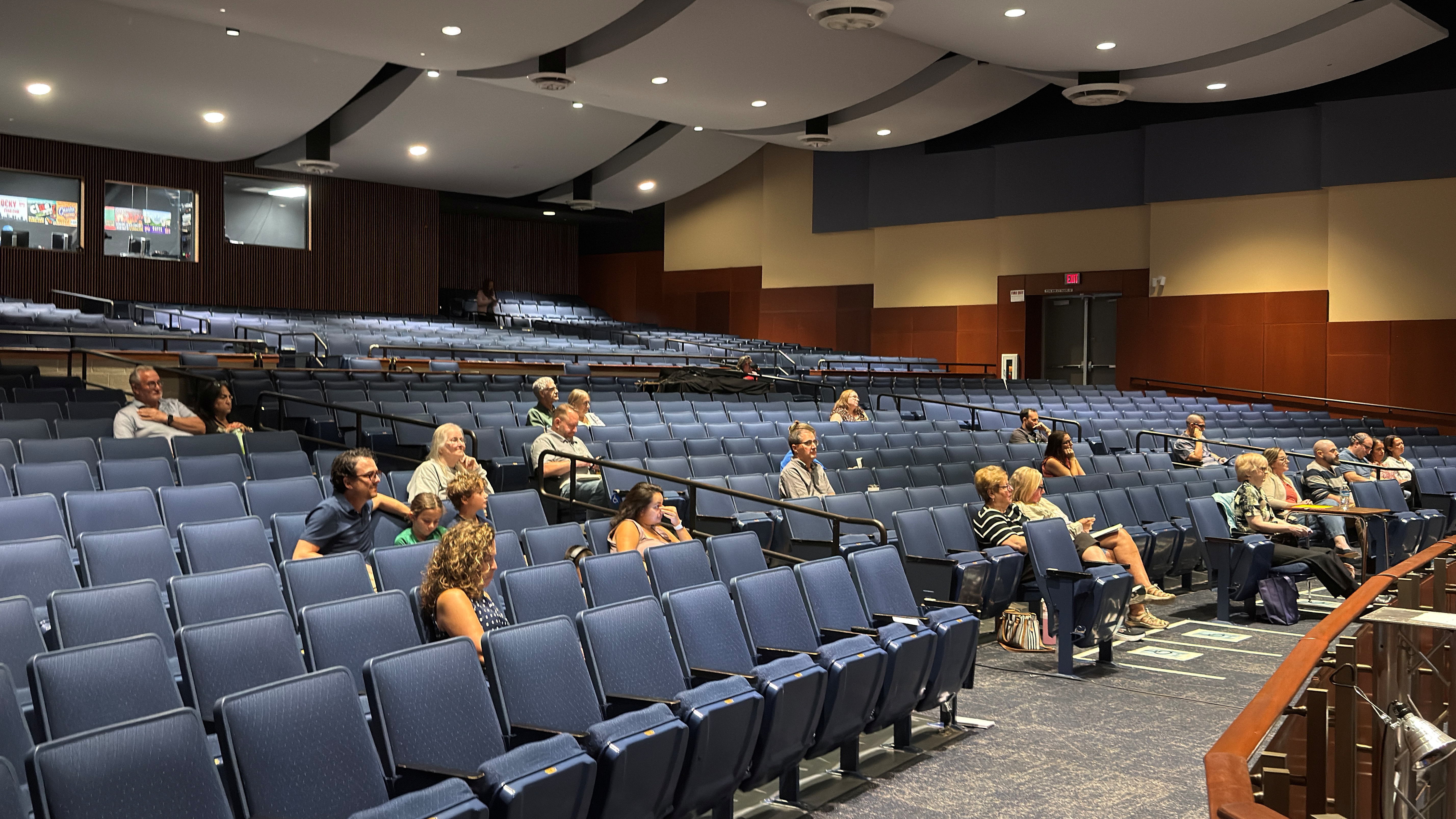
Seven out of eight candidates spent two hours making statements and answering questions in the cordial forum moderated by the League of Women Voters and hosted by the Cherry Hill Zone PTA at Cherry Hill High School West. One candidate could not make the event because of a work emergency, but his statement was read by the forum moderator. The in-person audience was small. The event also was livestreamed.
Money to pay for education in the future weighed heavily on each of the candidates.
“Every year, we’re trying to figure out how to maintain excellence with less and less and less,” incumbent candidate Renee Cherfane said.
The other incumbent running for reelection, Melissa Manzano, said the budget and state funding formula is “something that is really stressful to the community of Cherry Hill, to our teachers, to our community members and even trickles down to the students sometimes.”
None of the candidates offered solutions, with some pointing to the August announcement by Gov. Mikie Sherrill that directs the state Department of Education to pull together stakeholders in search of answers and “overhaul New Jersey’s school funding system.”
Cherry Hill leaders long have maintained the district does not get its fair share of aid. Adding to the problem is the uncertainty of the level of state aid year to year.
Candidate Steven Redfearn agreed the number one issue is funding, but he does not anticipate quick fixes from the Sherrill initiative.
That puts the focus on the district budget.
“I’m not going to wish and hope that funding can be solved within the next year with the task force, but my best guess would be we’re probably looking at … potentially going through a budget again this year and waiting for those solutions to the funding formula next year,” he said.
“Funding and the budget, I think, are of course the number one challenge that we’re facing, and that’s going to require a lot of creativity, coalition building, perseverance, because it’s not an issue that is going to be easily or quickly solved,” candidate Darby Malvey said.
But money is not the only challenge facing the district, the candidates said.
“Our second most-pressing issue of late seems to be the status of our special ed programs and how we’re running them and delivering services because we have too many parents coming to the mic telling us we don’t have something,” said candidate Anne Einhorn, referring to the public comment sessions at school board meetings.
Candidate Harold “Hal” Melleby Jr. said he was concerned about the decline in enrollment at Cherry Hill High School West. “I’m also very concerned about the academic program and standardized test scores, which have declined,” he added.
Like Melleby, candidate Ineda “Corrien” Elmore-Stratton said that among her top three issues was “academic achievement and the achievement gap that continues to grow and needs to consistently be addressed.”
Joseph Lynch could not attend the forum because of an emergency at his workplace. The League of Women Voters moderator read a statement from him.
Residents “deserve understandable budgets, earlier disclosure of financial challenges, careful oversight of contracts and transparent reporting on bond projects and associated costs,” Lynch wrote. “Special education requires particular accountability,” he added.
70and73.com is a hyperlocal news site focused on South Jersey, including the communities of Cherry Hill, Evesham, Mount Laurel, Voorhees, Medford, Medford Lakes, and Moorestown.
President Donald Trump remains determined to install warning signs outside the Smithsonian’s National Museum of American History to alert the public that the institution, in his view, does not accurately present U.S. history.
In letters to two senators, the Interior Department outlined a plan for 12 temporary signs to be installed at a total cost of $84,000. The letters did not specify the dimensions or language of the signs, which were originally ordered in July, but it went into considerable detail about the kind of information they plan to convey.
In the letter to Sen. Lisa Murkowski (R., Alaska), dated Sept. 3, Doug Burgum, the interior secretary, said he was responding to questions about Trump’s March 2025 executive order, “Restoring Truth and Sanity to American History.” The order described a “revisionist movement” across the country that it said “seeks to undermine the remarkable achievements of the United States by casting its founding principles and historical milestones in a negative light.”
Americans should enter the National Museum of American History “with relevant information about the curators’ interpretation of history and their stated goal of changing the viewpoints of visitors,” said the letter, which was earlier reported in the Atlantic on Tuesday. Instead, the letter argued, the museum and Smithsonian’s leaders “have altered the museum’s role from accurately and coherently telling America’s story to using the museum as a tool to advance personal, radical ideologies.”
“We believe the public should enter the museum fully equipped with the information needed,” the letter said, “to evaluate whether to invest their time viewing these exhibits and programming.”
The museum’s director, Anthea M. Hartig, has contested the thrust of a July 4 White House report that accused her of “radical activist ideology” and the museum of undermining “faith in American institutions.”
Although the letter said the language of the signs had not been finalized and gave no installation timeline, it described some of the topics they were intended to address, all of which had been outlined in the White House report.
For example, the letter said the signs should “ensure parents bringing young children to the museum are equipped to protect the well-being of their children” regarding exhibits that “present ideological viewpoints inconsistent with biology, including ideologies that sex is not binary, that biological men can be women, and that biological men should be permitted to compete in women’s sports.”
Burgum’s letter said a copy had also been sent to Sen. Jeff Merkley (D., Ore.).
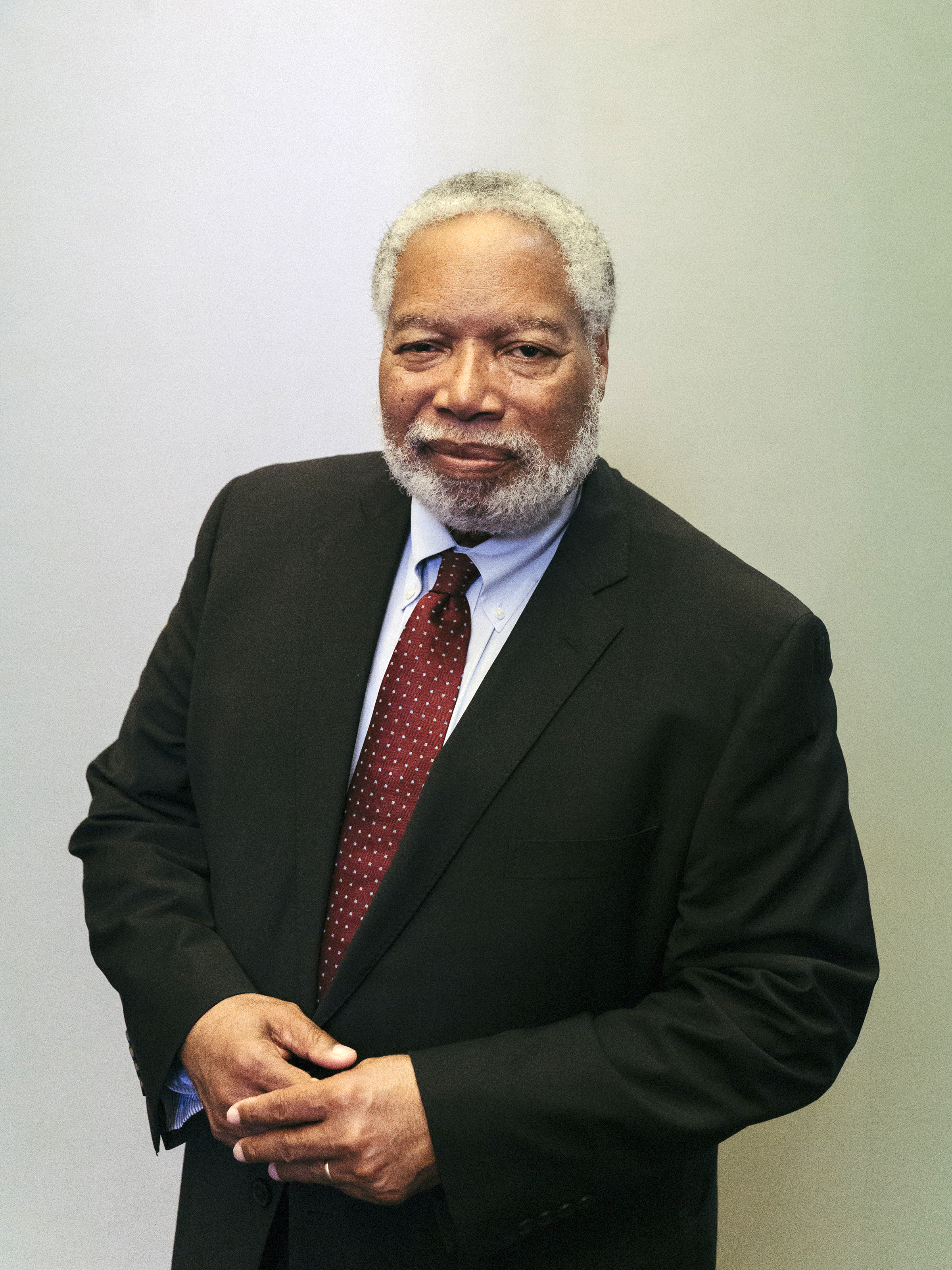
In laying out a case for the signs, the letter was particularly critical of the Smithsonian’s secretary, Lonnie Bunch III, who announced his resignation last week.
“Visitors should be aware of Smithsonian Secretary Lonnie Bunch’s history of invidious discrimination and anti-white animus,” the letter said, citing a 2000 essay in which Bunch “described the museum profession as ‘awash in whiteness’; wrote that ‘the real issue is not money but the monochromatic nature of our institutions’; and stated, ‘until we change the tint and tone of our workforce, we are just dancing around the edges of our greatest failure.’”
Bunch and the Smithsonian did not immediately respond to requests for comment.
Mike Gonzalez, a senior fellow at the conservative Heritage Foundation who has written critically about the Smithsonian, welcomed progress on the signage in an interview. “It is in the interest of transparency that museum visitors be warned in advance of the ideological baggage that the Smithsonian leadership has heaved on these exhibits,” he said.
The letter also took aim at Hartig. “It is disheartening,” the letter said, that “Hartig has stated that history is ‘a prime tool of social justice’; that she views one of her roles as connecting ‘research and scholarship to activism and advocacy.’”
Trump originally ordered the signs just days after Republican legislators grilled Hartig in two congressional hearings, where she was accused of teaching “national self-loathing.”
Hartig, in those hearings, insisted that the report “does not fairly or accurately characterize the full body of work at the museum” while acknowledging that “there is always room for improvement.”
“When historians talk about reframing a traditional narrative, we don’t mean erasing it,” she continued. “We mean adding the evidence, the voices, the objects that earlier tellings left out so that more Americans can see themselves reflected in the national story.”
A prominent Center City personal injury lawyer, known for his active TikTok account, choked his girlfriend and threw her to the ground during a dispute on a walking path in Lower Merion, according to police.
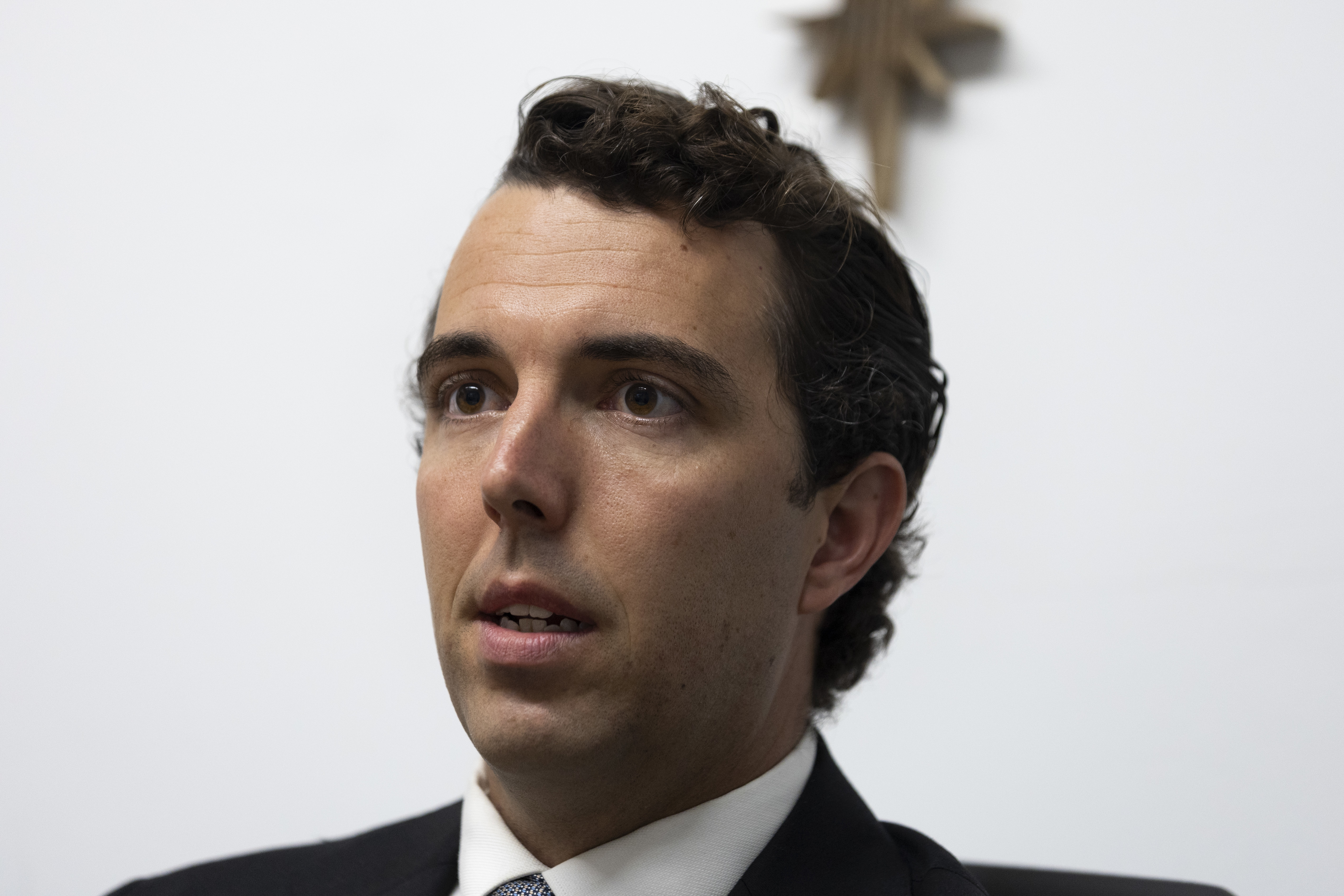
Thomas Bosworth, 37, has been charged with simple assault and harassment in connection with the Sept. 3 incident. He was released on $15,000 unsecured bail.
Bosworth, a resident of Gladwyne, did not respond to a request for comment. His attorney, Michael van der Veen, said in a statement that Bosworth “is presumed innocent, maintains his innocence and has full confidence in the courts.”
In the years since, he has opened his own law firm amid accusations from his former employer that he poached its clients and sanctions for his behavior from a federal judge.
Meanwhile, he has expanded his social media following through videos that give advice on everyday goods from his vantage point as a personal injury lawyer and the context for high-profile lawsuits he litigates.
On the day of the Lower Merion assault, four people told police they saw Bosworth attacking a woman on a section of the Cynwyd Heritage Trail behind Union Avenue in Bala Cynwyd, according to the affidavit of probable cause for his arrest. After choking the woman, the witnesses said, he threw her into bushes along the path, then walked away as she screamed.
The witnesses also said the woman slapped Bosworth and threw rocks at him while on the ground next to the trail, according to the affidavit.
Officers responding to the call found the woman with “redness on her cheeks and discoloration of the skin around her neck,” the document said. She told the officers she had fallen, and declined to speak with them further, as did Bosworth.
Witnesses later told police they overheard the couple arguing about Bosworth’s alleged infidelity, and the dispute escalated when the woman mentioned a text thread from his secretary he had deleted.
The assault took place in front of the couple’s newborn daughter, who was with them in a stroller, the affidavit said.
A judge ruled that attorney Tom Bosworth could keep displaying two TikTok videos critical of Penn Medicine, including the one from which this image is taken, in which he alleges that the health system’s radiology department is understaffed.
Bosworth’s arrest was not the first time in recent years that he has been the subject of scrutiny.
His separation from Kline & Specter in 2022 led to an ugly court dispute between the prestigious firm’s partners and their former young associate.
Tom Kline and Shanin Specter accused Bosworth of poaching clients, which he denied, and in return accused his former bosses of defamation. The parties reached a settlement in 2024 but have returned to court multiple times since, accusing each other of violating the agreement.
Kline and Specter are not the only ones who took issue with Bosworth’s conduct in the courtroom or online.
In 2023, Penn Medicine asked a Philadelphia judge to order Bosworth to stop posting on social media about a medical malpractice case he filed against the health system, saying he misrepresented facts and “poisoned” the potential jury pool. The judge sided with Bosworth.
That same year, a federal judge sanctioned Bosworth for “misconduct” during four expert depositions in a product liability case, saying the lawyer was “rude, demeaning, and obnoxious” to a female defense attorney.
And last week, the Pennsylvania Superior Court called Bosworth’s conduct in the courtroom “deplorable” even as it upheld the $19.7 million verdict he won while at Kline & Specter.
Bosworth had been accused of repeatedly ignoring the instructions of a Philadelphia Common Pleas Court judge during a medical malpractice trial in an attempt to inflame the jury.
“The courtroom is one of the only places left in our democracy where the everyday person can hold to task wrongdoers, no matter how rich powerful,” he said.
Bosworth is scheduled to appear for a preliminary hearing in the assault case Oct. 6.
It learned after the academy announced its museum was closing thatthe building is “alone among the historic cultural institutions on the Parkway” as not designated historic by the city, said Paul Steinke, executive director of the Preservation Alliance.
The museum is scheduled to close at the end of the month, and the academy plans to eventually relocate its collections and sell its building. The property’s zoning allows for low-rise, low-density residential buildings, such as townhouses or small apartment buildings. According to city records, the property’s assessed value is more than $28.7 million.
According to the Philadelphia Historical Commission, the academy considered pursuing historic designation for the building in the late 1980s but ultimately did not. On Wednesday, a spokesperson for the commission said it does not have a nomination from anyone in hand.
City Councilmember Jeffery Young Jr., whose 5th District includes the academy, said his office is looking into possible zoning changes to “protect and preserve that Parkway district,” including the academy’s building.
“We want to be able to utilize every tool we have available if necessary” to “preserve that public good in that area,” Young said.
Why hasn’t the building been designated historic yet?
“It wasn’t thought to be threatened, for one,” Steinke said. Designation happens only when someone takes the initiative to submit a nomination to the city, he noted, and that is commonly spurred by threats of redevelopment.
He pointed to another iconic Philadelphia spot that most people assumed was historically protected until a developer made plans to redevelop it: Jewelers Row, the oldest diamond district in the country.
In late 2019, Toll Bros. demolished several buildings on the 700 block of Sansom Street to build a 24-story housing tower that did not materialize. Developer Pearl Properties, which later took over the site, started making visible progress on its own housing tower this summer following years of delays.
For the academy’s building, Steinke said, the Preservation Alliance is looking into what it would take to do the necessary research, write and submit a nomination, and take it through the city’s historic designation process, which includes review by historical commission staff and public consideration by the commission and its committee on historic designation.
“We think it clearly qualifies for local designation,” Steinke said.
In the early 1900s, the academy building’s facade was redesigned in the Georgian style by the well-known Philadelphia firm Wilson Brothers & Co. Defining features of this architectural style include heavy use of red brick, symmetrical facades, centered entrances, and simple decorative elements, according to Steinke.
The academy said financial pressures and low attendance drove its decision to close the museum after nearly two centuries.
But Steinke said he hopes the outpouring of love and support people have been showing the museum since the closure was announced can help keep it where it is. When he visited on Sunday, he said, he “was heartened by the crowds of people, the families enjoying it.”
“It would be a real loss to lose that museum at the start of the museum mile,” Steinke said, referring to the section of the Parkway that hosts institutions such as the Rodin Museum, Calder Gardens, and the Philadelphia Museum of Art.
On Thursday, Councilmembers Young and Nina Ahmad plan to introduce a resolution that calls for Council hearings on the museum’s closure. They are also planning a rally to protest the closure at City Hall that morning.
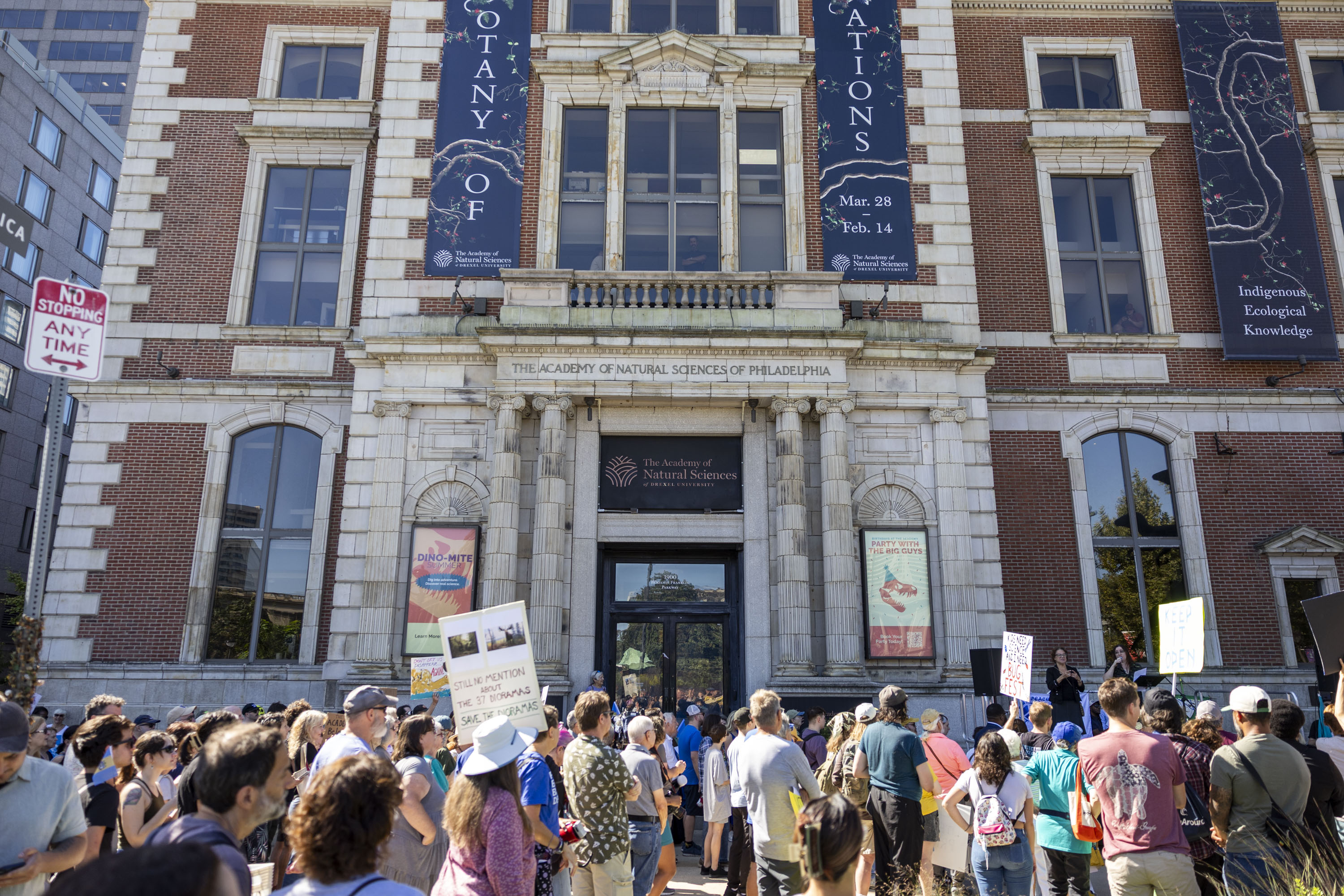
People came out to support and rally outside the Academy of Natural Sciences of Drexel University on the Benjamin Franklin Parkway on Sept. 8.Tyger Williams / Staff Photographer
A war-damaged building in the Gaza Strip collapsed Wednesday, killing at least 21 people, including children, and trapping many more beneath the wreckage, according to local officials.
The incident shines a light on the perilous conditions in Gaza after the devastating war that followed the Hamas-led attacks on Israel on Oct. 7, 2023. Officials have warned that many more damaged buildings are at risk of collapse. The lack of progress on reconstruction has forced residents to choose between living in seriously compromised buildings or in tents.
Dozens of people were living in the Saada residential building in Gaza City when it caved in around 2 a.m. local time, according to the Civil Defense rescue service, which is part of the Hamas-run Interior Ministry in Gaza.
The officials added that the building had previously been hit by an Israeli strike, though it was unclear when. The Israeli military did not respond to a request for comment.
Search-and-rescue teams pulled survivors from the wreckage Wednesday morning as they searched for missing residents.
“We can see people still trapped under the rubble,” said Raed al-Dahshan, director of Civil Defense in the Gaza City area. “We’re doing everything we can to extract them.”
Al-Dahshan said authorities in Gaza had warned residents that the building was unstable, but that many did not leave because they did not want to be displaced and potentially end up in worse conditions. He added that there were roughly 70 buildings in the Gaza City area at risk of collapse.
Humanitarian groups warned that there could be more such deaths in the coming months.
“With the heavy rains and winds of winter approaching, the risk of damaged buildings collapsing will only increase, putting more lives in danger,” Pat Griffiths, a spokesperson for the International Committee of the Red Cross, said by telephone from Gaza.
“Choosing between life in a tent — with little privacy or space and exposed to harsh weather — or a building that is damaged and at risk of collapse, just to have a roof over one’s head, is not a choice any family should have to make.”
The deadly collapse underscores the devastation across Gaza after years of war, which has left entire neighborhoods in ruins. Much of Gaza’s population was displaced by the conflict, and many are now living in damaged buildings.
After a U.S.-brokered ceasefire agreement was reached in October 2025, Palestinians had hoped that Israel would allow a significant amount of heavy machinery and construction materials into Gaza to begin the long process of removing rubble and rebuilding the territory. Thousands of bodies from the war are still beneath the rubble across Gaza, according to local officials. On Tuesday, the United Nations human rights chief called for international investigators to be allowed into the enclave to recover the remains of Palestinians from beneath damaged buildings.
Efforts by President Donald Trump’s Board of Peace and regional mediators to advance the ceasefire and pave the way for reconstruction have stalled. Israel has continued to target the territory, despite international pressure to halt its attacks there.
On Tuesday, an Israeli strike killed a Civil Defense worker and a teenager, according to an official in the rescue service. The Israeli military said it had been targeting Hamas militants, and that the attack was under review.
The International Committee of the Red Cross and Egyptian-backed rescue teams assisted local emergency crews Wednesday in their search for survivors of the building collapse.
In a statement, Ramiz Alakbarov, the U.N. humanitarian coordinator for the occupied Palestinian territory, urged international authorities to allow heavy equipment into Gaza to assist in search-and-rescue operations, along with humanitarian aid.
“Every possible effort must be made to save lives, protect people from further harm and provide families with safer places to live,” he said. “Every minute counts.”
A brother and sister died Wednesday in what investigators are calling a murder-suicide at a Pennsauken home, according to the Camden County Prosecutor’s Office.
Janet Camacho, 59, was found on the front steps of the home at 4400 Bethel Avenue with a gunshot wound around 9 a.m., after police responded to reports of a shooting. Police were also told, investigators said, that a male suspect armed with a handgun was at the residence.
Camacho was taken to Cooper University Hospital, where she was pronounced dead.
About 10:37 a.m., police found Camacho’s brother, Daniel Lopez, 60, dead inside the house with a self-inflicted gunshot wound.
Both siblings were Pennsauken residents, but investigators did not say whether either lived at the home where the shooting occurred.
Many people have a cartoonish idea of narcolepsy, perhaps picturing someone falling asleep standing up.
What people don’t understand is that sleepiness can infiltrate every aspect of daily life, said Julie Flygare, 42, who was diagnosed with the sleep disorder in 2007, during her second year of law school. It interferes with memory, attention, and weighs down everyday existence like a “heaviness on the skull,” she said.
While taking her current medications, Flygare has four to six precious hours of wakefulness a day, and still needs a nap. Positive feelings, like, say, the joy of hitting a volley in tennis, trigger episodes of cataplexy; her muscles go slack and her grip on the racket loosens. She, like many other patients, struggled for years to be correctly diagnosed and to find the right combination of stimulants or other drugs to ease her symptoms.
Since then, Flygare has been waiting, and pushing for, a drug aimed not just at alleviating sleepiness, but at replacing a crucial missing brain chemical. Last month, she saw it happen. A first-of-its-kind drug for the sleep disorder narcolepsy was approved by the Food and Drug Administration, offering a new treatment for people who live with the debilitating fog of sleepiness.
The new drug developed by Takeda Pharmaceutical Co., called Orzeyful, marks a long-sought success in the quest to mimic an essential brain peptide called orexin, which is missing in people with type 1 narcolepsy. About 120,000 people in the United States suffer from this type of narcolepsy, which causes pervasive sleepiness and episodes of cataplexy. Other companies, including Alkermes and Eli Lilly, are chasing close behind.
To test narcolepsy treatments, doctors use a “maintenance of wakefulness test” in which a person sits in a dim room for 40 minutes.
“You have to stay awake. You cannot read, you cannot watch TV, you cannot talk,” said Emmanuel Mignot, a sleep researcher at Stanford University and one of the leaders of the trial testing Orzeyful. “For a normal person, it’s already tough; for a person with narcolepsy, it’s impossible.”
Before treatment, patients fell asleep within four to five minutes, according to a study published Wednesday in the New England Journal of Medicine. In two late-stage trials, nearly 300 patients between the ages of 16 and 70 received either Orzeyful or a placebo for 12 weeks. On Orzeyful, they could stay awake for more than 20 minutes — about twice as long as currently available medications, according to Thomas Scammell, a sleep researcher at Beth Israel Deaconess Medical Center in Boston.
Scammell, who was not involved in the study, said he thought that the drug could be “transformative.” Patients taking the drug have reported developing hobbies for the first time; dancing, playing ice hockey or spontaneously socializing.
Flygare participated in one of the trials testing Orzeyful and recalled that when she was dropped off at the site for her first visit, she had been unable to think clearly and could barely walk because she was off her medications. (It is necessary to have a “blank slate” to test the effects of a new drug.)
Later, when the same driver picked her up after she’d started the medication, she remembers making a joke. It’s the kind of casual, offhand human interaction that would typically have triggered her cataplexy and made her knees buckle.
“The wakefulness had a different tone to it; it felt sunnier” compared to her experience with stimulants, said Flygare, who founded a nonprofit called Project Sleep that raises awareness of sleep disorders. The nonprofit receives funding from drug companies, including Takeda, and last year, Flygare served as a consultant to the company on patient perspectives in clinical trials.
Orzeyful is a pill taken twice a day. It will not be available until the Drug Enforcement Administration determines its classification as a controlled substance, which is expected to occur by November.
Physicians are thrilled to have a new tool, but there remain many unknowns: How well will it work long-term? Will a drug that activates orexin receptors alter people’s risk for other neurological diseases?
The long road to the new drug began more than two decades ago, when scientists first discovered that people with narcolepsy lacked orexin.
Orexins are produced by brain cells and work like a key fitting into a lock, by binding to two different receptors on the surface of cells in a region of the brain called the hypothalamus. Blocking the lock, like sticking a piece of tape over it, was a straightforward drug development problem and several insomnia treatments based on this idea have been approved. But designing a key that opened the lock required more finesse.
“It’s hard,” said Andrew Plump, president of research and development at Takeda. The drug is an “agonist” that must activate the receptor by binding to it, imitating what naturally occurring orexin does.
The second problem was that narcolepsy is rare.
“They said our science is very interesting and exciting, but narcolepsy, after all, is one in several thousands — not very rare, but not very common,” said Masashi Yanagisawa, a molecular biologist at University of Tsukuba in Japan who led one of the teams that discovered orexin in 1998.
A Takeda scientist who had a friend with narcolepsy initiated the project by screening a vast library of molecules for promising hits. “We got one,” Plump said. “And nobody in their right mind would ever start a drug discovery program with a single hit.”
The scientist was so passionate that the work began, but it wasn’t a slam dunk. An early version needed to be administered by IV. Another candidate caused liver injury.
Other companies are following close behind. Beyond sleep, the approval sets off a race to develop a new class of medicines that show early hints of promise in a host of ailments, from ADHD to neurodegenerative diseases.
Alkermes has a similar drug in late-stage testing against narcolepsy. Blair Jackson, CEO of the Dublin-based company, said it has identified 19 areas within neuroscience where such drugs could have potential. Eli Lilly recently agreed to pay up to $7.8 billion for Centessa Pharmaceuticals, a biotech company with similar drugs in the pipeline.
“Sleep is the low-hanging fruit,” said Luis de Lecea, a molecular biologist at Stanford and part of the team that also discovered orexin — though they called it hypocretin — in 1998. Narcolepsy patients lack orexin, but it also declines with Alzheimer’s disease, Parkinson’s disease, PTSD, and even normal aging.
Wall Street analysts have drawn hopeful comparisons to the GLP-1 drugs, which started out as diabetes treatments, then expanded into weight loss and are now being tested against a slew of diseases.
Flygare is hopeful, too. She began organizing sleep awareness walks with just a few friends, at a time when drug companies had little interest in the field.
“This has been feeling like such a full circle moment for me,” she said.
To Denise Burgher, co-organizer of this weekend’s 2026 Colored Convention Conference, the attack on civil rights and Black history under President Donald Trump’s administration is chilling.
Among the most egregious, she said, were his attempts to repeal the 14th Amendment, the Reconstruction-era addition to the Constitution guaranteeing citizenship to anyone born in the United States. In June, the Supreme Court upheld birthright citizenship.
“The 14th Amendment overturned the Dred Scott Decision of 1857 ruling Black people — freed or enslaved — do not have the same rights as [their] white counterparts,” Burgher said. “Without that protection, Black Americans’ citizenship would be in question. Don’t think that could happen? We thought a woman’s right to chose was set in stone, too.”
A flyer advertising the 2026 Colored Convention: Black Freedom Movements Then and Now.2026 Colored Convention Committtee
Burgher went on: Last week Trump threatened to snatch the tax exempt status from private schools that give minority students access to scholarships and educational programs, including at historically Black colleges and universities like Howard and Hampton.
It’s clear Black equality in this political climate is not guaranteed.
“We haven’t seen a threat like this on Black livelihood in this country since the post-Reconstruction era,” said Burgher, who is also the director of community engagement and curriculum development at Penn State’s Center for Black Digital Research. “This part of American history was a part of our past, now, it is not so suddenly aggressively and nakedly a part of our present.”
A 19th-century America, she said, calls for 19th-century tactics.
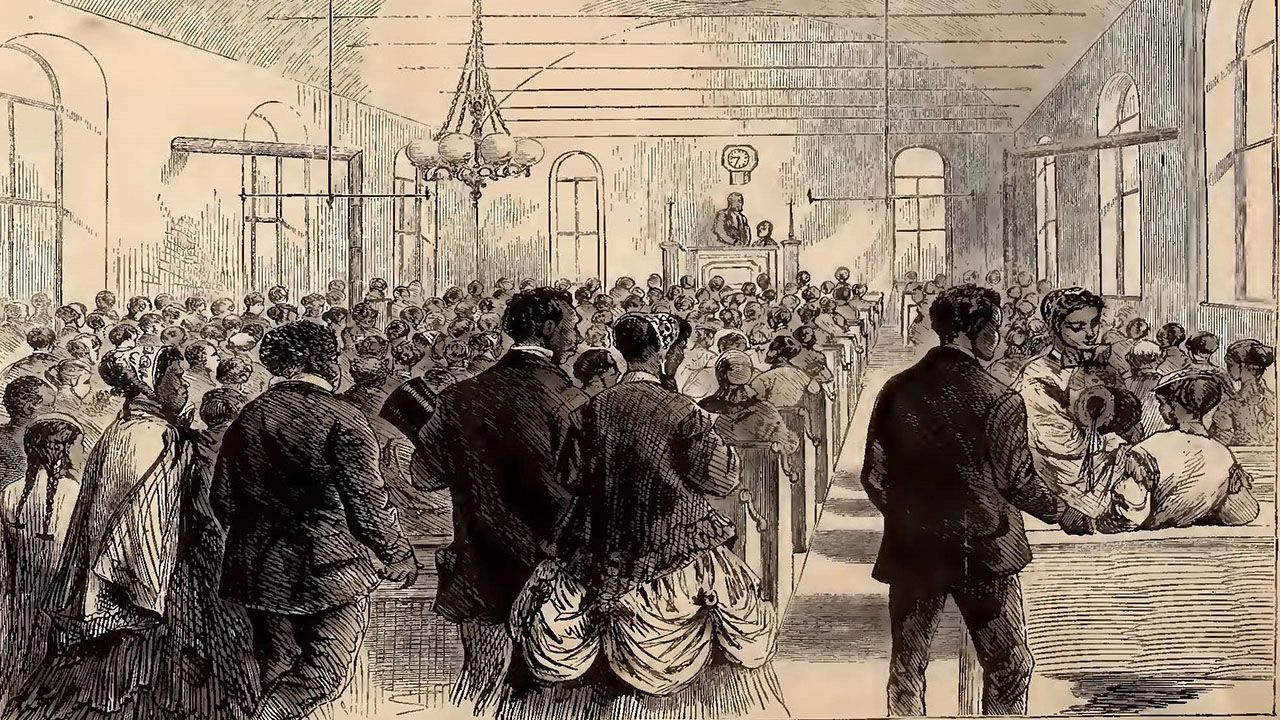
This weekend, Mother Bethel AME will host the “2026 Colored Convention: Black Freedom Movements Here and Now,” a celebration of the first Colored Convention held almost 200 years ago at the church. Dozens of influential free Black clergymen, statesmen, and activists convened at the 1830 Colored Convention and laid the foundation for civil rights groups like the Niagara Movement and the NAACP.
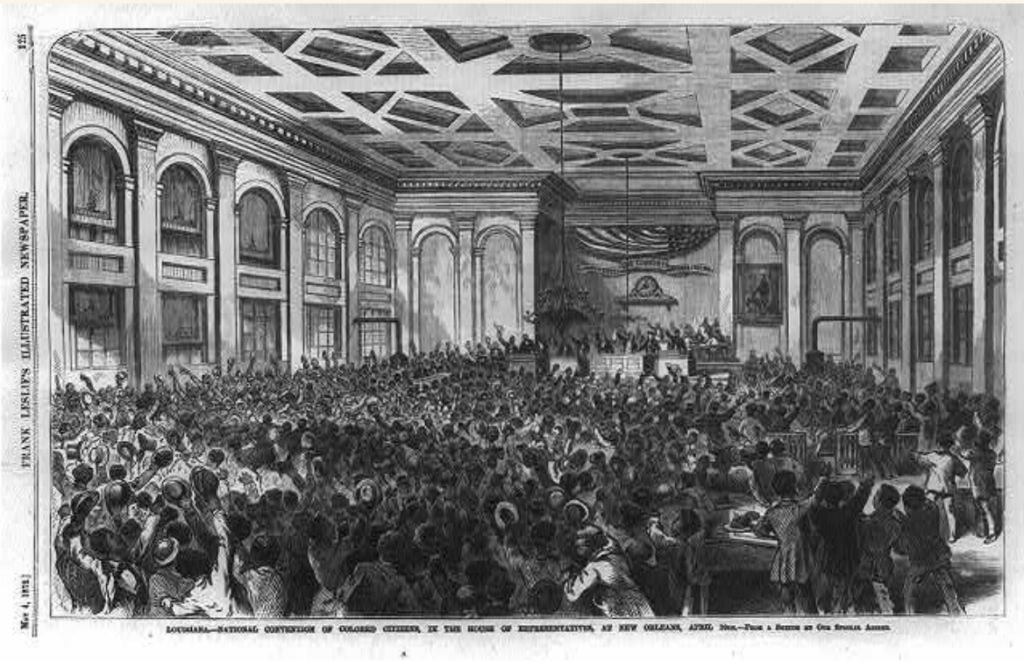
This print from Frank Leslie’s Illustrated Newspaper depicts the National Convention of Colored Citizens’ meeting in the House of Representatives in New Orleans, in April 1872.The Library of Congress
These organizations agitated for civil rights through the Civil War, Reconstruction, Jim Crow and into the 1960s, said Carolyn C. Cavaness, Mother Bethel’s pastor who tapped Burgher and Derrick Spires, historian and associate professor of English at the University of Delaware, to reignite the Colored Convention’s legacy.
“To reclaim and be challenged by such a movement … is of much worth and esteem,” Cavaness said. “We are literally in a struggle now for equality and fairness of all people.”
This weekend’s Colored Convention will feature workshops on genealogy, activism, and the 18th- and 19th-century Black press. Philadelphia school children will attend Thursday for arts and crafts projects that will teach them about the history of the Colored Convention.
Andre E. Johnson, codirector of the Colored Conventions Project and professor at the University of Memphis, will deliver the keynote on the history of the Colored Convention and share how activists can apply 19th-century action plans to 21st-century technology to create a strategy to combat the present crisis.
“In this year of the Semiquincentennial, this is yet another opportunity for Philadelphians to pay attention to history,” Burgher said, “and look at strategies our ancestors used more than 100 years ago. I’m not going to say the same thing is happening, but the events sure do rhyme.”
The event will include a voter-registration drive, emphasizing the importance of voting in the midterms.
Richard Allen founded Mother Bethel in 1794, and by 1830, the church was the cornerstone of the largest free community of African Americans in the country.
In August of 1829, white mobs burned Black businesses and neighborhoods during the Cincinnati Race Riots. In response to the brutal loss of life and business, free man Hezekiah Grice wrote to Allen, asking the influential pastor to gather free Black intellectuals to strategize. His reasoning was, if white mobs could do this in Cincinnati, what’s to stop them from attacking Black communities everywhere else.
More than 2,000 Black people from Cincinnati moved to Canada. The first Colored Convention was held from Sept. 20 to Sept. 24 in 1830 at Mother Bethel, resulting in emissaries from Philadelphia asking the Canadian government to allow Black people to establish communities there.
The Colored Convention held annual meetings at Mother Bethel from 1831-85. By the turn of the 20th century, there were Colored Conventions regularly in nearly every major American city along the Northeast Corridor, in the Midwest, and along the West Coast.
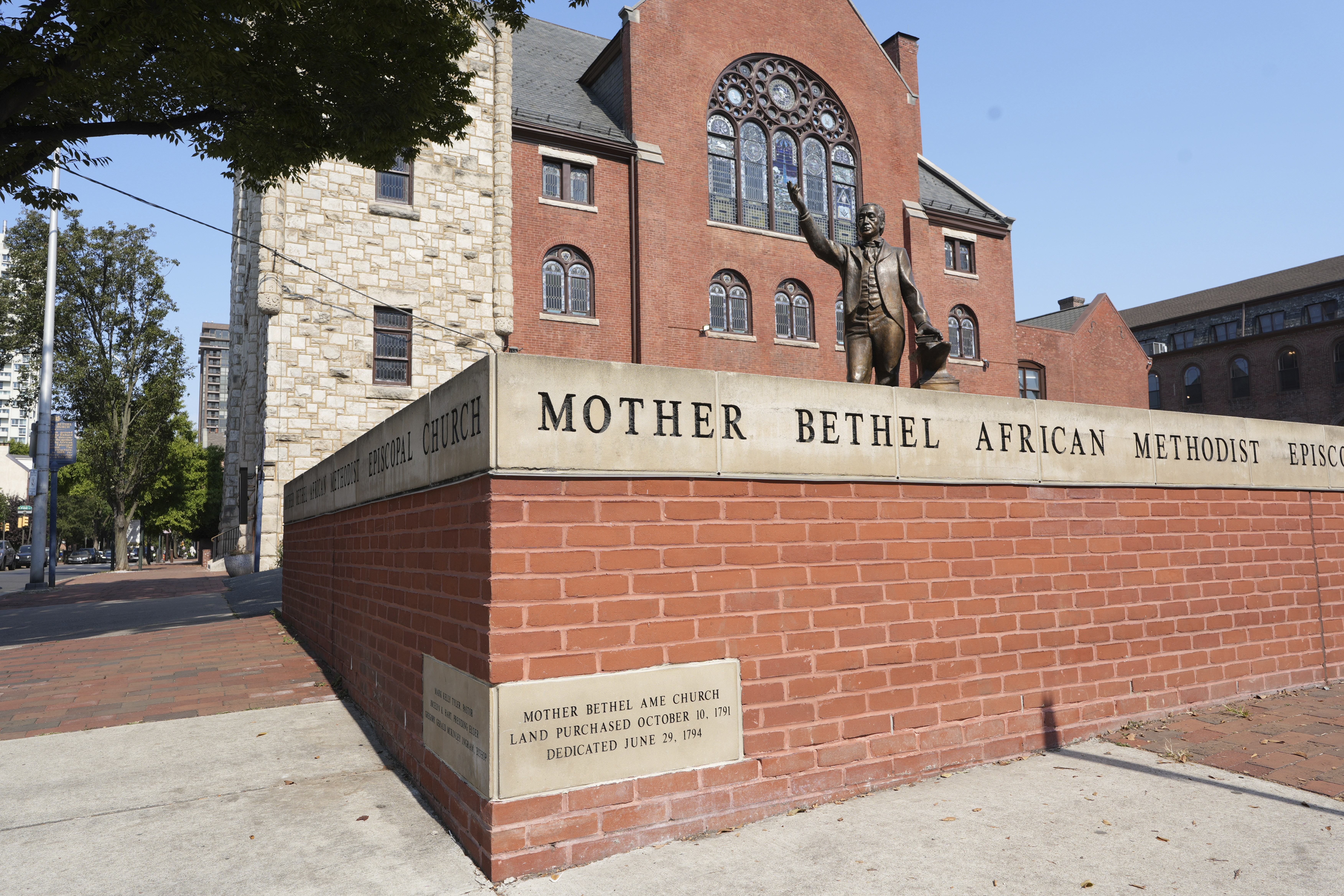
A statue of Mother Bethel AME Church founder Richard Allen stands on the oldest parcel of land continuously owned by Black Americans in Philadelphia on Oct 13, 2024. (AP Photo/Luis Andres Henao)Luis Andres Henao
Black leaders from every walk of life attended, among them Frederick Douglass — known as the Lion of the Convention because of his deep oratory voice and big, distinctive hair — poet Frances Ellen Watkins Harper, newspaperman T. Thomas Fortune, and Philadelphia educators Jacob C. White and Charles L. Reason.
Colored Conventions, Burgher said, became forums for Black leaders to discuss abolition, fugitive slave laws, voting rights, and education. Many Black institutions were born from these conventions, including the charters for Talladega University and Howard University Law School, established in 1865 and 1869, respectively.
The last Colored Convention on record was in 1972 in Newark, N.J., Burgher said.
“I hope this 2026 celebration will not only bring this history home,” Burgher said. “And I also hope it inspires Philly residents to respond to the current moment like history has taught us.”
Two Philadelphia-area robot developers who have sought more contracts from the rapidly increasingU.S. military budget have detailed growth plans with new investments.
Asylon also helps run drone-based security systems for the Air Force and for civilian clients, including Citizens Bank.
Bosch Ventures says it typically spends up to $30 million to buy up to 25% of each company it targets for investment.It has not confirmed how much it has pledged to Asylon.
Bosch, which has branch offices in the U.S. and Israel, made its bet on Asylon after its Bosch Building Technologies affiliate became a user of Asylon’s DroneIQ platform.
That placed Asylon’s birdlike Guardian flying drones and DroneDog systems in position to detect and respond to intruders and other threats at Bosch’s building security and safety clients. Asylon’s DroneDog systems are typically clipped onto Boston Dynamics’ doglike Spot robots.
Even before the latest investment, the relationship with Bosch helped Asylon in “connecting traditional alarm infrastructure with autonomous robotic response,” Damon Henry, Asylon’s founder and CEO, said in a statement.
Bosch’s investment “will accelerate our path” to better production and lower costs “for some of the most demanding [clients] in the world,” he said.
By combining autonomous aerial and ground systems with intelligent software, Asylon is bringing robotics into demanding real-world environments, Ingo Ramesohl, co-managing director at Bosch Ventures, said in a statement.
Separately, Malvern-based Rajant on Sept. 14 said it had purchased Bellwether Group, a military and spy agency contractor run by the husband-and-wife team of Tim Teal, a Navy veteran and former U.S. Cyber Command and National Security Agency manager, and Shana Teal, an information scientist, based in suburban Washington, D.C.
The Teals, who have “top secret” military clearance, according to Rajant, will report to Rajant co-founder and CEO Robert J. Schena. They can help Rajant land contracts “in areas we couldn’t reach before,” Schena said in a statement. The cost of the acquisition wasn’t disclosed.
Tim Teal, now Rajant’s chief mission and capability officer, in a statement called Rajant’s technology “extraordinary,” adding that “the opportunity now is to connect those capabilities directly to mission” and “deliver capabilities that make a meaningful difference for the warfighter.
Shana Teal, who holds an information technology Ph.D. from the University of North Carolina at Charlotte, was named Rajant’s chief scientist. Besides her career in data analytics, she has experience working within “highly cleared government environments,” Rajant said in a statement.
Rajant, founded in 2002, has developed communications systems for NFL coaches and for mines in remote areas of South America’s Andes Mountains, among other clients.
The company’s Kinetic Mesh broadband communications system was developed to operate without needing to be part of an outside communications grid.
Jaaqua Hunt, a longtime teacher, has a favorite saying that she shares with her students and with her son Jalyx, the third-year Eagles outside linebacker — “blossom where you’re planted.”
“You don’t have to originate in a place to become a part of that place,” she said. “So, take advantage of where you are.”
Jaaqua said it’s become clear that Jalyx is listening.
He isn’t native to Philadelphia. He was born in Memphis, Tenn., but he spent his adolescence in the Orlando, Fla., area, then moved with his family back to Tennessee, then to Maryland, then to South Carolina, then back to Florida.
In Philadelphia, though, Hunt has found a new home — and an extended family off the field.
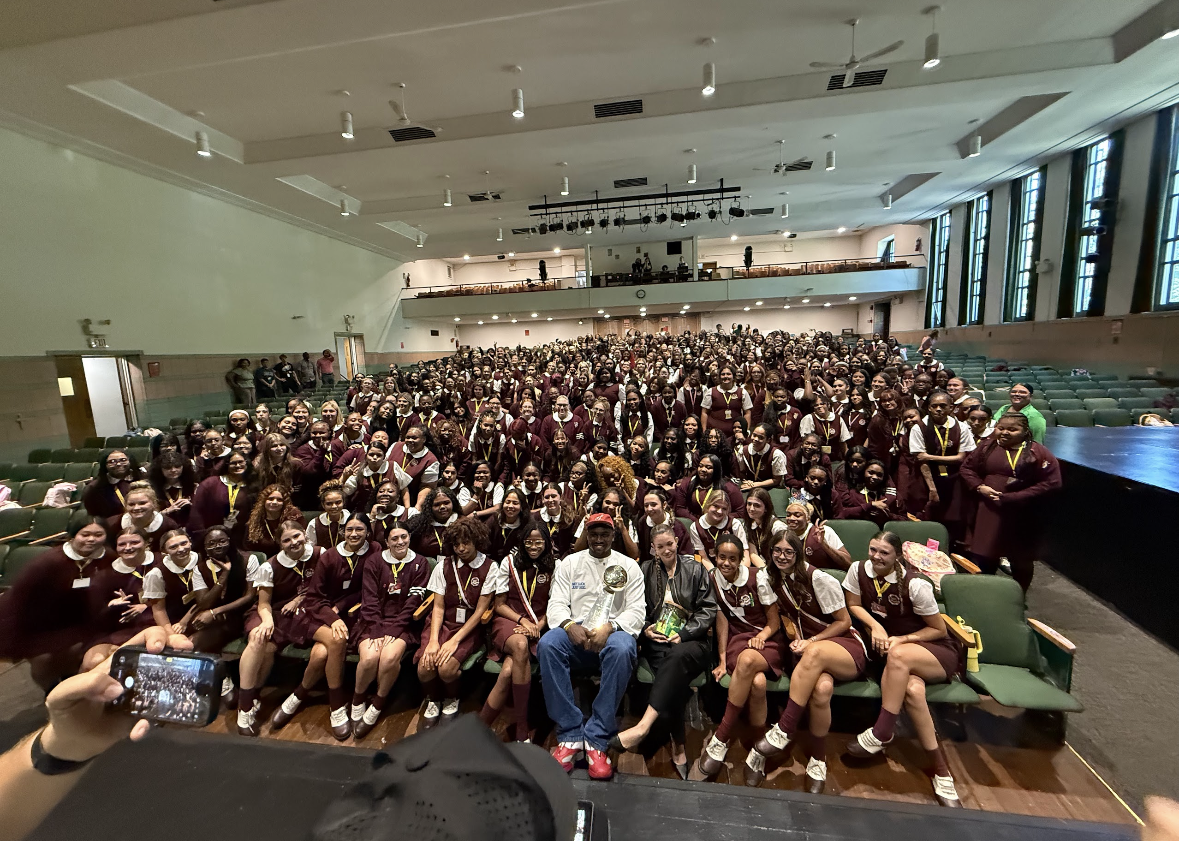
Hunt has an older sister, Jessica, and what he calls a “whole bunch of little sisters” in the hundreds of students at Little Flower Catholic High School for Girls in the Hunting Park section of North Philadelphia. His relationship with the school began in 2024, the year the Eagles drafted him in the third round out of Houston Christian, when he started a fundraiser for underfunded school sports programs. Little Flower’s basketball team raised their hands.
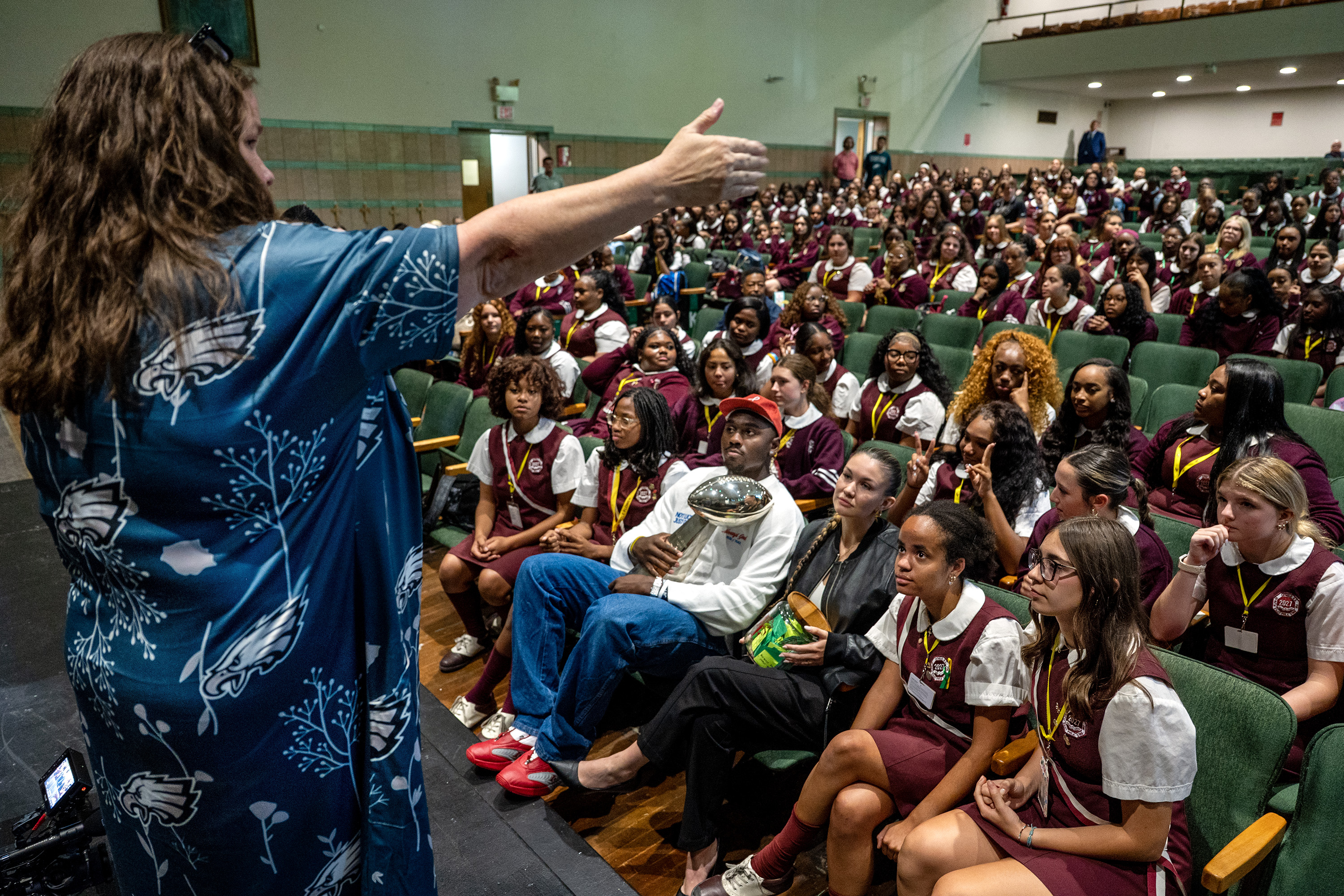
Eagles linebacker Jalyx Hunt holds the Lombardi Trophy while school president Kristie Dugan addresses Little Flower students on Tuesday. Tom Gralish / Staff Photographer
Two years later, Hunt hasn’t forgotten about the students. On Tuesday afternoon in the school auditorium, he announced the establishment of three scholarships and an endowment to support the Little Flower students. One of the scholarships will cover two years of tuition, while two others will cover all four. The endowment will help generate interest to fund future scholarships.
The scholarships and the endowment have extra importance to Hunt. They’re each named after important women in his life — his mother, his sister, his grandmother, Alice, and his marketing manager and longtime friend, Rachel Booth. The initiative aims to honor the women who have made an impact in his life, all while uplifting the next generation.
“This is longevity,” Hunt said. “I’ve had a lot of talks with [Little Flower president Kristie] Dugan, and I just know that this is something that helps out a lot. A lot of people at this school require and need some sort of help to pay tuition, and if I can do that, I would love to do that.”
Getting involved with the Little Flower community has had a grounding effect on Hunt, which he said has been particularly important as he develops his sense of self as a player and as a person in Year 3 of his NFL career.
“Outside of football, I know that I need to do things that remind me of myself,” Hunt said. “And one thing is giving back.”
Jalyx Hunt (seated in front row) has become an active member of the Little Flower community.Olivia Reiner
‘It makes our community feel seen’
Laniah Brooks, a 16-year-old junior at Little Flower, expected to have a typical school day Tuesday. She expected to attend her eight classes and go home in the afternoon.
But her sense of normalcy shifted when she was called into Dugan’s office during eighth period.
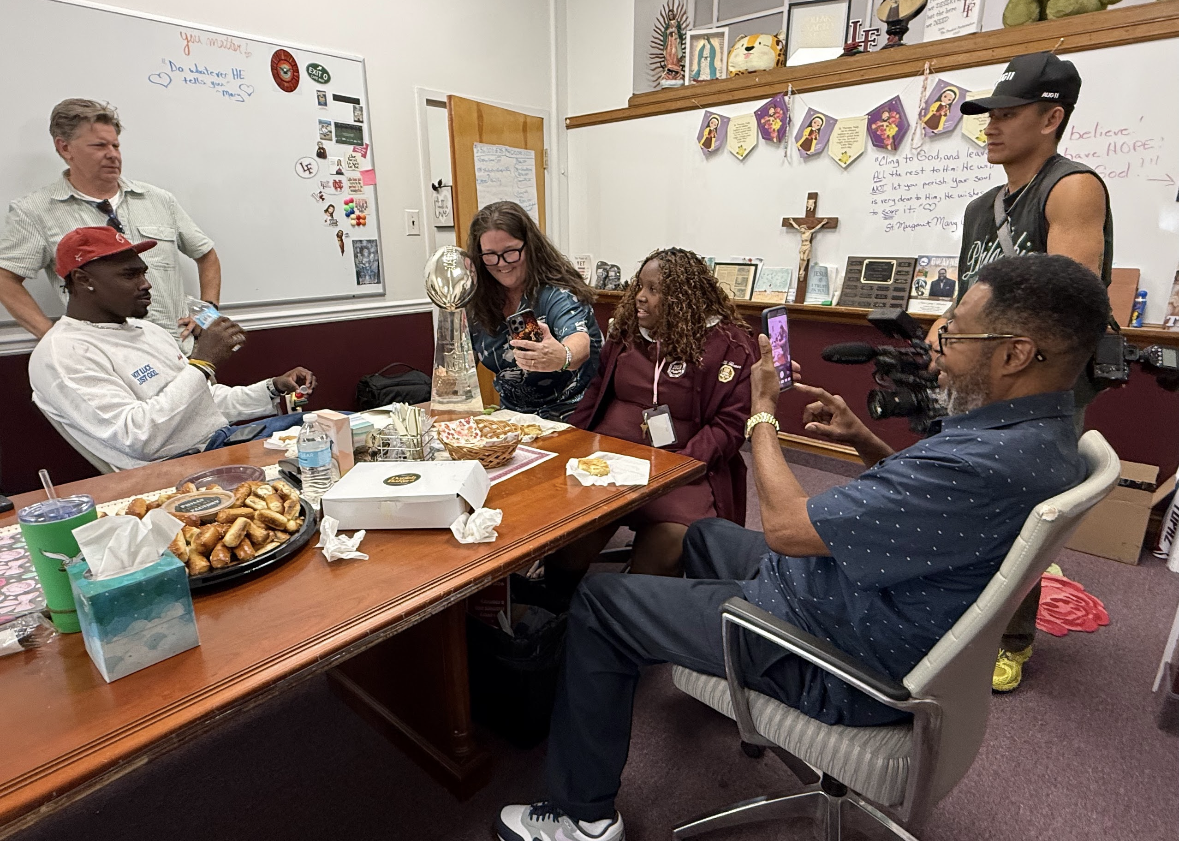
Dugan had told her father, Rodney, that Laniah was in consideration to receive a scholarship. They were to participate in an interview conducted by Little Flower staff. While Laniah and Rodney were sitting in an office, Hunt entered the room and surprised the Brooks family with the news that Laniah wasn’t in the running for the scholarship — she had already earned it.
“It just blew us away,” Rodney said. “It is one of the best days of my life.”
As a single father, Rodney said that without financial aid, affording tuition would be a hardship on him. The scholarship, which is named after Jaaqua, will cover the cost of Laniah’s junior and senior years at Little Flower.
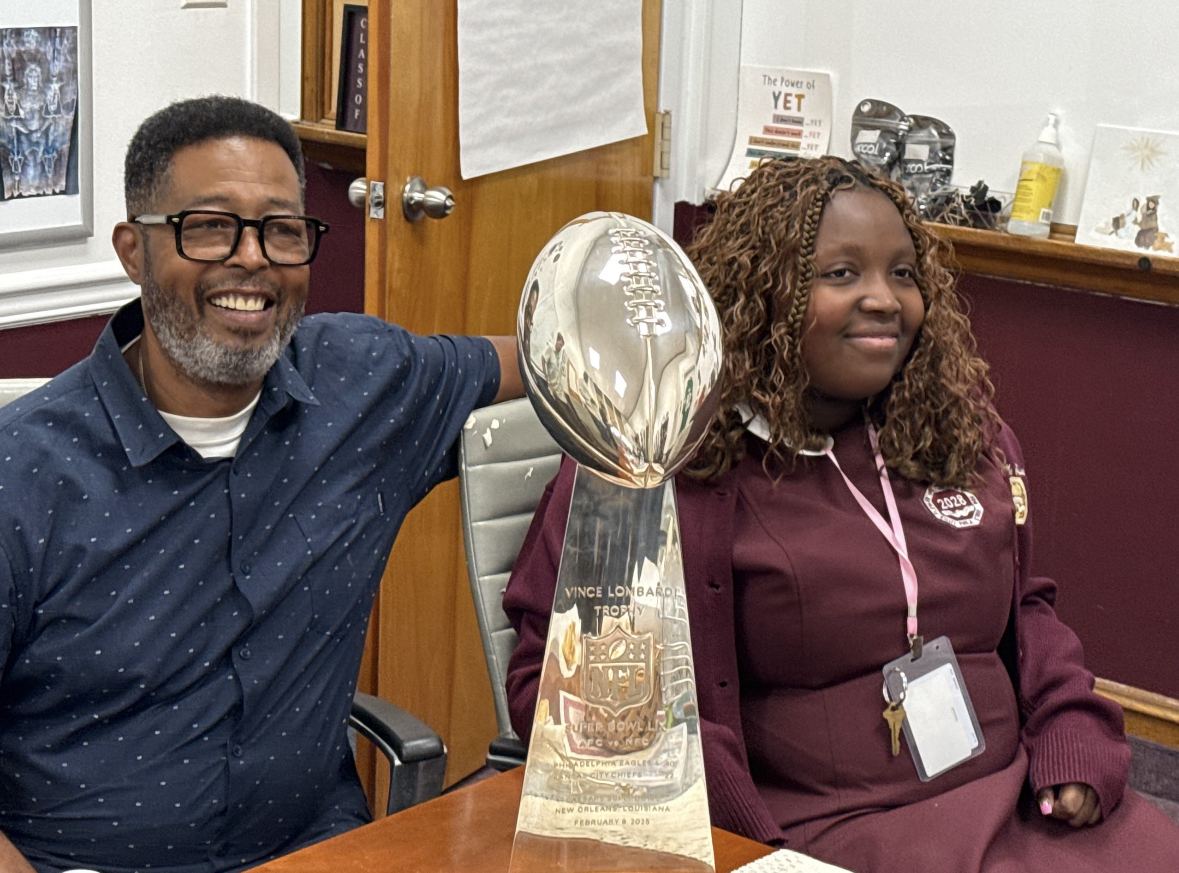
Laniah Brooks (right) and father, Rodney, who got to spend time with Jalyx Hunt and the Lombardi Trophy on Tuesday, are grateful for Hunt’s philanthropy and inspiration.Olivia Reiner
For Laniah, the scholarship served as validation for her hard work in school. The fact that it came from Hunt — and that she got to spend time with him, discussing their shared love for anime — reminded her that her support system is bigger than she ever realized.
“In order to thrive, no matter who you are, even if you’re like peak smartness, everybody needs somebody there, because if not, you could just burn out or give up,” Laniah said. “I feel like no matter who you are, you need that support system, because if you fall, they’re going to be there for you.”
Hunt’s support of Little Flower began with the fundraiser in December 2024. Not only did Hunt donate a portion of the GoFundMe money to Little Flower’s basketball team, but he also visited the students and their parents in their gym. He shared advice about the importance of developing a sense of discipline as an athlete, at the request of head coach Jesse Morgan.
Hunt’s parents, Jaaqua and James, instilled the spirit of giving within him. Growing up, they would help out children in need, whether they were giving them a place to live in their own home or paying for their registration and equipment in youth sports.
Jalyx Hunt (left) has helped Little Flower president Kristie Dugan (third from left) and students like Laniah Brooks (next to Dugan) accomplish their shared goals.Olivia Reiner
Jalyx continued to follow their example, and not just financially. That winter, Hunt returned to Little Flower to watch a basketball game. Dugan recalled greeting him and former Eagles defensive end KJ Henry at the door to the gym. She offered them seats behind the team’s bench, where they could have more privacy.
Hunt declined and said he wanted to sit with the fans.
“I said, ‘OK, but I just need you to know, people know who you are, so people are going to talk to you,’” Dugan recalled. “‘People are going to approach you.’ And he said, ‘That’s OK.’ He said, ‘I’m here as a fan. I’m not here as a football player. I’m here as a fan of Little Flower, and I’m here to support these girls.’”
The girls have done the same for Hunt. After the Eagles won the Super Bowl that year, he returned to Little Flower for a pep rally they planned for him. They gave him a bouquet of roses, which are symbols associated with St. Thérèse, the namesake of Little Flower.
“I love coming back just because of the people that are here, and I don’t know what it is specifically that they do in the building to make the girls so authentic, so hardworking, but you can definitely see that in how they interact with you, how excited the girls are whenever you talk to them about their future, what they’re doing at the school, that they like the school,” Hunt said.
He wears his Little Flower sweatshirt with pride as he boards the Eagles bus to road games. He helped bring Kylie Kelce to the school to speak to students as part of their women in leadership series in April. He gave the school a shoutout during the first recording of his radio show on 94.1 WIP on Monday night.
“Beyond the donation coming to Little Flower, Jalyx investing in our school and in our girls, it makes our community feel seen and valued,” Dugan said.
Jalyx Hunt had a breakout season in 2025 and is looking to keep ascending on the field this season. David Maialetti / Staff Photographer
‘I want to impact the world’
Hunt’s star has risen since he was a rookie standing in the Little Flower gym two years ago. Last season, he led the Eagles with 6½ sacks. Vic Fangio said at the outset of training camp that he’s looking for a big year from the 25-year-old outside linebacker.
Fangio said he believes Hunt is capable of it. His parents have been steadfast in their belief, too, as they watched their son go from Cornell safety to promising Eagles pass rusher in a span of six years.
“We’ve always told him that he would be in a place of greatness, and that with great placement and talent and skill comes a lot of responsibility,” Jaaqua said.
Hunt has learned that those responsibilities exist both on and off the field, and in some ways, they are intertwined. Going into his third year with the Eagles, he said he has a better understanding of how to set himself up for success on the field. He has heeded Nick Sirianni’s advice of falling in love with the process, not necessarily the result. Hunt has perfected his routine throughout the week and has identified the details he must hone in on in practice and during film study to prepare himself for game day.
Becoming a more intentional player on the field has allowed him to become a more intentional person off it, he said.
When he entered the NFL, Hunt acknowledged that the celebrity associated with his job was something he fought. But he came to realize that his humility was getting in the way of the reality that he had become a public figure.
Eagles linebacker Jalyx Hunt is given a “Blessings Jar” as he appears at an assembly at Little Flower Catholic High School on Tuesday. Tom Gralish / Staff Photographer
Hunt expressed an understanding that he has a responsibility to use his platform for good. He wants to do it in a way that is true to himself, and his increasing support of Little Flower is part of that effort.
“I could just be one of those people who’s in the house all the time, which is no problem,” Hunt said. “If that’s what you want to do, that’s what you want to do. But it’s not what I want to do. I want to get out. I want to meet people. I want to impact the world. I want to impact those around me, who pour into me.”
Hunt is trying to heed his mother’s advice of blossoming where he is planted. Jaaqua is already seeing the fruits of his efforts.
“He’s matured and has grown significantly just in his time there,” Jaaqua said. “And a lot of times when you experience that type of growth in an area, you kind of get rooted because that’s where the growth took place.
“So he’s blossoming, as a player for sure. But more importantly to me as a person, as a man.”