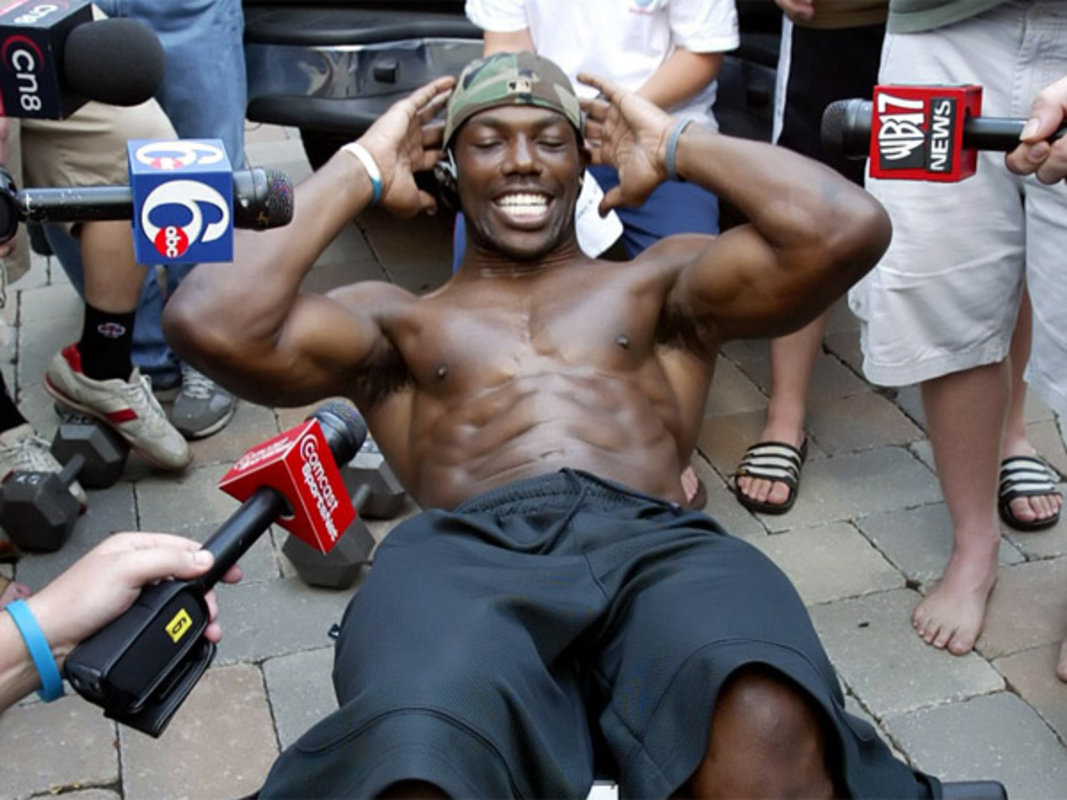
More than 20 years after doing sit-ups in his Moorestown driveway, Terrell Owens is opening up further about his public fallout with the Eagles.
“I felt like I was in a no-win situation, regardless,” Owens said in Terrell & T.O, a new documentary on Amazon’s Prime Video. “I felt like I was so like the black sheep of the family. I had only been there for like a year.”
Terrell & T.O., whichreleased Thursday and was produced by NFL Films, follows the star wide receiver throughout his NFL career. It features interviews with former Eagles linebacker Ike Reese and wideout Freddie Mitchell; former Eagles coach Andy Reid; 49ers stars Steve Young and Jerry Rice; Cowboys owner Jerry Jones; and former Cowboys quarterback Tony Romo.
The documentary offers a detailed look at Owens’ fractured relationship with the Eagles and then-franchise quarterback Donovan McNabb. Following the Eagles’ run to Super Bowl XXXIX in February 2005, Owens held out for a new contract. At the time, McNabb did not publicly back Owens, despite advocating for running back Brian Westbrook to receive an extension.
“Donovan did not like the fact that Terrell Owens got more love than him,” Mitchell said in the documentary.
The tensions culminated in a public feud between the two players, and Owens told ESPN that the Eagles would be improved with then-Packers quarterback Brett Favre under center. McNabb was not interviewed for the documentary.
Owens also details his recovery from a broken fibula during the 2004 season. Famously, the wide receiver suffered the injury during a Week 15 matchup against the Cowboys. He underwent surgery before making a surprise comeback to play in the Super Bowl just seven weeks later. In the documentary, Owens claims that the Eagles required him to sign a form to play, ensuring the team had no responsibility if he reinjured his leg. The Eagles have previously denied that such a form existed.
“There was a form I had to sign to release the Philadelphia Eagles for any liability because [of] the risk of me going out there and playing,” Owens said. “Basically, I risked my career to play.”
Along with his 15-year NFL career, including spending the 2004 and 2005 seasons with the Eagles, the documentary dives into aspects of Owens’ upbringing and personal life. It may surprise some fans that Owens, a Pro Football Hall of Famer known for his grand personality, was quiet when he entered the league because of the way he was raised. Owens grew up in his grandmother’s house and often felt he had to walk on “eggshells.”
“How I was raised impacted my first years,” Owens said. “I was aloof. I was socially awkward. I didn’t talk to everybody. I wasn’t a social butterfly. Once I started to emerge from the shadow of Jerry [Rice], football became a form of entertainment.”
Mercifully, the Eagles are almost at their bye week.
Their roster could look a little different this time next week after Tuesday’s trade deadline, but it’s safe to say the Eagles — and their fans — are ready for a break.
They’re 2-6 after six consecutive losses. Their offense has been woeful. Their defense has been leaky. They have suffered a rash of injuries to important players.
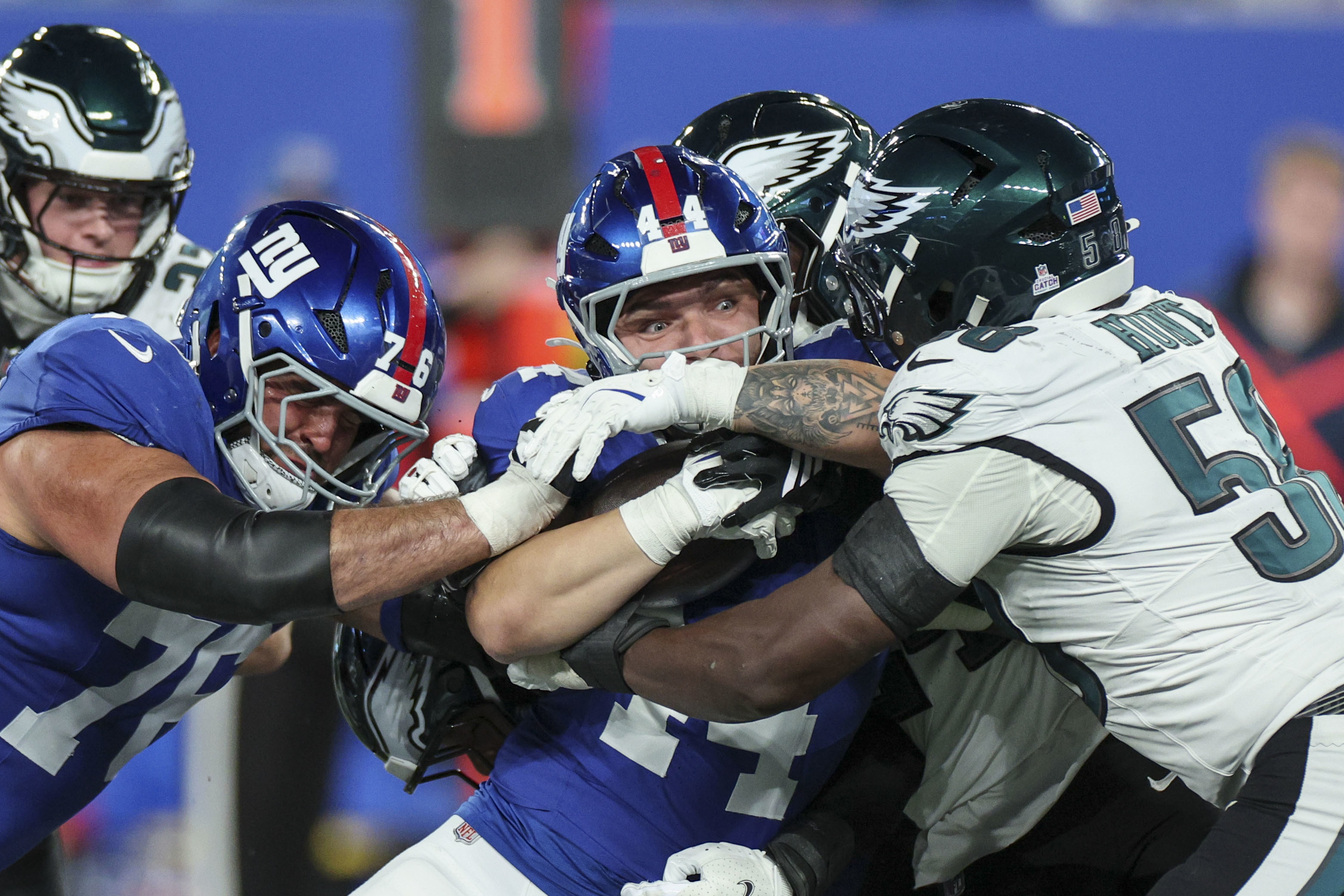
And there’s still nine more games to go, starting Sunday with a 1 p.m. home game vs. the New York Giants.
Here are some numbers and trends worth noting ahead of the NFC East showdown (we use that term liberally):
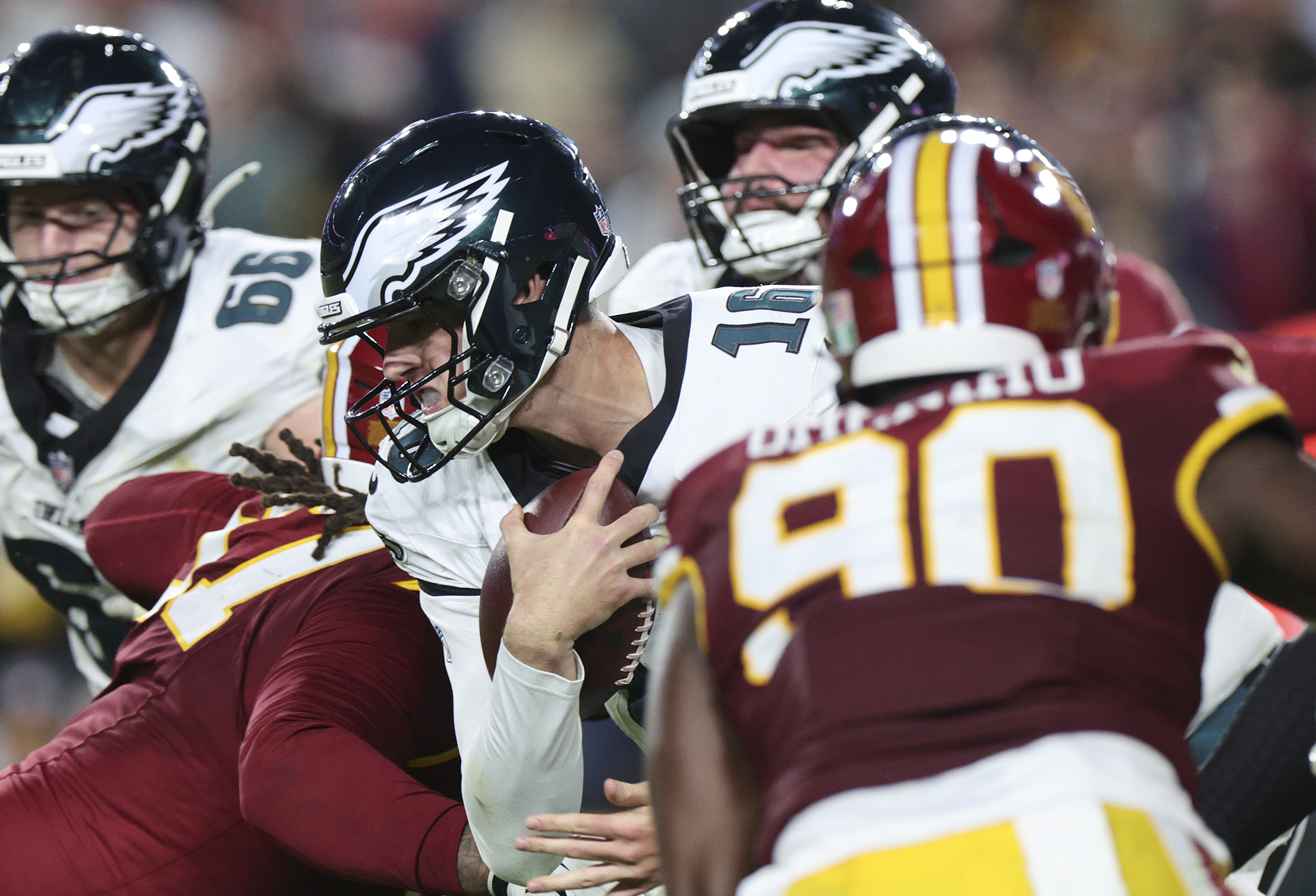
Tanner McKee will take to the bench after a shaky three-week trial as the Eagles’ starting QB. Monica Herndon / Staff Photographer
1998
Only the winless Los Angeles Chargers have a worse point differential than the Eagles, who are minus-65 in that category through eight games. (Side note: the Chargers have only played seven games. Yikes.)
When was the last time the Eagles were at minus-65 or worse through eight games? You have to go all the way back to 1998. Parallels have been drawn to Andy Reid’s final season of 2012, but even that team was 30 points better in point differential at this juncture of the season, as pointed out by The Ringer’s Sheil Kapadia.
The Eagles have scored an NFC-low 137 points. No team that has completed eight games has scored less than the Eagles.
The last time the Eagles went through eight games without topping 350 yards in a game was 1971, when they did it through 11 contests.
The Eagles racked up a season-high 341 yards in Week 2 in Tennessee, and dating back to last season have gone 10 consecutive games without going over the 350 mark.
The Eagles are averaging 244 yards during their six-game skid.
The pressure rate has hamstrung every Eagles QB who has taken a snap this season. David Maialetti / Staff Photographer
42.6%
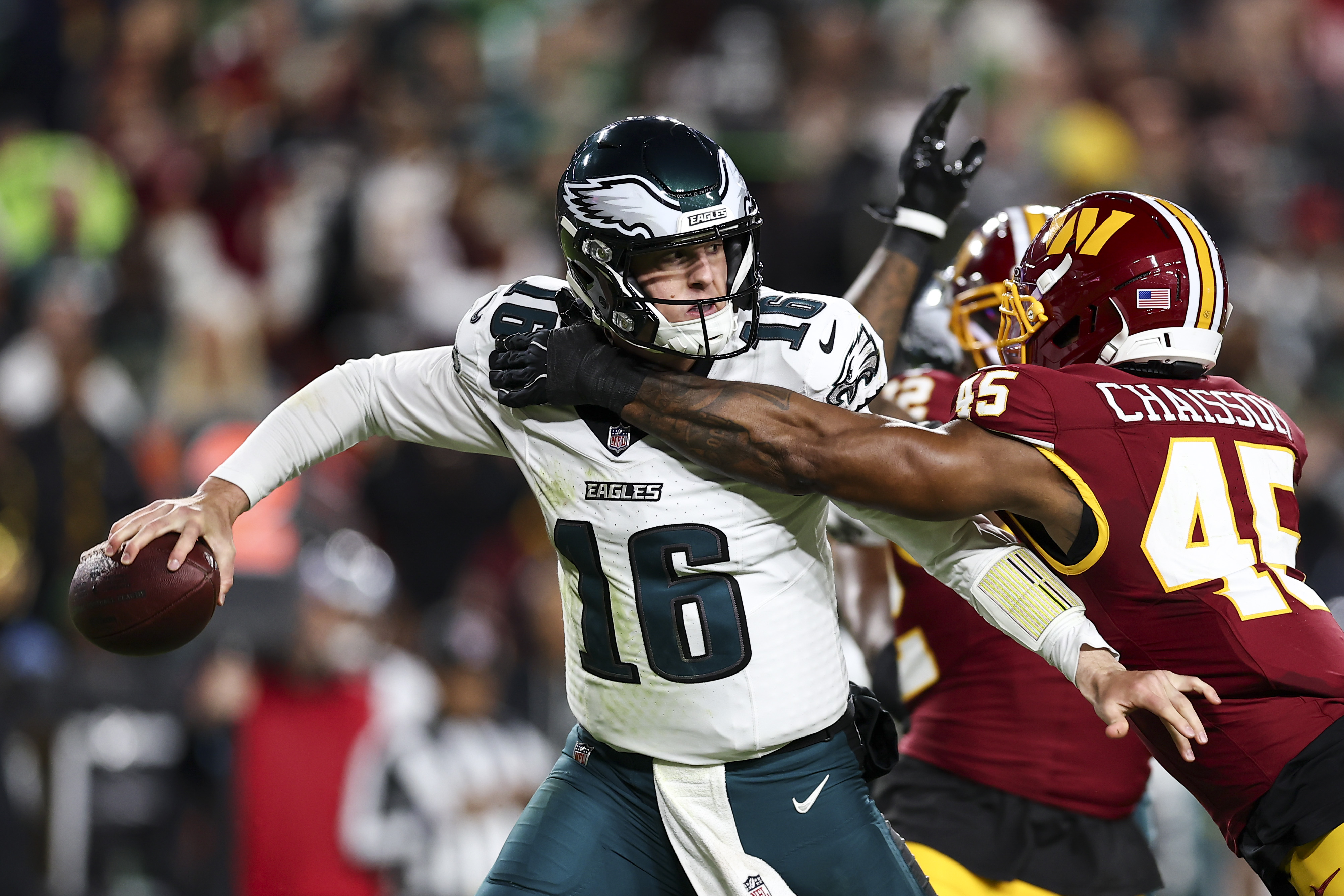
It is hard for an offense to do much moving when the quarterback is being pressured at a rate of 42.6% of dropbacks, according to Next Gen Stats, the fourth-worst mark in the NFL. That’s the world Milton is stepping into. It’s what Tanner McKee dealt with, and it was life for Jalen Hurts, too, before his season was stalled.
The Eagles are allowing too many unblocked pressures. They haven’t consistently communicated and dissected defenses in order to have any sustained success.
Run blocking isn’t much better. According to Sharp Analytics, the Eagles are tied for the league low in average yards before contact per running back rush at 0.7, and their run stuff rate of 23.7% is 31st in the league.
The Giants’ pass rush without Brian Burns (knee), whose season ended in Week 3, has not been as dangerous. They are 20th in the NFL with a pressure rate of 34.2%.
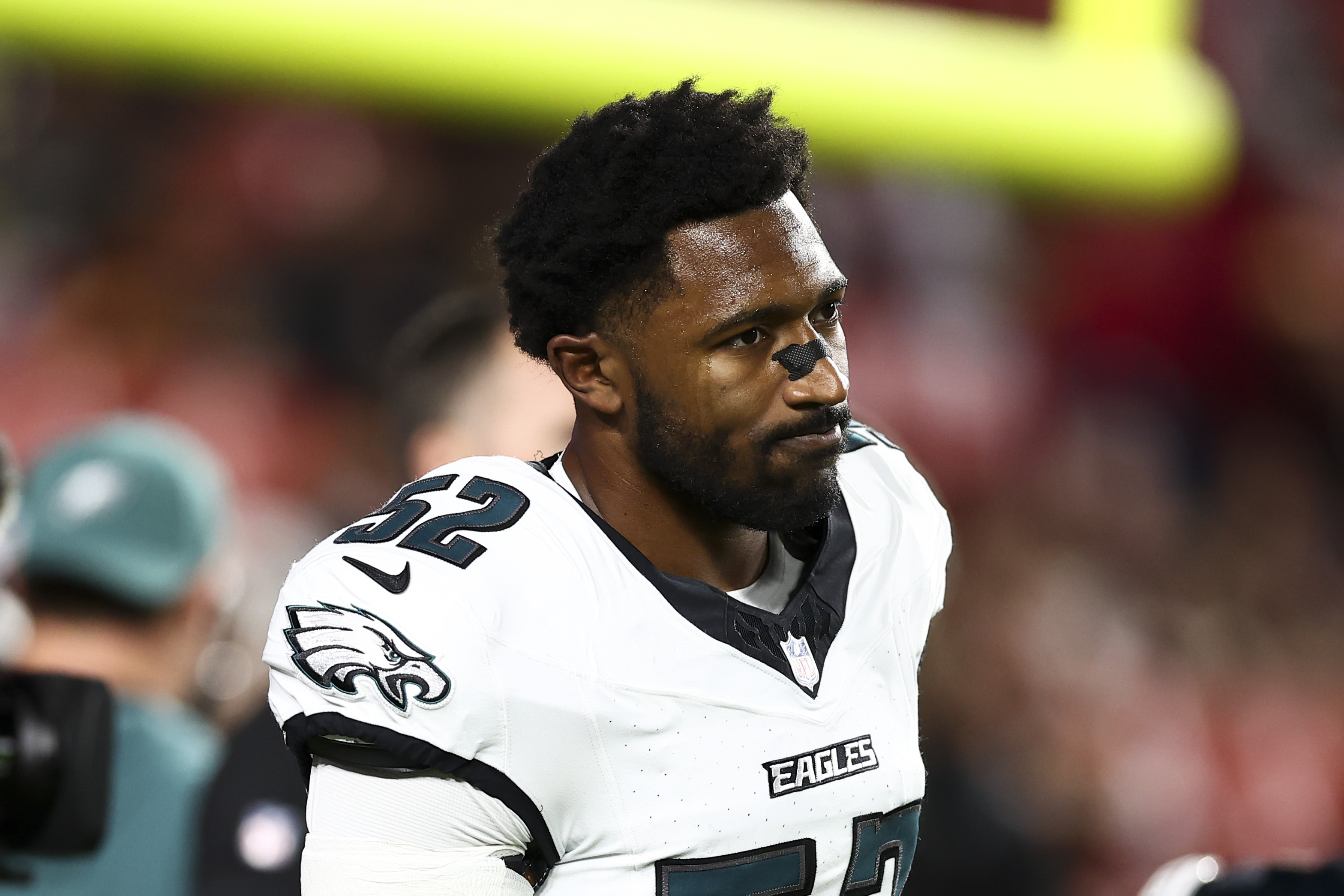
Jonathan Greenard is still looking to make an impact as an Eagle. Monica Herndon / Staff Photographer
9%
That’s the pressure rate of the Eagles’ biggest acquisition of the offseason, edge rusher Jonathan Greenard.
Injuries have limited him to five games, six full practices, and only a limited role in the games he’s played, but Greenard’s pass rushing being nonexistent has been a big factor on a team that is struggling to get after opposing quarterbacks.
The Eagles rank 29th in pressure rate (31.5%), according to Next Gen. They have just 10 sacks on the season, none of them from Greenard.
The Giants have been just OK protecting their quarterback. They’re 20th in pressure rate allowed (37.4%).
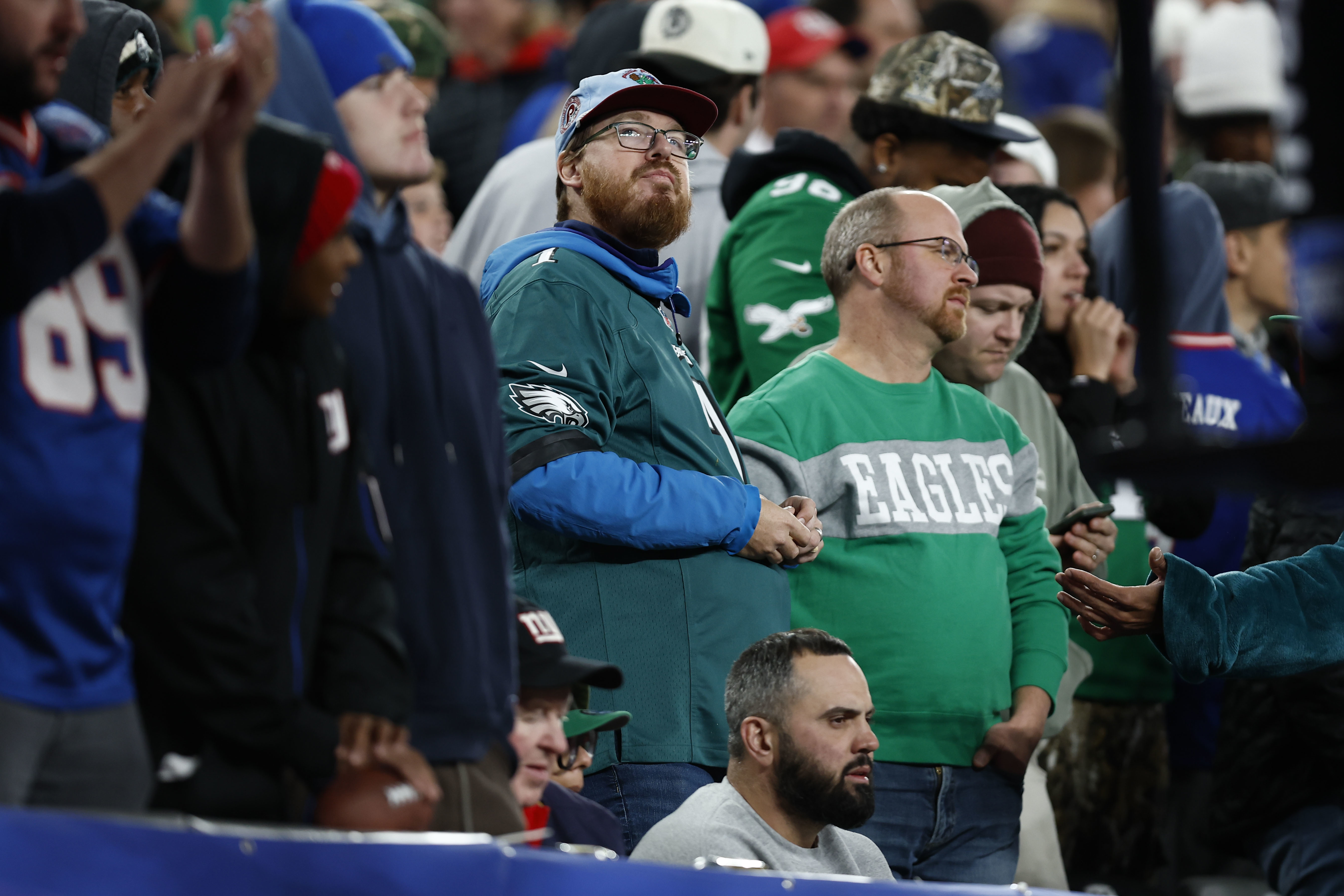
If Eagles fans walk away happy on Sunday, it will literally be an upset. Monica Herndon / Staff Photographer
2009
As of Wednesday afternoon, the Eagles were 3-point home underdogs to the Giants.
It’s been a while since the Eagles were home ‘dogs against their NFC East rival. According to Yahoo betting analyst Ben Fawkes, Sunday would mark the first time the Giants are road favorites in Philadelphia since Nov. 1, 2009.
While the Phillies are poised for some bigger roster changes this offseason, the rotation remains the foundation of the club.
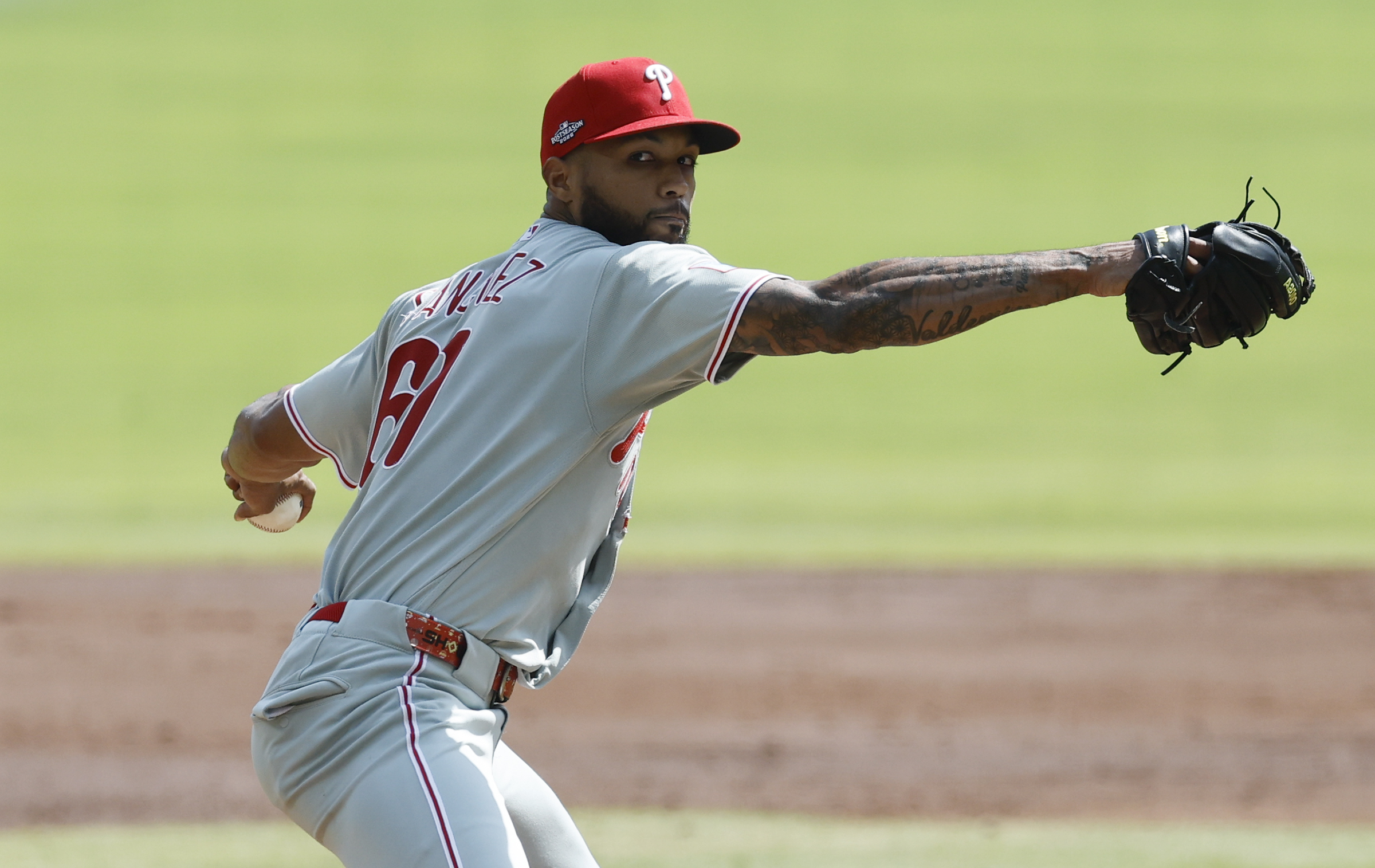
The organization doubled down on its top-end starters when it signed Jesús Luzardo to a five-year extension and Cristopher Sánchez to a six-year extension in March.
But while the front end of the Phillies’ rotation could compete with just about any club in baseball, the lack of depth beyond it remains a concern. It was exposed by a September shoulder injury to Luzardo, and ultimately became instrumental in the Phillies’ downfall against Atlanta in the wild-card series.
“I think we still start with a good foundation,” president of baseball operations Dave Dombrowski said at his year-end news conference. “It’s not starting pitching; it’s starting pitching depth. … We’ll get some starting pitching depth.”
Here’s a breakdown of the rotation’s outlook for 2027 and beyond:
Phillies pitcher Cristopher Sánchez was named a National League Cy Young finalist.Yong Kim / Staff Photographer
The lefties
After signing their respective extensions, Sánchez and Luzardo are set to anchor the Phillies into the 2030s.
For the second consecutive year, Sánchez was named a National League Cy Young Award finalist, and it’s likely Luzardo will receive some down ballot votes, too. Sánchez recorded a 2.91 ERA, while Luzardo posted a 2.87 ERA, good for fourth in the NL.
Both of them relied on their trademark pitches to eclipse 200 strikeouts this season. Sánchez’s changeup had a 46% whiff rate, and neutralized lefties and righties alike. His 207 innings were a career-high and only trailed Miami’s Sandy Alcantara.
Luzardo’s sweeper, which he only added to his arsenal in 2025, had a run value of plus-23, making it the sixth-most valuable pitch of any type in baseball, according to StatCast. Hitters averaged just .112 against it.
Both Sánchez and Luzardo pitched a complete game in an era of baseball where that is becoming exceedingly rare. But after Luzardo’s 1-0 shutout against the Braves on Sept. 7, he soon hit the injured list with shoulder inflammation and did not make another regular season appearance until Game 162. Luzardo, who said he believed the inflammation was unrelated, returned to start Game 1 of the wild-card series against the Braves, holding them to one run over five innings.
Video: Phillies Extra: How much change is needed for the Phillies entering 2027?
But Luzardo’s injury exposed just how shallow the Phillies’ starting depth was. As the Phillies’ late-season losing streak continued, delaying a playoff clinch, they wound up starting Aaron Nola on two days’ rest in the final week. It was a desperation move — one that didn’t work out — and was only necessary because the Phillies had no other reliable depth starters for a must-win game.
And that final week of the regular season hamstrung the Phillies when the wild-card series began.
“Down into the last week and last game to have to get in, not able to rest Sánchy, not able to rest Wheels, you kind of limp in, in a sense, with standpoint from our pitching,” manager Don Mattingly said. “And that just put us in a tough spot, from the beginning of that.”
Phillies pitcher Zack Wheeler had a 3.00 ERA and 1.049 WHIP in 162 innings after returning from thoraric outlet syndrome.Elizabeth Robertson / Staff Photographer
Wheeler’s return
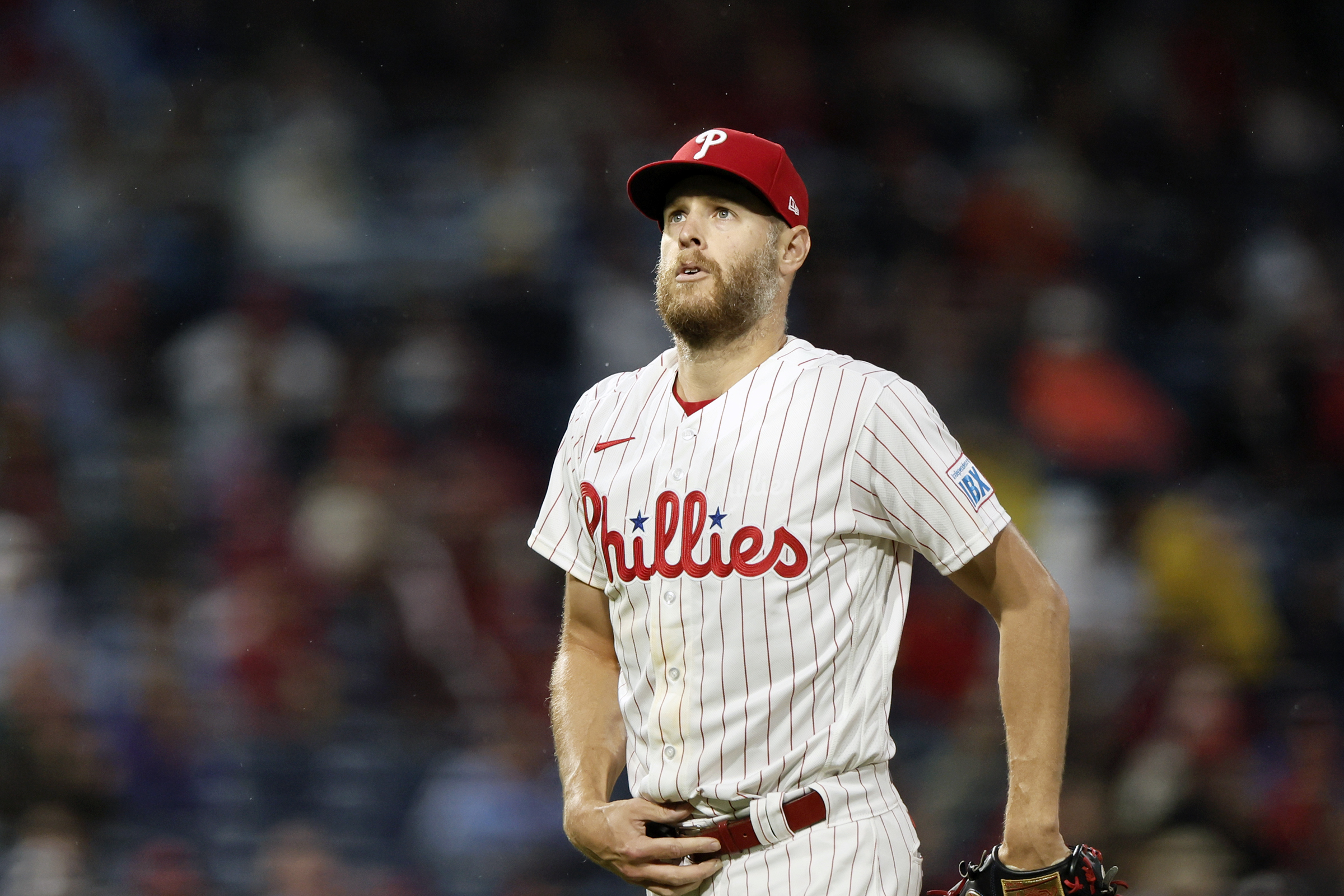
Zack Wheeler maintained throughout the season that he never doubted he could return from the thoracic outlet syndrome that cut his 2025 campaign short. But that didn’t make his 3.00 ERA and 1.049 WHIP in 162 innings after returning to the mound on April 25 any less impressive.
After returning from the injured list one rib lighter, Wheeler looked like his same old self. Against him, hitters had a 36.3% chase rate and 30.9% whiff rate.
Wheeler openly expressed frustration that he was not included as an All-Star this season, despite having a 2.13 first-half ERA. He did not make the NL team by player vote, nor was he initially named a replacement by the league. (After his public statements, MLB did reach out and offer him a spot, at which point Wheeler declined, saying he had been “disrespected.”)
The question now becomes how long Wheeler wants to continue to pitch. In 2027, Wheeler will enter the final season of his contract, and he has been open about wanting to retire after that. It’s unknown whether the impending lockout and its potential impact on the 2027 season will change the 36-year-old’s calculation. Two of Wheeler’s career goals — a World Series title and a Cy Young Award — have so far proved elusive.
When asked about whether he would be interested in a potential extension after the Phillies’ elimination from the wild-card series, Wheeler said he hadn’t thought about it.
Phillies pitcher Aaron Nola rebounded in August after a rough first half.Yong Kim / Staff Photographer
Nola’s second half
After a tumultuous first half, Nola managed to turn things around once the calendar flipped to August. His first-half ERA of 5.75 became 3.33 after the All-Star break, earning enough trust to be given the ball to start the decisive Game 3 of the wild-card series.
Sure, following the disastrous final week of the season, the Phillies didn’t have many other options. And Nola did have command issues against the Braves and got a quick hook for Wheeler, who was pitching on short rest. But his second half overall was something for the veteran right-hander to build on for the next four years of his contract.
“I think it speaks to a lot about Aaron Nola that he didn’t give in and say, ‘Oh, it’s going to be a bad year’ or anything else. Kept working,” Mattingly said of Nola during the postseason. “I think there was adjustments with the ABS early for him. He’s a guy that’s on the edges all the time. I think he changed his mix a little bit through the course of this and just kept going.
“I think that’s what happens with guys is they’re later in their career and they’ve got some miles on them, they make adjustments. They keep going. They’re competitive. They haven’t been this good for this long for no reason. So they keep making adjustments to what they have to do to have success.”
Nola also managed to stay healthy for the entire season after an injury-riddled 2025. He notched 175⅓ total innings.
Overall, he continued to struggle with the long ball. The 38 homers Nola allowed in 33 starts were the most in the majors. But that’s always going to be a potential consequence for a low-90s mph pitcher like Nola who works in the zone, relying on command and off-speed pitches. The key for success is cutting down on walks and baserunners to try and limit homers, when they do happen, to solo shots.
It’s possible experimenting with a new pitch this offseason could help Nola navigate lineups easier as he enters his age-34 season. His knuckle curve is his best weapon, but his four-seam fastball ranks as one of the lowest-rated pitches by run value at minus-15. Refining another pitch could give hitters a different look.
Other members of the rotation, namely Wheeler and Luzardo, have added pitches to their arsenals in the past to great success.
A demotion to triple-A Lehigh Valley benefited Andrew Painter, who was a different pitcher when he returned to the Phillies.Yong Kim / Staff Photographer
Painter’s growth
It was a tale of two seasons for Painter, with the dividing line on June 18 — the date that he was optioned to triple A after a string of poor starts.
When he was sent down, it wasn’t a guarantee that Painter would come back at all. The Phillies told him he would have to earn it. But a month in Lehigh Valley allowed him to work on his mechanics and improve his fastball and changeup. The 23-year-old returned as a different pitcher.
“Painter took a while to get over the hump,” Dombrowski said. “I don’t know another club in baseball that wouldn’t want him in their rotation going into next year.”
His ERA had climbed to 7.06 by the time the Phillies decided to demote him. In the second half, it was 3.65. Hitters had batted .316 against him before the reset; after, it dropped to .212.
Perhaps his most significant outing was his final one of the year, when Painter entered Game 2 of the wild-card series in the eighth inning. It was his playoff debut and first late-inning relief appearance, and the Phillies’ season was on the line.
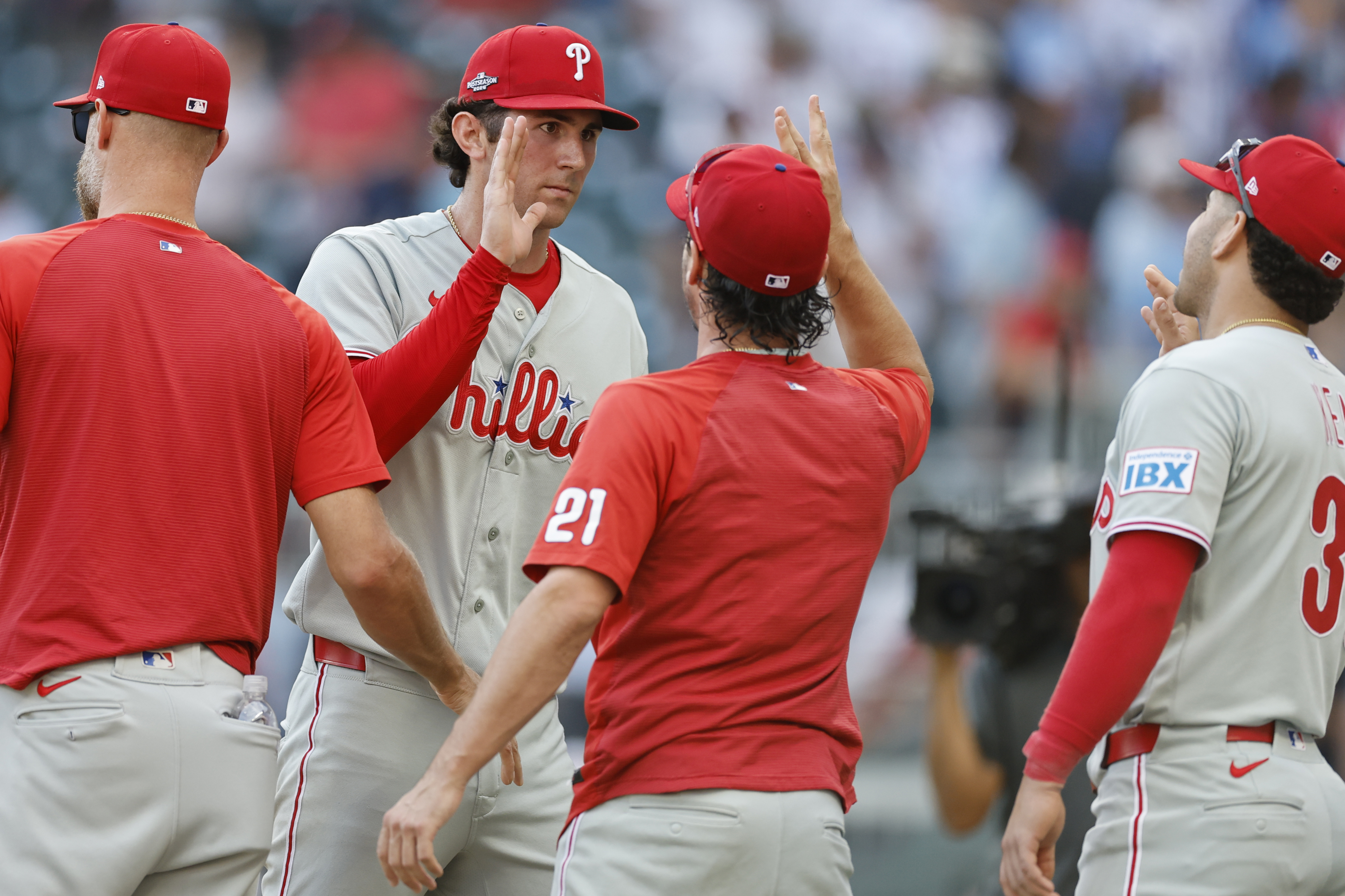
In a hostile, high-pressure environment in Atlanta, Painter wound up delivering three scoreless innings to earn the win in extras and force a Game 3. Catcher J.T. Realmuto called it a “career-altering performance.”
It wasn’t always smooth sailing, but Painter showed glimpses in 2026 of the heralded top prospect that the Phillies had been waiting for. And more importantly, he has a strong foundation to springboard from as he enters his second major league season.
Veteran pitcher Colin Rea was solid in a variety of roles for the Cubs the past two seasons.David Banks
Free agent options
With their 2027 rotation seemingly set, the Phillies don’t need to be shopping for high-end starting pitchers like Tarik Skubal, the two-time Cy Young winner who is likely to command the biggest contract of this free agency period.
A more ideal fit for the Phillies is a swingman-type pitcher in the mold of Spencer Turnbull in 2024, who could provide length out of the bullpen but also transition to starting if and when needed. It would give them an option other than Alan Rangel, who was the main choice to fill in when Painter was in triple A, and pitched to a 5.88 major league ERA.
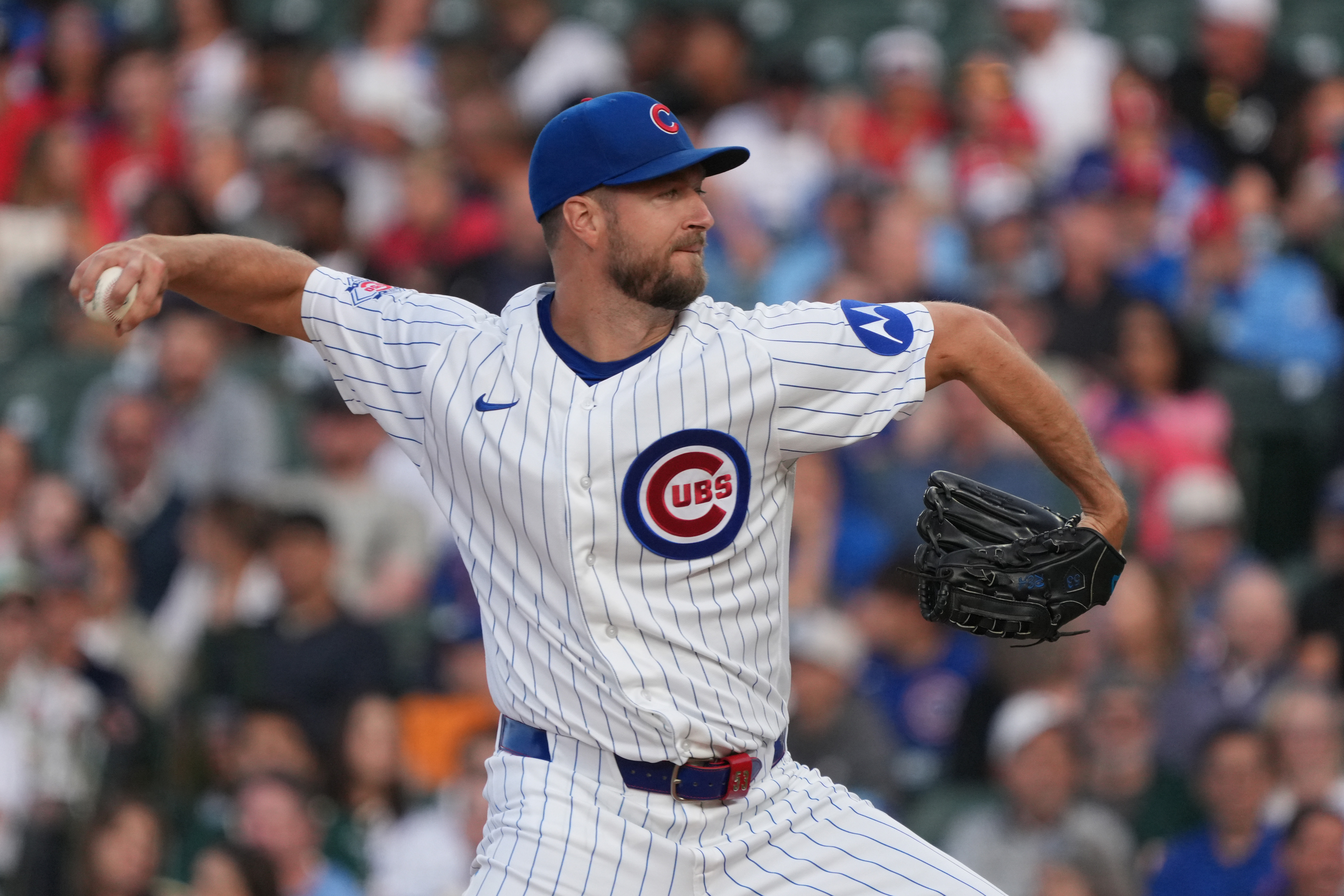
Colin Rea fulfilled that role with the Cubs in 2026 and is a free agent after Chicago declined his $7.5 million team option. The 36-year-old had a 4.34 ERA over 137 total innings, split between 19 starts and 15 relief appearances.
Rea struggled to miss bats overall, with just a 19.8% whiff rate and 41.7% hard-hit rate. His best offering by far in his seven-pitch arsenal is his changeup, which has a plus-7 run value and had a .182 batting average against in 2026. With the Phillies needing to make several additions to their team for 2027 in other areas, Rea could be a relatively inexpensive option that could fulfill multiple roles.
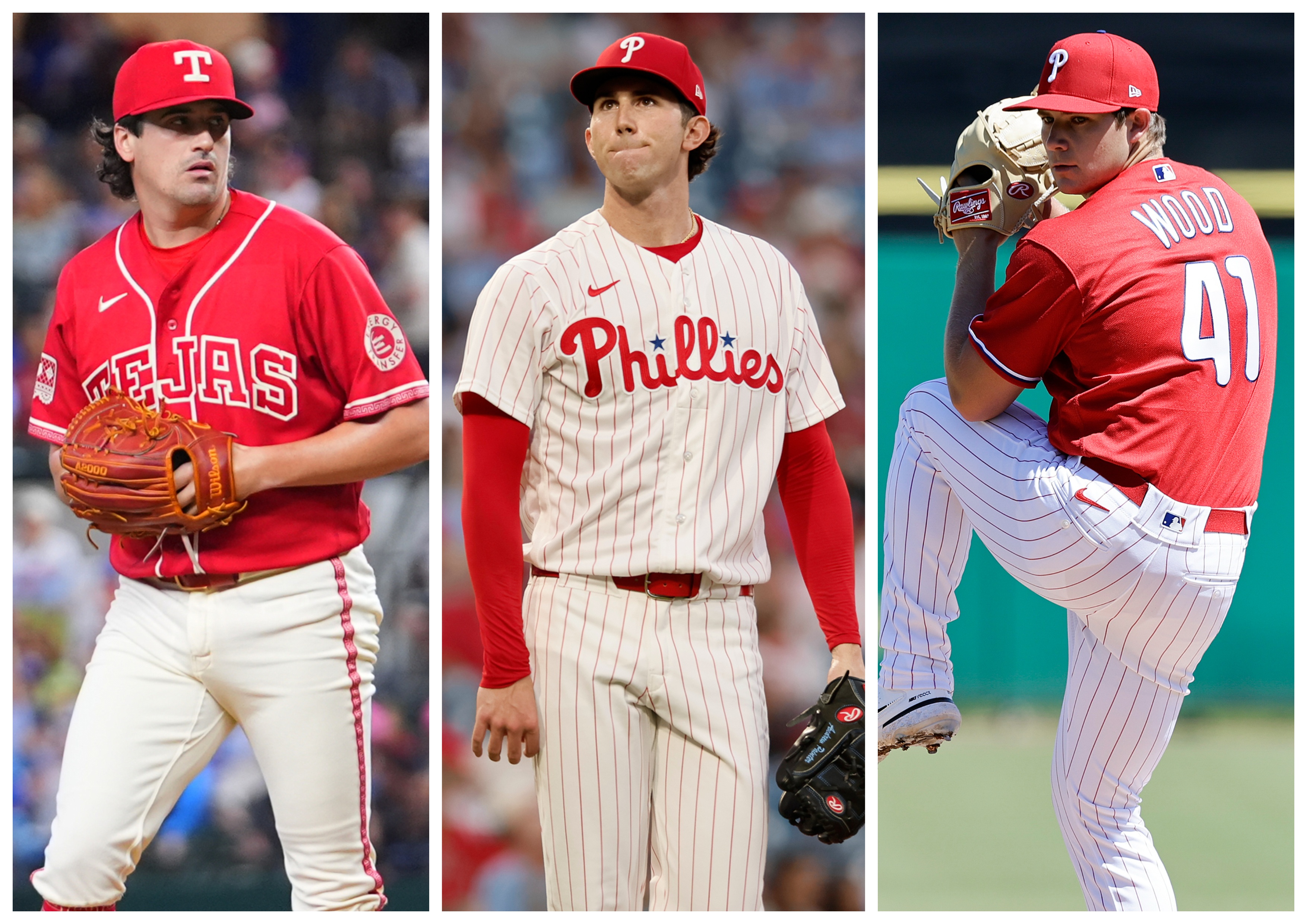
Cal Quantrill could be another depth option. He is coming off a career year with the Rangers, going from signing a minor league deal to posting a 2.86 ERA and 1.04 WHIP over 110 major league innings. The right-hander made 15 starts and 17 relief appearances for Texas, but ended the season on the injured list with a right lat strain.
Like Rea, Quantrill doesn’t generate a ton of swing-and-miss, posting just a 19.6% whiff rate. But Quantrill, 32, historically has been effective at limiting walks, and had just a 5.5% walk rate in 2026. His sinker averages 94 mph and tops out at 96.2, while his splitter is one of his go-to secondary pitches.
Quantrill’s father, Paul, spent two seasons of his 14-year career with the Phillies.
Phillies top pitching prospect Gage Wood had a 4.36 ERA in 95 innings in his first full professional season.
On the farm
Following the graduation of Painter — who had been the Phillies’ top-ranked prospect since 2023 — to the major leagues, a new pitcher has since taken up the mantle at No. 1: Gage Wood.
“Gage Wood is very close to pitching at the big league level,” Dombrowski said in October.
Wood posted a 4.36 ERA in 95 innings in his first full professional season, helping double-A Reading make it to the Eastern League championship. While that number doesn’t exactly jump off the page, his 34.4% strikeout rate and 7.4% walk rate certainly do.
The righty can touch 99 mph with his fastball, and added a split-change to his arsenal in 2026. In double A, he had a 35.97% chase rate and 35.6% whiff rate.
Wood represented the Phillies at the 2026 All-Star Futures Game, starting for the National League in his potential future home ballpark at Citizens Bank Park.
Brad Pacheco had a 4.00 ERA in 101⅓ innings for single-A Clearwater. Like Wood, however, he had a strong strikeout rate (26.6%) and walk rate (5.3%) in 2026, indicating solid command.
Pacheco, a 21-year-old right-hander, is ranked the Phillies’ No. 18 prospect by MLB Pipeline. The Phillies signed him out of Venezuela in 2023.
Video: Phillies prospect Gage Wood raves about his first time meeting current Phillies
Moisés Chace will be interesting to watch in 2027. The Phillies acquired the right-hander at the 2024 trade deadline from the Orioles in exchange for Gregory Soto, and he immediately became one of their more intriguing pitching prospects because of his fastball, which had a lot of ride. But Chace, 23, had a velocity drop in 2025 and eventually underwent Tommy John surgery, which sidelined him for all of 2026.
As the Phillies saw with Painter, the first year back from Tommy John can be uneven for a pitcher. Still, Chace, who is ranked the Phillies’ No. 13 prospect, will be one to watch when he returns to action for the first time since May 2025.
Hua Ho hasn’t thrown a professional pitch yet but will be another name to keep an eye on. The Phillies signed the 18-year-old out of Taiwan during the 2026 international signing period. To give Ho a $500,000 contract, they acquired part of that bonus pool money from the Guardians in a trade for minor leaguer Ryan Degges.
Ho is 6-foot-2 with a five-pitch mix, according to MLB.com. His fastball tops out at 95 mph, and he already ranks as the Phillies’ No. 25 prospect before making his pro debut.
But a glance at the University of Houston’s football roster might make Eagles fans do a double take.
Meet Jack Carson-Wentz, a fifth-year long snapper for the Cougars whose hyphenated last name happens to be the full name of the former Eagles quarterback.
The 6-foot-2, 210-pound Carson-Wentz wears No. 64 for Houston, where he’s continuing a college football journey that has taken him through five schools in five years. But it’s his name, rather than his position, that has captured the internet’s attention.
For Eagles fans, it’s a familiar name with an unfamiliar face.
A name that broke the internet
Carson-Wentz first attracted national attention in August 2024, when he was playing for Michigan State.
During the final moments of the Spartans’ 16-10 victory over Florida Atlantic, Big Ten Network cameras caught Carson-Wentz standing on the sideline wearing No. 83.
There, across the back of his jersey, was a name that Philadelphia football fans knew all too well.
“Carson-Wentz.”
It didn’t take long for social media users to notice.
Unlike the former Eagles quarterback, who starred at North Dakota State before the Birds selected second overall in the 2016 NFL draft, Carson-Wentz has taken a winding route through college football.
The Canton, Ga., native began his career at Division II Lenoir-Rhyne in 2022 before moving on to West Georgia in 2023.
He transferred to Michigan State in 2024 and appeared in five games. He handled 20 punt snaps and one extra-point snap, according to the Spartans’ biography.
Carson-Wentz spent the 2025 season at Florida A&M before transferring to Houston for his fifth year.
And while his last name draws comparisons to a quarterback, his position is very different. Rather than throwing passes downfield, Carson-Wentz specializes in delivering snaps to punters and kickers.
His biography on Houston’s website also reveals a few entertaining details about the player behind the name.
His nickname is “Jwentzy;” his hobbies include playing guitar, fishing, and customizing his truck; and he lists salsa dancing among his hidden talents.
For now, the Houston long snapper is carving out his own football career, even if his name continues to remind Philadelphia fans of one of the most memorable quarterbacks in recent Eagles history.
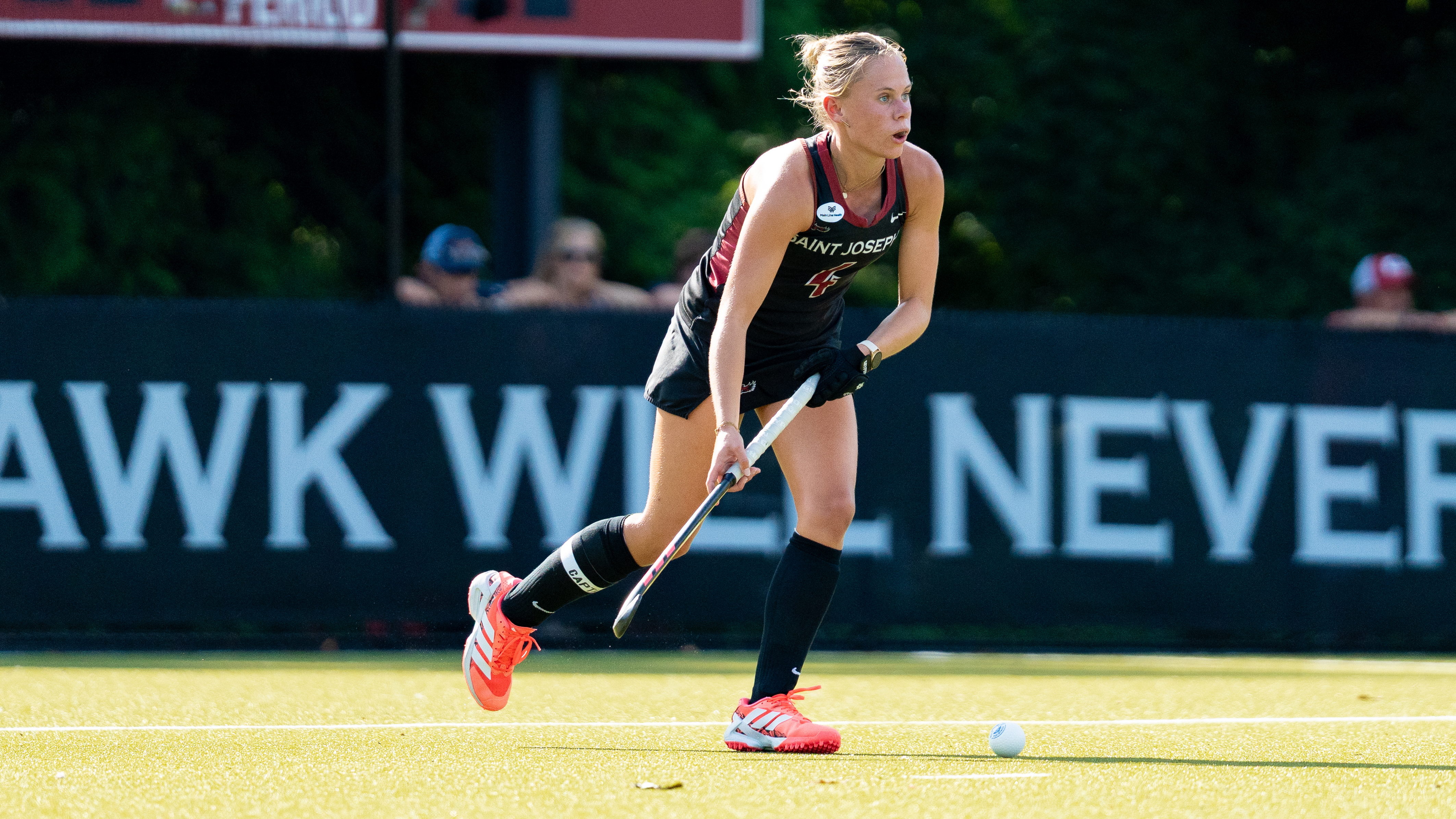
St. Joseph’s field hockey had an offseason filled with unknowns.
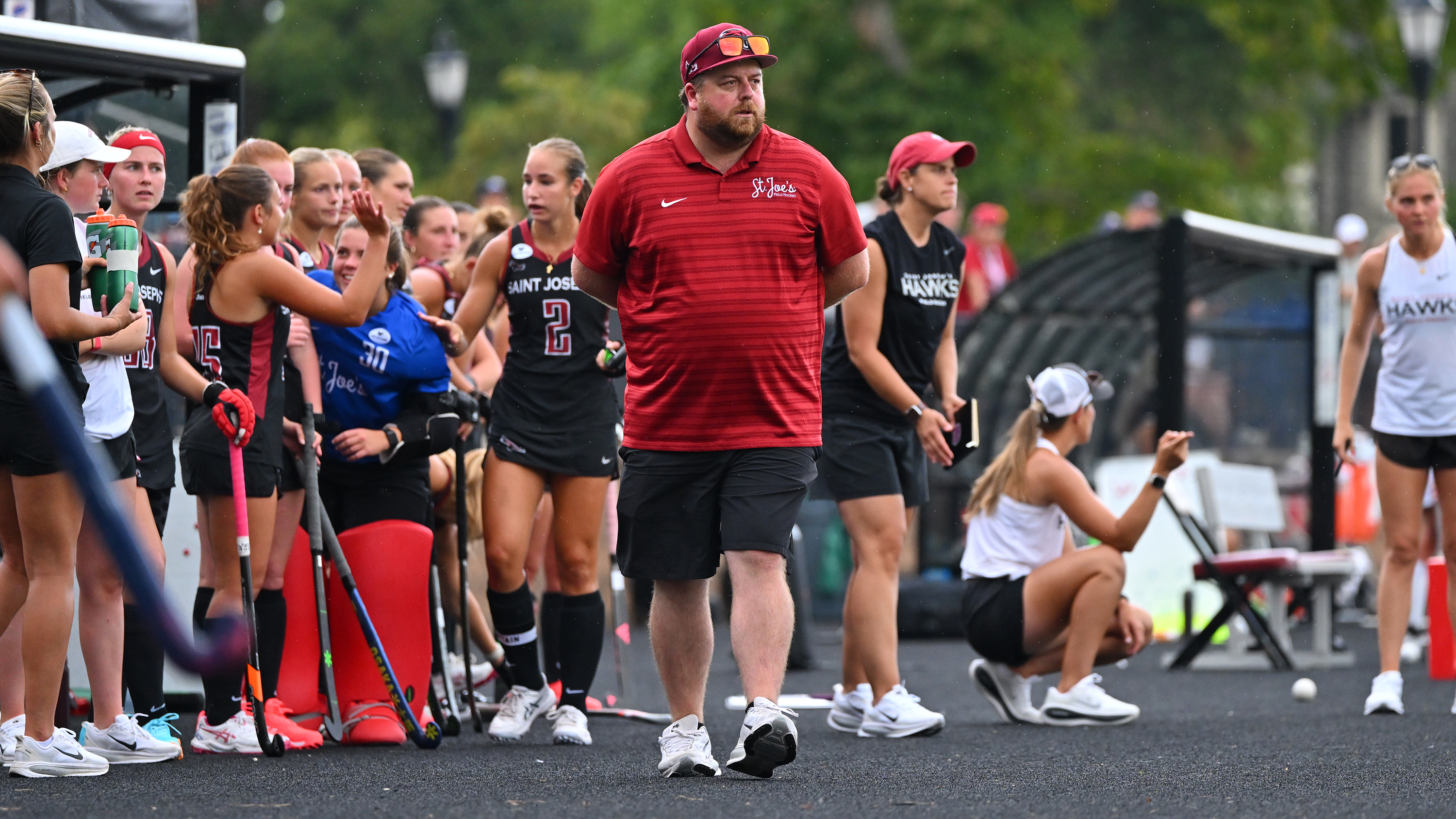
Following four consecutive Atlantic 10 conference championships, head coach Hannah Prince stepped down after four seasons with the Hawks in January to take the head-coaching position at Penn State. Sam Brown was named the program’s next coach on March 31.
Brown, who was on James Madison’s coaching staff and previously coached at Syracuse, entered into the 2026 season as a first-time head coach.
Despite the changes the team underwent, St. Joe’s had a status to uphold.
Leading St. Joe’s to a 6-0 record in conference play and its first regular-season conference title since 2023, Brown earned A-10 coach of the year honors on Wednesday. Senior back Milou Kluyt was named defensive player of the year for the second year in a row and eight Hawks were named to the the all-conference first and second teams.
After what Brown called a “whirlwind of a season,” the Hawks enter the A-10 tournament as the top seed and will play fourth-seeded Davidson on Thursday in Richmond, Va., in the teams’ first-ever postseason meeting (11 a.m.). One of the Hawks’ greatest assets ahead of the tournament is playing a new scheme that adds an air of mystery to one of the A-10’s most reputable teams.
“There’ll be elements of our player group that are the same and that will be familiar to our conference opponents,” Brown said. “But our overall system and structure, I believe, is quite different to the way that St. Joe’s may have played the last two or three years, so hopefully that gives us a small advantage at this point of the season.”
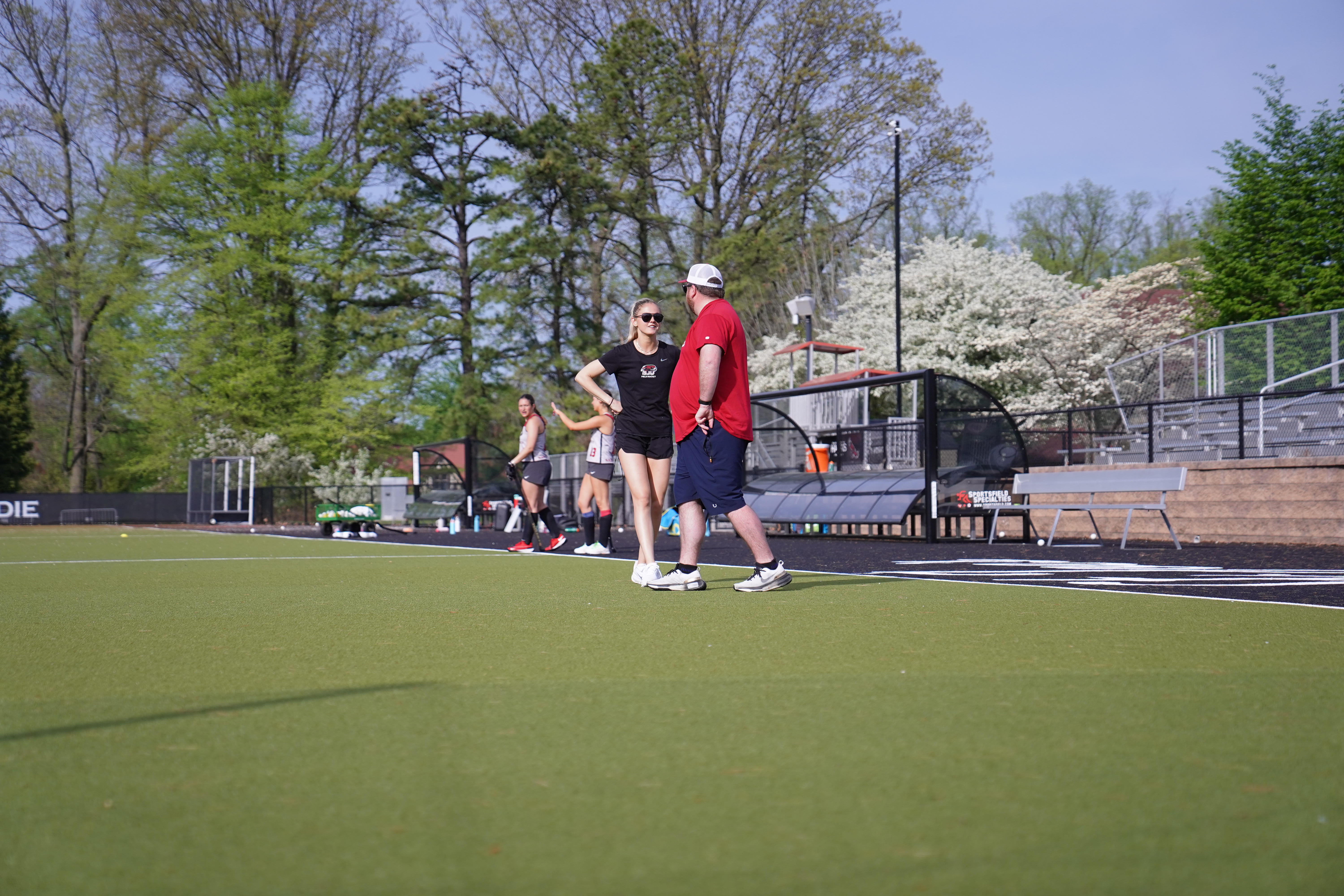
New St. Joseph’s coach Sam Brown (right) chats with assistant coach Maggie Dickman during a practice last spring.Declan Quinn / St. Joseph's Athletics
The other two teams in the tournament include Richmond and Virginia Commonwealth, both of whom St. Joe’s faced in the conference tournament last season. The Hawks defeated VCU in double overtime in the semifinal before taking care of Richmond in the championship game.
St. Joe’s has won five consecutive A-10 tournament titles, and appeared in 10 consecutive title games, a league record. It won eight of those 10 championship /games/.
Maggie Dickman and Beth Riley both returned to the coaching staff for their third and 10th seasons, respectively. Their presence eased the Hawks’ transition.
Brandi Ritz, previously the head coach at Academy of Notre Dame de Namur in Villanova, also joined the coaching staff this season.
Brown said his staff bought in early to the “philosophical and conceptual changes,” allowing for more work to be done individually with player groups.
“I’ve been able to trust them to take individual sessions, small group sessions, and really give attention to the players that need it,” Brown said. “And it’s, I think, shown with the depth of our group and the number of players we’ve been able to get on the field this year.”
A challenging nonconference schedule that included games against seven top-15 opponents also proved beneficial for the Hawks.
St. Joe’s finished 9-9 in the regular season with all but two of its losses coming from ranked opponents. Its only two non-ranked opponent losses came to Drexel in overtime and to Penn in a shootout on waterlogged turf that Brown said was probably the “worst loss of the season.”
Brown said having games at that level of difficulty early on was “intentional” to help the team “get used to each other.”
Senior back Milou Kluyt was named A-10 defensive player of the year for the second year in a row.Greg Carroccio / Sideline Photos, LLC
Early-season losses to Connecticut, Liberty, and Maryland, all by three or more goals, saw a different level of play from the Hawks than mid- and late-season losses to Louisville, Duke, and Princeton, which were all decided by one or two goals.
“All of those [games] combined forced our team to learn quickly,” Brown said. “That forced us to have to really pump as much into the players as we could, as far as tactical things, and help them develop technically where we could to get to that point where we were competitive. And the side effect of that was we were comfortable with our conference games and the regular season.”
Brown said it also helped teach the players about the speed of the game and how to control that speed.
“That’s a huge thing in hockey because if you can get teams playing much faster than they’re used to, you apply a different form of pressure, and that time pressure can be huge to forcing errors and creating opportunities,” Brown said.
Overall, St. Joe’s had a goal differential of minus-24 against ranked opponents compared to plus-29 against unranked teams.
Going into tournament play, Brown said the Hawks are more familiar with their system than they were earlier in the year and more than any of their opponents are. In this new system, they’ve also stretched out the field more, which Brown hopes will help the Hawks reach a sixth consecutive conference title.
“If we can control the tempo and kind of dictate the pace of the game, then hopefully we’re forcing opponents to play within our system and within our structures,” he said. “If we can do that and we’re the comfortable side, the hope is we generate opportunities. So, we’ll see how it goes.”
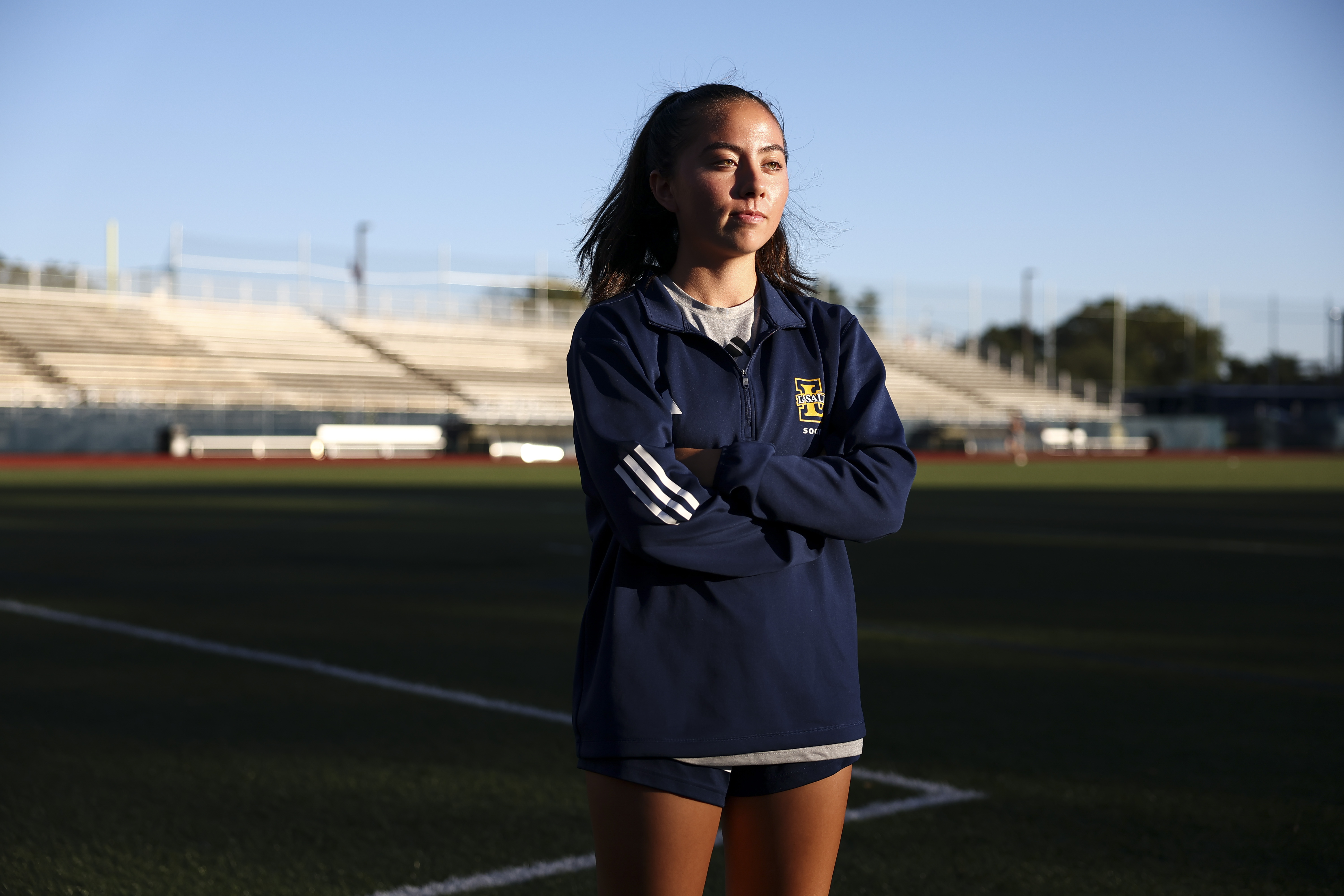
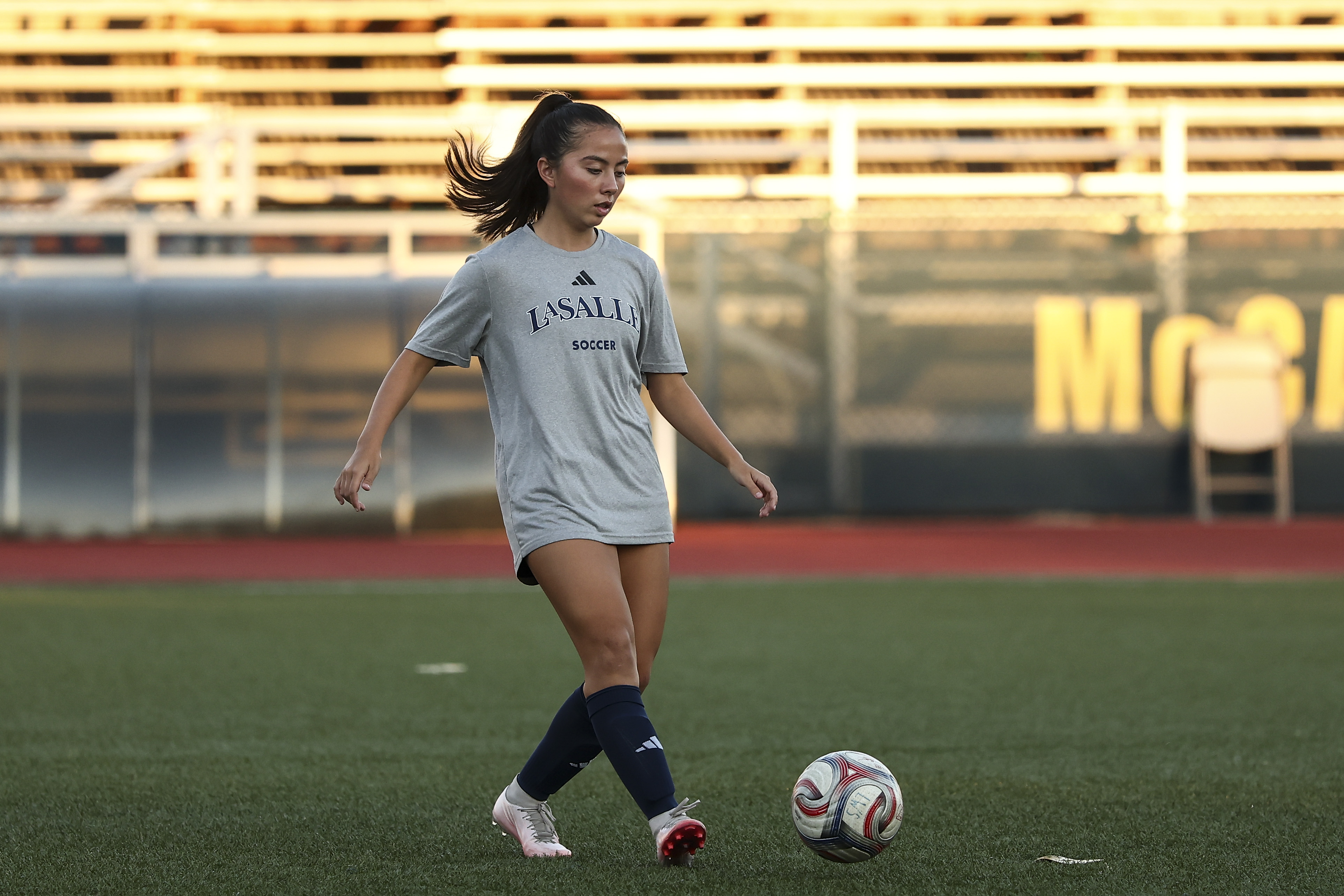
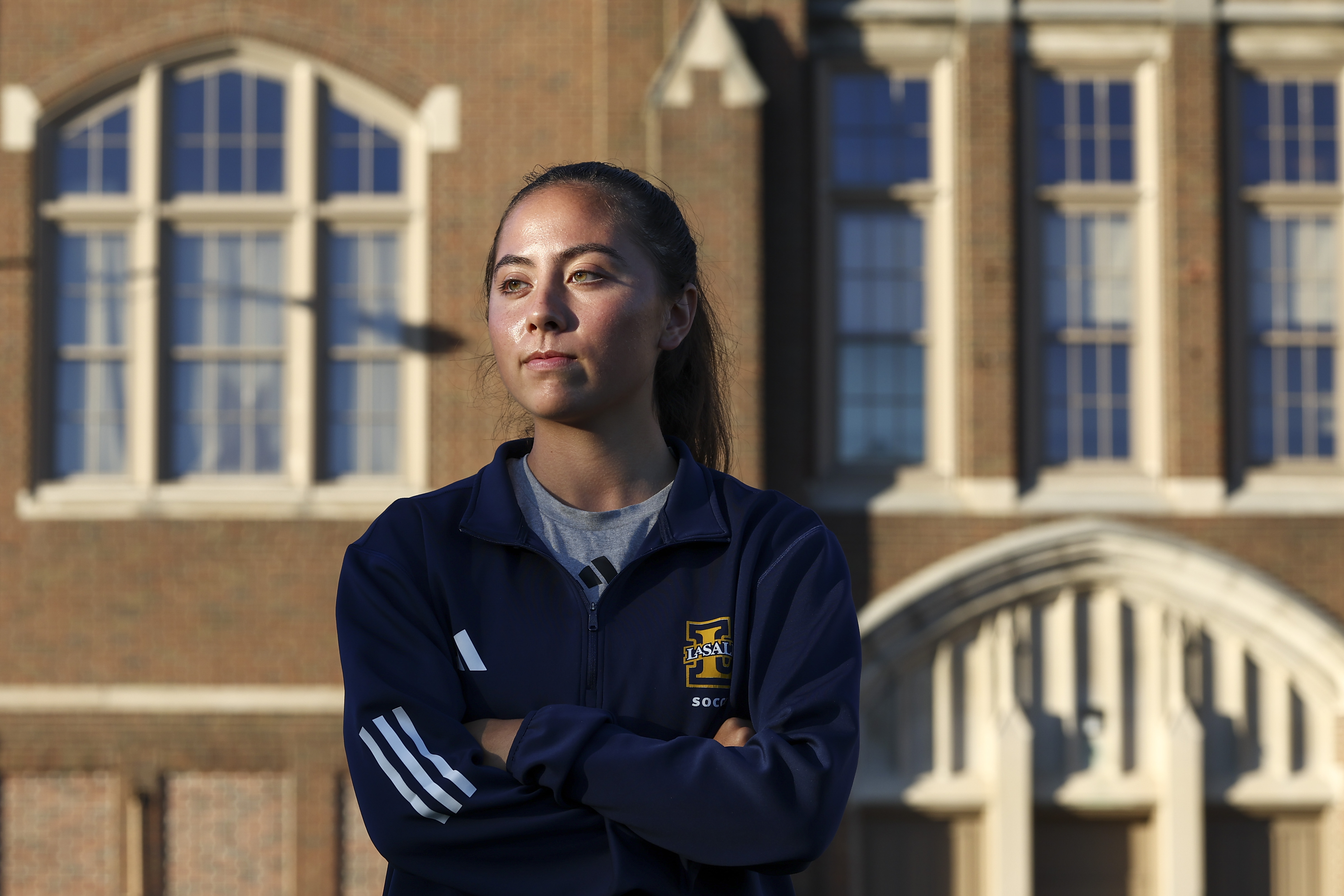
When Ella Cadigan arrived at La Salle, she was no longer the best player on her team.
She knew this would happen, but the transition to the college level was difficult. The midfielder previously starred at Westfield High School, a girl’s soccer powerhouse in North Jersey. In some ways, she was back at square one at 20th and Olney.
“I put so much of my identity on how I performed and whether I scored or not,” Cadigan said. “I just lost my love for the game a little bit.”
Self-doubt overcame Cadigan during her first two seasons with the Explorers. This summer, while playing for Morris Elite SC of the United Soccer League, she dispelled those feelings by focusing more on the “mental side” of soccer.
“I realized there’s always an after college,” Cadigan said. “Do you want to play professionally or do you want to find a career for yourself? And for me, this summer, I kind of realized that I only have two or three years of college soccer left, and so just finding other things that I find joy in, not just soccer, that helped me relieve a lot of the pressure.”
On her off days, Cadigan began going on runs, reading, and baking. The Biology major also got lost in her studies, making time to work in the lab. When she returned to campus, she had a new mentality — one that has paid off.
This season, the junior captain’s team-high 10 assists leads the Atlantic 10 and ranks near the top of Division I women’s soccer. She also tallied four assists in a 7-4 win against Howard on Sept. 6, setting a new single-game program record.
Junior midfielder Ella Cadigan has 10 assists this season.Monica Herndon / Staff Photographer
Cadigan’s uptick in play helped guide La Salle (9-5-4, 6-2-2 Atlantic 10) to the quarterfinals of the A-10 conference tournament, where it will face Loyola Chicago (7-3-8, 4-1-5 A-10) on Friday (5 p.m., ESPN+).
“Scoring goals and having assists isn’t everything,” Cadigan said. “Obviously, it’s nice to get your name in the newspaper every once in a while. [I] just kind of take it game-by-game and by leaning on my teammates, focusing on what makes me a great player, a great leader, and doing what I can to support the team.”
La Salle coach Paul Royal added: “[Cadigan is] focusing more on the team success than being an individual out there. I think that’s one of the things that she grew immensely in by knowing that ‘Hey, I can influence others. They respect me. They look up to me.’”
‘Close knit’
Cadigan comes from a big family. She has a twin brother, Patrick, and two younger sisters. Ella’s father, Richard, played soccer at La Salle. When Ella and Patrick turned 5, Patrick was put into the sport — and Ella didn’t follow far behind.
“I got super jealous that he was signed up, and I wanted the attention,” Ella said. “So I mean, my parents signed me up too, and I kind of just fell in love with it.”
In 2017, Richard took Ella and Patrick to a La Salle women’s game, a 3-1 loss at Rutgers in the opening round of the NCAA Tournament. Richard introduced the twins, then in sixth grade, to Royal. Almost a decade later, Ella is starting for the longtime coach in another postseason run.
“It was the first time I remember meeting them,” Royal said. “They were in middle school then. It was awesome just to see. There’s a men’s soccer alum that has these little kids that have dreams of playing at the college level.”
When Cadigan went through the recruitment process, Royal was the only Division I coach that looked her way. The fit was perfect for Cadigan, who wanted to go to a smaller college after four years at Westfield, which has nearly 1,800 students.
“I wanted to go somewhere where everyone knew each other,” Cadigan said. “It felt close knit, and obviously, a school like La Salle, we’re not the biggest campus, but I love the fact that you know everyone in your grade. All the athletes always know each other.”
Ella Cadigan is “doing what I can to support the team.” Monica Herndon / Staff Photographer
Through her three years at La Salle, Cadigan has found a strong support system — one that has helped her overcome her own mental battles. On Friday, she’s looking to succeed with them too.
“I can really go to anyone if I needed to talk about anything,” Cadigan said. “As a team we’ve kind of built a foundation where everyone needs to play their role. But at the end of the day, we always have to be happy for each other.”
In the Old Testament we learn in Leviticus that, on Yom Kippur, the Hebrew people sent a goat into the wilderness, symbolically burdened with the sins of the people. Over time, the ritual became a metaphor for the act of shifting blame to someone who doesn’t deserve it.
Which brings us to Tanner McKee.
McKee spent the summer getting third-team quarterback reps behind starter Jalen Hurts and, inexcusably, behind washed-up veteran Andy Dalton.
Dalton threw one pass this season, an interception against the Bears, and was cut by the time Hurts was lost for the season with blood clots in his lungs last month.
At that point, the current iteration of the offensive line — from left to right: Jordan Mailata, Landon Dickerson, Drew Kendall, Tyler Steen, and Markel Bell — had played zero games together.
The current iteration of the offensive line has now played two games together. It is making the sort of inexcusable mistakes you see in springtime OTAs.
First-year offensive line coach Chris Kuper has, so far, been a disaster. He lost Lane Johnson to retirement after three games, but when Dickerson was lost after Game 1, he moved Pro Bowl center Cam Jurgens to left guard, where Jurgens played poorly, then was traded.
First-year, first-time offensive coordinator Sean Mannion, who has been an NFL coach only since 2024, has been even worse.
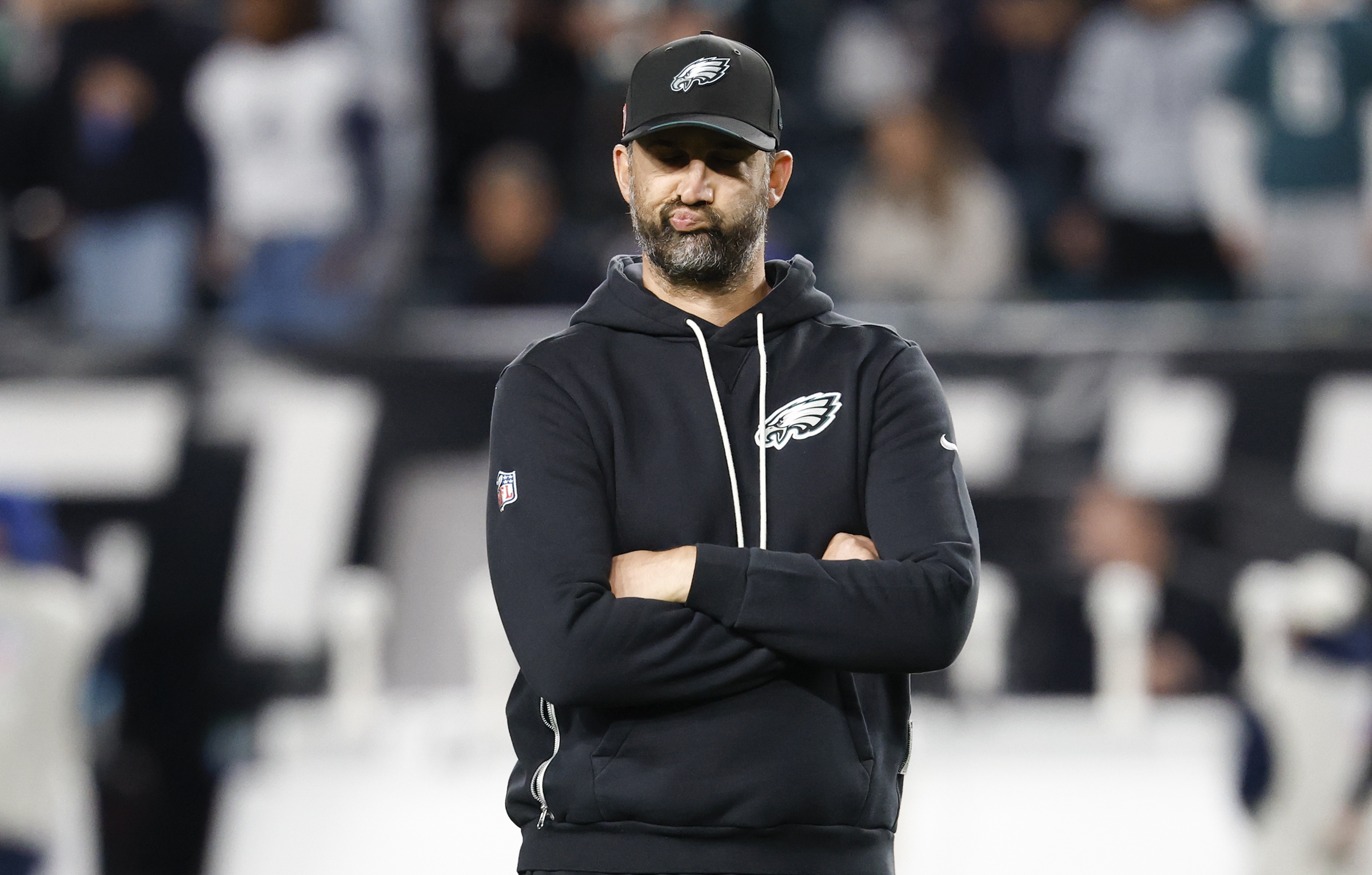
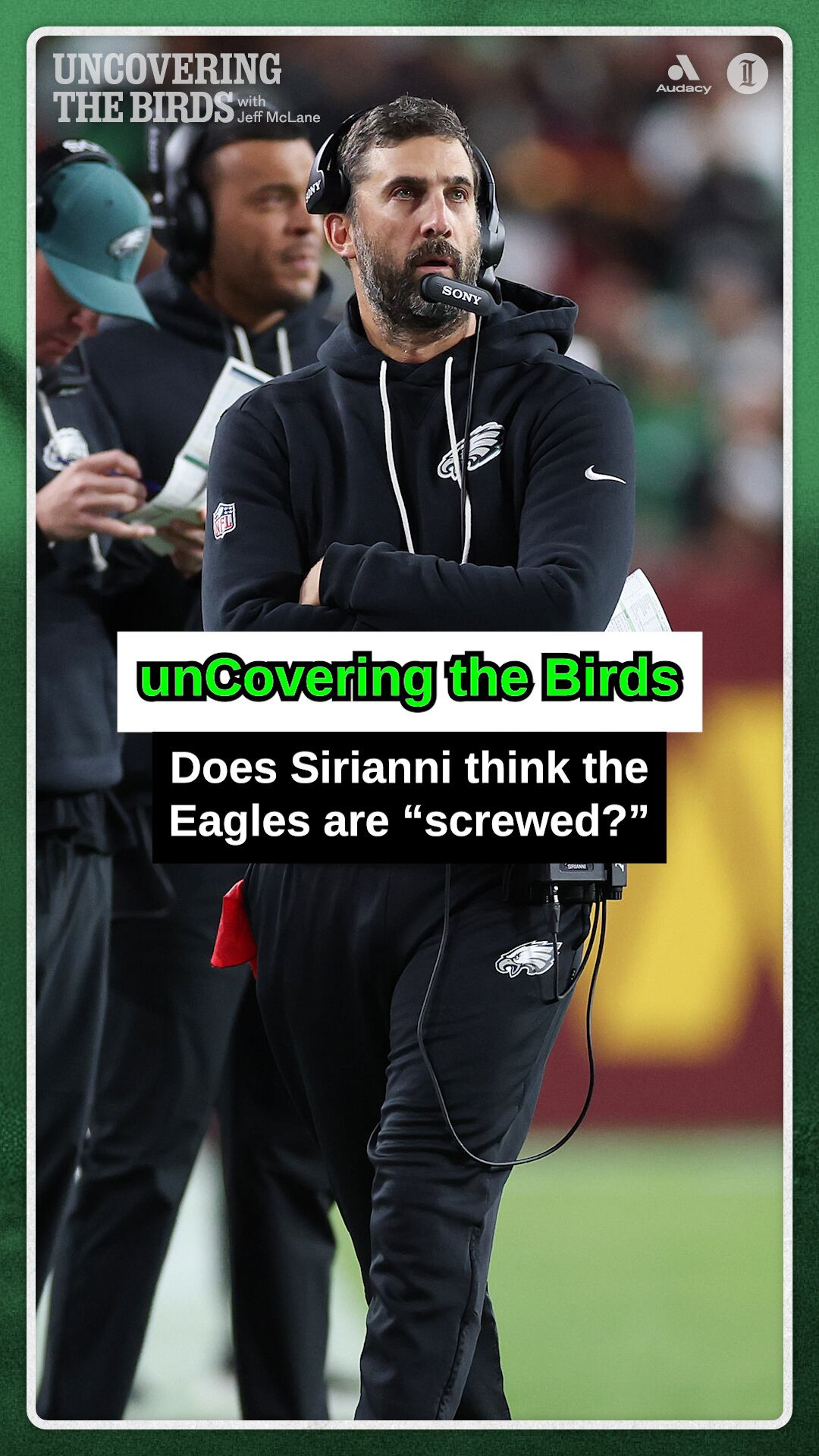
Head coach Nick Sirianni, who has won two NFC titles and a Super Bowl and is now challenged to win without a star-studded roster, suddenly has no answers.
The team has lost six straight games for the first time since 2012.
Andy Reid was fired after the 2012 season.
Sirianni needed a distraction.
So, on Wednesday, he benched McKee.
He did this in a manner that ensured no accountability for nearly three news cycles.
He did this after he spoke with the press around noon but before the locker room opened, where he knew that players would let the public know. Shortly after Sirianni’s news conference, the Eagles leaked to major media outlets that recent arrival Joe Milton would start in place of McKee on Sunday when the Giants visit.
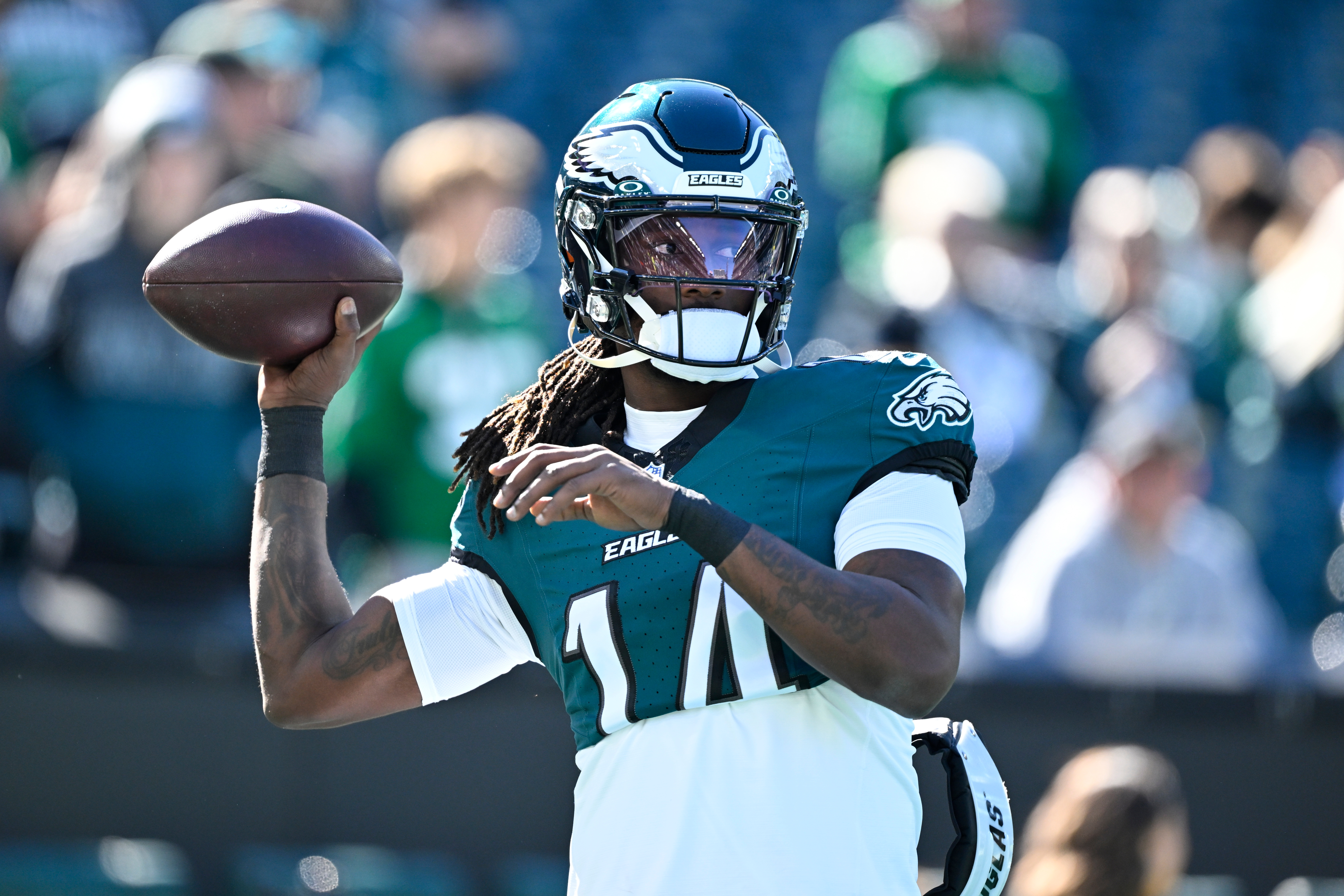
Quarterback Joe Milton will be the next man up for an Eagles offense that has been hapless for most of this season.Terrance Williams
Sirianni next speaks Friday.
He will have some explaining to do.
Milton was a sixth-round pick by the Patriots out of Tennessee in 2024 who was traded to the Cowboys a year later. He has played in five games as a reserve. He has never started. He is 6-foot-5, 236 pounds, athletic, and he has a very strong arm.
We hope he gets a better chance than McKee was afforded.
In his three starts, McKee has thrown two touchdown passes and two interceptions, though, to be fair to his critics, he probably should have been intercepted a couple more times. He has been sacked 10 times. He occasionally misreads the defense’s intentions, but he also has played behind a poorly coached offensive line that continually makes mistakes.
McKee played in only one game, Oct. 18 against the Panthers, with No. 1 receiver DeVonta Smith and No. 2 receiver Dontayvion Wicks. They have been injured since.
McKee has had Saquon Barkley on the field for the last two starts, but Barkley has been injured, and he’s still on a pitch count.
McKee has played in zero games with Smith, Wicks, and Barkley together.
His most frequent target has been rookie Makai Lemon, who is a possession receiver.
Has McKee been good?
No.
Video: What should the Eagles’ 3-5 year plan be? | unCovering the Birds
But then, McKee, like Milton, is a former sixth-round pick. He has been an Eagle for four full offseasons, 3½ regular seasons, and three playoff trips.
McKee was completely unsuited to start more than three games in the NFL after almost four years with Sirianni, and that falls at the feet of Sirianni.
Coach better.
At any rate, it is under these impossible circumstances that McKee gets benched.
But there’s pressure to fire Mannion. There’s pressure on Kuper, as folks clamor for ousted offensive line coach Jeff Stoutland. And most importantly, there is pressure on Sirianni.
You know what takes the spotlight off coaching failure?
Shifting the blame to a scapegoat quarterback with no pedigree and no ally.
OK, so we know most of Philly views this Eagles season as a wrap.
However, the franchise made a decision and yesterday to give Joe Milton the keys to the offense ahead of Sunday’s game against the NFC East-leading New York Giants is intriguing.
The news of Milton’s takeover arrived midday yesterday, and almost immediately it reminded me of another NFL journeyman who transformed an Eagles season for the better: Jeff Garcia.
For those too young to remember, in 2006, after quarterback Donovan McNabb went down with an injury, Garcia stepped in and stepped up, leading the Birds to the playoffs. We’re not saying that Milton is going to do that in Week 9, but in a season with so much bad, what if Milton is the good the Eagles need?
Of course, getting healthy at receiver and running back wouldn’t hurt, either.
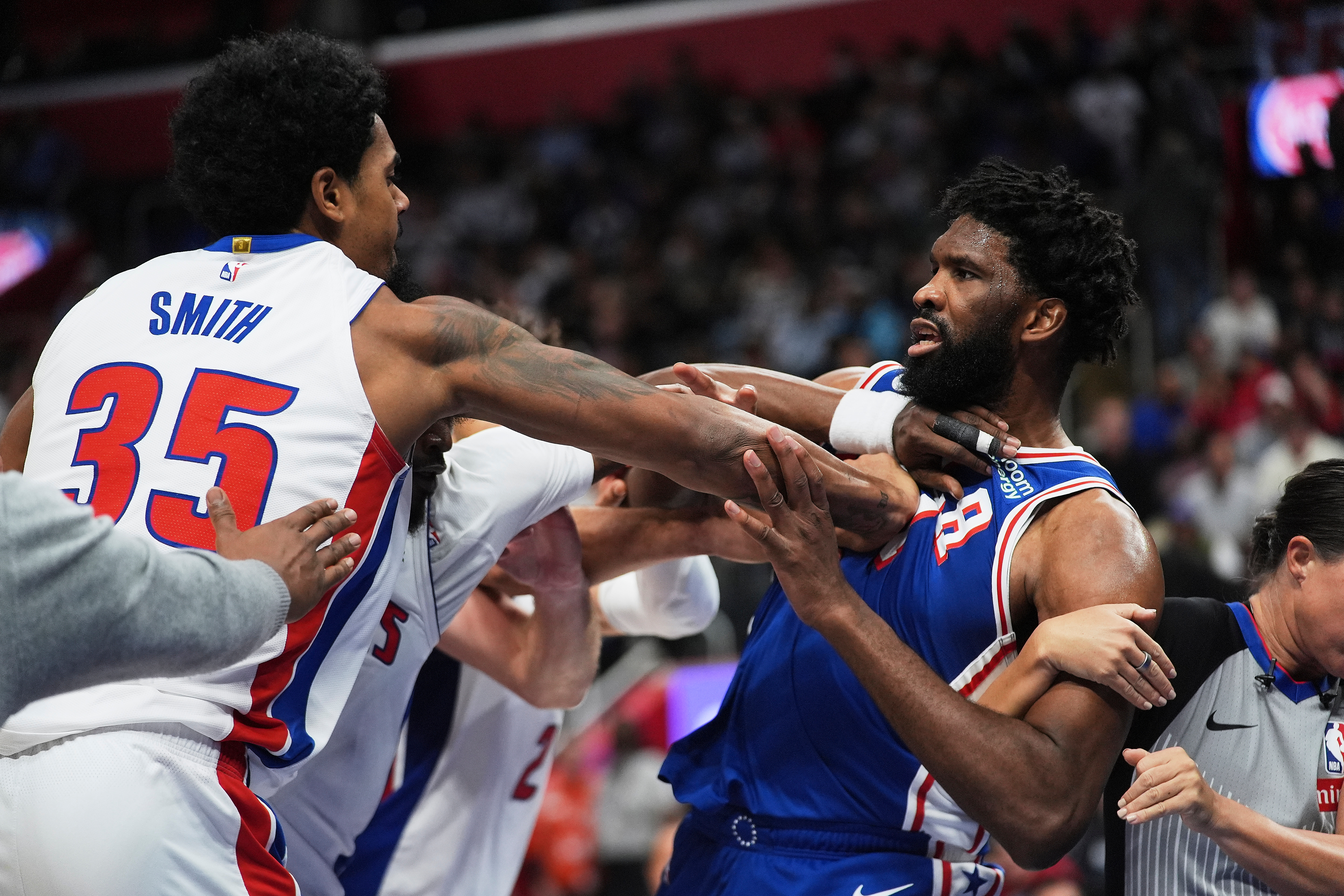
Pistons forward Tolu Smith (35) and Sixers center Joel Embiid (21) scuffle in the first half of their game in Detroit on Wednesday
.Paul Sancya
The Sixers are now 8-1 following a massive 112-106 win against the Detroit Pistons last night. That one loss on the Sixers’ season? To the Pistons.
The difference on Wednesday night? The Sixers had their full squad, and it showed as the team led by as much as 18 points and had all five starters scored in double figures, including LeBron James, who finished with 13 points and 10 rebounds.
Next up for the Sixers is group stage play of the NBA Cup against the Cavaliers (7:30 p.m., Prime Video).
Oh, and a side note for you sneakerheads out there … did you see Reebok is reviving Allen Iverson’s iconic “Question” shoe? With a few upgrades at that.
What we’re …
📖 Reading: The number of players you, our readers, chose to save on this current Eagles team. Spoiler alert: The pickings were slim.
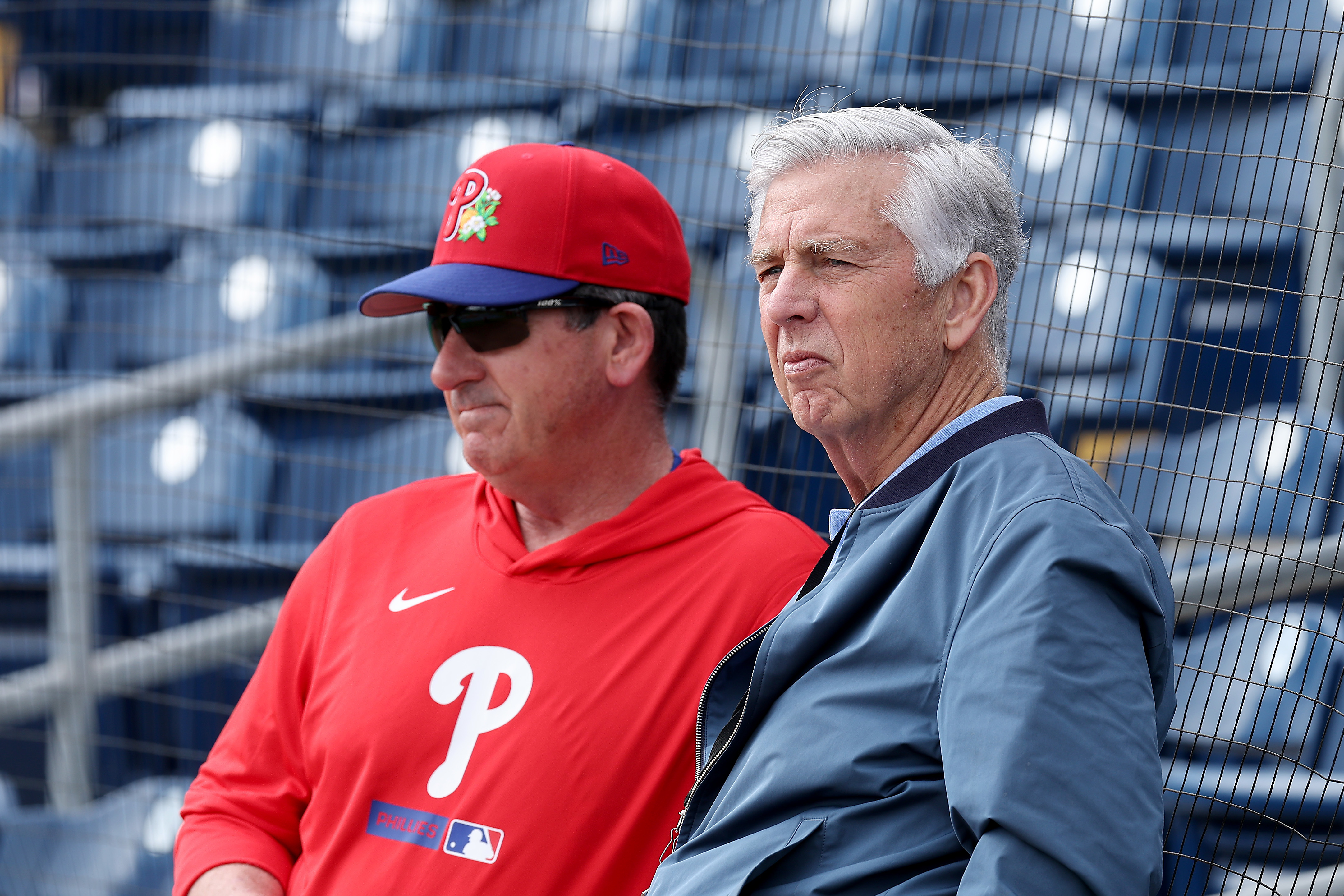
Phillies manager Rob Thomson (left) and president of baseball operations David Dombrowski (right) have much to consider this offseason, in addition to an impending lockout.David Maialetti / Staff Photographer
This year’s MLB offseason will be different from most, with the looming expiration of MLB’s collective bargaining agreement on Dec. 1.
Our focus is on the Phillies and what moves, both incoming and outgoing, could be on the horizon. Inquirer writer Lochlahn March created this primer looking at everything, from the lockout, the dates you need to know and what moves the Phillies have to make.
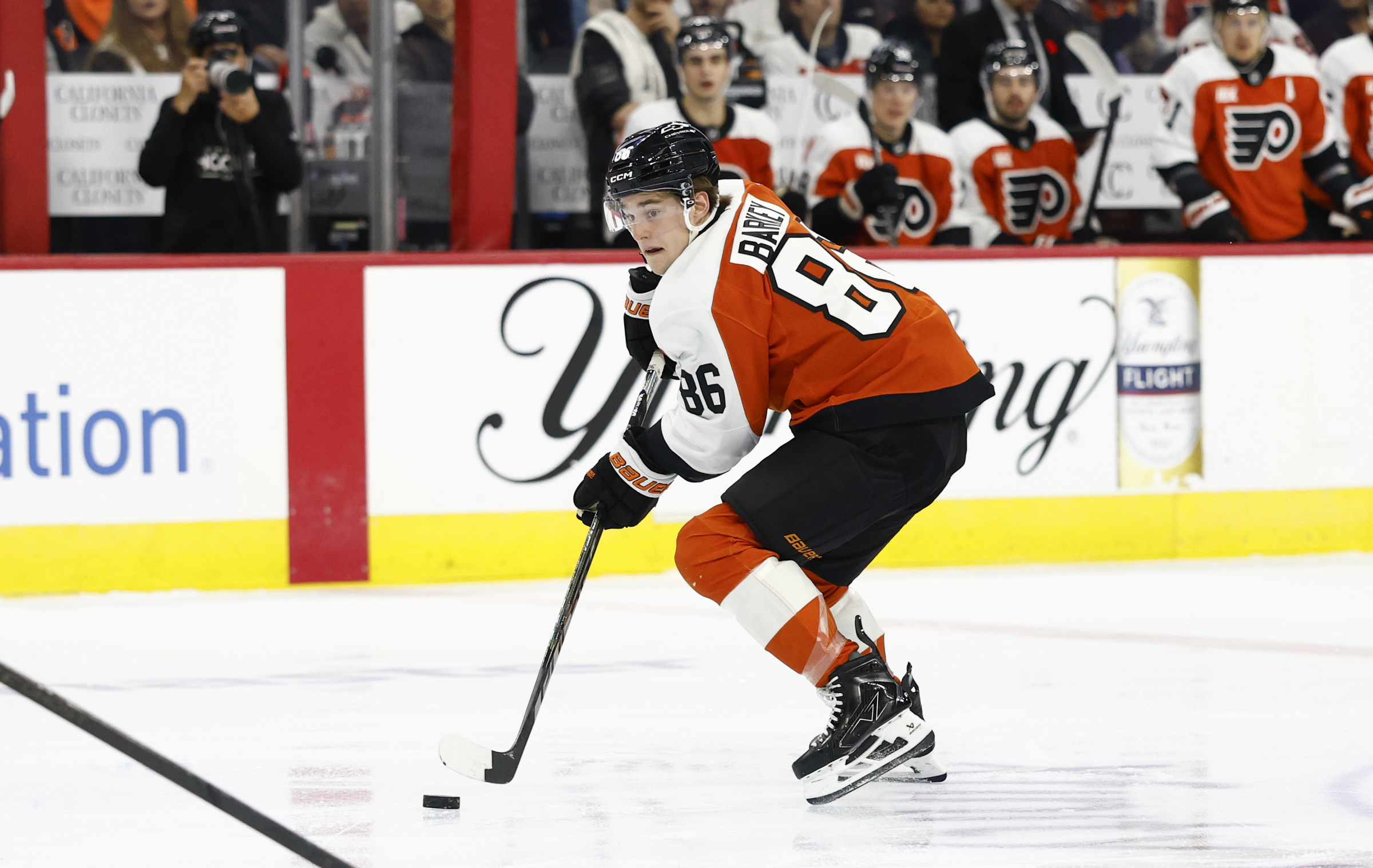
Flyers center Denver Barkey skates with the puck against the Utah Mammoth on Sunday, Nov. 1, 2026 in Philadelphia.Yong Kim / Staff Photographer
The Flyers have yet to truly recover from their record nine-game winless streak to start the year. Despite their 4-9-4 record, Rick Tocchet thinks his team is slowly improving.
“I’ll be the first guy to admit [it], we have been awful all year early on on [winning pucks], but I think we’ve gotten better,” Tocchet said after Tuesday’s 4-2 loss to Minnesota.
“Where there’s been 50-50 pucks, we’ve come out with them. I thought a little bit more tonight again, so that is something that we are improving on. It makes a difference because then you’re getting more chances or more shots or more action at the net.”
Speaking of getting better, Gabriela Carroll wrote about Denver Barkey, the unsung hero of the Flyers’ suddenly competent power play.
Next: The Flyers kick off a five-game road trip in New York tonight against the Rangers (7 p.m., NBCSP).
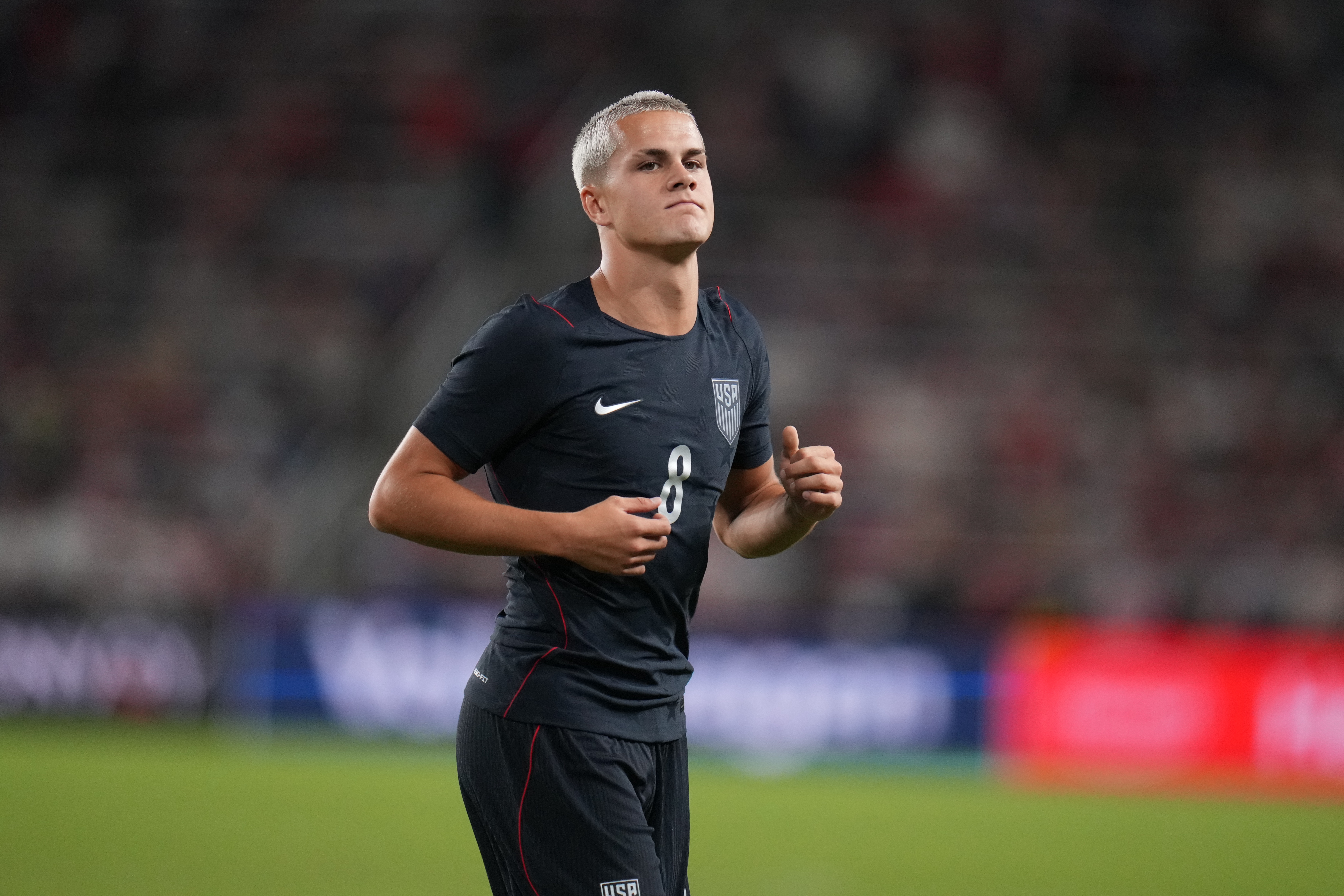
The Union’s Cavan Sullivan was selected to U.S. Soccer’s 26-man roster for a pair of upcoming final matches in 2026. Jeff Roberson
In the final FIFA international date of 2026, U.S. Soccer will pair Christian Pulisic, who is on another tear with his club team AC Milan, with Union phenom Cavan Sullivan. It’s set to be a potentially explosive pairing that should aid the U.S. in progressing in the CONCACAF Nations League quarterfinal against Haiti on Nov. 14 (4:30 p.m., TBS, Universo).
Additionally, four other players with local ties cracked U.S. manager Mauricio Pochettino’s 26-man roster, setting up another opportunity to see homegrown talent on the highest stage. Jonathan Tannenwald breaks down the roster and the duo of Cavan and Christian.
On this date
Oct. 5, 2022: The Phillies would find themselves on the losing end of a 4-1 final in Game 6 that lifted the Houston Astros to their second World Series title. It was a game that would see longtime Astros manager Dusty Baker become the oldest manager to win a pennant at 73 years young.
Quarterback Joe Milton will be the next man up for an Eagles offense that has been hapless for most of this season.Terrance Williams
“The most likely outcome is not that [Joe] Milton plays well enough to enter the offseason as the Eagles’ presumptive QB2 for 2027. But it is at least a potential outcome, which is more than you can say for [Tanner] McKee.” — In his latest, Murphy takes a look at what the Eagles stand to gain from starting Joe Milton over Tanner McKee on Sunday.
What you’re saying about sports moments
We asked: What’s the wildest thing you’ve ever witnessed at a sporting event?
For all of us who weren’t old enough to remember the Miracle in the Meadowlands in 1978 and barely old enough to remember Brian Westbrook’s incredible punt return to beat the Giants in 2003 — Giants Stadium has seen some incredible moments at the end of games for the Eagles.
What I saw during the Holidays of 2010 — was one of those moments. It was hard to be surrounded by Giants’ fans all basking in the glory of a 31–10 lead late in the 4th quarter. But then Michael Vick found Brent Celek for a 56-yard touchdown with just under eight minutes left in the game. The Eagles then recovered an onside kick, and Vick ran in from six yards out to bring the score to 31–24.
The Giants faithful were silenced again when Vick found Jeremy Maclin for a 13-yard score to tie the game at 31–31. Everyone in that stadium knew what was possible when DeSean Jackson secured the football and then ran for a 65-yard punt return touchdown to win the game 38–31 — placing pure disbelief on the faces of New York fans. — Michael L.
I saw the Santa Claus snowball throwing game at the Vet in 1968 on a cold, miserable day. I once saw a fan run out on the court at Convention Hall during a Sixers game. I think, but not sure, that the ref was Mendy Rudolph. — Everett S.
We compiled today’s newsletter using reporting from Olivia Reiner, Mike Livingston, Chris Hine, Devin Jackson, Matt Mullin, Scott Lauber, Lochlahn March, David Murphy, Jackie Spiegel, Gabriela Carroll, Jonathan Tannenwald, Ariel Simpson, and Mia Messina.
By submitting your written, visual, and/or audio contributions, you agree to The Inquirer’s Terms of Use, including the grant of rights in Section 10.
That’s your Thursday. I’ll be spending mine tonight finishing that Tyson documentary on Netflix. If you haven’t seen it, definitely recommend it. I’ll be back tomorrow to get you set for a full sports weekend. — Kerith
Ryan and Olivia are breaking down everything you need to know ahead of the Eagles’ matchup against the New York Giants! From key matchups and players to watch to predictions and what the Birds need to do to come away with a win. Watch here.
Christmas will look different this year for Inarvis Ramos’ family.
They will have left the small North Philadelphia rowhouse they rent and be living in a larger one with room for a big tree — exciting for her two children under 10 — and nice sofas that aren’t from Ikea — exciting for her.
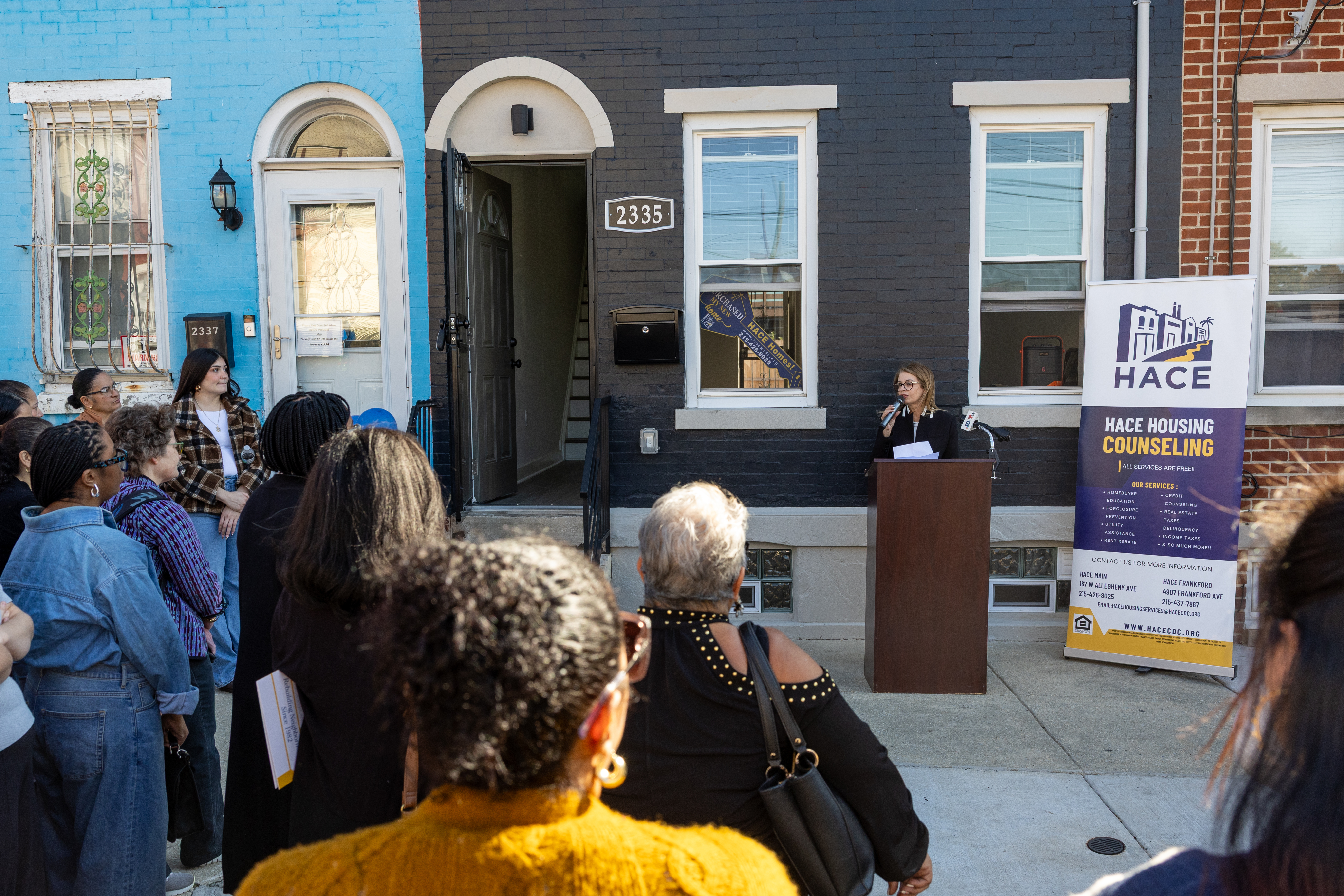
Ramos and her 23-year-old son will close next month on the three-bedroom house, whichwas recently renovated after standing vacant for a decade. Their monthly mortgage payment will be about $1,000 — less than their rent.
“I’m happy,” said Ramos, a 43-year-old first-time homebuyer who works at a nearby school. “Excited for a new step, sort of new beginning.”
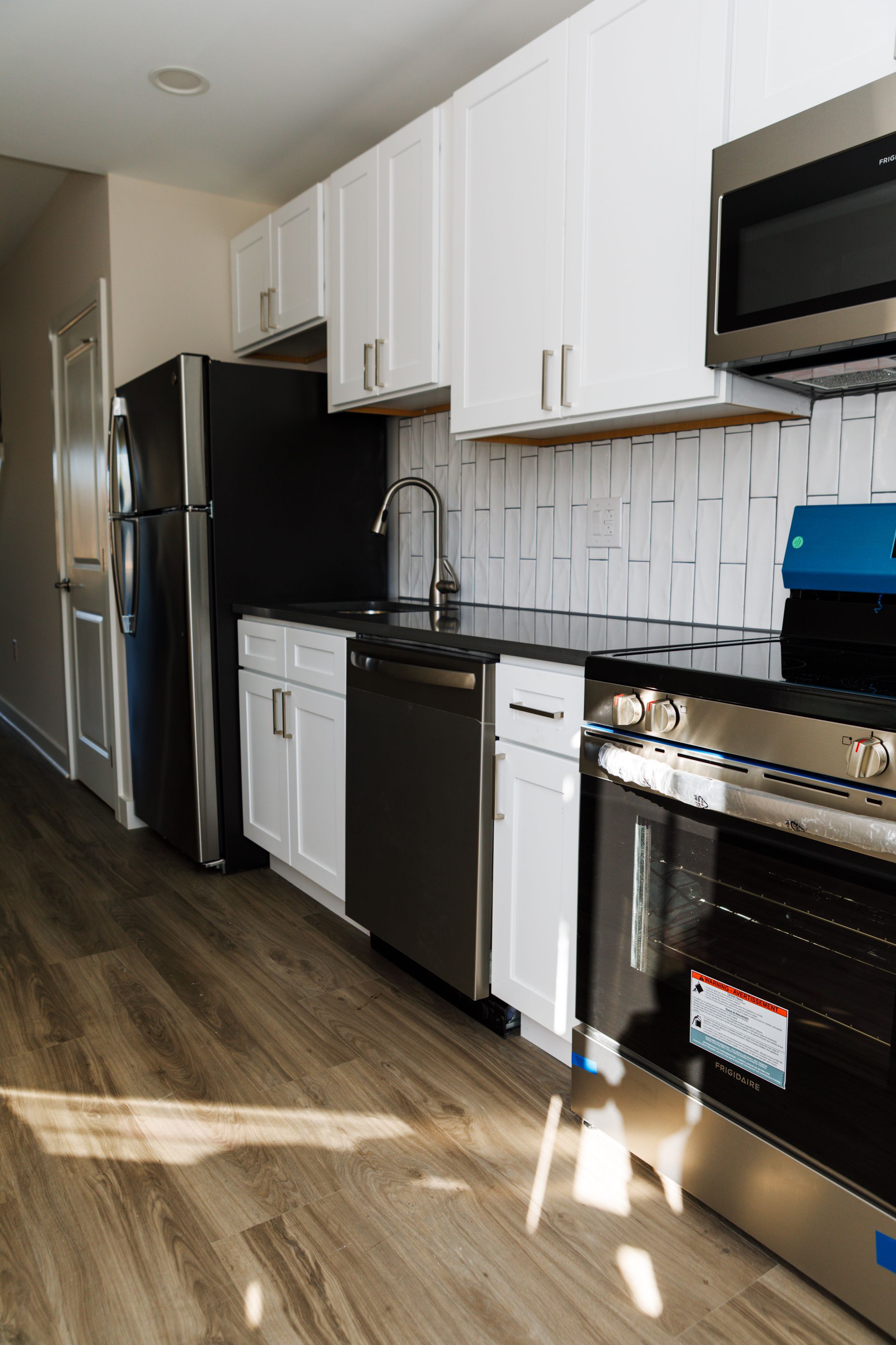
Inarvis Ramos is excited for holiday meals in her new kitchen in the newly renovated North Philadelphia house she is buying in December.Daniel Jackson, Embassy: Interactive
Her purchase also represents a new step for the city’s Turn the Key first-time homebuyer program. For the last four years, it has subsidized sales of single-family homes newly built on city-owned vacant land.
Ramos is part ofa pilot initiative in which the North Philadelphia-based community development corporation HACE is renovating existing homes and making them affordable for households with lower incomes. City officials and funders hope the pilot can become a model.
Turn the Key buyers pay an average of $183,500 for new homes after subsidies and grants. But HACE has been able to sell rehabilitated homes for $160,000 through the program thanks to the Philadelphia Housing Authority’s donation of houses, subsidies, and a grant provided by the city, and funding through LISC Philadelphia, a nonprofit focused on supporting community development.
“We’re getting very creative to serve families that really cannot afford a traditional Turn the Key property,” said Maria Gonzalez, HACE’s president and CEO.
Hector Soto, the partner of homebuyer Inarvis Ramos, shows off an LED mirror to City Councilmember Quetcy Lozada inside the second-floor bathroom of Ramos’ newly rehabilitated home in North Philadelphia.Aidan T. Gallo / Staff Photographer
Depending on the project, Turn the Key is open to homebuyers making up to 80% or 100% of the area median income, which is $122,700 for a four-person household. But as of September, the average buyer’s income was much less — 57% of the area median, or about $70,000 for a household of four.
Through the pilot program, HACE and its partners have made newly renovated homes affordable for households making less than half the area median income. Ramos’ four-person household, for example, makes about 37%, or roughly $45,200.
“Philadelphia has tons of vacant houses with good bones,” Brooks said. “Rehabbing them can save money compared with building new, it keeps the character of our blocks, and it turns an empty house into a home.”
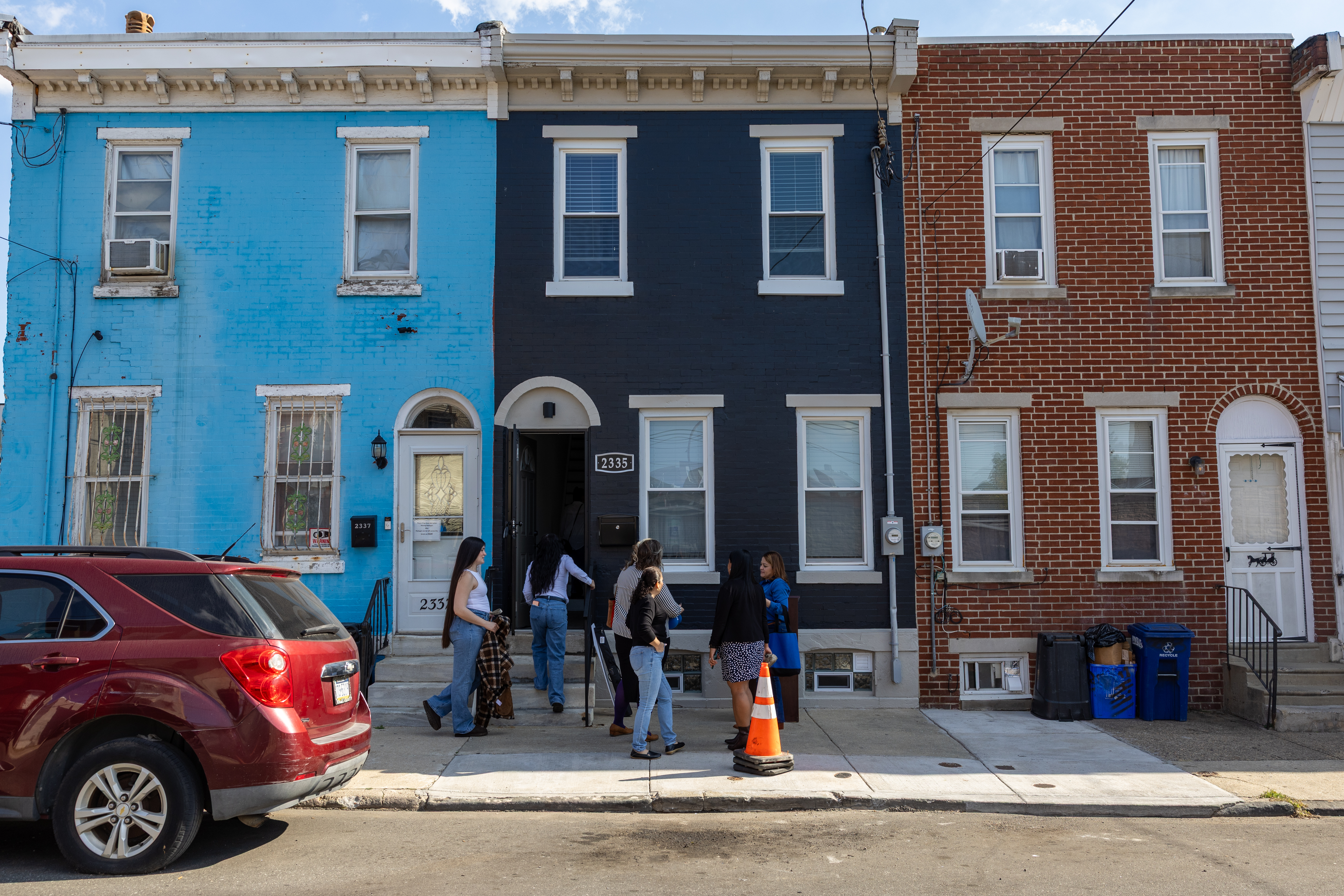
The center North Philadelphia rowhouse, which Inarvis Ramos will buy in December, was vacant for a decade before HACE renovated it through a Turn the Key pilot program.Aidan T. Gallo / Staff Photographer
Cutting development costs
In the established program, the city essentially donates vacant land to developers through the Philadelphia Land Bank. That cuts development costs and the new home’s sale price.
Buyers need to complete housing counseling, have minimum credit scores of around 640, and qualify for mortgages.
As of September, developers had sold about 470 homes through the program, according to the executive director of the Philadelphia Land Bank in a report to its board. More than 200 more homes were under construction.
Andrew Frishkoff, executive director of LISC Philadelphia, said the organization supports the established Turn the Key program and has financed developers’ construction of new homes. But LISC saw existing vacant homes as potential missed opportunities.
Making newly built homes affordable for households with lower incomes is difficult because of the cost of construction. Renovating a home is typically less expensive.
This is what a bathroom looked like in a long-vacant Norris Square rowhouse before HACE renovated the property to sell to a low-income family.Courtesy of HACE
His organization got funds from the Pennsylvania Housing Finance Agency and the U.S. Department of Housing and Urban Development to help developers acquire and renovate properties that would have appealed to investors and to help households purchase them for below-market-rate prices. LISC is working with HACE and other local nonprofits that develop housing.
“We knew they were encountering challenges in some cases in acquiring properties or coming up with the budgets to repair them, and more importantly, being able to make sure they sold them at a price lower-income residents could afford,” Frishkoff said.
All five Turn the Key homes that HACE has renovated so far have been in the Fairhill area of North Philadelphia in City Councilmember Quetcy Lozada’s 7th District.
The pilot “shows us what is possible when we invest in homes and properties already present in our neighborhoods,” Lozada said. “Rather than allowing vacant properties to remain symbols of neglect, HACE is transforming them into quality, affordable homes and creating opportunities for families to build stability and wealth.”
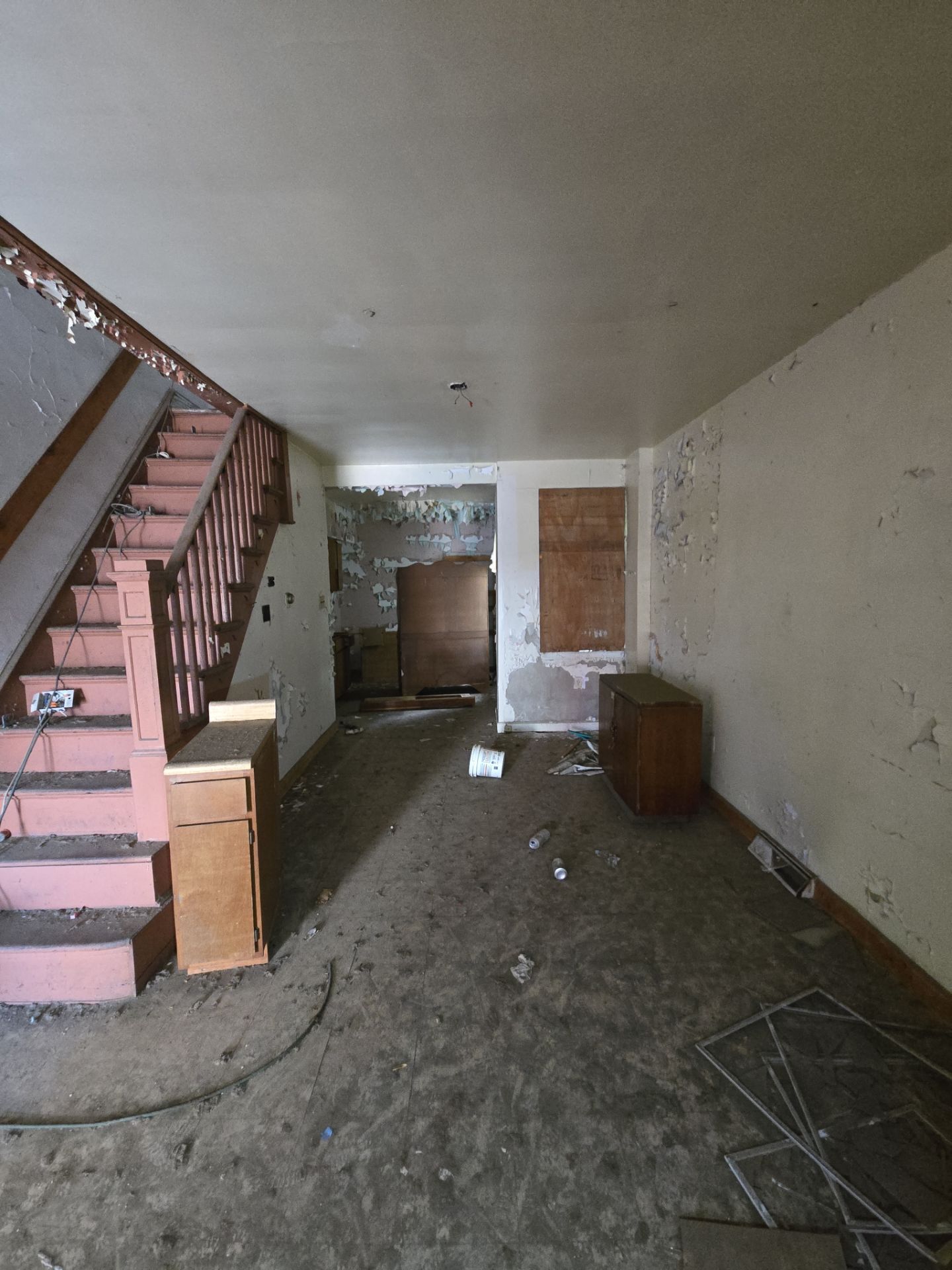
This is what a living area looked like in a North Philadelphia rowhouse before HACE renovated the property to sell to Inarvis Ramos.Courtesy of HACE
Deeper affordability
Lozada is among the Council members who have pushed back against Turn the Key developments, because homes aren’t affordable for constituents.
But, she said, “I strongly support projects like Turn the Key when they are intentional, inclusive, and designed to benefit the people who have called this community home for generations.”
LISC Philadelphia is offering homebuyers tens of thousands of dollars in grants. It is distributing $40,000 awards in this first phase of the pilot with HACE, but it is prepared to give more if needed in future phases to match “what [buyers] really need to afford the home,” Frishkoff said.
LISC has started with about $1.3 million for its “affordability-gap” subsidies.
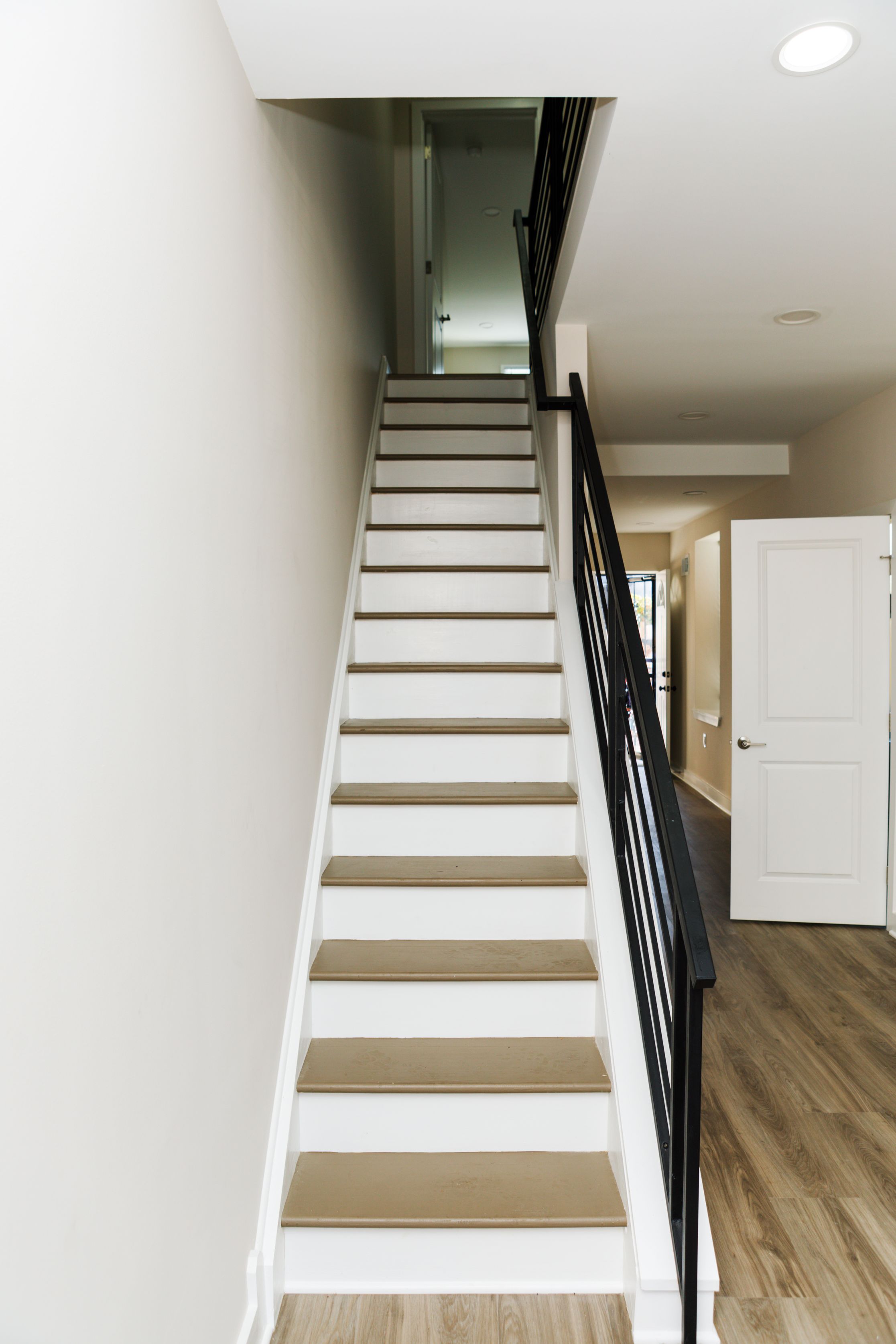
Pictured are the newly renovated stairs leading to the second floor of a North Philadelphia rowhouse that HACE rehabilitated through a pilot initiative of the Turn the Key program.Daniel Jackson, Embassy: Interactive
‘I have a house’
For this initiative, the Philadelphia Housing Authority donated single-family houses to HACE.
Kelvin Jeremiah, PHA’s president and CEO, said the city’s affordable-housing crisis requires a multipronged approach, creative solutions, and strong partnerships.
“We have properties that were uninhabitable being used for affordable homeownership in a neighborhood and in a community where we’re seeing increasing home values displacing a lot of local residents,” Jeremiah said.
(From left) María M. González, president and CEO of HACE; homebuyer Inarvis Ramos; Ramos’ partner, Hector Soto; and City Councilmember Quetcy Lozada have their picture taken together during a Turn the Key ceremony at Ramos’ newly rehabilitated home in North Philadelphia on Oct. 30.Aidan T. Gallo / Staff Photographer
Veronica Feliciano, a 32-year-old general manager of a Northern Liberties restaurant who has family in Norris Square, bought her house in the neighborhood in August.
She had always wanted to be a homeowner, but she felt discouraged by high home prices. Through the pilot program, Feliciano was able to buy her two-bedroom, 1½-bathroom, fully renovated house for $160,000.
“It’s so surreal honestly,” she said. “I literally walked in today and thought, ‘I have a house.’ I can’t even believe it.”
Feliciano likes her home’s layout and natural light. She is close to amenities, her job, and friends. And she has a large yard for hosting gatherings and for the flowers, herbs, vegetables, and fruits she wants to grow.
Feliciano’s mother, Annie Feliciano, said she’d always believed her daughter would one day become a homeowner.
“But I never imagined that as a first-time homebuyer, she would be able to afford a beautiful, completely renovated home right here in the neighborhood where I grew up,” she said.
Veronica said HACE made her purchase as easy as possible and is still offering support.
“I’ve been telling everybody about the program,” she said. “I hope that they get more homes and they renovate more homes.”
María M. González, president and CEO of HACE, speaks during a Turn the Key ceremony at a newly rehabilitated home in North Philadelphia on Oct. 30.Aidan T. Gallo / Staff Photographer
Looking ahead
HACE is the first nonprofit to renovate houses through Turn the Key. But LISC Philadelphia also is working with Xiente and Habitat for Humanity Philadelphia, which are in early stages of following in HACE’s footsteps.
Of the five houses HACE has renovated so far, three have been sold, one is under contract, and one is available for sale. In the next phase of the Turn the Key pilot, HACE plans to rehabilitate six more houses.
HACE’s CEO said she wants the initiative to keep people from being priced out of their communities.
“Homeownership is a way to build wealth for many of our families,” Gonzalez said. “And we want to make that affordable for families that typically would not have a chance to buy a home in today’s market.”
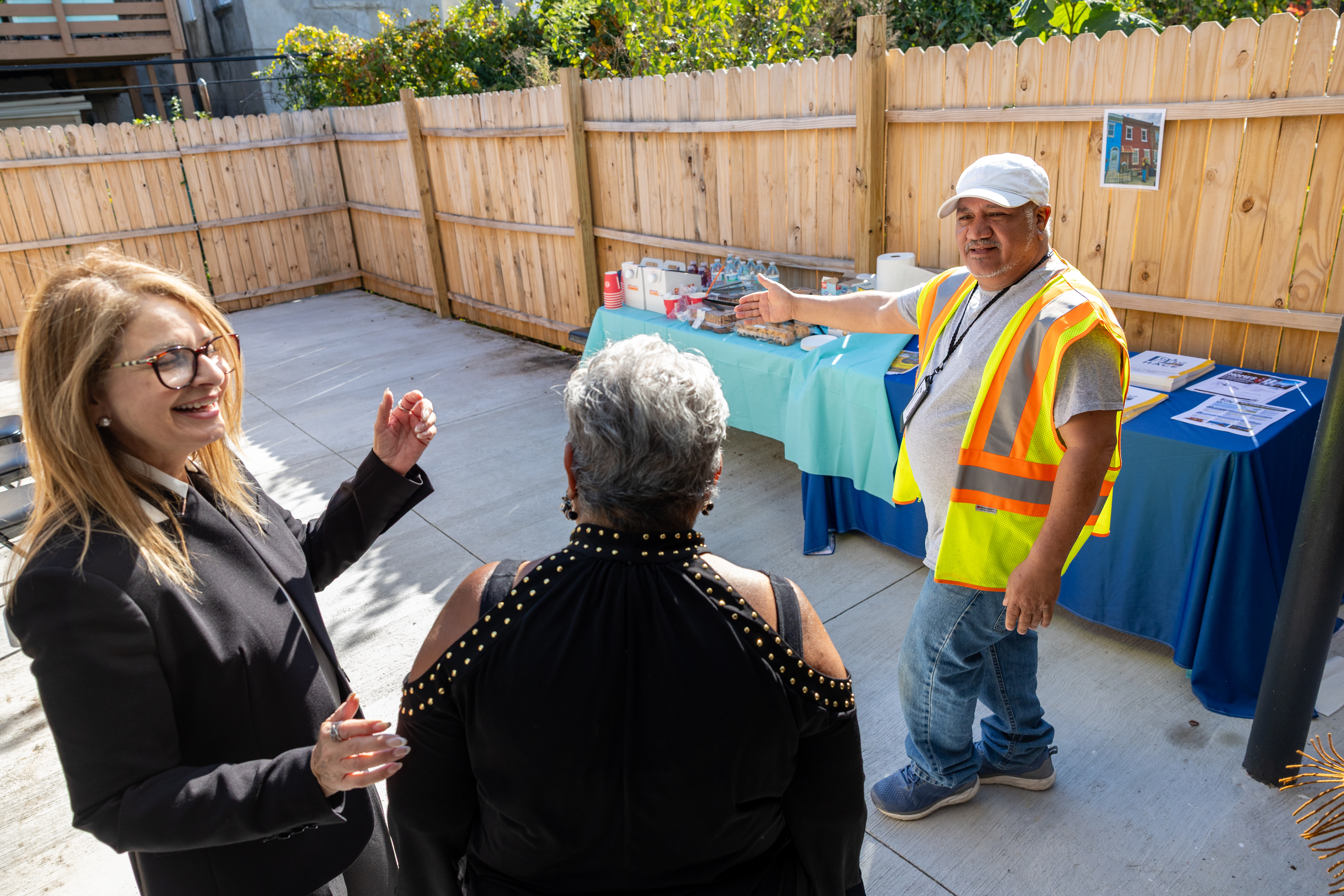
Hector Soto, the partner of homebuyer Inarvis Ramos, gives a tour of Ramos’ new backyard while president and CEO of HACE María M. González and Rose M. Tirado-Turner, a mortgage originator at Finanta Credit Union, share a moment together at Ramos’ newly rehabilitated home in North Philadelphia.Aidan T. Gallo / Staff Photographer