Category: Washington Post

  • Supreme Court expands Trump’s power over the federal bureaucracy, with an exception

    Supreme Court expands Trump’s power over the federal bureaucracy, with an exception

    The Supreme Court greatly expanded President Donald Trump’s control over the federal bureaucracy Monday, but stopped short of allowing him to undermine the independence of the Federal Reserve in a pair of rulings that amount to one of the largest verdicts on the scope of presidential power in decades.

    In a 6-3 ideologically divided decision, the justices struck down a nearly century-old precedent that has allowed Congress to insulate the leaders of the Federal Trade Commission (FTC) and roughly two dozen other independent regulatory agencies from political influence by requiring the president have good reason to dismiss them.

    The ruling is likely to usher in major changes to the structure of the federal government, and it fulfills a major goal of the Trump administration and many conservatives who have long argued that the president should exercise nearly unfettered authority over the executive branch.

    In the other related case, a group of justices blocked Trump from removing Federal Reserve Governor Lisa Cook, at least for now, in a 5-4 ruling that found the powerful central bank has a distinct history and structure that allows Congress to carve out protections for its governors, unlike other independent agencies.

    Taken together, the cases amount to a split political decision for Trump, who has pushed aggressively in his second term to assert his authority over federal government by dismissing agency heads, restructuring departments, and firing thousands of federal workers.

    Trump hailed the ruling in the FTC case as a “BIG WIN” in a post on Truth Social, while saying he would continue the fight to try to remove Cook.

    “90 years of precedent has been COMPLETELY AND UNEQUIVOCALLY OVERRULED, greatly increasing Presidential Power at a time when it is most needed!” Trump wrote.

    Republicans said the FTC ruling would make the government more accountable to voters who elect the president, but Democrats and some former agency officials worried it would lead to the politicization of regulations on product safety, elections, nuclear energy, and much more. The ruling in the Cook case is provisional and it will return to the lower courts for additional legal wrangling.

    The majority said the Constitution’s plain language gives the president control of the executive branch, but Justice Sonia Sotomayor, joined by the court’s other two liberals, said in dissent that the nation’s founders clearly envisioned the existence of agencies whose independence would be protected by Congress. Sotomayor read her dissent from the bench to signal her strong disagreement with the majority.

    “Today, the majority replaces 90 years of proven, workable practice with a half-baked theory of executive power that is simultaneously all encompassing yet also subject to necessary but undefined exceptions,” she wrote. “The one thing that does appear to be clear going forward is that chaos will follow.”

    Sotomayor said the ruling would upset the structure of numerous agencies — such as the Federal Communications Commission and the Securities and Exchange Commission — that Congress created to make decisions based on nonpartisan expertise and technical knowledge. Most are run by bipartisan, multimember commissions.

    Gillian Metzger, a Columbia University law professor and expert on administrative law, said she was struck by the breadth of the FTC ruling, which could give Trump direct control over virtually all federal employees.

    “There’s language in the Slaughter majority opinion that is exceptionally broad,” Metzger said, referring to the case’s name. “The president has the power to remove at will his subordinates. That is extraordinarily broad.”

    Metzger said it was notable that the court cited no exceptions for the civil service protections that protect many federal workers from arbitrary dismissal or political retaliation. That could mean the court is possibly granting the president greater authority to remove federal workers, she said, although other court precedents protect them.

    Chief Justice John G. Roberts Jr. wrote the majority opinion, joined by the court’s five other conservatives. He said the congressionally-mandated protections that kept the president from firing Rebecca Slaughter, a Democratic member of the Federal Trade Commission, were unconstitutional.

    “We hold that such protection from removal is contrary to the separation of powers enshrined in the Constitution,” Roberts wrote.

    In the Federal Reserve case, the narrow majority from across the court’s ideological spectrum ruled that Cook could keep her job while a lawsuit challenging her dismissal plays out in the courts. The case could take months or years to resolve and appear again before the justices, who said Monday that Cook is likely to prevail.

    Roberts wrote the majority opinion in the Cook case as well, joined by the court’s three liberals as well as conservative Justice Brett M. Kavanaugh. Roberts wrote that Congress had created the Federal Reserve to operate with independence from the president.

    “Any change in that scheme must come from Congress, not the courts,” he wrote. “That is why we cannot accept the Government’s contentions in this case. To do so would allow the President to remove a member of the Federal Reserve at any time, for any reason, without any notice before, and without any judicial check after.”

    Four of the court’s conservatives objected. Justice Samuel A. Alito Jr., joined by Justice Neil M. Gorsuch, wrote in a dissent that the Supreme Court was premature in taking up Cook’s case. Justices Clarence Thomas and Amy Coney Barrett argued that the majority was wrong on the substance.

    “Today’s decision is an unprecedented incursion on the Executive Branch,” Thomas wrote in his dissent. “Neither the parties nor the Court can point to a single time in American history that this Court has upheld an injunction against the President’s removal of an executive officer.”

    Legal experts had long expected the court to rule against the decades-old precedent affirming Congress’ right to create independent agencies, known as Humphrey’s Executor, because the justices have been chipping away at it for years. Roberts called it a “dried husk” during oral arguments in December.

    The Supreme Court has repeatedly backed Trump’s efforts to remove the heads of independent agencies on its emergency docket, allowing him to dismiss members of the National Labor Relations Board, Merit Systems Protection Board, and the Consumer Product Safety Commission in rulings over the last year or so.

    Likewise, the ruling in the Cook case came as little surprise because some justices had signaled they were interested in carving out an exception to the president’s removal authority for the Fed.

    Trump fired Slaughter and the other Democrat on the five-member FTC, Alvaro Bedoya, without giving a cause in March 2025. The dismissals were part of a broader campaign by the president to remove perceived liberal leaders from independent agencies and replace them with loyalists.

    Slaughter challenged her dismissal in federal court, saying Trump had exceeded his authority under the law creating the FTC. The law says the president can fire members only for “inefficiency, neglect of duty, or malfeasance in office.” The agency works on antitrust and consumer protection issues.

    A federal judge cited the Humphrey’s Executor precedent in reinstating Slaughter to her position. That decision was upheld by an appeals court before the Trump administration asked the Supreme Court to intervene. Roberts paused Slaughter’s reinstatement in September so the high court could weigh the administration’s appeal.

    During arguments in December, Solicitor General D. John Sauer said regulatory agencies like the FTC had become “a headless fourth branch insulated from political accountability and democratic control,” and that curbing the president’s power to remove agency heads infringed on his constitutional powers.

    Trump has often disparaged the federal bureaucracy as a “deep state” determined to undermine his agenda. He has moved to fire thousands of federal workers, shutter agencies, and remove civil service protections to bring the government more firmly under his control.

    Many in the administration support the so-called unitary executive theory, which holds that the Constitution vests direct control of the executive branch solely in the president, and he is free to fire any of its officials at will. Since the Reagan administration, conservatives have pushed to give the president greater control over hiring and firing in the government.

    Trump initially nominated Slaughter to the FTC in 2018. She was unanimously approved by the Senate before President Joe Biden renominated her in 2023. Slaughter has become an outspoken critic of Trump’s efforts to cut the federal workforce.

    Slaughter said she was disappointed with the ruling.

    “What we have seen is a massive expansion of executive power at the expense of Congress, which has designed these agencies to work on behalf of the people and not the powerful,” Slaughter said.

    The majority wrote in its Cook ruling Monday that the Fed is different from other independent agencies because its structure echoes U.S. national banks whose genesis goes back to before the Constitution.

    Congress created the Fed to be independent of the president so it could make difficult decisions — such as raising interest rates — that are good for the health of the economy but may not be politically popular.

    Trump is the first president in the Fed’s 112-year history to try to fire one of its board members. In August, Trump alleged that Cook claimed two homes as primary residences to get a better mortgage rate. In filings with the Supreme Court, Cook “unequivocally” denied the allegations.

    The high court case revolved around whether Trump’s attempt to fire Cook complied with the Federal Reserve Act, which says Fed board members can only be ousted “for cause.”

    Days after Trump announced on social media in August that he was firing Cook, she sued in federal court, arguing that Trump’s accusations did not meet the standard for “for cause” removal because the allegations occurred before she was on the Fed board and had not been proved. Her attorneys also said she had not been given due process.

    A federal judge in D.C. sided with Cook, allowing her to remain on the job temporarily. A divided appeals court affirmed that decision, before the Trump administration appealed to the Supreme Court. The justices ruled in October that Cook could continue at the Fed while they considered her case.

    During arguments in January, Solicitor General D. John Sauer told the justices that the mortgage allegations gave Trump reason enough to fire Cook and that the courts did not have the authority to second-guess his determination.

    “The American people should not have their interest rates determined by someone who was, at best, grossly negligent in obtaining favorable interest rates for herself,” Sauer said.

    Paul D. Clement, an attorney for Cook, said the justices would be rash to rule on the Trump administration’s emergency request to oust Cook from her job without the benefit of additional fact-finding and legal proceedings.

    “There is no reason to abandon more than 100 years of central bank independence on an emergency application,” Clement said.

    After Monday’s ruling, Trump wrote on Truth Social that “we will take appropriate action immediately to make sure that someone who has committed wrongdoing will not be making vital decisions concerning the Welfare of the United States of America!”

    Cook said in a statement she was pleased.

    “Today’s ruling affirms a principle that has underpinned sound economic stewardship for generations: that the Federal Reserve must make all its policy decisions guided by evidence and independent judgment, free from political interference,” Cook said. “This bedrock principle has guided the Federal Reserve since its founding.”

    • The Supreme Court’s major cases during the 2025-26 term
    • Supreme Court justices turn children’s books into big paydays
    • There are no Supreme Court vacancies, but some judges are acting like there might be

  • Left-wing Democratic primary wins pose a test for a Jeffries speakership

    As New York Mayor Zohran Mamdani and fellow democratic socialists celebrated a trio of insurgent leftist victories that rocked last week’s House primaries in New York, so did congressional Republicans.

    In the days since, the GOP has gleefully speculated that a potential Democratic majority next year could be just as unruly and restive as its own has been, with an ideological battle between liberals and moderates undermining a possible speakership of Minority Leader Hakeem Jeffries (D., N.Y.).

    “You can call it the Bolshevik Revolution of 2026,” House Speaker Mike Johnson (R., La.) said following the election results, while the National Republican Congressional Committee facetiously sent Jeffries a sympathy card and flowers.

    Jeffries and his Democratic allies have downplayed the tensions, noting that their party held together a broad spectrum of members the last time they were in charge of the House, from 2019 to 2023.

    But there are warning signs for Jeffries, who already faces frustration from the Democratic base that he is not fighting back hard enough against President Donald Trump. If Democrats win only a narrow majority in the heavily gerrymandered chamber in November, it will give each vote outsize importance and Jeffries critics more opportunities to stir up trouble.

    Two of the challengers backed by Mamdani, Darializa Avila Chevalier and Claire Valdez, defeated Democratic incumbents endorsed by Jeffries; only one of the three, Brad Lander, has committed to vote for him as speaker. Those candidates, all of whom are likely to win their heavily Democratic districts in November, and a handful of others who have prevailed against more moderate Democrats in primaries this year are expected to push for more liberal policies, particularly regarding Israel and Gaza, immigration enforcement, and universal healthcare.

    “What I hope will happen is that Democratic leadership will incorporate the lessons that voters are sending into the agenda that we’re going to be fighting for,” Lander said.

    Jeffries, for his part, has projected his typical calm and refused to engage with conjecture about how his leadership could be challenged. His office did not respond to a list of questions from the Washington Post but pointed to a CNN interview on the subject.

    “What’s in front of us right now is we’ve got to do everything to take back control of the House of Representatives,” Jeffries said in that interview Friday, where he steered every question about the New York primary back to a message of Democratic unity. “That’s actually the moment that we’re in.”

    On Saturday, Jeffries congratulated Valdez, Lander, and Avila Chevalier on social media.

    Not everyone in the party is ready yet to rally around Jeffries in return. A viral video from Valdez’s watch party on Tuesday night showed a crowd erupting with chants of “you’re next” when Jeffries appeared in news coverage they were watching.

    “If he continues to ignore what voters, not only in New York City but across the country, are telling him is important to them, he will do so at his own peril,” said Grace Mausser, co-chairperson of the New York City chapter of the Democratic Socialists of America. “It will weaken his power and ability, not only to control his own caucus, but to fight the right wing.”

    It’s not the first time that Democrats have navigated this dynamic.

    The wave that carried the party to the House majority in 2018 elected “the Squad,” a group of left-wing newcomers — Reps. Alexandria Ocasio-Cortez (D., N.Y.), Ayanna Pressley (D., Mass.), Rashida Tlaib (D., Mich.), and Ilhan Omar (D., Minn.) — who were more willing to openly challenge party leadership to achieve their aims. Ocasio-Cortez, who also defeated a high-ranking Democratic incumbent in her first primary, notoriously joined a sit-in in then-Speaker Nancy Pelosi’s office during her freshman orientation.

    But Pelosi (D., Calif.) wrangled the Squad by simultaneously embracing them and diminishing their power. By 2021, she was delivering historic legislative victories for then-President Joe Biden.

    In an interview, Pelosi dismissed the significance of the liberal victories from 2018, which she said “didn’t make that much difference,” and from Tuesday in New York, which she insisted would not be a problem for Jeffries because the Democratic caucus has long maintained ideological diversity.

    “I wouldn’t make so much of it,” she said. “You always have to balance. We have Blue Dogs to Squad, and they represent their districts as they ought to be respected. So he’ll be fine.”

    Since retaking control in 2023, Republican leaders, who lack Pelosi’s decades of experience, have struggled more to contain their antiestablishment wing: the ultraconservative House Freedom Caucus, whose members have a history of withholding votes unless their demands are addressed. Those rebellions cost former speaker Kevin McCarthy (R., Calif.) the gavel after only nine months and have nearly derailed some of Trump’s legislative priorities.

    With a new generation of Democratic leadership confronting a rising populist wing of the party, the Jeffries era could face the same kind of turmoil — a prospect that has Republicans gloating.

    “Democrats had a very bad week,” said Rep. James Comer (R., Ky.). “When you’re Hakeem Jeffries and you’re trying to be the next speaker of the House, and you lose three elections in your hometown, that’s a pretty big slap in the face.”

    This year’s cohort of left-wing challengers, many of whom come from organizing backgrounds, is already connected to strategize about their campaigns and beyond.

    Mai Vang — who finished ahead of Rep. Doris Matsui (D., Calif.) in a primary this month for a Sacramento-area seat — said she regularly speaks with other candidates including Valdez, Avila Chevalier, and Chris Rabb, who won the Democratic primary for a Philadelphia House seat in May.

    Under California’s top-two system, Vang will face Matsui again in a November runoff. If she wins, Vang said, she would decide whether to support Jeffries as leader only after a conversation with the other liberal freshman members.

    “These election wins in the primaries are mandates from the people,” she said. “Right now, the Democratic Party has to reckon with whether they are bold enough to represent the people.”

    Democratic strategist Trip Yang said the disagreement is healthy because it keeps the party more responsive to the public.

    “There will be some discord in the House Democratic caucus. Discord is good,” Yang said. Jeffries “is no stranger to hard, necessary conversations.”

    Some of the more moderate House Democrats are already bracing themselves. Rep. Gregory W. Meeks (D., N.Y.) warned the insurgent candidates who won Tuesday that “they’re going to have to compromise and work together” once they arrive in Congress.

    On social media last week, Rep. Josh Gottheimer (D., N.J.) sounded pessimistic about that prospect.

    “The Democratic-Socialists are bomb throwers, not problem solvers,” he said. “They’ve declared war on common sense Democrats, which will only lead to more deadlock, dysfunction, and hard-working families paying the price.”

    But publicly, most establishment members of the caucus are generally brushing off the idea that the arrival of more liberal colleagues will complicate their agenda should they win control in November. Rep. Jamie Raskin (D., Md.), the top Democrat on the House Judiciary Committee, plans to launch investigations into the Trump administration’s alleged abuse of the justice system.

    “I served opposite James Comer, and I serve opposite Jim Jordan, so I can work with anybody,” Raskin said, citing two of the most conservative members of the House. “There are exciting new generations within the Democratic Party.”

    Ocasio-Cortez called the expectation that the incoming class of left-wing members would pose trouble for Jeffries a “double standard.”

    “Conversation, negotiation, all of that is the business of governance, and it’s the business of Washington,” she said. “There’s this tendency that when a progressive negotiates, that means that they’re bad, but when a moderate negotiates, that means they’re savvy. And that is a myth. We’re all here doing the same job.”

  • Supreme Court rules mail-in ballots arriving after Election Day can be counted

    The Supreme Court on Monday upheld a Mississippi law that allows officials to tally mail-in ballots postmarked by Election Day that arrive later, a decision that keeps voting procedures in place in several states as the midterm elections loom.

    In an ideologically mixed 5-4 ruling, the justices turned aside a challenge by Republicans and Libertarians, who argued federal law preempts a Mississippi statute that allows the counting of such ballots that arrive up to five days after polls close.

    The decision could make less likely similar legal challenges in 14 states that allow the counting of ballots that arrive days or weeks after polls close, and others that allow military members to return ballots later. Most states require mail-in ballots to be received by Election Day.

    Justice Amy Coney Barrett delivered the opinion for the majority, which included Chief Justice John G. Roberts Jr. and the court’s three liberals. Barrett said federal election law did not address when ballots should be received.

    “The election-day statutes say nothing about ballot receipt, and we cannot add to the words Congress chose,” Barrett wrote.

    The ruling came over the objections of four of the court’s conservatives. Justice Samuel A. Alito Jr. wrote the opinion for the group, which included Justices Clarence Thomas, Neil M. Gorsuch, and Brett M. Kavanaugh.

    “Not only is today’s decision inconsistent with statutory text, legal context, historical practice, and precedent; it also threatens to produce lamentable consequences,” Alito wrote. “The majority’s holding spawns a slurry of troubling election-law questions and risks further undermining Americans’ confidence in election integrity.”

    President Donald Trump and some Republican allies have falsely argued that voter fraud is rampant in mail-in balloting. Trump partly blamed his loss in the 2020 presidential election on mail-in votes and unsuccessfully called on states to stop tallying them during the contest.

    Trump called the ruling a “tremendous loss” in a post on Truth Social. He called on Congress to pass the Save America Act, which tightens voter identification laws.

    Republicans in a number of states have launched legal challenges to mail-in voting, which has grown in popularity since the onset of the coronavirus pandemic. One study found about 1 in 3 voters voted by mail in 2024, but the practice is more widespread in Democratic-leaning states.

    Conservatives in Congress also have introduced legislation to limit mail-in voting.

    In March, Trump issued an executive order telling the Postal Service to send ballots only to voters who appear on lists of citizens created by states in conjunction with the federal government. A federal judge in Massachusetts blocked that provision of the executive order last week, saying states — not the president — are responsible for setting election rules.

    Despite his criticism of mail-in voting, Trump voted by mail in a special election in Florida earlier this year.

    In the case decided by the high court, the Republican National Committee, the Mississippi Republican Party, a state voter, and a county election commissioner had sued Mississippi in 2024, claiming it was illegal to count mail-in ballots that arrive after polls close because federal law sets elections for a specific day. The Libertarian Party later filed a similar suit.

    The cases were consolidated by a federal judge, who allowed groups of veterans and retirees to intervene in the suit on behalf of Mississippi. The judge dismissed the case, but the U.S. Court of Appeals for the 5th Circuit reversed that ruling. Mississippi then appealed to the Supreme Court.

    During arguments in March, Paul D. Clement, an attorney for the conservatives, told the justices that casting and counting ballots at the same time has long been “intertwined.” He said allowing mail-in ballots to be counted after Election Day could increase fraud and undermine faith in elections, particularly if the winning candidate was not the one ahead when polls closed.

    “The losers are going to doubt the result, full stop,” Clement said. “That is bad for our system.”

    Mississippi Solicitor General Scott G. Stewart countered that existing law required only that voters fill out their ballots by Election Day. He said mail-in voting has a long history in the United States, pointing to field voting that occurred during the Civil War.

    “States have allowed it for over a century, and Congress has respected it,” Stewart said.

    This term has been an active one for the justices on voting and election issues. In January, the court allowed a Republican congressman from Illinois to challenge the state’s mail-in balloting laws, finding candidates have inherent standing to sue over election rules.

    The case brought by Rep. Mike Bost (R., Ill.) also argues that federal law prohibits ballots from being counted after Election Day. The case was sent back to the lower courts.

    The justices also severely limited a key section of the Voting Rights Act, which has cleared the way for a number of Republican-controlled states in the South to carve up districts held mostly by Black Democrats ahead of the midterm elections. Hundreds of other minority officeholders could be redistricted out of their seats in state and local boards.

    The court has yet to rule in a case challenging limits on spending coordinated between political parties and candidates that is being pushed by the Republican Party. Striking down the spending limits could give Republicans a big money boost in November.

    Fourteen states provide grace periods for all mail ballots, and another 16 provide them for military and overseas voters. Republican-led states have been steering away from ballot grace periods recently, with Kansas, North Dakota, Ohio, and Utah eliminating them last year, according to Voting Rights Lab.

    RNC Chairperson Joe Gruters said Republicans would push Congress to pass legislation requiring ballots in all states to be returned by Election Day.

    “Democrats are inviting chaos at the ballot box by allowing elections to drag on for days and weeks after voters cast their ballots,” he said in a statement.

    Voting rights advocates praised the decision, saying they feared the court could reverse long-standing policies on when ballots are due.

    “Good news rarely comes out of this Supreme Court, but today’s ruling is a win for our democracy,” NAACP President Derrick Johnson said. Virginia Kase Solomón, president of Common Cause, said the decision was correct because voters “shouldn’t lose their voice because of mail delays outside their control.”

  • Inside the Onion’s quest to turn Infowars into a comedic revenge story

    Inside the Onion’s quest to turn Infowars into a comedic revenge story

    It’s not easy to parody Alex Jones, but that’s not stopping the Onion from trying.

    The right-wing conspiracy theorist behind Infowars, Jones has spent years promoting stranger-than-fiction ideas, arguing that chemicals in water turn frogs gay, the U.S. government deploys “weather weapons” against its own citizens, and that yogurt maker Chobani imports “migrant rapists.” (Chobani sued for defamation, and Jones apologized upon settling the lawsuit.)

    Days after a gunman killed 20 students and six educators at Sandy Hook Elementary School in Newtown, Conn., Jones falsely claimed the massacre was staged.

    The insidious lie cost him dearly: Jones was ordered to pay roughly $1.5 billion to the families of the victims in a landmark defamation case forcing him to declare bankruptcy.

    The satirical news site the Onion is trying to capitalize on the rare opportunity. For Ben Collins, CEO of the Onion’s parent company, Global Tetrahedron, the idea to buy Jones’s signature site began as a bit.

    On the social media site Bluesky, he saw a reposted newspaper ad marketing the Infowars assets.

    “I thought, ‘huh, this would be the funniest thing of all time if we pulled this off,’” he said. “It was, and is, but it’s also become the world’s biggest pain in the ass.”

    Since 2024, the Onion has been locked in a legal battle to take over Infowars and transform it into a parody site. Infowars assets are still largely tied up in bankruptcy court, preventing the Onion from absorbing the URL. Still, it’s moving forward with launching its site on Thursday, which will live at theonion.info.

    “There is a whole world of like grifters and weirdos who have not been made fun of, and have taken over like the United States,” said Collins. “We need to make fun of this more efficiently, and we need professionals to do it, and what better way to do it than to do a hostile takeover of where it all started.”

    As a reporter at NBC, Collins covered a unique beat in his prior life: “disinformation, extremism, and the internet.” He even wrote about Jones’s defamation trial.

    Now, he’s left the confines of a real news organization to run a fake one.

    Collins enlisted comedian Tim Heidecker, best known as one half of the comedy duo Tim and Eric, as the creative director of this parodic Infowars. He’s also the face of it, performing as a caricature of Jones — complete with his signature rasp, cadence, and penchant for selling questionable nutritional supplements.

    Jones did not respond to a request for comment.

    The Onion has faced roadblocks to taking over Infowars: In 2024, a judge prevented the Onion from buying Infowars at a bankruptcy auction. Instead, its assets were transferred to a court-appointed receiver. So the Onion struck a licensing deal with the receiver to pay $81,000 a month for the Infowars.com domain and brand. But in April, a Texas appeals court halted any transfer of Infowars assets, again thwarting the Onion.

    Collins said he never expected the legal proceedings to take this long: “We thought it was going to be like Storage Wars, and it wound up being more like a dream that you have when you’ve taken too much NyQuil.”

    A version of the site viewable before launch featured a video of Heidecker addressing viewers as “infowarriors,” mimicking Jones, and taking a fake call from President Donald Trump. The site’s homepage was full of fake ads imploring readers to buy oxygen capsules and another obvious troll of the embattled Jones: “Turn your gold into piss. Liquidate your assets today.”

    There’s an extra motivation for Collins: helping the Sandy Hook families.

    The Onion has said it’s worked closely with Sandy Hook families and is donating $100,000 to the families through proceeds from the site. The company called the gift “the first of many.”

    “No one else was going to get these families money, and he owes them,” Collins said about Jones. “He still owes them 1½ billion dollars, and we want to get them some cash.”

    Chris Mattei, a lawyer for the families who sued Jones in Connecticut, said the families appreciate the Onion’s commitment, though he said it’s never been about the finances for them.

    “The families we represent actually never cared about money at all,” Mattei said. The verdict let them “prove to the world in an open courtroom that Alex Jones was a fraud” and “demonstrate to the world the type of real-world harm that online misinformation can cause.”

    Collins emphasized that he wants the families to be at the heart of this effort — because they’re the ones who have suffered because of Jones’s false claims. “There’s a few sacred things that we really got to protect if we want to have like a society still,” Collins said. “And these [families] are some of them.”

  • With time running out, Trump digs in on changing midterm election rules

    With time running out, Trump digs in on changing midterm election rules

    President Donald Trump’s efforts to alter how elections are run faced an avalanche of setbacks last week, as Republican senators rebuffed him and court after court hindered his administration’s plans to, as one judge put it, undercut “the sacred right to vote.”

    The pushback has infuriated the president, who has ramped up his threats and demands as he openly grows increasingly worried about the investigations and impeachment that could come if Democrats win control of Congress.

    But with the general elections just four months away, Trump is racing the clock as states make final preparations for early voting.

    The urgent push to change election rules by several arms of the federal government has created a volatile sea of shifting and contested election policies, many of which are before the courts. The climate of uncertainty is creating headaches for election officials and risks confusing voters, reanimating conspiracy theories about rigged elections, and spurring postelection disputes.

    “The administration is doing as much as possible to inject chaos into the election cycle,” said Wendy Weiser, vice president for democracy at the Brennan Center for Justice at New York University, a voting rights organization that has sued the administration over election policies. “A top priority for this administration is to try to interfere in this election.”

    Trump has issued executive orders on voting rules and cheered on Justice Department investigations of past elections. He’s pressed Republicans in Congress to require Americans to provide proof of citizenship to register to vote. He’s called for sharply curbing mail voting and urged ending the use of voting machines.

    He has been hampered not only by judges and reluctant GOP senators, but also a portion of the Constitution that gives states — not the federal government — primary authority over elections.

    “We can never let elections get rigged again,” Trump told supporters Tuesday during a stop in Macungie, Pa.

    Courts are ruling against Trump

    Courts dealt Trump five adverse rulings last week, the first coming on Monday when a judge barred using a federal immigration database to determine voter eligibility. U.S. District Judge Sparkle L. Sooknanan determined the use of the Department of Homeland Security database violates federal privacy laws and was responsible for revoking the voter registrations of some citizens who were wrongly listed as noncitizens.

    “The federal government has knowingly trampled on the privacy rights of American citizens in a manner that threatens the sacred right to vote,” she wrote. “This Court cannot stand idly by while that happens.”

    James Percival, the general counsel at DHS, expressed frustration with the ruling. “It’s amazing how hard the Left will fight to stop us from solving problems they insist do not exist,” he wrote on social media, responding to critics who emphasize the dearth of evidence of noncitizens voting in large numbers.

    Trump ordered the creation of the database last year in an executive order that also sought to require voters to provide proof of citizenship to register to vote. The provision on voter registration has been blocked by other judges, including one who issued a decision on Wednesday.

    Frustrated by the rulings, Trump has spent months demanding that the Senate pass a law requiring Americans to submit documents proving their citizenship to register to vote and show identification to cast a ballot. The measure remains stalled because GOP senators have declined to lift long-standing filibuster rules that would allow them to pass it with a simple majority.

    Trump on Wednesday put new pressure on the Senate by canceling the signing of a bipartisan housing bill until it acts on the election legislation. Hours later, he urged Senate Republicans to pass the voting measure in a closed-door meeting.

    “President Trump is committed to ensuring that Americans have full confidence in the administration of elections, and that includes totally accurate and up-to-date voter rolls free of errors and unlawfully registered noncitizen voters,” White House spokesperson Abigail Jackson said.

    DHS last week sought to prod states to go along with Trump’s plans by threatening to withhold federal funding from states if they don’t perform citizen checks on voters and agree to phase out some types of electronic voting systems.

    Checking citizenship records, frequently updating voter rolls, and tightening ballot deadlines would “enhance public trust in outcomes,” said Jason Snead, executive director of the conservative Honest Elections Project.

    Trump is trying to achieve those goals with powers he doesn’t have, said Dax Goldstein, senior counsel at the nonprofit States United Democracy Center, a nonpartisan group that assists state election officials.

    “It is all part of this overall effort to take power away from the states that they have constitutionally and aggrandize it to the administration so that the president can interfere in the way that elections are run,” Goldstein said.

    Elections under a microscope

    Amid the efforts to alter voting procedures, federal prosecutors have been investigating elections, often with Trump urging them along.

    Trump last week said he recently asked a federal prosecutor to “take a look” at California’s primary for governor, calling into question the state’s slow method of counting ballots. Separately, the FBI has seized 2020 ballots in Georgia, obtained images of 2020 ballots in Arizona, and questioned current and former election officials in Wisconsin about the 2020 election. The Justice Department has unsuccessfully sought 2024 ballots in Michigan, and the FBI recently raided the offices of a progressive group in Ohio that focuses on voter registration.

    Trump has argued repeatedly and falsely that the 2020 election was stolen from him, despite ample evidence that Joe Biden won fairly.

    Rattled by the investigations and worried the administration could interfere with voting, Senate Democrats said they would send election observers to the polls this fall. “We’re not waiting for the chaos to arrive,” said Senate Minority Leader Chuck Schumer (D., N.Y.). “We’re preparing now.”

    In March, Trump tried another tack by issuing an executive order that seeks to limit who can receive mail ballots. Postmaster General David Steiner told senators last week that proposed rules prompted by the order would bar mail ballots from being sent in states that don’t turn over voter information.

    But a judge put a stop to Trump’s plans on Thursday, saying the administration doesn’t have authority to impose such sweeping changes. The White House said it will appeal, and election officials said if the measure goes into effect it could impede voting, particularly in states such as Colorado that conduct almost all voting by mail.

    “Now is not the time for an experiment with people’s fundamental right to vote,” said Amanda Gonzalez (D), the county clerk in Colorado’s Jefferson County and a candidate for secretary of state.

    Time running out to adopt changes

    Election officials have little time to adjust to any new voting policies because they must start sending mail ballots for the general election to military and overseas voters by mid-September. Significant changes to rules would require them to retrain workers, buy supplies, redesign ballot envelopes, and modify their voting procedures.

    “Trump is sowing seeds of confusion into our election system,” said Rebekah Caruthers, chief executive of the Fair Elections Center, a nonprofit group focused on voting rights. “It’s confusing to young people, especially college students, who oftentimes are voting for the very first time.”

    The fight over how elections are run is particularly acute in the swing state of North Carolina, where Republicans last year took over elections boards after GOP lawmakers put a Republican official in charge of making appointments. Republicans on county election boards have sought to eliminate early voting sites or move them to more conservative areas. The GOP-controlled state elections board will have the final say on determining the location of many early voting sites.

    Supreme Court may shorten mail deadlines

    Other attempts to change the mechanics of elections have failed. The Justice Department has sued 30 states to get copies of their voter rolls but has lost each of the nine cases and one appeal that have been ruled on.

    Trump’s allies are hoping to secure a victory before the Supreme Court soon in a case that could tighten deadlines for mail ballots. Republicans want to make sure mail ballots are counted only if they are in the hands of election officials by Election Day.

    Fourteen states and D.C. allow mail ballots to be counted if they arrive after Election Day as long as they’re postmarked on time, and another 16 states allow late returns for military and overseas voters. New deadlines would prompt states to engage in costly campaigns to alert millions of voters that they’ll need to return their ballots sooner — especially amid concerns about mail delays.

    Other cases are just getting started. The Republican National Committee this month sued Nebraska and Colorado officials to prevent some citizens living out of the country — including adult children of citizens who have never lived in the U.S. — from casting ballots.

    Many Democrats see the attempts to make last-minute changes to election laws as voter suppression.

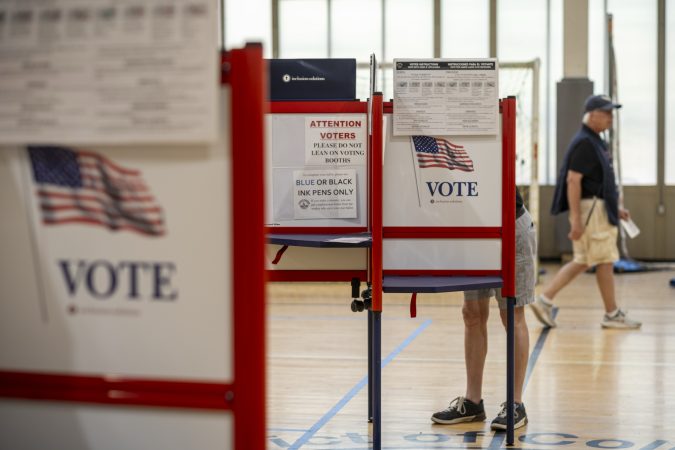
    “Less access has always been something historically that has endangered more people than helped anyone,” visual artist Nadya Yaksich, 30, said after voting in the Democratic primary at a high school in Wheaton, Md., last week.

    But book cataloger Carola Lewis, 62, said after voting in the Republican primary at the same school that she would have more confidence in election results if all voters were required to show IDs and prove that they are citizens.

    “As a citizen, I abide by the law, I pay my taxes, I do what I’m supposed to do, I go out and vote,” Lewis said. “And then to not be 100% confident that it’s only Americans that are voting is actually terrifying to me.”

  • Trump’s Religious Liberty Commission takes aim at church-state separation

    Trump’s Religious Liberty Commission takes aim at church-state separation

    The Trump administration took aim at the separation of church and state Friday, issuing a draft report from the president’s Religious Liberty Commission that says the separation concept is a legal error and that Americans should view religion as an “essential support” and always remember “the Creator who made us and bestows our rights.”

    The 224-page report recommended the Justice Department issue guidance to promote “an originalist understanding” of how the Constitution sees the relationship between religion and government. The founders had diverse views about the topic, but recent Supreme Court rulings have suggested a more narrow interpretation of what justices considered constraints on religious freedom.

    Friday’s report also said faith-based groups working with the government shouldn’t have to accommodate civil rights laws or anything that conflicts with their religious beliefs; public schools should allow religious displays (it mentioned only the Ten Commandments); and soldiers who refused to be vaccinated and were punished should have their positions restored and be financially compensated. It called for the end to the Johnson Amendment, which bars nonprofits from making political endorsements.

    At an Oval Office news conference announcing the report, commission chairperson Dan Patrick, the Republican lieutenant governor of Texas, said the commission recommends that any official — in government, a school, the military, a hospital, etc. — who alleges a violation of church-state separation must in writing “point out exactly where you have violated the Constitution, because you have not, and from this day forward, that phrase should have no power over people of all faiths ever again in America.”

    While the phrase “church-state” separation is not in the Constitution, the concept of space between government and religion is in the First Amendment, which calls for no government “establishment of religion.” Americans have disagreed over the meaning of establishment since the founding.

    The report was issued at a time when many conservatives are aggressively working to elevate religion — particularly Christianity — into the public square, fueled by Supreme Court decisions saying that such expression is constitutional. Several states have mandated that the Ten Commandments be displayed in public school classrooms, and many are requiring schools to release students for Bible classes during the school day. Last month, the White House hosted a daylong evangelical prayer festival on the Mall for the country’s 250th birthday, featuring commission members and others preaching from the stage.

    On Friday, the Texas education board approved a mandatory reading list for more than 5 million public school students in the state that includes Bible passages.

    President Donald Trump’s Religious Liberty Commission, created last year, is made up of all conservative Christians and one Orthodox Jew, groups who experts say make up a minority of Americans. In February, a coalition of groups representing other religious groups, as well as nonreligious and interfaith Americans, sued the administration over the commission, saying it was put together without the transparency and diversity required of a federal commission.

    The Rev. Paul Raushenbush, one of the plaintiffs in the lawsuit and head of the Interfaith Alliance, had applied unsuccessfully to be a member of the commission.

    The draft report, he wrote in a statement, “reflects the narrow, Christian nationalist worldview of the illegitimate commission. … A betrayal of the original intention of the promise of religious freedom guaranteed in the First Amendment, the report and the commission behind it fail to represent and uplift the importance of religious diversity and tolerance for all faiths in our country — not just a special, chosen few. The report is a wish list of divisive, unpopular ideas far-right religious groups have pushed for years.”

    Raushenbush also noted that while the report expresses concern about anti-Christian bias and antisemitism, it made no similar mention of growing Islamophobia around the country.

    The report is a draft, and comments from the public are open until July 12.

    The lawsuit against the commission had sought to stop the release of any report until the court ruled on whether the commission was illegally constituted. It also asked the court to mandate any commission recommendations include a disclaimer stating that the report was produced by a body that was not fairly balanced.

    Asked about the lack of religious diversity on the commission, a Justice Department spokesperson said the group was a way for Trump to create “opportunities for Americans from all walks of life to share their testimonies, concerns, and recommendations to better support Civil Rights and religious freedom in the United States.”

    “The Department of Justice’s mission is to uphold the rule of law and ensure fair and impartial justice for all Americans, which is an endeavor every American should support regardless of their political or religious beliefs,” the Justice Department statement said.

    People called to testify before the commission included a worker at an Alaska women’s shelter who turned away a homeless man who later sued for gender discrimination, and foster parents in Vermont who said their religion kept them from affirming children who were undergoing gender transitions — even though the state required foster parents to do so.

    Speaking at the White House, commission vice chairperson Ben Carson said Trump was doing more than anyone else in the country for religious liberty.

    “Our founding document says that our rights come from our creator and not from government,” he said. “People who try to divorce us from that heritage? Do they realize that that’s our family document? Do they realize that our family just says we are one nation under God?”

    Trump noted that he won the overwhelming majority of evangelicals in his elections.

    The White House is facing other litigation over its religion-related actions. Americans United for Separation of Church and State, among other advocacy groups, has a total of seven lawsuits.

    Some note that Trump’s Justice Department asked other federal agencies for examples of what it called “anti-Christian bias” and sought access to any complaints received as a result. Others note the proselytizing of some agency heads, including Defense Secretary Pete Hegseth and Agriculture Secretary Brooke Rollins.

  • Ukrainian drones drive Russia to declare emergency in occupied Crimea

    Authorities in occupied Crimea, the Black Sea peninsula that Russia annexed illegally from Ukraine in 2014, declared a state of emergency Friday following weeks of punishing Ukrainian drone strikes.

    The Russian Defense Ministry said its air defenses intercepted 660 Ukrainian drones overnight across 13 regions, including Crimea. The peninsula, which Ukrainian President Volodymyr Zelensky has vowed to reclaim, has become the centerpiece of Kyiv’s campaign to demonstrate the reach of its increasingly advancing medium-range drone capabilities.

    The Ukrainian military last month announced a “logistics lockdown” of Crimea, with plans to “systematically destroy Russian logistics, warehouses, equipment, command posts, and supply routes at operational depth.” In the weeks since, Ukrainian forces have targeted roads, bridges, and energy infrastructure to sever the peninsula from Russia and from Russian-occupied territories in eastern Ukraine.

    The assault has disrupted fuel, electricity, and water supplies, and the Russian tourists who have traveled to Crimea each summer despite the war have rushed to leave.

    Locals have not seen such disturbance to everyday life since the annexation. Gas stations have run dry, leaving motorists who have already waited hours for fuel vouchers to queue at the few stations still operating. Summer camps have been canceled and children evacuated, including from Artek — the iconic Soviet-era camp the Kremlin has used as a symbol of state prestige since 2014.

    Rolling power outages have halted water supplies that depend on electric pumps.

    Kyiv intends the strikes on Crimea, which is far removed from the main front line in Donbas, to erode the sense of distance from the war that President Vladimir Putin has worked to maintain since the full-scale invasion began — and to chip away at the public perception that Russian forces can contain the fighting within Ukraine.

    Ukraine has also stepped up pressure on Russia’s closest ally, Belarus, which allowed Moscow to use its territory as a launchpad for attacks on Ukraine early in the invasion. Kyiv maintained diplomatic relations with Minsk. But after Russian drone strikes on northwestern Ukraine this year, Zelensky ordered strikes on relay stations in Belarus.

    Zelensky warned President Alexander Lukashenko this week that he would strike them again if Lukashenko didn’t shut them down. Zelensky said Wednesday they had been switched off.

    It was the latest test for Lukashenko’s long-running gamble. He has survived for years by balancing his regime’s economic and security dependence on Russia against being fully absorbed by Moscow.

    Ukrainian officials say Russia might be trying to draw Belarus deeper into the war. On Friday evening, Lukashenko flew to Putin’s Valdai residence, where the Kremlin said they discussed “the implementation of joint economic projects and issues related to regional security.”

    Before the trip, Lukashenko said he had recently received Zelensky’s representatives in Minsk.

    “If he thinks he can talk to us like this and then drag us into a war, he must understand that the quality of the war will instantly change,” the Belarusian president said. “This will be a completely different war. So let’s come to an agreement.”

    The combination of the chaos in Crimea, record drone strikes on Moscow, and fuel rationing spreading across Russia appears to be taking a toll. According to data from the Public Opinion Foundation, a polling organization with Kremlin ties, trust in Putin has fallen to 69% — its lowest point since the war began.

    The emergency declaration stoked anxiety among residents that already had been building for weeks. Authorities appeared eager to manage the alarm, describing the measure as “an emergency situation” rather than a “state of emergency.” It should allow authorities to bypass normal bureaucratic procedures to mobilize resources, use emergency budgets, and coordinate evacuations where necessary.

    “This does not envision restrictions on movement and the introduction of a curfew,” Sergei Aksyonov, the Russian-installed governor, wrote on social media.

    Zelensky said Thursday he had authorized a 40-day strike campaign against Russian targets to “influence the aggressor state in order to press for an end to the war.” Strikes were reported to have hit oil facilities deep inside Russia.

    Kyiv has been trying to reengage President Donald Trump after a monthslong effective freeze in peace talks. Trump this week had rare praise for Zelensky over the offensive, saying the Ukrainian leader is “doing pretty well.”

    Trump, meeting with NATO Secretary General Mark Rutte, was asked whether he believed Zelensky was winning the war.

    “He’s winning now. Well, he’s doing pretty well. … At least he’s holding on,” Trump said. He also said “a lot of people are dying on both sides.”

    “I have to say he’s courageous,” Trump said. “He’s got great equipment, he’s got great people, he’s got fighters.”

    Whether Ukraine’s campaign can pressure Putin into yielding is another question. The Russian leader has shown a consistent willingness to absorb enormous losses in a grinding war of attrition. Analysts warn that the Ukrainian offensive could fuel anti-Ukrainian sentiment at home.

  • Nursing homes, factory owners, and immigrants brace for fallout from Supreme Court ruling

    Nursing homes, factory owners, and immigrants brace for fallout from Supreme Court ruling

    Immigrants began making plans to sell or rent their homes, secure bank accounts, and figure out thorny issues like child custody arrangements. Business owners started calculating how many days they can continue to employ workers whose legal status is set to expire. And nursing home leaders warned they would have fewer beds to offer if health aides are forced to leave the country.

    Panic rippled through communities from Florida to Ohio and beyond in the hours after the Supreme Court cleared the Trump administration Thursday to strip humanitarian protections from Haitians and Syrians — and potentially all 1.3 million immigrants from over a dozen countries who had been previously shielded from deportation.

    “The residents will be losing caregivers that they really have become attached to,” said Colin O’Leary, executive director at Laurel Ridge Rehabilitation & Skilled Care Center in Boston. Managers at the facility were racing to figure out how much longer staff members from Haiti with temporary protected status could continue taking care of patients. “That’s a lot for our residents to handle.”

    Attorneys said Haitians and Syrians could lose work permits in little more than a month, but the deadline remained unclear because lower court judges must issue orders to implement the decision. Stephen Miller, the White House deputy chief of staff, told reporters Thursday that Haitians and others with temporary protected status should be detained and deported once they lose the benefit.

    “If you no longer have status in this country, then you’re supposed to be deported,” Miller said.

    Some of those immigrants have lived in the United States for decades and said they feared being sent back to conflict-ridden homelands that they barely know and whose languages some do not speak.

    Temporary protected status, a program created in 1990, grants work permits and deportation reprieves to immigrants for up to 18 months if their nations are engulfed in war, natural disasters, or other emergencies. Applicants cannot have serious criminal records and the government can, and has, renewed the protections multiple times.

    President Donald Trump and his allies have alleged that the temporary protections have lasted long after the emergencies have passed and have allowed undocumented immigrants and visa overstayers to live and work in the United States.

    But the program also has become a political wedge. When he was a senator representing Florida, home to thousands of Haitians, Venezuelans, and others with the protections, Secretary of State Marco Rubio favored the protections.

    Approximately 350,000 Haitians and roughly 6,000 Syrians have TPS, but the Supreme Court ruling ultimately could affect immigrants from 17 countries whose citizens were safeguarded under the program when Trump took office. His administration has sought to terminate protections for 13 of those countries.

    Harlaine, 38, a registered nurse in Florida, said she hasn’t been to Haiti since she left for the U.S. at age 7 and had never visited because everyone told her it was too dangerous. She spoke on the condition that only her first name be used because she fears being targeted by immigration authorities.

    “To tell me to go back to a country that I know nothing of is the sickest and most evil thing I think that somebody could do,” she said.

    News of the ruling devastated residents and staff at healthcare and elder care facilities across the country, since a large share of the Haitian immigrant population works in those industries. Nursing homes, labor unions, and governors condemned the decision and called for an emergency resolution. Advocates called the decision one of the largest “de-legalization” efforts in U.S. history.

    Ohio Gov. Mike DeWine, a Republican, characterized the decision as “a mistake” and said it is too dangerous to deport people to Haiti, including the more than 10,000 Haitians living and working legally in his state. New York Gov. Kathy Hochul (D) vowed to fight the ruling, even as the path to challenging it is unclear.

    “I’m telling you it’s going to cripple our healthcare system,” Hochul told reporters. “Who’s going to show up tomorrow to take care of Grandma? Who’s doing that? Who’s stepping up?”

    Miami Jewish Health, a senior living community and healthcare provider in Florida, cut 120 nursing home beds a few months ago, in part due to staffing issues, including those stemming from the pending cancellation of TPS for Haitians. About 40 healthcare employees and contracted food and housekeeping workers were affected by the Supreme Court ruling, said Jason Pincus, a vice president at the center.

    Goodwin Living, a senior living nonprofit that serves thousands of older adults in Northern Virginia and Washington, D.C., braced for staff cuts, and at Laurel Ridge Rehabilitation & Skilled Care Center in Boston, managers prepared for having to say goodbye to dietary aides and certified nursing assistants who care for about 115 elderly residents.

    Rita Siebenaler, a resident of Goodwin House Bailey’s Crossroads in Virginia, called the decision “sad, dreadful, and very upsetting for the seniors that I know.”

    “We are now threatened with the loss of valuable, trained, vetted, very, very reliable caretakers,” she said.

    The decision is expected to hit hard in Springfield, Ohio, where about one in four residents is Haitian. Trump falsely claimed on the 2024 campaign trail that Haitian immigrants there were eating cats and dogs. The loss of hardworking employees, homeowners, and renters who became trusted members of the community will be painful, residents said.

    Ross McGregor, a fifth-generation Springfield resident and the president of a heavy machinery factory in town, has employed dozens of Haitians with temporary protections in the past, and worried that he will not be able to find workers in the future.

    “If anything, right now our business is starting to pick up and grow,” said McGregor, 61. “I might have trouble hiring because the workforce is already challenging in Springfield.”

    Harlaine, the nurse from Florida, obtained temporary protected status after Haiti’s catastrophic earthquake in 2010. She said she paid her way through college to earn a bachelor’s degree, taking years longer than most students to finish because she had to pay for it herself. She went on to work in emergency rooms, including during the deadly COVID pandemic that killed her sister.

    Now she is facing the loss of her life in the U.S. She lives with her elderly mother, a retired factory worker who also has the temporary status, and her 17-month-old son, who is a U.S. citizen. Her mother paid off the home with her wages, she said.

    Starting over in Haiti, she said, is unimaginable.

    “You’re basically sending me to stick out like a sore thumb,” she said. “I barely know the language. That’s crazy.”

    Fissures have emerged in recent weeks among some Republicans over Trump’s immigration enforcement policies.

    Some House Republicans broke ranks in April to help Democrats pass legislation that would have extended Haitians’ TPS protections through April 2029. This month, the U.S. Chamber of Commerce and other business leaders pressured Trump to back off a plan to require green-card applicants to leave the United States for processing, fearing they’d get stuck abroad and it would harm their workforces.

    Advocates for immigrants say it is inhumane to deport so many residents to struggling countries. Some are trying to find alternate ways to stay legally, but attorneys say they could be detained pending an asylum hearing if they lose TPS.

    “People haven’t been here in this country in some artificial limbo like in a waiting room. People have married, people have had children, people who have started businesses, people have made this country their home,” said Jessica Bansal, an attorney involved in the case. “Are half a million people going to be torn from their communities in 32 days? Or will Congress and the people do something to stop it?”

    Mustafa Doe, a Syrian immigrant in his 20s with TPS, was among the plaintiffs named using a pseudonym in the case the Supreme Court decided Thursday. In an interview, he said he fears persecution in his homeland because he is gay and not a practicing Muslim. He works for a Fortune 500 company in New York, helping manage its philanthropic programs. But he said he also recently bought a co-op and sits on the board, and now fears he will have to sell it.

    He is among the younger residents in a building of older residents who rely on him to help lug heavy bags of groceries upstairs and even paint the building.

    “It is like a family,” he said.

    His parents are legal U.S. residents and most of his relatives are scattered across the U.S. Nobody is left in Syria to receive him if he is forced to go back. He said he came to America with a student visa in 2021 to attend college.

    “There’s no one in Syria,” he said. “It’s literally just going to be me.”

  • Vance dismisses Watergate scandal, says ‘deep state’ went after Nixon

    Vice President JD Vance on Thursday expressed sympathy for former President Richard M. Nixon, suggesting that Nixon was wrongly forced out as president in 1974 and comparing his political travails decades ago to those facing President Donald Trump now.

    “As I joked … backstage, if Watergate happened tomorrow, it would be like a 12-hour news story,” Vance said in remarks at the Richard Nixon Presidential Library and Museum in California. “The idea that it would have taken down a presidency is crazy.”

    A spokesperson for Vance did not immediately respond to questions about whether the vice president was being facetious and how he was defining Watergate.

    The Watergate scandal, which began in 1972 with a botched attempt to bug the Democratic National Committee’s offices at the Watergate Hotel in Washington, mushroomed into a wide-ranging investigation by reporters and lawmakers that revealed Nixon was aware of the break-in and directed secret White House payments in an effort to cover it up. He resigned as president two years after the scandal broke, with Nixon blaming the Washington Post for its central role in exposing his involvement in the break-in and other abuses.

    The scandal also prompted a series of reforms intended to rein in presidential authority, including more independence for government watchdogs such as inspectors general, which Trump has steadily rolled back.

    Historians said Thursday that the full scope of the Watergate scandal, ranging from the president’s efforts to apply pressure to his “enemies list” to asking for a census of Jewish Americans serving in government because he believed they were unpatriotic, revealed Nixon’s abuses of presidential power.

    Vance “should know better as a well-educated lawyer,” said Timothy Naftali, a previous director of the Nixon library, referring to Vance’s law degree from Yale University.

    Naftali, a Columbia University presidential historian, referenced tapes that contained thousands of hours of Nixon’s Oval Office conversations.

    “You can hear him suborn perjury on the tapes. He’s telling an intermediary, what to tell someone who’s about to be interviewed by the FBI, what to say and what not to say,” said Naftali, who oversaw the Nixon library’s Watergate exhibit. “You can hear Nixon being told that money had been found to hire teamsters to go and break the bones of demonstrators. That’s all illegal.”

    “It’s not as if it’s a matter of partisan interpretation. The evidence is overwhelming,” Naftali said, offering additional examples of Nixon’s efforts to subvert legal protections. “If he does know all of this, he’s telegraphing the kind of president he hopes to be.”

    Some conservatives in recent years have reframed the scandals that ended Nixon’s presidency, arguing that government bureaucrats and the media unfairly sought to push him out.

    In his remarks, Vance also repeatedly compared Nixon to Trump, pointing out the similarities in their political coalitions as well as their experiences with overseas wars.

    “One of the other lessons of Richard Nixon is it’s not just that he got out of Vietnam, but that he got out of Vietnam from a position of strength. OK?” Vance said, making a comparison with Trump’s war against Iran. “It’s one thing to tuck tail and run. It’s another thing to clearly define an objective, to accomplish that objective, and then to ensure that you don’t allow mission creep to transform a victory into a defeat.”

    Vance also alluded to lawmakers’ efforts to investigate both presidents. Trump was twice impeached in his first term, after first pressuring the Ukrainian government to investigate his rival Joe Biden, and then after lawmakers said he helped incite a riot at the U.S. Capitol on Jan. 6, 2021, as he attempted to have the results of the election overturned.

    Nixon resigned as president while an impeachment process into his Watergate-related conduct was underway. Lawmakers ultimately decided to end the process given Nixon’s resignation. His former vice president, Gerald Ford, later issued a controversial pardon.

    “If you look at the story of how the ‘deep state’ took down Richard Nixon, it’s not all that different from what the same groups of people, the same institutions tried to do to Donald Trump and the first Trump administration,” Vance said to applause. “There is a parallel.”

    The 41-year-old Vance also mused on his own similarities to Nixon, who served as a California senator in his late 30s and became vice president when he was 40.

    “Young senator, vice president, writes some best-selling books, is hated by the media,” Vance said. “It kind of sounds like JD Vance. … I’ve always liked Richard Nixon.”

  • New acting intel czar Bill Pulte starts trimming staff as Trump urged

    New acting intel czar Bill Pulte starts trimming staff as Trump urged

    Acting director of national intelligence Bill Pulte, installed Friday by President Donald Trump, has at Trump’s urging begun trimming his organization, which coordinates the nation’s 18 spy agencies.

    This week Pulte fired a half-dozen political appointees and notified several dozen career officers on loan to the Office of the Director of National Intelligence that they were being sent back to their home agencies.

    Pulte’s immediate predecessor, Tulsi Gabbard, had already culled hundreds of personnel, boasting that she had slashed the staff by 40%. Trump has long been distrustful of what he calls the “deep state” intelligence community, and the cuts by Pulte are the latest in a series of shocks that have roiled the ODNI.

    Gabbard, who left office last week, had a stormy tenure, falling in and out of favor with Trump’s White House. Current and former officials criticized as ham-handed her release of files related to President John F. Kennedy’s assassination. She selectively declassified data on Russia’s interference in the 2016 U.S. election and other matters that supported Trump’s views.

    In recent months, the ODNI has seen a number of high-level resignations and a roller coaster of leadership announcements by Trump.

    The agency “is being so hollowed out that its new name might become DNR — do not resuscitate. It’s on life support already,” said Beth Sanner, a former ODNI deputy director who served as Trump’s intelligence briefer in his first administration.

    While a number of current and former intelligence officials note that there are merits to shrinking the ODNI, the Trump administration, they say, has gone about it in a haphazard way that could undermine the intelligence coordination that Congress created the agency to do.

    “Reasonable people can debate ODNI’s size and mission, but sacking dozens of seasoned officers in your first week isn’t reform — it’s performative firing to please a president who treats his own intelligence community as the enemy within,” said Julia Curlee, who served as a director for intelligence programs in Trump’s White House until last year and recently resigned from the CIA after 20 years as an analyst.

    Pulte asked program heads for a rank-ordered list of personnel to guide decisions on who could be let go, according to former intelligence officials, who spoke on the condition of anonymity for fear of retribution.

    One apparent casualty of the personnel moves that began under Gabbard is the National Intelligence Council, which was staffed primarily by career officers on loan from other agencies, such as the CIA. The NIC is considered the most authoritative intelligence analysis unit, producing in-depth reports on key topics for top government officials using information gathered by multiple spy agencies.

    About 20 NIC personnel have been removed or have chosen to leave, including several senior officers who oversaw the production of analysis on Russia, China, and Europe.

    The deputy director for mission integration, Will Ruger, who effectively led the council, was placed on administrative leave, according to three former intelligence officials.

    It is unclear whether and to what extent the vacancies will be filled. When the principal deputy intelligence officer for Russia left last year, the position was kept open.

    Trump told the Wall Street Journal this month that he’d like to see a “smaller” ODNI. “I think there are a lot of people in there that shouldn’t be there,” Trump said, noting that he was referring to holdovers from the Biden and Obama administrations.

    Senate Intelligence Committee Chairman Tom Cotton said on the Senate floor Wednesday that “mass firings” were not taking place. He said Pulte told him that “a small handful of front-office personnel” were leaving, “which is not at all uncommon when a senior leader leaves an agency or one comes into an agency.” He added that “around 45 or 50 career officers” were returning to their home agencies.

    “I think that’s a step in the right direction,” said Cotton, who has long called for shrinking the ODNI and last year proposed legislation that would cap its full-time staff at 650.

    Some agency insiders have heard that there could be subsequent rounds of cuts and that keeping each round relatively small will help avoid congressional blowback, according to one former intelligence official.

    Trump’s appointment of Pulte, who has no intelligence or national security experience, has alarmed Democratic lawmakers, as well as some Republicans. Some current and former intelligence officials fear he will use the post to further Trump’s agenda, including weaponizing intelligence against the president’s enemies.

    As head of a federal mortgage regulation agency, Pulte has launched mortgage fraud probes of people Trump considers adversaries, including Sen. Adam Schiff (D., Calif.) and Federal Reserve Board member Lisa Cook.

    Government reorganization efforts under Trump have been marked by chaos and missteps, such as when Elon Musk’s Department of Government Efficiency last year dismantled the U.S. Agency for International Development and conducted mass firings at the State Department and other agencies.

    The Office of the Director of National Intelligence was created by Congress in the wake of the September 2001 terrorist attacks, after investigations found that the CIA, the FBI and other agencies had failed to share critical information about al-Qaeda plots.

    The ODNI had a little more than 2,000 employees at the start of Trump’s second term. By the time Gabbard left last week, the number had shrunk to 1,300, according to congressional aides.

    Morale was shaken last year when Gabbard dismissed the chair and vice chair of the NIC after it produced a report that found that the Venezuelan government was most likely not directing the activities of Tren de Aragua, a criminal gang that Trump has vilified. The finding contradicted his rationale for invoking the Alien Enemies Act and deporting alleged Venezuelan gang members without due process.

    “Getting [the agency] smaller makes sense, but this isn’t the way to do it,” said John Sipher, a 28-year veteran CIA operations officer and former Moscow station chief, who has argued that the ODNI should be dismantled.

    Sipher said the ODNI’s problem is that it suffers not just from bureaucratic bloat, but from political interference. “The office that was meant to safeguard intelligence from fragmentation has become another perch from which intelligence can be politicized and bent toward partisan narratives,” he wrote in the Bulwark.

    This week’s cuts do not appear to have significantly affected the agency’s largest component, the National Counterterrorism Center, which was set up by Congress to be the government’s primary organization for analyzing international terrorism and which in its heyday had more than 1,000 personnel, according to former senior intelligence officials.

    Trump has nominated Jay Clayton, U.S. attorney and former Securities and Exchange Commission chairman, to be the permanent director of national intelligence.

    But last week, Trump abruptly froze Clayton’s nomination, prompting the Senate to postpone a confirmation hearing, in a fit of pique over lawmakers’ failure to pass unrelated election legislation.