Category: Wires

  • Gen X and millennials are set to inherit trillions. If they’re already rich.

    Gen X and millennials are set to inherit trillions. If they’re already rich.

    Baby boomers are set to pass trillions of dollars on to their heirs in the next two decades, but the huge transfer of riches will mostly benefit Gen X and millennial heirs who are already wealthy.

    An analysis from Visa Business & Economic Insights finds that boomers, born between 1946 to 1964, will pass on $36 trillion in wealth to their younger heirs over the next 20 years.

    Nearly three-quarters of households receiving an inheritance will be in the top echelon of wealth in the country when they receive the money, Visa estimates. Gen X and millennials were born between 1965 and 1996.

    Often called the Great Wealth Transfer, the inheritances are expected to be the largest passage of generational wealth in history, given the massive size of the baby boomer population and their wealth.

    Baby boomers are sitting on about $93 trillion worth of assets, according to Visa’s analysis. Only about 8.6% of that, or roughly $8 trillion, is expected to be spent into the economy, after it is inherited.

    “Eight trillion dollars is nothing to sneeze at,” Visa chief economist Wayne Best said. But that spending number has been whittled down quite a bit from the starting wealth.

    Visa calculated that about $36 trillion would be passed from boomers to their heirs, after subtracting liabilities such as mortgages, as well as retirement spending and taxes. That works out to about $515,000 per inheriting household, but the inheritances will be uneven.

    The richest boomers have the most to give away. Visa found that those in the 90th to the 99th percentile of boomers held some $44 trillion in wealth. Meanwhile, the bottom 90% of boomer households hold just $16 trillion in wealth.

    Since most inheritances are coming from wealthy boomers, their heirs are more likely to be wealthy as well. Lower-wealth boomers will need to use more of their savings to pay for housing, healthcare, and other needs, while wealthier households can save more to pass on.

    The bulk of that money will flow to people who are worth far more than the average. And that means much of it will be saved or invested, rather than spent.

    “Wealthier Americans are going to be putting that money into the stock market or real estate,” said Jeremy Ney, a professor at Columbia University’s business school and writer of the “American Inequality” newsletter. “It doesn’t buy groceries or cars, it just changes your accountant’s week.”

    It could also widen gaps between lower-wealth and higher-wealth Americans, Ney said, which have already been accelerating.

    The $8 trillion in spending is still expected to boost the economy — Visa estimates it will bump annual consumer spending growth over the next 20 years from 2% to 2.1%. Much of that money will be spent on housing, or buying new cars, as well as on travel and retail.

    One reason that the transferred wealth will flow to the already wealthy might be because people are living longer, and therefore passing their money down to heirs who are already in their 50s or 60s, noted Jonathan Parker, a professor of financial economics and co-director of the MIT Sloan Consumer Finance Initiative. Those heirs have had more time to accumulate wealth than they would have if they had inherited in their 20s or 30s.

    “There are tax incentive reasons to wait until you pass away to pass along those bequests,” he said.

    Still, some people in older generations have already started passing along their wealth, wanting to see its effects while they’re alive. Visa found that more boomers are soaking up the benefits of their wealth, including by taking their grandchildren on vacation without their parents and by helping heirs with down payments on homes.

    Visa’s analysis to get to the $36 trillion removed the wealth held by the top 1% richest of boomers, because their money is likely to go to charitable foundations and other private pursuits and doesn’t represent typical spending.

    “They don’t really spend like the rest of us,” Best said.

  • American missionary kidnapped in Niger soon to be reunited with family

    American missionary kidnapped in Niger soon to be reunited with family

    A mission organization said on Friday that a pilot who was kidnapped while working for the group in the West African country of Niger last year was in “good health” after his release.

    The missionary pilot, Kevin Rideout, was seized from his home in Niamey, the capital of Niger, in October. A U.S. official said on Friday that Rideout had arrived at Ramstein Air Base in Germany and was undergoing medical evaluation. Like others in this article, the official spoke on condition of anonymity to discuss operational matters.

    Rideout’s organization, called Serving in Mission, said in a statement that he would soon be reunited with his loved ones.

    “We are grateful to confirm that our good friend and brother in Christ, Kevin Rideout, has been released,” the statement read. The mission noted that he was in “good health in the care of U.S. officials” and would soon be reunited with his wife, Krista; their four children; and his extended family.

    “Krista and the rest of Kevin’s family are profoundly grateful for the prayers offered on their behalf by people around the world throughout his captivity,” the statement added.

    Another U.S. official said on Thursday that Rideout’s release, which was earlier reported by the New York Times, was not the result of a military rescue operation but “by other means,” offering no further details.

    The official linked Rideout’s release to U.S. military pressure on the Islamic State in Nigeria, Niger’s southern neighbor, in recent months. In May, President Donald Trump said that American and Nigerian forces had killed Abu Bilal al-Minuki, a high-ranking Islamic State leader in Lake Chad, a region at the intersection of four countries, including Nigeria and Niger.

    The official said that raid had helped influence the kidnappers’ decision to release Rideout.

    How and where he was released were not yet clear, U.S. officials said earlier, and it was also unclear which group held him at the end of his captivity. Rideout’s release had been a major priority for the White House and for the military’s Africa Command.

    In May, French journalist and researcher Wassim Nasr, who has been monitoring jihadi groups in the area for several years, said that Rideout was being held in Ménaka, a region in Mali just over the border with Niger. That area is mostly controlled by a local branch of the Islamic State.

    For years, Mali and Niger have been battling insurgents affiliated with al-Qaida and the Islamic State. In April, al-Qaida-linked militants launched coordinated attacks across Mali, seizing a major city and killing the country’s defense minister.

    This article originally appeared in the New York Times.

  • Oil, hunters, and Dr. Phil: How a longshot project is shaking up Greenland

    Oil, hunters, and Dr. Phil: How a longshot project is shaking up Greenland

    LONDON — In one of the most remote towns on Earth, on the frozen crust of Greenland’s east coast, the American oilman made his pitch.

    Near to the very room where they were all sitting, he told a crowd of Greenlanders, could be as much as 13 billion barrels of oil. His company planned to drill two exploratory wells, and if it struck oil, it could be a major worldwide discovery bringing much-needed jobs, loads of tax money, and relief to world energy markets.

    The people who attended the meeting, which was held in June in an isolated town called Ittoqqortoormiit, had some questions.

    Why would Greenland get only 15% of the profit?

    What kind of chemicals would be used?

    And what about the musk ox? (Musk ox hunting is a big deal up there.)

    The meeting wrapped up with a lot of unhappy people filing out, according to a video of it that was shared with the New York Times, and a showdown over oil exploration has now joined the cloud of issues swirling over Greenland.

    The wildcat oil project is being pumped up by Dr. Phil McGraw, the TV personality known as Dr. Phil, and Gov. Jeff Landry of Louisiana, both powerful allies of President Donald Trump. It’s the latest push by the MAGA camp to close in on this gigantic Arctic island that Trump threatened to annex and remains a fixation of his.

    If the discovery is anything close to what the company says, and if it makes economic sense for major production — and those are two enormous ifs — this project could thrust Greenland into a radically different future, possibly as an Arctic petrostate.

    But it’s off to a bumpy start. After a wave of negative publicity, protests by Greenlanders, and a slipup by the project’s organizers who have a drilling license, Greenland’s authorities tapped the brakes. This week, the government pushed back the timeline for granting final approvals, saying that it’s unlikely any drilling would be authorized before 2028.

    The Texas-based firm leading the project, Greenland Energy Co., now says it will focus on drilling only one well, not two. And the delays are expected to cost millions. As a result, Greenland Energy’s share price has plummeted, trading at little more than a dollar, half its value from just days ago.

    A few years ago, Greenland declared it was suspending oil exploration. The Arctic is among the fastest-warming regions in the world, and the Greenlandic government felt it was wrong to contribute more fossil fuel pollution.

    But the oil prospectors in this case are operating with a valid license granted before the policy changed, according to documents reviewed by the New York Times. So Greenlandic officials, who have been trying to navigate the intense pressure Trump has put on them, find themselves in a tight spot.

    They are more than aware that if they reflexively block Americans from drilling, especially at a time when world events have squeezed the global oil supply, that could give Trump the pretext he needs to return to his threats to “get” Greenland, “one way or the other.” At the same time, there’s obvious resistance from ordinary Greenlanders and government officials to the project.

    “In a world where Donald Trump has pursued such a confrontational policy toward Greenland, you can’t help but be a little concerned,” said Mikkel Runge Olesen, a senior researcher at the Danish Institute for International Studies. “If you suddenly throw a major oil discovery into the mix, who knows what might happen.”

    For months, the United States, Greenland, and Denmark — the island’s former colonial master that still controls many of its affairs — have been locked in sticky negotiations over the island’s future. One key issue has been America’s access to Greenland’s natural resources.

    Ever since Trump set his sights on the island, Greenland has become a magnet for investors and allies chasing Arctic resource dreams. But oil has never been easy.

    Chevron and Shell prospected decades ago with no success. It’s incredibly expensive to build an oil industry from scratch in one of the most remote and inhospitable places on the planet. Most of Greenland is covered in ice. One major U.S. company, ARCO, decades ago sank today’s equivalent of $250 million — far more than the $80 million the current players have raised — into seismic studies in the same area, only to abandon the project in 1990.

    “There are so many red flags here,” said Naaja Nathanielsen, Greenland’s former minister of natural resources and now a representative in Denmark’s parliament. She said she hasn’t seen any hard data supporting the project’s tantalizing claims, adding, “I think they are selling hot air.”

    Not so, say the backers of the project, a joint venture between Greenland Energy, the small, publicly traded U.S. company that raised the money, and 80 Mile Plc, a British outfit that acquired the drilling licenses several years ago.

    Roderick McIllree, 80 Mile’s executive director and a board member of Greenland Energy, said this stretch of Greenland had the same geology as the North Sea oil fields, where European countries have extracted billions of barrels. And climate change is working in their favor, he said.

    Warming temperatures mean less ice clogging Greenland’s coast, making any oil discovered cheaper to export than it would have been decades ago, he said.

    One investor is the Citadel hedge fund, run by investment titan Ken Griffin, and the Trump administration fully supports the project.

    “Greenland could be exporting 2 million barrels of oil a day,” said Landry, Trump’s special envoy to Greenland, in a Fox News interview in May. He added, “Think about what kind of pressure that would relieve in the Straits of Hormuz.”

    Before the project is allowed to start, its plans, including a detailed environmental assessment, must be approved. But the organizers have been moving ahead anyway and recently carried out two disputed equipment transfers.

    First, they brought in a barge load of equipment from another part of Greenland on what authorities said was an expired permit. Jorgen Hammeken-Holm, the head of Greenland’s mineral resources department, called the move “naughty, naughty.”

    Then, a few days later, they unloaded another piece of heavy equipment without proper notification, authorities said.

    “We have the police and the military,” Hammeken-Holm warned. “They can assist in dealing with unlawful activities if necessary.”

    McIllree admitted, “We kind of fell down.” He said the company apologized to Greenlandic officials.

    The potentially oil-rich area, known as Jameson Land, is a highly protected environmental zone, an Arctic swampland of sorts, home to tenacious shrubs and musk ox, foxes and migrating birds like the pink-footed goose. The musk ox is prized for its meat and its fur, which is turned into a luxurious yarn.

    All this has attracted Dr. Phil, who did a recent 44-minute podcast on the project. He titled the episode “Frozen Gold,” and according to documents on Greenland Energy’s website, the company has established “a wide-ranging partnership” with him to make a six-episode series on “this modern-day treasure hunt.”

    His company did not respond to requests for comment about his involvement in the project. But on his podcast, Dr. Phil said he would soon head to the Arctic.

    “I’m going to have to mug a kitten and get some mittens because I’m going to go up there and see this firsthand,” he said.

    Ittoqqortoormiit (It-tok-kor-TOR-meet), population 329, is trying to make sense of what’s happening. This spring, members of the local council seemed ready to negotiate and drafted a list of things they wanted from the oil company: a heated community pool, new hunting cabins, and funding for residents to fly over Jameson Land in helicopters one last time before their hunting grounds were turned into an industrial site.

    But the public meeting in June changed the mood.

    McIllree conceded that the team that led the meeting didn’t show enough respect.

    “They forgot whose house they were in,” he said.

    Still, some residents support the project.

    Aage Uugi Pike Barselajsen, a construction worker, said in a telephone interview that Ittoqqortoormiit desperately needed jobs.

    “You have to think about the future and the money,” he explained. “Maybe Greenland could become like Dubai. That’s my dream.”

    This article originally appeared in he New York Times.

  • Russian drones kill a woman and 9-year-old son at home as Ukrainian civilian casualties surge

    Russian drones kill a woman and 9-year-old son at home as Ukrainian civilian casualties surge

    KYIV, Ukraine — Russian jet-powered drones struck a home in northern Ukraine on Friday, killing a 29-year-old woman and her 9-year-old son, officials said.

    The strike came a day after the United Nations said July was the deadliest month for Ukrainian civilians since the weeks following Moscow’s all-out invasion of its neighbor more than four years ago.

    At least 437 civilians were killed and 2,610 wounded last month, the U.N. monitoring mission in Kyiv said, as Russia escalated its bombing of Ukrainian towns and cities. That was 70% higher than in July last year and 30% up on June of this year.

    Overall, since Russia’s invasion on Feb. 24, 2022, U.N. human rights monitors say the war has killed at least 16,874 civilians, including 820 children, and wounded 51,273, including 3,126 children.

    “Every month this year the number of killed and injured civilians has increased. That trend accelerated sharply in July,” said Danielle Bell, head of the U.N. human rights monitoring mission in Kyiv. “The number of civilian casualties in July was the highest we documented in a single month since March 2022.”

    The Russian strike in northern Ukraine’s Sumy region early Friday also wounded four other people, including the dead boy’s father and grandmother, who were hospitalized with severe burns, the regional military administration chief Oleh Hryhorov said.

    Russia’s top diplomat says Moscow will intensify attacks

    Russian Foreign Minister Sergey Lavrov warned that Moscow is planning to escalate its strikes on Ukraine, even as U.S. diplomatic efforts to end the war are set to continue.

    “We will use much harsher methods to destroy everything that feeds Kyiv’s war machine from the West,” Lavrov said in an interview with Russian state TV broadcast Friday, referring to military aid Kyiv receives from abroad.

    Officials in Washington said last month that Steve Witkoff and Jared Kushner, President Donald Trump’s main envoys, would travel to Kyiv sometime in the future. No date for the trip is publicly known, as the U.S. focuses on the Iran war.

    President Volodymyr Zelensky has accepted an unconditional ceasefire demanded by Trump, but Putin has refused, demanding a comprehensive peace agreement first, and Lavrov said that position hasn’t changed.

    “We will only stop when there’s a long-term, reliable, and sustainable settlement,” he said.

    Russian glide bombs hit residential areas near front line

    In Ukraine’s eastern Donetsk region, a Russian glide bomb demolished six floors of a 10-story apartment block, killing one person and wounding 16 others, Zelensky said.

    Russia is launching around 220 glide bombs every day against settlements near the front line in eastern and southern Ukraine, Zelensky said in a social media post Friday.

    Russian forces crush settlements with the brute force of 3,000-pound glide bombs, artillery, missiles, and drones, then send in infantry units to attack the exposed defenders. The tactic has rendered many towns and villages uninhabitable.

    In addition, Russian forces struck two tugboats in the Black Sea that were escorting cargo ships carrying Western weapons for Ukraine, the Defense Ministry in Moscow said.

    It also said that its drones overnight hit the railway station in Ukraine’s southern port of Izmail that it said is used for transporting military cargo and fuel for the Ukrainian armed forces.

    In all, Russia attacked 12 Ukrainian regions overnight, wounding dozens of people, Zelensky said.

    Ukrainian drones strike a major port north of Moscow

    Ukrainian forces, meanwhile, extended their long-range strike campaign against Russian infrastructure, hitting the port of Ust-Luga in the Leningrad region north of Moscow and starting a brief fire, its governor Alexander Drozdenko said.

    Ust-Luga is one of Russia’s largest oil and gas export terminals, located more than 500 miles from Ukraine.

    It has been a frequent target of Ukrainian drone attacks this summer, as Kyiv seeks to undermine Russian oil exports that provide Moscow with vital revenue for its war effort.

    Ukraine also launched another attack on the premises of Wildberries, Russia’s biggest online retailer, which Kyiv says helps supply the Russian military.

    The attack damaged a wall of a Wildberries warehouse in the Tver region north of Moscow, the region’s acting governor, Vitaly Korolyov, said.

    Wildberries reported “insignificant damage” and said the goods stored at the site were not damaged.

    The Russian Defense Ministry said Friday its air defenses overnight intercepted 553 Ukrainian drones over 18 Russian regions, as well as occupied Crimea and the waters of the Azov and the Black seas.

    NATO warplanes shoot down a drone over Latvia

    NATO fighter jets shot down a drone that entered Latvian airspace in the early hours of Friday, the Latvian army and an official for the military alliance said.

    Latvian authorities did not say what the origin of the drone was, but said it had entered Latvia “as a result of Russian electromagnetic warfare.”

    Several drones have previously crossed the border into Latvia. Most of them are thought to be Ukrainian drones that strayed off course due to Russian electronic jamming.

    Two Italian Eurofighter jets were scrambled to tackle the drone and one of them shot it down, NATO spokesperson Allison Hart said.

    Two Turkish fighter jets were also deployed, she said.

    Residents in five municipalities in eastern Latvia were warned about the threat to airspace and told to take shelter.

    Another drone crashed in woodland in Romania 3.1 miles from the border with Ukraine, the NATO member’s Defense Ministry said Friday.

    Military radars did not detect the drone, which landed in eastern Tulcea County, because it was flying at a “very low” altitude, it said without providing details about the drone’s origin.

    The ministry said later that another drone was found Friday in the village of Plauru, also in Tulcea County, which is situated across the Danube River from Ukraine’s port of Izmail. A specialist team was deployed to the area, which was secured, it added.

  • Ward Churchill, professor who challenged his dismissal over 9/11 essay, has died at 78

    Ward Churchill, professor who challenged his dismissal over 9/11 essay, has died at 78

    Ward L. Churchill, a professor whose firing by the University of Colorado in 2007 inspired a lawsuit that became a landmark case about academic freedom and free speech, has died. He was 78.

    The death was confirmed by his former lawyer, David Lane. No further details were provided.

    When he was dismissed, Mr. Churchill had been a tenured professor at the university’s Boulder campus since 1991 and had served as chairperson of its ethnic studies department. In 2007, a faculty panel found that he had plagiarized and falsified parts of his research on Native Americans, prompting his dismissal.

    He filed a wrongful termination suit against the university, claiming that the real cause for his firing was to punish him for an essay he had written on Sept. 12, 2001, and published online a few days later, in which he argued that the United States had brought on itself the 9/11 terrorist attacks.

    In the essay, he compared office workers who had been killed with Adolf Eichmann, a Nazi official whose later defense that he was merely “following orders” helped inspire writer Hannah Arendt to develop the concept of “the banality of evil.”

    In Mr. Churchill’s essay, titled “Some People Push Back: On the Justice of Roosting Chickens,” he wrote that the financial workers who died at the World Trade Center were not innocent bystanders, but “little Eichmanns” who were part of “a technocratic corps at the very heart of America’s global financial empire.”

    The essay garnered little notice at the time of its release, nor when it was expanded and published as a book in 2003. But when Mr. Churchill was invited to speak at Hamilton College in New York in 2005, it resurfaced and caused an uproar, and the organizers canceled the event.

    Under pressure, including from Colorado Gov. Bill Owens, the university formed a panel to investigate Mr. Churchill’s conduct. It concluded that he had committed serious academic misconduct, including falsifying and fabricating historical details and plagiarizing work by an environmental group and another scholar.

    The panel was divided about whether he deserved to be dismissed, with three of the five members in favor, and two recommending a two-year suspension.

    The university’s leaders decided to fire him, prompting Mr. Churchill to start his legal challenge. When the lawsuit went to trial in March 2009, Mr. Churchill’s lawyers described the university panel’s search for professional misconduct as a pretext for a foregone decision to dismiss him. Lane, his lawyer, said at the time that Mr. Churchill was the victim of a “howling mob” of university administrators, conservative media, and politicians “falling over themselves” to secure his removal.

    In April 2009, the jury found that Mr. Churchill had been wrongfully dismissed, awarding him a symbolic $1 in damages. It found that his political views had been a “substantial or motivating” factor in his dismissal, and that the university had not shown that he would have been dismissed anyway for his academic misconduct.

    “The jury’s award is some vindication,” Mr. Churchill said. “I didn’t ask for money, I asked for justice.”

    A Denver District Court judge ruled that the university did not have to reinstate or compensate Mr. Churchill, a decision upheld by the Colorado Court of Appeals. In 2012, the Colorado Supreme Court affirmed the lower courts’ rulings.

    Ward LeRoy Churchill was born Oct. 2, 1947, in Urbana, Ill., to Jack LeRoy Churchill and Maralyn Lucretia Allen. They divorced when he was a year old. In a 2003 essay in an academic journal, he claimed to be of Muscogee Creek descent through his father and an enrolled member of the United Keetowah Band of Cherokee Indians through his mother.

    The Cherokee tribe said in 2005 that he was an associate member rather than a full member. A former member of the tribe’s enrollment committee said Mr. Churchill could not prove his eligibility by blood but was granted associate status based on his advocacy work.

    Mr. Churchill grew up in Elmwood, Ill., and graduated in 1965 from Elmwood Community High School, where he played football and basketball. Former classmates told the Denver Post in 2005 that he liked to debate politics, even as a teen.

    He joined the U.S. Army in 1966, training as a light-truck driver and projectionist, then served in Vietnam. He told the Denver Post in a 1987 interview that he had attended paratrooper school and was assigned to an elite reconnaissance patrol unit, details that did not appear on his Army record.

    He was discharged from the Army in 1968. He said in the 1987 interview that he became active in anti-war leftist circles in Chicago after he returned from Vietnam.

    He earned a bachelor’s degree in technological communications from Sangamon State University in Springfield, Ill., (now the University of Illinois Springfield), in 1974, and a master’s degree in communications theory from Sangamon State in 1975.

    He was hired by the University of Colorado in 1980 to be the acting director of its American Indian Equal Opportunities Program. In 1991, he became an associate professor in the communications department and received tenure. He became a full professor and transferred to the ethnic studies department in 1997.

    His classes were popular enough that up to 60 students would be on the waitlist, Arturo Aldama, a professor in that department, told the Denver Post in 2005.

    Mr. Churchill was married four times. His first wife, Dora-Lee Larson, filed to end their common-law marriage in 1984 and accused Mr. Churchill of “past violence and threats.” His second marriage, to Marie Annette Jaimes, a colleague at the University of Colorado, ended in divorce in 1995. That same year, he married Leah Kelly, who was struck and killed by a car while crossing a street near Boulder in 2000 at age 25.

    Mr. Churchill’s fourth wife, Natsu Saito, was a fellow professor in the University of Colorado’s ethnic studies department. In 2006, while he was being investigated by the university, Saito resigned to teach at Georgia State University.

    Information about his survivors was not immediately available.

    In 2017, Mr. Churchill returned to speak at the Boulder campus, and he remained defiant. “Academic freedom in America is dead,” he told the crowd. “I had my identity before I was a professor, I had it while I was a professor, and I have it now.”

    This article originally appeared in The New York Times.

  • John Crowley, whose fantasy novels blurred reality and dream, dies at 83

    John Crowley, whose fantasy novels blurred reality and dream, dies at 83

    John Crowley, an author of sweeping fantastical narratives whose ability to blend such disparate material as American history, dreams of lost utopias, and Alice in Wonderland-tinged occult allowed him to transcend the fantasy genre in novels like Little, Big, which critic Harold Bloom called a “neglected masterpiece,” died Sunday at his home in Conway, Mass. He was 83.

    His wife, Laurie Block, said the cause was complications of dysphasia and dementia.

    The author of 14 novels and 10 volumes of essays and short fiction, Mr. Crowley explored a considerable range of subjects and genres. His first novel, The Deep (1975), was set on a disc-shaped world and involved a war between two factions, the Reds and the Blacks, loosely based on the 15th-century War of the Roses in England.

    Even his most straightforward, realistic novel, Four Freedoms (2009), about the workers at an airplane factory in Oklahoma during World War II, is an alternative history of the homefront, in which Americans of marginalized identities — Black Americans, women, disabled people — find themselves liberated by a common purpose.

    His work drew comparisons to C.S. Lewis, J.R.R. Tolkien, and Thomas Pynchon; reviewers recognized notes of Dante, William Shakespeare, and Lewis Carroll. Writing in the Washington Post in 2000, critic Michael Dirda called Mr. Crowley “arguably the most original and accomplished American fantasy writer ever.”

    Despite his wide range, certain themes persisted. He was consistently interested in the way that narrative shapes perception; in the sometimes murky line between fantasy and reality; and in the possibility, as he wrote in his 1987 novel, Aegypt (eventually republished as The Solitudes), that “there is more than one history of the world.”

    Little, Big, Mr. Crowley’s fourth novel, was his best known and most widely read. Its plot revolves around the long marriage of Smoky Barnable and Daily Alice Drinkwater, which plays out against a tableau of urban decay, a fascist takeover of the United States, and a rural manse that offers a gateway to a realm of fairies and, possibly, a redemptive future.

    Any summary of its plot makes it sound twee; in fact, it is an achingly melancholic and deeply humane meditation on mortality and memory.

    Like all Mr. Crowley’s books, Little, Big reads almost like a fable, starting with its first sentence: “On a certain day in June, 19 —, a young man was making his way on foot northward from the great City to a town or place called Edgewood, that he had been told of but had never visited.”

    Mr. Crowley continued, “His name was Smoky Barnable, and he was going to Edgewood to get married; the fact that he walked and didn’t ride was one of the conditions placed on his coming there at all.”

    Poet James Merrill was a gushing fan of Little, Big and arranged for Mr. Crowley to receive a grant from the Ingram Merrill Foundation, which Merrill directed. Eminent fantasy writer Ursula K. Le Guin said that it “calls for a redefinition of fantasy.” Bloom, the critic, wrote that it was “literally the most enchanting 20th-century book I know.”

    It was named the best novel at the 1982 World Fantasy Awards, the highest prize in the genre.

    Mr. Crowley was unafraid of boldly original stories and sprawling epics. The four books in his Aegypt cycle, written over two decades, follow the waking and dream life of a historian named Pierce Moffett, with parallel story lines set during the Renaissance. His 2017 novel Ka: Dar Oakley in the Ruin of Ymr centers on a sentient, immortal crow as it follows the course of human history.

    “The kind of fiction that always interested me,” Mr. Crowley told the Believer magazine in 2009, “is stuff that somehow manages to be convincingly actual — in the sense that you believe that truths are being told about the world you live in — and are also somehow connected to the imaginary in some way.”

    John Michael Crowley was born Dec. 1, 1942, in Presque Isle, Maine, where his father, Joseph, was a doctor with the Army. His mother, Patience (Lyon) Crowley, managed the home and later worked as a librarian.

    The family moved frequently because of Joseph Crowley’s work, living in Vermont, eastern Kentucky, and finally Indiana.

    Though he at times dreamed of becoming an archaeologist or a set designer, John Crowley studied English at Indiana University. As a freshman, he was a member of the university’s quiz team, which won the 1961 GE College Bowl, an event broadcast on national television.

    After graduating in 1965, he moved to New York, where he wrote documentary screenplays.

    He moved to western Massachusetts in the mid-1970s, where he began writing fiction. He continued to write documentaries, eventually joining his wife, Block, in forming Straight Ahead Pictures, a nonprofit production company.

    His film scripts include The World of Tomorrow (1984), about the 1939 World’s Fair, and, with Block, Fit: Episodes in the History of the Body (1991), about American fitness culture.

    Mr. Crowley and Block married in 1984. He is also survived by their children, Hazel and Zander Crowley, and his sister, Jo Busha.

    Thanks to the presence on the Yale English faculty of two of his great admirers, poet John Hollander and Bloom, Mr. Crowley became a lecturer there in 1993, retiring in 2018.

    Mr. Crowley insisted to his students and readers that fantasy was, at its heart, no different from any other genre, and could achieve greatness if it followed the rules of literature.

    “To actually articulate a way of being in a literary world without boundaries between reality and fantasy — it can’t just be a bunch of craziness and surreal carrying on,” he told Locus magazine in 2010.

    He added, “Fantasy fiction at bottom, or at its best, is about making true fictions by the rules, in worlds you make up out of whole cloth, or out of your heart.”

    This article originally appeared in The New York Times.

  • Alfonso Fanjul Jr., Cuban American sugar baron, dies at 89

    Alfonso Fanjul Jr., Cuban American sugar baron, dies at 89

    Alfonso Fanjul Jr., the patriarch of a family that lost one of Cuba’s largest sugar businesses in the revolution of 1959 and fled to the United States, where, thanks to pluck and government price supports, they built an even vaster empire, died Aug. 3 in South Florida. He was 89.

    The death was announced by Florida Crystals Corp., part of the privately held family business that Mr. Fanjul presided over. The company provided no further details.

    A billionaire who called himself a farmer and lived a luxurious life in Palm Beach, Fla., where he docked a 95-foot yacht, Mr. Fanjul, known as Alfy, was co-chair and co-CEO of the family businesses alongside his younger brother José, known as Pepe.

    Their two other brothers and sister also have interests in the empire, which includes the world’s largest cane sugar refiner and the Domino and C&H brands.

    Alfy and Pepe Fanjul became major donors to both political parties in the United States, a lesson in realpolitik that they learned after Cuban communists confiscated 90,000 acres of the family’s property as well as its mansions and an art collection.

    “One of the reasons we get involved in American politics is because of what happened to us in Cuba,” Alfy Fanjul told Vanity Fair in an article published in 2011.

    He gave generously to Democrats and was a co-chair of Bill Clinton’s 1992 presidential campaign in Florida. Pepe Fanjul has donated more than $2.5 million to the political campaigns of President Donald Trump, a longtime friend whose protectionist tariffs have benefited the Fanjuls.

    Clinton and former Speaker Nancy Pelosi attended Mr. Fanjul’s funeral in Palm Beach on Saturday.

    During one of the few in-depth interviews he gave to the press, Mr. Fanjul was described by Marie Brenner of Vanity Fair as having “the old-world manners of a Spanish aristocrat, a cool detachment that indicates he is accustomed to being in control.”

    For decades, the Fanjuls attracted critics of their labor, environmental, and business practices. Environmentalists accused Florida Crystals of spoiling the Everglades with chemical runoff from their 180,000 acres of cane around Lake Okeechobee. (As evidence that it was a good environmental citizen, the company pointed to a renewable energy plant that it built, as well as to sustainable practices on its farms.)

    Even sharper criticism came from free trade advocates, who said the Fanjuls profited from import quotas that ensured American sugar farmers got an inflated price, some three times higher than the rest of the world’s price. The difference was said to cost American consumers billions of dollars a year. The libertarian Cato Institute called Big Sugar in the United States a “candy-coated cartel.”

    The Fanjuls, usually speaking through public relations specialists, responded that they had built their business over decades of hard work and determination — in the best tradition of the American dream.

    Mr. Fanjul was born in Havana on June 27, 1937, to Alfonso Fanjul Sr. and Lillian (Gómez-Mena) Fanjul. His parents’ marriage united two wealthy Cuban sugar families, whose properties included 10 mills, mansions, and the Manzana de Gómez, a full-block commercial building in central Havana that is now a luxury hotel.

    Alfy, who was sent to Fordham University in New York for college, was back home on New Year’s Eve in 1959, watching the fireworks at the Havana Yacht Club, when Cuban dictator Fulgencio Batista fled the country ahead of the advancing communists.

    Mr. Fanjul later told the story of a meeting in the family office soon after with Fidel Castro’s guerrillas, who opened the discussion by laying their machine guns on a table. The family lost all its assets and left for New York.

    Mr. Fanjul, his father, and his maternal grandfather, Pepe Gómez-Mena, set out to rebuild the business in America; they had already sent some money out of Cuba.

    With other wealthy exiles, they raised $640,000 (about $7.3 million today) and bought 4,000 acres of land in western Palm Beach County and three rundown Louisiana sugar mills. The mills were shipped to Florida, where the first cane harvest was cut in 1961. Over the years, much of the cane was harvested by Jamaican workers on temporary visas.

    Seven years older than his brother Pepe, Alfy became the leader of the Fanjuls’ rise in America. He took over as chairperson and CEO of the companies in 1980, after his father died.

    The business expanded in 1984 when it acquired large holdings in Florida and the Dominican Republic from Gulf & Western, a conglomerate that then included Paramount Pictures. According to Forbes, in 2025 the family-controlled businesses were worth about $4 billion.

    The family’s holdings also include a 7,000-acre luxury resort in the Dominican Republic, Casa de Campo, which is known for golf courses, a marina, and an equestrian center.

    The Fanjul portfolio includes a stake in Central Romana Corp., a large sugar producer in the Dominican Republic. Last year, Trump officials lifted a ban that had been imposed by the Biden administration on imported sugar from Central Romana because of accusations that it used forced labor. Labor rights groups have said the company has not improved those practices.

    Besides political donations, Mr. Fanjul gave to educational institutions and charities. He was a trustee of the University of Miami and the Brookings Institution, and a co-founder of Mission International Rescue Charities in the Dominican Republic. The Fanjul family has supported hospitals, schools, and civic groups in Palm Beach County.

    Mr. Fanjul’s marriage to Maria Cristina de los Reyes ended in divorce, and in 2007 he married Raysa Herrera, who survives him, along with his brother Pepe; their three siblings, Alexander, Andres, and Lillian Fanjul; two daughters from his first marriage, Crista Ryan and Lillian Fernandez; a stepdaughter, Raissa Enis; five grandchildren; and seven great-grandchildren.

    From his waterfront home in Palm Beach, Mr. Fanjul liked to set to sea on his yacht for big-game saltwater fishing. He was twice a member of winning teams in the Sailfish Club of Florida’s Gold Cup tournament, in 1979 and 2007.

    Unlike some members of the Cuban exile community, he did not obsess over how to reclaim his family’s lost holdings on the island they fled.

    “My father spent the last years of his life trying to figure out how to get to Cuba,” he told Vanity Fair.

    But Mr. Fanjul understood that the family’s future was American.

    This article originally appeared in The New York Times.

  • Trump says record-setting Navy deployment to support Iran operations ‘not nearly long enough’

    Trump says record-setting Navy deployment to support Iran operations ‘not nearly long enough’

    WASHINGTON — President Donald Trump on Friday downplayed the toll on American sailors enduring a record-setting deployment of nearly nine months on the USS Abraham Lincoln as concerns escalated about mental health and supply issues aboard the aircraft carrier supporting U.S. operations against Iran.

    In a brief exchange with reporters before flying to New York for an event to highlight falling violent crime rates across the U.S., Trump refuted that family members have raised concerns about the deployment’s length and even said that the more than 260-day deployment is “not nearly long enough.”

    “That ship is moving right now, or very shortly, and it’s being replaced with another very similar ship,” Trump said when asked about the lengthy deployment.

    The Lincoln has been supporting the U.S. war against Iran, and several Democratic lawmakers, including Sens. Richard Blumenthal of Connecticut and Ruben Gallego of Arizona, are pressing for accountability from the Pentagon over conditions aboard the carrier, which Defense Secretary Pete Hegseth on Thursday said were “completely misrepresented.”

    Rep. Jason Crow (D., Colo.), who served three tours in Iraq and Afghanistan with the 82nd Airborne Division and 75th Ranger Regiment before being elected, took to social media to criticize Trump’s comments, saying on X that “President Trump does not care about our servicemembers or their families.”

    Extended deployments of carriers during the Iran conflict have raised concerns about the impact on service members who are away from home for long periods as well as the increasing strain on the ship and its equipment.

    While hostilities between the U.S. and Iran have calmed in recent weeks, the Navy has reimposed a blockade on Iranian ports in the crucial Strait of Hormuz, and the Trump administration has offered no clarity on how it intends to wind down the war. Hegseth said that the U.S. military can maintain the blockage of Iranian ports “indefinitely.”

    Another aircraft carrier, the USS George Washington, left port in Da Nang, Vietnam, last week, and is expected to replace the USS Lincoln, one of two aircraft carriers currently deployed in the Middle East.

    After reports emerged that sailors on the Lincoln are struggling with mental health concerns, the Navy said it has “not observed an increase in suicidal ideations or attempts aboard the ship,” though officials have declined to provide data, citing operational security and patient privacy concerns.

    A Navy official said that a sailor aboard the Lincoln went overboard in early August but that the person was quickly recovered, treated by the ship’s medical department, and transferred off ship for follow-on care. The official would not say whether it was being considered a suicide attempt.

    U.S. Central Command, which oversees military operations in the Middle East, has also pushed back on reports about poor conditions.

  • Farage wins special U.K. election that he initiated, as expected

    Farage wins special U.K. election that he initiated, as expected

    LONDON — Nigel Farage, the leader of Reform U.K., Britain’s populist right-wing party, won a special election on Thursday that he initiated when he resigned amid a parliamentary investigation into possible financial impropriety.

    As expected, Farage easily defeated dozens of fringe and novelty candidates, including Count Binface, who wears a trash-can-themed costume. None of Britain’s other major parties participated in the race, calling it a political stunt engineered by the Reform leader to distract from the investigation.

    Farage, who did not attend the official announcement of the result in a departure from political tradition in Britain, received 22,239 votes. Count Binface, a character played by Jon Harvey, 46, a writer and comedian, received 9,455 votes.

    Turnout was slightly higher than expected, with 35,401 voters — 44% of those eligible — participating in the election, the BBC said.

    The Reform leader is under investigation by the parliamentary standards commissioner for failing to declare a 5 million pound gift, about $6.7 million, that he received in the weeks before the 2024 general election. Farage has given varying explanations for the gift, which he received from Christopher Harborne, a British crypto-billionaire based in Thailand. At one point Farage said it was a reward for Brexit, while at other times he has said it was to pay for his personal security.

    Last month, Farage abruptly resigned the seat, which he had held since 2024, and immediately announced he would run again in the ensuing by-election, saying he wanted a new mandate from his constituents in Clacton, a coastal area in Essex, England, to show that his voters did not care about the allegations.

    “The people of Clacton should be the judges of my actions,” he said in his resignation speech in July. “This will be a people-versus-the-establishment by-election.”

    Farage referred in the speech to the standards investigation into the Harborne gift, and also said that “yet another standards investigation is underway.” Days before, the Sunday Times of London had reported that one of Farage’s close aides, George Cottrell, had provided undisclosed benefits to Farage, including security, social media employees, and accommodation. Farage has since said he did not need to report the benefits because they were received before his election to Parliament.

    The parliamentary code of conduct says that lawmakers must register any benefits received in the 12 months before they are elected, unless they could be considered “purely personal gifts.” It adds: “Both the possible motive of the giver and the use to which the gift is to be put should be considered. If there is any doubt, the benefit should be registered.”

    Farage is an ally of President Donald Trump who has long warned of an “invasion” of migrants and railed against “the establishment.” In May, Reform won almost 1,500 seats on municipal councils. But its overall share of the vote was only about 26%, down from more than 30% the previous year.

    Several recent polls have shown support for the party falling to under 25% and Labour taking the lead. The polls have shown a continued decline as the accusations about improper disclosure of financial support have increased.

    Reform officials were always very confident, however, that Farage would recapture his seat in Clacton, which voted by a large margin for Brexit, his signature cause. The last time he ran there, during the 2024 general election, he won with 46.2% of the vote, and the Conservative Party candidate came second with 27.9%.

    This article originally appeared in The New York Times.

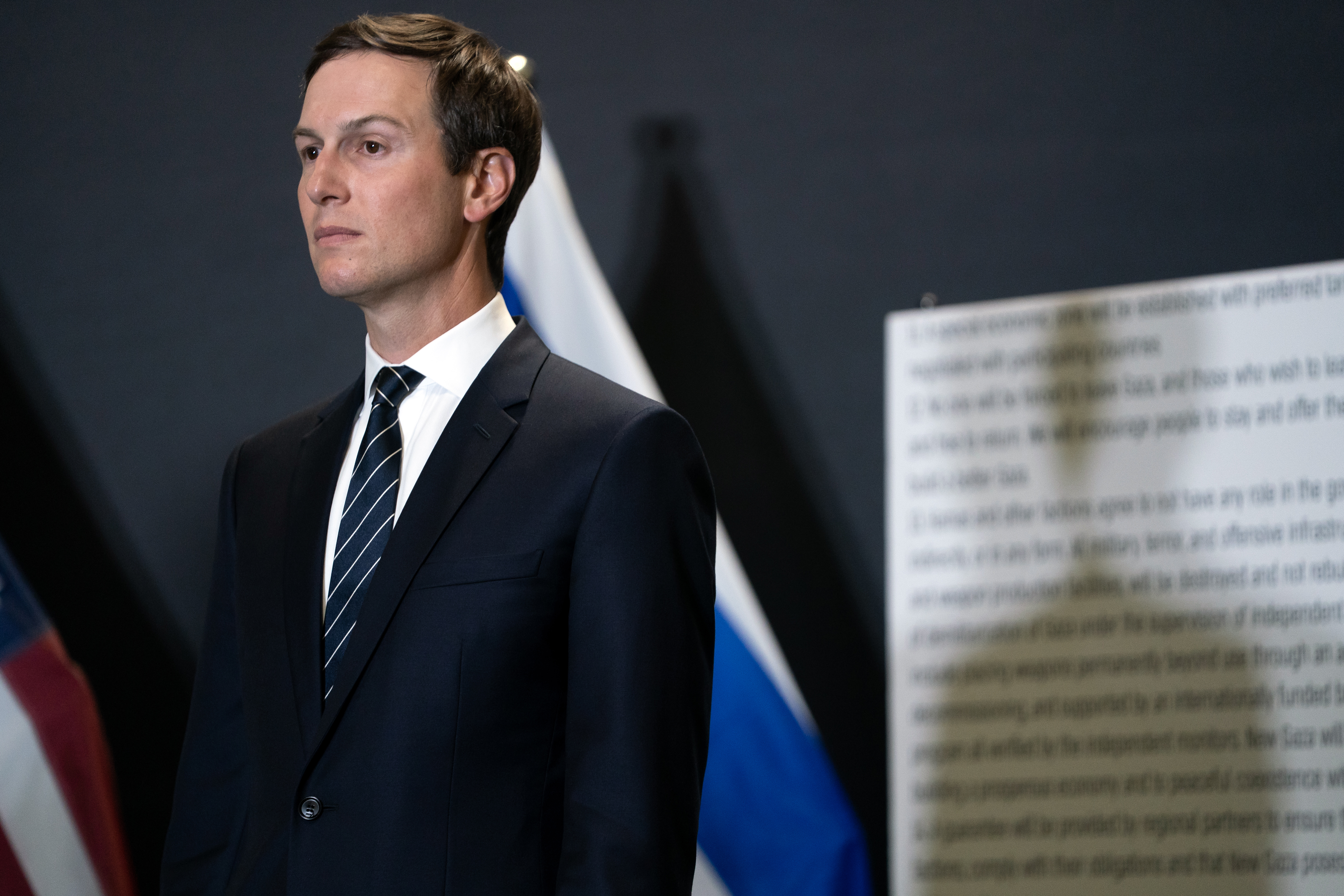
  • With Trump’s Hamas deal in peril, Kushner set to visit Israel for Gaza talks

    With Trump’s Hamas deal in peril, Kushner set to visit Israel for Gaza talks

    TEL AVIV, Israel — Jared Kushner, President Donald Trump’s senior aide and son-in-law, is set to visit Israel early next week, according to four people familiar with the plans, days after the Israeli government rejected a U.S.-brokered disarmament deal with Hamas.

    Kushner is expected to meet with Israel’s prime minister, Benjamin Netanyahu, to discuss the Gaza Strip, the people said, speaking on condition of anonymity to divulge details about Kushner’s schedule.

    The deal, agreed to late last month between Trump’s Board of Peace and the militant group Hamas, called for the disarmament of Palestinian factions in Gaza and the withdrawal of Israeli forces there.

    The Board of Peace is a new international organization chaired by Trump that has focused on plans for governing and rebuilding Gaza. Kushner is a senior member of its executive board and was involved in ceasefire negotiations between Hamas and Israel.

    Netanyahu said Sunday that Israel rejected the deal, a move that was seen as an appeal to his right-wing voting base before national elections in October. Yet the prime minister also ordered the Israeli military to pause its strikes in Gaza, in an apparent effort to appease the Trump administration.

    For days after the announcement, the Israeli military conducted no airstrikes in Gaza, until Wednesday, when the military carried out a fresh attack, saying it was targeting Hamas militants. It conducted further attacks Thursday.

    Hamas officials have condemned the strikes, calling on mediating countries in the region to pressure Israel to halt them.

    Hamas remains in control of about half of Gaza, where most of its people live. The group said that among those killed by Israel this week was the head of the police force in the Gaza City area.

    Nickolay Mladenov, the Board of Peace’s high representative for Gaza and former United Nations envoy, will join Kushner in Israel, according to two of the people with knowledge of the visit. Mladenov has played a leading role in the negotiations with Hamas over disarmament, frequently meeting with officials from the group in Egypt.

    Kushner and Mladenov were also expected to visit Egypt next week to meet with regional mediators, according to two of the people.

    The deal with Hamas says that, as part of the disarmament process, Israel should first uphold its side of the ceasefire, which was agreed to in October last year. That includes halting airstrikes and allowing more aid into Gaza.

    The 15-point document leaves elements of the disarmament process vague, however. It calls for a “gradual, sequential, and time-bound manner” for decommissioning and storing heavy weapons, with an exact timetable still to be determined.

    It adds that, at the “end of the process,” the National Committee for the Administration of Gaza will “hold, control, or store weapons in Gaza.” The committee, a body of Palestinian technocrats, was assembled by the Board of Peace to take over governing Gaza under the board’s supervision.

    Many Israelis remain skeptical that Trump’s Board of Peace can successfully disarm Hamas. The group has long touted armed struggle against Israel as the core of its ideology, and members have said they regard disarmament as tantamount to surrender.

    This article originally appeared in The New York Times.