Category: Wires

  • 60 days after signing Iran deal, Trump stuck in quagmire as peace talks stall

    60 days after signing Iran deal, Trump stuck in quagmire as peace talks stall

    Sixty days ago, seated beside French President Emmanuel Macron at a lavish dinner at the Palace of Versailles, President Donald Trump signed a memorandum of understanding with Iran and declared the beginning of the end of the U.S. conflict with Tehran.

    The “historic breakthrough” would lead to the reopening of the Strait of Hormuz and ensure Iran never obtained a nuclear weapon, the White House declared. Trump advisers said the deal would demonstrate that the president could end, rather than prolong, the kind of “endless wars” in the Middle East he had spent years denouncing.

    The agreement set aside two months for talks to turn the interim truce into something more ambitious: a broader settlement of the decades-long standoff over Iran’s nuclear program.

    That window has now closed.

    The war has not ended. The Strait of Hormuz remains largely shut. Detailed negotiations over Iran’s nuclear program never began.

    The United States has resumed its blockade of Iranian ports. Tehran is demanding concessions that the Trump administration has rejected. And the administration has now publicly disowned several of the key points in the ill-fated memorandum, including development of a plan “with at least $300 billion for the reconstruction and development” of Iran, a waiver of sanctions to allow Iran to sell oil, and a “dialogue” between Iran and Oman over how to run the Strait of Hormuz.

    Trump on Monday went so far as to threaten to bomb Oman over its talks with Iran on management of the strait, through which 20% of the world’s oil used to pass.

    If Oman “gets in the way,” Trump said in a Fox News interview, the U.S. would “bomb the s— out of them.” He demanded that Iran raise “the white flag of surrender” while insisting that neither the approaching midterm elections nor the passage of time was putting pressure on him to reach a deal.

    “I have no time schedule,” Trump said. “I’m not in a hurry. … Midterms have nothing to do with my thinking.”

    Six months after he launched attacks on Iran in coordination with Israel and 78 days before elections that will determine whether his party retains control of Congress, Trump confronts the kind of open-ended conflict he claimed he was uniquely equipped to avoid: one with no obvious military resolution, no diplomatic breakthrough in sight, and mounting economic and political costs at home.

    Continuing the standoff risks leaving him presiding over a war that undercuts one of the central premises of his political identity.

    The war has helped to erode voters’ trust in Trump and may have larger consequences in the midterms, said Lee Miringoff, director of the Marist University Institute for Public Opinion.

    “For a lot of voters, the war in Iran is linked with the economy. When the strait closed, the price of gas went up,” Miringoff said. “The problem for President Trump and the Republicans is that a lot of what he was elected on seems to not be being fulfilled. So there’s a sense of no rationale for why we went in, and no clear sense of how it’s going, and no indication of how we’re going to get out, which is the opposite of what makes for good politics.”

    The White House did not immediately respond to questions about the memorandum’s expiration or the impact it will have on the president’s political goals.

    Trump’s overall standing has deteriorated as the war has dragged on. Strikingly, surveys show an erosion of support among Republicans, whose intense loyalty has been the foundation of Trump’s political power.

    An Economist-YouGov poll released last week found Trump’s approval among Republicans at 79%, a second-term low and 15 points below its level shortly after he returned to office. The share of Republicans who strongly approve of his performance has fallen even more sharply, from 68% to 48%.

    A Washington Post-Ipsos poll last month found a new low of 15% of Americans “approve strongly” of Trump’s job performance. The finding marked the first time the Post-Ipsos poll found that significantly more than half of Trump approvers support him only “somewhat,” rather than strongly.

    The declines cannot be attributed to the Iran war alone. Voters have also expressed frustration about inflation, gasoline prices, and other aspects of Trump’s presidency. But those issues have increasingly become intertwined: The war and the continued disruption of oil shipments have helped make Trump’s foreign-policy predicament an economic and political problem at home.

    Trump has continued to insist that an end to the stalemate is in the offing. On Monday, he told Fox News that the U.S. was engaged in back-channel talks with Iran’s Islamic Revolutionary Guard Corps.

    An IRGC spokesperson quickly denied the claim. Brig. Gen. Hossein Mohebbi told Iran’s semiofficial Tasnim News Agency that there were no talks between Revolutionary Guard officials and the Americans, dismissing Trump’s assertion as a product of “defeat and desperation in the war.”

    Alan Eyre, a former diplomat who served on the U.S. negotiating team that secured the 2015 Iran nuclear deal, said the war has transitioned from a military operation into an economic pressure campaign that the U.S. hopes can force Iran to capitulate. But any economic pain will be felt primarily by the Iranian people, he said, rather than forcing change from the increasingly hard-line regime.

    “The U.S. has no good options,” said Eyre, who is a distinguished diplomatic fellow at the Middle East Institute. “This war has broken a complex system. And it is not getting back to the way it was before Feb. 28.”

  • Trump aims to rebuild defenses against bioweapons as AI fears rise

    Trump aims to rebuild defenses against bioweapons as AI fears rise

    The White House is working to strengthen safeguards against biological attacks after staffing cuts early in the second Trump administration depleted expertise in a field where officials increasingly fear artificial intelligence could make it easier to create deadly pathogens.

    By the end of President Joe Biden’s term, the White House had built a team of as many as 30 people focused on biological security, according to three former government officials who worked on the issue — two for Biden and Trump, and one just for Biden — and spoke on the condition of anonymity to avoid professional retaliation.

    This specialized staff was charged with coordinating the web of federal agencies that deal with biohazards and provided scientific guidance to top officials.

    That team rapidly dwindled after Trump returned to office amid cuts and reorganizations, said the three former officials, as well as a fourth former official, who also worked for both administrations. At times, nobody at the White House was dedicated solely to biosecurity, according to three of the former officials.

    The losses have come as the administration has delayed replacing key Biden-era directives. It revoked a 2023 executive order on AI calling for stronger biological safeguards and cast doubt on a policy issued the following year designed to require companies to screen buyers seeking genetic components that could be used to create biological agents — widely seen by experts as a basic pillar of the nation’s defenses.

    Trump directed officials to produce a revised version by August 2025. More than a year later, it has yet to appear, even as AI companies say their most advanced models are gaining increasingly sophisticated biological capabilities alongside the hacking skills that have alarmed officials this year.

    “They have kneecapped themselves in their ability to create any policy that would have staying power,” said one of the former experts, who recently worked directly on outbreak response policy. “That’s the risk, they’re not playing the long game. The whole purpose of having the technocrats there is to advise political leaders on the nuanced tradeoffs of taking one path or another.”

    In the absence of a large team, the White House has relied on a small revolving cast of employees. They have included a junior fellow without a security clearance; a part-timer from the research organization Rand; a pair of CIA staffers with little expertise in the field; and an Air Force doctor who had been a consultant to the White House medical office, according to the three experts.

    A White House official said the administration was working to strengthen the Biden-era policy, calling it inadequate and technically limited despite the staff devoted to developing it, and did not address questions about the staffing changes.

    “The Administration’s commitment to addressing AI and biological safety risks is clear and ongoing,” the official said in an email. “The White House has been developing policy for over a year, including in our AI Action Plan last summer.”

    The Trump administration has acknowledged the biological security risks AI poses while touting the potential for the technology to help keep the nation safe. Trump told foreign leaders gathered at the United Nations last year that he wanted to prevent biological weapons disasters and said AI was a tool to help.

    At the Pentagon, a former health official who led Operation Warp Speed — the effort during the first Trump administration to rapidly produce a vaccine for the coronavirus — is involved in efforts to use AI to speed the development of new defenses against future pandemics and to deter biowarfare. Part of the work involves analyzing billions of tweaks to antibodies to assess how to respond to new forms of the coronavirus.

    But that work is taking place in a government that analysts and the former experts say has been drained of expertise amid broader cuts to federal public health and science funding.

    The White House removed all the staff from the Office of Pandemic Preparedness and Response Policy, an organization created to lead the nation’s response to the kind of major outbreak that the most dangerous kind of bioweapon could trigger. The office was resurrected as Ebola spread in Africa this spring.

    A National Security Council unit dedicated to health security was also shut, two of the former experts said, and parts of the Office of the Director of National Intelligence and Department of Homeland Security responsible for biological threats were broken up as part of broader reorganizations.

    A scientist who worked on biotechnology and national security issues in both the first Trump and Biden administrations said the federal government is not taking a leading role in coordinating a response to the risks posed by the rapidly evolving technology.

    “Every time an administration changes over there’s a lot of continuity that just gets disrupted,” said the scientist, who spoke on the condition of anonymity because they were not authorized by their employer to speak publicly. In the transition from Biden to Trump, they said, “when it comes to biosecurity, that happened in a very disruptive way.”

    There has never been one federal agency responsible for biosecurity, a sprawling field that encompasses efforts to secure research labs, aspects of public health work, and international diplomacy, and which is increasingly focused on the role of AI. But an analysis of Trump’s most recent budget request by the Council on Strategic Risks, a Washington-based security-policy think tank, concluded that the administration’s rhetoric on biosecurity was not matched by its funding proposals. In a separate analysis, the group found that spending across multiple government departments peaked in 2024, before declining slightly in Trump’s first year — with the administration proposing further cuts.

    “General programmatic cuts and agency-specific reorganizations have restricted and eliminated key programs, clouding budgetary transparency and weakening US deterrence efforts,” the council wrote in a blog post.

    When Trump returned to office last year, his team was focused on eliminating barriers to the development of AI technology. That approach began to shift this spring when a new generation of models proved to be capable of hacking into computer networks, leading administration officials to embrace the kind of government oversight of yet-to-be released tools that they had once spurned.

    There are now signs that officials are taking additional interest in the potential dangers. That has included a recent string of briefings on biological risks between OpenAI, the White House, and half a dozen government agencies, according to a person familiar with the meetings, who spoke on the condition of anonymity to describe their private nature. Politico reported this month that the White House was launching a new initiative involving its cybersecurity office and a top official at the Department of Health and Human Services.

    Leaders in the AI industry have long said that their tools being used to enable a biological attack ranks among their top fears.

    “I’m getting very frustrated,” said David Relman, a professor of medicine at Stanford University who worked on pandemic response in the Biden White House.

    The newest AI models, such as Anthropic’s Mythos and OpenAI’s GPT 5.6, have continued to get better at high-level biological research. But just as the models’ ability to write computer code has made them good at hacking, their biological capabilities have stoked fears that they could be used to help build a new bioweapon, set off a new pandemic, or aid even a relative amateur in carrying out a biological attack. This month, the journal Science published the results of a successful effort to use AI to engineer new viruses. They were designed to infect bacteria rather than humans, but the outcome was a clear sign of what is becoming possible.

    As early as last summer, researchers at OpenAI determined that they were close to reaching “high” levels of capability in biology, which the company defines as capabilities that “significantly increase existing risk vectors for severe harm.” The company briefed the Trump administration and hosted more than 50 government experts for a summit at its San Francisco headquarters last July to discuss how its systems could be used for biological defense. (The Washington Post has a content partnership with OpenAI.)

    The company said it has continued to work with the administration, aiming to provide officials with access to a special version of GPT for biological defense that it calls Rosalind.

    “The Administration has increasingly prioritized this important issue as AI capabilities have expanded, and we welcome their partnership,” an OpenAI spokesperson said in an email.

    Despite the growing concern, scientists remain divided on how serious the risks are, how soon they might materialize, and how the nation should prepare. Large language models that power chatbots could be helping terrorists to do tricky lab work, and specialized biological design tools could aid in the creation of new kinds of deadly pathogens not readily recognized by current methods of surveillance.

    In October, researchers at Microsoft detailed how they had patched gaps in detection systems after using AI to engineer digital versions of thousands of toxins that were not caught by the existing safety net.

    A report by Rand concluded that attackers have a significant advantage over defenders when it comes to biological incidents. Someone carrying out an attack could make multiple efforts, while authorities need to be able to tackle every threat because even one “could result in catastrophic consequences.”

    Leading American AI firms have sought to lock down their models, blocking them from answering questions about risky biological research and providing more capable systems only to trusted partners. But AI guardrails are imperfect and OpenAI said in July that its testing of leading Chinese models, which are made freely available, indicates that they do not have the same kinds of protections built in.

    “I think we have a massive collective-action problem in front of us,” said Relman, the Stanford professor.

    AI systems have gone on runaway hacking sprees in recent months but, for now, experts say the barrier between the digital world and the biological one presents a major hurdle — and an important line of defense. Yet that could begin to change as companies seek to automate laboratories.

    “The ultimate fears are a ways out,” said Crystal Grant, a researcher at the Council on Strategic Risks. “We have a lead time before they’re here to prepare ourselves.”

    Because the same abilities can allow AI to be used for dangerous and helpful biological research, many scientists also fear their work becoming too tightly regulated.

    The Trump administration recently released a new policy on what it calls dangerous gain of function research. It’s a long-standing approach involving tinkering with pathogens in order to better understand how to defend against them. But it has become increasingly controversial in the wake of the coronavirus pandemic. The Trump administration has embraced the theory that the virus escaped from a Chinese lab that was undergoing gain of function work. Some scientists say the new policy is vague and could impede legitimate research.

    In the private sector, researchers complained that biological guardrails Anthropic put on its most powerful model were too strict. The company loosened the restrictions this month.

    Paul Friedrichs, a retired Air Force general, said the need to get the balance of safety and progress right underscored the need for strong leadership and expertise in the federal government.

    Friedrichs, who ended his government career leading the White House pandemic office under Biden, said the cuts in the Trump administration have “unquestionably” left the nation less well prepared and at risk of squandering an incredible opportunity.

    “We’re on the cusp of curing some of the banes of humanity,” Friedrichs said.
  • Trump blames vandals for damaged grass in the spot where he held his big July 4 celebration

    Trump blames vandals for damaged grass in the spot where he held his big July 4 celebration

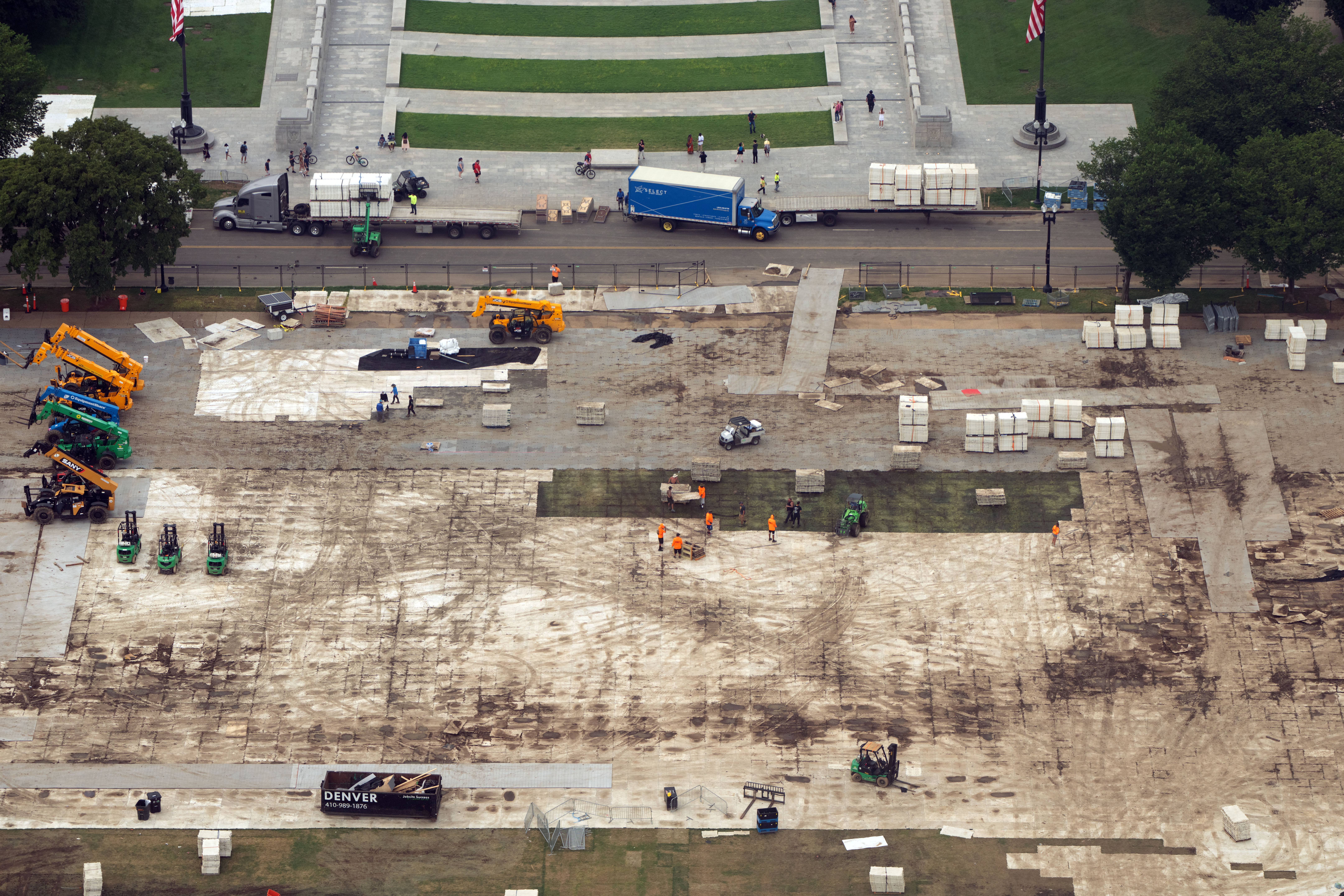
    WASHINGTON — President Donald Trump says vandals are to blame for large swaths of dead grass on the National Mall near the World War II Memorial — in the spot where he had a stage built and hosted crowds for his July 4 celebration.

    Trump made the accusation in a social media post on Sunday without saying why he believes it’s the work of vandals instead of trampled turf from the Independence Day festivities. The Republican president posted a photo showing a once-grassy area by the World War II Memorial, now patchy and brown across much of the sprawling turf.

    “Look what VANDALS did to the grass connecting the vandalized World War II Monument and the vandalized Reflecting Pool, which will be opened again, and better than ever, shortly,” Trump said on his Truth Social platform.

    “Anybody who thinks the Reflecting Pool wasn’t vandalized should go back to Law School!” he added.

    Trump has repeatedly blamed vandals for damage to his renovation projects in the nation’s capital, often without evidence and sometimes despite opposing accounts from his officials. Trump lashed out at U.S. Attorney Jeanine Pirro this month after her office concluded that damage to the Lincoln Memorial Reflecting Pool was the result of poor construction and not the work of vandals, as Trump claimed.

    Authorities on Friday announced an arrest in connection with vandalism at the World War II Memorial, after the words “Clean hands dirty $” were found painted on the monument and bubbles filled a fountain. Pirro said felony charges were being brought against Melissa L. Farris, who was in custody and couldn’t be reached for comment.

    A woman identified on her Facebook page as Melissa Lovewell on Thursday posted a video in which she is seen taking cans of spray paint from her bag and then painting the monument. “I will wait here to be arrested for spraying our veterans’ fountain,” she says. “It was me. I’m doing it. It’s on camera.”

    The woman was identified by her Kentucky driver’s license as Melissa L. Farris, of Elizabethtown, Ky., an arrest warrant says.

    Charging documents in that case make no mention of the grassy area Trump is highlighting in his new claims. Authorities said Farris had previously been arrested for camping on federal property a few blocks from the World War II Memorial, but not the area cited by Trump.

    That stretch of lawn is instead where a large stage was built and crowds gathered to hear from Trump and watch fireworks at a July 4 event celebrating the nation’s 250th anniversary. Trump claimed without providing evidence that more than 400,000 people attended the event before a storm hit the area and delayed his remarks.

    Photos from the time, taken by a streaming webcam atop the Washington Monument, show a large bandstand and seating areas covering nearly the entire lawn Trump now says has been vandalized. Associated Press photos from the days that followed showed workers removing the structures, revealing brown, damaged grass underneath.

    On Aug. 1, Trump posted a different photo of the same area that appears to show the numbers “86 47” — which federal officials have said constitutes a threat against Trump, the 47th president — emblazoned into the grass. He cited it as evidence refuting Pirro’s conclusion, calling it “a pure case of VANDALISM, that included the grass.”

    “There may have been some contractor difficulty, but the major damage was caused by VANDALS!” he wrote.

    Those numbers are not visible in the photo Trump posted to social media on Sunday.

  • Trump dwarfs his predecessors in the number of ultra-rich in his second White House, report shows

    Trump dwarfs his predecessors in the number of ultra-rich in his second White House, report shows

    Wealth, perhaps second only to loyalty, has been a prized attribute for Donald Trump during his second presidency.

    The number of people worth at least $100 million whom the Republican president has appointed to his administration is more than four times the combined total under the three previous presidents, according to a report from the consumer advocacy group Public Citizen.

    It’s the numbers for the Trump administration, in the context of previous administrations, that stand out in Public Citizen’s report, published on Monday. In all, 57 Trump officials are worth at least $100 million, including 17 ambassadors and the remaining 40 in senior posts across the executive branch.

    Look no further than Trump’s cabinet. Eight of its 23 members fit the category, notably Commerce Secretary Howard Lutnick and Education Secretary Linda McMahon, both billionaires.

    The president, himself a billionaire, has described his inclination toward appointing the ultrawealthy as deference to financial success. And yet, Trump, who owes his White House comeback to support from middle-income, working Americans drawn to his pledge to lower everyday costs, now faces a midterm electorate decidedly less keen on his handling of the economy.

    Presidents have long sought counsel from the nation’s wealthiest people and tapped some for high-profile administrative leadership roles. Likewise, presidents routinely reward wealthy and influential supporters with ambassadorships.

    Among the most notable examples is Andrew Mellon, the aluminum, oil, and banking tycoon who was among the handful of the nation’s wealthiest people in the 1920s and served as treasury secretary for three presidents.

    The Trump officials worth at least $100 million include Deputy Secretary of Defense Stephen Feinberg and Small Business Administration Administrator Kelly Loeffler, who are also billionaires, and Treasury Secretary Scott Bessent and special envoy Steve Witkoff, both worth hundreds of millions of dollars.

    By comparison, Republican George W. Bush’s administration and Democrat Joe Biden’s each included five members worth $100 million or more. Democrat Barack Obama’s included three, the report states.

    A government populated by so many of the economic elite presents potential problems, the report’s authors said.

    “When the people holding the reins of government are drawn overwhelmingly from the ranks of the ultra-rich, it leads to misplaced incentives and corruption, and begs the question, ‘Whose interests they are truly serving?” said Lisa Gilbert, Public Citizen’s co-president.

    The list does not include Trump, whose net worth Forbes estimates at more than $6 billion. Nor does it include space and social media giant Elon Musk, who advised Trump last year on an effort to reduce the federal government’s size, scope, and workforce and is the world’s wealthiest person, with a net worth Forbes estimates at about $860 billion.

    Trump’s views are well established: Financial success is evidence of executive mastery and negotiating strength.

    “They have great competence, those people. Incredible competence. Some of the smartest business leaders,” Trump said last year in explaining why he put considerable weight on advice from business executives.

    He has also pointed to investments by wealthy people as a signal of future economic growth. To encourage billionaires to deliver, Trump, in his first year back in the White House, pursued policies on artificial intelligence and financial regulation that could benefit wealthy people, along with tax cuts and reduced regulatory burdens for large-scale investments.

    Still, last month, only 32% of U.S. adults approved of Trump’s handling of the economy, down from 40% at the beginning of his second term and as his Republican Party faces headwinds in its attempt to hold both majorities in Congress in November.

  • Trump lashes out at Oman as preliminary deal with Iran expires

    Trump lashes out at Oman as preliminary deal with Iran expires

    As a crumbling truce with Iran officially collapsed Monday, President Donald Trump signaled his frustration at his inability to resolve a war that he started but cannot seem to end.

    In an interview with Fox News, the president lashed out at a U.S. ally, Oman, that has been trying to mediate negotiations with Iran.

    “If Oman gets in the way, we’ll bomb the s— out of them,” Trump said in a phone interview, according to Fox News’ Trey Yingst.

    The latest threat toward Oman, which has facilitated talks between the United States and Iran for years and maintains that it is still a neutral mediator, came as Trump found himself without much leverage to reach the goals he set out at the start of the war.

    Hostilities have now stretched past the six-month mark in a conflict that began with the United States and Israel launching strikes across Iran in February. Administration officials pledged at the time that the war would be over in four to six weeks.

    In June, the two sides agreed to a memorandum of understanding, but that quickly fall apart amid disputes over its wording. Both Trump and Iran’s leaders have said the deal is essentially dead.

    As the ceasefire officially expires, the president and his team have promised to level crushing sanctions against Iran this week, though the details of those plans have yet to be unveiled. And Defense Secretary Pete Hegseth has said the United States can maintain a naval blockade of the Strait of Hormuz, a critical oil shipping corridor, indefinitely — an acknowledgment that there was no end to the war in sight.

    In the Fox News interview, Trump sought to project patience, saying he was “not in a hurry” to secure a deal while maintaining that his central goal remained preventing Iran from possessing a nuclear weapon.

    But in the meantime, it was Oman that received the president’s fury.

    It was the second time this year the president has threatened the country. After it emerged in May that Oman had discussed partnering with Iran to charge fees for ships to pass through the strait, Trump snapped.

    “Oman will behave just like everybody else, or we’ll have to blow them up,” Trump told reporters that month. “They understand that. They’ll be fine.”

    A White House official did not immediately respond to a request for comment.

    This article originally appeared in the New York Times.

  • Trump’s overture to Kim Jong Un strains alliance with South Korea

    Trump’s overture to Kim Jong Un strains alliance with South Korea

    SEOUL, South Korea — The South Korean and U.S. militaries view their annual drills in South Korea as more critical than ever. The stakes have risen dramatically as North Korea has gained battlefield expertise with drones and modern warfare by deploying troops to support Russia’s war in Ukraine.

    The summer exercise had barely begun Monday when President Donald Trump denounced it, dealing yet another blow to the seven-decade-old alliance between Washington and Seoul. Under Trump, bilateral relations have already come under immense strain from ​his punishing tariffs on South Korean exports.​ And his transactional diplomacy has frustrated South Korea, most recently when he appeared to put Saudi Arabia on the path to enriching nuclear fuel on its own soil, a demand Seoul has made for years.

    In recent years, North Korea has ​not only expanded its nuclear arsenal but also repeatedly threatened ​to use it against South ​Korea, labeling its neighbor ​a “most ​hostile enemy.” Its leader, Kim Jong Un, has also forged a mutual defense treaty with Moscow, dispatching troops and​ weapons to ​support Russia’s war against Ukraine. Despite these escalations, Trump, in a social media post, characterized North Korea as “unthreatening and respectful” while boasting of his “very good relationship” with Kim.​

    In the same post, he ​also criticized the decades-old joint military drills with South Korea as “not only costly” but “totally inappropriate and hostile” toward North Korea.

    “I am not happy with the fact that the United States has, long ago, agreed to participate in Joint Military Exercises with South Korea,” he said. “Based on the fact that it is too late to cancel, I have instructed Secretary of War, Pete Hegseth, to substantially reduce the Joint Military Exercises!”

    If implemented, the directive would mark Trump’s first-known concrete overture toward North Korea in his second term. However, it remains unclear whether Kim will embrace the gesture.

    Throughout his political career, Trump has treated the alliance as a​ bad bargain for Americans, frequently accusing Seoul of failing to pay its fair share for the U.S. troops stationed in South Korea — who act as a deterrent to North Korea. During his first term, he unilaterally canceled or downscaled major drills, calling them “tremendously expensive” and “​very provocative.”​ That concession helped facilitate three summit meetings with Kim but failed to roll back his nuclear ambitions.

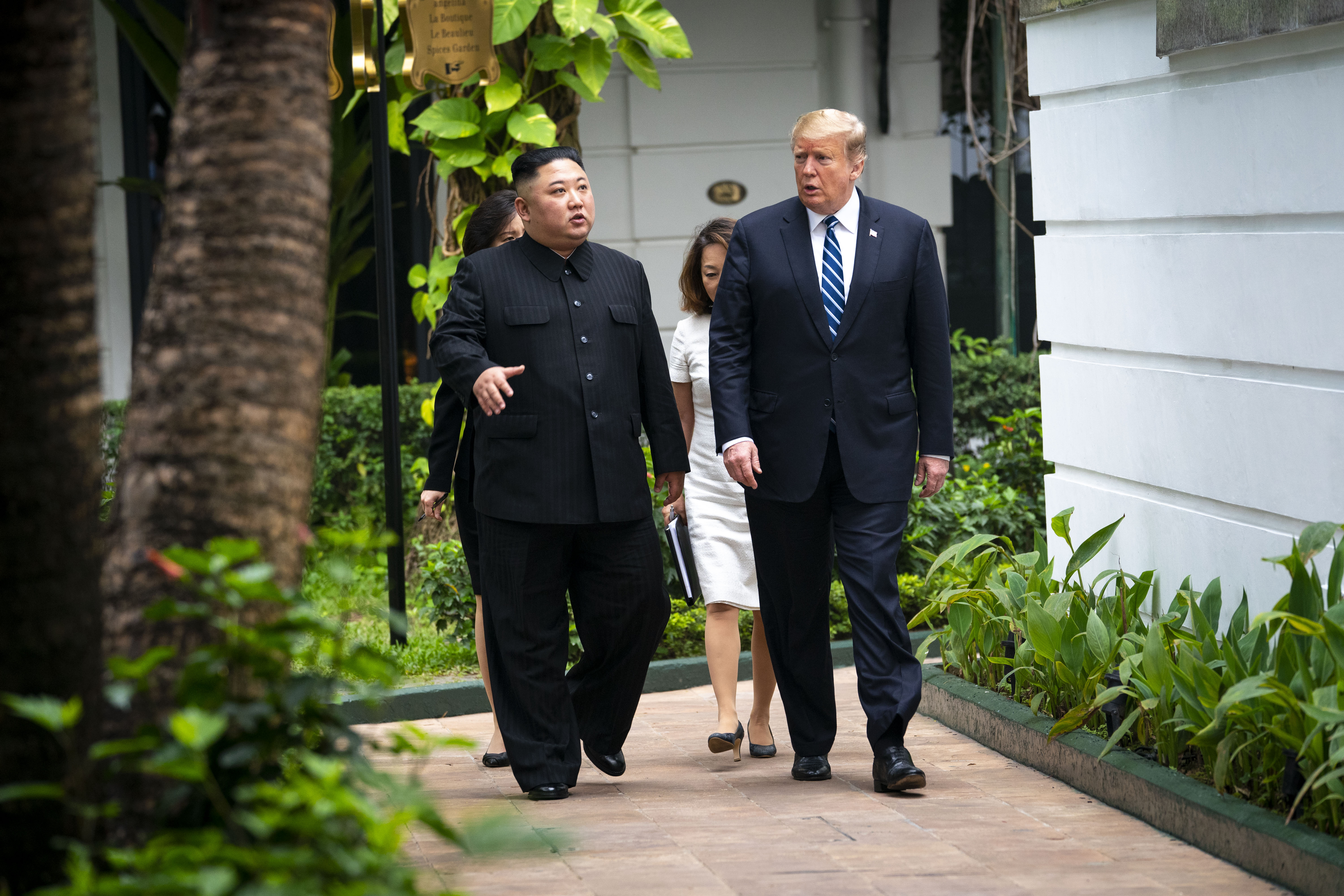
    Since returning to the White House, Trump has signaled a desire to renew that personal diplomacy. Over the weekend, he posted a 2019 photograph of himself and Kim at the inter-Korean border, writing, “Kim Jong Un and I get along GREAT!”

    “Trump’s description of the DPRK as ‘unthreatening and respectful’ is alarming to allies, who have watched the regime steadily improve its missile and nuclear capabilities, while also gaining an additional patron in Russia for its support in the war on Ukraine,” said Emma Chanlett-Avery, the deputy director at the Asia Society Policy Institute, referring to North Korea’s full name, the Democratic People’s Republic of Korea.​

    Th​is summer’s 11-day Ulchi Freedom Shield exercise was designed to adapt to these shifting dynamics​, incorporating lessons learned from recent conflicts, including from Ukraine. Lt. Gen. Joseph E. Hilbert of the U.S. 8th Army noted that the maneuvers would ​also test “the alliance’s ability to rapidly project combat power and secure key terrain within the First Island Chain”​ —​ a long Pacific archipelago seen by the U.S. military as a strategic frontier against China’s expansive territorial claims.

    But Trump found fault with South Korea on another front; in his post, he also criticized Seoul for failing to help “denuclearize” Iran.

    South Korea’s Foreign Ministry on Monday pledged continued coordination with the United States on both joint military exercises and Iran.

    While South Korea’s government confirmed that the drills had begun as scheduled, its defense establishment was deeply rattled. Trump’s directive fueled growing fears​ that the alliance was hollowing out.

    “South Korean conservatives​, in particular, will see the alliance turning into a zombie, ​considerably losing its old strategic objectives and political energy under Trump,” said Lee Byong-chul, an analyst at the Institute for Far Eastern Studies in Seoul.

    Trump’s overture toward North Korea, however, is not entirely unwelcome for his South Korean counterpart, Lee Jae​ Myung, analysts said. A staunch proponent of inter-Korean reconciliation, Lee has urged Trump to ease tensions on the Korean Peninsula through direct talks with Kim. ​North Korea has long cited the joint drills as a major stumbling block to such efforts, calling them “a rehearsal for an aggressive war.”

    On Monday, South Korea reiterated its hopes that the rapport between Trump and Kim would foster “meaningful dialogue.”

    But a second round of Trump-Kim diplomacy faces much steeper hurdles than it did in 2018. North Korea is now a de facto nuclear state that has been bolstered by economic lifelines and diplomatic leverage from Moscow and Beijing. While Kim has noted that he retains “a good memory” of Trump, he has emphasized that North Korea would resume talks ​only if Washington abandons its insistence on denuclearization.

    This article originally appeared in the New York Times.

  • Kushner meets Netanyahu in effort to break logjam over Gaza

    Kushner meets Netanyahu in effort to break logjam over Gaza

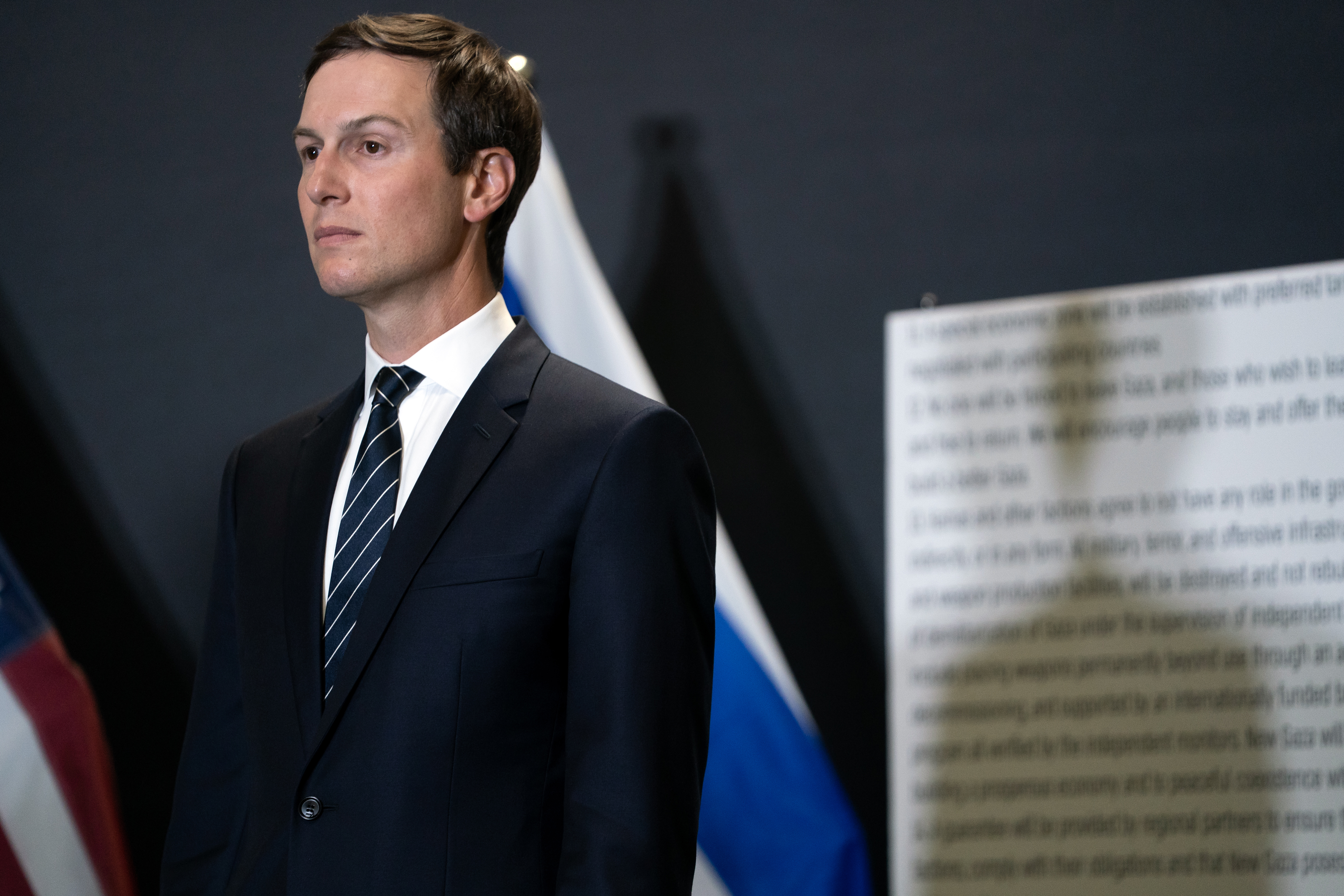
    JERUSALEM — Jared Kushner, President Donald Trump’s son-in-law and former White House adviser, was meeting with Prime Minister Benjamin Netanyahu of Israel in Jerusalem on Monday in an effort to break a logjam over Trump’s plan for the future of the war-ravaged Gaza Strip.

    The plan had been stalled for months over Hamas’ refusal to lay down its arms, as well as Israel’s frequent airstrikes and military operations beyond the withdrawal line it agreed to in the ceasefire reached in October 2025. Israel has also failed to meet its commitments to allow specified amounts of fuel and other necessities into Gaza.

    Trump’s announcement last month that his Board of Peace had secured Hamas’ agreement to disarm briefly raised hopes for progress. A 15-point “road map” that Hamas agreed to called for the militant group to lay down its weapons in a phased approach that would be matched by Israel withdrawing from parts of Gaza.

    But Netanyahu rejected the deal this month, insisting that Israel would not pull back within Gaza, let alone from Gaza, until Hamas had disarmed completely.

    Kushner and members of the Board of Peace flew to Israel for Monday’s meeting after holding talks with representatives of Hamas, including its political leader, Khalil al-Hayya, on Sunday in El-Alamein, Egypt.

    Hamas officials presented Kushner with a list of what they contended were Israel’s violations of the ceasefire, according to a Hamas official and two people briefed on the talks, and he promised to speak to Netanyahu about Israel upholding its end of the agreement.

    Kushner, in turn, asked the Hamas representatives to move ahead with disarmament, the two people said. But they replied that Israel first needed to keep its commitments under the ceasefire, and they warned that the road map they agreed to last month was not open for changes.

    The Board of Peace’s deal with Hamas says that, as part of the disarmament process, Israel should first uphold its side of the ceasefire. But political considerations are widely believed to be preventing Netanyahu from upholding all of Israel’s commitments under that deal.

    The Israeli leader faces a tough campaign for a new term in elections to be held Oct. 27, and his right-wing coalition is behind in the polls. Any concessions to Hamas or perceived softening of his posture toward Gaza could subject him to attacks from allies he considers vital.

    Political considerations are also important for the Board of Peace and for the Trump administration. With the U.S. midterm elections approaching in November and the anniversary of the ceasefire in early October, a failure to reach an agreement that could pave the way for reconstruction in Gaza could be highly embarrassing for the board, for the White House, and for its approach to the Middle East.

    This article originally appeared in the New York Times.

  • Ohio State and Oregon are 1-2 in preseason Top 25 football poll; Penn State 18th

    Ohio State and Oregon are 1-2 in preseason Top 25 football poll; Penn State 18th

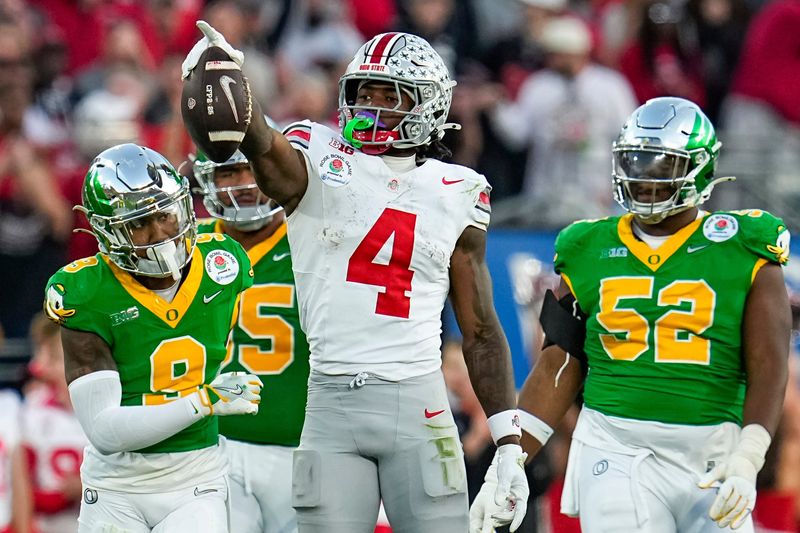
    Ohio State and Oregon are 1-2 in the AP Top 25, giving the Big Ten Conference the top two teams in the preseason rankings for just the second time ever. Georgia, Notre Dame and Texas round out the top 5.

    The Southeastern Conference gets bragging rights with nine ranked teams, but the Big Ten isn’t far behind with eight.

    Penn State is ranked 18th going into its first season with coach Matt Campbell, who was hired in December following a 7-6 season that cost James Franklin his job in October. Penn State is one of four teams in the Top 25 with new coaches.

    Indiana finished the 2025 season at No. 1 in the rankings after a historic 16-0 run and national championship game victory. This season, Ohio State enters with the best odds (+600) to win it all. Notre Dame (+650), Texas (+650), Indiana (+800) and Oregon (+800) round out the top five.

    The Top 25 voters are more than 60 journalists covering college football for AP members and other news organizations. They’re urged to base their votes on head-to-head results, not reputation, preseason speculation or regional bias.

    Conference breakdown

    SEC (9): No. 3 Georgia, No. 5 Texas, No. 8 Texas A&M, No. 9 Mississippi, No. 10 Oklahoma, No. 11 LSU, No. 13 Alabama, No. 20 Tennessee, No. 25 Missouri

    Big Ten (8): No. 1 Ohio State, No. 2 Oregon, No. 6 Indiana, No. T-14 USC, No. 16 Michigan, No. 17 Washington, No. 18 Penn State, No. 22 Iowa

    Big 12 (4): No. 12 Texas Tech, No. T-14 BYU, No. 21 Utah, No. 23 Houston

    ACC (3): No. 7 Miami, No. 19 SMU, No. 24 Louisville

    Independent (1): No. 4 Notre Dame

    SEC has 9 ranked teams to Big Ten’s 8

    Having Ohio State and Oregon enter the season Nos. 1 and 2 ahead of sixth-ranked defending conference and national champion Indiana is a flex for the Big Ten, which already is riding the momentum of winning the last three national titles.

    Having five of the top 10 teams, and seven of the top 13, bolsters the SEC’s contention that it has greater depth. The SEC has nine ranked teams compared to the Big Ten’s eight.

    The debate goes on over conference supremacy and will only heat up when the Big Ten and SEC square off in the first heavyweight games of the season Sept. 12. That’s when No. 10 Oklahoma visits No. 16 Michigan and No. 1 Ohio State goes to No. 5 Texas. Both are rematches of games won by the home team last year — OU 24-13 and Ohio State 14-7.

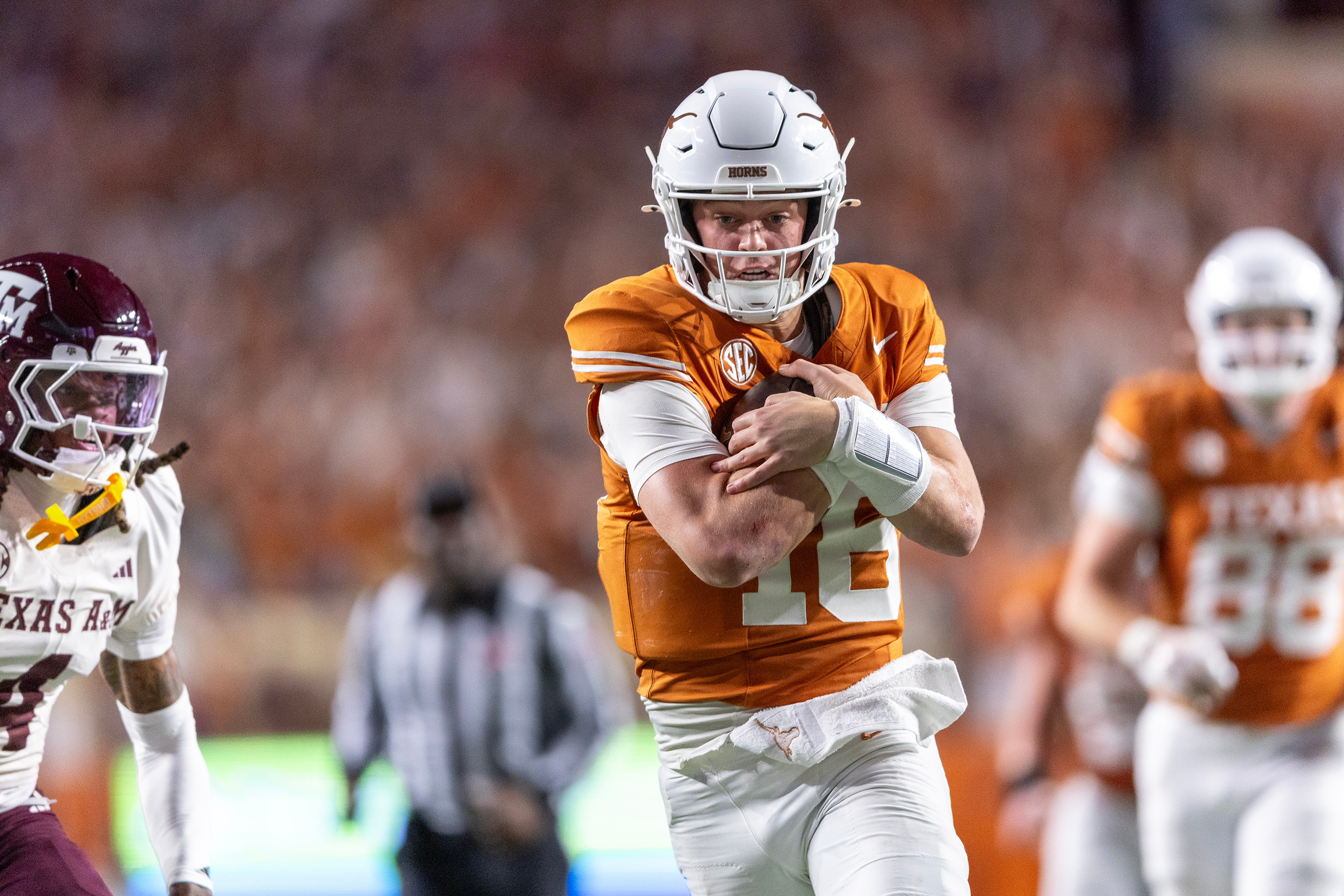
    Texas quarterback Arch Manning is expected to be a Heisman Trophy candidate this season.Stephen Spillman

    Longhorns, No. 1 in last year’s preseason poll, look to bounce back

    The Longhorns entered the 2025 season at No. 1 after receiving 25 first-place votes — two more than No. 2 Penn State. But after a Week 1 loss to Ohio State, Texas found itself fighting upstream to maintain its top-ranked status. An October loss to a struggling Florida team didn’t help either, knocking Texas out of the rankings altogether.

    The Longhorns, despite gutting out a few impressive wins, ultimately fell short of the 12-team College Football Playoff after Georgia handed them a third loss.

    Eyes will be on quarterback Arch Manning, who the Longhorns hope makes the expected jump from year one to year two as a full-time starter. Manning, a favorite for the Heisman Trophy this year, will have to lead a team facing plenty of expectations once again.

    Buckeyes are an early favorite

    It’s the first time the Buckeyes have topped the list since the 2015 preseason.

    Ohio State ranked No. 1 in the AP Top 25 for the entire regular season last year, only dropping after a Big Ten Championship game defeat from Indiana. With a 12-1 record, Ohio State still earned the No. 2 seed and a first-round bye in the College Football Playoff. The Buckeyes ultimately went on to drop 24-14 to eventual runners-up, Miami, in the Cotton Bowl.Gallery

    This season appears promising with quarterback and receiver duo Julian Sayin and Jeremiah Smith returning to the offense. Veteran defensive end Kenyatta Jackson Jr. is expected to anchor the defense. Notre Dame and Texas are tied for the second best odds at +650. Indiana (+800) and Oregon (+800) round out the top five.

  • Supreme Court again rejects Trump’s appeal of $5 million E. Jean Carroll payment

    Supreme Court again rejects Trump’s appeal of $5 million E. Jean Carroll payment

    WASHINGTON — The Supreme Court for a second time refused a request by President Donald Trump to review a $5 million civil judgment against him after a jury found in 2023 that he had sexually abused and defamed writer E. Jean Carroll.

    The announcement Monday did not include the justices’ reasons, which is typical when the court issues routine orders. There were no noted dissents.

    Trump paid Carroll in July, a few days after the court initially turned away the president’s appeal. He also made a long-shot request to the justices that they reconsider, which the court formally declined Monday.

    The president has separately asked the Supreme Court to overturn a much larger award of $83.3 million that a jury ordered him to pay in 2024 for defaming Carroll in 2019, after she accused him of a decades-old rape. The justices are on summer recess and not expected to consider whether to take up that case until late September at the earliest.

    The request the justices dispatched Monday was always a long shot, since they rarely reconsider when asked. Still, it was another in a series of blows to the president’s efforts to contest Carroll’s claims and avoid the two separate monetary awards that juries have ordered him to pay related to Carroll’s allegations.

    In a statement, Trump’s legal team said: “The American people stand with President Trump as they demand an immediate end to all of the witch hunts, including the Democrat-funded travesty of the Carroll hoaxes. President Trump will keep winning against liberal lawfare, as he continues to focus on his mission to make America great again.”

    Carroll’s lawyer Roberta Kaplan said in a statement: “We are pleased that the United States Supreme Court has declined again to hear this case. As a result, the jury’s unanimous verdict that Donald Trump sexually assaulted and then defamed E. Jean Carroll is now final and cannot be challenged in any court.”

    The $5 million matter stems from a trial held in May 2023, when a federal jury in New York found the president liable for sexually abusing and defaming Carroll.

    The jury agreed that Carroll, a former magazine writer, had sufficiently shown that Trump sexually abused her in a dressing room of the Bergdorf Goodman department store when the two crossed paths in the 1990s. Further, the jury found that Trump had defamed Carroll by posting a statement on social media calling her case “a complete con job” and “a Hoax and a lie.” Throughout, Trump denied Carroll’s allegations.

    After that verdict, Trump appealed to the 2nd U.S. Circuit Court of Appeals, asserting, among other things, that the trial judge, Lewis A. Kaplan, erred by allowing certain evidence to be shown to the jury.

    In December 2024, a three-judge appeals court panel upheld the jury’s verdict, finding that Trump failed to show that the evidence had harmed his rights to a fair trial.

    Trump then asked the justices to weigh in and find that the trial court had erred.

    This article originally appeared in the New York Times.

  • Inside the gentle, careful work of restoring famous paintings of Lincoln

    Inside the gentle, careful work of restoring famous paintings of Lincoln

    Heather Smith stood before the tattered portrait of Abraham Lincoln, holding a fine-tipped sable brush and a small plastic palette smeared with dabs of conservation paint.

    Wearing special magnifying glasses, she peered at the edge of the unframed portrait where paint was missing and pieces of old canvas remained.

    Lincoln, shown in the portrait resting his chin on his right hand, seemed to be watching.

    “He’s been through a war of his own,” she said of the painting of the nation’s Civil War president. “It’s terrifying to think about.”

    The 6-foot-2-inch portrait of a contemplative Lincoln sitting in a chair was painted in 1887. Time has weathered it and pocked it with flaws: Its original canvas was removed, probably with a scalpel. The surface of the painting was abraded, perhaps with an iron. And spots dotted the portrait where the paint was gone.

    But the Baltimore art conservator, working for the Smithsonian’s National Portrait Gallery, which owns the painting, has now embarked on a months-long effort to restore the majestic portrait to its original look.

    The effort is part of the portrait gallery’s project to assess 110 of its presidential portraits and repair those in need. The work has been funded, in part, by a grant from Bank of America.

    Smith is the owner of Maryland Art Conservation, which is based in a former Baptist church in northern Baltimore.

    She has already worked on the gallery’s 1785 portrait of George Washington by English artist Robert Edge Pine. And she is scheduled to work on gallery portraits of presidents Theodore Roosevelt, Benjamin Harrison, Woodrow Wilson, and Dwight D. Eisenhower.

    She is also working on another Lincoln — known as the penny portrait, which resembles the image of Lincoln on the coin.

    But the large portrait of Lincoln seated is, perhaps, the most dramatic and well-known of the group. He is shown wearing a dark suit, white shirt and bow tie. He is leaning forward, his left hand gripping the arm of the chair, as if listening.

    The painting is too big to fit on an easel, Smith said, so it leans against a wall, flanked by two large windows. It was last on view at the portrait gallery in 2022.

    It is one of four similar Lincoln portraits painted by the prolific American artist George Peter Alexander Healy, said Mindy Farmer, a portrait gallery historian.

    “This has been an iconic work since it was created,” she said.

    Another version, painted in 1869 and once owned by Lincoln’s son, Robert, is in the White House, according to the White House Historical Association.

    The portraits are based on The Peacemakers, a painting Healy did in 1868 depicting Lincoln meeting with Lt. Gen. Ulysses S. Grant, Maj. Gen. William T. Sherman, and Rear Adm. David D. Porter near the end of the Civil War, according to the association’s website.

    The gallery’s 1887 portrait was commissioned by Lincoln’s longtime friend and political ally Elihu B. Washburne, who wanted it for his home, art historian Alba Campo Rosillo wrote in Smithsonian Magazine in 2021.

    Healy painted the portrait in the winter of 1887 in his studio in Paris, where he was living, Rosillo wrote.

    Washburne died in Chicago later that year, and the painting passed to his brother, William, who died in 1912.

    It was purchased in 1934 by the A. W. Mellon Educational and Charitable Trust. It was given to the National Gallery of Art in 1942 and transferred to the planned portrait gallery in Washington in 1965, according to the gallery. The gallery opened in 1968 with the Lincoln portrait on display.

    In the early 1940s, during conservation at a now-defunct gallery in New York, the painting underwent what Smith said was a radical treatment procedure.

    “I’ve never encountered this before,” she said in an interview in her conservation lab. “They put [it] face down, removed the canvas from the back of the paint layers, which is extremely unusual.”

    “They would have protected the front with something called a facing, which is paper glued to the front of the painting to keep everything intact, and then worked on the back,” she said.

    The old canvas was probably scraped away little by little, except for a small ridge along the edges of the painting, she said. “I would not be surprised if that is how some of the painting’s numerous tears and holes were inflicted.”

    The old canvas was replaced with a new backing, Smith said. The portrait also shows evidence of “abrasion,” where the paint has been worn down. What probably happened was that a prior conservator, assumably in the 1940s, used an iron to try to fix cracks in the paint surface, she said.

    “When they ironed them, they didn’t put anything protective between the iron and the painting,” she said. “And I’m guessing they just wore down the paint.”

    The painting’s last major conservation was in 1966, Smith said, and the portrait was in poor shape when she got it earlier this year.

    She has since removed dirt and old varnish and reattached bits of paint that were loose.

    She plans to soon begin comprehensive inpainting — adding paint to places where it’s missing. In her lab, she keeps books, paint brushes, picture frames, lighting equipment, jars of pigment, and a bed for her dog, Charity.

    Across the room from the large Lincoln portrait, his penny portrait rests on a table. The work on it requires using bits of cotton on the end of a bamboo skewer to clean off dirt and soot.

    The 1864 portrait, by the Boston artist William Willard, may have hung above someone’s fireplace, she said. The painting was given to the gallery in 1976 by Mr. and Mrs. David A. Morse, the gallery’s website says. It was last exhibited in 2009.

    Smith, a native of Westminster, Md., has been an art conservator for more than 20 years, taking over the business in the small wood-shingled church when her employer retired.

    She said she feels a sense of responsibility adding paint to damaged works of historic art.

    “Early in my career … I would have conversations with the artist — ‘I’m sorry this happened to your painting,’” she said. “Over time, you treat enough paintings, you’re more looking at it as the materials, you kind of break it down in your head to the raw materials.”

    She said that there is a sense of gravity to the work, a realization that the person restoring the art is part of its history.

    “Obviously, you want to do no harm but make it look as good as possible,” she said. “Eventually, you won’t see any damages any more and will focus on what we’re here to see.”