Category: Wires

  • Leaked memo shows how U.S. aims to weaken global limits on plastic pollution

    Leaked memo shows how U.S. aims to weaken global limits on plastic pollution

    The United States has doubled down on its opposition to plastic production limits in global treaty talks, according to a diplomatic memo reviewed by the Washington Post, pushing to create a broad loophole to disregard the treaty on national security grounds.

    A year after the Trump administration worked with other major oil-producing nations to block strict plastic pollution limits, leading to a failed U.N. conference in Geneva, environmentalists and other observers argue this same group is helping steer negotiations toward a weaker agreement.

    Involving delegates from nearly 180 countries, the talks have reached a critical point after four years. Global plastic pollution has ballooned to more than 57 million tons per year, and a coalition of dozens of countries — including most members of the European Union and many from Africa and Latin America — say this waste will become overwhelming unless the world imposes meaningful restrictions soon.

    The leaked document, which a foreign diplomat confirmed was circulated this summer to governments involved in negotiations, calls for a “pragmatic” treaty that includes a provision allowing for countries to take any measures they consider necessary to protect national security.

    The memo, which emphasizes the need for waste management and private sector investment, argues any agreement must not undermine national security, critical infrastructure, or supply chains. It warns restricting plastics and chemicals could limit access to defense-related products such as weapons materials and protective gear.

    The overwhelming majority of plastic is made from chemicals derived from petroleum or other fossil fuels, and the Trump administration has pushed to expand oil and gas drilling and domestic production. Negotiators under Trump have become far more vocal in opposing binding limits on plastic production, compared with a more conciliatory tone under President Joe Biden.

    The negotiating position also reflects a broader administration strategy of citing national security concerns to promote fossil fuels, such as when it declared a national energy emergency last year, blocked the development of wind farms, and exempted oil and gas firms from Endangered Species Act requirements in the Gulf of Mexico.

    The State Department said in an email that it generally does not comment on “purported” U.S. diplomatic communications.

    “The United States seeks to negotiate an agreement that all countries can join and implement as an outcome that will be most effective in reducing plastic pollution,” the department said, adding the treaty should not interfere with military readiness or critical national-security applications.

    It said the administration backed “common-sense” measures to reduce plastic pollution while rejecting proposals that would “damage the American economy, drive inflation, and restrict consumer choice.”

    Andreas Bjelland Eriksen, Norway’s minister of climate and the environment, said the memo was “in line with what the US has communicated” during recent negotiations.

    “We do not share the view that restricting specific plastic items that contribute to plastic pollution would pose a threat to economic growth,” Eriksen said, adding that in countries that have imposed limits on plastic pollution, “new and improved business solutions emerge.”

    “The treaty must lead to real changes to tackle plastic pollution; if not, there is no point having it,” Eriksen added.

    Barirega Akankwasah, executive director of Uganda’s National Environment Management Authority, defended the U.S.’s right to advance its views: “International law must reflect the needs and aspirations of negotiating countries and international law can only succeed based on national implementation, which in turn is a reflection of national capabilities and circumstances.”

    The dispute comes after what experts described as a sharp shift in the U.S. position under the Trump administration. Youngman, a legal and policy specialist at advocacy group Environmental Investigation Agency, said the U.S. under the Biden administration was open to provisions reducing plastic production, even though it did not support a global cap.

    But the U.S. has since vocally opposed limits on production and sought to narrow the treaty’s scope, including through new language invoking national security.

    Alexandra Harrington, an international legal expert, said the U.S. was not acting alone and had “come back in as a disrupter” in the talks.

    Harrington, also the chairperson of the International Union for Conservation of Nature’s plastic pollution task force, added the U.S. proposal went far beyond the narrow military exemptions sometimes found in environmental treaties, and appeared aimed more at shielding economic and petrochemical interests than addressing a specific plastics-related defense risk.

    “I think for them the national security argument is convenient, it’s useful,” she said.

    The memo was circulated in the months before treaty chairperson Julio Cordano published a new “Aid to Negotiations” document earlier this month. The text, intended to steer governments toward a final agreement, has also been criticized by environmental groups and some legal experts for creating a system based on national pledges rather than binding global controls.

    Cordano did not respond to a request for comment.

    Harrington said the chairperson’s new text was “very clearly” bending toward the agenda of countries seeking a less ambitious treaty, like the U.S.

    She pointed to the removal of trade provisions that would have regulated the cross-border movement of plastics, from polymers and products sold abroad to plastic waste shipped for disposal or recycling. Harrington said trade rules are a standard feature of major pollution treaties.

    Stewart Harris, managing director for global affairs at the American Chemistry Council, said the administration’s position is largely aligned with the plastic industry’s.

    Harris, whose trade group represents plastics manufacturers, said hard limits on plastic production will raise product costs for lower income people globally without significantly reducing plastic waste. Roughly 2.7 billion people globally do not have access to proper collection for their plastic waste and addressing that and recycling would go further to reducing pollution, he said.

    ACC is lobbying for individual countries to set their own action plans for tackling plastic pollution, such as setting national rather than global targets for how much recycled content plastic should contain.

    Harris said ACC has not taken a position on the national security exemption, but that such provisions were common in global environmental agreements.

    “That tells me that the United States is very serious about negotiating an agreement it can join,” he said. “They wouldn’t be even considering those details if it was not serious about joining.”

    Even if negotiators reach a deal, the United States would only join the treaty if the Senate ratifies it by a two-thirds majority vote, a difficult bar to clear in an extremely polarized Congress.

    While formal talks will resume next spring, informal negotiations resumed in late June, nearly a year after governments failed to produce a final agreement amid disputes over whether the treaty should include limits on plastic production and binding restrictions on chemicals. Many countries rejected the then-chairperson’s draft as too weak to serve as the basis for a deal.

    Youngman said the new document weakens last year’s text further by removing proposed reporting requirements on how much plastic countries produce and consume, and by replacing stronger legal terms such as “shall” with weaker language such as “should.” Even its most ambitious options, she said, would fall short of the mandate to end plastic pollution.

    “We didn’t think it was possible,” she said, “but we keep on digging ourselves even lower.”

    Heads of delegations are due to meet in Bangkok at the end of September, where governments are expected to discuss “bridging proposals,” compromise language intended to address the treaty’s most contentious issues.


  • Trump’s school voucher program could become a public school cash machine

    Trump’s school voucher program could become a public school cash machine

    Forget student fun runs, PTA bake sales, and Saturday morning car washes.

    The future of public-school fundraising may soon look more like a payroll deduction. Or perhaps door-to-door campaigns each tax season asking filers to earmark donations to support nearby public schools.

    When President Donald Trump’s tax overhaul known as the One Big Beautiful Bill last year created the first national school-voucher-style program to help families pay for private schools or homeschool costs, it allowed public schools to benefit as well. According to U.S. Treasury guidelines released in June, the program allows specific nonprofits to collect donations that people direct from their federal taxes for a vast array of public school costs, such as transportation or tutoring.

    Sara Hazel, president of the Denver Public Schools Foundation, the fundraising arm for Colorado’s largest school district, is among a small but growing number of district leaders who have said they plan to take advantage of the financial opportunity. She said she plans to tell potential donors, “Do you want that money going to the IRS or going to local kids?”

    The program doesn’t officially start until the new year, but its resemblance to private-school vouchers has inspired opponents of school choice to line up against it. Still, supporters and even cautious critics say the Republican-backed initiative could mean a financial boon for public schools.

    The program works like this: Taxpayers can contribute up to $1,700 to what’s known as a scholarship-granting organization and receive a credit on their federal income taxes. It’s a dollar-for-dollar credit, meaning every pledged dollar reduces what an individual owes to the Internal Revenue Service by the same amount.

    These new intermediaries could be formed by an array of nonprofits, including public-school foundations, with approval from their state. The scholarship-granting organization would then pass on the money to private school and homeschool applicants in the form of scholarships — or to school districts so they could cover certain services for student applicants.

    Marguerite Roza, a school finance expert, has advised school districts — many of which have bandaged their slashed budgets by shuttering campuses or issuing pink slips — that they can’t afford to ignore this new source of funding. “Any time there’s an available revenue source, generally we don’t see districts saying, ‘No thank you,’” said Roza, director of the Edunomics Lab at Georgetown University.

    States must opt into the program, and so far, 30 states have done so. Now it’s up to individual school district leaders in those states to decide if they want to try to tap into the money.

    School finance experts suggest the scholarships could help districts access funding comparable to 3% of their entire budget. But tapping into this unexpected revenue risks political backlash and logistical headaches. Governors and superintendents may face fierce resistance from teachers unions, which in many states have portrayed the new program as a Trojan horse for the expansion of vouchers in education because it also allows money to be funneled to families to pay for private school.

    Some opponents also raise concerns about creating a new funding system that could favor school districts with a ready pool of wealthy donors over those in low-income communities where few residents may owe enough in federal taxes to contribute to the scholarships.

    “In low-income areas, you’re going to find it’s not easy for school districts to raise this money,” said Thomas Toch, director of the think tank FutureEd at Georgetown University.

    He said he worried that the inclusion of public school districts in the legislation was little more than a ploy, a shrewd political strategy to further school choice in states otherwise unlikely to support it.

    “It was designed to make the case that this program can support the public sector in order to win support in blue states,” Toch said.

    The mechanics of the tax credit scholarships represent a dramatic departure from how the federal government supports schools.

    The money for the scholarships never flows through federal Department of Education coffers, entirely bypassing Congress and its spending decisions.

    Treasury regulators will soon issue formal rules to set additional guardrails for the program. But the law suggests the scholarships could be used to cover an expansive list of expenses that public schools often struggle to fund including costs such as field trips, textbooks, or support services.

    The inclusion of public schools now places some governors, superintendents, and school boards in a new dilemma: Do they choose to tap into a Trump-backed program that could boost their bottom line, or leave the tax-credit cash on the table for others to claim?

    “The reality is this program exists, and if there are dollars on the table that can go to our children and families, I don’t understand the purpose of not trying to do everything we possibly can,” said Justin Dayhoff, chief financial officer for Nevada’s Clark County School District, which includes Las Vegas.

    His district, like many around the country, is strapped for cash as health insurance and other costs increase and fewer students enroll in public school due to population decline. Enrollment in Clark County — the nation’s fifth-largest district — has dwindled by more than 35,000 students, or 11%, since before the pandemic, and it laid off five dozen staff ahead of this new school year.

    How big a financial difference the voucher-style program would make for school districts remains to be seen.

    Some school finance experts expect soliciting donations could be as simple as districts partnering with employers to enroll their workers in the tax credit program, perhaps as another form in their regular HR paperwork. (Many employers already partner with nonprofits like United Way to collect pretax donations from paychecks.)

    Roza, of Georgetown, estimated a district could bring in about $200 per student by enrolling its own employees into the program. Convincing major companies to do the same — directing proceeds to nonprofits supporting students who attend local public schools — could push that figure higher. City and county governments might participate as well.

    “Local employers are an absolutely critical piece of this puzzle,” said Hazel, with the Denver Public Schools Foundation.

    Her organization hasn’t officially approached any of its corporate partners yet about enrolling their employees in the tax credit program. (Past donors to the foundation have included Chevron, the Colorado Rockies, and United Airlines.) But Hazel’s already thinking about whether Denver Public Schools will have to compete with other Colorado districts attempting to woo the same business leaders.

    “We’re the largest school district in Colorado, so we already have an advantage,” Hazel said. “But how can we go to a company and say, ‘Your employees must choose between all these great school districts?’”

    But her new fundraising plans will come with steep operational hurdles.

    Under the new law, at least 90% of all donations to scholarship-granting organizations like Hazel’s must go directly to student scholarships, leaving relatively little to cover marketing, staff, annual independent audits, and payment processing. Fees already take 4% of each credit card transaction, Hazel said.

    Yet even as she awaits further clarity from Treasury on how organizations can collect donations, she’s imagining what the money could mean for Denver schools.

    “My dream is I can give every second grader a tutor and we get everyone to grade-level reading and math,” Hazel said. “There are things like that are so scalable and would support every student.”

  • Farmers struggle to get basic services from depleted Agriculture Department

    Farmers struggle to get basic services from depleted Agriculture Department

    WASHINGTON — Mary and Zachariah Ben, farmers in New Mexico, believed they were on the verge of buying the property of their dreams last fall: 47 acres, with enough cropland to grow heirloom corn and a processing facility to expand their organic baby food business.

    But the low-interest loan they secured from the Agriculture Department to make the purchase in Aztec, N.M., was on hold for months, first during the government shutdown that lasted until mid-November and then as federal workers left the agency in droves. Only half a dozen loan specialists who could help process their claims remained in the entire state, the couple learned, leaving them in limbo indefinitely and the seller impatient to know whether the agreement would ever go through.

    Zachariah Ben, who along with his children is a member of the Navajo Nation, ultimately turned to private lenders instead, and the family absorbed more than $200,000 in interest as a result. “At least we got the land because we could have also lost that, and we would have if we had to wait” on the Agriculture Department, Mary Ben said.

    The experience of the Bens, whose aim of providing organic and shelf-stable options for young children appears to align with some of the Trump administration’s stated goals, is not unique. Across the country, farmers and rural residents describe struggling to obtain the basic services the Agriculture Department is meant to offer, including loans and grants, technical assistance, and financing for housing and utilities. Sharp attrition under the Trump administration, largely through voluntary resignations and dismissals by the Department of Government Efficiency, have left many of the Agriculture Department’s local offices with skeletal staffing — and, in some counties, with no one at all.

    The ripple effects of the Agriculture Department’s depleted workforce illustrate how the Trump administration’s mission of shrinking the federal bureaucracy has undercut a competing priority: delivering for farmers, a core political constituency. Strained government resources also risk posing additional challenges for a farm economy that administration officials have described as “dire,” increasing barriers to entry for new farmers who need more assistance, impeding assistance to producers already facing tough economic conditions, and hampering basic services and government aid in the most remote and poorest places.

    “All these practical things that make the wheels go around in a community were facilitated by USDA, and it was with staff who knew how to navigate and had the trust of the local community,” Sen. Pete Welch of Vermont, the top Democrat on the Senate subcommittee on rural development, said in an interview. “It’s something that was working, was working well, and was very cost-efficient. And now it is being demolished.”

    Trump administration officials have defended the staffing cuts as voluntary and necessary to trim a bloated agency.

    “We don’t have the money in our budget to pay for all of the employees that were hired in the prior administration,” Stephen Vaden, the deputy secretary of agriculture, said in a congressional hearing in July. He emphasized that the reductions were “voluntary decisions made by individual employees who chose, with the information that the agency provided to them, to seek a new career elsewhere.”

    Overall, more than 20,000 workers out of more than 110,000 left the Agriculture Department through the first half of 2025, according to an inspector general report. Recently obtained data showed that the Farm Service Agency, a division whose approval the Bens sought in applying for a low-interest loan, has no staff left in dozens of counties across the country, forcing farmers to travel long distances for assistance or to simply give up. Among divisions that directly work with farmers and aid rural residents, the percentage of departures is even higher.

    The Agriculture Department said that it currently had about 93,000 employees after hiring more workers this year, and that it believed staffing levels were adequate as “services and supports have become more targeted and efficient” through planned technological improvements.

    Still, its plans to fundamentally overhaul the agency, as well as funding cuts proposed by President Donald Trump’s latest budget, are likely to deepen difficulties for farmers and rural communities.

    Already, the agency is moving more than half of its staff in the Washington region out of the nation’s capital, a move that is all but certain to further thin the ranks of the agency. Such losses will affect the department’s ability to finance home loans, carry out agricultural research, and service farmers, according to federal workers, farm groups, and rural lenders. (Unions and farm organizations have mounted a legal challenge to that plan.)

    Likewise, Trump’s budget for the next fiscal year proposes a nearly $5 billion cut to the Agriculture Department, essentially eliminating programs for beginning farmers, conservation, and rural aid.

    Some of the steepest cuts have fallen on a part of the Agriculture Department responsible for improving the economy and infrastructure in rural communities, leading to long delays in aid for residents and charities alike.

    The subagency, known as Rural Development, has lost about 1,700 workers, or more than a third of its staff, since the Trump administration took office.

    In New Mexico, questions directed at the agency often languish for weeks, as do approvals of key documents, with emails and queries bouncing among staff members scattered across the state and in Washington, said Lorenzo Alba Jr., the executive director of Casa de Peregrinos, an anti-hunger charity in the area.

    After receiving a grant from the Rural Development section at the end of the Biden administration to build a food pantry in Hatch, N.M., the charity is still waiting for $300,000 in federal funding. For now, Casa de Peregrinos has cobbled together other sources of financing to set up and operate a makeshift pantry with limited hours and food varieties, despite no refrigeration or air-conditioning.

    “Our pantry should have been up and running, fully renovated by now,” Alba said. He added that the delays had led costs to balloon to $600,000 from $475,000, money the charity could have used to buy more food and serve more families.

    “I quit blaming the USDA on this because I didn’t know what they were going through,” he said. “Now I do.”

    It is unclear whether staffing cuts have been a factor, but in the last year the subagency has also financed far fewer loans and grants. As of mid-August, with a little more than a month left in the 2026 fiscal year, the agency has approved nearly 52,000 investments worth $15.8 billion. In comparison, in the past three fiscal years, the agency made between 63,000 and 74,000 investments totaling $24 billion to $40 billion annually.

    Another crucial service the department offers — helping producers carry out sustainable farming practices through its Natural Resources Conservation Service — has lost more than 2,700 workers, or nearly one-fourth of its staff, forcing farmers to miss contract deadlines and turn to expensive private consultants for advice.

    In central Nebraska, Clay Govier, who farms corn and soybeans on 3,500 acres in Broken Bow, described the cascading effect of 50% staffing cuts at his local conservation agency. The technician he had worked with took a buyout at the start of the Trump administration. Now, Govier and his family coordinate with someone who travels between two counties to survey different farms.

    Though the technician is knowledgeable, “he’s stretched very thin because if he needs a signature, he has to drive to our farm and then he drives back or we have to drive to him, and it just burns up an entire morning to get some basic paperwork done,” Govier said.

    As a result, the office is missing more details and overlooking crucial steps to verifying the farmers’ practices these days, leading to delays in the contract cycle and payments.

    “Farming is an art and a science,” he said. “It’s so different for every operation, every state, every region, so you need local NRCS staff that understand their region and how to implement these programs.”

    In southwestern Pennsylvania, Amanda Butterfield worked with the conservation service for nearly a decade, first to restore roughly 180 acres of strip-mined land in Meyersdale into pasture for a herd of beef cattle. After her technician shared anecdotes about burnout and long working hours, Butterfield turned instead to private consultants who work for agribusinesses. But that advice often comes at a steeper cost, like the expectation of buying certain products.

    Butterfield also added that staffing turnover at her local Farm Service Agency had led to errors and inefficiencies: A new worker hired to replace an employee who had left asked her husband to report crop acreage, unaware that the ranch did not grow crops at all.

    “We’ve completely lost a whole group of experts within our communities across the United States that can no longer help and support us,” she said.

    This article originally appeared in the New York Times.

  • European leaders mark Ukraine’s 35th Independence Day as Russian invasion pushes on

    European leaders mark Ukraine’s 35th Independence Day as Russian invasion pushes on

    KYIV, Ukraine — European leaders joined President Volodymyr Zelensky in Kyiv on Monday to celebrate the 35th anniversary of Ukraine’s independence and boost its long-range missile program as Russia pressed on with its 4-year-old invasion of the country.

    One of President Vladimir Putin’s key goals in starting a war with Russia’s neighbor in February 2022 was to return Kyiv to Moscow’s orbit. Ukrainian lawmakers voted on Aug. 24, 1991, to proclaim the country’s independence, and a nationwide referendum later that year overwhelmingly approved it.

    With no significant changes on the front line for months and no apparent progress after more than a year of U.S.-led peace efforts, both countries are locked in a spiral of escalating aerial attacks that are killing civilians and smashing infrastructure.

    Europe rallies around Ukraine

    U.K. Prime Minister Andy Burnham, on his first overseas trip since taking office last month, joined almost a dozen other European leaders, as well as other dignitaries, in Kyiv on Monday.

    “For Ukraine, independence is not an abstract idea. We defended it against all odds,” Ukrainian Foreign Minister Andrii Sybiha said on social media. “In times like these, nations learn how important it is to have allies by your side.”

    Burnham co-chaired a meeting of what’s been dubbed the Coalition of the Willing — a group of over two dozen countries helping Ukraine resist Russia’s onslaught.

    Burnham said he is pushing British industry to help a Ukrainian project that is working on a low-cost alternative to the U.S.-made Patriot air defense systems that are desperately needed but are in short supply. He urged other countries to encourage Washington to adopt stiffer sanctions on Russia and press Moscow to accept U.S. attempts to secure an unconditional ceasefire.

    Zelensky said in a speech at Kyiv’s St. Sophia Square that the presence of European leaders reflected continental fears about Russia’s wider ambitions.

    “We all understand that in this Russian war against us — against Ukraine — far more is being decided than the future of Ukraine and Eastern Europe,” he said.

    “No nation in a war like this could rely solely on its own weapons,” Zelensky said. ”No nation could withstand attacks of such intensity without the world’s help.”

    Ukraine eyes local production of Anglo-French missile

    The leaders brought pledges of further military and financial support. Burnham announced his government has agreed to allow defense company MBDA to release classified information relating to British components used in the SCALP long-range missile. That paves the way for France and Ukraine to advance plans for the weapon’s production in Ukraine.

    SCALP is the French version of the U.K.’s Storm Shadow missile, with both systems incorporating shared technology.

    “Ukraine has been Europe’s protector, not a drain on our security, but the front line of keeping Europe safe,” Burnham said, adding that Kyiv and its partners “must keep up the pressure on Moscow.”

    Kremlin spokesperson Dmitry Peskov said the Kremlin views the plan “extremely negatively.” He accused the U.K. of “taking part in this war” on Kyiv’s side.

    Ukraine has leaned heavily on NATO countries for help fighting Russia’s bigger army, although relations with the United States have been cooler under President Donald Trump.

    Russia, meanwhile, is getting help from North Korea and China.

    Ukraine displays its drones in a parade

    Ukraine’s swift development of innovative drone technology has enabled it to blunt Moscow’s battlefield progress as well as hit targets deep inside Russia, as far as 1,200 miles from their border. The speeches in St. Sophia Square were accompanied by a parade of domestically produced weapons.

    Both Russia and Ukraine are trying through long-range strikes to inflict economic pain, disrupt military supplies, and erode public morale.

    Ukraine’s long-range drones have repeatedly hit facilities in Russia’s vital oil industry, causing fuel shortages, and have also engaged in a campaign against Russia’s largest online retailer, Wildberries.

    But foreign suppliers also have to take into account their own needs, weapon production levels, and the depth of stockpiles.

    As the air war has intensified, Ukraine’s stocks of Patriot interceptors to counter Russia’s ballistic missiles have dwindled. Kyiv urgently needs more interceptors before winter, when Russia routinely bombards its power grid, but the demands of the Iran war and slow output of the sophisticated interceptors have left Ukraine short and vulnerable.

    Finnish President Alexander Stubb said he believed that striking Russian targets like Wildberries was a “sensible military strategy” that would hasten peace negotiations.

    Ukrainian strikes kill 3 teenagers

    Three teenagers were killed and six children were wounded in the southern Russian city of Krasnodar, Russia’s children’s rights ombudsperson Maria Lvova-Belova said, as Ukraine attacked several warehouses of Ozon, another online retailer, for the third straight day, according to officials and the company.

    Ozon said a large fire raged at its logistics facility in the suburbs of Krasnodar following the overnight attack.

    A drone also hit the grounds of an Ozon logistics center in the southern Russian region of Adygeya, said regional Gov. Murat Kumpilov, although the company said its warehouse wasn’t damaged.

    In all, four Ozon premises appeared to have been targeted.

    Meanwhile, Ukraine’s General Staff said its forces struck the Russian state-owned Kamenetsky Combine defense company in the Rostov region overnight, starting a fire. The plant produces rocket and missile fuel, it said.

    Russia’s Defense Ministry said its air defenses overnight intercepted and destroyed 351 Ukrainian drones over eight Russian regions, the Crimean Peninsula, and the Azov and Black seas. Moscow illegally annexed Crimea in 2014.

    The ministry also said its forces overnight struck Ukrainian ports and vessels delivering military cargo.

    Russia has also turned its sights on Ukrainian shopping malls, supermarkets, and gas stations in recent months. Russian drones struck a shopping center in central Ukraine in a daytime attack Friday, killing 16 people and wounding 130, Ukrainian officials said.

    Ukraine’s southern Odesa region came under a large-scale Russian missile and drone attack Monday, with food storage facilities and energy infrastructure among the targets, regional authorities reported.

    Eighteen people, including two children, were injured in a Russian drone strike on Chernihiv in northern Ukraine, according to Ukraine’s Emergency Service.

    It was not possible to independently verify each side’s reports.

  • Trump’s economic approach draws concern from some Republicans

    Trump’s economic approach draws concern from some Republicans

    President Donald Trump’s economic policies drew a fresh round of concern from some Republicans over the weekend who criticized his trade policies, as others in the party sidestepped questions about his broader approach amid a midterm election that has put consumer prices front and center.

    Rep. Ashley Hinson (R., Iowa), who is running in one of the most competitive Senate races, reiterated her opposition to Trump’s recent announcement that he would lower tariffs for up to 300,000 metric tons of imported ground beef over the next 90 days, which he claimed would push down costs.

    “We need to focus on affordability, but I think this isn’t the way to do that,” Hinson told Fox News in an interview broadcast on Sunday Morning Futures, arguing it would hurt domestic cattle ranchers. The import taxes, she said, are helping U.S. cattle ranchers restore the U.S. cattle supply, which remains at a 75-year low.

    On Saturday, Sen. Susan Collins of Maine, considered one of the most vulnerable Republican incumbents, implored Trump to reverse course on Canadian import taxes and “reach a fair agreement” after trade talks between the United States and Canada collapsed.

    “If the Administration proceeds with these tariffs, they will increase costs for Maine families, as most businesses will have no choice but to pass on the tariffs to their customers through higher prices,” Collins wrote in a social media post, urging “both sides to return to the negotiating table.”

    Texas Gov. Greg Abbott, a Republican who is running for reelection, refused to grade Trump on the economy when asked about it on ABC News’ This Week on Friday. He said that “people are not talking to me about Trump” on the campaign trail.

    Pressed again, Abbott said, “We all need to have prices lowered,” adding that he thought Trump was “on a track to get us there.”

    The comments from candidates in key races reflected the distance some Republicans have tried to draw from Trump at a moment when polls show that voters have major concerns about the economy and the president’s stewardship of it, including cost increases driven by an unpopular war with Iran. The remarks also revealed some of the geographic sensitivities to the administration’s economic approach that could come into play in November in battleground states such as Iowa and Maine.

    The White House did not respond to a request for comment. Trump has defended his economic actions.

    But some Republicans are unnerved by recent developments.

    Hinson joined other Midwestern Republicans, including Sen. Chuck Grassley of Iowa and both of Nebraska’s senators, who criticized Trump’s beef import tariff cuts. Sen. Tim Sheehy (R., Mont.) said he had “advised President Trump against this course of action for a year.”

    The breakdown of trade negotiations with Canada kicked the Trump administration’s 50% tariffs on a range of Canadian goods into gear and prompted Prime Minister Mark Carney of Canada to promise “dollar for dollar” counter-tariffs on American imports.

    Former Vice President Mike Pence, who served in the first Trump administration before breaking with Trump, expressed concern about the trade standoff between the United States and Canada on CNN’s State of the Union on Sunday.

    “The last thing we need right now, as our economy is getting back on its feet, is a trade war with Canada,” Pence, a critic of Trump’s tariffs, said, adding, “That’s how I would advise the president: Drive a hard bargain, but let’s pursue free trade with free nations, especially our partners to the north.”

    On Sunday, Transportation Secretary Sean Duffy told Fox News Sunday that “Canada gets the benefit of trading with the U.S. way more than the U.S. gets the benefit of trading with Canada” and that it was “foolish” for Canada to think it could win a trade war with the United States.

    Carney said the United States had made unreasonable demands of his country in trade negotiations.

    John Barrasso (R., Wyo.), the Senate majority whip, who is not up for reelection this year, defended Trump’s handling of negotiations — but he also said that the United States needed to maintain its trade relationship with its northern neighbor.

    Canada would “be wise” to return to the bargaining table and move forward, he said on Sunday Morning Futures, “because we need to continue trade with Canada.”

    He added, “The president is very consistent: We’re going to make sure to protect our workers and bring jobs back to America.”

    Democrats have sharply criticized Trump on the economy. On Sunday, Sen. Chris Van Hollen (D., Md.) said Trump had broken his campaign commitments to keep the United States out of foreign wars and to lower prices.

    “He’s done the opposite,” Van Hollen told NBC’s Meet the Press. He added, “Broken promises, betrayal.”

    The campaign of Troy Jackson, the Democrat challenging Collins in Maine, slammed Trump’s tariffs.

    The tariffs are “a tax on Maine families and small businesses,” Dan Gottlieb, a spokesperson for Jackson’s campaign, said.

    Sen. Tim Scott (R., S.C.), a staunch supporter of Trump, sought to redirect an interview when pressed on Trump’s tariffs. Asked on Meet the Press if he agreed with Collins’ comment that they would increase costs for families, Scott, who presides over the Senate Republicans’ campaign arm, pivoted to arguing that Trump had inherited economic problems from his predecessor, President Joe Biden Jr.

    The interviewer, Kristen Welker, interjected to say that Trump had been in office “for two years.”

    Asked if Trump had broken his campaign promise to lower costs, Scott again dodged the question, saying the election would be about differences between Democrats and Republicans.

    “At the end of the day, the American people need to see the contrast,” Scott said. “And the good news is, they’re seeing the contrast.”

    This article originally appeared in the New York Times.

  • Shelley Fabares, ‘Johnny Angel’ singer and actor in ‘The Donna Reed Show’ and ‘Coach,’ dies at 82

    Shelley Fabares, ‘Johnny Angel’ singer and actor in ‘The Donna Reed Show’ and ‘Coach,’ dies at 82

    Shelley Fabares, an actor who was a fixture on television for decades from her days as a young teenager on The Donna Reed Show, through One Day at a Time and Coach, has died. She was 82.

    She died Saturday in Los Angeles, her family said in a statement to the Associated Press. No cause was given.

    “To her family and friends, Shelley was a source of love, strength, laughter, and comfort,” her family wrote. “She had a remarkable ability to make people feel welcomed, valued, and cared for.”

    Ms. Fabares was born in Santa Monica, Calif., in 1944, and started acting as a young child. Her first television credit came at age 10 when she appeared on The Loretta Young Show. Many movies and television shows followed: She acted with Paul Newman, Frank Sinatra, and Eva Marie Saint in a Producers Showcase production of Our Town; was in the Rosalind Russell movie The Girl Rush and the Rock Hudson drama Never Say Goodbye. Other early credits include Annette, Captain Midnight and the “Black Leather Jackets” episode of The Twilight Zone.

    Her biggest break came when she was cast as Mary Stone on The Donna Reed Show, where she was a regular from 1958 through 1963. During that time she also got a recording contract and had two Top 40 hits including “Johnny Angel.” In the early 1960s, she also co-starred in three movies with Elvis Presley: Girl Happy, Spinout and Clambake.

    “I think the years on The Donna Reed Show, the years from 14 to 19, were so incredibly important,” Ms. Fabares told the Los Angeles Times in 1993. “Donna Reed was simply an extraordinary woman, a woman of great strength, kindness, integrity, and compassion. I am not trying to make her sound like a saint, but she had the most profound influence on me. I carry her with me today.”

    In the late 1970s, Ms. Fabares made an impression as Francine Webster on the CBS sitcom One Day at a Time. She also played James Caan’s wife in Brian’s Song. One of her biggest roles came when she was cast as Christine Armstrong in Coach, although the show took a minute to find its audience.

    “I did always feel from the very beginning if they could find the right spot for us, this was a show that would last,” she said in the 1993 Los Angeles Times interview.

    Ms. Fabares married twice, first to producer Lou Adler in 1964. She had been married to M*A*S*H actor Mike Farrell since 1984. She was also a devoted advocate for awareness of Alzheimer’s, which affected her mother.

    In early 1999, a visit to the emergency room for an esophageal bleed revealed that she had progressive liver failure. After spending 22 months on a waiting list, she had liver transplant surgery in October 2000.

    In an interview with Cedars-Sinai Medical Center in Los Angeles three years after the transplant, she said she’d been “changed by the experience” and was eternally grateful to Farrell, who was with her “every step of the way.”

    Her family, in their statement, said, “We will remember Shelley for her kindness, loyalty, wit, courage, and beautiful spirit. We will miss her deeply — not only as a celebrated performer, but as the loving and extraordinary person she was in our everyday lives.”

  • Secret White House bunker undercuts Trump’s ballroom lawsuit, ex-officials say

    Secret White House bunker undercuts Trump’s ballroom lawsuit, ex-officials say

    President Donald Trump has claimed that the White House needs a massive new ballroom because it would provide him and future presidents with a secure, hardened facility. But former officials say the argument fails to acknowledge that the presidential complex already has one.

    More than a decade ago, federal officials built a highly protected bunker, embedded deep underground, that can shelter the president and his top aides in a national security emergency, according to three former officials.

    The facility, which was secretly completed during the Obama administration, can house dozens of people for up to multiple weeks, two former officials said. It’s buried more than 60 feet underneath the White House complex and built to withstand a nuclear blast, two of the officials said, ensuring the president and his team have a secure command center to run the country in times of extreme duress.

    The bunker’s existence, the former officials said, undercuts the Trump administration’s emerging legal argument in the ongoing lawsuit over the $600 million ballroom complex’s construction: that the facility must be completed due to its significance for U.S. national security.

    The people spoke on the condition of anonymity to discuss elements of the secretive facility, some of which have not been previously reported.

    The Washington Post is withholding some details of the bunker and its construction in order to not compromise sensitive White House security protocols.

    Asked about Trump’s assertions about the need for a new military complex, the White House defended the project and criticized past officials for discussing existing security structures.

    “The East Wing Modernization Project is inextricably tied to the security of the President, the White House grounds and the certain security infrastructure assets,” said White House spokesperson Davis Ingle in a statement.

    “Recent events such as the foiled attack on the historic UFC Freedom 250 event at the White House proves exactly why the East Wing Modernization Project is severely needed for large scale events, which include drone proof structures and drone ports among other critical security enhancements,” Ingle added.

    Chief Justice John G. Roberts Jr. issued an order Friday allowing the Trump administration to continue ballroom work in the short term as the Supreme Court weighs an emergency appeal in a lawsuit challenging whether the construction requires the approval of Congress.

    A U.S. district judge and a federal appeals panel have both ordered the administration to stop building the ballroom until lawmakers authorize the project. But the judges carved out an exception: Construction on national security needs, such as a planned military complex underneath the ballroom, can continue.

    In August court filings supporting the White House’s case, Trump’s top national security team urged the Supreme Court to allow the project to proceed. The construction, they said, comes as the president faces rising threats from foreign adversaries and terrorists, alongside advances in commercial drone technology that could more effectively target White House grounds.

    Trump officials argued the ballroom complex would provide essential security upgrades to the president’s residence and help guarantee the U.S. government could continue functioning during a crisis.

    White House Deputy Chief of Staff Stephen Miller wrote in his filing that the facility “serves continuity-of-government interests by ensuring that the President and senior national security staff are able to operate from a protected facility during any attack on the nation’s capital.”

    Army Secretary Dan Driscoll has repeatedly asserted the ballroom’s construction would help resolve an “emergency” in the White House’s “defensive posture” posed by the spread of military-grade drones.

    Driscoll told the Supreme Court in an Aug. 13 filing that completing the ballroom complex was necessary so Trump could run the country in a crisis.

    “Securing this reinforced subterranean node guarantees uninterrupted command and control in place,” Driscoll wrote, calling the project “a nondiscretionary prerequisite to ensure the President can maintain continuity of government, uninterrupted operations, and effectively exercise National Command Authority during an attack or global crisis.”

    The arguments echoed the Trump administration’s increasing effort to rely on national security as a way to justify the ballroom’s completion.

    Trump has taken to calling the project a “military complex” in his public comments and social media posts, and has repeatedly posted AI renderings of drones, troops, and even fuel tanker trucks stationed on the future East Wing roof to press his case.

    “The ballroom is so much a military component with the drones and the bomb shelters,” Trump told reporters on the South Lawn on Wednesday.

    The White House has been racing to complete the project before any court-ordered halt takes effect. Officials told the Supreme Court earlier this month that construction was about “65% complete” and that about 250 workers are working 20 hours per day, seven days a week to quickly finish it.

    The structure goes five stories deep into the ground, and much of the underground work has been completed, the administration said. The project is already 70 feet above ground in some places, officials told the Supreme Court.

    After asserting in court last year that the secure portion of the project could be carried out independently of the ballroom, the administration has reversed its argument.

    Maj. Gen. Garrett R. Hoffman, director of the White House Military Office, told the Supreme Court that the aboveground ballroom and belowground military facility are “inextricably intertwined elements” and that the new construction “provides extraordinary protection to these spaces that has not been available in the past.”

    Officials have also stressed that the concrete, steel, and other materials used for both parts of the project are being chosen for national security reasons. In court filings, they detailed how the ballroom’s construction materials are intended to stop bombs, rockets, missiles, and even nuclear blasts.

    “It is, in a very large way, a ‘safe room’ for the Presidency and the continuity of government,” wrote Joshua Fisher, a senior White House official who is managing the project, in his Supreme Court filing.

    The two former officials noted this same argument had been invoked two decades ago to construct the White House’s existing subterranean bunker that is hardened against nuclear blasts and other threats. They questioned why the administration has suggested that the White House lacks such a secure location, including one that could help ensure a functioning government in national security crises.

    They also contrasted secretive efforts to build the existing bunker to the current project. Details about the secure White House facility are among the most closely guarded secrets in the U.S. government, the former officials said, and its construction was concealed from many lawmakers, administration officials, and the public.

    During the new ballroom’s construction, Trump has repeatedly revealed private aspects of the planned East Wing military complex, such as its medical capabilities and “drone port.” And the renovation has occurred in public view, potentially allowing foreign adversaries to spy once-hidden elements of the White House complex — a threat Trump officials invoked in their court filings to urge that construction continue.

    Trump has separately accused the National Trust for Historic Preservation, the organization that sued to halt the ballroom’s construction, of being “treasonists.” He has claimed that the nonprofit group, which Congress charged with helping preserve historic buildings, was asked not to file a lawsuit for national security reasons.

    “I said the problem with the suit — I told them this — is that we have many military things in this ballroom, and ideally, they shouldn’t be revealed,” Trump said in the Oval Office on Aug. 17. “But now they are revealed, so the world knows about it.”

    The National Trust’s filings have not revealed any new information about the ballroom project that Trump or the administration did not previously disclose.

    National Trust officials also told the Post that they were never briefed on the bunker, that they were not asked by Trump or the White House to not file a lawsuit, and that they sued to halt the ballroom because they believe the president does not have the authority to unilaterally make wholesale changes to the historic White House grounds.

    Trump officials did share classified information directly with U.S. District Judge Richard J. Leon as he weighed the National Trust’s arguments, beginning last year. Leon ultimately ordered a halt to ballroom construction but said the administration could keep working on the underground military complex.

    The White House’s protections for presidents have evolved as threats have increased.

    For decades, the White House bunker was limited to a small facility located in the basement of the East Wing, built during World War II to help protect President Franklin D. Roosevelt in case of an emergency. That site — known as the Presidential Emergency Operations Center, or PEOC — is where the Secret Service hurried Vice President Dick Cheney and first lady Laura Bush during the 9/11 terrorist attacks.

    The attacks of Sept. 11 prompted the White House to begin work on a much more secure facility, said journalist Ronald Kessler, who referenced construction of the bunker in his 2018 book, The Trump White House: Changing the Rules of the Game. The upgraded facility, he wrote, was completed during the Obama administration, had a monthslong food supply, and was equipped with its own self-contained airflow system.

    “It’s a serious issue. What could be more important than maintaining continuity of government?” said Kessler, who supports the Trump administration’s efforts to expand the White House’s secure facilities through the ballroom project.

    Kessler and the former officials who spoke with the Post acknowledged the necessity of providing the president with a secure facility amid ongoing serious threats. Trump has faced multiple assassination attempts, the latest of which — from Iran earlier in the summer — prompted the Secret Service to stage an elaborate ruse that ended with the president flying back from the NATO summit in Ankara on a separate aircraft, apart from Air Force One.

    Still, the two former officials questioned the White House’s public case that the existing architecture is insufficiently hardened. The existing site, the two people said, is buried deep into the Washington bedrock, accessible by a private elevator and built specifically to protect the president from a vast array of threats, including an attack from a weapon of mass destruction.

    Its specifications, the former officials said, include many of the safety protocols the White House is describing in an attempt to justify the new ballroom complex.

    The former officials also warned that the administration’s abrupt decision to demolish the East Wing, and expose what sat underneath it, could have itself created national security risks. The PEOC, two former officials said, sat only about 20 feet under the East Wing and may have been destroyed or damaged in the construction process.

    Fisher, the White House official managing the project, said that he was worried that halting construction now could unwind nearly a year of work.

    “Pausing work now, as the district court has ordered, will jeopardize everything we have done so far,” Fisher told the Supreme Court. “Depending on how long that freeze persists, it might force us to tear down everything we have done as a degraded mass, to allow for whatever comes next — something that would be disruptive and extremely dangerous.”

    Similar arguments have not swayed lower-court judges.

    Leon, the district judge who first ordered the administration in March to halt its ballroom construction, chastised Trump officials for arguing that they needed to complete the project for safety and security reasons.

    “Here is the bottom line,” Leon wrote in a follow-up ruling in April. “Defendants themselves forged ahead and created this ‘coordinated and managed safety hazard’ on White House grounds.”

  • Enes Kanter Freedom ejected from Fever-Sky game after he was confronted by Sky’s Cloud

    Enes Kanter Freedom ejected from Fever-Sky game after he was confronted by Sky’s Cloud

    CHICAGO — Former NBA center Enes Kanter Freedom was ejected from Sunday night’s Indiana-Chicago WNBA game after Sky guard Natasha Cloud yelled and pointed in his direction late in the third quarter.

    Freedom was sitting along the baseline. He had on a black shirt that read “WOMAN noun. adult human female.”

    The Fever called for a timeout after Cloud scored inside with 1:22 left in the third. Cloud then went to confront Kanter, who held his arms and took one step on the court. Security and a handful of Sky players stepped in between the two before the dispute escalated.

    Freedom was then escorted from the court area. He displayed his shirt as he walked toward the lobby. He had a conversation with a group of police officers before departing Wintrust Arena.

    Freedom and Royce White, another former NBA player, declared themselves eligible for the WNBA draft this month, saying they identify as women.

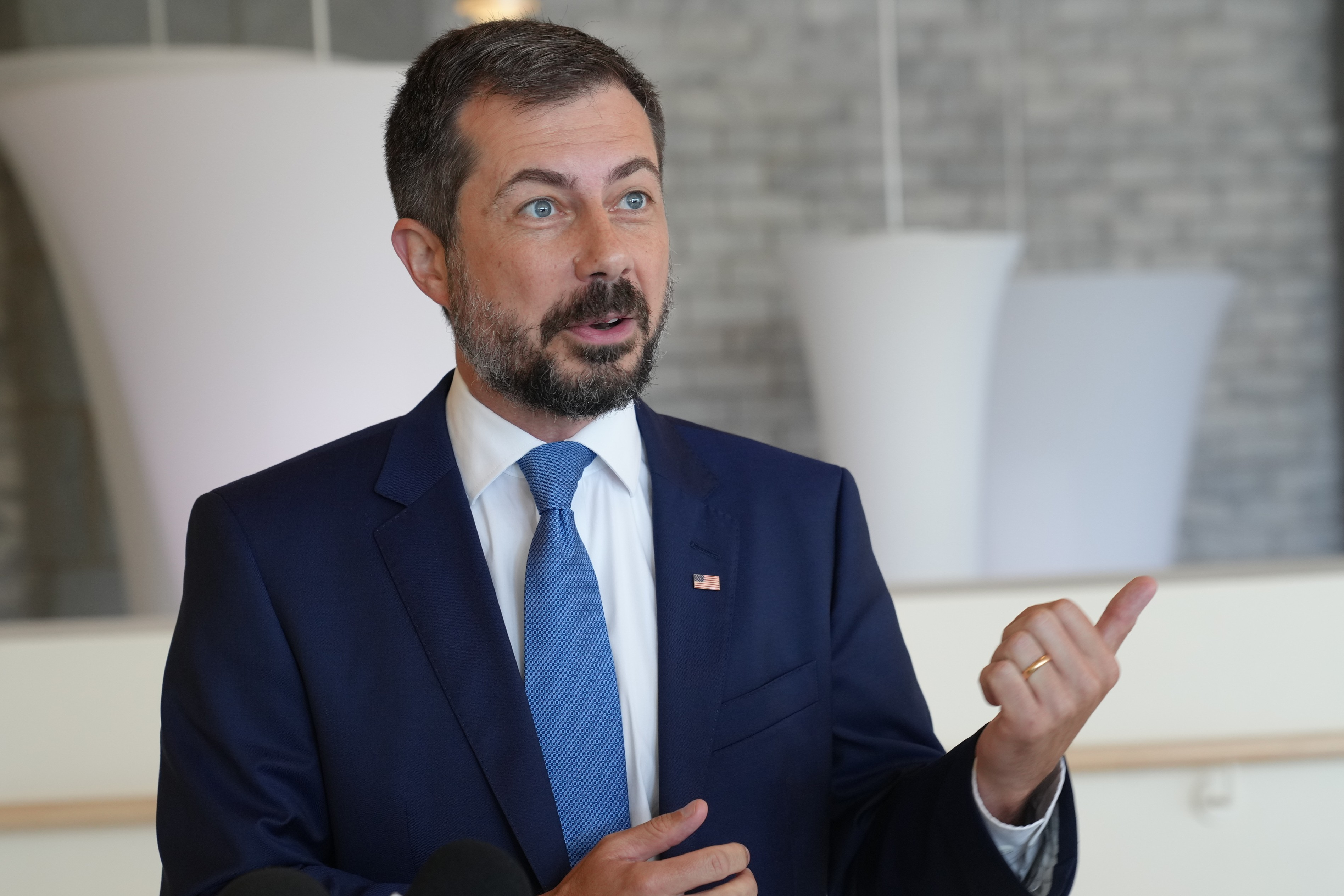
  • Pete Buttigieg returns to South Carolina as he weighs another White House run

    Pete Buttigieg returns to South Carolina as he weighs another White House run

    ORANGEBURG, S.C. — The last time Pete Buttigieg was giving a political speech in South Carolina, it was to mark a distant finish in the state’s primary that effectively ended his campaign for president.

    Returning this weekend as he mulls a second run for the White House, Buttigieg set out to reintroduce himself to the state and the Black voters he struggled to win in 2020. The results were encouraging.

    There was a standing ovation in a Black church in South Carolina when Buttigieg was credited for helping bring millions of federal dollars to the area for a project as President Joe Biden’s transportation secretary. A second ovation came as Buttigieg gave a speech warning of a country in “big trouble” while laying out his own vision for what should come next.

    “There is no such thing as again in real life. The only way out is through,” Buttigieg told the crowd of more than 200 people at an NAACP Freedom Fund Dinner. “If we recognize and embrace a future that is different from the past, we will do better.”

    The warm applause was a markedly different reception than six years ago, when a fourth-place showing in South Carolina helped derail Buttigieg’s presidential campaign while exposing his failure to connect with Black voters. The state is likely to have an even greater say in his political future as the first contest in the Democratic presidential primary in 2028.

    Starting the election calendar in South Carolina is intended in part to give Black voters a greater voice at the outset of the nominating process. For Buttigieg and other potential contenders, winning the support of this group that makes up a majority of South Carolina’s Democratic electorate is essential.

    “You need to demonstrate that you can win Black voters,” said Jaime Harrison, a former Democratic National Committee chairperson and South Carolina Democratic Party chairperson. “If you can’t win Black voters, you can’t be the nominee of our party.”

    2028 campaign is already coming to South Carolina

    Buttigieg insists he has made no final decision about whether to run for president again.

    “Right now, I’m totally focused on 2026,” he told reporters Saturday.

    But his South Carolina trip — a week after visiting another early-voting state, Nevada — had all the trappings of a potential presidential bid.

    He raised money Friday in Charleston with Nancy Lacore, a U.S. House candidate trying to flip a Republican-held seat. On Saturday morning, he spoke at a policy conference before traveling to Claflin University, a historically Black university in Orangeburg.

    Davina Perry, a third-year student at Claflin, said she came away from Buttigieg’s visit thinking he would be a “good candidate” if he ran.

    “Secretary Pete has definitely put himself on my radar for 2028 now, for sure,” Perry said. But, she added, “I do want to see more representation from people who look like me.”

    That evening, Buttigieg attended a dinner at a church in Orangeburg, a nearly three-quarters Black city with a deep history in the Civil Rights Movement. The crowd included local NAACP leaders, ministers, and elected officials. Buttigieg worked the room, giving hugs and taking photos.

    “He is responsible for the Railroad Corner,” said Orangeburg Mayor Michael Butler, referencing a project aimed at revitalizing the city’s downtown that received a $22.7 million federal grant. “Do I need to say any more? We need to stand and welcome the former secretary.”

    Buttigieg used the speech that followed to make a broader case about the direction of the country, arguing that Democrats cannot separate Americans’ economic frustrations from a political system he described as increasingly broken.

    “I have come to believe that the kitchen table cannot be improved unless we are also reforming the institutional and political floor on which that kitchen table sits.”

    Black voters will have the first say for Democrats in 2028

    For Buttigieg, the weekend offered signs of how much has changed since he came to South Carolina in 2020 as a 38-year-old Indiana mayor asking voters to take a chance on him. He points to what he delivered during four years in Biden’s cabinet, including specific projects in the state.

    But Buttigieg said he also came to South Carolina “to propose something” about the country’s future. Butler, Orangeburg’s mayor, liked what he heard.

    “His speech was what you talk about at the kitchen table. How America is going to survive all of this?” Butler said. “He brought hope to us.”

    South Carolina Democratic leaders say the close, personal engagement with candidates is exactly what they hoped for. Those involved in the push to make South Carolina first envisioned the living-room conversations and retail politics long associated with Iowa and New Hampshire.

    “You got to go listen. You got to go all over the place,” Harrison said. “You have to make meaningful investments. That’s how you win South Carolina.”

    Buttigieg is hardly alone in his early trip to the state.

    Other potential 2028 contenders, including California Gov. Gavin Newsom, Kentucky Gov. Andy Beshear, U.S. Rep. Ro Khanna of California, and U.S. Sen. Cory Booker of New Jersey have made trips to the state as what is expected to be a large Democratic field begins to take shape. Former Vice President Kamala Harris already has deep ties in the state.

    The electorate they will encounter has changed from 2020, when Biden’s victory in the state resurrected his presidential campaign and put him on a path to ousting Republican President Donald Trump.

    Four years later, Trump defeated Harris and returned to the White House, which Black leaders say has significantly hurt their community. Earlier this year, a Supreme Court decision weakened a core provision of the Voting Rights Act, threatening Black political representation across the South.

    “We must start our process where democracy must still be fought for, in the full view of the nation,” former interim DNC chairperson Donna Brazile said in a speech this year advocating for South Carolina to go first.

    Buttigieg addressed that anxiety directly Saturday night, describing efforts to weaken the Voting Rights Act as the culmination of a “multidecade effort.” He warned of a broader push “to demolish African American political power.”

    Harrison said Buttigieg’s trip this weekend was a “good start,” but that Buttigieg and all the other potential 2028 candidates have a long road ahead to prove themselves to the state’s voters.

    “It has to be a good start and then you got to continue,” Harrison said. “It can’t just be, ‘Oh, pop in and then I’m going to pop back out.’”

  • Zelensky details rift with Ukraine’s dismissed defense minister Fedorov

    Zelensky details rift with Ukraine’s dismissed defense minister Fedorov

    KYIV, Ukraine — Ukrainian President Volodymyr Zelensky said that he believes actions taken by dismissed Defense Minister Mykhailo Fedorov, including his involvement in mass protests and calls for an election, were misguided, as he publicly detailed their dispute for the first time.

    Zelensky also alluded to problematic decisions over defense spending and said that inaccurate information provided by the Defense Ministry contributed to an awkward encounter with U.S. President Donald Trump over the use of Starlink in Russia.

    Zelensky disclosed figures showing Ukraine’s growing shortage of Patriot air-defense missiles needed to counter Russian ballistic attacks, with deliveries from Western allies declining in the past three years even as Russian missile strikes intensified.

    He highlighted battlefield gains, however, saying Ukrainian forces have almost completely recaptured the Dnipropetrovsk region, with only about 4 square miles remaining under Russian control.

    The Ukrainian president made the remarks during a two-hour off-the-record meeting with reporters on Saturday, with a transcript released publicly on Sunday.

    Zelensky’s first public comments on Fedorov dismissal

    His comments ranged widely, covering the latest battlefield developments, efforts to counter Russian ballistic attacks, the state of peace negotiations, Ukraine’s budgetary challenges, and the political turmoil surrounding Fedorov’s dismissal.

    “I really had and still have a very positive attitude toward Mykhailo. We have been through a lot together. But I believe that he himself goes, or is pushed, into the wrong things,” he said.

    Fedorov, a popular minister credited with modernizing Ukraine’s armed forces and accelerating the military’s embrace of technology and drone warfare, was dismissed last month after reportedly falling out with the country’s top military commander. His removal triggered mass protests that lasted for weeks, but ultimately failed to force a reversal of the decision. Fedorov later called for an election.

    Zelensky said that he had offered Fedorov four different options to continue working in the government. Fedorov, he said, rejected all of them.

    The Ukrainian leader told journalists that he believes holding an election during the war would be a huge risk with the potential to “split Ukraine apart.”

    “I believe elections during a war like this would generally pose enormous risks. Holding elections right now would be a tsunami for the state that would split Ukraine apart,” he said.

    Zelensky said he had previously faced pressure to hold an election during the war, but no partners had come up with a plan for how a poll could be held safely, legitimately, and democratically.

    Inaccurate information led to uncomfortable White House encounter

    Zelensky appeared to link Fedorov to an awkward episode involving Starlink and Elon Musk. Zelensky said that earlier this year, the Defense Ministry had told him that SpaceX had agreed to allow Ukraine to use Starlink over Russian territory to carry out deep strike operations, subject to political approval.

    Acting on that, Zelensky said, he raised the issue directly with U.S. President Donald Trump. He told Trump that Musk had confirmed the proposed use. Zelensky said the two sides subsequently sought Musk’s confirmation and discussed financing for the project.

    But at a later meeting, Zelensky said, Trump told him that Musk had rejected the proposal and accused him of having misled the U.S. president. Musk considered the move a dangerous escalation, according to Zelensky.

    “He said that I had supposedly deceived him, because Musk had denied Ukraine the use of Starlink on Russian territory. I went back to our Ministry of Defense and they said that maybe it was so,” he said.

    Zelensky didn’t explicitly accuse Fedorov of lying. He said that the situation was among the reasons behind “some of the steps.”

    Zelensky also pushed back against protesters’ vilification of former army chief Gen. Oleksandr Syrskyi, who he dismissed, and current Defense Minister Maj. Gen. Yevhen Khmara, saying they had gone too far.

    “Maybe someone doesn’t like Syrskyi for one reason or another. But the slogans ‘Syrskyi is the devil, Khmara is the devil,’” he said. “Listen, this is too much. Do you understand? In principle, you can’t treat the military like this and tolerate it, especially when it was the military that made it possible for any peaceful protests to take place in the Ukrainian capital at all.”

    Pressure on defense budget but military successes

    Zelensky also described severe financial pressure on Ukraine’s defense effort. He said that the Defense Ministry faced a $27 billion budget shortfall after spending decisions earlier in the year brought forward funds originally intended for the second half of this year.

    Touching on a corruption inquiry that led Zelensky to fire one of his most senior officials this week, he said that anti-corruption investigators don’t believe that the president was involved. The investigators had named a deputy head of the presidential office among the suspects in a money-laundering case.

    “The heads of anti-corruption agencies have zero questions for me. They understand perfectly well that I am not involved in anything like that. And this is important to me,” he said.

    On the battlefield, Zelensky was optimistic. In addition to Ukraine almost completely regaining control of the Dnipropetrovsk region, he said that another operation was underway elsewhere and that its results were expected by the end of August.

    He also predicted that by the end of the year, Ukraine could reach parity between the territory occupied by Russia since the beginning of the year and the territory retaken by Ukrainian forces. Zelensky said that Russia had occupied about 380 square miles since the start of the year, while Ukraine had restored control over roughly 315 square miles.

    The president said that Russia’s principal objective remained the Konstantynivka-Sloviansk-Kramatorsk axis, and that Moscow was still demanding that Ukraine withdraw from the Donbas region as a condition for a settlement.

    Still struggling for access to Patriot missiles

    Zelensky said that Ukraine was receiving substantially fewer Patriot interceptor missiles even as Russian ballistic attacks are increasing.

    He said that Ukraine received 675 Patriot missiles in 2023, compared with 364 in 2025 and an expected 264 this year. Zelensky said that he wanted to secure 300 additional Patriot missiles for the coming winter, while Ukraine’s air force had requested 360.

    The shortfall is particularly serious, because the United States and European partners are struggling to expand production. Zelensky said that he hoped Ukraine could obtain even 5% or 10% of U.S. reserves and was able to pay for them.

    Zelensky said that Russia could eventually produce up to 1,300 ballistic missiles a year, compared with an estimated current capacity of 600.

    He said that Ukraine was also preparing alternatives to Starlink, including a European communications project, as Russia and China work on their own competing system.

    Other developments

    Debris from a Ukrainian drone hit two industrial facilities including a warehouse belonging to online retailer Ozon, local officials in Russia’s Orenburg region said Sunday.

    As well as shifting the war onto Russian soil through long-range drone strikes on oil facilities that have caused fuel shortages across Russia, Ukraine has unsettled the Russian public by striking warehouses of online retailers, including Russia’s biggest one, Wildberries, and competitors such as Ozon.

    One person was killed and six wounded in Ukrainian drone attacks on Russia’s Belgorod border region, local authorities said Sunday. A woman also died in a drone attack in the Tula region.

    Two women were killed and five other people were wounded when a Russian drone hit an electric train in Ukraine’s Kharkiv region, the Ukrainian national police said Sunday.

    Leaders from Nordic and Baltic nations arrived in Kyiv on Sunday, the eve of Ukraine’s Independence Day, in a show of solidarity from some of Ukraine’s closest partners before a larger “coalition of the willing” meeting.

    Leaders from Denmark, Estonia, Finland, Latvia, Lithuania, and Norway attended a flag-raising ceremony, as Ukraine marked Ukraine’s National Flag Day.

    “We feel we are not alone. Our allies are with us,” Ukrainian Foreign Minister Andrii Sybiha wrote on X on Sunday, noting that the leaders would hold bilateral and multilateral talks with Zelensky.