Category: Wires

  • Patriot missile deal and Trump’s praise for Zelensky put pressure on Russia

    Patriot missile deal and Trump’s praise for Zelensky put pressure on Russia

    The U.S. agreement this week to allow Ukraine to produce Patriot missiles and President Donald Trump’s praise for President Volodymyr Zelensky are leading the Kremlin to recalibrate its message on the war.

    The Kremlin has downplayed the developments but says they will make a peaceful resolution more difficult.

    Dmitry Peskov, the spokesperson for Russian President Vladimir Putin, accused Ukraine on Friday of being “unwilling” to engage in a peace process, while Moscow remains open to ending the war through diplomacy. He reiterated that Putin was open to scheduling another phone call with Trump.

    The Kremlin has, in fact, repeatedly rejected Zelensky’s offers to meet with Putin and rejected his calls for a full ceasefire.

    “One must give credit to Zelensky’s diplomacy,” the Russian political scientist Vladimir Pastukhov wrote Friday on Telegram. “Ukraine managed to reconfigure the anti-Russian alliance into a new alignment — one far more advantageous for itself and increasingly threatening to Russia.”

    Zelensky, Trump told reporters Wednesday at the NATO summit in Ankara, Turkey, has “done an amazing job.” It was a dramatic departure from Trump’s comments during his first year back in office, when he accused the Ukrainian leader of ingratitude for U.S. help and “gambling with World War III.”

    “We’re going to give a license to you to make Patriot missiles,” Trump said Wednesday. “That’s pretty cool. This way, you can’t complain that we’re not giving them enough. I said, ‘Make them yourself.’ We haven’t informed the company of that yet, but that’ll work out all right.”

    The Patriot missiles, long sought by Kyiv, are among the few Western weapons capable of shooting down the ballistic missiles Russia is increasingly firing at Ukrainian cities.

    Secretary of State Marco Rubio, speaking alongside Trump, said Russia was finding it harder to defend its own skies. He expressed hope the deal would “create the space now to negotiate the end of this war.”

    “It’s an escalation,” Trump added, “but it’s also an escalation that can help lead to an end.”

    Peskov, in response, said the Kremlin does not “see an escalation” but said there were “certain misconceptions within the White House administration … regarding the idea that escalation and military pressure can help pave the way for a peaceful settlement.”

    He called this “a flawed judgment” and warned it might cause what Russia calls its “special military operation” in Ukraine to go on longer.

    “It will result in our having to establish a larger security zone — a larger buffer zone,” he said. “Consequently, stoking tensions and taking actions that drive escalation will in no way contribute to the peace process.”

    Peskov downplayed the Patriot deal.

    “Yes, it is an obvious fact that the U.S. is continuing full-scale deliveries of weaponry and military technology to Ukraine — we are aware of this,” he said. “At the same time, however, there is a certain duality in the United States’ position: Unlike the Europeans, the U.S. maintains a desire to facilitate a move toward a peace process.”

    Russia, which invaded Ukraine, has pressed maximalist demands on Kyiv, including the surrender of territory its forces have not captured. The Kremlin has invited Zelensky to come to Moscow, while the Ukrainian leader has dismissed the offer as a stalling tactic.

    “The Kremlin appears to be struggling to adjust its narrative line in response to the Trump administration’s recent denial of Russian negotiating tactics and acknowledgment of Ukrainian battlefield successes,” the Washington-based Institute for the Study of War said in a recent analysis.

    Pastukhov, who is based in London, said Zelensky had “succeeded in altering — not so much the ‘reality on the ground’ that Putin is so fond of citing, but rather the West’s perception of that reality.”

    “Now,” he said, “it is Putin who must rack his brains over how to present the ‘realities on the ground’ in a more favorable light.”

    While the U.S. deal is a diplomatic win for Zelensky, military analysts warn it won’t address Ukraine’s immediate needs. Russia is firing ballistic missiles at Ukrainian cities almost daily. Given strict U.S. technology controls and the complexity of the missile systems, full-scale production is likely years away.

    Zelensky thanked the United States for the “positive decision.”

    “President Trump has repeatedly emphasized that only two or three countries in the world are currently capable of producing Patriots because the others are not technologically ready,” he told reporters Friday. “The United States has recognized Ukraine as a country that is ready to do this.”

    Now, he said, his teams need to work out a timeline to set up production. “The sooner we reach an agreement, the sooner we’ll be able to produce Patriots.”

  • Kia launches new recall for 463,000 Telluride SUVs due to fire risk, urges owners to park outside

    Kia launches new recall for 463,000 Telluride SUVs due to fire risk, urges owners to park outside

    NEW YORK — Kia America has issued a new recall for nearly 463,000 of its Telluride SUVs, urging owners to again park their vehicles outside and away from buildings after several customers reported fires following previous repairs.

    The recall, announced this week by the National Highway Traffic Safety Administration, replaces a prior one Kia initiated in 2024. Certain Tellurides from the 2020-2024 model years are affected, with the NHTSA warning that the front power seat motor of these vehicles may overheat due to a stuck slide knob.

    That could result in a fire while the car is parked or being driven. And even after Kia rolled out a remedy in 2024, recall documents note several customers filed complaints of alleged fires underneath the passenger seat. The automaker investigated other vehicles that had received the prior repair and identified “sporadic dealer workmanship issues” — later deciding to initiate a new recall.

    Between October 2024 and April 2026, Kia North America’s safety office identified 18 incidents involving either localized seat fires or melting of the seat motor, per recall documents. No associated injuries or crashes have been reported.

    In a statement, Kia America noted that “an external impact with excessive force” to the vehicles’ front power seat side cover or slide knob could cause their switch to become dislodged or otherwise damaged — resulting in overheating if the motor continues to be used over time. To prevent this, Kia’s new fix will be for dealers to install an electronic fuse assembly, free of charge.

    That remedy will be available in early August, according to an advanced dealer notice published by the NHTSA. And owner notification letters are set to be mailed starting Aug. 13.

    In the meantime, both the NHTSA and Kia are warning owners to park “outside and away from structures” until the recall repair is complete.”

    Drivers can also confirm if their specific vehicle is included in this recall and find more information using the NHTSA site and/or Kia’s recall lookup platform. Irvine, Calif.-based Kia America is a subsidiary of the larger South Korean automaker.

    The recall covers 462,869 model year 2020-2024 Tellurides that were manufactured between Jan. 9, 2019, and May 29, 2024. Kia America estimates that 1% have the defect.

  • Assigning FEMA staff to immigration enforcement hurt disaster work, House report says

    The Department of Homeland Security misused Federal Emergency Management Agency resources when it diverted dozens of staff to help with immigration enforcement, says a new report by a group of House Democrats shared first with the Washington Post. The lawmakers describe the deployments as an example of how the Trump administration has hindered FEMA’s ability to properly prepare for and respond to disasters.

    Beginning last summer, the Trump administration reassigned FEMA personnel to immigration enforcement roles that were largely outside the scope of emergency and disaster work for long stretches of time when the agency was grappling with extensive cuts and leadership changes, according to the report from Democrats on the House Transportation subcommittee on economic development, public buildings, and emergency management. The probe was based on interviews with 15 current and former FEMA employees and disaster and immigration policy experts.

    “Overall, the Administration’s sweeping immigration agenda has used FEMA resources and personnel to aid in carrying out large-scale immigration enforcement operations, distracting the agency from its statutorily required responsibilities, jeopardizing its workforce levels and expertise, and reducing its ability to respond to disasters and aid survivors,” the report said.

    To assess the probe’s findings, the Post separately reviewed previously unreported documents from the Government Accountability Office related to the report, and spoke with two current FEMA employees with direct knowledge of the agency’s immigration deployments, as well as four former senior FEMA officials and two federal officials who specialize in homeland security.

    Two current and former FEMA officials interviewed said some of the lawmakers’ findings were mischaracterized, because DHS has called on FEMA personnel and specialized teams to support immigration work in the past. They did, however, agree with the report’s conclusion that FEMA’s primary mission “has been measurably undermined by DHS’ policy goals surrounding border security.”

    DHS and FEMA did not provide a comment to the Post by the time of publication.

    The Post reported in August that DHS began to move dozens of FEMA staffers to help immigration agencies with vetting and onboarding new hires, as well as other administrative work. The lawmakers’ report, as well as separate interviews with six current and former federal officials and documents from GAO reviewed by the Post, reveal in greater detail how involved FEMA was with immigration initiatives for nearly a year.

    At the time, some FEMA leaders raised concerns about the legality of using disaster-funded resources for this kind of work, according to one former senior official with direct knowledge of the situation who, like others interviewed for this story, spoke on the condition of anonymity because they were not authorized to speak publicly about FEMA’s immigration work.

    But “they still were sent over,” the former official said.

    FEMA employees worked in detention centers, including in Minneapolis, where protesters surrounded one staffer en route to an Immigration and Customs Enforcement facility, according to witness accounts summarized in the report. FEMA human resources staffers reviewed applications and issued job offers for the surge of new immigration enforcement officers, according to details the agency sent to GAO in connection to the probe and reviewed by the Post.

    “ICE could not have done this work without FEMA,” a former agency official who specialized in national incident management and homeland security, and who had field experience at a Texas detention facility, told lawmakers for the report. “ICE is good at law enforcement, but operations, strategy, and the big picture — FEMA created that structure for them, building the plan and the operation toward the mission end-goal.”

    The influx of immigration work consumed FEMA’s hiring and administration capacity and delayed its ability to process some work, even as disaster staffers were losing their contracts, according to the report. A current FEMA official with knowledge of the situation also described the strain on that department.

    “Basically all human resourcing actions ground to a halt,” the official said. “We couldn’t process even simple things like annual salary adjustments for current staff on time.”

    FEMA helped oversee a group of civilians who volunteered with the Defense Department for immigration enforcement, and whose duties included planning support for arrests, raids, and patrols, and “managing the physical flow of detained noncitizens from arrest to deportation,” according to one GAO document. The current FEMA official similarly described how staffers managed that workforce.

    Because the agency can quickly coordinate resources and logistics, previous administrations have tapped FEMA to support or lead complex missions outside its usual scope. That has included processing the entry of refugees; helping shelter, transport, and provide medical support to migrants; or leading the nation’s coronavirus pandemic response.

    Still, five current and former agency officials described a stark difference in how this administration has deployed FEMA — not for humanitarian work, as had happened in the past, but for coordinating and supporting mass immigration raids, arrests, and deportations across the United States. Former FEMA leaders said this administration’s use of the agency sets a new precedent.

    “I’ve spent almost two decades in emergency management, including leading FEMA. The agency has always faced resource constraints and competing pressures. That’s not new,” said Pete Gaynor, who ran FEMA during President Donald Trump’s first term and oversaw the agency’s coronavirus operation. “What these findings describe, however, raises serious questions that deserve honest answers.”

    Chris Currie, GAO’s director for emergency management issues, said that while FEMA has been asked to do a wide range of tasks outside disaster response and recovery, he was not aware of any previous situation in which FEMA personnel were reassigned to other agencies for the purpose of hiring employees for those agencies.

    Other aspects of the reassignments also raised questions, he said.

    “A valid question is to what extent were they making decisions in the hiring of those candidates? Were they involved in interviews? Were they making qualitative decisions about their ability to perform the function?” Currie asked. “But given the number of ICE officers hired in the last year, it’s clear that DHS needed additional help.”

    The reassignments came as FEMA was mired in internal upheaval.

    Since January 2025, FEMA has lost about 30% of its staff — about 5,000 people, according to the probe — a number higher than previously reported. The losses reflect cuts by the Trump administration, voluntary departures, and involuntary reassignments, the report notes. FEMA has also lacked a Senate-confirmed leader since Trump returned to office last year.

    FEMA has long had a workforce problem, Currie said. Even before the latest Trump administration took over, numerous GAO reports over the years identified staffing issues that contributed to prolonged disaster recoveries, he said.

    “So it’s concerning anytime I see resources redirected away from FEMA,” he said. “Because they have struggled for so long.”

    In May, FEMA told Currie’s office that starting in August 2025, DHS reassigned about 125 people from its security and human resources offices. Earlier that year, 41 FEMA employees volunteered to help DHS at the southern border as part of an internal immigration enforcement mission.

    DHS offered in some cases to renew the expiring contracts of disaster-specific workers if they raised their hands for immigration assignments, according to the lawmakers’ report. Some of these workers, known as CORE, or Cadre of On-Call Response/Recovery Employees, were dismissed en masse last winter, only to then be rehired months later when new FEMA leaders came in.

    In response to questions from GAO, FEMA said DHS instructed the agency to permanently reassign two staffers to ICE. One person declined and chose to voluntarily transition out of DHS. The other initially accepted but resigned before their start date.

    Many FEMA employees stayed in their immigration roles for periods “far exceeding prior administrative practice,” the report found, including for longer than 120 days, which former FEMA administrator Deanne Criswell said was a timeline the agency’s Office of Chief Counsel developed years ago. Some assignments lasted more than 200 days, which Criswell said is concerning because “these employees are hired under special hiring authority to be used to support disaster response and recovery.”

    FEMA told GAO in writing that all details should have ended in May.

    One current FEMA official with knowledge of the situation said that FEMA’s new leaders were winding down the agency’s involvement in immigration support “so we can pivot to our core mission and focus on hurricane season.”

    The lawmakers’ investigation includes other examples of how the Trump administration has hindered FEMA’s ability to coordinate large-scale disaster response efforts.

    During the disastrous Texas floods that killed at least 137 people last July, internal documents included in the report note that lapsed contracts for call centers, which were not renewed by then-Homeland Security Secretary Kristi L. Noem, kept hundreds of disaster survivors waiting in exceptionally long call lines. Emails show how FEMA had warned about the lapse and was trying to work around it, all while processing 60,000 disaster survivor caseloads.

    Rep. Greg Stanton (Ariz.), the subcommittee’s ranking Democrat who led the report, said in an interview that federal law put in place due to failures after Hurricane Katrina was meant to protect FEMA from “politics getting in the way of delivering disaster response.”

    “I’m very angry about what I learned,” he said. “I think the American people will be pretty shocked and disappointed that the United States is not focused on natural disaster preparation and response, that a third of [FEMA] employees are gone, and some that are left are being used for other purposes, especially supporting an agency that has an ungodly amount of increased resources.”

    The lawmakers lay out recommendations that call for strengthening the autonomy and oversight of FEMA. Those include a call to make FEMA an independent, Cabinet-level agency — which has previously been a bipartisan push — and a suggestion that DHS reimburse the disaster agency for its immigration work.


  • Trump fires members of bipartisan elections commission

    Trump fires members of bipartisan elections commission

    President Donald Trump dismantled a long-standing bipartisan elections board Thursday, four months before a midterm contest that will determine which party controls Congress.

    Trump dismissed members of the Elections Assistance Commission less than two weeks after the Supreme Court gave the president broad leeway to reshape boards that were designed to be independent. Congress created the panel to strengthen and secure elections in response to the challenges of the 2000 contest and structured it so no more than two of its four members belong to the same political party.

    Trump’s actions weaken the commission, which is responsible for maintaining the federal voter registration form and certifying electronic voting equipment. New appointees would need to be confirmed by the Republican-controlled Senate.

    The move is the latest in Trump’s broad effort to exert authority over elections as he falsely claims the 2020 election was stolen from him. Trump has spent years casting doubts on elections and pushed to limit the use of mail ballots and voting machines.

    In recent months, Trump has sought to overhaul how the midterm elections will be run, in part by directing the commission to redesign a form so that people would have to provide proof of citizenship to register to vote. Many of Trump’s actions on elections, including his attempt to change the form, have been thwarted by courts.

    The White House said the president “reserves the right to remove individuals that may not be totally aligned with the important task of securing America’s elections and ensuring every legal vote is counted.” It did not say whether he planned to name replacements and when he might do so.

    Late last month, the Supreme Court ruled Trump could fire a Democratic member of the Federal Trade Commission in a decision that gave presidents broad powers to determine who controls federal agencies. The ruling was tempered by a separate decision that came the same day that prevented Trump from dismissing a member of the Federal Reserve Board. His latest actions could prompt new litigation and determine the extent of the president’s authority.

    Trump on Thursday fired the two Democratic members of the elections commission, Thomas Hicks and Benjamin Hovland, and accepted the resignation of a Republican member, Christy McCormick. The other Republican member, Donald Palmer, resigned this spring.

    Despite the firings, the commission’s staff can certify voting equipment, disburse funds, and maintain the federal voter registration form, according to the Institute for Responsive Government, a nonprofit group aimed at making government more accessible. The staff cannot establish new policies or guidelines without commissioners, the group said.

    Trump’s move “is a blatant part of his plan to politicize our elections,” said Sen. Alex Padilla (Calif.) and Rep. Joe Morelle (N.Y.). The two are top Democratic members of committees that oversee election policies.

    “Americans deserve elections that are safe, secure, and run free from political interference — not overseen by partisan loyalists and election deniers beholden to Trump,” they said in a statement.

  • Why does cancer seem so common right now? An oncologist explains. | Expert Opinion

    Why does cancer seem so common right now? An oncologist explains. | Expert Opinion

    Q: I know so many people who have been diagnosed with cancer. Are rates really going up? Why does it seem so common now?

    A: Cancer is a global problem. If it seems like there are more cancer diagnoses than ever, you’re right: In 1975, about 400 per 100,000 people in the United States were diagnosed with cancer. In 2023, the incidence was 456 per 100,000, though overall rates have been mostly stable since 2014.

    While more people are being diagnosed with cancer today compared with 50 years ago — either because of an increase in actual cases, better detection, or a changing definition of what’s considered cancer — the good news is that fewer are dying of it. Since 1999, age-adjusted cancer death rates fell dramatically, from 201 per 100,000 people in 1999, to 142 per 100,000 people in 2023.

    To understand how these can both be possible at the same time — and how, ultimately, the outlook for those diagnosed with cancer is quite positive — it helps to first understand what cancer is, how it occurs, and how modern treatments have learned how to exploit the diagnosis for good.

    What is cancer and how does it start?

    Put simply, cancer involves the uncontrolled growth of cells in the body. While there are a number of possible causes, they are all related to errors that happen in the cell’s genetic instructions, or DNA.

    The cell can make a random mistake when replicating, resulting in a cell that grows faster than other cells around it. Or, the cell can be damaged by carcinogens, such as ultraviolet light or the chemicals in cigarettes.

    Some cancers can also occur when a cell’s “self-destruct” code malfunctions. Our bodies recognize when cells are damaged, grow too rapidly, or otherwise behave abnormally, then react by sending out chemical signals that tell the cells to stop growing or self-destruct. Errors can alter that signal or affect a cell’s ability to recognize it; the cell turns a deaf ear to the instructions from the body to cease and desist.

    Most genetic errors that cause uncontrolled cell growth occur because of bad luck. The longer we live, the more of our cells divide, increasing the statistical likelihood that one of those cells will make a mistake when replicating and develop into cancer. This is why most cancers are diagnosed in older adults.

    Another form of bad luck includes genetic mutations we’re born with. It is estimated that up to 10% of cancers are caused by inherited genetic abnormalities such as BRCA1 and BRCA2, which are linked to breast, ovarian, and prostate cancers, among others.

    Some genetic errors are introduced by viruses. Anywhere from 13 to 20% of cancers worldwide are thought to be due to viruses, such as human papilloma virus, or HPV, Epstein-Barr virus and hepatitis B and C, and bacteria, such as Helicobacter pylori.

    Other extrinsic or “outside of the body” factors can break or damage a cell’s DNA and lead to cancer, including smoking, alcohol intake, and exposure to ultraviolet radiation from the sun or other sources, such as tanning beds. Less common DNA-damaging culprits include environmental exposures such as industrial chemicals, nuclear radiation, chemotherapy, or radiation therapy used to treat other cancers.

    Once created, cancer cells are insidious: They can instruct blood vessels to grow toward tumors, thus ensuring their own survival by having an adequate supply of oxygen and nutrients; they can hide from the immune system, cloaking themselves to prevent their own destruction; and they can even trick the immune system into helping them survive and thrive.

    Why have cancer rates increased over time?

    Overall, people are living longer because deaths from cardiovascular disease, stroke, and other medical conditions have declined. As we extend our life span, though, we increase that statistical likelihood that our cells accumulate genetic mutations.

    Cancer rates can also change depending on how we define “cancer.” For example, many of my patients have a type of bone marrow cancer called myelodysplastic syndromes. It was only about 25 years ago that the Centers for Disease Control and Prevention and the National Cancer Institute formally recognized this condition as a cancer, and started tracking it alongside more common cancers like those of the lung, breast, or prostate. Once these government agencies decided to call myelodysplastic syndromes a cancer, overnight the numbers of cancers diagnosed in the U.S. increased by about 20,000 per year.

    And much of the increase in cancer diagnoses can be attributed to better detection. Radiology scans have become more refined and sensitive, making them better at detecting abnormalities that lead to cancer diagnoses. Laboratory tests have been developed to identify markers in the blood (such as certain proteins) that suggest cancer may be present before it otherwise would have been discovered.

    Cancer screening programs, which are designed to detect cancer in its early stages, when it is potentially more curable, have uncovered more slower-growing cancers — including ductal carcinoma in situ of the breast in women or early stage prostate cancer in men — that previously never would have been diagnosed.

    While there are increases in certain kinds of cancer (which generate a lot of discussion), such as colorectal cancer in people under 50, it’s also true that cancer rates are dropping in other groups, like colorectal cancer in people over 50.

    Treatments to target and eliminate cancer keep getting better

    There is some good news: People are living longer than ever following a cancer diagnosis. The National Cancer Institute’s Division of Cancer Control & Population Sciences estimates that there are over 18 million cancer survivors in the U.S. and that this number is expected to grow to 26 million by 2040. Seventy percent of survivors live five or more years following their diagnosis, approximately half live 10 or more years and three-quarters of survivors are 60 years or older.

    While some of the improved survival from cancer can be attributed to the increased number of early-stage cancers detected, we can also thank advancements in cancer therapies. Traditional chemotherapies damage cells during the division process, taking advantage of those rapidly dividing cancer cells. Other drugs, called angiogenesis inhibitors, help prevent the growth of blood vessels that feed the tumor. These treatment approaches, though, are not always specific to a given person’s cancer, and tend to affect the growth of noncancerous cells, too.

    But over the past two to three decades, medications have been developed that target specific genetic mutations within the cancer cells, such as the HER2 abnormality in breast cancer, ALK in lung cancer, FLT3 in leukemia, and more recently KRAS in pancreatic cancer, among many, many others.

    And within the past 10 to 15 years, there has been a revolution in the use of immunotherapy to treat cancer, with drugs that specifically target proteins on the outside of cancer cells, or that harness a patient’s own immune system to essentially train it to find and eliminate cancer. These newer, innovative treatments have improved the rates and duration of remission and even survival for a number of cancers, and have retooled how we treat cancer.

    So while it is true that there seems to be more cancer than ever, there is also more hope than ever, as cancer is being detected earlier, eliminated more effectively, or transformed to a chronic condition rather than a life-threatening one.

    Mikkael A. Sekeres, MD, MS, is the chief of the division of hematology and professor of medicine at the Sylvester Comprehensive Cancer Center at the University of Miami. He is author of the books “When Blood Breaks Down: Life Lessons from Leukemia” and “Drugs and the FDA: Safety, Efficacy, and the Public’s Trust.”

  • As consumers pare spending, grocery stores race to cut prices

    As consumers pare spending, grocery stores race to cut prices

    America’s grocery stores are cutting prices to attract consumers who have pared back spending to cope with rising costs.

    Walmart, the nation’s largest retailer, said Monday that it would lower the price of ground beef rolls, fresh corn, cherries, potato chips, and Coca-Cola as part of a slew of summertime discounts.

    It’s the latest grocery chain to do so, increasing competition in a relatively low-margin industry reliant on people buying shopping carts packed with items, including some at more profitable prices.

    The grocery industry has struggled over the past 18 months as higher food bills, reductions in food stamp programs, and the rise in the use of weight-loss medications have resulted in shoppers buying less. On top of that, elevated gas prices because of the war with Iran are hitting shoppers’ wallets.

    A May CNN poll found that 61% of Americans had changed which groceries they bought in order to stay within their budget.

    High grocery prices have been a political issue for several years, so much so that President Donald Trump sought to take credit for Walmart’s announcement, posting on social media that the retailer “will be lowering prices, by a lot, at my administration’s request to celebrate our great country’s 250th birthday.”

    Walmart did not mention Trump or his administration in its news release.

    But while shoppers may get better deals on some items, it’s unlikely that their overall grocery bill will fall. Prices across all food categories are expected to rise 3.2% in 2026, according to the Department of Agriculture’s Economic Research Service.

    While egg prices have dropped from last year’s record levels, the USDA predicts that prices for beef, pork, poultry, sweets, nonalcoholic beverages, fresh vegetables, and fresh fruit will increase this year. That comes on top of the 18% price increase in food consumed at home since the beginning of 2022, according to the U.S. Bureau of Labor Statistics. Beef prices continue to hit record levels this year; Walmart said it would reduce the price of its 1-pound log of ground beef to $5.94 from $6.74.

    In the four weeks ending in late June, prices in 61 food categories rose 3.4% from the same period a year ago, while the volume of goods sold slid by 2.1%, according to analysts at Stifel, a financial services firm.

    To lure consumers in their doors and, hopefully, persuade them to buy more, several grocery store chains have reduced prices on a few dozen items, or the top 10 food products consumers typically buy. They have also increased the number of less expensive store brand products on their shelves.

    “It’s not going to be across the board. It’s not going to be across 40,000 items,” said Phil Lempert, a food industry analyst and the editor of Supermarketguru.com.

    Consumers are also changing where they shop and are making fewer trips to traditional grocery stores in favor of discount grocery chains like Aldi, a company that originated in Europe and is quickly expanding in the United States, according to a grocery shopper study by consulting firm AlixPartners.

    Retailers, still trying to maintain profits to keep investors happy, are looking for ways to fund the price reductions. On a call with analysts in May, Walmart executives said that at least some of the price cuts could be funded by the $2.4 billion it has filed for in reimbursements after the Supreme Court ruled in February that Trump exceeded his authority in establishing sweeping tariffs on imported goods.

    In many cases, the reduced grocery prices likely reflect better deals grocery retailers have gotten from manufacturers, Lempert said. Food and beverage manufacturers, eager for consumers to put more of their foods in shopping carts, oftentimes offer discounts or other promotions to retailers, he explained.

    “The average grocery retailer is only making 1.5% to 2% net profits on groceries,” he said. “There’s not a lot they can do to take price cuts on their own.”

    Earlier in the year, executives at PepsiCo said the company was lowering some prices to drum up demand, or volume, for its snacks and foods. On Thursday, PepsiCo reported that prices in its North American food business, which includes Frito-Lay chips as well as Quaker Foods breakfast and snack bars, were down 2% in the second quarter compared with the previous year.

    Executives said the lower pricing at many stores had helped boost demand in the quarter. They noted, however, that higher gas prices translated into weaker sales at convenience stores.

    Executives at Kroger said on an earnings call in June that the retailer would push harder in negotiations with suppliers but would also fund discounts by cutting its own expenses.

    In May, Stop & Shop, a unit of Dutch supermarket operator Ahold Delhaize, said it was lowering prices on more than a dozen food items in its New Jersey and New York stores. The price of a rotisserie chicken fell $1 to $6.99 and a can of Bumble Bee tuna was cut to $1.99 from $2.29.

    The grocery retailer chose the products based on customers’ everyday purchases across a variety of departments, Daniel Wolk, a spokesperson for Stop & Shop, said in an email.

    Since making the price cuts, Wolk said the chain was seeing “encouraging signs that customers are filling their baskets with more volume.” He added that the original cuts were part of a phased approach and that, since then, prices on “thousands of items” in stores throughout Massachusetts, Rhode Island, Connecticut, New York, and New Jersey had been reduced.

    Costco said in May that it cut prices on everyday goods including eggs and beef, which had slightly impacted the retailer’s margins. The warehouse club slashed prices on items like chicken wings and chocolate almonds.

    “Our goal is to be the first to lower prices where we see opportunities to do so,” Gary Millerchip, the chief financial officer of Costco, told investors on a conference call.

    Target said in March that it would reduce prices for “pantry staples,” after lowering prices on thousands of food items late last year.

    Retailers are also increasingly leaning into placing more of their own brands onto shelves, hoping to drive customer spending on less-expensive store versions of spaghetti sauce, frozen waffles, and baked goods.

    Whole Foods Market, which was famously nicknamed Whole Paycheck for its higher prices, has been trying to alter that perception by expanding its store brand offerings and cutting prices.

    “We’ve reduced prices on more than 900 products across private brands, including the 365 by Whole Foods Market private label selection,” a spokesperson for Whole Foods said in an email.

    This article originally appeared in the New York Times.

  • New York Times and other publishers ask court to penalize OpenAI

    New York Times and other publishers ask court to penalize OpenAI

    SAN FRANCISCO — The New York Times, the New York Daily News, and 15 other media organizations said in a federal court filing Thursday that OpenAI was withholding evidence that could play a key role in high-profile lawsuits the companies filed against the artificial-intelligence start-up.

    With their filing, the publishers called for legal sanctions against OpenAI, accusing the company of violating court rules and acting in bad faith during the litigation’s fact-discovery phase.

    The Times sued OpenAI in late 2023, accusing the company of infringing on its copyrights by using its materials to train ChatGPT and other technologies. In the months that followed, other publishers sued the AI start-up, making similar accusations. Many of those cases were consolidated last year.

    In the motion Thursday, known as a sanctions filing, the publishers said OpenAI refused to provide information showing how the company’s AI systems are trained and used.

    “The evidence is in OpenAI’s training data sets and ChatGPT output logs,” the parties said in their motion. “But instead of just producing that evidence at the start of the case and focusing on the merits of its fair use defense, OpenAI chose obstruction.”

    OpenAI did not immediately respond to a request for comment.

    OpenAI has previously denied wrongdoing, saying it respects the rights of content creators. The company has also argued in a court filing that ChatGPT is not a substitute for a Times subscription.

    A sanctions filing is an unusual step that forces a judge to settle a legal disagreement, said Robin Feldman, a professor at UC Law San Francisco.

    It “makes the judge get down in the mud with other parties,” she added.

    The Times was the first major American media company to sue OpenAI over copyright issues related to its written works. The Times’ suit made similar accusations against Microsoft, one of OpenAI’s primary partners.

    Microsoft has denied the allegations.

    A judicial panel last year consolidated many of the dozens of cases brought by publishers against OpenAI, including the lawsuits from the Times and from authors, including comedian Sarah Silverman, John Grisham, Jonathan Franzen, and George R.R. Martin.

    Like other AI companies, OpenAI has built its technologies by feeding them enormous amounts of data, some of which is copyrighted. OpenAI, Microsoft, and other companies have long contended that they can legally use copyrighted material to train their AI systems without paying for it because they transformed the material for a different use.

    The Times, the Daily News, and other publishers filed their motion after deposing an OpenAI employee. The deposition, which was largely redacted in public court documents, shows that OpenAI could have provided the data the plaintiffs have long sought, the publishers said.

    “For two years, OpenAI has been making misrepresentations to the court regarding its ability to search for Daily News content in its training data sets and output logs,” said Steven Lieberman, counsel for the Daily News and several other newspapers that have sued OpenAI.

    “OpenAI lied to the Times, the Daily News plaintiffs, the public and the court,” said Ian B. Crosby, a partner at Susman Godfrey and the lead counsel for the Times.

    The publishers are asking for monetary penalties and other sanctions, according to the filing. The filing does not ask for sanctions against Microsoft.

    This article originally appeared in the New York Times.

  • China, Russia and Others Seek to Inflame Debate Over AI Data Centers

    China, Russia and Others Seek to Inflame Debate Over AI Data Centers

    A state-owned newspaper in China recently published a satellite image of a data center in Gainesville, Virginia, writing in English that the development of artificial intelligence posed a threat to Americans’ physical and financial well-being.

    A comic strip made to look as if it had been published by a Maryland news outlet — created with OpenAI’s ChatGPT by people in China, the tech company said — circulated on social platform X this year, blaming data centers for soaring electricity bills. It showed a tycoon smoking a cigar and clutching bags of cash.

    A video shared on X by a known covert Russian influence operation questioned the viability of a data center that an American company, Firebird, is constructing in Armenia, the small Caucasus nation that has been a focus of Kremlin pressure. “The country’s electrical grid instability may render it useless,” the video’s narrator says.

    All are examples of a push by foreign adversaries to seize on what polls have shown is deep ambivalence — verging at times on hostility — about the spread of the data centers needed to power AI in the United States and elsewhere.

    China, Russia and, to a lesser extent, Iran have sought to use state media outlets to turn the controversy over data centers in the United States into “a domestic fracture point,” according to a new analysis by Alethea, a threat intelligence company, which identified scores of articles and posts on social media this year.

    These campaigns, whose impact on public opinion remains to be seen, have raised alarms in Washington, where AI is seen as a top issue heading into this year’s midterm elections.

    The foreign efforts appear intended to stoke the debate over data centers that has united political figures across the political spectrum — from Sen. Bernie Sanders (I., Vt.), a progressive, to Steve Bannon, the erstwhile adviser to President Donald Trump.

    “Foreign actors aren’t manufacturing American debates over the future of AI, they are exploiting them,” said Jessica Brandt, a former official with the Office of the Director of National Intelligence who tracked foreign influence efforts during the Biden administration.

    The goal, she added, is to “deepen our divisions in order to dent our appeal and weaken us from within.”

    Republicans and business lobbying groups have seized on the role of China, in particular, claiming that the country’s Communist Party wants to undercut U.S. leadership in a field that the Chinese, too, hope to dominate. They argue that China’s propaganda is an effort to slow down America’s development.

    “We can’t allow any effort by foreign adversaries to extort these fears and undermine our technological development,” Sen. Tom Cotton (R., Ark.) wrote to the acting attorney general, Todd Blanche, referring to genuine public concerns.

    The Trump administration, which after taking office dismantled many of the government teams that tracked foreign influence operations, has begun to recognize the political threat of the rising sentiment against AI.

    A Gallup poll in May found that 71% of Americans were somewhat or strongly opposed to having a data center built near them, almost 20 percentage points higher than those who opposed construction of a nearby nuclear power plant. Many have broad concerns about the effects of AI on jobs and the climate, while people who live near data centers complain that they are eyesores and emit annoying sounds. Some cities and counties have enacted temporary or permanent moratoriums on new construction.

    In a recent interview on Fox Business, Interior Secretary Doug Burgum suggested that the outside influence campaigns had succeeded in building opposition to data centers. “I think some of this propaganda is being effective,” he said.

    The foreign campaigns follow a familiar playbook that dates back at least a decade. They often try to leverage official news organizations and social media to fuel domestic discord around hot-button issues like guns, race and vaccines, or even natural disasters like the wildfires in and around Los Angeles last year.

    Between January and June, state media in China, Russia and Iran mentioned data centers roughly 700 times, according to Alethea’s analysis. That was an average of nearly four times a day, though it remained a fraction of overall published content about AI development.

    The outlets have featured articles and posts aimed at an American audience, as well as content highlighting criticism of data centers by prominent Americans, including Tucker Carlson, a conservative commentator. In Iran, state media has also highlighted links between American AI companies and Israel and criticized the race to develop the technology as reckless.

    Covert Russian information operations, previously identified by government officials and researchers, have recently begun to focus on data centers as a wedge issue on social media, but so far their Chinese counterparts have not done so in the same way, according to Alethea.

    OpenAI did disclose last month that a small number of operatives working in China used the company’s ChatGPT platform to generate covert social media campaigns on X, including the comic strip.

    Other posts by the operatives promoted claims that data centers were spiking electricity costs and criticized Trump’s tariffs as a blunt tool used to win the technology race.

    OpenAI, though, found “little to no authentic engagement” with the campaigns, and the accounts at issue were ultimately removed from X. OpenAI did not respond to requests for comment about Chinese or other foreign efforts.

    (The New York Times has sued OpenAI and its partner, Microsoft, accusing them of copyright infringement of news content related to AI systems. They have denied those claims.)

    Lobbyists have also weighed in to insinuate that U.S. opposition has been fomented with support from abroad.

    Power the Future, an energy industry group, argued recently that domestic opposition to data centers was manufactured by environmental groups financed in part by foreign donors such as Hansjörg Wyss, a Swiss philanthropist and conservationist whose foundation is well known for supporting environmental issues.

    In a statement, the Wyss Foundation said it did not provide grants to oppose data centers. “These reports are false, misleading and an attempt by special interests to manipulate the public into accepting data centers,” the statement said.

    A pair of reports by the Bitcoin Policy Institute, a cryptocurrency advocacy group in Washington, detailed what the group’s researchers called an “extensive, multiyear influence campaign” by China to sway the AI race.

    As evidence, the reports cited an invitation by Sanders for two Chinese-government-linked academics to attend a conference on Capitol Hill in April. They also criticized political donations to liberal organizations from Neville Roy Singham, an American tech entrepreneur who is based in Shanghai and has long been a subject of criticism for supporting Chinese propaganda campaigns.

    “There is an organic opposition to data centers,” said the author of the reports, Sam Lyman. “What we are calling for is simply transparency, though, because we’ve been able to document an inorganic element that runs parallel to this specific opposition movement.”

    Sanders and Singham did not respond to a request for comment.

    The Chinese government, through its embassy in Washington, disputed accusations that it was trying to stoke protests in the United States — something it has accused the United States of doing inside China.

    “The allegations are completely unfounded and constitute smears and defamation,” a spokesperson, Liu Chang, said in response to questions, noting that the United States and China needed “to work together to promote the development and improve the governance of AI to make sure it will better contribute to social progress.”

    Not all of the anti-AI content online has an overtly political purpose. Other actors appear to be exploiting the issue simply to build engagement.

    Alethea tracked a network of inauthentic accounts on Facebook that has been posting images appearing to highlight Americans’ opposition to data centers. They include images generated by artificial intelligence showing, for example, a field of crops carved into a massive obscene hand gesture, each tailored to users in different American states. “This is what Oklahoma thinks of data centers,” one says.

    The network has digital traces linking it geographically to Bangladesh, Alethea found. It includes dozens of groups or accounts on Facebook and Instagram that feature names like “Life in Texas” or “I Love Minnesota.” Amid a steady stream of AI “slop” are posts opposing data centers.

    McKenzie Sadeghi, a principal analyst at Alethea, called the posts “rural rage bait.”

    “Data centers are likely the ideal topic for engagement-maximizing operators,” she said. “It is locally salient in all 50 states, fresh, and it maps onto preexisting anti-China, anti-tax, ‘selling America’ grievance.”

  • Palm Beach Airport now bears Trump’s name

    Palm Beach Airport now bears Trump’s name

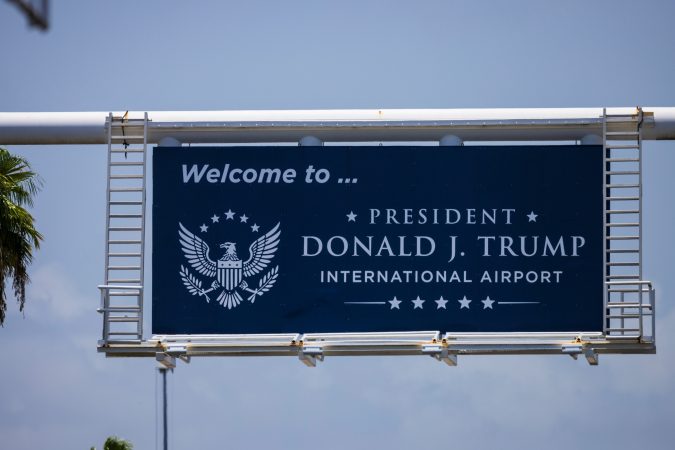
    Palm Beach International Airport in Florida is now President Donald J. Trump International Airport.

    The name change became official Thursday morning, the Federal Aviation Administration announced. Eric Trump, Trump’s son and the executive vice president of the Trump Organization, shared a video on social media in which an air traffic controller is heard announcing the name change to the pilots of the president’s private Boeing 757 as it approached the airport for a landing just after 5 a.m.

    “As a son, and someone who flies out of this airport nearly every day, I will forever be proud to see the initials ‘DJT’ on my boarding pass,” Eric Trump wrote in a separate post.

    The airport’s three-letter code will not change to DJT from PBI until Aug. 18, according to airport officials.

    Travelers will see the airport’s previous branding and new signage during a transition period that will last several weeks, airport officials said. The rollout of the new name would not disrupt airport operations, they said.

    “We’re working behind the scenes to update our physical signage, terminal spaces, and digital channels to our new name: President Donald J. Trump International Airport,” the airport said on social media.

    The airport sits a few miles from Mar-a-Lago, Trump’s private club and residence in Palm Beach, which has served as a hub for his political operations.

    Florida Gov. Ron DeSantis, a Republican, signed a bill in March clearing the path for the airport to be renamed. Democratic state lawmakers opposed the measure, which the Legislature approved in February, arguing that it would cost about $5 million to update signs, maps and other airport materials to reflect the name change.

    The New York Times reported in February that Trump’s family business had filed trademark applications for potential airport names with the U.S. Patent and Trademark Office. The applications staked a claim to three names: President Donald J. Trump International Airport, Donald J. Trump International Airport and the airport code DJT.

    The applications also sought the right to use the name in connection with a variety of airport-themed merchandise, including luggage, animal carriers and “shoes for protection of airline passengers’ feet during airport security screening.”

    Renaming the airport for Trump attaches his name to a gateway that is used by millions of visitors each year.

    Trump has a long history of putting his name on the things he has built, owns or promotes, a list that includes Trump Tower and his golf resorts and hotels. As president, he has reached beyond his private businesses. For nearly six months starting in December, Trump’s name was added to facade of the John F. Kennedy Center for the Performing Arts in Washington until a judge ordered its removal in May. His signature is expected to appear on U.S. dollars later this year.

  • Federal agents at scene of ICE shooting in Houston didn’t have body cameras, DHS says

    Federal agents at scene of ICE shooting in Houston didn’t have body cameras, DHS says

    Federal agents did not have body-worn cameras when a U.S. Immigration and Customs Enforcement officer fatally shot a Mexican homebuilder who was driving a work van they tried pulling over in Houston, the Department of Homeland Security said Thursday.

    Separately, prosecutors in Houston said they are investigating the death of Lorenzo Salgado Araujo, whose family has joined Democrats in calling for an independent probe over Tuesday’s early morning shooting in one of the city’s heavily Hispanic neighborhoods.

    Few photos or videos surrounding the shooting have emerged publicly in the days since the encounter between Salgado Araujo and ICE agents, unlike other deaths involving federal immigration officers. The family of Salgado Araujo, who had lived in the U.S. for more than 35 years, has questioned ICE’s account and called on the agency to release evidence.

    In a statement, DHS said the agents at the scene in Houston had not yet been issued body cameras, which it blamed on Democrats and a record government shutdown that was fueled by President Donald Trump’s immigration crackdown.

    DHS, which oversees ICE, has said federal officers were conducting a targeted operation to arrest a person in the country without legal status when they attempted to stop a vehicle driven by Salgado Araujo. The agency has said Salgado Araujo rammed an ICE vehicle and that a federal officer fired a weapon in self-defense.

    Asked whether ICE agents had been specifically targeting Salgado Araujo, DHS said Thursday that officers had been surveilling a property where they had previously observed two white vans.

    “On July 7, officers were almost at the target’s address when they observed a white van with an individual who resembled the target. Officers then initiated the vehicle stop,” the department said.

    Salgado Araujo had no criminal record and was close to obtaining a work permit after living in the U.S. for more than three decades without legal status, his family has said.

    The Harris County District Attorney’s office said it would conduct an investigation into the shooting. The office is consulting with local prosecutors in Minneapolis, where federal agents fatally shot two U.S. citizens, to learn how they have navigated investigations into federal immigration agents, spokesperson Rafael Lemaitre said.

    “Although access to key evidence remains under federal control, we are pursuing investigative avenues available to us and will conduct a review of any information we collect within our reach,” Lemaitre said in an emailed statement.

    Three men, including Salgado Araujo’s brother, were detained by ICE during the fatal traffic stop, according to Juan Proaño, CEO of the League of United Latin American Citizens, who has been communicating with their families.

    LULAC has yet to obtain video footage that clearly shows what happened during the moments of the shooting and has offered a reward of $5,000 for information from witnesses, Proaño told The Associated Press. The position of Salgado Araujo’s van and ICE vehicles has obstructed security camera footage LULAC has reviewed, he added.

    “It’s going to make it even more difficult to find the truth in all this,” he said.

    DHS said the ICE agents involved in the incident were expected to receive body-worn cameras in the next 60 days.

    In the aftermath of the fatal Minneapolis shootings of Renee Good and Alex Pretti, Democrats had refused to fund ICE and the Border Patrol without changes to those operations designed to increase accountability and transparency. Republicans in Congress eventually passed legislation funding just ICE and CBP for three years.