Category: Nation World News Wires

  • In a Ukrainian bomb shelter, Laura Loomer explains shift on Russia’s war

    In a Ukrainian bomb shelter, Laura Loomer explains shift on Russia’s war

    KYIV, Ukraine — Laura Loomer became infamous for spreading conspiracy theories online. Now, as she travels across Ukraine to see the damage inflicted by Russia in its yearslong war, she wants to admit that she fell for some falsehoods herself.

    A close ally of President Donald Trump, Loomer has completely reversed her longtime criticism of Ukraine and is urging fellow conservatives to be wary of Moscow’s propaganda, which she blames for duping large swaths of the American right.

    “You don’t need to listen to a podcaster and let them influence your opinion about a country. You can look at those facts yourself,” she told the Associated Press in Kyiv shortly after returning from a trip close to the front line in Ukraine’s east. The interview was supposed to take place in Loomer’s hotel, but it had to be moved to the building’s underground bomb shelter as the city faced another ballistic missile attack.

    Loomer has remained influential with Trump despite not having an official role, and she said they spoke over the phone after she sat down with Ukrainian President Volodymyr Zelensky. She also said that she expects to meet with Trump after returning from her trip.

    Loomer’s turnaround on Ukraine has been welcomed by the country’s leaders, whose relationships with Trump have been strained at times. But it has also stirred confusion, surprise, and suspicion in the United States. She continues to insist that Ukraine is not paying for her travels.

    As Trump and Zelensky prepare to meet on Tuesday in Washington, Loomer said it’s clear that her trip has already made a difference, refocusing attention on the war as Congress debates new sanctions intended to punish Russia.

    “It’s looking good for Ukraine, right?” she said. ”Going into this meeting next week at the Oval Office is looking pretty good.”

    Loomer says she was ‘bamboozled’ to oppose Ukraine

    Loomer had spent years minimizing the war and amplifying Russian propaganda until she made a dramatic reversal this week.

    “I’ve come to realize I was bamboozled by Russian propaganda and I came to believe a lot of untrue things about Ukraine. I used to think that this was a country full of Nazis,” Loomer told Zelensky as she interviewed him for her show on Rumble, an online video platform.

    Loomer blamed her indoctrination on getting banned by American social media platforms, leading her to try Telegram, where Russian media is widely shared.

    “The Russians,” she added, “are very good at capitalizing on people’s rage. And I was very angry,” she said, recounting her feelings about the 2020 election, which she falsely maintains was stolen from Trump despite all evidence to the contrary.

    She said her change in perspective had been gradual as she started to see podcasters like Tucker Carlson “turn on President Trump” while having their rhetoric amplified by Russian sources.

    Loomer, who casts herself as an independent journalist, told the AP she believed her reversal was already changing minds within Trump’s Make America Great Again movement.

    “Oh, 100%,” she said. “I’ve received messages all day from different people and media and politics and people just who follow me online who said, ’Wow, I didn’t realize how much we’ve been lied to.’ ‘Wow you really opened my eyes.’”

    Loomer was welcomed with open arms

    Ukrainian officials seemed to recognize the opportunity of winning over an ardent Trump ally with a large online following. In addition to her interview with Zelensky, Loomer had audiences with top Ukrainian officials and the country’s chief rabbi.

    “It takes courage to come to Ukraine and not be deterred by Russian propaganda or air raid sirens,” Zelensky’s office wrote on social media.

    Loomer also got a tour of Dormition Cathedral of Kyiv-Pechersk Lavra, a monastic complex that came under Russian attack last month.

    “Laura is very powerful and she’s very authoritative in the U.S., so I hope that everything she has seen by her own eyes will help her to spread the truth when she is back at the U.S.,” Tetyana Berezhna, the deputy prime minister and Ukrainian minister of culture told the AP. “I do really hope and I believe that her visit will have a huge impact on relations with the U.S. administration.”

    While some have tried to downplay Loomer’s influence with the president, he has often followed her advice. She occasionally traveled with him during the 2024 campaign, and last year he purged his National Security Council staff after she raised concerns about their loyalty in an Oval Office meeting.

    Trump appears to be tracking Loomer’s trip, sharing video of her conversation with Zelensky on social media.

    “Very good!!!” he wrote on Thursday evening.

    The conspiracist denounces conspiracy theories

    Loomer has a long history of spreading conspiracy theories. She once shared a video that called 9/11 an “inside job” and amplified a lie about Haitian immigrants eating dogs and cats in Ohio, which Trump went on to repeat during a presidential debate with Kamala Harris.

    Although Loomer may have changed her mind about Russia’s invasion, her bigoted views have not budged.

    “One thing I really love about Ukraine is I haven’t seen a single Muslim here,” she posted on Saturday. “It’s so refreshing.”

    But in the interview, she bemoaned how influential podcasters can spread misinformation.

    “They have been able to warp people’s minds to the point where people aren’t even capable of analyzing a subject with common sense anymore because they want to depend on these personalities to give them the opinion that they think they should have,” she said, calling the situation “a major national security threat.”

    She said she thinks that “information war” has “the potential to be more destructive than any kinetic war that our country may ever face” and called on the Trump administration to take the threat of Russian propaganda, foreign interference, and influence operations more seriously.

    “I think that some of our leaders are being influenced by propaganda,” she said.

    The White House has routinely downplayed the role of Moscow’s influence, especially because Trump has long chaffed at investigations showing that Russia worked to boost his 2016 candidacy.

    Loomer has said repeatedly that Ukraine did not finance her trip and insisted she had traveled in her own capacity.

    “I can guarantee you I wasn’t paid by anybody. I certainly wasn’t paid by the government of Ukraine to come here,” she said.

    “If it’s fake, why did I risk my life? I’m in a bomb shelter right now. I barely slept this week,” she said.


  • A forced-labor crackdown or an end run around Congress? Dissecting Trump’s new tariffs

    A forced-labor crackdown or an end run around Congress? Dissecting Trump’s new tariffs

    NEW YORK — The Trump administration has imposed double-digit tariffs on more than 60 countries, using a legal justification that permits the president to levy import taxes and other sanctions against countries found to engage in “unjustifiable,” “unreasonable,” or “discriminatory” trade practices.

    The new tariffs announced in recent days take effect just as temporary 10% worldwide tariffs expired, and critics say they are less about cracking down on forced labor than they are a way to replace those tariffs. The expired tariffs were themselves a temporary replacement for worldwide tariffs the Supreme Court struck down in February.

    The tariffs were levied on countries that the U.S. says either don’t have or don’t effectively enforce a forced-labor import ban. The affected countries, which account for 99% of U.S. imports, were quick to protest, calling the Trump administration’s claims unfounded and arbitrary, as nations with vastly different records on forced labor received the same tariff level. The U.S. spent four months investigating but gave few details on how it arrived at the tariff rates, which are either 10% or 12.5%.

    Sidestepping Congress

    The tariffs were levied under Section 301 of the Trade Act of 1974 on countries that the U.S. determined had failed “to impose and effectively enforce a prohibition on the importation of goods produced with forced labor.”

    During President Donald Trump ‘s first term, he cited Section 301 to impose sweeping tariffs on Chinese imports amid a dispute over the sharp-elbowed tactics Beijing was using to challenge America’s technological dominance. The U.S. is also using 301 powers to counter what it calls unfair Chinese practices in the shipbuilding industry.

    “The 301s allow a permanent tariff without going to Congress to settle the dispute,” said Barry Appleton, a law professor and co-director of New York Law School’s Center for International Law. “That’s what all of this is about. The president doesn’t want to knock on the front door of Congress, so he’s trying every side door and every unlatched window to get in.”

    Little evidence that countries failed to enforce import bans

    The office of the United States Trade Representative said it consulted with all 60 economies under investigation and held two rounds of public hearings, elicited more than 2,100 public comments, and had “engagement” with its trading partners about what they were doing to combat forced labor bans.

    It didn’t detail its talks with the countries, saying those were confidential. Experts say it is fairly straightforward to investigate whether a country has a ban or not, but it is difficult to determine the government’s exact rationale for each country’s failure to enforce import bans.

    “There’s not a lot of hard evidence there,” said Scott Lincicome, vice president for general economics and trade policy at the Cato Institute, a libertarian think tank. “It’s pretty laughable on its face to think that a country like the ones in Europe or in Norway or Switzerland aren’t doing enough to police forced labor.”

    And even if countries do enact and enforce the forced-labor import bans the U.S. wants, they would still need to prove that they’re enforcing them to Washington’s satisfaction before the tariffs would be removed, said lawyer Patrick Childress, a partner at Holland & Knight and a former U.S. trade official.

    “This suggests that no short-term path for countrywide relief from the new Section 301 tariffs will be available,” he said.

    Countries and industries reject the forced labor argument

    Many countries have pushed back against the Trump administration’s findings.

    Brazil, which faces a 12.5% forced-labor tariff, called the U.S. move “arbitrary and unjustified.” The U.S. “chose to manipulate an issue of great importance to human rights and the struggles of workers worldwide in order to accuse 59 countries and the European Union of unfair practices,” it said in a statement.

    Australia also questioned the justification for its 12.5% tariff.

    “We believe that amongst all of the countries in the world, Australia does take the issue of slavery, modern slavery, seriously, and will continue to do that,” Trade Minister Don Farrell told reporters in Adelaide.

    Carve-outs have riled some industries. The National Council of Textile Organizations, which describes itself as the voice of the American textile industry, protested a mechanism that exempts the Section 301 tariffs for textile and apparel imports from Bangladesh, Cambodia, Indonesia, and Malaysia based on those countries’ imports of U.S. cotton and textiles.

    “No other industry has been more disadvantaged by forced labor than the U.S. textile industry, which employs 453,000 workers and has lost 41 plants over the past two plus years,” NCTO chief executive Kim Glas said in a statement. “We remain strongly concerned that USTR’s textile mechanism will harm the very domestic manufacturers the administration seeks to help.”

    U.S. forced-labor bans don’t always work

    The U.S. has two major pieces of legislation related to forced-labor import bans. The Tariff Act of 1930 gave Customs and Border Protection the authority to seize shipments where forced labor was suspected and to block further imports. But it had a big carve-out: If there was “consumptive demand,” meaning there wasn’t sufficient supply to meet domestic demand, imports were allowed regardless of how they were produced. The Trade Facilitation and Trade Enforcement Act that took effect in 2016 eliminated that loophole.

    In 2021, the Uyghur Forced Labor Prevention Act was passed. It blocks imports from China’s Xinjiang region unless businesses can prove the items were made without forced labor.

    But goods made with forced labor can still make it into the U.S. In 2015, an Associated Press investigation found that slave labor was used in the fishing industry in Southeast Asia. The seafood they caught made its way to supermarkets and pet food providers across the U.S.

    An investigation by the Associated Press in 2020 into the $65 billion palm oil industry found labor abuses among an invisible workforce consisting of millions of men, women, and children in Asia. The fruit they harvested made its way into the supply chains of major companies, including Unilever, L’Oreal, Nestle, and Procter & Gamble.

    Calls for a more comprehensive approach to combat forced labor

    During hearings on the tariffs this month, National Retail Federation vice president Jonathan Gold, who was representing the business coalition the Joint Association Forced Labor Working Group at the hearing, said that in order for the import bans to work, they would have to be much more extensive.

    He said there need to be “clear, measurable benchmarks” tied to tariffs for countries to hit, and that the U.S. should help countries build enforcement programs.

    Kenya Davis, a partner at the Boies Schiller Flexner law firm, said an effective ban needs a “comprehensive approach” that provides transparency about what the investigations consisted of, along with programs that provide countries aid in enforcing bans.

  • Netanyahu accuses Mamdani of ‘fomenting hate’ and calls ICC war-crimes charges ‘bogus’

    Netanyahu accuses Mamdani of ‘fomenting hate’ and calls ICC war-crimes charges ‘bogus’

    WASHINGTON — Israel’s Benjamin Netanyahu said Sunday that New York Mayor Zohran Mamdani is “fomenting hate” by calling the prime minister a war criminal who should be arrested over the war in Gaza if he visits the city for the United Nations General Assembly.

    Netanyahu said he intends to be in New York in September to address the annual U.N. gathering of world leaders, despite the mayor’s suggestion that he is not welcome. Mamdani said last week that while New York City does not have legal authority to execute an arrest warrant issued by the world’s top war-crimes court, he encouraged the federal government to do so.

    “He’s supposed to be the mayor of all New Yorkers — Jews, Christians, Muslims, everyone,” Netanyahu said on Fox News Channel’s Sunday Morning Futures with Maria Bartiromo. “But he’s trying to turn one group against the other.”

    The prime minister has become an increasingly polarizing figure over Israel’s war in Gaza, which was ignited by the Oct. 7, 2023, deadly attack on southern Israel by Hamas militants. Israel also joined the U.S. in starting the war against Iran on Feb. 28 before launching a ground invasion in southern Lebanon in response to fire from the Iranian-backed Hezbollah group.

    Netanyahu on Sunday dismissed the International Criminal Court’s war crimes charges against him as “bogus.” He pointed to sexual misconduct allegations against the ICC’s top prosecutor, who was removed from that post on Friday, and said the warrant was an attempt to divert attention.

    The mayor’s office did not immediately respond to a request for comment Sunday.

    Bipartisan U.S. support for Israel at risk, Netanyahu says

    Netanyahu said he was concerned that once-bipartisan political support for Israel in the U.S. is at risk, particularly as progressive and far-left Democrats aligned with the Mamdani wing of the party splinter.

    He also warned against rising antisemitism in the U.S. and other Western countries, saying that when he talks to people in New York City, home to the second-largest Jewish population in the world, “Jews feel very uncomfortable.”

    “And I think it’s wrong. The whole thing is wrong,” he said.

    Throughout his mayoral election campaign last year, Mamdani said he would seek to order the city’s police to execute the ICC’s arrest warrant over Netanyahu’s role in the war in Gaza.

    But Mamdani acknowledged last week that his city did not have the legal authority to arrest Netanyahu and called on federal authorities to step in.

    “I want to be equally clear, Benjamin Netanyahu is not welcome in New York City, nor is any other war criminal at large,” he said in a video message.

    He told New Yorkers that he understood their frustration and that expressions of protest are something the city would “always respect.”

    the Hague-based court has accused Netanyahu, his former defense minister, and the late leader of Hamas of crimes against humanity. The Palestinian territory’s Health Ministry says over 73,000 people have been killed in Israel’s offensive — roughly half of them women and children. Some 1,200 people, most of them civilians, were killed in the initial Hamas attack on Israel.

    Trump has assured Netanyahu he won’t be arrested

    President Donald Trump told Netanyahu in a social media post last week that he “will not be arrested, in any way, shape, or form, while in the United States of America.”

    Netanyahu is expected in Washington this week to meet with Trump and attend funeral services for the late Republican Sen. Lindsey Graham of South Carolina.

    Graham, a leading defense hawk and strong supporter of Israel, died suddenly two weeks ago of a likely torn aorta. The prime minster called him an “extraordinary American patriot.”

  • Airstrikes have paused and talks are pressing forward. But can the US and Iran take the off-ramp?

    Airstrikes have paused and talks are pressing forward. But can the US and Iran take the off-ramp?

    WASHINGTON — The U.S. military has paused its airstrikes on Iran after nearly two weeks of intensifying bombing, while diplomatic efforts have pushed forward to try to avert a return to all-out war.

    But it remains to be seen whether the U.S. and Iran are at an inflection point in a mercurial conflict that will reach the five-month point Tuesday. President Donald Trump both has threatened more strikes and said talks are pressing on, all while brushing off concerns that rising gas prices tied to the fighting could hurt Republicans in November’s midterm elections.

    Adding to the uncertainty is the impact of Israeli Prime Minister Benjamin Netanyahu’s planned visit with Trump this week in Washington. Israel, which launched the war alongside the U.S. on Feb. 28, has been notably absent from the renewed American attacks over Iran’s effective closure of the Strait of Hormuz, a vital shipping corridor through which 20% of the world’s oil normally flows.

    “The Iranians understand that perhaps it could get worse because Israel could come into the conflict,” said Michael Singh, managing director at the Washington Institute for Near East Policy. On the other hand, Israel’s lack of involvement so far “may signal to the Iranians that we’re looking to limit the conflict.”

    Singh, who was senior Middle East director on the National Security Council during the George W. Bush administration, said he was hesitant to read too much into the lull in fighting.

    “If it turns into a multiday pause, that’ll be something significant,” he said. “But it’s hard to know. Is it an operational pause? Is it a pause to allow for some kind of behind-the-scenes diplomacy?”

    Mediators keep pressing their diplomatic efforts

    A regional official involved in the mediation efforts said that concerted diplomacy was underway and that a pause in U.S. strikes and Iranian counterstrikes on neighboring countries hosting American forces was a “positive signal that helps their efforts to de-escalate.”

    The official said that both the U.S. and Iran want to return to the interim ceasefire deal and that a compromise, which is being negotiated now, centers around having Iran run vessel transit through the Strait of Hormuz with fewer restrictions on ships. The official was not authorized to discuss the matter and spoke on condition of anonymity.

    On Sunday, Iran’s Foreign Ministry spokesperson, Esmail Baghaei, confirmed that Iran and Oman had held several rounds of technical talks about the strait in Iran over the weekend. He said that while the Omani delegation left Tehran on Saturday afternoon, talks had made progress and were continuing.

    Iran put a chokehold on the narrow Persian Gulf waterway when the war began by firing on tankers and freighters. In turn, oil prices have soared during the conflict, which has been unpopular with many Americans, and could leave some Republican lawmakers vulnerable in November.

    Following the signing of an interim ceasefire deal in June, a battle for control over the strait has erupted. Iran demanded that ships use a route near its coastline and said it can potentially charge fees. Ships were increasingly navigating a southern route along the coast of Oman under a U.S. overwatch operation when Iran attacked some vessels.

    The U.S. renewed attacks on Iran’s coastal defenses, aiming to blunt Tehran’s ability to strike ships in the strait. The Trump administration then expanded its targets, hitting bridges and infrastructure in the south and striking deeper into the center of Iran.

    Singh said the strikes appear to be an attempt to push Iran back to the negotiating table. Now, he said, “the question would be: What kind of messages, if any, is the Iranian regime sending through diplomatic channels? Have those messages changed? Do they seem more eager to return to talks?”

    Among the challenges the U.S. faces is the fractured leadership in Iran, with different factions vying for control, Singh said, something that Trump administration officials have also pointed to. The people in charge in Iran may worry that compromising with the U.S. will be seen as weakness and could loosen their grip on power.

    Whatever the case, both the U.S. and Iran need the strait to reopen for their own economic reasons.

    “But they have very different conceptions of under what conditions, under whose control,” Singh said. “So we have to get to some kind of stable equilibrium on those questions before you’re going to see a longer period of quiet. I think this effort to negotiate with words and also to negotiate with force is going to continue until we reach that equilibrium.”

    Trump issues threats but also talks up diplomacy

    Despite the lull in fighting, tensions are high in the region.

    Yemen’s Houthi rebels said Saturday that they fired missiles and drones at Saudi Arabia in response to Saudi airstrikes on the strategic Red Sea city of Hodeida. The Iran-backed rebels say they have closed the Bab el-Mandeb Strait, which has become even more vital for Saudi oil exports since the disruption of the Strait of Hormuz.

    The U.S. military also is enforcing its naval blockade of Iranian ports, saying it disabled a Mozambique-flagged ship in the Gulf of Oman on Friday after the vessel tried to violate the blockade and ignored warnings.

    Trump also has kept up the threats against Iran even as he spotlighted diplomacy. Asked about his exit strategy Friday, Trump said there are two ways.

    “You can just keep doing exactly what we’re doing and take them apart piece by piece. We could do it in a more rapid fashion, which we might do,” he told reporters in the Oval Office. “Or we can negotiate with them, which we’re also doing right now.”

    While Trump said he doesn’t think Iran is “ready yet” to make a deal, he also asserted that “I think they’re getting more and more serious as the days go by, for maybe the obvious reason.”

    Trump met Friday with top national security aides to discuss the situation with Iran and whether the administration should maintain the current course or escalate military attacks, according to a U.S. official who spoke on condition of anonymity to discuss internal deliberations. No U.S. strikes occurred overnight in Iran after 13 consecutive nights.

    Trump insisted Friday that he was “not in a hurry” to wrap things up because of the approaching elections, in which voters, angry about high food and gasoline prices, could vote his Republican Party out of control of Congress.

    “Despite what everyone says about the election, I’m not in a hurry,” he said. “We have to do it right. Elections take care of themselves.”

  • As U.S. pauses attacks on Iran for  a second day, Tehran pauses too

    As U.S. pauses attacks on Iran for a second day, Tehran pauses too

    CAIRO — The United States and Iran paused their attacks for a second straight day Sunday, as efforts continued to bring them back to negotiations on an interim ceasefire deal largely undermined by recent exchanges of fire.

    It was not clear why the U.S. has paused after targeting Iranian coastal areas and infrastructure in a nearly two-week escalation sparked by Iran’s firing at ships trying to transit the Strait of Hormuz. The Pentagon did not respond to questions.

    U.S. President Donald Trump is “giving talks some space. He’s giving it a little bit of room,” Mike Waltz, the U.S. ambassador to the United Nations, told Fox News. “We’ve had both Oman and Iran, and a number of our other negotiators, engaged at every level, from the most senior levels all the way down to the technical level over the past few weeks, and particularly in the past few days.”

    Waltz dismissed the idea that the U.S. stockpile of interceptors crucial in defending against Iranian attacks is running low, but experts have questioned how long both the U.S. and Iran can afford to keep up attacks.

    Since the U.S. has halted attacks for the past two nights, Iran has as well, its army spokesperson told Iran’s state TV on Sunday. Tehran in recent days has counterattacked against countries in the region hosting U.S. military forces, killing at least three service members at a base in Jordan and one in Iraq.

    Official calls the pause a ‘positive signal’

    The 60-day period that began when the interim deal was signed by both countries in mid-June is now well into its second half, and major issues that were meant to be negotiated — notably Iran’s nuclear program at the heart of tensions — remain set aside as mediators try to keep both sides talking.

    A regional official involved in mediation efforts said diplomacy was underway and that a pause in U.S. and Iranian strikes was a “positive signal that helps their efforts to de-escalate.”

    The official said both countries want to return to the interim ceasefire deal and that a compromise being negotiated centers on having Iran run vessel transit through the Strait of Hormuz with fewer restrictions on ships. The official was not authorized to discuss the matter and spoke on condition of anonymity.

    Shipping traffic on strait is at 3-week low

    Concerns continued about shipping on the strait and now on another crucial waterway in the region, the Bab al-Mandeb strait to the Red Sea. Iranian-backed Houthi rebels in Yemen last week threatened a blockade of Saudi shipping there.

    Global energy supplies and the economy remain in the balance as gasoline prices have risen again.

    Commercial shipping traffic on the Strait of Hormuz was at a three-week low, a maritime body overseen by the U.S. Navy said Sunday, adding that no new attacks had been confirmed in the past 72 hours. It said traffic remained steady through the Bab el-Mandeb.

    Iran on Sunday said it continued to speak with Oman about managing the safe passage of ships on the Strait of Hormuz, which passes between the countries. Iran’s Foreign Ministry spokesperson, Esmail Baghaei, said talks had made progress and continued.

    Baghaei also said the strait’s status remained unchanged. Tehran has asserted that the interim deal with the U.S. allows it to manage shipping on the waterway for now, and it has objected to U.S. efforts to support a route through the strait that passes close to Oman instead. The strait was considered an international waterway before the war.

    The U.S. military on Saturday said its recently reimposed naval blockade against Iran continued, with a dozen commercial ships redirected, two disabled, and two boarded. U.S. forces “remain highly vigilant, focused, lethal, and ready,” it added.

    Netanyahu says he ‘fully’ backs Trump’s efforts

    Meanwhile, Israeli Prime Minister Benjamin Netanyahu plans to travel to the United States and meet with Trump in Washington on Tuesday, his office has said. They last met in Washington in February, weeks before they launched the war on Iran that killed senior leaders including Supreme Leader Ayatollah Ali Khamenei.

    The Iranian-backed Hezbollah fired at Israel two days after the war began, and Israel responded with airstrikes and ground forces in southern Lebanon. Since then, the U.S. has supported landmark direct talks between Lebanon and Israel to try to calm that front and find a way to disarm Hezbollah.

    Netanyahu on Sunday told Fox News he “fully” backs Trump’s efforts to weaken Iran and press it to end its nuclear program, adding: “If he can do so without returning to intense military fighting, that’s fine. Why not?”

    The prime minister indicated he would not present new information to “our good friend” Trump and instead would listen to “what he has in mind, because I think in many ways, it’s his decision.”

    But Netanyahu warned that if Iran again attacks Israel, directly or with armed proxies, “it will make a terrible mistake.”

  • Suspect in deadly Berlin Pride attack killed in confrontation with police

    Suspect in deadly Berlin Pride attack killed in confrontation with police

    BERLIN — The suspect in the deadly Berlin Pride attack that left one person dead and 29 injured was shot and killed by police during a confrontation on Sunday in a suburb of the city, authorities said.

    Abdul Ballout, a German citizen with Lebanese roots, was killed following a search that lasted nearly 24 hours after the attack in downtown Berlin. Prosecutors said he had previously sought to join the militant Islamic State group.

    Ballout was suspected of driving a van into a crowd near Berlin’s Pride festival Saturday night before apparently stabbing others with a machete in what authorities believe was an Islamic extremist terror attack.

    Interior Minister Alexander Dobrindt said the attack occurred a few hundred yards from a party near the Brandenburg Gate that was supposed to close out the city’s Pride festival.

    Ballout was tracked down around 6 p.m. Sunday at a garden in Spandau, a Berlin suburb, the city’s police department wrote on X. They said he apparently ran toward officers with a sharp instrument, and police fired at least one shot. He died at the scene.

    Ballout was born in Germany, the minister said. His mother was naturalized in 2002, three years before he was born.

    Ashley Jump, a 26-year-old U.K. resident, had traveled to Berlin for Saturday’s Pride parade but had left the celebrations before the attack. They returned Sunday to leave flowers at a memorial near the crime scene in support of the LGBTQ+ community.

    “They’ll never erase us, we’ll never be gone,” they said. “As long as humanity has existed, we’ve existed. And as long as humanity exists, we will exist. We will not be removed.”

    Suspect convicted of ties to Islamic extremism

    Ballout traveled to Lebanon in 2025 with the goal of going to Syria to join the Islamic State group, Berlin prosecutors said Sunday.

    There, he made contact with several people who were presumed members of the militant group — or at least he believed them to be, prosecutors said. He was arrested in Lebanon last year and sentenced by a military court to three months’ imprisonment for offenses including incitement to religious and sectarian conflict.

    He returned to Germany after completing his sentence, where he was arrested at the Berlin airport.

    In May, a juvenile court in Berlin convicted Ballout of preparing a serious act of violence endangering the state, as well as publishing Islamic State propaganda on his Instagram account and other charges, prosecutors said.

    The court handed down a suspended sentence of 1 year and 10 months in youth custody, which Berlin prosecutors had appealed.

    The court said it took Ballout’s months of pretrial detention in Germany and Lebanon into account. It also said it considered that Ballout had confessed to the crimes, appeared to distance himself from the militant group, and no actual threat had ever materialized.

    He was released from detention pending the appeal.

    Berlin’s Pride festival is one of Europe’s largest LGBTQ+ celebrations

    According to police, a white van drove into the Tiergarten park around 10 p.m. and hit several people before colliding with a tree. The closing party at the Pride festival, known as Christopher Street Day, was ongoing at the time next to the Brandenburg Gate, a short distance away. The party followed a parade with some 80 trucks that had made its way through downtown Berlin earlier in the day.

    The attack did not occur at the festival, along its route, or at the closing party. Rather, the violence took place a few hundred yards away on a track in the Tiergarten park. The van drove into a crowd that was likely a mix of festivalgoers and other locals or visitors.

    Police said a woman was killed.

    On Sunday afternoon, hundreds of mourners gathered at a memorial at the iconic gate. They hugged each other and laid down flowers, candles, rainbow flags, and homemade signs, including a cardboard one that said: “The only thing more powerful than hate is love.”

    Hundreds of thousands had come to Berlin to celebrate on Saturday, though it’s unclear how many were still at the festival by late evening. The event is one of Europe’s largest LGBTQ+ celebrations.

    “We are simply stunned by what happened,” said Andre Lehmann, a top official with the main national LGBTQ+ association, LSVD+. “This suspected attack hits the heart of the queer community.”

    Amsterdam says it will celebrate freedom in the wake of Berlin attack

    Chancellor Friedrich Merz urged the nation to remain united in the aftermath of the attack.

    “I would like to say this to Christopher Street Day participants here in Berlin but also across Germany: Don’t let yourselves, let us not let ourselves, be intimidated,” he said. ”These acts have only one purpose: They aim to divide our society. They want to take away from us the most important thing we have: Namely our openness and our freedom.”

    Dobrindt said he expected security measures at other major events in Germany, including Pride events elsewhere, to be reviewed and if necessary significantly boosted.

    Berlin has seen Islamic extremist attacks before. In December 2016, a rejected asylum seeker from Tunisia plowed a hijacked truck into a Christmas market, killing 13 people and injuring dozens. He was killed days later in a shootout in Italy.

    In February last year, a Spanish tourist was stabbed and seriously wounded at Berlin’s Holocaust Memorial, an attack that saw a Syrian man convicted in March and sentenced to 13 years.

    This week, Amsterdam will be hosting World Pride alongside its own annual Pride celebrations. Mayor Femke Halsema said authorities and organizers “are closely monitoring the security situation” after the Berlin attack but aim to prevent any extra measures getting in the way of celebrating freedom and love.

  • How the lighthearted social media trend of teen takeovers took a serious turn

    How the lighthearted social media trend of teen takeovers took a serious turn

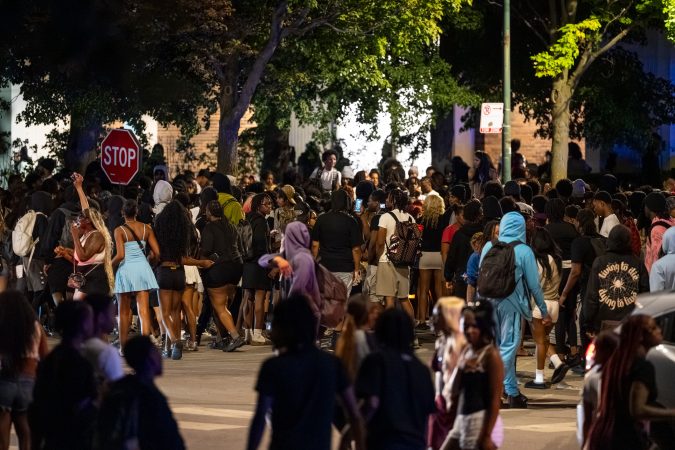
    When Damarion Spann, 18, saw an Instagram flier calling for a massive gathering on a beach near downtown Chicago, he immediately wanted to go. Thousands of others joined him that night on the sand, blasting music and dancing.

    The cultural trend of so-called teen takeovers has popped up across the U.S. in recent years, influencing local policing and national politics. The events, often hyped online and captured in videos on social media, have led to shootings, theft, and vandalism. City officials and police are concerned about an increase over the summer, and are under pressure to prevent similar gatherings or to punish those who participate.

    Over the July 4 holiday weekend, several thousand young people converged in two spots in Raleigh, N.C., police said. Nine people, including an adult who was not part of the gatherings, were shot and wounded.

    There were also takeovers in Pensacola, Fla., where a 19-year-old was shot and killed; and Newport Beach, Calif., where more than 400 were arrested after the police chief said teens launched “explosive mortars and other projectiles” at officers ordering them to disperse.

    But Spann and other teens say that the events are largely misunderstood. They point to formal curfews or limits on group size at malls and movie theaters that have made it harder for teens to gather, exacerbating a feeling of disconnection they trace back to remote learning during the coronavirus pandemic.

    How cities are tracking the social media trend

    Communities and police across the country are trying to identify organizers, fine parents of those involved, and impose curfews.

    In Detroit, officials say they “thwarted” 19 gatherings so far this year by monitoring time and location changes as young people coordinated across social media, said Teferi Brent, director of the Mayor’s Office of Neighborhood and Community Safety.

    “We have eyes on all the behaviors and activities of those who have expressed interest in trying to take over and we have done a good job of being way ahead of the curve and being able to prevent a lot of these things,” Brent said.

    Alderperson Jessie Fuentes, who chairs the Chicago City Council’s subcommittee on youth employment, said her office has tried to find solutions that don’t rely exclusively on police and instead coordinate with parents and community members to prevent conflict or crimes.

    Blue Island, a south Chicago suburb, has taken another tack: to fine parents or guardians and use the funds to cover cleanup after events. That might include debris left behind or other damages like cars dented from scores of teens clambering over them while fleeing police.

    Other places have taken harsher approaches, as in Florida, where state officials said prosecutors can apply racketeering laws, typically targeting criminal gangs or organized crime, if takeovers appear to be facilitated by “an organized network.”

    But some have pushed back on the idea that the threat of harsh legal punishment could prevent the gatherings in the first place.

    “What we know about adolescent brain development is that the stakes are not going to be what prevents a young person from engaging in risky behavior,” said Melissa Milchman, the executive director for the nonpartisan organization the Coalition for Juvenile Justice. Milchman added that mass arrests often ensnare those who are going for innocent fun without preventing others from breaking the law.

    Teens say there aren’t safe spaces for them to gather

    For Spann, the recent media attention on the events has largely failed to capture the appeal to young people.

    “You feel like a young person who has freedom, who’s not being held to something,” said Spann, who is Black. At the event he went to, he was able to catch up with people he hadn’t seen since 8th grade.

    He said that the events are a direct result of a cascade of school closures across Black neighborhoods over the past couple of decades in Chicago. To deter people from gathering even at basketball courts, where there were sometimes fights, officials have removed the nets. Spann said that his mom, who grew up in the same neighborhood, frequently talks about how much easier it used to be to hang out outside without a fear of gun violence.

    When Spann goes to malls in more affluent areas with his mostly Black group of friends, shoppers often stare and security guards question them. To avoid scrutiny, Spann and his friends sometimes sneak into outdoor shopping centers or areas downtown in smaller groups at staggered times.

    By contrast, in the same spaces, Spann said, “If I’m with my white friends, I feel like I belong.”

    Despite the physical dangers that come with takeovers and the threat of getting a ticket or even arrested, the allure is strong, according to Jeffrey Bernstein, a psychologist and author.

    “The kids still do it because they feel like it’s their second family,” which he said “really takes over as their primary sense of connection.”

    “They’re getting things from their peers that they can’t get from their parents.”

    Some cities have tried to meet that need head-on, instead of cracking down with law enforcement.

    In St. Louis, officers have started to bring some teens to community centers instead of jails so their parents can pick them up, and in Baltimore, officials have tried leaning on public schools to provide alternative programming. In Chicago, Spann received a $11,000 grant from the city and partnering nonprofits to host an event for his peers at the end of the summer, in an effort to give his community more places to gather.

    What cities are doing to address teen takeovers

    In April, Daveion Page, a 16-year-old in Detroit, was bored. He turned to his phone, creating a post on social media promoting a teen takeover. Hundreds of teens soon flocked to a site downtown and fights broke out by the end of the night. At another takeover in May, a 14-year-old was shot and wounded.

    After the Detroit event in April, Page told reporters that he didn’t intend for the takeover he organized to result in violence.

    “I just wanted to get out of the house, have fun, enjoy time with my family and my homeboys and my homegirls, too,” said Page, who was flanked by Detroit Mayor Mary Sheffield and other city officials at a news conference.

    He told city officials that young people might respond if there were more safe places to gather.

    Before the takeovers, there were already plans to use $1.5 million from the city’s budget for summer programming and to support violence prevention programs. In response to the takeovers, the city has launched an office of youth affairs, met and listened to students at schools, and created a youth advisory board comprised of teens and young adults.

    “We have brought them to the table and made them a part of our structure in regards to identifying what the needs and concerns are of the young people in the city,” Brent said.

    In Detroit, a late-night basketball league has formed as an alternative hangout spot for teens and young adults. Jerseys and sneakers are provided by the city.

    “This league just helps me find something to do,” Cameron Chandler, 21, said while playing basketball at the recreation center.

    He’s never participated in a takeover, but recently after practice, he stumbled on one near his home.

    “There were a lot of cops and some people got arrested,” Chandler said. “You just have to think, ‘that could easily be me.’”

  • More health workers strike as Ebola cases in Congo near 3,000, including over 1,300 deaths

    More health workers strike as Ebola cases in Congo near 3,000, including over 1,300 deaths

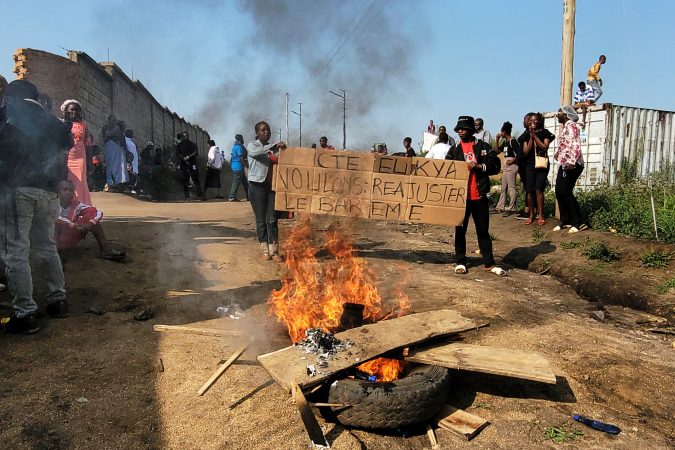
    BUNIA, Congo — Health workers at an Ebola treatment center in eastern Congo went on strike on Saturday, demanding their pay. The walkout disrupted care for patients in the epicenter of the country’s rapidly growing outbreak.

    The number of confirmed cases of Ebola in Congo has reached 2,973, including 1,309 deaths, according to government data released on Friday in what authorities say is the fastest-growing outbreak on record.

    The Elikya Ebola Treatment Center in Bunia, Ituri province, came to a standstill after doctors, nurses, and security staff stopped work.

    About a hundred health workers protested outside the treatment center on Saturday. They said the unpaid bonuses were undermining morale and disrupting patient care, and called on Congolese authorities to resolve the backpay so they could resume their work.

    “We need to be paid, because in the meantime the disease is spreading at the treatment center,” Martin Bolombi, one of the health workers on strike, said.

    “I’ve already had five people die who are still inside there. A solution must be found for us,” he added.

    In a statement issued Friday, staff said they had unanimously voted to strike until “concrete solutions” were found to resolve “two months of unpaid performance bonuses.”

    The strike comes a day after Congo’s Prime Minister Judith Suminwa came to Ituri, touring major treatment hubs in Rwampara and Mongbwalu, to assess the outbreak response. During her visit in Mongbwalu, she faced urgent demands from healthcare personnel protesting payment issues.

    Adelard Lufungula, operations manager for the Ebola response, said Saturday the payment issue is “being resolved,” with workers now paid via mobile money instead of cash, and that the backlog “should be cleared” in the coming days.

    Last week, health workers at Bunia General Hospital, the region’s largest medical center, had already gone on strike over unpaid salaries. Some told the Associated Press they had not received any payment since they started work at the onset of the outbreak.

    The World Health Organization says more than 100 healthcare workers have been infected since the beginning of the outbreak.

    The Central African nation has been battling the Ebola outbreak caused by the rare Bundibugyo virus since May 15. A total of 766 patients remain in isolation or in hospitals, while 540 have recovered so far, according to data from Congo’s Ministry of Health.

    The eastern province of Ituri accounts for nearly 90% of confirmed cases.

    The outbreak continues to spread faster than health officials can track despite an expanding response. A key challenge is that patient zero has yet to be identified in the outbreak, while displacement from armed conflict and illegal mining in the region have made it difficult to trace thousands who have come in contact with infected individuals.

    The response is also hampered by a funding gap, attacks on health centers, an ongoing conflict in eastern Congo, and mistrust among local communities.

    There is also a lack of approved vaccines or treatments for the Bundibugyo virus, unlike the more common Zaire virus, for which there is a vaccine and which was responsible for most of Congo’s past 16 outbreaks of the disease.

    Enrollment in a highly anticipated study of two possible Ebola treatments recently started in Ituri.

    WHO says the global risk of the outbreak spreading outside Central Africa is low, noting that Ebola spreads through direct contact with the bodily fluids of an infected person rather than through the air, making it much harder to spread than respiratory viruses.

  • Wisconsin’s capital city cancels signature events, grapples with fallout from police shooting

    Wisconsin’s capital city cancels signature events, grapples with fallout from police shooting

    MADISON, Wis. — A police shooting in Wisconsin’s progressive capital city this week put the spotlight on persistent and deep racial divisions, prompting cancellations and other changes to popular summertime events as protesters said they were determined to continue public pressure for change in Madison.

    Corey Ruiz, who is identified as Black or Latino in Wisconsin court records, was shot and killed by a Madison police officer on Wednesday after a brief scuffle at an intersection in the city’s most liberal neighborhood just yards away from a popular 52-year-old food co-op.

    It marks the third time since 2012 that Madison police have shot and killed someone in the same neighborhood. The shooting has sparked renewed calls for police reforms and forced the city to once again reckon with calls from the Black community to address racial justice issues.

    Pressure from protesters, and sympathy for their cause, has also led to the cancellation or disruption of many of Madison’s signature summertime events.

    “Our community has spoken loud and clear: this is NOT business as usual,” Black activist Clyde Mayberry posted on Facebook on Friday amid a string of cancellations. “Your decisions have helped ensure that this city continues to acknowledge the pain, the loss, and the call for accountability.”

    Protesters took to the streets hours after the shooting, disrupting a popular Wisconsin Chamber Orchestra outdoor concert at the state Capitol that attracts about 30,000 every week in the summer.

    The scene captures a familiar divide in Madison, a city that is more diverse than the state overall but still 70% white. Protesters, many of whom were Black, stood over white concert attendees sitting at tables near the stage that cost as much as $1,800 to rent for the night.

    Concert organizers canceled the event.

    Threats of a protest on Thursday led the city to postpone the grand opening of a new public market, just a few blocks away from where the shooting occurred. A popular neighborhood festival near the shooting called AtwoodFest, scheduled to begin on Saturday, was also canceled in the face of potential protests.

    “Our community and our Marquette neighbors witnessed another horrific officer-involved shooting just blocks from our festival grounds, leaving us in deep pain and justified anger,” organizers of the festival wrote. “In acknowledgment of what has happened far too often in our community and our country as a whole, this year’s AtwoodFest, themed ‘The Heartbeat of the Neighborhood,’ is canceled.”

    And on Saturday, the popular downtown farmers market that attracts about 20,000 people each week around the Capitol building shut down nearly four hours earlier than usual in solidarity with protesters.

    “We mourn with our community,” market organizers posted on social media. “And we agree — business cannot proceed as usual.”

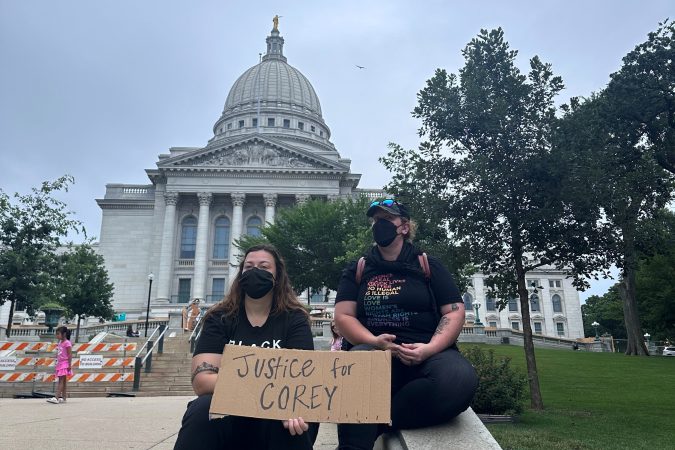
    A handful of protesters showed up at the Capitol as vendors were breaking down their booths at around 10 a.m.

    “No one should be thinking this is just another Saturday,” said Reba Bergmann, who sat with Lilly Nimmer holding a sign that said “Justice for Corey.”

    “It’s not life as normal,” Nimmer said. “We should be more mad. We should stand up for what we believe in.”

    Charles Alt, 30, supported the decision to close down early.

    “It’s important to keep focus on the real tragedy, which is that someone got killed,” said Alt, who was shopping at the market. ”Missing some market time, that’s sad, but that’s not what’s important.”

    But Rodney Hathaway, who was visiting Madison from Milwaukee, was caught off guard by the market’s early closure.

    “It’s ridiculous,” he said. “This is peoples’ livelihoods. It’s just unfortunate. We have such a short summer season for these people to sell their wares.”

    Investigations into the shooting continue. Civil rights attorney Ben Crump, who represents the Ruiz family, said on Friday at a new conference in the Capitol that the officer who fired the shots should face criminal charges.

    Madison Police Chief John Patterson, who is white, has tried to calm tensions, even allowing protesters to overtake a news conference that he was leading along with the mayor inside the police department’s downtown headquarters on Thursday.

    Patterson took questions from angry protesters, one of whom held a sign just feet away from the chief that said “corrupt cops deserve to die too.” After one protester hurled an insult at Patterson, the chief calmly responded, “I appreciate you being here.”

  • France and Spain battle wildfires as more than 250,000 people are forced to flee homes

    France and Spain battle wildfires as more than 250,000 people are forced to flee homes

    LEGE-CAP FERRET, France — France sent a hulking military cargo plane to dump tons of flame retardants as it battled raging wildfires on Saturday and slashed the final stage of Tour de France to redeploy security personnel to the blazes that forced tens of thousands of people to flee their homes.

    The giant A400M transporter swooped in low, its long plume of ochre-colored retardant trailing over drought-hit woodlands in the southwest as fire crews on the ground fought flames that authorities feared could spread toward the wine region city of Bordeaux.

    Race organizers and the Paris police department announced a truncated 21st and final stage on Sunday for the three-week Tour, France’s most famous annual sporting event, reflecting the immense strain that two large fires in the southwest are causing for emergency services.

    Tour riders will race Sunday inside Paris, rather than starting from Thoiry, west of the capital, on a circuit of 55 miles — down by a third from the 82.5-mile route that had been planned. Part of the race’s security detail will instead “reinforce the response efforts in the areas affected by the wildfires,” according to the statement announcing the ”exceptional measures made necessary by the situation.”

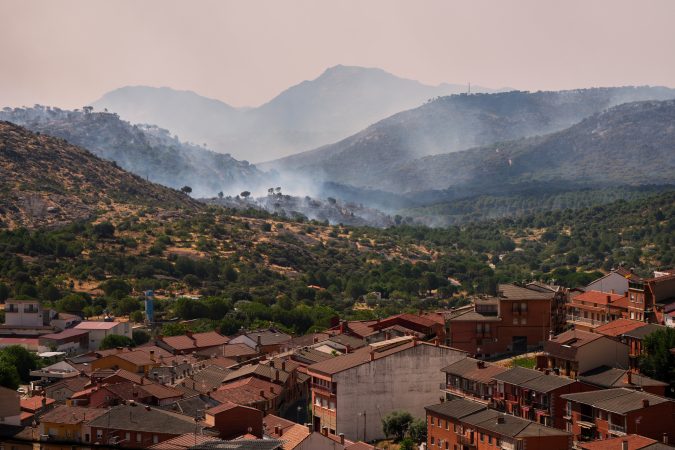
    Including some 70,000 people evacuated in central Spain, wildfires in southern Europe this week have displaced more than 250,000 people.

    Shifting winds raise concerns for Bordeaux

    With winds expected to shift in a west-to-east direction on Saturday afternoon, potentially driving flames closer to Bordeaux, fire crews and authorities were digging trenches, using retardants, and taking other blaze-blocking steps, French Interior Minister Laurent Nunez said, predicting a “long and very difficult” battle.

    He said the fire was about 20 miles west of the city and lost some of its intensity overnight. The prefect of the Gironde region that includes Bordeaux said the blaze grew into “a firestorm” on Friday after igniting earlier this week and cautioned that it “remains dangerous” even though firefighters were making progress.

    The government mobilized soldiers to join fire crews and was rushing in 1.5 million face masks to protect against choking smoke.

    Authorities ordered people between the fire and Bordeaux to evacuate, including from parts of the city’s western suburbs and other towns and villages.

    Prime Minister Sébastien Lecornu described the fires as unprecedented and said the Gironde blaze became so strong on Friday that it had begun generating its own winds. Firefighting teams were being reinforced with the addition of hundreds of soldiers, and breathing masks to filter out potentially noxious smoke particles were being rushed to those exposed, Lecornu said.

    In Bordeaux, authorities took in thousands of evacuees, offering them food and shelter in an exhibition center, and the city’s mayor said it could be equipped to welcome as many as 10,000 people if that became necessary. The city’s airport said it remained open but that its bus and tram services were suspended.

    Evacuation orders were sent with special alerts to mobile phones, instructing people to leave, Gironde prefect Sophie Brocas said. She said the fire had destroyed about 140 homes in the region.

    The magnitude of the wildfires caught authorities off guard

    The French military A400M transport plane, specially converted for firefighting, was a heavyweight new tool in the battle. It joined at least 18 other water- and retardant-dropping aircraft and helicopters that Nunez said were deployed in the Gironde region, working in rotation in the smoke-filled skies.

    The virulence of the French and Spanish wildfires, fueled by high temperatures and the long-term effects of climate change, caught fire crews and authorities off guard.

    Firefighters in Spain said the blazes spread so fast and violently that they could not be tackled head on. In France, some people even fled by boat when flames swept through tourist towns on the Atlantic coast.

    “We’ve never seen anything like this,” said Javier Organista, a resident of El Tiemblo, west of Madrid, where fire charred a famed chestnut grove. “When we saw the flames coming into our town, surrounding us, leaving us with practically no way out, all the neighbors joined together to try to stop its advance.”

    “It’s just really sad,” he said.

    Climate change supercharges fires

    Spain deployed 2,600 firefighters, police, and other emergency personnel to two blazes west of Madrid, backed by 19 water-dumping aircraft and helicopters.

    France deployed 1,400 firefighters to the Gironde fire and hundreds of others to another wildfire further south in the Landes region. Dozens of firefighters suffered injuries, authorities said, but no deaths were reported in either country despite scenes of panic as townsfolk fled by car and police went door to door to tell people to leave.

    Successive heat waves that hit unusually early and hard this year, baking Europe with record-shattering high temperatures, have turned forests and scrublands into tinderboxes.

    Fires have burned 130,000 hectares of forest already this year in Spain, up from an annual average of 100,000 hectares over the past decade, Spanish Prime Minister Pedro Sánchez said Saturday as he visited a command post west of Madrid.

    He said more favorable weather Saturday offered “a window of opportunity” for fire crews to bring the blazes under control. Madrid’s regional government said the fires decreased in intensity as winds and temperatures dropped.

    Other European nations were helping, with Italy, Greece, the Netherlands, Portugal, Croatia, the Czech Republic, Sweden, Slovakia, Germany, and Switzerland already providing or expected to deploy water-dumping planes and helicopters to the Spanish and French fire fronts.