Category: Business Wires

  • Fed rate hike likely means more expensive credit cards and mortgages, but savers may rejoice

    Fed rate hike likely means more expensive credit cards and mortgages, but savers may rejoice

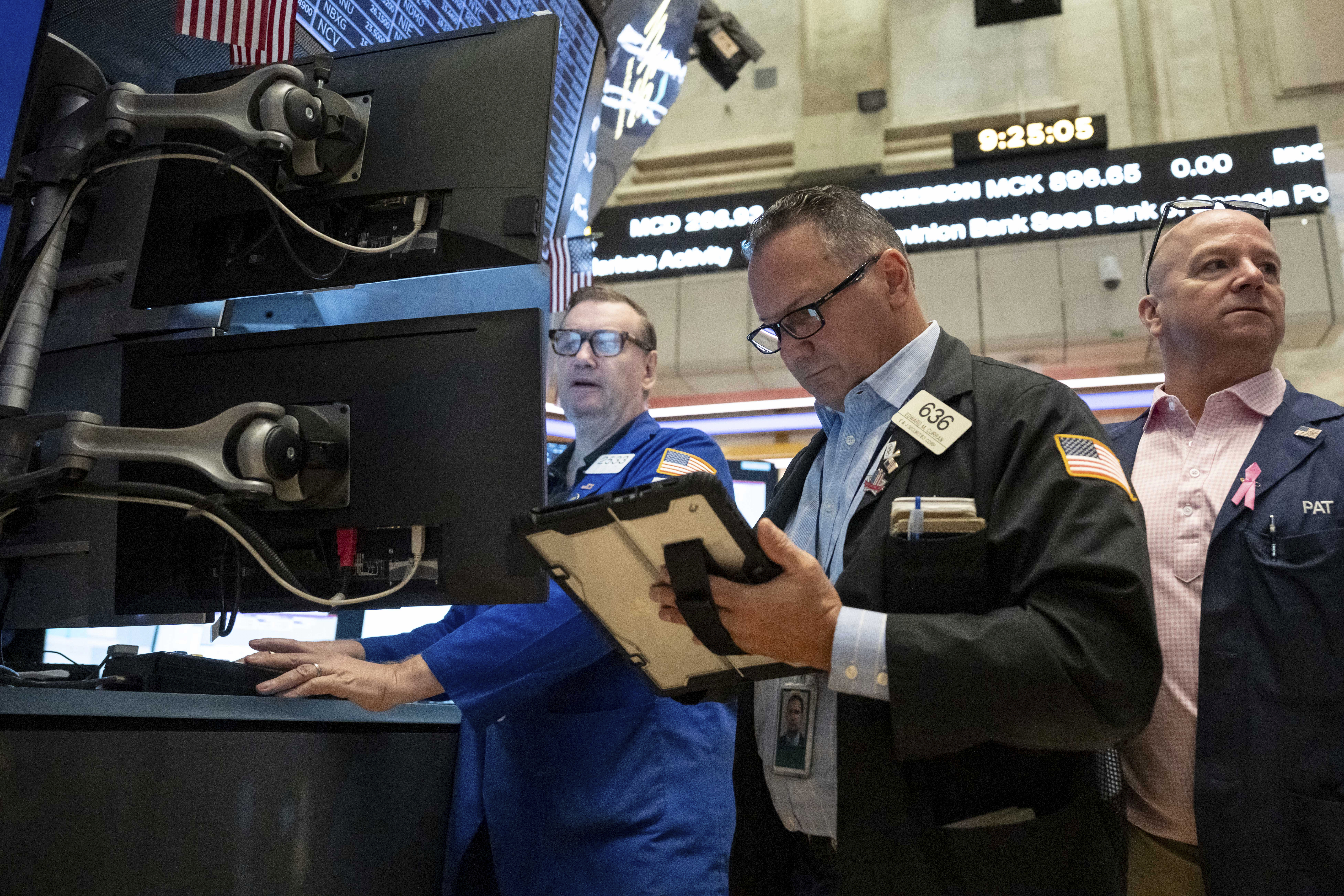
    WASHINGTON — The Federal Reserve just raised the cost of money — bad news for borrowers, good news for savers.

    The Fed increased its benchmark interest rate Wednesday by a quarter-point, the first rate hike since the summer of 2023. The hike will likely make it even costlier to borrow for homes, autos, and other purchases. But if you’ve been socking money away, you’ll probably earn a bit more interest on your savings.

    The increase boosts the Fed’s target rate to a range of 3.75% to 4.00%.

    Here’s what to know:

    Why is the Fed raising rates?

    The short answer: inflation.

    Inflation has remained above the Fed’s 2% target for more than five years. The Labor Department reported Friday that consumer prices rose 3.4% in August compared to a year earlier, while the monthly increase quadrupled from July to hit 0.4%.

    The Fed’s goal is to slow consumer and business spending by raising the cost of borrowing, thereby reducing demand for homes, cars, and other goods and services, eventually cooling the economy and reducing upward pressure on prices.

    Kevin Warsh, Fed chair since May, has assured Congress that central bank policymakers “have no tolerance for persistently elevated inflation.”

    Speaking to reporters Wednesday after the Fed’s meeting, Warsh argued that the rate hike will benefit lower-income Americans because they are hurt most by higher prices. “The least well off are the ones that have the most to gain from stable prices,’’ he said. ”The decision we made today was the right decision to deliver on the remit that Congress gave us to ensure stable prices.”

    Which consumers are most affected?

    Anyone borrowing money to make a sizable purchase, such as a home, car, or large appliance, will likely take a hit eventually. The new rate will also increase monthly payments and costs for any consumer who is already paying interest on credit card debt.

    Then again, said Matt Schulz, chief consumer finance analyst at the online loan marketplace LendingTree, “the reality is that a single quarter-point rate increase isn’t really going to have a huge impact.’’ But it would be different if Wednesday’s hike marks the first in a series of rate increases. ”When this all becomes impactful to people is when you stack a few these on top of each other over time, and it adds up to something bigger,” Schulz said.

    Fed policymakers signaled Wednesday that they expect to hike the benchmark rate again this year — to 4.1%.

    For now, U.S. household debt payments are relatively low overall as a percentage of after-tax income. So even if borrowing rates rise, many households might not feel a heavier debt burden immediately.

    Do savers get a break?

    Most likely. Wednesday’s move probably means interest rates on savings accounts and certificates of deposit are headed higher. The Fed doesn’t set rates on savings accounts and CDs but it “sets the tone″ for them, the credit reporting agency Experian says. When the central bank started raising rates to combat an outbreak of inflation in March 2022, the average rate on a 1-year CD was stuck at a miserly 0.15%, according to FDIC data published by the Federal Reserve Bank of St. Louis. The rate shot up to 1.88% by September 2024 and has remained above 1.5% ever since. It was 1.71% last month.

    Online banks and others that offer high-yield savings accounts typically compete aggressively for depositors. (The catch: They sometimes require significantly larger deposits.)

    What does this mean for mortgage rates?

    Mortgage rates don’t necessarily follow what the Fed does. At least not directly. They tend to track the yield on 10-year Treasury notes instead. Unfortunately for home shoppers, 10-year yields have been surging. On Monday they topped 5% for the first time since 2023 due to unease over surging energy prices and massive government debt that continues to grow. Treasury yields have continued to rise despite an intervention from the Treasury after Secretary Scott Bessent ordered the U.S. to buy back government bonds in a bid to push yields down.

    The rate on the benchmark 30-year fixed-rate mortgage rose to 6.76% last week, the highest in more than 14 months, mortgage buyer Freddie Mac said.

    The high cost of home loans is already taking a toll on the housing market. The Realtors association reported last week that sales of previously occupied U.S. homes dropped for the third straight month in August, growing at the slowest pace in more than a year.

    Adjustable-rate mortgages could rise in order to price in a Fed hike. But many homeowners locked in low mortgage rates when COVID-19 slammed the economy and sent borrowing costs tumbling; so they are protected if mortgage rates rise in the wake of a Fed rate hike. The National Association of Realtors reports that nearly half of mortgages outstanding are locked in at 4% or lower and almost a fifth were at 3% or lower in the first three months of 2026.

    And credit-card rates?

    Most credit cards have variable interest rates that track the prime rate banks charge their best customers. And the prime rate responds quickly — within a month — when the Fed raises or lowers its benchmark “fed funds” rate, ”meaning that the Fed’s policy changes flow through to credit card rates rapidly,’’ researchers at the Boston Fed wrote in March.

    Schulz at LendingTree reckons that most credit card holders will see their rates rise by a quarter-point over the next couple of months.

    Many Americans, coping with the high cost of living, are increasingly relying on credit cards to help maintain their spending. Total credit card balances hit $1.26 trillion in the second quarter — near the record $1.28 trillion set at the end of 2025 (though the numbers are not adjusted for inflation), according to the New York Fed.

    Car loans, too?

    The Fed indirectly influences auto loan rates by influencing the prime rate. Cars, especially new ones, are already prohibitively expensive. The average cost of a new car rose to $50,089 last month, according to Kelley Blue Book. The average loan rate last month was 7% for a new car and 10.6% for a used car, according to Edmunds. And the average monthly payment, Experian reported, was $765 in the second quarter of 2026.

    “Most Americans are generally doing OK,’’ Schulz said. ”But it wouldn’t take a whole lot for them to not be doing OK. People’s financial margin for error is generally pretty small, and just the rising cost of most everything just squeezes them more and more.’’

  • Sudan gold mine collapse kills at least 82 people with many more missing

    Sudan gold mine collapse kills at least 82 people with many more missing

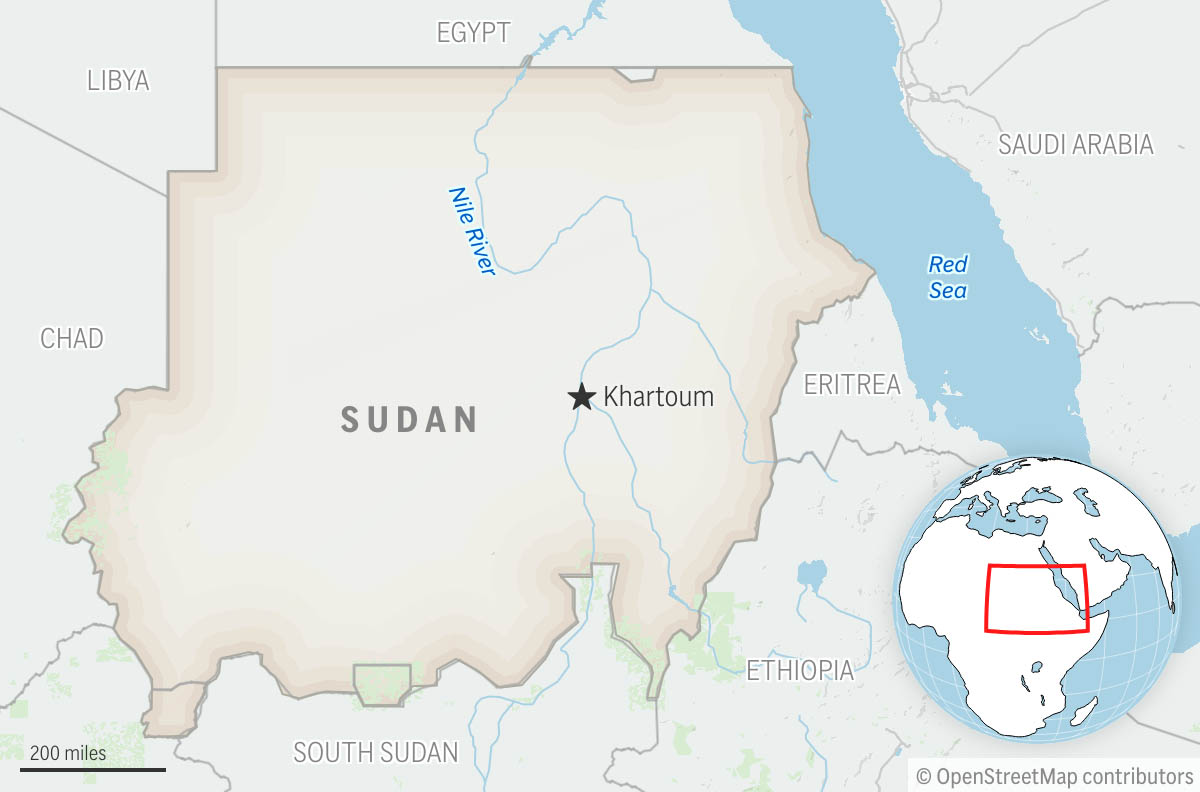
    SHENDI, Sudan — The death toll from the collapse of an informal gold mine in a remote area of Sudan has risen to 82, according to local officials and activists, as rescuers struggled on Wednesday to search for the missing with limited equipment.

    It’s the latest tragedy in a nation mired in a devastating war.

    Survivors said that the collapse happened at the al-Zara gold mine, in Nuhud, a town in West Kordofan province, which is controlled by the paramilitary Rapid Support Forces, or RSF. The group has been fighting against the Sudanese military for more than three years.

    Suleiman Abu Hmeida, a member of the Emergency Response Rooms, said that rescuers had pulled out 82 bodies by Wednesday afternoon. “But dozens remain unaccounted for,” Abu Hmeida told the Associated Press.

    The Emergency Response Rooms is a grassroots network that monitors the conflict and provides support for communities across war-torn Sudan.

    A local administration official also said that 82 bodies were recovered.

    The official said that the collapse began on Sunday in one of the mine shafts and spread to the other interconnected shafts. He said that only one privately owned forklift is available for the rescue efforts, complicating the search for survivors.

    The official spoke on condition of anonymity because he wasn’t authorized to speak to the media.

    “The collapse is massive and the situation is very dire,” Khairal-Sayed Gabara, one of the survivors, told the AP when reached by phone. He said that the machinery needed to remove the collapsed soil and rubble wasn’t available.

    “We do not have the machinery to lift dirt and stones and search for survivors at depths of more than 30 meters (around 100 feet),” he said. “There were dozens of people working in the mine.”

    The al-Zara gold mine is one of thousands of small-scale and informal mines scattered across Sudan, which has been engulfed in a war that has at times pushed parts of the country into famine.

    Despite Sudan being a major gold producer, deadly mine collapses aren’t uncommon in a country where safety standards aren’t widely applied. A 2023 collapse killed 14 miners and one in 2021 claimed 38 lives.

    Al-Amin Suliman, another survivor, said that 60 bodies had been recovered as of Wednesday morning.

    “There are still people stuck inside,” he said.

    The Sudan Doctors Network, a medical group tracking the war in Sudan, reported earlier that 67 bodies were pulled from the rubble, predicting that the death toll could increase as rescuers continued their search. The group said that the mine — an informal site that employs unregulated workers — lacked basic safety and protective measures.

    Earlier, survivors reached by phone and the physicians network said that the tragedy took place on Tuesday evening.

    The Kordofan Observatory monitoring group said that at least 70 miners were killed or missing at the site, which stretches around a half-mile across a wide swath of fragile, sandy soil. It described the miners as unregulated and informal workers.

    Large quantities of gold have been smuggled out of the country to finance the RSF, which controls gold-producing areas in the Darfur and Kordofan regions, according to experts commissioned by the United Nations.

    Sudan plunged into an all-out war in April 2023 as fighting erupted between the RSF and the Sudanese military in the country.

    The conflict has killed at least 59,000 people, according to Armed Conflict Location & Event Data, a monitoring group. Aid organizations say that the figure is an undercount, and the true number could be many times higher.

  • Federal Reserve hikes key rate for 1st time in 3 years, defying Trump demands for a cut

    Federal Reserve hikes key rate for 1st time in 3 years, defying Trump demands for a cut

    WASHINGTON — The Federal Reserve raised its benchmark interest rate Wednesday for the first time since 2023 in an effort to quell stubbornly-high inflation and the central bank also signaled that another rate hike could occur later this year.

    The quarter-point increase lifts the Fed’s key rate to about 3.9% and, over time, could result in higher borrowing costs for mortgages, auto loans, and credit cards. In a set of quarterly projections, the Fed also signaled that its rate-setting committee expects to hike rates a second time to 4.1%.

    The move comes as Americans are already struggling with high costs for groceries, gas, and housing. Affordability has taken on a leading role in the upcoming midterm elections, just seven weeks away.

    In a news conference following the Fed’s announcement, Chair Kevin Warsh emphasized that the economy has shown signs of gathering speed since the central bank decided to keep rates unchanged in late July. Inflation has also remained stubbornly above the Fed’s 2% target and he noted that there is little sign it is cooling.

    “The plain fact is that inflation is too high and has been for too long,” Warsh said. “We must be confident that underlying inflation is moving to our objective clearly and at sufficient speed. Today the FOMC decided that this standard has not been satisfied,” he added, referring to the policy-setting Federal Open Market Committee, an arm of the Fed.

    “Warsh’s tough talk around inflation in the post-meeting press conference suggested that he may be pushing for higher rates in meetings to come,” said Preston Caldwell, chief U.S. economist at Morningstar.

    Warsh also said renewed combat between the U.S. and Iran, which has driven up gas prices, also convinced Fed officials to support rate hikes.

    “There’s no hiding from hotspots around the world,” he said.

    Warsh noted that other central banks are hiking interest rates, in response to global turmoil and higher gas prices. The European Central Bank raised its key rate last week, and the Bank of Japan is expected to do the same Sept. 18.

    The Fed next meets in late October and most economists expect officials will keep rates unchanged then because it is just a week before the midterm elections. But Wall Street analysts now see a rate hike by December as a near certainty, according to futures prices.

    Also late Wednesday, the yield, or interest rate, on the 2-year Treasury rose to 4.74% from 4.67%, another sign investors expect the Fed to potentially lift rates further.

    Since taking the lead at the Fed in May, Warsh has said the Fed is firmly committed to taming inflation, and that policymakers would take their cues from the data to determine if inflation was going in the right direction.

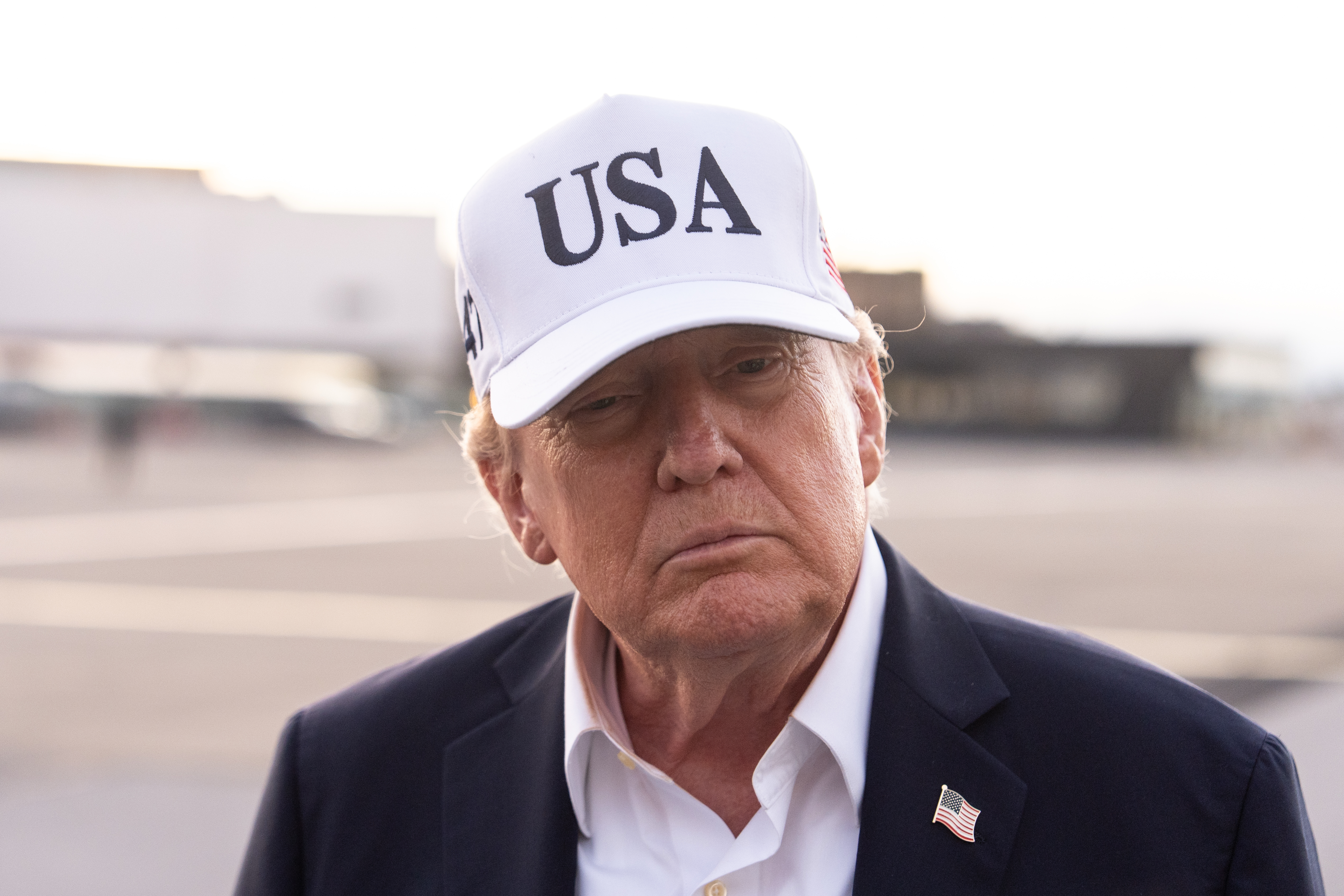
    The rate hike marks a turnaround for Warsh, who was appointed by President Donald Trump. Warsh often suggested last year when under consideration by Trump that the Fed could reduce its key rate, echoing the president’s call for lower borrowing costs.

    And in April, when Warsh’s nomination was under consideration by the Senate Banking Committee, Trump said in a television interview that he would be disappointed if Warsh didn’t cut rates. On the same day, however, Warsh told the committee he did not promise Trump he would cut rates and said he would be “an independent actor” as Fed chair.

    Yet the ongoing disruptions from the Iran war, which have pushed up average gas prices more than 7% from just a month ago, threaten to spread through the economy and keep broader inflation stubbornly high. An inflation report last week showed core prices, which exclude food and energy, accelerated a bit in August.

    According to the Fed’s preferred measure, inflation was 3.7% in July compared with a year ago, up from 2.3% in April 2025, just before Trump unveiled sweeping tariffs. Core inflation, which excludes the volatile food and energy categories, was 3.3% in July, the latest data available, up from 3% just before the Iran war and far above the Fed’s target.

    Fed policymakers unanimously supported the rate hike, compared with late July when the central bank kept rates steady and three officials dissented in favor of higher rates. Sixteen of the eighteen Fed policymakers who submitted growth and interest rate projections penciled in at least one further rate hike this year, with four supporting two more increases.

    Earlier Wednesday, the government said retail sales jumped 1.2% in August from the previous month, a sign that consumers are still spending at healthy levels despite sentiment surveys that indicate Americans remain gloomy about the economy. Strong spending is a sign that interest rates at current levels aren’t necessarily restricting the economy and cooling inflation.

    “While uncertainty remains elevated owing, in part, to geopolitical developments, domestic spending has been resilient,” the Fed said, a likely reference to ongoing consumer spending and strong investment in AI data centers by large technology companies.

    Higher inflation isn’t all about gas prices. Ongoing investment in AI has driven up prices for computer chips and other electronic gear, adding to overall inflation. Tariffs may still be elevating some costs, such as appliances, which jumped in price last month.

    Trump harshly criticized Warsh’s predecessor, Jerome Powell, for not cutting rates quickly enough. His Justice Department even launched a criminal investigation into Powell over brief testimony he delivered to Congress last year, though that probe was eventually dropped.

    When asked Wednesday how the president might react to the rate increase, Warsh said, “I’ve got nothing for you on a discussion with the president.”

    Trump again called for lower interest rates in a social media post late Wednesday, but didn’t comment on the Fed’s action. On Sunday, Kevin Hassett, Trump’s top economic adviser, was asked in an interview with Fox News how Trump might react to a rate hike.

    “I’m sure he’s not going to be super happy about it, but he will defend the independence of Kevin Warsh above all,” Hassett said.

    Warsh might also have a measure of protection from the fact that his father-in-law is Ronald Lauder, a friend of Trump’s and a billionaire donor to his campaigns.

  • Houthis seize 2 strategic Red Sea islands

    Houthis seize 2 strategic Red Sea islands

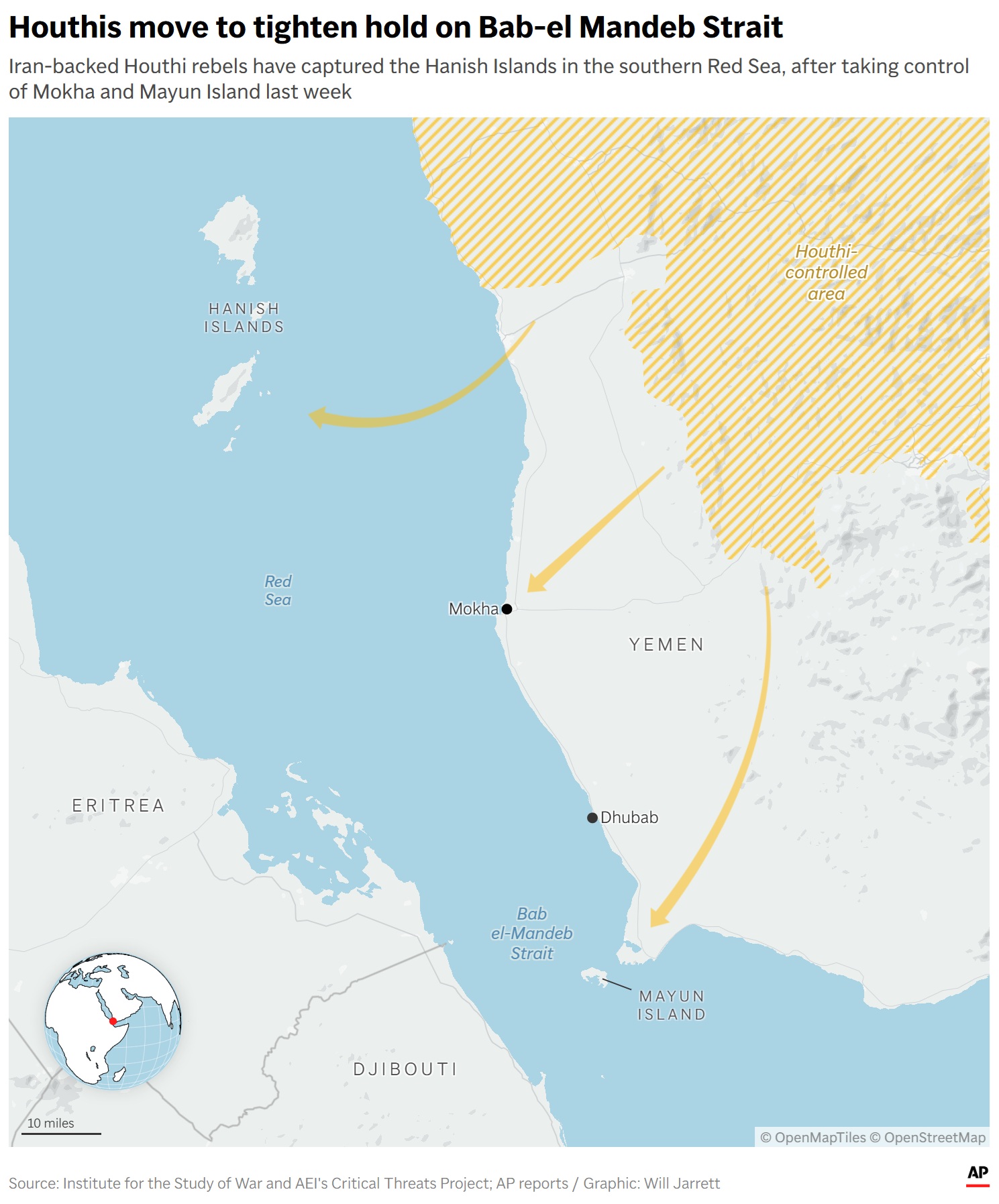
    Yemen’s Houthi rebels have seized the strategic islands of Greater and Lesser Hanish in the southern Red Sea, bolstering the Iran-backed rebels’ ability to control a key maritime shipping route.

    Meanwhile, repairs to a crucial Saudi Arabian oil pipeline that was struck in an attack last week could last three to five weeks, putting it mostly out of service, two regional officials said.

    Houthis gain ground as oil prices face more pressure

    Houthi officials said Monday that rebels had taken over the two islands just as Saudi-backed government forces tried to claw back territory from the rebels’ swift advances around the Bab el-Mandeb Strait, a crucial shipping alternative to the Strait of Hormuz.

    Iran effectively closed the Strait of Hormuz — through which a fifth of the world’s traded oil and gas transits in peacetime — in the opening days of the war. The Saudis have since used the Bab el-Mandeb Strait, which leads out of the Red Sea, for crude oil exports.

    The Houthis’ latest takeover, following the seizure of the Red Sea port of Mokha and a strategic island last week, puts more pressure on Saudi shipments and, in turn, global oil supplies and prices.

    This could give Iran additional leverage in its war with the United States.

    Oil might only partially move through damaged line

    Saudi Arabia relies on the East-West Pipeline to move crude from Gulf ports to ports on its western, Red Sea coast. From there it can be put on tankers for export.

    Two officials briefed on the matter said repairing damage from an attack on Sept. 10 could take weeks, including at a major pumping facility.

    The officials spoke on condition of anonymity because they weren’t authorized to brief the media. One said the line may work partially while teams carry out the repairs.

    China, a major Middle East oil importer, called Houthi attacks on Saudi energy infrastructure “unacceptable” and said that it was “deeply concerned” about further escalations by the rebels.

    Iran says Saudi Arabia behind postponed meeting on Hormuz

    Iranian Foreign Ministry spokesperson Esmail Baghaei said Monday that Saudi Arabia had “demanded” that a meeting bringing together Iran with other regional countries to discuss the Strait of Hormuz be scrapped “for the time being.”

    Baghaei called the meeting, which was to be hosted by Oman, a “proper opportunity” to restore security in the region.

    The spokesperson said that an agreement between Iran and Oman on the Strait of Hormuz has been finalized and it will be announced later.

    Saudi Arabia had submitted amendments to the agreement, citing concerns that it could have lasting implications for the Strait of Hormuz, negatively impacting other Gulf Cooperation Council countries, according to a Gulf official familiar with the matter who wasn’t authorized to comment publicly and spoke on condition of anonymity.

    Iran condemns Austria’s visa refusal for its nuclear chief

    Iran denounced on Monday the refusal by Austria to issue visas to the Iranian nuclear chief and other delegation members for the International Atomic Energy Agency’s general conference in Vienna, calling the decision “completely unjustified.”

    Baghaei said that Tehran summoned the Austrian chargé d’affaires, saying Austria was obligated as the host country to issue the visas.

    Baghaei accused Western countries of denying Iran an opportunity to defend itself and blamed the U.S. for pressuring Austria to deny the visas.

    The refusal is part of U.N. sanctions on Iran, reinstated last year, that include a travel ban on Iranian officials.

    Iran fails to live up to nuclear obligations, U.S. official says

    U.S. Energy Secretary Chris Wright on Monday criticized Iran’s failure to cooperate with the U.N. nuclear watchdog.

    Wright was particularly critical of Tehran’s refusal to grant U.N. inspectors access to Iran’s nuclear sites affected by the war. He said that Iran had “ample time to address its egregious negligence” toward its obligations ”but that time is up.”

    Speaking at the IAEA general conference in Vienna, Wright said that giving Iran more time “only delays overdue accountability.”

    Yemenis flee homes as rebels press on

    Nearly 94,000 people have fled their homes in Yemen since fighting between Iran-backed Houthi rebels and government forces escalated this month, the International Organization for Migration said Monday.

    The worst-hit areas are Taiz and Lahj, where 48,000 have been displaced, the U.N. agency said, adding that more than 2,000 people have fled across the sea into Djibouti.

    Around 200 schools have been converted to shelters in southwestern Yemen to absorb an influx of families, the International Rescue Committee, an aid group, said.

    Fears mount that Yemen is inching closer to a return to a civil war that killed 150,000 before a 2022 ceasefire. The World Health Organization said more than 500 people were killed in a weeklong period ending Saturday, a sharp increase.

    Israel accused of dismantling ‘Palestinian existence’ in West Bank

    The B’Tselem human rights group said Monday Israel is carrying out a systematic and accelerated project aimed at “dismantling the foundations of Palestinian existence” in the occupied West Bank.

    The group said in a new report that Israeli actions against Palestinians in the West Bank by settlers and the military are designed to undermine Palestinian collective life “while entrenching a permanent system of Jewish supremacy” across the territory.

    Settler violence has surged under the ultranationalist government of Israeli Prime Minister Benjamin Netanyahu. Rights groups say the military frequently turns a blind eye to the violence, and that when it intervenes it often focuses on protecting the settlers.

    The B’Tselem report also says that Israeli actions rely heavily on open cooperation between state authorities and armed settlers who attack Palestinian communities, while the military either fails to prevent the violence or sometimes participates in it.

  • Trump says a smart president is all that’s needed to rein in AI

    Trump says a smart president is all that’s needed to rein in AI

    WASHINGTON — President Donald Trump on Monday rejected calls from leading artificial intelligence executives for new limits on the technology, writing on social media that the only guardrail the industry needed it already had: “a STRONG AND SMART (High IQ!) PRESIDENT.”

    Trump inserted himself into the intensifying national debate over how to handle a rapidly evolving technology that researchers and industry leaders say poses major risks like mass unemployment, a new wave of biological weapons, and autonomous warfare. The president did not address those risks directly. Instead, he questioned the sincerity of the executives who have been calling to slow the technology’s development.

    “The only control or ‘guardrails’ that AI needs is a STRONG AND SMART (High IQ!) PRESIDENT, and the U.S.A. has that, in spades!” Trump posted. “The Trump Administration has stopped AI ‘people’ from doing bad, or potentially bad, ‘things,’ like Dario (Anthropic!), who is now pretending to be a ‘perfect little angel’ — and we will continue to do so!

    “We already have tremendous CRIMINAL and REGULATORY power over these companies!” he added.

    It was not clear what authority Trump was referring to, or what actions he believes his administration has already blocked. The White House did not immediately respond to a request for comment.

    Over the weekend, Dario Amodei, the CEO of Anthropic, a leading AI company whose founders have long warned about the technology’s dangers, published an essay that called for a global slowdown of AI development. Days earlier, one of Anthropic’s researchers quit and went public over his fears about the safety of the technology.

    The Trump administration feuded with Anthropic earlier this year when the company refused to allow the Pentagon unfettered access to its AI system without the safeguards the company wanted. Trump then ordered the federal government to stop using Anthropic’s AI technology and labeled it a security risk, a designation that a federal judge later ruled was unlawful.

    Other AI chiefs have voiced their own concerns in recent days. Demis Hassabis, the chairperson of Google DeepMind; Elon Musk of SpaceX; and Sam Altman of OpenAI have all endorsed calls for a slower pace.

    Trump has spent much of his second term aligning himself with AI accelerationists who have been pushing the U.S. government to clear away obstacles to growth. He has been influenced in particular by Jensen Huang, the CEO of chipmaker Nvidia, and David Sacks, a Silicon Valley investor who played a major role in shaping the administration’s policies on AI.

    The president has embraced their arguments that imposing additional guardrails on American companies would allow China to “win” the AI race.

    Beijing, however, has its own anxieties about the technology — and they may lead to more regulation, not less. Chen Yixin, China’s security minister, recently warned that the leading AI models pose risks to the Chinese system and called for stricter government oversight.

    The Associated Press reported that in an editorial published Sunday, China’s state-run Global Times newspaper dismissed Amodei’s essay as a veiled call to “contain” China. It said that Amodei’s essay may appear on the surface to be focused on global AI security, but that it is “packed with containment provisions targeting China and is, in essence, a ‘Cold War playbook’ for the AI sector.”

    Amodei’s essay was published a few days after the FBI, National Security Agency, and Cybersecurity and Infrastructure Security Agency issued a joint cybersecurity advisory last week. That advisory said Chinese AI developers had engaged in “aggressive, malicious” efforts in extracting, or “distilling,” capabilities from some of the most advanced AI models in the U.S. like Anthropic’s Claude and OpenAI’s GPT.

    Trump and Chinese leader Xi Jinping are expected to discuss AI governance, among other topics, at a Sept. 24 meeting.

    Trump has also dismissed the domestic backlash to the industry’s growth. He claimed in his social media post Monday that widespread opposition to the building of data centers — a major political issue emerging across the United States before the midterm elections — is part of a “conspiracy” rather than the outgrowth of genuine public anxiety.

    “There is a SICK conspiracy going on against AI and Data Centers, and the only one that is happy about it is China,” the president posted. “WHOEVER WINS AI, WINS! We are leading China, and all others, and will continue to do so. Conspiracy Theorists, Treasonists, Traitors, and Leakers, BEWARE!”

    Elsewhere, governments are moving toward stricter oversight. Prime Minister Mark Carney of Canada told Bloomberg News on Monday that he favored the creation of a global “technology stability” body to oversee AI.

    “There’s a need for coordination,” Carney said in the interview. “Ultimately, a technology stability board, in our view, along the lines of the Financial Stability Board would make sense.”

  • At BRICS, India’s Modi warns geopolitical tensions and supply chain shocks threaten global stability

    At BRICS, India’s Modi warns geopolitical tensions and supply chain shocks threaten global stability

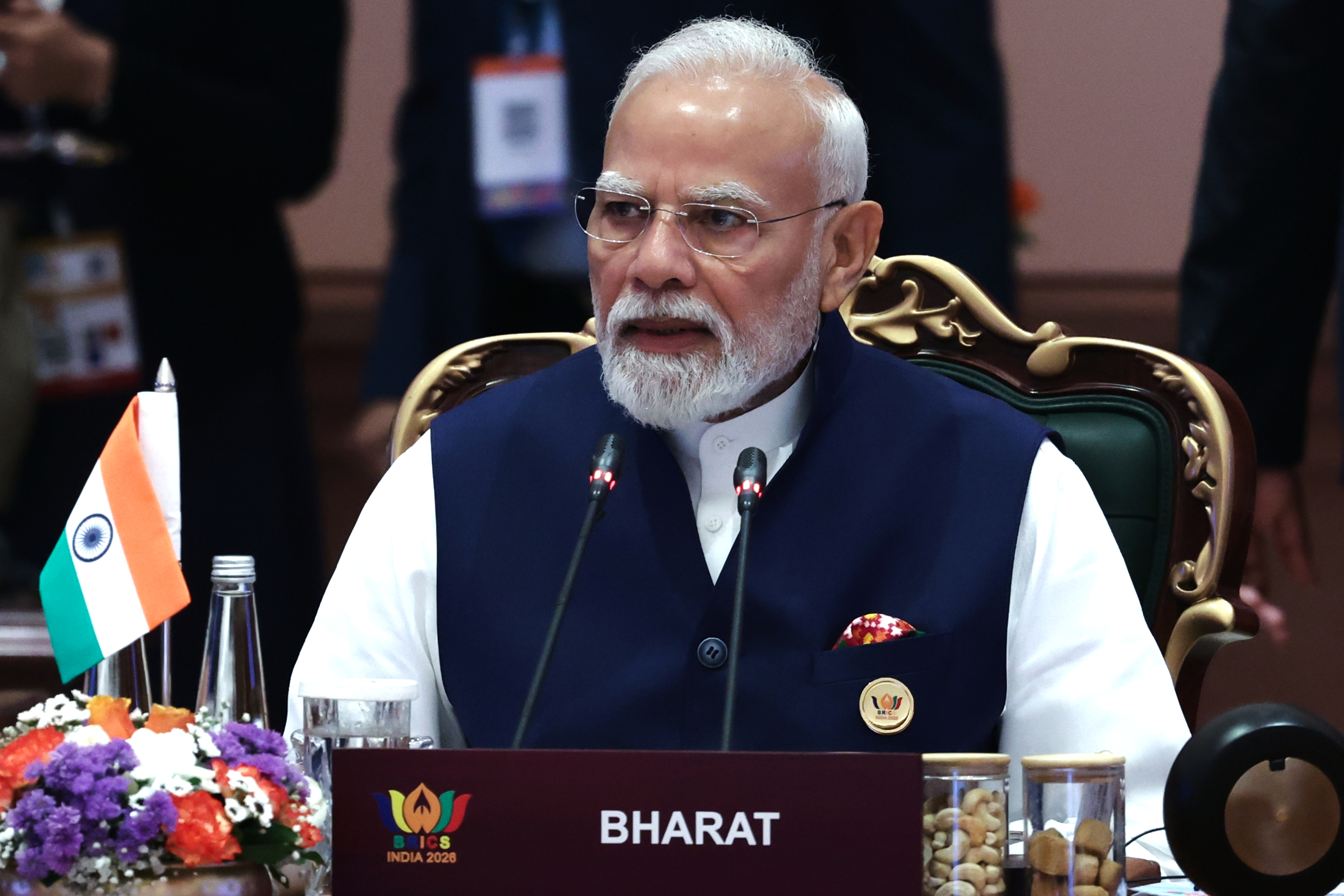
    NEW DELHI — Indian Prime Minister Narendra Modi on Sunday warned that rising geopolitical tensions, supply chain disruptions, and climate crises are increasingly affecting people worldwide and called for strengthened cooperation and support across the Global South.

    Addressing the BRICS summit of leading developing nations on its second day in New Delhi, Modi also warned that the “weaponization of technology and critical minerals” could hinder global development and shared prosperity.

    Founded in 2006 by Brazil, Russia, India, and China, BRICS has expanded to 11 members representing about half the world’s population and a significant share of global economic output. It has sought greater representation for developing countries in global institutions and promoted alternatives to Western-dominated financial systems.

    “The number of conflicts and tensions in the world is continuously increasing, and this is having an increasingly negative and far-reaching impact on the lives of ordinary people,” Modi said, alongside bloc leaders, including Chinese President Xi Jinping, Russian President Vladimir Putin, and Iranian President Masoud Pezeshkian.

    “Pandemics, climate disasters, and supply-chain disruptions have shown that in today’s interconnected world, no crisis remains confined to a single region,” Modi said, while announcing that the bloc agreed to establish an integrated early warning system for infectious diseases, aimed at boosting preparedness and response to future outbreaks.

    In his closing remarks at the summit, Modi urged the bloc nations to convert the summit’s agreements into tangible and time-bound action and move them from “files to real-life impact.”

    The discussions over the past two days, he said, reinforced the belief that “BRICS is not merely a group of countries, but an ecosystem of solutions.” He wished China success as it takes over the BRICS chair for the next term.

    The group in a joint declaration Saturday had expressed concern over escalating tensions in the Middle East and Sudan, and called for disputes to be resolved through dialogue and diplomacy.

    The bloc reiterated support for a multipolar world order and reforms to the United Nations, including its Security Council, as well as global financial institutions such as the World Bank and the International Monetary Fund.

    The leaders opposed unilateral sanctions and coercive economic measures and criticized sanctions not authorized by the U.N. They also criticized rising tariffs and nontariff barriers, saying they undermine global trade and supply chains.

    The bloc backed greater use of local currencies in trade and stronger cross-border payment systems, while calling for cooperation on food security, energy, digital infrastructure, artificial intelligence, and climate action.

    The declaration was a significant breakthrough, as forging consensus among Iran, Saudi Arabia, and the United Arab Emirates — which hold competing positions on key regional and geopolitical issues — posed a complex diplomatic challenge amid ongoing conflicts and heightened tensions.

  • US stocks jump after oil prices ease and an inflation update comes in near expectations

    US stocks jump after oil prices ease and an inflation update comes in near expectations

    NEW YORK — U.S. stocks rebounded Friday and regained much of their losses for the week after oil prices eased off their recent spurt. An update on inflation across the United States that came in close to economists’ expectations, even if prices are still rising too quickly for everyone’s liking, also helped calm the market.

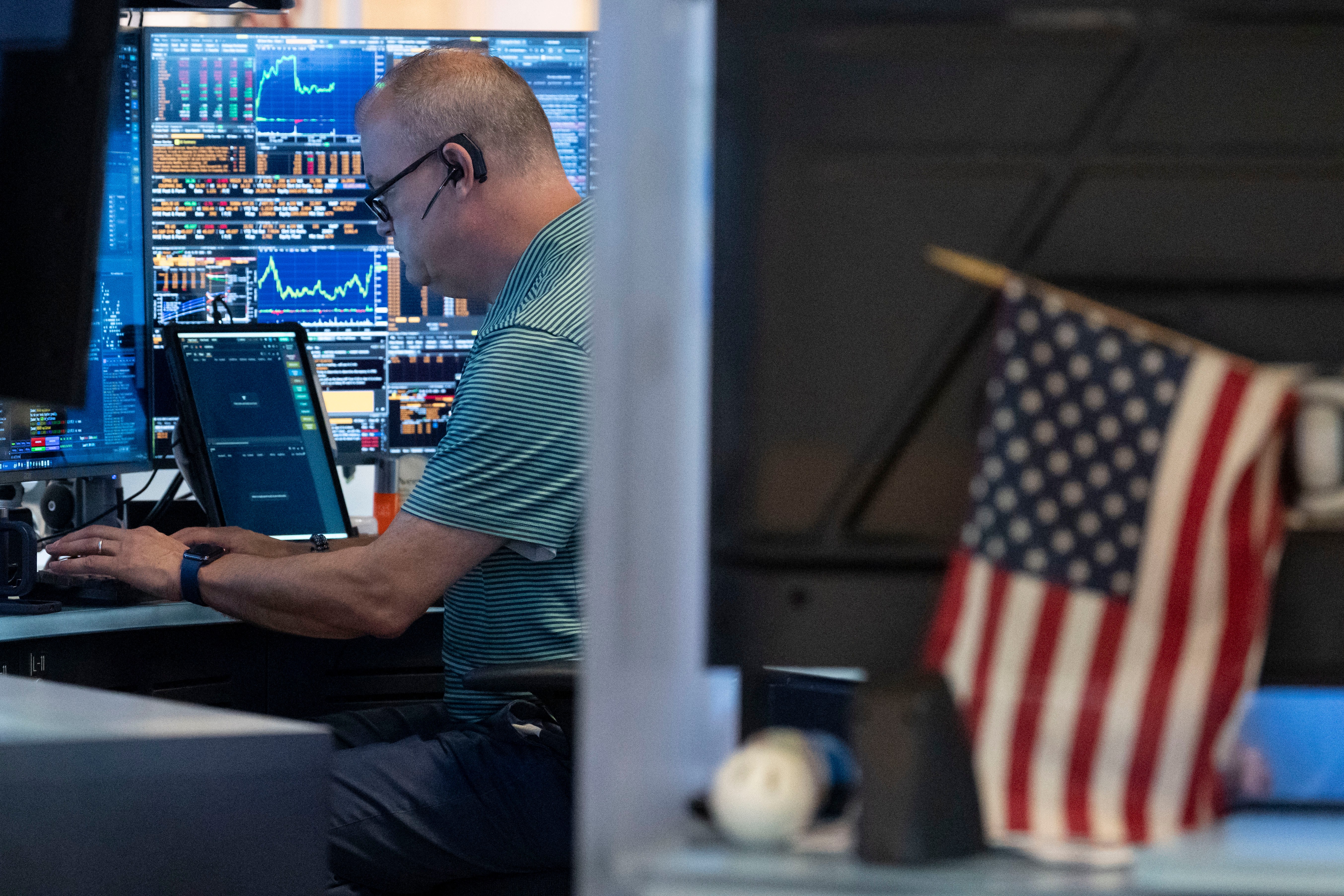
    The S&P 500 climbed 0.9% and snapped a four-day losing streak, its longest since June. The Dow Jones Industrial Average jumped 509 points, or 1%, and the Nasdaq composite rose 1%.

    They got help from a pullback in oil prices, which had jumped to their highest levels since May because of the ongoing war with Iran. The price for a barrel of Brent crude, the international standard, fell 2.8% to settle at $104.61 after getting near $110 overnight.

    That took a bit of pressure off inflation, which remains stubbornly high. A report on Friday showed that U.S. consumers had to pay prices for gasoline, food, and other costs of living that were 3.4% higher last month than a year earlier.

    While still high, that was close to what economists expected and what Wall Street was prepared for. The data also strengthened expectations among traders that the Federal Reserve will feel compelled to hike its main interest rate at its meeting next week.

    Such moves are the typical way the Fed tries to rein in high inflation, and they work by filtering through the bond market, making it more expensive for everyone to borrow money, slowing the economy, and hopefully removing fuel for further inflation.

    The rising expectations for an upcoming hike to rates drove up the yield of the two-year Treasury, which moves with guesses for upcoming Fed action, to 4.62% from 4.56% late Thursday.

    Longer-term Treasury yields held steadier, though. That could be a signal that investors in the bond market see upcoming hikes by the Fed as helping to keep control of inflation over the longer term. The yield on the 10-year Treasury rose more modestly to 4.97% from 4.95% late Thursday, while the 30-year yield eased to 5.36% from 5.37%.

    Economists say hikes could quiet questions about the Fed’s commitment to keeping inflation under control. Worries had risen earlier in the summer about its credibility and whether it would do what’s needed to bring inflation down, even if it causes pain for the economy in the near term.

    Federal Reserve Chairman Kevin Warsh has been adamant about not giving hints about where the Fed may take interest rates, though he did calm some concerns among investors at a speech late last month. President Donald Trump, meanwhile, has been pushing for interest rates to go lower rather than higher.

    “Symbolism can trump substance, even when it comes to monetary policy,” according to Brian Jacobsen, chief economic strategist at Annex Wealth Management.

    It’s all coming at a moment when confidence among Americans continues to sour. A preliminary report from the University of Michigan on Friday said U.S. consumer sentiment is falling, with declines for both Democrats and Republicans.

    Their expectations for inflation coming in the year ahead jumped to 4.6% from 4% last month. That’s the highest reading since June, and it’s concerning for the Fed and for economists because it can trigger a vicious cycle of behavior that worsens inflation.

    On Wall Street, Kroger rose 2.7% after the grocer reported a stronger profit for the latest quarter than analysts expected. It also held firm on its forecast for profit over the fiscal year, even though it trimmed its forecast for an important underlying measure of revenue growth.

    ACV Auctions, whose digital marketplace connects wholesale buyers and sellers of vehicles, soared 44.2% after Copart said it would pay $10.50 in cash for each of the company’s shares. Copart, whose online vehicle auctions sold more than 4 million units in the last year, fell 2.6%.

    An early jump for Oracle faded as trading progressed after the tech giant reported stronger profit and revenue for the latest quarter than analysts expected. After initially leaping 8.5%, its stock swiveled between gains and losses and finished with a loss of 1.7%.

    Stocks closely tied to the artificial-intelligence industry broadly became shaky this summer on worries that the AI frenzy may have sent prices too high.

    All told, the S&P 500 rose 65.28 points to 7,656.98. The Dow Jones Industrial Average added 509.19 to 52,573.29, and the Nasdaq composite climbed 251.31 to 26,333.04.

    In stock markets abroad, indexes rose in Europe as oil prices eased. London’s FTSE 100 added 0.4% after a report said the U.K. economy was stronger in July than economists expected.

    Stock markets were weaker in Asia, where Japan’s Nikkei 225 lost 1.9% and South Korea’s Kospi fell 1.8%.

    AP Business Writers Chan Ho-him and Michelle Chapman contributed to this report.

  • The Houthi advance in Yemen raises concerns about a key shipping choke point

    The Houthi advance in Yemen raises concerns about a key shipping choke point

    FRANKFURT, Germany — The capture of the Red Sea port of Mokha and a strategic island by Iran-backed Houthi rebels in Yemen brings their forces to the heart of a key choke point for the global economy: the Bab el-Mandeb Strait leading out of the Red Sea.

    The Houthis took Mokha on Thursday and on Friday captured Mayun, also known as Perim, off Yemen’s coast, two officials said, in a swift advance that extends their reach near one of the world’s key commercial lanes.

    The strait had been a vital route for crude oil supplies from Saudi Arabia to Asia after shipping through the Strait of Hormuz was restricted due to threat of Iranian attack — until Houthi targeting of Saudi tankers largely ended that safety valve.

    The Houthi advance is focusing renewed attention on the Bab el-Mandeb Strait and further risks to shipping there, despite efforts by the Houthis to reassure shipowners that vessels other than those covered by their embargo on Saudi-linked shipping remain safe.

    Bab el-Mandeb was key workaround for Saudi oil exports

    The Strait of Hormuz was long the main highway for Saudi oil. But when Iran choked off most ship traffic at the Strait of Hormuz, the Saudis ramped up shipments through a pipeline running across the desert to Yanbu on the Red Sea.

    Oil loaded on tankers in Yanbu could head out of the Red Sea through the Bab el-Mandeb Strait and then east to Asia. That helped the Saudis maintain a share of their exports to customers there.

    The Red Sea route helped keep global oil prices in check, along with other improvised alternatives. In recent weeks the U.S. military has guided tankers through the Strait of Hormuz in defiance of Iranian demands that ships pass through a vetting lane near the Iranian coastline. And the United Arab Emirates has used a pipeline to Fujairah on the Gulf of Oman to skirt the Strait of Hormuz.

    Houthi attacks on shipping through the Bab el-Mandeb Strait started in late 2023 over Israel’s war in Gaza, leading many companies to abandon the route because of safety concerns. Traffic overall remains down some 60% from levels before then, although it remains a key freight route for goods moving between Asia and Europe.

    Alternate routes helped restore much of Middle East oil flows

    In August, alternative routes helped restore some two-thirds of the roughly 15 million barrels that transited Hormuz before the war. That took some of the economic pressure off the U.S. amid politically sensitive higher gas prices ahead of the midterm elections.

    However, Houthi threats have weighed heavily on Saudi oil exports in the Red Sea. In August, Red Sea oil loadings fell from 3.8 million barrels per day to 2.2 million barrels per day, according to the International Energy Agency. Overall, Saudi supply fell 2.3 million barrels per day to 6 million barrels, the lowest in three decades, according to the IEA.

    By now, “Saudi shipping has largely routed away from this risk anyway,” said Richard Meade, editor-in-chief of Lloyd’s List.

    While the Houthi advance “doesn’t change the immediate risk profile” because Saudi and Israeli shipping is already high risk, it does raise the question of whether the Houthis, who have insisted that other shipping is safe, will expand their threats if they face further attack, Meade said.

    “It puts the Houthis in a strong position to take further control if they want to,” he said.

    Meanwhile, increased attacks on shipping in the Strait of Hormuz this week have put use of the U.S. route on hold. Iran said it attacked 10 ships there Wednesday after the U.S hit five Iranian tankers.

    Suez Canal is a workaround for the workaround

    With the Houthis threatening Bab el-Mandeb, Saudi tankers have turned northwest instead of southeast from Yanbu and headed for the Suez Canal.

    Tankers that are too big to pass through the canal have offloaded oil at Ain Sokhna in Egypt to a pipeline to Sidi Kerir on the Mediterranean coast, where the oil is picked up by tanker. Some 70% of Yanbu crude exports are now heading that way, either by pipeline or by tanker, according to Lloyd’s.

    That, however, is a time-consuming and expensive workaround for customers in Asia, since ships must then transit the Mediterranean, pass the Strait of Gibraltar and sail around the Cape of Good Hope at the southern tip of Africa. The Suez route enables the Saudis to redirect as much as 3 million barrels per day.

    But that more than doubles transit time to an Asian destination like South Korea, from 24 days to 54 days, according to senior research analyst Victoria Grabenwöger at energy data firm Kpler.

    That adds to the cost, given that tankers cost tens of thousands of dollars per day to charter even in normal times, while prices have risen in some cases above $100,000 per day during the current global energy turmoil.

  • New iPhones arrive, but you can keep your old phone longer by caring for it

    New iPhones arrive, but you can keep your old phone longer by caring for it

    Apple’s latest iPhones, unveiled this week, come with new features, better cameras, and hefty price tags — including a folding model with a starting price of $1,999. If you’re planning to splurge on a new iPhone 18, you will want to take care of it to make it last as long as possible.

    Or save money by holding on to your current device, whether it is Apple or Android, to get the most life out of it.

    As smartphone technology has matured and innovations have become more incremental, people have stopped buying into the idea that they need to upgrade to the newest phone. There is also an environmental push to keep old phones out of landfills as electronic waste becomes a larger sustainability issue. Modern smartphones are also just sturdier and better able to survive dunks and drops.

    The typical smartphone replacement cycle is now four years, according to Counterpoint Research. Some device owners boast in online forums that they have had phones last more than seven years.

    Here are some pointers on extending your phone’s life:

    Take care of your phone’s battery

    The biggest factor in a phone’s longevity is the battery. A rechargeable battery’s life span is related to its “chemical age,” which is based not only on the manufacturing date but also on factors including “temperature history and charging pattern,” according to Apple. The company says that as lithium-ion batteries chemically age, they hold less charge, which results in “reduced peak performance.”

    Samsung warns against running a lithium-ion battery down completely, because that could shorten its life.

    “The battery is absolutely often the first thing to go in most people’s phones,” said Elizabeth Chamberlain, director of sustainability at the device-repair website iFixit.

    Lithium-ion batteries typically last about 300 to 500 charging cycles before degrading noticeably to the point that they can’t last a day without needing a charge, she said. “Many people will hit 500 cycles in two years. Heavy users will get there faster.”

    Batteries get stressed if they are completely drained or fully charged, Chamberlain said.

    So avoid letting your battery die, and also avoid charging it all the way to 100%, “unless you really need a full charge,” she said. “Aim to keep the battery between 20% and 80% charged.”

    If you are in the habit of plugging in your phone when you go to bed, Apple and Samsung both have charging optimization technology that improves battery life by delaying a full charge based on your daily routine.

    This feature, which is on by default in iOS, pauses charging at 80% and then charges to 100% just before you wake up.

    Phone batteries shouldn’t get too hot or cold

    Device makers warn against exposing phones to extreme heat or cold, both of which can damage batteries.

    Apple says batteries warm up as they charge, which can shorten their life span. It warns against using your phone or charging it in very hot temperatures, above 95 degrees.

    Samsung says you shouldn’t leave your phone in, for example, a car’s glove box when it is very hot or cold. And don’t put it in a freezer either — it’s a myth that it can prolong battery life.

    Google, which makes the Android operating system and Pixel phones, says hot batteries drain faster, even when they are not in use, and that can damage the battery.

    Adjust your phone’s power options to boost battery life

    Tweak your device settings so apps or features use less power, which extends your battery’s daily life and the time between charging cycles.

    You can turn down your phone’s screen brightness, turn on the dark theme and reduce the time for the screen to power off. Enable the auto-brightness feature, which adjusts screen brightness according to the level of ambient light. Also check battery usage in your settings to see if there are any power-hungry apps you can switch off or uninstall.

    If the power level dips below 10%, iPhone users can turn on low power mode to stretch their battery’s life before it needs recharging. Samsung’s Android phones have a similar “power saving mode.” You can also leave it on all the time, but it might affect your phone’s performance.

    Phone cases and screens are essential protection

    Phones are sleek capsules with glossy surfaces, meaning they can easily slip from your hand. A sturdy protective case is essential to help cushion the blow from accidental drops.

    However, beware that some phone cases can retain heat, so your phone might stay hot even if it seems cool, Chamberlain warns.

    Don’t forget a screen protector. Plastic versions are cheap but can scuff easily, according to iFixit, which recommends TPU film or tempered glass because they offer better protection against scratches and drops.

    Keep your device clean

    Keeping your phone in your pocket or purse means ports and sockets collect debris that needs to be cleaned out.

    Chamberlain said that when a phone stops charging, often the problem is simply that the charging port is jammed with lint, preventing the cable from connecting.

    You can buy kits with brushes, picks, swabs and dust blowers to give your phone’s ports, speaker and microphone grilles a thorough cleaning. But in a pinch, use a toothpick and a clean toothbrush.

    Update the software regularly

    Software is another important factor in a phone’s life span. Experts advise keeping your operating system and apps up to date so they have the latest privacy, security and battery management features.

    That will be easier to do as your phone ages because some device makers have been extending the time limit for providing updates.

    Google has pledged to provide Pixel 8 and newer phones with seven years of Android and security updates, compared with four to five years for older models. Samsung pledged in 2024 to extend its operating system updates to seven years.

    Apple said Wednesday that iOS 27 will be available on Sept. 14 and the oldest phone with which it will be compatible is iPhone 11, released in 2019.

    Some phones are designed to be easily repaired

    Sometimes your phone will have a problem that can only be solved by repairing it, usually involving paying someone else to fix it.

    But there are device makers that are making it easier to repair phones yourself. Netherlands-based Fairphone makes phones it says are designed for longevity, which come with a stripped-down version of Android and can be easily disassembled using a mini screwdriver. Replacement batteries, screens and other spare parts can be ordered online.

    Fairphone’s Chief Technical Officer Chandler Hatton said the company aims to have its devices last at least five years.

    “What we’re trying to do is to support people to be able to use their device for longer,” Hatton said.

  • Oil prices leap to their highest since May and drag Wall Street lower

    Oil prices leap to their highest since May and drag Wall Street lower

    NEW YORK — Oil prices keep climbing as the war with Iran keeps clogging the global flow of crude, and they leaped Thursday to their highest levels since before the summer. That worsened worries about inflation and cranked up pressure within the bond market, helping to send stocks lower again on Wall Street.

    The S&P 500 fell 0.6% for a fourth straight loss, its longest such streak since June, though it’s not far from its all-time high set last month. The Dow Jones Industrial Average dropped 316 points, or 0.6%, and the Nasdaq composite sank 0.7%.

    Stocks sank under the weight of rising oil prices. Brent crude, the international standard, climbed another 6.3% and briefly topped $108 per barrel for the first time since May before settling at $107.63.

    It’s jumped from less than $72 in early July as hopes fade that the war with Iran will allow oil to flow freely again from the Middle East anytime soon. President Donald Trump said on Wednesday that oil prices likely won’t come down until after the U.S. midterm elections in November.

    The jump has vaulted the price for a gallon of regular gasoline to an average of nearly $4.28 across the United States, according to AAA. That’s up nearly 34% from a year earlier and is not only costing people more at the pump but also through higher prices for all kinds of products that move by truck to store shelves.

    A report on Thursday said inflation at the U.S. wholesale level accelerated to 5.4% last month from 4.8% in July, and retailers could eventually pass such increases in prices onto shoppers. A report is coming on Friday that will show how much inflation U.S. consumers are feeling.

    The typical move to rein in high inflation is for the Federal Reserve to raise its main interest rate, the federal funds rate. Such a move then filters out through the rest of the bond market, makes it more expensive for U.S. households and businesses to borrow money, slows the overall economy, and undercuts prices for investments. That hopefully would remove some of inflation’s fuel.

    A report on Thursday suggested the U.S. job market may remain solid, with fewer workers applying for unemployment benefits last week. That could give the Fed more confidence that the economy could withstand higher interest rates.

    Following Thursday’s reports, traders see a roughly 73% chance the Fed will raise the federal funds rate at its meeting next week. That’s up from the 61% probability seen the day before, according to data from CME Group. That’s also despite Trump’s consistent lobbying for interest rates to go lower rather than higher.

    The Fed’s counterpart in Europe, the European Central Bank, raised its own interest rates on Thursday in hopes of getting inflation in check. It cited “the conflict in the Middle East” and how it “continues to generate inflation pressures.”

    It all pushed the yield on the 10-year Treasury up to 4.95% from 4.83% late Wednesday, which is a significant move for the bond market.

    It’s up from just 3.97% before the war with Iran began and is back to where it was in the autumn of 2023. That was after the Fed cranked the federal funds rate higher to get super-high inflation coming out of the COVID pandemic under better control.

    Higher yields mean investors can make more money putting their money into bonds, which can in turn make investors less willing to pay high prices for stocks and other investments that are riskier than bonds.

    Some investors see a 5% yield on the 10-year Treasury as the next potential flashpoint. But strategists at Bank of America’s Research Investment Committee suggest 7% may be the more important threshold, pointing to peaks for expensive stocks around that point in the past.

    In the meantime, the rising 10-year Treasury yield is making mortgages more expensive and hurting the housing industry. One report on Thursday said the average long-term U.S. mortgage rate hit its highest level in over 14 months, while a second one said sales of previously occupied U.S. homes fell in August to their slowest pace in more than a year.

    The benchmark 30-year fixed rate mortgage rose to 6.76% from 6.71% last week, mortgage buyer Freddie Mac said Thursday. One year ago, the average rate was 6.35%.

    That helped sent stocks of homebuilders lower, including drops of 3.5% for Lennar and 2.4% for D.R. Horton.

    Elsewhere on Wall Street, Macy’s fell 4.7% even though the retailer reported stronger profit and revenue for the latest quarter than analysts expected. While raising its forecast for earnings this fiscal year, it warned that “there are macroeconomic and geopolitical factors that could influence” how much its customers feel comfortable spending.

    Macy’s said it received $116 million in tariff refunds from the government — $98 million during the quarter and another $18 million after the quarter ended. Macy’s CEO Tony Spring told the Associated Press Thursday that it’s using some of the proceeds to lower prices on certain items like furniture and other big-ticket purchases.

    All told, the S&P 500 fell 44.66 points to 7,591.70. The Dow Jones Industrial Average dropped 316.56 to 52,064.10, and the Nasdaq composite sank 171.62 to 26,081.72.

    In stock markets abroad, indexes slipped across much of Europe and Asia. Hong Kong’s Hang Seng dropped 1.3% for one of the world’s biggest moves.