Category: Associated Press

  • Trump demands Senate cancel August break until it passes voting bill

    Trump demands Senate cancel August break until it passes voting bill

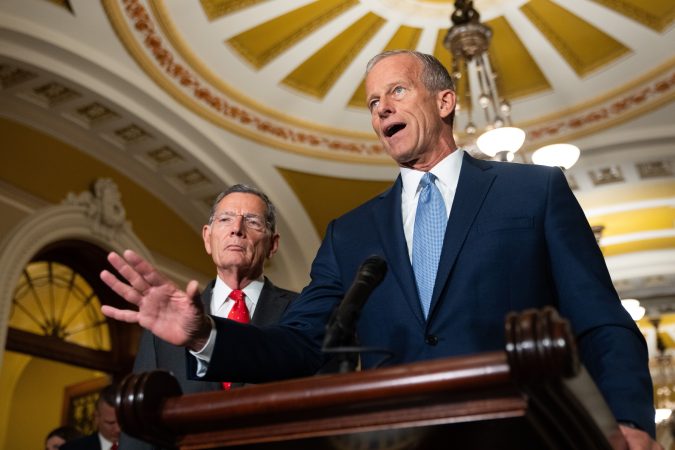
    WASHINGTON — President Donald Trump on Monday demanded that Senate Majority Leader John Thune cancel the chamber’s upcoming August break until senators pass a strict proof-of-citizenship voting bill, even as Republicans lack the votes to advance it.

    Trump has repeatedly urged Thune to scrap the legislative filibuster, which effectively sets a 60-vote threshold for most legislation in the 100-member Senate, or find another workaround to pass the voting bill, known as the SAVE America Act. But Republicans hold only a 53-47 majority, and Thune has consistently said they don’t have the votes to pass the bill or change the rules to get around the filibuster.

    “John Thune should not allow the United States Senate to ‘leave town’ until it passes The Save America Act or, far better still, TERMINATES THE FILIBUSTER,” Trump wrote on social media.

    He later insisted to reporters Monday that he has a good relationship with the Senate majority leader but said Thune has “got to get his job done.”

    It’s the latest escalation in a monthslong pressure campaign by Trump and others in the GOP base to pass the SAVE Act ahead of the midterms. A small but vocal group of Republican senators has also increasingly pressed Thune to find a way forward.

    House Republicans have also attempted to create another path for the legislation through the budget reconciliation process, which would allow grant money associated with voting rules to pass the Senate with a simple majority.

    The House last week approved a budget framework that included $10 billion for voting-related changes aligned with the SAVE America Act. But Thune has said Republicans don’t currently have the votes for that approach, either.

    Trump’s pressure comes during an important period

    The fight threatens to complicate the Senate’s final legislative sprint before the August break, when Thune had hoped to focus on a long list of priorities that includes government funding, cryptocurrency legislation and sanctions on Russia. The August break, scheduled to start on Aug. 7, is a pivotal stretch for senators to return home and campaign ahead of the midterm elections.

    Several Republican senators are facing competitive races, including Maine Sen. Susan Collins, Ohio Sen. Jon Husted and Alaska Sen. Dan Sullivan. Republicans currently hold a 53-47 Senate majority. Republicans are confronting broader political headwinds as well, including an unpopular war in Iran, surging gas prices and costs that remain high for voters.

    Thune has enjoyed broad support from his GOP conference all year as he’s pushed back on Trump’s demands. He previously kept the SAVE Act on the Senate floor for weeks in an effort to build additional support, but was unable to secure the votes needed to advance it.

    Utah Sen. Mike Lee, who has led the push for the bill in the Senate, escalated his pressure late last week, warning that how Republicans handle the SAVE America Act “could impact not only the November midterm elections, but also the Senate GOP leadership elections.”

    “Leaders must lead. And if they don’t, they’re not leaders,” Lee wrote on social media Friday.

    Frustrated by the pressure when he doesn’t have a route to pass the bill, Thune has urged Trump, Lee and others to help him find the votes. Trump on Friday said he’d “certainly be willing” to help call senators.

    Asked last week if Trump is frustrated with Thune, White House press secretary Karoline Leavitt said that “his patience is running out.” But Trump told reporters on Air Force Once Monday while traveling to an event in Michigan, that he hasn’t “even thought” about potential replacements for Thune.

    The late-summer dispute echoes a similar fight before last year’s August recess, when Trump pressed Thune to keep senators in Washington to clear a backlog of his nominees. The Senate ultimately left town without a deal after negotiations with Democrats collapsed.

    The SAVE America Act would create new national rules

    The SAVE America Act, which stands for Safeguard American Voter Eligibility, would require Americans to prove they are citizens when they register to vote, mostly through a valid U.S. passport or birth certificate. It would also require a valid photo identification before voters can cast ballots, which some states already demand.

    Voting experts have said the bill could disenfranchise some 20 million American voters who don’t have birth certificates or other documents readily available.

    Trump has made it his legislative priority in 2026, saying it would “guarantee the midterms” and falsely claimed that election cheating is “rampant.” He previously declined to sign any other legislation until it was passed.

  • Clinton Foundation launches an institute to help state governments find nonpartisan solutions

    Clinton Foundation launches an institute to help state governments find nonpartisan solutions

    The Clinton Foundation unveiled a new initiative Monday to help state and local governments develop and enact nonpartisan policy solutions to improve health outcomes, especially for women and children, economic security, and democracy.

    The foundation’s first new initiative in more than a decade, the Clinton Policy Institute has already begun convening political leaders from both parties, research experts, and Americans affected by the issues being studied to create new approaches to long-existing problems.

    “Rising costs, economic uncertainty, rapid technological change, and growing pressures on our public institutions are making it harder for families to get ahead,” former Secretary of State Hillary Rodham Clinton said in a statement to the Associated Press. “We created CPI because we believe there are still practical, evidence-based solutions that can improve people’s lives.”

    CPI is building on its work with New York state in banning cellphones from schools in the past academic year. Though the institute did not technically exist last year when it teamed with New York Gov. Kathy Hochul’s administration on creating distraction-free schools in the state, the Clinton Foundation saw promise in its approach and decided to expand it before publicly announcing CPI’s creation. It’s a strategy that the foundation, also led by former President Bill Clinton and public health expert Chelsea Clinton, used when it launched the Clinton Health Access Initiative in 2004.

    Zayn Siddique, former principal deputy director of the Domestic Policy Council, will serve as CPI’s chief executive officer. Jennifer Klein, who was director of the White House Gender Policy Council under former President Joe Biden, will be CPI’s chair.

    In New York, CPI helped create the Teen Tech Council so that students could help make the phone-ban program more effective. The result, according to Hochul’s office, was that educators found a marked improvement in classroom behavior and engagement.

    “CPI is bringing together policymakers, researchers, business leaders, and community organizations to identify what works, build stronger policy networks, and help turn those ideas into policy,” Hillary Clinton said. “We’re taking a particular focus on states and local communities, where so much innovation is happening.”

    Kansas Gov. Laura Kelly praises CPI’s nonpartisan approach

    Kansas Gov. Laura Kelly said a CPI conference on improving the lives of children earlier this month was “the best roundtable I’ve been involved with since becoming governor.”

    Kelly, who will leave office in January due to term limits after serving two consecutive terms, said she was inspired by CPI’s nonpartisan approach to solving problems affecting children.

    “I am a Democrat governor in what is considered a very red state,” Kelly told the Associated Press in an interview. “It became very clear to me that if I wanted to accomplish anything in my political life, I was going to need to do it in a bipartisan way.”

    Kelly believes that, despite political polarization, CPI can succeed in finding nonpartisan solutions — especially to issues involving children and healthcare — and giving state leaders the research and other support to implement them.

    “Every once in a while, you get people from both sides of the aisle who come together and crafted, maybe not sexy legislation, but something that really needed to be done,” Kelly said. “And they get it through.”

    Jerome Adams, former U.S. Surgeon General in President Donald Trump’s first administration, agrees that nonpartisan solutions are possible to find. But he says the nonpartisan nature of the solutions has to be intentional.

    “Health is inherently political,” said Adams. “When you talk about access to healthcare coverage, when you talk women’s health issues, particularly around the issue of abortion and contraception, when you talk about drug policy and whether you’re in favor of harm reduction, when you talk of firearm safety — all of these are inherently political issues.”

    Former Surgeon General Adams sees broad support for children’s issues

    That is complicated further, Adams said, because “we live in a country that is very binary, so every issue, no matter how nuanced, is, for purposes of elections, turned into black/white, yes/no, all or none.”

    However, Adams said CPI has already found a way to get bipartisan buy-in for some of its solutions to adverse childhood experiences (ACEs). In 2020, the state of California launched the ACEs Aware initiative to begin screening for ACEs — which include abuse, neglect, and household challenges — and treating them early to reduce the impact and the cost to the state later.

    Through CPI, Adams was asked to become the co-chair of the National Leadership Council for the ACE Resource Network in June in an effort to bring California’s work treating ACEs to other states.

    “I’m very interested in work that has proven and practical solutions,” he said. “We bring in states and say, ‘Hey, let’s look at the best evidence in terms of what works around adverse childhood experiences and state level policy and then try to implement it in your state’.”

    That strategy has led Republican-led states like Utah and Georgia to consider parts of Democrat-led California’s work on the issue, Adams said.

    He said it’s a sign that CPI’s approach works and can be expanded to other areas.

    The Clinton Foundation hopes that will be the case.

    “Too many people have lost faith that progress is possible,” Hillary Clinton said. “But across the country, leaders are developing innovative policies that are strengthening families and communities. Those ideas deserve to be shared and scaled.”

  • Chiefs assistant Eric Bieniemy’s son charged in shooting of his mother in Virginia, authorities say

    Chiefs assistant Eric Bieniemy’s son charged in shooting of his mother in Virginia, authorities say

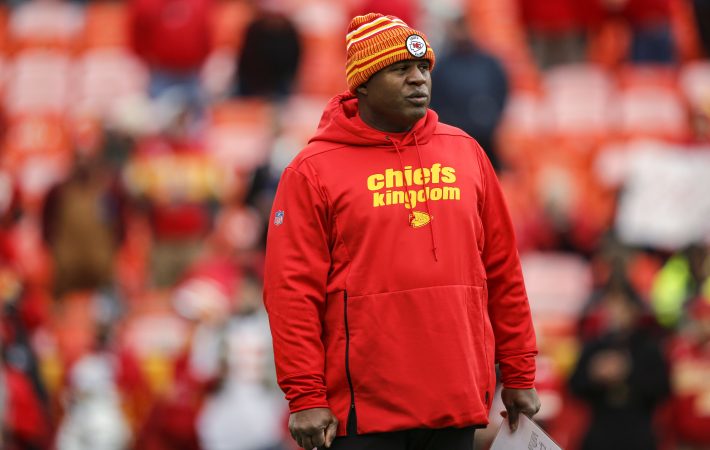
    ST. JOSEPH, Mo. — The son of Chiefs assistant coach Eric Bieniemy has been arrested and charged with the shooting of his mother, Mia Bieniemy, the wife of the Kansas City offensive coordinator, according to authorities in Virginia.

    The Loudon County Sheriff’s Office said Monday that deputies responded late Sunday to a shooting in Ashburn, Virginia, where they found 57-year-old Mia Bieniemy with multiple gunshot wounds. She was transported to a hospital and was in stable condition Monday.

    Elijah Zion Bieniemy, the 27-year-old son of the couple, was arrested in connection with the shooting. He has been charged with malicious wounding, use of a firearm in commission of a felony and discharge of a firearm inside a dwelling, and is being held without bond at the Loudoun County Adult Detention Center.

    Eric Bieniemy was with the Chiefs at their practice in St. Joseph, Missouri, earlier Sunday. He was not present for Monday’s workout.

    “The club is aware of the incident involving Eric Bieniemy’s family,” the team told The Associated Press in a statement. ”Out of respect for their privacy, we won’t have a comment at this time. Our thoughts and prayers are with them.”

  • Your next job interview could be with an AI bot

    Your next job interview could be with an AI bot

    Have you applied for a new job? If you’ve been shortlisted, get ready to be interviewed by artificial intelligence.

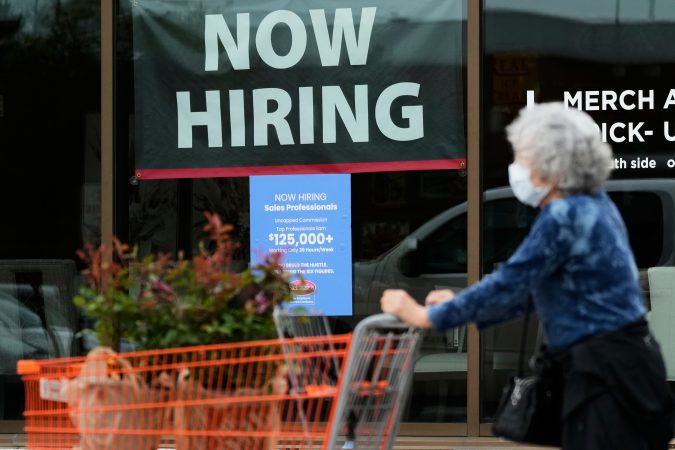
    Deluged by a flood of AI-generated job applications from easy-apply job boards, recruiters are turning to AI to cope. Companies are using chatbots to interview candidates, typically at the screening stage, through phone calls, text messaging, or video chats with onscreen avatars.

    Recruiters have been using AI-powered hiring tools for years to assess job applicants, and their use has been expanding in step with technology advances.

    Many people find AI job interviews unsettling, though the trend seems here to stay. According to recent research by hiring platform Greenhouse, more jobseekers are reporting they’ve faced AI job interviews. But many applicants have walked away from the hiring process because of it, which could be a sign that they’re either creeped out, or they could be fraudulent or were not serious candidates, depending on who you ask.

    Here’s what to expect from an AI job interview and how to do your best:

    Do your homework

    Whatever the interview format, the fundamentals still apply, said Amanda Augustine, a career coach at Careerminds, which helps companies support laid-off workers with resume writing and job search services.

    Ahead of the interview, review the job description, research the organization, and understand what it’s looking for.

    “The more prepared you are, the easier it will be to tailor your responses, even when you’re interacting with AI instead of a person,” she advised.

    Get used to the format

    If you’ve never done an AI job interview before, the first time could be unnerving or unsettling.

    I did a demo AI interview set up by Netherlands-based TestGorilla, one of numerous platforms providing recruitment tools for companies. First came two sets of questions, one that tested problem-solving skills and another gauging work experience. Then I faced an AI-generated female face.

    “My goal is to learn more about you and the experiences, skills, and competencies that you might bring to this role,” it said, adding that I should plan to spend about two minutes to answer each of three questions.

    Unlike a human interview, there was no warm-up chit-chat, no chance to build a rapport. There was no point in smiling or trying to break the ice.

    Experts say the best way to get over that is preparation.

    “You need to practice out loud,” said Priya Rathod, workplace trends editor at online job board Indeed. “And when I say practice out loud, I mean, say the actual answers out loud,” because the chatbot needs to record what you’re saying, she said.

    Also keep in mind you’re providing information about yourself to a machine, not having a conversation.

    “You have to be particularly descriptive and a very clear communicator in your language so that they can pick up on things that a regular interviewer might pick up through your facial expressions and tone,” Rathod said.

    An AI interviewer “cares less about my tone and more about what it is that I’m saying,” she added.

    Use an online interview simulator to prep — there are many available. They can record your answers and provide instant feedback on your content, delivery, or pacing. They’ll also help you get used to speaking into a camera, manage time limits, and give your answers in a structured way without the natural back-and-forth of a live conversation, Augustine said.

    Get ready for behavioral questions

    For my demo interview, the AI grilled me for a communications professional role.

    One question it asked was how I use AI in my “workflow,” including examples of both success and failure. When I replied that I saved lots of time with an AI transcription tool for interviews and other recordings, it summarized my answer and then asked me if I wanted to add anything else. I wasn’t sure whether I had answered satisfactorily.

    I scored “below average” on this question, according to TestGorilla’s assessment, which said I provided “no concrete metric” such as minutes saved. “The improvement claim is therefore vague,” it said.

    AI interviewers are asking these “behavioral questions” because they want candidates to provide examples of how they handled specific work situations, complete with numbers and metrics, Rathod said.

    “Those are the kinds of questions that AI relies heavily on. And the trap that we see a lot of people falling into is giving really vague answers,” she said.

    Candidates should still rely on tried and tested tactics like the STAR method — short for situation, task, action, result.

    So be prepared to talk about a specific work situation and the task assigned to you, the action that you took, and the result, Rathod said.

    “You want to use numbers as much as possible. Even if you’re not in a revenue driving role, there are ways in which you can say (how) you influenced something or impacted something within a group,” she said.

    Setup still matters

    Don’t neglect the physical setup of your desk and computer — it’s still important even if the video-based interview is with AI, and not a person.

    Test your audio and video in advance. Make sure the lighting is bright enough and is on your face. Raise your laptop to eye level so that you’re not looking down at the camera.

    “Small adjustments, such as using a stack of books or a ring light, can make a noticeable difference in how polished and professional you present,” Augustine said.

    Don’t be tempted to use AI shortcuts

    Jobseekers might be tempted to use AI to help come up with answers. After all, they’re so easy to use and if you’re not talking to a human, no one will be able to tell, right?

    “That’s a big no-no because it’s pretty obvious” to both the AI interviewing tool and anyone who might review the recording, said Rathod. Using AI for your answers “can sometimes immediately disqualify you.”

    If you’re having difficulty answering, you can always ask it to clarify or repeat the question.

    The question might even be designed to figure out if you’re using AI to cheat. TestGorilla’s head of marketing, Mehak Chowdhary, said it sometimes poses simple questions worded in a very convoluted way.

    “We do that intentionally to understand whether you are running an AI alongside, because the AI will then try and optimize for the length of the question,” she said. “But if you know your skill set, you will understand what’s being asked.

    “And we strongly recommend candidates put the AI devices aside. This is a test of your capability.”

  • Pentagon’s official Iran war death toll no longer lists 4 troops killed during renewed fighting

    Pentagon’s official Iran war death toll no longer lists 4 troops killed during renewed fighting

    WASHINGTON — The four American troops killed during renewed fighting between the U.S. and Iran in recent weeks are no longer listed as part of the Iran war death toll in the Pentagon’s official casualty count but have been placed in a new, separate category.

    It is raising questions about properly counting the impact to U.S. service members as the Trump administration escalated strikes on Iran in a bid to reopen the Strait of Hormuz, while providing little indication of how it intends to wind down a conflict that is unpopular with many Americans.

    The Defense Casualty Analysis System, which Pentagon officials have repeatedly pointed to as the definitive source on the numbers of dead and wounded from the conflict, removed the four fallen soldiers as well as dozens of wounded troops from its Iran war tally last week.

    On Sunday, a new category called “Overseas Operations” emerged on the system’s website, listing the four Army deaths by name as well as 207 wounded. It was unclear if all of the wounded were injured in the Iran conflict.

    U.S. Central Command, which oversees operations in the Middle East, referred questions to the Pentagon, which did not immediately respond.

    Pentagon described earlier changes to the system as ‘data disruptions’

    Pentagon press secretary Joel Valdez argued Thursday that the drop in casualty figures in the online system was not an effort to hide the growing human toll of the war but rather the result of “anomalies” and “temporary data disruptions” that were being resolved “imminently.”

    As late as Tuesday, the website was reporting the war’s official toll as 18 killed and 482 wounded.

    It appeared to reflect that four soldiers had been killed since fighting resumed despite the signing of an interim ceasefire deal last month — three on a base in Jordan that was struck July 17 by Iranian ballistic missiles and drones, and one in Iraq a day later during a controlled detonation of an Iranian drone.

    Adding further confusion, when the Pentagon announced two of the deaths in Jordan, it said the troops were supporting the U.S. mission to counter the Islamic State group. The other two were announced in press releases simply as supporting overseas operations.

    President Donald Trump has confirmed the total, writing in a Truth Social post on Tuesday that the “Iran Military Conflict” had claimed 18 lives.

    By Wednesday, the Iran war figures in the Pentagon’s system fell back to 14 dead and 420 wounded. However, a U.S. official told the Associated Press at the time that the actual number of wounded personnel in the war had grown to well over 500 troops.

    The Pentagon’s top spokesperson, Sean Parnell, took to social media that day to assert that the reported drop was a “temporary data disruption.”

    New category lists casualties following date of renewed fighting

    The U.S. and Israel launched the war in Iran on Feb. 28, and 14 troops were killed in the initial waves of fighting. Washington and Tehran agreed to a ceasefire in April and then signed an interim deal to end the war in mid-June.

    It was short-lived. Iran struck three merchant vessels in the Strait of Hormuz on July 7 that were transiting along a route near the coast of Oman overseen by the U.S. military. American forces launched strikes in response to the attacks on vessels in the key energy shipping corridor. Trump soon declared that the ceasefire was over.

    The Pentagon system’s new “Overseas Operations” category says it tallies casualties starting July 7.

    Since then, the U.S. and Iran have exchanged regular fire in a bid to control the crucial waterway, with the U.S. hitting Iranian targets nightly for nearly two weeks and Tehran responding with attacks on neighboring countries hosting American forces. There have been no strikes for two nights as mediators push for diplomacy.

    Since the renewed hostilities began, the Pentagon has provided even less information about military strategy and casualties than it did during the first phase of the conflict. The Pentagon has not held a press briefing about the war since early May, and officials at U.S. Central Command have stopped providing casualty updates to reporters.

    Pentagon officials such as Valdez and Parnell have insisted that the DCAS website is proof of the commitment to transparency about the number of dead and injured in the war.

  • Wildfires in France drive 250,000 people from their homes and creep toward wine city of Bordeaux

    Wildfires in France drive 250,000 people from their homes and creep toward wine city of Bordeaux

    LEGE-CAP FERRET, France — A raging wildfire in southwest France forced the evacuation of 55,000 people overnight Sunday, bringing the total forced out of their homes to a staggering 220,000 in one region alone, as flames crept ever closer to the wine region city of Bordeaux. Neighboring Spain oversaw its own fire evacuations on the country’s east coast.

    Shifting and gusting winds, as well as arid conditions, complicated massive efforts to limit the spread of the monster blaze burning out of control since midweek in France’s Gironde region, where Bordeaux is located. Authorities issued overnight evacuation orders for five more localities southwest of the historic city.

    “The situation remains very unfavorable,” French Interior Minister Laurent Nunez said after what he described as “another difficult night” for fire crews battling round the clock against the blaze that has burned an area four times the size of Paris.

    “The fire became extremely virulent again and unpredictable, generating its own winds and advancing erratically toward the Bordeaux metropolitan area,” Nunez posted on X.

    “It became calmer by the end of the night,” the minister added.

    Pope calls for prayers for victims of the ‘devastating wildfires’

    At the end of his Sunday Angelus prayer, Pope Leo XIV referenced “the devastating wildfires” in France and Spain and said: “I express my solidarity and invite everyone to pray for those affected and for the work of the rescue workers.”

    An estimated 162 square miles had burned in Gironde, the region’s prefecture said, much of it forests and scrubland made tinder-dry by successive heat waves. That is seven times the area of Manhattan island and four times the size of Paris.

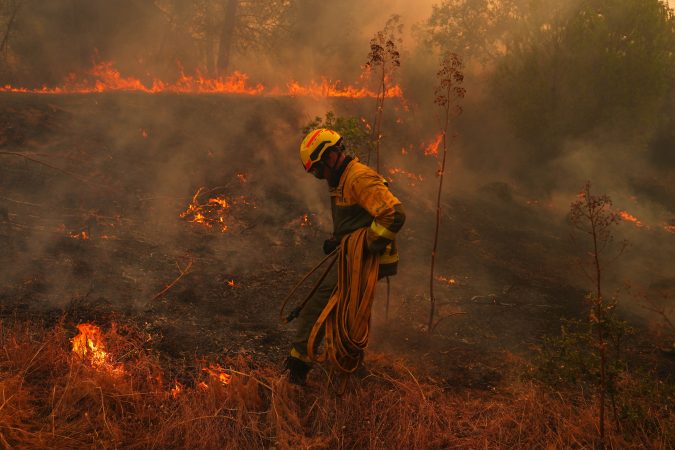
    Firefighters raced in trucks to fight flare-ups and planes dropping water and retardants rotated in the smoke-filled air. Farmers delivered water in tanks to fire crews so they could fight the flames without interruption.

    “This allows firefighters to focus on the fire,” said Theo Hernandez, a wine grower. “It’s very strong, very virulent, it’s spreading everywhere.”

    The number of firefighters mobilized grew to 2,500, backed by 18 planes and helicopters, including from other European nations. Soldiers have also been called in. A giant A400M military cargo aircraft dropped plumes of ochre-colored retardant.

    The Gironde prefecture said 75 firefighters were treated for injuries. Hundreds of homes have been destroyed.

    Blaze has created firestorms

    In a first for France, the blaze alarmingly developed into a self-feeding firestorm on several occasions, most recently on Saturday night, generating lightning bolts that can start new flare-ups, authorities said.

    “It’s like being confronted by a hurricane,” said Gironde fire chief Marc Vermeulen.

    Forecast high temperatures starting Tuesday could complicate the firefighting, Gironde prefect Sophie Brocas said.

    Evacuees won’t be allowed back to their towns and villages until the blaze is brought under control, she warned. She urged holiday makers not to come to the region, which has popular Atlantic beaches and some of France’s largest woodlands.

    Fire creeps toward Bordeaux but the city isn’t evacuating

    Bordeaux Mayor Thomas Cazenave described the blaze as being “at the gates of the metropolitan area,” about 9 miles away at its closest point.

    But Cazenave said an evacuation of Bordeaux is not on the cards for now. The city is home to 268,000 people.

    Bordeaux turned an exhibition center into an emergency shelter, providing cots and food for thousands of evacuees, including hundreds of older people evacuated from care homes.

    A second fire burning farther south in the Landes region has also forced the evacuation of 36,000 people, driving the total number of displaced people in southwest France to more than 250,000.

    Fire crews have also been battling a blaze in the Var region of southern France on the Mediterranean. Nearly 3,000 people have been evacuated there.

    Tens of thousands of people also forced out of their homes in Spain

    In Spain, wildfires burned out of control around Madrid. Evacuations were also carried out Sunday in the Valencia region. A man was killed Saturday in a wildfire in Manises, a Valencia suburb, marking Spain’s first recorded death in the latest fires.

    “We still have some difficult hours ahead,” Prime Minister Pedro Sánchez said Sunday, but the night was “very positive in terms of bringing the flames under control.”

    A total of 76,000 people have been evacuated in Spain while 30,000 others have been confined to their homes, the government said.

    Evacuees fretted about what they’ll find when they’re allowed to return.

    “It looked like the apocalypse. You couldn’t see anything. Everything was covered in ash,” said Rocío Domínguez, who evacuated with her dog, Simba, from Chapinería, west of Madrid.

    “We don’t know when we get to the town, if we’ll have half the house burned down or we’ll have it intact or we won’t have a house,” she said. “All the clothes, all the memories, everything.”

  • UNESCO adds France’s D-Day beaches, Greece’s Mount Olympus. U.S. Okefenokee Swamp to World Heritage List

    UNESCO adds France’s D-Day beaches, Greece’s Mount Olympus. U.S. Okefenokee Swamp to World Heritage List

    SEOUL, South Korea — World War II’s D-Day landing beaches in northern France and the iconic Mount Olympus in Greece were among the sites added to the World Heritage List on Sunday at a U.N. committee meeting in South Korea reviewing dozens of nominations.

    The UNESCO committee, which meets in Busan through Wednesday, also inscribed the ancient Japanese capitals of Asuka and Fujiwara and South Sudan’s Boma-Badingilo Migratory Landscape, host to one of the world’s largest land mammal migrations and the country’s first addition to the World Heritage List.

    Last week, the committee added Georgia’s Okefenokee Swamp to the list. The Okefenokee Swamp is regarded as one of the world’s largest freshwater ecosystems, encompassing a vast network of wetlands that supports exceptional biodiversity and serves as the source of two major rivers. Its largely undisturbed peat beds preserve a 5,000-year record of environmental change, making the swamp both a globally significant natural habitat and a valuable source of information on long-term environmental change, according to a UNESCO description.

    The French designation covers the five Normandy landing beaches — Omaha, Utah, Sword, Gold, and Juno — where more than 150,000 Allied troops came ashore on June 6, 1944, along with the Pointe du Hoc assault site, all central to the campaign to liberate Western Europe from Nazi occupation during World War II.

    The International Council on Monuments and Sites, which evaluates submissions to the heritage committee, said the sites contain extensive remnants, from German fortifications and bomb-scarred landscapes to Allied harbor structures and sunken vessels, marking an “event widely perceived as having enabled the return of freedom and heralded a lasting peace on the European continent.”

    ICOMOS also called for stronger monitoring and preservation efforts on the sites, citing potential threats posed by tourism, climate change, and rising sea levels, and the development of wind farms near the areas.

    Ahlem Gharbi, France’s permanent delegate to UNESCO, said the Normandy landings marked a turning point from global conflict toward a postwar order built on peace and security, and that the designation of the sites carries added significance at a time of escalating international crises and wars.

    “It’s probably the greatest amphibious landing there’s ever been. It ought to be remembered for that alone,” historian David Edgerton said in a recent interview with the Associated Press.

    The World Heritage inscription of Mount Olympus, the mythical home of the 12 Olympian gods, rewarded a 12-year effort by Greece to secure recognition for its tallest mountain as a mixed cultural and natural heritage site. Rising 9,573 feet from a base near sea level, the mountain was believed to be the throne of Zeus, king of the gods, while also harboring rich biodiversity.

    Evangelos Geroliolios, mayor of Dion-Olympus, a municipality at the foot of the mountain, said in a recent interview with the AP that inclusion on the World Heritage List “places greater obligations on our part to protect this environment,” citing the potential impact of increased tourism.

    “We reaffirm our unwavering commitment to safeguarding Mount Olympus for the benefit of present and future generations,” said Georgios Koumoutsakos, Greece’s delegate to UNESCO. “As Greek mythology wisely reminds us, it is always best to remain on good terms with gods.”

    The designated Japanese locations in the western prefecture of Nara cover 19 archaeological sites from the 6th to 8th century capitals of Asuka and Fujiwara, where Japan established its first centralized state modeled after Chinese systems. The sites preserve the largely buried remains of royal palaces, government offices, Buddhist temples, and tombs from capitals that influenced the later capitals of Nara and Kyoto.

    Japanese Vice Culture Minister Shigeki Kobayashi thanked the committee for inscribing the Asuka-Fujiwara sites and said Japan reaffirms its commitment to “transmitting this valuable property to the future generations.” Japanese Prime Minister Sanae Takaichi, a Nara native, wrote on X that she hopes the World Heritage designation will boost tourism to the site.

    Yoshiyuki Aihara, a Nara University archaeology professor, told AP the sites are significant because they show how Japan’s ancient state was formed through influences from China and the Korean Peninsula.

    “If you dig underneath these rice paddies about 1 meter, you start finding a stretch of ruins in this area, though that’s not easy for ordinary visitors to understand,” said Aihara, who is continuing excavation work at the site.

    South Sudan’s Boma-Badingilo site encompasses vast wetlands, flood plains, and savannas shaped by seasonal rainfall and flood dynamics, with an estimated 6 million white-eared kob, tiang, and Mongalla gazelles moving across the landscape in response to changing environmental conditions.

    It also provides habitat for elephants, lions, cheetahs, and other wildlife while supporting various ethnic communities that have lived by herding, farming, and fishing for centuries, according to UNESCO.

  • As Trump boosts nuclear power, regulators seek to eliminate a longstanding radiation safety practice

    As Trump boosts nuclear power, regulators seek to eliminate a longstanding radiation safety practice

    The Nuclear Regulatory Commission is proposing to eliminate a foundational safety principle that has for 50 years minimized the radiation people in the United States are exposed to and that has been adopted around the world.

    Currently, facilities such as nuclear plants, hospitals, or academic institutions that use radioactive materials must ensure radiation exposures are kept “as low as reasonably achievable” — the ALARA principle. The NRC proposal would abandon that philosophy while keeping a separate standard on maximum radiation exposure.

    The two standards have worked together in radiation safety. Dose limits set the maximum amount of radiation the public and radiation workers can be exposed to, while ALARA kept radiation exposure as low as practical under those limits. Research shows radiation exposure increases a person’s chance of getting cancer, a risk that increases as the dose increases.

    The dose limits are not changing. But the NRC, which regulates civilian nuclear energy technologies and radioactive materials, now wants to replace ALARA with a “graded approach” that includes several actions facilities must take depending on the potential dose of radiation to workers. More rigorous radiation protection measures would be required when approaching dose limits to ensure they aren’t exceeded.

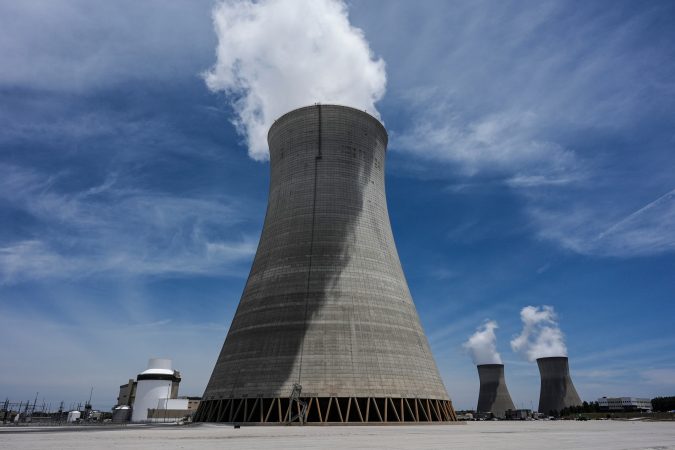
    This comes as President Donald Trump attempts to quadruple domestic nuclear energy production because of surging electricity demand amid a data center and artificial intelligence boom. Reforming the NRC is one way Trump is trying to speed up nuclear reactor development. He instructed the federal agency in an executive order last year to “adopt science-based radiation limits.”

    The Energy Department, which oversees national energy policies, has already stopped using ALARA. The NRC expects to finalize its radiation protection regulations in the coming months.

    NRC Chairperson Ho Nieh said the commission is not lowering the bar on safety.

    “We’re just removing the ambiguity,” he said in a call with reporters. “But the standard for exposure to workers and the public, those are not changing. We’re just putting in place greater clarification.”

    Nieh doesn’t expect major changes within the nation’s existing fleet of large, traditional reactors. But companies designing and building new, smaller reactors could move faster with a clearer picture of the radiation protection requirements, he said.

    Without ALARA, could radiation doses creep closer to the limits?

    The NRC said radiation exposure limits are set well below levels associated with health effects, and it expects remaining standards and industry practices to keep radiation doses far below the limits. There’s incentive to do so — it’s more expensive and time-consuming to work in areas with higher radiation because access must be restricted and more surveys are required.

    The nuclear industry’s trade association agrees with the NRC.

    “We will always continue to look at what can we do to reduce the dose to workers, and maintain our doses to the off-site public as low as possible,” said Doug True, chief nuclear officer at the Nuclear Energy Institute. “It’s not like we’re just going to throw open the doors and let everything run up to the limits.”

    ALARA created a “moving target” for regulation, said Justin Friedman, a nuclear energy consultant who previously spent three decades at the U.S. Department of State. Getting rid of the rule would allow NRC scientists to make more rational decisions about appropriate levels of manageable risk, he added.

    Some experts question the wisdom of eliminating ALARA

    Edwin Lyman, director of nuclear power safety at the Union of Concerned Scientists, cautions that some parts of the NRC proposal could raise permissible radiation doses in certain cases, while still staying below the cap. Lyman highlighted a proposed revision to radionuclide emissions standards, in particular.

    Radiation exposure to the general public is limited to 100 millirem per year. A typical dose of radiation from a chest X-ray is 10 millirem.

    The NRC wants to increase its radionuclide emissions standards from a conservative 10 millirem per year dose to 25 millirem per year, based on a hypothetical person living in a house at the property line for a nuclear plant.

    The NRC says actual doses to the public would remain far lower because, in reality, people live farther from nuclear sites and benefit from dispersion in air and water.

    The NRC should improve, rather than eliminate, ALARA, Lyman said, to protect the public and workers. ALARA has become a political target because some people mistakenly believe radiation exposures have to be as low as possible no matter the cost, Lyman said. In reality, it allows tradeoffs.

    Katy Huff, a former U.S. assistant secretary for nuclear energy, said in some cases, the requirement may be challenging to regulate. Additional clarity would improve the regulatory environment without harming the public, added Huff, a professor and department chair at the University of Wisconsin-Madison.

    However, Huff said, she thought the NRC was going to clarify what reasonable means in ALARA without scrapping it. She said she’s open to being convinced the graded approach will be just as effective.

    Radiation protection expert says proposal is a mixed bag

    The National Council on Radiation Protection and Measurements, chartered by Congress to provide independent scientific guidance, has not formally weighed in yet. Council president Kathryn Higley said she personally likes some things in the 180-page document and thinks others are problematic.

    The NRC should look at the whole picture for managing risk, she said. For instance, if a worker at a nuclear power plant were to enter an area where airborne radioactive materials are present, in keeping with ALARA, they might wear full personal protective equipment with respirators, said Higley, professor emeritus at Oregon State University. That makes them move more slowly, potentially subjecting them to heat stress that could hurt them more than a low dose of radioactivity, she said.

    A concern with the proposal, Higley said, is that it maintains the current occupational dose limit for adult radiation workers at 5 rem, or 5,000 millirem, per year. With ALARA in place, the average dose to workers has been well below that cap.

    The International Commission on Radiological Protection recommends an occupational dose of 2 rem per year on average. The NRC previously found it wasn’t justified to match that, because workers were exposed to less than that and changing regulations is costly.

    Higley said the U.S. may need to align with the international community if ALARA is going away.

  • 2 mosques in the West Bank are set on fire during a deadly surge in settler violence

    2 mosques in the West Bank are set on fire during a deadly surge in settler violence

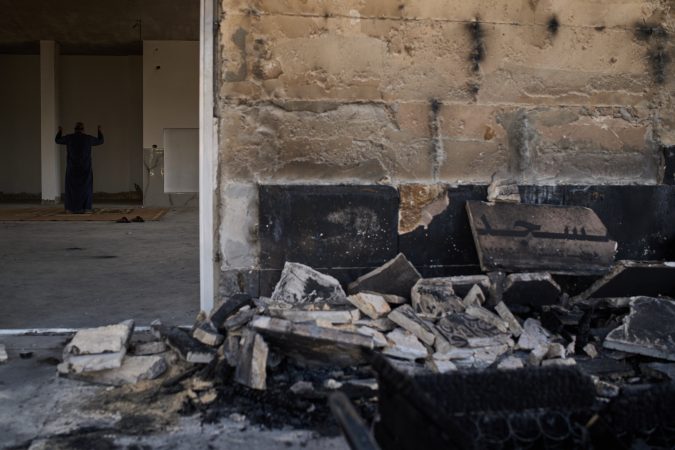
    TEL AVIV, Israel — Two mosques in the Israeli-occupied West Bank were set on fire overnight in an apparent Israeli settler attack, officials said Sunday, after a spate of deadly violence that killed four Palestinians and two Israeli soldiers.

    Palestinians and the Israeli opposition accuse Prime Minister Benjamin Netanyahu’s hard-line government of turning a blind eye to attacks by settlers against Palestinians, which threaten to ignite widespread violence across the territory.

    Israeli soldiers and police fanned out across the West Bank after the attack, closing off major roads and blocking access to a hospital where it said two militants were hiding. Israel also arrested more than 70 Palestinians over the weekend as they attempted to contain the escalating violence.

    Israel’s military says it condemns such incidents

    The mosques, in the villages of Qusra and Kour in the northern West Bank, suffered extensive damage in the fires.

    In Qusra, the attackers spray-painted “revenge Benayahu,” referring to one of the Israeli soldiers killed on Friday, and “the land of Israel is redeemed with blood.” The soldier lived in a nearby settlement.

    Ahmed Abu Mahmoud, 64, who lives next to the Qusra mosque, said he heard noises at 3 a.m. and discovered the mosque had been set on fire. The fire was too large for him to fight on his own, so he called for help.

    “The military arrived here, saw with their own eyes, and then left,” Mahmoud said.

    Security footage in Kour obtained by the Associated Press showed three people dressed in civilian clothes setting off a large explosion in the entrance of the mosque in the middle of the night.

    On Sunday, residents held prayers despite damage to the entrance.

    Israel’s military said it was working with police to investigate the mosque attack.

    “The security forces strongly condemn incidents of this kind, including harm to religious sites, and will continue to act decisively to maintain security and public order in the area,” it said.

    The Israeli army often announces investigations into violence against Palestinians but rarely makes arrests or prosecutes settlers involved in violence.

    The military also reported it had sealed the homes of two Palestinian militants suspected of killing the soldiers in preparation for their demolition. Israel often demolishes the homes of attackers, claiming it deters future attacks.

    On Sunday, Netanyahu said troops entered villages across the West Bank to seize weapons and make arrests. “We are also prepared to operate on a broader scale against the terrorist nests,” he said.

    The exact circumstances of Friday’s deadly incidents remained unclear, but Israeli media reports and interviews with local Palestinian officials said they were sparked after a group of settlers entered the village of Tell and were confronted by residents who were fearful of an attack.

    According to the Israeli military, one of the Palestinians took one of the settlers’ weapons and fired on the group, killing Benayahu Mellet, 32, a security guard from a nearby settlement.

    Palestinians and human rights groups have increasingly documented armed Israeli settlers entering villages in the area. Livestock theft, arson, and the defacement of mosques are routinely reported.

    Leaders appeal for peace and pressure on Israel

    Arab League Secretary-General Nabil Fahmy urged U.S. President Donald Trump to restrain “the Israeli government’s extremist ambitions,” including its implementation of a “de facto annexation in the West Bank.”

    He called on Trump to confront Netanyahu ahead of their meeting in the United States this week.

    Palestinian President Mahmoud Abbas sent letters to Arab and other allies, including the European Union, urging them to pressure Israel to stop settler violence in the West Bank, which he described as a systemic Israeli policy and a dangerous escalation, the Palestinian news agency WAFA reported. The Palestinian Authority is the internationally recognized representative of the Palestinian people.

    Pope Leo XIV appealed for peace in the Middle East at the end of his weekly Sunday prayer, saying, “I am following with apprehension the persistence and escalation of violence in the Holy Land, of which recently many civilians in the West Bank and Gaza have also been victims.”

    He appealed for a “return to negotiating a just political solution.”

    According to the Palestinian Health Ministry, 87 Palestinians have been killed in the occupied West Bank this year, including 21 by Israeli settlers. Three Israelis have been killed in attacks by Palestinian militants in 2026, including the two soldiers on Friday.

    More than 700,000 Israeli settlers live in the occupied West Bank and east Jerusalem, territories captured by Israel in 1967 and sought by the Palestinians for a future independent state. The international community overwhelmingly considers Israeli settlements be illegal and obstacles to peace.

    Israel approves immunity for an international force in Gaza

    Israel’s security cabinet on Sunday took a step toward the deployment of an international stabilization force in Gaza, approving granting it immunity under Israeli law, a political source told the AP.

    Israel will also decide which countries will send forces and that the prime minister, defense minister, and foreign minister will approve them.

    So far, the international force is expected to have 200 members from different countries, including Uganda and Morocco, said the source, speaking on condition of anonymity to discuss a decision made in a closed-door meeting.

    Israeli forces control well over half of Gaza’s territory, which was largely destroyed in two years of war that followed the Hamas-led attack on Israel on Oct. 7, 2023. A fragile ceasefire began in October, but next steps in its implementation — including reconstruction — have been largely stalled over the issue of Hamas’ disarmament. Israel maintains its forces won’t withdraw until Hamas is disarmed.

    Last week, the U.S.-created Board of Peace meant to oversee Gaza’s reconstruction said it was working on a pilot governance and humanitarian zone in southern Gaza that would be secured by the international force.

  • Raúl Castro is absent as Cuba celebrates the anniversary of a key revolutionary attack

    Raúl Castro is absent as Cuba celebrates the anniversary of a key revolutionary attack

    HAVANA — Cuba held a traditional rally on Sunday to commemorate one of the revolution’s most important anniversaries but former President Raúl Castro was conspicuously absent.

    It was the first time in at least 30 years that Castro, 95, did not attend the event, and no explanation was given. President Miguel Díaz-Canel read a congratulatory message from Castro to his compatriots at the rally, held in the eastern city of Pinar del Río.

    The annual event commemorates the July 26, 1953, assault led by brothers Fidel and Raúl Castro on the Moncada and Carlos Manuel de Céspedes barracks in Cuba’s eastern region. The military action against former dictator Fulgencio Batista failed, but it marked the beginning of the revolutionary struggle that culminated on Jan. 1, 1959.

    Raúl Castro’s last public appearances were in June, during an event to establish the Ministry of the Interior, and on May 1 to celebrate Labor Day.

    He no longer holds any formal positions, but his symbolic presence is strong, and he was recently identified as one of the negotiators in talks with the United States following the imposition of a U.S. energy embargo.

    Facing a crowd of hundreds of people waving Cuban flags early Sunday, Díaz-Canel rejected a report that the U.S. State Department published last week that accused Cuba of running a leftist espionage and influence network against the United States and Latin America for decades.

    “Every day they issue a threat against the revolution, and every week they announce a new punishment for Cuban companies and officials,” the president said.

    In May, Castro was charged in a U.S. indictment with murder and other crimes for his alleged role in the downing of two civilian aircraft operated by Miami-based exiles in 1996 off the coast of the Caribbean island.

    The accusations were widely rejected by Cuba’s government.

    Cuba is going through one of the worst periods in its historically tense relationship with the United States.

    U.S. President Donald Trump has said he hopes to “take over” the island after his January attack on Venezuela — a key ally of Cuba for decades — and his imposition of an oil embargo that has practically paralyzed the Caribbean nation, pressuring it to change its economic and political model.

    “Cuba is the victim of a coldly calculated genocide,” Díaz-Canel said during his speech, in which he accused the Trump administration of imposing a policy of “maximum pressure” and intensified “economic strangulation.”

    Daily blackouts are lasting more than 20 hours, workdays have been reduced, industrial production halted, and shortages of water and medicine are hitting an island already undergoing a severe crisis in the past five years given previous sanctions imposed by the U.S. and an internal financial reform that sparked inflation.

    Meanwhile, hotel chains including Spain’s Meliá, payment processors like Visa and Mastercard, and airlines such as Air Canada and Air France have left the island as its economic and financial crises deepen.