Category: Associated Press

  • Boat capsizes in New York Harbor, woman and 5-month-old baby die

    Boat capsizes in New York Harbor, woman and 5-month-old baby die

    NEW YORK — The operator of a boat that capsized in New York Harbor, killing a mother and her infant daughter, is facing criminal charges and authorities are investigating whether the vessel was an illegal charter, the U.S. Coast Guard said Sunday.

    The 22-foot Bayliner speedboat overturned around 10:25 p.m. Saturday near Liberty Island, home to the Statue of Liberty, the U.S. Coast Guard said.

    Twelve people were rescued from the water before police arrived, and police divers later located the 27-year-old woman and 5-month-old girl in the water. Both were taken to a hospital where they were pronounced dead. According to the Coast Guard, the others were in stable condition.

    “We are deeply saddened by the tragic loss of life last night, and our thoughts are with the victims’ family and loved ones during this incredibly difficult time,” said Captain Doreen McCarthy, the Coast Guard Sector New York Commander. “We are extremely grateful for the heroic, swift actions of our partner agencies and Good Samaritan vessel who assisted in rescuing survivors from the water.”

    Manuel Hernandez, 46, of New York, has been charged with 13 counts of reckless endangerment, police said. No phone number for him could be found Sunday, and the case had not yet been entered into online court records.

    The victims’ identities have not been released pending notification of family, police said Sunday.

    McCarthy said Coast Guard investigators are working with police to investigate and are committed to holding lawbreakers accountable. According to the Coast Guard, an illegal charter is any passenger-for-hire vessel operation that lacks Coast Guard credentials, safety equipment, and inspection certificates.

  • El-Sayed spoke with Obama as Michigan Democrats look to unite after a bitter Senate primary

    El-Sayed spoke with Obama as Michigan Democrats look to unite after a bitter Senate primary

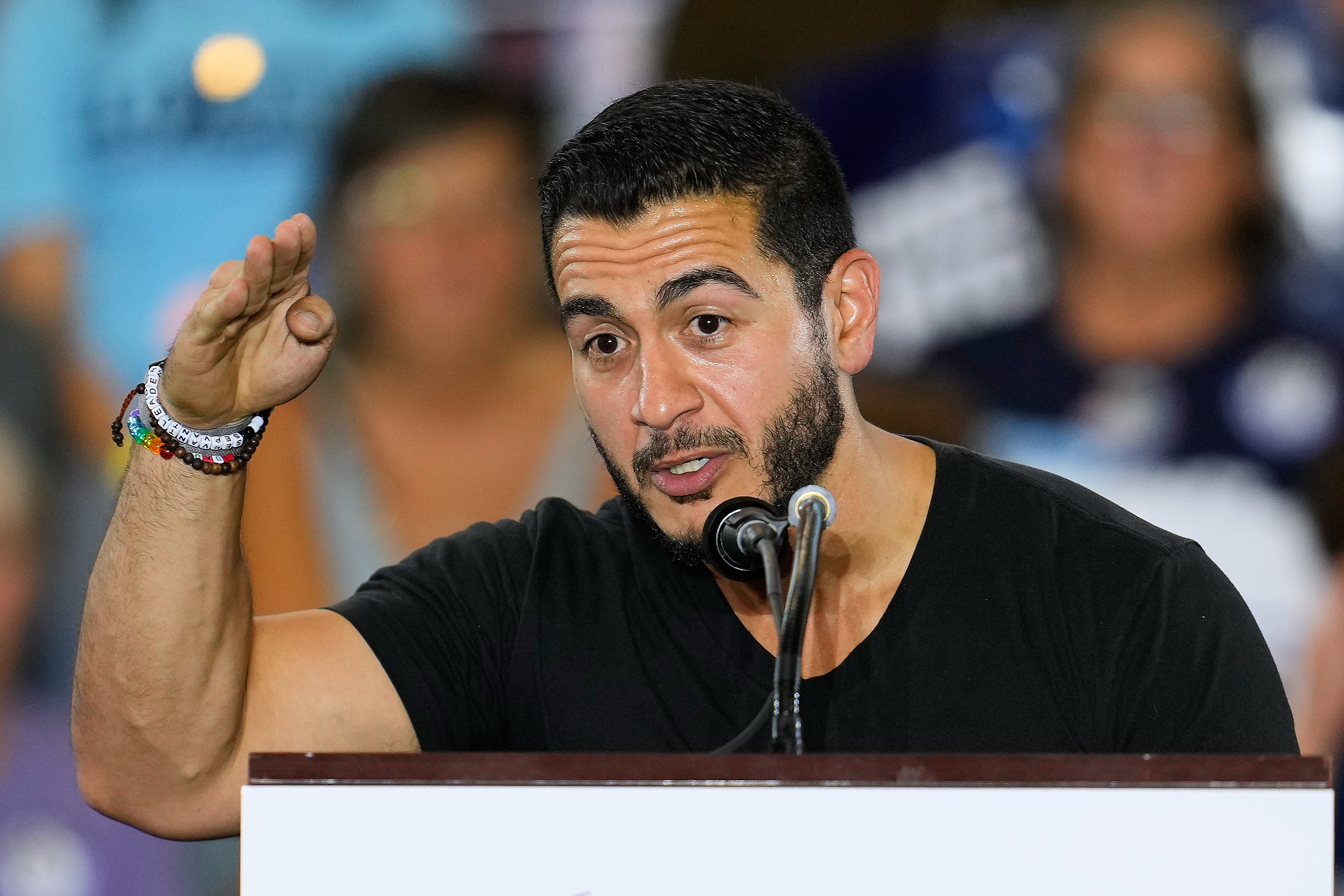
    BRIDGEWATER, N.J. — Abdul El-Sayed, the Democratic nominee for U.S. Senate in Michigan, said Sunday he has spoken with Barack Obama and hopes the former president campaigns with him as the party tries to unite after a bitter primary that exposed deep rifts between its progressive and moderate wings.

    El-Sayed said his Friday conversation with Obama was “really warm and inspiring.” The candidate did not provide details.

    “I was grateful for his advice. It was very warm, very inviting, and I know that he knows the critical role that Michigan is going to play,” El-Sayed told NBC’s Meet the Press.

    Asked if he would like to see Obama come to Michigan to drum up support for Democrats before the midterm elections in November, El-Sayed said he “really” hoped so and that Obama “knows a lot about winning Michigan” after carrying the state in the 2008 and 2012 presidential races.

    An Obama spokesperson confirmed the call.

    The discussion came the same day that a group of Michigan nominees and other notable national Democrats tried to present a united front at a rally in Detroit. The crowd cheered loudest for El-Sayed, a former public health official who last week narrowly beat establishment-backed U.S. Rep. Haley Stevens in a contentious and closely watched primary. A Democratic victory in the fall is crucial to the party’s chances of regaining a Senate majority.

    Democratic Sen. Gary Peters is not seeking reelection in the perennial swing state, which Republican Donald Trump won in 2016 and 2024, while Democrat Joe Biden carried it in 2020.

    El-Sayed faces Republican Mike Rogers, a former congressman who narrowly lost a Senate race to Democrat Elissa Slotkin in 2024 and has tried to capitalize on lingering tensions within the Democratic Party.

    Rogers has released a video message attempting to appeal to Democrats who feel their party may be moving too far to the left with El-Sayed. “You have a home with us,” Rogers says in the video.

    During an interview Sunday with CNN’s State of the Union, El-Sayed acknowledged that “we aired our differences” in the heated primary. But he said the internal divisions are “so much smaller than the similarities that we share.”

    “You’re seeing folks come together,” El-Sayed said, before adding of moderate Democrats, “We might see the world differently. But we also recognize the responsibility to come together.”

  • Many immigrants face deportation without a lawyer at their side in court. This program tries to help

    Many immigrants face deportation without a lawyer at their side in court. This program tries to help

    SACRAMENTO, Calif. — Lawyer Kamalpreet Chohan ran her finger down a list of 57 names of people scheduled to appear during a morning of hearings at the immigration court in California’s capital and pointed out one glaring absence.

    “None of these folks are represented,” she said.

    Chohan is the coordinator of a program that sends volunteer lawyers to immigration courts to assist people without representation and help them navigate the complicated legal system where the stakes are a future in America or deportation.

    Appearing without a lawyer opens up even greater risk under the second Trump administration, with the courts playing a key role in its mass deportation agenda. Courts are increasingly denying asylum, deportation officers have arrested immigrants in court hallways, the administration has packed courtrooms to cut backlogs, and reduced lead time on hearings, prompting people to miss them.

    Data shows that legal representation can be vital to winning in court but many immigrants, unable to pay for a private lawyer or find a pro bono one, navigate the system without an attorney at their side.

    “Folks go into immigration court not knowing what’s happening. They come out not knowing what’s happening. And when there’s an attorney present,” Chohan said, “it’s just so helpful.”

    Immigrants aren’t provided an attorney but legal help makes a difference

    Unlike criminal court, there is no guaranteed lawyer in immigration courts.

    Immigrants have to hire one at a cost of thousands of dollars or hope to get represented by one of the nonprofit organizations assisting low-income immigrants. But waitlists with those organizations are long, and many parts of the country just do not have that many immigration attorneys.

    Of the roughly 3.2 million pending deportation cases currently in U.S. immigration courts, people in 52% of those cases do not have a lawyer, according to an analysis of immigration court data by the Vera Institute of Justice, a think tank.

    A Congressional Research Service study from 2024 found that only 19% of people who did not have a lawyer won asylum or another avenue to stay in the United States. Among those who did have a lawyer, 47% were successful.

    “Having an attorney is just super critical to be able to navigate the system successfully,” said Adriel Orozco of the advocacy group American Immigration Council.

    Chohan said she frequently runs into people who have been scammed by lawyers or people posing as lawyers who take their money but do nothing for their case.

    “I will give him a list of attorneys who are free and we have vetted,” she told one man who said he was scammed. “They have long waitlists but he should still ask.”

    Speaking later to the Associated Press, the man described how he left Guatemala after being threatened by gangs and came to the U.S. in 2024 seeking asylum. Ever since, he said, he has done everything that has been asked of him while he tries to make ends meet, occasionally painting houses. He spent $4,500 on a lawyer who in the end did nothing to help him, he said.

    “He turned out to be a scammer,” said the man, who did not want to be identified for fear of endangering his case. He is worried about what comes next in court after being warned by the judge that he could be deported. “I don’t know what I’m going to do,” he said.

    A nonstop day of consulting with clients

    Outside the Sacramento building where the court is housed is a long line of immigrants waiting for appointments with U.S. Immigration and Customs Enforcement, which is in the same building. Volunteers with a local anti-ICE resistance group stand ready to help.

    Upstairs, two immigration judges are on the bench. One hears the in-depth individual cases of immigrants who are pursuing their claim of asylum.

    The other judge has the master calendar docket, where dozens of immigrants will appear in brief hearings geared to making sure their case is ready to go to the next step.

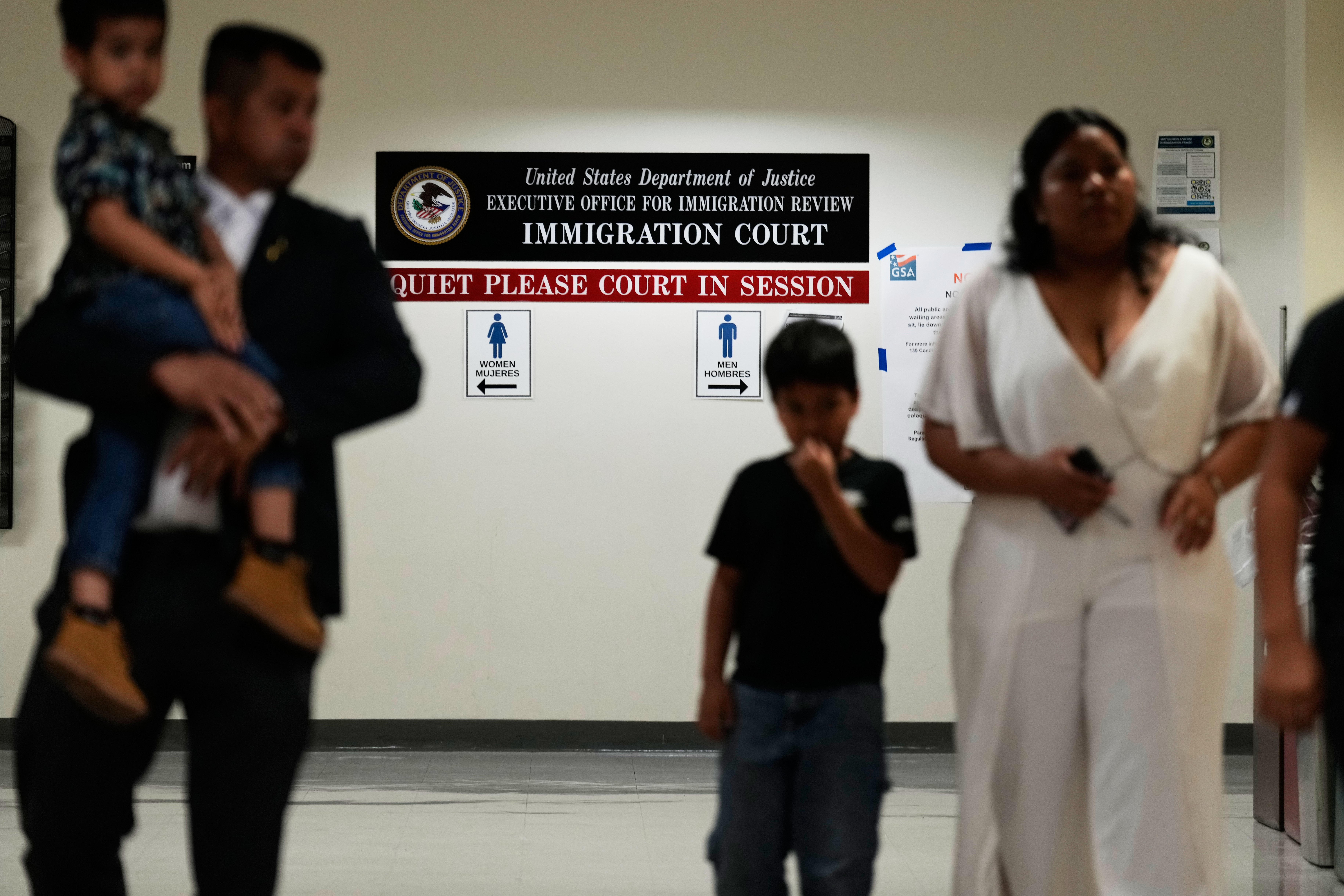
    Signs taped to the wall remind people not to videotape or record inside the court complex. A security guard makes sure no one loiters in the hallways. Most people clutch stacks of papers documenting their cases.

    After immigrants file into the courtroom for their hearings, Judge Susan Phan introduces Chohan and describes the services her organization offers.

    “You are not required to meet with her but it is a rare opportunity that we have someone volunteering their time,” Phan said before launching into the day’s work.

    The need for a detailed asylum application

    Chohan, who works with the California Immigration Project, starts each hearing in the courtroom. She has a clipboard to take notes, extra copies of forms, and a crate of books for restless children attending court with their parents. She spends the bulk of her time in the waiting room, talking to immigrants after their hearings and scanning their documents to flesh out what else they need.

    Speaking to one young man from Mexico, she asks to see his asylum application, noting that the judge had pointed out that it was not that detailed.

    “Sometimes judges can deny a claim if there isn’t enough detail,” she said through one of the organization’s volunteer translators.

    The organization frequently has clinics to help immigrants fill out their asylum application. Chohan said she will alert him to the next one.

    Another woman holding a stack of documents is there with her son and wanted to make sure her children could come with her if she is deported. Chohan also briefed her on what to expect at her upcoming asylum hearing and said the organization will send her an asylum filing guide.

    Chohan highlighted places on forms where people need to give answers or answer in more detail. It’s OK to write “none” but she advises them to not leave boxes blank.

    Everything submitted in Spanish must be accompanied by a translation into English that must be done by a person, not an automatic online translator. Copies of every single page of a passport must be submitted. Documents must be sent in two weeks before the applicant’s hearing so the judge can review them.

    Over and over, Chohan reminds immigrants to download their receipt showing they paid the $102 asylum application fee so they can submit it to the court.

    Chohan said a lot of these procedures and forms are discussed in court but it happens so fast that, with immigrants listening through a translator, they do not always understand what is happening.

    “A lot of times when they go into court, they’re just happy that they’re out of court and they’re not being arrested,” she said.

    A changing immigration court system

    Chohan has witnessed the upheaval in the immigration courts during Republican President Donald Trump’s second term.

    She was in the court hallways last summer when ICE officers waited to arrest immigrants after their hearings. Earlier this summer she watched as the administration started holding “mega masters,” hearings with dozens of respondents at a time that are meant to clear a backlog but have created chaos.

    Chohan said there are not enough pro bono lawyers in the Sacramento area to help everyone who needs one so the “Attorney of the Day” program is often the next best thing. She believes everyone should have access to a lawyer.

    Until that day, she said, the program “helps bridge that gap.”

  • Russia, Ukraine exchange overnight strikes that leave 7 dead, many injured

    Russia, Ukraine exchange overnight strikes that leave 7 dead, many injured

    KYIV, Ukraine — Russia and Ukraine exchanged strikes overnight that killed civilians and injured many others on both sides, local authorities reported.

    Large-scale Russian missile strikes on Ukrainian cities have become almost routine in recent weeks, with Moscow exploiting Ukraine’s critical shortage of interceptors for the U.S.-made Patriot systems — the sole air defense weapon in its arsenal able to shoot down ballistic missiles.

    In the latest attacks, Ukrainian drones killed five people and injured two dozen others, including a 4-year-old boy, in Russia’s border region of Belgorod, according to the regional administration.

    In Kharkiv, Ukraine’s second-largest city, Russian missiles struck a high-rise apartment block in the Saltivskyi district, killing two people and injuring 13, according to regional head Oleh Syniehubov. Eight more people were injured in Ukraine’s Black Sea port of Odesa after “dozens of missiles and drones” struck the city and surrounding region, according to local administration head Oleh Kiper.

    Ukraine’s President Volodymyr Zelensky has for months lobbied other countries, especially the U.S., to send Ukraine more Patriot systems made scarcer by the Iran war, arguing they are crucial for defending civilians.

    Failing that, Zelensky wants to make Patriot ammunition in Ukraine or get approval from Elon Musk to use his Starlink satellite communications system to guide strikes inside Russia that can hit its missile launchers.

    Meanwhile, Kyiv has kept up long-range drone strikes against Russian energy infrastructure, as well as the country’s largest online retailer, Wildberries, and other targets deep inside Russia, sparking a fuel crisis.

    Russia’s defense ministry on Sunday claimed its overnight strikes hit drone warehouses in the Kharkiv region, as well as fuel depots and stores of other materiel belonging to Ukraine’s armed forces at the port of Odesa.

    It said its forces had shot down 153 Ukrainian drones during the night, including over Russian-occupied Crimea and the Black and Azov seas.

    In Russia’s Belgorod region, authorities said Ukrainian drone strikes damaged 29 apartment blocks and five private houses, as well as administrative buildings and unspecified “commercial facilities.”

    Debris from Ukrainian drones also fell on two enterprises and a private home in the Russian city of Novorossiysk, Mayor Andrey Kravchenko said on Sunday. He did not specify what the commercial sites were. Regional authorities later said falling debris had injured one person, damaged two private houses, and blew out a window in an apartment block.

    A major fuel terminal is located at Novorossiysk that links Kazakhstan’s oil fields to markets around the world, and which has previously been a target for Ukrainian strikes.

    Moldova says blast near Ukraine border caused by drone

    A “powerful explosion” believed to be from a combat drone was reported in the village of Crocmaz, in southeast Moldova near the border with Ukraine, local police said Sunday.

    No one was injured by the impact, which caused a vegetation fire in the Stefan Voda district, police said, adding that “fragments of a combat drone were found at the scene” and would be examined by specialists. Police did not specify the origin of the drone.

    Multiple drones have violated Moldovan airspace since Russia launched its full-scale war in neighboring Ukraine.

    Bulgaria summons Ukrainian ambassador over drone incident

    Bulgaria has summoned Ukraine’s ambassador after a drone entered Bulgarian airspace, the country’s public broadcaster BNT reported on Sunday.

    The drone exploded on Saturday close to an international gas pipeline shortly after crossing the border from Romania. No casualties or damage were reported.

    Bulgaria’s defense ministry said the drone appeared to be the type used by Ukrainian armed forces, and that the incident was likely accidental.

    Ukrainian Foreign Ministry spokesperson Heorhii Tykhyi said the incident was being examined, but that it did not deliberately target Bulgaria. Ukraine and Bulgaria were in “close contact” to clarify what had happened, he added.

    ——

    AP writer Stephen McGrath contributed from Leamington Spa, England.

  • Health officials urge caution for Gulf Coast beachgoers during surge of deadly bacterial infections

    Health officials urge caution for Gulf Coast beachgoers during surge of deadly bacterial infections

    BATON ROUGE, La. — Health officials in Louisiana are urging beachgoers to take precautions during a summertime surge in infections from a flesh-eating bacteria found in coastal waters.

    Louisiana has confirmed nine cases of Vibrio vulnificus infections this year, the state’s health department said last week in a news release. All were hospitalized, and five died. During the same period over the previous decade, Louisiana reported an average of seven cases and one death.

    “Seek medical care immediately if a wound exposed to brackish or salt water becomes red, swollen, painful, warm, or discolored,” officials said in the release. ”Tell the healthcare provider about the water exposure.”

    Gulf is an ideal environment

    Vibrio bacteria thrive in seawater and in the brackish mix of fresh and saltwater found in estuaries and lagoons. Most infections are reported from May to October, and most happen in states along the Gulf Coast. Doctors say the Gulf is an ideal environment with the right amounts of salt and heat to let this organism proliferate.

    The mostly deadly type is Vibrio vulnificus, according to the Centers for Disease Control and Prevention. As many as one in five of those infections are fatal, a much higher rate than other types of Vibrio bacteria.

    Florida, which tends to have more infections than other states, has reported 14 Vibrio vulnificus cases and two deaths so far this year, compared with 33 cases and five deaths for all of last year. Records show more cases in years when Florida is hit by tropical storms and hurricanes.

    Bacteria enters through breaks in the skin

    Some people become infected by eating raw or undercooked shellfish — particularly oysters. But a large percentage fall ill when the person is in ocean or brackish water and the bacteria enter the body through small breaks in the skin.

    Doctors say severe cases are seen more often in elderly patients, people with weakened immune systems, and those with liver disease, diabetes, and certain chronic illnesses.

    Scientists say climate change is helping the germs proliferate and spread northward. A 2023 study found that the northernmost case has been shifting by about 30 miles each year, and that cases overall have been rising.

    Beachgoers can protect themselves

    Vibrio vulnificus can enter the body through unhealed cuts and scrapes, recent piercings and tattoos, and recent surgical incisions. People should immediately wash cuts and scrapes thoroughly with soap and clean running water after coming in contact with coastal waters or raw seafood, the CDC said. They should see a doctor if they start to develop symptoms such as fever, chills, and hot red areas on the skin that start to turn dark and blister.

    Oysters are a particular risk, and there is no way to tell if an oyster is contaminated just by looking at it. People should wash hands with soap and water after handing raw shellfish and wear protective gloves if they have a weakened immune system and are at a higher risk of infection.

    Health officials also offer cooking instructions for clams, mussels, and other shellfish. They recommend throwing away any with open shells before boiling or steaming.

  • Nagasaki marks 81st atomic bomb anniversary as mayor says nuclear deterrence only increases risk

    Nagasaki marks 81st atomic bomb anniversary as mayor says nuclear deterrence only increases risk

    TOKYO — Nagasaki marked on Sunday the 81st anniversary of the U.S. atomic bombing of the southwestern city, as the mayor called nuclear weapons “absolute evil,” denounced growing support for nuclear deterrence, and called on the Japanese government to adhere to its three postwar non-nuclear principles.

    The anniversary coincided with Japanese Prime Minister Sanae Takaichi ‘s government revising the country’s defense policy to further bolster the military’s offensive capability. Speculation has risen about whether Takaichi, who supports nuclear dissuasion, may allow nuclear weapons to be brought into the country, going against the third non-nuclear principle.

    Mayor Shiro Suzuki said that while some countries argue the possession of nuclear weapons helps deter potential attackers, the atomic bombings of Hiroshima and Nagasaki had demonstrated that humans can cross the line.

    “The theory of nuclear deterrence is extremely dangerous and fragile. Nuclear weapons are not a ‘necessary evil’ but an ‘absolute evil,’ and can never coexist with humanity,” Suzuki said. “To all leaders of the nuclear states and nations relying on nuclear deterrence, you must face the reality that the more you rely on nuclear deterrence, the more you increase the risk of a nuclear war.”

    The United States launched the Nagasaki attack on Aug. 9, 1945, killing 70,000 by the end of that year, three days after the bombing of Hiroshima that killed 140,000. Japan surrendered on Aug. 15, 1945, ending World War II and the nearly half-century of aggression across Asia.

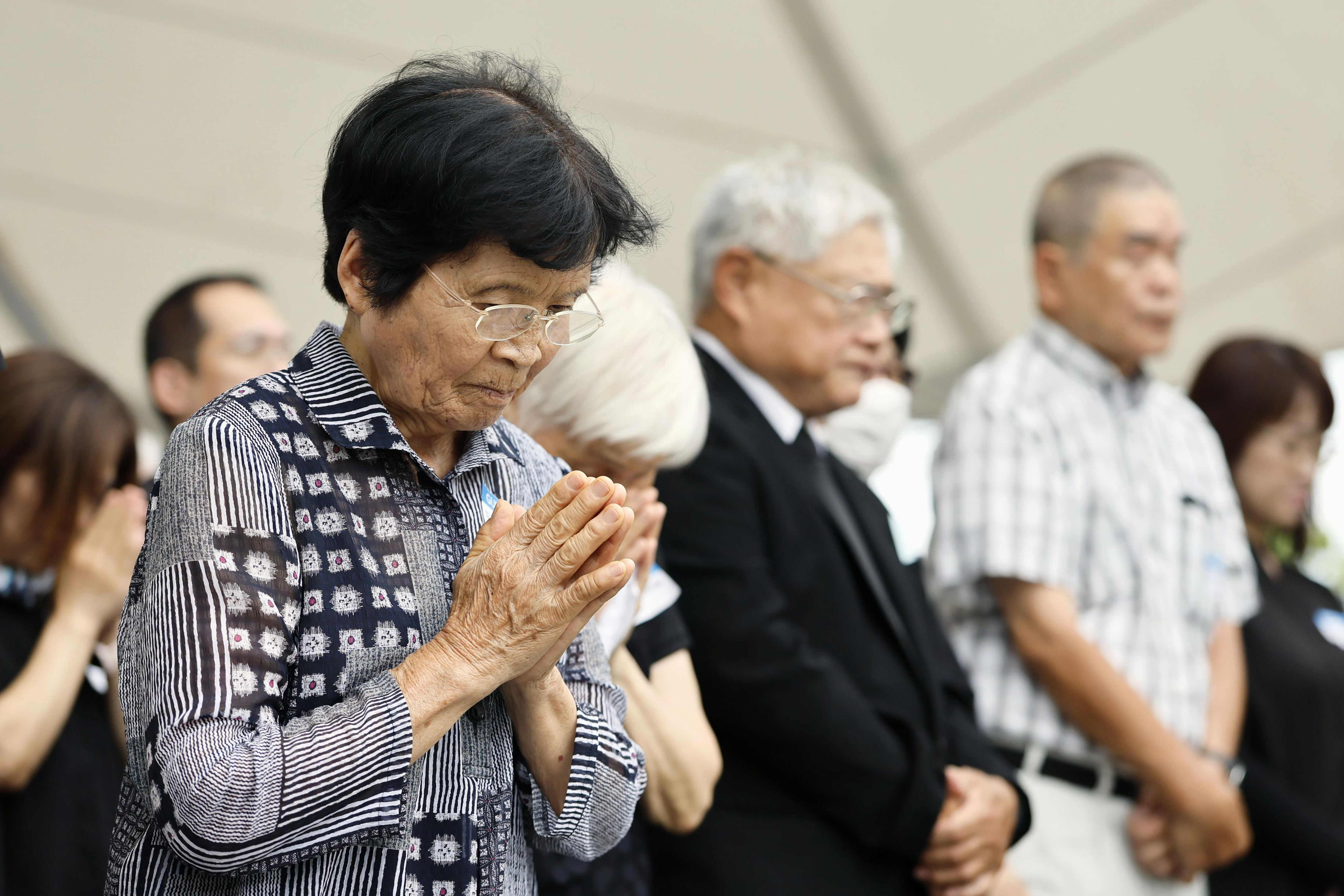
    Representatives from more than 90 countries attended the ceremony at the Peace Park on Sunday and observed a moment of silence at 11:02 a.m., the time when a B-29 dropped a plutonium bomb, known as “Fat Man.”

    Suzuki singled out the Japanese government, demanding it uphold Japan’s war-renouncing Constitution, attend the Treaty on the Prohibition of Nuclear Weapons review conference later this year, and stick to the three non-nuclear principles.

    Takaichi supports the first two principles of not possessing and developing nuclear weapons.

    The prime minister, who attended Sunday’s ceremony, reiterated her policy of taking “a realistic and pragmatic approach” toward achieving a world without nuclear weapons. As she did in Hiroshima, Takaichi remained ambiguous about the three non-nuclear principles and only reiterated that Japan currently maintains the policy.

    Takaichi, in her speech at the ceremony, did not mention the Treaty on the Prohibition of Nuclear Weapons, which Tokyo has refused to sign because Japan is under the protection of the U.S. nuclear umbrella.

    She later told reporters that Japan’s policy is to work within the Nuclear Nonproliferation Treaty, and that her government will decide what to do with the treaty based on what’s most effective to ensure the country’s national security and push forward nuclear disarmament.

    Survivors have expressed frustration and criticized the Japanese government’s support for nuclear deterrence for being insincere. Growing concern about Takaichi’s possible easing of the non-nuclear principles has prompted protests by the survivors, or hibakusha, in Hiroshima and Nagasaki.

    The number of survivors has fallen to 91,105, about a quarter of the original number, with their average age exceeding 86. Survivors worry about fading memories, as the youngest of the survivors were too young to clearly recall the attack.

  • Trump goes unmentioned but not ignored as Clinton, Bush, and Obama step up as essayists on presidents

    Trump goes unmentioned but not ignored as Clinton, Bush, and Obama step up as essayists on presidents

    WASHINGTON — When George W. Bush wrote an essay this year about another president named George, he avoided mentioning the one named Donald.

    So did Barack Obama and Bill Clinton. The three ex-presidents joined a roster of historians and authors in contributing to the In Pursuit project, a 250th-anniversary series that had each writer produce an essay about a president or first lady.

    Though the project was explicitly designed to transcend today’s politics, some of its essays nevertheless reflect anxieties that are flaring in the era of President Donald Trump over the use of power, the health of the democracy, and the integrity of the presidency.

    The project is being curated by Colleen Shogan, the U.S. archivist who was fired without explanation by Trump last year. She instructed contributors not to be partisan or ideological. “Everybody took those instructions and that guidance very seriously,” she told the Associated Press. The goal was for all Americans to “feel welcome to be able to read these lessons and essays and learn something from them.”

    The mission, Shogan said, “is to surface the lessons from the past 250 years of American history, so that we can learn from those lessons, from both our successes and our failures, so we can plan for the present and the future. It’s what has been described as debriefing the American story.”

    The essays cover 43 presidents — all but Democrat Joe Biden and Republican Trump — and 30 first ladies. They are being published online at inpursuit.org and on Substack chronologically and weekly into December.

    Trump and Biden were judged too fresh to be appraised by history, a call that may have also set aside passions of the moment.

    Without naming Trump, Bush’s essay is difficult to read without thinking of Trump’s reluctance to cede power after his 2020 election defeat and his musings about a third term in defiance of the Constitution’s two-term limit.

    Bush hails the heroism of humility

    Bush’s essay celebrates George Washington, the original “No Kings” guy. Bush, a Republican, hails a man whose legacy only grew larger because he modeled the limits of the presidency for centuries to come.

    “Our first president could have remained all-powerful,” Bush writes, “but twice he chose not to. In so doing, he set a standard for all presidents to live up to.” First, Washington resigned as commander in chief of the Continental Army, then set the precedent of serving only two presidential terms before that limit was enshrined in the Constitution.

    Bush went on: “George Washington’s humility in giving up power willingly remains among the most consequential decisions and important examples in American politics.” Bush’s essay, released Presidents Day as the first in the series on Substack, drove heavy engagement.

    Retired Gen. Stanley McChrystal, who led U.S. and international forces in the Afghanistan War, sized up a fellow general, Ulysses S. Grant, in another essay that drew much attention for its parallels with today.

    History offers lessons on ‘law over loyalty’

    McChrystal presents the Union general and post-Civil War president as a leader who displayed “an absolute commitment to principles larger than personal ambition” and who, before his presidency, resisted pressure on military leaders to “align with political factions and be loyal to a person rather than the Constitution.”

    The emphasis on personal loyalty resonates in a time when Trump has repeatedly demanded fealty from officials in his administration.

    The “temptation to bend institutions toward personal power is not unique to Grant’s era,” McChrystal writes. “Our future still depends on whether our leaders choose law over loyalty.”

    This month, in the latest In Pursuit installment, Democrat Bill Clinton writes about Theodore Roosevelt, focusing on that president’s drive to expand the universe of “we the people” at the expense of powerful corporate interests, while also emphasizing Roosevelt’s exclusionary views on Black and Indigenous people.

    The essays frequently address presidents’ failures alongside their accomplishments, a contrast with Trump’s calls for federal cultural institutions to stick to patriotic interpretations of American history.

    Presidents, the chief justice, and first ladies contribute

    Among the In Pursuit contributors are Chief Justice John Roberts (writing about William Howard Taft, the only president who also served on the Supreme Court); Hillary Clinton (Eleanor Roosevelt); Michelle Obama (Jacqueline Kennedy); GOP operative Karl Rove (William McKinley); documentarian Ken Burns (Franklin D. Roosevelt); and historian Michael Beschloss (Lyndon Johnson). Democrat Barack Obama presents Abraham Lincoln.

    The project is being staged by More Perfect, a nonpartisan alliance of dozens of presidential centers along with academics and organizations dedicated to advancing democracy. It is where Shogan now practices her archivist craft that Trump shut down by firing her in February 2025.

    She still has not been told why. Nor has Congress apparently been notified of the reason. The law requires Congress to be told but does not specify a deadline. The National Archives is the central repository of federal documents both precious and routine, and its leader has discretion over which records to preserve and display, and how.

    “That is a position that used to be a nonpartisan position, much like the Librarian of Congress, the secretary of the Smithsonian,” she said. “And I took that very seriously and acted the entire time when I was archivist in a nonpartisan way.”

    The White House did not respond when asked why Trump fired the archivist and whether the administration will tell Congress the reason.

    Trump has long begrudged the archives for notifying the Department of Justice of his alleged mishandling of classified documents after he left office following his first term, though Shogan was not working for the agency then.

    Shogan sees hunger for history without a slant

    Shogan said she has been overwhelmed with the public response to the series so far and figures that speaks to a hunger for history shorn of partisanship. The essays have received more than 1 million cumulative views on Substack and her podcast of the same name registered 160,000 audio downloads and nearly 64,000 YouTube views at last count. A documentary about the series is scheduled to air on PBS in October.

    In the essays, readers learn something new not just about the giants, but about presidents such as Millard Fillmore — “a historic punchline — best remembered, ironically, for being so forgotten,” in the words of his essayist, former New York congressman Steve Israel.

    Then there was Franklin Pierce, presented by his essayist as a pro-slavery president and “permanent victim” of Washington’s alcohol-soaked culture.

    Yale history professor David W. Blight recounts how Pierce won the presidency for the Democrats in 1852 despite vicious trolling by the Whigs. Fielding Mexican War veteran Gen. Winfield Scott in that election, they labeled Pierce, who also served in the war, the “hero of many a well-fought bottle.”

  • Lake Mead hits historic low water level as Colorado River struggles

    Lake Mead hits historic low water level as Colorado River struggles

    BOULDER CITY, Nev. — Lake Mead, the largest reservoir in the United States, has plummeted to its lowest water level since it was filled some 90 years ago, another sign of the crisis plaguing the Colorado River system.

    Water levels at Lake Mead hit 1,040.4 feet above sea level on Friday, according to federal data. That’s just below the elevation of 1,040.58 feet recorded on July 28, 2022, at the reservoir that straddles the Arizona-Nevada border outside Las Vegas.

    The record follows a winter that produced the worst snowpack on record in the Colorado River Basin. Melting snow feeds the river, which is relied upon by farmers, industries, wildlife, hydropower producers, and more than 40 million people across seven U.S. states, tribal nations, and Mexico.

    It comes a week after federal officials announced a short-term proposal to stave off a crisis in the beleaguered waterway. Federal officials stepped in after states that rely on the river — California, Colorado, Arizona, Nevada, New Mexico, Wyoming, and Utah — failed to reach an agreement on how to share the dwindling resource long term. Under the proposal, California, Nevada, and Arizona would share water cuts.

    Years of overuse combined with drought and rising temperatures have been depleting Lake Mead and Lake Powell, the country’s second-largest reservoir. Together, the two bodies of Colorado River water are the lowest they’ve been in nearly seven decades.

    To protect the strained system’s ability to produce hydropower, federal officials said Thursday that they will not release cool Lake Powell water from Glen Canyon Dam in northern Arizona to protect a threatened native fish whose habitat is between the reservoirs.

    Severe drought in 2022 on Lake Mead, which is held back by the Hoover Dam, exposed human remains and forced water officials in Las Vegas to pump water from deeper within the reservoir to continue to supply water to millions of people.

  • Ukraine honors its ‘collector of souls’ killed while recovering the war dead

    Ukraine honors its ‘collector of souls’ killed while recovering the war dead

    KYIV, Ukraine — Ukraine paid tribute on Saturday to Oleksiy Yukov, a volunteer who spent more than two decades recovering the bodies of civilians and soldiers — many of them Russian — killed by war. He was 40.

    An Orthodox Christian service was held at the Cathedral of Saint Volodymyr, in central Kyiv, where thousands of people gathered to pay their respects following his death in a landmine explosion during a recovery mission on Aug. 5. Mourners also gathered at Kyiv’s main Maidan Square before the service.

    Yukov founded the Platsdarm (“bridgehead”) organization because he believed all the dead require a proper burial. He became known as a “collector of souls.”

    Yukov, from the war-torn Donbas region, was a martial arts instructor. He began recovering the dead as a teenager after encountering the remains of Soviet and Russian soldiers from World War II.

    Platsdarm’s volunteers go into fields and forests, among ruins and across territory, where the ground is often mined.

    Yukov’s widow, Evhenyia Kaluhyna, promised to continue his work, sobbing as she spoke at the funeral, wearing an embroidered white dress and standing over her husband’s open casket.

    “The work was difficult and terrifying,” she said. “But I promise you we will continue it because the (dead) deserve it, and you deserve it for everything you did.”

    Yukov had suffered leg injuries and lost an eye in a mine blast in 2022. Still recovering from those injuries, he returned to the front line.

    In a social media post last month, Yukov described the landscape in which he worked.

    “Remote mines, shelling, drones — everything is against you. But you go and do everything to ensure that every soul returns home,” he said.

    He also addressed those who believed Russian bodies should simply be left behind: “When they say: ‘Let them rot,’ I do not agree. This is how we fight for every soul.”

    Yukov spoke of his work in religious terms, saying a body was a soul waiting to go home.

    “This is action,” he wrote. “Action every day in the fields, in the forest belts, among the ruins, where your life can end at any moment.”

  • A pillar of environmental enforcement is targeted by Trump and Musk’s AI company

    A pillar of environmental enforcement is targeted by Trump and Musk’s AI company

    WASHINGTON — Right-leaning legal activists along with Elon Musk ‘s artificial intelligence company have brought sweeping challenges against a cornerstone of legal enforcement in the United States: the right of private groups, people, and local governments to sue over violations of many major laws.

    Their argument, supported by the Trump administration, is that the Constitution reserves tremendous power for the president and federal agencies to decide how — or whether at all — to enforce federal law. They contend Congress should never have handed that power to others through so-called citizen suits that are part of environmental, campaign finance, and certain other laws.

    Environmentalists say it would be devastating to lose this essential, decades-old tool that is used to impose fines and halt lawbreaking by bad actors. Citizen suits, for example, have extracted millions from heavily polluting oil and gas operations, and ensured that lead pipes in Flint, Mich., would be removed after its water crisis.

    Legal experts say four pending federal cases — one of them filed last week — are moving forward at a time when the conservative majority on the Supreme Court gives opponents of citizen suits a greater chance than ever of success. The hard part for those opponents now is winning early federal cases and creating disagreement between the country’s appeals courts, which may help convince the Supreme Court the issue is important enough for a nationwide ruling.

    Back in 2000, a Supreme Court opinion opened the door for that possibility.

    “Many of us who worked in this area have been waiting basically 26 years for this shoe to drop,” said Richard Lazarus, a Harvard professor with decades of experience in environmental law.

    A more inviting Supreme Court could take up the issue

    Lazarus was referring to former moderate Justice Anthony Kennedy’s comments in a Clean Water Act case that citizen suits raised “difficult and fundamental” questions about whether they improperly dilute executive power. The late conservative Justice Antonin Scalia wrote in a dissenting opinion in the same case that citizen suits turn “over to private citizens the function of enforcing the law.” He avoided explicitly saying they were constitutional.

    “The court is more like Scalia’s court since he died than it ever was when he was there,” said Lazarus.

    He observed that those who lost cases where Scalia dissented are rushing back to today’s court hoping for a more favorable result.

    The critical issue for citizen suits is who — the government or private citizens — collects fines and has control. A person filing a citizen suit must tell the government ahead of time. The government can stop the suit if it sufficiently pursues the case itself, but its options are limited and the person suing can stay involved. Citizen suits can force compliance with the law and result in fines, which go to the U.S. Treasury.

    Prominent law firms, companies push against citizen suits

    Efforts to increase presidential power and limit who can sue have grown in recent years. They gained vital federal support this summer.

    That’s when the Pacific Legal Foundation, a right-leaning organization with recent Supreme Court success, chose a routine citizen suit in Tennessee federal court for a broader constitutional challenge.

    They signed on as attorneys for Springfield, a town of roughly 19,000 north of Nashville, that was in the early stages of fighting allegations brought by Tennessee Riverkeeper that it had let too much sewage flow from its treatment plant into a nearby creek, violating the Clean Water Act.

    It was the thirty-first citizen suit Tennessee Riverkeeper had filed under the Clean Water Act since 2010. Pacific Legal argued this was part of the problem — a private group of unelected activists had repeatedly forced others to expend resources defending themselves.

    It’s better when “the government is the one wielding the power because the government remains accountable to the people,” said Sean Radomski, a Pacific Legal Foundation attorney on the case.

    Radomski isn’t targeting every lawsuit a person can bring under federal law — he takes exception to those where fines go to the Treasury and where he says people are improperly taking on the government’s powers. Civil rights lawsuits, for example, where damages are paid directly to those wronged, wouldn’t be touched. Nor would many procedural challenges.

    Musk’s AI company also getting into the fight

    Elon Musk-led xAI argued many similar points in its ongoing bid to rid itself of the NAACP’s lawsuit accusing it of operating dozens of gas turbines near Memphis to power a data center without first getting permits. The civil rights group told a Mississippi federal court that the turbines are a pollution threat to those who lived nearby, many of whom are Black. One of their demands was to halt the gas turbines until the company complied with the law.

    The Trump administration intervened in support of Musk’s company, arguing that turning off the power to artificial intelligence that supports the Department of Defense would harm national security. Because the Trump administration wants the suit dismissed, the NAACP shouldn’t be allowed to proceed with it — prudent enforcement requires balancing interests, including national security, the DOJ said.

    Laura Thoms, director of enforcement at Earthjustice, which is representing the NAACP, said the government traditionally gets involved in cases to enforce the law, not to argue that it doesn’t matter if the law is broken.

    “This administration has determined that the company should be allowed to continue to pollute and that therefore, they should have the unilateral and unreviewable authority to veto our citizen suit,” she said.

    Changing the law would have profound consequences

    Citizen suits were written into foundational environmental laws because Congress understood that the federal government had limited resources to go after polluters and that the politics of some cases could be dicey — the government sometimes is the polluter. That’s why outside groups are necessary to fulfill the law’s purpose, according to Lazarus.

    Some argue that dynamic is especially important now. The Trump administration has slashed air and water protections and promoted fossil fuels. They’ve also constrained enforcement that could slow energy projects to only the most extreme cases, such as an “imminent and substantial threat to human health,” according to a federal guidance memo. Environmentalists say citizen suits are vital for filling the enforcement gap this administration created.

    Leaner budgets in many states make the problem worse.

    Thoms said the potential for corruption could increase, too — the president could unilaterally waive laws to benefit friends.

    She said that those who live in states with strong protections may be fine if citizen suits end, but other areas will be “sacrifice zones” where citizens have few options to fight pollution in their backyard. And the unprotected are more often poor and majority-minority communities.

    Many experts are skeptical of the challengers’ claims of a powerful president that gets to unilaterally shape enforcement even outside of criminal law. They argue the country’s history is rife with examples of that task falling to private individuals, too — a contention the challengers reject.

    David Adelman, a law professor at the University of Texas at Austin School of Law, said before the current conservative majority on the Supreme Court, he would have thought there was a close to zero percent chance the challenges would succeed.

    “But this court has been so protective of the executive branch’s complete control of implementation of federal law,” he said, “that it’s not implausible that something like this could prevail.”