Category: Sports Columnists

  • Violence against women in a Good Good ad stains slow responders: PGA Tour, Callaway, Golf Galaxy, Golf Channel

    Violence against women in a Good Good ad stains slow responders: PGA Tour, Callaway, Golf Galaxy, Golf Channel

    The only thing more disappointing about the slow and weak response by the principals in the Good Good Golf YouTube channel scandal was its utter predictability.

    There should have been immediate distancing and disassociation from Callaway Golf and Good Good Golf after they aired an outrageous commercial that endorsed violence against women. Instead, it took almost a week.

    Why?

    Because corporate America, the foundational structure for the golf industry, hoped it would all blow over.

    It did not.

    Last Friday, an ad aired online in which Good Good Golf co-founder Garrett Clark rushes across a tee box and levels a female golfer who is looking in his bag, then stands over her, points at her on the ground, and says, “Do not touch my new driver.”

    Who thought this was acceptable? Who thought this was funny? Who thought this was anything but horrific?

    Good Good, that’s who. Of course they did.

    It’s a frat bro content creator and apparel company with more than 2 million subscribers to its YouTube channel, making goofy videos. It also sells ugly hats and even uglier shirts. When you hear some idiot on TV scream, “Get in the hole!” when a pro golfer tees off on a par-5, dollars to doughnuts he’s wearing Good Good gear, hat on backward, shirt untucked.

    Then, the commercial.

    There was, appropriately, immediate backlash that convinced Good Good to delete the ad. The backlash snowballed into international outrage, with resounding consequences.

    Cool. It took far too long.

    The ad aired Friday.

    By Saturday night the PGA Tour, Tour CEO Brian Rolapp, Callaway, Dick’s Sporting Goods and Golf Galaxy, and Golf Channel all should have cut ties with Good Good. The fact that none did until they were forced by public sentiment tells you everything to need to know about these folks and how they view women.

    In case anyone wants to argue that this commercial was not an endorsement of violence against women, know that Callaway, as penance, on Thursday committed $1 million to support initiatives that combat violence against women.

    The club in question was a driver made by Callaway in collaboration with the new hip-and-with-it brand. The ad was vetted by both Callaway and Good Good. Incredibly, it raised no alarms at either place, with anyone, until social media began its cycle of outrage.

    The irony is few brands had done as much to promote women in golf than Callaway, which has perhaps the most potent brand-to-athlete recognition relationship in the women’s game, the one-time face of women’s golf, Annika Sorenstam. She condemned the ad but, sadly, did not condemn either Callaway or its leadership.
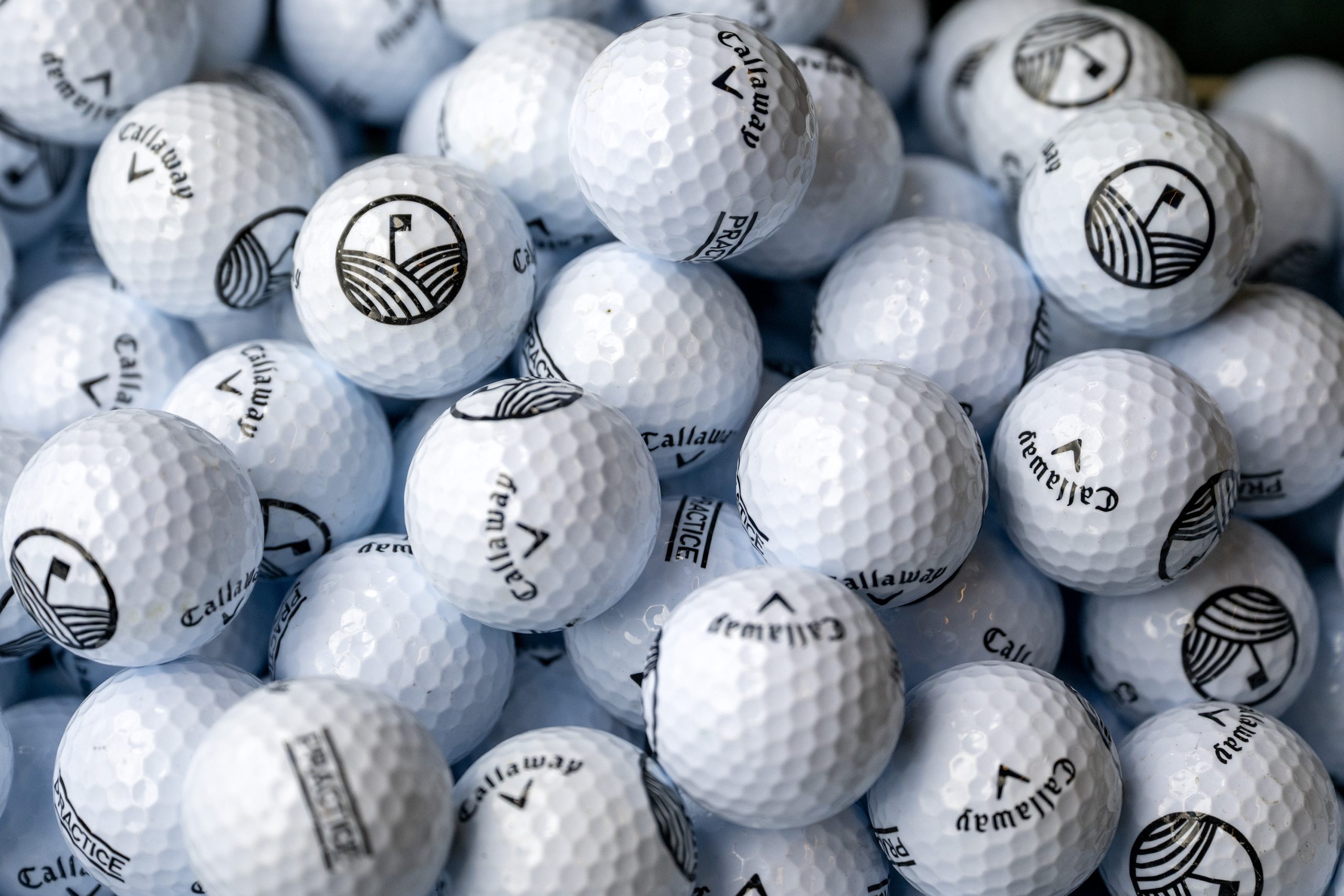
    Callaway Golf balls shown at the Cobbs Creek Golf Course.Tom Gralish / Staff Photographer

    This comes at the height of the Caitlin Clark era, when women’s sports are surging like never before. She’s a basketball player, but she loves to golf.

    Her involvement in the game might have helped spur the biggest growth spurt women’s golf has ever seen. The COVID-19 lockdown triggered massive growth in the golf industry in the United States, and the segment that has grown the most by both percentage and raw numbers is women’s golf, up 45% and 2.5 million golfers compared to 12% and 2.3 million for men, according to the National Golf Federation.

    Callaway just scored the worst own-goal in sports marketing history.

    More than 8 million women now play golf, but the chairmen of all of the entities in question — the Tour, Callaway, Dick’s, and Golf Channel — all are men. Which might explain the slowness and gradualness of the only acceptable responses.

    So we had the scramble, and the admonitions, and the apologies, and the disassociations. The problem with all of it is, nobody wanted to do the right thing unless they had to. Everybody wanted to try to ride it out. Which means they are all as guilty as they could possibly be.

    That includes the Tour, which, on Thursday, announced that Good Good would no longer be the title sponsor of a tournament in Texas in November.

    That includes Golf Channel, which needed four days to decide to not air the Good Good edition of “Big Break,” which was due to begin Tuesday but, after sponsor Golf Galaxy pulled out, was initially pushed back a week and has since been canceled altogether.

    That includes Dick’s Sporting Goods and Golf Galaxy, which needed five days to decide to pull Good Good merchandise from its shelves.

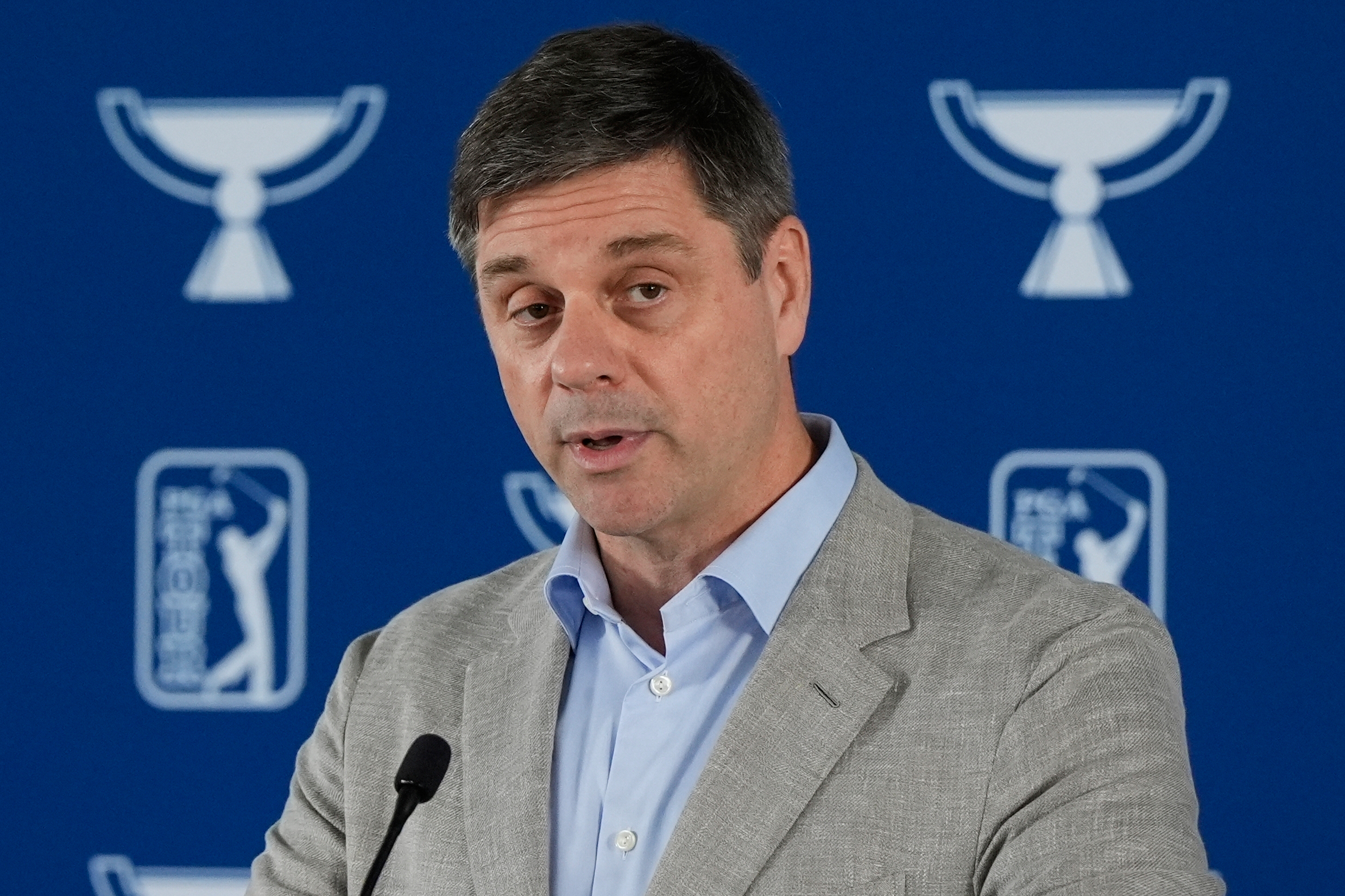
    That includes Rolapp, who only responded to the commercial’s misogyny when he was questioned at a press conference four days after the incident, then landed this stinging indictment: “I think what we saw was concerning.”

    Rolapp’s milquetoast response was a resounding reminder that, before moving to the PGA Tour last year, Rolapp spent more than two decades working for the NFL, America’s most notorious sports league when it comes to ignoring issues like domestic violence and sexual harassment in the workplace.

    That includes Callaway, whose executive roster looks like President Donald Trump’s cabinet. After one day, Callaway issued a chastisement … of Good Good. After three days, Callaway pulled the driver from its website. After six days, as its stock continued to lose value, Callaway finally cut ties with Good Good.

    Callaway’s abrupt about-face, after partnering with Good Good for three years, might have been prompted by Callaway being threatened with exclusion by huge retailers like Costco, which apparently removed access to Callaway products Thursday, at least temporarily.

    And, of course, there is Good Good.

    Clark is the general manager.

    He should resign.

    He should have resigned Saturday morning.

    Instead, five days after the commercial aired, as Dick’s, Golf Galaxy, and the PGA Tour Superstores began pulling Good Good stock from their shelves, Clark issued a rambling, 8½-minute “apology.” In it, he explains the process of the production of the ad, and insists that the woman was not injured, and that Good Good is women-friendly — as if any of this matters.

    At all.

    It does not.

    The obtuse and embarrassing statement just paints Clark and Good Good as defensive, tone-deaf, and completely uncomprehending of the gravity of the moment.

    As tone-deaf as Rolapp, the PGA Tour, Callaway, Golf Channel, and Dick’s/Golf Galaxy.

    All of them did the right thing, eventually, when forced to do so.

    But none of them did the right thing for the right reasons in the right time frame.
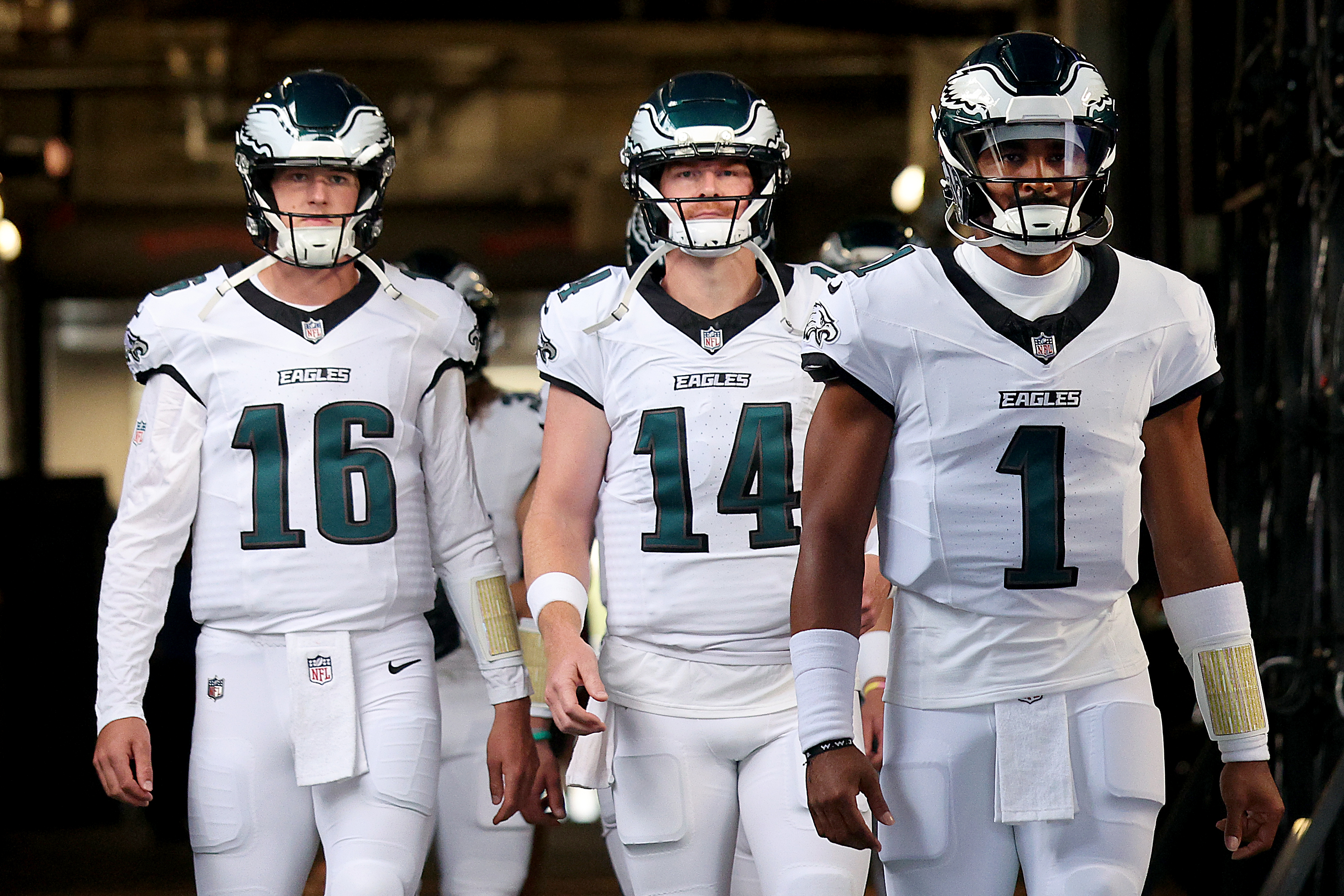
  • Andy Dalton? Tanner McKee? Please. The Eagles lack a real backup quarterback. Unusual. Unsettling.

    Andy Dalton? Tanner McKee? Please. The Eagles lack a real backup quarterback. Unusual. Unsettling.

    The Eagles used to value the backup quarterback position, perhaps more than any other team in the NFL. Looking at their rosters in 2025 and 2026, it’s hard to believe they still do.

    This might not matter at all, except Eagles starter Jalen Hurts gets hurt a lot, and quarterbacks are the most important players in all of team sports.

    Still, it seems like a lot of energy to spend on a guy who won’t play much. Backup quarterback angst: The sort of nattering matter that makes the NFL preseason interminable; the sort of infuriating football geek-talk that fantasy nerds Snapchat about.

    You know. Guys like Lurie and Roseman.

    In 2017, the Eagles committed $11 million to their backup quarterback spot. So important was the position to owner Jeffrey Lurie that he told GM Howie Roseman to sign Nick Foles, whom Andy Reid had just cut from the Chiefs. It meant eating $7 million of the contract of Chase Daniel, whom the Eagles promptly released.

    Despite missing the playoffs in 2016 with rookie Carson Wentz at quarterback, Lurie saw 2017 as a real chance to win the franchise’s first Super Bowl, and he considered Foles, who’d had a strong run as an Eagle, to be a better option than Daniel, who’d never had a strong run anywhere.

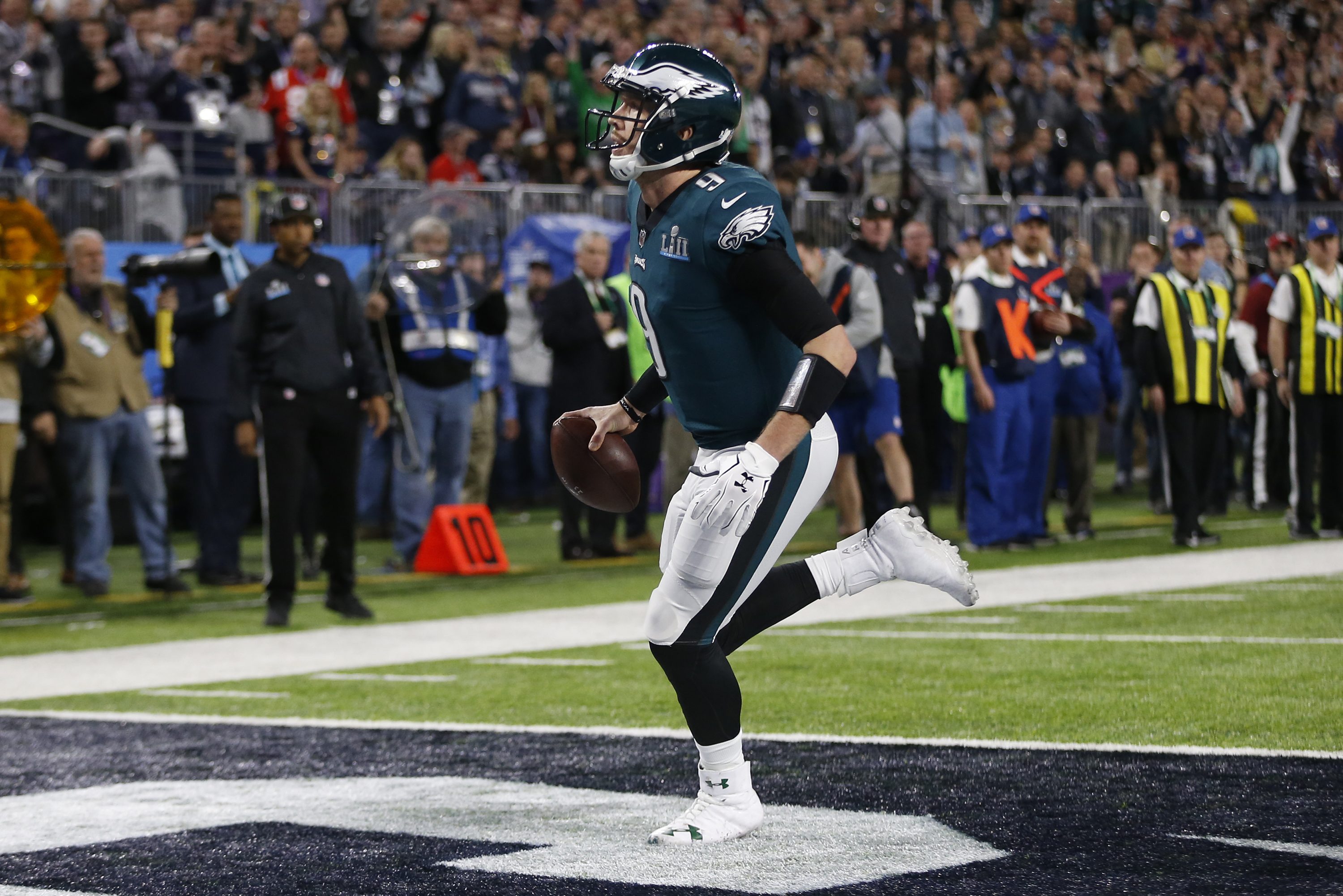
    The rest, as they say, is history: Wentz got injured, Foles replaced him, played well down the stretch, and won the MVP award inSuper Bowl LII where he outplayed Patriots legend Tom Brady and outfoxed coach Bill Belichick.

    Nick Foles became an unassailable Eagles legend, but that doesn’t mean all backup quarterbacks are created equal. Michael Bryant / Staff Photographer

    “Our priority, as you’ve seen, is to make sure we have the very best possible other starting quarterback,” Lurie said during Super Bowl week.

    That’s generally been true, and it’s generally made sense for the Birds, since Lurie prefers mobile quarterbacks, who, of course, are more likely to get hurt.

    Lurie signed Michael Vick out of prison in 2009, and Vick supplanted Donovan McNabb the next season and went to the Pro Bowl in his second of four years as an Eagle. Lurie drafted Hurts in the second round in 2020 with plans that Hurts would be the long-term backup to Wentz, but that’s before Ginger Jesus lost his job, and maybe his mind. Lurie sanctioned the recent, sensible acquisitions of Gardner Minshew, Marcus Mariota, and Kenny Pickett.

    But in 2019, Lurie also approved the signing of Josh McCown, a 40-year-old with a 79.7 passer rating with eight other teams. McCown replaced Wentz early in the Eagles’ home wild-card playoff game, played atrociously (predictably), and cost the Birds their postseason.

    Last season, Lurie allowed the Birds to enter the season with third-year sixth-round pick Tanner McKee as the backup of a team defending its second Super Bowl title. It didn’t matter, since Hurts stayed healthy. But McKee got to start game 17 against the Commanders, and he was poor: 21-for-40, 241 yards, one touchdown, one interception, with a forgettable fourth quarter that cost the Eagles their chance to win the game and capture a better seed. It looked OK in the moment, but upon further review, the Eagles (and I) decided that McKee is not the answer.

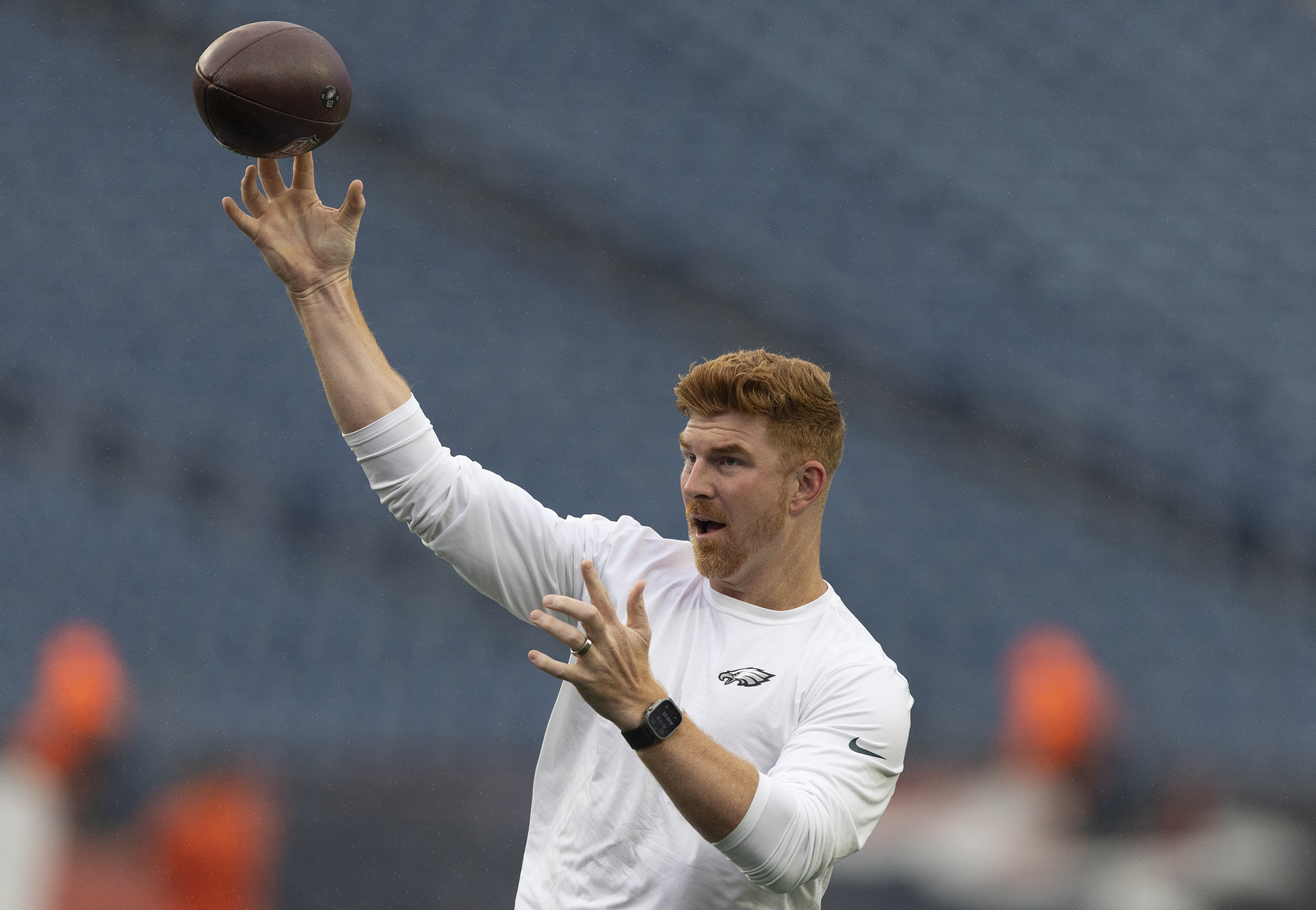
    The Eagles (not I) determined that Andy Dalton is the answer.

    They were wrong.

    The Eagles’ bet on Andy Dalton does not appear to be going according to plan. Yong Kim / Staff Photographer

    The Birds in March traded a seventh-round pick to the Panthers for Dalton.

    No player at Eagles preseason work or in training camp has been a bigger disappointment than Dalton.

    That isn’t really fair. There should have been minimal expectations of Dalton.

    He’ll be 39 in October. He’s 1-6 in his last seven starts over the past three years, during which time his passer rating is 84.5. Aberration? No. In the five seasons before that, his rating was 85.5 in 57 games. He’s been the backup in Carolina the past three seasons, essentially a big brother for Bryce Young, the underperforming No. 1 overall pick from 2023, and an assistant coach of sorts.

    That’s the role he was expected to serve in Philadelphia, where new offensive coordinator Sean Mannion has installed a new scheme. Dalton can help with the adjustment for Hurts, and you’d think Dalton would have a significant advantage over McKee in executing the offense.

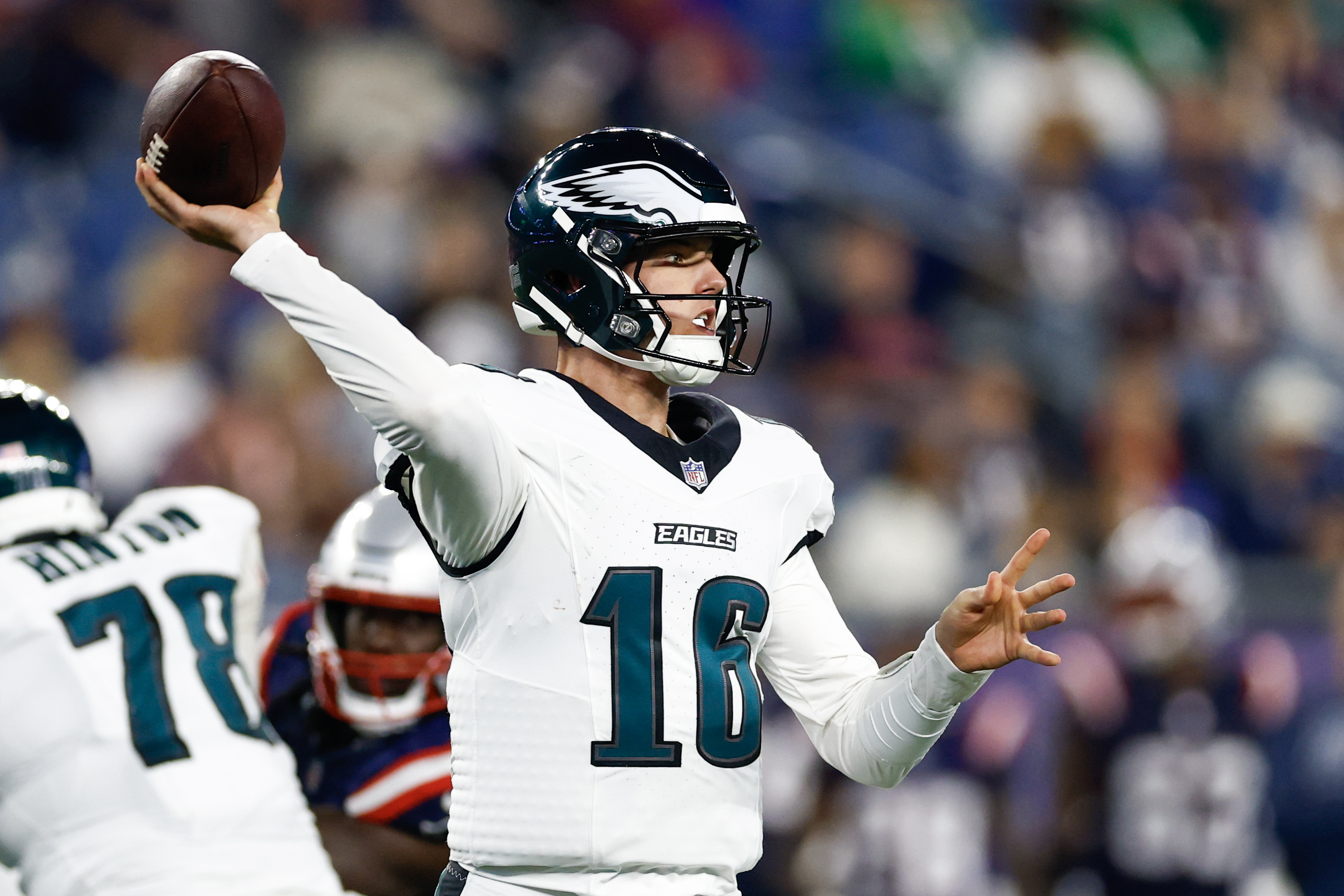
    Tanner McKee again appears to be the best backup option for the Eagles. Yong Kim / Staff Photographer

    But no. Dalton has looked appreciably worse than McKee — so much worse that McKee’s unremarkable performance looks good by comparison.

    Entering the third and final preseason game Friday, the competition, such as it is, for the backup job clearly tilts in McKee’s favor. Which delivers this uncomfortable truth:

    The Eagles, who have made the playoffs five years in a row, don’t really have a viable backup quarterback. That’s the fault of the front office.

    Roseman.

    Lurie.

    What should they have done?

    Maybe they should have signed Mitch Trubisky, who got two years and $10.5 million to back up Cam Ward in Tennessee. Maybe another dance with Minshew, who got $8.25 million to back up Jacoby Brissett in Arizona. Both would have cost a lot more than Dalton’s $1.5 million, but that’s also just about what Tua Tagovailoa got from the Falcons to be the emergency plan if Michael Penix Jr. wasn’t back in time from his knee injury.

    All three of those QBs are in spots where they will have a likelier chance to resurrect their careers. Maybe that’s why the Eagles weren’t able to land one of them, and why they had to trade a pick for Dalton.

    To be fair to Roseman and Lurie, the Birds also drafted a quarterback in April: Cole Payton, in the fifth round, out of North Dakota State, who currently is not close to being an option.

    To be fair to Payton, he might be as good an option as the other two.

  • Lane Kiffin, a former Eagles undrafted free agent, and a fitting episode for our times in college sports

    Lane Kiffin, a former Eagles undrafted free agent, and a fitting episode for our times in college sports

    Maybe the best thing that can happen to college sports’ integrity is everything that is happening to its integrity right now. It would be ironic, in a way. The NCAA and its member institutions are where they are because they spent decades adhering to a policy of inertia. Only now does it look like a viable strategy, after their world is already burning around them. Sometimes, in order to gain back what was lost, one must lose what little remains.

    Very little remains. Let’s be clear about that. That was true even before last weekend’s news that former Eagles undrafted rookie free agent Dae’Quan Wright was planning on returning to the college ranks after being waived by the Browns. In fact, the hand-wringing that has accompanied the tight end’s reported agreement with LSU is mostly an admission of naiveté or ignorance on the part of the hand-wringers.

    The NCAA is more than a decade into a series of logical premises and conclusions that was always going to lead power conferences like the SEC and Big Ten to where they are right now. The university presidents who operate behind the NCAA’s bureaucratic anonymity chose this path when they allowed the almighty dollar of television contracts and the vanity of a news cycle monopoly to become the primary goal of collegiate sports rather than sports played by, for, and among collegiates. They are living in a reductio ad absurdum of their own creation.

    The best thing any of us can do for our sanity is to lean back and enjoy watching them lose theirs. It no longer makes sense to react to each development as if university athletic departments are tethered to some sort of ethical baseline that sets them apart from any other major professional sports organization. They pulled up that anchor long ago. The ship has sailed.

    Frankly, the idea of an undrafted athlete moving from the bottom of an NFL training camp roster to a college football starting lineup pales in comparison to the legion of current college football starters who are making bigger bank than they would as NFL players on rookie contracts. The average Power 4 quarterback is currently signed to a name, image, and likeness deal worth $3.1 million, according to Sportico. It always made sense that there would come a day when a player would ask out of a contract from the Browns for a more competitive offer funded by Big Willy’s Jeep-Chevy of Baton Rouge. That’s the way NIL was always going to work.

    The ridiculousness is the real sport, now. We should treat it as such. For years, the NCAA chose to address the logical implications of its profit drive with a weird and counterintuitive combination of hope, avoidance, and authoritarian dictates. They fully recognized that the genie would one day escape the bottle. Now, they’re left to hope that Ja’Marr Chase and Joe Burrow already have plans for their bye week, when LSU plays Mississippi State.

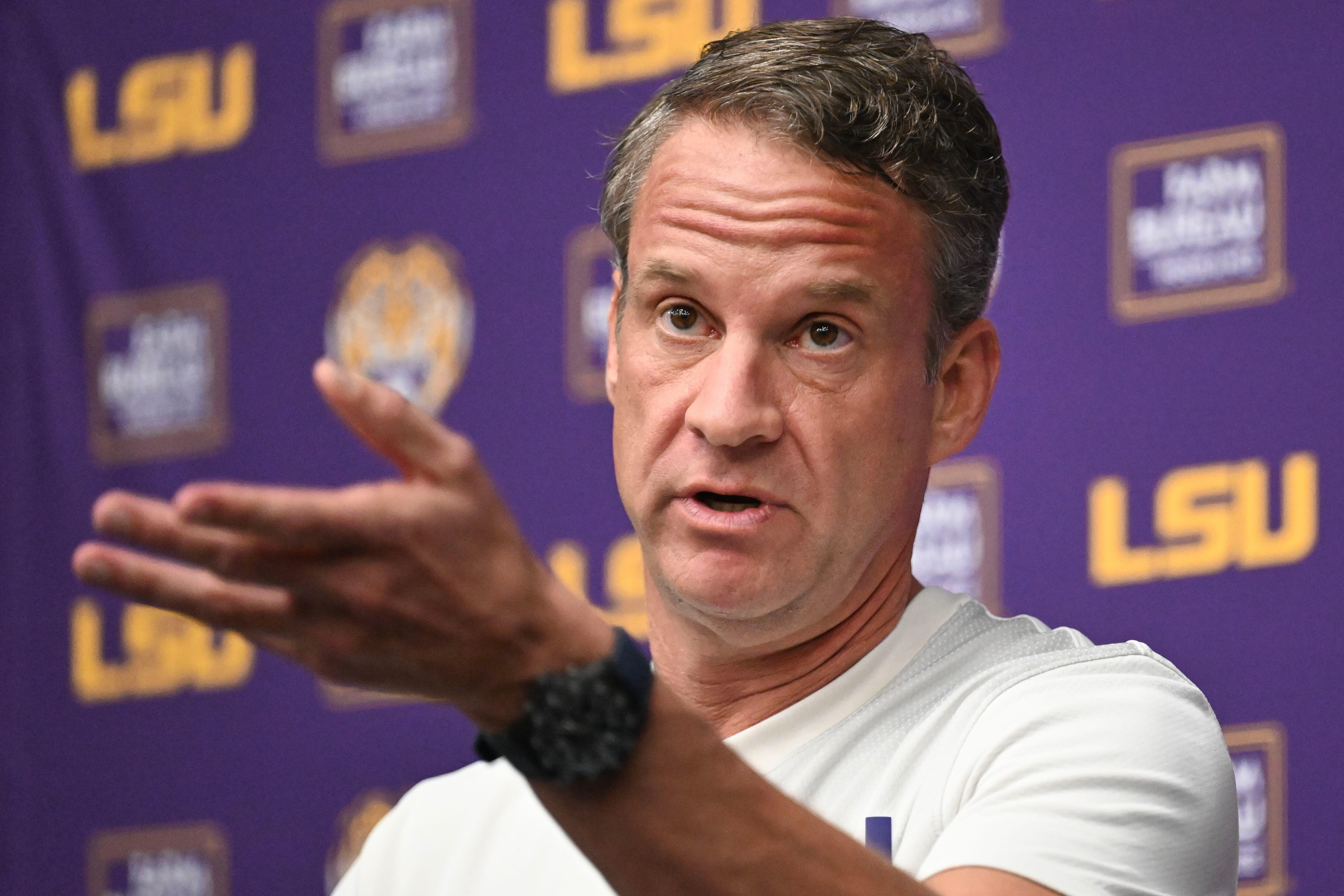
    Lane Kiffin’s central role in the latest lunacy is fitting. College football’s Kendall Roy has spent the early part of this week channeling the exact sort of ends-based nihilism so sublimely satirized by HBO’s Succession. He did the same last year when he left his Ole Miss team on the eve of the college playoffs in order to sign a mega contract with LSU. Nick Saban, his former boss at Alabama, leveraged the full power of the media-sports industrial complex to absolve him of responsibility.

    “We need to take a better approach to the business aspect of what we do in college athletics,” Saban said on ESPN’s pregame studio show after Kiffin left Ole Miss. “In the NFL, you can’t leave your team until you are finished playing. You can’t talk to another coach in the regular season. There’s a defined time when you can talk to them if they are in the playoffs. We should match the academic calendar with the football calendar.”

    Well, yeah. You should. But there are a whole lot of competing self-interests standing between ought and is. Like any system, it is first and foremost a reflection of those who agree to its framework. Major college football has become nothing more than Boar on the Floor in pads. Any television news segment on NCAA should conclude with a clip of Logan Roy smirking at all the piggies at the trough.

    Dae’Quan Wright is among the NFL players trying to play another season of college football.Carolyn Kaster

    “In general, should NFL players come back to college? I believe — it doesn’t matter necessarily what I believe — that answer would be no,” Kiffin said in a Monday news conference while defending his recruiting of at least two former Ole Miss players who’d spent the summer in NFL training camps.

    Focus on Kiffin’s interjection.

    It doesn’t matter necessarily what I believe.

    You’ll struggle to find seven words that more accurately summarize both the current state of college sports and its contributing factors. In a more principled world, they would be written off as the words of a coward. In our current world, they might as well be written in Latin beneath the flag or family crest or company logo of a disconcerting number of tech titans, politicians, and Fortune 500 firms, not to mention the hundreds of university presidents who have long embraced the plausible deniability of the concept of shareholder value. The best thing you can say about the system of higher education in the United States is that it remains steadfastly by and of the system at large.

    The only hope is that it burns itself as quickly and completely as possible. The inevitable end game for the major football-playing schools won’t look much closer to the mandates of their university charters. The big schools will break away, impose a salary cap, hiring and transfer restrictions — all of the things major sports leagues long ago did as a result of similar competitive inevitabilities. They will sign their own television contract, sell their own licensing agreements, consolidate the revenues. The nonpower schools will exist mostly as a counterweight to any antitrust claims. Meanwhile, the rest of us will continue to contemplate the question: Do we really care about college sports if they are no longer about the college?

  • Here’s 5 reasons to give the Phillies your heart again. What have you got to lose — besides your sanity?

    Here’s 5 reasons to give the Phillies your heart again. What have you got to lose — besides your sanity?

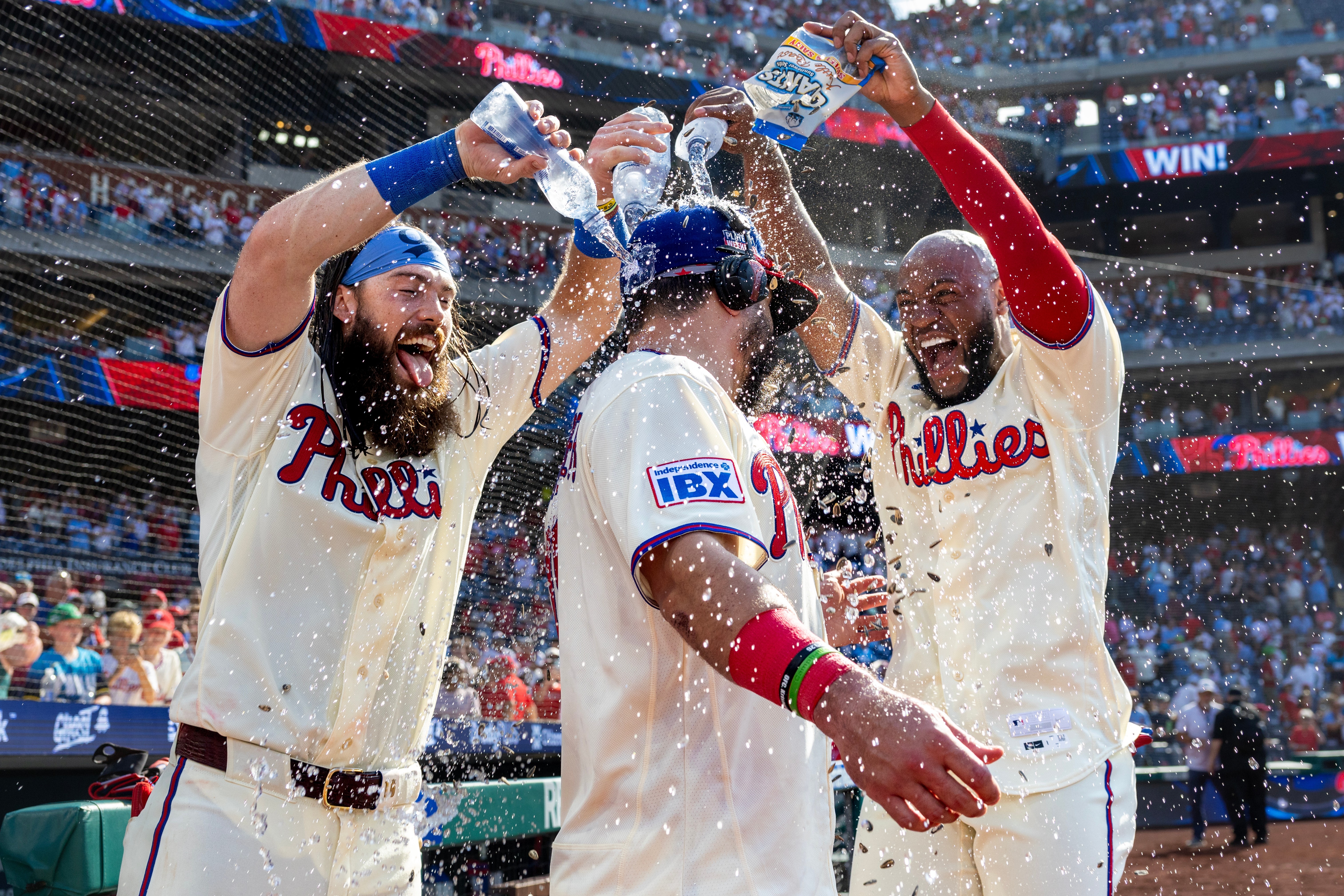
    The Phillies are the hottest team in baseball, hotter than they’ve been all year, winners of nine straight for the first time since May of last season and just the second time in the Schwarber Era, which began in 2022.

    We’ll call it the Schwarber Era because it was Kyle Schwarber’s 459-foot, two-run, walk-off Schwar-bomb that extended the winning streak Sunday afternoon, and because, with due respect to Bryce Harper and Zack Wheeler, Schwarber is the soul of this ballclub.

    Everybody always loves Schwarber. Not everybody loves these Phillies.

    Maybe you don’t. Who can blame you? Whether it’s collapses against the Diamondbacks or Mets, or an inexplicable bunt or an unforgivable error against the Dodgers, these Phillies have a way of breaking your heart.

    “Once bitten, twice shy,” as the philosopher band Great White once sang?

    Once bitten, twice bitten, thrice bitten … goodbye?

    Paul told the Galatians, “Be ye not faint of heart,” but the greatest apostle would be ashamed of Phillies fans today. Why?

    Because these Phillies are for real.

    They’re beating good teams by playing mature, sound baseball, and they’re doing it generally without the best efforts of their best players.

    Nevertheless, they’re 16-5 in their last 21 games and a season-high 15 games over .500 going into Monday’s series opener in Seattle. They were 9½ games behind the Braves in the NL East when the streak began, but now they’re just three games out with 31 games to go, seven of them head-to-head with Atlanta. The Phils held the No. 2 wild-card slot, two games behind the Cubs, two ahead of the Padres, and four games ahead of the Diamondbacks, the first team out.

    The Phillies on Monday began a nine-game, 10-day road trip three time zones west. They face the Mariners, then the Angels, two relatively poor American League teams, by the time they get to Arizona.

    They swept Miami, St. Louis, and Minnesota, all teams with valid playoff aspirations, at least until they played the Phillies. That’s the biggest reason why you should learn to love again.

    Here are four more.

    The Phillies are winning despite middling performances of late from their aces, including Cristopher Sánchez.Yong Kim / Staff Photographer

    2: They’re streaking without good starts from the Big 3

    During the streak, top three starters Wheeler, Cristopher Sánchez, and Jesús Luzardo all left the game while trailing after an ungainly outing. They surrendered a combined 10 earned runs in 17⅔ innings. The Phillies won anyway.

    All three are healthy. They just faced decent offensive teams in the dregs of summer. The Mariners have scored the fewest runs in baseball. The Angels have the second-worst OPS. The next seven days should be a feast for the Big Three.

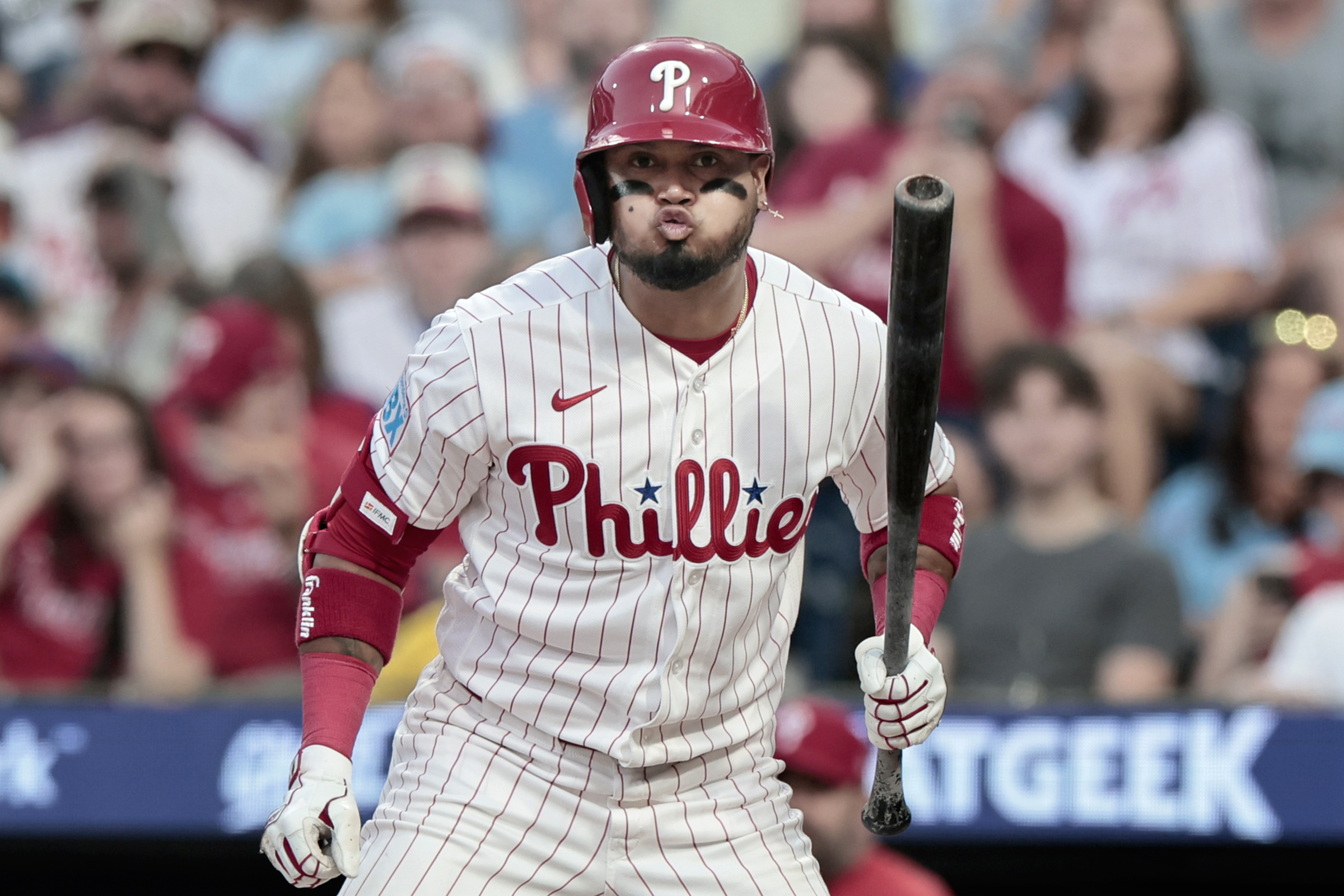
    Luis Arraez is an unconventional but productive cleanup hitter for the Phillies.Elizabeth Robertson / Staff Photographer

    3: The Arraez Affect

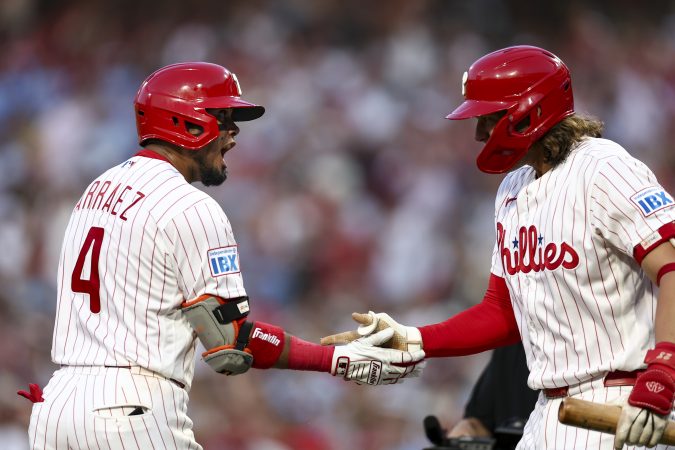
    Since three-time batting champ Luis Arraez, a deadline addition, joined the lineup Aug. 4, the Phillies have mimicked his approach. Their swings are more controlled. The hitters are more on balance.

    The result: fewer home runs, but more hits.

    They’ve hit nine homers in the nine wins, a rate of 1.0 per game. They’d hit 148 home runs in their first 123 games, a rate of 1.2 homers per game. Sometimes, less is more.

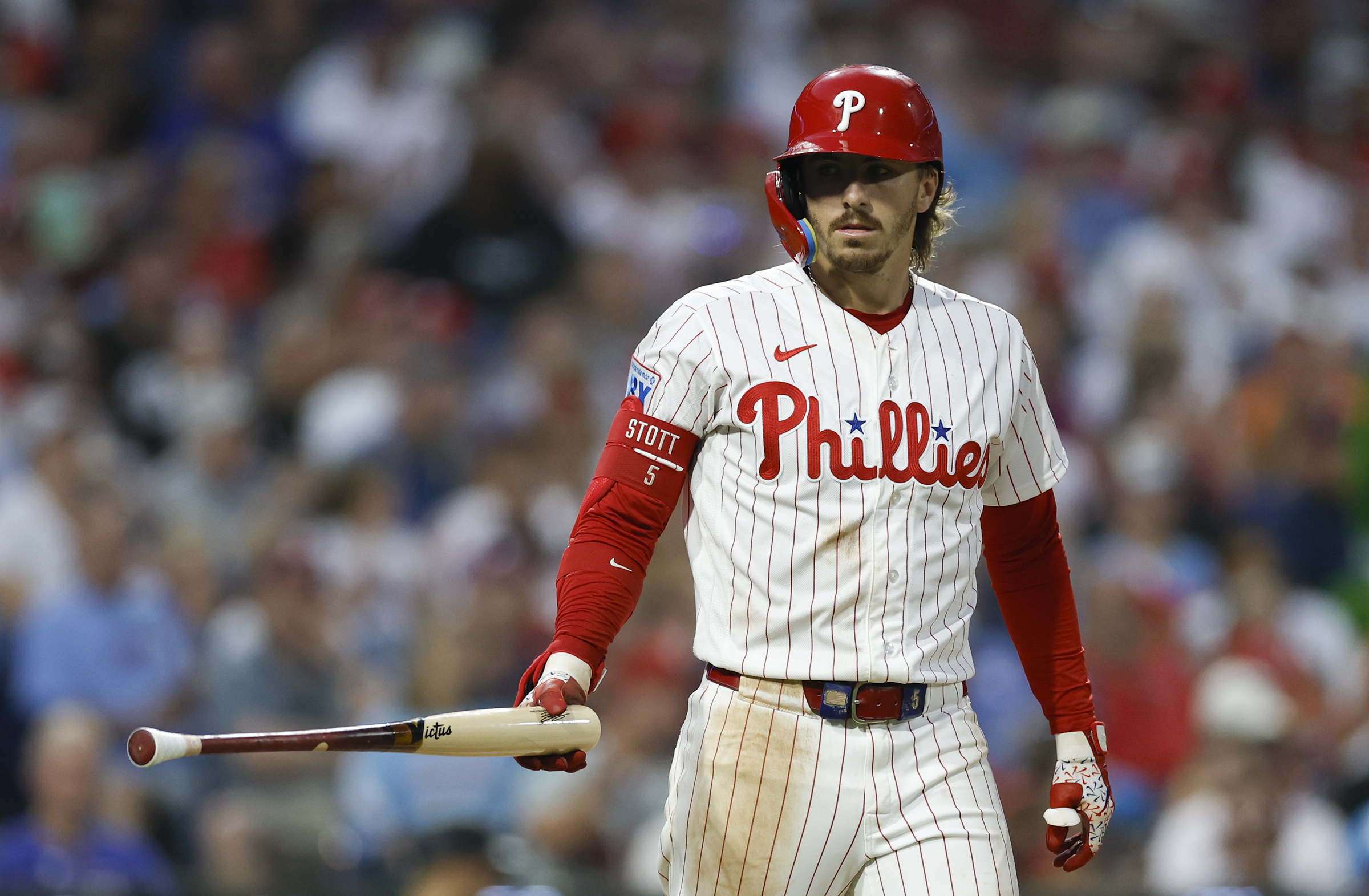
    Since Arraez’s arrival and his insertion in the No. 4 spot, No. 3 hitter Bryce Harper has a .506 on-base percentage with 25 walks. No. 5 hitter Alec Bohm saved his season: He’s hitting .393 with a 1.015 OPS and 15 RBIs in 17 games. Bryson Stott, who bats sixth, is hitting .295 with 15 walks.

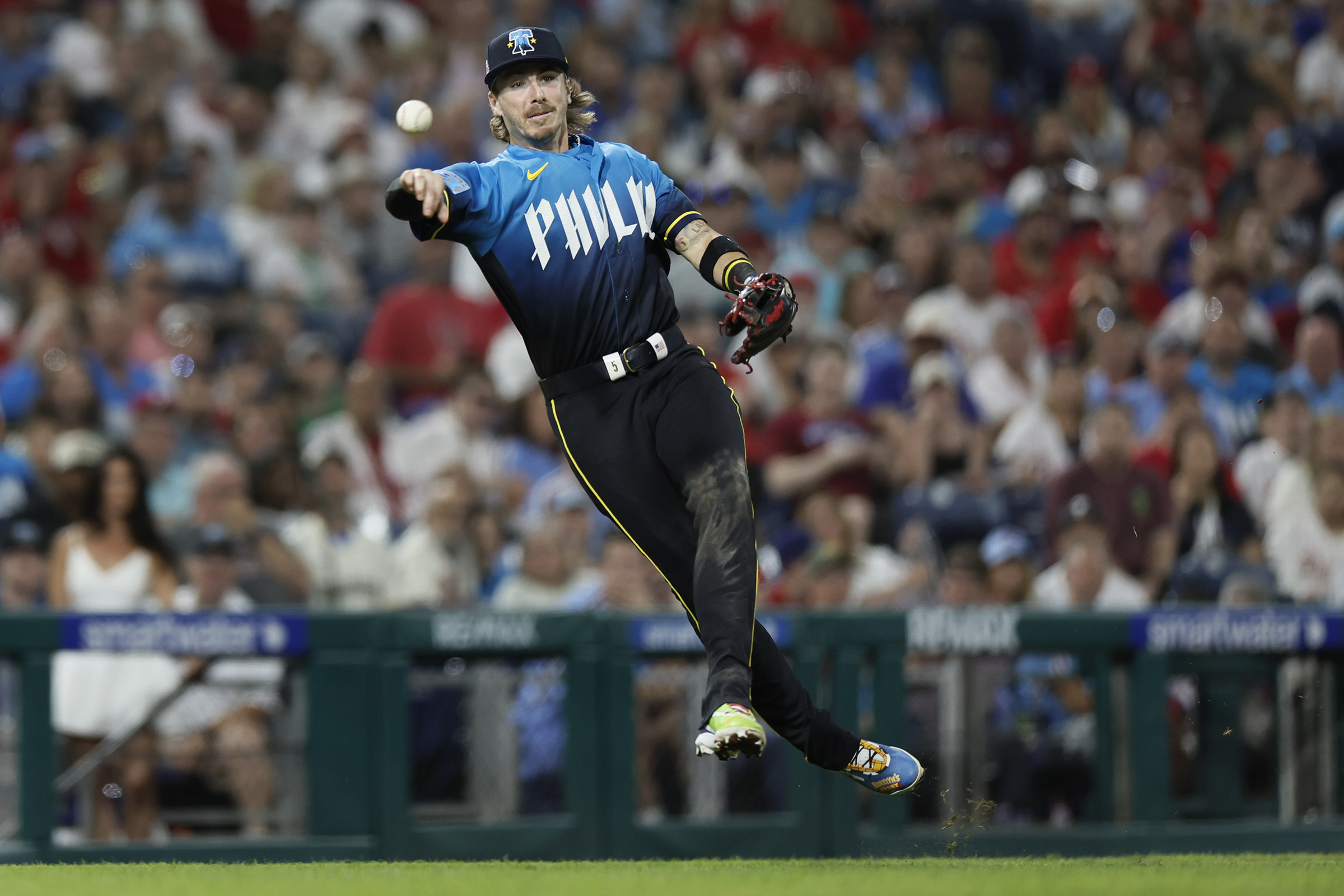
    Bryson Stott has been great at third base since his move there following the Arraez trade.Elizabeth Robertson / Staff Photographer

    4: The defense got better

    The Phillies chose to play Arraez at second base. This meant Stott had to move from second to third base, Bohm had to move from third to first base, and Harper had to move from first back to right field.

    The unintended consequence: This is the best Phillies infield since 2011, when Placido Polanco won a Gold Glove at third base and Jimmy Rollins should have won it at shortstop. Granted, this is a low bar — Phillies infields have been atrocious for 15 years — but Stott, a shortstop by birth, already was an elite second baseman, and his play at third has been otherworldly. Bohm is an unnatural third baseman but a natural first baseman, unlike Harper, who is a very good outfielder. Arraez is a fine second baseman, and even Trea Turner looks better at shortstop.

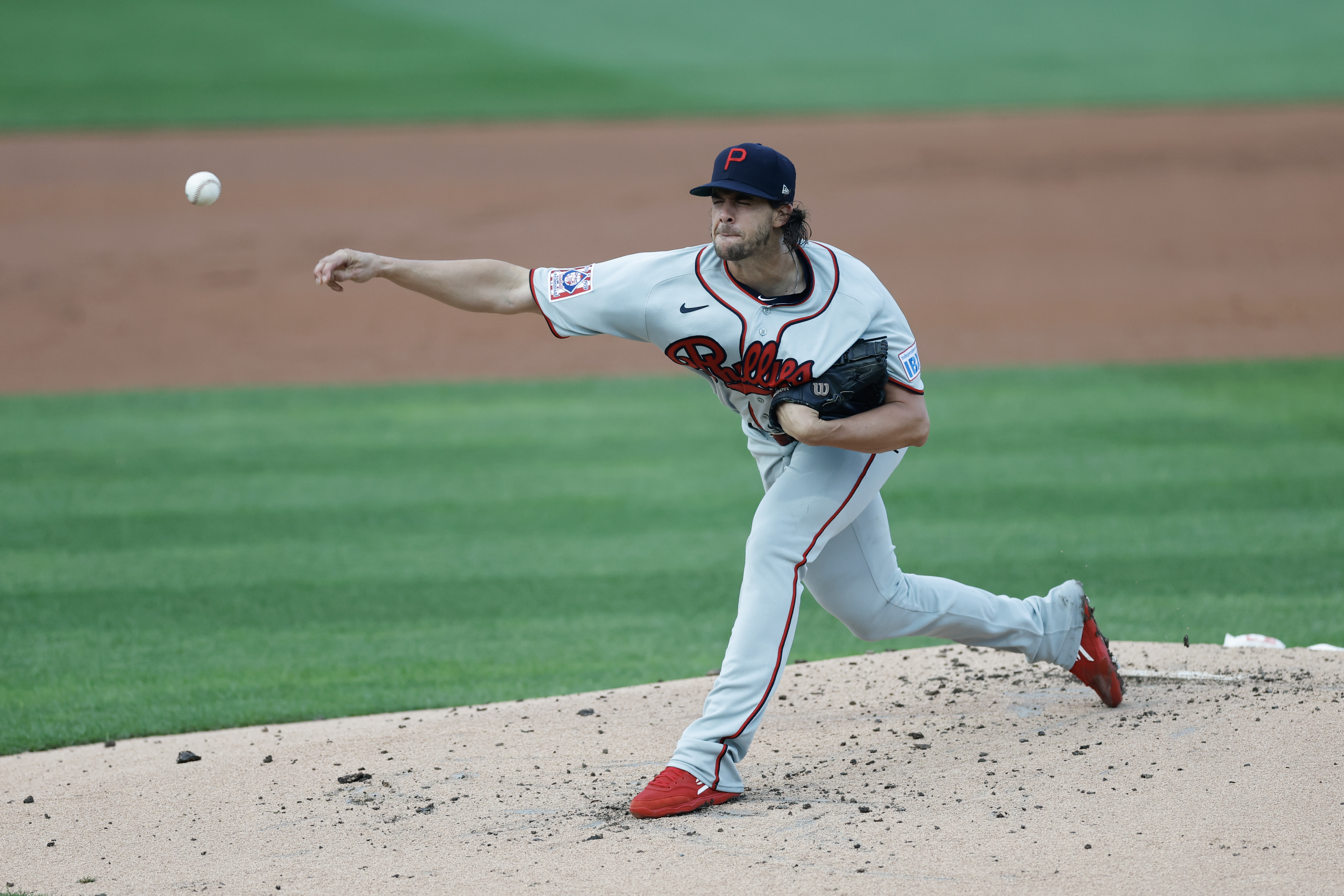
    Aaron Nola has been solid of late after a very slow start to his season.Yong Kim / Staff Photographer

    5: Andrew Painter and Aaron Nola settled in

    Andrew Painter, who is 23, spent all of 2025 in triple A coming back from elbow surgery that cost him all of 2023 and 2024. His big-league debut was March 31. He was inconsistent, and was sent back to triple A in mid-June.

    We call this “normal.”

    Aaron Nola, who is 33, threw more innings than anyone else from 2018-24. In 2025 he suffered his first significant injury since 2016, which cost him three months in the middle of the season. He struggled the first three months of this season.

    Again: “normal.”

    Painter has a 3.62 ERA in his five starts since he was recalled. He’s had one bad start. He’s throwing his four-seam fastball with authority.

    Nola’s ERA in his last nine starts is 3.63. He’s had one bad start. He’s learned to lean on his knuckle-curve.

    You know what happens when you get 3.6-ish ERAs from fourth and fifth starters? You win divisions, you win pennants, and you win back the hearts of your fans.

    Love Hurts

    I get it. It’s hard to love a team with a $300 million shortstop hitting .245; a team that had to release $20 million outfielder Nick Castellanos and $18 million starter Taijuan Walker; a team with a bullpen that is injured and ineffective and, with the exception of the closer, utterly maddening.

    But in matters of the heart, there are no guarantees. You take a chance, you ride the thrill, and, as fate decides, your devotion is rewarded … or not.

    After all, as Lord Tennyson penned in elegy of a friend who died too young:

    “ ‘Tis better to have loved and lost than never to have loved at all.”

    Lord Tennyson was English, and he died in 1892. His grandson, Lionel, became England’s cricket captain, and Tennyson simply wallowed in heartbreak: It took him 17 years to finish the elegy.

    In a different time the poet properly known as Alfred, Lord Tennyson — a moderate conservative rashly bearded — surely would have been a baseball fan.

    Given his predilection for misery, he probably would have followed the Phillies.

  • There’s one big reason to think that Andrew Painter’s transformation is for real

    There’s one big reason to think that Andrew Painter’s transformation is for real

    A little past 6 o’clock on Saturday evening, Andrew Painter delivered a couple of pitches that could have some serious implications for the Phillies. Both of them were four-seam fastballs that registered 97 mph on the gun and crossed home plate at the sternum of Cardinals leadoff hitter JJ Wetherholt. The important thing is where those pitches ended up: inside the mitt of Phillies catcher J.T. Realmuto, rather than in play, or in the seats. Wetherholt swung at both. He did not make contact with either.

    That two-pitch sequence may sound like a small thing. It mostly was, at least within the context of the game. But it was a very big thing with regard to the futures of both the Phillies and their prized pitching prospect. It was a reason to believe.

    The top-line numbers suggest that Painter is a young man in the midst of a renaissance. Since returning from a six-week stint in the minors on July 31, the 23-year-old righty has posted a 3.62 ERA with 26 strikeouts, 10 walks, and two home runs allowed over 27⅓ innings. His most recent start was his finest yet: 103 pitches, seven innings, one run allowed, eight strikeouts, no walks.

    That his season-long ERA is still 6.02 speaks to the extent of the struggles he endured during the first 14 starts of the season. It also warrants a skeptical eye. Yet the deeper you pore through the entrails of Painter’s recent performances, the more evidence you’ll find that suggests the rookie really is in the midst of a radical transformation.

    Phillies pitcher Andrew Painter yells into his glove after striking out Cardinals slugger Jordan Walker for the final out of the sixth inning Saturday.Elizabeth Robertson / Staff Photographer

    It all starts with four-seam fastballs like the ones that prompted Wetherholt’s whiffs in the first inning on Saturday. By the end of the game, Cardinals hitters had failed to make contact on five of their 15 swings against Painter’s four-seamer. That may not sound like a lot, but consider this: In Painter’s last two starts before his demotion in June, he generated just three whiffs on 23 swings at his fastballs.

    The numbers are staggering. When the Phillies sent Painter down to the minors in June, his four-seam fastball ranked as one of the least effective in the sport. He wasn’t missing bats with it: His whiff percentage ranked 276th out of 278 pitchers who’d thrown at least 200 pitches. Opponents had 38 hits against the pitch in just 12 starts. Their .404 batting average against Painter’s four-seamer was higher than against any other pitcher’s. He ranked among the bottom 4% in slugging percentage (.763), strikeout percentage (7.65%), and wOBA (.481). Only one pitcher in the majors had a four-seamer rated lower than Painter’s per FanGraphs’ Pitch Value metric.

    Now, suddenly, Painter’s four-seamer has become one of baseball’s most difficult to hit. Of the 84 pitchers who have thrown at least 100 four-seamers since July 31, only seven have a higher whiff percentage inside the strike zone than Painter’s. Opposing hitters are making contact with just 78% of his fastballs in the strike zone. That’s lower than even Brewers fireballer Jacob Misiorowski. It is a massive difference from Painter’s 93.2% zone contact percentage in his first 14 starts. Painter isn’t generating out-of-zone swings-and-misses on the level of the Miz, but his overall contact rate still ranks in the top 25% of pitchers since July 31.

    Andrew Painter’s four-seamer has gone from liability to strength in his return to the Phillies.Monica Herndon / Staff Photographer

    It’s a lot easier to believe in real change when there is a logical explanation for it. With Painter, the four-seamer is the thing. His spin rate is up by about 6%. In his last two starts, the induced vertical break on his fastball was better than in any previous start, with an increase of about 10% over his predemotion baseline. Against the Cardinals on Saturday, he threw nine pitches at 98-plus mph, two of them at 99-plus. Sixteen of his 33 sinkers and four-seamers clocked at 97-plus mph. Compare that to his last start before his demotion, when Painter didn’t touch 98 and only reached 97 on five pitches.

    “There’s a presence out there,” Phillies interim manager Don Mattingly said. “He’s on the attack. He looks confident. Obviously, the stuff has to be good, or all that doesn’t matter if you’re not getting anybody out.”

    You saw it on Saturday. In the third inning, Jose Fermin struck out on a foul-tipped four-seamer. In the fifth, Jimmy Crooks swung and missed at a 1-2 four-seamer that registered 98.2 mph on Statcast. In the sixth, Alec Burleson swung and missed at another 98 mph four-seamer.

    Painter still has plenty of work to do to reach the level of dominance many envisioned when he was rated as one of the top pitching prospects in the sport. But the improvement is very real. Make no mistake about that.

  • Wins matter most for Phillies and Eagles, not Zack Wheeler’s and Jhoan Duran’s ERAs or Jalen Hurts’ QBR

    Wins matter most for Phillies and Eagles, not Zack Wheeler’s and Jhoan Duran’s ERAs or Jalen Hurts’ QBR

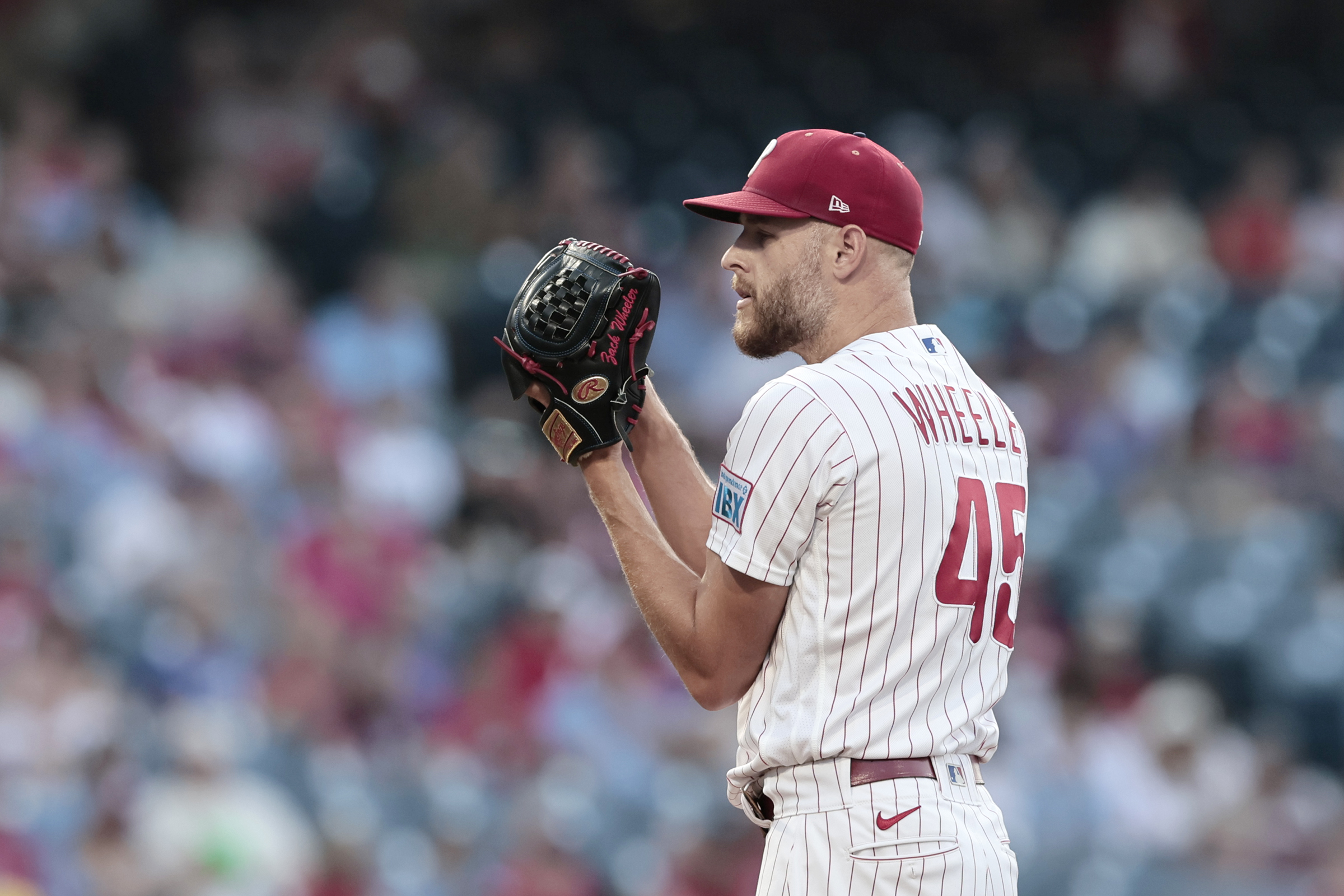
    Zack Wheeler was driving angry.

    He’d allowed two runs off two hits and four walks over five innings in a 6-4 Phillies win Tuesday night over the Marlins. It was the fifth consecutive start in which he’d failed to pitch at least six innings (one was affected by rain). His fastball velocity this season had been the lowest it’s been in eight years, at 95.1 mph.

    He’s 36. He’s coming off surgery to address thoracic outlet syndrome that cost him the last seven weeks of 2025 and the first month of 2026. Was it his age? Was it the surgery?

    Did it really matter? After all, the Phillies did win.

    “I was thinking about that on the way home,” Wheeler admitted. “I was, like, ‘I guess that’s not the worst start.’”

    He calmed down and drove on.

    The Phillies won two of Wheeler’s last five starts. They’re 16-8 this season when he starts, and he’s 10-5 with a 2.92 ERA. Since arriving in Philadelphia in 2020, Wheeler has been the best pitcher in baseball. He remains just that.

    When he pitches, the Phillies have a great chance to win, style points be damned. That’s all that matters. But even Wheeler has a hard time seeing the forest for the trees, since the game has changed since he hit the bigs 14 years ago.

    “I think the win column doesn’t matter as much as it used to,” Wheeler said. “Just, because, there’s more numbers and all the other crazy stats that there are.”

    Nevertheless …

    “But, you know, I think when they put your name on a lineup card and we go out as starters, we’re expected to give the team a chance to win.”

    And that’s all.

    The Phillies are 16-8 when Zack Wheeler pitches, including Tuesday’s game despite some struggles. Yong Kim / Staff Photographer

    Wheeler’s interim manager, Don Mattingly, believes that, regardless of max velo or walk rate, Wheeler always provides the Phillies an excellent chance to win, even if his fastball sits at no more than 95 mph.

    “What I worry more about is, ‘Is this guy giving us good starts and keeping us in the game,’ more than anything else,” Mattingly said Tuesday. “Zack’s not one of the guys I worry about, if that’s what you’re asking.”

    Mattingly seemed a bit bemused at the line of questioning, and just a smidge perturbed.

    After all, they’d won the game.

    Act II: Strategy

    Mattingly had the same tone the next afternoon, when he was asked about a strategy on the radio pregame show regarding holding runners.

    In the ninth inning Monday, with a 6-4 lead, Duran allowed a leadoff single to Xavier Edwards. Edwards is an effective base-stealer. Duran is generally ineffective at holding runners. The Phillies did not hold Edwards. Edwards took second base on the first pitch, moved to third on a groundout that might have been a double-play ball had he been successfully held at first base. He then scored on a single. Duran retired the next two hitters and the Phillies won, 6-5.

    In the daily pregame radio show the next afternoon, Mattingly was asked about the strategy of not holding the runner. Mattingly explained that, with a two-run lead, he usually considers that run inconsequential compared with the defensive compromise of having the first baseman hold the runner, which opens a much wider hole between first and second base.

    This is not a hard-and-fast rule, just a sound general strategy. Outs with leads equal wins.

    In the ninth inning Sunday, with a 7-5 lead and one out, Victor Caratini walked. Caratini is an ineffective base-stealer. The Phillies did not hold him. Caratini advanced to second on a single. Duran stranded both runners with consecutive strikeouts.

    In the ninth inning Wednesday, with a 4-1 lead, Duran allowed a leadoff single to Heriberto Hernandez, who is a moderate threat to steal. The Phillies did hold Hernandez, who was forced out at second on a ground ball by Owen Cassie to shortstop.

    Jhoan Duran got the final out Wednesday, allowing a leadoff hit before earning the save.Matt Slocum

    Mattingly acknowledged that this strategy works best if the pitcher is selfless enough to not worry about giving up an earned run. A single earned run for a reliever, especially a closer, has a much greater effect on his ERA than it would for a starter or a long reliever since closers seldom pitch more than a single inning in a game.

    Duran’s ERA rose from 1.66 to 1.86 on Monday. He was asked before Wednesday’s game if he’d cared about risking that earned run.

    “It all depends,” Duran said. “In that situation, I understand. They explained it to me. We’re on the same page right now.”

    Several factors influence the decision to hold a runner or not. Does the runner run well? Does the batter make consistent contact, especially on the ground to the right side? Does the batter make better contact with a runner on base? It might not get that granular in every situation, but if we know anything about today’s baseball, it’s that things can get as granular as you like.

    Monday, the evidence was more empirical than analytical. Duran has blown just two saves this season, but his last was against the Marlins on July 27. In that game, they held the runner, and a soft grounder to the right side got through, a big part of a killer, three-run inning.

    “Sometimes, we cover the runner, and they get soft contact that way, and it’s a base hit,” Duran said.

    Act III: Aphorisms

    No one gets more annoyed than I do when Jalen Hurts, the Eagles’ 28-year-old sage, drops his saccharine maxims. But one of them resonates every time:

    “You gotta keep the main thing the main thing.”

    This is Hurts’ general fallback line when asked about the efficiency of the team’s offense, particularly the aesthetic quality of his own often choppy, inelegant passing performances.

    No winner in Philadelphia history has been picked apart more than Hurts. I know, because I’ve done it myself. There somehow is an active debate regarding whether Hurts deserves a contract extension because Hurts can’t sling it like Josh Allen or Joe Burrow. Mike Vrabel, who took the Patriots to the Super Bowl last year and won it three times as a Patriot, considers Hurts a “franchise quarterback.”

    Hurts wins.

    That, more than anything, is what matters.

    But even the athletes can lose sight of that, and that includes the Phillies’ two best pitchers.

    “You know, we won the game,” Duran said, “but, like, we [don’t] want to give up a free run, you know?”

    Wheeler has parameters beyond winning.

    “My mindset is: Six to eight innings every start. That’s what great pitchers do,” Wheeler said. He walked five batters two starts prior, and what bothered him most about Tuesday were the four walks. “It’s hard for me to be, like, ‘Yeah, that’s good.’”

    Understood. After all, Wheeler hadn’t walked 10 batters in a three-game span since early in 2019.

    “I’m used to doing what I have been doing for a long time now — being great — and that’s just not great,” Wheeler said.

    Maybe not.

    But, as usually is the case with Duran and Hurts, even when Wheeler’s not great, he’s more than good enough.

  • Bryson Stott’s historic tear and Zack Wheeler’s slump are among the key Phillies subplots

    Bryson Stott’s historic tear and Zack Wheeler’s slump are among the key Phillies subplots

    Three big questions for the Phillies as they look to do to the Cardinals what they just did to the Marlins …

    Zack Wheeler is going to be OK, right?

    Only once in Wheeler’s seven years with the Phillies had he gone more than two consecutive starts without pitching at least 5⅔ innings. Never had he gone more than three. His current streak now stands at five, a career-high and by far the most important subplot of the Phillies’ stretch run.

    The top-line key performance indicators suggest something more than bad luck is responsible. Wheeler’s ground ball ratio over his last five starts is half of what it was in the first two-plus months of this season. His soft contact percentage is down, while his hard contact percentage is up. His 10 walks over his last three starts are his most in a three-start span since 2019, his last season with the Mets. His strike percentage on Tuesday was his second lowest of the season.

    The Phillies don’t sound too concerned. Wheeler’s pitch-level metrics don’t set off any health alarm bells.

    His fastball velocity remains in line with his overall season average: 95.5 mph on the four-seamer and 95 on the sinker in his most recent start, per Statcast. Both are marginally above their season-long baseline. Wheeler’s spin rates haven’t changed much at all. He is simply struggling to locate.

    Can Bryson Stott keep this up?

    The Phillies don’t need Stott to be Albert Pujols, but it’s always a good thing when a player does something that nobody since Pujols had done. In Stott’s case, that something was walking 21 times with just four strikeouts in a 19-game on-base streak that ended earlier this week with an 0-for-4 outing against the Marlins.

    The Phillies’ formula for a late-season surge has always required somebody in the bottom-third of the lineup to get hot. They are a completely different team when somebody at the bottom of the order is reaching base consistently. Few hitters have been hotter than Stott in recent weeks. Less than a month ago, his OPS was .692. As of Thursday, it was .755. That’s a remarkable jump this late in the season. The encouraging thing is what preceded it.

    In his last 81 games, Bryson Stott is hitting .284 with a .375 OBP and a .429 slugging percentageYong Kim / Staff Photographer

    Stott has been a well-above average big league hitter for half of a season now. In his last 81 games, he is hitting .284 with a .375 OBP and a .429 slugging percentage. That’s an .804 OPS, with 52 strikeouts and 41 walks in 326 plate appearances.

    If Stott continues at this pace for the rest of the season, there is a conceivable world where Bryce Harper and Kyle Schwarber both get hot at the same time and the Phillies score runs with enough consistency to rattle off the kind of winning streak that can pressure the Braves.

    Can the Phillies avoid overworking Jonathan Bowlan?

    This is one of those questions that would have sounded like a foreign language at the start of the season. Not only has Bowlan worked his way to the back of the bullpen, the Phillies might not be able to survive without him. It’s worth noting, then, that the 29-year-old right-hander threw a combined 62 pitches in his last two outings with one day of rest between them.

    Bowlan fits the profile of a guy who can handle the rigor of intensive bullpen action. With the Royals last season, he threw 63 pitches in a three-day stretch and 96 over four days and showed no ill effects. He was optioned to the minors but continued pitching regularly and returned to the big leagues later in the month, posting a 2.55 ERA in 17⅔ innings from late August through the end of last season.

    All that said, the Phillies will need to exert some willpower with Bowlan, who has emerged as the most dependable arm in the bullpen this side of Jhoan Duran. He has walked just seven batters in 19⅓ innings since moving into a high-leverage seventh- or eighth-inning role on July 7. He has a 2.33 ERA during that stretch, even after allowing a couple of runs to the Marlins on Monday. Bowlan’s has been the kind of unforeseen emergence that a team needs to get where the Phillies want to go. Interim manager Don Mattingly and his athletic training staff are going to need to walk the perilous line that always exists when a manager trusts one reliever above all others.

  • He was the first Phillies pitcher to return from Tommy John surgery. He still wonders what might have been.

    He was the first Phillies pitcher to return from Tommy John surgery. He still wonders what might have been.

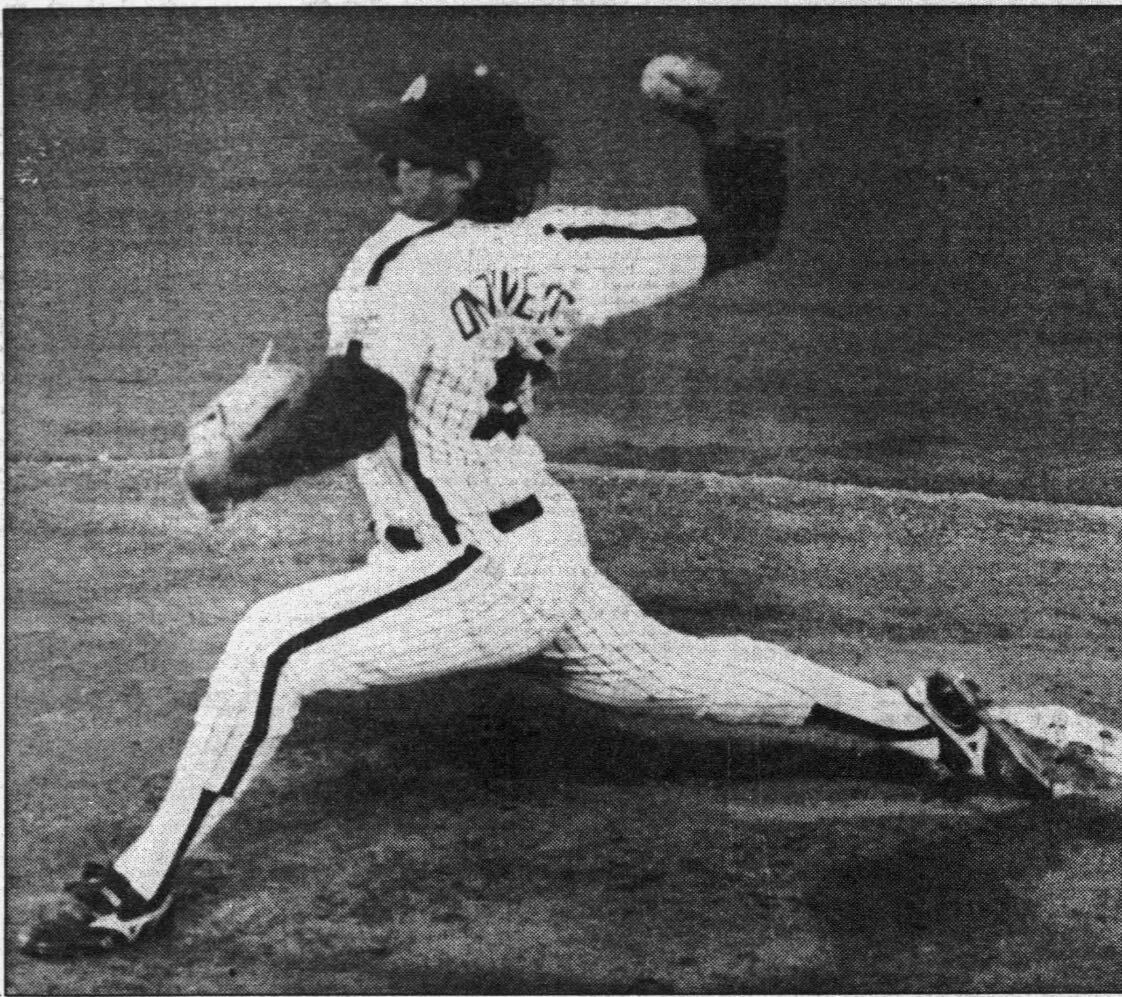
    Steve Ontiveros was for once healthy, and had not yet joined the Phillies, when he and Tommy John became teammates, pitchers on the Oakland Athletics in 1985. Ontiveros was 24 years old, a right-hander having a terrific rookie season: a 1.93 earned run average, eight saves. John was already 42, still the same soft-throwing lefty he’d always been, more than a decade removed from undergoing the revolutionary surgical procedure that still bears his name. They did not know then the physiological connection they would come to share.

    Over the 11 games that he pitched for the Phillies in 1989 and 1990, in an era full of forgettable baseball here, Ontiveros managed to complete a remarkable story — and to introduce Philadelphia to the future of sports medicine. He was the first Phillies pitcher to have Tommy John surgery and return to pitch for the team.

    After starting 2-0 and allowing just two earned runs in his first 20 innings in ‘89, after offering a glimpse of greatness to an awful Phillies team, Ontiveros needed some magical science and the steady hands of surgeon Frank Jobe just to take the mound in the majors again. When he caught the news reports that John had died at 83 late last Saturday night, Ontiveros couldn’t help but recall John’s daring and desperate decision back in 1974 — his willingness to have Jobe try replacing a torn ligament in John’s left elbow with a fresh tendon from somewhere on John’s body.

    The procedure saved John’s career. It has saved hundreds of pitchers’ careers since. Steve Ontiveros’ star-crossed stretch in Major League Baseball was one of them.

    “He was fantastic,” Ontiveros, 65, said by speakerphone as he and his wife, Cindy, drove near their Scottsdale, Ariz., home Tuesday morning. “Think about it: No one in the history of the game had had that done. It was so off the wall, out of outer space, to even think about that type of surgery. But when that’s your livelihood, you’ll do anything. You’ll take any chance because you want to play. You want to compete.”

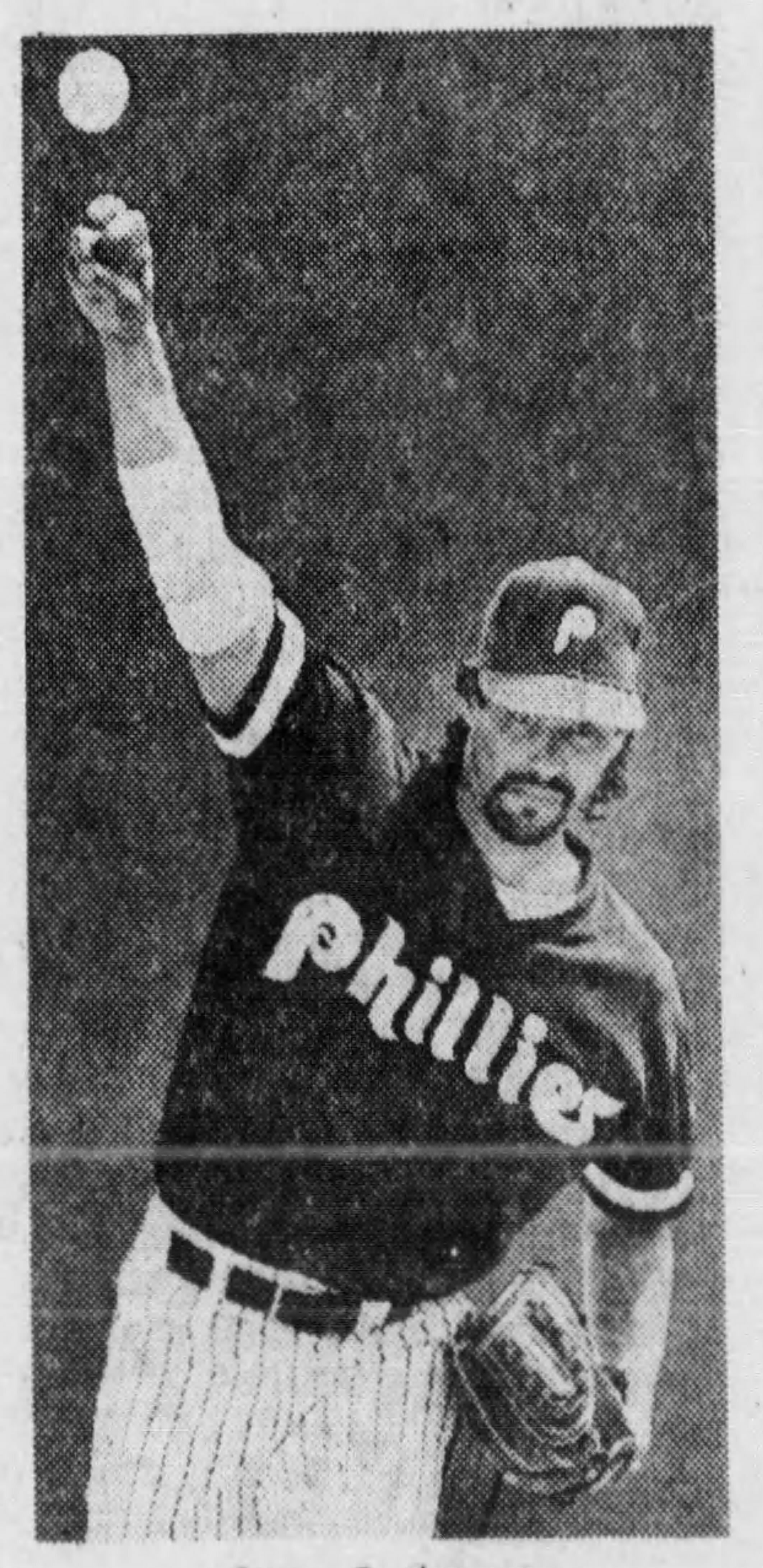
    He and John — who appeared in 760 games, won 288, threw 46 shutouts, and should have been inducted into the National Baseball Hall of Fame long ago — were different people, different pitchers, and at different stages of their lives when they met. The A’s picked Ontiveros in the second round of the 1982 draft. A standout at the University of Michigan, a fierce black goatee rimming his mouth, he had five pitches, each of which he could throw with exquisite control. “When I was healthy,” he said, “I got people out.”

    John, with his granddad-bod physique and his slow-slower-slowest stuff, seemed a being from another time, another world. Ontiveros, for instance, would be baffled watching him slide himself into a scalding hot whirlpool before every start. The Centers for Disease Control recommends keeping the water in a Jacuzzi under 104 degrees Fahrenheit, but John would crank the temperature to 115 and spend 10 minutes practically poaching himself. When Ontiveros asked him about the strange ritual, John explained that the soak had been part of his pre-start preparation for years. It saps my energy, he told Ontiveros. When I come in, if I’m throwing 85, I get killed. But if I’m throwing 82, they can’t touch me.

    John was in the midst of his 25th and next-to-last season in the majors, winning nine games and pitching 176⅔ innings for the Yankees in 1988, when Ontiveros first experienced the arm trouble that would dog him thereafter. The prospective third starter on an Oakland team that starred Jose Canseco, Mark McGwire, Dennis Eckersley, and Dave “Smoke” Stewart and would win the American League pennant, Ontiveros had pain flare up in his elbow during spring training. The A’s pushed him back in the rotation, to the No. 5 spot, to give him more rest, but it didn’t help.

    Before Ontiveros’s June 6 start in Kansas City against the Royals, the A’s training staff tried to stabilize his elbow by wrapping it in tape as if it were an injured knee. Twenty pitches into his warmups, the tape fell off, and though Ontiveros allowed just one earned run in seven innings that night, he knew something was wrong.

    Tommy John crossed paths with Steve Ontiveros on the A’s in 1985.

    “I’m in the seventh inning, and I throw a pitch, get the ball from the catcher, and I’d have to walk around the mound until the pain went away,” he said. “When I’d climb back on the mound, I’d make another pitch. I did that through the entire inning. I said, ‘I can’t do this anymore.’”

    He didn’t appear in another game for the A’s that season after early August, and in the offseason he underwent elbow surgery that wasn’t as radical as John’s but was close. A ligament in Ontiveros’ elbow had stretched so far that, he said, “it wasn’t performing as a ligament anymore.” So orthopedist Lewis Yocum shortened it, folding it over onto itself and suturing it.

    The A’s released Ontiveros in December ‘88, and the Phillies signed him as a free agent in February ‘89. Pitchers like him were the Phillies’ currency back then: injured or aging long shots who had once been promising prospects or accomplished big-leaguers. Danny Cox, Dave LaPoint, David Palmer, later Fernando Valenzuela and Sid Fernandez: Each of them tried to complete a semi-miraculous comeback.

    Despite being a nonroster invitee to spring training, Ontiveros cracked the rotation, then dominated the Cubs — eight innings, one earned run — on April 6 before throwing seven shutout innings to beat the Montreal Expos at Veterans Stadium five days later. The Phillies were 5-2 and in first place in the National League East. “This qualifies as a pleasant surprise in my book,” manager Nick Leyva said after the game.

    But after his brilliant start against the Expos, Ontiveros felt the same twinge of pain that he had the season before. He lasted five innings, giving up just one run, in a loss to the New York Mets on April 19 before the Phillies put him on the injured list, with a “strained ligament,” for nearly two months. “I went down, and we lost two other pitchers,” he said. “We instantly sucked after that.” He returned in June and was hammered: three starts, 10⅔ innings, 19 hits, 11 earned runs.

    “I wasn’t able to separate the pain from the pitch,” Ontiveros said. “It starts accumulating in your head, the pain that’s going to be coming. It takes away your focus from getting a hitter out. You focus on, ‘What am I feeling right now? Is my arm going to fall off on the next pitch?’ I could not overcome that amount of pain mentally. There may be some people who could. I was not one of them. I was so distracted by the amount of pain I was feeling and the amount of pain that was to come if I kept throwing.”

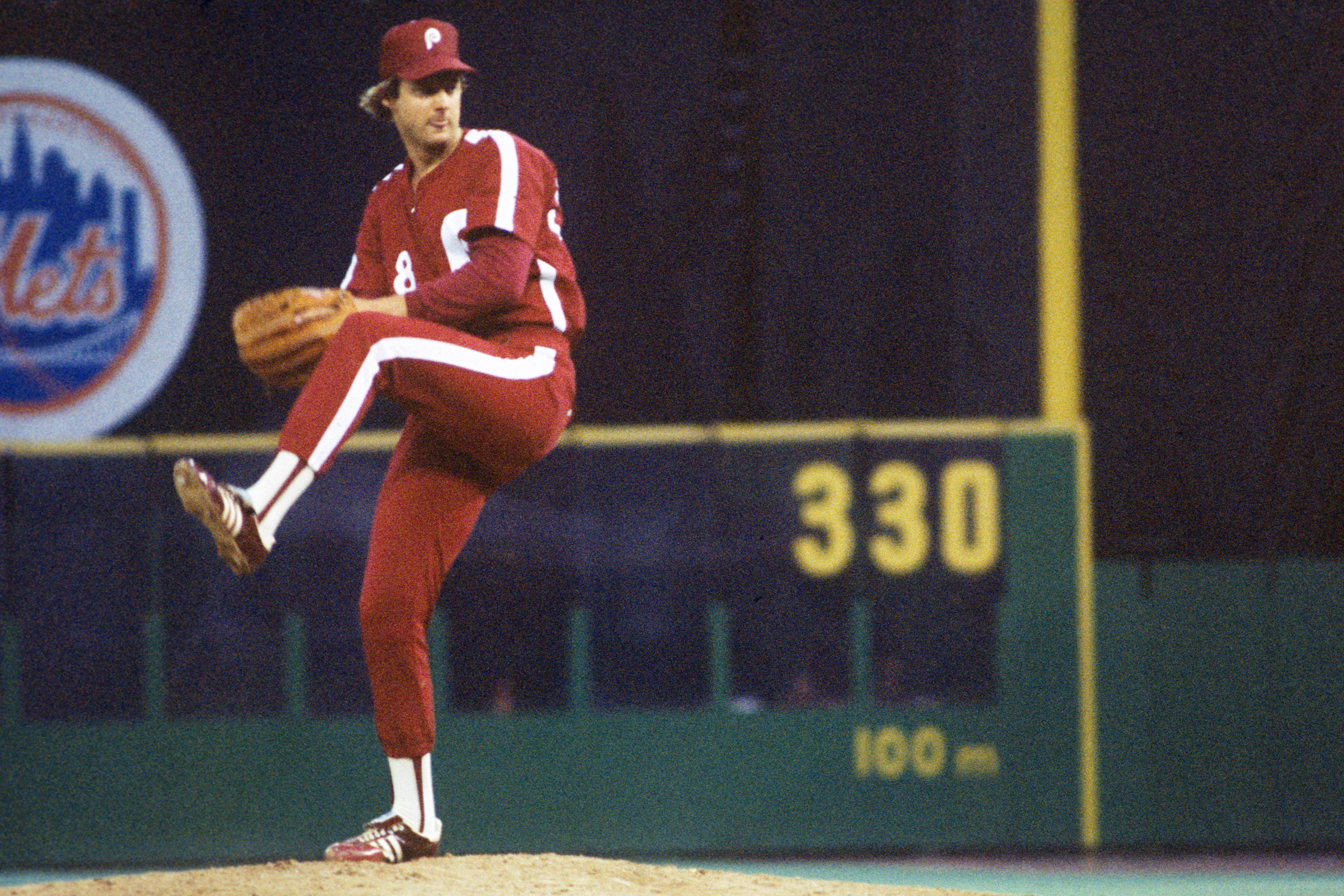
    There was no avoiding the knife now, but the Phillies had little experience with Tommy John surgery. Larry Christenson was their first pitcher to have it, in 1983, in a last-ditch effort to end his lengthy succession of elbow injuries. He never pitched for them or anyone else again. The good news for Ontiveros and the Phillies was that Jobe himself would handle the operation. The bad news was that, even 15 years after John’s pioneering procedure, only so many advancements and improvements to it and a pitcher’s rehabilitation process had been made.

    Larry Christenson was the first Phillies pitcher to have Tommy John surgery in 1983.Copyright © The Phillies/Paul Roedig

    Before Jobe and his team performed the surgery, on July 20, 1989, they asked Ontiveros if he wanted them to take the healthy ligament from his right arm or his left. The left, of course, Ontiveros told them. Why weaken and damage his right arm further? Except the doctors screwed up, instead removing a six-inch tendon from Ontiveros’s right wrist and grafting it onto his elbow.

    The mistake prolonged Ontiveros’ rehab, which was hardly the kind of comprehensive, reliable course of action that would reassure an elite athlete whose livelihood was hanging in the balance. Working with the Phillies’ medical and training staff and with Steve Kush, a trainer based in Arizona, Ontiveros tried to improve his right arm’s range of motion before strengthening the muscles around his elbow joint. But no one was completely certain what exercises he ought to be doing or how often he ought to be doing them. When he visited Jobe for a postsurgery consultation, Ontiveros asked the doctor for some direction.

    “He literally handed me a copy of what they did with Tommy John,” Ontiveros said. “It was 10 pages of nothing. There was no structure to any of it. I gave it to Steve, and we just kind of winged it.”

    Having read that another pitcher, John Tudor, had recovered from Tommy John surgery in just eight months, Ontiveros pushed himself to match that ambitious timeline. “I went out in the offseason, and I threw outside,” he said, “and it was cold, and I felt a little tug. I went, ‘Uh, oh.’ I pushed it too fast, and it set me back months.” Still, the makeshift rehab went well enough that in August 1990, he made a start for the Phillies’ single-A affiliate in Clearwater. He lasted one inning. His arm, he said afterward, felt like he had stuck his finger into an electrical socket, and he was certain his career was finished. It did not have to be. There was some inflammation in his elbow, but rest would heal it. He talked with Cindy. They decided he would not give up.

    When he pitched again in the majors, for the Phillies, at Wrigley Field against the Cubs on Sept. 13, 1990, throwing two shutout innings in relief, his senses seemed sharper: the smell of the grass on the infield and the ivy on the outfield walls, the tingle of Lake Michigan’s breeze.

    “I went through so much [stuff] with the Phillies, and I loved playing for them,” said Ontiveros, who after retiring ran a baseball academy for 20 years that produced 13 major-league players. “I absolutely loved the fan base. Yeah, they’re brutal, but they’re also amazing. You do well, and they’ll let you know about it. Just being able to know a fan base has passion — I played four years in Oakland before that, and you’d see them come in by the third inning and leave by the seventh inning, and these were World Series-caliber players on a World Series-caliber team. You went to Philly, and it was intense, and I loved that.”

    Steve Ontiveros pitched in 11 games for the Phillies over the 1989 and 1990 seasons.Daily News staff

    Through a second Tommy John surgery, he somehow kept pitching, returning to the A’s, going 6-4 and leading the American League in ERA (2.65) in 1994, earning a spot on the AL All-Star Team in 1995, appearing in three games for the Boston Red Sox in 2000 when he was 39. When he was as close as he would get to being Tommy John himself, to having something else in common with the man whose name now lives forever.

    “It gave me longevity,” he said. “That was good. That wouldn’t have happened otherwise. I’d have been done. It gave me an opportunity to continue my career. It’s just unfortunate that there weren’t that many people ahead of me.”

    True, but there have been so many after him who could keep pitching, who could keep playing the game they loved. That legacy is Steve Ontiveros’, too, and as they continued on their morning drive, perhaps because she could hear the wistfulness and what-might-have-been in his voice, Cindy Ontiveros asked her husband a question.

    “How many people have come back from two?”

    “Not many,” one of them said.

  • Alec Bohm, Bryce Harper, Bryson Stott address how Luis Arraez helped save the Phillies’ offense

    Alec Bohm, Bryce Harper, Bryson Stott address how Luis Arraez helped save the Phillies’ offense

    Athletes mimic.

    Whether it’s Kobe Bryant mirroring Michael Jordan or Joel Embiid mastering Kobe’s footwork, imitation is the sincerest form of flattery (which actually is the case for that aphorism, since Oscar Wilde borrowed it from Charles Caleb Cotton).

    The Phillies aren’t exactly mimicking deadline light-hitting addition Luis Arraez, but his arrival on Aug. 3 has meant everything to a team that had the most disappointing offense in baseball through two-thirds of the season.

    The Phillies’ on-base percentage on Aug. 3 was .305, which was third-worst in baseball. The Phillies’ on-base percentage since Aug. 3, entering Wednesday night’s game, was .367, which was the best in baseball.

    What happened between Aug. 3 and Aug. 4?

    The Phillies traded for Arraez.

    This makes sense — right? — since Arraez won league batting titles in 2022, 2023, and 2024, and he led the National League entering Wednesday, at .317.

    However, since his arrival, Arraez has generally slumped. He was hitting .274 with a .292 on-base percentage since arriving from San Francisco. This might be because he’s batting fourth in the order after spending almost all of his career batting first or second. At any rate, it’s OK.

    Because this has less to do with Arraez’s production than with Arraez’s presence and how it has affected the hitters around him.

    Bryce Harper, the No. 3 batter in front of Arraez, was hitting .255 with an .862 OPS on Aug. 3. Since then, he’s hit .295 with a .939 OPS, fueled largely by his .530 on-base percentage, which includes 22 walks in 14 games.

    Alec Bohm, hitting fifth behind Arraez, was hitting .226 on Aug. 3. Since then, he’s hit .396 with a 1.038 OPS and 11 RBIs in 14 games.

    Bryson Stott, who bats sixth, was hitting .253 on Aug. 3. Since then, he’s hit .367, has a 10-game hitting streak, and, like Harper, his on-base percentage of .508 has as much to do with his eye as with his hands: Stott has 14 walks in those 14 games.

    Harper has begged for protection for two seasons.

    Now, he has it.

    “As a lineup, any time you’re able to add somebody like that, obviously, it’s going to be really good for the team,” Harper said. “You know he’s [going] to put the bat on the ball.”

    There might be other factors.

    The Phillies held a hitters’ meeting just before Arraez arrived, and they talked a lot about being selective-aggressive, as hitting coach Kevin Long has preached since his arrival in 2022.

    Long’s a superb hitting coach, but Long doesn’t hit. Long doesn’t set an example. Arraez does both, and his presence seems to have more obviously impacted production.

    Between the meeting and Arraez’s arrival, the Phillies’ on-base percentage rose two points.

    Between Arraez’s arrival and Wednesday night, the Phillies’ on-base percentage rose 62 points.

    It’s not as if Arraez sets an example of selectivity. In fact, he’s seeing just 3.74 pitches per plate appearance this season, well below the big-league average of 4.13. And Arraez doesn’t walk much: he’s averaged 37.2 walks in his five full seasons, and he has 27 this season.

    Luis Arraez doesn’t walk much, but he strikes out even less.Elizabeth Robertson / Staff Photographer

    So, has he really affected the middle of the lineup?

    “Yeah, for sure,” Stott said. “When you’re the guy behind him, you see him, when he swings the bat, it just feels like he’s going to get a hit.”

    Bohm spoke after Tuesday’s win over the Marlins, in which the Phillies collected 10 hits. Nine of them were singles, but, really, Bohm’s double was a single, too, but the Marlins threw to the wrong man, so he stretched it into a double.

    The core of the Phillies’ order is swinging at fewer tough strikes, waiting for their pitch, making balanced, controlled swings, keeping the bat in the strike zone longer, and not trying to hit home runs. Harper, Stott, and Bohm struck out just 17 times combined in the last 14 games.

    Homers have become coincidental.

    On Tuesday, the Phillies scored at least six runs in a fifth straight game, the first time they’ve done that this season. They scored six on Monday, too, with 10 singles and a double.

    They’ve become a fun team to watch by adding a fun player.

    “He’s one of those infectious energy guys,” Bohm said. “And you see the ways he plays, the way he takes his at-bats, watching his at-bats — you spend time around good hitters, good hitters can make other hitters better.”

    The sincerest form of flattery, indeed.

  • A.J. Brown and the Patriots vs. Jalen Hurts and the Eagles is the perfect rivalry for our hot-take age

    A.J. Brown and the Patriots vs. Jalen Hurts and the Eagles is the perfect rivalry for our hot-take age

    You know how this is going to go. The Eagles will take part in two joint practices, on Wednesday and Thursday, against the New England Patriots — and against A.J. Brown. Those workouts, plus the teams’ preseason game Saturday, will provide all the narrative jet fuel necessary to power us through the rest of the preseason and at least five weeks into the regular season.

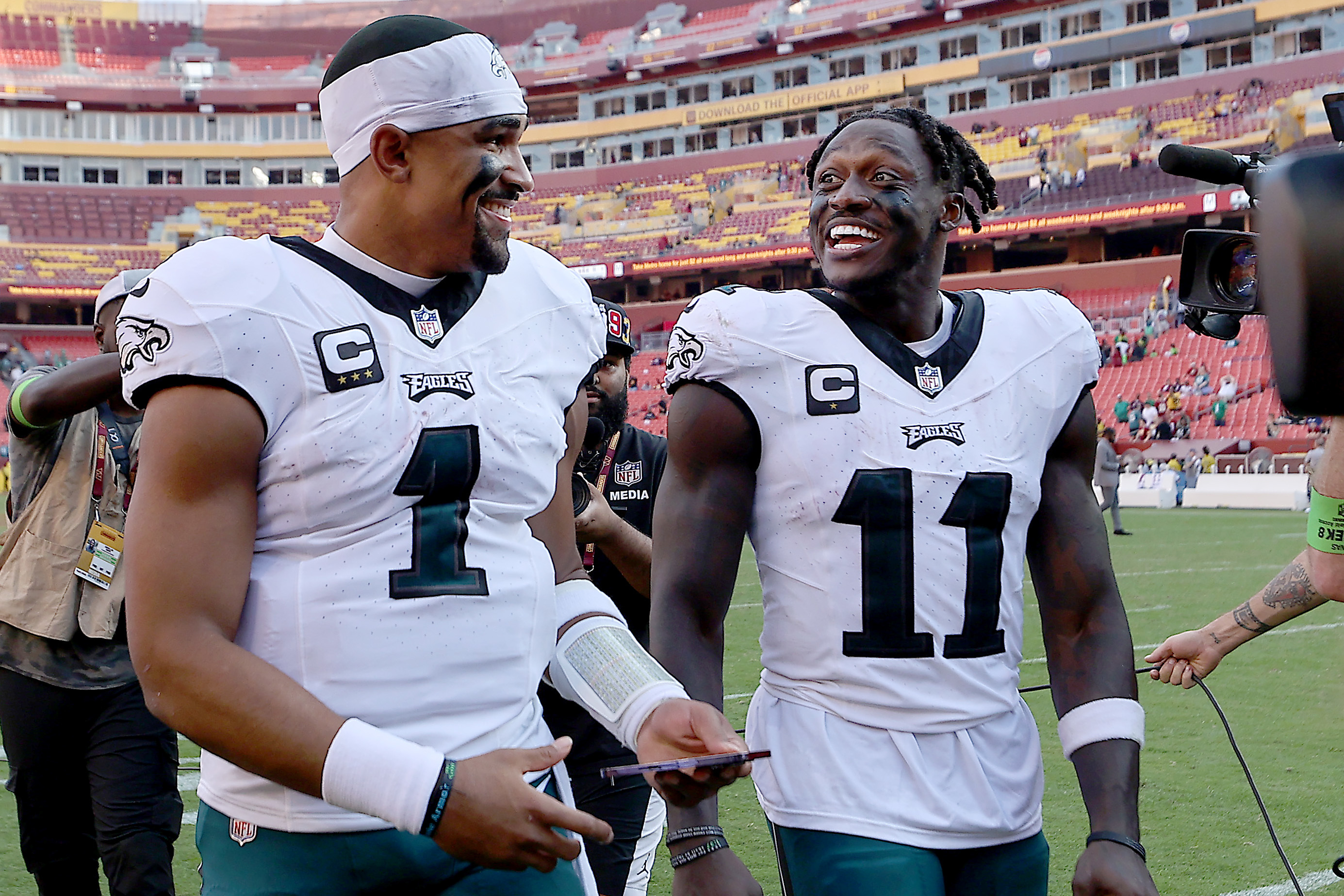
    By then, Jalen Hurts will have played a few real games in Sean Mannion’s offense, and Brown will have caught who-knows-how-many passes from Drake Maye, and we’ll have a better if incomplete gauge of each team’s chances of qualifying for the playoffs, winning its division, and reaching Super Bowl LXI. Let’s be honest, though: A lot of people who follow the NFL and root for the Eagles will pay attention to how the Patriots fare, sure, but they’ll be more interested in another comparison, another unspoken competition: Jalen vs. A.J.

    Jalen vs. A.J. is about more than football. It’s about a friendship that fell apart and that may or may not have been put back together. It’s about a partnership that contributed to a championship, to four seasons’ worth of excellent collective performance, and to a year-plus of questions and passive-aggressive behavior that culminated in the acknowledgment that it was time for one of these men to move on.

    Best of all, Jalen vs. A.J. taps into one of the most visceral and familiar sensations within Philadelphia sports fandom (and, to a less intense degree, sports fandom generally). People here love to hate a villain, and Brown — whether he intended to or not, whether it’s fair that he is perceived this way or not — made himself one when he made it clear that he’d be happier playing for another team.

    He’s the guy who left, who snubbed the Eagles and everyone who cheers for them. Hurts is the guy who stayed, who wanted to be here. For a lot of fans here, it won’t be enough if Hurts has a terrific season or the Eagles win more games than the Patriots. Brown must drop every pass Maye throws to him, complain incessantly about how miserable he is, and be photographed paging through a copy of The TB12 Method on the New England sideline. These two are going to be held up against each other all season.

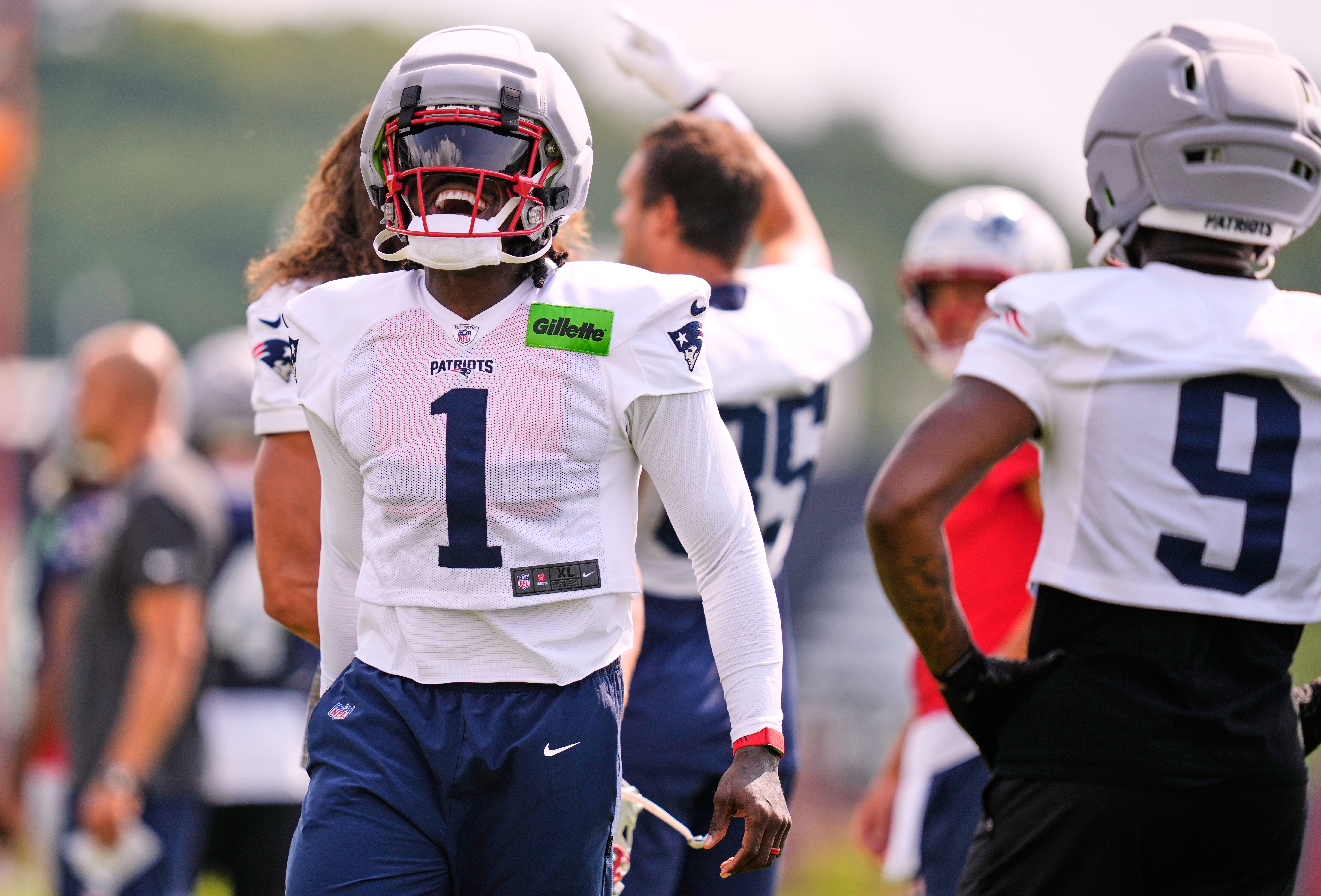
    A.J. Brown (1) wanted out, and now resides in New England where many Eagles fans wish him to fail. Charles Krupa

    So how will we judge who has won this soap-operatic battle? Obviously, team success and individual achievement will be the primary determining factors. And while there’s really no way to know for certain how the season will play out for either Hurts or Brown, we can look at some conditions and circumstances as they are now to make an educated guess about who will get the better of whom.

    For instance …

    Hurts’ head coach is Nick Sirianni, who has won a Super Bowl and sometimes has his children accompany him to his postgame news conferences. Mike Vrabel, who has lost a Super Bowl and isn’t quite as devoted a family man, will hold Brown’s hand throughout their time together with the Patriots. Advantage: Jalen.

    Brown’s quarterback will be Maye, who, before his four rocky playoff games, led the NFL last season in completion percentage, yards per attempt, passer rating, and QBR. Hurts’ wide receivers will be DeVonta Smith and three guys named Sal. Advantage: A.J.

    In fairness, Hurts can probably count on Sal 1, Sal 2, and Sal 3 to finish running all their routes. Advantage: Jalen.

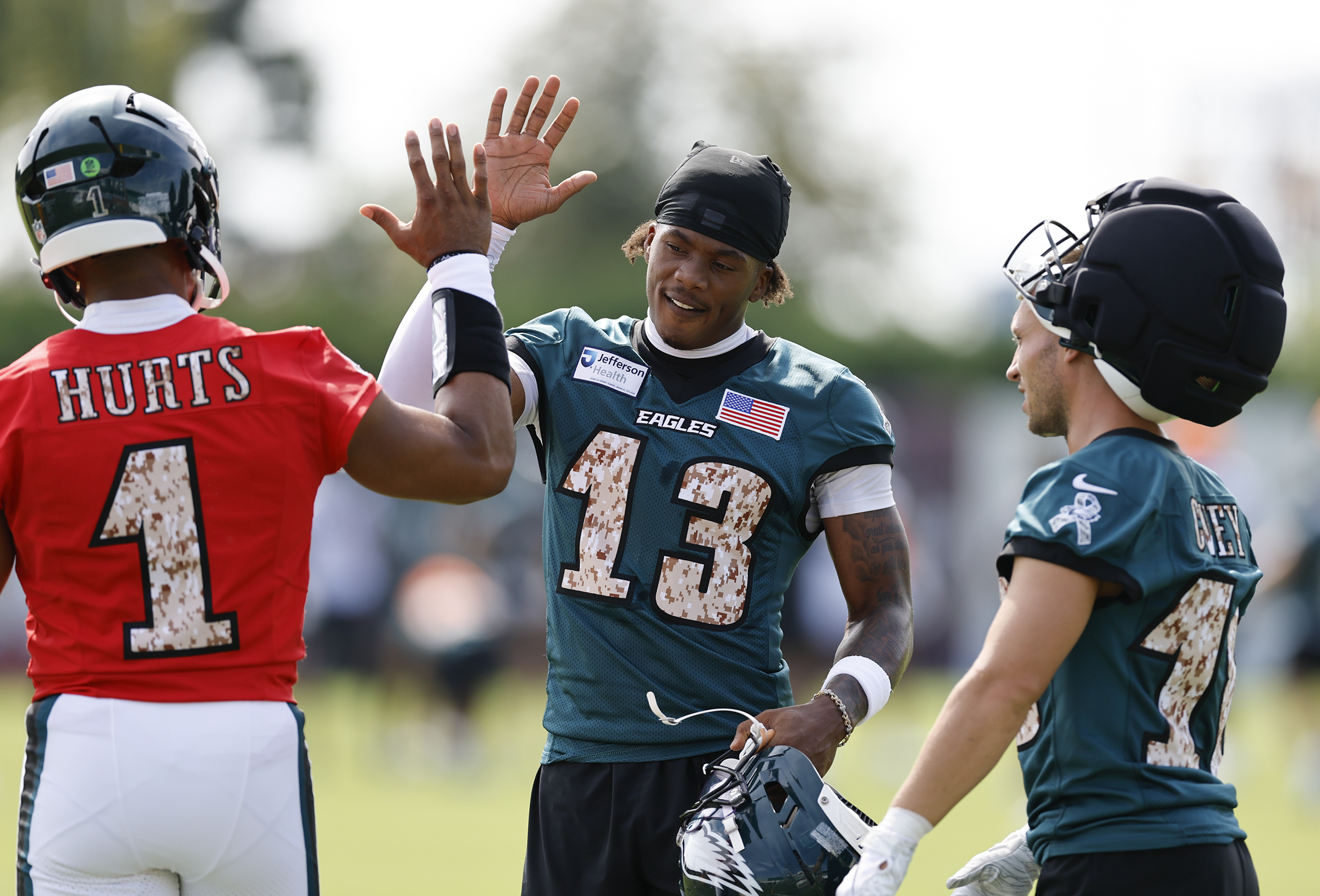
    Jalen Hurts with wide receivers Dontayvion Wicks (center) and Britain Covey during training camp earlier this month. Yong Kim / Staff Photographer

    The Patriots’ play-caller will be Josh McDaniels, regarded as one of the league’s most astute orchestrators of offense. The Eagles’ will be Mannion, who has never called plays in the NFL but is also not Kevin Patullo. Advantage: A.J.

    Hurts still plays in Philadelphia, where he can have dinner at any number of world-class restaurants and partake of a robust cultural scene and night life. Brown now plays in Foxboro, Mass., where he can pay full price for a refill at Dunkin’. Advantage: Jalen.

    Over his career, Brown has spent a lot of time, perhaps too much time, on Instagram and X/Twitter and paid a lot of attention, perhaps too much attention, to what has been written and said about him there. But with the Patriots, he doesn’t have to worry about the franchise’s social media team undermining his standing in the locker room by posting a video of him doing something totally humiliating and vitally important like throwing an interception in training camp. Advantage: A.J.

    Welp, looks like Jalen vs. A.J. is too close to call at the moment. Which is great. More intrigue! More drama! More content! Two man enter. One man leave. There can be only one Highlander. The winner gets a free copy of Pat McAfee’s new country-rock-rap-grievance album and the satisfaction of knowing the other guy was the true source of the problems with the Eagles’ passing game all along. The loser must live with the shame of knowing he let down a desperate fan base starved for its first Super Bowl victory in a year and a half. Let our long march to the ultimate hot take begin.