The body of a 33-year-old woman who disappeared in the Delaware River after she rescued a struggling swimmer on Monday afternoon has been recovered, the Delran Township Police Department said Tuesday.
Search crews located the body of Priscila Alvares Pereira Dos Santos about 20 feet off a beach at Amico Island Park in Riverside shortly after 8 a.m. Tuesday, Delran police said, roughly 16 hours after she was last seen in the water.
Alvares Pereira Dos Santos reportedly drowned after saving a girl who was struggling in the river around 4 p.m. on Monday, according to officials.
She was able to push the girl toward bystanders on the shore before she vanished under the surface, they said.
The girl she saved has not been publicly identified and her condition is unknown.
Amico Island Park was closed Tuesday as the investigation into the incident continued.
New Jersey students are going back to school with a new phone-free routine in September.
Starting on the first day of classes, all K-12 students in public schools must power off and put away phones and most internet-enabled devices before the bell rings, with only a few exceptions.
Heartily endorsed by educators who believe it will ease classroom distractions, promote academic performance, and improve student mental health, New Jersey’s new rule marks a big change for students accustomed to having their cellphones and other devices nearby and checking them regularly — even during class.
Some districts, such as Cherry Hill and Woodbury, have voluntarily implemented cell phone bans. Woodbury Superintendent Andrew Bell said most students embraced the restrictions and spend more time interacting with each other during breaks.
“At this point, it’s simply part of our culture and daily routine,” Bell said of the cell-free policy, passed two years ago.
The state left it to local school boards to determine how to implement the law at a district level, while complying with the guidelines. Because policies may vary, parents and students should check with their local district.
The law requires the state’s nearly 600 public school districts to adopt a policy banning the use of cell phones and other personal devices for the entire school day. The law allows some flexibility on enforcement and how the devices are stored.
The state Department of Education issued guidelines this summer to help district set local policies. Some districts including Cherry Hill in Camden County and Washington Township in Gloucester County this month are voting on amending existing policies.
Districts had to decide whether students would be required to store their phones in their lockers or bins, in locked pouches, or in their backpacks with their personal belongings. The devices must be powered off.
The guidelines apply to all internet-enabled devices, typically smartphones, smartwatches, smart glasses, and ear buds, or any device that can access online content.
Some districts have also included other communication devices like flip phones, two-way radios, and walkie-talkies. Some rules may vary, for age appropriateness, depending on grade level, too.
What is bell-to-bell?
Cherry Hill school board member Bridget Palmer explained the restriction this way at a recent board meeting: “The minute you walk in to the meeting, you leave.”
The law restricts students from using their phones during lunch and study hall periods.
Districts get to decide whether phones can be used before and after school on school grounds, on school buses, and during school-sponsored events, such as athletic events and extracurricular activities.
“We’re not going to tell kids they can’t use their phones when they’re at Disney,” Washington Township Superintendent Eric Hibbs said at a board meeting. “We couldn’t enforce it anyway.”
Districts must also provide parameters for how and when parents can contact their children during an emergency. Hibbs said Washington Township will have phones available in every office that a student can use, and is developing a way for parents to contact their child on a district-issued device.
“A true emergency — all of this goes away,” Hibbs said. “No child will ever get in trouble for calling 911 for reporting an emergency.”
Where will the phones be stored?
The law lets the districts decide where the phones will be stored during the school day. The state provided some funding for districts to purchase locked Yondr pouches. Others are designating lockers or bins.
Lianah Carruolo, 12, a seventh-grade student, unlocks her cell phone pouch outside the junior high entrance to Woodbury Junior/Senior High School on Friday, Sept 20, 2024. Alejandro A. Alvarez / Staff Photographer
Cherry Hill’s amended policy would allow students to keep their phone in their personal belongings. It must be turned off, not just on vibrate or silent.
“We prefer that you don’t bring it to school, but if you bring it to school, it has to be off and in your backpack or your locker for the duration of the day,” Palmer said.
In Camden, the district’s new “off and away” policy says phones should be off and out of sight. They are permitted at a teacher’s discretion for instructional purposes. After a first offense, the phone will be confiscated and returned to the student at the end of the day; for subsequent offenses, the phone will be returned to a parent or guardian.
In Washington Township, pre-K to fifth graders must store their phones in their backpacks, sixth to eighth graders must store theirs in their lockers, while high schoolers will be allowed to keep theirs in their backpacks.
Hibbs said few high school students use their lockers so it was decided to allow them to keep their phones in their personal property. With about 2,100 students, the high school is among the largest in South Jersey.
Are there any exceptions to the law?
The law mandates exemptions for students with a disability or an Individual Education Plan (IEP) or 504 plan that stipulates the need for an internet-enabled device.
The exemptions include students with a health plan, such as students with diabetes who need their phone to check glucose levels.
There are also exemptions for students who use the cell phone for translation, or are the primary caregiver responsible for the well-being of a family member.
School policies must also outline procedures for mobile devices that will be implemented in the event of an emergency, such as a lockdown.
In the event of a family emergency, parents should contact the school office, and not the student directly, according to the guidelines.
How will violations be handled?
Districts are posting the new policy on district and school websites, in newsletters, and on social media sites to inform parents and students about the changes. They may also review it at back-to-school-nights, orientations, and training sessions for staff.
The disciplinary action may vary, depending on the district, and typically begins with a warning that could escalate with additional violations. Districts must specify how a phone may be confiscated.
Washington Township’s policy calls for progressive discipline, based on grade level. Administrators, not teachers, will be responsible for confiscating a phone if warranted.
There are 10 possible “consequences” for high school students beginning with an administrative warning for the first two violations, Hibbs said.
For additional violations, students will get a lunch detention and have their phone confiscated for three to four infractions, Hibbs said. Sanctions for additional violations include requiring a student to store the phone in a locker or main office, a two-day internal suspension, and a mandatory parental meeting.
“It’s going to be a very big change, but we’re going to navigate it,” Hibbs told the board.
Authorities were searching for a woman who disappeared in the Delaware River after rescuing a girl Monday afternoon, according to Delran Township police and Burlington County officials.
Delran police responded just after 3:50 p.m. to Burlington County’s Amico Island Park for two possible drowning victims, officials said.
Officials gave the following account:
Police were told that the woman entered the river to rescue a struggling juvenile girl.
The woman pushed the girl toward the shore, where bystanders pulled her safely from the water.
During the rescue, the woman went under the water and did not resurface.
Officials said the search included personnel from the Delran Police Department, the Delran Fire Department, the Delran Emergency Squad, the New Jersey State Police, the Philadelphia Police Department, and the Camden County Dive Team, officials said.
A Delaware County school board member was killed during the weekend in a vehicle crash in South Jersey, officials said Monday.
Phillip Eastman, 68, was a longtime Springfield resident who recently retired from a 44-year career with Peco and Exelon, the Springfield School District said in a statement.
“Phil tragically lost his life in a car accident this past weekend,” the district said.
For nearly three decades, Eastman coached youth and high school ice hockey, including 17 years as the varsity head coach at Springfield High School, the district said.
“While his teams enjoyed success on the ice, he considered mentoring student athletes and helping them develop teamwork, responsibility, perseverance, and other lifelong skills to be the most rewarding aspect of his coaching career,” the district said.
“Phil and his wife, Maureen, raised their son and daughter in Springfield, where both attended Springfield schools and participated in high school athletics,” the district said.
“His family’s enduring connection to Springfield schools was a primary motivation for his desire to serve on the School Board,” the district said.
On Saturday around 8:30 a.m., Eastman was driving a Chevrolet SUV north on Route 55 in Vineland when his vehicle was struck by someone driving a Tesla heading in the opposite direction, said Trooper Caitlin Brennan of the New Jersey State Police.
The Tesla was traveling south when it crossed over a grass median, hit a tree, and then entered the northbound side of Route 55, Brennan said.
The driver of the Tesla and a passenger in Eastman’s SUV suffered injuries and were taken to an area hospital, Brennan said.
The crash remains under investigation, she said.
It was at least the second fatal accident on Route 55 this summer.
In July, two women were killed and another injured in a one-vehicle crash in Deptford Township.
Burlington County is in the early phases of designing a new $30 million extension of the Rancocas Creek Greenway Trail that would cross Route 130 and Rancocas Creek.
The preliminary plan is to build a boardwalk-style path along the southbound Route 130 embankment and underneath the highway that will connect to a new bridge across Rancocas Creek, officials announced Monday.
Likely years away from completion, the project would extend the trail system from Pennington Park in Delanco to separate connections in Willingboro Lakes Park in Willingboro and Rainbow Meadow Park in Delran.
The first segment of the Rancocas Creek Greenway Trail, a four-mile stretch between Amico Island Park in Delran and Pennington Park, opened in 2022.
The new trail will put the county one step closer to achieving its goal of building a path along the 30-mile stretch of Rancocas Creek from the Delaware River to its source in Pemberton Township.
In a statement, Burlington County Commissioner Deputy Director Allison Eckel said the extension will “provide an important route for vulnerable pedestrians and cyclists to travel across the Rancocas Creek and Route 130, providing a long-sought safe connection for both sides of the highway.”
While the project is still in its preliminary phase, the community can weigh in on it during a virtual public information session on Wednesday at 5 p.m.
The project is expected to cost around $30 million and will be paid for mostly by federal funding, according to the county.
The Delaware Valley Planning Commission has already approved more than half a million dollars for planning and design on the trail extension.
With the project still in the Local Concept Development phase, it is too early to nail down a detailed timeline, county spokesperson David Levinsky said in an email.
“The county anticipates finishing that portion of the planning and design later this fall,” he said, before it pursues funding for preliminary and final engineering for the project.
“Construction would come after those steps,” Levinsky said, which is still “several years” away.
He expects a timeline could come once the design phase is completed.
According to New Jersey Department of Transportation data, there were 111 crashes involving pedestrians or cyclists along Route 130 between 2019 and 2026, including 11 fatalities.
“The deaths and injuries on Route 130 over the years are proof positive that more needs to be done to improve safety for all road users, especially pedestrians and cyclists,” State Sen. Troy Singleton (D., Burlington) said in a statement.
Singleton cosponsored legislation in 2018 to reduce the speed limit on Route 130 and make other safety improvements along the highway within Burlington City. The law is named after Antwan Timbers Jr., a 17-year-old Burlington City High School student who was killed in 2016 after being hit by a car along a stretch of the roadway.
“Infrastructure enhancements, like the one Burlington County is planning, will absolutely save lives and improve mobility through the Route 130 corridor,” Singleton said.
When Gregory Williams stepped into Ravitz ShopRite in Cherry Hill, he was on a mission, carefully selecting fresh fruit to add to his shopping cart.
After stocking up on strawberries, peaches, nectarines, and a pineapple, Williams moved quickly to the meat section to peruse his options.
“I’m on the healthy side,” said Williams, 29, of Camden.
Williams got a ride recently to the ShopRite courtesy of a new program that offers free door-to-door transportation to the supermarket to Camden residents.
Camden resident Gregory “Baby Face” Williams arrives to take a van to the ShopRite in Cherry Hill Tuesday, Aug. 4, 2026. Pastor Amir Khan (left) is on a mission to help residents eat healthier, as Camden is a food desert and doesn’t have any grocery stores. With a grant from FEED NJ, Khan is picking up residents and transporting them free of a charge to the suburban store.Tom Gralish / Staff Photographer
It’s funded by a grant from Food Equity and Economic Development in New Jersey, or FEED NJ, which seeks to provide residents in food deserts like Camden and Salem with better access to fresh, affordable, and healthy food options not always available in their local community.
Camden, a nine-square-mile city of about 71,000, has not had a full-service supermarket since 2013, when the Pathmark store on Mount Ephraim Avenue closed. The city tops the state’s list of 50 food desert communities.
Those with cars or access to public transportation travel to nearby suburban communities or shop at pricey neighborhood corner stores or bodegas with fewer healthy options.
After efforts to bring a supermarket to Camden fell short, Pastor Amir Khan launched the free shuttle service with a $487,000 FEED NJ grant awarded earlier this year from the New Jersey Economic Development Authority (NJEDA). He purchased three vans to transport Camden residents to the supermarket along with equipment for a pantry.
“I knew that this was what was best for people of Camden,” Khan said. “God blesses us to be a blessing to others.”
Van driver Lonnie Watkins helps Camden resident Agripina Vega unload her cart after shopping at the ShopRite in Cherry Hill Tuesday, Aug. 4, 2026. Camden is a food desert and doesn’t have any grocery stores. Pastor Amir Khan is on a mission to help residents eat healthier. With a grant from FEED NJ, Khan is picking up residents and transporting them free of a charge to the suburban store.Tom Gralish / Staff Photographer
The grant was made through a $30 million state pilot program that awards funds for projects to improve food access and food security in the New Jersey communities most in need, said Tara Colton, chief economic security officer at NJEDA.
Nearly $9 million was awarded to projects such as urban farming and fresh markets in Camden, Colton said, and statewide, 72 organizations received grants.
“Food security is crucial to the state’s economic success,” Colton said. “We need to ensure that everyone has their basic needs met.”
Agripina Vega, 75, was happy to get transported from the Riverview Towers, a building for senior citizens in Camden. Normally, she has to wait until her daughter-in-law can pick her up.
“I love it,” Vega said, standing in front of ShopRite waiting for a ride home after purchasing meat, fruit, and dog food.
Khan operates the shuttle through his New Beginnings Behavioral Health, a faith-based nonprofit that helps unhoused people, people recovering from addiction, and returning citizens transition back into society.
In addition to the shuttle service, the center provides a community food bank and pantry. It also has several shelters, provides job training and placement, and offers mental health and drug counseling.
Khan believes his mission is “changing and transforming lives.” He encourages clients to follow a motto on a sign in the lobby that reads: “Accept what is. Let go of what was. Have faith in what will be.”
Jay Rutherford, the program’s supervisor, hopes others will learn from his life. He was released from prison in 2023 after serving 31 years for felony murder.
“I was in a bad situation,” said Rutherford, 52. He was 19 when he went to prison.
Khan said his work at New Beginnings was inspired by his father, a doctor in Camden who often provided free treatment to patients unable to pay. His goal is to help residents choose healthier lifestyles.
The shuttle service to ShopRite is available to Camden residents only, said Lorene Watkins, a director at Khan’s organization. It operates Mondays through Fridays, and occasionally on Saturdays to meet demand, she said. About 25 people are transported weekly, she said.
Camden resident Ryan Crews (right) shops at the ShopRite in Cherry Hill Tuesday, Aug. 4, 2026. Tom Gralish / Staff Photographer
“It’s terrible that there’s no supermarket here,” Watkins said. “These are people, too, and they should have a supermarket.”
Colton said there are “promising efforts” to eventually locate a supermarket in Camden, perhaps with a smaller footprint. Meanwhile, the state is funding food access programs to help meet the need, she said.
The state is not “giving up the goal of a full-service supermarket,” Colton said.
Watkins said a mobile market stocked with groceries will be added to the New Beginnings fleet in a few months. It will make stops around Camden and residents can purchase items from the van, she said.
Since it began a few weeks ago, the shuttle service has added stops at Walmart and Aldi stores in Cherry Hill to the routes, Khan said.
“We want to be a convenience,” he said. “Anything we can do to get people to eat healthier.”
The family-owned ShopRite supported the shuttle grant, said Jason Ravitz, vice president of operations for the Ravitz Family Markets. It has also donated food gift cards, Watkins said.
“Hopefully, people’s dollars can go further,” Ravitz said. “We were always taught you have to be there for the community.”
Camden residents Gregory “Baby Face” Williams (left) and Ryan Crews (right) shop at the ShopRite in Cherry Hill Tuesday, Aug. 4, 2026. Tom Gralish / Staff Photographer
First-time shopper Benjamin Moore, 33, picked up fresh fish, chicken, and dairy products. He typically shops at a corner store.
“There’s a lot more stuff here, more of a variety,” he said.
Kathy Mason, 65, made a shopping list before traveling to the store and pulled it out to make sure she didn’t forget anything. She navigated the massive store picking up items.
“I don’t have that much money at all,” Mason said. “For the whole month, it’s really tight.”
Camden resident Kathy Mason displays her shopping list at the ShopRite in Cherry Hill Tuesday, Aug. 4, 2026. Camden is a food desert and doesn’t have any grocery stores. Pastor Amir Khan is on a mission to help residents eat healthier. With a grant from FEED NJ, Khan is picking up residents and transporting them free of a charge to the suburban store.Tom Gralish / Staff Photographer
Like many of the other riders, Mason receives Social Security or Supplemental Nutrition Assistance Program food assistance benefits. They try to make healthy choices and stretch their dollars.
“Sometimes, if there is something I really want, I can’t get it,” said Williams, who receives $277 a month in food assistance. “You have to pay your bills.”
To schedule a pickup with New Beginnings Behavioral Health’s shuttle, call 856-588-0807.
This week Philly teachers were prepping for the start of a new school year and I went to Fanny Jackson Coppin School in South Philadelphia to photograph them hanging posters, arranging desks, taking new books out of boxes, and opening packages of supplies,
I walked from classroom to classroom, saying hi and introducing myself. Most were happy to have me come in and show the newspaper’s readers how they spend hours making their room feel welcoming and comfortable.
I was definitely feeling at ease by the time I got to the first grade classroom of teacher Lauren Cucinotta.
Because I wrote just last week about the senses triggering memories I was expecting all morning that what’s known as the “Proust phenomenon” would kick in. But it wasn’t the waxy smell of the crayons.
No, as a visual person it was the sight of a cup full of freshly sharpened pencils.
There is nothing more basic, more ordinary than a pencil — well except maybe for paper. But then we get into a chicken or the egg thing, and I don’t want to go there, so I’m sticking with pencil.
All those little points of graphite evoke a feeling of possibility. More than being ready to make the first marks of a new school year, I see them representing a clean slate (page) or even a new way to look at an annual recurring photo assignment.
You can’t see them in the photos, but for a moment even the erasers at the other end of the pencils evoke memories of my own first days of school and remind me that yesterday’s mistakes do not have to follow me into today, that there is always something new to see and photograph.
That’s enough navel gazing for one column, so let’s talk about this week’s installment of my colleague Elizabeth Wellington’s series highlighting a Philly “first” for the ongoing celebration of America’s 250th birthday. This week celebrated the first selfie still in existence, which was taken in Philadelphia in 1839.
They were first called self-portraits, and before smartphones, they involved putting cameras on tripods or tabletops and using timers or long cable shutter releases. Photographers — especially after small 35mm cameras came along — did use a wide-angle lens with the “extend your arm” technique, and the first I can remember seeing was when our wedding photographer took one of himself with me and my bride.
That’s a cherished selfie, but my all-time favorite selfie is one with U.S. Sen. Cory Booker when I spent time with him in Iowa during his short-lived 2020 presidential campaign. And since then, often on his home turf, in New Jersey. You can see me in the background — right behind the helpful photography tip a supporter’s cell phone offered (he cleared the message before taking the photo).
Which brings me to a few other photos to share from this week:
Flags and a bright blue sky are reflected in the windows of a Center City Philadelphia hotel on Monday.Tom Gralish / Staff PhotographerOne of two shell sculptures placed on either side of the entrance on the 19th Street entrance to the Academy of Natural Sciences of Drexel University on Monday. Created by unidentified artists and installed in 2010, a Philly public art website describes the small shell sculptural details as a “complement [to] the museum’s historic focus on malacology (the study of mollusks and their shells).”Tom Gralish / Staff Photographer
And a story I wrote this week on viral French singer-songwriter and animal advocate Loris Assadian, known as Plumes, who sang for tortoises at the Philly Zoo.
Assadian serenades Abrazzo, a Western Santa Cruz Galapagos tortoise estimated to be around 97 to 100 years old.Tom Gralish / Staff Photographer
Since 1998 a black-and-white photo has appeared every Monday in staff photographer Tom Gralish’s “Scene Through the Lens” photo column in the print editions of The Inquirer’s local news section. Here are the most recent, in color:
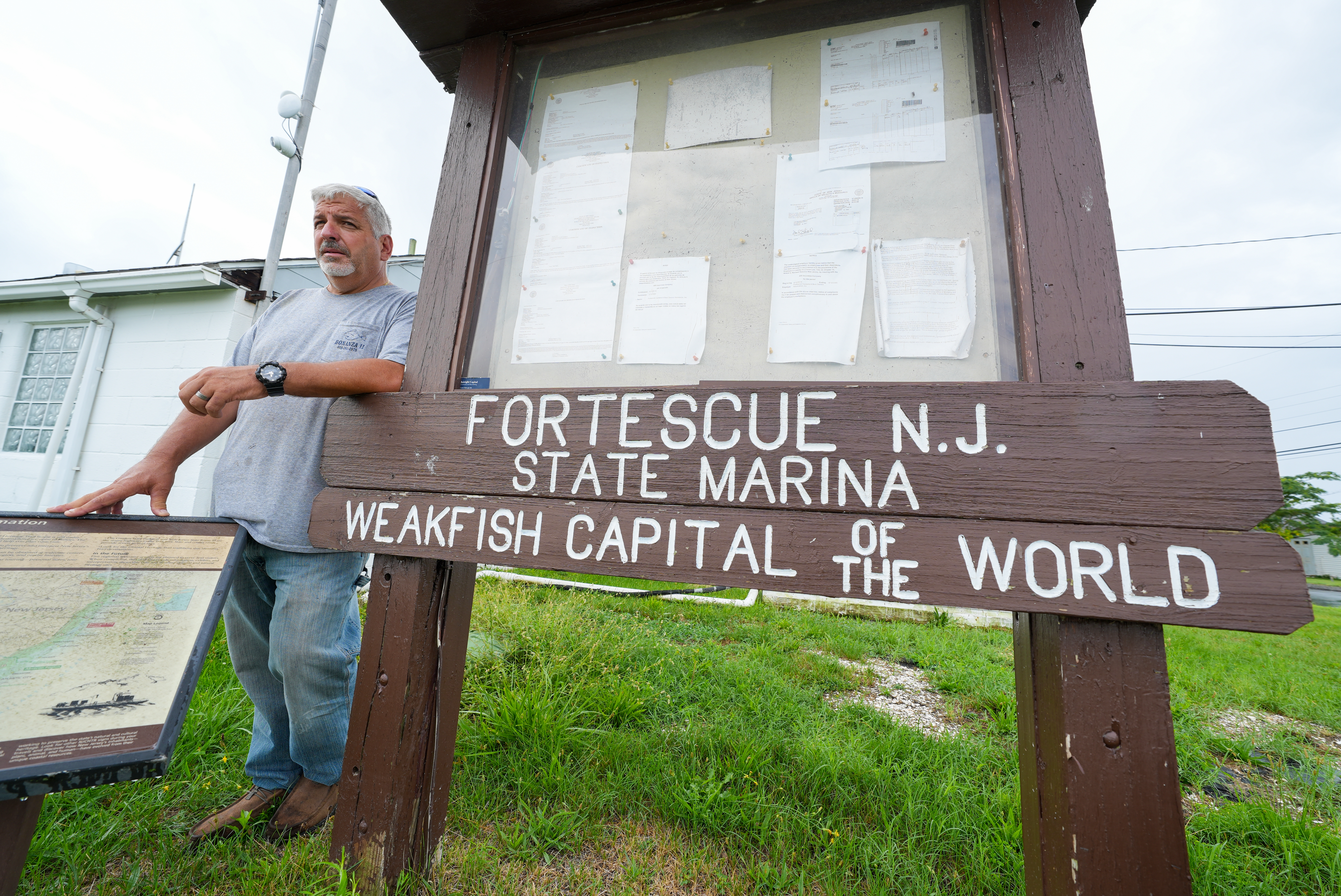
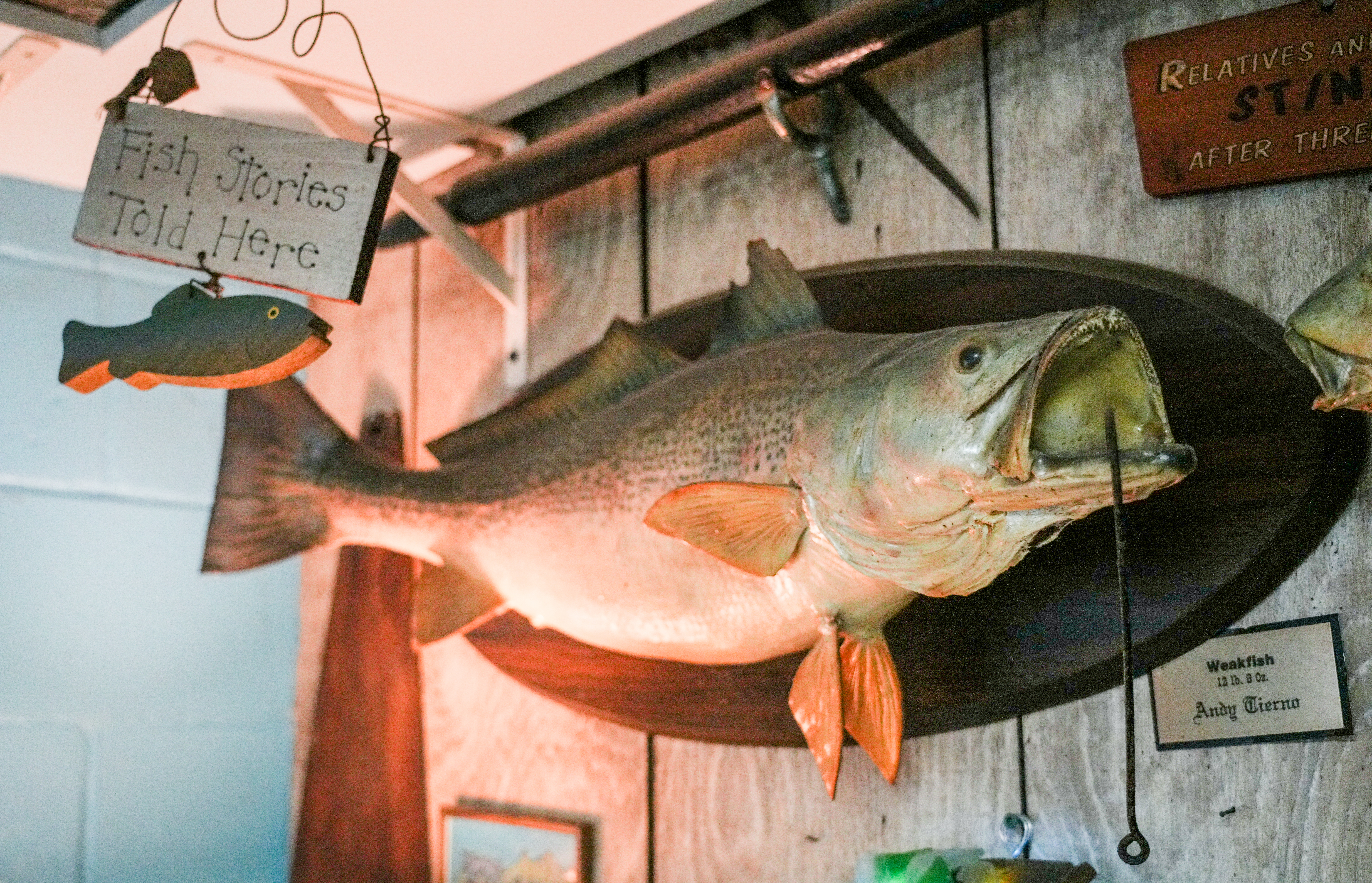
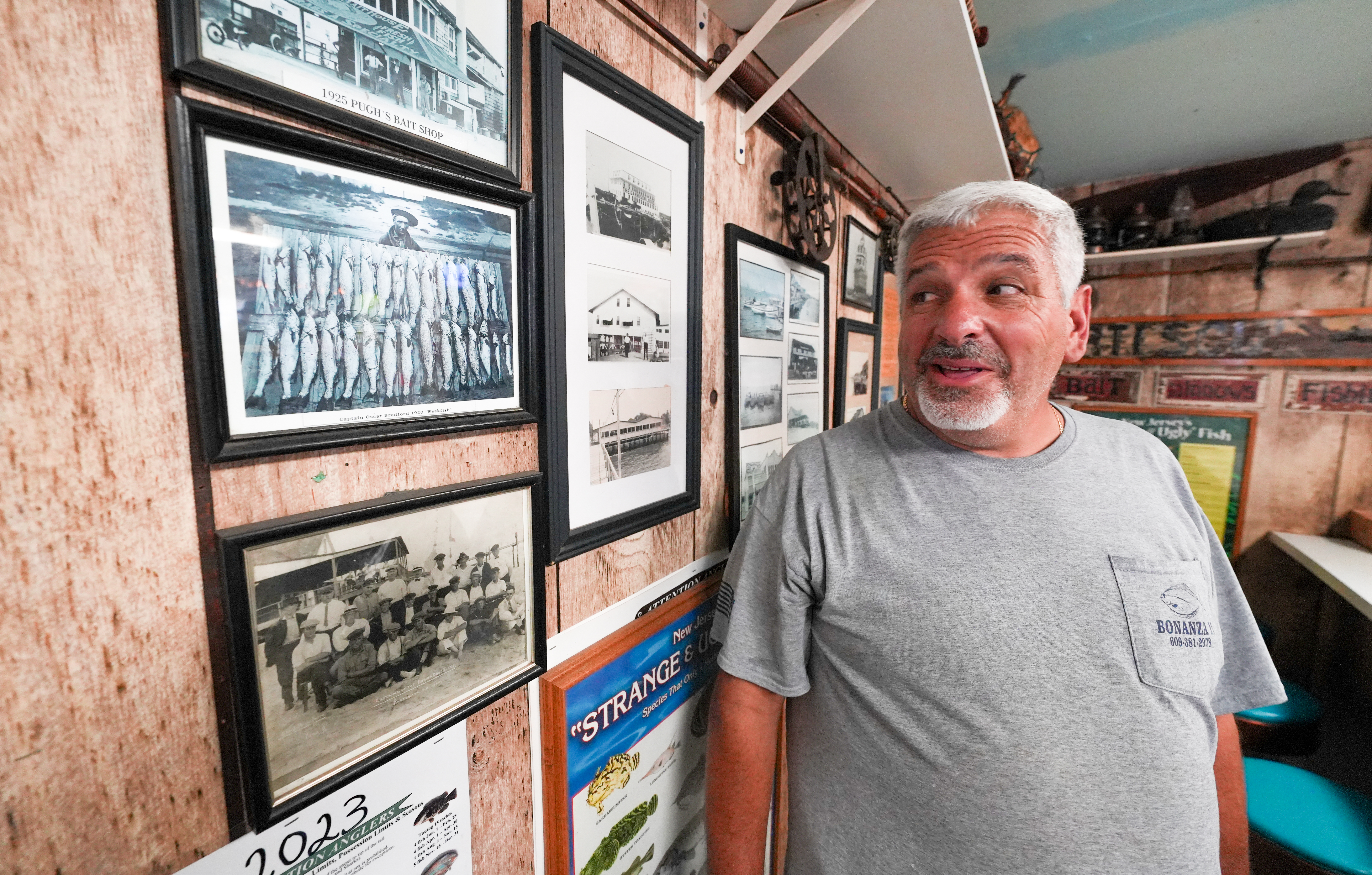
CUMBERLAND COUNTY, N.J. — Taxidermy and weathered photos line the walls at Higbee’s Bait and Tackle in Fortescue, artifacts from bygone days when the sleepy Delaware Bay town was truly the “weakfish capital of the world.”
The taxidermy is a dusty, 12-pound “tide runner,” the nickname fishermen bestow on the biggest, trophy weakfish, a member of the drum family with a tan, often iridescent body and a reputation for fighting hard on a fishing line. The black-and-white photo shows a single fisherman standing beside his catch, about 30 weakfish of various sizes.
Tide runners are unicorns today, a rarity on New Jersey coasts and across the bay, in Delaware. Catch limits enacted by state fisheries would prevent a single fisherman from catching dozens of fish today, though most would be happy with one legal keeper they could fry up in lemon and butter.
Fishermen have plenty of theories about where all the weakfish have gone. They blame dolphins and dogfish for gobbling up the young; nuclear power plants; the rise of other popular game fish, like striped bass; and offshore seafood trawlers.
Some are introspective.
“I’ll be real honest. It’s us. Back in the day, in the ’80s, we fished these things so hard,” said Mike Rothman, captain of the Bonanza II, a 65-foot charter boat out of Fortescue. “We did it to ourselves, and I’m the first one that — 100% — we did this to ourselves.”
A weakfish hangs on the wall of Higbee’s Bait and Tackle located at the Higbee Marina on Monday, Aug., 3, 2026. Once known as the “Weakfish capital of the world,” locals are curious where the fish has gone.Tim Hawk / For The Inquirer
Jessica Gorzo, a scientist with the New Jersey Department of Environmental Protection, who’s studied weakfish, said the population has been on the decline since the mid-2000s. She said the decline over those two decades is the result of natural mortality from predators, not fishing.
“The prevailing thought is the majority of predation is likely dolphins, offshore, in the winter. It’s estimated that 55% of the mortality can be attributed to dolphins,” Gorzo said. “Coming in second, a far second at 21%, is attributed to striped bass, but the dolphins are taking the lion’s share.”
Like all things under the sea, however, there’s a degree of mystery involved in spawning stock estimates. Gorzo said weakfish spawning stock estimates, in 2017, were 1,922 metric tons, which was a low number.
“To have a healthy weakfish population, the spawning stock threshold would be 6,170 metric tons,” she said.
The Marine Mammal Protection Act protects dolphins, and most fishermen and beachgoers agree their populations have grown along the Jersey coast in the summer for decades.
“More than ever,” said Joseph LoBianco, owner of Cape May Bait & Tackle. “When I go out on the Delaware Bay, I see them year-round. They are here all the time, and they’re eating a lot of the smaller fish.”
‘I would’ve released all those tide runners’
In 2010, New Jersey tightened weakfish regulations, allowing fishermen to keep just one fish, 13 inches or longer, per day, but many said it was too late to stop the population free fall.
“Back in the day, you were allowed to keep 15 fish per fisherman,” Rothman said.
Mike Rothman looks at a picture of weakfish, from 1920, that hangs on the wall of Higbee’s Bait and Tackle located at the Higbee Marina, Monday, Aug., 3, 2026. Once known as the “weakfish capital of the world,” locals are curious where the fish has gone.Tim Hawk / For The Inquirer
Gorzo said tight regulations on weakfish should result in a comeback. That’s what happened with striped bass, arguably the most popular sport fish along the Jersey Shore, a species that seems more abundant today than it was decades ago.
“Striped bass do seem to be doing really well,” she said.
Striped bass are also voracious and grow large enough to swallow bigger weakfish.
“They are the vacuum cleaners of the ocean,” Rothman said of striped bass.
In May, Gorzo appeared on the Finnsylvania podcast to discuss the decline of weakfish. The episode was titled “The Ghosts of Cape May,” another longtime weakfish destination for anglers. Host James Suleski reminisced about catching them during childhood summers there.
“They were just so abundant,” Suleski said.
Suleski, in his podcast, described the population collapse as one of the biggest mysteries in marine biology.
Around the same time the episode was released, avid fisherman Frank Ruczynski posted on Facebook, reminiscing about Fortescue’s claim to be the “weakfish capital of the world.” It received close to 700 likes and 200 comments, many of which discussed theories or dismissed the issue.
“They are probably cyclical like many species,” one man wrote.
Another said you could almost walk across the backs of weakfish in the bay at one time.
“If I would’ve known, I would’ve released all those tide runners,” another wrote.
Weakfish caught by New Jersey angler Frank Ruczynski.Frank Ruczynski
Ruczynski, who also works for NJDEP, said 2026 was especially bad for him.
“Overall, I think it’s a mix of 100 different things going on,” he said in May, in Fortescue. “They just disappeared. It’s a shell of what we had here, back in the day.”
Ruczynski said he’s followed weakfish north, up into Cape May County and even into New York, and he wondered whether water temperatures were prompting the species to move. He said he received a message from a man in Portugal — straight east from New Jersey — who claimed that he caught a weakfish there.
Weakfish caught by New Jersey angler Frank Ruczynski.Frank Ruczynski
Rothman, the mayor of Downe Township, which includes Fortescue, said he can take customers out and still catch weakfish, but he relies on other species, or whale and dolphin sightseeing, and even dinner cruises, for the bulk of his business.
“I’m in the entertainment business these days,” he said.
Fortescue has never been bustling as far as Shore towns go. There are no traffic lights, few businesses, and plenty of biting greenhead flies. Fishermen will always go there, but the loss of the weakfish gives it a bit of a ghost-town feel at times.
“We had a world-class fishery here, right in our backyard,” Ruczynski said.
Across the road from Rothman’s boat, at the tackle shop, owner Cliff Higbee Sr. said there were far larger weakfish in the Delaware Bay than the taxidermy on his wall.
“We had 16-, 17-pounders in here,” he said. “Used to at least.”
Higbee isn’t waiting for the tide runners to return, though. The family tackle shop is for sale for just under $400,000.
Cliff Higbee Sr. owner of Higbee’s Bait and Tackle located at the Higbee Marina, talks about the lack of weakfish, Monday, Aug., 3, 2026. Once known as the “Weakfish capital of the world,” locals are curious where the fish has gone.Tim Hawk / For The Inquirer
And in November, the residents of the same borough will settle a separate debate: Lift its liquor ban or keep its longstanding status as a dry town.
Plus, the U.S. Justice Department is accusing a New Jersey family of using several hotels that are in poor condition to fraudulently obtain loans in a $100 million Ponzi scheme, and more news of the day.
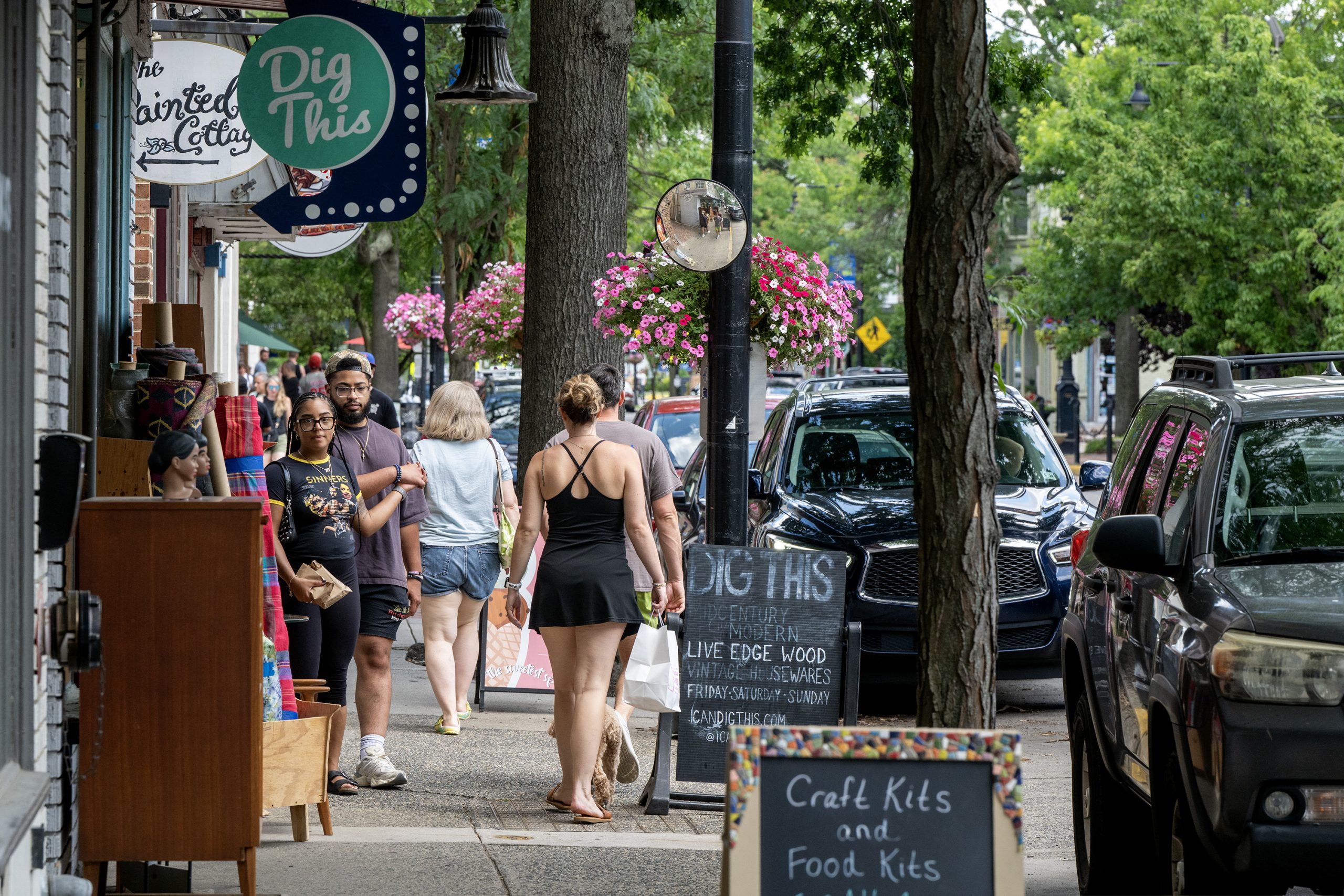
There’s a chaotic debate in Collingswood with the Scottish Rite Theater at the center.
Collingswood is looking to transfer management of the theater to Camden County after paying millions in expenses to keep it afloat in recent years, particularly since the pandemic.
Commissioner Jim Maley, a former mayor, cofounded the nonprofit that manages the Scottish Rite property, Collingswood Foundation for the Arts, in 1999. The foundation, according to Maley, was created to secure arts grants for the borough.
It has routinely received funds without pushback.
But now, the public is demanding answers. They want to know who actually runs it, if it’s even part of the borough, and why taxpayers are paying for it if it’s not.
This November, Collingswood voters will decide if the borough will lift its ban on alcohol sales.
The borough’s board of commissioners passed a resolution Wednesday to add the question to the general election ballot after years of debate over its long-standing dry-town status.
If voters lift the ban, that means Collingswood could either:
🍷 Award licenses in a bidding process, which would mean onetime revenue for the borough’s budget.
Or:
🍷 Enact an application and review process that would require annual fees and prospective licensees to make public presentations.
The Justice Department is accusing a New Jersey-based father, son, and other family members who own several hotels of a $100 million Ponzi scheme that lasted more than 30 years. The lawsuit alleges they used hotels in chronic disrepair and various business entities to fraudulently obtain government-secured loans.
A skunk found in Cherry Hill has tested positive for rabies, according to Camden County officials and the state health department. Officials advise residents to avoid direct contact with unfamiliar animals and to make sure pets are up to date on vaccinations.
According to a Morning Consult poll, Gov. Mikie Sherrill is one of the country’s most popular governors: She is in a four-way tie for 12th with a 55% approval rating versus a 30% disapproval. South Jersey Democrat U.S. Sen. Andy Kim has a 49% approval versus a 27% disapproval.
😂 Laugh at Your Expense with Joe Bartnick: Joe Bartnick headlines this comedy show fresh off appearances on Netflix’s Old Dads and Bill Burr: Friends Who Kill. Other performers include Steve Trevelise from New Jersey 101.5 and rising comic Andy Picarro. ⏰ Thursday, Aug. 20, 7:30-9:30 p.m. 💵 $30 📍 The Broadway Theatre of Pitman, 43 S. Broadway, Pitman.
📚 Philly Bookstore Crawl: The annual book crawl is back. More than 50 participating independent bookstores in the Greater Philadelphia area, including Kiss & Tale in Collingswood, will host special events with discounted sales, giveaways, author signings, and more. ⏰ Saturday, Aug. 22, various times 💵 Pay as you go 📍 Kiss & Tale, 688 Haddon Ave. Floor 1, Collingswood and Inkwood Books, 106 Kings Hwy. E, Haddonfield.
🎉 Women’s Equality Day Festival: The fest is back for its fifth year featuring craft vendors, live music, performances, and family-friendly activities. The Alice Paul Center for Gender Justice hosts at historic Paulsdale, the birthplace of the women’s rights activist and suffragist. ⏰ Saturday, Aug 22, 1-5 p.m. 💵 Pay as you go 📍 Paulsdale, 128 Hooton Rd., Mount Laurel.
Armando Roberto Perez goes by many names. Armand. Bob. Opa. Mr. Soupy.
Perez, 70, is the longtime caretaker for Soupy Island, a public pool and park in West Deptford, best known for its century-old carousel, free soup, and the tall, enclosed slide guests glide down, crashing into sand.
Before Perez took the job 28 years ago, his father-in-law was caretaker, and before that, his grandfather-in-law. Managing the former 25-acre haven for sick and hungry kids has long been a family affair.
Soupy Island is open and free to the public three days a week from July to mid-August. For the rest of the year, it’s Perez’s job to keep the tuberculosis treatment center-turned-playground standing come summertime.
Lifeguard Alexandria Bright, 22, watches over swimmers in the main pool at Soupy Island. She is a niece of caretaker Bob Perez.Tom Gralish / Staff Photographer
He puts the picnic tables away, disconnects the piping and toilets, drains the pool, boards up the carousel, collects leaves, cuts the grass, weed-whacks, handles repairs, and takes on whatever else happens.
“If you’re not self-motivating, nothing’s going to get done,” Perez said.
On Wednesday, the second-to-last day of Soupy Island’s summer and what could be one of Perez’s last seasons as caretaker, 329 people had arrived by lunchtime.
At 11:45 a.m., the park’s amenities close like clockwork for lunch, until 1 p.m. Its 18 staff members ushered children and their families toward the middle of the park for Soupy Island’s controversial intermission: free hot soup, crackers, and milk, enjoyed (or not) in the August heat.
Syreeta Minor, 47, brought her daughter and her group of friends to Soupy Island for the first time after hearing about the destination on YouTube. Minor had no idea the park existed despite living in West Deptford, but she said she’ll likely be back.
A soupy history
Driving his golf cart across Soupy’s campus, Perez explained the park’s complicated history, in brief.
He pointed out the old European carousel, an early 20th-century relic that the National Carousel Association has been working to restore, and all the structures he’s fixed over the years. A chalk drawing made by his granddaughter, Izzy, on the wall of the soup house depicts Perez, “Opa,” at the top of a family tree with his wife, Denise.
Perez with a family tree drawn in chalk by his granddaughter Izzy when she was young.Tom Gralish / Staff Photographer
The park’s roots trace back to 1877, when the Sanitarium Association of Philadelphia purchased land to create a playground and treatment center for kids with tuberculosis.
The hospital no longer exists, but remnants of its history remain. A public pool has replaced the hospital’s former basement. A brick building from the late 19th century still serves hot soup and snacks from its three windows. The medical staff quarters is where Perez now lives with his wife, free-of-charge, different from the life Perez imagined growing up in North Philly. He graduated from Frankford High School, didn’t go to college, and moved to Jersey when he got married in 1976.
“I came from nothing,” Perez said. “We had government food. We had government housing.”
Perez’s home is an old five-bedroom white house at the front of the park, paid for through an endowment set up by Soupy Island doctors more than a century ago. It’s spacious enough for Perez’s grand and great-grandkids when they visit.
The endowment is what keeps the park alive and has kept it going through decades of turmoil.
During the Great Depression, the Sanitarium Playground fed thousands per day. It was often the only place city children could get a hot meal, by taking a river boat from Penn Treaty pier down the Delaware River. For fun, Perez said, children swam on the river in wool bathing suits and overalls.
In the 1940s, during World War II, the U.S. military took over Soupy Island to protect the nearby shipyard, before the playground returned to its park and soup kitchen roots.
‘Working with my hands’
Despite its history, Perez said the island (which isn’t an island at all) has kept under the radar. When staff have to call the police to report vandalism or an incident, they don’t always know where to go.
“A lot of people don’t know about it. They say, ‘I never knew you were here,’” Perez said. “I got people around the corner who don’t even know we’re here.”
In many ways, that has been to Soupy’s benefit. The summer playground doesn’t have the staffing or space to accommodate huge crowds, and Perez does much of his work solo. Over the years, he’s had to keep up certifications as an amusement ride operator, a pool manager, a lifeguard, and a diver, on top of the mechanical skills he developed over his 24 years at Cherry Hill Volvo.
It was his father-in-law who pestered him to apply for Soupy Island, a career he didn’t want.
“I like working with my hands,” Perez said.
His grandson, Lucas Ngo, plans to take over when Perez retires. A mural of Ngo, now 22, is on the wall over by the big kid pool, painted by Perez when Ngo was still a child.
Lucas Ngo, now 22, and an employee at the at Soupy Island in West Deptford, N.J. is depicted on a mural at the swimming pool Wednesday, Aug. 12, 2026. Tom Gralish / Staff Photographer
On Wednesday, Ngo, who originally planned to pursue car mechanic work, prepared the daily soup, chicken noodle, in a giant vat as visitors trickled toward the house. An unfamiliar clanging came from the soup area.
“Now that noise? Open the valve,” Perez instructed, then laughed. “There you go. You get to know the sounds of the things.”
‘A rite of passage’
Lifeguard Ali Bright, 22, placed spoons as Perez scooped soup during Soupy Island’s daily lunchtime ritual. Fellow lifeguard Madi Hogan, 17, carried the trays to a cooling rack, then to the windows to serve a line of people outside.
“It’s like a rite of passage in this family,” said Bright, Perez’ niece. She’s worked at Soupy every summer since she was 14. “This is my little oasis away from my real life.”
Perez in the kitchen of the original building where the camp still serves free soup lunches every day. The kettles are at right and the same shelves for cooling the soup are at left. Kids still line up for lunch at the windows in rear. Tom Gralish / Staff Photographer
The lifelong connection to the playground is typical for staff. Hogan’s great-grandmother used to come to Soupy Island as a child. Marielle Lewis, 17, used to come to the park for soup when she was little, since her aunt lives nearby. Now, she’s worked as a lifeguard for two years.
“It’s kind of weird now that I get to see everything that I wanted to see when I was a kid,” Lewis said.
For now, the group is using their remaining soup supply donated by The Campbell’s Company last year. In the 2000s, the company paid for a new jungle gym, volleyball court, basketball court, and more at Soupy Island and continued its contributions through food since, even though Campbell’s has no true affiliation with the playground despite its name.
But this season, Campbell Soup didn’t donate goods, Perez said, who added that one season’s worth of soup costs the park more than $8,000.
The Food Pantry of South Jersey in Pennsauken has stepped up, though, by providing Soupy Island with thousands of shelf-stable meals to distribute to visitors.
“Sometimes a lot of these people go through trials, and come in here just to chill a little bit,” Perez said. “You don’t know what the other person’s going through.”
Once Ngo takes over, Perez still plans to help out where he can, just with less physical labor. Plus, he’ll hopefully get to do more home remodeling on the side, and take more consistent naps, his favorite part of the day.
“I try to do it around three,” Perez said, a dream. “But it doesn’t happen.”