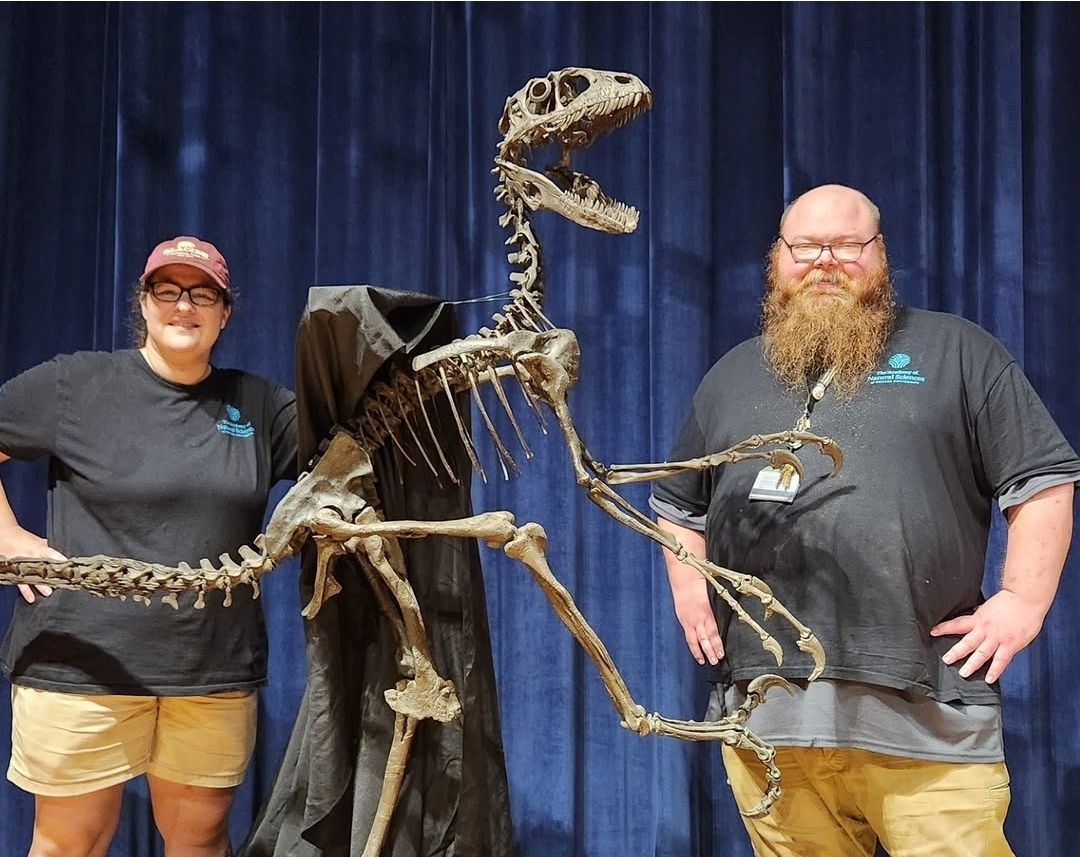
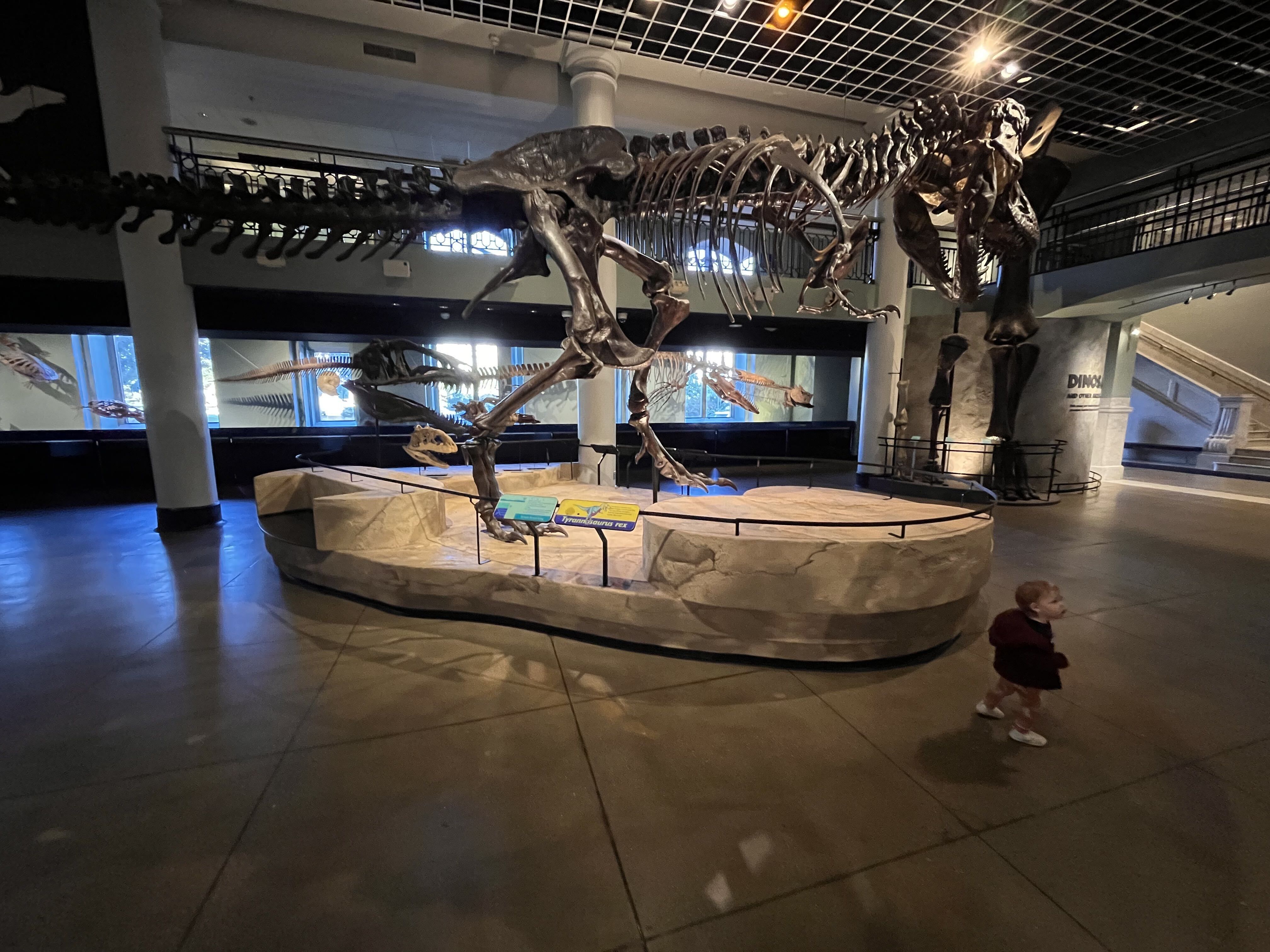
As a toddler gazing up at the meticulously assembled cast dinosaur bones evoking a Tyrannosaurus rex, Amber Redfield knew she wanted to spend as much of her life as possible at the Academy of Natural Sciences.
By then, The Land Before Time and Jurassic Park had already hooked her on all things dino, but beholding their actual body parts and scale at the museum molded her passion into a dream.
For nearly 15 years, she lived that dream as an Academy museum employee, most recently as an educator, until it all came tumbling down on Sept. 1, when she and her department learned the museum would close at the end of the month and their jobs would be eliminated.
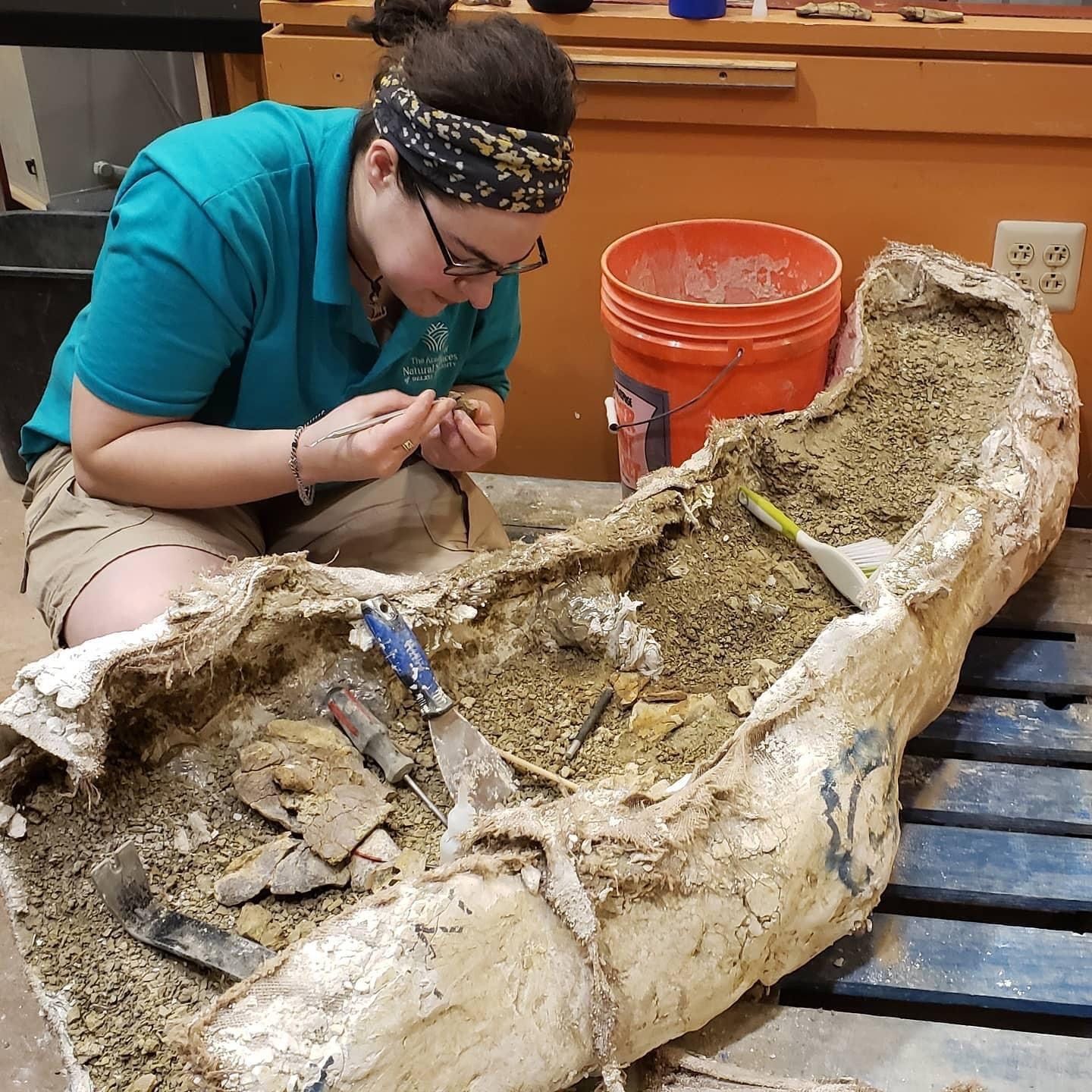
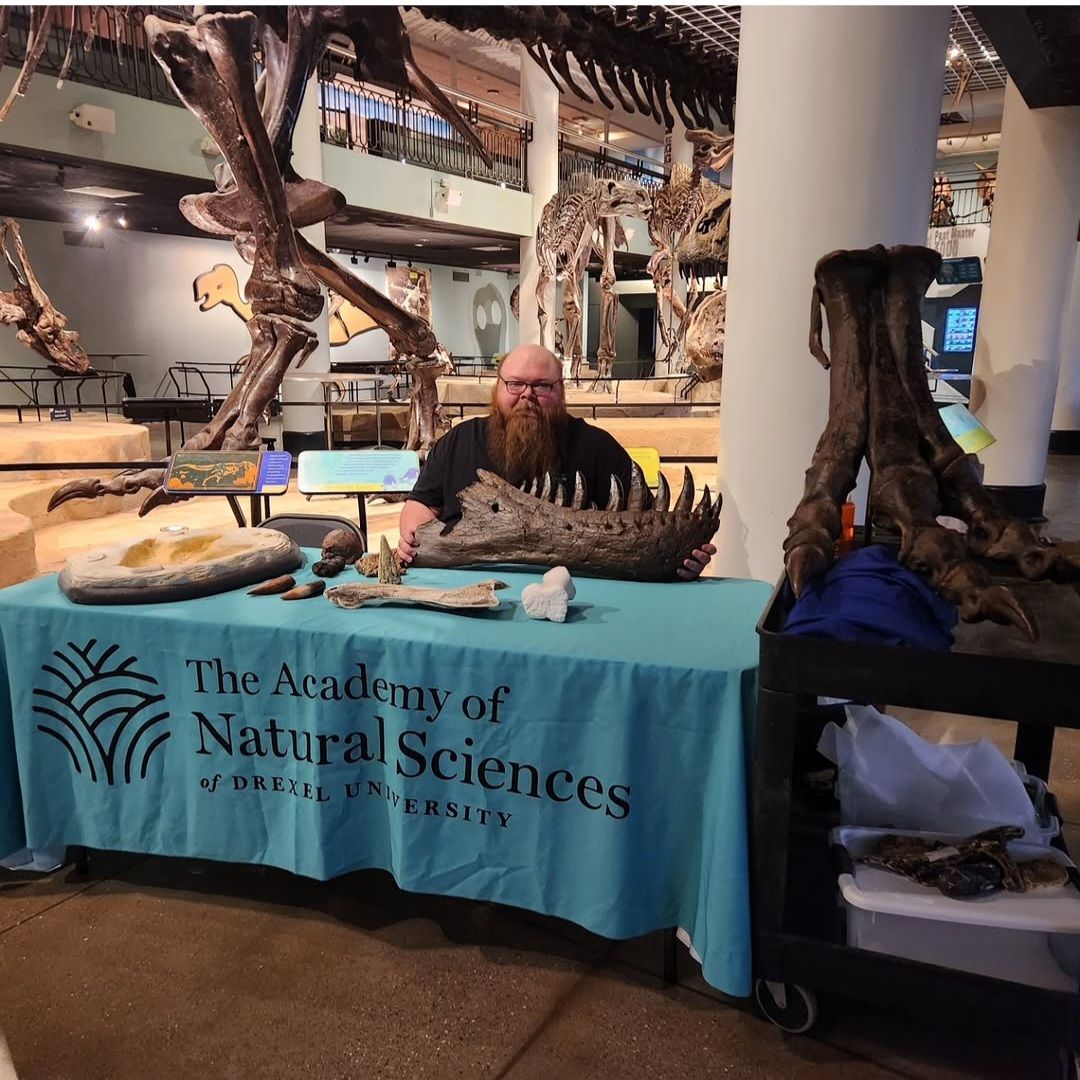
Amber Redfield, a former educator at the Academy of Natural Sciences, examines fossils.Amber Redfield
The news broke the hearts of employees, many of whom aspired to work at the Academy museum not long after they learned to walk and talk. For some, that goal served as a guiding light through academic hardships. For others, working and volunteering there fostered confidence and creativity. For all, it offered a rare opportunity to ignite a passion in local kids that the museum had ignited in them.
“My whole life is that place,” said Redfield, 37, whose last day was Nov. 1. “I feel like a part of my soul has been ripped out.”
This career was all she ever wanted. She managed Dinosaur Hall, the exact room in the museum she marveled at as a child, geeked out with visitors about new developments in the field, and whipped out fossils so mind-bogglingly ancient they brought museum patrons to tears.
“‘I can’t believe I’m holding this right now,’” they would tell her, grasping an approximately 66 million-year-old hadrosaur leg or back bone.
Perusing some of the older specimens in the academy’s collections — “it’s the closest we get to time travel,” said Liam O’Donnell, 27, who worked with Redfield. His last day as an experience and engagement educator wasOct. 1.
Working at the Academy museum over the last four years was a dream come true for O’Donnell — presenting a wide-eyed child with a hissing cockroach or answering questions about whether velociraptors would have liked tacos.
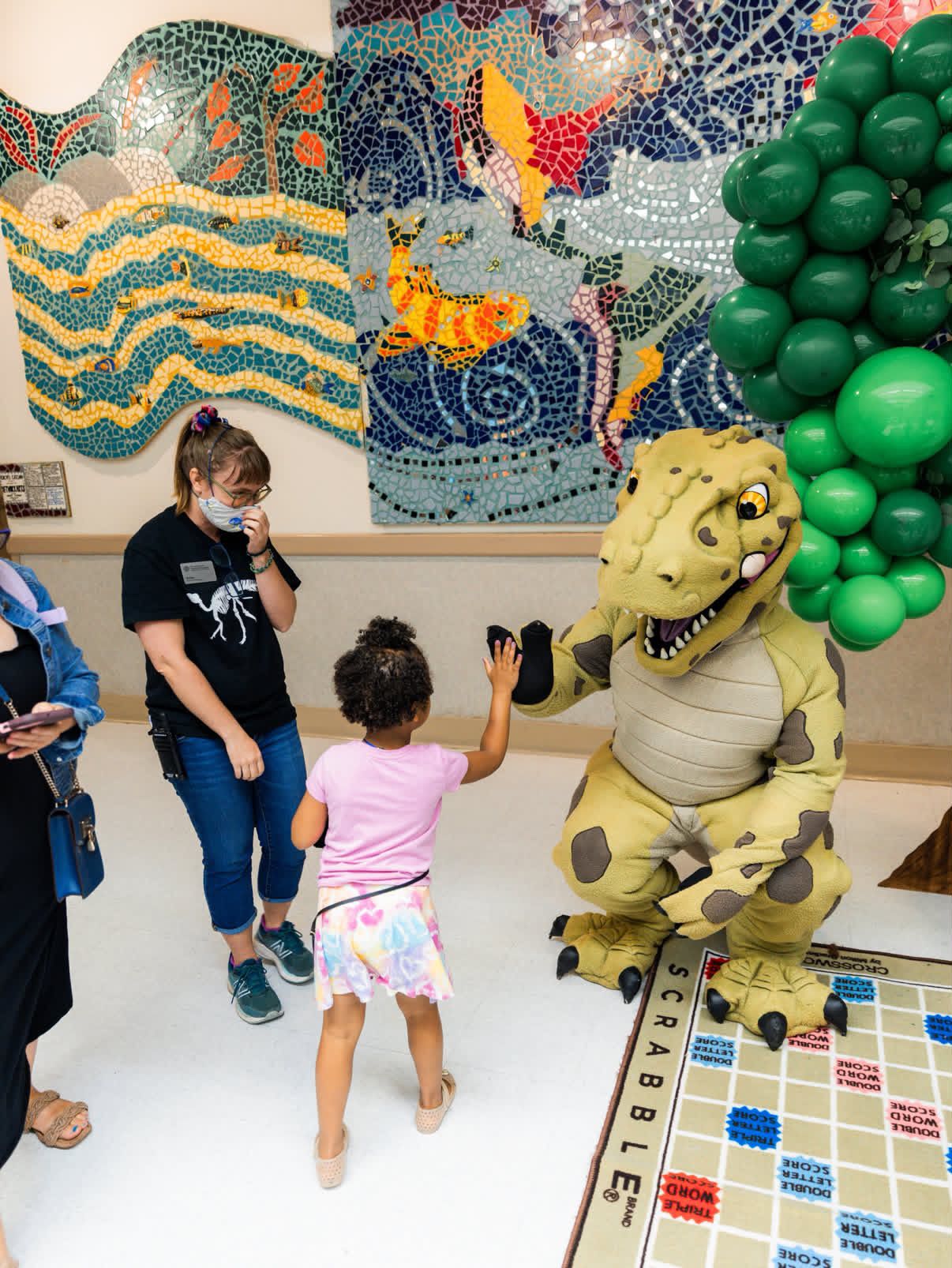
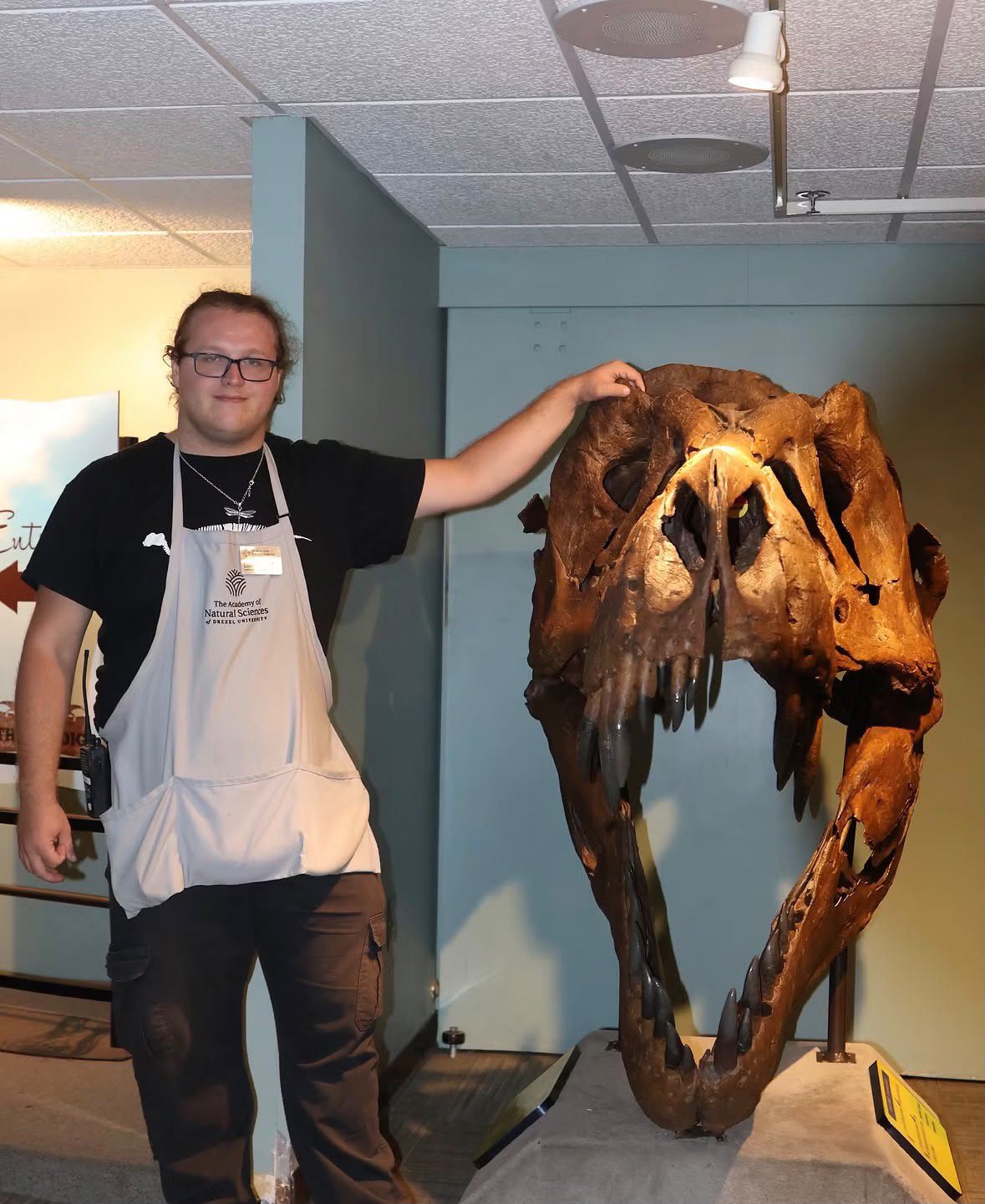
Liam O’Donnell, wearing a dinosaur costume, greets children at Chase Books’ annual Read-a-Thon at the Academy of Natural Sciences museum.Chase Books
O’Donnell dreamed of working at the Academy museum since his first visit there at around 6 years old. He was wowed by how much humanity had managed to learn about such old species.
But, throughout his academic career, his ADHD presented hardships, particularly as he pursued his biology degree at Widener University.
“I came very close to flunking out,” he said. “I failed chem three times.”
Weekend visits to the Academy, he said, kept him motivated to graduate.
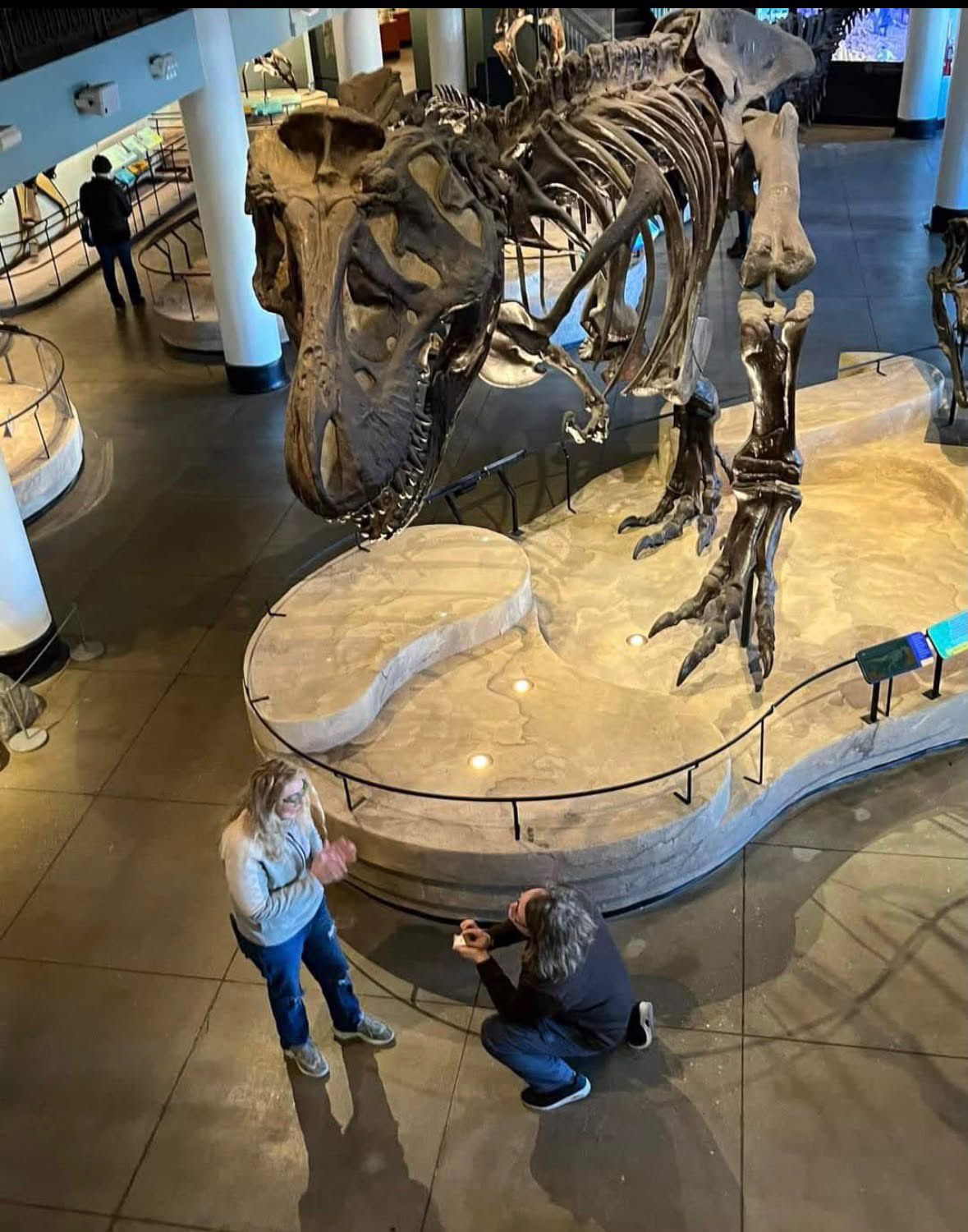
Liam O’Donnell, a former educator at the Academy of Natural Sciences museum, proposes to his wife in Dinosaur Hall.Liam O'Donnell
The museum served a similar purpose for former education and experiences manager David Schloss, 39, who worked at the Academy for 15 years before his last day Nov. 1.
Schloss’ love for dinosaurs dates back to kindergarten, when he was asked to name a word that starts with P and offered pterodactyl.
As a biology student at Wheaton College in Massachusetts, Schloss was having difficulty in school. So he took several months off to be with his sister in Philadelphia and volunteered at the Academy cleaning and preparing fossils.
After that, “I kind of had a direction and drive,” Schloss said. “I was dean’s list for the rest of my time until I graduated.”
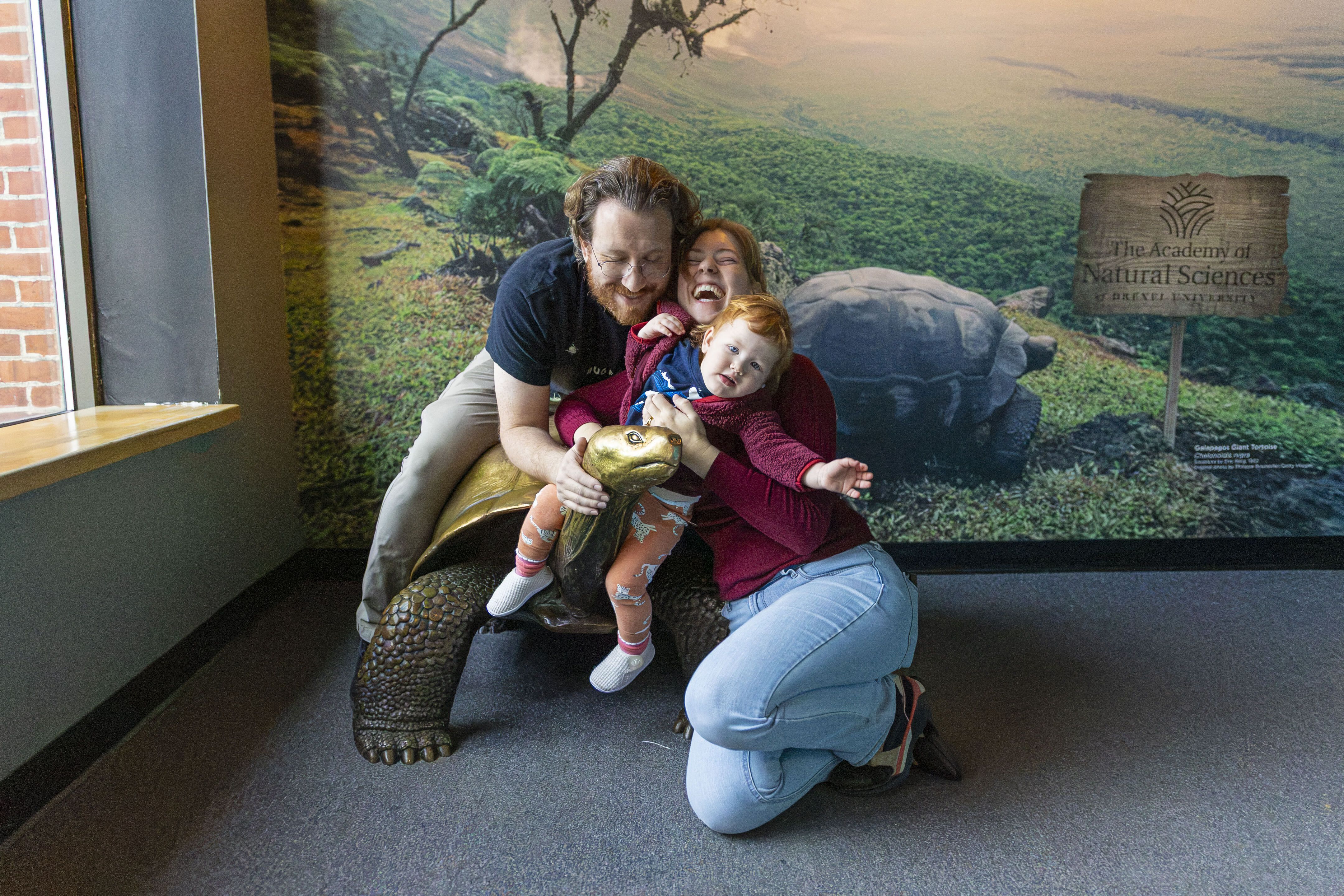
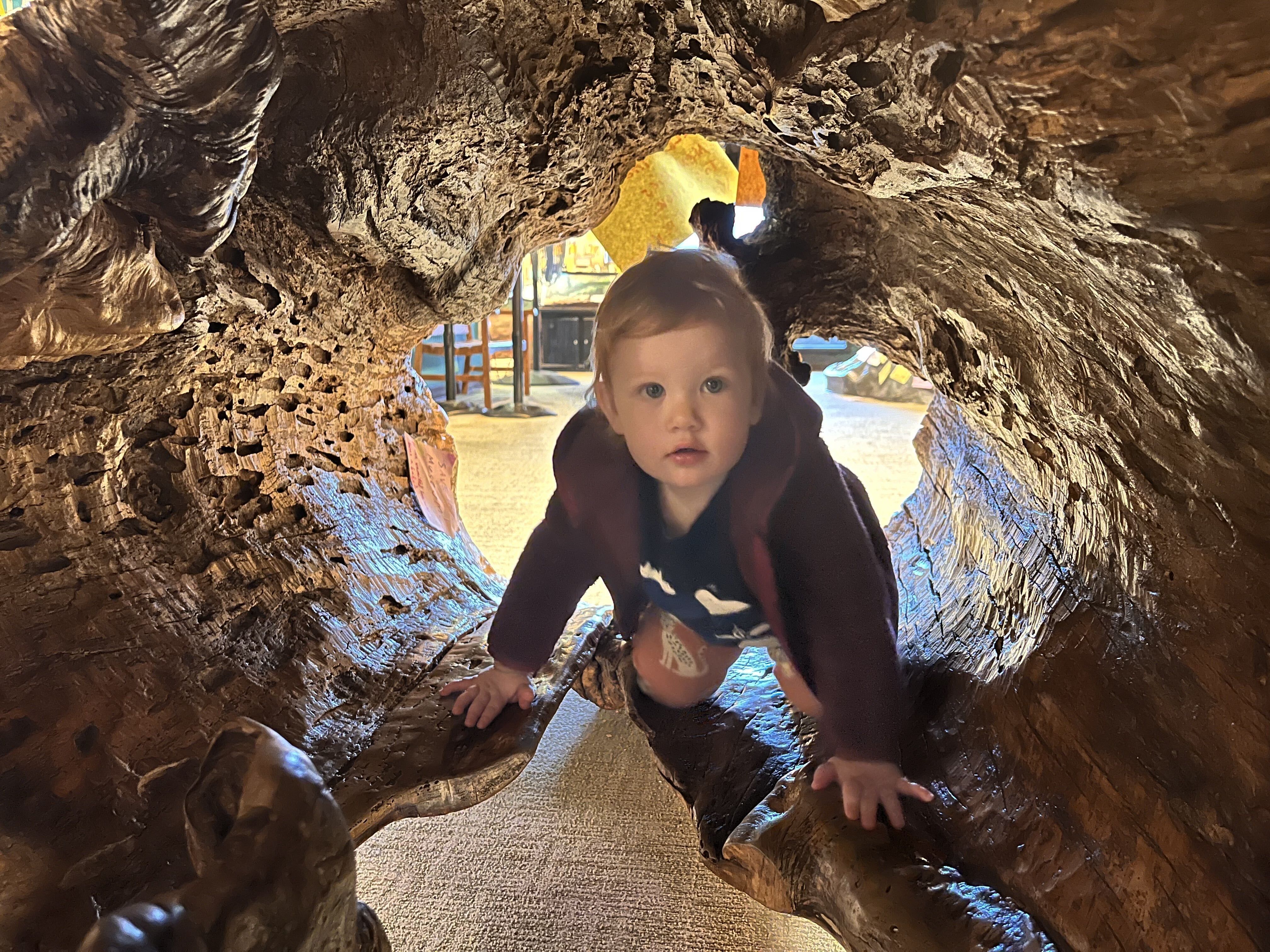
David Schloss with his wife, Ashley, and 1-year-old Eloise at the Academy of Natural Sciences in October, on a day after the museum closed when staff were allowed to bring their young kids into the museum.David Schloss
Inspiration and fulfillment always lived around the corner during Schloss’ time working at the museum. Before it closed during the pandemic, he ran the butterfly house and discovered a half-male, half-female butterfly that he got to put his name on when it was entered into the entomology collections.
The live animals at the Academy museum similarly spoke to Anwar Abdul-Qawi.
Now 32, he still remembers seeing his first live animal show at there as a child. A self-proclaimed “super animal nerd,” he was awestruck at seeing the creatures onstage handled with such expertise.
“I can’t wait to do this one day,” he thought to himself.
But he was a shy child with a pretty severe stutter, so speaking in front of a crowd seemed impossible.
In high school he began volunteering at the Academy, then got his degree in zoology at Delaware Valley University. Soon after, the academy hired him. One live animal show after another his stutter subsided, his confidence grew, and, 11 years later, public speaking became one of his greatest skills.
His final role at the Academy museum was manager of animal programs, running the live animal department that hosted the shows that awed him as a child.
Anwar Abdul-Qawi, former manager of animal programs at the Academy of Natural Sciences museum, shows animals to kids.John Hutelmyer
The Academy never wavered in supporting his dreams. When he got interested in wildlife photography, the museum displayed his photos. When he yearned to go abroad, Academy leaders sent him to Equatorial Guinea to document a research trip. It was his first time leaving the country. He was so excited, he cried in bed the whole night leading up to the flight, wondering: “Is this real?”
“I didn’t think this was something that was ever going to happen to me,” he recalled.
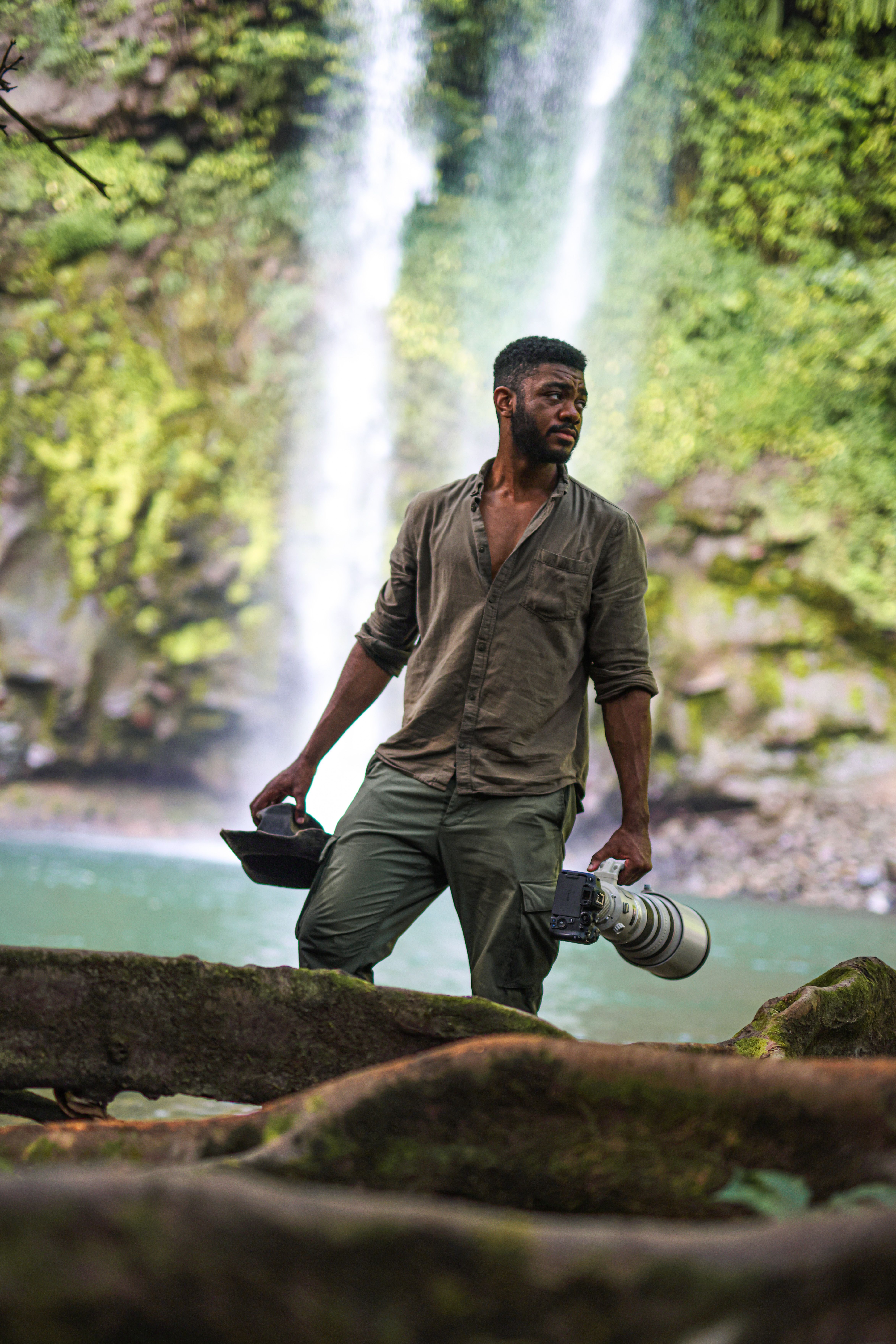
Anwar Abdul-Qawi, former manager of animal programs at the Academy of Natural Sciences, in Equatorial Guinea on a research trip the academy sent him on.Anwar Abdul-Qawi
Working at the Academy museum also opened doors for Redfield and Buddy Muhler, an educator who ran the school programs at the museum. Neither Redfield nor Muhler ever graduated college. For Redfield, that was due to learning challenges, including dyslexia. For Muhler, school just was not his strong suit.
Buddy Muhler, a former staff member at the Academy of Natural Sciences museum, showcases dinosaur items.Buddy Muhler
Nevertheless, the Academy museum gave them a chance. For Redfield, it came after she did a stint volunteering there and her enthusiasm and level of paleontologic knowledge quickly became evident. For Muhler, 42, that opportunity came after several years working at another museum.
It “took a lot of hard work and timing and luck,” Muhler said.
For Schloss, learning that the museum would close felt like witnessing “a seismic event,” he said — one not unlike the alleged asteroid strike that wiped out the dinosaurs. This time, it was the extinction of “a community of people who tried to do their absolute best to engage the public with what felt like a piece of string, a pencil, and a wad of gum,” Schloss said.
David Schloss’s 1-year-old, Eloise, at the Academy of Natural Sciences in October, on a day after the museum closed when staff were allowed to bring their young kids into the museum.David Schloss
Perhaps the hardest part is knowing that, if the museum never reopens, he won’t be able to share the place he has spent the last decade and a half with his 19-month-old daughter as she grows up.
“It crushes me,” Schloss said.
David Schloss’ 1-year-old, Eloise, at the Academy of Natural Sciences in October, on a day after the museum closed when staff were allowed to bring their young kids into the museum.David Schloss
Developments earlier this month offered a glimmer of hope when Drexel University, which is affiliated with the Academy, accepted an offer from the William Penn Foundation to fund feasibility studies on the future of the Academy. But whether that could yield a reopeningof the museum will likely remain unknown for months.
Liam O’Donnell is a former staff member at the Academy of Natural Sciences museum.Liam O'Donnell
In the meantime, O’Donnell, Muhler, and Schloss are job hunting.
“I can’t imagine myself working anywhere else,” Muhler said, but “I can only live on severance for so long.”
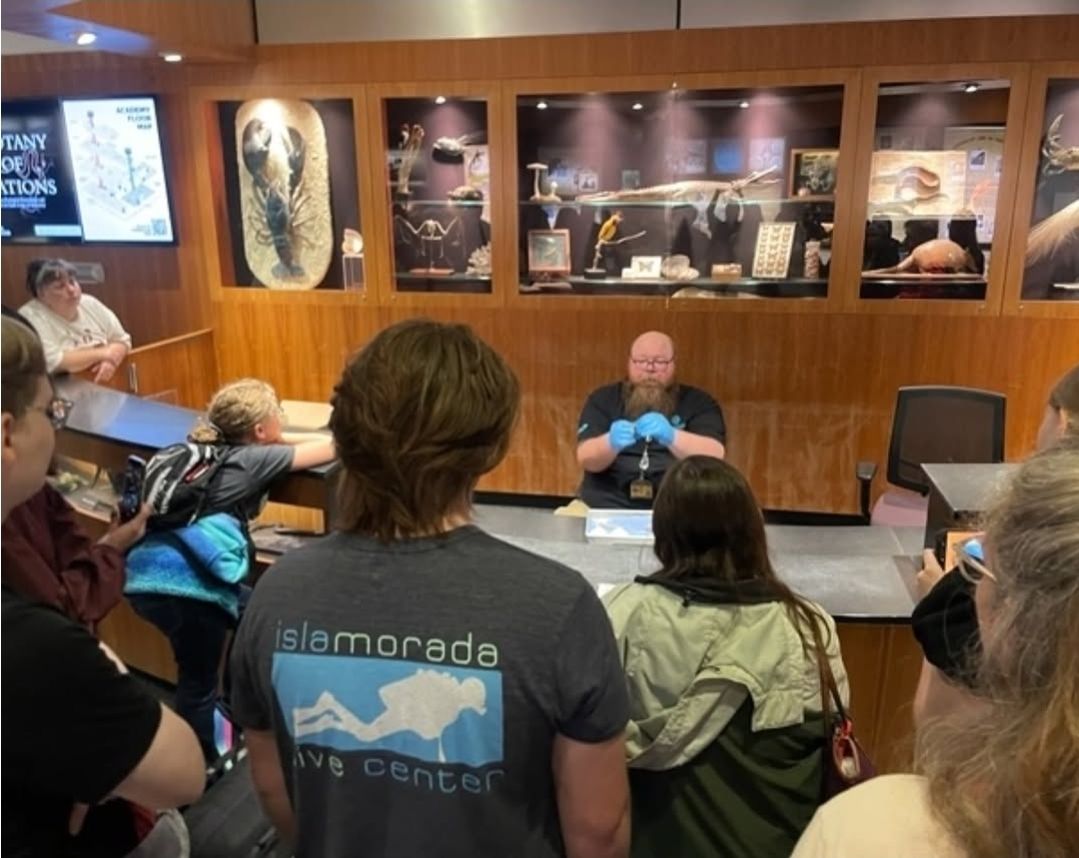
Buddy Muhler, a former employee at the Academy of Natural Sciences Museum, is surrounded by visitors as he works.Buddy Muhler
Abdul-Qawi moved to Costa Rica to do full-time sea turtle conservation work.
As for Redfield, she has turned down job offers at other institutions in the hopes the Academy museum will reopen.
“But I can’t wait forever,” she said. “That’s the scary part.”
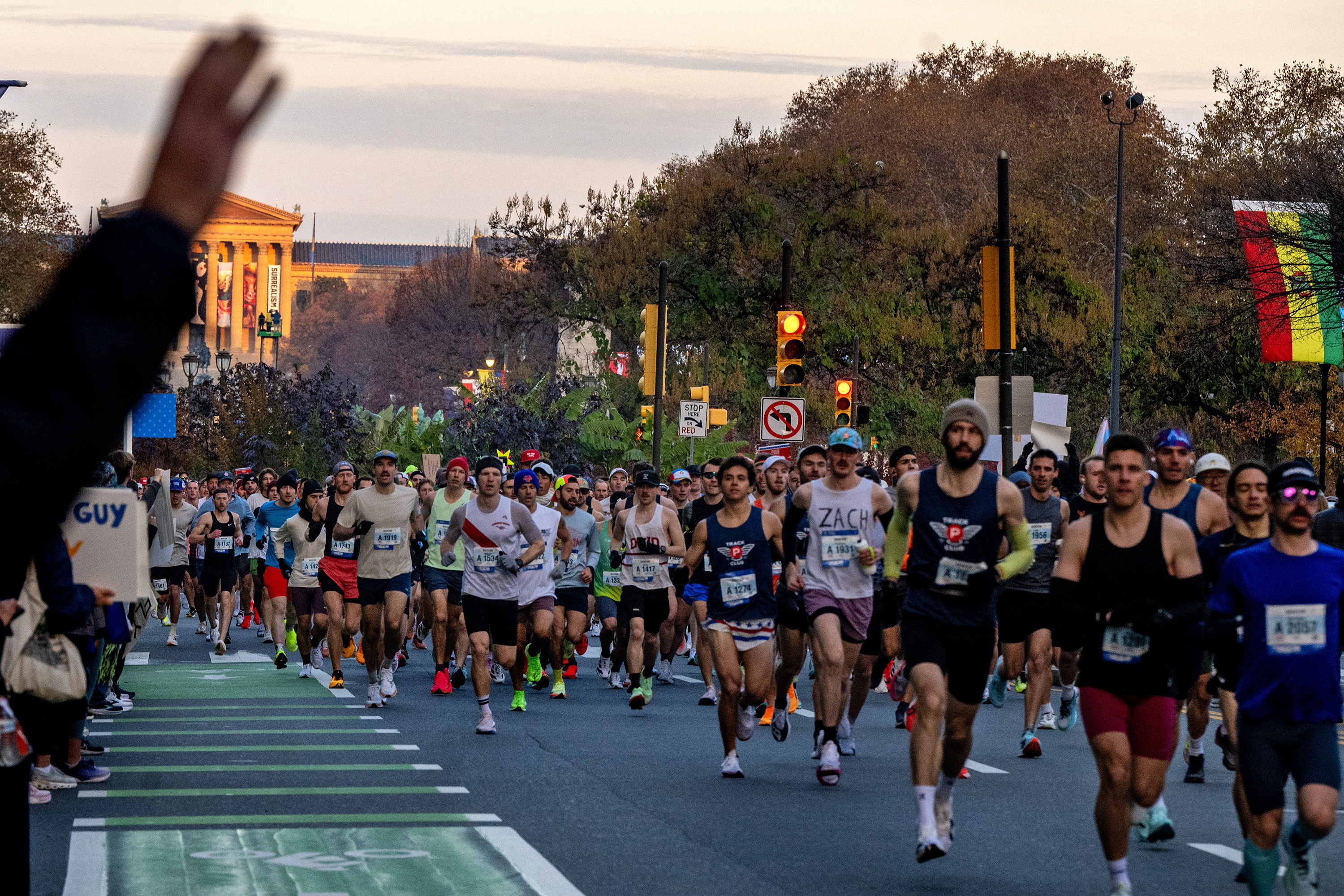
For what will be the biggest Philadelphia Marathon ever, the weather is going to be at least half-spectacular, and the odds are looking better that racers will outrun the rain Sunday. Plus, the winds are going to be anywhere from light to negligible both mornings.
Regarding Saturday: While temperatures in Philly have tumbled into the 20s multiple times on a Nov. 21, and it has snowed, the 16,000 race participants and the Philadelphia half-marathon spectators are going to experience a day that will feel like it wandered out of April.
That good fortune is likely to continue Sunday morning, and the 22,000 competing in what will be the main event of the biggest marathon in the city’s history should beat the rain handily.
The caveat is that the storm has been throwing curves at the computer models, which suggest it will take on a complex structure before tracking up the East Coast and impacting the Shore and the entire Philly region.
But at the very least, conditions should be dry at race time Sunday, said Matt Benz, senior meteorologist with AccuWeather Inc. And assuming any rain would be light, the weather should not have much impact on the racers, said race director and veteran runner and coach Kathleen Titus, given the forecast temperatures and winds.
“We’re looking good,” she said.
The race conditions look favorable for runners
Temperatures on both Saturday, for the half-marathon, and Sunday morning, for the 26.2-mile race, are forecast to be in the 40s when the runners start just before 7 a.m. And winds will be light.
Based on studies, the conditions should fall close to the performance sweet spots.
An analysis by a group of French researchers who examined the times of 1.8 million participants in marathons in Boston, Chicago, New York, Paris, London, and Berlin from 2001 to 2010 concluded temperature was the most important weather element, with 44 degrees Fahrenheit the gold standard.
According to other research, the morning conditions also score well in a more nuanced index, the WetBulb Globe Temperature, which takes into account ambient temperatures, winds, cloud cover, and other variables.
The National Weather Service tracks the index but does not post it publicly. It is used in the emergency-management community, being especially useful during heat waves; the weather service sticks with the popular “heat index.”
Why the marathon is this weekend
The region has experienced some wild weather at this time of year, but climatologically, the chances are decent for favorable running conditions.
However, Titus said that is not the main reason the city opted in 1994 for holding the event the weekend before Thanksgiving.
“It’s a slower time,” she said. It’s more likely that hotel rooms would be available, and this year that probably came in handy.
The 40,000 participants this year represent a 12,000 increase over last year, Titus said.
Still, it is unclear whether spectators will need umbrellas, said Mike Silva, meteorologist at the National Weather Service Office in Mount Holly.
Computer-model forecasts were “all over the place,” he said.
With the Philly region in for a splendid run of days with wall-to-wall sun and temperatures more characteristic of late April than the week before Thanksgiving, savoring them wouldn’t be the worst idea.
But it may have impacts, especially at the Shore, and meteorologists are becoming ever more certain that the Philly region and much of the nation are in for a tempestuous winter.
The El Niño warming in the tropical Pacific continues to cook and is approaching a record intensity. And, at least in the short term, it may interact with what would be the earliest known southward intrusion of the cold-air-importing polar vortex.
No one is quite sure how this might all work out, given the paucity of precedents, the mixed signals, and the non-signals.
The consensus is that the winter, particularly December, may be kind to heating bills, and Paul Pastelok, a longtime seasonal forecaster with AccuWeather Inc., issued an outlook that looks like a lock. The nation’s various weather apps and websites, he predicts, will experience blizzards of clicks.
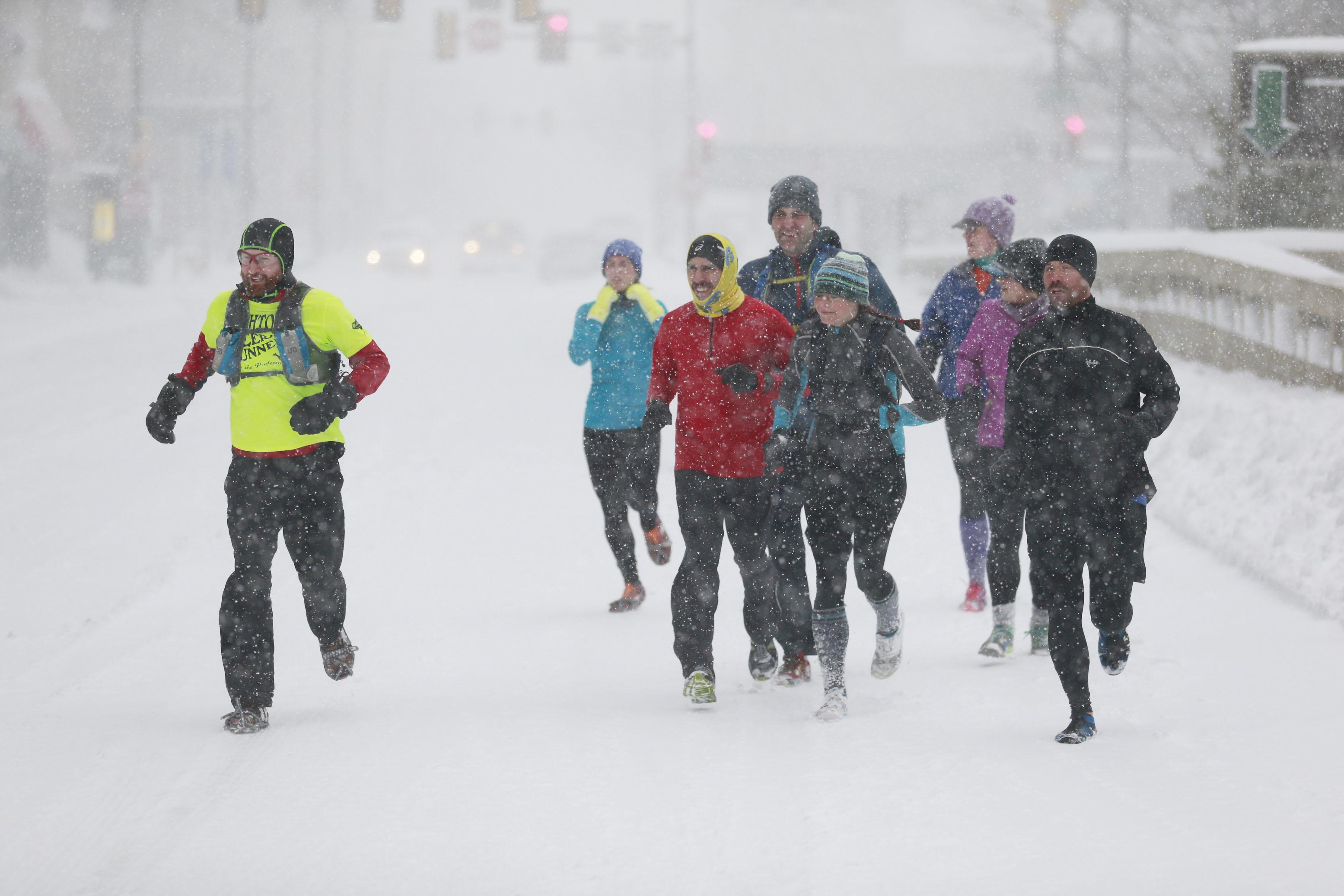
No, these aren’t Philadelphia Marathon racer, but the “Fishtown Beer Runners” make their way up Arch Street toward the Art Museum during an El Niño mega-snowstorm snowstorm in January 2016.
“There’s going to be storm after storm after storm,” he said. “There’s going to be no boring periods.”
What’s going on up there?
El Niño’s influence: It’s going to get stronger
El Niño already is flooding North America with warm air and energizing storm tracks as warming waters over vast areas of the equatorial Pacific threaten to reach record intensities.
The warming is due to persist into the spring, having profound impacts on the weather-bearing west-to-east winds. One likely outcome is a harvest of storms strengthening in the Gulf and tracking up the East Coast.
Whether any produce heavy snow would depend on the availability of cold air, which typically is in shorter supply during El Niño, and that would be the case this weekend.
A possible polar vortex intrusion could have a temporary chilling effect on temperatures in the Northeast sometime in the next few weeks and could interact with the effects of an El Niño that may have had a role in dislodging it, according to atmospheric researchers such as the National Oceanic and Atmospheric Administration’s Amy H. Butler.
El Niño, stratospheric warming, and the polar vortex
About every two years, the potent west-to-east winds about 20 miles up that trap frigid air in the Arctic slacken and then reverse, allowing the cold to ooze southward. It may take weeks before the effects would be evident in the United States.
One such reversal, known as a sudden stratospheric warming because the air warms quickly and radically — by as much as 90 degrees Fahrenheit in the high atmosphere — occurred Nov. 10, the earliest in records dating to 1958.
El Niños may generate atmospheric waves that contribute to the Arctic disruptions, Butler said in a recent blog post on climate.us, a forum for weather and climate experts and the successor to climate.gov, a victim of NOAA cuts.
A polar vortex disruption, said Laura Ciasto, a meteorologist with the National Weather Service’s Extended Prediction Division, can nudge the polar jet stream, the upper-air boundary between warm and cold air, southward, “bringing the Arctic air with it.”
In this case, however, “there is added uncertainty,” she added. Only two other stratospheric warmings have occurred in November, both at the end of the month. Plus, the Arctic air is not as frigid as it would be in January, and the snow cover not as robust. Northern Hemisphere snow cover is the third-lowest in areal extent in the last 30 years, according to the Rutgers University Climate Lab.
And arguing against prolonged cold is El Niño’s December resumé.
December warmth
Michelle L’Heureux, a physical scientist who heads NOAA’s El Niño/Southern Oscillation team, recalled attending a Christmas gathering in the Washington, D.C., area in 2015 at which some of the guests showed up in T-shirts and sandals as warmth washed over the Northeast. In Philadelphia that day, it went up to 68 degrees in what was the warmest December on record.
That coincided with the last winter with an El Niño of comparable strength to this one.
While this month has been warm in much of the country, the evidence for an El Niño role in November warmth is wanting, and actually leans slightly toward below-normal temperatures. she said.
However, at least in Philadelphia,the December warmth signal appears to be robust. According to National Center for Environmental Information data, nationally temperatures were above normal in four of the six El Niños comparable to this one, and all six were warmer than normal in Philly.
Whatever role a polar vortex invasion may have in December or the rest of the winter, Pastelok said, “El Niño is just so overwhelming.”
The outlook for the Philly region
Philly’s first snow threat has not popped on radar yet, and for that matter the city is waiting for its first official freeze, although suburban areas have had their first ice sightings.
Amadi El-Bisiolu, of West Philadelphia, is swinging with her son Jai, 2, at Clark Park on Tuesday.Tyger Williams / Staff Photographer
No precipitation is in the forecast until Sunday, when an El Niñoish coastal storm could generate substantial rain throughout the region, though the timing may spare the annual TIAA Philadelphia Marathon race, which kicks off at 6:55 a.m.
In the meantime, the next three days should feature tranquil conditions with highs in the mid-60s.
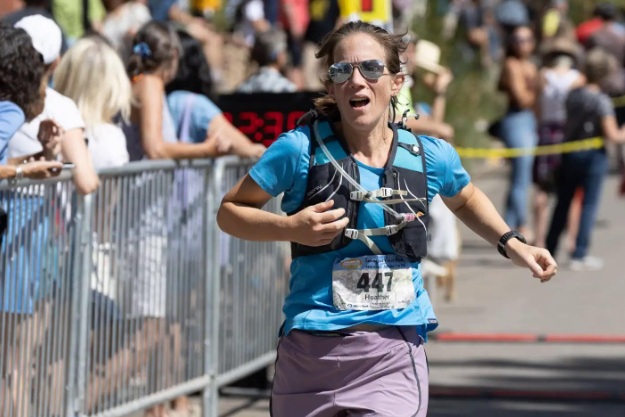
Heather Kovich, 49, formerly of Philadelphia, pioneering physician in rural family medicine, founding director of the first family medicine residency for the federal Indian Health Service, clinical assistant professor of community and family medicine for Dartmouth College, writer, and athlete, died Saturday, Oct. 31, of injuries after an incident that occurred while she was running near her home in Shiprock, N.M. The incident is under investigation by the FBI and other law enforcement agencies.
Reared in West Philadelphia and a graduate of Central High School and the Temple University Lewis Katz School of Medicine, Dr. Kovich joined the Northern Navajo Medical Center in Shiprock in 2009. She served as the center’s chief of staff for four years, mentored colleagues, treated patients, oversaw clinics and other service programs, and trained visiting residents from the University of New Mexico, Dartmouth, and elsewhere.
Dr. Kovich was an expert in population health, substance abuse treatment, musculoskeletal medicine, hospital procedures, and other topics. She raised funds and earned grants that benefited patient care, medical education, public health outreach, and other programs at Northern Navajo Medical Center.
Colleagues praised her “unwavering stamina,” “compassionate care,” and “incredible dedication” in tributes. They said she “touched so many lives” and was “a caring, compassionate physician who was deeply committed to her Native patients.”
Her patients called her “a very caring wonderful doctor” and “a great lady in every way” in tributes. A friend said: “She embraced our people, valued our culture, and became part of our family and our community.”
In 2021, to improve medical care for the Navajo Nation in New Mexico, Dr. Kovich helped establish the Indian Health Service’s first family medicine residency program. Residents spend their first year working in Albuquerque with the University of New Mexico School of Medicine and the next two years at the Northern Navajo Medical Center in Shiprock.
Dr. Kovich was remembered by colleagues on the Ellsworth LLC website.Ellsworth LLC
“Residents work in our inpatient and outpatient settings, and out in our community,” Dr. Kovich said in the ACGME interview. “The community teaches the residents how to be excellent physicians and also how to butcher a sheep.”
Dr. Kovich earned a bachelor’s degree in religious studies at Williams College in Massachusetts in 1999 and her medical degree at Temple in 2005. She served a residency at the University of Washington in Seattle and was drawn to New Mexico, she said, for its natural wonders and healthcare needs.
She sat on panels and spoke at conferences, and her articles about the Navajo Nation, population density, disease distribution, and other issues appeared in the New England Journal of Medicine, Family Practice, American Family Physician, and other publications.
Away from work, Dr. Kovich was an avid runner and bicyclist. She ran in the New York City and Boston Marathons, cycled with her family across Europe, and worked on the Appalachian Mountain Club trail crew.
She rowed for the Williams crew team in college and coached University of Vermont teams at the Dad Vail Regatta on the Schuylkill. “She was determined and self-motivated,” her mother said. “She worked hard and played hard. She liked adventure.”
Born March 7, 1977, Heather Clare Kovich grew up with her parents, Peggy and Todd, and younger sister Emily. She played bassoon in the Philadelphia Youth Orchestra and the school orchestra at Central, and the piano at home.
She also played field hockey in high school and won science fair competitions. She even appeared on a quiz show when she was 10 and won a TV set. “She was all in on life,” her sister said.
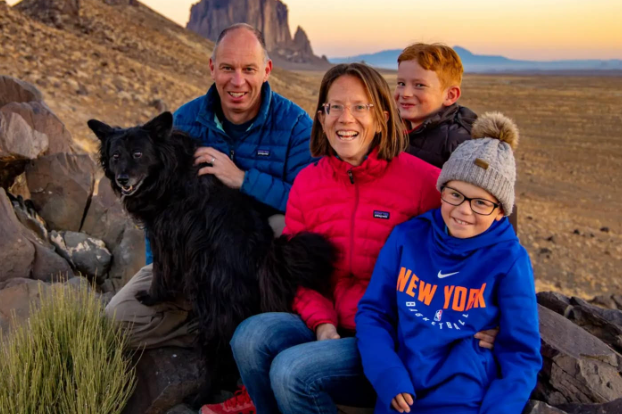
She met writer Andrew Weber in Seattle, and they married in 2008 and had sons Bennett and Russell. Even in New Mexico, she continued to cheer for the Eagles and the Phillies.
Dr. Kovich ran in many marathons and other races, and enjoyed time with her family.Courtesy of the family
She liked to quote Taylor Swift song lyrics and often said: “I can do hard things.” Her father said: “She was intense. She wasn’t put off by whatever it took to get things done. She cared.”
Her husband said: “Beyond her professional life, she was an amazing wife and mother to our family.”
In addition to her husband, sons, parents, and sister, Dr. Kovich is survived by other relatives.
A celebration of her life was held earlier and another is to be held later.
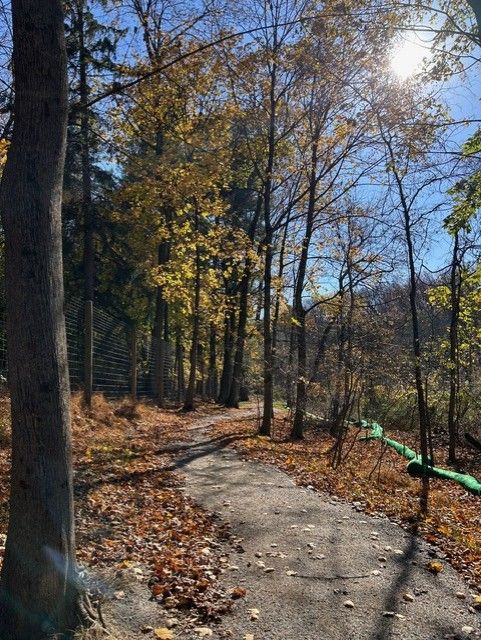
A fence installed to help keep deer out so depleted vegetation in Randolph Woods Nature Preserve can regrow has inadvertently been trapping deer inside, leading to vandalism as some residents worry about the animals’ welfare.
Photos of deer and foxes peering out from behind the fence have circulated on social media, with Malvern residents concerned that the issue is too recurrent and dangerous for the wildlife.
Borough officials said that residents intentionally tried to reintroduce deer to the preserve,and that the fence was “intentionally cut” earlier this month.
“We are going to investigate it and if and when we do find anyone damaging the fence or the gates or anything you will be charged appropriately,” Malvern police chief Louis Marcelli said at a Nov. 4 public meeting.
Several instances of cutting the fence have occurred, said Sylvie MacKenzie, director of communications for the borough. Cameras have been installed to monitor the fence. No one has been charged.
The deer are among the culprits for that decline, by chowing down on native understory and ignoring the invasive species, officials said. Deer removal is part of the borough’s phased plan to protect young trees and native species, officials said.
But the fence has prompted pushback from some residents, who see the animals stuck behind it and worry they have no access to water just beyond the fence line. They also worry it was installed too quickly, disrupting the ecosystem.
“I think it’s time to take it down. It’s not serving the purpose it was intended to and it’s actually creating a mess,” resident Cassandra Doughty said during public comment at the Nov. 4 meeting. “At this point it’s just kind of cruel.”
Malvern officials said that people propping open pedestrian gates, which are spring-loaded to close automatically, are leading to deer gaining entry, as well as intentional cutting.
Council president Brendan Phillips said the plan was something the borough “thought about long and hard” with two committees informing it. Changingit could force the borough to return the grant funding, he said.
“Who’s going to pay for that? Are you going to insure the borough for the money that we have to pay back?” he said. “You’re not.”
Why a deer fence?
When deer are overabundant, they can “negatively impact” both plants and animals, said Kate Hasapes, wildlife management supervisor for the Pennsylvania Game Commission’s southeast region.They can decimate habitats for ground-nesting birds — turkeys and grouse, for instance — and rabbits. It’s often seen in southeastern suburban areas, where there is littlehunting, she said.
The commission uses fencing in areas where deer populations are too high, and are negatively affecting state game lands, as a way to “mitigate negative deer impacts on the ecosystem.”
Hasapes was among a group of statebiologists who met with Malvern officials earlier this month to walk through the fenced area and look for improvements. She saw where cuts had been made (and also evidence people were dumping their yard waste into the preserve).
The fence is too high for deer to jump, she said.
“While some more stubborn deer are able to find a way through a fence, most deer cannot,” she said. “People with good intentions for wildlife ended up allowing deer to more easily access the fenced-in area by cutting these holes and leaving the gates propped open.”
The larger mesh at the base of the fence allows smaller animals such as foxes, possums, and turtles to navigate through as they please, she said.
Game Commission officials told the borough that the deer weren’t suffering, MacKenzie said.
Deer get water from three sources, Hasapes said: through metabolic water, like a camel, which stores water in fat; through the plants they eat, like one would a juicy fruit; and through free water, be that the creek or eating plants after rain or dew in the mornings, she said.
Game Commission regional staff are working with the boroughpublic outreach about the importance of the fence and ways to get deer out when they become trapped, she said.
Meanwhile, public works employees have been walking through the fenced areas, now with increased frequency, to check for deer and “guid[e] them safely outside,” MacKenzie said.
While most of the region is likely to experience hard freezes for the next several mornings, after one of the more incredible weather events in the Philly region’s weather history, a few ice puddles aren’t likely to get much attention.
The National Weather Service confirmed that two rare November tornadoes touched down in the region on Thursday — one near Wilmington, and another in Chesterfield, Burlington County.
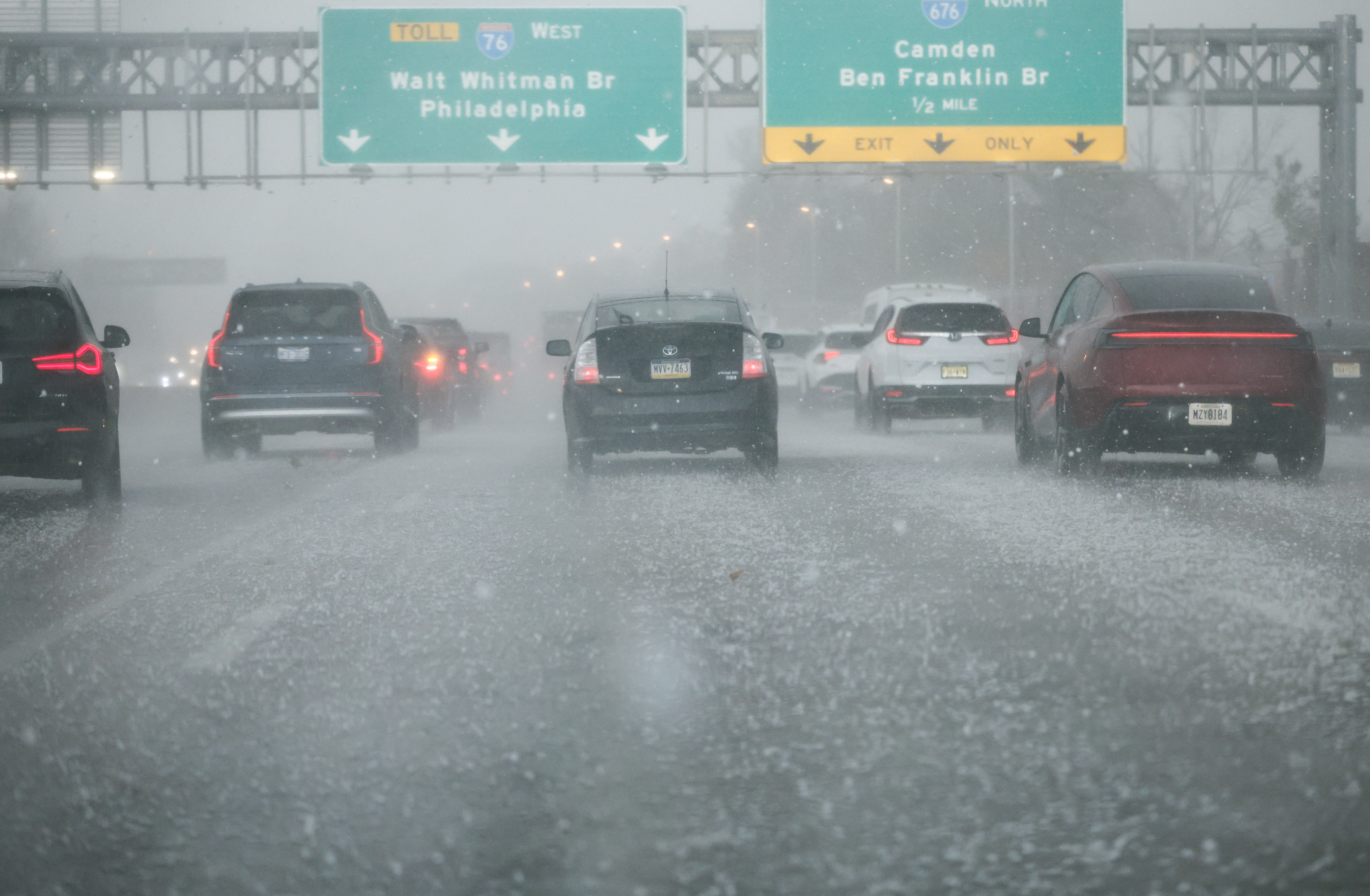
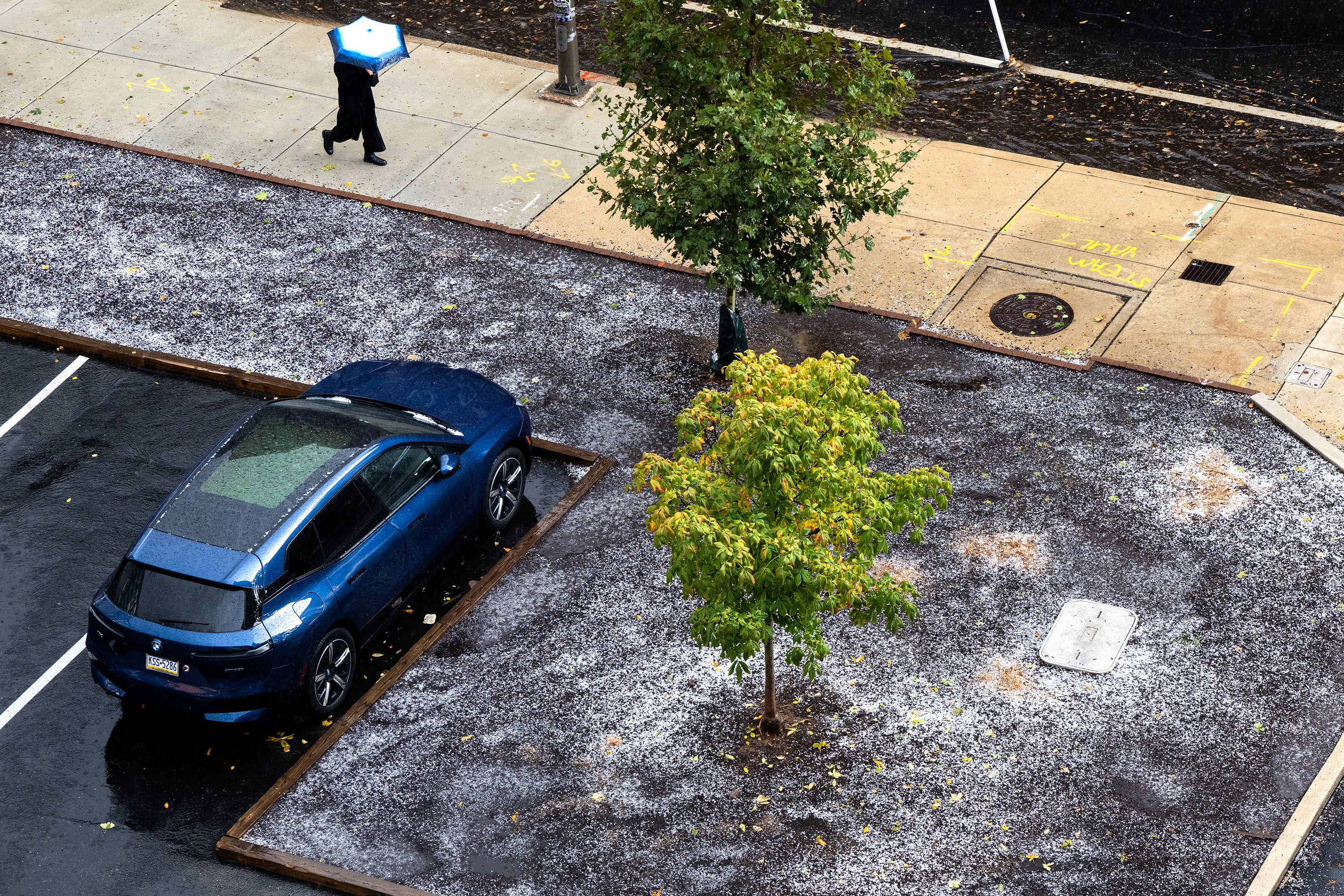
But the twisters arguably were upstaged by rare hailstorms that featured golf-ball-sized icy rocks, mined from frigid regions 35,000 feet in the atmosphere, which literally were plowable in some areas.
“That was wild,” said Lee Robertson, a lead meteorologist at the weather service office in Mount Holly, who said he had witnessed nothing quite like it in his 21 years with the agency.
Robertson, who lives in Churchville, Bucks County, was getting live reports from his 7-year-old son, Jack, who said the hailstones sounded “like jackhammers.”
“That was something we usually see in the West and in the Plains,” said Bill Deger, senior meteorologist at AccuWeather Inc.
And rarely does the Philly area see tornadoes in November. It’s happened only one other time in Delaware in records dating to 1950, said Kevin Brinson, Delaware state climatologist. In fact, on average, the region experiences thunderstorms in November only once every two years.
New Jersey hasn’t had a confirmed sighting this late in November since 1989, said Deger.
Thursday’s tornado damaged three structures, including the Meadow View Junior Academy private school, said Burlington County spokesperson Dave Levinsky. It also caused some tree damage, the weather service noted.
The Delaware twister, which also had peak winds of 100 mph, uprooted “multiple” trees and damaged several houses along its 1.5-mile path, the survey team said.
The storm struck the region with ferocity starting around 1 p.m., with the worst over by the evening commute. In addition to the twisters and the hailstones, downpours flooded numerous roads throughout the region.
No injuries or deaths were reported.
“It took like the perfect track to impact the most people,” said Deger, the worst of it running along the I-95 spine.
As for the plowable hailstones that were notable in Delaware and Gloucester Counties, Deger said those hefty accumulations likely occurred near the bottoms of road valleys after all those ice marbles had rolled downhill.
“That’s not to diminish what happened there,” he said.
The potential didn’t become evident until Thursday morning when the federal Storm Prediction Center posted a discussion warning that the atmosphere over the Philly region was about to become especially volatile.
The storm generated powerful updrafts into frigid regions of the upper atmosphere that turned the water to ice, heavy enough to survive trips to the surface where temperatures were around 60 degrees.
You may have noticed the dynamical storm was a prelude to quite a change in the region’s temperature fortunes.
Highs are unlikely to get out of the 40s the next two days, and freeze warnings were in effect for the region, save for the Philly heat island and the freeze-proof Philadelphia International Airport. Freezes outside the city are likely the next several mornings.
Come Saturday morning, it’s all but certain that some of the residual standing water will have turned to ice.
Given what happened Thursday, would anyone notice?
Staff writer Lacey Latch contributed to this article.
While most of the region is likely to experience hard freezes for the next several mornings, after one of the more incredible weather events in the Philly region’s weather history, a few ice puddles aren’t likely to get much attention.
The National Weather Service confirmed that two rare November tornadoes touched down in the region on Thursday — one near Wilmington, and another in Chesterfield, Burlington County.
The latter, an EF1 on the Enhanced Fujita scale with top winds of 100 mph, traveled 1.5 miles and damaged three buildings, a weather service team said. A tornado of similar strength damaged two helicopters on the Christiana Hospital property, the agency said. And a tornadic waterspout also was sighted on the Delaware River near Penns Grove, Salem County.
But the twisters arguably were upstaged by rare hailstorms that featured golf-ball-sized icy rocks, mined from frigid regions 35,000 feet in the atmosphere, which literally was plowable in some areas.
“That was wild,” said Lee Robertson, a lead meteorologist at the weather service office in Mount Holly, who said he had witnessed nothing quite like it in his 21 years with the weather service.
Robertson, who lives in Churchville, Bucks County, was getting live reports from his 7-year-old son, Jack, who said the hailstones sounded “like jackhammers.”
“That was something we usually see in the West and in the Plains,” said Bill Deger, senior meteorologist at AccuWeather Inc.
And rarely does the Philly area see tornadoes in November. It’s happened only one other time in Delaware in records dating to 1950, said Kevin Brinson, Delaware state climatologist. In fact, on average, the region experiences thunderstorms in November only once every two years.
The Delaware tornado touched down in the vicinity of Christiana Hospital. Its peak winds of 100 mph uprooted “multiple” trees, and damaged several houses along its 4.4-mile path, the survey team said,
New Jersey hadn’t had a confirmed sighting this late in November since 1989, said Deger.
Thursday’s tornado damaged three structures, including the Meadow View Junior Academy private school, said Burlington County spokesperson Dave Levinsky. It also caused some tree damage, the weather service noted.
The storm struck the region with ferocity starting around 1 p.m., with the worst over by the evening commute. In addition to the twisters and the hailstones, downpours flooded numerous roads throughout the region.
No injuries or deaths were reported.
“It took like the perfect track to impact the most people,” said Deger, some of the worst of it running along the I-95 spine.
As for the plowable hailstones that were notable in Delaware and Gloucester Counties, Deger said those hefty accumulations likely occurred near the bottoms of road valleys after all those ice marbles had rolled downhill.
“That’s not to diminish what happened there,” he said.
The potential didn’t become evident until Thursday morning when the federal Storm Prediction Center posted a discussion warning that the atmosphere over the Philly region was about to become especially volatile.
The storm generated powerful updrafts into frigid regions of the upper atmosphere that turned the water to ice, heavy enough to survive trips to the surface where temperatures were around 60 degrees.
While rare, November hail around here is not without precedent. Six inches of hail accumulated in the Princeton area during a storm on Nov. 17, 1977, according to the weather service. That came in advance of an all-time stormy winter in the Northeast.
Deger said the record-challenging El Niño warming of equatorial waters in the Pacific, which are expected to affect North American weather into spring, may have had something to do with Thursday’s mayhem. “El Niño years make things like this more likely to happen,” he said.
You may have noticed thst this dynamical storm was a prelude to quite a change in the region’s temperature fortunes.
Highs are unlikely to get out of the 40s the next two days, and freeze warnings were in effect for the region, save for the Philly heat island and the freeze-proof Philadelphia International Airport. Freezes outside the city are likely the next several mornings.
Come Saturday morning, it’s all but certain that some of the residual standing water will have turned to ice.
Given what happened Thursday, would anyone notice?
Staff writer Lacey Latch contributed to this article.
At least one, and possibly two tornadoes; downpours; widespread flash flooding; and torrents of hailstones — some reported to be as large as ping-pong balls — rocked parts of the region Thursday afternoon in advance of what will be the chilliest run of weather this season to date.
The National Weather Service Office in Mount Holly was investigating a possible tornado in Chesterfield, Burlington County, not far from the office, said meteorologist Mike Lee.
In addition, he said a survey team will be looking at a confirmed tornado site near Christiana Hospital, in New Castle County, Del., in which a helicopter was damaged.
However, for the immediate Philly area, the high drama was over.
Some showers were possible overnight Thursday into Friday, and more rain on Friday, Lee said, but no more of those white ice rocks from the sky, created by the rising air encountering cold air aloft.
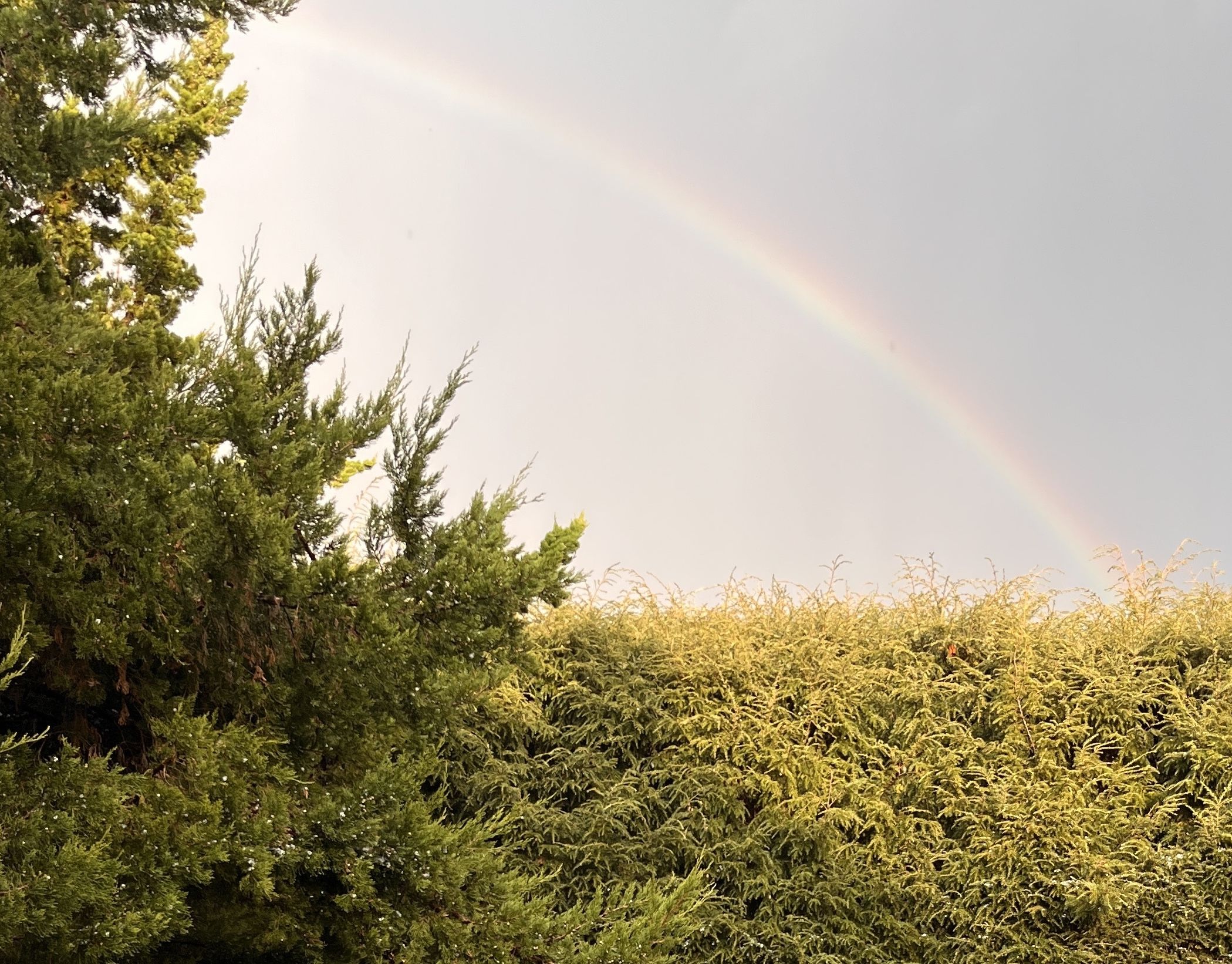
By late afternoon, the hailstones had been replaced by outbreaks of rainbows. But flash-flood warnings remained in effect until early evening along the Delaware River from the Delaware border to Bucks County, where high water made Haines Street in Tullytown impassable.
Hail pelts the Philly region on Thursday.Elizabeth Robertson / Staff Photographer
Multiple water rescues were logged in Delaware County, where flooding caused issues on the Blue Route near Woodlyn, and on I-95 around Trainer.
In Philly, flooding disrupted traffic on the Schuylkill Expressway in the Grays Ferry area, and on Route 1 near Morrisville and I-95 at Bensalem in Bucks County .
In Jersey, floodwaters blocked a lane of Route 42 in the Williamstown area.
A rainbow follows the hail, thunder, and lightning in Cherry Hill on Thursday afternoon.Staff / Frank Kummer
Overall, it was case of an anomalous storm preceding the region’s impending taste of December.
On average, according to weather service data, thunderstorms occur in November only once every two years.
The federal Storm Prediction Center in Norman, Okla., which had issued the tornado watch, said the mayhem was resulting from a complex storm system that was centered over northern Virginia Thursday morning and forecast to mature off the New Jersey coast.
It had been showing signs of being “a little bit stronger” than computer models had shown earlier, Lee said.
Come Friday, you may think you wandered into December. The storm was expected to draw in much colder air on winds from the northwest as it intensified.
Highs won’t get out of the 40s Friday, and stray snowflakes might even wander into the region, forecasters say. It will remain chilly through the weekend into early next week.
“It’s going to be a shock to the system,” said Tom Kines, senior meteorologist with AccuWeather Inc. “We’ve been spoiled for the last several weeks.”
The warning, buried in an obscure government report this summer, was unflinching.
The Defense Department’s vaunted network of research laboratories — whose scientists helped develop satellite communication, radar technology, and even the computer mouse — was in trouble.
The labs lost a significant share of their staff last year, largely in response to the Trump administration’s efforts to thin the federal workforce, the report found. Refilling critical positions was proving difficult due in part to President Donald Trump’s demand that new hires be screened for their loyalty to his goals. The report, issued by the Pentagon, pointed to “potentially grave consequences for the future of national defense.”
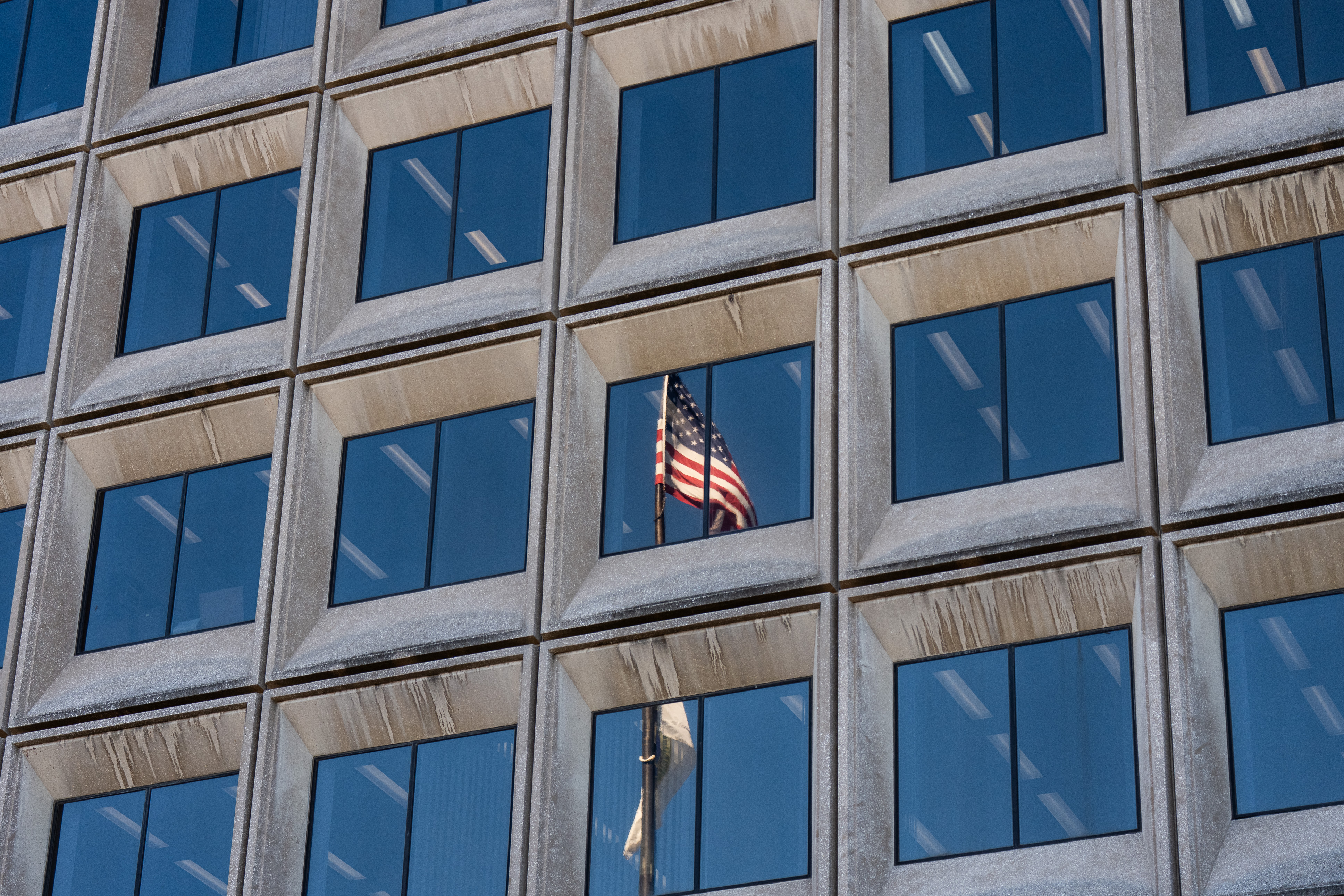
The turmoil inside scientific research has extended beyond the Pentagon. The Energy Department, a key hub of nuclear and quantum research, has lost more than 1,000 scientists and technical staff. The National Science Foundation, for decades a primary backer of long-term, foundational research, has withheld more than $1 billion in funding. And at the National Institutes of Health, the biggest funder of medical research, officials delayed or canceled more than 2,000 grants to biomedical researchers focused on topics such as Alzheimer’s, cancer and other diseases.
Under Trump, the federal government is still spending roughly as much on research — about $200 billion this year — as the administrations that came before. Scientists across the country are still receiving grants; universities are still being funded. But beneath the surface, the system of federally funded science that helped make the United States a global superpower is under intense strain from Trump’s policies, jeopardizing the nation’s advantages in defense, medicine, and technology, a New York Times examination has found.
The White House regularly proclaims that it is advancing U.S. interests. Yet its actions are eroding the country’s scientific edge as global rivals challenge U.S. dominance in fields that will help define the 21st century, according to interviews with scientists, university leaders, government officials, and analysts and a review of documents and budgets.
The damage is the byproduct of three pillars of Trump’s broader agenda.
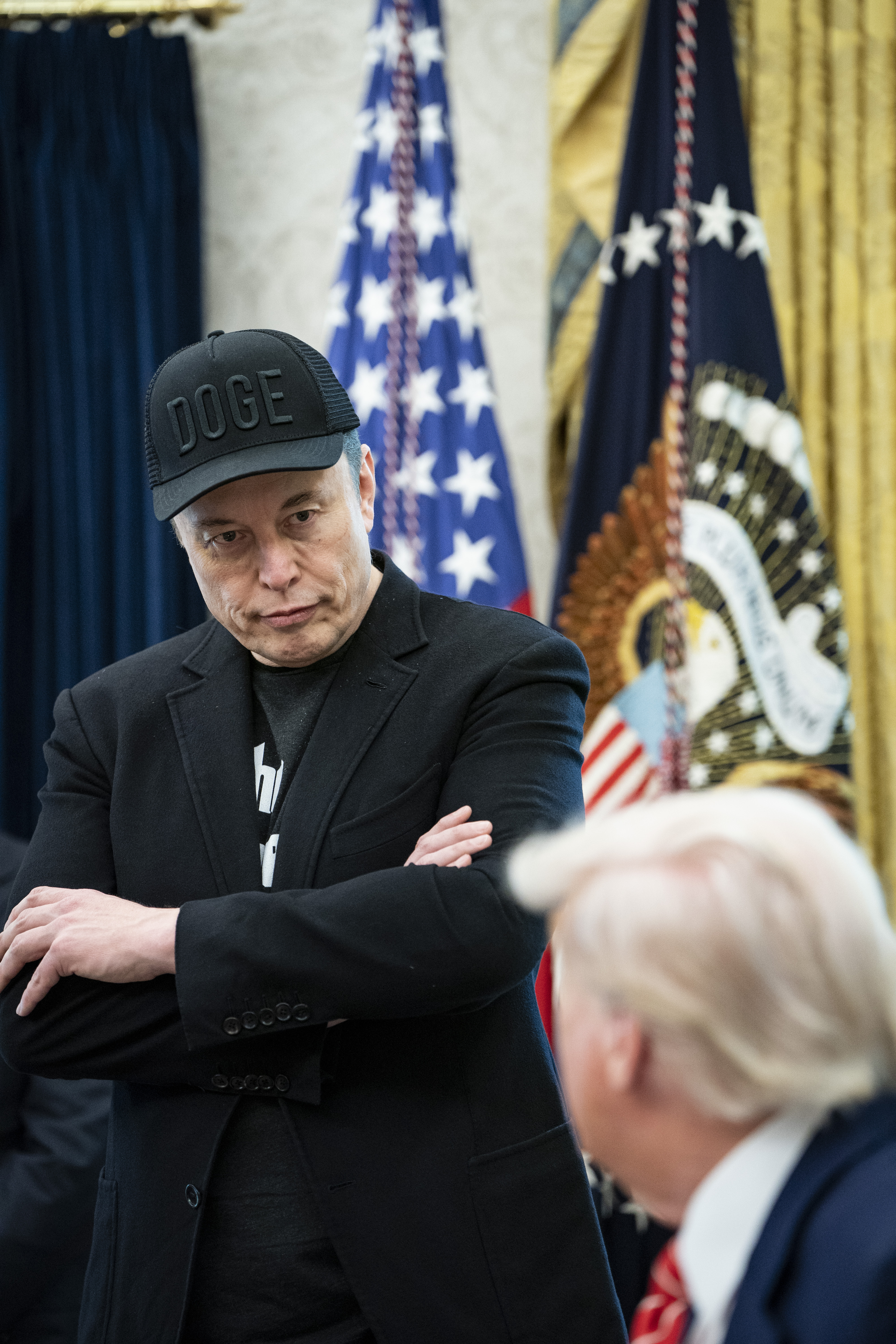
One is the sweeping job cuts and grant cancellations engineered last year by the so-called Department of Government Efficiency, the Elon Musk-led effort that viewed much of federal spending as wasteful and whose effects are still reverberating across the bureaucracy.
A second is the administration’s continued pressure on research universities, in which the White House used funding cuts to push schools into adhering to its demands for ideologically driven policy shifts.
The third is a campaign by Trump’s budget director, Russell Vought, to impose more political control over how the government spends money appropriated by Congress, further infusing politics into decisions around scientific research.
If not for the courts curbing the administration’s campaign against universities and lawmakers in both parties rejecting cuts to research funding, the impact on science would have been far deeper. Still, the effects of the broader agenda have rippled through nearly every facet of the nation’s research machine.
Aspiring scientists have seen their career paths thwarted, with fewer available spots for doctorate students. The number of doctorate applications from foreign students, typically a significant share of U.S. science programs, shrank by 21% this year at leading universities, according to data gathered for the Association of American Universities. Total doctorate admissions at those schools have dropped as universities try to make do with less resources.
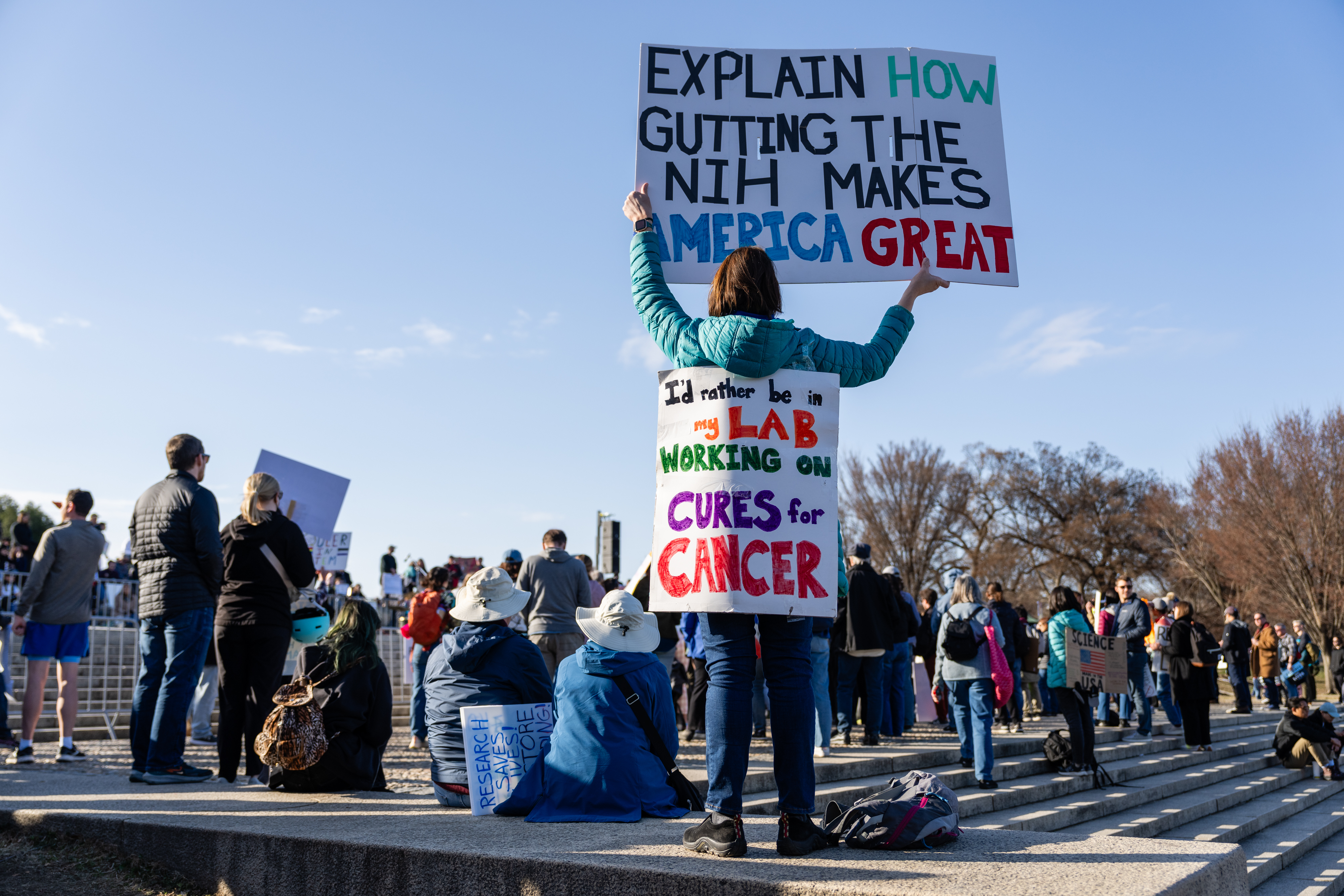
FILE — Demonstrators during 2025 Stand Up for Science rally at the Lincoln Memorial in Washington, on Friday, March 7, 2025. Scientists across the country are still receiving grants; universities are still being funded. But beneath the surface, the system of federally funded science that helped make the United States a global superpower is under intense strain from Trump policies, jeopardizing the nation’s advantages in defense, medicine and technology, a New York Times examination has found. (Eric Lee/The New York Times)ERIC LEE
Even the agencies working on topics that Trump and his aides have called priorities — including national defense, artificial intelligence, quantum computing, and nuclear energy — have been depleted.
Taken together, the changes underscore how Trump’s policies have disrupted scientific research beyond the areas the administration has targeted more directly, such as vaccines and climate science, endangering U.S. power and preeminence.
By many measures, China is closing the gap with the United States as the world’s research leader. Some organizations that rank global universities show China’s best schools increasingly displacing U.S. universities at the top. And the impact of Chinese research papers, as measured by citations from other scientists, has caught up with the United States, according to Clarivate, a data and analytics company.
By the time the full consequences of the administration’s actions become apparent, experts warn, it could be too late to fix. That’s because basic research funded by federal grants often takes decades to mature into the technology, medical treatments, and consumer products that change American life.
Federally funded work on atomic clocks starting in the late 1940s, for example, paved the way for GPS technology. In 1976, federally funded research yielded a major discovery about the origins of cancer-causing genes, which led to a Nobel Prize and, two decades later, lifesaving cancer drugs. Some of the early precursors to artificial intelligence date to U.S.-backed research in the 1980s, which used an algorithm to teach neural networks to learn from mistakes.
“Science is the long game,” said Marcia McNutt, who was president of the National Academy of Sciences, the country’s top scientific advisory body, until this summer. “By the time we no longer win any Nobel Prizes, we will have lost the capacity to ever recover.”
In response to the Times’ reporting, officials from the White House, Pentagon and other science agencies disputed that administration policies were hampering science. Rather, said White House spokesperson Liz Huston, the administration is reinvigorating U.S. science by transforming organizations in need of change.
“President Trump is ushering in a new golden age of American science by modernizing our research institutions, refocusing on ambitious national missions, and fully leveraging super intelligence for scientific discovery,” Huston said in a statement, using Trump’s preferred term for artificial intelligence. “Revitalizing our national scientific enterprise requires supporting the best American scientists and funding the best research based on merit.”
The White House said the administration has expanded a number of programs that support young researchers, and noted that the decision to reduce doctorate admissions this year was made by the universities themselves. The Association of American Universities said schools’ decisions to reduce admissions were largely the result of “federal research funding uncertainties.”
The White House also said that most of the scientists who have stopped working for the federal government since Trump came back to office were not fired, but instead left voluntarily. And it noted that the methodologies for ranking universities, such as comparisons between the United States and China, are limited.
The rest of the world now sees an opportunity.
Australia, for example, announced its “global talent attraction program,” calling it “an urgent and unparalleled opportunity to attract the smartest minds leaving the United States.” Canada dedicated more than $1 billion to bring in 1,000 international researchers, drawing U.S. leaders in fields such as biochemistry and neuroscience.
Even China, a country not known for academic freedoms, has been luring researchers away. A winner of last year’s Nobel Prize in chemistry left the University of California, Berkeley, to lead an institute in Beijing using artificial intelligence to accelerate the discovery of new materials — two fields the Trump administration has said it wants to dominate.
A postwar system shaken to its core
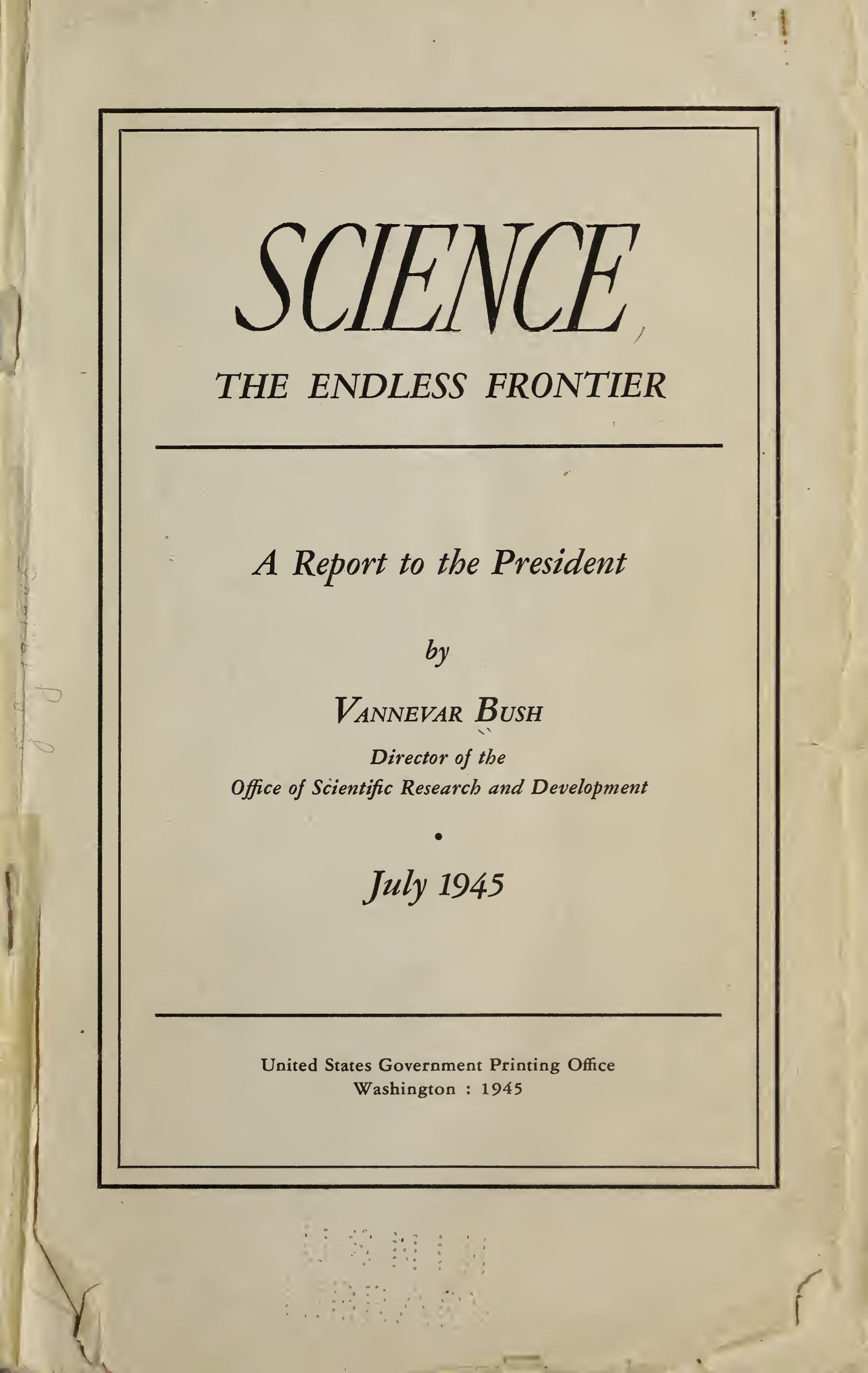
The roots of the United States’ science empire can be traced to a landmark 1945 report issued during the Truman administration, “Science: The Endless Frontier.” It described a vision, inspired in part by the Manhattan Project that led to the atomic bomb, for how science would power U.S. dominance in the world.
The federal government went on to establish a network of science agencies with distinct missions. The National Science Foundation supports theoretical or experimental work, which often lays the groundwork for future technologies years or even decades later. The Department of Energy was established to pursue advances related to power generation, as well as managing the nation’s nuclear arsenal. NASA, created in response to Soviet advances in space, put a man on the moon. The National Institutes of Health, which traces its roots to 1887, funds biomedical advances.
The federal government also provides tens of billions of dollars each year to the nation’s research universities while funding national labs, private industry, and other institutions — a system built up over 80 years by presidents and lawmakers from both parties.
In less than two years, Trump has shaken that system to the core.
The upheaval began early in the administration.
DOGE engineered staff firings and encouraged others to resign across the federal bureaucracy. Within a year, NIH staffing had shrunk by one-fifth. The NSF’s ranks were reduced by a third. Even NASA, which shrank less than other science agencies, lost 20% of its employees with doctorates. Those who left included its chief scientist, a climate science expert whose job the administration eliminated.
NASA said it will keep recruiting staff as needed. In a statement, Nicky Fox, associate administrator for NASA’s Science Mission Directorate, said the agency is working to get “more science into space for lower cost.”
DOGE and the White House directed agencies to search for terms in grant descriptions that might reveal science the administration viewed as liberal, including anything that appeared to promote diversity, equity, and inclusion.
The cuts cascaded through the country.
Ann D. Cohen, a neuroscientist who co-directs an Alzheimer’s research center at the University of Pittsburgh, had been working on a five-year study looking at how people’s exposure to stress and health problems earlier in life can affect their odds of developing the disease.
The research was critical to developing better treatments and health interventions, Cohen said. “If the triggering event is poor cardiovascular health in midlife, we can actually deploy public health strategies to improve those things, and potentially have an effect on Alzheimer’s,” she said.
Recruiting people from different backgrounds was difficult, because people who volunteer for scientific studies tend to have higher than average incomes and education levels. So Cohen and her colleagues recruited from rural western Pennsylvania, whose residents were more likely to be white and low-income, as well as from Black communities in Pittsburgh.
This past August, the NIH terminated the grant, effective immediately, on the grounds that the project was focused on structural racism — an argument that fundamentally misunderstood the work, Cohen said.
Emily Hilliard, a spokesperson for the U.S. Department of Health and Human Services, which includes the NIH, did not comment on specific grants. In a statement, she said the NIH’s commitment to Alzheimer’s research has not decreased.
“NIH is focused on funding innovative projects led by a new generation of health researchers, and on allocating funds for research that will lead to better health for the American people,” Hilliard said.
Some researchers who lost funding acknowledged having framed their projects in the language of DEI. But, they argued, that was what the Biden administration had emphasized.
Jessica L. Rosenberg, director of education for the Quantum Science and Engineering Center at George Mason University, had received NSF funding to research ways to encourage more U.S. students to seek careers in quantum technology, an emerging field that has led to innovation by vastly expanding computing power.
The NSF canceled the grant last year, about four months after the project started. Rosenberg said she suspects the grant was targeted because her application mentioned students from diverse backgrounds.
“That was what we were supposed to be doing at the time,” she said in an interview.
Trump administration officials argue that the push to incorporate DEI degraded science, and that scientists who embraced the approach had themselves to blame for losing support.
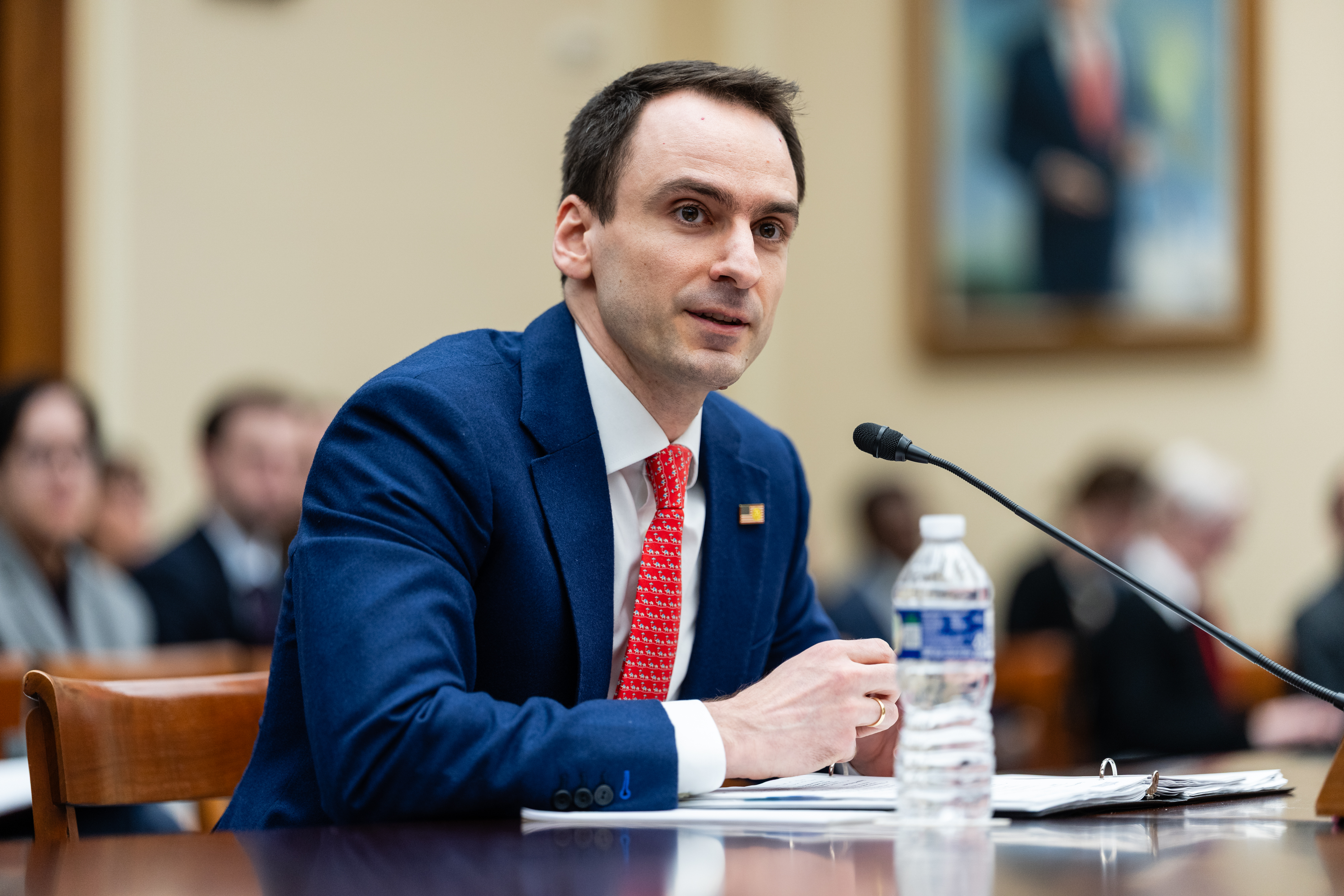
FILE — Michael Kratsios, the director of the White House Office of Science and Technology Policy, in Washington, on Jan. 14, 2026. Kratsios report barely mentioned a crucial part of the administration’s agenda: a proposed rule issued by the Trump administration this past May, which would require that Trump’s political appointees approve which researchers get funding — taking power away from nonpartisan science officials who have typically been the deciders. (Eric Lee/The New York Times)ERIC LEE
“We cannot afford for America’s scientists to be in the business of scoring points for an ideological agenda,” Michael Kratsios, Trump’s science adviser, told a meeting of scientists last year.
A dilemma for universities
Trump and his aides returned to the White House wanting to punish elite schools like Columbia and Harvard universities, ostensibly for transgressions like tolerating antisemitism.
But when cuts to research funding became the White House’s weapon of choice, professors and administrators had to decide whether to fight or acquiesce.
Harvard sued. Other schools negotiated. And even at universities that were not explicitly targeted, researchers made changes in hopes of keeping federal money that was foundational to their work — softening the language in their proposals, narrowing their projects and debating the line between fair-game government oversight and improper political interference.
The cuts fell across disciplines. Projects on epilepsy, Lou Gehrig’s disease, tuberculosis, and even astronomy outreach and education sputtered. Work on cancer and heart rhythms was imperiled.
The administration ultimately restored billions of dollars in funding, either because of court orders or settlements with universities. But researchers said the interruptions and changing priorities delayed or derailed experiments.
“You can’t run a research operation when you have to constantly pivot,” said Dorota Grejner-Brzezinska, vice chancellor for research at the University of Wisconsin-Madison, which was swept up in the administration’s funding cuts and participated in more than a dozen legal challenges.
“The current state of affairs is that it’s really very hard to plan long term,” she added, “and research is a long-term kind of enterprise.”
May Mailman, a former White House aide who helped lead the pressure campaign against universities, said the administration wasn’t overly concerned about the effects on research. Funds taken away from one university could eventually make their way to other schools whose behavior and ideology the White House approved of, she said. In the meantime, Mailman said, the administration tried to minimize the disruption to fields of research it supported, including artificial intelligence and some types of energy.
But much of the work coming out of universities, she said, may not have merited the taxpayer money going into it.
“There’s a feeling that there is more spent on research than comes out of it — that the system is a little bit broken,” Mailman said.
The hunt for woke
The administration also sought deep funding cuts to federal science agencies. Last year, when Vought presented the administration’s annual budget request to Congress, he called for reducing research funds at the National Institutes of Health by 41%; cutting the National Science Foundation by 55%; and reducing NASA’s budget for science by almost half. No previous administration, from either party, had sought such deep cuts.
Congress rejected those cuts. But Vought began finding novel ways to slow grants and redirect funds.
One of the offices that Vought targeted in his budget request was the NSF’s “woke social, behavioral, and economic sciences” — an apparent reference to an NSF division that funded social science. Not long after, the division began reducing its grants.
An NSF spokesperson, Michael England, said in a statement that the agency’s funding decisions “reflect a strategic alignment of resources in a constrained fiscal environment.”
The loss of those funds affected researchers like Priti Shah, chair of the University of Michigan’s psychology department. Shah had applied for a grant to study how people evaluate and make decisions based on scientific information. In the summer of 2025, the NSF told her that her application had been put on hold because of funding issues. It was later rejected entirely.
“It is so important to understand what people assume and what errors they make when they’re thinking about science,” Shah said. “People are very poor at reasoning about scientific evidence.”
An innovation engine ‘at risk of stalling’
The administration’s actions also hurt agencies central to its political agenda.
The Defense Department’s assessment of science and research capabilities published this summer said changes during the first year of the Trump administration had degraded the department’s highly regarded network of research laboratories, due largely to DOGE cuts and obstacles to hiring.
“Without a swift and sustained reversal of these policies,” the report warned, the Defense Department’s “innovation engine is at risk of stalling.”
The labs lost about 14% of their staff, the report found. Among those mentioned were the Naval Sea Systems Command, charged with developing ships and weapons; the Air Force Research Laboratory, which helped develop stealth aircraft and laser systems; and the Army’s Aviation & Missile Center.
External research laboratories, which are funded by the Pentagon but staffed by civilian researchers and develop technology for use by the military, were also suffering from the administration’s policies, the report said.
Much of the work at those labs, some of which are attached to major research universities, is classified, and the report did not disclose specific examples of research that has been affected. But it warned that staff departures inside the labs and among agency employees who coordinated with them “jeopardized the execution of critical defense research.” Without key points of contact between the agency and the labs, the report said, efforts that support “time-sensitive, real-world operations are in some cases at a standstill or delayed.”
Because the labs aren’t financially connected to defense contractors, they play an added important role helping the Pentagon objectively evaluate contractors’ claims about new technologies, said Heidi Shyu, who oversaw the Pentagon’s research operation as under secretary of defense for research and engineering in the Biden administration.
A Pentagon official acknowledged that, during the first year of the administration, there was a “retraction in the number of scientists and engineers across the research enterprise.” But, the official said, the agency has “hired to fulfill the mission and mitigate any impacts from the loss of personnel.”
Defense Department funding changes also affected university researchers.
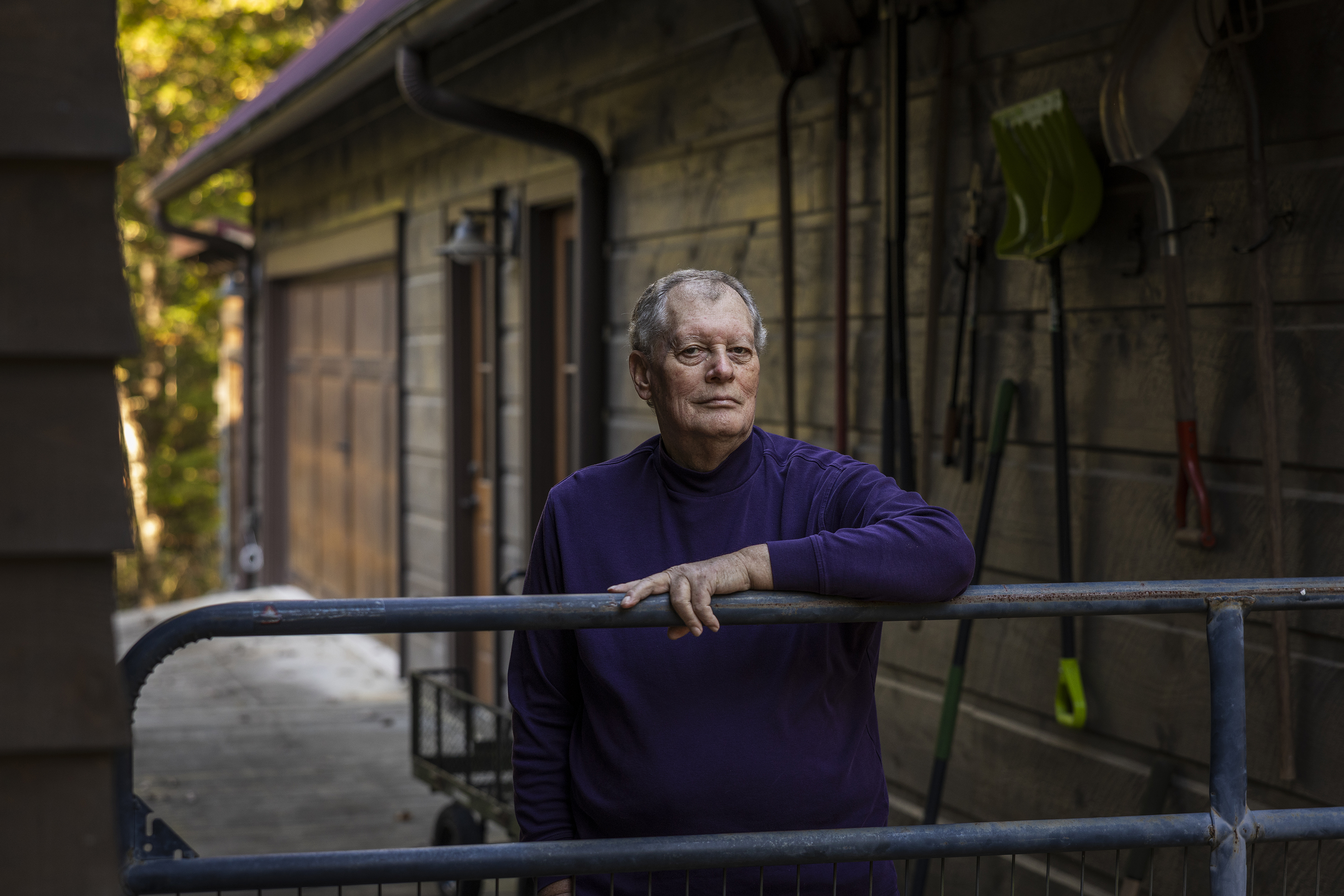
Randall Engle, a psychologist at the Georgia Institute of Technology, at his cabin in Ellijay, Ga., on Oct. 23, 2026. Engle was working on ways to help the Navy select air traffic controllers, pilots and other applicants for complex jobs.(Audra Melton/The New York Times)AUDRA MELTON
Randall Engle, a psychologist at the Georgia Institute of Technology, was working on ways to help the Navy select air traffic controllers, pilots, and other applicants for complex jobs.
The Navy needs to train roughly 1,000 new air traffic controllers each year, Engle said, at a cost of about $100,000 per trainee. But because the job requires intense focus in difficult conditions, nearly a quarter of trainees typically fail.
So he received funding to develop diagnostic tests to determine a person’s ability to maintain focus.
Engle tested his new approach at the Navy’s air base in Pensacola, Fla., and found that it did a better job identifying people likely to succeed as air traffic controllers. He was in the midst of refining those tests, when the Office of Naval Research told Georgia Tech that the grant was canceled.
Engle said he believes the grant was canceled simply because it was happening at a university.
“There was no wokeness,” Engle said of his project. “There was no diversity, inclusion.”
A new agenda
The uncertainty over the future of U.S. science is reflected in the events that have unfolded at the Department of Energy.
The agency is a critical engine for research in the physical sciences, and it houses the Genesis Mission — a marquee Trump administration initiative that officials say will drive discoveries across a range of topics, from quantum computing and particle accelerators to microchips that can operate in outer space. In an executive order, Trump called it a “dedicated, coordinated national effort to unleash a new age of AI-accelerated innovation and discovery.”
But the Energy Department’s central role on a Trump-driven project came with a glaring contradiction: It was also hammered by DOGE.
The agency has lost about one-quarter of its staff since the start of the administration, according to a Times analysis of federal data. And the amount of grant money awarded by its two major science offices dropped by more than one-quarter during the administration’s first year, before Genesis began — a reduction of more than half a billion dollars.
Darío Gil, the agency’s top science official, rejected the idea that its science mission has suffered, noting that much of the department’s work is done by 17 national laboratories, where most staff are not federal employees and so not affected by DOGE’s staff-reduction programs. He said the agency is hiring.
“Staffing is always a challenge,” Gil said. “We continue to recruit good people.”
He added that the goal of Genesis is to double the productivity of the United States’ science industry within a decade. The program has selected almost 300 projects to fund at universities, private companies, national labs, and other research organizations.
“The outcome we seek,” Gil said, “is that this transformation impacts the entire American economy.”
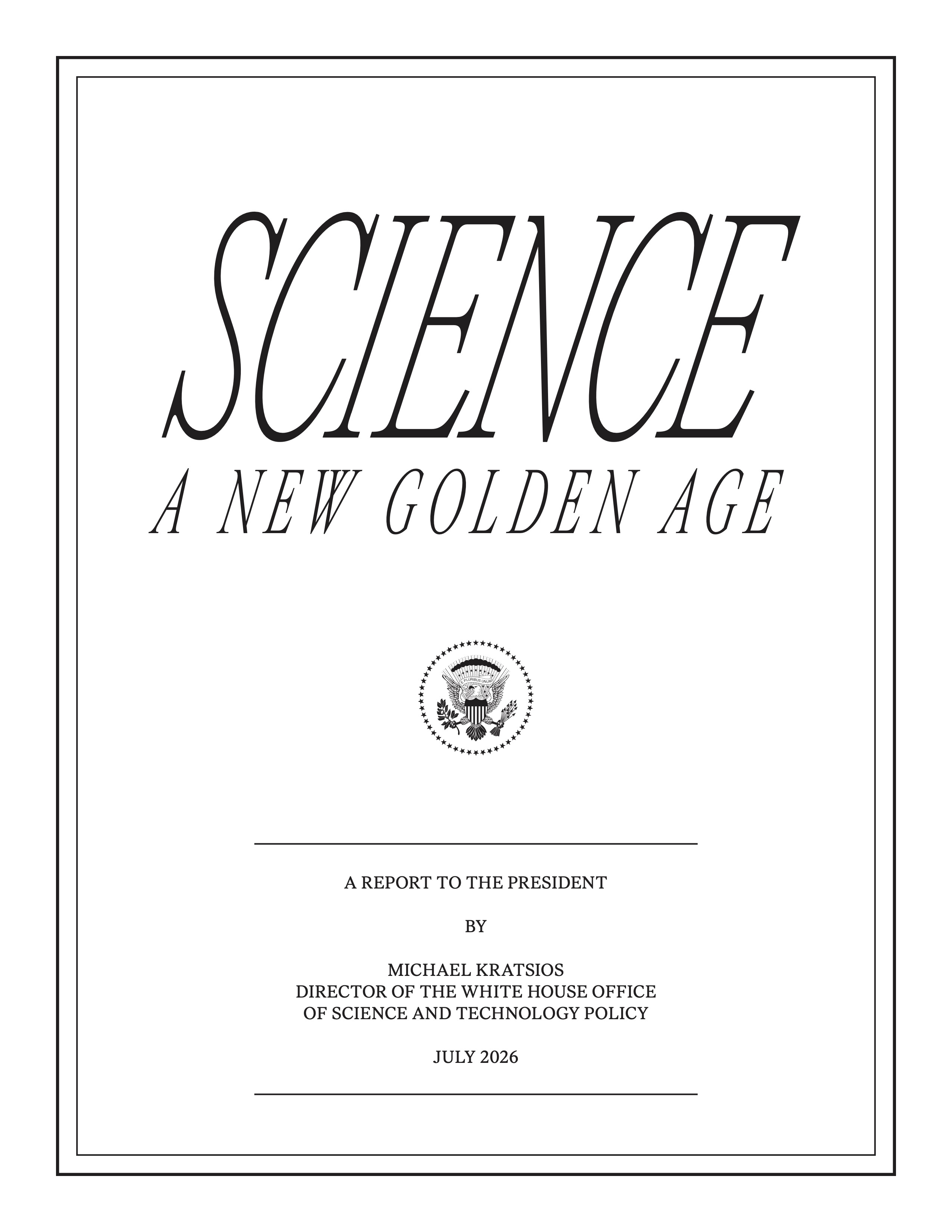
In July, just a few weeks after the Pentagon published its warning about defense labs, Kratsios, the White House science adviser, issued a report of his own.
The document emphasized many of the administration’s goals: Increasing the role of private industry in federal research. Bypassing the traditional peer-review process for deciding who gets research grants, instead giving individual reviewers the chance “to make bold scientific bets” on researchers of their choosing. Redirecting more money toward younger researchers.
Kratsios barely mentioned a crucial part of the administration’s agenda: a proposed rule issued by the Trump administration this past May, which would require that Trump’s political appointees approve which researchers get funding — taking power away from nonpartisan science officials who have typically been the deciders.
Under the proposal, researchers seeking funds “should commit to complying with administration policies.” Officials would screen and reject applications for projects that “promote anti-American values.”
The day after Kratsios released his report, he appeared before the House science committee to discuss it. Some committee members seemed perplexed by his promise to usher in a scientific golden age, given the tumult over the previous year and a half.
“All I see is tarnish and deterioration,” said Rep. Gabe Amo, D-R.I. “Do you commit to not leaving our scientific apparatus in shambles?”
“I don’t think, sir, I would be doing my job if I wanted to leave the scientific enterprise in shambles,” Kratsios responded. “So I will commit to not doing that.”
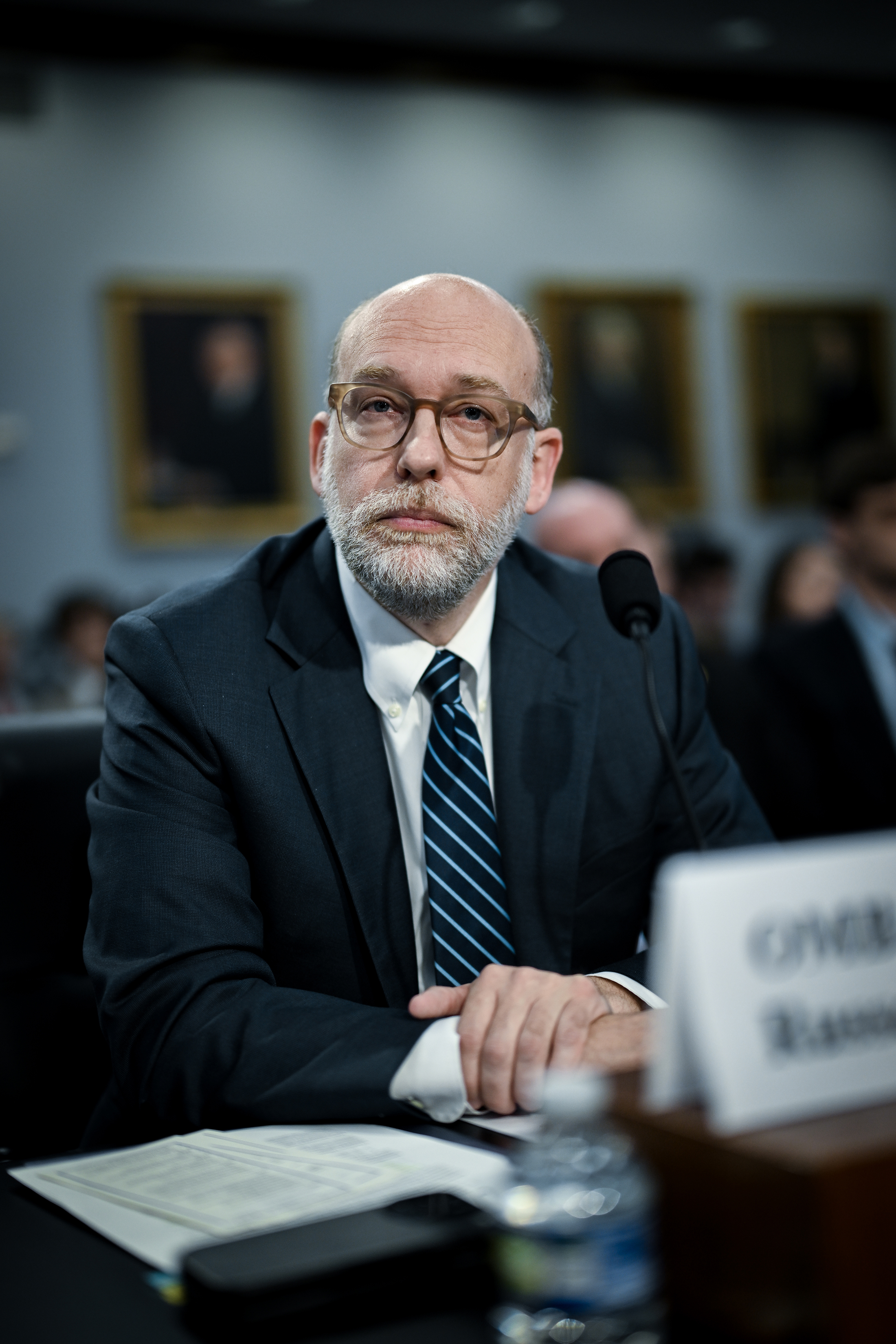
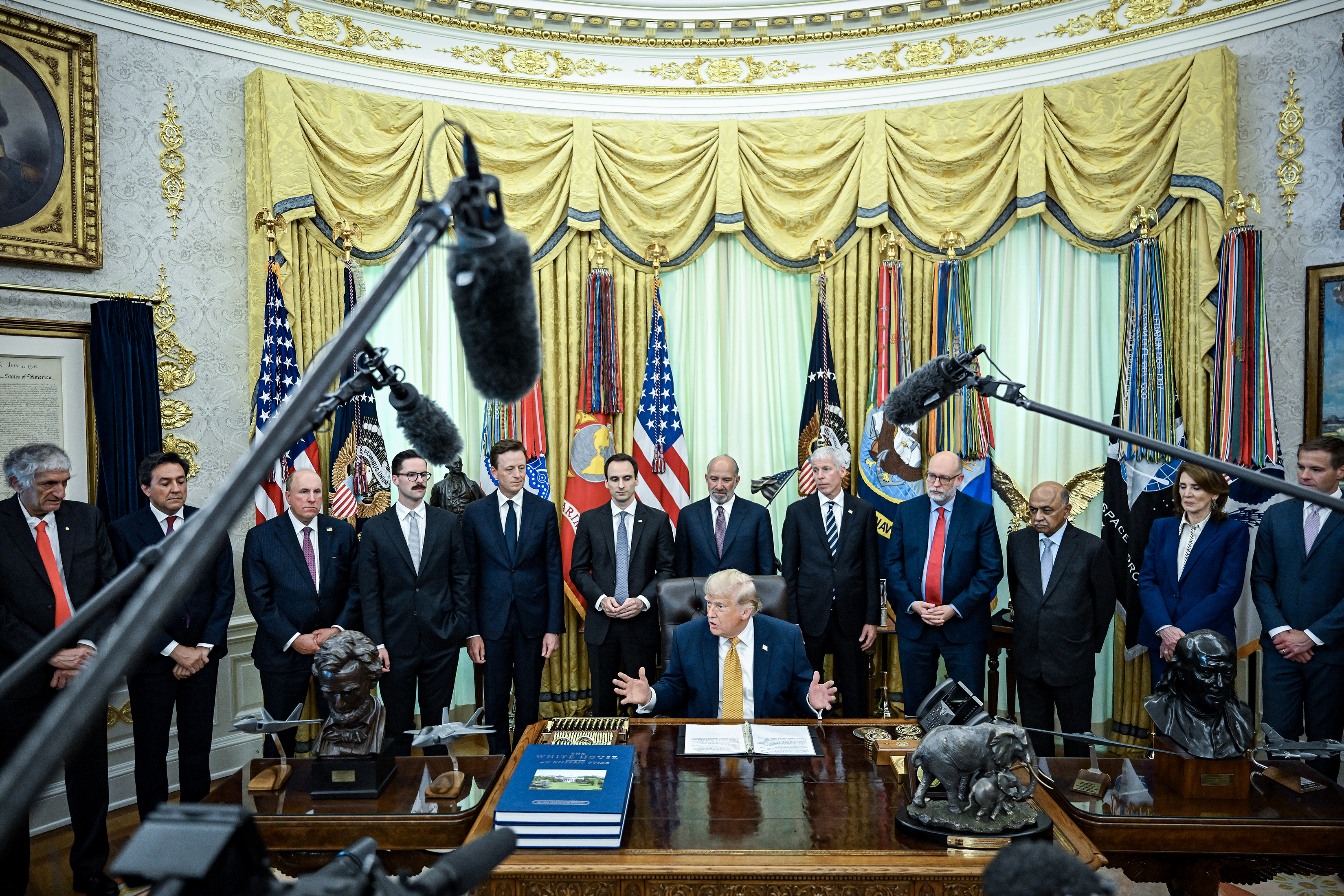
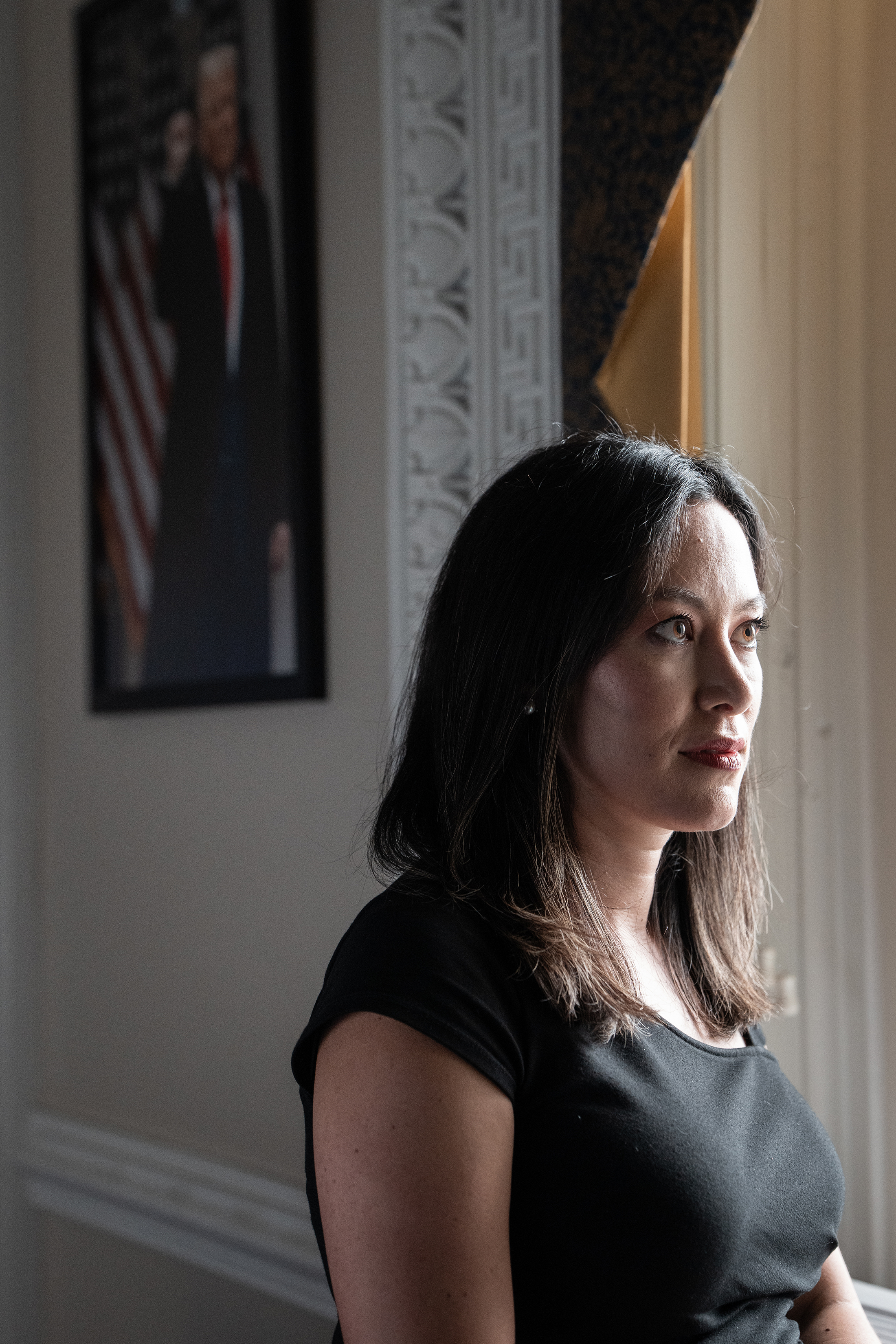
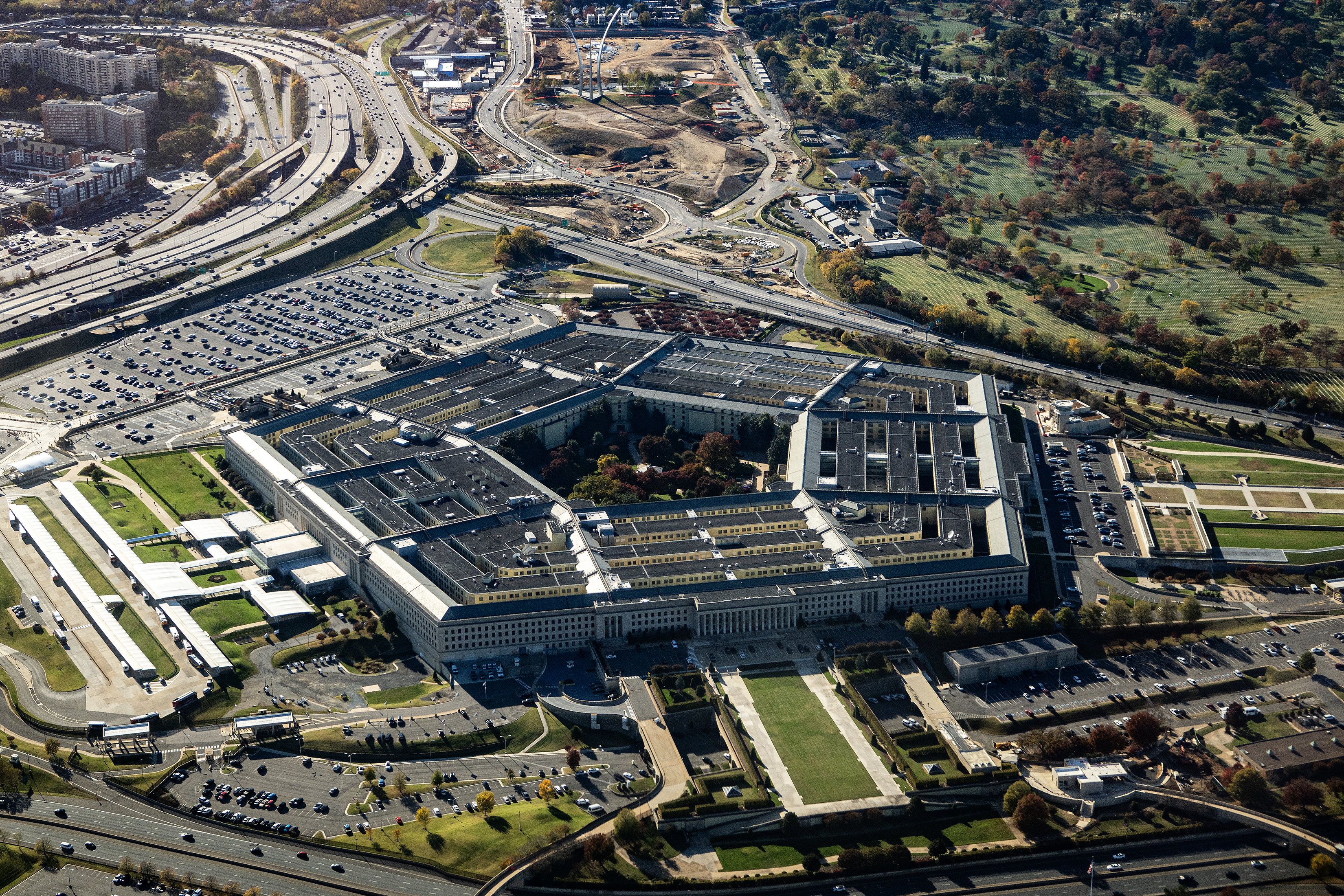
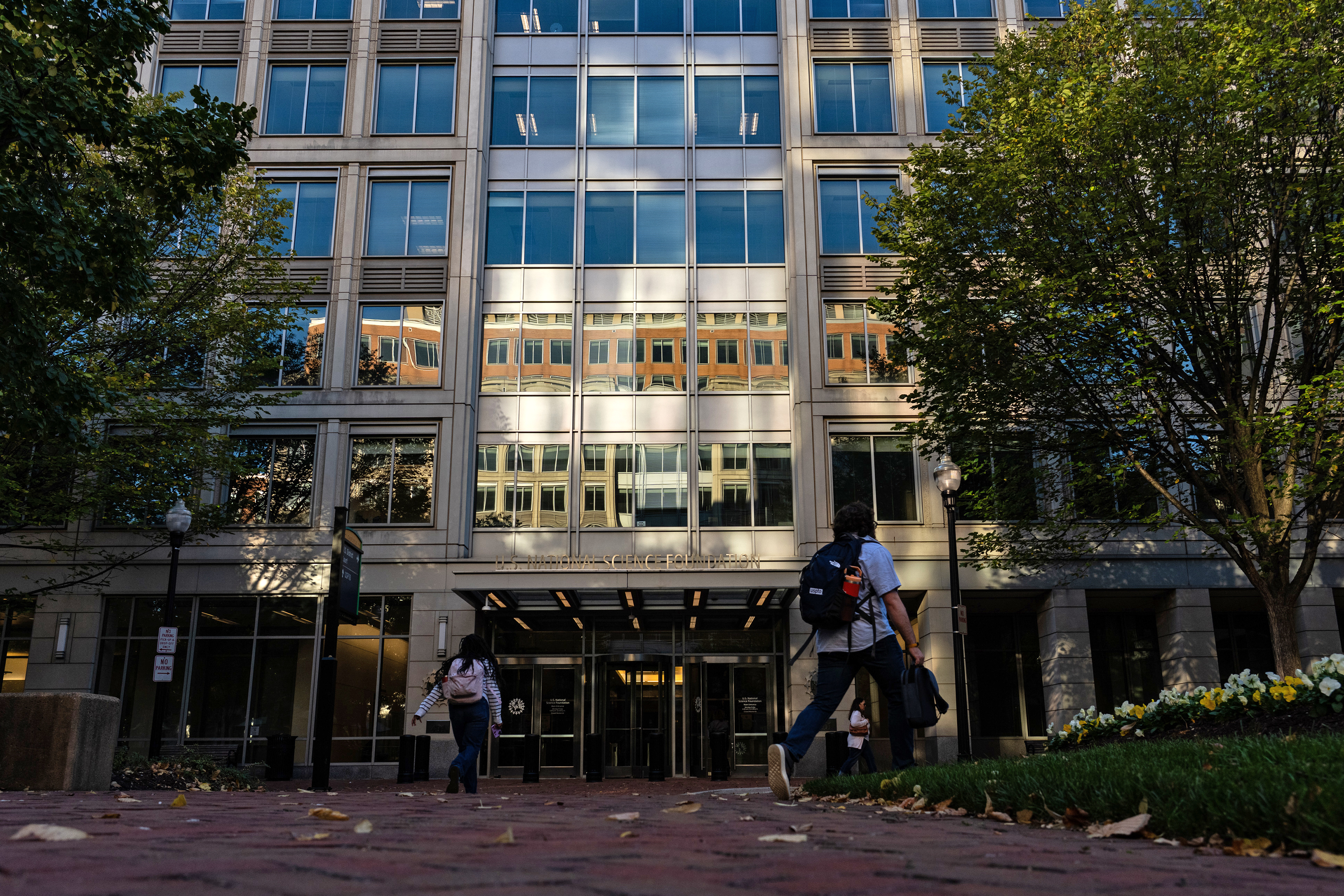
FILE — Russell Vought, director of the Office of Management and Budget, appears for a House Appropriations Committee hearing on Capitol Hill in Washington, on June 4, 2025. Vought has sought to impose more political control over how the government spends money appropriated by Congress, further infusing politics into decisions around scientific research. (Kenny Holston/The New York Times)KENNY HOLSTONFILE — Elon Musk, left, with President Donald Trump in the Oval Office of the White House in Washington, May 30, 2025. Scientists across the country are still receiving grants; universities are still being funded. But beneath the surface, the system of federally funded science that helped make the United States a global superpower is under intense strain from Trump policies, jeopardizing the nation’s advantages in defense, medicine and technology, a New York Times examination has found. (Haiyun Jiang/The New York Times)HAIYUN JIANGThe Energy Department, a key hub of nuclear and quantum research, in Washington on Monday, Oct. 7, 2026, has lost more than 1,000 scientists and technical staff. Scientists across the country are still receiving grants; universities are still being funded. But beneath the surface, the system of federally funded science that helped make the United States a global superpower is under intense strain from Trump policies, jeopardizing the nation’s advantages in defense, medicine and technology, a New York Times examination has found. (Salwan Georges/The New York Times)SALWAN GEORGESA report to the president produced by Vannevar Bush, Director of the Office of Scientific Research and Development from 1945 laid out a vision for how science would power U.S. dominance in the world. Scientists across the country are still receiving grants; universities are still being funded. But beneath the surface, the system of federally funded science that helped make the United States a global superpower is under intense strain from Trump policies, jeopardizing the nation’s advantages in defense, medicine and technology, a New York Times examination has found. (Via The New York Times) — NO SALES; EDITORIAL USE ONLY —VIA THE NEW YORK TIMESFILE — Darío Gil, far left, under secretary for science at the Energy Department, Michael Kratsios, rear center, and Russell Vought, far right, listen as President Donald Trump speaks during an executive order signing in the Oval Office of the White House, in Washington, on June 22, 2026. Scientists across the country are still receiving grants; universities are still being funded. But beneath the surface, the system of federally funded science that helped make the United States a global superpower is under intense strain from Trump policies, jeopardizing the nation’s advantages in defense, medicine and technology, a New York Times examination has found. (Kenny Holston/The New York Times)KENNY HOLSTONFILE — May Mailman, a former White House aide who helped lead the pressure campaign against universities, in the Eisenhower Executive Office Building in Washington on July 31, 2025. Scientists across the country are still receiving grants; universities are still being funded. But beneath the surface, the system of federally funded science that helped make the United States a global superpower is under intense strain from Trump policies, jeopardizing the nation’s advantages in defense, medicine and technology, a New York Times examination has found. (Haiyun Jiang/The New York Times)HAIYUN JIANGFILE — An aerial view of the Pentagon in Arlington, Va., Oct. 31, 2025. The Pentagon’s network of research labs lost staff members amid efforts to thin the federal work force. (Kenny Holston/The New York Times)KENNY HOLSTONA report issued by Michael Kratsios in 2026 proclaiming that the Trump administration was renewing the country’s dominance in research and development. Scientists across the country are still receiving grants; universities are still being funded. But beneath the surface, the system of federally funded science that helped make the United States a global superpower is under intense strain from Trump policies, jeopardizing the nation’s advantages in defense, medicine and technology, a New York Times examination has found. (via The New York Times) — NO SALES; EDITORIAL USE ONLY —VIA THE NEW YORK TIMESDorota Grejner-Brzezinska, vice chancellor for research at the University of Wisconsin-Madison, on campus in Madison, Wis., on Oct. 30, 2026. The University of Wisconsin-Madison was swept up in the administration’s funding cuts and participated in more than a dozen legal challenges.(Jenn Ackerman/The New York Times)JENN ACKERMANThe Harvard T.H. Chan School of Public Health in Boston, Oct. 29, 2026. Scientists across the country are still receiving grants; universities are still being funded. But beneath the surface, the system of federally funded science that helped make the United States a global superpower is under intense strain from Trump policies, jeopardizing the nation’s advantages in defense, medicine and technology, a New York Times examination has found. (Sophie Park/The New York Times)SOPHIE PARKThe headquarters of the National Science Foundation in Alexandria, Va., on Oct. 7, 2026. Scientists across the country are still receiving grants; universities are still being funded. But beneath the surface, the system of federally funded science that helped make the United States a global superpower is under intense strain from Trump policies, jeopardizing the nation’s advantages in defense, medicine and technology, a New York Times examination has found. (Salwan Georges/The New York Times)SALWAN GEORGES
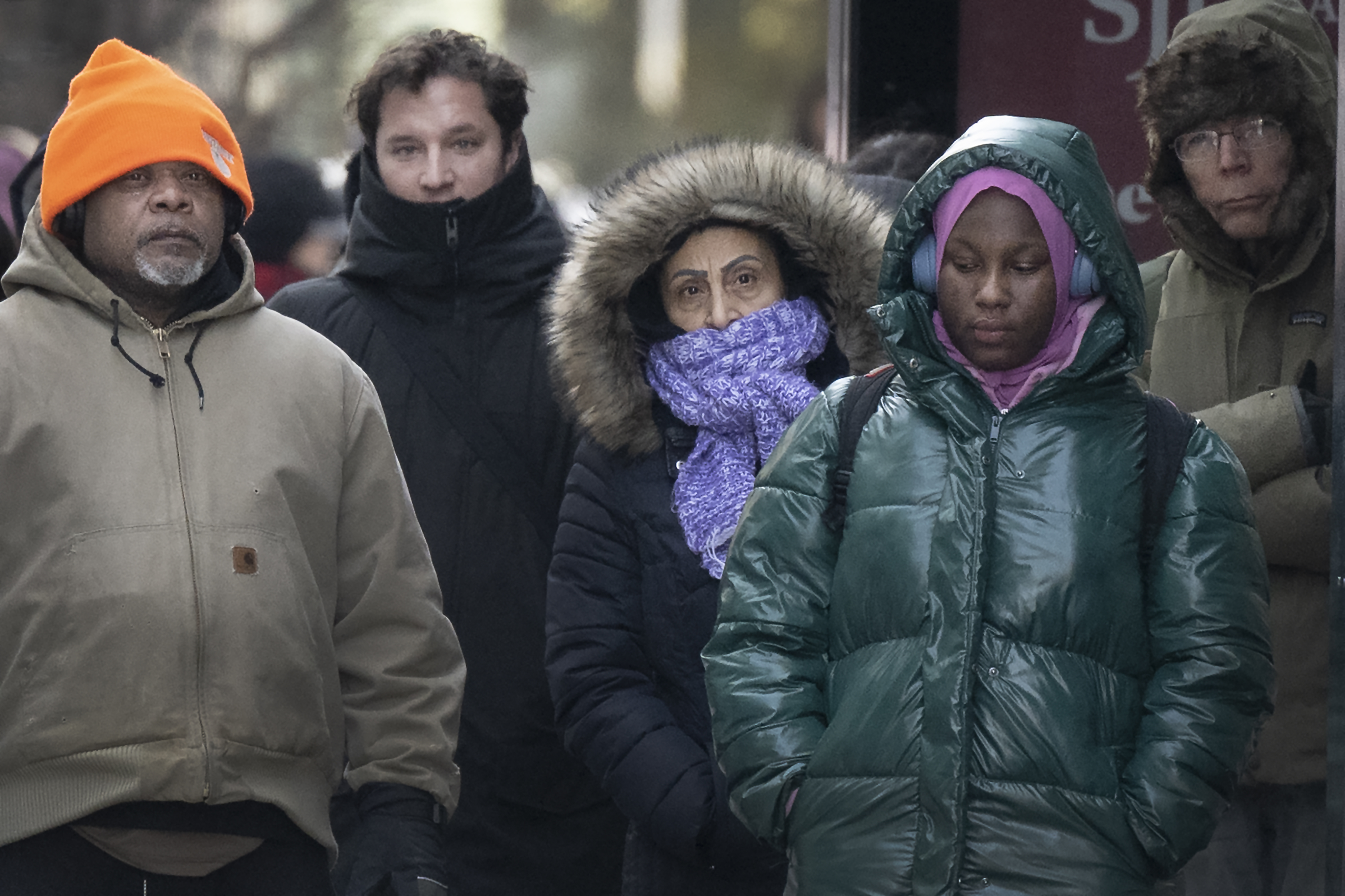
It won’t be extreme — about what one might expect in mid-November when the sun goes to bed early and takes its time pinking up the sky in the morning — but a December-like chill is about to settle across the Philly region.
After a gloomy, rainy Thursday — with a thunderstorm possible — forecasts are calling for highs in the 40s Friday and Saturday, with perhaps some wet snowflakes making cameos.
The chill should last into early next week. However, it appears warmer days will be making a strong comeback after that, with perhaps record warmth Thanksgiving week.
The forecast for the Philly region
Light rain is expected to develop Thursday with highs in the 60s, but winds from the northwest generated by a coastal storm due to mature off the Jersey coast are expected to import much colder air Thursday night into Friday, with more rain possible.
Snow is possible in the higher elevations of Eastern Pennsylvania, and random snowflakes could find their way into the Philly region, said Marc Chenard, senior branch forecaster at the federal Weather Prediction Center, in College Park, Md.
But no cause for panic.
While the cooldown won’t be polar vortex stuff, stiff northwest winds will drive wind chills into the 30s through the weekend.
“It’s going to be a shock to the system,” said Tom Kines, senior meteorologist with AccuWeather Inc. “We’ve been spoiled for the last several weeks.”
True. In fact, after a mild October, temperatures this month are running a lusty 7 degrees above normal.
That has a lot to do with that El Niño warming of sea surface temperatures in the equatorial Pacific, Kines said.
El Niño continues to cook and affect U.S. weather
The interaction of the overlying air and the waters that have been running about 4 degrees Fahrenheit above normal have been delivering generous amounts of warmth to North America.
That is likely to continue.
A significant warmup is likely in the region starting in the middle of next week, and Kines said that heading into Thanksgiving week, record warmth is possible in Philly.
The government’s Climate Prediction Center has the odds strongly favoring above-normal temperatures in the Northeast leading up to Thanksgiving, not the most welcome news for ski resorts hoping for early openings.
It is likely to get chilly again Thanksgiving weekend, but “before that we’re going to have a lot of nice weather,” he said.
Meteorologists still are keeping an eye on an Arctic disturbance that may allow cold air to spill southward later in the month or in December.
But for now, Kines said: “This is El Niño all the way.”