The buyers: Charlotte Burns, 33, veterinary anesthesiologist; Noah Johnson, 37, battery scientist
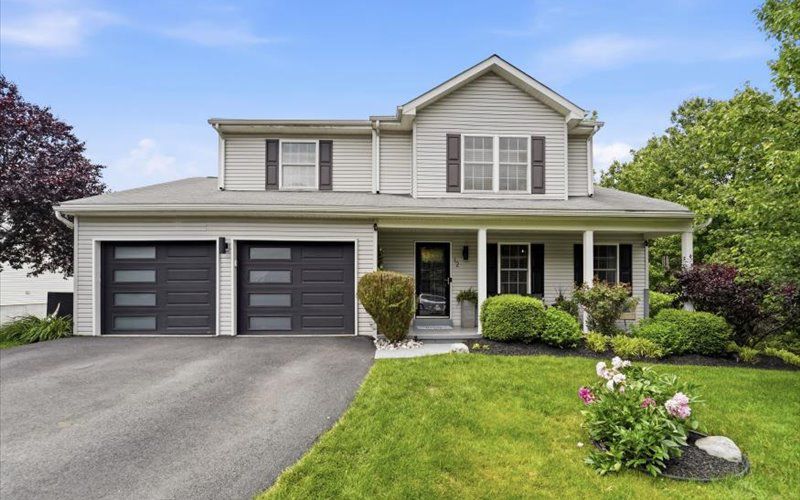
The house: a 1,850-square-foot townhome in Fairmount with four bedrooms and three bathrooms built in 1876
The price: listed for $975,000; purchased for $975,000
The agent: Sela Fallt, KW Empower
The ask: When Charlotte Burns and Noah Johnson moved back to Philadelphia in July 2024, they already knew they wanted to buy a house. They had spent the previous decade renting while they went to college and graduate school, and years of lease renewals and rent hikes had worn them down. Now that they both had steady jobs, they wanted a payment that stayed put and a home to call their own.
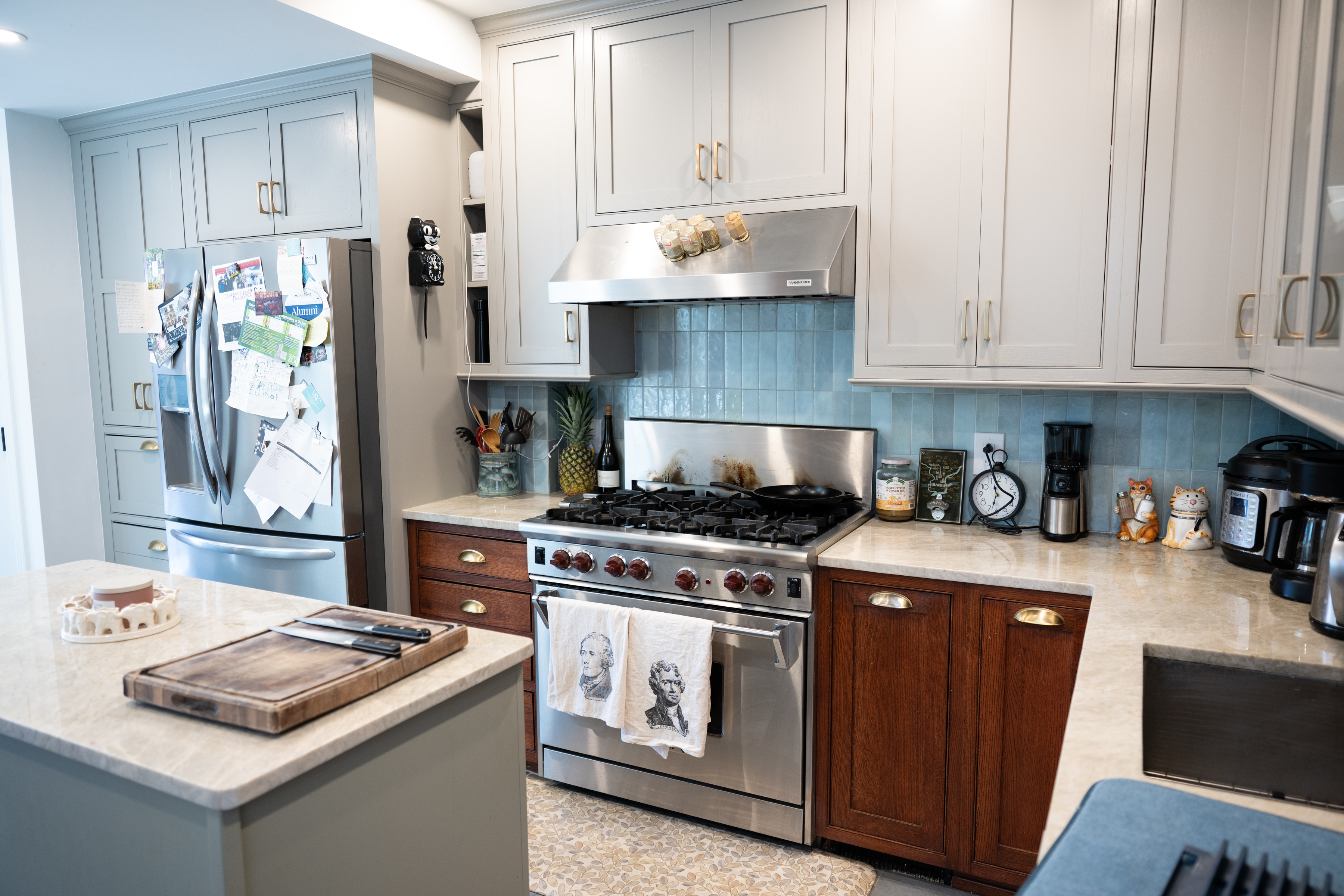
They started looking casually that fall. Johnson wanted a big kitchen with lots of counter space. Burns wanted enough outdoor space for a garden and a house with character. “I love the old Colonial homes,” she said. “I’ve wanted one since I was 12.” They wanted to stay in Fairmount if they could.
A large kitchen with counter space was a must-have. Erin Blewett / For The Inquirer
The search: The couple’s search was unusually brief. They had only started casually browsing listings online when Johnson bumped into their next-door neighbor, who happened to be a real estate agent. She asked him what they were hunting for. “My husband thankfully knows me quite well, so he told her what I like,” Burns said. A week later, the agent knocked on their door. “I think I found your house,” she told them.
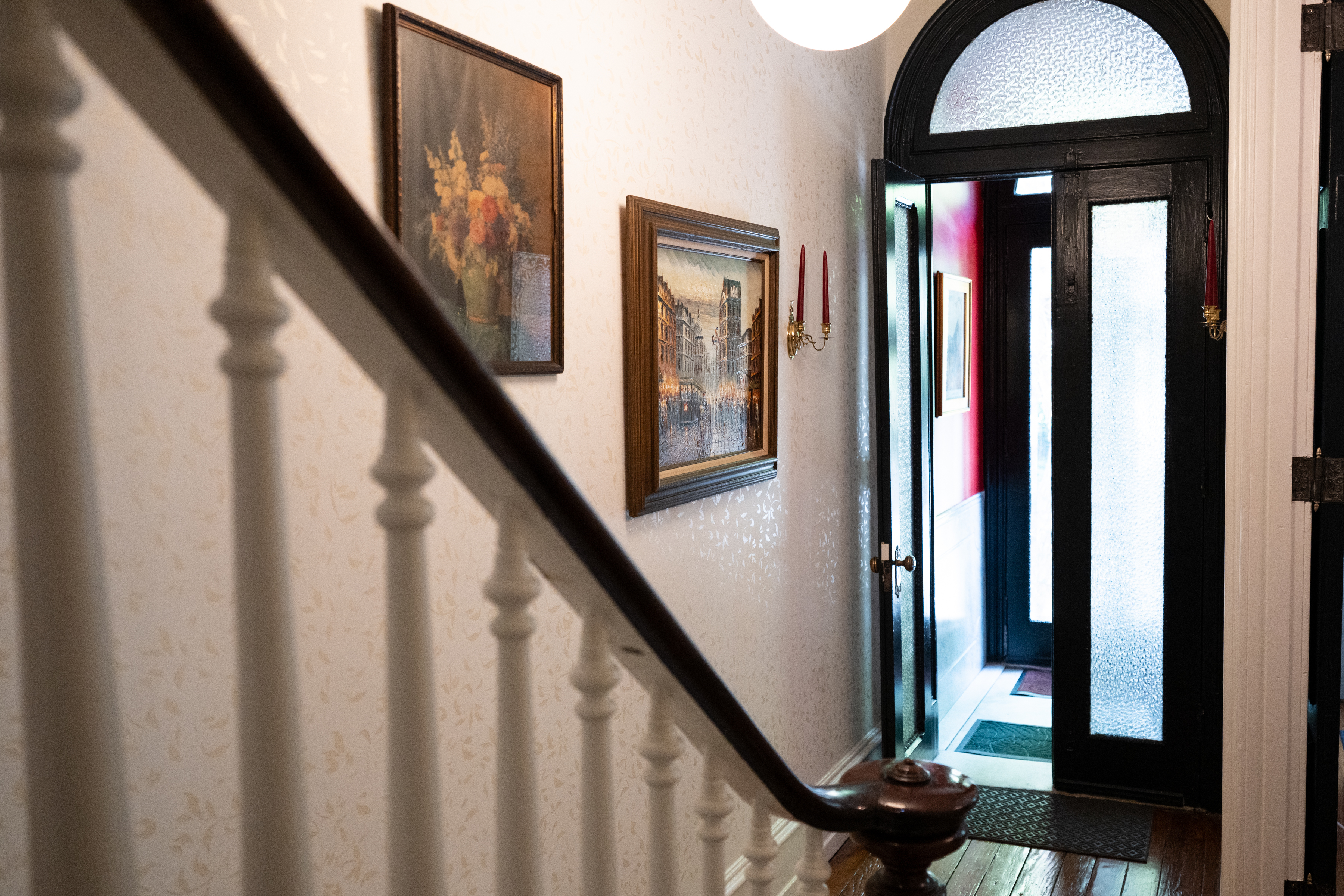
The appeal: The house looked like the old Colonial home Burns had wanted since she was a kid. It still had several of its original details, such as the crown molding, shutters, doorknobs, hinges, marble steps, and 150-year-old wood floors. The previous owners had updated the house, Burns said, but didn’t gut it or turn it into “some modern monstrosity.”
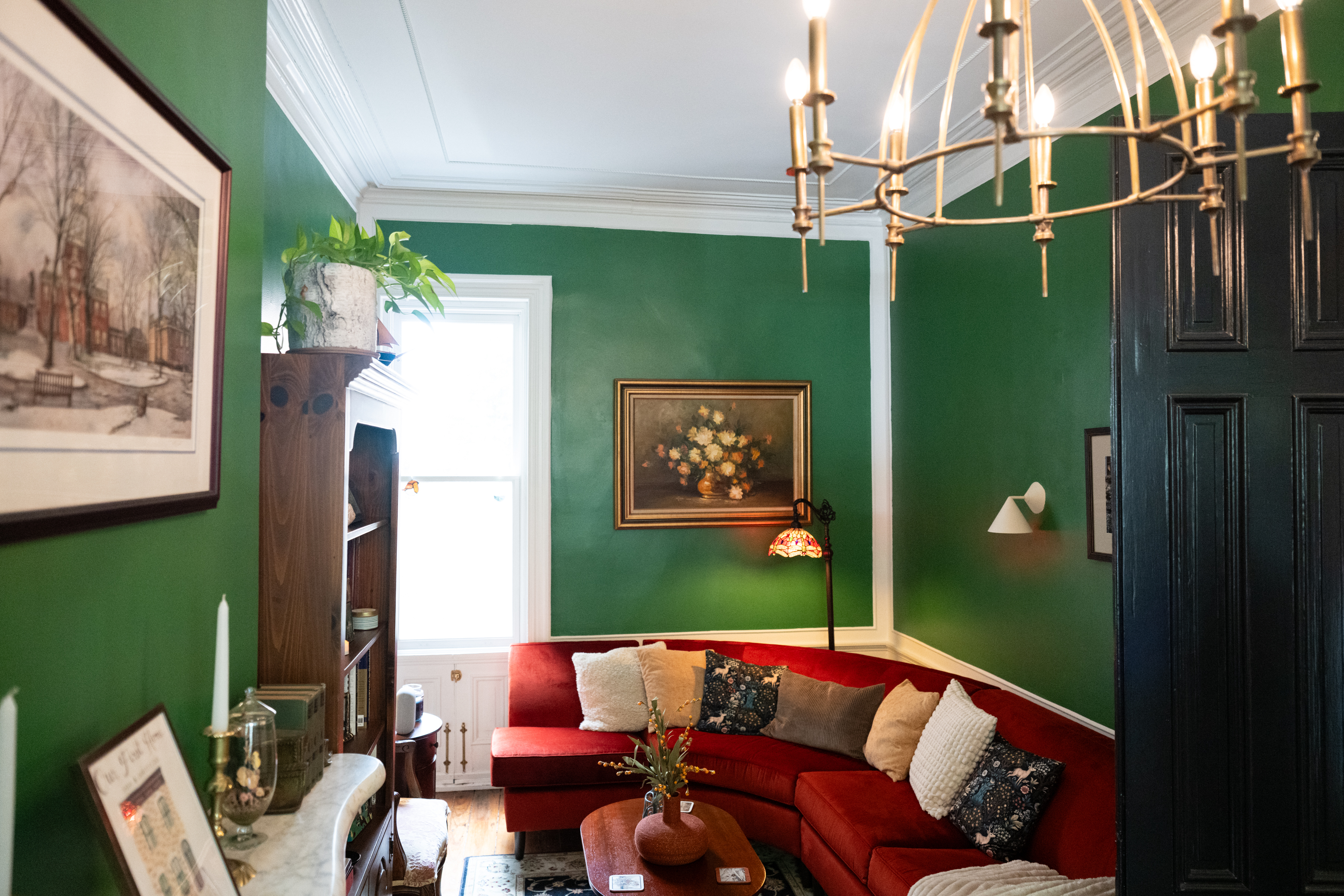
A large red couch is the centerpiece of the first-floor living area in Charlotte Burns and Noah Johnson’s home. Erin Blewett / For The Inquirer
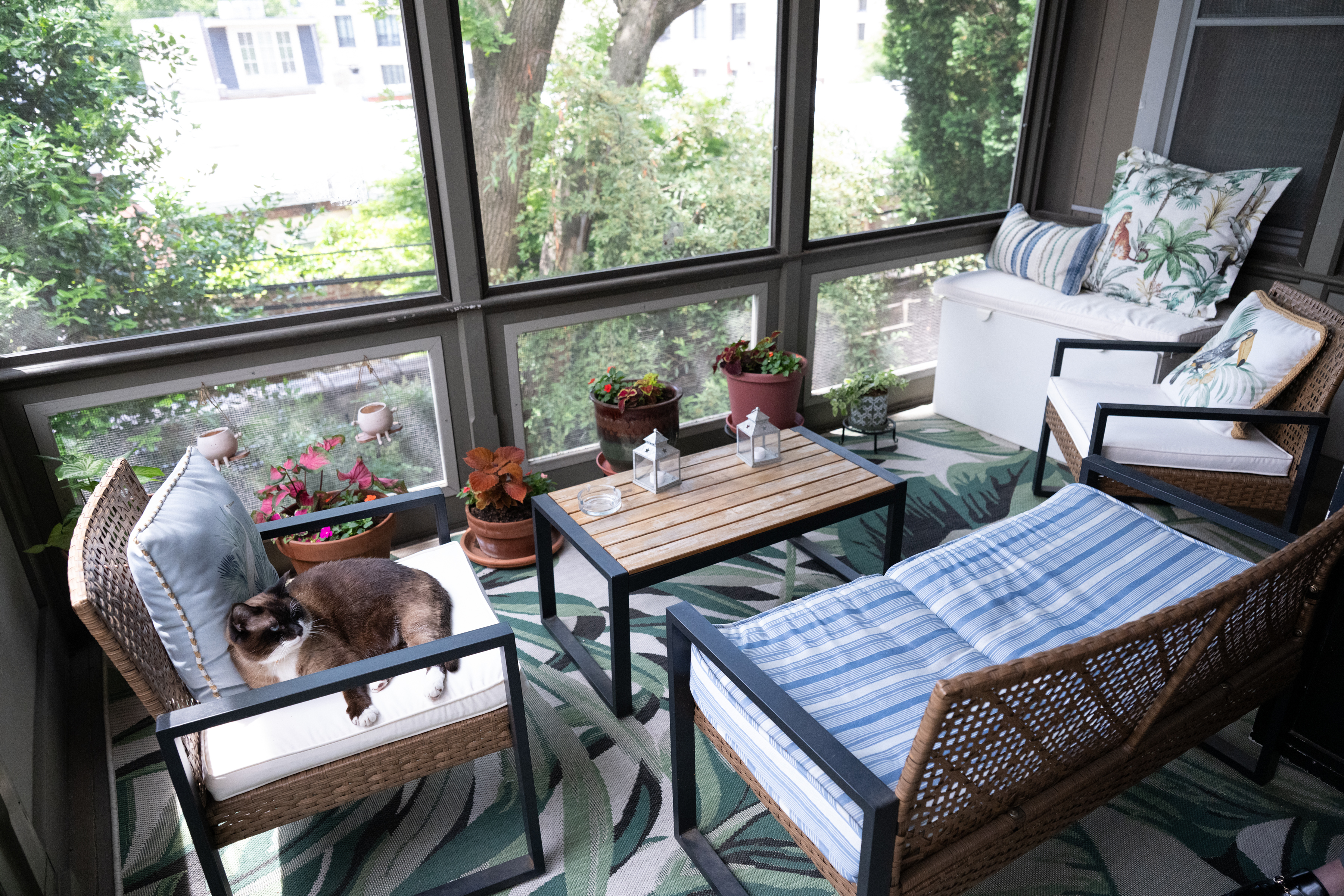
The house also had the big kitchen Johnson wanted and space for a garden for Burns. Then there was the screened-in porch on the second floor. “I feel like that’s a rare find,” Burns said. Her other favorite feature is the third floor, which “felt like your own private suite,” she said.
The deal: The house was listed for $975,000. The couple offered the full asking price and felt good about not going over. “I really was not in the market for haggling or fighting over a house,” Burns said. “We weren’t that desperate.” There was one other offer, but it was lower, so the seller accepted theirs.
Homeowner Charlotte Burns appreciated that the home’s prior owners kept historical details like moldings intact. Erin Blewett / For The Inquirer
The inspection came back mostly clean. Some porch wood and window linings needed work, but the biggest issue was the HVAC system, which was more than 20 years old. Burns and Johnson negotiated a $7,500 seller’s credit for it and later replaced the HVAC and heat pump for about $8,500.
The money: Burns and Johnson bought the $975,000 house with no money down through a professional loan, a mortgage product for borrowers with high future earning potential but not necessarily years of savings. “It’s a very good option if you’re a medical professional,” Burns said. She didn’t know the loan applied to veterinarians until a colleague told her.
The screened-in porch on the second floor was a selling point. Erin Blewett / For The Inquirer
Unlike other low- or zero-down payment loans, a professional mortgage doesn’t require private mortgage insurance, and Burns said her student loan debt was not held against her in the same way it might have been with a conventional mortgage.
The couple actually had $100,000 in savings, most of it from Johnson, who had been working for several years after graduate school. But they decided not to put that money toward the house. They wanted to keep it as an emergency fund instead. “I feel like you should always have at least six months of emergency savings at all times,” Burns said.
Since moving in, the couple has done a lot of painting. Erin Blewett / For The Inquirer
Their mortgage payment was originally $7,200 a month. Recently, they paid a one-time fee of $1,200 to lower their interest rate from 7% to 6.5%, which brought their monthly payment down by about $400.
They plan to refinance if rates drop enough in the next few years.
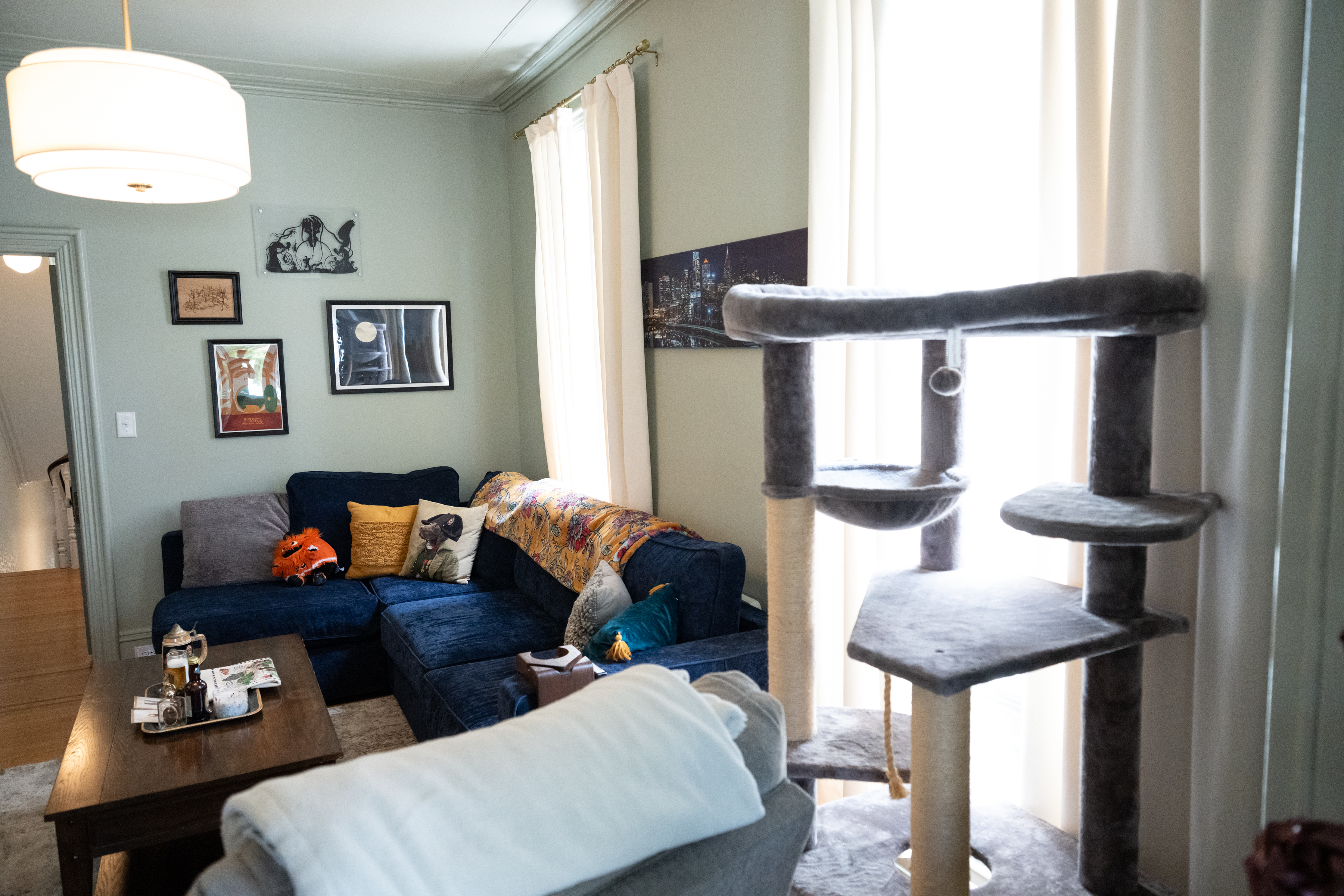
The couple turned one second-floor room into a living room, including space for their cats to lounge. Erin Blewett / For The Inquirer
The move: The couple closed Feb. 3 and started packing a week or two later. When they signed their lease, they had told their landlord that they might buy soon. She let them leave without issue and found new tenants within a week.
The move itself was a mess. They’d booked it for the day after the Super Bowl parade, and Fairmount was still buried in cars — including in front of their old house, where the no-parking signs Burns had ordered from the city were ignored. So Burns called the Philadelphia Parking Authority and had the cars ticketed and towed. Then, at the new house, the truck blocked the Route 48 bus, so Burns called SEPTA, and they rerouted it.
Mao is enjoying his new home in Fairmount. Erin Blewett / For The Inquirer
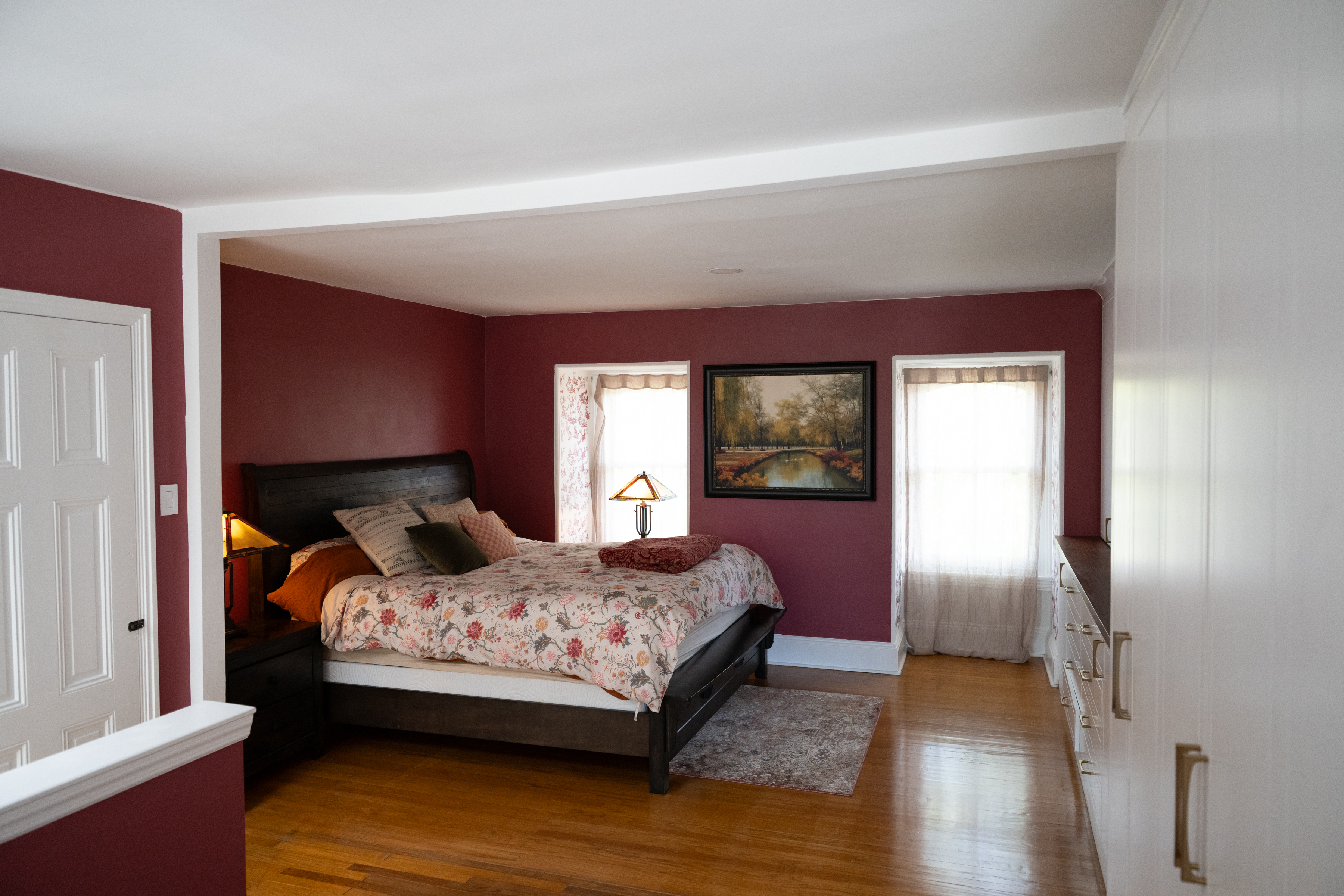
Life after close: Since moving in, the couple has been busy making the house their own. Burns has painted, wallpapered, gardened, and gotten “really into stencils,” she said. She painted the green living room herself and added an ivy stencil along the stairs.
Some days, she still can’t believe how easily everything came together. “It’s really crazy,” she said. “But you gotta let the universe do what it wants to do.”
Did you recently buy a home in the Philadelphia area or South Jersey? Share the story of how you did it. Email Inquirer real estate reporters at properties@inquirer.com.
These 4 Philly properties just got historic protection
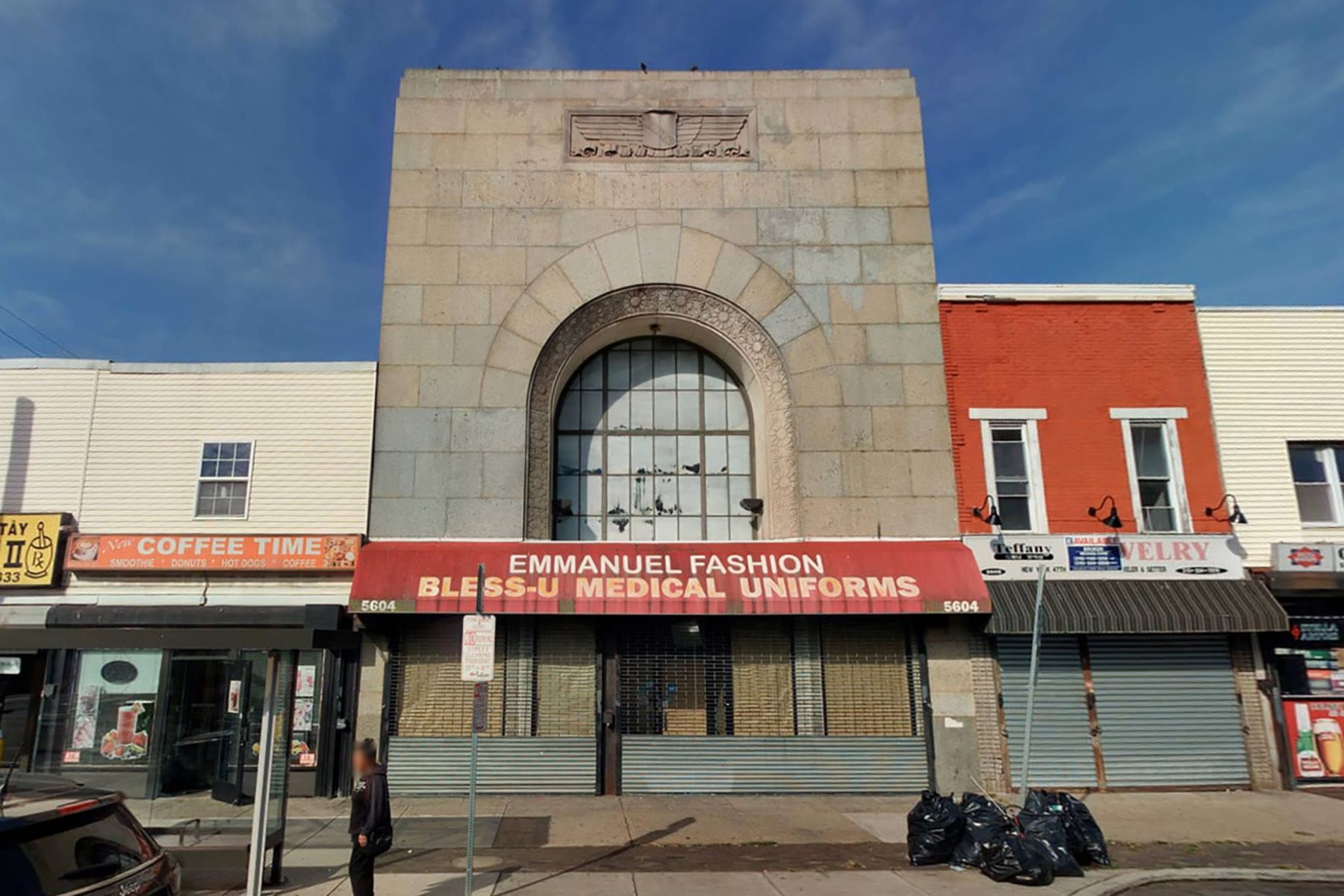
National Bank of Olney
The former National Bank of Olney building is an example of the shift in the design of neighborhood banks toward the Art Deco style in the late 1920s.Kevin McMahon
5604 N. 5th St. | Built: 1927-28
The building is an example of the shift in the design of neighborhood banks toward the Art Deco style in the late 1920s. Its architects — Simons, Brittain & English — were nationally prominent.
Manayunk Plush Manufacturing Co.
A manufacturing building and a power plant of the former Manayunk Plush Manufacturing Co. are representative of Manayunk’s industrial-era textile economy.Oscar Beisert
4889 Umbria St. | Built: 1926-27
The former company’s manufacturing building and a power plant are representative of Manayunk’s industrial-era textile economy. A developer plans to build a large apartment project next to these buildings.
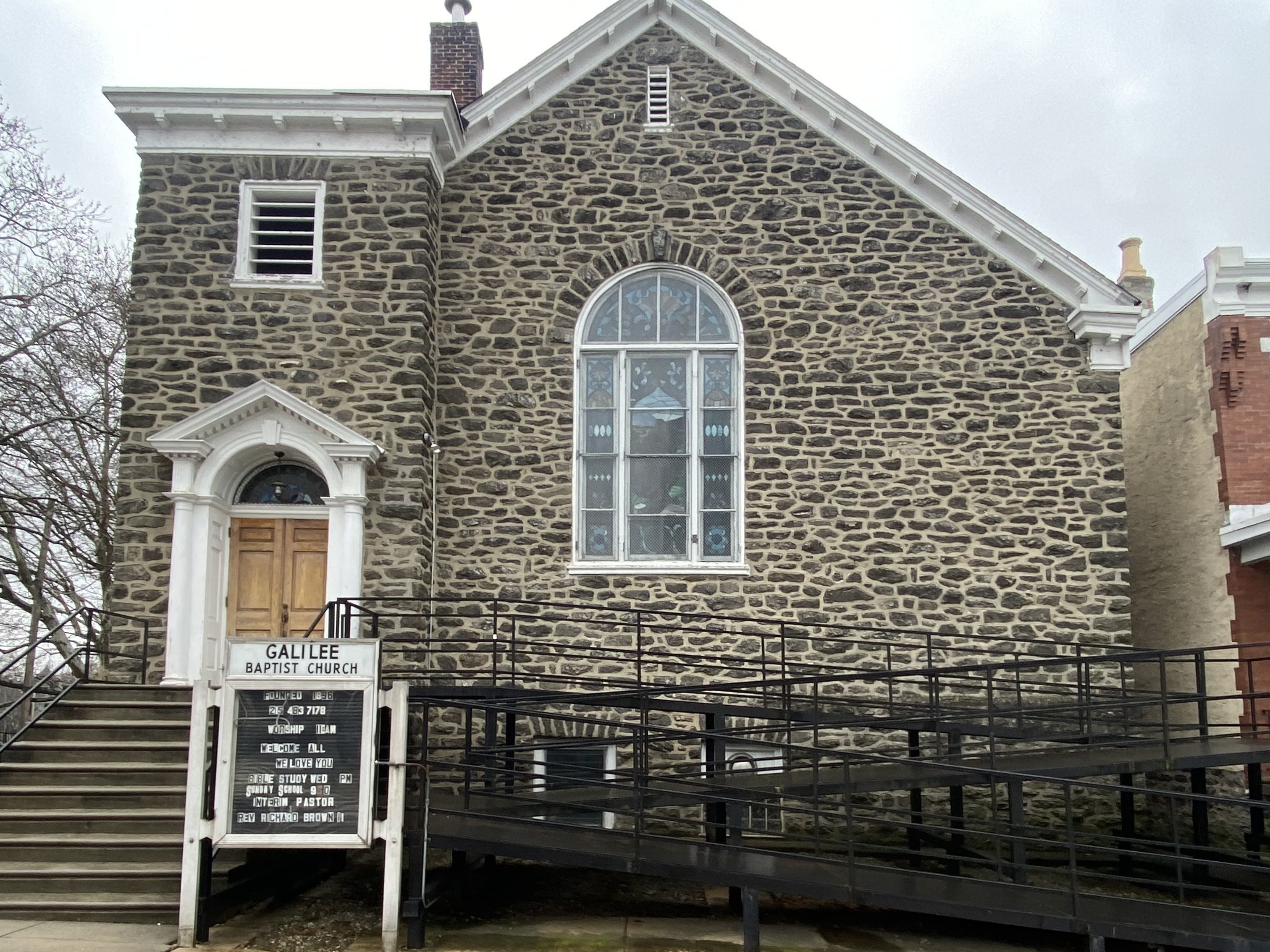
Galilee Baptist Church
Galilee Baptist Church has been an institution for Black residents in the Roxborough/Manayunk area for 125 years.Philadelphia Historical Commission
459 Roxborough Ave. | Built: 1900-01
The church has been an institution for Black residents in the Roxborough/Manayunk area for 125 years. It “has endured, far removed from the historical epicenter of Philadelphia’s Black community life.”
Tetlow Manufacturing Co.
This building in Chinatown was once a factory for the cosmetics maker Henry Tetlow. The Tetlow Manufacturing Company also is a “remarkably intact” example of a late-19th century industrial building.Annie Liang-Zhou, Liangs Culture
132 N. 10th St. | Built: 1885
This building was once a factory for the cosmetics maker Henry Tetlow, who discovered a non-toxic base for face powders. It also is a “remarkably intact” example of a late-19th century industrial building.
City Council approved a bill Thursday to encourage denser and taller development around Philadelphia’s transit stations.
The legislation, a part of Mayor Cherelle L. Parker’s housing agenda, expands an existing law that offers development incentives to most non-single-familyproperties within a 500-foot radius of transit stations. Thursday’s Council vote expands that radius to a quarter of a mile.
It also boosts eligibility for the incentive, allowing it to include not only SEPTA rail stations but also intercity bus, PATCO, water taxi, and some bus or trolley stops.
The legislation is meant to allow more people to live near transit and boost SEPTA ridership. Mass transportation works best when more people live within walking distance of stations.
The law comes with a very Philadelphia caveat, however: City Council must opt stations into it. In most other states or cities that have this kind of transit-oriented development policy, it automatically applies to all eligible stations.
“I have not heard of that for transit-oriented development laws,” said Yonah Freemark, a lead housing policy researcher at the Urban Institute, a Washington think tank.
“If you look at what Chicago, New York City, or Los Angeles has, it’s across the city. There aren’t special exemptions for aldermen or council members” to control which stations are included, Freemark said.
Under the existing law, Council members in West Philadelphia have opted in most Market-Frankford Line stations to the west of the University of Pennsylvania.
Many of the stops in Northern Liberties, Fishtown, Kensington, and Frankford are included as well, although heavily used stations like Front-Girard, York-Dauphin, and the Arrott Transportation Center are left out.
The stations already covered by the zoning incentive’s existing 500-foot radius will be automatically expanded to a quarter mile.
No stations on the Broad Street Line are currently included. Those to the south of City Hall are half in Council President Kenyatta Johnson’s district and half in Councilman Mark Squilla’s district, complicating the politics of adding the stations.
To the north, former City Council President Darrell Clarke and his successor, Jeffery Young, have not opted any of the stations on Broad Street into the transit-oriented development program and have often been skeptical of high-rise development.
“The problem with this approach is that it essentially allows City Council members who are recalcitrant to allow development to block” the transit-oriented development law, Freemark said. “It entrenches that resistance.”
Several Council members said in interviews that they hope to make use of the new law and add stations in their districts.
Councilmember Mike Driscoll, who represents much of the Lower Northeast, said he plans to use it at the two Market-Frankford Line stops in his district that are not already covered, including the Arrott Transportation Center.
Councilmember Jamie Gauthier, who represents much of West Philadelphia, has long championed the legislation and said she is studying the new language to see whether she can opt in more stations.
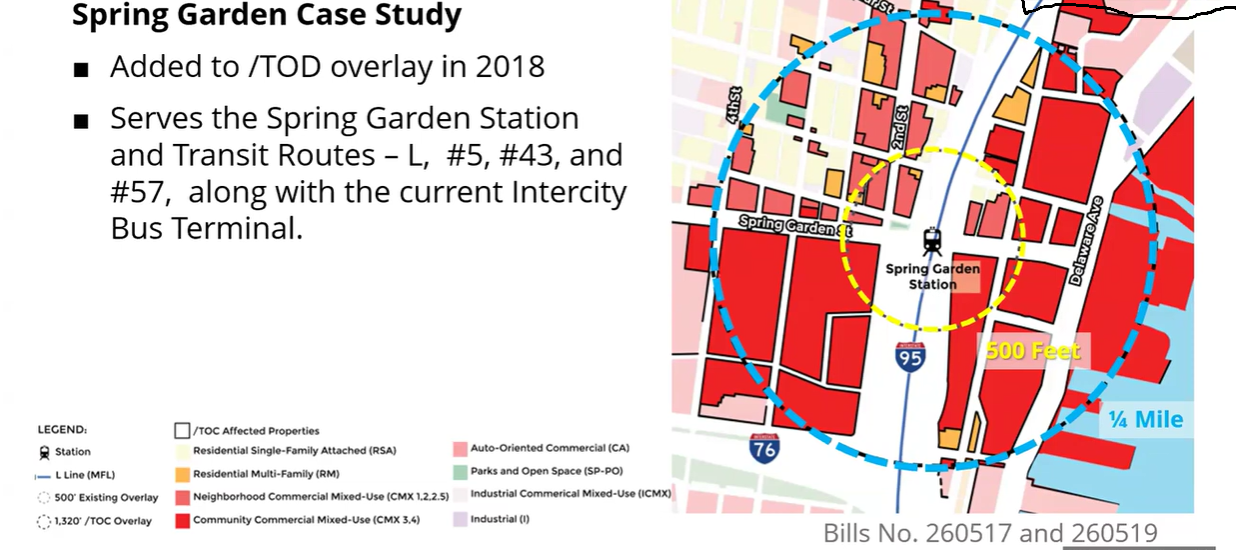
Squilla, who opted in the Spring Garden station in Northern Liberties, said its application is more complicated on South Broad Street.
A screen shot of a Philadelphia Planning Commission study showing how many more properties will be covered by the overlay under the new law.Philadelphia Planning Commission
“Broad Street is tough because it is two separate Council districts, and [we] need to get input from the community on both sides,” Squilla said. “I would consider it but do my usual community outreach first.”
But Council President Johnson said that he is interested in adding all the South Broad stations to the expanded transit-oriented development law.
“I have no objection to transit-oriented communities, so all of mine will be in,” Johnson said. “It’s great for development and the surrounding area. I’ll probably look at it just to make sure … there’s a level of affordability.”
On North Broad Street, Young is still studying the legislation and “assessing which stations would make sense to include,” the Council member’s spokesperson said.
Properties zoned for single-family housing are not affected by the law. It also bans certain kinds of development from the area around transit stations, including one-story buildings, parking garages, and curb cuts.
The urbanist group 5th Square hadbeen meeting with City Council members in advance of Thursday’s final vote on the bill strengthening transit-oriented development.
Council President Kenyatta Johnson says he is interested in including all of the South Broad Street subway stops in the transit oriented development law. Aidan T. Gallo / Staff Photographer
Activists with the group say there is support for adding many more SEPTA stops to the law, although they think areas like North Broad Street will be much harder to get stations opted in.
“The idea that all of the stations will be opted in at once is unlikely,” said Jay Arzu, housing organizer with 5th Square and the founder of the Roosevelt Boulevard Subway Movement.
“They made the intention clear that they’ll look at it on an individual, case-by-case basis, which is disappointing for transit advocates,” Arzu said. “But we recognize it’s another step in the right direction. Sometimes you just got to take what you can get.”
A few years ago, friends from California came to visit me for their first trip to Philly. As we waited to get into a restaurant for brunch, one of them noticed a mural on a wall across the street and asked me what it was. I said, “It’s a mural.”
I realized laterI should have told them about Philly’s strong tradition of murals and that the city is known for them. (Sorry, Katie.)
It’s easy to take for granted that our city is full of murals. But as a residential real estate reporter, I recently thought it’d be fun to talk to some of the homeowners who’veturned their properties into giant canvases for artists’ creations.
Keep scrolling for that story and more in this week’s edition:
Renting history: Peek inside a loft at this historic Fairmount building that was converted into apartments.
Market update: Scroll for a look at homebuying and selling in May.
📮Each week, one of my colleagues highlights the story of how a homebuyer in the Philly region made their purchase happen. Did you recently buy a home in the area? Whether you have an inspiring or cautionary tale to share, tellus how you did it.
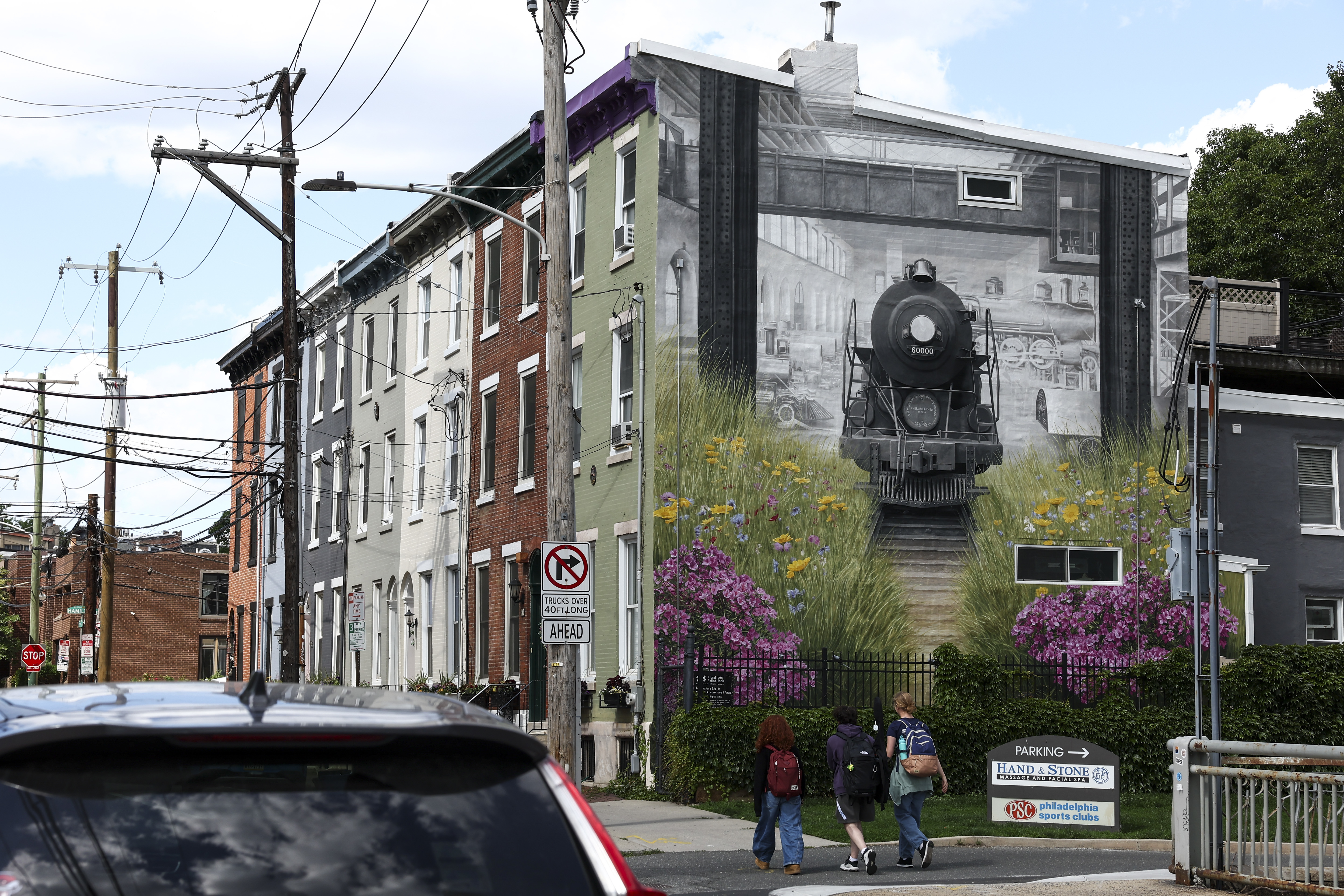
I pass the Baldwin Locomotive Works mural on North 20th Street all the time. It’s impossible to miss. It takes up the whole side of a house and has a train that looks like it’s coming at you.
But now I know a secret that I’ll share with you: If you ever stop to look at the mural and think you hear a faint whistle coming from inside, it’s not your imagination. The homeowner told me she likes to blow her own personal train whistle when she sees the mural getting attention.
Across the city, roughly 1,000 murals are on someone’s home through partnerships with Mural Arts Philadelphia. That number doesn’t include the homeowners who put art on their walls themselves or pay an artist to do it, like an owner I talked to in Fishtown who has a giant fish on her brick wall.
As the founder of Mural Arts told me, in Philly, “people 100% absolutely love public art.” The organization has a long waitlist filled with people who have a mural idea or a wall to fill.
I talked to six Philly homeowners about why they wanted their properties to join the city’s rich tapestry of murals. Here’s what they told me.
Allison Langer and her husband, Mark Paulson, were intrigued by the converted apartment building next to Langer’s yoga studio.
They’re both fans of historic preservation and could tell from the street that they loved the windows in the old headquarters of the AF Bornot Dye Works Co. They could see themselves living there.
But the four-story building was full, so they had to wait a few months to get an apartment.
Once they moved in, they saw they were right about the windows, which are now the couple’s favorite feature. Langer, Paulson, and their cat are treated to lots of natural light and daily sunset views.
Both the windows and high ceilings make their apartment feel bigger than it is.
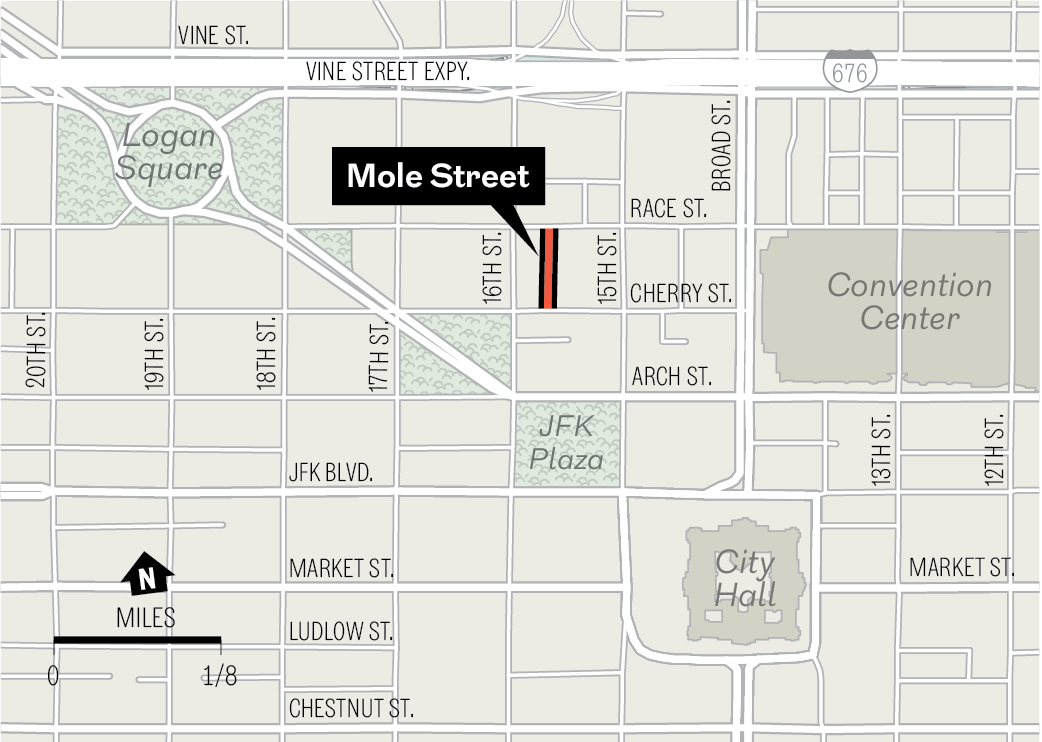
The tree-lined 100 block of North Mole Street seems to cast a spell on everyone who lives there.
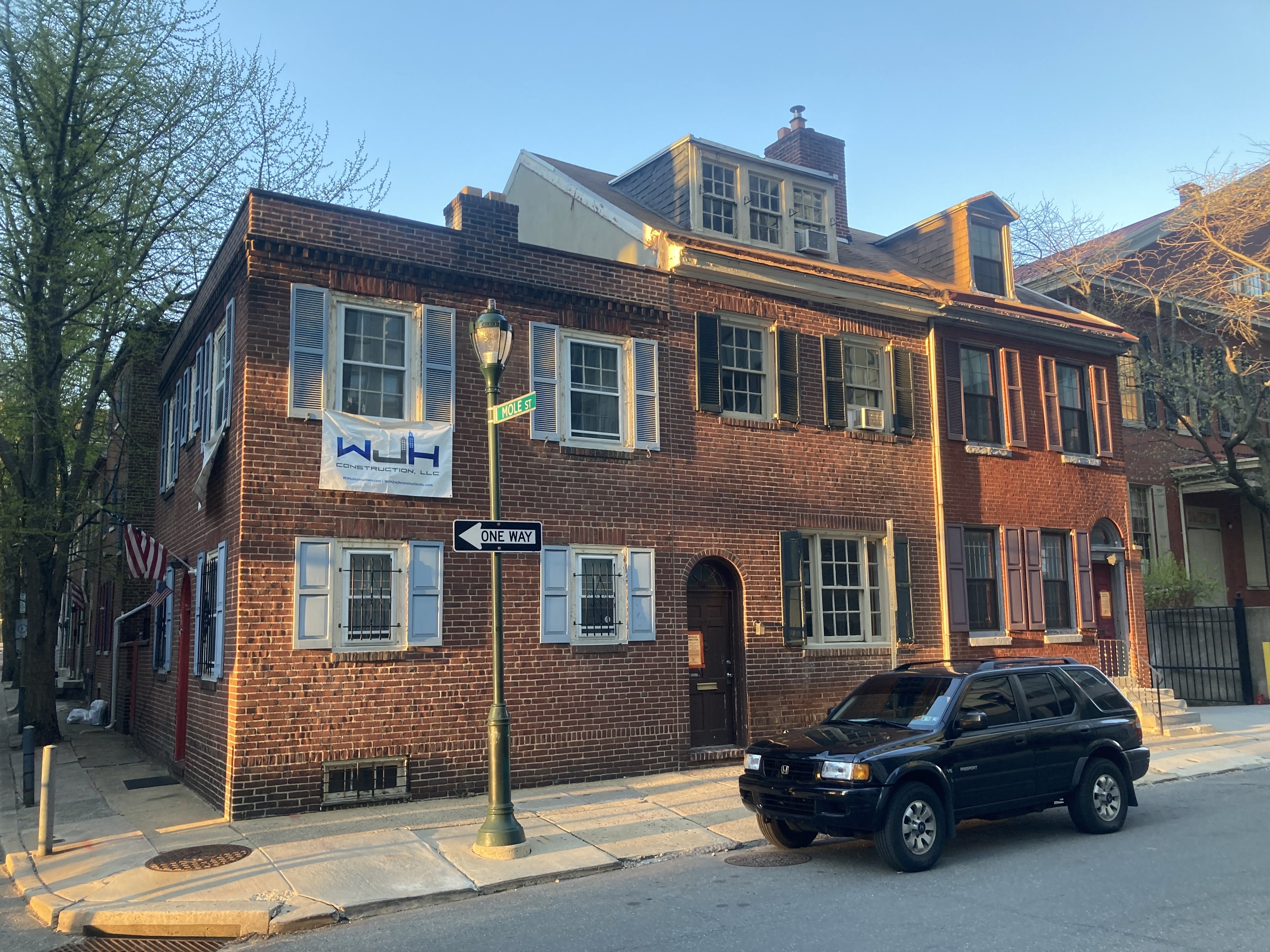
This cluster of 30 two-story brick houses dates to the mid-19th century — some are close to 200 years old — and has long turned residents into devotees of its artsy parties and communal life.
The street standsout from the surrounding blocks of high-rise buildings and surface parking lots, a lone historical holdout in the heart of Center City, where most rowhouses have been erased. Affordable rents two blocks from City Hall have attracted a mix of artists, students, and — for some reason — airline flight attendants.
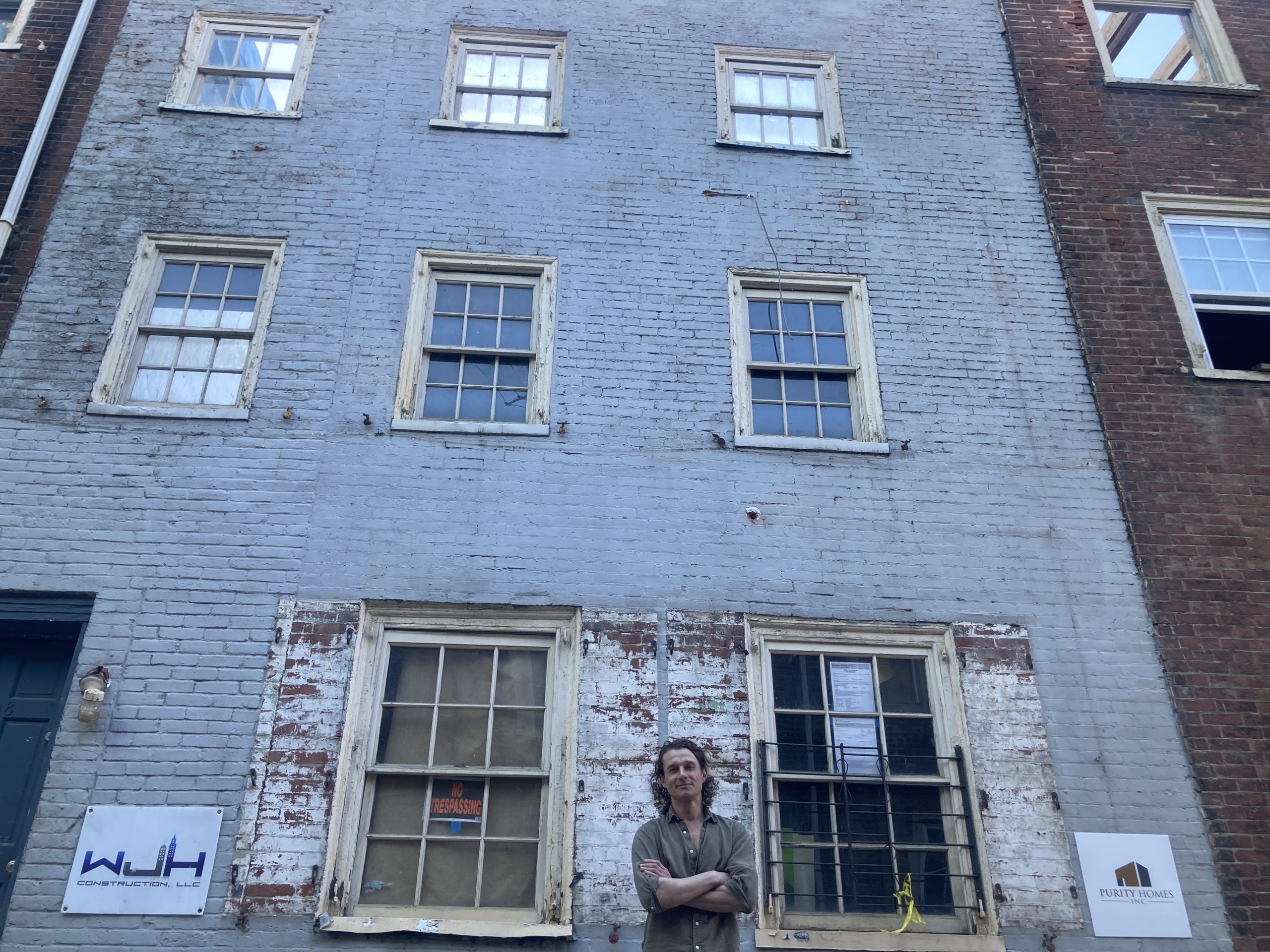
Except, now, almost all the trees have been cut down and the mid-block pocket park torn up. Many of the homes are being redeveloped, and leases are not being renewed for the motley assortment of renters who have long populated the block.
“I’m pretty close with most people on the block, and, I mean, this sucks,” said Teddy Powell, 34, a musician who has lived on this stretch of North Mole since 2020 and can reel off the names and occupations of most people on the block.
“We’re all being forced out of the houses that we love living in,” he said.
Teddy Powell is being forced off the 100 block of North Mole along with most of the rest of the tenants.Jake Blumgart
The 100 block of North Mole Street managed to stand apart for so long because it is owned by a family trust, which also dates to the 1800s, and belongs to descendants of founding father Robert Morris. The homes on Mole Street were given historic preservation protections in 1960.
It neighbors the Central Friends Meeting, which lies just to the east and dates to the 19th century as well.
Until last year, the trust owned 25 of the 30 homes. Rents were kept low: well under $2,000 for four-bedroom homes, mostly hosting roommates, a stone’s throw from City Hall. Individual renters would often pay just hundreds of dollars a month.
That’s a deal that cannot be found in most other parts of Center City, where new buildings have an average rent of over $2,600 and median household incomes are among the highest in Philadelphia.
And the group houses on this block of Mole Street tended to be tight knit, with parties spilling into the shaded street.
From the 1980s until the COVID-19 pandemic, the block hosted the Molestice Festival, with live music, food trucks, and a pop-up bar in the pocket park tucked into the block. In 2018, cheerful chalk graffiti daubed frontages with phrases like “The Mole Hole” and “We R Sky Trash Kappa Mole.”
“We had a lot of fun here; we’ve carried on the tradition,” Powell said. “It’s all over now, though, man. The party’s over.”
Last year, a developer bought eight of the North Mole Street homes for $3.1 million.
The new owner is Purity Homes Inc. Some of the zoning documents filed with the city are signed by real estate investor Armando Ahmad, with the owner’s mailing address listed in either Arlington, Texas, or a Point Breeze rowhouse that hosts seven other real estate-related LLCs.
Ahmad did not respond to a request for comment, and the architect for the project, Carey Jackson-Yonce of Canno Design, declined to comment.
The rowhouses holding out on the 100 block of North Mole Street in Center City are conveniently located to almost everything.John Duchneskie
But at a meeting last September of the city’s Historical Commission reviewing Purity Homes’ plans for eight of the homes, Jackson-Yonce said his client planned to acquire most of the block.
“They are heavily investing on the entire block, and I think in the end they will probably be able to acquire approximately 80% of the block,” Jackson-Yonce said. “This is just probably Phase One of what will probably be at least one more, if not two, more phases.”
Jackson-Yonce noted that the family trust that has owned North Mole Street for the better part of two centuries is selling the properties in batches, perhaps to see how the developer does with the first eight.
He assured commission members that his client was “100% committed to the faithful restoration of these homes.”
The plans displayed at that meeting centered on adding square footage to the rear of the homes, while the interiors are being gutted to create more space. The Historical Commission regulates only the exteriors that can be seen from the street. Currently several of the homes lack roofs.
The exception to the plan to supersize the block is the three homes at 1527, 1525, and 1523 Cherry St., on the south end of the block, which are being demolished.
1527 to 1523 Cherry St., three 19th-century homes slated for demolition at the end of Mole Street. This photo was taken before most of the trees were cut down. Jake Blumgart
They are not protected by historic regulations. Paul Steinke of the advocacy group Preservation Alliance says the developer wants to build an eight-unit apartment block in the place of those 19th-century rowhouses.
Purity Homes’ plans for Mole Street will necessarily entail sharp rent increases due to the amount of money being spent to acquire and redevelop the homes.
Powell and two other tenants on the block say that they were recently told their leases won’t be renewed.
“Everybody that I know over here is pretty sad and disappointed about the whole thing,” said Joshua McIntyre, a more recent resident of the 100 block of Mole.
“It’s a lot of different kinds of young people, artists, and there were several bands that practice over here, but now it’s going to be like the rest of Center City, I guess,” McIntyre said.
Canno Architects’ designs promise that the exteriors of the buildings on this stretch of Mole Street will remain — as preservationists watch closely.
“This block is really a magical one,” David Traub of the preservation group Save Our Sites said at last September’s Historical Commission meeting. “It’s really a miracle that it still exists in the context in which it is situated, immediately adjacent to the very center of the city … [it’s an] extremely important remnant of Old Philadelphia in Center City.”
After first-time homebuyer Brendan McCreath settled into his Bella Vista rowhouse last spring, his first priority was contacting Mural Arts Philadelphia.
During the closing process, he had learned that the previous owner had agreed to let an artist paint a mural on the house, butwithdrew her support. McCreath wanted to revive the plan.
“I love that Philly is just loaded with murals,” he said. “It’s beautiful.”
In a city internationally known for murals, roughly 1,000 are on private homes through partnerships with Mural Arts. Homeowners don’t have to go through the organization to put a mural on their house. But if they do, Mural Arts covers the costs of preparing the wall, installing the piece, and maintaining the mural.
“We appreciate homeowners so much who really hold art in esteem and are thinking not just about their house but about the communal effect the art will have on the city,” said Jane Golden, founder and executive director of Mural Arts. “Murals become part of our collective identity.”
Homeowner Brendan McCreath captured photos of artist Michelle Angela Ortiz’s mural as it was installed last year.Brendan McCreath
Artists plan murals in collaboration with homeowners and neighbors. Some paint directly onto walls, but most now paint on large sections of cloth and piece them together later on surfaces, Golden said.
She estimates the wait list for artwork through Mural Arts is close to a thousand strong. In Philadelphia, “people 100% absolutely love public art,” she said.
The city gets about a hundred new works per year through Mural Arts. Pitches come from the wait list as well as artists, Mural Arts staff, city officials, and funders.
But the city also loses murals to development and demolitions. Mural Arts tries to stay away from vulnerable sites, including those next to vacant lots.
Lack of funding is usually what prevents Mural Arts from doing more work, Golden said. But sometimes, artists just need walls. The organization has an official “wall hunter” who scouts potential locations. The job has gotten harder, as more properties are owned by limited liability companies (LLCs), and tracking down humans who can give permission for murals is difficult.
Bella Vista homeowner John Del Rossi gave an immediate “yes” when Mural Arts approached him.
“I can’t imagine anybody saying, ‘No, don’t put this beautiful mural on my wall. Leave it blank and ugly,’” he said.
The Inquirer asked six homeowners why they wanted their properties to join Philadelphia’s rich tapestry of murals.
Brendan McCreath looks at the mural painted on the side of his rowhouse.Tyger Williams / Staff Photographer
Sometimes, McCreath will spot people gazing at the mural and stop to gaze with them. Then he’ll take out his keys and walk through the door behind it.
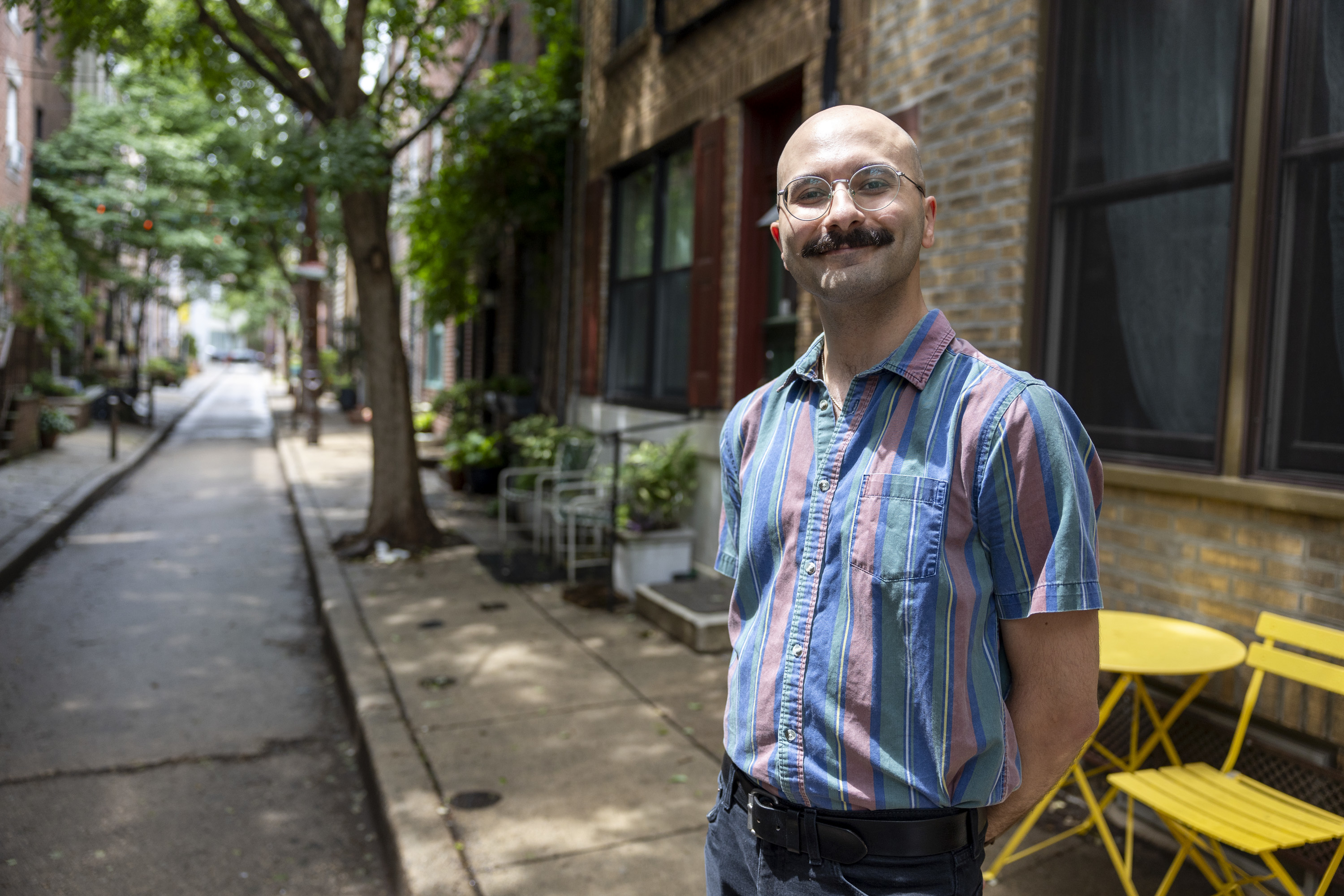
“There’s many people who will stop dead in their tracks and take a photo of the side of my house,” he said. “It’s such an open wall out to Ninth Street. It truly feels like the perfect placement for a mural.”
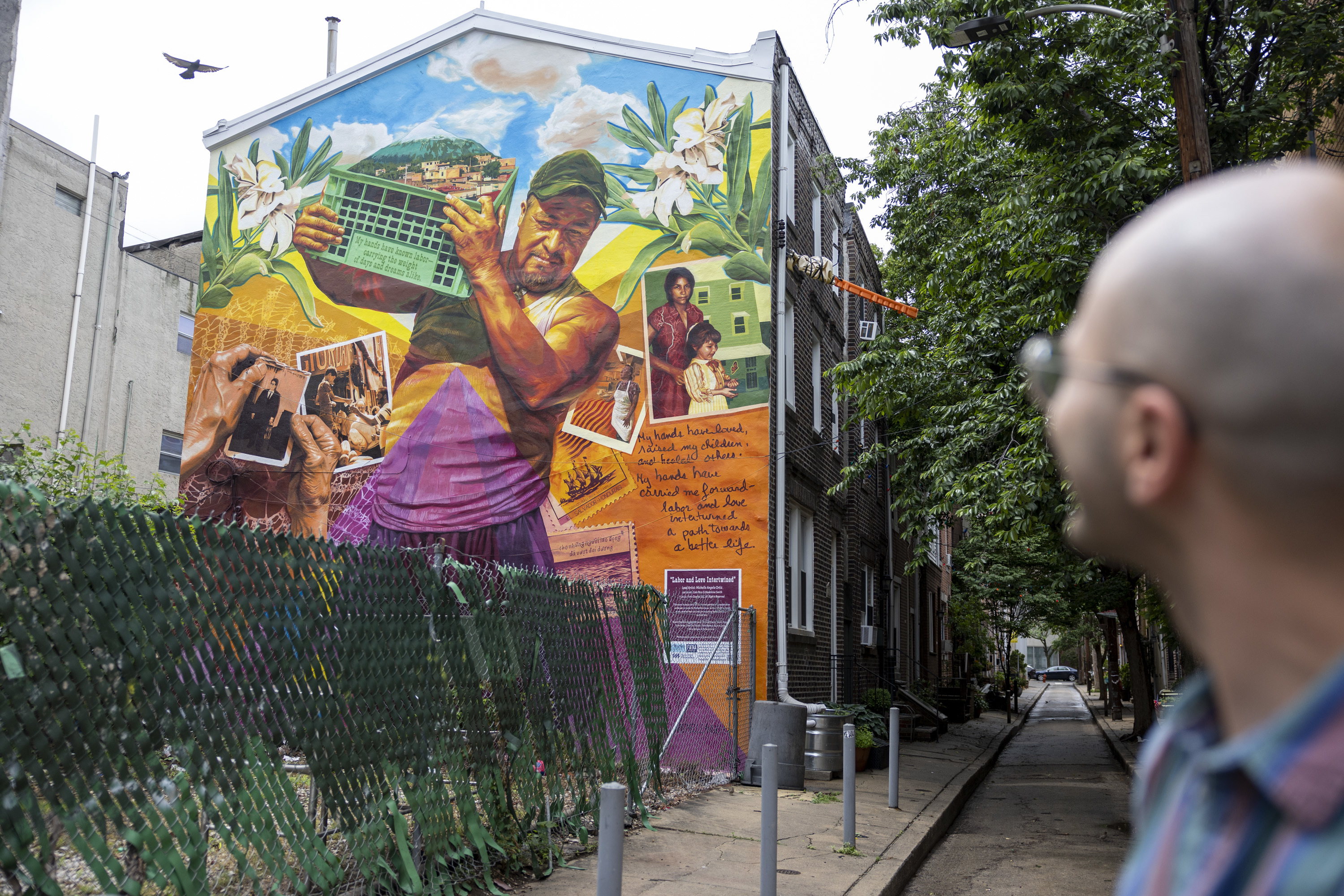
Creator Michelle Angela Ortiz makes art nationally and internationally, and turned to other projects when the mural fell through. But she was disappointed. She was born and raised on this block of League Street, and her parents still live there. Ortiz had wanted to paint a mural “at home” in her neighborhood.
So when McCreath revived plans for the mural, she was ecstatic.
Brendan McCreath poses for a portrait outside his home.Tyger Williams / Staff Photographer
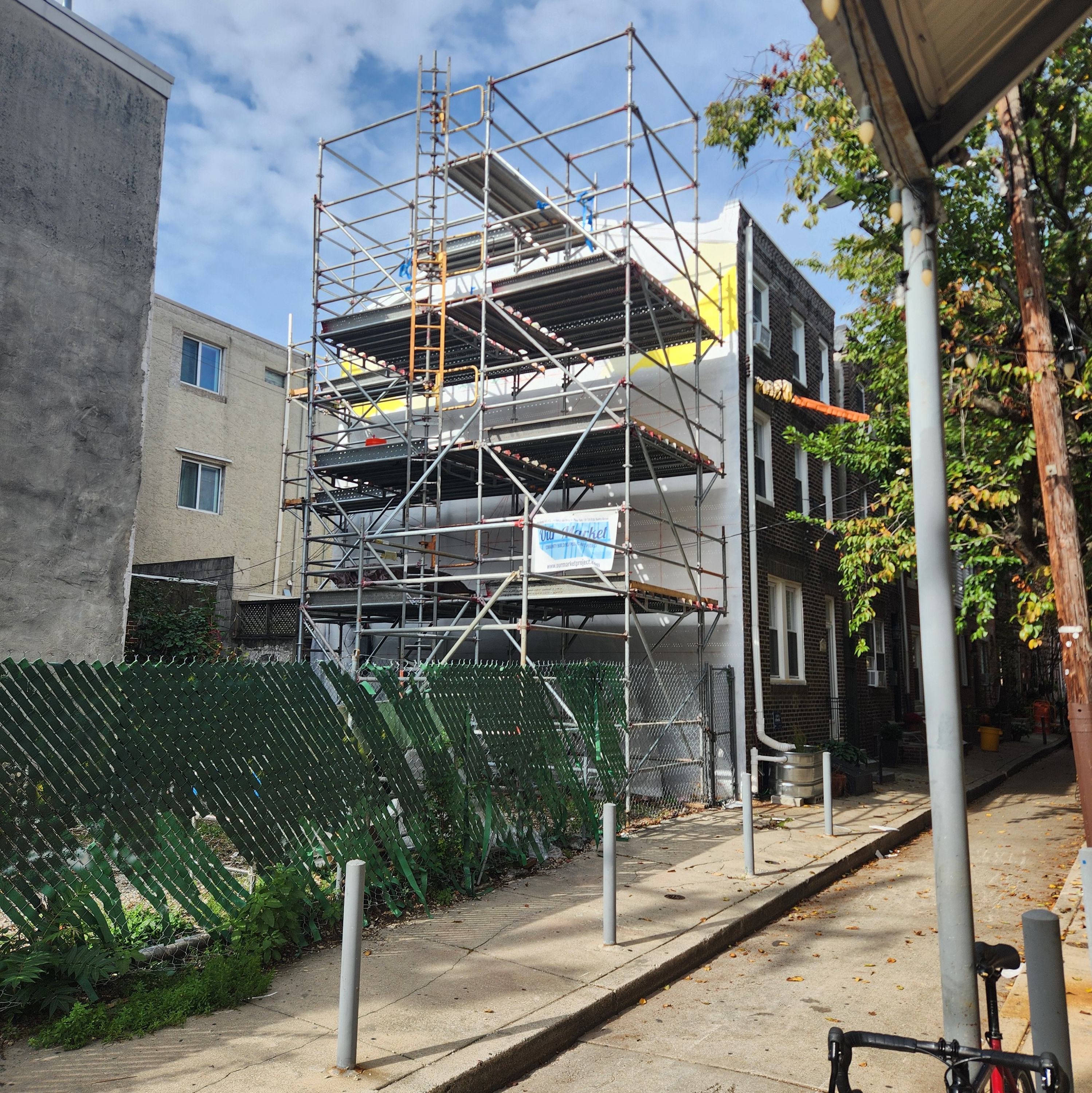
The work is part of the Our Market Project that Ortiz created six years ago to broaden the narrative of what has become known as the Italian Market and honor the people from different backgrounds who make the market on South Ninth Street what it is.
“What we do in the market is not just sell things. We take care of one another,” Ortiz said. “We raise our families. We bring our culture. We bring our values and our spirit to the market.”
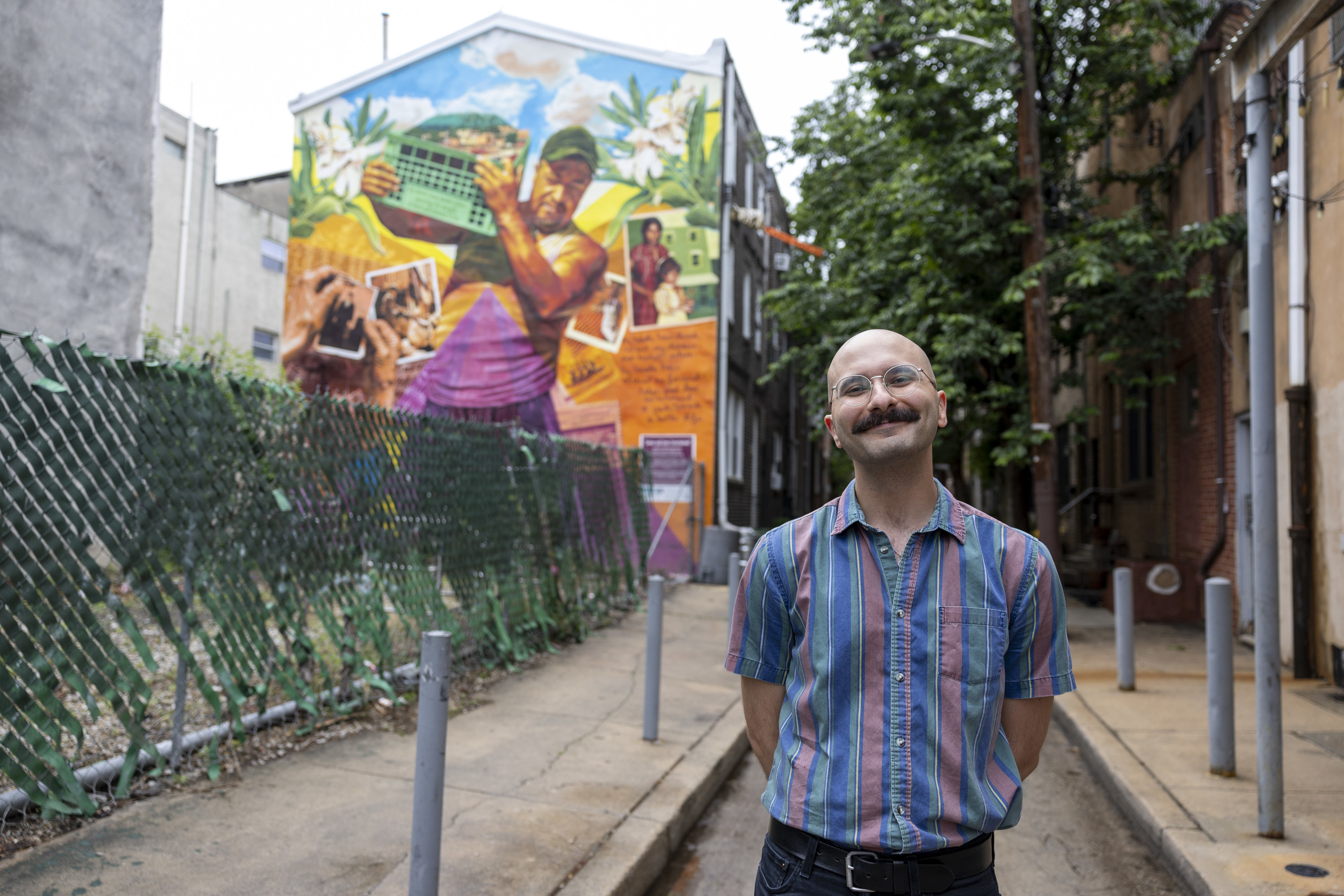
In the mural, which she painted directly onto McCreath’s wall, she highlights stories of neighbors with ties to the market. The center image is of a Mexican immigrant named Gabriel who works at Tran’s Produce, owned by Vietnamese immigrants. The mural includes a poem by Alice Harrison, a longtime market worker and the daughter of Holocaust survivors, who also lives on League Street.
Ortiz said her Our Market Project is “my love letter to my community, but also a way to pay homage and honor to my mother, who is an immigrant from Colombia and work[ed] at Giordano’s for 25 years.”
This mural by Phillip Adams pays tribute to Baldwin Locomotive Works and the Lenape.Monica Herndon / Staff Photographer
If you stare at the mural of a train on North 20th Street and think you hear a faint whistle, you’re not imagining things. Homeowner Susan Freeland likes to blow a train whistle when she sees the mural getting attention.
“Many people remark that it actually looks like the train is coming toward you, because it looks larger than life,” she said.
Freeland and her husband owned their house for a few years before she called Mural Arts about their “ugly, empty” wall. It was visibly lumpy from when the neighboring house was torn down.
“You would never know that to see the mural on it,” she said.
About six months after Freeland’s call, Mural Arts called back. That led to meetings with nearby neighbors and artist Phillip Adams. The mural stalled when neighbors said they didn’t like Adams’ first idea for a still-life painting.
His second idea, Freeland said, “really spoke more to explaining what used to be in the area right where we live.” It pays tribute to Baldwin Locomotive Works, once the world’s most successful builder of steam locomotives, and the Lenape, who once lived on the land.
For Freeland and her husband, having the mural on the house “makes us feel very special indeed.”
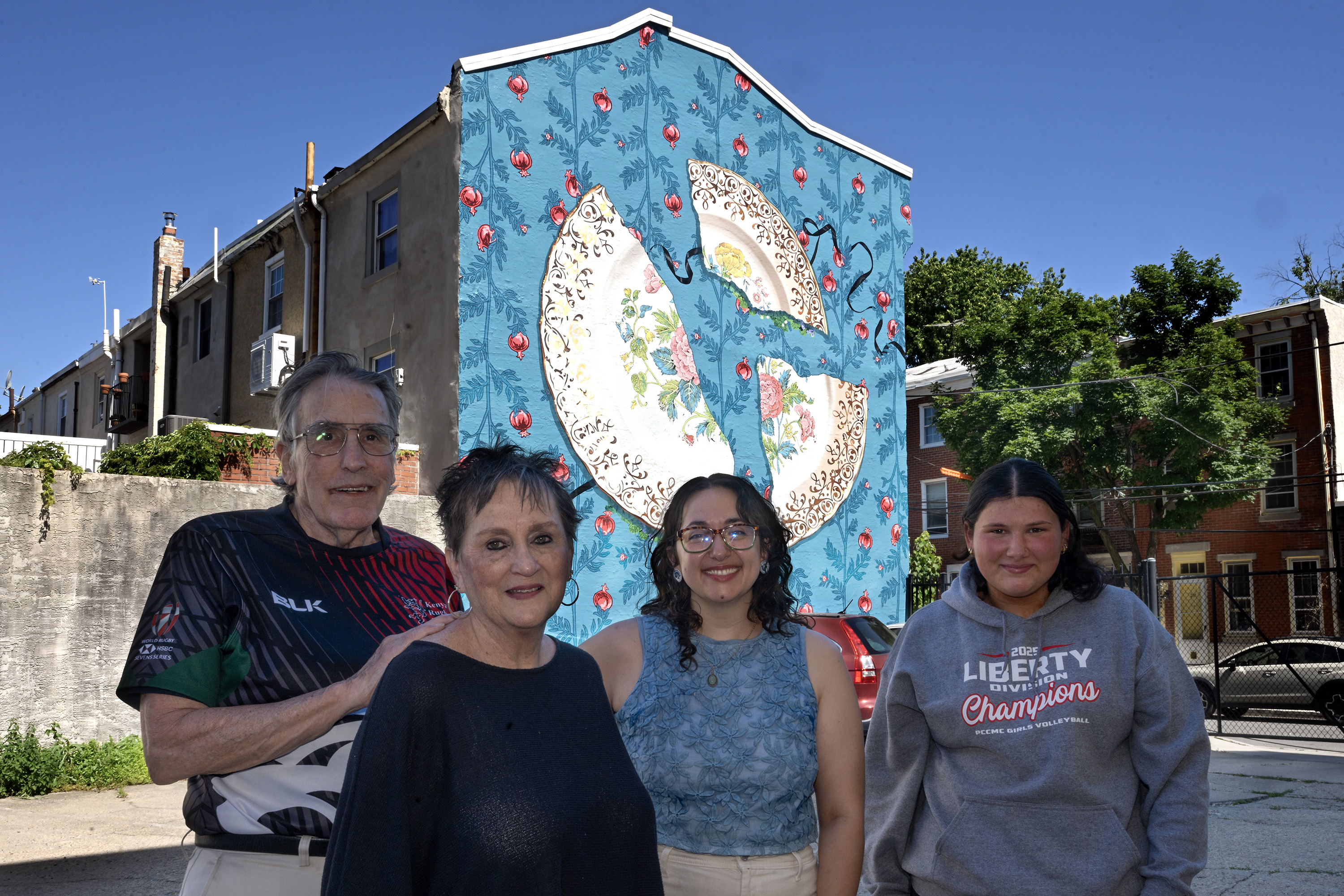
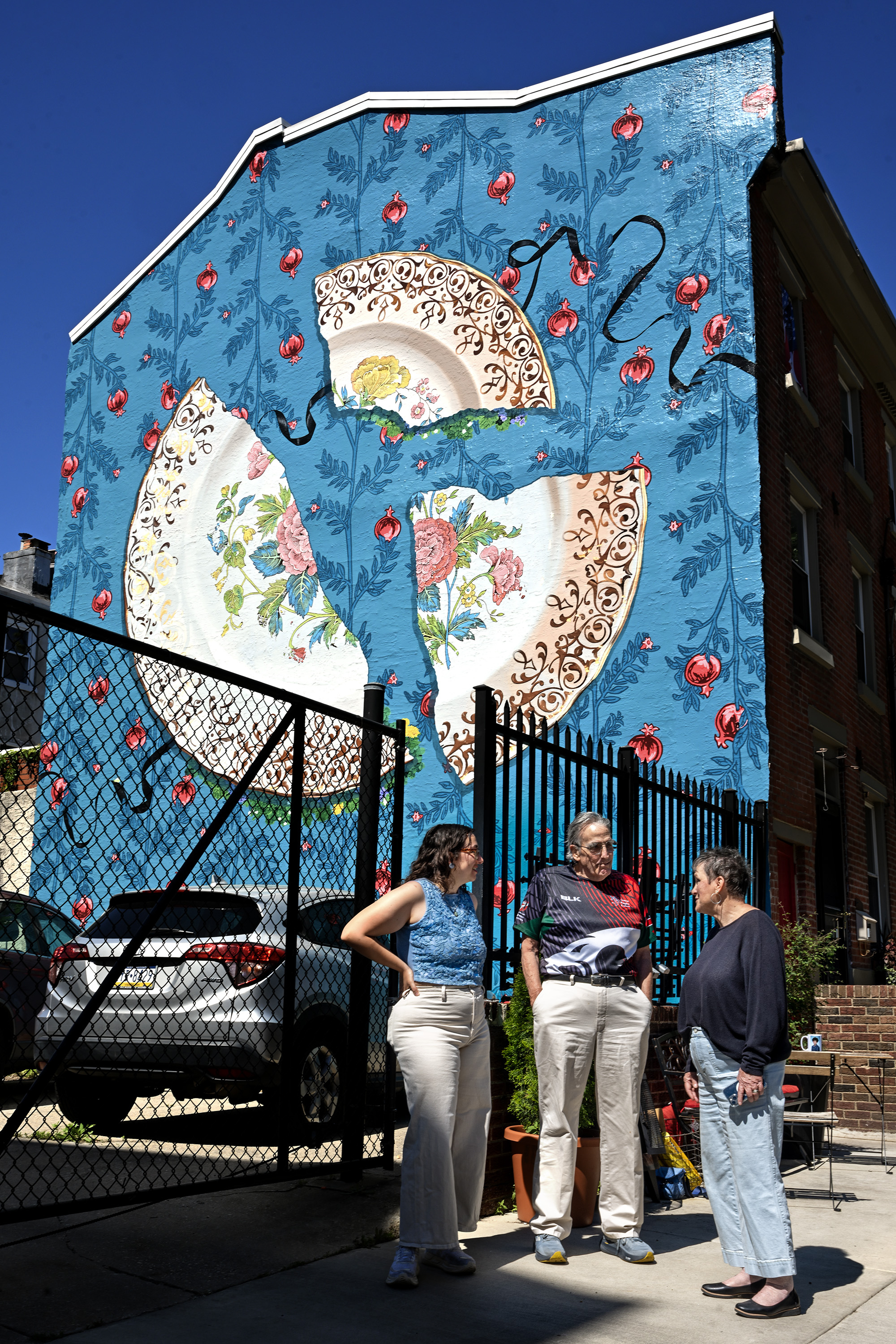
Homeowners Sara and Clark DeLeon (left) and their granddaughter Lucy Metzker (right) pose in front of their mural with artist Sammy Kovnat (center).Tom Gralish / Staff Photographer
Sara DeLeon was persistent. She kept calling to check on her 2016 application for a mural through Mural Arts. For years, she stayed on the wait list.
“My husband and I, we just kept believing that one day, the right mural would be up on our wall, and the right artist would choose our wall,” she said.
In 2024, Sara and her husband, Clark, finally got the call they’d been hoping for. Artist Sammy Kovnat needed a wall after another one fell through when a neighbor refused to make space for the installation process.
“We feel very lucky that she chose us,” DeLeon said.
Three renters in the neighboring building enthusiastically gave up their spots in the parking lot for a month so the mural could be installed.
The DeLeons were thrilled with the design, and so were their neighbors.
Artist Sammy Kovnat (left) talks with homeowners Sara and Clark DeLeon in front of their mural.Tom Gralish / Staff Photographer
“It’s the block’s mural, not just ours,” DeLeon said. “It’s become just a wonderful focal point.”
The DeLeons also discovered a surprising personal connection when they saw the artist’s plans that made the mural feel “like fate.” They had inherited a set of dishes from Clark’s mother with an almost identical design to the one on the large plate featured on the mural.
Kovnat makes mosaics using broken dishes, and painted the plate in shards as part of her work exploring healing after trauma. The background of the mural is an homage to her grandfather, the Philadelphia-based founder of a national wallpaper hangers union.
Whenever the DeLeons see people they don’t recognize looking at the mural, they always stop to talk and answer questions.
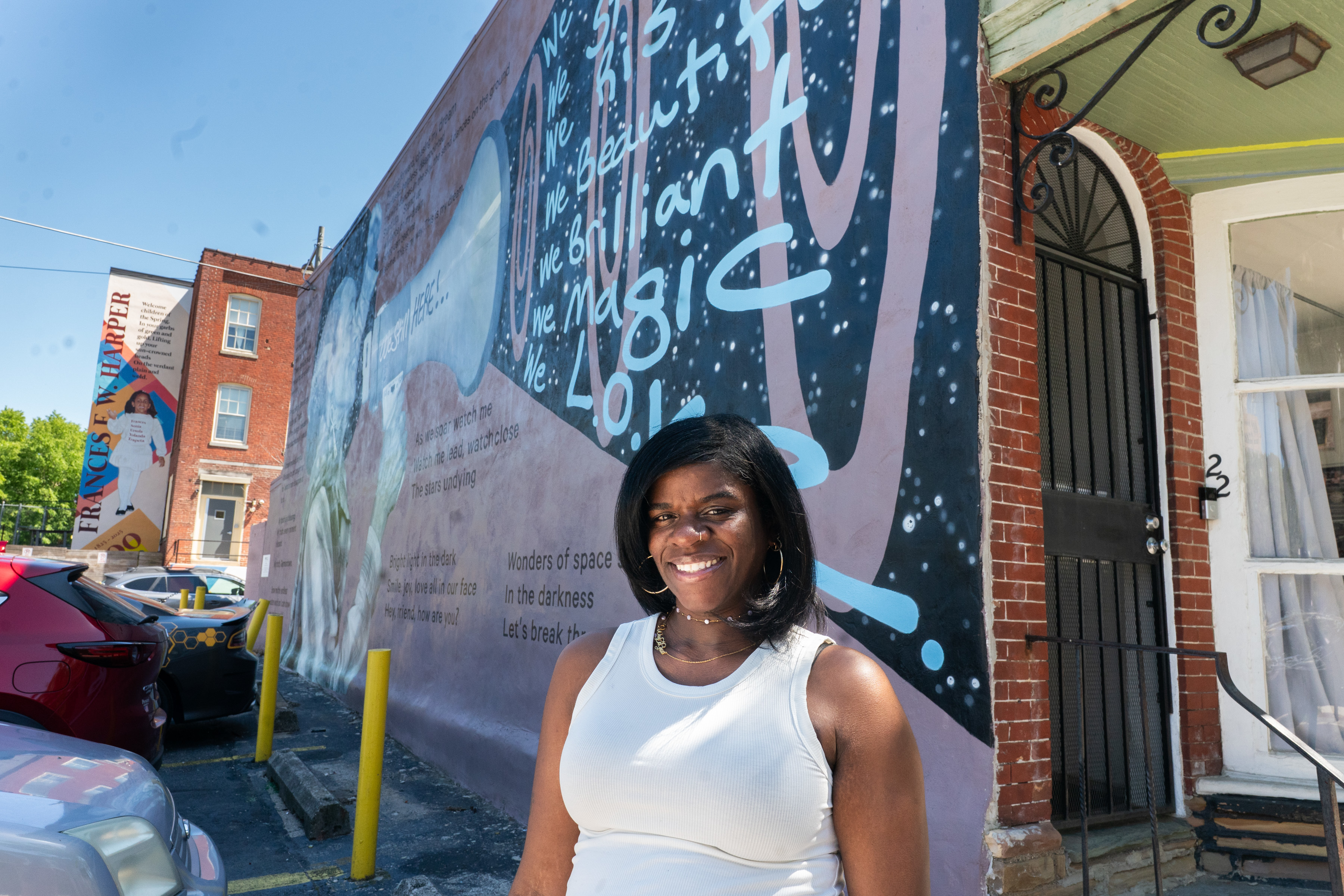
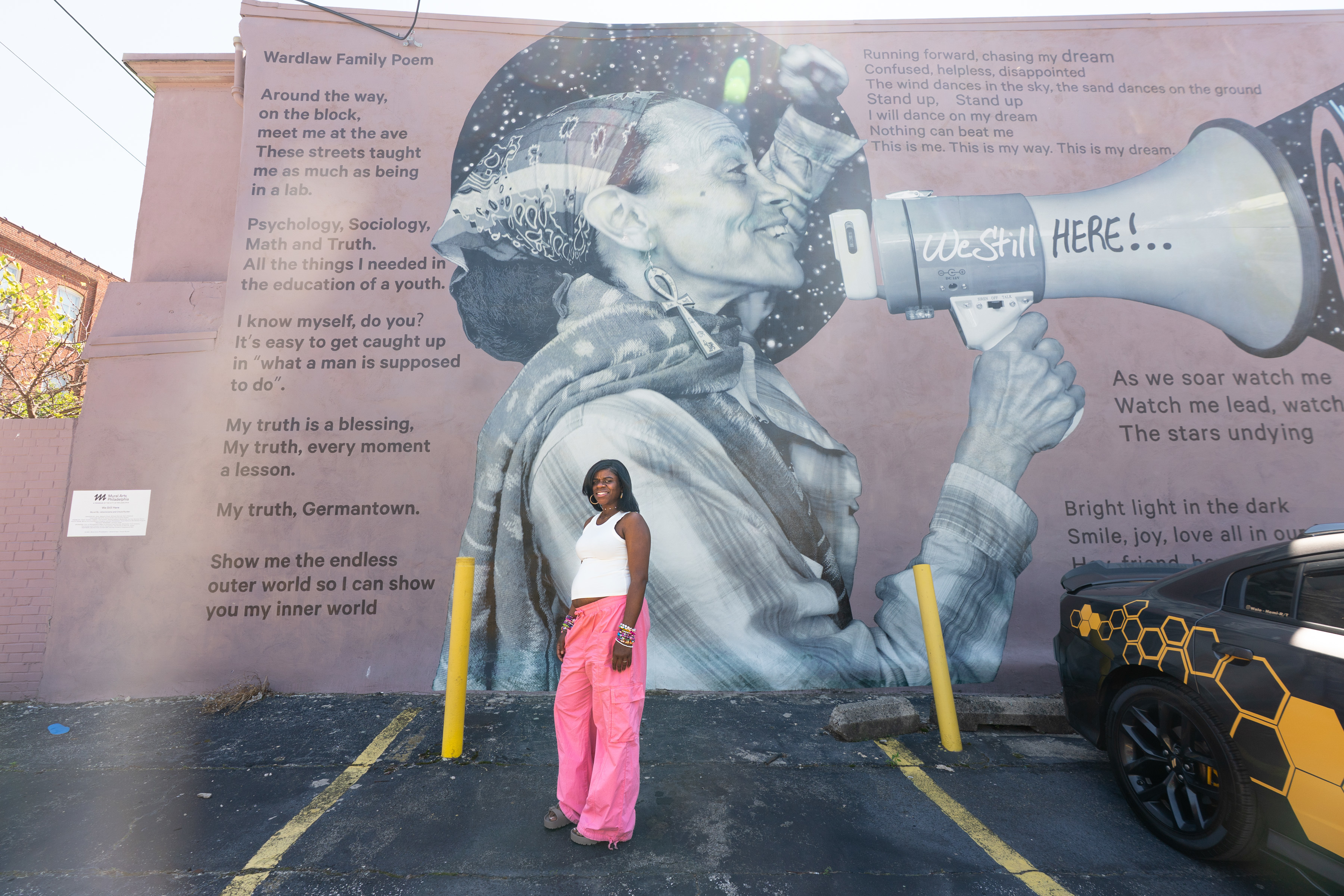
Shirley Wardlaw stands in front of the mural featuring poet and recording artist Ursula Rucker on her property, which includes a poem she wrote with her husband and daughter.Jessica Griffin / Staff Photographer
In 2019, a North Philadelphia mural of poet and recording artist Ursula Rucker was covered when a developer constructed a mixed-use building next to it. So Mural Arts invited artist Chip Thomas, aka Jetsonorama, to create another. The organization asked Shirley Wardlaw whether a mural of the Germantown native could go on her mixed-use building in Germantown.
Wardlaw operates a nursery school out of the building, and for a few years lived in the apartment above with her husband, Eckloff, and daughter, Sanayah. When the Wardlaws bought the property, the side wall had a partly sketched-out mural that had languished since Shirley was in high school. The wall was cracking, and it “looked pretty bad,” she said.
So Wardlaw applied to Mural Arts. And in came Jetsonorama.
Shirley Wardlaw worked with Mural Arts to get a mural on the side of her building, where she operates a nursery school.Jessica Griffin / Staff Photographer
“I was really attracted to his real-life art and the black and white photos,” Wardlaw said.
The mural features an image of Rucker holding a megaphone that amplifies a poem celebrating the community. Another poem was written by the Wardlaw family. Young people in the neighborhood also contributed poetry.
The mural “brought back life” to the area and is “a big attraction” for visitors, Wardlaw said.
“It’s a beautiful, colorful space at the end of our block,” she said.
Wardlaw thinks the mural helps draw families to her nursery school, and she has pitched murals to other neighborhood businesses as a way to attract customers.
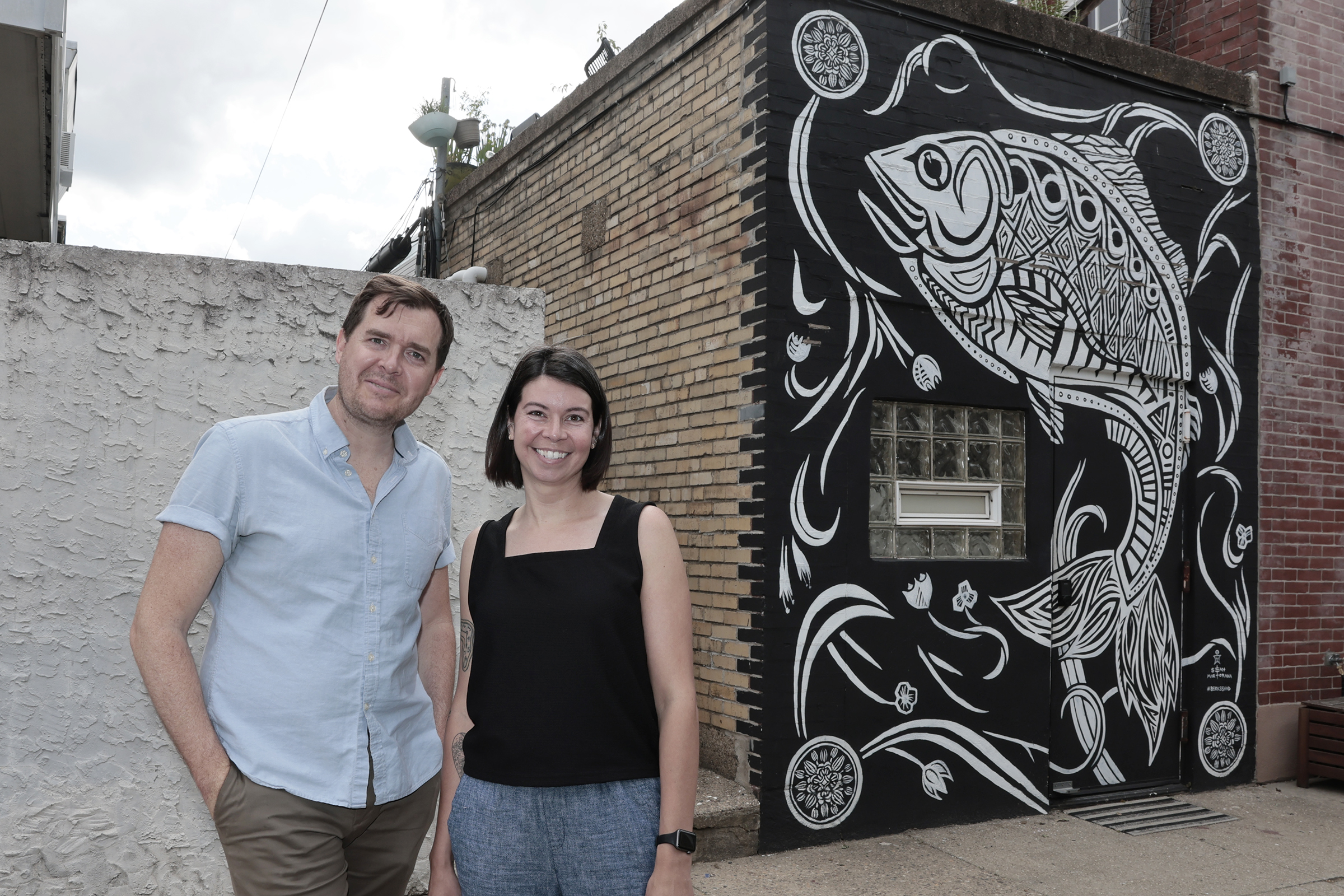
Christopher and Shannon Wink stand in front of the “Berks Shad” mural on their Fishtown home.Elizabeth Robertson / Staff Photographer
Berks Shad
The plain brick wall on Shannon and Christopher Wink’s Fishtown property was “screaming for a mural,” Shannon said.
The year after they moved in, it got one.
The Winks had known Philadelphia artist Sean Martorana for years and liked his style. So they asked him to paint the exterior wall of a structure that had been a cold storage room decades earlier. It was Martorana’s first outdoor mural.
“We knew we wanted something Fishtown,” Shannon Wink said. “It can easily get a little over-the-top, but it’s so nice to have a neighborhood that has its own visual identity.”
Martorana painted a giant shad surrounded by the Pennsylvania state flower, mountain laurel, in black and white, since the Winks didn’t want something too colorful. It all stands out next to the brick of their house.
“The way that the fish is oriented, it’s facing the river, which is something that Sean and we wanted to be really intentional about,” Wink said.
Sightseers often use their mural as a backdrop for photos. People have come in their wedding dresses.
The Winks’ two daughters were born after the mural was painted, so they’ve never known a home without it. The girls love walking around the neighborhood and seeing other decorated walls.
A neighbor of theirs, inspired by the Winks’ mural, gota similar one on their home, also painted by Martorana.
Wink encourages homeowners to get in on the city’s mural tradition.
“It’s just a really nice way to sometimes beautify, but also just create some more fun in a neighborhood,” she said.
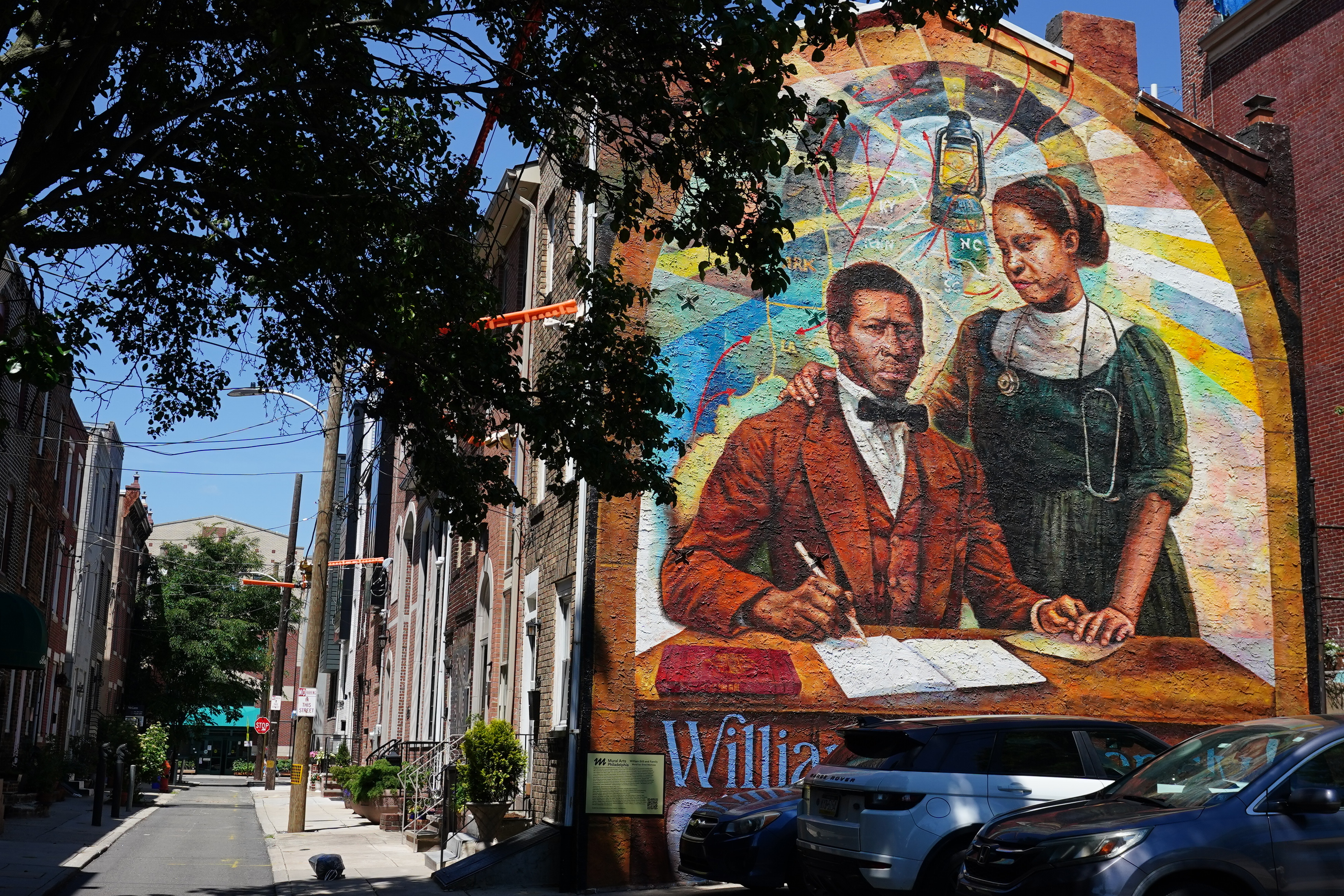
Mural Arts asked homeowner John Del Rossi for permission to honor William and Letitia Still, Underground Railroad leaders who once lived in the home. Jessica Griffin / Staff Photographer
John Del Rossi bought his Bella Vista rowhouse in 2006. But he didn’t know about its historic significance until 2018, when he learned the property was nominated for designation as the William and Letitia Still House, named for the Underground Railroad leaders who once lived there.
A few years after the house joined the Philadelphia Register of Historic Places, Mural Arts asked Del Rossi for permission for a mural to honor the Stills. He said hosting the artwork is an additional honor.
“The mural says a lot about what the house stood for,” he said. “It’s a visible representation of what took place in the home, and the sacrifice and the courage that people had in order to make that home what it was.”
During the design process, Del Rossi got to meet descendants of the Stills, which he called “a goose bumps type of meeting.”
“It was pretty surreal,” he said.
As the homeowner, he was invited to share his thoughts on the mural’s design, but he left the decisions to those who know more about art.
“I’m not an artist. I’m in medicine,” said Del Rossi, who works in California and rents out his home.
All mural expenses were covered, but he said he would have paid for the artwork himself if he had to in order to honor this piece of Philadelphia’s abolitionist history.
“I’m not gonna live forever,” Del Rossi said. “But hopefully, the mural will remain, and it’ll be a representation for the neighborhood and people in future generations to be able to see and understand what took place within those walls.”
Editor’s note: This story has been updated to correct the name of the mural, “Pomegranates and Plate Shards.”
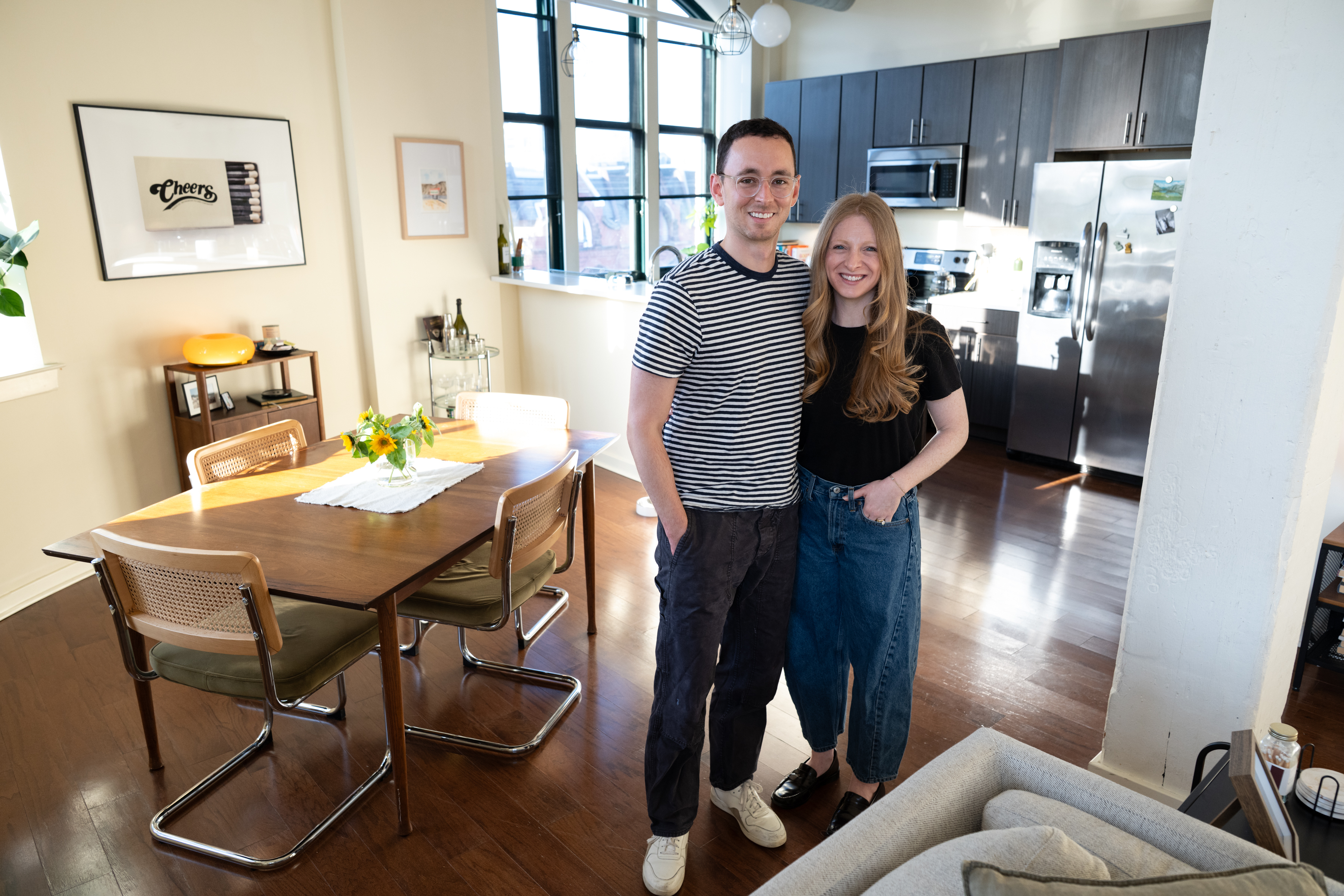
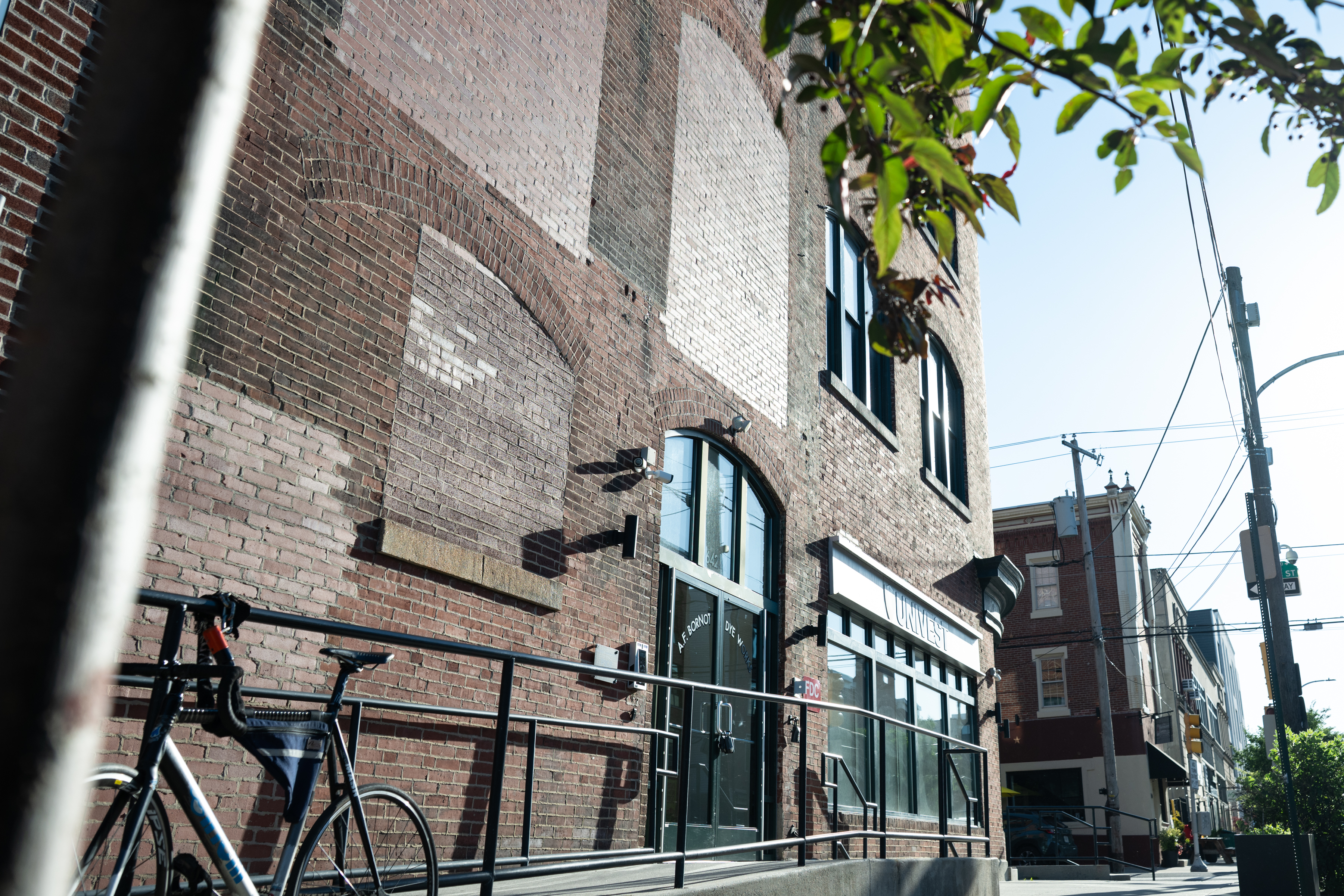
A regular at Yoga Habit in Fairmount, Allison Langer was curious about the four-story apartment building next door, the AF Bornot Dye Works Lofts. Her husband, Mark Paulson, was also intrigued, but at the time, the building was fully occupied.
“We are drawn to historical preservation,” recalled Langer, a developmental psychologist. “The windows caught our eye from the street, and I told Mark, if an apartment in that building opened up, I would love to move there.”
Six months later, in April 2024, their wish came true. Their two-bedroom, two-bathroom apartment has 11-foot-high ceilings and an open floor plan.
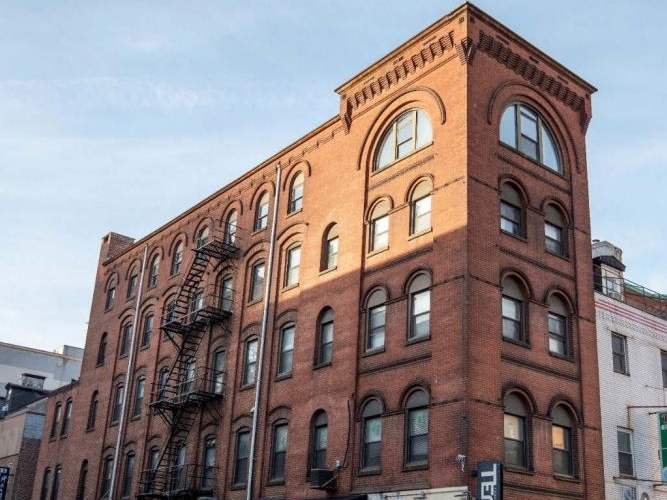
The exterior of the AF Bornot Dye Works Lofts building, which Langer and Paulson had admired before moving in.Erin Blewett / For The Inquirer
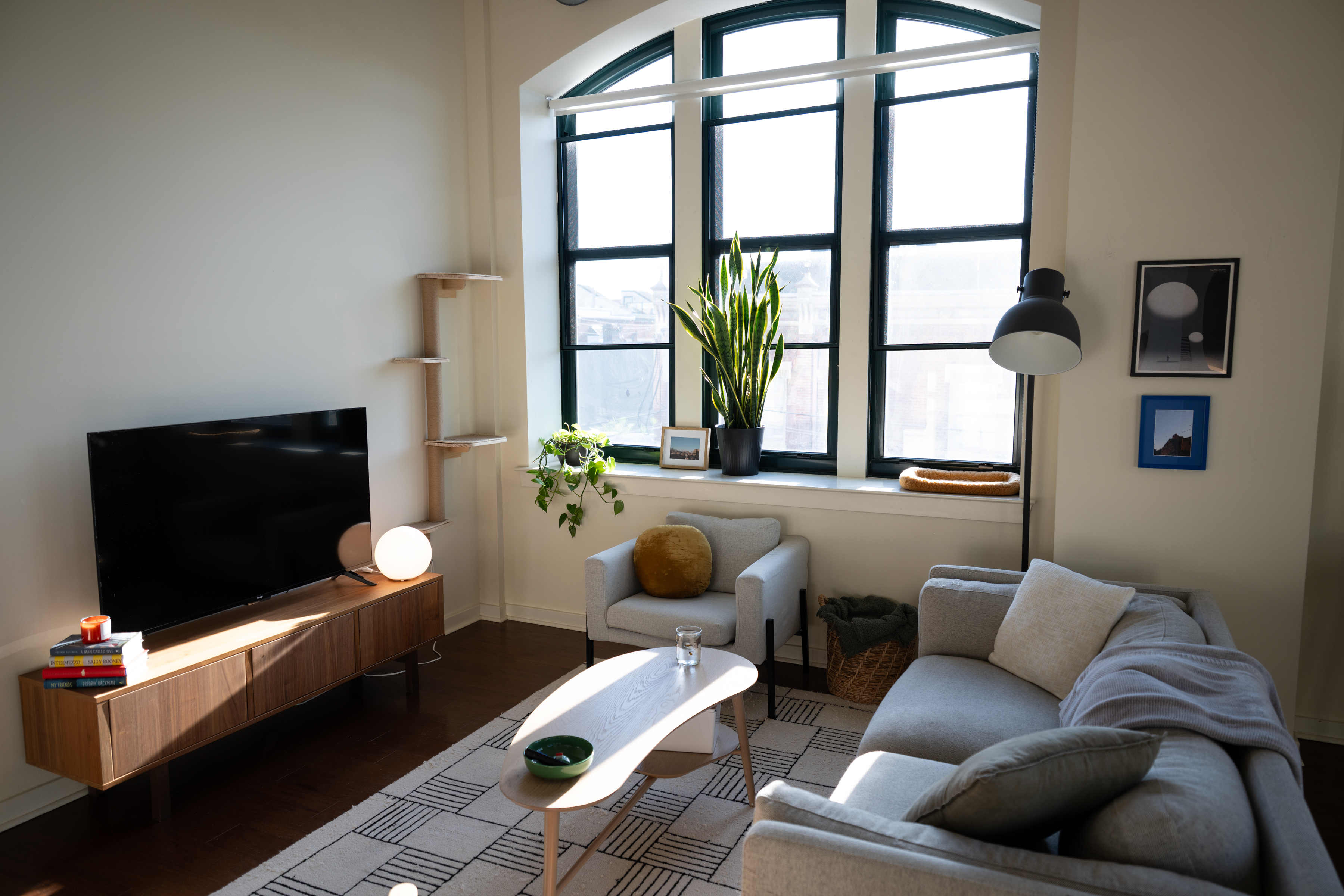
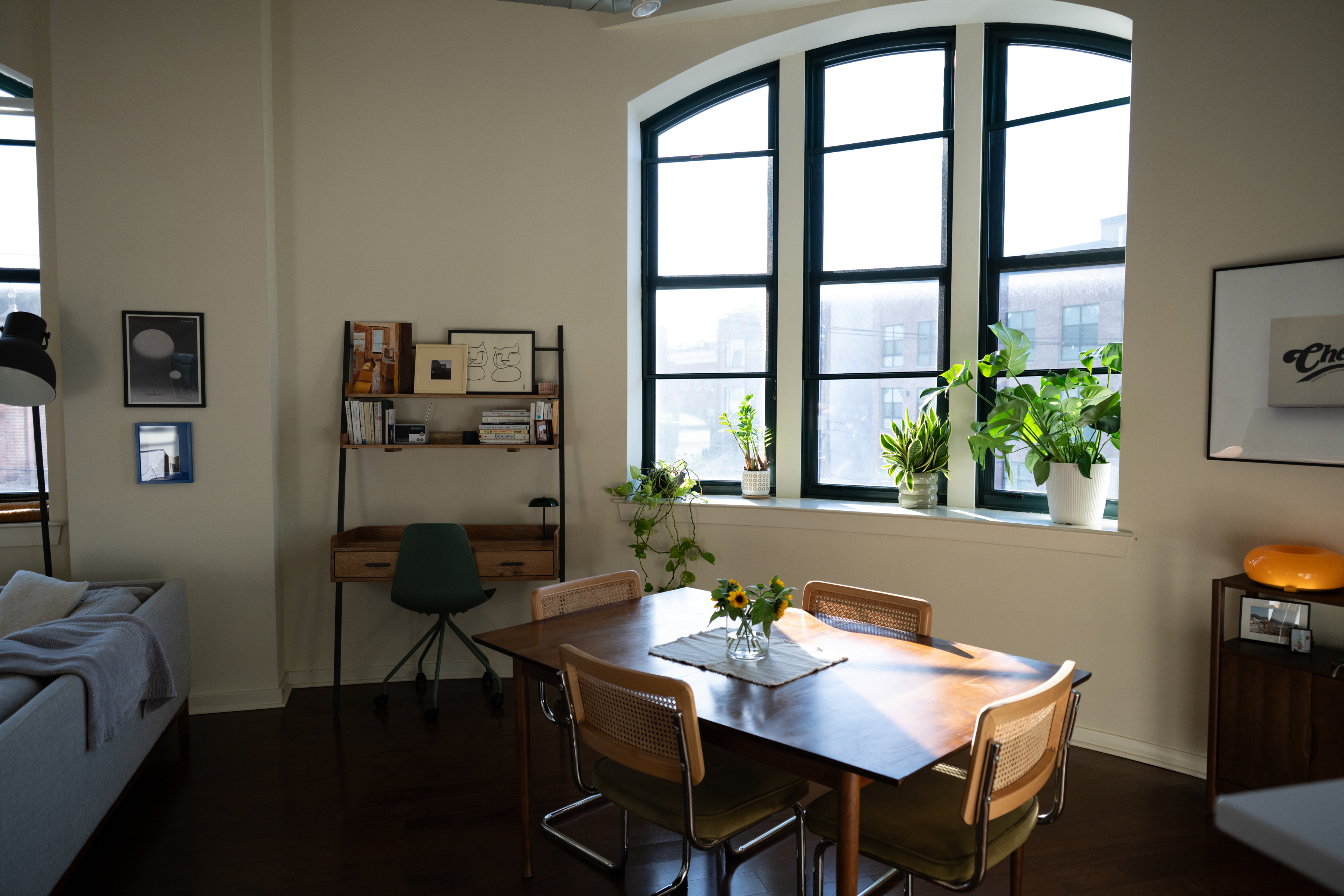
“The combination of the windows, really high ceilings, and exposed ductwork makes it feel so airy, open, and spacious, even though it’s only 1,250 square feet,” said Paulson, a data analyst.
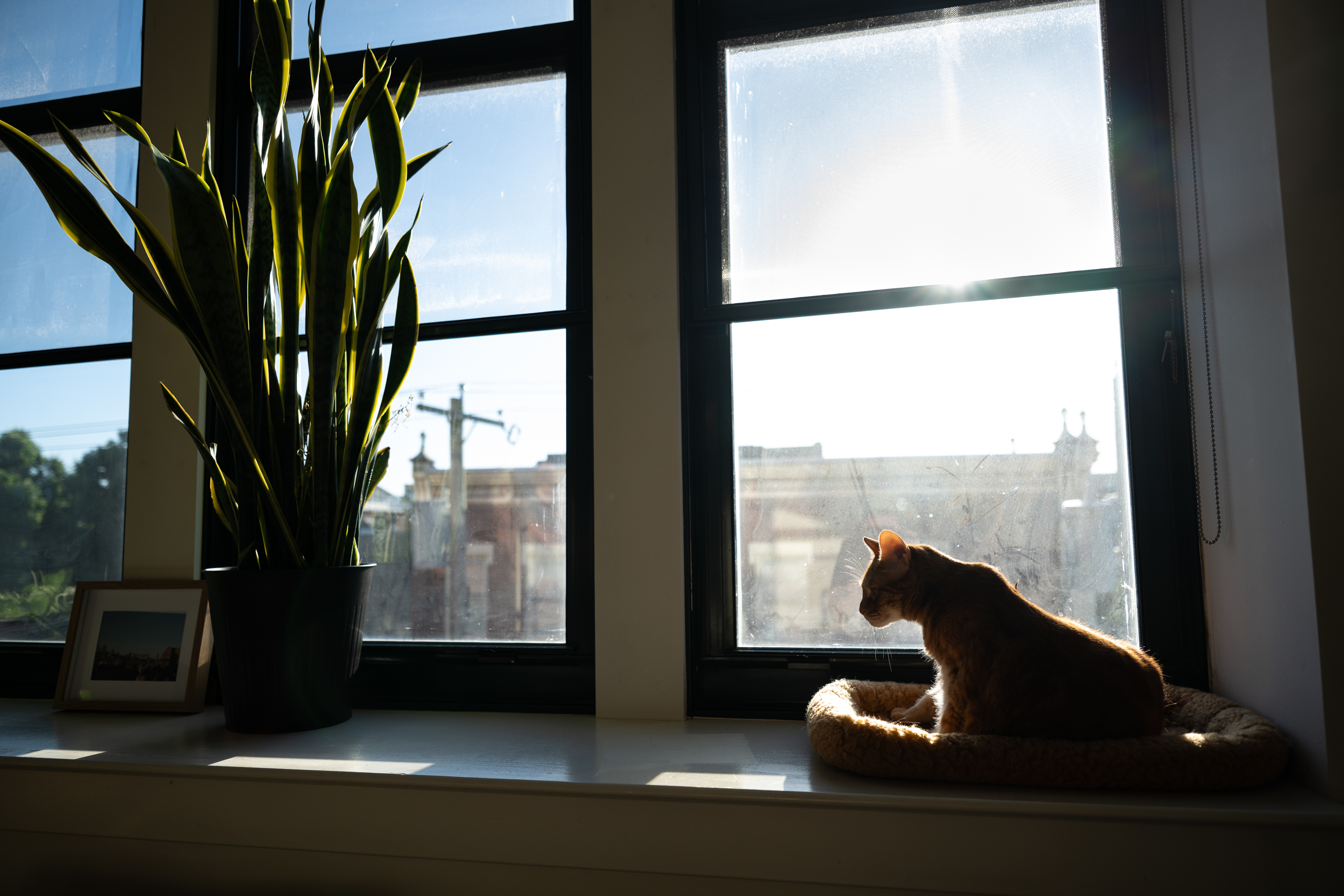
The windows are the couple’s favorite feature. The western exposure means they can enjoy daily sunsets, and Frankie, the 6-year-old orange shorthair domestic cat they adopted from a local shelter, can sunbathe on one of the large windowsills all day.
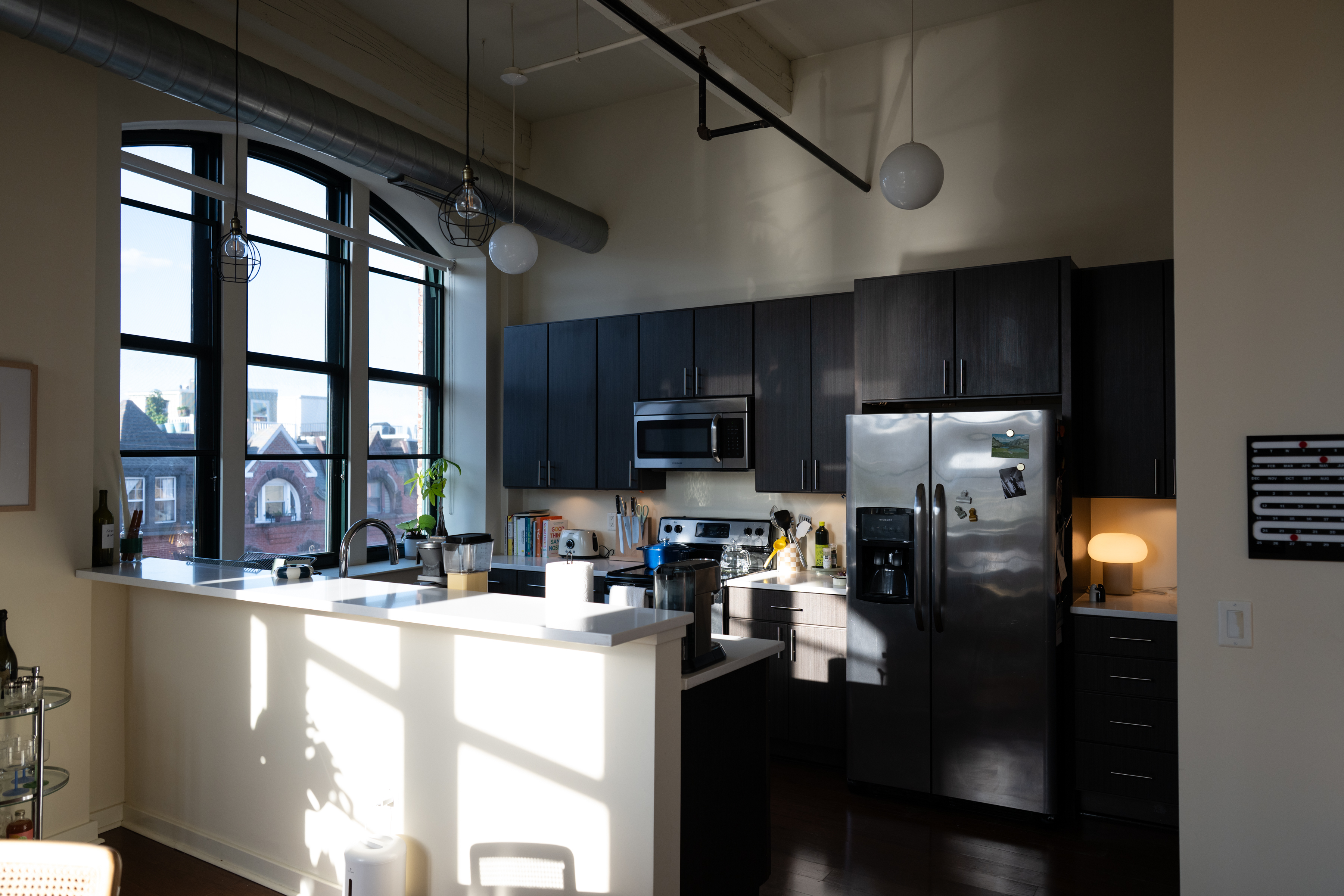
The open floor plan is perfect for the couple, who enjoy cooking and entertaining.
The living area is bathed in sunlight on a May evening.Erin Blewett / For The InquirerThe apartment’s kitchen also features a large window.Erin Blewett / For The Inquirer
“When we have friends over, everyone can be in one space,” Langer said. “The kitchen is the spot in the home with the most western-facing windows so we can watch the sunset as we’re cooking.”
An avid baker, she has a dedicated corner for preparing her sweet confections. That’s where the KitchenAid mixer her mother-in-law gave her sits, alongside a photo of her grandmother baking with her when she was young.
Fridays are typically pizza night when Paulson and Langer make homemade pies. They also enjoy board game nights with friends, including Magic: The Gathering — a game Paulson has played since he was 5 years old. They also play Settlers of Catan, Wingspan, and Nertz.
The building is a historic landmark originally constructed in 1901 as the headquarters of the AF Bornot Dye Works Co. In July 2014, MM Partners acquired the property, and following an extensive renovation, completed construction in June 2016.
“The exterior still beautifully harbors the old Parisian style of this historic, adaptive reuse property,” said William K. Ayassou, regional manager at MM Partners. The project earned the 2018 Preservation Alliance Achievement Award.
Paulson and Langer’s cat, Frankie, a fan of the apartment’s ample sunlight, rests by the living room window.Erin Blewett / For The Inquirer
Langer and Paulson are inspired by mid-century and Scandinavian design and Japanese minimalism, focusing on a decluttered, yet warm look. They celebrate the modern style that incorporates the building’s historic features with natural wood tones and mid-century furniture.
Most of their furniture has come from secondhand stores.
“Philly is such a great city for secondhand furniture and people do a great job of keeping everything in great condition,” Langer said.
The dining room table was a Habitat for Humanity Restore find, and as the first piece they bought together in their previous apartment it carries a lot of sentimental value.
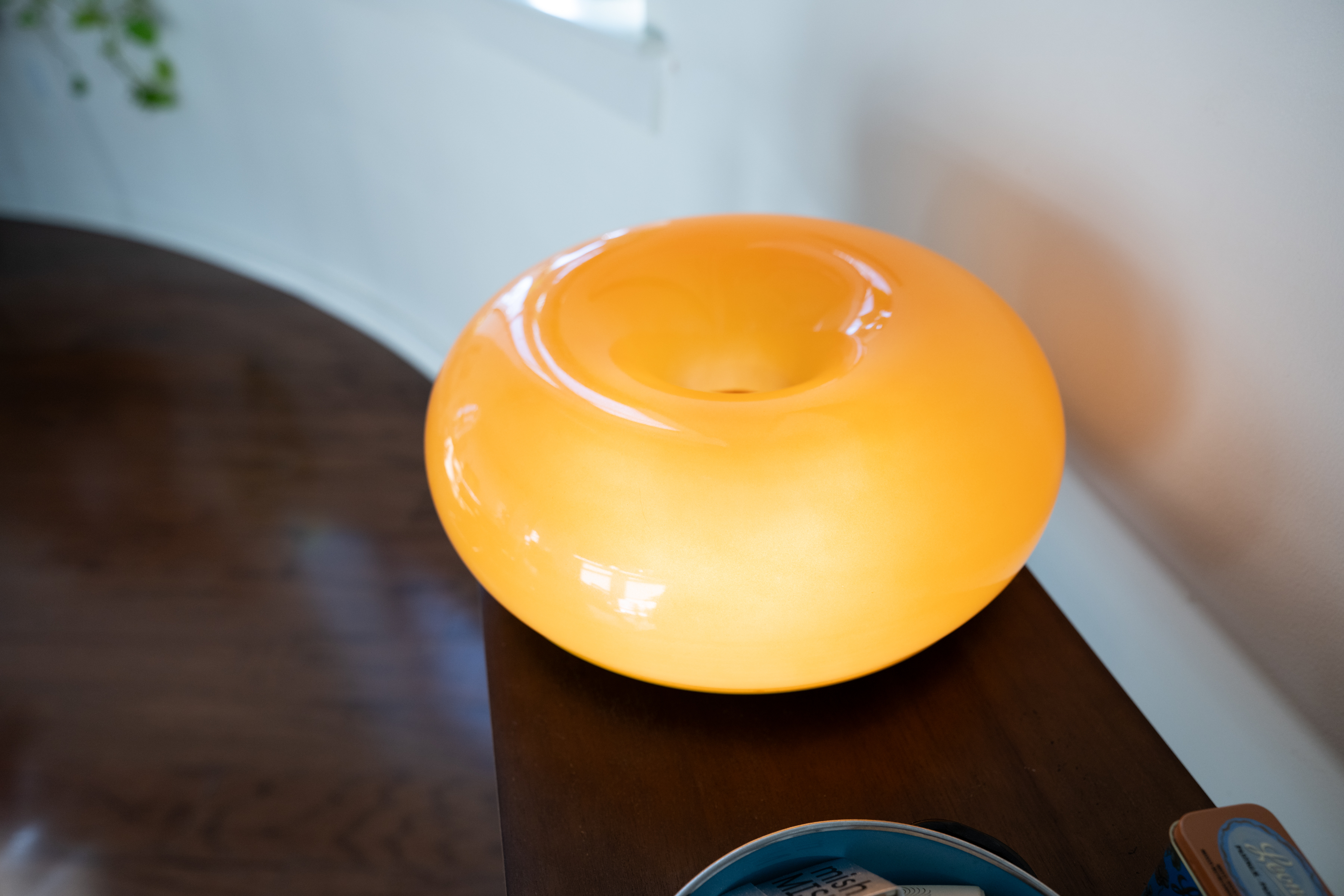
They also collect lamps in various shapes and sizes. With so much natural light in the apartment, they appreciate the glow of the lamps scattered throughout, from the mushroom to the orb to the orange doughnut shaped Ikea Varmblixt LED model that went viral on TikTok and Instagram in 2023.
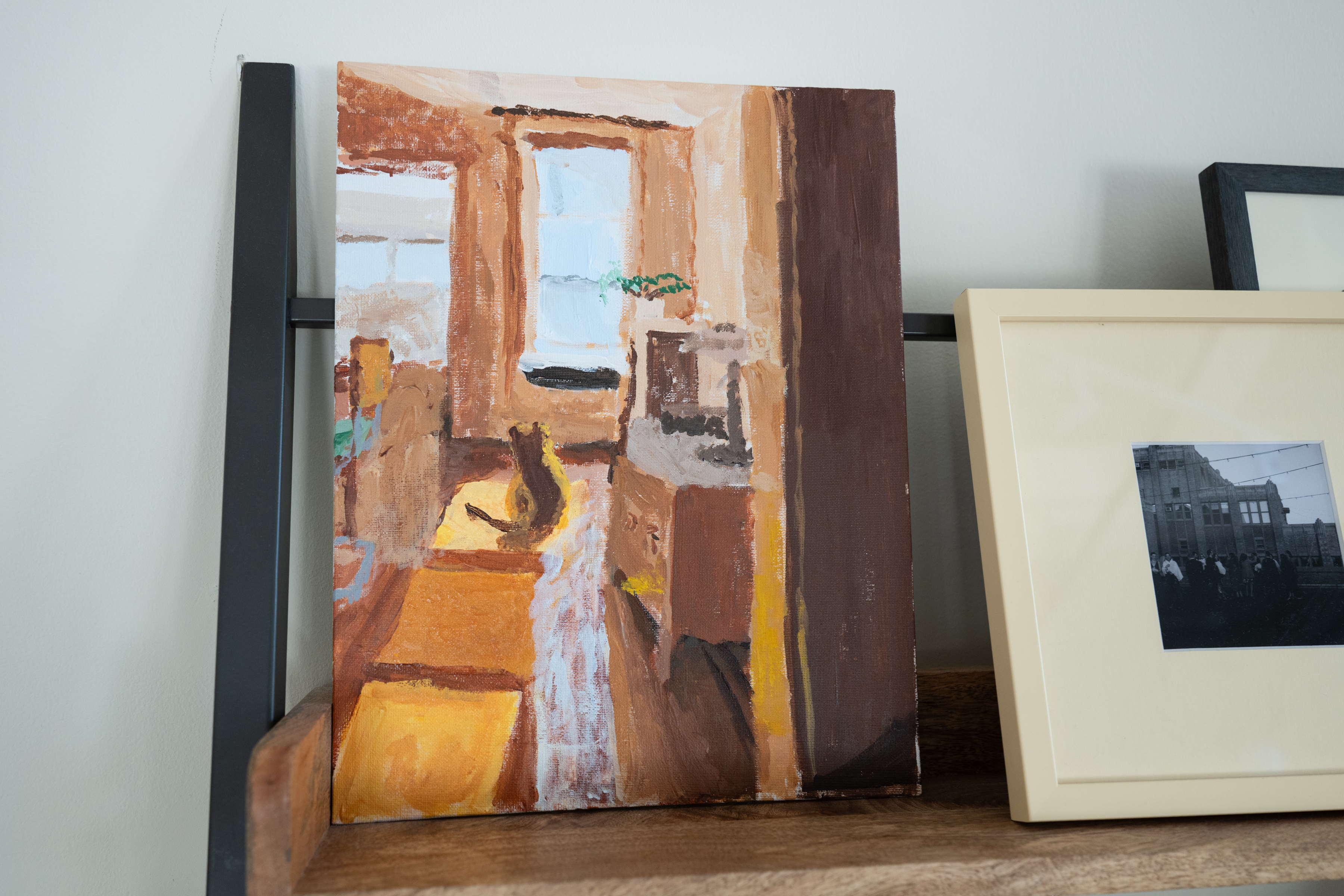
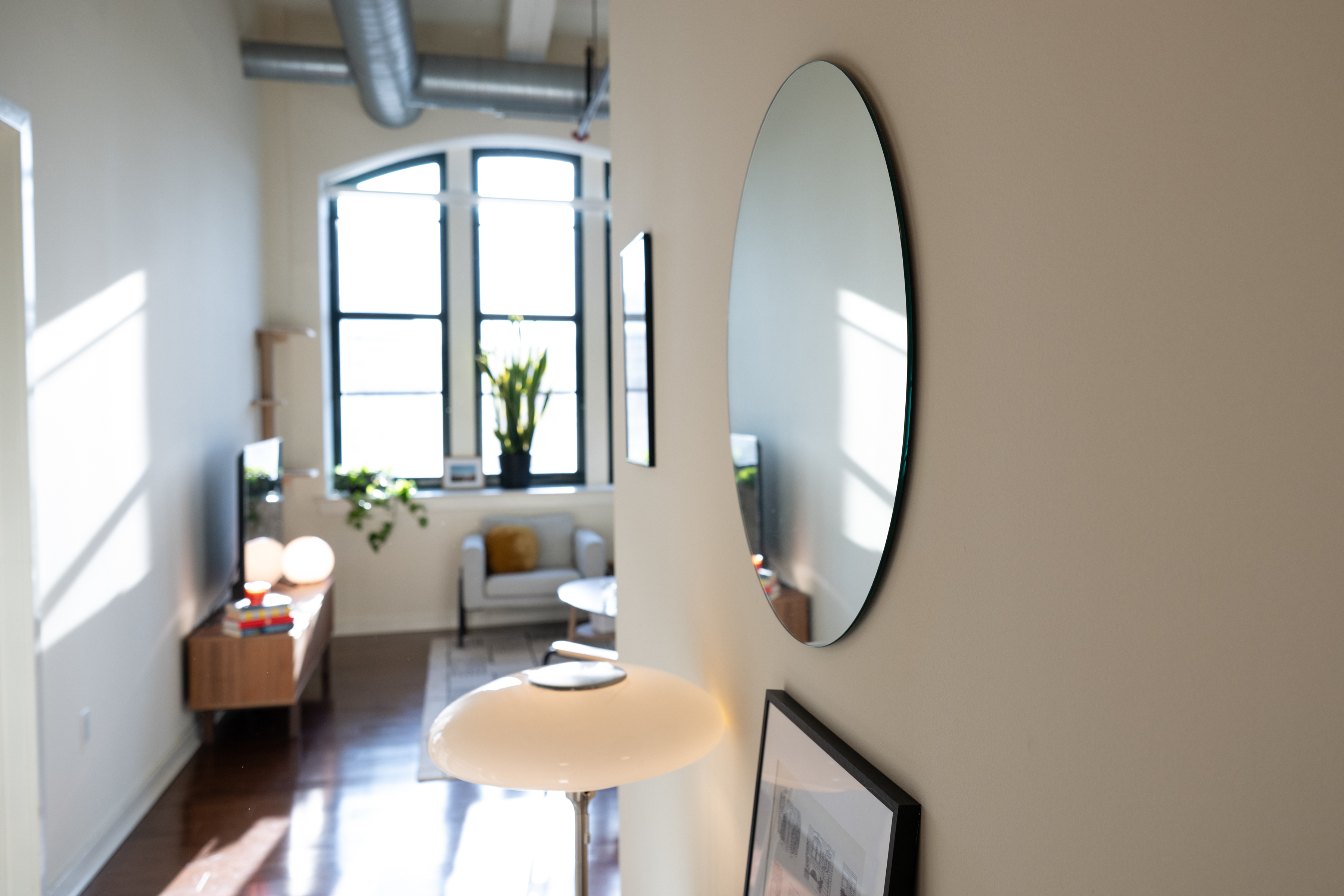
The dining room features a table the couple found at Habitat for Humanity Restore.Erin Blewett / For The InquirerAn orange donut-shaped Ikea lamp is a model that went viral on social media several years ago.Erin Blewett / For The InquirerA painting of Frankie the cat, made by Paulson, is on display in the apartment.Erin Blewett / For The InquirerThe front hallway features one of the couple’s distinctive lamps, and a round wall mirror.Erin Blewett / For The Inquirer
“The overhead lighting is minimal, so we’re really able to indulge our lamp collection,” joked Langer.
Bursts of color are found in textiles and artwork. Paulson, who makes art as a hobby, takes classes at Philly Art Center near their home. One of the couple’s favorite pictures — an acrylic painting he made in class from a photo of Frankie awash in a sunbeam — sits on the desk between the living room and dining room.
“I enjoy dabbling, and the Art Center is another way in which we engage with the Fairmount community,” Paulson said.
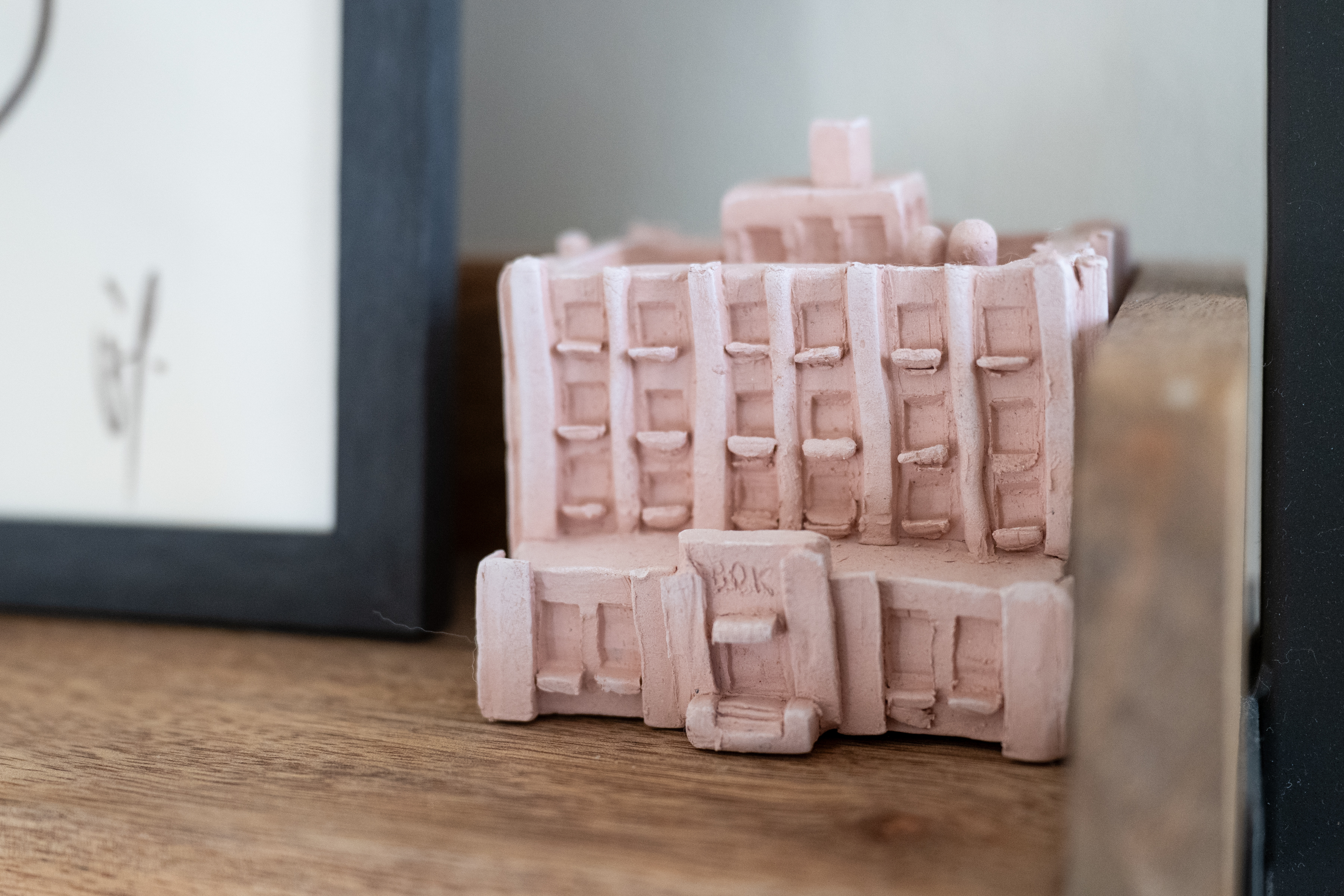
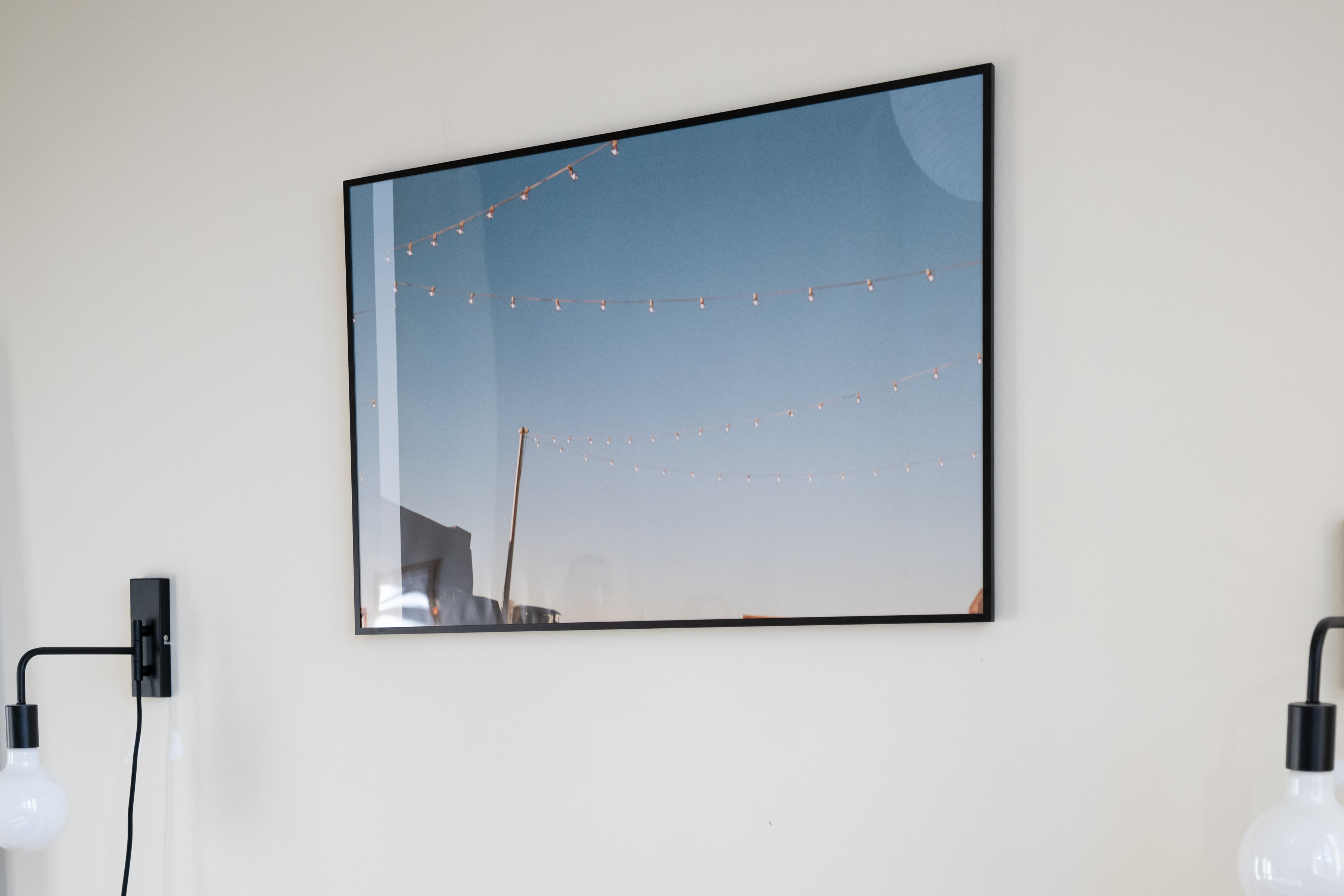
The desk also holds the clay Bok building replica their friend Keeley gave them for their 2024 wedding, which was held at the Bok. Other wedding mementos can be found in their primary bedroom, including the photo of the sky taken by Philadelphia-based wedding photographer Elizabeth Blanco, which hangs above their bed.
“We got very lucky with a cloudless day and a beautiful sunset during our ceremony on Bok’s roof,” Langer said. “The photo captures and reminds us of that moment.”
A clay replica of the Bok building, where the couple married, is on display in the apartment.Erin Blewett / For The InquirerA photo taken by Elizabeth Blanco on the roof of the Bok building at Paulson and Langer’s wedding.Erin Blewett / For The Inquirer
Langer loves her home’s proximity to Yoga Habit and the rest of the Fairmount community. Some of the couple’s favorite hangs include Musette, Aiyah (and its monthly art markets), and Sandwich Corner Market.
“It’s such a central location, close to the Broad Street Line and great cafes, restaurants, and small businesses in Fairmount,” she said.
Is your house a Haven? Nominate your home by email (and send some digital photographs) at properties@inquirer.com.
Sales of previously occupied U.S. homes accelerated last month to their fastest pace since December, a sharp turnaround in demand after a lackluster start to the spring homebuying season.
Existing home sales rose 3.2% in May from the previous month to a seasonally adjusted annual rate of 4.17 million units, the National Association of Realtors said Tuesday. Sales also rose 3.2% compared with May last year.
Home sales increased from a year earlier in the Midwest, South, and West, but fell in the Northeast, NAR said.
The latest sales figure topped the roughly 4.07 million pace economists were expecting, according to FactSet.
Home sales have been mostly hovering close to a 4-million annual pace going back to 2023, far short of the historic norm that is closer to 5.2-million.
Sales rose last month even as mortgage rates have continued to mostly trend higher this spring, although they remain below where they were a year ago.
Home prices continued to rise nationally last month. The U.S. median sales price increased 1.3% in May from a year earlier to $429,300, an all-time high for any May on data going back to 1999, NAR said. Home prices have risen on an annual basis for 35 months in a row.
Even so, home price growth is now lagging income growth in many areas. That, plus mortgage rates holding below where they were this time last year, is helping to improve affordability, giving the housing market momentum, said Lawrence Yun, NAR’s chief economist.
“I cannot definitively say if home sales are truly coming out of the slump, because we know that there’s still uncertainty related to the oil prices or how the mortgage rates will move,” Yun said, adding that he expects home sales will emerge from their multiyear slump if the average rate on a 30-year mortgage drops back closer to 6%.
The U.S. housing market has been in a slump since 2022, when mortgage rates began to climb from pandemic-era lows. Sales of previously occupied U.S. homes were essentially flat last year, stuck at a 30-year low. They have remained sluggish so far this year. They were flat in April after declining from a year earlier through the first three months of this year.
Years of soaring home prices, especially in the early part of this decade when rock-bottom mortgage rates fueled a buying frenzy, have left many would-be homebuyers frozen out of the market. And a chronic shortage of homes for sale nationally, due partly to years of below-average new home construction, has helped prop up home prices even in a multiyear sales slump.
Homes purchased last month likely went under contract in March and April, when the average rate on a 30-year mortgage ranged from 6% — close to its lowest level in three and a half years — to 6.46%, according to mortgage buyer Freddie Mac. The average rate was at 6.48% last week, down from 6.85% a year earlier.
While the average rate has remained below where it was a year ago, it has been mostly trending higher since the war with Iran began, disrupting the passage of tankers ferrying crude oil from the Persian Gulf to customers worldwide and driving oil prices sharply higher. Expectations of high oil prices as the war continues have pushed up the long-term bond yields that lenders use as a guide to pricing home loans, causing mortgage rates to climb.
“If not for the war-related spike in inflation, the average 30-year fixed mortgage rate could well be in the mid-to-upper 5’s,” said Ted Rossman, principal analyst at Bankrate.
Despite the uncertainty over mortgage rates, first-time buyers accounted for 35% of home purchases last month, the highest share going back to June 2020, Yun said. Historically, they made up 40% of home sales.
Those who can afford to buy at current rates are likely benefiting from buyer-friendly trends in many markets. In May, median list prices were down 2.4% from a year earlier, the steepest drop on data going back to 2017, according to Realtor.com.
They also have more homes on the market to choose from, although home inventory levels remain well below historical norms.
There were 1.55 million unsold homes at the end of May, up 3.3% from April and up 0.6% from May last year, NAR said. That’s still short of the roughly 2 million homes for sale that was typical before the COVID-19 pandemic.
May’s month-end inventory translates to a 4.5-month supply at the current sales pace. Traditionally, a 5- to 6-month supply is considered a balanced market between buyers and sellers.
For Tina and Waverly McAlister, preparing for a retirement living near the beach has been a meticulously planned process taking about a decade.
About 17 years ago, the two Phoenixville natives thought they would buy a home there or in King of Prussia, but Pottstown was a better market for them. Waverly had been a supervisor with a precious metal manufacturing firm and Tina had been a revenue services specialist in a school intermediate unit.
Kitchen Alcove Media
So in 2009 they bought a three-bedroom, 2½-bathroom house in Pottstown on a cul-de-sac along busy U.S. Route 422. Waverly said they were attracted to the design and attention to detail.
Then, eight years ago, they bought their eventual retirement home, on Fenwick Island, Del. Since then they have split time between two homes, gradually moving possessions to Delaware.
DeckAlcove Media
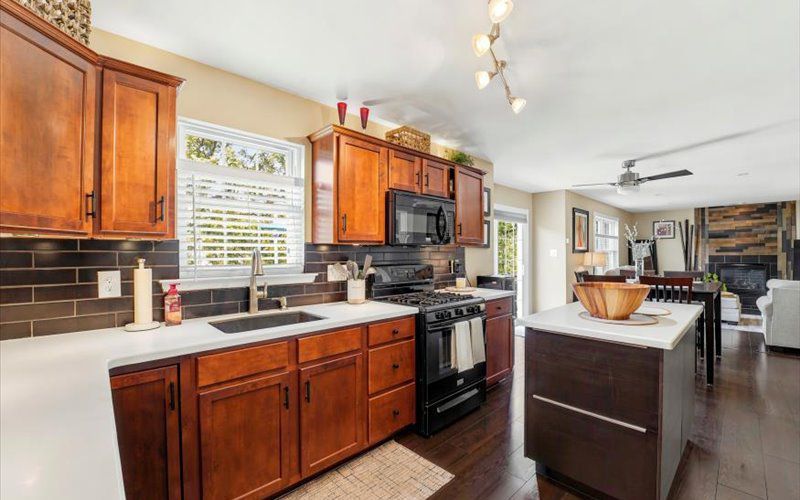
The 2,648-square-foot Pottstown house features a two-car garage that can also serve as a workshop. It has extensive cabinetry, a refrigerator, and mounted television.
The house’s main level has a hardwood foyer and composite flooring in the kitchen, dining room, and family room. And the kitchen has an island, a subway tile backsplash and a sink mounted under the counter, giving a lower profile.
There is also a powder room and laundry.
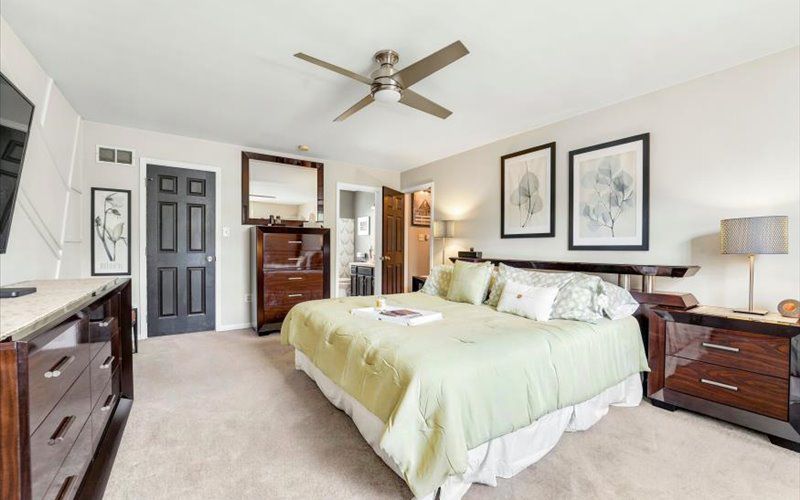
The primary bedroom has a walk-in closet with custom organizers.Alcove Media
The bedrooms are on the next level. The primary has a decorative accent wall and a walk-in closet with custom organizers, and a bathroom with tile flooring.
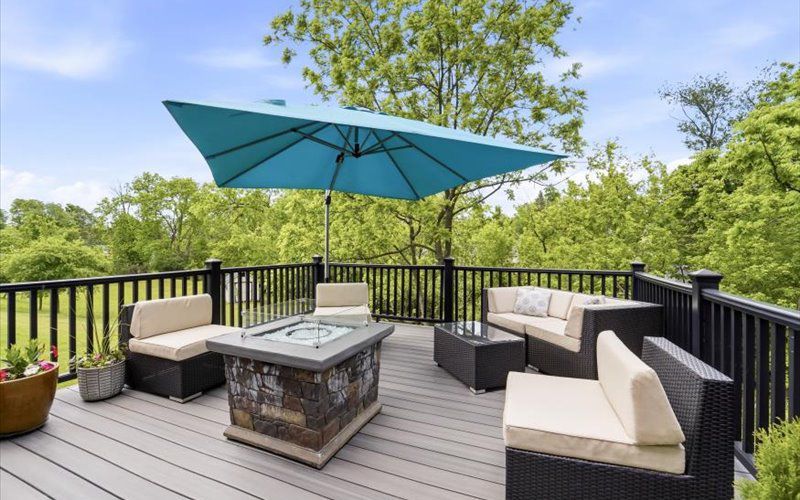
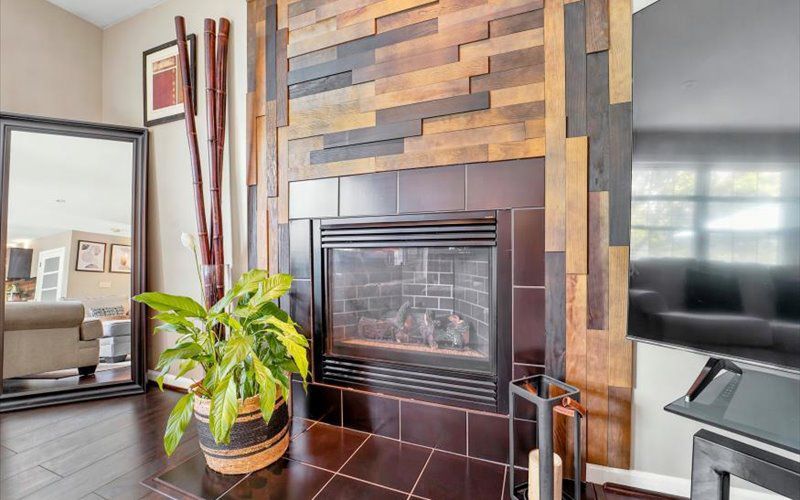
The finished basement has a bar area with a wine and beverage refrigerator, pantry, a decorative tile ceiling, and an electric fireplace. Sliding doors lead to the patio and backyard.
FireplaceAlcove Media
The house is in the Pottsgrove School District, convenient to Philadelphia Premium Outlets and Costco.
It is listed by Pam Butera of Keller Williams Blue Bell for $575,000.
Over the past year, Zillow, the country’s largest real estate portal, and Compass, the biggest real estate brokerage in the world, have traded lawsuits and allegations of antitrust violations, all while waving the banner of consumer protection. Both companies have gobbled up competitors and become so dominant that when they shift their rules and practices, they have the power to change how homes in the United States are bought, rented, and sold.
Zillow owns listing websites including StreetEasy and Trulia and receives about 220 million unique visitors every month. Its scale means it can dictate practices that agents say are bad for their businesses and confusing for consumers.
Compass was already the largest real estate brokerage in the country when, this year, it bought Anywhere Real Estate for $1.6 billion, making it by far the biggest real estate brokerage in the world with about 340,000 real estate professionals. It controls brands that include Christie’s International Real Estate, Century 21, Coldwell Banker, and Corcoran. It has come under fire for pushing the practice of private listings, which go to a select group of people before they reach the public.
The National Association of Realtors was the longtime gatekeeper of real estate listings, but the organization was found guilty of antitrust violations in 2023, and its grip on the market has loosened. Now, Zillow and Compass are rushing in to fill the vacuum, battling over who gets control of the listings.
“We have two behemoths in the industry,” said Jonathan J. Miller, a real estate appraiser and consultant. If the leaders of these companies were to quickly change, shifting their strategy or focus, he continued, the ramifications could be enormous. “The entire market — the biggest asset class in the world — is subject to potentially significant change overnight.”
What is the controversy around Compass’ private listings?
Private listings have existed for decades, but they were fairly rare. Perhaps a judge or a celebrity wanted to keep their home and address private, so instead of posting the house online, their broker would call other agents and quietly invite them to the property.
Compass, however, has taken the practice wide. It offers its buyers the ability to share online listings only on the Compass website so its own agents and their clients can see them, before bringing the homes to the larger market. Those are what it calls Private Exclusive listings.
Websites like Zillow list how many days a home has been for sale, and a property that’s been on the market for an unusually long time might give a potential buyer pause. Compass’ Private Exclusive listings allow sellers to test their price without starting the days-on-market clock.
Compass’ critics say the practice disadvantages both buyers and sellers. Buyers won’t know if an overpriced home has been sitting at the same price for a year, and sellers won’t have the largest pool of potential buyers. Compass, on the other hand, does benefit, its critics say. Brokerages take a cut of their agents’ commissions, so by keeping both sides of the deal in-house, the company earns more money.
Critics liken the practice of private listings to putting tape over the odometer before selling a car. Compass disputes this, and says it isn’t obscuring any information about the home itself.
“Sellers should have the right to decide how their homes are marketed and where they are marketed,” Compass CEO Robert Reffkin said in a statement.
Some states, including Connecticut and Wisconsin, have passed laws restricting private listings. New York’s version is on its way to the governor’s desk.
Why do real estate agents complain about Zillow?
When potential buyers look at a home on Zillow, they’re presented with the price, photographs, and a menu of information, including the number of bedrooms and a list of local schools. There are also big, bright buttons to click that will connect them with an agent.
Most buyers assume that when they click those buttons, they are contacting the agent selling the home. But instead they are connected with a buyer’s agent, a person who might have nothing to do with the property, but pays Zillow a fee to be connected with potential clients. Some of those agents share their commissions with Zillow.
Many buyers find this practice confusing. A study by Jerry Wind, a professor of marketing at the Wharton School at the University of Pennsylvania, surveyed more than 850 consumers about Zillow’s website and found that less than 1% of them correctly identified who would be contacting them when they expressed interest in a property on Zillow.
Zillow says it’s important to connect buyers with their own broker.
“When you go into a negotiation, you want to make sure that each party to the negotiation has somebody on their side who is advocating for them,” said Mischa Fisher, chief economist at Zillow. The listing agent’s information is available on Zillow for every property.
Does it matter that these companies are so large?
There has been an enormous amount of consolidation in the real estate industry. Last year, Rocket Cos., which provides mortgages, acquired Redfin, an online real estate brokerage in a deal valued at $1.75 billion. The Real Brokerage announced this spring that it plans to acquire RE/MAX in an $880 million deal.
Many in the industry expected the Compass acquisition of Anywhere Real Estate to face antitrust scrutiny from federal regulators, but it sailed through the regulatory process. The office of New York Attorney General Letitia James, however, is investigating Compass over antitrust concerns, according to a person with knowledge of the investigation who was not authorized to speak publicly.
James has concerns about Zillow, too. Last year, her office joined a group of states and the Federal Trade Commission in suing Zillow and Redfin, one of the largest players in the rental market, saying they had entered into an agreement to stop competing with each other.
Zillow is also facing a class-action lawsuit alleging it incentivizes brokers who use its Flex Agent and Premier Agent programs to steer buyers toward its home loan products.
Both Compass and Zillow have also sued each other on antitrust grounds, accusing one another of using market power to stifle competition. In the latest suit, Zillow accused Compass and Midwest Real Estate Data, a listing service, of hiding listings from buyers to shut out competition.
The companies have all denied the allegations against them.
“There is a huge multibillion dollar strategic power play playing out with these very large publicly traded companies, around the country and in court,” said Michael DelPrete, a real estate technology strategist who teaches at the University of Colorado Boulder. “At the end of the day, they’re fighting over content — but it’s not just content. It’s not a Star Wars movie. It’s somebody’s house.”