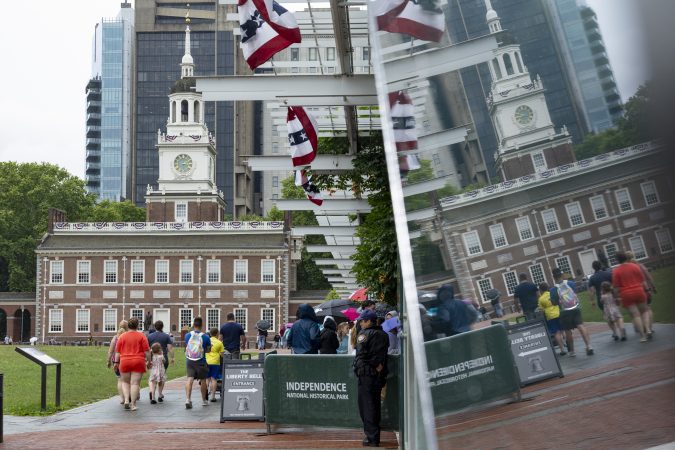
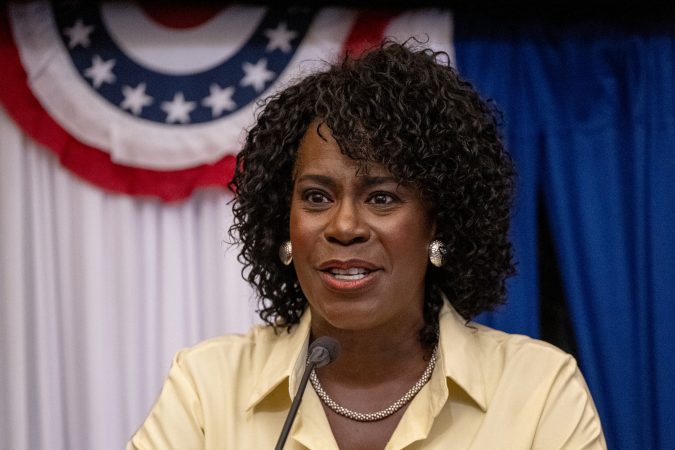
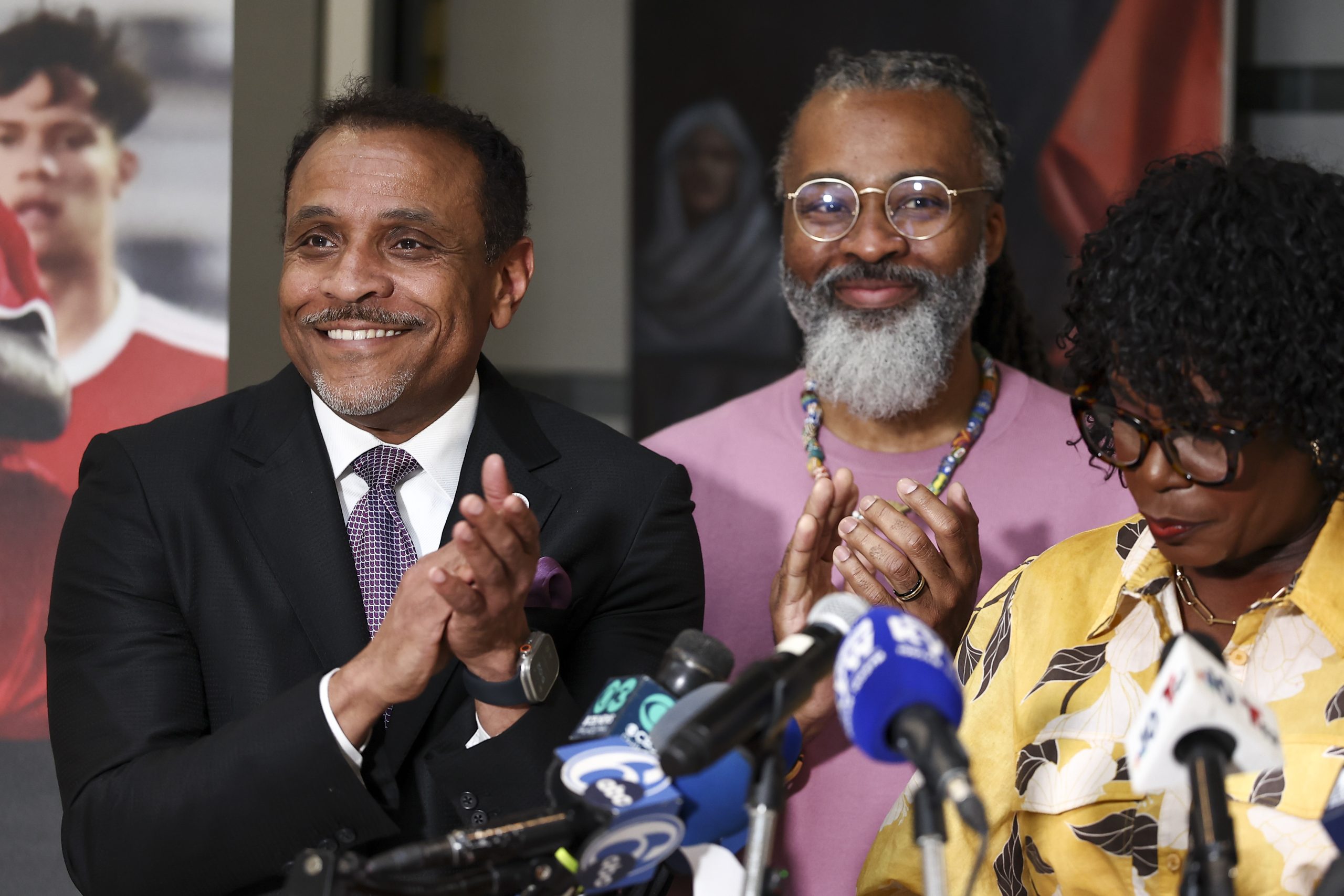
Two hundred and fifty years after the Declaration of Independence was signed in Philadelphia, nearly 50% of Philadelphians said the most important “new revolution” the city needs to lead is “closing the educational and economic wealth gap,” according to a new CityView poll by Suffolk University and The Inquirer.
The poll of 500 Philadelphians living in all 66 city wards was conducted between June 16 and June 20. The margin of error was 4.4 percentage points.
A majority of those who supported eliminating barriers to education and economic opportunity — 57% — were women, while respondents aged 18 to 24 supported the educational/wealth “new revolution” at the same percentage.
Mai Miksic, executive director of the nonprofit advocacy group Children First in Spring Garden, said she “loved” to see poll results like these, but was not surprised by them.
“From speaking with parents, I know that moms are incredibly aware of the gap between how kids are educated here and future prosperity,” she said. “Mobility and economic security really resonate with them.” As for young people, she said, “it’s important because this is directly about their lives.”
The poll’s other findings showed that 17% of Philadelphians felt that it was more important to support “revolutionizing community-led public safety”; 14% were behind making the city “the top hub for technology and medical innovation”; and 12% wanted to fight for “clean energy and green urban spaces.”
It makes sense that poll respondents linked education to increased prosperity. Philadelphia residents with a bachelor’s degree had an average annual income of $64,205 — more than twice the income of residents with less than a high school diploma, who earned about $29,000, according to estimates from the Census’s 2023 American Community Survey.
High school graduates in Philadelphia make an average salary of about $44,077, more than 30% less than a college graduate, according to Zip Recruiter.
Healthcare a right?
In another poll question connected to the theme of America’s creation, city residents were asked, “If the Framers of the U.S. Constitution rewrote the document in Philadelphia today, what right should be added first?”
Nearly 38% of respondents named “the right to affordable, high-quality healthcare,” as their first pick followed by ”secure, affordable housing for all” (24%); then — echoing the “new revolution” poll answer about schooling and wealth — “equitable, fully funded public education” (15%); and finally, “a safe, healthy environment and clean air” (nearly 13%).
Ann Marie Healy, executive director of Philadelphia Health Partnership, believes healthcare is very much a right. The foundation, located in Center City, is committed to improving the health and well-being of people in Philadelphia.
“Everyone, whether you’re a citizen or not, should have a right and opportunity to access quality healthcare in a manner aligned with their beliefs,” Healy said.
This is change “that could take generations,” Healy acknowledged. It will require a combination of harnessing new technologies and finding alternate, untraditional ways of administering healthcare, such as relying more on nurse practitioners and tools such as telehealth.
(function(){function e(){window.addEventListener(`message`,function(e){if(e.data[`datawrapper-height`]!==void 0){var t=document.querySelectorAll(`iframe`);for(var n in e.data[`datawrapper-height`])for(var r=0,i;i=t[r];r++)if(i.contentWindow===e.source){var a=e.data[`datawrapper-height`][n]+`px`;i.style.height=a}}})}e()})();
Espousing the opposite view, Kevin Flynn, president of HealthCare Advocates Inc., a patient advocacy organization in Center City, had a succinct rebuttal.
“Health care is a privilege, not a right for most people,” he said.
“One has to work at a job to be able to obtain healthcare,” Flynn said. Beyond Medicaid and Medicare, it isn’t something “that’s bestowed,” he added.
Even a system like Obamacare, built to help people without traditional health insurance, has become expensive and difficult to manage, Flynn said.
While it sounds like a good idea to think of the ability to see a doctor as an inalienable right, Flynn said, “healthcare isn’t a life, liberty, and the pursuit of happiness sort of thing.”
Whether healthcare is seen as a right or a privilege, says the nonpartisan Builders Movement, a nonprofit dedicated to finding common ground on knotty issues,there’s one clear takeaway: Healthcare isn’teasy to navigate, and so in the end, “what people really want is a system that works.”
An overwhelming majority of Philadelphians feel safe in their neighborhoods and more than 40% believe that the city has become cleaner under the leadership of Mayor Cherelle L. Parker, according to a new poll, suggesting that city residents see significant progress on the mayor’s key campaign promises.
However, there is not a broad citywide consensus on Parker’s tenure as she heads into an expected reelection campaign next year, and there were also red flags for her and the city, including alarmingly bad evaluations of the public school system.
That is according to a recent Suffolk University/Philadelphia Inquirer poll that surveyed 500 Philadelphians across the city on issues including crime, quality of life, city services, and education. More than half of those surveyed said they would rate Philly as a “good” or “excellent” place to live.
About 83% of residents reported feeling safe in the city just five years after record-high rates of gun violence in Philadelphia, with respondents in neighborhoods most affected by violent crime most likely to say they feel that crime has decreased since Parker took office in 2024.
And the city’s public school system emerged as a primary concern, with 45% saying they would rate Philadelphia’s schools as of “poor” quality, while more than half of the poll’s respondents said that schools play an important role in whether they stay in the city or move out.
The survey was conducted last week, after the financially struggling Philadelphia School District and its controversial school closure plan dominated local headlines for more than a month.
David Paleologos, director of the Suffolk University Political Research Center in Boston, said the poll provides Philadelphia policymakers with a blueprint for how to keep people in the city: continue progress on crime and improve the public schools.
“If that happens,” he said, “then Philadelphia is poised to be a renaissance city.”
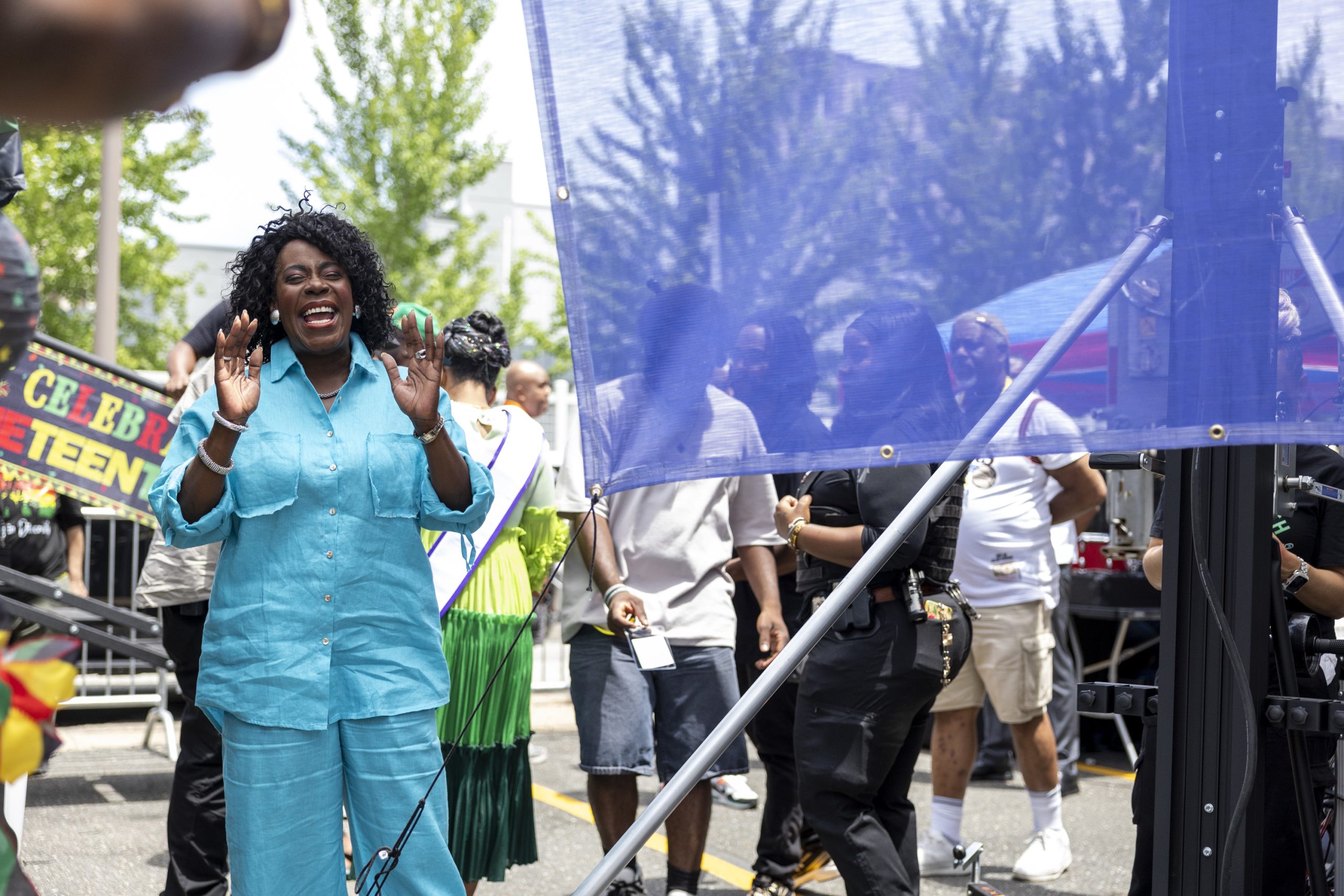
Mayor Cherelle L. Parker attending the Juneteenth Block Party at the African American Museum in Philadelphia on June 19.Tyger Williams / Staff Photographer
Parker said in a statement that her administration “values both qualitative and quantitative information.”
“The real-life, lived experiences of people in this city are what matters most,” she said. “Polling is not my North Star in how I govern. My solutions always come from the ground up, from what people can see, touch, and feel.”
For Parker’s political fortunes, the poll represents mixed results. It showed that the substantial base of support that lifted the mayor to office in 2023 is holding up, with Black residents and older Philadelphians most likely to say they have a favorable view of her and see progress on her campaign promises.
But Parker has not consolidated broad citywide enthusiasm, with 44% of respondents saying that they have a favorable view of the mayor and 35% saying they have an unfavorable one. That is positive territory for Parker more than halfway through her first term, but not overwhelmingly so.
Her biggest vulnerability is with young people — respondents under age 45 were more likely to say that they had an unfavorable view of the mayor than a favorable one. White residents were also more sour on Parker.
(function(){function e(){window.addEventListener(`message`,function(e){if(e.data[`datawrapper-height`]!==void 0){var t=document.querySelectorAll(`iframe`);for(var n in e.data[`datawrapper-height`])for(var r=0,i;i=t[r];r++)if(i.contentWindow===e.source){var a=e.data[`datawrapper-height`][n]+`px`;i.style.height=a}}})}e()})();
Paleologos said that the poll shows there are “pockets of strength” that make Parker, a centrist Democrat, electorally strong, but that he would not consider her support broad-based.
Those results come as the city’s most prominent progressive political groups are weighing whether to mount a challenge against Parker next year. As the incumbent, Parker would be the hands-down favorite in any contest, as no Philadelphia mayor has lost a campaign for reelection in modern history.
Aren Platt, the executive director of People for Parker, the mayor’s political arm, said in a statement that Parker’s support “has always been under-counted, especially in public polling.” He cited polling conducted during the 2023 mayor’s race that showed her tied with or trailing her top opponents in the Democratic primary, in which Parker prevailed by a commanding 10 percentage points.
Platt also said the Suffolk University/Inquirer poll is not necessarily predictive of how the mayor could perform in a theoretical reelection race. The poll was of Philadelphia residents, not likely primary voters.
“This poll may reflect the demographics of Philadelphia, but elections are decided by the people who show up to vote on election day,” he said. “In Philadelphia, those are two very different universes.”
The poll also showed relatively positive marks for one of Parker’s potential successors: City Council President Kenyatta Johnson. He has said that he supports Parker for reelection, but Philadelphia mayors are limited to two terms and Johnson is widely seen as a potential future contender for the city’s top office.
Overall, 48% of respondents said they had a favorable view of Johnson and only 12% had an unfavorable one. Johnson is also far less publicly known than Parker, with 40% of those surveyed saying they had either never heard of him or were undecided on their view of him.
Negative reviews of the Philadelphia School District
About one in five respondents said that schools and education are the most important issue in the city, making it second only to crime. Paleologos said that is somewhat unique to Philadelphia — in other major cities where he has polled public opinion, he said, respondents often rank jobs and the economy as greater concerns.
(function(){function e(){window.addEventListener(`message`,function(e){if(e.data[`datawrapper-height`]!==void 0){var t=document.querySelectorAll(`iframe`);for(var n in e.data[`datawrapper-height`])for(var r=0,i;i=t[r];r++)if(i.contentWindow===e.source){var a=e.data[`datawrapper-height`][n]+`px`;i.style.height=a}}})}e()})();
Nearly 75% of respondents said they would rate the quality of Philadelphia’s public schools as “fair” or “poor.” Younger residents were far more likely than older ones to rate the schools as “poor,” and more than half of all respondents said the public schools are an important factor in determining whether they and their family stay in the city or move away.
“That’s a big number,” Paleologos said. “That research alone gives the policymakers a bird’s-eye view of what they need to do to keep people here in Philadelphia.”
The survey also shows that residents see issues across the school system. When asked what should be the highest priority in improving the schools, there was little consensus among respondents: About a third said teacher pay, while a quarter said school safety, and another quarter said building repairs.
Just 4.4% said the highest priority should be instituting year-round school, an initiative that Parker campaigned on and that the district is piloting.
Superintendent Tony B. Watlington Sr., School Board President Reginald L. Streater, and Mayor Cherelle L. Parker stand together during an announcement at the School District of Philadelphia Headquarters on June 10.Monica Herndon / Staff Photographer
In a statement provided to The Inquirer after the initial publication of this story, Monique Braxton, a spokesperson for the School District of Philadelphia, said district leaders share “the public’s sense of urgency to significantly improve public schools in the City of Philadelphia.”
She said the district is making progress toward the superintendent’s goal of making the district the “fastest improving large urban district in the nation.”
Braxton added that the district’s own survey suggests most parents are satisfied. The district’s 2024-25 survey, Braxton said, found that 90.3% of more than 26,000 parents whose students attend district schools said they were pleased with the quality of education their child received.
The quality of Philadelphia’s public schools has been a perennial concern, and city leaders have long pointed to the chronic underfunding of the Philadelphia School District. In 2023, the state Commonwealth Court ruled that Pennsylvania had for years unconstitutionally deprived students in low-wealth districts of an adequate education, and state lawmakers are now funding schools under a new formula.
District leaders have undertaken significant efforts in recent years to improve academic performance. There have been some positive results, including improvement on test scores and a recent report that said Philadelphia School District students’ learning post-pandemic was tops in the nation among large urban districts.
The district also earlier this year adopted a sweeping, $3.3 billion effort to renovate and modernize 169 schools. That multiyear plan was hotly debated, as it included the closure of 17 schools.
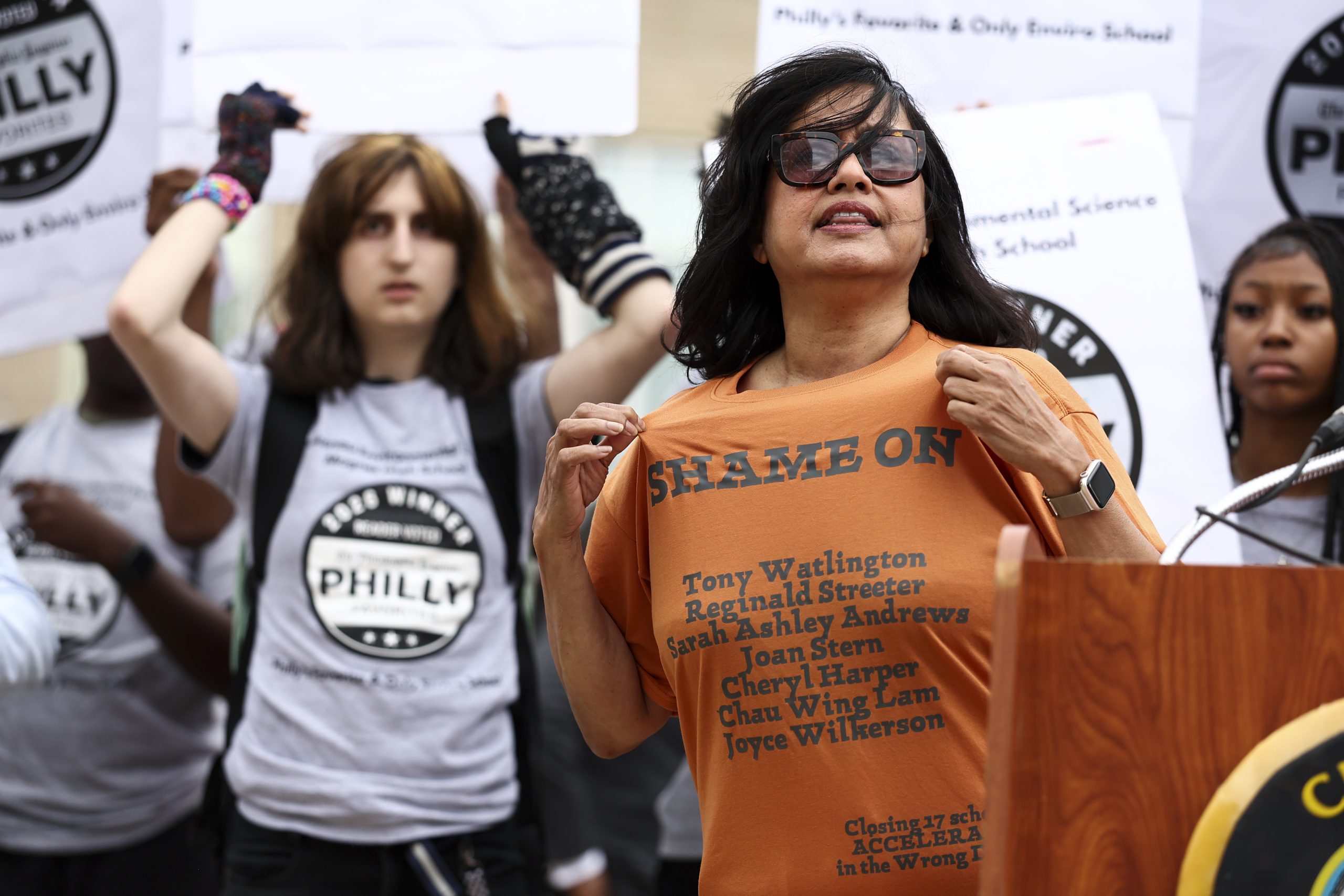
Councilmember Nina Ahmad shows off her T-shirt during a rally outside of the School District of the Philadelphia School District headquarters building on May 28. Council members rallied to oppose the school closure plan.Monica Herndon / Staff Photographer
Parker said the Commonwealth Court “got it right” in declaring that low-wealth districts like Philadelphia’s are chronically underfunded.
“If we had all the resources we need, we’d see even more enhanced improvements in our schools,” Parker said. “I’ll never stop fighting for our children and their right to a high-quality education.”
Crime is the top concern, but most residents feel safe
Despite rates of violent crime in the city plummeting to record lows under Parker, public safety remains the top concern for three in 10 Philadelphia residents, suggesting that people who live in the city are still anxious about crime.
When asked about whether they believe crime in their neighborhood has increased or decreased over the last two years, a third of respondents said they believe it has increased, about 32% said it has decreased, and 28% said they believe it has stayed the same.
(function(){function e(){window.addEventListener(`message`,function(e){if(e.data[`datawrapper-height`]!==void 0){var t=document.querySelectorAll(`iframe`);for(var n in e.data[`datawrapper-height`])for(var r=0,i;i=t[r];r++)if(i.contentWindow===e.source){var a=e.data[`datawrapper-height`][n]+`px`;i.style.height=a}}})}e()})();
(function(){function e(){window.addEventListener(`message`,function(e){if(e.data[`datawrapper-height`]!==void 0){var t=document.querySelectorAll(`iframe`);for(var n in e.data[`datawrapper-height`])for(var r=0,i;i=t[r];r++)if(i.contentWindow===e.source){var a=e.data[`datawrapper-height`][n]+`px`;i.style.height=a}}})}e()})();
A closer look at the results shows that a plurality of respondents in the neighborhoods most affected by violent crime, including North and West Philadelphia, believe that crime has decreased.
The respondents most likely to say that they believe crime in their area has increased live in Northeast Philly. But public data maintained by the Philadelphia District Attorney’s Office show overall crime has decreased there, too. There are five Northeast Philadelphia police districts, and the total number of crime incidents reported to police declined in all of them between 2023, the year before Parker took office, and last year.
Despite the mixed poll results, a vast majority of Philadelphians — nearly 83% — said that they feel safe in their own neighborhood.
That is good news for Parker, who ran for office as a tough-on-crime Democrat amid a historic wave of gun violence and who vowed often to “bring order back to our city.”
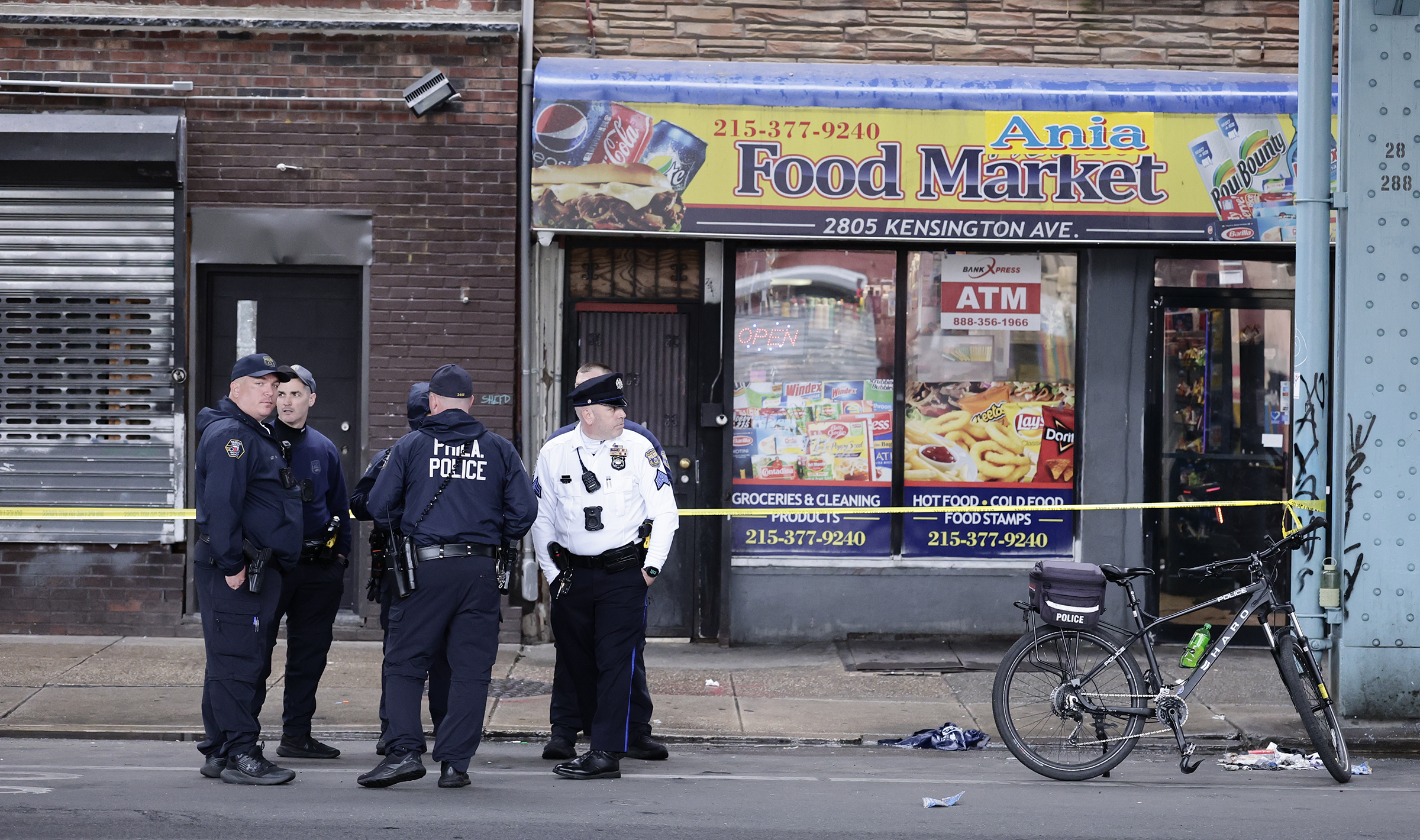
Philadelphia police officers stand along the 2800 block of Kensington Ave. after a police involved shooting on May 23. Police shot a robbery suspect.Yong Kim / Staff Photographer
Parker said in a statement that the polling results are evidence that her public safety strategy is working, calling it her “number one priority.”
She also vowed to continue her administration’s efforts in Kensington, the epicenter of the city’s opioid crisis. The Parker administration has deployed a multipronged approach, including increased police patrols in the neighborhood and an expansion of offerings for people in addiction.
But 53% of poll respondents said they do not believe the mayor’s efforts there are working, and those who live closest to the problem were the least supportive. In the region that encompasses the Lower Northeast and the river wards, where Kensington is located, 68% of people said Parker’s strategy is not working while only 18% said it is.
The mayor’s overall favorability was also lowest in that area of the city, the only region where more respondents said they had an unfavorable view of the mayor than a favorable one.
(function(){function e(){window.addEventListener(`message`,function(e){if(e.data[`datawrapper-height`]!==void 0){var t=document.querySelectorAll(`iframe`);for(var n in e.data[`datawrapper-height`])for(var r=0,i;i=t[r];r++)if(i.contentWindow===e.source){var a=e.data[`datawrapper-height`][n]+`px`;i.style.height=a}}})}e()})();
Parker acknowledged that there is “much more work to do” in Kensington and said that “changing culture and going to war with the status quo is never easy.“
Parker’s ‘clean and green’ message is landing
For a city derisively called “Filthadelphia” and where cleanliness has been a longtime concern, a significant number of people seem to think Philadelphia is getting cleaner.
When asked about trash and litter, 41% of poll respondents said they believe the city has gotten cleaner over the last two years. Just 19% said Philadelphia has gotten dirtier, and 38% said it has stayed the same.
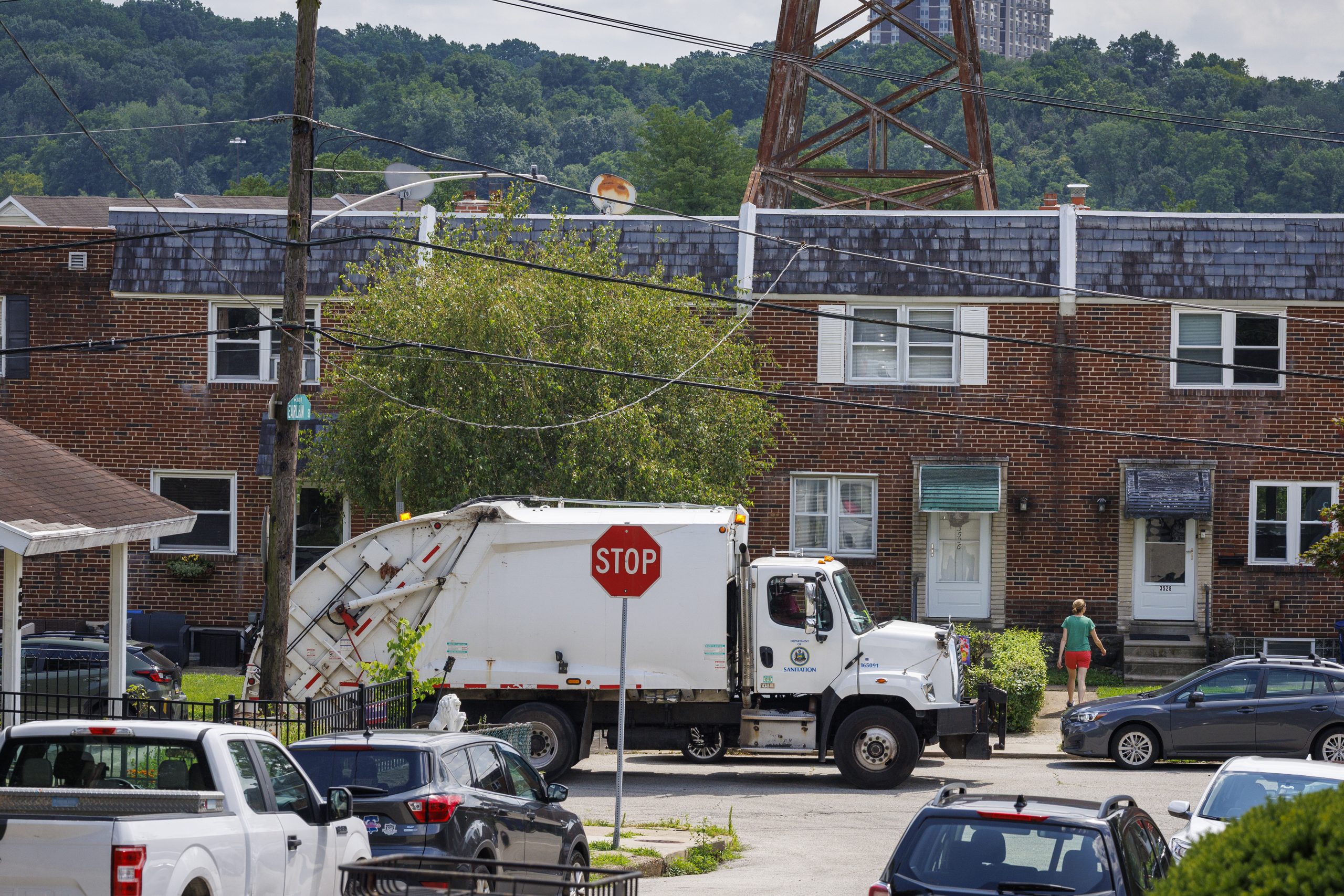
A sanitation department truck is seen along Cresson Street at West Earlham Street in Philadelphia on the first day of trash collection after a strike on July 14, 2025.Alejandro A. Alvarez / Staff Photographer
Those are positive marks for a mayor whose slogan is “safer, cleaner, greener” and who has instituted new programs including twice-weekly trash pickup in the densest parts of the city.
Despite those efforts, Philadelphians gave worse reviews to the overall quality of city services in their neighborhood. About six in 10 respondents said the quality was either “fair” or “poor,” while 40% said “good” or “excellent.”
Staff writer Michelle Baruchman contributed to this article.
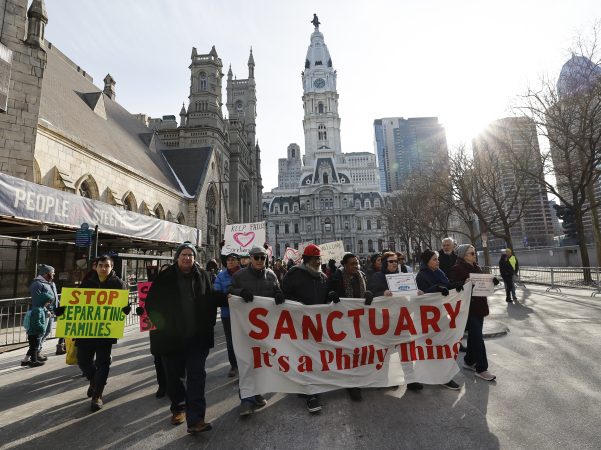
A significant majority of residents want Philadelphia to remain a sanctuary for immigrants, according to a new poll that shows the overwhelmingly Democratic city is undeterred by President Donald Trump’s threats to defund so-called sanctuary cities.
A recent Suffolk University/Philadelphia Inquirer poll that surveyed 500 city residents asked respondents if Philadelphia should remain a sanctuary city, “even if it means losing federal funding.” A commanding 59% answered “yes,” with only 28% saying “no” and the remainder undecided or unwilling to say.
The support for Philadelphia’s sanctuary status was consistent across age and racial groups. The only geographic region where a plurality of respondents answered “no” was far Northeast Philadelphia, which is among the most politically conservative areas of the city.
The survey question did not elaborate on what a loss of federal funding could mean for the city in terms of the impact on residents. Philadelphia received $2.2 billion from the federal government in fiscal year 2024 to pay for a wide range of critical services, including infrastructure needs, as well as healthcare, food, and housing assistance for low-income people.
(function(){function e(){window.addEventListener(`message`,function(e){if(e.data[`datawrapper-height`]!==void 0){var t=document.querySelectorAll(`iframe`);for(var n in e.data[`datawrapper-height`])for(var r=0,i;i=t[r];r++)if(i.contentWindow===e.source){var a=e.data[`datawrapper-height`][n]+`px`;i.style.height=a}}})}e()})();
Still, the results of the poll show relatively widespread support in Philadelphia for the city’s sanctuary policies, which include its practice of not complying with detainers issued by U.S. Immigration and Customs Enforcement without a court order. Those detainers are effectively requests submitted by federal agents to local law enforcement agencies that ask to hold undocumented immigrants in custody.
Mayor Cherelle L. Parker’s administration does not refer to Philadelphia as a “sanctuary city” — she and her top aides instead call it a “welcoming city,” language that has been increasingly adopted nationwide as Trump and his allies in the Republican Party have sought to crack down on sanctuary cities.
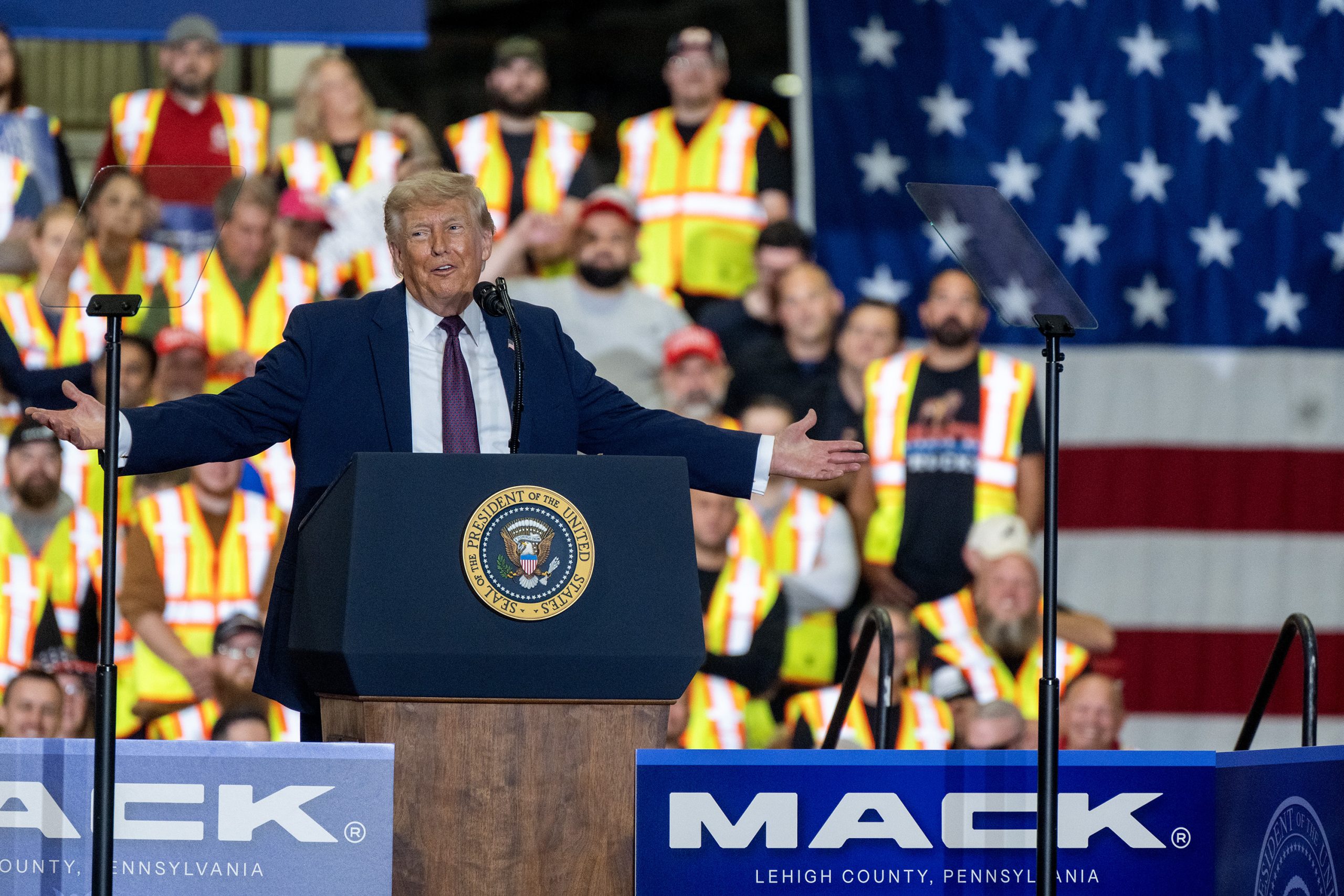
President Donald Trump travels to the Lehigh Valley to visit Mack Trucks in Macungie on Tuesday, June 23, 2026.Tom Gralish / Staff Photographer
The sanctuary policies predate Parker’s tenure and were in place under an executive order signed by former Mayor Jim Kenney. They were codified into law earlier this year after City Council passed a package of legislation aimed at limiting ICE’s operations in the city and instituting some of the nation’s toughest restrictions on ICE.
In May, Parker signed six of the seven bills in the package, but took no action on one that bars law enforcement officers from concealing their identities, including by wearing masks. City Solicitor Renee Garcia wrote in a letter to Parker that the legislation may not be legally enforceable, but the mayor did not veto the bill, allowing it to become law.
Last week, the Trump administration sued Philadelphia and some of its top officials, including Parker, over the mask-ban ordinance. The Trump administration contended that the law is “blatantly unconstitutional” and undermines federal law enforcement’s ability to do its job.
The lawsuit is one of several filed across the nation by the Trump administration challenging local laws related to immigration as federal authorities carry out the massive deportation campaign promised by the president.
That effort is also tied up in litigation. Last year, a federal judge issued an injunction blocking the Trump administration from denying funding to jurisdictions that limit cooperation with ICE, saying the White House could not impose funding conditions without authorization from Congress.
Staff writer Sean Collins Walsh contributed to this article.
But that may not jibe with what many Philadelphians want to see.
A new Suffolk University/Philadelphia Inquirer CityView poll of 500 city residents found that a quarter of respondents believe the city’s primary responsibility to the nation is to protect its historical sites for future generations. Nearly 27% said the city’s primary responsibility to the nation is to serve as a model for “diverse, multicultural urban progress.”
The poll, conducted from June 16 to 20 and released this week, comes after a ruling by the U.S. Court of Appeals for the Third Circuit in favor of the Trump administration and just weeks ahead of celebrations in Philadelphia for the nation’s 250th birthday.
(function(){function e(){window.addEventListener(`message`,function(e){if(e.data[`datawrapper-height`]!==void 0){var t=document.querySelectorAll(`iframe`);for(var n in e.data[`datawrapper-height`])for(var r=0,i;i=t[r];r++)if(i.contentWindow===e.source){var a=e.data[`datawrapper-height`][n]+`px`;i.style.height=a}}})}e()})();
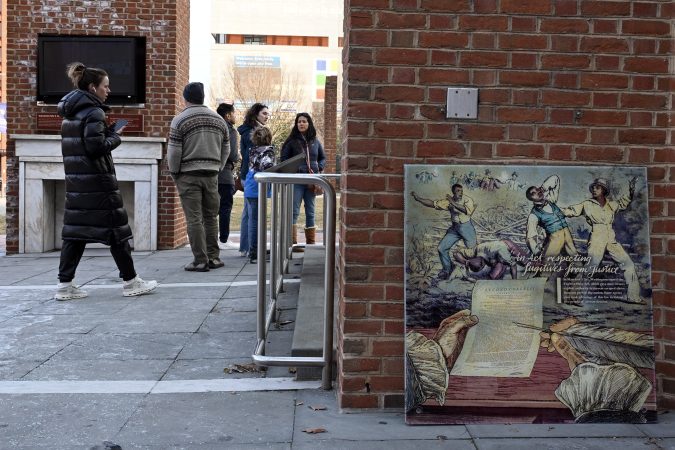
The appeals court’s ruling last week was a turning point in a legal battle waged by Mayor Cherelle L. Parker’s administration that questioned the federal government’s authority to interfere in what information is presented at the President’s House. Both the Third Circuit ruling and a recent decision by a Boston-based federal appeals court regarding National Park Service exhibits nationwide have started to pave the way for the Trump administration to make unprecedented changes to displays of U.S. history in the region.
Alacia Maxton, 36, a respondent to the poll, said frustration with the attacks on the President’s House has been at the forefront of her mind as the city prepares to celebrate the Semiquincentennial.
For nearly two decades without opposition, the site — which opened in December 2010 — has memorialized the nine people George Washington enslaved at his Philadelphia residence during the founding of America and detailed the brutality of slavery.
Last month, it was designated as an endangered historic site by a major national historic preservation organization. The new panels proposed by the Trump administration to replace the removed exhibits at the President’s House soften Washington’s role as an enslaver, according to those working to protect the site.
“I don’t like the idea that certain groups of people want to whitewash history and erase what doesn’t make them feel comfortable,” said Maxton, who lives in Overbrook Park.
Carolyn Keys, 61, another resident who responded to the poll, said the absence of the some of theoriginal panels is like “missing pieces to a puzzle.”
“Every piece was specifically put together for a purpose,” said Keys, 61, a veteran who lives in the Tacony neighborhood.
David Paleologos, director of the Suffolk University Political Research Center, said Philadelphians valuing preserving history and being a model for progress is a particularly localized issue.
“Which I think makes this really important information for the nation to see,” Paleologos said.
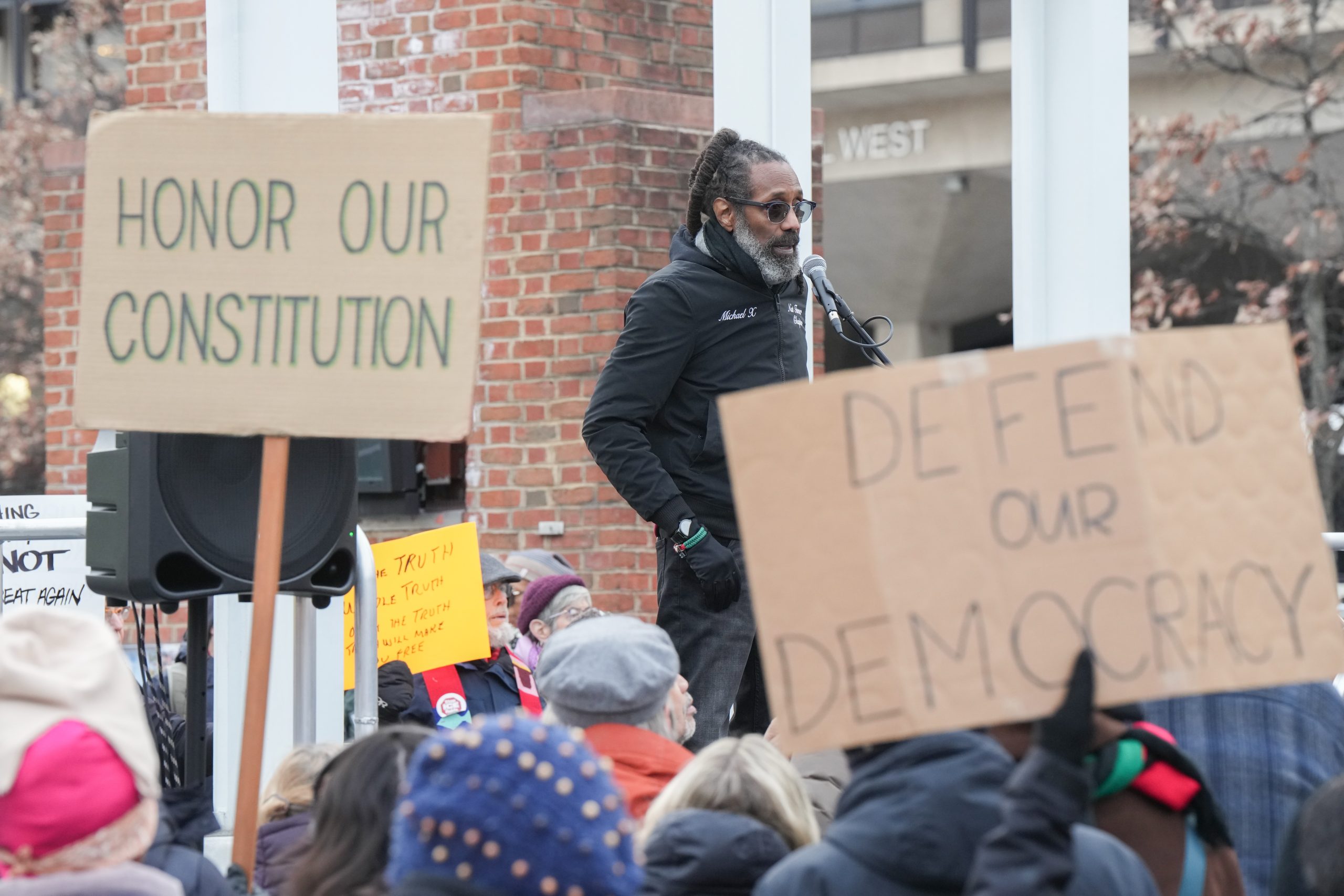
Philadelphia Lawyer Michael Coard speaks at a rally at the President’s House Site in response to the removal of the President’s House exhibit in Old City, in Philadelphia, Tuesday, Feb. 10, 2026, in Philadelphia Jessica Griffin / Staff Photographer
A bipartisan grassroots group of Philadelphians — called the President’s House/Slavery Memorial Coalition — has been spearheading efforts to protect the historical site, which has been under scrutiny from the Trump administration since last summer.
Michael Coard, an attorney and founder of one of the leading groups in the efforts to protect the President’s House, said in a statement Wednesday that the poll results show that “Philadelphians understand the importance of protecting our shared history.”
“Black history is American history, and we have both an obligation and, based on these results, a clear mandate to ensure that the stories of enslaved Africans and their descendants are preserved, honored, and accurately told,” Coard said.
Other respondents had different ideas for Philadelphia’s primary responsibility as the birthplace of democracy: Roughly 23% said “leading national conversations on civil rights and economic justice” was a top priority, while almost 17% said the city’s duty to the nation is “proving that a large, complex city can govern itself equitably.”
These insights come as Philadelphia is bracing for an influx of tourists, with particular emphasis on its history as the nation’s birthplace, ahead of the Semiquincentennial celebrations.
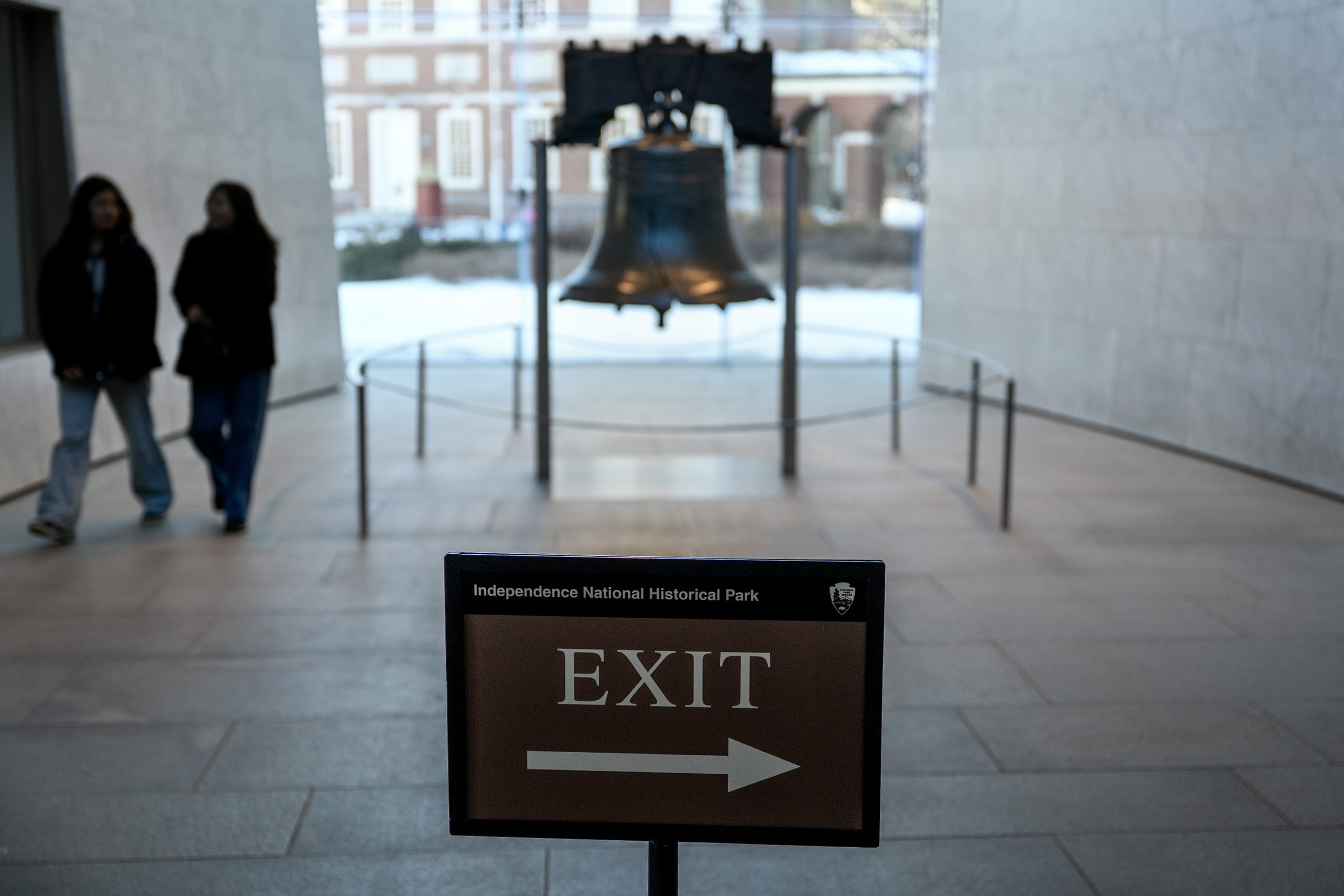
The Liberty Bell in Independence National Historical Park Feb. 2, 2026.Tom Gralish / Staff Photographer
Almost 28% of the Philadelphia residents polled see the Liberty Bell — in comparison to Independence Hall, the National Constitution Center, and the Rocky Steps — as the city landmark that best embodies American democracy.
But hanging over the impending 250th celebrations is the uncertain fate of the President’s House, said Leeanna Lundy, 34, of West Philly.
“For them to remove where the most impactful part of where history took place, it’s like mind-boggling,” Lundy said.
Staff writer Michelle Baruchman contributed to this article.
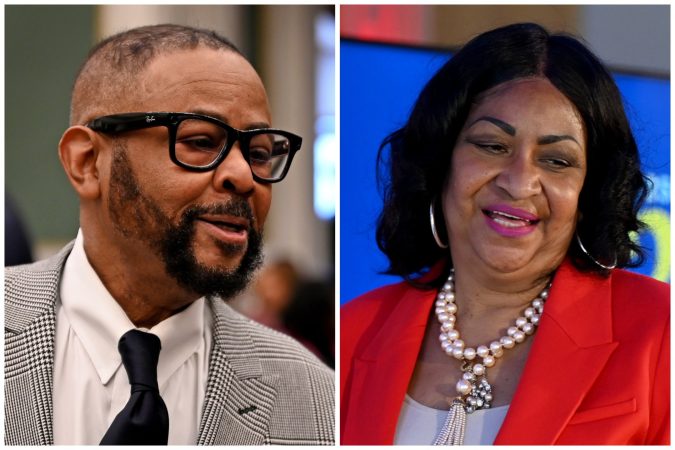
Councilmember Curtis Jones Jr. and City Representative Jazelle Jones, who are married, are poised to collect up to $752,000 in combined payouts from Philadelphia’s widely criticized Deferred Retirement Option Plan, an early retirement incentive that two decades ago sparked a major scandal in City Hall.
But neither of the city officials is actually retiring.
DROP is available to all city workers. But both of the Joneses are using the program in a way that is not available to a vast majority of municipal employees:temporarily retiring and immediately returning to their jobs, allowing them to receive their DROP payouts before the end of their city government careers.
Curtis Jones, 68, who has represented the 4th District for 18 years, is able to access that perk because he is a long-serving lawmaker. Jazelle Jones, 70, a high-ranking appointee of Mayor Cherelle L. Parker, received an exception from the mayor to be rehired after her DROP retirement.
Following her one-day retirement, Jazelle Jones also received a $97,000 payout for unused sick and vacation time, a benefit normally reserved for employees permanently departing from city government.
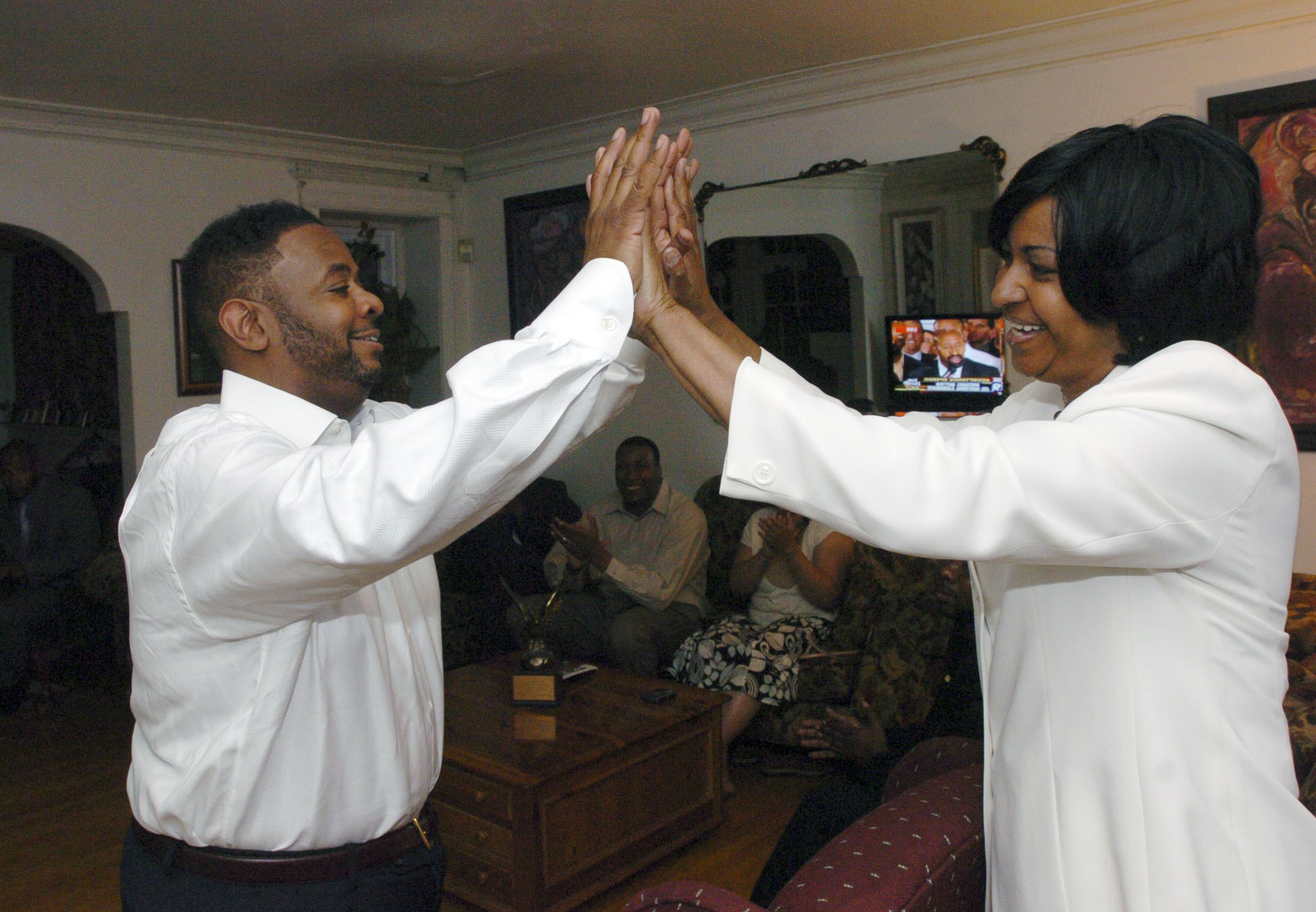
FILE – Curtis Jones, Jr. declares victory with his wife Jazelle and his family in the Council race in his home in West Philadelphia on Tuesday, May 15, 2007.Gina Gayle / Staff Photographer
Lauren Cristella, president of the government watchdog group Committee of Seventy, said the administration’s handling of the situation further undermines public confidence in the DROP program.
“Rehiring an employee to the same position the day after she collects a DROP payout defeats the purpose of the program,” Cristella said. “DROP exists to manage workforce transitions, not to serve as a bonus for employees with no intention of actually leaving.”
Established in the late 1990s during Mayor Ed Rendell’s administration, DROP was originally pitched as a cost-neutral way to give the city predictability over retirements and entice high-earning employees to step down early.
But the program ended up costing the city far more than expected, andvoter frustration withelected officials’ enrollment in DROP was credited with ending the political careers of several Council members.
At the height of that controversy in 2010, Curtis Jones voted to enact a law banning future elected officials from accessing DROP. But he and others already serving at that time were “grandfathered” in, Curtis Jones said.
He would be eligible to collect a $432,000 lump-sum DROP payment in August 2028. However, Curtis Jones said he plans to run for a sixth Council term in 2027, using the loophole to briefly retire to collect the payout before resuming his post.
In interviews, the Council member, who earns $165,000 annually, said he instead plans to retire in December 2027, collecting a reduced DROP payment closer to $350,000. If he is reelected, the maneuver would allow him to hang on to his Council seat for another four years by being sworn back into office the following month.
He justified his enrollment in DROP by saying that times have changed since the 2010 vote — both for the city’s finances, which have dramatically improved, and for his health. He said he is suffering from glaucoma, an incurable disease that causes vision loss.
“Over the years, I’ve had four surgeries on my eyes,” said Curtis Jones, who represents the Northwest and West Philadelphia-based Council district. “I’ve actually lost 40% of my vision.”
Curtis Jones said he enrolled in DROP “so that if I was blind, I wouldn’t have been without resources.”
A centrist Democrat, he endorsed Parker’s 2023 campaign for mayor and is viewed as her most reliable ally on Council.
His wife, Jazelle Jones — who receives a $199,000 annual salary for serving as an ambassador for the city and planning special events — temporarily retiredfor one day last year and was then immediately rehired by the city with a $4,000 raise.
The Philadelphia Administrative Board, which oversees personnel matters, granted her an exception to return to her job. That board is led byParker, a staunch defender of DROP, and other top officials in her administration.
The mayor said she personally asked Jazelle Jones to return to work, and defended the decision.
Parker cited Jazelle Jones’ “lived experience” and the potential disruption her departure could cause for major events this year, like the city hosting World Cup games.
“The essential nature of her role is why I asked” Jazelle Jones to continue working, Parker said Tuesday in a phone interview. “And I’m unapologetic about asking. It’s one of the most important decisions I’ve made as mayor.”
Jazelle Jones was originally scheduled to retire in September 2024. Instead, in a departure from typical DROP procedures, she continued to work as the city representative through that date and took her one-day retirement a year later, in September 2025.
None of those changes appear to have been approved at the time they occurred by the city’s administrative board. It was not until March 2026 when the board retroactively approved exceptions allowing Jazelle Jones to receive an extra year of DROP — resulting in the 2025 retirement date — and her rehiring, according to board minutes.
Parker declared an emergency in order to approve the extra year of DROP for Jazelle Jones, the mayor’s office said. The move effectively increased her retirement payout by almost 20%, to nearly $320,000.
Parker’s office did not respond to questions about the deviation in the approval timeline.
Jazelle Jones did not respond to a request for comment through the mayor’s office.
‘Tools in the toolbox’
When city employees enroll in DROP, they select a mandatory retirement date no more than four years in the future. Between the time they sign up for the program and their selected retirement date, the city pays their regular salaries and makes pension payments as if they had already retired.
The deferred pension payments are deposited into an interest-bearing account that each city worker collects in a lump-sum payout four years after enrolling. The departing employee then begins to receive standard monthly pension checks, which are calculated based on when they entered DROP.
City workers make contributions from their salaries to the municipal pension fund. But their contributions do not cover all of the pension fund’s liabilities, let alonethe added costs associated with DROP, which ultimately come out of taxpayer coffers.
Philadelphia’s original DROP law created a loophole in which elected officials, who generally serve four-year terms, can enter into the program, retire a day before their terms end, and rejoin the city workforce when they are sworn in again the following day.
The revelation that many members of Council had enrolled in DROP rocked City Hall in the early 2000s. The scandal was credited for several members’ decisions to not run for new terms in 2011 and was widely seen as the reason former Councilmember Frank Rizzo Jr. lost reelection that year.
A 2017 city controller report found that, cumulatively, the program had cost the city in excess of $277 million despite initially being projected as budget-neutral.
While DROP programs were once common in cities across the country, the Government Finance Officers Association — a national organization that Philadelphia officials regularly cite for best practices when shaping the city budget — in 2020 warned they led to unpredictable costs and detrimental impacts on municipal pension funds.
“Government defined benefit plans should not include deferred retirement option programs for a variety of reasons,” the GFOA said a statement.
Parker, however, has defended the program as a valuable recruitment and retention tool.
“Government doesn’t pay you as much as the private sector, so we offer a great benefits package,” Parker told reporters in March. “DROP, the defined-benefit pension — I’m never going to be for taking away any of the tools in the toolbox that would allow the city of Philadelphia to compete.”
‘Semi-hypocritical’
In 2008, when Council was in the early stages of considering a ban on elected officials enrolling in DROP, some wanted the prohibition to apply not just to future officeholders, but current ones as well.
Curtis Jones, a freshman legislator at the time, agreed.
“It would be semi-hypocritical if I say [end it] for only future elected officials,” he said then.
The bill that Council eventually passed did not prohibit current members from enrolling in DROP. Now, Curtis Jones is set to become the first lawmaker to benefit from the program in years.
“At the time, when I was 20/20 vision, [banning lawmakers from using DROP] was my decision. And now that I’ve had some surgeries, I’ve changed that position,” Jones said Monday. “It’s an earned benefit that I contributed to that I would like to receive.”
Cristella, of the Committee of Seventy, accused Jones of hypocrisy.
“Being grandfathered in is not the same as acting with integrity,” she said.
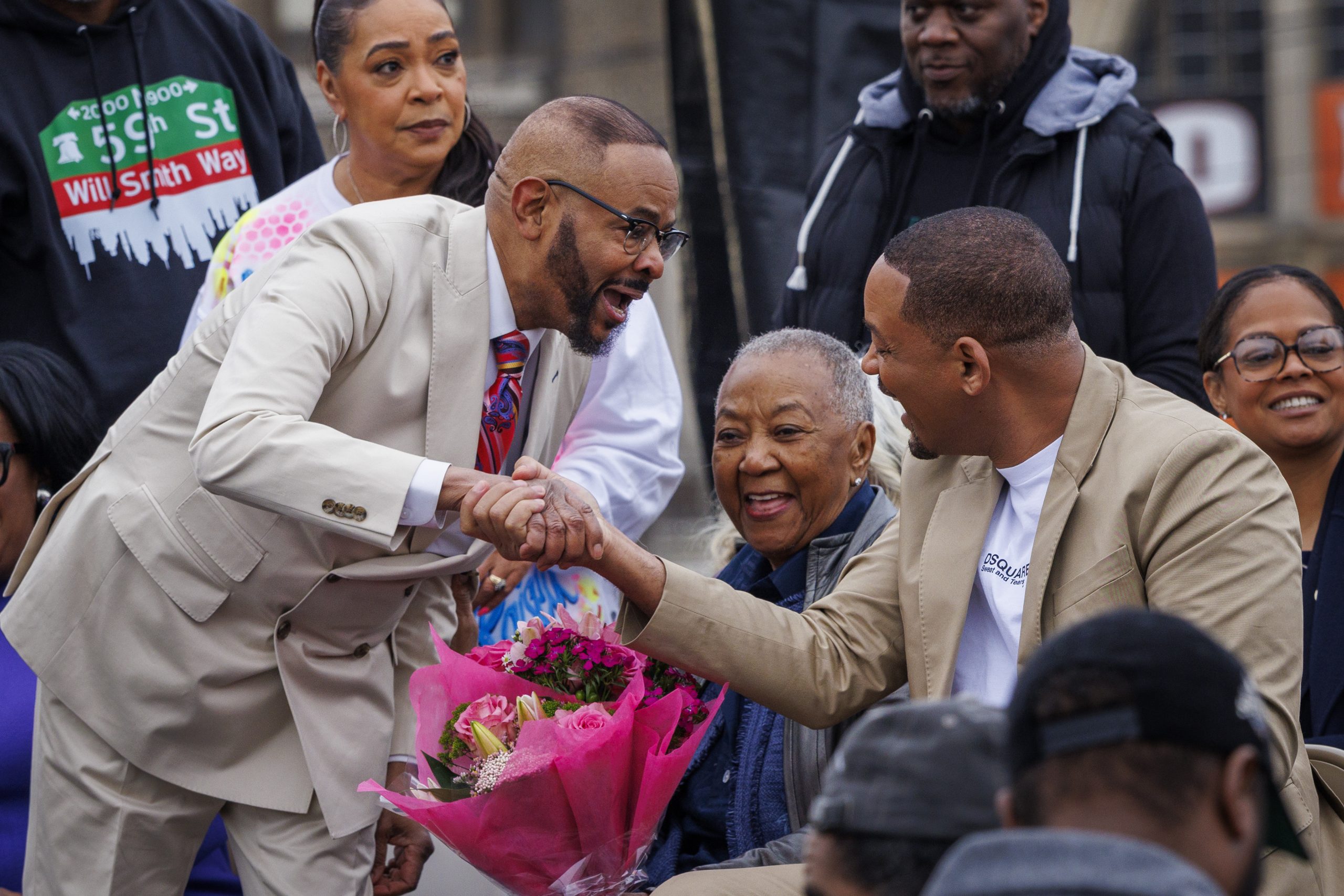
At left is Councilmember Curtis J. Jones Jr. shaking the hand of actor and rapper Will Smith who was honored with a street naming, Will Smith Way, at N. 59th and Lancaster, across from Overbrook High School, Wednesday, March 26, 2025.Alejandro A. Alvarez / Staff Photographer
Curtis Jones enrolled in DROP in August 2024, meaning he is required to retire no later than August 2028. He has made no secret of his intent to run for a sixth term next year, even publicly musing about delaying bridge repairs in his district so as not to subject potential voters to traffic jams.
Were he to win reelection and collect his maximum $432,221 DROP payout, Curtis Jones’ scheduled retirement date would fall within the first year of his next four-year term.
However, the lawmaker said in an interview that he intends to complete his next Council term. To achieve that, he said he would instead resign in December 2027, after the November election but just before he would be sworn into a new term in January 2028.
“I am going to resign, then be sworn in [if], God willing, I’m reelected,” he said.
In this scenario, Curtis Jones said, he would receive a reduced DROP payout by forgoing the final nine months of payments into his interest-bearing account by taking his brief retirement early. He would be effectively rehired to his city job by being sworn back into office.
He added that he hopes State Rep. Morgan Cephas, a West Philadelphia Democrat, will succeed him in the 4th Council District after the 2031 elections.
Cephas declined to comment.
In 2023, Curtis Jones ran for Council president, but lost to Kenyatta Johnson. He said he is now relieved he did not win.
“I am functional. My staff kind of helps to keep that good,” Jones said. ”I am thankful to God that I did not get elected [Council] president. Do you know how much reading they do? I could have not kept up with all of the numbers and stuff like that, so I know my limitations.”
‘I had heard whispers’
During Jazelle Jones’ one-day retirement in 2025, the 25-year city employee earned a $319,757 DROP payout and cashed out nearly 1,000 hours of unused sick and vacation time, worth $97,000, as all city workers are entitled to do upon their last day of service.
The very next day, she was back on the job, with a small raise that brought her salary to about $199,000.
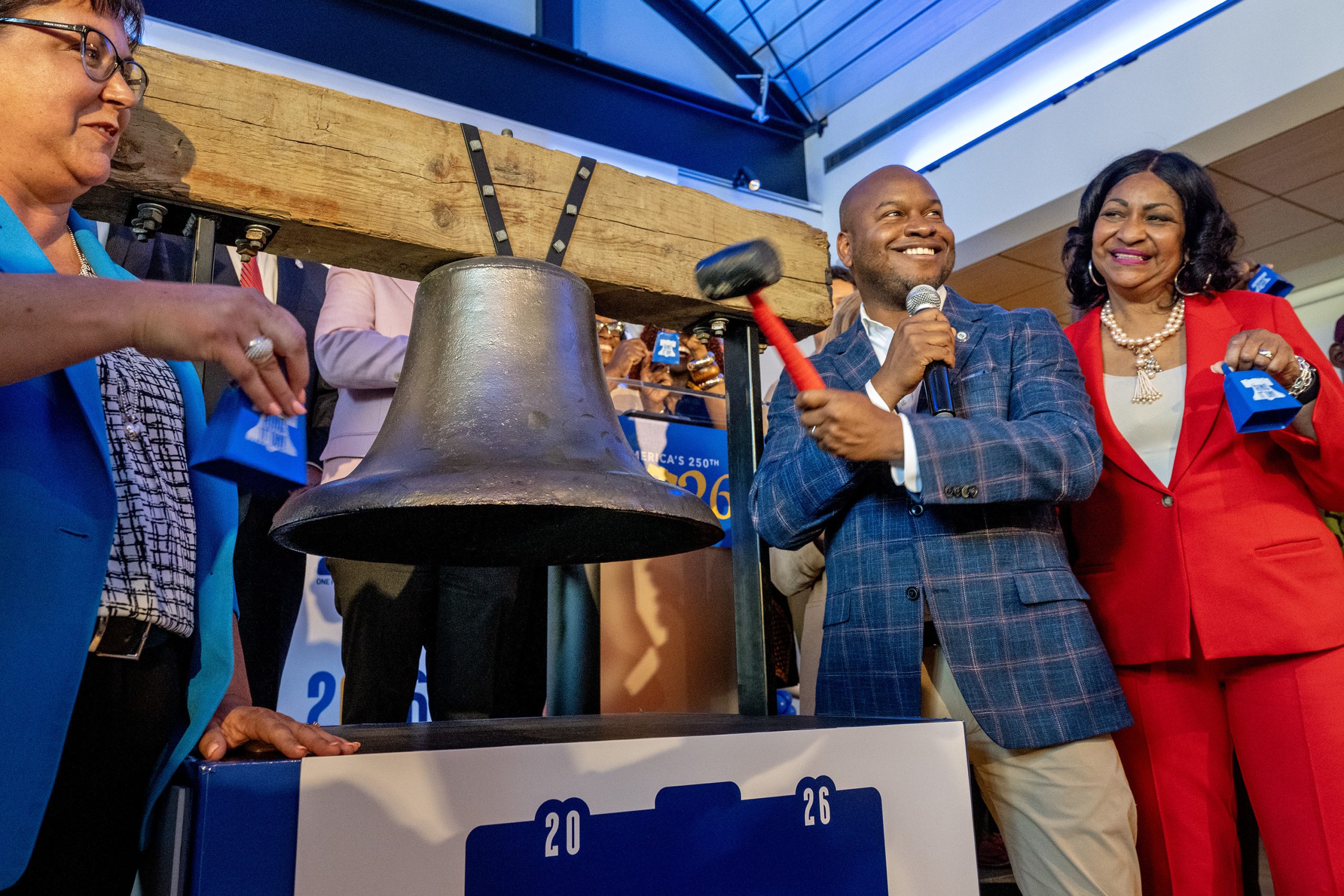
Michael Newmuis (center), the city’s 2026 Director Philadelphia, rings the bell to kick off the city’s “Ring It On! One Philly, A United Celebration” at Independence Visitor Center Wednesday, Sept. 3, 2025. Mayor Cherelle L. Parker announced the new initiative that puts city neighborhoods at the forefront of the city celebrations of America’s 250th birthday in 2026. At right is Jazelle Jones, City Representative and Director of Special Events.Tom Gralish / Staff Photographer
Despite saying Jazelle Jones was needed to coordinate the city’s 2026 festivities, Parker has also appointed a separate 2026 director, Michael Newmuis, to a $175,000 position to also oversee this year’s major events.
The mayor said Jazelle Jones was irreplaceable given her experience managing large events like the 2015 papal visit, the 2016 Democratic National Convention, the 2017 NFL Draft, and the Eagles’ Super Bowl wins.
“Could we have hired five to 10 people to try to do the job Jazelle does?” Parker asked. “We could have tried, but there would be no reason for me to do that when I had the best person.”
Parker indicated she was aware of the steep price tag required to keep Jazelle Jones working through 2026 when the mayor first appointed her as city representative shortly after taking office in 2024.
“I had heard whispers,” Parker said. “They said, ‘You’re going to lose Jazelle.’”
City personnel records show Jazelle Jones enrolled in DROP in September 2020, meaning her first planned retirement date was September 2024, just nine months after Parker appointed her to the role.
Jazelle Jones’ $97,000 payout for unused paid time off was deposited into her account this month, four days after The Inquirer contacted the mayor’s office about her rehiring. The mayor’s office did not respond to a question about the delay in her payment.
Unlike most newly hired city employees, who are entered into a hybrid 401(k)-style pension plan, she was granted an exception allowing her to continue paying into an older, more generous pension plan.
Cristella, from the Committee of Seventy, said the decision to hire Jazelle Jones into a vital role months prior to her mandatory retirement date was irresponsible.
“It is also deeply troubling that the city would retain a high-salaried senior official with full knowledge that a large DROP payout was imminent,” Cristella said. “If city leadership knew and proceeded anyway, that is a failure of fiscal stewardship that demands explanation.”
Staff writer Max Marin contributed to this article.
Gov. Josh Shapiro is by far the most popular political figure among Philadelphia residents, a boost as he looks toward November and beyond.
In a new Suffolk University/Philadelphia Inquirer CityView poll,62% of Philadelphians have a favorable opinion of Shapiro, double digits above any other political figure included in the survey.
Not only did the Democratic incumbent running for reelection win over three-quarters of his own party’s votersin the blue stronghold, he also got positive reviews from almost halfthe city’sindependents and more than one-third of Republicans.
“He has strong bona fides within his own party, 76% favorable and 11% unfavorable, but he’s also at least somewhat competitive among independents and even some Republicans, so that’s an amazing profile for a candidate who’s an incumbent these days,” said David Paleologos, the polling director at Suffolk.
Just 16% of residents have an unfavorable view of Shapiro, and only 8% have never heard of the one-term governor, who was on former Vice President Kamala Harris’ short list of potential running mates in 2024.
(function(){function e(){window.addEventListener(`message`,function(e){if(e.data[`datawrapper-height`]!==void 0){var t=document.querySelectorAll(`iframe`);for(var n in e.data[`datawrapper-height`])for(var r=0,i;i=t[r];r++)if(i.contentWindow===e.source){var a=e.data[`datawrapper-height`][n]+`px`;i.style.height=a}}})}e()})();
The poll of 500 residents in the city, which was conducted by phone from June 16 to 20, had a margin of error of 4.4 percentage points. Pollsters reached residents in all 66 wards in the city.
Shapiro clobbers his Republican opponent,Treasurer Stacy Garrity, whom just 9% of the poll’s respondentsview favorably.
That’s not unexpected in a city where Democrats outnumber Republicans 6-1. But it’s Garrity’s lack of name recognition that plays a larger role. A whopping 61% of those surveyed had never heard of Garrity, a glaring figure less than five months until the November election.
(function(){function e(){window.addEventListener(`message`,function(e){if(e.data[`datawrapper-height`]!==void 0){var t=document.querySelectorAll(`iframe`);for(var n in e.data[`datawrapper-height`])for(var r=0,i;i=t[r];r++)if(i.contentWindow===e.source){var a=e.data[`datawrapper-height`][n]+`px`;i.style.height=a}}})}e()})();
“She’s kind of a blank slate, and that works to the challenger’s advantage, but if you’re Stacy Garrity you want to start defining yourself quickly before someone else does,” Paleologos said.
Shapiro can drive up his statewide total if voters in Philadelphia, an overwhelming Democratic electorate, turn out in large numbers — though that has been less reliable in recent years.
His broad favorability could also help him stretch his bank account further. Shapiro, who hails from nearby Montgomery County, has spent the least amount of money so far in the Philadelphia television market and the most in Pittsburgh, which could show his campaign knows where he is already strong.
Fetterman is far less popular in Philly, particularly among young voters
Shapiro’s popularityin the city stands in stark contrast with the state’s other top Democrat: U.S. Sen. John Fetterman.
Less than one-quarter, 24%, of Philly residents have a favorable opinion of Fetterman, compared with 43% with an unfavorable view. The numbers are even worse within his own party, withjust 17% of Democrats holding a favorable view of the senator, who has often feuded with progressives and repeatedly crossed party lines to cast key votes in support of President Donald Trump’s nominees.
His numbers are particularly sour among voters ages 18 to 24 and 25 to 34.
(function(){function e(){window.addEventListener(`message`,function(e){if(e.data[`datawrapper-height`]!==void 0){var t=document.querySelectorAll(`iframe`);for(var n in e.data[`datawrapper-height`])for(var r=0,i;i=t[r];r++)if(i.contentWindow===e.source){var a=e.data[`datawrapper-height`][n]+`px`;i.style.height=a}}})}e()})();
A strong majority of Republican voters, 60%, view him favorably in the poll, but the Pennsylvania Democrat has repeatedly insisted he has no interest in switching parties heading into 2028, when he is likely to face a primary challenge if he runs for another term.
While slightly more Philadelphians have a favorable view of Fetterman than his GOP colleague, U.S. Sen. Dave McCormick, a greater share of Philly voters have an unfavorable view of the Democrat.
McCormick earned 17% favorable views compared with 25% unfavorable views, while the rest had not heard of the freshman senator or were undecided.
But the least popular politician in Philly was Trump, who had just 12% favorability in the city.
Ninety-two percent of Democrats view Trump unfavorably, and 31% of Philadelphia Republicans do, too. The poll also found that nearly 70% of Philly voters had grown less confident in American democracy under Trump’s presidency.
Trump made inroads in the deep-blue city in 2024, but Harris still won Philadelphia handily with 78% of the vote.
The president is a frequent target of Shapiro, who has blamed Trump’s tariffs and other policies for exacerbating the cost of living.
Taking on Trump may be boosting Shapiro’s popularity as he pursues reelection. His numbers show opportunity as he continues building a national profile, likely with ambitions for higher office. In a city where voters favor liberal and left-leaning candidates, Paleologos said, the polling results could be somewhat extrapolated to a national Democratic primary for president in 2028.
“In a Democratic primary, you really want to be strong among women, and he is,” Paleologos said. “If 60% of women are voting a Democratic primary, that really plays to his strength.”
He also ranks in the 70s for favorability among people ages 45 to 74.
“Those are people who are bill payers, they’re raising children, they’re taking care of sick parents, they’re very stretched in terms of economics. Just terrific numbers,” Paleologos said.
Shapiro’s favorability is far above that of other Democratic politicians in the city, including Mayor Cherelle L. Parker and State Rep. Chris Rabb, who won last month’s competitive primary to represent the 3rd Congressional District, which stretches from Northwest Philly to parts of South Philly.
A majority of respondents had not heard of Rabb despite his recent win. But 26% of respondents said they had a favorable view of the progressive lawmaker, compared with only 7% with an unfavorable view.
The mayor was viewed favorably by nearly 44% of respondents, compared with nearly 35% who viewed her unfavorably — a net positive rating but a much closer split than Shapiro.
“There are there are pockets of strength that make her electorally strong, but I wouldn’t call it broad-based,” Paleologos said of Parker.
Mayor Cherelle L. Parker and other top leaders of the city government and the Philadelphia School District will travel to Harrisburg on Monday for a high-stakes trip aimed at securing millions of dollars in new funding for the financially strapped public schools.
Parker will spend much of the day advocating for increased public education dollars as state lawmakers hurtle toward their June 30 budget deadline. The mayor is slated to host an afternoon rally in the Capitol Rotunda alongside Superintendent Tony B. Watlington Sr., school board president Reginald L. Streater, and City Council President Kenyatta Johnson.
Their trip to the Capitol comes after weeks of tension among those same leaders, who earlier this month hammered out a city budget deal that was in large part centered on finding new funding for the school district, which is facing a $300 million structural deficit and had planned to cut more than 300 school-based staff positions.
Parker and school officials wanted the city to levy a $1-per-ride tax on rideshare services like Uber and Lyft to secure about $50 million a year in recurring funding, but Council rejected that plan, and instead voted on a one-time diversion of money to the district that came out of the existing city budget.
Parker, who served in the state legislature for a decade before becoming a City Council member and then taking office as mayor in 2024, said when she announced the new funding plan that city leaders would be able to travel to Harrisburg “saying we’ve made tough decisions, we’ve made sure we’ve done our best to take care of our own, and we have a plan.
“Philadelphia is primed to travel to Harrisburg to advocate in unity to ensure that our children get access to the revenue that they deserve,” she said, “so that they can have a first-class school district here in the city.”
Superintendent Tony B. Watlington Sr., school board president Reginald L. Streater, and Mayor Cherelle L. Parker stand together during an announcement at the School District of Philadelphia Headquarters on June 10 in Philadelphia. Philadelphia School District officials will move to restore 340 classroom-based jobs that were slated to be cut, despite top district leaders saying earlier that they did not have the recurring funding needed to keep the positions.Monica Herndon / Staff Photographer
The mayor’s message to lawmakers will be largely focused on securing capital dollars for the district’s $3 billion plan to modernize 169 aging school buildings over the next decade. In April, the school board adopted its controversial facilities plan — which includes an intention to close 17 schools — with the goal of bringing in $2 billion of that money from state and philanthropic sources.
Finding that money in Harrisburg could be a tall task as the state faces its own multibillion-dollar budget shortfall. All 203 state representatives and half of the 50-member Senate are up for reelection this year, and many lawmakers gearing up to face voters in November are averse to broad-based tax increases aimed at juicing revenue.
In addition, gridlock is commonplace in the divided legislature, where reaching a state budget deal has been a drawn-out and arduous process in recent years. Last year’s bitter negotiations stalled for more than five months, leading to mass service disruptions statewide.
Gov. Josh Shapiro, a Democrat who is in the midst of his own reelection battle and is seen as a potential contender for president, has also said that he is generally not looking to raise taxes. Leaders in Harrisburg last month rejected a separate proposal by Parker to raise the city’s hotel tax to generate new funding for homelessness prevention programs.
However, Shapiro has positioned himself as a champion of public education, and he proposed increasing the Philadelphia School District’s general funding allocation to about $2.2 billion in the coming fiscal year, a $151 million increase over this year’s amount.
Statewide, Shapiro called for an additional $565 million for public schools as part of the state’s new “adequacy funding” formula, a multiyear plan developed to address the chronic underfunding of low-wealth school districts.
The formula was adopted in 2024 after a Commonwealth Court ruling that the state had for years unconstitutionally deprived some children of an adequate education by sustaining a funding plan largely reliant on local property tax dollars. Philadelphia is the only school district in the state that can’t itself raise taxes. Instead, it depends on the city and state governments for funding.
Parker said earlier this month that despite her own tax proposal to fund the schools falling through, she intends to “take this fight on the road.”
“We stand in unity with our legislative leaders in Harrisburg, our legislative leaders on both sides of the aisle, [and] we stand with our governor,” she said. “And we fight until the end to ensure that we do everything we possibly can to ensure that our school district has access to the resources that it needs.”
A 65-year-old man who allegedly threatened the staff of a Republican state legislator from Bucks County and attempted to trash her district office remained jailed Thursday after a judge ordered that his criminal case should proceed to trial.
Donald F. Ambrose, of Bensalem Township, was unable to post 10% of his $200,000 bail and was being held at the Bucks County Correctional Facility on one count of terroristic threats and two counts each of disorderly conduct and harassment.
On June 9, Ambrose allegedly entered the district office of State Rep. Kathleen “K.C.” Tomlinson in Bensalem Township “aggressively shouting about an ongoing medical malpractice issue,” the Bucks County District Attorney’s Office said.
Ambrose allegedly had been to Tomlinson’s office before several times, “making outlandish comments before leaving,” the district attorney’s office said.
“On this occasion, Ambrose became aggressive, grabbing paperwork off the desk of one of the employees and then scattering the papers while continuing to scream and yell. Ambrose was told by staff that law enforcement was being called, and he allegedly pointed at a staff member and stated, ‘you’re dead,’ before exiting the building,” the district attorney’s office said, citing the criminal complaint.
“Once outside, Ambrose retrieved a gasoline can from his vehicle and began walking around the perimeter of the office building, causing employees inside to fear he intended to set the building on fire,” the district attorney’s office said.
On Friday, Tomlinson posted a statement on social media acknowledging the incident, saying she was in Harrisburg when Ambrose allegedly “began trying to destroy the [Bensalem Township] office and then proceeded to threaten the life of a member of my staff.”
Tomlinson added: “We live in a very unsettling time, especially as public servants. Unfortunately, this is not the first time we have experienced a hostile encounter in just a few short months which is completely unacceptable.”
Bucks County District Attorney Joe Khan said in a statement Thursday: “Public servants should never have to fear for their safety simply for doing their jobs. My office takes these actions incredibly seriously, and we will continue to hold accountable anyone who uses fear or threats to disrupt our community and target those who serve the public.”
Tomlinson, 37, was elected in 2020 and is the daughter of former State Sen. Robert M. “Tommy” Tomlinson.
After taking office in 2024, Mayor Cherelle L. Parker split the Department of Licenses & Inspections into two separate agencies.
On Thursday afternoon, Parker’s administration unexpectedly announced that her appointee to lead one of those two agencies “is no longer with the City of Philadelphia effective Thursday.”
Parker appointed Basil L. Merenda as the L&I commissioner for “Inspections, Safety, and Compliance” in February 2024, at the same moment she split the agency and named Bridget Collins-Greenwald commissioner for “Quality of Life.”
The departure of top city officials are often announced well in advance of their last days. That was not the case for Merenda, and the city declined to explain the circumstances of his exit.
“We do not comment on private personnel/HR matters,” Sharon Gallagher, a spokesperson for the managing director’s office, said in a statement. “We remain laser-focused on L&I ISC’s mission, workforce and the public they serve.”
Perhaps the most high-profile moment of Merenda’s tenure came two months ago when he stood alongside Parker during a news conference at the site of a deadly collapse of a Children’s Hospital of Philadelphia garage that was being constructed in Grays Ferry.
Parker noted at the time that the project had all necessary permits for construction and that inspections were up to date. Three ironworkers died in the collapse, which was caused by a precast concrete roof panel crashing onto the garage’s stairwell.
Gallagher confirmed the administration will continue L&I’s bifurcated structure, which Parker established through an executive order in 2024.
Merenda’s division was tasked with overseeing permitting and inspections for construction, building operation, and demolitions in the city.
The city’s politically powerful building trades unions, which played a critical role in electing Parker in 2023, have a keen interest in who holds that job. And Merenda, who was the city’s director of labor under union-friendly former Mayor Jim Kenney, seemed to fit the bill as someone who could be a reliable ally.
Ryan Boyer, who heads the Philadelphia Building & Construction Trades Council, said Thursday he found out about Merenda’s departure when the Parker administration publicly announced it and did not know why he was let go.
Attempts to reach Merenda were unsuccessful.
Ralph DiPietro, a deputy commissioner in L&I’s quality of life agency, will replace Merenda, according to the administration’s announcement.
“Commissioner DiPietro’s vast experience with the Department, building and inspection background, and work on many recent initiatives will serve well for him to assume the restructured L&I Inspections, Safety, and Compliance Division,” Managing Director Adam K. Thiel said in a statement. “We thank him in advance for his service and leadership during this transition.”
Staff writer Anna Orso contributed to this article.
After a week of heated conflict that left both sides looking worse for wear, the race to become the Democratic leader of Mount Airy’s 22nd Ward came down a tie.
Philadelphia City Councilmember Cindy Bass and her progressive challenger, Octavius Price, each received 27 votes from their fellow committeepeople in the initial rounds of voting during Wednesday night’s redo of the race for ward leader, an influential party position in one of the most voter-rich neighborhoods of the city.
A series of closed-door meetings followed, including a one-on-one meeting between Bass and Price.
Ultimately, Price agreed to allow Bass to remain as ward leader as part of a power-sharing agreement in which he will become ward chair, the No. 2 position. They also agreed to elect a joint slate of officers to fill out the ward’s executive committee.
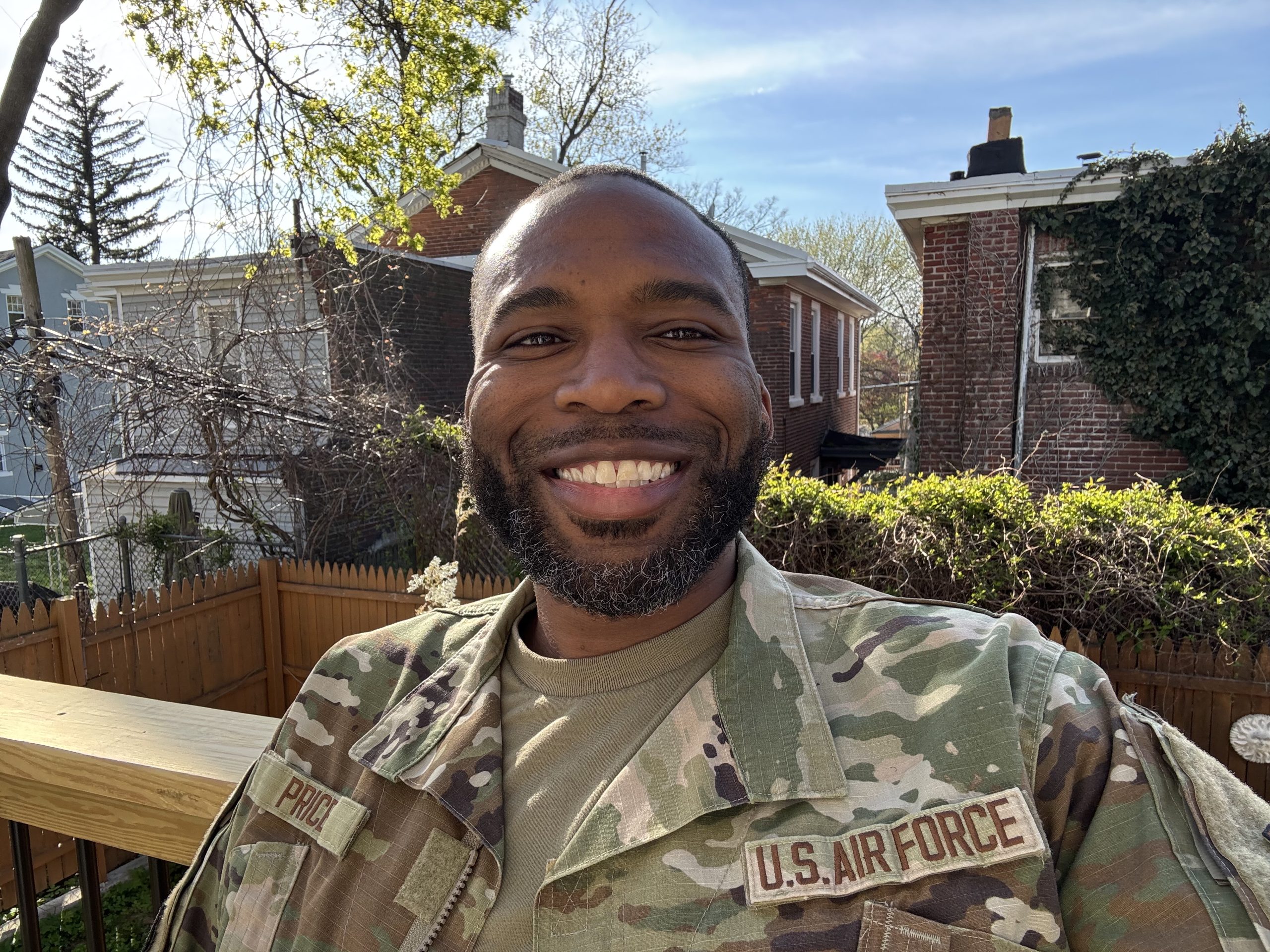
“We both had supporters who weren’t here today, so we would have just kept tying, essentially,” said Price, a fiber optic engineer and a member of the Pennsylvania Air National Guard. “And because I’m committed to the ward, I decided to take a position that was not necessarily a ward leader, but still gives me the time and the capacity to work with my constituents.”
Bass described the outcome as “a win.”
“We’re looking forward to working with everybody,” Bass told reporters. “We’ve got some new members who have joined the ward, and we’ve got some other folks who will be the staples of the organization who can help keep it going.”
The drama began on the evening of June 8, when Bass declared herself the victor of the ward leader race after a divided voice vote of committeepeople during a meeting at the Germantown Seventh-day Adventist Church. The Inquirer published a video of the meeting showing Bass refusing requests to hold a roll-call vote that could have clarified the results, prompting the Democratic City Committee to order a redo of the race.
Both sides spent the ensuing week attempting to win over committeepeople for the rerun.
On Wednesday morning, progressive activist Nate Holt visited committeeperson James Harrison at his home and offered him money while encouraging him to vote against Bass, videos of the encounter obtained by The Inquirer show.
Octavius Price, a fiber optic engineer and member of the Pennsylvania Air National Guard, ran for 22nd Democratic Ward leader. (Photo courtesy of Octavius Price)Sean Walsh
Price condemned Holt’s behavior and said he had “cut all ties with him” in a statement Wednesday evening before the vote.
Holt has not responded to questions about why he offered money to Harrison, but said in a statement he did not court committeepeople at the direction of any ward leader candidate.
As it happens, Harrison’s vote could have been decisive. But he did not attend Wednesday’s meeting.
Additionally, one committeeperson who did show up abstained, declining to vote for either candidate.
Another key vote came from former Councilmember Derek S. Green, a committeeperson in the ward who briefly considered running for ward leader and said he abstained during the initial vote last week, ultimately sided with Bass.
Green said the incident with Holt and Harrison swayed his vote.
“I learned about the video,” Green said, explaining his decision. “I’ve never seen that in the history of politics.”
The redo election took place Wednesday night at party headquarters. The party’s organization committee, which is made up of other ward leaders and chaired by former Councilmember Sharon Vaughn, oversaw the election.
Bass is often at odds with progressive activists in her Northwest Philadelphia-based 8th Council District. She narrowly won reelection in 2023 and likely faces another stiff challenge in next year’s Council race.
Ward leaders and committeepeople, the front-line workers of the party, are charged with getting out the vote for party-endorsed candidates and fielding constituent services requests.
Control of the voter-rich 22nd Ward could play a big role in next year’s Council race.
The 22nd Ward was one of three elections the party ordered to be rerun Wednesday night. In both other races, the candidates who won the initial votes also prevailed in the redos.
In North Philadelphia’s 14th Ward, Valerie Williams defeated the incumbent, Arthur Green, in a 10-8 vote.
And in an open race for the Northwest Philadelphia-based 17th Ward, Tyrone Barge beat Melissa Schley, a former ward leader.
Barge said that his race did not involve significant ideological differences. Instead, committeepeople supported him because he promised “hard work” and increasing efforts to drive turnout for Democrats.
“We’re gonna do some exciting things in the ward,” Barge said in an interview. “It’s gonna be different.”
The results put an end to a dramatic party election cycle that saw longtime Democratic City Committee chair Bob Brady reelected to an 11th term with a new roster of lieutenants led by Vaughn, the party’s new first chair.
Brady said after Wednesday’s election that party leaders at one point considered deciding the race through a coin toss.
“We didn’t know what to do with it. And then the two got together and made an agreement and made life a lot easier,” Brady said. “The best thing can happen is those two factions that they had all agreed on this … and the two are going to work together, and I told them I would come and work with them.”