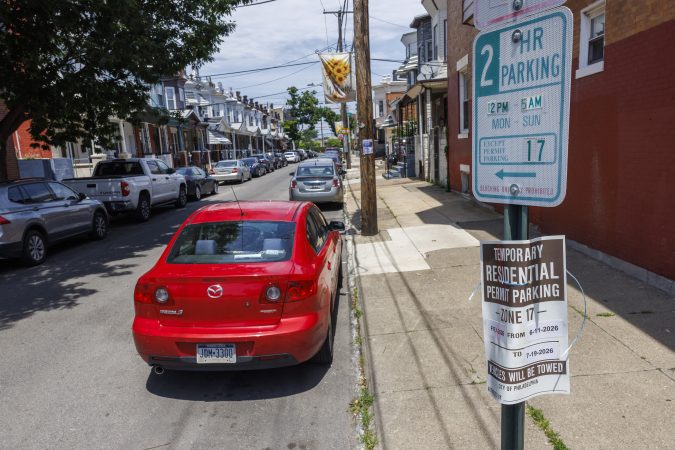
The city is rolling back its geofence border around the FIFA Fan Festival to reduce the number of residential areas blocked from using rideshare.
The Philadelphia Office of Transportation and Infrastructure Systems (OTIS) announced Thursday that it would shrink the geofence to exclude large residential buildings on Pennsylvania Avenue.
The geofence, which blocks people within its borders from using rideshare services like Uber and Lyft, will now shrink to the south of Aspen Street, about half a block from its original border at 25th and Meredith Streets.
“We’re continuing to work with the community, elected officials, and operational partners to improve the experience for everyone, including residents impacted by Lemon Hill festivities,” an OTIS spokesperson said.
Additionally, four blocks in Fairmount had been designated for rideshare pickups and drop-offs, but OTIS is reducing rideshare zones to two, allowing for more parking for permitted residents.
The rideshare pickup/drop-off zones are now located only near Eastern State Penitentiary, at 23rd Street and Fairmount Avenue, and the 2200 block of Fairmount Avenue.
This was well-received news for residents who live in the area and have been concerned about the geofence’s restriction on residents with mobility issues.
Paul Stewart, an 86-year-old resident who lives in one of the large apartment buildings that initially had been geofenced, relies on Uber to visit his doctor at Thomas Jefferson University Hospital. But last week, when he planned to head to an appointment, he found he could not call a rideshare.
“The geofence that includes my building and all the businesses in the immediate area will continue for 39 days,” Stewart said before the geofence rollback. “Many people take Uber to and from the restaurants and bars in this neighborhood so that they can have a few drinks and not worry about driving drunk.”
Geofencing these large residential buildings and blocks was hindering everyday life, Stewart said. Now, he said, residents will be able to go about their business as they normally would.
The geofence reduction is just one of the adjustments the city has been making as it manages the traffic and fans around the FIFA Fan Festival in Lemon Hill. Since at least May, residents have been requesting traffic-calming measures on residential blocks. The Philadelphia Parking Authority and OTIS installed additional barricades and signage last week.
A former supervisor in Philadelphia District Attorney Larry Krasner’s office has been suspended from the region’s federal courts, a development that came just one day after the Pennsylvania Supreme Court sharply curtailed the office’s ability to seek to overturn old convictions and accused its lawyers of misleading judges.
Nancy Winkelman was suspended for three years by a panel of federal judges who found that she was complicit in efforts to mislead a federal judge while seeking to overturn the death sentence of a man convicted of killing an East Mount Airy couple in the 1980s and allow him to serve life in prison instead.
The ruling, made public this week, adds to the mounting judicial scrutiny of post-conviction work in Krasner’s office. On Tuesday, the state Supreme Court imposed remarkable new restrictions on prosecutors’ efforts to reverse potentially problematic convictions.
In a forceful and scolding opinion, the high court said Krasner’s office misled judges, submitted false statements, and “violated its duty of candor” in asking a judge to vacate a 2004 murder conviction.
The court wrote that prosecutors’ actions in the case were part of a troubling pattern of conduct in seeking to overturn murder convictions and ordered that, going forward, the state attorney general’s office must be asked to review and weigh in on all such cases.
The panel of federal judges, in ordering Winkelman’s suspension, echoed some of those concerns.
Winkelman, who had led the office’s law division since 2018 before moving into a part-time role handling legal matters in state court last year, did not respond to a request for comment Wednesday. Her attorney, Andrew Hellman, declined to comment.
Winkelman is appealing the decision. In an earlier request that the findings remain under seal, Hellman described the ruling as having “findings and conclusions infected by serious errors.”
Krasner said in a statement Wednesday night that Winkelman is an exceptional attorney who left a lucrative private law practice to serve the public. He said she always showed “exceptional competence and integrity and contributed mightily to needed reform.”
“On the eve of Juneteenth,” he said, “we should all remember that reform is necessary in every era. And that those who bring needed reform sometimes are made to pay a price.”
The three-judge panel, in a ruling issued in March and unsealed this week, said Winkelman and a subordinate, former assistant district attorney Paul George, misled a federal judge by misrepresenting parts of the case while attempting to reverse the death sentence of Robert Wharton.
Wharton was convicted of first-degree murder and sentenced to death for the 1984 strangulation and drowning deaths of Bradley and Ferne Hart inside their East Mount Airy home.
The jury found that Wharton, angry over a disputed debt, spent months terrorizing the family before he forced his way inside the home at knifepoint and killed the couple. Afterward, he turned off the heat, leaving the couple’s seven-month-old baby, Lisa, to freeze to death — but she survived.
Decades later, prosecutors in Krasner’s office, in seeking to vacate his death sentence, suggested in court that the victims’ family backed their effort. But it was later discovered that they had consulted only one relative and never contacted Lisa Hart-Newman, the couple’s surviving daughter, who strongly opposed the move.
George later acknowledged that was a mistake, and U.S. District Judge Mitchell Goldberg ordered Krasner to write apology letters to the Harts’ relatives.
Goldberg, who denied the request to reduce Wharton’s sentence, later said that George’s and Winkelman’s review of the case was “patently deficient” and that they had violated federal rules of procedure in a manner that was “egregious” and “exceptional.”
The two prosecutors then faced federal disciplinary proceedings to examine whether they had been intentionally deceptive.
Last year, the three-judge panel found that George had lied to Goldberg about key facts, “flouted the interests of the public and the victims’ families,” and acted as the “quarterback” of efforts by the district attorney’s office to undo or undermine all death penalty cases.
George, 75, was disbarred in federal court. He has denied the accusations and filed an appeal. His attorneys said his disbarment was “highly disproportionate and offends basic tenets of justice.” Krasner also defended George’s work and said he believed the appeals court would find that the opinion criticizing George was filled with “factually and legally incorrect” statements.
The panel’s probe into Winkelman’s conduct continued, and the judges said they determined she “was willfully blind to, and complicit in,” George’s misrepresentations to Goldberg.
Winkelman, the judges said, “knowingly made misrepresentations” as part of the district attorney’s office “policy of vacating all death sentences.”
Krasner and his staff have long denied that the office has any such policy.
But the panel appeared to reject that, writing: “We do not credit [Winkelman’s] testimony that there is no such policy.”
According to the order, after Krasner was elected in 2017, he asked Winkelman, who had spent decades in civil appeals work but had no criminal law experience, to lead his office’s law division, a unit that handles hundreds of appeals and post-conviction cases in state and federal court each year.
George, a veteran attorney in the office, was made her assistant supervisor “to fill what she described as the ‘very big gap’ in her resume,” the order said.
The judges wrote that while Winkelman “betrayed the public’s trust,” she “has had a long and distinguished career.” George was the “quarterback of the DAO’s misrepresentations,” they said, and he alone misled Goldberg in the office’s communication with the Hart family.
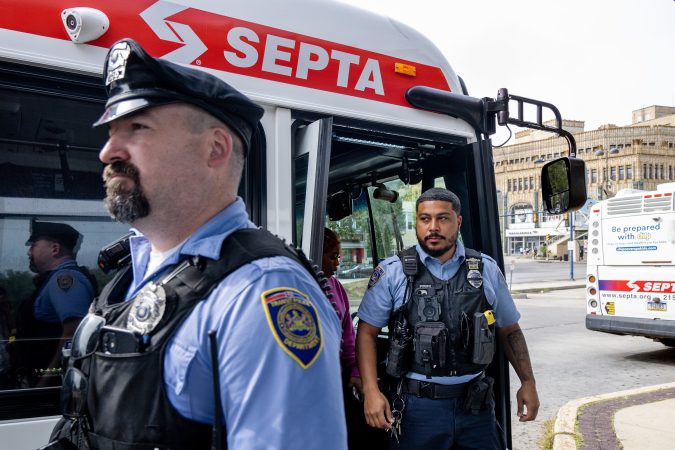
The union representing transit police and SEPTA reached a tentative deal on a new three-year contract Wednesday that includes a 12% raise and avoids a possible strike during the region’s summer of big events.
Officers had been working without a contract since March 31, and the police union said on June 4 it was willing to walk off the job if there was no progress in talks. Leaders said the two sides were at an impasse.
Since then, negotiators traded new proposals and met several times.
Members of Fraternal Order of Transit Police Lodge 109 are scheduled to hold a ratification vote on the agreement Thursday, with SEPTA’s board scheduled to consider it next week.
“SEPTA believes the agreement is fair to our hard-working Transit Police officers and responsible to the fare-paying riders and taxpayers who fund the authority,” spokesperson Andrew Busch said in a statement.
“I can confidently say that a strike has been averted at this time,” FOTP Lodge 109 president Omari Bervine said in an interview.
He credited SEPTA general manager Scott A. Sauer with getting talks moving.
“We were able to actually sit down to direct talks, with the general manager [involved], and that was instrumental in getting a tentative deal worked out,” Bervine said.
Officers would get a 5% pay hike in the first year and 3½% in each of the next two years, according to sources familiar with the agreement. They also would receive a $2,500 signing bonus.
Officers are scheduled to get the first installment of the pay bump on June 28, if the contract is ratified and approved. Normally, pay increases for transit police did not kick in until the next anniversary of the start of the contract year — in this case, April 1, 2027.
Lodge 109 has pressed to change the timing so members would start receiving raises as soon as possible after the signing of an agreement, as happens with other SEPTA unions.
The union represents 203 rank-and-file officers who patrol SEPTA’s stations and transit vehicles across its five-county service area.
Bervine had offered to waive the right to strike if SEPTA voluntarily agreed to submit their dispute to binding arbitration.
Most union-represented police officers in Pennsylvania can use binding arbitration, which involves an independent arbiter deciding the final terms of a contract. In turn, those officers are barred from striking.
But state law does not allow transit police and some other state law enforcement officers to use binding arbitration.
Bervine said there was no agreement to include binding arbitration in the contract. There is proposed legislation in Harrisburg to extend it to officers employed by state agencies like SEPTA. “Hopefully, common sense will prevail,” he said.
Union and SEPTA negotiators met on Tuesday and Thursday last week and exchanged new proposed contract language. They met for a third time Saturday.
The union has exercised its right to strike before.
In December 2023, the transit officers union went on strike for three days seeking wage increases matching those given to Transport Workers Union Local 234 and other SEPTA employee unions.
In 2019, transit officers walked out for six days, in part over whether members could review body-camera footage before filing incident reports. They struck in 2012 over a 15-cent difference between the FOTP’s demand and SEPTA’s offer for an increase in the hourly rate that members received for annual recertification as police officers.
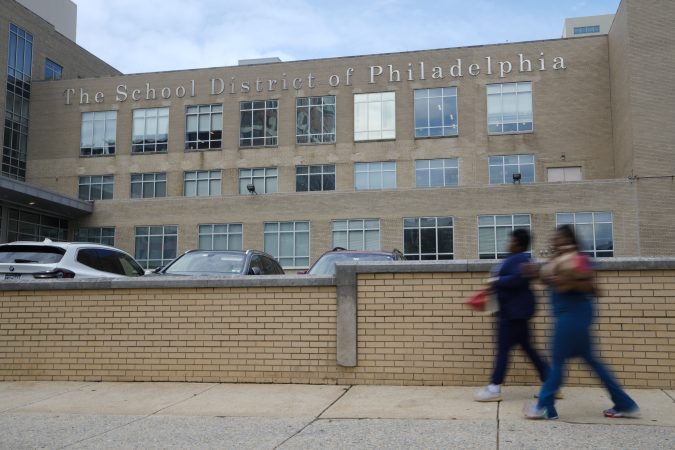
A judge has blocked the Philadelphia school board from voting to close a charter school Thursday amid a legal fight over the school district’s treatment of charter schools.
Common Pleas Court Judge Damaris Garcia had previously barred the district from moving forward with nonrenewal proceedings against Philadelphia Montessori Charter School, which in a lawsuit last month claimed the school system violates state charter law. But on Tuesday, the board appealed that decision and added votes on Philadelphia Montessori and Global Leadership Academy Southwest Charter School to its Thursday meetingagenda.
Philadelphia Montessori filed an emergency motion Wednesday to stop the vote, and Garcia granted its request — ordering the board to delay its vote on the charter’s future.
“It is further ordered and decreed that all actions related to the subject matter of the motion, including but not limited to the vote currently scheduled before the Board of Education of the School District of Philadelphia on June 18, 2026, are temporarily stayed pending further order of this court,” Garcia said in the order.
It was not immediately clear what would happen Thursday. Wanda Odom, a spokesperson for the board, said it does not comment on litigation. Two charter votes, including on Philadelphia Montessori, remained on Thursday’s publicly postedagenda after the ruling was released.
Following those complaints, the district is revising its evaluation framework; charter advocates have called on the board to pause renewal decisions until new standards are complete.
Philadelphia Montessori, which enrolls about 250 students, lags similar schools and the district as a whole in academics, according to district officials. The charter has called the district’s assessment methodologies “flawed” and “unreliable.”
In its emergency motion Wednesday, the charter accused district officials of a “transparent and deliberate tactic” in adding the nonrenewal vote 48 hours before Thursday’s meeting, despite Garcia’s earlier order on June 9.
The district “waited until the last possible moment” to file its notice of appeal while also scheduling a vote on Philadelphia Montessori “that directly violates the court’s order,” the charter said in the filing. Garcia had previously scheduled a court hearing for July 27.
If the board votes to start nonrenewal proceedings for Philadelphia Montessori on Thursday, it will cause “immediate and irreparable” harm, likely prompting families and teachers to leave the school even if a court later reverses the decision, the charter said in its filing.
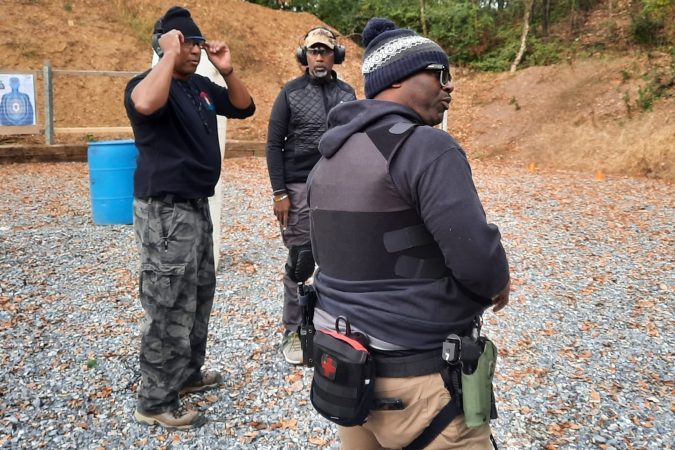
In videos posted online, firearms instructor Eric Franks taught others how to handle guns safely.
“If you don’t have a leg strap on … your firearm’s going to be flapping out,” the 57-year-old Wynnefield man said in an Instagram video demonstrating how to properly secure a“battle belt,” a tool for holstering guns and equipment.
So some people who knew him found it hard to fathom that Franks, a retired Philadelphia firefighter, father, and business owner, walked up to a group of police officers on a West Philadelphia street and got into a confrontation that ended in gunfire.
“The biggest thing he taught was restraint, situational awareness,” said Randy Robinson, a friend and fellow member of That Gun Talk, a firearms training organization Franks helped found during the pandemic.
Robinson said Franks taught students: “The last thing you want to have to do is pull your firearm.”
Police were called to the block around 10:30 p.m. that night for a report of a shooting on 54th Street, not far from Mingle, a popular event space Franks owned that had hosted a teenager’s birthday party that evening.
Alerted by his son to the nearby gunfire, Franks made his way to Mingle, near where he began to argue outside with several police officers who told him they were trying to establish a crime scene, according to surveillance footage and police accounts.
As officers investigated a vehicle that had been struck by bullets, Franks approached and began complaining about crime and policing in the area, said a source familiar with the case who spoke on the condition of anonymity to discuss an ongoing investigation.
He appeared frustrated, the source said, that officers had not yet cordoned off the area around the vehicle with crime scene tape, and became increasingly agitated as officers repeatedly asked him to step back so they could do their jobs.
Video obtained by The Inquirer appears to show Franks yelling at officers, then pushing one, before stepping back and pulling a gun from his waistband.
Franks then fired multiple shots at the officers, who took cover behind nearby vehicles, according to the video and police accounts, and four officers returned fire. Three officers — including a sergeant — were struck by gunfire. Franks was shot in the chest and the leg and later died at Thomas Jefferson University Hospital.
Police have not released the names of the injured officers or identified those who discharged their weapons that night. One officer was shot in the face, one in the hip, and another in the leg, officials said. A 43-year-old officer was released from the hospital on Tuesday, police said, following the release of a 39-year-old sergeant on Monday.
The shooting remains under investigation by the police department’s officer-involved shooting unit and the Philadelphia District Attorney’s Office.
DA Larry Krasner said investigators from his office had visited the scene, spoken to witnesses and Franks’ family, and reviewed video footage and other evidence. He said his office — like Franks’ family and members of the community — has questions about what happened that night.
James Funt, an attorney for Franks’ wife, Michelle, and his two children, said he,too, is looking for more informationon what transpired in the moments before the gunfire.
“That’s all the family is looking for — a full, fair, and thorough investigation,” Funt said.
Meanwhile, those who knew Franks say the shooting ran counter to the behavior of the man they knew — an advocate for responsible gun ownership and reducing crime in the neighborhood.
Franks was a founding member of That Gun Talk, a local chapter of the National African American Gun Association formed in 2020 to promote self-defense training among Black gun owners, according to Robinson.
He said he was puzzled that Franks would resort to violence in a neighborhood he had urged local leaders to make safer.
In recent years, Franks had brought his concerns to City Councilmember Curtis Jones Jr., who grew up near the Franks family in West Philadelphia and was familiar with his older brothers.
Jones said in a recent interview that Franks had spoken with him multiple times about his frustrations with crime and policing on the business corridor near Mingle.
“What he wanted was better enforcement of laws, and felt frustrated with the reality of our ability to patrol in a way he thought [the corridor] deserved,” Jones said.
And Franks once visited Jones’ office to discuss firearms education for city residents, as well as the possibility of opening a Black-owned shooting range in the neighborhood, an idea Jones said he did not agree with.
The Council member recalled that Franks’ relatives were among the first to open a business on the 54th Street corridor in Wynnefield in the 1970s, a variety store not far from where Franks was killed.
“This whole tragedy, it’s bizarre, ironic, and I grieve for everybody,” Jones said. “The officers that were shot, the family — Franks was a patriarch, the community respected him.”
Funt, the family lawyer, agreed.
Franks cared about “getting more police on the beats, trying to get drugs out of the neighborhood,” Funt said. “I think it was in that spirit that he went there,” to the block in West Philadelphia, on the night he was killed.
How that instinct led to the gunfire that wounded three police officers and ended Franks’ life is a question police and prosecutors will seek to answer as their investigation continues.
Staff writer Ellie Rushing contributed to this article.
It would have nothing to do with Arthur, which on Wednesday became the first named storm of the Atlantic hurricane season, but the Philly region may be in for tropical-storm force gusts and strong thunderstorms Thursday.
Even if the rains don’t come — and on Wednesday, the storm odds were close to 50-50 — wind gusts to 45 mph are possible during the afternoon, said Alex Staarmann, meteorologist at the National Weather Service in Mount Holly, “quite unusual for June.”
Not so unusual these days would be the forecast high, which would mark the 14th time this year that official readings in Philly had reached 90 degrees or higher. That is about half the average total for an entire year.
But this heat will be more of a ripple than a wave, and the outlook for the holiday weekend is looking spectacular.
When the winds and storms may arrive in Philly on Thursday
As a front approaches, winds from the southwest are expected to gust to 20 mph during the morning and 30 to 40 mph in the afternoon.
While the winds are all but a certainty, it was unclear if any strong storms would pop Thursday. If they did, the best estimate would be between 1 an 8 p.m., the weather service said.
“The environment is favorable for damaging winds if anything does develop,” Staarmann said.
“The biggest question is how widespread the storms are going to be,” he said.
Uncertainty is a near 100% certainty with June storms
Such uncertainty is standard fare with thunderstorm threats this time of year, said Rich Thompson, forecast operations branch chief at the government’s Storm Prediction Center, which would have to make a call on posting severe storm watches.
With so many moving parts and micro-features such as terrain involved, predicting the behavior of small-scale storms is “incredibly complicated,” he said, and on some days clues are frighteningly lacking.
And while observations have improved immeasurably in recent decades, “we still aren’t observing most of what’s there,” he said. Land-based surface observations are far more plentiful than those over the oceans, which cover 70% of the atmosphere, and in the upper atmosphere, where the weather is manufactured.
Even if the atmosphere were perfectly measured, he added, meteorologists would still have to contend with the fact that the physics involved in forecasting are not completely understood.
Arthur and the weekend outlook for Philly
As for Arthur, knighted with a name by the National Hurricane Center at 11 a.m. Philadelphia time Wednesday as it matured off the southeast Texas coast, it is forecast to deluge portions of the Gulf states.
Then it is due to head out to sea before it could have anything to do with Philadelphia or the Jersey Shore, which is likely to be a popular destination this weekend.
For Friday, Juneteenth; Saturday; and Sunday, the beginning of the astronomical summer, highs are expected in the mid-80s with sunny days and no threat of showers until early Monday.
Angel Okeke, a junior at the Academy at Palumbo in Philadelphia, wanted to make sense of the loss of her best friend’s brother to a tragedy spurred by gang violence.
Isadora Pendygraft, an eighth grader at Welsh Valley Middle School in Narberth, felt pulled to explore how restorative justice could reshape the criminal court system.
Avigail Wus, a junior at Pennsbury High in Fairless Hills, hoped to examine how the public, the media, and courts interact with survivors of sexual assault.
They are among a group of students who spent nearly a year thinking, researching, and writing about changes they want to see in Philadelphia. This month, their work culminated in professional performances of their original plays.
“It’s freaking amazing,” Okeke said.
The possibility of performance
The student work is part of What Now: 2026, a new arts festival marking the country’s Semiquincentennial. When the festival was in the planning stages, Madeline Charne, director of education and programs for Philadelphia Young Playwrights, said sheknew youth voices ought to have a place.
That is how PYP’s Civic Theater Project was born.
(L-R) Actor Raymond Ingram rehearses as (seated) Palumbo civics teacher Charlie McGeehan, Philly Young Playrights director of education and programs Madeline Charne, students Abigail Wus, Isadora Pendygraft, Angel Okeke, and Harmonee Summers look on during rehearsal at the Drake Theater in Philadelphia earlier this month.Elizabeth Robertson / Staff Photographer
Charne said she wanted students “thinking about how theater itself can create social change, not just be about social change.” She prompted students to imagine Philadelphia 25 years in the future, to dream about what should be changed, and to see their work as the beginning of that shift.
“Creativity and art and performance — that’s what has the possibility to make people actually listen,” said Charlie McGeehan, a Philadelphia School District civics teacher who worked as a PYP teaching artist.
Kids thought so, too. For every spot PYP had in the process, it received roughly five applicants. Eventually, five young people signed on: Okeke; Wus; Pendygraft; Harmonee’ Summers, who attends Springside Chestnut Hill Academy; and Maroua Benfadhla, a student at Science Leadership Academy.
The young playwrights had to commit one day a week to their work — researching and refining ideas, interviewing change makers around the city, committing to their eventual topic, writing, editing, critiquing one another’s work, andeven casting their plays.
The works the five eventually produced were a revelation, McGeehan said — powerful, smart, and character driven. They were presented in staged readings at the Louis Bluver Theatre in Center City.
The right rooms, the right resources
On a sweltering Wednesday this month just before the students’ work debuted, they gathered at the theater for a final run-through.
The playwrights sat in chairs, eyes fixed on the actors in front of them. The actors performed the plays without sets or costumes, just reading scripts on music stands and allowing the audience to take inthe power of the young people’s words.
The moment Summers first heard professional actors reading words she had written, it stopped her cold.
“It is so cliche to say it’s magical, but it feels different when your words are literally jumping off the page‚” said Summers, whose play is called The Double K Show. It chronicles two young women’s rise to stardom and the effect substance use has on their lives, and was shaped by events Summers observed growing up in North Philadelphia and attending an elite private school.
Part of the students’ process was finding resources that might help with the issues they tackled — from recovery and housing assistance organizations to groups that support survivors of sexual assault.
(L-R) Actor Raymond Ingram rehearses as Palumbo civics teacher Charlie McGeehan, Philly Young Playrights director of education and programs Madeline Charne, students Abigail Wus, Isadora Pendygraft, Angel Okeke and Harmonee’ Summers look on during rehearsal at the Drake Theater in Philadelphia earlier this month.Elizabeth Robertson / Staff Photographer
Pendygraft, whose mother, Letitia Stein, is an editor at The Inquirer, is a PYP veteran and the only middle schooler in the group. The playbill lists Pendygraft’s author name as Rut, a nickname. She said she was inspired by The 57 Bus, a book she had read about the ripple effects of a crime committed by one teenager against another.
“The criminal court has a long history of being complicated and a little corrupt and biased,” Pendygraft said, but restorative justice — the theme of her play — would go a long way toward repairing harm.
Wus said she used the motif of the Salem witch trials as “a critique about the way stories of sexual assault have been commodified into entertainment.” It wasa powerful exercise in using her voice, she said, made stronger by the magic of real performers.
“These actors, they’re the people you see on TV — they are so talented,” Wus said. “Hearing my words out loud has allowed me to make revisions to make my script feel more real. It’s probably one of the best writing experiences I’ve ever had.”
Okeke, who wrote Echoes Beyond Shut Doors about the loss of Naim Castleberry, her best friend’s brother, said she struggled for a time with the idea that her ideas would go nowhere.
“It felt very daunting to tackle such big issues. Often, I feel like I feel small as a young person in Philly. I have this doubt, ‘how much of an impact can I really make?’” Okeke said. But she powered through, with words — and the experience was transformative.
“Us youth really have good things to say if we’re put in the right rooms with the right resources,” she said.
Police identified the man who is suspected of shooting two teens, killing one, Tuesday afternoon inside Wilmington Hospital as a23-year-old from New Castle, Del.
JohnWallace-Bey was arrested Tuesday night in Philadelphia and is pending extradition to Delaware, Wilmington police said in a statement. He was expected tobe charged with first-degree murder, attempted first-degree murder, possession of a firearm during the commission of a felony, and carrying a concealed deadly weapon.
Wallace-Bey is accused of shooting two 19-year-old men, one of whom died from his injuries the night of the shooting and one of whom remained in critical condition. Police did not identify the victims.
Wilmington police believe this was “a targeted, isolated incident,” according to the statement, which did not say more about what might have led to the shooting.
Police responded to reports of the shooting at the hospital at 501 W. 14th St. around 3:30 p.m., Police Chief Wilfredo Campos said at a Tuesday evening news briefing.
The hospital, which is run by ChristianaCare, was locked down until police cleared the buildinglater Tuesday, Campos said.
Philadelphia School District bus drivers, maintenance workers, cleaners, and tradespeople are entering contract season.
Leaders of 32BJ SEIU District 1201, which represents 2,000 workers, are scheduled to begin talks with Philadelphia School District officials Thursday. Their current contract expires Aug. 31.
The bottom line for members of 32BJ SEIU District 1201 is higher pay, officials said.
Members’ current pay scale varies, from bus attendants, who are paid $30,762 annually, to building engineers, whose pay rate starts out at $51,155 and tops out at $77,832. The union’s highest-paid workers are its building construction workers, whose salary maxes out at $77,832.
Tradespeople — bricklayers, HVAC mechanics, electrical mechanics, plumbers, and roofers — are paid $62,899 at the top of the pay scale.
“We are the foundation of this district, and we’re not asking for the world here. We’re asking to not live in poverty, and we’re asking to help maintain our health insurance,” said Tim Finucan, 32BJ’s Pennsylvania state director.
Wages are not the only issue. Union leaders are also fighting for “a more clear ladder of opportunity for our membership to advance within the school district,” Finucan said. 32BJ also wants to codify ways it can work with the district to fill vacant jobs in a system that struggles to find qualified engineers and trades workers, including partnering with community organizations, clergy, and others to spread the word about open jobs.
“We want people to know if you can get into the school district, you know you’re going to have a good check, you know you’re going to have access to good health insurance, we know you’re going to have access to a pension,” Finucan said.
Naima DeBrest, a district spokesperson, said in a statement that officials “deeply value” 32BJ members and “will diligently engage in good faith negotiations with the hope of securing a new contract as soon as possible.”
‘We got there’
If you want to know what 32BJ workers mean to the district, think back to February, when a major winter storm dumped more than a foot of snow on Philadelphia, said Ronald Smith, a longtime district building engineer and member of the union’s bargaining committee.
“The whole city was encased in snow and ice, and the engineers still had to be there, and we got there,” Smith said.
Building engineers — who are in charge of the operations of district facilities, with responsibilities from keeping up with schools’ heating and cooling systems to making sure schoolyards are maintained — are still waiting for the extra pay they are contractually owed for working in those conditions, Smith said.
“It was a slap in the face when we had to fight to get paid for that,” Smith said. “A lot of engineers are leaving the district — they feel disrespected. Some of the fights that we have to fight, we shouldn’t have to.”
A too-small workforce affects the district and its workers in myriad ways, Smith said.
“We’re bringing in new guys without the trainees having enough time to really learn the basics of the trade,” Smith said. “It’s not really fair to the trainee, it’s not fair to the schools. A lot of these buildings don’t have adequate staffing.”
Despite friction in some areas, union officials are approaching talks with the district as partners, Smith and Finucan said. Officials are well aware of the district’s looming $300 million deficit, they said; 32BJ members have advocated for more funding for Philadelphia schools in City Hall and Harrisburg, and will continue to do so.
But union member Sherrie Gordan said it is tougher and tougher to feed and house her three kids on what she earns as a cleaner in the district.
“Even when I work overtime, so much gets taken out for taxes that it’s still not enough,“ Gordan said in a statement. ”Grocery prices keep going up, and my kids eat more every week. I spend $500 on groceries, but it’s gone in just a week. It’s not like it used to be when you could actually afford it.”
At a grand-reopening celebration at Stateside Live!, Stateside Vodka president Matt Quigley’s wife, Megan, grabbed his arm and beckoned to the crowd around them in disbelief.
“It was just such a prideful moment of like … we’re here to stay,” Quigley said.
Just a couple years earlier, fellow cofounder and CEO Clement “Clem” Pappas looked around Citizens Bank Park to see as many Surfsides as Miller Lites in the hands of Phillies fans: “Holy s —, this is happening,” Pappas recalled thinking at the time.
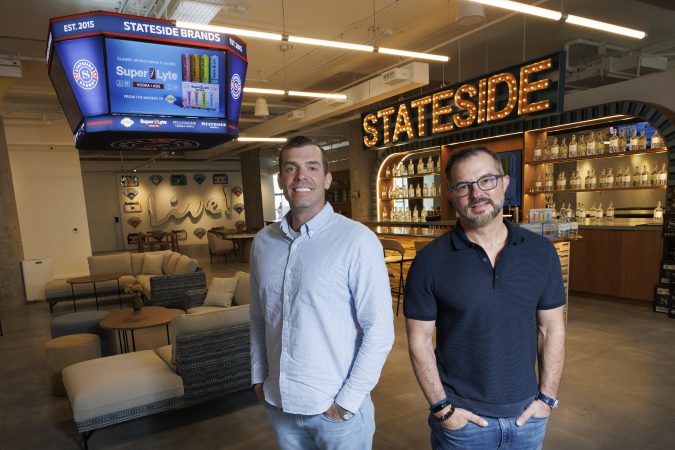
At their massive new Center City headquarters last week, Pappas and Quigley said Surfside’s astronomical rise still feels surreal.
In 2015, the area natives founded Stateside Vodka in a distillery near Kensington with their brothers, Zach Pappas and Bryan Quigley. The company started selling canned vodka sodas in 2021. But they launched into a different stratosphere when they debuted their spiked teas and lemonades in 2022.
Stateside Vodka’s taproom near Kensington is pictured in 2017, when it was called Federal Distilling. TOM GRALISH / Staff Photographer
Branded as lower-calorie, better-for-you booze, the Surfside cans took off. The cofounders said they sold 200,000 cases in the first year, then 1.3 million in 2023, nearly 5 million in 2024, and a whopping 11.1 million cases last year.
The “slammable” 4.5% ABV cans, as Matt Quigley describes them, are particularly popular in the summertime, a three-month period that accounts for about half the beverage company’s retail sales.
So far this year, Stateside is on track for 70% growth in overall sales, and a 65% growth in Surfside sales, according to the company. That comes after a record year in which the company recorded 111% overall sales growth.
(function(){function e(){window.addEventListener(`message`,function(e){if(e.data[`datawrapper-height`]!==void 0){var t=document.querySelectorAll(`iframe`);for(var n in e.data[`datawrapper-height`])for(var r=0,i;i=t[r];r++)if(i.contentWindow===e.source){var a=e.data[`datawrapper-height`][n]+`px`;i.style.height=a}}})}e()})();
As a private company, Stateside does not have to publicly disclose earnings, and executives declined to share specific sales figures.
While Surfside has accounted for about 90% of sales in the past year, the top executives are bullish on their latest invention, a sports-drink-inspired canned cocktail called Super Lyte. They said the new beverage had sold nearly 400,000 cases in three months, meaning it could outpace Surfside’s early growth.
“The initial response is way beyond our expectation,” Clem Pappas said. “It feels like another hit.”
The company has achieved this success without the backing of an alcohol giant like Anheuser-Busch InBev or Molson Coors, which together manufactures hundreds of brands.
Quigley, 42, and Pappas, 52, said they’ve been approached by nearly every big beverage company, but they have no interest in selling anytime soon.
“As long as you’re still having fun, I see no reason to hang up the metaphorical cleats,” Quigley said.
“I don’t want to sit on the bench. I want to be in the game,” Pappas said. “We still think it’s early days.”
Stateside keeps Philly at its heart amid national growth
A wall at Stateside Vodka’s new Center City headquarters shows a handful of Surfside’s 170 partnerships.Alejandro A. Alvarez / Staff Photographer
In Stateside’s earliest days, Quigley recalled confiding in Pappas about a pipe dream: “If we ever get super successful, I want a sick office in a high-rise in Center City.”
More than a decade later, they have moved from a temporary office in Feasterville-Trevose, Bucks County, to a chic new headquarters at 11th and Ludlow Streets in Market East.
The company plans to stay put for at least 10 years, the cofounders said. For now, about 80 employees work there four days a week with room to grow.
On a recent day, the office was humming during a new-hire orientation. While everyday operations include the same mundane tasks required of any business, the top bosses pride themselves on keeping the vibes light. “We’re not selling, like, car insurance,” Quigley said.
The bright industrial-style space occupies 34,200 square feet across two floors. It is centered around a long bar with a backlit Stateside marquee, a replica of the one at the tasting room. Nearby, there’s an open lounge with couches, underneath a miniature Jumbotron. Ads for Surfside, Super Lyte, and Stateside rotate on the screens.
Office happy hours are a given.
“That’s part of the special sauce,” Pappas said. “We’re in the drinks business.”
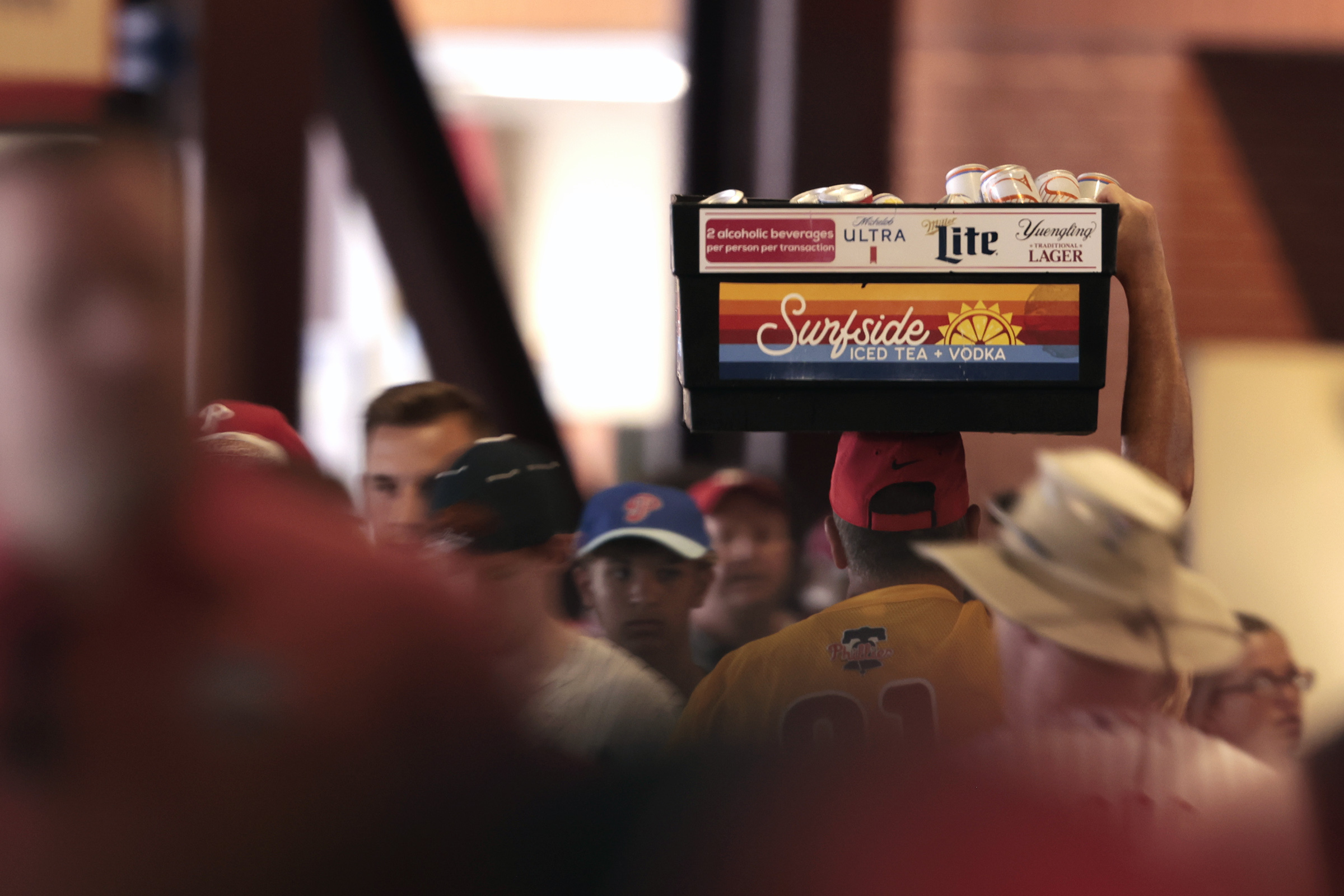
Philadelphia has always been at the heart of the company. It’s where they landed their first partnership with the Phillies, which fueled Surfside’s rise. At Citizens Bank Park, the cans have been the top-selling spirit since 2023, according to Stateside executives, citing figures from concessions provider Aramark.
Across the city, the cofounders still run the 7,500-square-foot Kensington-area tasting room and distillery, the latter of which they hope to turn into an event venue.
The distillery has been outgrowing its space for a while. But the need intensified in the past year as the vodka’s retail sales increased 120%.
They attribute the boost in part to greater name recognition thanks to Stateside Live! They said they hope to move vodka production to a larger facility somewhere in the Northeast.
Sales of the original Stateside Vodka, displayed at the company’s office bar, have grown 120% year over year.Alejandro A. Alvarez / Staff Photographer
The cofounders have also stayed local: Quigley, a Fort Washington native, lives in Kensington, and Pappas, originally of Vineland, is in Haddonfield.
Stateside’s reach, meanwhile, has expanded far beyond the region. The company employs about 340 nationwide, up from around 30 in 2022, executives said, and they sell in all 50 states through a network of more than 200 distributors.
Across the country, Surfside has racked up 170 partnerships, including with MLB teams, music festivals, and colleges. Super Lyte has already acquired more than a dozen partnerships, too, including at Penn State, where they said it will be sold at Beaver Stadium this fall.
A hawker carries drinks, including Surfsides, around the concourse at Citizens Bank Park in 2024. The brand now has 170 partnerships at venues nationwide.Elizabeth Robertson / Staff Photographer
In many ways, the cofounders said, they’re trying to replicate the strategy that proved successful with Surfside at Citizens Bank Park: Connect with consumers somewhere where it feels only natural to grab a refreshing, familiar-tasting beverage.
“You’re at a hot baseball game,” Pappas said. “You got a hot dog. You got a soft pretzel. You got an iced tea” — or, rather, a Surfside.
Compared to seeing a new canned cocktail at a beer distributor, he added, “It’s more of an authentic, emotional connection.”
A beverage hawker sells Surfside cans during a Phillies game at Citizens Bank Park in 2024. Surfside has been the stadium’s top-selling spirit since 2023.Elizabeth Robertson / Staff Photographer
Surfside succeeds with familiar tastes
When customers first sip a Surfside or Super Lyte, the taste is likely familiar, perhaps even comforting. It’s similar to iced tea, lemonade, tea cooler, or Gatorade, drinks that for many have been staples since childhood.
That’s intentional, Pappas and Quigley said, and is one of the reasons they think their products have become so popular.
“If you remember your first beer, it was like, ‘Oh God, who wants that?’ It’s bitter. It’s foreign,” Pappas said. “It’s an acquired taste.”
But when it comes to these canned cocktails, “these are not acquired tastes,” he added. “They’re light. They’re easy.”
Quigley said he got the idea for Super Lyte after years of mixing vodka into Gatorade and throwing the bottles into beach bags on summer vacations. He recalled thinking: “I can’t be the only person in America that’s been doing that for a long time.”
The initial uptake of Super Lyte confirmed that, he said.
Super Lyte launched in March with four flavors: fruit punch, orange, lemon-lime, and blue chill.
Surfside now has 16 variations of iced tea, lemonade, iced tea-lemonade, and green tea. A 12-ounce Surfside contains 100 calories, 2 grams of sugar, and no carbonation, while a 12-oz Super Lyte contains 90 calories, no sugar, and no carbonation.
Stateside Vodka’s new product line, Super Lyte, is displayed at the company’s new Center City headquarters.Alejandro A. Alvarez / Staff Photographer
In the alcohol industry, “we’re meeting what was previously an unmet demand,” he said. It’s “all the convenience and the alcohol level of [a light] beer, where you can drink a few of them and you’re not getting sloshed.”
Even younger consumers — who are least likely to drink alcohol, according to recent surveys — are gravitating toward Stateside products, with high sales in some college towns.
Pappas and Quigley said they don’t see drinking rates declining much farther. Instead, they predict an evolution in the market, with an even greater focus on ready-to-drink cocktails.
Matt Quigley (left), Stateside’s president and cofounder, talks about the company’s products with fellow cofounder and CEO Clement Pappas.Alejandro A. Alvarez / Staff Photographer
So Stateside’s leaders plan to keep crafting new products, they said, which is one of the reasons they have turned down acquisition offers.
“Big, publicly traded multinational companies just aren’t great at innovating,” Pappas said.
Stateside has now established “enough of the back-end capabilities to really compete pretty effectively,” he said, without losing “that entrepreneurial spirit” and the drive “to innovate and disrupt.”
At the moment, he said, they are working on several beverage ideas, none of which are ready for publication.
But it seems unlikely they’ll dabble in nonalcoholic drinks. As Quigley noted, “then it would just be iced tea.”