FORT WORTH, Texas — Eight protesters accused by the Justice Department of having ties to antifa were sentenced Tuesday to decades in federal prison over a shooting outside a Texas immigration detention center that wounded a police officer and that prosecutors called an act of terrorism.
One of the defendants, a former U.S. Marine Corps reservist convicted of opening fire during the July 4 demonstration outside the Prairieland Detention Center near Dallas, was sentenced to 100 years in prison, the maximum punishment.
The lengthy sentences were condemned by family members and supporters in a news conference outside the federal courthouse in Fort Worth. Hope Song, whose son Benjamin Song received the heftiest sentence, disputed prosecutors’ claims that her son shot the officer and said he didn’t intend to hurt anyone.
U.S. District Judge Reed O’Connor, one of two judges overseeing the proceedings, said what happened wasn’t a protest but “an assault on democracy.”
“The need to deter this type of conduct is high,” O’Connor said.
The seven other protesters received prison terms ranging from 30 to 70 years.
Prosecutors said the eight are members of antifa, a decentralized anti-fascist organization and a target of the Trump administration. Antifa is not a single organization but rather an umbrella term for far-left militant groups that confront or resist neo-Nazis and white supremacists at demonstrations.
President Donald Trump last fall signed an executive order designating antifa a domestic terrorist organization, even though there is no domestic equivalent to the State Department’s list of foreign terror organizations.
The defendants deny any affiliation with antifa and maintain they attended the demonstration in support of detained immigrants.
Prosecutor Frank Gatto urged the judge to impose stiff penalties.
“People with that kind of extremist beliefs need extra time in prison,” Gatto said. “They believe violence is justified.”
Phillip Hayes, Song’s attorney, said outside the courthouse that he takes issue with the idea that the protesters are extremists.
“This is a bunch of kids and young adults who really have a really big heart and really wanted their voice to be heard,” Hayes said. “It was never intended that anybody get hurt. It was never intended that any shots would be fired.”
Prosecutors said in court that Song had yelled “get to the rifles” and opened fire, striking a police officer who had just pulled up to the center.
Hayes argued that Song’s shots were “suppressive fire” and that a ricochet bullet hit the officer after he arrived on the scene and “aggressively” pulled out his firearm. He said his client will appeal the 100-year sentence.
“Song, aside from this day, has had an impeccable life. A former Marine. A good student,” Hayes said. “He had a lot of good qualities that were just ignored. The judge went ahead and gave as much as he could.”
Other defendants and their family members pleaded for leniency in court.
Autumn Hill said the gathering “seemed more like a party to me than anything else” and that she and others who participated ”didn’t expect or want any violence or destruction of property to occur.”
Amber Lowrey told the judge that her sister, Savanna Batten, is a compassionate person with dreams of opening a bakery. She said Batten’s activism started with animal rights and evolved into anti-war and human rights advocacy.
“She’s the best person I know,” Lowrey said.
Hill and Batten both received 50-year sentences.
Other defendants previously pleaded guilty to providing material support to terrorists rather than take their case to trial.
Critics warn the case could have wide-reaching impact on protests given that organizations operating within the U.S. are supposed to be protected by First Amendment free-speech rights.
Last week, federal prosecutors charged 15 people with impeding the Trump administration’s immigration crackdown in Minnesota. They claimed the demonstrators were members of antifa who conspired against the federal government to block arrests and deportations by setting up blockades around government buildings and throwing chunks of ice at federal vehicles, among other actions.
Gov. Josh Shapiro thinks sports could be the key to unity ahead of the nation’s 250th anniversary.
“To me, sports is still one of the few things that allows people from all different walks of life, and different political views, to actually come together and enjoy each other’s company,” Shapiro said in an interview with 6abc while in Philadelphia for Monday’s World Cup match between France and Iraq.
“We worked really, really hard to stack these events up,” Shapiro told6abc. “And I was really purposeful about this, that as we celebrate our history, we have to find ways to come together.”
Shapiro has attended two of the three World Cup games held in the city so far, taking in Ivory Coast’s 1-0 win over Ecuador on June 14 before attending France’s 3-0 victory against Iraq.
VisitPA has committed $31.6 million to Philadelphia Soccer 2026 to help aid World Cup costs. Through this sponsorship, the state, including Shapiro, has access to tickets and suites.
“The Commonwealth has access to a mix of suite, VIP, and general admission tickets, which are being used to host business leaders, prospective partners, and other guests to further strengthen Pennsylvania’s economic development and promote the Commonwealth as the best place to visit, live, and do business,” Rosie Lapowsky, a spokesperson for Shapiro, wrote in an email.
Shapiro said he stopped by the FIFA Fan Festival at Lemon Hill before the game and admired how welcoming Philadelphians were to tourists from all over the globe.
“We are welcoming people,” Shapiro said. “We want you here, and we want you to celebrate not just a great sport; we want you to celebrate the greatest country on the face of the earth at this important moment as we celebrate the 250th birth of this nation.”
Fan fests are being held in multiple locations, allowing Pennsylvanians to bask in the World Cup excitement across the state.
“We were really insistent that this fan fest not be the only one, that we have them across the state,” Shapiro told The Inquirer during that event. “So we got one in Scranton, Reading, and Pittsburgh, and I think we’re going to see a lot of the excitement in there, too.”
Shapiro, a potential 2028 presidential candidate, is among the many possible 2028 aspirants to attend World Cup events. According to Politico, California Gov. Gavin Newsom, Secretary of State Marco Rubio, and Health and Human Services Secretary Robert F. Kennedy Jr. have all also attended games.
Politico reported that, ahead of the games, Shapiro distributed 700 free tickets to Philadelphia community organizations to make the games as accessible as possible and bring people together.
“I think it [the World Cup] has a great way of allowing us to kind of blur our differences and find our commonalities and come together,” Shapiro told 6abc.
Staff writer Owen Hewitt contributed to this article.
New photos show that President Donald Trump’s name is indeed off the Kennedy Center, offering the first public look at the performing arts venue’s facade since crews removed the letters by court order.
The images were taken last week inside the tarp-covered scaffolding that has hidden the title of the John F. Kennedy Center for the Performing Arts for the nine days since crews removed Trump’s name. The images were first provided to the Washington Post by the activist group Hands Off the Arts before being independently obtained and verified by the Post.
“This is the picture the Trump administration does not want anyone to see, so it’s all the more important … that people have an opportunity to witness when they’re winning,” said Mallory Miller, co-founder of Hands Off the Arts.
On June 12, a 14-member crew erected scaffolding to comply with a court-ordered deadline to remove Trump’s name. The workers missed the deadline, taking down the letters around 3 a.m. Saturday. The Kennedy Center’s lawyers confirmed in a court filing later that morning the work was done.
But the center left the scaffolding and tarps in place. For nine days, barricades manned by security guards have kept people from approaching and blocked any view of the exterior.
The new photos show two rows of blank square panels, with black lettering just visible below. In older photos, Trump’s name occupied the bottom of the two blank rows.
In a statement last week, Kennedy Center spokesperson Roma Daravi said the tarps and scaffolding “will remain up as crews address maintenance needs of the marble and soffit panels.”
On Friday, lawyers for Rep. Joyce Beatty (D., Ohio), an ex officio board member whose lawsuit led to the removal, accused Trump and his allies on the board of “willfully sabotaging Kennedy Center’s iconic façade to assuage Defendants’ vanity or massage broken egos.”
The trustees “appear to be actively undermining the restoration of the Kennedy Center’s name, in a petty act of defiance,” they wrote.
On Monday night, House Democrats on the Transportation and Infrastructure Committee, which oversees the Kennedy Center and other federal buildings, said the center should take down “the shame scaffolding.”
“Now that the Courts have compelled President Trump to take his name off another man’s Memorial,” they said in an X post, “it’s time for a return to normalcy.”
While state and federal lawmakers have blasted the Trump administration for deplorable conditions at Newark migrant jail Delaney Hall, New Jersey’s prisons watchdog has issued a new report detailing overcrowding, intolerable heat, and other deficiencies at Bayside State Prison in Cumberland County.
Bayside, one of the state’s largest lockups, now houses almost 1,300 people, more than twice its capacity, according to the report released Tuesday by the state corrections ombudsperson’s office. The mixed-security prison, which opened in 1971 in Leesburg, was built to hold 504 people.
“Turning single-occupancy rooms into double-occupancy rooms … leaves each incarcerated person with significantly less storage and personal space,” the report says.
The crowding is compounded by the closure of Bayside’s dining hall, which is now used for storage, the report says. That closure forces prisoners to eat all three meals while perched on their beds or foot lockers in their cramped cells, which at 70 square feet are about the size of a parking space.
Inspectors from the ombudsperson’s office also found old, thin mattresses; birds in the kitchen and housing units; and dirty showers, among other problems.
The prison lacks air conditioning, so inspectors also encountered stifling heat during summer inspections, with temperatures reaching 94 degrees in cells and shared spaces and 116 degrees in the kitchen, according to the report.
State health inspectors, who last inspected Bayside in November 2023, also dinged the prison for a “repeat deficiency” for the presence of insects or rodents, the report says.
The ombudsperson’s office recommended that Department of Corrections officials allow people to eat meals outside their cells in a courtyard area or day rooms if they cannot reopen the dining hall, and to improve cleaning of kitchen equipment and showers, among other things.
Officials have tried to improve some problems, such as replacing mattresses and exhaust fans and vents in shower areas, as well as putting up barriers to keep out birds, the report says.
Reopening the dining hall, which has been closed since 1997, is “not logistically feasible” because of cost, staffing, and security concerns, the department said in a response to the report. They said they won’t move meals to common areas, also citing security reasons.
The Supreme Court on Tuesday ruled a Rastafarian can’t pursue a lawsuit against prison officials who forcibly sheared his dreadlocks in violation of a court order while he was incarcerated at a facility in Louisiana.
In a 6-3 ruling along ideological lines, the justices found Damon Landor could not sue prison officials as individuals under a 2000 federal law that requires states to protect the religious rights of prisoners in state institutions.
Justice Neil M. Gorsuch, who wrote the majority opinion, found prison officials could not be held personally liable in most instances for violations of religious rights under the Religious Land Use and Institutionalized Persons Act (RLUIPA). The ruling centered on the technicalities of the law.
“Under the Spending Clause, Congress lacks regulatory authority to impose liability on them directly and must depend instead on consent,” Gorsuch wrote of the prison officials. “And because they never agreed to answer suits like this one, Mr. Landor’s case cannot proceed against them any more than a breach of contract action might proceed against a defendant who never formed a contract.”
The ruling came over the objections of the court’s liberals, who said barring a remedy for a violation would render the law toothless.
“Prisoners like Landor who suffer violations of their religious freedom in state prisons — no matter how blatant — will often be left remediless,” Justice Ketanji Brown Jackson wrote for the liberals. “And encroachments on prisoners’ statutory rights are likely to happen with fair frequency, as state-empowered prison officials will have little incentive to abide by federal law, even if it is handed to them on a piece of paper.”
She added: “We took this case to address whether Landor can seek money damages from the officials who ignored the law, held him down, and ‘uncrowned him before God.’”
The ruling dealt with the question of who can be held liable under the RLUIPA but departed from a series of decisions by the Supreme Court expanding religious freedoms in recent terms, including allowing religious parents to opt their children out of lessons featuring LGBTQ+ books, permitting a football coach to pray on a field at a public high school, and protecting a Christian web designer who did not want to serve same-sex couples.
That trend has pushed up against another set of court decisions limiting the ability of prisoners to obtain compensation for ill treatment in custody.
Landor’s case began in 2020, when he arrived at the Raymond Laborde Correctional Center to serve out a term for drug possession. The two previous facilities in which Landor was incarcerated allowed him to keep his dreadlocks, a symbol of his religious devotion that he had grown for roughly 20 years and that reached nearly to his knees.
At Laborde, Landor told a prison guard about his faith and presented him a copy of a court decision that found RLUIPA prevented Louisiana prisons from forcing Rastafarians to cut their hair.
The guard threw the ruling in the trash.
Despite pleading with the warden, Landor was handcuffed to a chair and held down by two correctional officers, who trimmed his dreadlocks. Landor was devastated, because lengthy dreadlocks are seen as a physical embodiment of Rastafarians’ religious commitment to God.
After Landor finished his term, he sued under RLUIPA. He also filed claims in state court for negligence, infliction of emotional distress, and violation of the Louisiana Constitution.
Congress enacted RLUIPA under the Constitution’s spending clause, requiring state corrections departments to comply with the law’s provisions in order to receive federal money. The law includes a provision that allows individuals to sue to enforce the law’s requirements.
Landor’s case raised the issue of whether the law also allows people to sue prison officials for damages in their personal capacity. In 2011, the Supreme Court ruled it did not authorize claims against state prison officials in their official capacities, so the one remaining avenue for Landor to collect damages in federal court for his treatment was to sue officials personally.
Zack Tripp, an attorney for Landor, told the justices during arguments in November that allowing suits such as Landor’s would be an effective deterrent to prevent the abuse of prisoners’ rights. If defendants cannot collect damages, he said, prison officials “can treat the law like garbage.”
“It is the poster child for RLUIPA violation,” Tripp said of Landor’s case.
In filings, Landor’s lawyers also pointed out that the Supreme Court held in 2020 that a “sister statute” of RLUIPA, employing the same language, does allow a plaintiff to sue a government official in his or her individual capacity for damages for religious discrimination.
The Louisiana attorney general and Department of Public Safety and Corrections wrote in briefs that the state “condemns” in “the strongest possible terms” what happened to Landor. They said they have changed grooming policy in response to the incident.
The state argued that allowing suits for damages, however, could open the door to lawsuits being filed against individual government officials in other areas of federal law, such as Title IX, the landmark statute that prohibits sex discrimination in education.
A federal judge and an appeals court ruled against Landor, finding the law did not allow him to sue officials for damages in their individual capacities. All other federal courts that have examined the issue have come to the same conclusion.
Landor is still able to pursue his claims in state court.
In the post-pandemic hybrid-work environment, Philadelphia office space remains cheaper than most other major metro areas, according to a new report from the online real estate platform Commercial Cafe.
Asking rents for Philly offices were $31.26 per square foot on average as of May, the report found. That makes Philadelphia the only major market in the Northeast below the national average of $33.61 per square foot.
Relative to other major U.S. markets, only Chicago, Houston, and Phoenix recorded lower average asking rents.
Elsewhere in the Northeast, Manhattan averaged the most expensive asking rents at more than $69 per square foot, according to the report. Boston’s asking rents were around $44 and New Jersey’s were more than $35.
Philadelphia’s 18.4% office vacancy rate, meanwhile, was slightly higher than the other Northeast markets, as well as the national average of 17.6%, according to the report.
The analysis, released last week, reflected the broader challenges that all office markets are up against. In Philadelphia and elsewhere, the office landscape has shrunk since the pandemic, with many employers downsizing their space amid the rise of hybrid work.
Some Center City office buildings have plummeted in value and are now becoming apartment complexes. Among them: The iconic Wanamaker Building and Centre Square, better known as the “Clothespin building” for the sculpture outside it.
Between January and May, $220 million in office sales were recorded in Philadelphia, according to the Commercial Cafe report, and $387 million in New Jersey. In the Garden State, 630,000 square feet of offices were under construction, found the report, which did not have under-construction data for Philadelphia.
Peter Kolaczynski, the director of Yardi Research, helped compile the report, and noted the trend toward office reuse.
“The destruction of value that we have discussed for years is showing through in the sales data,” Kolaczynski said in a statement. “With this decrease cost in acquisition comes opportunity — whether that is conversions to apartments, repositioning to best-in-class office and coworking, or full-on redevelopment and revitalization projects.”
Some newsletters have a theme, and this week’s focus is a rare one: good news. Let’s start with the subject of a recent column: Izzy Aly, the 40-year-old Egyptian national from Orlando who’d been in U.S. Immigration and Customs Enforcement custody for nearly six months, amid allegations of neglect around his worsening health. Today, I can happily report that Aly is a free man: released from detention and back home in central Florida. But he still needs assistance for his legal bills and replacing what was taken during his time away; you can help out here.
Soccer, Obama, Knicks give a glimpse of the America we can be at 250
I’m old enough to remember when Lawrence, Kansas was the nightmarish vision of a dystopian U.S. future. The year was 1983, and the corn-fed university town seemed to producers the most fitting all-American location to decimate in a fictional Cold War nuclear apocalypse, ABC’s The Day After.
In 2026, Lawrence is not only still standing, but it’s putting the heart in the American heartland — making love, not nuclear war. And its obscure object of desire is, of all things, a soccer team from 5,000 miles away: the national squad from Arabic-speaking, predominantly Muslim Algeria.
When the Algerians chose Lawrence — about 40 minutes west of Kansas City, where two of its three World Cup matches are taking place — as its training base for the planet’s greatest sporting event, locals came out to greet the foreigners like rockstars.
“I was just so happy that they chose our hometown,” an older man, tearing up slightly, told an Algerian reporter in a video that went viral, as he waited in a rainstorm for the team to arrive. He said he knew three things about Algeria — that it touches the Mediterranean in the north, the Sahara Desert in the south, and that it fought for independence from France. “We don’t know too much, but we want to welcome them here.”
That they did in Lawrence. There are signs on all of the lampposts — “1,2,3, Viva l’Algérie!” — and an official welcome party featured the University of Kansas marching band nailing its cover of the Algerian national anthem while 800 Kansans saluted a rendering of the Algerian flag by local landscape artist Stan Herd. Herd told ABC News that what’s happening in his hometown is “not about football. It’s about cultures coming together. It’s about shared humanity.”
What’s happening in his prairie town is special yet not unique during the second-ever World Cup on U.S. soil. Greensboro, N.C. is festooned with the flags of the Norwegian team that’s training there (although the team chef did have to fly in the players’ halibut) while Chattanooga, Tenn. has gone gaga over sightings of the Spanish soccer superstars training in their city.
There’s a saying in soccer that if one team has all the momentum but then the other team nets a surprise goal on a counterattack, they’ve scored “against the run of play.” It’s hard to imagine anything more against the run of play than these outpourings of international love in states that have voted in the last three elections for the xenophobia of Donald Trump and his mass-deportation regime.
The affection for Algeria is especially remarkable in Kansas, where in 2012 Republican lawmakers enacted a largely symbolic ban against Sharia law in state courtrooms, and in 2017 a man claimed he’d murdered “two Iranians” — the victims were actually of Indian descent — after Kansas candidates ran scare campaigns warning that Muslim terrorism might come to Middle America.
Yet these World Cup welcomes in red America also seem to have captured what feels like a shift in karma that arrived just ahead of the summer solstice. Sure, the news on TV was still giving off bad vibrations — from the reality of a lost war in Iran to the cosmic metaphor of green slime in the Lincoln Memorial Reflecting Pool. But everyday people seem determined not to let our government drown us in their muck.
With the United States less than two weeks from its 250th birthday, regular folks seem eager, even desperate, to celebrate what is good not just about our nation but the bigger world that’s showed up in North America with a soccer ball and a smile.
There was a brief moment of epiphany last Thursday when I started to wonder if — in spite of everything, and there is a lot of everything — America was on the cusp of a Summer of Love, and a much more successful one than the original 1967 iteration.
I’d hopped in the car for the only place I ever go — the dog park — and the dedication ceremonies for Chicago’s Obama Presidential Center were on the radio. I heard the former first lady, Michelle Obama, uttering words that are never formed on the lips of the 47th president: “equality, empathy, honesty, inclusion, fairness.”
She said of her fellow Americans that “deep down in our hearts and souls we all know right from wrong. We know selflessness from greed, righteousness from injustice.” This was just four days, 900 miles, and about 2,000 light years from Trump’s beclowning of the White House grounds for the Caligula-style spectacle of a blood-soaked Ultimate Fighting slate of cage matches that ended with a horrific slur against — wait for it — Michelle Obama.
The Obama Presidential Center was one window into the Bizarro World where America’s leaders are still deeply invested in democracy. Another was unexpectedly taking place in New York City, where the first NBA championship in 53 years for basketball’s Knicks spread joy from Fifth Avenue to Howard Beach, with bond traders high-fiving cabbies as old-fashioned ticker tape rained down on the hoops heroes.
“Neighbors invited neighbors over,” first-year New York Mayor Zohran Mamdani said in his City Hall speech. “Strangers high fived one another in the street. Subway conductors sang their announcements and bus drivers danced behind the wheel. So often, when this city comes together, it is because we are forced to by a moment of tragedy or adversity. What a gift it is to be brought together by pure, unfiltered joy.”
Indeed, it was a remarkable day, with the Chicago and New York celebrations wrapped around a full day of World Cup matches as Americans cheered the best players from Europe, Asia, South America and Africa — some from nations that have been travel-banned and others that have been bombed by a Trump regime that just doesn’t get it.
Yet despite all of those things, it feels like America is having a People’s 250th birthday — one that doesn’t need Trump’s poisoned stamp of approval, or million-dollar donations from crooked corporations, or cage-fighting thugs, or rejects from the I Love the ‘90s Tour singing, or not singing, on the National Mall.
Millions of Americans are looking for a workaround — ways to voice hope over hate, seek joy instead of despair, and wave the U.S. flag while saluting the banners of Algeria or so many places where people may not look or talk quite like us, but share the same dreams. You could squint last week and see the America we are supposed to be at age 250.
Yo, do this!
The one story that truly epitomizes where we are at in the middle of the 2020s is the rise of Elon Musk as the world’s first trillionaire, even as he spews racist bile on his social-media platform X. The veteran writer Charlie Warzel, currently with the Atlantic, looks at the shaky vessel behind Musk’s surge in wealth: SpaceX, the rocket-and-satellite company that recently went public at a valuation that for a time topped $2 trillion — despite currently losing billions of dollars a year. He writes: “SpaceX is a rocket company, a complex financial instrument, a meme, a monument to a broken financial system.” Here’s a gift link for all of Warzel’s must-read essay.
One grossly underreported story that cuts especially hard here in Pennsylvania is the lingering health crisis in rural communities from the fracking boom of the 21st century. A journalist named Justin Nobel has been on the beat of exposing the health hazards of radioactive fracking waste for a decade now, and his latest report for the DeSmog blog from my long-ago western Pennsylvania stomping ground of Washington County is devastating. He finds waste with shockingly high levels of radiation right next to a popular hiking trail, and a possible link to the bone cancer that killed a local teen and devastated his family.
Ask me anything
Question: Is it possible to file against Todd Blanche now for disbarment and if so why is no one taking action or talking about it? — gordeaux (@gchdrake.bsky.social) via Bluesky
Answer: This is a great question, as I’d been thinking about this as the topic for a future column. Blanche, the current acting attorney general who before that was the Justice Department’s No. 2 and before that Donald Trump’s personal attorney, has been accused of a smorgasbord of potential legal misconduct, from his mishandling of the Epstein Files to his role in sending immigration detainees to a Salvadoran hellhole prison. State bar associations are absolutely empowered to investigate misconduct by Justice Department lawyers not only in D.C. but around the nation. But they have been frustratingly slow in doing so. How worried is Team Trump? A recently proposed Justice Department rule would allow the attorney general — right now, this is Blanche — to block state bar-association misconduct probes. Stopping this rule would be one small step in the looming battle for truth and reconciliation in America.
What you’re saying about…
I got a healthy response to last week’s question about whether readers have stayed on X (formerly Twitter) since an openly racist, anti-democratic and extremely wealthy Elon Musk bought it in 2022. Not surprisingly, many of you left after his purchase, or the 2024 election in which he heavily funded Donald Trump. “I absolutely think governments, organizations, media companies and really just about everyone should at a minimum do as I have done and stop posting there completely,” Linda Mitala wrote. But Patrick Roan is conflicted. “I have stayed with it because there are some really good people who have not completely left, including a few who are only on X, but are good and knowledgeable writers with enlightened points of view,” he offered.
📮 This week’s question: The looming Fourth of July is one of those round-number birthdays, America’s 250th. Are you planning to do anything special or different for this Independence Day? Or will you do less because Donald Trump is president? Please email me your answer and put the exact phrase “July 4 plans” in the subject line.
Backstory on the quiet outrage of soldiers occupying D.C.
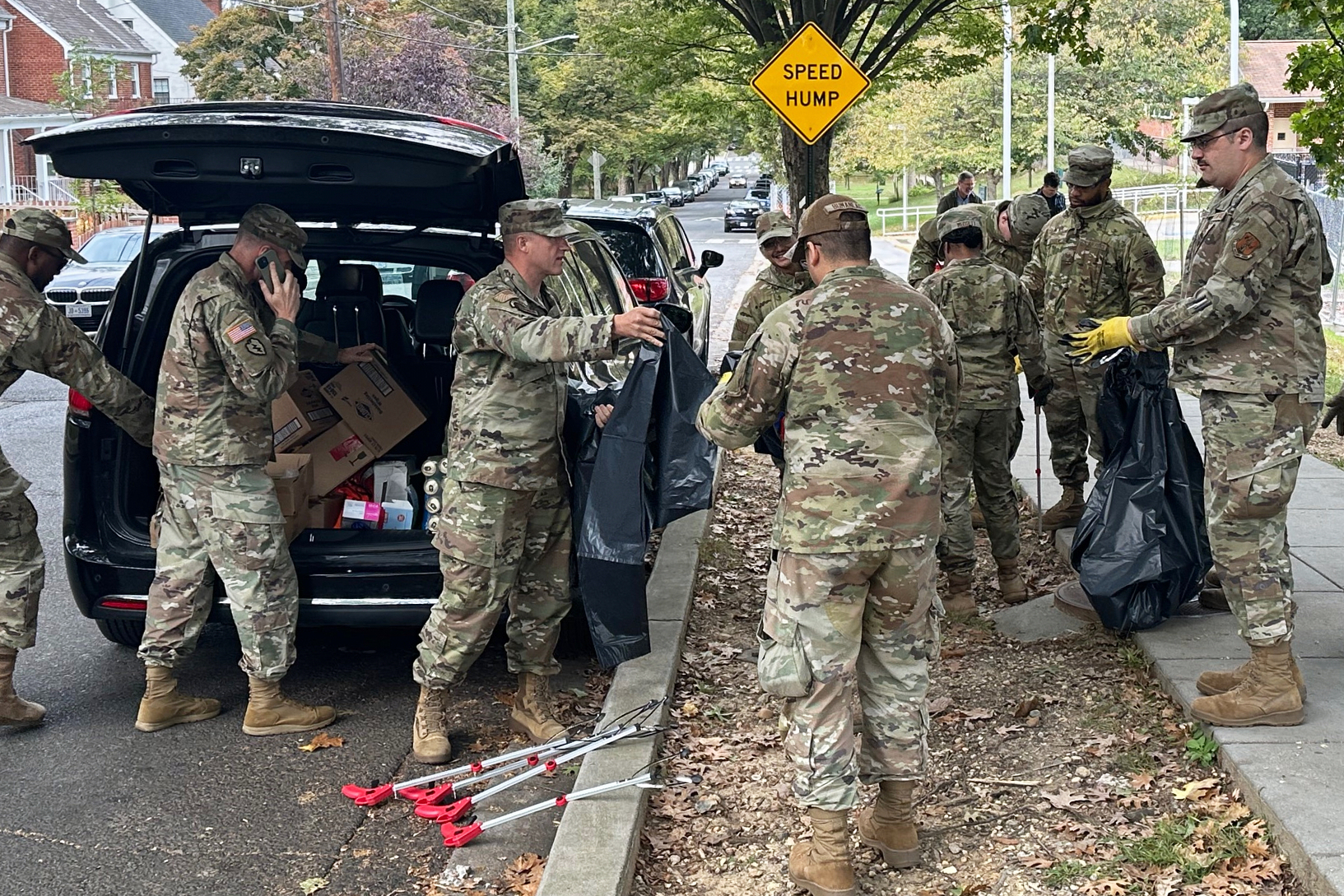
D.C. National Guard members take part in an October clean up of the park around Fort Stevens Recreation Center in the Brightwood section of Washington.Gary Fields
On Father’s Day morning this past Sunday, a longtime Washington, D.C.-based writer named Ian Livingston went out to get a breakfast sandwich. When he returned, he found a small platoon of National Guard soldiers, dressed in camouflage, patrolling an alley near his home. On a video that soon went viral, the troops smile slightly or ignore Livingston and his phone camera, which doesn’t make the scene any less disturbing. “Just a normal morning in our police state,” he wrote.
The normalcy is the problem. It’s been more than 10 months now since Donald Trump first took the extraordinary step of ordering the large National Guard deployment in the nation’s capital, with soldiers from the D.C. armory — authorized by Defense Secretary Pete Hegseth to carry weapons — soon augmented by detachments from red states, rising to an occupation force in the thousands. The move, which the president linked to a surge in “violent gangs, bloodthirsty criminals, and homeless people,” made a lot of headlines, then disappeared from the news. But soldiers haven’t disappeared from the streets. In fact, Trump recently authorized an increase to some 5,000 troops ahead of the July 4 festivities.
But what for? Researchers have found that the presence of the National Guard has had no apparent impact on violent crime rates — which were already at or near 30-year lows — although there has been a drop in “opportunistic crimes” like vehicle break-ins. But the legal parameters of their actual mission bar the troops from making actual arrests, although they can detain someone until district police show up. Typically, their squadrons have been spotted around D.C. picking up trash, although some are now deployed against the algae tourists of the Lincoln Memorial Reflecting Pool.
And at what price? The annual cost to taxpayers of the constant Guard deployment has been estimated at as much as $600 million — money that could otherwise be spent on things like actual solutions to the city’s chronic crisis of homelessness. The unbusy troops are, unfortunately, a magnet for America’s growing number of unhinged people, including the one who killed a West Virginia Guard member and seriously wounded another in a shooting last year. For most, the extended deployments mean unwelcome days away from family, actual work, and their hometowns.
But the real cost is a psychic one: the mental impact of living in an occupied city. Trump’s forever deployment of armed soldiers in our nation’s capital achieves some of the highest goals of his brand of strongman authoritarianism: a) a constant show of force aimed at demoralizing a population that’s increasingly unhappy with life under the 47th president and b) a threat that protesters should stay away from the White House and the Capitol when things really start to go south. We need to keep reminding ourselves what Ian Livingston conveyed tous this weekend: This is not normal. In the immortal 1971 words of singer Freda Payne, bring the boys (and the girls) home.
What I wrote on this date in 2020
This date six years ago was also nearly one month after the Minneapolis police murder of George Floyd, and America — and especially Philadelphia — was still dealing with the consequences. On June 23, 2020, I wrote about an Amnesty International report about police brutality in response to those protests, including the cops’ tear-gas assault on protesters blocking the Vine Street Expressway in Center City. ” We should be shocked that police forces in the United States are acting like the so-called ‘state security forces’ in an authoritarian banana republic,“ I wrote. ”Tear gas is banned in warfare under the United Nations, yet police commanders don’t think twice about lobbing it into crowds of Americans from Seattle to the gates of the White House.” Read the rest: “Amnesty International won a Nobel Prize for fighting torture. Next up: Philly police.”
Recommended Inquirer reading
Only one column last week as I enjoyed a Juneteenth/Father’s Day extended weekend. In that piece, I looked at the real reasons behind the federal conspiracy indictment against a group of an anti-ICE activists that some are already calling “the Minneapolis 15.” The charges — mostly centering on constitutionally protected free speech such as discussing their protests on the Signal app — are outrageous. But they also signal that the Trump regime is desperate to quash political dissent ahead of the November election.
The World Cup is a remarkable moment for sports, but also an incredible time for journalism, because the stories in the stands are often as compelling as what’s taking place on the pitch. At The Inquirer, the five-week tournament has been a great way to reveal how Philadelphia relates to the wider world. Last week’s match between Brazil and Haiti might have been a rout on the field, but sports columnist Mike Sielski took in the scene with Haitian fans who were just delighted their violence-wracked nation was having a moment on the world stage. Alex Coffey spent the weekend with four French fans who played hooky from their jobs back home to spend an unforgettable week in America’s founding city. Longtime soccer writer Kerith Gabriel hailed the city’s joy over the World Cup as “the escape we didn’t know we needed.” It’s easy to join this party in print for the last three unforgettable weeks of the World Cup: subscribe to The Inquirer today.
By submitting your written, visual, and/or audio contributions, you agree to The Inquirer’s Terms of Use, including the grant of rights in Section 10.
FCC commissioner Anna M. Gomez, the only remaining Democrat on the three-member panel, wrote in a May letter to Disney that the company had “been made a target” by Trump’s FCC, and that targeting local stations “is an extraordinary and dangerous misapplication” of the agency’s authority.
“What Disney and ABC are facing is not a series of coincidental regulatory actions but a sustained, coordinated campaign of censorship and control,” Gomez wrote, “carried out through the weaponization of the FCC’s authority as a federal regulator and aimed at pressuring a free and independent press and all media into submission.”
“If the evidence does in fact play out and shows that they were engaged in race- and gender-based discrimination, that’s a very serious issue at the FCC, that could fundamentally go to their character qualifications to even hold a license,” FCC chairman Brendan Carr said on Fox News in March.
6abc viewers being asked to comment
In an attempt to fight back, 6abc, which did not immediately respond to request for comment, is asking viewers to weigh in on the early review of its broadcast license and support the station.
The FCC doesn’t make it easy. Viewers need to visit the agency’s website and submit a “express comment” using the FCC’s docket number: 26-131
The public comment period is open until June 29.
6abc renewed its broadcast license in 2023 for eight years, but the FCC could move to revoke it if it determines the station hasn’t “served the public interest” or has violated federal broadcast rules and regulations.
A Disney spokesperson said in a statement the company has “a long record of operating in full compliance with FCC rules” and was “prepared to show that through the appropriate legal channels.”
It’s been more than 40 years since the FCC has revoked a broadcast license from a TV station. The last time it happened was 1987, when the FCC stripped RKO General Inc. of its licenses in Boston, New York, and Los Angeles because of business misconduct.
The process could take years, and no changes are expected for 6abc during that time.
‘The View’ is also fighting back
It’s not just ABC’s local stations the Trump administration is targeting. The FCC is also targeting the daytime interview show The View and its ability to interview politicians.
The investigation of The View stems from an February interview featuring U.S. Senate candidate James Talarico, a Texas Democrat who at the time was facing off in a primary against U.S. Rep. Jasmine Crockett.
The FCC claimed the interview was a violation of the equal time rule, a federal requirement put into law in 1934 requiring broadcast stations to provide comparable airtime to political opponents during an election.
Disney has asked the FCC to declare The View qualifies as a “bona fide news” interview program and is exempt from the federal rules, like news programs on broadcast TV like Meet the Press and Face the Nation.
In a May filing, ABC said The View received a news exemption from the FCC in 2002, and in 24 years it hadn’t been challenged. It called the FCC’s move to go after The View “unprecedented” and an attempt to “chill critical protected speech.”
It’s a blurry line for late-night shows, which feature politicians as guests. While not technically news programs, the FCC hasn’t enforced the equal time rule on late-night shows since 2006, when it ruled then-California gubernatorial candidate Arnold Schwarzenegger’s appearance on The Tonight Show with Jay Leno qualified as a “bona fide news interview.”
But that’s changing under the Trump administration. The FCC issued a notice to broadcasters in January stating late-night and daytime TV talk shows may no longer be exempt, claiming some were “motivated by partisan purposes.”
Carr also pressured ABC affiliates to take Kimmel off the air in September. ABC ultimately suspended his show after two companies — Nexstar and Sinclair — said they would preempt it on their ABC-affiliated stations. Ultimately, ABC backed Kimmel and his show was back on TV a week later.
Sporting orange swim trunks and not much else, Gunter was one of 12 new men who entered the show on episode 18 of Love Island USA.
It’s all part of Casa Amor, the mid-season twist where OG contestants split off into two villas and are forced to explore new connections. Gunter, 25, was one of a dozen men and six women who’ve been introduced to the show in the last two nights.
He was also one of the men chosen to stay: Those 12 men were quickly cut to six in the same episode.
Proving Philly is the center of the universe — even on a remote Fijian island and even at Casa Amor, Gunter was quick to tell North Philly native Melanie Moreno that he went to Drexel.
In a prior episode, Moreno, 24, told her most consistent connection, Sincere Rhea — who’s from Cape May — that her dream first date for them would be to walk through Penn’s Landing.
But with Rhea away at the other villa with new arm candy and the OG women forced to explore connections with their own new crop of islanders, Gunter stood out.
He chose to kiss both Moreno and Jen Terry as part of a challenge and later won the women over by talking about family life and his cooking chops.
“I want my wife sipping red wine on the countertop while I’m cooking,” he said. “I love to chef. Y’all will never go hungry with me around.”
While attending college in Philly, where he majored in sports studies, Gunter achieved virality for his likeness to Hurts.
Two years ago, in a TikTok reshared by accounts including ESPN, Gunter’s then-girlfriend (now-former Division I golfer and prominent sports broadcaster and social media personality Emma Carpenter) said he’d get mistaken for Hurts “everywhere we go.”
Gunter told The Inquirer at the time that the comparisons started coming around his sophomore year — along with stares and photo requests — but he welcomed the attention for the most part.
“I think it’s funny. And I mean, he’s not a bad guy to be compared to,” he said. “It’s an awesome comparison to be mistaken for that guy.”
Even Drexel’s Lacrosse program got in on the fun, posting on Instagram in 2023: “All we’re saying is that we’ve never seen @_ronniegunter and @jalenhurts together.”
Born and raised in Minnesota before heading Northeast for school, Gunter lives in New York these days, where he works as a program director for the nonprofit Harlem Lacrosse.
So far, no one on Love Island has made any comments about Gunter’s resemblance to Hurts. But there’s a lot more island time to play out.
A South Philadelphia woman shot and killed her sister and granddaughter before turning the gun on herself Monday in what police described as a double murder and suicide.
The women, identified Tuesday as Janice Picano, 67, Denise Grottini, 55, and Angelina Picano, 18, were found dead inside a home on the 2800 block of South 10th Street, according to police.
Police responded to the residence around 5:30 p.m. and found the women with single gunshot wounds to their heads.
They were pronounced dead at the scene by medics at 5:38 p.m., police said.
Janice Picano, who investigators say fired the fatal shots, was Grottini’s sister and Angelina Picano’s grandmother, according to a law enforcement source.
A gun was found at the home and was taken into evidence.