Category: News

  • Nagasaki marks 81st atomic bomb anniversary as mayor says nuclear deterrence only increases risk

    Nagasaki marks 81st atomic bomb anniversary as mayor says nuclear deterrence only increases risk

    TOKYO — Nagasaki marked on Sunday the 81st anniversary of the U.S. atomic bombing of the southwestern city, as the mayor called nuclear weapons “absolute evil,” denounced growing support for nuclear deterrence, and called on the Japanese government to adhere to its three postwar non-nuclear principles.

    The anniversary coincided with Japanese Prime Minister Sanae Takaichi ‘s government revising the country’s defense policy to further bolster the military’s offensive capability. Speculation has risen about whether Takaichi, who supports nuclear dissuasion, may allow nuclear weapons to be brought into the country, going against the third non-nuclear principle.

    Mayor Shiro Suzuki said that while some countries argue the possession of nuclear weapons helps deter potential attackers, the atomic bombings of Hiroshima and Nagasaki had demonstrated that humans can cross the line.

    “The theory of nuclear deterrence is extremely dangerous and fragile. Nuclear weapons are not a ‘necessary evil’ but an ‘absolute evil,’ and can never coexist with humanity,” Suzuki said. “To all leaders of the nuclear states and nations relying on nuclear deterrence, you must face the reality that the more you rely on nuclear deterrence, the more you increase the risk of a nuclear war.”

    The United States launched the Nagasaki attack on Aug. 9, 1945, killing 70,000 by the end of that year, three days after the bombing of Hiroshima that killed 140,000. Japan surrendered on Aug. 15, 1945, ending World War II and the nearly half-century of aggression across Asia.

    Representatives from more than 90 countries attended the ceremony at the Peace Park on Sunday and observed a moment of silence at 11:02 a.m., the time when a B-29 dropped a plutonium bomb, known as “Fat Man.”

    Suzuki singled out the Japanese government, demanding it uphold Japan’s war-renouncing Constitution, attend the Treaty on the Prohibition of Nuclear Weapons review conference later this year, and stick to the three non-nuclear principles.

    Takaichi supports the first two principles of not possessing and developing nuclear weapons.

    The prime minister, who attended Sunday’s ceremony, reiterated her policy of taking “a realistic and pragmatic approach” toward achieving a world without nuclear weapons. As she did in Hiroshima, Takaichi remained ambiguous about the three non-nuclear principles and only reiterated that Japan currently maintains the policy.

    Takaichi, in her speech at the ceremony, did not mention the Treaty on the Prohibition of Nuclear Weapons, which Tokyo has refused to sign because Japan is under the protection of the U.S. nuclear umbrella.

    She later told reporters that Japan’s policy is to work within the Nuclear Nonproliferation Treaty, and that her government will decide what to do with the treaty based on what’s most effective to ensure the country’s national security and push forward nuclear disarmament.

    Survivors have expressed frustration and criticized the Japanese government’s support for nuclear deterrence for being insincere. Growing concern about Takaichi’s possible easing of the non-nuclear principles has prompted protests by the survivors, or hibakusha, in Hiroshima and Nagasaki.

    The number of survivors has fallen to 91,105, about a quarter of the original number, with their average age exceeding 86. Survivors worry about fading memories, as the youngest of the survivors were too young to clearly recall the attack.

  • Window closes for Ohio GOP to replace Rep. Max Miller on the ballot

    Window closes for Ohio GOP to replace Rep. Max Miller on the ballot

    Rep. Max Miller, the embattled Ohio Republican who faces accusations of domestic violence from his ex-wife, appears almost certain to remain on the ballot in November after a key deadline in the process to replace him passed Saturday.

    Miller, who denies any wrongdoing, has resisted growing calls to drop his bid for a third term and resign from Congress.

    Under Ohio law, the deadline to fill a vacancy for the November general election is Monday at 4 p.m. But there are earlier steps in the process that seemingly would have necessitated Miller withdrawing already.

    Most notably, the leaders of the local Republican parties in all four counties that are part of the district must meet to choose the replacement nominee. The statute requires that the chairperson from the most populous county provide at least two days’ notice to participants to convene the meeting.

    That means Miller would have had to withdraw his candidacy by Saturday to leave enough time for the selection process before Monday’s deadline. He did not.

    A spokesperson for Ohio Secretary of State Frank LaRose (R), who oversees elections in the state, said the office could not confirm that interpretation of the law because of the potential for litigation.

    If Miller were to end his campaign after Monday, his name could still be removed from the ballot until 70 days before the November election — that deadline is Aug. 25 — but there would be no Republican nominee for the office.

    Some Republican officials, fearful of putting a conservative-leaning seat at risk as the GOP fights to hold its narrow House majority, have maneuvered to pressure Miller to drop out of the race. Withdrawing after he won the Republican nomination for Ohio’s 7th Congressional District would have allowed local GOP officials to select a replacement.

    Following their divorce last year, Miller’s ex-wife, Emily Moreno, accused him in court filings of throwing hot water on her from a pan of eggs he had just cooked, once holding a gun to her head, and hurting their daughter, who suffered a fractured collarbone in February. Miller claims his ex-wife fabricated those allegations because she is mentally ill, which she denies.

    Public scrutiny of the abuse accusations increased in recent weeks after Moreno filed for a new restraining order, leading Miller to post a lengthy video statement online in which he blamed a custody battle for souring their relationship and vowed to press ahead with his reelection.

    Last Sunday, Sen. Bernie Moreno (R., Ohio), Emily Moreno’s father, broke months of silence about the situation, calling Miller “a danger” who is unfit to serve in Congress and urging him to step aside.

    That set off a scramble over Miller’s fate. Some Senate colleagues, including Sen. Jon Husted (R., Ohio), and conservative organizations in Ohio joined Moreno to push Miller to end his campaign and resign from Congress.

    But prominent Republicans, including President Donald Trump and House Speaker Mike Johnson (R., La.), have stood by Miller. Most of his GOP colleagues in the House refuse to discuss the allegations against him.

    Privately, Republican campaign officials express little concern about losing Miller’s seat because of the conservative tilt of this area stretching south from the Cleveland suburbs.

    The Washington Post interviewed dozens of voters in the district this week and found that the scandal was barely registering.

    Many were unfamiliar with the accusations against Miller, and even those Republicans who had heard were largely wary of wading into what they considered a family matter and reluctant to abandon the congressman. Only a handful of conservative voters told the Post that they were even open to considering his Democratic opponent, Brian Poindexter.

  • Blanche’s confirmation fight was tough. Being Trump’s AG may be tougher.

    Blanche’s confirmation fight was tough. Being Trump’s AG may be tougher.

    With his bruising confirmation battle behind him, Todd Blanche will soon be sworn in as the Senate-backed head of the Justice Department.

    But the hardest part may be what comes next.

    Blanche, President Donald Trump’s former criminal defense lawyer, will officially assume the title of attorney general and take command of an agency he has led on an acting basis since April.

    But he will do so under competing pressures from a president intent on seeing his enemies put on trial, a federal judiciary increasingly skeptical of those efforts, and a Republican-led Congress harboring growing doubts about Blanche’s ability to say “no” to his boss.

    The Justice Department’s career staff has been ravaged by firings, departures, and low morale over the past year and a half, as its traditional independence from the White House has evaporated. And its to-do list has only grown longer, including stepped-up efforts to prosecute fraud, illegal immigration, and violent crime while pursuing the sweeping, politically charged investigations of foes that the president has demanded.

    Blanche acknowledged those challenges and the difficulty of meeting Trump’s expectations as he spoke to reporters ahead of his confirmation last week.

    “It’s not as if I remain blissfully unaware of what will happen if I am confirmed,” he said. “When President Trump talks about what he expects this department to do to make this country safe, I don’t think the American people should look at that as some sort of threat to me or warning to me. He wants this country to be safe.”

    But as Blanche assumes his new role, now with the imprimatur of Senate backing, walking a tightrope between satisfying Trump and fulfilling an attorney general’s obligations to the rule of law is likely to only grow more perilous.

    Over the next several months, the Justice Department is expected to make a number of charging decisions in sensitive cases of keen interest to the president.

    Prosecutors in Florida have been at work for months on what Trump allies have referred to as a “grand conspiracy” investigation of former Obama- and Biden-era officials, including former CIA director John Brennan, who they say engaged in a long-running scheme to violate the president’s civil rights through efforts to undermine his presidency — allegations Brennan denies.

    Meanwhile, department investigators continue to seek evidence to back Trump’s unproven assertions that the 2020 election was stolen, that there exist broad left-wing conspiracies to oppose his second-term agenda, and that his critics, including former FBI director James B. Comey, deserve to be put in prison.

    Despite concerns raised by lawmakers about Trump’s role in those probes, Blanche has repeatedly defended the president’s “right” to intervene in Justice Department business — a significant departure from long-standing norms.

    “If we have discussions where we have to talk about a case and whether we’re going to charge a case or whether we have charged a case, that’s OK,” Blanche told reporters last week. “I’m not concerned about that.”

    The Senate’s 50-49 vote to confirm Blanche early Saturday came in spite of reservations expressed by some Republicans over the growing politicization of the department under Trump.

    In casting the pivotal votes, Sens. John Cornyn (R., Texas), Thom Tillis (R., N.C.) and Bill Cassidy (R., La.) each said they worried about Blanche’s ability to put the interests of the American people above those of his former client.

    But each said Blanche had provided them with personal assurances that had assuaged their doubts about his ability to effectively counsel Trump when the president’s instincts run contrary to the rule of law.

    “I am realistic that President Trump can be unrelenting,” Cassidy said Friday, but added: “This will be true no matter who the attorney general is. And this is the rationale for having a Senate-confirmed attorney general with more leverage to push back.”

    Yet, even as Blanche was making those promises to the senators last week, Trump continued to pick at some of the very issues that had stoked lawmakers’ concerns.

    He threatened to revive the controversial proposal for a nearly $1.8 billion fund to compensate those who claim they were victims of political prosecutions, casting doubt on Blanche’s pledge to Congress that the fund was officially dead.

    He insisted the U.S. attorney in D.C., Jeanine Pirro, should refile cases that she withdrew against four people previously accused of damaging the Lincoln Memorial Reflecting Pool, even after she determined that there was no evidence to support the charges and that a government contractor was to blame for the damage.

    And, in a letter this week, the White House revived its efforts to oust Lisa Cook from the Federal Reserve Board over unproven allegations of mortgage fraud, despite a Supreme Court ruling in June blocking that move and the fact that the Justice Department has not filed any charges despite months of investigation. Cook has denied any wrongdoing.

    Publicly, Blanche has pointed to the unique relationship he built with Trump while defending him against the four criminal cases he faced in his years out of office, saying it gives him a base of trust from which to advise the president on issues tied to the Justice Department.

    But Blanche has also acknowledged that he can only do so much.

    “President Trump trusts me to give him counsel,” he said during his confirmation hearing in July. “Counsel does not mean a ‘yes man,’ and that’s true in my case like it should be in any attorney general’s.”

    He added, though, that “the Department of Justice, like every single department in the executive, is part of the executive” branch.

    Current and former members of the department’s career workforce have said they, too, once hoped that Blanche could serve as a moderating check on Trump’s most aggressive impulses, only to see those expectations dashed.

    When he was confirmed last year as the Justice Department’s No. 2 official, under then-Attorney General Pam Bondi, Blanche brought to the job experience as a federal prosecutor in Manhattan and, later, as a partner at a prestigious law firm.

    Career officials said they expected that background had instilled in Blanche a recognition of the department’s tradition of independence and respect for the rule of law.

    Their optimism quickly faded, they said, as Blanche publicly embraced Trump’s calls for disruptive change in the department and pursued legally questionable cases against the president’s rivals.

    Behind the scenes, Blanche has at times demonstrated a willingness to gently push back against the president, though not always with success.

    The Washington Post reported last year that he joined Bondi in advocating to save the job of Erik S. Siebert, the former U.S. attorney for the Eastern District of Virginia, who concluded in September that there was insufficient evidence to charge two top Trump targets — former FBI director James B. Comey and New York Attorney General Letitia James — with crimes.

    Trump ousted Siebert anyway, replacing him with Lindsey Halligan, who secured the indictments Trump wanted against both. Those cases were later thrown out by a federal judge who ruled Halligan had been appointed illegally.

    And on Wednesday, as Trump suggested Pirro’s job could be in jeopardy over her decision to withdraw the Reflecting Pool cases, Blanche offered her his full endorsement.

    “Judge Pirro is doing a great job, and our city, Washington, D.C., is a lot safer in no small part to her effort and the prosecutors’ efforts that she works with,” he said.

    Still, Blanche added: “Hypothetically, if the president chose to fire a U.S. attorney, he’s allowed to do that because he’s the president of the United States.”

    The same applies to attorneys general — and Trump’s relationships with those who have previously occupied the role under him have been famously fraught.

    He fired Jeff Sessions two years into his first presidential term, following months of acrimony over Sessions’s decision to recuse himself from the Justice Department’s investigation of Russian interference in the 2016 presidential campaign — a move that cleared the way for the appointment of special counsel Robert S. Mueller III.

    William P. Barr, Trump’s second Senate-confirmed attorney general, resigned after publicly contradicting Trump’s claims about the 2020 election being stolen.

    Trump fired Bondi in April over frustrations with her slow pace and limited success in bringing cases against his adversaries.

    Blanche, speaking to reporters soon after the president chose him to replace her, contemplated that he, too, could one day find himself on the wrong end of Trump’s expectations.

    If that day comes, Blanche said at the time, he would thank the president for the opportunity to serve, adding: “I will say, ‘Thank you very much. I love you, sir.’”

  • Netanyahu rejects Trump-backed Gaza plan for Hamas disarmament, Israeli withdrawal

    Netanyahu rejects Trump-backed Gaza plan for Hamas disarmament, Israeli withdrawal

    TEL AVIV — Israeli Prime Minister Benjamin Netanyahu rejected a U.S.-backed plan Sunday for Hamas to lay down its weapons in Gaza in exchange for Israeli withdrawal from the territory — a proposal President Donald Trump recently touted as a breakthrough toward ending the conflict there.

    Netanyahu, at the start of a government meeting, said that “Israel does not accept the 15-point document” and that an Israeli withdrawal will be carried out only after “genuine disarmament, not fictitious disarmament.” His demands included that the Palestinian militant group give up all weapons: “Heavy weaponry, lighter weaponry, all weaponry,” he said.

    Israel is “talking with the Americans about this issue,” Netanyahu said. “They have ideas, some of which are acceptable to us and some of which are unacceptable, and we know how to stand firm against these things.”

    Hamas said in a statement Sunday that it reaffirms its commitment to the 15-point plan that it agreed on with the Board of Peace, calling on parties to help ensure its implementation. However, the militant group and Israel disagree as to which should come first: Israeli withdrawal or Hamas disarmament.

    “The existence of Israel and the security of all Israeli citizens are not up for negotiation. We stand firm on these interests,” Netanyahu said in his remarks Sunday. “Unlike all those who lecture us, we do what needs to be done for Israel’s security, and we can and know how to stand our ground, even against our best friends when necessary.”

    The Board of Peace, the State Department, and the White House did not immediately respond to requests for comment.

    Netanyahu’s stance on the Hamas deal was another setback for Trump’s efforts to address Middle East conflicts.

    With Trump’s unpopular war on Iran now in its sixth month, comments from Iranian officials Saturday cast further doubt on an end to hostilities that have driven up global oil prices and dragged down the president’s approval ratings.

    Iranian officials on Saturday laid out a list of demands they are seeking from the United States in exchange for reopening the Strait of Hormuz, including withdrawing U.S. forces from the region, paying war damages, and lifting sanctions.

    Former defense secretary Mark Esper told ABC News’s This Week that Iran’s aggressive demands showed that they have been “emboldened” and feeling “confident about their position in the world.”

    However, in an interview with Axios on Sunday, Trump suggested that pressure on Iran was building because of the toll that U.S. strikes and a naval blockade have taken on its economy.

    Trump said the U.S. is “only semi-negotiating” with Tehran and “low-keying it.”

    “We are just watching Iran with its huge inflation and the fact they have no money,” Trump told Axios’ Barak Ravid, “It will work out. It always works out. It’s like a chess game.”

    The Hamas plan was unveiled on July 30 by Trump’s Board of Peace. It gave Hamas and Israel two weeks to agree on a timetable and process for implementing the disarmament of Hamas and the withdrawal of Israeli forces from Gaza.

    There was almost immediate disagreement on the order in which each should happen. Hamas said Israel must end its military campaign in Gaza as a first step; Israel’s position has been the complete disarmament of Hamas and removal of weapons from Gaza as a prerequisite. That disarmament would see Hamas surrender its weapons, which would be held by the National Committee for the Administration of Gaza, run by Palestinian technocrats.

    Trump, in announcing the plan late last month, said on Truth Social that the Board of Peace — a group that was set up in the aftermath of the 2025 deal to release the remaining hostages that Hamas seized during the Oct. 7, 2023, attack on Israel — “reached a HISTORIC agreement for the COMPLETE DISARMAMENT of Hamas and all other armed groups in Gaza.”

    He called it “a monumental step toward lasting PEACE and SECURITY.”

    Israeli Finance Minister Bezalel Smotrich said in a video on X, “There is no Hamas in Gaza, that is the goal of the war, and we are committed to it.” He added that “the IDF cannot withdraw a single millimeter from the Gaza Strip … prior to the disarmament of Hamas.”

    The 15-point plan also “shall create appropriate conditions for a credible pathway towards achieving Palestinian self-determination and statehood,” the framework states.

    But Netanyahu on Sunday reiterated: “As long as I am prime minister, a Palestinian state will not be established.”

  • Pentagon presses defense firms to build weapons as Iran war depletes stocks

    Pentagon presses defense firms to build weapons as Iran war depletes stocks

    The Pentagon is asking the U.S. defense industry to rapidly escalate the production and delivery of weapons, including munitions that are in extreme shortage due to the war with Iran, according to a Defense Department memo obtained by the Washington Post.

    Deputy Defense Secretary Steve Feinberg wrote to industry leaders on Wednesday, saying they had no more than 21 days to submit plans to “drive significantly faster, more aggressive delivery schedules and/or increased production for critical capabilities,” according to the memo, which is previously unreported.

    “Yearslong development cycles are not acceptable,” Feinberg wrote. “We must dramatically accelerate our program schedules and expand our production capacity now.”

    The directive comes as the weapons shortage has been a source of tension between President Donald Trump and the Defense Department, two people familiar with the issue recently told the Washington Post. It is also the latest in a series of actions the Pentagon and the White House have taken to address an issue that may largely remain unsolved until a gridlocked Congress releases additional defense spending, according to industry experts.

    Trump on Thursday said that the United States has “massive amounts” of munitions, posting on Truth Social that “large amounts are being manufactured and shipped to the U.S. as needed.”

    Feinberg’s note comes after efforts by the White House to enlist the defense industry to unlock military funds.

    In late July, legacy defense contractors and Silicon Valley weapons startups were summoned to the White House to meet with Trump’s chief of staff, Susie Wiles, Defense Secretary Pete Hegseth, Office of Management and Budget Director Russell Vought and White House Legislative Affairs Director James Braid, according to three people familiar with the event, who spoke on the condition of anonymity to discuss sensitive matters.

    In the meeting — which included firms such as Lockheed Martin, Northrop Grumman, Boeing, autonomous weapons firm Anduril, and data analytics company Palantir — company executives were asked to directly lobby lawmakers to increase defense spending through congressional reconciliation, the people said. Fox News earlier reported this meeting.

    The Pentagon has in recent months announced several “framework agreements” with the largest U.S. defense contractors and emerging startups to increase its supply of both low-cost munitions and sophisticated air defense weapons, like the Terminal High Altitude Area Defense (THAAD) and Patriot missile interceptors.

    These framework arrangements are legal, nonbinding contracts between the U.S. government and private sector partners that signal the Defense Department’s intent to purchase weapons but rely on congressional funding to become final, industry experts said.

    “They are agreements to agree, and so they’re not contracts,” said Tom Karako, director of the Missile Defense Project at the think-tank Center for Strategic and International Studies. “Almost nothing has been contracted, and that’s the problem.”

    “Working directly with industry leaders to accelerate production is not new. It has been the clear intent of the President and this Secretary from the start,” Pentagon chief spokesperson Sean Parnell said in a statement.

    He added that the Feinberg memo “is real” and “will inform the fiscal year 2028 budget submitted to Congress for funding, and it is entirely consistent with our ongoing push to rebuild the defense industrial base.”

    An empty arsenal

    In the first month of the Iran war alone, the U.S. fired off more than 850 Tomahawk cruise missiles and more than 1,000 Patriot and THAAD interceptors, the Post previously reported. The U.S. also used more than 1,300 of the Army’s tactical ballistic missiles in the initial weeks of fighting.

    As of last week, the global inventory of Patriot missiles has fallen from 2,200 before the war to fewer than 827, and THAAD missiles from 452 to fewer than 278, according to an analysis by CSIS.

    The depleted U.S. stockpile of munitions and defense systems has increased the risk to U.S. service members and forced the White House to back away from escalating attacks, the Post previously reported.

    The Pentagon has made efforts over the past few months to increase its weapons supply. On Aug. 3, the Defense Department announced a framework agreement with Northrop Grumman and Lockheed Martin to increase production of the Patriot Advanced Capability-3 (PAC-3) and THAAD missiles. Last week, the Pentagon awarded Lockheed Martin a contract worth up to $58.6 billion to triple production of PAC-3s by 2030.

    In May, the Pentagon announced several framework agreements with defense tech companies, including Anduril, Castelion, CoAspire, Leidos, and Zone 5, to “aggressively expand” the U.S. military’s strike capabilities and purchase their low-cost missiles. The department in late June also hosted leaders from various Silicon Valley startups, indicating they will be crucial in resupplying the U.S. with weapons.

    Speaking in November at the National War College in Washington, Hegseth outlined his vision to overhaul the Pentagon’s acquisition process in partnership with U.S. industry to ensure it can operate on a wartime footing.

    “American industry and its innovative spirit are begging to be unleashed to solve our most complex and dangerous warfighting problems,” he said. “We need to get out of our own way, out of your way, and enter into real partnership with you rather than overprescribe and decelerate your natural progress.”

    ‘The dilemma’

    The Pentagon has brought in former Silicon Valley business leaders such as former Uber executive Emil Michael to serve as the Defense Department’s under secretary for research and engineering, and to overhaul the defense innovation and procurement process.

    But moving forward with the Pentagon’s framework agreements to purchase weaponry, crucial to Defense Department strategy to expedite acquisition, depend on congressional passage of a $1.15 trillion defense spending bill, which remains deadlocked as Democrats object to massive spending increases.

    “That’s the dilemma, that’s the danger,” Karako said. “This really, really critical thing is in jeopardy because of congressional inability to appropriate.”

    In the memo, Feinberg said the Defense Department is “fundamentally shifting how [it] develops, produces, and fields military capabilities to meet current and future challenges.”

    Feinberg deemed several weapons programs critical and “under consideration for acceleration or increased procurement” during the 2028 fiscal year budget review. It included the Next Generation Interceptor missile defense program, the National Advanced Surface-to-air Missile System, a mobile air defense radar system, an advanced pilot training system, and a space-based system for missile tracking.

    The Feinberg memo tasked “industry leaders” to plan for “accelerated delivery” that would “provide the fastest production schedule to deliver projected orders and increase capacity.”

    It also asked defense firms to “propose specific capital investments and facility expansions … to support the Department’s commitment to higher volume, sustained orders,” Feinberg added.

    “Address how we will collaborate as partners and demonstrate your willingness to put skin in the game,” he wrote.

    Karako said some defense contractors are spending their own money to fund production costs while Congress is in gridlock and framework agreements await approval. But he said that comes with a risk for industry.

    “It’s a little bit of a gamble because they’re sticking their neck out,” he said. “They’re publicly traded companies, and you’re not supposed to really stick your neck out on a promise.”

  • Should you drink Philly’s tap water?

    Should you drink Philly’s tap water?

    If you live in Philly and want to know information about your tap water quality, start with the latest consumer confidence report, which is required to be produced annually by every community water system in the country. Most people never read them, but the reports provide essential information about drinking water quality.

    Like other large water systems, the Philadelphia Water Department publishes this information online, including the most recent 2025 drinking water quality report. The report provides an overview of Philly’s drinking water from source to tap. It reports that levels of approximately 100 regulated contaminants all meet federal standards.

    As an interdisciplinary scientist and engineer, I study drinking water infrastructure and how science gets translated into policy and decision-making.

    While the Philadelphia Water Department report is a good place to start, knowing what it tells you and where there may be gaps requires some background on how drinking water is regulated.

    How drinking water gets regulated

    In the U.S., drinking water is regulated under the Safe Drinking Water Act, which set limits for just over 20 contaminants when it became law in 1974.

    Subsequent amendments and regulatory processes have brought the total to about 100. That’s still a small number compared to the approximately 700 disinfection byproducts, the tens of thousands of chemicals in commercial use in the U.S. today, or other contaminants of emerging concern.

    While not all of these compounds end up in drinking water in amounts that can harm public health, the U.S. Environmental Protection Agency’s regulatory process is designed to be reactive, not proactive.

    Before setting a limit, the EPA must demonstrate that a contaminant may cause adverse health effects, that it occurs at levels that are a public health concern, and that regulation would meaningfully reduce risk.

    This process is repeated contaminant by contaminant, though a single glass of tap water may contain dozens of trace contaminants at once. The EPA has recently moved partly toward regulating mixtures of contaminants. The 2024 federal PFAS rule set individual limits for six PFAS compounds and also regulated four of them as a mixture. However, proposed changes to the 2024 federal PFAS rule include rescinding the mixture provision.

    Goals versus limits

    Federal drinking water standards involve two numbers for each contaminant. The maximum contaminant level goal, or MCLG, is the concentration at which the contaminant is believed to pose no significant risk to health in people who drink that water every day for 70 years.

    For chemicals classified as possible human carcinogens, MCLGs are typically set at a level where drinking the water daily for 70 years would cause one additional cancer case per 1 million people above the background rate.

    However, MCLGs are nonenforceable. Enforceable drinking water limits, also called maximum contaminant levels, or MCLs, are often higher than MCLGs because they take cost and feasibility into account.

    Levels of forever chemicals

    Two forever chemicals, PFOA and PFOS, deserve attention first. Both are types of perfluoroalkyl and polyfluoroalkyl substances, commonly called PFAS. PFAS are a family of synthetic chemicals widely used in consumer products. They persist in the environment and accumulate in the body.

    The 2025 report from the Philadelphia Water Department shows Philly’s highest reported levels of PFOA at 6.1 parts per trillion, or ppt, and PFOS at 4.6 ppt. Both are above the new federal limit of 4 ppt.

    But Philly remains in compliance. Meeting the federal limit is not required until 2029, and the EPA has proposed extending that deadline to 2031.

    The levels are well below Pennsylvania’s limits of 14 ppt for PFOA and 18 ppt for PFOS.

    Encouragingly, the Philadelphia Water Department is expanding its capacity to remove PFAS systemwide using powdered activated carbon. Small-scale tests have shown that powdered activated carbon can be effective for removing PFOA and PFOS, though effectiveness in real treatment conditions depends on dosing, contact time, and other factors.

    Lead, disinfectants, and sodium

    Lead in drinking water comes from lead leaching into the water from service lines leading from the water main to your house or from plumbing inside your home. Lead can cause serious health problems, and it accumulates in the body.

    As required by the Lead and Copper Rule, the Philadelphia Water Department’s treatment includes corrosion control that forms a protective coating on the inside of pipes. This reduces the amount of lead that leaches into drinking water from lead service lines. Homes built before a 1986 federal ban on lead pipes and solder carry the most risk, as do homes with lead service lines. More recent brass fixtures could legally contain small amounts of lead until 2014.

    The Philadelphia Water Department is required to collect samples from homes in Philly with lead service lines every three years. Testing in 2025 showed 90% of sampled homes were at or below 2 parts per billion, or ppb. That’s well under the 15 ppb EPA action level. But testing results ranged from 0 to 21 ppb, meaning some homes with lead service lines had measurable lead in their water.

    The maximum contaminant level goal for lead is zero because no safe level of childhood lead exposure has been determined.

    Chemical disinfection keeps water safe across Philly’s 3,000 miles of pipe but produces byproducts linked to increased cancer risk. These byproducts form when the disinfectant, in this case sodium hypochlorite, reacts with organic matter remaining in the water after treatment. Levels rise the longer water sits in the pipes.

    The Philadelphia Water Department’s 2025 annual averages were 51 ppb total trihalomethanes and 41 ppb haloacetic acids – both well under federal limits of 80 and 60 ppb, respectively. However, individual samples exceeded those limits. This suggests some homes further out in the distribution system may experience elevated levels.

    Finally, sodium levels are a concern for people with sodium-restricted diets, including those with hypertension, heart failure, or kidney disease. The American Heart Association recommends that people in these groups limit sodium intake to 1,500 milligrams per day. Depending on which plant serves you, Philly tap water carries 4 to 44 milligrams of sodium per 8-ounce glass. Over eight glasses a day, that’s roughly 30 to 350 milligrams, or up to nearly 25% of the recommended daily limit.

    What you can do

    Reducing your household exposure to drinking water contaminants isn’t difficult.

    A carbon filter certified to NSF/ANSI Standard 53 will measurably reduce disinfection byproducts, PFOA and PFOS, and lead. A certified carbon filter for a pitcher, faucet, or refrigerator works well to reduce levels in drinking water; reverse osmosis does more, but it costs more and wastes water.

    In addition, if your home has a lead service line or older plumbing, the Philadelphia Water Department recommends running cold water from the tap for 3-5 minutes when it has been unused for more than six hours before drinking or cooking with it. This flushes out water that has been in contact with plumbing.

    The Philadelphia Water Department offers free lead testing of tap water on request. The Centers for Disease Control and Prevention and EPA recommend that children at risk for lead exposure should have their blood lead levels assessed.

    Sodium is a different case: Standard carbon filters don’t remove it, but an ion-exchange pitcher, such as ZeroWater, or a reverse osmosis system will.

    Christine Kirchhoff is an associate professor of civil and environmental engineering and law, policy, and engineering at Penn State University.

    Reprinted from The Conversation.

  • Oxford may soon disband its police department. The community is worried about losing its homegrown force.

    Oxford may soon disband its police department. The community is worried about losing its homegrown force.

    Oxford officials are inching closer to disbanding the borough’s century-old police department and joining a regional law enforcement agency, as increasing costs of maintaining the local force have outpaced revenue. But the plan has prompted worries from some residents.

    The seven-member borough council will review final agreements to join the Southern Chester County Regional Police Department at its Aug. 17 meeting, where officials are poised to cast their final vote to move ahead with regionalization.

    First responders represent some of the most expensive parts of a municipality’s budget, between salaries, health insurance, and pensions, as well as facilities and equipment costs. Oxford will join a smattering of other area municipalities that have moved to regionalization as a way to save money.

    But the prospect has sparked concerns in the community of roughly 5,800 people. Some fear that dissolving the borough’s department will increase emergency response times and potentially leave the municipality unprotected. And they worry about losing the officers who have grown up alongside them and understand their community. Some residents have called on the township to try to save the department by cutting costs in other ways.

    “These are people that literally would pull my kid over, give him a ticket, and ask how his dad is when he had cancer,” Oxford resident MaryAnn Riess said. “This is personal. This is a small town. These guys, all 11 of them, mean something to us. We buy them coffee. We buy them doughnuts. They are part of our extended family. This matters to us, and how they’re being treated matters to us.”

    Mayor Phil Harris does not disagree. But he says it is becoming impossible to maintain the department at its current level — let alone increase salaries or staffing.

    “We all want the same thing. I want our officers in a different uniform in our town doing the same job, with more equipment and more access to the tools they need to continue to perform at a very high level,” he said. “That’s the goal.”

    Years of deliberation

    When Oxford’s council casts its vote later this month, it will be after more than three years of studies and evaluations, the township said.

    In 2023, leadership found its police department — which consists of a police chief, 10 full-time officers, and several part-time officers — was the borough’s largest operating expense. It accounts for about half of the borough’s expenditures, with more than $2 million budgeted in 2026 for police.

    Meanwhile, the borough’s revenues were not keeping pace. Officials began exploring how they could sustainably provide public safety services long-term.

    Original fiscal forecasts were quite “bearish,” Harris said. But even when the borough performed better than earlier projections, the writing was still on the wall, he said.

    Its higher revenue was in part thanks to an influx of new homes with higher-than-expected earned income tax. But the largest indicator of why revenue rose was a 21% tax increase during the same period.

    “We’re seeing the operational and the structural imbalances continue within the police department,” he said. “We’re struggling on the operational side to be able to maintain what we currently have.”

    A July analysis from Keystone Municipal Solutions found that though Oxford’s financial status had improved, it levied the second-highest millage rate in the county, increasing by 21% since 2023, compared with the average of 12% across the county. Additional raises were seen as “counterproductive to the growth necessary for long-term fiscal stability.”

    The analysis evaluated five possible service alternatives: keeping the borough’s department, restructuring the existing department, reducing staffing and supplementing coverage with Pennsylvania State Police, relying entirely on the state police, and merging with the Southern Chester County Regional Department.

    At its July 29 meeting, the borough council voted 6-1 to authorize the council president, borough manager, mayor, and solicitor to negotiate with the regional department. They will present those agreements to the full council in August.

    If the council votes in the affirmative, the borough will join New Garden, West Grove, and Avondale in the regional department. Formed in 2017, the department employs 21 full-time officers.

    It is projected the regional department would add 12 more officers with the inclusion of Oxford. Oxford would receive 24-7 police services, with at least two officers on patrol at all times, like the current structure.

    Harris said the goal is for every officer who wants to go to the regional department to do so. But there are protections and a path for those who do not.

    Oxford is a ways further west from its partners; the borough is up to 16 miles away from them.

    To keep response times low, the borough would have a substation — though likely not in Oxford’s existing police building — with cars in the borough. Officers would start and end the clock within Oxford’s boundaries, so there would be no shift-change gaps. They hope to retain the administrative assistant and have a lieutenant stationed on duty at the substation, Monday to Friday.

    Officers would get new uniforms, the cars would be relabeled, and Oxford’s assets would become part of the regional department’s assets.

    According to the report, after an increase in costs associated with up-front transition costs in 2027, annual savings would range from $300,000 to $320,000 “before declining slightly toward the end of the projection period.” The report estimates cumulative savings through the projection period at approximately $1.4 million.

    “What you get by regionalizing is the economy of scale,” Harris said. “You get stability across those lines, and it’s predictability — and you can spread things out, and you can plan.”

    More regionalization

    The Southern Chester County Regional Department is part of a broader swell across the state of municipalities utilizing regionalized services to slash expenses, said John Brenner, executive director of the Pennsylvania Municipal League.

    You would be “hard pressed” to find a community that spends less than 50% of its budget on public safety, he said. And those costs continue to rise.

    “That puts pressure on local officials again to say, ‘OK, what is more efficient here? Is there a better way to do this?’ And I think a number of local officials throughout the state have said, ‘You know what? Regionalization might make a lot of sense,’” he said.

    It is not a perfect solution: Across the state, municipalities have joined and then withdrawn from regional services due to increasing costs under the agreement, according to the analysis by Keystone. Similarly, Kennett Square pulled out of the regional fire and emergency services commission that it had helped start after costs soared too high. It rejoined the commission earlier this year, having not found a cheaper alternative.

    In Chester County, some municipalities contract out with their neighbors’ forces. Oxford tried to embrace such a model, but its closest neighbors have relied entirely on the Pennsylvania State Police for public safety, at zero cost. Contracting Oxford’s force was an expense those communities could not take on.

    Across Chester County, more than 20 municipalities rely on the state police for full coverage. Around a dozen others use partial coverage.

    But that was not a direction Oxford wanted to go. While the state police do a “great job,” they are “not a community-based police department,” Harris said.

    “We were desirous of having a community-based police department that operates in a different model, that knows the neighbors, that knows the streets, that goes out to the festivals, that shakes the hands and goes to the schools and the nonprofits,” he said. “We felt like the [regional department] brings that model and it maintains that standard.”

    Residents are concerned

    Danny Graham grew up running around town with the men who would go on to become police officers in Oxford. There is a distinct “hometown” feeling to the force, he said. It feels like the officers know what to do, how to calm people down. And they respond almost immediately, he said, recalling an incident outside his home when they were there within 2.5 minutes.

    Oxford police responded to 4,406 calls for service in 2023, according to the most recent data in the Keystone report. A majority were for property and house checks, followed by traffic stops, medical emergencies, and more.

    Serious crime — such as larceny or violent crime — was “not prevalent,” according to the report.

    But residents worry about what regionalization will do to that community culture and speed of response.

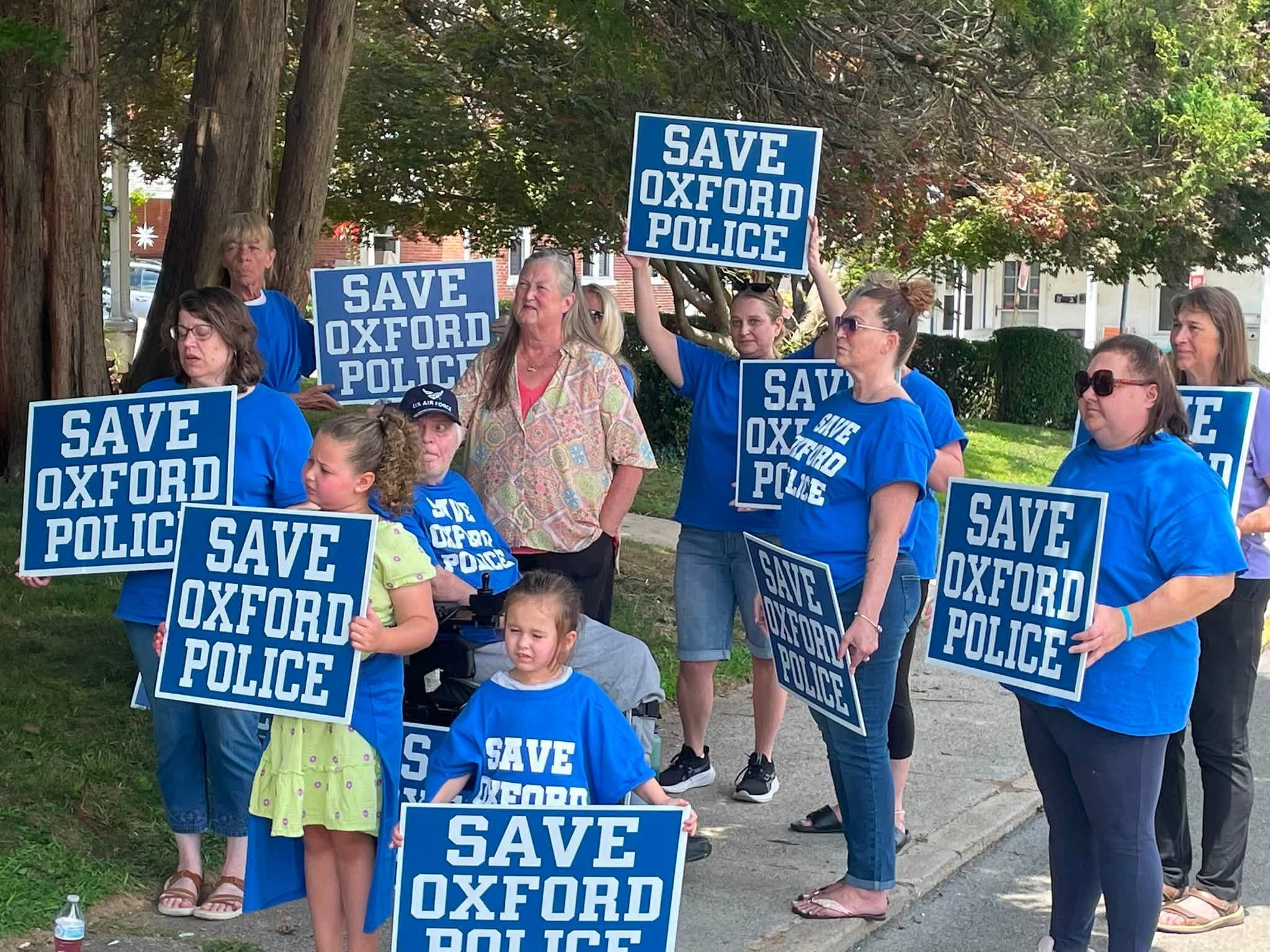
    In response, Graham created Save Oxford Police, a Facebook group that amassed nearly 1,000 members in recent weeks. A Change.org petition calling for saving the department has accrued hundreds of signatures.

    He said he did not understand how the borough could have enough cash flow for other expenses, but would not invest in the department.

    “Something stinks in Oxford, and we’re trying to find that smell,” he said.

    He hopes that, if enough people come to the Aug. 17 meeting, they can shut the regionalization effort down by postponing the vote, with the hope something could come up in the interim to save the department.

    But, if not that, “it’s no longer Save Oxford Police. It’s Save Oxford Police Officers, because now that means more than the department itself,” he said.

    Riess, who believes the Oxford police force is a greater extended family for the borough, said that sitting out on the patio at a restaurant recently, her group watched an officer test each business door, making sure they were locked.

    “Do you really think that’s going to happen [with regional]?” she said.

    “I’ve never seen regional do that, but I haven’t seen any officers really do that. Except Oxford,” Graham said.

    This suburban content is produced with support from the Leslie Miller and Richard Worley Foundation and The Lenfest Institute for Journalism. Editorial content is created independently of the project donors. Gifts to support The Inquirer’s high-impact journalism can be made at inquirer.com/donate. A list of Lenfest Institute donors can be found at lenfestinstitute.org/supporters.

  • Pa. small towns set to get latest wave of federal funding for EV chargers

    Pa. small towns set to get latest wave of federal funding for EV chargers

    HARRISBURG — As Pennsylvania prepares to receive millions of federal dollars to build electric vehicle charging stations, the small towns that will host the devices hope they can double as tourist magnets.

    “People can let their vehicles sit for a bit and walk the stores downtown and grab food,” Steve Herman said of the vision for the devices. “They’ll serve folks who are living here but also draw in visitors.”

    Herman is transportation planning program director for SEDA-COG, an economic development organization that covers eight central Pennsylvania counties. He’s spent the past year working with chambers of commerce and community groups to explore how to make the chargers economic assets. If planned properly, he said, the stations can “draw people into our downtowns.”

    The funding is the latest wave of a $5 billion federal program created under the Biden administration to build out EV chargers across the country. A previous phase of the program placed chargers along interstates and other major roads, but this round is focused on building chargers in local communities. All told, Pennsylvania is slated to receive $171 million by the program’s end.

    In the past year, Herman has surveyed where the best locations for chargers would be, hosting in-person workshops on the program and polling residents. He even created a tool that lets people drop pins on a map to recommend locations for chargers.

    He reported his findings to the Pennsylvania Department of Transportation, which has been consulting with dozens of other local planning councils across the state in preparation for the funds.

    “Compared to Philadelphia or Pittsburgh, [there are] differences in terms of existing network and priorities,” Herman told Spotlight PA, referring to current charger access. “We already have some in university towns and hospitals and destinations like that, even some of the grocery stores. But [there’s] not as widespread availability. The community charging program will broaden that out.“

    Pennsylvania has built at least three dozen chargers so far — the most of any state in the U.S. Each charging port cost roughly $163,000.

    Clean energy and transportation experts attribute the fast deployment to PennDot, which had previously partnered with the Department of Environmental Protection to research the issue. The agency also worked directly with local gas stations to dole out grants.

    Environmental advocates view EVs as a key part of combating climate change, as the transportation industry is one of the largest sources of greenhouse gas emissions in the U.S. Over half of those emissions come from passenger cars and trucks.

    Alissa Burger, regional policy director at clean transportation industry group CALSTART, said the federal funds are “creating a foundation” for states to have basic EV charging infrastructure that will “encourage their citizens to consider switching over to a zero-emission vehicle.”

    She added: “You’re not gonna get an EV if you feel nervous about where you’re going to charge it.”

    Previously, states were on their own, Burger said. For instance, she pointed to the 2019 PennDot plan to build out EV infrastructure. That pitch proposed just four charging stations and identified only state sources for funding.

    “There was intention. I don’t think there was a lot of funding behind it,” Burger said.

    So far, Pennsylvania has already spent or plans to spend roughly $60 million of the $171 million allocated to the state. The remaining $100 million has been obligated — meaning a contract is in place to spend the funds — to the grant program that Herman of SEDA-COG is participating in, per PennDot.

    That initial commitment is important, as unobligated funds can be clawed back by federal officials when the program expires in October. The EV charging effort is among a slate of initiatives funded by the Bipartisan Infrastructure Law that the Trump administration has tried to roll back or freeze.

    In the first weeks of his second term, President Donald Trump issued an executive order to freeze funding to this and other programs within the BIL. Trump said the freeze was for the purpose of eliminating “unfair subsidies and other ill-conceived government-imposed market distortions that favor EVs over other technology.”

    As a result, the federal Department of Transportation paused funding to states. But after a suit by environmental organizations and states, including Pennsylvania, a federal judge ruled the order unconstitutional and returned the funds.

    The Federal Highway Administration also issued new guidelines for the National Electric Vehicle Infrastructure program last August, which environmental advocates said slowed down EV build-out by forcing states to resubmit their plans.

    Under the NEVI program, states get funding to grow their electric charger network. Site hosts, such as gas stations and local governments; EV charging companies; and contractors can apply for money to buy, install, and operate EV chargers. These funds can be used to pay for up to 80% of the total costs to build, replace, or upgrade a charging station.

    The first tranche of funding was released in 2021 and designated for a specific use: ensuring that there was an EV charger every fifty miles on major highways in the state, namely the Pennsylvania Turnpike. The money was aimed at building chargers for passenger vehicles.

    Pennsylvania was the first state to meet that goal, which allowed PennDot to tap the funding dedicated to setting up charging networks in less-trafficked routes. That second tranche went toward areas like Northeast Pennsylvania, Erie, and the Pittsburgh suburbs.

    The latest and final round of funds, for “community-focused EV charging projects,” is what has small towns excited.

    PennDot is still in the process of mapping out where to place chargers, working with local planning organizations like SEDA-COG to finalize locations.

    The agency is doing this work in stages, targeting different regions of the state. Officials plan to begin announcing this fall which municipalities will be awarded grants to build charging stations, and say the process of choosing locations should wrap up by next summer.

    Spotlight PA is an independent, nonpartisan, and nonprofit newsroom producing investigative and public-service journalism that holds power to account and drives positive change in Pennsylvania. Sign up for our free newsletters.

  • Philly school principals were asked about their jobs. Here’s what they had to say.

    Philly school principals were asked about their jobs. Here’s what they had to say.

    Most Philadelphia principals believe the city’s district and charter schools are moving in the right direction, though they are also frustrated with punishing workloads and inadequate access to resources.

    And while the majority of principals are satisfied with their leadership roles, Philadelphia School District school leaders are less likely to feel positive about their levels of support and autonomy. Only about half of district principals reported feeling backed by central administration, and about the same number said felt they had the authority to make decisions about school policies and practices.

    Two-thirds of principals citywide have considered leaving their jobs, with most contemplating K-12 jobs outside Philadelphia or in the education sector but not in a school or district.

    The results come via a new survey commissioned by the Philadelphia Citywide Talent Coalition, a group asked by the Philadelphia Mayor’s Office of Education to design and implement strategies to hire and retain more effective teachers and teachers of color.

    Elevate 215, a Philadelphia-based education nonprofit, commissioned the study on the talent coalition’s behalf, surveying 135 district and charter school principals this spring.

    Here are some takeaways from the recently released report:

    There are some reasons to be optimistic

    Most principals have spent more than a decade in Philadelphia schools, district or charter.

    Both charter and district principals said they think Philadelphia schools are going in the right direction — 64% of charter principals and 55% of district principals. (In all, 36% and 45%, respectively, believe the sectors are going in the wrong direction.)

    Charter and district principals report a satisfaction gap in some areas

    While charter and district principals report similar levels of satisfaction in areas like relationships with students (95% for district principals and 96% for charter principals), there were areas of disparity.

    More than three-quarters, 80%, of charter principals felt they had access to adequate funding, supplies, and support staff. Just 23% of district principals were satisfied with their level of resources.

    Facilities satisfaction was a key area of difference, too — 83% of charter principals said they were satisfied with their access to adequate facilities, while 34% of district principals did.

    Only 32% of district principals said they were satisfied with their workload; 54% of charter principals reported workload satisfaction.

    In all, 51% of district principals said they felt supported by their central office administrators, while 88% of charter principals did. The same percentage of district principals said they felt they had autonomy to make decisions regarding school policies and practices; 81% of charter principals did.

    Principals’ top challenges are consistent

    Principals across sectors reported that staff shortages, workload, inadequately prepared teachers, and expectations around student achievement are top challenges.

    Principals sound off

    Asked what policymakers should know, the principals — who were not identified in the report by name or school — had much to say.

    “One piece of advice I would give policymakers is to listen directly to school leaders who are doing the work every day,” one principal wrote. “Retention will improve when leaders are not expected to carry the weight of academics, culture, staffing, family engagement, safety, and community concerns without adequate support.”

    Another principal was succinct, writing: “do not micromanage!”

    “People need to be paid more, especially teachers. We also need to be able to enforce truancy policies. It’s frustrating for all involved,” another principal said.

    “Attract, support, and help retain high-quality educators,” wrote another principal. “We can’t [hire large numbers of teachers without permanent certification] and expect miracles. Hold parents more accountable for school attendance — other states do.”

    Another principal focused on a lack of experienced educators: “Offer veteran teachers a higher salary to commit to working at schools such as mine in Kensington where the only applicants are just out of college with no experience. The children continue to fall further behind even with [academic coaches] in our building.”

    “Schools in hard to fill locations require veteran teachers with heart who understand their skills are needed desperately,” the principal said.

  • Delco man pleads guilty to stalking Philly TV news personality

    Delco man pleads guilty to stalking Philly TV news personality

    A Delaware County man who previously got in trouble for leaving lewd and threatening voicemails for U.S. Rep. Madeleine Dean pleaded guilty Wednesday to stalking a Philadelphia TV news personality.

    Stephen M. Cilurso, 73, of Aldan, admitted to one count of stalking by use of the mail and one count of witness tampering before U.S. District Judge Gail A. Weilheimer in Philadelphia federal court.

    U.S. Attorney David Metcalf did not identify the victim, but court records describe the target of Cilurso’s homophobic and threatening mailed letters as a TV news personality who has a spouse and children.

    Cilurso mentioned the man’s children by name in several of his threatening letters, according to the memorandum for Cilurso’s plea deal with prosecutors.

    Even after Cilurso was contacted in March by law enforcement about the harassment, he continued to send letters to the TV personality — but this time he was asking the victim to help get the criminal investigation dropped, the memo said.

    Cilurso reportedly did the same with Dean (D., Montgomery).

    He was charged in 2021 with making threatening and lewd calls to Dean’s office because she was involved with the impeachment of Donald Trump, whom he supported in 2020. At one point, he mentioned Dean’s daughter by name.

    After police began to investigate the calls, Cilurso left additional messages apologizing for his behavior and begging Dean to tell detectives to stop the investigation.

    Cilurso pleaded guilty in the Dean case and was sentenced to probation, court records show.

    In January, Cilurso was arrested for allegedly making threats to New Jersey Gov. Mikie Sherrill when she was a member of Congress.

    On Thursday, the Essex County Prosecutor’s Office confirmed that Cilurso pleaded guilty in March to one count of fourth-degree stalking in the Sherrill case. His sentence is pending.

    In the Philadelphia case, Cilurso mailed his first letter in 2019 and included homophobic comments and mentioned that he had just seen the victim with his kids.

    Cilurso continued mentioning the victim’s children in subsequent letters as well as the victim’s spouse, prosecutors said.

    He also threatened to release snakes around the victim’s home.

    “Regarding why the snake letters were mailed, the defendant stated he saw a news segment where Victim 1 revealed on the air that he is deathly afraid of snakes,” the plea memorandum said.

    “The defendant thought Victim 1’s fear of snakes was funny, so he began mailing threatening communications to Victim 1 indicating he was planning to release snakes at Victim 1’s residential property,” the memo said.

    In a September 2025 letter, Cilurso again used homophobic slurs and mentioned the victim’s spouse. At the end of the letter, according to the memo, Cilurso wrote: “I hope what happened to Charlie Kirk happens to you.”

    The victim received that letter about a week after Kirk, a conservative activist, was fatally shot on Sept. 10.

    Prosecutors said the victim felt as if his life was in imminent danger after receiving that letter and installed security cameras around his house. He also contacted Philadelphia police, who then notified the U.S. Postal Inspection Service.

    After being interviewed by law enforcement in March, Cilurso sent additional letters to the man, but was now asking for his help to stop the investigation.

    “I am the 73 year old scumbag who wrote you” the letters, Cilruso wrote, according to the memo.

    The plea memo said Cilurso begged for the victim to “help me out of this nightmare. Please ask the FBI to drop any future charges against me … I will donate a monetary amount to your favorite charity on your behalf … [D]on’t let me go to jail again and be away from my 3 remaining cats. I love my cats as you love your [children],” he wrote, again using their actual names.

    In a side note, the agents confirmed that Cilurso owned three cats.

    In another letter, Cilurso admitted that an agent had come to his house and told him to stop communicating with the victim, the memo said.

    In his last letter in March, according to the memo, Cilurso wrote: “I know that I told you that I would not write you again, but things have changed and not for the better for me.”

    Cilurso described health problems he claimed he had, and said he would take his own life and the lives of his cats rather than go back to jail, the memo said.