Not all Philadelphians who answered President Franklin D. Roosevelt’s call to action were soldiers and civilians.
Even the artists went to war.
Like renown sculptor — and local legend — Walker Kirtland Hancock, these educated Americans charged into the bomb-pocked battlefields of World War II to also confront unprecedented evil.
Their task? Saving priceless pieces of art.
Hancock was part of the “Monuments Men,” an outfit of about 345 men and women who were sent overseas to try to pry Europe’s cultural treasures from the grip of the Gestapo.
“I was really prepared,” Hancock told the Daily News in 1991. “I knew where I was going and what I was looking for.”
A group of “Monuments Men” retrieving stolen art in Germany in 1945. National Archives
He enlisted in the Army in his mid-40s and was trained as a medic, but later transferred to the Army’s Monuments, Fine Arts, and Archives outfit.
The unit’s monumental task: reclaim art the Germans had stolen and then hidden throughout the countryside in caves, on trains, in castles, and in hospitals.
But it was in a salt mine in Bernterode, Germany where Hancock struck gold.
Walker K. Hancock, considered the dean of American figurative sculpture, taught at the Pennsylvania Academy of Fine Arts.Inquirer Archives
The first painting he rescued was a work by Jean-Antoine Watteau, Embarkation for Cythera, what he described as “one of the greatest paintings” the artist ever completed.
“The surprise was so enormous to see a very famous old friend like that standing on the ground without any frame on it,” he told the Daily News.
The mine was also filled with other treasures: the great seal of Prussia; an emperor’s scepter; the art collection of Frederick the Great, which was considered to be the best collection of French paintings in the world; and palatial libraries.
The group’s efforts to reclaim precious pieces of human achievement were documented in a 2009 best-selling book. In 2014, their tale was given the “based on a true story” treatment and made into a star-studded motion picture dubbed The Monuments Men, featuring names like George Clooney, Matt Damon, Bill Murray, and John Goodman.
Today, Hancock’s public works can be found all over the country, and locally, his most notable work sits at the east end of 30th Street Station.
The Pennsylvania Railroad War Memorial (1950, installed 1952) by Walker Kirtland Hancock (1901 – 1998) in the lobby of 30th Street Station.Tom Gralish / Staff Photographer
The 39-foot-tall, 10½-ton Statue to War Dead depicts an angel holding a dying soldier. It commemorates in bronze the 1,307 employees of the Pennsylvania Railroad who died during World War II. Gen. Omar N. Bradley was on hand to help dedicate the artwork on Aug. 10, 1952.
Hancock died in 1998 at age 97 but his sculpture remains the station’s monumental centerpiece.
Think you know your news? There’s only one way to find out. Welcome back to our weekly News Quiz — a quick way to see if your reading habits are sinking in and to put your local news knowledge to the test.
Question 1 of 10
Bryson Stott’s custom “Field of Dreams” cleats feature Phillies legends emerging from a cornfield. They were designed by NXT LVL Customs, based out of where in Pennsylvania?
CorrectIncorrect. XX% of other readers got this question right.
Ryan Stevens and his company, NXT LVL Customs, are based out of Downington. Stevens collaborated with a Bucks County illustrator to do the portrait work on the shoes.
Question 2 of 10
Philadelphia is the latest locale for vigilante Jack Reacher's shadowy dealings in season four of Reacher, streaming now on Amazon Video. The show, which stars actor Alan Ritchson as the hulking retired Army investigator, was spotted filming around town last year. What location has NOT been spotted in a season four episode?
CorrectIncorrect. XX% of other readers got this question right.
Parc briefly plays host to Reacher, Lila Hoth (Agnez Mo), and Jacob Merrick (Christopher Rodriguez-Marquette) as the trio settles in at an outdoor table to evade police. But they haven’t been spotted at a cheesesteak spot, like Pat’s, so far.
story continues after advertisement
Question 3 of 10
What did 12-year-old Sam Okyere choose for his Make-A-Wish “Perfect Day?”
CorrectIncorrect. XX% of other readers got this question right.
Sam, who has sickle cell disease, wanted to help the homeless as his Make-A-Wish gift. The organization hosted a carnival-style extravaganza for the West Philly homeless shelter, Families Forward Philadelphia.
Question 4 of 10
A new LeBron James mural takes inspiration from an iconic photo from the basketball player’s Miami Heat days — where he and Dwyane Wade nailed an alley-oop. In the Chinatown mural, however, James is seen wearing a Sixers uniform and Wade is swapped out for this figure:
CorrectIncorrect. XX% of other readers got this question right.
In the mural, Wade is swapped for a bronze Billy Penn, a nod to the statue atop City Hall. Artist Chenlin Cai painted the mural.
Question 5 of 10
A corner store in Point Breeze, on the corner of 17th and Wharton Streets, is being praised for having the best:
CorrectIncorrect. XX% of other readers got this question right.
The spot is praised for its fried chicken sandwich, which costs $9 and consists of two chicken breast cutlets, thickly breaded with a super crunchy exterior. Ordering it “with everything” means that it comes with pickles, mayo, onion, tomato, and lettuce; laid on two slices of potato bread.
Subscribe to The Philadelphia Inquirer
Our reporting is directly supported by reader subscriptions. If you want more journalism like this story, please subscribe today.
This sweet treat first originated in Philadelphia, according to a 19th-century cookbook:
CorrectIncorrect. XX% of other readers got this question right.
The first known American cookbook author, Amelia Simmons, included a “light cake to bake in small cups” in her 1796 American Cookery. Another book from 1828 was the first to call the petite cake a cupcake. Not only is her recipe titled “cup cake,” but she also includes specific instructions to bake in “small tins.” Cupcake history thus begins here, in this printed record of the name and form recognized today.
Question 7 of 10
As its permit nears expiration, this attraction by City Hall is looking to relocate soon:
CorrectIncorrect. XX% of other readers got this question right.
The Portal — the video installation that accesses live feeds to other countries — and its permit is set to expire on Oct. 31. Portals.org is looking for a sponsor that can help house and relocate it. If it doesn’t find one in time, officials say the exhibit will move on.
Question 8 of 10
Which fruit flavor is trending across all Philly beverage menus — from bars to cafes — according to food reporter Kiki Aranita?
CorrectIncorrect. XX% of other readers got this question right.
Banana’s popularity is suddenly booming. They’re trending everywhere, but especially at cocktail bars and cafes, which use fresh bananas, banana liqueur, banana extract, and even banana peel. Some are calling it "the next pumpkin spice."
Question 9 of 10
The alternative rock band, Dogstar, toured through the Philly region this week. The band features this famous actor on bass:
CorrectIncorrect. XX% of other readers got this question right.
“We’re coming to Philly! We’re gonna rock!” said actor and Dogstar bassist Keanu Reeves in an interview with music critic Dan DeLuca. The band discussed the actor’s winding career and how he came back around to playing bass.
Question 10 of 10
A Philly entrepreneur allegedly scammed Eagles players and people in multiple states with:
CorrectIncorrect. XX% of other readers got this question right.
A recent investigation claimed that Mohamed Coulibaly defrauded three former NFL players out of $1 million in an e-commerce scheme involving fake Shopify stores.
Your Results
You have skipped .
You scored XX out of 10.
The average reader scored XX out of 10
Seems like you’ve been skimming more than reading there, buddy. There’s always next week.
You’ve read some articles (or made some educated guesses) but we wouldn’t come to you first for our local news recaps. Better luck next week!
Do you work here? You’re a local news stan with the latest updates on Philly happenings. Your friends definitely ask you for summaries on what’s going on and it shows.
The Upper Merion Township Board of Supervisors unanimously rejected a proposed 5-million-square-foot AI data-center campus that had sparked pushback from residents, a lawsuit from the developer, and accusations of mistreatment and intimidation.
After the decision was made at a Thursday night meeting, some in the crowd applauded, danced, and high-fived one another. The rejection came after three hours of fiery exchanges between the developer, Brian O’Neill, and township officials.
O’Neill and his team said they were prepared to go over each of the township’s comments about his five proposed sites in the King of Prussia area. But officials said it was too little, too late, and asked if O’Neill’s team was “filibustering.”
“Are you asking us to not present those facts in defense of those plans when it’s clear all you want to do is deny our plan and go home tonight?” said O’Neill. He later said township officials were violating state and local planning codes, an allegation they denied.
“Your attempt here to lecture us is considered an intimidation. And I don’t want to see our professional staff bullied or coerced,” said William Jenaway, vice chair of the Upper Merion Township Board of Supervisors. “Intimidation, coercion and bullying are not good qualities in a professional leader.”
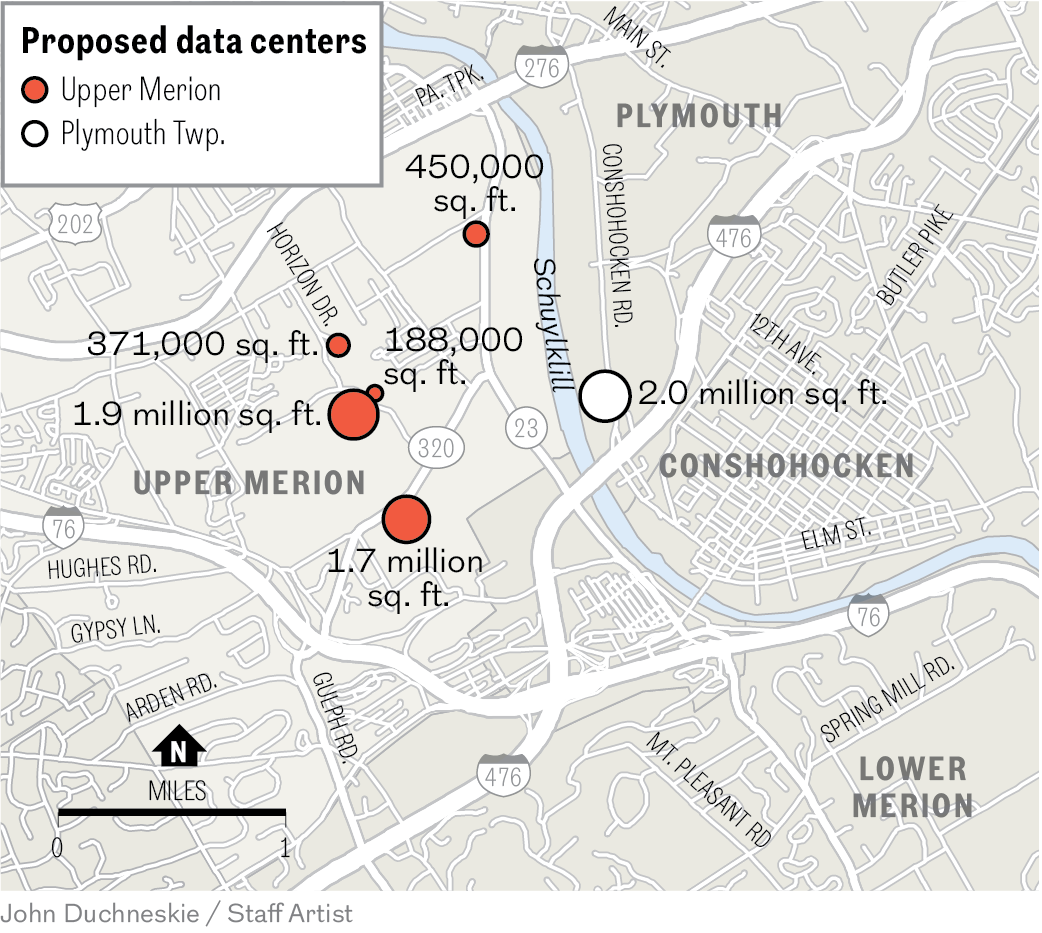
A map of the proposed data centers in Upper Merion and Plymouth TownshipsJohn Duchneskie
Those projects aren’t dead: O’Neill can appeal the board’s denial, as chair Tina Garzillo told him Thursday.
“Don’t you worry about that,” said O’Neill, before walking out of the Upper Merion Area Middle School auditorium to a chorus of boos.
The board’s decision came after months of contention and a whirlwind two days of legal back-and-forth.
O’Neill on Wednesday sued the township, its planning commission, and its board of supervisors, saying they violated his legal right to an extension and treated him unfairly during the development review process. Soon after, Montgomery County Court Judge Garrett D. Page ordered the township to halt proceedings and decisions related to the data centers until a hearing next week.
Citing the ruling, Edmund J. Campbell, an attorney for O’Neill, declined to make a presentation on two of the five proposed data-center sites at an Upper Merion Township Planning Commission meeting on Wednesday night.
Late Thursday afternoon, however, Page vacated his previous order, allowing the township board of supervisors to proceed with its meeting as planned. On the agenda: A vote on O’Neill’s request for an extension until Sept. 30, and votes on the five proposed data centers.
After an hour of public comment, all but one of which was from residents opposing the data centers, the township’s board of supervisors voted to deny O’Neill’s extension requests. The board then moved on to vote on the land development plans for each of the five sites.
One by one, the plans were denied unanimously by the five-person board.
Each vote was met with loud cheers from attendees.
For months, residents have rallied against O’Neill’s plans, packing township meetings and putting up bright orange lawn signs opposing the projects. About 18,000 people had signed a Change.org petition against the Upper Merion data centers as of Thursday. Some neighbors have expressed concerns about pollution, light, noise, electricity prices, property values, and quality of life.
Upper Merion residents opposed to the data centers have put up these lawn signs.Alejandro A. Alvarez / Staff Photographer
“I’m really proud to stand here tonight with each and every other concerned resident,” Courtney Smith said Thursday. “We all have something important here to fight for.”
“The people here are here because they care deeply about the long-term interest of our communities,” Montgomery County Commissioner Neil K. Makhija said during his comments in opposition of the plan. The commissioner said the supervisors’ decision would have ramifications beyond the county, as communities across the region and the country weigh data-center development.
O’Neil has said his data centers would benefit Upper Merion and “change the world for the better.” While the developer has declined to specify who exactly would operate the centers, he has indicated the facilities would use AI-powered biotech in conjunction with his existing life-sciences complex, Discovery Labs.
One of the sites where Brian O’Neill wanted to build a data center in Upper Merion.Alejandro A. Alvarez / Staff Photographer
O’Neill has said his data centers would comply with the highest environmental standards, emitting little light and noise. They would operate on a closed-loop system, requiring no outside water, he said, and provide their own power.
The developer has also said they’d be an economic boon to the area. Last week, he released an economic impact study that said the Upper Merion centers would result in more than 10,000 jobs during its construction and then generate more than $55 million a year in local tax revenue.
At Thursday’s board of supervisors meeting, however, Upper Merion Township Tax Collector Evelyn Ankers disputed those figures, and said O’Neill has failed to pay taxes on his properties in the past.
Across the Schuylkill, a data-center fight rages on between O’Neill and some residents of Plymouth Township, where the developer wants to build a 2-million-square-foot facility on a shuttered steel mill outside Conshohocken.
The amendment was one of hundreds filed this summer to an annual defense bill making its way through Congress. Along with her proposed change, Rep. Anna Paulina Luna’s office had sent a summary of what it would do.
But the first line made no sense.
“increasing example specific factors. Identical to H.R. 100 (118th Congress).11:25 AM????Claude responded:”
One of Luna’s staffers had copied a chatbot’s answer — timestamp and all — and pasted it into the public record of the National Defense Authorization Act.
As a screenshot of the garbled text circulated on social media, the Florida Republican was nonchalant.
“Not a shocker,” she wrote. “Most staff use it.”
Asked later about the incident, Luna went further. “A lot of staff will use ChatGPT, Claude, Grok. I personally like Grok better, but my staffer prefers Claude,” she told the Washington Post. “I’m not going to knock him for that. There’s nothing illegal about him doing a summary.”
Across the Capitol, lawmakers and staffers are using artificial intelligence to write speeches and news releases, sort constituent mail, prepare questions for congressional hearings, and draft amendments.
Even as politicians are debating how to govern AI for the rest of America, Congress has already settled how it will use the technology: quickly, broadly, and with little oversight.
Both chambers have cleared members and staff to use chatbots — Copilot, ChatGPT, Gemini, and, in the House, Claude — for official work, with more under review. The House bought 6,000 Microsoft Copilot licenses last year and encouraged staff to use them.
Having someone else put words in a lawmaker’s mouth is nothing new. For almost as long as Congress has existed, staffers have been ghostwriting speeches for their bosses. But a speechwriter can be summoned or fired. Chatbots are products built by the tech companies that lawmakers are in charge of regulating.
Amid the rapid adoption of AI on the Hill, lawmakers face a key question: How much of their responsibilities are they willing to hand over?
Interviews with more than two dozen lawmakers and staffers — some of whom spoke on the condition of anonymity to discuss internal operations — along with internal House and Senate policies obtained by the Post show that the institution has left that question largely unanswered. The few House and Senate rules that exist are poorly understood and seldom enforced. In practice, AI use is left up to the hundreds of individual congressional offices to settle for themselves. It’s not clear how many offices have internal written policies on AI.
And no one the Post asked knew of any instance where a staffer was formally disciplined by the House or Senate for breaking its rules.
Luna was right. There was nothing illegal about having AI edit, spell-check — or even write — legislative materials. It wasn’t against House rules, either.
Her staffer’s only mistake was letting Claude sign its work for others to see.
Congress’ newest staffer
Sen. Tommy Tuberville has found a new way to pass the long drives across Alabama: talking to ChatGPT.
He asks it about Medicare and Medicaid, and listens as the machine’s voice talks back.
“It’s kind of like you can sit there and talk to an expert,” said the Alabama Republican. “You don’t know whether or not they’re 100% correct. But they put you on the right path.”
Rep. Mike Flood (R., Neb.) said he consulted a chatbot while working on a bipartisan housing bill that passed this year, asking it where private equity was buying up single-family homes. Sen. Elizabeth Warren (D., Mass.), who has proposed stricter legislation on tech companies, uses ChatGPT to look up demographic information.
One GOP staffer’s boss uses chatbots to generate the occasional cartoon of himself, she said with a laugh. Her explanation: “He’s a boomer.”
But the real power users are the thousands of staffers who do most of Congress’s work.
Earlier this year, Rep. Cleo Fields (D., La.) had a town hall coming up in Natchitoches, a city in his district that his press secretary didn’t know well.
So that aide, Sydney Broome, asked Claude for a list of TV stations in town, its newspapers, and reporters’ names and contacts. Then, she started calling each one.
At 22, Broome is the youngest full-time staffer and only press secretary for Fields. AI saves her three or four hours of work a week, she said. Her boss does not use it at all.
ChatGPT first emerged when Broome was still in college. Her professors, unable to stop students from using AI, urged restraint and ran their assignments through AI detection. Students could use it for research, they warned, but never to write from scratch.
Congress has no such checks. So Broome has imposed them herself.
She’ll use Claude to find a reporter’s email, but not to write to them. She doesn’t use it to produce anything in her boss’s name. “That’s just kind of a bit of a gray area,” she said.
Many staffers say they are aware of AI’s limitations. The tools occasionally invent nonexistent bills. Other times, the writing is formulaic and clunky. Still, chatbots help speed up their work.
A GOP aide in another office said he uses Copilot to write appropriations amendments. The subcommittee he works for used AI to suggest witnesses for a hearing and to help generate the questions lawmakers should ask them.
Another Republican aide has taken AI even further. He exported all his phone contacts and text messages — years of conversations — into a personal Claude account and told it to build a database of every reporter he has ever dealt with: what he pitched them, which ones they accepted, which exchanges went badly. The chatbot auto-updates itself with each new conversation.
Recently, his boss wanted to do a TV interview about surveillance law. The aide asked Claude whether he had ever pitched a TV booker on that topic and how it went. It came back instantly with a contact.
Claude also runs that staffer’s office’s communications budget — the taxpayer-funded mail and ads sent to constituents. “I don’t really have to touch the data in Excel much anymore,” he said.
The aide said he’s not sure what exactly is permitted by congressional rules. “You’re still not supposed to put constituent data into AI,” he said. “There are weird things around where the rules are. I don’t know all of them.”
When nobody’s looking
In 2024, the House Administration Committee convened a private, bipartisan meeting with House officers and outside AI experts to talk through how far to let AI into the legislative process. About 150 chiefs of staff attended.
Out of it came the first AI guidance for Capitol Hill.
Internal House and Senate policies obtained by the Post and interviews with people familiar with them show how Congress has embraced the use of AI.
Last summer, the House bought 6,000 Copilot licenses. The tool was a natural fit for a chamber that already ran on Microsoft and a more secure way to keep congressional work inside a single system, officials believed. Starting in January, offices could sign up for access.
They came with a major guardrail built into the system: Copilot is designed to refuse political requests. Ask it to criticize a party, politician, or political group, and the machine declines.
“I can’t create content that criticizes or condemns political parties, politicians, or political groups,” read one Copilot response shared by a staffer. “That includes writing tweets that attack Democrats, Republicans.”
Roughly half the licenses are now in use, and House officials have extended the deal.
The rules Congress wrote for itself are loose. Off limits under current House guidance: putting sensitive material such as constituent information into a chatbot, generating deepfakes, making personnel decisions, and finalizing legislation.
A machine may help write a bill but may not be the last hand on it. It may draft a reply to a constituent but can’t be told who the constituent is.
In theory, a staffer breaking those rules can be stripped of access to AI tools, suspended, fired, even fined and imprisoned.
But no one could name a single case of that happening. People familiar with House operations said they’re not aware of any enforcement action by the chief administrative officer. A spokesperson for the CAO said the office can’t comment on potential enforcement actions. A spokesperson for the Senate sergeant-at-arms didn’t respond.
Catching violations largely falls on staffers, who would have to report a colleague, or themselves.
Most said in interviews that they don’t know the rules. A former senior Republican House staffer said that his office subscribed to both ChatGPT and Claude and that staff used them however they liked. He wasn’t sure what the rules were, or whether his team followed them. “We just had a free-for-all,” he said.
The House and Senate encourage individual offices to implement their own written AI policies. If a House office wants Copilot, in theory, it must have a policy in place.
One reason Congress has moved so quickly to adopt AI tools is to keep pace with the executive branch, said people familiar with internal House operations. The Trump administration has spent the past year and a half pushing AI into every corner of the government.
“If we are not keeping pace with how the executive branch is functioning,” one person said, “then we’re not performing effective oversight.”
AI for everything
The new frontier has left some lawmakers pondering how to proceed.
“We want to make sure we’re using AI, and AI isn’t using us,” said Rep. Jamie Raskin (Md.), a constitutional law professor and the top Democrat on the House Judiciary Committee.
Sen. Elissa Slotkin (D., Mich.) recently worked with her staff on a new policy for her office. They can use AI to “enhance and streamline” work but not to generate “final products” — like floor speeches or public remarks. They have to take AI training. Nothing with personal information about constituents or the senator can be uploaded. And her office is holding unannounced “spot check” inspections.
“We didn’t want to prohibit the use of the newest tools, but we also didn’t want absolute schlock showing up in my memos,” Slotkin said. “What I’m not willing to do is put my head in the sand and pretend that my young staff aren’t going to find new and interesting ways of doing this.”
In recent months, one Democratic staffer said his office has been exploring something new: feeding AI his boss’ past statements so the tool can write in the lawmaker’s voice. He heard another office was pulling it off and wanted to try himself.
In the same building, a GOP press secretary whose office has stricter AI limits said it’s unfair other offices get an advantage. “We could churn out so many op-eds if we were more comfortable with AI,” she said.
Recently, she found her own press assistant using AI in violation of their office’s policy. “We had to have a very robust conversation about how not to use AI for things in [the boss’s] voice,” she said.
A preview of what more rampant AI use could look like already exists in state legislatures — many of which have no rules or policies at all.
Amber Hulse serves in the South Dakota state Senate, where money is tight and lawmakers have no full-time staff. Hulse, a Republican, uses AI for almost everything — policy research, constituent email, speeches, writing legislation.
Lately, she said, the signs of AI’s effects are getting easier to spot.
“It’s funny,” Hulse said, “how your ears will start to pick up on the floor someone who’s giving a speech that was very clearly written by AI.”
WASHINGTON — Democratic senators have begun raising concerns about the extended deployment of the USS Abraham Lincoln, amid reports about poor living conditions and a lack of downtime for the crew after more than 8½ months at sea.
The Lincoln, a San Diego-based aircraft carrier with a crew of about 5,000 sailors, is supporting U.S. operations in the Middle East against Iran.
In a letter to Defense Secretary Pete Hegseth and Hung Cao, the acting Navy secretary, Sen. Richard Blumenthal (D., Conn.) described a list of reported problems on the ship.
“There have been widespread reports of shortages of basic supplies, water contamination, plumbing issues, deteriorating mental health, deck safety concerns, and disruptions in the mail system, which have caused many care packages in route to the ship to be lost in transit for months,” he wrote about the problems, many of which were reported earlier by Navy Times and Stars and Stripes.
Blumenthal added that the Trump administration had kept aircraft carriers at sea far longer than usual during its pressure campaign against Venezuela and its war with Iran.
Sen. Ruben Gallego (D., Ariz.) said in a social media post Wednesday that he was requesting an overnight visit to the Lincoln for a bipartisan delegation of lawmakers.
“Unlike Donald Trump, I’ve seen active duty,” said Gallego, who served in combat as a Marine. “The way he’s treating our service members as he carries out this illegal war is not just disgusting; it’s dangerous.”
The Navy is sending the aircraft carrier George Washington to the Middle East to relieve the Lincoln, according to a U.S. official who spoke on the condition of anonymity because they were not authorized to speak publicly about ship schedules.
“We make sure every ship, every crew, every captain has everything we can provide them at every single moment,” Hegseth told reporters during a visit to Panama on Thursday, according to Reuters. “Some deployments are longer than others, and I have more respect and gratitude for those sailors than anybody. What they do in those high seas in those austere conditions with less port calls — it’s incredible.”
A second carrier, the USS George H.W. Bush deployed on March 31 and is already operating in the Middle East.
The Navy’s newest carrier, the USS Gerald R. Ford, was deployed for 326 days before it returned home in May, breaking the record for the longest carrier deployment since the Vietnam War.
The Ford deployed from Norfolk, Va., on June 24, 2025, and was operating in the Mediterranean when it was redirected to the Caribbean in October as part of the force that captured President Nicolás Maduro of Venezuela. In February the ship was sent to the Middle East as part of a buildup of U.S. military forces in the region that launched the war against Iran late that month.
During its deployment, the ship suffered a fire and food shortages along with mechanical problems.
The longer warship deployments are, the more they wear on people and equipment alike. When in constant operation, gear often begins to break or become inoperable if replacement parts are not readily available. And the nonstop cycle can take a toll on morale.
Keeping warships out for extended periods often also creates other issues, such as upending plans that keep ships in certain parts of the globe for strategic reasons, along with interrupting shipyard maintenance schedules that are developed years in advance.
“The Navy has a lot of flexibility to react to contingency operations, but as those deployments get extended and demand more underway time outside of normal schedules, readiness and maintenance suffer,” Mike Franken, a retired Navy vice admiral, said in an interview. “We just don’t have the ability to recover from that quickly. It will take years.”
The Lincoln itself had to fend off attacks from Iran during the early phase of the war.
“Iran shot hundreds and hundreds of missiles and one-way attack drones at our aircraft carrier,” Hegseth told reporters at the Pentagon on April 8. “Every single one of those shots, easily shot down miles and miles away from the Abe Lincoln.”
The Lincoln has also helped enforce the U.S. blockade of Iranian ports, which initially ran from April 13 until a ceasefire agreement was announced in mid-June, and then resumed on July 15.
During the first blockade, U.S. Central Command, which directs military operations across the Middle East, said its forces disabled nine “noncompliant” vessels through gunfire and missile attacks, and had “redirected” 135 ships that ultimately complied with the blockade order.
In the second blockade, there appear to have been fewer U.S. attacks on merchant ships. In its most recent update on Aug. 9, Central Command said it had redirected 55 commercial vessels, disabled two, and boarded two to “ensure compliance” since the blockade was reinstated.
When the Lincoln’s relief will arrive is unclear, but the George Washington recently passed through the Strait of Malacca — a major transit route through the Pacific Ocean in Indonesian waters — heading west, according to a second U.S. official who spoke on the condition of anonymity to discuss warship movements.
With the Navy’s limited numbers of aircraft carriers being routinely pushed months beyond their scheduled deployments, Franken said, it will begin to limit their availability for combat operations in the future.
“I guarantee you that the first two years of the Trump administration will definitely affect the next two years of the Trump administration,” he said.
Four days after Alex Pretti was fatally shot while filming officers taking part in the Trump administration’s immigration crackdown in Minnesota, the Homeland Security Department quietly opened an investigation at its office in St. Paul.
The target was not the Border Patrol agents who had killed Pretti, a 37-year-old government nurse, in late January. Instead, it was several left-leaning political organizations — labor unions, a climate change group, socialist collectives — that investigators believed had provided help and money to what they described as the “violent opportunists and agitators” on the street, according to newly released government documents.
As part of their inquiry, the documents show, Homeland Security officials used an array of invasive tactics during the first half of this year to gather information on many groups and individuals who were never accused of crimes, crossing the line that has traditionally stood between investigating criminal activity and political dissent.
In one instance, officials used administrative subpoenas to obtain more than three years of financial records from the Sunrise Movement, an environmental action group, and a labor union, the Communications Workers of America. That time frame went well beyond the civil unrest in Minnesota, which was prompted by the deployment of thousands of immigration agents to the state during the winter.
In another, investigators scrutinized three years’ worth of wire transfers made by the nation’s biggest healthcare workers union, the Service Employees International Union, in what they referred to as an inquiry into “domestic terrorist financing.”
The documents further detailed an expansive covert surveillance operation in which undercover agents spied on protesters and organizers at meetings held online, as well as in libraries, parks, and churches, taking down not only what they said, but also their names and sometimes license plate numbers. The undercover agents also infiltrated group chats on Signal, listening as activists discussed coming demonstrations and their political opinions.
So far, none of the organizations targeted by the Homeland Security inquiry, conducted with the U.S. attorney’s office in Minnesota, have faced charges. And yet, as the investigation moved forward, prosecutors showed grand jurors a PowerPoint slide asserting that 18 groups — including the AFL-CIO, the country’s largest federation of labor unions — were part of a conspiracy to impede the work of immigration officers in Minnesota.
Ultimately, that supposed conspiracy led in June to the indictment of 15 people accused of interfering with law enforcement agents as members of the far-left movement known as antifa.
The Homeland Security Department did not respond to a message seeking comment. A spokesperson for the U.S. attorney’s office in Minnesota declined to answer questions about the investigative tactics.
By its own account, the institutional left in Minnesota, especially the labor movement, played a central role in bringing out hundreds of thousands of people to march in protest of President Donald Trump’s immigration crackdown in the state. But the demonstrations — and corresponding efforts to monitor the movements of Immigration and Customs Enforcement agents — were largely undertaken by ordinary residents, most of whom have said they were committed to peaceful resistance.
“While federal agents repeatedly broke the law, ordinary people exercised their First Amendment rights to protect their neighbors,” said Aru Shiney-Ajay, the executive director of the Sunrise Movement. “The Trump administration is now trying to intimidate individuals and organizations who opposed his agenda.”
Some of the 15 people charged in the so-called antifa case did, in fact, belong to some of the unions and political organizations that faced scrutiny over several months during the spring and winter. But the newly released documents, which were disclosed as part of a motion asking for more details about the criminal inquiry, suggest that investigators used those tenuous connections to take a deep dive into the inner workings of the groups.
Kevin Riach, the lawyer who filed the motion, in U.S. District Court in Minnesota, wrote that the Homeland Security investigation into the interference with federal agents “extended far beyond any potential threat to law enforcement safety.”
“It concluded, with no evidence (but obvious political animus),” he wrote, “that numerous Twin Cities unions and nonprofit organizations were involved in a widespread conspiracy,” adding that “it surveilled and surreptitiously gathered financial records generated by these organizations despite the lack of any connection between those organizations and criminal conduct.”
The investigation in some ways called to mind Cointelpro, the intrusive counterintelligence program that the FBI ran against leftist groups from the 1950s to the 1970s under the leadership of the bureau’s director, J. Edgar Hoover.
The Minnesota surveillance reports in particular documented what largely appeared to be political activity protected by the First Amendment. They showed how undercover agents embedded themselves in a “noise protest” outside a hotel where immigration agents were staying and took down notes at other gatherings as demonstrators brainstormed ideas on how to protest the surge of officers who descended on Minnesota late last year.
Former federal prosecutors questioned why Homeland Security officials took the lead in a case that would typically be overseen by the FBI. Others said that the broad use of subpoenas targeting labor unions and other groups was unusual and concerning, especially if it turns out there was no evidence that the organizations were breaking the law.
“The government’s power to investigate is extraordinary, and with that power comes a responsibility to exercise care and restraint,” said Harry Jacobs, who resigned as the chief of the criminal division at the U.S. attorney’s office in Minnesota in January in protest over the Trump administration’s handling of the killing of Renee Good.
“An investigation should begin with a legitimate basis to suspect criminal conduct, not with a chosen institution or group,” Jacobs added. “Prosecutors must follow the facts and the law wherever they lead, rather than select a target and work backwards to build a case.”
Several of the groups that were targeted in the inquiry, known as Operation Puppet Master, and in a follow-up investigation called Project Whipple Shield, declined to comment. (Whipple Shield is a reference to the Whipple Building, which served as a hub of the immigration operation.)
When Daniel N. Rosen, the top federal prosecutor in Minnesota, announced the indictment of the 15 purported antifa members two months ago, he chose his words carefully, insisting that the defendants had been charged only because each of them had “violently opposed” federal agents taking part in the Trump administration’s immigration agenda.
“Be assured,” he told reporters, “the Department of Justice and my U.S. attorney’s office has and will distinguish between lawful protest and criminal conduct.”
But what Rosen did not disclose that day was that the charges filed against the 15 defendants stemmed from a sprawling investigation. Its tentacles had touched the lives of scores of ordinary people — teachers, veterans, union members — who in many instances had gotten together to do little more than discuss monitoring ICE agents or abolishing ICE altogether.
The case in St. Paul, like others against ICE protesters, arose from a sweeping directive issued last year by Trump known as National Security Presidential Memo 7. The memo ordered a whole-of-government approach to stem what officials have described as a rising tide of left-wing political violence.
But former prosecutors and civil rights lawyers have criticized it for encouraging aggressive investigations and prosecutions of groups and people on the left for activities typically protected by free speech laws.
In drafting their indictment, prosecutors under Rosen focused on an organization called Direct Action Minnesota, or DAMN, an umbrella group that describes itself as a “decentralized coalition of working-class people engaged in various forms of community defense against the current federal occupation” in Minnesota. Prosecutors said that the group trained its members in how to use shields against law enforcement officers, conduct surveillance, plan events, and mount “rapid mass mobilization” against actions by ICE officers.
The indictment details some behavior by protesters with ties to DAMN that clearly seems violent or obstructive.
For example, prosecutors said that on Jan. 23, demonstrators who had gathered at the Whipple Building threw ice blocks at law enforcement vehicles. They also formed a blockade, boxing federal agents into one area near the federal building. Weeks later, prosecutors added, some of the defendants put debris in a road outside the building, trying to block access to it.
But the indictment also notes that the defendants often relied on information gleaned from group chats whose members tracked and monitored vehicles going to and from the Whipple Building — behavior that is not necessarily illegal. Indeed, the federal judge overseeing the case, Katherine M. Menendez, has already issued an order in a separate civil proceeding saying that protesters cannot be arrested simply for following federal agents in their vehicles.
Nonetheless, some groups that organized and ran the group chats were targeted by the surveillance operation and later identified in the prosecutors’ grand jury presentation as being part of the conspiracy to interfere with ICE agents. Other members of the alleged conspiracy were said to include the local chapters of the SEIU and the Democratic Socialists of America, a state teachers union — and even the Grease Pit, a small bike shop in Minneapolis.
In his motion, Riach described how federal agents took down the license plate numbers of people who attended a protest at a church in Roseville, Minn., and used that information to obtain their names. The agents then searched social media for images of the people, compiling an “intel work-up” that included detailed personal information about them.
“None of these individuals did anything other than engage in protected First Amendment speech in a church meeting room,” Riach wrote. “Yet now their personal information is memorialized in a DHS dossier.”
WASHINGTON— President Donald Trump’s botched repairs at the Lincoln Memorial Reflecting Pool have landed the National Park Service in a tight spot, forced to serve the public while managing controversial demands by the Republican president.
The beloved federal agency, its iconic park rangers, and other employees have been navigating a new reality under Trump, from orders to revise exhibits at parks and other sites to the demolition of important structures under its stewardship, such as the White House’s East Wing, to arresting visitors for alleged vandalism at the pool.
Critics say the monthslong Reflecting Pool saga and other demands by Trump risk undermining the integrity of a federal agency that has long been held in high esteem by the American public.
“Never — not once in decades — have I witnessed such systematic degradation, disrespect, and dismantling of the National Park Service as I see today under the thumb of President Donald Trump and Interior Secretary Doug Burgum,” said Bill Wade, a former park ranger and superintendent.
Wade, who now serves as executive director of the Association of National Park Rangers, wrote an op-ed for the Denver Post lamenting what he called the Trump administration’s “assault on the people, the mission and the values that have made the National Park Service one of America’s most valued institutions.”
The park service has been at the center of some of Trump’s most contentious actions during his second term. An executive order targeted funding and demanded reviews at national parks and other sites that Trump said advanced “divisive narratives” and “improper ideology,” resulting in changes to some exhibits on slavery or climate change.
The president has also ordered sweeping changes to historical monuments and buildings in Washington that fall under NPS’ purview, including the creation of a White House ballroom and a 250-foot-tall memorial arch. The agency meanwhile has lost at least one-quarter of its permanent workforce since Trump began his second term, through layoffs, forced retirements, and resignations.
Park service employees “are being politicized and drawn into the absurdities and corruption of this administration” on a regular basis, said California Rep. Jared Huffman, the top Democrat on the House Natural Resources Committee. He cited the pool project, the proposed arch, and the executive order on exhibit materials.
The ongoing political assault on the agency “is unlike anything we’ve seen in this country, and it makes life miserable at agencies like the National Park Service,” Huffman said.
Reflecting Pool saga continues
Trump launched repairs at the Reflecting Pool earlier this year, hoping to address longstanding problems at the iconic site ahead of the America 250 celebrations. But the $16 million project faced immediate problems, including peeling blue sealant and a fierce return of green algae.
Trump blamed the sealant issues on vandalism without providing evidence, and felony charges were brought against a former Olympic canoeist, David Hearn, after he was accused of vandalizing the pool.
The U.S. Park Police, a unit of the National Park Service, arrested Hearn, who denied wrongdoing and said he briefly touched a chunk of the coating.
Charges against Hearn were dropped on July 31 after prosecutors acknowledged that damage was caused by a bungled installation rather than vandalism.
The advice and counsel of career officials and rangers — instantly recognizable by their signature flat hats and green-and-gray uniforms — has been ignored or pushed aside as Trump and Burgum make decisions regarding the failed pool repair, according to an Interior Department employee who was not authorized to discuss internal discussions and spoke on the condition of anonymity.
“It’s tragic,” said Ed Stierli, vice president of government affairs at the National Parks Conservation Association, another advocacy group. “The whole thing is a master class in how not to go about a public rehabilitation project.”
In the days since the dismissal of the charges, Trump has continued to lean on NPS in his repeated claims that vandals damaged the pool’s lining.
“A National Park Service career employee, a highly credible witness, saw David Hearn … in broad daylight vandalize the Reflecting Pool by ‘violently’ ripping and tugging at the Pool’s somewhat delicate coating,” Trump posted Aug. 9 on his Truth Social site. Hearn’s legal team said Trump “is continuing to attack an innocent man.”
Stierli, of the parks conservation group, called Trump’s reference to the unnamed park employee an example of the awkward position agency workers now face under Trump and Burgum, who has publicly backed Trump’s claims about vandalism at the pool.
“I think the public understands that unfortunately, you have the president of the United States directly driving decisions, both here in Washington and around the country,” Stierli said. The park service — and especially its career staff — “has very little control over this,” he added.
The White House and the Interior Department did not directly respond to requests for comment on the park service. The White House defended the pool project, saying Trump “promised to make D.C. safe and beautiful, and he’s delivering.”
“For years, the Reflecting Pool sat neglected, plagued with algae, and leaking millions of gallons of water,” the White House said in a statement. “Fixing it was common sense.”
Park service morale is at its lowest point, a former official says
Wade, the former park superintendent, called the pool repair “a comedy of errors” and “a continuation of the incompetence” shown by the Trump administration.
“Most people realize the NPS is under the gun and can’t do much about it, even though they’d like to,″ he said, adding that morale at the agency is at the lowest point he can remember.
Edicts from Washington have made clear that speaking honestly about what is going on could cost staffers their jobs, Wade said. “There’s a very strong fear among employees at NPS,″ he said in an interview. “It’s very frustrating for them, as you can imagine.”
Trump’s proposed memorial arch has faced some pushback. A recent report by park service staff warned that the proposed gilded arch could disrupt the historical significance of dozens of sites around its planned location near the Lincoln Memorial.
The arch, which last month received initial approval from a key federal commission, would impact the “integrity” of dozens of historical properties because it would change “character-defining visual and spatial relationships” between them, the report said.
Americans view the National Park Service favorably
The park service is popular with Americans. About three-quarters of U.S. adults — including similar shares of Democrats and Republicans — have a favorable opinion of the agency, according to Pew Research Center polling from 2025. Only about 1 in 10 have a negative impression, and about 15% are unsure.
A Washington Post/Ipsos poll from July found that about two-thirds of Americans say they are “dissatisfied” or “upset” about Trump’s Washington area projects, including construction of a new ballroom at the White House, painting the Reflecting Pool, and building his triumphal arch. Republicans are more likely to be “enthusiastic” or “satisfied” with the projects.
About one-quarter of U.S. adults say Trump’s goal is to “make Washington more beautiful,” while about half say he has a “different goal.” In an open-ended question, many respondents speculated that Trump wants to glorify himself or leave his mark.
The pool and other recent controversies including the exhibit reviews jeopardize the agency’s credibility, Wade said.
“Whether interpreting the Civil War, discussing climate science, or describing the complex stories of Indigenous people, rangers have sought to present evidence, not political ideology,’’ he said. ”That is now being lost.”
WARSAW — A Russian plan to kill a Ukrainian American citizen in Warsaw was thwarted by Poland before it could be carried out, the Polish prime minister said Thursday, adding it was the first time that “someone on the order of Russia” sought to attack a U.S. citizen on the territory of another NATO country.
Western officials have previously warned that Russia stepped up a campaign of targeted killings since President Vladimir Putin’s 2022 invasion of Ukraine, saying they have disrupted several plots across Europe. But Polish Prime Minister Donald Tusk said this incident was unprecedented.
The suspect, who was allegedly recruited by Russia’s secret services, was detained by Polish authorities on Aug. 7. He will be held in custody for three months, the Warsaw police said in a statement.
The American Ukrainian citizen “was uncomfortable for the Putin regime,” Tusk said in a news conference, without elaborating.
The operation was carried out in cooperation with U.S. services, said Tomasz Siemoniak, Poland’s minister overseeing intelligence services. He said the targeted victim was a U.S. citizen “of Ukrainian origin.” Officials did not immediately provide further details.
The Russian Foreign Ministry did not immediately respond to a request for comment.
The U.S. State Department said it was aware of the reports but said it had no additional information.
Western countries believe Russia seeks to undermine Ukraine’s allies
Russia has long been accused of targeting its enemies abroad, including by using rare poisons. But intelligence officials previously told the Associated Press that Russia’s security services are now more brazen in their choice of targets, going after Russian activists and foreign supporters of Ukraine as well as military defectors.
“We must assume that the Putin regime will try to eliminate people who are inconvenient for various reasons, in various places around the world,” Tusk said on Thursday. He said that Poland and others must be prepared to counter such actions.
Western officials see the campaign as connected to Russia’s broader efforts to undermine European countries that support Ukraine. The AP has mapped about 200 acts of sabotage, arson, and other disruption across Europe since the start of the war that officials have linked to Russia. President Vladimir Putin told the AP in June that Russia is not waging a sabotage campaign against Europe.
In 2006, British authorities accused Russia of being behind the killing of former FSB officer Alexander Litvinenko in London with radioactive polonium. The U.K. also blames Russia for the attempted killing of former Russian military intelligence officer Sergei Skripal in Salisbury in 2018 with the nerve agent Novichok.
German authorities said Russia organized the 2019 killing of Zelimkhan Khangoshvili, a former Chechen rebel commander who was shot in a Berlin park by Vadim Krasikov, a hitman who was later greeted by Putin after he was exchanged in a spy swap.
In June, a Russian artist who was critical of Putin was shot and killed at close range near his home in eastern Poland. Tusk said at the time that the killing of Robert Kuzovkov, known by the pseudonym Semyon Skrepetsky, had the hallmarks of a political assassination. He suggested it was possible Russia was behind it but Polish officials have not yet attributed it to Moscow.
Last year French officials disrupted a plot which they believe was aimed at killing Vladimir Osechkin, a Russian exile who lives under police protection and works to help military defectors flee Putin’s war. Lithuanian officials also disrupted a plot last year to kill a Lithuanian supporter of Ukraine and another against a Russian activist. Officials in Germany have similarly broken up two plots: one to target the head of a German weapons company supplying Ukraine, the other against a Ukrainian military official.
Polish authorities arrested a man in 2024 in what they said was a plot to assassinate Ukrainian President Volodymyr Zelensky. That year, a Russian helicopter pilot who defected was killed in Spain — with Russian operatives the prime suspects.
“This campaign is not by accident or chance,” a senior European intelligence official previously told the AP. “There is political authorization.”
KINSHASA, Congo — Congo’s Ebola outbreak has spread to a sixth province after a death was recorded in the previously unaffected Bas-Uele province, the head of Africa’s CDC said Thursday.
The man died in Buta, the capital of Bas-Uele, after traveling there from Isiro in Haut-Uele province, said Jean Kaseya, director general of Africa Centres for Disease Control and Prevention.
He was a motorcycle-taxi driver who had sought treatment at several hospitals before he died, Jean-Jacques Muyembe, head of Congo’s National Institute for Biomedical Research, said. His colleagues tried to forcibly take his dead body, prompting police intervention and concerns that more people may have been exposed to the virus, Muyembe added.
The outbreak in eastern Congo, considered the fastest-growing one yet, is on track to surpass the deadliest one in history, which erupted over a decade ago and killed over 11,000 people, the World Health Organization said Wednesday. There are no approved vaccines or treatments for the rare Bundibugyo virus responsible for the current outbreak.
It has killed over 2,100 people out of more than 4,500 cases, according to the latest government figures. This death toll has been reached almost three times faster than in the 2014-16 Ebola outbreak in West Africa — the worst in history.
Bas-Uele is a vast province in northeastern Congo that borders the Central African Republic, where there is recurring armed violence that has forced thousands to flee and take refuge in the province. Access can be difficult due to bad and poorly connected roads as well as limited communication networks, and there are frequent population movements related to gold mining and displacement from conflict.
As of Thursday, six out of 26 of Congo’s provinces have been impacted. About 90% of all cases and 80% of deaths are concentrated in Ituri province, the WHO said Wednesday.
Mercy Corps, an aid group, warned Thursday that Ebola cases have been reported along a major travel route about 22 miles from Congo’s border with South Sudan, expressing concern over the outbreak’s “widening footprint.” No cases have been confirmed in South Sudan so far.
Unpaid health workers’ strikes, low contact tracing hamper response
Meanwhile, health workers at the Nizi Treatment Center in Ituri province, one of the most affected in the area, went on strike Thursday, leading to the temporary closure of the center after they said they have not been paid for three months.
“We need to pay health workers,” he told reporters. “This is the responsibility of the government, not partners. And they told us that money is available.”
The real scope of the outbreak remains unknown. It was declared on May 15, but the WHO now says sequencing showed it began months earlier, in February.
Health authorities have said between 60% and 70% of new cases are recorded outside contacts being monitored, and that the disease is spreading at an “alarming” rate. Contact tracing helps break chains of transmission by finding exposed people early and reacting quickly if they show symptoms.
“We are chasing the virus; the virus is ahead of us,” the WHO regional director for Africa, Mohamed Yakub Janabi, said this week.
On Thursday, Kaseya from Africa CDC said, “The concept of contact tracing in DRC has become useless.”
Trials for treatments and vaccines are underway
Ebola is rare but highly contagious and can be contracted from bodily fluids such as vomit, blood, or semen, and from contaminated surfaces and materials such as bedding and clothing. The disease it causes is severe and often fatal.
Clinical trials of two possible treatments for this type of Ebola began last month in Ituri, the most affected of the provinces in Congo where cases have been reported.
Two vaccines developed specifically for the Bundibugyo virus are now being tested in people for the first time, the WHO said Wednesday.
WHO also plans to test whether an existing Ebola vaccine could protect people against the virus after studies in animals showed promising results.
Kaseya said on Thursday that the Africa CDC supports the use of Ervebo, a vaccine authorized against the Zaire Ebola strain, in provinces impacted by Bundibugyo virus. He said some studies show some cross-protection from the available vaccines.
“We are in a gray area,” he said. “And when you are in a gray area, you have to make strong decisions to stop seeing people dying.”
The country’s most prominent seller of automated license-plate readers said Thursday it will enact major changes in hopes of more proactively preventing abuse by police officers.
Flock, the maker of a vast roadside camera network that maps cars’ movements into a database searchable by law enforcement, said it would for the first time start requiring officers to label every search with a criminal case number and automatically review all searches for “abnormal activity,” a previously voluntary feature that the company said was used by about a third of its 7,000 law enforcement agencies nationwide.
Flock also said it would reduce the default setting for how long license-plate data is stored, from 30 days to seven, and give police departments more control over how their data is shared with other agencies.
The announcement comes roughly a week after the Washington Post reported that at least 50 officers had been accused, charged with, or convicted of misusing Flock’s system and other license-plate readers to spy on people’s locations, including to stalk their girlfriends and ex-wives. Since publication, the Post has confirmed more than a dozen additional cases of license-plate-reader misuse.
The case number and automated-review features were previously offered to agencies as optional settings. Policing experts and civil liberties advocates identified those two features in the Post report as key product shifts that could help combat misuse.
Flock chief executive Garrett Langley said in an interview that the changes reflected the system’s “continual evolution of Flock’s responsibility to the communities we help serve.” Company executives, he said, had declined to mandate them sooner because they expected more local officials would activate the antiabuse features on their own.
“I had this hope that local lawmakers at the state and local level would move very quickly and they’d look at the things that we’re recommending as optional and say, ‘Great, we’re going to force it.’ And they haven’t,” he said. “Instead of waiting, we said, ‘Look, we should just move faster.’”
Max Isaacs, director of technology law and policy at the New York University School of Law’s Policing Project, said the shift was a “welcome change” but that he questioned what had taken the company so long to implement it.
“There is no reason the system shouldn’t have been designed that way to begin with,” he said of the case number requirement. “Ultimately, though, this kind of safeguard should be required by law. It’s completely backward that we are relying on this one company to implement the kinds of things that ought to just be standard everywhere.”
Flock, which is based in Atlanta, has installed more than 120,000 of the artificial-intelligence-enabled cameras across the U.S. since 2017. The company said the 20 billion plate scans recorded every month by its cameras have helped officers investigate 1 million crimes a year.
Although Flock’s training guides encourage officers to use the search tool exclusively for official police work, the company only began offering agencies the option to require that officers tag every search with a criminal case number in July 2025.
In misuse-case records reviewed by the Post, some officers frequently looked up car locations without providing any details linking the searches to legitimate criminal investigations.
In April, Flock announced an automatic review feature, known as Audit Assistance, and said the tool would scan officers’ searches for suspicious behavior, such as repeated targeting of a single plate or bursts of searches in the middle of the night. Flock officials declined to share the criteria the system uses to look for abnormal behavior, arguing that sharing the details would help bad actors avoid detection.
The company has announced that some officers have been charged with misusing the system following an Audit Assistance report. But Isaacs recommended treating the system with “a healthy dose of skepticism,” given that it relies on artificial intelligence, not human experts, to find suspicious conduct.
“It’s good to see vendors developing accountability features,” he said, “but until we have some evidence that this tool does what it says it does, I don’t think we should rely on it to replace any human auditing measures.”
Flock also said it would reduce the default length of time for how long plate scans are saved to seven days. Agencies can choose to ignore that default and increase their data-retention policies to as long as a year with prior approval from an elected official or governing body, the company’s evidence policy said.
It also will launch a feature called Evidence Mode that will allow officers to preserve license-plate data beyond that retention window “for cases that need more time,” a company announcement said.
Flock currently allows police departments to share their license-plate data with other agencies beyond city, county, or state lines. But as part of the changes, the company said it would begin allowing agencies to determine the types of investigations for which its data can be shared. A city could, for example, allow its camera data to be searched for violent crimes but not for immigration enforcement, the announcement said.
Langley said he spoke to 100 police chiefs in the last week to preview the changes and that all were supportive of the shift. He argued that the cases of misuse reported by the Post showed that Flock’s long-running strategy of recording all officer searches into audit logs that agency leaders can examine to investigate misconduct helped fight abuse.
“It’s not that people abuse Flock,” he said. “It’s that Flock actually found cops that abused their power, and I want to find all of them.”
Flock said it was still considering additional changes, including a function that would automatically lock out officers whose activity met the “criteria for abnormal behavior” until their searches were reviewed by an agency administrator, according to the announcement.
In some towns, however, the agency’s Flock administrators are the police chiefs themselves, and some chiefs have been fired or charged with criminal misconduct in cases of Flock misuse previously reported by the Post. Langley said he hoped that, given the “increased level of attention” to the problem, local mayors and city managers would take a more proactive role in pushing for regular agencywide audits or supervision by outside law enforcement.
Marci Bakely, an Air Force veteran in Georgia whose police chief ex-boyfriend searched her plate hundreds of times and was charged with stalking and misuse of a license-plate reader, said in an interview that she hoped the changes would curb abuse but that she worried it was mostly a “temporary Band-Aid” to shield the company from criticism.
“They knew before that stuff like this would happen. So now they want to wait until after it’s been brought to the public’s eye?” she said. “Now it’s a big deal, whereas before it didn’t mean anything? They weren’t worried about it, but now it’s been brought to the light.”