Category: New Jersey News

  • Young Turkish man drowns in North Wildwood, authorities say

    Young Turkish man drowns in North Wildwood, authorities say

    A Turkish man died at Second Avenue and the beach in North Wildwood Thursday afternoon, police said.

    Authorities on Friday identified the victim as Ahmet Yimenici, 21, noting in a statement that he was transported to Cooper University Hospital Cape Regional after officials responded to a call for a swimmer in distress at around 2 p.m. Thursday.

    Officials from the North Wildwood Fire Department and North Wildwood Beach Patrol began lifesaving efforts at the scene after receiving the call, authorities said. However, Yimenici was pronounced dead at the hospital a short time later, authorities said.

    No foul play in Yimenici’s death was identified.

    “Our hearts go out to Mr. Yimenici’s family during this incredibly difficult time,” said North Wildwood Police Chief Katherine Madden in a statement. “I also want to recognize the quick actions of the surfers and civilians on scene. Their willingness to act without hesitation gave this young man the best possible chance, and we’re grateful for their courage.”

    Officials urged beachgoers to swim in areas under the watch of on-duty lifeguards.

    Anyone who may have information about the incident is asked to contact the North Wildwood Police Department Detective Bureau at 609-522-2411.

  • Wonder has plans to lay off 533 New Jersey workers and open a new factory in Gloucester County

    Wonder has plans to lay off 533 New Jersey workers and open a new factory in Gloucester County

    Wonder, the food hall and meal delivery company with more than 150 locations across the Northeast, has plans to open a new production and distribution facility in Gloucester County and lay off hundreds of workers in the process.

    The company plans to lay off 533 New Jersey employees between Sept. 16 and Jan. 8, according to a WARN notice. Wonder’s facilities in Cranfield and Fairfield in North Jersey are closing, but not any other locations or offices in the state.

    “Eligible employees” in Cranford and Fairfield will receive severance, “outplacement services,” and would have to reapply to continue working at Wonder, including at the new facility in Logan Township, Gloucester County.

    Wonder is leasing the new site, 160,000 square feet, at 1130 Commerce Blvd. The move is an effort to consolidate Wonder’s operations across the state as Wonder expands into “new regions,” according to Wonder spokesperson Najy Kamal.

    “To set our supply chain up for long-term growth, Wonder made the strategic decision to transition away from our existing New Jersey facilities and move into a new, higher-capacity facility in Swedesboro, New Jersey,” Kamal said in an emailed statement. The new facility has a Swedesboro mailing address, but is located in Logan Township.

    HelloFresh, a meal-kit company, is set to close their distribution center at the new Logan Township warehouse on Sept. 30 and lay off nearly 400 employees.

    Wonder plans to open the Logan Township facility in November and anticipates adding about 550 roles there.

    The move comes following a rapid expansion by Wonder in the Philadelphia area, adding 12 sites in Philadelphia and its surrounding counties in 2025. In December, Jason Rusk, head of restaurant operations, told The Inquirer that he expects to have a Wonder servicing every part of the broader Philly region.

  • A deaf woman was crowned Miss America for the first time on this week in Philly history

    A deaf woman was crowned Miss America for the first time on this week in Philly history

    As Heather Whitestone’s dream veered toward reality, her hearing aid wasn’t working and she had lost sight of Regis Philbin’s lips.

    The 21-year-old Miss Alabama couldn’t hear the talk show host, or read his lips, when he announced the winner of the Miss America pageant on Sept. 17, 1994.

    Rebecca Blouin — Miss Mississippi — turned to her fellow Southerner and shared the news, which broke a barrier at what many consider the United States’ most-celebrated beauty contest.

    For the first time in the event’s history, which dates back to 1921 at the Jersey Shore, a deaf woman would wear Atlantic City’s most prestigious award: a rhinestone tiara.

    Unheard of

    Whitestone was not born deaf.

    At 18 months old, she contracted a serious bacterial infection that damaged the nerves in her ears and led to a total loss of hearing.

    Years of therapy taught her how to speak, and she utilized hearing aids, but Whitestone navigated her way through life primarily by reading lips.

    Former Miss America Kimberly Aiken, left, crowns Miss America 1995 Heather Whitestone, of Alabama, after Whitestone won the 74th annual pageant in the Atlantic City Convention Hall in September 1994.Charles Fox

    In media interviews during the pageant, she didn’t use an interpreter.

    “It’s a physical challenge, not a handicap,” she told The Inquirer in an interview prior to her win. “I really believe the most handicapped people are those who have a bad attitude.”

    Feeling the love

    Leading up to the main event, attendees showered the Birmingham, Ala., woman with standing ovations as she made it through the pageant’s three nights of preliminary competition.

    That affection carried over into the finals, when the ballet dancer dazzled judges Philbin and Kathie Lee Gifford with her talent and chutzpah.

    As Christian singer Sandy Patti performed the song “Via Dolorosa,” Whitestone glided along on her tippy toes — counting beats in her head to help keep pace.

    “She is an extraordinary human being,” Gifford told The Inquirer.

    Crowning achievement

    Whitestone was not the first deaf contestant, but she remains the only deaf woman to have won.

    A reporter would later ask Whitestone about the potential challenges she faced fulfilling such a public-facing role.

    “I think I’m doing just fine,” she said with a wry smile. “I mean, look at us now.”

    Miss America Heather Whitestone receives flowers from Christina Simeone, age 9, from Wallingford Elementary School in January 1995.G. Loie Grossmann / Staff Photographer

    When Whitestone, as the newly crowned Miss America for the forthcoming 1995, took her victory walk down the runway, she raised her hand to the thousands in Convention Hall, signing “I love you.”

    Whitestone couldn’t hear their response — the hearing aid in her left ear was overwhelmed by the thunderous ovation and transmitted only static — but she didn’t need to.

    She could read the smiles on their lips.

  • A South Jersey resident evicted from a council meeting will get a $15,000 settlement from the borough

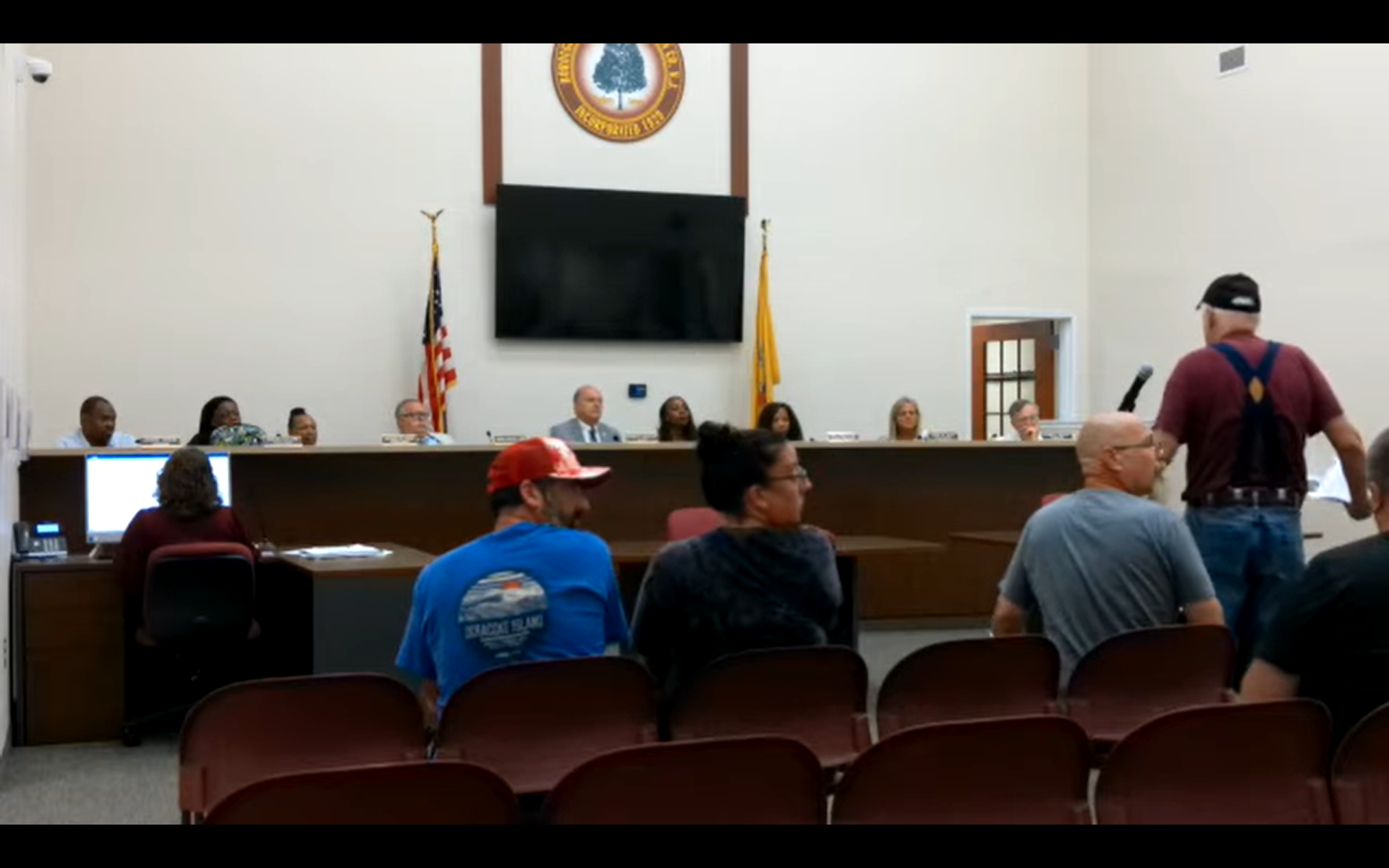
    A South Jersey resident evicted from a council meeting will get a $15,000 settlement from the borough

    Lindenwold will pay $15,000 to a resident who was removed from a council meeting for recording on his phone, settling a lawsuit over the Camden County borough’s video policy.

    The lawsuit pushed the seven-person council to rescind its policy last month, which limited public meetings to one camera, required attendees to give 30 minutes’ notice before they record, and demanded that residents provide a copy of the recording to Lindenwold officials within two days.

    The lawsuit follows years of calls by residents for the borough to record its own meetings and upload them to its website.

    Alfonso Penna, 24, filed the complaint on July 22 against Lindenwold, its mayor, the police chief, and the police officer who escorted Penna out of a June council meeting. He alleged the borough had infringed upon his constitutional right to freedom of expression, his right to record, and the state’s Open Public Meetings Act. Penna, who has lived in Lindenwold all his life, said it took only a few days for Lindenwold to reach out seeking to settle the dispute.

    “The residents ended up having to foot the bill of just some incompetence,” said Penna, who started attending all of Lindenwold’s public meetings between service calls in his job as a pool repairman two years ago. “That’s what it came down to.”

    Officers escorted Penna out of the June 10 council meeting after Richard Roach, Lindenwold’s longtime mayor, told Penna to leave as he recorded a resident speaking during the public comment period, according to the complaint and a recording of the June meeting.

    Roach cited the borough’s one-camera video policy. Trevor Shaw, founder of local community advocacy group Love Lindenwold, has recorded nearly every council meeting since 2018, and he was already recording that night.

    In Shaw’s recording, Penna can be heard arguing for his right to record under the Open Public Meetings Act before agreeing to leave after repeated pushback from Roach.

    Then, the complaint alleges, at another council meeting in July, Roach again demanded that Penna turn off his camera and asked an officer to escort Penna out. Police Chief Michael McCarthy allegedly told Penna that the meeting would not continue until Penna stopped recording.

    But this time, the complaint says, Penna did not leave. Rather than remove him, council members temporarily ended the public session to speak in private. They returned less than 10 minutes later to resume the meeting, and Penna kept recording.

    Alfonso Penna, 24, sued Lindenwold in July over the Camden County borough’s video recording policy.Alfonso Penna

    Lawyers for Penna and Lindenwold filed to dismiss the lawsuit Tuesday, after the borough voted unanimously on Sept. 9 to pay thousands of dollars for Penna’s legal fees. The agreement, provided to The Inquirer by Penna, requires that any future recording policies in Lindenwold follow “constitutional limitations” and be enacted by an ordinance, so residents can comment on the rules.

    The video policy that was revoked had been enacted by resolution in January at a council meeting, in a single vote approving 65 resolutions at once.

    Roach and his fellow council members have not commented on the rescinded policy or their decision to settle at recent meetings. Roach, the borough administrator, and several council members did not return requests for comment.

    Raymond Morrissey, who has served on Lindenwold’s council for four years, said he was not aware of any plans for council to create a new recording policy. But the old one will cost residents via the $15,000 payout.

    “That impacts all us taxpayers in town because one way or another, it’s an extra expense,” Morrissey said. “Whether it was budgeted or not, it was an extra expense.”

    ‘A petty power play’

    Until it was rescinded in August, Lindenwold’s policy limiting meetings to one camera had been approved by council every January for years. Morrissey said the policy is one of “a gazillion and one resolutions” passed with a single vote during the annual reorganization meeting.

    Shaw, a Lindenwold resident since 1998, said the policy has affected him for the last eight years, as he has recorded and posted meetings online.

    While Roach has never approached him over the one-camera rule, Shaw said, the mayor has demanded copies of his footage before he posts it to YouTube and criticized him for not giving proper notice.

    “To me, it’s always seemed like a petty power play just to exert some perceived level of control or power over the people who choose to attend the meetings,” Shaw said.

    It’s unclear exactly how long the policy has limited meetings to one camera, but its language is not very modern. The policy requires people recording to “advise the Council or Borough Clerk of the tape’s permanent location” and “make fair payment for the electricity used while operating the video recording device.”

    The now-rescinded policy says the one-camera rule was created to “prevent disruption of council meetings” and could be enforced at the discretion of borough officials.

    But Penna’s lawsuit claimed that his cell phone, “silent” and “self-contained,” posed no risk of distraction.

    “This was clearly written for a time before smartphones,” Penna said.

    At the June meeting, Shaw said, multiple people had taken their phones out to record during the induction of new borough police officers, about a half hour before Penna was removed from the room. Love Lindenwold’s recording shows at least one other person recording on a cell phone, without reproach.

    Penna’s complaint attributed that difference to local politics: Penna ran for Lindenwold Council during the June Democratic primary, just days before he was kicked out of the meeting.

    Penna lost that election to two incumbent council members.

    A vacuum of information

    Without the policy, residents can now record Lindenwold meetings regardless of whether Love Lindenwold or Penna is there to record, and no ordinances have been introduced to change that.

    But Shaw and Penna both said Lindenwold’s next step should be to start recording and posting its own meetings so the public doesn’t have to. Shaw, who has previously approached borough officials to offer his recordings for Lindenwold’s website, said council has not been receptive to those pitches.

    “There’s an enormous vacuum of information in this town,” Shaw said.

    Penna agrees. He said attending public meetings could bring more attention to issues important to him and other residents, such as public transit and installing benches at local bus stops, especially as nearby municipalities record and post their own meetings without issue.

    “It’s 2026,” Penna said. “I’ll keep holding Lindenwold accountable. There’s a lot of apathy in town. We need more people who want to show up and care because our town is worth caring about.”

  • N.J. power broker and former Inquirer co-owner George E. Norcross III files $100 million lawsuit against the newspaper

    N.J. power broker and former Inquirer co-owner George E. Norcross III files $100 million lawsuit against the newspaper

    South Jersey power broker and former Inquirer co-owner George E. Norcross III on Thursday filed a $100 million defamation and conspiracy lawsuit against the newspaper and one of its editors.

    Norcross was among six individuals indicted in 2024 by New Jersey state prosecutors in a racketeering case regarding economic development tax breaks for projects connected to Norcross in Camden. The high-profile case, which was extensively covered by The Inquirer and other outlets, was subsequently thrown out by a judge.

    Norcross’ suit, filed Thursday in Common Pleas Court in Philadelphia, alleges the newspaper played a part in bringing about the now-dismissed charges. The suit claims The Inquirer weaponized its newsroom against Norcross in a scheme designed by Nancy Phillips, an Inquirer editor who “harbored a well-known and widely acknowledged deep-seated personal animosity toward Mr. Norcross.”

    The complaint accuses The Inquirer and Phillips of defamation, false light, intentional infliction of emotional distress, abuse of process, and civil conspiracy. The lawsuit does not cite any specific inaccuracies in The Inquirer’s coverage, but rather describes a broader alleged conspiracy in which the newspaper sought to undermine Norcross.

    The lawsuit centers on interview notes Phillips typed in 2019 that came into the possession of the New Jersey Attorney General’s Office during an investigation that led to the now-abandoned racketeering indictment against Norcross.

    The interview was with former Cherry Hill Mayor Susan Bass Levin, according to Norcross’ suit. Bass Levin is the former president and CEO of Cooper University Health System’s Cooper Foundation. Norcross chairs the health system’s board, and his brother Philip A. Norcross currently serves as the foundation’s board chair, according to the organizations’ websites.

    “Defendants handed over the notes containing falsehoods to prosecutors strictly out of revenge, harassment, and manipulation, acting with extreme, uncivilized cruelty,” the suit says.

    Bass Levin in 2023 met with investigators and provided an account that “contradicted Ms. Phillips’ notes,” according to the lawsuit.

    For instance, the notes indicated Norcross “berated” John Sheridan, a prominent lawyer and CEO of Cooper University Health Care, during a clash over a property deal connected to the racketeering indictment, according to the suit. Bass Levin told investigators she rejected that characterization and “stated that she would not use the word ‘berated,’” according to a summary of her interview with investigators that was obtained by The Inquirer and is referenced in the lawsuit.

    Gabriel Escobar, The Inquirer’s editor and senior vice president, said in July that the newspaper had conducted an internal review and determined that the notes were not provided to authorities by The Inquirer.

    “Speculation that Nancy Phillips, who has a long and distinguished track record as a reporter and editor, was working with state prosecutors is both false and outrageous,” Escobar said in a memo to staff.

    The paper has not retracted any of its stories on Norcross. That coverage was led by Inquirer reporter Andrew Seidman and former Inquirer reporters Catherine Dunn and Jeremy Roebuck. Phillips “was not directly involved in the coverage but served as a conduit for information only she could access,” Escobar said in the July memo.

    “In 2019, she was approached by a source who was offering unique insights on a significant and running story,” Escobar wrote. “Nancy conducted an interview, typed up the notes, and then shared them with two Inquirer reporters who were working on the story.”

    The lawsuit does not provide evidence proving the allegation that Phillips provided the notes to authorities. Evidence discovery through litigation will reveal how the notes made their way to New Jersey authorities, the complaint says.

    The Inquirer reported in July that a person with firsthand knowledge of how New Jersey prosecutors obtained the notes said Phillips had shared the file with “a third party” outside The Inquirer, not with authorities.

    “It was not for the purpose of sharing the notes with authorities. It was for her own edification,” said the source, who is not an Inquirer employee and requested anonymity due to ongoing litigation threats related to the case. “The state did not receive the notes from Nancy Phillips directly.”

    The Inquirer also reported in July that the interview notes were included in an electronic file titled “Stier Documents” in the state’s evidence discovery file from the original racketeering case. That fact is repeated in the lawsuit, which adds that the file “is believed to refer to Edwin H. Stier, a prominent former state prosecutor and private attorney.” Stier has been quoted by The Inquirer, including as part of its coverage of Norcross.

    The suit notes that Stier has “personally represented” Sheridan’s son, Mark Sheridan.

    Stier declined to comment Thursday.

    Phillips, Escobar, and Inquirer publisher Lisa Hughes declined to comment or did not respond to a request for comment for this article. Escobar recused himself from involvement in this article, as did the reporters and editors who led The Inquirer’s coverage of the investigation into Norcross.

    “The Inquirer is not going to comment on ongoing litigation,” said Evan Benn, the paper’s senior director of special projects and communications.

    Defamation lawsuits against newspapers typically focus on a specific inaccurate claim. But Norcross’ complaint says he was defamed when The Inquirer and Phillips “handed over” the notes to prosecutors, allegedly knowing they contained false information.

    Pennsylvania’s statute of limitations for defamation is one year, and the notes are now at least six years old. But the suit says that only after the New Jersey Attorney General’s Office abandoned the prosecution earlier this year was Norcross able to “pursue uncovering the corrupt mechanisms used to smear his name and threaten his freedom.” Prior to this year, according to the complaint, a strict protective order prohibited the public disclosure of the interview notes.

    Norcross’ lawsuit asks for $100 million, which he would donate toward public education and public safety programs in Camden, Pennsauken, and Philadelphia, according to a statement from his spokesperson, Dan Fee.

    Norcross’ allegation that Phillips was biased against him stems from her former romantic relationship with the late Lewis Katz, a wealthy New Jersey businessman who previously co-owned the paper with Norcross and H.F. “Gerry” Lenfest.

    Norcross lost his stake in the paper during a contentious ownership fight that resulted in Katz and Lenfest outbidding him in an auction. Days later, Katz died when his private jet crashed in Bedford, Mass. (The paper is now owned by the Lenfest Institute for Journalism, a nonprofit endowed by Lenfest before his 2018 death.)

    The suit alleges Phillips, who scored legendary scoops as a crime reporter before she became an editor, made statements that tied Norcross to Katz’s death. The suit provides no evidence proving this claim.

    The suit also alleges Phillips, in a conversation, connected Norcross to the 2014 death of Sheridan and his wife, Joyce Sheridan. Authorities initially ruled the case a murder-suicide before they “officially changed his cause of death from suicide to ‘undetermined,’” the suit says.

    “During a subsequent newsroom discussion, Ms. Phillips allegedly stated, without any factual basis, that Mr. Norcross was connected to the death of his longtime business associate,” the suit says.

    No evidence proving that this occurred is included in the suit.

    Inquirer reporter Abraham Gutman contributed to this article.

  • NJDOT is trying to make Route 55 safer after five people died in crashes this summer

    NJDOT is trying to make Route 55 safer after five people died in crashes this summer

    The New Jersey Department of Transportation is looking to make Route 55 safer after a string of fatal crashes on the highway this summer.

    Juan Nordelo, NJDOT’s chief of staff, sent a letter to South Jersey legislators Wednesday detailing an action plan for the 40-mile highway running from Cumberland County up to the Route 42 entrance. The safety measures focus primarily on the stretch of roadway from Elk Township to Deptford, the letter says.

    The department has already added four portable signs advising drivers to use caution on the highway and informing them that they are in a high-crash area, with two in each direction at mileposts 47.6 and 52.4, according to Steve Schapiro, an NJDOT spokesperson.

    Staff recently put in a work order to install 75 new “wrong way” signs at five interchanges, including Exits 45, 48, 50, 53, and 56. Installation is set to begin in the next few weeks, Schapiro said in an email. NJDOT is also considering adding signs at three median U-turns in Millville and Vineland.

    Next steps include a project set to begin next month to continue clearing vegetation on Route 55 to create zones where drivers can stop safely when needed, and more “guiderail” additions as safety barriers along the highway.

    “The collective intent of the efforts is to ensure motorists accessing NJ-55 from Exits 45 to 56 have more guidance to reduce the chances of driving the wrong way. Additionally, the ultimate installation of [a] guiderail will also help to prevent vehicles from leaving the roadway and reducing the severity of impacts should they occur,” Nordelo wrote.

    The plan follows four fatal crashes this summer on Route 55 that killed five people total. On July 5, two women died after the driver lost control of the vehicle, ran off the roadway, and struck a tree. A week later, a man died after he drove his pickup truck the wrong way down the highway and collided with a tractor-trailer. A week after that, a woman died after she crashed her vehicle into a tree while fleeing a police traffic stop.

    Then, last month, a Delaware County school board member died after a Tesla crossed the grass median, hit a tree, and struck his car on the other side of the highway.

    After the first two crashes, nine state legislators united to request that NJDOT examine how Route 55’s design could have contributed to the tragedies.

    That effort was led by Assemblyman Bill Moen, who grew up using Route 55 as his main traffic artery. Moen said that NJDOT’s letter was a good first step, but that the message does not “close the loop” on work to make Route 55 safer.

    Of South Jersey’s limited-access highways, the majority of Route 55 is relatively safe, according to an Inquirer analysis of NJDOT fatality data over the last six years. That analysis found that seven South Jersey corridors are particularly problematic, with a 1.3-mile stretch of I-76 seeing 10 deadly crashes since 2019.

    But one 0.6-mile stretch of Route 55 around Mantua Township, Gloucester County, has seen four fatal crashes in that time, more than any other part of the highway, including the wrong-way fatal crash in July.

    One new portable sign on Route 55 informs drivers that they’re in a “high crash area” in South Jersey.NJDOT

    Last year, on another stretch in Elk Township, three teenagers died in a crash that also injured a woman and three children.

    Moen said he hopes NJDOT considers adding more lighting to Route 55 to brighten the highway at night, and coordinating with local and state police to enforce traffic laws there.

    Still, he said, the action plan proves that the public’s desire for a safer Route 55 is possible.

    “It’s an example of government working,” Moen said.

  • Barbara Lippincott Martin, lifelong sailor and honorary commodore of the Riverton Yacht Club, has died at 96

    Barbara Lippincott Martin, lifelong sailor and honorary commodore of the Riverton Yacht Club, has died at 96

    Barbara Lippincott Martin, 96, of Riverton, Burlington County, lifelong sailor, honorary commodore of the Riverton Yacht Club, community volunteer, and Delaware River waterfront matriarch, died Friday, Sept. 4, of age-associated decline at her home.

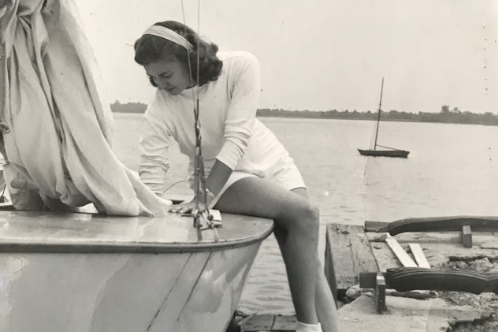
    Born and reared in Palmyra, Burlington County, hard by the Delaware River, Mrs. Martin practically grew up on the water in the 1930s and ’40s. Her father, Howard Lippincott, was an avid sailor and head of what The Inquirer called the “famous Riverton sailing family.” He often navigated the family’s motor cruiser Pythagoras up and down the river, floating between the banks in South Jersey, Southeastern Pennsylvania, and Delaware to the Chesapeake Bay and back.

    Years later, in the 1960s and ’70s, Mrs. Martin and her family sailed those same waters in their schooner Walter Mitty, and her children, as she did before them, crabbed and swam and learned how to row and sail. She lived near the waterfront on Bank Avenue, adjacent to the Riverton Yacht Club, for 50 years and routinely opened her home and property to family and friends on holidays, sailors and spectators during regattas, and artists during weeklong local workshops.

    “The Delaware River shaped her childhood, her marriage, and her legacy,” her family said in a tribute.

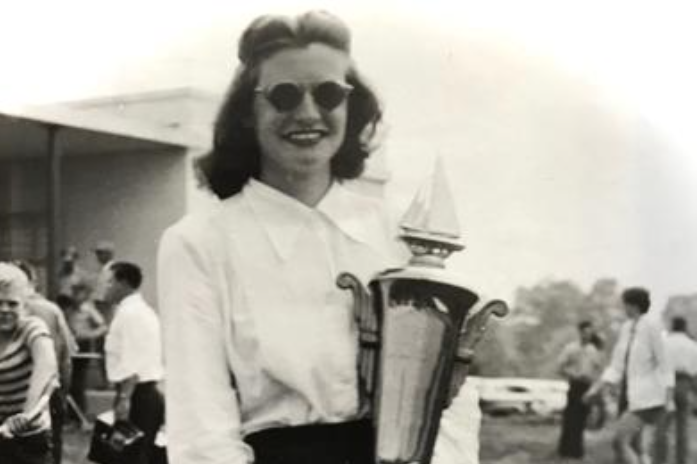
    Mrs. Martin won a room full of trophies and plaques over the years. Courtesy of the family

    Mrs. Martin served as secretary for the yacht club and gave it permanent access to the tidal zone on her Bank Avenue property. Club officials awarded her a lifetime membership, named her honorary commodore in 2022, and said in an online tribute: “There are certain people whose lives become so intertwined with a family, a club, and a community that their influence is difficult to measure. Barbara was one of those people.”

    In Facebook tributes, friends called her “a wonderful lady,” “an amazing person,” and the “Riverton Queen.”

    As a young woman, Mrs. Martin, like her father, sister, and six brothers, embraced racing on the river. She finished sixth in a national race, placed first in many local regattas, and, in 1947, became the first woman to win the seasonal championship in the Duster class at the Riverton Yacht Club.

    She was often the only woman in a race, and her victories and near victories were reported frequently in The Inquirer in the 1940s. She even finished one race after her boat was struck by lightning.

    Mrs. Martin “became known throughout the region for her determination and skill,” her family said. Courtesy of the family

    Officials at the yacht club called her “a fearsome competitor.” Her family said she ”became known throughout the region for her determination and skill.”

    Her daughter, Barbara Smyth, said: “She made me realize that girls can compete with boys, and they can win.”

    Barbara May Lippincott was born Jan. 3, 1930, in her family home. The youngest of eight children, she graduated from Palmyra High School, learned to sail on a homemade dinghy named Snapper, and called her own championship Duster-class boat Tanny Boo.

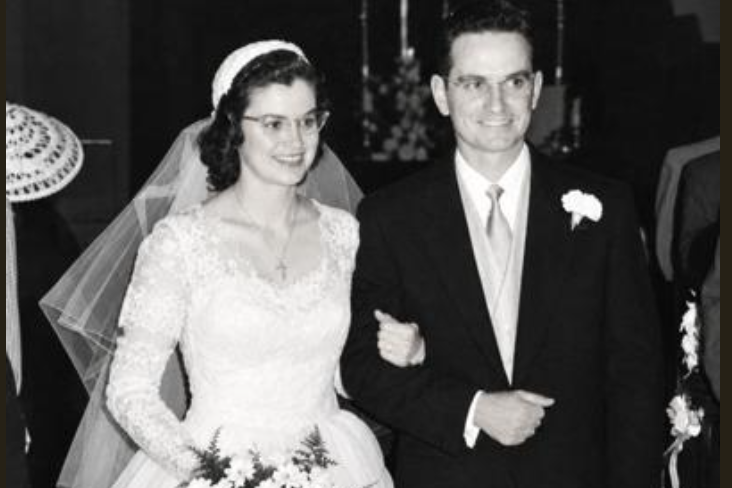
    She met fellow sailor John Martin at a regatta, and they married in 1952 and had daughters Barbara and Jane, and sons John, Richard, and Robert. Her children became sailors, too, and she and her husband spent many weekends at regattas with them. Her husband died in 1984.

    Mrs. Martin and her husband, John, were both longtime sailors.Courtesy of the family

    Mrs. Martin played tennis and listened to classical music. She sang in the choir and was active at Christ Church in Riverton. In 2022, she was named marshal for the Riverton Fourth of July parade.

    She volunteered at a seniors home in Cinnaminson Township and Zurbrugg Memorial Hospital in Riverside Township. She raised funds for the local library, hosted weddings at her home, and doted on her grandchildren and great-grandchildren.

    She worked for years as a stenographer and bookkeeper for her brothers and husband, and for her son, John, until she was 87. “She was bulletproof,” her son said. “She gave love without expecting any benefit to her. She was the happiest person I knew.”

    In addition to her children, Mrs. Martin is survived by 16 grandchildren, 10 great-grandchildren, and other relatives. Her sister and brothers died earlier.

    Her son John said Mrs. Martin “gave love without expecting any benefit to her.”Courtesy of the family

    Visitation with the family is to begin at 9:30 a.m. Saturday, Sept. 19, at Christ Church Riverton, 500 Fourth St., Riverton, N.J. 08077. A funeral service is to follow at 11.

    Donations in her name may be made to Christ Church Riverton, 500 Fourth St., Riverton, N.J. 08077; and the Riverton Steamboat Landing Foundation, Box 2911, Riverton, N.J. 08077.

  • Aide pleads guilty to spraying bleach into face of patient at Cherry Hill nursing home

    Aide pleads guilty to spraying bleach into face of patient at Cherry Hill nursing home

    A Camden woman working as a certified nurse’s aide admitted to spraying bleach into the face and eyes of a paralyzed elderly patient at a Cherry Hill nursing home, New Jersey Attorney General Jennifer Davenport said Thursday.

    Simone Goldsboro, 37, pleaded guilty before Superior Court Judge Kurt E. Kramer in Camden to third-degree aggravated assault and fourth-degree assault upon an institutionalized elderly person.

    State prosecutors will recommend that Goldsboro be sentenced to 364 days in jail in Camden County, Davenport said.

    Goldsboro, who will permanently forfeit her license to be a certified nurse’s aide, is scheduled to be sentenced Oct. 30.

    Erin Yerke, an assistant deputy defender representing Goldsboro, could not be reached for comment Thursday.

    In 2023, prosecutors said, Goldsboro worked as a certified nurse’s aide at the Avista Healthcare Nursing Home in Cherry Hill.

    On Aug. 17, 2023, Goldsboro was taking care of a patient who was more than 60 years old and was paralyzed on one side of her body from a stroke, prosecutors said.

    “Goldsboro admitted she used more force than necessary while undressing D.S. so she could clean her and then left the room to retrieve a spray bottle containing bleach from the custodian’s cart,” the attorney general’s office said.

    Goldsboro then intentionally sprayed bleach into the patient’s face and eyes, the attorney general’s office said.

    “We have to trust the people who care for our loved ones at residential facilities,” Davenport said in a statement. “This defendant exploited that trust and physically assaulting a paralyzed patient in her care. We will not tolerate the abuse of elderly and vulnerable individuals, especially by those entrusted with their care.”

  • Cherry Hill is taking over a pedestrian bridge at Downs Farm Swim Club and preserving the club as open space

    Cherry Hill is taking over a pedestrian bridge at Downs Farm Swim Club and preserving the club as open space

    A Cherry Hill Township deal with the Downs Farm Swim Club to replace and take over maintenance of a closed pedestrian bridge will also preserve the club as open space should it ever close.

    The strategically placed bridge crosses a stream and connects the Downs Farm neighborhood to Haddonfield-Berlin Road over swim club property.

    “The entire neighborhood uses it for pedestrian access,” Mayor David Fleisher said in an interview.

    Fleisher said the club no longer could afford to maintain the bridge, so part of the club’s acreage will be conveyed for no charge to the township, which will make the bridge a municipal property.

    But the twist to the arrangement calls for a deed restriction on the club that will prevent it from ever being developed.

    A dozen private swim clubs are scattered across Cherry Hill. Many were built by housing developers in the township’s heavy growth years of the 1950s and 1960s.

    Swim club cultures grew as whole neighborhoods crowded them on weekends and sent their children there to learn to swim and later compete on swim teams. But some clubs, which require a membership fee, are not as popular as in the past and have faced financial challenges.

    Fleisher said the township was able to learn from experience when the financially failing Kingston Estates Swim Club closed in 2020 after more than 60 years and was taken over by a bank.

    The property was zoned institutional and could have been developed in the middle of the residential neighborhood, Fleisher said. However, Cherry Hill was able to intervene and purchase the property for a park and open space.

    Fleisher said the Downs Farm open-space restriction was modeled with the Kingston experience in mind.

    The swim club is pleased with the arrangement, he said, and a bridge replacement is expected by next summer.

    70and73.com is a hyperlocal news site focused on South Jersey, including the communities of Cherry Hill, Evesham, Mount Laurel, Voorhees, Medford, Medford Lakes, and Moorestown.

  • Atlantic City Mayor Marty Small Sr. made a ‘massive’ announcement about street paving

    Atlantic City Mayor Marty Small Sr. made a ‘massive’ announcement about street paving

    ATLANTIC CITY — Only in Atlantic City, a town with hype in its original DNA and, more recently, a teeth-grindingly bumpy main artery through town, would the announcement of street paving be billed as “massive.”

    But the long-awaited paving of Atlantic Avenue is set to begin at 8 p.m. on Monday, Sept. 21, Mayor Marty Small Sr. announced Thursday. It will be preceded at 6:30 p.m. by a celebration with food and music at Florida Avenue before contractors from South State begin.

    Small and City Engineer Uzoma Ahiarakwe were positively giddy with the news that the much-maligned roughness of the city’s main arteries would finally be addressed. Pacific Avenue will be paved, too, they said.

    “We’re really happy that we’re getting this done, and I just thank the residents and everyone for their patience and even the critics,” Small said. “We deserve to be criticized, and I told you from the bottom of my heart, I wholeheartedly apologize.”

    A bicyclist rides across Atlantic Avenue in Atlantic City, N.J. on Jan. 26, 2024. (AP Photo/Wayne Parry)Wayne Parry

    Small added that the traffic lights will soon be synchronized. The Democratic mayor credited the intervention of U.S. Rep. Jeff Van Drew, a New Jersey Republican with a close relationship to President Donald Trump, with wresting some stalled federal funding for the project.

    The stretch from Tennessee to Maine Avenue will include a road diet and new bike lanes. There will be new lighting. Also slated for paving: Fairmont Avenue from Missouri to the Albany Avenue Bridge.

    “The Small administration is paving and behaving,” Small said. “So you’re not going to talk about Atlantic Avenue anymore. You’re not going to talk about Pacific Avenue anymore. Let’s pick a new topic.”

    He added: “In all seriousness, I’m proud, and like I told the people of Atlantic City, I live here, too, and it was unacceptable.”

    Atlantic Avenue’s paving will take place at night, while Pacific Avenue will be paved during the day, he said. The work on Atlantic is expected to be completed in time for the city’s Christmas Parade on Dec. 12, with all the work expected to be completed by year’s end.