The H Mart in Cherry Hill has a new look after 25 years in town.
The renovations of the 39,000-square-foot Asian grocery store includes a food court, bakery, and retail space.
The second floor houses a food court, a mini Korean beauty store, and a general store. The first floor has myriad aisles (numbered for your convenience) full of snacks, produce, oils, seasonings, and so much more.
Austen’s Shelf is no longer exclusively on wheels.
The shop, inspired by novelist Jane Austen, was initially a mobile bookstore when it launched last year. Now, it’s a brick-and-mortar in Bordentown.
After attracting long lines and customers who liked to linger, it didn’t take long for founder Charity Herndon to consider a permanent space. During a stop in Bordentown, her patrons said point-blank: “We need a bookstore like this in town.”
Nationwide, independent bookstores like Herndon’s are gaining popularity.
📚 The rise is evident in the numbers: More than 600 indie bookstore businesses opened in 2025 — an 87% increase compared to the year before, according to the American Booksellers Association.
An ICE officer shot at a vehicle on Route 72 on Monday after the person he was trying to arrest fled in the a car and hit the agent, according to the police.
World War II veteran Paul Robbins returned to the Battleship New Jersey in Camden this week to be honored. At 101 years old, he is the last known WWII crew member, according to CBS Philadelphia.
Eric Robinson was among the Carolina Hurricanes who won the Stanley Cup on Sunday. The star hockey player from Bellmawr is also a friend of the Gaudreau family, NJ.com reports.
There’s only one practice facility for light saber combat in Jersey, and it’s at the Cherry Hill Health and Racquet Club, according to South Jersey Media.
After nearly 25 years in operation, the newly renovated H Mart in Cherry Hill is drawing crowds as regulars and newcomers marvel at its major improvements.
The outpost of the renowned Korean grocery store off Route 70 has served the local community since 2001. In April 2025, the Cherry Hill Township Planning Board approved plans for an expansion. A year later, the grocery store reopened with enhancements to the first floor and an open-concept food court, bakery, and retail space on the second.
As a diehard H Mart fan, I decided to venture across the bridge on a recent Thursday and see the 39,000-square-foot store for myself.
Customers shop inside H Mart Cherry Hill.Hira Qureshi
Where to start your H Mart visit
I arrived at the brick building, marked with the familiar “H Mart” sign in big red letters, at about 11 a.m. Entering through the double sliding doors of the second floor, I found myself inside the new food court.
A few customers dined in the massive seating area that morning, enjoying various dishes. I decided to grab an iced brown sugar coffee boba from Tiger Sugar as a little treat to sip on during my exploration.
Beginning the journey on the second floor was the right move, according to Ryan Solot, a regular shopper at H Mart. He and his wife, Miki Solot, came to the store once a week before renovations. The couple were shopping for dashi stock and Japanese sauces when I ran into them. They were happy to see the makeover, particularly on the second floor’s general shop department. But the Solots still felt the first-level aisles were a bit narrow for ideal grocery shopping.
“The layout is strangely unchanged,” Ryan Solot said. “It’s still kind of awkward to get through the aisles … but start from the top [floor] and make your way down, it’s much more organized upstairs.”
Korean beauty section at H Mart Cherry Hill.Hira Qureshi
The second floor of H Mart: general goods, Korean beauty products, and an arcade
Walking out of the food court area, I found a mini Korean beauty store with boxed shelving displaying creams, serums, cleansers, tonics, and other products from popular brands such as Medicube, Anua, and Beauty of Joseon. Attendants explained the various products to customers, especially to Korean skincare novices like myself.
Neon arrow signs next to the beauty department directed me into H Mart’s general store and “H Pop” section. A small selection of drinks and snacks lined the shelves leading me into the rows of shelves with over-the-counter medicines, vitamins, toiletry items, slippers, bedding, and kitchenware.
In the back corner I found a vast selection of cutesy notebooks, pens (ones with funky kiwi and toilet attachments), furry character key chains, mini toys, makeup storage containers, and other knickknacks. The prices for items were organized by serial numbers, which were listed on a card hanging off the shelves. Pro tip: Take a photo of that price card to reference as you shop.
Customers shop inside H Mart Cherry Hill.Hira Qureshi
The first floor of H Mart: frozen foods, fresh produce and seafood, snacks, and lots of instant noodles
Taped to the elevator, two signs offered directions on where to find specific items. “Second floor: food court, house ware, characters, K-beauty, game, health food” and “First floor: Asian/Western, produce, fish, meat, ready to eat, banchan” were written in all caps and highlighted in yellow.
The elevator also had another sign with an important tip for shoppers: “You are welcome to shop freely on both 1st and 2nd floor, and you may check out either floor.”
Downstairs on the first level, the elevator opened up to aisles upon aisles of snacks, produce, sauces, packaged sweets, and lots of instant noodles. Each aisle is organized by number with a sign noting all the items available.
Shrimp crackers at H Mart Cherry Hill.Hira Qureshi
I walk into Aisle 3 as I exited the elevator and found snacks galore. KitKats, Pocky sticks, Buldak ramen-flavored chips, O’jelly real plum candies, lychee gummies, Poongnyun Bakery seaweed crackers, and so much more lined the shelves. I picked up some of my favorites: Shrimp crackers, crispy snacks made from starch and ground shrimp, and a bag of chocolate yogurt-covered orange slices sitting nearby.
Next, I headed into Aisle 5 for beverages. The vast selection includes soy milk, hojicha, banana milk, corn silk tea, coconut milk and juice, and taro. I grabbed a tall can of Thai tea and a couple of glass bottles of Ramune, a fizzy, fruity, sweet Japanese soda.
Thai tea at H Mart Cherry Hill.Hira Qureshi
I stopped by Aisle 10 for chili oil and pho seasonings. And on Aisle 1, I found instant noodles plentiful — the Japanese-style soba noodle box piqued my interest. At the end of Aisle 9, I saw cups filled with ice in the freezer section and drinks packaged in pouches for easy pouring. I grabbed the peach mango tea to accompany my post-shopping food court lunch.
As I walked deeper into the store, I found Catherine Yao and her mother, Jingjing Dong, in the massive seafood section, picking live crabs from a big box.
Live crab selection at H Mart Cherry Hill.Hira Qureshi
Yao and Dong, who live five minutes from the store, come to the H Mart every week. They come for the fresh seafood — live fish, lobsters, and crabs swim in big tanks near the butchers, while some sit in displays on ice — and frozen meats — think beef bulgogi and pork belly. The two also like exploring the premade foods section next door; I picked up a crab onigiri for the road.
The mother-daughter duo recommended stopping by the vast produce section near the cashiers. “I like the fresh durian, lychees, mangoes, and the gold melons,” Dong said.
Food court at H Mart Cherry Hill.Hira Qureshi
The food court
Around noon, I took the elevator back up to the second floor and ventured back into the food court for lunch.
The court can feel overwhelming, with nine vendors to choose from — think bibimbap, Korean fried chicken, and noodles. Thankfully, Yao and Dong recommended a couple of options: Kyodong Noodles, a Korean-style Chinese noodle restaurant; Daily Seoul, a Korean lifestyle food brand; and Tiger Sugar, the Taiwanese bubble tea vendor I sampled earlier.
While perusing the vendors, I ran into regular Ryan Solot at Mirim, a traditional Korean restaurant. He recommended the cold buckwheat noodle soup. “I didn’t like how it looked at first but then I tried it and it was very good,” he said.
Spicy cold buckwheat noodle soup H Mart Cherry Hill.Hira Qureshi
I ordered the spicy buckwheat noodles with beef at Mirim. The dish was served in a metal bowl with pickled vegetables on the side, chopsticks included.
For Yao, the food court is a great addition to the store.
“I like coming here more now because they have a food court — we go to eat there pretty often, for lunch and dinner sometimes,“ she said.
H Mart Cherry Hill: 1720 Route 70 E, Cherry Hill; 856-489-4611; Monday to Sunday, 9 a.m. to 9 p.m.
On a warm weekend earlier this month, dozens of shoppers, some of them dressed in Regency-inspired apparel, milled about the city of Bordentown, in Burlington County.
Those donning bonnets and hand fans weren’t time travelers or lost actors — they were there to celebrate the opening of a new bookshop with plenty of historic flair of its own.
Inspired by the works of renowned 18th- and 19th-century novelist Jane Austen, Austen’s Shelf penned a new chapter June 6 with the opening of its storefront at 230 Farnsworth Ave. The bookshop, which held a period-inspired costume contest for the occasion, is part of a growing surge of independent bookstores nationwide.
Austen’s Shelf launched last year as a mobile bookstore in a 98-square-foot trailer.Jessica Griffin / Staff Photographer
Austen’s Shelf launched last year as a 98-square-foot mobile bookstore that popped up at festivals and events, many of them in South Jersey. It was born out of founder Charity Herndon’s desire to fulfill a lifelong dream of owning a bookstore, something she decided to pursue after facing a breast cancer scare.
While she ultimately didn’t end up with a diagnosis, the experience changed how the now-30-year-old looked at life.
“I feel like a completely different person than I was before the health scare,” she said. “After you get over that mountain, it’s kind of like, all systems go.”
For Herndon, it was. Within months of her mobile shop’s September opening, she began to contemplate a more permanent space, seeing a desire from customers to “sit and linger.” With long lines forming at pop-ups, she felt like the shop had become as much about buying a book as it was a place for people to connect.
That was further stoked after a dreary winter and one particularly busy January pop-up at Turtle Beans Coffee in Bordentown. During that event, she said visitors told Herndon “we need a bookstore like this in town.”
While there’s already an independent bookstore there, Old Book Shop of Bordentown specializes in general used, out-of-print, and antiquarian books. Coincidentally, Jane Austen is the 21-year-old shop’s second-best selling author, owner Doug Palmieri said.
Given the two don’t have significant crossover in their business models, he welcomes having another bookshop nearby. Like antique stores, “the more there are in one area, the better for business,” he said, adding that he got a boost during Austen’s Shelf’s opening weekend, which coincided with the New Jersey book crawl and another store’s opening.
Independent bookstores like Austen’s Shelf are on the rise nationally. According to the American Booksellers Association, 605 new bookstore businesses opened in 2025, an 87% increase from 2024.
They’ve proliferated in the Philadelphia suburbs in recent months. Chapter Two Books opened in Wynnewood in May, Forage Books debuted in Kennett Square in February, and two bookstores, Celia Bookshop and Dirt Farm Books, opened in Swarthmore in October and January, respectively. The latter specializes in used and rare books.
Books aren’t the only media form making a resurgence. A Passyunk Square resident is on the hunt for a place to set up Little Movie Store, a video rental shop in the vein of Blockbuster.
Palmieri — a 20-year member, current secretary, and past president of the Downtown Bordentown Association, which promotes and supports local businesses — attributes the growth of indie bookshops partly to an uptick in younger readers, primarily those in their 20s and 30s.
“They like the touch and feel of books,” he said. “They like to have the books in their hands.”
DBA treasurer and past president CJ Mugavero, who owns Artful Deposit, sees the rise in retail as something of a reaction to the increased digitization of society.
“What people are craving is the human factor,” she said. That’s helped spur a number of new businesses in Bordentown recently.
Located next door to Austen’s Shelf, menswear and home store Haberdashery and Home debuted this month. Earlier this spring, the historic city welcomed art spaces Bonaparte Boutique and Sleeping Cat, an expansion of studio Leaping Dog. Abyssal Brewing and yoga and pilates studio The Movement also put down roots there in the first half of this year.
Beyond a desire for the tactile, “people long for community, and I think that’s something you can’t necessarily find if you’re just ordering your books off of Amazon,” Herndon said.
That was top of mind when she conceptualized her new space, which is small, but more than quadruple the size of the mobile bookshop. Clocking in at under 500 square feet, it has a “homey” vibe that allows for lingering and connecting. There are two sitting areas, one with a couch, the other a table and chairs. The latter sits beneath a large mural depicting Elizabeth Bennett and Mr. Darcy from Austen’s Pride and Prejudice,painted by Philadelphia artist Erik Weedeman.
Shoppers browse for books and other goods at Austen’s Shelf in Bordentown. Elizabeth Robertson / Staff Photographer
Like its predecessor, this edition of Austen’s Shelf caters to a wide range of readers, stocking a curated selection of young adult, literary fiction, poetry, mystery and thriller, and fantasy, as well as children’s books.
There’s also a room dedicated to Austen, complete with a gilded digital display showing film adaptations of her books. Herndon also sells a selection of what she’s dubbed “Regency-modern” apparel.
With a permanent space now up and running, Herndon has no plans to stop taking the mobile bookstore out. She’s just refining the schedule and taking on fewer events.
A former Bordentown resident who now lives in Gloucester County, Herndon hopes the shop helps draw visitors to the city. She wants visiting Austen’s Shelf to feel “like an experience where the entire town can kind of be a place to linger.”
If opening weekend was any indication, that just might be the case. Looking out at the historic city during the grand opening and seeing people wander the streets in period-inspired attire, she said the image “just fits like a glove. It’s the dream, literally.”
Austen’s Shelf is open Wednesdays and Thursdays from 11 a.m. to 6 p.m., Fridays and Saturdays from 11 a.m. to 7 p.m. and Sundays from 11 a.m. to 5 p.m.
This suburban content is produced with support from the Leslie Miller and Richard Worley Foundation and The Lenfest Institute for Journalism. Editorial content is created independently of the project donors. Gifts to support The Inquirer’s high-impact journalism can be made at inquirer.com/donate. A list of Lenfest Institute donors can be found at lenfestinstitute.org/supporters.
A U.S. Immigration and Customs Enforcement agent was hit with a vehicle in Manahawkin early Monday as he tried to arrest a man who later fled in the car, according to local police. As the suspect got away, the officer struck the vehicle with his firearm.
The attempted arrest played out on Route 72 near Mermaid Drive, according to the Stafford Township Police Department, which learned of the incident around 9:30 a.m.
An ICE spokesperson said immigration officers were conducting a targeted car stop to arrest Peruvian national Friedrich Castillo-Ormeno, who’d been given a final order of removal Jan. 30.
“The driver then weaponized his vehicle and struck an officer resulting in the officer discharging his weapon,” said the ICE spokesperson in a statement, adding the incident was part of a “pattern of vehicle attacks” against its officers.
The ICE agent was reported to have sustained injuries, but his condition was not immediately clear. The ICE spokesperson did confirm the officer was transported to a local hospital for treatment
Stafford Township Police said it’s unclear whether the suspect fired back at the ICE agent as he tried to flee, but noted they believed there is no threat to public safety.
For now, local police continue to secure the area, which is expected to see road closures for several more hours as ICE continues to investigate. The FBI was also on the scene.
New Jersey’s Immigrant Trust Directive and other state policies limit police cooperation with ICE. Stafford Police said they were not part of the attempted arrest when the incident occurred, adding they would not be investigating the incident, either.
New Jersey State Police similarly directed all questions regarding the ongoing investigation to ICE.
An ICE spokesperson said the agency would update the public when more information is available.
👋🏽 I’m Taylor, your newsletter writer. As a Jersey girl, I can’t wait to spotlight my home state: the land of pork roll, intense attachments to highway exit signs, beautiful farmland, expansive woodlands, full-service gas stations, and of course, diners.
I hope this space will become your reliable news hub for Burlington, Camden, and Gloucester Counties.
A little more about me:
You might know me already from writing The Inquirer’s main morning newsletter from 2022 to 2023. I’ve also been filling in over there during the past month.
I’ve lived in every region of this wonderful state: North, Central, and now South Jersey is my home. I wouldn’t have it any other way.
Some hobbies include writing quick book reviews, hiking, latch-hooking, and hunting for new bookstores and coffee shops (double points if they are both!).
Now, onto the news.
South Jersey progressives and immigration rights activists aren’t happy with how Gov. Mikie Sherrill handled the protests outside of Delaney Hall.
And former 6abc reporter Annie McCormick recently released a book about a nearly 100-year-old case about the deaths of two South Jersey socialites in Moorestown.
All eyes are on Gov. Sherrill, the first-term governor who campaigned to fight against President Donald Trump and ICE.
She’s pushing for the closure of the Delaney Hall immigration detention center while grappling with the backlash for how she’s has handled the unrest outside of it.
The South Jersey progressives and immigration rights activists who campaigned for her see Sherrill’s choice to put in place designated protest zones and deploy state troopers as a betrayal. Sherrill said the decision was her attempt to “lower the temperature.”
“It’s her first real test [of] how she manages the duties of being the highest public safety officer of the state leading New Jersey, and then still protecting the immigrant community who lives here,” a former campaign adviser to Sherrill said.
The 1929 deaths of two young socialites, Ruth Wilson and Horace Roberts Jr., in Moorestown rocked the township and inspired years worth of sensational headlines.
But nearly a century later, most people don’t recall the case that was officially ruled a murder-suicide.
Former 6abc reporter and Moorestown native Annie McCormick never heard of it until she stumbled on a 2021 news article and then quickly became hooked on the story. Her fascination led to the recent release of her book, Restless Ghosts: Murder, Suicide, and the Case that Wouldn’t Stay Buried which retells the case.
“The most frustrating part is that I can’t ask anyone,” she said. “I have questions, and I don’t have anyone I can follow up with. I wonder if this was a present-day case if there would be more finality.”
P.S. Don’t miss the archived Inquirer coverage of the case included throughout the article.
What to know today
Nearly all of the 1,322 New Jersey wildfires that burned 27,229 acres in 2025 were caused by human activity. Two large fires from the past year included the Mines Spung Wildfire in Burlington County and the California Branch Wildfire in Camden County, which burned 6,610 and 2,336 acres respectively.
A South Jersey man shot and killed an acquaintance, and then himself in his car after driving half a mile away in Lumbertonlast week, according to authorities.
U.S. Sen Cory Booker toured the Camden County’s Police Department in Camden to see its new training tools for officers. Booker praised the new technology as “innovative and cutting edge” and said other departments should use them as an example.
The brother and father of Xavier Taylor, the 12-year-old boy from Maple Shade who was critically injured after getting hit with a baseball and remains on a ventilator, threw the first pitch at a Little League game in Camden County on Saturday, NBC10 reports. Support for Xavier and his family has grown nationwide.
Gov. Sherrill announced state farmers in all 21 counties are eligible for emergency federal loans for the crops damaged by cold temperatures back in April. Heights in Progress, a nonprofit, hosted a FIFA World Cup watch party in downtown Haddon Heights on Saturday to fundraise for farmers.
The $50 million Bruce Springsteen Center for American Music at Monmouth University examines the musician’s influence and validates “New Jersey’s enormous contribution to the history of American music,“ architecture critic Inga Saffron writes.
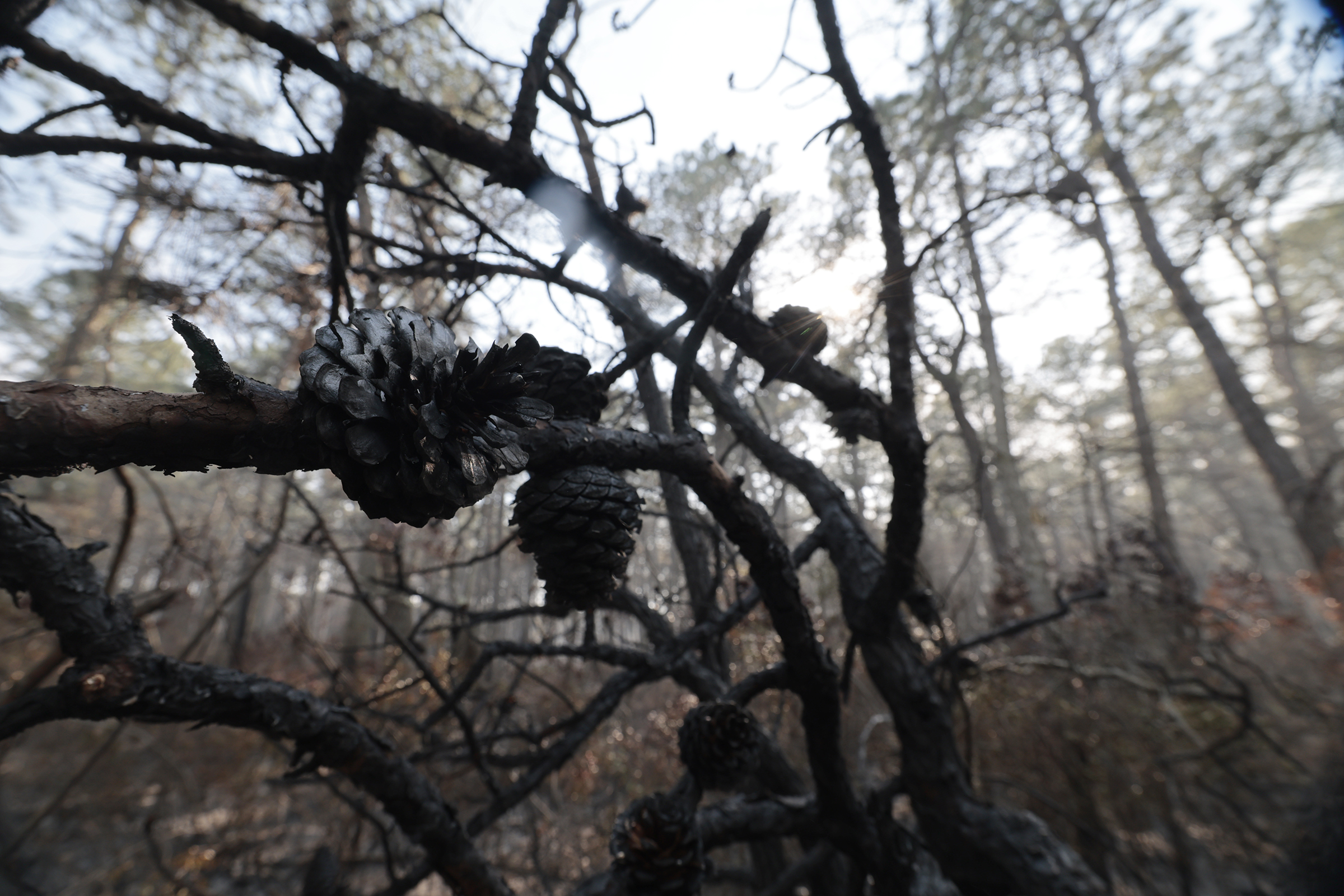
Conditions worsened by a drought last year, which continues in 2026, had a dramatic impact on wildfires in New Jersey, according to the state’s inaugural wildfire report.
However, of 1,322 wildfires that burned 27,229 acres statewide in 2025, nearly all were caused by humans, according to the report. That includes the massive Jones Road Wildfire in Ocean County that took 20 days to contain as the result of a bonfire set by youth.
The figures represent a 22% increase in the number of wildfires and an eye-popping 116% increase in acreage burned compared with the 20-year average.
To date in 2026, New Jersey has logged 589 wildfires that burned 648.5 acres.
Overall, the New Jersey Forest Fire Service’s first wildfire report details a historic, challenging, and highly destructive 2025 for the state’s wildlands.
That came after a demanding fall fire season in 2024. Severe blazes in 2025 not only stretched firefighting resources but also forced thousands of residents from their homes.
“Our wildland firefighters responded to an increased number of wildfires and spent weeks at a time battling fires, often under challenging weather conditions,” Bill Donnelly Sr., chief of the New Jersey Forest Fire Service, wrote in the report, which was released Thursday.
A major wildfire in New Jersey is classified as any blaze reaching or exceeding 100 acres. While the state typically averages 4.75 major fires annually, crews battled nine major wildfires in 2025.
The drought had a big impact as it created tinderboxes in areas such as the Pinelands. Not only did the dryness help spread fires, but it also forced the forest fire service to drastically reduce the amount of acres it intentionally burns in advance.
Firefighters use those prescribed fires, or controlled burns, in strategic areas to reduce dry brush and other vegetation, thus denying future fires fuel.
The drought continues into this June despite some recent heavy downpours. Data from the National Weather Service’s Middle Atlantic River Forecast Center show that Camden County is running a 13-inch rain deficit over the last 12 months.
Residents of the state are living amid a prolonged drought warning — the third of four levels of dryness monitored by officials. Parts of South Jersey have been under a drought warning since fall 2024.
But the biggest issue has been people.
Human activity was responsible for an overwhelming 99.6% of New Jersey’s wildfires in 2025, stemming from both accidental and intentional acts, according to the report.
“Whether through accident, carelessness, or even at times intentional acts, human behavior continues to be the primary driver of wildfire activity in our state,” Donnelly said.
Equipment use was the leading cause of fires by volume, sparking 486 individual wildfires that collectively burned 527.5 acres. Lawnmowers, weed trimmers, chain saws, welding tools, grinders, and agricultural harvesting machinery can all create sparks that ignite brush.
However, illegal and improperly managed campfires were responsible for the most devastating destruction, scorching a massive 15,263.75 acres statewide.
The largest incident of the year, the Jones Road Wildfire in Ocean and Lacey Townships, burned 14,949 acres and prompted the evacuation of 7,000 people.
Triggered by an illegal bonfire, the massive blaze threatened more than 1,300 structures and forced the closure of major thoroughfares, including the Garden State Parkway and Route 9. It destroyed a commercial building and triggered power outages affecting 30,000 residents.
Other large incidents included the Mines Spung Wildfire in Burlington County, which consumed 6,610 acres and closed portions of the Batona Trail, and the California Branch Wildfire in Camden County, which burned 2,336 acres.
Firefighters faced increasingly difficult environmental conditions throughout 2025. The report noted a growing trend of prolonged emergency operations, stating that 44% of the major wildfires in 2025 required more than five days to contain due to persistently dry weather.
In response to the escalating wildfire threat, the state’s fiscal year 2026 budget allocated an additional $1 million to the New Jersey Forest Fire Service, funding that is expected to be maintained in future budgets. That allowed the addition of six full-time positions.
The remaining $700,000 was used to buy equipment, including a bulldozer and fire engines, and to expand air base operations. The service is also upgrading its communication network by transitioning to a 700 MHz radio system to improve coordination with local and state agencies.
The $2 million, 133-foot structure replaces the decommissioned Lakewood tower and will serve as a vital vantage point to protect nearly 200,000 homes and more than 516,000 residents across Ocean and Monmouth Counties.
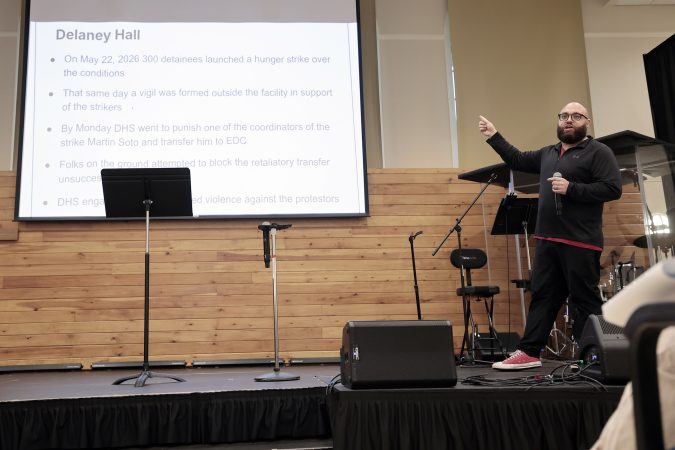
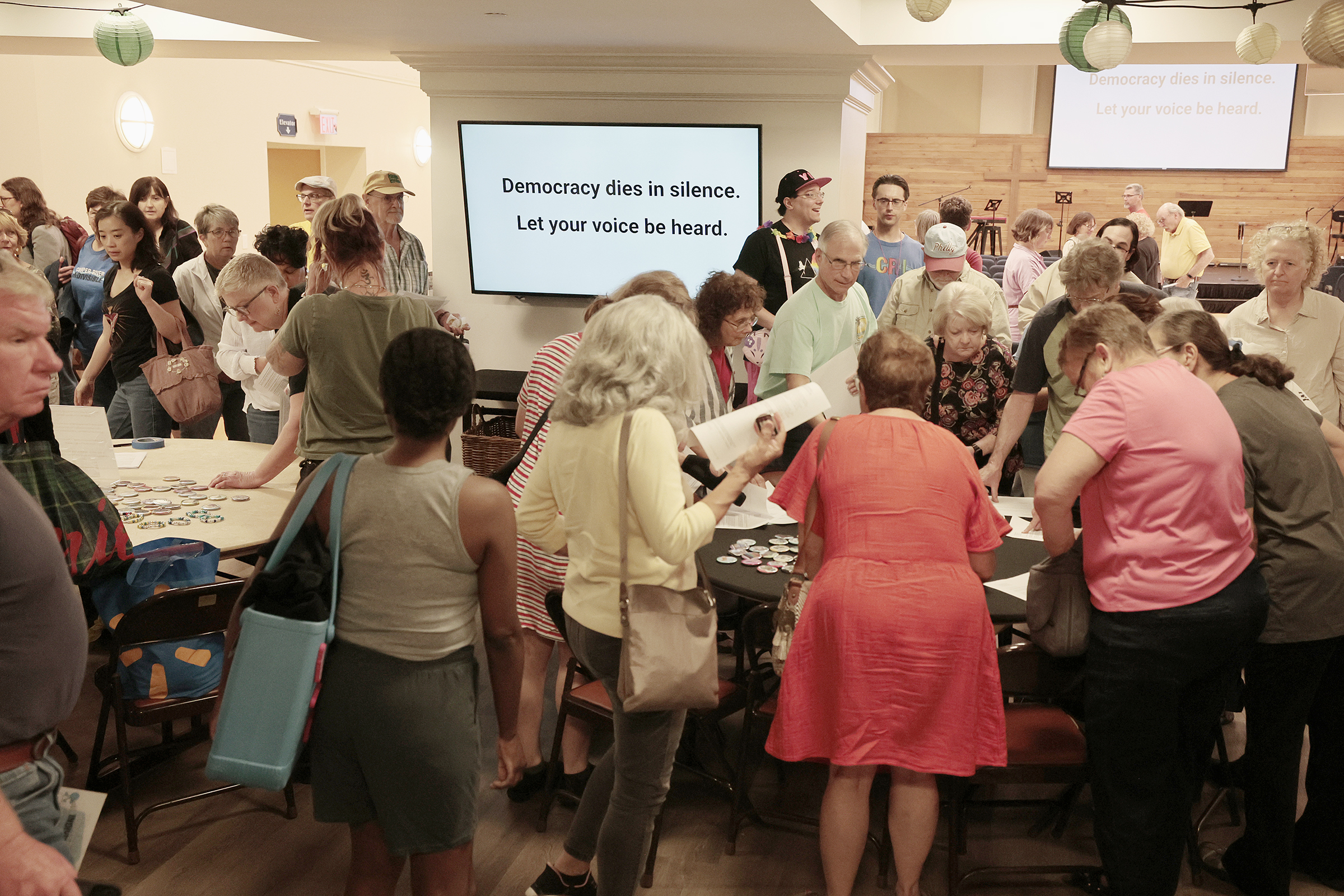
Josue Barreiro stood in front of a crowd of 200 people seated inside a church last week in Haddonfield. He was there to speak about his experience as one of 61 protesters arrested in one night outside Delaney Hall after Gov. Mikie Sherrill had sent over state police.
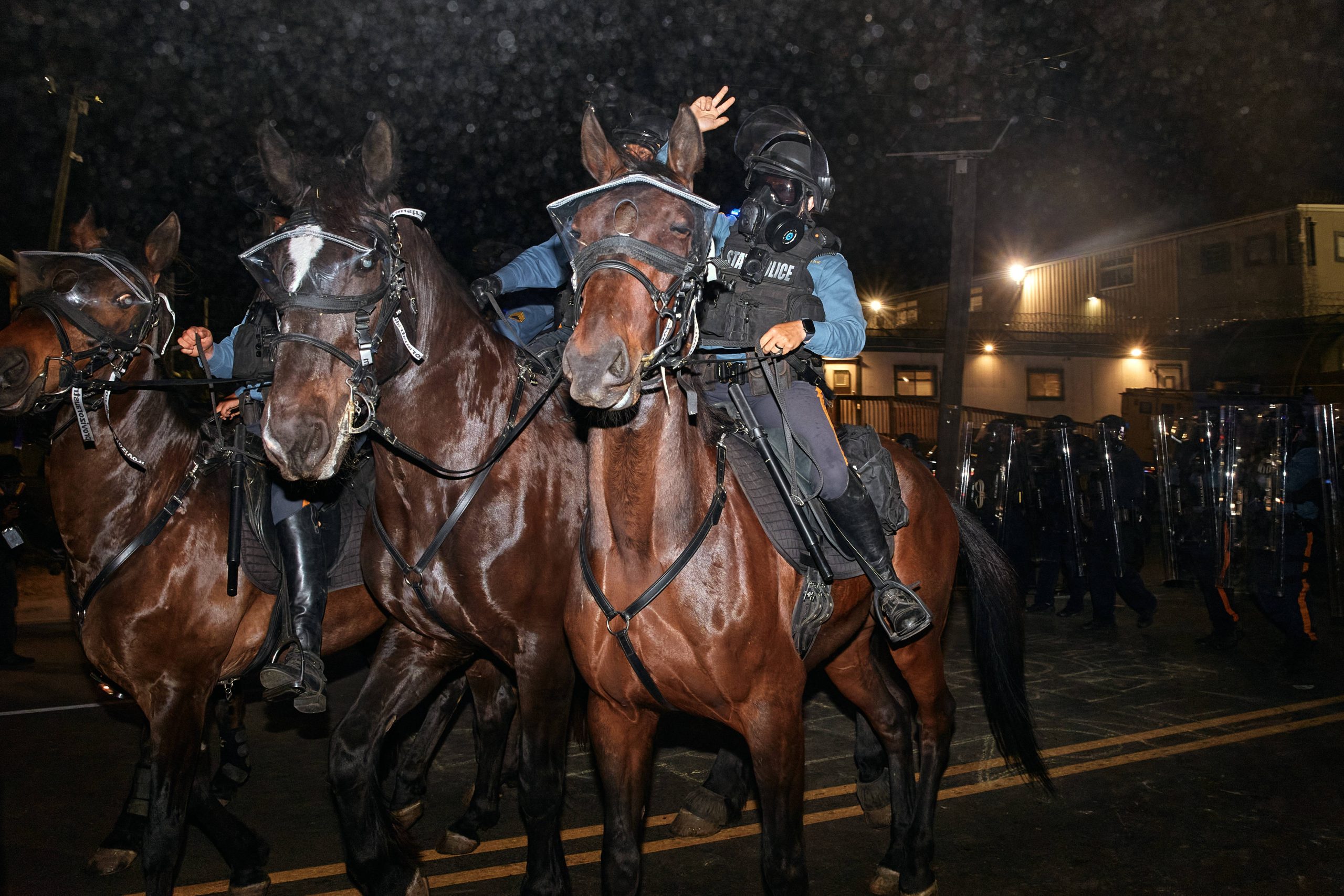
He told the crowd, gathered for a meeting of the South Jersey progressive group Cooper River Indivisible, that the governor made it seem like she was sending state troopers to protect demonstrators from federal immigration officers. Instead, he said, they brutalized protesters on horseback in riot gear. He showed a video of state police knocking him to the ground.
“All accounts say the state police were considerably more violent than the federal government was,” Barreiro, a Bridgeton resident and activist with Los Tequios, told receptive audience members who made sounds of disgust.
Josue Barreiro speaks about the protests outside Delaney Hall during the Cooper River Indivisible general meeting at the Haddonfield United Methodist Church on June 9.Elizabeth Robertson / Staff Photographer
Sherrill, a former member of Congresswhose double-digit victory last year was seen as a rebuke of President Donald Trump, has been in her most high-profile political bind yet as she juggles her opposition to the ICE detention center while facing widespread criticism for her handling of protests outside it.
The first-term governor campaigned as a fighter against Trump and Immigration and Customs Enforcement. She highlighted her experience as a Navy helicopter pilot and said she was trained “that in a crisis, you run toward the fight.” But to South Jersey progressives who worked hard to campaign for her, Sherrill’s decision to respond to tensions between protesters and ICE with a designated protest zone policed by state officers represented a betrayal. The governor called the decision “absolutely necessary to protect public safety and avoid escalation from ICE.” But the state police’s show of force, video of which replayed across national news and social media channels for days, “kind of resembled what ICE was doing in the first place,” said Newark Mayor Ras Baraka, one of Sherrill’s primary opponents, who was arrested outside the facility last year.
“This was not the kind and quality of leadership we were voting for, or hoping to see,” said Michele Messer, 52, a leader of Cooper River Indivisible, one of the groups that campaigned for Sherrill.
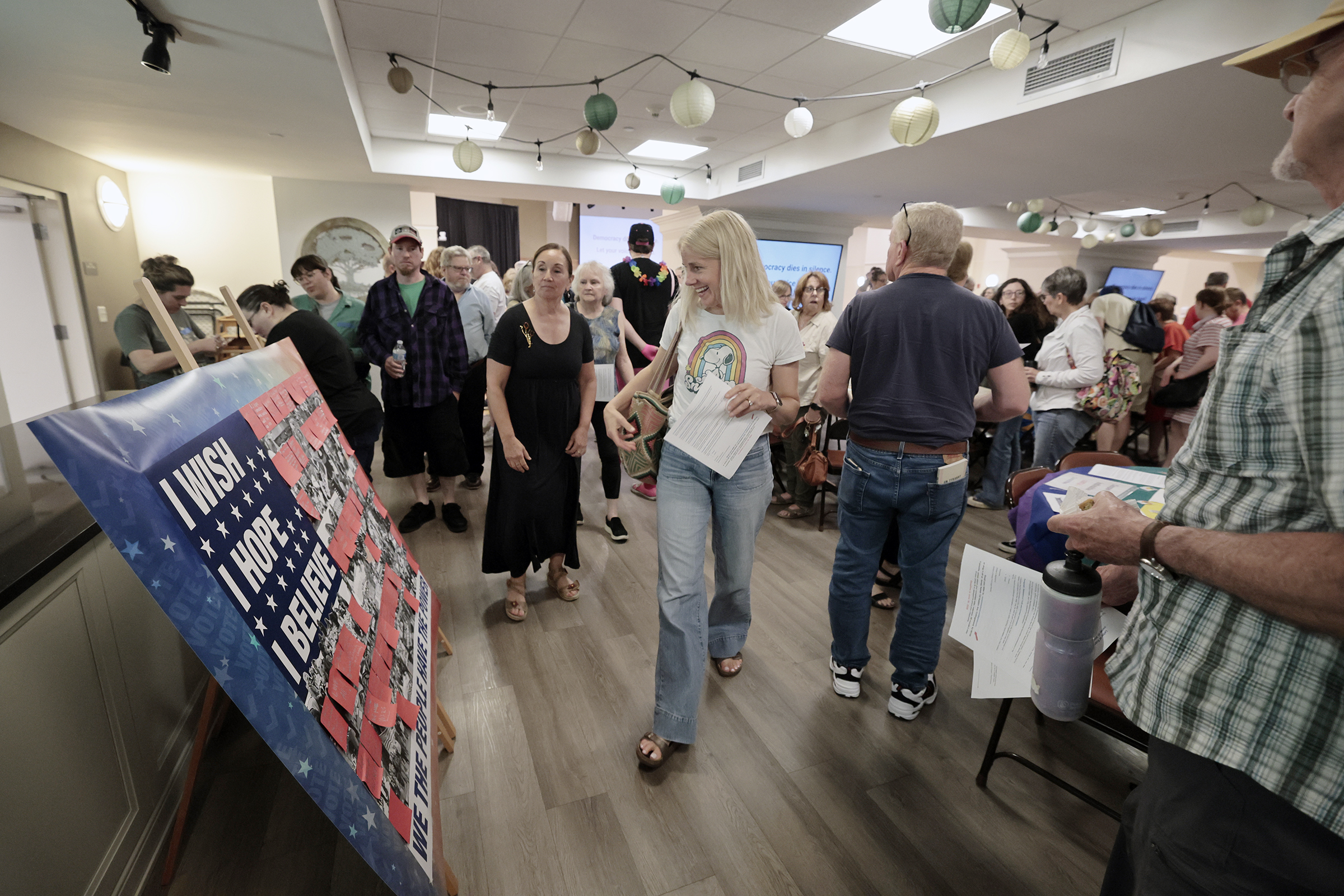
People sign up to volunteer after the Cooper River Indivisible general meeting at the Haddonfield United Methodist Church.Elizabeth Robertson / Staff Photographer
Sherrill said she was trying to “lower the temperature” to prevent Newark from becoming another Minneapolis when she announced her plans to send state troopers to Delaney Hall. She later disagreed with a comparison between state police and federal immigration officers in Minneapolis during a tense interview on WNYC’s Ask Governor Sherrill, noting that state police didn’t kill anyone.
“I don’t think they have the same concern for human life in many cases that I do, and that our police forces in New Jersey share,” she said.
Activists said she should have known that sending in police and corralling people into a free speech zone can escalate already fraught demonstrations.
“I mean, there’s precedent, there’s history. We’ve all read about how these things go, and yet that was the choice she made,” said Messer, a Haddon Township resident who has protested at Delaney Hall.
Patricia Campos-Medina, a former campaign adviser to Sherrill, said the governor’s handling of Delaney Hall — and how she manages “the fallout of her decisions” — has been an early test of her leadership.
“It’s her first real test [of] how she manages the duties of being the highest public safety officer of the state leading New Jersey, and then still protecting the immigrant community who lives here,” said Campos-Medina, an ally of the governor who works with the labor movement.
Sherrill has built her national profile on fighting the Trump administration, and those who have become the most frustrated with her share that mission. How she navigates this moment could determine whether she can keep that base focused on fighting the president, instead of her.
Mounted New Jersey State Police troopers move toward protesters outside the Delaney Hall detention center on May 29 during a protest against the transfer of detainees and federal immigration policies.AP Photo/Andres Kudacki
‘I’m not proud to have voted for her’
Sherrill has called for the closure of Delaney Hall and her administration announced multiple measures to support the fight against the detention center since the late May backlash against her began.
Activists from across the staterallied in Trenton on June 1 and delivered a letter to Sherrill calling on her to “honor our First Amendment rights, cease police brutality and to enable the closure of Delaney Hall.”
“As the grassroots who campaigned for you, we also expect ongoing communication with your administration to navigate this perilous time in New Jersey,” the letter continued, signed by about 40 organizations statewide, including Cooper River Indivisible and several other South Jersey groups.
The next day, New Jersey Attorney General Jennifer Davenport, Sherrill’s appointee, filed a lawsuit against GEO Group — the private company that runs Delaney Hall — to give the state health department full access to the facility over reports of “inhumane and unsanitary conditions.”
Two days later, Sherrill and the state legislature announced an infusion of $20 million to assist with immigration defense and launched a rapid legal defense effort amid concerns about due process.
Marie Henselder-Kimmel, 65, a Cherry Hill resident who leads the South Jersey group NJ Voters Want More Say, said the reports of bad conditions in the facility are not new, so she doesn’t understand why the administration did not take legal action months earlier.
“I foresee that we’re going to have to keep pressuring to get them to keep doing those more bold things,” she said.
Henselder-Kimmel said she feels “torn” about Sherrill’s decision to send state police because she agrees ICE would have escalated otherwise. But she said it seemed like Sherrill may have sent the police in without understanding what they were going to do.
Marie Henselder-Kimmel (left) and Michele Messer (right) talk with Vikki Toomer (back to camera) after the Cooper River Indivisible general meeting at the Haddonfield United Methodist Church.Elizabeth Robertson / Staff Photographer
Cristian Moreno-Rodriguez, who works as the executive director of El Pueblo Unido of Atlantic City, an organization that supports Latino immigrants, said Sherrill’s handling of the protests has fully broken the trust with his community.
Sherrill’s campaign made a particular effort to target Latino voters. She did particularly well in New Jersey’s largest Hispanic-majority cities, which moved an average of 18 points toward the Democrat after rightward shifts in 2024.
“We’re not going to forgive her for what she’s done,” said Moreno-Rodriguez, who worked for One Giant Leap, asuper PAC that supported Sherrill and raised about $9 million by the end of 2025.
Sherrill was not Moreno-Rodriguez’s first choice in the primary, but she was a better choice for his community than Republican Jack Ciattarelli, he said. Still, he said he was expecting better from the Democrat.
“I don’t regret voting for Mikie Sherrill because she was better than Jack Ciattarelli, but I’m not proud to have voted for her,” he said.
Gov. Mikie Sherrill poses for a selfie at a Latinos for Mikie event at the Rancho Mateo restaurant in Elizabeth, N.J., last May.Aristide Economopoulos
Activists have been demanding Sherrill meet with detainees, but she says she has not been allowed in except for one “closely controlled and limited tour” on June 8, in which she was not allowed to speak with those being held there.
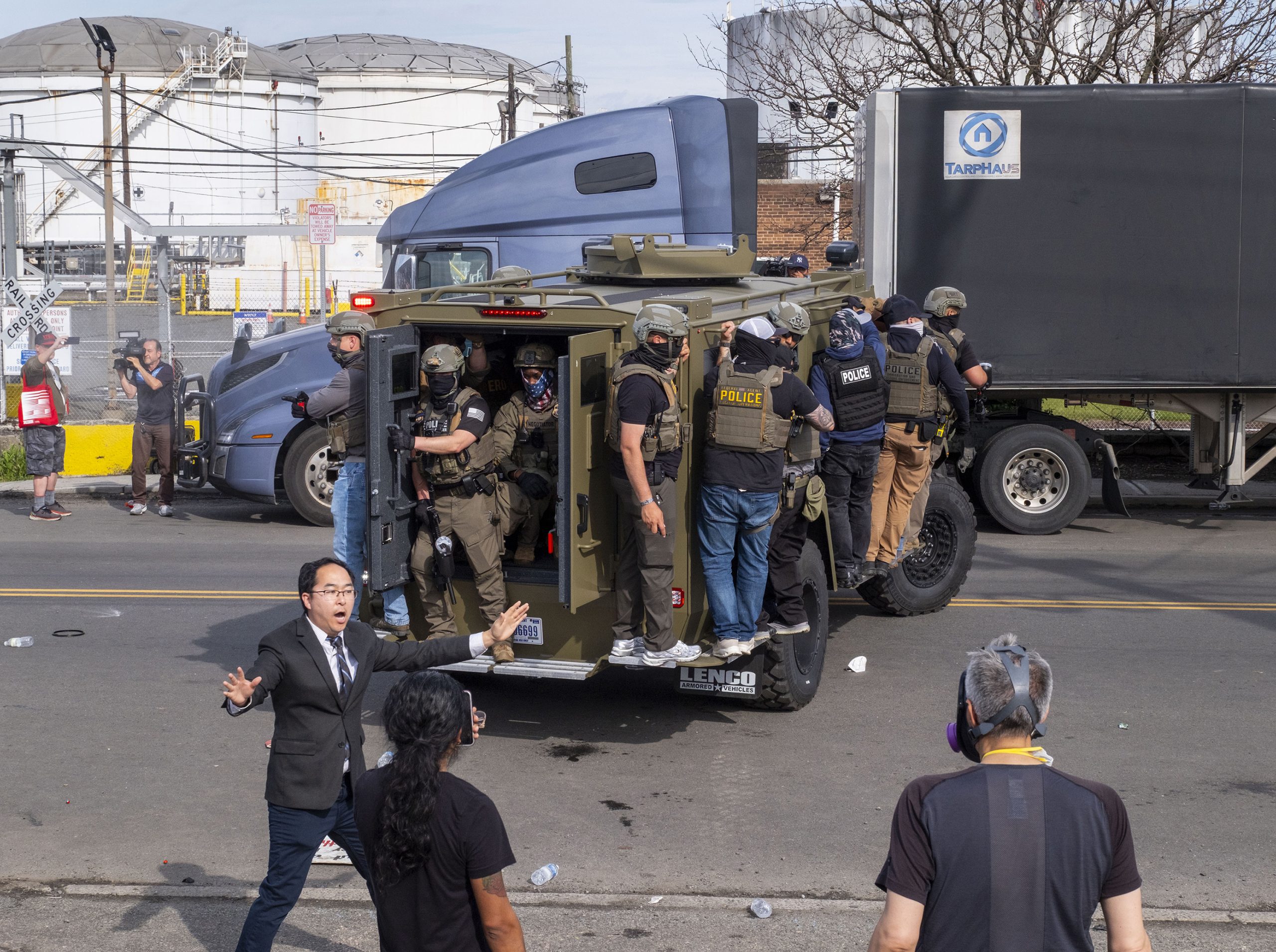
Several members of Congress, who are authorized to conduct oversight visits, have visited the detention center, including Sen. Andy Kim, a South Jersey Democrat who made headlines for getting pepper-sprayed while trying to de-escalate tensions between federal immigration officers and protesters. Kim faced criticism from some activists for what they viewed as trying to negotiate with ICE, but others have praised him for being on the ground in a way they have not seen from Sherrill.
Sen. Andy Kim stands between federal agents and demonstrators in an attempt to prevent a clash outside the Delaney Hall migrant detention center in Newark on May 25.DAKOTA SANTIAGO
Sherrill and activists alike have said that the demonstrators have been largely peaceful. But U.S. Rep. Jeff Van Drew, a Cape May County Republican, accused the protests of being “more like anarchy” and called on Sherrill to bring state police back.
State Sen. Michael Testa, a Cumberland County Republican, praised Sherrill’s “decision to cooperate with federal authorities” and “restore order” by bringing state police in, and added fuel to the fire by thanking her for “supporting President Trump and the brave men and women of ICE.”
‘The buck stops with her’
Activists have expressed frustration that the narrative has strayed from the conditions inside Delaney Hall to the fight outside it — a point Sherrill has echoed.
But after state police clashed with protesters, Sherrill focused her criticism on what she described as “aggressive and dangerous” disruptors and defended the officers.
Her remarks further infuriated activists who accused her of echoing the state police’s narrative, which they say does not align with what they experienced on the ground or saw online.
When a radio caller confronted Sherrill on WNYC over state police brutalizing nonviolent protesters, the governor said “if there were incidents like that, the attorney general will be looking into that.”
Vikki Toomer, a Cooper River Indivisible leader who has protested outside Delaney Hall, said that listening to Sherrill’s news conferences have given her “that same visceral reaction” she gets from listening to Trump.
Vikki Toomer speaks during the Cooper River Indivisible general meeting at the Haddonfield United Methodist Church.Elizabeth Robertson / Staff Photographer
“I don’t know if they were feeding her lies, or that’s the narrative she was trying to spin … all I know is what she was saying was not true, and she was not taking the time to listen,” Toomer said.
Toomer said she believes the governor knows her plan did not go well but also “has not come out publicly and said, ‘Oops, I made a mistake.’”
When asked on the radio whether she believes her administration has suffered a loss of trust, Sherrill said sending state police “was really not done focusing on politics, and I certainly hope not.”
“This was focused on making a really hard decision in a situation that nobody wanted,” she said.
Folks leave messages on a collage (left) during and after the Cooper River Indivisible general meeting at the Haddonfield United Methodist Church on June 9. The poster will be part of an exhibit at Perkins Center for the Arts.Elizabeth Robertson / Staff Photographer
Linda Greenwood, 74, a Voorhees resident who belongs to Cooper River Indivisible and campaigned for Sherrill, believes the governor has good intentions but does not think she has been unfairly blamed.
“She’s the governor,” Greenwood said. “The buck stops with her. She brought the state police in. She has to take responsibility for what happened there, and I think she will.”
Lawrence Garrity, 29, was the lead volunteer for long shifts at Sherrill’s Cumberland County campaign office between overnight shifts at Wawa last year. The Rowan student said he feels “salty” he worked so hard to elect her and it feels like she is not on their side.
“It doesn’t feel like she’s not on our side either. It’s like she’s sitting in the middle … people are genuinely in danger, and you’re trying to, like, half-ass fight it,” he said.
Garrity said he had to go to urgent care after state police unleashed tear gas and pepper balls on protesters.
“Somebody said they’re gonna make T-shirts that said ‘I voted for Mikie Sherrill and all I got was tear-gassed,’” he said.
In the summer of 1929, Moorestown was rocked by the tragic shooting deaths of two young socialites in what officially was ruled a murder-suicide. The saga resulted in a scandal rife with money, alleged corruption, and death, and it captured sensational headlines for years.
“It’s crazy I never heard of it, growing up in Moorestown and doing what I do,” said McCormick, who left 6abc in December after 13 years at the station. “I started looking into it and got hooked. I thought, ‘How many legs does this case have?’”
Many, it would turn out. And they range from bootlegging and political corruption to the unspoken truths of high society in South Jersey and the desperation of Depression-era America. Even Ellis Parker, the famed Burlington County detective once known as “America’s Sherlock Holmes,” plays a role.
The deaths of Ruth Wilson and Horace Roberts Jr.
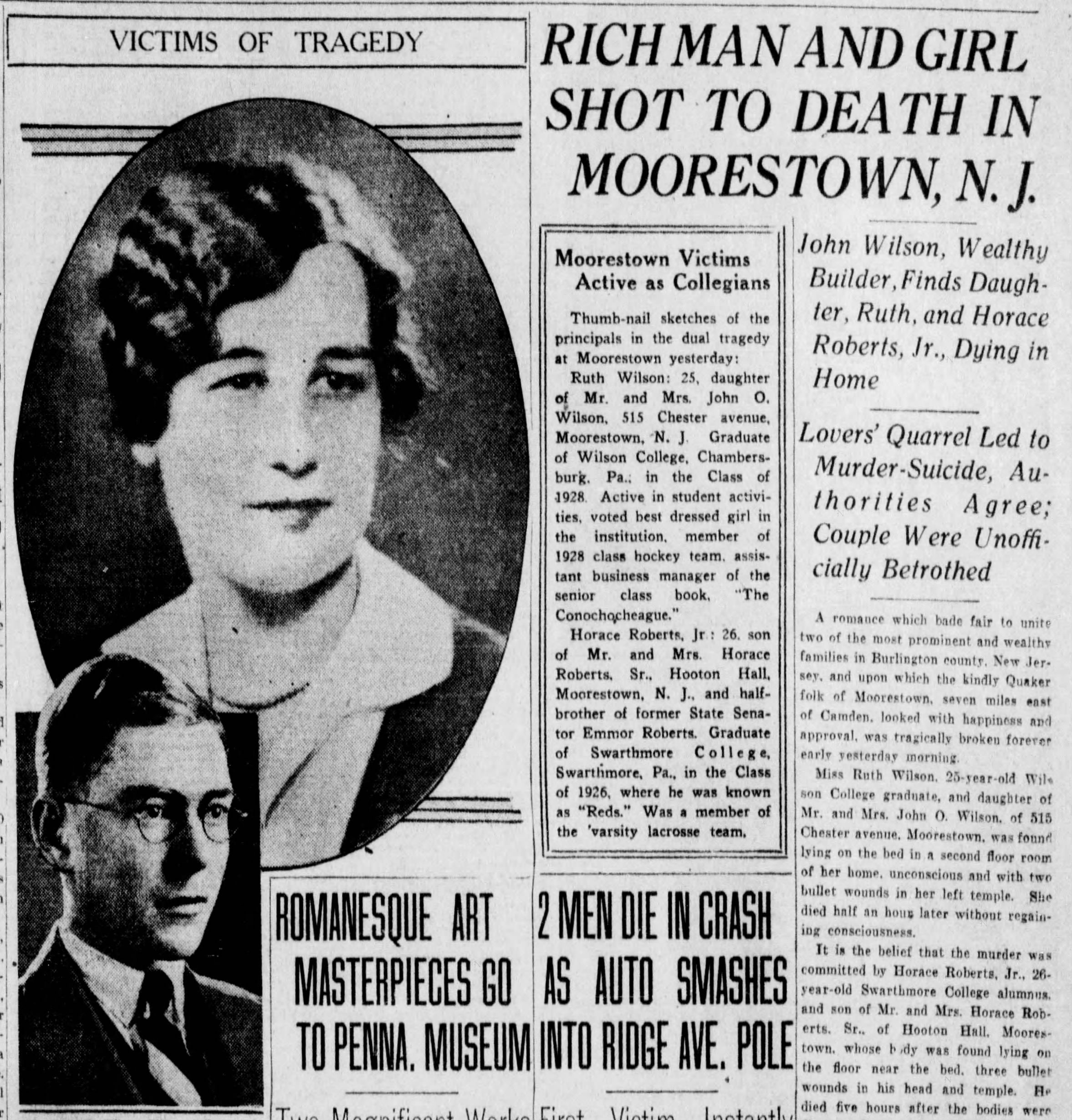
At its core, McCormick’s Restless Ghosts has its roots in a case that dates back to June 1929. Early one morning that month, Wilson and Roberts — wealthy, twenty-something socialites from two of South Jersey’s most prominent families who until recently had been engaged to be married — were found dead in Wilson’s bedroom in her family’s Moorestown home.
Wilson’s father, John Wilson, a prominent attorney and real estate developer, found the pair, nude and apparently suffering from gunshot wounds to their heads. Both died a short time later, with an investigation led by Parker later finding that the fatal shots came from a .22-caliber handgun discovered at the scene.
Ruth Wilson, investigators found, had been shot in the head twice. Roberts, meanwhile, had at least three gunshot wounds to his head — and officials quickly ruled that the situation was a murder-suicide that occurred in the wake of Wilson calling off the engagement. According to official reports, Roberts shot Wilson in the head before firing multiple shots into his own while distraught over the state of their relationship.
No autopsies were initially conducted. In the days and weeks that followed, rumors and speculations about the pair’s deaths cropped up in news coverage, with some reports insinuating that the situation was a double murder — one that involved Wilson’s father, though no such claims were ever substantiated.
Article from Jun 3, 1929 The Philadelphia Inquirer (Philadelphia, Pennsylvania) <!— –>
A coroner’s inquest
While McCormick runs down the tragic history of the deaths in Restless Ghosts, she is careful to not take a particular side on what may have happened back then. Instead, the circumstances are thoughtfully, meticulously recounted from multiple perspectives, leaving the readers to decide. Still, some inconsistencies and details, McCormick said, give her pause.
“It doesn’t make sense that someone could fire into their head multiple times,” McCormick said. “But at the same time, who else was there?”
In 1929, officials and members of the public had similar questions — so much so that a coroner’s inquest was launched that resulted in the exhumation of Wilson‘s and Roberts’ bodies weeks after their deaths. But even after the extensive questioning of investigators, relatives, and friends and the coroner’s discovery that Roberts had four bullet wounds to his head, the original conclusion was upheld.
And so, it seemed Wilson‘s and Roberts’ ghosts were left to rest for eternity, victims of a tragic murder-suicide over unrequited love. At least, until the death of Bradway Brown, a similarly high-profile socialite who died from gunshot wounds he suffered at his home in nearby Cinnaminson in 1933.
Article from Jan 17, 1933 The Philadelphia Inquirer (Philadelphia, Pennsylvania) <!— –>
The death of Bradway Brown
Brown, a childhood friend of the victims and a former suitor of Wilson’s, was found dead in his home with multiple gunshots. Parker also headed up the investigation in this case, and initially told the press it was a suicide — a tactic McCormick reports was a method to throw the media off and prevent Brown’s actual killer from becoming too alarmed.
Brown’s death stoked the fires of conspiracy, with rumors abounding that he had confessed to acquaintances that he had known who Wilson’s and Roberts’ true killer was. The rumor mill even said Brown had likely been behind anonymous phone calls to Wilson’s father accusing him of being the perpetrator.
Again, though, none of these allegations were officially substantiated. And despite Brown’s death resulting in another investigation into Wilson and Roberts’ deaths, this time a grand jury probe, the original conclusion was again upheld: Roberts killed Wilson, and then himself.
Parker, meanwhile, ultimately died of a brain tumor in federal prison after having been convicted of masterminding the abduction of an attorney in order to coerce a confession in the 1932 kidnapping and murder of Charles Augustus Lindbergh Jr., otherwise known as the Lindbergh baby.
Article from Apr 15, 1934 The Philadelphia Inquirer (Philadelphia, Pennsylvania) <!— –>
No one left to ask
In 2026, meanwhile, McCormick’s Restless Ghosts has the benefit of hindsight, and faithfully recreates the case largely from archival newspaper accounts. McCormick remains surprised that she had never learned of the case until starting work on the book, noting that the families involved had a lasting impact on Moorestown. The homes where the murders occurred, she said, remain in pristine condition.
“These were all places I know and have driven by a million times,” she said.
Still, while she didn’t necessarily set out to solve the case once and for all, its mystery remains intriguing for the author. After all, with the crime so far in the rearview mirror of history, virtually all of the people directly impacted are long gone. As a journalist, McCormick is particularly perturbed by that aspect of the project.
“The most frustrating part is that I can’t ask anyone,” she said. “I have questions, and I don’t have anyone I can follow up with. I wonder if this was a present-day case if there would be more finality.”
I won’t be photographing any of the FIFA World Cup games here, but I did make The Inquirer’s sports photos Big Picture gallery for the second week in a row.
And again, my inclusion is not a traditional action photo. It’s from a press conference and the subject — Sixers new president of basketball operations Mike Gansey — isn’t even the focus of the image.
Sixers head coach Nick Nurse talks to Griffin Gansey, 8. wearing a Tyrese Maxey jersey after his father Mike Gansey (rear, far left) finished up his first press conference as the Sixers new president of basketball operations. Nurse was greeting Amy Gansey, and their other three children after the event.Tom Gralish / Staff Photographer
I also photographed him posing with team executives, holding a basketball, then a Sixers jersey, followed by his comments and Q & A with reporters, but I was more interested in the periphery, and stayed around after it was over — and most of the media left for more comments downstairs by the other executives (the featured image at the top).
Later in the week in Center City, I passed a youngster in full graduation cap and gown. I often play the role of street photographer so I walked behind them for a block.
The photographer is reflected in front window of the restaurant as he arrives with Lynnette Lucas and her granddaughter.Tom Gralish / Staff Photographer
If I were not a curious journalist I would’ve moved on, but I said hello and introduced myself as we walked together. Lynnette Lucas was taking her granddaughter Faith Green, 6, for a special lunch after her kindergarten graduation at Mastery Charter School. Lucas takes all her grandchildren to the Chili’s near the Convention Center for celebratory meals where the staff treats them well, especially server Tevin Jones. Faith was headed to a party with the rest of her family, with cake and ice cream later in the day. I switched from street photographer back to visual journalist and headed to my next assignment.
There are different definitions for street photography, but I always like what William Eggleston said: “Often people ask what I’m photographing, which is a hard question to answer. And the best what I’ve come up with is I just say: life today.”
Which brings me to my good friend and Inquirer photo colleague Alejandro A. Alvarez. Starting today Philadelphia will wake up differently. For decades, before the coffee shops unlocked their doors and the metal roll-up shutters were opened on newsstands Alex was already there. A street photographer who chases the morning light, Alex retired from the newspaper yesterday, almost exactly 38 years — Monday, June 13, 1988 — after he first stepped into a newsroom as a full-time newspaper staff photographer, at the Wilkes-Barre Times Leader.
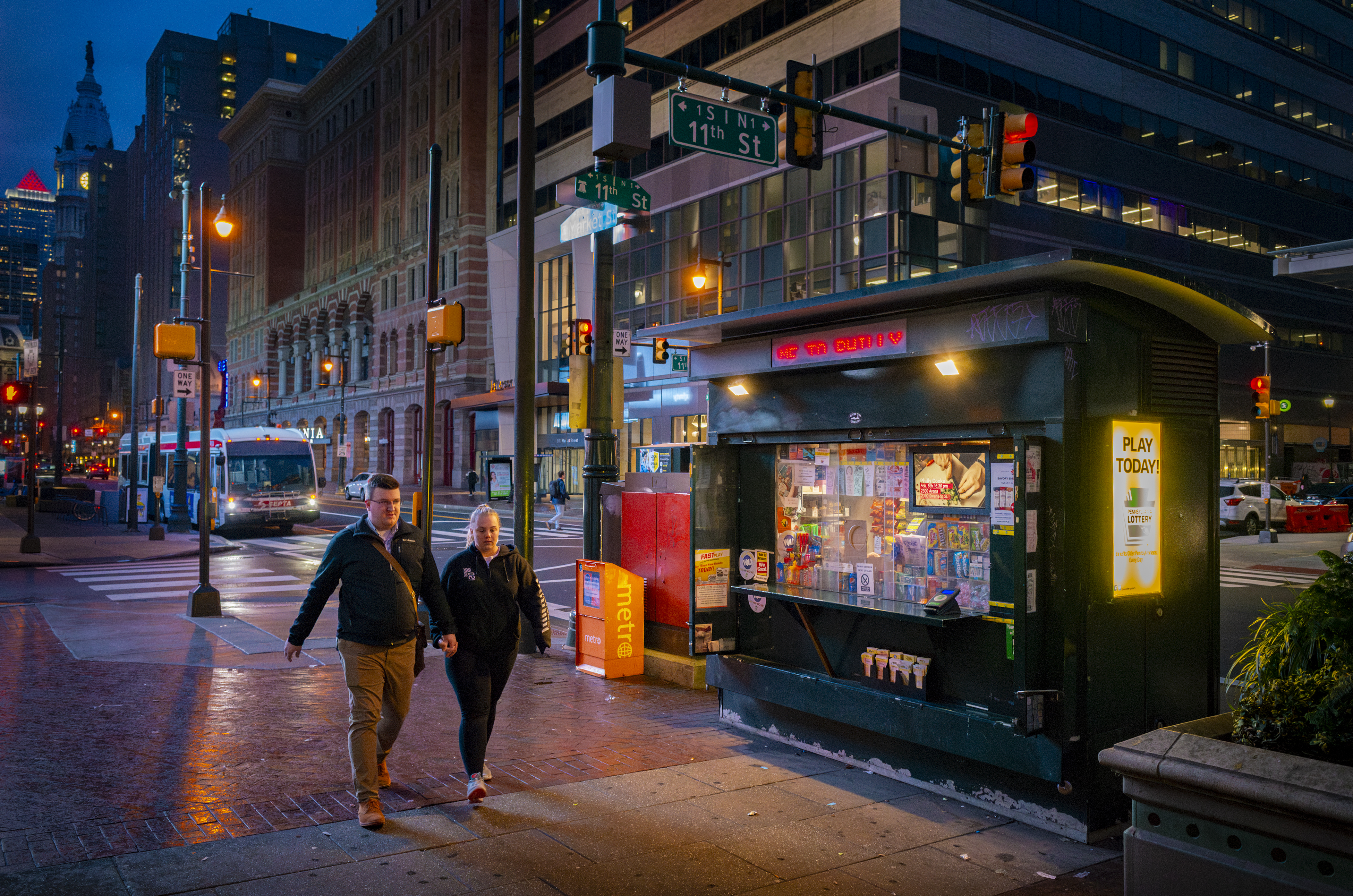
Jan. 10, 2019, 6:50 a.m. Along Market East at 11th Street.Alejandro A. Alvarez / Staff Photographer
That is not to say he won’t still be there with his camera, waiting for the sun to rise and bathe the sidewalks and neighborhoods with the day’s first warm light. He describes himself as a “professional wanderer about town, documenting the people and places I see.”
And I will probably see a lot more of him now as he will have more time for the street photography he most enjoys.
Readers — and his editors — will miss his breaking news coverage, as he will no longer be checking the news websites, apps, and tips from sources before heading out pre-dawn to visually report on the aftermath of overnight shootings, fires, or accidents. He usually filed his news photos before the reporters even turned on their computers.
June 21, 2022, 5:54 a.m. Firefighters in the 900 block of Race Street moments before extinguishing a flare up.ALEJANDRO A. ALVAREZ / Staff Photographer
The way he sees the city however, will endure and readers will still see his work, whenever Inquirer.com or the Inquirer or Daily News needs a photo to illustrate a story about SEPTA, or pedestrians and city workers, bikers and joggers and dog walkers — in all kinds of weather, they will tap into the admirable archive of his images in our digital library.
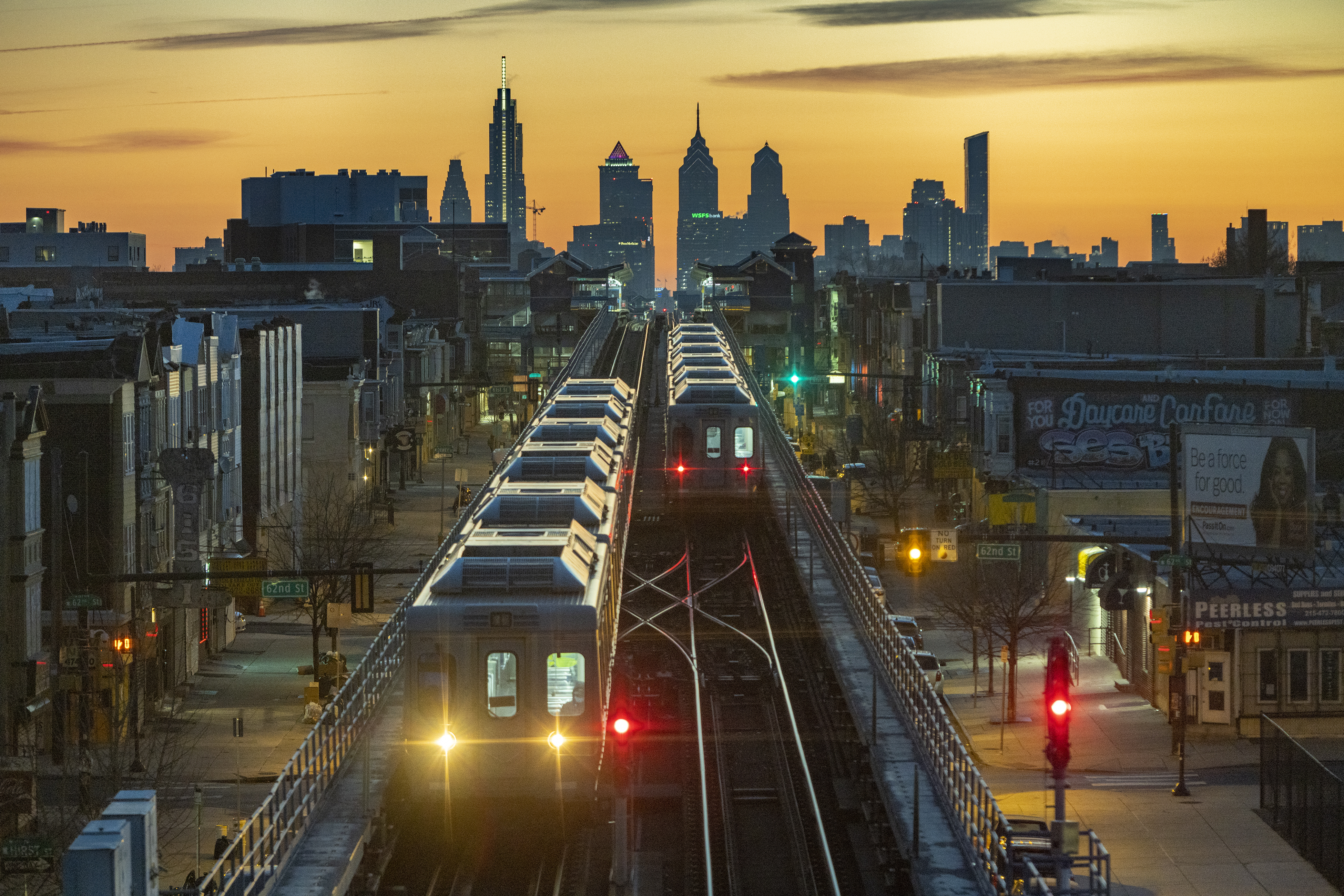
Dec. 21, 2022, 6:55 a.m. Market-Frankford SEPTA trains come and go from the 63rd Street station.Alejandro A. Alvarez / Staff Photographer
At The Inquirer, Alex photographed protests and elections; changes in the seasons and weather; parades, celebrations and memorial; kings and criminals. Yet his most memorable images came from those seemingly unremarkable mornings.
April 2, 2020, 7:30 a.m. The shadow of the photographer on a wall at N. 6th and Callowhill Streets as he chases morning light.Alejandro A. Alvarez / Staff Photographer
Since 1998 a black-and-white photo has appeared every Monday in staff photographer Tom Gralish’s “Scene Through the Lens” photo column in the print editions of The Inquirer’s local news section. Here are the most recent, in color:
U.S. Sen. Cory Booker stood Friday in the basement of the Camden County Police Department headquarters in downtown Camden, surrounded by floor-to-ceiling video screens displaying a lifelike training scenario: a distraught man teetering near the edge of a bridge, threatening to jump.
A young officer stepped forward and addressed the digital figure: “Just step back from the edge,” the officer said, “and come talk to me.”
The immersive simulation is part of a system the department uses to train officers to respond to volatile encounters without resorting to force — one piece of a growing suite of technology it has embraced over the last decade. Department officials credit those tools, along with broader policing reforms and community-engagement efforts, with helping reduce crime in a city once regarded as among the nation’s most dangerous.
Today, Camden’s homicide total sits at a four-decade low, while robberies, sexual assaults, and other violent crimes have also declined, according to police data.
Booker toured the department Friday to see those tools firsthand as he promotes federal legislation designed to help other law enforcement agencies adopt similar technology.
The proposal, known as the Violent Incident Clearance and Technological Investigative Methods Act, or VICTIM Act, would establish a Department of Justice grant program to help police departments increase staffing, purchase investigative technology, and train personnel to use it. Booker, a New Jersey Democrat, reintroduced the bipartisan legislation in March 2025 alongside Sen. John Kennedy, a Louisiana Republican.
The measure comes as violent crime has fallen sharply in many cities across the country in recent years, a trend Booker said lawmakers should sustain through continued investment.
“What they’re doing here is so innovative and cutting edge,” Booker said after the tour, pointing to Camden as an example for other departments to follow.
Inside the Camden County Police Department’s Real Time Tactical Operations Intelligence Center, analysts monitor live camera feeds, 911 calls, and data streams from license plate readers and other sources. The center provides officers with real-time information during emergencies, helps investigators track suspects, and identifies crime patterns throughout the city, said Chief Gabriel Rodriguez.
The intelligence center works in tandem with the department’s drone unit.
U.S. Sen. Cory Booker, joined by city officials, watches a drone demonstration atop the Camden County Police Department on June 12, 2026.Jose F. Moreno / Staff Photographer
Rodriguez said those tools, combined with training programs such as the simulation Booker observed Friday, have helped drive crime to new lows.
The city recorded 12 homicides in 2025, down from 17 the previous year and the fewest since 1985, according to department data. Violent crime also fell 6% last year, while robberies declined 12% and sexual assaults dropped 32%.
Camden has spent more than a decade reshaping its approach to policing, adding new technologies and investigative tools as funding became available. Booker said departments across the country cannot afford to stop investing in technology as criminal investigations become increasingly reliant on digital tools and real-time information.
“Technology is moving rapidly,” he said. “We’ve got to stay ahead of the curve, and that’s going to take constant investment.”
Several local officials joined Booker on the tour, including Camden Mayor Victor Carstarphen and Camden County Commissioner Director Louis Cappelli Jr., who highlighted the city’s crime reductions and broader public-safety gains as they walked through police headquarters.
Even so, police who have adopted technologies such as automated license plate readers and large-scale camera networks have drawn scrutiny from civil-liberties groups nationwide. And on Friday, Rodriguez acknowledged that some residents are skeptical of the department’s use of technology.
But he said many have also come to view it as a benefit, pointing to faster emergency response times and the department’s efforts to address quality-of-life concerns such as illegal dumping.
Some residents, Rodriguez said, are even curious enough to tour the facility themselves.
“A lot of communities often feel like they have too much of the policing they don’t want and not the policing that they need,” Booker added. “Standing here in Camden, where we’re finding ways … to make tremendous progress … the key for me is making sure that we can continue to get better and better as a state.
“Overall,” he said, “crime is going down in New Jersey. But we want to continue that momentum and not just see crime rates go down, but community strength and community partnerships go up.”
























 –>
–>  –>
–>  –>
–>