Category: Life

  • Philly is beta testing its own version of Boston’s Freedom Trail. I tried it and you should too.

    Philly is beta testing its own version of Boston’s Freedom Trail. I tried it and you should too.

    Following my first visit to Boston two years ago, I penned a column (against my better judgment) bemoaning what a surprisingly good time I had there (against my will).

    I was particularly taken with the city’s Freedom Trail, a 2.5-mile walking path embedded in Boston’s sidewalks that leads to 16 historic sites. Far from being half-baked, I had to admit this Beantown tourist attraction was “annoyingly great.”
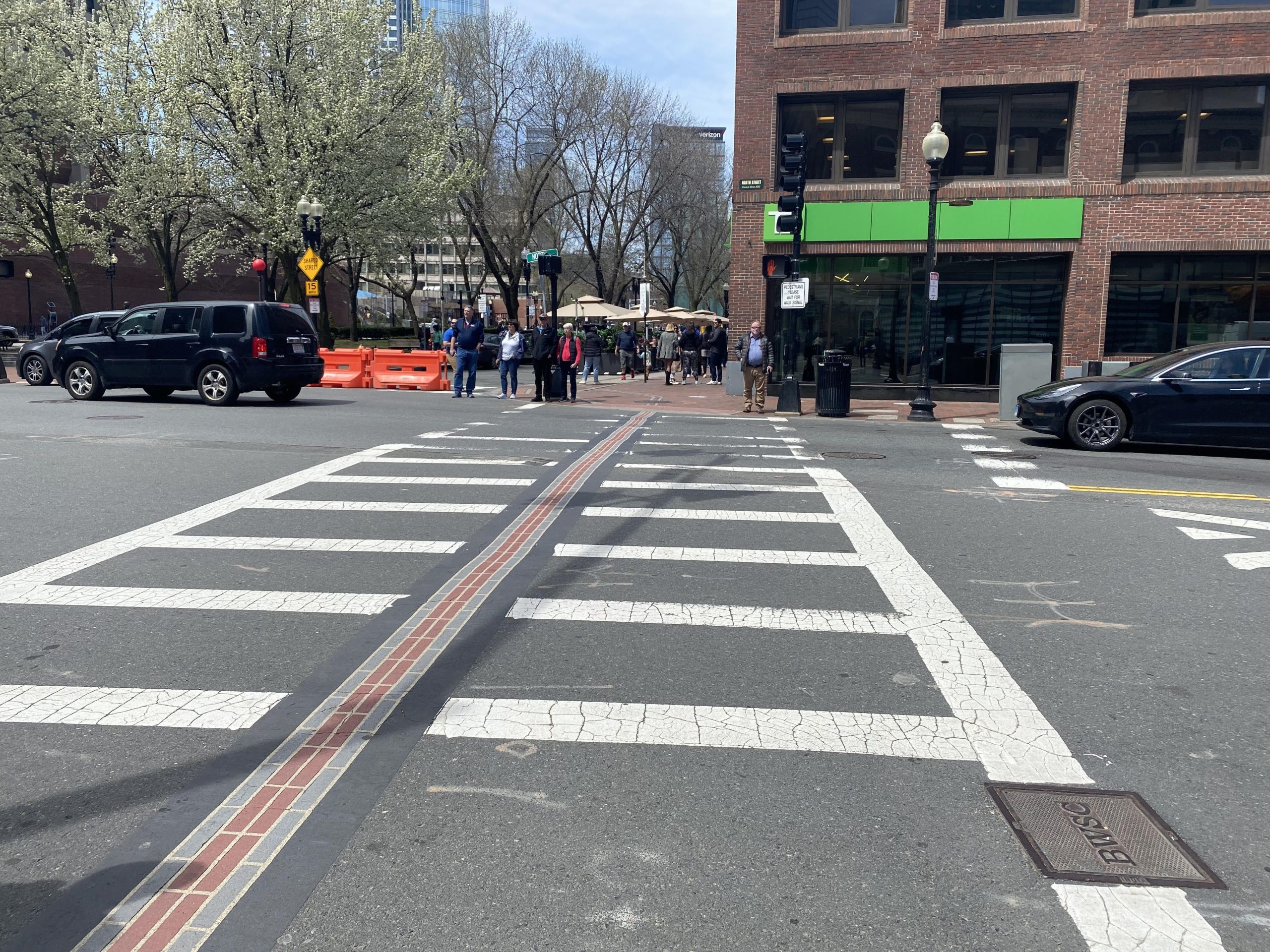
    Look at the Freedom Trail being all cute running through this Boston Street. Gawd! STEPHANIE FARR / Staff

    Why didn’t we have anything like this in Philly, I wondered, and could we get our own version in time for the nation’s 250th anniversary?

    I was flooded with emails in response from readers who not only agreed with me, but offered route suggestions and names for a potential Philly path. I also received a cryptic message from someone at Visit Philadelphia who said they had some things up their sleeves.

    That was more than two years ago and I’d all but given up hope. Then I received an email this month from Jenea Robinson, vice president of communications for Visit Philadelphia.
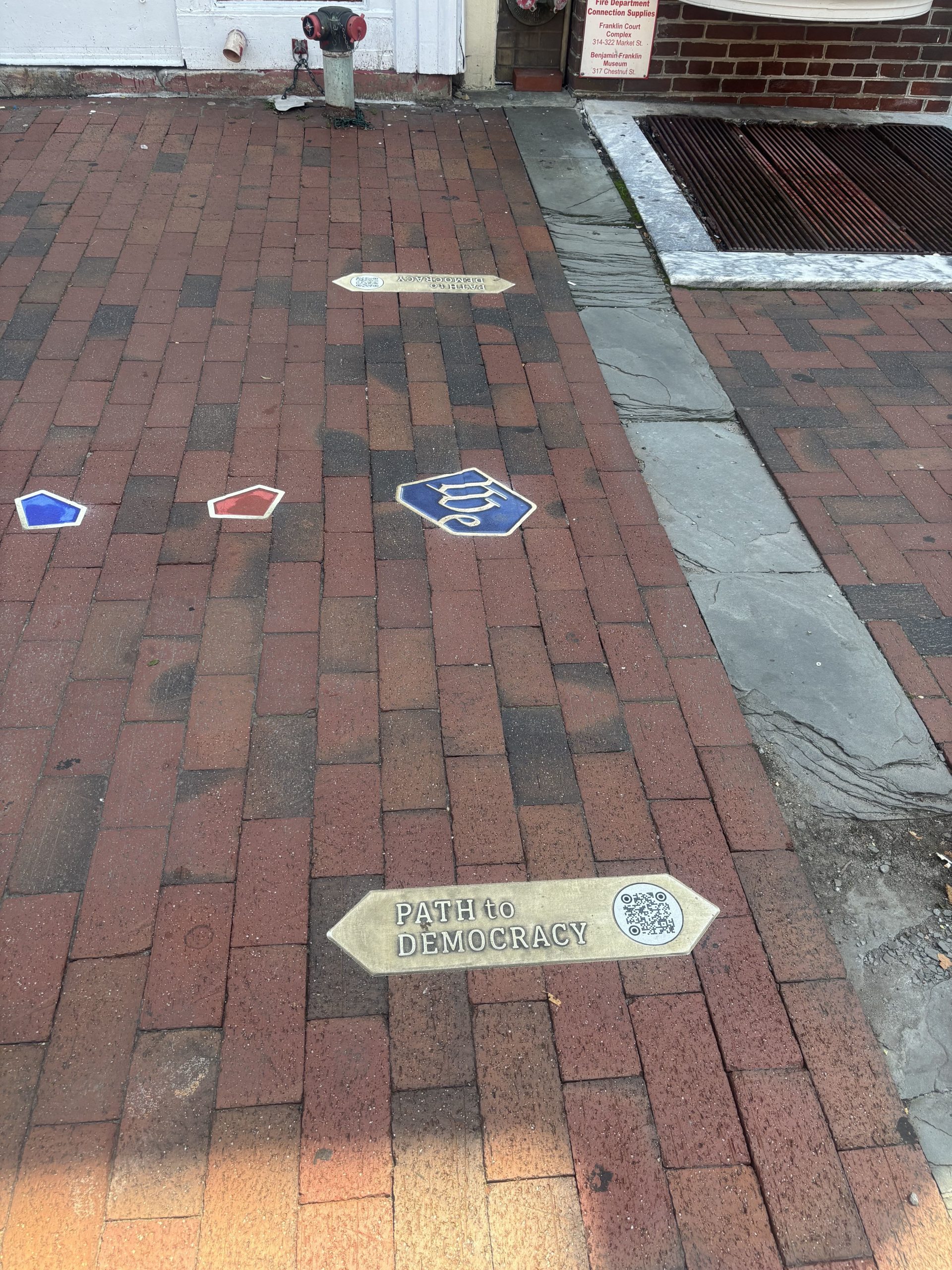
    Vinyl decals resembling ceramic tiles and a brass plaque mark the public pilot version of the Path to Democracy.Stephanie Farr / Staff

    “Because you wrote that delightfully, ‘annoyingly accurate’ story about Boston’s Freedom Trail a few years ago, I wanted to make sure you got the first look at Philadelphia’s answer to it: Path to Democracy,” she wrote.

    Could it be true? Are we actually getting our own historic trail and did someone really call my work “annoyingly accurate?!?” Be still my craggy, Philly heart!

    ‘A legacy project’

    Still in its early phases, there are currently only six stops on the Path to Democracy as it undergoes public beta testing through Labor Day. The full path, which is slated for next summer, will have 21 stops and is based on a self-guided tour Visit Philly has had on its website for years, said Kyle Stein, senior marketing project manager for Visit Philly.

    “This is something we wanted to introduce to people this year and have it be a legacy project for years to come,” he said.

    (function(){function e(){window.addEventListener(`message`,function(e){if(e.data[`datawrapper-height`]!==void 0){var t=document.querySelectorAll(`iframe`);for(var n in e.data[`datawrapper-height`])for(var r=0,i;i=t[r];r++)if(i.contentWindow===e.source){var a=e.data[`datawrapper-height`][n]+`px`;i.style.height=a}}})}e()})();

    In its final iteration, the Path to Democracy will be marked by colorful ceramic tiles, brass directional plaques, and large tile mosaics embedded in the sidewalks that will pay “homage to all of the art across Philadelphia” and particularly, to that of Isaiah Zagar, Stein said.

    “Whatever look and feel we went with had to be authentic to Philadelphia,” he said.

    For now, Visit Philly is using sturdy, eye-catching vinyl decals that resemble tiles and mosaics to mark the path and stops along it. Zagar’s studio wasn’t consulted on the project, but Stein said Visit Philly would love to work with them going forward.
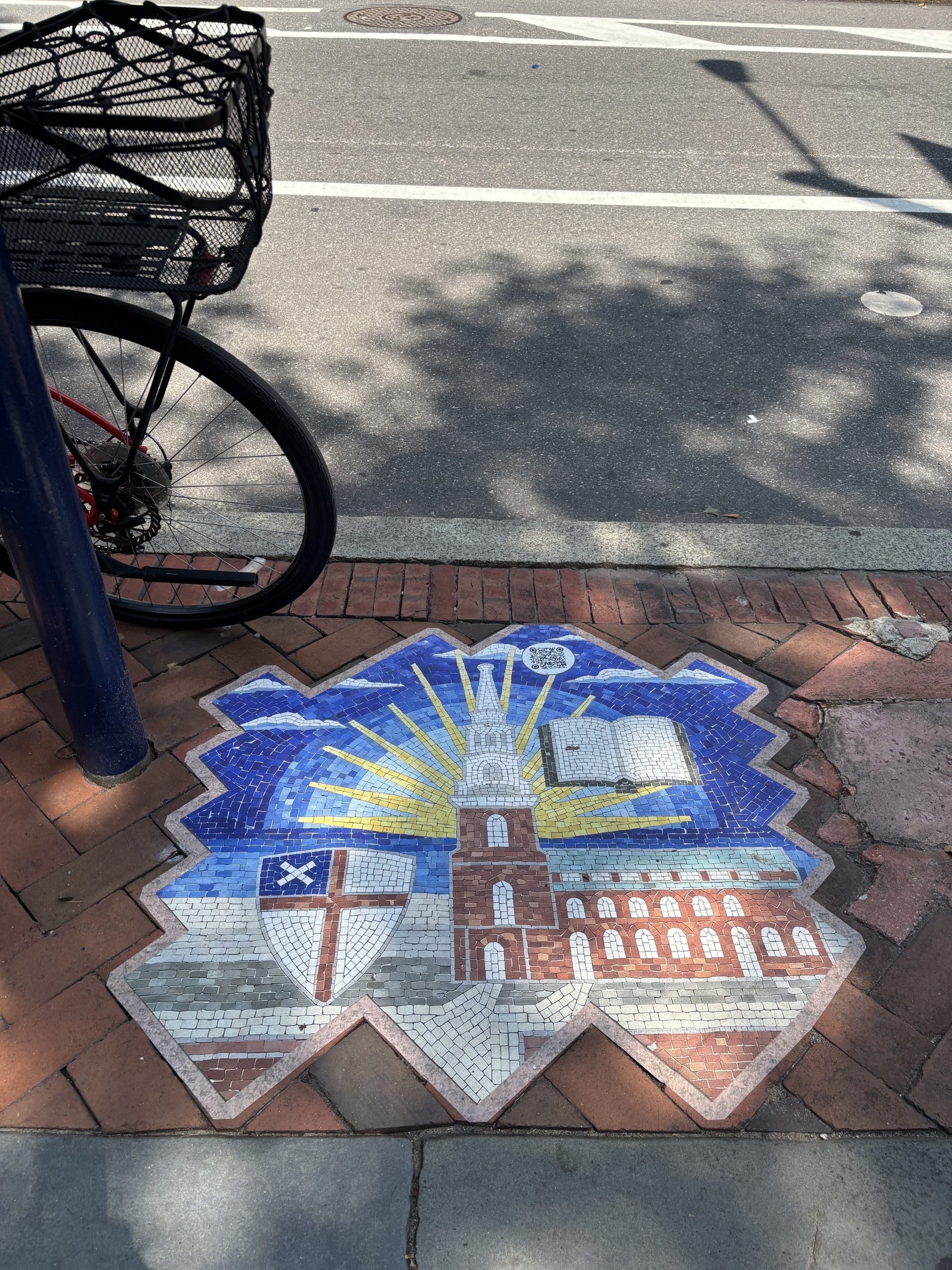
    The vinyl mosaic decal at Christ Church along the Path to Democracy.Stephanie Farr / Staff

    The Path to Democracy will not only be unique from Boston’s trail in look but in substance as well. The Freedom Trail traces Revolutionary War history, but Philly’s path will highlight sites and people that have shaped American democracy over the years.

    “It’s not just something that happened in 1776,” Stein said. “Democracy is something that is an evolving thing.”

    I knew there was only one way to suss out this path and that was to walk it myself. Plus, Stein said feedback from locals is essential during beta testing, and who doesn’t love being essential and opinionated in Philly?

    Choose-your-own adventure

    I snagged a parking space on Race Street near Second last week, knowing that the sites are all within a four-block radius from Front to Fourth and from Market to Arch Streets.

    My first stop wasn’t planned. I just kept my eyes on the ground until something caught them, which happened at the corner of Second and Arch Streets. I spotted a blue vinyl tile that said “We” (written in the script of the Declaration of Independence) and two vinyl directional decals that said “Path to Democracy” with QR codes that led to an accompanying website. One pointed up Arch Street to Third and the other pointed down Second Street to Market.
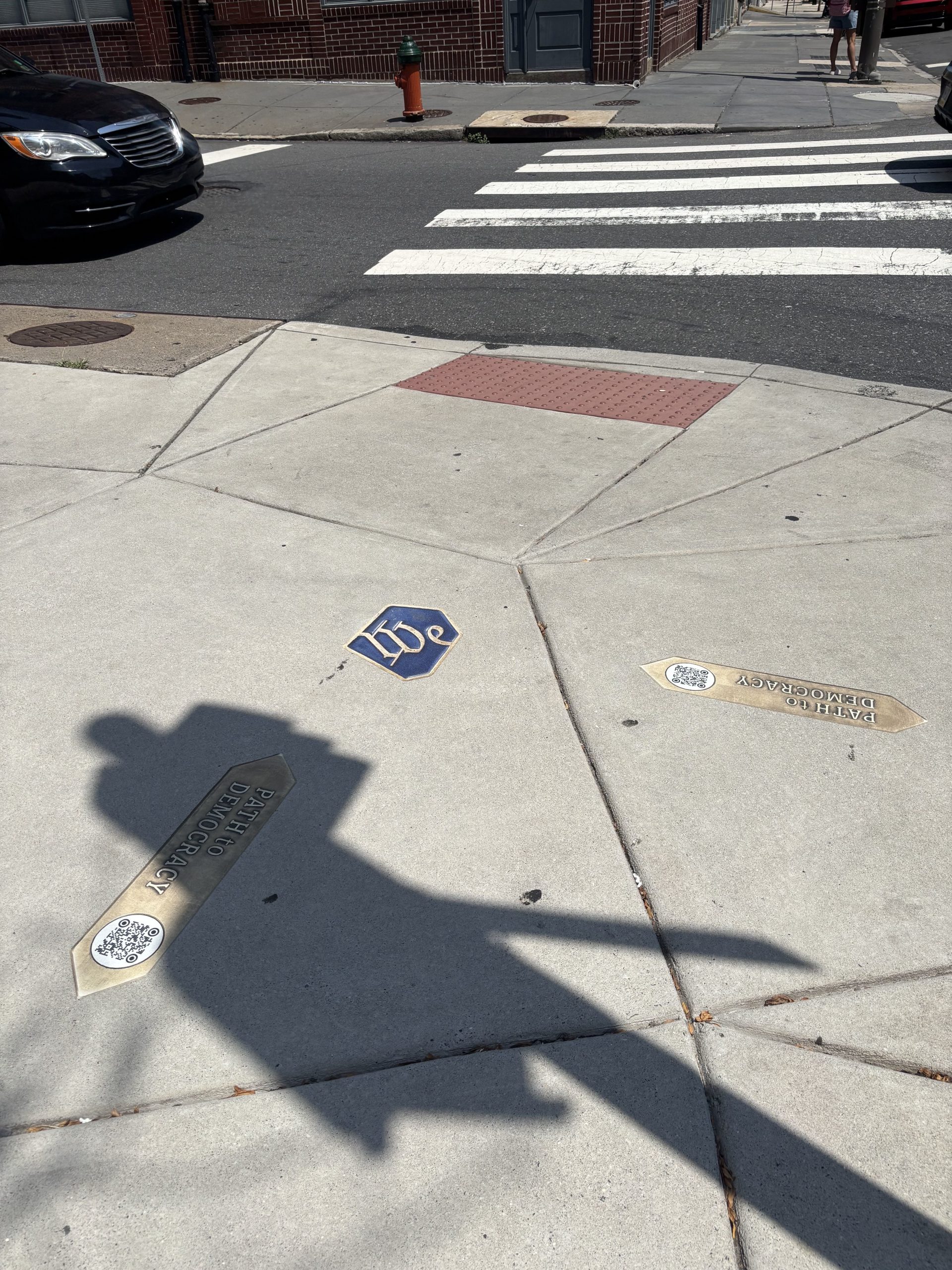
    Vinyl brass-colored decals at Third and Arch Streets in Old City denote that the Path to Democracy can be taken in one of two directions here. In the center is a “We” tile that is found on multiple spots along the path as well.Stephanie Farr / Staff

    I decided I’d follow the arrow pointing right up Arch Street. As I walked, I spotted gem-shaped blue-and-red vinyl decals that were peppered like breadcrumbs down the sidewalk and led me straight to the Betsy Ross House.

    On the sidewalk outside of the site, I spotted a lovely vinyl mosaic of a needle and thread superimposed upon a multicolored flag. A QR code on it took me to a mobile-friendly webpage about Ross. I listened to a 51-second audio clip about her life and read about the mosaic before me. Also provided on the page was the Betsy Ross House’s address, operating hours, and other useful visitor information.
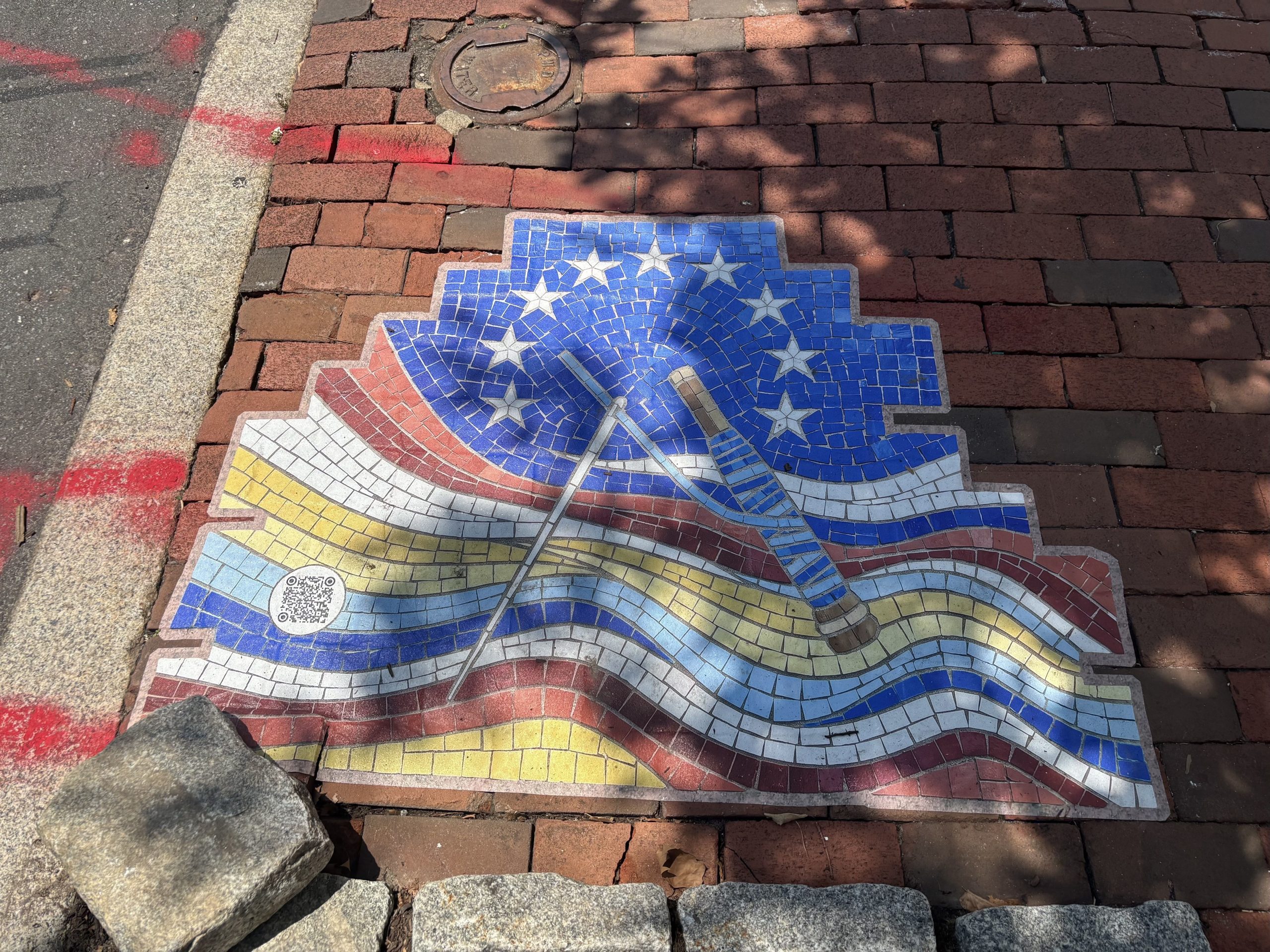
    The vinyl mosaic decal outside of the Betsy Ross House along the Path to Democracy.Stephanie Farr / Staff

    At the bottom of the site was a nifty little guide showing me that I was currently a four-minute walk away from Christ Church in one direction and a two-minute walk away from the Arch Street Meeting House in the other.

    “All right, this is pretty cool,” I whispered.

    Confusing corners

    I chose to follow the blue-and-red vinyl decals to the Arch Street Meeting House where a vibrant vinyl mosaic of a dove and the word equality was plastered on the sidewalk. The QR code led to a page about the meetinghouse and to an audio clip about how “Religious radicals founded Philly.”

    When I was done, I discovered I’d reached the end of the path, much to my chagrin. I didn’t realize it wasn’t a continuous loop and I had to retrace my steps back past the Betsy Ross House to the next site, Christ Church.

    From there, the vinyl decals led me to the southwest corner of Second and Market Streets, where a directional decal with arrows on both ends pointed me toward Front Street on my left and also to Third Street on my right.

    “Well this is confusing,” I thought.

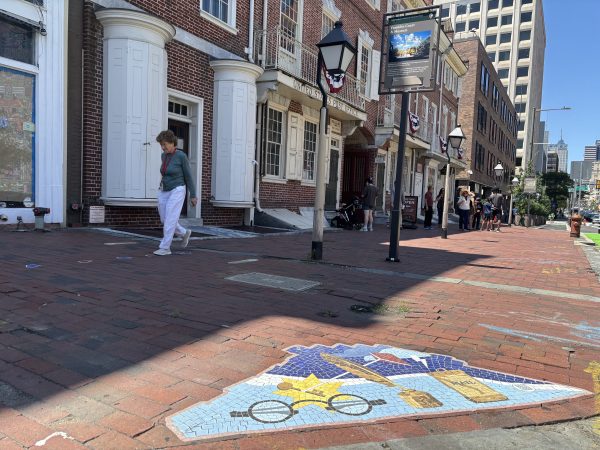
    I decided to follow the path up Market Street past Third Street to Franklin Court, where I spotted a large vinyl mosaic decal of a key, kite, quill pen, and spectacles.
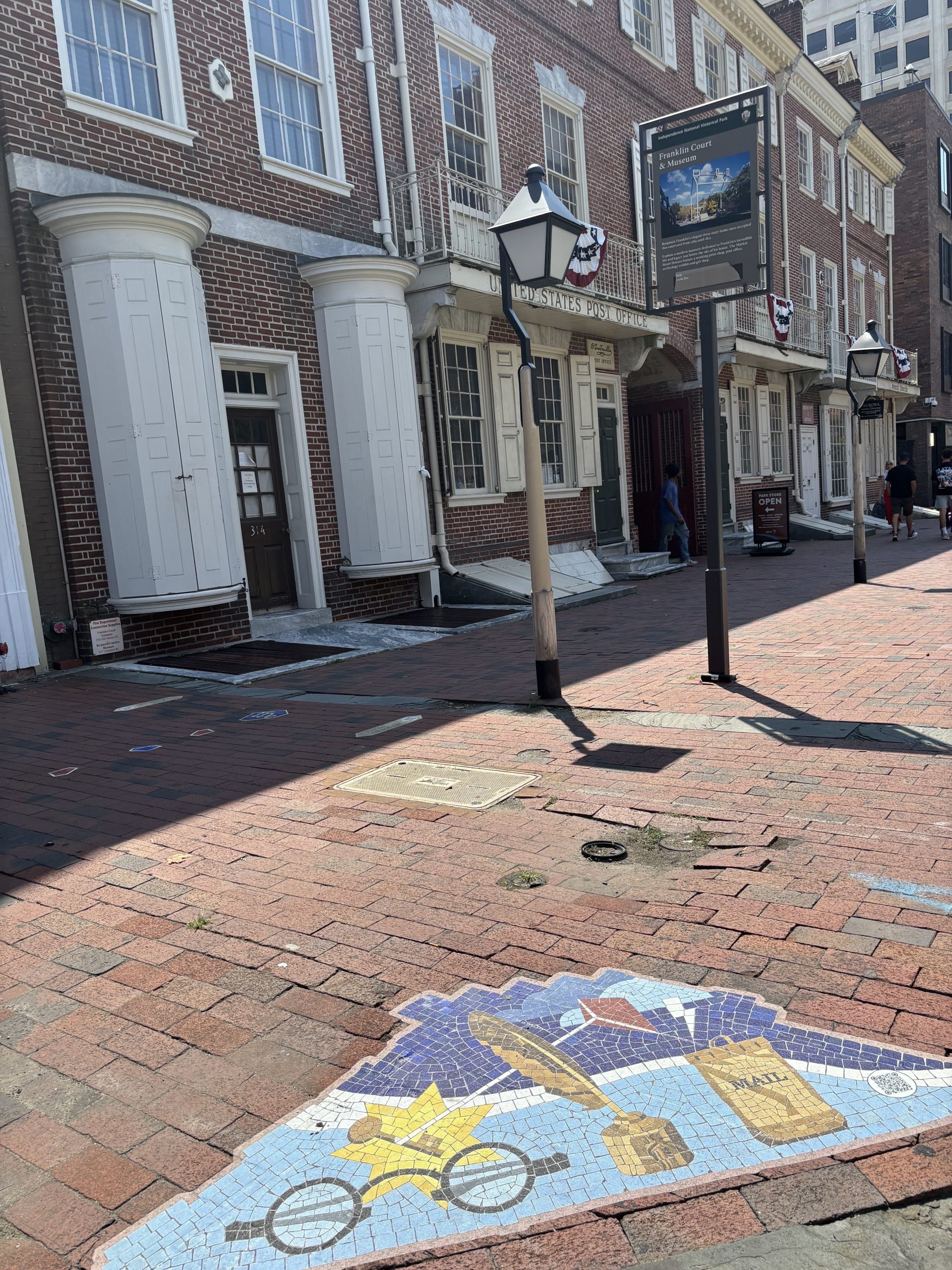
    The Path to Democracy leads to just outside Franklin Court, where this vinyl mosaic decal located.Stephanie Farr / Staff

    I headed inside Franklin Court and walked around. I always forget how many privies there are in there (the place had more johns than the Second Continental Congress!).

    Franklin Court marked another terminus of the path, so I turned around and headed back down Market Street to Front to check out the other direction of the trail I’d forgone.

    Lesser-known sites

    On the southeast side of Second Street as it crosses Market, I found a large mosaic decal of a man operating a printing press. Scanning the QR code, the website told me this was once “Printers’ Row,” where many important documents — including the first copies of the Declaration of Independence — were made.

    Unlike the other sites along the path, there was nothing already at this one to indicate it was of any importance, aside from an easy-to-miss plaque embedded in a crumbling wall of a vacant building nearby.
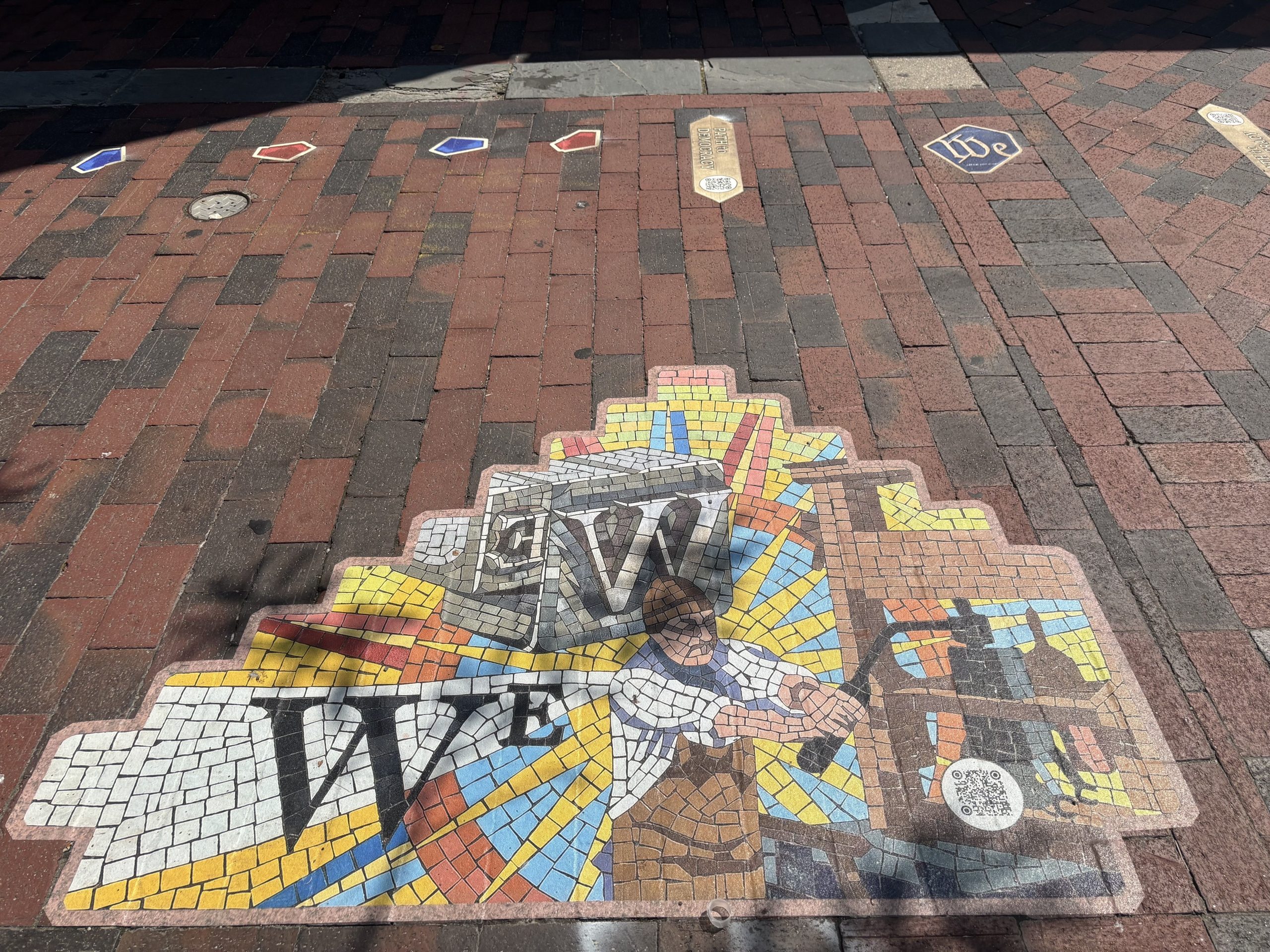
    A vinyl mosaic decal marks the site of Printer’s Row on Market Street near Second along the Path to Democracy.Stephanie Farr / Staff

    I appreciated this more-obscure site being highlighted on the path. Stein said its inclusion in the beta test was very intentional.

    “Not every historic site in Philly is one people can enter. We wanted a tried-and-true one, like the Betsy Ross House, and lesser-known ones, like Printers’ Row,” he said.

    Following the decals, I reached my final stop at the corner of Front and Market Streets. There, a vinyl mosaic decal of a tree, animals, and human figures was situated on the sidewalk catty-corner to the Chief Tamanend statue at the I-95 on-ramp.

    As I listened to the accompanying audio via the QR code, I found myself staring at the statue.
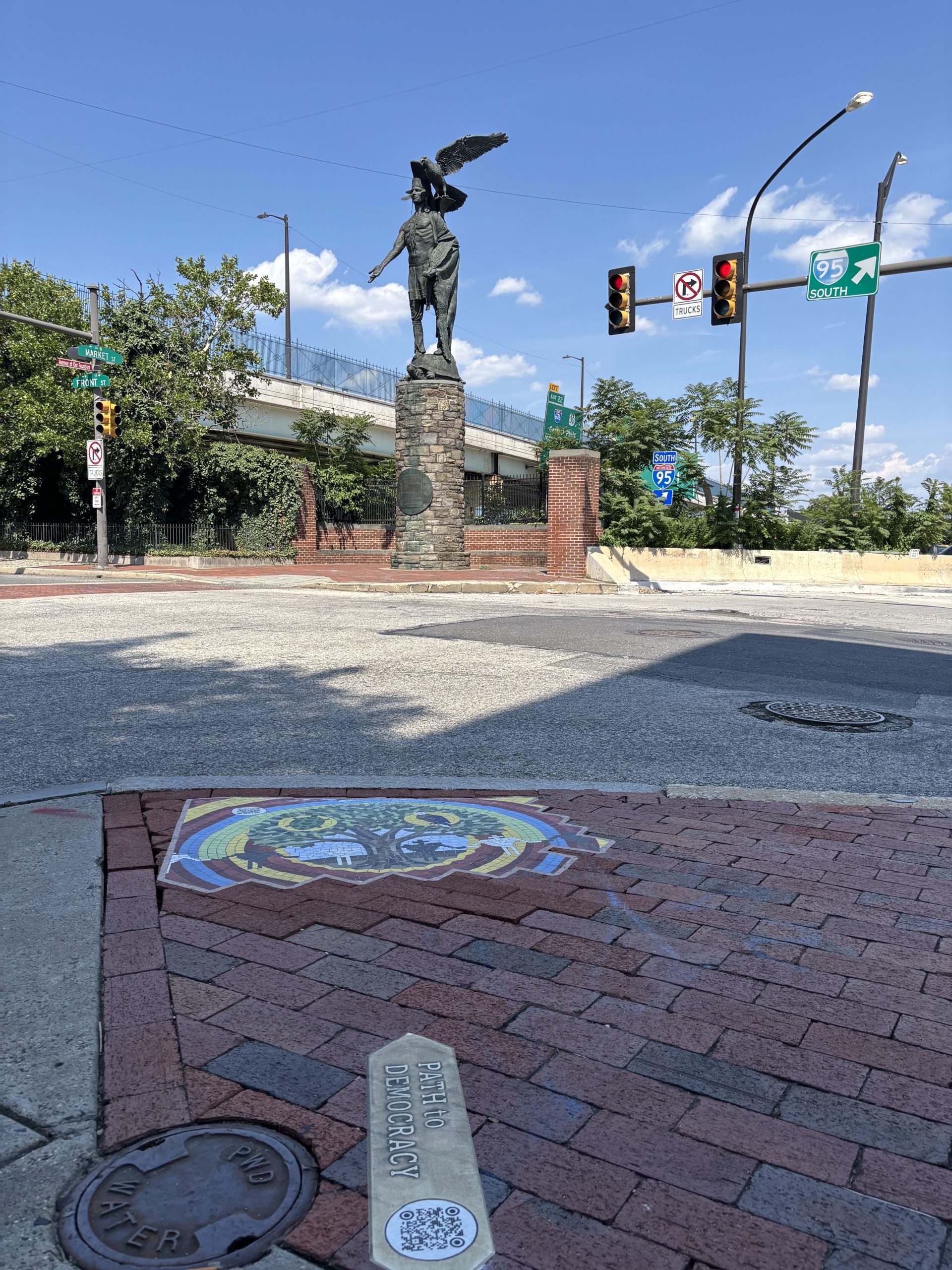
    The Path to Democracy highlights the “Chief Tamanend” statue at Front and Market Streets in Old City.Stephanie Farr / Staff

    Then, I did something I’ve never done before — I crossed the street and approached it. I stood below Chief Tamanend’s feet, I looked up at him and the eagle on his shoulder, I marveled at the details of his clothing, I read the accompanying bronze plaque.

    And I couldn’t believe that it took me this long and this path to do so.

    A worthy pursuit

    I spent about two hours walking the path, but I backtracked often and took my time. You could feasibly do it in 30-60 minutes.

    After my walk, I filled out the pilot program survey via the QR code.

    “I want more sites and would love for it to be a circular path you could start at any place and keep going around until you get back where you started, like a Phlash bus loop,” I wrote.
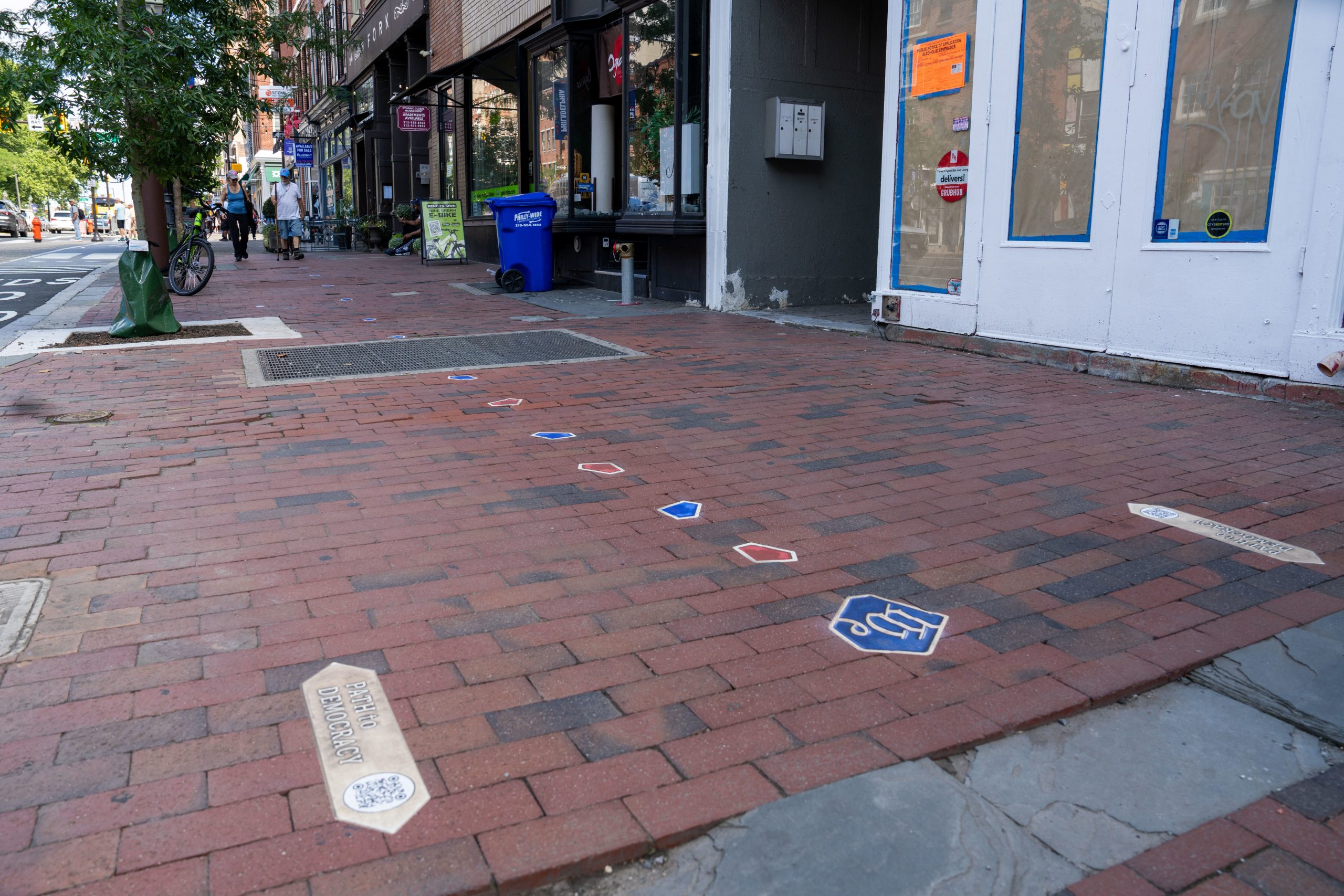
    Vinyl decals mark the Path to Democracy on the 300 block of Market Street in Old City during the beta testing phase of the project.Courtesy of Visit Philadelphia

    Stein said the goal is to have the path be multidirectional.

    “I think in the future we’re considering the best way to actually connect the sites,“ Stein said. ”Printers’ Row and Chief Tamanend was an opportunity to test out a spur. That will be something we may come up against in the future, some sites may not fall within a perfect pathway.”

    While I didn’t see anyone else following the path as I was exploring it, Visit Philly’s Robinson told me about 50 people a day have been scanning the QR codes.

    Though there are still some kinks to work out, the Path to Democracy shows a lot of promise. Like democracy itself, we don’t know where it will lead, but it’s a worthy pursuit — and one that requires our participation to succeed.

    So before Labor Day, go try it out and provide feedback. You could help shape a path in Philly that may be walked for generations to come.

    “We just want Philadelphians to be proud of this and be aware of it,” Stein said. “I think that this path is another way for us as Philadelphians to celebrate how great this city and these sites are.”
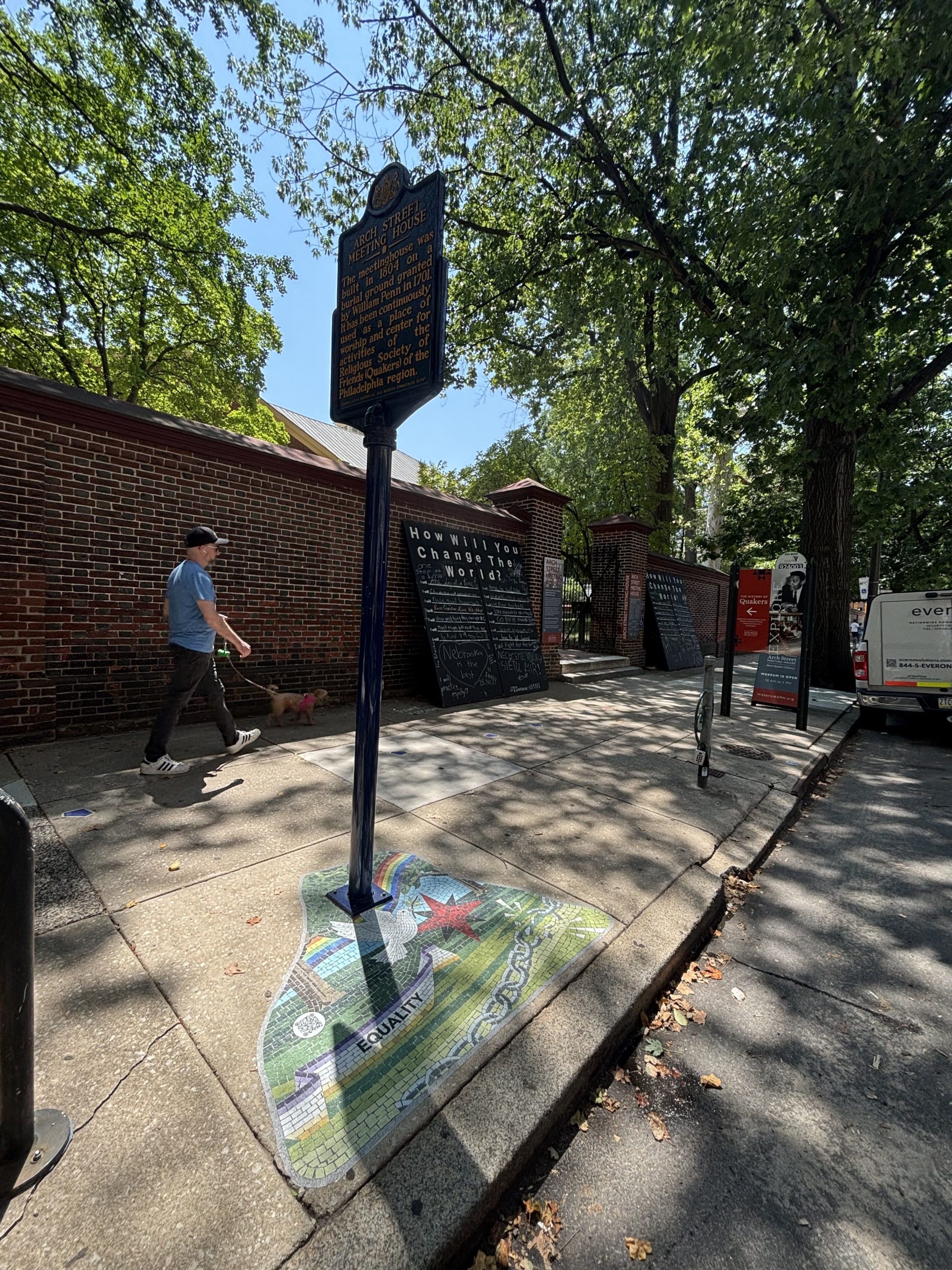
    The Path to Democracy leads to the Arch Street Meeting House, where a vinyl mosaic decal wraps around the site’s historical marker.Stephanie Farr / Staff
  • LeBron is a Sixer, Sirianni finds AI, and Philly’s parking champs | Weekly Report Card

    LeBron is a Sixer, Sirianni finds AI, and Philly’s parking champs | Weekly Report Card

    LeBron in Philly: A+

    This isn’t a drill.

    LeBron James is coming to Philadelphia.

    Before you start pointing out that he’s 41, remember who we’re talking about. This is arguably the greatest basketball player of his generation — one of the few athletes whose name alone can change the mood of an entire city. There will be plenty of time to debate how much he has left in the tank.

    But now isn’t the time.

    Now is the time for imagining LeBron in a Sixers jersey. It’s for checking the schedule, texting your friends in all caps and wondering how quickly the team store can stock No. 23.

    Will this end with a championship? Nobody knows. But sports are supposed to be fun, and this is fun.

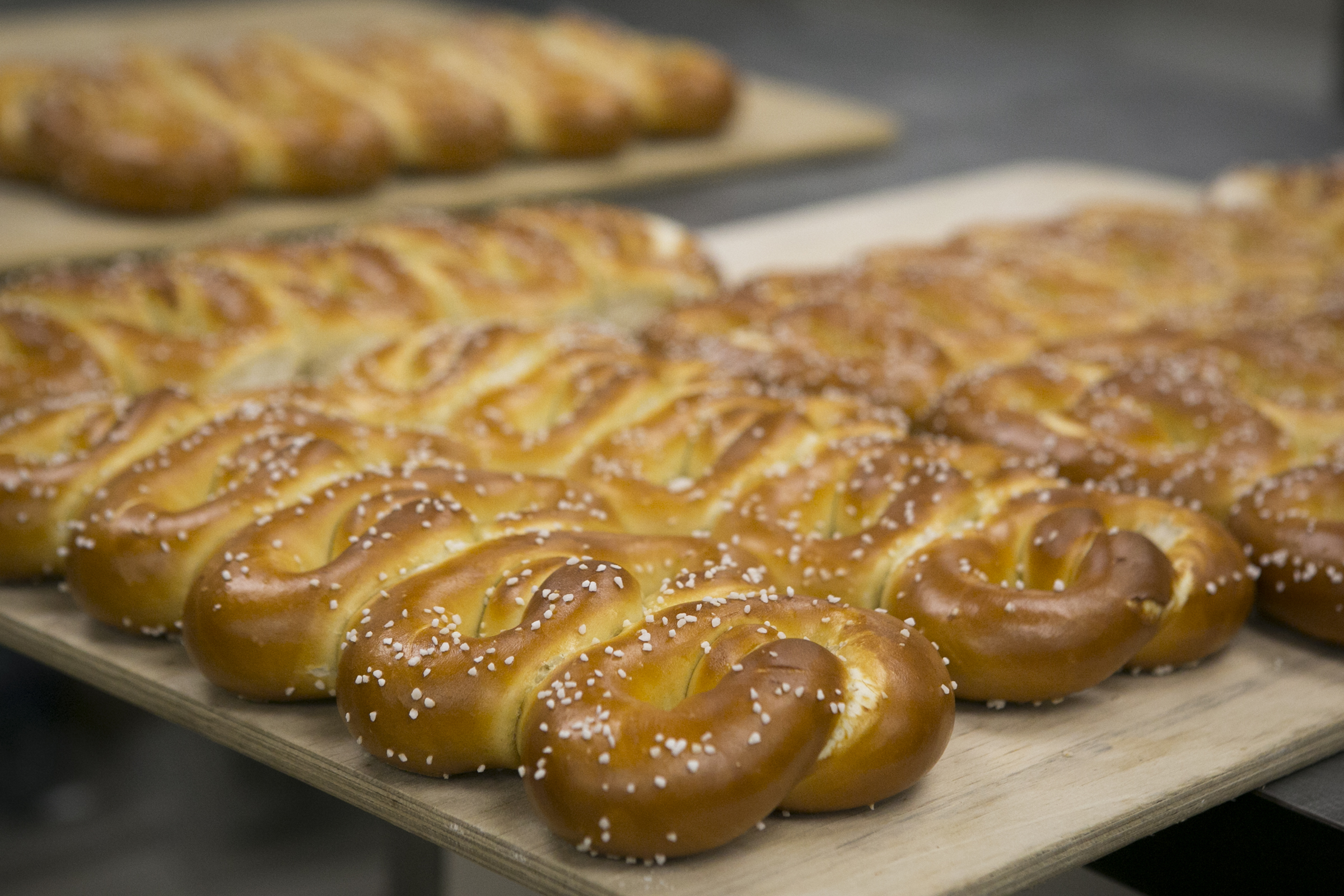
    Freshly baked “penny pretzels” cool in the test kitchen at Philly Pretzel Factory headquarters in Bensalem, Pa., on the morning of Thursday, August 9, 2018.MAGGIE LOESCH / Staff Photographer

    Keep your protein out of my pretzel: C

    There are plenty of places to squeeze in an extra 20 grams of protein. A Philadelphia soft pretzel shouldn’t be one of them.

    Philly Pretzel Factory says it’s developing a high-protein pretzel to appeal to consumers in the GLP-1 era, joining a growing list of food companies tweaking recipes to satisfy Americans’ obsession with protein.

    Sure, the business logic is there. But some foods don’t need to become “functional.” They already have a purpose.

    A Philly soft pretzel isn’t just a snack. It’s breakfast after a youth soccer game, lunch when you’re running late. It’s something you grab at a Wawa, a corner store, or outside the stadium without giving a second thought. It’s warm, salty, a little messy, and unapologetically carb-heavy.

    We’ve spent years turning ice cream into protein shakes, cookies into protein bars, and cereal into a dietary supplement. Now we’re coming for the pretzel? Somewhere, Gritty is shaking his fuzzy orange head.

    If you want more protein, eat some chicken. Leave the pretzel alone.

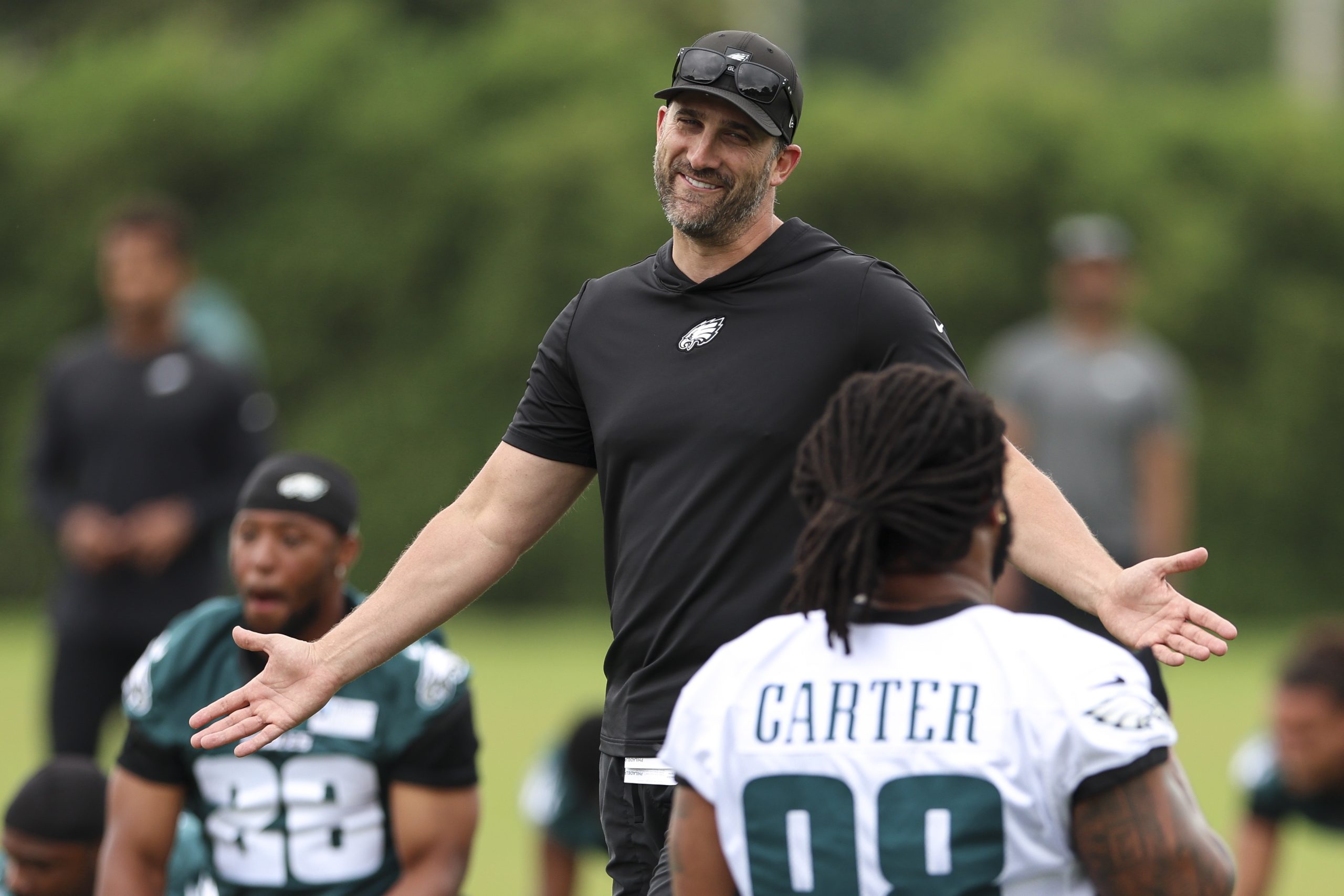
    Philadelphia Eagles head coach Nick Sirianni laughs with defensive tackle Jalen Carter during mandatory mini-camp at the Jefferson Health Training Complex on Wednesday, June 10, 2026, in Philadelphia.Monica Herndon / Staff Photographer

    Nick Sirianni’s AI pep talks: D

    The robots aren’t taking over the Eagles playbook just yet. Instead, Nick Sirianni says he’s been using ChatGPT to find inspirational sports stories to share with his players, according to The Athletic.

    Somewhere, decades of coaches who relied on Remember the Titans, grainy YouTube highlight reels, and laminated printouts with motivational quotes are shaking their heads.

    Apparently even locker room speeches have entered the AI era.

    It’s objectively funny to imagine Sirianni sitting at his computer typing, “Give me a great relentless effort true sports story,” before walking into a room full of NFL players.

    Then again, maybe this is just what coaching looks like in 2026. At least he’s using ChatGPT to inspire the team — not to draw up game plays.

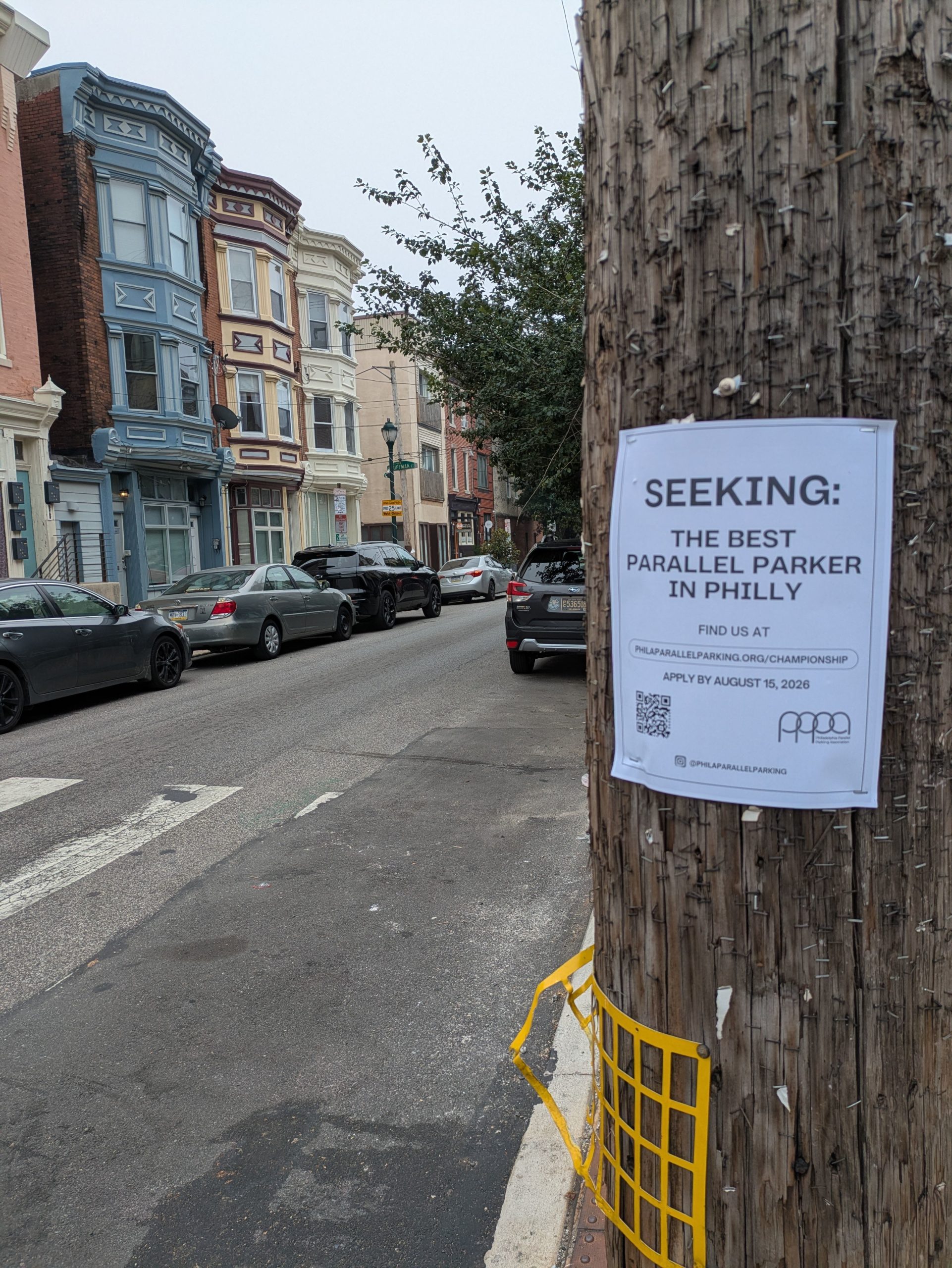
    A sign advertising the 2026 Philadelphia Parallel Parking Association Championship is affixed to a pole across from some fine examples of parallel parking in the city.Courtesy of Adam Wodka

    Competitive parallel parking: A

    There are two types of Philadelphians. Those who dread parallel parking, and those who quietly believe they’re among the best to ever do it.

    So, of course, the city’s first-ever Philadelphia Parallel Parking Association Championship already has more than 400 applicants competing for just 20 spots.

    This is a city where successfully squeezing into a parking spot the size of a shoebox earns applause from strangers, where people take it personally when someone leaves three feet between bumpers, and where every South Philly resident has at least one story about fitting into a space they probably shouldn’t have.

    The organizers somehow made it even more Philly by including an “under duress” category, complete with a savesies chair, an angry neighbor yelling that the spot is reserved for their granddaughter, honking traffic, and other distractions. That’s less a competition than an average Tuesday.

    The winner gets $76… just enough to cover your next parking ticket, and the most Philadelphia prize imaginable.

    Bryce Harper’s history lesson: C+

    Look, nobody has ever accused Bryce Harper of being a history professor. We just need him to keep hitting baseballs very, very hard.

    But getting asked on the MLB All-Star red carpet when the Declaration of Independence was signed — while standing in Philadelphia, no less — and answering “1775″ is a tough look. It got even better when Harper laughed and said, “I was off by one day.” Clearly he meant one year, but somehow that made the whole thing even more endearing.

    The worst part? Players from the Nationals, Yankees, and even the Dodgers got it right. Come on, Bryce. You’ve spent years playing in the birthplace of American democracy. We weren’t expecting a dissertation on the Continental Congress, we just wanted 1776. Heck, the basketball team that plays across the parking lot isn’t called the 75ers.

    Then again, if the price of 40 home runs is occasionally forgetting what year America declared independence, that’s probably a trade Phillies fans are willing to make.

    $1,500 in Philly rent: B

    Nobody is going to look at 591 square feet and say, “Wow, what a palace.” That’s about what $1,500 a month gets you in Philadelphia, according to a new RentCafe study. It’s smaller than the national average and not even enough for a typical one-bedroom apartment.

    But perspective matters.

    In Manhattan, the same $1,500 gets you about 210 square feet — roughly enough room for a bed, a mini fridge and an existential crisis (a dorm room, essentially). In Boston, it won’t even cover a studio.

    So suddenly, Philly’s 591 square feet starts looking… respectable.

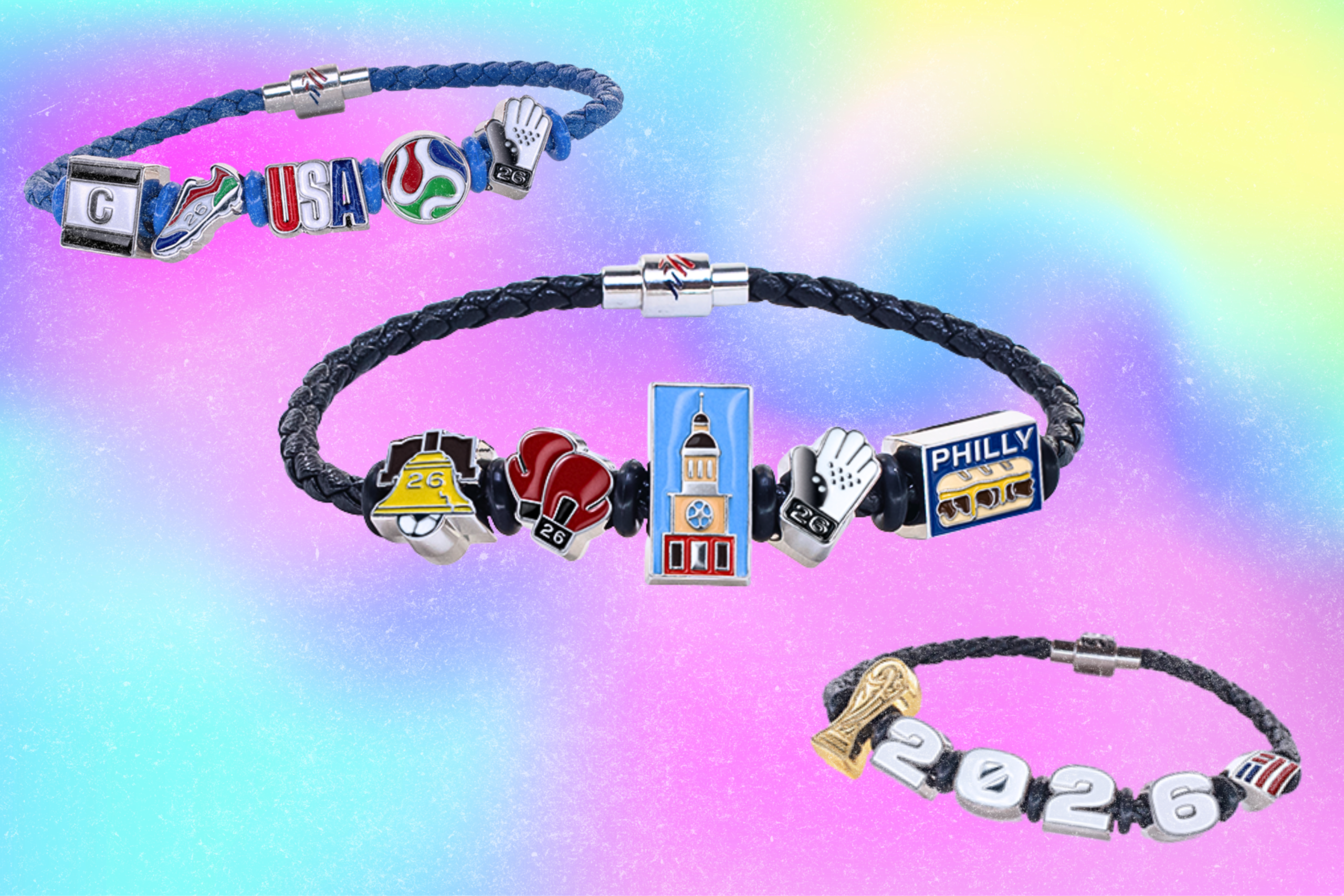
    A free charm bracelet available at FIFA Fan Festivals nationwide, including Philadelphia’s in Lemon Hill, had fans waiting hours in line to get one. Bank of America is behind the coveted Fan Bands, drawing hours-long lines.Emily Bloch / Staff illustration / Bank of America

    Nothing stays free for long: A-

    The World Cup ended, everyone went home, and right on schedule, the internet got to work.

    Remember those free Bank of America charm bracelets that had people waiting in line for hours at Lemon Hill?

    They’re already popping up on Facebook Marketplace and eBay for anywhere from $10 to hundreds of dollars. We’ve somehow reached a point where people aren’t just flipping sneakers and concert tickets, but free promotional giveaways.

    Honestly, you almost have to respect the hustle. If someone is willing to pay $150 because they didn’t want to stand in a four-hour line for a tiny cheesesteak charm, that’s capitalism doing what capitalism does.

  • History, hikes, and cider: Spend a weekend in Gettysburg | Field Trip

    History, hikes, and cider: Spend a weekend in Gettysburg | Field Trip

    From July 1 to 3, 1863, the Confederate and Union armies faced off in the bloodiest battle of the Civil War. The South’s defeat at Gettysburg became a turning point in the conflict, and an entire tourism economy has grown around the town’s significance.

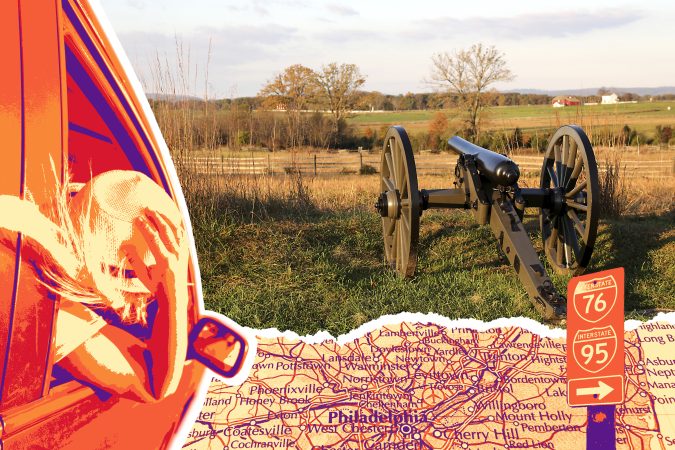
    This Field Trip gives that history its due, but Gettysburg isn’t a one-trick pony. Expect battlefield landmarks and ranger talks alongside viral doughnuts, lake swims, craft cider, and Syrian food; all about 140 miles west of Philadelphia.

    Start the car.

    Fuel: Devil’s Den Doughnuts

    It’s worth timing your trip to arrive in Gettysburg for Fritter Friday, the weekly tradition that has turned Devil’s Den Doughnuts into a viral sensation. Lately, the little bakeshop on the outskirts of downtown Gettysburg has been running a berry version cloaked in a magenta glaze. If it’s sold out by the time you arrive, don’t worry. The bakery is still packed with chocolate-iced, cinnamon-sugared, and honey-drenched options; plus over-the-top cold brews to wash them down.

    📍 16 Deatrick Dr., Gettysburg, Pa. 17325

    Stay: Union Hotel

    From its beginnings as an 18th-century stop for westbound travelers to today’s best boutique stay in downtown Gettysburg, the Union Hotel has history in abundance. Its four-story brick facade, striped awnings, and gold marquee give it the look of a classic Main Street landmark. Inside, the 12 suites offer kitchenettes, full-size sofas, and beds wrapped in Brooklinen sheets.

    📍 27 Chambersburg St., Gettysburg, Pa. 17325

    Learn: Gettysburg National Military Park Museum & Visitor Center

    No surprise the 1863 Civil War battle of Gettysburg is the area’s main tourism driver. Even visitors who are typically snoozy on history need to do the circuit when they come here, and that starts at the Gettysburg National Military Park Museum & Visitor Center. Doing this first sets the context for the entire historical gravitas of Gettysburg and its pivotal role in the war, and a standard admission ticket includes the museum galleries, filled with battlefield artifacts; the iconic 360-degree Cyclorama painting of Pickett’s Charge; and A New Birth of Freedom, the introductory film. You can add on the bus tour of the Gettysburg Battlefield, but it’s unnecessary since that site will be covered separately in this itinerary.

    📍 1195 Baltimore Pike, Ste. 100, Gettysburg, Pa. 17325

    Reset: Pine Grove Furnace State Park

    About 20 minutes north of Gettysburg, Pine Grove Furnace State Park offers a welcome change of pace once the weight of Civil War history starts to settle in. Nearly 700 acres of forest feature more than a dozen hiking trails, including a stretch of the Appalachian Trail, along with mountain biking, bird-watching, swimming at Fuller Lake (lifeguards in season), and kayaking on Laurel Lake.

    📍 1100 Pine Grove Rd., Gardners, Pa. 17324

    Drink: Ploughman Cider

    The Three Springs Fruit Farm apples you love at the Headhouse Square Farmers Market? Farmer Ben Wenk’s generational orchards grow them right outside Gettysburg in the Adams County countryside. While his Jonagolds and Nittanys make great fresh eating, many of the more arcane heirlooms get fermented into Wenk’s liquid spinoff, Ploughman Cider. He tends a cozy taproom right in downtown Gettysburg, where you can try the whole cider portfolio, along with seasonals and limited-edition runs that might not even make it to the city. Hillbilly Banana blends Stayman Winesaps with our native “tropical” fruit, the pawpaw.

    📍 14 Lincoln Square, Gettysburg, Pa. 17325

    Dine: Jamilie Syrian Kitchen

    Syrian cooking in Gettysburg? Yes, please. Jamilie Syrian Kitchen, with its exposed brick walls, hand-painted plates, and full cocktail menu, is open all day, making it an ideal spot for the early dinner you need in order to get to your nighttime plans. The extensive menu ranges from hot and cold mezze — including tangy muhammara and za’atar-and-cheese flatbreads — to kebabs, hearty entrees, and excellent pistachio ice cream.

    📍 28 Carlisle St., Gettysburg, Pa. 17325

    Visit: Gettysburg National Military Park

    Aim to reach Gettysburg National Military Park around 6 p.m., when the lowering light lends the battlefield an especially powerful atmosphere. Access to the park is free, and there are both free and paid apps to download that correspond with the self-guided Auto Route, which follows the battle’s timeline from McPherson Ridge to the National Cemetery as it covers 24 miles. If you’re visiting on a forthcoming Saturday, plan your drive to end at Pitzer Woods Amphitheater for the free Campfire with a Ranger program at 8:30 p.m. The hourlong talks blend military history with local lore, all beside a crackling campfire.

    📍 Auto Tour begins at Gettysburg National Military Park Museum & Visitor Center, 1195 Baltimore Pike, Ste. 100, Gettysburg, Pa. 17325

  • Dear Abby | Widow has second thoughts about rekindled romance

    DEAR ABBY: After a four-year battle with cancer, my husband of 27 years passed away. After his death, I was contacted by a guy I had been involved with 40 years before. He said he wanted me to know that he was there for me if I needed to talk or just needed some company. I told him how much I appreciated it and I would call if I felt he could help.

    This man was someone I had loved intensely. We had dated for seven years when he broke my heart. He was seeing other people behind my back, and when I found out, I broke up with him. We always managed to stay in touch, though. He would call to wish me happy birthday or just say hi. We remained friends. He dated a couple of people I knew, and we would run into each other a couple of times a year.

    Well, we are now seeing each other again. He has told me how sorry he is for breaking my heart all those years ago. He says he knows that being a man is not being with every woman you possibly can be with but being willing to commit to the one woman you know you love. He says he knows he made a mistake and he loves me and wants us to spend the rest of our lives together.

    The problem: I can’t stop thinking about all the women he has been with and how I will never be able to measure up to them. There’s nothing special about me. I’m not beautiful, I don’t have a “killer body” and I don’t have a lot of money. I don’t want to ruin what is possibly the best thing that has ever happened to me, but I just can’t seem to move past this. What can I do to move forward from his past?

    — BACK WHERE I STARTED IN TENNESSEE

    DEAR BACK: The only thing that could ruin what is possibly the best thing that has ever happened to you is your low level of self-esteem. This man appears to have matured in the years since you broke up with him. He isn’t after a raving beauty, a woman built like a racing sloop or a sugar mama. He is interested in the person you are.

    Please ask your doctor for a referral to a licensed mental health professional who can help you make a serious attitude adjustment before your insecurity ruins what could potentially be a happy future.

    ** ** **

    DEAR ABBY: I have been lucky. I have done well and lived a good life. I’m married (my third time), and I have adult children and grandkids. For most of my life, I have had an active sex life. Much of it I wouldn’t want my children to know about while I’m alive, but it could make for some erotic reading years after I’m gone. Should I write my honest accounting covering 50 years and leave it for posterity?

    — TALES TO TELL IN FLORIDA

    DEAR TALES: For the sake of your children, their spouses, and your grandchildren please resist the urge to recount in detail your sexual history. When you depart this earthly plane, leave them with at least a few illusions, I’m begging you.

  • More than 575,000 people attended Philly’s World Cup fan festival

    More than 575,000 people attended Philly’s World Cup fan festival

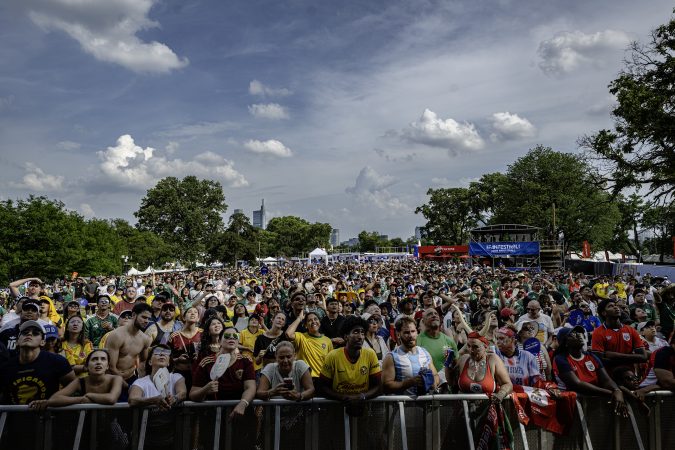
    Philadelphia transformed Lemon Hill into the longest and one of the largest World Cup watch parties in the country throughout the FIFA Fan Festival’s 39-day stay.

    With the World Cup wrapped up, host committees throughout the country are taking stock of how many fans flocked to these festivals. Philly’s fan fest saw the second-highest number of attendees, with 575,304 between June 11 and July 19, according to the festival’s organizer, Philadelphia Soccer 2026.

    Miami’s host committee was less precise in its count, but said its festival drew more than 600,000 guests.

    Each one of the 11 host cities reported fan totals in the hundreds of thousands, but none quite reached the attendance levels of Philly and Miami.

    However, despite South Florida’s high total numbers, Philadelphia set the record for most attendees throughout a single day at a U.S. fan festival with 55,000 attendees during the Brazil vs. Haiti group stage match on June 19. While Philadelphia’s fan festival operated for almost twice as long as Miami’s, opening every day of the tournament, Philadelphia worked with half the capacity limit that Miami did, capping crowds at 15,000 people at a time.

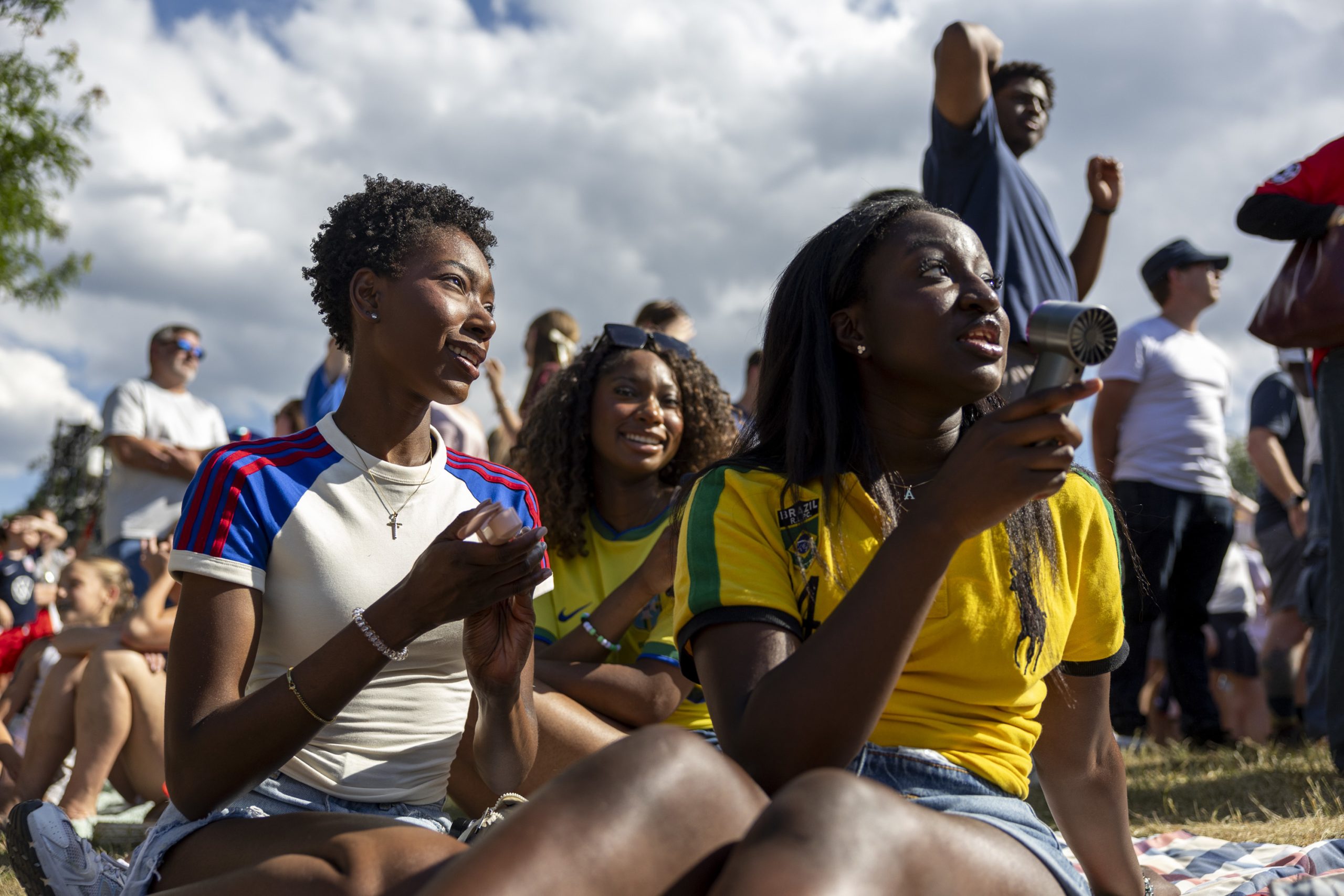
    Anu Akinlotan, 19, of Darby, Pa., (right), Sandra Olaniyi, 25, of Drexel Hill, Pa., (left), and her sister Victoria, 22, (center), watch the USA vs. Australia game at FIFA Fan Festival at Lemon Hill Park in Philadelphia, Pa., on Friday, June 19, 2026.Tyger Williams / Staff Photographer

    New York and New Jersey, home to the largest population among host cities and host of the World Cup final, netted more than one million fans across their decentralized network of official fan zones. The San Francisco Bay Area host committee also chose not to do a single festival but rather a network of watch parties and events. Across those areas, 900,000 people reportedly visited during World Cup games, according to CBS.

    Philly’s million-square-foot watch party, akin to a Fairmount summer barbecue of epic proportions, featured large swaths of open space for fans to lay down blankets and picnic while they watched the game, with the Center City skyline as backdrop; mini soccer pitches to challenge friends to pickup games; and a line of sponsor exhibits, including one outrageously viral Bank of America bracelet-making workshop. Some later resold the bracelets online for upward of $150.

    But the main course was the 60-foot-wide screen playing almost every 2026 World Cup game to a crowd of thousands. This is where Philadelphians and international tourists could experience the energy of the World Cup outside the pricey stadium seats.

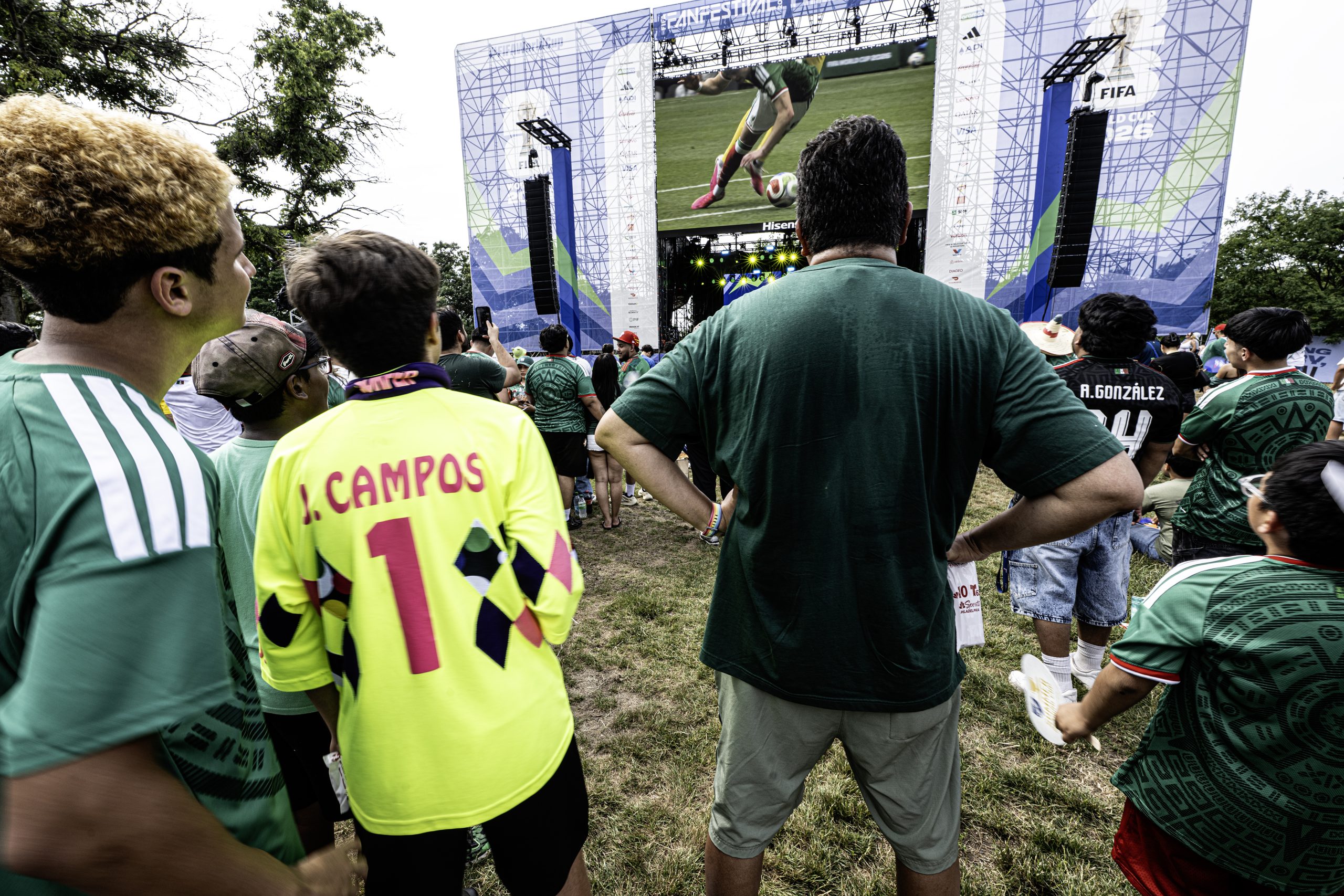
    Soccer fans gather to watch Mexico play South Africa on a giant screen during the opening day of the FIFA Fan Festival at Lemon Hill on Thursday, June 11, 2026, in Philadelphia.Jose F. Moreno / Staff Photographer

    Philly and Miami may win out for the highest attendances, likely due to their singular locations and being open much longer than celebrations in other cities, which opted for shorter-lived festival days or decentralized events. Still, most of the U.S. host cities boasted impressive numbers at fan events.

    Atlanta, Houston, and Seattle all reported having hosted at least 500,000 fans at their festivals. Kansas City was close behind, reaching 400,000 fans across its 18-day run. Los Angeles brought in 250,000 people to its festival. Boston hosted 155,000. Dallas’s host committee has not released official counts yet.

  • How surfing came to the Jersey Shore

    How surfing came to the Jersey Shore

    Long Beach Island recently hosted the 18th annual Coquina Jam at Brant Beach, an all-women surfing event that raises funds for the David’s Dream & Believe Cancer Foundation and the Jetty Rock Foundation. With summer in full swing, there are many opportunities to catch waves down the shore: for example, on Aug. 22, people ages 5 to 60 can compete at Ocean City’s 7th street at the Eastern Surfing Association competition. Kids and adults alike can book a lesson up and down the shore.

    Surfing might be a part of the shore experience today, but it was not always a staple of the East Coast. In fact, surfing was once seen as the domain of the countercultural West Coast. But during the 1960s, fanatics brought their boards to New Jersey in the hope of disassociating surfing with its rebellious and countercultural image—and instead promote it as a purposeful pursuit and competitive sport. Positioning surfing as no different than playing basketball, baseball, and football helped entrench it in New Jersey seaside life, while also reinforcing ideas about conformity and respectability.

    Surfing’s image has evolved greatly over the years, with its roots tracing back to Hawaii. Since about the 12th century, Hawaiians of all classes and genders took to the waves. They steered large, finless, wooden boards known as alaia and olo boards.

    However, by the late 19th century, an influx of American Christian missionaries into the islands pushed the “lustful” sport to the margins, casting it as incompatible with the aims of settlers and businesses. Nevertheless, Hawaiians continued to find ways to surf, and soon white settlers began to appropriate Indigenous beach culture for their own purposes.

    In the early 20th century, tourism-minded opportunists including Alexander Ford Hume, Tom Blake, and writer Jack London promoted surfing to draw white American settlers and vacationers to the pristine warm waters of Hawaii. In his book chapter “A Royal Sport,” published in 1907 and 1911, London remarked, “I was chiefly conscious of ecstatic bliss at having caught the wave.” Local surfing legends Duke Kahanamoku and George Freeth then spread surfing to the mainland United States. Freeth brought lifeguarding and beach culture to Southern California, while Kahanamoku traveled the globe, showcasing his Olympic-level swimming and extraordinary surfing skills.

    In 1912, after the Stockholm Olympics where he won the gold in the 100-meter freestyle event, Kahanamoku visited Atlantic City, exposing the shore resort to “the sport of kings” for the first time. In the early 1930s, Tom Blake, an innovator who manufactured surfboards for U.S surfers in the first half of the 20th century, introduced his 13-foot wooden longboards to Ocean City. But despite these early exposures, surfing did not catch on in the Garden State until the 1960s.

    Movies and music were instrumental to surfing fever at the Jersey Shore. Viewers were drawn to Gidget’s (1959) Cliff Robertson as “the Big Kahuna,” a youthful nonconforming rebel who valued the hedonism of the beach and consistent access to surf over responsibilities. Young people were captivated by the carefree lifestyle found in the Beach Party (1963) franchise. These movies were fictional but spoke to growing white affluence and greater access to leisure in real-life postwar America. Teenagers flocked to local theaters to watch the globe-trotting adventures of surfers Robert August and Mike Hynson in 1966’s The Endless Summer.

    Some New Jersey teenagers embraced the fad, perhaps hoping to foster the freedom and youthful expression associated with surfing in their own waters.

    Soon, surf shops popped up and down the coast, sponsoring new surf teams and providing locals with access to equipment. Ron Jon Surf Shop was founded in Ship Bottom in 1961, while Surfer Supplies in Ocean City, and Heritage Surf Shop in Sea Isle both opened in 1962. The New Jersey Hobie team was hosted by the Manatee Surf Shop, founded in Belmar in the early 1960s.

    Yet as surfing proliferated along the shore, initial community reactions were sour. Young surfers were seen as troublesome, an unpredictable hazard on crowded beaches. Police, concerned parents, and hotel owners all spoke out against surfers, viewing them as vandals with unkempt, long hair, huge unwieldy surfboards, and worst of all, they used profanity and disobeyed authority figures. The presence of surfers threatened to disrupt the peace of beachside resort towns, places for respectable families who followed the rules.

    In 1966, for example, authorities in Bradley Beach curtailed surfers’ access to the Kent Avenue Beach, with Police Chief Harvey Gaunt reporting that surfing was a safety hazard. He claimed that surfers “set fires in trash barrels, illegally exchanged beach badges, are often injured, are often poor swimmers, leave their boards where bathers may walk into them, use foul language, create a danger when they carry their boards, and use the beach instead of a toilet.” The litany of charges revealed an almost visceral disgust at people who surfed, evoking an ongoing moral panic about juvenile delinquency and the erosion of middle-class norms.

    Made By History sponsors. FOR USE ON MADE BY HISTORY STORIES ONLY.Inquirer Staff

    To overcome such associations and convince the broader community that surfing deserved a place down the shore, surfers organized, hoping to show how surfing might channel young people’s energy and coexist with other popular shore activities and sports. They formed surfing associations and clubs.

    In 1963, Cecil Lear, a schoolteacher from Belmar, along with eight other members, founded the Jersey Surfing Association (JSA), aiming to garner respect for surfing as a growing American sport. In his fight to establish designated surfing beaches in New Jersey, the schoolteacher touted the positive health benefits of surfing: it provided quality exercise, and what’s more, morning surfing sessions could promote earlier bedtimes—keeping young surfers out of late-night trouble. The association hosted successful competitions during the 1960s, such as the Greater Point Pleasant Jaycee Contest and the Jersey State Open State Surfing Championships in Belmar.

    In 1965, John “Bull” Carey, a real estate developer and former lifeguard and surfer, and Don Pileggi, Ocean City’s Recreational Director, founded the Ocean City Surfing Association (OCSA). They instituted a yearlong tournament schedule that operated around school breaks.

    The summer season featured contests every Tuesday, where bronze, silver, and gold medals were awarded, culminating in early September with a final event, the Ocean City Open Surfing Championship. During the school year, a contest was held each school break: the Turkey Trot over Thanksgiving, the Polar Bear over winter break, and the Spring Fling over spring break.

    By the middle of the decade, the surfing association was strengthening relationships with the city and local businesses. For example, in preparing for the Polar Bear Championship on Dec. 28, 1966, the OCSA worked closely with the city, the Port-O-Call Hotel, and Bob Harbaugh’s oceanside restaurant, providing free hot showers and changing rooms for frozen contestants, drum fires along the contest beaches at 14th and 15th streets, hot coffee and soup on standby, and a catered lunch for the winners.

    Treating surfing as a competitive sport and potential money-maker for local businesses helped reposition surfing as a purposeful pursuit, not just teenage trouble.

    However, this reframing also solidified a surfing demographic that was solidly middle class, mostly white, and mostly male—thereby marginalizing people of other identities who wished to surf. In this small way, surfing culture reinforced a history of segregation at the Jersey Shore, fortifying the beach and the ocean as mostly white spaces. Events like the Coquina Jam, an all-women surfing competition, may be eroding such boundaries today—but due to the history of how surfing came to the Jersey Shore, there is still a long way to go.

    Thomas DiGiovanni is a graduate student at Rutgers-Camden interested in the intersections of race and class within sporting cultures, with a concentration on surfing history.

    Made by History takes readers beyond the headlines with articles written and edited by professional historians. Opinions expressed do not necessarily reflect the views of The Inquirer.

  • 🏝️ Exploring our islands | Outdoorsy Newsletter

    Step outside, take a deep breath, and enjoy the fresh air this week, friends. In today’s edition:

    • A view from above: Fly up the Delaware on a tour of the river’s most intriguing islands.
    • Chicken fight: A retired nurse has helped dozens of towns legalize backyard birds.
    • Your outdoorsy experience: A moment of peace among the butterflies.

    ☀️ Your weekend weather outlook: Mainly sunny skies during the days and deliciously cooler nights in the sixties.

    — Paola Pérez and Alyssa Passeggio (outdoorsy@inquirer.com)

    If someone forwarded you this email, sign up for free here.

    A ride up the Delaware

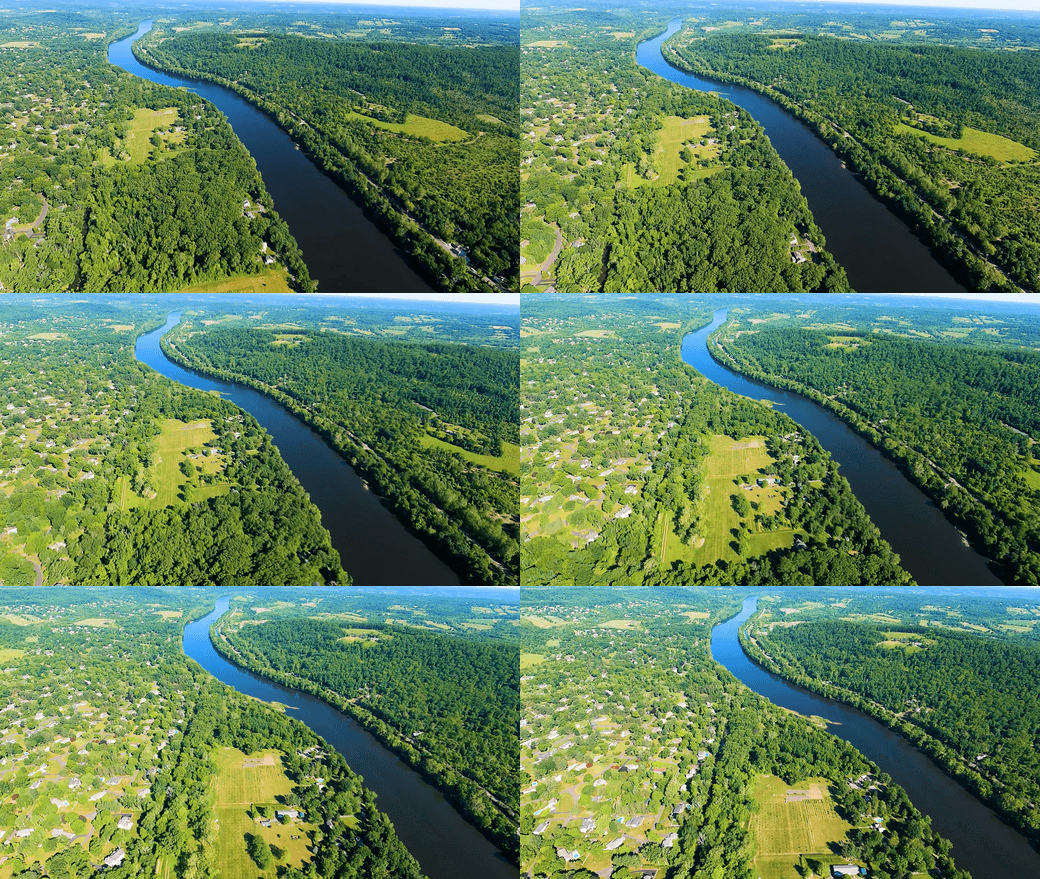
    There is a string of more than 100 islands where visitors might find birds nesting, unusual plants, and old military forts.

    The 330 miles of Delaware River from Wilmington, Del., to New York state are home to shoals, sandbars, or hundreds of acres of uninhabited islands.

    Some were playgrounds for the wealthy. Others are owned by industrial giants. There are even tales of pirates.

    Our latest interactive will take you for a ride over the islands of the Delaware.

    News worth knowing

    🦋 Your outdoorsy experience

    My colleague Lizzy Ravitch wants to put us on to a natural respite that seems to be hiding in plain sight:

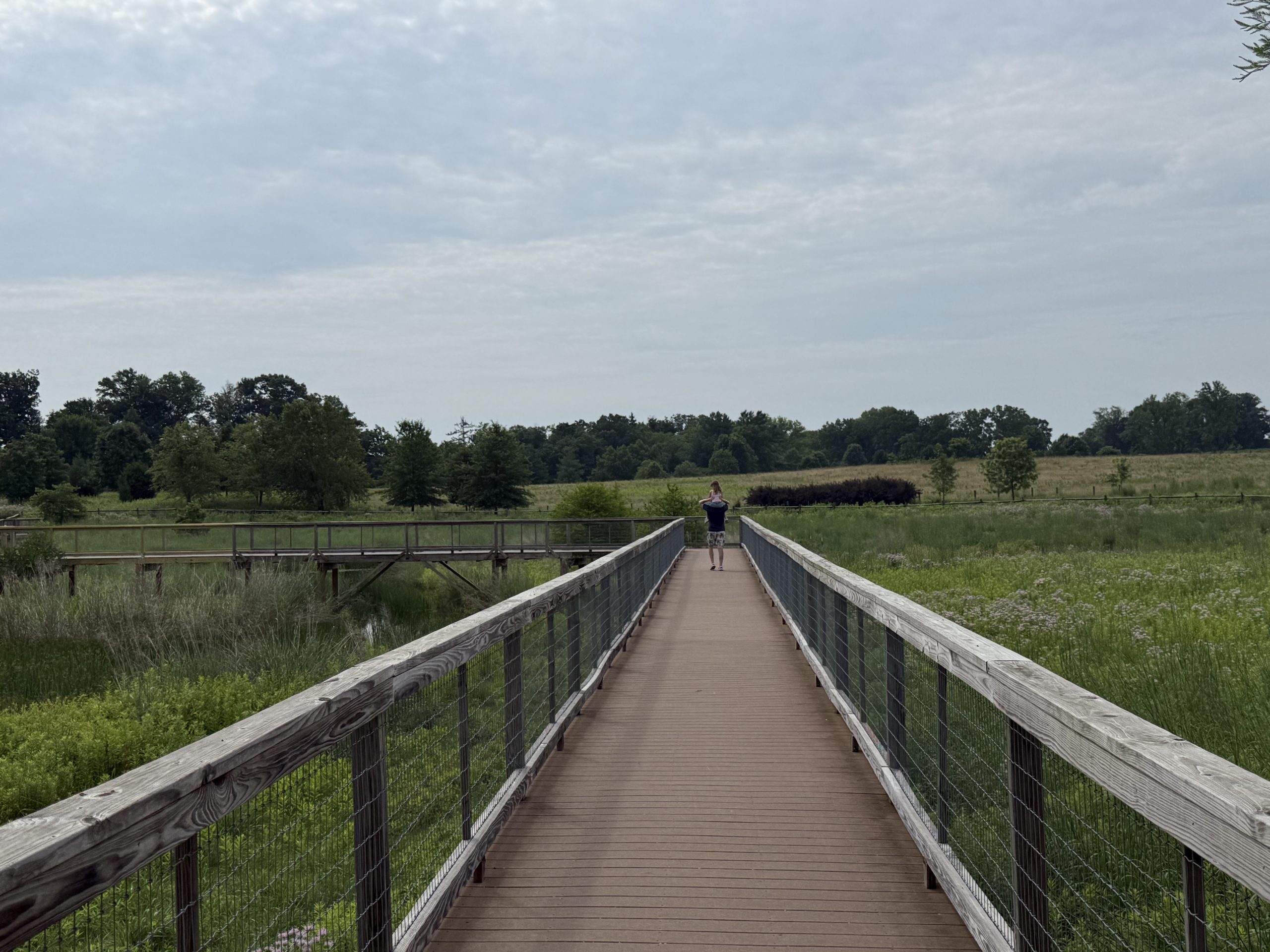
    In Whitemarsh Township, just minutes away from bustling suburban shopping centers in any direction, a stretch of road runs past the Erdenheim Farm, and nestled among it is the Dixon Meadow Preserve & Boardwalk.

    That’s where I have found myself on quite a few occasions, including the recent sultry Sunday after the Fourth, with my husband and two young kids. The morning promised too much heat for a long walk or hike, but at the preserve, with less than a mile of walking trail to tread, we didn’t have to worry about that.

    It may not seem like an escape into nature, given that cars passing by on Flourtown Road are in view from most of the area. Yet somehow, while walking the paved path and a raised boardwalk, one can feel as if a bubble has been created around the preserved space. It’s surprisingly quiet — well, except for the birdsong and occasional quack from a marsh-dwelling duck.

    The 14-acre preserve is home to native plants, and it’s frequented by a variety of colorful birds — and binocular-toting birders. Monarch butterflies also hang out there this time of year, and they were our favorite friends to see on that recent Sunday.

    After about 30 minutes of wandering, covered in sweat, we headed back home. We didn’t get in many steps, but that wasn’t the point. On a weekend when air conditioning and shade were the responsible choice, it had been nice to spend a moment among the butterflies.

    Beautiful! Thank you, Lizzy.

    📧 What are you enjoying out there? This is your spot to shine. Send your special stories and moments in an email — with a picture, if you have one. You may see it featured here.

    Fighting for Jersey’s backyard chickens

    🎤 Now we’re passing the microphone to South Jersey reporter Sarah Nicell.

    Any Collingswood resident over the last 18 years can remember the fight to legalize backyard chickens. Or the second attempt. Or the third.

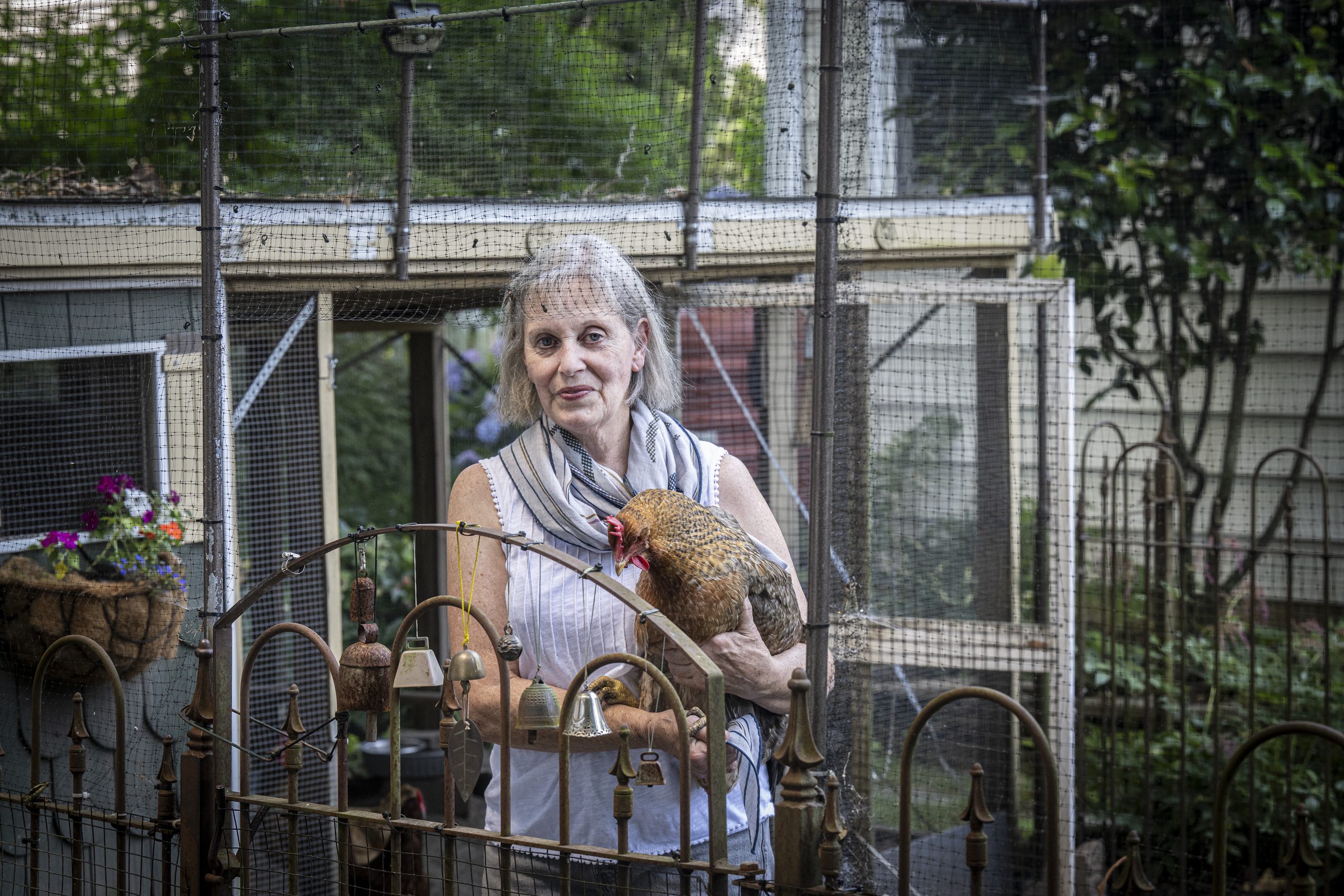
    Gwenne Baile, 77, knows the efforts well. A Haddon Township resident and the unofficial “Chicken Lady of South Jersey,” Baile initially became interested when she saw Martha Stewart showing off her chickens on TV. After retiring in 2009 from a long career as an ob-gyn nurse, Baile decided she needed a hobby.

    “I started looking into it,” Baile said, “but it was illegal here.”

    Since then, Baile said, she has played some part in changing the ordinances in 35 municipalities across South Jersey, including in her hometown. She keeps a list of places with pro-chicken zoning rules, including the 19 municipalities in Camden County that allow them. Baile now has five hens, taken in as fosters, including those injured by predators or forced from owners whose municipalities do not allow coops. — Sarah Nicell

    Keep reading on the push for residential hens.

    Paola’s picks

    🐺 A win: There’s hope for the future of the most endangered species on the planet.

    🌡️ A song: “I feel like summer.”

    🐉 An activity: Philadelphia Chinese Lantern Festival at Franklin Square.

    🐻 A read: “I watched a bear eat from a bear-proof trash can.”

    An oceanic view

    Breathe in…and breathe out. Paola took this at Decatur Street beach in Cape May.Paola Pérez

    There’s something about bodies of water…

    👋🏽 Happy trails.

    By submitting your written, visual, and/or audio contributions, you agree to The Inquirer’s Terms of Use, including the grant of rights in Section 10.

  • Dear Abby | Husband’s career struggles impact couple’s marriage

    DEAR ABBY: My husband and I have been married for 11 years and have two children. When we met, he worked two union jobs, paid his bills, saved his money and took care of his mother and grandmother when they needed his financial support. About six years ago, he decided he didn’t want to work with the union anymore, and I supported him in exploring alternative career paths. He has tried currency trading, personal training and used car sales. Nothing seems to stick.

    I work five days a week and have a part-time job on the weekends to bring in extra income. We are unable to make ends meet, and my extended family often has to bail us out because we can’t pay our bills. I told my husband I need him to start making a decent income again. He said he would, but I see little effort from him in terms of gaining solid employment.

    Our relationship is not going well. I have lost faith in him. I want to stay together, but I need him to provide for his family. I don’t know how much more of this I can tolerate. Please help.

    — OVERWORKED AND UNDERWHELMED

    DEAR O & U: Your husband has gotten comfortable with letting you do the heavy lifting in the family. If you don’t give him specific goals and deadlines, he’s not likely to clean up his act.

    State the exact monthly income you need him to provide, even if he ends up working several part-time jobs to do so. Then give him a certain number of job applications he must complete each day. If he doesn’t reach these goals by a certain date, the next step will be separation. This may seem harsh, but remember that you and your kids are suffering because he isn’t pulling his weight.

    ** ** **

    DEAR ABBY: I have been married to a wonderful man for 36 years. During the last 12 years, he has had heart surgery and some depression. He refuses to get out of his easy chair and do anything. He won’t bathe or shower and insists that washing off in the sink is good enough. He smells, and I’m embarrassed to go places with him because of it.

    I have tried to encourage him and let him know how I love a clean-scented man. He just doesn’t care. I won’t even kiss him. He refuses to help around the house and expects me to do everything. I still work, and we are raising a granddaughter. I’m no longer in love with him but I do love him. I have wanted a divorce for a while now, but, financially, I can’t afford to live on my own. Thank you for any advice.

    — ALL WASHED UP

    DEAR ALL WASHED UP: You need to discuss this with a doctor who can advise you about the options for treating depression and apathy after heart surgery, as well as an attorney who can help you determine if enough assets have been acquired during your 36-year marriage to allow you to live independently. Once you have that information, you may be able to give your husband an ultimatum and force him out of the easy chair and into a healthier lifestyle, which could add years to his life.

  • John Alviti, retired senior curator at the Franklin Institute and former executive director at the Atwater Kent Museum, has died at 76

    John Alviti, retired senior curator at the Franklin Institute and former executive director at the Atwater Kent Museum, has died at 76

    John Alviti, 76, of Flourtown, Montgomery County, retired innovative senior curator at the Franklin Institute, former executive director at the Atwater Kent Museum, adjunct professor of urban studies, and “Mr. Philadelphia History” to family and friends, died Saturday, June 20, of complications from heart and kidney disease at Jefferson Abington Hospital.

    Born in Chicago and devoted to history and his South Side White Sox baseball team, Mr. Alviti came to Philadelphia in the 1970s to pursue a doctorate in history and urban studies at Temple University. He never got that doctorate.

    But he fell in love with Philadelphia’s history and architecture, got married, settled down in Flourtown, and, for 34 years, was one of the region’s most influential museum curators and historians. Affable, creative, and energetic, by all accounts, Mr. Alviti became a groundbreaking executive director at the now-closed Atwater Kent Museum in 1982 and celebrated curator at the Franklin Institute in 1994.

    Even after he retired in 2018, he was known around town as “Mr. Philadelphia History.”

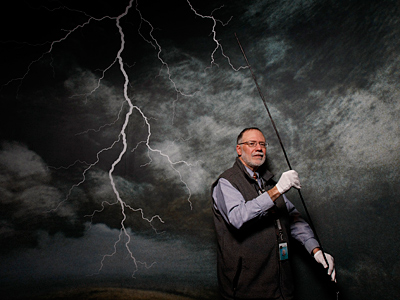
    Mr. Alviti displayed this 5-foot-long fragment of a lightning rod designed by Benjamin Franklin at the Franklin Institute in 2010. Michael S. Wirtz / Staff Photographer

    At the Atwater Kent, Mr. Alviti updated exhibits on William Penn, the history of Philadelphia, the old Enchanted Colonial Village display, and local cemeteries. He added maritime and archaeology galleries.

    At a gala to celebrate the museum in 1984, A. Atwater Kent Jr., son of the museum founder, said Mr. Alviti “has done a great job of creating interesting exhibits and improving the museum.”

    At the Franklin Institute, he reorganized its huge inventory, redecorated the galleries, digitalized many artifacts, and created popular exhibits regarding the Wright Brothers, Benjamin Franklin, antique machines, X-rays, and dozens of other scientific subjects.

    “He loved objects,” said his wife, Maryellen. “He loved the history of objects and telling their story.”

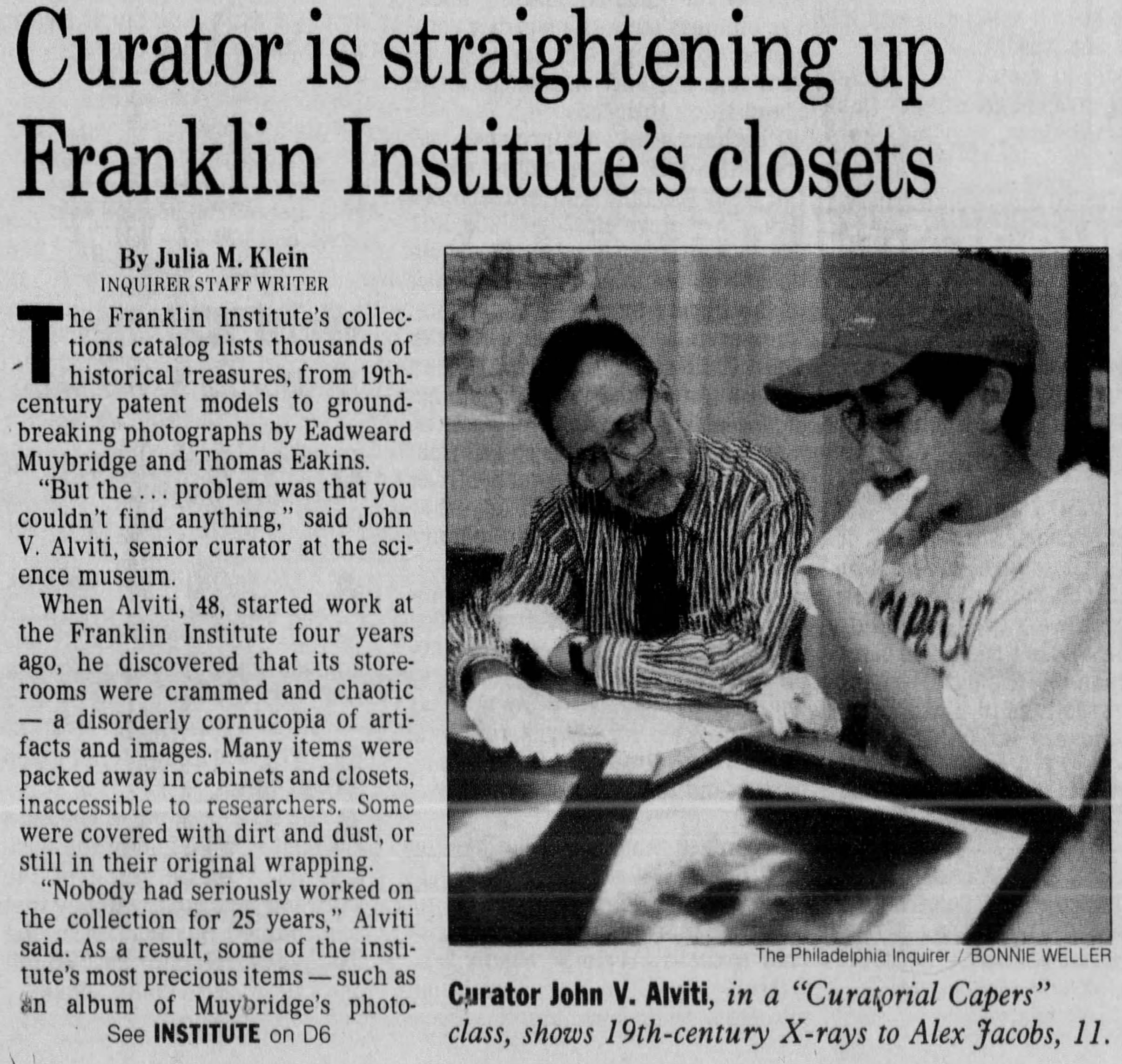
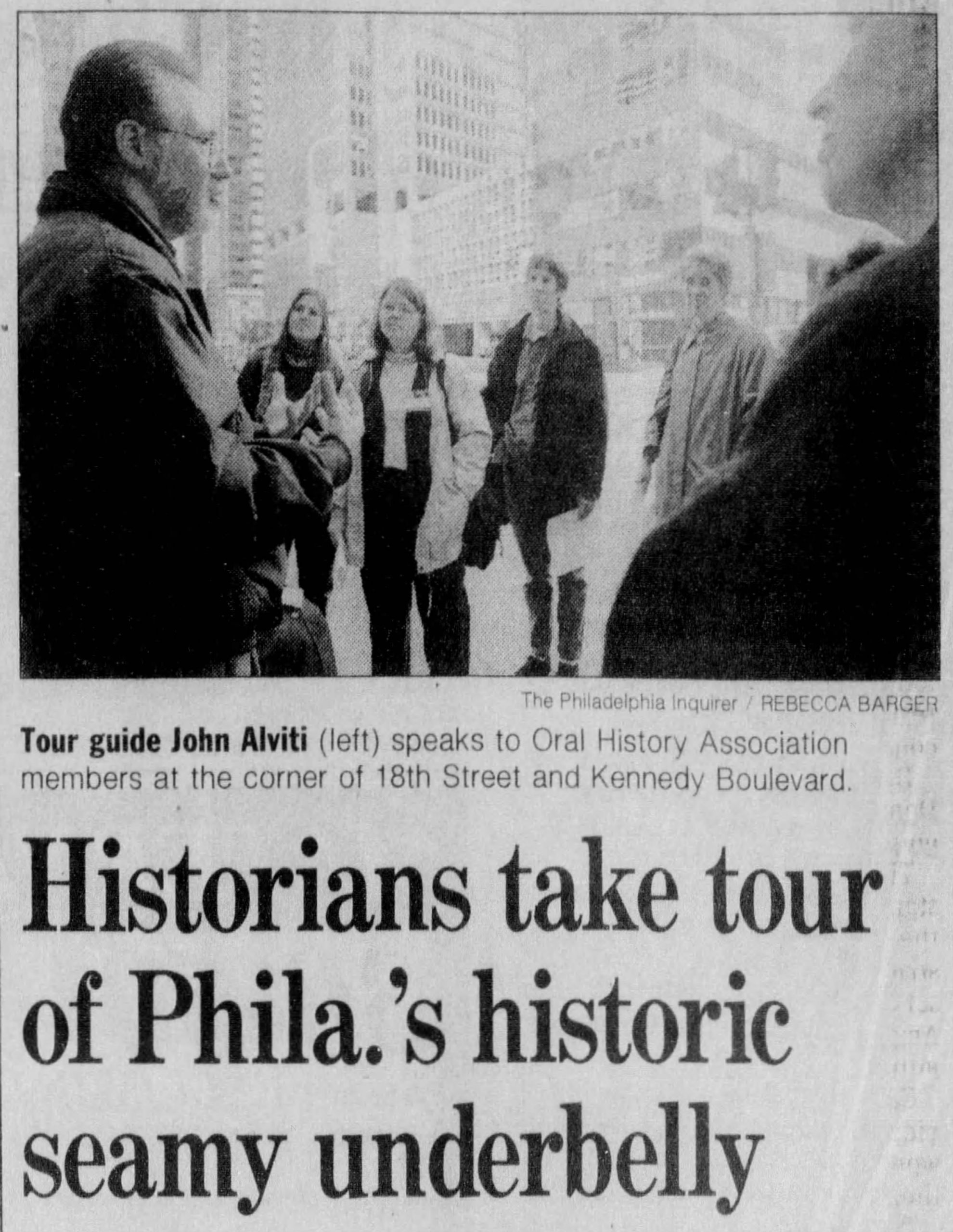
    This story and photo of Mr. Alviti (left) was published in The Inquirer in 1998.Newspapers.com

    In 1998, Mr. Alviti told The Inquirer: “Besides the curator of stuff, I’m also the curator of institutional memory. And institutional memory is more than just simply the facts about what happened in the past. It’s about the legacy of an institution … and how it informs our thinking and decision-making.”

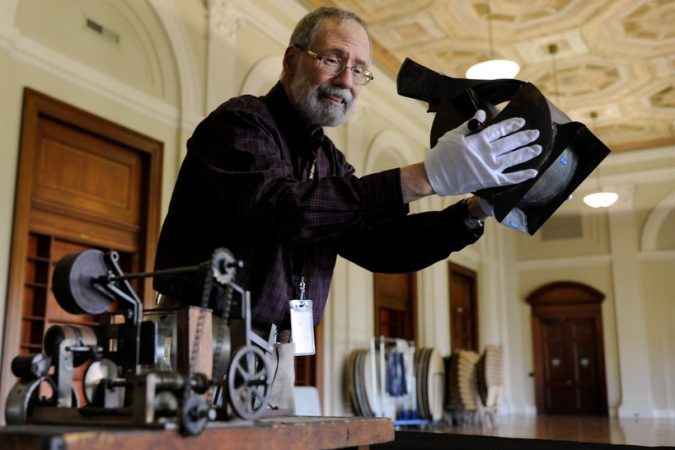
    He was also adept at merging his collections with educational programs, and he helped organize the city’s National History Day competition for students, the Phil-A-Kid hands-on history workshop for fourth and fifth graders, the Peopling of Philadelphia research project, and the Curatorial Capers summer day camp program. Often, in a nod to the ever-present protective gloves he wore to handle the artifacts, he introduced himself as “Johnny Whitegloves.”

    “There are some curators who think I’m crazy,” he told The Inquirer. But a public presentation, he said, “really demonstrates the power of an object.”

    Mr. Alviti also led walking tours of the city for visiting colleagues from the Oral History Association, the Organization of American Historians, and other groups. He admired and worked closely with amateur historians, and led the successful effort in 1981 to save the historic Lit Bros. building complex on Market Street from demolition.

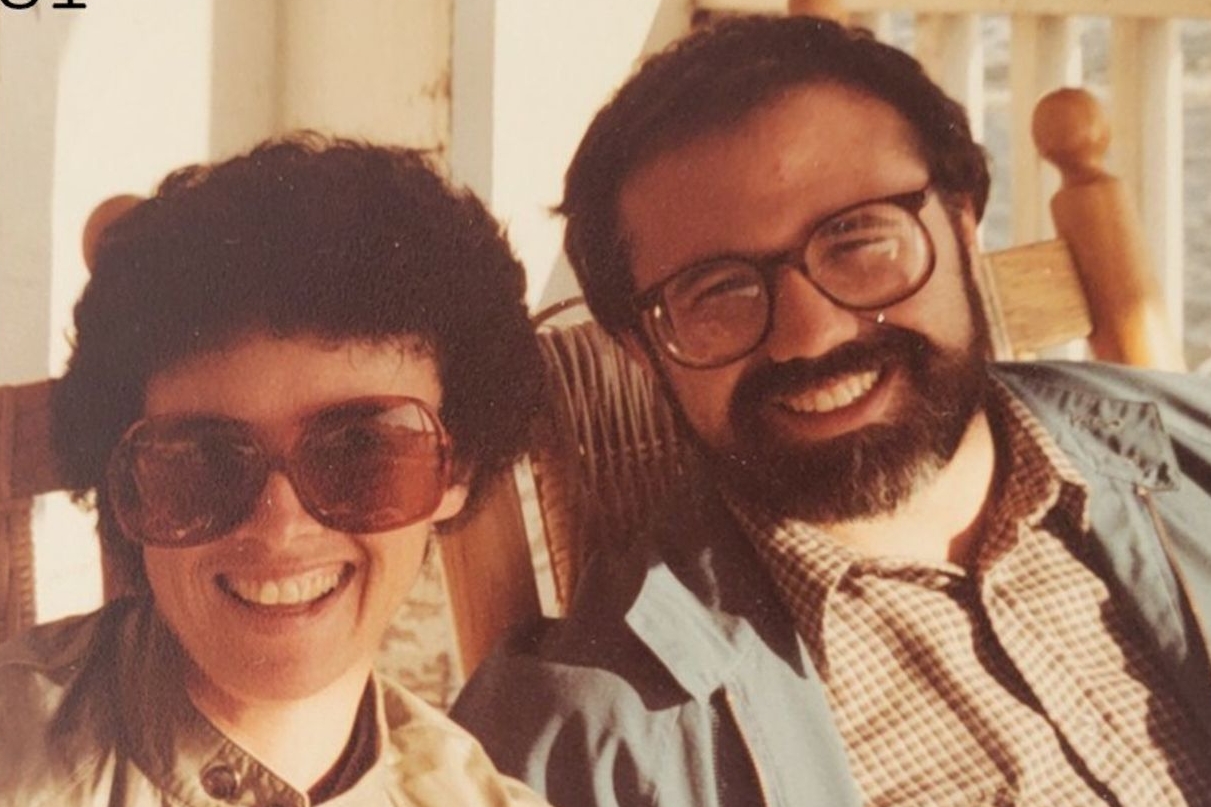
    Mr. Alviti and his wife, Maryellen, married in 1983.Courtesy of the family

    Between the Atwater Kent and the Franklin Institute, Mr. Alviti spent two years as director of the Historical Society of Washington, D.C. He was an expert on public transportation and taught urban studies, American history, and museum training at Temple and Stockton Universities, Rutgers University-Camden, and elsewhere.

    He was onetime curator of historic Fort Mifflin and president of what is now the Museum Council of Greater Philadelphia. He was on the advisory board of the old Philadelphia Alliance for Teaching Humanities in the Schools and active with the American Association of Museums and other groups.

    “He had a gift for making friends for life,” longtime friend Margaret Marsh said, “and he had a legendary generosity of spirit.” Longtime friend Howard Gillette said: “He never met a stranger.”

    John Vincent Alviti was born Sept. 22, 1949. A lifelong avid reader, he earned a bachelor’s degree in urban studies and history at Lewis University in Illinois in 1971 and a master’s degree in history at the University of Wisconsin-Milwaukee in 1975.

    The photo and a story about Mr. Alviti and his city walking tours appeared in The Inquirer in 1996.Newspapers.com

    He played piano and clarinet, and sang in choirs in high school and college. “He left Chicago when he was 25 or 26,” said his younger sister, Rosemarie Alviti Babic, “but never stopped loving the city.”

    He met Maryellen Coonahan when she took an urban studies class he was teaching at Temple, and they married in 1983 and lived in Philadelphia, Washington, and Flourtown. Together, they traveled the world and visited museums in London, Rome, Athens, Madrid, and elsewhere.

    Mr. Alviti enjoyed puzzles, games, and conversation. He lived with a heart condition for most of his life and was the lovable “Uncle Johnny” to his nieces and nephews. “He is missed beyond words,” said his niece Lindsay Hogan.

    He was fascinated by urban architecture and city life around the world, and he routinely bought food and drink for people without homes, picked up litter, and offered correct directions to those who looked lost.

    Mr. Alviti (right) enjoyed time with family and friends.Courtesy of the family

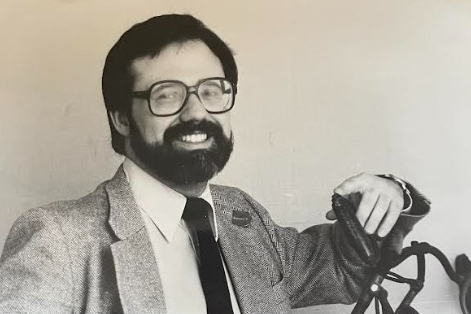
    “He was a curious fellow,” his wife said, “who loved to help people.”

    In addition to his wife, sister, and niece, Mr. Alviti is survived by a sister, Rita Jo Alviti Coyne, a brother, James, and other relatives.

    A celebration of his life was held earlier.

    Donations in his name may be made to Face to Face, 123 E. Price St., Philadelphia, Pa. 19144.

    His wife called Mr. Alviti “a curious fellow who loved to help people.”Courtesy of the family
  • It started as a joke. Now, three Philly friends are the proud owners of their very own garage.

    It started as a joke. Now, three Philly friends are the proud owners of their very own garage.

    It was a very Philly problem.

    Corey McMillan, Luke Elrath, and Jeremy Stock were longtime friends. All in their mid-to-late-40s and all self-described “motorheads,” the South Philadelphia residents loved to spend their free time restoring old vehicles and, over the years, had come to amass a small assortment of trucks, cars, motorcycles, and bicycles.

    It was a side passion, started as a way to save money on mechanic fees or escape — for an hour or two, at least — the stresses of daily life.

    The issue was, this was Philly, where century-old rowhouses dominate the local housing stock and a home garage is notoriously difficult to come by. While they all owned at least one classic vehicle, none had a garage of his own.

    Then, last spring, came a crazy idea.

    What if we bought one ourselves?

    Making do

    Through the years, the three friends had done their best to make it work: They’d tinkered on sidewalks or rented out space in under-the-table — and sometimes dubious — commercial garages. Elrath was so desperate for space that, for a time, he used the living room of his apartment as a workshop for bicycle-related repairs.

    “I’d roll back the [rug] and get to work on the hardwood floor,” he said.

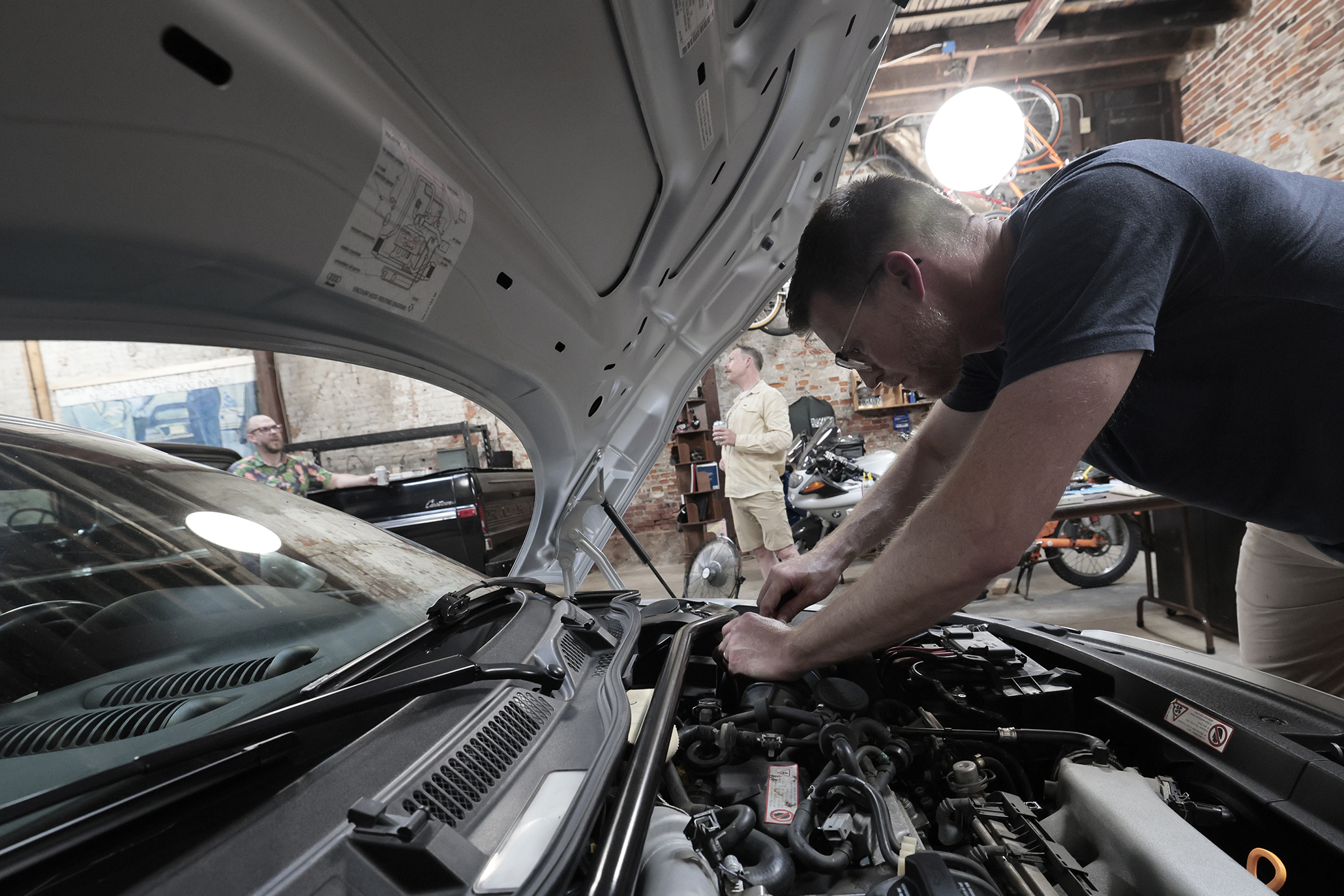
    Jeremy Stock (right) works on his 2001 Audi TT Roadster as Luke Elrath (middle) and Corey McMillan (left) chat in their South Philadelphia garage one evening earlier this month. The group bought the garage together so they would have a place to work on their cars, trucks, motorcycles, and bikes.Elizabeth Robertson / Staff Photographer

    As the years passed, they’d largely accepted this as the price of city living, making do however they could.

    McMillan, 49, kept his 1970 Ford Truck at his family’s place in the Catskills, working on it only when he could make the trip up from Philadelphia. For the 2001 Audi TT Roadster he was restoring, Stock found a cramped space over the river in Haddonfield that was “so small I couldn’t work on the car at all.” Elrath rented a spot in a garage that doubled as a storage unit for the Mummers — grateful to have even that.

    “If that was all I had for the next decade, I’d consider myself at least lucky for that,” he said.

    Then, one day this spring, McMillan — who by day works as a professor at the University of Pennsylvania — stumbled upon a curious Instagram post.

    It was a property listing, for a sizable South Philly garage. 3,000 square feet. Brick walls and a reinforced concrete floor. Located on a narrow, nondescript residential street. Listed for $380,000.

    Notably, it was located within a mile and a half of each of their homes.

    ‘Absolute heaven’

    McMillan texted the listing to his two buddies, who over the course of the day traded a flurry of bemused texts — daydreaming of what they’d be able to do with a space all their own.

    “It was a full day of talking about it like what would we do if we won the lottery,” said Stock, 46, who works in marketing technology for a pharmaceutical company.

    It was all in fun, insists McMillan. “Just kind of like, Haha, isn’t this funny?”

    But when Stock woke up the next morning, there was something about the idea he couldn’t shake.

    I just can’t get this out of my mind, he texted the group.

    Neither could Elrath, it turned out. Or McMillan, who was already preparing for how he might broach the idea with his wife.

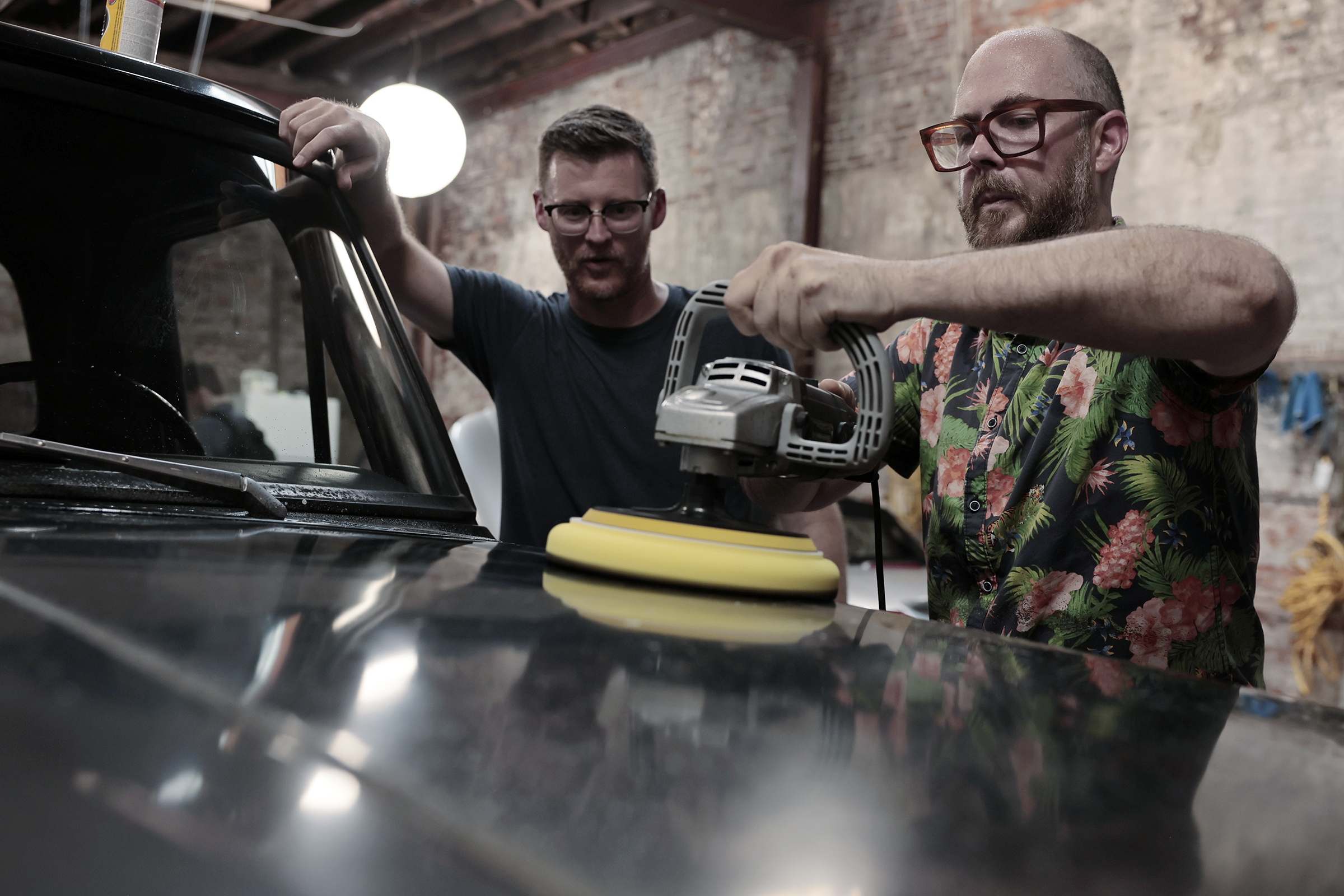
    Jeremy Stock, a former detailer, (left) guides Corey McMillan as he restores the paint on his 1970 Ford F-100 truck nicknamed “Boone” in their South Philadelphia garage earlier this month. Elizabeth Robertson / Staff Photographer

    That weekend, the three of them went to look at the space.

    It was a cavernous, nearly windowless structure. There was no heat or air-conditioning. A rusted beer fridge stood in the back. In one corner was a small bathroom, which was easy to find considering it had no walls — just a toilet and sink anchored to an elevated patch of concrete.

    “Absolute heaven,” Stock said.

    Gettin’ wrenchin’

    Soon enough, the three were running the idea past their wives. And though it took a bit of getting used to — “Buying a second property was not on my 2026 bingo card,” said Danielle Burrows, Stock’s wife — everyone ultimately bought in.

    Not long after, McMillan was meeting with a transactions lawyer, who helped navigate the three-way purchase, and, suddenly, they were signing the sale documents — the proud owners of a South Philly garage.

    “It all happened so fast,” said McMillan. “It didn’t feel real. It still doesn’t.”

    They began moving their things in early June, said Stock, “and immediately got to wrenchin’.”

    Recently, McMillan brought his Ford Truck from the Catskills to the garage, and has begun working on it a couple times a week. Elrath, 49, who works as a subject matter expert investigating bicycle crashes, has three motorcycles and a slew of bicycles on-site, and tries make it over to the garage five days a week to tinker with them.

    Stock is preparing to take ownership of a 1970 Triumph TR 6, a sporty British roadster in need of significant work, which, he says, will “be a nice multiyear project that we’re going to take on.”

    “As the budget allows,” his wife quickly added.

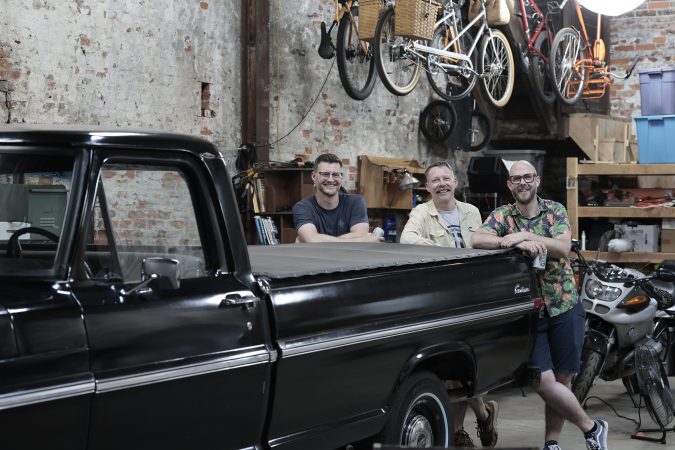
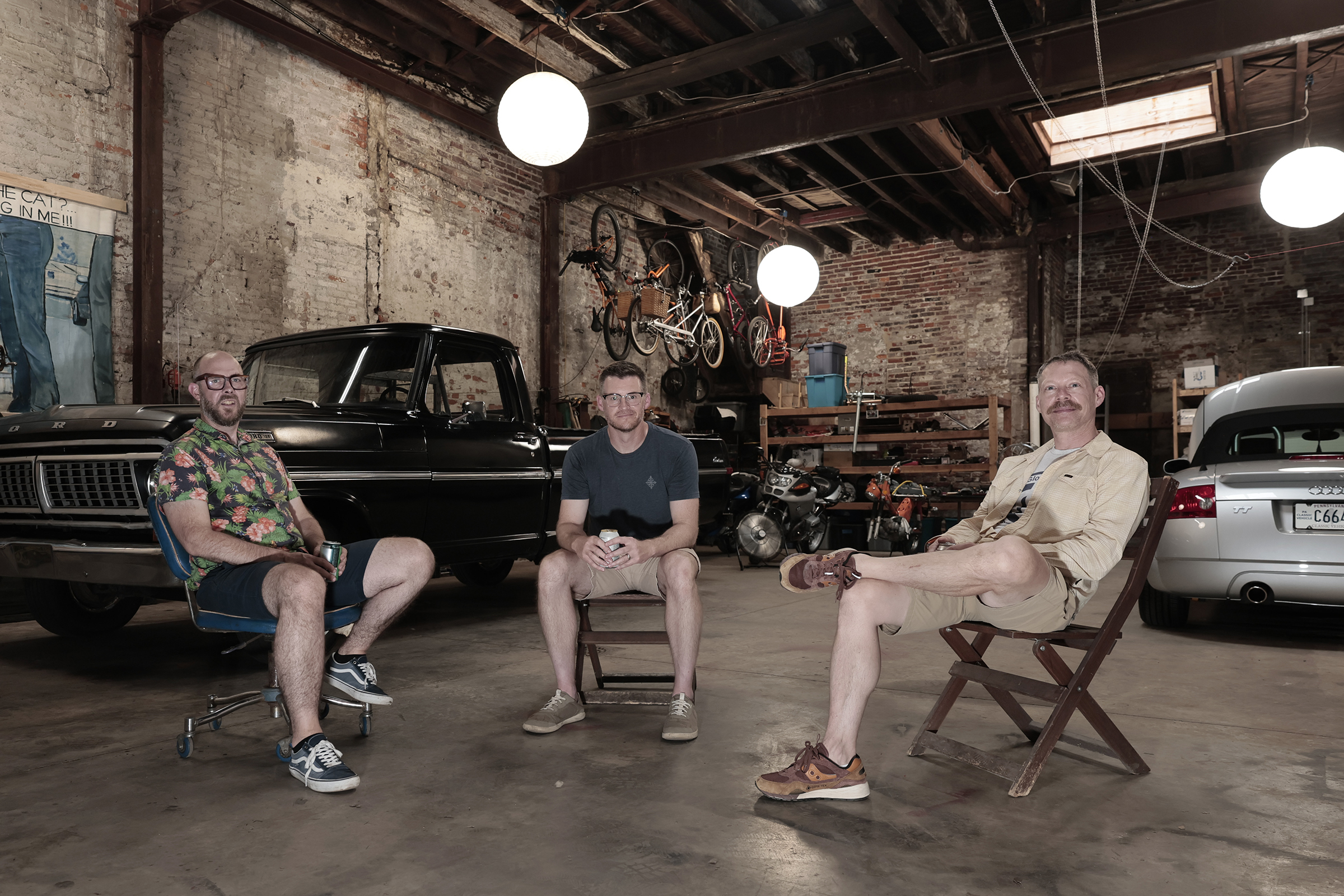
    From left, Corey McMillan, Jeremy Stock, and Luke Elrath in their South Philadelphia garage.Elizabeth Robertson / Staff Photographer

    Settling in

    On a recent evening inside the garage, the three friends still seemed in awe that it had all come together so nicely. So far, they agreed, it’s been a revelation. Working side by side, they’re able to share tools and the technical know-how they’ve accumulated through the years. Maybe best of all, it’s been an excuse to see each other regularly. Their wives have begun using the hashtag “GarageWives” in the friends’ group chat.

    A month and a half in, meanwhile, the place is starting to feel like home. McMillan’s wife found a used espresso maker. Someone brought over some old speakers. There are rumors of a potential couch.

    There is still plenty left to do; there are plans to add a lift, and the rotting wood floor of the upstairs hay loft needs replacing.

    On this night, however, they seemed perfectly content as they worked on their respective vehicles in satisfied silence — the only sound the clank of tools, the hum of a pair of floor fans, and the sweet crack of a fresh fridge beer.

    Heaven, indeed.