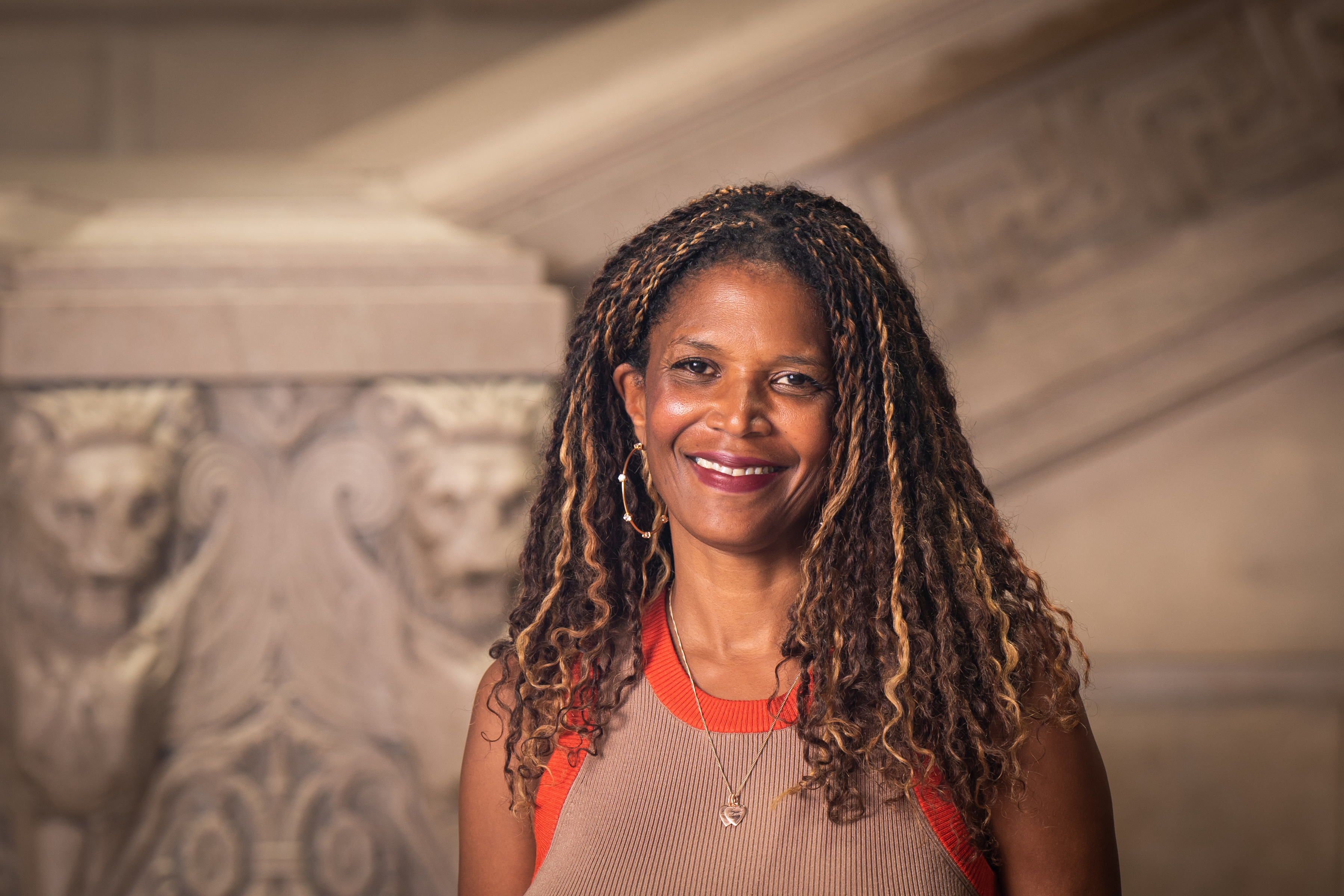
Free Library Foundation president Monique Moore Pryor is stepping down to tend to family matters, the foundation announced Thursday.
Her resignation is effective immediately.
“Serving as the president of the Free Library of Philadelphia Foundation has been one of the most exciting and rewarding experiences of my professional career,” Moore Pryor said in a statement.
She served as the foundation’s first executive and had been at the helm of the nonprofit fundraising arm of the Free Library since August 2023.
“I want to thank the leadership and staff of the Foundation and the Library for all the vital work we did together,” she said, “and I look forward to seeing all of the fantastic things they will do for Philadelphia in the future.”
When reached for comment, she would not elaborate on her statement.
Former Free Library Foundation board member Antoinette Brock Johnson will lead the foundation until an interim president is identified, board members announced at a staff meeting Thursday.
The foundation will begin the search for a permanent replacement for Moore Pryor following the completion of a new strategic plan in the spring.
In her three-year tenure, Moore Pryor is credited with securing substantial grants, including nearly $750,000 in an unrestricted grant from the Kellogg Foundation to potentially fund resources and programming within the Free Library’s business and information centers.
But Moore Pryor’s time leading the foundation was controversial from the beginning. Her leadership style, staff members said, led to the June 2024 resignation and subsequent firing of the Author Events team that hosted the biggest names in the publishing world, from Toni Morrison to Jennifer Weiner to Malcolm Gladwell, at the Central Library on the Benjamin Franklin Parkway.
The four-person team tendered its collective resignation with four weeks’ notice, saying they disagreed with Moore Pryor’s programming direction and treatment of the staff.
At least 10 other staff members have been fired or quit in the last year.
As a consequence, donors stopped writing checks to the foundation and authors like Weiner vowed they would not return to the Free Library’s stage. The staff departures have left local book communities with a sour taste that still lingers.
Moore Pryor appointed Daniel Blank, who holds a Ph.D. in literature from Princeton University, to lead Author Events. Under Blank and Moore Pryor’s leadership, the foundation instituted a $5 admission charge for all events — previously, most events were free to attend, and for others, entry was the cost of a book. The move was criticized by one author for creating “an unnecessary barrier to entry for one of the library’s most popular and influential programs.”
Corporate sponsors FanDuel and Comcast began sponsoring Author Events. And heavy-hitting authors including Justice Sonia Sotomayor, Anthony Fauci, and Maria Shriver participated and took part in conversation with local moderators, just as before.
Although separate entities, the Free Library and the Free Library Foundation used to operate as one, commingling money and resources. Moore Pryor’s position was created with an intent to separate the foundation and library funds.
She was named president in 2024.
During Moore Pryor’s time with the foundation, the Free Library has opened the bulk of its branches on Saturdays and renovated several buildings. She is also credited with diversifying the foundation’s donor base and revenue sources.
In 2023, she launched the community impact awards that recognize the work of local leaders and organizations who have had a positive impact on the city’s literacy and education.
“We want to thank Monique for her partnership and wish her the best as she begins her next chapter,” Jeffrey Benoliel, chairman of the Free Library Foundation Board, said in the statement. “We are excited about building on the progress of the last few years and will begin to search for a new president as the work continues on the strategic plan that will guide the library and foundation going forward.”
Staff writer Nate File contributed to this article.
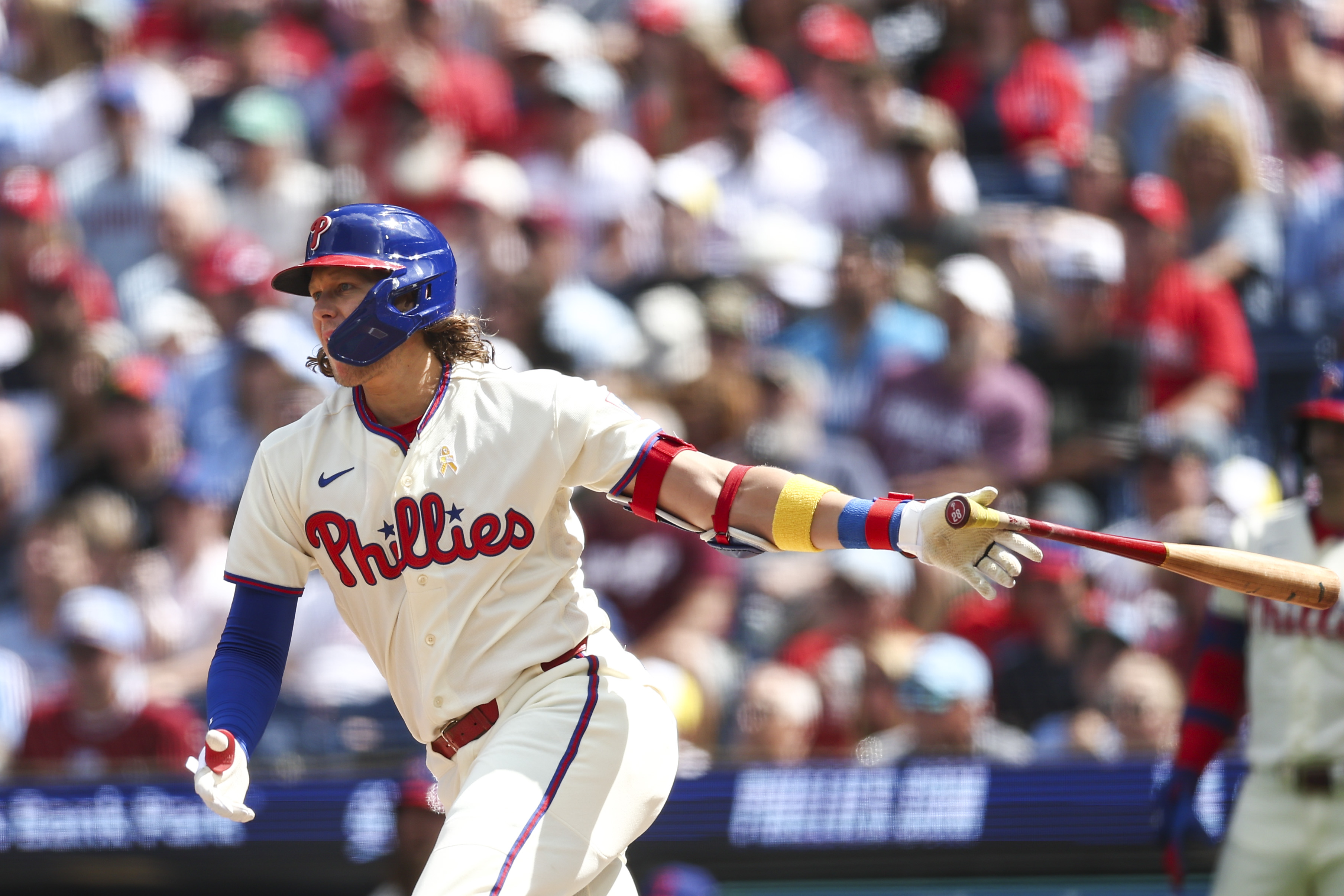
The Phillies kick off a four-game series with the New York Mets Thursday, but fans will need to do a bit of channel surfing to catch all the games.
Thursday night’s game will air on Fox beginning at 7:15 p.m., with Kenny Albert and Tom Verducci calling all the action. Ken Rosenthal will report from Citi Field.
Aaron Nola (6-10, 4.69 ERA) is scheduled to take the mound for the Phillies. Nola hasn’t allowed more than three runs in a start since way back on July 22, when he gave up five to the Los Angeles Dodgers. He’ll face Mets rookie Nolan McLean (11-9, 3.24 ERA), who gave up just two hits and struck out 10 in a win against the Phillies on July 19.
On Friday, the Phillies jump off TV and onto streaming for their final appearance on Apple TV’s Friday Night Baseball this season. First pitch is scheduled for 7:10 p.m., with Alex Faust and Ryan Spilborghs on the call and Tricia Whitaker reporting from the stadium.
Apple TV also has its own pregame show hosted by Sierra Santos alongside former outfielder Chris Young and MLB insider Russell Dorsey.
It’s the fifth season of Apple TV’s seven-year, $595 million deal with MLB, which runs through the 2028 season. Over that time, the cost has nearly doubled from $6.99 to $12.99 a month.
While Apple TV’s exclusive games remain an annoyance for baseball fans without the streaming service, they do come with one important perk — the ability to switch the audio feed over to 94.1 WIP and Scott Franzke and Kevin Stocker calls.
The quality of Apple TV’s broadcast is also generally very good, with crystal-clear footage and minimalist graphics (though the constant probabilities and live gambling updates become a bit annoying).
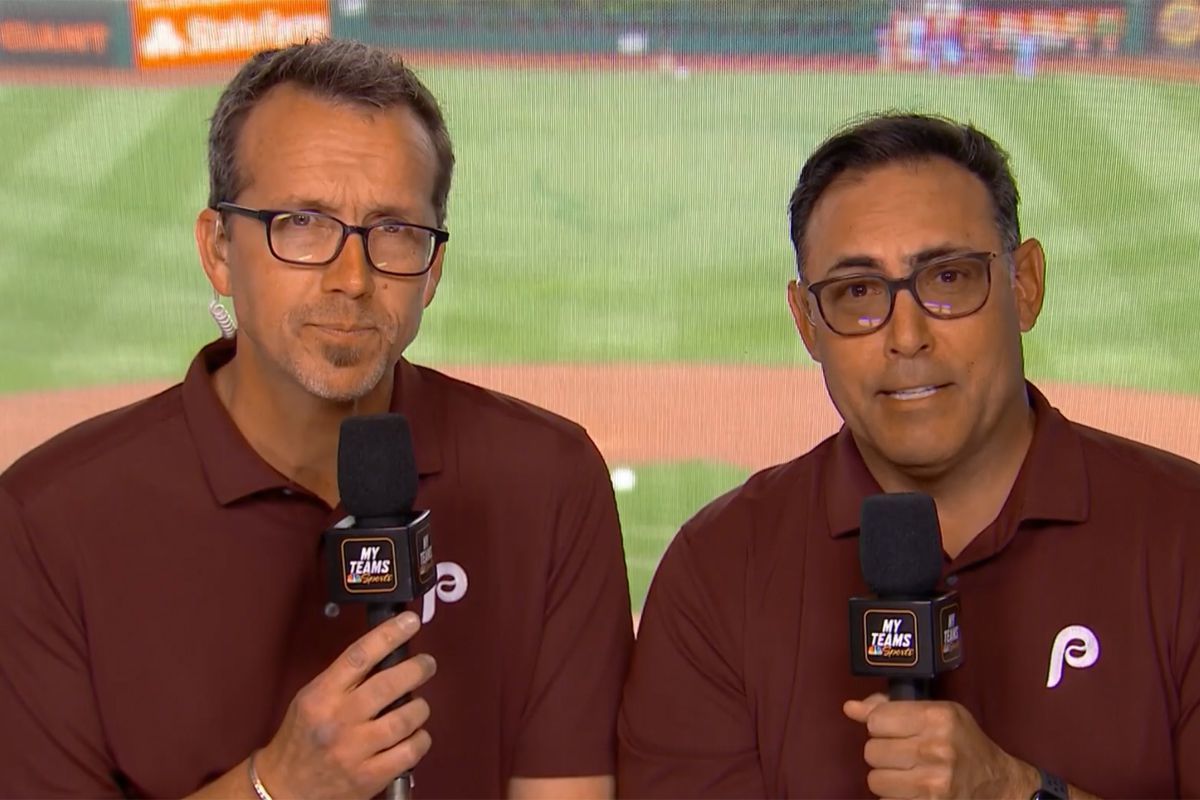
Scott Franzke (left) and Ruben Amaro, Jr. will call the final two games of the Phillies-Mets series on NBC Sports Philadelphia. NBC Sports Philadelphia
The final two games of the Phillies-Mets series will be back on NBC Sports Philadelphia Saturday or Sunday. With Tom McCarthy calling Sunday’s NFL matchup between the Cleveland Browns and Tampa Bay Buccaneers on CBS, it’ll be Franzke calling the games alongside former Phillies general manager turned announcer Rubén Amaro Jr.
John Kruk will be back Tuesday along with McCarthy to call the Phillies’ series against the Milwaukee Brewers, the second-to-last of the season. And World Series MVP-turned-broadcaster Cole Hamels will be back in the booth for the final Phillies game of the season on Sept. 27 against the Tampa Bay Rays.
Phillies playoff picture
NL East standings
window.addEventListener(“message”,function(a){if(void 0!==a.data[“datawrapper-height”]){var e=document.querySelectorAll(“iframe”);for(var t in a.data[“datawrapper-height”])for(var r,i=0;r=e[i];i++)if(r.contentWindow===a.source){var d=a.data[“datawrapper-height”][t]+”px”;r.style.height=d}}});
There was a moment where it seemed like the Phillies might overtake the Braves in the standings. But after dropping two of three against Atlanta last weekend, the Phillies’ chances of winning the National League East appear distant as best.
The Phillies enter Thursday’s series opener against the Mets 4½ games behind the Braves with 10 remaining. Atlanta faces the AL West-leading Houston Astros this weekend, but finish the season against the lowly Cincinnati Reds and Miami Marlins. An epic collapse along the lines of the 1964 Phillies — who blew a 6½ game lead with 12 remaining — doesn’t seem likely.
NL wild-card standings
window.addEventListener(“message”,function(a){if(void 0!==a.data[“datawrapper-height”]){var e=document.querySelectorAll(“iframe”);for(var t in a.data[“datawrapper-height”])for(var r,i=0;r=e[i];i++)if(r.contentWindow===a.source){var d=a.data[“datawrapper-height”][t]+”px”;r.style.height=d}}});
If the season ended Tuesday, the Phillies would end up in the second wild-card spot, meaning they’d travel to Chicago for a three-game series against the Cubs.
The good news is the Phillies are just a half-game down from the top wild-card spot entering Thursday. Overtaking the Cubs would move that three-game series to Citizens Bank Park.
The bad news is the Cubs, who are off Thursday, own the tiebreaker against the Phillies. Chicago kicks off a three-game series against the Reds Friday before finishing the season with series against the Marlins and Boston Red Sox.
The MLB playoffs begin Sept. 29 and will air on NBC.
Phillies magic number
That is the combined total of Phillies’ wins and/or losses by the teams on the outside looking in that are needed to secure at least the third wild-card berth and a spot in the playoffs.
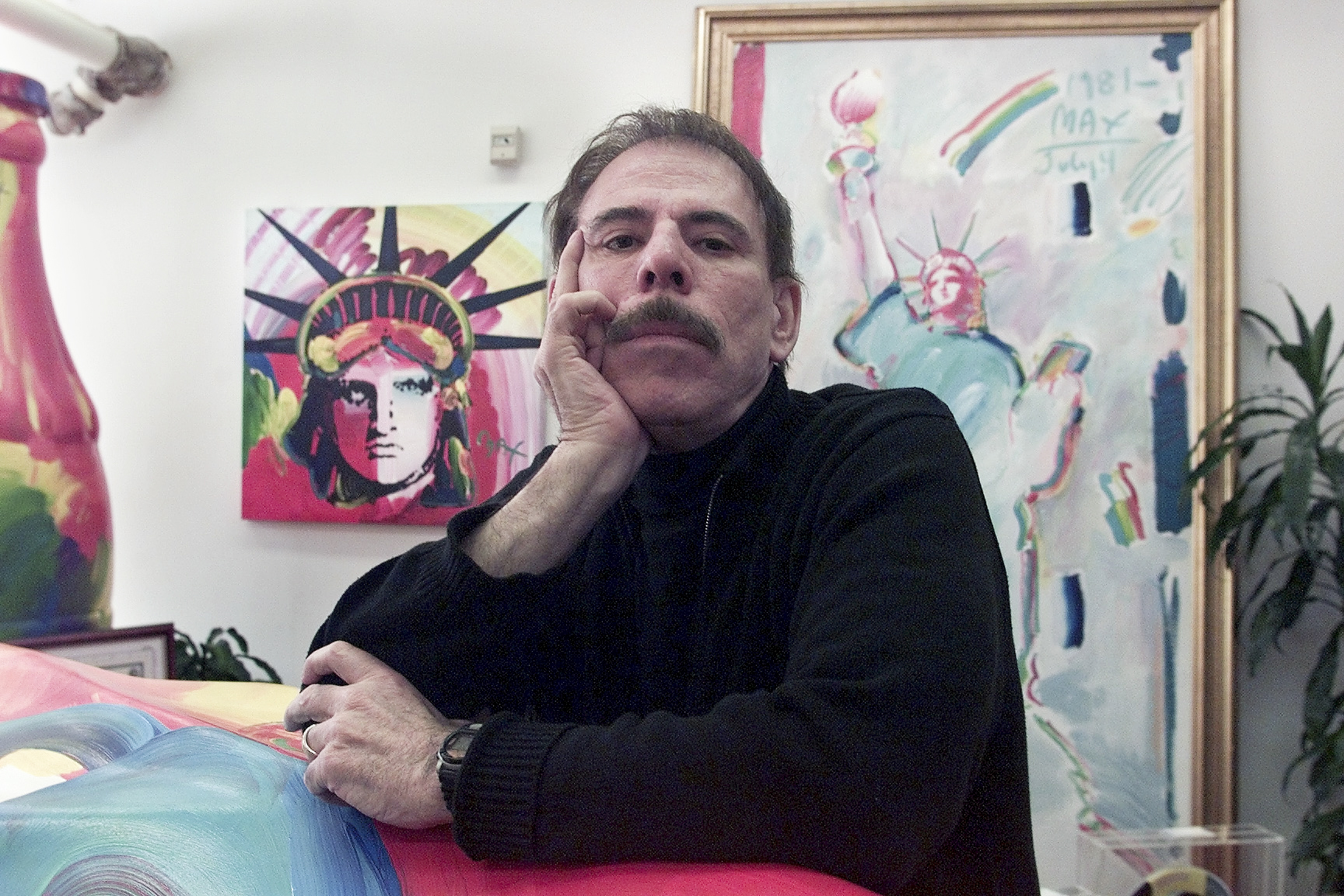
NEW YORK — Peter Max, whose trippy posters of Day-Glo flowers, butterflies, rainbows, stars and planets sold by the millions and expressed the blissed-out exuberance of the countercultural 1960s, died Monday in New York City. He was 88.
The death, at a hospital, was confirmed by his son, Adam Max. He had long suffered from dementia.
Mr. Max, a vegetarian and a teetotaler who expanded his consciousness through yoga, not drugs, was one of the most visible and successful artists of his time, selling posters in the millions.
His simple graphic images, brightly colored and infectiously happy, lent themselves to a long list of licensed commercial products, from sheets and glassware and shower curtains to airplanes and, on one occasion, a stamp for the Postal Service.
Incorporating art nouveau, op art and psychedelic motifs, Mr. Max’s designs offered instant visual gratification and a cheery endorsement of the generational politics of love, joy and universal consciousness. His “panopticon” images repeated visual elements in tight formation, producing a kaleidoscope effect that recalled Easter mandalas.
His “cosmic jumper,” a young man in bell bottoms traversing the globe in giant strides, became an emblem of modern youth, eager to explore the far reaches of inner and outer space. Barefoot and surrounded by puffy clouds and chubby birds, the jumper appeared on the 10-cent stamp commissioned for Expo ’74, the conservation-themed World’s Fair in Seattle.
In The Universe of Peter Max, a memoir published in 2013, he wrote: “My cosmic art subjects were always euphoric: Himalayan sages levitating under a shower of flowers beside snowcapped mountain peaks; faces and flowers exploding into a symmetrical cosmic butterfly; mirrored lakes and waters with a cascade of stars and planets; flowers in perpetual states of organic growth, begetting blossoms. My inspiration came from the new youth movement in America and in return spoke to it.”
Peter Max Finkelstein was born Oct. 19, 1937, in Berlin, where his father, Jakob, was in the import-export business and his mother, Salla (Zeisel) Finkelstein, had been a fashion designer before her marriage. With the rise of Nazism, the family moved to Shanghai, where Jakob set up as a pearl merchant. Peter attended an English-language school and spent much of his spare time talking to monks at the nearby Buddhist monastery.
As the Maoist revolution gathered strength, the Finkelsteins moved again, this time to Haifa, in Israel, where Peter learned Hebrew and, infatuated with the stars and planets, took special courses in astronomy at the Technion, the Israel Institute of Technology.
In 1953, the family emigrated to New York, settling in Bensonhurst, Brooklyn, where Peter attended Lafayette High School. He had taken private art lessons in Israel, and, at the urging of a classmate, signed up for summer classes at the Art Students League in Manhattan after high school graduation. Abandoning his rather vague plan to pursue astronomy as a career, he threw himself into art.
Initially he painted as a realist, then dabbled in abstraction and finally concentrated on commercial art. Riverside Records gave him his first assignment, to design the LP sleeve for The Blues Piano Artistry of Meade Lux Lewis, released in 1962. His moody, vaporous portrait of Lewis at the piano won a gold medal at the annual exhibition of the Society of Illustrators.
With Tom Daly, he formed a design company that quickly found favor with advertising agencies and book publishers. Within two years, Daly & Max Studio had collected more than 60 awards for its book jackets, album covers and other work, but Mr. Max, feeling constrained, left in 1965. For two years, he lived in virtual seclusion in his duplex apartment on Riverside Drive, turning out thousands of drawing and ideas.
In 1967, he applied some of his new concepts to the Tin Lizzie in midtown Manhattan, a theme restaurant that he decorated with paisley wallpaper, photographic collages of Charlie Chaplin film scenes and an actual Model T Ford.
His advertising posters for local shops began to attract special attention. Young customers called up the job printer, Security Printing Company, asking for a poster to hang in their rooms. Denton Stein, the company’s owner, went into partnership with Mr. Max to create Peter Max Posters, which sold 25 of the artist’s designs, in millions of copies, to book stores, head shops and department stores.
As his popularity grew, Mr. Max began doing commercial posters for the American Cancer Society, the Peace Corps, and the United Nations. The 3,000 posters and 40,000 flyers he printed for a gathering in Central Park on Easter 1967 inadvertently gave the event its name. The words “Be In,” in large letters, followed by “Central Park on March 31,” were read as a noun, not a verb in the imperative mood.
In 1968, a transit advertising company commissioned Mr. Max to design posters for buses, streetcars and subways in 10 major cities. “I am bringing art to the people where the people are,” he told Time magazine. “Now they don’t have to go to galleries and see paintings on a wall.”
General Electric approached him to design a clock. He followed up with a line of linens for J.P. Stevens and shirts for Van Heusen. Through the half dozen businesses bearing his name, he entered into licensing agreements with more than 70 companies.
“You provide the cash, the production and the selling,” he told Business Week in 1968. “I’ll furnish the ideas and the designs — and we’ll split the profits 50-50.” When Life magazine put Mr. Max on its cover in 1969, the headline read “Peter Max: Portrait of the Artist as a Very Rich Man.”
Mr. Max was everywhere. He was not, however, involved with the 1969 Beatles film Yellow Submarine, often assumed to be his work, in part because he often took credit for it. The film’s art director was Heinz Edelmann, sometimes called the German Peter Max.
By the 1970s, Mr. Max was in a rut. He shut down his studio and again went into seclusion. “I stopped cold,” he told People magazine in 1976. “I was repeating myself creatively. I had filled myself with being everywhere, doing everything. I had had it.”
Gradually, he reemerged. For the American Bicentennial, he accepted a commission from the Swedish company ASEA to produce the book Peter Max Paints America, a collection of paintings and drawings honoring each of the 50 states.
That same year, he produced a series of bilingual “Welcome to the United States” signs posted at more than 200 crossings along the Canadian and Mexican borders. Initially rejected by the Customs Service as implicitly endorsing the ’60s drug culture, they were finally put up in 1978.
He designed the logo for MTV in the 1980s and the official poster for soccer’s World Cup in 1994. In 1999 he decorated a Boeing 777 for Continental Airlines to commemorate NYC 2000, the official millennium celebration in New York. In 2015, the Rock & Roll Hall of Fame commissioned him to do a poster for its annual induction ceremony.
By then, he was already struggling with dementia. Yet the Peter Max brand flourished, boosted by the artist’s relationship with Park West Galleries, a Michigan-based company that sold Mr. Max’s work at cruise-ship auctions. Sales on a single voyage could reach $2 million, and in 2018, Mr. Max’s studio, ALP Inc. — named for its three owners, Peter Max and his two children, Adam and Libra — recorded a profit of more than $30 million.
The artist’s production methods became the subject of widespread speculation. Friends reported that Mr. Max could no longer paint and merely signed his work, which was made, in prodigious quantities, by a small army of assistants.
They were overseen by Adam Max, who was ousted from his father’s business in 2019 by his daughter, Libra Max, and the artist’s court-appointed guardian, who were concerned that Mr. Max was being exploited. Libra Max took over her father’s studio, fired many of his assistants and business associates, and set about restoring his reputation through galley and museum shows that showcased his earlier work.
Mr. Max’s first marriage, to Elizabeth Nance, with whom he had two children, ended in divorce. In 1997, he married Mary Balkin, who was 30 years his junior and whom he randomly met on a Manhattan sidewalk a year earlier. “Hi, I’m Peter Max, and I’ve been painting your profile my entire life,” he reportedly said upon first seeing her.
She died by apparent suicide in 2019, amid her husband’s worsening dementia and an extended legal dispute with her stepson over the handling of Peter Max’s art and wealth.
Mr. Max is survived by Adam and Libra Max.
For his legions of fans, Mr. Max would always remain an avatar of the 1960s counterculture in its happiest, most innocent phase. Whatever the year, and whatever the occasion, his work always breathed the spirit of the 1960s. When the De Young Museum in San Francisco organized an exhibition in 2007, the title said it all: “Peter Max and the Summer of Love.”
“Just as The Beatles had the music, I had the images,” he told Crain’s New York Business in 2007. “Kids would buy the posters and look at them as they listened to the music. It was like their MTV.”
The skirmishes between the colonies and England in April 1775 grew into a full-on war by January of 1776. No longer contained to New England, the fighting had spread to Canada and the South; so much so that British loyalist and Virginia’s royal governor Lord Dunmore offered freedom to any enslaved man who fought on behalf of the Crown.
The stakes were high.
The colonies were no longer interested in making nice with England. They wanted independence and realized they had to unite to win.
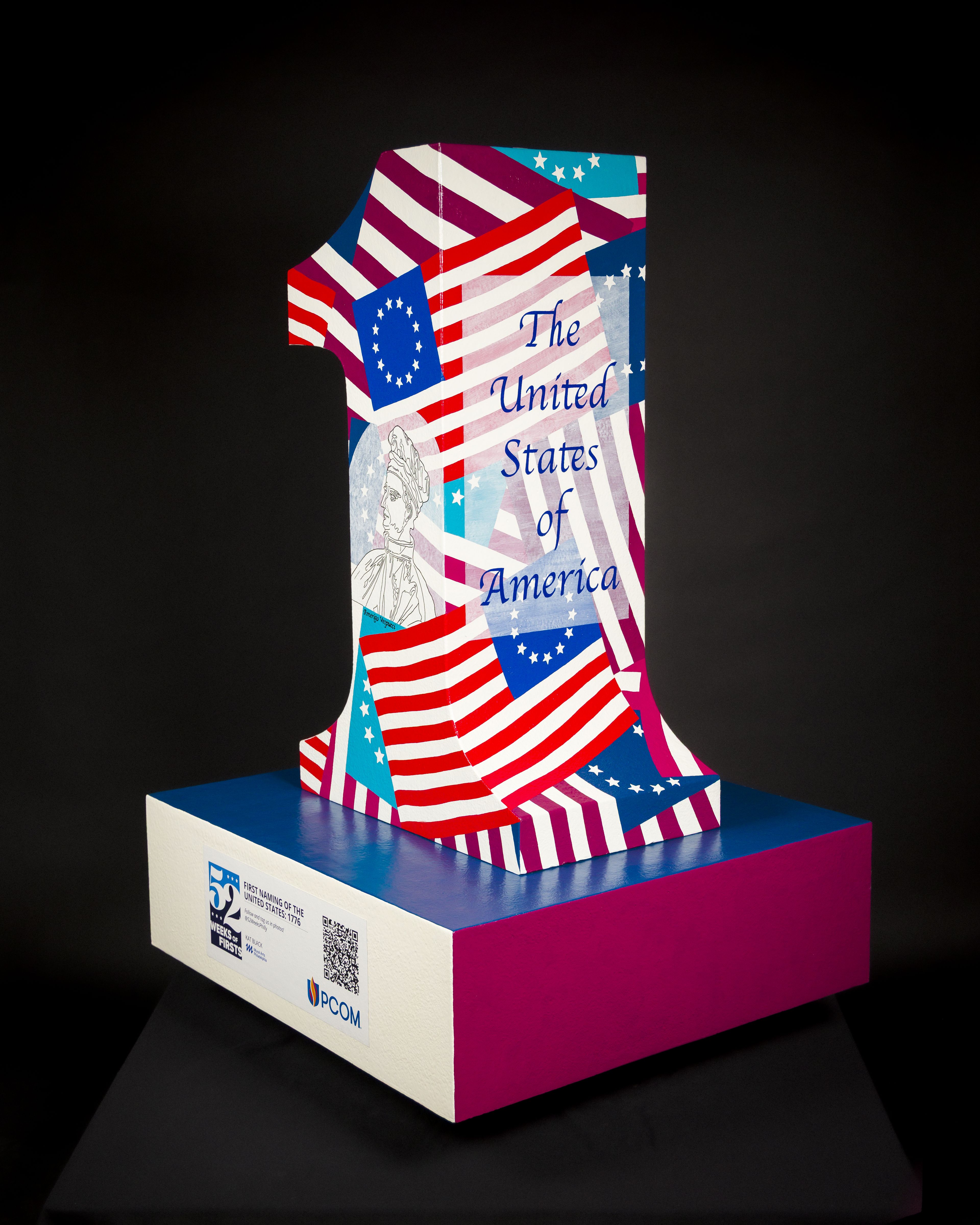
Kat Black’s design presents the flag of the original 13 colonies of 1776 when the name “United States” was approved by the Second Continental Congress in July of 1776 along with the Declaration of Independence.Kat Black for Colibrí Workshop
Stephen Moylan, a Pennsylvanian and officer in the Continental Army, first floated the idea of calling the new nation the “United States” in a 1776 letter to politician and comrade in arms Joseph Reed.
“Moylan wrote the ‘united states’ needed to spend emissaries to Spain and build a case for the rising revolution and secure foreign support,” explained Matthew Skic, director of collections and exhibitions at the Museum of the American Revolution.
”That letter, dated Jan. 2, 1776, is the first documented reference to the colonies as the ‘united states,’” Skic said.
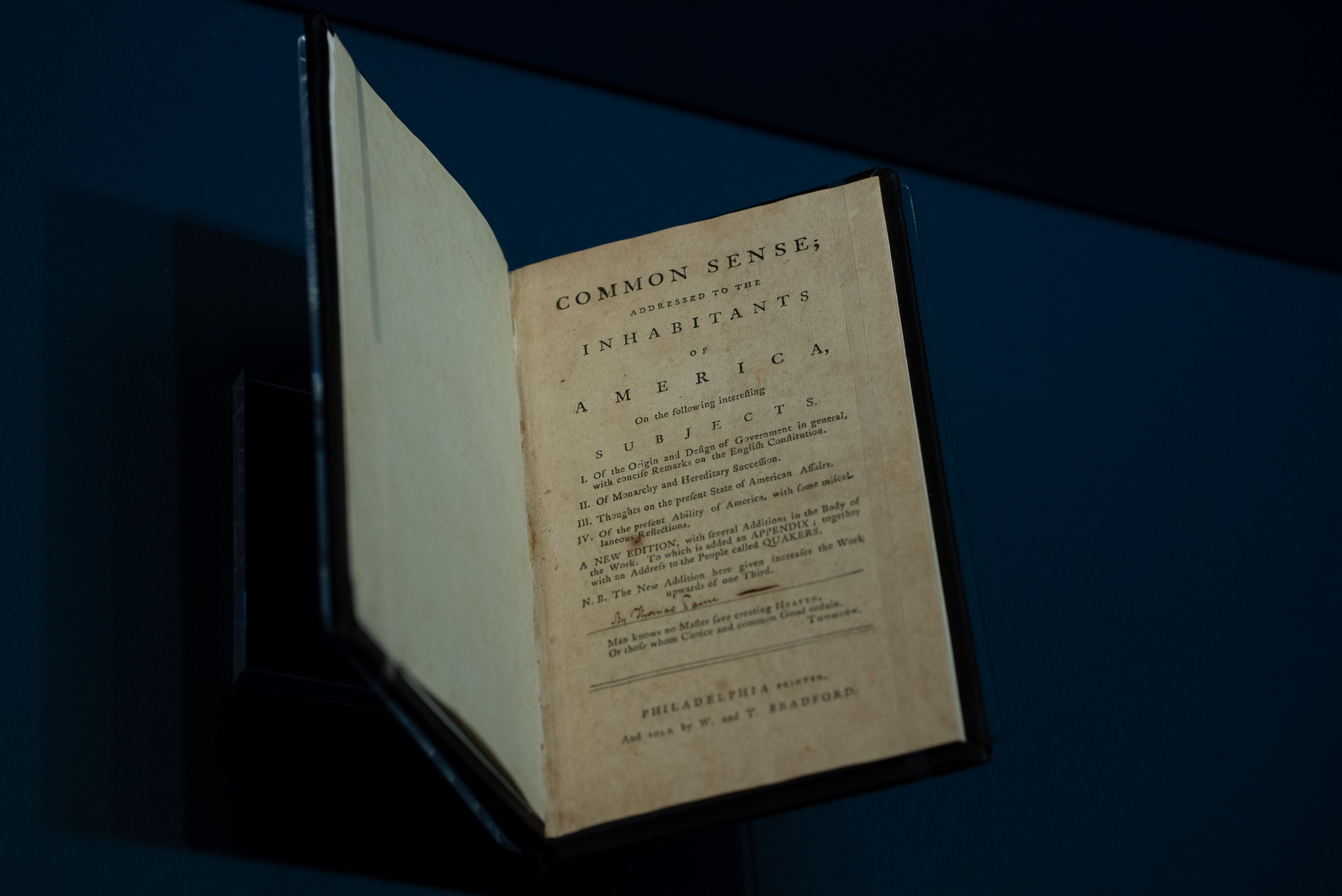
An original copy of Thomas Paine’s 47-page Jan. 1776 Common Sense pamphlet where the revolutionary called for the colonies to form united states independent of English colonies.The Museum of the American Revolution
The pamphlet, read aloud in taverns in Philadelphia and throughout the original colonies, stoked the flames of independence. It was printed in Robert Bell’s print shop at Third and Walnut Streets.
“Paine urged the colonies to form states,” Skic said. “But not the 21st-century perspective of states as in New Jersey, Virginia, or New York. In the 18th century, states were an independent nation or country with its own government.”
And those states, Paine said, needed to come together to defeat a common enemy: England.
In May 1776, Virginia statesman Richard Henry Lee issued a resolution proposing that the Second Continental Congress declare the colonies’ independence, explicitly stating that the new country should consist of independent states formerly known as colonies.
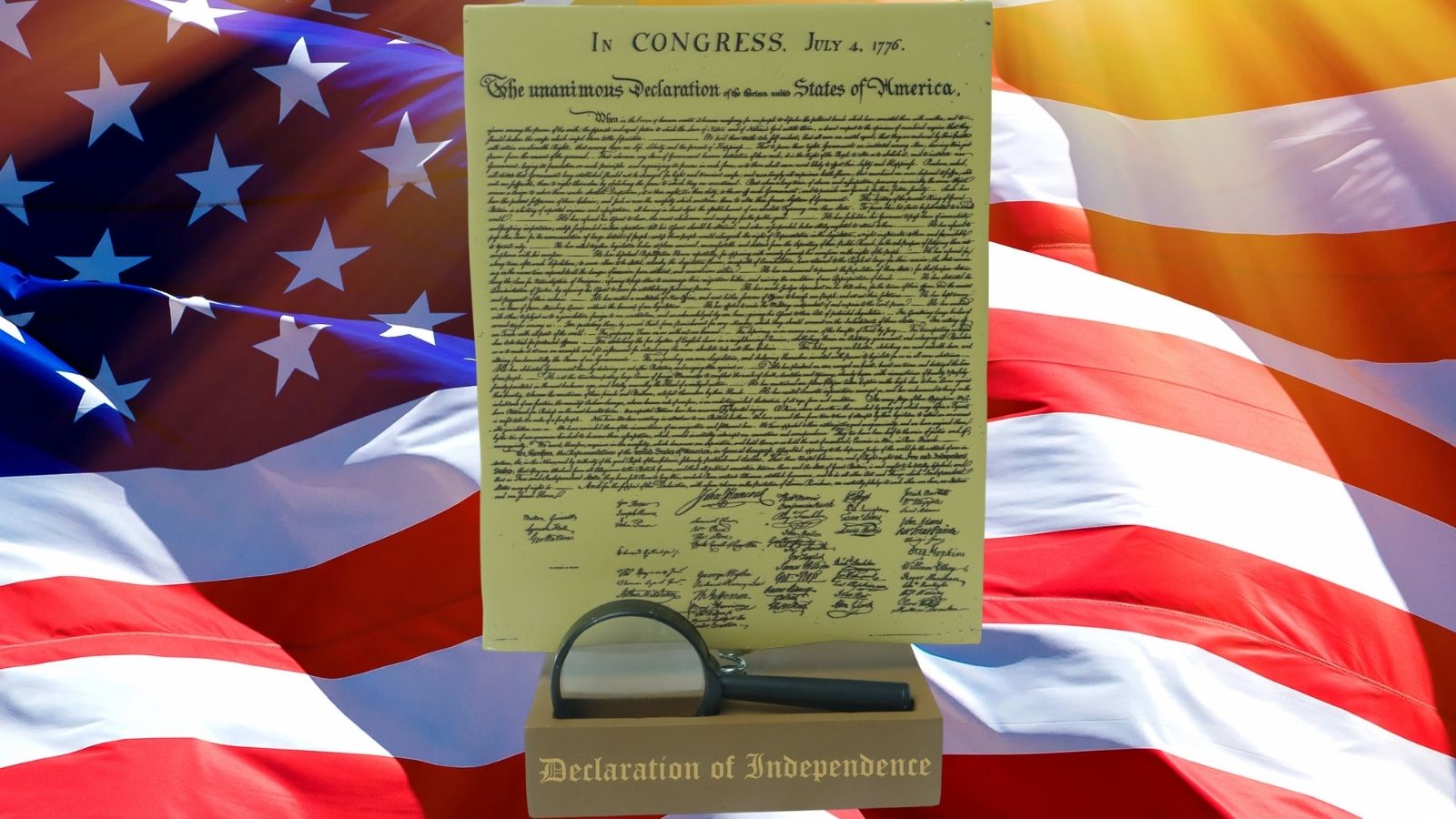
An image from the National Bobblehead Hall of Fame and Museum of its Declaration of Independence bobble created for the nation’s 250th anniversary.Courtesy of the National Bobblehead Hall of Fame and Museum
On July 2, the Second Continental Congress adopted the Declaration of Independence that referred to the new country as the united States. The united was written in lowercase, Skic said, to emphasize the focus on “States.”
However, it wasn’t until Sept. 9 when during the Second Continental Congress — meeting at the Pennsylvania State House, today’s Independence Hall — delegates voted to call the new government the United States of America, with a capital “U.”
“As soon as independence becomes the goal, not just restoring liberty, the United States took hold as a name,” Skic said. “And it happened in a neat six month time period.”
The official naming of the United States will be remembered Saturday at Independence Hall from 11 a.m. to 1 p.m. in the Philadelphia Historic District’s 38th firstival. Firstivals are weekly day parties held in honor of America’s 250th birthday.
“The Continental Congress had been trying to decide how it should be represented when we present ourselves to other countries,” Skic said. “What would be the official seal on our government documents? With the Sept. 9 vote, Congress officially says all of the government’s official documents will say ‘United States.’”
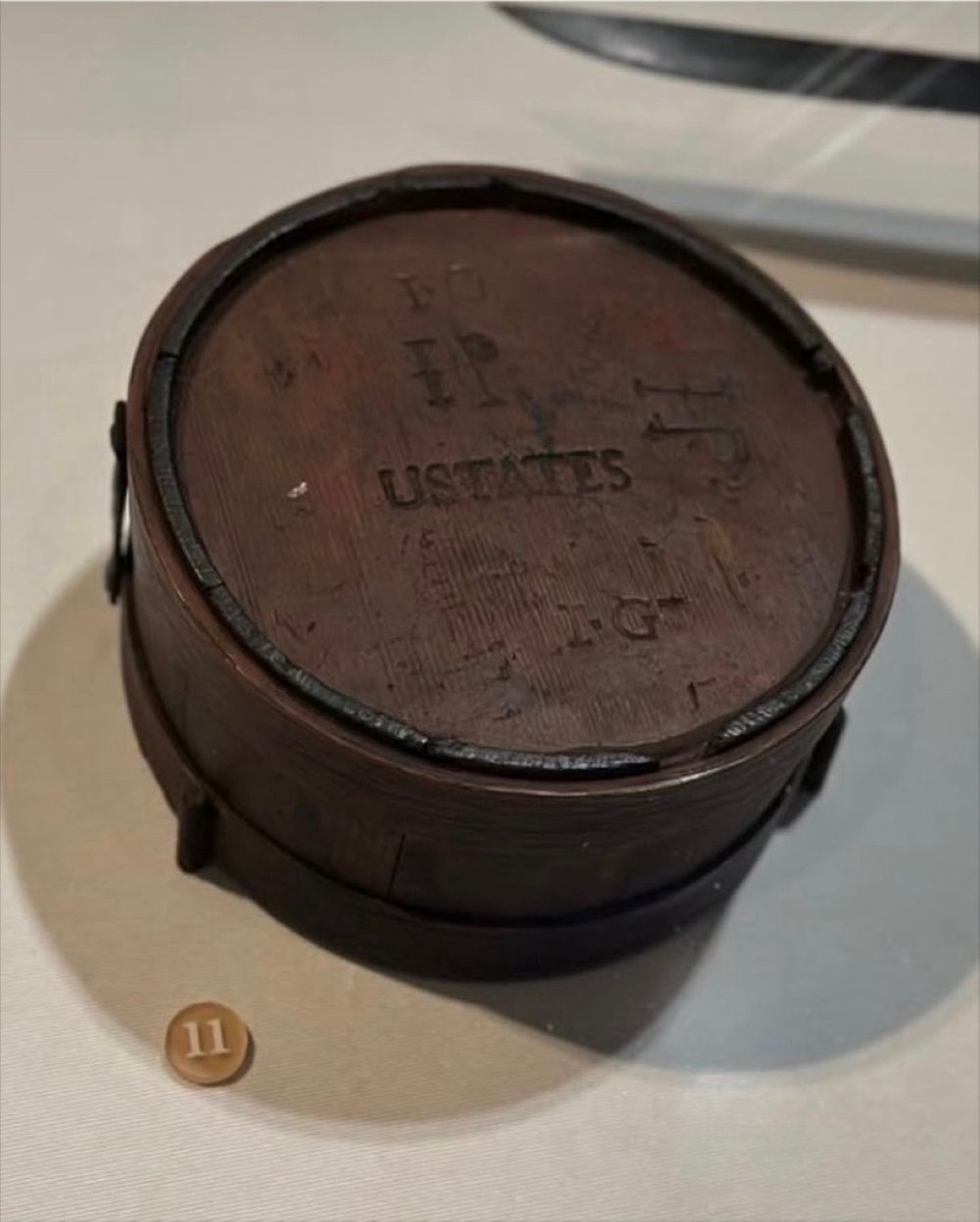
The Continental Congress ordered the Continental Army’s property be marked United States in February 1777.
A Revolutionary War-era canteen marked U. States for United States. One of the first military-issued items that speaks to the formation of America’s independence.The Museum of the American Revolution
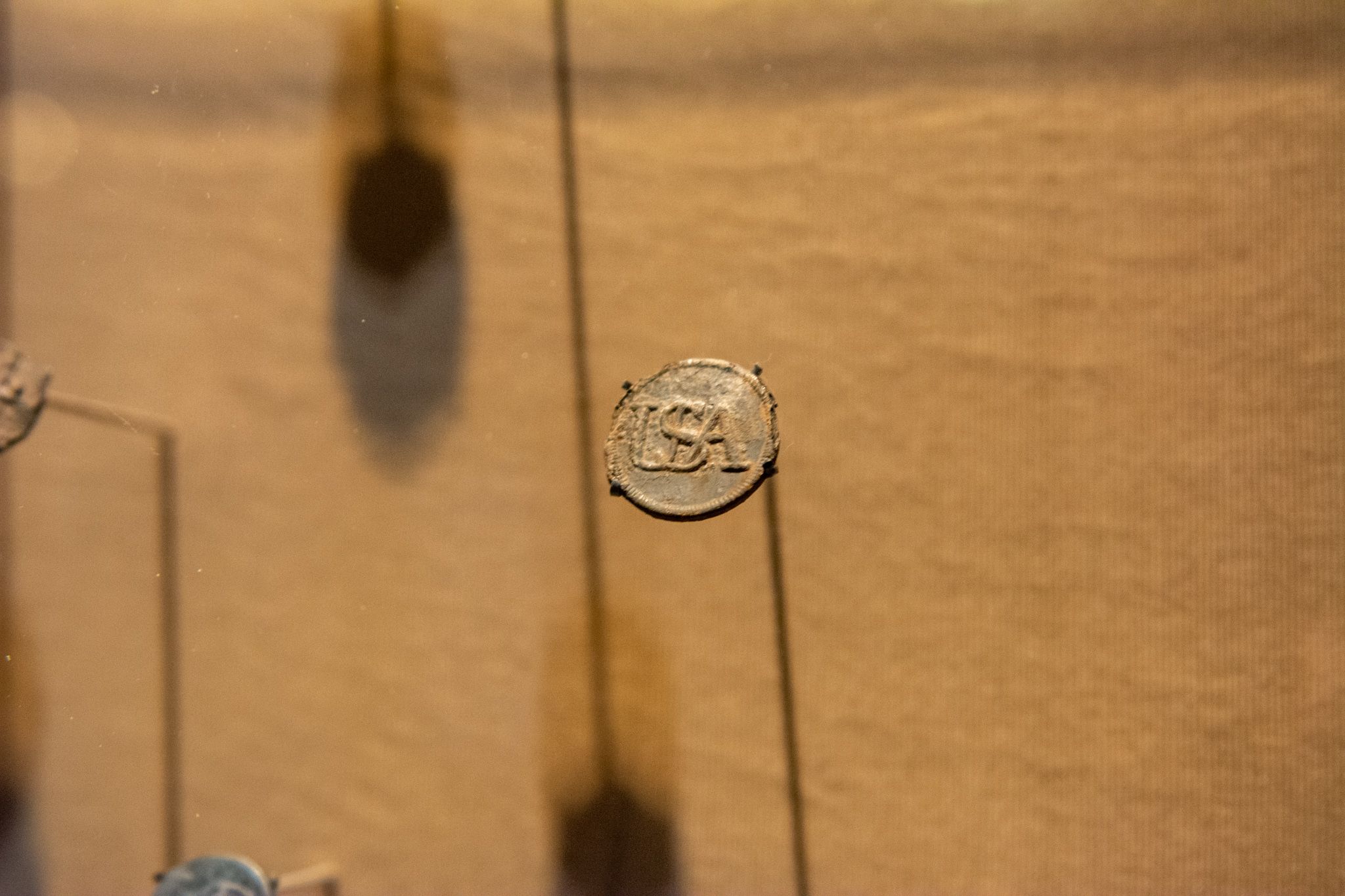
“[The Museum of the American Revolution] has muskets, canteens, and cartridge boxes marked U. States,” Skic said. “We also have one of the only surviving original molds of USA buttons.”
The army would be called the Continental Army through the end of the Revolutionary War in 1783, after which it disbanded. George Washington was elected president in 1789 and soon after his inauguration, it was reestablished as the United States Army.
A previous version of the story misstated Common Sense’s publication date. It was published Jan. 9, 1776.
This week’s Firstival is Saturday, Sept. 19, from 11 a.m.-1 p.m., at Independence Hall, 520 Chestnut St.
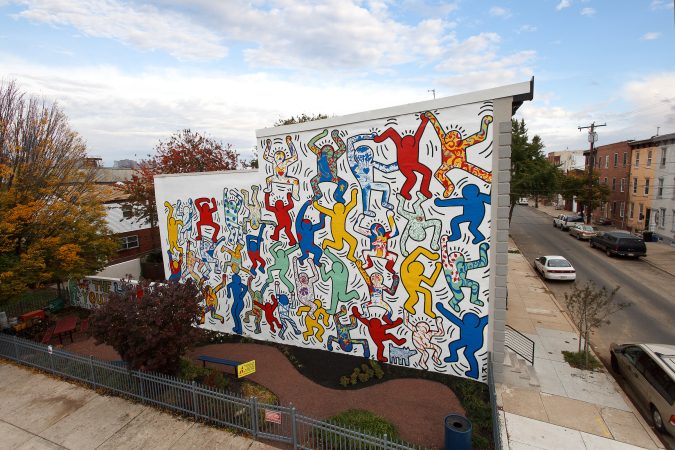
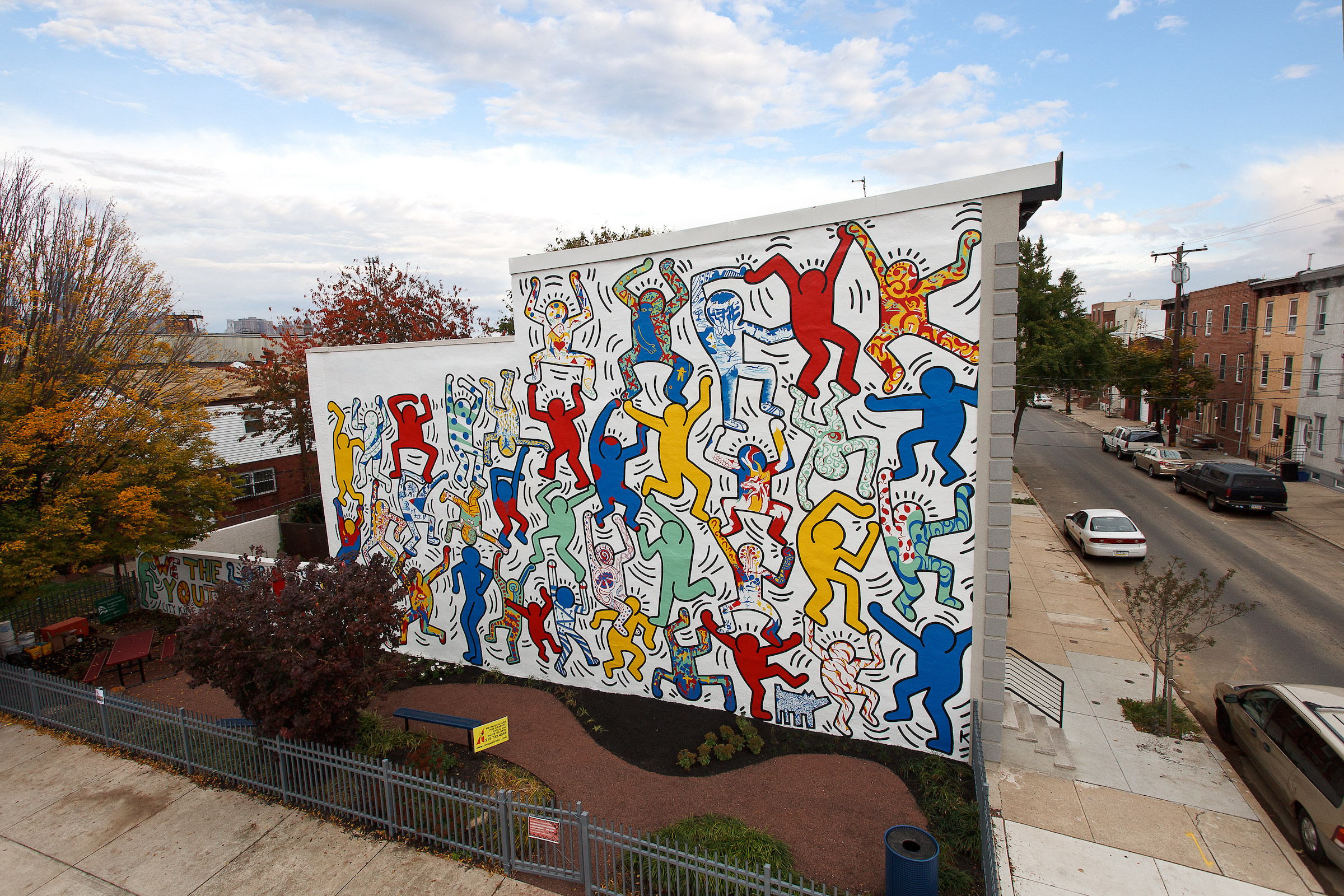
For nearly 40 years, Keith Haring’s We the Youth has been a highlight in Philadelphia’s Point Breeze neighborhood.
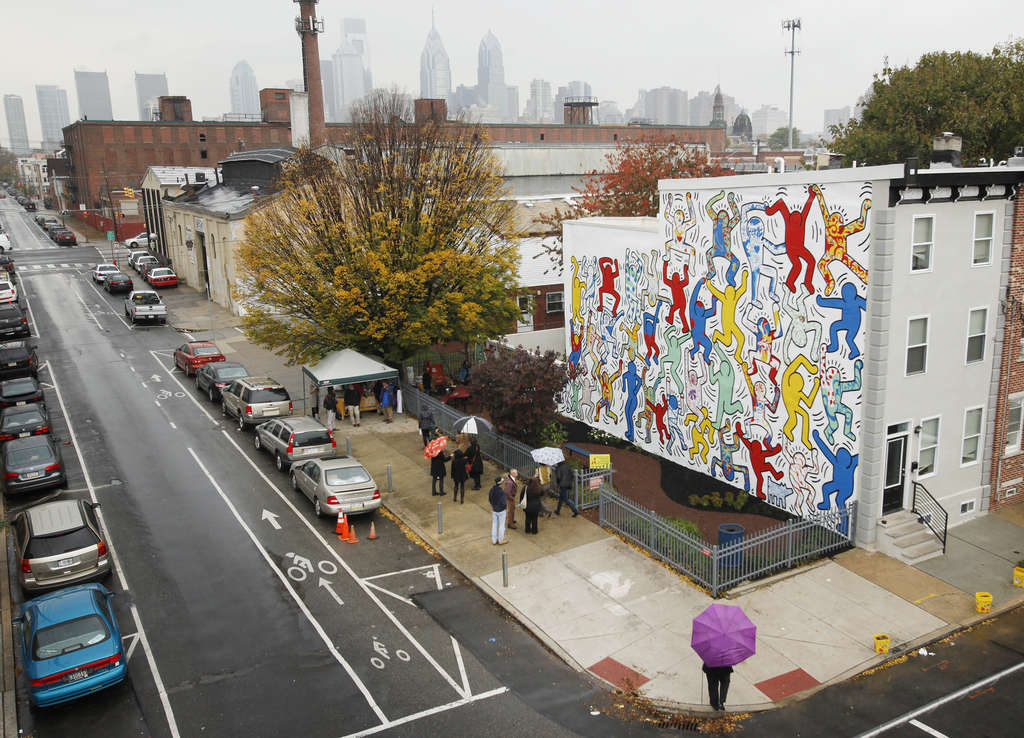
The vibrant figures dancing across the facade of a three-bedroom rowhouse at 22nd and Ellsworth Streets is the only collaborative Haring mural that remains intact in its original location.
Now it’s one step closer to being added to the city’s Register of Historic Places. On Wednesday, an advisory group of the Philadelphia Historical Commission unanimously approved its nomination to be included.
If approved at next month’s Philadelphia Historical Commission meeting, the mural will be added to the Philadelphia Register of Historic Places. That would make it the first outdoor mural to be an officially designated and protected landmark in the city’s history. It’ll be only the fifth mural to be designated as such, after The Dream Garden inside the Curtis Center, the New Deal-era murals inside the Family Court building, the frescoed ceiling at Old City’s St. Augustine’s Roman Catholic Church, and Iron Plantation Near Southwark inside the Southwark Station Post Office in South Philly.
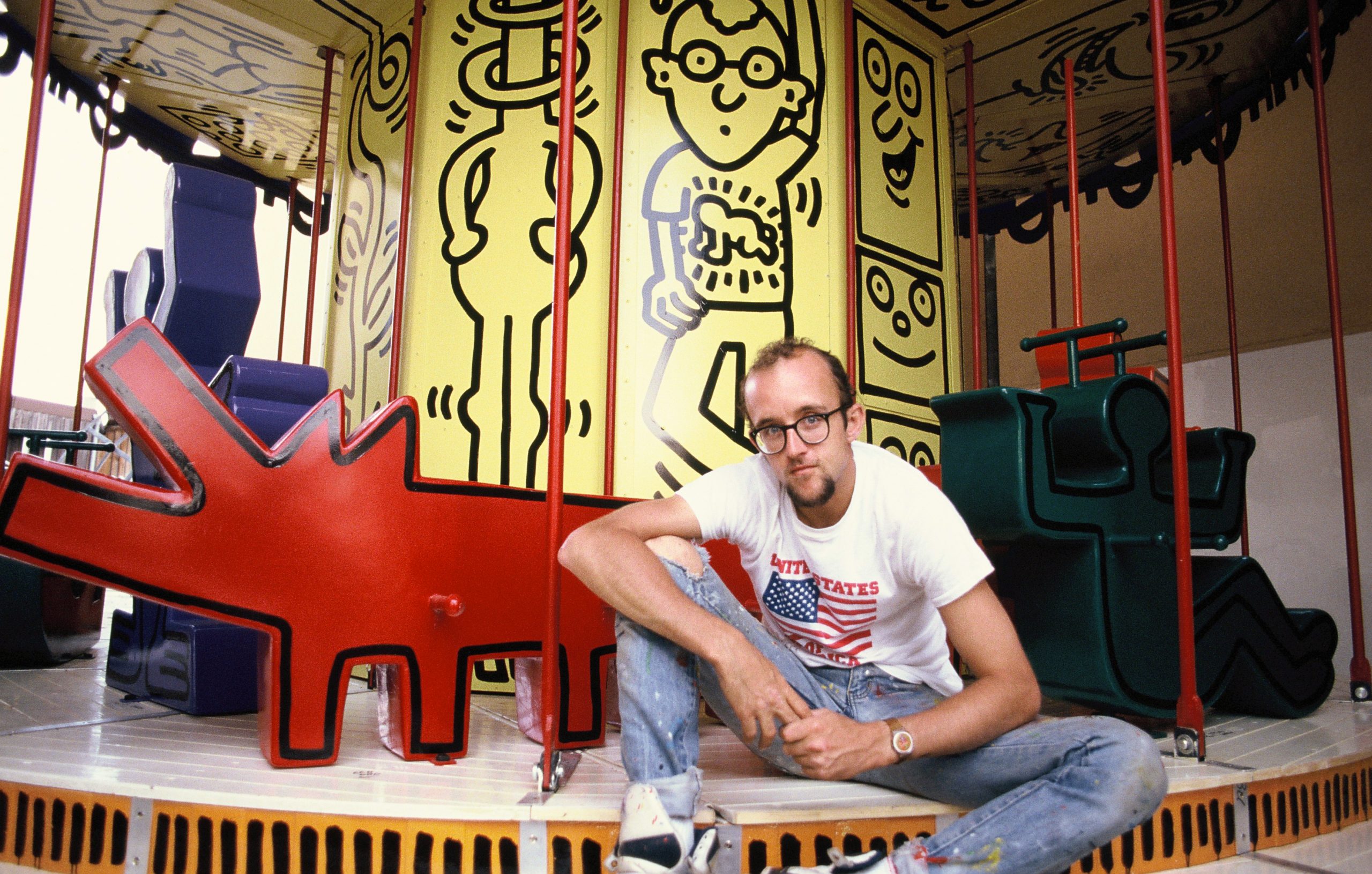
Keith Haring, who died in 1990, with his painted carousel. MUST CREDIT: Sabina Sarnitz/Luna Luna/Keith Haring Foundation/Artestar
Haring, the Reading, Pa., native, whose bold drawings and vivacious paintings meld the worlds of graffiti and contemporary art, became one of the defining artists of his generation. He died in 1990, at age 31, due to AIDS-related complications.
In 1987, Haring and a group of 14 Philly and New York students collaborated on We the Youth to commemorate the bicentennial of the U.S. Constitution.
In 2013, Mural Arts Philadelphia undertook a massive restoration of the Haring mural, located on a shared party wall at 2147 and 2149 Ellsworth Streets. In recent months, organizations have advocated for the designation of the pop artist’s mural.
During Wednesday’s meeting, the nomination was presented by Alex Till, a historic preservation planner for the City of Philadelphia, who referenced designation criteria A and E because of the mural’s artistic and cultural significance.
“We the Youth” sits at 22nd and Ellsworth Streets, with a small park next to it. Photo from 2013.Steve Weinik / Mural Arts Philadelphia
According to the City of Philadelphia website, criteria A is considered for “significant character, interest, or value as part of the development, heritage, or cultural characteristics of the City, Commonwealth, or Nation or be associated with the life of a person significant in the past.” Criteria E is for the work of a “designer, architect, landscape architect or designer, or engineer whose work has significantly influenced the historical, architectural, economic, social, or cultural development of the City, Commonwealth, or Nation,” according to the website.
Till was joined by Mural Arts Philadelphia founder and former leader Jane Golden; Jenny Greenberg, executive director of the Neighborhood Gardens Trust; and Simon Castets, executive director of the Keith Haring Foundation.
Golden said the mural is a part of the “unique fabric of Philadelphia.”
“There are few opportunities to preserve history while it is still physically present and still connected to our city and our community. This is the moment,” Golden said.
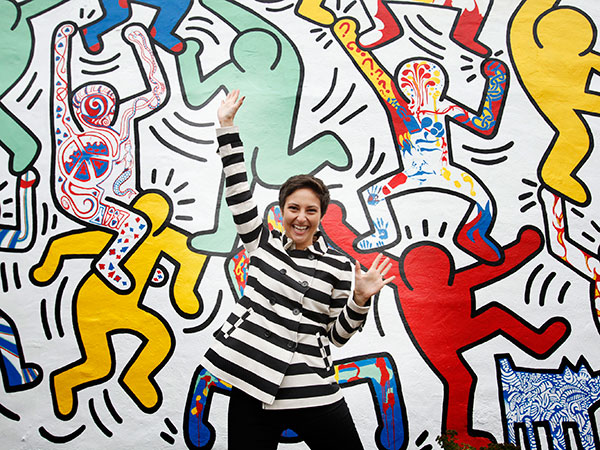
Erica Bryant mimics a Keith Haring figure. “We the Youth,” a Keith Haring mural created in 1987 at 22nd and Ellsworth Streets, has been restored by artists from the Mural Arts Program. Photo from 2013. ( MICHAEL S. WIRTZ / Staff Photographer )Michael S. Wirtz / Staff Photographer
Greenberg said amid the ongoing threat of development and gentrification in this city, it is almost rare to find a mural that has been at the same site for 40 years. And this is why historical designation is necessary.
“The mural’s location reflects Haring’s commitment to making art accessible to the public, regardless of socioeconomic status, and to engaging young people as creative partners,” she said.
The advisory group, comprising architects, historians, and preservation experts, agreed that the mural meets the criteria. After nearly an hour of deliberation, including comments from Philadelphia residents who tuned into the Zoom meeting, the group approved the nomination and recommended it to the commission for next month’s meeting.
The commission will vote Oct. 9. If approved, We the Youth would be the city’s first designated mural in over four years.
A potential historic designation will not affect the larger property and will be restricted to the mural and the wall it is painted on. The building’s owner will be required to maintain the structural integrity of the wall and commit to set obligations, with Mural Arts making any necessary restorations to the mural itself.
If the mural is designated, the building’s owner, listed as “2147 Ellsworth LLC” in city records, will not be allowed to remove or alter the appearance of the mural without the Historic Commission’s review.
While speakers were impassioned by the possibility of historical designation, 2147 Ellsworth LLC manager Ori Feibush, serving as a representative at Wednesday’s committee meeting, opposed the nomination.
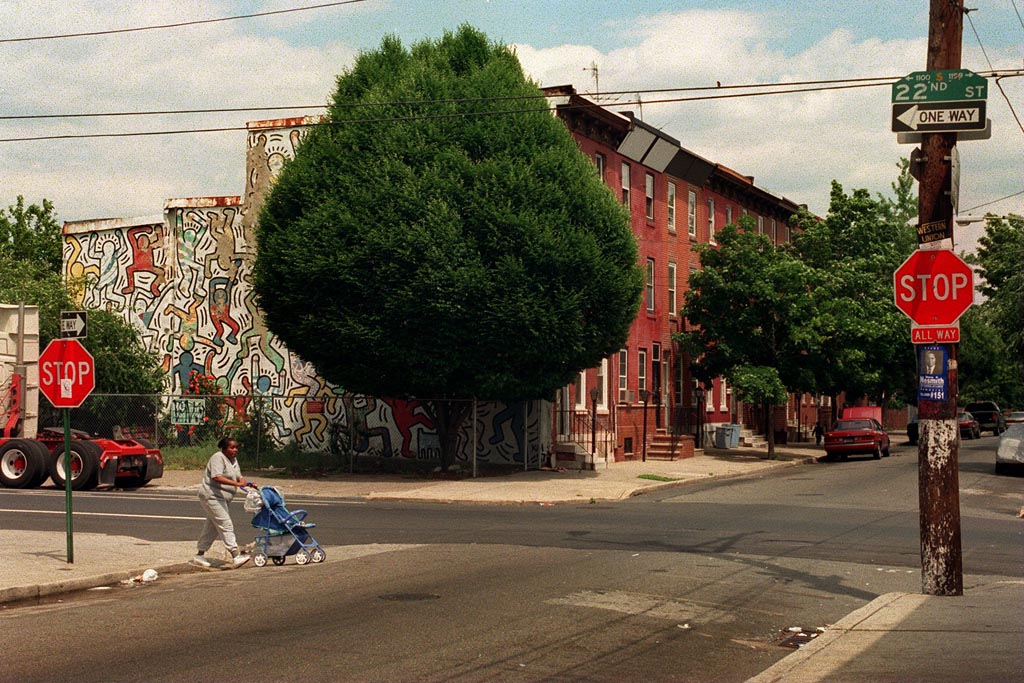
Kutztown, Pa., native Keith Haring came back to Philadelphia at the height of his worldwide popularity in 1987 and painted a mural at 22nd & Ellsworth Streets with the help of neighborhood kids from the Brandywine Workshop. This photo, from May 27, 1999, shows the mural before restoration. (Tom Gralish/Staff photographer)
Feibush warned that the designation would impede the building’s renovation efforts, which may require the demolition of the rowhouse’s interior, based on analysis from engineers. Since purchasing the property eight years ago, Feibush said his company has worked diligently to reduce water infiltration and minimize movement to “preserve the mural.”
Despite years of efforts, he said, the mural has delaminated from the underlying salmon brick and is in a fragile condition.
“The removal and, ultimately, reinstallation of the mural here is the only path to create something that can be here long term,” Feibush said.
By gaining historical designation, he said, there will be temporary plans made to preserve the site, rather than long-term fixes that will ensure the mural lasts “another 100 years,” rather than the five to seven he projects.
“We the Youth,” a Keith Haring mural painted in 1987 at 22nd and Ellsworth Streets, was restored to its original vibrancy in 2013 by the Philadelphia Mural Arts Program. [File Photo]Michael S. Wirtz / Staff Photographer
“This mural we hope will forever be at this location, but the only way this location could have a mural is without a designation,” he said.
Committee member Jeff Cohen was one of several who questioned whether historical designation and preservation could happen simultaneously. He and his fellow member Elizabeth Milroy agreed that both methods should be carefully studied and explored before next month’s commission meeting, ensuring that all scenarios are properly vetted and that all attendees’ views are considered.
The committee then opened the meeting to the public. Several Point Breeze residents, many of whom live within walking distance of the mural, supported the historical designation.
An earlier version of the article misstated the murals included in the Philadelphia Register of Historic Places. It has been updated to include the frescoed ceiling at St. Augustine’s Roman Catholic Church in Old City.
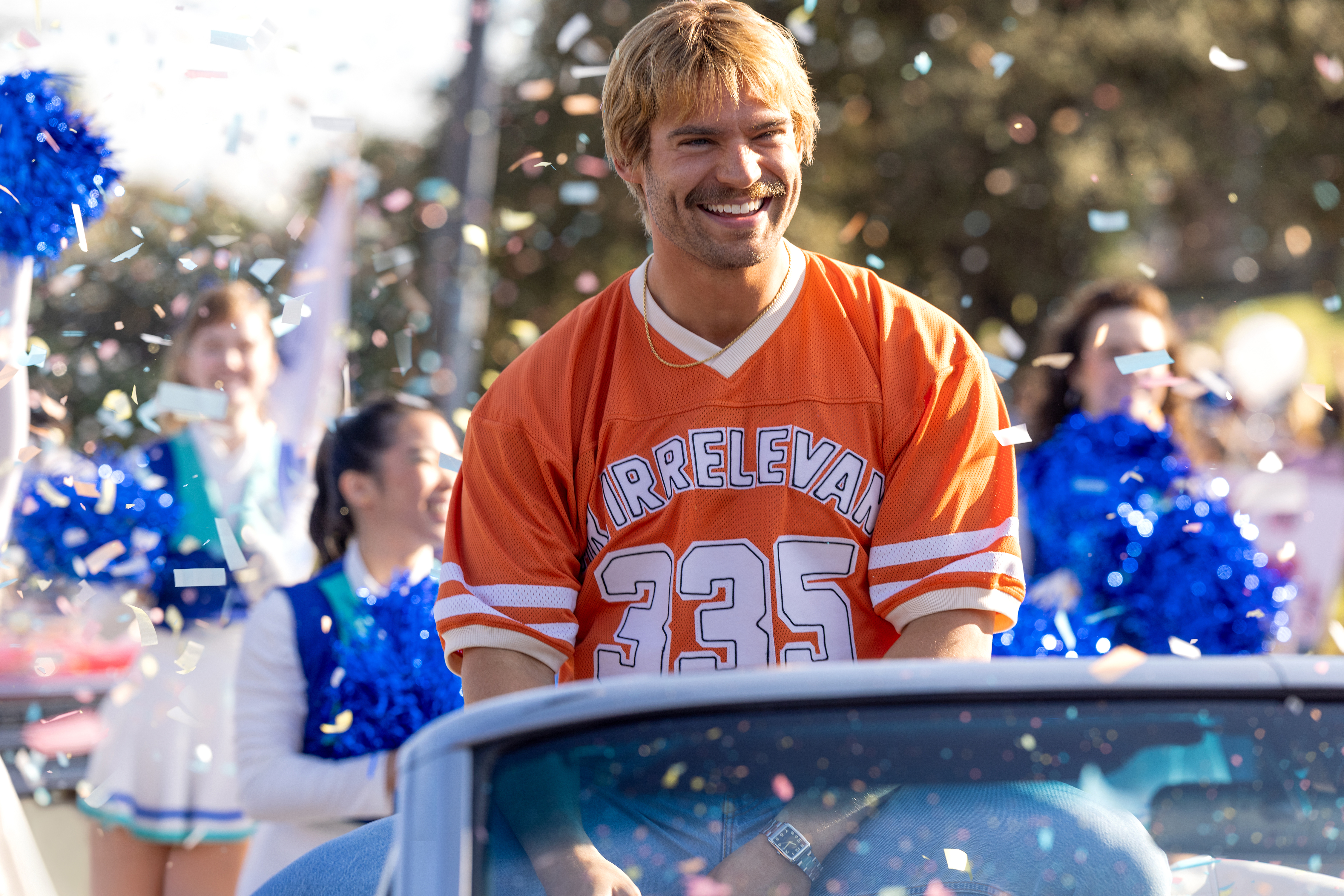
Superman star David Corenswet grew up in Philadelphia loving the Eagles, but that didn’t stop him from saying yes to donning a Giants jersey for the upcoming biopic, Mr. Irrelevant.
The 33-year-old actor — who got his start on local stages as a kid — became a breakout movie star last year when he played Superman in James Gunn’s revamp of the legendary superhero films. While the sequel, Man of Tomorrow, releases in summer 2027, Corenswet’s next project is based on a true story that follows underdog football player John Tuggle.
Mr. Irrelevant, named because Tuggle was the last pick of 1983 NFL draft, was written by Reacher creator/producer Nick Santora and will be out in theaters Dec. 25. In a promotional video that dropped Wednesday, Corenswet admitted that he initially had doubts about the role because of his Eagles allegiance, but he soon realized the story was bigger than football fandom — and Tuggle had a connection to Philadelphia of his own, too.
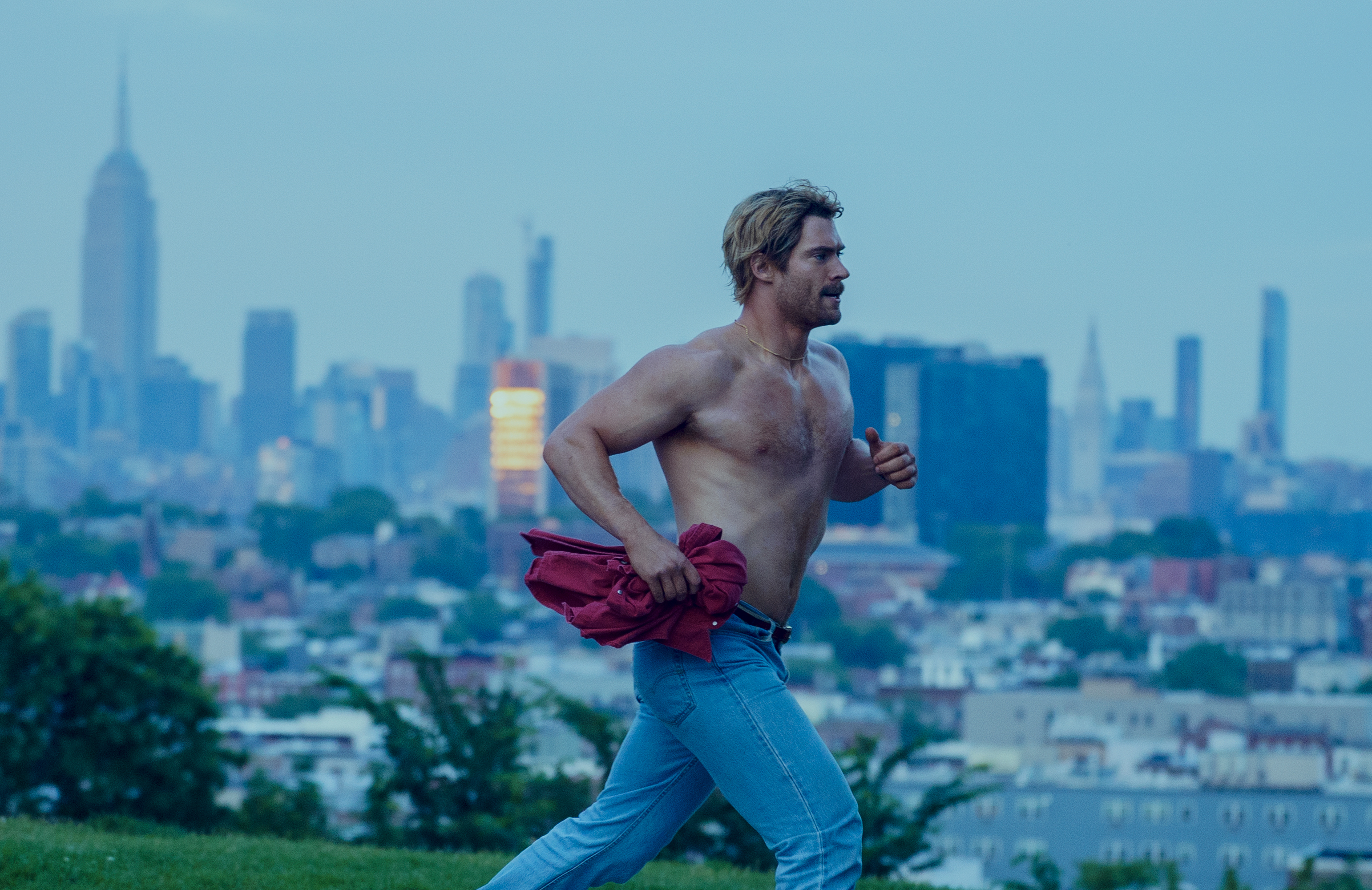
David Corenswet as John Tuggle in “Mr. Irrelevant” from Paramount Pictures.Clay Enos
“As a kid from Philadelphia, I thought it would be a hard sell to get me to wear a Giants jersey on the big screen,” said Corenswet. “When I learned that John Tuggle scored his only professional touchdown against Philadelphia in Philadelphia, I thought, ‘This would really be a terrible betrayal,’ you know? What would Bradley Cooper think of me?”
“But when I saw the footage of that play, when I saw John dive into that kelly green end zone, the fans cheered,” Corenswet continued. “The same fans that booed Santa Claus cheered for a New York Giant scoring six on their turf. Why? Because for that moment, John Tuggle wasn’t a New York Giant, he was Mr. Irrelevant. He was the guy who was never supposed to make it.”
Tuggle was a rookie from California who played just one season with the Giants as a running back before he was diagnosed with cancer. After two years of extensive treatment, he died at age 25 in 1986. His story was explored in the 2018 ESPN 30 for 30 short film, The Irrelevant Giant.
‘Mr. Irrelevant’ will be released in theaters Dec. 25.
To Denise Burgher, co-organizer of this weekend’s 2026 Colored Convention Conference, the attack on civil rights and Black history under President Donald Trump’s administration is chilling.
Among the most egregious, she said, were his attempts to repeal the 14th Amendment, the Reconstruction-era addition to the Constitution guaranteeing citizenship to anyone born in the United States. In June, the Supreme Court upheld birthright citizenship.
“The 14th Amendment overturned the Dred Scott Decision of 1857 ruling Black people — freed or enslaved — do not have the same rights as [their] white counterparts,” Burgher said. “Without that protection, Black Americans’ citizenship would be in question. Don’t think that could happen? We thought a woman’s right to chose was set in stone, too.”
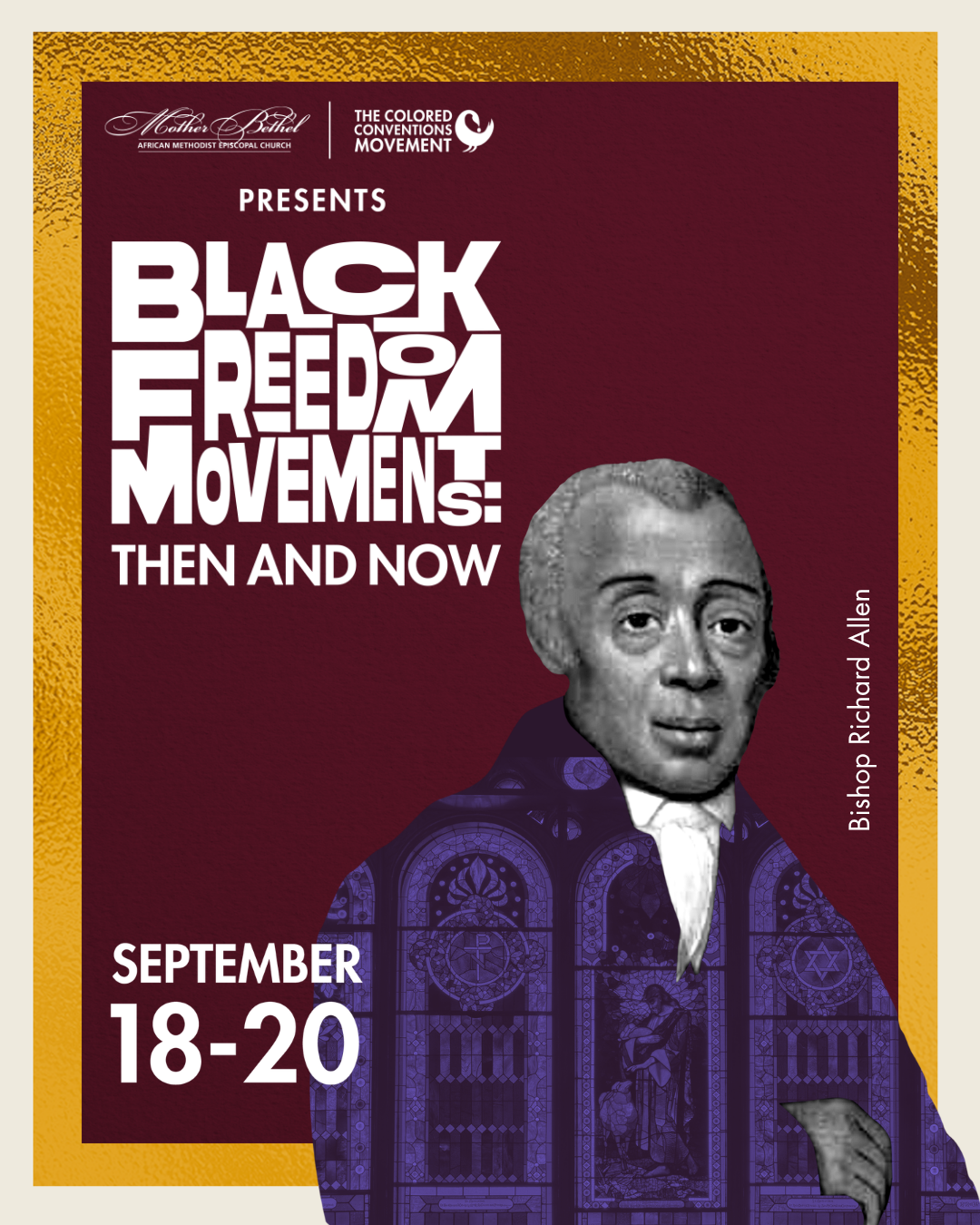
A flyer advertising the 2026 Colored Convention: Black Freedom Movements Then and Now.2026 Colored Convention Committtee
Burgher went on: Last week Trump threatened to snatch the tax exempt status from private schools that give minority students access to scholarships and educational programs, including at historically Black colleges and universities like Howard and Hampton.
It’s clear Black equality in this political climate is not guaranteed.
“We haven’t seen a threat like this on Black livelihood in this country since the post-Reconstruction era,” said Burgher, who is also the director of community engagement and curriculum development at Penn State’s Center for Black Digital Research. “This part of American history was a part of our past, now, it is not so suddenly aggressively and nakedly a part of our present.”
A 19th-century America, she said, calls for 19th-century tactics.
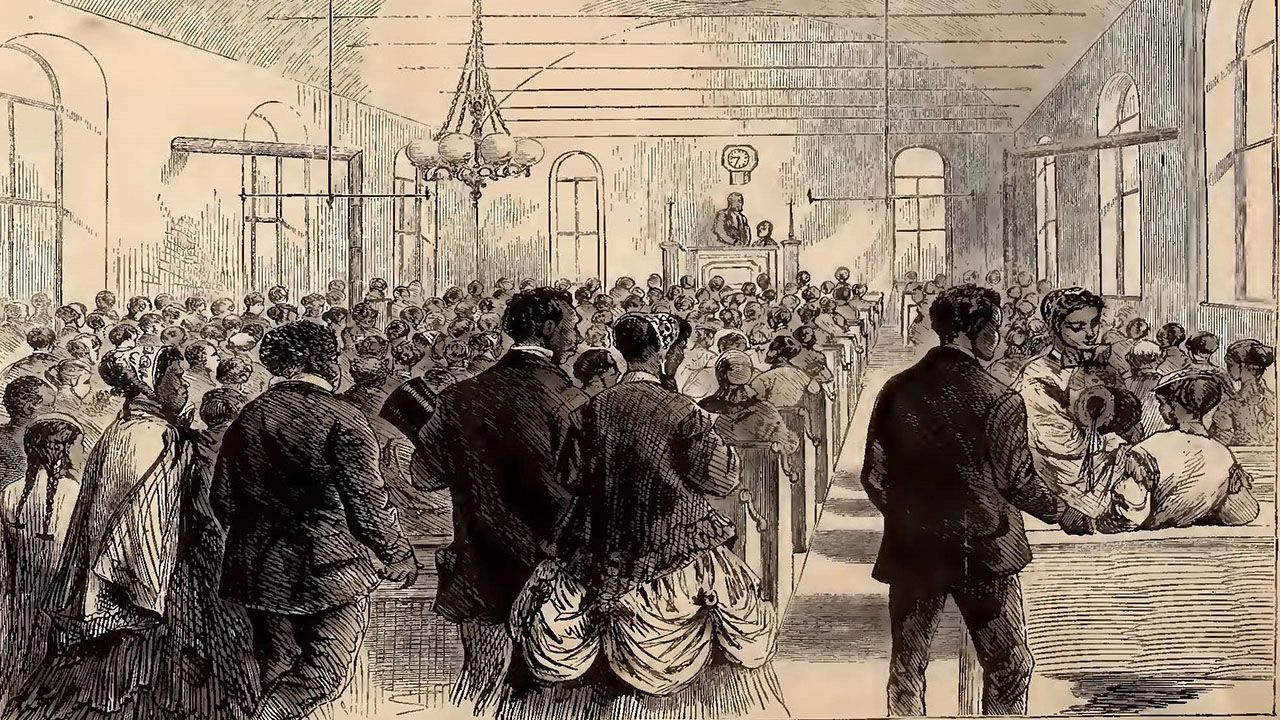
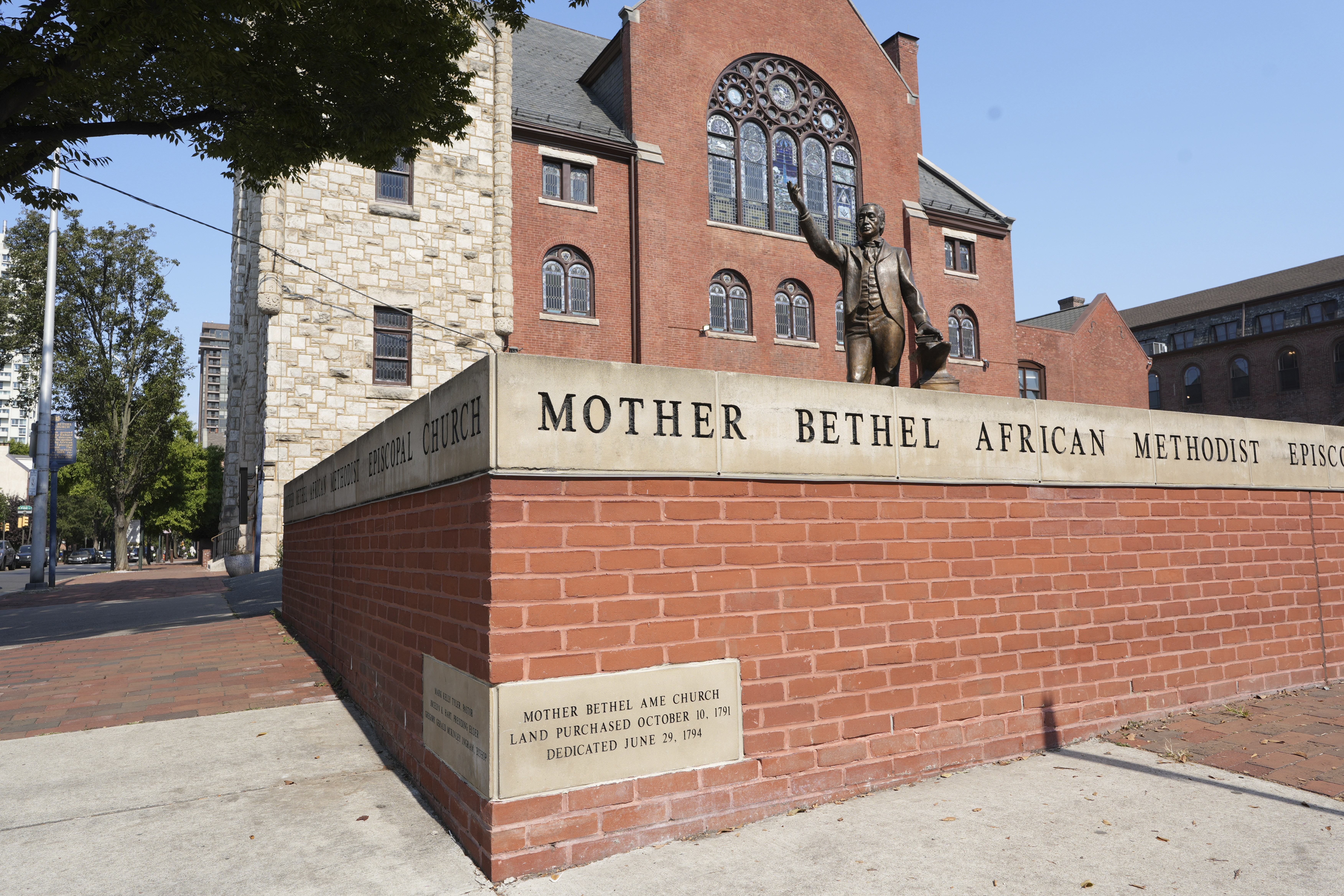
This weekend, Mother Bethel AME will host the “2026 Colored Convention: Black Freedom Movements Here and Now,” a celebration of the first Colored Convention held almost 200 years ago at the church. Dozens of influential free Black clergymen, statesmen, and activists convened at the 1830 Colored Convention and laid the foundation for civil rights groups like the Niagara Movement and the NAACP.
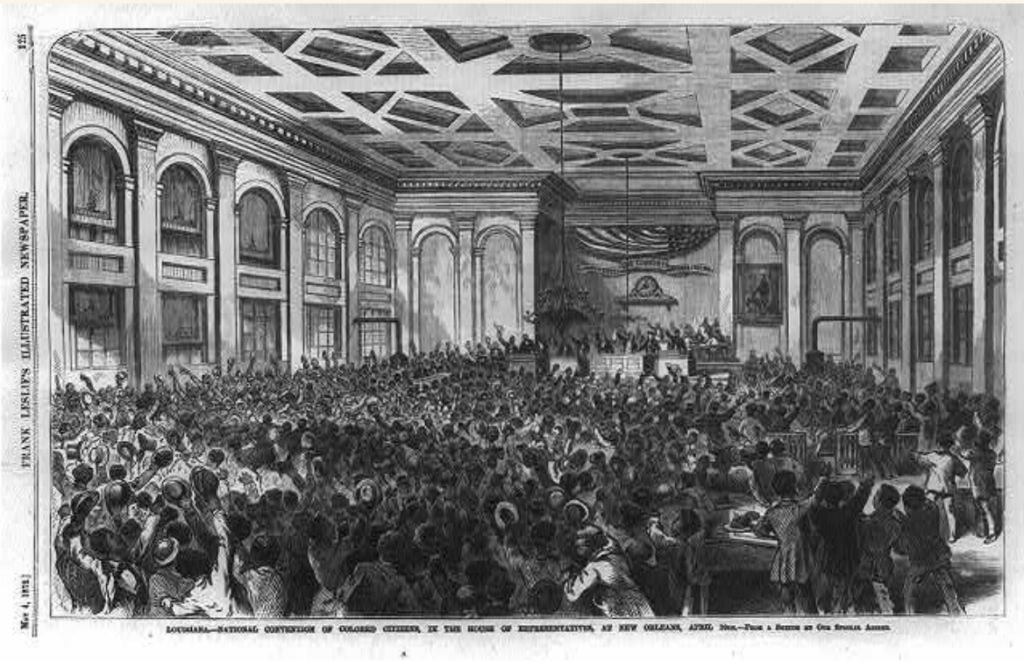
This print from Frank Leslie’s Illustrated Newspaper depicts the National Convention of Colored Citizens’ meeting in the House of Representatives in New Orleans, in April 1872.The Library of Congress
These organizations agitated for civil rights through the Civil War, Reconstruction, Jim Crow and into the 1960s, said Carolyn C. Cavaness, Mother Bethel’s pastor who tapped Burgher and Derrick Spires, historian and associate professor of English at the University of Delaware, to reignite the Colored Convention’s legacy.
“To reclaim and be challenged by such a movement … is of much worth and esteem,” Cavaness said. “We are literally in a struggle now for equality and fairness of all people.”
This weekend’s Colored Convention will feature workshops on genealogy, activism, and the 18th- and 19th-century Black press. Philadelphia school children will attend Thursday for arts and crafts projects that will teach them about the history of the Colored Convention.
Andre E. Johnson, codirector of the Colored Conventions Project and professor at the University of Memphis, will deliver the keynote on the history of the Colored Convention and share how activists can apply 19th-century action plans to 21st-century technology to create a strategy to combat the present crisis.
“In this year of the Semiquincentennial, this is yet another opportunity for Philadelphians to pay attention to history,” Burgher said, “and look at strategies our ancestors used more than 100 years ago. I’m not going to say the same thing is happening, but the events sure do rhyme.”
The event will include a voter-registration drive, emphasizing the importance of voting in the midterms.
Richard Allen founded Mother Bethel in 1794, and by 1830, the church was the cornerstone of the largest free community of African Americans in the country.
In August of 1829, white mobs burned Black businesses and neighborhoods during the Cincinnati Race Riots. In response to the brutal loss of life and business, free man Hezekiah Grice wrote to Allen, asking the influential pastor to gather free Black intellectuals to strategize. His reasoning was, if white mobs could do this in Cincinnati, what’s to stop them from attacking Black communities everywhere else.
More than 2,000 Black people from Cincinnati moved to Canada. The first Colored Convention was held from Sept. 20 to Sept. 24 in 1830 at Mother Bethel, resulting in emissaries from Philadelphia asking the Canadian government to allow Black people to establish communities there.
The Colored Convention held annual meetings at Mother Bethel from 1831-85. By the turn of the 20th century, there were Colored Conventions regularly in nearly every major American city along the Northeast Corridor, in the Midwest, and along the West Coast.
A statue of Mother Bethel AME Church founder Richard Allen stands on the oldest parcel of land continuously owned by Black Americans in Philadelphia on Oct 13, 2024. (AP Photo/Luis Andres Henao)Luis Andres Henao
Black leaders from every walk of life attended, among them Frederick Douglass — known as the Lion of the Convention because of his deep oratory voice and big, distinctive hair — poet Frances Ellen Watkins Harper, newspaperman T. Thomas Fortune, and Philadelphia educators Jacob C. White and Charles L. Reason.
Colored Conventions, Burgher said, became forums for Black leaders to discuss abolition, fugitive slave laws, voting rights, and education. Many Black institutions were born from these conventions, including the charters for Talladega University and Howard University Law School, established in 1865 and 1869, respectively.
The last Colored Convention on record was in 1972 in Newark, N.J., Burgher said.
“I hope this 2026 celebration will not only bring this history home,” Burgher said. “And I also hope it inspires Philly residents to respond to the current moment like history has taught us.”
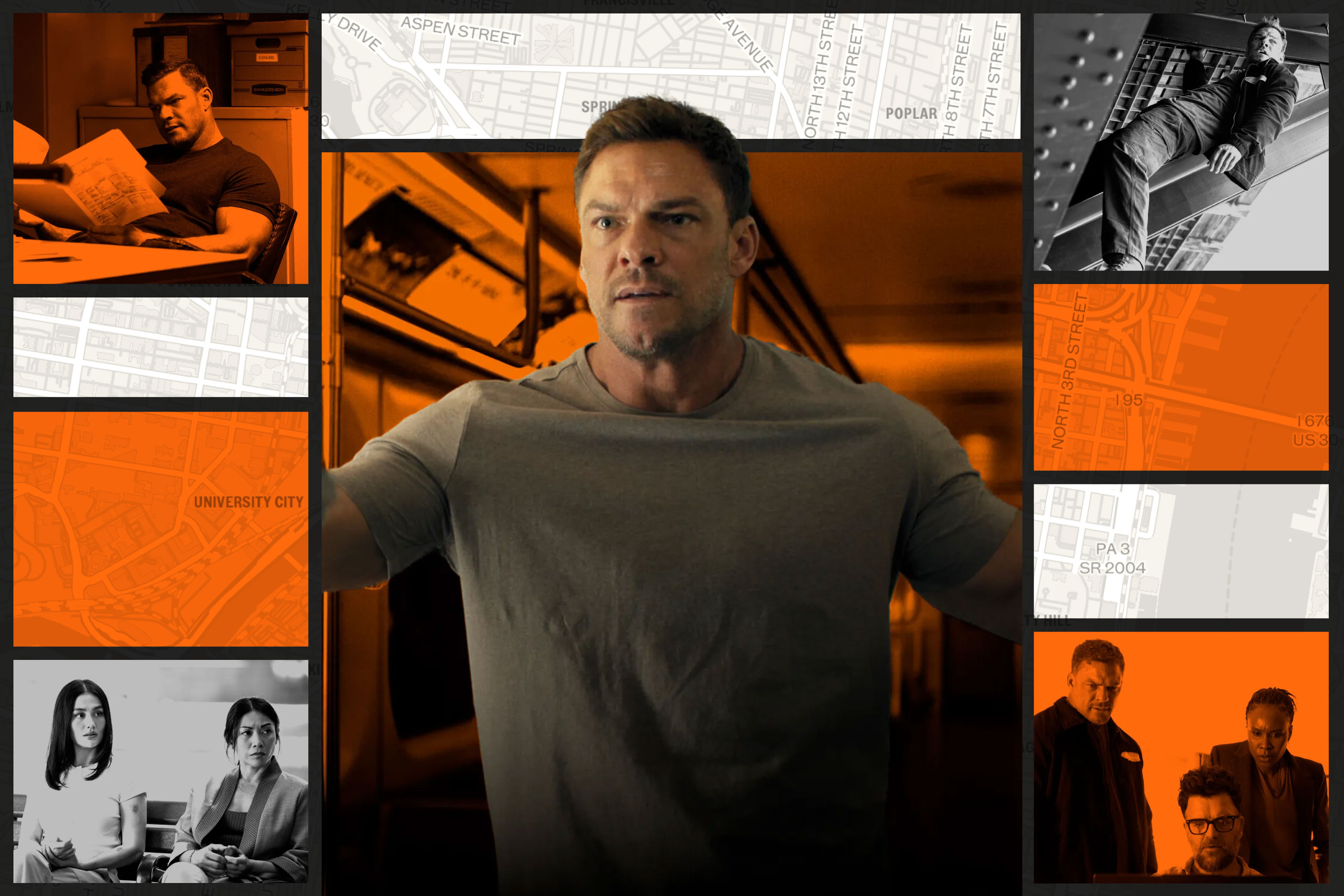
Vigilante Jack Reacher's shadowy dealings spilled out across Philadelphia for the Reacher’s fourth season, which is now available in full on Amazon Prime. Starring actor Alan Ritchson as the hulking retired Army investigator, the series was spotted filming around town in 2025.
Based on Lee Child's 2009 novel Gone Tomorrow, the fourth season of Reacher has its titular character facing off against he CIA, federal agents, and international mercenaries following a woman's suicide. And while much of the on-screen action appears to have been filmed elsewhere — namely Toronto, which looks a lot like Philly, but with space — the City of Brotherly Love does show up quite a bit.
Here, we've rounded up all the Philly spots we could identify in season four. Check out the map below for where Reacher and his cohorts went in the city.
story continues after advertisement
Loading…
Seen in episode 1
City Hall
Michael Bryant / Staff Photographer
Reacher's fourth season immediately sets the scene with a shot of the William Penn statue atop City Hall as a nightscape of Center City shines in the background.
Seen in episode 1
Uptown Beer Garden
Erin Blewett / For The Inquirer
We catch our first glimpse of our hero, Jack Reacher (Alan Ritchson), as he exits Uptown Beer Garden, walking out of the establishment silently with a beer in hand.
Seen in episode 1
LOVE Park
Michael Bryant / Staff Photographer
Reacher speaks for the first time this season, ordering a "wiz wit" from a nondescript food truck in Love Park.
Seen in episode 1
Avenue of the Arts
Jessica Griffin / Staff Photographer
Here, Reacher strolls down the sidewalk on the west side of Broad Street, chomping on his cheesesteak. Canonically, it is just after 2 a.m., and the street is deserted as he descends into the Walnut-Locust entrance of the B line, which runs along Broad Street.
Seen in episode 1
Walnut-Locust Station
Alejandro A. Alvarez / Staff Photographer
As he enjoys his cheesesteak, Jack Reacher (Alan Ritchson) heads down into the Broad Street Line at this Center City station. Several interior shots of the station are shown, including one in which a rat munches on a hot dog.
Seen in episode 1
Benjamin Franklin Bridge
Thomas Hengge / Staff Photographer
Philly is shown off in all its nocturnal glory in episodes one, and seven with a low-light shot of Center City from the Ben Franklin Bridge. Episode five features a skyline shot from the bridge, showing the One Water Street Apartments building.
Seen in episode 1
Benjamin Franklin Parkway
Tom Gralish / Staff Photographer
For the first time in the season's first episode, the sun rises on Philadelphia. And it does so in this stunning aerial shot showcasing many of the Ben Franklin Parkway's gems — Logan Circle, the Philadelphia Museum of Art, the works.
Seen in episode 1
Parkway Central Library
Tom Gralish / Staff Photographer
We get a great glimpse of the exterior of the Parkway Central Library before heading inside, where Jack Reacher (Alan Ritchson) and Jacob Merrick (Christopher Rodriguez-Marquette) do research on Congressman John Sampson (Marc Blucas), a North Carolina representative who is launching a presidential bid.
Seen in episode 1
Parc
Courtesy of HughE Dillon
Parc briefly plays host to Reacher, Lila Hoth (Agnez Mo), and Jacob Merrick (Christopher Rodriguez-Marquette) as the trio settles in at an outdoor table to evade police.
Seen in episode 3
Walt Whitman Bridge
Tom Gralish / Staff Photographer
Reacher and his cohorts travel back into Philly via this bridge after escaping Washington, D.C. In the background, the old Southwark Generating Station is clearly visible.
Seen in episode 3
Schuylkill Expressway
Tom Gralish / Staff Photographer
As Reacher and his crew traverse Philly at night, the action leads to a shot of the west end of Center City near 30th Street Station from the Schuylkill Expressway.
Seen in episode 3
Schuylkill Expressway
Monica Herndon / Staff Photographer
Here, we get another nightscape shot of Philly's skyline, again from I-76 near 30th Street Station looking east. In the foreground, Locust on the Park is lit up green and is featured prominently.
Seen in episode 4
Benjamin Franklin Parkway
Monica Herndon / Staff Photographer
The Philly skline is again featured in a sprawling shot from the Parkway. In the lower left, the Parkway House is visible.
Seen in episode 4
City Branch tunnel
Ed Hille / Staff Photographer
Fresh off a victory over some goons following a battle in the subway, Reacher makes his way back above ground here as he evades police.
Seen in episode 5
Philadelphia’s Magic Gardens
Margo Reed / Staff Photographer
While on the run from the police, Reacher and Tamara take refuge here, only narrowly avoiding capture in the Gardens' maze-like interior.
Seen in episode 5
The Rail Park
Yong Kim / Staff Photographer
Reacher and Tamara continue to evade capture, cutting through the Rail Park before dangling from its side to hide.
Seen in episode 6
12th and Market Streets
Alejandro A. Alvarez / Staff Photographer
Reacher and Tamara's mugshots appear on a screen at the corner of 12th and Market, which they see after passing by the Hard Rock Cafe.
Seen in episode 6
Italian Market
Alejandro A. Alvarez / Staff Photographer
Yet another Philly skyline shot, but this time from South Philly. If you look closely, you can see St. Paul Parish, as well as the seating area for the Di Bruno Bros. 9th Street Bottle Shop.
Seen in episode 7
56th and Market Streets
Kate McCann / Staff Photographer
This skyline shot looks east along the Market-Frankford El line, with one of Steve Powers' "A Love Letter For You" murals clearly visible.
Seen in episode 7
Highmark Mann Center for the Performing Arts
Jessica Griffin / Staff Photographer
The Mann becomes a plot point as a potential demonstration site for a toxin being sold on the dark web thanks to an orchestral concert of movie scores.
Seen in episode 8
Schuylkill Expressway
Tamara, Reacher, and Jacob travel along I-76 in South Philly, with a clear view of Kindy's Christmas Factory Outlet in the background. Reacher and his cohorts continue their journey on I-76, getting off at exit 349 and crossing over Packer Avenue. If you squint, you can just make out the Chickie's & Pete's sign in the background.
Seen in episode 8
Philadelphia Museum of Art
Tom Gralish / Staff Photographer
We get another aerial shot of the Parkway zooming into City Hall, but this time the camera travels over the roof of the Philadelphia Museum of Art. The building's bronze winged horses and griffins are the stars of the shot.
Seen in episode 8
45th and Market Streets
The season closes out on, you guessed it, an aerial shot of Center City. This one looks east from West Philadelphia as Reacher rides the subway to parts unknown, Drexel University's Vidas Field barely visible to the left.
story continues after advertisement
That was every location we could spot in this season of Reacher. Explore the map of all locations featured. Tap onHover overa pin to learn more.
Staff Contributors
Design and Development: Garland Fordice and Sam Morris
Philadelphia talent was on full display at the 2026 Emmy Awards in Los Angeles on Monday night, but only one of the nominated actors, crew members, or shows took home trophies.
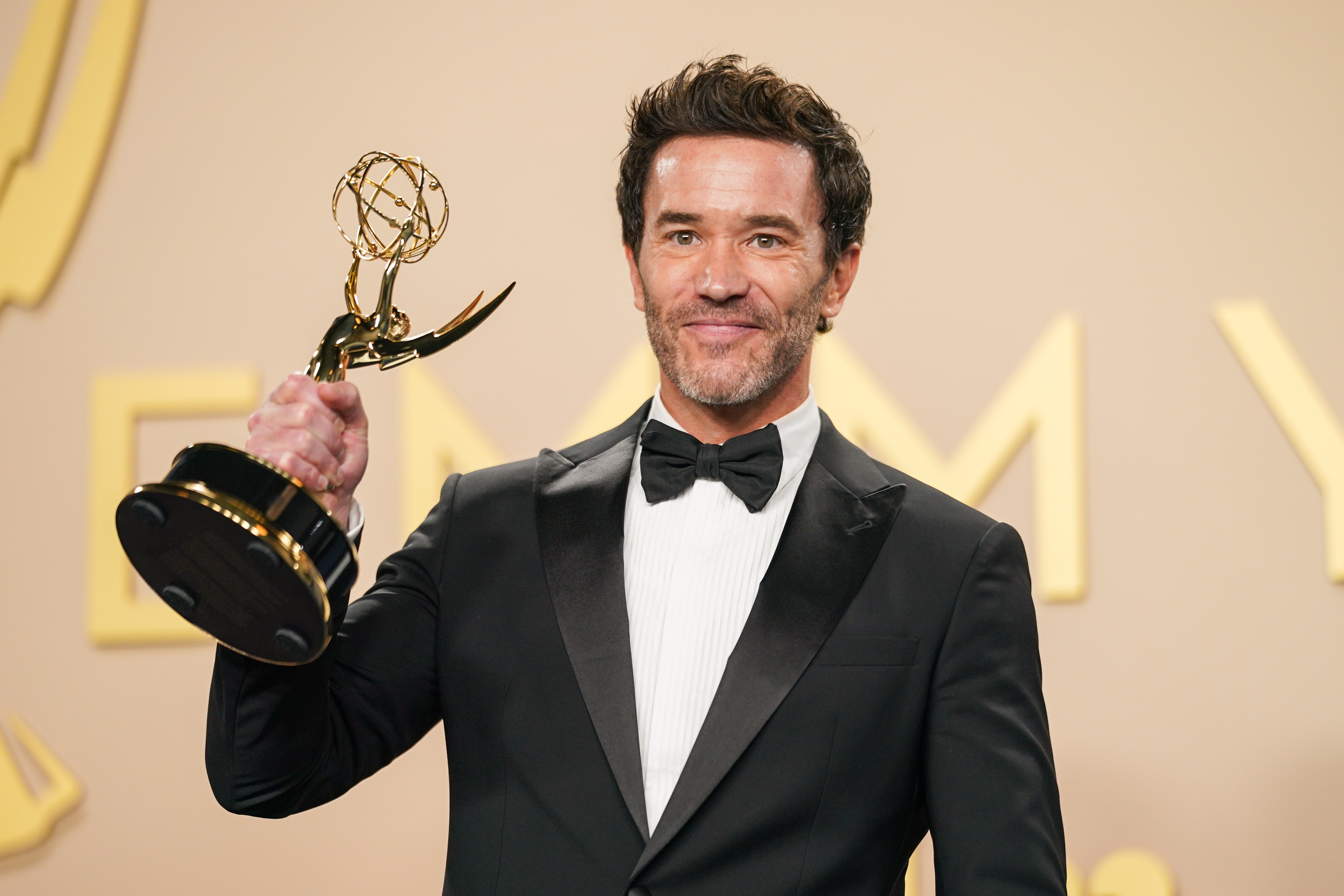
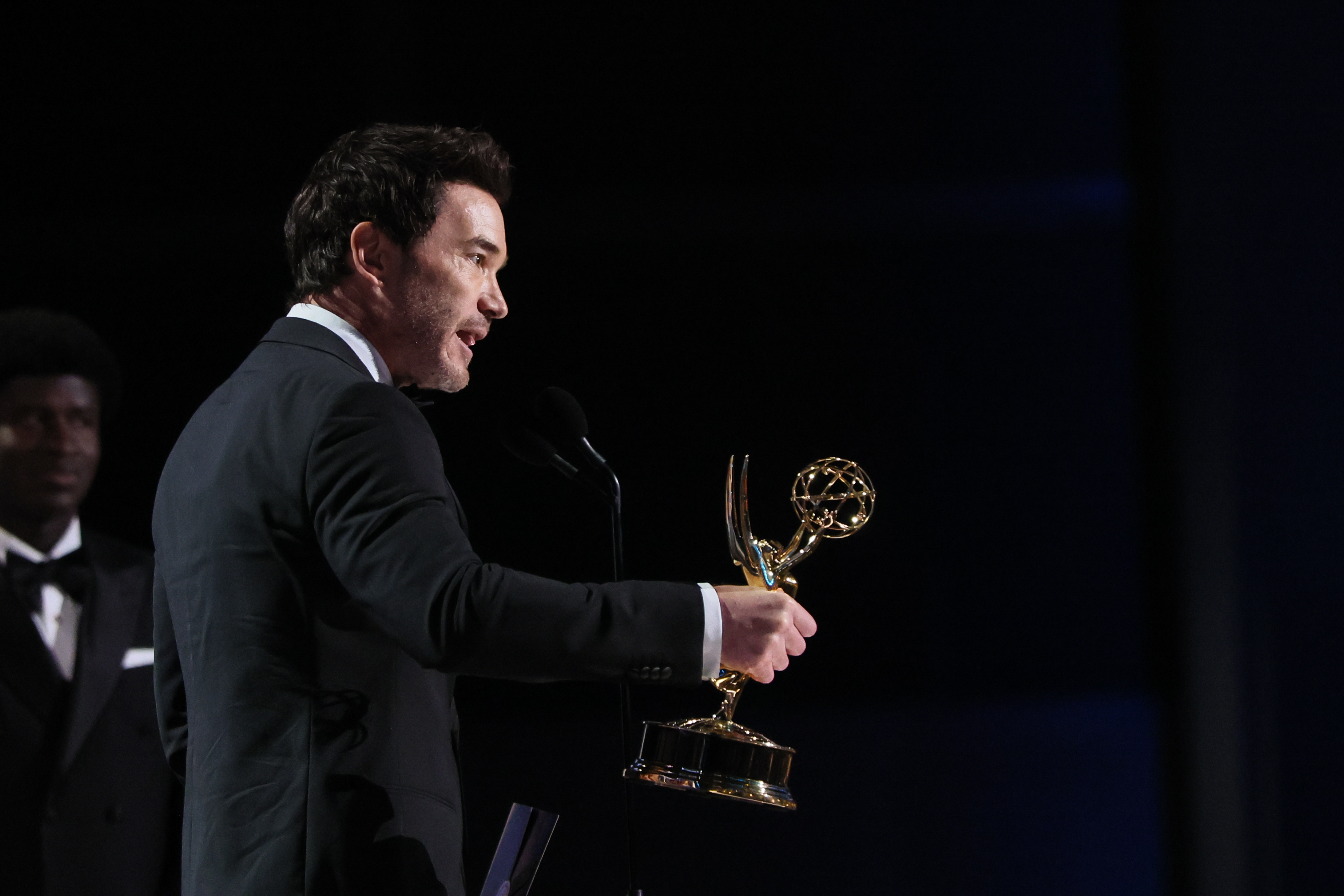
The big, surprise exception was Tom Pelphrey, a Rutgers University alum from Howell Township, N.J., who won for outstanding supporting actor in a drama series for his performance as Robbie Prendergrast on Season 1 of the Delco-set HBO crime thriller Task.
“I thank God for my life and my sobriety. I thank my family and my friends for all your love and support all these years, from Emmys to, you know, black box theaters and everything in between,” said Pelphrey in his acceptance speech before thanking Task creators including directors Jeremiah Zagar (son of South Philly mosaicist Isaiah Zagar) and Salli Richardson-Whitfield, and fellow cast members Mark Ruffalo, Emilia Jones, and Raúl Castillo.
Ruffalo was nominated for outstanding lead actor in a drama for his role as Tom Brandis but lost to Noah Wyle of The Pitt. The Pittsburgh-set emergency room drama received a whopping 25 nominations and took home seven Emmys, including outstanding drama series; Pelphrey beat out three supporting actor nominees from The Pitt for his win.
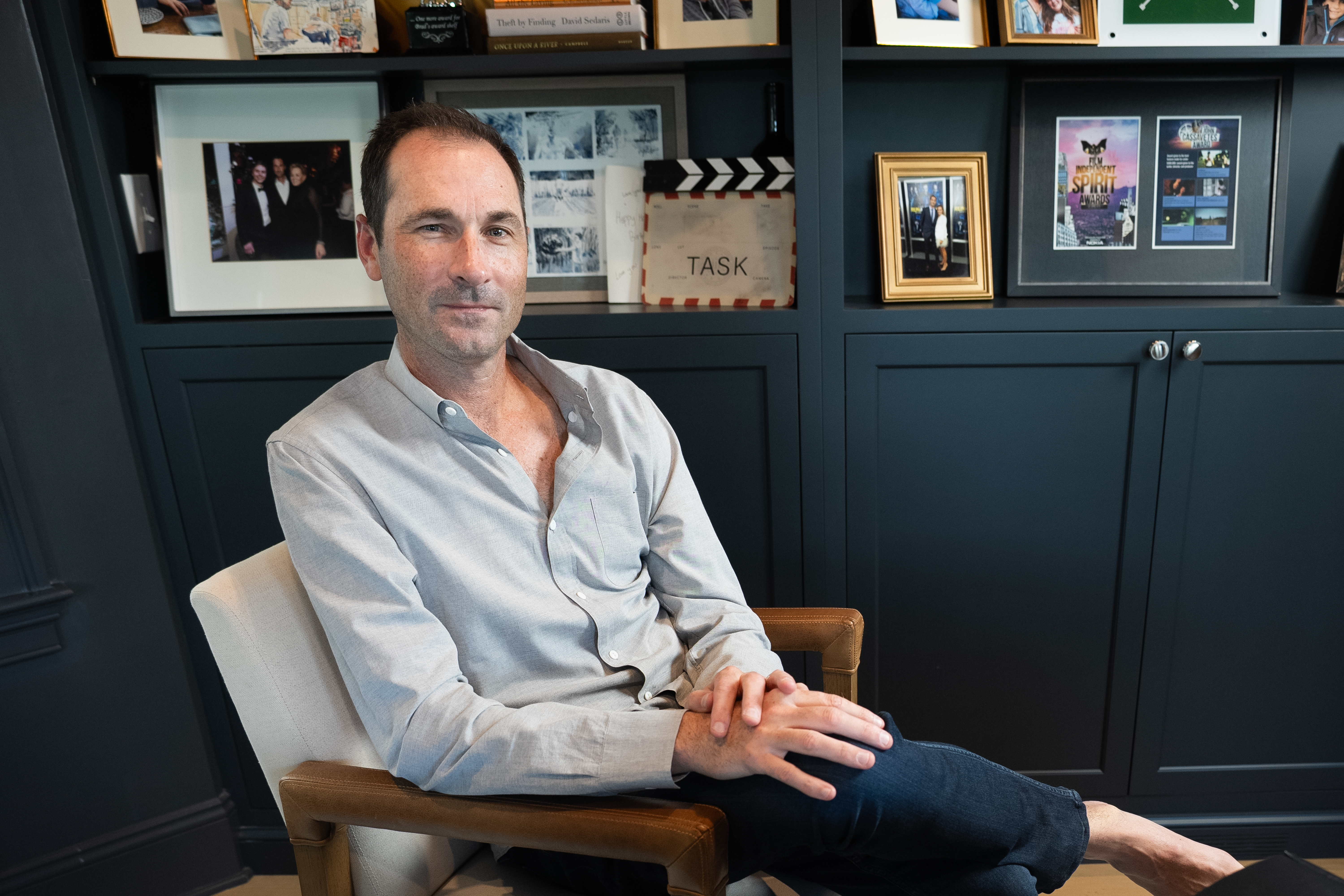
Brad Ingelsby, writer/executive producer of “Task” and “Mare of Easttown,” in his office in Berwyn on July 17, 2025. Jessica Griffin / Staff Photographer
“Thank you to Brad Ingelsby for this incredible role and this opportunity and your friendship. You are an amazing human being. I’m so proud to be your friend,” Pelphrey continued onstage as the camera showed a beaming Ingelsby, the Berwyn-based showrunner. Ingelsby is the writer/executive producer behind Task, which is currently shooting its second season in the Philadelphia area, and the Emmy-winning Mare of Easttown.
In Task, Pelphrey played a heartfelt but troubled trash collector who begins stealing from drug houses in Philadelphia’s collar counties run by a local motorcycle gang that killed his brother. Starring alongside two-time Emmy winner Ruffalo, Pelphrey was a complicated foil to Ruffalo’s priest-turned-FBI agent who hunted him down. The recognition marks Pelphrey’s first Emmy win after he was previously nominated for outstanding guest actor in a drama in 2022 for his role in Ozark.
“Brad is desperately insistent upon each individual’s humanity, so every character he writes is justified, in some sense, with a reason why they’re doing everything that they do — and that’s incredible, because usually that stuff gets sacrificed for plot,” Pelphrey told The Inquirer in a 2025 interview.
Tom Pelphrey accepts the Emmy for Outstanding Supporting Actor in a Drama Series for “Task” at the Television Academy’s 78th Emmy Awards telecast at the Peacock Theater at L.A. LIVE on Monday, Sept. 14, 2026 in Los Angeles. (Photo by Danny Moloshok/Invision for the Television Academy/AP Content Services)AP Photo/Danny Moloshok
Task received six Emmy nods, including outstanding writing for a drama (recognizing Ingelsby’s heart-wrenching finale), directing, picture editing, and cinematography. The dystopian Apple TV+ show Pluribus won for outstanding writing and picture editing, while the directing trophy went to the British spy show Slow Horses and cinematography went to Spider-Noir.
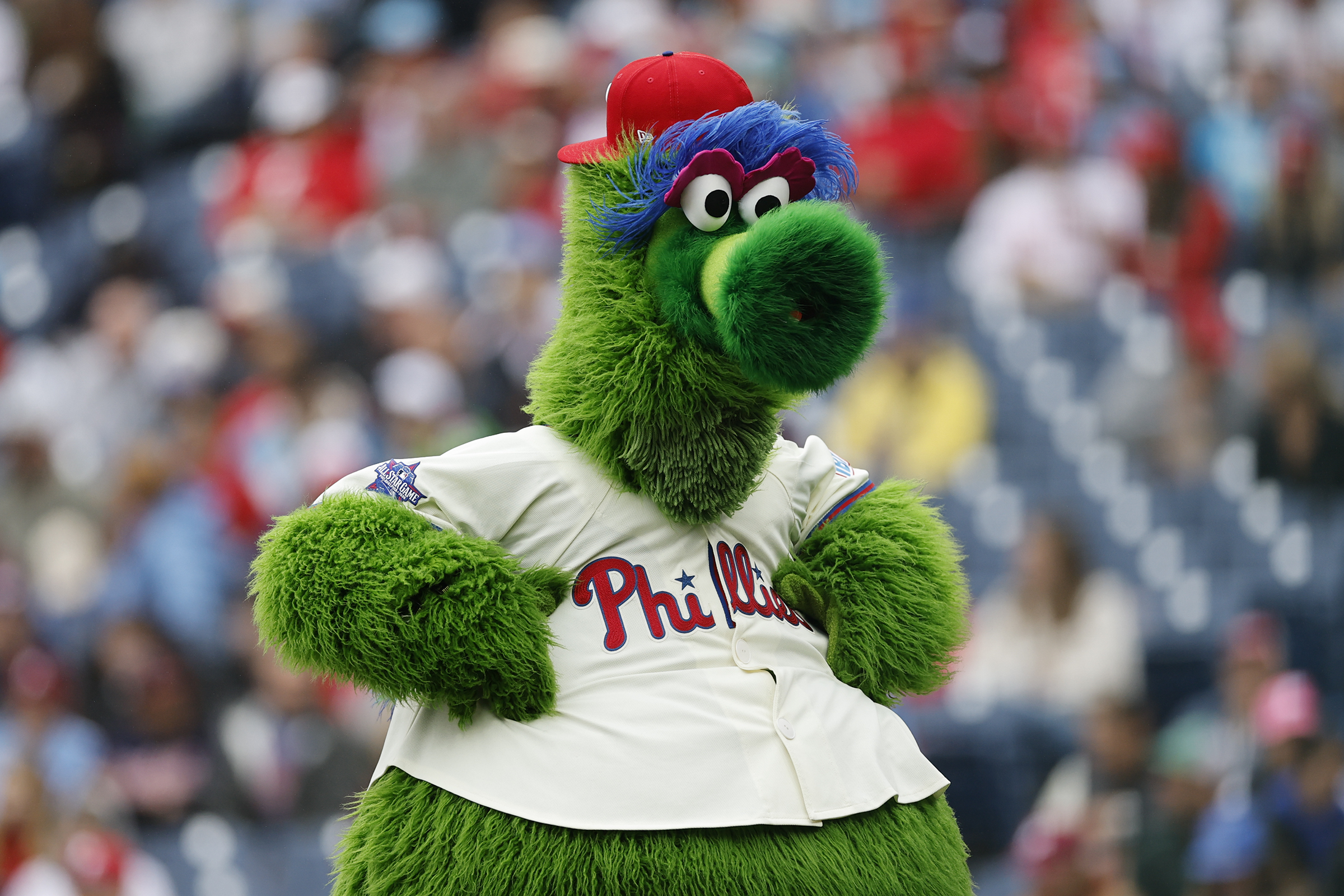
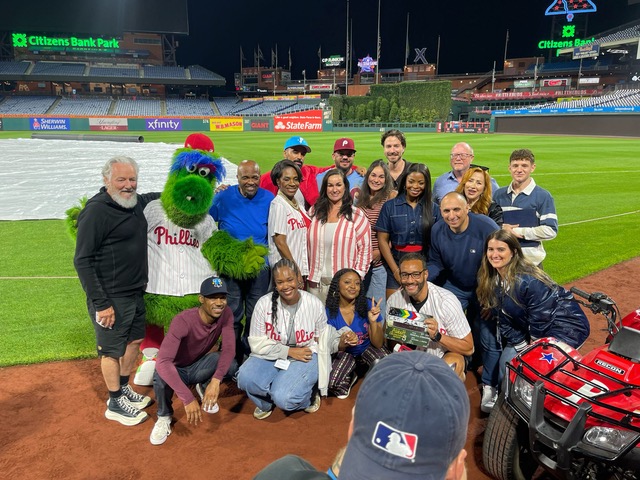
“Abbott Elementary” cast and crew pose with the Phanatic and Phillies player Kyle Schwarber at Citizens Bank Park on Aug. 28, 2025.Vaughn C. Page Jr.
However, the horror-tinged newcomer Widow’s Bay swept nearly all the comedy categories, dominating the stage with a record-breaking 14 wins. Abbott Elementary actors Tyler James Williams and Janelle James were up for outstanding supporting acting in their respective categories but both lost to Widow’s Bay.
Previous two-timeEmmy-winner Brunson was briefly in the spotlight when Emmys host and Law & Order: Special Victims Unit star Mariska Hargitay asked celebrity attendees about their first jobs.
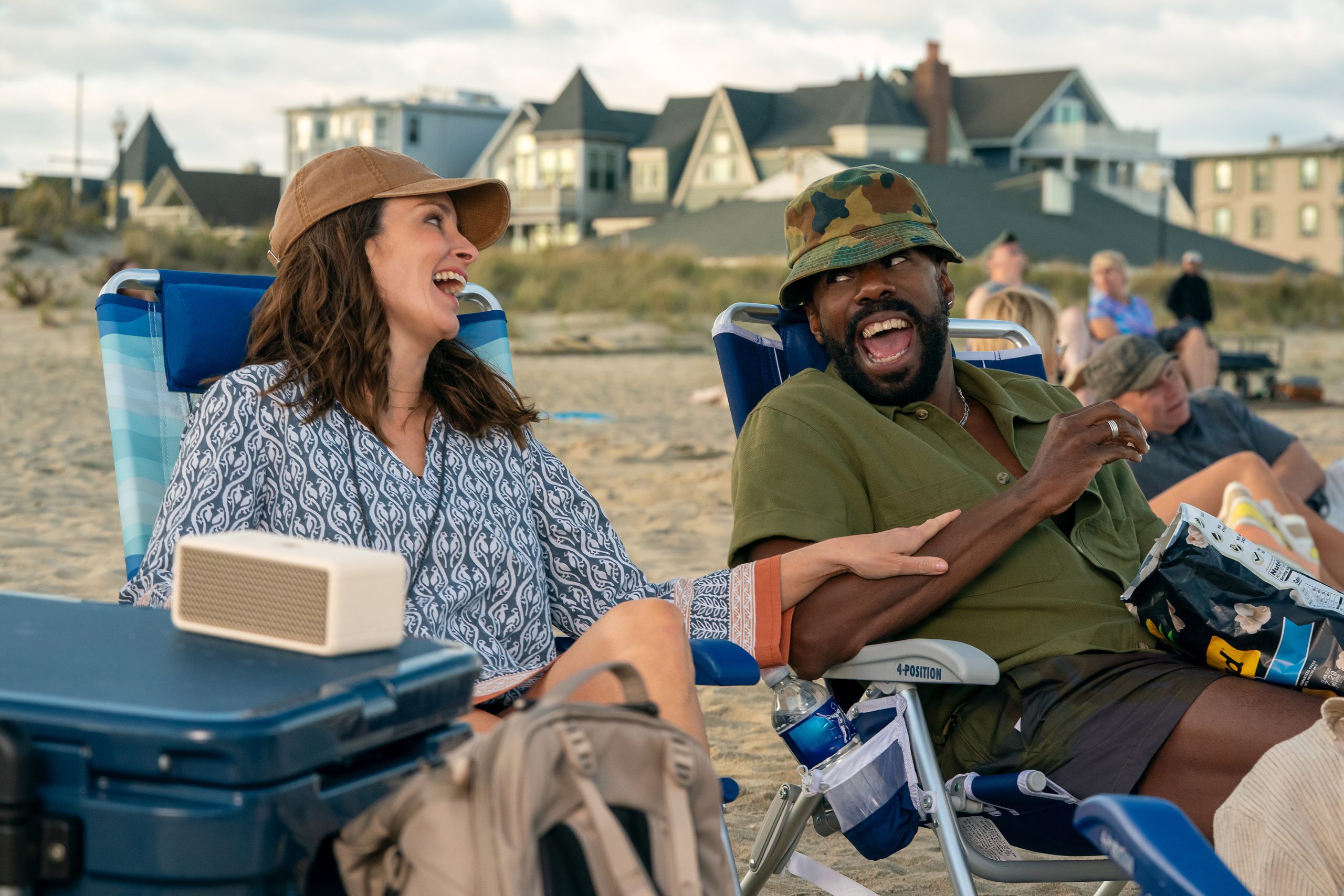
“Oh, I was a student dance schoolteacher,” Brunson answered. Fellow West Philly-raised star Colman Domingo, who was nominated for outstanding guest actor in a drama for Euphoria and outstanding supporting actor in a comedy for Tina Fey’s The Four Seasons, also joined in. His first job, he said, was working the fries station at McDonald’s. (Domingo lost the former category to The Pitt and the latter to Widow’s Bay.)
Tina Fey as Kate and Colman Domingo as Danny in Season 2 of the Netflix comedy series “The Four Seasons.”Emily V. Aragones/Netflix
To celebrate the 30-year anniversary of Buffy the Vampire Slayer, Villanova-raised actor and Malvern Prep alum David Boreanaz joined star Sarah Michelle Gellar for a reunion moment onstage. The son of famous 6abc weatherman Dave Roberts, Boreanaz played the vampire with a soul Angel and later received his own spinoff show. (He’s also a diehard Philly sports fan.)
“You know, Sarah, I always thought that Buffy and Angel would end up together,” Boreanaz said as the pair reflected on the groundbreaking show. “Well, I guess we won’t find out,” Gellar replied in a pointed critique of the recent cancellation of the Buffy reboot that had been in the works.
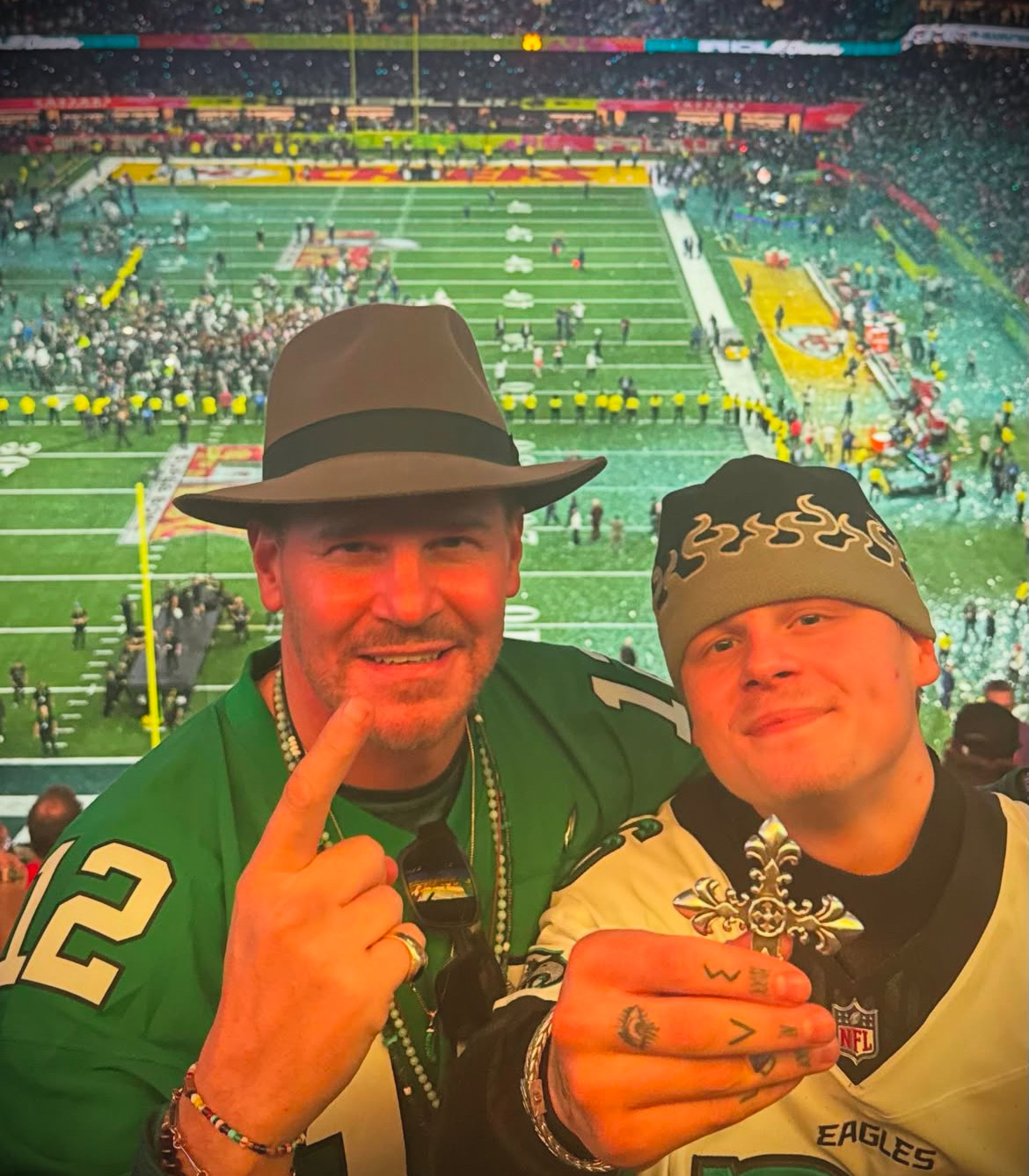
Actor David Boreanaz, wearing a Randall Cunningham jersey, and his son, Jaden, in a Saquon Barkley jersey, at Super Bowl 59 in New Orleans.Courtesy of David Boreanaz
Ahead of the 78th Primetime Emmy Awards ceremony, the Academy of Television Arts & Sciences hosted the Creative Arts Emmys in two events honoring artists behind the scenes in technical categories. Winners from those ceremonies included South Philly comedian Rob Mac — the showrunner behind It’s Always Sunny in Philadelphia — whose FX show Welcome to Wrexhamwon for outstanding sound mixing for a reality program. (It was also nominated for outstanding picture editing and outstanding unstructured reality program.)
Bucks County pop star Sabrina Carpenter also won during the Creative Arts Emmys earlier this month for performing in and executive producing the 50th anniversary special of The Muppet Show, which earned a gold statue for outstanding variety special (prerecorded) — putting her halfway to EGOT status.
Another Philadelphia-connected nominee was Tires, the Shane Gillis-led Netflix comedy recognized for outstanding sound mixing for a half-hour comedy or drama; the trophy went to Widow’s Bay.
At Monday night’s ceremony, one more Pennsylvania celebrity made a cameo: Superstar singer Taylor Swift, who grew up in Reading was not in attendance, but appeared in a prerecorded skit with Hargitay spoofing Law & Order along with Swift’s cat, named for Hargitay’s character, Olivia Benson.
Anastasia Inciardi’s art has made the rounds — her mini prints have become desirable collectibles at museums, arenas, and VIP red carpets nationwide. But her latest collab is particularly special because of what it means to her family.
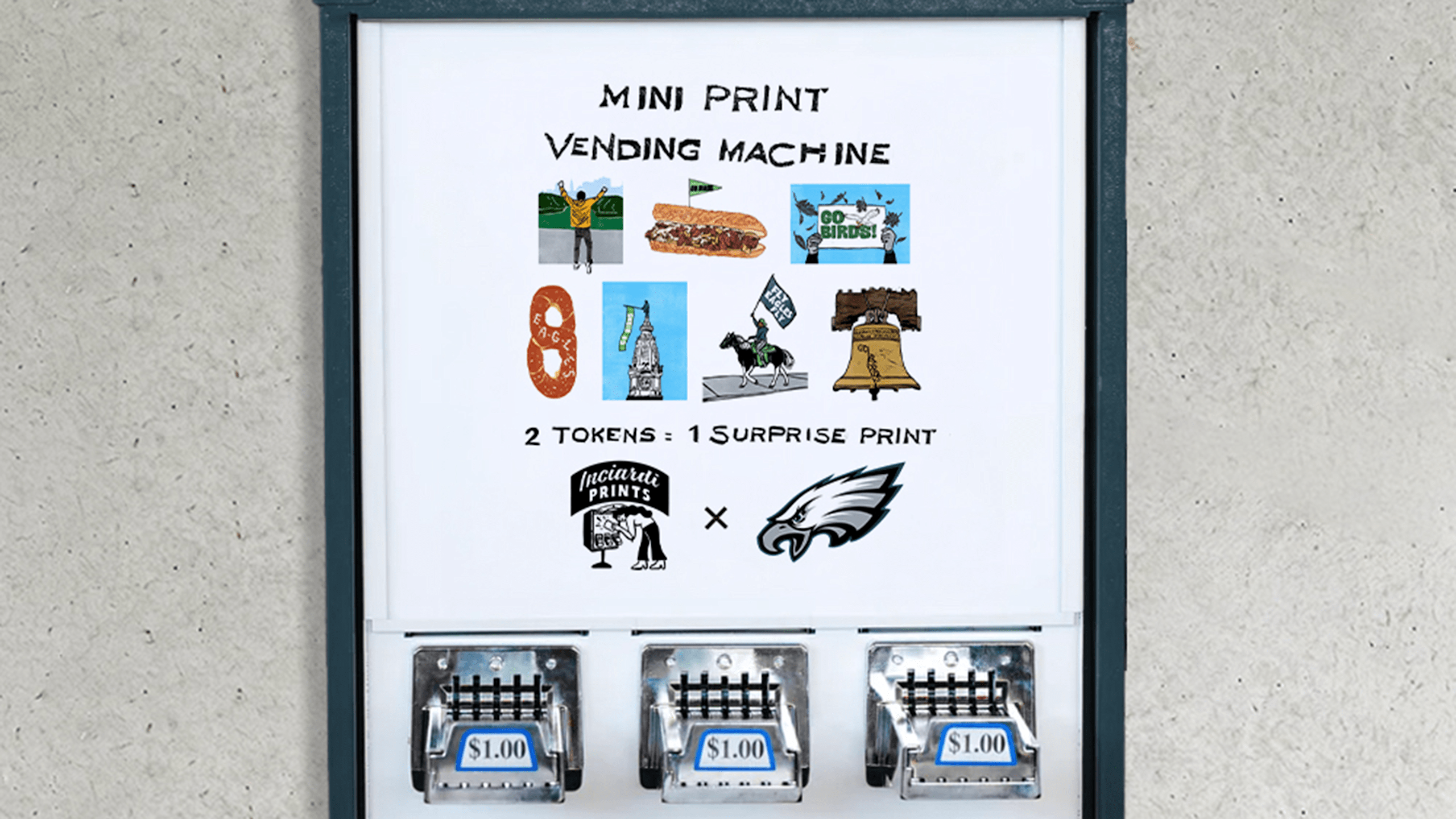
This week, the Philadelphia Eagles announced that Inciardi’s mini-print vending machines would be stationed at Lincoln Financial Field all season. The machines are stocked with football-themed linocut art with designs ranging from a Go Birds sign to an Eagles pretzel.
Inciardi’s worked with big names and brands before — ranging from Harry Styles to Snoopy and the Peanuts gang. But her work with the Eagles marks the artist’s first foray into the NFL.
The Birds are touting the collab as an easy, affordable game-day souvenir. Prints cost $1, and they are about 2.5 inches by 3.5 inches — about the size of a playing card.
For Inciardi, who lives in Portland, Maine, and grew up in Brooklyn, N.Y., the partnership was a no-brainer, given her family’s Philly ties. Her grandmother, two aunts, two uncles, and cousins all live in Philly.
“It’s been an absolute dream come true to partner with the Eagles,” she said. “My family are all die-hard Philly sports fans, so it was an honor to create these prints as an homage to this incredibly dedicated fan base.”
This is the fifth Philly location to host Inciardi machines. Her prints became available in the area in 2024, at book and magazine shop Another Corner, Di Bruno Bros. (the Italian Market bottle shop and Rittenhouse grocery locations), and the Fabric Workshop and Museum.
“When I first started placing my vending machines, I wanted my grandmother to have one within walking distance,” Inciardi told The Inquirer last year. “She’s 85 and loves to walk to Di Bruno Bros., pick up some Romano, antipasti, and a few of my mini prints.”
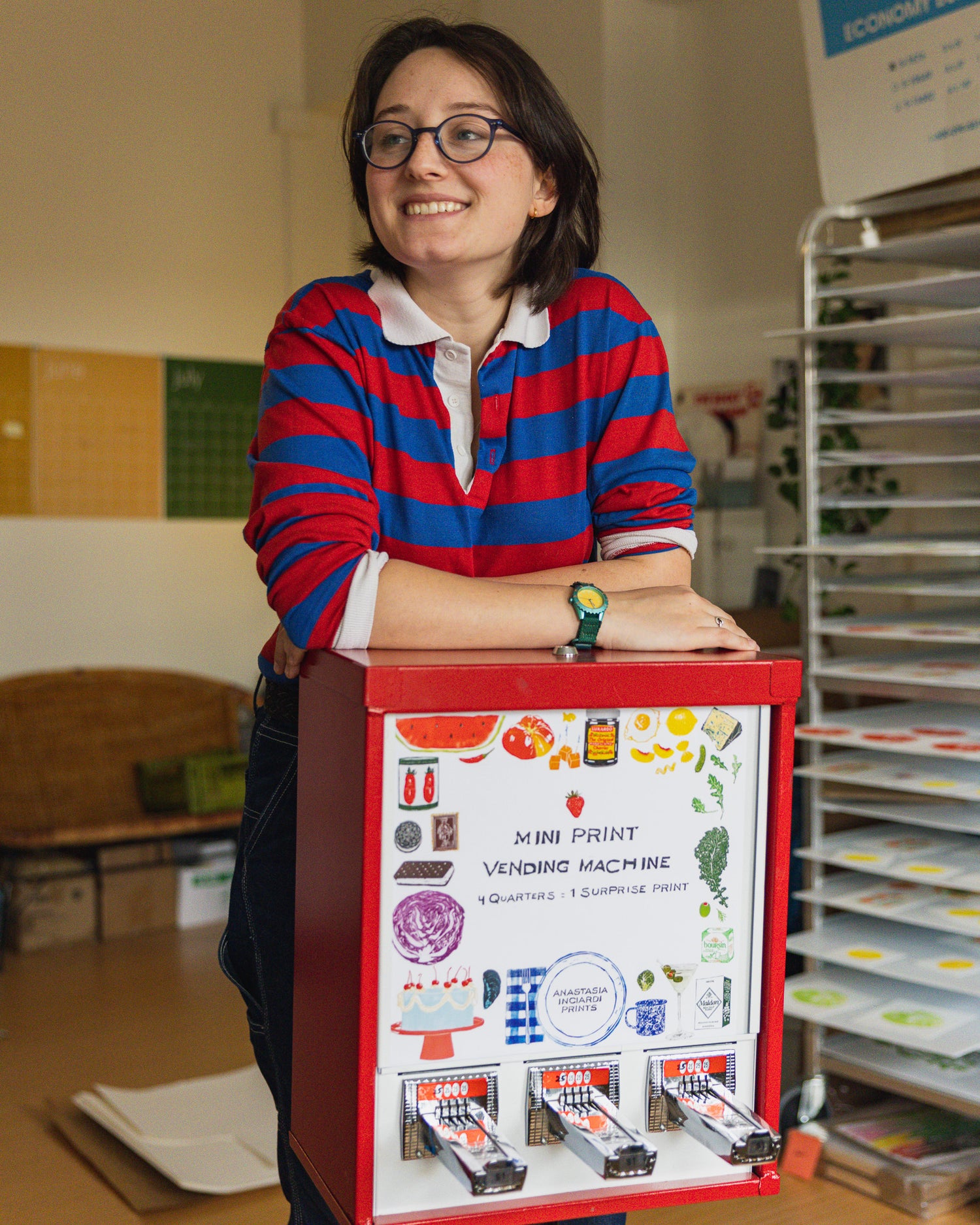
Anastasia Inciardi, a Maine-based linocut artist, poses with one of her popular art vending machines, which have been making appearances nationwide — including in Philadelphia.Courtesy of Anastasia Inciardi
The novelty of vending-machine art has been on the rise because of the pieces’ small size and affordable pricing. Several other artists have since started putting their own spin on the concept — including Philly’s Fabiola Lara, a Latinx illustrator with machines all over town that hold her Riso-printed art. Those artists, including Lara, credit Inciardi for popularizing the concept.
The Linc will host three mini-print vending machines with seven designs at the stadium during games, in Pepsi Plaza, Section 107, and Section 113.
For fans not attending games, the machines will also be accessible at the stadium Pro Shop during the week.
Each print is $1 and redeemable through tokens — not cash. Tokens can be purchased at Pro Shop locations. Additional designs will be added throughout the season, according to the Eagles.