A federal judge wouldn’t let the man-baby in the Oval Office put his name on the Kennedy Center for the Performing Arts. So President Donald Trump shut it down.
Trump claimed on Truth Social that it was closed “for safety reasons.” He also said renovations won’t happen unless his name can be on the front of the building.
So there.
Closing the Kennedy Center is narcissistic even for someone like Trump. His huge ego now stands between Americans and our right to enjoy one of the most beautiful landmarks in Washington, D.C.
Yes, I’m mad.
I grew up in the nation’s capital. D.C. residents are in and out of the Kennedy Center like Philadelphians are in and out of the Kimmel Center. During college, I worked as a tour guide, and I never passed by the building without marveling at its beauty.
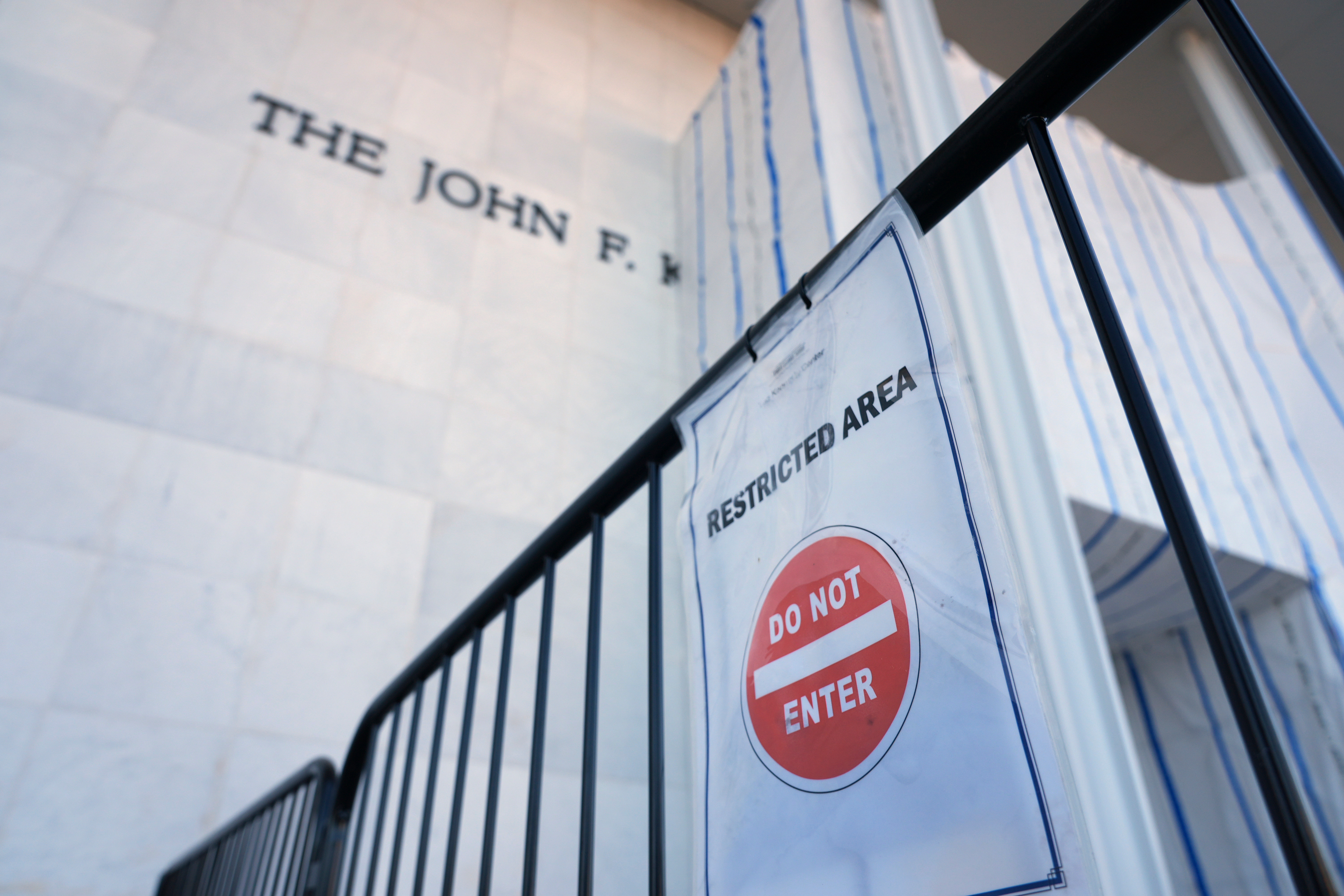
A sign is placed on a gate outside the John F. Kennedy Center for the Performing Arts in Washington, Tuesday.Jacquelyn Martin
I’m grateful that I got to spend time inside twice in recent months. The first time was in June after I took a train to Washington to see for myself what was going on with the Reflecting Pool and Trump’s renovation fiasco there.
Afterward, I headed to the Kennedy Center to see if Trump’s name had been removed as a court had ordered. It was hard to tell for certain because a giant white tarp had been placed in front of the building.
A uniformed guard directed us to a massive sunlight-filled dining room with glorious views of the skyline. Our jaws dropped. We practically had it to ourselves. We were the only visitors. A cafeteria worker piled an extra-large helping of teriyaki salmon and rice on my plate, while my sister placed an order for a smash burger. We carried our trays to a table near one of the gigantic windows so we could enjoy the view. The food tasted as good as homemade.
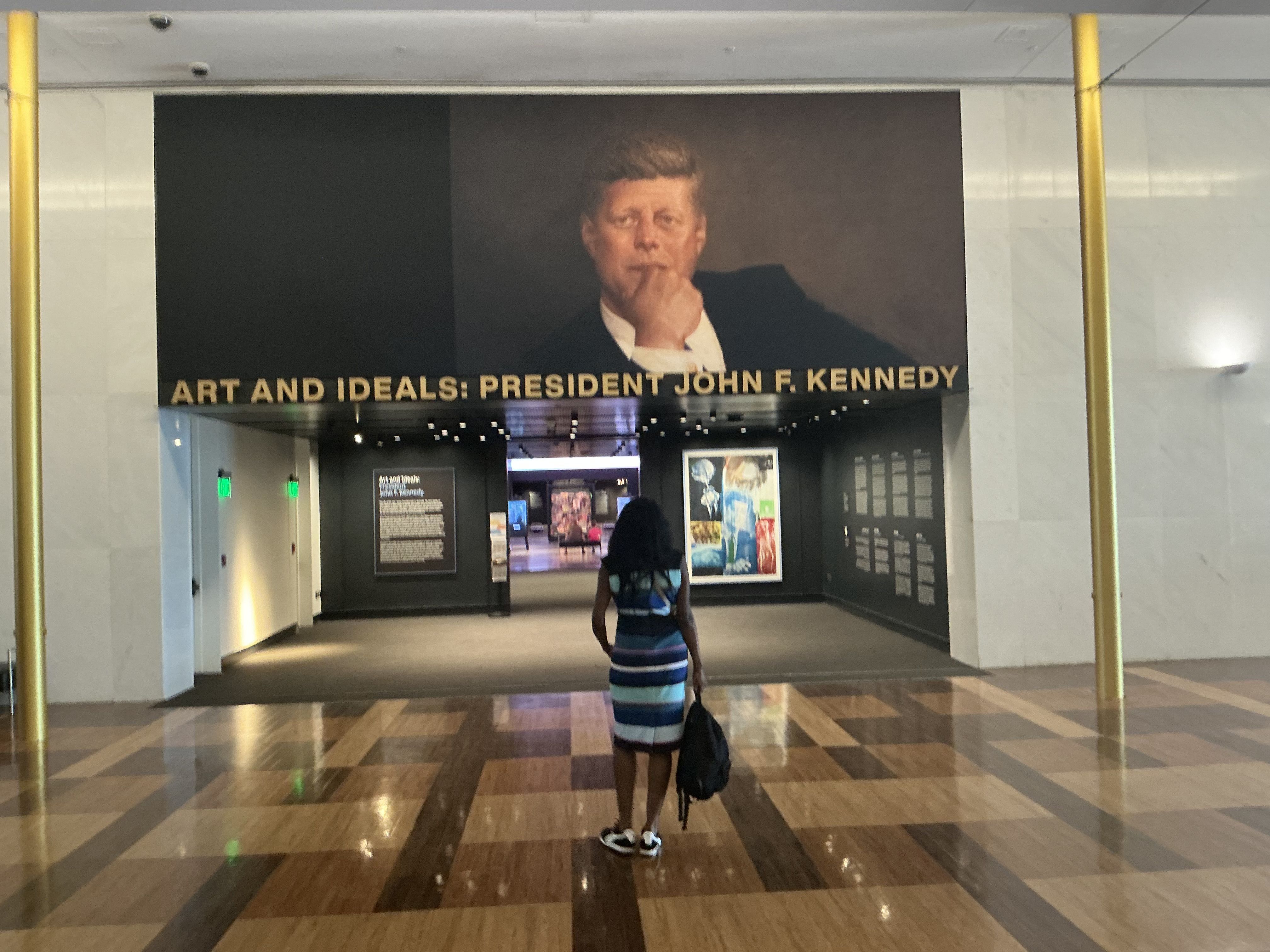
Inquirer columnist Jenice Armstrong pauses outside an interactive exhibit about the life of President John F. Kennedy inside the Kennedy Center for the Performing Arts in Washington, D.C., in June.Jenice Armstrong
Afterward, we decided to explore the interactive exhibit dedicated to the art and ideals of President John F. Kennedy. We took our time wandering around. Perhaps we sensed that with all the orange spray-tanned storm clouds hovering over the institution, this might be a moment to savor — and that a major change was imminent.
Reading about the Kennedy era made me nostalgic. My late parents had been huge fans because of Kennedy’s work advancing the cause of civil rights. My mother admired the grace and style of first lady Jacqueline Kennedy so much that she considered naming me after her.
Kennedy personified youthful optimism. He inspired Americans to be civic-minded and urged people to “Ask not what your country can do for you — ask what you can do for your country.” Kennedy founded the Peace Corps and created the U.S. Agency for International Development, which the Trump administration decimated last year.
I went back to the Kennedy Center about a week later, after returning to the National Mall to write about Trump’s Great American State Fair — which wasn’t so great. This time around, we arrived too late to eat, so we grabbed a few bags of chips and sat in a lobby for a bit.
Again, I took my time at the exhibit about the life and legacies of the Camelot era. I noted how the first lady back then transformed the White House Rose Garden into an oasis.
There are no oases allowed in the Trump era, however. He tore up the roses, poured cement over the garden, and rendered it lifeless.
Sounds a lot like what he’s doing to the Kennedy Center.
District Attorney Larry Krasner didn’t attend the dramatic three-day evidentiary hearing recently in which four supervisors from his office testified about his conflicts of interest, job threats, and other inappropriate steps, following efforts to overturn a murder case.
But Krasner’s take on the imbroglio can be found throughout a recent 47-page federal court filing by his office.
The filing paints a picture of a district attorney unbowed by the controversy that has roiled his office. Krasner’s handling of the exoneration case has prompted one prosecutor in his office to step down following what they described as a loss of confidence in Krasner’s leadership. A federal judge presiding over the case also voiced concern about possible obstruction of justice, perjury, and criminal conspiracy.
Despite admitting “serious errors” in the original motion that said Dennis Johnson was entitled to a new trial, the filing contains no contrition or introspection by Philadelphia’s DA.
In the world according to Krasner, he’s right, and everyone else is wrong.
Krasner’s worldview is hardened by his decades as a public defender and criminal defense attorney before getting elected district attorney in 2017. In the second paragraph of the filing, Krasner’s office blames prior district attorneys for violating “their constitutional duties” to secure convictions.
The filing makes no apologies for how Krasner’s office handled the appeal by Johnson, who was found guilty of second-degree murder in 2009.
After arguing for four years to overturn the verdict, Krasner’s office did a 180 in June, claiming its initial concession was “legally erroneous” and “not supported by the record.”
The reversal came after U.S. District Judge Paul S. Diamond ordered an evidentiary hearing in May. That prompted supervisors in Krasner’s office to take a closer look at the case, in which they discovered “material omissions” in their initial concession claim.
The blunder stems from the failure of Krasner’s office to fully investigate Johnson’s appeal, and its willingness to go along with the arguments put forward by his defense attorneys.
Here’s the bigger problem: That appears to be the way Krasner’s office has handled other post-conviction cases. Under Krasner, more than 60 people convicted — mainly of murder — have been set free or had their sentences reduced following concessions despite no incontrovertible proof of the person’s innocence.
Instead, Krasner’s office has conceded other cases by not mounting a substantive challenge to the arguments put forth by defense lawyers. In many exoneration cases, defendants claim their cases were harmed by their own ineffective lawyers or by prosecutors who withheld evidence; the latter, known in legal circles as a Brady violation, constitutes a major breach of the court’s rules.
Full steam ahead
Judge Diamond has yet to decide if Krasner’s office can continue handling Johnson’s case, or if it should be turned over to the state attorney general because of the issues aired during the evidentiary hearing.
Regardless of the outcome, Krasner appears determined to keep conceding cases.
“The current [district attorney’s office] administration will continue to do its duty under Brady and to self-correct moving forward, regardless of how the instant matter resolves,” the filing said.
The full-steam-ahead approach seems obtuse given the controversy that has engulfed the office’s handling of several post-conviction cases.
In recent months, supervisors in Krasner’s office have been disbarred and suspended for lying in federal court while seeking to overturn the death sentence of a man convicted of killing a couple in their home in East Mount Airy.
In June, the state Supreme Court ordered judges to ask the state attorney general’s office to review any cases in which Krasner’s office wants to alter a sentence or overturn a past conviction.
That unprecedented ruling came after the high court found prosecutors in Krasner’s office misled judges in several post-conviction cases. The court said it could no longer trust the word of Krasner’s prosecutors.
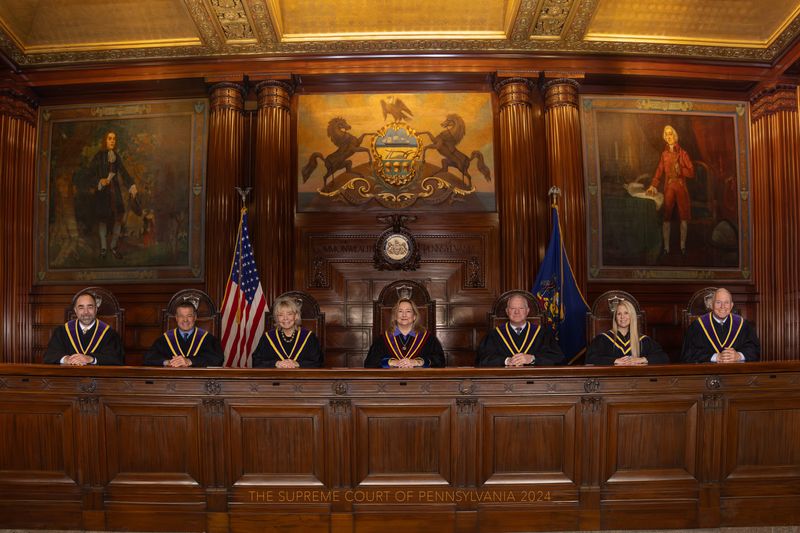
Pennsylvania Supreme Court justices (from left): P. Kevin Bobson, David N. Wecht, Christine Donohue, Chief Justice Debra Todd, Kevin M. Dougherty, Sallie Updike Mundy, and Daniel D. McCaffery. In June, the court ordered judges to ask the state attorney general’s office to review any cases in which Larry Krasner’s office wants to alter a sentence or overturn a past conviction.Provided by Jen Barker Worley/Ad
Office strife
Amid that major setback came the Johnson case, which has splintered Krasner’s office.
After Judge Diamond ordered the evidentiary hearing in May, Katherine Ernst, the chief of training in the law division, reviewed the initial motion to concede Johnson’s conviction and found multiple errors.
Ernst worked with three other supervisors — Steven Wildberger, David Napiorski, and Peter Andrews — who all agreed the motion needed to be withdrawn.
They met with Jaclyn Mason, the assistant district attorney who signed the original motion, and urged her to withdraw the concession and apologize to the judge. Mason argued that her supervisor, Matthew Stiegler, was largely responsible and should also have to sign the motion.
Fearing she would be forced to take the blame, Mason quit in June. That set off a chain of events that exposed the sloppy handling of the matter.
Mason testified in July that Stiegler, the head of the office’s Conviction Integrity Unit, colluded with defense attorneys to develop the legal rationale to have Johnson’s case thrown out.
Mason, who was new to the DA’s office at the time of filing, testified she took direction from Stiegler, who told her that if Johnson’s claims were “good enough for the Innocence Project, it’s good enough for me.”
To be sure, Mason bears some responsibility because she signed the motion and failed to fully investigate the defense claims. But her instinct that she would be thrown under the bus proved correct.
The four other prosecutors testified last month that Stiegler proposed reviewing Mason’s other cases to find errors and tell the judge she was a “rogue” actor.
Krasner backed that plan, telling the prosecutors Stiegler had a good idea.
In the end, Krasner’s filing largely blamed Mason and said the judge “should not credit” her testimony.
Posters featuring criminal justice analytics adorn the district attorney’s offices in May. The controversy over the handling of an exoneration case has splintered the office, Paul Davies writes.Tom Gralish / Staff Photographer
“Mason signed and filed a brief rife with errors that supported the defense’s request for a new trial,” the filing said. “Mason has admitted that she did not review the relevant records, including the trial transcripts, before supporting overturning a murder conviction; she may have simply cribbed and modified the filings of the defense attorneys.”
The filing said Stiegler “failed” to detect the errors, but largely lets him off the hook. Krasner even went out of his way to change a footnote in an earlier motion that initially said Stiegler “edited several drafts” of the original Johnson filing to instead say he “supervised its preparation.” Stiegler remains in charge of the Conviction Integrity Unit even after other supervisors voiced concerns about him.
What conflict?
Meanwhile, Krasner remains adamant his office has no conflict of interest in the Johnson case even after four supervisors withdrew from the case, arguing that they and Krasner had conflicts after the internal machinations went from the legal merits of Johnson’s case to the self-interest of protecting the office.
Krasner’s filing waved away their arguments and said the prosecutors who left the case acted “without authority or a reasonable legal basis to do so.” He added that he “did not appreciate” his team’s “repeated, unsolicited, and wavering advice” to refer this case to the state attorney general.
The filing said any potential conflicts have been resolved by Krasner’s recent hiring of an outside attorney, Jean Peters-Baker, a longtime prosecutor from Missouri, to handle Johnson’s case. The AG’s filing argued that Krasner’s conflict can’t be cured by handpicking an outside prosecutor.
Krasner’s filing did not address the testimony from his own prosecutors who said he warned them there would be “consequences” if they raised the conflict issue with the court.
The prosecutors also said that Krasner refused to refer the case to the state attorney general because he wanted to “protect the office.” Krasner’s filing said his efforts to maintain control of the case were “entirely appropriate.”
The filing did not specifically address Krasner’s comments revealed by the supervisors who testified thathe called prosecutors in the attorney general’s office “Nazis.” But it shed light on his hatred for the state AG’s office.
The filing explained that Krasner had a “general mistrust” of prosecutors in the AG’s office “based upon decades of observing their work.” Indeed, several prosecutors Krasner pushed out after he was elected now work in the AG’s office.
The filing added that “any animus he may have toward individual employees of that office based upon their own actions and inactions has nothing to do with whether he correctly declined to refer a case.”
Krasner is also apparently not a fan of Diamond, whom he views as a hostile judge, according to people familiar with the matter. Krasner’s contempt stems, in part, from the fact that Diamond spent four years in the DA’s office in the late 1970s and early 1980s, and was nominated to the federal bench by former President George W. Bush, a Republican.
So, by Krasner’s logic, is everyone who ever worked in the DA’s office before him tainted?
Krasner’s filing contained a footnote complaining the judge only provided a week, which included a holiday weekend, to address the disqualification issue. The filing added that any ruling that removes his office from the case would be “an abuse of discretion.”
That seems like a particular failure to read the room given the credibility issues exposed in Krasner’s handling of exoneration cases.
Judge Diamond’s ruling will likely have a lot to say about this fiasco.
I’m not a lawyer, but Krasner’s filing doesn’t even seem like the way to win friends and influence people, let alone succeed in a legal argument.
One of the many things we won’t forget about the Trump era is how much the family of POTUS 47 has enriched itself — not only the president but his children, including Donald Trump Jr., who is said to be now worth at least $500 million and growing. So it was no surprise when his second marriage to Palm Beach, Fla.’s Bettina Anderson in May was a lavish affair on two private islands in the Bahamas. What is a surprise — as we now know from some stunning work by a team of reporters from ProPublica — is who paid: a very close associate of Russian dictator Vladimir Putin. So maybe the “Russia, Russia, Russia” folks were onto something?
Pa. Democrats are alarmed at the rapid growth of ICE-police deals. But can they stop them?
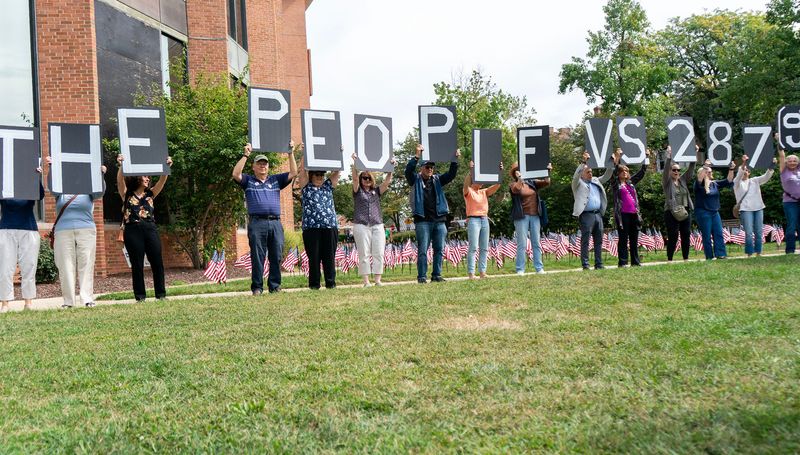
Immigrants’ rights advocacy group members and their supporters hold up letters that read “The people vs 287(g)” during a rally last September in Doylestown against the Bucks County sheriff’s efforts to implement a 287(g) program.Daniella Heminghaus | Bucks Coun
The big, mostly under-the-radar story around the Donald Trump regime’s relentless push to arrest and remove immigrants from the United States has been this year’s explosion of so-called 287(g) agreements. These allow local cops to act as immigration agents, working collaboratively with U.S. Immigration and Customs Enforcement, or ICE.
But if you look at a national map to understand how these 287(g) agreements have spiked from just 135 when Trump retook office in January 2025 to more than 2,500 such pacts today, you’ll notice that one state sticks out like a sore thumb.
In Pennsylvania, amped-up promises of federal cash incentives have meant a soaring number of localities where local beat cops are now working with ICE to make arrests — up from just a handful at the start of the year to some 130 now. Most 287(g) collaborators are in Trump-voting pockets of the Keystone State — northeast and south-central Pennsylvania, or out west near the Ohio border.
But when you look at the rest of the Northeastern United States, the 287(g) map is very sparse. That’s partly because most local pols across the region agree with their constituents about opposing Trump’s mass deportation policies, and in several states it’s also the result of legislation that aims to ban the program altogether.
In late August, New York enacted the Local Cops, Local Crimes Act — backed and signed by its Democratic Gov. Kathy Hochul — which calls on police departments and county sheriffs to terminate their 287(g) agreements, although several counties are still challenging the measure in court. Maryland has a similar law on the books, while New Jersey, which had long prevented such pacts under an attorney general’s directive, also passed a law this spring to codify the ban.
There’s a growing number of Pennsylvania lawmakers who want to pass a similar law here, but there’s one big problem: Republicans. They control the state Senate in Harrisburg — currently by a 27-23 margin — and GOP lawmakers have no interest in rebuking the president on immigration policy.
“The reason we exist alone is because of our split legislature,” State Rep. Heather Boyd, a Democrat who represents heavily immigrant Upper Darby and adjacent parts of Delaware County, told me. Last year, Boyd circulated proposed legislation to ban 287(g) deals in Pennsylvania, and while dozens of Democrats in Harrisburg are supportive, any move is on hold until a November election that could shift the balance of power. Boyd said lawmakers are wary of “starting any culture wars” ahead of the vote.
I pressed the office of Gov. Josh Shapiro, who’s running for a second term and who is seen as a possible top contender for the 2028 Democratic presidential nomination, for his position on reining in the 287(g) program here.
“Governor Shapiro has been clear that law enforcement should be focused on keeping Pennsylvanians safe — not sowing fear in communities or targeting people who are working hard, raising families, and contributing to our Commonwealth,” his press secretary, Rosie Lapowsky, said. She noted that the governor has barred Pennsylvania State Police from any formal ICE collaboration, and he would urge local police to take a similar stance.
She added: “Ultimately, however, these decisions rest with local law enforcement agencies. The governor does not have the unilateral authority to dictate whether individual sheriffs or police departments enter into these agreements.”
Many of those local law enforcement agencies have instead rushed to join 287(g), with ICE promising small-town departments an initial $100,000 cash windfall and additional incentives for training officers to make arrests and to cover the cost ofworking overtime on the program.
Last week, I reported from Schuylkill County in east-central Pennsylvania, where some 14 law enforcement agencies have raced to adopt 287(g), more than any other county in the state. Since the spring, local cops there have arrested about 100 immigrants at highway stops or by assisting ICE in job site raids. The blitz has prompted rising complaints about alleged racial profiling, the handcuffing of U.S. citizens, and a sense of fear that permeates a growing Latino community in Pennsylvania coal country.
Statistics obtained from the U.S. Department of Homeland Security by advocates show that local police in Pennsylvania have arrested and turned over to ICE more than 1,200 immigrants this year — ranking the state fourth in the nation on a list in which the other leading states are all south of the Mason-Dixon Line.
In Washington, some of the state’s Democratic House members say they’re fed up with a lack of transparency over who is being detained and how the 287(g) program is working here. Last week, four of them — Reps. Mary Gay Scanlon and Madeleine Dean from the Philadelphia suburbs and Reps. Chris Deluzio and Summer Lee from Western Pennsylvania — sent a letter to ICE’s acting director David Venturella demanding information on why the agency’s data lack any specific details about which departments are making arrests, which is required by law.
“It is unacceptable to me that ICE is hiding information from Pennsylvanians about who ICE is working with in their mass deportation regime,” Deluzio — viewed as a potential 2028 primary challenger to embattled Sen. John Fetterman — told me in an emailed statement.
Deluzio also summed up the growing unease by many over the speedy growth of 287(g) in the state. “Let’s keep local law enforcement focused on local public safety, rather than enlisting them in extreme federal immigration enforcement that has ripped away American liberties and targeted so many law-abiding families,” he said. Indeed, 287(g) data guru Andrew Thrasher has reported that a whopping 70% of the immigrants arrested in Pennsylvania under the program have no criminal record or pending charges.
“People in my community are getting smashed off the streets,” said Boyd, the Upper Darby lawmaker. That Delco township is about to vote on a local ordinance to restrict its cops from collaborating or sharing data with ICE.
Statewide, Boyd says she’s one of about 50 House Democrats in a Welcoming Pennsylvania Caucus with an extensive list of proposed bills that would not only bar 287(g), but look to expand opportunities for noncitizens to do things like obtaining driver’s licenses or gain professional certification. But any serious action hinges on November, when Democrats are hoping a blue wave at the ballot box will flip at least three more Senate seats and create a trifecta for their party in Harrisburg.
“Even if we can’t stop ICE from picking them up on the streets, we have to protect their rights,” Boyd said. “And right now, there are barriers to that in the state of Pennsylvania.”
Yo, do this!
The issue of wrongful convictions is back in the news here in Philadelphia — but for all the wrong reasons. Some reckless and seemingly wrongheaded moves by Philadelphia District Attorney Larry Krasner and his underlings have the vultures who’ve always opposed criminal justice reform circling. The shame is that the real crisis around wrongful conviction is the thousands of mostly Black and brown folks who remain behind bars for crimes they did not commit. I cannot say enough about a book that came out earlier this year from Brown University (yay!) sociologist Nicole Gonzalez Van Cleve called Crime Fictions: How Racist Lies Built a System of Mass Wrongful Conviction. She mines the most outrageous prosecutions — often of young Black teens and boys — to make a compelling argument that wrongful convictions aren’t a flaw in the criminal justice system. They are the system.
If timing is everything, then you’ve got to hand it to my freshman dorm pal at Brown who became Washington bureau chief for Mother Jones, David Corn. On the heels of ProPublica’s bombshell reporting on ties between the Trump family and Vladimir Putin, Corn is out Tuesday with his newest book: How Russia Won — Donald Trump, Vladimir Putin, and the Fight for America. It promises a raft of new information about Russia’s efforts to meddle in U.S. elections in 2020 and 2024, the ongoing close links between Team Trump and Team Putin, and how the current president’s pro-Russian slant has changed the world.
Ask me anything
Question: What happens when [House Speaker Mike] Johnson refuses to seat newly elected Dems in January? — David Minckler (@audivita.bsky.social) via Bluesky
Answer: Suddenly, Jan. 3 — the date the 120th U.S. Congress begins, and new members who won their November elections are to be sworn in — has become the new Jan. 6. Summer vacations are over, and the body politic is focused on the looming midterms, and — more importantly — with polls showing the Democrats on track to retake one and possibly both chambers. So there’s been a surge of speculation that the Trump-allied Johnson will do what former Vice President Mike Pence would not do on Jan. 6, 2021, and somehow fail to certify Democratic winners. That’s based on an assumption that Trump’s election-meddling tactics like stopping mail voting — blocked on Monday by the U.S. Supreme Court — won’t work, yet Team MAGA will attempt to undo the election after the fact, as was tried unsuccessfully in 2020-2021. Lawfare has published the most detailed analysis of a so-called rogue clerk theory in which Johnson appoints a MAGA loyalist to serve as House clerk with the understanding that some Democratic wins won’t be certified. Its article notes that such a gimmick is unlikely to pass muster in the courts, but that won’t necessarily stop Trump and the GOP from trying. My only guidance is: Fasten your seat belts.
What you’re saying about …
It turns out readers of the newsletter aren’t eager to join the punditocracy. Only a few of you responded to last week’s question about the chances of a Democratic-led Senate in 2027, and one of them was to give me a verbal tongue-lashing for even asking this. (Frequent writer Daniel Fleisher called it “a pointless exercise in predicting the unpredictable.”) That said, Cathy King has her eye on Abdul El-Sayed in Michigan, her home state, writing that “he seems to be following [Zohran] Mamdani’s playbook.” Meanwhile, in Iowa, Mary Chilton thinks the Dems’ Josh Turek has a real shot in a state won three times by Donald Trump, noting that farmers are up in arms “over the data center issue, imported beef, water pollution and the soaring cancer rates …”
📮 This week’s question: Suddenly, everyone is talking about one thing: the Silicon Valley whistleblowers saying there’s not a trivial chance that a swarm of angry artificial intelligence agents could wipe out humankind by the end of the decade. Are you worried by this, or do you think Big AI is deflecting here to draw attention away from other issues like data center opposition or the stock market bubble? Please email me your answer and put the exact phrase “the AI threat” in the subject line.
Backstory on that other thing that could kill humanity
A barge on the Ohio River moves past the Mountaineer Power Plant, a coal-fired power plant near New Haven, W.Va., in March.Carolyn Kaster
This weekend, a Bluesky post went super viral almost the second its author, a scientist named David Ho, hit the button to post it. “I resigned from ExxonMobil today,” he wrote. “I spent the last three years doing fossil fuel extraction research at both BP and ExxonMobil. Neither company is acting responsibly. They are racing to maximize extraction while the window to act closes, and gambling with our lives.”
It’s a safe bet that many of the 13,000 people who liked Ho’s post truly believed they were sharing the words of a brave whistleblower — but instead the post was satire from a leading climate scientist based at the University of Hawaiʻi at Mānoa. Ho would never work for a Big Oil giant. He was trying instead to mimic — and thus make a point about — the recent posts from Silicon Valley whistleblowers that triggered the new freakout over whether AI robots are a threat to human existence.
Climate change is a threat to society, and it’s even closer to reality. Maybe we should freak out about that?
Ho absolutely has a point. Just before his post, it was announced that August had been tied for the hottest month ever recorded in the history of the planet. That doesn’t come without consequences. In the Himalayas between Nepal and Tibet, a glacier and the adjacent bedrock of mountains at 17,000 feet abruptly collapsed in a region plagued by higher-than-normal temperatures, sending a 150-foot-high cocktail of floodwater and debris down a populated valley at 100 mph. At least 1,386 were killed, and thousands more remain missing. Here in the U.S., a summer of record heat triggered wildfires across the Pacific Northwest.
Robots didn’t do this. Humans did. Maybe that’s why humans — at least the ones that are running Donald Trump’s America — are reacting so differently to the danger of AI than the way they’re dealing, or not dealing, with the lethal pollution from burning fossil fuels. In the case of artificial intelligence, even tech leaders like Anthropic’s Dario Amodei, whose firm makes the Claude program, have urged a slowdown until we better understand the risk from rogue AI agents.
But in the case of climate change, willful ignorance rules the day. The latest outrage from a Trump regime that’s expensively killing off wind farms while racing to extract as much fossil fuel as possible? The now ironically named Environmental Protection Agency is repealing the rule that limits greenhouse-gas emissions from power plants that burn coal or natural gas. A president who spent his summer sweltering on the golf course continues to insist climate science is “the greatest con job ever perpetrated on the world.”
There’s one last irony here. Increasingly, the biggest new sources of climate-altering pollution are the massive data centers that power AI. An Amazon data center proposed for Pecos County, Texas, would likely become the world’s largest source of carbon dioxide if it opens, spewing out 33 tons from natural gas generators every year. Slowing down the AI arms race would also help the planet. Artificial or not, that would be intelligence.
What I wrote on this date in 2019
Joe Biden performing badly in a presidential debate? Say it ain’t so, Joe. We all remember what happened on that 2024 stage in Atlanta (“The night the lights went out in Georgia,” I called that one), but I was almost as unimpressed with the future 46th president during a Democratic primary debate on this date seven years ago. That put me at odds with the punditocracy. I wrote, “The cable TV news show that both channels and is most revered by Washington’s elites — MSNBC’s Morning Joe — is at times so over the top in its bias toward Barack Obama’s former wingman that it could be renamed Morning Joe Biden.”
Summertime is over, and the living is no longer easy. I published my monthlong investigation into local cops collaborating with ICE under the controversial 287(g) program in semirural Schuylkill County, northwest of Philly. I found U.S. citizens handcuffed, families hiding behind blanket-covered windows, and a community wrestling with what it means for neighbors to be treated as suspects. Over the weekend, I delved into the astonishing $850 million or so Trump World has raised in campaign contributions since his reelection — despite the fact that he’s barred from seeking office again. You don’t think he has a scheme to pocket the excess cash, do you?
Dante only had Nine Circles of Hell, but the downward spiral of Pennsylvania Sen. John Fetterman seems to be never-ending. It’s one thing to profoundly disagree on a political and moral issue such as the war crimes of Israel’s right-wing government in Gaza, but recent reporting suggests things are far, far worse in Fettermanland. No senator — regardless of how much their ideology has flip-flopped — should be blowing off their home-state constituents, or clocking out of committee hearings after five minutes. The Democratic senator’s surprise video appearance at the midterm miniconvention of Donald Trump’s GOP, introducing his new best buddy, Republican Sen. Dave McCormick, did nothing to dispel the sense of utter betrayal among liberal voters who now see his winning 2022 campaign as a big lie. The next two years will be crazy as Democrats line up to primary Fetterman, amid rumors the hoodie-clad politico might run as an independent or even change parties. The only sure thing is that The Inquirer will be there for every move. Join us. Subscribe!
By submitting your written, visual, and/or audio contributions, you agree to The Inquirer’s Terms of Use, including the grant of rights in Section 10.
Tuesday is the first day of Hispanic Heritage Month, which runs from Sept. 15 to Oct. 15. I’ve always had a bit of a love/hate relationship with this month, which purports to recognize and celebrate that Latinos have been a formative part of the nation since its early days. While the attention to the extraordinary individuals and myriad cultural heritages that comprise “Latinidad” in the United States is gratifying, it is, by its very nature and time limitation, a glancing and shallow attention.
Even so, I always note the arrival of a mass email from the mayor’s office about the events the city has programmed to mark the month.
This year, I’m still waiting.
As yet, there’s been no email from the city of Philadelphia announcing any special programming during Hispanic Heritage Month, and nothing when I search for that on phila.gov.
Screen capture of a search for “Hispanic Heritage” month on the phila.gov website on Monday.Screen capture of phila.gov
There aren’t even links to information about two signature events that took place this past Sunday: La Feria del Barrio (organized by Taller Puertorriqueño) and the Mexican Independence Day Festival (organized by the Mexican Cultural Center), nor even the unofficial culminating event in Philadelphia — the Puerto Rican Day Parade, which Concilio has been hosting for more than 60 years — on Sept. 27.
While I’d like to say I’m completely surprised by the elision of Hispanic Heritage Month that the city is doing, I’m not.
Francisco Gonzales, of Lawrenceville, N.J., dances with his daughter Bianca, 17, near the stage as musicians perform at last year’s Mexican Independence Day Festival at the Independence Blue Cross RiverRink at Penn’s Landing.Tom Gralish / Staff Photographer
Philadelphia’s Latino communities get surprisingly little respect — outside of the high regard for our undeniably wonderful food and dance moves — from our electeds, and have long been slighted by city government in far more significant ways.
For me, nothing epitomizes that more than an example from 2015, when there was a Latino managing director and even so, then-Mayor Michael Nutter convened — at the behest of Attorney General Eric Holder and the U.S. Department of Justice — a Philadelphia roundtable about the imperative of improving police-community relations at which there wasn’t a single person from a Latino-serving organization at the table. In a city where our community was subjected to relatively high stop-and-frisk rates, experienced excessive force incidents (and still does), was historically targeted for extortion by police, and was (and still is) racially profiled by police and U.S. Immigration and Customs Enforcement.
No. Latinos. At. The. Table.
Is it simply that our political capital has been stagnant since the 1980s — or is there something else?
We’ve had three Latino primary contenders for mayor (two in 2015 and one in 2023), but no substantive progress when it comes to the political power necessary to be taken seriously in Philadelphia.
To wit, in 1983 Philadelphia elected its first Latino City Council member, and a year later it elected a Latino state legislator (the second in the city’s history). The census conducted in 1980 put Philadelphia’s Latino population at 3.9% of the city’s total. Fast-forward some four decades, and Latinos are now about 17% of Philadelphia’s total population, but we still have only one Latina City Council member, and just two Latino Philadelphia state legislators.
But departments and offices reflect the administrations they are part of, and Mayor Cherelle L.Parker has sent mixed signals to her Latino constituents.
On the one hand, she has addressed issues in Kensington in concert with District 7 Councilmember Quetcy Lozada — who is a well-liked and respected Boricua leader. On the other hand, she had to be dragged, kicking and screaming, by City Council’s veto-proof “ICE Out” proposals into offering any public comment about ICE actions under President Donald Trump.
Or maybe the offices that are meant to be in conversation with, and about, Philadelphia’s Latino communities aren’t up to the job?
I’m willing to offer the benefit of the doubt: Maybe they are focusing on important work behind the scenes. But in my opinion, they have minimized Latino visibility — to our detriment, and to all of Philadelphia’s detriment.
I was struck recently by the events the Office of Immigrant Affairs is publicizing as part of its Welcoming Week 2026 (from Sept. 10 to 25), for example. The focus this year is on the Caribbean, but in the publicity I’ve received (or dug up) about it, there seems to be nothing scheduled about or from the Spanish-speaking Caribbean. The thing is, this isn’t a zero-sum game — we can (and must) celebrate our significant Haitian and Jamaican communities, for example, and their incredible cultural contributions to Philadelphia, without ghosting our Dominican and Boricua ones.
So, come on, send that Hispanic Heritage Month email, Mayor Parker. List those events and programs on the website. Latinos are here and doing amazing things in service of our city. We should celebrate that together.
Here’s what you need to know about free speech on America’s college campuses: We’re all Marxists now.
No, we’re not those “crazy communists” whom President Donald Trump denounced at the Republican midterm convention in Dallas last week. I teach at the University of Pennsylvania, where nearly two-thirds of undergraduates enter finance, technology, or consulting. If I’m trying to convert them to Karl Marx, I’m doing a very poor job of it.
I’m talking about the comedian Groucho Marx, who authored the world’s funniest testament to hypocrisy. “These are my principles,” Groucho quipped, “and if you don’t like them … well, I have others.”
That’s the big takeaway from the annual report on campus free speech by the Philadelphia-based Foundation for Individual Rights and Expression (FIRE), which came out on the same day as Trump’s convention diatribe. We’re not communists or anarchists or any of the other slurs he lobbed at us. We’re hypocrites. All of us. On campus, and off of it.
Witness the response to the murder of conservative activist Charlie Kirk last fall. After complaining for years about “cancel culture” in American higher education, GOP politicians led the drive to fire or suspend professors and students who said the wrong thing about Kirk.
Meanwhile, left-leaning academics who had supported speech codes prohibiting “violent” speech insisted that comments praising the violence against Kirk must be protected. They were correct about that: Nobody should have been penalized for what they said about him. But there was no acknowledgment — none — that we had erred in trying to censor others.
Instead, as the FIRE report demonstrates, the censorship continued. Dozens of schools blocked conservative students from establishing chapters of Turning Point USA, the organization Kirk founded. And where chapters already existed, we tried to shut them down.
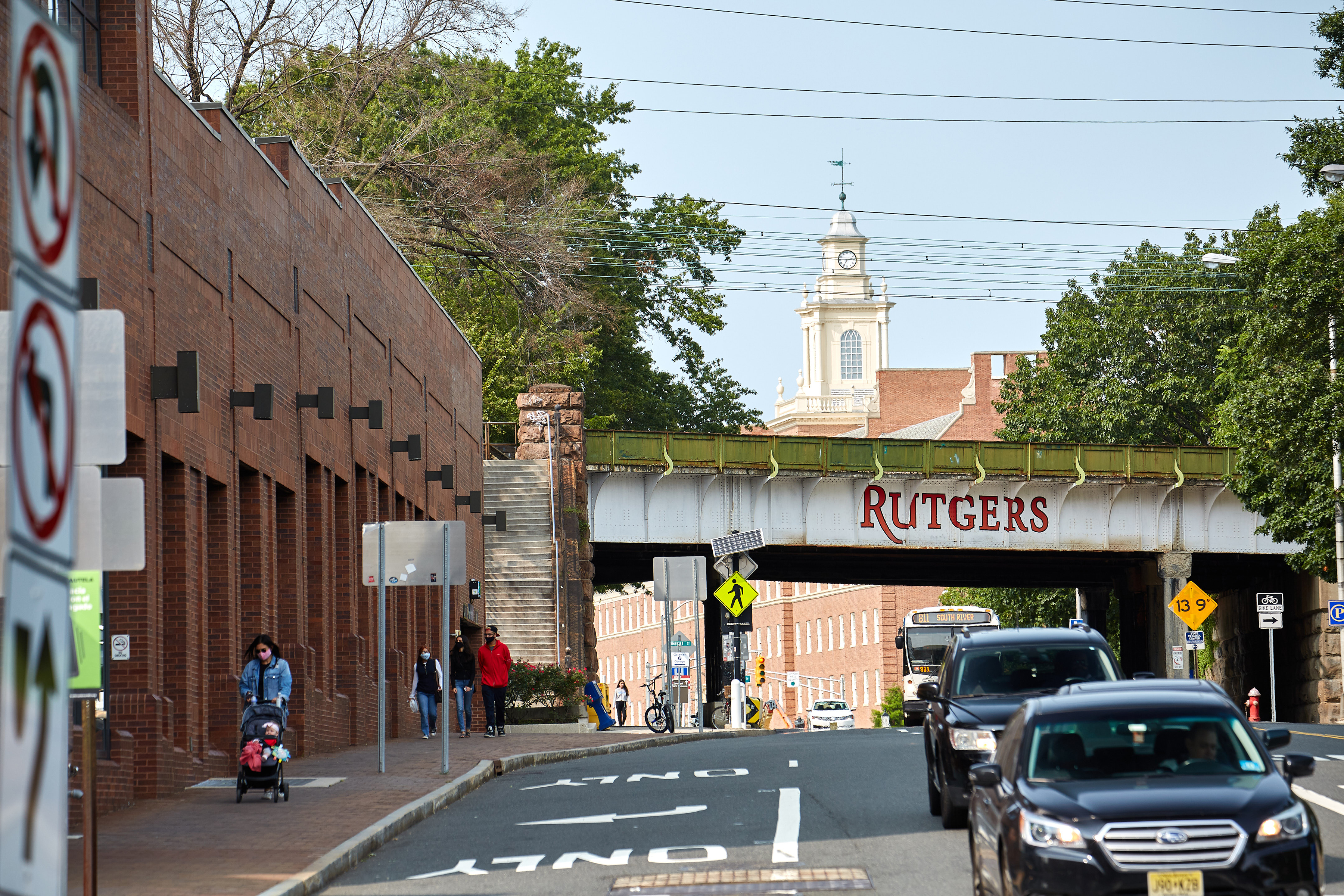
At Rutgers, for example, more than 7,000 people signed a petition asking the university to disband its TPUSA chapter because it made people feel unsafe. “It is imperative that we take decisive action to restore security and the feeling on inclusivity to the campus,” the petition declared.
Meanwhile, the Rutgers TPUSA chapter issued its own petition calling on the university to fire a history professor because of his alleged ties to antifa. Why? You guessed it: People felt unsafe. “Having a prominent leader of the Antifa movement on campus is a threat to conservative students,” the petition claimed.
Remember when right-wingers denounced liberal “snowflakes” on campus? Now everyone is a snowflake, just like we’re all (Groucho) Marxists. If you don’t like someone’s opinion, just say it threatens your safety. It will work.
And it will make everyone afraid to speak, no matter their politics. At Penn, the FIRE report notes, over half of surveyed students said they have self-censored on campus at least once or twice a month. “In classrooms, it is difficult at times to express full opinions without causing someone to become upset,” one Penn student told FIRE.
What’s wrong with that? If I write a column and nobody becomes upset, it was a lousy column. To be clear, I never go out of my way to offend anyone. But I take it for granted that if I have something meaningful to say, some readers will be angered or annoyed by it.
On our campuses, by contrast, causing upset has become a dangerous thing. Best to keep your big mouth shut, lest you get on the wrong side of anyone.
So both pro-Israel and pro-Palestinian students bite their tongues. And so do conservatives and — especially — Trump voters, who often stay in the closet instead of revealing their true selves.
I taught for 20 years at New York University, which was dead last in FIRE’s free speech ranking in this year’s report. I have taught for 10 years at Penn, which moved up slightly — from 261st to 227th — but still received an “F” grade from FIRE.
And I haven’t heard anyone at either institution acknowledge the report or pledge to do better. You would think the firing of professors for their comments about Kirk — or about gender fluidity, a frequent right-wing target — would make our heavily liberal professoriate rally around the principle of free speech.
But no. I’ve heard colleagues say Trump voters should keep quiet because they are racist and sexist and nobody wants to hear that. Other professors say scaredy-cat conservatives should just show some backbone instead of hiding in the shadows.
Please. Here’s the question we should pose to ourselves: If FIRE reported that any other sizable group of students — aside from political conservatives — felt too afraid to voice their views, how would we react? Would we see righteous protests across our campuses? Or would we tell those who were scared they should just suck it up?
“The secret of life is honesty and fair dealing,” Groucho Marx said. “If you can fake that, you’ve got it made.” We’ve got a lot of fake free speech warriors on our campuses right now. You either believe in it for everyone, or you don’t believe in it at all.
Jonathan Zimmerman teaches history and education at the University of Pennsylvania. He is the author of “Schooling Citizens: How Education Can Save Our Democracy,” which will be published in the spring by the American Philosophical Society Press.
Yet, if you look at the data, most Americans are united in their desire for change, and Congress — for all its faults and lack of follow-through — reliably puts forward bipartisan proposals.
That was the message at a recent discussion sponsored by the Garden State Immigration Policy Institute, which offered a glimmer of optimism amid the gloom.
But first, the challenges.
Even if Donald Trump were not in the White House, there are real obstacles to overcome, said Jennie Murray, president and CEO of the National Immigration Forum, a nonprofit immigration advocacy group.
“The reason why we haven’t been able to have bipartisan solutions at a grand scale yet is because I think we’re in a policy, a political, and a cultural disagreement,” she said.
On policy, finding the solution and building legislation to effect change is not an easy task, especially if, politically, the parties have used the issue to their advantage or to the detriment of their opponents. Culturally, Murray noted, for the last decade or so “we’ve had some really strong conversations about what it means to be American; who gets to come, who doesn’t get to come and join us.”
I’ll be much less diplomatic and say that the rise of Trump as a political figure, which infamously began with him accusing Mexican immigrants of bringing drugs and crime, has seen the president’s virulently anti-immigrant positions spread to some of his followers, making it hard to even discuss the positive impact of immigration.
But even under the current climate, polling consistently finds that fair, firm, and compassionate immigration solutions appeal to a majority of Americans, regardless of their political affiliation, Murray said.
This mirrors recent results by Commonsense American, a nonpartisan group dedicated to practical policy solutions, which found that cross-partisan supermajorities of survey respondents rejected blanket mass deportation and supported many individual immigration reform proposals.
These include legal status for immigrants who came to the U.S. as children, mandatory employer verification of immigration status, more worker visas, increased border security measures, and a pathway to legal status for long-term undocumented immigrants.
The group also asked participants to weigh in on how likely it would be for someone from the opposite political party to support a package of proposals that included lasting border security and enforcement, a modernized legal immigration system, and a path for undocumented immigrants to earn legal status.
“Republicans guessed it would be about 50% of Democrats, but it’s actually 86%,” said Keith Allred, founder and president of Commonsense American. “We similarly asked Democrats to guess what percentage of Republicans would support this proposal, and they guessed 45% when it’s actually 74%.”
That underlines that Americans are more divided in their perception of each other than in actual fact.
Another misperception is that Congress has given up on bipartisan immigration reform, said Theresa Cardinal Brown, who spent more than a decade working at the nonprofit Bipartisan Policy Center and is a distinguished immigration scholar at Cornell Law School.
Looking at the period of 2015 to 2024, across five Congresses, 309 bipartisan bills — defined as those having at least one Democratic and one Republican cosponsor — were introduced. Out of that total, 78% would have eased restrictions on legal immigration.
“Most bipartisan legislation runs toward legal expansion of legal pathways for immigration into the United States, and it’s worth noting again that workforce is the biggest area of bipartisan agreement,” she said.
So, if most Americans support immigration reform, and at least some in Congress believe in doing the work of legislating, why has meaningful change eluded the nation?
Immigration reform is not too big to fail, Cardinal Brown said. In many ways, it’s too big to succeed.
“Every part of the immigration system has proponents who really care about it, or it’s their one thing, and it has to be exactly right for them to support a bigger package if it’s in it,” she said. “But you can’t really govern if you have an ‘I win, you lose’ mentality. That’s not going to succeed in any way, and we’ve seen it from both parties.”
The Trump administration’s immigration policies are hurting the country. The full extent of that damage is yet to be seen, but repair efforts will have to go through Congress, and the perfect cannot be the enemy of the good.
Fortunately, the American people also have thoughts on what legislators should do when they eventually consider reform.
Democrats were asked by Commonsense American if their representatives should hold out to give more undocumented immigrants status; Republicans were asked if lawmakers should keep pushing for more enforcement and border security.
In both cases, the answer was clear: Don’t wait, take the deal.
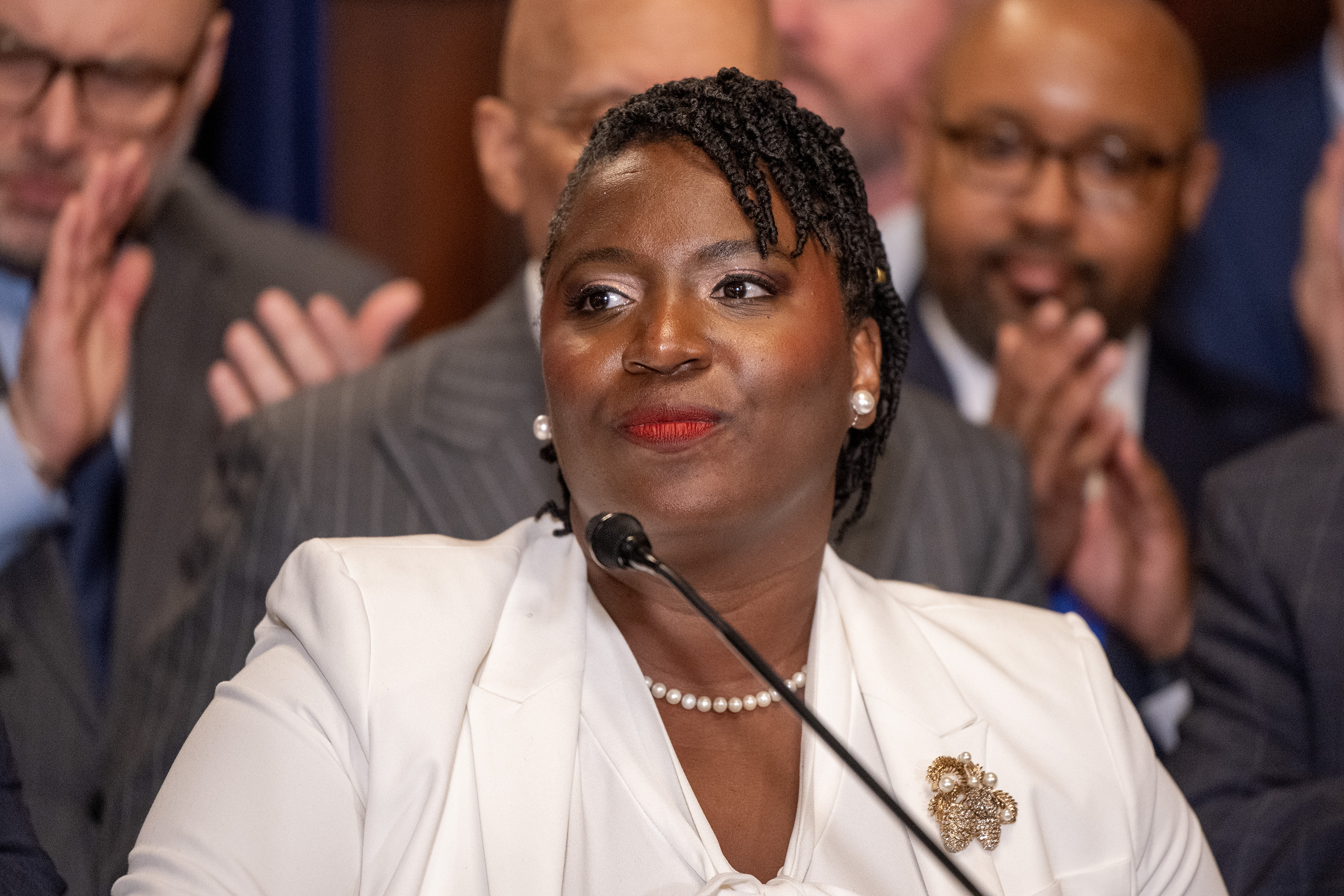
Pennsylvania House Speaker Joanna McClinton was listening to a sketch by comedienne Zainab Johnson when Florida State Rep. Angie Nixon’s name came up. Johnson mentioned how Nixon, who is vying to become the Sunshine State’s first African American U.S. senator, had been attacked by a right-wing influencer named Laura Loomer.
McClinton is closely following Nixon’s race and immediatelywondered: “Who’s Laura Loomer? Who is she?”
McClinton found out soon enough.
Loomer, reportedly a close ally of President Donald Trump, has been publicly going after Black female legislators and other prominent women — including U.S. Supreme Court Justice Ketanji Brown Jackson — calling them “ghetto” and the B-word.
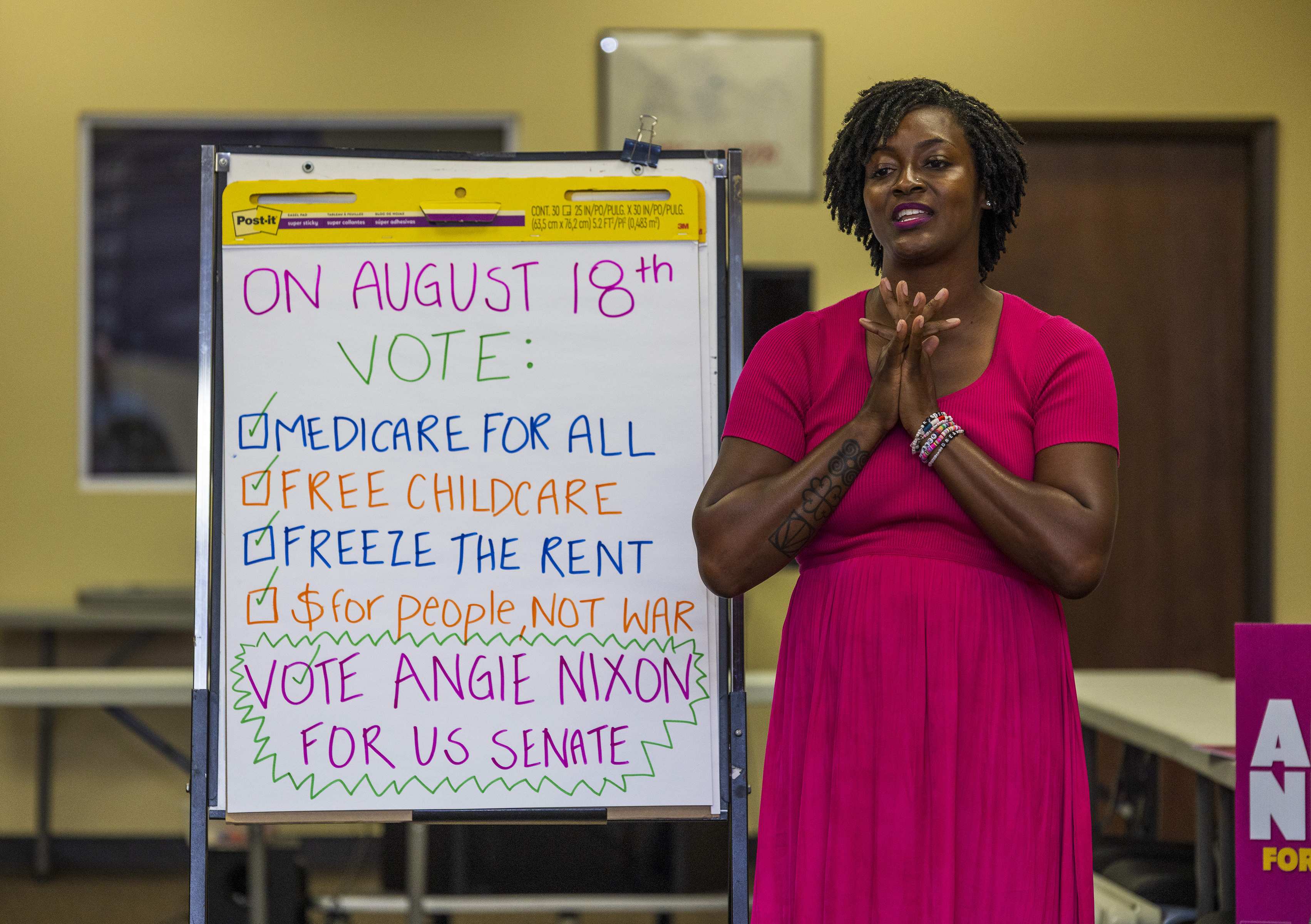
State Rep. Angie Nixon, a Democratic candidate for U.S. Senate, during a canvassing event in Fort Lauderdale, Fla., in August.SAUL MARTINEZ
The MAGA influencer zeroed in on Nixon last month after she won Florida’s Democratic Senate primary and accused her of using Ebonics. She also likened the former grassroots organizer to a dog, saying, “Maybe I need to bark at you and tug your leash and then you’ll finally understand.”
Loomer has also posted about Reps. Ilhan Omar, Ayanna Pressley, and LaMonica McIver, and former Rep. Cori Bush, saying they’re “entitled,” “destructive,” and “race-obsessed.”
I don’t know, Laura — you might want to look in the mirror to see who’s really “entitled,” “destructive,” and “race-obsessed.”
She made me mad.
A lot of people may have brushed it all off, but as you can tell, I haven’t.
Former Rep. Marjorie Taylor Greene has condemned Loomer. Where are the other Republicans who pride themselves on being civil and having family values? Every member of the GOP should speak out against what’s been happening.
House Speaker Joanna McClinton during a news conference at the Capitol in Harrisburg in February.Tom Gralish / Staff Photographer
“We need the president to condemn these comments,” McClinton told me, adding that U.S. Senate leadership should also act. “Unfortunately, attacking Black women is nothing new.”
She added, “We have been fighting with racism and misogyny for as long as we have been a democratic republic.”
I won’t repeat all of the racist things Loomer has uttered on her podcast or posted online lately about Black female politicos. If you’re curious, you can go on social media and see for yourself.
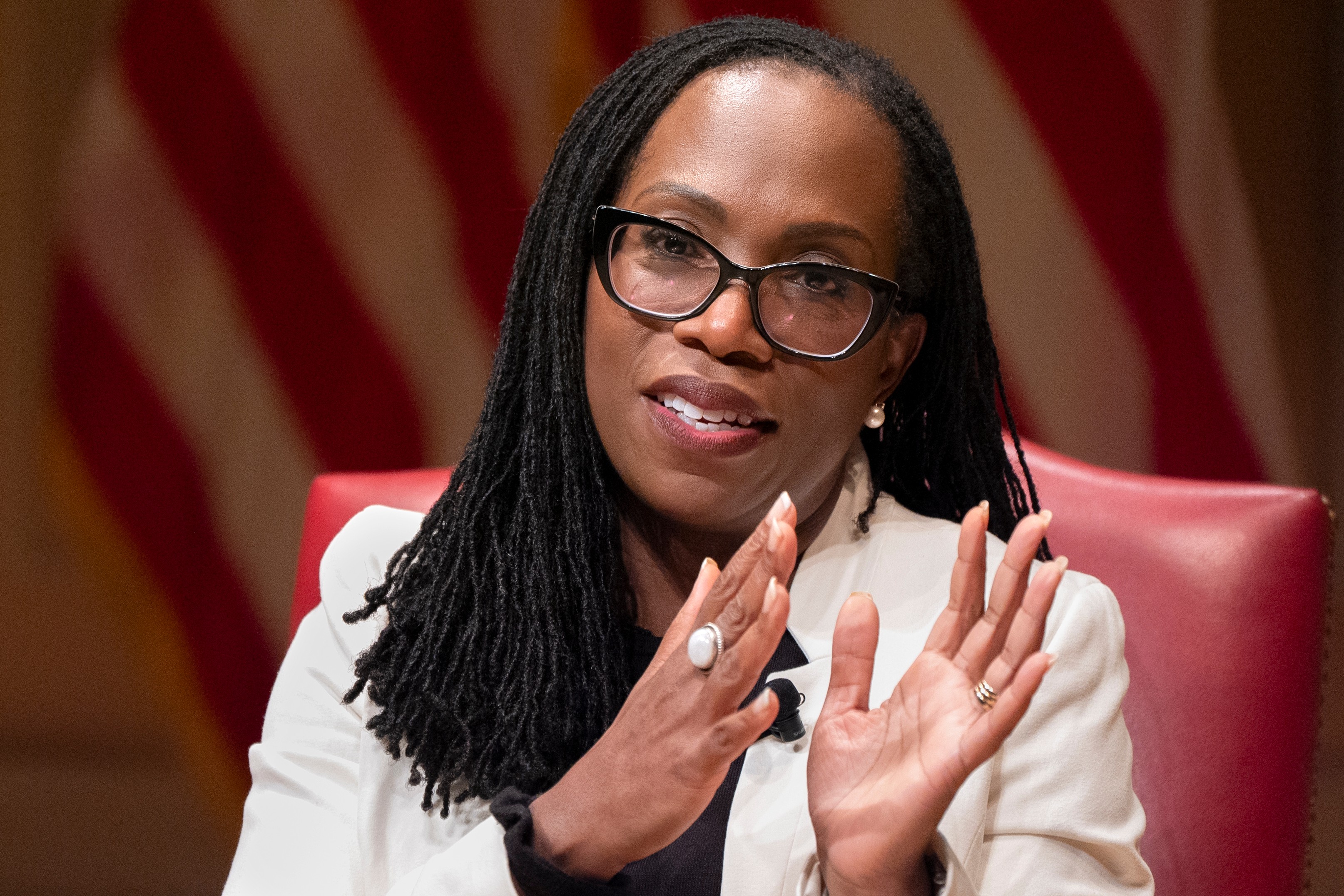
U.S. Supreme Court Justice Ketanji Brown Jackson speaks to the 2025 Supreme Court Fellows Program, Feb. 13, 2025, at the Library of Congress in Washington.Jacquelyn Martin
While you’re there, you can check out her Islamophobic posts.
I thought long and hard about ignoring what’s been happening and writing off Loomer as just another right-wing extremist.
But she has traveled with the president numerous times, visited Mar-a-Lago, and reportedly has Trump’s ear. Her platform is huge — nearly two million followers on X, the social media site formerly known as Twitter. And she doesn’t hesitate to use it.
That’s political currency — not just in Washington. In this era of the attention economy, the most strident voices get traction.
Maryland Gov. Wes Moore was spot on when he posted a statement directed at Loomer saying, “You attack and insult Black women because you believe peddling racism is good for your clicks and your business model.”
It felt good to see Moore, who is a possible presidential contender, defend Black lawmakers against Loomer’s looney tunes. Same with House Minority Leader Hakeem Jeffries, who called her a “stone-cold racist.”
Being a Black woman in traditionally white spaces can be challenging. Nixon appeared near tears during a recent appearance on Don Lemon’s YouTube show and said she was tired. “It’s become so normalized for people to continue to attack us,” she said.
Timothy N. Welbeck, director of Temple University’s Center for Anti-Racism, said he wasn’t surprised there hasn’t been a more fervent pushback against Loomer.
“Things like woke and DEI were politically expedient slurs to convey anti-Black sentiments,” he told me. “And now people like Laura Loomer are forgoing the veiled statements.”
It has felt like open season on Black women ever since Trump’s return to office.
We have been disproportionately impacted by widespread cuts to the federal workforce. Trump weaponized the U.S. Department of Justice to try to prosecute Federal Reserve Governor Lisa Cook and New York Attorney General Leticia James.
Black women are survivors, though. Ever since we were dragged through the Middle Passage and forced into bondage, we have managed to make a way out of no way, as my mother used to say.
This is our heritage.
This is our legacy.
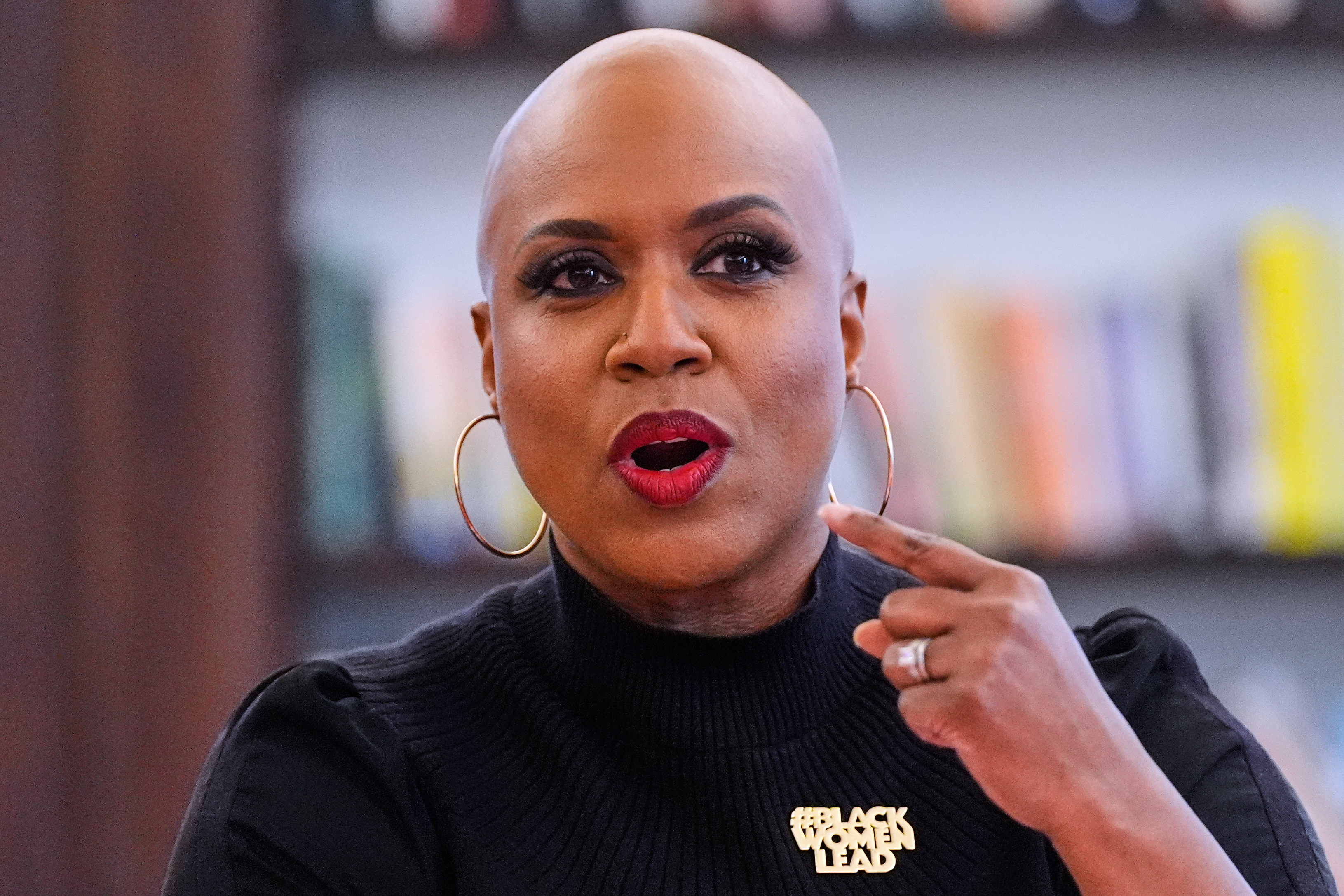
U.S. Rep. Ayanna Pressley (D., Mass.) gestures while addressing a gathering at a roundtable meeting in November in Boston.Charles Krupa
In the spirit of the late Shirley Chisholm, the first Black female member of Congress, and all of the other ancestors, we will get through the Trump era, too.
And we’ll be inspired by the passion of Nixon, the style and commitment of Pressley, and the sheer brilliance of Justice Jackson.
That’s what we do.
As Moore pointed out, “We will never let anyone steal our joy or let those that don’t matter too much, matter too much.”
There’s actually three things that are pretty certain in life: death, taxes, and the fact that the 22nd Amendment to the U.S. Constitution explicitly bars Donald Trump from seeking a third term as president.
Even Trump, for all his occasional pep-rally bluster and online merch about running in 2028, has kind of, sort of, begrudgingly acknowledged this reality. “You know the law is very strong on that,” the president admitted to reporters during a gaggle just last month.
That’s actually a good answer for Trump, because it avoids the obvious follow-up of how a president who’ll be 82 on Election Day in 2028, can barely stay awake now during important moments like a 9/11 memorial service, has probablyconsumed more Big Macs than the late Morgan Spurlock — and, oh, has a 32% approval rating — could expect to win, or even make it up the steps of his Qatari bribe jet in two years.
Still, I wish that one of those tarmac journalists would throw on a Peter Falk-style overcoat and ask, Columbo-like, just one more thing of the 47th and possibly last president:
If you’re not running for office ever again, why have you raised some $850 million — and counting — in campaign funds since your last and supposedly final campaign? Why are you sitting on most of this money? Are you planning to take it with you on Jan. 20, 2029?
I’d been mulling this column for a while when it was announced late last week that Trump’s best-known political action committee, the super PAC called MAGA Inc., with about $400 million in the bank, is finally cracking open the vault, slightly.
MAGA Inc. just transferred $49 million to yet another new PAC, No Going Back Inc. — the more money laundering, the better, apparently — that’s actually going to buy ads supporting some GOP candidates in the November midterms, especially in tight Senate races in Texas, Michigan, Ohio, and New Hampshire.
Indeed, expenditures like that are the only legitimate argument for Trump to have such a large political slush fund — to elect sympatico lawmakers who can support the president’s agenda, whatever that is. Whatever else happens in this election, two more years of a Republican-led Senate would allow Trump to keep appointing right-wing judges and at least limit the investigations of his gross misconduct.
Still, even some Republicans are acknowledging the $49 million, and presumably some additional funds over the next seven weeks, are too little and too late. In August, when voter opinions tend to harden ahead of the fall campaign season, MAGA Inc. spent a piddling $825,000 to prop up the new, Trump-supported South Carolina Sen. Darlene Graham in a GOP primary battle, and nothing more.
“Our threat level should be up and people are going to have an expectation that you deploy all your resources,” one GOP donor told Politico, before the $49 million drop was announced. “He’s sitting on hundreds of millions of dollars, not doing that. We’re in September.” Interestingly, MAGA Inc. has spent virtually nothing on House races, even though a Democratic House is likely to impeach Trump for the third time in 2027.
Republicans should be alarmed. We all should be alarmed, for a number of reasons. Boomers like me remember, vaguely, an old-school TV game show that was called You Don’t Say, with a tagline I’ve never forgotten: “Remember, it’s not what yousay. It’s what you don’t say.”
When it comes to MAGA Inc. — and several other massive piles of Trump-connected cash — political reporters ought to realize it’s not what you spend. It’s what you don’t spend.
If Trump is freeing up $49 million to try and sway close Senate races, where is the other $800 million going? And where am I getting this figure? It was buried in a recent MS Now article, which noted, correctly, that there is a separate, so-called dark-money arm of MAGA Inc. called Securing American Greatness that’s believed to hold as much as $450 million, most from secret donors.
That figure comes from Trump himself, who told reporters last month at an airport press gaggle: ”I’ve raised a lot, and nobody knows what it is, but I will tell you it’s about $850 million. I’ll be spending a lot of that money for — and my own money — but I’ll be spending a lot of that money for candidates that I think are good, Republican candidates.”
Nobody knows what it is. You can thank Trump’s pals on a right-wing rogue U.S. Supreme Court for a generation of bad rulings that have sold American elections to the highest, secret bidders.
The other thing about Trump’s comments is that, despite what he said, he’s actually so far not spending a lot of that money. Even though, by laws that are now honored in the breach, there’s supposed to be a clear separation between Trump and these super PACs, the president sees these funds as his own money.
“This is my money, that I control,” Trump told reporters earlier this month. Increasingly, anxious Republicans and other political observers worry Trump is hoarding the money not to elect GOP candidates, but to spend on his legal defense once those candidates lose and investigation-minded Democrats retake the House and maybe the Senate.
The law does say Trump can’t legally pocket the money when he leaves office. And we all know what a stickler Trump is for following the law, right?
Protest organizers gather in August 2025 outside the Moshannon Valley Processing Center, an ICE detention center near Philipsburg, Pa., run by the GEO Group, which contributed more than $1.4 million to a Trump-aligned PAC in June.Tom Gralish / Staff Photographer
It’s worth noting there are other piles of cash we know far too little about. For example, Trump’s 2025 inaugural committee raised a staggering $250 million — more than double his 2017 record — from the usual assortment of billionaires, tech companies, etc., and yet there’s been virtually no accounting of how that money was spent. And Team Trump is hoping to raise a gobsmacking $950 million by next year for his utterly amorphous plans for a presidential library, honoring a POTUS who doesn’t read.
Add it all up, and you’ve got a potential slush fund of roughly $2 billion. That’s appalling, but even worse with the knowledge that — and this cannot be repeated enough — with Trump never running for office again, the donors to these funds are almost all millionaires and billionaires who simply want something from the government for themselves or their corporations.
Earlier this year, reporters used tax records and other available reports to sleuth out three of the donors to the secretive Securing American Greatness Inc., including the Bitcoin Advocacy Project, which gave $2 million as Trump was boosting that industry through deregulation. The tech firm Qualcomm had been outed earlier as a $1 million donor to this massive fund that is largely a mystery.
There arenumerous examples of donors giving money to MAGA Inc. around the time of favorable government actions. For example, a subsidiary of the private-prison giant GEO Group gave $1.4 million to the Trump-aligned PAC in June at the same time U.S. Immigration and Customs Enforcement was awarding the firm $165 million in additional contracts. Michelle D’Souza, the chief executive officer of Pentagon contractor Unified Business Technologies, gave MAGA Inc. $4 million last October.
That’s in addition to the family members of those seeking presidential pardons, who made huge donations to MAGA Inc. right before Trump granted clemency to their relatives. That tally includes $3.5 million from the daughter of a Venezuelan billionaire who’d reached a plea bargain on federal bribery charges before he was freed by Trump, or Paul Walczak, a convicted tax cheat pardoned after his mom gave $1 million to MAGA Inc.
Many of MAGA Inc.’s donors are billionaires, and while some surely share Trump’s authoritarian worldview, many of them want something from the White House — and they are getting what they want. It is legal graft, a massive pay-to-play scheme that gets a giant shrug in the unholy world created by a right-wing master plan.
It’s time to stop shrugging. When Democrats retake the House, an almost certainty at this point, an investigation into Trump’s $1 billion to $2 billion in assorted slush funds, and whether any corruption laws were violated in raising all this cash, needs to pole vault to the top of their very long list of possible probes into this rogue president.
It’s kind of nuts when you think about it: A president corruptly raising hundreds of millions of dollars he’ll end up spending to hire lawyers to defend himself from the looming corruption charges. Maybe it would have been better — not just for the sake of democracy, but for Trump himself — not to have gone down this road in the first place?
But then, nothing makes sense anymore. And nothing makes less sense than the lack of energy, so far, in accounting for Trump’s pay-to-play dollars and how they are being spent. Keeping an American republic depends on answering these questions, and then making sure this never, ever happens again.
Meta released its new personal AI agent on Tuesday and named it Muse (like this bot is going to inspire humanity to write the next great tragedy and not relegate us to become the lead characters in one).
Of course, Muse could refer to the act of thinking about something very carefully, but that would be even more ironic, given that some experts in the field have sounded alarm bells that AI is advancing faster than humanity is prepared for.
Admittedly, I didn’t hear about the launch until two days after its release (I’m not a tech reporter and still keep a paper calendar), but I was surprised by how it did come to my attention.
In a post on Threads, user @rpennone pointed out how similar Muse’s stroke-like “M” logo is to the logo of one our city’s most beloved institutions, Mural Arts Philadelphia.
View on Threads
I pulled up the two logos on my computer, put them side-by-side, and it painted a pretty clear picture.
Part of our DNA
Typically an “M” is two sets of arches, sometimes with a little rat tail on the upper left side for flair. But both of these Ms have three peaks and valleys with little rat-tail flairs at both ends. Granted, Muse’s logo is blue, while Mural Arts’ is typically purple (though like Gritty’s belly button, it can change colors), and the former’s logo also has more fluid lines, while the latter’s are more rigid. Still, the resemblance is enough to make you go “hmm…”
View on Threads
Given how much people are worried about AI copying everything we create, this isn’t going to help the situation. Maybe nobody outside of Philly would catch it, but Mural Arts is a part of the very fabric of this city, part of its DNA, and someone here was bound to notice the similarity and defend its honor. Nobody paints our baby into a corner.
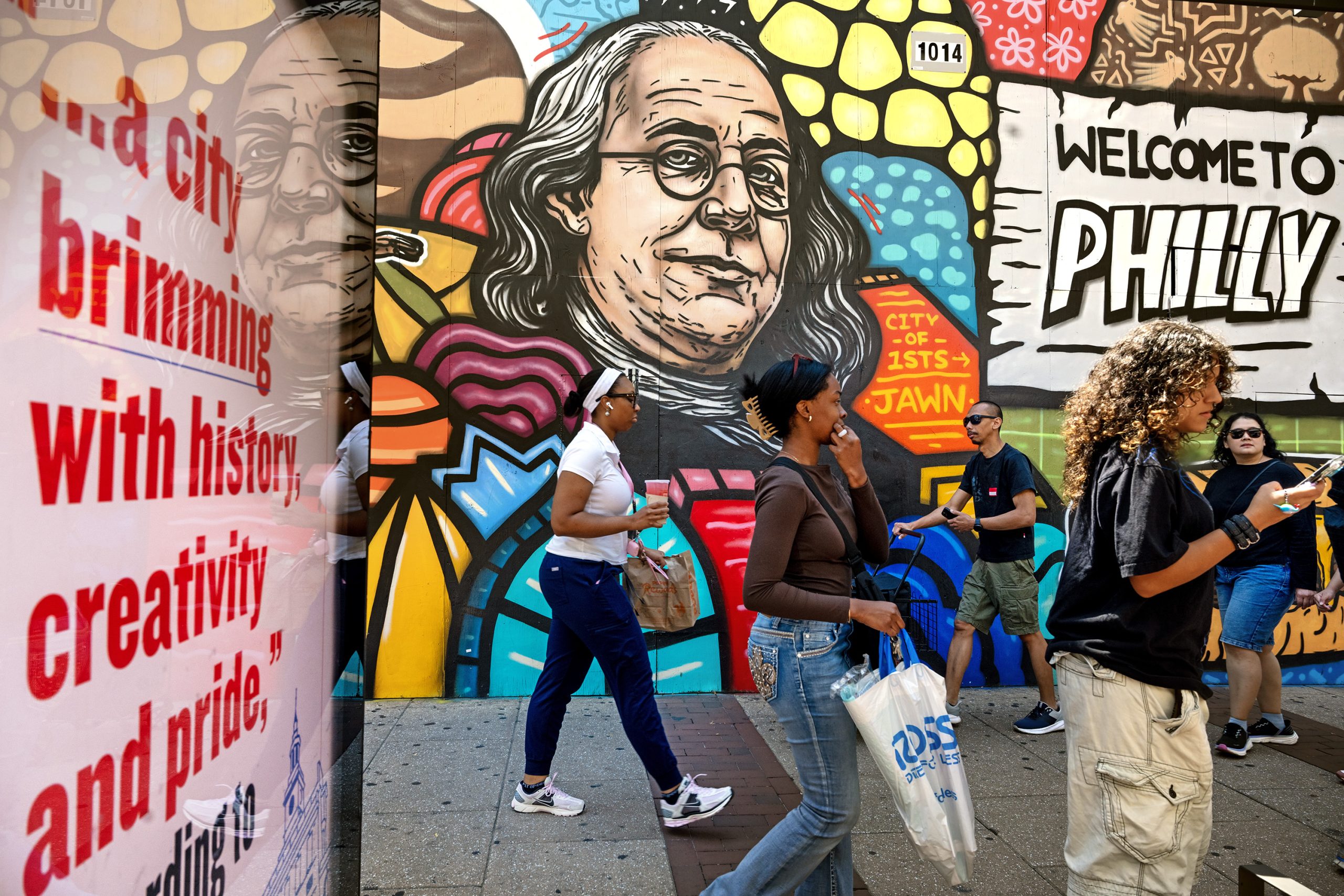
The 150-foot “Welcome to Philly” mural by artist Alloyius McIlwaine on the 1000 block of Market Street. The mural was a collaboration between Mural Arts Philadelphia, the Center City District, Comcast, HBSE, and the ownership group of the 76ers.Tom Gralish / Staff Photographer
For its part, Mural Arts was very diplomatic about the matter. Spokesperson Frank Luzi told me there’s no concern on the nonprofit’s part about copyright infringement and there are no plans for legal action.
“They feel like they are two very different organizations,” he said.
Designed by artist Chenlin Cai, “The Past Supporting the Future” mural in Chinatown was collaborative project by the Philadelphia Chinatown Development Corporation, Mural Arts Philadelphia, and the Philadelphia Housing Development Corporation.Monica Herndon / Staff Photographer
‘Definitely a resemblance’
Here’s the interesting thing, Muse’s logo was designed by a human who “cut my creative teeth in Philadelphia,” according to her website.
Jessica Hische is a lettering artist and author specializing in “typographical work for logos, film, books, and other commercial applications,” whose previous clients include companies like Target and Hallmark and people like Barack Obama and Wes Anderson. Based in Oakland, Calif., she graduated from Temple University’s Tyler School of Art and Architecture in 2006 with a bachelor’s degree in design and illustration.
I reached out to ask her about the similarities in the logos. In an e-mailed statement, she said Meta contacted her after doing its own sketch of an M inspired by a pen stroke or scribble. She said she refined the design by “playing with the stroke angles, end treatments, and vertical rhythm.”
Hische sent me a screenshot of the “M” Meta provided her and 30-plus variations she worked on until she landed on the final version.
I had to squint pretty hard to detect the differences, but lettering isn’t my field of expertise. Meta’s initial version does look more rigid and even more like Mural Arts’ logo, while Hische’s is more fluid.
Mural Arts Philadelphia lead teaching artist and muralist Jamee Grigsby (left) and an apprentice continue painting a mural focused around what accessible justice looks like, at the Mayfair Athletic Club in Russo Park on Edmund Street in Philadelphia on July 30, 2024.Elizabeth Robertson / Staff Photographer
Hische said she was familiar with the Mural Arts program from her time in Philly but hadn’t seen its logo, which was created by J2, a Philly-based branding company, and debuted in 2016.
“There’s definitely a resemblance (and it would have been even closer had we landed on the brushier versions of the “M” I had explored!) but ultimately what Meta hired me to do was to make the mark they had created less rigid and more fluid,” Hische wrote. “The rigidity, regularity, and perfect symmetry are defining qualities of the Mural Arts M (along with the brush stroke treatment), and it’s a great logo.”
Common threads
I appreciated Hische’s response and recognition of the resemblance. It’s not the first time logos have looked similar (Korean Air’s logo looks more like the Pepsi logo than the Pepsi logo does). It’s unclear where or how Meta came up with the original “M” logo Hische was asked to fine-tune. Meta did not return my requests for comment.
The logo for Korean Air bares an uncanny resemblance to Pepsi’s logo. Lee Jin-man
Later in the day, I saw Hische was catching flak online from people in her field for a completely different reason.
Because the digital world is a creepy stalker, as I was scrolling on Threads that evening, my feed suddenly become flooded with posts about Hische from people I don’t follow. Users on Threads — which is owned by Meta — were both condemning her for working on Meta’s AI project and defending her for working on it. Hische also penned her own nine-part Thread explaining her rationale, which includes the line “I have literally been touching grass more because of AI” and ends with a pitch for her latest children’s book.
I couldn’t help but wonder if this is right where Threads wanted me to end up. Why did that initial post about the logos from someone I didn’t follow pop up in my feed? Why did it also end up in the feed of an editor who sent it my way, confirming for me I should write this piece?
I thought I was pulling a thread, but maybe Threads was pulling me all along.
In the weeks after the Sept. 11, 2001, terror attacks, I went to New York to report on a story about Johanna Sigmund, a young woman from Wyndmoor who perished after one of the hijacked planes rammed the north tower.
Over the course of my career, I’ve spent more time than anyone would want writing pieces about people whose lives were cut short prematurely. One of the most memorable was Johanna, whose story and positive spirit remain seared into my soul.
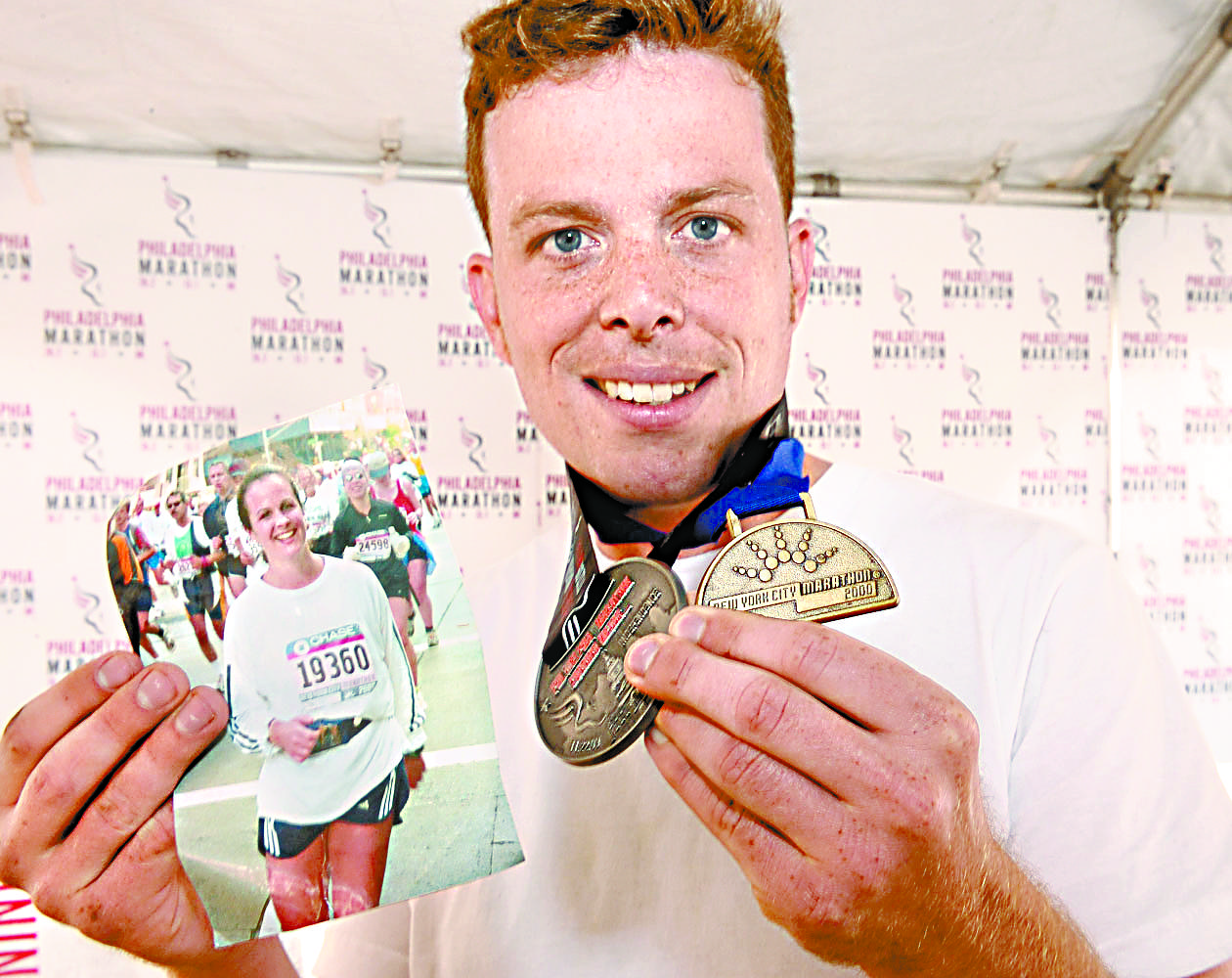
Johanna’s parents invited me, a stranger, into their home at their worst hour. They took the time to tell me about their only daughter, and shared photograph after photograph after photograph — Johanna smiling after she ran the New York City Marathon, Johanna posing with her girlfriends at a wedding, and so on.
One image stood out.
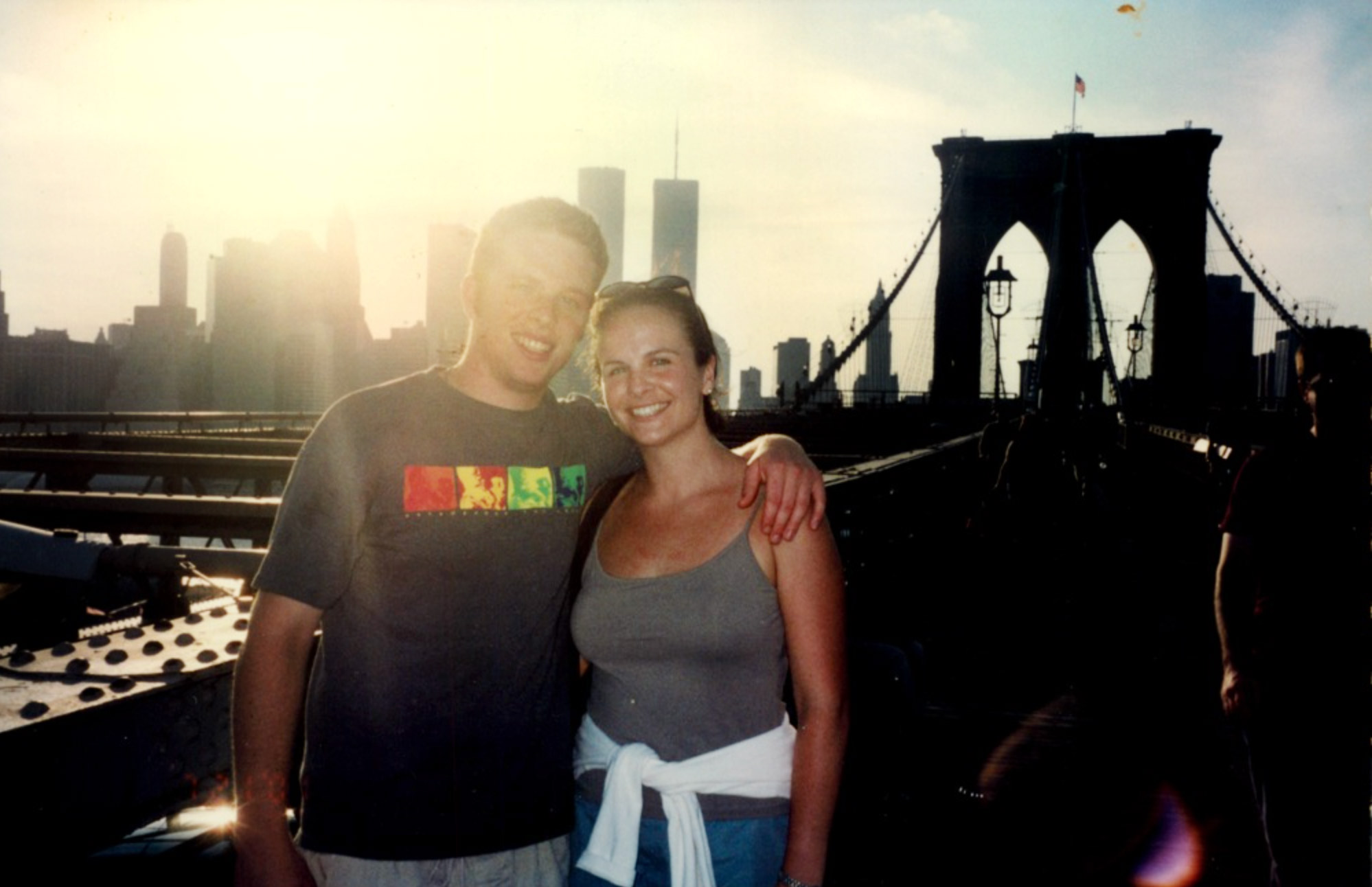
It was a photo of Johanna, 25, and her brother, John, 23, smiling while standing arm in arm at the foot of the Brooklyn Bridge. The photo was taken two months before the terror attacks. In the background loomed the twin towers.
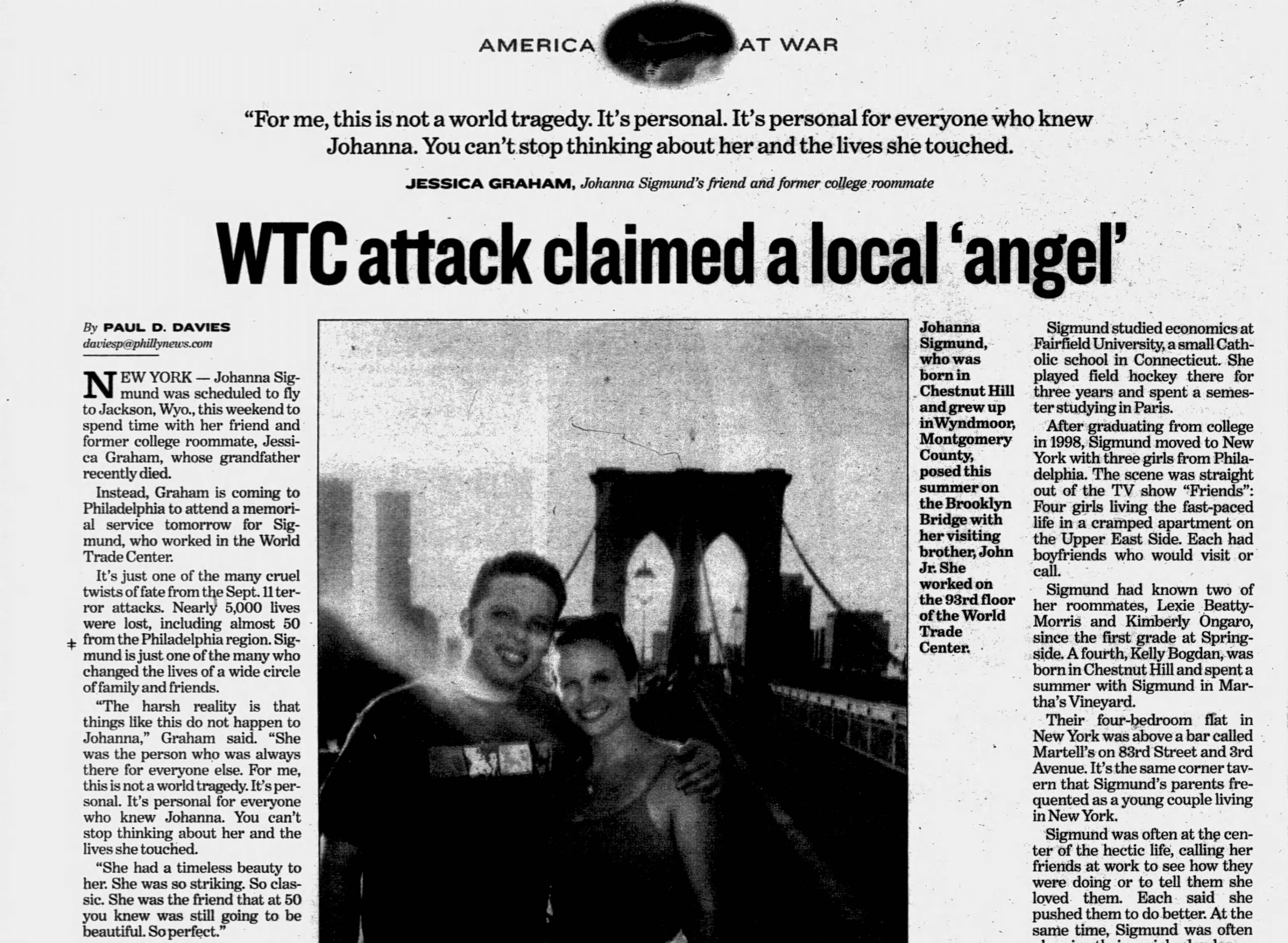
An article by Paul Davies about Johanna Sigmund in the Oct. 19, 2001, edition of the Daily News.Staff
Johanna’s story has stuck with me for a quarter century, but her life is emblematic of the promise and potential of so many others who were lost. At least 40 people with ties to Philadelphia and its western suburbs were killed in the attacks, including 18 from Bucks County, 11 from Montgomery County, five in Chester County, eight from Delaware County, and three from Philadelphia. It may be impossible for any of us to fathom how many other lives were forever impacted by the horrors of that day.
I wondered how Johanna’s family and friends had fared over the years.
So much has been lost in the 25 years since 9/11. Johanna would have turned 50 on the first day of summer — the longest day of sunlight. Her elegant beauty remains frozen in time, and — all these years later — her life remains a catalyst for good.
A scholarship fund set up in her name continues to help students attend St. Malachy School in North Philadelphia, as well as another at her alma mater, Springside Chestnut Hill Academy.
Johanna packed a lot into her brief time here. She was the captain of the field hockey, lacrosse, and squash teams in high school. She studied economics and played field hockey at Fairfield University, and spent a semester in Paris before moving to New York in 1998 with three friends from Philadelphia.
When I met with Johanna’s roommates a few weeks after the attack, they shared stories of her love of cooking, dancing, and listening to U2, often replaying the song “Stuck in a Moment You Can’t Get Out Of” that begins, “I’m not afraid of anything in this world.”
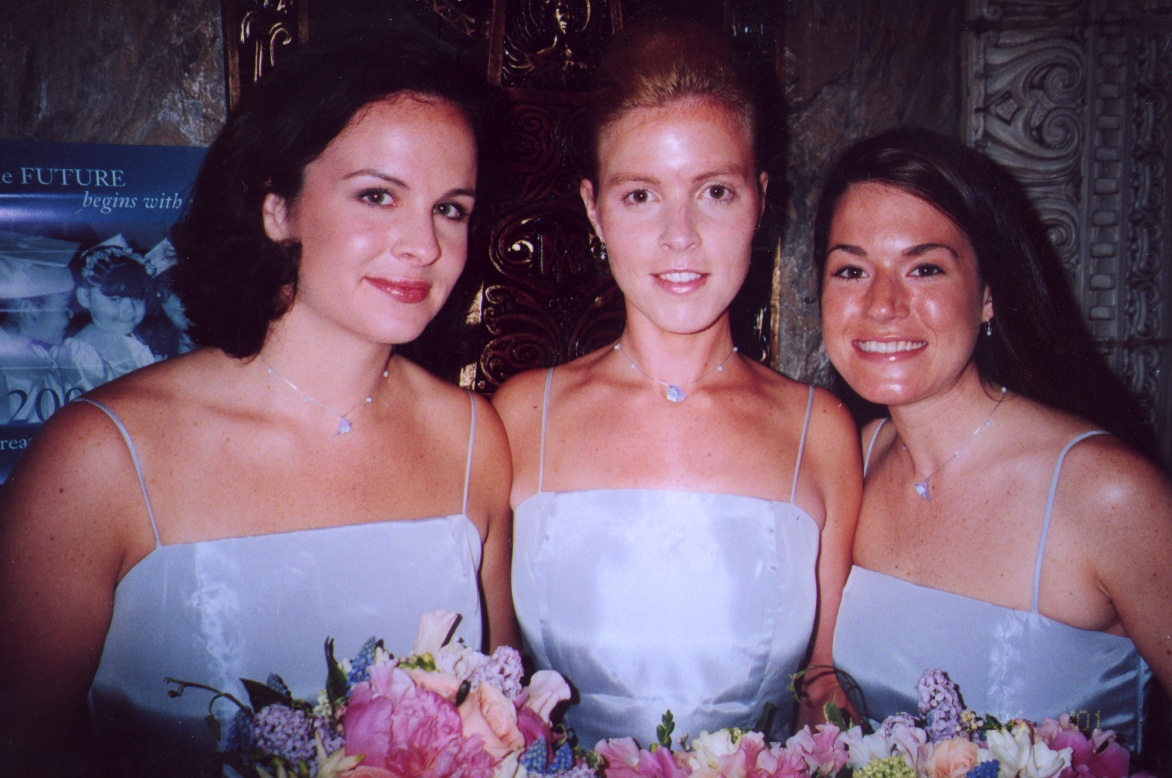
From left: Johanna Sigmund, Rory McDevitt, and Kim Ongaro were all bridesmaids at the wedding of their friend, Lexie Beatty, in May 2001. Sigmund was one of the victims in the 9/11 attacks.h
Johanna cared for others. She distributed pizza and McDonald’s to the homeless people in her neighborhood. She helped a woman who was thrown from a taxi get to a hospital. Johanna spent the night by her side and returned home in the morning with blood on her clothes.
Kimberly Ongaro, a roommate and friend from Springside, called her “an angel.”
The toughest interview in the weeks after the attack was with Johanna’s boyfriend, Joe Bonavita. They had dated for several years and had discussed marriage.
Their final weekend together was a whirlwind. They went to the Yankees game Friday night and drove to the U.S. Military Academy in West Point, N.Y., on Saturday, met up with friends, attended the Army football game, and walked through the cemetery for soldiers, which included Gen. George Armstrong Custer.
On Sunday, Johanna competed in a 5K race down Broadway before continuing on as part of her training for the Philadelphia Marathon. She and Joe shared dinner that night.
Johanna Sigmund and her boyfriend, Joe Bonavita, at the wedding of her friend Lexie Beatty Morris.
Johanna did not feel well on Monday, but went to work. When she was still under the weather on Tuesday — Sept. 11 — Joe urged her to stay home.
But she went into the office at an investment firm on the 93rd floor of the north tower.
Joe worked near the Trade Center. As he exited the subway, he saw the first plane smash into the north tower.
A life upended
I located her brother, John, and emailed him. He responded a few minutes later and graciously agreed to speak. When we connected after 25 years, it almost felt like old friends catching up.
John told me how 9/11 upended his life.
He had planned to move to New York after college, but lost interest after the attack. He visited ground zero to commemorate the first anniversary. President George W. Bush greeted families, including John’s aunt, who offered veiled advice regarding the plans to invade Iraq. “I hope you are making a prayerful decision,” she told the president.
Bush was taken aback, but continued shaking hands before circling back to tell John’s aunt that he prayed every day.
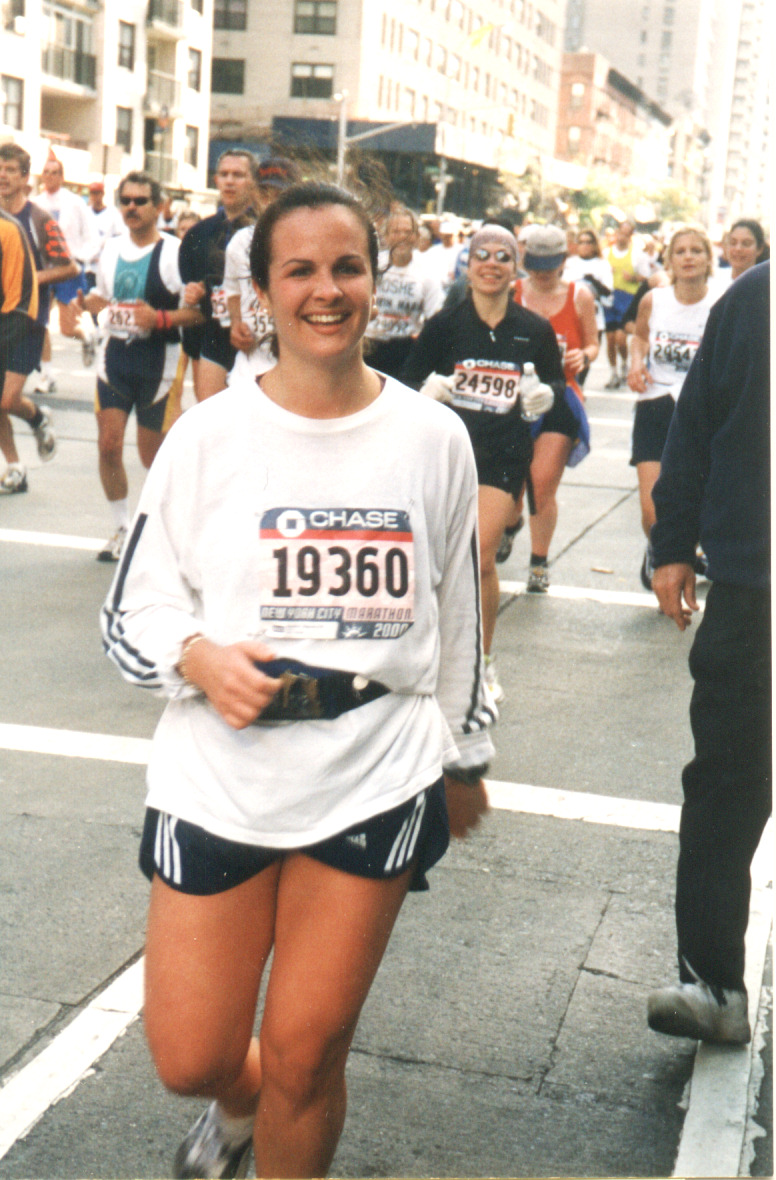
A photograph of Johanna Sigmund running in the New York City Marathon in November 2000.
After college, John, a Spanish speaker, spent a year with AmeriCorps teaching literacy to second graders in Kensington. After he explained to one class’s teacher why he wanted to take off for the anniversary of 9/11, she had her students write notes of support. John was struck by how many kids shared stories of loved ones they had lost to violence.
“Everyone has their 9/11,” he said.
Along the way, we all pay a price. Some more than others. But how one responds is a lesson for all as we navigate these trying times 25 years after 9/11.
John said he wonders how his life would have been different if not for Sept. 11. After a year teaching in Philadelphia, he moved to Texas, in part to get away. He earned a master’s degree in art education at the University of Texas in Austin before going on to teach at Say Sí, an after-school arts program in San Antonio.
John’s attempt to get away brought him back to New York. One of his students won an art award that included a trip for the student and teacher to Carnegie Hall. The artwork was displayed at the Winter Garden located near ground zero in May 2010.
“My heart sank,” John said. “I didn’t want to go anywhere near ground zero.”
Even then, nearly a decade after the towers fell, ground zero remained little more than a giant pit with the Freedom Tower slowly rising alongside it. In a macabre daily scene, tourists jammed the sidewalks, gawking and posing for pictures in front of what John could only see as a mass grave, while street hustlers sold photos of the hijacked planes crashing into the towers.
John tried to maintain his composure as he made his way through the gauntlet to the Winter Garden, but a man stepped in front of him and tried to sell him a fiery photo from the attack.
John snapped. He grabbed the stack of photos from the man, threw them in the air, and cussed him out. The two got into a tussle. After the fracas, John tried to gather himself by channeling his sister’s unflappable spirit.
John Sigmund (center) holds a picture of his sister, Johanna, as he and his family run down Kelly Drive toward the finish line of the Philadelphia Marathon in November 2001.d
“Johanna, help me,” he said to himself while overlooking ground zero. “I need to get it together.”
‘Beyond coincidence’
John calmed down and carried on. After the event, he met friends at a nearby bar. John was telling them about the run-in with the street hustler when he suddenly saw Johanna’s old boyfriend, Joe Bonavita, across the bar.
Joe had moved to New Orleans but, in a twist of fate, was in town for a 9/11 event. The two were not close but quickly bonded. John viewed the reunion as his sister’s handiwork.
“Some things are beyond coincidence,” he said.
Eventually, John did move to New York. The city helped him better find himself. After years of worrying about disappointing his parents or adding to their suffering, John told them he was gay. His parents, who have a deep Catholic faith, were supportive.
Twelve years ago, John returned to Philadelphia and fell in love with the city, and especially Fairmount Park.
After running the Philadelphia Marathon in November 2001, John Sigmund holds a photo of his sister, Johanna, and wears two medals around his neck — one he earned after finishing the race and another his sister won after completing the New York City Marathon in November 2000.Courtesy of Tony Webb / Office of the City Representative
But tragedy struck again in September. Three days after the 20th anniversary of 9/11, his father died.
For John, September remains the cruelest month. But he credits a strong support network of cousins and friends for helping him navigate life’s challenges — and added that Johanna always feels close by.
“I have a thing with the wind,” John said. “When I think about her, the wind will kick up.”
After losing his sister and father in September, John and his partner, Jaime, decided to add some positivity to the month. They got married last Sept. 26 and are planning an anniversary party in a couple of weeks.