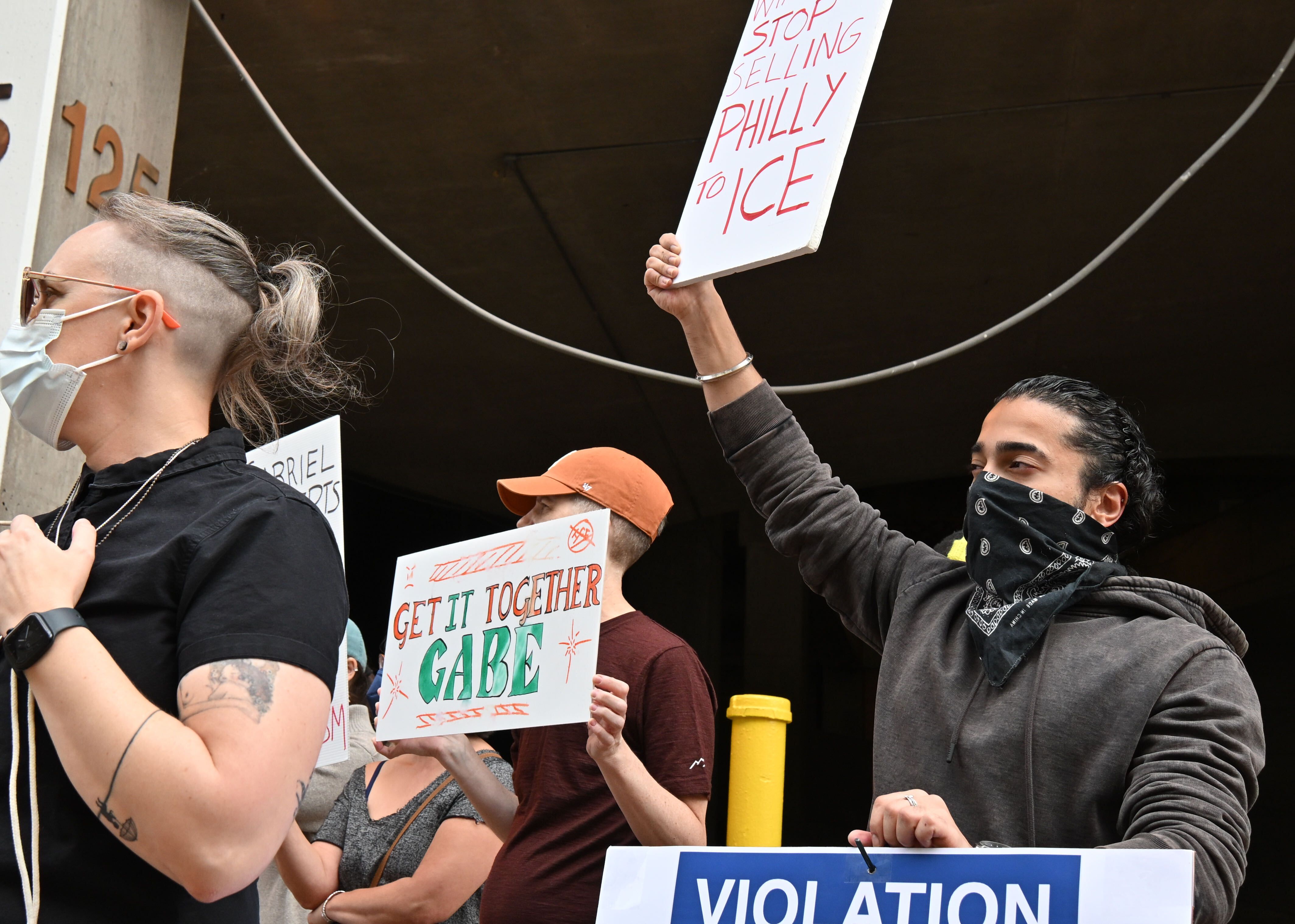
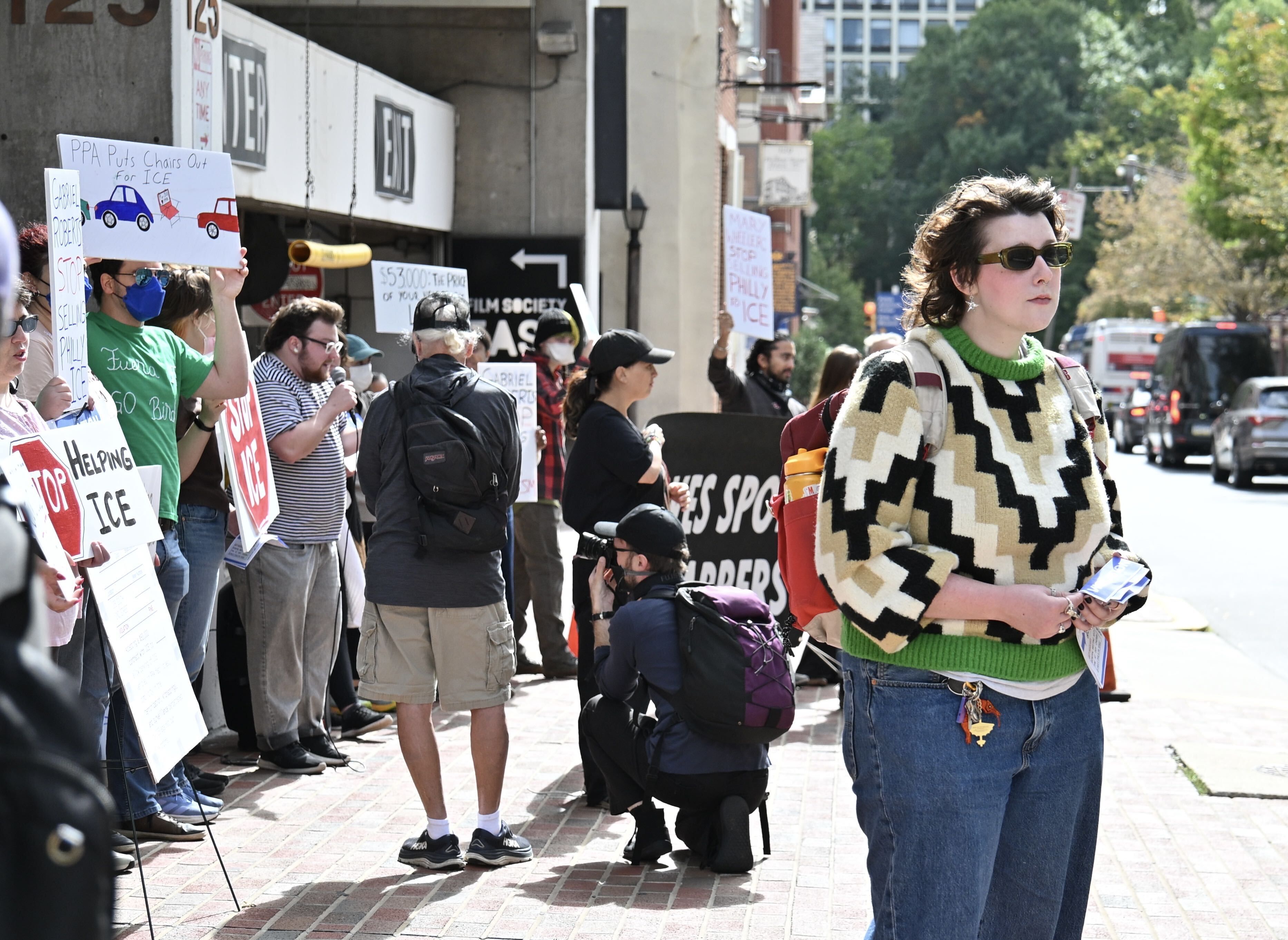
About two dozen No ICE Philly activists gathered Saturday outside a parking garage in Old City, demanding the Philadelphia Parking Authority end an arrangement with Immigration and Customs Enforcement.
At issue are 16 parking passes at the federally owned garage on Second Street, which is managed by the PPA. The group sang protest songs, held signs, and passed out informational flyers that resembled oversized PPA parking tickets.
“Who doesn’t know what these things look like, you know?” said one activist handing out flyers.
Group organizer Jay Bergen said the rally is meant to pressure the PPA — and to let people know that ICE is using the parking garage.
“It’s scary that you could be parking downtown, and unbeknownst to you, parking next to an ICE agent,” Bergen said.
Bergen, a 34-year old pastor at the Germantown Mennonite Church, pointed to public records showing a $53,520 contract that allows “for parking of government vehicles for ICE Homeland Security investigations” at the garage.
That contract was set to expire at the end of September, but another one, beginning in October and running through at least next September, gives Department of Homeland Security “16 leased parking spaces,” records show. ICE is part of DHS.
PPA spokesperson Martin O’Rourke declined to comment on the contracts.
An activist holds “violations” resembling PPA parking tickets to pass out to people, while a crowd gathers to demand the PPA stop leasing parking spaces to ICE.Brett Sholtis
Bergen said the group opposes ICE for “kidnappings” of immigrants and others, including people who have lived legally in the community for decades. One recent example is a 30-year-old nurse from Delaware County, who was arrested while taking her son to Disneyland.
Bergen said most people detained by ICE did nothing wrong. Some had minor lapses in paperwork or had been convicted of summary or misdemeanor crimes.
“Their goal is terror. It’s not public safety in any meaningful way,” Bergen said.
The local ICE field office did not respond to a request for comment Saturday.
At the rally, protester Akarsh Balaji said that the amount of money PPA makes on the contracts is “less than what they spend every year on salt to de-ice the streets.”
Balaji said he’s seen ICE harass his Puerto Rican neighbors in West Kensington. Puerto Ricans are Americans — so is Balaji, who is of Indian ethnicity — but that doesn’t seem to matter, he said.
“Nobody should have to live in fear, or be told that they’re harmful to society,” Balaji said.
Balaji said he got involved with the group in February after feeling a need to do something, “and be part of a movement that is so much bigger than I was.”
“We want to make it as difficult as possible for ICE to do its job,” Bergen said.
In Philly, ICE has faced obstacles from residents and elected officials. In April, the city adopted some of the nation’s most aggressive polices aimed at restricting ICE. The legislation took effect in July but the federal Department of Justice sued the city over some of its directives.
Bergen said ICE has changed its tactics since early this year, when its Operation Metro Surge in Minnesota — and the killings, captured on video, of U.S. citizens Renee Nicole Good and Alex Pretti — led to overwhelming public opposition to the agency.
“But the fear has not gone down. I heard this week about someone whose mother is afraid to go to doctor’s appointments, because she’s afraid ICE might grab her,” Bergen said.
Beginning this month, states are required to shoulder a higher portion of the costs associated with administering the Supplemental Nutrition Assistance Program.
It’s the latest change to the federal food aid program resulting from the “One Big Beautiful Bill Act” signed by President Donald Trump last year. A local legal expert said that it’s another challenge for a program that has already seen tens of thousands of people in Philly lose their benefits.
Here’s the latest on what’s changed, and what people can do:
How do the October changes affect SNAP recipients?
Beginning Oct. 1, Pennsylvania and other states are required to take on 75% of the administrative costs of managing SNAP, said Mackenzie Libbey, a supervising attorney at Community Legal Services, which provides free legal assistance.
State agencies are already struggling to keep up with recent changes to SNAP, Libbey said. In addition, they’re preparing for another rule change that will go into effect next year — requiring states to keep a low “error rate” or take on more of the costs of the food assistance itself.
So on one hand, state case workers are overloaded, and on the other, SNAP recipients are struggling to navigate a lot more documentation requirements.
“So what we’re seeing, and I think we’ll continue to see, is people getting cut off due to paperwork,” she said.
Does this have to do with work requirements?
As of last September, people on SNAP in Philadelphia had to start proving that they were working, or that they were exempt because of medical or other reasons, to qualify.
That’s contributed to a steady decline in recipients, she said.
People who are on SNAP tend to be either working low-wage jobs and raising children, or dealing with issues related to health or age. That often doesn’t put them in a good position to handle the bureaucracy of the new system.
“It can be really difficult for people who are trying to feed their family or get back on their feet. It’s just too much, and people just give up,” Libbey said.
Who is losing their benefits?
With a few exceptions, noncitizens have lost their access to SNAP benefits, Libbey said. That includes refugees, asylum seekers, victims of human trafficking, and those awaiting a permanent status. Green-card holders and a few other groups remain eligible.
However, most people who have lost benefits are citizens who have failed to meet paperwork requirements. That’s led to a massive drop in enrollment.
How many people have lost SNAP benefits?
Almost two million people in Pennsylvania were on SNAP last summer, when the federal changes were signed into law, Libbey said. Since then, 234,000 people — 12% — have fallen off the rolls.
About 106,000 lost SNAP benefits because of work requirements, including 36,000 in Philadelphia.
Children make up 29% of those who lost benefits, with 69,000 people under age 18 losing benefits since last July, she said.
How much do SNAP recipients get?
The amount of benefits has not changed because of federal rules, and has increased slightly because of cost of living adjustments, federal data show.
SNAP benefits for a single person may be as high as $306. A family of four could receive as much as $1,023. A household of seven people would cap out at $1,616 per month. Most families get less than those amounts; average benefits are roughly a third less than the maximums.
What resources are available?
Food pantries such as Philabundance are one short-term resource for people in need.
For noncitizens in particular, charitable organizations targeting specific groups have popped up. Recently, the Asian Pacific Islander Political Alliance has organized food drives focused on Asian food staples.
Libbey encourages people who have lost SNAP benefits to contact Community Legal Services, which provides free legal help in Philly and has processed thousands of SNAP applications.
“We’ve seen a sad trend where people lose their benefits, they don’t know why, and they think, that’s it, there’s nothing I can do. And typically there are ways to get help, depending on your situation,” she said.
A fatal scuba dive at a lake near Bethlehem, Northampton County, has shaken the Philly region’s tight-knit diving community, leaving divers questioning how an underwater training excursion ended in tragedy.
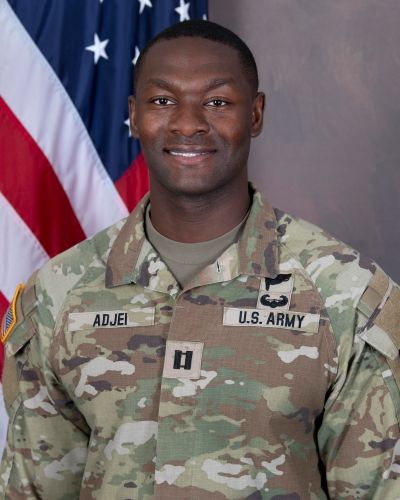
Stephen O. Adjei, a 31-year-old U.S. Army captain died Saturday while training with U.S. Military Academy West Point — a premier school for those seeking a career in the Army. His death is under investigation, West Point said.
“Our hearts are with the Adjei family during this difficult time. Capt. Adjei’s dedication to our cadets, commitment to his teammates, and service to others left a lasting impact on our community. He will be greatly missed,” said West Point Commandant of Cadets Brig. Gen. Joe Katz.
Originally from Ghana, Adjei had lived in Worcester, Mass., and had worked with the military academy, located in New York state, since 2024, West Point said.
U.S. Army Captain Stephen O. Adjei died while scuba diving at Lake Hydra, Northampton County.Courtesy of U.S. Military Academy West Point
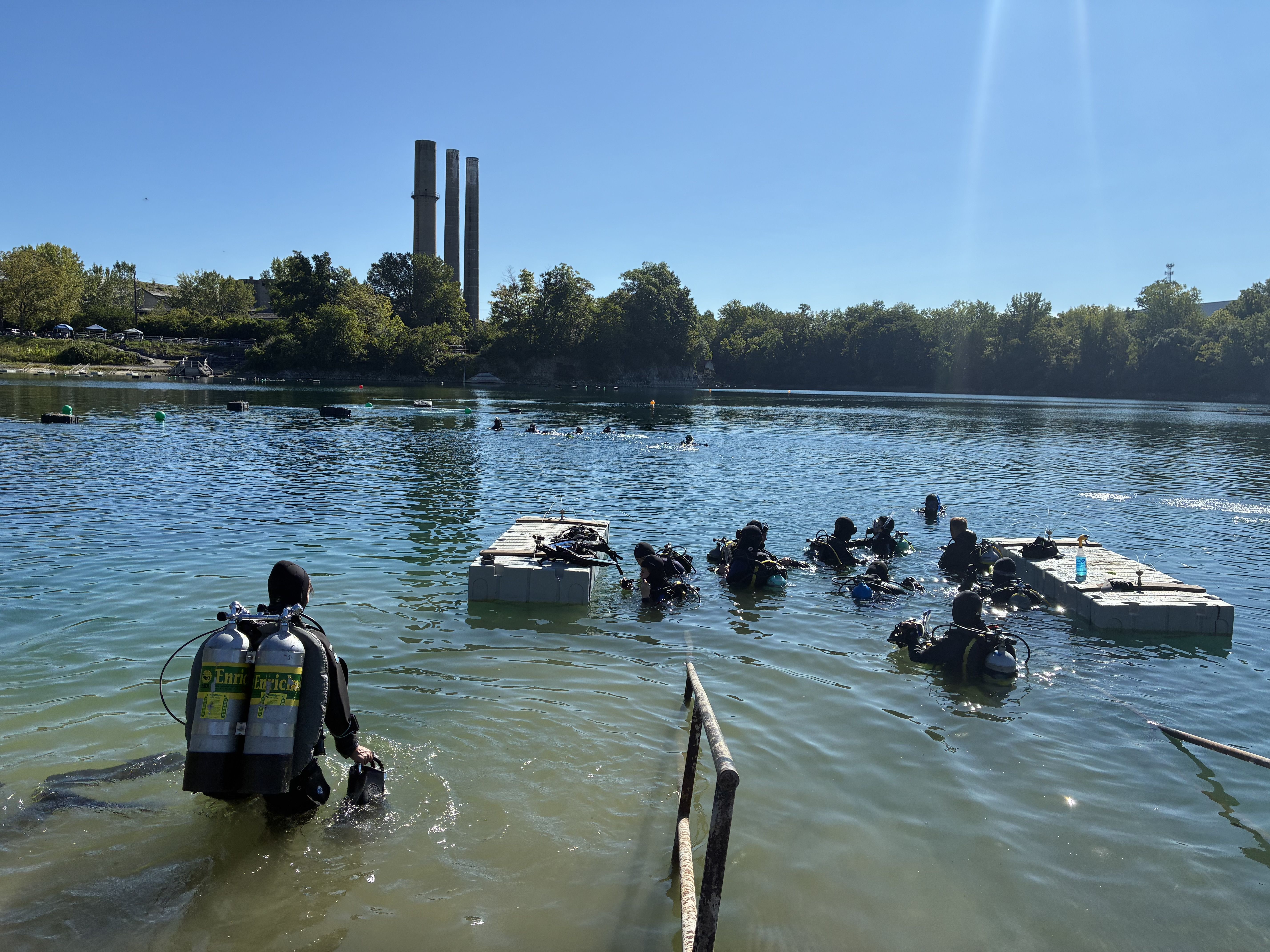
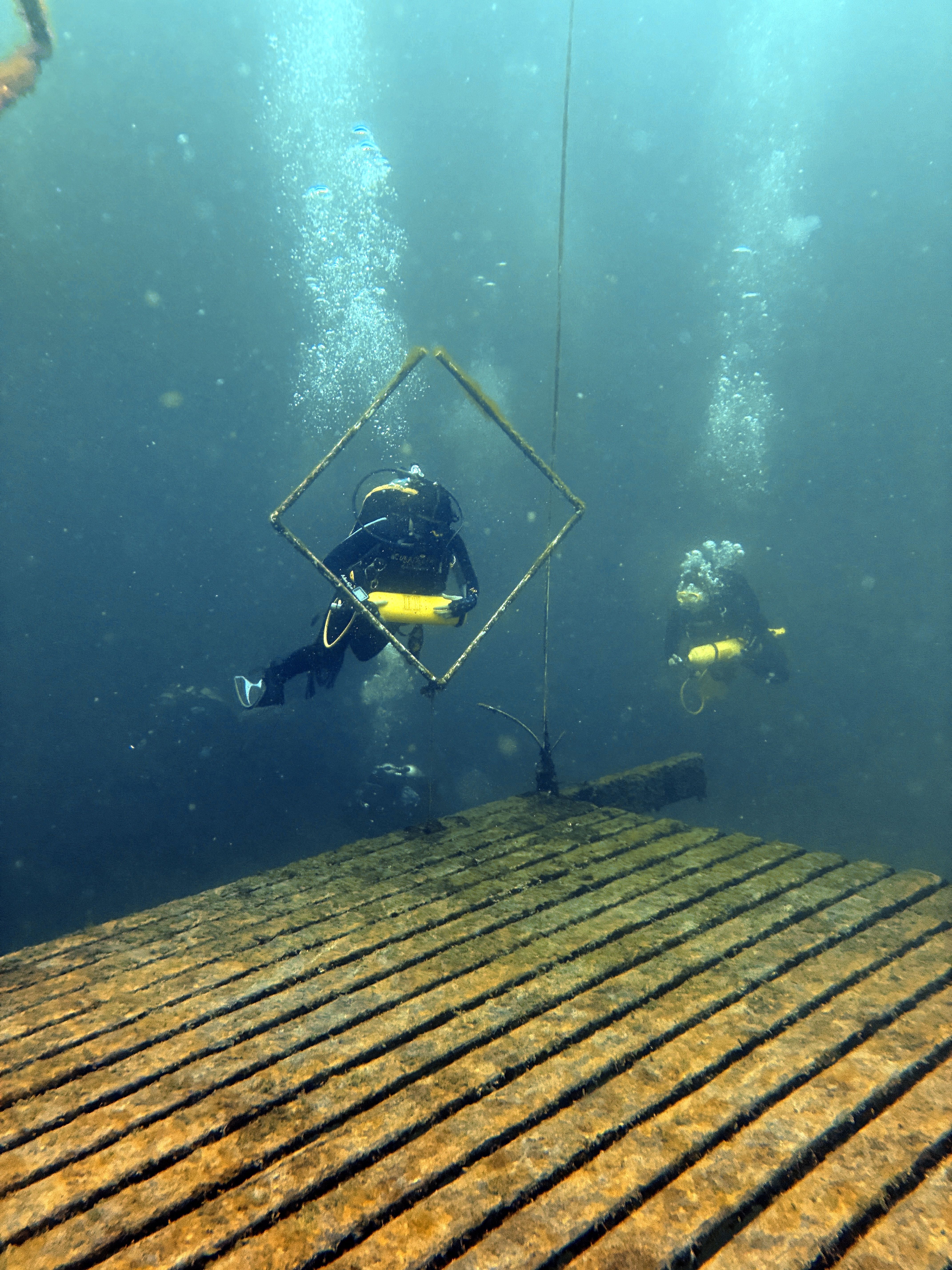
West Point divers made up one of several groups Saturday at Lake Hydra, a limestone quarry near Bethlehem that draws scuba enthusiasts from all over the mid-Atlantic. About 140 people were at the 55-acre lake Saturday, owner Ken Kraft said. According to him, there hasn’t been a diving death since 2022.
Like many sports, diving involves risks, Kraft said.
“That is why we are only open for training and not to the general public, this ensures that a professional is with the diver in training at all times,” he said.
In addition to being a training destination, people enjoy the quarry, previously called Dutch Springs, for its opportunities for underwater exploration, said Dave Barnes, who runs Scubadelphia Diveseekers in Philly. Airplanes, a helicopter, and a school bus are among the attractions on the lake bottom, along with large fish and wildlife.
Barnes said his group was nearby on the north cove of the lake when he learned about a missing diver.
“It’s terrible. I sent my divers in to help search,” Barnes said.
Two of his students — a paramedic and a physician from Philly — helped render aid to Adjei after he was brought ashore, Barnes said.
Divers conduct training at Lake Hydra, Northampton County.Courtesy of Dave Barnes
Kevin Pang, who co-owns South Jersey Scuba in Marlton, N.J., also had divers in the water. Pang said the incident has shocked the community — especially since Adjei was young and presumably fit.
“Scuba diving overall is a really safe sport,” Pang said. “These events are rare. That’s what makes it shocking when it does happen.”
Still, there were some challenges on the lake that day, Pang said. The lake is 100 feet deep at its lowest points. Divers routinely go down to around 60 feet, and overcast weather meant that it was hard to see at those depths. Inexperienced divers can make that situation worse by kicking up mud on the lake bottom, Pang said.
When Adjei went missing, a string of rescue protocols would have gone into effect, he said. Divers typically have a “dive buddy” responsible for maintaining eyes on their partner underwater. If one goes missing, the other diver searches for them for a minute, then surfaces. Usually, Pang said, the missing diver is quickly found at the surface.
It is not yet known whether Adjei’s death resulted from an error or a medical condition. Lehigh County Coroner Daniel Buglio said his office is working to determine how Adjei died.
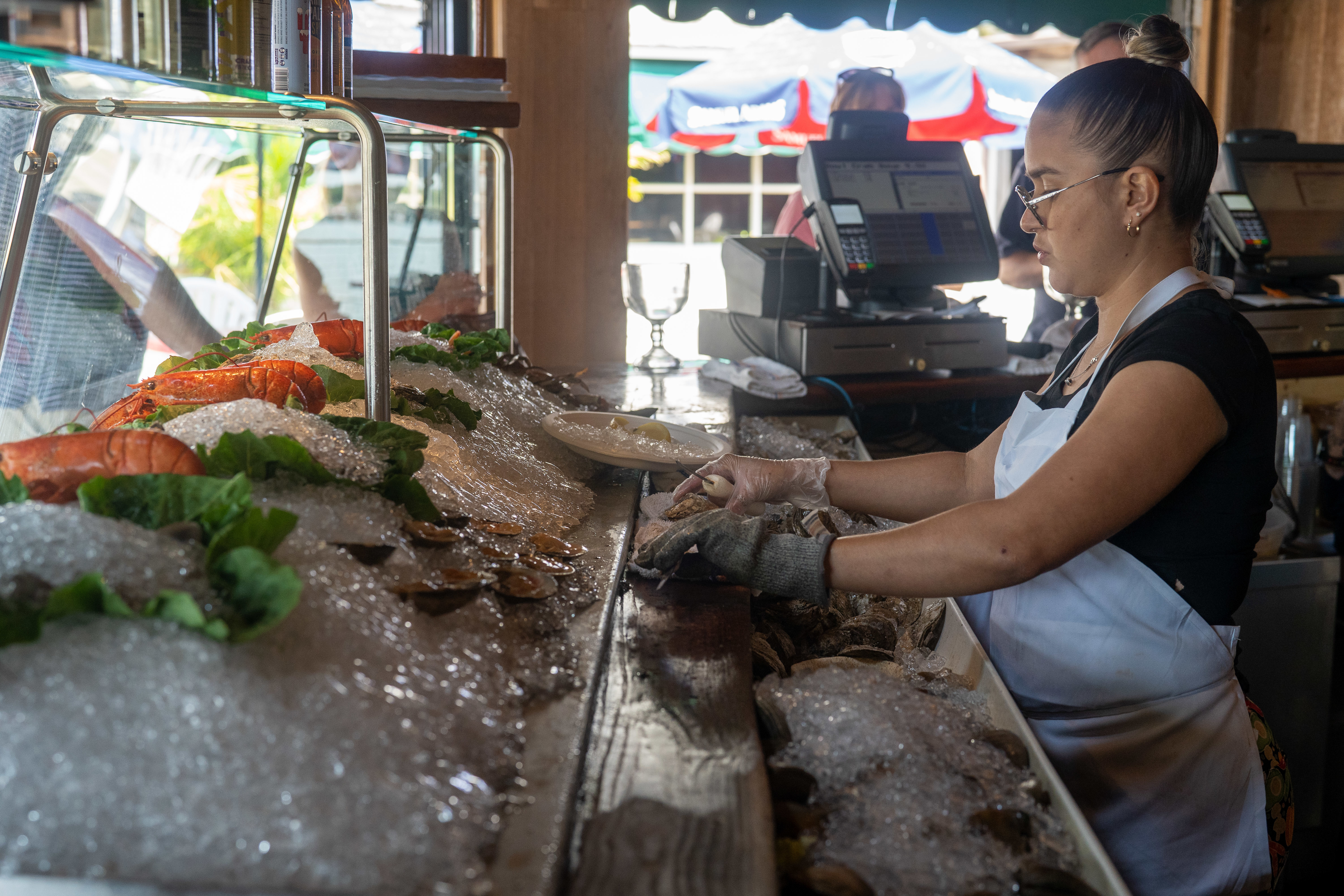
Keith Laudeman, the third-generation owner of the Lobster House, explained that for three days, the water level outside the restaurant inched up — the result of relentless northeast winds holding seawater in the inlet.
Saturday morning’s high tide was the “icing on the cake” that sent floodwaters pouring through the front door.
Laudeman dealt with flooding after Superstorm Sandy in 2012 and Storm Jonas in 2016. He said his team will have to wash everything with freshwater, scrub it down with antimicrobial soap, and replace carpeting.
He hopes to have the restaurant open within three days, and plans for the fish market and coffee shop to be open Monday.
As for the lobsters escaping to sea, Laudeman said anything is possible.
“That’s a little far-fetched,” he said. “But if it adds to the story, then go ahead.”
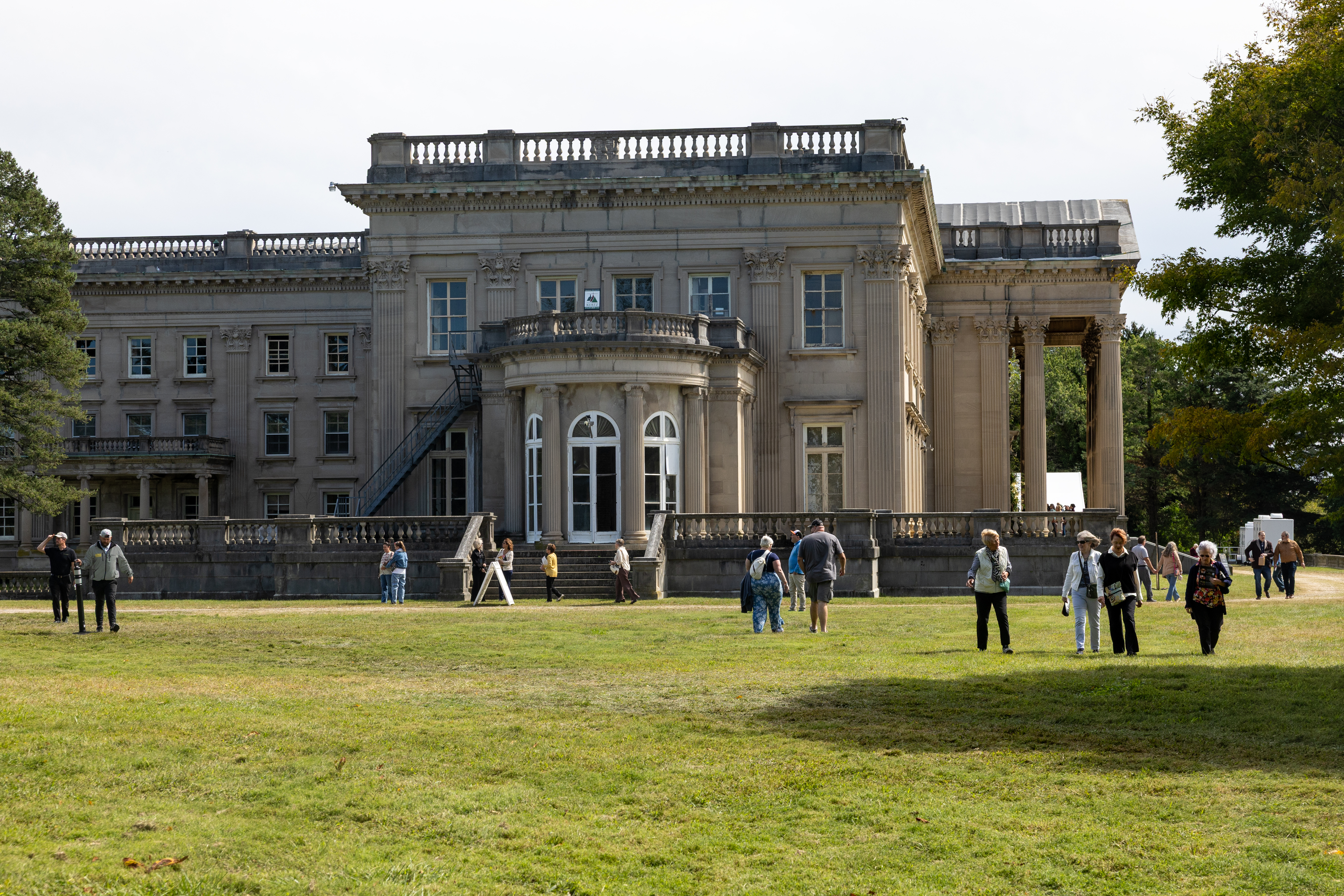
After being closed for more than eight decades, the Lynnewood Hall mansion in Elkins Park is open, briefly, to the public. And if Friday morning was any indicator, people want in.
Spectators poured into the mansion for the first day of a 10-day flower show that offers a rare chance to view the second-largest surviving Gilded Age mansion in the U.S.
“I just love big, old, fancy houses,” said Karen Lacki, 47, who drove from Reading.
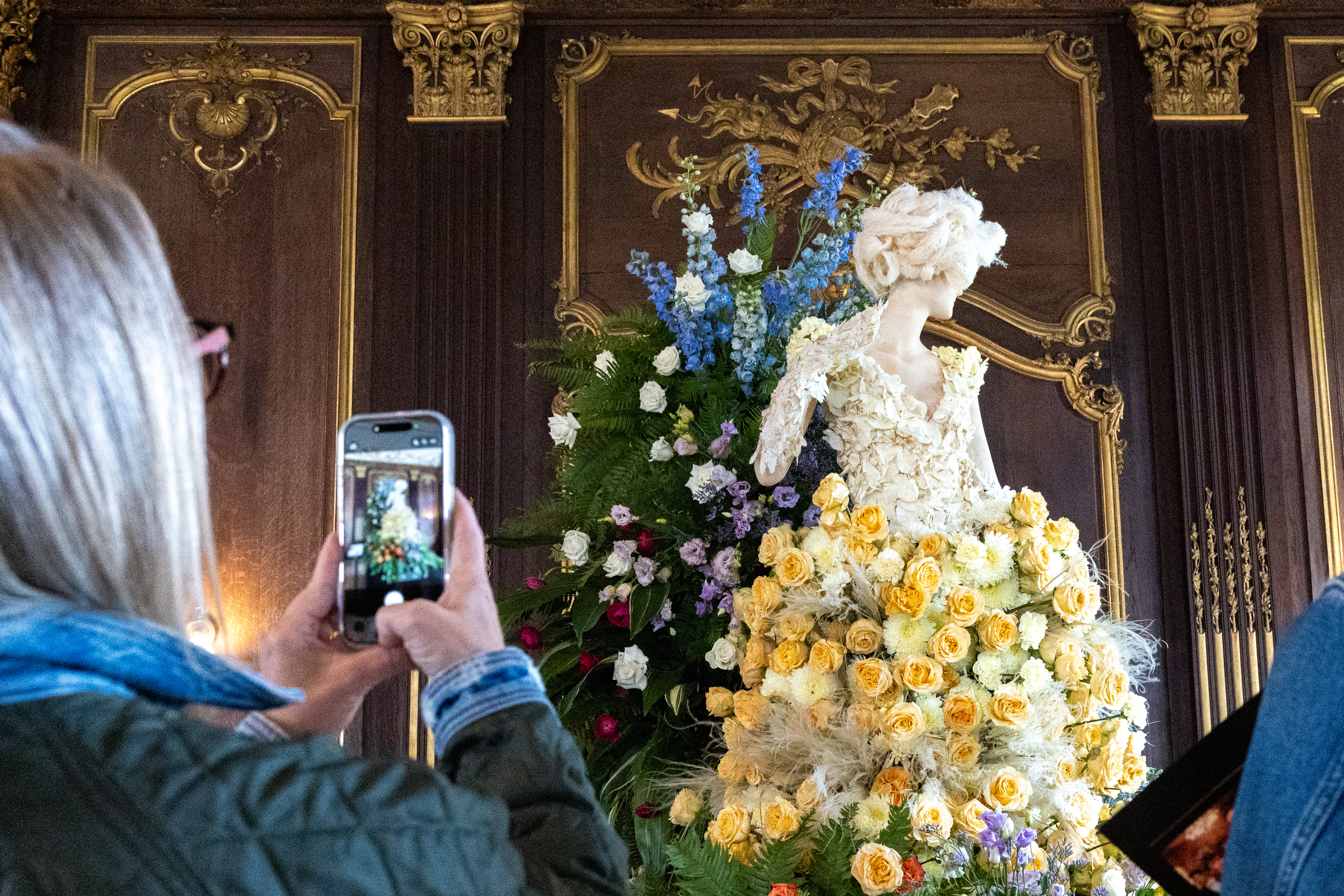
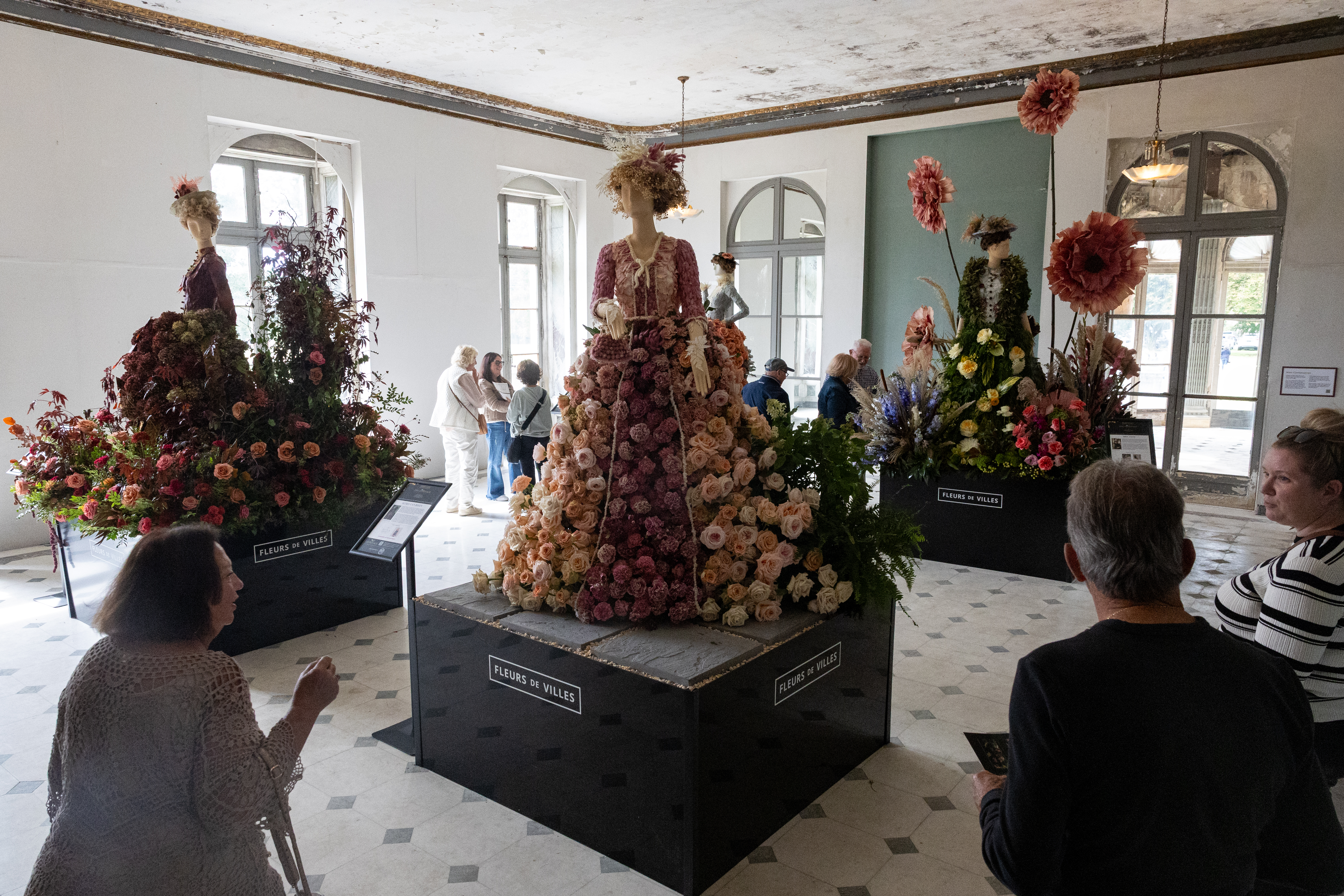
Lacki showed up early to snap photos of flower-adorned mannequins staged at the mansion, part of an exhibit by the floral display company Fleurs de Villes as a tie-in with the HBO series The Gilded Age.
Marcy Abhau, 76, of Mount Airy, looks up to view the old ceiling in the west hallway of the Lynnewood Hall mansion in Elkins Park on Friday, Sept. 25, 2026. The mansion is in dire need of restorations.Aidan T. Gallo / Staff Photographer
Though the TV show is fictional, the 100,000-square-foot Lynnewood Hall could very well have been part of the story. Peter A.B. Widener, a West Philadelphia bricklayer’s son-turned-transit tycoon, built the neoclassical revival mansion around 1899. The architect was Horace Trumbauer, whose firm designed the Philadelphia Museum of Art.
The history behind Lynnewood Hall Mansion
Widener family history is what drew author Kelly Skwarcan to the flower show. Skwarcan wrote a book about the sinking of the RMS Titanic. She explained that Widener had sent his son George, daughter-in-law Eleanor, and grandson Henry on the Titanic’s doomed 1912 voyage. George and Henry died in the disaster.
“It was heartbreaking for Peter,” Skwarcan said, adding that Widener died three years later.
After his death, the estate, which housed an extensive art collection, was open to the public until 1940. But the art collection was moved, and in 1944, the family sold Lynnewood Hall.
The Lynnewood Hall mansion in Elkins Park on Friday, Sept. 25, 2026.Aidan T. Gallo / Staff Photographer
By the time Karen Brown and Cameo John were children in Elkins Park, the 110-room mansion had fallen into disrepair. On Friday, the best friends, both in their mid-40s, showed up so that they could finally go inside.
“I always hoped that they’d try to do something with it,” John said. She hopes it could be a wedding venue and something educational foryounger people.
As they and others walked onto the mansion lobby’s checkerboard floor, they were encouraged to vote on favorite flower installations.
Visitors walk around the floral mannequin exhibition inside the Lynnewood Hall mansion in Elkins Park on Friday, Sept. 25, 2026.Aidan T. Gallo / Staff Photographer
“The flowers are gorgeous,” said Ellin Jones of Chestnut Hill.
But for Jones, and others on a guided tour Friday, the building itself was the main draw — and in every room, the long-neglected mansion’s problems were evident. A placard described how a failing downspout had caused rainwater damage.
Elsewhere, plaster had peeled from walls and ceilings, revealing rusted mesh lath and holes. In the high-ceilinged Van Dyck Gallery, ornamental molding had shorn off, revealing brick. In a dark alcove nearby, a ragged pipe organ jutted out from the wall.
“It’s absolutely amazing, but it’s also so terribly sad,” Jones said. She said it will take a lot of “money, and love,” to restore the building.
It’s going to be an expensive restoration project
Angie Van Scyoc, chief operating officer of the Lynnewood Hall Preservation Foundation, said sheis dedicated to making that happen.
The first step, Van Scyoc said, is to stabilize the structure by fixing the roof, downspouts, and other urgent issues that cause water damage. That will cost about $10 million.
From there, she said, the foundation will seek a full restoration of the mansion.
“When you take on a project of this magnitude, you have to shoot for the stars, or it’s not going to take off,” Van Scyoc said.
The foundation has received $9 million from an angel investor, she said, and is working to secure grants and donations.
The site has already been used as a movie set, and Van Scyoc said she sees opportunities to raise considerable funds through film agreements and other leasing opportunities.
She noted that Highclere Castle in England was restored usingrevenue from the hit TV series Downton Abbey, which was filmed there. Another example is Wentworth Woodhouse, a 250,000-square-foot country house in England, where filming was a primary revenue source, she said.
To be sure, the restoration bill will be massive. Edward Thome, executive director of the foundation, said repairs will cost $300 million over 25 years.
In the near future, he expects to see increased work on the roof, as well as improvements to the grounds. The foundation also recently got $1 million to stabilize Lynnewood Lodge, an 18,000-square-foot building on the grounds.
But for Thome, it is worth it — for history, and for the community. Thome said he has been drawn to the mansion ever since he discovered it online at age 11. Now 28 — the same age, he noted, that Horace Trumbauer was when the mansion was completed — he feels a thrill at seeing people walking in.
“It’s fabulous. This house was built to entertain. It’s built to host.”
The floral exhibition runs Sept. 25-Oct. 4, open daily from 10 a.m.-6 p.m. Adult tickets are $30.50. lynnewoodhallpreservation.org.
Correction: This article has been updated to correctly characterize the musical instrument in an alcove.
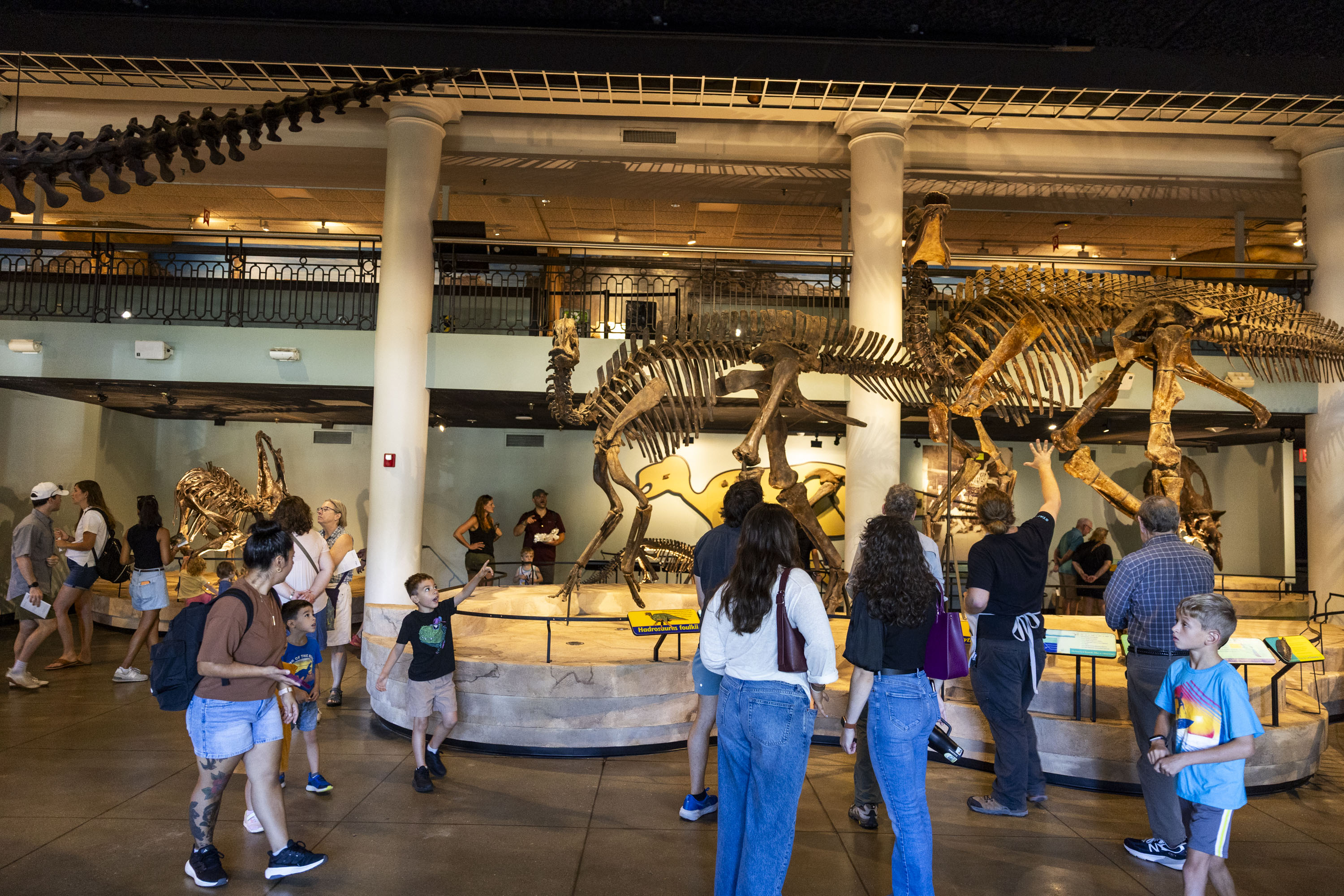
This weekend may be the last chance to see the Tyrannosaurus rex fossil replica and other exhibits at the Academy of Natural Sciences. Unless Drexel University and the academy respond to growing protest, the museum is set to permanently close.
Its closure to the public, set for Sunday at 5 p.m., will end nearly 200 years of public science exhibits that have thrilled children and adults alike. The academy, which became affiliated with Drexel in 2011, announced in a joint statement with the university earlier this month that they are closing the museum due to financial struggles and low attendance in recent years. (The museum itself will close at the end of day on Sept. 30, but Sunday is the last day it will be open to visitors.)
Despite public outcry, an effort to mobilize elected officials, and a rally that drew hundreds to the museum, Drexel and the academy have not announced any plans to keep the museum open.
What’s happening this weekend?
The museum will be open during its regular hours, 10 a.m. through 5 p.m., Saturday and Sunday, said Drexel spokesperson Britt Faulstick.
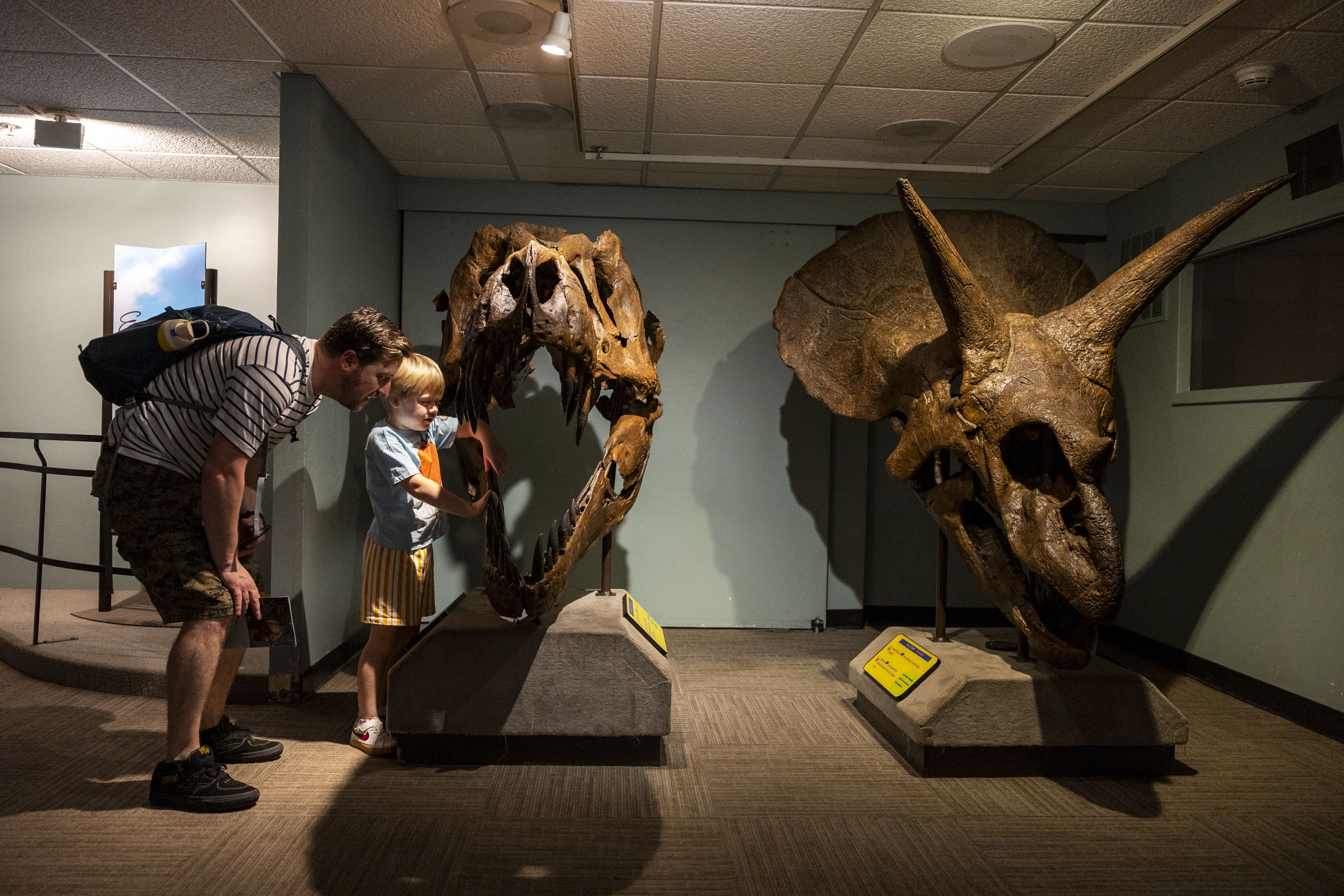
Michael Ashleigh, of Phoenixville, Pa., is with his son Otto, 5, looking at the Tyrannosaurus rex skull in the Dinosaur Hall at the Academy of Natural Sciences of Drexel University on Friday, Sept. 4, 2026, in Philadelphia, Pa. Michael wanted to give his son the experience he had 20 years ago when he first visited the Academy of Natural Sciences.Tyger Williams / Staff Photographer
Attendance has been high the past few weekends, drawing about 41,000 guests, Faulstick said, and that’s likely to be the case this weekend, too.
Walk-up tickets remain available. Ticket prices range from $18 for children to $22 for adults, with discounts for students and military. Children under 2 get in free.
Are people protesting?
Hundreds of people gathered outside the museum earlier this month to protest its closing. Around the same time, a group called Save the Academy formed.
Visitors Saturday and Sunday may be met by volunteers from the group handing out fliers to keep the museum open.
In addition, Saturday, from 2 p.m. to 6 p.m., the group has scheduled “an afternoon of arts and crafts, bubbles, face painting, music, dancing and more, right in front of the museum we love, to show how much this community wants the Academy to stay open.”
And on Sunday, protest organizers are planning to hold a candlelight vigil and march to Philadelphia City Hall.
Braxton Huminski, 3, is wearing a costume to show his support for the Academy of Natural Sciences of Drexel University on Tuesday, Sept. 8, 2026, in Philadelphia, Pa.Tyger Williams / Staff Photographer
On its website, the group argues that if the Barnes Foundation art museum could be successfully moved to Center City, then the city could help keep the museum alive.
“How many Philadelphians remember being awed by first seeing the dinosaur skeletons, either on a school trip or on a visit with family?” the group wrote on its website. “How many young people grew up to be scientists because they regularly spent time at the Academy?”
As of Thursday, nearly 56,000 people signed the group’s petition to keep the museum open. It hopes to have city council discuss the matter at an upcoming meeting.
What about all the specimens?
Even if the museum closes, the bulk of the academy’s scientific research work will continue. Its some 19 million biological specimens — seen as essential by scientists around the world — will remain preserved.
The academy owns one of the largest collections of scientific specimens on the planet, including birds, fish, mollusks, and bones. These remain important for scientific research — in particular, when looking at how the natural world has changed, one expert recently told The Inquirer.
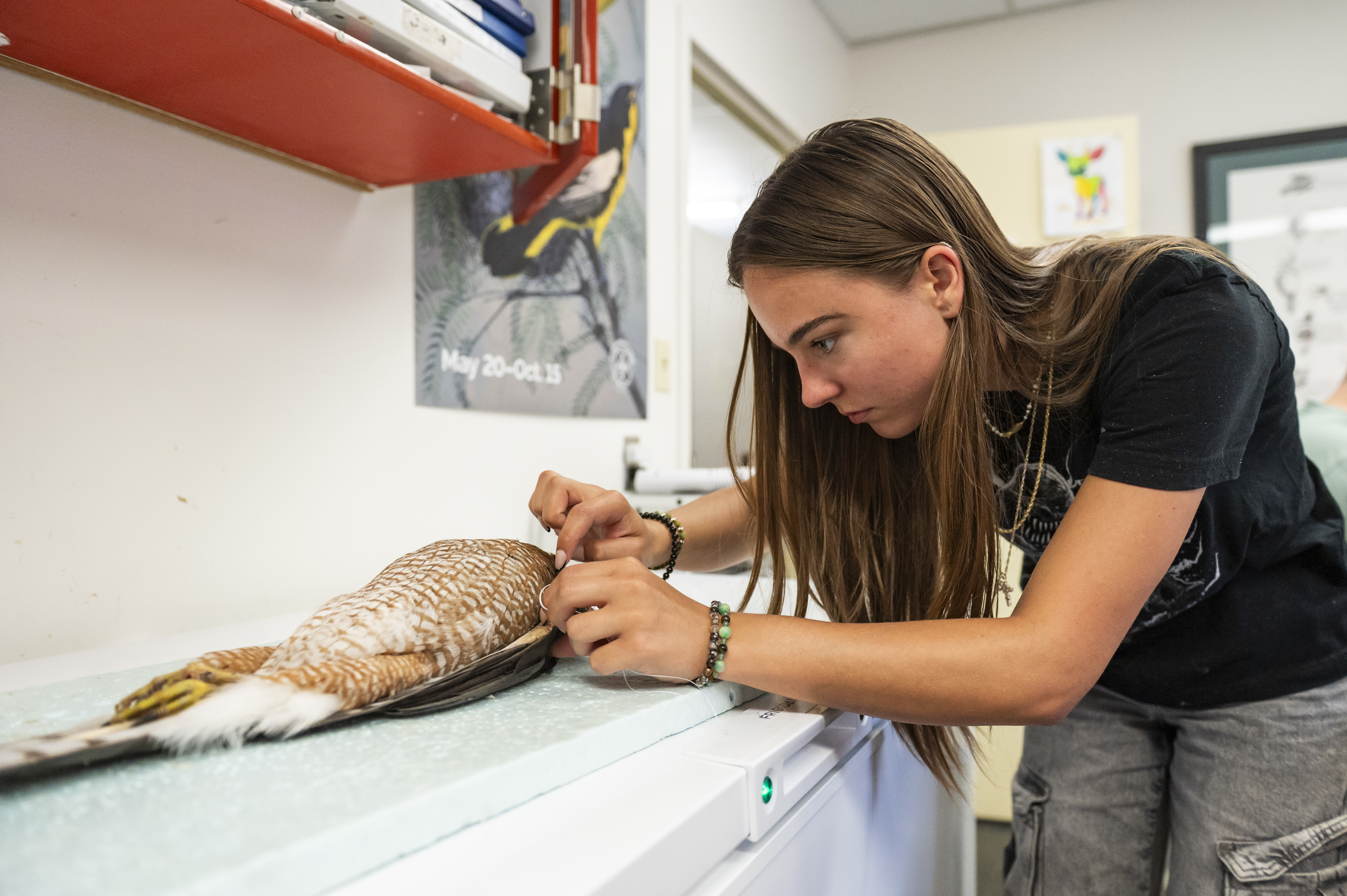
Sophie Bonner, intern and rising senior from Drexel University, puts the finishing touches after preserving a Cooper’s hawk at the Academy of Natural Sciences on Wednesday, Aug. 5, 2026.Allie Ippolito / For The Inquirer
“But these collections were made at specific times in history. We can never go back to collect more of these voucher specimens. They tell us how our world is changing,” said Robert McCracken Peck, curator of art and artifacts and senior fellow emeritus of the Academy of Natural Sciences of Drexel University. “It is by definition irreplaceable.”
Drexel and the academy have reached a tentative agreement that includes moving its collections and selling the building.
As Philadelphia rounds the corner into spooky season, fans of all things gothic, literary, or historical may be disappointed to learn that the Edgar Allan Poe National Historic Site remains closed.
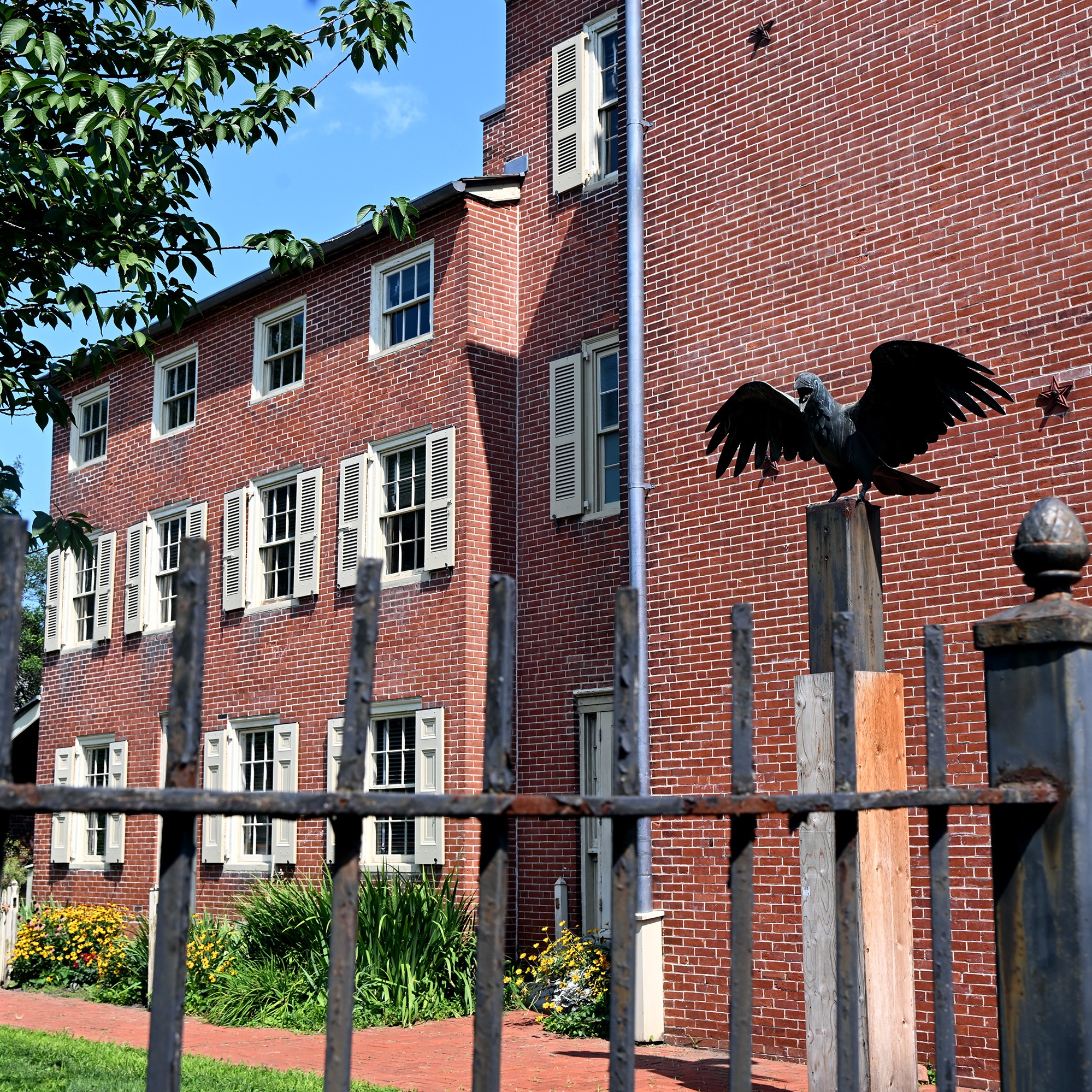
The three-story brick building at 532 N. Seventh St. shuttered in summer 2024 for fire safety upgrades costing over $931,000. It was initially slated to reopen that fall, but renovations grewinto a broader improvement project, according to the National Park Service.
More recently, Philadelphia’s tourism agency had said the site was expected to open this fall, and an Oct. 31 event celebrating Poe as the father of the modern detective novel is planned at the site.But the National Park Service says there is still no official reopening date for the public.
“I can tell you that we can offer no date for when the house will reopen,” said park service spokesperson John Warren.
Calls to a supervisor at Independence National Historical Park, which manages the Poe house, went unanswered Thursday and Friday.
Warren said park service officials did not provide more details to him on the timeline, adding that there were “multiple, complex infrastructure projects going on at the site all at once.”
“If you have ever owned an old home, you know that repair projects often lead to discovering more issues, so it’s wisest not to speculate on an end date,” Warren said.
What’s holding things up?
At the site Friday, volunteers tended to flowers and plants while National Park Service workers wrapped up another day renovating the building’s first floor.
National Park Service plasterer and painter Joe Palumbo said the house’s issues should have been addressed a decade earlier. He said when he started working there,the property “smelled awful” from likely water damage.
Palumbo said construction crews redid the restrooms, replastered and painted the first floor, and rehabbed the woodworking.
He estimated it would take another week to complete first-floor renovations. From there, outside contractors are set to replace the carpets and blinds.
Palumbo said a plan to renovate the building’s exterior is “on hold,” and he is not sure why.
What’s the significance of the site?
Built in the 1800s, the home is the only remaining residence where Poe lived during his six years in Philadelphia from 1838 to 1844.
Retired National Park Service worker Helen McKenna spent 25 years at the site, educating people about Poe and his ties to Philadelphia. During her time working there, the house had exhibits, poetry recitations, a short biographical film, and a reading room styled after one of Poe’s published articles.
Back then, the house still had the original plaster, which was moldering and falling away from its lath. Of course, she said, the walls would have been gleaming white when Poe lived there in 1843 and 1844.
The neighborhood was not even part of the city at that time, she said, and Poe would have traveled on horse-drawn omnibuses. These kinds of details help people imagine Poe, she said, not just as a literary figure, but as a person.
To her, the house captures thecontrast between Poe’s literary stature — with his influence stretching across detective fiction, science fiction, poetry, and short stories — and the alcoholic, struggling writer who lived there with his mother-in-law and his wife, who had tuberculosis.
“There’s that sense of place. This grand, admired author was living in really humble circumstances on the outskirts of the city,” she said. “He didn’t own the place, he was paying rent, and he wasn’t always able to pay the rent.”
What did Poe do while in Philly?
Many cities have memorials to Poe, McKenna said. That is because he traveled. He was born in Boston, grew up in Richmond and in England, lived twice in New York, had a stint in Delaware, and died in Baltimore.
Poe’s time in Philly, however, marked acreative high-water mark, McKenna said.
He moved to Philly after failing to find success with a novel in New York City and turned his attention to short stories. While in Philly, he published “The Murders in the Rue Morgue,” “The Black Cat,” and “The Tell-Tale Heart,” McKenna said. He also became known as a charismatic speaker and an acerbic critic.
At his best, McKenna said, Poe was “a genius of compression,” creating haunting, memorable stories at a time when interest in American writers was growing.
“I won’t say that Poe is the best writer that America ever produced, but he’s certainly had a ton of impact, globally,” McKenna said.
Leah Santos still wears a mask during her daily Regional Rail commute into Philly.
The 35-year-old nurse from Springfield, Delaware County, never stopped implementing COVID-19-era precautions. And she’s just as careful with her 1-year-old son.
So when Santos learned in May about the growing measles outbreak in nearby Lancaster County, she started asking a new question of friends and family who regularly make excursions around the region for shopping and dining: Have you been to Lancaster lately?
“I have a child to protect at all costs. So I’m making sure I’m not in contact with anyone who’s been traveling out to Lancaster,” Santos said.
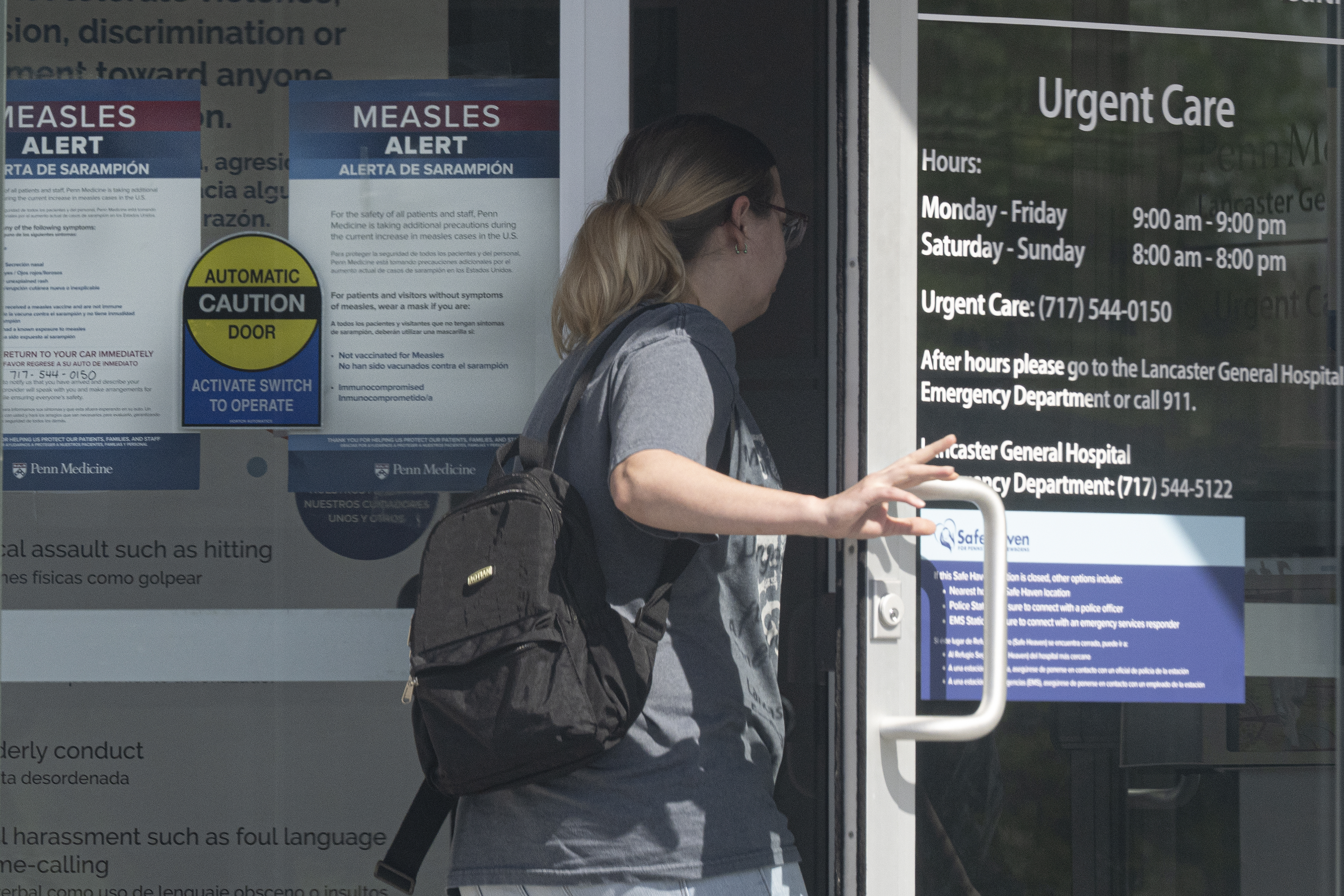
Measles alert signs in English and Spanish are posted on the front doors of an urgent care facility this month in Lancaster County amid a measles outbreak that has affected local Amish and Mennonite communities.Jose F. Moreno / Staff Photographer
A spreading measles outbreak in Pennsylvania has sickened 767 people already this year, and hospitalized 45 children under age 18. State officials have announced fourdeaths related to the outbreak: two infants in Lancaster County, a 40-year-old in Jefferson County, and an 18-year-old in Mifflin County.
Chester County remains the only Philadelphia-area county with confirmed cases — more than 65 this year, the third-highest in the state.
But in a densely populated region where crossing county lines for work and socializing is the norm, someworried parents are vaccinating babies early, delaying daycare, and weighing the risks of attending crowded festivals with their kids or visiting family in affected areas.
Measles can be more dangerous for some
Young children are especially at risk from the vaccine-preventable disease, which in severe cases can cause pneumonia, blindness, and brain swelling that can lead to brain damage.
None of the Pennsylvania residents who died were vaccinated against a virus so contagious that it will infect nine in 10 unvaccinated people who are exposed.
Measles deaths are rare,and the four deaths confirmed as “measles-associated” by Pennsylvania health officials, sparked a political standoff between Democratic Gov. Josh Shapiro and President Donald Trump’s Health Secretary, Robert F. Kennedy Jr., a longtime anti-vaccine activist.
Experts say that life shouldn’t change much for families whose children are vaccinated and otherwise healthy. But it’s important to take the disease seriously at a time when declining vaccination rates have left communities across the state increasingly vulnerable, including in the Philadelphia region.
Even as countywide immunization levels in the area remain relatively high, hundreds of kindergartens across Philadelphia and four surrounding suburban counties dropped below the “herd immunity” threshold — a vaccination rate of 95% or higher — for the 2025-26 school year, an Inquirer analysis of state data found.
This is the level at which a given population must be fully vaccinated against measles to prevent the spread of disease. In the Philadelphia region last school year, about 40% of kindergartens failed to meet that threshold, up from about a third the year before.
What are the pediatric guidelines to protect against measles?
Pediatricians typically recommend a child’s first vaccine for measles, mumps, and rubella at 1 year old, unless the child is likely to travel overseas, and then a second between 4 and 6 years old.
But Pennsylvania health officials are now encouraging a “dose zero” for children as young as 6 months old in counties affected by the state’s worst outbreak in three decades. Children can then get a second dose at 1 year old and another at 4 to 6 years old. The state is also recommending that children older than 1 who haven’t started their MMR vaccine series get two doses of the vaccine at least 28 days apart.
Santos said her son recently had his first vaccination, and her son’s pediatrician recommended he get his next shot at just 15 months old.
“We have gotten so far from knowing what vaccinations have done for us that we have no idea how terrifying this disease is,” Santos said.
‘One of those things you never think would affect you’
Caitlin Buttery of Kennett Square, in Chester County, recalls her trip, earlier this summer, to Lancaster when she was nine months pregnant, only to regret it after learning about the measles outbreak.
Now, with a healthy 6-week old baby, as well as an 18-month old, she’s avoiding the Lancaster area and also monitoring cases in her own county, where measles is circulating.
She worries about taking her children to public spaces like the YMCA or Kennett Square’s annual Mushroom Festival, which earlier this month drew thousands to the rural town.
“Measles is definitely one of those things you never think would affect you,” she said. “Now, I need to be a lot more cognizant of the chance that it could.”
Caitlin Buttery in East Passyunk with her daughter this month. The Chester County mother is avoiding the Lancaster area, the epicenter of the state’s outbreak, and also monitoring cases in her own county, where measles is circulating.Jessica Griffin / Staff Photographer
The 33-year-old said she plans to get her youngest the measles, mumps, and rubella vaccine at 6 months old.
Public health experts have warned that there are likely far more measles cases circulating in Pennsylvania than have been recorded by the state. And the disease doesn’t confine itself to county or state borders. Across the United States, more than 3,100 people this year have tested positive for the disease, the CDC said last Thursday.
(function(){function e(){window.addEventListener(`message`,function(e){if(e.data[`datawrapper-height`]!==void 0){var t=document.querySelectorAll(`iframe`);for(var n in e.data[`datawrapper-height`])for(var r=0,i;i=t[r];r++)if(i.contentWindow===e.source){var a=e.data[`datawrapper-height`][n]+`px`;i.style.height=a}}})}e()})();
Amina Lowery lives in Upper Darby. No cases have been reported in Delaware County, but health officials there did identify measles in a wastewater sample earlier this summer, meaning someone with the disease used a bathroom connected to the county’s public water supply.
Lowery opted to get her 6-month-old daughter vaccinated early. She alsoquit her job in the insurance industry to keep her daughter out of daycare, “since we can’t control what other parents decide.” She said the plan now is to enroll her child when she’s closer to 2 years old.
She feels safer having her child vaccinated ahead of a family trip later this year to Florida, which is also dealing with a measles outbreak.
“We have the research and documentation to show that vaccines work and are for the greater good. It feels like we are in the midst of societal decline,” Lowery said.
Like Lowery, Shelby Steele of Springfield opted to keep her daughter out of daycare. Her daughter is now nearly 2 years old, but Steele, a consultant who works from home, isn’t any closer to enrolling her.
“We obviously worry about the socialization aspect of things, but measles is no joke. We’d rather find more creative ways to socialize her safely for now,” Steele said.
Steele and her partner want to have another child if possible. But she said the measles outbreak “and just the current state of things overall” makes them think twice about the risks a child could face.
Steele said she’d like to send her daughter to school, but the outbreak even has her considering homeschooling. “We are having to reconsider a lot of things, schooling being one of them,” she said.
Physicians advise parents on navigating the outbreak
Pediatrician Katie Lockwood says parents coming to her Children’s Hospital of Philadelphia practice in Montgomery County say they’re changing childcare and vacation plans to avoid measles exposures.
Montgomery County has reported three measles cases this year.
“If you’re fully vaccinated and healthy, I don’t think there’s a change in how you need to operate right now,” Lockwood said.
“But if you have someone in your family who is particularly vulnerable, if they’re immunocompromised, pregnant, or unvaccinated because they’re too young, then you may want to change your behaviors.”
She advises parents to talk to school officials and daycare providers about their vaccination policies, keep sick kids home to avoid spreading illness, and make sure children are up to date on all recommended vaccines.
“It’s awful that now parents are having to make a decision between work and childcare for something that we can prevent safely with vaccination,” she said. “Not everyone has the ability to quit their job or stay home, and they may not have an alternative childcare resource.”
Like many practicing physicians today, most schools and daycares have never had to deal with a measles case. Lockwood recently had several childcare providers refer children with rashes to her practice, worried about measles.
None of the children had the disease, but “I would rather a school or a daycare overreact,” she said, explaining that keeping a child out of school to evaluate a rash that proves harmless prevents “potentially exposing a bunch of kids to measles.”
(function(){function e(){window.addEventListener(`message`,function(e){if(e.data[`datawrapper-height`]!==void 0){var t=document.querySelectorAll(`iframe`);for(var n in e.data[`datawrapper-height`])for(var r=0,i;i=t[r];r++)if(i.contentWindow===e.source){var a=e.data[`datawrapper-height`][n]+`px`;i.style.height=a}}})}e()})();
In Bucks County, pediatrician Toni Richards-Rowley often counsels parents frustrated about having to navigate the outbreak.
She also serves as president of the Pennsylvania chapter of the American Academy of Pediatrics, which has been working to educate doctors about measles and how to recognize it.
In her own practice, Richards-Rowley is also offering “dose zero” shots for children whose parents work or plan travel to affected counties.
“If a parent asks for it, even though there’s not community spread in Bucks yet, we’re not going to turn a family away,” she said.
“Measles doesn’t respect borders. Just because we don’t have an index case doesn’t mean it’s not going to happen. You do have to be fairly vigilant wherever you go.”
Correction: This story has been updated to delete an incorrect reference to Upper Darby’s geography in the region.
The Philadelphia district attorney’s office has charged a woman with murder and other crimes for her alleged involvement in a fire in February in the city’s Kingsessing neighborhood.
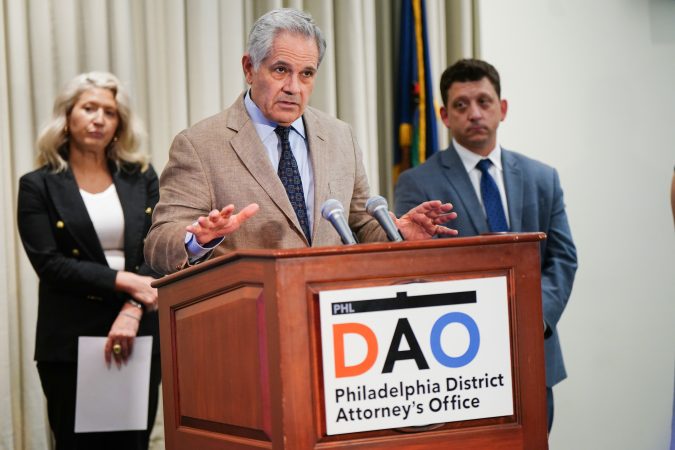
Chardae Sapp, 34, was charged with murder, attempted murder, aggravated assault, arson, causing or risking a catastrophe, and two misdemeanors, District Attorney Larry Krasner’s office said Friday.
The charges date back to a fire at a house on the 5400 block of Regent Street on Feb. 4 around 1:40 a.m., prosecutors said. Four people were taken to the hospital for treatment. Twenty-six-year-old Raymond Bell, found unresponsive in a bedroom, died as a result of the blaze.
Fire marshals determined that the fire was deliberately set and began in a second-floor bedroom “when an open flame was applied to available combustibles consisting of bedding and mattress materials,” the District Attorney’s office said.
“This is a terrible tragedy that should have never happened and could have been even deadlier if the fire had spread faster,” Krasner said in a statement, thanking first responders for their roles in the investigation. “Our office looks forward to pursuing a fair and just outcome in this case and continuing to support the co-survivors.”
The line formed early, and by noon more than 200 people stood outside the Kai Yuan Temple in Northeast Philly, waiting to receive food.
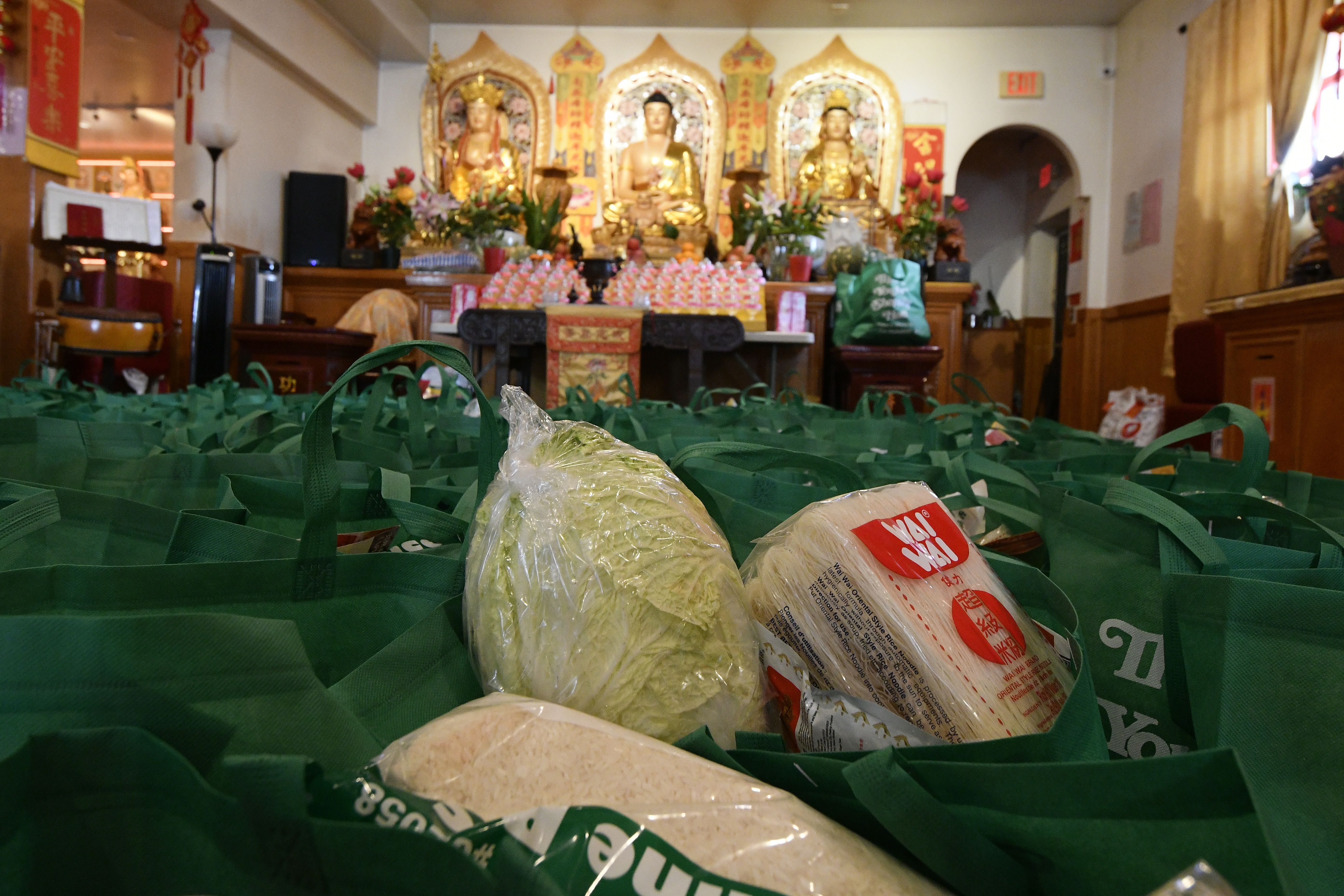
This wasn’t a typical food pantry. The food drive was organized to provide familiar grocery staples to the city’s sizable Chinese immigrant community.
“It really shows the need for culturally relevant food — and food access in general,” said Sunhee Volz, an organizer.
The food drive was a grassroots response to the city’s affordability crisis at a time of rising food insecurity, fueled by federal cuts to the Supplemental Nutrition Assistance Program. Some immigrant families also fear seeking government assistance, according to Asian Pacific Islander Political Alliance, which organized the event. The food drive was part of the group’s awareness campaign to tax corporations and the very wealthy.
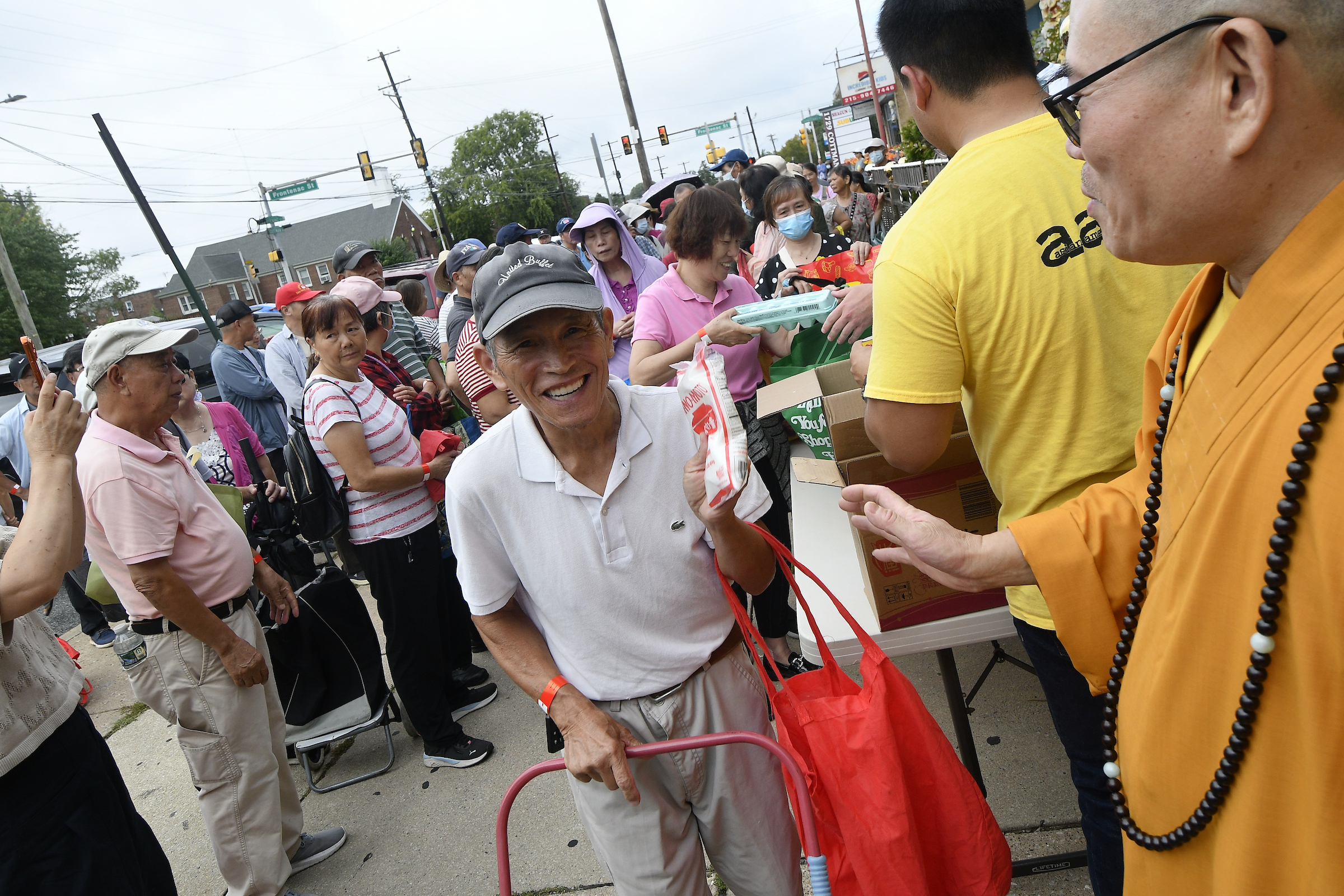
Community members receive culturally appropriate food aid at the Kai Yuan Temple on Cottman Avenue, on Sunday afternoon.Bastiaan Slabbers/ For the Inquirer
An anonymous donor footed the bill for 200 bags of groceries ordered from Heng Fa food market in Chinatown, organizers said. Rice noodles, napa cabbage, sweet potato starch, MSG, and fruit were among the food items packaged into large, green bags for distribution.
Eggs were kept outside the temple for religious reasons, organizer Jenny Zhang said. Large glass bottles of soy sauce were handed out separately from the bagged items to prevent them from breaking.
In a way, those soy sauce bottles were the inspiration for the food drive, said Hanna Kim of Asian Food Collective. At previous food distributions, Kim had noticed how excited people became when they received a particular brand of soy sauce.
The family of Joyce Yan and Bobby Lin (not pictured) of Northeast Philadelphia receive culturally appropriate food aid outside Kai Yuan Temple on Cottman Avenue on Sunday afternoon.Bastiaan Slabbers/ For the Inquirer
Kim held up a yellow bottle of Haday premium soy sauce, which she said is immediately recognizable to many Chinese immigrants.
“When you have that familiarity, it’s a feeling of home, too,” Kim said.
Wei Chen, civic engagement director of Asian Americans United, explained that the Buddhist temple had recently completed its annual Hungry Ghost Festival. The 30-day celebration honors ancestors and the dead, and giving away food is part of the tradition, Chen said.
Centuries ago in China, the government prohibited food distribution for the those experiencing hardships. But under the pretense of giving food away to “hungry spirits,” the temples were able to circumvent the rules, Chen said.
These days, Sunhee Volz said, the government has made it harder for immigrants in need of food to get help. Recent ICE deportations have made it worse, she said.
“Some people aren’t even applying because they’re afraid. That fear is intentional, to keep people from even trying,” Volz said.
The food was distributed with flyers from the group, printed in both English and Chinese, explaining that in 2025 Congress cut $187 billion from the Supplemental Nutrition Assistance Program. New work requirements and rules have made it harder for people, especially noncitizens, to qualify for assistance, the flyer states.
Ven Zhi Lai of Kai Yuan Temple helps hand out snacks to children of families in the line that formed waiting to receive culturally appropriate food aid at the Buddhist temple on Cottman Avenue on Sunday afternoon.Bastiaan Slabbers/ For the Inquirer
“Step one is just awareness,” Volz said. “A lot of people don’t even know why funding is being cut.”
From there, the group hopes to build relationships with people and plan more actions. “The affordability issue is affecting everybody, of course,” Volz said.
APIPA is one of about 30 political groups pushing a plan called “Tax Billionaires, Fund PA,” Volz said. That plan seeks to add state revenue by closing corporate tax loopholes, instituting a digital advertisement tax, and adding a tax on “unearned income” such as stock dividends, according to its website.
Democratic State Rep. Sean Dougherty met with the group before the food drive and helped hand out cartons of eggs. Dougherty cosponsored one legislative proposal supported by the group, which would tax online advertisements from tech companies. The bill stalled in the Republican-controlled state Senate.
“Just look at this line. It also shows that affordability and the cost of living is a real issue,” Dougherty said.
As families lugged the heavy tote bags full of groceries from the Buddhist temple Sunday, many expressed their gratitude.
Through a translator, Rong Chen said that she was “very excited” to receive food for her family. Chen has been in Philadelphia since 2019 after moving from Fujian, China.
Bobby Lin said the free food helps offset the rising costs of living expenses and gas prices.
Lin’s partner, Joyce Yan, said some people waited three hours in the line, but it was worth it.
“This kind of food is very good,” Yan said, as she held her infant daughter in her arms.