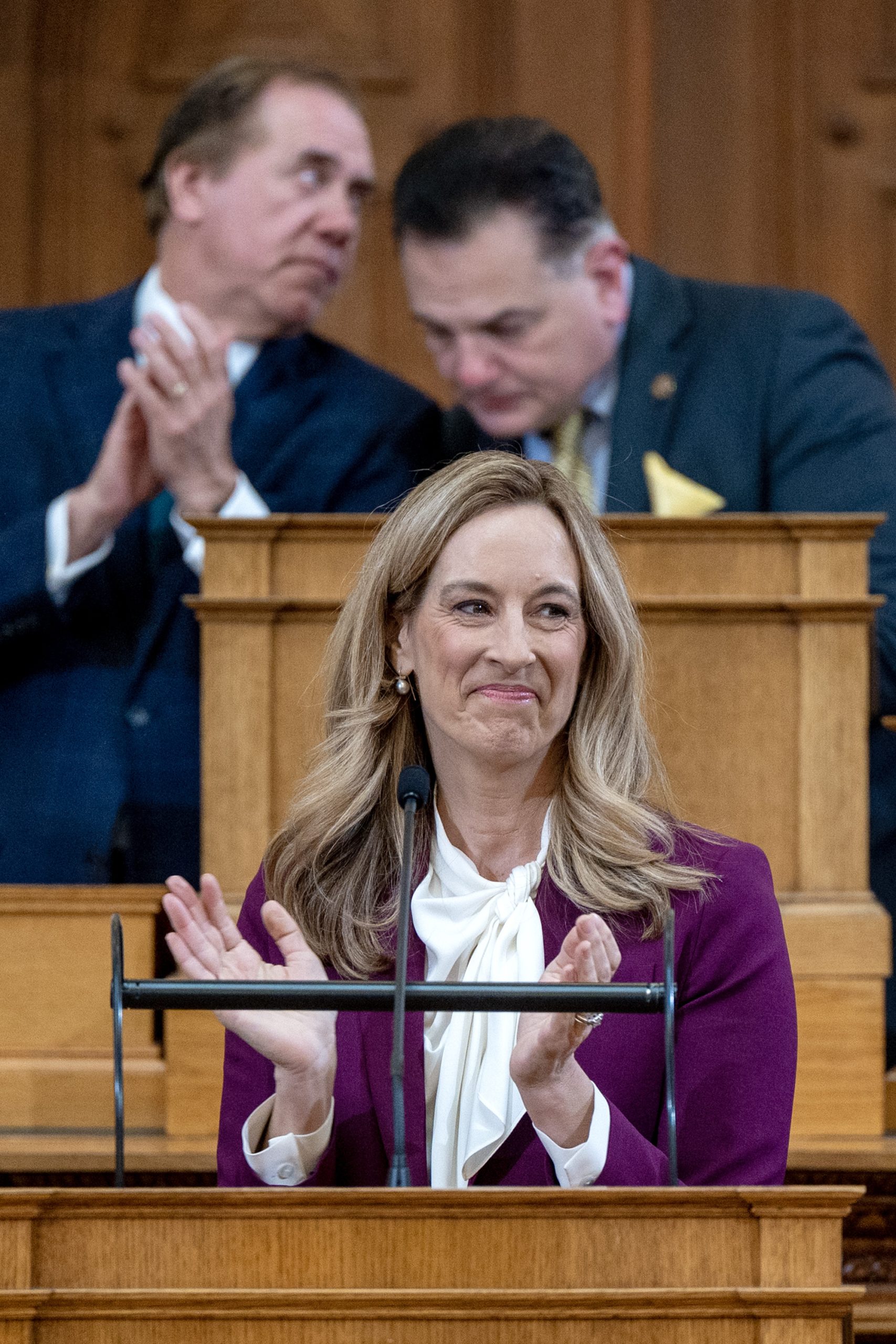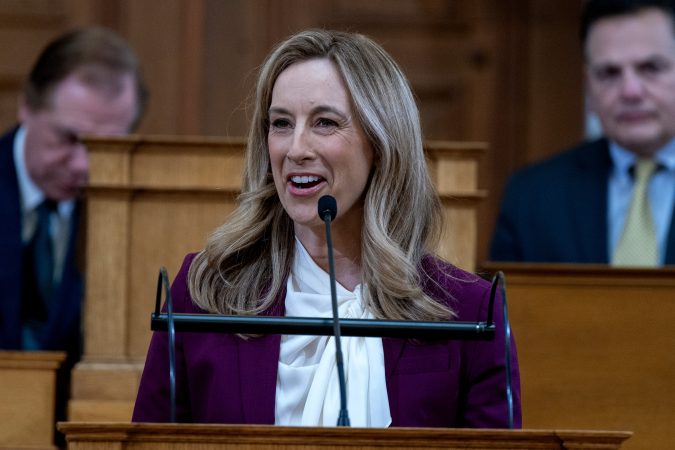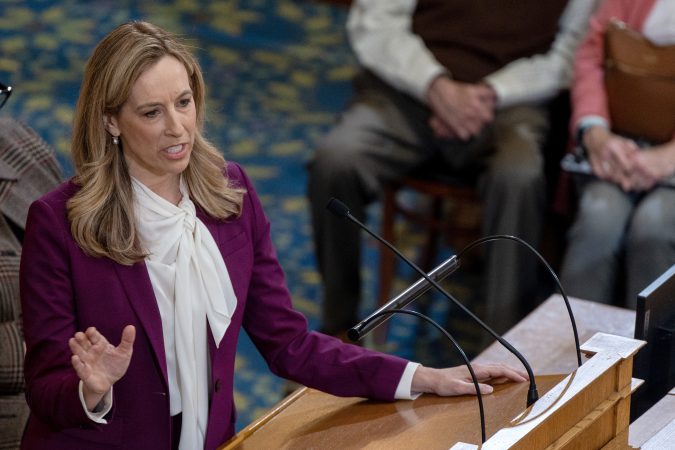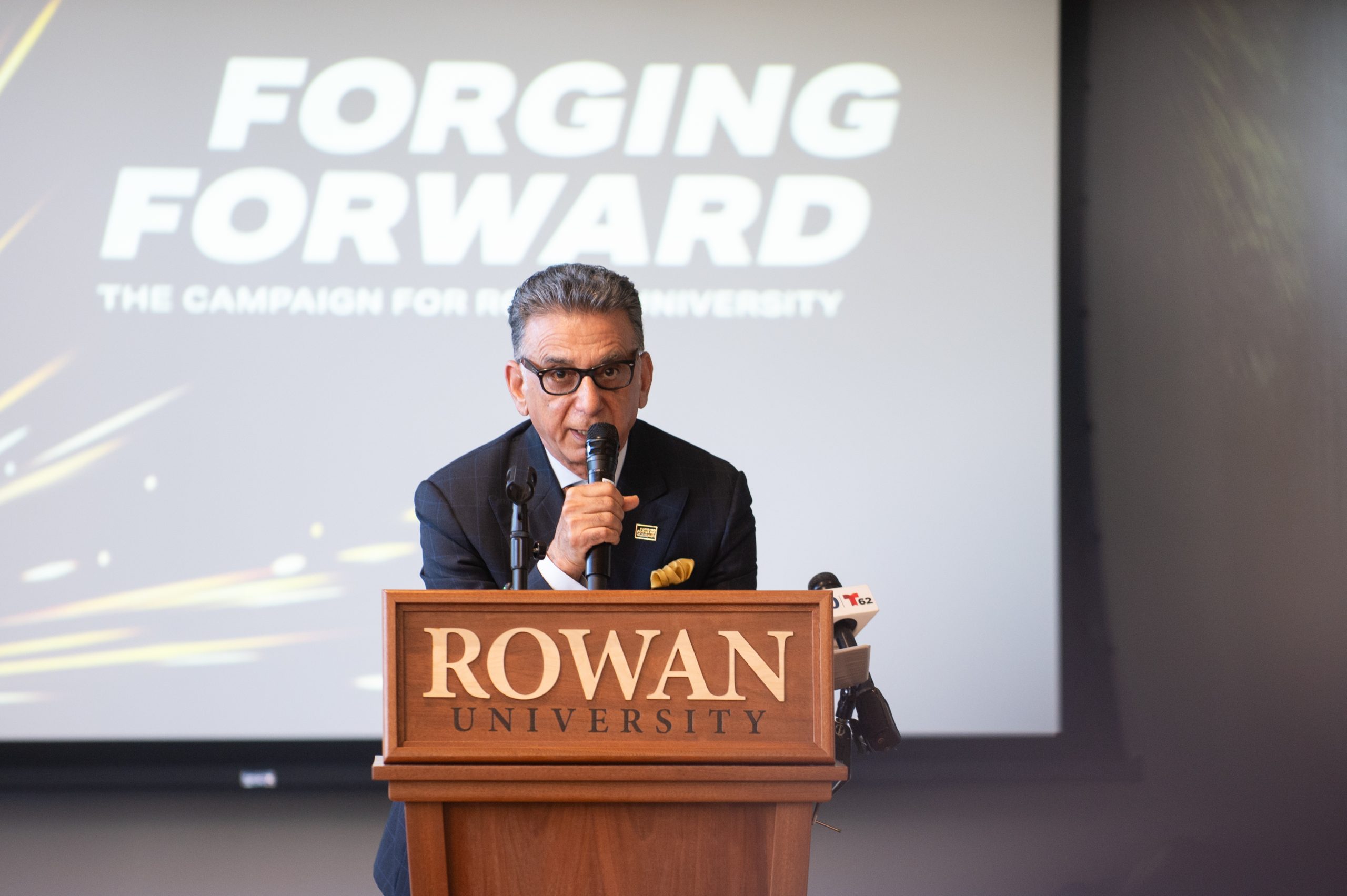
Author: Aliya Schneider

  • Pope Leo XIV celebrates immigrants in speech to Philadelphia crowd amid clash with Trump ahead of 250th anniversary

    Pope Leo XIV celebrates immigrants in speech to Philadelphia crowd amid clash with Trump ahead of 250th anniversary

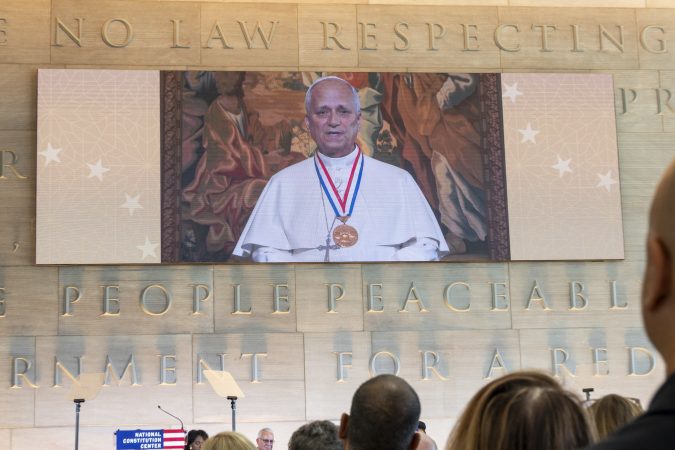
    Addressing a Philadelphia crowd live from the Vatican, Pope Leo XIV called for a “recommitment” to American ideals.

    The first U.S.-born pope delivered remarks virtually at an interfaith ceremony inside Philadelphia’s National Constitution Center on the eve of the United States’ 250th birthday to accept the center’s prestigious Liberty Medal.

    Facing a screen showing the live, cheering Philadelphia audience, the pontiff wore his Liberty Medal along with a cross around his neck.

    Leo, who grew up in Chicago and attended Villanova University, quickly pointed out his American roots, calling himself “a son of this great country.”

    “I join you in asking God’s blessings upon America’s future that the lofty ideals enshrined at the beginning of the Declaration of Independence may continue to guide the flourishing of the nation in unity, justice, and peace,” he said.

    Leo, who was elected pope last year, spent years serving the church in Peru and has been outspoken about calling for international peace. That’s landed him at odds with President Donald Trump’s administration on the issue of migrants, the war in Iran, and more.

    The pope leaned into some of those themes in his speech, even though he did not refer to the president directly.

    He nodded to his advocacy for humane treatment of immigrants and noted that the founders of the United States “made America a byword for freedom, as the country opened its doors to successive waves of immigrants, enabling them and their children to play their part in shaping the future of the nation.”

    He said the “love of freedom” in the United States has inspired the country “to look beyond itself and at great sacrifice to champion the cause of freedom beyond its own borders.” But he acknowledged that mission hasn’t been straightforward, noting that building a society that embodies such ideals “was not always easy and, in many respects, is still a work in progress.”

    The pontiff’s speech comes the day before he plans to visit Lampedusa, an Italian island known as a stop for migrants making the dangerous journey across the Mediterranean Sea from North Africa to Europe. His predecessor Pope Francis made his first official visit outside of Rome in 2013 to the same island and condemned the “globalization of indifference” toward migrants.

    Pope Leo XIV speaks at the Liberty Medal Ceremony at the National Constitution Center in Philadelphia on Friday.Tyger Williams / Staff Photographer

    Julie Silverbrook, the chief content and learning officer for the National Constitution Center, emphasized in a Friday interview that Leo is a “global leader who has been uniquely shaped by American ideals.”

    “He has brought together people of different faith traditions, and through his ministry really reflected his belief in the inherent dignity of all human beings,” she said.

    Leo declined an invitation from Trump to the United States to celebrate the country’s 250th birthday on July Fourth, the New York Times reported. The first American-born pope opting to visit migrants instead sends a stark message as the president pursues his mission of mass deportations.

    But the pontiff’s participation in the Philadelphia program highlights his connections to the region, which isn’t lost on the National Constitution Center.

    The Philadelphia-based private nonprofit organization chose Leo for the award due to “his lifelong work promoting religious liberty and freedom of conscience and expression around the world — ideals enshrined by America’s founders in the First Amendment to the U.S. Constitution.” That, and also because he is the first pope born in the United States, and has connections to Philadelphia, Silverbrook said.

    “He was shaped by those freedoms … in much the same way that the Declaration of Independence was shaped by the city of Philadelphia, and of course a reflection of American values that have been carried globally,” she said.

    When a delegation from Philadelphia’s National Constitution Center met with Leo at the Vatican in April to present him with the medal in person, they also bore a few local goodies: a bundle of Villanova swag, a replica of George Washington’s Acts of Congress, and a Wawa tote bag filled with Tastykakes.

    “I think he very much so feels a connection to Philadelphia, both having been educated here, and I think in this semiquincentennial moment, I think the eyes of the world are on Philadelphia, and we’re thinking about the ideals that have emanated from this place for 250 years,” Silverbrook said.

    Leo, a 1977 Villanova alum, recently passed on a surprise message to graduates of his alma mater. Vince Stango, the interim president and CEO of the National Constitution Center, also went to the Augustinian university on the Main Line, which co-sponsored the NBC10 broadcast of the event along with the archdiocese and Malvern Prep.

    (From left to right) Gov. Josh Shapiro, Rev. Nelson J. Pérez, Mayor Cherelle L. Parker, Interim President & CEO of National Constitutional Center Vince Stango, Rev. Carolyn C. Cavaness, Imam Quaiser D. Abdullah, Rev. Luis A. Cortés Jr., and Rabbi Jill L. Maderer, pose for a photo at the Liberty Medal Ceremony at the National Constitution Center in Philadelphia, Pa., on Friday.Tyger Williams / Staff Photographer

    Clashing with Trump

    The pope has contended that it’s up to each country to determine how they want to accept migrants while also denouncing the Trump administration’s “extremely disrespectful” treatment of them.

    He has also spoken out against Trump’s threats against Iran, and declined to participate in the president’s “Board of Peace” for Gaza’s reconstruction.

    In an April social media rant, Trump complained that he doesn’t “want a Pope who criticizes the President of the United States.” The president called the Catholic leader weak and accused him of “catering to the Radical Left.”

    Leo told reporters that month that he has “no fear, neither of the Trump administration, nor of speaking out loudly about the message in the Gospel, and that’s what I believe I am called to do, what the church is called to do.”

    In his Friday remarks, the pope made a call for unity but warned that a country should come together with “ideals that do not fade with the passing of time.”

    He called on the United States to recognize its values of “peace and prosperity, a country characterized by generosity and nobility of heart,” and said the values of “shared human dignity, equality, and the rights laid out in the Declaration of Independence” can help unite and guide the nation.

    The Liberty Medal

    The Liberty Medal was created in 1988 and has been hosted by the National Constitution Center since 2006.

    The award has gone to storytellers, philanthropists, civil rights leaders, and politicians on both sides of the aisle, such as Ukrainian President Volodymyr Zelenskyy, former Supreme Court Justice Ruth Bader Ginsberg, the Bushes, Malala Yousafzai, and Thurgood Marshall.

    The center describes its recipients as individuals who “strive to secure the blessings of liberty to people around the globe.”

    The process of selecting Leo began about a year ago, Silverbrook said.

    The speech was initially going to be projected on Independence Mall, but the event was moved indoors due to the extreme heat and livestreamed by the center online.

    Rich Russo, 63, a Fishtown resident who attended the event in person, called the experience “once in a lifetime.”

    “How many times do you get the pope talking to you?” said Russo, who works for a bank.

    Gov. Josh Shapiro, who is Jewish, and Mayor Cherelle L. Parker, a Baptist — both Democrats who have been outspoken about their own faiths — joined Philadelphia Archbishop Nelson J. Pérez and other religious leaders who made remarks on stage prior to the pope’s speech. Pennsylvania Attorney General Dave Sunday, a Republican, rang a replica Liberty Bell outside.

    “Philly is proud that the pope is a graduate of Villanova University who spent time living and working in our region,” Pérez said on stage. “Pope Leo knows us, and we feel like we know him, too.”

    “His influence, however, extends beyond Philadelphia,” the archbishop added.

  • Pope Leo XIV is speaking to the National Constitution Center live from the Vatican. Here’s what to know.

    Pope Leo XIV will accept the National Constitution Center’s Liberty Medal on Friday, delivering remarks live from the Vatican that will be broadcast inside the Sixth and Arch building.

    The U.S.-born pontiff’s speech is a major addition to Philadelphia’s already extensive lineup of activities and events on the eve of the United States’ 250th birthday on July Fourth.

    His speech will be particularly anticipated in Philadelphia given the Semiquincentennial and Leo’s deep ties to the Philly area.

    The Catholic leader has garnered attention for clashing with President Donald Trump’s administration, which will be further exemplified by his visit with migrants on Independence Day.

    His award acceptance speech also comes just two days after traditionalist Catholics in Switzerland defied him by consecrating bishops without his consent, which Leo called “a sin of extreme gravity,” the Associated Press reported.

    His Friday remarks were initially going to be broadcast on Independence Mall but it was moved inside due to extreme heat.

    Here’s what to know ahead of his Liberty Medal speech.

    What are Pope Leo’s connections to the Philly area?

    Not only is he the first U.S.-born pope, but he has connections to the Philly area — despite being from Chicago.

    Leo graduated from Villanova University in 1977 with a bachelor’s degree in mathematics. He received an honorary doctorate of humanities in 2014 from the Augustinian university.

    Those who knew him at the time described him as a Midwesterner with a sense of humor who was tuned in to global issues like immigration and poverty — and like anyone who goes to Villanova, a big basketball fan. He worked part-time at St. Denis Catholic Church in Havertown as part of the cemetery maintenance crew during his studies.

    In May, he passed along a surprise commencement message to this year’s graduates. In that message, he fittingly referenced America’s 250th anniversary.

    “May the graduates of 2026 always be faithful to the guiding light that has been so important for these 250 years,” Leo said.

    This video screen grab shows Pope Leo XIV wearing a Villanova hat given to him during a meeting with an Italian heritage group.Associated Press

    Last month, a delegation from Philadelphia’s National Constitution Center met with Leo at the Vatican to present him with the medal. They would have been remiss to forget to celebrate his Philly connections.

    So they brought him a few local goodies: a bundle of Villanova swag, a replica of George Washington’s Acts of Congress, and, best of all, a Wawa tote bag filled with Tastykakes.

    Vince Stango, interim president and CEO of the Constitution Center, said the visit had “a real Philadelphia vibe that was unmistakable.”

    What’s the Liberty Medal?

    The Liberty Medal has been presented by the nonpartisan National Constitution Center since 2006, offering the esteemed prize to individuals and organizations who “strive to secure the blessings of liberty to people around the globe.”

    In Leo’s case, he’s receiving the award because of his work in promoting religious liberty.

    Previous recipients of the award include Ukrainian President Volodymyr Zelensky, the late U.S. Supreme Court Justice Ruth Bader Ginsburg, the late U.S. Sen. John McCain (R., Ariz.), and the late civil rights leader and U.S. Rep. John Lewis (D., Ga.).

    How do I watch?

    The National Constitution Center is streaming the ceremony live on its YouTube channel at 10:45 a.m. NBC10 will also broadcast the awards.

    Tickets to the event were previously made available to the public and other invited guests.

    What’s going on with the pope and Trump?

    Trump invited the pontiff to visit the United States on July Fourth to celebrate the 250th anniversary of the country. He declined.

    Instead, the pope will spend Independence Day visiting Lampedusa, an Italian island in the Mediterranean Sea located between Tunisia, Malta, and Sicily. It‘s a major entry point for migrants seeking refuge in Europe from North Africa. It’s one of the deadliest migration paths in the world, Reuters reported.

    Leo’s predecessor, Pope Francis, visited the island in 2013.

    Francis, who was close with Leo, also clashed with President Donald Trump and Vice President JD Vance on issues like immigration, and that tension has continued under the new pontiff.

    The pope said in November that the United States has been treating migrants “in a way that is extremely disrespectful” under the Trump administration. A month prior, he suggested that the United States’ treatment of immigrants is “inhumane.”

    Vance, who converted to Catholicism in 2019, said this week on Fox News that he finds the Vatican’s immigration views “troubling,” saying that “mass migration has victims.”

    Leo was also outspoken in his opposition to Trump’s war in Iran, and the Vatican declined to participate in Trump’s “Board of Peace” for Gaza.

    Trump has not held back on his criticism of the pope, calling him “WEAK on Crime, and terrible for Foreign Policy” in an April social media rant. He faced condemnation from Catholics — who have found themselves taking a side between the pope and the president — after sharing a now-deleted image of himself presented as Jesus.

    It will be telling whether Leo leans into his disagreements with the Trump administration, whether directly or indirectly, during his speech on Friday.

  • Camden is a winner in New Jersey’s $60.7B budget. Who are the losers?

    Camden is a winner in New Jersey’s $60.7B budget. Who are the losers?

    Gov. Mikie Sherrill signed the New Jersey budget for fiscal year 2027 Tuesday night, shortly before the clock ran out on the constitutionally mandated deadline.

    The budget ranks as the largest in state history, but Sherrill also contends it is the most “fiscally responsible” in decades in part because it fully funds the state pension program and doesn’t come with widespread tax increases for residents.

    Lawmakers approved the budget on Tuesday after adding millions in legislative add-ons Sunday night, a move that countered Sherrill’s earlier vows to change the culture in Trenton. But she softened her stance as the deadline neared and she conceded that lawmakers know their districts best.

    South Jersey Democrats defended the spending, which Republican lawmakers criticized as “pork.”

    “I know sometimes it gets disparaging names, but I think one of our responsibilities as elected officials is to be responsive to the needs of our communities,” said Sen. Troy Singleton, a Burlington County Democrat.

    But the last-minute shuffle didn’t result in the transparency Sherrill originally promised, with some legislators saying they weren’t sure of the details they were voting on. The budget passed mostly along party lines in the Democratic-dominated legislature. Sherrill and legislative leaders touted record funding for schools and property tax relief programs.

    “I know the process needs work,” Sherrill said at a Tuesday night news conference. “It takes too long. It could be much more transparent, but we took steps in the right direction this year.”

    Here are some of the winners and losers in the budget.

    Camden County Commissioner Director Louis Cappelli, Jr., left, with Gov. Mikie Sherrill and Camden Mayor Victor Carstarphen, right, at SoccerFest26, the World Cup fan fest at Wiggins Waterfront Park in Camden on Friday.Aliya Schneider / Staff

    Winner: Camden City and County

    South Jersey obtained funding for projects across the region with Camden scoring one especially big-ticket item: $9 million for property acquisition and demolition. The funding is for a county-run program focused on removing vacant, unusable, or otherwise deemed dangerous properties in the city.

    Louis Cappelli Jr., the director of the Camden County Commissioners, said in an interview that the county has demolished more than 1,200 residential and commercial buildings over the past decade as part of this effort, mostly with state money. He said the program’s mission is to encourage the city’s redevelopment.

    “The city is in desperate need of new housing, especially market-rate housing, and by creating opportunities for development on these properties, we believe we will draw the interest of residential developers to build in Camden City,” he said.

    The city of Camden was also allocated $250,000 for a statue of Martin Luther King Jr., which Sherrill promised the city ahead of her inauguration. This project was a priority for the governor, who systematically struck a pen through legislative projects but dedicated funding to the statue in her proposal earlier this year.

    Several organizations that serve Camden city and county received hundreds of thousands of dollars in the budget.

    The Camden Coalition of Healthcare Providers received $500,000 for a program that connects emergency department patients to outpatient behavioral care and $750,000 for a program that helps people experiencing homelessness obtain housing. Joseph’s House, a homeless shelter in the city of Camden, received $600,000, and a separate spending bill also sends $650,000 to a new construction homeownership project.

    The budget also allocates $300,000 for job training for youth and young adults, $75,000 for a program dedicated to improving school attendance in the city of Camden, and $25,000 for a new county program that supports formerly incarcerated people reentering their community.

    It also includes $3.2 million for structural improvements for a bridge at Route 30 and Somerdale Road and $12.1 million for the Camden County LINK Trail, a planned 34-mile multiuse trail.

    Loser: High-income seniors

    Senior homeowners who earn between $200,000 and $500,000 a year will no longer qualify for the nascent Stay NJ property tax credit program under the new income cap. They just began receiving checks for the program this year.

    Sherrill proposed scaling back the expensive program in her budget proposal earlier this year, which caused some tension because the new program was championed by Assembly Speaker Craig Coughlin, a Middlesex County Democrat and a key budget negotiator.

    But Sherrill and legislative leaders found a compromise by giving higher payments than she proposed for those who make less money, and an even lower income limit than she proposed for the program.

    Qualifying taxpayers will get refunded up to half their property tax bill up with maximum refunds ranging from $4,000 to $6,500, depending on their income, with those earning more getting less.

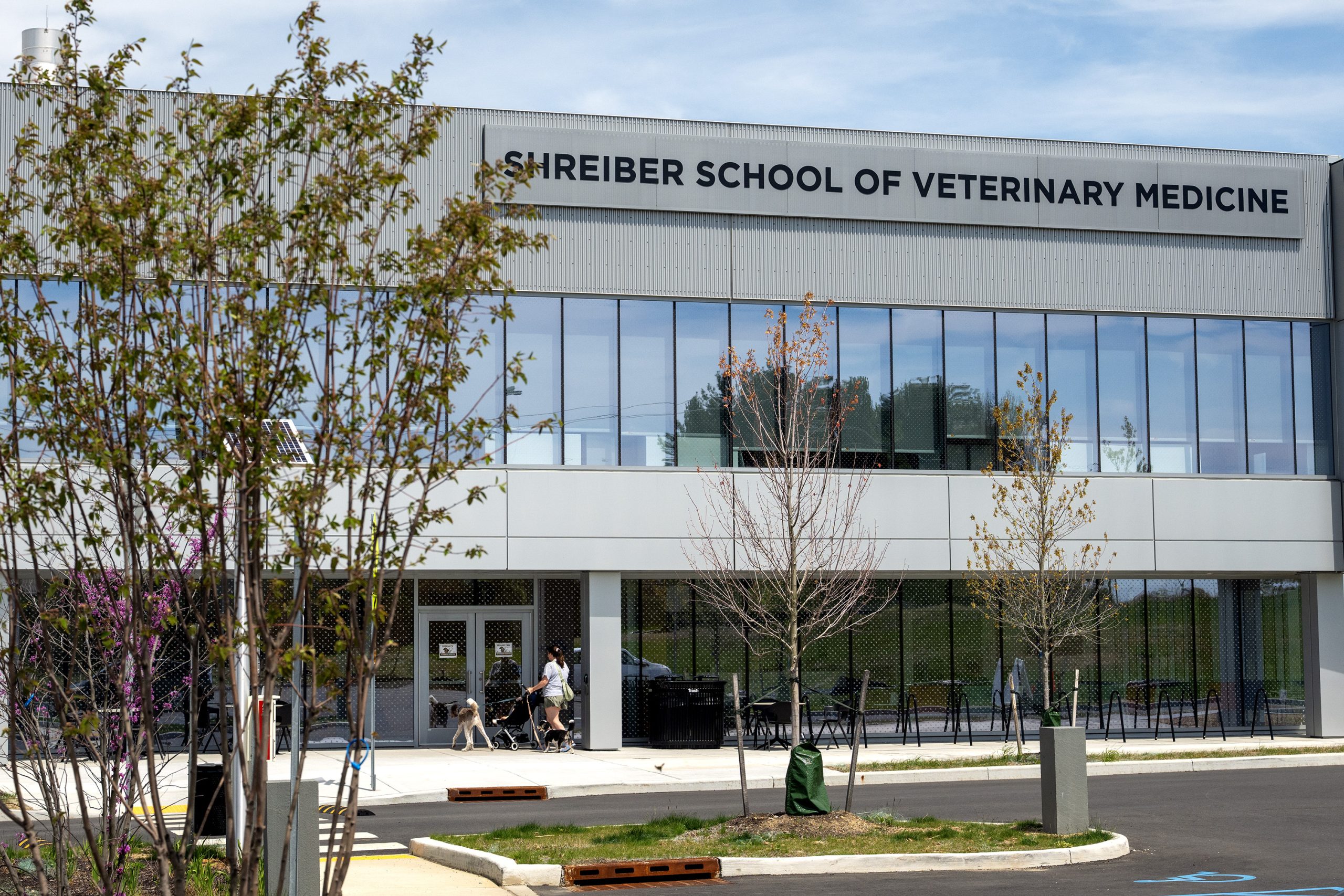
    Rowan University’s Shreiber School of Veterinary Medicine Tuesday, April 14, 2026. Tom Gralish / Staff Photographer

    You win some, you lose some: Rowan University

    Rowan University is receiving less money than it did this year, but significantly more money than Sherrill initially proposed. At the end of the day it’s a win for the university, which saw significant cuts reversed.

    Sherrill’s initial proposal included about $125 million, but legislators brought the total up to nearly $135 million — a drop from the $155 million the state gave the school this year.

    Sherrill zeroed out funding for Rowan’s new veterinary school but legislators successfully got $6.2 million for the program — still less than the $8 million it received this year and a far cry from the $20 million the school requested.

    State Sen. John Burzichelli, a Gloucester County Democrat, said the money is enough for the school to at least “keep the lights on,” for the veterinary school and the medical school funding is “sound.”

    Sherrill also proposed cutting all state funding for Virtua Health College of Medicine and Life Sciences. Legislators restored $2 million to the program — half of what it received this year and much less than the requested $12 million.

    The Rowan-Virtua Child Abuse Research Education and Service Institute (CARES) program, which provides medical and mental healthcare to children who have experienced abuse, had all its $1.85 million funding restored after Sherrill initially zeroed it out.

    In anticipation of the governor’s proposed cuts, Rowan sent employees layoff notices and announced the closure of its Vineland office. A union representing CARES employees has called on Rowan to reverse these changes.

    But Rowan spokesperson Jose Cardona said the university “will evaluate next steps and very soon determine the most responsible path for operations, staffing, and long‑term sustainability.”

    The bill that passed alongside the budget with funding from this fiscal year sent nearly $15 million going to Cooper Medical School of Rowan University and support to Cooper University Hospital. That bill also sends $5 million to Cooper University Healthcare’s South Jersey cancer program, which got an additional $27.4 million in the new budget.

    Winner: Parents

    Legislative leaders secured a 25% increase in the state’s child tax credit program, which is claimed by 217,000 tax filers with children, according to the governor’s office.

    The expansion, which will be in place over the next three tax years, bumps each tax credit tier by 25%. So, for example, a household that previously got the highest tier of $1,000 will receive $1,250 and households that got $800 will get $1,000.

    Sherrill, a former member of Congress and mother of four, said she saw positive impacts of the national tax credit, “giving parents more money for childcare and summer camps, so their kids can thrive while they’re at work.”

    Gov. Mikie Sherrill talks with state Sen. Troy Singleton (D., Burlington) as she arrives to meet with the South Jersey business community for a fireside chat event hosted by the Chamber of Commerce of Southern New Jersey in Mt. Laurel Monday, March 16, 2026.Tom Gralish / Staff Photographer

    Loser: Businesses

    What Sherrill touted Tuesday night as closing “corporate loopholes” and asking employers “to pay their fair share in healthcare,” the business community saw as an attack.

    The budget includes Sherrill’s proposals to introduce new fees for businesses with at least 50 employees on Medicaid, an effort that was led in part by Assembly member Carol Murphy, a Burlington County Democrat, in the legislature. It also imposes limits on two methods businesses use to deduct losses from their taxes.

    Hilary Chebra, the director of governmental affairs for Chamber of Commerce Southern New Jersey, criticized these policies, as well as a bill passed by the legislature that bans food surveillance pricing as it’s written.

    “Employers aren’t reacting to a single tax increase or one new regulation,” she said. “They’re responding to all of it at once.”

    She said these measures will have more severe consequences in South Jersey for small and family-owned businesses that compete with businesses in Pennsylvania and Delaware.

    Tom Bracken, the president & CEO of the New Jersey Chamber of Commerce, said businesses were given “minimal support” and that the budget did not focus on supporting economic growth. He said the policies Sherrill championed in the budget “send the wrong message” to employers that New Jersey should be working to attract.

    “The negative financial and reputational consequences of these policies will make it more difficult for New Jersey to be competitive — and competitiveness is essential if the state economy is going to grow,” he said.

  • Rowan’s vet school can ‘keep the lights on’ under tentative state budget deal, and other South Jersey program updates

    Rowan’s vet school can ‘keep the lights on’ under tentative state budget deal, and other South Jersey program updates

    Rowan University’s nascent veterinary school will get enough funding to “keep the lights on” under the tentative New Jersey budget deal, according to one South Jersey lawmaker.

    It’s among several South Jersey programs with a fate tied to the negotiations ahead of the state’s June 30 budget deadline.

    New Jersey Gov. Mikie Sherrill proposed completely slashing state funding for the state’s only vet school in her budget proposal rolled out in March.

    The Shreiber School of Veterinary Medicine was created with state support and its first class just finished its first year. On top of training the next generation of vets and conducting research, the South Jersey institution provides veterinary services to the region and helps address a large animal vet shortage.

    Since the four-year school only has had only one 75-student class paying tuition so far, the prospect of losing all state funding was potentially devastating.

    The state legislature will vote Tuesday on a budget that allocates $6.2 million to the school, a lower number compared to the $8 million it got this year (and much lower than the $20 million it had requested). But the amount will be sufficient enough for the vet school to survive, said Sen. John Burzichelli, a Gloucester County Democrat.

    “Will they keep the lights on? Will they continue to grow? I’m confident they can,” he said in a Monday interview.

    Veterinary students at Rowan University’s Shreiber School of Veterinary Medicine interact with a group of less than-a-week-old kids (baby goats) brought in by classmate Cana Patterson (back to camera, second from right).Tom Gralish / Staff Photographer

    Burzichelli said he and other supporters of the school were trying to allocate $12 million to the school to provide “more resources as they grow out.”

    Rowan spokesperson Jose Cardona declined to comment because the deal has not been signed into law.

    The legislature is expected to approve the budget Tuesday, the final day before the new fiscal year begins on July 1. Sherrill has the power to veto items in the budget before signing it into law.

    As part of her March proposal, Sherrill warned that legislators must provide cuts to equal out any spending they want to add to the budget, a stance she softened more recently.

    On Friday, she said in Camden that because of cuts she identified with legislative leaders, there’s money for lawmakers to “really push into their local projects.” The state’s revenue forecasts have also gone up.

    Sherrill announced last week that she came to a budget agreement with legislative leaders with a price tag of $60.7 billion, the same rounded figure she proposed earlier this year.

    Then, on Sunday, legislators advanced a budget with $15 million more than Sherrill’s proposed total earlier this year.

    Sherrill has repeatedly touted her budget proposal as” the most fiscally responsible budget New Jersey has seen in years,” though it’s the largest in the state’s history.

    Gov. Mikie Sherrill delivers her budget address Tuesday, Mar. 10, 2026, in the Assembly Chamber at the New Jersey State House. Assembly Speaker Craig J. Coughlin (left) and Senate President Nicholas P. Scutari (right) are behind her.Tom Gralish / Staff Photographer

    Funding restored for child trauma care in South Jersey

    Sherrill’s original proposal also zeroed out funding for a program that provides medical and mental health care to South Jersey children who have experienced abuse in her budget proposal earlier this year. But the legislature restored funding to the same level as the current fiscal year at $1.85 million.

    The Rowan-Virtua Child Abuse Research Education and Service Institute (CARES) has locations in Stratford in Camden County and Vineland in Cumberland County. Rowan informed employees of layoffs across both locations and said the university would be closing down the more rural Vineland location as a result of the cuts.

    Cardona, the Rowan spokesperson, declined to say Monday whether the Vineland center will remain open and if the layoffs will be reversed. He said it’s “premature to comment on a budget that has not been approved.”

    Dio Tsitouras, the executive director of the American Association of University Professors Biomedical and Health Sciences union — which represents CARES employees — said the union is awaiting “an announcement from Rowan that rescinds all layoffs and indicates that the Vineland office will remain open.”

    “We are pleased that the budget the Legislature passed restores critical funding to the CARES program so that our members can continue serving the most vulnerable children of South Jersey,” Tsitouras said.

    State Rep. Anthony Angelozzi, a Burlington County Democrat, said his office advocated for CARES, one of dozens of groups at risk of funding cuts that met with his office. He called the program’s work “imperative.”

    “There were certain priorities we had to fight for because we are sorta on the ground in our districts in a way sometimes the governor is not,” he said. “There are some programs that legislators realize how profound they are at helping people that the governor may underestimate.”

    Staff members observe from back of the room during a workshop at the Hispanic Women’s Resource Center in Camden Thursday, June 11, 2026. Tom Gralish / Staff Photographer

    Hispanic Women’s Resource Centers still at risk

    New Jersey has one of the largest wage gaps for Hispanic women in the country. Hispanic Women’s Resource Centers were established by the legislature in the early 1990s to help that disparity, providing employment training and other support to Latinas. Sherrill proposed cutting 80% of state funding for these programs, down to just $535,000 statewide.

    Legislators restored most of that funding in their tentative budget to nearly $1.8 million but program leaders say it’s still not enough, at almost 30% less than this year’s allocation of $2.5 million.

    The Latino Action Network Foundation runs these centers in partnership with six nonprofits across 14 sites, including five in South Jersey in Camden, Vineland, Hammonton, Pennsville, and Rio Grande.

    Latino Action Network president Javier Robles said that decrease will still cause the closure of centers and reduce job training, mental health services, and English language classes to thousands of families statewide.

    “At a time when Latino families across our state are being targeted by the right-wing Trump anti-immigrant agenda, these cuts will only put additional strain on our community,” Robles added.

  • How this property tax relief program for New Jersey seniors could change under the state’s budget deal

    How this property tax relief program for New Jersey seniors could change under the state’s budget deal

    A nascent property tax relief program for New Jersey seniors has been at the center of budget negotiations between Gov. Mikie Sherrill and lawmakers as the state’s budget deadline quickly approaches.

    That program, called Stay NJ, is expected to undergo changes that would slice the income eligibility by more than half, kicking off seniors that made hundreds of thousands of dollars and started reaping the benefit this year.

    The benefit is currently available to seniors making less than $500,000, but that cap would be lowered to $200,000 under an agreement between the governor and legislative leaders, according to reports of closed-door budget talks. Those making less money would be eligible for a larger refund under the arrangement.

    The proposal is a compromise between Sherrill, who pushed for cuts to the program, and House Speaker Craig Coughlin (D., Middlesex), a key player in budget negotiations who has championed Stay NJ.

    As the name suggests, Stay NJ was created in 2023 to incentivize New Jerseyans to remain in the Garden State by providing refunds to eligible senior homeowners. The program was designed to start payments in 2026, so the very first checks had just begun going out when the first term governor presented her early March budget proposal.

    She argued that the state could face a dire financial situation if there aren’t serious cuts.

    Here’s what to know about the status of the Stay NJ program.

    Is there a budget deal?

    Sherrill, Coughlin, and State Sen. President Nicholas Scutari (D., Union) announced Tuesday that they came to a budget “agreement.” The closed-door deal wasn’t made public, and legislators continue to iron out the details ahead of the deadline this coming Tuesday.

    They said the budget agreement totals $60.7 billion, the same total Sherrill proposed in March. The governor has touted her proposal as “fiscally responsible,” though it’s still the highest price tag in the state’s history.

    The joint statement mentioned few details but cited a handful of measures, including Stay NJ.

    The state leaders said their agreement ensures the program “is a sustainable benefit retirees can count on.”

    The fate of other programs impacting South Jerseyans is less clear, including Rowan’s veterinary school, a program that provides healthcare to children that have experienced abuse, and resource centers that help Hispanic women get employment.

    What is Stay NJ?

    The property tax relief program issues refund payments to eligible seniors in quarterly installments. The first Stay NJ payments were issued in February with an average of $600 each, according to the state treasurer’s office.

    Under the current policy, eligible homeowners over 65 years old who make under $500,000 a year are eligible to get refunds for as much as half their property tax bills. The refunds are capped at $6,500 in a year.

    What did Gov. Sherrill want to change about Stay NJ?

    Sherrill wanted to slice the eligibility cap in half so only seniors with an annual household income below $250,000 would qualify.

    She also wanted to lower the maximum benefit to $4,000.

    “That’s a fairer, more efficient use of taxpayer money,” she said in her budget address in early March.

    Stephen Sigmund, a spokesperson for Sherrill, said at the time of her proposal that 90% of Stay NJ recipients would keep their benefits.

    The AARP expressed outrage at her proposal as New Jersey seniors struggle with the cost of living. But critics of the program who believe it directs too much state money to higher earners praised her for wanting to rein it in.

    So what’s actually changing?

    According to reports of the budget agreement, Sherrill and legislators agreed on a compromise.

    Sherrill agreed to steer an additional $100 million funding to the program, NJ.com reported.

    Meanwhile, legislative leaders agreed to lower the income threshold to qualify for the program to $200,000, even lower than what Sherrill initially suggested.

    And as part of the new plan, those earning the least would get bigger deductions, according to the report.

    Seniors making $100,000 or less would qualify for up to $6,500; those making between $100,000 and $150,000 would be eligible for up to $5,000, and those making $150,000 to $200,000 would qualify for up to $4,000, according to the report.

    Coughlin said at an AARP town hall that Sherrill’s proposed cap across the board of $4,000 was “too low,” and that he would “stand up for Stay NJ,” New Jersey Monitor reported earlier this month.

    Spokespeople for the governor did not respond to a request asking for confirmation of the plan.

  • Gov. Mikie Sherrill proposed an 80% cut to a program that provides job training and support to Hispanic women. The budget is due in days.

    Gov. Mikie Sherrill proposed an 80% cut to a program that provides job training and support to Hispanic women. The budget is due in days.

    Consensa Francisca Silva Silva moved to Camden from Costa Rica more than two years ago knowing nobody. She lived on the street for two months, she said, and then was bouncing from house to house when a young man in the neighborhood told her to check out the Hispanic Women’s Resource Center in Camden, one of several such centers in the state.

    She went. With help from the program, Silva received food, obtained a work permit, made a down payment for a studio apartment, and started a job at McDonald’s.

    That statewide initiative is now facing detrimental cuts under Democratic Gov. Mikie Sherrill’s budget proposal. The governor has proposed cutting nearly 80% of its funding, and Silva worries that other immigrant women looking to improve their circumstances will not get the help she received.

    “It was very hard to come here without knowing anyone, and it was really hard because at first I couldn’t find any work,” Silva, who is Nicaraguan, said in Spanish, translated by Jesselly De La Cruz, the executive director of the Latino Action Network Foundation, which funds the centers.

    The initiative is one of numerous South Jersey programs at risk under Sherrill’s proposal, including the Rowan University veterinary school and a program that provides mental healthcare to abused children. But the cuts are not a done deal.

    Sherrill and legislative leaders announced Tuesday they had come to an “agreement” on a budget totaling $60.7 billion, the same price tag Sherrill proposed in March. But it has not been made public and it is unclear how far into the details they have gotten. They have until Tuesday to figure it out.

    And the process is still underway. State Sen. Nilsa Cruz-Perez, a Camden Democrat who sits on the Senate Budget and Appropriations Committee, has been a supporter of the centers. She was unable to speak Wednesday afternoon because she was in a committee budget hearing.

    Client Consensa Francisca Silva Silva (right) participates in a workshop at the Hispanic Women’s Resource Center in Camden Thursday, June 11, 2026.Tom Gralish / Staff Photographer

    On a recent Thursday, Silva participated in a healthy life skills workshop in Spanish at the Camden center, where she learned about taking care of herself as summer temperatures get hotter in the city. About 20 adults clapped for one another with big smiles on their faces, and they received goody bags with sunscreen, lip balm, a towel to keep cool, and a little fan. A young girl played with magnetic tiles and a baby was kept calm, passed between women.

    The governor proposed cutting funding for the center’s programs to $535,000, down from more than $2.5 million this year and more than $3 million in 2025. Murphy had proposed a similar cut last year, but the funding was restored during budget negotiations.

    Hispanic Women’s Resource Centers were established through 1991 legislation to address the wage gap for Latinas. New Jersey is one of the states with the biggest wage gap for Latina workers, according to the National Women’s Law Center.

    Staff members observe from back of the room during a workshop at the Hispanic Women’s Resource Center in Camden Thursday, June 11, 2026. Tom Gralish / Staff Photographer

    The Latino Action Network Foundation funds these resource centers in partnership with six nonprofits across 14 sites, including five in South Jersey. The Camden center is located at the nonprofit Healthy Families and Communities, and there are centers in Vineland in Cumberland County, Hammonton in Atlantic County, Pennsville in Salem County, and Rio Grande in Cape May County.

    Sherrill’s proposal would “drastically cut” the number of resource centers, and sites in Hammonton and in Lakewood, in Ocean County, would likely be on the chopping block, De La Cruz said, adding that services would need to be cut in eight of 11 counties.

    Martha Infante, 38, who lives in Pennsauken, said she was disoriented when she moved to South Jersey from the Dominican Republic. But through the Camden center, she found out how to apply for work online and learned basic English. She obtained coats for her daughters’ first U.S. winter, and a staffer accompanied her to a New Jersey Department of Motor Vehicles center to get her driver’s license.

    “I came here and my mind was all over the place, I didn’t know where things were,” she said in Spanish.

    She now works as a home health aide, thanks to training she got through the center, and even participated in a program where she learned about advocating for her community in Trenton.

    “Don’t cut these funds, Gov. Sherrill,” she pleaded. “Don’t cut the funds! This is like a family. It’s like a home for the community.”

    Client Martha Infante (left) talks with staff member Chailienisse Vega (right) after participating in a workshop at the Hispanic Women’s Resource Center in Camden Thursday, June 11, 2026. Tom Gralish / Staff Photographer

    Some of the women in the program are fleeing domestic violence and seeking financial independence. Others are struggling to get a work permit, or may have lost a family member who helped pay the bills to deportation. A lot of former “Dreamers” — undocumented immigrants who came to the U.S. as children — utilize the center as well, De La Cruz said.

    The need for the centers has only escalated under President Donald Trump’s second administration, she said.

    The social worker-turned-executive said she was surprised by the severity of Sherrill’s proposed cut, especially because of the governor’s efforts to push back against Trump’s immigration policies.

    A 2023 Rutgers study funded by the Latino Action Network Foundation found that the most popular services at these resource centers were English-language classes and employment services, such as job referrals, assistance filling out applications, resume writing, and interview preparation.

    Staff member Andreina Pardo pauses to stretch with participants as she leads a workshop at the Hispanic Women’s Resource Center in Camden Thursday, June 11, 2026. Tom Gralish / Staff Photographer

    “Aside from helping them with the technical aspects of job hunting, the assistance from the Centers seemed to provide a boost of confidence for many of the women, giving them an additional push to apply for positions even if they felt hesitant to do so at first,” the study said.

    Gladys, 48, who declined to give her last name due to concerns over her safety, said in Spanish that the free English courses made her feel like she could “come up for air and breathe” after not being able to communicate.

    The Camden resident had been an ecologist in Nicaragua and has gotten involved in the center’s community garden. She said she would love to pursue a career teaching children about the environment, but her plans are on hold because her work visa was canceled.

    In the meantime, Gladys said, activities at the center like art classes have made her feel less alone. She has been able to connect with women in the same situation as her, and those who migrated to the U.S. earlier who can give her advice from their experiences.

    “Maybe my circumstances don’t change, but my emotional well-being changes because I’m able to connect with others,” she said in Spanish.

  • Rowan is closing a health center for abused children because of Gov. Mikie Sherrill’s proposed budget

    Rowan is closing a health center for abused children because of Gov. Mikie Sherrill’s proposed budget

    Julie Harrison, a clinical psychologist in South Jersey who works with children who have experienced abuse, received a letter from Rowan University: Notice of Layoff.

    Her position as a teacher, researcher, and provider in Camden County would be eliminated “due to the loss of state appropriation funding,” the May 12 letter said. Harrison works for the Rowan-Virtua Child Abuse Research Education and Service Institute (CARES), which provides evaluation, treatment, and other services to children who have experienced abuse in South Jersey, and conducts research on the subject.

    The notice came after Gov. Mikie Sherrill proposed slashing the $1.85 million line item in her state budget plan for the program.

    CARES has offices in Stratford in Camden County and Vineland in Cumberland County. The Vineland location, which opened two years ago to provide better access to families in deeper South Jersey, is shutting down due to the anticipated cuts.

    “With Mikie Sherrill being in office, we had a lot of hope because she really was pretty loud about wanting to help kids, wanting to help families, wanting to really champion mental health services, and so we were pretty surprised about this budget,” Harrison said in an interview.

    The clinician is pregnant with twins and her job prospects are uncertain as the clock ticks until her final day at CARES. But she is mostly concerned about the impacts the funding cuts will have on children facing trauma in South Jersey, and the workers caring for them.

    The South Jersey program serves more than 1,500 children across more than 4,000 visits in both locations. Though just about 200 families use the more rural Vineland location, that is where these types of services can be the most critical, Harrison said.

    “It’s a pretty resource-dry community,” she said. “There’s not a ton of public transportation to get around. … The amount of services that are available to these families generally is much lower than other parts of New Jersey.”

    Harrison is one of about 20 people whose jobs are being impacted by the anticipated funding cuts across both office locations, according to union members. The majority of those are layoffs, and some employees had their hours dramatically reduced to the point they lost their healthcare benefits, according to union members.

    Ali A. Houshmand, president of Rowan University, said in a May 11 email that Sherrill’s proposed cuts forced the child abuse care center to pull back its services beginning July 1. He announced the closure of the Vineland office without saying it outright.

    “CARES will consolidate its work into our Stratford campus offices and will continue to fulfill its mission there: delivering high‑quality evaluations and treatment, supporting partner agencies across the region and educating the next generation of physicians and health professionals,” he said in the email.

    Joe Cardona, a Rowan University spokesperson, said the program also receives $3 million from other state agencies that will not be cut. He said the program’s goal is to offer the same services but reduce the quantity of care.

    “The exact outcome, of course, is to be determined,” he added.

    What is clear is that the closing of the Vineland center will have a domino effect on Stratford.

    “It’s creating an environment where people who are already doing multiple roles, performing multiple jobs, are going to be asked to do more,” Harrison said. “It’s just that horrible ‘do more with less.’”

    Harrison said she was just days away from submitting a grant application to start a food pantry out of the Vineland office when she heard the news. Her team did not submit the application after learning about the cuts and Vineland’s planned closure.

    CARES is one of four legislatively mandated diagnostic and treatment centers through the New Jersey Department of Children and Family, though it provides more expansive medical and mental healthcare than legally required. The center champions trauma-focused cognitive behavioral therapy, an internationally recognized model that was developed by the South Jersey program’s codirector.

    The program has tried to keep waiting lists for trauma care to under three weeks, but it has now grown to 10 to 12 weeks and the wait for care will probably get longer, Harrison said.

    “There is a high cost to what untreated trauma can look like for medical, mental health, all those services down the road if trauma isn’t treated early on,” she said.

    Dr. Ali A. Houshmand, president of Rowan University, speaks to students and staff at a fundraising event in September 2025. Erin Blewett / For The Inquirer

    ‘Tough choices’

    Sherrill championed improving mental health for young people on the campaign trail and in her budget proposal by allocating $33 million to expand mental health services for students with high needs in K-12 schools, $500,000 for a new social media research center focused on young people’s mental health, and $125,000 for the newly created New Jersey Office of Youth Online Mental Health Safety and Awareness.

    Her office did not respond to a request for comment on her proposal to decrease funding for CARES.

    In response to a request for comment for an earlier Inquirer story about Sherrill’s decision to cut all state funding for Rowan’s brand-new veterinary school, an administration official cited the governor’s “blanket cut to all legislative add-ons.” These items refer to funding allocations legislators secure for their district that are sometimes criticized as “pork” or “Christmas tree items.” They can range from improvements for a local park to community services, like CARES.

    Sherrill, in her budget address, spoke about making “tough choices” in order to have “the most fiscally responsible budget that our state has seen in years.”

    But the governor carved out line items for her own priority projects, like $250,000 toward a new statue of the Rev. Dr. Martin Luther King Jr. in Camden.

    The state budget is a negotiation between the governor and legislative leaders due June 30, so it is unclear how much funding these programs will get in the end. But Rowan has moved forward as if the money for CARES is not on the table.

    This is not the first time the program has been at risk as part of the budget dance.

    Former Gov. Phil Murphy proposed cuts to the program last year, citing “belt-tightening,” but legislators were able to get the money back in the budget.

    This year, Harrison said, people are not optimistic because CARES is one of so many programs Sherrill struck a pen through.

    Dio Tsitouras, the executive director of the American Association of University Professors Biomedical and Health Sciences union, said he hopes Sherrill allocates more money to CARES because more state revenue has been identified since her budget proposal. But state officials have still warned of financial uncertainty on the horizon.

    “The CARES program is invaluable to protecting our state’s most vulnerable children,” Tsitouras said.

  • This scrap metal facility has had 13 fires in Camden. It’s suing the city to reopen operations.

    This scrap metal facility has had 13 fires in Camden. It’s suing the city to reopen operations.

    A scrap metal recycling facility in Camden that has been prone to fires is suing the city for suspending its operations after its 13th fire in six years.

    The city of Camden this month suspended the EMR scrap metal recycling facility’s junkyard license after a late May two-alarm fire that officials said created smoke plumes that stretched to Gloucester Township. It was the latest in a string of several fires in recent years that have plagued the facility and local Camden residents.

    In the complaint, filed Monday and first published by WHYY, the company argues that the city acted outside of its power and did not provide due process by issuing the suspension. The company’s legal team says the pause in operations has cost EMR $10 million in lost revenue and operational expenses, as well as irreparable harm in the “competitive, relationship-driven” industry.

    The most recent fire occurred on May 29 at 3 a.m. and was under control about two hours later. It led to air quality alerts and broke out just days after the company installed a new fire suppression system.

    The company says it had shut down its shredder to investigate the cause of the fire before the city sent a suspension notice on June 4 ordering it to cease its primary operations. The notice, signed by the city code enforcement officer, states that the suspension will be reassessed after 30 days.

    The company said it asked the city on June 12 to continue operating on June 15 after implementing “preventative measures.”

    Camden Mayor Victor Carstarphen said after that fire, “Enough is enough.”

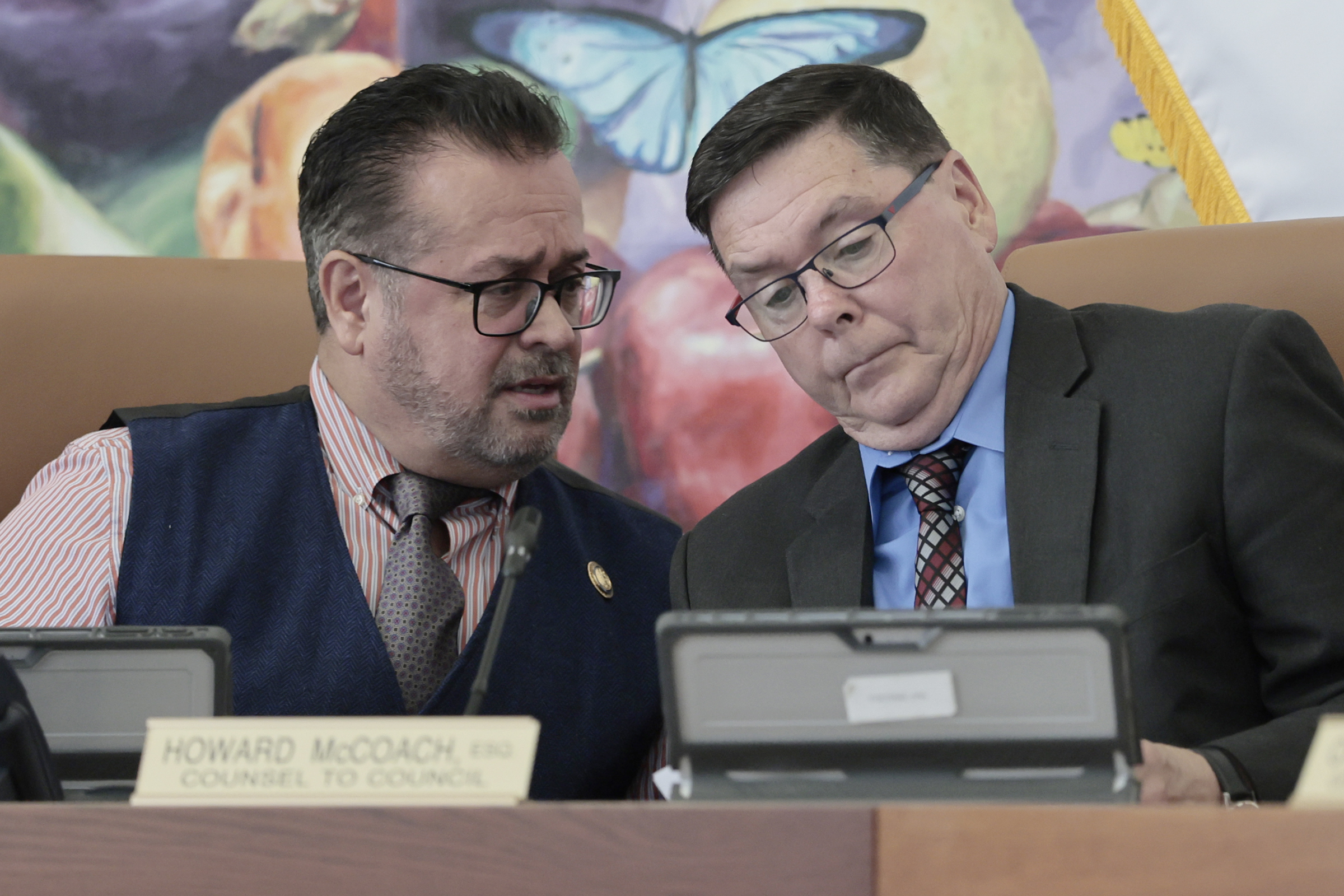
    Camden City President Angel Fuentes (left) and counsel to council Howard McCoach discuss business during a Camden City Council meeting at Camden’s City Hall on Thursday, June 11, 2026.Elizabeth Robertson / Staff Photographer

    The Camden City Council voted on a resolution Thursday calling on all regulatory agencies with jurisdiction over the facility, including on the county and national levels, to shut the facility down. The company has faced lawsuits over fires at the facility, including from the state attorney general’s office and local residents.

    The resolution cites a joint statement signed by Carstarphen, County Commissioner Jeffrey Nash, State Sen. Nilsa-Cruz Perez, City Council President Angel Fuentes, and City Council Vice President Arthur Barclay, all Democrats:

    “We will not stand idly by while residents are exposed to fires on a regular basis and have to bear the burdens of an operation that clearly cannot function in a safe manner,” it says in part. “We will no longer allow shelter in place alerts to go out because of another mishap in this scrap metal operation.”

    At Thursday’s council meeting, Camden residents called for the facility to be permanently shut down — citing health concerns and other disruptions to their quality of life — and criticized the city for not doing more earlier.

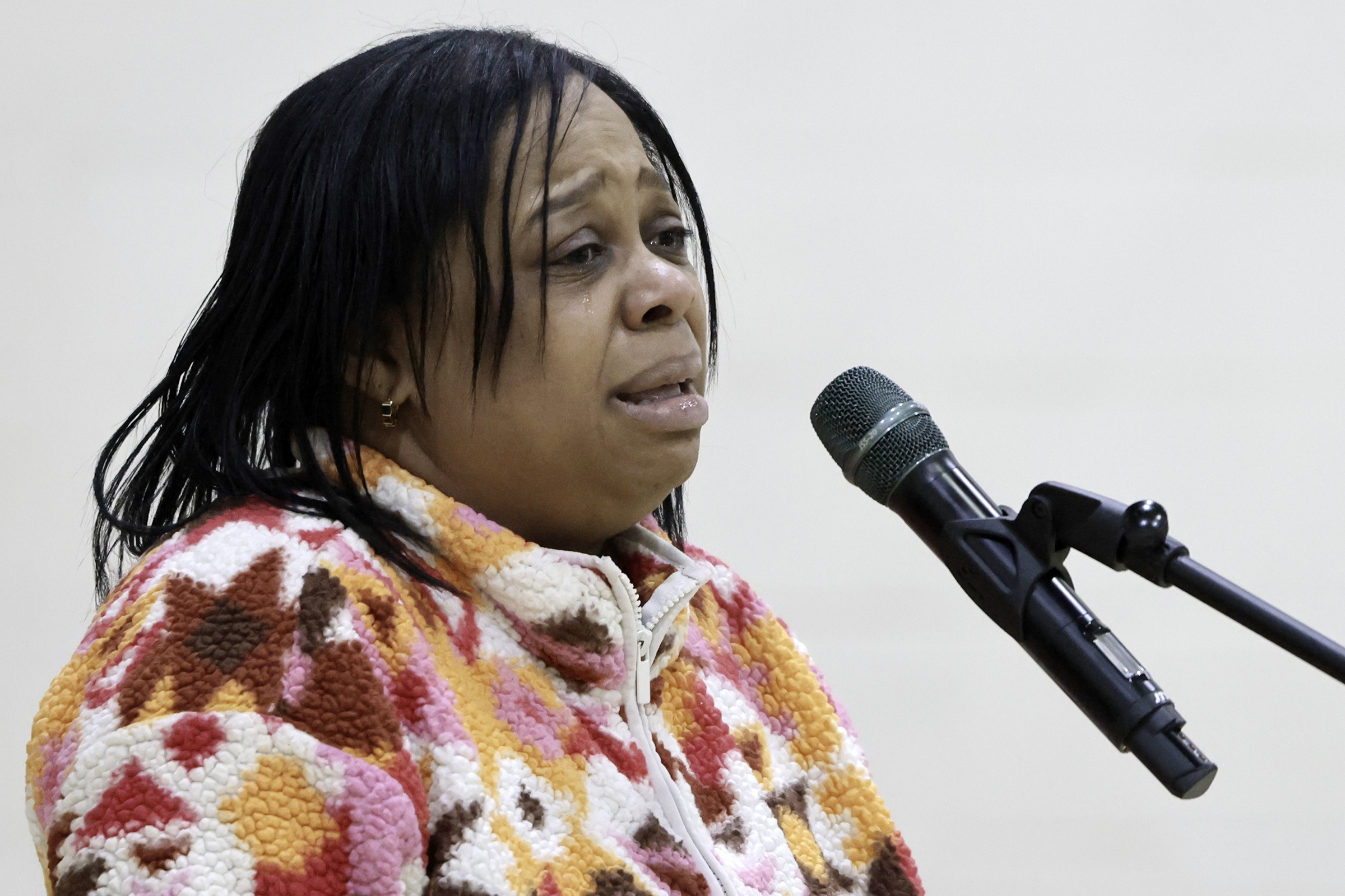
    Aliyia Jones becomes emotional during a community meeting for residents, affected by the recent junkyard fire, at MJD Fieldhouse Gym on Broadway in Camden on Sunday, February 23, 2025. Jones was describing her attempt to alert all of her neighbors before fleeing the area with her disabled mother after the fire broke out.Elizabeth Robertson / Staff Photographer

    “I just want to say, too little, too late,” said Aliyia Jones, who was among 100 Camden residents who fled their homes after a four-alarm fire at the facility in February 2025.

    “No one wants to come here and say ‘finally,’ or ‘thank you,’ or ‘hurrah.’ … We can’t breathe,” she added.

    EMR employs 500 people in Camden, including 179 Camden residents, according to the complaint, and if the shutdown continues, employees will face layoffs. EMR workers protested calls to close the facility earlier this month.

    Ajeena Riggs, a project manager at the Center for Environmental Transformation, said that she is sympathetic to workers seeking to keep their jobs and that the city and their union should help them find new positions if they lose their employment.

    “I don’t blame them for fighting for their jobs,” she said at Thursday’s meeting. “They’re fighting for their livelihood. But the only entity that’s to blame is the EMR.”

    The company blames the fires on improperly disposed lithium-ion batteries, but officials said in their joint statement “that story line is old and irrelevant at this point.”

    EMR implemented a fire suppression system and agreed to make other changes after entering a memorandum of understanding with the city last summer following the massive February 2025 blaze. Residents at the meeting criticized that agreement as lacking teeth.

    Camden city spokesperson Vincent Basara declined to comment on the lawsuit.

  • Delaney Hall brought Mikie Sherrill’s ‘first real test.’ South Jersey progressives who campaigned for her say she failed.

    Delaney Hall brought Mikie Sherrill’s ‘first real test.’ South Jersey progressives who campaigned for her say she failed.

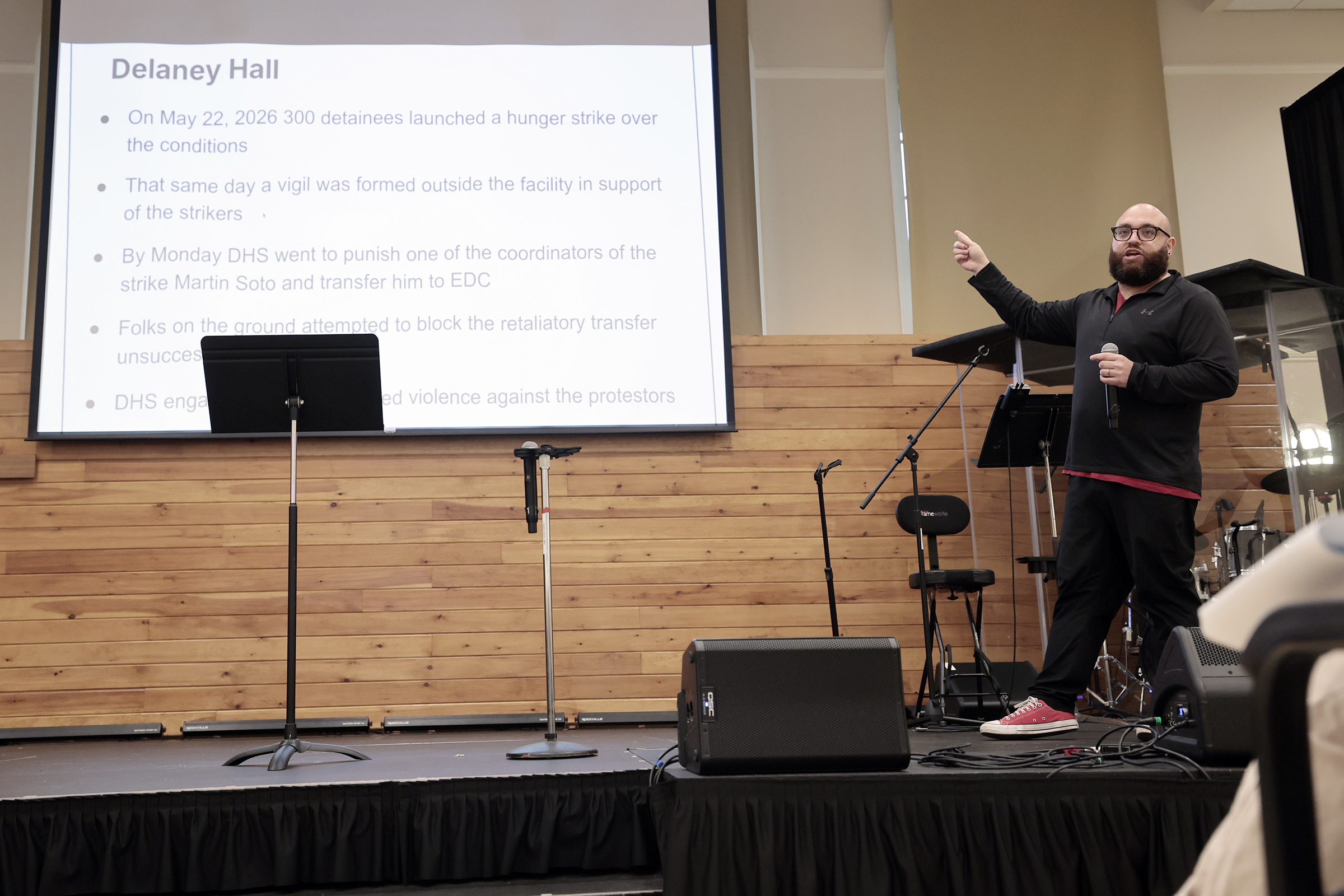
    Josue Barreiro stood in front of a crowd of 200 people seated inside a church last week in Haddonfield. He was there to speak about his experience as one of 61 protesters arrested in one night outside Delaney Hall after Gov. Mikie Sherrill had sent over state police.

    He told the crowd, gathered for a meeting of the South Jersey progressive group Cooper River Indivisible, that the governor made it seem like she was sending state troopers to protect demonstrators from federal immigration officers. Instead, he said, they brutalized protesters on horseback in riot gear. He showed a video of state police knocking him to the ground.

    “All accounts say the state police were considerably more violent than the federal government was,” Barreiro, a Bridgeton resident and activist with Los Tequios, told receptive audience members who made sounds of disgust.

    Josue Barreiro speaks about the protests outside Delaney Hall during the Cooper River Indivisible general meeting at the Haddonfield United Methodist Church on June 9.Elizabeth Robertson / Staff Photographer

    Sherrill, a former member of Congress whose double-digit victory last year was seen as a rebuke of President Donald Trump, has been in her most high-profile political bind yet as she juggles her opposition to the ICE detention center while facing widespread criticism for her handling of protests outside it.

    The first-term governor campaigned as a fighter against Trump and Immigration and Customs Enforcement. She highlighted her experience as a Navy helicopter pilot and said she was trained “that in a crisis, you run toward the fight.” But to South Jersey progressives who worked hard to campaign for her, Sherrill’s decision to respond to tensions between protesters and ICE with a designated protest zone policed by state officers represented a betrayal. The governor called the decision “absolutely necessary to protect public safety and avoid escalation from ICE.” But the state police’s show of force, video of which replayed across national news and social media channels for days, “kind of resembled what ICE was doing in the first place,” said Newark Mayor Ras Baraka, one of Sherrill’s primary opponents, who was arrested outside the facility last year.

    “This was not the kind and quality of leadership we were voting for, or hoping to see,” said Michele Messer, 52, a leader of Cooper River Indivisible, one of the groups that campaigned for Sherrill.

    A rising star in the Democratic Party, Sherrill overperformed in November in parts of South Jersey that had been viewed as fertile ground for her Republican opponent. She flipped back three counties that went red in 2024.

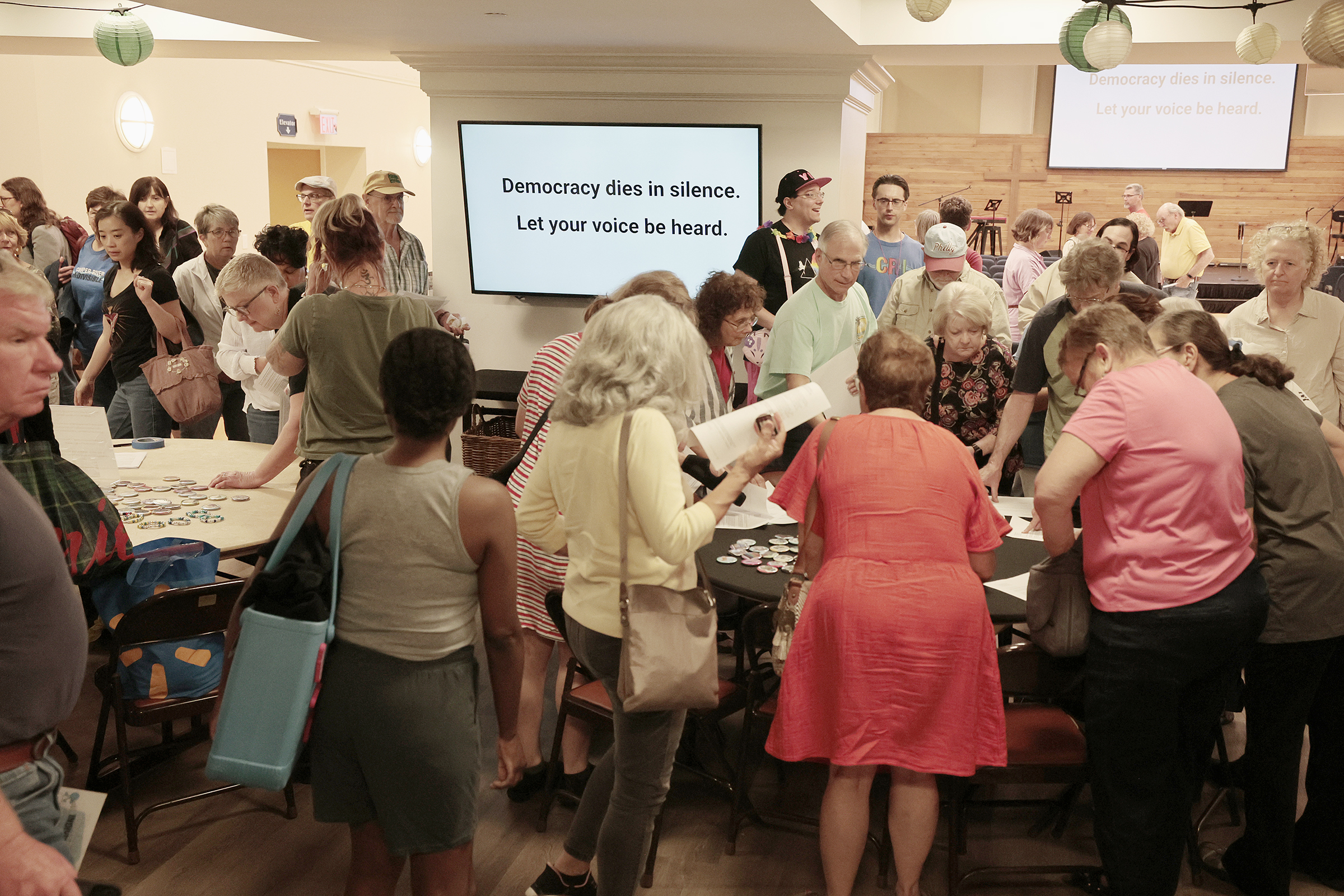
    People sign up to volunteer after the Cooper River Indivisible general meeting at the Haddonfield United Methodist Church.Elizabeth Robertson / Staff Photographer

    Sherrill said she was trying to “lower the temperature” to prevent Newark from becoming another Minneapolis when she announced her plans to send state troopers to Delaney Hall. She later disagreed with a comparison between state police and federal immigration officers in Minneapolis during a tense interview on WNYC’s Ask Governor Sherrill, noting that state police didn’t kill anyone.

    “I don’t think they have the same concern for human life in many cases that I do, and that our police forces in New Jersey share,” she said.

    Activists said she should have known that sending in police and corralling people into a free speech zone can escalate already fraught demonstrations.

    “I mean, there’s precedent, there’s history. We’ve all read about how these things go, and yet that was the choice she made,” said Messer, a Haddon Township resident who has protested at Delaney Hall.

    Patricia Campos-Medina, a former campaign adviser to Sherrill, said the governor’s handling of Delaney Hall — and how she manages “the fallout of her decisions” — has been an early test of her leadership.

    “It’s her first real test [of] how she manages the duties of being the highest public safety officer of the state leading New Jersey, and then still protecting the immigrant community who lives here,” said Campos-Medina, an ally of the governor who works with the labor movement.

    Sherrill has built her national profile on fighting the Trump administration, and those who have become the most frustrated with her share that mission. How she navigates this moment could determine whether she can keep that base focused on fighting the president, instead of her.

    Mounted New Jersey State Police troopers move toward protesters outside the Delaney Hall detention center on May 29 during a protest against the transfer of detainees and federal immigration policies.AP Photo/Andres Kudacki

    ‘I’m not proud to have voted for her’

    Sherrill has called for the closure of Delaney Hall and her administration announced multiple measures to support the fight against the detention center since the late May backlash against her began.

    Activists from across the state rallied in Trenton on June 1 and delivered a letter to Sherrill calling on her to “honor our First Amendment rights, cease police brutality and to enable the closure of Delaney Hall.”

    “As the grassroots who campaigned for you, we also expect ongoing communication with your administration to navigate this perilous time in New Jersey,” the letter continued, signed by about 40 organizations statewide, including Cooper River Indivisible and several other South Jersey groups.

    The next day, New Jersey Attorney General Jennifer Davenport, Sherrill’s appointee, filed a lawsuit against GEO Group — the private company that runs Delaney Hall — to give the state health department full access to the facility over reports of “inhumane and unsanitary conditions.”

    Two days later, Sherrill and the state legislature announced an infusion of $20 million to assist with immigration defense and launched a rapid legal defense effort amid concerns about due process.

    Marie Henselder-Kimmel, 65, a Cherry Hill resident who leads the South Jersey group NJ Voters Want More Say, said the reports of bad conditions in the facility are not new, so she doesn’t understand why the administration did not take legal action months earlier.

    “I foresee that we’re going to have to keep pressuring to get them to keep doing those more bold things,” she said.

    Henselder-Kimmel said she feels “torn” about Sherrill’s decision to send state police because she agrees ICE would have escalated otherwise. But she said it seemed like Sherrill may have sent the police in without understanding what they were going to do.

    Marie Henselder-Kimmel (left) and Michele Messer (right) talk with Vikki Toomer (back to camera) after the Cooper River Indivisible general meeting at the Haddonfield United Methodist Church.Elizabeth Robertson / Staff Photographer

    Cristian Moreno-Rodriguez, who works as the executive director of El Pueblo Unido of Atlantic City, an organization that supports Latino immigrants, said Sherrill’s handling of the protests has fully broken the trust with his community.

    Sherrill’s campaign made a particular effort to target Latino voters. She did particularly well in New Jersey’s largest Hispanic-majority cities, which moved an average of 18 points toward the Democrat after rightward shifts in 2024.

    “We’re not going to forgive her for what she’s done,” said Moreno-Rodriguez, who worked for One Giant Leap, a super PAC that supported Sherrill and raised about $9 million by the end of 2025.

    Sherrill was not Moreno-Rodriguez’s first choice in the primary, but she was a better choice for his community than Republican Jack Ciattarelli, he said. Still, he said he was expecting better from the Democrat.

    “I don’t regret voting for Mikie Sherrill because she was better than Jack Ciattarelli, but I’m not proud to have voted for her,” he said.

    Gov. Mikie Sherrill poses for a selfie at a Latinos for Mikie event at the Rancho Mateo restaurant in Elizabeth, N.J., last May.Aristide Economopoulos

    Pushing back against ICE has been one of Sherrill’s priorities during her first months as governor. She banned them from staging on state property without a judicial warrant, signed the state’s sanctuary policy into law, and created a portal for people to submit videos of ICE for investigation. She also signed a law banning ICE agents and other law enforcement officers from wearing masks, but it is being fought in the courts.

    Her administration is also fighting a proposed detention center in Roxbury in court and said it will fight any other proposed centers.

    Activists have been demanding Sherrill meet with detainees, but she says she has not been allowed in except for one “closely controlled and limited tour” on June 8, in which she was not allowed to speak with those being held there.

    Several members of Congress, who are authorized to conduct oversight visits, have visited the detention center, including Sen. Andy Kim, a South Jersey Democrat who made headlines for getting pepper-sprayed while trying to de-escalate tensions between federal immigration officers and protesters. Kim faced criticism from some activists for what they viewed as trying to negotiate with ICE, but others have praised him for being on the ground in a way they have not seen from Sherrill.

    Sen. Andy Kim stands between federal agents and demonstrators in an attempt to prevent a clash outside the Delaney Hall migrant detention center in Newark on May 25.DAKOTA SANTIAGO

    Sherrill and activists alike have said that the demonstrators have been largely peaceful. But U.S. Rep. Jeff Van Drew, a Cape May County Republican, accused the protests of being “more like anarchy” and called on Sherrill to bring state police back.

    State Sen. Michael Testa, a Cumberland County Republican, praised Sherrill’s “decision to cooperate with federal authorities” and “restore order” by bringing state police in, and added fuel to the fire by thanking her for “supporting President Trump and the brave men and women of ICE.”

    ‘The buck stops with her’

    Activists have expressed frustration that the narrative has strayed from the conditions inside Delaney Hall to the fight outside it — a point Sherrill has echoed.

    But after state police clashed with protesters, Sherrill focused her criticism on what she described as “aggressive and dangerous” disruptors and defended the officers.

    Her remarks further infuriated activists who accused her of echoing the state police’s narrative, which they say does not align with what they experienced on the ground or saw online.

    When a radio caller confronted Sherrill on WNYC over state police brutalizing nonviolent protesters, the governor said “if there were incidents like that, the attorney general will be looking into that.”

    Vikki Toomer, a Cooper River Indivisible leader who has protested outside Delaney Hall, said that listening to Sherrill’s news conferences have given her “that same visceral reaction” she gets from listening to Trump.

    Vikki Toomer speaks during the Cooper River Indivisible general meeting at the Haddonfield United Methodist Church.Elizabeth Robertson / Staff Photographer

    “I don’t know if they were feeding her lies, or that’s the narrative she was trying to spin … all I know is what she was saying was not true, and she was not taking the time to listen,” Toomer said.

    Toomer said she believes the governor knows her plan did not go well but also “has not come out publicly and said, ‘Oops, I made a mistake.’”

    When asked on the radio whether she believes her administration has suffered a loss of trust, Sherrill said sending state police “was really not done focusing on politics, and I certainly hope not.”

    “This was focused on making a really hard decision in a situation that nobody wanted,” she said.

    Folks leave messages on a collage (left) during and after the Cooper River Indivisible general meeting at the Haddonfield United Methodist Church on June 9. The poster will be part of an exhibit at Perkins Center for the Arts.Elizabeth Robertson / Staff Photographer

    Linda Greenwood, 74, a Voorhees resident who belongs to Cooper River Indivisible and campaigned for Sherrill, believes the governor has good intentions but does not think she has been unfairly blamed.

    “She’s the governor,” Greenwood said. “The buck stops with her. She brought the state police in. She has to take responsibility for what happened there, and I think she will.”

    Lawrence Garrity, 29, was the lead volunteer for long shifts at Sherrill’s Cumberland County campaign office between overnight shifts at Wawa last year. The Rowan student said he feels “salty” he worked so hard to elect her and it feels like she is not on their side.

    “It doesn’t feel like she’s not on our side either. It’s like she’s sitting in the middle … people are genuinely in danger, and you’re trying to, like, half-ass fight it,” he said.

    Garrity said he had to go to urgent care after state police unleashed tear gas and pepper balls on protesters.

    “Somebody said they’re gonna make T-shirts that said ‘I voted for Mikie Sherrill and all I got was tear-gassed,’” he said.

  • Pennsylvania State Police just issued hundreds of tickets to enforce a new ban on handheld cell phone use while driving

    Pennsylvania State Police just issued hundreds of tickets to enforce a new ban on handheld cell phone use while driving

    The Pennsylvania State Police gave out nearly 700 tickets and more than 300 warnings just days after a new law banning handheld device use was fully implemented.

    Pennsylvania became one of the last states to have such a ban when Gov. Josh Shapiro signed the new law two years ago in June 2024. But the rule wasn’t implemented until June 2025, and it came with a one-year warning period. So police haven’t been able to ticket drivers for the law until just over a week ago.

    To mark the occasion, state police conducted Operation Hands Off from Monday to Wednesday, cracking down on the new rule, which carries a $50 fine. The department touted the mission as “highly successful” with 694 traffic citations and 308 warnings related to the new law. They also issued 6,013 other traffic citations, 4,090 other warnings, and 98 DUI arrests during the three-day period.

    The state police issued 1,616 warnings during the one-year warning period from June 5, 2025, to June 5, 2026, for the new law.

    It’s named Paul Miller’s Law, to honor Paul Miller Jr., who was killed in 2010 after a tractor-trailer driver crashed into him.

    “Nearly 15 years ago, two Dunmore state troopers knocked on my door to tell me that my son was killed,” Miller’s mother Eileen Miller said in an April statement. “My son did everything right — he was killed by someone else’s unsafe choices behind the wheel. This law is for every family in Pennsylvania that doesn’t have to experience two state troopers knocking on their door to tell them that their loved one was killed by distracted driving.”

    Texting while driving had already been banned in Pennsylvania, but the new law encompasses all sorts of uses like taking photos, playing games, sending emails, scrolling on social media, or talking on the phone while holding it.

    The law states that holding a phone or dialing or answering a phone by pressing more than one button is not allowed. Drivers can still use hands-free technology for uses like phone calls, navigation, and music.

    There are no exceptions for sitting in traffic or at a red light — but there is an exception for contacting law enforcement in an emergency.

    Shapiro’s administration suggests drivers pull over and park in a safe location if it’s urgent, ask a passenger to be a “designated texter,” use the “Do Not Disturb” feature while driving to silence notifications, or place their phone somewhere inaccessible.