Author: Aliya Schneider

  • Zack Mullock says Van Drew made harmful cuts to Medicaid and Medicare. The South Jersey Republican begs to differ.

    Zack Mullock says Van Drew made harmful cuts to Medicaid and Medicare. The South Jersey Republican begs to differ.

    Susan Coll-Guedes was baffled when she saw a photo of U.S. Rep. Jeff Van Drew, a Cape May County Republican, smiling with scissors at a ribbon-cutting ceremony for a group home provider agency.

    “He cut Medicaid, which is the funding for group homes for people with disabilities,” said Coll-Guedes, whose adult son has Down syndrome and is on Medicaid.

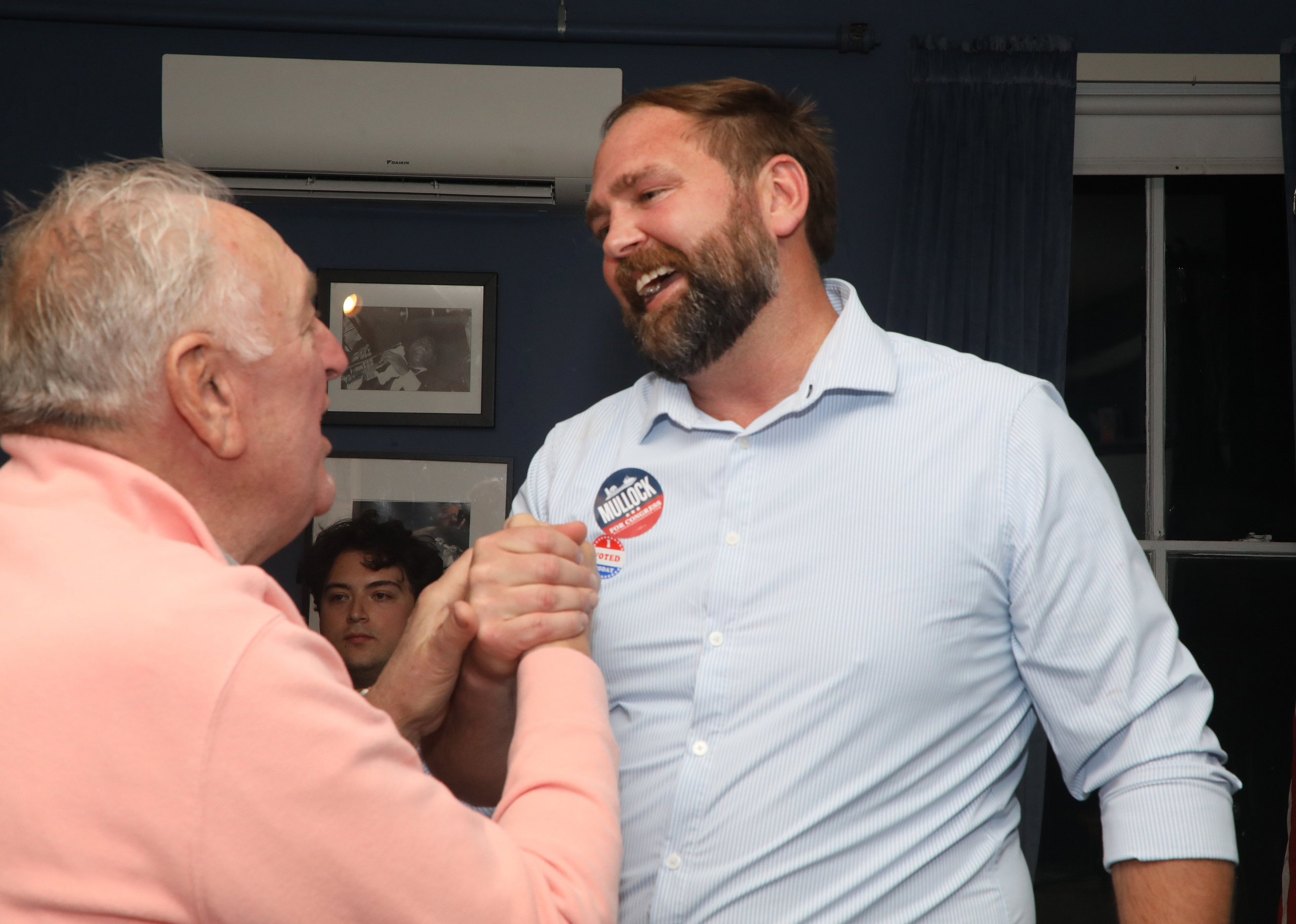
    The Galloway resident is a self-proclaimed “Mom for Mullock,” who supports Democrat Zack Mullock, the Cape May mayor who is challenging Van Drew in the Nov. 3 midterm election. She wasn’t interested in politics until President Donald Trump’s One Big Beautiful Bill Act made major changes to Medicaid eligibility and decreased federal funding for the program.

    While the cuts don’t directly target her son, she’s concerned the changes will have a domino effect on the program as a whole, she said in interviews this month.

    Back in August, behind the red barn of Independent Spirits Distillery, a small business along farmland in Gloucester County’s Woolwich, Mullock told an audience of about 75 people that he gets “daily reminders” from South Jersey residents who are scared about the law’s cuts to social programs like Medicaid, which provides health coverage for low-income people and people with disabilities, including tens of thousands of people in the district.

    Cape May Mayor Zack Mullock speaks to an audience at Independent Spirits Distillery in Woolwich on Aug. 11.Aliya Schneider / Staff

    Mullock is among the many Democrats across the country attacking Republican incumbents for slashing social safety net funding to help pay for Trump’s policy priorities — including tax breaks for the wealthy — while still adding $3.4 trillion to the national deficit.

    “I cannot fathom cutting for the very poorest to give to the very wealthiest,” Mullock said to the receptive audience brought together by the Woolwich Democrats. “It’s absolutely insane, and that’s exactly what Jeff Van Drew did when he voted for the Big Beautiful Bill. It was passed by one vote. One vote. And that tells you just how important these elections are.”

    “If I was in his shoes, that bill would not have passed,” he added.

    Local Democrats see Mullock as their best shot yet at ousting Van Drew, but the race flew under the national radar until earlier this month when the Democratic Congressional Campaign Committee added it to its list of “districts in play,” which Van Drew mocks as a “wish list.”

    Van Drew was first elected as a Democrat in 2018 before changing parties and vowing his loyalty to Trump one year later. He’s been reelected three times since then with his closest challenger still falling nearly 6 points behind him in 2020.

    On Tuesday, the University of Virginia’s Center for Politics’ Sabato’s Crystal Ball shifted the district’s rating from “safe Republican” to “likely Republican,” meaning Van Drew remains favored to win but less comfortably than before.
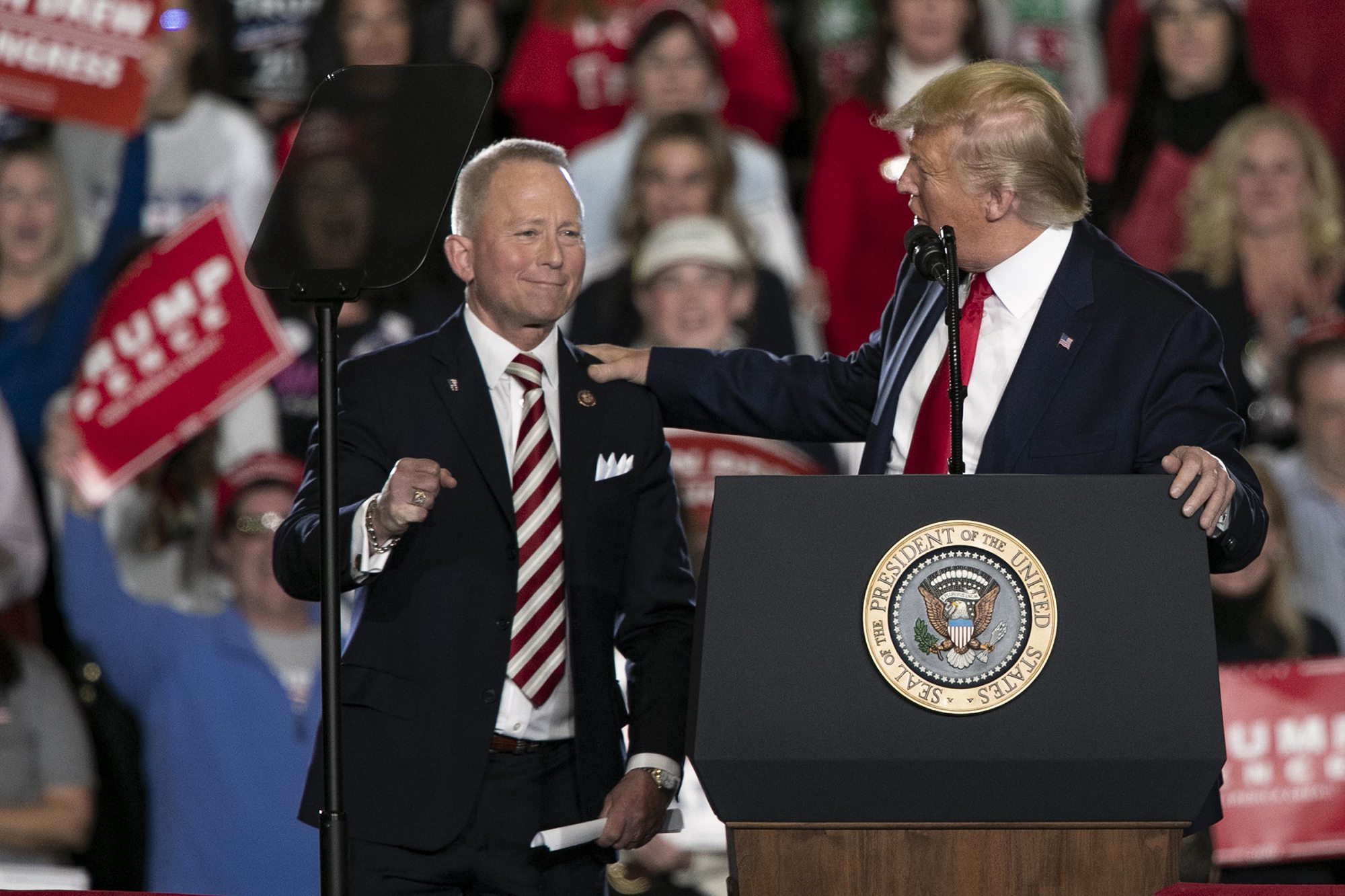
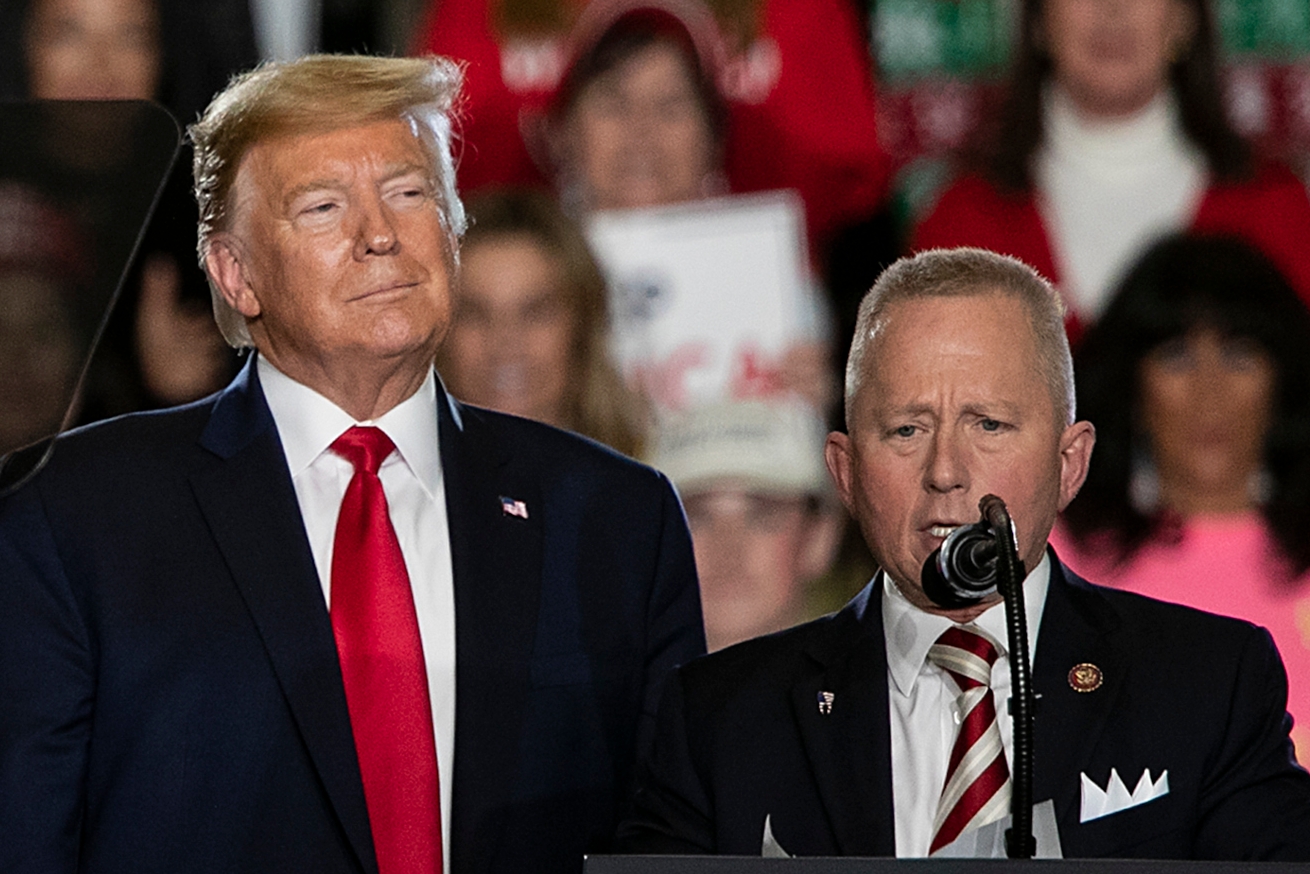
    U.S. Rep. Jeff Van Drew with President Donald Trump at a campaign rally in Wildwood in 2021.Heather Khalifa / MCT

    Mullock is hoping dissatisfaction with the impacts of Trump’s policies will help him pull off an upset in the district, which stretches from Gloucester County to the Jersey Shore.

    How Trump’s law will impact Medicaid

    Prior to his vote for Trump’s law last year, Van Drew was adamant that he would not vote for legislation that impacts Medicaid or Medicare unless the cuts are “specifically aimed at reducing waste, fraud, or abuse.”

    That’s exactly how the Trump administration has framed the new changes, along with saying that the cuts will help preserve the programs in the long term.

    “I was on the forefront of saying that we shouldn’t hurt seniors, we shouldn’t hurt children, we shouldn’t hurt the disabled, that we shouldn’t be harming those folks,” Van Drew said at a recent candidate forum held by the Gloucester County Chamber of Commerce after Mullock criticized his vote at the same event.

    Cuts to SNAP have already taken effect but Medicaid cuts won’t be fully implemented until after the midterms in January 2027. Democrats are pledging to reverse them if they take control of Congress.

    Van Drew defended the changes, particularly a new requirement for Medicaid recipients ages 19 to 64 to file paperwork every six months to show they work, volunteer, or take academic classes 20 hours a week to qualify for the program, unless they meet exemptions carved out for people with disabilities.
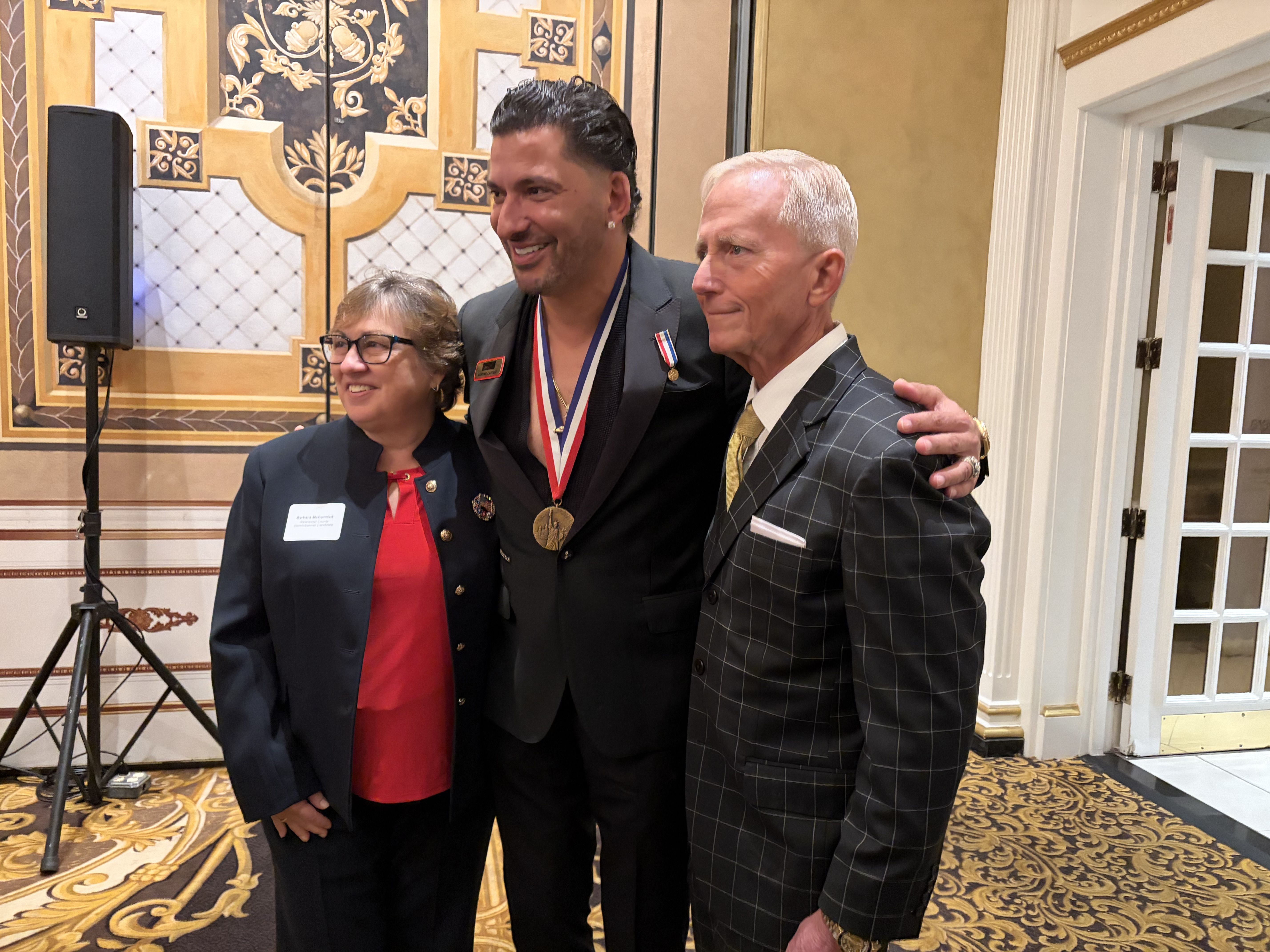
    U.S. Rep. Jeff Van Drew (right) poses for a photo at a Gloucester County Chamber of Commerce candidate forum with Barbara McCormick and Martino Cartier, Republican candidates for Gloucester County Commission, on Oct. 7.Aliya Schneider / Staff

    “If you are able-bodied and you don’t have children, and aren’t planning on it, and aren’t a senior citizen, and don’t want to work … you could pet dogs at the Humane Society, help senior citizens, or you could go and learn a trade, or you could even go back to college. You still would get your Medicaid,” Van Drew said at the forum.

    “But if you’re healthy and you are young and you don’t want to work at all and you’re not willing to do any of those things … you’re not going to get it,” he said to claps from his supporters.

    The law is slated to cut Medicaid spending over 10 years by approximately $911 billion, including approximately $29 billion in New Jersey, according to a KFF analysis using data from the nonpartisan Congressional Budget Office.

    The changes to Medicaid are expected to lead to 7.5 million people becoming uninsured by 2034, including approximately 240,000 people in New Jersey.

    Opponents of the requirement argue that since most adults receiving Medicaid already work, the extra paperwork will cause people who qualify to lose coverage anyway.

    The 2nd Congressional District includes all of Atlantic, Cape May, Cumberland, and Salem Counties, and parts of Ocean and Gloucester Counties. These counties all together have 365,666 people enrolled in Medicaid as of August.

    Mullock made the case at the forum that the cuts will have a disproportionate impact on the district because Cumberland, Atlantic, and Salem Counties are among those with the lowest incomes and highest poverty rates in the state.

    “When you are driving all around and meeting with people and seeing the real poverty that exists here in CD-2, if your heart doesn’t break, you’re not a human,” Mullock said in an interview.

    Another provision will also boot immigrants off the program who have legal status but aren’t permanent residents, such as refugees of war, asylum seekers fleeing persecution, and victims of sex trafficking and domestic violence. New Jersey’s Department of Human Services estimated that between 15,000 and 25,000 immigrants with legal status will lose coverage.

    Van Drew introduced a “No Medicaid for Illegals Act” last year and said the program should only benefit American citizens.

    Does the One Big Beautiful Bill touch Medicare?

    While the law takes primary aim at Medicaid, Mullock has spoken about the cuts in tandem with Medicare, the federal healthcare program for people ages 65 and older. His campaign website says he supports Medicare for All funded by “fairer corporate taxes and a fair tax on the top 5%.”

    And at the Gloucester County forum, Mullock claimed that the law cut $1.5 trillion in Medicare and Medicaid.

    To get to that figure, Mullock said he was combining the nearly $1 trillion in Medicaid with a $491 billion figure that the Congressional Budget Office said could hit Medicare from 2027—2034 if Congress doesn’t act. That figure comes from the Pay‑As‑You‑Go Act of 2010, which forces cuts to prevent federal deficit increases. But legislators can override that obligation, and that’s exactly what they did as part of the November 2025 law that reopened the government after a record-breaking 43-day shutdown.

    Meanwhile, Van Drew retorted during his own remarks that Medicare “never came up for a vote.”

    “There wasn’t even a vote on Medicare,” he added. “Not one dollar has been cut from Medicare.”

    While most of the law’s healthcare provisions affect Medicaid, the law does make some changes to Medicare.

    Changes to eligibility for groups of legally present immigrants will leave 100,000 more people without health insurance and decrease federal Medicare spending by $5.1 billion by 2034, according to Congressional Budget Office data.

    Another provision of the law blocks a policy enacted under former President Joe Biden that tried to make it easier for low-income Medicare recipients to access Medicaid financial assistance. The Congressional Budget Office projected this change will decrease dual enrollees by 800,000 people and decrease spending by $66 billion by 2034. While these people aren’t expected to stop getting Medicare, higher out of pocket costs would likely cause them to seek less care, the budget office predicted.

    The six counties the district touches had a total of 378,833 people enrolled in Medicare in 2025.
  • Mikie Sherrill will headline DNC dinner in D.C. after Philly speech to business leaders

    Mikie Sherrill will headline DNC dinner in D.C. after Philly speech to business leaders

    New Jersey Gov. Mikie Sherrill had a whirlwind day, rushing to headline a high-profile political event in Washington by way of a Philadelphia business conference.

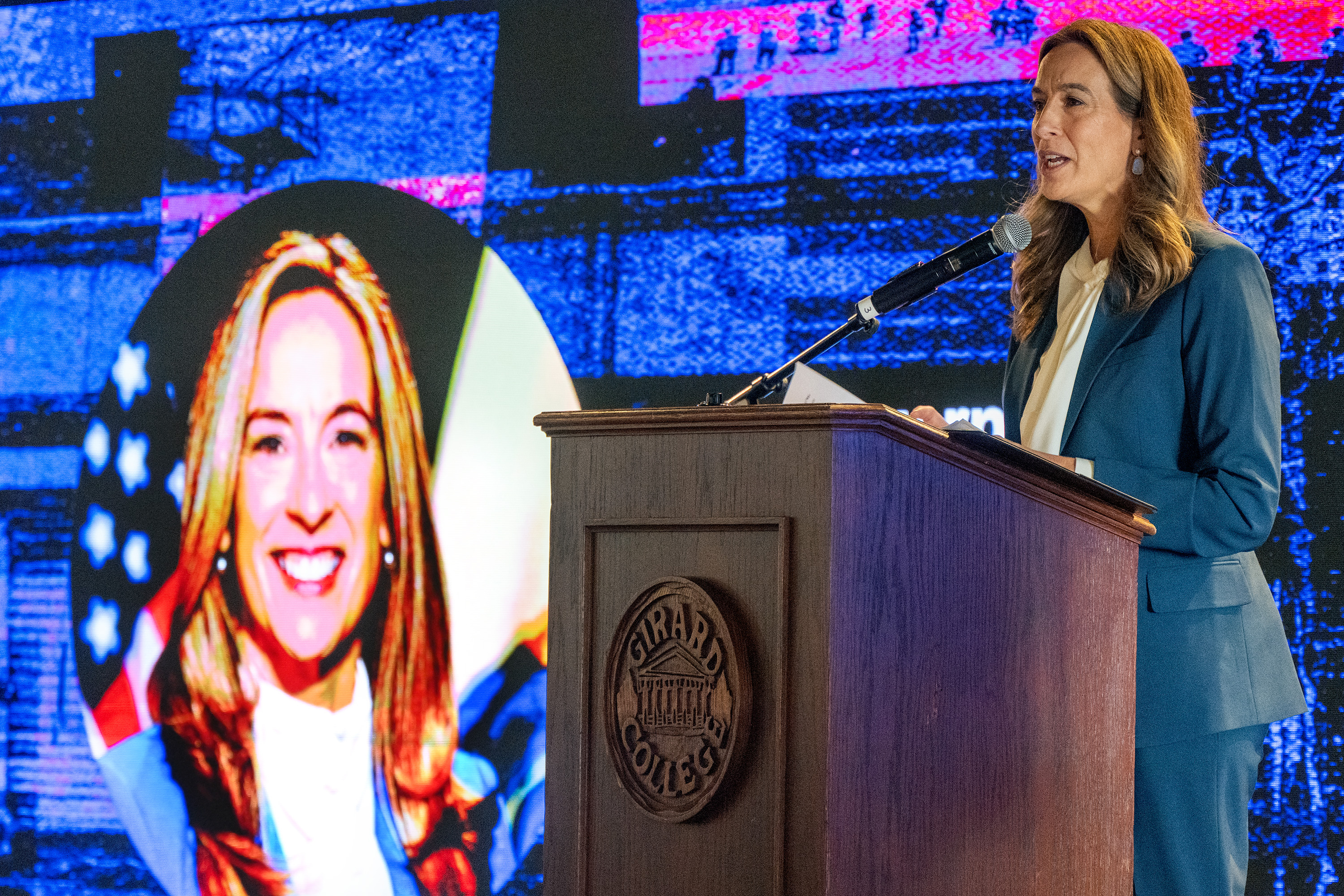
    The Democrat gave a 10-minute speech at the Economy League of Greater Philadelphia’s Leadership Exchange at Girard College ahead of schedule on Thursday before rushing to her Washington-bound train.

    She was slated to headline the Democratic National Committee Women’s Leadership Forum opening dinner for donors and attendees alongside her friend and former roommate Virginia Gov. Abigail Spanberger and historian Heather Cox Richardson.

    The two stops are a sample of how Sherrill, a former member of Congress, is raising her national profile.

    Pennsylvania Gov. Josh Shapiro and Delaware Gov. Matt Meyer — both Democrats — were also invited to speak at the Philadelphia conference, which had the theme of “collaboration across lines of difference,” but Sherrill was the only one to accept, per conference spokesperson Raymond Brothers.

    She opened her speech with her signature Philadelphia joke, calling it the “Greater Camden Metropolitan Area,” and nodded to her love for the rich American history on both sides of the river.

    N.J. Gov. Mikie Sherrill rushes to catch a train after delivering remarks at the Economy League’s 21st Annual Greater Philadelphia Leadership Exchange at Girard College.Tom Gralish / Staff Photographer

    Sherrill leaned into the theme of the conference by calling for collaboration among New Jersey, Pennsylvania, and Delaware while still trying to to lure businesses to the Garden State. Just last month, Burlington Coat Factory announced that it was leaving the South Jersey home it was named after to move to Philadelphia in light of Shapiro’s state incentives for businesses.

    “As you consider regional expansion or investment, we want you to choose New Jersey,” Sherrill said as a direct invitation to the audience at the business-oriented event. “My team is ready to help you take your next step in the Garden State.”

    More than 200 people attended from Pennsylvania, Delaware, and New Jersey, according to Jeff Hornstein, executive director of the Economy League of Greater Philadelphia.

    Sherrill juggled lauding business efforts in the other Delaware River states while keeping her focus on what she is proud of in New Jersey.

    She touted the pharmaceutical industry and innovation efforts in New Jersey while praising robotics in Pennsylvania and business incorporation in Delaware.

    “Each of those is attractive on its own, but together they’re world-class,” she said.

    “If all of us in this room can work together, we’re unstoppable,” she added.

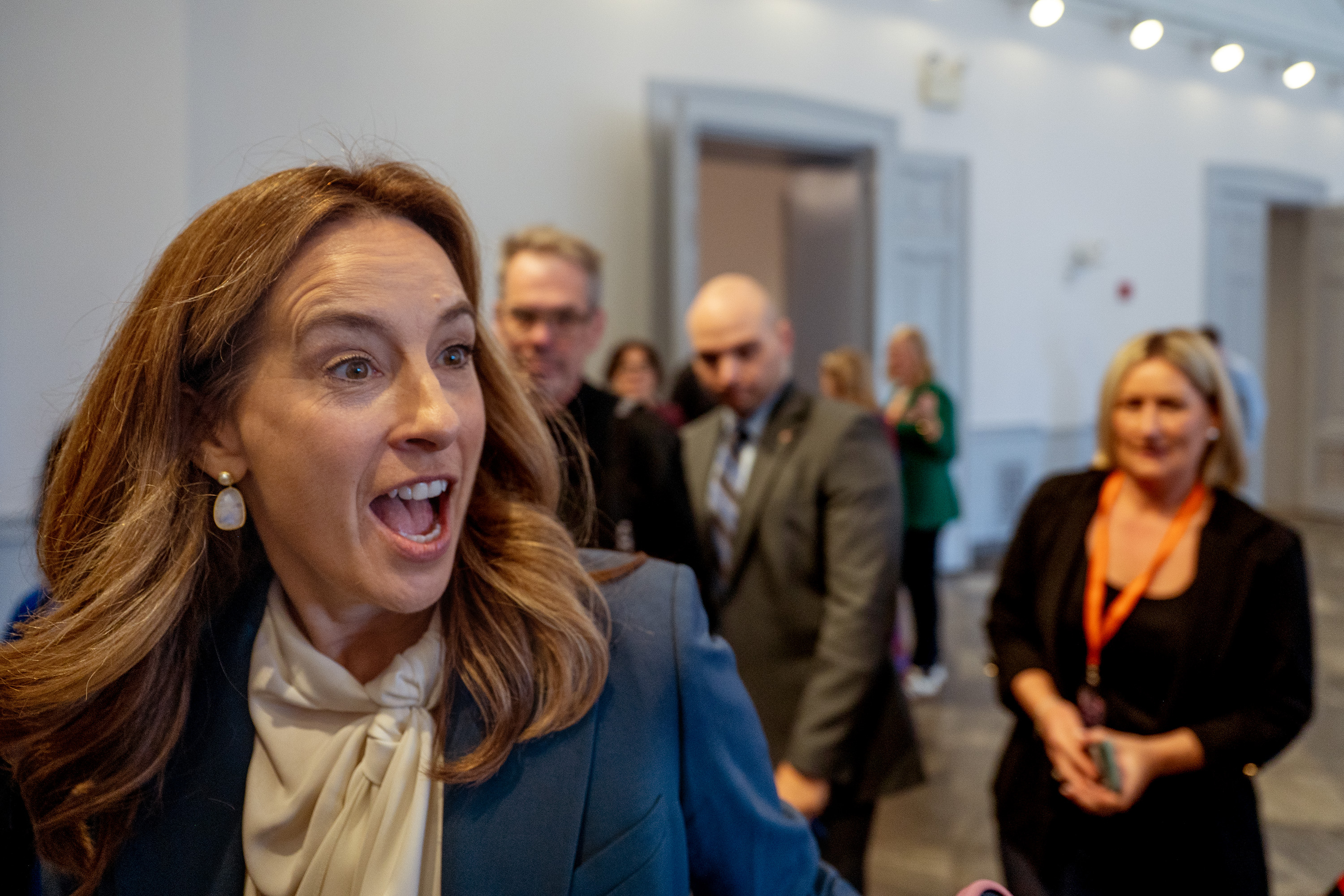
    Asked for an example of cross-state collaboration as she rushed out of the building, Sherrill shouted out: “Photonics.”

    Photonics is a method of using light particles instead of electrons to transmit information, as in fiber-optic cables. This effort is already underway — Princeton University has a regional consortium of groups across Southeastern Pennsylvania, New Jersey, and Delaware studying the practice called Advancing Photonics Technologies.

    Sherrill left Senate President Nicholas Scutari, a North Jersey Democrat, in charge of the Garden State after departing Philadelphia for Washington. Sherrill is currently without a lieutenant governor after her former No. 2, Dale Caldwell, resigned last month.

    The same DNC dinner that Sherrill was slated to address had been headlined by former President Barack Obama in 2015 and former Vice President Kamala Harris in 2022, according to a source familiar with the matter. It was to be followed by a day full of panels on Friday featuring a slew of prominent Democratic women, including former Secretary of State Hillary Clinton and New York Attorney General Letitia James, with tickets ranging from $250 to $44,300.

    Govs. Mikie Sherrill and Josh Shapiro talk before they’re introduced to speak on a panel with two other governors April 16, 2026 at a National Governors Association event on energy.Tom Gralish / Staff Photographer

    Praise for Gov. Josh Shapiro

    During her quick Philly visit, the New Jersey governor tipped her hat to Shapiro for his agreement with regional grid operator PJM to cap costs across 13 states while emphasizing her own efforts at increasing energy production in New Jersey with the goal of lowering costs. Shapiro could not attend because of a scheduling conflict, his spokesperson Rosie Lapowsky said.

    “Today, 67 million customers across the region are benefiting from that collaboration, but New Jerseyans were demanding that our state go even further to drive down costs in the short and long term,” she said. “We need, and we are implementing, transformative change in energy production and the utility business model in New Jersey.”

    She said that she has approved 18 solar and battery storage projects and expanded the state’s community solar program by 3,000 megawatts since taking office.

    She said her attempt to expand nuclear energy production in South Jersey would help lower energy bills across the region and “create good-paying jobs across state lines.”

    “Our two plants in Salem County employ 1,600 technicians and engineers from both New Jersey and Delaware,” she said. “Just imagine how many more careers we could build with another plant or two.”

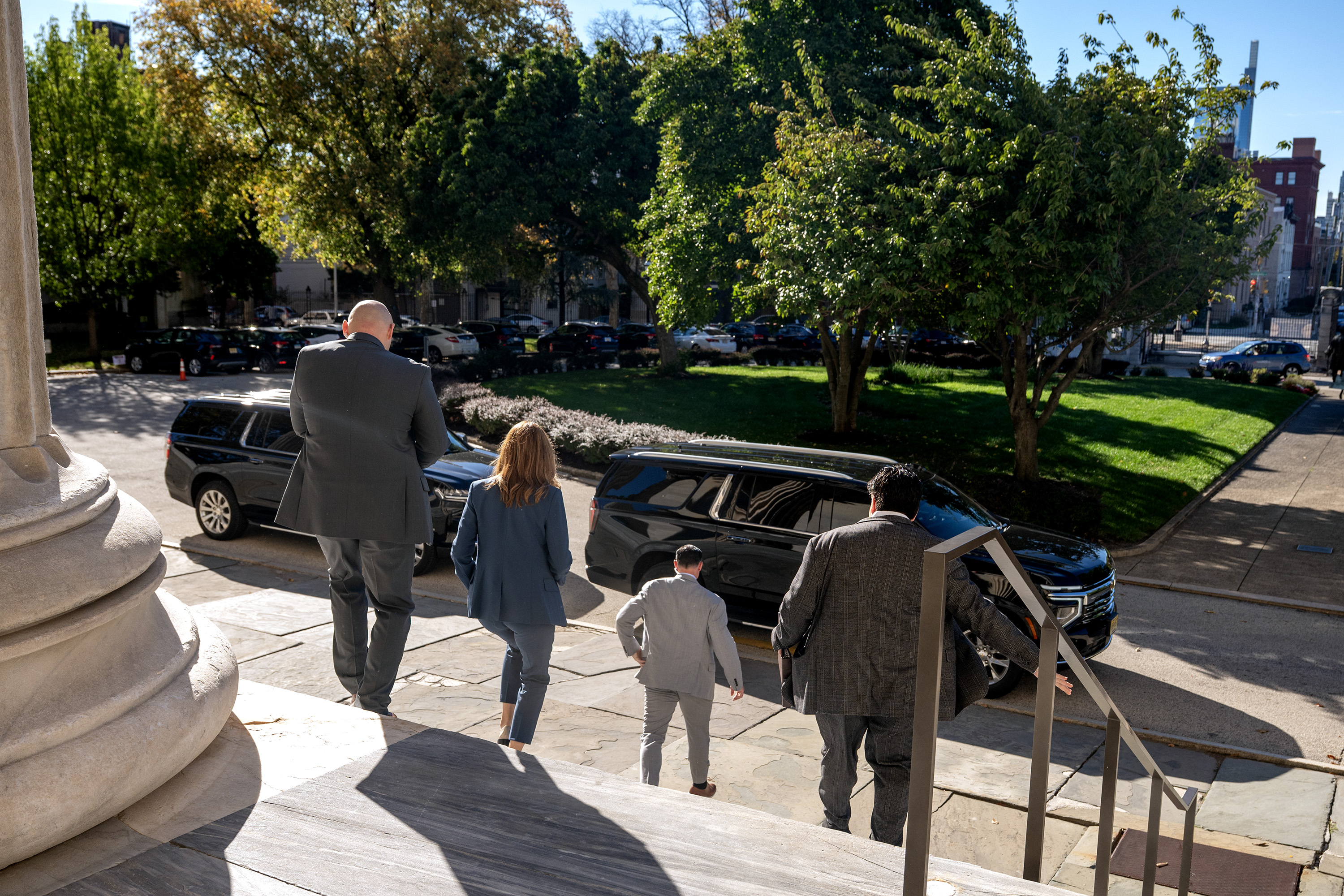
    Gov. Sherrill rushes to catch a train after delivering remarks at Girard College. She was slated to headline the Democratic National Committee Women’s Leadership Forum opening dinner in Washington, D.C.Tom Gralish / Staff Photographer
  • Sen. Cory Booker debated his longshot challenger from South Jersey. They mostly talked about Trump.

    Sen. Cory Booker debated his longshot challenger from South Jersey. They mostly talked about Trump.

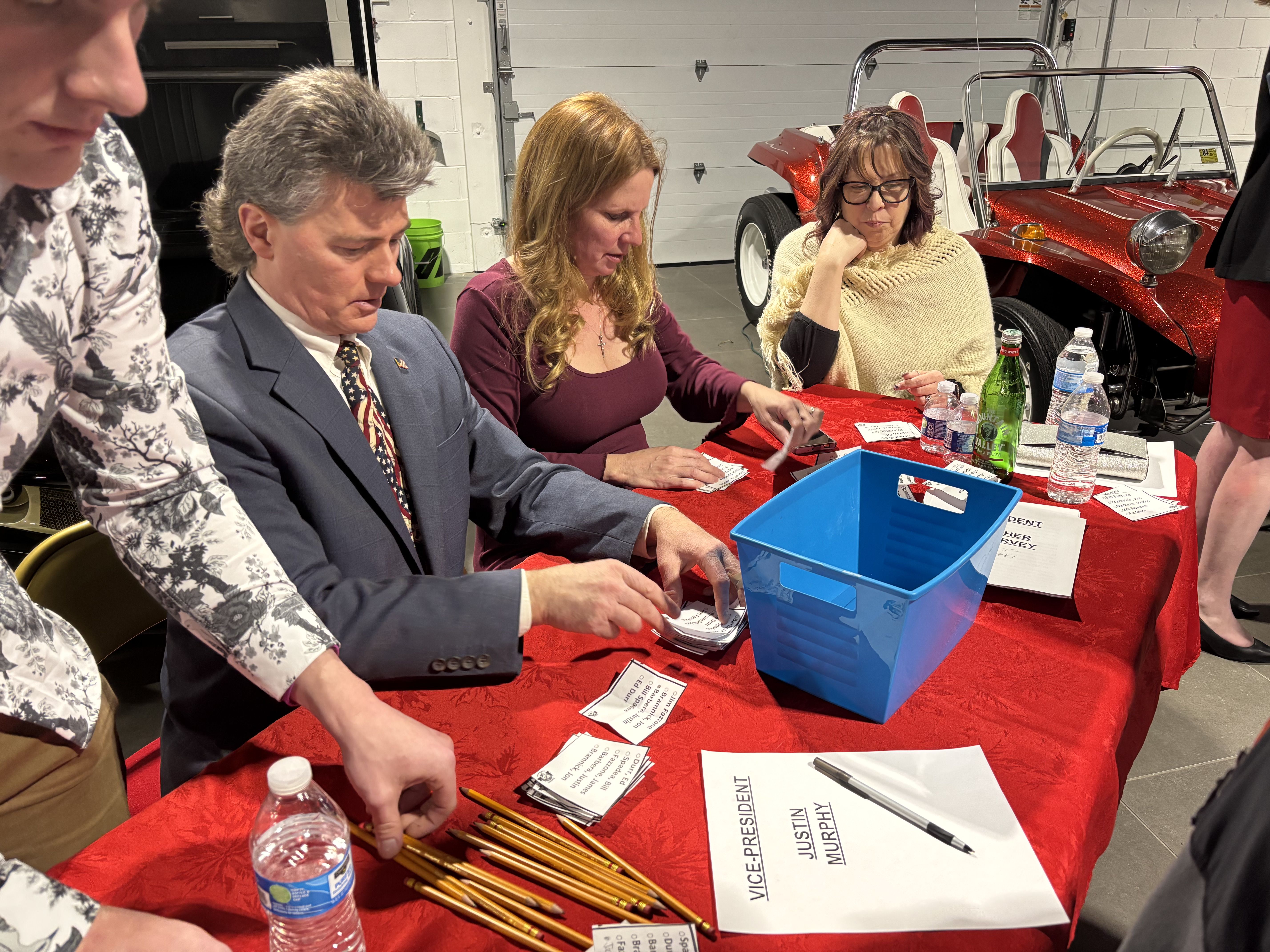
    Democratic Sen. Cory Booker took to the stage Thursday for a debate with Justin Murphy, the South Jersey Republican mounting a long shot campaign to unseat the well-funded incumbent.

    They mostly talked about President Donald Trump.

    Murphy, a former Tabernacle committee person who calls himself a Reagan Republican, unsuccessfully sought U.S. House nominations in 2008 and in 2010 — with Tea Party backing — and for Senate in 2024. The Burlington County attorney has little chance in the Nov. 3 election against Booker, a prolific fundraiser and former mayor of Newark who has served in the Senate since 2013 and could pursue the presidency for a second time in 2028.

    As of June 30, Booker raised more than $33 million while Murphy raised just over $27,000.

    There are nearly 865,000 more Democrats than Republicans in New Jersey. The state’s electorate, as of June, includes 38% Democrats, 35% unaffiliated voters, and 25% Republicans.

    The debate, which was hosted by the New Jersey Globe and Rider University and broadcast nationally by C-SPAN, lasted about one hour.

    The moderators focused much of their questions on Trump’s policies. Booker criticized congressional Republicans, who he said have “enabled” the president. Murphy, on the other hand, praised the current economy — a stark contrast to Democrats’ messaging this campaign season.

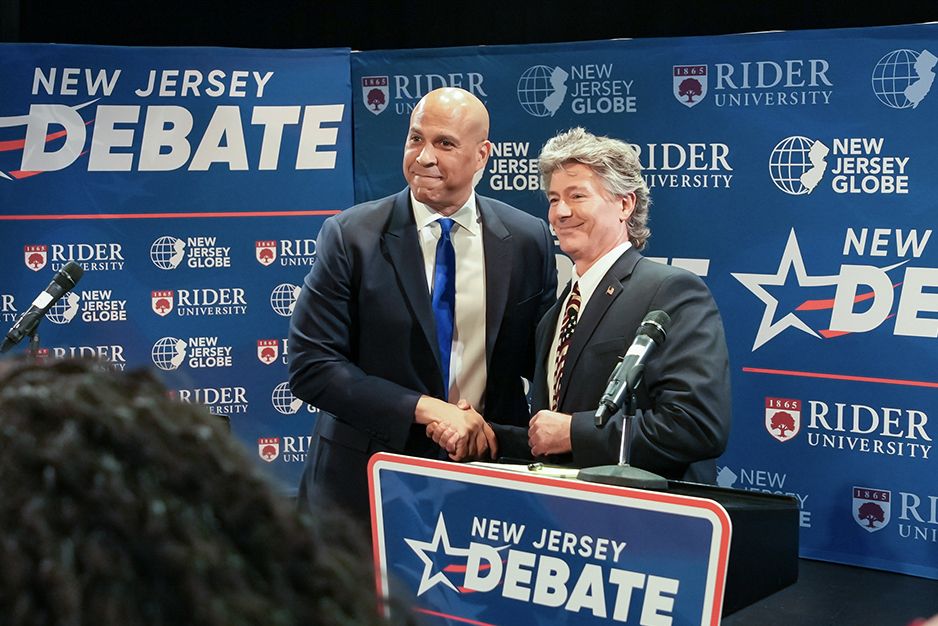
    The two candidates were mostly civil, shaking hands and posing for a photo before getting started. Booker, who is bald, made a couple of jokes about Murphy’s voluminous head of hair.

    The most raucous part of the debate was when audience members erupted during both Booker and Murphy’s remarks about the state’s sanctuary policy for immigrants.

    Here are the highlights.

    Sen. Cory Booker, left, and his South Jersey Republican challenger Justin Murphy, shaking hands on the debate stage Thursday night.Pete Borg / Rider University

    Focus on Trump: His cabinet, Iran, and the Epstein files

    Murphy supports Trump but said he’s not a “blind rubber stamp.” He admitted he is not well-versed on Trump’s cabinet picks or the Epstein files.

    When asked about Trump’s cabinet members, the Republican said he trusts the president’s judgement but that he doesn’t know enough about them.

    “I don’t know about their backgrounds. I couldn’t name them all for you right now,” he said.

    “You’ve gotta be honest,” he added.

    The Republican also said his knowledge is limited on the Jeffrey Epstein files, in which Trump is referenced thousands of times. Trump lobbied against releasing them to the public until it was clear he didn’t have enough support from his own party. Murphy said he supports the law that required the files to be released with redactions and exceptions — and supports an overall increase in transparency around them.

    Booker had fierce criticism of the president on both subjects.

    The incumbent said he voted for some of Trump’s appointees for his first term but the second time around, “something happened where it suddenly seemed like the standard he was creating for a cabinet position was loyalty to him.”

    He said the Trump administration’s handling of the Epstein files was an example of Trump’s White House working to protect the president from valid inquiries “and as a sword to go after anybody that criticizes him.”

    As for the Iran war, Murphy defended Trump but also said the president should wrap it up.

    “Mr. President, put your cowboy hat on and get out there, and kick some … and get this done and done right,” he said to cheers from supporters.

    Booker responded that Murphy’s attitude is precisely the problem, calling it a “false bravado.”

    “We do not need yahoo policy,” Booker said. “We need sound people that use military force as a last resort, who know the power of diplomacy, who don’t insult your enemies and threaten to invade Canada and Greenland, but pull our allies together.”

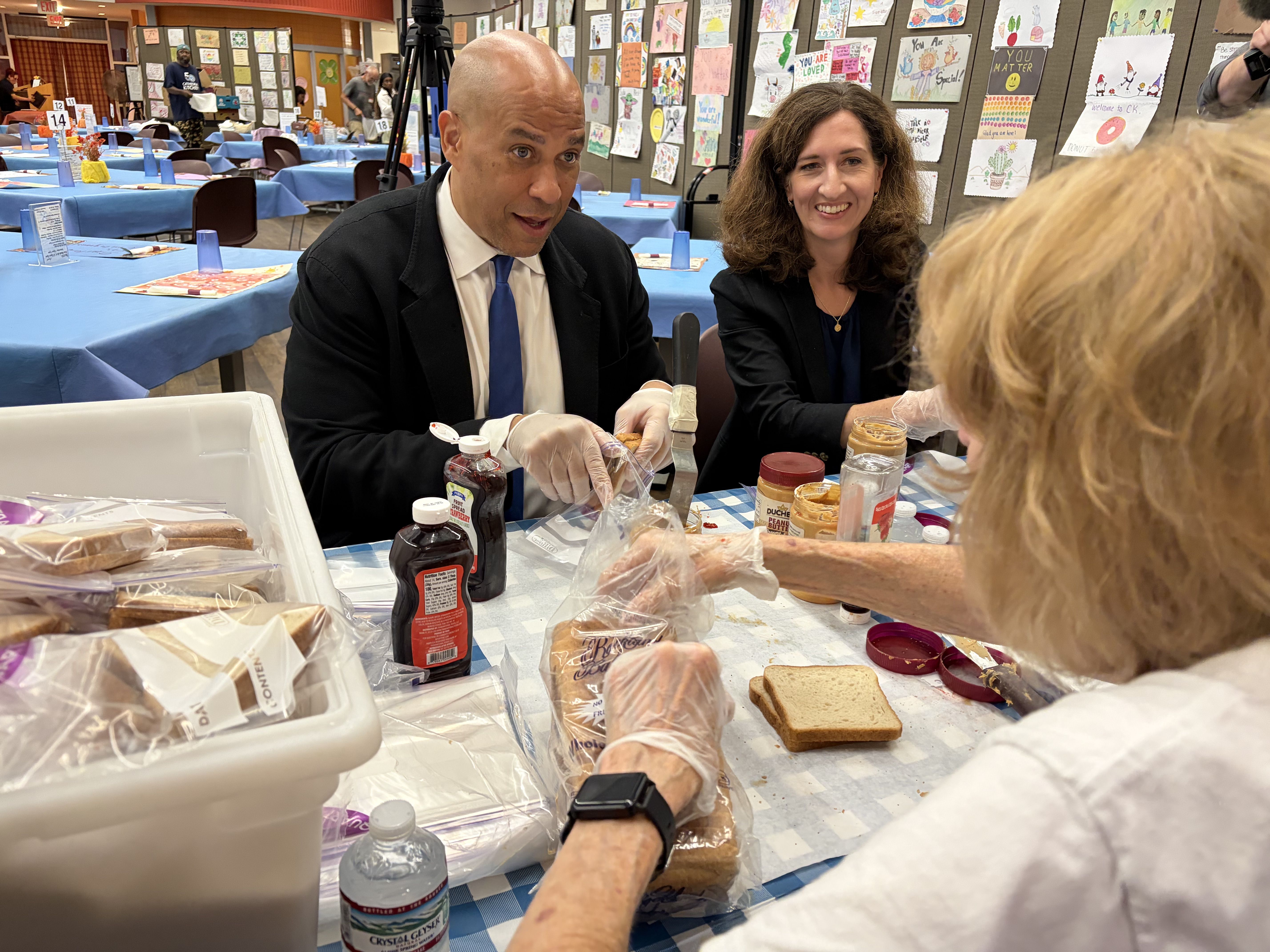
    Sen. Cory Booker sits with volunteers at Cathedral Kitchen in Camden on Thursday, Aug. 27.Aliya Schneider / Staff

    Housing policies

    Sahmya Smith, a Rowan student and Passaic County voter, asked the candidates how they would address the racial wealth gap in New Jersey driven by home ownership disparities.

    Booker touted bipartisan housing efforts including a new housing law and opportunity zones, the second of which he said resulted in affordable housing construction in Atlantic City.

    “For me, as a guy who was the mayor of Newark, New Jersey, a majority minority city, we were able to double the production of affordable housing during the last housing recession we had in 2008, 2009, it’s something that I feel is really urgent right now,” he said.

    He said that Trump’s trade war with Canada is driving up building costs.

    Murphy said the best way towards home ownership “is being gainfully employed with low interest rates.” He said the Republican Party is providing the opportunity for the American Dream and that the country, referencing statistics from the Census Bureau that found that the median household income reached a historic high in 2025 since tracking began in 1967 and the poverty rate is the lowest it has been since tracking began in the 1960s.

    That being said, the bureau also found that income inequality remained high, and the supplemental poverty measure — which considers non-cash benefits like food aid and household expenses — reached an all time low in 2021 under former President Joe Biden, AP reported.

    “We continue to empower people through economic empowerment and betterment,” Murphy said, citing tax relief on tips, overtime, and Social Security benefits. He also noted that there should be more housing supply.

    Candidate Justin Murphy, in the suit, at a Pinelands Republican Club event on Jan. 29, 2025.Aliya Schneider / Staff

    Sanctuary state

    New Jersey’s Immigrant Trust Directive, known as the state’s sanctuary policy, limits state law enforcement’s cooperation with federal immigration officers. Booker said the policy made immigrants feel more comfortable contacting law enforcement to report crimes, but that people feel unsafe again because of ICE immigration sweeps directed by Trump.

    “My first priority is keeping New Jersey towns, municipalities, and cities safe, and to do that, I believe the policies of our state are good in keeping bright lines between what is a federal responsibility and what is a county and state and local responsibility,” he said.

    Someone off camera shouted that they had to “butt in” and verbal chaos erupted with shouts from the audience.

    Murphy said sanctuary policies “are a magnet for criminal illegal aliens,” even though “not every illegal alien is in this country to do us harm.”

    “Sanctuary jurisdictions are a problem. They incentivize illegal immigration, and I don’t believe they help our state stay safe,” he added.

    As he elaborated on his stance, another interruption erupted from the audience. Murphy responded by saying his position is “not xenophobia.”

    Murphy recently received heat from Democrats for comments he made at an August town hall hosted by the Morris County GOP, saying “Islam creates a problem” in response to a question that mentioned a “big Muslim problem.”

    Booker at the time called Murphy’s remarks “vile.” Murphy told Politico he intended to reference “radical Islam” and not all Muslims.

  • More issues discovered with New Jersey’s voter registration system, Gov. Mikie Sherrill says

    New Jersey Gov. Mikie Sherrill disclosed additional issues with the state’s voter registration system Wednesday, months after she announced the discovery of noncitizens on the voter rolls.

    Sherrill said Wednesday that a review of the state’s voter registration processes revealed that the same system that allowed for those improper registrations also allowed people to register who said they were not of legal age to vote. No underaged voters were registered as a result, however.

    She also identified a separate problem, which dates back to 2016, that appears to have allowed people incarcerated for indictable offenses to register in violation of state rules.

    “The review showed that this issue had gone undetected and unaddressed, with some going as far back as a decade,” Sherrill said Wednesday. “My administration found them and moved immediately to fix them.”

    Both issues were found after Sherrill’s administration launched a review after discovering that thousands of people who identified themselves as noncitizens were registered to vote in New Jersey between June 2023 and June 2024 because of what she described as a glitch in the Motor Vehicle Commission’s software.

    An outside firm is still conducting an independent investigation, according to her office.

    Incarcerated registrants

    The review found that about 340 people may have improperly registered through the MVC’s reentry program, which is designed to help people leaving prison obtain driver’s licenses and other ID.

    The MVC’s mobile clinics also help them register to vote.

    In New Jersey, people who are serving a sentence for an indictable offense (comparable to a felony in other states) are not allowed to vote until their sentence is complete. But people who are serving for misdemeanors or are in jail as they await trial are still allowed to vote.

    The review found that some people incorrectly said they were eligible to register even though they were serving time for an indictable offense. Sherrill’s administration is referring 340 registrations from this program to county election offices for vetting.

    The review separately found about 60 people who are currently registered to vote but are not eligible because of their incarceration status. Their names are being sent to the counties, which routinely review and remove individuals who are no longer eligible to vote because of their sentences, Sherrill’s office said.

    The governor said she directed the MVC to create a prompt at reentry events where people who want to register to vote must confirm that they are not incarcerated for an indictable offense to prevent this issue in the future.

    Sherrill spokesperson Darwin Pham said the investigation is ongoing when asked whether anyone who improperly registered through the reentry program actually voted.

    Age verification

    Sherrill has blamed former Gov. Phil Murphy’s team, as well as software vendor IDEMIA, for the registration of people who had answered they weren’t citizens and therefore ineligible to vote. Both have denied responsibility.

    The governor’s review found that about 750 additional voter registrations were impacted by a similar issue related to the software during that June 2023-24 period. These individuals selected “no” when asked if they are old enough to vote but were still registered to vote. However, Sherrill said they were all of voting age anyway — as indicated by their dates of birth — and no one underage voted as a result of the issue.

    Many of these people “were well above voting age,” indicating they likely pressed the wrong button by mistake, her office said.

    Even though they are all of legal age to vote, since these individuals indicated that they weren’t of age while answering the software’s prompts, the system did not ask them the verification questions required for a legal registration, a state official said.

    About 370 of these 750 people actually voted, according to Sherrill’s office. Of those, about 320 may have other valid voter registrations — such as by changing their address or party — and will be sent to counties for review. About 50 of these people who voted had only registered with the error so they are being removed from the rolls.

    About 380 of the 750 people did not vote and did not have any other registrations, and are being deleted from the rolls, according to the governor’s office.

    This issue is similar to the noncitizens who were improperly registered even when they indicated they are not citizens.

    U.S. Rep. Jeff Van Drew’s office, which met with IDEMIA as part of a House Republican probe into the issue, said the state reached out to the software company in June 2024 after noticing voter registration files missing their age and party affiliation. Van Drew spokesperson Paxton Antonucci said the software had not prompted those customers to fill out those demographic questions because they indicated they were not citizens.

    Sherrill has framed the issue as a “glitch” in the IDEMIA software, but IDEMIA spokesperson Lisa Shoemaker said the company’s software operated how the state directed it to, and accurately recorded applicants’ responses.

    The issue at hand, from IDEMIA’s perspective, is about the Division of Elections’ responsibility to verify the data before registering people to vote.

    “IDEMIA’s software accurately recorded applicants’ responses and operated according to state specifications,” Shoemaker said in a statement after Sherrill’s announcement Wednesday. “We do not determine eligibility or register voters. The MVC sends data to the Division of Elections, which is responsible for validating the information and determining voter eligibility.”

    To avoid similar issues in the future, Sherrill said she directed the MVC to implement an automatic daily audit process that compares voter registration records against customers’ responses before sending the information to elections department. The program, as directed, would prevent registrations with missing or conflicting information from being sent to the DOE and flag incomplete or inconsistent records for review by MVC staff.

    To make voting policies and processes clearer, the MVC is also working to make voter registration prompts clearer by expanding the available languages to English, Spanish, Portuguese, Hindi, and Simplified Chinese, adding multilingual signage, and implementing handheld translation devices that support more than 80 languages.

    The agency is also updating its online license-renewal pages to state voter eligibility requirements clearly and making sure the department’s website can be translated on supported browsers.

  • Democrats add Zack Mullock’s challenge of Jeff Van Drew in South Jersey to their ‘districts in play’ list

    Democrats add Zack Mullock’s challenge of Jeff Van Drew in South Jersey to their ‘districts in play’ list

    National Democrats added U.S. Rep. Jeff Van Drew’s South Jersey district on Friday to a list of their target races to flip, signaling they’re taking Cape May Mayor Zack Mullock’s candidacy more seriously than before.

    Mullock decisively won a crowded primary in June to face Van Drew, a Cape May County Republican.

    Van Drew has comfortably warded off challengers in recent years. He was first elected as a Democrat in 2018, but then declared his loyalty to President Donald Trump and switched parties a year later.

    The designation was a long time coming for Mullock, as mail ballots have already begun to come in 32 days before the Nov. 3 election.

    Still, it came as a surprise to him. He learned on Friday he made the cut at the same time everyone else did, through social media, he said.

    “We may be purplish-red, but you know, we are not a just ‘go with whatever the president says’ kind of district,” Mullock said in a phone call. “We voted for Obama twice. We voted for Jeff Van Drew as a Democrat.”

    Local Democrats have been optimistic that Mullock is their best shot yet at ousting Van Drew, but the race had flown under the national radar. The Democratic Congressional Campaign Committee (DCCC), the party’s main campaign arm in House races, had excluded the district from its “2026 Districts in Play” map until Friday morning.

    The announcement likely indicates that the national committee will send resources to Mullock’s campaign, such as staff support, but it does not come with the funding that the most competitive “Red to Blue” seats get.

    Still, it serves as a nudge to donors to take the race seriously.

    U.S. Rep. Jeff Van Drew speaks next to President Donald Trump at a Keep America Great campaign rally in Wildwood, NJ on Tuesday, Jan. 28, 2020.HEATHER KHALIFA / Staff Photographer

    Van Drew’s district was one of eight districts across the country added to the battleground list, showing that Democrats see a blue wave as increasingly likely as Trump’s popularity suffers amid the Iran war and inflation.

    National Democrats are now targeting a total of 66 House races, which they say is nearly double as many as in 2024 when Republicans maintained control of the chamber.

    Van Drew’s campaign spokesperson Ron Filan, in a statement, said Democrats make the race seem competitive every cycle as a “fundraising ploy,” and that Van Drew “proves them wrong” each time.

    “We predicted back in June they would follow this same playbook and appreciate them proving us right,” Filan said. “The DCCC has about a third of House Republicans on one of their silly wish lists or another.”

    Van Drew has been thrusting out attack ads as Mullock campaigns across the district, showing that he sees the local mayor as a threat. Filan noted that Van Drew “doesn’t take anything for granted and will continue to campaign as hard as he always has.”

    Previously, the only seat in the Garden State on the DCCC’s battleground list was U.S. Rep. Tom Kean’s 7th District in Central Jersey, which is still the only one on the “Red to Blue” list. Kean, who was absent from Congress for months without explanation until he revealed it was for depression, is viewed as highly vulnerable as Democrat Rebecca Bennett tries to oust him.

    The nonpartisan Cook Political Report has rated the 7th District as leaning toward Democrats, but Van Drew’s “solidly Republican” seat will be a more difficult challenge to flip.

    The Cape May lawmaker’s closest challenge was in 2020 from Amy Kennedy, who still fell nearly 6 points behind him. He was reelected in 2022 by 19 points and in 2024 by 17 points.

    National Republicans cite a double-digit win for Trump in the district in 2024, but Democrats note Gov. Mikie Sherrill came within single digits of her Republican opponent Jack Ciattarelli in the district last year as she reversed red shifts in the state while consistently attacking Trump.

    Mullock said he thinks constituents are becoming disillusioned about Van Drew’s support of Trump.

    “I think people are realizing what I realized … I thought Jeff was a moderate Democrat that became a moderate Republican, and that is just not what he has become,” the Democrat said.

    The 2nd Congressional District spans several South Jersey counties, extending from the Jersey Shore to rural farmland and the Philadelphia suburbs.

    DCCC chair Suzan DelBene said in a statement that voters will send Van Drew “packing” because he “prioritizes tax breaks for the wealthiest few while gutting healthcare and raising costs for his constituents.”

    The National Republican Campaign Committee (NRCC), meanwhile, is focused on defending Kean’s district, the only Jersey seat on its “Patriots” list.

    NRCC spokesperson Maureen O’Toole said in a statement that “Democrats are living in a fantasy.”

    “New Jersey families know Jeff Van Drew delivers results, they trust him, and they’ll proudly reelect him in November,” she said.

  • Camden County voters will decide whether to pay more taxes to prevent sewage from entering the Cooper River

    Camden County voters will decide whether to pay more taxes to prevent sewage from entering the Cooper River

    The temperature was in the low 70s with a light breeze and clear skies. It was perfect boating weather. A group of students from Philadelphia’s Maritime Academy were excited to paddle out onto the Cooper River.

    But Don Baugh from the Upstream Alliance had to cancel the trip. The water was still too dirty from the weekend’s heavy rain, which can cause sewage to spit out into the river from old pipes in Camden.

    “Our goal is that we don’t have to cancel at all … we’d be able to say anybody can recreate, play, swim, on this water 365 days of the year, whether it rained or not,” Baugh said from his motorboat on Tuesday, surrounded by greenery and mud-colored water.

    That is why Baugh hopes voters will support a ballot referendum in Camden County that would increase the open space tax by one cent per $100 of property owned. That one-cent increase would go toward the county’s ambitious plan to rehabilitate its sewers and waterways through a multifaceted initiative that is slated to cost about $400 million across the next 10 years. It has become more urgent, county officials say, as powerful storms and flooding become more commonplace due to climate change.

    The nonprofit Upstream Alliance provides free kayaking to the public, but the organization has had to cancel about 20% of its programming due to concerns about water cleanliness, Baugh said. His rule of thumb is to wait 48 hours after half an inch of rain falls before allowing people in the water, so the bacteria from the sewage can die. But even that was not enough time following the weekend’s storm.

    Put frankly, the water still looked “yucky,” Baugh said, so he was not going to expose people to it.

    Olivia Liu with Upstream Alliance on the Cooper River in Camden County on Tuesday. A tax increase ballot referendum would fund projects like sewer rehabilitations aimed at improving the county’s waterways.Tom Gralish / Staff Photographer

    What is the referendum?

    Camden County voters have already been receiving their mail ballots for the Nov. 3 election. One of the decisions they face is whether to raise the county’s open space tax by one cent — bringing it to $0.03 per $100 of assessed property value. If it passes, the tax will still be one cent lower than in neighboring Burlington and Gloucester Counties.

    This means that someone with property assessed at $500,000 would pay $150 a year toward open space, up from $100 at the current $0.02 rate.

    The county’s open space tax is used to preserve parks, farmland, and historic sites. But the one-cent increase would be dedicated to the county’s $400 million clean water plan, which includes sewer repairs along the Cooper River, green infrastructure, dredging in local lakes, and recreation programs.

    “The county is making a very bold step doing this now, and, frankly, nobody wants a tax, right? But everybody wants a higher quality of life,” Baugh said. “Everybody wants a safe and clean environment today and for tomorrow.”

    Scott Schreiber, the executive director of the Camden County Municipal Utilities Authority (CCMUA) — the entity overseeing the project — believes the county could raise about $7 million from the tax increase, which could result in approximately $100 million worth of project funding through the New Jersey Water Bank, which offers the entity very low interest rates and principal forgiveness.

    The existing user rate that residents pay to the CCMUA will go toward the projects, Schreiber said, and the county will also seek out funds from the state and federal governments, as well as philanthropies.

    “It’s not one entity that can fix this,” Schreiber said. “This is going to take a combination of local government, state, federal government, advocacy groups, and the regular public to make this work. Without that combination of people and funding, it’s going to be really impossible to fix any of this stuff.”

    Here is what the $400 million effort, which the tax increase would go toward funding, entails.

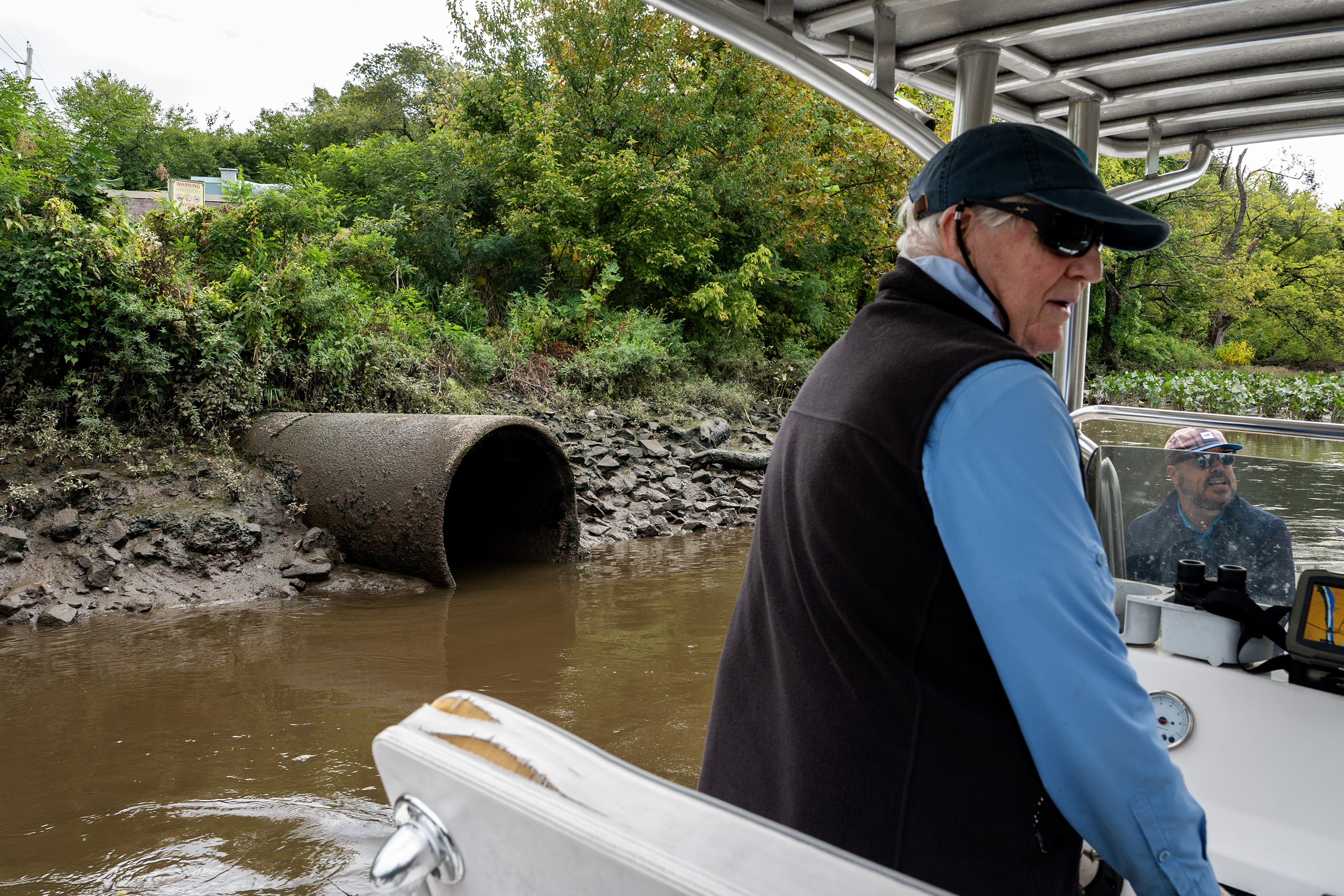
    A combined sewer overflow site during low tide on Tuesday. This 60-inch discharge pipe spits out untreated wastewater and stormwater during heavy rain events, which flow directly into the back channel of the Delaware River.Tom Gralish / Staff Photographer

    The sewer problem

    The cities of Camden and Gloucester have an antiquated sewage system that combines stormwater and sewage in the same pipes. The pipes are designed to carry the combined liquid to the wastewater treatment plant, but when there is heavy rain, they can overflow and the contaminated water spits into the Cooper and Delaware Rivers. The overflow from the combined pipes can cause flooding — and then residents are subjected to sewage-infested waters in their streets and homes.

    “These are the old stone pipes that were built before the current technology,” Camden County Commissioner Jeffrey Nash said.

    “But as both cities grew, and the storms have become more violent, and rain has become more excessive … flooding has been a large problem,” he added.

    On top of the risks to humans, the nutrients from the human waste are harmful for aquatic life.

    There are 30 combined sewage overflow spots in the two cities, Schreiber said, that dump waste into the river when there is heavy rain and the system cannot handle it. Just one of the larger combined pipes pours out about 200 million gallons of sewage-filled water a year, he said, and the two cities dump out about 800 million gallons on average altogether.

    The county wants to spend $200 million to upgrade this system.

    The rest of the county has separate stormwater and sewage pipes, but they still need to be maintained. Leaky pipes can also cause sewage to spill into the river.

    The county plans to spend about $50 million for the rehabilitation of these sewer systems across multiple municipalities. The county has already begun the design process for lining some of these pipes, Schreiber said.

    The bottom line is, the Cooper River — which runs from Gibbsboro and Voorhees out to the Delaware River — does not meet state and federal water quality standards, he said, so the county is taking a “holistic approach” to fix the waterway that flows through multiple municipalities.

    Wildlife along the back channel of the Delaware River near the Cooper River on Tuesday.Tom Gralish / Staff Photographer

    Green infrastructure

    The plan also includes $25 million for green infrastructure, like rain gardens or bioswales, which are typically sloped channels covered with vegetation.

    Green infrastructure gets water directly into the ground, which helps with flooding and decreases the amount of water going through the pipes to the treatment plant, overall alleviating the system. This infrastructure, however, requires expensive and ongoing maintenance, Schreiber said.

    “The more that you contain the water on the land, the better it is for the water,” Baugh said.

    Dredging

    The project also includes $75 million for dredging and other methods of removing sediment from public waterways. This sediment includes toxins that end up in the water from residential and business areas, and if it is not removed, waterways can become defunct. It is part of what makes Camden County’s waterways brown after heavy rain, because “a lot of not-good stuff on the bottom” gets stirred up, Schreiber said.

    “We really want to make sure that we’re taking that sediment out, so that even if it does get disturbed and move, it’s moving clean sediment and not polluting or contaminating,” he added.

    Cleaning up Evans Pond and Wallworth Lake, Cooper River Lake, and Kirkwood Lake are priorities for the county.

    Newton Lake Park, which runs through Haddon Township, Collingswood, and Oaklyn, finished a two-year, $23 million dredging process in 2023 that rehabilitated the lake after it became clogged. And just on Tuesday, the county unveiled the results of a $1.3 million project to improve fishing piers at the rejuvenated lake.

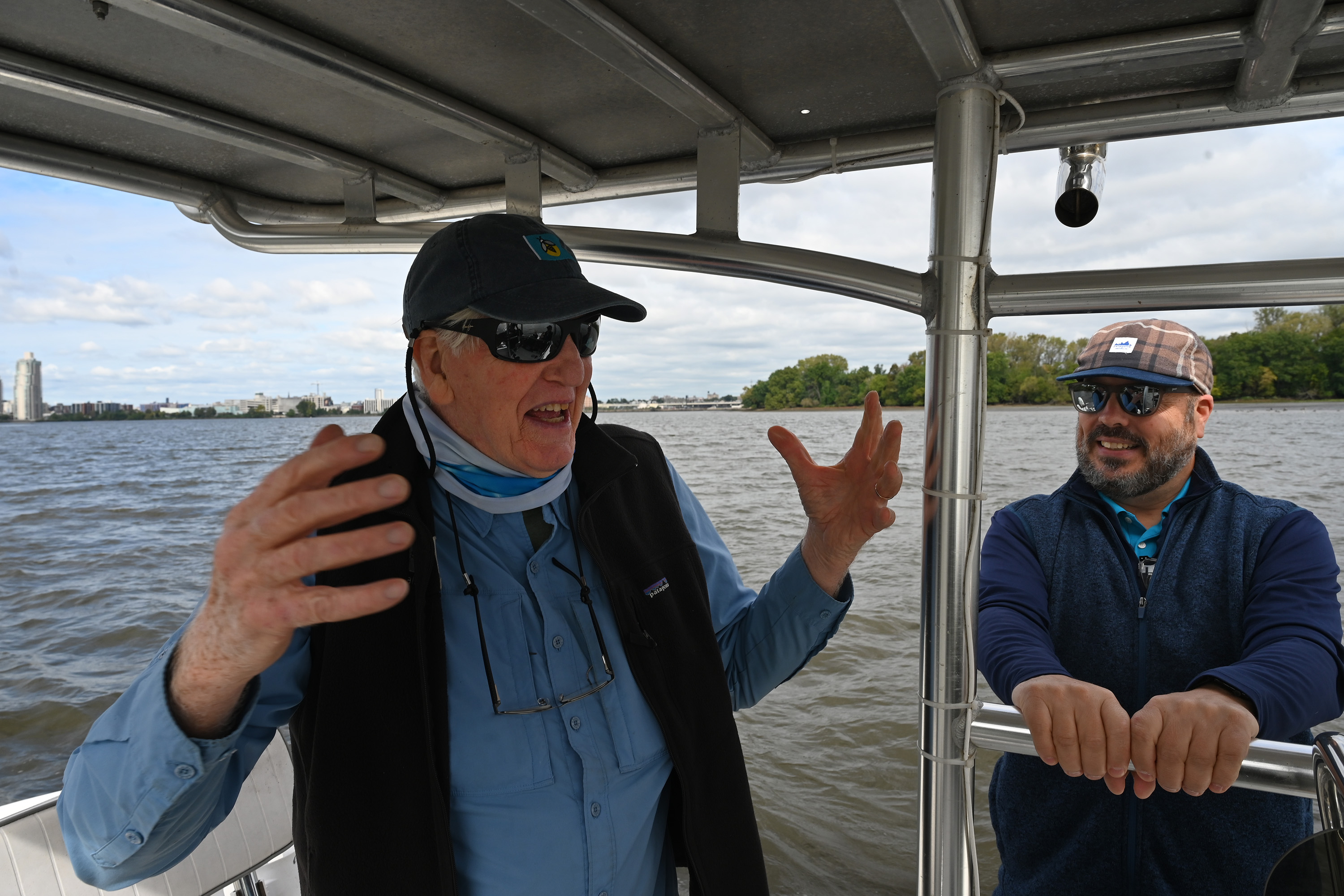
    Don Baugh, president and founder of Upstream Alliance is on the Delaware River on Tuesday with Scott Schreiber (right), executive director of the Camden County Municipal Utilities Authority, looking at sewage runoff from Camden’s waterways.Tom Gralish / Staff Photographer

    Parts of Camden’s waterways are littered with lead and arsenic that was used in apple orchards decades ago in places like Cherry Hill and Voorhees, as well as toxins from the Sherwin-Williams/Hilliards Creek Superfund site, the location of a former paint manufacturer in Gibbsboro.

    Recreation

    Baugh said local families who do not have experience on the water and might not know how to swim show up to his free Saturday kayaking program disappointed that they cannot go out on a nice day. As the county gradually addresses its sewage issues, he expects to feel better putting people out on the water under his 48-hour rule and one day get rid of it completely.

    And the county’s plan would give more options for residents to enjoy their local waters, with $50 million allocated to restoring recreational lake areas. This effort aims to bring more fishing piers, kayak rentals, boat launches, and water trail systems, Schreiber said. The county is prioritizing rehabilitating Atco Lake, Lake Worth, and Audubon Lake, according to its planning document.

    Nash described exploring the county’s urban waterways as a “great thrill.” He wants more residents in Camden to enjoy it, too.

    Each of the plan’s components has distinct advantages, but taken together their benefits amplify, Schreiber said.

    “And if you do that holistically from the top of the county all the way down, you’re going to have a much more clean and friendly park system and river water system,” he added.

  • New Jersey Lt. Gov. Dale Caldwell resigns after investigation found sexual harassment and other wrongdoing

    New Jersey Lt. Gov. Dale Caldwell resigns after investigation found sexual harassment and other wrongdoing

    New Jersey Lt. Gov. Dale Caldwell has resigned after investigators found “credible evidence” of sexual harassment and other wrongdoing.

    Gov. Mikie Sherrill announced his resignation at a news conference Friday afternoon after calling for him to step down while releasing the investigative report Thursday evening.

    “His decision will allow us to move forward with important work serving the people of our state,” said Sherrill, who was inaugurated with Caldwell by her side in January.

    “I will move swiftly and thoughtfully in choosing a new lieutenant governor who will represent my administration and the people of New Jersey with honor and integrity.”

    The governor released a 61-page report from a monthlong investigation conducted by an outside law firm late Thursday afternoon. The report said Caldwell made inappropriate comments to women and violated ethics rules. Caldwell, a minister, is the former president of Centenary University.

    Sherrill called for him to resign by Friday, but it was unclear whether he would listen. Caldwell denied the investigation’s findings through his attorney, who argued Caldwell was not given an opportunity to meaningfully address the accusations in the report or provide his own witnesses.

    Sherrill emphasized Friday that she wanted to “make sure everyone was treated fairly and justly” and called the investigation thorough and impartial.

    “After I received the report and the facts were clear, I took action right away,” Sherrill said, in what may have been a nod to earlier criticism that she didn’t confirm the investigation while it was underway. “Let me be clear: all credible allegations of misconduct must be fully investigated and addressed. In my administration, we are committed to doing what is right, not what is politically expedient.”

    The investigation found Caldwell hit on a female staffer’s friend, and when she turned him down, he told the staffer that ambitious women like them needed a man in a position to help them, “but you young women are looking for young sperm.”

    Caldwell denied making the comments, “but we did not find his denial credible,” the report said.

    Replacing Caldwell

    Sherrill did not have the power to fire Caldwell, so his resignation prevents potential impeachment proceedings in Trenton. The governor has 45 days to pick his replacement.

    In the meantime, New Jersey Senate President Nicholas Scutari will lead the state in her absence. Sherrill traveled to campaign for Democrats in congressional races in other states earlier in the summer, leaving Caldwell in charge. But she stopped after the investigation became public knowledge.

    Sherrill said she spoke to Caldwell on Thursday and texted with him on Friday, and that he resigned to let her administration continue with its agenda amid “all of the attacks from the federal government on affordability, voting rights.”

    Caldwell’s attorney, Thomas Calcagni, said in a statement late Friday that his client continues to dispute the allegations in the report and would be exploring “all legal remedies” to contest its findings.

    “We continue to forcefully challenge the report. Dr. Caldwell’s resignation, submitted to put an end to the targeted campaign to discredit his character, does not in any way diminish our outrage concerning the investigative process and its specious findings,” Calcagni said.

    As fragments of the allegations leaked out over the weeks, some of Caldwell’s friends and allies shared messages of support about his character and record of service. And while he did not speak publicly as news of the investigation surfaced, a May letter he wrote to the ethics commission forcefully denying the claims — and alleging racism — was leaked to media.

    On Friday, a group of self-described Black “faith, civic, and community leaders” commended his decision to resign.

    “By choosing to step down and ending this controversy, he has put the interests of the people of New Jersey and the work of our state ahead of himself,” the group said in a statement, which included U.S. Rep. Bonnie Watson Coleman (D., Mercer), New Jersey Democratic Committee Chair LeRoy Jones, among others.

    Democratic state legislators remained largely quiet before Caldwell announced his resignation, but many were relieved to see Caldwell step down.

    Assemblymember Anthony Angelozzi, a Burlington County Democrat, said he was “appalled” with the findings of the report.

    “The idea of using your government position for personal benefit and harassing women, as someone who has staff members who are female and a daughter, I wouldn’t want to put any woman in a compromised position like that,” he said.

    Assemblymember Balivir Singh floated another Burlington County Democrat, State Sen. Troy Singleton, as an ideal replacement for Caldwell.

    “You look for a person with integrity … and I would think my senator is the best,” Singh said.

    As lieutenant governor, Caldwell served a dual role as the state’s top election official. With his resignation less than 40 days before the midterm election, Sherrill appointed Acting Comptroller Shirley Emehelu to serve as secretary of state on an acting basis.

    “For months at this point, the Department of State team has been hard at work preparing for the upcoming elections in partnership with local and county election officials. I will make sure their work proceeds as planned,” Emehelu said.

    The investigation into Caldwell was conducted by former Attorney General Christopher Porrino — who worked under former Republican Gov. Chris Christie — and his law firm. The probe had been going on since at least May.

    Road crews had begun removing Caldwell’s name from state signs on I-95 as of Friday, but the scandal is still likely to dominate New Jersey politics for the foreseeable future.

    Christine Giordano Hanlon, chair of the New Jersey GOP, called Sherrill’s handling of the investigation a “failure.”

    “Caldwell’s resignation is not accountability for everything that happened before it,” she said. “There are many more questions that will need to be answered.”

    ‘Long-term concerning behavior’ outlined in report

    Sherrill said the report “lays out a pattern and practice of long-term concerning behavior.” She said her decision shows the “culture change” she has pushed for in Trenton.

    “What was so important to me was to make sure that if there are substantiated claims of sexual harassment and ethics violations, that I, as the leader of the government, handle that,” she said.

    “There has been a culture in Trenton, probably since the birth of our nation, to sweep this under the rug,” she said. “You can speak to numerous people who’ve worked in the statehouse for decades who felt this day would never come, that allegations would never be taken seriously, action would never be taken, and victims would just have to either quit their job or move on.”

    According to the report, less than a month after being spoken to and given training on workplace conduct and ethics, and four days after he was told about the investigation, Caldwell tried to get a promotion for a state employee he was dating.

    Caldwell’s attorney said the lieutenant governor forwarded the employee’s resume and did not disclose the two had a personal relationship.

    The report also details comments Caldwell allegedly made about wanting a “first lady.” One staffer said he asked her to find him someone and another recalled him suggesting that he would need a wife in order to run for governor and to let him know if she comes across someone suitable. Caldwell admitted to making comments to staffers about wanting a “first lady” but said he wasn’t serious and other people in the office made similar kinds of jokes, the report said.

    He also repeatedly made comments about staffers having “executive appearance,” which came across to some staffers as a judgment on women’s physical attractiveness. Caldwell said the term was about how both men and women carry themselves, not physical appearance, the report said.

    Caldwell repeatedly brought personal guests to ticketed events without clearing it with the ethics officer and without paying for the extra tickets, a practice that continued even after warnings, attending an ethics training, and being told about the investigation, the report said. His attorney said when Caldwell “learned that reimbursement was appropriate in one particular situation, he reimbursed $175 for the event.”

    He was also accused of providing his business card to women he wanted to date, but he said in his May letter that he gives his business card to more men than women.

    “I have never asked anyone out on a date, ‘hit on,’ or pursued anyone romantically while conducting official business as Lieutenant Governor and Secretary of State,” he said at the time.

    Staff writers Susan K. Livio, Sarah Nicell, and Lacey Latch contributed reporting.

  • Andy Kim and Cory Booker call on N.J. lieutenant governor to resign after report finds evidence of sexual harassment

    Andy Kim and Cory Booker call on N.J. lieutenant governor to resign after report finds evidence of sexual harassment

    New Jersey’s two senators in Washington echoed Gov. Mikie Sherrill’s call for Lt. Gov. Dale Caldwell to resign just hours after she released a report that said he sexually harassed a woman and made advances to others even after he was warned to stop.

    Sen. Andy Kim, a Burlington County Democrat, said in a statement on social media that the lieutenant’s governor was “unacceptable” based on the findings in the 61-page report based on a months-long investigation by an outside law firm.

    “New Jerseyans deserve to have public servants who work to earn and keep their trust, not undermine it,” Kim said.

    “The Lt. Governor should resign immediately,” he added.

    Sherrill’s office released the documents Thursday evening in her first acknowledgement of the investigation into Caldwell, who has denied the findings of the report.

    Sherrill said Caldwell “engaged in serious, repeated violations of state policy and failed to uphold the responsibilities of his office.”

    The governor called on Caldwell to step down from his post as her No. 2 by Friday, but statements from his attorneys show no indication he plans to adhere to that request. He’ll likely face increasing pressure over the course of the day.

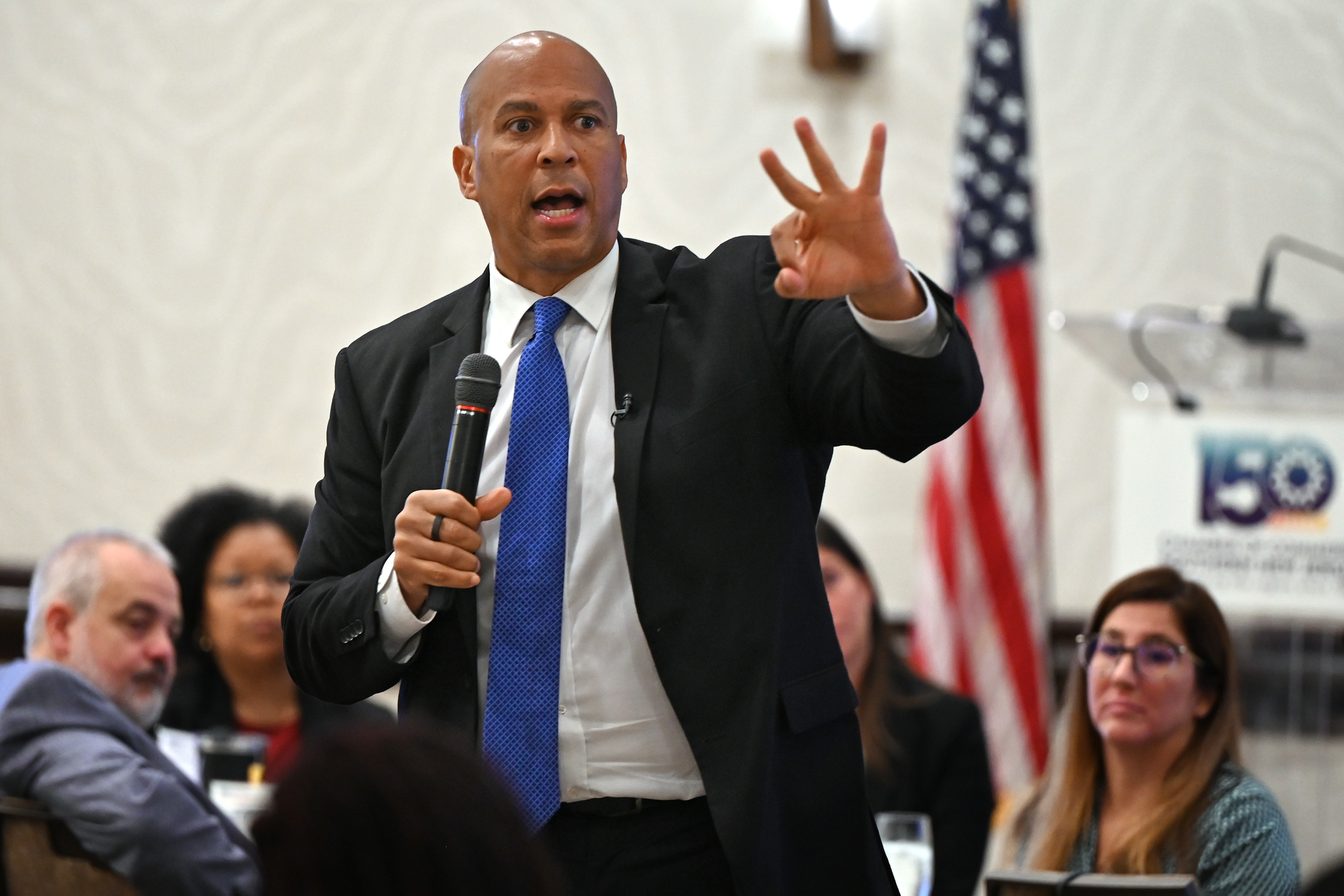
    USE AS DESIRED: U.S. Sen. Cory Booker addresses members of the Chamber of Commerce of Southern New Jersey in Mt.Laurel Aug. 29, 2023.Tom Gralish / Staff Photographer

    Sen. Cory Booker, a Newark Democrat, said Caldwell should resign “for the sake of our state” in a statement on social media.

    “Governor Sherrill is absolutely right the conduct described in the investigative report is totally unacceptable,” he said.

  • Former South Jersey transit official enters plea deal in political revenge case

    Former South Jersey transit official enters plea deal in political revenge case

    A former South Jersey Transportation Authority commissioner and Philadelphia union leader accused by a New Jersey grand jury of using public office to retaliate against a political foe entered a guilty plea deal Wednesday that will likely keep him out of prison.

    The grand jury last year indicted Bryan Bush and Christopher Milam, a current SJTA commissioner and former vice chair, on six counts of conspiracy, official misconduct, and perjury.

    Prosecutors accused the two Gloucester County men of conspiring in 2023 to deny payment to a contractor that had allegedly fallen out of favor with George E. Norcross III, a Democratic South Jersey powerbroker, and with lying to a grand jury about their reasons for rejecting payments.

    They were first charged in 2024, just days before Norcross was indicted on charges of racketeering in a case that has since been dropped. (Norcross recently filed a defamation lawsuit against The Inquirer.)

    Bush, who was represented by Robert Agre of Agre & St. John in Haddonfield, pleaded guilty to one count of obstruction in the fourth degree — and agreed not to hold public employment. In exchange, prosecutors dropped the remaining charges and recommended probation. He agreed to comply with conditions in a Sept. 17 letter from the state, which prosecutors did not make available on Wednesday.

    Milam, whose term as commissioner officially ended earlier this year, rejected prosecutors’ offer. His attorney, Charles Fiore of Charles Fiore Law Offices in Williamstown, is seeking Pretrial Intervention (PTI), a program that can help first-time offenders get charges dropped by “gaining skills to straighten out personal problems in order to avoid future arrests,” according to the New Jersey Courts website. He appeared in court remotely on Zoom.

    Obstructing the administration of law has a maximum sentence of 18 months in state prison, Judge Donna Taylor said in court. Taylor rejected a motion to dismiss the case in early July.

    In court, Bush admitted withholding information from prosecutors that would have helped the investigation into the nonpayment of money to T&M Associates, a Middletown, N.J.-based engineering firm, for its contract with the SJTA.

    Bush told The Inquirer he will keep his job as the business manager of Sheet Metal Workers Local 19, an influential union in Philadelphia.

    “I’m just trusting my attorney’s judgment on all of this,” Bush told The Inquirer on his way out of the courtroom at Atlantic County Criminal Court on Wednesday.

    Dan Prochilo, a spokesperson for Attorney General Jennifer Davenport, who inherited the case from former Attorney General Matthew Platkin, said Wednesday that the office “is committed to investigating and fighting for accountability in any case where public officials abuse their positions of public trust.”

    Davenport did not pursue Platkin’s case against Norcross, declining to appeal a court ruling that dismissed it.

    ‘Political suicide’

    Milam’s lawyer argued that the case centers on Norcross — though he is not a defendant — and that prosecutors used it to strengthen their separate case against him, according to court documents. He noted that the power broker was mentioned 50 times during the grand jury presentation.

    When asked to comment on Bush’s plea, Dan Fee, a spokesperson for Norcross, criticized the former attorney general. Platkin, he said, “tried to pin something on George that just wasn’t true.”

    According to court documents, John Cimino, head of T&M Associates, got on Norcross’ bad side after endorsing a different candidate than Norcross directed in a Democratic primary for Mercer County executive. Norcross subsequently said Cimino committed “political suicide” and was off his “Christmas card list,” according to the documents.

    Norcross’ firm dropped T&M as a client and his longtime political consultant resigned from T&M, according to the documents. Milam and Bush entered the picture because, as SJTA commissioners, they voted against payments for work done by T&M for the agency at three separate meetings.

    Detectives discovered texts from Milam to Bush saying he planned to vote against T&M because “they cut South Jersey in Mercer County,” and Bush said he would vote no, too. The commissioners eventually approved the invoices after they were directed to do so by SJTA Director Stephen Dougherty, according to the court record.

    Milam’s term technically expired in May, but he remains a commissioner until Gov. Mikie Sherrill makes an appointment, SJTA spokesperson David Zappariello said. He declined to comment on the case.

    The SJTA oversees the Atlantic City Expressway and Atlantic City International Airport. It also works on transit efforts across South Jersey, such as the new South Jersey Connects bus system.

    Bush’s sentencing is scheduled for Nov. 10.

  • U.S. Rep. Jeff Van Drew accuses N.J. Democrats of ‘cover-up’ at congressional hearing over noncitizen voting

    U.S. Rep. Jeff Van Drew accuses N.J. Democrats of ‘cover-up’ at congressional hearing over noncitizen voting

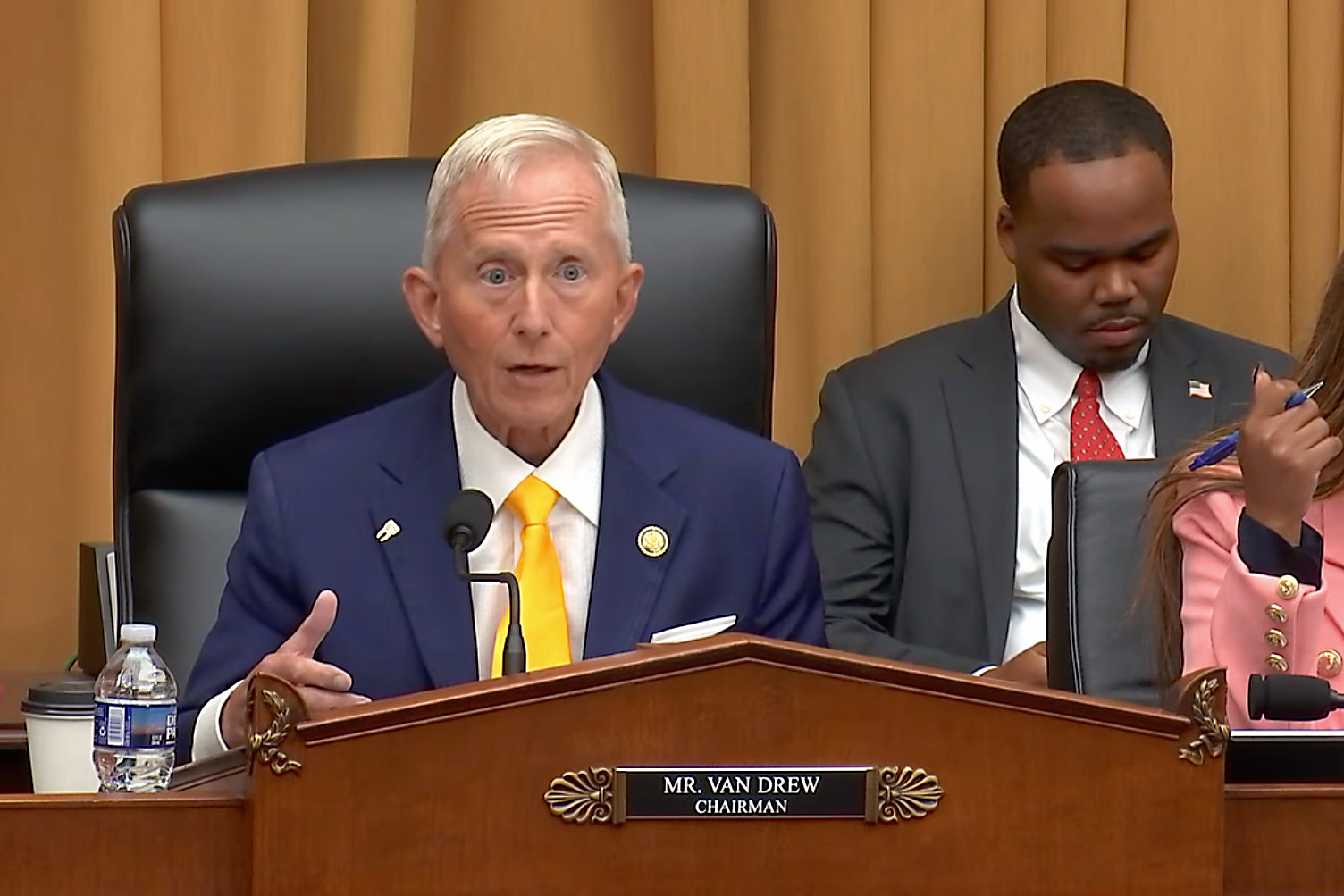
    South Jersey Republican Rep. Jeff Van Drew tried to ramp up pressure on Democratic Gov. Mikie Sherrill over the state’s noncitizen voter registrations at a Tuesday hearing in Washington, which did not feature testimony from anyone in Sherrill’s administration.

    “Whose side is New Jersey government on?” Van Drew said early in the congressional hearing as he aired grievances about Sherrill and the state’s immigration policies. “That’s the question hanging over this entire hearing.”

    None of the witnesses at the hearing were employees of New Jersey or IDEMIA, the software vendor which Sherrill has blamed for the issue, a point disputed by the company. Van Drew defended IDEMIA at the hearing and said the company is cooperating with his probe.

    As he chaired the hearing, Van Drew repeatedly accused the state of New Jersey of knowing about the noncitizen registration issue since 2024.

    “In political terms, that’s called a cover-up,” he said.

    Van Drew, the chair of the House Judiciary Subcommittee on Oversight, has been a thorn in Sherrill’s side since she announced in July that about 6,600 noncitizens had been registered to vote due to an issue with the software used for the New Jersey Motor Vehicle Commission’s (MVC) voter registration program under former Democratic Gov. Phil Murphy.

    Tuesday’s hearing came the day after the Supreme Court rejected President Donald Trump’s mail ballot restrictions, allowing states to continue sending ballots under the same processes they have been using for years. Van Drew has been a vocal supporter of Trump’s efforts to overhaul national elections, including passing legislation to require proof of citizenship, like a birth certificate or passport, to register to vote.

    Three witnesses, including the former chief counsel of the Republican National Committee, advocated for stricter rules around voting. A fourth witness, a former election official from Arizona, said the issue of noncitizen voter registration is incredibly rare.

    Rep. Jeff Van Drew and President Donald Trump at a campaign rally in Wildwood, New Jersey, shortly after Van Drew switched parties.Heather Khalifa / MCT

    Van Drew claims state knew of problem sooner

    IDEMIA confirmed after the hearing that the company had met with staff from Van Drew’s office and “will continue to cooperate with congressional and state investigations to help ensure a complete and accurate understanding of the facts.”

    Van Drew contended that internal documents show the state government had “tested and approved” the software that led to the improper registrations.

    “We also know that in 2024, IDEMIA received a request from New Jersey after the state finally realized that noncitizens were being registered to vote,” the Cape May County lawmaker said.

    Van Drew spokesperson Paxton Antonucci told The Inquirer on Tuesday evening that the documents showed that New Jersey reached out to IDEMIA in June 2024 after noticing individuals who were registered to vote had missing information on their age and party affiliation. She said that information was missing because the software failed to flag that the group of individuals had selected they were not citizens, but were still allowed to registered to vote.

    “The committee is working with IDEMIA to obtain additional information on how this was allowed to happen, and we are seeking documents from New Jersey as to why this error was never disclosed to the public prior to 2026,” she said.

    Sherrill spokesperson Darwin Pham said the governor’s office “can’t speak” for the prior administration. Mahen Gunaratna, Murphy’s spokesperson, pointed to a previous statement on Tuesday that said Murphy “had no knowledge” of the issue and applauded Sherrill for investigating it.

    Pham said in a statement Tuesday that congressional Republicans are weaponizing the issue “to advance Trump’s voter suppression agenda” while the governor “is focused on continuing to solve the problem she inherited from the previous administration.” He called the hearing “political theater.” Sherrill hired an independent firm to conduct an investigation that is ongoing. She said she will present the findings to the public.

    Sherrill’s administration said earlier this summer that the state had removed roughly 4,000 voters from the rolls and left the rest to county election officials to verify whether they were citizens or not. Locally, Burlington and Camden Counties confirmed removing noncitizens from the rolls but did not specify a number.

    Sherrill’s administration said fewer than 400 of the noncitizens voted but did not affect the results of an election. Van Drew pushed back against this assertion on Tuesday, saying he still does not know the details of which elections these noncitizens voted in.

    “Anybody knows if you follow local elections, they can be a handful of votes very often. It can even happen in Congress,” said Van Drew, who was elected as a Democrat in 2018 before declaring his loyalty to President Donald Trump and switching parties a year later. This November, he will face Democrat Zack Mullock, the Cape May mayor, at the ballot box.

    Van Drew said that Lt. Gov. Dale Caldwell, the secretary of state, has been “somewhat cooperative” but that the state has broadly “done everything it can to not cooperate and stonewall the investigation.”

    A Sherrill official said Tuesday her administration had provided the committee with public documents. The governor has pledged to protect New Jerseyans’ data, and her administration has been in a legal battle with the Trump administration over providing the personal information of noncitizens.

    At the hearing, Van Drew referred to Caldwell being under investigation without going into details. Sherrill has touted her transparency in disclosing the noncitizen voter registrations, but she has been criticized by some in her party for staying tight-lipped about a reported investigation into Caldwell and his alleged behavior with women.

    Lt. Gov. Dale Caldwell (left) follows Gov. Mikie Sherrill off the stage following the celebration of their victory at an election night party in East Brunswick Tuesday, Nov. 4, 2025.Tom Gralish / Staff Photographer

    Noncitizens removed from voter rolls in Burlington and Camden Counties

    David Levinsky, a spokesperson for Burlington County, confirmed some ineligible voters were removed from the rolls in the South Jersey county but deferred to the state on specific numbers.

    “The [Burlington County] Superintendent of Elections Office continues to follow all relevant state laws and guidance to ensure that all residents who register to vote are eligible,” he said.

    Camden County spokesperson Dan Keashen also confirmed that the county received a list of voters to investigate. The rolls are up to date after noncitizens were removed, he said.

    Stephanie Salvatore, the Gloucester County superintendent of elections, said Tuesday that the county had not been notified of any questionable voters due to the MVC issues from the state.

    Salvatore, who has been in the election office for more than three decades, said the issue had come up “a handful of times” before.

    “I have police powers over elections, and an investigator assigned full-time. We work closely with many agencies, including the FBI, the state police, the county prosecutor, among other agencies,” she said. “If I cannot verify the voter eligibility in question within my office, I send it to the professionals and/or the courts to decide.”

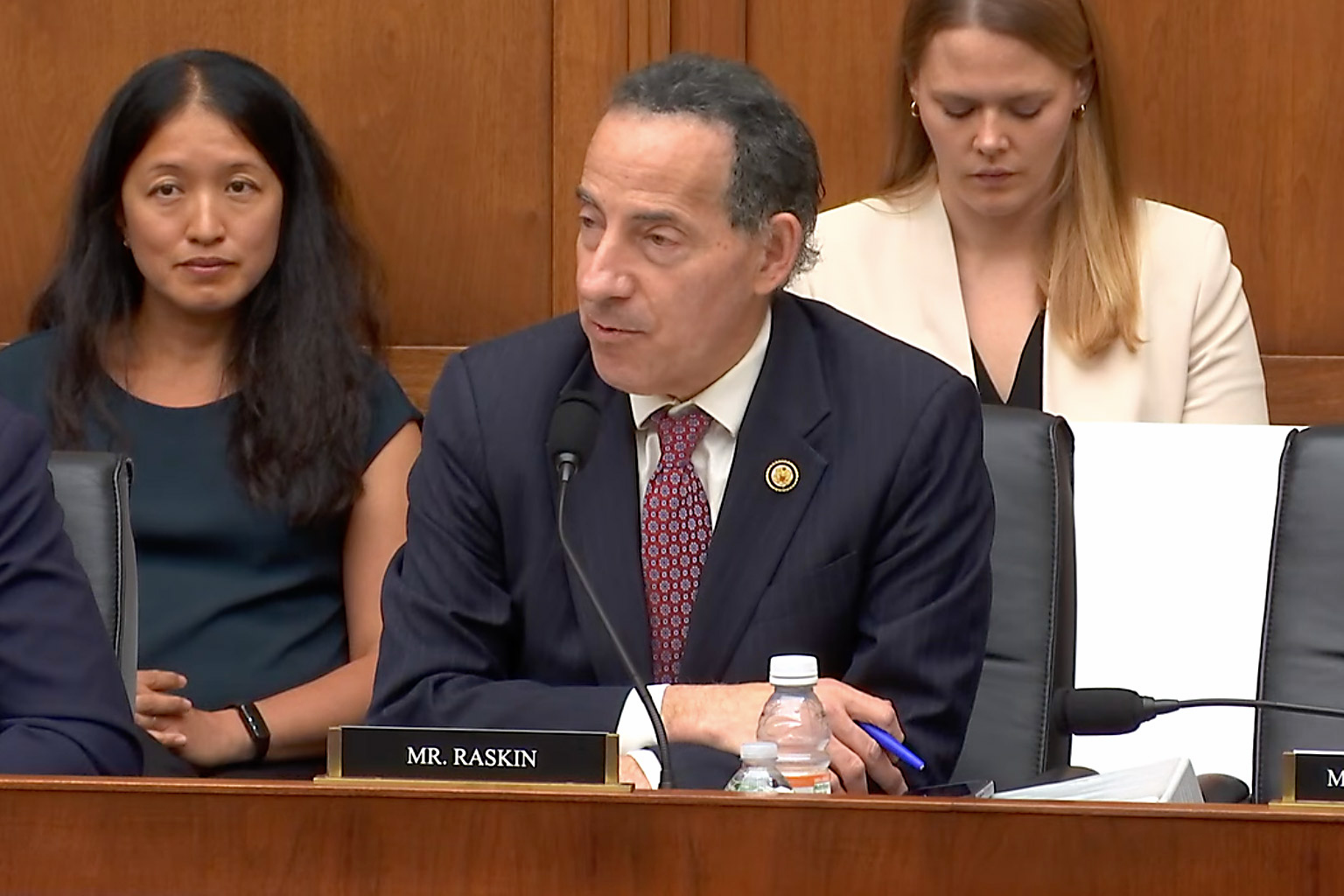
    U.S. Rep. Jamie Raskin, a Maryland Democrat, speaks during a hearing on New Jersey noncitizen voter registrations. House Judiciary Subcommittee video

    ‘Worst-case scenario’

    Stephen Richer, a legal fellow with the libertarian Cato Institute’s Robert A. Levy Center for Constitutional Studies, was the one witness who strayed from Van Drew’s position on noncitizen voting. Richer, who previously served as a Republican responsible for voter registration in Maricopa County, Ariz., cited as an example an audit in Utah, which found that 0.001% of voters were noncitizens. He said New Jersey’s case is the worst he has seen.

    “Even in this scenario, this worst-case scenario, noncitizens made up a fraction of a percent of voters,” he said.

    Josh Findlay, a senior fellow for election integrity policy at the Trump-aligned America First Policy Institute, argued that every noncitizen vote cancels out a citizen’s vote.

    “The default should be that voters must verify their eligibility before being added to lists, not that people are added to lists and then we hope that the state catches them,” he said. “Even small numbers matter.”

    U.S. Rep. Jasmine Crockett, a Texas Democrat and ranking member of the subcommittee, called Trump “the biggest threat to democracy,” pushing back on the GOP messaging.

    Van Drew contended that pressure from the federal government led to the noncitizen voter revelation, but U.S. Rep. Jamie Raskin, a Maryland Democrat, emphasized that the error was discovered and disclosed by New Jersey itself.

    “No matter how much our colleagues seek to inflate it, a clerical error is not structural corruption, much less is it a criminal conspiracy,” said Raskin, the top Democrat on the Judiciary Committee. “It does not rise to the level of, say, a violent insurrection deliberately incited and organized to overthrow a completed presidential election.”