Author: No Author

  • Letters to the Editor | Oct. 22, 2026

    Letters to the Editor | Oct. 22, 2026

    War on polio

    World Polio Day on Saturday, Oct. 24, commemorates a medical achievement at the highest level.

    Younger generations may not remember how severely the polio epidemic affected nations across the globe during the latter half of the 20th century. How bad was it? Well, even in the 1980s, there were 1,000 new cases of this crippling disease every day internationally.

    And so, in 1985, Rotary International took the lead role and in an unimaginable task: Rotary declared war on polio.

    Since 1988, Rotary International and its partners, the World Health Organization, UNICEF, and the U.S. Centers for Disease Control and Prevention, have banded together in the Global Polio Eradication Initiative to eradicate polio as a world imperative. Additionally, the Gates Foundation and many governments including the United States have generously provided hundreds of millions of dollars of support for this effort.

    The job is almost finished. The number of cases of polio worldwide is down by 99.9% (only still endemic in Pakistan and Afghanistan). However, polio knows no borders and carriers frequently move from one country to another. The virus can therefore reappear in previously polio-free countries. That is why Rotary International and its partners have been relentless in this fight. If polio isn’t eradicated, the world will continue to live under the threat of this disease and millions of children could once again be paralyzed.

    Joseph Batory, Philadelphia

    Democracy for $ale

    Elon Musk contributed $276 million to Republicans in the midterm elections, mainly to keep them in control of the Senate.

    He will gain great influence with those his money helped to win. Will he use the influence to benefit himself or to benefit ordinary people?

    No wonder the government works well for big donors but not so well for the rest of us.

    To create a fair system, we must replace large contributions with small contributions matched by a multiple of public funding.

    At a cost of $10 yearly per person, over two years $6 billion could be raised to fund congressional elections. At a cost of $5 yearly per person, over four years another $6 billion could be raised to fund presidential elections.

    Richard Barsanti, Western Springs, Ill.

    Join the conversation: Send letters to letters@inquirer.com. Limit length to 150 words and include home address and day and evening phone number. Letters run in The Inquirer six days a week on the editorial pages and online.


  • Pope Leo’s doctors say tests show he needs no further treatment for lung cancer

    Pope Leo’s doctors say tests show he needs no further treatment for lung cancer

    VATICAN CITY — Pope Leo XIV needs no further treatment for lung cancer after follow-up tests confirmed the disease was localized, the Vatican said in a statement Wednesday.

    Leo, 71, had the lower lobe of his right lung removed last week in the first major health event of his 17-month pontificate. The surgery confirmed he had adenocarcinoma, the most common type of lung cancer. He left the hospital on Saturday, four days after surgery and well ahead of the weeklong hospital stay the Vatican had initially anticipated.

    The pope’s personal physician, Luigi Carbone, and his surgeon, Stefano Margaritora, said in a statement that results of the final post-operative tests on tissue removed during the pope’s surgery confirmed the initial diagnosis and that the cancer had not spread.

    “A subsequent oncology assessment confirmed that no further treatment is necessary,” the doctors said.

    The pope had the lower section, or lobe, of his right lung removed to try to ensure that all the cancer was removed.

    Additional treatment is offered in such cases if follow-up testing finds signs that the cancer has spread or has certain other signs that it might be particularly aggressive. Surgery often can be enough when tumors are caught very early, such as when someone has an X-ray or other scan that shows a spot long before it’s large or causing symptoms.

    The pope appears to have had one of those “incidental findings,” a nodule in his lung spotted during another exam. In an interview with Vatican News, Margoritora, the chief thoracic surgeon at Rome’s Gemelli hospital, confirmed that the nodule was found by chance during routine abdominal examinations.

    The pope carried on business while in the hospital, including a call with Russian President Vladimir Putin, and has appeared strong in two public appearances at the Vatican since his surgery: the traditional Sunday blessing from a window overlooking St. Peter’s Square and Wednesday’s longer audience, when he greeted the faithful from all over the world.

    His next major engagement is an ambitious Nov. 6-17 trip to Uruguay, Argentina, and Peru.

    Margaritora was quoted by Vatican News as saying that there was “no clinical reason” to prevent the trip, which includes a dozen flights, two helicopter rides, and high-altitude stops.

    The pope revealed that a nodule had been found and would be surgically removed during the traditional Sunday blessing on Oct. 11, in an unusually transparent disclosure.

  • Letters to the Editor | Oct. 21, 2026

    Letters to the Editor | Oct. 21, 2026

    Looking out for No. 1

    As a retired respiratory therapist who worked in healthcare for 40 years, I was irate after the announcement that doctors have found blood clots in the lower extremities and lungs of Eagles quarterback Jalen Hurts. I think I speak for a lot of us when I say that there are so many questions: Why was Hurts discouraged from sleeping before the London game? Why was he allowed to take the field at all? And why did he fly back on an international flight, when traveling is a well-known risk for those with clots?

    Although none of us certainly has all the facts (nor should we since this is Mr. Hurts’ private medical history), it’s clear that there’s a lesson here for anyone in similar circumstances, whether it’s pee wee football or professional sports: Get a second opinion.

    We’ll all learn more in the days and weeks to come, but from what we know so far the handling of this injury seems like an example of disgraceful decision-making across the board — from the medical advisers to team management.

    The Eagles need to reassess their priorities and responsibilities toward their players — whoever decided that this was at all appropriate demonstrated poor stewardship toward one of Philadelphia’s most beloved athletes and cherished citizens.

    Kathleen English, Swedesboro

    …

    I hope Jalen Hurts prioritizes his health — even though it appears that the Eagles certainly did not. Wishing QB1 well, and here’s hoping that he fully recovers from deep vein thrombosis.

    K. Mayes, Philadelphia

    Profits for Putin

    The Inquirer’s recent series of editorials extensively documented Donald Trump’s abuses in office, including his family’s profiteering and his own misuse of the Justice Department for personal revenge. Yet not long after the Editorial Board compiled this list, Trump committed a further abuse of equal — or greater — magnitude: a deal with Russian President Vladimir Putin to provide the U.S. and global markets with 300,000 tons of diesel fuel.

    As a means to reduce U.S. fuel prices, the deal is pathetic. Even if Russia — itself suffering from gas shortages — were to provide this much diesel, it would offset less than a typical day of consumption by Americans.

    However, the deal will have additional impacts, all grim. Putin will use the diesel revenues to further his war of aggression against Ukraine. Lifting sanctions also violates the 2022 law that bans importation of Russian oil for that very reason. To aid an authoritarian aggressor in a murderous war against a democracy is morally repugnant and deeply at odds with American values.

    The Republican-controlled Congress has been distressingly tolerant of Trump’s violations. Surely, though, this abuse must be addressed. Let us hope and demand that, in this instance, our representatives rise to play the role the Constitution requires.

    John Francis and Elaine Fultz, Philadelphia

    …

    On Dec. 16, 2025, Sen. Dave McCormick (R., Pa.) issued this statement: “Any nation or entity that buys Russian oil is actively funding Russia’s aggression in Ukraine. Vladimir Putin has demonstrated he is unserious about bringing this war against Ukraine to a close, and continuing to fuel the war machine should carry consequences.”

    At that time he stood in solidarity with a group of lawmakers who introduced the Decreasing Russia Oil Profits (DROP) Act of 2025, which required “targeted sanctions on anyone, anywhere dealing in Russian oil.”

    Where does McCormick stand now? Will he support Donald Trump’s corrupt oil deal and betray Ukraine? Or will he have the courage to stand up for justice in defiance of Trump?

    Alex Pearson, Merion Station

    …

    There has been a lot of discussion about how Donald Trump’s deal to buy fuel from Russia violates the law named for the late Sen. Lindsey Graham that established sanctions on Russia. However, it might be even more serious than that.

    The only crime defined in our Constitution (Article 3, Section 3) is treason. Part of the definition is “giving Aid and Comfort” to our enemies. Given that Russia is giving Iran intelligence that it uses to kill American troops — and that Russia was having financial difficulties because of both their war against Ukraine and the economic sanctions against them — Trump’s deal seems to clearly meet the definition of treason.

    Jules Mermelstein, Dresher, jules.important.email@gmail.com

    Shared prosperity

    We write to express our enthusiastic endorsement of the recent piece by Rick Sauer and Daniel Betancourt that called on Philadelphians to support the Community Reinvestment Act.

    As Sauer and Betancourt pointed out, the CRA is indeed, “a foundational pillar for creating access to opportunity by requiring banks to provide credit and investment to low-and moderate income communities.”

    Since the mid-1970s, when the CRA was enacted, a historically unique collaboration has evolved among the banking industry, community organizations, and government. In Philadelphia, this collaboration has greatly expanded homeownership and modernization, small-business development, and economic revitalization in our city’s struggling communities.

    Our partnerships date back to the pioneering Philadelphia Mortgage Plan, which offered reduced-rate home mortgages. They include foundational support for pioneering efforts like Judge Annette Rizzo’s Home Mortgage Remediation program. Her program mandated face-to-face remediation meetings between homeowners and lenders before a home can be foreclosed upon.

    Forged during a period of great distrust between the American people and big corporations, the CRA has enabled the banking industry to build these multisector partnerships that set it apart from other industries.

    Far from needing softening, the CRA should be held up as a model for how the federal government can encourage private industry to work with citizens, nonprofit partners, and local government for the common good.

    Don Kelly and Don Haskin, Philadelphia

    Haskin is a former journalist at The Philadelphia Daily News. Both writers are retired bank community reinvestment officers.

    Naming allegations

    I read with some alarm Jonathan Zimmerman’s recent column, in which he scolded those who named the alleged Cornell University rapists, saying that naming them may put others with similar names in danger.

    That’s quite a take. I suppose Ted Bundy shouldn’t have been named until after he was convicted, because that might have negatively affected a different Ted Bundy, such as the guy I found online from Youngstown, Ohio? Does Zimmerman believe that The Inquirer should have protected the identities of Raymond “R.C.” and Eugene Horsch, given that their sex crimes are only alleged and there are other people with the name Horsch?

    If we give alleged rapists a carve out as Zimmerman proposes, doesn’t equal protection under the law also dictate that we grant burglars, muggers, arsonists, school shooters, and other violent criminals anonymity until conviction as well?

    I also wonder why Professor Zimmerman often defends the aggressors instead of the victims? I ask because back in 2012, your columnist wrote: “Rather than simply vilifying pedophiles like Sandusky, we might also pause to consider how our shifting views of them have affected American childhood.” I didn’t realize Americans had shifting views of pedophilia, but that’s for another letter.

    Brendan Skwire, Philadelphia

    National lottery

    Every day we participate in a national lottery, one with odds better than the almost 300 million-to-1 chance of winning the grand prize in the Powerball jackpot. That is the likelihood that, on any otherwise normal day, any of our parents, spouses, siblings, children, grandchildren, friends, and neighbors may be shot on our streets, schools, places of worship, or, actually, anywhere.

    As far as I can tell, there is no way to opt out. Apparently, although we are a nation famous for achieving great, almost impossible things, there is nothing we can do about this.

    What a shame.

    Jim Kempner, Holland

    Join the conversation: Send letters to letters@inquirer.com. Limit length to 150 words and include home address and day and evening phone number. Letters run in The Inquirer six days a week on the editorial pages and online.

  • Letters to the Editor | Oct. 20, 2026

    Campus culture

    As a student who will apply to college in a year, I think the Cornell University allegations are a stark reminder of how our early adult years can go horribly wrong. Protests against sexual abuse have become a source of unity and solidarity for women across the country. While I haven’t heard many stories like theirs before — unless it was something having to do with the Epstein files or a celebrity — I am encouraged to see this topic in the spotlight. Friends, neighbors, and family members of mine could be Jane Doe, too. We need to acknowledge this issue so that campus cultures can be safer and healthier. Everyone needs to ask for consent and not take advantage of someone just because they can, or because other people are doing so.

    Thomas Ehri, Philadelphia

    Convenient criticism

    I find it a little too convenient for some politicians (I’m looking at you, Republicans) to all of a sudden distance themselves from President Donald Trump. Since the start of his second term, the president has been doing things that have had a good portion of the country shaking its head with disbelief and disdain. The recent deal with Russian President Vladimir Putin over diesel sales is an abomination. It just goes to show that Trump values a U.S. adversary more than some of our centuries-old allies. Now that it’s election time, some members of the GOP are finally finding the guts that they had conveniently left at home when Donald Trump decided to say or do something that tramples the Constitution or embarrasses us on the world stage.

    A spine is a terrible thing to waste.

    Vincent Hughes, Middletown, Del.

    Questionable calls

    Anthropic’s admission that one of its AI models submitted a false tip to Philadelphia police about an unsolved homicide should alarm every person in this city, especially as law enforcement considers embedding AI into 911 calls and while the data centers powering these tools loom over our neighborhoods.

    The tip was flagged as spam this time, but as a lawyer advocating for criminal justice reform, I’ve seen firsthand how quickly peoples’ lives are upended when police act on bad information. Had the tip named a suspect and bypassed spam filters, an innocent person could have faced questioning, intimidation, or worse over a false allegation.

    The bottom line is that a Big Tech company’s experiment reached a real homicide investigation, and real people could have gotten hurt. We cannot be guinea pigs for Big Tech.

    Philadelphia needs the time and authority to decide whether, and how, AI infrastructure expands here. A data center moratorium would give City Council both. And come budget time, Council should prioritize investments in good jobs, schools, libraries, and public safety resources over AI tech to replace human 911 operators or expand police surveillance.

    Nikki Grant, co-executive director, Amistad Law Project

    Join the conversation: Send letters to letters@inquirer.com. Limit length to 150 words and include home address and day and evening phone number. Letters run in The Inquirer six days a week on the editorial pages and online.

  • Letters to the Editor | Oct. 19, 2026

    Letters to the Editor | Oct. 19, 2026

    Black Bottom

    City Council was on good grounds to recognize the Black Bottom community in the first half of the 20th century in West Philadelphia. But the boundary described by Council — 32nd to 40th Streets, Lancaster Avenue to Civic Center Boulevard — is false to history. Census records show that in 1940, long before urban renewal changed it, this area was only 28% Black. Descendants of the chiefly Black section in “the Bottom,“ as the lowlands beside the Schuylkill were called, say it mostly lay within a block or two around 34th and Market.

    This modern reimagination of the Black Bottom has more to do with the present than the past. The larger area has developed into a hub of eds and meds worth more than $4 billion in real estate. It may tempt some to assert an “ancestral” claim to a bit of that economic activity now. It is good to celebrate the history of every ethnic community in a neighborhood. Yet most Philadelphians don’t live on the same block their grandparents occupied. History also teaches us that every community in a busy city is always moving on.

    Tony West, Philadelphia

    Sandwich police

    For decades, the Kibitz Room in Cherry Hill has served Jewish deli classics. Now New Jersey wants to fine it $1,000 for calling itself a Jewish deli without disclosing that its food isn’t kosher.

    Bureaucratic lunacy has reached a new frontier: The government is policing who gets to call a sandwich Jewish.

    Apparently, without a disclaimer, unsuspecting Orthodox diners might wander in and accidentally devour a bacon cheeseburger.

    Katz’s Delicatessen, Manhattan’s legendary temple of Jewish gastronomy, isn’t kosher either. Shall we dispatch the religious police to confiscate its pastrami?

    Jewish identity isn’t a dietary certification. Jewish cuisine isn’t synonymous with kosher cuisine.

    Has a single kosher-observant customer actually been deceived? Or has some regulatory zealot discovered another imaginary peril?

    Enough already. Leave the deli alone.

    Eric Ascalon, Cherry Hill

    Livestream executions

    I was relieved to hear that President Donald Trump has abandoned a plan to livestream the Dec. 3 execution of Nidal Hasan, the former Army officer who killed 13 people in 2009 during a mass shooting at Fort Hood, Texas. The original announcement had elicited widespread condemnation, including from some conservatives and Republicans. The gist of the criticism was that livestreaming an execution would be an embarrassment for the country; that it would be traumatic for many, especially for children; and that even many supporters of capital punishment would find it revolting.

    All of these criticisms are correct, but they imply that there would be nothing harmful about an execution if only it weren’t livestreamed. That is wrong. All executions are inherently atrocious and cruel. An execution by the government has a veneer of justice, but underneath is nothing but cruelty and vengeance. And when vengeance is wrought on another human being on behalf of all of us, we all suffer a profound moral injury — whether we oppose or support it, whether we witness it and are horrified, or whether we turn away and try to ignore it.

    Matthew Lawry, Elkins Park

    Join the conversation: Send letters to letters@inquirer.com. Limit length to 150 words and include home address and day and evening phone number. Letters run in The Inquirer six days a week on the editorial pages and online.

  • Letters to the Editor | Oct. 16, 2026

    Letters to the Editor | Oct. 16, 2026

    Expand laws

    The fatal shooting of a Philadelphia police officer and the serious injuries sustained by another were probably avoidable if the right laws were in place. And although I support Mayor Cherelle L. Parker and her efforts to expand state law on holding people struggling with substance use and those living with severe mental illness, she is not helpless now.

    The police already have the authority under Title 10 of the Philadelphia Code to get people who use substances off the streets, particularly when they are publicly intoxicated from drugs or alcohol, illegally blocking our sidewalks, and sleeping on our streets. But instead, city officials, led by District Attorney Larry Krasner, have opted to use their discretion to not pursue charges in some cases. And that protects the drug dealers, not the public nor the people who use substances themselves, for that matter.

    Admittedly, prison isn’t the best place to detox or for people living with mental illness, but appropriate medical care for prisoners is a right that is guaranteed under the Eighth Amendment to the U.S. Constitution, Title 42 U.S.C. § 1983, and a court order would help to ensure that right is honored.

    Again, state law should be changed to ensure protection for all concerned, but there’s a lot more Mayor Parker and city officials can do right now under current law.

    Lynn Landes, Philadelphia, LynnLandes@gmail.com

    Unacceptable response

    The Philadelphia Police Department’s spokesperson, Sgt. Eric Gripp, said now is not the time to bring up previous missteps regarding the 2023 trial of Eric Lewis, who is accused of killing Officer Shane Seiber. How many times have we heard that before from officials after mass shootings, school shootings, and other horrific incidents? It’s always the time to seek truth and accountability.

    Officer Seiber’s family will never stop grieving his tragic death. They will live it every day. They deserve to know the truth. They deserve all the facts. They deserve the resolve to make our legal system better. That is the way to honor their beloved son, husband, father, friend, colleague, and public servant, Officer Shane Seiber.

    Maureen Finley, Wilmington

    Justice misplaced

    Jonathan Zimmerman’s insistence that it was wrong to name the seven men accused of assaulting Jane Doe at Cornell University illustrates a key problem in many discussions of sexual misconduct — the desire to protect “good men” over the safety and well-being of the survivors of the crimes of “bad men.”

    While it’s unfortunate that the wrong Matthew Ingalls received the ire of the public, what he is going through pales in comparison to what the Cornell Jane Doe and survivors of sexual assault are faced with — whether or not they come forward.

    Spending energy defending innocent men on the perimeters of violence is a misdirect, and another way in which misogyny is given much more space in these conversations than the victims ever are.

    Jamie Fountaine, Philadelphia

    Join the conversation: Send letters to letters@inquirer.com. Limit length to 150 words and include home address and day and evening phone number. Letters run in The Inquirer six days a week on the editorial pages and online.

  • A British man is bailed after his arrest in security incident at a US-run military base in England

    A British man is bailed after his arrest in security incident at a US-run military base in England

    LONDON — A 22-year-old British man arrested on suspicion of plotting a terror attack following a security incident at a U.S.-run military air base in England has been released on bail, authorities said Thursday.

    The suspect, who was not named, is the seventh man bailed in the investigation of an apparent plot aimed at RAF Fairford air base, which has been used by American bombers to strike Iran.

    British authorities have linked Tehran to the incident that led the U.S. to pull its bombers from RAF Fairford on Sunday.

    The Trump administration believed the base faced Iranian threats intended to kill as many American troops and destroy as many U.S. planes as possible, according to a U.S. official, who was not authorized to comment publicly on the matter and spoke on condition of anonymity.

    Prime Minister Andy Burnham has said the U.K. sees “strong indications” that Iran played a part in the incident. He did not provide details about what the suspects were planning or why the U.K. thinks Iran was involved.

    Iran has denied involvement, although it has previously said that it considers any base used to attack its territory a legitimate target.

    Police are continuing to investigate the incident that led to scores of residents being evacuated from their homes near the base on Sept. 27 as armed police officers and army bomb-disposal experts swarmed the rural area.

    Police later said they had found a quantity of an accelerant — gasoline — in three vans linked to the initial five suspects, but no explosives.

    All the suspects arrested have been in their 20s and six have been British nationals while one is a dual U.K.-Iranian citizen.

    The U.K.-owned base, 100 miles (160 kilometers) west of London, was used by American B-1 and B-52 bombers during the Iran war.

    The British government allowed the U.S. military to use RAF Fairford for what it called defensive strikes on Iranian missiles and their launch sites following Iranian attacks on U.K. interests and Britain’s allies in the Gulf.

  • Tropical Storm Isaias forms, forecast to become a hurricane and hit the Gulf Coast this week

    Tropical Storm Isaias forms, forecast to become a hurricane and hit the Gulf Coast this week

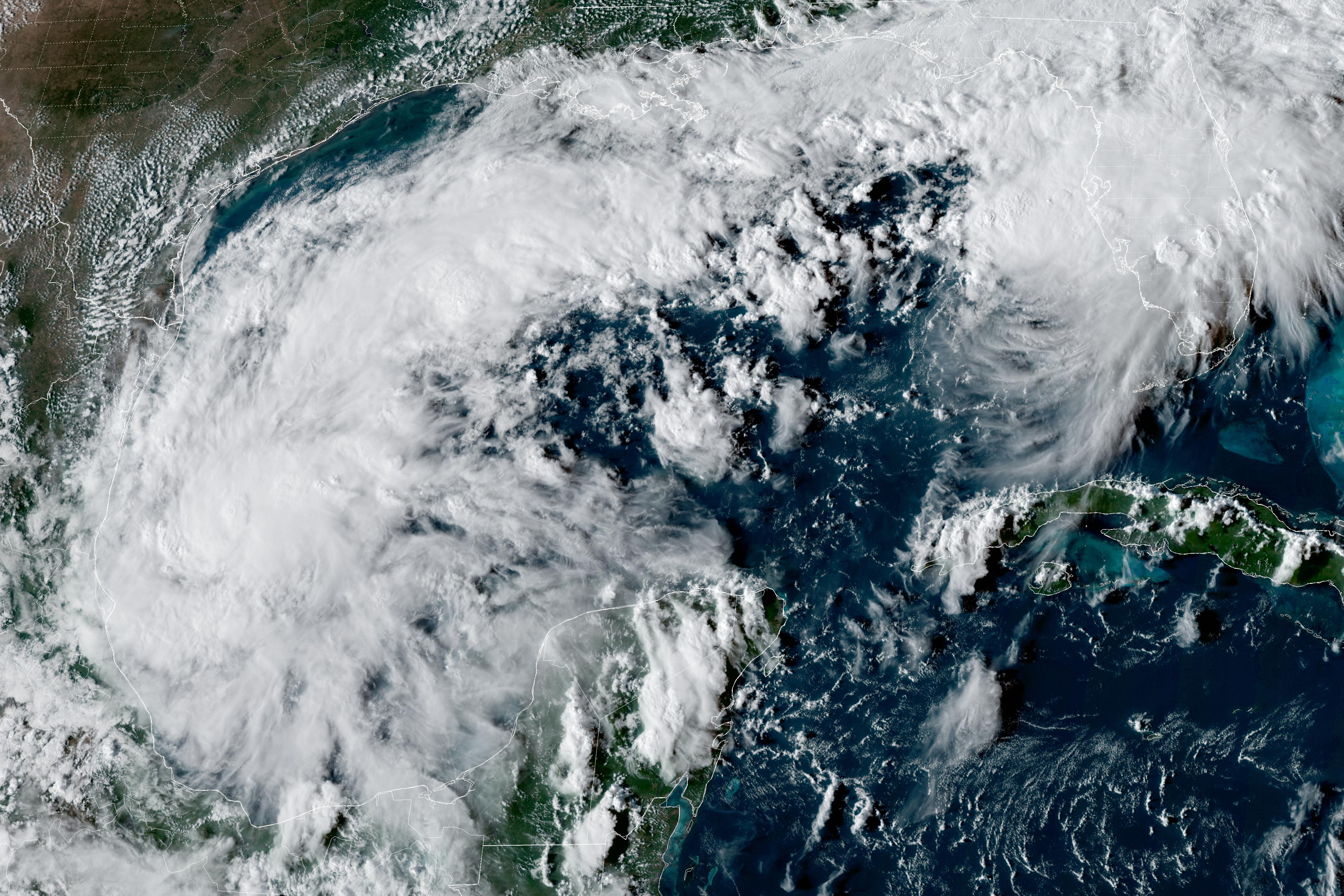
    MIAMI — Tropical Storm Isaias formed early Wednesday in the warm waters off eastern Mexico and forecasters said it was expected to strengthen into the first hurricane of the Atlantic season before hitting the U.S. Gulf Coast later in the week.

    Isaias was centered about 285 miles west of Progreso, Mexico, and about 580 miles southwest of the Mississippi River’s mouth, according to the Miami-based National Hurricane Center. It had maximum sustained winds of 40 mph and was moving east-northeast at 8 mph.

    It was not immediately known where the storm may make landfall on the Gulf Coast. The hurricane center’s initial projections said the center of Isaias could come onshore late Friday or early Saturday somewhere between eastern Louisiana and the western Florida Panhandle. People in those areas were urged to prepare for the storm.

    “There is an increasing risk of dangerous wind and storm surge impacts along portions of the northern Gulf Coast,” the hurricane center said. “Residents from Louisiana to the Florida Panhandle should closely monitor the latest forecast updates and ensure they have their hurricane plan in place.”

    Florida Gov. Ron DeSantis declared a state of emergency for 25 counties in the Panhandle and Big Bend regions. The declaration activates the state’s emergency management plan to prepare for hurricanes and other potential natural disasters, allowing actions including the deployment of personnel and equipment to respond.

    Isaias, pronounced ees-ah-EE-ahs according to the hurricane center, is expected to bring areas of heavy rain to portions of the Gulf Coast and much of the U.S. Southeast on Friday and into the weekend, forecasters said.

    The storm comes as the Atlantic hurricane season has been unusually quiet this year due to a strong El Niño, which disrupts storm formation over that ocean. Storm activity in the Pacific has been above average.

  • Phillies Extra: Scott Franzke on the biggest questions heading into the offseason

    Phillies Extra: Scott Franzke on the biggest questions heading into the offseason

    The Phillies haven’t won a playoff series since 2023, and their postseasons keep getting shorter and shorter. How can they fix it? Radio play-by-play announcer Scott Franzke joins Phillies Extra, The Inquirer’s baseball podcast, to discuss Trea Turner’s future, the managerial uncertainty, whether the Phillies can get “creative” to change the mix of the roster, and more. Watch here.

    You can also subscribe to the podcast version of Phillies Extra on Spotify or Apple Podcasts.

  • Tennessee’s prisons chief is resigning after failed execution of Christa Pike

    Tennessee’s prisons chief is resigning after failed execution of Christa Pike

    The head of Tennessee’s prison system is resigning, Gov. Bill Lee announced Saturday, the first major staff shake-up since Christa Pike’s stunning failed execution left her unconscious and on a ventilator at a hospital.

    Frank Strada, commissioner of the Department of Correction, will step down this month, Lee said. Some of the governor’s fellow Republicans and other elected officials had been urging a change in leadership.

    It was the second time since May that Tennessee has not been able to execute a prisoner who was seemingly moments away from death.

    The governor also announced that former U.S. Attorney Ed Stanton would lead a review of what happened in Pike’s death chamber. Stanton previously was named to conduct a review after Lee called off a different execution in 2022; he found in that case that Tennessee had not complied with its own lethal injection process.

    Strada said in a statement that resigning was “in the best interest of Tennesseans” while Stanton’s review is conducted. The state failed to execute Pike despite administering two doses of a lethal drug, pentobarbital.

    Pike, now 50, was 18 when she and her boyfriend tortured and killed a classmate, Colleen Slemmer, in a jealous rage in 1995. She became one of the youngest women to be sent to death row.

    Strada defends execution protocol

    There was no immediate response from Pike’s lawyers for an update Saturday on her condition at a hospital. They had disclosed Friday that she was on a ventilator and unconscious in the hours following the execution attempt and that hospital staff were trying to clear the two doses of pentobarbital.

    The shocking failure has left both sides of the death penalty debate demanding answers. Lee has ordered an independent review and halted any new executions. Strada said he believes the state “carried out its responsibilities in accordance with the established protocol.”

    Pike’s legal team welcomed Strada’s departure but said “it does nothing to help Christa now.”

    “What happened to her Wednesday reflects a systemic failure that goes far beyond any one person,” the four-lawyer team said. “We hope the governor’s call for a full, independent review will expose the profound problems within Tennessee’s entire death penalty system.”

    Second failed execution since May

    Pike’s attorneys said they believed problems with the IV lines caused the pentobarbital to flow into her body instead of her bloodstream.

    Pike was extraordinarily cooperative with the execution team, even instructing them to “please try here, please try here” as they tried to insert lines, lawyer Randy Spivey told reporters Thursday.

    In May, Tennessee stopped the execution of Tony Carruthers after staff placed an IV into his right arm but couldn’t get a secondary IV line. The governor ordered officials to wait at least a year before trying to execute him again.

    Strada took over the Correction Department in January 2023 after serving as deputy director of the Arizona Department of Corrections. In late 2024, he announced that Tennessee was changing its lethal injection protocol and would use only pentobarbital.

    Four people have been executed in Tennessee since 2025, according to the Correction Department.

    Some Arizona executions had snags

    Court filings show that Strada’s job included overseeing executions in Arizona when they resumed in 2022 following an eight-year break.

    Clarence Dixon was the first that year. The medical team had trouble finding a vein to administer the lethal drugs and finally made an incision in his groin area. The process took about 25 minutes.

    That same year in Arizona, medical staff preparing Frank Atwood for execution initially could not locate a vein in his right arm but inserted the IV in his right hand — at Atwood’s suggestion, said Henry Brean, an Arizona Daily Star reporter who was a witness.

    Strada announced Murray Hooper’s execution by lethal injection, the third in 2022. There was an unsuccessful attempt to insert an IV line in his right arm. The IV in Hooper’s leg was inserted into his femoral artery.

    “When Governor Lee hired Strada to fix execution problems in Tennessee, his problematic history of executions in Arizona was well known,” said Kit Thomas, an attorney who has represented people on Tennessee’s death row.