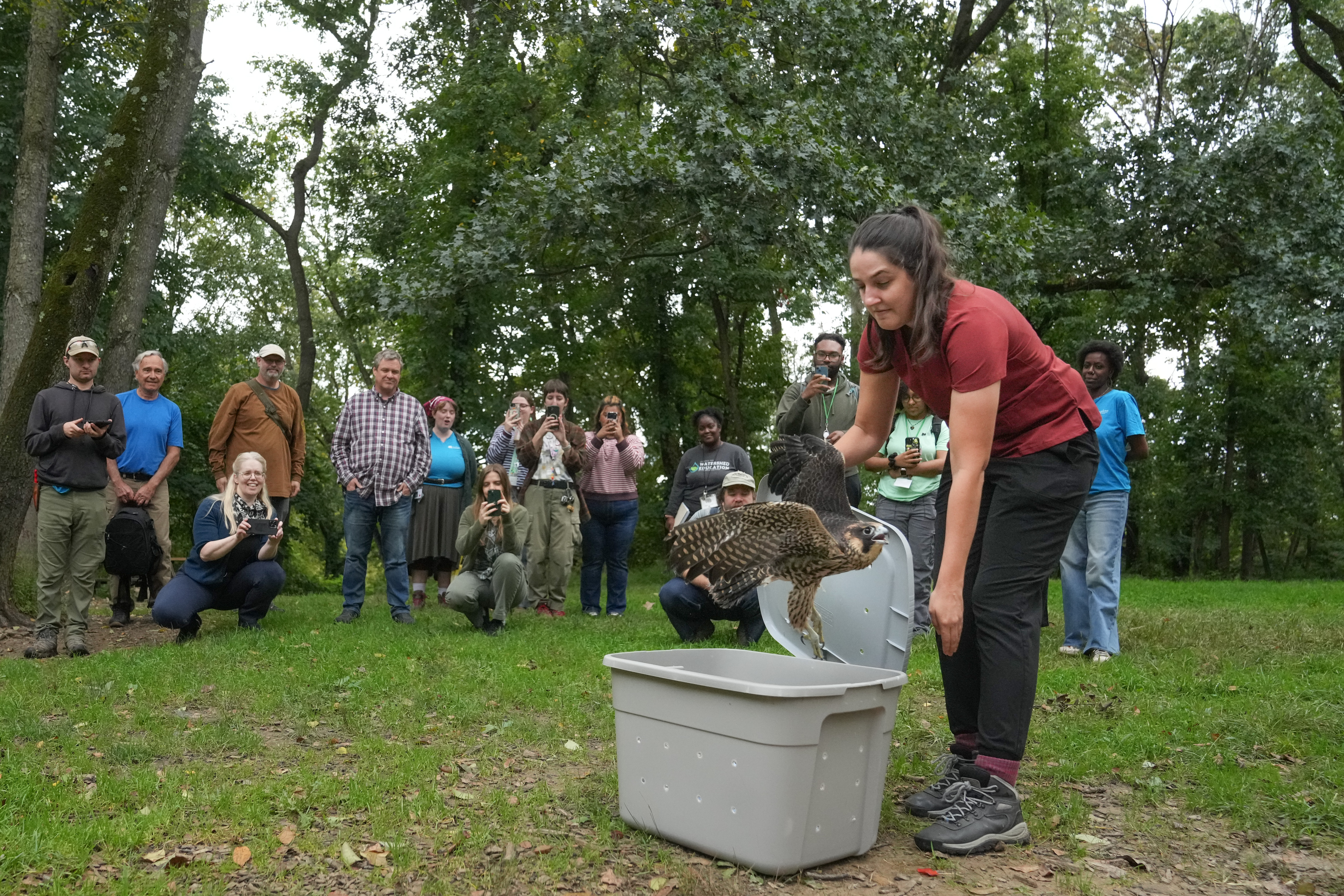
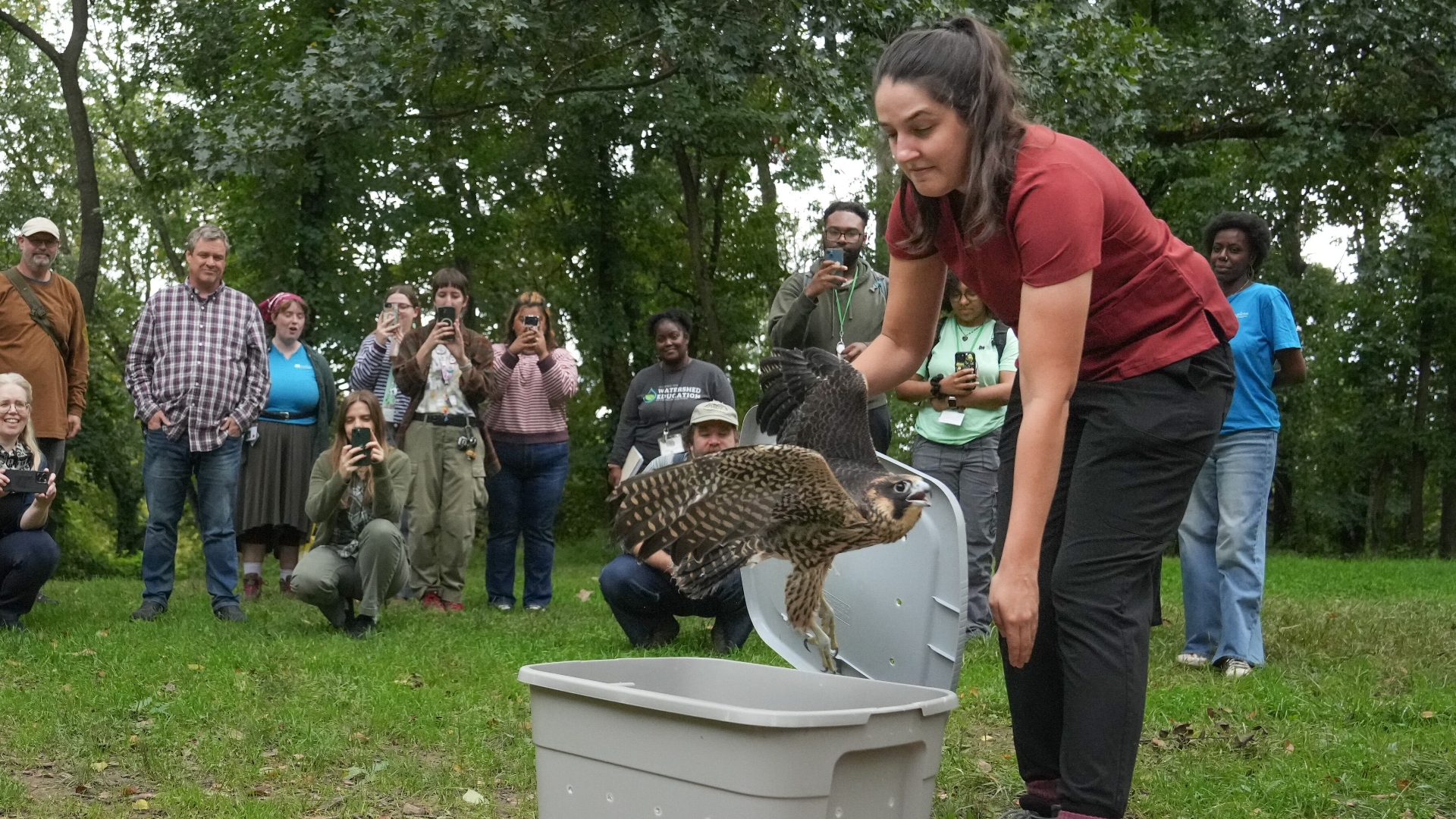
A gray plastic tote shook outside the Schuylkill Center for Environmental Education every few minutes Tuesday afternoon, proof that patient 718 was ready to fly.
A crowd gathered on the lawn beside it, adjusting shutter speeds to capture the world’s fastest animal. Just after 1 p.m., Sydney Glisan, director of the center’s wildlife clinic, unfastened the bungee cord, removed the lid, and offered the male peregrine falcon a few words of encouragement.
“All right, buddy,” Glisan said. “Today’s the day.”
Video: Peregrine falcon released into the wild after healing from lead poisoning
Like a feathered fighter jet, the bird burst from the tote and bolted for the big trees in Roxborough, letting out a few raucous shrieks as it disappeared.
Patient 718 — animals are rarely named at the Schuylkill Center — arrived thin and sickly on June 4, suffering from high levels of lead poisoning. The bird was found near the entrance of the Philadelphia Museum of Art earlier that day, far below the nest its parents built there.
“He was just kind of sitting there,” Glisan said of 718.
A sibling, who had lower levels of lead poisoning, was also discovered at the museum the same day. That falcon, also a male, was treated at the clinic and released into the wild on July 1.
Glisan said most raptors in the region would test positive for lead, but 718’s levels were “off the charts.” Lead can be found in the soil, she said, from bullets, lead-poisoned prey, and even fishing gear.
At the clinic, 718 received chelation therapy, where a medication binds to the lead in the bloodstream and is then passed by the bird. The falcon received four rounds of chelation over the summer, with recovery breaks.
“It’s hard on the body,” Glisan said, “but he was a real trouper.”
After chelation, the falcon was taken to an aviary, where he practiced flying through an obstacle course that included pool noodles. He aced the test.
“It was fascinating,” she said. “They move so fast.”
Peregrines mostly hunt other birds from high perches and can reach speeds of over 200 mph when dive-bombing on prey.
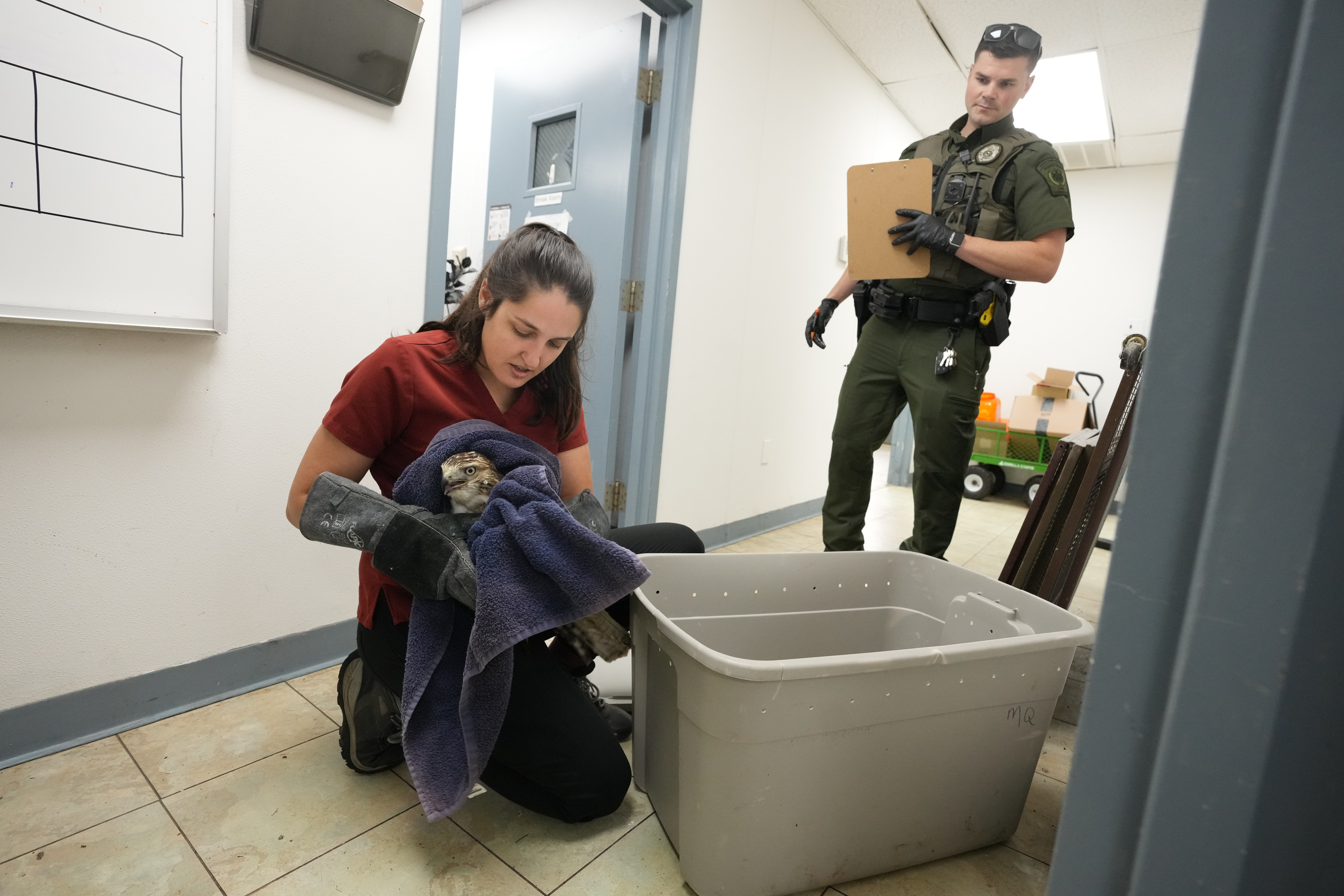
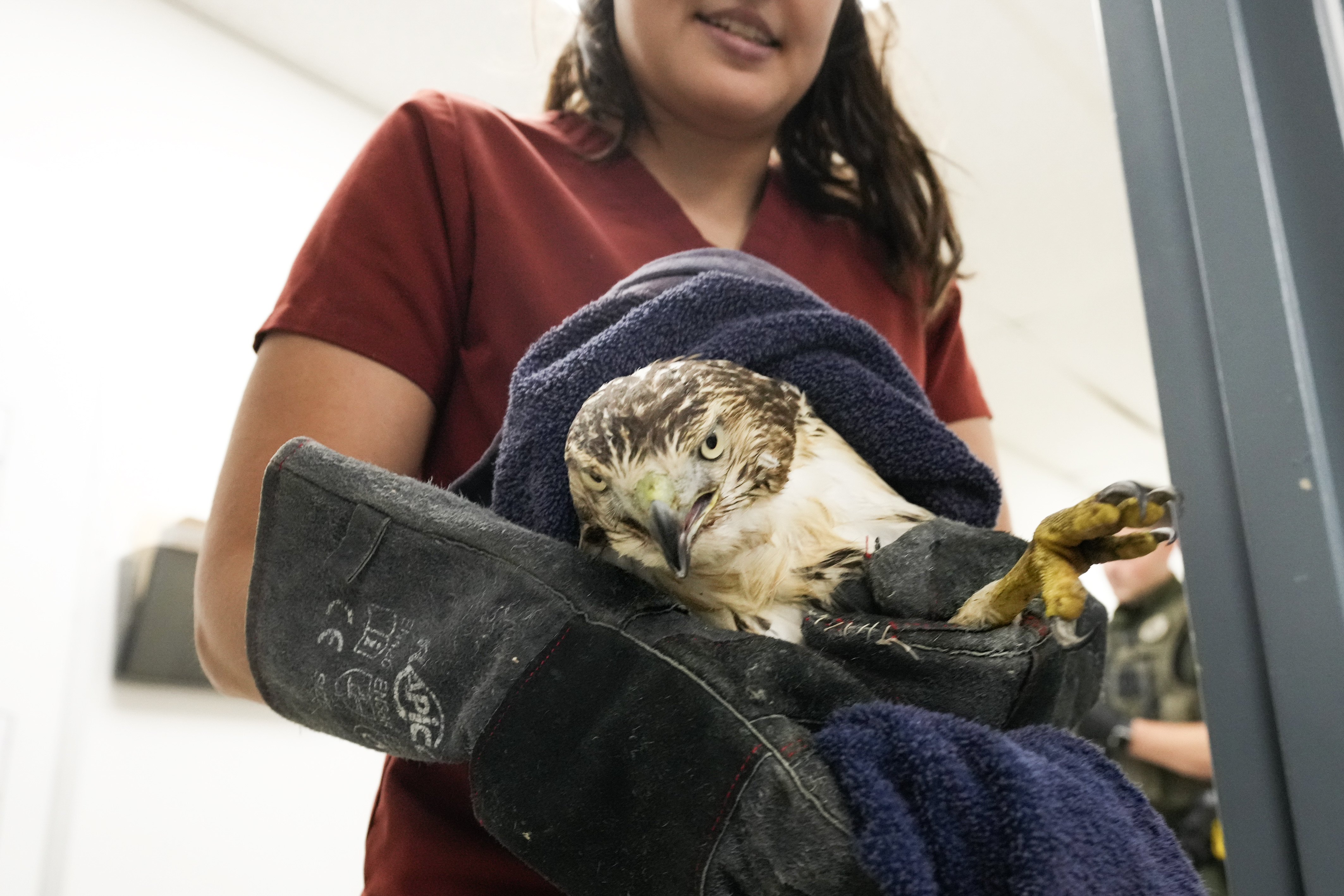
Sydney Glisan, director of the wildlife clinic at the Schuylkill Center for Environmental Education, cares for a red-tailed hawk who was brought into the clinic on Tuesday.Jessica Griffin / Staff Photographer
Glisan said 718 would probably find his own territory and not return to the art museum. She said there are at least three active peregrine nests in Philadelphia, including one at City Hall.
Sydney Glisan, director of the wildlife clinic at The Schuylkill Center for Environmental Education, cares for a red-tailed hawk who was brought into the clinic Tuesday.Jessica Griffin / Staff Photographer
As of Tuesday afternoon, the Schuylkill Center has treated 1,775 animals this year, including numerous species of birds, gray squirrels, and rabbits. More were coming in by the minute, including a red-tailed hawk with an injured talon and a baby squirrel that tangled with a dog.
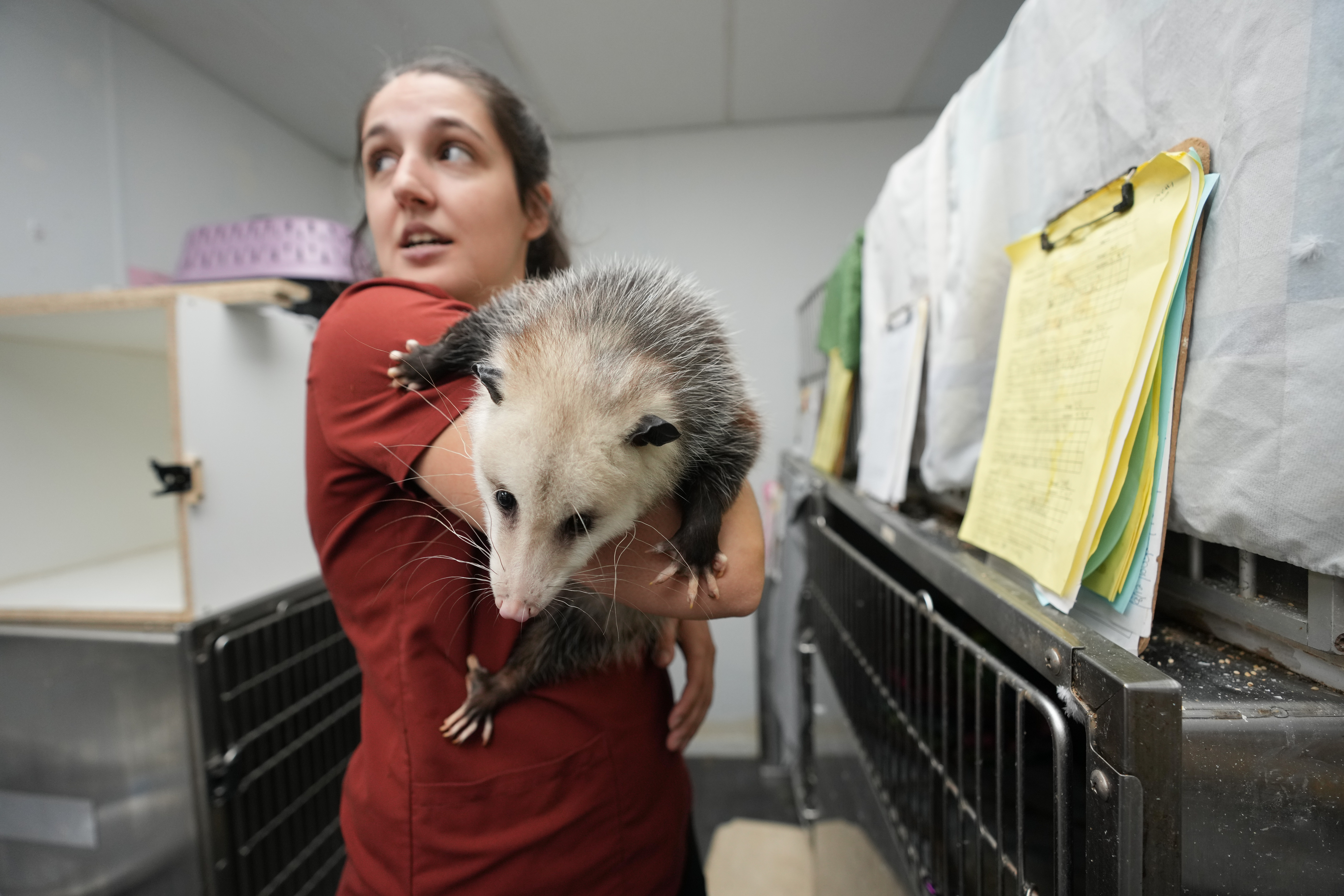
Many animals that come in don’t survive long, Glisan said, and some, like Buttercup, the mostly blind-but-friendly opossum with frostbitten ears, are unable to be released due to their injuries. They are used for education and, on occasion, cuddling.
“I do love you, Butter,” Glisan said, cradling the opossum.
Sydney Glisan, director of the wildlife clinic at The Schuylkill Center for Environmental Education, shown here with Buttercup, the mostly blind-but-friendly opossuma who is a permanent resident at the clinic.Jessica Griffin / Staff Photographer
Erin Mooney, the Schuylkill Center’s executive director, said the facility does not charge to take in and treat animals. She also said the center needs a new clinic building because theirs is 31 years old, and too small.
While the Schuylkill Center receives money from outside agencies on occasion, Mooney said they rely heavily on donors.
“In order for the work at the clinic and the Schuylkill Center itself to continue, we need people to give,” Mooney said.
A rural Pennsylvania tableau is laid out across a stage on South Broad Street for the Wilma Theater’s latest production.
There are fresh green cornstalks in the foreground, and the sky glows violet behind them as the two main characters of Horsegirl & Cowdaddy take the stage.
Horsegirl, played by Samora de la Brisa, is a trans woman in her 30s, living and working near a farm in an unnamed southern Pennsylvania town with Cowdaddy, her father, played by Mount Airy’s Lindsay Smiling.
Horsegirl, it turns out, told her father she was trans years earlier, and while he’s still a bit confused by pronouns, his daughter’s identity is not an issue.
“I thought she was just, er, you know, gay,” Cowdaddy says in a scene, explaining to his daughter’s love interest the day Horsegirl came out to him. “But then she said, she told me, ‘I’m a girl,’ er, and I thought, ‘well.’”
The Wilma Theater’s production of “Horsegirl & Cowdaddy” runs through Oct. 4.JOHANNA AUSTIN
Writer DJ Hills, a Queen Village resident who grew up in rural Western Maryland, said one of the goals for their play, which had its world premiere at the Wilma on Friday, was to show that rural America isn’t always a hellscape for queer people.
“I don’t think that there was ever a moment of my life when society didn’t see me as queer in some way,” Hills, 31, said at Wilma on Thursday. “I was really cared for by my family, even when they didn’t always have the language or an understanding of who I was; there was always a lot of care, my grandmothers in particular.”
A 2019 report by the Movement Advancement Project, a Colorado nonprofit focused on LGBTQ equality and democracy, found that approximately 16% of trans Americans live in rural areas. The nonprofit said this population faces unique challenges, including higher poverty rates and “increased visibility.”
“There’s a present-day myth that trans people can only find happiness in metro areas and cities,” said Samora de la Brisa, who is trans. “We are everywhere. We exist in multitudes.”
Samora de la Brisa (far left), starring as Horsegirl, Lindsay Smiling (center), as Cowdaddy, and Ni-Ni (right), as Bethel, go over staging before their third preview inside the Wilma Theater on Sept. 24.Aidan T. Gallo / Staff Photographer
In 2023, The Inquirer spent several months chronicling the lives of two transgender women making their way in rural Dauphin County. One woman — Stephanie Fritsch — wanted to stay there. The other, Billie Jean Williams, wanted to get to Philadelphia or another city.
“You know, I want to be happy, she wants to be happy, and I want people to be happy with their lives. That’s pretty simple, right?” Williams told The Inquirer. “I don’t know what happened in America that made that so difficult.”
In the play, Horsegirl faces a difficult decision about where to live, whether to follow a love interest across the country or stay in rural Pennsylvania with her father. Cowdaddy struggles with past losses and, possibly, future ones, worrying about how his daughter would be treated in a new place.
“Folks here know her,” Cowdaddy says.
Smiling, who was recently named artistic director at the Wilma, said he empathized with the character Hills created.
“He’s got his issues but [is] a very loving father, a patient father doing the best you can for his kid,” Smiling said. “He’s human, just like us, and one of the wonderful things about the play is there are no villains.”
DJ Hills stands for a portrait on the stage inside the Wilma Theater on Sept. 24. Hills’ production “Horsegirl & Cowdaddy” premiered on Sept. 22 and will last until Oct. 4.Aidan T. Gallo / Staff Photographer
Hills said Horsegirl & Cowdaddy was inspired by a simple conversation they had with their father one afternoon in Greencastle, Franklin County, during the pandemic. While the play will be heading to New York City next year, Hills would like to have a run in Pittsburgh and, perhaps, rural settings.
“You can’t call yourself an American playwright if you’re only interested in New York, speaking to New York audiences,” they said.
“Horsegirl & Cowdaddy” plays through Oct. 4 at the Wilma Theater.
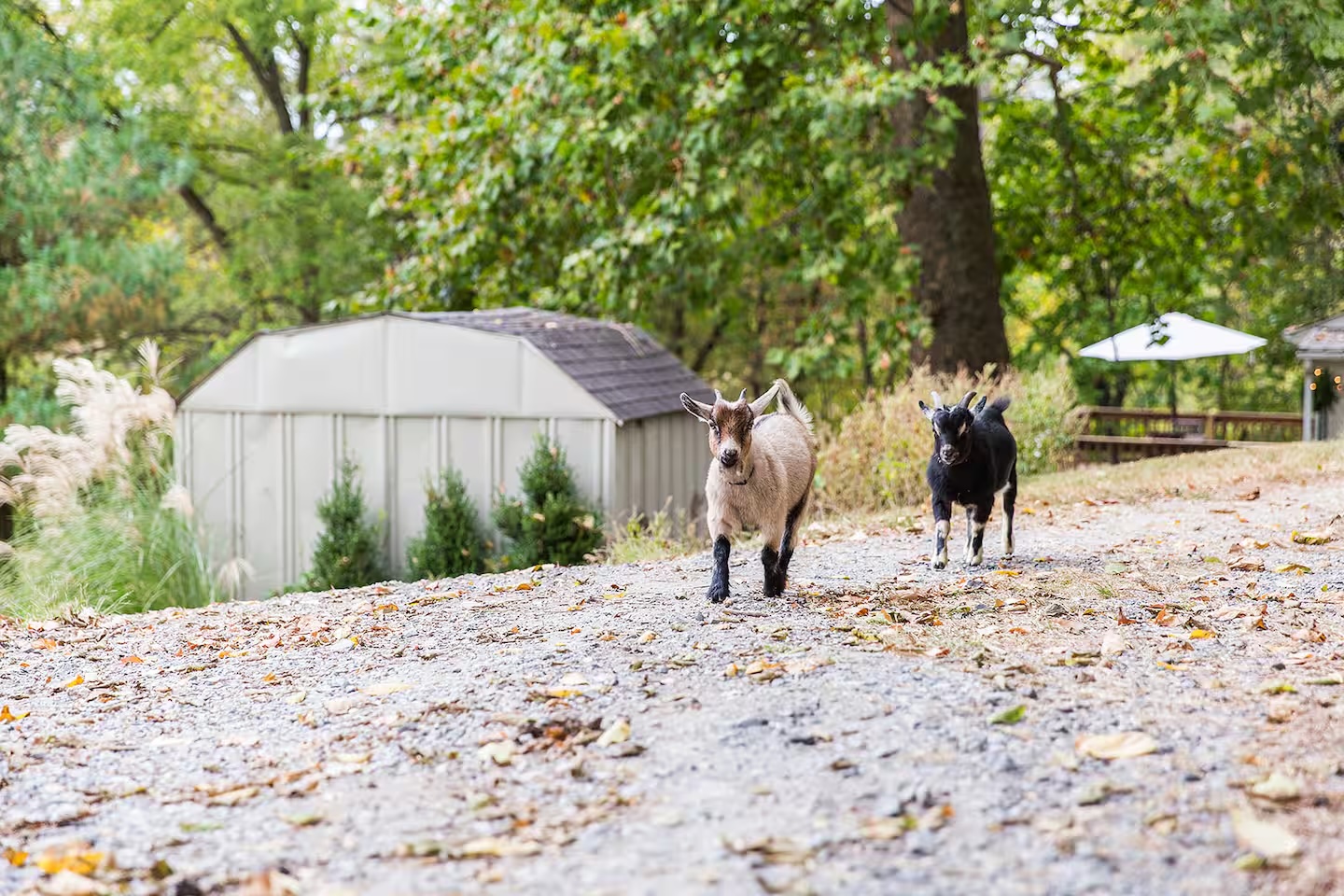
Pennsylvania is home to tens of thousands of farms, and Airbnb wants you to stay on them.
The short-term rental giant ispartnering with the American Farmland Trust and recruiting Keystone State farmers — and even offering grants — to host guests and tap into the growing agritourism industry. The average farm stay listing on Airbnb, the company said, can make an extra $9,600 per year.
Valerie and Jeff Fellenbaum said they’re making much more than that at Pleasant Pines Stables, their horse farm dating to the early 19th century in Lancaster County.
“Once we started, we never looked back,” Valerie Fellenbaum said. “I would say, from March to about the end of October, we’re anywhere from 85% to 90% booked.”
Nationwide, farms — particularly smaller operations — struggle to stay profitable and find alternate sources of revenue, and agritourism is leading the way. Some farms, like Arasapha Farm in Glen Mills, transform into wildly popular Halloween attractions every fall. Others host concerts and court influencers who take selfies in acres of sunflowers.
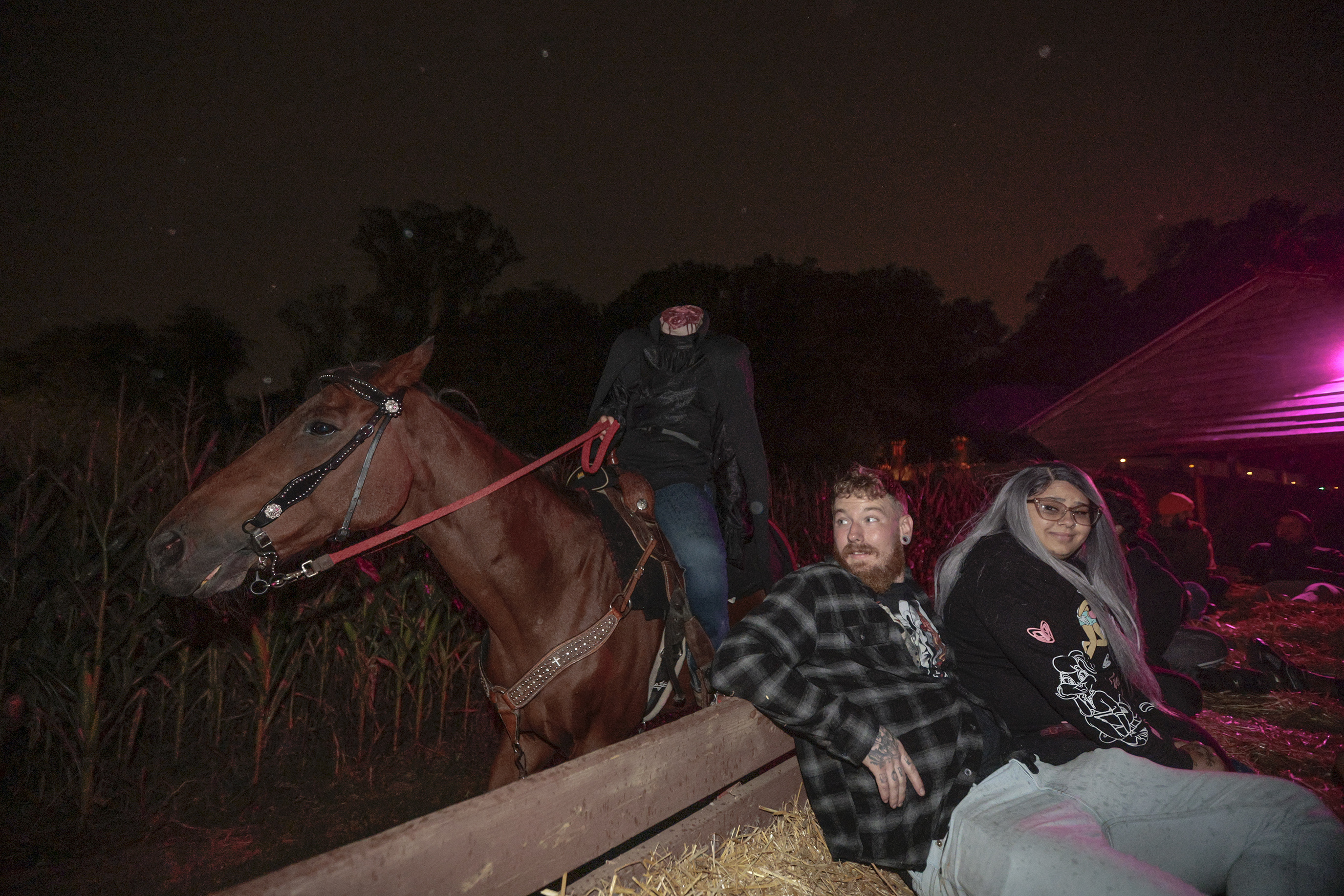
The Headless Horseman rides behind David and Jelly Luty from Sharon Hill during the hayride at the Bates Motel in Glen Mills, on Sept. 30, 2022. Along with fall hayrides, listing farmhouses as short-term rentals is another way to make extra cash.Steven M. Falk / Staff Photographer
According to Airbnb, Google Trends shows U.S. search interest for “farm stay” nearly quadrupled between 2016 and early 2026. The vacation rentalcompany is partnering with the American Farmland Trust to offer farmers up to $10,000 through the Farm to Stay Grant Program. Farmers could use the funds to renovate or prepare their property to host overnight guests and launch unique farm-based experiences.
“This really gives folks the opportunity to broaden their horizons,” said Ashley Brucker, American Farmland Trust’s senior manager of grant making. ‘It gives them a little more freedom.”
Brucker said interested farmers can apply at farmland.org and attend informational webinars. Workshops will be held on Oct. 14 at 5 p.m. and Nov. 13 at noon.
Webinars will discuss how Airbnb works, with particular emphasis on rural and farm stays, the company said.
At the Fellenbaums’ Airbnb, Valerie said guests can simply enjoy the peace of a rural farm or ride horses.
“People really love to come and see the horses,” she said, “and we give them opportunities to do more than see them.”
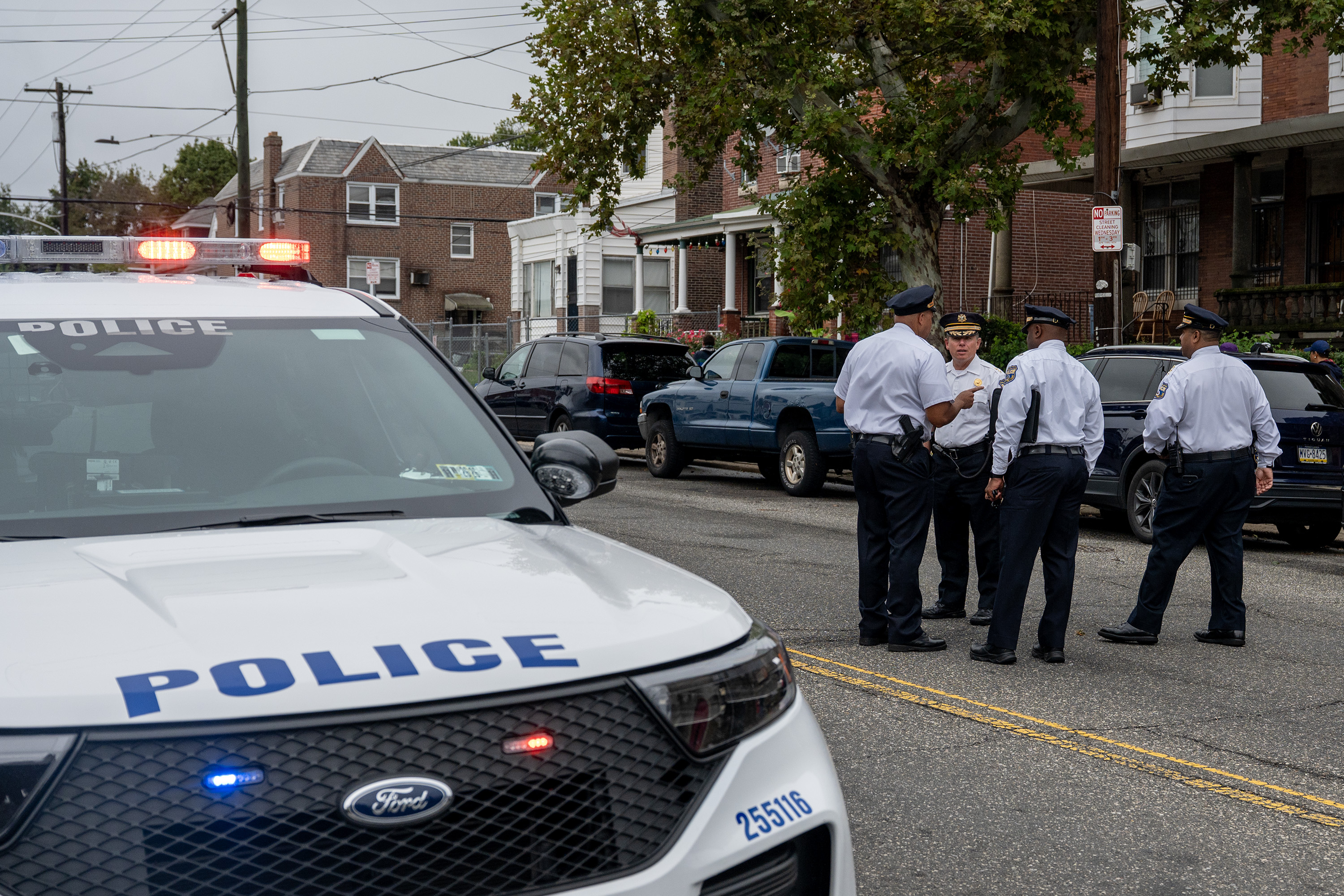
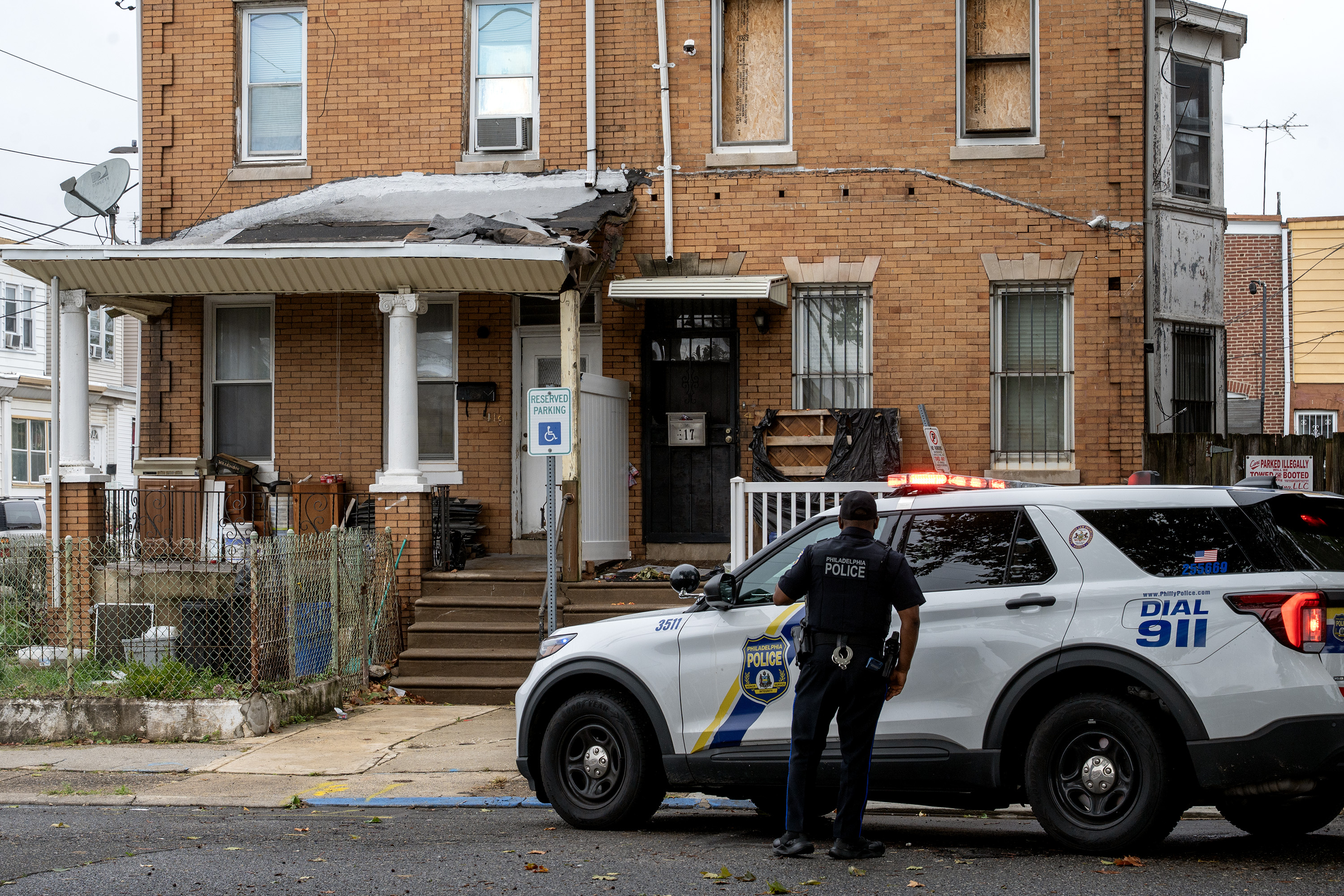
Residents, police, and elected officials gathered in an Olney house of worship Sunday afternoon to discuss how the investigation into the infamous “house of horrors” down the street would play out in the coming weeks.
“You’re going to see a lot of equipment,” Philadelphia Police Homicide Unit Staff Inspector Ernest Ransom said.
Ransom alsotold the crowd of about 100 inside the Olney Baptist Church that there could bea large police presence around the home of the late Raymond “R.C.” Horsch on West Chew Avenue on Monday and Tuesday. But he declined to say exactly what investigators would be doing there.
Police leadership leave Olney Baptist Church on Chew Avenue on Sunday, Sept. 27, 2026, after a community meeting organized by the Philadelphia Police Department ahead of another planned search of the home of Raymond “R.C.” Horsch a few blocks away.Tom Gralish / Staff Photographer
Horsch, who died last year at 82, ran a drug, sex, and porn operation out of the three-story, brick twin home. He left behind more than a million photos and videos in a vast digital archive,which investigators believe shows real and staged violence, and, possibly, murders.
Horsch is now linked to at least seven missing women.
“This is still a very active and ongoing investigation,” First Deputy Commissioner John Stanford told the crowd.
Starting on Oct. 5, police said they will be bringing in “heavy”equipment onto the 400 block of Chew Avenue.
Police declined to say more about the kind ofequipment or what exactly they would be looking for. Even though the investigation would focus primarily on Horsch’s home, Ransom said there would be street closures — mostly during daytime hours — and parking restrictions through Oct. 16.
Residents would still be allowed in and out of their homes, Ransom said, but cars that weren’t moved during the restricted hours would be towed to a neighboring street.
“We will not be ticketing cars,” he said.
Ransom said fliers would be posted in the neighborhood before Oct. 5 with more details about the parking restrictions.
“It’s going to be a large project,” Ransom said.
When asked whether the operation would be concluded by Oct. 16, police said it could take longer.
“I do wanna say to you, just for the purpose of being able to manage expectations, think in your mind that this is probably gonna be the month of October,” Stanford said.
Residents didn’t probe for too many details about the investigation, mostly asking about logistics, crowds, social media influencers lingering around the area, and the future of Horsch’s dilapidated home.
“Hopefully, when you’re finished, you’ll tear it down,” resident Alice Hunter said.
One local business owner, who declined to identify himself to a reporter, expressed concern aboutthe street closures affecting his business.
“I lost a ton,” the man said of investigation-related disruptions.
Residents were also apprehensive about the “lore” surrounding the case, both locally and beyond, telling police that “TikTokers” are coming to take photos and videos of the Horsch home.
“You have the social media folks, people on YouTube-ers, just coming and taking photos and what not,” resident Sarah Duncan said. “That can be a disruption and alarm some of the kids.”
During the meeting, a lone police cruiser sat outside Horsch’s home. Stanford said residents should expect to see a cruiser there indefinitely.
Police remain outside the home of Raymond “R.C.” Horsch on Chew Avenue on Sunday, Sept. 27, 2026, while a few blocks away residents were attending a community meeting organized by the Philadelphia Police Department ahead of another planned search of the home.Tom Gralish / Staff Photographer
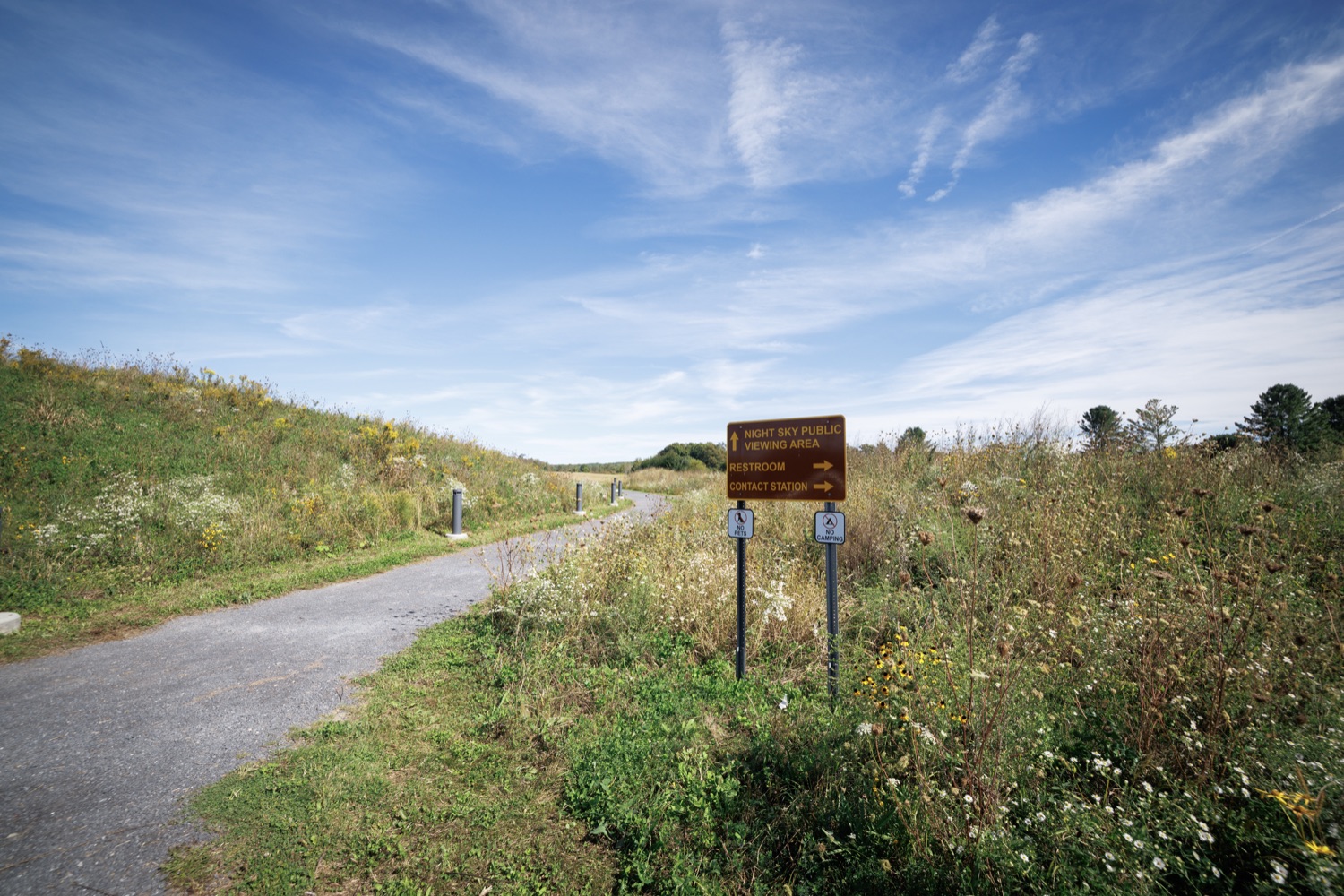
In an area of Pennsylvania known as “God’s Country,” hours from the glowing lights of Philadelphia, Pittsburgh, and Buffalo, Cherry Springs State Park is a refuge for stargazers.
On Thursday, Pennsylvania’s Department of Conservation and Natural Resources announced the completion of $5.2 million in improvements there, everything from new parking to a larger amphitheater, and “headlight-blocking mounds to prevent light shining into the astronomy field.”
“This park comes alive after dark, and we have a responsibility to conserve that experience for the future,” DCNR Secretary Cindy Adams Dunn said there Thursday.
DCNR, in a news release, said the goal of the project was to redesign how visitors “moved through the park at night, reduced artificial light, and expanded facilities to support astronomy, education, and large events.”
The small state park in Coudersport, Potter County, some 250 miles northwest of Philadelphia, is designated as an International Dark Sky Park by DarkSky International, a nonprofit that claims to be the “worldwide authority combating light pollution.”
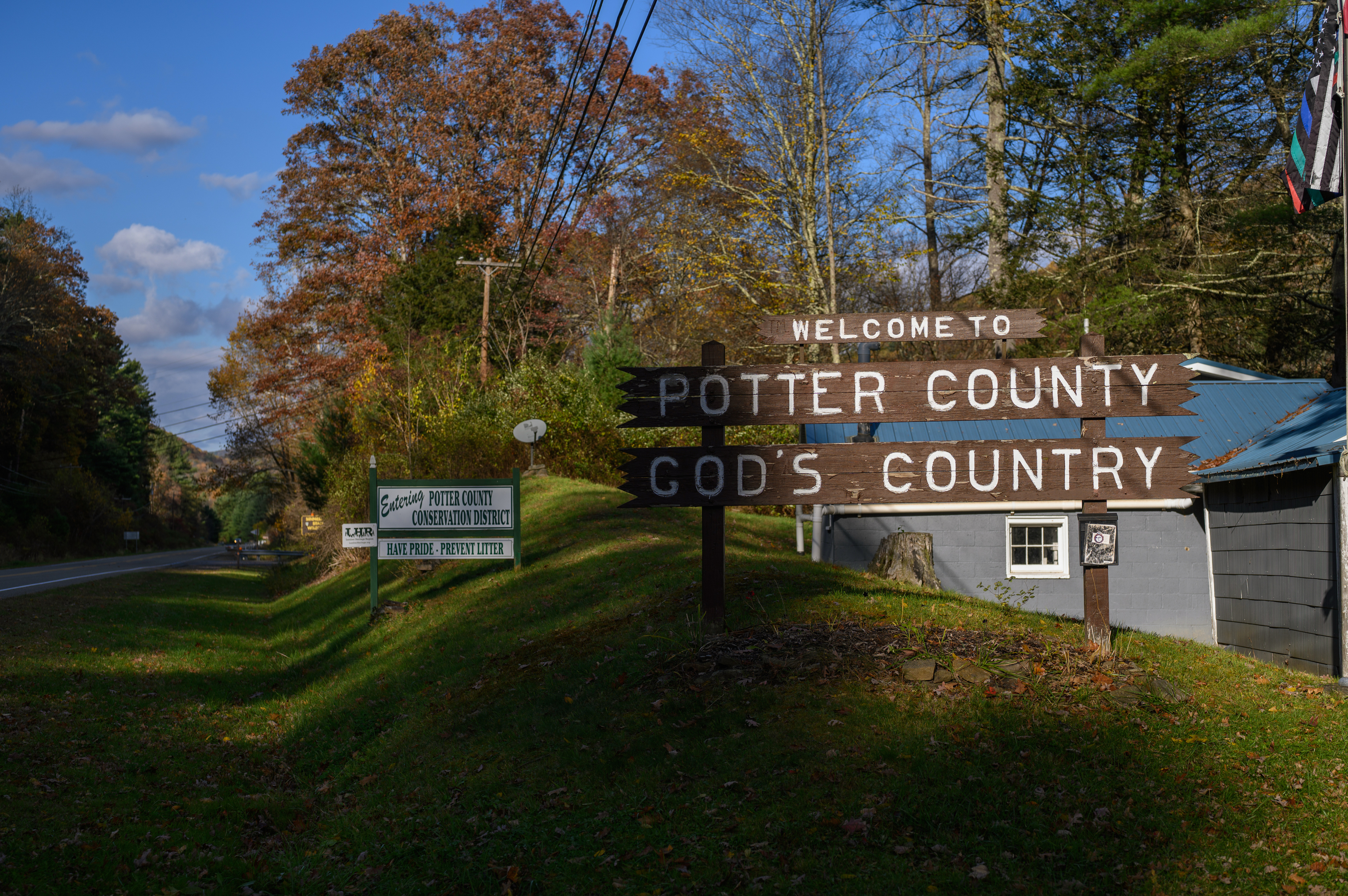
A sign welcomes visitors to Potter County. MUST CREDIT: Justin Merriman/For The Washington PostJustin Merriman
Despite being relatively small at 82 acres and far from cities — it’s almost four hours from Pittsburgh and a bit more from Philadelphia — the park has become wildly popular with astronomers, campers, and social media influencers. The campground is generally booked out every season, with professional and amateur stargazers alike staring up at the Milky Way, particularly on moonless nights.
During the COVID-19 pandemic, when parks and other outdoor spaces were inundated with visitors, Cherry Springs saw the biggest crowds. Between March and September of 2020, the park saw 26,745 visitors, a 231% increase over the same time period a year earlier.
Potter County has just 16,453 residents, and the economy there relies heavily on tourism, much of it during the spring, summer, and fall for camping, stargazing, leaf peeping, and hunting.
The county has taken steps to keep things dark, too, urging home and business owners to implement downward-casting lights, timers, and low-wattage bulbs to preserve the stargazing opportunities.
Department of Conservation and Natural Resources (DCNR) Secretary Cindy Adams Dunn announced the completion of $5.2 million in new improvements at Cherry Springs State Park, an International Dark Sky Park in Potter County.Jon Ferreras
An icon of Jersey Shore waterways is in peril, according to a Stockton University study.
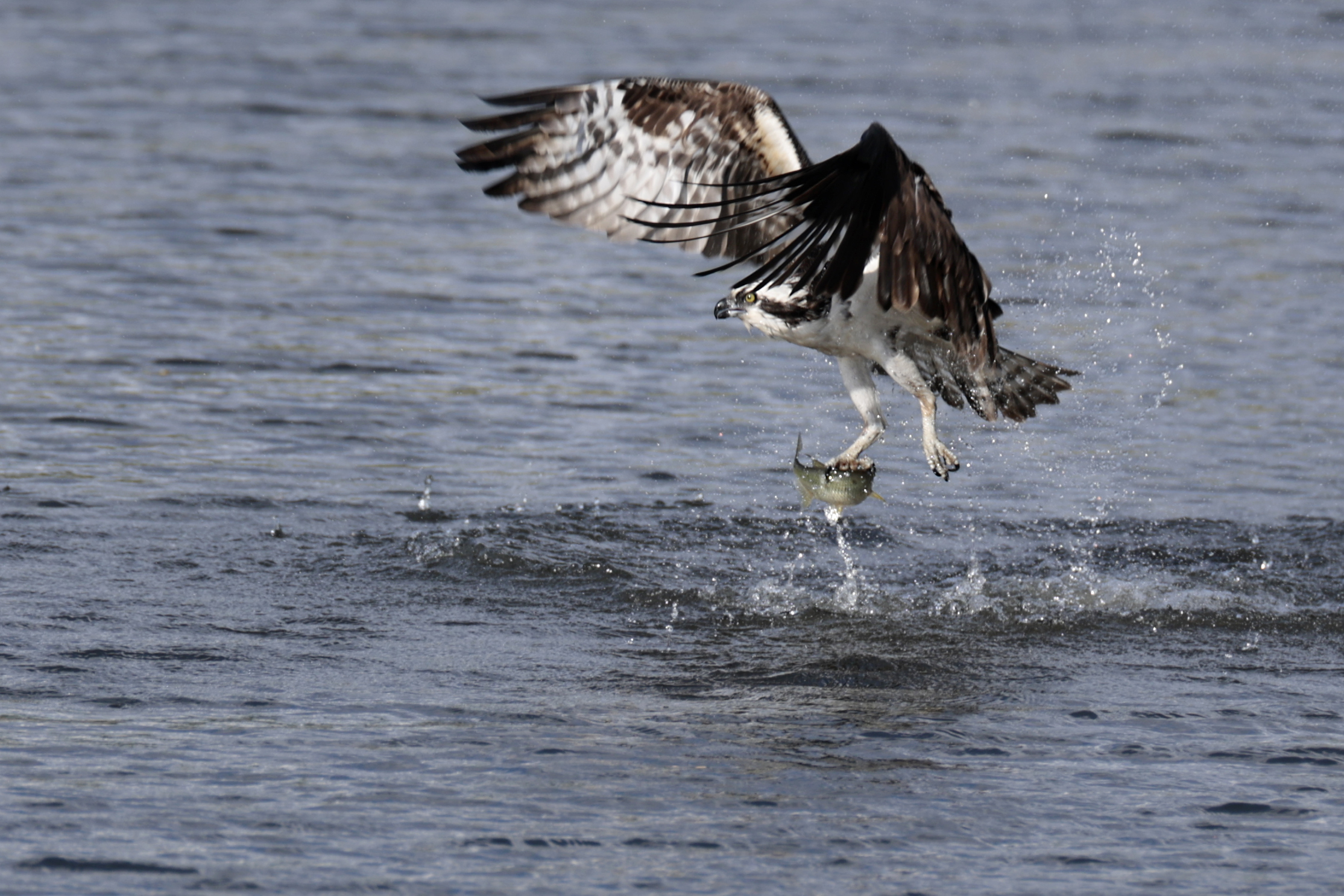
The osprey, a raptor that feeds primarily on fish, was reclassified from “threatened” to “stable” by New Jersey’s Department of Environmental Protection’s Fish and Wildlife agency, but a recent study by Atlantic County University, whose mascot is the osprey, found staggering declines along the Mullica River and Great Bay.
Biology students and instructors at the school monitored 27 osprey nests along the Mullica River and Great Bay this year and discovered that chicks were surviving at a dismal rate. During the first survey, in May, the team counted 54 eggs and three chicks. During the final survey, last month, there were nine fledged chicks, an 85% loss.
Melanie Schroer, a biology instructor at the school, said the study’s results were alarming.
“The broader context here is that osprey nest productivity is declining. Nesting success has taken a huge hit, not only in my little part of the world, but also New Jersey and much of the East Coast, and so, of course, everyone wants to figure out what’s going on,” Schroer said in a statement. “This population has been recovering for 50 years, and it’s been doing great, and then just the last handful of years, not so much anymore.”
Last year, the Conserve Wildlife Foundation of New Jersey found that osprey nest productivity had its steepest decline in decades, with 57% of active nests failing to produce any young.
Both studies mentioned fluctuations in food sources, particularly the Atlantic menhaden, also known as “bunker,” as a potential issue for the empty nests. Shroer, of Stockton, said researchers noticed that adult ospreys were bringing more flounder to their nests as opposed to menhaden, their typical food source. Menhaden, Schroer said, pack more calories.
“So they’re putting in more work and bringing back fewer calories, fewer resources for their young,” she said.
Menhaden are considered a “keystone species,” vital to a slew of food chains up and down the East Coast, feeding everything from whales, to game fish, to coastal birds like osprey. Commercial fishing harvests vast quantities of menhaden for animal feed and human supplements, particularly in the Chesapeake Bay. Advocates of the Chesapeake are calling for as much as a 50% reduction in menhaden harvests.
Last year, when New Jersey reclassified ospreys as stable, officials noted how pesticides had decimated populations, with only 50 nests statewide in the 1970s. Those numbers had rebounded to 800 by 2023.
Schroer said Stockton’s study reveals a questionable future, however, as those adults age out.
“There are still many adults in the ecosystem, ” she said, “but if the nest productivity declines as it has been in the last couple years, there won’t be enough young birds to replace the older ones and sustain the population.”
In 1795, an Irish pastor went down a hole in Central Pennsylvania and discovered a vast underground cave full of stalactites, stalagmites, and frigid water.
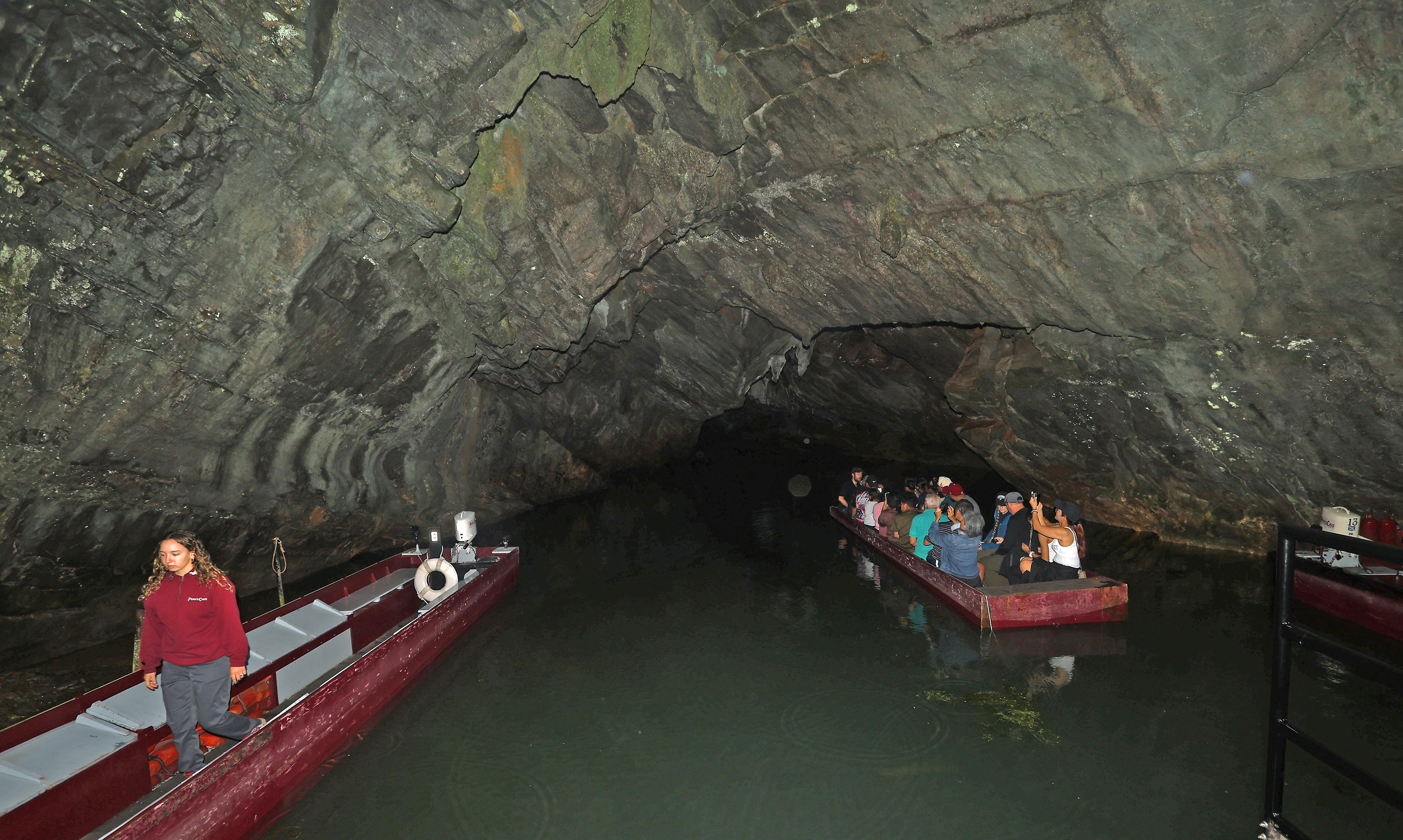
On a recent Sunday morning in July, visitors simply had to go through the gift shop to visit Penn’s Cave, the only all-water cavern in the country. The boat tours in the cave and the adjoining 1,400-acre wildlife park full of bison, wolves, elk, and one very large black bear attract thousands of visitors per year just east of State College in Centre County.
According to several published reports in recent months, Penn’s Cave and Wildlife Park, which opened in 1885 and has been run by the same family since 1908, is hoping to become Pennsylvania’s 126th state park by transferring the property to the state’s Department of Conservation and Natural Resources. Penn’s Cave ownership and management declined to comment during a recent visit, directing The Inquirer to public statements made earlier this summer.
Penn’s Cave CEO Russ Schleiden, during a July 7 Centre County Commissioners meeting, said the decision was “difficult.”
“But we feel that it’s a very important part of not only Centre County, but the Commonwealth of Pennsylvania, and that it should be preserved in perpetuity.”
The Colored Lights Room during a boat tour of Penn’s Cave on Aug. 9.Craig Houtz / For The Inquirer
Schleiden’s daughter, Jeanine Watson, was brought to tears when she spoke to the commissioners.
“We want it to be preserved and to be taken care of,” Watson said. “We’ve always felt we were the stewards of that. We would hate to see this go into development and, unfortunately, that would be the alternative.”
During the meeting, Watson said Penn’s Cave had been discussing the proposal with DCNR for several years. She did not say why development would be the only alternative.
The proposal received the support of Centre County’s commissioners and State Rep. Kerry Benninghoff, (R., Bellefonte).
“I can’t think of a better time in our country and our county’s history at the Semiquincentennial to make this reality,” Benninghoff said in July, according to statecollege.com. “If you want to look at Americana in its best, the park I think exemplifies that.”
Benninghoff told The Inquirer that his proposed legislation did not make it into the state budget by July.
“It just didn’t work out in this budget cycle. My ultimate goal is to preserve this property,” Benninghoff said. “You couldn’t ask for a better place to preserve.”
Wesley Robinson, a DCNR spokesperson, said department staff has visited Penn’s Cave and engaged in discussions about “potentially taking over stewardship of this significant geoheritage site.”
“Penn’s Cave’s natural and cultural resources could make it a strong addition to Pennsylvania’s state park system and provide expanded opportunities for the public to access and enjoy the site,” Robinson said in a statement.
Robinson said acquiring Penn’s Cave may require legislation and that the agency would continue conversations with stakeholders.
Penn’s Cave is an all-water cavern, a historic 1,300-foot limestone show cave with tours by boat.Craig Houtz / For The Inquirer
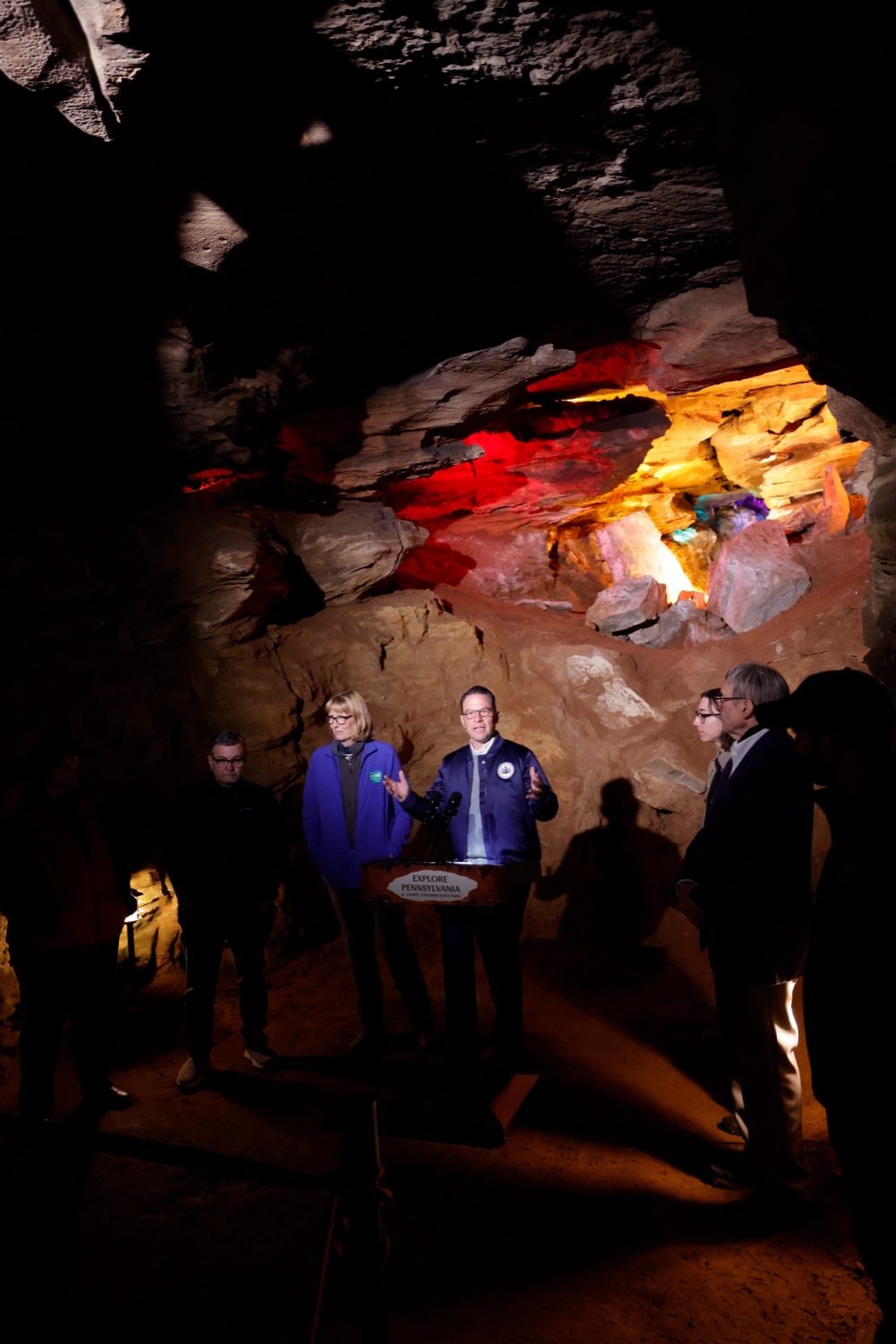
Coincidentally, Pennsylvania’s 125th state park is a former privately owned cave. Laurel Caverns State Park, in Fayette County, opened in April and is the first cave system to become a state park.
Laurel Caverns, the biggest cave system in Pennsylvania, opened as a tourist attraction in 1964. It’s also home to the biggest bat hibernaculum — where animals can hibernate in winter — in the Northeast.
“Parks like Laurel Caverns give our kids a new place to learn, our families a place to make memories, and all of us a chance to get away, take a breath, and just enjoy nature,” Gov. Josh Shapiro said in April during a press conference in the cave.
Laurel Caverns was donated to the state. It’s unclear how DCNR would take ownership of Penn’s Cave if the process moved forward or what its operating costs would be. The attraction employs dozens of seasonal and full-time workers and includes a large gift shop and snack stand.
Gov. Shapiro and DCNR Secretary Cindy Dunn open Laurel Caverns State Park, Pennsylvania’s first subterranean state park, in April.Provided
On a tour of Penn’s Cave in July, a lone bat flapped around between the stalactites, but the experience is quite different from Laurel Caverns and would present a unique challenge to operate as a state park.
For one, visitors to Laurel Caverns walk through the cave system. Tours of Penn’s Cave are conducted via boat with a guide, on a frigid, subterranean offshoot of Penns Creek that’s filled with large rainbow trout.
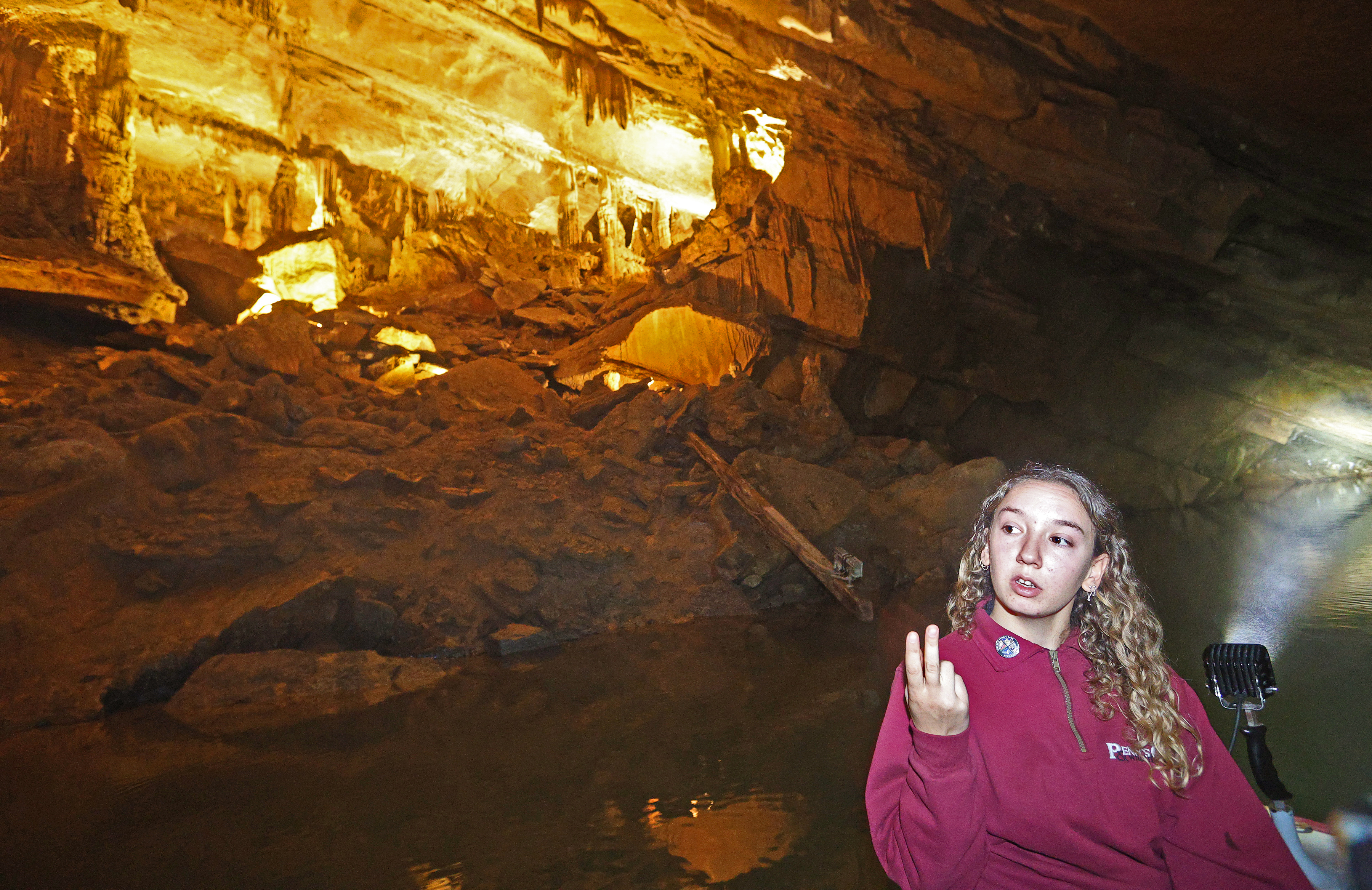
“To the left here, we have our tallest stalagmite. We call this one our Statue of Liberty,” guide Kara Hoffman explained.
Hoffman also discussed the cave’s geology, early attempts at tours with torches, and its earliest visitors, the Indigenous Seneca who used the cave for shelter.
Kara Hoffman gives a boat tour of Penn’s Cave on Aug. 9.Craig Houtz / For The Inquirer
Laurel Caverns, with 400 acres above ground, does not offer camping. The Penn’s Cave property is 1,500 acres, and consists of rolling farmland and animal enclosures. It’s unclear if the state would maintain the wildlife exhibits, which include large elk, Texas longhorns, and mountain lions, but Benninghoff said he believed camping would be part of the state park.
In 2024, The Inquirer wrote about DCNR’s plan to build a campground in Chester County and the pushback it received from a vocal group of residents concerned about traffic and campers.
Robinson said that the project is still in the works and currently in “cultural review.”
Meanwhile, Penn’s Cave, about 190 miles northwest of Philadelphia, remains open for tours, and Benninghoff said he hoped to draft legislation for the next budget.
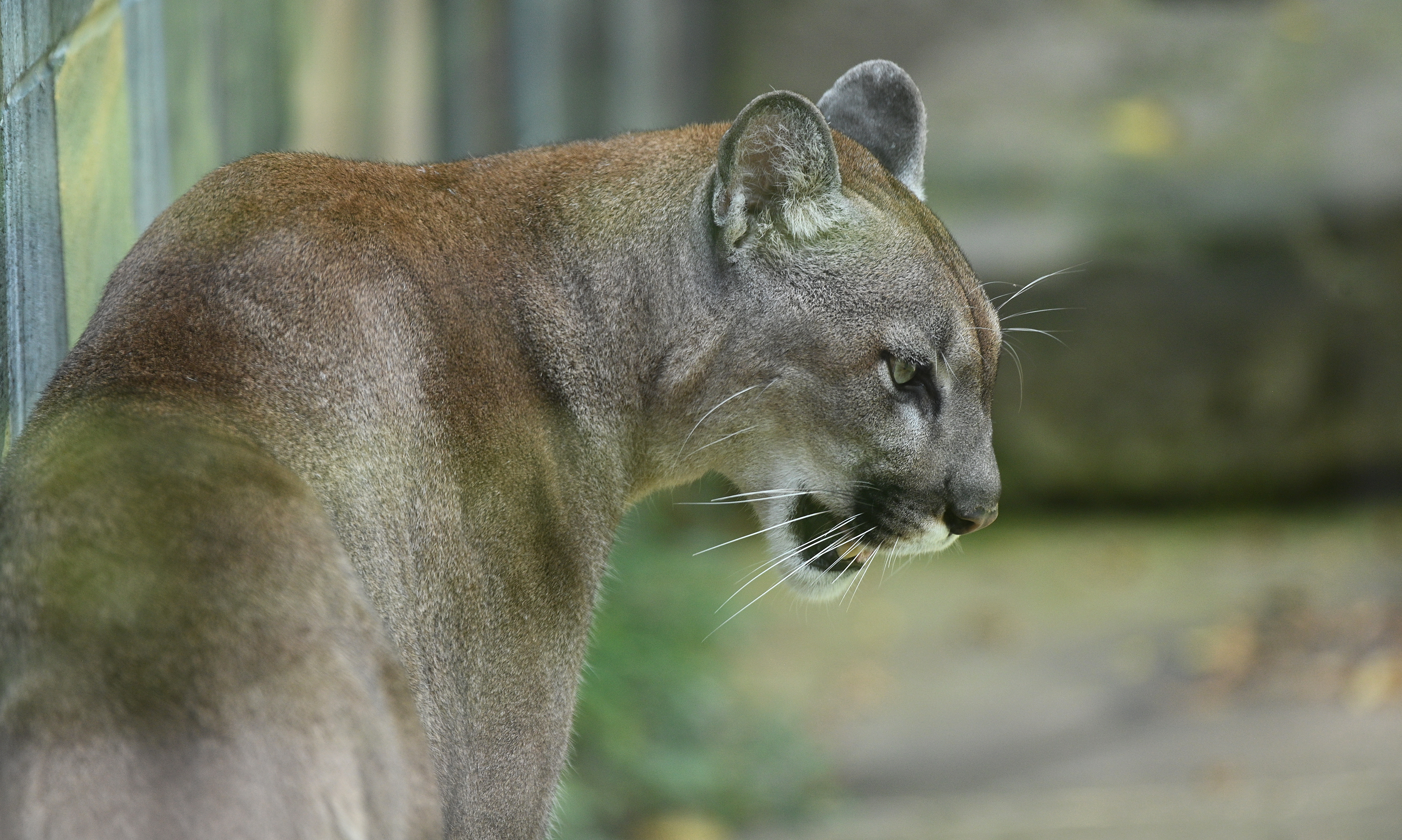
Mountain lions are part of the farm-nature-wildlife tour at Penn’s Cave and Wildlife Park.Craig Houtz / For The Inquirer
The unofficial end of summer is here, and I’m (Jason Nark) back to write one of the final Jersey Shore newsletters of the season. I’ve done a few of these end-of-summer newsletters over the years, and they get me feeling a little introspective. I’ve written about getting ditched by my teenage kids on the Wildwood boardwalk in the past, the ebb and flow of nostalgia I experience there, and the joy of getting to do it all over again with a toddler.
And that’s what I’m doing this year, too.
For almost 30 years now, most of my Shore time has been at my parents’ two-bedroom condominium on Hereford Inlet in North Wildwood. It’s been a real blessing, particularly with my four kids, and I’ve grown more grateful for it as time passes. I made a few trips to other shore towns, like Asbury Park and Ocean Grove, this summer that really cemented that for me: I couldn’t afford to spend even one night there.
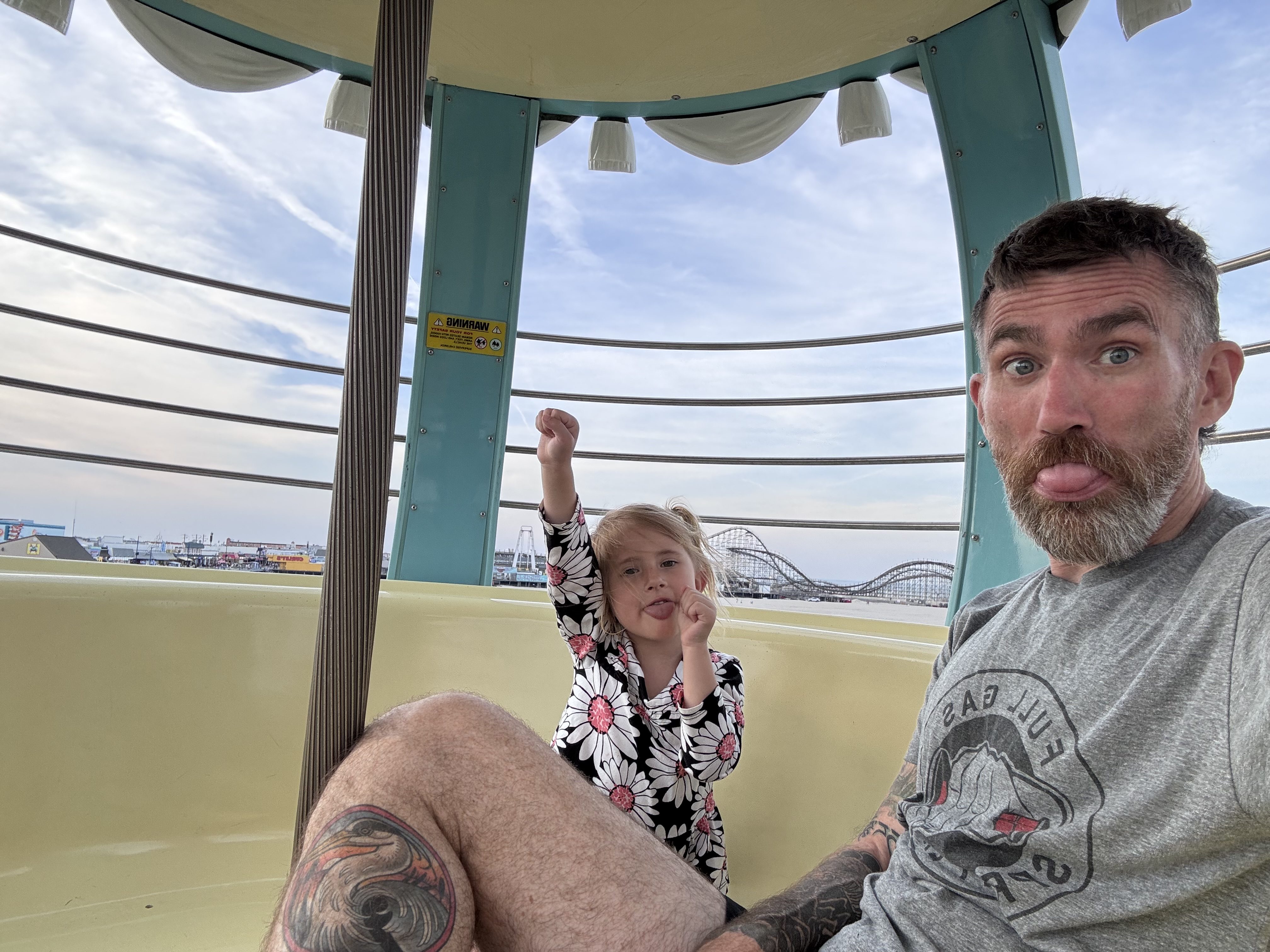
The author and his daughter, Penelope, on the rides on Wildwood’s boardwalk.Jason Nark
I’ve always been concerned with the affordability of the Shore, how that goal of a weekend at the beach must be a real struggle for working families, and the hassle of finding a hot shower if you’re a day-tripper.
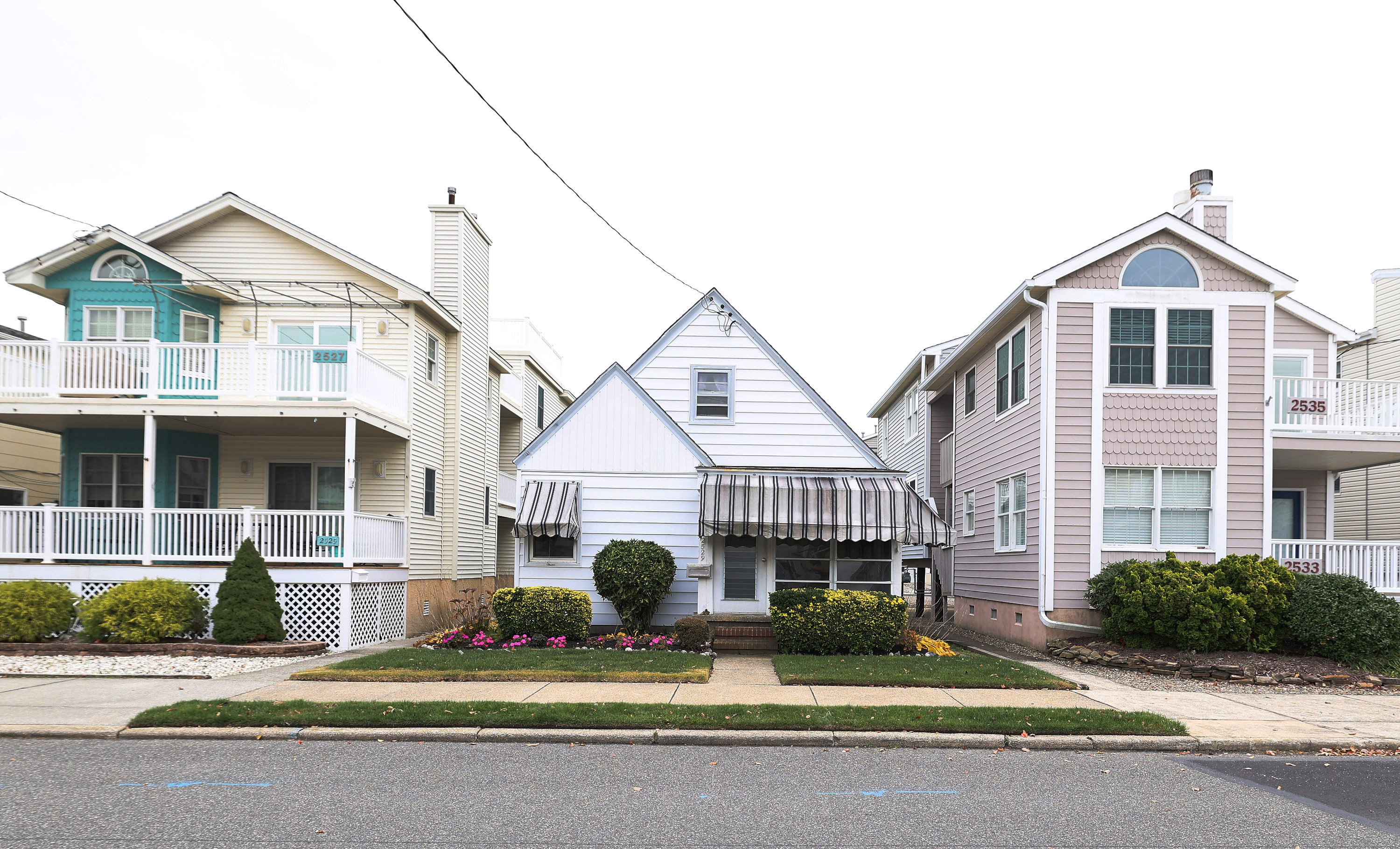
I visited North Wildwood irregularly myself this summer, a few days here and there with my daughter but never anything too long. Still, I found a nice rhythm, some real peace in walking my dog, Wanda, at night — bless my parents for letting me bring her — after my daughter went to bed. I’m talking two-hour walks, along the sea wall, on side roads, past the bars, etc. During many of those walks, I just studied houses, watching people watch the Phillies or hearing them laugh on a deck. Some were too brightly lit, others a bit cookie-cutter for my taste, but I found myself pausing at the interesting ones and the smaller homes with faded siding and old screen doors. I take photos of them, sometimes, from afar.
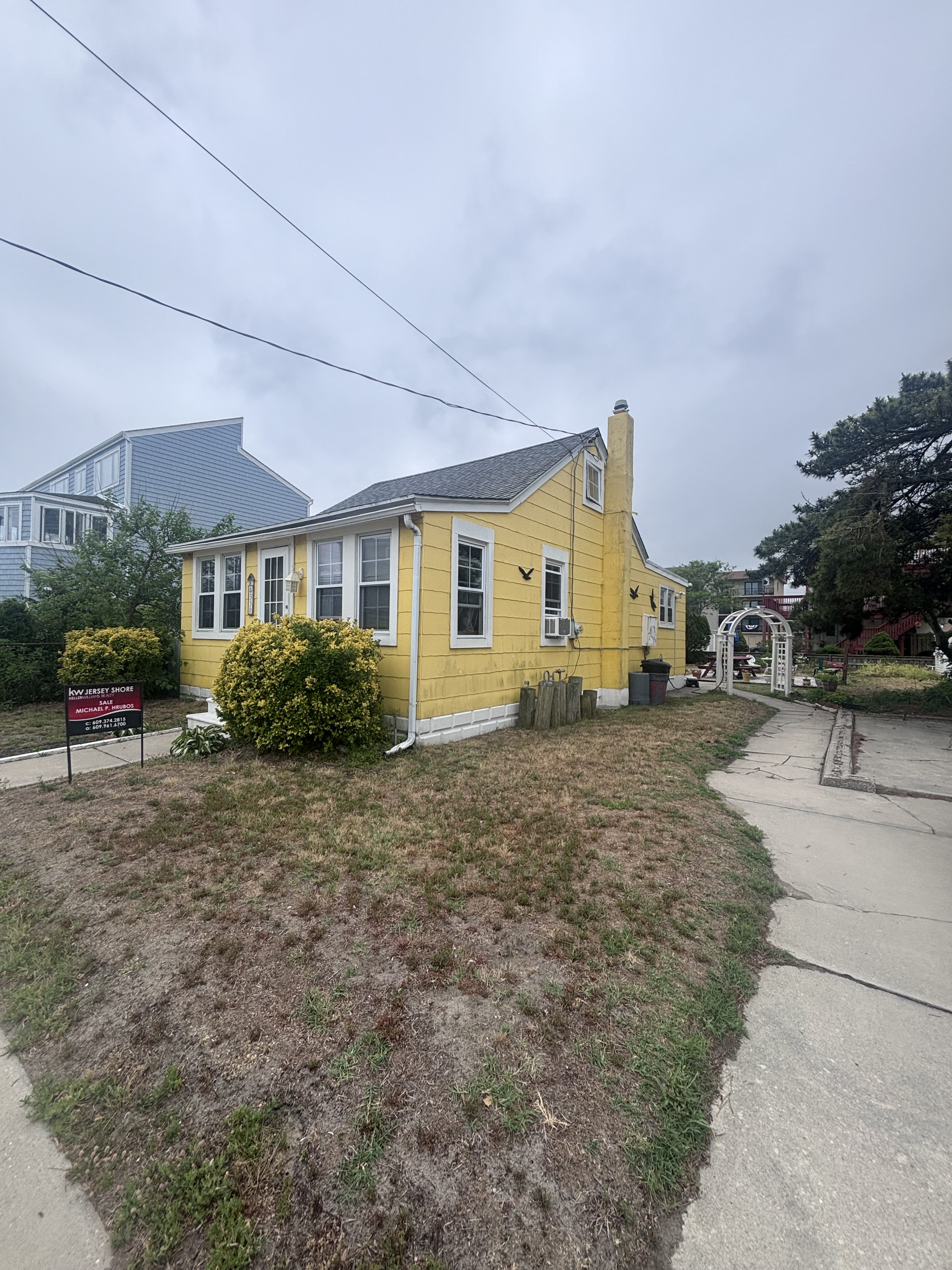
One of those houses, a 760-square-foot cottage that was built in 1950, was up for sale. It was bright yellow and charming. It was going for just over $2 million and, as I suspected, probably wouldn’t be there next summer.
“They’re not buying the house, they’re buying the location,” a local real estate agent said in a Facebook video about the home. “Most likely, this place gets torn down and replaced with a luxury shore home.”
This 1950 bungalow sold for $1.9 million in North Wildwood last month.Jason Nark
The wrecking ball has been cruel to me in the Wildwoods, taking the Thunderbird Inn, the Golden Nugget ride on the boardwalk, and the postcard-perfect Château Bleu hotel. There are too many to name.
I’ll feel it a bit next summer when that cottage is gone. I’d love to be wrong.
As I get older, I’ve tried to loosen my grip on nostalgia, to not waste emotions worrying about the long-gone Lamp Post Diner, or bait shops that seem to be barely hanging on.
I’ve even accepted that my parents’ place may someday change hands. They are older now and deserve to reap the rewards of a wise investment, whether it’s retiring there or selling altogether. They get plenty of feelers from real estate agents.
Still, watching my daughter — she’s 5 — on the beach this summer, seeing her eat all the pepperoni off her slice of Sam’s Pizza, or work up the nerve to ride the log flume I’ve been on 100 times, I feel nostalgia’s strong grip again. I’m not sure I’d be able to afford all those memories without that cozy, little condo.
“I love it,” my father told me when I asked why he’s held out so many years. “Plain and simple, I love it.”
My parents’ place is in a whole unit of condos, and I couldn’t fathom it being torn down for something larger, but I’ve been wrong before, and stranger things have happened… in Avalon.
📮 What do you think about the tear-down trend at the Jersey Shore? Do you see it as progress? Does it hurt a bit, or can you look on the bright side and see the rising tide — property values — lifting your boat, too? Let me know what you think by replying to this email. Have ideas or news tips about the Shore? Send them to us here.
Ask Down the Shore: Where have all the manners gone?
We asked our text group The Shore Line about changing manners down the Shore after a reader observed that people were angling for the right of way even on mobility mats leading to the beach.
Here’s a sampling of the response:
Just the other day, walking to the beach with little ones and a group of teens did not move over, even a little bit. I’m 70, and the kids are 4 & 2. They acted like I was the one who SHOULD move out of their way. No manners. I blame the parents.
It’s not just beach etiquette — all manners have declined, and proper decorum isn’t valued like it used to be. I definitely agree that walkers rarely drop into a single file on those mats. Fortunately, I do still see people move aside for wheelchairs, as they should.
Periodically, I experience the same obstruction behaviors. I hold my ground until they move; I’m in my seventies! Manners everywhere are deteriorating, not just at the shore, though many who vacation here seem entitled.
Your Shore memory
An end of summer memory from Jacqui Delario:
My sisters and I grew up in South Philly and summered with my aunt and uncle on Cresse Ave in Wildwood Crest. I live in Margate now; nothing was as magical as Wildwood in the 60s. Just before Labor Day, we always had a big crabs and macaroni dinner. My dad purchased the crabs somewhere offshore, with corn from a Goshen farm.
Aunt Betty declawed the crabs — she wore sturdy black shoes and wielded her kitchen tools like weapons. My mother and Aunt Sue were inside preparing the rest. Aunt Betty and Uncle Joe had a big picnic table. They removed the umbrella and added newspaper. Shortly before sunset, we started eating. First was the linguine. The crab gravy was so sweet you hated to stop at one serving. Then magically, the crabs appeared, later the corn. We stayed at the table for hours. My mom and my aunts somehow kept the food coming while never appearing to leave the table.
But it was also a bittersweet occasion — a highlight of the summer, which was ending.
Keep sending us your Shore memories! You never know when Down the Shore will pop up in your inbox. In 200 words, tell us how the Shore taps into something deep for you, and we will publish them in this space.
By submitting your written, visual, and/or audio contributions, you agree to The Inquirer’s Terms of Use, including the grant of rights in Section 10.
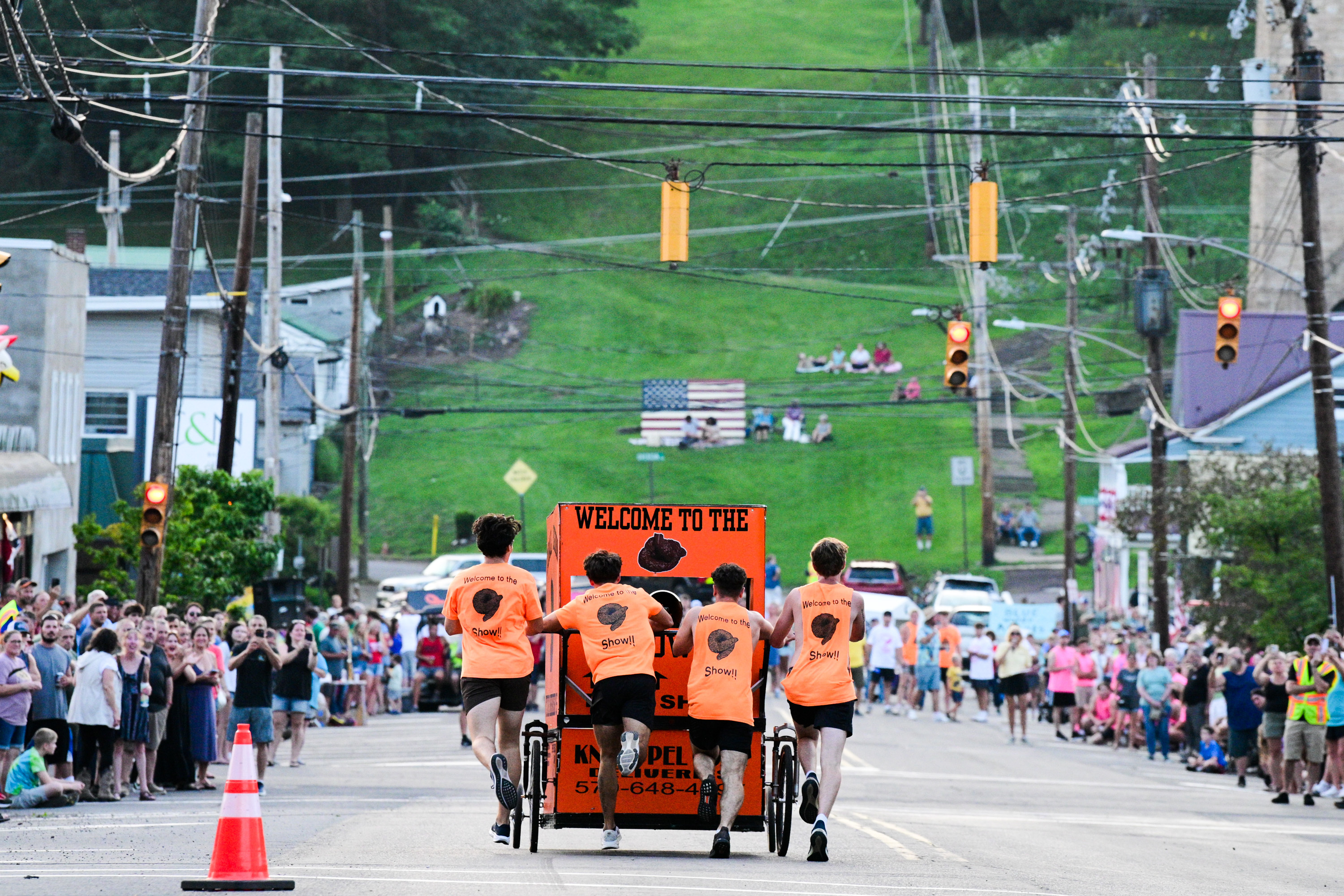
DUSHORE, Pa. — The competitors were wiped, but they gathered at the starting line in this sleepy Sullivan County town for one last push on their custom-built toilets.
“All right, this is it, folks,” emcee Gretchen Little announced. “Reputations are made. Legends are created. It’s all here, the drama, the triumph, the heartbreak. There’s nothing like the Dushore Outhouse Races.”
A half-dozen or so teams began the Dushore Founder’s Day 26th Annual Outhouse Races earlier on this Saturday night in early August. One by one, they dropped, teams like the Blue Water Angels, Perfect Dump, and Royal Flush.
The Coal Region Turd Herder’s team races down the hill on Main Street in Dushore, Pa.RALPH WILSON/For the Inquirer
Little let the crowd decide the best-looking outhouse before the final race. One of them was Steiny’s Heineys. Another team had a Dunkin’ Donuts theme with some unprintable potty humor.
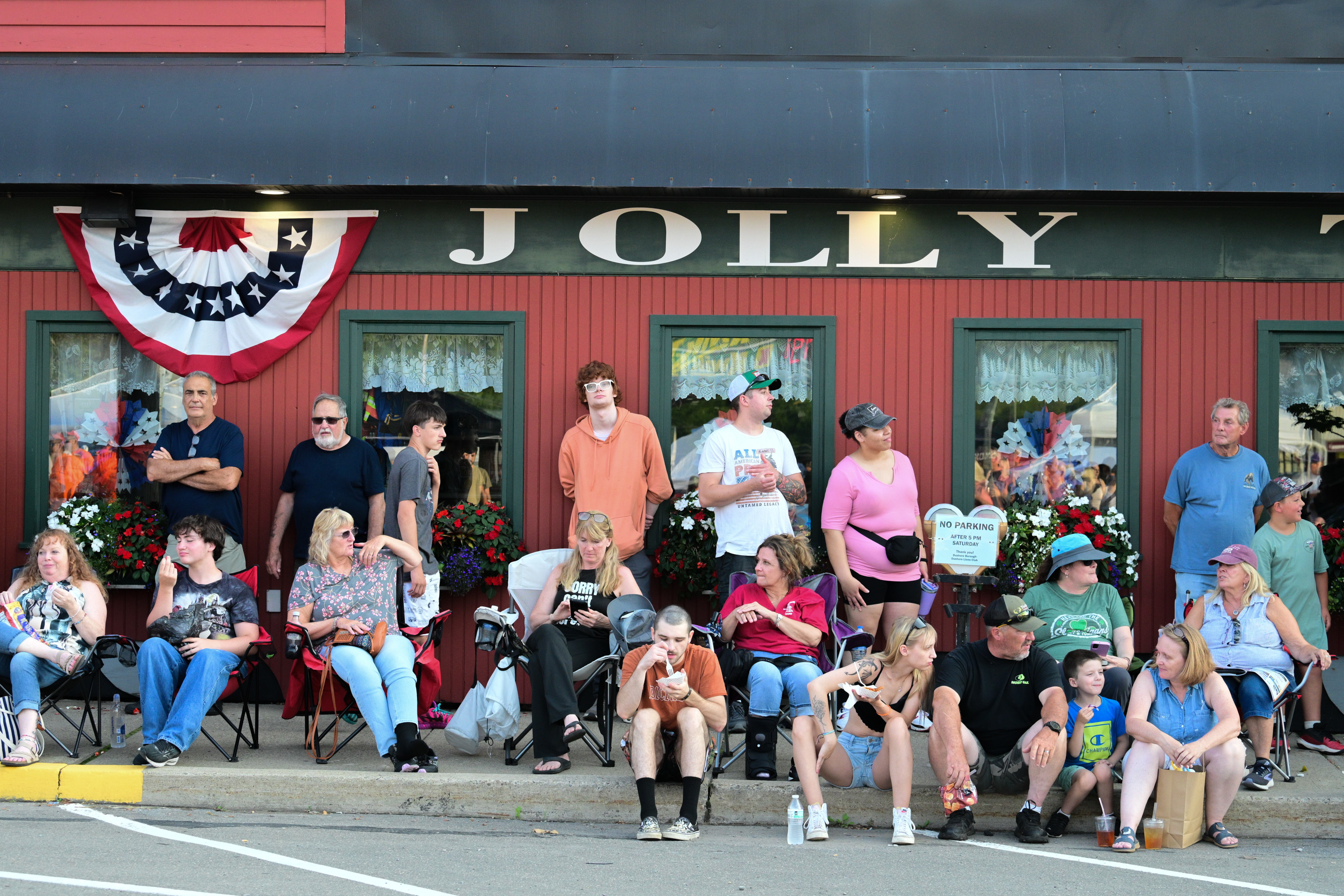
The crowd itself was an anomaly in Dushore, easily four times bigger than its year-round population of about 450. Sullivan County, about 160 miles northwest of Philadelphia, is one of Pennsylvania’s most rural counties, and its population has been rapidly decreasing and aging for decades.
“You come to this town tomorrow, you might not see a soul,” said Darryl Kashner, of Coal Township.
The Lyons Club driver reacts as the team’s outhouse crosses the finish line in Dushore, Pa.RALPH WILSON/For the Inquirer
Dushore’s Founder’s Day also included a 5k and a keg-rolling competition, but the crowds swelled on Main Street for the outhouses. Vendors included local wineries, coffee shops, and a Sullivan County artisanal broom maker that’s been in business for 100 years. Despite the crowd, many attendees said the turnout was smaller than usual.
“It used to be much bigger,” said Greg DelBuono.
The Steiny’s Heinys team races down the hill in Dushore, Pa., as part of the 2026 Founder’s Day festivities.RALPH WILSON/For the Inquirer
Dushore’s outhouse races are essentially bobsledding on the street. The outhouse must have a real toilet seat, and most sit on simple aluminum frames with wheels.
“Remember … this must look like an outhouse … be creative,” the rule book states.
The Corkscrew Crew team races down the hill during the 2026 Dushore Founder’s Day festivities.RALPH WILSON/For the Inquirer
The pilot sits on the throne, steering, while pushers line up outside. In Dushore, the best pushers were young and brawny, often sleeveless or shirtless. They came off the starting gun fast, racing uphill on Main Street. They passed through Sullivan County’s lone traffic light, swept around a memorial, and pushed back hard in the opposite direction, their legs burning.
“It’s a young man’s game,” said Kyle Nolte, 39, of Forksville. “I did this about 25 years ago, but I hung it up.”
The Coal Region Turd Herders were underdogs from the anthracite area south of Dushore, but they’d advanced to the finals by recruiting some real athletes — one of them was named “Speedy” — to do the pushing. Their outhouse was painted safety orange and featured a brown piece of, well you know, wearing sunglasses.
Locals and visitors line Main Street to watch the 25th Annual Outhouse Races at the Dushore Founder’s Day.RALPH WILSON/For the Inquirer
Like many people, Kashner discovered the races after he bought a hunting cabin in the area. Now, he pilots the Turd Herders’ outhouse.
“We bought the camp, came down, and decided to build one,” Kashner said. “I’ve never seen anything like it.”
Team Nutz, the local boys from Sullivan County, were perennial favorites at the races and faced off with the Turd Herders in the finals. The winners would come away with a trophy and a few hundred dollars, but the bragging rights were more important.
The Dushore Lyons Club team race up the hill on Main Street during outhouse races at the Dushore Founder’s Day.RALPH WILSON/For the Inquirer
When they rounded the memorial, the teams were neck and neck. The crowd was roaring. Cowbells were clanging.
“This is close,” Little said. “This is real close.”
Team Nutz, the locals, crossed first and dedicated their win to team founder Larry Kiess, who died at 36 in 2011.
“We trained for this. We came down here this week and trained for this, and every dollar we win goes to a scholarship in Larry’s name at Sullivan County High School,” said team organizer Jeff Neary. “This is our 26th year racing outhouses.”
Team Nutz celebrate their victory.RALPH WILSON/For the Inquirer
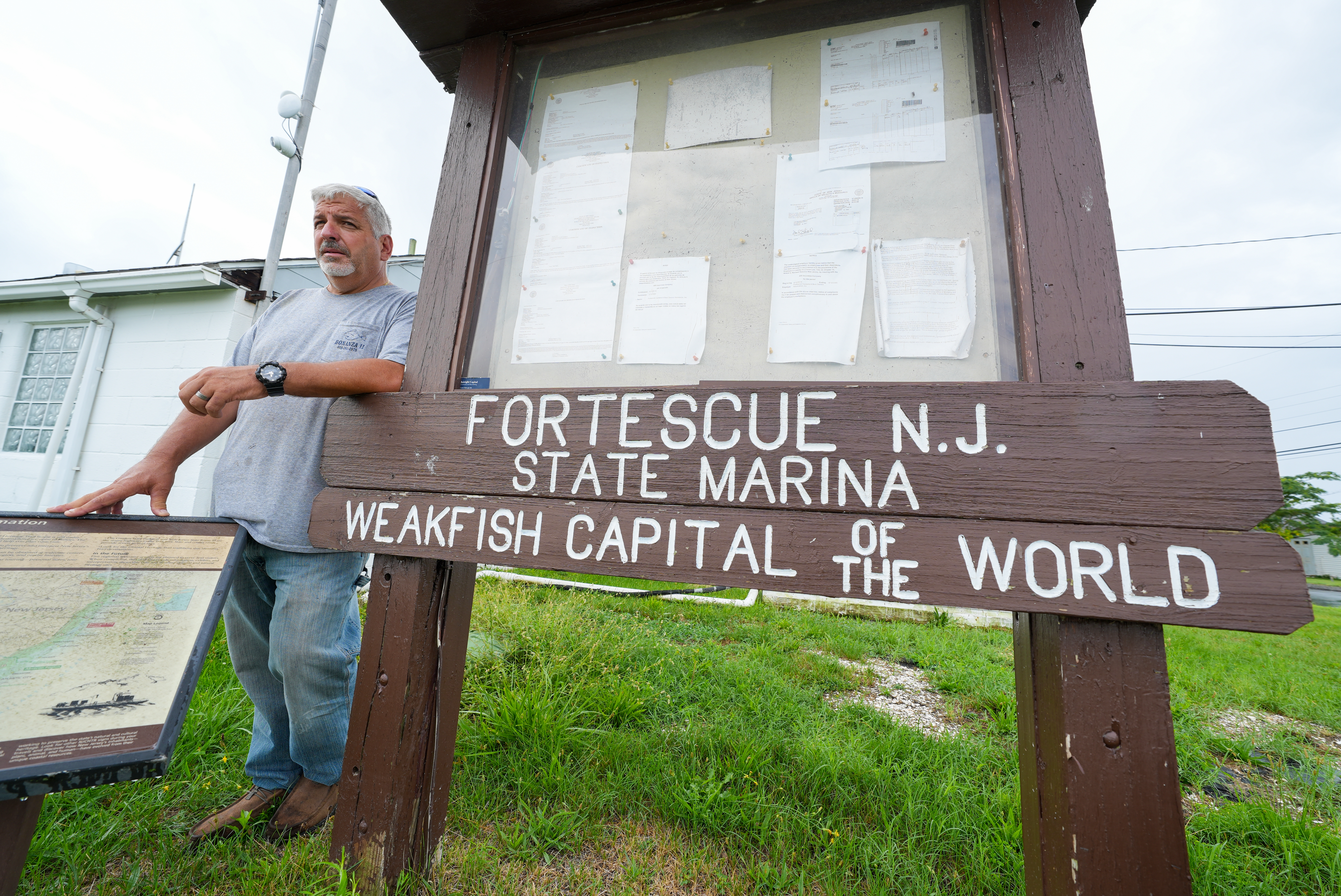
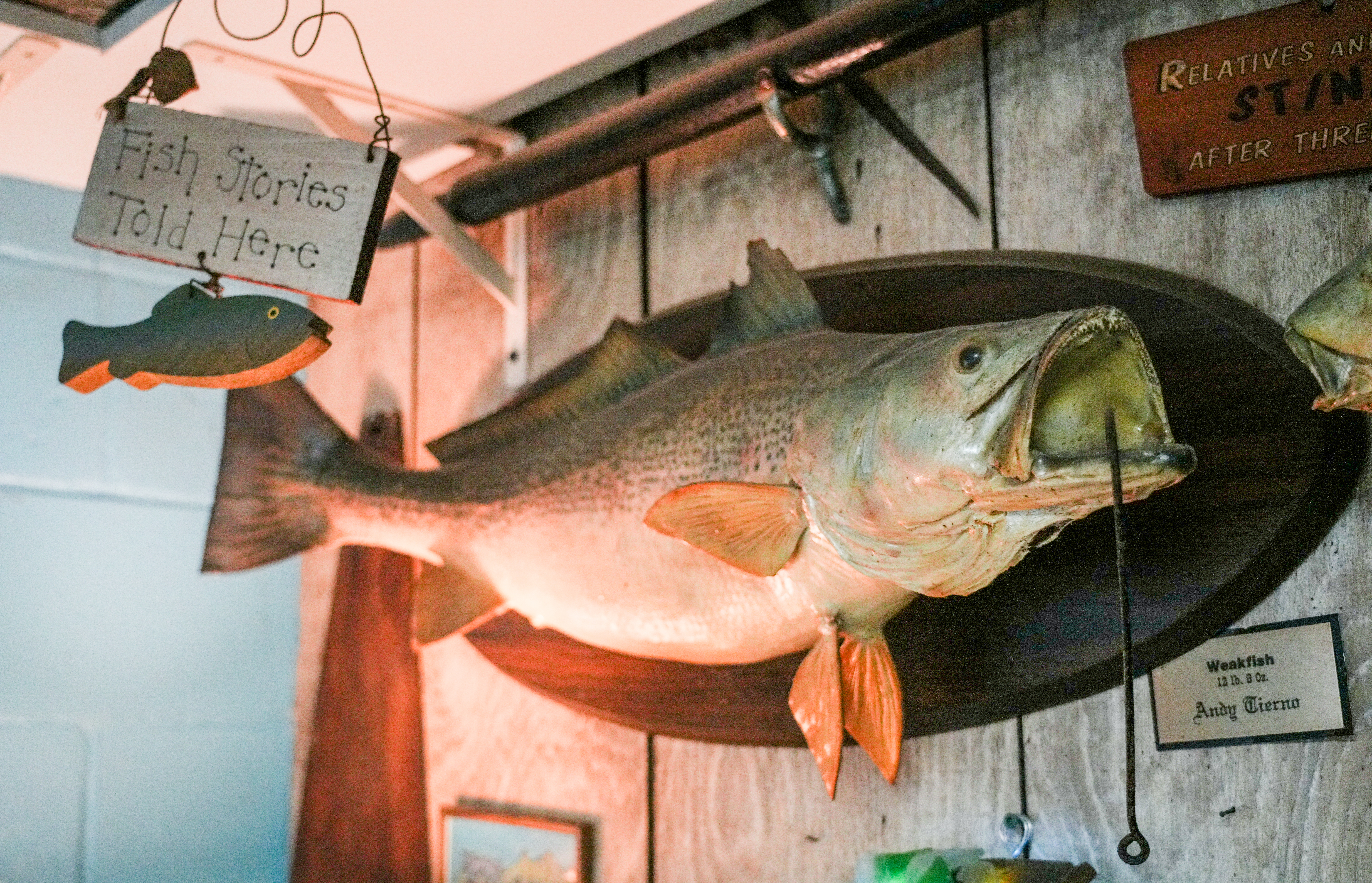
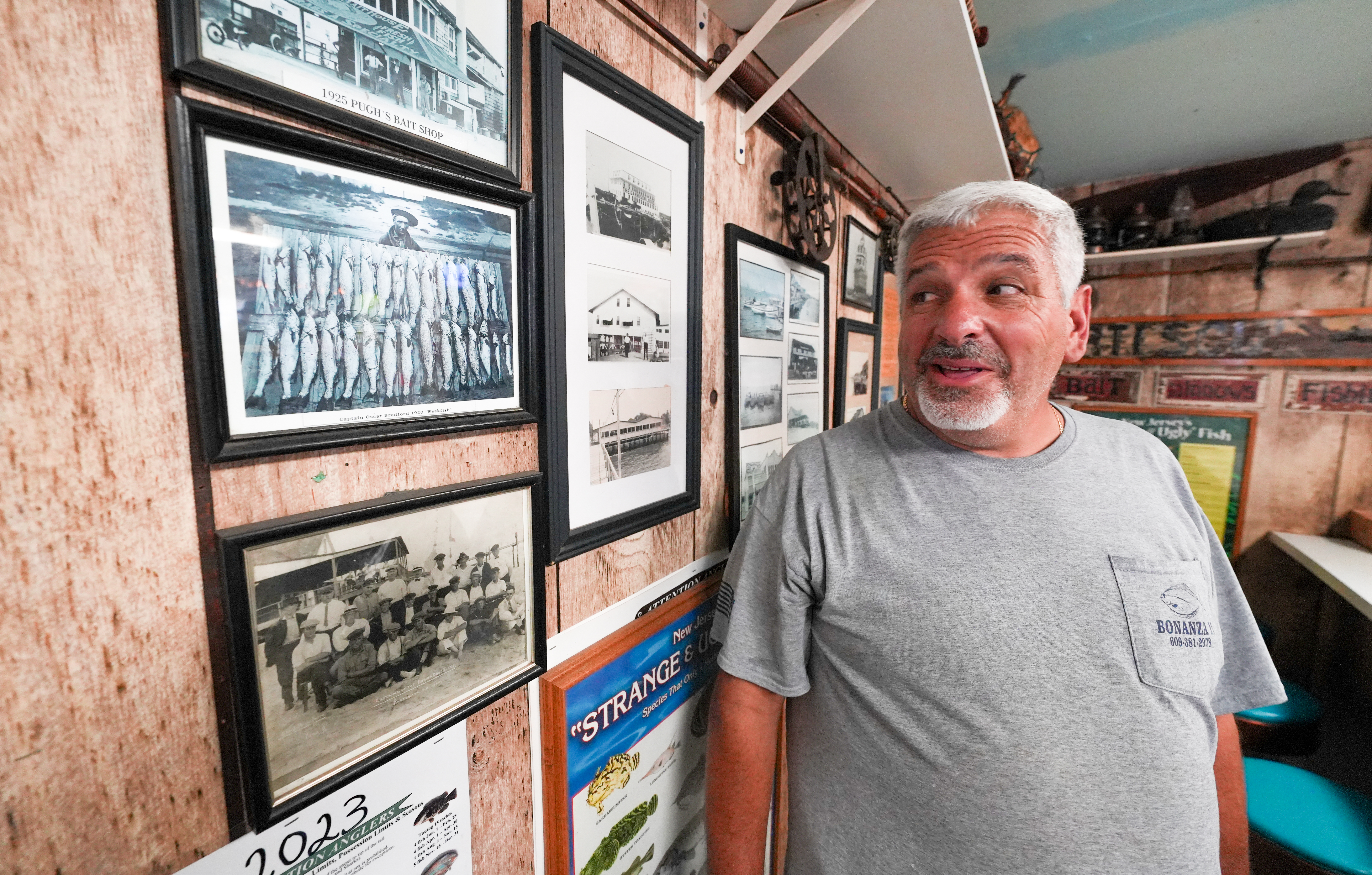
CUMBERLAND COUNTY, N.J. — Taxidermy and weathered photos line the walls at Higbee’s Bait and Tackle in Fortescue, artifacts from bygone days when the sleepy Delaware Bay town was truly the “weakfish capital of the world.”
The taxidermy is a dusty, 12-pound “tide runner,” the nickname fishermen bestow on the biggest, trophy weakfish, a member of the drum family with a tan, often iridescent body and a reputation for fighting hard on a fishing line. The black-and-white photo shows a single fisherman standing beside his catch, about 30 weakfish of various sizes.
Tide runners are unicorns today, a rarity on New Jersey coasts and across the bay, in Delaware. Catch limits enacted by state fisheries would prevent a single fisherman from catching dozens of fish today, though most would be happy with one legal keeper they could fry up in lemon and butter.
Fishermen have plenty of theories about where all the weakfish have gone. They blame dolphins and dogfish for gobbling up the young; nuclear power plants; the rise of other popular game fish, like striped bass; and offshore seafood trawlers.
Some are introspective.
“I’ll be real honest. It’s us. Back in the day, in the ’80s, we fished these things so hard,” said Mike Rothman, captain of the Bonanza II, a 65-foot charter boat out of Fortescue. “We did it to ourselves, and I’m the first one that — 100% — we did this to ourselves.”
A weakfish hangs on the wall of Higbee’s Bait and Tackle located at the Higbee Marina on Monday, Aug., 3, 2026. Once known as the “Weakfish capital of the world,” locals are curious where the fish has gone.Tim Hawk / For The Inquirer
Jessica Gorzo, a scientist with the New Jersey Department of Environmental Protection, who’s studied weakfish, said the population has been on the decline since the mid-2000s. She said the decline over those two decades is the result of natural mortality from predators, not fishing.
“The prevailing thought is the majority of predation is likely dolphins, offshore, in the winter. It’s estimated that 55% of the mortality can be attributed to dolphins,” Gorzo said. “Coming in second, a far second at 21%, is attributed to striped bass, but the dolphins are taking the lion’s share.”
Like all things under the sea, however, there’s a degree of mystery involved in spawning stock estimates. Gorzo said weakfish spawning stock estimates, in 2017, were 1,922 metric tons, which was a low number.
“To have a healthy weakfish population, the spawning stock threshold would be 6,170 metric tons,” she said.
The Marine Mammal Protection Act protects dolphins, and most fishermen and beachgoers agree their populations have grown along the Jersey coast in the summer for decades.
“More than ever,” said Joseph LoBianco, owner of Cape May Bait & Tackle. “When I go out on the Delaware Bay, I see them year-round. They are here all the time, and they’re eating a lot of the smaller fish.”
‘I would’ve released all those tide runners’
In 2010, New Jersey tightened weakfish regulations, allowing fishermen to keep just one fish, 13 inches or longer, per day, but many said it was too late to stop the population free fall.
“Back in the day, you were allowed to keep 15 fish per fisherman,” Rothman said.
Mike Rothman looks at a picture of weakfish, from 1920, that hangs on the wall of Higbee’s Bait and Tackle located at the Higbee Marina, Monday, Aug., 3, 2026. Once known as the “weakfish capital of the world,” locals are curious where the fish has gone.Tim Hawk / For The Inquirer
Gorzo said tight regulations on weakfish should result in a comeback. That’s what happened with striped bass, arguably the most popular sport fish along the Jersey Shore, a species that seems more abundant today than it was decades ago.
“Striped bass do seem to be doing really well,” she said.
Striped bass are also voracious and grow large enough to swallow bigger weakfish.
“They are the vacuum cleaners of the ocean,” Rothman said of striped bass.
In May, Gorzo appeared on the Finnsylvania podcast to discuss the decline of weakfish. The episode was titled “The Ghosts of Cape May,” another longtime weakfish destination for anglers. Host James Suleski reminisced about catching them during childhood summers there.
“They were just so abundant,” Suleski said.
Suleski, in his podcast, described the population collapse as one of the biggest mysteries in marine biology.
Around the same time the episode was released, avid fisherman Frank Ruczynski posted on Facebook, reminiscing about Fortescue’s claim to be the “weakfish capital of the world.” It received close to 700 likes and 200 comments, many of which discussed theories or dismissed the issue.
“They are probably cyclical like many species,” one man wrote.
Another said you could almost walk across the backs of weakfish in the bay at one time.
“If I would’ve known, I would’ve released all those tide runners,” another wrote.
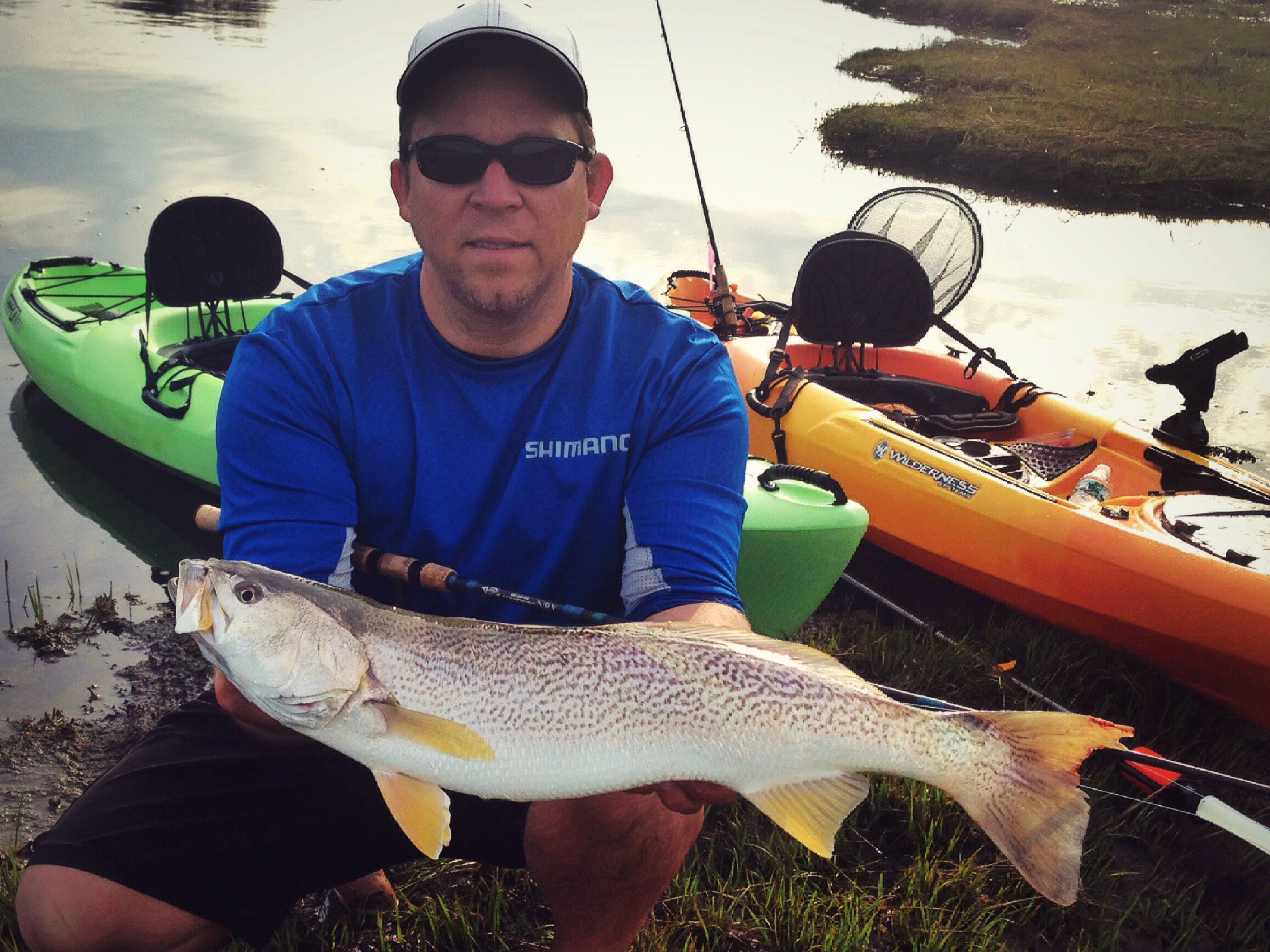
Weakfish caught by New Jersey angler Frank Ruczynski.Frank Ruczynski
Ruczynski, who also works for NJDEP, said 2026 was especially bad for him.
“Overall, I think it’s a mix of 100 different things going on,” he said in May, in Fortescue. “They just disappeared. It’s a shell of what we had here, back in the day.”
Ruczynski said he’s followed weakfish north, up into Cape May County and even into New York, and he wondered whether water temperatures were prompting the species to move. He said he received a message from a man in Portugal — straight east from New Jersey — who claimed that he caught a weakfish there.
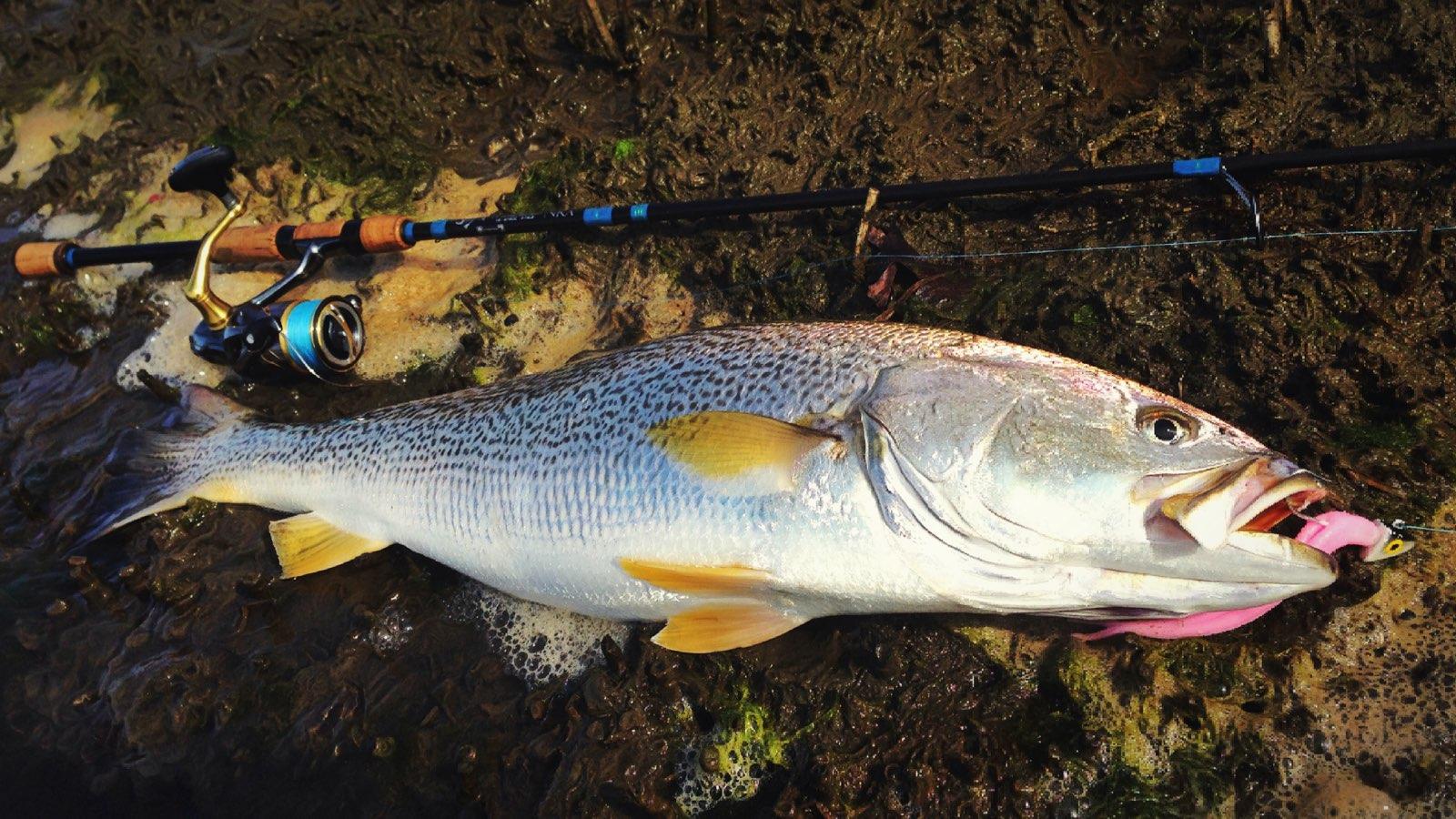
Weakfish caught by New Jersey angler Frank Ruczynski.Frank Ruczynski
Rothman, the mayor of Downe Township, which includes Fortescue, said he can take customers out and still catch weakfish, but he relies on other species, or whale and dolphin sightseeing, and even dinner cruises, for the bulk of his business.
“I’m in the entertainment business these days,” he said.
Fortescue has never been bustling as far as Shore towns go. There are no traffic lights, few businesses, and plenty of biting greenhead flies. Fishermen will always go there, but the loss of the weakfish gives it a bit of a ghost-town feel at times.
“We had a world-class fishery here, right in our backyard,” Ruczynski said.
Across the road from Rothman’s boat, at the tackle shop, owner Cliff Higbee Sr. said there were far larger weakfish in the Delaware Bay than the taxidermy on his wall.
“We had 16-, 17-pounders in here,” he said. “Used to at least.”
Higbee isn’t waiting for the tide runners to return, though. The family tackle shop is for sale for just under $400,000.
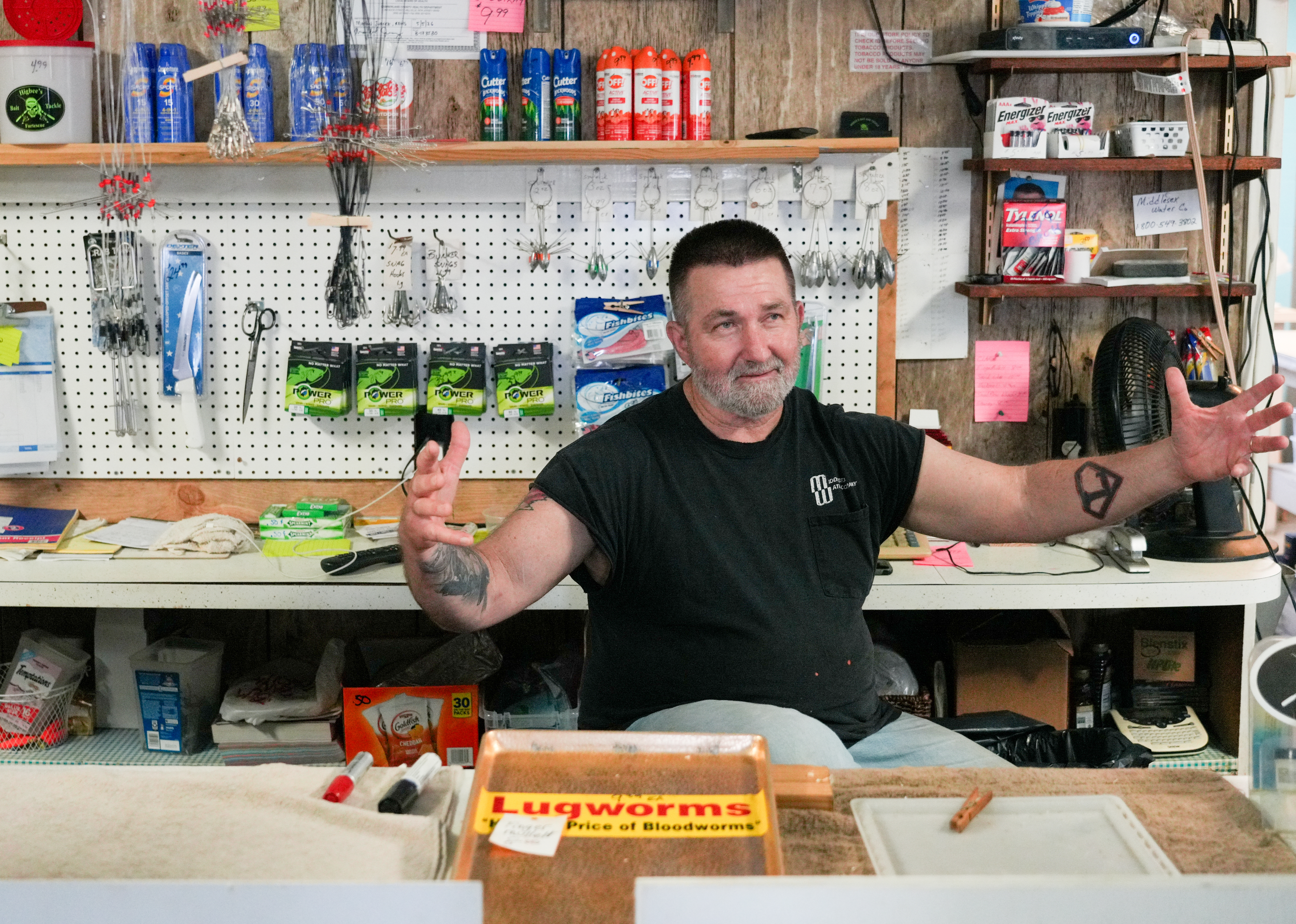
Cliff Higbee Sr. owner of Higbee’s Bait and Tackle located at the Higbee Marina, talks about the lack of weakfish, Monday, Aug., 3, 2026. Once known as the “Weakfish capital of the world,” locals are curious where the fish has gone.Tim Hawk / For The Inquirer