Author: Frank Kummer

  • Is building a data center on a Superfund site safe? Construction has started on one in Chester County.

    Is building a data center on a Superfund site safe? Construction has started on one in Chester County.

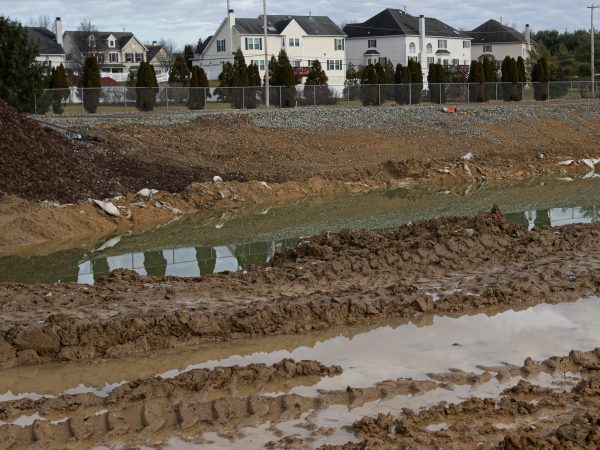
    Kelly Donia was seated in her Malvern Hunt home when she spotted dust plumes rising from construction vehicles combing the site of a planned data center complex in East Whiteland Township.

    She immediately drove to the site, across Swedesford Road from her development, to watch that day in June, anxious about the safety of building a 1.5 million-square-foot data center directly on top of a Superfund site in Chester County.

    “No one seems to be concerned, but I mean, we live right here, we work right here, there are children — there’s a daycare,” Donia said. “I don’t understand. I don’t understand our officials, and I don’t understand the developer, and I don’t understand the general contractor.”

    Donia is not alone in her fears. She and many of her neighbors, who had packed into East Whiteland meetings about the project for months, have continued to raise concerns about the safety of the building on the former 79-acre Cyprus Foote Mineral Co. property, which was contaminated over decades by a range of chemicals such as lithium, arsenic, and hexavalent chromium.

    Not long after Donia saw those plumes, the township issued a stop-work order until it gathers more information on the environmental impact of construction.

    While the developer says the site is safe, and the township has approved the plans, some residents believe that documents filed with the township and U.S. Environmental Protection Agency show that the site is still contaminated from its years as an industrial site, and they worry about what impact the construction will have on their community.

    Here is what The Inquirer knows about the Foote Superfund site.
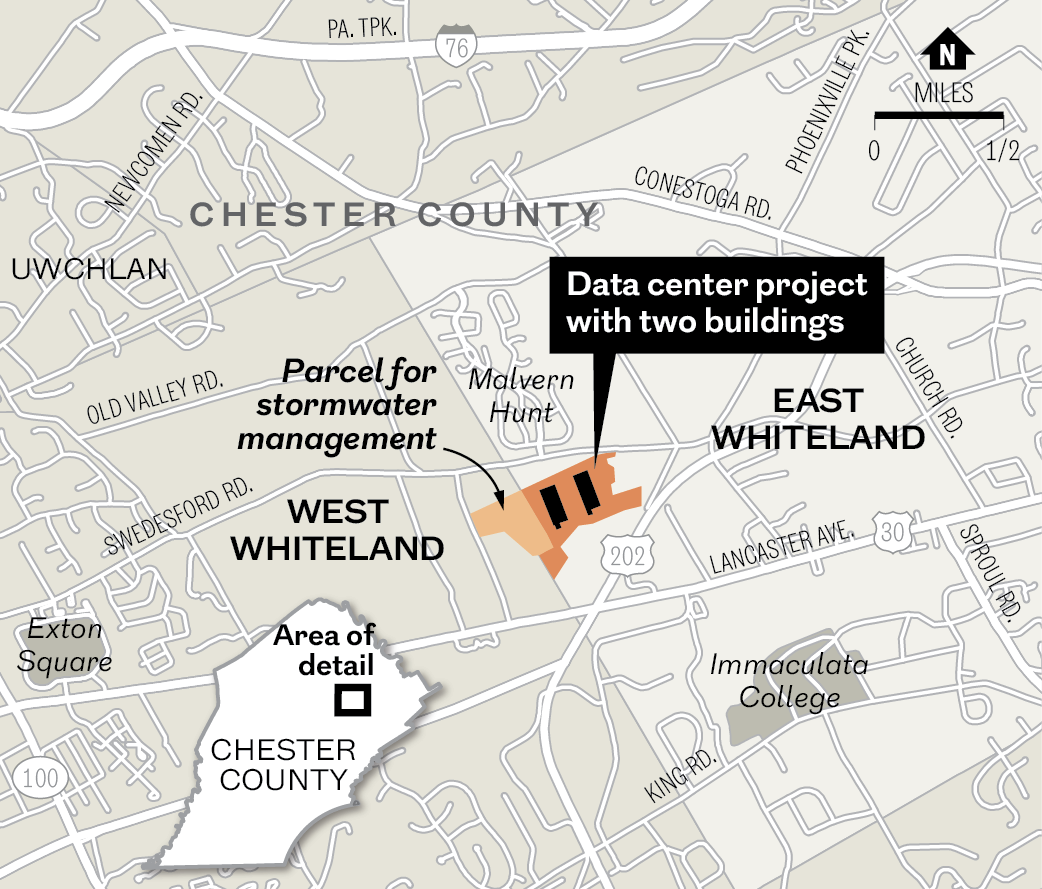
    Location of the two-building data center project in East Whiteland, Chester County.John Duchneskie

    What is proposed?

    Green Fig LLC and Sentinel Data Centers plan to build a 1.5 million-square-foot data center on the 79-acre former site of Cyprus Foote Mineral Co.

    Green Fig LLC first proposed a data center in 2018 and secured early zoning board approvals. The plans were greenlit by the township’s supervisors in 2024, drawing little pushback from the community.

    Residents have been more engaged since the plan came back before the township earlier this year, first with ambitions to scale it up, then with a proposal to shrink it to appease outraged residents.
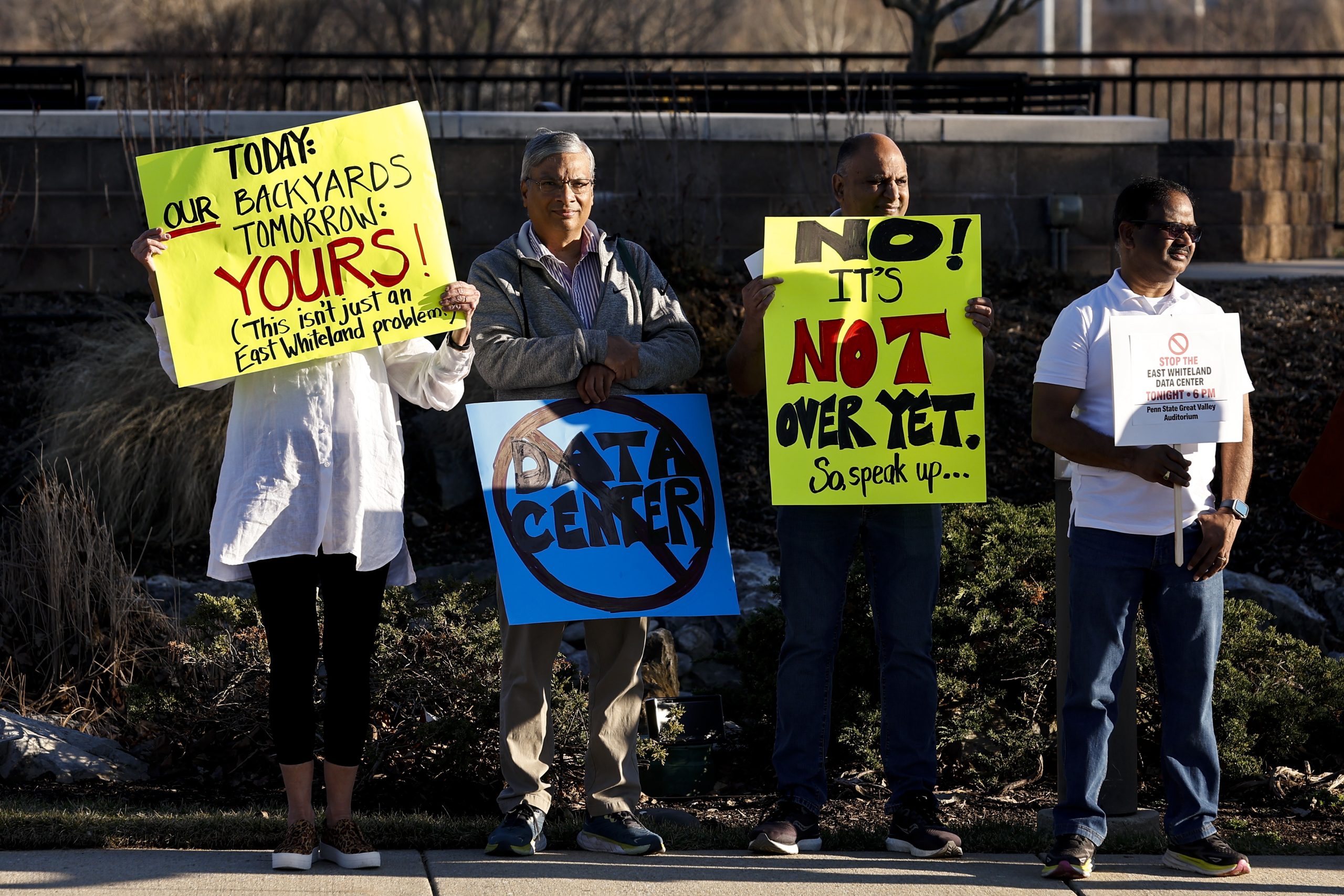
    People protest the expanded data center before the East Whiteland Planning Commission meeting held at Penn State Great Valley on Monday, March 9, 2026 in Malvern.

    What are residents concerned about?

    Residents fear that construction work on the site will kick up pollution in the air and release contaminants into the drinking water. They worry that there has not been ongoing testing of the soil on the site, especially knowing that contamination exists below.

    How did the site become polluted?

    Pollution at the Foote Mineral Co. likely started as soon as 1941 when the company began crushing ores and minerals.

    Foote closed in 1991 with two quarries, a pit where solvents were burned, a lined wastewater basin, and more than 50 buildings and processing areas. Three unlined lagoons were backfilled.

    At the time, public and private wells within four miles of the site had supplied drinking water to approximately 42,300 people. Several private wells near the site were found to be contaminated and were closed. A public water-supply well one mile away was also shuttered.

    Cleanup, led by the EPA, has included capping contaminated quarries, stabilizing waste areas, and maintaining a long-term monitoring program for an evolving groundwater plume. Pollutants included lithium, boron, and low-level radiation.
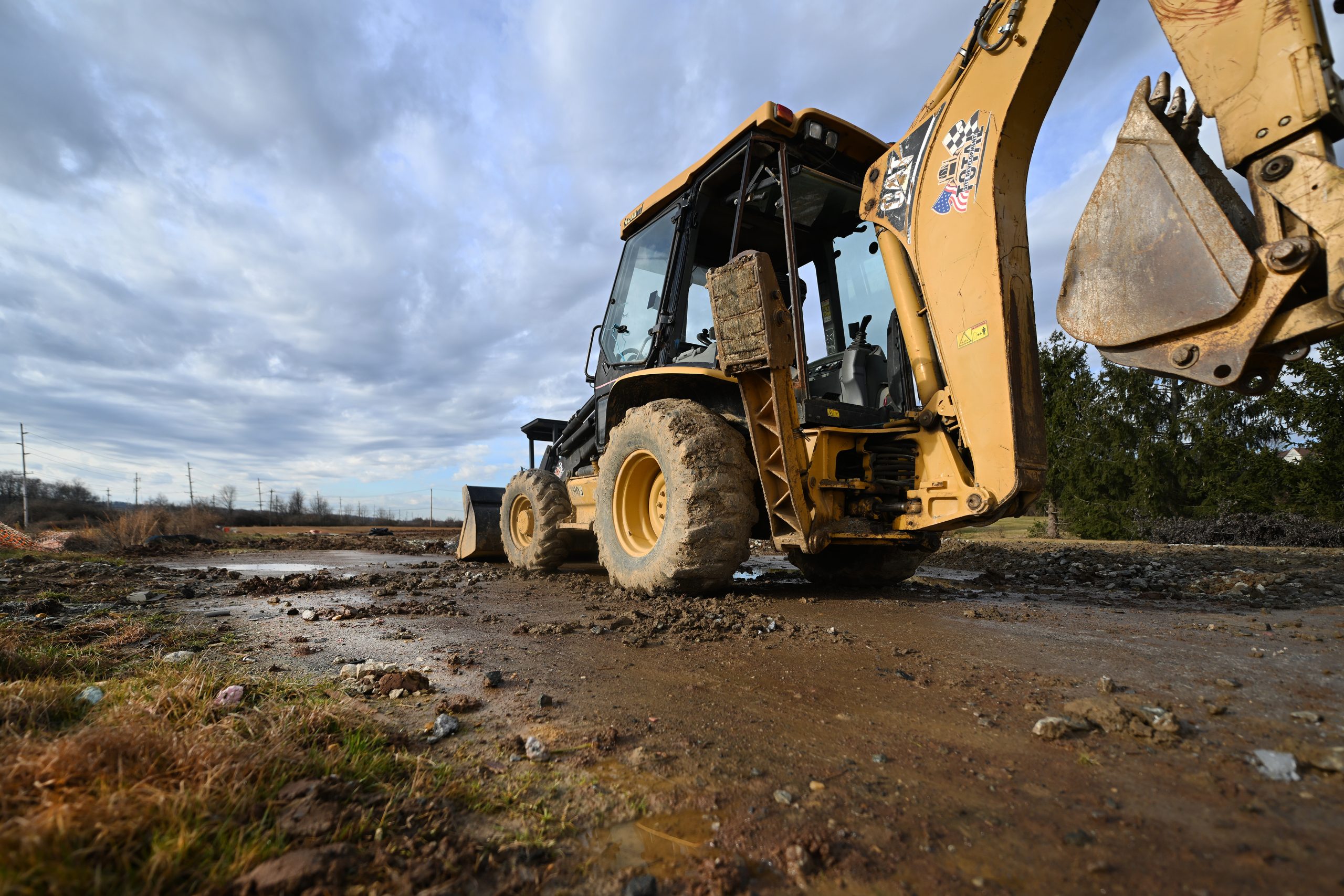
    An open land site is shown in East and West Whiteland Townships in Chester County on Thursday, January 5, 2023, where Green Fig LLC has proposed its data center project.Jose F. Moreno / Staff Photographer

    What is a Superfund site, and how did it become one?

    A Superfund site is a contaminated location in the United States designated by the federal government as a severe health or environmental hazard. Foote was added to the federal Superfund list in 1992.

    In a 2023 letter to East Whiteland Township officials, a contractor hired on behalf of the developers incorrectly said that the site had been removed from the U.S. Environmental Protection Agency’s National Priorities List, an inventory of the nation’s most serious hazardous waste sites.

    As of Friday, Foote Mineral Co. remained on the list posted on the EPA’s website. The EPA says because of the ongoing pollution, there is no proposal to remove the Foote site from the National Priorities List, nor any timeline for remediation to be complete.

    What does the EPA recommend?

    It’s complicated.

    A 2024 EPA report, the most recent environmental evaluation of the site, found concentrations of certain pollutants have decreased over time, but an excessive amount of volatile organic compounds, or VOCs, remained. VOCs are gases that contain a variety of chemicals that may adversely affect human health. VOCs tend to be much more concentrated when contained indoors.

    The EPA recommended updated land-use restrictions and further data collection to ensure the site remains safe during future redevelopment.

    On its website, the EPA wrote that the “hazardous substances, pollutants or contaminants remain at the site above levels that allow for unlimited use and unrestricted exposure.”

    Days before the 2024 findings were released, an EPA engineer filed a report known as a “Superfund Checklist for Retracting the Sitewide Ready for Anticipated Use Measure (SWRAU)” that said the site “no longer meets” standards for human exposure.

    The EPA said in an emailed statement that SWRAU forms are only for guidance.

    SWRAU “designations are not required for redevelopment,” the statement said. “So long as all land and groundwater use restrictions continue to be met and redevelopment does not interfere with EPA’s cleanup or future investigations, sites can be reused and redeveloped.”

    “Based on a careful review of construction plans by EPA subject matter experts, the agency does not anticipate the development to impact the remedy at the Foote Mineral Co. Superfund site,” Mike Bastasch, an EPA spokesperson, said in June. The EPA “remains engaged and will continue monitoring redevelopment progress to ensure the remedy remains intact,” he said.

    What do experts say?

    If a site is properly cleaned up, there are “potential ways that a data center could be a better use, environmentally, of the land,” said Noah Kittner, associate professor in the Department of Environmental Sciences and Engineering at the University of North Carolina Gillings School of Global Public Health.

    But that is contingent on how it uses water, what kind of systems are in place, what types of energy and electricity are being used, and whether diesel generators are being used in the construction, development, and operation of the site, he said.

    The documentation from the EPA showing remaining contamination “certainly raises some red flags” about redeveloping the site, he added. And whether the project does more harm than good is “highly dependent on plans for construction.”

    “You could have a poorly executed project, and it causes a lot more problems for the community,” Kittner said. “Or you could have a really well-designed remediation project that builds in sustainability principles and other factors that could really transform that area from what was once highly polluting to something that is environmentally positive.”
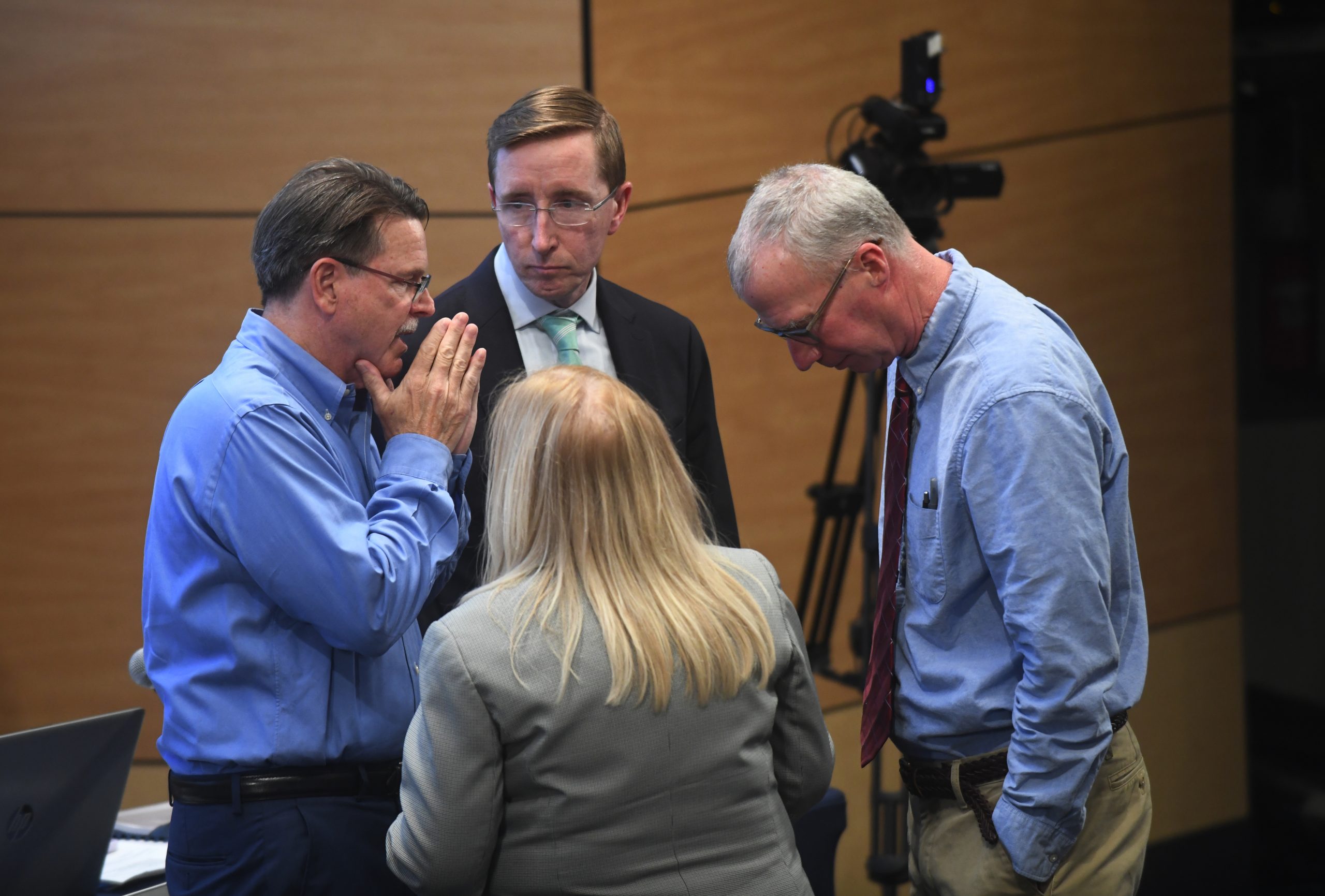
    Scott Lambert, chair of the East Whiteland board of supervisors, left, confers with township officials about the data center proposal on April 14, 2026.Bob Williams / For The Inquirer

    Who decides?

    The EPA said in a statement to The Inquirer that it does not “recommend, propose, or approve specific Superfund redevelopment plans.” The agency reviews proposed uses and checks if there are “any potential conflicts with the selected remedy (including cleanup standards) or any issues that could reduce protection of human health and the environment,” the statement said.

    The EPA’s goal is that most Superfund sites will be cleaned enough for commercial or industrial use. However, in some cases, the EPA can impose near permanent, severe restrictions on potential uses. Most Superfund sites undergo evaluations every five years to make those determinations until a site is removed from the National Priorities List.

    Beyond that, it falls to the township to make final decisions on what the project will ultimately look like, and whether it could be built. Municipal leaders have said previously that, due to state law, they feel their hands are tied to allow for uses such as data centers.

    What’s next?

    The project remains in limbo: The developers have returned to the township seeking to amend their plans and alter the final design for the project. Supervisors tabled their decision at their last meeting on July 8, saying they needed more information about proposed changes.

    Residents remain concerned about long-term construction at the site.

    This suburban content is produced with support from the Leslie Miller and Richard Worley Foundation and The Lenfest Institute for Journalism. Editorial content is created independently of the project donors. Gifts to support The Inquirer’s high-impact journalism can be made at inquirer.com/donate. A list of Lenfest Institute donors can be found at lenfestinstitute.org/supporters.
  • Liquid natural gas export facility planned for Eddystone provokes an environmental fight

    Liquid natural gas export facility planned for Eddystone provokes an environmental fight

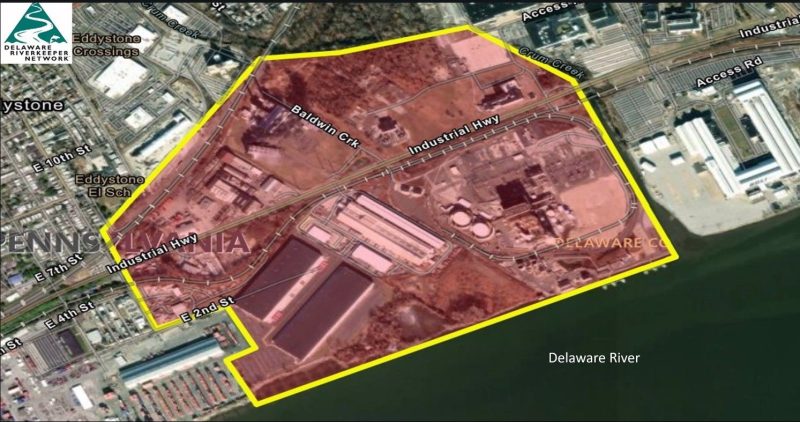
    Two environmental activist groups say they plan to organize resistance against a plan to build a liquefied natural gas (LNG) export facility in Eddystone, a small borough in Delaware County.

    They say the facility would threaten not only the environment, but also public safety.

    The Delaware Riverkeeper Network and Chester Residents Concerned for Quality Living (CRQL) said during an online meeting Wednesday that documents show negotiations have been happening behind closed doors for more than a year.

    They cited a newly released tranche of documents that show the plan has progressed with nondisclosure agreements (NDAs) with state officials.

    More than a year ago, U.S. Sen. David McCormick (R., Pa.) wrote an opinion piece in the Washington Times publicly announcing the $7 billion project by Penn America Energy to build the terminal along the Delaware River in Eddystone.

    Details have been scant, but nearby communities such as Media have stated opposition to the terminal.

    Tracy Carluccio, deputy director of the nonprofit Delaware Riverkeeper Network, said the documents show that the administration of Pennsylvania Gov. Josh Shapiro and Eddystone officials have been talking to, or in negotiations with, a developer for at least a year.

    (function(){function e(){window.addEventListener(`message`,function(e){if(e.data[`datawrapper-height`]!==void 0){var t=document.querySelectorAll(`iframe`);for(var n in e.data[`datawrapper-height`])for(var r=0,i;i=t[r];r++)if(i.contentWindow===e.source){var a=e.data[`datawrapper-height`][n]+`px`;i.style.height=a}}})}e()})();

    The environmental groups say Eddystone Borough officials initially denied open records requests about those negotiations, prompting a yearlong legal mediation.

    The planned facility aims to produce 7.2 million tons of LNG per year from Pennsylvania’s rich Marcellus Shale deposits, Carluccio said, based on a presentation by Penn America to Eddystone Borough on March 7 that was obtained through a records request.

    “There have been no public meetings or public disclosure about the proposed project,“ she said, adding that “the public knows nothing about this, and Eddystone Borough knows all about it.”

    Carluccio said nondisclosure agreements (NDAs) and confidential meetings involving high-level state and local officials have helped shield the project from public scrutiny.

    The Pennsylvania Department of Environmental protection said it had not had any pre-application meetings regarding a proposed LNG export facility and no permits for such a facility are under review.

    In a statement from Eddystone Borough, officials said they are aware of the “public discussion” regarding a potential LNG facility. The statement said that members of Borough Council met with representatives of the project last year “for informational” purposes.

    “Those meetings did not constitute approval or endorsement of any future development,” the statement said. “No approval action is currently before Borough Council.”

    If an application is submitted, the statement said, the borough would conduct a “thorough review” and that the process would be open to the public.

    Pa.’s drive toward LNG

    State, public utility, and elected officials, as well as unions, have been working toward locating an LNG facility in Southeastern Pennsylvania, although no site has been formally proposed.

    The Philadelphia LNG Task Force was created from legislation introduced in 2022 by State Rep. Martina White (R., Philadelphia) to explore the possibility of the first liquefied natural gas export facility along the Delaware River. Former Gov. Tom Wolf, a Democrat, signed the legislation to form the task force.

    Previously, state officials have hosted multiple public sessions on a potential facility, saying it would tap a European market hungry for energy.

    Eddystone deal

    Although McCormick noted Eddystone as a location, no official planning documents have been submitted to Eddystone or the Federal Energy Regulatory Commission (FERC).

    According to records obtained through Pennsylvania’s Right to Know Act, the Pennsylvania Department of Community and Economic Development (DCED) entered into a formalized nondisclosure agreement with Eddystone Energy LLC in October 2025.

    The DCED issued a statement to The Inquirer saying that it “routinely discusses potential projects with companies seeking to do business in the Commonwealth.”

    The agency said the discussions are confidential because they involve proprietary information from companies.

    “Maintaining confidentiality in such discussions is common practice in the business development industry across the country,” the statement said.

    A draft NDA was additionally distributed between Eddystone Borough Council and Penn America Energy Holdings, though it appears it was never officially finalized, Carlucci said.

    Advocates say that Franc James, CEO of the now-dissolved Penn America Holdings LLC, has been the primary figure driving the LNG project forward, alongside an array of state politicians.

    On Wednesday, Carluccio asserted James is behind Eddystone Energy LLC, a Delaware corporation formed in May 2025.

    Internal records reveal that meetings have involved representatives from the offices of Shapiro, State Sen. John Kane, McCormick, and State Rep. Dave Delloso, as well as Eddystone Borough officials.

    For example, a document from Shapiro’s office shows there was an hourlong meeting in February with Eddystone Mayor Ronald Hughes, Borough President William Stewart, Kane, James, multiple union representatives, and Technip Energies, an international energy infrastructure developer with a specialty in LNG.

    And James wrote an email dated July 11 to Samuel Robinson, Shapiro’s deputy chief of staff, stating that the “LNG Eddystone team” would attend the Pennsylvania Energy and Innovation Summit that same month in Pittsburgh. The summit was organized by McCormick.

    Community reaction

    An LNG facility along the Delaware River waterfront in Southeastern Pennsylvania has been discussed for years with James’ Penn America Energy Holdings, also referred to as Penn LNG.

    Though no location had been firmly named, it was initially believed Chester would be the host. However, that location received massive pushback from residents led by Zulene Mayfield, founder of the CRQL advocacy group, and resulted in a political turnover in the city. No project was ever formally proposed for Chester.

    The environmental advocates say the plan for Eddystone is well underway despite the lack of public input. Mayfield said she plans to organize Eddystone residents to oppose it.

    “This project is already rolling, that’s what we’re telling you,“ Mayfield said Wednesday in the webinar she hosted with Carluccio. ”The attempt is already being made to put it right in Eddystone.”

    Mayfield and Carluccio said the borough is too small to host a large LNG export facility, which typically span 1,000 acres. The borough is one-square mile.

    They also fear that an explosion or fire could not only reach neighboring towns but also stretch across the river to New Jersey.

  • ‘We’ve moved on’: Chester mayor and environmentalists object to LNG terminal proposal

    ‘We’ve moved on’: Chester mayor and environmentalists object to LNG terminal proposal

    Chester Mayor Stefan Roots came up with an idea as he waited to testify Wednesday during a Pennsylvania legislative committee hearing on a proposed gas export terminal.

    “I’m introducing a new initiative,” he said, “WMO — we’ve moved on .… This dangerous facility does not belong in a densely populated urban area like Chester. I’m calling on this committee to do the right thing: Protect some of the most vulnerable people in this commonwealth and say no to an LNG terminal in this region.”

    Roots spoke in response to a yearslong plan by Penn LNG to build a liquefied natural gas (LNG) export terminal in Chester or nearby in southeastern Pennsylvania along the Delaware River. The terminal would tap in to an existing pipeline to carry gas from the Marcellus and Utica formations to a site on the river. There, it would be compressed into liquid gas for export and capitalize on soaring global demand for LNG after Russian’s invasion of Ukraine.

    The hearing, held by the Pennsylvania House Environmental & Natural Resource Protection Committee, was stacked with opponents of the plan, saying it would create pollution and be highly dangerous to surrounding communities. Democratic State Rep. Greg Vitale, the committee chair from Delaware County, said proponents, including Franc James, CEO of Penn LNG, and union leaders were invited but declined.

    Penn LNG has not specified a location but has said it plans to develop a new plant to export 1 billion cubic feet per day of gas from the Marcellus Shale to Europe.

    At previous hearings held by Republican State Rep. Martina White, chair of the Philadelphia LNG Export Task Force, proponents spoke of the economic change the facility would bring, including jobs.

    Vitale said he convened Wednesday’s hearing because he feared the project would “proceed under the radar without sufficient public scrutiny.”

    Indeed, the mood Wednesday was strikingly different from past hearings as opponents told legislators an LNG facility would pose serious health, safety, and environmental justice issues.

    What are the plans for the LNG facility?

    In 2024, former President Joe Biden put a pause on LNG export approvals in 2024 to further study the issue. This year President Donald Trump has made reviving fossil fuel energy projects a priority.

    Reuters reported in June that James, the Penn LNG CEO, had met with officials at the White House over the project.

    Penn LNG wants to export 7.2 million tons a year of LNG from a site near Philadelphia to markets in Europe and Asia and is considering several locations other than Chester, such as in Trainer, Marcus Hook, and Eddystone, the news service reported.

    What are the issues regarding an LNG facility?

    Opponents believe such a facility would pose a major threat if there is an explosion or fire in an area already densely populated with people and polluting industrial sites. They noted that Delaware County’s Crozer-Chester Medical Center and Springfield Hospital were closed this year amid a bankruptcy auction.

    If there is a catastrophic explosion, they said, the nearest hospital would be 30 minutes away.

    Tracy Carluccio, an advocate with the nonprofit Delaware Riverkeeper Network, said the area is too densely populated for the facility, emphasizing that a major concern is the lack of a sufficient safety buffer, which the federal government advises for LNG terminals.

    She noted that similar facilities in the South are situated in areas with thousands of acres of buffer. She said a new site in the area would likely be around 100 acres.

    “There is no location within the Delaware River watershed, including the bay all the way down to the ocean, for any LNG facility to be located,” Carluccio said.

    Lauren Minsky, a visiting professor of health studies at Haverford College, said an LNG facility would exacerbate existing public health issues in the region.

    She said southeastern Delaware County has already been given a grade of “F” for particle pollution and a grade of “D” for ozone levels by the American Lung Association.

    She cited 2025 research by Johns Hopkins University showing that high levels of volatile organic compounds have been measured in communities near the fence lines of LNG facilities. She also said there are elevated cancer rates in adults living in the area’s riverfront communities, citing the People’s Cancer Incidence Screening Tool, which calculates average annual cancer incidence rates in Pennsylvania.

    “If we value the health of our families, our friends and neighbors, and throughout the commonwealth, we need to build a different future, one in which we can all thrive,” she said.

    Already industrialized

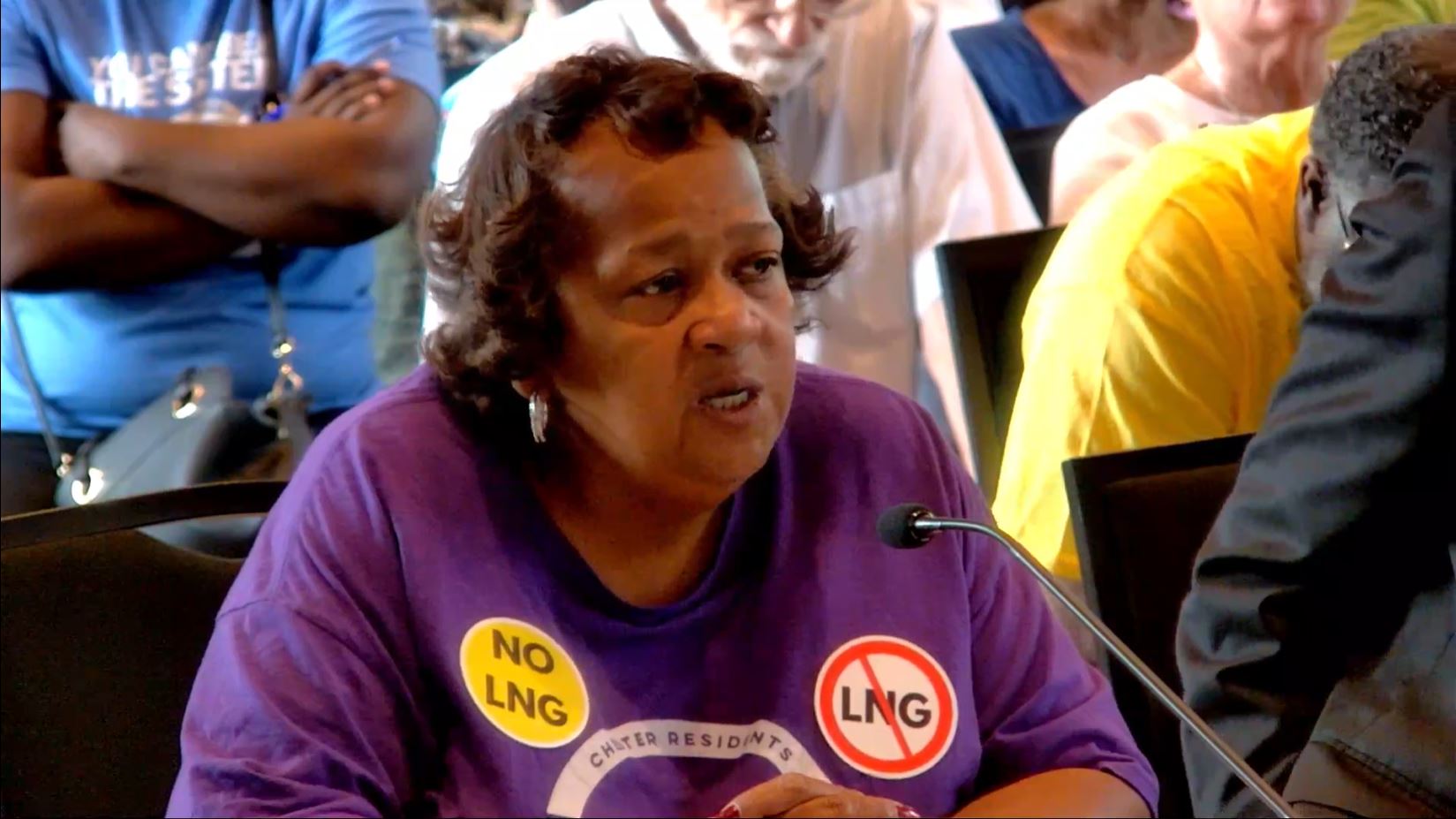
    Zulene Mayfield, an activist with Chester Residents Concerned for Quality Living, said older residents she knows have suffered heart conditions and cancers that she links to living in an already heavily industrialized area.

    Mayfield is a longtime opponent of the Delaware Valley Resource Recovery Facility owned by Reworld, formerly Covanta. The facility burns trash and converts it to energy.

    She said Chester, rimmed by heavy industry, lacks many things other communities take for granted, such as primary-care physicians or entertainment for children.

    “We are being told that we have to accept other industries” that no other communities want, Mayfield said.

    “I’m sitting here right now trying to contain my rage,” she said. “The jobs are temporary, but death is forever.”