Author: Frank Kummer

  • EPA will spend $2.5M in Camden to clean up site where giant dirt pile caused underground contamination

    EPA will spend $2.5M in Camden to clean up site where giant dirt pile caused underground contamination

    A 45-foot-high pile of illegally dumped construction fill that once marred Camden’s Bergen Square neighborhood was removed several years ago.

    But contamination still lurks beneath, including lead, arsenic, and PFAS — known as “forever chemicals.”

    Now, the U.S. Environmental Protection Agency has awarded a $2.5 million grant to excavate and clean up the 1.6-acre site by scooping out and disposing of a four-foot-deep layer of ground, now leveled with crushed stone.

    The grant was announced Thursday at a news conference with regional EPA administrator Michael Martucci, Camden Mayor Victor Carstarphen, U.S. Rep. Donald Norcross (D., N.J.), and other officials.

    “It’s a brownfield grant,” Martucci said, noting the money would be used to assess the site and clean it so it can be used for a productive purpose.

    “There’s underground contamination,” he said. “To return the site to beneficial reuse, we need to complete the environmental cleanup.”

    Martucci said the money would be awarded after Camden finds a developer for the site and submits plans for its new use.
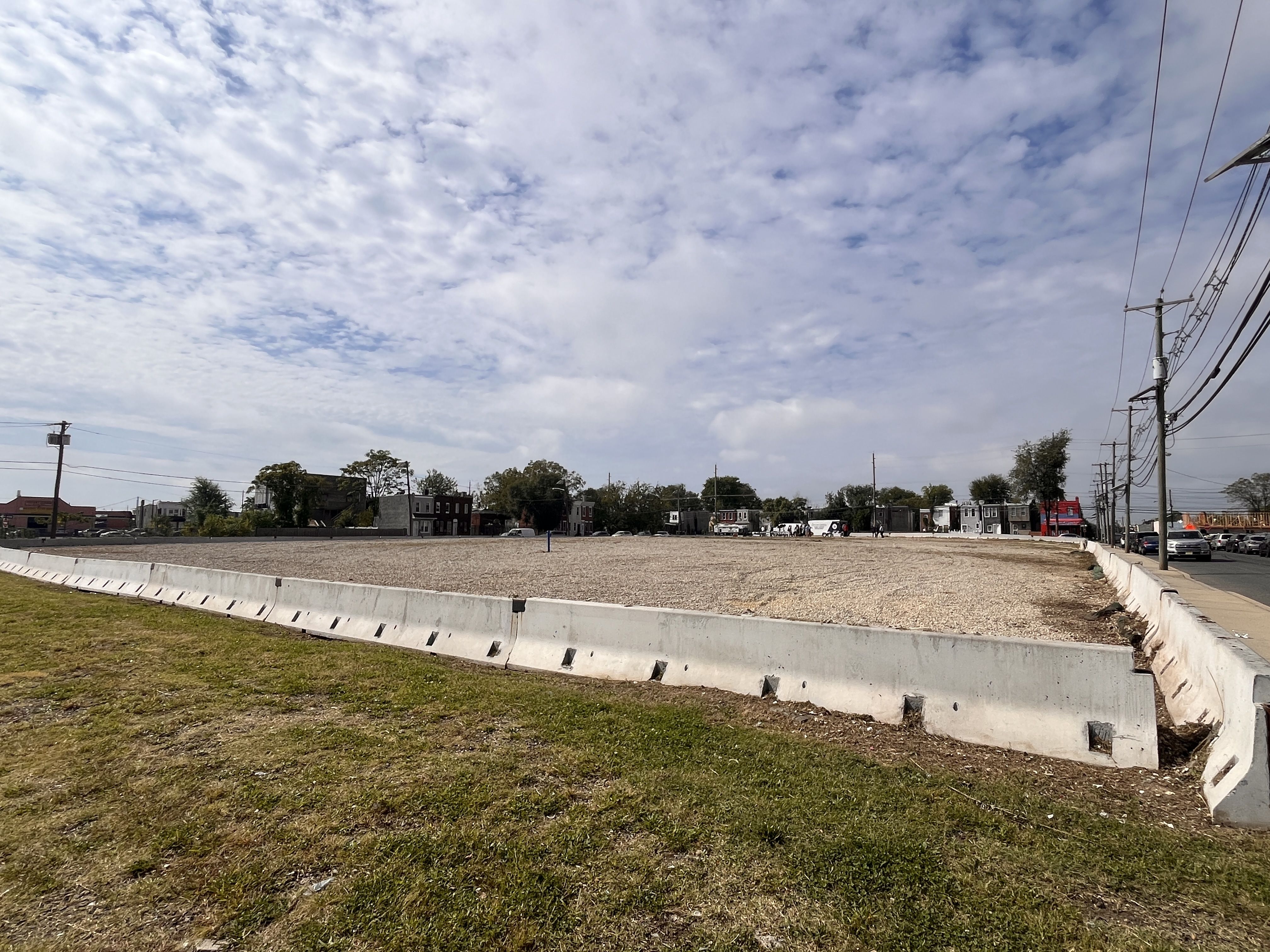
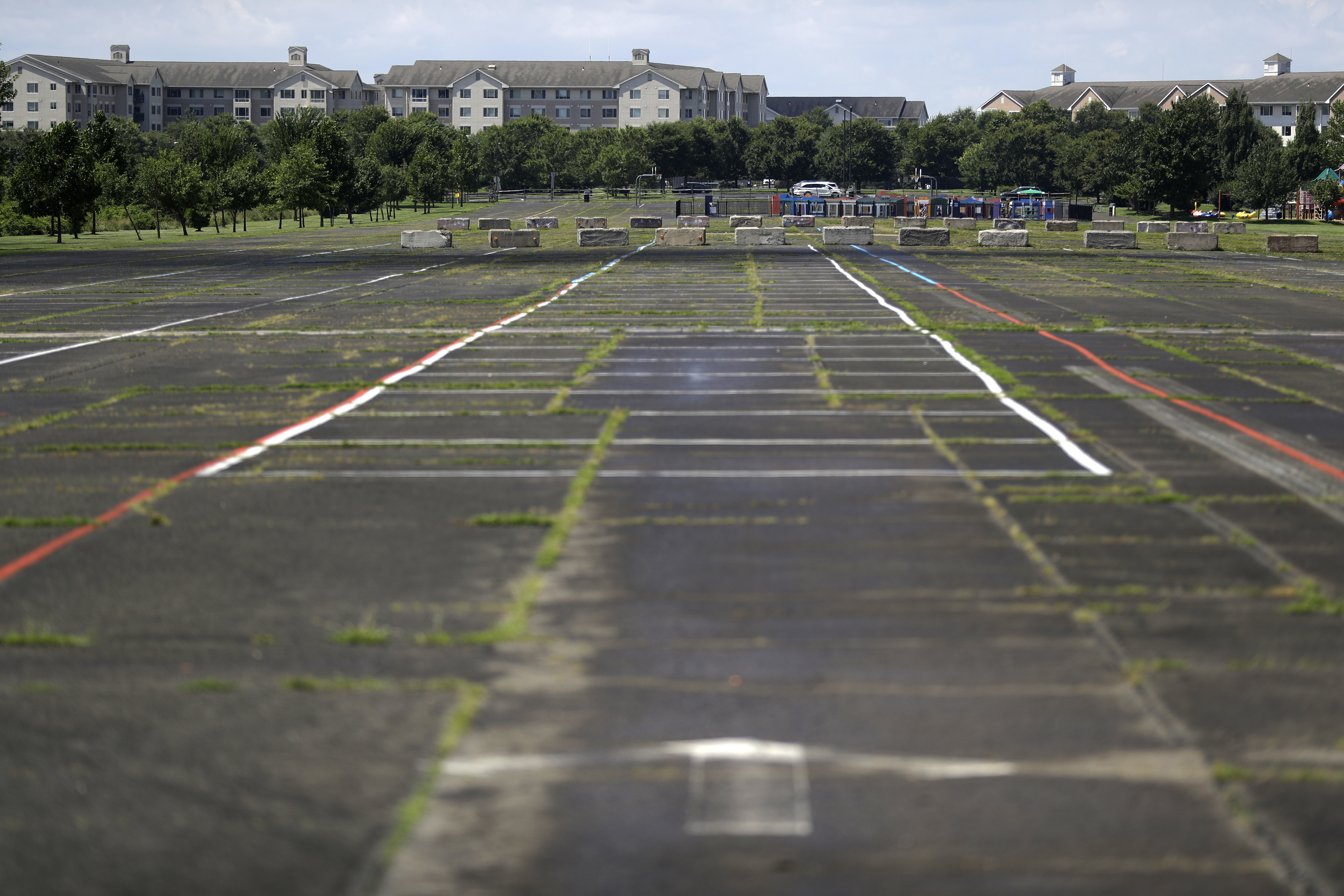
    The site of a former tower of dirt at 7th and Chestnut Streets in Camden, N.J. is now covered in crushed stone.Frank Kummer

    Hope for a neighborhood

    Carstarphen said the cleanup brings more hope to the blighted neighborhood.

    “This is a great day for our community,” Carstarphen said. “It’s been a long, long journey.”

    The pile, the result of years of dumping construction fill and other material at the site, grew so big that it loomed over a lone home on the 600 block of Chestnut Street.

    Covered with weeds, it towered above an intersection with debris, including tires and broken concrete. Some of the waste spilled onto city property.

    The pile was removed by the city in 2024. In all, crews removed 4,000 tons of solid waste, 100 tons of tires, and 15 drums.
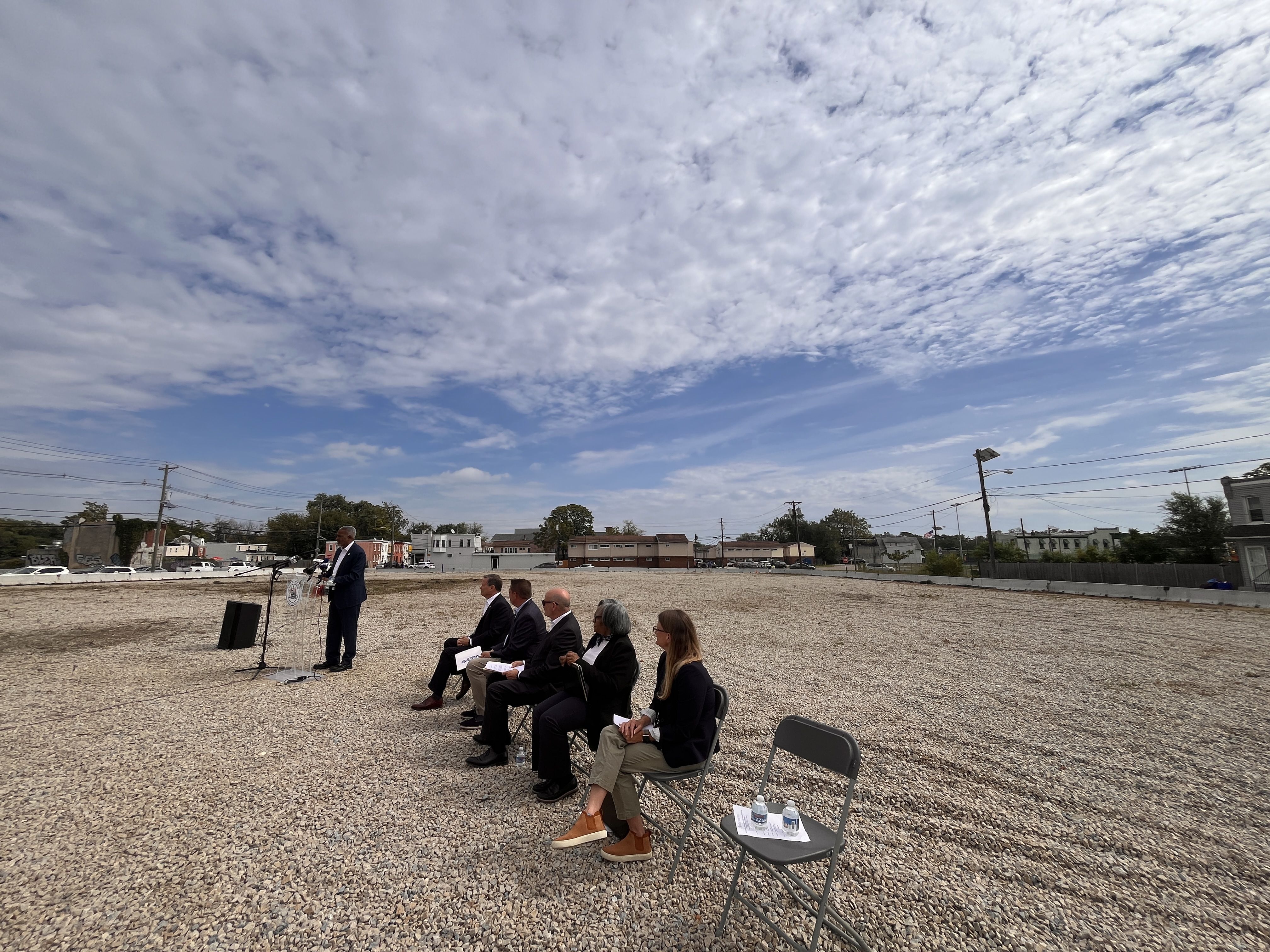
    Camden Mayor Victor Carstarphen speaks during a press conference about the cleanup of the site on Chestnut Street. Next to the mayor, from left, are U.S. Rep. Donald Norcross, U.S. Environmental Protection Agency regional administrator Michael Martucci, Camden County Commissioner Jeffrey Nash, Camden Redevelopment Agency executive director Olivette Simpson, and BRS Inc. engineer Jennifer Taylor.Frank Kummer

    Long a blight on Bergen Square

    The New Jersey Department of Environmental Protection sued one former owner and longtime operator of the site, S. Yaffa & Sons Inc.

    The 2021 suit alleged the company “unlawfully imported and stockpiled solid waste on their Camden property, including contaminated fill material, construction and demolition debris, and waste tires,” and resisted taking action after receiving numerous violation notices and an order to stop. The company sold the property in 2019, according to the suit.

    The suit also noted that Camden, with a “significant low-income and minority population,” has “been disproportionately exposed to high-polluting facilities.”

    The city shut down the site in April 2021 as an illegal dump.

    It entered into an agreement with multiple agencies in July 2022 to authorize action to take the land through foreclosure. In September 2022, officials seized the land, then owned by a contractor. Some of the land was on both sides of the street.

    Officials began removing the pile in 2023 and finished in June 2024, leaving a large open space that immediately changed the character of the neighborhood.
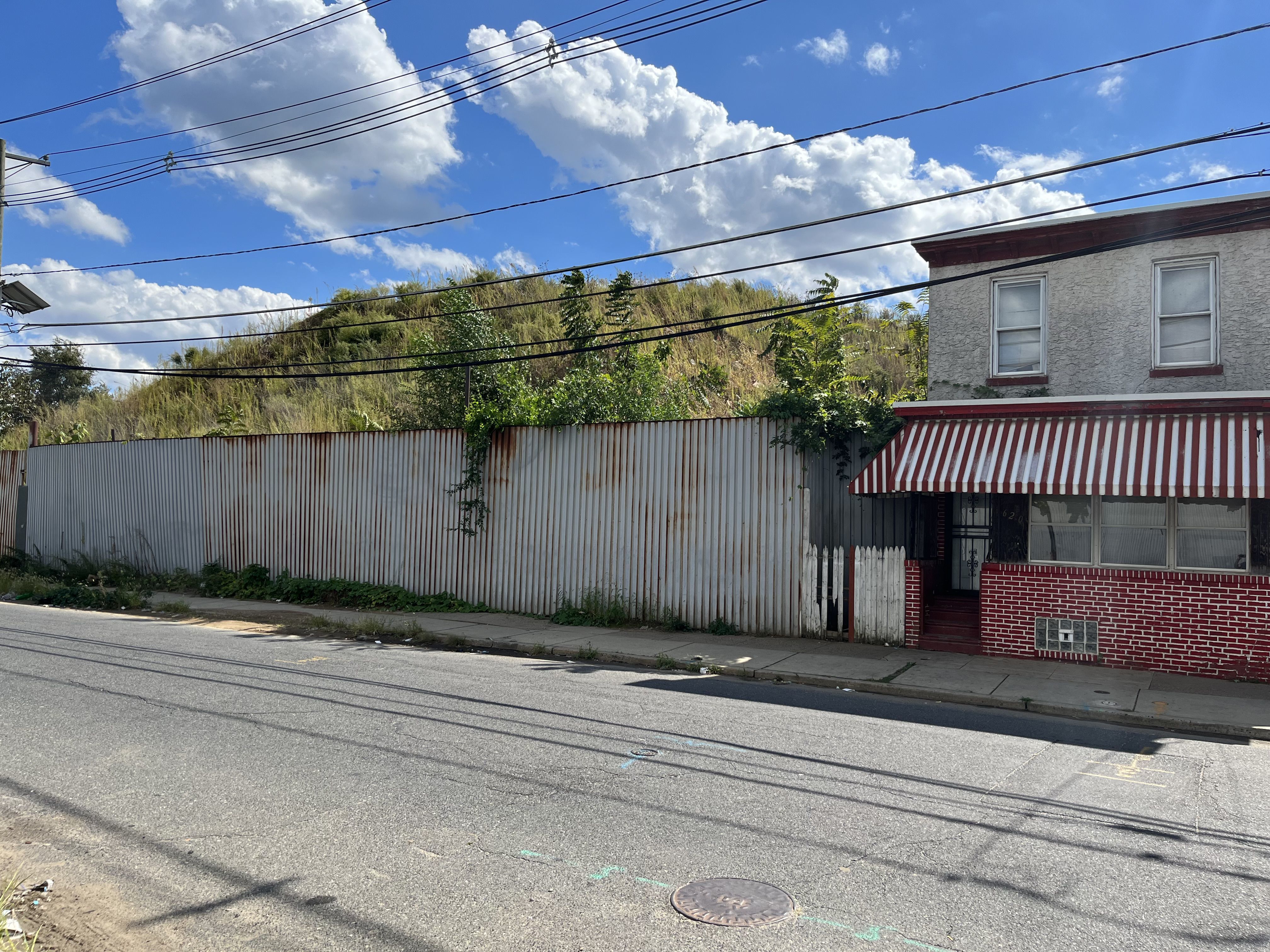
    File: When the dirt pile still stood next to a home on Chestnut Streets in Camden. Frank Kummer

    Next steps

    Olivett Simpson, executive director of the Camden Redevelopment Agency, said an estimated 11,800 tons of soil will be removed and the site will then be covered with clean soil.

    Camden is currently assessing what kind of redevelopment will work on the site, which is zoned for industrial and commercial buildings. Simpson said the city has already held meetings to engage the community on the site’s future, which will likely include retail and housing.

    Jennifer Taylor, an engineer with BRS Inc., a brownfield consulting firm, is working with the city to evaluate redevelopment opportunities and expects a plan to be adopted by the end of the year.

    The ground underneath must be made suitable for people to use the property, Taylor said.

    “We want the momentum of this site not to go away,” Taylor said.

    A new home was being built less than a block from the site as she spoke, something officials said would have been unlikely had the pile still stood.
  • Microplastic pollution found in 100% of Delaware River tributaries tested

    Microplastic pollution found in 100% of Delaware River tributaries tested

    Fleece fragments in a washer flow into a wastewater treatment plant. A plastic bag blows into a stream. A water bottle washes down a storm drain.

    All can end up in the region’s waterways as microplastics smaller than a grain of rice and find their way into drinking water and the stomachs of animals and fish.

    This kind of microplastic pollution was detected in 22 stream and river segments across the Delaware River watershed, according to a new survey of waterways by the nonprofit advocacy group PennEnvironment Research and Policy Center.

    Researchers analyzed water samples from sites along the Delaware River and its tributaries across Pennsylvania, New Jersey, Delaware, and New York.

    The research was conducted in partnership with the nonprofit Environment New Jersey Research and Policy Center. Scientists with the Academy of Natural Sciences at Drexel University helped analyze the results, which were released Wednesday during a news conference at Fairmount Water Works.

    Contamination was found in the Delaware and Lehigh Rivers and the Schuylkill. It was found in Neshaminy Creek in Bucks County, Brandywine Creek in Chester County, and Cooper River in Camden County. And it was found along the Christina River in Delaware.

    Drexel’s lab analysis confirmed microscopic plastic at every sampled site, highlighting what the researchers say is a widespread environmental threat.

    “We can look at a waterway, and it might be free of litter, it might be free of visible plastic pollution, but that doesn’t necessarily mean it’s clean,” said Faran Savitz, an advocate for PennEnvironment. “The big takeaway is that we should be concerned. The depth, the breadth of this plastic pollution is staggering.”

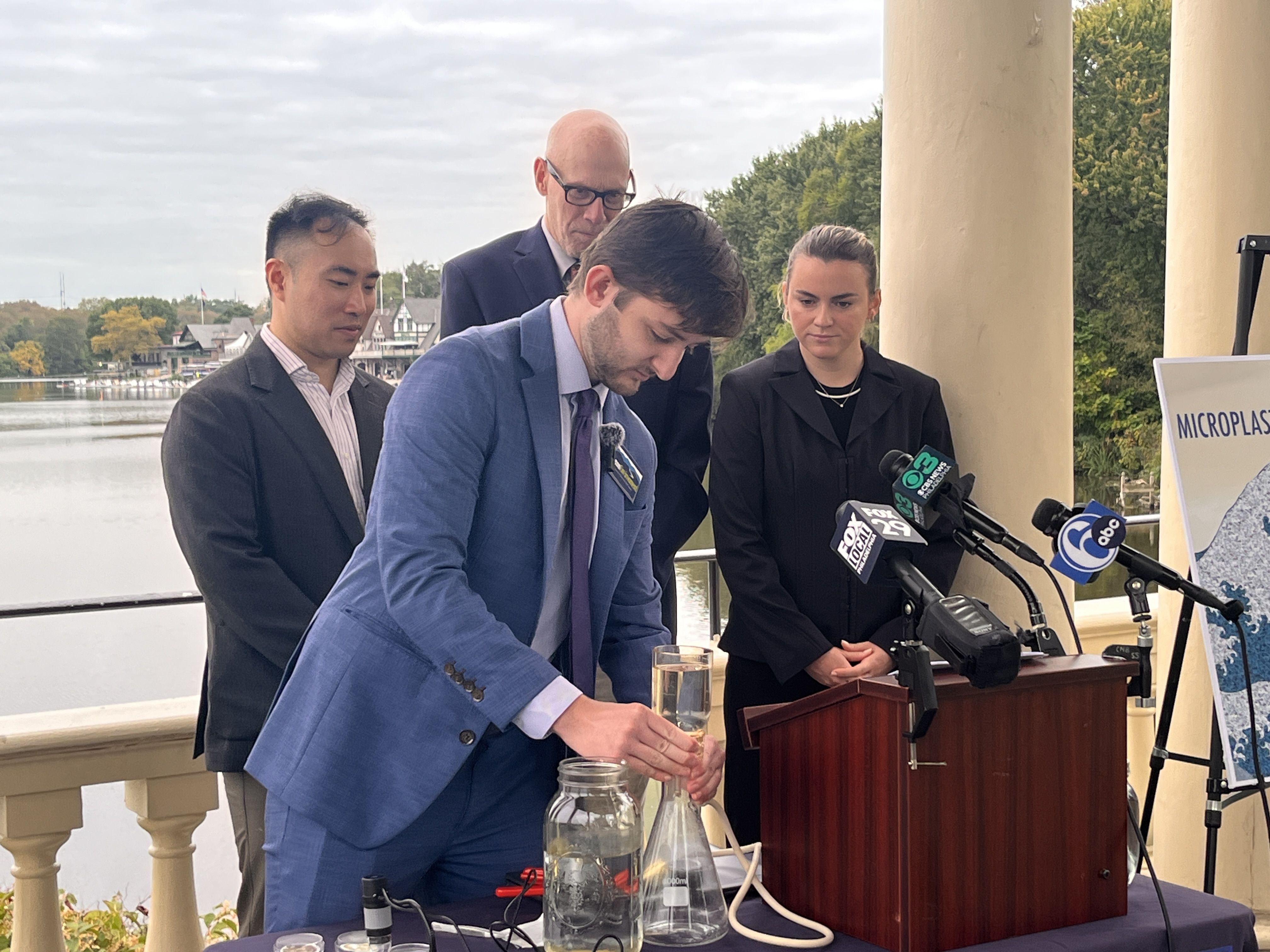
    Faran Savitz with PennEnvironment demonstrates water testing. In the background from right are: Lizzy Mulvenna, with Environment New Jersey Research & Policy Center; David Velinsky, senior scientist, Academy of Natural Sciences; and Derek Ho, microplastics researcher, University of Pennsylvania.Frank Kummer

    Where do microfibers come from?

    Waterways in and around Philadelphia emerged as significant focal points in the survey results.

    Samples drawn from the Delaware River in Philadelphia tested positive for multiple categories of microplastics including microfibers, microfragments, and microfilm, as did other waterways. Microbeads, often found in cosmetic products, were also found in the Christina River.

    Microplastics are defined as fragments of less than 5 mm in length.

    The synthetic microfibers came primarily from clothing and textiles. Rigid microfragments from items such as fishing line were found in 82% of locations. And flexible microfilm from bags and packaging appeared in 77%.

    (function(){function e(){window.addEventListener(`message`,function(e){if(e.data[`datawrapper-height`]!==void 0){var t=document.querySelectorAll(`iframe`);for(var n in e.data[`datawrapper-height`])for(var r=0,i;i=t[r];r++)if(i.contentWindow===e.source){var a=e.data[`datawrapper-height`][n]+`px`;i.style.height=a}}})}e()})();

    Microplastics have been found in humans

    Researchers explained that laundering synthetic garments releases millions of microfibers that wastewater treatment facilities are unable to completely filter out before they are discharged into local streams.

    However, because plastic does not biodegrade but continuously fractures into tiny fragments, filters capture only a portion of plastic entering a waterway.

    Savitz said PennEnvironment’s study did not release the concentrations of microplastics because it did not want to compare one waterway or state against another.

    The findings carry ecological and public health implications, as microplastics can block digestive tracts in wildlife and absorb toxic chemicals like PCBs and PFAS that bioaccumulate up the food chain, the report stated.

    On average, humans ingest approximately 5 grams of plastic weekly, which is roughly equivalent to the weight of a credit card. Microplastics have been found in human blood, lung tissue, and organs, the researchers said.

    Plastics are also routinely found in wildlife, including sea turtles, birds, and whales. About 60% of all seabirds have ingested plastic, with that number rising.

    The environmental advocates are urging state and local leaders to enact policies such as producer responsibility for plastic packaging, bans on single-use foam and plastic bags, strict limits on pre-production plastic pellets, and enhanced drinking water filtration systems.

    Microbeads once used in personal care products were phased out under President Barack Obama in 2015. But many of those products still linger on household shelves.

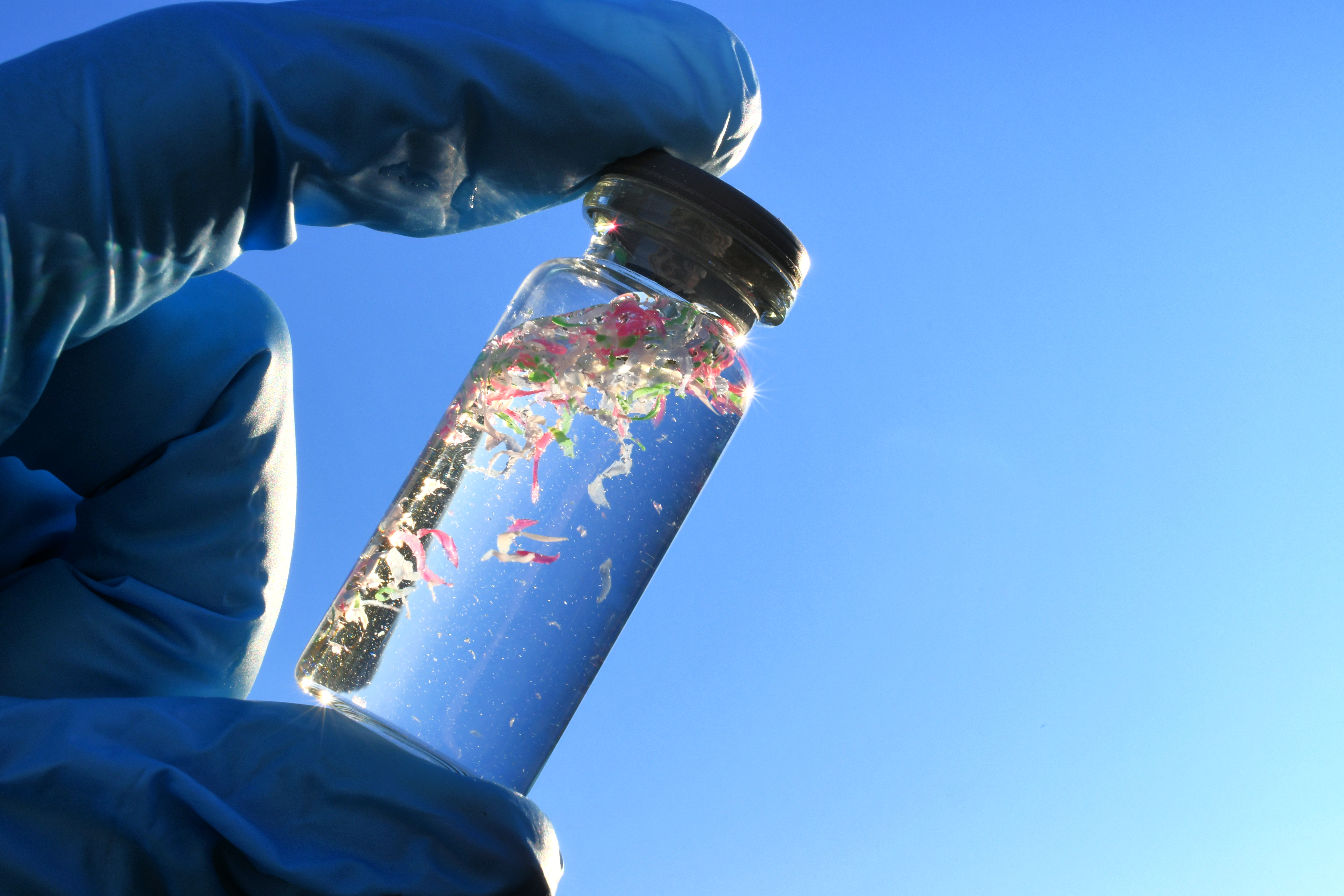
    File: A glass vial containing water and microplastic pollutionGetty Images

    Philadelphia’s drinking water

    Philadelphians get their drinking water from the Delaware River and the Schuylkill. Most microplastics are filtered out at the Philadelphia Water Department’s wastewater treatment plants, but some particles still get through.

    In 2025, PWD removed 4.6 tons of plastic litter from the Delaware and the Schuylkill, alongside an estimated 1,000 tons of plastic extracted through sewer maintenance, the researchers stated.

    PWD said in an online report that it is “unclear whether microplastics pose a danger to human health,” noting that the risk could depend on the level of exposure, the type of plastic, and the size of the particles.

    But it noted that research suggests some are harmful to fish and animals and can build up in the organs or bloodstream over time.

    “PWD is always investigating advanced treatment technologies that may eliminate microplastics and other impurities,” the report stated.

    David Velinsky, a senior scientist at the Academy of Natural Sciences of Drexel University, said, “plastics and microplastics are everywhere, from our clothing to the ubiquitous water bottle.”

    When plastics and microplastics are not properly disposed of or recycled, he said, they break down into ever smaller pieces.

    They “can travel great distances through both the air and in the water,” Velinsky noted.

    A plea for ‘producer responsibility’

    To combat pervasive plastics, advocates are urging federal and state lawmakers to enact targeted reforms, including the federal Plastic Pellet Free Waters Act currently before Congress, and state-level producer responsibility legislation for plastic packaging.

    Savitz emphasized that shifting financial and operational burdens back onto manufacturers is critical to curbing waste at its source.

    At least seven states have passed producer responsibility laws, though not all are in effect, according to the Product Stewardship Institute. Those states include Washington, Oregon, California, Colorado, Minnesota, Maryland, and Maine.

    “If we can shift the burden back onto companies that create this waste in the first place,” Savitz said, “we can actually reduce the waste, encourage recycling, and make these broader, more systemic changes.”

  • N.J. sues Trump administration over offshore wind cancellations, $1.4B for fossil fuel projects

    N.J. sues Trump administration over offshore wind cancellations, $1.4B for fossil fuel projects

    New Jersey joined a coalition of states suing the Trump administration over its attempts to cancel two big offshore wind leases and pay the companies $1.4 billion to develop fossil fuel projects instead.

    “This administration is paying developers to abandon building new sources of energy at a time when our grid needs more power to meet demand and residents need relief from high electricity prices,” New Jersey Attorney General Jennifer Davenport said in announcing the suit.

    New Jersey joined New York, Connecticut, Delaware, Maine, Massachusetts, Rhode Island, and Vermont in two suits filed Tuesday in U.S. District Courts in Maine and New York.

    The suits were filed by the states’ attorneys general against the U.S. Department of the Interior and the U.S. Department of Justice. The states claim that the settlements attempting to cancel two leases for major wind power projects offshore of New Jersey are illegal.

    The Trump administration is using a taxpayer-funded account meant to settle legal claims to pay for fossil fuel developments outside the states that had offshore wind projects planned, the suits state.

    Davenport said that Trump cannot redirect those funds simply “because he favors the fossil fuel industry.”

    At issue are offshore wind projects that were supposed to be built in the New York Bight, a section of ocean between Long Island and New Jersey, and projects that spanned other states.

    Ending leases

    The New York Bight, despite its name, is mostly off the New Jersey coast, stretching from Long Island to the Cape May inlet.

    The companies purchased the wind power leases in federal auctions held by the Bureau of Ocean Energy Management (BOEM) during the Biden administration. The BOEM manages any energy production in the Outer Continental Shelf several miles off the coast.

    Chicago-based Invenergy won thousands of acres of offshore wind leases through BOEM auctions in 2022 and 2024 in the New York Bight and the Gulf of Maine.

    It was part of what the Biden administration called the “nation’s highest-grossing competitive offshore energy lease sale in history.”

    The Invenergy leases were designed to produce around 5 gigawatts of electricity, enough to power about 2 million homes in New York, New Jersey, Maine, and Massachusetts.

    In New Jersey, the project was known as Leading Light Wind.

    In addition, Bluepoint Winds won a lease in 2022 in a project expected to generate 2.4 gigawatts of electricity, or enough to power about 1.5 million homes in New York and New Jersey.

    However, earlier this year, the Trump administration reached a settlement with Invenergy to end its offshore wind leases in exchange for $765 million in lease fee reimbursements, with the money going toward natural gas and geothermal projects.

    And it reached a settlement with Bluepoint Winds Holdings to invest up to $765 million into a U.S.-based liquefied natural gas facility. In return, the Department of the Interior said it would cancel the company’s offshore wind lease. Bluepoint Winds Holdings is jointly owned by OW North America LLC and Seaway Energy Holdings LP.

    The Department of the Interior sent a statement to The Inquirer on Tuesday saying that it does not comment on pending litigation.

    However, the statement said in reference to the lease cancellations that the “Department of War identified serious national security risks that demanded immediate attention — which critics conveniently ignore.”

    The statement called the agreements with Invenergy and Bluepoint “voluntary” and said they had been “reviewed and approved by the Department of Justice, underscoring that they went through the appropriate channels.”

    Davenport disputes the Trump administration’s claim that the contracts were canceled over national security issues, which she said have never been specified.

    “Any legitimate national security issues were already accounted for in the government’s original decision to award the leases and are routinely addressed through the federal permitting process that every offshore wind project must complete,” she said.

    The suits filed Tuesday ask the courts to strike down the settlements and restore the leases.

    The suits contend that the administration ignored federal procedure for canceling the leases, that it never held public hearings, that its actions were arbitrary and illegal, that it failed to complete an environmental-impact statement, and that money from the judgment fund cannot be used to pay the companies for their fossil fuel ventures.

    Unwinding offshore wind

    Separately, New Jersey and other states sued the Trump administration in June over cancellation of a $795 million offshore wind lease with Attentive Energy that also would have brought power to the state.

    The unwinding of New Jersey’s nascent offshore wind industry began rapidly when Trump took office in 2025 and began issuing executive orders that made exploring or building the renewable energy source untenable.

    Those included other big offshore wind projects such as those planned by Danish-run Orsted and Atlantic Shores, a partnership between Shell and EDF Renewables.

    On his first day in office, Trump issued a temporary ban on offshore wind, and within days he personally attacked New Jersey’s quest to build wind farms, calling it “a disaster” and saying he wanted the projects “dead and gone.”

  • PFAS exposure near Pa. military bases linked to high blood pressure, cholesterol. Researchers find cancer cluster.

    PFAS exposure near Pa. military bases linked to high blood pressure, cholesterol. Researchers find cancer cluster.

    A major study of PFAS-contaminated drinking water among people living near military bases in Bucks and Montgomery Counties shows associations with elevated cholesterol, increased blood pressure, and lower childhood development, according to preliminary findings.

    PFAS, or per- and polyfluoroalkyl substances, are a family of compounds known as forever chemicals because they resist breaking down in the environment and in the human body.

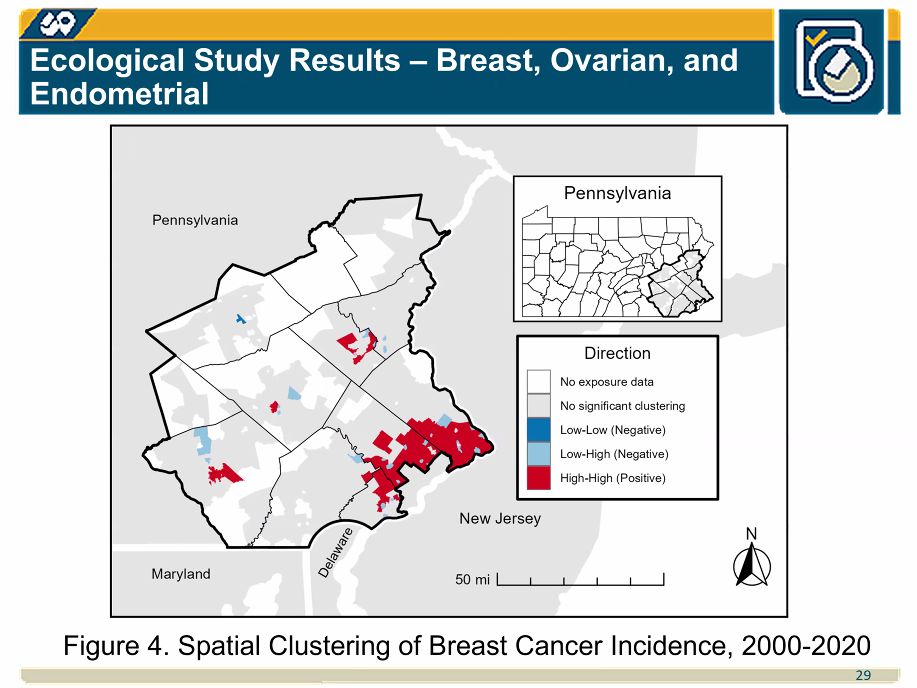
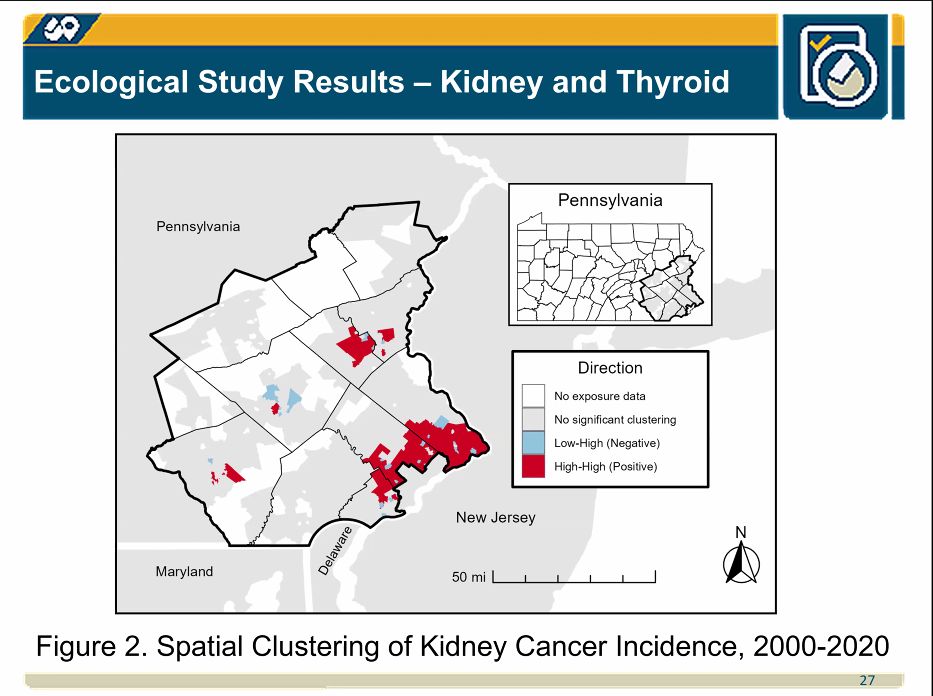
    A separate analysis showed cancer clusters in those communities, but more research is needed to determine whether there is a correlation between cancer rates and the water, the study’s investigators say.

    Lead researchers from RTI International and Temple University presented the findings Wednesday at Hatboro-Horsham High School during an event hosted by the Buxmont Coalition for Safer Water.

    The ongoing study, part of an effort by the federal Agency for Toxic Substances and Disease Registry and Centers for Disease Control and Prevention, examined PFAS exposure in Pennsylvania and seven other states: California, Colorado, Massachusetts, Michigan, New Hampshire, New Jersey, and New York. It included 5,826 adults and 710 children ages 4 to 17.

    Wednesday’s presentation focused on Pennsylvania, where researchers collected blood from residents in 11 townships in Bucks and Montgomery Counties who lived near military bases where firefighting foam contaminated local drinking water supplies for decades. About 180 people attended the meeting.

    “We have waited a long time for these study results to be released,” said Joanne Stanton, of the Buxmont Coalition for Safer Water, a grassroots organization formed after the PFAS contamination was first identified. “For the past 12 years, our community has carried an unimaginable heavy burden.”

    According to baseline testing, local participants had elevated concentrations of per- and polyfluoroalkyl substances (PFAS) in their blood. Levels of PFAS and associated compounds — PFOS, PFOA, PFHxS, and PFNA — exceeded national averages. Pennsylvania ranked second highest nationally among all study sites for PFOS and PFHxS.

    “These higher levels [of PFAS] are consistent with decades of exposure to firefighting foam used at the military bases,” said Linda Brown, the Pennsylvania study’s director from RTI International, an independent research institute.

    Impacts on blood pressure, immunity, cholesterol, IQ

    Brown said 1,251 adults and 89 children from Pennsylvania gave blood for the study.

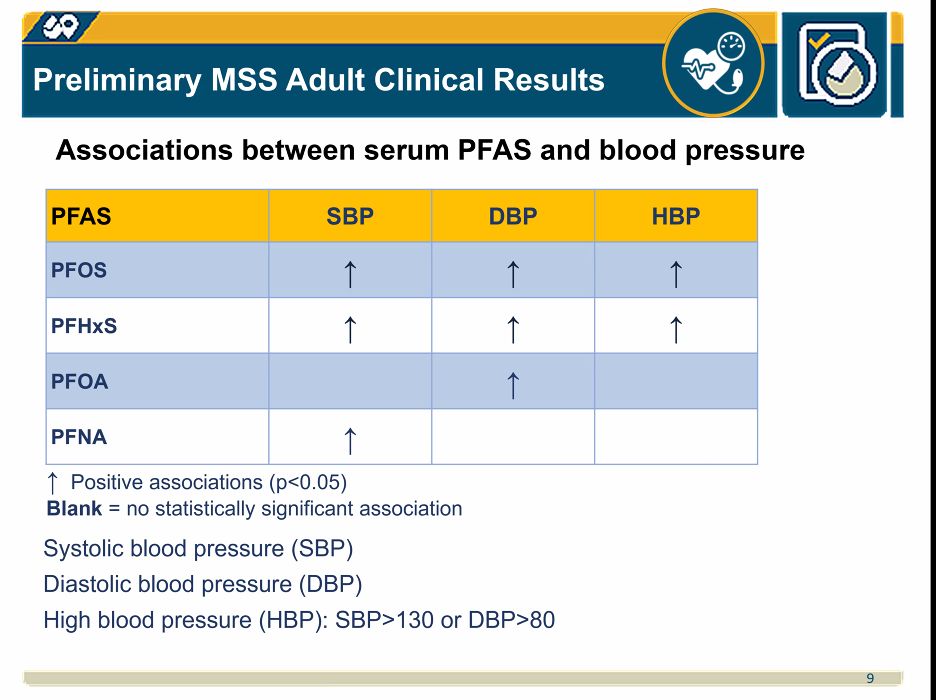
    “Adults with higher PFAS levels in their blood tended to have higher blood pressure,” she said.

    High blood pressure is a major risk factor for cardiovascular disease, she said.

    Graphic shows an increase in blood pressure and various PFAS compounds.Preliminary results federal multi-site study of exposure to PFAS

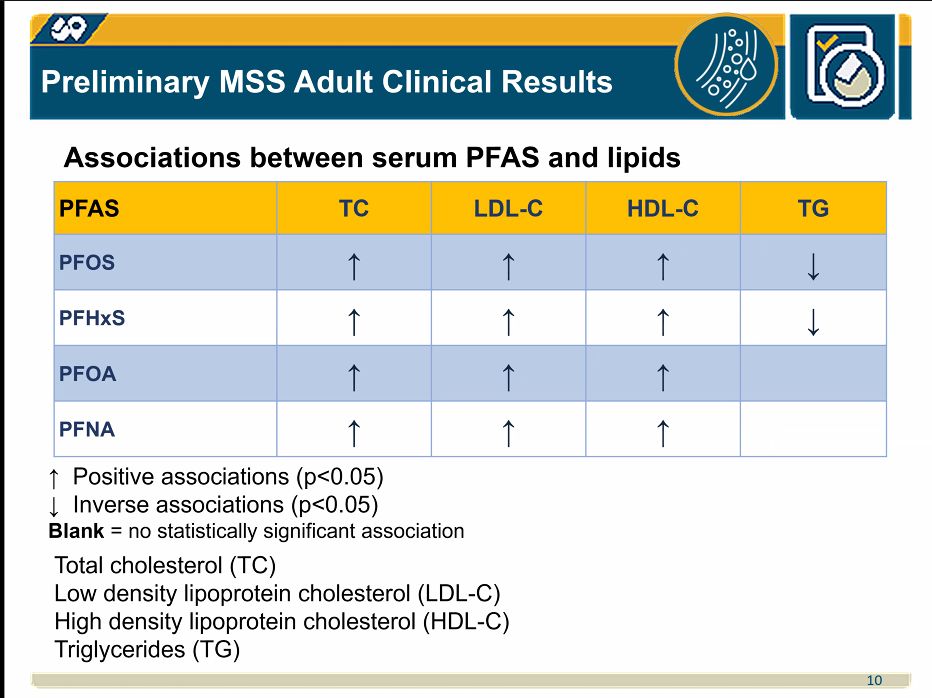
    Brown also said elevated PFAS levels were associated with higher cholesterol, including LDL, the so-called bad cholesterol. All four PFAS compounds were associated with higher cholesterol in both adults and children.

    She said, however, that preliminary results did not find a clear pattern linking PFOS levels with heart disease, diabetes, thyroid disease, or obesity.

    Graphic shows an increase in cholesterol among adults and various PFAS compounds. Cholesterol in children also showed a rise.Preliminary results federal multi-site study of exposure to PFAS

    Overall, children with higher PFAS levels had lower levels of certain antibodies that help the body fight infection, she said. The findings suggest PFAS may affect the immune responses, including the response to vaccines. But the findings do not tell researchers whether any individual child’s vaccines were less effective.

    Higher levels of exposure to PFAS during pregnancy and early childhood also showed patterns of lower abilities of language, reasoning, and cognition. But she cautioned that the patterns cannot tell parents how PFAS may have affected their own child.

    Chart shows an association between a decrease in language, IQ, and reasoning and PFAS exposure.Preliminary results federal multi-site study of exposure to PFAS

    Cancer clusters

    The study had too few cases of individual cancer types to complete a statistical analysis from the blood samples given. Cancer is not part of the original study.

    To fill the gap, Temple researcher Resa Jones said, the group used a grant from Pennsylvania to separately look at overall cancer cases in 12 counties.

    Chart shows clusters of breast, ovarian, and endometrial cancers in Montgomery and Bucks counties in Southeastern Pennsylvania.Preliminary results federal multi-site study of exposure to PFAS

    Jones said researchers pulled data from the state’s cancer registry to find the rate per 100,000 people. Mapping showed geographical clusters of elevated kidney, thyroid, breast, endometrial, and ovarian cancer incidence in Bucks and Montgomery Counties.

    “We definitely have spatial clustering of the cancers,” Jones said of the two counties.

    In municipalities with the highest totals of breast cancer, half had PFAS levels above minimum reporting levels for drinking water, Jones said.

    But Jones stressed that more research is needed and that the results are preliminary.

    Chart shows kidney cancer clusters in Montgomery and Bucks counties in Southeastern Pa.Preliminary results federal multi-site study of exposure to PFAS

    Kidney function

    In addition, Robin Taylor Wilson, another investigator from Temple, said longer exposure to PFAS was also associated with lower kidney filtration rates and chronic kidney disease.

    The study highlighted heightened renal vulnerability among specific subpopulations, reporting that older residents, individuals with a history of blood transfusions or thyroid disorders, and cancer survivors faced significantly higher risks of chronic kidney disease.

    Hope Grosse, of the Buxmont Coalition for Safer Water, said the release of preliminary results of the study gives future researchers a solid foundation for further study into PFAS.

    “While these study results cannot undo the damage or bring back what we have lost, we hope that they are the beginning of the answers that we deserve,” Grosse said.

  • Camden is using police-operated drones to crack down on illegal dumping

    Camden is using police-operated drones to crack down on illegal dumping

    The Camden Department of Public Works spends about $4.5 million annually to clean up illegal dumping.

    City officials say the disrespect shown by landlords, outsiders, and even residents is just as problematic as the use of taxpayer money.

    “These bad actors who dump illegally simply don’t care about our city,” Mayor Victor Carstarphen said. “So we’re trying to hit them where it counts. We’re hitting them in their pockets.”

    Carstarphen, along with city and county officials, outlined a strategy on Wednesday to tackle the problem and released detailed photos and videos showing those who have been charged with dumping.

    They say an aggressive push to combat widespread blight and improve neighborhood quality will use a combination of stepped-up enforcement, drones, high-tech camera networks, and steep penalties.

    Violators face fines of up to $10,000.

    In addition, officials are offering a $1,000 reward for residents who provide information, such as video from doorbell cameras, that leads to a violator being caught.

    Camden City Mayor Victor Carstarphen address the illegal dumping problem in the city during a press conference Sept. 9, 2026.Frank Kummer

    A widespread problem

    Carstarphen said the problem is widespread and the dumping comes from contractors and landlords who live outside the city, as well as within.

    Camden County Police Department Capt. Gordon Harvey gave a presentation detailing those who have been charged.

    Most are from Camden or nearby communities such as Pennsauken, Cherry Hill, Pine Hill, Mount Laurel, and Maple Shade. But people from Bernville, Pa., Ashburn, Va., and Union, N.J., have also been charged.

    So far this year, the Camden County Police Department has pursued 68 illegal dumping incidents — about the same as in all of 2025.

    In 2026, 27 people have been charged in 31 incidents.

    About 40% of the illegal dumping activity has been located in the Waterfront South neighborhood.

    Harvey said other neighborhoods, such as Bergen Square, Fairview, and Beideman, all have been hit.

    Educating the community about the problem is key, he said.

    “We need you to help us. We need you to report these incidents,” Harvey said in a direct plea to residents. “Tell us when they’re happening, where they’re happening.”

    Officials say residents can report dumping anonymously through the STOPit mobile phone app.

    Harvey showed videos of people brazenly pulling up in vehicles to dump in parks, streets, alleys, and secluded areas. Materials ranged from construction waste to bags of household waste.

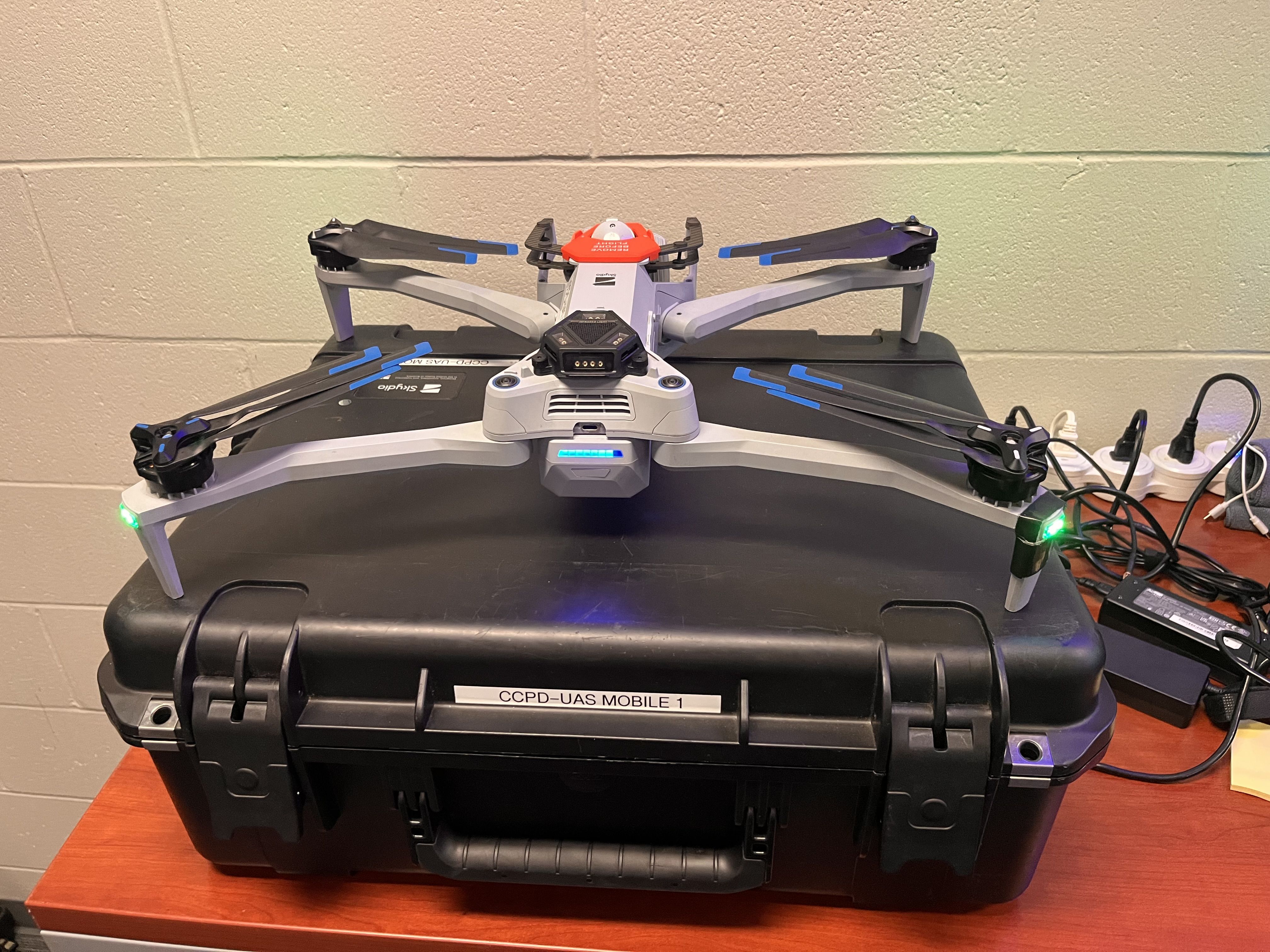
    Camden County police are using drone such as this to help identify illegal dumping and track the dumpers.Frank Kummer

    ‘Eye in the sky’

    Some people have been charged the same day they dumped waste because they were caught by police-controlled drones owned by the county, or by the city’s “eye in the sky” network of video cameras.

    The network provides “1,000 unique views within the City of Camden,” Harvey said.

    Most cameras are fixed, but the city has five mobile cameras dedicated to identifying illegal dumping. They can be moved to a hot spot in less than an hour.

    In addition, the police department has two full-time drone pilots, though they scan the city for many other issues beyond dumping. Five drones are stationed on rooftops throughout Camden, and all can reach a site in minutes.

    City Public Works Director Keith Walker said the city has spent $3.2 million on new equipment that can be used to tackle illegal dumping. That includes five compact waste-collection trucks, a large front-end loader, and a range of dump trucks.

    Equipment and cleanup costs divert funds from community parks, playground equipment, and youth programming, he said.

    “We spend most of our time dealing with the new dumping, and it cuts into our budget,” Walker said.

    Officials say they hold community cleanups and clean out dumps, only to find the areas blighted again within days.

    “Enough is enough,” said Angel Fuentes, Camden City Council president. “We won’t tolerate this type of behavior.”

    Editor’s note: This story has been updated to correctly attribute a quote.

  • Sea rise prompts Stone Harbor’s Wetlands Institute to move temporarily with plans for a new building

    Sea rise prompts Stone Harbor’s Wetlands Institute to move temporarily with plans for a new building

    The Wetlands Institute in Stone Harbor, N.J., has been a research and education stalwart for decades, instructing thousands of visitors annually on the importance of salt marshes and the marine world.

    Starting this week, though, the nonprofit’s staff will pack up and move to a temporary headquarters, so its main trail can be raised to stave off sea-level rise.

    The existing headquarters will ultimately be razed, with a new, elevated building rising in its place. The current wooden headquarters was built in 1972 and was originally intended for short-term seasonal use.

    Sea level “is rising fast enough that it’s outpacing the ability of the marshes to keep up,” said Lenore Tedesco, executive director of the Wetlands Institute. “They’re starting to drown.”

    “You can see that even right at the institute, where there are more open-water pockets and mud flats, instead of the grasses,” she added.

    Much of the institute’s 34-acre campus sits on low marsh and has become increasingly at risk due to flooding.

    In 2000, the Salt Marsh Trail flooded twice a year. Now, it is flooding up to 70 times a year, Tedesco said.

    For now, staff will move from the Stone Harbor Boulevard location to the New Jersey Coastal Conservation Center on North Delsea Drive in Cape May Court House.

    All programs have been paused as of Tuesday, but the Wetlands Institute will reopen Nov. 7 at the temporary location.

    The Wetlands Institute in Stone Harbor plans to raze its existing building and replace it with a larger, more resilient, expansive structure big enough to house growing levels of research, conservation, and education. This is a rendering of the back of the structure.The Wetlands Institute

    Salt Marsh Trail

    Most of the 31,000 annual visitors to the Wetlands Institute walk the quarter-mile Salt Marsh Trail looking at the bountiful birds and wildlife.

    About half of it and the surrounding ecosystem will be considered unstable low marsh by 2030 if nothing is done. The surrounding marsh sits at about two feet of elevation, while the Salt Marsh Trail, built on an old 1950s road, ranges from three to four feet.

    Tedesco said dredge material from Avalon will be spread on the trail to raise it and surrounding land to create a new high marsh. It will have more vegetation to help buttress the area from storm-driven waves and provide habitat for diamondback terrapins and at-risk coastal birds.

    Tedesco expects trail work to start in October. It will be paid for through a $3 million grant from New Jersey’s Regional Greenhouse Gas Initiative Natural Climate Solutions program.

    The work will not affect the existing elevated metal boardwalk, which will remain as is.

    The institute undertook a similar project last year with state and federal officials to save the adjacent Scotch Bonnet Island, which was drowning.

    About five acres of Scotch Bonnet Island was raised with dredge material to keep it above rising seas.

    The island is situated in Scotch Bonnet Channel, a waterway that cuts through the bay to connect the barrier island to the mainland. The channel has widened by 70 feet since 1970.

    Scientists say sea-level rise in New Jersey is running at twice the global average. They estimate the sea could rise 2 to 5 feet along the coast by 2100.

    New Jersey has 200,000 acres of tidal wetlands, valuable habitat used by shore birds and other wildlife. The Wetlands Institute abuts those tidal wetlands.

    Tedesco said the lessons learned on Scotch Bonnet Island are being used to reimagine the institute’s campus.

    Construction on the Salt Marsh Trail is expected to continue through spring before sensitive wildlife returns.

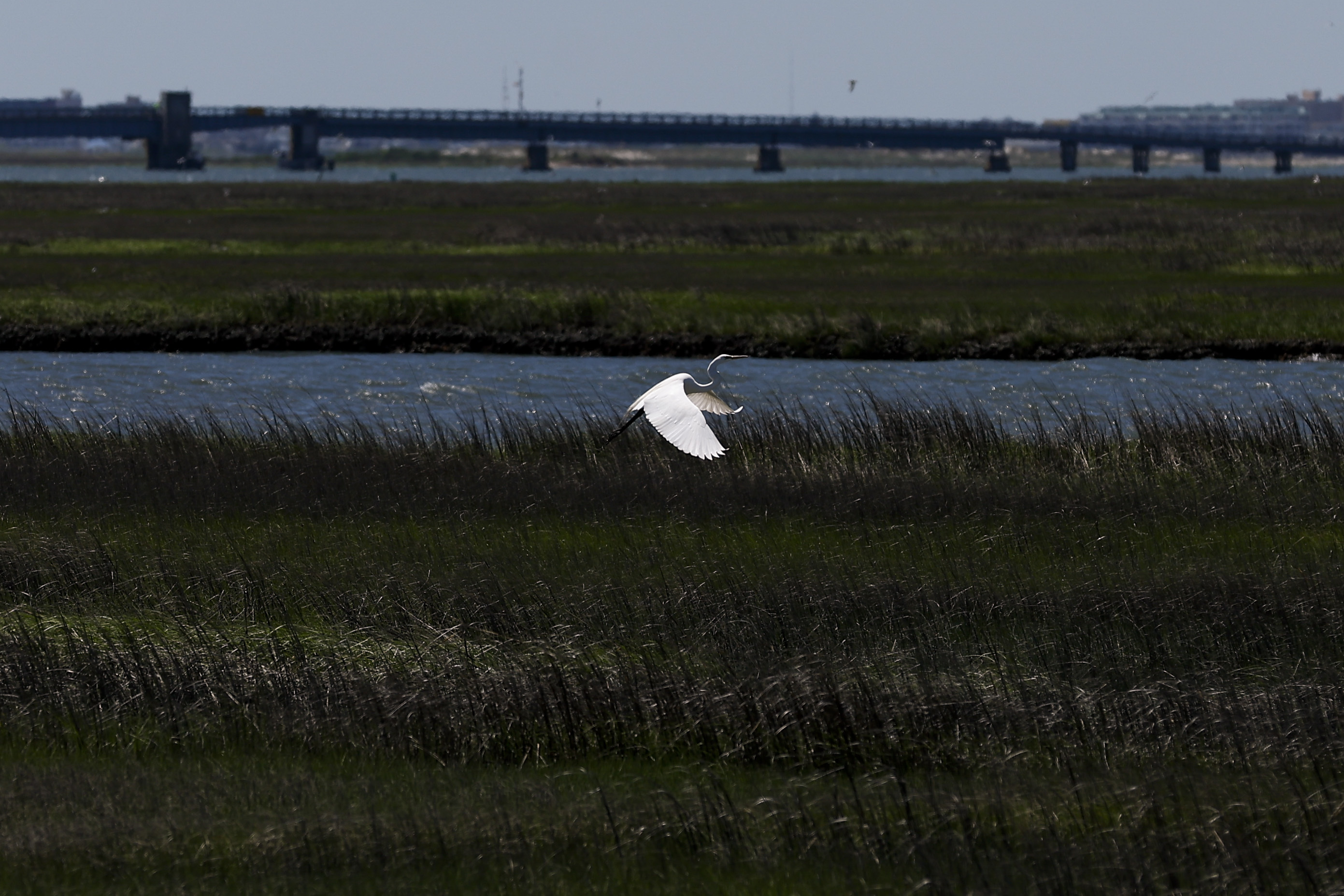
    File: A snowy egret flies over the salt marsh at the Wetlands Institute in Stone Harbor where dredged material was used to raise the height of the marsh at Scotch Bonnet Island.Monica Herndon / Staff Photographer

    A new building

    Tedesco said architects and engineers are working with the institute’s board of trustees on a proposed new building.

    Those plans call for both the building and grounds to be elevated, while maintaining the “coastal character” of the current institute.

    She said federal, state, and local permits are needed given the sensitive area.

    The Wetlands Institute is getting construction bids for the new building but does not have a final estimated cost or timeline. Tedesco said the institute is still raising money.

    The new headquarters would be built using sustainable methods, such as mass timber construction that uses engineered wood panels, columns, or beams.

    The facility would have more indoor and outdoor classroom space for educational programs, a new lecture hall, modern labs with twice the space, outdoor decks, an aquarium enlarged by 50%, and new exhibits.

    Tedesco said the institute worked with experts to explore keeping the existing building, which was designed by Malcolm Wells, a mid-20th-century designer famed for his “gentle architecture.”

    The structure was used as a biological research station by Lehigh University from 1972 to 1986. It has been expanded multiple times over decades.

    Tedesco said it became clear that it is not feasible to continue using the building because it is so outdated and cannot be raised. She said the institute has expanded into “world-class” research and the facilities are at capacity.

    “We’re in a 55-year-old wooden building in the marsh that was built to residential standards for seasonal use,” Tedesco said. “But you have to give kudos to the building. Nobody expected that a wooden building in a marsh in 1972 would still be functional today.”

  • Pa. is the only state to split fish and wildlife management. Combining could save $34 million a year.

    Pa. is the only state to split fish and wildlife management. Combining could save $34 million a year.

    Pennsylvania is the only state that splits fish and wildlife management across two separate agencies, totaling a combined 1,298 employees — well above the number in similar states.

    Perhaps more dire, the Fish and Boat Commission (PFBC) and Game Commission are expected to see hundreds of millions in reserves drastically reduced within a decade as the number of hunters and anglers continues to decline, according to a new report dated Aug. 31.

    The state could save $34 million annually by combining duplicative operations, the report says.

    The PFBC and Game Commission contracted the Wildlife Management Institute to conduct the independent study in search of efficiencies and collaboration.

    A statement by PFBC said the institute dug into the operations of both commissions, examined finances, looked at physical assets and demographics, and considered employee feedback.

    The institute then compared the data against other state fish and wildlife agencies before making recommendations.

    In a statement, PFBC said this week that the recommendations are only that, and not mandates.

    “The decision on whether to combine the agencies will require detailed analysis of additional factors that are unique to Pennsylvania, as well as potential action by the Pennsylvania General Assembly,” the statement said.

    Pennsylvania Rep. Anita Astorino Kulik, who chairs the House Game and Fisheries Committee, could not be reached for comment.

    The numbers behind the decline

    The report warns that the current way of doing things is unsustainable because the base of both commissions is eroding. Both agencies depend on fees and licenses to hunt, fish, and boat on state game lands and waterways.

    Since 2009, the number of hunters seeking licenses has fallen by 100,000, and it appears little growth is on the horizon. There are significantly fewer license sales to hunters aged 21-37 compared with those aged 49-65.

    The Game Commission projects hunting licenses will decline by 0.8% per year over the next decade.

    Much of the revenue decline stems from the shrinking base of hunters who typically pay full price. Hunters 65 and older pay once for lifetime licenses that require no more payments.

    The loss is similar among anglers. Fishing license sales saw a big spike during the COVID-19 pandemic from 2020 to 2021. But sales have declined steadily since. Many of those buying licenses are also older and transitioning to senior lifetime brackets.

    The report says that nearly one-fifth of active registered anglers held senior lifetime fishing licenses by 2023.

    A senior hunter pays $52 for a lifetime license and an angler pays $85. Seniors also have an option of paying $102 for a lifetime license for both.

    Those licenses return only a small fraction of revenue generated by a standard adult license. Meanwhile, operating costs continue to rise.

    As a result, rising costs at both commissions are projected to outpace revenues within a decade.

    What’s in the report?

    Steve Smith, executive director of the Game Commission, noted in a statement that the report does not call for the two agencies to be completely merged.

    “The Pennsylvania Game Commission takes its fiscal responsibility seriously, and that includes being good stewards of every dollar entrusted to us,” Smith said. “In part, that is why we chose to do this study now, when the commission is in solid financial standing.”

    He also noted that the study does not recommend immediate action.

    The Game Commission has a sizable $504 million cushion, and revenues are expected to grow a bit. However, the report said annual expenditures will soon outstrip that. As a result, the Game Commission is on course to use 95% of those funds by 2034.

    Meanwhile, PFBC is projected to exhaust its $145.8 million in reserves within the same time frame.

    The institute recommends consolidating some operations, which would reduce the number of employees by 17%, saving about $34 million annually.

    How would it save money?

    The study looked at staffing and physical assets at five states comparable in size with similar geographic and ecological profiles: Michigan, Minnesota, New York, Ohio, and Wisconsin.

    The authors say the biggest savings to Pennsylvania would come from unifying the law enforcement branches of each commission. Currently, the combined law enforcement workforce totals 337 sworn officers, surpassing those of comparable states.

    The Fish and Boat Commission’s waterways conservation officers enforce fishing, boating, and environmental laws and regulations by patrolling streams, rivers, and lakes on foot, in vehicles, and on boats.

    The Game Commission’s wardens patrol state game lands. They investigate poaching, illegal shooting, and trapping violations.

    Bringing the number of officers down to 222 would streamline the number of supervisors and enhance field coverage during peak seasons, the report found.

    It also recommends reduction of overlapping administrative positions, including top supervisors, legal counsel, human resources, and engineering.

    The number of buildings could also be reduced. The Game Commission has 74 field offices, compared with an average of 29 in other states. Sharing facilities would cut utility and maintenance costs.

    However, such changes would likely require legislation by the Assembly. There is currently no bill proposed, but combing operations could be tricky given that hunters and anglers have long had their own views of what the state should prioritize.

    Pennsylvania has a sprawling network of state game lands covering 1.55 million acres of public land popular with hunters and anglers. And it has 86,000 miles of flowing waterways popular with anglers and boaters.

  • ‘Obsolete’ 225-foot-long dam at Tyler State Park in Bucks County will be removed

    ‘Obsolete’ 225-foot-long dam at Tyler State Park in Bucks County will be removed

    A curved dam at Tyler State Park in Bucks County well known to anglers and hikers is coming down.

    Pennsylvania officials will begin removing the Spring Garden Mill Dam, which is 225 feet wide and 9 feet tall, on Sept. 8.

    It will be the second-largest dam ever removed in Pennsylvania. The largest, the Oakland Dam in Susquehanna County, was torn out in 2023.

    The Spring Garden Mill Dam, which spans Neshaminy Creek, no longer serves a purpose, impedes fish, and could present a danger because it can create a powerful current at its base, officials say.

    The Spring Garden Mill, once powered by the dam, still stands in the park near where Route 332 crosses Neshaminy Creek but now houses a community theater.

    The dam’s removal, which has been planned since at least 2023, is expected to take several weeks and is overseen by the state Department of Conservation and Natural Resources (DCNR) and the Fish and Boat Commission (PFBC).

    The Neshaminy Weir Dam near the Boathouse and main parking lot at Tyler State Park will remain.

    (function(){function e(){window.addEventListener(`message`,function(e){if(e.data[`datawrapper-height`]!==void 0){var t=document.querySelectorAll(`iframe`);for(var n in e.data[`datawrapper-height`])for(var r=0,i;i=t[r];r++)if(i.contentWindow===e.source){var a=e.data[`datawrapper-height`][n]+`px`;i.style.height=a}}})}e()})();

    Mike Parker, a spokesperson for PFBC, said dams are being removed across the state to reduce impediments in rivers and to increase public safety.

    “In many cases there was once a function to a dam, whether it was used to impound water, power a mill for stone milling of grain,” Parker said. “But those functions became obsolete.”

    Parker said the budget for the dam’s removal is $1.3 million and is being funded by $750,000 from the National Fish and Wildlife Foundation and $550,000 from the DCNR.

    Officials say that the park, including the popular Fisherman’s parking lot, will remain open during the removal. But a section of trail along Tyler Park Drive near the dam will be temporarily closed.

    PFBC will temporarily remove and relocate red‑bellied turtles, which are classified as a threatened and endangered species, from the work zone.

    Parker said the dam’s removal will increase safety.

    He said that the low-head dam can create a dangerous condition for paddlers and anglers by creating a “boil” at its base. Boils can cause powerful churning currents sometimes referred to as the “washing machine effect” that traps people under water.

    The removal will also aid fish moving through Neshaminy Creek, Parker said.

    The creek is popular with anglers, but the state Department of Environmental Protection (DEP) issued an advisory in 2021 against eating fish from it because of PFAS contamination. As a result, it is no longer stocked.

    Further, officials say the dam does not provide any flood control.

    Tyler State Park spans 1,711 acres with its main entrance in Newtown, about 33 miles north of Center City. Its steep grade is known for its trails and a covered bridge. It is divided by Neshaminy Creek.

    On Memorial Day weekend in May 2025, Alec Campbell, a 38-year-old park resource ranger, was trying to place a buoy in the water when his kayak flipped near the Weir Dam at the park following powerful rains. His body was recovered after several days of search.

  • Some Freedom Fuel stations have been able to sell gas cheaply because some fuel wasn’t paid for, a lawsuit claims

    Some Freedom Fuel stations have been able to sell gas cheaply because some fuel wasn’t paid for, a lawsuit claims

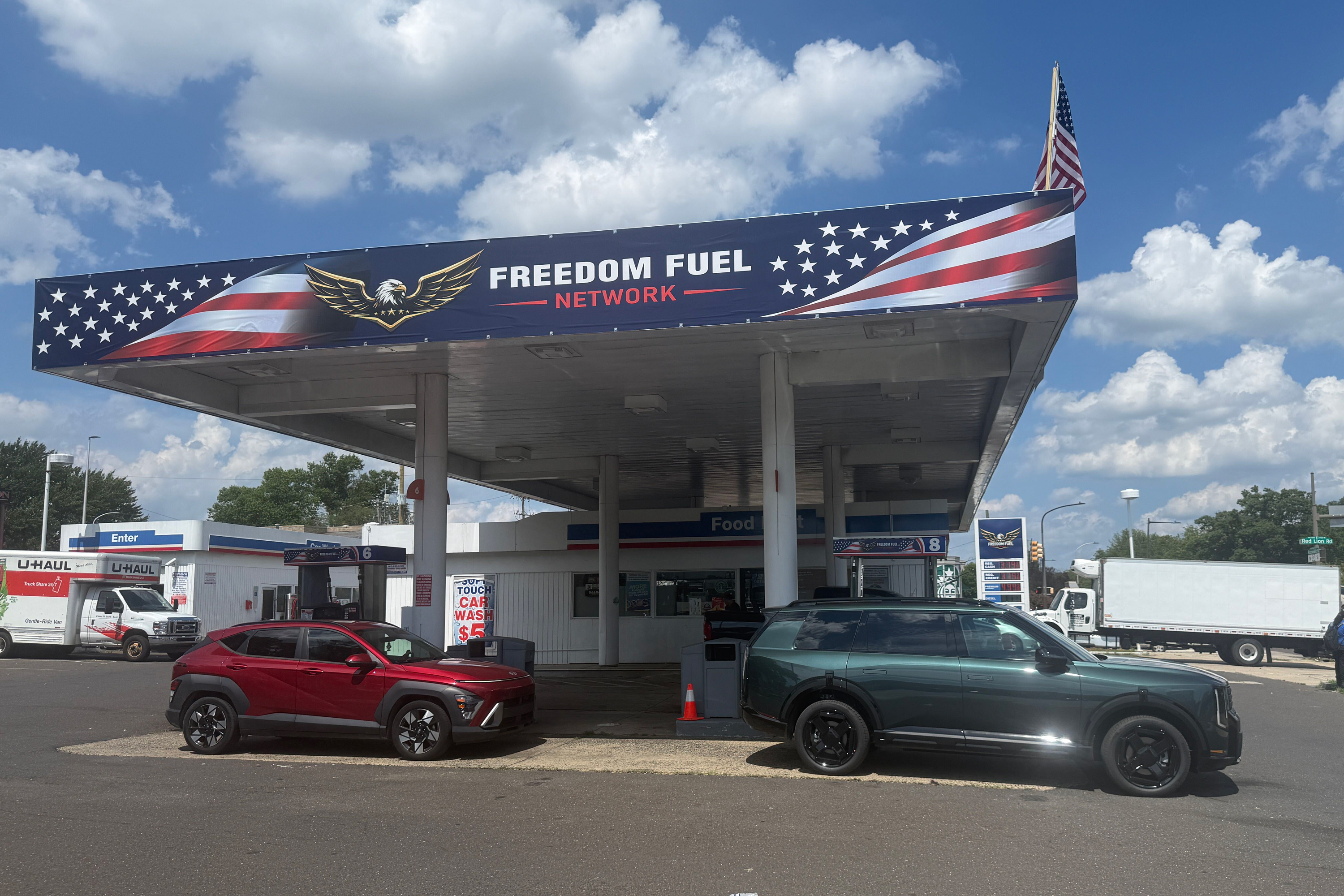
    A petroleum distributor has filed suit in federal court alleging it supplied $4 million worth of gasoline sold to multiple Freedom Fuel Network gas stations but has never been paid for it.

    That is at least one reason, the civil suit claims, Freedom Fuel Network gas stations have been able to sell gas so cheaply after President Donald Trump touted the brand.

    Georgia-based plaintiff Mansfield Oil Co. of Gainesville Inc. filed the civil suit against KRSM Inc. in U.S. District Court in Philadelphia earlier this month.

    The suit says that Syed Kazmi, as president of KRSM, requested in May to buy gasoline from Mansfield at Energy Transfer’s Twin Oaks terminal in Aston, Delaware County.

    KRSM then took 1.12 million gallons of gasoline and sold it to stations that are part of the Freedom Fuel Network. The price of the purchase was just shy of $4 million, according to the suit.

    “KRSM was able to sell such fuel for such low prices and garner such publicity because it never paid [Mansfield] for such fuel,” the suit said.

    The suit does not specify which Freedom Fuel locations it says sold gas originally purchased from Mansfield.

    The White House promoted Freedom Fuel when it launched its first location in July on Dreshertown Road in Upper Dublin Township, Montgomery County. The station initially sold gas for $3.47 a gallon, a nod to Trump being the 47th president.

    “They are doing this because they love the U.S.A.,” Trump wrote on his Truth Social account on July 1.

    “The administration has had zero contact or dealings with the defendant: KRSM Inc or Sayed Kazmi,” a White House spokesperson said in a statement Saturday.

    Kazmi and his brother, Cherry Hill developer Shamikh Kazmi, are linked to at least eight of Freedom Fuel’s 29 locations. Neither could be reached for comment Saturday. However, attorney Mauro Tucci said in a statement on Saturday: “KRSM disputes the allegations in this case, which is an accounting dispute over fuel invoices mispriced by Mansfield Oil. We will not be commenting further on this pending litigation.”

    The Inquirer reported last week that six of the network’s New Jersey stations had racked up environmental violations with the state dating back to 2023.

    For its part, Mansfield says in the suit that it initially had difficulty sending invoices to KRSM, but managed to begin doing so by July.

    The contract specified that KRSM was to pay the invoices in full within 10 days of receiving them or face 1.5% per month interest on the balance.

    Mansfield said that, as of Aug. 17, it had not received any payment for the 150 loads of fuel KRSM purchased at the Twin Oaks terminal.

    The suit cites breach of contract and five other counts in seeking $4 million for the fuel, interest, and attorney costs from KRSM.

    The Kazmi brothers have been embroiled in at least two lawsuits related to previous gas station ventures, including a 2021 trademark dispute with BP American Inc. and BP Products North America Inc. Additionally, Petroleum Marketing Group Inc., a fuel distribution company, accused the brothers of stealing thousands of gallons of gas from the company.

    The network expanded to 29 locations earlier this month, but one Philly station was nearly shut down by the city after it failed a license renewal inspection.

    Freedom Fuel first launched with prices 40 to 50 cents a gallon cheaper than nearby stations, confounding experts and angering competitors due to the network’s apparent connection to the White House. Prices have since risen closer to other discount chains.

    The White House has maintained it is not involved in Freedom Fuel’s operation or provided the company with any subsidies.

    “Freedom Fuel Networks is a private company,” a White House spokesperson told The Inquirer in July. “They are not purchasing gasoline at a discount. The administration has not provided any funding. They are simply lowering their costs to make gas more affordable for drivers in PA and NJ.”

    Baltimore Ravens assistant coach Randy Brown and former commodities trader Yoni Gontownik signed the company’s certificate of formation in Delaware and have not spoken publicly about the highly touted enterprise.

    Freedom Fuel’s owners have been silent about their discount gas operation more than two months after the network was loudly promoted by the White House.

  • Two men, one with an AR-15-style rifle, robbed a victim of gold chains and a watch

    Two men, one with an AR-15-style rifle, robbed a victim of gold chains and a watch

    Two masked men, one wielding an AR-15-style rifle, robbed a man of his jewelry and a watch Friday in Center City, according to Philadelphia police.

    Central detectives are investigating the incident, which took place about 2:15 a.m. on the 1500 block of Sansom Street. It was the second such robbery in Center City involving an AR-15-style rifle within a week.

    Friday’s robbery occurred as a 23-year-old man and two friends were returning home.

    Two masked men got out of a light gray or beige four-door sedan with tinted windows, police said. One was carrying the AR-15-style rifle, according to police. The second was armed with a black semiautomatic handgun.

    The robbers stole two gold chains off the victim’s neck and demanded his silver diamond watch. They then fled west on Sansom Street, police said.

    No one was injured.

    Early on the morning of Aug. 23, masked men armed with handguns and what appeared to be an AR-15-style rifle robbed three men in Center City, forcing at least one of the victims to his knees at gunpoint, according to police.

    The victims — ages 27, 35, and 36 — were talking on the sidewalk around 3 a.m. on the 1500 block of Locust Street when three robbers stepped out of a gray Hyundai sedan and demanded the men’s belongings, police said.

    Two of the men complied but the third resisted, and one of the robbers hit him in the face with a handgun. He was taken to a hospital with injuries that were not life-threatening.

    The assailants took cell phones, watches, car keys, wallets, driver’s licenses, and cash, police said.

    Surveillance video showed one victim on his knees on the sidewalk as two of the robbers pointed guns at his head.