More funding for SEPTA and dozens of financially strained mass transit systems across Pennsylvania has beenon the back burner in this year’s budget debate, but it may get some more attention now.
“By dedicating a portion of skill game revenue to transportation, we can protect and strengthen transit services without placing additional burdens on taxpayers, while ensuring our transit agencies have the resources they need,” Republican State Sen. Frank Farry of Bucks County said Friday in a statement.
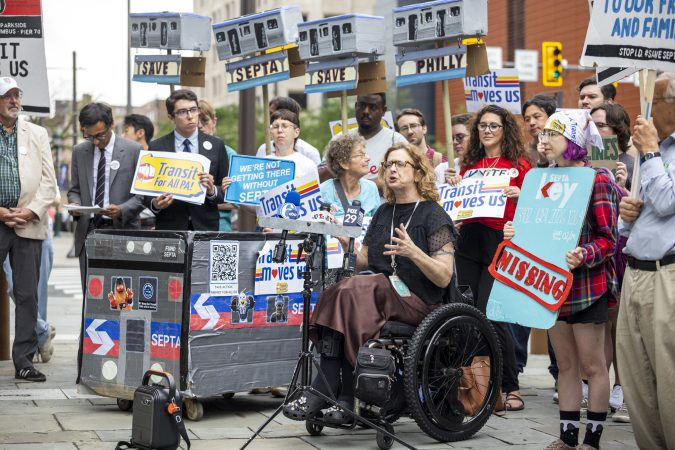
Transit advocates renewed what has become an annual public push for more money for SEPTA and fellow transit agencies at a news conference in front of the Fifth Street/Independence Hall Station — prompted in part by the court decision.
Farry issued the statement in support of that effort.
“I have the freedom to be able to come here, thanks to this elevator behind us, which was recently renovated,“ said Julie Rea, an organizing fellow for Transit Forward Philadelphia who uses a wheelchair and depends on the Market-Frankford El (now called the L).
“Without the long-term funding that SEPTA really needs, we’re not going to be able to keep the system accessible for all,” she said.
Last year, lawmakers and Gov. Josh Shapiro failed for a third time to reach agreement on his proposal to dedicate an increased portion of general sales tax revenue to consistently fund transit agency operations for five years.
Republicans, who control the Senate, did not want to take more sales tax revenue for transit, and the Democrats in charge of the House did not want to take up the GOP leadership’s counterproposal to use state money for infrastructure projects for operations instead.
Farry offered legislation in 2024 to regulate and tax skill games and dedicate 50% of the revenue to create a stable source of funding for public transit. The most optimistic assessments are that taxes on the games at or near the rate casinos must pay for their slots could generate up to $1 billion a year.
Taxing skill games has been discussed in budget deliberations for several years, though it never came together, in part because of differences of opinion in the GOP Senate caucus.
“Maybe the court decision will spur people to get their act together,” Farry, who is up for reelection in the fall, said in an interview. “We have a pathway.”
Meanwhile, this year, paratransit and shared-ride services are in trouble throughout the state and transit systems in Lancaster, Westmoreland County, and the Lehigh Valley are considering service cuts.
“We know that the rural-urban divide is manufactured, and that a public good, like transit, touches us all,” said Connor Descheemaker, statewide campaign manager for Transit for All PA.
The SEPTA board on Thursday approved new labor contracts with the Fraternal Order of Transit Police Lodge 109 and three unions representing workers in the Regional Rail Division.
Omari Bervine, president of Lodge 109, said the agreement was “fair to the hardworking men and women of the transit police” and thanked SEPTA General Manager Scott A. Sauer for helping restart negotiations.
The transit police union represents 203 patrol officers who protect the regional agency’s transit and commuter rail networks, trolleys, buses and property, including stations and transportation hubs.
“Historic reductions in crime over the last two years have come amid an unprecedented effort to bolster our transit police,” Sauer said at the board meeting. “Staffing is at its highest level in more than a decade.”
Fifteen new officers joined the force this month after graduating from the police academy, and 18 cadets are scheduled to start their studies next month, SEPTA says.
Officers had been working without a contract since March 31.
The new agreement is retroactive to April 1 and runs through March 31, 2029.
Lodge 109 members will receive a 5% increase in their hourly rates Sunday, with 3½% raises in June of each of the following two years. Longevity bonuses will range from $2,901 for officers with three years of experience, up to $9,552 for those who have 25 years or more of service.
SEPTA’s board also approved new two-year contracts with the Brotherhood of Railway Carmen, International Association of Machinists and Aerospace Workers that together represent about 145 rail vehicle mechanics, welders, millwrights and maintenance custodians working on Regional Rail.
The board also ratified a new contract with the Transportation Communications Union, which represents 76 Regional Rail clerical staff.
Each deal with the three Regional Rail unions is for two years and gives workers raises totaling 7%, the same as the contract reached last year with the Transport Workers Union Local 234, SEPTA’s largest.
Officials of the Pennsylvania and New Jersey Turnpikes have chosen a design to replace the 70-year-old bridge over the Delaware River linking the toll roads: a six-lane span that would be built about 195 feet north of the existing one.
Called a ”tied-arch” bridge, the $1.6 billion replacement would be cheaper than other styles considered and can be built fastest, said John Boyer, senior engineer for the Pennsylvania Turnpike Commission.
“Shorter time frames mean less disruption to local businesses and daily life for the communities in this area,” said Boyer, the manager of the joint project.
Because the new bridge would be farther from the existing Delaware River Bridge than alternatives, traffic can keep flowing as it’s built, he said.
Planners for years have known that the region would need a new turnpike bridge because of exponential growth in traffic volume, especially trucks.
Freight volumes nationally are projected to grow by 73% by 2050, with warehouses on both sides of the river relying on crossing.
Before the nearby I-95/Pennsylvania Turnpike interchange opened in 2018, an average of 42,000 vehicles a day crossed the four-lane Delaware River Bridge. Now, that’s up to around 70,000. By 2050, projections say an average 93,000 vehicles will need to traverse the replacement.
The surfaceof a tied-arch bridge provides tension to resist the horizontal forces pressing on either end of the arch, like the taut string that connects a bow. It requires less sturdy foundations than a bridge supported by cables.
“You can be build those river piers while you’re building the arch structure off-site,” Boyer said. When the piers are ready, the arch can be brought in by barge and “you can essentially jack it and elevate it up into place,” he said.
Federal authorities approved a new span in 2003, but the project was put on hold because of problems paying for it.
As congestion increased on the repaired bridge, more traffic capacity became imperative, officials said.
Because the earlier federal approval was so old, officials had to start again with a new environmental impact statement and design studies. Last year, turnpike officials settled on two options.
Now, they’re finishing up the environmental impact statement, with formal public hearings scheduled for the winter.
Turnpike officials expect the Federal Highway Administrationto make a decision on the project around April 2028.
The two states’ turnpike agencies will finance the balance. Borrowing would be backed by toll revenue, but both say the bridge project won’t increase tolls for drivers.
The union representing transit police and SEPTA reached a tentative deal on a new three-year contract Wednesday that includes a 12% raise and avoids a possible strike during the region’s summer of big events.
Officers had been working without a contract since March 31, and the police union said on June 4 it was willing to walk off the job if there was no progress in talks. Leaders said the two sides were at an impasse.
Since then, negotiators traded new proposals and met several times.
Members of Fraternal Order of Transit Police Lodge 109 are scheduled to hold a ratification vote on the agreement Thursday, with SEPTA’s board scheduled to consider it next week.
“SEPTA believes the agreement is fair to our hard-working Transit Police officers and responsible to the fare-paying riders and taxpayers who fund the authority,” spokesperson Andrew Busch said in a statement.
“I can confidently say that a strike has been averted at this time,” FOTP Lodge 109 president Omari Bervine said in an interview.
He credited SEPTA general manager Scott A. Sauer with getting talks moving.
“We were able to actually sit down to direct talks, with the general manager [involved], and that was instrumental in getting a tentative deal worked out,” Bervine said.
Officers would get a 5% pay hike in the first year and 3½% in each of the next two years, according to sources familiar with the agreement. They also would receive a $2,500 signing bonus.
Officers are scheduled to get the first installment of the pay bump on June 28, if the contract is ratified and approved. Normally, pay increases for transit police did not kick in until the next anniversary of the start of the contract year — in this case, April 1, 2027.
Lodge 109 has pressed to change the timing so members would start receiving raises as soon as possible after the signing of an agreement, as happens with other SEPTA unions.
The union represents 203 rank-and-file officers who patrol SEPTA’s stations and transit vehicles across its five-county service area.
Bervine had offered to waive the right to strike if SEPTA voluntarily agreed to submit their dispute to binding arbitration.
Most union-represented police officers in Pennsylvania can use binding arbitration, which involves an independent arbiter deciding the final terms of a contract. In turn, those officers are barred from striking.
But state law does not allow transit police and some other state law enforcement officers to use binding arbitration.
Bervine said there was no agreement to include binding arbitration in the contract. There is proposed legislation in Harrisburg to extend it to officers employed by state agencies like SEPTA. “Hopefully, common sense will prevail,” he said.
Union and SEPTA negotiators met on Tuesday and Thursday last week and exchanged new proposed contract language. They met for a third time Saturday.
The union has exercised its right to strike before.
In December 2023, the transit officers union went on strike for three days seeking wage increases matching those given to Transport Workers Union Local 234 and other SEPTA employee unions.
In 2019, transit officers walked out for six days, in part over whether members could review body-camera footage before filing incident reports. They struck in 2012 over a 15-cent difference between the FOTP’s demand and SEPTA’s offer for an increase in the hourly rate that members received for annual recertification as police officers.
Take the B (Broad Street) Line to 15th Street/City Hall, transfer to the eastbound L, and disembark at Spring Garden Station, on the southern edge of the neighborhood.
Correct, to a point.
“I didn’t say where I need to get to in Northern Liberties, right?” said Jena Burley, the SEPTA training facilitator teaching the class.
Ack! Maybe the passenger would be better off taking the L for one more stop to Front-Girard, depending on the precise destination.
“Ask for as much specific information as possible,” Burley said.
SEPTA supervisors, administrators, and managers have been assigned 1,300 shifts as ambassadors in critical transit and Regional Rail stations from June 13 through July 19.
Jena Burley leads the SEPTA ambassador class.Tyger Williams / Staff Photographer
Four to 12 ambassadors will provide information, directions, and, ideally, a friendly welcome in each designated station — along with crowd control, and de-escalation techniques for conflict.
It’s a lot, which is why up to 1,000 employees have spent half a day in training with a detailed curriculum that feels like cramming for finals.
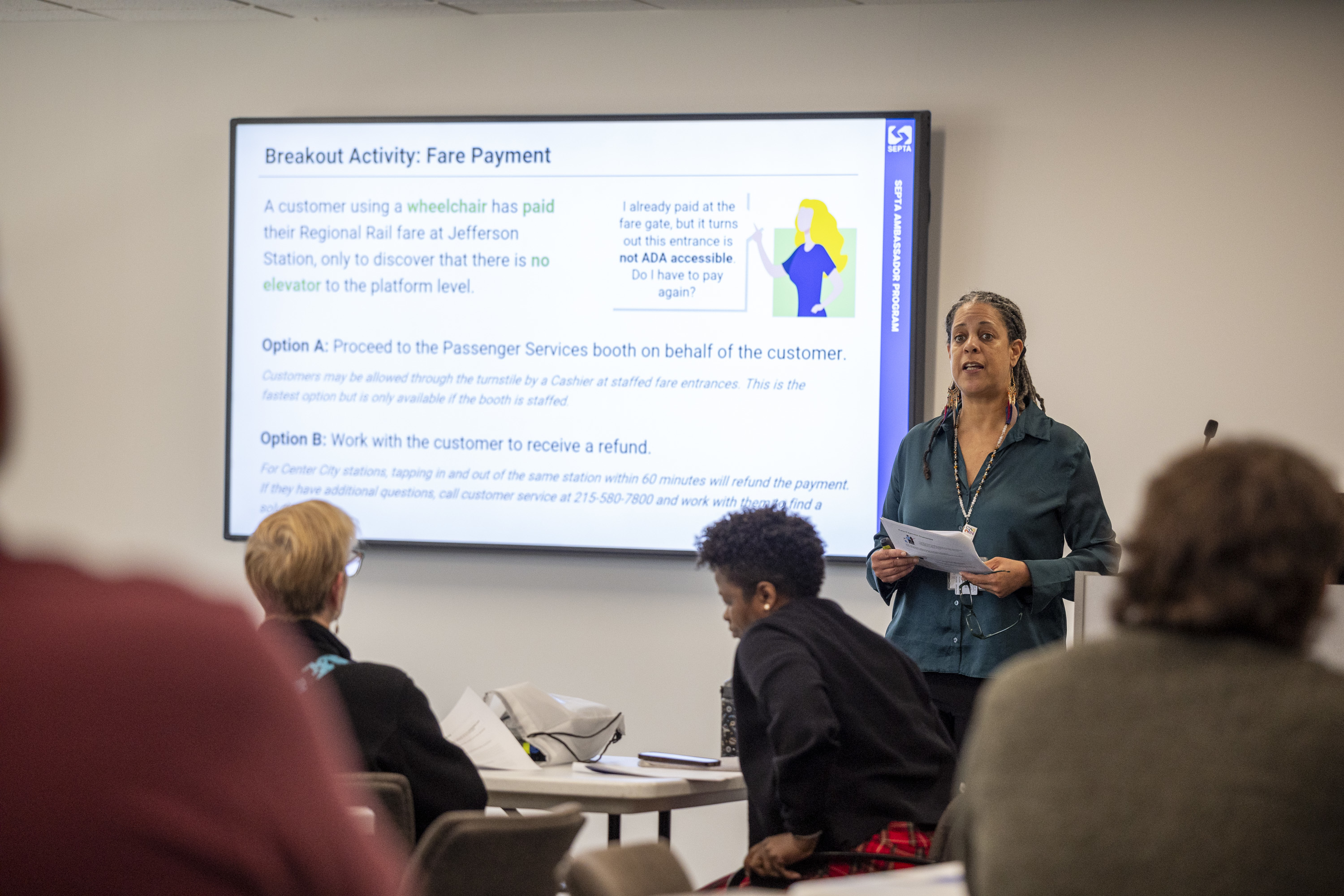
I worked with them through scenarios of escalating severity to simulate situations they will encounter: sweaty, frustrated crowds on platforms; medical emergencies; confusion over SEPTA’s fares and methods of payment; and how to troubleshoot travel glitches. And scarier stuff.
“This summer is an opportunity for SEPTA to shine, and you are such a big part of that,” said Lex Powers, chief officer for customer experience.
The Disney approach
This summer SEPTA is also debuting a new customer-service philosophy that subordinates other priorities to creating a safe and positive experience for people using the system.
The transit agency has used ambassadors since 2000 to help customers during special events like the Eagles Super Bowl parade last year, service changes, and the like. Officials rebooted the training program.
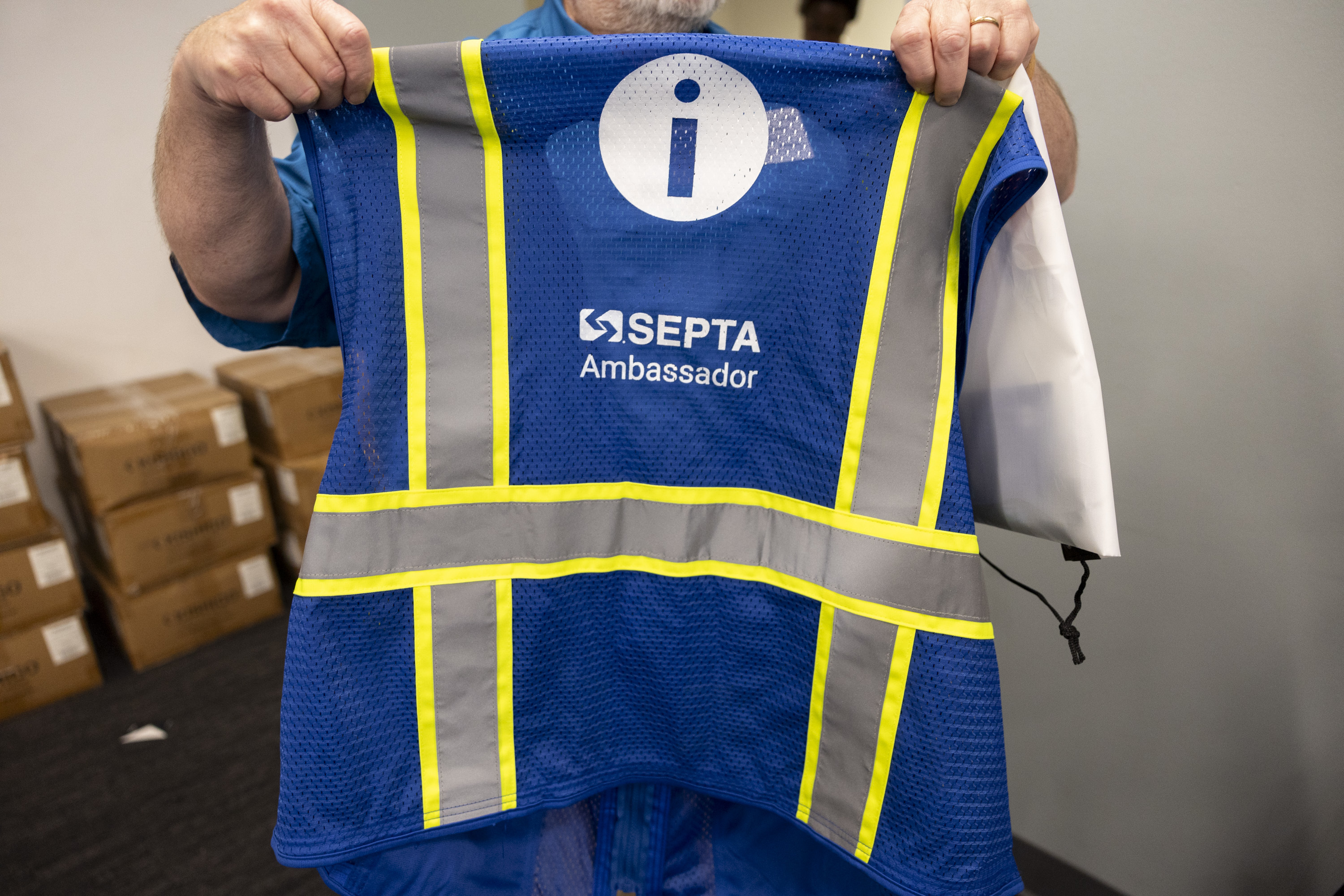
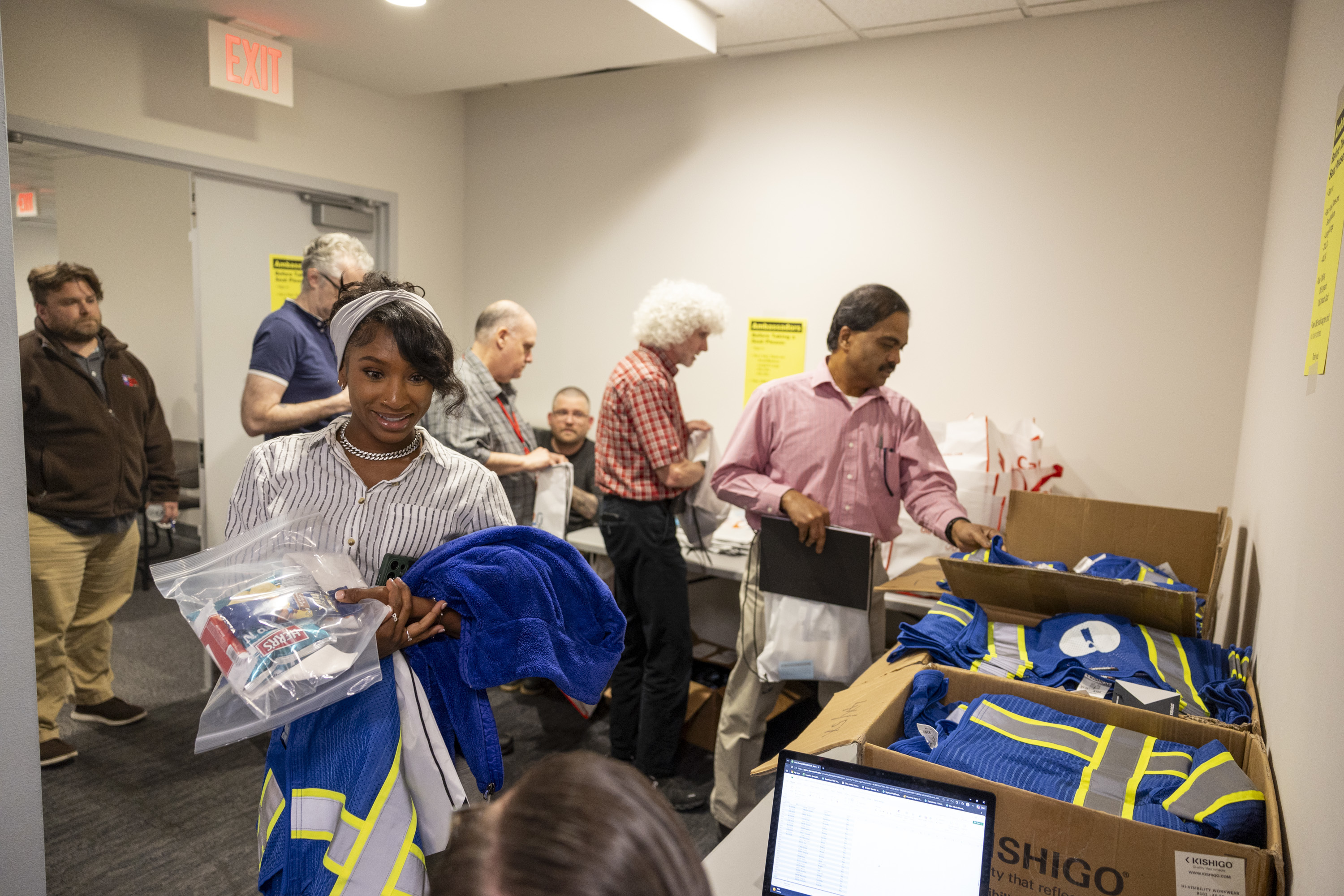
This summer, ambassadors will carry “cheat sheet” cards and wear blue vests to differentiate them from other workers in typical yellow safety vests.
I got my own blue vest at the start of the class — pretty snazzy — and tried to earn it.
Brittany Davis, of Northeast Philadelphia, a service planner at SEPTA, gets her vest.Tyger Williams / Staff Photographer
Cultural correctness
The recent training included “cultural diplomacy” briefing sheets with guidance on customs and backgrounds of the countries with national teams playing here, prepared by the World Affairs Council of Philadelphia and protocol experts.
For instance,I learned:
Never flash the “OK” hand gesture to a Brazilian. It’s offensive, like flipping the bird.
When greeting or handing things to a person from Ivory Coast, use your right hand. It is a social slight to use the left, which is reserved for personal hygiene.
In some cultures, such as Ghana, it is customary to exchange pleasantries before getting down to business. People from Curaçao, influenced by Dutch culture, can be more direct and, while friendly, value personal space.
‘Bring the temperature down’
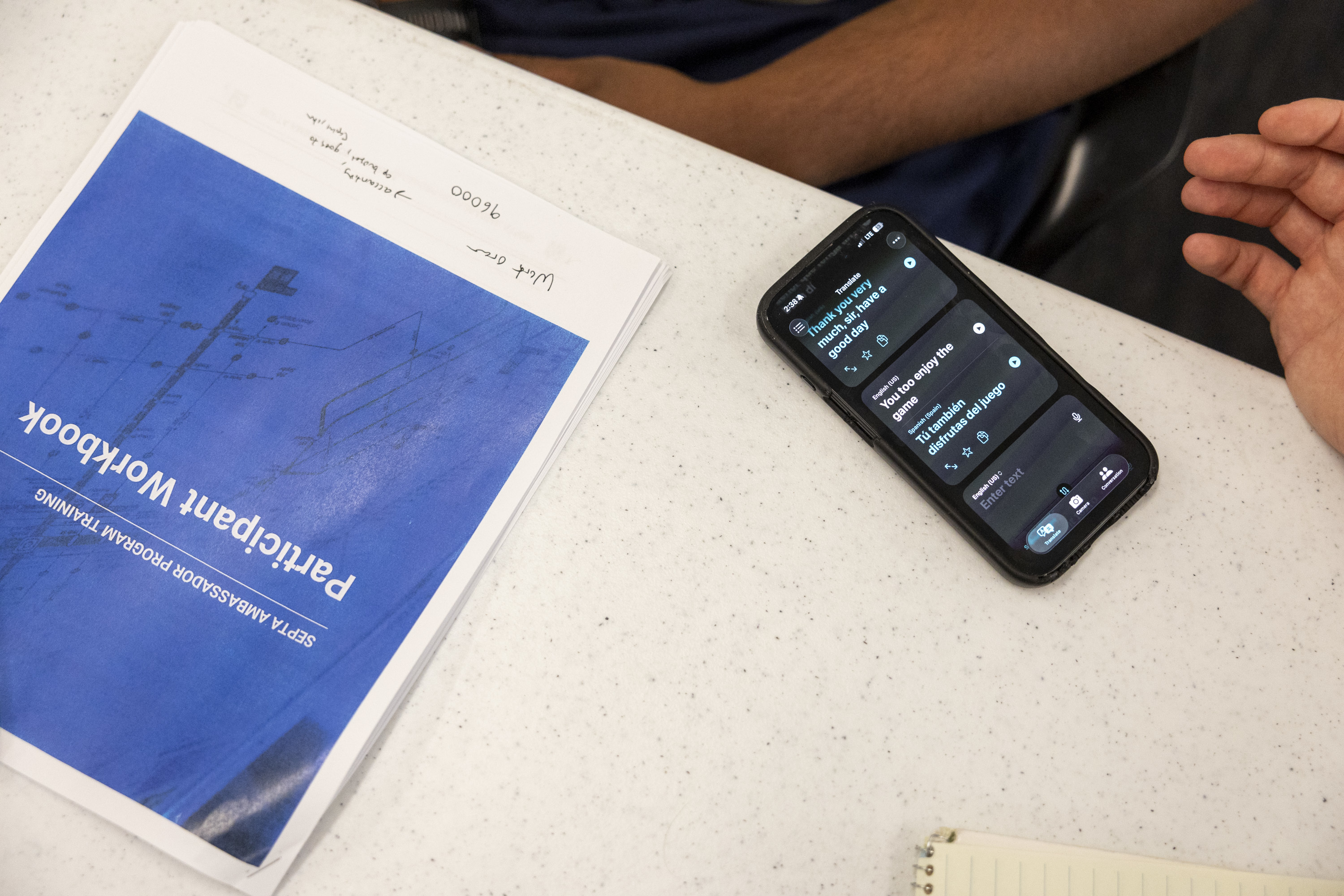
My fellow trainees and I shared tables in a conference room and huddled to work through often complex scenarios in a 24-page workbook.
You notice a particularly long line forming at one fare gate and go to investigate. …
A customer is tapping a credit card over and over, but it doesn’t work. Another customer tries to squeeze past them, increasing tension, and voices in the line start to rise.
“You want to bring the temperature down,“ said Noah Lee, manager of service-information development, with whom I shared a table. ”Take the person whose card doesn’t work off to the side to figure it out, and let other people go through.“
Nithin Vejendla, an operation planner, speaks Spanish in the Google Translator app.Tyger Williams / Staff Photographer
Nithin Vejendla said the bottleneck could be a two-person job and suggested bringing in another ambassador to wave people through the gate.
“Try empathizing with them,” said Vejendla, a SEPTA operations planner who was at my table. “Like, ‘I know it’s frustrating. I’ve had times where [tapping] doesn’t work. … We’ll get you on the next train.’”
Meanwhile, fix it. Is the person tapping incorrectly? Maybe the card reader’s bad, so try another turnstile. Consult a cashier.
The situation worsens.
A customer that has been held up in the line starts pushing and shoving the people in front of them. They are clearly agitated … [and] verbally threatening people.
“If they keep escalating, at that point your responsibility shifts to keeping the other passengers safe,” Vejendla said. “Maybe you stay between them and the fare gates, a physical barrier.“
Lee worked an ambassador shift during the 2025 Super Bowl parade and said he didn’t see anything like that.
“The atmosphere was joyful, and it was in the morning,” Lee said.
Vejendla, an operations planner who has worked at SEPTA for almost three years, was an ambassador for the Eagles parade and the Flower Show, and when SEPTA briefly cut and changed bus routes last year.
Later, trainees downloaded Google Translate to practice.
Vejendla speaks fluent Spanish and rough French. Powers, his boss, was teasing him about it.
“Lex was like, and I quote, ‘I can’t believe the system understood you. That French accent was terrible.’”
When emergencies arise
Sometimes, the scenarios are more serious. People wind up in the track area, trying to retrieve an item or having fallen off a platform. What do you do?
“Stop the train. Think about everything else later,” Burley said.
Heather Jordan, employee relations manager, (right), and Kim Smith, senior project engineer and track engineering with SEPTA, (left), are looking at the SEPTA app to answer questions for an exercise during the SEPTA’s Ambassador class.Tyger Williams / Staff Photographer
Go to the cashier and get them to push the Emergency Train Stop button, which activates a “stop” signal light. There are red flags in the booth to wave at incoming trains.
Moving your arm back and forth at chest level is a traditional railroad stop signal. “Or go berserk,” Burley said, waving your arms over your head or flashing a phone flashlight.
Do not enter the track area, and don’t try to pull a person up. The third rail carries 600 to 750 volts of electricity.
“You’re there to keep customers safe, but if you’re not safe, you can’t help,” Burley said.
As class ended and everyone left, I carried a deeper respect for the job of ambassador. I wished my fellow students good luck.
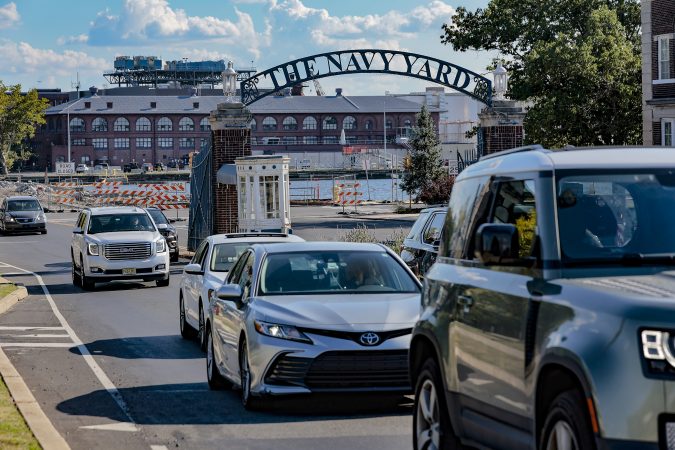
SEPTA is extending Route 45 to provide direct daily bus service to the Navy Yard for the first time in more than a decade, a move aimed at helping to grow both the development and transit ridership.
The new service is scheduled to begin in August, with buses operating at about 20-minute intervals, starting at 12th and Noble Streets in North Philadelphia, through Center City, and to stops inside the Navy Yard itself.
More than 150 employers have facilities in the Navy Yard, with more than 16,000 people working on the campus. There are 614 units of housing and plans for more residential and commercial development.
“Our goal is to provide as many safe, reliable, efficient ways to get to the Navy Yard as possible,” said Alex M. Smith, vice president of Navy Yard strategic initiatives at the Philadelphia Industrial Development Corp. It has built a path alongside South Broad Street to accommodate bike commuters and pedestrians.
“The 45 just provides another level of service for folks that may think otherwise than to take an Uber or their own car,” Smith said.
(function() {
var l2 = function() {
new pym.Parent(‘route45’,
‘https://media.inquirer.com/storage/inquirer/projects/innovation/arcgis_iframe/route45.html’);
};
if (typeof(pym) === ‘undefined’) {
var h = document.getElementsByTagName(‘head’)[0],
s = document.createElement(‘script’);
s.type = ‘text/javascript’;
s.src = ‘https://pym.nprapps.org/pym.v1.min.js’;
s.onload = l2;
h.appendChild(s);
} else {
l2();
}
})();
The Navy Yard’s master plan projects about 3,000 people will be living there within 15 to 20 years. About 450 jobs are expected to be added at Rhoads Industries, a maritime company in the western part of the former military base.
Colin Foley, the chief of service planning and schedules at SEPTA, said a 2023 survey of the Navy Yard workforce found that 86% did not use transit, and 60% of those said they would use SEPTA if more options were offered.
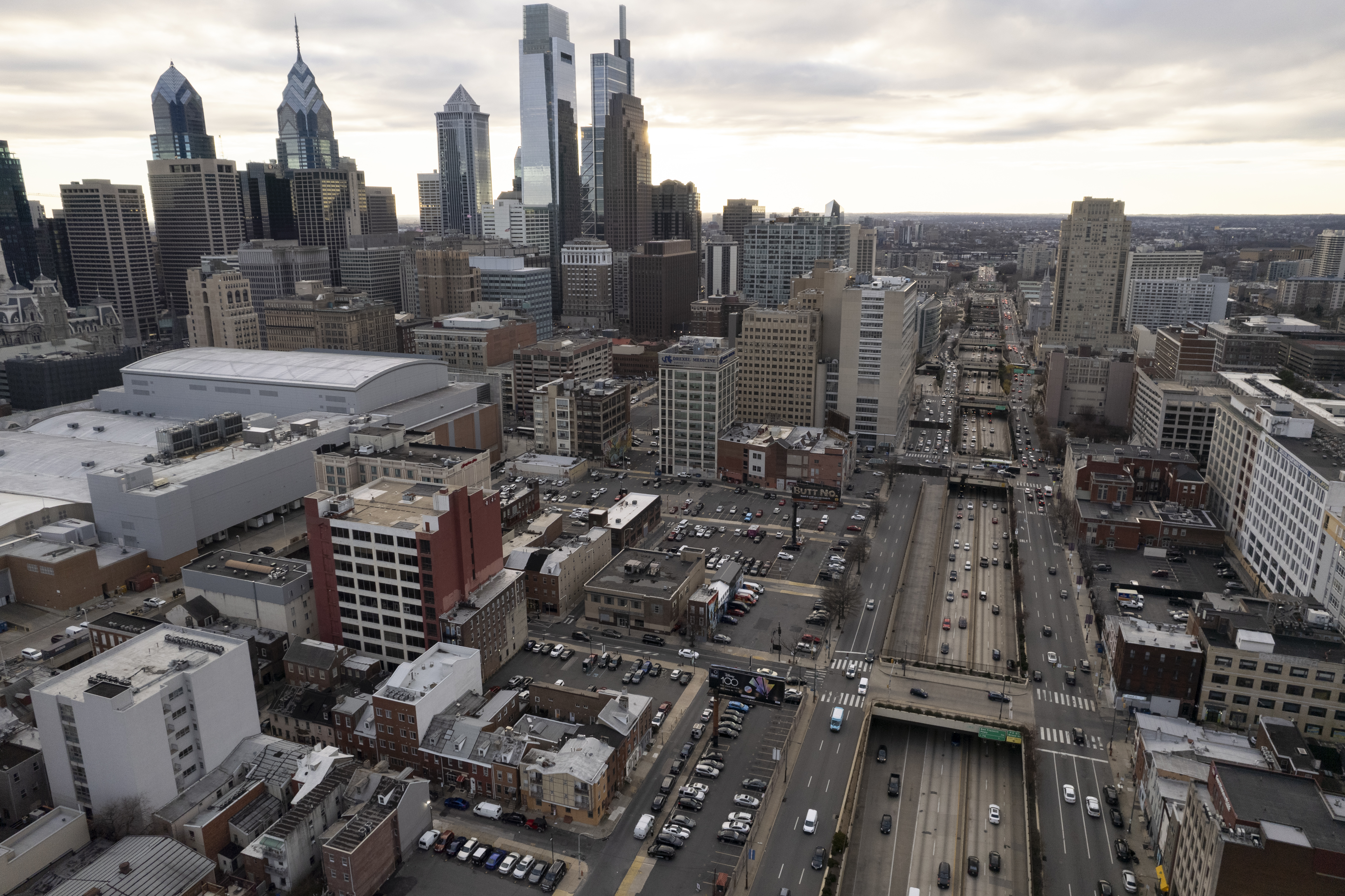
City officials and residents of the Callowhill neighborhood on Monday night discussed design options for a park atop the Chinatown Stitch, a planned cap over part of the Vine Street Expressway.
The Philadelphia Office of Transportation and Infrastructure Systems is thinking about the day the project is complete, with preliminary exploration of a possible improvement district in the area to finance operations and maintenance.
“We’ve come to the conclusion that there’s not really a city department or even nonprofit entity that’s ideally placed to take over that maintenance responsibility,” said Christopher Puchalsky, director of policy and strategic initiatives at OTIS.
The meeting of the Callowhill Neighborhood Association was held at the Folk-Arts Cultural Treasures Charter School.
The original grant was $159 million, but the city already had spent $8.4 million on preliminary engineering and design work. The rest was rescinded.
Using either a Neighborhood Improvement District or a Business Improvement District would give the neighborhood control over the maintenance of the park and its planned connection to the Rail Park along the Reading viaduct, Puchalsky said.
City money would be subject to a yearly appropriation, and the Stitch would be “not just competing against all the other parks that need to be maintained,” he said. “The Chinatown Stitch would be competing against firefighters and social workers and pothole crews and go down the list.”
People expressed strong support throughout several rounds of community engagement for keeping a completed project safe, clean, and in good repair, Puchalsky said.
He presented three possible annual maintenance and security budgets for a hypothetical improvement district: $1.3 million; $2.2 million; and $3.8 million. A budget would depend on the size of the district and the level of services involved.
The largest budget could likely finance 24-7 security, robust maintenance, and some social service programs, while the smallest budget would provide much less.
Improvement district assessments range from 1% to 7% in Philadelphia, which would be on top of property taxes. Based on rough back-of-the-envelope math, Puchalsky said, the owner of a $500,000 property would pay $140 a year on top of a $7,000 property tax bill at the lowest end of the range and $300 yearly at the highest end.
He stressed that there is no formal proposal for an improvement district or firm estimate for assessments.
“It is a goal to try to get some kind of a neighborhood consensus about what you would like to do,” Puchalsky said. “I’m not hearing anyone jumping up and down, either angrily or cheeringly” — just reasonable questions.