Author: The Inquirer Editorial Board

  • Bob Harvie is the best choice for Pennsylvania’s 1st Congressional District | Endorsement

    Bob Harvie is the best choice for Pennsylvania’s 1st Congressional District | Endorsement

    U.S. Rep. Brian Fitzpatrick (R., Pa.) has been a member of Congress for nearly a decade, and it is difficult to determine what exactly he has accomplished.

    Fitzpatrick, 52, claims to be a problem solver, but he is really part of the problem. Fitzpatrick entered Congress with the MAGA wave that first swept into Washington with Donald Trump in November 2016.

    He is a member of a Republican House majority that has been one of the least effective and most dysfunctional in modern times. The GOP controls the House, Senate, and the White House — and still can’t do much to help the American people.

    Because Fitzpatrick represents a swing district that covers Bucks County and portions of Montgomery County, he doesn’t always vote lockstep with his Republican colleagues. But when Fitzpatrick’s vote is needed, he backs Trump’s incoherent agenda, which has made life more expensive for everyone.

    That agenda speaks for itself: costly tariffs, cruel deportations, unprovoked war, tax breaks for the superrich, massive debt, healthcare cuts, brazen corruption, abuses of power, self-enrichment schemes, and constant chaos.

    For Fitzpatrick’s constituents, Republican control in Washington has resulted in higher interest rates, sluggish job growth, and increased prices on everything from gasoline to food, cars, housing, and utility bills. Not to mention a host of constitutional, ethical, and legal abuses with no oversight or pushback.
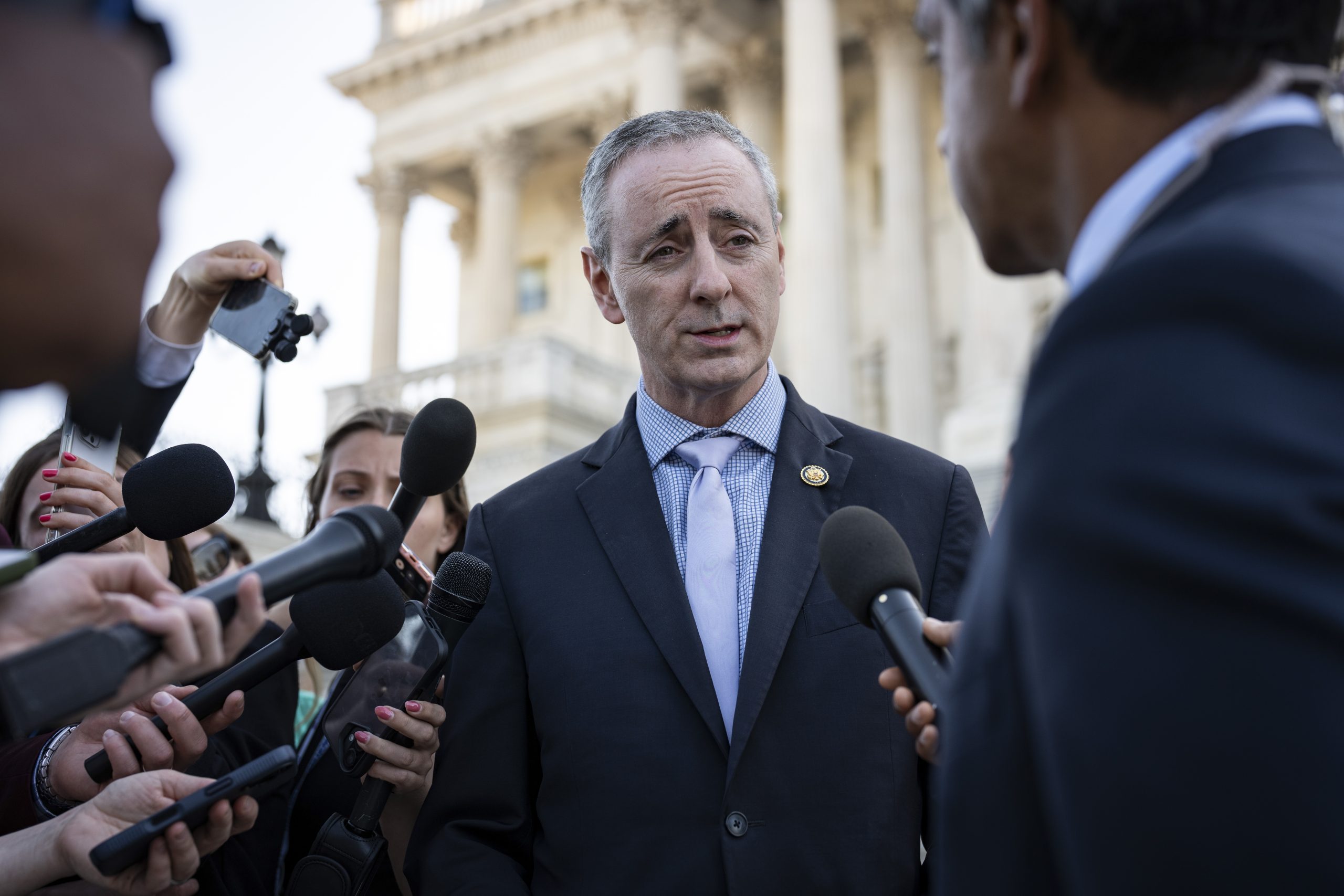
    U.S. Rep. Brian Fitzpatrick (R., Pa.) doesn’t always vote with his Republican colleagues. But when his vote is needed, he backs Donald Trump’s incoherent agenda, the Editorial Board writes.Haiyun Jiang

    He did vote against Trump’s signature legislative accomplishment: the so-called Big Beautiful Bill, which added trillions to the ballooning deficit, extended tax cuts for the wealthy, slashed Medicaid and other support for the most vulnerable citizens, and added billions to support Trump’s deportation roundups.

    But Fitzpatrick’s no vote came only after final passage of the measure was assured. Weeks before the measure’s final passage, he was the deciding vote to advance the bill that ultimately became law.

    He often performs this type of calculated two-step to appear not so extreme to his more moderate constituents. But the results spell pure MAGA.

    Fitzpatrick, who recently married a Fox News correspondent, pulled a similar switcheroo on Trump’s costly war in Iran. Initially, he voted against limiting Trump’s power to wage war in Iran before voting to block further military action. He even issued a muddled statement about the war that said nothing.

    So he was for the war before he was against it. The result of Trump’s strategic blunder that GOP congressional members enabled has been higher gas prices, billions wasted on bombs, and needless death and destruction with no way out.

    Fitzpatrick has harmed his constituents in other ways. He repeatedly supported Trump’s tariffs, which have upended trade relations with allies, roiled financial markets, and increased prices for small businesses and consumers.

    He is increasingly out of step with his own constituents. He supports data center development, which most voters oppose. He also opposes codifying abortion rights, which a majority of the public supports.

    Fitzpatrick has also been largely missing in action in his own district. He has not held a town-hall meeting with voters since 2017, calling them a waste of time.

    He has refused to debate his opponent, Bob Harvie, a Bucks County commissioner. Fitzpatrick declined to meet with this Editorial Board to make his case for reelection — even though The Inquirer endorsed him in the past.

    If 80% of success is just showing up, Fitzpatrick has failed his constituents.

    The problem may rest with who Fitzpatrick really represents. His campaign is largely funded by billionaires and out-of-state corporate PACs backed by Wall Street banks, Big Pharma, and Koch Industries.

    More broadly, the GOP-controlled Congress has failed to uphold its sworn oath to support the Constitution and serve as a check on the executive branch of government.

    Fitzpatrick’s true character is shining through in the onslaught of attack ads aimed at his opponent. An ally with a checkered past was recently exposed for planting negative articles about Harvie. That’s a Tammany Hall move.

    Fortunately, voters in Pennsylvania’s 1st Congressional District have a more upstanding alternative in Commissioner Harvie.

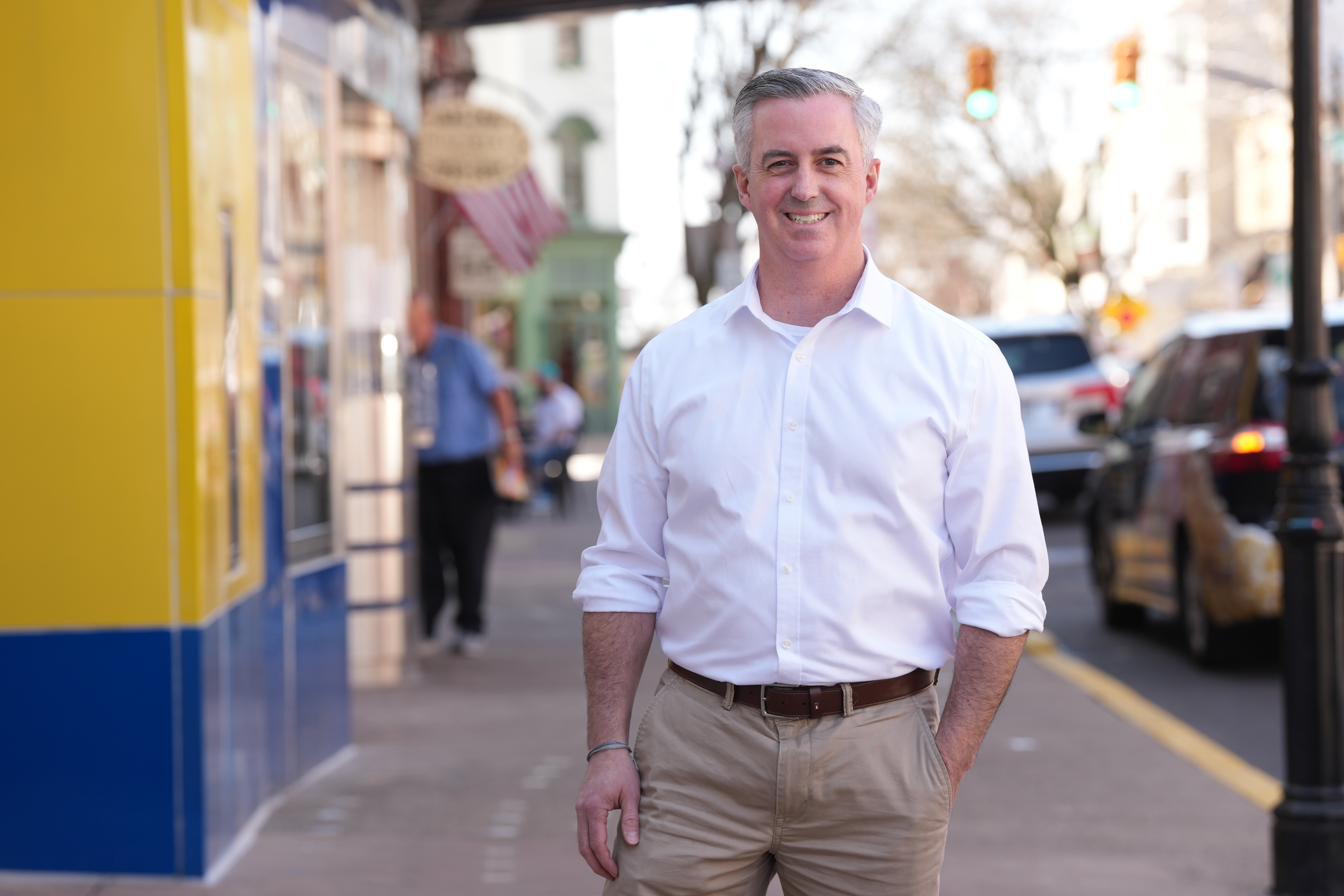
    Harvie, 54, is a Bucks County native who grew up in a blue-collar family (Bristol Borough) and was the first member in his family to go to college. He taught social studies in the public schools there for many years. He is humble, hardworking, and understands the affordability challenges facing Pennsylvanians.
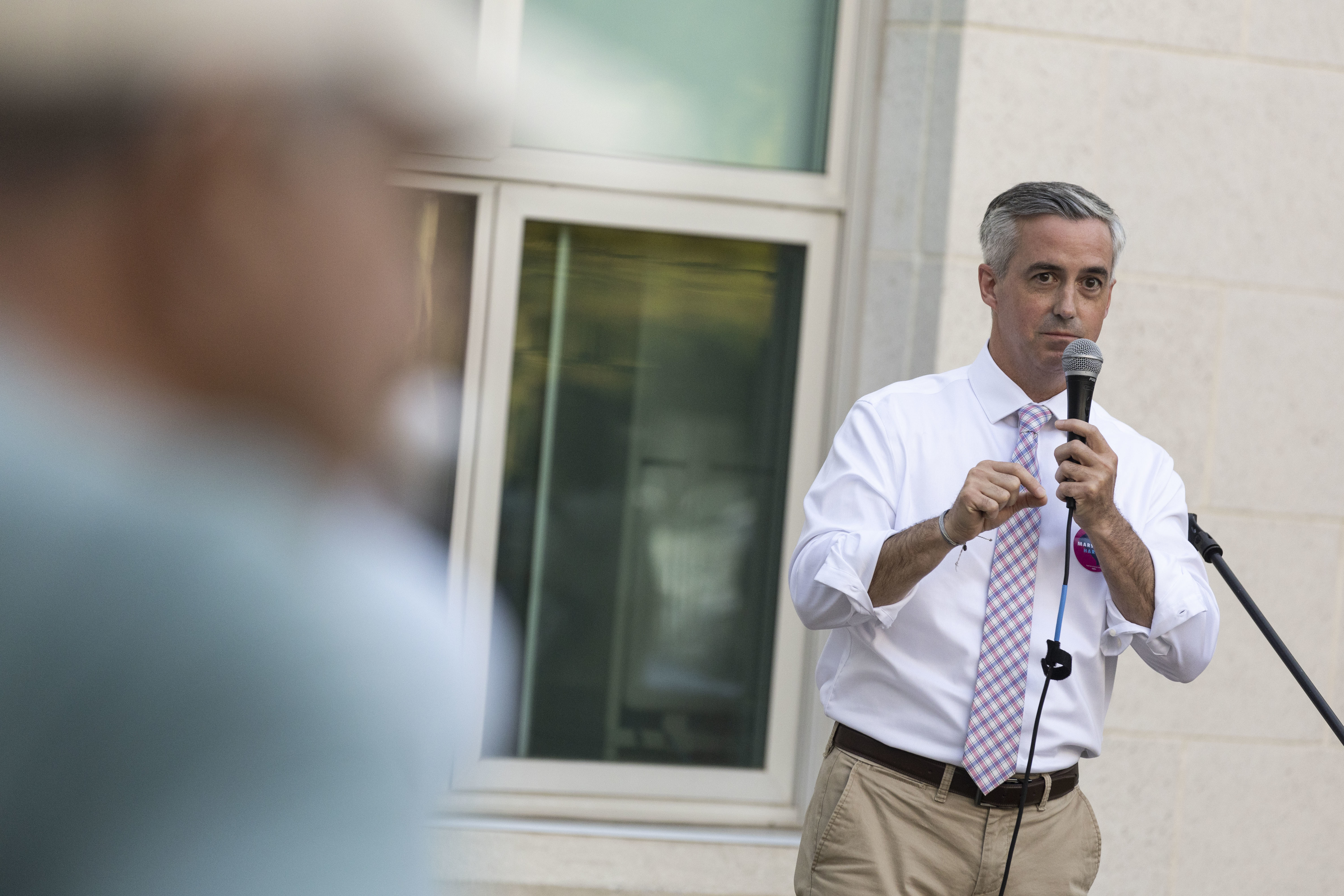
    Democratic Bucks County Commissioner Bob Harvie understands the affordability challenges facing Pennsylvanians, the Editorial Board writes.Monica Herndon / Staff Photographer

    He would bring some much-needed compassion and decency to a Congress that is turning into TikTok performance artists more interested in viral posts than making government work for the people they represent. Even better, Harvie will answer to the people, not Trump.

    Unlike Fitzpatrick, who has not held an in-person town hall in nearly a decade, Harvie has held five town halls since April and has four more scheduled this month.

    Harvie was elected commissioner twice. He knows how to work with Republicans and Democrats. The three-member commission includes one Republican, yet more than 90% of the votes have been unanimous.

    The commissioners have opened mental health care facilities, launched sustainability programs, and passed a bipartisan resolution opposing the use of warehouses as U.S. Immigration and Customs Enforcement detention facilities.

    If elected, Harvie said his top priority would be to address affordability issues facing residents. He also wants to restore trust in government, starting with a ban on stock trading by members of Congress and a clampdown on corporate control of politics by passing a constitutional amendment to overturn Citizens United.

    “I was raised to love this country,” Harvie told the Editorial Board. “I cannot stand what’s happening to it.”

    Many Americans agree. That’s why The Inquirer endorses Bob Harvie for Congress in Pennsylvania’s 1st District.
  • New Jersey Gov. Mikie Sherrill has set an ethical example for a corrupt era | Editorial

    New Jersey Gov. Mikie Sherrill has set an ethical example for a corrupt era | Editorial

    In announcing the resignation of New Jersey Lt. Gov. Dale Caldwell last week amid allegations of harassment and ethics violations, Gov. Mikie Sherrill said an independent investigation had found “a pattern of behavior that does not meet the standards of this administration.”

    In a state where official misconduct has often been not just tolerated but embraced — and at a time when our national government is making workaday New Jersey corruption look quaint — Sherrill responded swiftly, fairly, and decisively to the accusations against the lieutenant governor, who doubled as the state’s chief elections official.

    The governor’s decision was particularly principled given that Caldwell is not only a fellow Democrat, but also the running mate she chose just last year. Demanding his exit after just eight months of service effectively required Sherrill to acknowledge she had made a poor choice.

    Accepting mistakes, embracing accountability, and moving forward are qualities voters should expect from all elected officials.

    An investigation led by former state Attorney General Christopher Porrino, who was hired by the administration’s chief ethics officer to look into anonymous complaints about the lieutenant governor, found several of the accusations credible.

    Among the most troubling was that after Caldwell unsuccessfully propositioned a friend of an employee, he complained to the employee that young women like her and her friend were “looking for young sperm.” The investigation also substantiated that Caldwell pushed for the promotion of a sometime romantic partner in another state department without disclosing their relationship. And it found he had a habit of taking nonpaying personal guests to ticketed functions he attended in his official capacity.

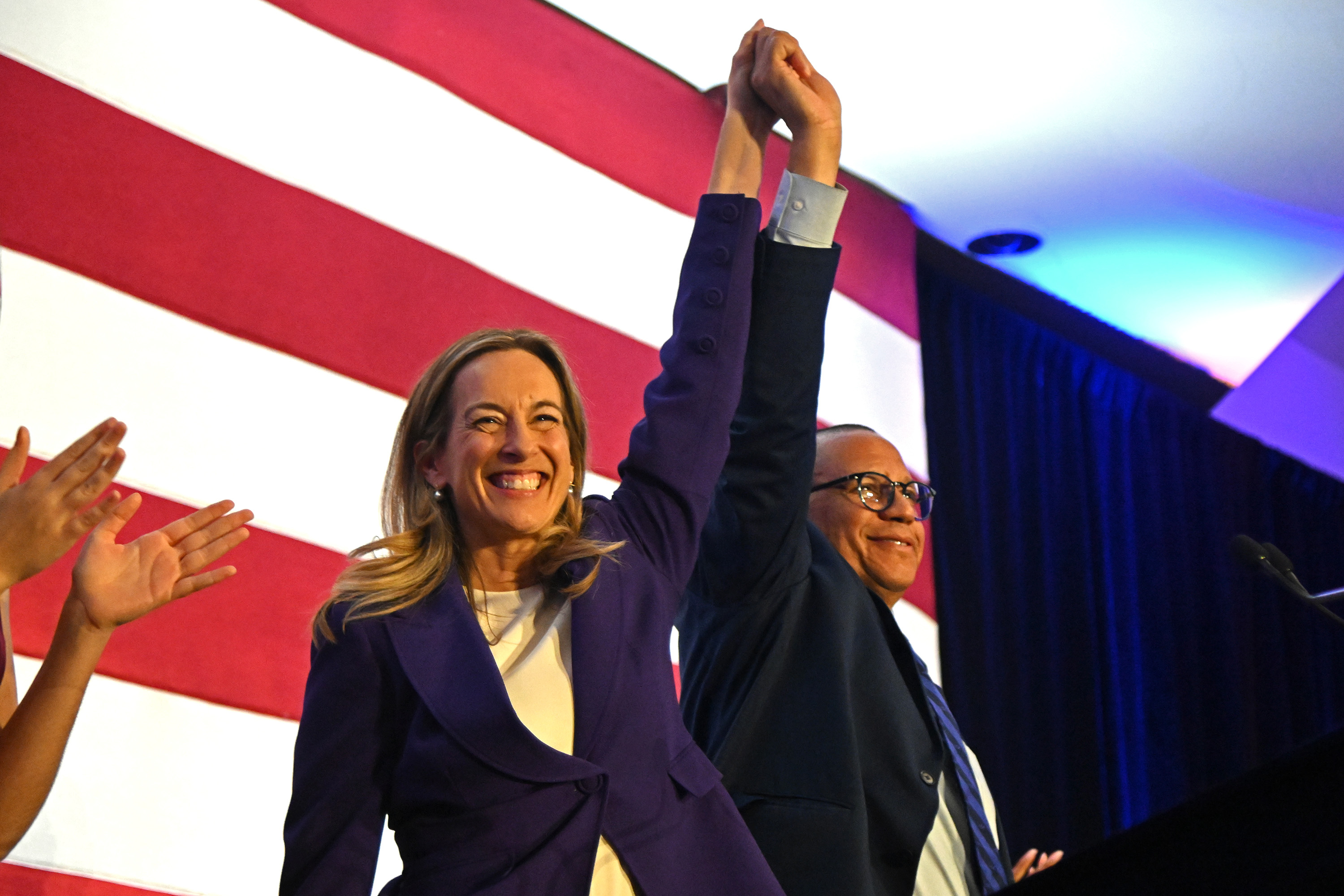
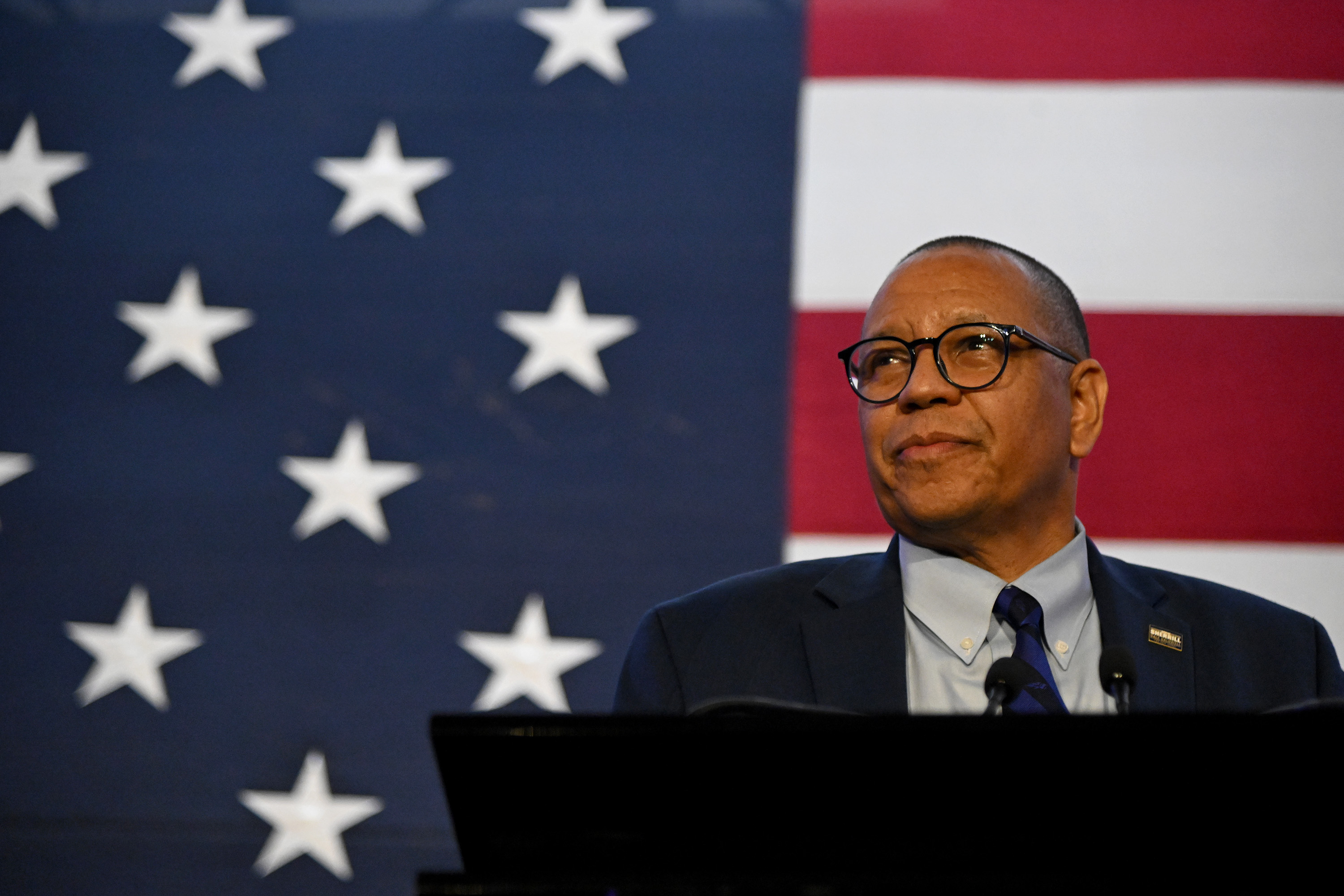
    Dale Caldwell speaks before Mikie Sherrill as they celebrate their victory at an election night party in East Brunswick, N.J., Nov. 4, 2025.Tom Gralish / Staff Photographer

    Porrino’s report noted that all this conduct was in violation of state policies Caldwell had been informed of in training sessions to no apparent avail.

    Granted, this wasn’t a question of throttling interstate travel for political reasons or inventing a state job for a paramour, to name a couple of the Garden State’s more infamous gubernatorial scandals — let alone anything approaching the brazen, unprecedented corruption that has characterized President Donald Trump’s second term. But Caldwell’s alleged behavior would and should constitute a firing offense in any number of more obscure private-sector jobs. The standard for public officials should be higher, not lower.

    Caldwell, who continues to deny the allegations, deserves credit for stepping down and allowing the administration to move on nevertheless. His resignation allowed the governor to immediately appoint a new secretary of state whose full attention can be devoted to the role, which is especially crucial considering the approaching midterm election and the Trump administration’s efforts to interfere with it. Sherrill said she would select a new lieutenant governor within 45 days.

    The governor’s handling of the matter has certainly not been flawless. Especially given published reports of the allegations and Caldwell’s service as acting governor during Sherrill’s out-of-state travels, she should have been quicker to disclose the existence and general nature of the investigation. She could have done so while reserving judgment and without discussing unsubstantiated allegations in detail.

    That being said, the outcome is more important and encouraging. As Sherrill noted, “There has been a culture in Trenton, probably since the birth of our nation, to sweep this under the rug.”

    The governor is to be commended for a stark departure from that history.

  • Philadelphia shouldn’t give up on the Academy of Natural Sciences’ historic museum | Editorial

    Philadelphia shouldn’t give up on the Academy of Natural Sciences’ historic museum | Editorial

    The Academy of Natural Sciences opened in 1828 when John Quincy Adams was president.

    It survived the Civil War, the Great Depression, two world wars, Philadelphia’s near bankruptcy, and the COVID-19 pandemic.

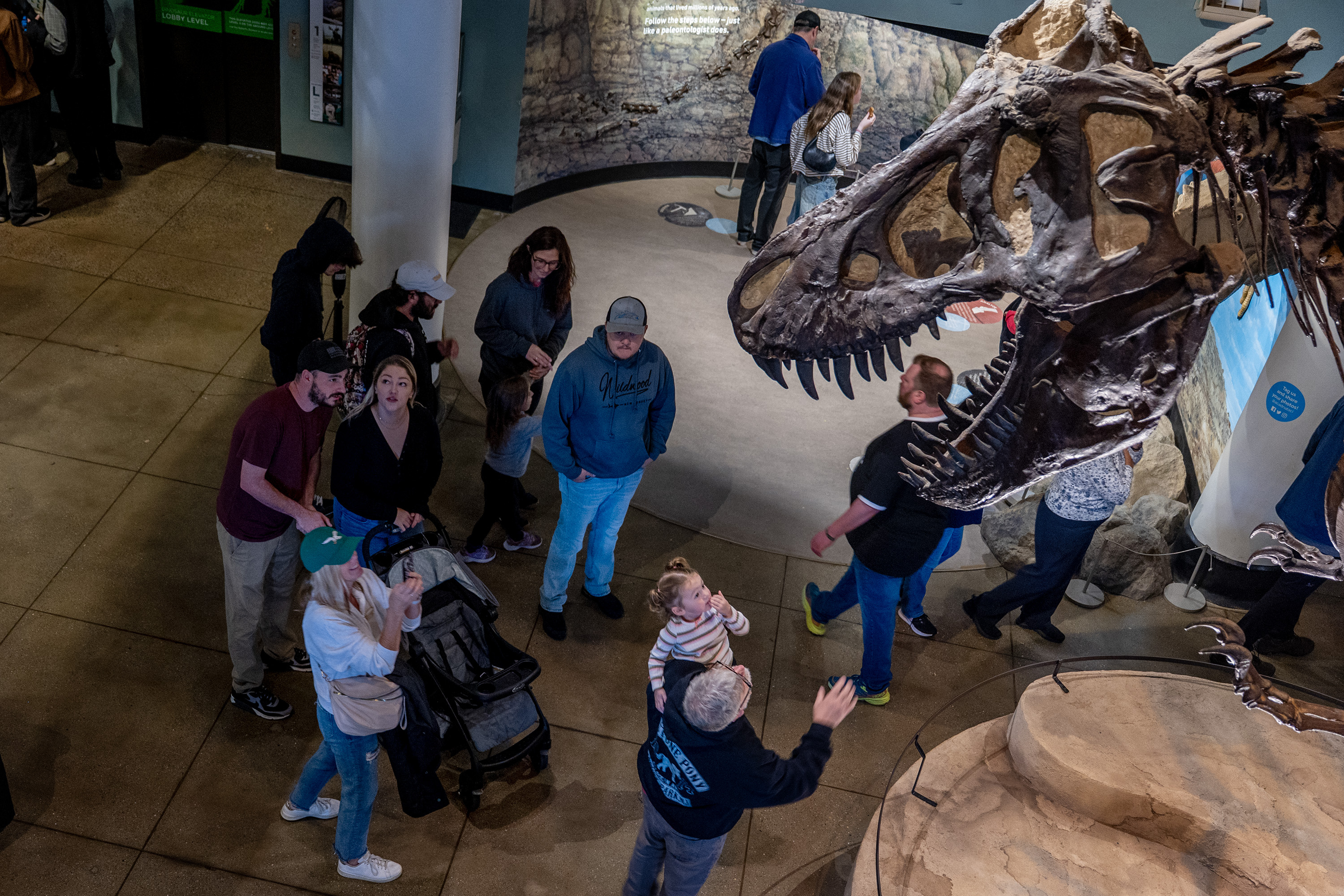
    So the decision by the leadership of the Academy and Drexel University to close the oldest natural history museum in the Americas on short notice is beyond disappointing.

    This is one of the city’s cultural crown jewels, housing more than 19 million scientific specimens, including fossils, plants, and animals, supporting global research on biodiversity and environmental science.

    Generations of grade school students in the Philadelphia area experience their first formative contact with science and history during field trips that have launched untold careers in pathbreaking fields.

    To be sure, the museum has faced declining attendance and budgetary strain since the pandemic and is in need of a refresh. But its finances do not appear to be dire. Its 2025 tax filings show $25.8 million in revenue and $23.8 million in expenses.

    The bigger problem is that the 150-year-old building on the Benjamin Franklin Parkway faces roughly $150 million in deferred maintenance costs, according to people familiar with the matter.

    While that may seem daunting, it is not insurmountable. Twenty years ago, city leaders raised $68 million in 45 days to keep Thomas Eakins’ iconic painting, “The Gross Clinic,” from being sold to an ownership group made up of the National Gallery of Art in Washington and an Arkansas museum.

    The William Penn Foundation attempted its own Hail Mary pass to the Academy late last week when it offered to underwrite the costs to operate the museum for at least a year. That seems like some welcome breathing room until a long-term solution is found.

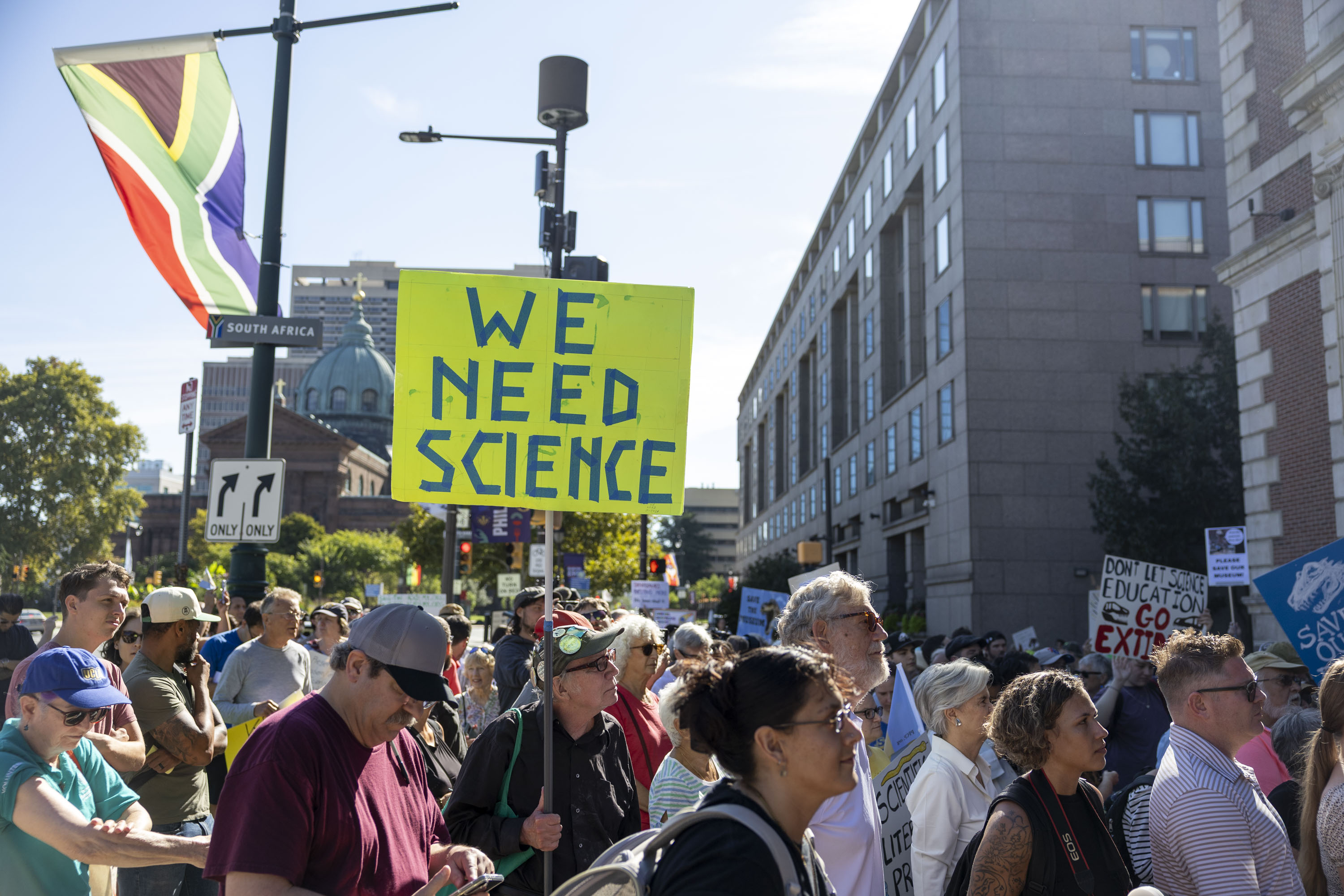
    People came out to support and rally outside the Academy of Natural Sciences of Drexel University on Sept. 8.Tyger Williams / Staff Photographer

    But Drexel said in a statement that it had not received a formal proposal from the foundation. At the very least, it seems like a generous offer that warrants further discussion.

    Instead, the museum opted to close the doors to the public on Sunday.

    David L. Cohen, the former Comcast executive and ambassador, has been designated by Gov. Josh Shapiro and Mayor Cherelle L. Parker to serve as their agent to find a solution to keep the Academy going.

    In an interview with the Editorial Board, Cohen said solutions have been found to preserve the research and education operations, but an agreement on a plan for the museum had yet to be reached.

    Cohen is a prolific fundraiser who once served as former Mayor Ed Rendell’s right-hand man through the city’s near bankruptcy in the 1990s. He has the gravitas and clout to strike a grand bargain.

    But it is disappointing to hear that a working proposal already calls for relocating the museum and selling the building. The city has spent decades transforming the Benjamin Franklin Parkway into the museum mile, including the addition of the Calder and Barnes Museums. Moving the natural history museum — and its millions of artifacts — should be the last option, not the first.

    Philadelphia has stepped up at other times of civic crisis.

    As governor, Rendell led a controversial effort — that included raising tens of millions of dollars mainly from foundations, along with state funding — to bring the Barnes Museum to Center City.

    Surely, Philadelphia’s business, political, and nonprofit leaders can come together to find a solution to keep the Academy of Natural Sciences in its iconic location for generations to come.

  • The Art of the Steal

    The Art of the Steal

    While much of the country struggles to pay for gas and groceries, Donald Trump has turned the presidency into a massive enrichment scheme for himself, his family and his cronies while also abusing the power of his office to reward supporters, punish enemies and remake Washington into his own self-aggrandizing image.

    In this collection, The Inquirer Editorial Board details many of the schemes Trump has used to grow his wealth by billions since his return to office last year.


    There’s gold in that thar swamp!

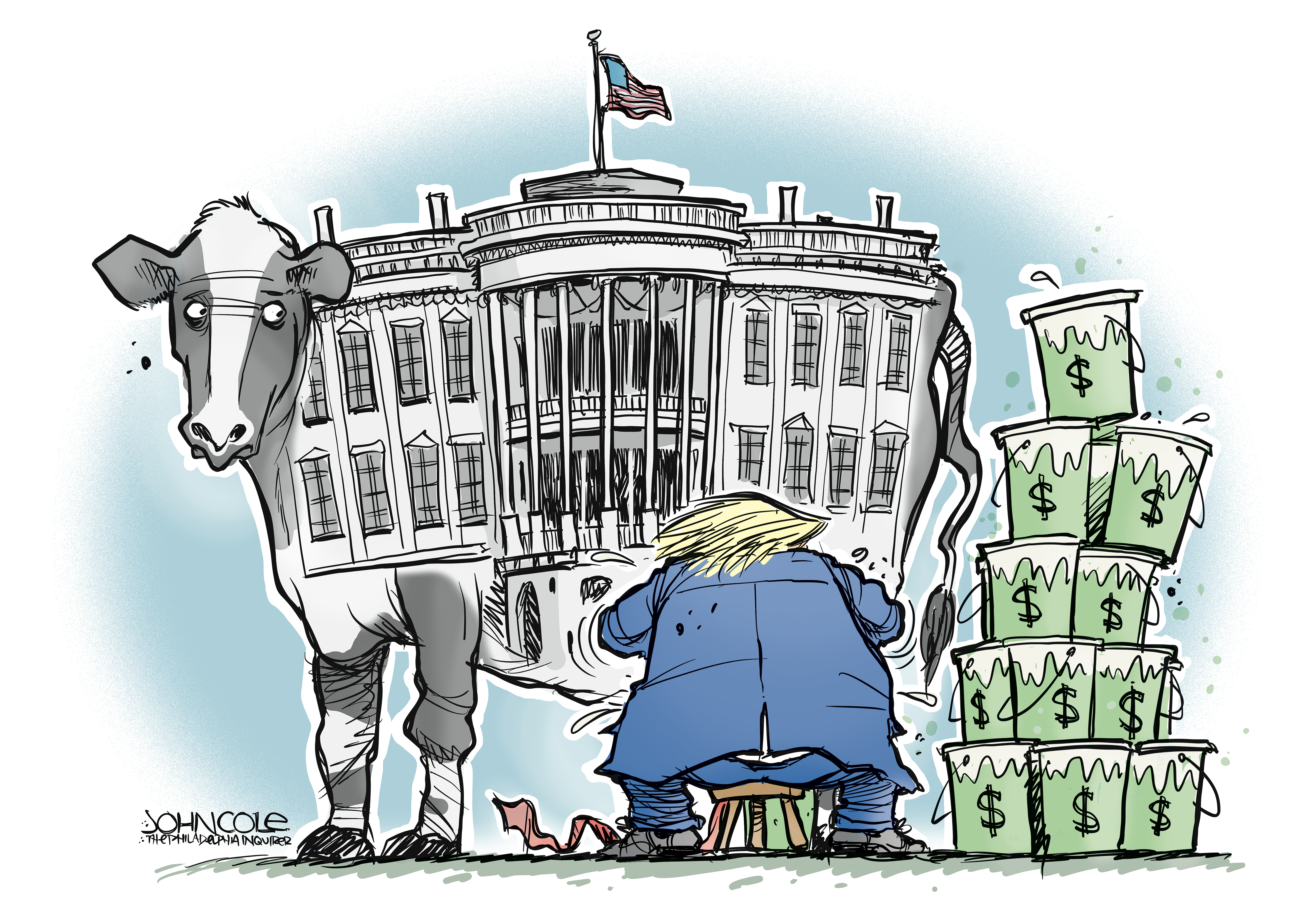
    From crypto to cologne, Bibles to blanket pardons, Donald Trump has turned the White House into a cash cow for himself, his cronies, and his kin.


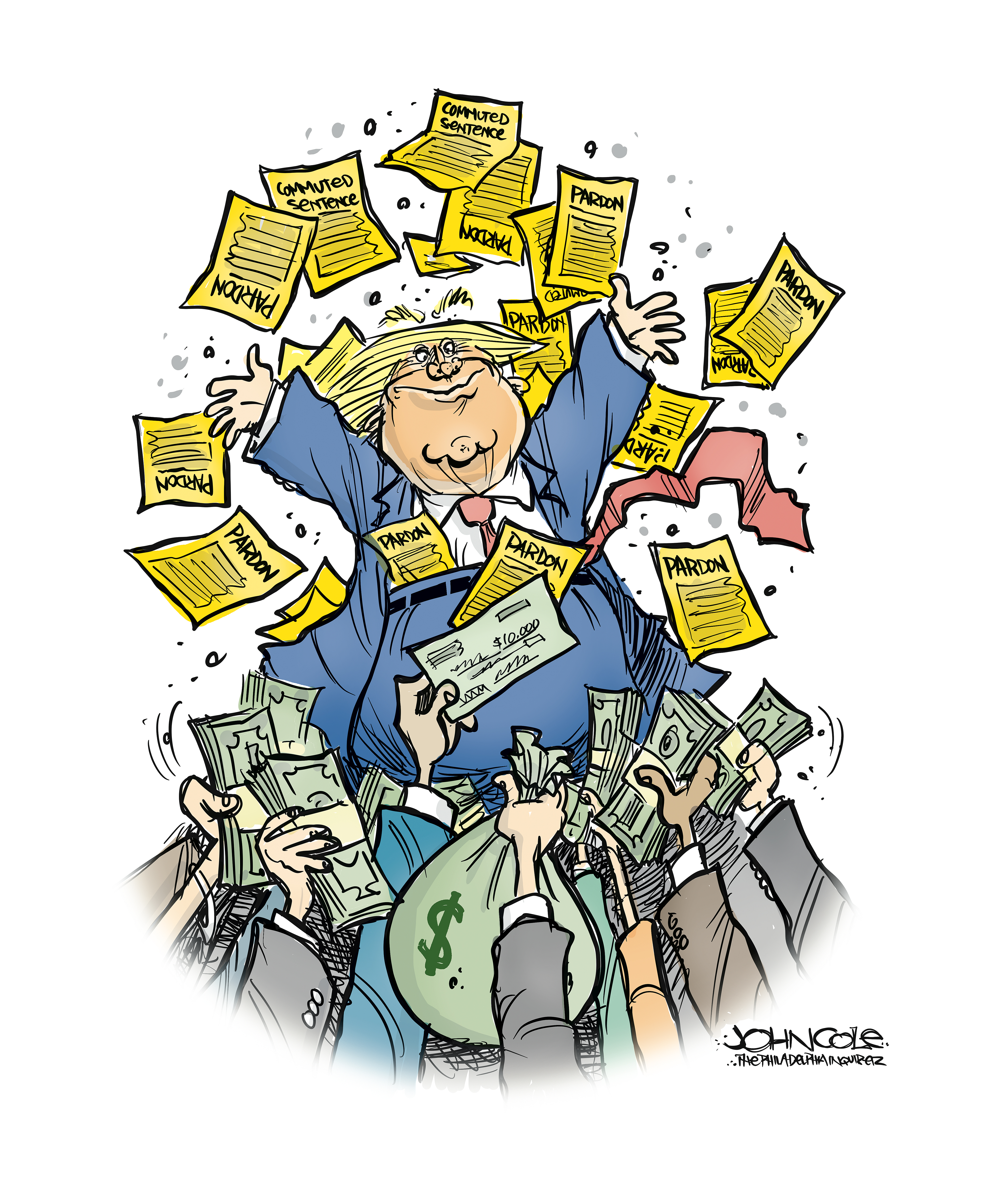
    Pardon me, Mr. President!

    Once sparingly used to temper justice with mercy, the presidential pardon has become a get-out-of-jail-free card for Trump supporters, no matter how corrupt or violent.


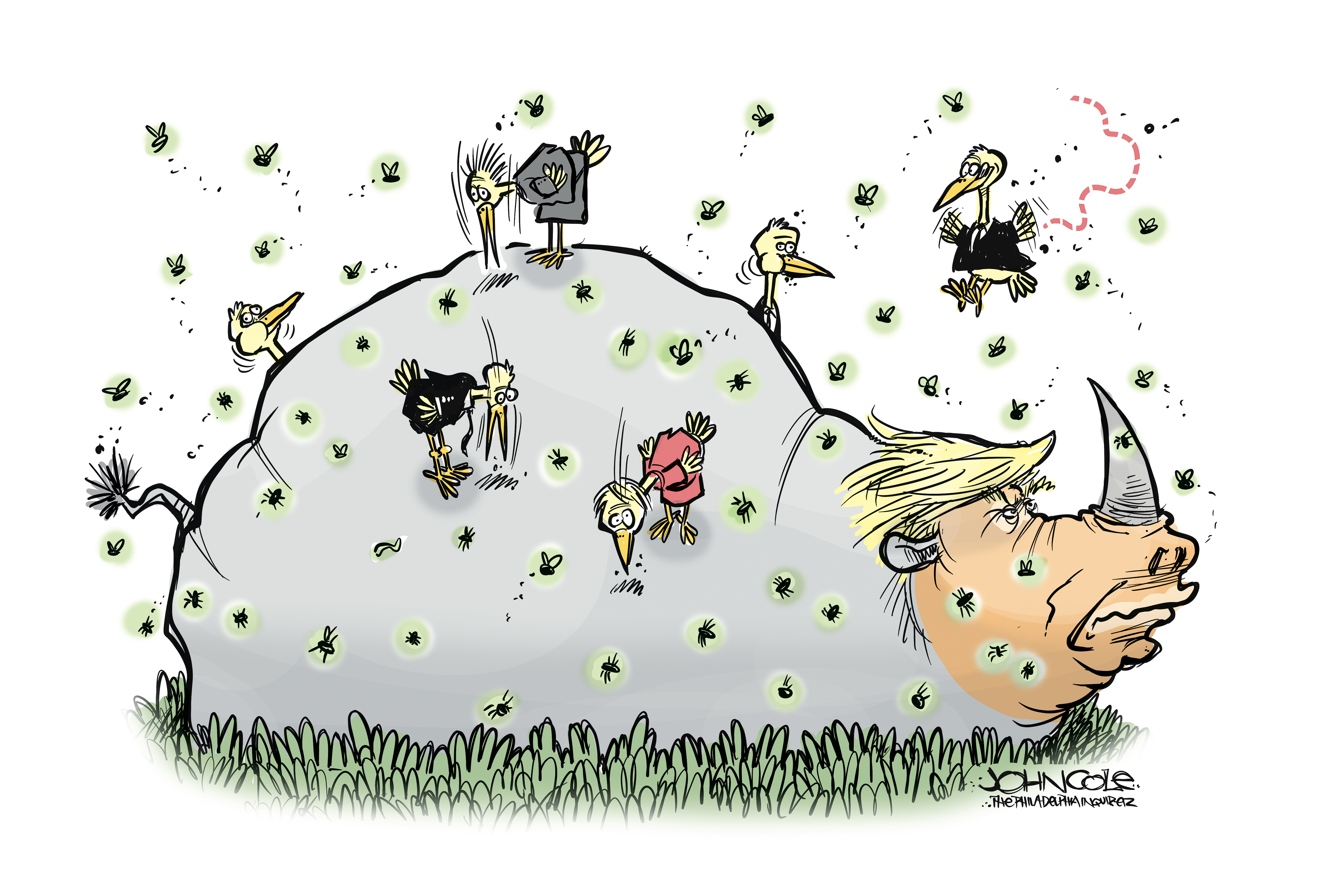
    For Trump’s underlings, too much is never enough

    A rogue’s gallery of billionaires, incompetents, and self-dealers crowds insatiably around the public trough.


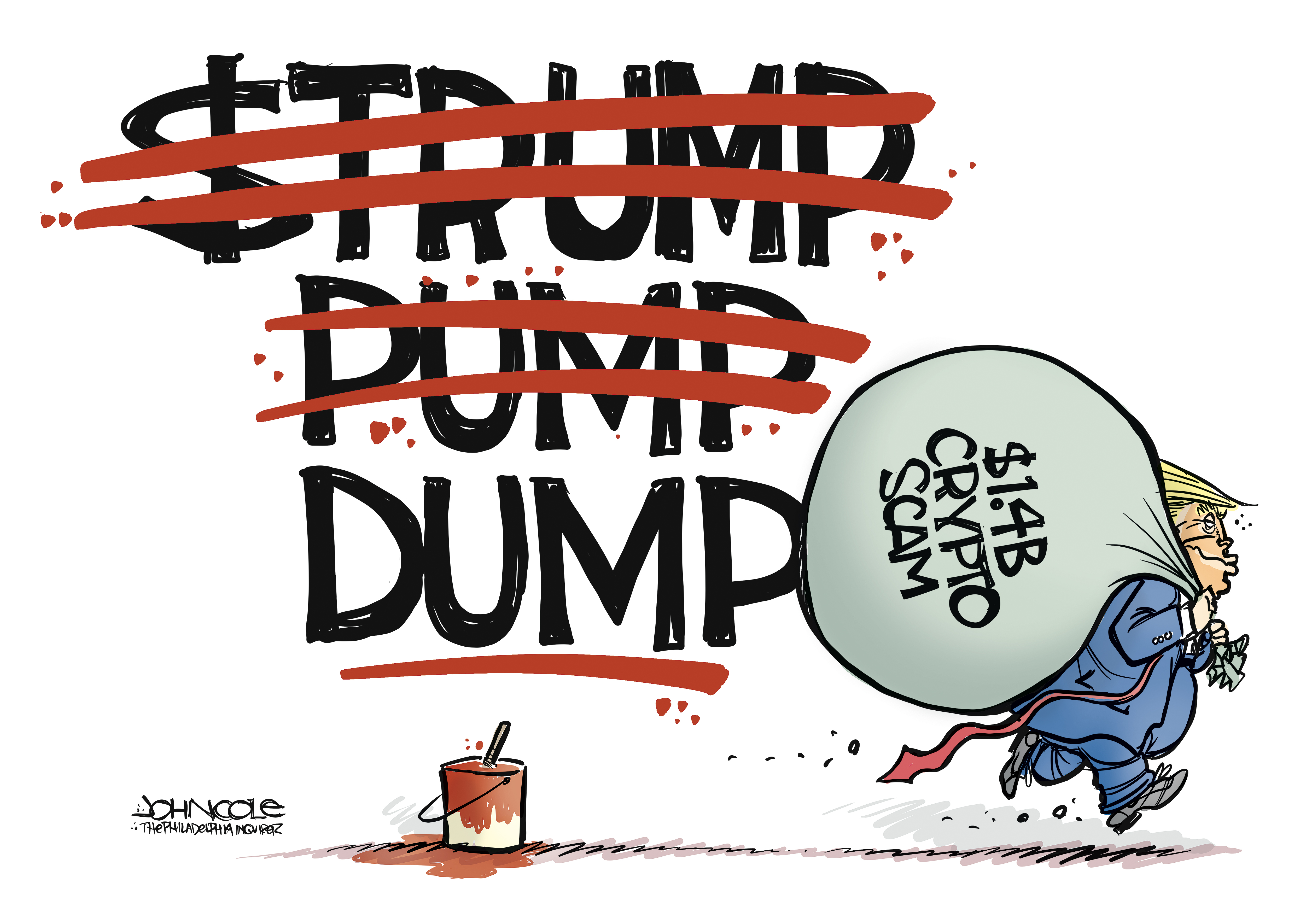
    Bitcoin memes and Ponzi schemes

    Having once dismissed it as a “scam,” the president has embraced cryptocurrency — to the tune of $1.4 billion.


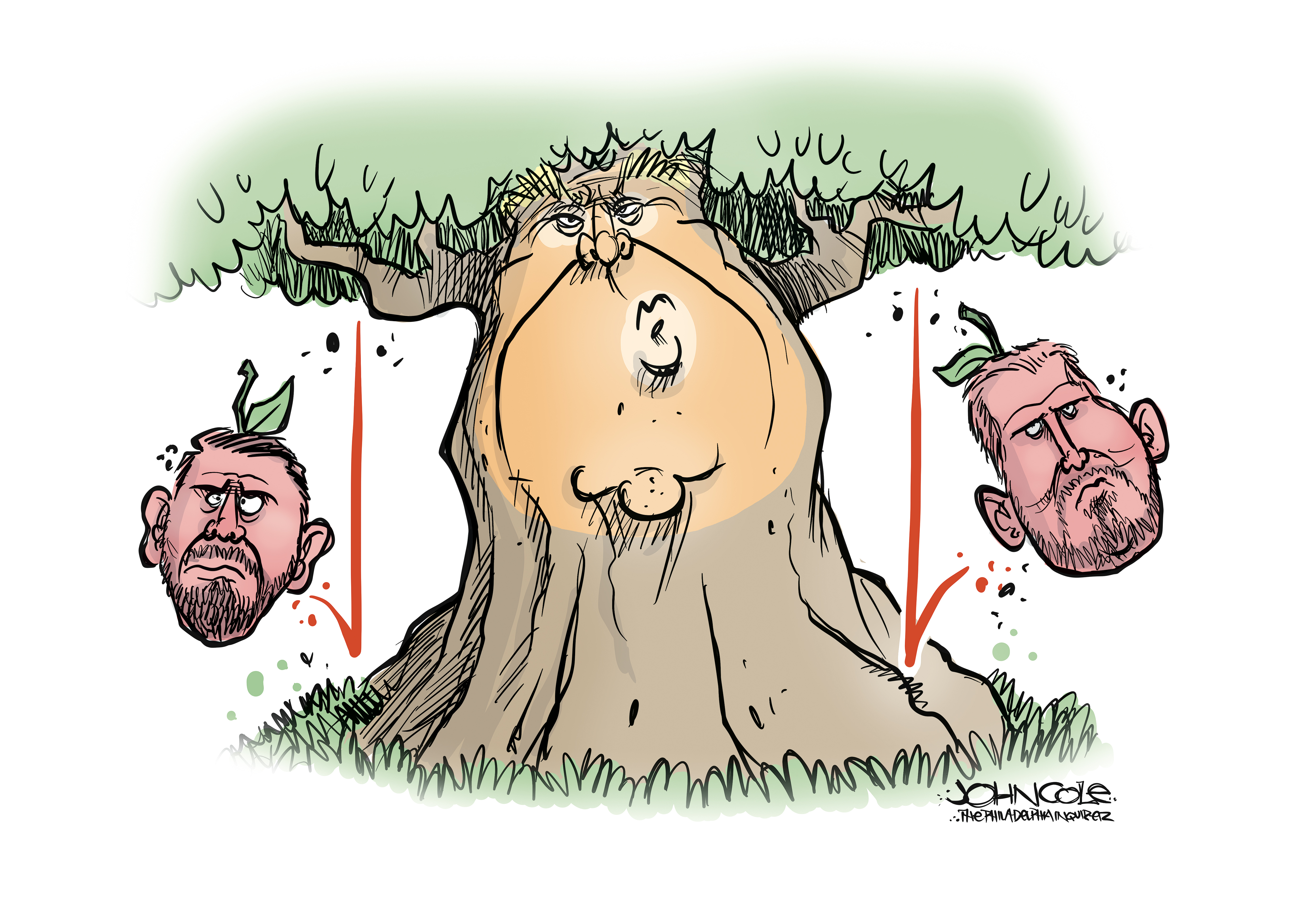
    The family that grifts together

    When it comes to plundering the presidency, the thief–in–chief brings the wife and kids.


    It’s all about him

    The president continues to plumb the depths of narcissism with a breathtaking array of self-aggrandizing vanity projects.

  • It’s all about him | Editorial

    It’s all about him | Editorial

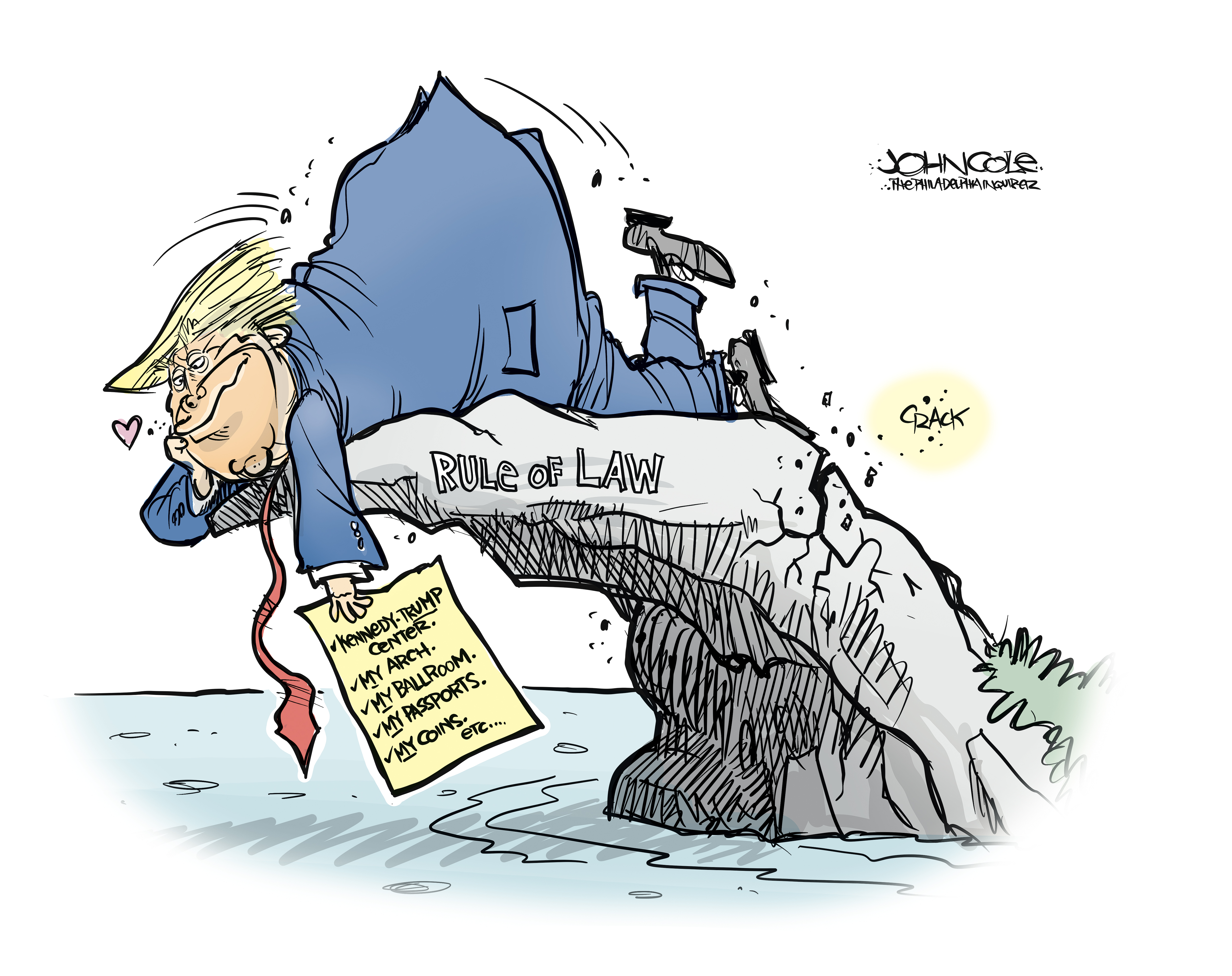
    Ignoring the law and breaking with tradition and decorum, Donald Trump has successfully added his image to U.S. passports, national park passes, and currency. He has draped his looming visage on federal buildings and named investment accounts and a discount drug program after himself.

    The president’s self-aggrandizing impulse knows no bounds or limits of reality. In his AI-addled dreams, Trump has put his face on Mount Rushmore, placed himself alongside great military leaders, and even compared himself to Jesus Christ (or, according to Trump, just a doctor in flowing robes bathed in a heavenly glow).

    Yet, all his efforts up to this point have proven mostly ephemeral, likely bound for the novelty bin.

    And if indeed the arc of the moral universe bends toward justice, it will only be a matter of time until Trump’s politics of cruelty and abuse of power are but an unpleasant memory.

    It is no wonder, then, that the president is relying on concrete and marble to try and leave any sort of legacy Americans can look up to.

    Of course, Trump being Trump, his desperate need for approval, his insatiable hunger for adulation and praise, are inseparable from the corrupt chicanery that characterizes the Art of the Steal.

    The president’s bid to remake Washington in his image began with the seemingly overnight demolition of the East Wing of the White House in October to build a massive ballroom. By the time the National Trust for Historic Preservation sued over the project’s defiance of multiple rules and regulations, construction was already underway — funded by a who’s who of companies and individuals who have business interests before the federal government.

    Trump has never addressed the appearance of corruption or possibility of quid pro quo deals over the private funding, instead touting the money coming from donors. “This is a gift. This is not going to be paid for by the taxpayer,” he said in May.

    However, as the price tag for the arguably needless structure continues to balloon — from an initial $200 million to upwards of $600 million — it is taxpayers who have been left to cover the shortfall. While Senate rules blocked a Republican effort to funnel $1 billion to ballroom security expenses, around $300 million in public funds have already been earmarked.

    In August, the U.S. Supreme Court allowed construction to continue on a 5-4 vote. The justices did not rule on the legality of the project, only that the plaintiff did not have the legal standing to sue.

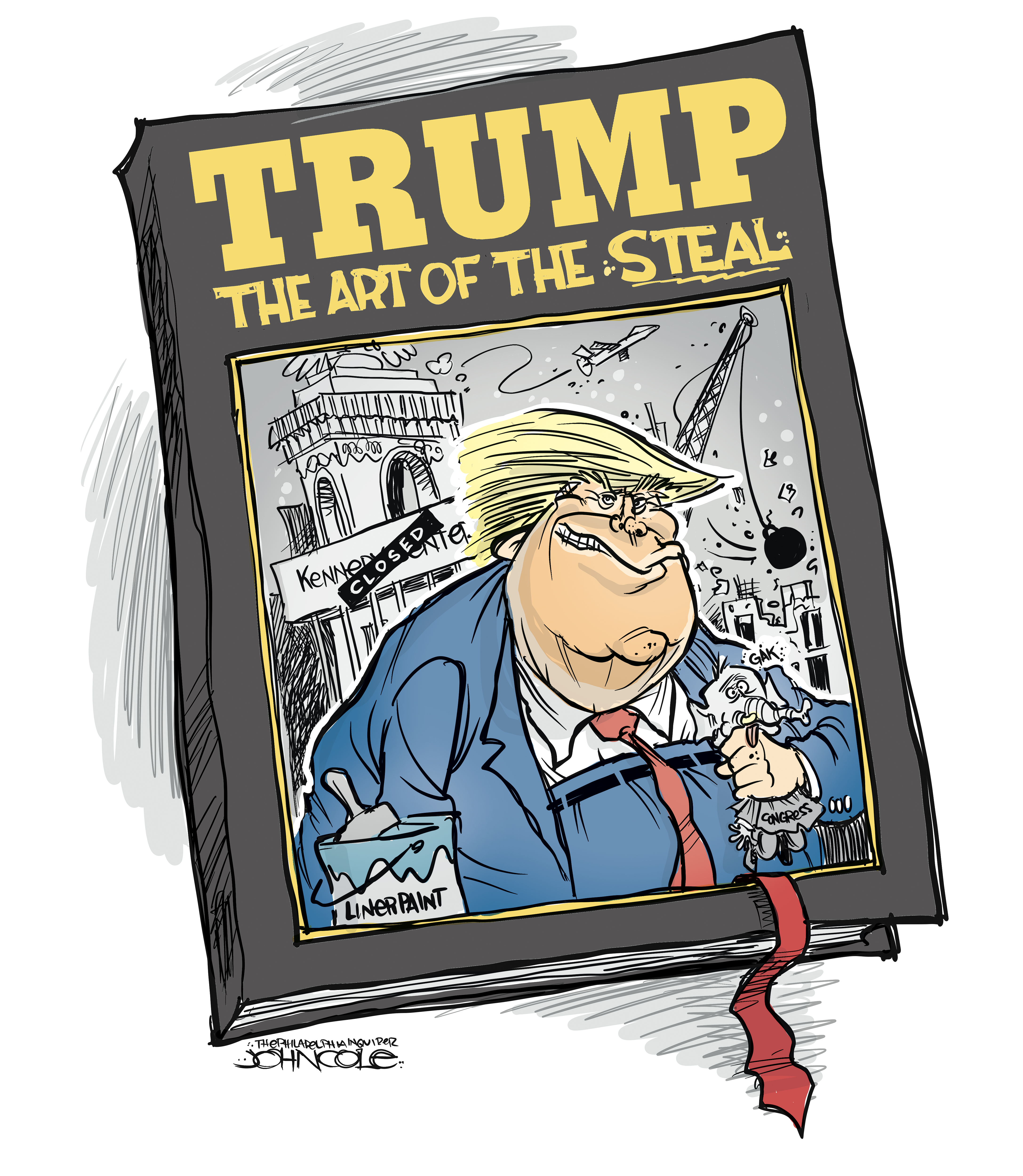
    Unlike the ballroom construction effort, Trump has suffered nothing but legal setbacks in his bid to be spoken of in the same breath as JFK. The president’s systematic debasement of the John F. Kennedy Center for the Performing Arts offers an example of what happens when Trump doesn’t get his way.

    In December, a day after Trump’s handpicked board (of which he is the chairman) voted to rename the Kennedy Center in his honor, workers were slapping Trump’s name on the building’s facade. The name change led to widespread cancellation of events by artists and abandonment by audiences and donors.

    As a face-saving measure, Trump announced in February that the center would close for two years of renovations. But while a district court judge has ruled repeatedly that Trump’s name was added illegally (the right belongs to Congress), the president has grown more toxic in his possessiveness.

    On Sept. 18, protesters formed a human chain outside the center after photos of Trump reviewing a potential demolition plan circulated. While the imminent destruction of the memorial to the slain president has not been confirmed, what is most certainly verified is Trump’s pettiness and disregard for the law.

    Congress has appropriated more than $250 million for renovating the center, money which Trump is now holding hostage unless he gets his way. “Because frankly, if we don’t do that, it’s going to close,” he told reporters recently. “It’ll end up being ripped down.”

    As the fate of the Kennedy Center remains in flux, across the Potomac River, plans for the 250-foot arch Trump wants built at a traffic roundabout near Arlington National Cemetery are advancing at an alarming pace.

    The arch, which would stand more than twice as tall as the nearby Lincoln Memorial, would adversely impact dozens of historic properties, according to the National Park Service. What is more troubling than the results of the agency’s review is that critics contend the report is nothing more than part of a box-checking process, not a real effort to examine the merits of the proposed monument.

    Consider that Trump has installed loyalists in the federal panels reviewing the proposal and that its approval — being rushed for the National Capital Planning Commission’s November meeting — is believed to be a fait accompli.

    The administration has defended building the arch as the continuation of a project Congress approved in 1925, with the president adding recently that the structure will also serve as a “military complex” that will help ensure national security.

    You cannot blame Trump, nor can you excuse him, for his desire for glorification. He is a deeply flawed human being whose lifetime has been defined by the empty flaunting of wealth. But blame for how his unchecked ego has shattered the rule of law can be readily assigned to the Republican-controlled Congress.

    Legislators could have stopped the president from any and all of his vainglorious efforts. They chose not to. As the midterms approach, it will be up to voters to do what their representatives couldn’t.

    Ultimately, the Art of the Steal may take away the power the GOP sacrificed all to hold on to. Or perhaps Trump will have his way, and his monuments will tower above Washington for generations to come.

    Generations who may think of a pitiable man who wanted to be remembered.

  • The family that grifts together | Editorial

    The family that grifts together | Editorial

    Donald Trump is not the only Trump profiting from the presidency.

    Nearly everyone in the Trump family is cashing in, raising concerns about self-dealing and hundreds of potential conflicts of interest.

    While relatives of past presidents sought to make money off their family name — see: Billy Carter, Roger Clinton, and Hunter Biden — no one has been anywhere near as brazen or greedy. Nor has anyone dared to mix policy with profiteering like the Trump family.

    It is all part of Trump’s shameless Art of the Steal.

    Often lost amid the Trump administration’s daily chaos, destruction, and incompetence is the unprecedented profiteering as the felonious president takes from America while he and his family grow richer.

    In just over a year, Trump’s two oldest sons, Donald Jr. and Eric, have seen their net worths jump six- and 10-fold to $300 million and $400 million, respectively, according to Forbes.

    Recent revelations that a Russian oligarch with close ties to Vladimir Putin paid hundreds of thousands of dollars for a party on a private island after Don Jr.’s wedding in May were brushed off as merely a gift from a friend — though Trump later said his son paid back the oligarch.

    Trump’s third and current wife, Melania, is also cashing in. She received an estimated $40 million from Amazon for documentary projects during her husband’s term in the White House. She also pocketed an undisclosed amount for her memoir titled Melania.

    The first lady is also involved in cryptocurrency. She launched $MELANIA, a memecoin that had an initial market capitalization of about $1.7 billion, but quickly plummeted by about 95%.

    But not before some insiders reportedly made roughly $100 million. A lawsuit accused the designers of Melania’s cryptocurrency of orchestrating a “pump-and-dump” scheme.

    Overall, the Trump family reportedly pocketed $1 billion in pretax profits from several cryptocurrency-related products and companies since Trump’s return to the White House.

    Even Trump’s youngest son, Barron, 20, who is still in college, made an estimated $40 million off the family’s crypto venture.

    Trump’s older daughter, Ivanka, has maintained a low profile in his second term. But during Trump’s first term, she and her husband, Jared Kushner, reported between $172 million and $640 million in outside income while working in the White House.

    After Trump’s first term ended, Kushner received a $2 billion investment from a fund led by the Saudi crown prince for his fledgling private equity venture — even though he had no private equity experience.

    In Trump’s second term, Kushner continues to mix personal business with diplomacy.

    Kushner is reportedly trying to raise $5 billion for this private equity fund from Middle East governments, even as he serves as Trump’s point person in negotiating a peace deal with Iran.

    Kushner’s role as Trump’s special envoy for peace has been a struggle since he and his peace partner, Steve Witkoff, a New York real estate developer and Trump crony, knew nothing about Iran’s nuclear capabilities.

    More troubling, Kushner has raised questions as to whether he is focused on peace or personal profits.

    “You cannot both be a diplomat and a financial pawn of the Saudi monarchy at the same time,” said U.S. Rep. Jamie Raskin (D., Md.), who called for an investigation into Kushner’s foreign financial entanglements.

    Trump dismisses any critiques of his family’s money-making ventures and maintains he always puts the nation’s interests first. Likewise, the Trump Organization, his family business, insists it is “fully compliant with all applicable ethics and conflicts of interest laws.”

    But watchdog groups and historians have said Trump’s profiteering is unprecedented.

    The Trump Organization, the family real estate company run by Eric and Don Jr., has announced a dozen international development deals since their father returned to the White House.

    But most of Trump and his family’s newfound wealth stems from crypto ventures — a business he once dismissed as “a scam.”

    Trump changed his tune during the 2024 presidential campaign after he met with Bitcoin mining executives. One executive said his industry would raise over $100 million and turn out more than five million votes in the 2024 presidential race.

    Once in office, Trump returned the favor.

    Three days after his inauguration, Trump signed an executive order that officially declared it U.S. policy to support the growth of the digital asset economy and blockchain technology.

    He then proceeded to gut crypto regulations, eliminate watchdogs, and drop investigations.

    In March 2025, he signed an executive order to create a new U.S. crypto reserve. The following month, Trump’s Justice Department disbanded the unit that investigated cryptocurrency crimes. By December 2025, the Securities and Exchange Commission dropped or paused nearly 60% of crypto cases.

    Under Trump, the Commodity Futures Trading Commission slashed crypto enforcement actions, purged career officials, and shrunk the agency’s workforce, while paving the way for crypto and prediction markets to blossom.

    All that occurred as the Trump family embraced cryptocurrency — even though none of them had any experience in the risky and complex business.

    In September 2024, Trump, Don Jr., and Eric unveiled World Liberty Financial, a cryptocurrency start-up that sparked immediate concerns regarding conflicts of interest.

    Four days before Trump’s inauguration, World Liberty Financial landed a windfall: An investment firm tied to the United Arab Emirates invested $500 million to acquire a 49% stake in the company.

    A few months later, the Emirati government reached a deal with the Trump administration involving the export of hundreds of thousands of advanced computer chips to power AI technology. Lawmakers and intelligence experts warned the sale presents a national security risk of the technology being diverted to China.

    Trump also used his presidential power to do a favor for a convicted executive who gave his family’s crypto company an early boost.

    World Liberty Financial benefited from a business alliance with Binance, the world’s largest crypto trading platform, founded by Changpeng Zhao, a billionaire mogul who pleaded guilty to money laundering in 2023.

    President Trump pardoned Zhao in 2025. Days after that pardon, Binance began promoting a digital coin offered by World Liberty Financial on its U.S. site, making it more accessible to American buyers.

    In March 2025, Don Jr. and Eric expanded their crypto portfolio by buying a 20% equity stake in American Bitcoin, a cryptocurrency company.

    Trump’s oldest sons have jumped into other businesses in which they have little to no expertise. Since their father’s election, Don Jr. and Eric have joined 10 company boards, where they receive stock and other financial benefits.

    After Trump was elected to a second term, Don Jr. became a venture capitalist. He was hired as a partner at 1789 Capital, a firm based in Palm Beach, Fla., founded in 2022. Companies backed by 1789 Capital have since received government contracts valued at $735 million.

    Drones have also become a lucrative part of Don Jr. and Eric’s portfolio, even though they had no experience in that business, either.

    In November 2024, Don Jr. became an investor and adviser at Unusual Machines, a tiny drone manufacturer with fewer than 200 employees. The announcement caused the company’s stock price to jump 100%.

    Just over six months later, Trump signed an executive order directing federal agencies to prioritize American-manufactured drones and accelerate domestic production for military applications.

    Four months later, Unusual Machines won its largest contract ever to supply drone motors to the U.S. Army.

    In an unusual deal, a golf club company backed by Trump’s two oldest sons merged with Powerus, a Florida-based drone manufacturer with fewer than 100 employees.

    Companies are learning that hiring a Trump can make their troubles go away.

    After Don Jr. joined the board of PublicSquare, the company’s stock price jumped 180%. The Consumer Financial Protection Bureau then closed a yearslong investigation into a subsidiary of Public Square called Credova Financial, claiming the probe was biased.

    Don Jr. is also an investor and board member at Polymarket and a strategic adviser at Kalshi, the controversial and unregulated prediction betting market companies. Yet another business in which he had no experience.

    A number of states have sued Polymarket and Kalshi, alleging the companies operate a gambling business in violation of state laws.

    But the Trump administration has sided with the prediction companies and sued three states, insisting the prediction industry should be regulated by the federal government.

    Apparently, the golden age of America Trump promised largely stops at his family tree.

  • Bitcoin memes and Ponzi schemes | Editorial

    Bitcoin memes and Ponzi schemes | Editorial

    Much has been made of Donald Trump’s apparent about-face on cryptocurrency. This is particularly notable since the president’s dealings in the virtual cash he once spurned have earned him at least $1.4 billion since he returned to office. Not bad for something he had called “a scam” and an asset “based on thin air.”

    Of course, that assumes he meant those things as derogatory.

    After a lifetime of pushing real estate, casinos, liquor, and steaks, one may think the Art of the Steal has finally gone high-tech. But at least for retail investors, Trump’s crypto ventures reek of old-fashioned Ponzi schemes.

    Launched a few days before his inauguration in 2024, the $TRUMP memecoin — a digital token with no intrinsic value — reached a peak price of around $74 as the president hyped up the asset to his followers. The coin’s value cratered soon after and was trading under $3 in September.

    A few dozen early investors made multimillion-dollar profits, but most buyers fared poorly, losing almost $4 billion as of earlier this year, according to a New York Times analysis.

    Even if Trump supporters and less savvy investors played along willingly, the game was always rigged in the president’s favor — regardless of the memecoin’s price, Trump and his business partners were always going to rake in transaction fees.

    All told, Trump walked away with a $636 million payout.

    It is unseemly and deeply unethical for Trump to use the office of the presidency for personal benefit. But profiting off the sale of a worthless tchotchke is very much on-brand for the inveterate huckster whom voters returned to the White House.

    Much more troubling than his déclassé dealings is how individuals and foreign governments with interests before the United States, including government regulation of the crypto industry, have made large investments that have gone to line Trump’s pockets.

    The president has repeatedly brushed off ethical concerns about his crypto windfall, saying there is “nothing illegal” and “nothing wrong.”

    Yet, there can be little question that Trump’s memecoin remains a way to funnel large amounts of money to him with little transparency or oversight.

    Speaking at a Center for American Progress event recently, U.S. Sen. Chris Murphy of Connecticut called the president’s crypto business “a bribery conspiracy,” and said the very founding of Trump’s crypto empire was “bathed in corruption.”

    Murphy pointed to the half billion dollars Sheikh Tahnoon bin Zayed Al Nahyan put up to secure a 49% stake in the Trump family’s crypto company, World Liberty Financial, shortly before Trump assumed office. The Abu Dhabi royal, the United Arab Emirates’ national security adviser and brother of that country’s president, is also backing the launch of a new Trump crypto bank, according to the Wall Street Journal.

    There is no evidence of a quid pro quo, but there is also little explanation as to why long-standing bipartisan national security concerns were ignored and the UAE was given access to advanced AI chips by the Trump administration, long a goal for the Gulf nation.

    Tahnoon was not the only investor in World Liberty Financial who benefited from his relationship with Trump. Justin Sun, a Chinese billionaire accused of fraud, sank $30 million into World Liberty Financial and saw a lawsuit by the Securities and Exchange Commission put on hold soon after, with a settlement reached in April in which Sun admitted no wrongdoing.

    (Sun is now accusing World Liberty Financial of “criminal extortion” after he was prevented from selling off the memecoin, allegedly once he declined to sink more money into the Trump-owned company.)

    Earlier this month, legislation long sought by the crypto industry as a way to legitimize its business failed to move forward in the Senate, as Democrats demanded stricter ethics guidelines to prevent further Trump profiteering.

    Crypto companies have spent hundreds of millions of dollars lobbying for this legislation — and they are likely willing to spend much more — but Congress should hold firm. Lawmakers must ensure that any legitimate use for cryptocurrency does not include the ability to bribe a president.

  • For Trump’s underlings, too much is never enough | Editorial

    For Trump’s underlings, too much is never enough | Editorial

    For Donald Trump’s underlings, public service has become a bacchanal.

    A rogues’ gallery of billionaires, incompetents, and self-dealers crowds insatiably around the public trough.

    Trump’s return to the White House has set an unprecedented bar for corruption, pocket lining, and abuse of power.

    But beyond the one-man profligacy, many of Trump’s underlings have joined in on the self-dealing as the rot spreads across the government.

    The upshot: Trump’s own Art of the Steal has morphed into a rampant smash-and-grab.

    Consider FBI Director Kash Patel’s abuse of a taxpayer-funded jet to visit his girlfriend, fly buddies to Scotland, and attend the Winter Olympics, where he chugged beer in the locker room with the U.S. men’s ice hockey team.

    Patel reportedly flew to Pearl Harbor and received a VIP snorkeling adventure near the sacred underwater tomb of the USS Arizona that contains the remains of more than 900 Navy sailors and Marines who died in the attack.

    He and his girlfriend used the FBI’s Gulfstream V to fly to Philadelphia to watch a concert from a $35,000 luxury suite at Lincoln Financial Field.

    Patel also used the $60 million jet to go hunting at an exclusive resort in Texas named the Boondoggle Ranch that is owned by a Republican donor.

    An article in the Atlantic claimed Patel drank excessively, and that his unexplained absences and carousing put national security at risk. Patel denied the report and sued the magazine for defamation. Drinks aside, Patel is abusing his office.

    Patel’s air travel should not be confused with that of former Homeland Security Secretary Kristi Noem, who spent $300 million in taxpayers’ money for a fleet of planes, including two Gulfstreams and a luxury Boeing 737 Max 8 jet that included a private cabin with a queen bed, full kitchen, bar, seating area, and four flat-screen TVs — supposedly for deportation missions.

    Noem’s office wasted $220 million on a taxpayer-funded ad campaign that depicted her on a horse near Mount Rushmore. A no-bid contract divvied up the funds between a company created eight days before they were awarded and another company that played a role in Noem’s 2022 gubernatorial campaign.

    Noem is gone, but taxpayers are stuck with her bill.

    Former Labor Secretary Lori Chavez-DeRemer resigned amid allegations of using her office for personal gain, including personal travel and allegations of drinking on the job and an alleged affair with a member of her security detail.

    One staffer accused Chavez-DeRemer of ginning up “official trips” funded by taxpayers in order to see friends and family. Her husband was banned from the Labor Department headquarters after at least two staffers said he sexually assaulted them. Another brief tenure of taxpayer waste and debauchery that contributed scant value to the country.

    Commerce Secretary Howard Lutnick has used his office to dangle policy favors in return for investments and deals that benefit his family, according to a report in the New York Times.

    Lutnick’s sons oversee a network of companies, including their father’s Wall Street investment firm, that are involved in a wide range of businesses, among them data centers and cryptocurrency, which overlap with the Commerce Department’s efforts to attract new entrepreneurs.

    U.S. Rep. Madeleine Dean (D., Pa.) accused Lutnick’s investment firm of profiting off the failure of Trump’s tariff policy, which the U.S. Supreme Court found was unconstitutional.

    “Your sons figured out how to profit from the high tariffs by buying up refund rights, pennies on the dollar, just as you were out there cheerleading the tariffs,” Dean said at a hearing in April. “As a result, federal taxpayers like my constituents may now owe your family tens or hundreds of millions of dollars.”

    Lutnick denied the charge, though his firm, Cantor Fitzgerald, now run by his sons, reportedly posted record revenue last year.

    Despite running on a message of reducing prices and helping the working class, Trump’s administration includes 12 billionaires and is the wealthiest ever, if not the most out of touch.

    The billionaire club does not include the brief and destructive DOGE stint of Elon Musk, who recently became the first trillionaire.

    Other Trump administration officials have also found ways to cash in. Several have profited from well-timed investments in the stock market.

    Former Attorney General Pam Bondi sold between $1 million and $5 million worth of shares in Trump Media the same day the president announced new tariffs that caused the price to drop. While her tenure was a train wreck, Bondi’s successor has already demonstrated he will be even worse.

    Todd Blanche, Trump’s former defense attorney who replaced Bondi at the Justice Department, owned cryptocurrency investments valued between $159,000 and $485,000 at the same time he shut down investigations into crypto companies, dealers, and exchanges launched during the Biden administration.

    Transportation Secretary Sean Duffy filmed a reality TV show bankrolled by firms he regulates, and sold stock in nearly three dozen companies two days before Trump announced a number of “reciprocal” tariffs.

    In all, more than a dozen Trump administration officials sold stocks before the president implemented tariffs that caused stock prices to plummet, ProPublica reported.

    The White House routinely defends the actions of Trump’s inner circle, stating recently, “President Trump has assembled the most talented Cabinet in American history who work every day to implement his common sense, America First agenda.”

    But Trump’s broker may be one of the busiest traders around. Trump disclosed making 3,500 stock trades valued at hundreds of millions of dollars in just the first quarter of this year, but said his accounts are independently managed. However, the amount of trading raised eyebrows among ethics experts.

    “We’ve never seen a president trading actively in the stock market before,” said Richard Painter, the ethics counsel under former President George W. Bush.

    Democratic lawmakers called for an investigation into whether Trump or others around him have engaged in insider trading. But nothing will change as long as Trump and the Republicans control all the levers of government.

    As millions of Americans struggle with rising gas, food, rent, and healthcare costs, Trump and his cronies have turned public service into a private jackpot.

  • Pardon me, Mr. President! | Editorial

    Pardon me, Mr. President! | Editorial

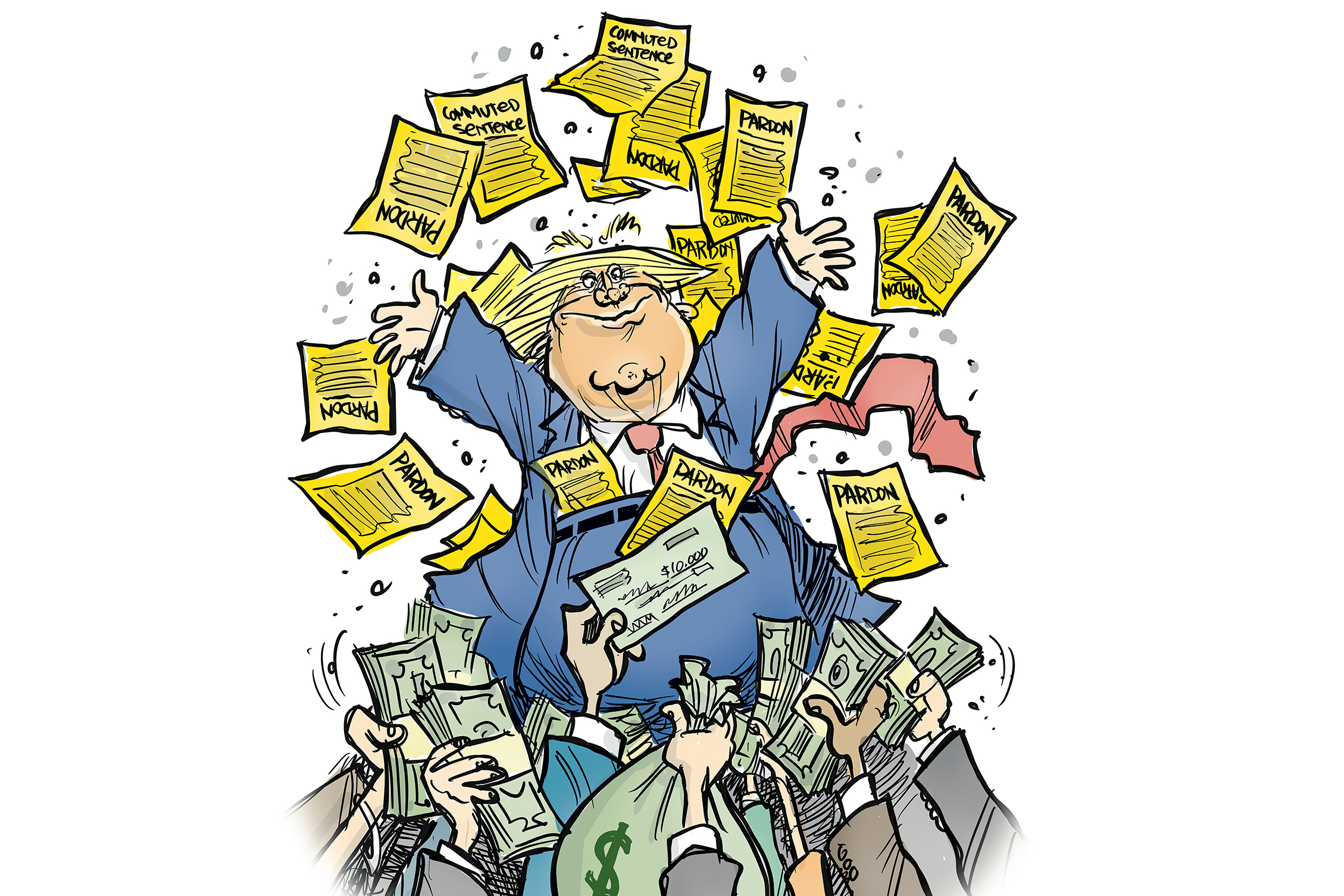
    Donald Trump has abused his power in many ways, but one of the most grotesque is through his perversion of presidential pardons.

    At the same time Trump has misused the U.S. Department of Justice to prosecute perceived political enemies, he has turned presidential pardons into a cottage industry, focused on freeing donors and business allies.

    This abuse of power rewards cronyism and distorts the idea that everyone is equal under the law.

    In Trump’s warped view, any allies with the right connections who got convicted or pleaded guilty were victims of a “witch hunt.” Conversely, anyone who refuses to do his bidding, or places their constitutional oath first, must be punished or prosecuted.

    Ironically, Trump is the one waging the lawfare he frequently decries.

    During the campaign, Trump promised retribution. The list of vindictive prosecutions shows that he has kept his word.

    See: former FBI Director James Comey, Comey’s daughter, Maurene, E. Jean Carroll, former Federal Reserve Chairman Jerome Powell, Federal Reserve Governor Lisa Cook, New York Attorney General Letitia James, former CIA Director John Brennan, former FBI Deputy Director Andrew McCabe, the Southern Poverty Law Center, and many others.

    At the same time, Trump has pardoned a number of disgraced politicians who were supportive of him, just as he pardoned a host of his loyal hatchet men at the end of his first term, including Steve Bannon, Michael Flynn, Paul Manafort, and Roger Stone.

    The blatant abuse on both sides of the legal scale by a sitting president is noxious and undermines the rule of law.

    Presidential pardons were meant to safeguard justice or demonstrate mercy. They were not meant to be dangled as rewards to cronies or violent supporters.

    Trump’s pardon abuse also benefits him. He secures loyalty, buys silence, and signals that future lawbreakers who act on his behalf will be protected. In some cases, he receives benefits via campaign donations or sweetheart business deals.

    The entire scheme is part of Trump’s broader Art of the Steal as he turns the power of the presidency into an instrument for personal gain.

    To be sure, other presidents have issued controversial pardons to political friends and family.

    Gerald Ford’s pardon of Richard Nixon, who resigned in disgrace to avoid impeachment, is probably the most notorious. More recently, Joe Biden pardoned his son, Hunter.

    Bill Clinton pardoned Marc Rich, a wealthy donor. George H.W. Bush pardoned six Reagan administration officials entangled in the Iran-Contra affair, including former Defense Secretary Caspar Weinberger.

    But Trump supercharged the pardon power in ways that make a mockery of the rule of law.

    On his first day back in office, Trump issued sweeping pardons and commutations to approximately 1,500 defendants charged or convicted for their role in the Jan. 6, 2021, insurrection — which a bipartisan House committee and federal prosecutors found he incited.

    The Jan. 6 insurrectionists ransacked the U.S. Capitol, attacked police officers, called for hanging then-Vice President Mike Pence, and hunted for then-House Speaker Nancy Pelosi. Nearly 100 of the Jan. 6 rioters Trump pardoned have gone on to commit new crimes.

    Trump said the Jan. 6 pardons were justified, and that the Constitution gives him the absolute power to “do whatever I want.”

    He has continued to issue pardons with that mindset. He preemptively pardoned political allies including Rudy Giuliani, Mark Meadows, and Sydney Powell last year, even though none of them faced any federal charges.

    In the first year of his second term, Trump granted 166 pardons, not including the mass pardons for the Jan. 6 insurrectionists. By comparison, during his entire four-year term, former President Biden issued 80 pardons.

    Trump, who was found liable in a civil fraud case related to his businesses, seems partial to freeing white-collar fraudsters. In all, he has extended clemency to more than 70 allies, donors, and others convicted of fraud.

    Trump’s abuse of the pardon system includes ignoring basic checks on the system.

    Justice Department guidelines call for people seeking pardons to wait five years after release from prison, show remorse, provide evidence of rehabilitation, and file a petition through the Office of the Pardon Attorney.

    That process has been obliterated. In its place, Trump essentially selects and issues pardons whenever and to whomever he wants.

    Supporters and business associates are often at the top of the list.

    Disgraced former U.S. Rep. George Santos (R., N.Y.) was freed after serving just three months of a seven-year term. In commuting the sentence, Trump cited the former lawmaker’s political support.

    Trump pardoned former Illinois Gov. Rod Blagojevich, who campaigned for the president and appeared on his reality TV show Celebrity Apprentice.

    Trump pardoned Changpeng Zhao, the billionaire founder of Binance, the world’s largest cryptocurrency exchange. Months later, the Trump family’s crypto company entered an alliance with Binance, a move that benefited World Liberty, the Trumps’ fledgling firm.

    Some of those who have been granted clemency have received added benefits beyond their freedom.

    At the end of his first term, Trump pardoned his son-in-law’s father, Charles Kushner, who pleaded guilty to tax evasion and making illegal campaign contributions.

    After returning to the White House, Trump handed Kushner the plum assignment of ambassador to France — a role in which he quickly proved to be unfit.

    Other pardons have cost taxpayers millions.

    Trump pardoned Trevor Milton, who was convicted of securities fraud, after he and his wife donated $1.8 million to Trump’s presidential campaign. The pardon eliminated $660 million in restitution obligations.

    Trump pardoned a tax cheat weeks after his mother attended a $1 million-per-person fundraising dinner at Mar-a-Lago. The deal also eliminated $4 million in restitution Paul Walczak, a nursing home executive convicted of tax evasion, was supposed to repay to taxpayers.

    In all, Trump’s pardons and commutations have wiped away nearly $2 billion that the offenders had been ordered to pay as part of their sentences.

    He told advisers he plans to issue mass pardons on his way out the door, according to the Wall Street Journal. No wonder Trump’s henchmen continue to act with impunity.

    “I’ll pardon everyone who has come within 200 feet of the Oval [Office],” Trump reportedly said during one meeting, generating laughs.

    Sadly, the joke is on the American people.

  • There’s gold in that thar swamp! | Editorial

    There’s gold in that thar swamp! | Editorial

    In Donald Trump’s world, public service pays better than being a real estate mogul.

    Trump has been lining his pockets since he returned to the White House. His sons, Eric and Donald Jr., have been cashing in, too. So has his wife, son-in-law Jared Kushner, and other cronies in the Trump administration.

    In just his first year back in office, Trump made more than $2.2 billion — an unheard-of sum for any previous president, and more than he ever made in any of his years as a private businessman.

    More troubling is how Trump has blurred his private profiteering with public policy — so much so that it is hard to know where one starts and the other ends.

    Most of Trump’s recent windfall has come from a murky crypto venture and a number of foreign real estate deals. But his cash grab seemingly has no end. Trump incorporated dozens of new companies just before returning to the White House.

    He launched numerous Trump-branded products, including Bibles, $249 “Victory 47” cologne, $399 gold high-top sneakers, $450 golf shoes, work boots, a line of watches that go from $499 to $100,000, and guitars for $10,000.

    While much of Trump’s shameless self-dealing has occurred in broad daylight, he has received little pushback from Republican lawmakers who control Congress, or the conservative media echo chamber that once championed his calls to “drain the swamp.”

    The White House continues to maintain the president is doing precisely that. The administration has repeatedly denied accusations of corruption and self-dealing, stating through a spokesperson that “President Trump only acts in the best interests of the American public.”

    Questions about whether Trump’s focus during his second term is more on personal enrichment than public service began even before Day One.

    Four days before returning to office, the Trump family’s newly created cryptocurrency company, World Liberty Financial, sold a 49% stake in the company valued at $500 million to Sheikh Tahnoon bin Zayed Al Nahyan, the United Arab Emirates’ national security adviser, known as the Spy Sheikh.

    In May 2025, another company chaired by Tahnoon invested $2 billion using a stablecoin issued by World Liberty. Two weeks later, the Trump administration announced a deal to sell hundreds of thousands of dollars worth of advanced computer chips for use in AI to the UAE.

    Trump made almost $60 million on foreign licensing deals in 2025, a 900% jump from the years before he returned to the White House.

    Unlike in his first term when Trump promised not to make any private foreign business deals, some recent family ventures include a $530 million luxury skyscraper on the Red Sea, an 80-story Trump Tower in Dubai, and golf resorts in Oman and Qatar.

    Most of Trump’s foreign money-making has occurred in the Middle East, but he added millions to his wealth through far-flung ventures in India, Ireland, Romania, and Vietnam. At the same time the Trump family is cutting lucrative private foreign business deals, he, as president, is negotiating public trade deals while ricocheting between imposing and lifting tariffs.

    Amid making more than a billion through crypto, Trump hosted a White House gala for top crypto purchasers. He also used the power of the presidency to pardon three crypto convicts, including a billionaire who was critical to helping his family’s crypto business and another man who was serving a double life sentence for using Bitcoin to facilitate sales of heroin, cocaine, and LSD.

    Along the way, Trump has cashed in on his deep business ties to Saudi Arabia that go back decades. Since his return to the White House, his family has announced at least nine deals worth more than $50 billion.

    At the same time, Trump has used the federal government to benefit Saudi Arabia. His administration just approved a deal to sell billions of dollars worth of F-35 fighter jets to Saudi Arabia — rejecting concerns raised by the intelligence community and lawmakers that the advanced technology may end up in the hands of the Chinese.

    Trump also approved a deal to allow Saudi Arabia to enrich uranium for nuclear energy at the same time he is at war with Iran to prevent it from obtaining nuclear weapons.

    Trump continues to mix politics and personal business, often at the same time. Trump recently used the lavish $400 million jet the Qatari government gave to him to attend a golf tournament at his resort in Ireland, where he met with government leaders and sparked an international incident regarding the future of Northern Ireland.

    Trump rejected dire warnings from artificial intelligence executives to slow down and regulate the technology before it spirals out of control. Trump called the concerns that AI could end humanity a hoax — but failed to disclose how he and his sons are personally invested in the technology.

    The billion-dollar question is whether Trump’s Oval Office decisions are made in the best interest of the American people or his bottom line.

    Trump’s tangled financial history with Russia for so long has caused many to wonder if it influences his embarrassing deference to Vladimir Putin, unwillingness to fully help Ukraine defend itself, and constant attacks on NATO.

    Years before he became president, he proposed building a hotel there and brought the Miss Universe pageant to Moscow. After Trump’s real estate empire ran into financial trouble, he received help from Russia.

    A Republican-led Senate intelligence report found Russia interacted with Trump campaign officials during the 2016 election, and recently declassified documents show Russia tried to help him win the 2020 election.

    Amid that backdrop come two recent reports that show how Trump continues to mix policy and business in Russia. First, the White House has been dangling business deals to get Putin to end the war in Ukraine. Second, a Russian oligarch and Putin ally helped bankroll the recent wedding of Trump’s son, Don Jr. (Trump said his son will give the money back.)

    Trump came of age in the 1980s when the Wall Street mantra was “greed is good.” As president, he’s showing that graft is even better — at least for him.

    Even when the schemes don’t work out, they never die.

    Trump floated a brazen deal to reward cronies who committed crimes and violence on his behalf with financial payouts from a $1.8 billion fund to be created with taxpayers’ money. It was part of an unprecedented “settlement” Trump reached between himself and the IRS — which he oversees — on the heels of a lawsuit he filed against the agency for $10 billion after his tax information was leaked to the news media.

    Amid bipartisan pushback and legal challenges, then-acting Attorney General Todd Blanche declared the plan “dead” in June, and the U.S. Department of Justice formally rescinded it in August.

    The second part of the deal — which received essentially no GOP pushback — includes a scheme to issue a blanket pardon to Trump, his businesses, and his family members for pending tax audits. The deal could enable Trump to avoid a potential $100 million penalty.

    Despite resistance and legal challenges, the president continues to support the slush fund and the IRS immunity. Both remain alive, even as a federal judge this month demanded to know who came up with these ideas in the first place.

    After the Constitution was established, Benjamin Franklin wrote that the document has “an appearance that promises permanency; but in this world nothing can be said to be certain, except death and taxes.”

    For Trump, the certainty of taxes apparently now does not apply.

    After all, in Trump’s world, corruption is king.

    It is all part of Trump’s second White House tenure, which could be coined the Art of the Steal.