It’s a good bet that a suburban Cincinnati man named Cody Morelock probably never heard of “Ned Ludd,” the mythical English weaver of the early 1800s who became the avatar of a movement to save society from the destructive force of a new technology.
But Morelock was absolutely channeling the spirit of history’s Luddites, who smashed up the newfangled machines of the nascent Industrial Revolution, when he was allegedly captured on video toppling a Flock automatic license plate reader near his home and obliterating the high-tech device and the solar panel powering it.
Morelock was arrested after the June incident, and then prosecutors in Clermont County, Ohio took what looked like an open-and-shut case — with surveillance tapes, credit card receipts, and other hard evidence connecting the 35-year-old man to the alleged crime — before a grand jury of his peers.
But Morelock’s peers apparently didn’t see a crime in the wanton destruction of a Flock camera spying on their community. The grand jury refused to indict him — another victory for the 21st-century Luddites who’ve turned U.S. politics upside down with their rage against the machines.
Public anger over the dystopia of omnipresent cameras tracking their every movement has caused more than 50 municipalities from coast to coast to cancel or reject contracts between local law enforcement and Georgia-based Flock Safety, the leading firm.
But that’s just the tip of a political iceberg: What’s becoming a mass movement against Big Tech’s intrusiveness in our everyday lives has also seen activists in scores of communities beat back proposed data centers that power artificial intelligence, or AI. Suddenly, politicians in both parties are tripping over each other to oppose the advanced technology they were backing just months earlier.
This weekend, I watched an online ad from a former Democratic state representative in Massachusetts running for the Bay State’s open congressional seat. The ad channels voter anger over Flock cameras, citing two local cases of police using them to stalk unsuspecting citizens. She slams an opponent for raising money from Big Tech sources.
With a wicked Boston accent, Jamie Belsito says, “Flock cameras feed our movements into a massive searchable network that we know can be tapped into by ICE, and now — in our own backyards — we see how that power can be abused.”
The uprising against Flock and government mass surveillance is merging with the already explosive movement against new data centers, which now sees a whopping 75% of Americans opposed to buildingone in their hometown — a kind of unity that in today’s bitterly divided nation you wouldn’t even see for cuddly puppies or ice cream sundaes.
Here in Pennsylvania, which has become an epicenter of proposed data centers, a recent analysis by Spotlight PA found at least 20 state legislative races in November in which these facilities have become a pivotal issue.
A governor’s race that started with both candidates seen as data center advocates now has the GOP’s Stacy Garrity calling for a moratorium as Democratic Gov. Josh Shapiro — who in 2025 posed in front of earth movers to hail AI complexes as the Keystone State’s bright economic future — issued stringent new regulations while calling data centers “secretive … predators” and “bullies.”
Even right-wing and zealously pro-business red-state Republican governors like Texas’ Greg Abbott and Florida’s Ron DeSantis have turned sharply against data centers this year.
It seems like the only U.S. politician with anything nice to say about these energy-sucking, polluting behemoths is Donald Trump, who told reporters last week, “If I were the mayor of a town or the governor of a state, and I had a chance to get a big plant in, an AI plant or a data center, I would absolutely want it because the jobs are enormous and the money paid, the taxes paid, are just enormous.”
You don’t need Kalshi to bet that dozens of Democrats will feature Trump’s toxic words in their fall campaign ads.
In the 21st century, the most exciting moments are the ones the TV pundits — who have more in common with their political drinking buddies or thecartoon villains of Silicon Valley than heartland voters — never saw coming. That list includes the progressive upheavals of 2011’s Occupy Wall Street, arguably a reaction not just to the Great Recession but Barack Obama’s tepid response, or 2017’s #MeToo movement after a man with multiple sexual misconduct allegations was elected president.
But then Trump’s two terms, including his popular vote plurality in 2024, were also arguably the result of publicfury atelites, even if a big chunk of that anger was against the ones calling out racism or sexism or homophobia. It’s worth noting, of course, that the progressive revolts, especially 2020’s Black Lives Matter marches, sparked intense backlash, yet Trump’s MAGA movement now seems in full meltdown.
In one sense, the ability of billionaires and their endless money and their reactionary political allies to put down 21st-century unrest feels like a callback to the Luddites, whose revolution against the new machines changing the landscape of northern England in the early 19th centurywas also crushed, often violently, by the powers that be.
But Fred Hampton famously said, “You can jail a revolutionary, but you can’t jail the revolution,” and the radical spirit of the Luddites continued to fuel pro-worker and pro-human rights movements for two centuries. On the whole, the Industrial Revolution won, but in 2026, revulsion over the way Silicon Valley — and especially AI — is changing our daily lives so quickly feels as if things could turn out differently.
This moment was captured in a recent cartoon that roughly depicted George Jetson — whose world of flying cars was the future my generation of boomers was promised in the 1960s — doing the drudge work of vacuuming while Rosie the robot paints at an easel. Robots were supposed to free us to create beautiful music or write the great American novel in our leisure time, not do those things, as well.
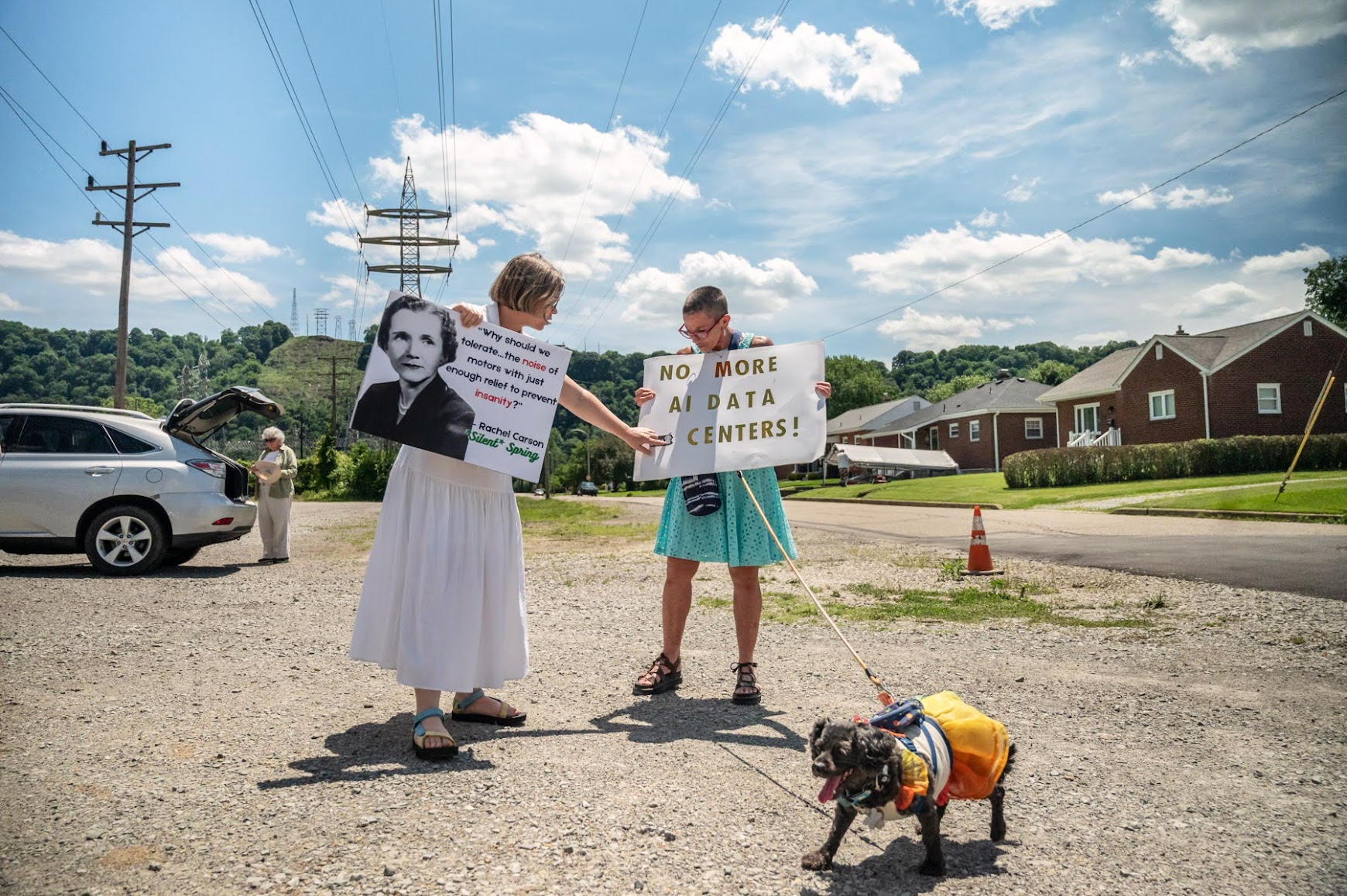
Charolette Baierl (left), the Ohio River Valley regional organizer for Climate Reality Project, and Sally Simpson, a Ford City organizer, protest a planned data center near the Rachel Carson Riverfront Park in Cheswick, Pa., in June.Stephanie Strasburg
To live in America in 2026 is to experience the constant anxiety of being watched by the government or big corporations — whether that’s on our phone or on the streets — and wondering when people stopped reading books, or whether that song was by a real person, or whether that video you just watched of the president (or from the president) is even real.
This weekend came news of an actual event in China called the World Humanoid Robot Games in which one of the robots shattered Usain Bolt’s world record for the 100-meter dash. Who wants this? … other than a handful of billionaires who are also rapidly building their own remote high-tech cities to save themselves from the looming torches and pitchforks.
They are going to need them. It was one thing when the Luddites trashed automated textile looms, when the meaning of work was up for grabs. That same threat is also posed by AI, which is starting to drag down the job market, but when robots take over track and field or pop music, people see that our fundamental humanity is under attack. That realization seems to have really kicked in this summer, and the future of our revolution is both exhilarating and somewhat scary.
Acts of vandalism — like the Ohio attack on the Flock camera — or worse are becoming somewhat more commonplace. Acts of violence — like the gunshots fired into the home of an Indianapolis city council member who supported data centers— are reprehensible and not helpful to the larger cause. In the present moment, there is rising hope that AI can be reined in the right way: at the ballot box.
When it comes to this issue, the ground beneath our feet may continue to keep shifting between now and Election Day. An article in Sunday’s New York Times describedhow the politics of data centers has scrambled a midterm election that was supposed to hinge on high gas prices and the growing threats to democracy.The piece noted that in Wisconsin and Florida — as well as Pennsylvania — the gubernatorial candidates from both major partiesare now attacking the high-tech facilities.
Yet, it’s hard to jibe the politicians’ embrace of populism with news that the AI industry and its related political action committees will spend as much as $200 million on the November elections. What will happen in 2027 and beyond if, and likely when, the American body politic doesn’t have the strength to slow down these sprinting robots? Will Morelock’s alleged destruction of one Flock camera seem like child’s play?
The story of America in the 21st century has been a tale of widespread consensus that a grossly unequal and unfair nation is on the wrong track, yet bitter disagreement over whom to blame. Until now. The fight that no one saw coming — pitting everyday folks against billionaires and their robots, who can already outrun us — is about much more than an election for U.S. Congress. Today’s Luddites may be our best hope.
What a difference three words can make. For weeks, the American body politic has watched the strange relationship between Donald Trump and his ever-present 35-year-old aide Natalie Harp in a state of puzzled silence. Then, Georgia Democratic Sen. Jon Ossoff spoke at a weekend rally and said that Trump “doesn’t want to do the job” and would rather “build his ballroom and travelwith Natalie on their apparently defenseless flying palace.” The floodgates opened — on social media and sites like the Drudge Report and in angry retorts from the White House that only threw gasoline on the controversy. It goes to show what Democrats can accomplish when they’re not afraid to speak the truth.
An expert raises questions about Freedom Fuel and Venezuelan oil
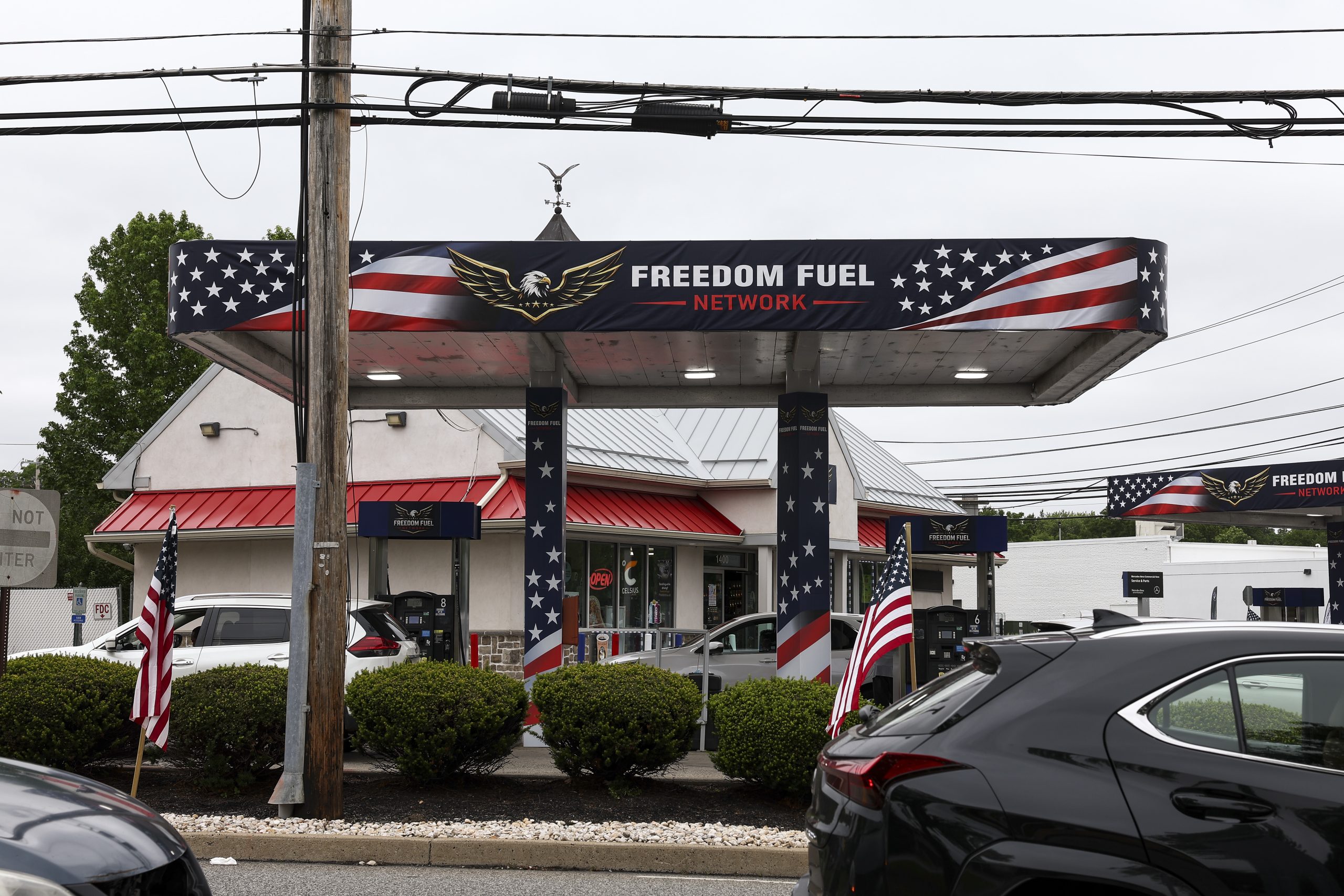
The Freedom Fuel Network gas station at 1400 Dreshertown Rd. in Dresher last month.Monica Herndon / Staff Photographer
For a government that seems to be in your face 24 hours a day, the Trump regime has managed to produce more mysteries than Sir Arthur Conan Doyle. Where’s Melania? Why was the president’s butt sticking way out at his last event? But here in Philadelphia, one Donald Trump-linked mystery has confounded motorists for weeks.
Why is Trump-promoted Freedom Fuel, a web of 29 service stations that popped up out of nowhere this summer, able to continue to sell gas cheaper than its rivals down the street?
The mostly suburban stations in Southeastern Pennsylvania and South Jersey burst onto the scene with prices at $3.47 a gallon — lower than anything since Trump’s disastrous war of choice against Iran launched in late February — and continue to undercut their competitors by about 10-20 cents per gallon. Experts have said that’s not sustainable, unless the stations are somehow getting their gasoline on the cheap.
Now a former high-level State Department official in the Barack Obama administration is trying to connect the dots between the Freedom Fuel conundrum and the ongoing questions about millions of barrels of crude oil Trump has bragged that the United States has taken out of Venezuela.
Jonathan Winer, who recently wrote about Freedom Fuel and Venezuela for the Washington Spectator and discussed his findings on the Court of History podcast, doesn’t connect all the dots, but his research is a reminder of how little the American public knows about the aftermath of the Trump regime’s January assault on Venezuela that captured strongman Nicolás Maduro and installed a friendlier head of state.
The Inquirer and other outlets have reported extensively on Freedom Fuel stations in Greater Philadelphia, including its ties to pro-Trump Republican ex-mayor of Evesham Township, N.J., Randy Brown, who signed Freedom Fuel’s certificate of formation. Former commodities trader Yoni Gontownik — a major donor to GOP causes and a New Jersey-based pro-Israel political action committee — also signed those papers.
Trump promoted the launch of Freedom Fuel on his Truth Social feed, but the White House has denied direct involvement in the flag-themed gas stations, and so has the companyitself. “Freedom Fuel Network is a privately owned and proudly patriotic company — along with its convenience store operators, haulers, sign companies, and operational partners — that answered President Trump’s call to action to lower prices at the pump,” it proclaims on its website.
Veterans in tracking the complicated oil market remain baffled. “People can’t mysteriously get fuel at a lower price and continue to offer that,” Winer said on the podcast. “You could, of course, do a very short promotion, but you basically can’t [sustain]it.”
It may be a total coincidence, but the giant enigma that is Freedom Fuel and its cheap gasoline surfaced at exactly the same time the president boasted about the cheap oil the United States is supposedly getting from the resource-rich South American nation his troops invaded.
“We’re taking their oil,” Trump proclaimed about Venezuela while in Las Vegas earlier this month. “To the victor belong the spoils.” He added that what America has taken has paid for the brief January war “many, many, many times.” But analysts know next to nothing about what is actually happening to as much as one million barrels of oil that Venezuela produces every day.
Winer pointed to a couple of common bonds between the efforts to market low-cost gasoline here in Philly and White House efforts to control the flow of Venezuelan oil.
The first is the role of Jarrod Agen, executive director of the National Energy Dominance Council inside the White House, who posted two photos of himself giving a thumbs-up at a new Freedom Fuel station in Philadelphia whenit opened on the July 4 weekend. Both Agen and the president himself insisted that the new gas retailer is proof of what the Trump regime is doing to lower prices at the pump.
Winer noted that Agen was also a key member of an American team that traveled to Caracas in April, met with the Trump-backed new president, Delcy Rodríguez, and came home bragging of new commodities deals, including in the oil sector.
The second overlap that Winer points to involves a Texas-based global commodities firm, Mercuria, which announced on May 1 that it had reached a major deal with Venezuela under what it called a “White House-supported initiative.” The announcement featured a photo of atop Mercuria official posing with Agen.
Mercuria told the Washington Post, which has also investigated Freedom Fuel, that it has no involvement with Freedom Fuel. Yet Gontownik, the trader listed as a backer of Freedom Fuel, was also listed as recently as March in campaign finance reports as an executive with Mercuria. But he also insists that he no longer works for the Texas firm — which has been linked to other Trump-regime commodities initiatives. (The ex-Philly journalist Maureen Tkacik, investigations editor at American Prospect, also raises a lot of questions about the role of Mercuria, Gontownik, and the firm Blue Owl Capital, which Trump invested in earlier this year.)
It must be stressed again that all of these connections are circumstantial. At the same time, this much cannot be disputed: The American people have not been given the most basic information about the extent of U.S. involvement in the Venezuelan oil trade, how much money is involved, or where all that money is going at a time when the price of crude oil has skyrocketed.
I could not agree more with Winer’s plea that Congress go after the U.S. Treasury, State, and Energy Departments that are sitting on undisclosed records of U.S.-linked oil transactions — even though realistically that might have to wait until Democrats gain a foothold on Capitol Hill next year. He also called on the media to dig deeper, which is why I wanted to amplify Winer’s early-stage reporting.
Look, we all want to pay less for gas, which is why motorists have been lining up at Freedom Fuel pumps since the stations opened last month. But most of us don’t want to live in a dying empire where a strongman’s tin soldiers steal a sovereign nation’s buried treasure so that favored insiders can profit. We still have no idea what’s been done in Venezuela in our name, and we need to find out.
Yo, do this!
It’s great that people — especially younger people — are returning to brick-and-mortar movie theaters in the long, hot summer of 2026, but the quality of the releases hasn’t really matched the boffo box-office numbers. That may change starting this weekend with the release of Tony, a movie that could have been titled “Becoming Anthony Bourdain.” The film stars Dominic Sessa playing the future chef, author, and beloved TV traveler as a lanky, awkward 19-year-old, spending a summer on Cape Cod and learning to embrace his love for the kitchen — and humanity. I’m really looking forward to this one.
There are two must-read articles out this week from Adam Bonica, a Stanford University professor who specializes in money and politics. The first is his lengthy investigation into dodgy fundraising practices by top Democratic Party committees and leaders, in which endless spam fundraising emails have hit home with susceptible elderly donors, some of whom have drained their life savings. The second is the story behind the story of how both the New York Times and the “Never Trumper” website the Bulwark both chickened out on publishing Bonica’s essential journalism. The cowardice of the elite media in America’s authoritarian moment is beyond disheartening.
Ask me anything
Question: Why aren’t more Democrats supporting and campaigning on the 32hour work week? It seems like a policy that would appeal to working people across the political spectrum. — brown cloud (@milehighdsa.bsky.social) via Bluesky
Answer: Good question. One political leader, Vermont Sen. Bernie Sanders, has aggressively pushed the 32-hour workweek without a reduction in pay, noting that this would pass the productivity gains of the computer era back to the workers who are being more productive. So, yeah, what’s not to like? It’s certainly true that a lot of Democrats, especially centrists, are heavily dependent on campaign contributions from corporate types who don’t like the idea of a shorter workweek. But I think ultimately, Democratic cowardice on these pro-worker issues goes all the way back to the Ronald Reagan era, and a fear that they’ll be branded by the GOP as the party of “free stuff.” But this isn’t free stuff. We’ve earned it.
What you’re saying about …
Last week’s question about how Democrats should view the primary success of leftists such as Michigan Senate hopeful Abdul El-Sayed drew a response that was both robust (despite the summer doldrums) and fairly unanimous. Proposals from the progressive movement like Medicare-for-All and taxing the wealthy, you agreed, are long overdue. Tom Lees noted that the GOP is trying to find the most extreme democratic socialists, but that “the [Rep. Alexandria Ocasio-Cortez] branch which supports ideas similar to European Social Democrats is the group that is getting people excited.” Craig Strimel added that leftist candidates have failed in the past, but “I also believe that we are so far deep in the current fiasco, and so damned close to total collapse of democracy, that we really are in an all-or-nothing situation right now.”
📮 This week’s question: Georgia Democratic Sen. Jon Ossoff has caused something of a political earthquake with his blunt criticisms of Donald Trump, including a reference to his ever-present young aide Natalie Harp. Has Ossoff crossed a line of incivility that’s a bad look for Dems, or are his criticisms a breath of fresh air? Please email me your answer and put the exact phrase “Ossoff comments” in the subject line.
Backstory on Jason Arday, casualty in the ‘war on woke’
Torchbearer Jason Arday carries the Olympic flame on the torch relay leg between Sutton and Merton in London in July 2012.Joe Giddens
There are two kinds of people in this world. There are normal folks who maybe get a slight whiff of news from the TV or when they boot up their computer, and never heard of a man named Jason Arday. Then there are people who (like me) spend far too much of their day on social media, and now know all about the charismatic Cambridge professor — the youngest Black man to reach those heights in the university’s long history — who came under fire for alleged plagiarism and biographical exaggerations.
The allegations apparently simmered from the day of Arday’s 2023 appointment, but boiled over in recent weeks. He acknowledged some citation errors in his 2015 doctoral thesis — mistakes that Liverpool John Moores University called “honest and reasonable” — but the allegations kept coming. They were fueled by a Cambridge colleague and self-proclaimed “race realist” who went on British national TV to lambaste Arday as “not smart” and label him as merely a diversity hire.
The famously not-laid-back British press went wild on the controversy, with literally hundreds of articles about Arday — not just the Fleet Street tabloids, but even the august Times of London, which ran 60 stories. The media frenzy over the young, dreadlocked sociology of education professor didn’t stop when Arday resigned his Cambridge post, saying that “the relentless accusations, speculation and public commentary have taken a profound toll on me and on those I love.” The media frenzy didn’t even stop when Arday was found dead in his home last Friday. He was 41.
Just one day after Arday’s body was found, Julia Hartley-Brewer, a host on a Rupert Murdoch-owned U.K. TV network, told her audience that Arday “was a liar and a fraud who was rightly exposed for what he really was by academics and journalists who were simply doing their job.”
I’m sorry, but as a lifelong journalist, I never realized that hounding a professor who wasn’t perfect but was loved by his students to his early death is part of the job. To the contrary, I think that good journalism might involve noting that scores of white professors and authors who’ve been caught and admitted to plagiarism or similar issues have been allowed to apologize and go on with their careers. And that bad journalism might be implying that Arday’s middling issues are some kind of commentary on any and every academic with darker skin — as opposed to researching the systemic racism that leaves a supposedly enlightened school like Cambridge with 0.4% Black professors, in an England that’s 4.2% Black.
The ghouls who hounded Arday to his death didn’t work in a vacuum. They tapped intoa disgusting narrative that way too many journalists and self-appointed public intellectuals are spreading not just in the U.K. and the rest of Europe, but here in the United States. They think the righteous COVID-19-era outcry against police brutality and a grossly unequal society was some kind of mania they’ve branded “Woke 1.0.” Never mind that the police were never defunded in 2020, not even close. The nattering nabobs of anti-wokeness won’t rest until every college classroom or airplane cockpit is made safe for white privilege.
Let me do my job as an opinion writer and tell you what I think about these mostly aging, mostly white, mostly male pundits who have so little to say about right-wing fascism that’s in power in America and on the rise in Britain and instead desperately cling to their status from the perceived threat of a few Black intellectuals. With key elections approaching on both sides of the pond, they opportunistically saw Arday as their latest chance to stir up white voters and preserve the status quo, even if that means tolerating an authoritarian police state. Now, a once-promising Black professor is a casualty in their glorious “war on woke.” Have they no shame?
What I wrote on this date in 2020
As I noted in this space a couple of weeks ago, there’s so much about the peak year of the COVID-19 pandemic that we’ve successfully tried to forget. That includes much about the consequential yet somehow anemic showdown between Donald Trump and Joe Biden, which included their virtual, prepackaged summer conventions. On this date six years ago, I grumpily covered the Democratic National Convention from my couch in Delco and — stop me if this sounds familiar — complained that the party was ducking progressive issues. “If viewers didn’t notice what the Democrats left out in their tightly scripted telethon so focused on Trump’s coronavirus failings and his paranoid style — such as climate change, gun violence, and the other things that young people across America have been marching for — the history books might.”
I’ve cut back on column writing this month, mainly because I’m working on a long-term investigation that I’m really excited about. In my one piece published this weekend, I took a deeper dive into the stunning reports that winter drone attacks on fishing boats off the coast of Ecuador — with eight sailors missing and presumed dead — were a covert operation by Donald Trump’s CIA. This callous disregard for innocent human life is the latest example of a White House death cult that must be held to account by a new Congress, and eventually by prosecutors.
It’s truly remarkable the extent to which public opposition to the data centers that support artificial intelligence, or AI, has gone from near zero to 60 mph (or maybe 80) in a matter of months — especially here in Pennsylvania. With public unrest over these behemoths around their air and noise pollution and impact on electric bills, as well as growing discomfort with AI itself, becoming a key issue in the fall election, The Inquirer has been all over this story. On Tuesday, veteran business columnist Joseph M. DiStefano looked at how major contractors are hoping that demand for new data centers will get them through an otherwise sluggish economy. That might be a pipe dream if municipalities respond to voters by rejecting these proposals, as happened last week with a massive facility planned for suburban King of Prussia. You’re going to want to read The Inquirer’s in-depth coverage of this debate before you vote in November, which means it’s time to finally subscribe. What have you been waiting for?
By submitting your written, visual, and/or audio contributions, you agree to The Inquirer’s Terms of Use, including the grant of rights in Section 10.
One of the worst things about Donald Trump’s America in the 2020s — I know, I know, it’s hard to pick — is the return of all the horrible stuff you foolishly thought our flawed nation was done with after the reckonings of the 1970s.
The American quagmire in Iran makes Vietnam look practically wise in comparison. Then it came out last week that the government was spying in Minnesota on what should be constitutionally protected protest activity by labor unions or environmental groups, in a callback to the notorious illegal FBI op known as COINTELPRO.
Oh, and the CIA is murdering* people in Latin America again.
The asterisk is for “allegedly,” based on a report last week in the Washington Post that confirmed growing suspicions about mysterious drone attacks last winter by “gringos” that struck at least three fishing boats that had sailed deep into Pacific Ocean waters from an impoverished coastal village in Ecuador.
One of the fishing vessels remains missing, its eight crew members presumed dead. The survivors of the other attacks remain traumatized from their injuries and their subsequent interrogation by men who wore no military uniforms — but had U.S. flag patches and spoke with American accents.
In March, the crew of the Negra Francisca Duarte II was returning to its Ecuadorian port in Manta with a fresh catch of seafood and, its sailors insist, no illegal drugs when it noticed a blue ship was trailing it on the horizon. Moments later, drones flew over the fishing craft and began dropping explosives.
Soldiers guard the port of Manta, Ecuador, in February.Cesar Munoz
“The boys were there, hurt and scared. Some got a fire extinguisher to try to put out the fire, but there were too many flames,” the captain of the Negra Francisca, Hernán Flores, told the New York Times, which published the first U.S. media account of the mysterious attack. Flores said injured sailors jumped into the ocean or scrambled onto lifeboats, and all were at first relieved when the blue boat arrived to rescue them.
Instead, according to the Times and other accounts, their ordeal was only beginning. The survivors were bound, hooded, and interrogated by the strange English speakers, who offered no medical treatment for their wounds. The boat headed north and transferred the crew members into custody in El Salvador, where officials soon released them — not charged with any crime, after the attack that nearly killed them.
The initial Times article did not confirm whom the men were working for, but it noted extensive data showing how each of the three attacked fishing boats had been tracked by a maritime patrol plane that was registered to a UPS mailbox in Richmond, Va., and flew from Tennessee to a military airstrip in El Salvador in November.
After the Times wrote about the three mystery boat attacks, the Post followed up with a report that the attacks were a special covert operation conducted by the CIA. These secret strikes have amplified a series of publicly acknowledged boat attacks in both the Pacific and the Caribbean by the U.S. military that have now killed more than 220 people since Trump returned to the White House 19 months ago.
Last week’s news reports built upon research and more than 100 interviews by the group Human Rights Watch, which is troubled by the lack of both legality and morality in a partnership forged between the United States and Ecuador. This includes not only the three boat attacks but a land assault against a farm near the border with Colombia, which also found no drugs, but in which farmers said they were tortured by the Ecuadorian military.
“The two countries’ security relationship is deepening at a moment when both governments have engaged in serious human rights violations fueled by their insistence on framing their confrontations with organized crime groups as a kind of war,” the rights group wrote.
It’s no secret that drug cartels have enlisted some fishing boats — sometimes through desperation to boost their meager income, but often through extortion — to aid their smuggling operations out of South and Central America.
But these alleged CIA drone strikes raise stark questions about the Trump regime’s strategy that is literally shoot first, ask questions later. Why are some sailors executed at sea when there’s not even evidence to charge the survivors with a crime? Even if some of these boats are tied to narcotics trafficking, what’s the legal and moral justification for a death sentence for low-level drug offenses?
There’s also this: What are these extrajudicial killings even accomplishing, beyond cementing the image around the world that Trump is running a violent criminal enterprise? The Drug Enforcement Agency (DEA) has assessed that — some 230 or so lost human lives later — these U.S. boat attacks have had zero impact on reducing the flow of cocaine into the United States. That’s in part because most drugs that come into the United States by sea pass through larger commercial ports, not small fishing villages.
Instead, the biggest impact from the military drone strikes has been the series of so-called snuff videos that either Trump or Pete Hegseth’s Pentagon has posted to social media platforms showing boats in gentle tropical waters getting blown to smithereens, in shock and awe tribute to their regime’s power to kill with impunity. But the secret, allegedly CIA attacks are not even that.
What is even the point of this cruelty?
I’m writing this column to honor the on-the-ground courage of Human Rights Watch and amplify the excellent journalism of Times and Post reporters — and because I’m furious that this story has drawn so little attention, and even less outrage.
Deep into the second year of Trump’s strongman second presidency, the news media is overwhelmed by the Caligula-like craziness of his regime and its fights over matters as small as a ballroom and as big as the Strait of Hormuz, not to mention the frequent weather disasters made worse by the climate crisis the president believes is a hoax. Some maimed or missing fishermen in a tiny village on the bottom side of the planet aren’t making the cut.
Which is probably exactly what the regime is going for. Trump and his MAGA minions would like nothing more than to numb you, me, and the rest of us to their growing archipelago of death, a bloodstained map that stretches from the icy streets of Minneapolis to a dingy detention site in Newark, N.J., and from a bomb-blasted island off Iran to the sickbeds in an African refugee camp. They want us to feel numb as their authoritarian death cult expands, and we cannot allow that to happen.
The truth is that the United States will remain a global pariah — a pitiful, helpless giant — as long as there is no accountability for these war crimes, including, or perhaps especially, the terror perpetrated by mystery men with American flag patches on the high seas. That means public hearings, trials, prison sentences, and the kind of truth and reconciliation this nation has not seen before.
Certainly the fishermen of Manta, Ecuador, will never forget the horrors that rained down upon them from a clear Pacific sky.
Simon Villacreses, a 52-year-old crew member of the Negra Francisca Duarte II, told Reuters that he suffered a head injury in the assault, and remains traumatized months later. “They started pointing guns at us. They took us aboard, put hoods over our heads and tied our hands behind our backs,” he said of the “gringos.”
The rattled Villacreses has not been back to sea since, telling the reporter, “Maybe I’ve given up fishing for good.” His livelihood has been destroyed by the criminal enterprise run out of 1600 Pennsylvania Avenue. Our outrage is not enough. We need to be relentless in the pursuit of justice.
Do rich guys have to ruin everything? Apparently so. There came a time about 15 years ago when my soccer obsession got to the point where I felt I needed to pick an English Premier League team to root for, in addition to the U.S. national teams and the Union. Long story, but I went with Liverpool, in a city many consider the Philadelphia of the U.K., and it’s been a good ride, including a couple of trophies. On Monday, it was reported Amazon gazillionaire Jeff Bezos is buying 30% of the team. I’m officially out. Go, Leeds!
When did Trump’s ballroom become a national security fortress? We need answers.
Construction continues on a helipad and the White House ballroom on the South Lawn of the White House on Aug. 5.Tierney L. Cross
Donald Trump’s originally stated 2025 scheme to demolish the East Wing of the White House to make way for an oversized ballroom to hold state dinners and whatnot was bad enough: an unneeded, unwanted, gilded, and presumably tacky callback to Louis XVI, a massive monument to a modern let-them-eat-cake regime.
A year later, the project is better describedasan alleged ballroom — another bait-and-switch scam by America’s first grifter president. The fact that the public really doesn’t know how much this project actually costs — estimates have soared from the initial lowball of $300 million to now at least $600 million, but possibly more — or how much of that will be dumped on U.S. taxpayers is just the beginning of the problem.
Nearly 10 months after the president shocked Washington, D.C., and the rest of America by taking a wrecking ball to the history-packed East Wing, Trump has all but stopped talking about a black-tie party venue and instead rebranded the project as essential to national security.
When the D.C. federal appeals court on Friday ordered the White House, which never got congressional approval for either the demolition or the ballroom addition, to halt aboveground construction, Trump took to Truth Social and described the ruling as akin to treason.
“The Military and Secret Service are viewing this horrendous, politically motivated, and unlawful ruling as a National Security threat to our Nation in that the entire Complex is being built for the protection of our Country and, additionally, all future Presidents,” Trump posted, using language that’s probably never previously in human history been used to describe a “ballroom.”
Trump didn’t say in his post anything about crystal chandeliers, or great acoustics, or things you might expect in a world-class ballroom. Instead, he said the facility will have bomb shelters, a state-of-the-art hospital, top-secret military facilities, protective missile-resistant steel, columns, roofs, and beams, drone-proof ceilings and roofs, military-grade venting, and bullet-, ballistic-, and blast-proof glass.
It sounds like somebody is expecting a last tango in Washington.
Trump’s post was alarming — shocking, really — but in case anyone missed the point, or doesn’t know how to read, he also posted some AI-created renderings, which again did not depict waltzing diplomats, but instead showed a rooftop “DronePort” that was packed to thegills with ominous-looking military drones, manned by troops and also with armored vehicles that somehow drove up there. The vibe was Darth Vader’s Death Star, except with “military-grade venting” this time around.
There are two very different ways to look at all of this, and let’s start with the more benign one. Ever since the beginning of his second crack at the presidency, Trump — when he’s not pursuing his main projects of making billions of dollars, punishing his enemies, and staying out of prison — has been obsessed with placing his personalist stamp on Washington. Maybe that’s for his legacy, or maybe he just wants a Mar-a-Lago-by-the-Potomac to comfort his octogenarian mind.
Trump might not be able to crash weddings as he does at his Palm Beach, Fla., estate, but his ballroom idea would be close enough. Although he’s also sought and received donations for the project from the usual suspects of friendly billionaires and favor-seeking corporations, Trump also wants both additional dollars and — more importantly, in light of the appeals court ruling — a stamp of approval from Congress. That’s been a thwarted agenda item for GOP leaders on Capitol Hill for months.
But if Trump can’t sway Congress, he hopes to win over a U.S. Supreme Court where he has appointed three of the nine members. The White House knows that both Congress and the high court tend to fall in line whenever national security is invoked, while there is no constitutional right to foxtrot. So maybe all the military bluster is just political posturing for Trump’s latest real estate development.
But as the project enters its second year, it seems to have morphed into something a lot more disturbing than that. The pictures, descriptions, and accounts of Trump’s game here are sounding a lot more like the impregnable mountain lair of a Bond villain.
This is a man who fomented an attempted coup the first time he was asked to leave 1600 Pennsylvania Avenue, and who saw how South Korea’s corrupt right-wing president was ousted after a massive throng of protesters overwhelmed key government buildings. Wasn’t it Chekhov who said you don’t put drones up on the roof unless you intend to deploy them by the third act? The two most likely scenarios for actually using Trump’s bunker — Civil War II, or World War III — are less than optimal.
This national security bunker isn’t the only thing that’s worrisome as Trump looks to the second half of what’s supposed to be his final term. As noted in this space recently, Trump has also extended the presence of National Guard troops in Washington through Jan. 20, 2029, which coincidentally is the scheduled last day of his term.
Since their arrival last year, the Guard troops — many from units in pro-Trump red states, and costing U.S. taxpayers at least $1.4 billion and possibly more — have often been spotted hanging around, or picking up trash as a kind of busywork. But residents and some advocates like Scott Michelman, legal director of the American Civil Liberties Union of the District of Columbia, are already complaining Trump is “treating [D.C.] like a police state.”
It raises the same questions as the alleged “ballroom.” The president is entitled to state-of-the-art security, and while the public doesn’t need to know all of the operational details, American taxpayers also can’t be expected to fork over hundreds of millions of dollars for these projects without truly knowing what they are for.
Democrats on Capitol Hill need to start demanding answers. On Monday, there was an encouraging report by the New Republic’s Greg Sargent that the opposition party is working to demand communications from the Justice and Interior Departments to explain why several people were wrongly criminally charged with vandalism at the Lincoln Memorial Reflecting Pool when the actual damage was a botched repainting contract.
Congress can, and should, also flex its muscles over this ballroom fiasco — first by denying any public money for the project, and then by launching a similar investigation into the hasty demolition, the political fundraising, and the sketchy purposes for the project. Someone owes America the truth, and it’s not going to come from the current regime without a fight.
Whatever happens, the woman or man who hopefully succeeds Trump and sends those guard troops back to their own private Idaho in January 2029 is also going to have a giant mess in their backyard. But it’s better to have the ruins from a botched, halted construction project than from the Battle of Armageddon.
Yo, do this!
The California journalist Gil Durán has been paying attention to the political craziness coming out of Silicon Valley years before anyone else was, and now comes the big payoff in the form of a book that is not only incredibly timely but has the best title of the year: The Nerd Reich: Silicon Valley Fascism and the War on Democracy. Durán explores the strange beliefs of Elon Musk, Peter Thiel, Marc Andreessen, and their friends, their obsession with building their own private “networked cities,” and their unlikely alliance with Donald Trump. I’ve been waiting on this one for a while.
August is always a great month for books. While Durán drills down on the high-tech enemies of liberty, the great writer Dave Zirin has a new tome about one of democracy’s heroes, the late historian Howard Zinn, his former mentor. Public intellectuals are still arguing about the merits of Zinn’s 1980 masterwork, A People’s History of the United States, but nobody disputes his influence on the national conversation. Zinn rejected American exceptionalism, but also spotlighted everyday heroes like labor leaders or civil rights activists who expanded our freedoms over two centuries. I’m looking forward to reading The People’s Historian: The Outsized Life of Howard Zinn.
Ask me anything
Question: Data centers are the flashpoint but the root problem is the unregulated AI that is sweeping up every keystroke and every written document then repackaging it as if original thought. How do we get a federal government mired in 2020 to begin legislating on AI? — Suzi (@wanderponder.bsky.social) via Bluesky
Answer: Great question, Suzi, and I think we all know the main reason why the body politic — and I’m talking about both Democrats and Republicans — have been so painfully slow to respond to voters’ widespread anxiety not only about noisy, polluting, resource-wasting data centers, but also to artificial intelligence itself. The reason is money. Silicon Valley AI developers have raised an unbelievable $220 million to spend on November’s election, and — while there are some disagreements within Big Tech about policy — most of the cash will go to the politicians least likely to regulatean industry badly in need of it. Cognitive computing is not only stealing our intellectual property, as you noted, but also our jobs, as well as our children’s ability to learn.The good news is that public backlash against AI is so strong that even a quarter-billion dollars may not be able to stop the movement. But it’s way past time to get money out of politics.
What you’re saying about …
I should have guessed that newsletter readers don’t have much more of a clue than Donald Trump about what to do about the giant mess in the Persian Gulf. I did get one thoughtful response from an emailer with a “cbluff” handle (Reminder: Please sign your real name to these responses) who said the Trump regime needs to send skilled negotiators — and be realistic. “I believe the U.S. will have to cede the Strait of Hormuz, allow Iran and Oman to collect protection money, remove sanctions and pay them so we can declare victory and leave,” they wrote. It’s hard to disagree. Once again, the United States has lost a war.
📮 This week’s question: Since the Democratic Senate primary win by Michigan’s Abdul El-Sayed last week, the mainstream media has been obsessed with the question of whether this year’s progressive surge, including candidates (although not El-Sayed) tied to the Democratic Socialists of America, is hurting the Democrats. What do you think? Are leftists bringing needed energy to a moribund party, or are they too out there to defeat the GOP in November? Please email me your answer and put the exact phrase “Democrats and the left” in the subject line.
Backstory on the day Trump left his press corps for dead
Catering trucks are parked at Air Force One on the tarmac as the motorcade carrying President Donald Trump arrives to depart following the NATO summit, at Ankara International Airport in Ankara, Turkey, on July 8.Alex Brandon
It was appalling enough back in late July when we watched a room full of some of America’s highest-profile journalists break bread with Donald Trump at the rescheduled White House Correspondents’ Association dinner in Washington, where the president got up and hurled crude insults at several of the media members. Many of us were disgusted that some of the nation’s most respected journalists would platform a man who has repeatedly called a free press “the enemies of the people.” But the White House press corps was in the dark about an even more disturbing plot twist.
Just 16 days earlier, Trump had left some of those journalists for dead — at least potentially — as human decoys who might be blown from the skies in a feared Iranian plot.
The stunning story came out late Monday night as I was writing this newsletter, with a scoop by the Washington Post, matched shortly, with some additional details, by the New York Times. The articles revealed a modern-day Air Force One kind of thriller that essentially involved a shell game with three different aircraft. It was triggered by what officials deemed was a credible Iranian assassination threat against the president when he traveled to a NATO summit in Ankara, Turkey — just over 700 miles from the border with the U.S. enemy.
This launched a series of events, beginning with a plan to abandon Trump’s new, $400 million gift-from-Qatar iteration of Air Force One for an older version that actually has more advanced defensive capacities. Trump was filmed boarding the replacement Air Force One, followed by the White House press corps and some traveling aides for the departure from Ankara to a U.S. air base in Great Britain. What those passengers could not have imagined was that Trump had somehow been spirited out “via a catering container that had been lifted to the opposite side of the plane,” and switched to a C-32A military plane for the flight to the U.K.
Then they kept the unwitting journalists and aides on the ground for a couple of hours before it was revealed POTUS was safely in Britain and the Iranians had been thwarted and … haha, of course that’s not what really happened. No, the press corps took off as human decoys — the latest sitting ducks in an idiotic war that never should have been launched in the first place. Thankfully, no one was hurt … this time. Journalists wondered why they’d been ordered to keep the airplane’s window blinds closed, which inspired this now ironic exchange between Trump and some journalists when they reunited for the flight from Britain back to the U.S.
Trump lied that he didn’t know of any specific plot against Air Force One, and then added: “I’m No. 1on their list, before you. But if I go, you go. Right?”
Apparently not.
Even as I write this in the middle of the night just hours after the Post and Times scoops, the internet is already flooded with memes depicting Trump crammed into one of those airport serving carts, or pigging out on the adjacent airline food. It’s funny to see that your president isn’t Harrison Ford punching out the terrorists, but, in reality, slinking away in a food truck, leaving other Americans in the line of fire, right?
No, it’s not funny at all. This whole episode is a grand metaphor for a careless president who smashes up things before retreating into his money or whatever keeps him going — not thinking twice about the fate of human beings in a squalid ICE detention camp or an Iranian girls’ school. Or bantering with the gaggle of journalists whom he abandoned after drawing a big target on their backs. The first media question at the next Oval Office event ought to be, “Why did you treat me like cannon fodder?” But I wouldn’t bet on that happening.
What I wrote on this date in 2016
It’s almost funny now, in a dark-comedy kind of way, to look back on the fateful summer of 2016 and remember what it felt like to be stubbornly convinced that something, anything, was bound to happen to stop the obvious insanity of a Donald Trump presidency. It seems so incredibly naive now to read what I believed exactly one decade ago, when I actually thought the success of a diverse and incredibly talented U.S. Olympics team in Brazil would expose the Big Lie of Trump’s racism. I wrote, “The exclamation point is the remarkable women’s gymnastics team led by individual gold medalist Simone Biles — so dominant you will easily forget they also celebrate the kind of diversity that is America’s best feature, not the bug that’s described by the bitter and the disaffected back home.”
The fight for America’s future is waged on many fronts, and I’m trying to keep up. Last week, I wrote about a fascinating political development that’s been largely flying under the radar screen: a movement out west to knock off GOP incumbents by creating one-on-one contests with feisty, populist independents. That means long-shot Democrats need to drop out — which has happened in Nebraska, Idaho, and South Dakota, but not in Montana. It’s both a bold plan to end the Republican majority on Capitol Hill and a sad commentary on the failed Democratic Party brand in the American heartland. This weekend, I wrote about the Trump regime’s latest assault on higher education — denying loans for students who major in fields linked to lower-income jobs — and the increasingly bleak future of a liberal arts education. I wondered why Democrats won’t fight harder to end runaway careerism and preserve college campuses as bastions of critical thinking.
This August feels like the calm before the storm in Philadelphia sports. Some of that is the excitement over the Eagles finally beingback in training camp and looking to regain that Super Bowl mojo as 76ers fans try to process, if that’s the right term, a once-in-a-lifetime offseason rebuilding project. But much of it is angst over the Phillies, who are clinging by their fingernails to a playoff spot despite adding the National League’s batting champ to a lineup that already includes home run king Kyle Schwarber, future Hall of Famer Bryce Harper, and one of baseball’s best pitching rotations. None of that matters when the Phillies don’t have a relief pitcher who can carry a lead past the 7th or 8th inning. The Inquirer’s ace sports columnists like David Murphy and Marcus Hayes have all asked the same question: Can this team be saved? The answers are just over the paywall, and you can leap over it just like Saquon Barkley at the first-down marker; all you need to do is subscribe to The Inquirer.
By submitting your written, visual, and/or audio contributions, you agree to The Inquirer’s Terms of Use, including the grant of rights in Section 10.
There is one war Donald Trump is actually winning — unfortunately.
Clearly it’s not the ongoing fiasco in the Strait of Hormuz. But Trump and his MAGA culture warriors keep gaining new territory here at home in their all-out assault on knowledge, with America’s college campuses as the prime battleground.
The Trump regime is fighting to destroy liberal arts education in America, and this summer it opened a new front in the campaign to make going to college all about the narrow pathway to a job in a robot-driven economy — and little more.
A little-publicized new rule published last month by Trump’s Department of Education aims to end student loans to young people who major in fields that lead to jobs with below-average incomes. The rule won’t take effect until next year, and there remain real questions about how it might work and which programs would be most affected. But some experts are worried that training for essential jobs like social work or teaching will be harmed.
“I’m happy for an MBA to pay back every penny they borrowed,” Ted Mitchell, president of the American Council on Education and a former college president and education policymaker in the Barack Obama administration, told me last week. “But social workers and teachers shouldn’t be submitted to the same logic.” In other words, some jobs are more valuable to a healthy society than the dollar value we assign them.
Still, education experts who are critical of the Trump regime over many other policies say there could also be some good to come out of student loan reform, since the rule is likely to most heavily impact for-profit institutions, especially those that have abused the system to saddle young people with high debt and poor job prospects.
But Roosevelt Montás, who leads the Chang Chavkin Center for Liberal Education and Civic Life at Bard College, said the positive benefits of going after for-profit college scandals need to be weighed against the broader harm to the idea that a liberal education will give students more than a return-on-investment balance sheet.
Montás called the student loan rule “an example of how the Trump administration has found areas that, in fact, deserve criticism and require reform in higher education, and he has used these as a tool to destroy and weaken the system.”
This month, most of the nearly 20 million university students in the United States are drifting back to campus to begin a new academic year — with broad agreement across the political spectrum that American higher education is in crisis.
Undergraduate enrollment actually peaked in 2010, when that era’s economic crisis was at its nadir, and has declined gradually in most years since. Public trust in higher education — as with other large institutions — has plummeted even more steeply. You could write a book about how college access, the insane cost of tuition, and resentment between educational haves and have-nots drive our deep, bitter political divide.
The Trump regime is not letting this crisis go to waste. Ignoring the real roots of the problem — the steady privatization of getting a college degree since the 1970s — the MAGA government has been following the Project 2025 blueprint for waging an ideological war on campuses it sees as breeding grounds for future liberals.
The student loan rule is just the latest onslaught. In recent weeks, a White House policy paper mapped out a massive shift of as much as $200 billion away from grants for basic science on university campuses and toward work on artificial intelligence, or AI, with private companies competing for those dollars.
Meanwhile, a surprising number of universities — rather than fighting the Trump agenda — are saying they’ll sign onto a so-called reform agenda that merges some broadly popular measures, such as reducing tuition, with right-wing wish-list items like more conservative faculty, ending efforts to boost enrollment numbers for students of color, and cracking down on protests. This builds on the regime’s push to end campus diversity programs.
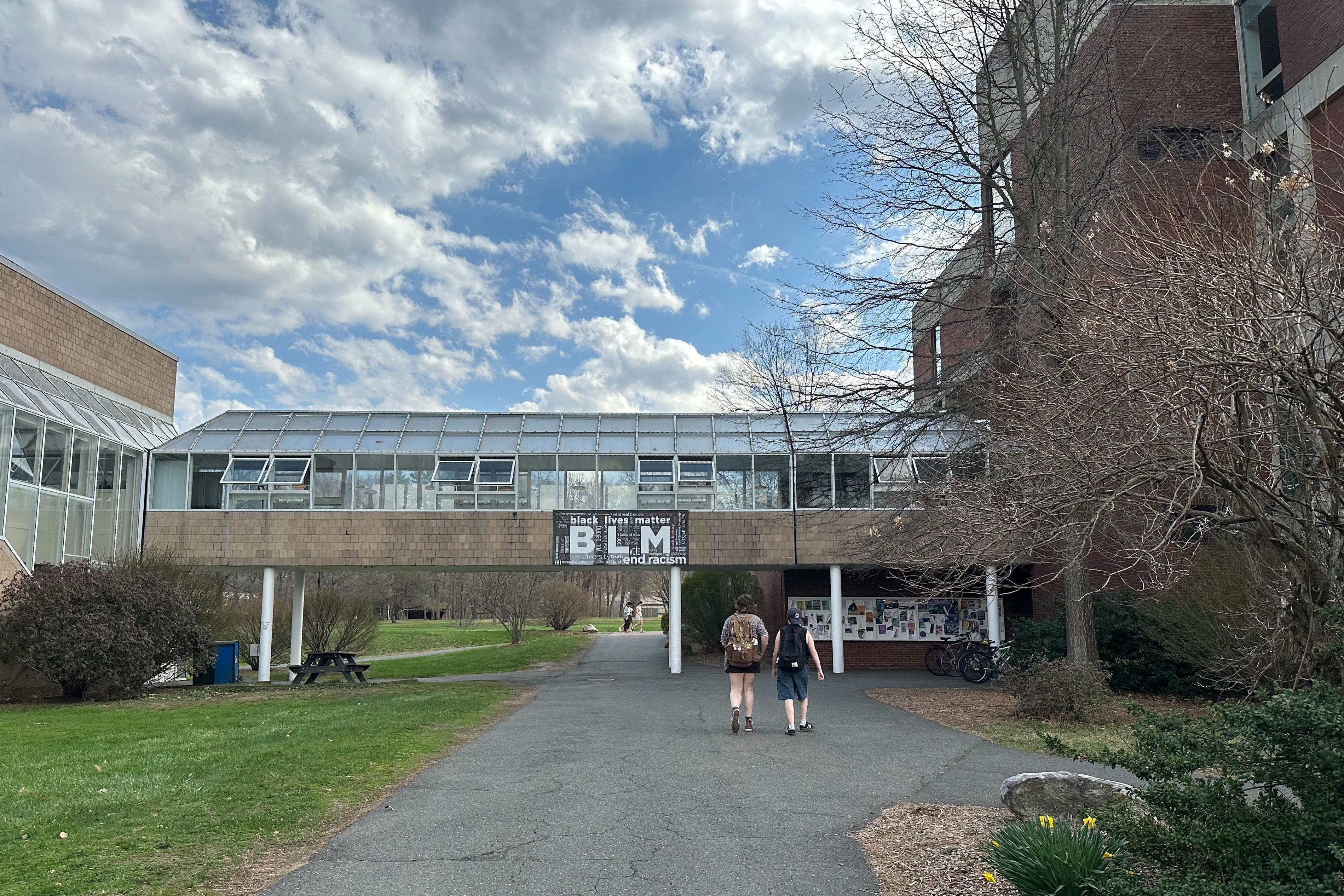
The campus of Hampshire College in Amherst, Mass., in April. It is scheduled to close at the end of the fall semester.Leah Willingham
This overlap of societal and governmental crises has fallen hardest on small liberal arts colleges — some, like the experimental, born-of-the-1960s Hampshire College, have announced plans toclose altogether — as have some degree programs in the humanities at larger schools, which have seen layoffs or even elimination.
“I think we’re at a real moment of crisis,” Montás said, noting that programs in the humanities and some social sciences were already weakened by downward enrollment trends and by ideological controversies even before the Trump regime targeted them. “These have energized questions about the value and cost of education. This combination of factors is proving deadly.”
But while the headlines tend to focus on campus closings or the latest faculty layoffs, the bigger story is the government’s push to radically reform the role that higher education plays in a healthy democracy.
In what we now clearly see as a golden age of U.S. college from the late 1940s into the ‘70s — when tuition was generally low, and enrollment was skyrocketing — advocates saw more diplomas as a way both to populate a new “knowledge economy” and also mold better citizens who’d be less likely to start World War III. Majors like English literature, philosophy, and sociology soared — as did the inclination to question authority in the fraught era of civil rights and the Vietnam War.
That last part, arguably, is what triggered a 60-years-and-counting conservative backlash that is currently maxing out under Trump. His regime doesn’t want to wreck college altogether — white dude-bros still need their keg parties, after all — as long as the ultimate outcome is creating worker drones, not critical thinkers.
The seeds exist for a backlash that might swing the pendulum back to where it was around 1965, but no one has really planted them. Instead of fighting the destruction of liberal education as a true opposition party, far too many Democrats have instead complied — insisting they support colleges, but only because they create jobs.
“Every student should have access to an education that aligns with industry demands and evolves to meet the demands of tomorrow’s global workforce” is a quote that sounds like it was ripped from Project 2025, but it was posted in 2022 by Joe Biden’s education secretary, Miguel Cardona. Democratic governors like Pennsylvania’s Josh Shapiro spend more time touting trade school than talking about expanding opportunities for four-year bachelor’s degrees.
Increasingly, politicians who last year were raving about the economic development possibilities of AI data centers are furiously backpedaling in the face of a full-on public revolt. While a lot of the backlash is driven by issues such as noise pollution or higher electric bills, the public unrest also reflects a more cosmic concern: Do we really want robots not only taking our jobs and making our art but thinking for us, too?
It’s easy for a politician to be against something, like a data center. But who is going to fight for something, like the humanities? The headline of this column about Democrats making a demand for more English lit majors into a political rallying cry was somewhat facetious — but should it be? Real leadership would mean fighting to give more young people more opportunities to flourish as creators and thinkers, without being terrified the other side will call you an “elitist.”
Mitchell said he’d like to see an expansion of federal loan forgiveness programs for graduates who go into public service careers like social work or teaching — perhaps on the state level — as part of a much broader return of the vanishing idea that higher education can be a public good.
Both Montás and Mitchell also advocated for college programs that would better integrate both career skills training and wider education in the liberal arts and civics. Mitchell touted, for example, a new program at the University of Texas which — working with the online learning company Coursera, where he is a board member — allows students to earn career-readiness certificates on their transcript even as they also pursue a major in the humanities.
Montás said his new center at Bard is part of a burgeoning national movement to grow general education programs within universities that promote classroom discussion through a heavy emphasis on what some call “the great books” of modern civilization. Advocates seek a core curriculum that would promote critical thinking and discourse beyond career-focused majors such as business or engineering. It would be, Montás said, “a return to approaches and conceptions of liberal education that are traditional — an emphasis on great books, an emphasis on character, an emphasis on civic education.”
The 2026 campaigns for Congress are well underway, and while you’ll hear a lot about vital issues like expanding access to healthcare or lowering gas prices, hardly anyone is running on bringing books back into the classroom or saving the humanities major. That feels like a big mistake. When there is a war against the very notion of higher education, somebody needs to be fighting back.
South Dakota is a prairie state that voted more than 63% for Donald Trump in 2024, so it’s not the first place you’d look to find a wave of discontent over GOP rule. But deep under the state’s expansive corn and soybean fields grow the invasive roots of political rage.
There’s the trade war that’s dried up demand for farmers’ crops while driving up the costs of essential items like fertilizer. Disdain for Trump has slashed the flow of Canadian tourists who once flocked to Mount Rushmore. There’s the same high gas and supermarket prices as in the other 49 states. And farmers who had liked the president’s border policies are now scared of losing workers to immigration raids.
Doug Sombke, president of the South Dakota Farmers Union, recently told the Canadian magazine Maclean’s that some Dakotans now “see we got sold a bill of goods … They were told grocery prices were going to come down. Trump keeps leading them on, saying, ‘There’s gonna be some pain.’ I don’t think anybody was ready for this much pain, this soon.”
In this brutal climate, one South Dakotan who probably should be bracing for pain is the mostly pro-Trump GOP Sen. Mike Rounds, a former governor seeking reelection to the Senate in November. And on Tuesday, Democrats hoping to oust Rounds from Capitol Hill got the big news that a lot of them were hoping for.
That’s right. In what may be the most counterintuitive political strategy in U.S. political history, liberal anti-Trump activists in politically red states west of the Mississippi have been pleading for obscure, long-shot Democratic candidates to abandon their races — so that spunky independent candidates can challenge the GOP one-on-one instead.
When ex-state trooper and longtime Democratic activist Julian Beaudion told South Dakotans that, feeling pressure, he’s quitting the race, it cleared the path for independent Brian Bengs to consolidate the anti-incumbent vote in November. Polls suggest that the retired U.S. Air Force lawyer and college professor who was briefly a Democrat is already within striking distance of an upset.
And he’s not alone. Democrats are also not running a Senate candidate in Nebraska — where a well-funded and well-known independent, labor leader Dan Osborn, is running again — or in Idaho, where Todd Achilles, a one-time Democratic lawmaker who left the party, is on the ballot. In Montana, an independent Senate hopeful is also hoping that a Democrat will drop out, but unsuccessfully so far.
Casual political observers probably know that Democrats (and two allied independents) — currently in the Senate minority by a 47-53 count — are hoping Trump’s unpopularity will help their candidates run the table in five to six key contested states from Maine to Texas. But much less attention has been paid to this stealth backup plan — the notion that a few prairie populists can end the GOP majority.
What’s truly remarkable about this scheme is that a growing number of Democratic strategists are making a tacit, not to mention uncomfortable, acknowledgment: In the American heartland, their party’s brand is in the toilet.
That’s why a number of political activists believe the only way in these blood-red states to make the most out of rising voter anger against Republicans over high gas prices and Trump’s badly botched war with Iran is to offer voters an alternative without a “D” next to their name.
Steve Hildebrand, a Sioux Falls-based political consultant who was a high-ranking official in Barack Obama’s 2008 campaign, is one of the Democrats who thinks that — despite voter unrest against the GOP — an independent has the best chance in South Dakota.
“I think our party has gravitated too far away from fighting for hard-working Americans — you know, blue-collar workers, union workers,” Hildebrand told me this week. “You know, we’ve been fairly pathetic about a unified party message, and frankly, we’ve been pathetic about beating back on Donald Trump.”
Still, most of the political agenda of the western independents is larded with a modern brand of prairie populism that feels like a first cousin to the left-wing progressivism of Democrats — like Michigan’s Abdul El-Sayed — who’ve been scoring 2026 victories in blue states. They are strongly against billionaire influence in politics while advocatingfor healthcare reform and progressive ideas about making life more affordable.
“Getting money out of politics to the maximum extent possible would be the single biggest accomplishment I think of my career and of Congress,” Bengs told Independent Voter News. “And I’d also like to get healthcare affordable, so people don’t have to worry about, ‘Don’t call the ambulance, because I can’t afford that.’”
So why not run as a Democrat, when so many of his proposals overlap? Bengs did join the Democratic Party to challenge South Dakota’s other GOP senator, Majority Leader John Thune, in 2022, and after losing by 27 percentage points, he said he’ll never do that again.
He said at county fairs and parades he met voters who liked his ideas, but told him, “I’ll never vote for a Democrat.” “Sometimes there was an expletive in there. The takeaway was that the letter was more important than what I was saying.”
“Democrats are simply not competitive in at least 20 states, maybe more.” Larry Sabato, the University of Virginia political scientist and veteran analyst, told me. He said independent races can be a way to win in these red states, but the candidate needs to break with the Democrats on some issues and show themselves as a true outsider.
Sabato said Republican dominance of prairie and mountain states can end up with “voters getting fed up with the ruling party, and desiring a switch so badly that they’ll hold their nose and defect. I suppose it is easier to vote for an independent.”
Except that clearing the political field to create the desired one-on-one race between a Republican and such an independent upstart is proving to be not so easy.
Experts like Sabato say the strongest independent Senate candidate might be Montana’s Seth Bodnar, a former University of Montana president and Army veteran. But the Democrat who’s on the ballot in Big Sky Country, Alani Bankhead, told Politico last week that she would abandon the race only “if a lightning bolt from God struck me” — an unlikely event even in this summer of wild weather. Polls suggest the Republican, Kurt Alme, would easily win a three-way race against both Bodnar and Bankhead.
The process in South Dakota was just as messy. The Democrat, Beaudion, also had been insistent he would not withdraw before Tuesday’s deadline, when he alleged that he and his family faced “intimidating threats to drop out of the race,” and gave no indication he would support Bengs’ campaign.
The best chance for knocking off a GOP incumbent remains Nebraska. Osborn, who rose to prominence as the union leader of a high-profile strike against the food giant Kellogg’s, got nearly 47% of the vote against Sen. Deb Fischer in 2024 when Trump was on the ballot. In 2026, he’s poised to capitalize on the president’s fading approval as he challenges another incumbent, Sen. Pete Ricketts.
“If you believe that billionaires, like Elon Musk, George Soros, or Pete Ricketts, should not be allowed to buy anything they want, including private islands for sex trafficking, and our elections, and our votes, then send them a message in cash and vote for me,” Osborn told a recent town hall. The most current poll, conducted in May by Tavern Associates, showed Osborn winning by 5 percentage points.
Still, it’s an uphill climb for many of these prairie independents. Incumbents like Rounds, Ricketts, and Idaho’s 83-year-old Sen. James Risch enter their races with an unshakeable base of MAGA Trump supporters, and they’ll have millions of dollars for ad campaigns that will surely portray their opponents as liberal Democratic wolves in sheep’s clothing.
There are also a ton of questions about what will happen if any of them win in November. Would they join the two current independents, Vermont Sen. Bernie Sanders and Maine Sen. Angus King, in caucusing with the Democrats? (Osborn has explicitly said he will not.) Whom would they support for majority leader, with a likely challenge to the current top Democrat Chuck Schumer? Would they vote mostly with Democrats, or take contrary, libertarian stands on issues like gun control, in line with voters back home?
The biggest question for Democrats, however, might be the long-term one: How will yanking so many candidates in 2026 help the professed goal of rebuilding a Democratic Party that some day will be viable in all 50 states? That will have to wait until the political derecho of disgust with both parties blows past.
“There’s just a lot of different stripes out there right now, and I don’t think that’s a bad thing,” Hildebrand said. “I think the Democratic Party and the Republican Party both have terrible brands. I think you know that it’s their own fault. It’s not the fault of voters.”
Today’s newsletter is all about things I thought I was done writing about: COVID-19, Kamala Harris, and the World Cup. Regarding the latter, FIFA strongman Gianni Infantino walked off the pitch after last month’s final like the hero in Steve Miller’s “Take the Money and Run”: He got the money — an ungodly $15 billion in revenue — thinking he got away. But instead, just like Icarus, Infantino flew too close to the sun. A plan to make even more cash off the world’s greatest sporting event — by selling a share to private investors led by the brother of Donald Trump’s son-in-law — outraged so many folks that the FIFA chief could lose his job. What a shame.
The right can’t shut up about COVID-19 because it needs your outrage against experts
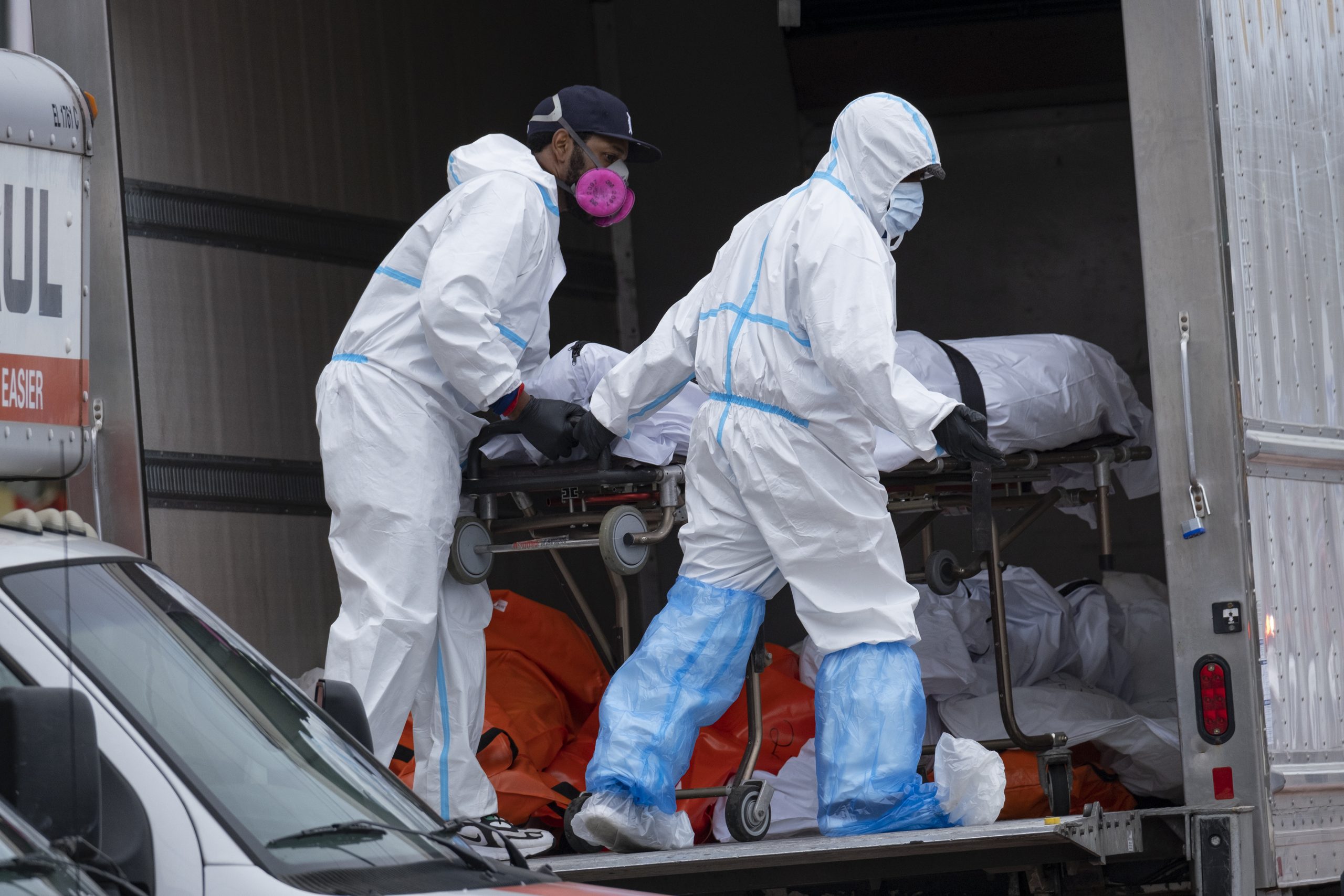
Workers move bodies to a refrigerated truck from the Andrew T. Cleckley Funeral Home in the Brooklyn borough of New York in April 2020.AP
Honestly, I thought — and hoped, frankly — that I’d written about the COVID-19 pandemic for the last time by the end of 2021. The issues it raised — about everything from public health preparedness to conspiracy theories — had seemed important enough, but I was more than ready to move on from empty baseball stadiums and masks in the supermarket.
I thought most folks felt the same way — that we were all eager to put the coronavirus in the rearview mirror. Clearly, I was wrong. The people we call MAGA still can’t stop yelling about it.
Last week brought the acid flashback of the government’s communicable disease czar when the pandemic erupted in 2020,Anthony Fauci,getting dragged before a U.S. Senate committee in a Joe McCarthy fashion, forced to take the Fifth Amendment to avoid any perjury traps that would satisfy the senators’ mouth-breathing constituents’ raw lust to imprison the 85-year-old public health icon.
The realization that they weren’t going to send Fauci — who was pardoned for his past actions in January 2025 by outgoing President Joe Biden to protect the good doctor from GOP wrath — up the river led these Republican statesmen to do the only thing left: scream at him.
“Who the f— do you think you were for doing that?” Ohio Sen. Bernie Moreno yelled at Fauci, even as it’s hard to understand what “that” was, except for working tirelessly to give Americans the best information about a rapidly evolving, deadly pandemic. “It is a total disgrace what you did to this country.”
The baseless attacks on Fauci by right-wingers — who’ve convinced themselves that the real crisis of 2020-2021 wasn’t the invisible virus that caused the early death of more than 1.2 million Americans, but an authoritarian government (led at the time by Donald Trump, but no matter) making them wear those masks and avoid those baseball games — were both infuriating and unconscionable. Still, maybe because of my aversion to reliving the pandemic, I was going to let the subject slide.
But then the current government’s top health official, Health and Human Services (HHS) Secretary Robert F. Kennedy Jr., went on CNN to double down on the Trump regime’s Big Lies about what really happened during the COVID years. And like Moreno, RFK Jr. turned the volume up to 11.
“Anthony Fauci was mismanaging the COVIDpandemic and was doing it under the Biden administration. President Trump wanted to end the lockdowns,” Kennedy loudly told CNN’s Dana Bash, inventing a farcical, backward timeline. An agitated RFK Jr. insisted the government’s priority during COVID-19 should not have been saving lives, but “protecting constitutional rights,” yet to make this fiction sound less ridiculous, the HHS chief also had to lie about the extent of thecrisis.
“There were ICUs that were empty all over the country, including in New York, at the height [of the pandemic],” Kennedy insisted.
This can no longer be ignored. There are two very important points that need to be made here.
First, when a high-ranking government official tells a lie on national television, this must be debunked immediately. The truth here is that the hospital emergency rooms and intensive care units, especially in New York City but other locales as well, were overwhelmed in the spring of 2020. So were many morgues and funeral homes, which struggled to keep up with the dead.
“I worked for New York’s largest medical center at the start of the pandemic,” Lucky Tran, a Columbia University scientist, posted on Bluesky. “There were morgue trucks on the streets. They set up emergency medical tents in Central Park. Healthcare worker colleagues died. It is horrific that RFK Jr is on national TV lying that ICUs were empty.”
Of course, this is just one of a number of lies about the pandemic — that the vaccines released to the public in early 2021 are dangerous (they’re not), that the virus came from a Chinese lab (it almost certainly didn’t) and not animal-to-human contact, and that Fauci led some kind of Watergate-level cover-up (his personal diaries, obtained by the senators, revealed exactly the opposite) — that are matters of faith among the political right.
Which brings us to the second big thing: Why? Why are all of these petty grievances about inconveniences we experienced six years ago still so gosh-darned important to these yelling people in 2026? Why do they want to send an octogenarian Fauci — a grandson of Italian immigrants whose life was the kind of American dream 20th-century Republicans would have celebrated — to prison?
The real virus here is anti-intellectualism — a strain that has always existed in American life, as the historian Richard Hofstadter famously wrote in 1964 — that has metastasized from a small, well-contained syndrome to overtaking the entire Republican Party. So-called rural resentment leads angry voters to think people like college professors or doctors in white coats are looking down on them.
It’s an antisocial worldview that was encouraged from on high by the likes of Big Oil executives who love it when the masses scoff at climate scientists. But the rejection of expertise reached a whole new level in 2020 when doctors like Fauci started telling Americans to wear masks or avoid social gatherings to slow the spread of COVID-19.
Sure, there were tough calls around issues like how long to close schools, but in real time, health experts were erring on the side of caution — the right thing to do — while shell-shocked regular folks stewed about an assault on their liberty.
As the revived Fauci controversy continued online this week, Mike Adams, whose website has been accused of spreading medical disinformation, posted Monday on X that getting a COVID-19 vaccine “reveals a twisted and artificial obedience to the falsified appearance of authority. People like that should never be trusted, because they are not in control of their own minds.”
They believe experts like Fauci don’t want to help you, but control you — welcome to the far right’s Bizarro World.
But still, why? At the end of the day, these extremists might care somewhat about thwarting climate science or not wearing masks, but the real reason they despise educated experts is because facts shatter the ancient, lie-based hierarchies such as white supremacy, the patriarchy, or homophobia that give meaning to their broken world.
I think some of the reason they still care so much about Fauci is that the pandemic spring of 2020 also brought the police murder of George Floyd and the subsequent Black Lives Matter marches that shocked many of the communities where they occurred. In their minds, all of it — masks, diversity training, vaccines, calls to “defund the police” — merged into one giant threat.
Which brings us to: Why now? There’s no question that the lingering resentments of 2020-2021 over both the coronavirus and the Floyd protests were the rage fuel that revived Trump, who looked dead in the water after his failed coup of Jan. 6, 2021. Now, it’s less than 100 days until a new election that could cripple Trump and his MAGA movement. And they are desperately waving the bloody shirt of COVID-19.
We must never forget the truth about 2020, Fauci, or the necessity of public health in a true democracy. Our anti-science government is seeing rising cases of measles and of the bacteria that causes explosive diarrhea (which has now been linked to two deaths), and God only knows what elseis in the pipeline.
Experts like Fauci aren’t here to tell you how to live your life — just how to not die.
Yo, do this!
I remain fascinated with the hidden history of American reactionary movements, which is coming out of the shadows during the Trump era. I’ve been listening to the audiobook of The Biggest Lie: The Prehistory of American Fascism, 1818-1915 by College of Charleston historian Joseph Kelly, which looks at how the defense of slavery in the antebellum South, Jim Crow, and the early 20th century revival of the Ku Klux Klan all bore the defining characteristics of an American strain of fascism, often for the self-preservation of monied interests. In the same mode, I highly recommend a recent New York Times guest essay, “It Wasn’t a Civil War. It Was the Slaveholders’ Rebellion,” by history writer Anthony Conwright, who argues persuasively that the name most of us have always used to describe the 1861-1865 conflict is actually a whitewash pushed by the South. The piece is a real eye-opener.
Did I mention that 2026’s summer of soccer isn’t over? The Philadelphia Union have emerged from the two-month World Cup break with a completely different look from the group that tanked in the first half of the MLS season, with the return of Kai Wagner (from England) and Quinn Sullivan (from injury) and rising young stars Neil Pierre and Cavan Sullivan, Quinn’s brother. They’ll also get a fresh start for a trophy opportunity with the arrival of the Leagues Cup tournament against the best teams of Mexico’s Liga MX. Check out their first match Thursday night at 8 p.m. against traditional powerhouse Cruz Azul, live at Subaru Park in Chester and on Apple TV.
Ask me anything
Question: Do you believe the Dems have a chance to take the Senate in November? — Elise (@bnat4.bsky.social) via Bluesky
Answer: Elise, I’d almost bank on it happening, and here’s why. Since the early months of the Trump 47 presidency, Democrats — who need to gain four seats for a majority — have consistently run double digits ahead of past performance in special elections. That should put seven states in play, with the strongest possible candidates in places like North Carolina (ex-Gov. Roy Cooper), Alaska (ex-Rep. Mary Peltola), and Iowa (Josh Turek). Maine voters will forget the Graham Platner fiasco long before they forget Sen. Susan Collins’ vote to confirm Justice Brett Kavanaugh. Ironically, the battle to hold a Democratic seat in Michigan looks toughest, but likely primary winner Abdul El-Sayed is an excellent campaigner. As Trump’s popularity plummets, there’s even a chance for shockers in places like Florida or with independent candidates in Nebraska or Idaho. For me, the bigger question is whether 51-plus Dems will dump Chuck Schumer as their leader after November. Stay tuned.
What you’re saying about …
Many of you had great ideas for a fall Democratic message that’s about more than just “affordability” — the preferred mantra of the party’s consultant class. Many sought to widen the conversation to issues around corruption and inequality. Here are some pithy ones. Roberta Soules wants to “take power away from the large corporations and oligarchs.” Meg Berlin suggested “More Butter. Fewer Guns.” Dane Madsen prefers “Stop the Trump Crime Family,” while Frank Friedman went with an even simpler, “We will be honest with you.” Stephen R. Rourke wrote simply, “Peace, prosperity, and justice for all.”
📮 This week’s question:CNN is reporting that the Pentagon recently took the highly unconventional step of asking rank-and-file troops for creative new ideas on how “to punish Iran.” But what should be done about this mess? Can the United States simply walk away at this point? Or do big problems like the flow of oil through the Strait of Hormuz or Iran’s nuclear ambitions require a response, and what is that, exactly? Please email me your answer and put the exact phrase “Iran war ideas” in the subject line.
Backstory: Is Kamala Harris ‘the new Nixon’?
Democratic presidential nominee Vice President Kamala Harris delivers a concession speech for the 2024 presidential election, Nov. 6, 2024, on the campus of Howard University in Washington. Jacquelyn Martin
Although it’s true that, as a 5-year-old kindergartner in 1964, I nearly got into a fight with a kid who said he supported Barry Goldwater, the first presidential election I really followed came four years later in 1968. I was probably waiting for the baseball scores when I saw news reports that the GOP front-runner was a “New Nixon,” which made this 9-year-old wonder what was wrong with the old one. Indeed, a Californian who’d lost a presidential election (and a gubernatorial race just two years later) stunned America with the political comeback that made him the 37th president. We’d spend the next six years of Kent State and Watergate learning the kinder, gentler Richard Nixon of 1968 was all a lie.
It would be a Nixon-level comeback if Kamala Harris were to win the Democratic nomination in 2028, let alone the presidency. Like Tricky Dick, Harris is a child of the Golden State and former vice president to the oldest-ever POTUS at that time (Dwight Eisenhower was 70 when he left office, which was unprecedented before Ronald Reagan, Joe Biden, and now Donald Trump), and a failed nominee, although shewas smart enough not to run for governor when she returned home. People forget the brief lightning bolt of excitement when she replaced Biden on top of the 2024 ticket, and so the smart money has been that her moment has passed, as the Democratic base looks for new blood.
But it feels like the earth has shifted a bit, and the reason can be summed up in two words: South Carolina. Last week, the Democratic National Committee unveiled its list of the first six presidential primary states, and the South Carolina primary tops the list. The same South Carolina where, in 2020, the state’s main Democratic voting bloc — older, center-left, Black members of the middle- or working classes — turned the race around for Biden, the man who then tapped Harris as his veep. The same South Carolina whose Democratic power broker, Rep. James Clyburn, is close to Harris. A state that seems tailor-made for a Harris comeback.
But the Palmetto State isn’t the only reason to start taking a Harris return seriously. In politics, your weakness is often also your strength, or vice versa. Harris has long been a political chameleon — from tough 2010s prosecutor to a sharp left turn during Trump’s first term that she backpedaled away from in 2024. Today, Harris is feeling the zeitgeist. She is drifting left again, but perhaps more importantly, she understands the desire by core Democrats to support fighters, not milquetoast cowards.
“They are ruthless,” Harris told the annual gathering of the National Urban League in Nashville on Friday, referring to Republicans. “We need to be ruthless, too” — explaining that Democrats should not be “cruel,” but “uncompromising.” She added: “For example, and I know this is going to be controversial coming from me, in particular, we need to revisit the Electoral College. We need to revisit the point of expanding the court to 13 justices, like we have 13 district courts. We need to revisit, if they so want, statehood for Puerto Rico and D.C.” Harris has also been holding extensive meetings with some of the pro-Palestinian activists who often clashed with her over Israel policy in 2024.
She’s running? It sure sounds like it.
To be clear, while I thought in the fall of 2024 that Harris had thepotential to become a very good president, and I still do, I’m also very much in the “new blood” camp when I think about 2028. I’d love to see what someone from the progressive Bernie Sanders-Alexandria Ocasio-Cortez wing of the movement could do in wiping away the stain of Trumpism. But establishment Democrats, intentionally or not, have thrown Harris a lifeline with their South Carolina gambit. The coming months will reveal whether this former vice president can be “the new Nixon” of the left.
What I wrote on this date in 2013
I was reminded that the 25th anniversary of the 9/11 terror attacks is almost upon us. Expect a lot of what you might call negative nostalgia about that wretched day in 2001, but also the bad times that followed. Do you remember the terror alerts? Many of us thought those would vanish when George W. Bush left the White House, so it was a little jarring when Barack Obama continued the practice, including this major one 13 years ago. I wrote that “the problem with the terror warning of 2013 is not the warning itself but the decade of government baloney that preceded it. Washington needs to acknowledge the reality: If it wants to do a better job of keeping the public safe, it will need to start doing a much, much better job of telling the public the truth.”
The Trump regime’s cruel campaign against our immigrant neighbors is the biggest story of our time. Last week, I traveled to a tiny borough in Central Pennsylvania, Mount Holly Springs, where a budding partnership with U.S. Immigration and Customs Enforcement has seized 32 immigrants in just four months, and angrily divided a rural community. Pennsylvania’s small towns are becoming the front line of mass deportation. Over the weekend, the immigrant crackdown was central to my essay about the rising death toll that’s attributable to Trump’s misrule, which includes murdered deportees in Guatemala, a woman left by ICE agents to die at a Pittsburgh bus terminal, the latest civilian bombing victims in Iran, and many, many more. It’s a humanitarian crisis that demands our immediate attention.
No two people define the world-class journalism that we regularly produce here at The Inquirer more than my longtime friends Wendy Ruderman and Barbara Laker, who could have rested on their laurels after winning the Pulitzer Prize for investigative reporting in 2010. Instead, both are working harder than ever. Ruderman has applied her talent for digging to Philadelphia’s leading industry, healthcare, with remarkable results. Check out her latest exposé about a Main Line psychiatrist who lost her license after a wildly inappropriate affair with a troubled younger client. Laker remains a linchpin of The Inquirer’s investigative unit, and — joined by her colleagues Ryan W. Briggs, Max Marin, and Ellie Rushing — she has been digging into the dark tale of a Philadelphia pornographer and his family’s mysterious ties to two missing women. Investigative reporting is essential to democracy and forging better communities, but it’s costly, time-consuming, and won’t happen without your support. Subscribe to The Inquirer today.
By submitting your written, visual, and/or audio contributions, you agree to The Inquirer’s Terms of Use, including the grant of rights in Section 10.
The United States government might wash its hands of any responsibility for the more than 700,000 human beings who’ve been deported since Donald Trump returned to the White House some 18 months ago, but it doesn’t take Sherlock Holmes to determine who’s to blame for the blood stains that have been left behind.
Last month, police outside the city of Retalhuleu in southwestern Guatemala found Nixon Giovanni Pérez Paz, 43, and his wife, Glendy Marisol González de la Cruz, dead in a sugar cane field. They’d been bound, gagged, and then executed by gunshots, with their 14-month-old daughter crying next to her mother’s lifeless body.
When Trump took office in January 2025, the couple was living in a suburb of St. Louis — working essential jobs and raising their three daughters while seeking to become legal residents of a country that had offered refuge from rampant crime and poverty back home in Guatemala.
The dream turned into a nightmare with one traffic stop in April 2025, as Pérez Paz was driving to work. Although a subsequent NPR investigation found just one permanent mark on his record — a paid $200 fine for driving without a license — Pérez Paz was swiftly deported by U.S. Immigration and Customs Enforcement (ICE). González de la Cruz had an active asylum application, but after struggling to support her kids while working two jobs, she decided to return home voluntarily.
The couple was murdered only weeks after they reunited in Guatemala.
“If immigration hadn’t picked up my brother, my sister-in-law would still be alive, and the children wouldn’t be going through this sorrow,” the dead man’s brother, Ronaldo Pérez Paz, told People magazine. “Unfortunately, immigration — the [U.S.] government — doesn’t see that. It makes no difference to them.”
No, it doesn’t. Nor did anyone with that government see the humanity of Daphy Michel, a 31-year-old Haitian asylum-seeker with a history of mental health struggles. Sheended up in immigration custody after an arrest and was dumped by ICE agents at a Pittsburgh bus stop wearing summer clothes during a brutal February cold snap. She was found dead three days later, and a medical examiner has ruled that Michel’s death was a homicide.
“I believe that we need to observe all our brothers and sisters as neighbors,” Jaime Martinez of the Pittsburgh immigrant rights group Frontline Dignity told the Guardian, invoking the golden rule that was shattered by Trump’s cruelty-is-the-point regime.
The smell of death permeates the so-called brain trust of American militarism that decided back in February — for reasons still unfathomable — to bomb Iran back into the Stone Ages, in an on-again, off-again campaign in which it seems the collateral damage is the point.
An undated photo of Daphy Michel, an asylum-seeker from Haiti who died March 2 in Pittsburgh, in the wake of her release from federal custody.Michel Family via AP
Last week, according to a deep analysis by the New York Times, U.S. forces dropped a massive, 2,000-pound bomb in the middle of a dense residential neighborhood on Iran’s Qeshm Island along the contested Strait of Hormuz, pulverizing a family’s home.
The 3:40 a.m. blast killed Zahra Jafari, her husband, Qeysar Jafari, a taxi driver, and their son Sina, according to Iranian news agencies, who said two other children were rescued alive from the rubble.
Less than halfway through Trump’s second presidency, his strongman rule is increasingly becoming a death cult. The stench of immoral indifference to the humanity of anyone not part of the MAGA movement is spreading as fast as the COVID-19 virus that helped bring an end to Trump’s disastrous first presidency.
I realize I’ve probably overused my lifetime quota for invoking one of the greatest four minutes of filmmaking I’ve ever seen, but yet again I am reminded of Martin Scorsese’s brilliant montage in Goodfellas as dead bodies pile up in parked Cadillacs or on freezer-truck meat hooks in the wake of a huge armored-car heist. It’s a testament to the greed, brutality, and senseless violence of the mob life.
Today, I can’t help but hear the mournful piano coda from “Layla” as I watch the corpses of Trump’s recklessly lethal rule wash up on Caribbean beaches near the driftwood of their obliterated fishing boats, or inside the bombed sanctuary of an Iranian girls’ school, or from medical neglect inside ICE’s growing gulag archipelago.
The nattering nabobs who scoff at the notion that the United States — whose president on Saturday posted an AI photo of himkissing Jesus on a golden cross wrapped in the American flag — has sunk into fascism because there are no Auschwitz-style death camps just don’t get it.
Whether it’s ICE agents firing bullets into an immigrant’s car, or deportation flights that dump their passengers back into the gang violence they thought they’d escaped, or ending the programs that saved millions of kids in Africa from malaria, the Trump body count is already into the thousands, and it grows every day of his warped presidency.
The statistics matter, but you can’t put a number on the rank immorality of an utter disregard for whether people who don’t look like you live or die. Whatever the Trump death toll turns out to be, this stain on the American soul is never coming out.
But there’s also an outer band of gross neglect or indifference to human life that has led to scores of additional deaths, including the more than 50 people — some who’d complained of medical conditions that were ignored — who’ve died in ICE custody since Trump returned to office, or the unknown number who’d faced murder or poor medical care after deportation to the trouble-laden nations they’d tried to escape.
A memorial at the site where Lorenzo Salgado Araujo was fatally shot by ICE agents in Houston last month is seen July 13.Karen Warren
Then there’s the biggest — and most abstract — ring of all. It’s difficult to agree on an exact count, let alone bring accountability, for what researchers say is a wave of death — 600,000 people, mostly children, according to one Boston University study — that has resulted from the decimation of the U.S. Agency for International Development (USAID). And what will become of the domestic surge of preventable diseases such as measles under a government whose top health official is a notorious critic of vaccines? At what point does bad policy become depraved indifference?
Death is contagious. In Ecuador, prosecutor Alexandra Bravo was investigating the U.S. drone strikes that destroyed three of her homeland’s fishing boats when a gunman on a motorcycle assassinated her and her sister. There’s no evidence that the United States has any direct responsibility for her death, but there’s every reason to believe she’d still be alive if this Trumpian death cult had not destabilized the planet.
The MAGA movement thrives on a brand of white supremacy that pumps up its adherents by dehumanizing everyone around them. And when people are stripped of their humanity, the Ten Commandments seem to no longer apply to their tormentors. It’s hard to reach Trump’s promised goal of one million deportations every year unless the deportees are just a number — not a mom, or a dad, or a cherished neighbor.
A bad president can be replaced every four years. A killing spree screams out for immediate action. We need to take whatever steps are possible right now to stop this rogue government before tomorrow’s headline about the next Nixon Giovanni Pérez Paz or Daphy Michel.
The stench of death has already become unbearable.
MOUNT HOLLY SPRINGS, Pa. — Still hailed for its trout fishing, this bucolic Central Pennsylvania borough in the shadow of South Mountain was a big draw for tourists at the turn of the 20th century who flocked here to cool off in its mineral-spring waters.
In 2026, this tiny municipality about 25 miles southwest of Harrisburg is developing a much less welcoming reputation. The new notoriety began with an agreement between borough police and U.S. Immigration and Customs Enforcement that has turned Mount Holly Springs into a kind of “speed trap” for unsuspecting immigrants — one with life-altering consequences.
What had been a simmering small-town controversy since the start of the year boiled over into an international incident on July 15 when a prominent Chinese dissident and U.S. asylum seeker named Wu Shaoping was pulled over by a borough officer who claimed Wu had blown through a stop sign. The Amazon delivery driver was then taken into custody by ICE agents who had been running an operation just down the road.
But the outcry over the arrest and detention of Wu — taken to ICE’s Moshannon Valley Processing Center and crammed into a room with 60 other detainees for 10 days before winning his release on bail — also exposed an even darker story.
In March, Mount Holly Springs became the only municipality in Cumberland County and one of a handful across Pennsylvania to execute a formal cooperation agreement with ICE under a controversial program known as 287(g). The program gives local cops expanded powers to arrest suspected undocumented immigrants, while offering training and financial incentives in return.
In just four months, the borough’s four police officers have pulled over and checked the status of dozens of motorists — mainly commercial truck drivers — and turned over 32 arrestees to ICE, the Mount Holly Springs Police Chief Tom Day told me on Wednesday.
The main drag in Mount Holly Springs, a small borough in Cumberland County, Pa., on Wednesday. The community has seen controversy over local police cooperation with federal immigration authorities.Will Bunch
Day, a gruff ex-Marine in a Nittany Lions cap and blue jeans who doubles as borough manager, insisted to me that the traffic stops and ICE cooperation have nothing to do with racial profiling and everything to do with road safety in a borough with aging bridges and narrow streets.
“There’s no racial profiling of or ethnic profiling of drivers,” the police chief maintained. “We have no clue until we step up on the side of that truck who we’re even dealing with.” Day also said “it’s not that we don’t have a heart” — that he believes in the American dream and understands why refugees want to come here, but when immigrants show up without permission “actions have consequences, you know.”
Minutes later, I met with a gaggle of local residents and business owners who told a very different story — that the wave of immigrant arrests has created a climate of fear that permeates Mount Holly Springs. The growing uproar has riven their once-placid borough into a distrustful cauldron of angry Facebook comments, muttered asides, and occasional threats — a kind of modern civil war just 25 miles north of Gettysburg.
“What I’m hearing from my customers, our people are afraid,” saidRachel Bear, the co-owner of a popular local boutique. “Immigrants are afraid. It’s out there.” She said she’s decided to speak out against the borough’s relationship with ICE because some neighbors are intimidated. “I think they’re just scared.”
Andrew Dapkins, the owner of The “Bird Guy” Tours of local wildlife, told me he’s stopped bringing his excursions into Mount Holly Springs since the deal with ICE was signed. “If I was to bring someone of color, or they were not heterosexual male, I would feel like I was bringing them into a potential hostile environment,” he explained. “So I can’t do that.”
Some local residents who oppose Mount Holly Springs’ police federal immigration arrests include (left to right) Democratic legislative candidate Jessica St. Clair, precinct leader Mandy Taylor, borough council member Pamela Still, and business owner Andrew Dapkin.Will Bunch
What’s happened in Mount Holly Springs since the ICE program began this winter feels in many ways like a microcosm of Donald Trump’s America. It’s the rage, distrust, and paranoia that only metastasizes as the demagogue’s fiery campaign tirades get translated into harsh reality at a small-town stop sign.
But it’s also exactly the chaos that some immigration policy experts warned about when the Trump regime dramatically expanded the 287(g) program, named for a section of 1996 federal immigration law that grants broader immigration enforcement powers to trained state or local police.
Despite warnings about the potential for racial profiling and seeding distrust in immigrant communities, the number of 287(g) agreements has exploded from a few dozen when Trump first became president in 2017 to more than 2,000 today, with at least 88 on the books now across Pennsylvania.
Still, the immigration arrest total in tiny Mount Holly Springs, which covers just 1.4 square miles and has a population of fewer than 2,500 residents, seems staggering. As recently as February, there were only 67 monthly immigration arrests by local police across the entire state. But now this one borough is on a pace for nearly 100 arrests in just one year.
“This is an agenda that’s being driven by numbers for numbers’ sake,” Nayna Gupta, policy director at the American Immigration Council, told me Thursday. “There is an arrest quota that the White House is pushing, and they’re leaning on local police departments to do that work for them” — even as that work paralyzes local immigrants when they learn of increased traffic stops.
“Communities become afraid to go to the grocery store, to go to work every day, to use public transit, even,” Gupta said.
There have been festering recriminations in Mount Holly Springs since January, when residents first learned that Day — seen as a local power broker because of his dual role and his close allies on borough council — had signed the paperwork with ICE to become a 287(g) department. A handful of angry residents denounced the plan — revealed at the same time as two ICE-related killings in Minneapolis sparked national outrage. But the lone Democrat on the seven-member board, Pamela Still, failed to get a second on her push to rescind the deal.
Human rights attorney Wu Shaoping, on the campus of the Massachusetts Institute of Technology in Cambridge, Mass., in an undated photo, was arrested on July 15 and taken into custody by U.S. Immigration and Customs Enforcement.Handout art
Trump received just over 62% of the vote in Mount Holly Springs in the 2024 election, although local residents said there are now growing numbers of Latinos and refugees from Nepal who’ve flocked to Central Pennsylvania living in the borough that census data had reported as more than 95% white.
There is clearly considerable local support — often voiced in angry Facebook comments about “illegals” — for Day and his department’s work with ICE. “You guys are doing the right thing; don’t listen to the childless cat ladies,” borough resident Derek Scheuren told a contentious council meeting in February, as reported by PennLive. He also called undocumented truck drivers “illegal invaders” and offered to buy a beer for any officer responsible for detaining one.
That would be nearly a half-dozen six-packs, based on Day’s updated tally. We don’t know if Scheuren has made good on that, but then there’s a lot that local officials and residents don’t know. There’s been little to no information about the multiple arrests since March, and while ICE is bringing the detainees about two hours north to Moshannon Valley, next to nothing is known about their fates.
Locals like council critic Still have also pressed for answers on the carrot of federal dollars that state and local supporters of these 287(g) programs cite as a key benefit. Day only volunteered to me that in addition to federal training of all four borough officers, he has so far put in for just $1,100 in reimbursement for officers’ time on 287(g) stops. But in an email he also sent to local leaders Wednesday, which was shared with me, Day further acknowledged that Mount Holly Springs has received some $130,000 for vehicles and equipment.
The July 15 arrest of Wu, which drew the attention of the New York Times, the Guardian, and other outlets, has so far brought more questions than answers about what’s really happening with immigration arrests in Mount Holly Springs.
The stop sign at Hill Street and State Route 34 in Mount Holly Springs, Pa., where Chinese dissident and asylum seeker Wu Shaoping was stopped by a local police officer on July 15. Wu’s arrest sparked controversy over the borough’s relationship with federal immigration.Will Bunch
Day insists that Wu, making Amazon deliveries in his Toyota Camry, ran the stop sign at the bottom of steep Hill Street and nearly collided with his officer who happened to be patrolling the main drag, State Route34. The chief said Wu exacerbated the situation by refusing to roll down the window and instead calling his lawyer — causing a commotion that attracted attention from ICE agents who happened to be in Mount Holly Springs doing truck inspections almost right across the street.
Wu disputed that account to Lancaster Online, insisting that he did stop at the intersection, then rolled a bit forward because of its poor visibility. ICE later said Wu was sent to Moshannon Valley because he’s overstayed his 2020 tourist visa, even though he has an active asylum application and a work permit. He was released on bail after two members of Congress formally complained about his detention.
Still, Wu’s arrest — along with the high number of other detentions in Mount Holly Springs — has only fueled suspicion among the program’s critics that cops are racially profiling drivers. Day has repeatedly insisted in past comments and in the Wednesday interview that undocumented truck drivers who can’t read English and don’t follow signs about restricted streets and bridges are a danger to the community.
“I don’t want to sound mean over it, you know, or that I’m not sympathetic,” Day told me. “But they can’t be driving 18,000-pound vehicles and not understand our roadway signs.”
But local critics say cops working so closely with ICE isn’t making Mount Holly Springs safer — not when immigrants are afraid to shop, landscaping crews that largely employ Latinos have seemed to vanish, and a quaint rural town that seeks outside tourists for trout fishing or bird watching starts getting a bad reputation.
“A lot of times, it is this overweight thing — going over the bridge on the Pine Street extension or something is what they get pulled over for, and you know it’s like don’t ruin somebody’s life because their truck was packed or because their GPS didn’t tell them,” said longtime local resident Jen Dieter.
The arrest surge in Mount Holly Springs seems to confirm the fears of immigration experts who’ve found in earlier iterations of the program that immigrants were less likely to call 911 for emergencies or report other crimes. Critics also believe that cops will ignore their public-safety duties to focus instead on immigration arrests, especially as the carrot of federal dollars is dangled before small departments.
“There’s plenty of evidence and data to show that 287(g) agreements undermine trust in the communities where these agreements exist and are used extensively, because the community becomes less likely to report crimes, or to report instances of domestic violence, out of fear that doing so could translate to detention and deportation,” Gupta said.
Experts also say what’s happening in Mount Holly Springs may be the future of mass deportation under the Trump regime. While high-profile, publicity-seeking operations like the ones that targeted Minnesota or Chicago are out, ICE is increasingly relying on its 287(g) partners to make arrests without attracting as much public outcry. The wave of arrests in the Pennsylvania borough came as ICE is nationally reporting as many as 1,400 immigration arrests in a day, an all-time record.
Some longtime residents of Mount Holly Springs are worried that things will never be the same.
Bear, the shop owner, spoke about moving here 25 years ago and slowly building a community around her business. “This is a small community,” she said. “We all know each other. You know these people that we’re talking about, [that] I’ve done business with. You know, hopefully we’ll do it again. But who knows?”
“But more than it being about business, it’s about community. And I think this isn’t how I would treat my neighbors.”
Occasionally, I get to share good news in this space. Wu Shaoping — the Chinese dissident who fled to America but was detained by U.S. Immigration and Customs Enforcement after a Central Pennsylvania traffic stop — was freed from ICE’s Moshannon Valley Processing Center Friday night, not long after my column dropped and a couple ofmembers of Congress pressed for his release. His asylum case is still pending. I’ve learned there’s actually a lot more to this story — stay tuned.
The Trump regime is shifting billions from college into AI. That’s no accident.
People take photos near a John Harvard statue on the Harvard University campus in 2024 in Cambridge, Mass.Steven Senne
The U.S. government has become pretty stingy when it comes to finding money for human beings — just ask any struggling single mother in Mississippi needing food stamps, or a physician in Africa waiting on vaccines that no longer arrive through American foreign aid programs.
But Washington always seems to have an open wallet for computers.
In fact, the very first one — ENIAC (Electronic Numerical Integrator and Computer), constructed right here in Philadelphia on the University of Pennsylvania campus as World War II came to an end — was funded by the U.S. Army Ordnance Corps at a cost of about $7 million in today’s dollars. Over the years, billions of dollars in federal funding would fuel key moments in the Computer Age, including the creation of the internet, which was also a Pentagon project.
Still, there was something chilling about last week’s report from the White House Office of Science and Technology Policy that called for a surge in research aid in one area: computers and robots using artificial intelligence, or AI. The nuts-and-bolts of the paper — “Science: A New Golden Age” — highlighted a new, more-than-$5 billion commitment for an AI-in-science program called the Genesis Mission.
But the White House paper also called for a radical shift in the way the federal government pays for science, with a massive move of $200 billion away from funding research and basic science at top universities — the system that has thrived since the time of ENIAC — and toward individuals and more directly applied AI projects, including those at private tech companies.
Goodbye, John Harvard. Hello, Claude.
“This plan raises profound concerns about the future of publicly funded science,” the top union leaders for educators — Todd Wolfson of the American Association of University Professors (AAUP) and Randi Weingarten of the American Federation of Teachers (AFT) — said in a joint statement last week. “It does nothing to make anyone healthier or safer, and it isn’t what Americans want.”
Wolfson, Weingarten, and other critics of the new science scheme from the Trump regime say it unravels long-standing protections for academic freedom and transparency on campuses in favor of a process that’s ripe for political interference. “This is a defining moment for American science,” the educators wrote.
Indeed, while the federal funding gains for AI are still mostly theoretical, the cuts for research projects on college campuses across the United States have been underway since Donald Trump took office in January 2025, and the impact has already been dramatic.
The playing field is complex, but a recent deep analysis by the Brennan Center for Justice found that the Trump administration successfully froze about $3 billion in previously approved grants for scientific research, is imposing a scheme to slash an additional $4 billion, and issued a budget proposal calling for a whopping $44 billion additional reduction.
The analysis noted that “these midstream freezes and cancelations have ripple effects far beyond the nominal dollars involved, prompting layoffs, interrupting careers, and destabilizing the budgets of research universities.”
But now it feels like the White House is stating the quiet part out loud: The bigger goal is simply to build smarter computers, even if that means humans get dumber. Intelligent robots still don’t vote in elections, after all, but poorly educated people do.
Ironically, the regime’s rationale for spending our tax dollars on making AI more powerful regurgitates a Cold War mentality that, on the surface, sounds like the reasons behind decades of massive college research funding and programs like the space race of the 1960s or the nuclear arms buildup: to stay one step ahead of the communists — this time in China.
The difference between then and now is that after World War II, Washington made a conscious effort to fund basic science and free inquiry as a way to distinguish the United States from the rigid planned economy of our then-biggest adversary, the Soviet Union. Now, the White House seeks to copy Beijing’s centralized planning. Can we truly promote science without lifting up the actual scientists?
Trump’s “Golden Future of Science” feels more like an extremely narrow wind tunnel. The irony is that many of today’s politicians in both parties see higher education as mainly workforce development, even as corporate recruiters say what they really want are more broadly educated critical thinkers. In other words, the AI era actually screams out for a boost for the humanities like literature or philosophy — the types of majors that are getting crushed in the Trump era.
An epic battle is looming between those obsessed with a new nuclear arms race around AI — especially the Silicon Valley billionaires who stand to gain and who, not coincidentally, have heavily funded the second coming of Trump — and a public that doesn’t want our communities ruined by noisy, energy-guzzling data centers that aim to take away our jobs while making reading a lost art.
A government scheme to build better computers while rendering humans obsolete used to be the stuff of dystopian science fiction. Maybe we can keep it that way before it’s too late.
Yo, do this!
About once a year or so, I write, “Yo, actually maybe don’t do this.” Last weekend, I ventured out of my underground lair to join every other American in devoting three hours to Christopher Nolan’s The Odyssey. To say I was underwhelmed would be, well, an understatement. The movie was a funeral for the now totally lost art of movie dialogue, amid a plot that meandered from gouge-your-one-eye-out boring to bursts of incomprehensible violence. It was a metaphor — Troy was My Lai, apparently — that got terribly lost at sea. But I do feel there’s something happening here. First the World Cup, now this mediocre whale of a motion picture: Americans are desperate to bea part of something, anything, that is bigger than our politics.
Regular readers know I’m a huge fan of the CNN modern history documentaries they now call the Decades Series, but the original format of politics, TV, and music did have gaping holes. A few years ago, they backfilled with a series on The Movies of our post-World War II world. Now, finally, Decades in Sports arrives on CNN with back-to-back episodes (presumably the 1960s and ‘70s) on Sunday night at 9 p.m. I can’t wait. Spoiler alert: Havlicek stole the ball.
Another thing you may have noticed is that Rep. Ro Khanna, who meandered west after Council Rock High School in Bucks County and became the congressman from Silicon Valley, is something of a friend of the newsletter. He’s back in our area frequently, and he’ll be at Philadelphia’s Parkway Central Library on Tuesday at 6 p.m. to deliver a special speech: “America at a Crossroads: A Vision for the Future on our 250th Anniversary.” He’ll talk about his background growing up here as the son of immigrants and the need for economic freedom that ends gross corruption and inequality — go check it out.
Ask me anything
Question: Who should be DNC [Democratic National Committee] chair? And does it matter? — Martha (@marthagrant.bsky.social) via Bluesky
Answer: It does matter. Despite everything else that’s happening in the world right now, one of the more revealing stories of the last week was the New York Times article about Democrats in disarray, focusing on embattled DNC chair Ken Martin, who before the 2024 election was the state leader in Minnesota. Under Martin, the party is sliding deeper in debt, and there are complaints about an abrasive personal style, the botched “autopsy” of the 2024 election, and the Democrats’ muddled message. A change should be made as soon as possible. Hopefully, party leaders could rectify the mistake of not picking Wisconsin’s more skilled ex-party chief, Ben Wikler. The problem is that, under the constant assault of GOP fascism, Dems need to fix this plane while it is flying at 37,000 feet.
What you’re saying about …
There was an excellent response to last week’s question about what a future Democratic president should do on Day One to erase the stench from two Donald Trump presidencies. I wish I could reprint all the suggestions, but recurring themes included a rapid purge of any Trump holdovers, abolishing ICE and related immigration raiders, and a speedy effort to prosecute the many wrongdoers. The two most frequent suggestions included major reform of the judiciary, from fixing the mangled immigration courts to ethics reform, and definitely an expansion of the U.S. Supreme Court. Mark Cohen suggested two more federal appeals courts and then “assign a Supreme Court justice to each one, bringing a total of 13 justices to the Court for fixed term of 18 years.” Another theme was erasing Trump’s various renovations to the District of Columbia. The ex-congressman Joe Hoeffel wrote, “Strip all the cheesy gold out of the Oval Office.”
📮 This week’s question: Speaking of Democrats, some top party officials like House Minority Leader Hakeem Jeffries seem to think the November election is primarily about “affordability.” That seems to miss the bigger moment, but I’m curious: What pithy message would you like to see Dems run on this fall? Please email me your answer and put the exact phrase “Democratic message” in the subject line.
Backstory on the Gen Z revolution rocking India
Protesters participate in a demonstration demanding educational reforms as part of the Cockroach Janta Party’s ongoing protest movement in New Delhi on July 25.Vipin
Last October, I wrote a column, with great interest and enthusiasm, about a growing revolution of Gen Z 20-somethings that was taking place across the global south — from Madagascar to Peru to Nepal, and elsewhere — who were fed up with the political corruption of grown-ups and threatening to topple governments. I wondered if this very online youth activism might spread to the United States or other more developed nations, but over the coming months, the momentum for these protesters and their Japanese anime pirate flags seemed to fade. The so-called Gen Z revolution looked like a historical footnote.
But it turns out that the embers of youth unrest were still smoldering, and this summer they have reignited in a big way in the world’s largest — if deeply flawed — democracy: India. And as is so often thecase, the spark was something nobody saw coming: a nationwide exam for entrance to medical school taken by roughly two million students, which the government moved to scrap after allegations that some of the questions had leaked. Some young people who’d studied for months for the exam took tothe streets in protest, and — as so often happens — a repressive police response only caused these demonstrations to get bigger. So did a comment from India’s chief justice, who described young, unemployed Indians as “cockroaches.”
That gave the protests a name when Abhijeet Dipke, a 30-year-old graduate of Boston University, posted on the social media platform X that he was starting the “Cockroach Janta Party” — a wordplay on the Indian authoritarian-minded leader Narendra Modi’s Bharatiya Janata Party. Incredibly, this “CJP” has seen its protests — calling successfully for the resignation of the education secretary and for other deeper reforms, using tactics such as sit-ins and hunger strikes — spread to some 30 cities while clogging the streets of the capital, New Delhi. The movement has become arguably the biggest threat to Modi’s strongman rule since the leader’s ascension in 2014.
All of which raises the same question I posed last fall: Could it happen here? In one sense, it already has. On Friday, about 500 Indian students and other members of the U.S.-based diaspora gathered under a statue of Mahatma Gandhi in Manhattan’s Union Square to express support for the “cockroaches” of their native country. Meanwhile, the kind of pressures that caused India’s youth to erupt — government meddling in higher education, diminished job prospects in a time of rising AI, to name two — are also found in the United States. Young people almost never protest over the same stuff that riles up their parents, as shown by the gray hairs that have populated the No Kings rallies against Donald Trump. When lightning strikes, it will probably be something as unexpected as a college entry exam. But thunderstorms are definitely in the forecast.
What I wrote on this date in 2019
A culture of death permeates the Donald Trump regime, from the doomed fishing boats of the Caribbean to an Iranian girls’ school to the scores now dying in immigration detention cells. But this is not exactly new. The seeds were planted in the first Trump presidency, when his attorney general, William Barr, led a push to revive the death penalty for federal prisoners in a big way. On July 28, 2019, I asked: “What took the American Caligula so long to bring back the spectacle of executions to electrify the masses (but not the prisoners … they’d be lethally injected) and juice his 2020 reelection campaign? Indeed, the five executions are scheduled around the Christmas holiday, presumably to remind us of its pagan roots.”
In 2026, I’ve been very focused on the individuals whose world has been turned upside down — or, in some cases, ended prematurely — by the horrors of life in these authoritarian United States. Last week, I took a deep dive into the story of Wu Shaoping, a Chinese dissident who fled his likely detainment by Xi Jinping’s regime and made it to Pennsylvania with his wife and teen daughter, only to get arrested at a traffic stop, turned over to U.S. Immigration and Customs Enforcement, and detained. The outcry may have had something to do with ICE’s release of Wu shortly after the column ran. Over the weekend, I wrote about the police killing of Corey Ruiz in Madison, Wisc. — noting that the shootings of civilians by cops have only increased since the massive George Floyd protest marches of 2020. I urged an end to the new numbness about police violence in America.
You didn’t really think I could make it all the way through the newsletter without mentioning the face that launched 1,000 hot takes: basketball king LeBron James. He stunned not just the sports world but America’s founding city by announcing Friday that he is taking his aging but still considerable talents to South Philadelphia, hoping to grab one last title with a completely revamped 76ers. Has there been any other story since then? The Inquirer has told you about the first time James played at the Palestra, his new uniform (No. 23), the speculation over how he will (or won’t) gel with the rest of the Sixers, the speculation over where he might live, hisrelationship with Tyrese Maxey and Joel Embiid, and on and on and on. Just wait until he actually takes the court this fall! Actually, don’t wait. Subscribe to The Inquirer today, slam dunk the paywall, and read every story from now until the hoped-for parade down Broad Street.
By submitting your written, visual, and/or audio contributions, you agree to The Inquirer’s Terms of Use, including the grant of rights in Section 10.