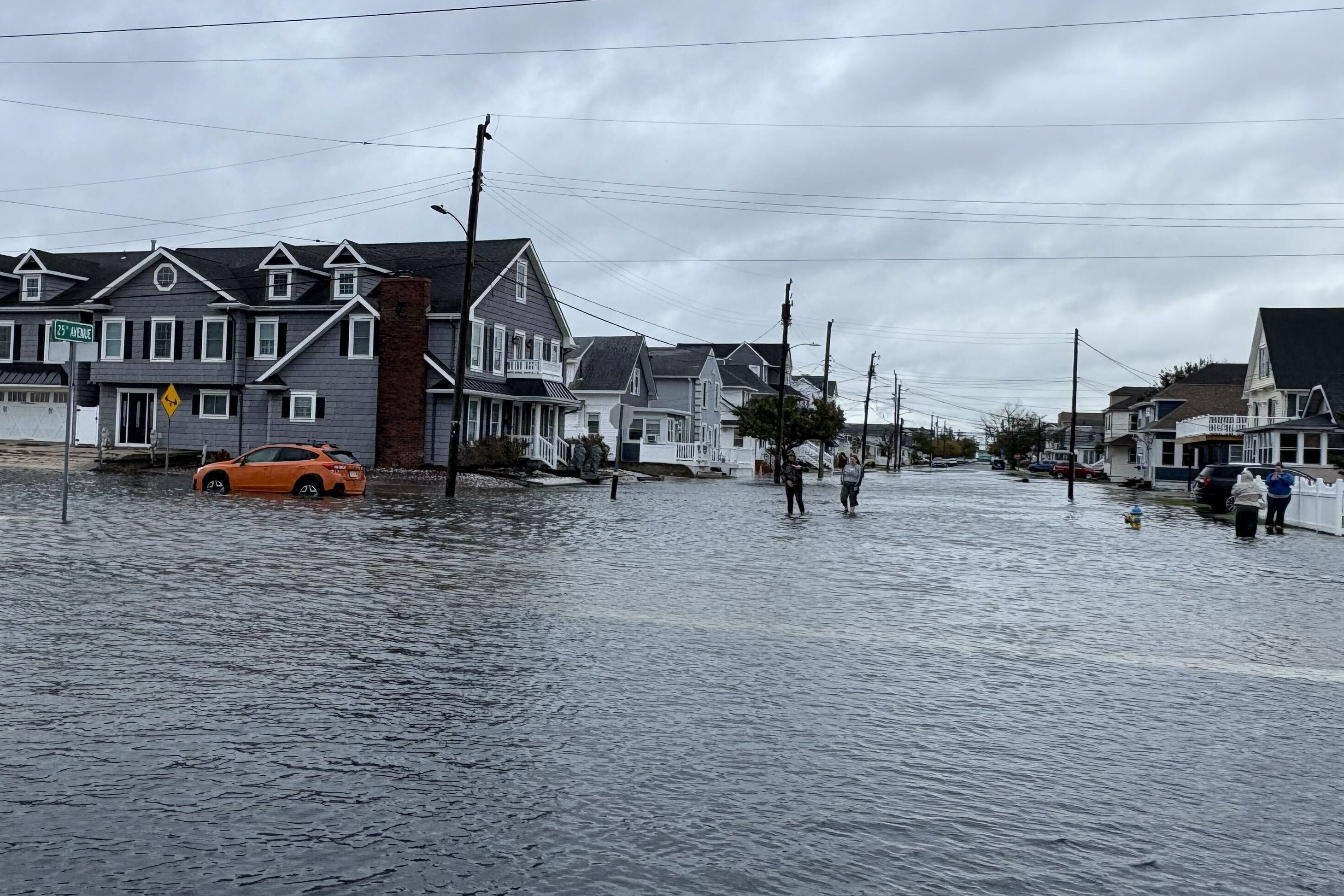
A weekend of devastating and unusual nor’easter storms prompted evacuations, waterlogged cars and businesses, and eroded idyllic beaches along the Jersey Shore.
In coastal towns, roaring floodwaters swallowed major thoroughfares and white-picket fences, as massive, salty waves pushed far past the Shore’s beaches and into residential areas. People waded through ankle- to waist-deep waters, and dozens had to be rescued from cars trapped on impassable roadways, New Jersey Gov. Mikie Sherrill said Sunday at a news conference.
“Our Shore communities have been hit hard,” Sherrill said, warning “we’re not out of the woods just yet.” On Sunday, persistent showers lingered, and the threat of high winds and surges continued for the already weather-tested region.
For some, the fury of the early-season nor’easter evoked memories of Superstorm Sandy in 2012 or 2016’s Winter Storm Jonas. No deaths have been reported in New Jersey, and the full scope of the damage likely won’t come into focus until the howling storm quiets.
The forecast
Sherrill, who declared a state of emergency Friday, said officials were concerned about possible flooding after high tide Monday morning.
Sunday morning’s high tide had been expected to work its way into the back bays and lagoon communities, likely leading to moderate flooding with the possibility of isolated pockets of more severe flooding, said National Weather Service meteorologist Ray Kruzdlo. Water levels may take a few days to recede, he said.
“I don’t think we’re going to see what we saw two high-tide cycles ago, but it’s still going to be impactful,” Kruzdlo said.
The wind — which reached 74 mph in Surf City, according to Sherrill — was also starting to subside.
“The low pressure responsible for this whole nor’easter, it’s kind of wobbling around a little bit,” Kruzdlo said. “It’ll get out of here within 24 hours.”
More than 22,000 power outages were reported across New Jersey about 2:45 p.m. Sunday, according to the PowerOutage.us tracker. Meanwhile, NJ Transit officials were monitoring conditions, and most routes were operating on normal weekend schedules or with some delays because of downed trees. Portions of the River Line and Hudson-Bergen Light Rail were suspended Sunday.
Across the Philly region, the heavy rain overnight and Sunday morning was headed out of town toward Wilmington, Kruzdlo said. There was a chance of showers overnight Sunday and early Monday.
Despite the rain, the Philadelphia area experienced only some disruption Sunday: SEPTA ran with some delays, and Peco reported nearly 110 outages, affecting about 1,900 customers, Sunday afternoon. The Phillies game was moved up, and the annual Puerto Rican Day Parade was moved inside.
Surveying the damage
According to Sherrill, the early-season nor’easter caused severe dune loss in Atlantic City and Brigantine — with the Brigantine mayor calling it the worst tidal flooding since Sandy, the Press of Atlantic City reported.
The storm reminded Sea Isle City Mayor Leonard Desiderio of Jonas — a historic winter storm with hurricane-force gusts that incited record tides at the Shore. Ocean City officials said Saturday morning’s tide (7.63 feet) reached nearly as high as the tide during Jonas (7.66 feet).
“But this was pretty bad,” Desiderio said. “Until we can really evaluate everything, we don’t know the damage it has caused.”
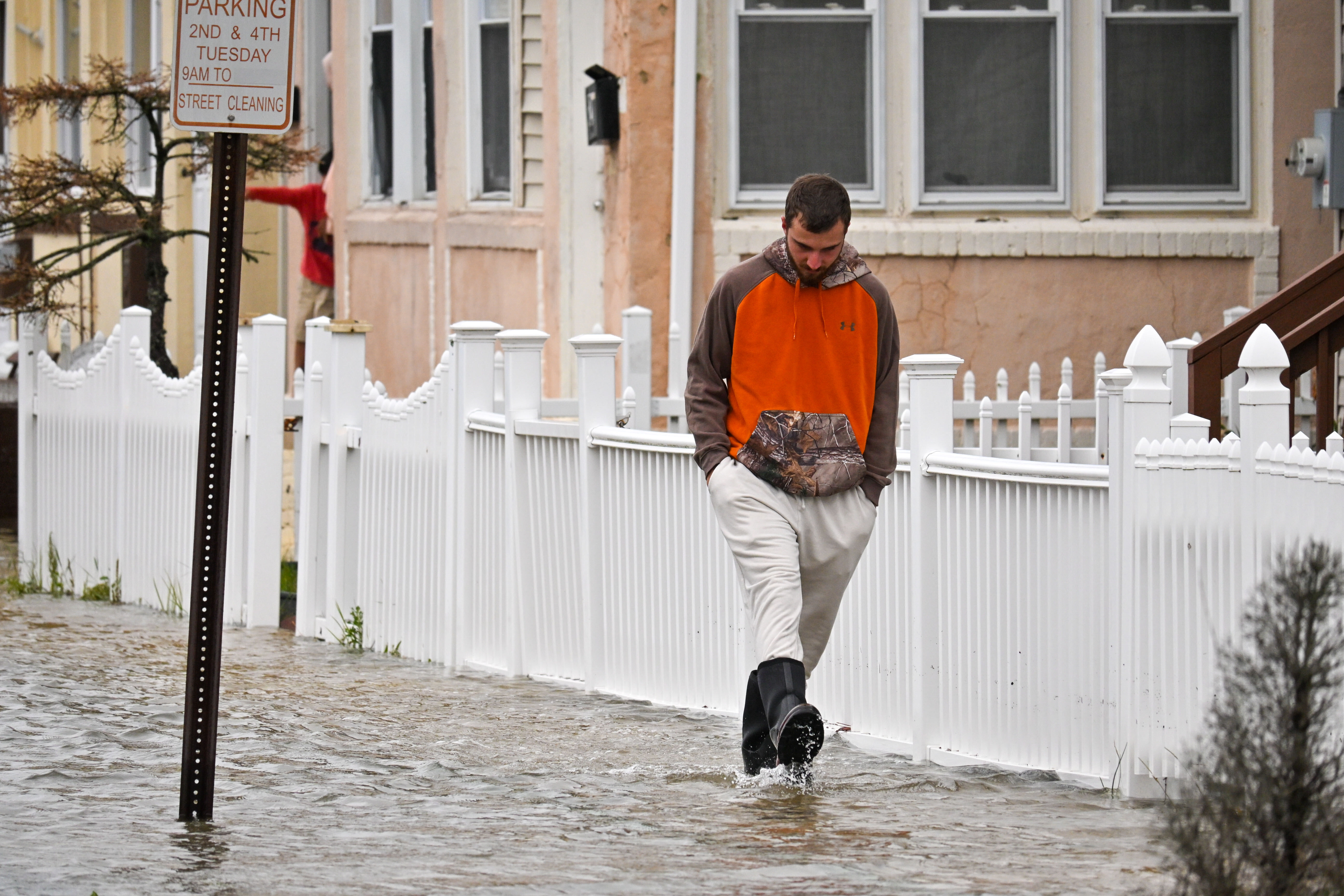
In Margate City, areas that tend to flood during storms indeed flooded, and tidewaters entered some buildings, fire department Capt. Chris Hornig said.
“After today, they’re going to be doing some cleanup, so hopefully this is the last big one this morning,” Hornig said.
Hornig cautioned drivers to stay out of flooded areas: “People shouldn’t drive through floodwater. It’s salt water. It’s not good for their cars, even if they make it through.”
Wildwood Mayor Ernie Troiano Jr. said flooding, there, contributed to multiple fires, including one caused by lithium batteries on an e-bike. Troiano said the Saturday morning tide surprised him with “the swiftness of it entering the streets.”
“When it came up over the bulkheads, it just released and it just went flying,” Troiano said.
As the tidewaters spread across the Shore, so did the videos and photos online.
One widely shared video showed a waterlogged dining room at The Lobster House in Cape May. Then Internet jokesters enhanced the video, adding three lobsters serenely swimming out to sea. On Sunday, people drove up to the iconic seafood restaurant and market — closed due to flooding — to see for themselves.
“We’ve had people in Florida and Virginia ask us about it,” Cape May resident Gary Bartlett said of the videos.
Keith Laudeman, the third-generation owner of The Lobster House, explained that for three days, the water level outside the restaurant inched up — the result of relentless northeast winds holding seawater in the inlet.
Saturday morning’s high tide was the “icing on the cake” that sent floodwaters pouring into front door.
Laudeman dealt with flooding after Sandy and Storm Jonas. He said his team will have to wash everything with freshwater, scrub it down with antimicrobial soap, and replace carpeting.
He hopes to have the restaurant open within three days, and plans for the fish market and coffee shop to be open Monday.
As for the lobsters escaping to sea, Laudeman said anything is possible.
“That’s a little far-fetched,” he said. “But if it adds to the story, then go ahead.”
This is a developing story that will be updated.
Leave a Reply