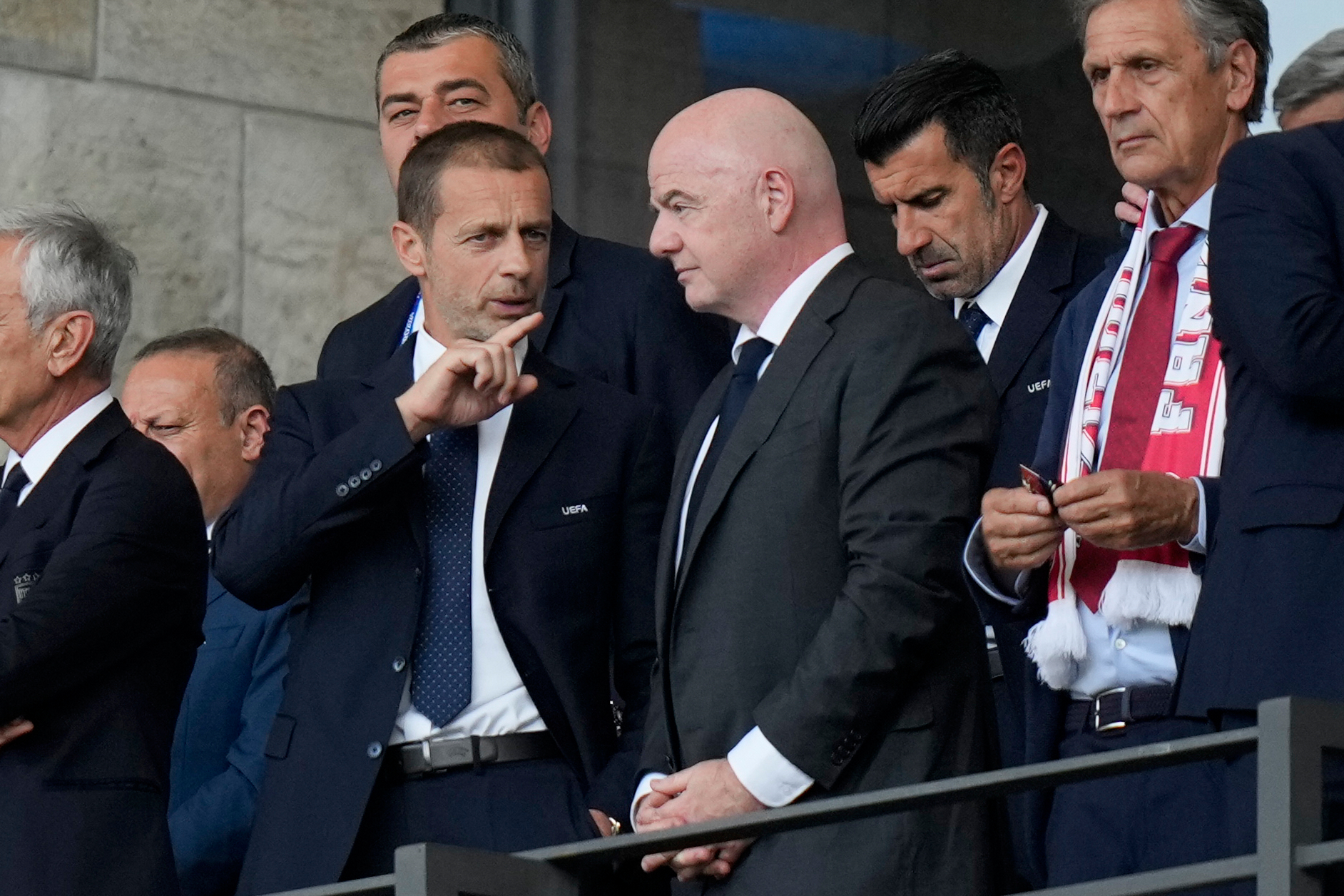
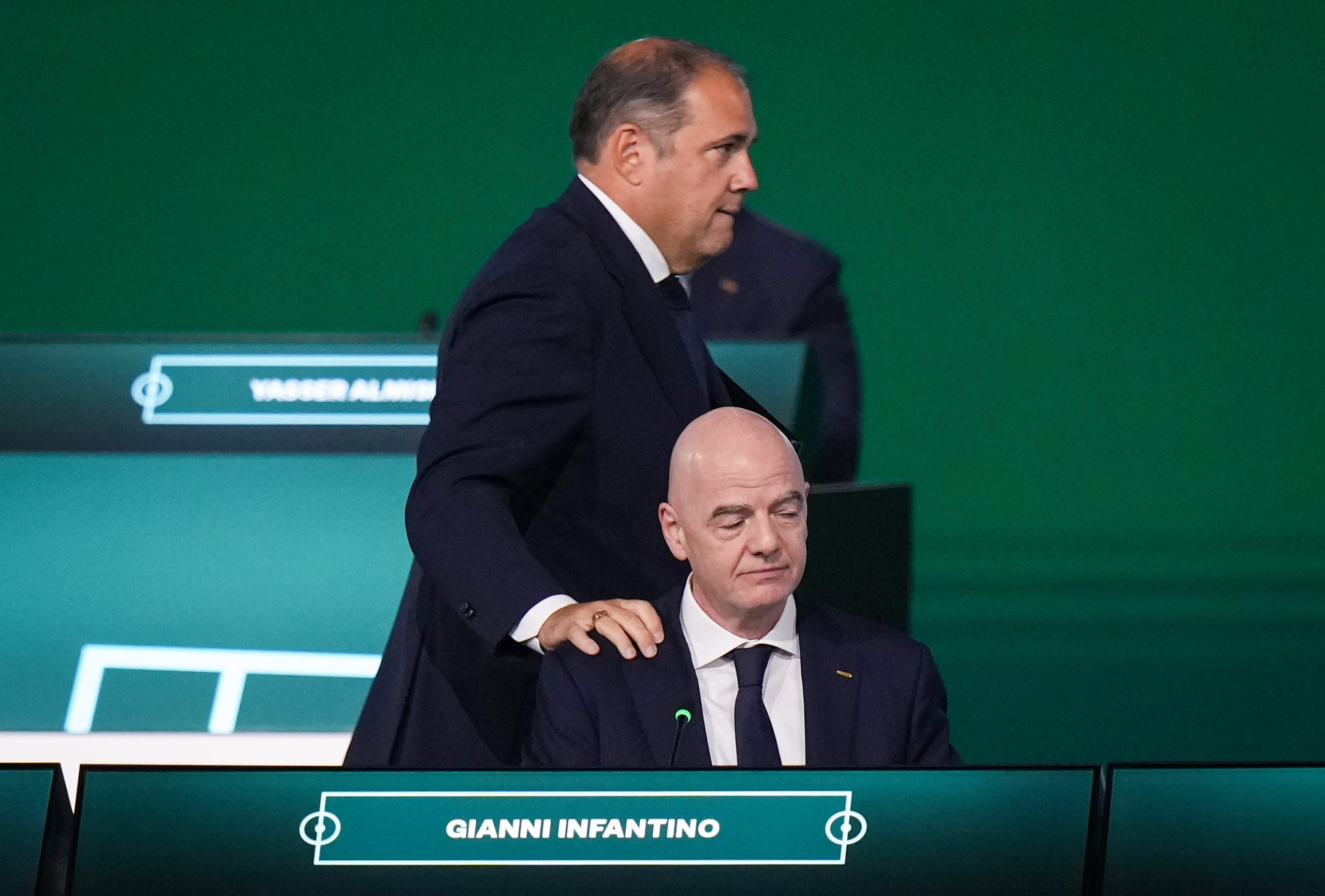
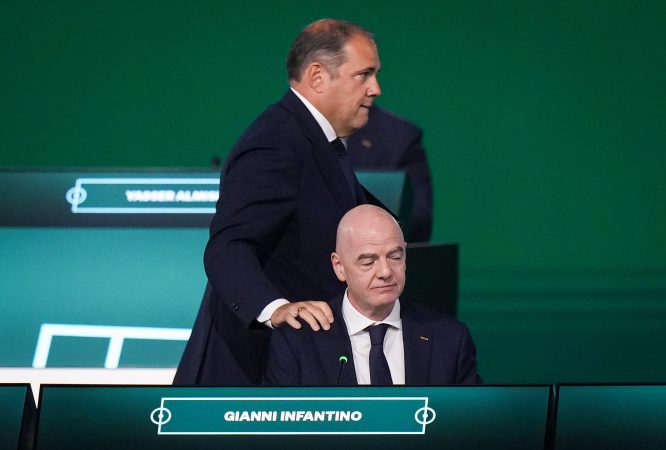
UEFA on Thursday reiterated that it had lost confidence in FIFA president Gianni Infantino and said conditions to withdraw its boycott threat had not been met.
“UEFA’s associations were very clear about the conditions attached to the non participation in FIFA competitions,” it said in a statement. ”First, the proposals to sell off the major competitions had to be withdrawn and secondly, assurances have to be made that such attempts to disfigure the game in this way will never be made again.
“These conditions have not been met. In addition, UEFA made it abundantly clear in its statement on Saturday that it has lost confidence in Gianni Infantino’s presidency. That position holds.”
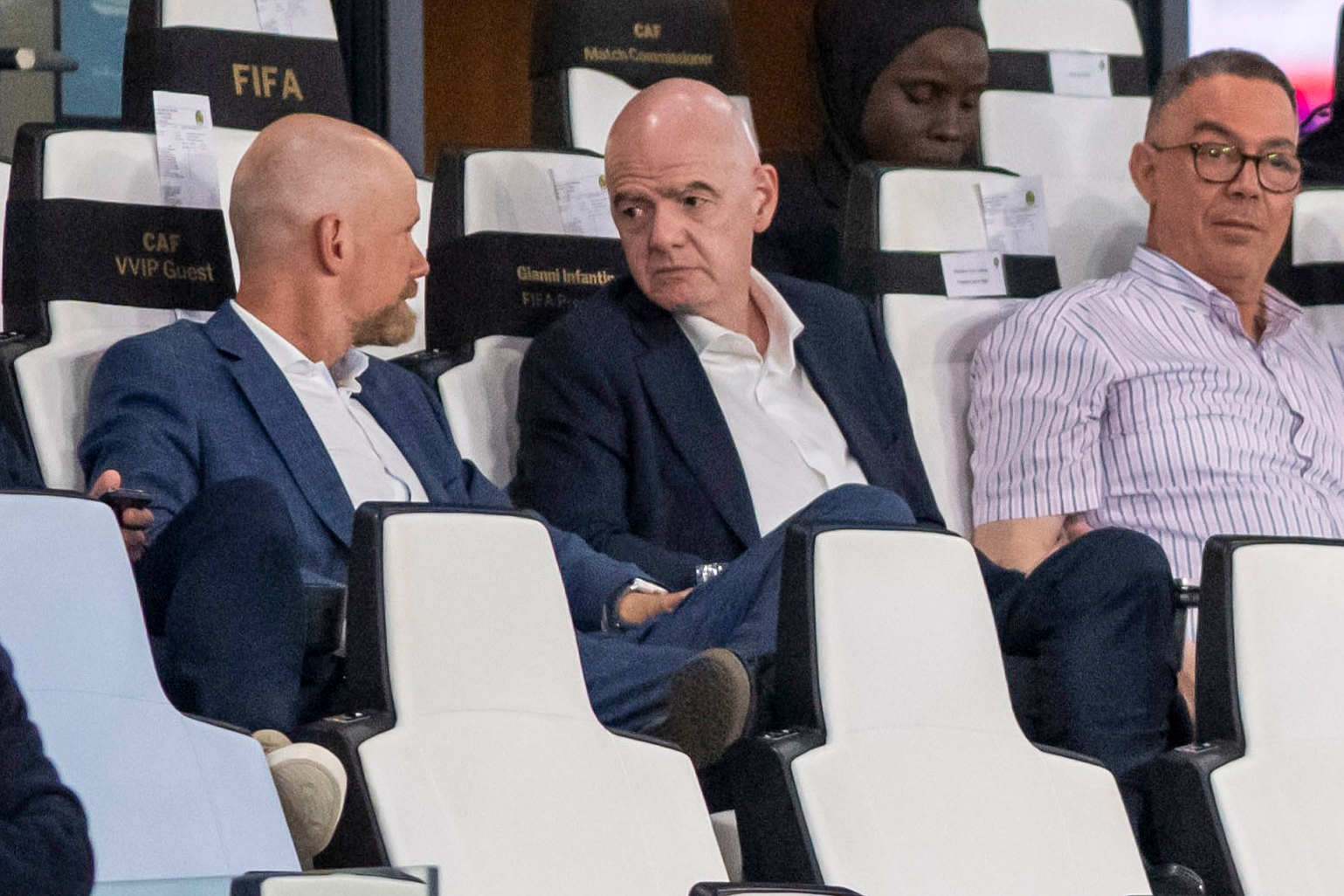
FIFA president Gianni Infantino (center) with secretary general Mattias Grafstrom (left) and Moroccan soccer federation president Fouzi at a women’s Africa Cup of Nations game in Morocco on Wednesday.STR
It was another bruising day for Infantino, with global soccer players union FIFPRO accusing him of “a profound abuse of presidential power.”
The English Football Association has also withdrawn its support for Infantino’s reelection.
Even Amnesty International said the “current crisis spotlights the need for governance reforms.”
FIFA and Infantino tried to present a united front following a high-level summit in Morocco on Wednesday when it announced the president had the full support of top staff in attendance.
The world governing body also apologized for errors made over its controversial plan to sell profits in the World Cup through a commercial subsidiary and committed to “ensure they do not happen again.”
FIFA said it hoped its meeting would “help restore confidence” in the organization after the turbulence created by Infantino’s now abandoned project, which provoked widespread condemnation.
UEFA voted to abandon FIFA competitions if it went ahead. And even after Infantino’s hasty climbdown, Europe’s governing body said it had lost confidence in FIFA’s leadership — paving the way for a challenge to his presidency.
In its defiant statement, UEFA made it clear its position still held.
“Yesterday’s announcement that some people employed by the FIFA president (and whose careers depend on his favor) agree with him changes nothing,” it said.
The next FIFA event on the calendar is the under-20 women’s World Cup from Sept. 5-27 in Poland.
Inquirer staff writer Jonathan Tannenwald contributed to this article.
Prior to the kickoff of the World Cup, the organizers of the city’s events projected the soccer tournament would bring $770 million to Pennsylvania in gross revenue.
Yet, George Diemer, a sports economist at Temple University, said those in his field tend to be skeptical of pre-event projections. Organizers “have an incentive to blow the numbers up,” he said.
Midway through the tournament, the Economy League of Greater Philadelphia estimated that $30 million to $90 million would actually stay in the city. The economists factored in metrics such as leakage, when a share of money spent goes to national organizations instead of staying local. The current analysis, done after the tourists have left, leans “toward the lower end of that range,” said Saloni Tandon, director of research and analytics at the Economy League, the region’s independent civic think tank.
“Even if it goes up, it feels like our estimation is likely to stay in the tens of millions, rather than cross into the range of hundreds of millions,” said Tandon.
The cleat-kicked dirt is still settling, and Tandon said conclusions will continue to change as more data comes to light. The city is looking for a consultant to craft a postmortem analysis on the year’s largest events’ economic impact.
Here is what we know so far.
Hotels and short-term rentals made more money
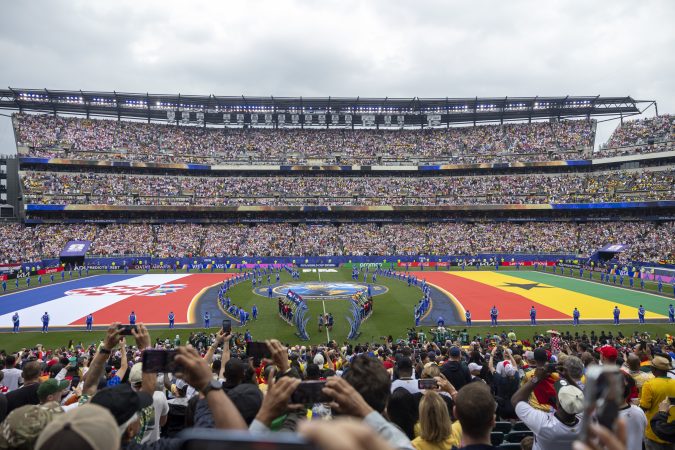
Center City hotels made out well, as almost 410,000 fans from more than 190 countries flocked to Philadelphia to watch the six matches at Lincoln Financial Field.
The Philadelphia Convention & Visitors Bureau data say on the dates of the six soccer Philadelphia matches, hotels saw a 50.3% increase in revenue compared to those same dates in 2025.
Using that data, however, Tandon calculated that Center City hotel occupancy on the game days increased around 3%— modest gains.Much of that revenue increase was thanks to higher per-night pricing by the hotels due to the special event.
A 3% occupancy increase doesn’t validate “a massive spike in terms of tourism,” Tandon said.
Ethan Conner-Ross, executive vice president of consultancy firm Econsult Solutions Inc., noted that hotels may have lost some business to short-term rentals, with “people finding a different way to stay based on their needs,” he said.
An Airbnb spokesperson said the World Cup was the biggest hosting event in the company’s history in all host cities.
For short-term rentals in Philadelphia, revenue reached $38.3 million over the tournament window — up 25% from the same period last year, according to AirDNA, a research company that tracks the short-term rental market.
But that gain was almost purely pricing — with $7.5 million of the $7.8 million increase coming from higher rates. Translation: hosts drove revenue by increasing prices rather than filling more nights. Occupancy dropped in 12 out of 16 host cities compared to the same period last year, including Philadelphia, as supply outpaced demand.
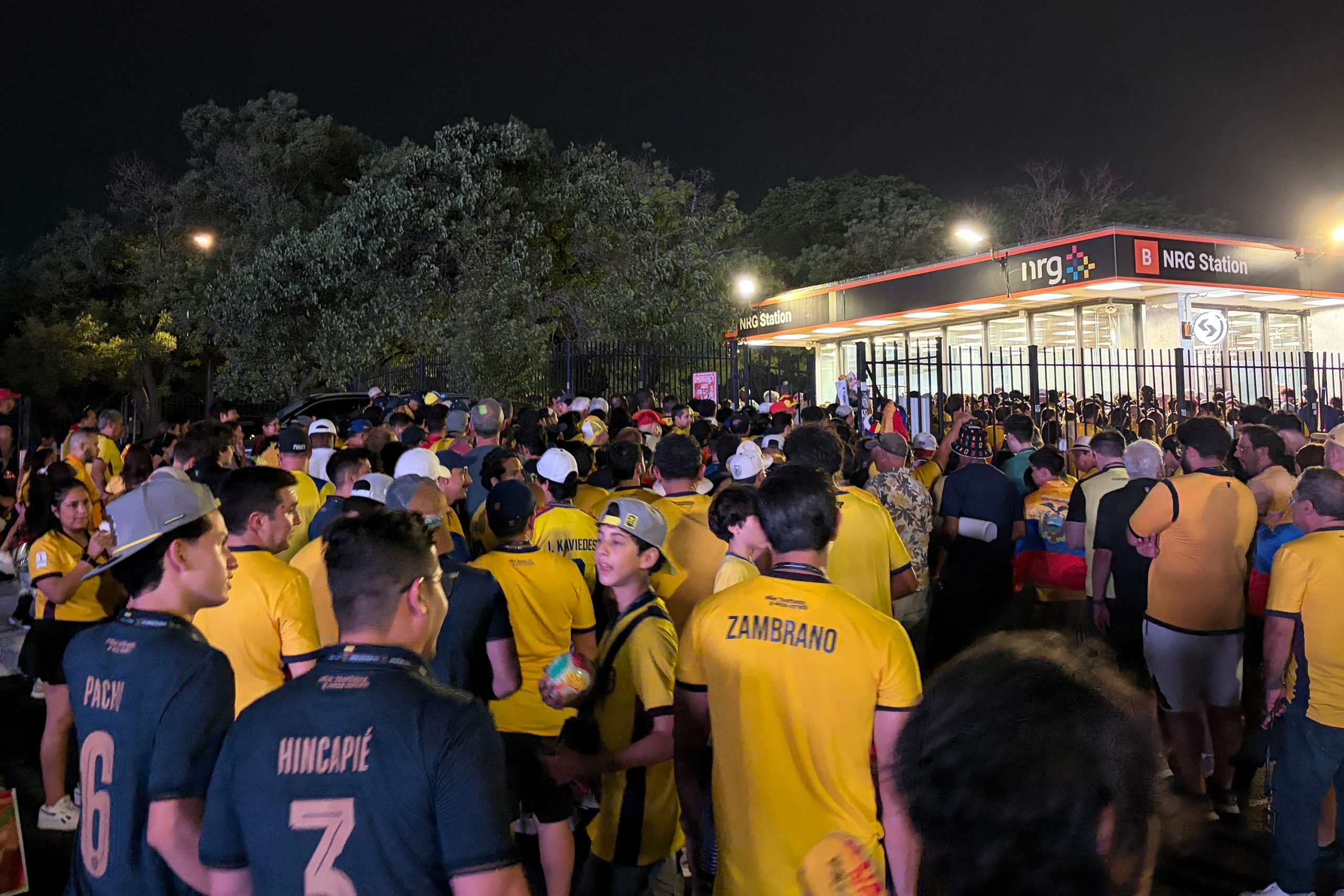
Fans wait outside SEPTA’s NRG Station near the stadium following Ivory Coast’s victory over Ecuador on Sunday, June 14, 2026.Michelle Myers
How SEPTA, PHL, and rideshare handled more travelers
Hosting a large sports event can strain local infrastructure as tourists crowd public transit and other services, leaving high costs of building infrastructure or congestion for locals.
Diemer pointed out that it took Montreal 30 years to pay off its debt from hosting the 1976 Olympics.
Since the six World Cup matches in Philly were spaced out over June and July, Diemer said that helped diffuse the costs.
“I think it was successful,” said Diemer of the decision to ”spread out the games so it won’t be overloading the local infrastructure.”
Travelers took advantage of public transit to get to and from the airport, as well. On the two days sandwiching a match, ridership on the Airport Regional Rail line typically increased at least 20%.
At Philadelphia International Airport (PHL), international arrivals were up 8.3% in June year-over-year.
Spokesperson Heather Redfern said that in a usual summer, PHL is typically a big outbound and connecting market to other destinations. This summer, there were more inbound passengers coming to Philadelphia from countries playing games in the city. In addition, many travelers, notably Scottish fans and Czech fans, took advantage of unique nonstop routes through PHL on the way to games in other cities.
“We focused on delivering an experience for those passengers that made them fond of Philadelphia and want to come back and visit,” said Redfern, “From this perspective, we are very happy.”
Despite some rideshare restrictions surrounding the FIFA Fan Festival in Lemon Hill, Uber drivers transported tens of thousands of fans to and from the festival and the stadium complex, according to Jazmin Kay, head of public affairs for Pennsylvania at Uber.
Prior to the tournament, Uber onboarded more drivers and maximized earning opportunities for them: one way was creating an event-rider surcharge near venues, with 100% of those surcharges paid directly to drivers.
For Lyft, on days when Philadelphia hosted a World Cup game, rides to bars increased by 18% compared to their typical average on the same day of the week. On June 19, rides to bars were 49% above average.
Soccer fans watch Ecuador take on the Ivory Coast during a World Cup soccer watch party at Brauhaus Schmitz on Sunday, June 14, 2026.Yong Kim / Staff Photographer
Where soccer fans ate and drank
Philly’s fan festival saw 575,304 attendees, and bars nearby, like the Black Taxi, saw greater foot traffic and a boost in sales.
For other Philadelphia restaurants, outcomes seem more mixed.
On four of the six World Cup game dates, local restaurants that use reservation site OpenTable saw an increase in seated diners, according to OpenTable data. The biggest gain was 22% on June 25, and of the two dates when reservations decreased, June 14 was the worst with a 44% decline.
At Reading Terminal Market, soccer fans helped drive a 13% year-over-year increase in June foot traffic. On June 19, the market saw more than 30,000 customers, setting a five-year record for Friday visitation.
“Our prepared food merchants — especially if you are in the pretzel, cheesesteak, pizza, or burger business — had a great month,” said Annie Allman, CEO of Reading Terminal Market.
Still, Allman noted that there was a drop in the number of loyal local customers that shopped at the market’s butchers, fishmongers, and grocers, “as they chose to stay home to avoid the crowds.”
A longer-term reputation boost for Philly?
It’s tricky to untangle the effects of the World Cup from tourism spending driven by other coinciding large events, such as the July Fourth celebrations for America’s 250th birthday.
Additionally, not all impacts will be observed within the short period of the tournament. Some benefits, like an improvement of Philly’s reputation or publicity on an international stage, could be realized later on.
“But it’s definitely in a mix of assets that affect how people think about Philadelphia,” Conner-Ross said, “and that contributes to those decisions that happen down the line.”
New Jersey Gov. Mikie Sherrill dissed Philadelphia cheesesteaks earlier this summer, and she just doubled down.
“The best cheesesteaks actually aren’t in Philly,” she declares in a video posted to her social media Wednesday afternoon centered ona recent visit to Donkey’s Place in Camden. “They’re right here in Jersey, and we’re about to go have one.”
In the video, Sherrillleans against the bar next to a customer drinking a beer and sporting a Phillies cap. The first-term Democrat notes with a grin that a “real-life” Philadelphian is “here in Jersey, getting a cheesesteak!”
She noted in the post that a friend of hers from California had mentioned the cheesesteak place to her — showing that the acclaimed Haddon Avenue spot, founded in 1943, is known across the country. She said she “never doubted that New Jersey has the best cheesesteaks,” but had to visit Donkey’s to “confirm” for herself.
I never doubted that New Jersey has the best cheesesteaks, but I still had to stop by Donkey's Place in Camden earlier this summer to confirm it for myself. pic.twitter.com/48JV0PavJQ
— Governor Mikie Sherrill (@GovSherrillNJ) August 5, 2026
Anthony Bourdain felt similarly.
In 2015, Bourdain, who grew up in North Jersey, opined on an episode of his Parts Unknown show that finding the best cheesesteak in “the center of the cheesesteak universe” may require crossing the Benjamin Franklin Bridge. The restaurant proudly displays his quote on its website: “The best cheesesteak in the area might well come from New Jersey.”
During her visit to Donkey’s, Sherrill got in on the cheesesteak action with owner Rob Lucas Jr., whose father, Bob Lucas, previously owned the restaurant. The younger Lucas’ grandfather, Olympic boxer Leon “Donkey” Lucas, was the founder.
Equipped with plastic gloves and a griddle spatula for each hand, the governor assists Lucas by shaking loads of seasoning on a pile of onions.
“Take three pieces of cheese, put it right on top of that,” he directs her in the video.
Sherrill noted she loves onions, in contrast to the three orders of “no onions” ahead of her.
Donkey’s steaks are endowed with white American cheese and come with fried onions on a poppy-seed kaiser roll.
“Guys, the verdict’s in, and you probably know I’ve been going to Army-Navy in Philly for years,” Sherrill, a former Navy helicopter pilot, proudly says, sitting with her creation. “I’ve had a million cheesesteaks. There is no better cheesesteak than here at Donkey’s.”
The historic Army-Navy football game was first played in Philadelphia in 1899 and it has been hosted in the City of Brotherly Love more times than any other city. The last time it was in Philly was in 2022, and it will be hosted by New Jersey, in East Rutherford, this year before returning to Pennsylvania’s largest cityin 2027.
Sherrill visited Donkey’s in late June the same day she visited Camden’s World Cup fan fest at Wiggins Waterfront Park just days before the deadline for her first New Jersey budget. During that appearance, local officials praised the governor for showing up for South Jersey.
During a speech on the fan fest stage, Sherrill boasted that as visitors flood to the region for the World Cup, “the best cheesesteaks are not across the river, they’re right here at Donkey’s.”
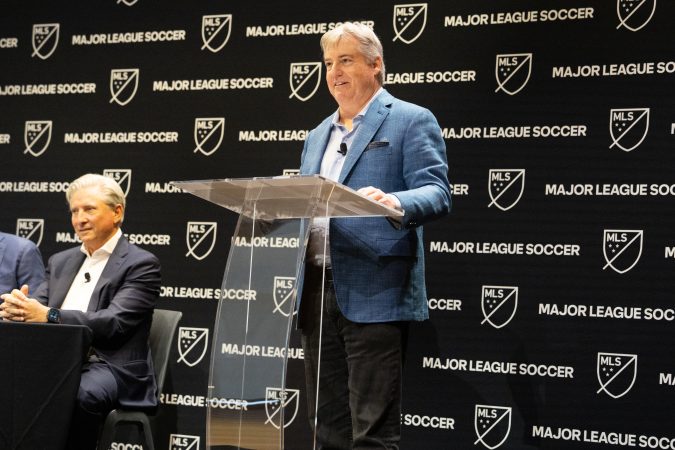
NEW YORK — There are plenty of fun stories to tell about Larry Berg’s Cherry Hill roots, from his lifelong Eagles fandom to playing in New Jersey’s state high school soccer tournament against Peter Vermes’ Delran High in the 1980s.
The biggest was finding out his vision for how the league will capitalize on the World Cup — especially when it comes to slashing the phone book’s worth of roster rules.
As part of Los Angeles FC’s ownership group, Berg has recently been a co-chair of the league’s powerful sporting and competition committee, which means he knows that rule book inside and out. Now he knows which of those rules need to go to make MLS more competitive on the global stage, and thus more attractive to global soccer fans who look down on it.
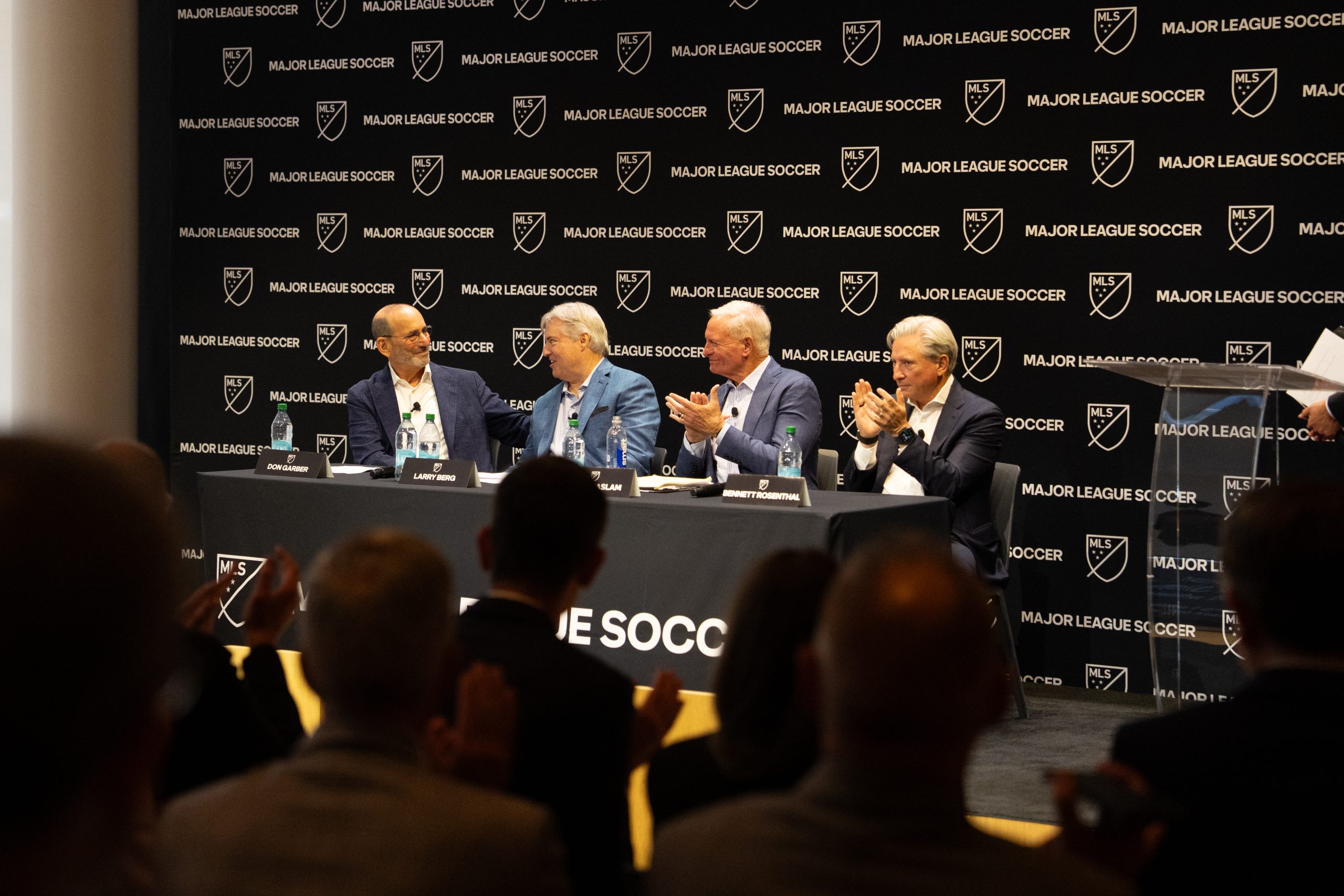
From left, longtime MLS commissioner Don Garber, new commissioner Larry Berg, Columbus Crew principal owner Jimmy Haslam, and Los Angeles FC part-owner Bennett Rosenthal at Tuesday’s event.Major League Soccer
“We’ve accomplished an extraordinary amount over the last three decades, but success can never become an excuse for standing still,” Berg said, still with hints of a Cherry Hill accent after his years out west. “Status quo is not an option.”
Current comissioner Don Garber said that when he appointed Berg to that committee in 2019, Berg “brought to that role an entirely modern and forward-thinking perspective as to where the product could be on the field.”
The league has long discussed an overhaul that will free teams to not just spend more money, but have more freedom in how they spend it. The latter is as important as the former, with rosters chopped into so many classifications: Designated Players, Targeted Allocation Money, Under-22 signings, and so on.
“I didn’t accept this role to protect what we’ve already accomplished — I accepted it because I believe this league is ready for its next chapter,” Berg said. “We’ve come an incredibly long way in a remarkably short period of time, and everyone who has helped build Major League Soccer should be proud of that. But I also believe the opportunity in front of us is even greater than what we’ve accomplished so far.”
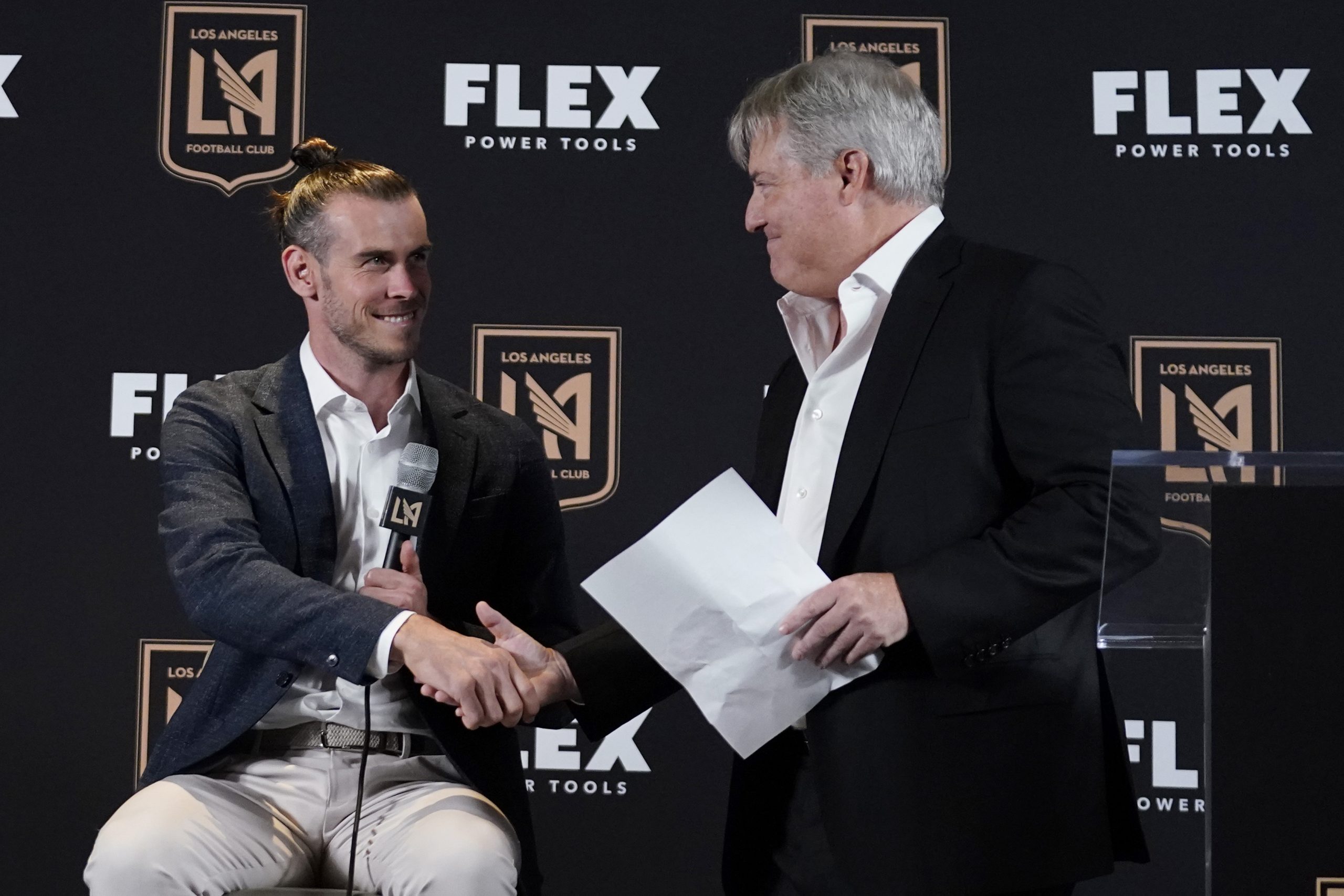
Larry Berg has helped bring Gareth Bale (left) and other superstars to Los Angeles FC over the years.Marcio Jose Sanchez
There is proof that overhaul is on the way. At Monday’s vote of team owners that elected Berg, Inter Miami’s powerful leader Jorge Mas was seen walking out of the lobby holding a printout of a presentation titled “MLS 3.0.” He was gone before reporters could ask him what was in it, but fans would like to know.
“The platform is in place, the infrastructure is in place, the opportunity is in front of us,” Berg said. “Now it’s time to pull the right levers, make the right decisions, and build on everything that’s been created. Together, we’ll make the right decisions to elevate our competition, strengthen our clubs, develop more world-class players, and inspire the next generation of supporters.”
One of Berg’s fellow co-owners at LAFC, Bennett Rosenthal, was a co-chair of the committee that vetted commissioner candidates. He said choosing Berg “puts us in a position, and puts Larry in a position most importantly, to succeed and get consensus to make those changes.”
Another major headline is that Berg is the first MLS commissioner to have a major soccer background before taking the job. It needs to be said that he’s only the third commissioner in league history: Doug Logan had the job first, from 1996-99, and Garber has had it since. He will stay in the job through the end of this year, then spend 2027 with the new title of chairman.
Larry Berg (right) with Don Garber at MLS headquarters.Major League Soccer
“In Larry, our league has found exactly the leader we need at this time,” Garber said, coincidentally speaking 27 years to the day since his hiring was announced.
“He understands it because he helped build it,” Garber continued. “He knows our clubs and knows our league because he’s experienced it full time, and understands the opportunities and the challenges ahead. … I think your integrity, your ambition, your thoughtfulness, your smarts, your respect that you have for the game, is going to help take this league to where we all want it to go.”
Berg, 60, has been around soccer since his childhood. He was a fan of the old Philadelphia Atoms back in the day, and has been a devoted traveler to U.S. national team games for decades.
“I want to take you back to 1974: I was eight years old when my father saw a flyer taped to a telephone pole announcing a brand new youth soccer league in our hometown,” he recalled. “He didn’t know anything about soccer, to be clear, but he thought it looked interesting and signed me up anyway — there were only two teams, so we played the same opponent every weekend. I don’t think either of us could have imagined that one decision would eventually lead me here today.”
Rosenthal said his committee believed from the start that “we needed somebody who had a passion for the game, and there was nobody who had a bigger passion than Larry. And when we say the word passion, Larry described this role as something he had ‘a calling’ to do.”
It remains to be seen how much of an impact that actually has. But there surely will be some impact, directly and subtly.
“I’ve experienced this sport as a player, a fan, an owner, and now with tremendous humility as next commissioner,” Berg said. “The foundation has been built. Now it’s our responsibility to build on it, and that’s what excites me most.”
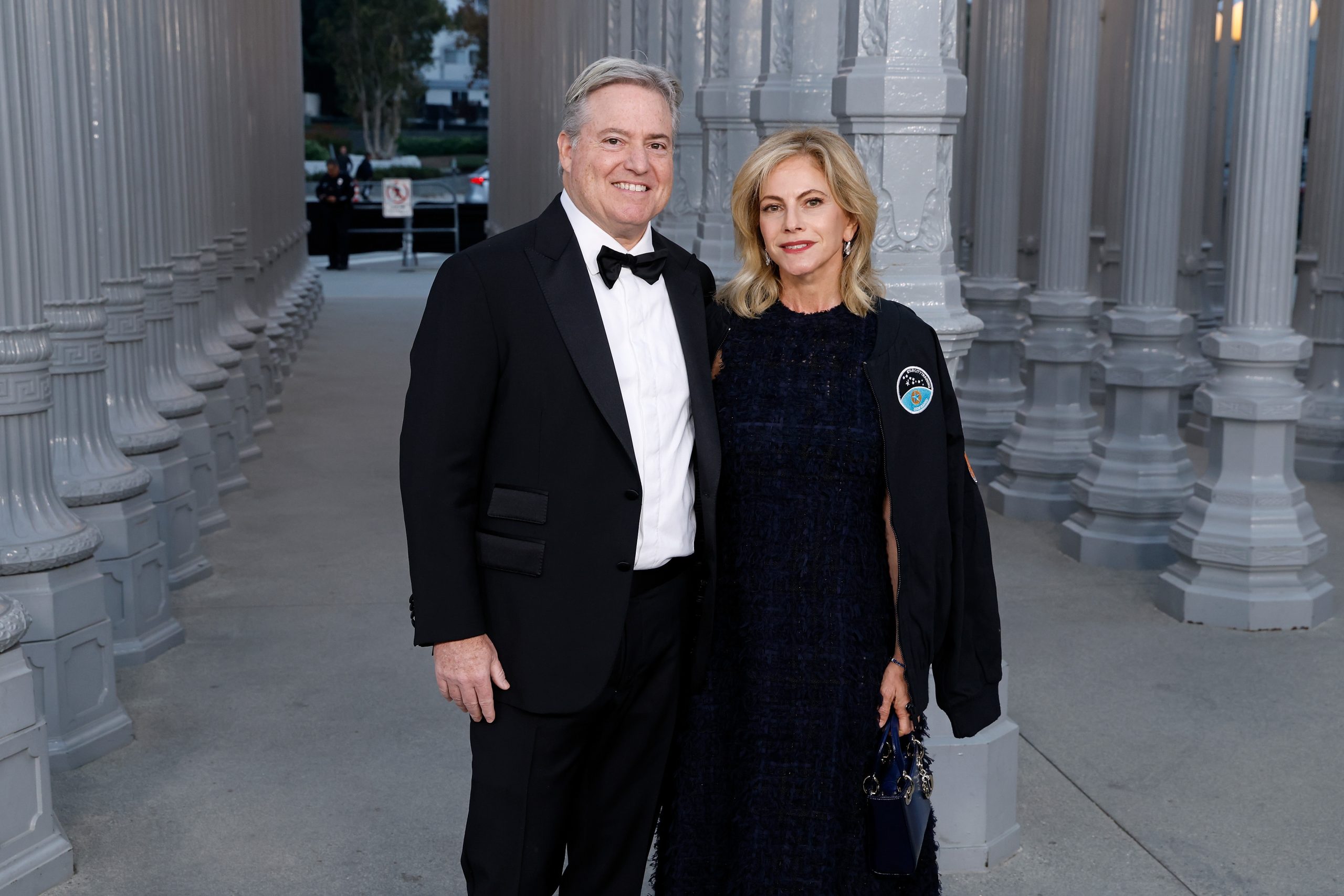
Larry Berg with his wife Allison (right), a Philadelphia native.FilmMagic
Berg specifically noted how important it is for the league to capture the afterglow of this summer’s World Cup, and ensure all the new soccer fans it created come to MLS specifically.
“Millions of people across North America experienced that passion firsthand: they fell in love with the drama, the atmosphere, the supporter culture, and the emotion that makes soccer unlike anything else,” he said. “That creates an extraordinary opportunity for all of us. The question isn’t whether people are paying attention to soccer — they are. The question is what we do with this moment.”
NEW YORK — U.S. Soccer Federation CEO JT Batson was among the VIPs at Larry Berg’s introduction as Major League Soccer’s next commissioner on Tuesday. After the event, Batson took questions from the media. But that didn’t mean he offered detailed answers to all of them.
That was particularly true when questions about FIFA president Gianni Infantino came up.
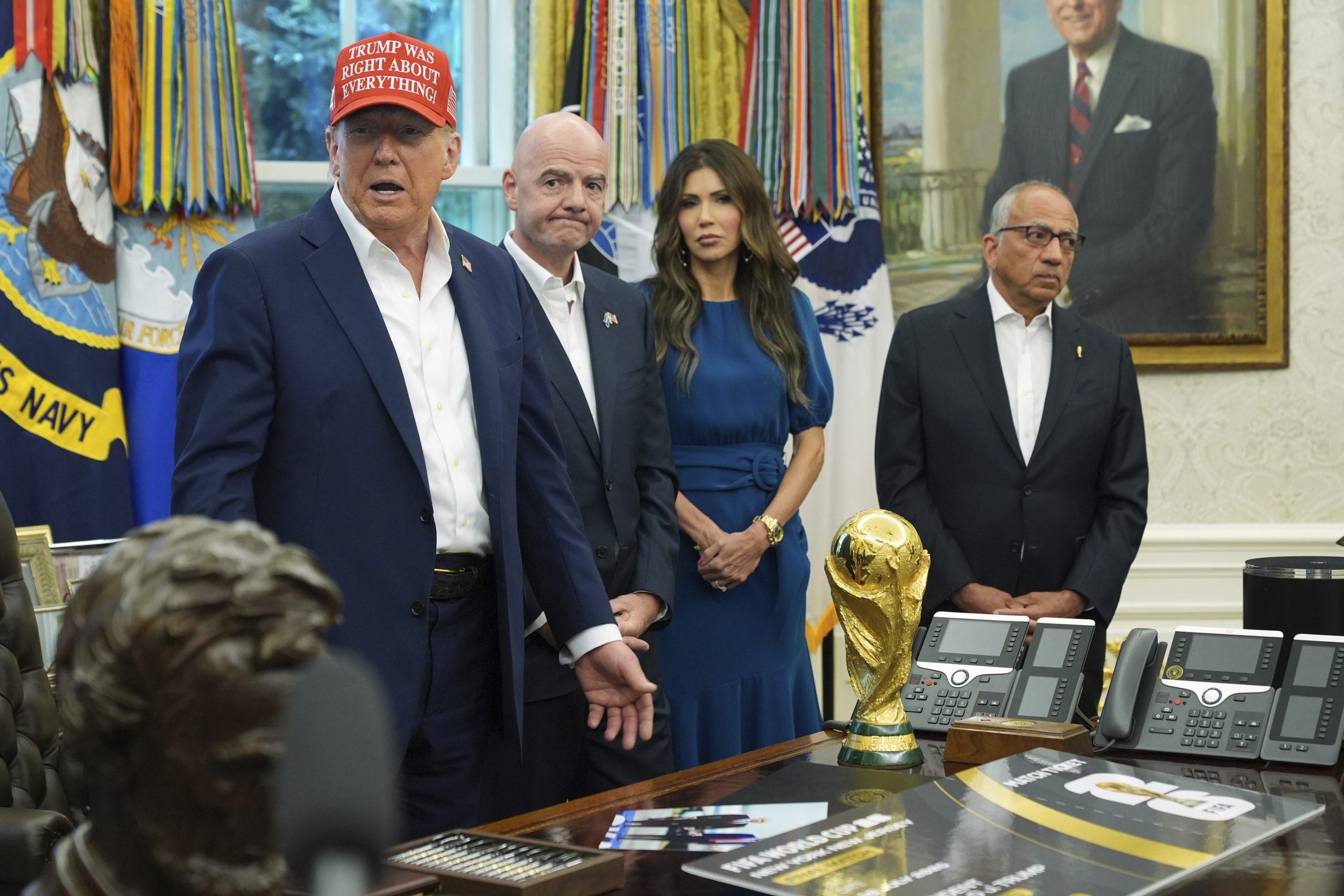
“As we shared publicly, we supported Concacaf’s statement on Friday with regards to FIFA Forward Enterprises,” Batson said, referring to Infantino’s plan to sell shares in a new FIFA private company — including to Josh Kushner, whose brother’s father-in-law is U.S. President Donald Trump.
That “support” was a mere one-sentence post on X: “U.S. Soccer stands with Concacaf and its members.” It was attached to Concacaf’s post with its statement that formally “rejected” Infantino’s plan.
“We have a board meeting in September where, among many topics, one of [them] is thinking about what the best future is for global soccer,” Batson said. “There’s so much more opportunity to grow soccer in more communities around the world, and to do it in a way where those communities are healthier, where they’re more sustainable, and everyone around the world is more connected. We’re looking forward to that discussion, and I don’t anticipate a whole lot of communication ahead of that.”
What happens if the issue is forced with Infantino before then? Europe’s soccer governing body UEFA could call for an extraordinary FIFA Congress to try to overthrow FIFA, and might get Concacaf’s help in doing so.
The Guardian reported Tuesday morning that all 41 of Concacaf’s member nations sent letters endorsing Infantino’s reelection before the World Cup, but “many are now giving serious consideration to withdrawing them.”
Concacaf president and FIFA vice president Victor Montagliani (top) with FIFA president Gianni Infantino at the FIFA Congress in Vancouver, British Columbia, in April.Darryl Dyck
The report further said U.S. Soccer specifically “is understood to be deeply unhappy with Infantino,” with the backlash over President Trump’s intervention on Folarin Balogun’s red card a key point. But “given the political sensitivities,” the report added, U.S. Soccer “may not feel able to take him on.”
When Batson was asked if U.S. Soccer wrote such a letter and might withdraw it, he answered: “I haven’t seen that story, so it’s hard for me to comment on it.”
He was also asked whether U.S. Soccer would back Concacaf president Victor Montagliani if he runs against Infantino, which looks increasingly possible. Batson didn’t answer that question directly.
Current MLS commissioner Don Garber was asked his opinion of it all, not just as the MLS’ leader but as a member of U.S. Soccer’s board.
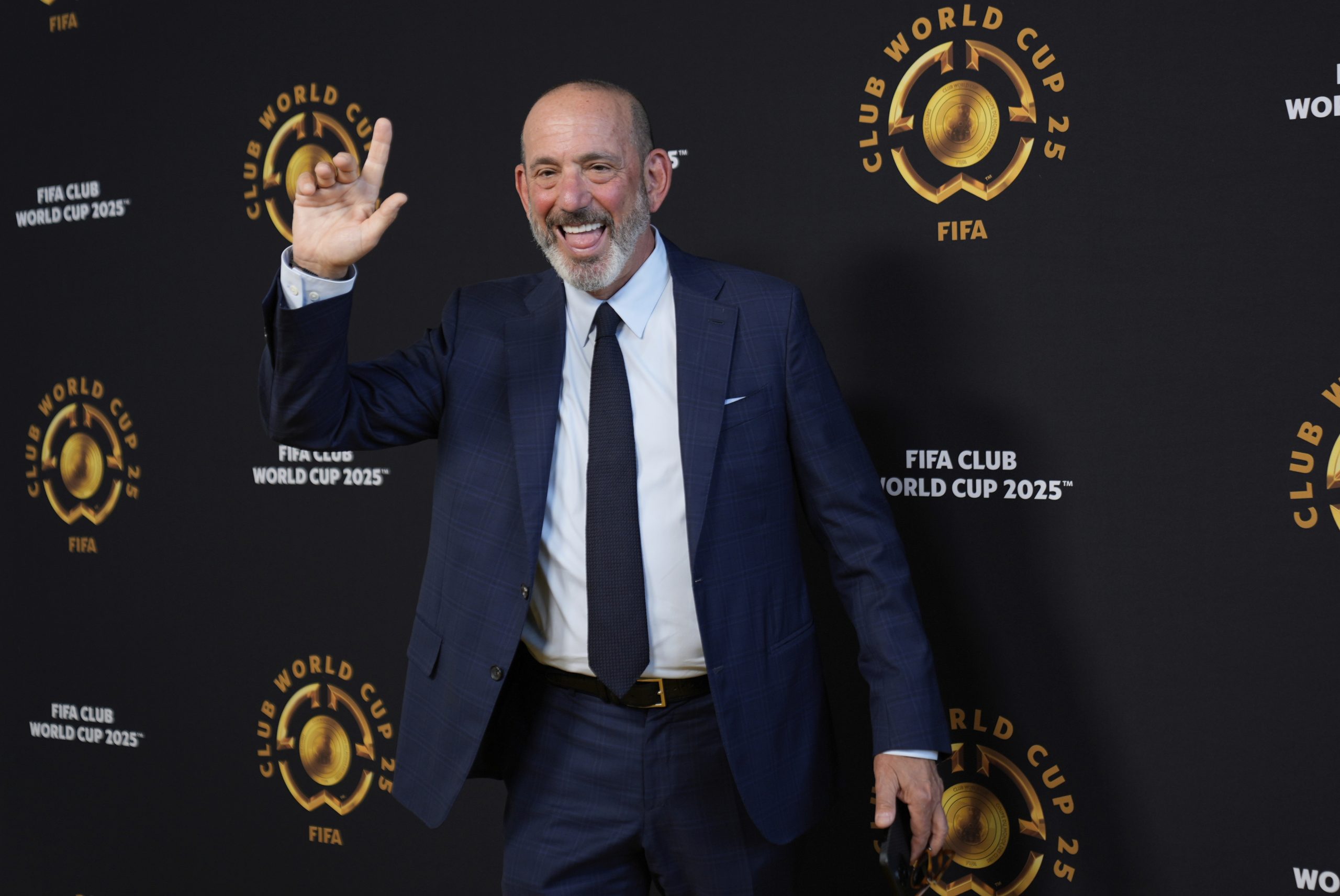
MLS commissioner Don Garber at last year’s Club World Cup final.Pamela Smith
“I’m going to wait for JT and Cindy [Cone, U.S. Soccer’s president], who I have a lot of faith in, and see what they want or don’t want to do,” he said. “But I haven’t spent any time thinking about it. I’m still reveling in the beauty and joy of the World Cup, disappointed that there’s negativity, but this is an issue that’s going to have to be addressed — but it’s going to be addressed by others.”
Garber spent plenty of time in Infantino’s orbit leading up to this summer, including when three MLS teams played in last summer’s Club World Cup. But he claimed he had no inside knowledge of Infantino’s privatization plan.
“I found out when everybody else did by reading it on social media,” he said. “And I’ve been focused on today, and our Leagues Cup which starts [this week]. I have no information, and probably no more or no less than anybody else in the world.”
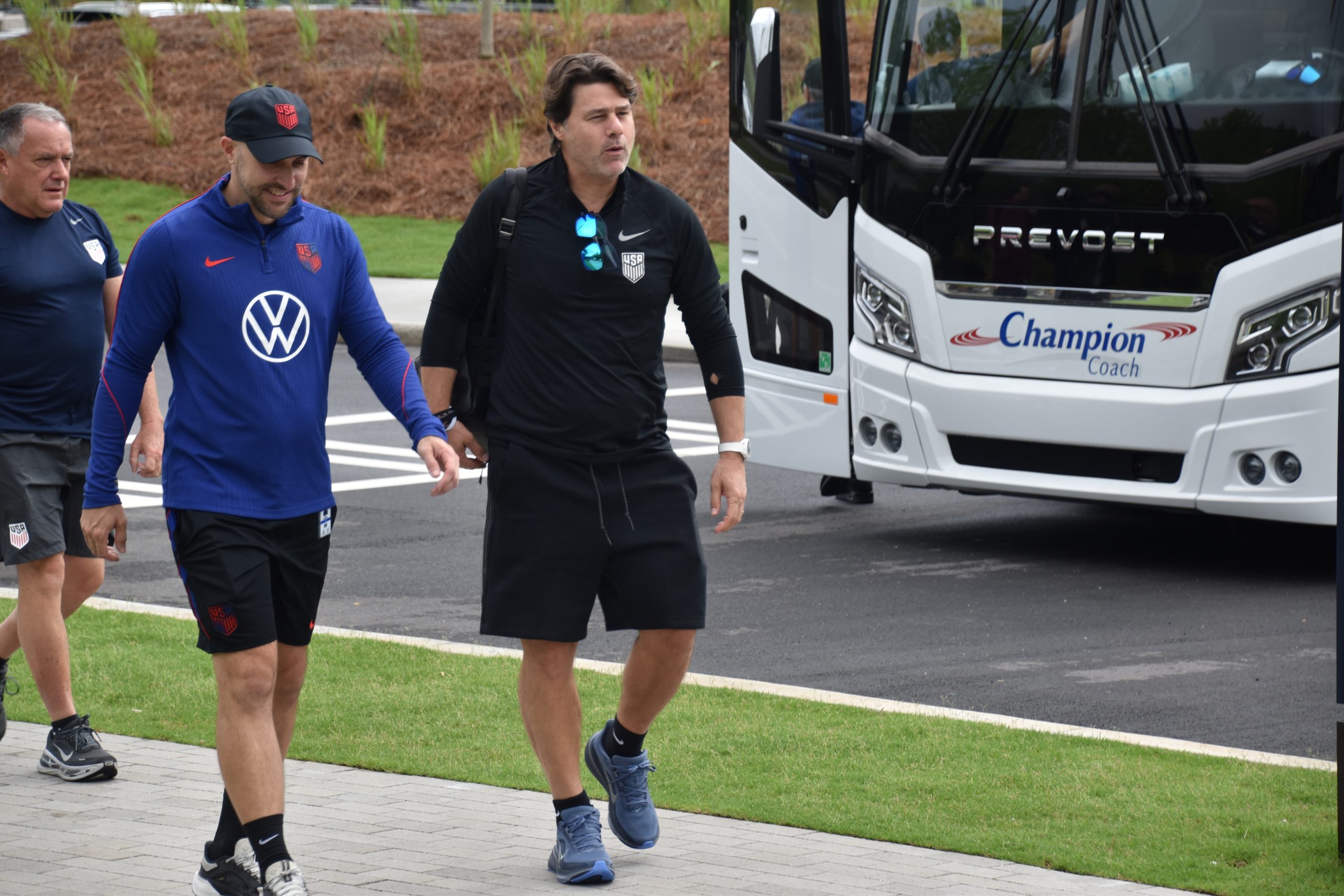
Mauricio Pochettino (left) with JT Batson during the U.S. men’s team’s pre-World Cup training camp.Jonathan Tannenwald
Contract talks started well before the World Cup, as Batson acknowledged when the U.S. team’s World Cup training camp kicked off in late May. An extension offer was put on the table back then, but both sides agreed to wait to see how the tournament played out.
After the Americans were eliminated in the quarterfinals on July 6, both sides took a breather for a bit. But once they started talking again, it didn’t take long for a deal to get done.
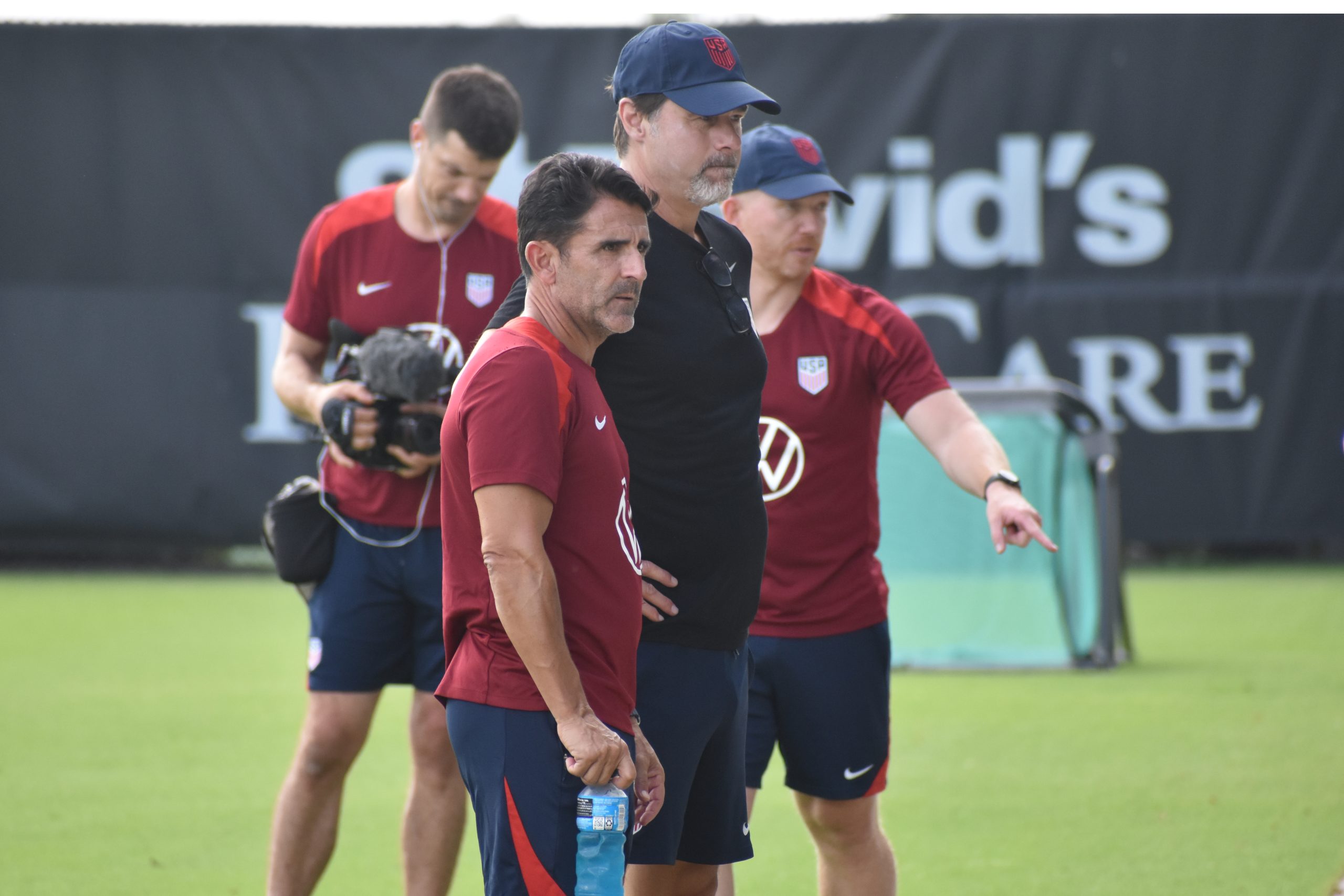
“We’re super excited that Mauricio and his staff are joining us for this next project,” Batson said. “We signed the contract Sunday, we announced it Monday, and at 7 a.m. this morning Eastern time, I was on with Mauricio, and Jesús [Pérez, Pochettino’s top assistant], and Dan [Helfrich, U.S. Soccer’s chief operating officer], about all the planning and everything around the next steps. They’re pumped, we’re excited, and we’re ready to get going.”
Batson confirmed an ESPN report that there are “mutual protections” in Pochettino’s deal, which runs through the 2030 World Cup, in case he doesn’t see it all the way out.
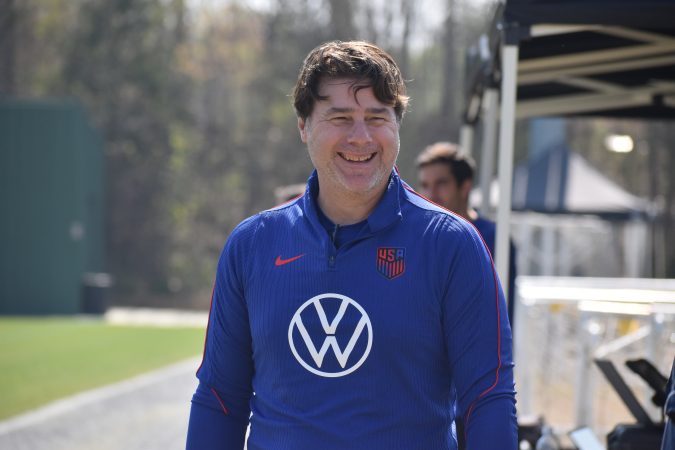
Mauricio Pochettino (center) has agreed a new deal to stay on as the U.S. men’s soccer team’s manager through the 2030 World Cup.Jonathan Tannenwald
That is an unusual phrase, certainly not as simple as “a buyout.” But it feels like an implicit acknowledgment that European clubs might pursue Pochettino, and that the summer of 2028 might be a natural separation point if the circumstances are right — especially if the U.S. plays in the 2028 Copa América with South American teams.
“Of course there are protections for both sides in this,” Batson said. “They were incredibly thoughtful, it was very straightforward, and we’re excited for the next four years.”
Asked to put a dollar figure on it, Batson only said “it’s material.”
If Pochettino does leave in the summer of ‘28, Steve Cherundolo would have an easy move over from the Olympic squad — mostly an under-23 age group — to the senior team.
Steve Cherundolo played for the U.S. national team for many years, and was Los Angeles FC’s manager from 2022-25.Michael Wyke / AP
But Batson believes Pochettino might stay for the whole term.
“I know from the moment we announced Mauricio, there were lots of folks skeptical that they actually were committed, and that they cared about soccer in this country, and they wanted to do all the things necessary to make us successful as a men’s national team, but more broadly as U.S. Soccer,” Batson said. “I’m incredibly excited that folks now are getting — obviously this summer, they got to see — the Mauricio and staff that we all knew, and of course now we’re seeing with their very long-term commitment to U.S. Soccer.”
Today’s newsletter is all about things I thought I was done writing about: COVID-19, Kamala Harris, and the World Cup. Regarding the latter, FIFA strongman Gianni Infantino walked off the pitch after last month’s final like the hero in Steve Miller’s “Take the Money and Run”: He got the money — an ungodly $15 billion in revenue — thinking he got away. But instead, just like Icarus, Infantino flew too close to the sun. A plan to make even more cash off the world’s greatest sporting event — by selling a share to private investors led by the brother of Donald Trump’s son-in-law — outraged so many folks that the FIFA chief could lose his job. What a shame.
The right can’t shut up about COVID-19 because it needs your outrage against experts
Workers move bodies to a refrigerated truck from the Andrew T. Cleckley Funeral Home in the Brooklyn borough of New York in April 2020.AP
Honestly, I thought — and hoped, frankly — that I’d written about the COVID-19 pandemic for the last time by the end of 2021. The issues it raised — about everything from public health preparedness to conspiracy theories — had seemed important enough, but I was more than ready to move on from empty baseball stadiums and masks in the supermarket.
I thought most folks felt the same way — that we were all eager to put the coronavirus in the rearview mirror. Clearly, I was wrong. The people we call MAGA still can’t stop yelling about it.
Last week brought the acid flashback of the government’s communicable disease czar when the pandemic erupted in 2020,Anthony Fauci,getting dragged before a U.S. Senate committee in a Joe McCarthy fashion, forced to take the Fifth Amendment to avoid any perjury traps that would satisfy the senators’ mouth-breathing constituents’ raw lust to imprison the 85-year-old public health icon.
The realization that they weren’t going to send Fauci — who was pardoned for his past actions in January 2025 by outgoing President Joe Biden to protect the good doctor from GOP wrath — up the river led these Republican statesmen to do the only thing left: scream at him.
“Who the f— do you think you were for doing that?” Ohio Sen. Bernie Moreno yelled at Fauci, even as it’s hard to understand what “that” was, except for working tirelessly to give Americans the best information about a rapidly evolving, deadly pandemic. “It is a total disgrace what you did to this country.”
The baseless attacks on Fauci by right-wingers — who’ve convinced themselves that the real crisis of 2020-2021 wasn’t the invisible virus that caused the early death of more than 1.2 million Americans, but an authoritarian government (led at the time by Donald Trump, but no matter) making them wear those masks and avoid those baseball games — were both infuriating and unconscionable. Still, maybe because of my aversion to reliving the pandemic, I was going to let the subject slide.
But then the current government’s top health official, Health and Human Services (HHS) Secretary Robert F. Kennedy Jr., went on CNN to double down on the Trump regime’s Big Lies about what really happened during the COVID years. And like Moreno, RFK Jr. turned the volume up to 11.
“Anthony Fauci was mismanaging the COVIDpandemic and was doing it under the Biden administration. President Trump wanted to end the lockdowns,” Kennedy loudly told CNN’s Dana Bash, inventing a farcical, backward timeline. An agitated RFK Jr. insisted the government’s priority during COVID-19 should not have been saving lives, but “protecting constitutional rights,” yet to make this fiction sound less ridiculous, the HHS chief also had to lie about the extent of thecrisis.
“There were ICUs that were empty all over the country, including in New York, at the height [of the pandemic],” Kennedy insisted.
This can no longer be ignored. There are two very important points that need to be made here.
First, when a high-ranking government official tells a lie on national television, this must be debunked immediately. The truth here is that the hospital emergency rooms and intensive care units, especially in New York City but other locales as well, were overwhelmed in the spring of 2020. So were many morgues and funeral homes, which struggled to keep up with the dead.
“I worked for New York’s largest medical center at the start of the pandemic,” Lucky Tran, a Columbia University scientist, posted on Bluesky. “There were morgue trucks on the streets. They set up emergency medical tents in Central Park. Healthcare worker colleagues died. It is horrific that RFK Jr is on national TV lying that ICUs were empty.”
Of course, this is just one of a number of lies about the pandemic — that the vaccines released to the public in early 2021 are dangerous (they’re not), that the virus came from a Chinese lab (it almost certainly didn’t) and not animal-to-human contact, and that Fauci led some kind of Watergate-level cover-up (his personal diaries, obtained by the senators, revealed exactly the opposite) — that are matters of faith among the political right.
Which brings us to the second big thing: Why? Why are all of these petty grievances about inconveniences we experienced six years ago still so gosh-darned important to these yelling people in 2026? Why do they want to send an octogenarian Fauci — a grandson of Italian immigrants whose life was the kind of American dream 20th-century Republicans would have celebrated — to prison?
The real virus here is anti-intellectualism — a strain that has always existed in American life, as the historian Richard Hofstadter famously wrote in 1964 — that has metastasized from a small, well-contained syndrome to overtaking the entire Republican Party. So-called rural resentment leads angry voters to think people like college professors or doctors in white coats are looking down on them.
It’s an antisocial worldview that was encouraged from on high by the likes of Big Oil executives who love it when the masses scoff at climate scientists. But the rejection of expertise reached a whole new level in 2020 when doctors like Fauci started telling Americans to wear masks or avoid social gatherings to slow the spread of COVID-19.
Sure, there were tough calls around issues like how long to close schools, but in real time, health experts were erring on the side of caution — the right thing to do — while shell-shocked regular folks stewed about an assault on their liberty.
As the revived Fauci controversy continued online this week, Mike Adams, whose website has been accused of spreading medical disinformation, posted Monday on X that getting a COVID-19 vaccine “reveals a twisted and artificial obedience to the falsified appearance of authority. People like that should never be trusted, because they are not in control of their own minds.”
They believe experts like Fauci don’t want to help you, but control you — welcome to the far right’s Bizarro World.
But still, why? At the end of the day, these extremists might care somewhat about thwarting climate science or not wearing masks, but the real reason they despise educated experts is because facts shatter the ancient, lie-based hierarchies such as white supremacy, the patriarchy, or homophobia that give meaning to their broken world.
I think some of the reason they still care so much about Fauci is that the pandemic spring of 2020 also brought the police murder of George Floyd and the subsequent Black Lives Matter marches that shocked many of the communities where they occurred. In their minds, all of it — masks, diversity training, vaccines, calls to “defund the police” — merged into one giant threat.
Which brings us to: Why now? There’s no question that the lingering resentments of 2020-2021 over both the coronavirus and the Floyd protests were the rage fuel that revived Trump, who looked dead in the water after his failed coup of Jan. 6, 2021. Now, it’s less than 100 days until a new election that could cripple Trump and his MAGA movement. And they are desperately waving the bloody shirt of COVID-19.
We must never forget the truth about 2020, Fauci, or the necessity of public health in a true democracy. Our anti-science government is seeing rising cases of measles and of the bacteria that causes explosive diarrhea (which has now been linked to two deaths), and God only knows what elseis in the pipeline.
Experts like Fauci aren’t here to tell you how to live your life — just how to not die.
Yo, do this!
I remain fascinated with the hidden history of American reactionary movements, which is coming out of the shadows during the Trump era. I’ve been listening to the audiobook of The Biggest Lie: The Prehistory of American Fascism, 1818-1915 by College of Charleston historian Joseph Kelly, which looks at how the defense of slavery in the antebellum South, Jim Crow, and the early 20th century revival of the Ku Klux Klan all bore the defining characteristics of an American strain of fascism, often for the self-preservation of monied interests. In the same mode, I highly recommend a recent New York Times guest essay, “It Wasn’t a Civil War. It Was the Slaveholders’ Rebellion,” by history writer Anthony Conwright, who argues persuasively that the name most of us have always used to describe the 1861-1865 conflict is actually a whitewash pushed by the South. The piece is a real eye-opener.
Did I mention that 2026’s summer of soccer isn’t over? The Philadelphia Union have emerged from the two-month World Cup break with a completely different look from the group that tanked in the first half of the MLS season, with the return of Kai Wagner (from England) and Quinn Sullivan (from injury) and rising young stars Neil Pierre and Cavan Sullivan, Quinn’s brother. They’ll also get a fresh start for a trophy opportunity with the arrival of the Leagues Cup tournament against the best teams of Mexico’s Liga MX. Check out their first match Thursday night at 8 p.m. against traditional powerhouse Cruz Azul, live at Subaru Park in Chester and on Apple TV.
Ask me anything
Question: Do you believe the Dems have a chance to take the Senate in November? — Elise (@bnat4.bsky.social) via Bluesky
Answer: Elise, I’d almost bank on it happening, and here’s why. Since the early months of the Trump 47 presidency, Democrats — who need to gain four seats for a majority — have consistently run double digits ahead of past performance in special elections. That should put seven states in play, with the strongest possible candidates in places like North Carolina (ex-Gov. Roy Cooper), Alaska (ex-Rep. Mary Peltola), and Iowa (Josh Turek). Maine voters will forget the Graham Platner fiasco long before they forget Sen. Susan Collins’ vote to confirm Justice Brett Kavanaugh. Ironically, the battle to hold a Democratic seat in Michigan looks toughest, but likely primary winner Abdul El-Sayed is an excellent campaigner. As Trump’s popularity plummets, there’s even a chance for shockers in places like Florida or with independent candidates in Nebraska or Idaho. For me, the bigger question is whether 51-plus Dems will dump Chuck Schumer as their leader after November. Stay tuned.
What you’re saying about …
Many of you had great ideas for a fall Democratic message that’s about more than just “affordability” — the preferred mantra of the party’s consultant class. Many sought to widen the conversation to issues around corruption and inequality. Here are some pithy ones. Roberta Soules wants to “take power away from the large corporations and oligarchs.” Meg Berlin suggested “More Butter. Fewer Guns.” Dane Madsen prefers “Stop the Trump Crime Family,” while Frank Friedman went with an even simpler, “We will be honest with you.” Stephen R. Rourke wrote simply, “Peace, prosperity, and justice for all.”
📮 This week’s question:CNN is reporting that the Pentagon recently took the highly unconventional step of asking rank-and-file troops for creative new ideas on how “to punish Iran.” But what should be done about this mess? Can the United States simply walk away at this point? Or do big problems like the flow of oil through the Strait of Hormuz or Iran’s nuclear ambitions require a response, and what is that, exactly? Please email me your answer and put the exact phrase “Iran war ideas” in the subject line.
Backstory: Is Kamala Harris ‘the new Nixon’?
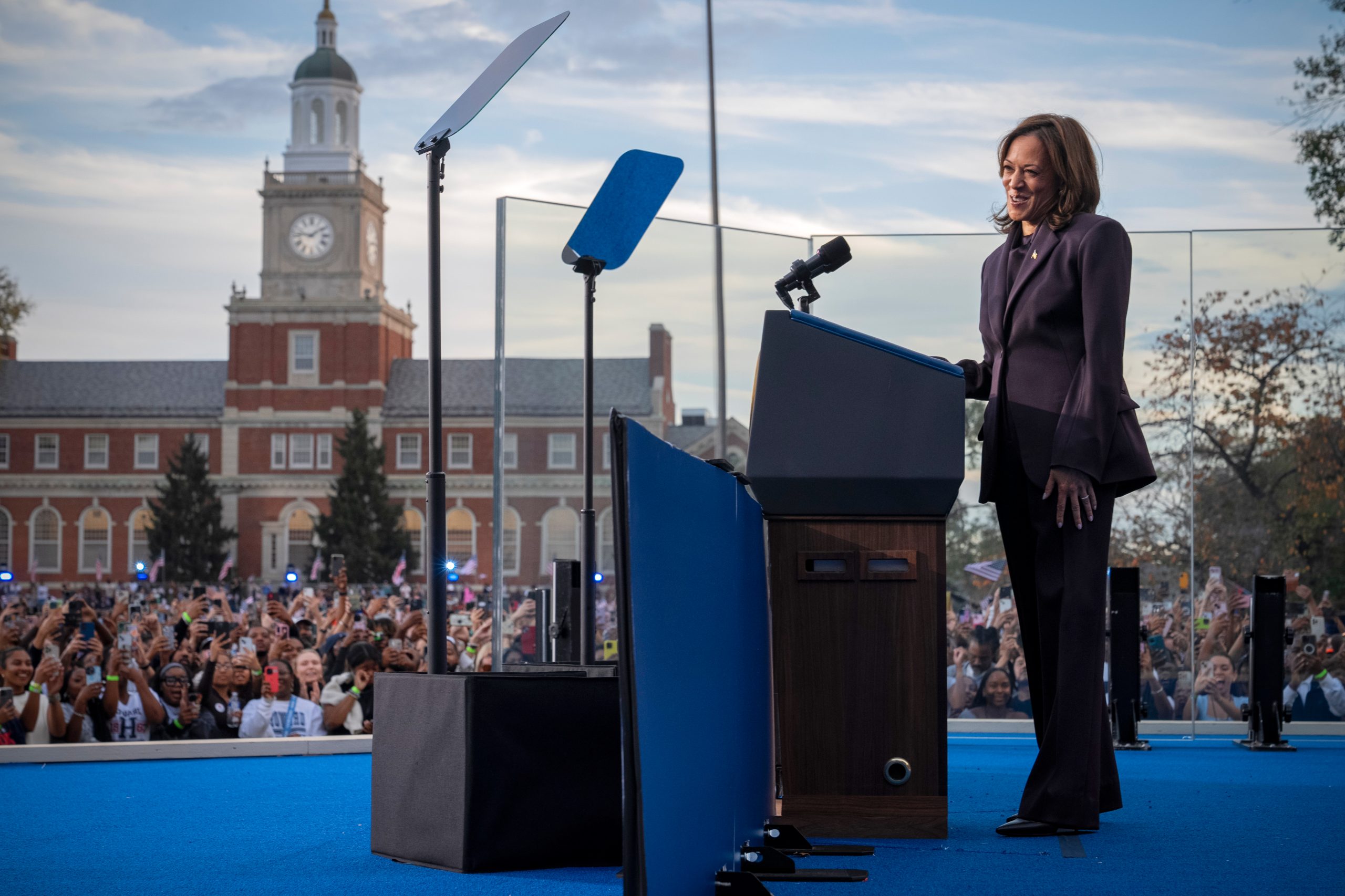
Democratic presidential nominee Vice President Kamala Harris delivers a concession speech for the 2024 presidential election, Nov. 6, 2024, on the campus of Howard University in Washington. Jacquelyn Martin
Although it’s true that, as a 5-year-old kindergartner in 1964, I nearly got into a fight with a kid who said he supported Barry Goldwater, the first presidential election I really followed came four years later in 1968. I was probably waiting for the baseball scores when I saw news reports that the GOP front-runner was a “New Nixon,” which made this 9-year-old wonder what was wrong with the old one. Indeed, a Californian who’d lost a presidential election (and a gubernatorial race just two years later) stunned America with the political comeback that made him the 37th president. We’d spend the next six years of Kent State and Watergate learning the kinder, gentler Richard Nixon of 1968 was all a lie.
It would be a Nixon-level comeback if Kamala Harris were to win the Democratic nomination in 2028, let alone the presidency. Like Tricky Dick, Harris is a child of the Golden State and former vice president to the oldest-ever POTUS at that time (Dwight Eisenhower was 70 when he left office, which was unprecedented before Ronald Reagan, Joe Biden, and now Donald Trump), and a failed nominee, although shewas smart enough not to run for governor when she returned home. People forget the brief lightning bolt of excitement when she replaced Biden on top of the 2024 ticket, and so the smart money has been that her moment has passed, as the Democratic base looks for new blood.
But it feels like the earth has shifted a bit, and the reason can be summed up in two words: South Carolina. Last week, the Democratic National Committee unveiled its list of the first six presidential primary states, and the South Carolina primary tops the list. The same South Carolina where, in 2020, the state’s main Democratic voting bloc — older, center-left, Black members of the middle- or working classes — turned the race around for Biden, the man who then tapped Harris as his veep. The same South Carolina whose Democratic power broker, Rep. James Clyburn, is close to Harris. A state that seems tailor-made for a Harris comeback.
But the Palmetto State isn’t the only reason to start taking a Harris return seriously. In politics, your weakness is often also your strength, or vice versa. Harris has long been a political chameleon — from tough 2010s prosecutor to a sharp left turn during Trump’s first term that she backpedaled away from in 2024. Today, Harris is feeling the zeitgeist. She is drifting left again, but perhaps more importantly, she understands the desire by core Democrats to support fighters, not milquetoast cowards.
“They are ruthless,” Harris told the annual gathering of the National Urban League in Nashville on Friday, referring to Republicans. “We need to be ruthless, too” — explaining that Democrats should not be “cruel,” but “uncompromising.” She added: “For example, and I know this is going to be controversial coming from me, in particular, we need to revisit the Electoral College. We need to revisit the point of expanding the court to 13 justices, like we have 13 district courts. We need to revisit, if they so want, statehood for Puerto Rico and D.C.” Harris has also been holding extensive meetings with some of the pro-Palestinian activists who often clashed with her over Israel policy in 2024.
She’s running? It sure sounds like it.
To be clear, while I thought in the fall of 2024 that Harris had thepotential to become a very good president, and I still do, I’m also very much in the “new blood” camp when I think about 2028. I’d love to see what someone from the progressive Bernie Sanders-Alexandria Ocasio-Cortez wing of the movement could do in wiping away the stain of Trumpism. But establishment Democrats, intentionally or not, have thrown Harris a lifeline with their South Carolina gambit. The coming months will reveal whether this former vice president can be “the new Nixon” of the left.
What I wrote on this date in 2013
I was reminded that the 25th anniversary of the 9/11 terror attacks is almost upon us. Expect a lot of what you might call negative nostalgia about that wretched day in 2001, but also the bad times that followed. Do you remember the terror alerts? Many of us thought those would vanish when George W. Bush left the White House, so it was a little jarring when Barack Obama continued the practice, including this major one 13 years ago. I wrote that “the problem with the terror warning of 2013 is not the warning itself but the decade of government baloney that preceded it. Washington needs to acknowledge the reality: If it wants to do a better job of keeping the public safe, it will need to start doing a much, much better job of telling the public the truth.”
The Trump regime’s cruel campaign against our immigrant neighbors is the biggest story of our time. Last week, I traveled to a tiny borough in Central Pennsylvania, Mount Holly Springs, where a budding partnership with U.S. Immigration and Customs Enforcement has seized 32 immigrants in just four months, and angrily divided a rural community. Pennsylvania’s small towns are becoming the front line of mass deportation. Over the weekend, the immigrant crackdown was central to my essay about the rising death toll that’s attributable to Trump’s misrule, which includes murdered deportees in Guatemala, a woman left by ICE agents to die at a Pittsburgh bus terminal, the latest civilian bombing victims in Iran, and many, many more. It’s a humanitarian crisis that demands our immediate attention.
No two people define the world-class journalism that we regularly produce here at The Inquirer more than my longtime friends Wendy Ruderman and Barbara Laker, who could have rested on their laurels after winning the Pulitzer Prize for investigative reporting in 2010. Instead, both are working harder than ever. Ruderman has applied her talent for digging to Philadelphia’s leading industry, healthcare, with remarkable results. Check out her latest exposé about a Main Line psychiatrist who lost her license after a wildly inappropriate affair with a troubled younger client. Laker remains a linchpin of The Inquirer’s investigative unit, and — joined by her colleagues Ryan W. Briggs, Max Marin, and Ellie Rushing — she has been digging into the dark tale of a Philadelphia pornographer and his family’s mysterious ties to two missing women. Investigative reporting is essential to democracy and forging better communities, but it’s costly, time-consuming, and won’t happen without your support. Subscribe to The Inquirer today.
By submitting your written, visual, and/or audio contributions, you agree to The Inquirer’s Terms of Use, including the grant of rights in Section 10.
Mauricio Pochettino has signed a new contract to remain the U.S. men’s soccer team’s manager through the 2030 World Cup, U.S. Soccer announced Monday morning.
“I really believe that this is an exciting situation and moment for soccer in the USA,” Pochettino said in a roundtable talk with The Inquirer and other media outlets. ”After 18, 19 months working with the objective that was only the World Cup, now [the goal is] to start in a fresh way with a different approach, trying to create a different philosophy, different idea of what we need to do.”
U.S. Soccer initiated talks on a new deal in late spring, with the understanding on both sides that it would be contingent on success in the summer. After the tournament, both sides took a few weeks, then returned to the table and finished the deal.
“They really believed in us before the start of the World Cup,” Pochettino said, “and that, I think, is another positive point for us.”
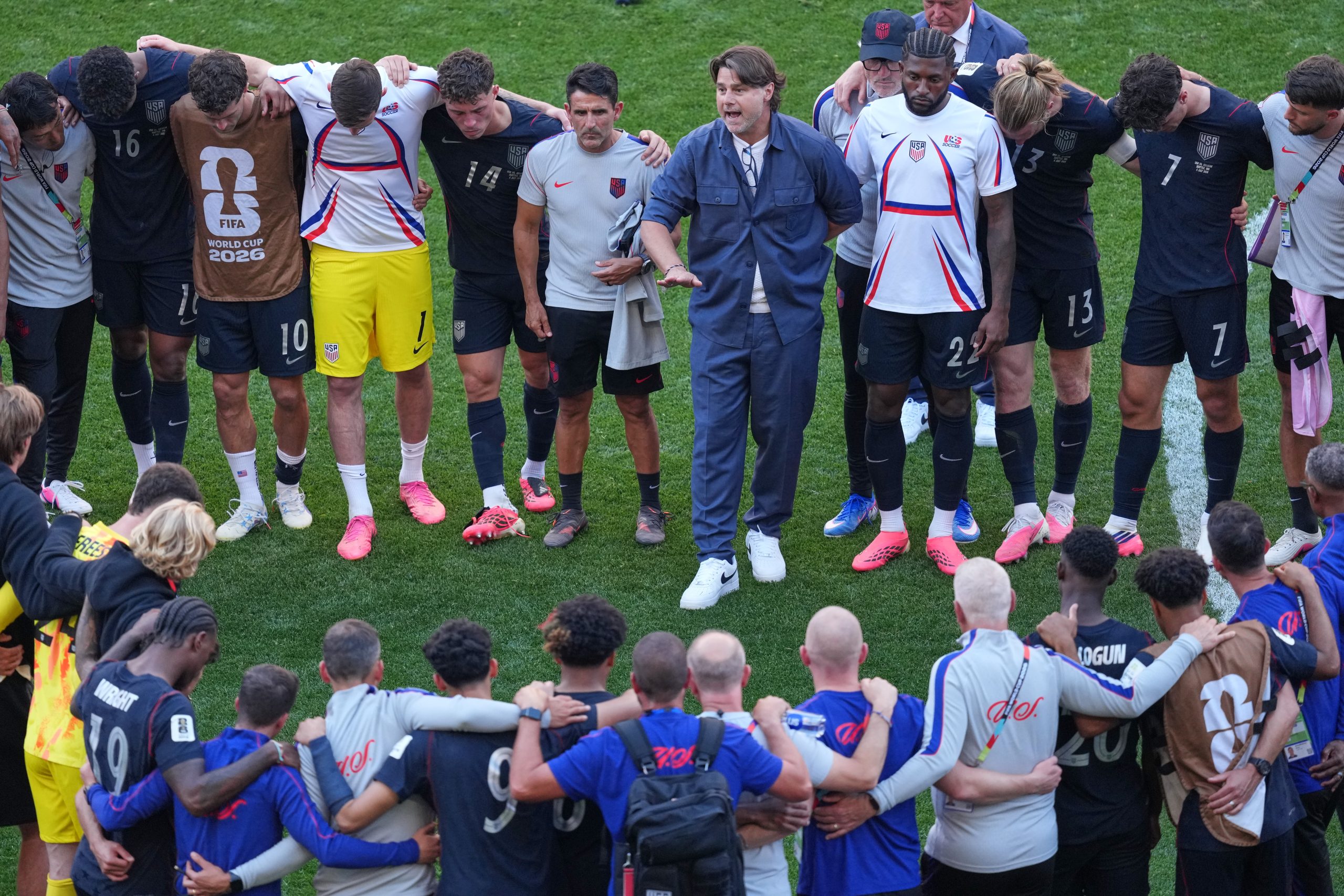
Mauricio Pochettino (center) talking with players and staff after the U.S.’ loss to Belgium that knocked them out of the World Cup.Nick Didlick
The 54-year-old Argentine arrived in late 2024, hired through this year’s World Cup. He accomplished most of what he had set out to achieve, raising standards for players by challenging the big stars to shake off their past complacency.
When the biggest moment came, Pochettino oversaw the first U.S. men’s team to win two group games at a World Cup since 1930, and the first knockout-round win since 2002. That led to an unprecedented wave of fan support across the country, and Pochettino seemed to be genuinely inspired by it.
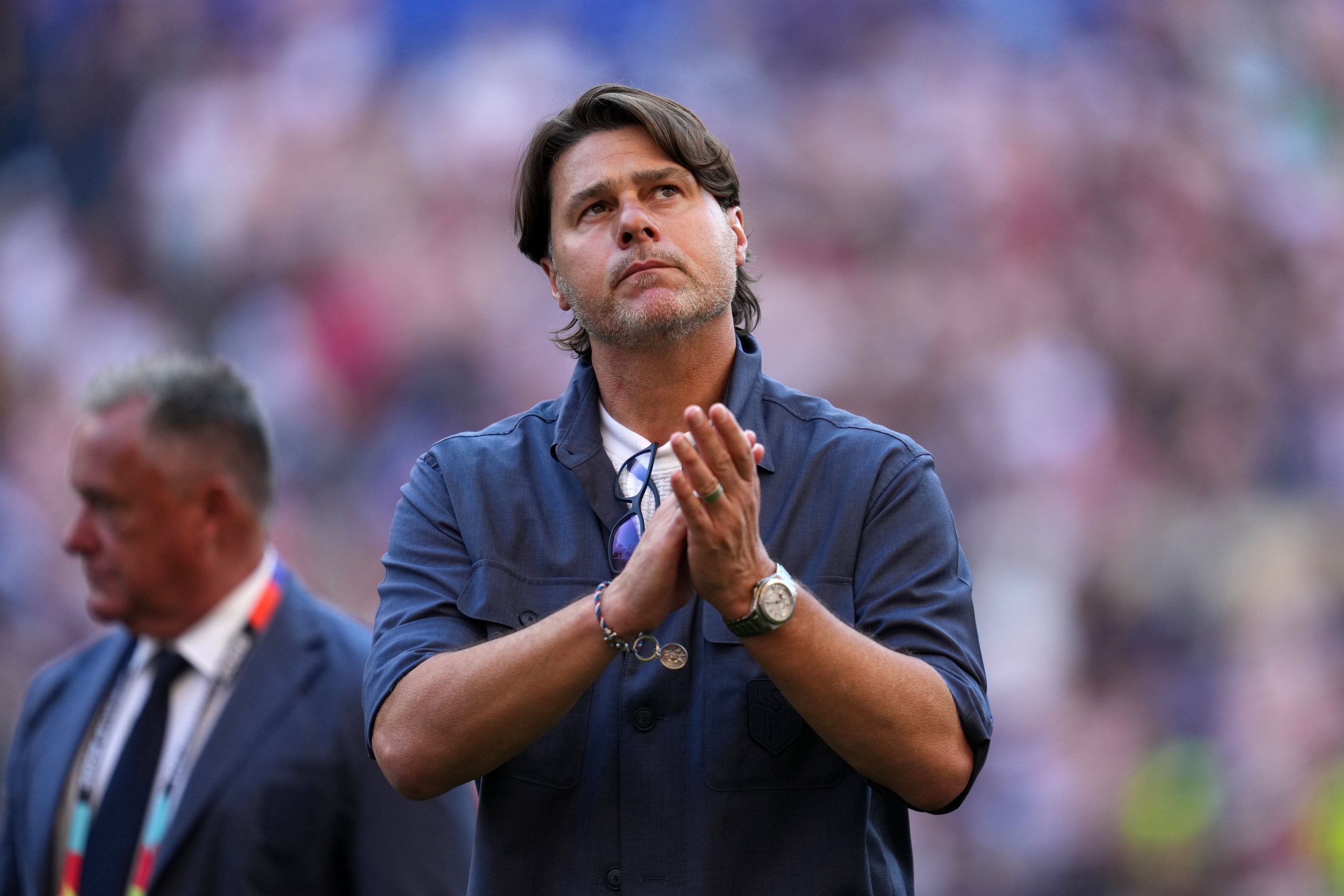
“The magic thing that happened during the World Cup, in the connection with the people, of course with the whole organization and everything, was a key point to make that decision” to return, he said.
Mauricio Pochettino applauding the fans after the Belgium game.Abbie Parr
Pochettino said Monday that he believes “that gap with the best teams the world is not too big. I think if we will be capable to do things in a different way, to reduce that gap, I think it’s possible.”
The distance includes some of the hardest yards to cover in the sport. So there were serious questions to ask. And to his credit, he answered them pretty directly.
The first question was how much change Pochettino wants to enact, especially with a new generation of young players ready for a shot at the senior squad. He said he is ready for quite a bit.
“I don’t want to think, and that you believe, that it is a continuity of the last 18 months or 19 months that we were working there‚” he said. “The good thing is that we have the experience and the knowledge about the players that were working with us. And of course, now [we] open the pool to bring, players that were playing in the last year or now they are playing more in MLS, but also for players that maybe we didn’t have time to assess during that process that was a very compact and very short period.”
Quinn Sullivan (second from right) is one of many young players with Union ties whom Mauricio Pochettino has called up so far. Cavan Sullivan could easily be on the radar for the next four years.Jonathan Tannenwald
Pochettino added: “It’s going to be key, it’s going to be important, to provide the young kids that we really believe have the potential to arrive in 2030, in four years, to start to work. And to start to know [them], and set up the principle that we expect from them.”
Another big question, one that a lot of fans have in particular: Will Pochettino actually stay here for the duration of his deal? If he continues to do well here, European clubs will no doubt continue to call. It was no secret before and during the World Cup that there was interest, and he was looking.
“For us, every time that we sign a contract, it’s to go to the last day of the contract,” he said. “If now we sign a four-year contract, we need to think to arrive there. And we signed the contract because we really believe that we are going to be four years there.”
But he also acknowledged the obvious: “Nothing is sure — in life, but it’s less in fútbol.”
“Four years’ time is a really long period,” he said. “You never know what can happen in soccer. Today, people really love you, but in X time maybe that feeling changes.”
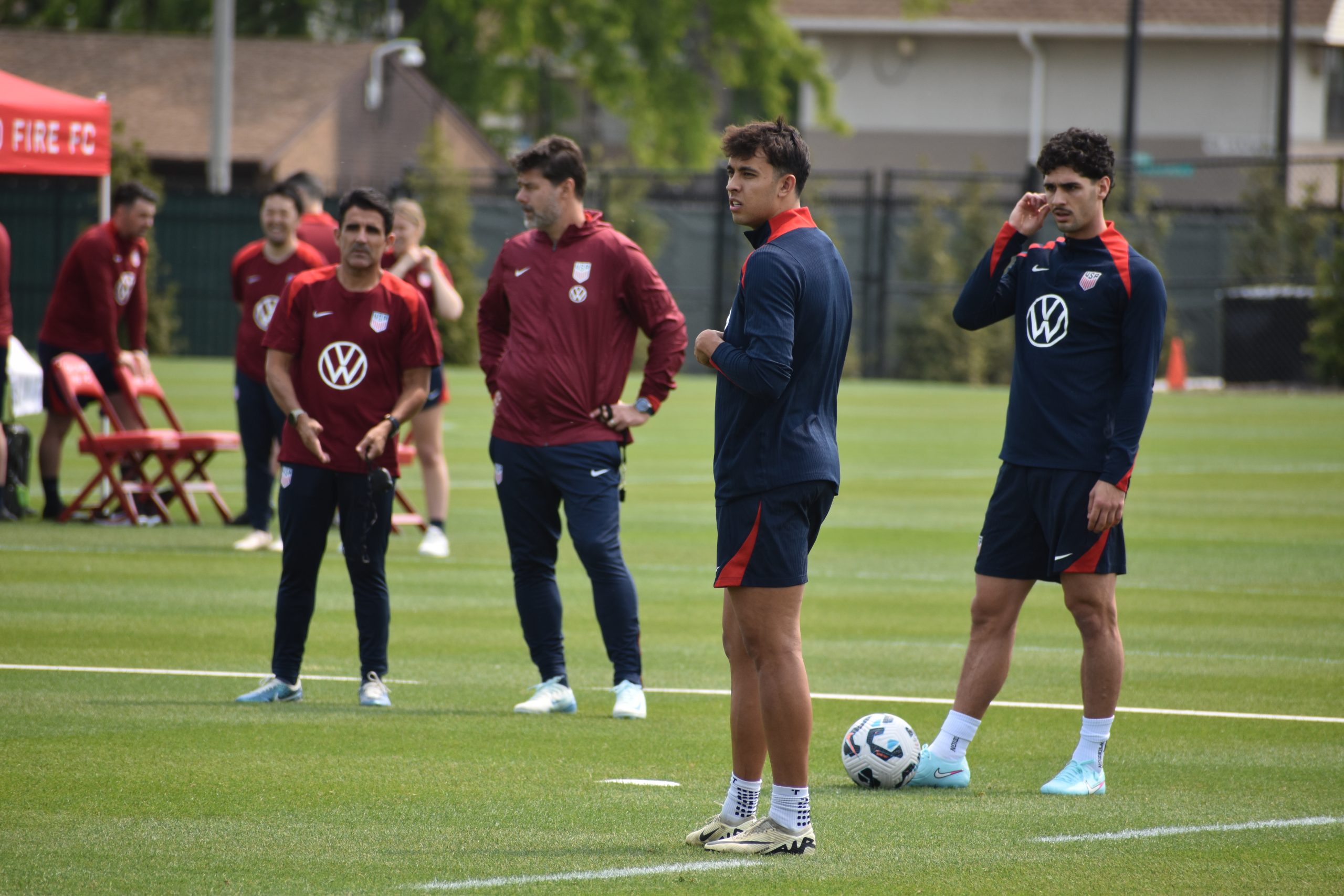
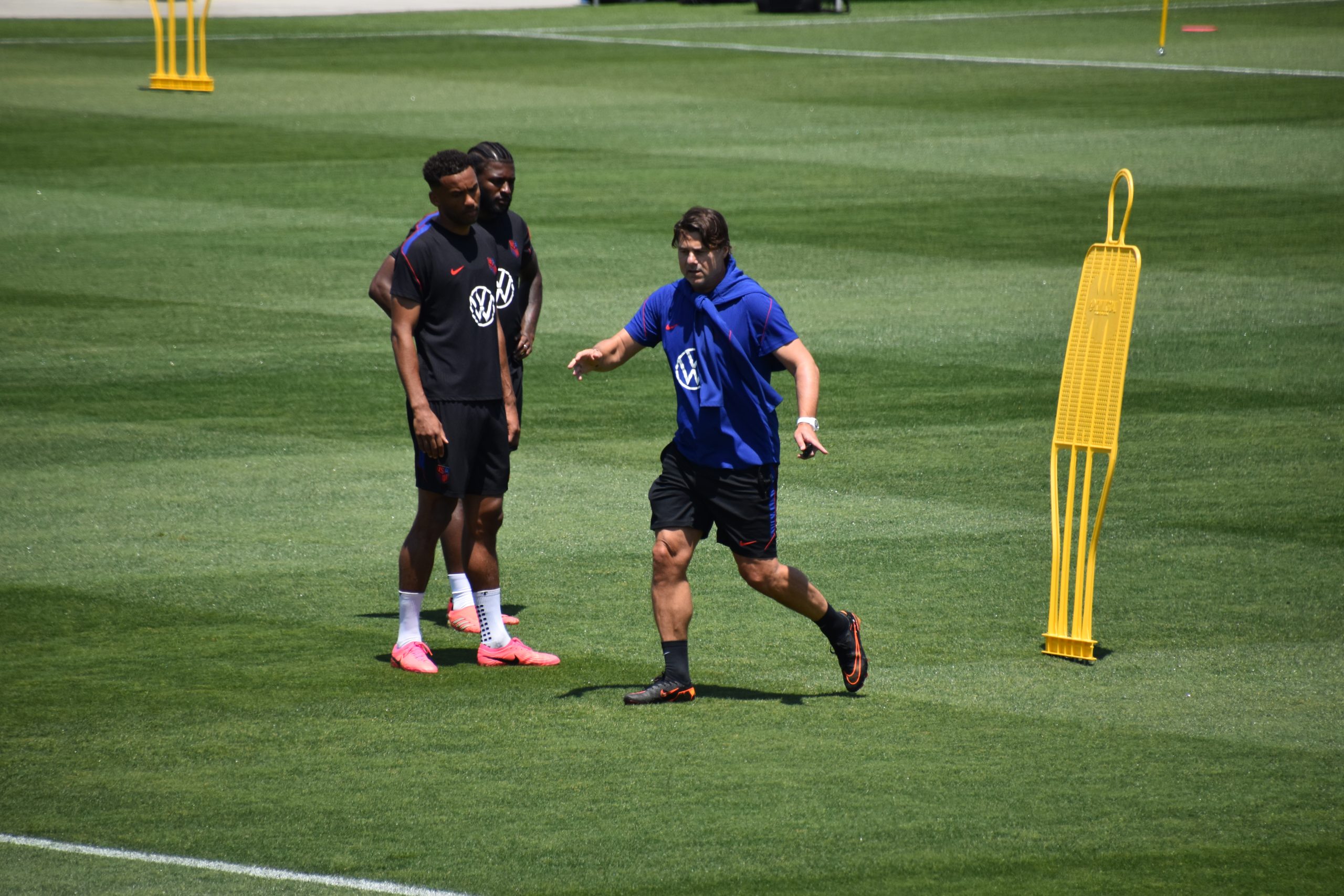
Maurio Pochettino (right) giving instructions to former Union defenders Auston Trusty (left) and Mark McKenzie at a practice during the World Cup.Jonathan Tannenwald
Will he make the U.S. his home?
Another big question is how much time Pochettino and his staff, all of which is also returning, will spend in the United States vs. Europe. They were all based in the latter for the first term, usually only crossing the Atlantic for national team game windows.
He isn’t alone on that count, to be sure. Argentina manager Lionel Scaloni has reached two straight World Cup finals with a home base in Spain, and Canada manager Jesse Marsch doesn’t live full-time in that country.
But there are some optics in the U.S. that aren’t the same in other countries.
This summer’s long-term impact on growing soccer’s fan base here is still to be seen. The NFL and NBA will no doubt take back their pieces of the spotlight in the coming months (we’ll see about baseball’s piece if there’s a work stoppage), so a U.S. coach might have to do more publicity work than was needed heading into a tournament on home turf.
Mauricio Pochettino and his longtime top assistant Jesús Pérez (left).Jonathan Tannenwald
There are also the practical benefits of the senior national team manager spending more time at the national training center in suburban Atlanta, where many youth national team coaches and backroom staff are based.
Put it all together, and it would be nice to see Pochettino and his staff be public presences at more MLS games, and at some of the big youth clubs and events around the country.
“Now [that] we finish with the negotiation and the agreement, I will consider it to move to the USA, of course, because that process is four years,” Pochettino said. “I think I have no problem, and all the coaching staff, we don’t have any problem to move to the USA.”
That felt significant to hear.
Toni Jiménez (right) is the goalkeeper coach in Mauricio Pochettino’s dedicated group of assistants.Jonathan Tannenwald
And one for the bosses
The last big question goes to U.S. Soccer’s leadership — including the big-money private equity donors who are once again paying Pochettino’s salary. By rehiring him, they are sending an implicit signal that he is better than any American candidate. Do they actually believe that?
None of the top brass were made available to take questions from the media before Monday’s announcement. There were only statements from president Cindy Cone and CEO JT Batson. (Nor have they said anything about the scandal around FIFA president Gianni Infantino, despite repeated requests for comment.)
“Mauricio has built a culture where players trust the group, trust the process and trust each other,” Cone said. “That culture, and the staff who helped build it, are exactly what we want to continue investing in for the men’s national team now and for the future. We are also excited about the experience and perspective Mauricio and his staff can bring across U.S. Soccer as we strengthen our pathways and seek to impact the broader soccer landscape in the United States.”
Batson said: “We know we have a lot of work to do to achieve our clear ambitions, including competing to win men’s World Cups and having soccer become the most played sport in every community.” And he was pretty clear that he believes Pochettino is the person for the job.
“I couldn’t be more excited that Mauricio and team are committed to partnering with all of us to do the hard work to bring those ambitions to life,” he said.
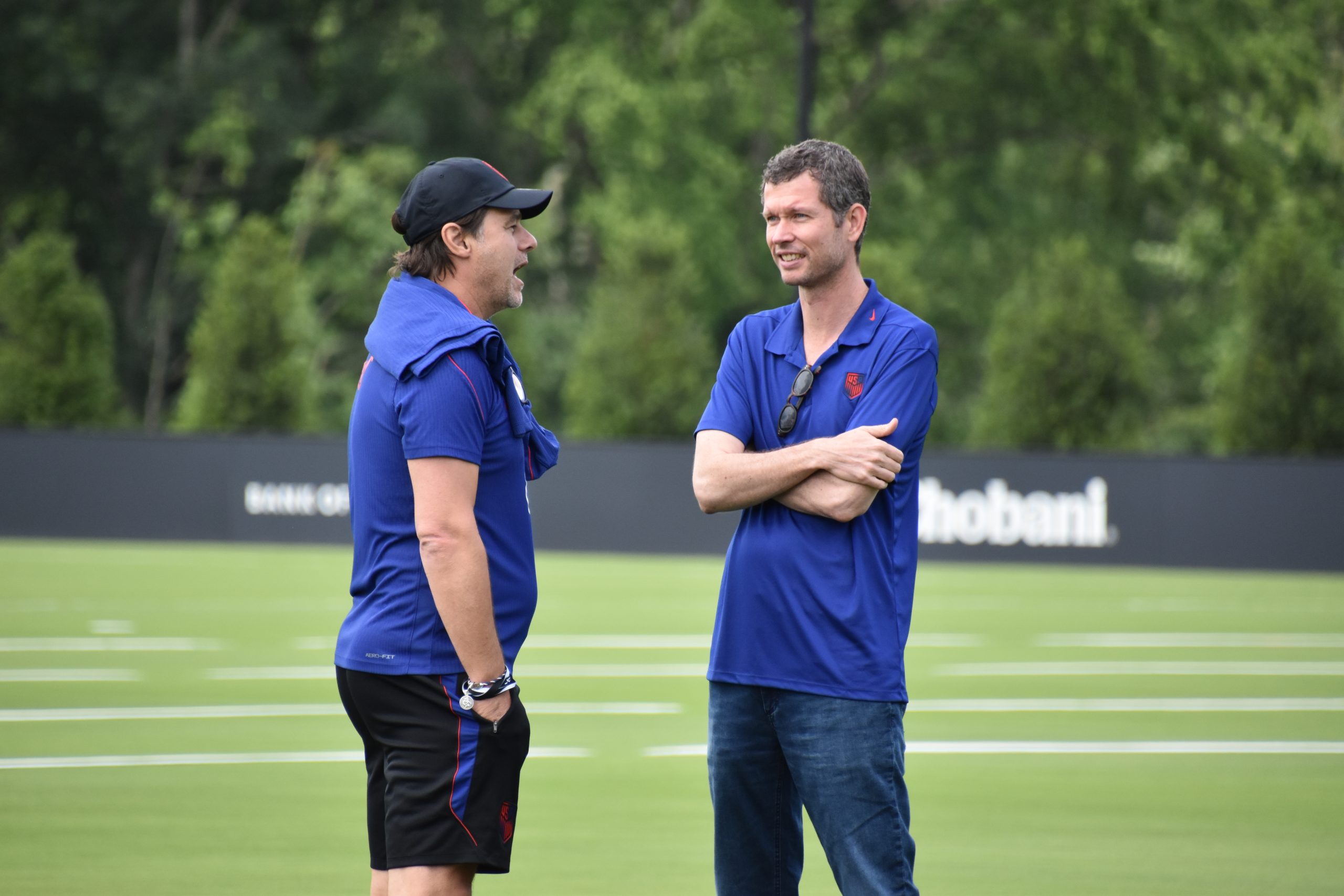
Mauricio Pochettino (left) speaks with JT Batson during the U.S. men’s team’s pre-World Cup training camp at the national training center in May.Jonathan Tannenwald
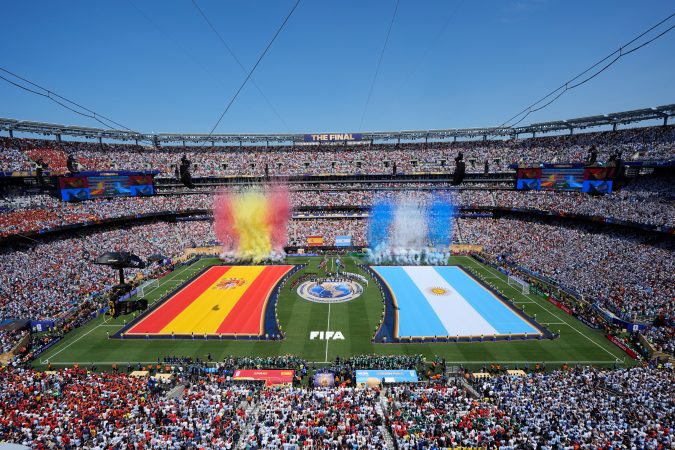
When the largest World Cup in history ended at MetLife Stadium, it marked the culmination of a summer in which millions of visitors moved through American host cities under the eyes of computerized systems most of them never noticed.
The federal government directed more than $1 billion to World Cup security, funding facial recognition cameras in and around stadiums, police drones over crowds, and AI-driven monitoring of transit hubs. More than 120 civil society organizations issued a travel advisory warning visitors about the screening they would face.
The tournament turned host cities into laboratories for urban artificial intelligence, and the experiments ran on tourists.
The two of us have conducted research on the use of electronic monitoring in urban areas, and we do not write to argue that cities should abandon these tools. Tourism contributed $10.9 trillion to the global economy in 2024, roughly 10% of global GDP, and safety increasingly decides where that money goes. Thirty-two percent of travelers now call safety the primary factor in choosing a destination, up from 23% in 2021.
AI can genuinely help cities deliver that safety. London’s transit authority uses smart video to spot trouble on crowded platforms. Singapore’s police fly drones that map crowd density at large events in real time. Used well, these systems find lost children, reroute crowds before crushes form, and speed emergency response.
A video surveillance camera hangs from the ceiling above a New York City subway platform in October 2020. Mark Lennihan
The problem is the gap between deployment and governance.
Cities are running the experiment first and writing the protocol later.
That order of operations should worry anyone who remembers that surveillance systems, once installed, rarely come down. Mega-events have long served as the justification for permanent expansions of monitoring capacity.
The gap matters because safety is not only physical. Our research frames tourist safety in three dimensions: physical safety from crime and disaster, digital safety from data breaches and fraud, and psychological safety, the felt sense of trust that makes a visitor relax in an unfamiliar place. An algorithm that marginally improves the first while quietly eroding the other two is a bad trade.
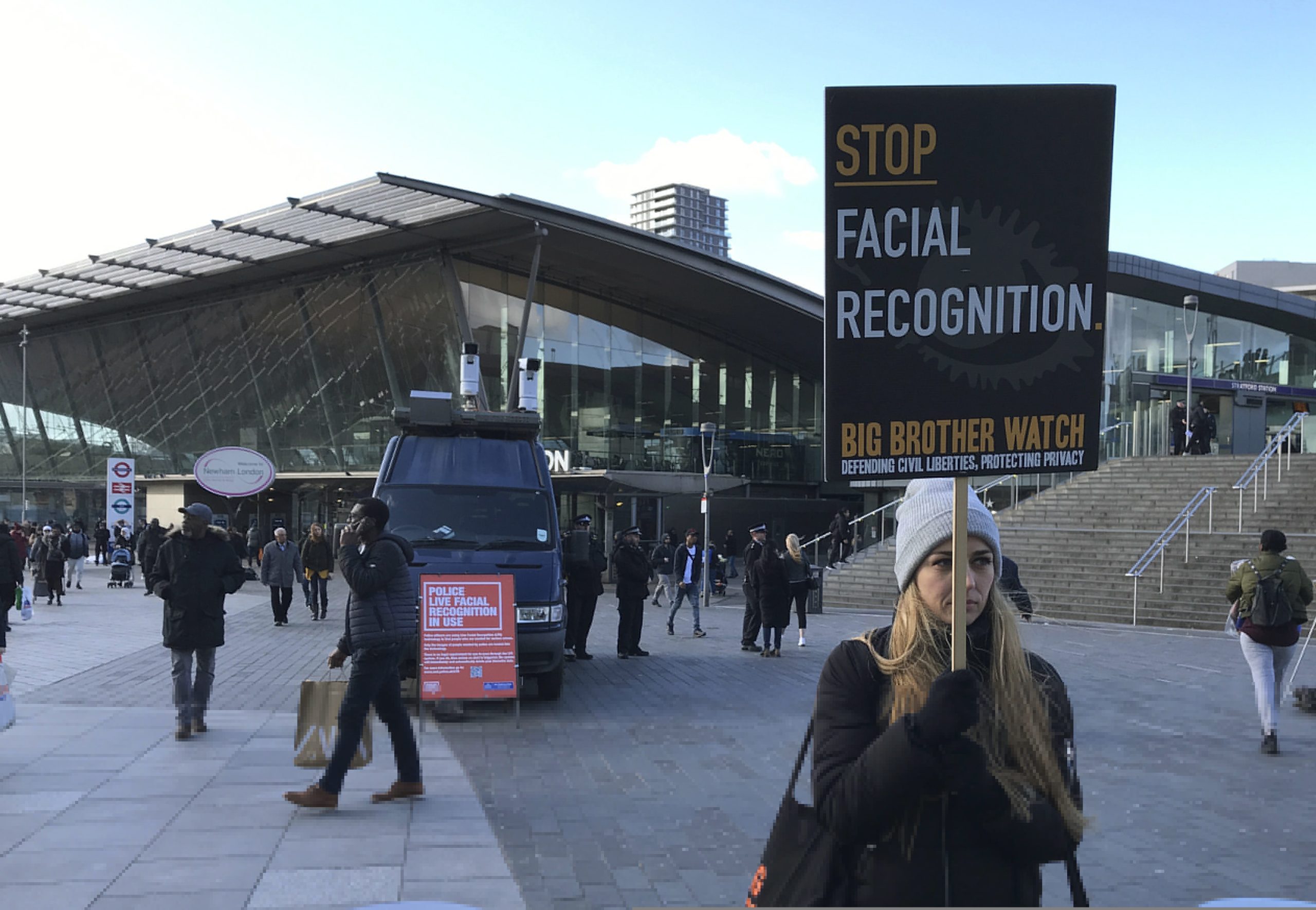
Rights campaigner Silkie Carlo demonstrates in front of a mobile police facial recognition facility outside a shopping center in London in February 2020.Kelvin Chan
The public senses this. Two-thirds of respondents in surveys we reviewed insist that people should be informed when AI is used to prevent, detect, or investigate crime. London learned the hard way that deploying facial recognition vans in high-footfall areas without that transparency generates backlash that outlasts the deployment.
Some cities show what the alternative looks like.
Barcelona created an external advisory council of independent experts that evaluates high-stakes algorithms before deployment; that panel rejected fully automated decision-making outright. Helsinki maintains a public AI register that lists every municipal algorithmic system — what it does, what data it uses, and what safeguards constrain it — so any resident or visitor can look up exactly what is watching them. Neither city sacrificed safety for principle. They built the trust that makes safety technology legitimate.
This convenience store in Tacoma, Wash., tested facial recognition technology to prevent theft in 2019. Melissa Hellmann / MCT
American cities do not need to invent this from scratch. The road map we propose starts with three steps any city council can take this year:
adopt an AI governance framework tailored to tourism and public safety;
extend legal protection to residents’ and visitors’ data whenever private vendors handle it;
publish a public register of every AI system the city operates.
None of these steps requires new technology. All of them require political will.
That means the great wave of municipal AI adoption is still ahead of us, and so is the chance to shape it.
Los Angeles hosts the Olympics in 2028. The cities that spent this summer as laboratories should spend the next two years writing the rules — in public — before the next surge of visitors arrives. Tourists chose these cities for a sense of welcome and security. Cities owe them systems worthy of that trust.
Eugènie L. Birch is the Nussdorf professor of urban research at the Weitzman School of Design, and co-director, Penn Institute for Urban Research at the University of Pennsylvania. Mauricio Rodas is the former mayor of Quito, Ecuador, and professor of practice at the Weitzman School of Design. Luke Campo, a graduate of the University of Pennsylvania, supported this research.
GENEVA — Successfully stopping Gianni Infantino’s FIFA plan to sell World Cup profits to private investors was the first half of a high-stakes game in global soccer politics.
The second half kicked off Saturday with what seemed a clear aim of ending Infantino’s decade-long presidency.
“No option should be off the table,” said European soccer body UEFA, whose president Aleksander Čeferin has led the fight against Infantino in a seismic week for FIFA.
“The current FIFA leadership has not only lost UEFA’s confidence but also that of many other members of the football family.”
Later Saturday, the governing body for North and Central American and Caribbean soccer (Concacaf) called for accountability, saying: “A (World Cup) proposal of this magnitude does not reach that stage by accident. It is a symptom of leadership that has stopped putting football first. This recent unilateral and egregious act of poor governance and leadership follows a pattern of missteps and similar behavior. A comprehensive reckoning with this presidency is imperative.”
Concacaf and its 41 Member Associations welcome the withdrawal of the proposed FIFA Forward Enterprise (FFE).https://t.co/H2KdBi1jJG
Infantino had proposed creating a $20 billion company to run the World Cup with private investors but drew backlash that grew every day since Tuesday’s announcement.
“We cannot keep going on like this with secret schemes on fast-track timescales, cooked up by faceless individuals and of dubious benefit to the game,” UEFA said. “We must identify those responsible and hold them to account.
“It is right that, in the coming days and weeks, UEFA will work with its associations and in close cooperation with other confederations to reflect on how this happened and devise a plan to make sure that it cannot occur again.”
Norwegian soccer federation president Lise Klaveness, an elected member of the UEFA executive committee, said steps must be taken to protect the integrity of the sport.
“The entire framework of international football cooperation was unnecessarily put at risk in pursuit of individual interests rather than the best interests of the game,” Klaveness said Saturday. ”This has been visible to many for a long time, including those of us elected to positions intended to safeguard checks and balances and provide ongoing oversight. We have to recognize that these mechanisms have not worked well enough.”
UEFA welcomes FIFA’s withdrawal of plans to sell a stake in the World Cup
The president of the Asian soccer confederation, Sheikh Salman bin Ibrahim Al Khalifa, said “the future of global football must always be shaped through proper consultation, collective dialogue and respect for the established governance structures of our game.”
Infantino’s audacious bid fell apart after UEFA’s 55-member nations agreed Thursday to boycott the World Cup and all other FIFA competitions. CONCACAF and the Asian Football Confederation also said they opposed the plan.
CONCACAF’s statement added that FIFA leaders have “a duty of service over power. Where that duty is not upheld, accountability cannot be optional.”
There was also an internal revolt.
Infantino’s senior adviser, Carlos Cordeiro, a former U.S. Soccer federation president and Goldman Sachs banker who represented FIFA on the White House Task Force for the World Cup, resigned on Friday and urged other senior FIFA staff to speak out.
Hours later, FIFA chief operating officer Kevin Lamour issued a statement to The Associated Press, saying FIFA staff were deceived by Infantino’s lack of openness in planning the sale over recent months and that the project must not continue.
“It is the project of one person,” wrote Lamour, a longtime colleague of Infantino at both FIFA and UEFA. “Not only must this project not go ahead … but the time has now come for football political leaders to ask themselves the right questions and make the right decisions.”
Infantino had proposed spinning off FIFA’s commercial businesses — including World Cups and Club World Cups for men and women — into a $20 billion subsidiary with 20% owned by private investors.
The “anchor investor,” described by FIFA, is a New York-based investment firm launched by Joshua Kushner, the younger brother of U.S. President Donald Trump’s son-in-law, Jared Kushner.
This is not Infantino’s first big plan to flop
A tumultuous week in international soccer is at least the third time Infantino has rocked it with an ambitious plan many in the sport saw as reckless.
But the fallout from FIFA’s Kushner-backed plan is the first time UEFA has acted quickly to create momentum for removing the man who was its former longtime employee.
Carlos Cordeiro (right) was a frequent presence when Gianni Infantino (second from left) visited the White House.Jacquelyn Martin
In 2018, Infantino pushed a secretive offer of $25 billion from Japan’s SoftBank to create new competitions, that posed a long-term risk to continental events for clubs and national teams.
In 2021, Infantino proposed playing World Cups every two years instead of four — an idea that also angered the International Olympic Committee where he is an elected member.
Both plans created big rifts in the sport and were eventually dropped by FIFA.
Despite the turmoil, Infantino was reelected unopposed in 2019 and 2023.
The third time shapes to be different.
Here is the calendar for the FIFA presidency
Nov. 18 is the deadline for candidates to enter the next presidential contest, exactly four months ahead of the vote in Rabat, Morocco, where FIFA has its African headquarters.
FIFA statutes allow Infantino one more four-year term in office. The failed spinoff venture seemed like a way to create a commissioner-like role for Infantino beyond 2031, likely paying much more than his current annual salary and a bonus deal of more than $6 million.
It would take 106 votes to ensure a majority in a contested election. Continents surely do not vote uniformly en bloc, but most of Europe’s 55, plus Asia’s 46 and CONCACAF’s 35 FIFA members would be a solid base.
The Qatar FA issued a statement in support of Infantino on Saturday.
Its president, Sheikh Hamad bin Khalifa bin Ahmed Al Thani, said: “We welcome FIFA President Gianni Infantino’s decision to withdraw the FIFA Forward Enterprise proposal in the interest of the global football community.
“While the proposal had merit, we applaud the wisdom behind prioritizing unity among Member Associations. The Qatar Football Association fully supports President Infantino’s efforts to continue growing and strengthening the game globally.”
Inquirer staff writer Jonathan Tannenwald contributed to this article. Associated Press writer Joseph Wilson contributed from Barcelona, Spain.
MORRISTOWN, N.J. — Though the World Cup only just reached the rearview mirror, the soccer world is already speeding toward the new European club season.
Brenden Aaronson is proof.
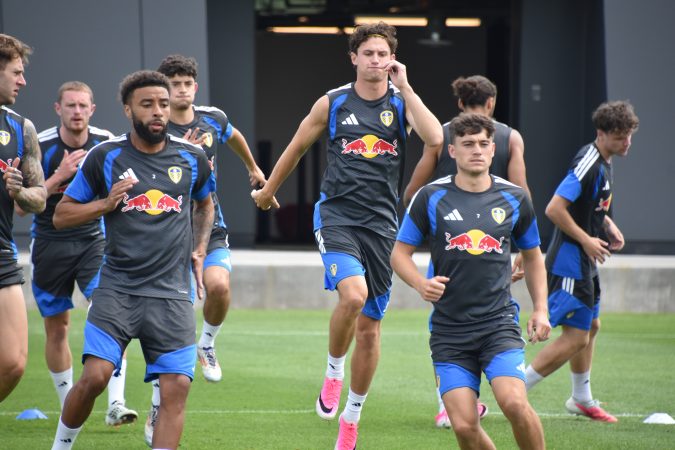
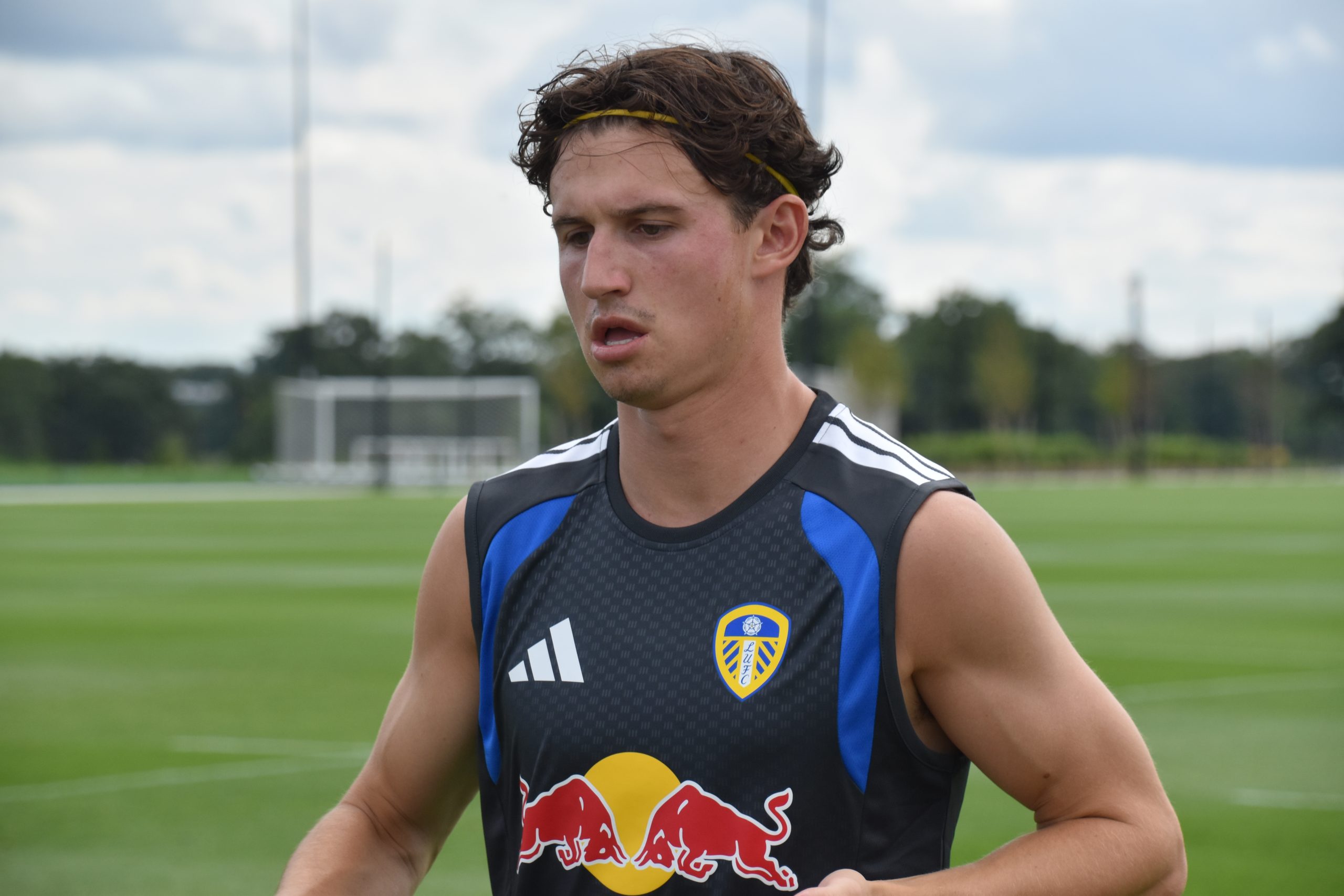
After taking the three-week break that FIFA’s rules allow for players after major tournaments, the Medford native returned to work at his club, Leeds United of the English Premier League, on Monday. Conveniently, that was right as his teammates arrived in North Jersey amid Leeds’ first preseason tour of the U.S. in nearly 30 years.
“Just great to get home, spend some time in Jersey,” he told The Inquirer. “I just needed to just get home and see family. I hadn’t been home since last September. That’s been probably the longest time I’ve been away from home.”
Leeds fell to Wrexham of the second-tier Championship last Saturday in Tampa, 3-2, then beat fellow Premier League club Sunderland 1-0 on Thursday in Harrison, N.J. The finale is Sunday against powerhouse Liverpool in Chicago (4 p.m., ESPN Deportes), the same day Wrexham and Sunderland meet at Subaru Park (noon, ESPN).
Alas, Aaronson wasn’t in the game squad Thursday, as much as he wanted to play being close to home. He had a lot of friends and family in attendance, and a busload of fans from the Leeds supporters’ group in Philadelphia made the trip. (Their viewing parties at the Black Taxi in Fairmount are lively occasions.)
But if his absence disappointed the box office, it wasn’t too surprising since he’d only just returned. No one begrudged him the time to rest, having gone just about nonstop since the last preseason started.
Not for nothing, too, he was also able to finally enjoy being a husband after his whirlwind wedding that briefly took him out of U.S. camp in late May.
That was just one early turn in a roller-coaster ride through the World Cup.
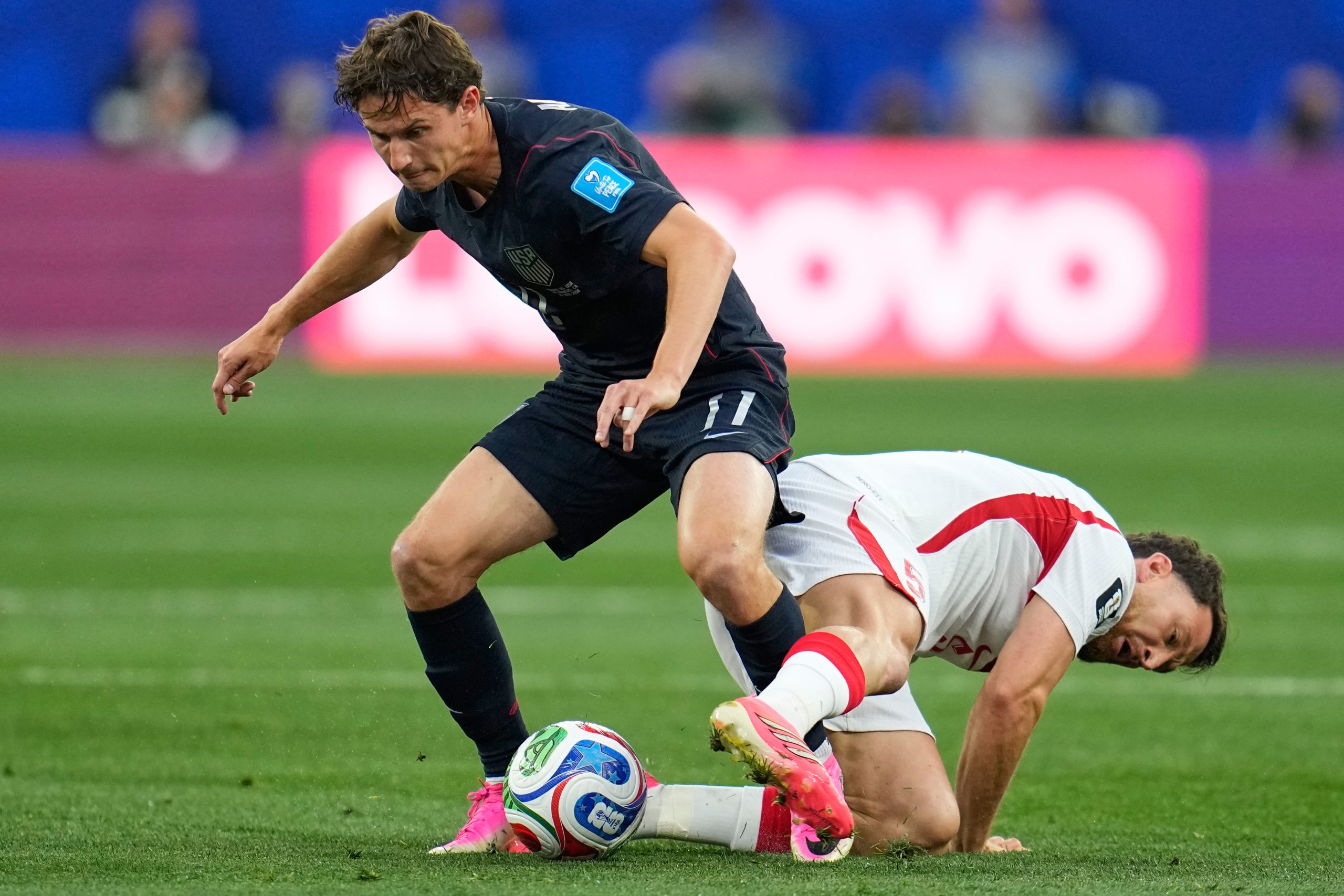
Brenden Aaronson (left) in action during the U.S.-Turkey group stage game, the only game of the World Cup he played in.Gregory Bull
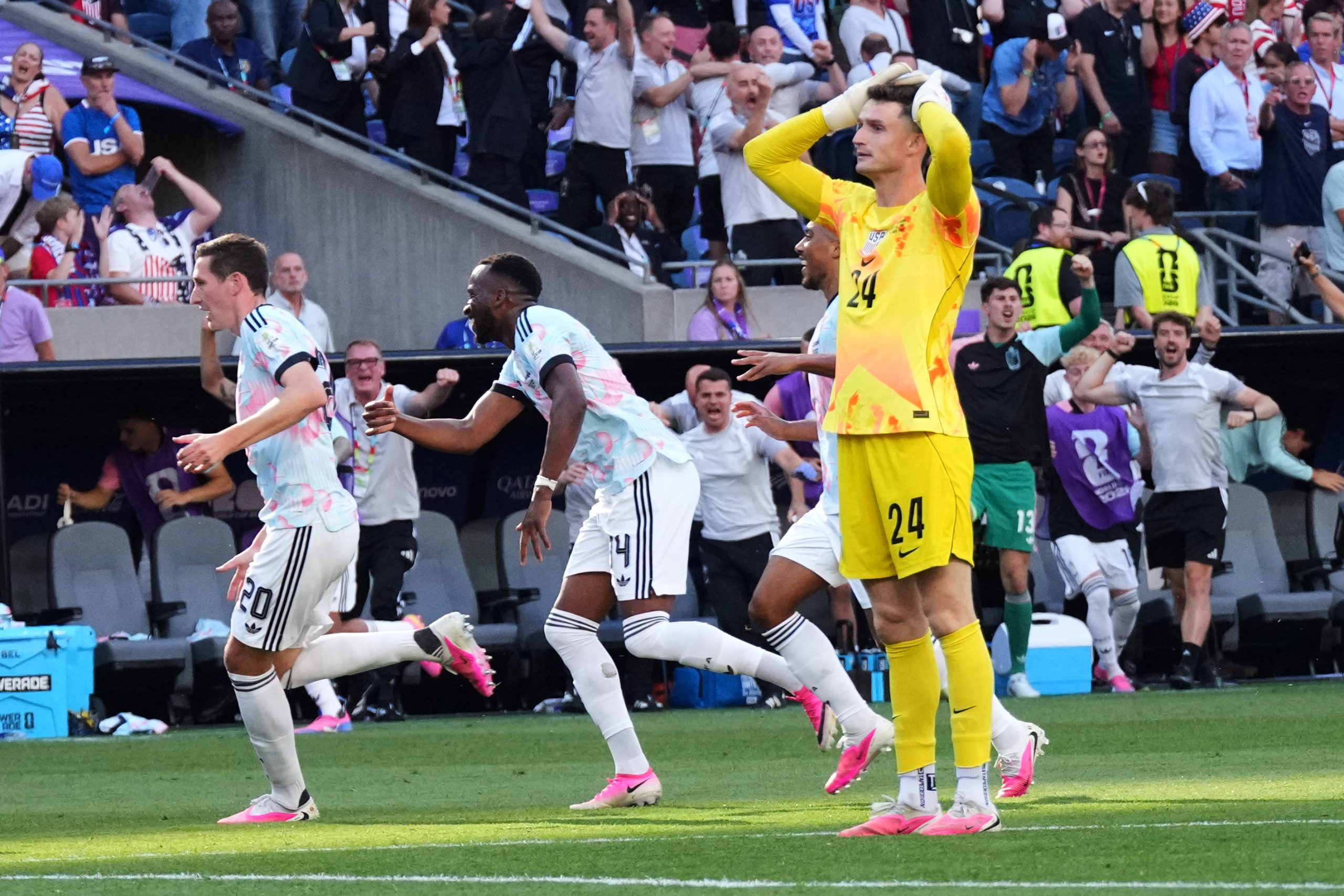
“It’s a shame that our worst game was in the round of 16,” he said. “I don’t think that we were at our best that game — I don’t think it’s anything to blame this or that, I just think we weren’t at our best. And sometimes you have to put your hands up, because they were also very good on the day, Belgium.”
He added that “it did feel like an opportunity lost” for a group of players who “felt very, very confident” heading into the biggest game of their lives.
A dejected Matt Freese (right) amid Belgium players celebrating one of their goals against the U.S.Ted S. Warren
“I felt like we knew what we could do and what we could have accomplished, and we knew we could have went farther in the tournament,” Aaronson said. “So I think that’s the thing that hurt the most. … It’s not fun when you lose that type of game, but also, I think we were upset with the way that we played, too.”
The emotions were particularly strong around U.S. centerback and captain Tim Ream, whom Aaronson said “was really upset after the game, knowing that maybe this [was] his last one — it was difficult to see.”
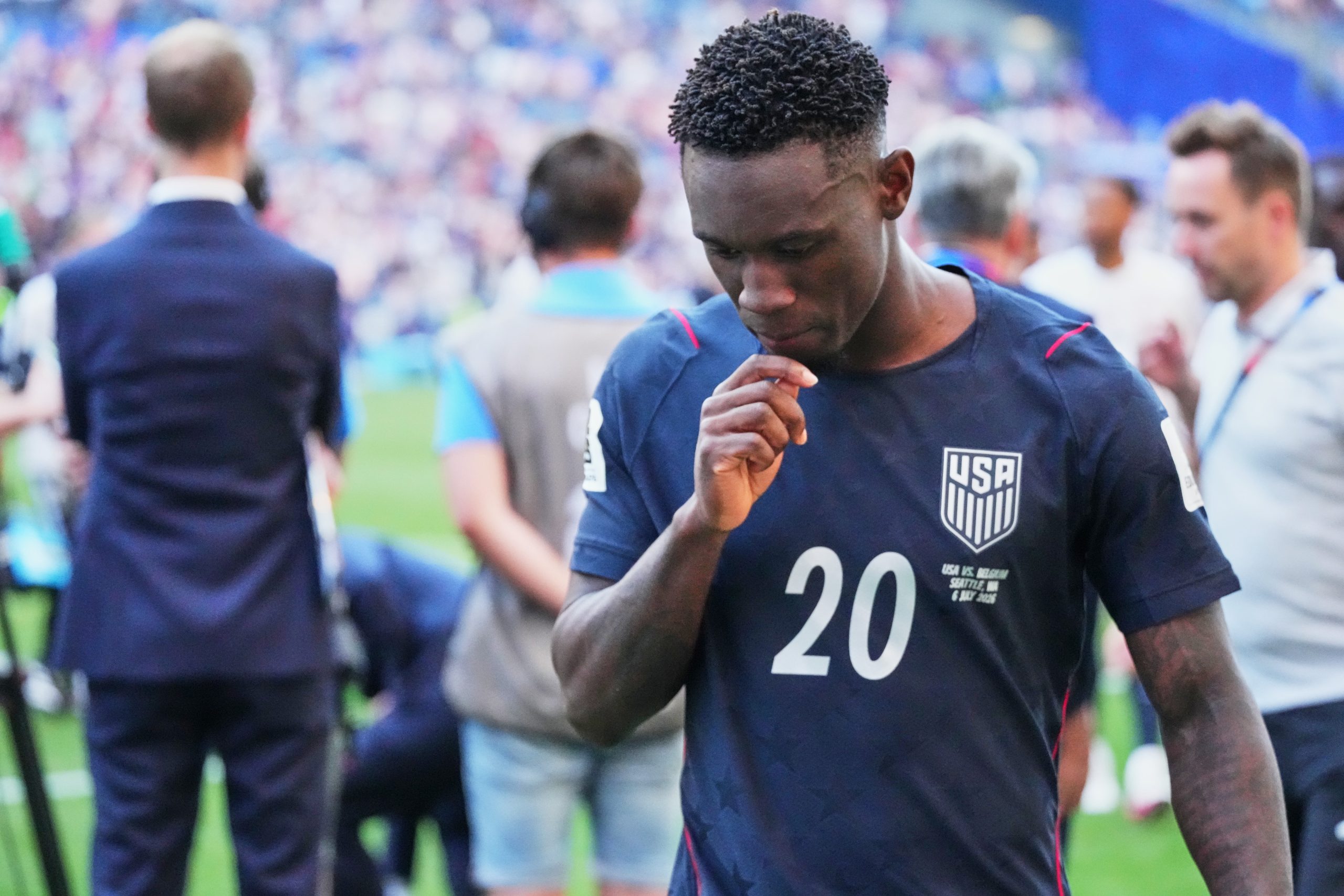
There was never any doubt about how the Balogun scandal affected Belgium’s team, especially President Donald Trump’s intervention with FIFA president Gianni Infantino to get Balogun reinstated. But there hasn’t been too much clarity about how it all affected U.S. players.
Folarin Balogun’s reinstatement might have ended up hurting the U.S. against Belgium more than it helped.Ted S. Warren
Aaronson came down on the latter side.
“I wouldn’t say it affected us,” he said. “I think we did a good job the whole time of kind of just staying in our little bubble and not really paying attention to the outside noise. We know in those moments, of course there’s media, it’s the World Cup, everybody’s going to be talking and stuff like this. But I didn’t really think much of it, to be honest, myself.”
He didn’t hesitate to add, though, “that it gave [Belgium] maybe a little more fire under their belly.”
On to a new season
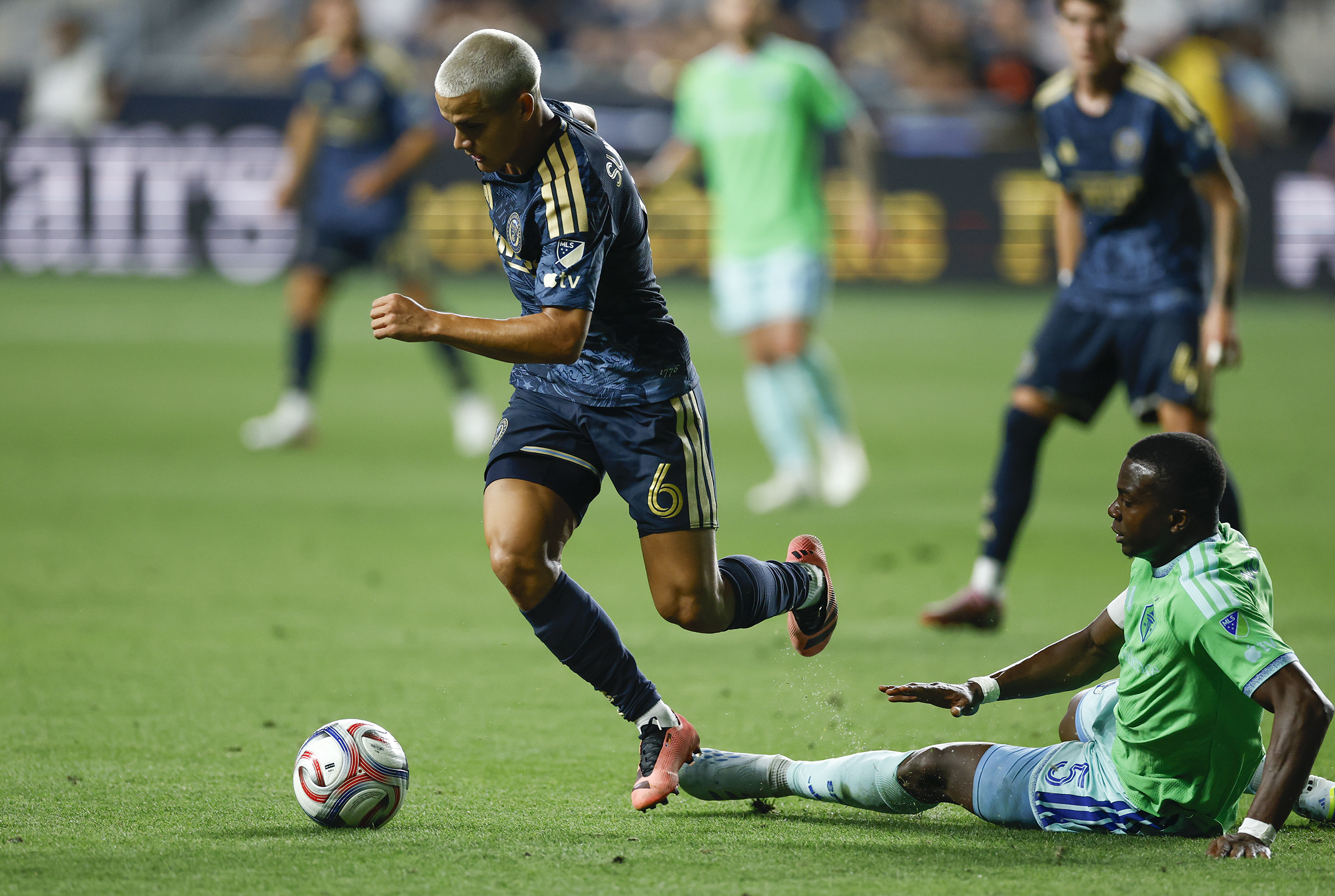
As the next World Cup cycle begins, it’s natural that some players will move on, and newcomers will be welcomed. That’s likely to start in the fall, when the new FIFA calendar takes effect with a four-game national team window from Sept. 18-Oct. 3. And it will be no surprise if some of the players who’ve succeeded Aaronson at the Union get invitations, such as Cavan Sullivan, Frankie Westfield, and perhaps Quinn Sullivan too.
A lot of U.S. fans want to see Union midfielder Cavan Sullivan (left) get a shot with the senior team this fall.Yong Kim / Staff Photographer
“There’s a time period where you can test things out and try things,” Aaronson said. “So it’ll be interesting to see what goes on the next four years, but I’m excited for it. I think it’s an exciting time for the national team, and we need to keep getting better and better.”
Aaronson hasn’t gotten a ton of playing time from Mauricio Pochettino, who from all indications seems headed toward a new four-year contract as U.S. manager. But it’s hard to believe that a 25-year-old who plays regularly in the Premier League, the world’s top domestic circuit, will be cast off entirely.
He certainly intends to do his part to stay on the radar.
“My aspiration, of course, is to play every game for the club, be a big player at the club and score goals and get assists, and then ultimately transfer that to the national team,” he said. “I want to play every game for the national team — I think that’s what everybody wants to do. That’s just been my aspiration, my goals. I’ve always been hungry like that.”
Brenden Aaronson (right) signing autographs for fans during the U.S. team’s World Cup training camp.Jonathan Tannenawld
And he was pleased by the news that Pochettino is likely to return.
“I think it’s something that we can continue to grow on,” Aaronson said. “I mean, he’s coached the best players in the world [over his career]. Being able to study under him and learn from him is massive for me.”
This will be Aaronson’s fourth season at Leeds, one of England’s most passionately supported clubs, and his third in the Premier League. As with last year, when the Peacocks returned to the top flight, the first goal is to stay up. But now Leeds can aim a little higher, with new signings bankrolled by an ownership group tied to the NFL’s San Francisco 49ers.
“I swear, Leeds fans are everywhere,” Aaronson said. “It’s got such a big fan base, and it will continue to grow. Because what we want to do is put this club in the right spot, and that’s being in the top of the Premier League. So that’s the goal.”
Brenden Aaronson at work during one of Leeds’ practice sessions leading up to Thursday’s game in North Jersey.Jonathan Tannenwald
He has his share of critics in England, largely for the same reason he has them over here: for all his industrious work on the field, he’s an attacking midfielder who doesn’t score a lot of goals. But Leeds manager Daniel Farke has been one of Aaronson’s biggest backers, and intends to stay that way.
“The task is more or less keep going exactly in the same way and develop exactly in the same way that he’s done since I’ve really worked with him,” Farke said. “I’m pleased for him that he was called up to the U.S. team — didn’t play perhaps as many minutes as he was hoping for, but he’s also a player full of potential, and he’s still in an age where he can develop and hopefully make the next steps. He is, in addition to that, also a great human being, and it’s a pleasure to work with him.”
Forward Lukas Nmecha, who scored the winner Thursday, also gave a nice endorsement.
“Firstly, on a personal level, he’s a lovely guy, works really hard,” he said. “On the football side, I think we all know what he brings. He’s very active in the game, he runs a lot, he creates a lot, and he’s just a good guy to have around.”