Updated on June 22: Telemundo had to restate its viewership figures because of what it called “Nielsen’s revised data.” As a result, the network’s audience measurement fell to 7 million viewers.
On the same day, a Fox spokesperson confirmed to The Inquirer that the network’s viewership figures are for broadcast windows longer than just the game itself. As such, the spokesperson said the “match window” number, to use the industry term, was 19.9 million viewers.
That means the combined number in the record book is now 26,900,000 viewers. That total ranks No. 3 all-time among soccer broadcasts in the United States, behind the 2014 men’s World Cup final and the 2015 women’s World Cup final.
Our original story follows below.
—
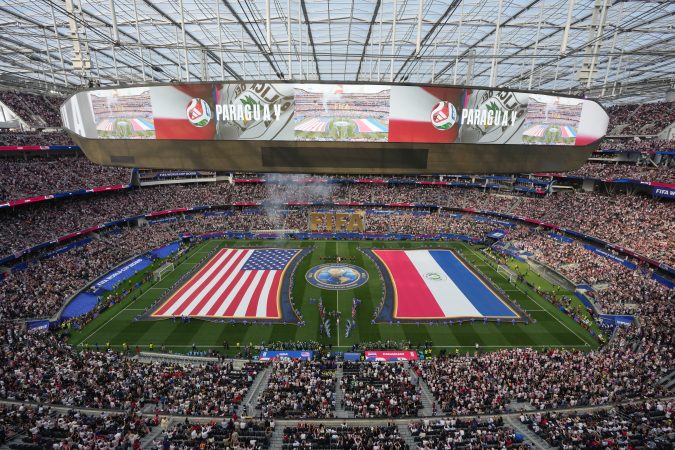
The final viewership numbers from the U.S.-Paraguay game landed on Tuesday, and they revealed a new record for the most-watched soccer game in American broadcast history.
Fox reported an audience of 18.037 million in English and Telemundo reported 9.5 million in Spanish, with both networks counting their TV and online audiences. The combined total of 27,537,000 broke a mark that had stood since the 2014 World Cup final, which drew a reported 27,314,274 viewers across ABC, Univision, and their respective streaming platforms.
Philadelphia was Fox’s No. 9 ratings market for U.S.-Paraguay, a network spokesperson told The Inquirer.
The combined audience was bigger than that of the decisive Game 5 of the NBA Finals on ABC, 24.5 million viewers according to ESPN. The series averaged 20.6 million viewers per game.
The peak audience of Game 5 was 33 million viewers. Fox’s peak for U.S.-Paraguay was 21.526 million and Telemundo’s was 7.1 million, for a combined 28.626 million.
U.S.-Paraguay isn’t the only game that has drawn a big audience. The Mexico-South Africa tournament opener last Thursday had a combined 20.586 million viewers, with Fox drawing 7.186 million across all platforms and Telemundo drawing 13.4 million. The latter number is the biggest ever audience for any soccer game on a Spanish-language network.
Mexico-South Africa was the most-watched World Cup group stage game not involving the U.S. — for all of two days. Saturday’s Brazil-Morocco game in the Meadowlands beat it, drawing a combined audience of 21.219 million: 10.019 million on Fox and 11.2 million on Telemundo.
Those two contests now stand as Nos. 10 and 11 in the all-time rankings. Sunday’s Netherlands-Japan game also makes the top 20, with 17.238 million reported viewers: 8.838 million on Fox and 8.4 million on Telemundo.
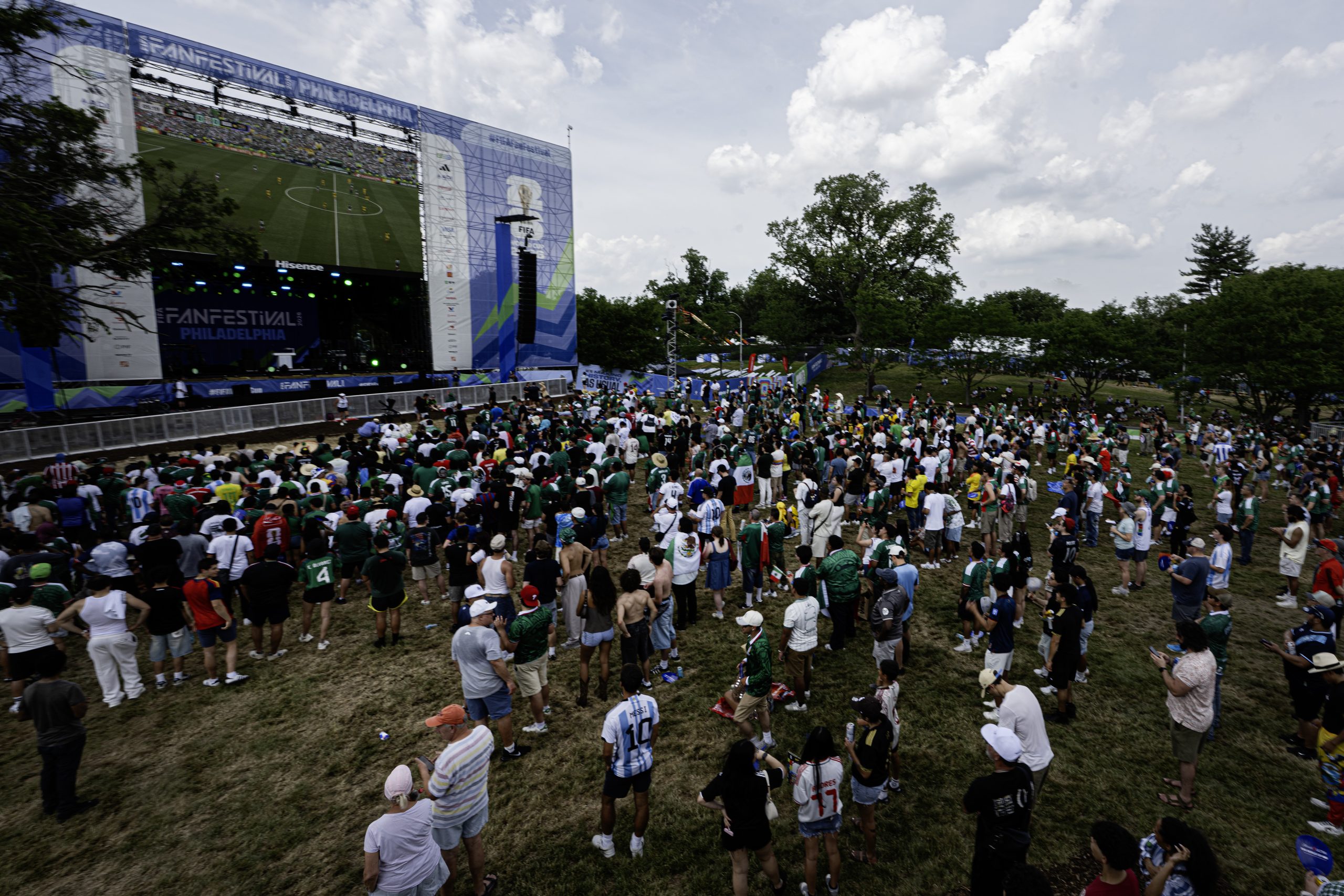
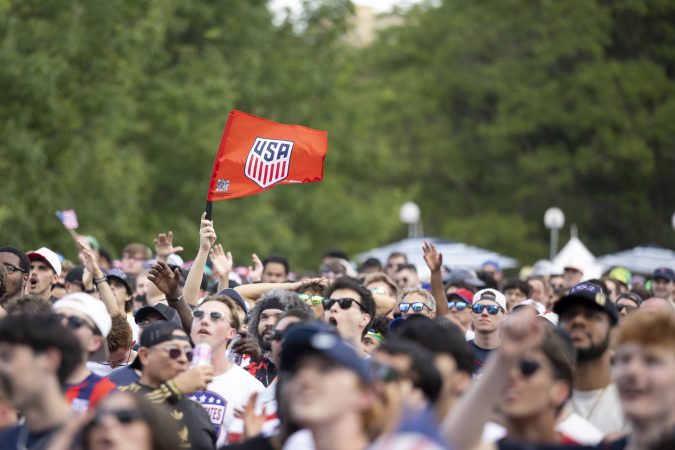
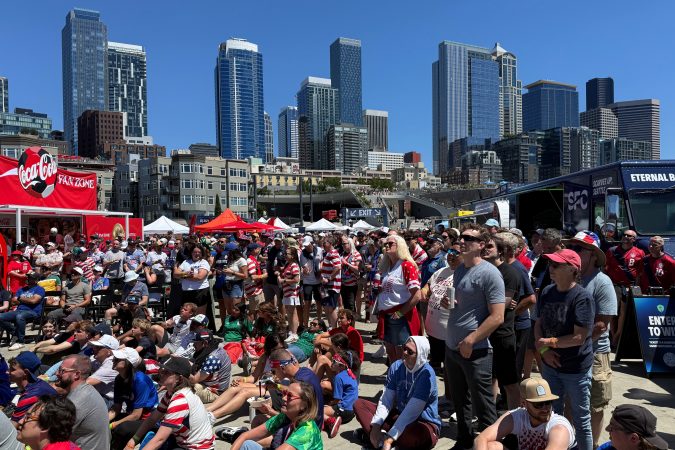
Fans watching the Mexico-South Africa game on the big screen at Philadelphia’s World Cup fan fest on Lemon Hill.Jose F. Moreno / Staff Photographer
Of the 12 games with publicly reported data so far, nine have reached combined audiences over 10 million viewers. One of them is Philadelphia’s first World Cup game, Ivory Coast vs. Ecuador on Sunday, which drew 13.473 million viewers across FS1 (4.273 million), Telemundo (9.2 million), and their online streams.
Based on publicly-available data, the record men’s World Cup audience on an English-language network remains the 2014 U.S.-Portugal game, which drew 18.71 million viewers on ESPN. The overall soccer record in English is the 2015 women’s World Cup final, where Fox’s primetime broadcast of the U.S. triumph drew 25.632 million viewers.
IRVINE, Calif. — Until now, the U.S. has played only one game in a World Cup that didn’t matter in the standings: in 1998, when it was eliminated from advancing before the group stage finale.
On Thursday, the total will rise to two. But this time, it will be because the Americans have already clinched first place.
That makes for a very different vibe, not just from this team’s past but from most teams at any World Cup. It also makes for a serious question: How many regulars should rest, and how many should play to stay in rhythm?
This was the question of the day as the Americans returned to practice on Monday.
Antonee Robinson (right) is one of four U.S. players at risk of a suspension for yellow card accumulation.Lindsey Wasson
Common sense says players on yellow cards should sit, because if they get booked again they’ll be suspended for the round of 32 games when they’re really needed. Those are defenders Chris Richards and Antonee Robinson, midfielder Tyler Adams, and striker Folarin Balogun. All four are big-time players.
We won’t hear from manager Mauricio Pochettino until Wednesday. We might hear from Richards, Robinson, or Adams before then. We did hear from Balogun on Monday, when the U.S. returned to practice. He and Alejandro Zendejas met with the media.
“I want to play every game — it’s the sort of player I am,” Balogun said. “It’s what’s got me to where I am, being available. I think the most important thing for a professional athlete in any sport is to be available, and I’m no different.”
But he quickly turned from there to pragmatism.
“So of course I want to play, but it’s also important to be smart,” he said. “I wouldn’t want to pick up a yellow card and miss the round of 32.”
Balogun also said the team’s overall focus for the game remains on winning.
“The most important thing is to go out there and win,” he said. “Regardless of whatever team the coach decides to play, the objective and the aim is to go out there and win. Three wins from three games, it’s an opportunity to create history, and to put a positive message out there — not just for ourselves, but toward other teams.”
Pulisic returns to practice
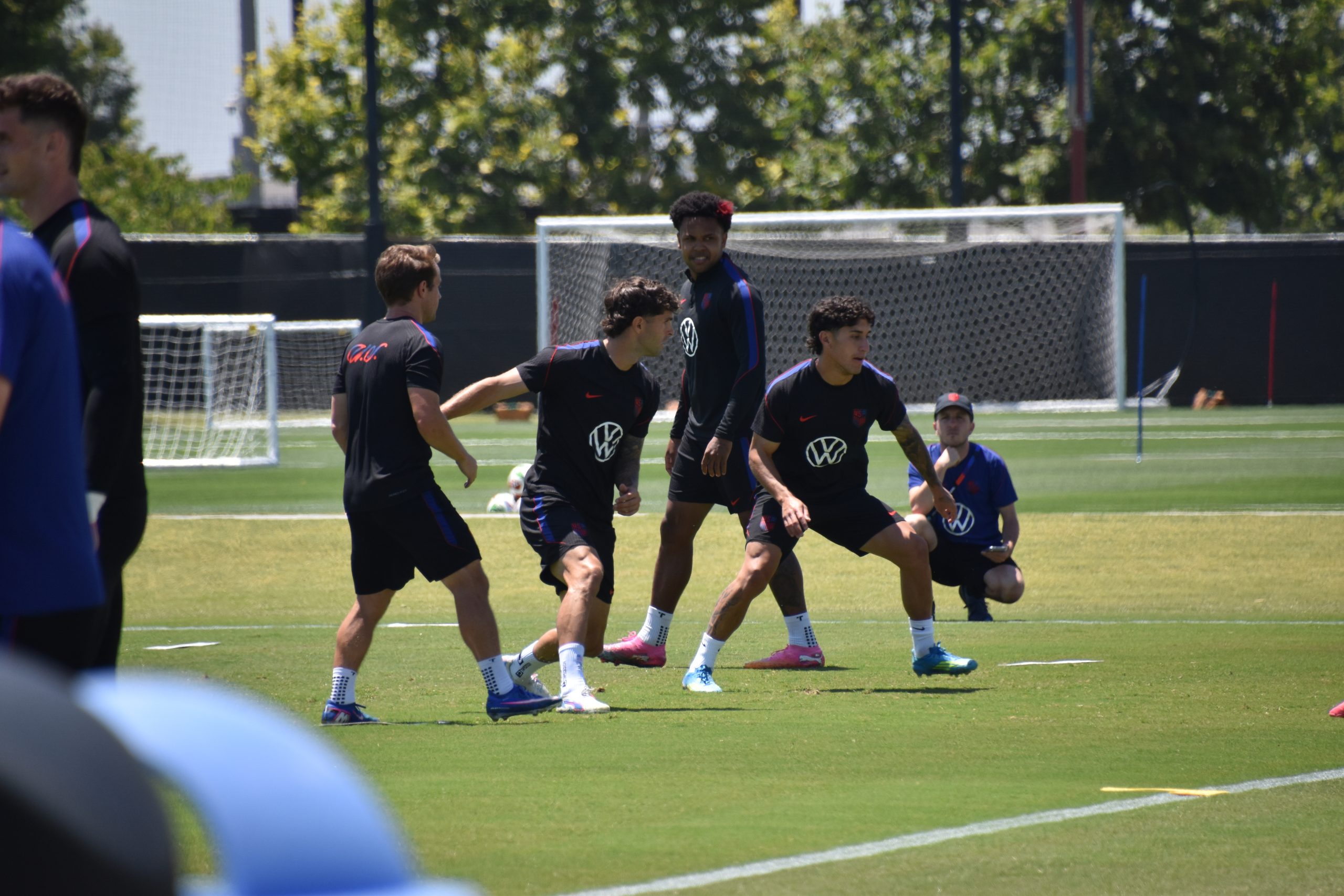
Star playmaker Christian Pulisic was back on the field in practice for the U.S. men’s soccer team on Monday, taking part for the first time since before the tournament opener against Paraguay.
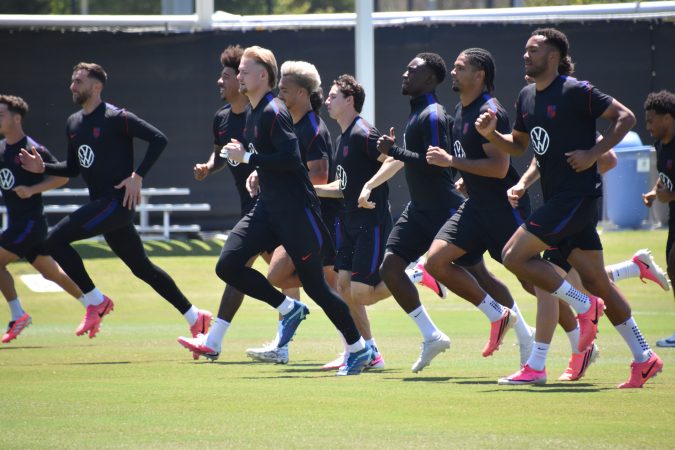
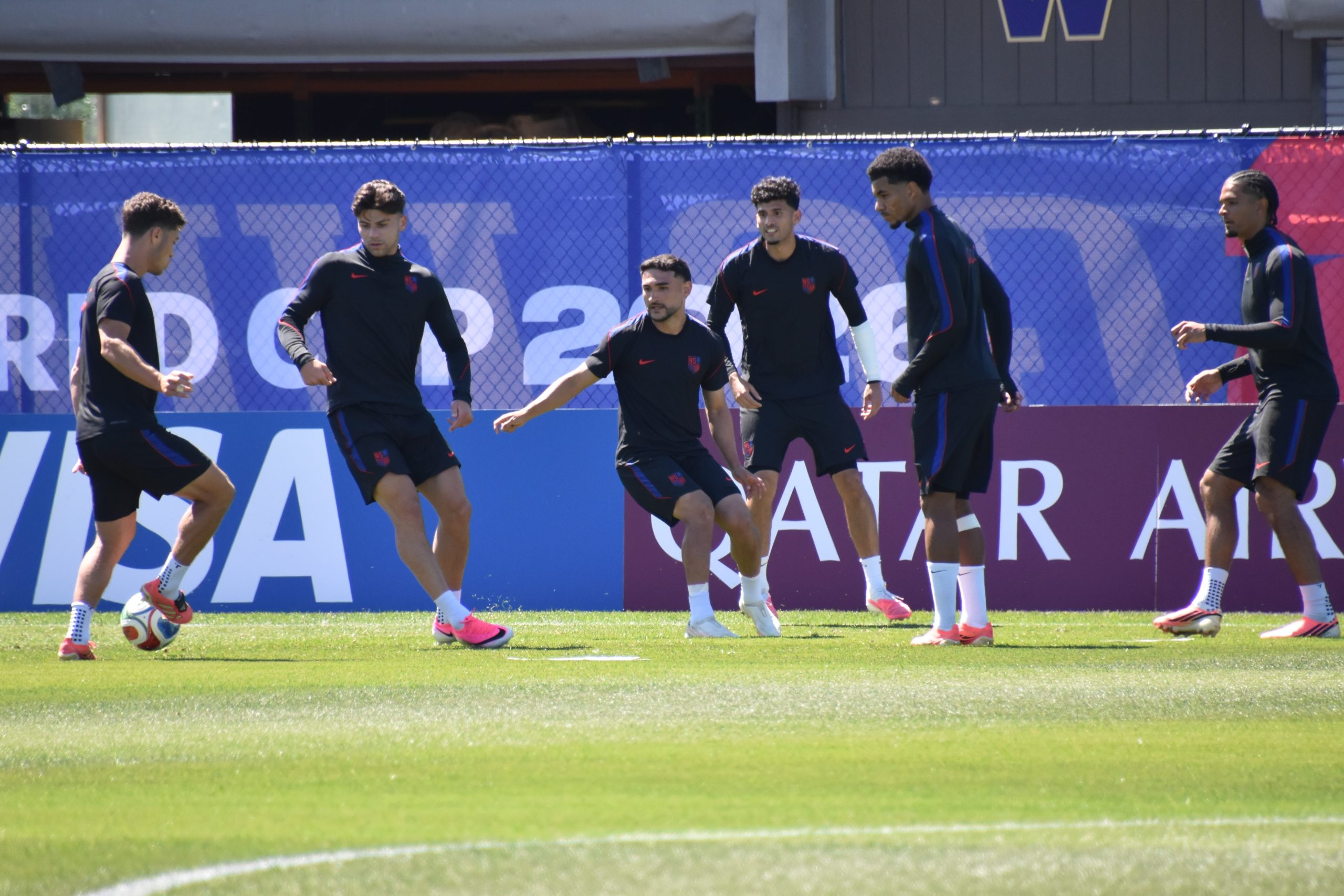
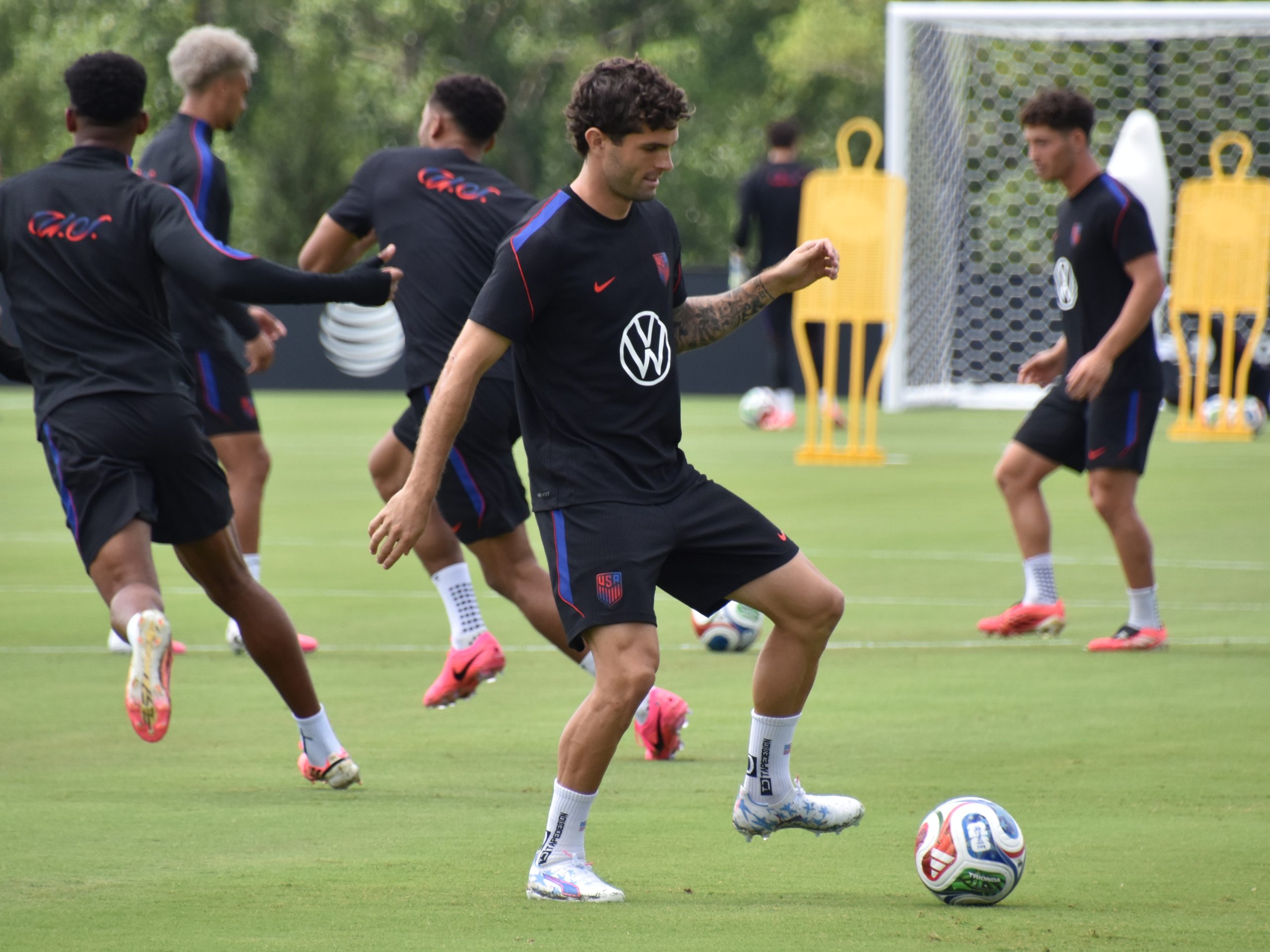
Christian Pulisic (second from left) in a drill during Monday’s practice.Jonathan Tannenwald
That was a good sign as the Hershey native finishes recovering from the calf injury that kept him out of the second group stage contest against Australia. But it’s just one step, and practice was open to the media only for the first 15 minutes. So we don’t know what happened after that.
Whether Pulisic should play against Turkey is another debate. If he’s fit, a few minutes could do him good, but it will be a risk. For now, it was a good sign to see him making progress.
The other injury news is that midfielder Cristian Roldan is day to day with a muscle strain. If he can’t play against Turkey, that will leave the U.S. shallow.
Immigrants’ success stories
The diversity of the United States means players come from a variety of backgrounds and locations. That thread links Balogun, who was born in New York to Nigerian parents and grew up in England, to Zendejas, who grew up on both sides of the Texas-Mexico border in El Paso and Juárez.
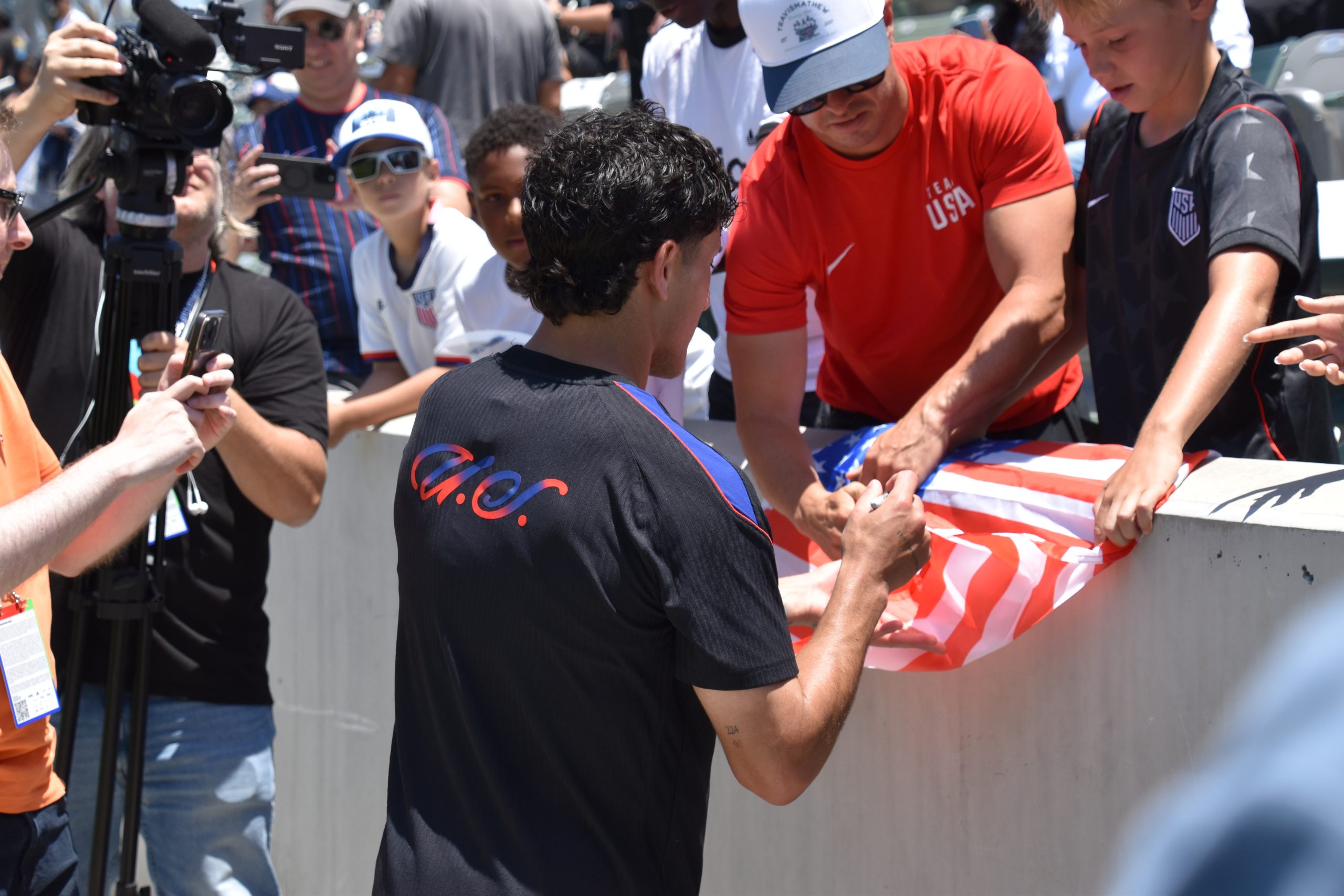
Alejandro Zendejas autographs a fan’s American flag during the U.S. team’s open practice at the start of their World Cup training camp in Irvine.Jonathan Tannenawld
“It is truly an honor and a source of pride to be here representing the entire Latino community,” said Zendejas, who shares that honor with other players including Ricardo Pepi and Roldan. “It’s a dream come true — for [them] just as much as for me — to be here and show people that dreams can become reality.”
Balogun called himself “proud to be American and to represent America.” He knows well that, as he said, “the story has picked up a bit of attention, but I think it’s expected. We’re at the World Cup, and it’s an opportunity for the fans to get to know more about us as players.”
Zendejas, by the way, wore an eye-catching 1994 World Cup throwback hat as he spoke. His sponsorship deal with Adidas got him it for free; it costs $40 for the rest of us.
“I don’t know much about this World Cup — I should but I don’t,” he quipped, knowing that tournament was played four years before he was born.
Alejandro Zendejas did his turn with the media wearing a very sharp 1994 World Cup throwback hat.
He admitted adidas gave it to him, and it’s a modern recreation, not an original.
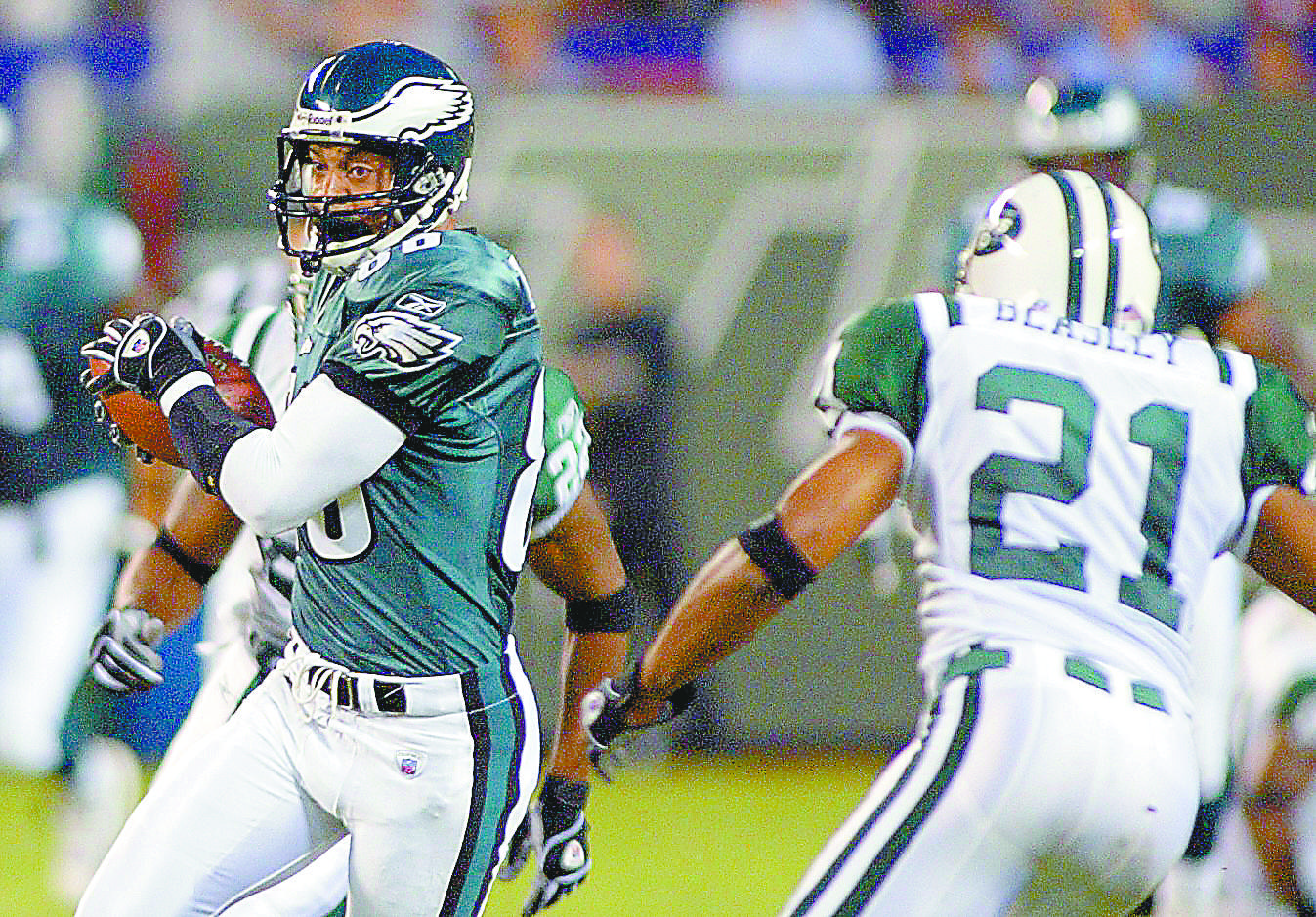
Alex Freeman’s fast rise with the U.S. team has no bigger fan than his father, former Eagles and Green Bay Packers wide receiver Antonio Freeman. When Alex scored the game’s second goal against Australia, he achieved the rare feat of scoring a World Cup goal in a stadium where his father scored two touchdowns 30 years earlier.
Antonio stopped by Monday’s practice to talk with the media and share his joy.
“I’m sure Alex has heard enough from other people about my success and my moments,” he said. “I don’t really talk about those moments too much. But it was definitely a full-circle moment. to just have a father-and-son combination in any sport have an impact on a game in the same stadium, same state, it’s pretty amazing.”
He called it “a credit to all the work that Alex has put in, the commitment that he’s made. This is his ride, and I’m just happy to be his biggest supporter.”
Antonio Freeman stops by #USMNT practice and meets the press:
And what was the father’s message to his son after the game?
“He just continued to amaze me, and that’s all it is,” he said. “When I see him, it’s like, ‘Yeah, boy, that’s what I’m talking about!’ — that’s our little thing. But just keep working, Alex, keep being you. People love who you are, don’t change, just keep working hard.”
He also praised soccer’s growth in the United States, saying this World Cup “has really heightened the awareness in the U.S., and people from all walks of life are getting involved, rallying behind the [U.S.] team.”
Antonio Freeman with the Eagles in a 2002 game against the Jets.Yong Kim
IRVINE, Calif. — On any given day in Seattle, there are a lot of things in the air: the breeze off Puget Sound, the seagulls that steal your french fries, and other substances for which the city is well-known.
It wouldn’t be fair for an outsider to ask if the last of those factored into the sudden outbreak of hype around the U.S. men’s soccer team. The atmosphere at Friday’s U.S.-Australia game needed no enhancement, with that crowd showing the nation and the world why Seattle’s soccer culture is the real deal.
But something has caused people to start asking if the U.S. men can win this World Cup. So let’s answer it.
No, this team is a long way from such a … height, let’s say.
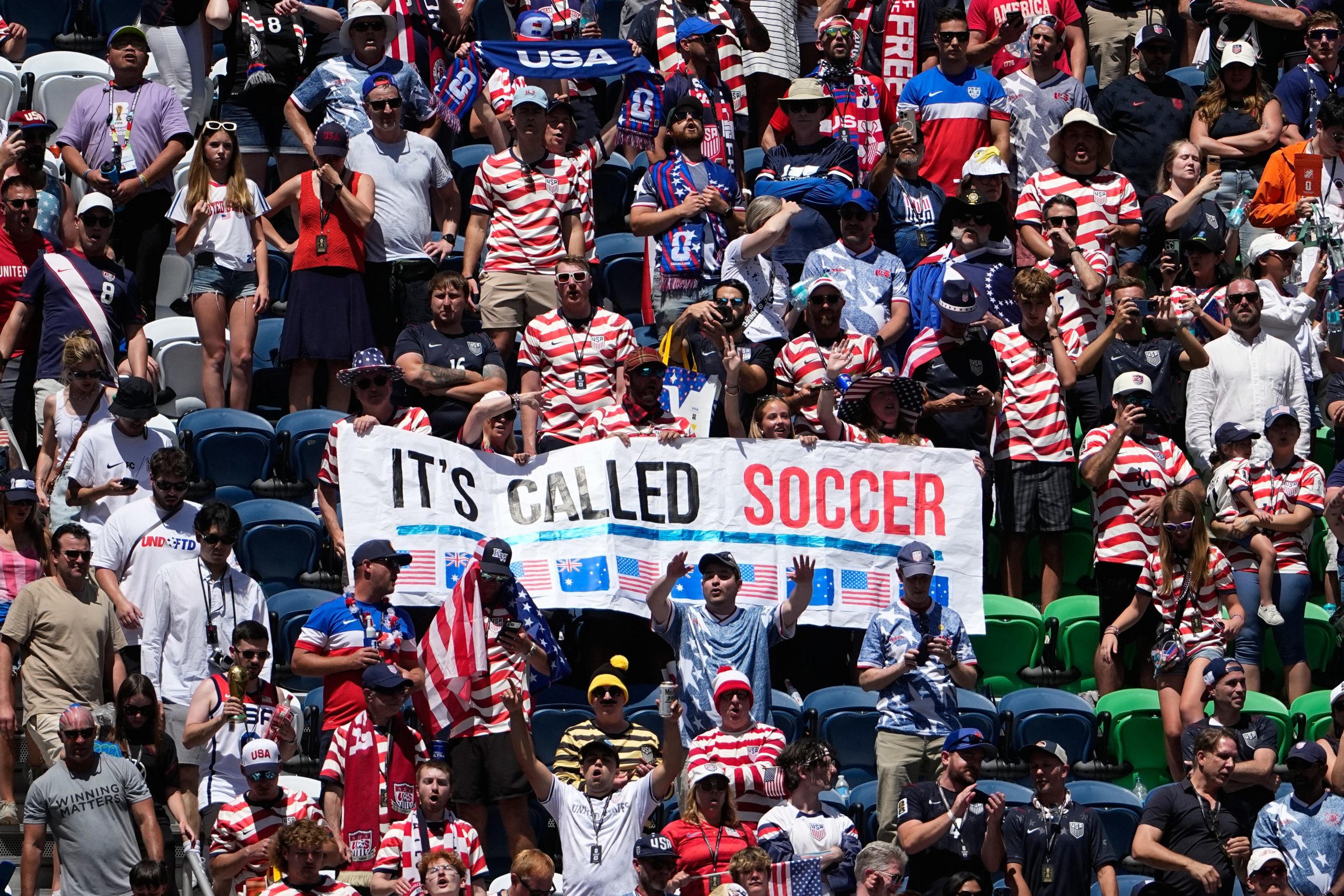
A sign from U.S. fans at the game against Australia, with two teams that call the sport “soccer” instead of England’s “football.”Lindsey Wasson
Yes, the Americans have won two games in a men’s World Cup group stage for the first time since 1930. Yes, they have won their group for the first time since 2010, and clinched qualification for the knockout rounds with a game to spare for the first time in the program’s modern era, which started in 1990.
But the teams they’ve beaten so far, Paraguay and Australia, looked the part of the 41st- and 27th-ranked teams in FIFA’s global standings, which they were when the tournament kicked off. The U.S., meanwhile, has done something that should be within reach for a No. 17 team with home-field advantage on the world’s biggest stage.
When the U.S. faces Turkey in the group stage finale on Thursday in Inglewood, Calif. (10 p.m. Fox29, Telemundo 62), the hosts will again face a team ranked below them. Turkey is No. 22. How much will that actually prove, compared to a potential matchup with Belgium in the round of 16 or Spain in the quarterfinals?
Even the first knockout game in the round of 32 could be a trap. Though the U.S. is already set to head to the Bay Area for a game on July 1, the team across the field won’t be known until the group stage ends. It will be the third-place team from group B, E, F, I, or J, depending on which eight of the 12 third-place finishers in the tournamentadvance.
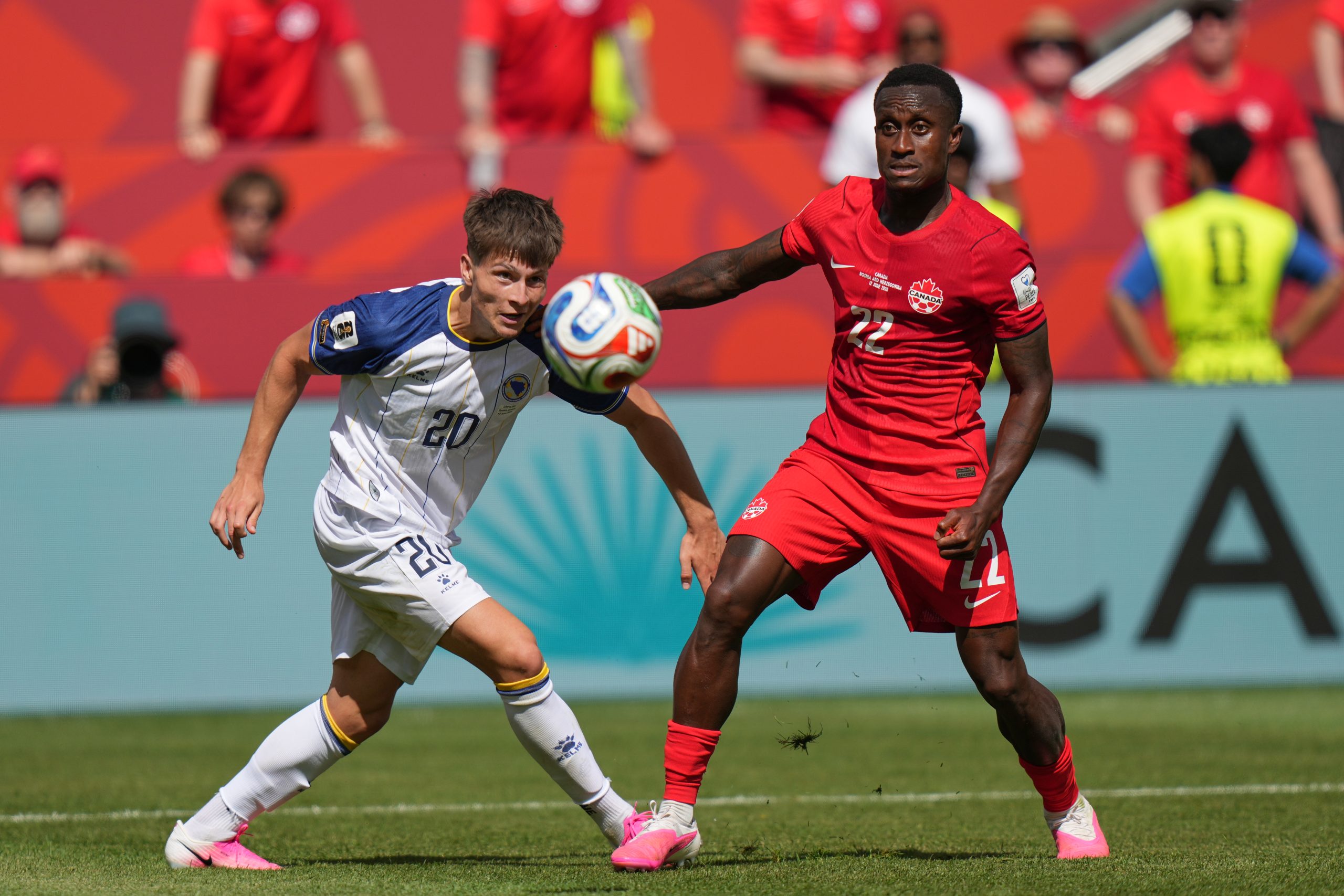
A U.S.-Bosnia game would be a reunion for Bosnia’s Esmir Bajraktarević (left), who grew up in Wisconsin and played for the New England Revolution.Stephanie Scarbrough
The Athletic has a forecasting formula that projects Bosnia & Herzegovina, ranked No. 64, as the most likely candidate right now. As they’d say on “Let’s Make A Deal,” you take the offer right there. Upcoming games could put Ivory Coast, Ecuador, Japan, Sweden, Norway, or Senegal behind the other doors.
But if it is Bosnia, it would still be a measuring stick, and not just because the U.S. men have won just one knockout-round game in their history (against Mexico in 2002).
The Americans’ all-time record against European teams in World Cups is 3-14-7, and the only win of the modern era was against Portugal in 2002. The other two were against England in 1950 and Belgium in 1930. (Coincidentally, both games had heroes from Philadelphia, Walter Bahr and Bart McGhee.)
Sometimes, the insistence on measuring American soccer against Europe is just a thing in the heads of fans and media. But the results record is still long and one-sided, even compared to other continents. The U.S. is 3-2-0 against teams from South America, 2-2-0 against teams from Africa, and 2-1-1 against teams from Asia.
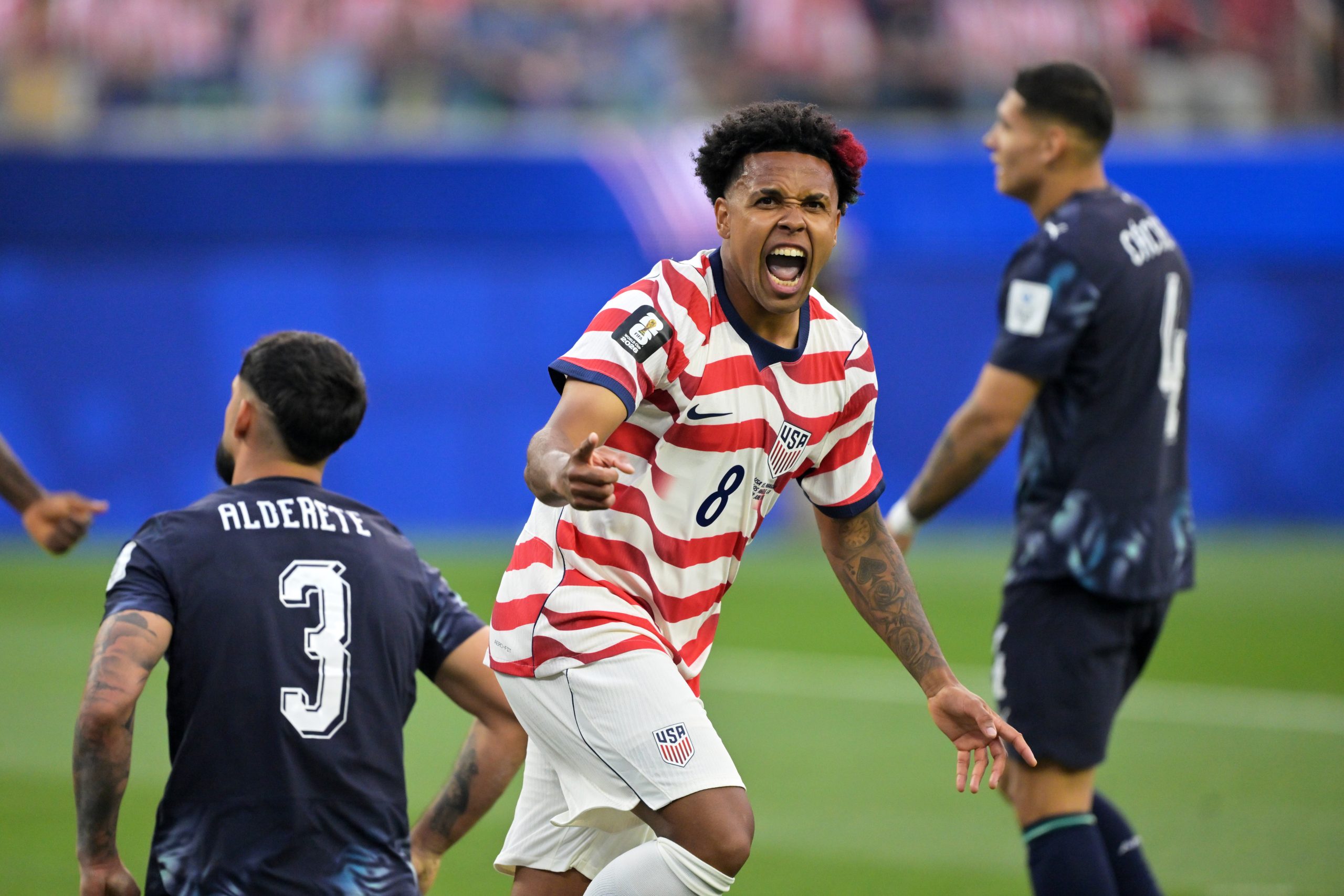
Weston McKennie (center) and the U.S. men recorded their third World Cup win over a South American team by beating Paraguay.Jayne Kamin-Oncea
Why it’s different for the players
If reading this makes you feel like it’s spoiling the party, sometimes that’s the job of a professional cynic. So we’ll balance it by saying the warning only applies to outsiders. It’s perfectly fine for the players and coaches to believe they can go all the way, because they need that belief along with everything else to win games on the biggest stage.
“Obviously, we take it one game at a time, but every game, every tournament that we play, we want to win,” centerback Chris Richards said. “So I don’t think it’s ridiculous to say that we want to win it.”
Nor was it outrageous, even if it was certainly headline-grabbing, when manager Mauricio Pochettino told The Athletic last week that “we should dream without limits.”
“If I dream of touching the moon, of being up on the moon, maybe I can get close to the moon,” he said. “If I only dream of getting close to it, I’ll stay on Earth. It’s so powerful, isn’t it? Believing that you can do it.”
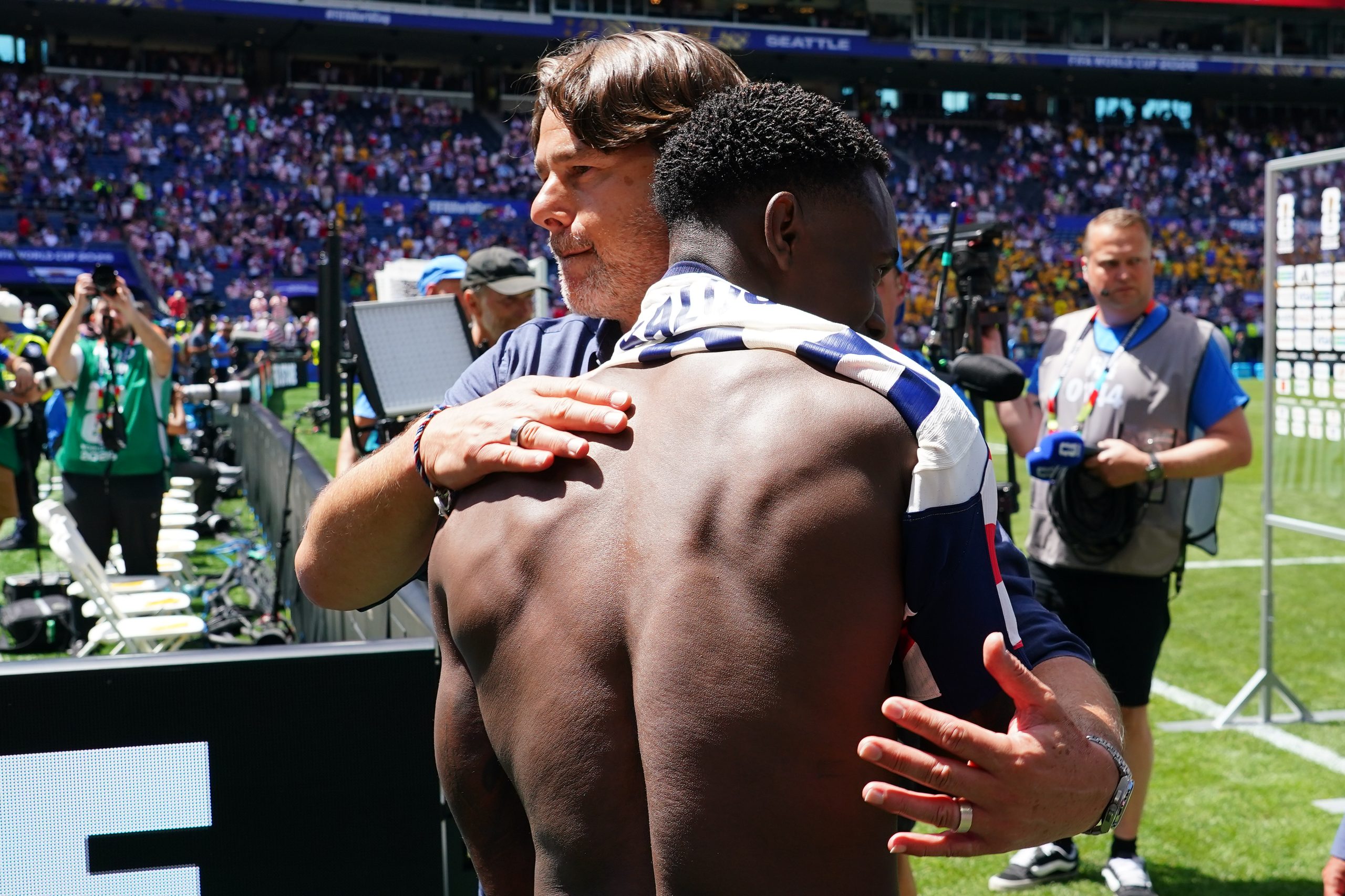
Mauricio Pochettino embracing Folarin Balogun after the U.S.’ win over Australia.Ted S. Warren
It had to help Friday. The players found out that morning, just a few hours before kickoff, that its catalyst, Christian Pulisic, wasn’t healthy enough to play.
“We were all ready to prepare for this game, and whenever we heard that the coach gave us the lineup, the next player, the next man up was ready,” said Ricardo Pepi, who was that next man.
“I think that we built the victory in our attitude,” Pochettino said after the Australia game. “I told the player: the first action when we started the game, did you see how Pepi and Balogun go to press?”
We sure did, and it set the tone that led to the game’s first goal in just 11 minutes. Australia had to boot the ball out to beat it, and one of those clearances led to the throw-in that started the scoring play. The U.S. worked the ball around the back line, Antonee Robinson sprung Balogun down the left wing, Pepi charged up the middle, and Cameron Burgess put the ball in his own net.
They didn’t let up, either, as physical as the game got. After winning the first game with style, the U.S. won the second with grit, as the teams combined for 28 called fouls and plenty more uncalled.
How the Turkey game will go is impossible to know right now, with the U.S. already group winners and Turkey already eliminated. It’s the first game without qualification stakes for the Americans since 1998, when they lost their first two games and were eliminated before the third.
Will Pochettino rotate his lineup a lot? It makes sense at first, but there are caveats. There’s a history of teams that rest players in their third game ending up rusty in their first knockout game, and this time there are six days between the second and third group contests — then another six between the round of 32.
There’s a clear case to rest Pulisic and players on yellow cards: Tyler Adams, Robinson, Richards, and Balogun. If they get another booking in this game, they’re out of the round of 32 contest. But beyond them (and it’s a lot, for sure), Pochettino might want to keep the rest in a good rhythm.
At least it’s a good problem to have. The results so far and the manner of earning them signal that the U.S. can make a run in this World Cup. But winning the title is a different question. That still feels too high of a task, and it will eventually become clear.
By the time you read this, Philadelphia will have hosted two matches in the FIFA World Cup and will be steadfastly preparing for a third in quick succession come Monday.
France, a favorite by many to win the whole tournament, will take on Iraq in the second game of Group I, but if it’s anything like the previous two matches, the game itself will once again not be the story.
Because for the past two games, the attraction has been that of the fans, and the unbridled passion people have for not just a team and its players, but the nation so many have bought jerseys for, the emblem they proudly wear above their heart, or in the middle of their chest.
The heart of Brazil is in Philadelphia ahead of their match against Haiti
This spectacle of what will result in 104 matches of underdogs becoming story lines, a U.S. men’s national team exercising the type of dominance very few expected, has also seen Philly lead the way on the main stage, creating lasting memories for thousands of fans who have flocked to the city, all while becoming lore, in the process.
In the lead-up to the World Cup, the story lines circulated the unforeseen, the question marks that surrounded what the World Cup’s return to the United States would look like.
It came on the heels of perceived rampant greed from FIFA, which enacted dynamic pricing for the first time, sending ticket prices soaring to the highest they’ve ever been. They opened the door for broadcasters to run advertisements midgame, under the guise of hydrating tired players.
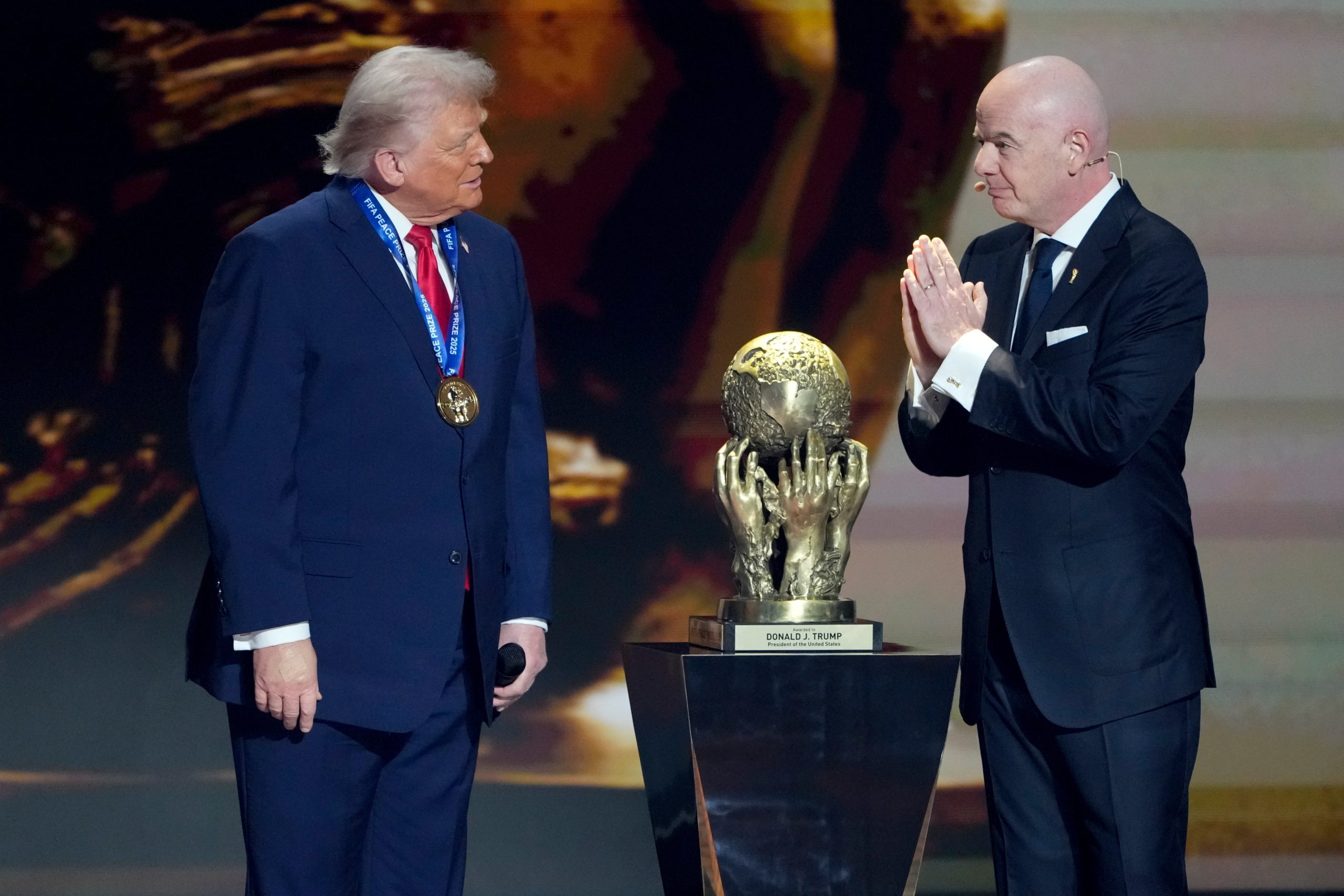
FIFA president Gianni Infantino (right) gives President Donald Trump the inaugural FIFA Peace Prize at the World Cup draw last December.Chris Carlson
Let’s not forget the lobbying of the sitting U.S. president in the process, going as far as to create an inaugural peace prize for him while his administration destabilized governments and enabled a war in the Middle East.
But look at how quickly all of that has fallen into the backdrop.
Soccer in its purest form has provided an escape for a nation that desperately needed one. And what it’s also proved in the process is that people of different races, colors, and creeds don’t hate each other as much as their social media algorithms might suggest.
Proof was on display right here in Philly in the form of fans who packed the stands over the last two matches.
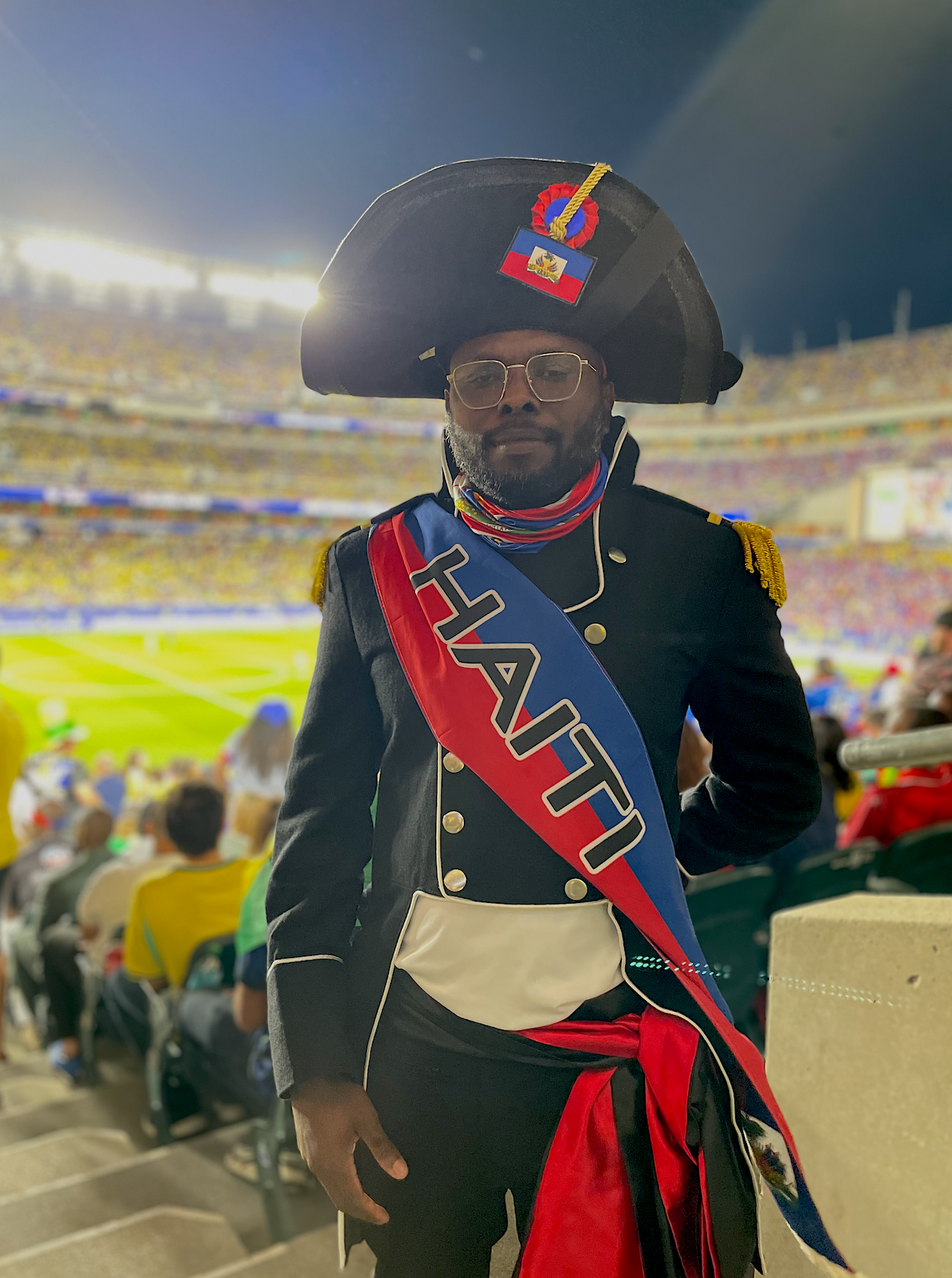
Fans like Maxence Jeanty, a 41-year-old Haitian native living in Chicago who traveled to Philly from the Windy City, dressed in a suit depicting liberator Jean-Jacques Dessalines, a key figure of the Haitian Revolution.
Maxence Jeanty, 41, a fan from Chicago arrived at the FIFA World Cup game between Brazil and Haiti, dressed as Jean-Jacques Dessalines, the leader of the Haitian revolution.Kerith Gabriel / Staff
“When I was growing up in Haiti as a kid, I watched the World Cup, and I’ll never forget watching the 1994 World Cup,” Jeanty said. “It’s been so long that my people haven’t made it to the World Cup that the choice was to choose either Brazil or Argentina [as the nation to support]. But now, we’re stepping on the field as equals, and no matter what happens, we’re stepping on the field as equals. The pride that brings to me and to every Haitian fan here, man, that’s indescribable.”
We witnessed massive gatherings on the most iconic steps of our fair city from supporters who, like Jeanty, boarded planes just to be a part of the moment.
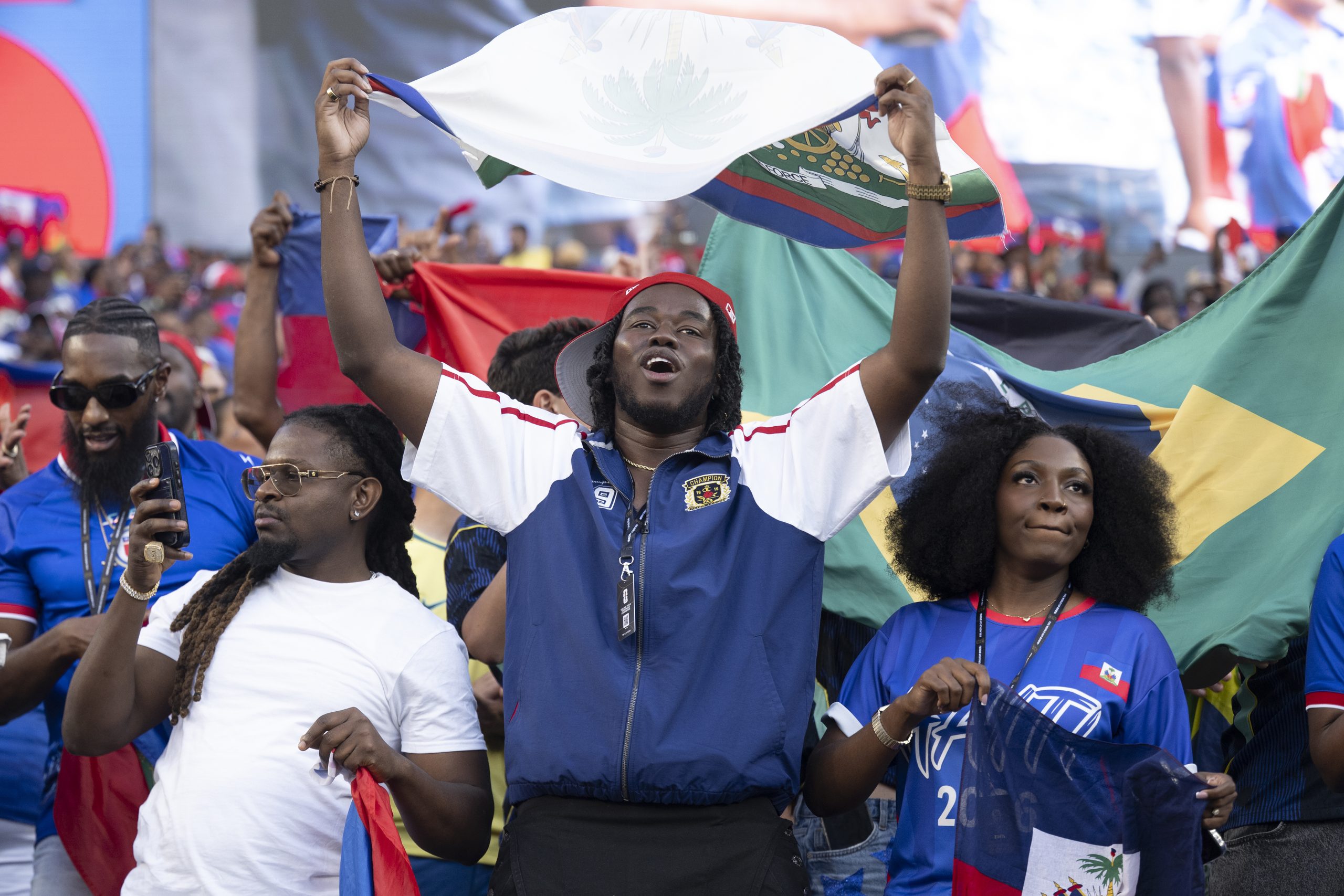
Haiti fans celebrate during Friday’s FIFA World Cup Group C soccer match against Brazil.Jose F. Moreno / Staff Photographer
Only a week and a half in, the World Cup has become for so many a momentary cure for what ails, the escape we didn’t know we needed. Lifelong supporters hang onto every kick, and casual fans are amazed by the sights and sounds.
Along the way, we’ve met supporters of other nations who’ve never met and have become instant friends. We saw dance parties on subway cars, in parking lots, and in the middle of streets.
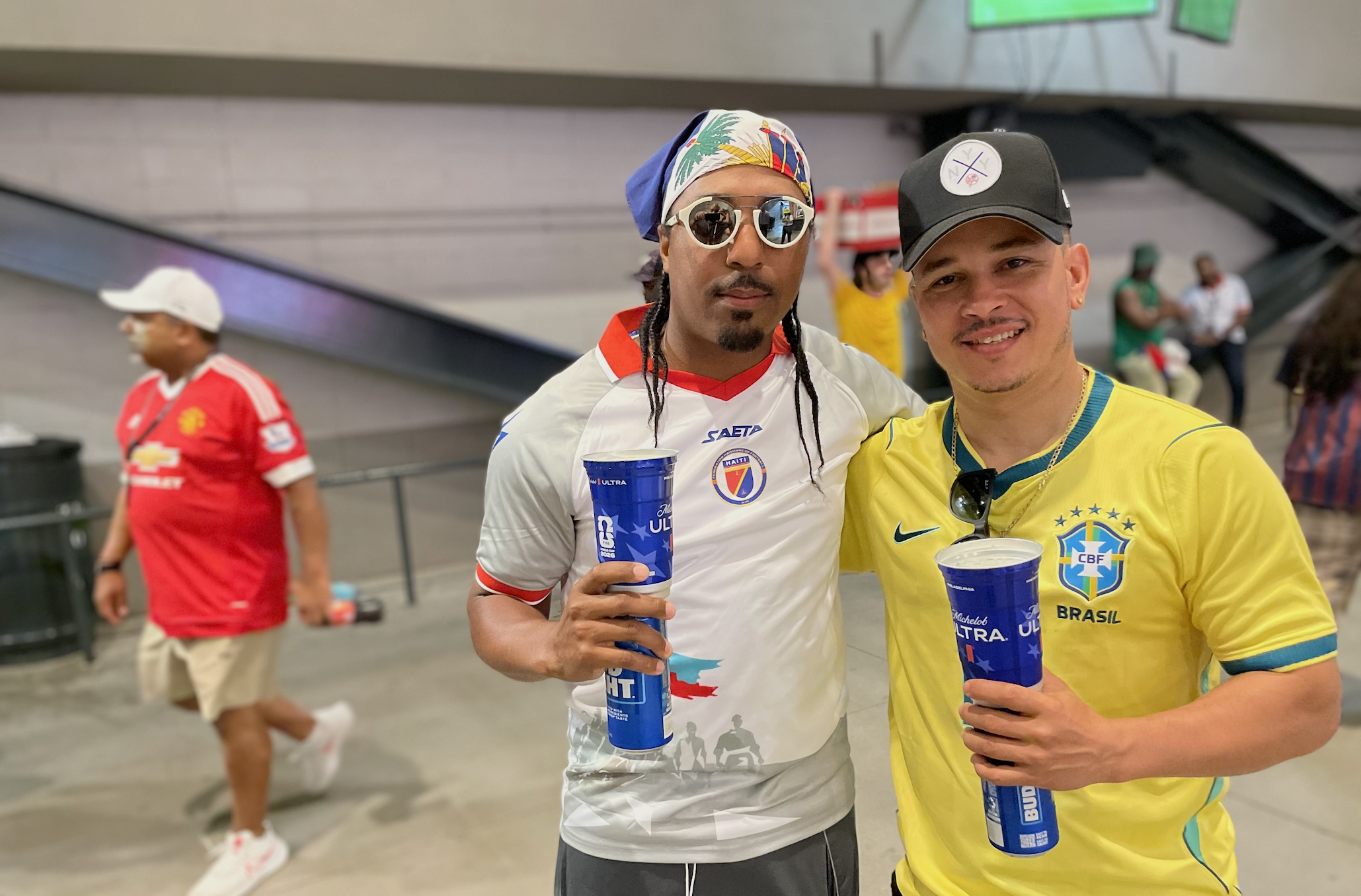
Lucas Maninhu, 31, who arrived from New York and was draped in Brazil’s jersey, wanted to introduce me to his “new best friend,” a Haitian man who only wanted to go by Greguity. The two met in the parking lot on the day of the Brazil-Haiti match, struck up a conversation, walked into the stadium, and watched most of the game together.
Brazil fan Lucas Maninhu (right) and Haitian fan Greguity met at the World Cup match in Philly between Brazil and Haiti. Both said they’ve become “best friends” in the process.Kerith Gabriel / Staff
“We met tonight,” Maninhu said. “We are here for different teams, but it doesn’t matter, tonight this is my boy. We’re all here for the same reason.”
And look, FIFA knows this. It knows the unifying power this tournament has had on the masses since before the end of the Second World War.
It’s why, despite laying the claim of being “Football for All,” this edition of the World Cup, from a financial perspective, has felt like football for the few.
But those few continue to sell out arenas, flock to stadium stores to buy World Cup merchandise, and drink $7 purified water. Outside the stadium, games are setting broadcast records, and people are filling the bars and restaurants across North America. There’s money to be made all around.
Let’s not forget the FIFA Fan Festivals, the official watch party situated in Philly at Lemon Hill. It’s made that neighborhood a noisy one, but it’s a good noise.
Think about it. At its core, the first 10 days of the World Cup have allowed many Americans to take a sigh of relief, to have something to look forward to, or have on in the background while life is happening in real time.
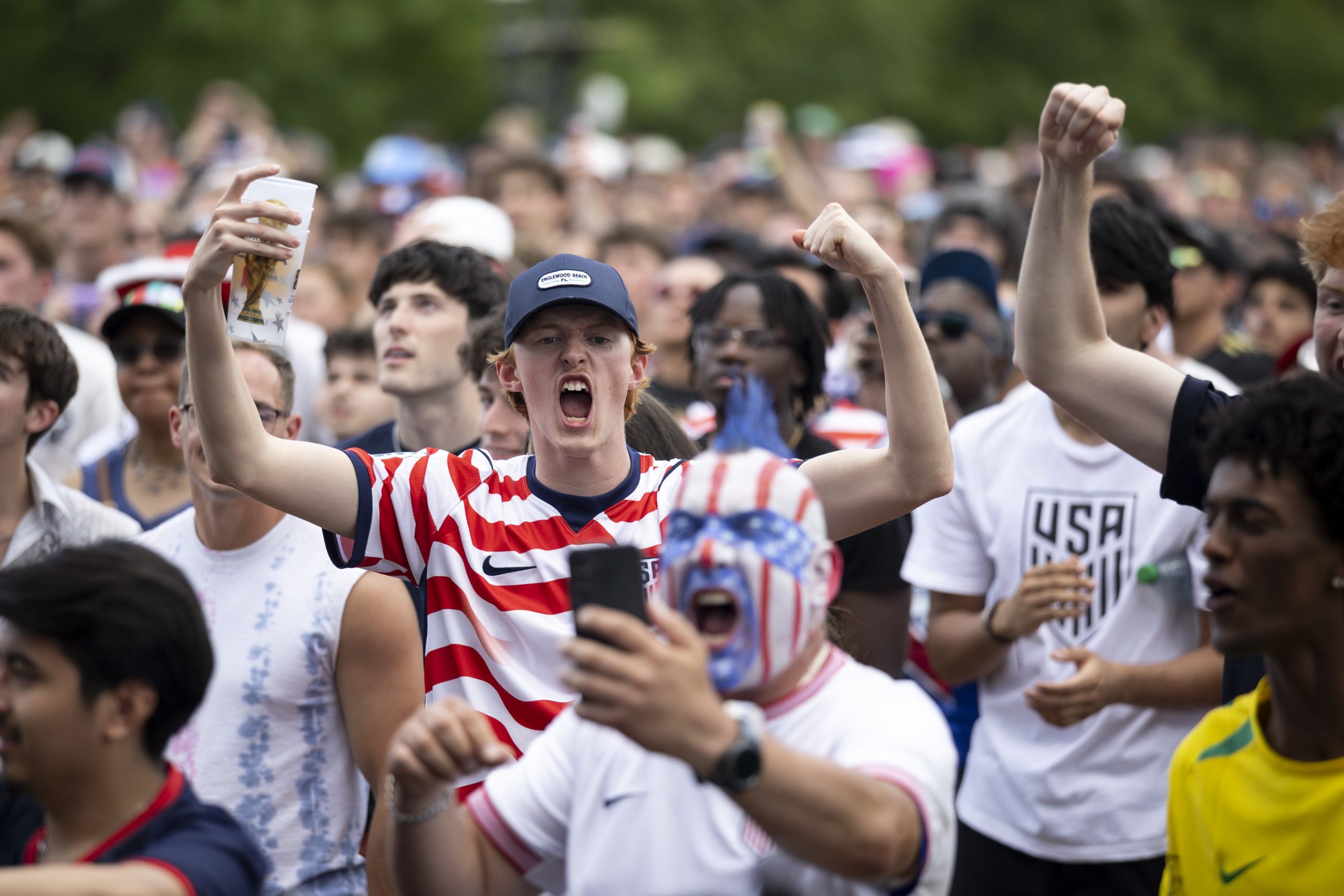
Cam Gorman, 23, of Gilbertsville, Pa., cheering with Philly Sports Guy Jamie Pagliei (front, center) at the FIFA Fan Festival in Lemon Hill as the U.S. beat Australia on Friday.Tyger Williams / Staff Photographer
Here at home, you can try to equate the fervor to the Eagles winning it all in 2018, and then again in 2024, but it’s a different vibe, because this isn’t about wins or losses. To many fans, this is about the sheer joy that having the sport in their backyard has delivered.
It feels like the reprieve America needed, and Philly’s place in all of it has not gone unnoticed.
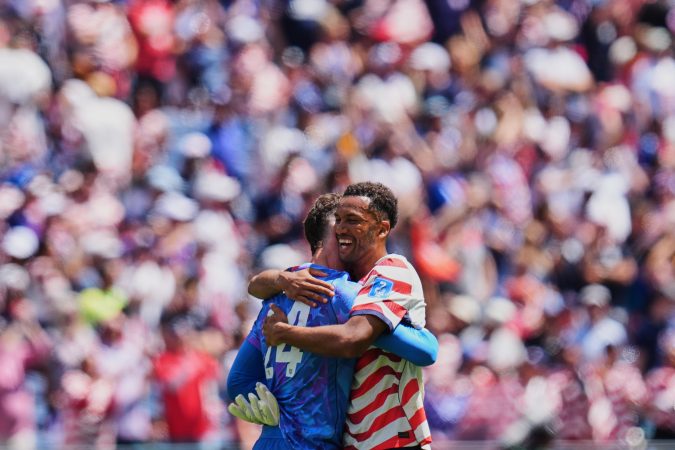
SEATTLE — At the final whistle of the U.S. men’s soccer team’s 2-0 win over Australia on Friday, Auston Trusty walked over to Matt Freese to offer a big hug.
They didn’t know that a photographer from the Associated Press was standing nearby to capture the moment. But soon enough, everyone found out.
“He came over to me and said, ‘Two Delco-heads just had a shutout in the World Cup together. That’s fate,’” the Wayne-born Freese said after his shutout in net. “And I laughed and I said, ‘Yeah, who would have thought?’”
Perhaps Jim Curtin, or other coaches across the Union ranks who worked with the duo over the years. But not too many people beyond Chester, or Wayne in those days, since that was YSC Academy’s first home.
“It’s obviously such a cool thing to have known him for so long, and I knew him outside of the soccer world too,” Freese said of Trusty. “We were just friends. So it’s incredible.”
That wasn’t the only karmic coincidence of the day. Trusty made his World Cup debut in front of not just his wife, daughter, in-laws and cousins, but also two of his first youth soccer coaches with the old Nether United club in Nether Providence, Delaware County: Tor Hotham and John Waraksa.
Like so many people around American soccer, they circled this day in this soccer-mad city and decided they had to be there. The reward was beyond measure.
“To have them fly here, not knowing if I’m going to play or not, to come here and be here for this game where I actually make my World Cup debut, it’s just all meant to be,” Trusty said.
The Media native beamed with pride again when he reflected on finally reaching this moment at age 27, 11 years after going to an under-17 World Cup with Christian Pulisic, Tyler Adams, Alejandro Zendejas, and Haji Wright.
“When you’re a little kid, dreaming about the stadiums you play in and the atmospheres and everything involved, to play in a home turf World Cup, get minutes, it’s a dream come true,” Trusty said.
Freese had his family in attendance too, plus his girlfriend’s family, and old friends from high school at Episcopal Academy. He shouted out one of the closest, Michael Hinkley, a soccer teammate back then who went on to play basketball at Dickinson.
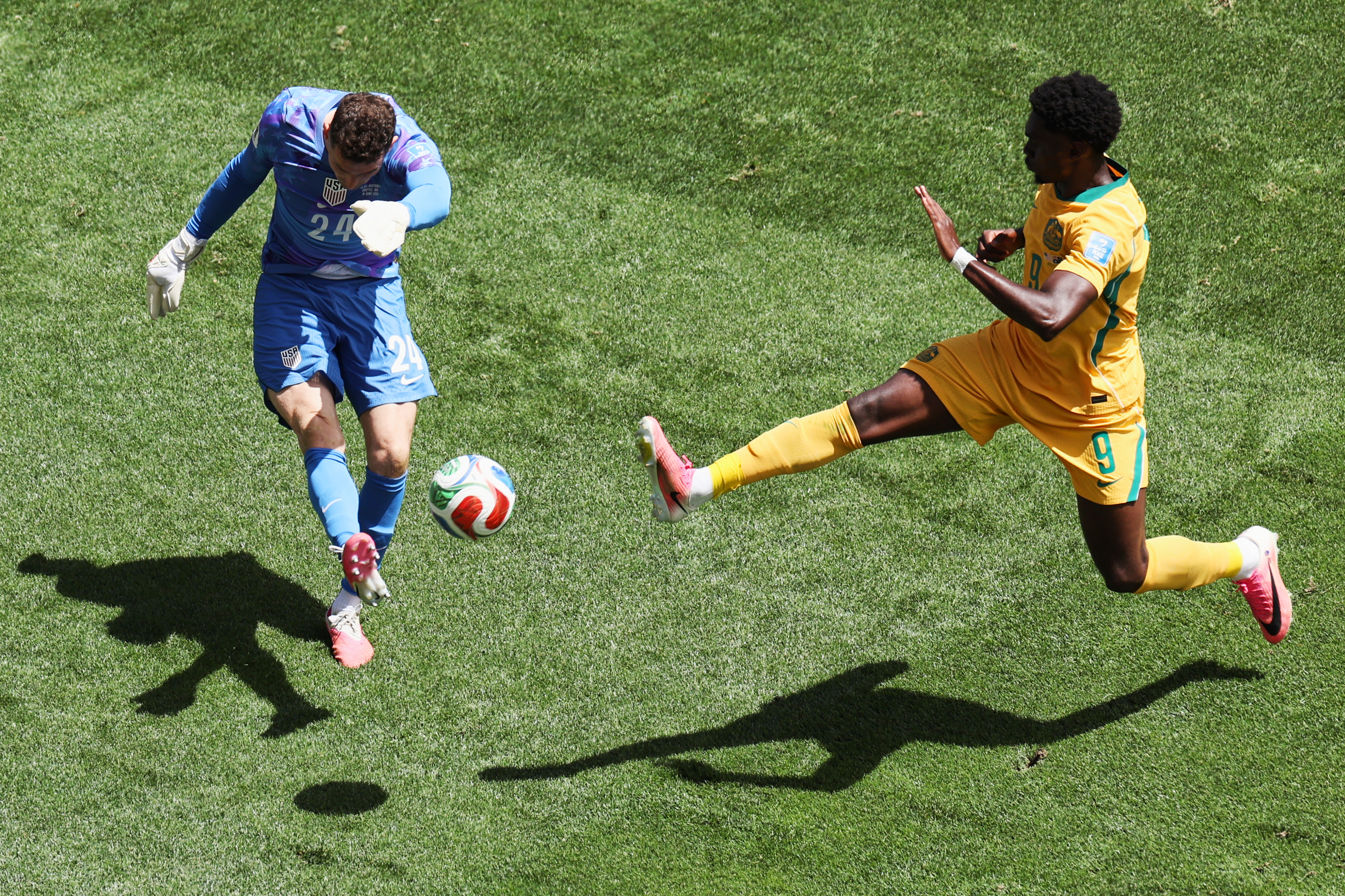
Matt Freese (left) clearing the ball in front ofAustralia’s Mo Touré during the first half.Maddy Grassy
“Obviously incredible support,” Freese said. “It means a lot to play in front of them, and play in front of everyone in this country.”
That support fueled the U.S. team all day, with the stands full and roaring well before kickoff. Trusty said the atmosphere “gives you chills,” especially when the crowd sang The Star-Spangled Banner over the orchestral rendition on the speakers.
“The atmosphere is one of those things you dream of,” Freese said. “I’ve heard ‘the 12th man’ is what they call the crowd here. It was definitely a 12th man for us — I think it was a 12th, 13th, 14th, 15th man for us today.”
But things were getting dicey when Trusty and Joe Scally entered the game in the 80th minute as defensive reinforcements. Australia was gaining momentum even though it hadn’t scored, and an already physical game was getting even more fractious.
Auston Trusty (left) tussling with Australia’s Cristian Volpato.Lindsey Wasson
It got especially chippy in the last few minutes, but those two and the rest of the Americans kept their heads and finished the job. They did so at both ends, ensuring Australia didn’t score while also keeping a foot on the gas pedal in attack.
“Just keep the pressure up,” Trusty said. “They weren’t really pressing too much, they kind of had like a halfway-block [formation], and obviously in a back five [defensively], they want pressure on them. So just continue the press that we had and the movement we had, and really just keep momentum.”
Mission accomplished on all counts. Not only did the U.S. men qualify for the knockout rounds before the group stage finale against Turkey, but the program has two wins in one World Cup group stage for the first time since the inaugural tournament in 1930. And thanks to Turkey’s loss at the end of the night, the U.S. clinched first place with a game to spare.
“We came into the tournament wanting to make a statement,” Freese said. “The first part of that’s done, but, you know, there’s a lot more statements we want to make.”
The United States’ dream start to the FIFA World Cup continued with a 2-0 win over Australia in Seattle that secured the Americans’ place in the knockout round.
Fans in Philadelphia packed the FIFA Fan Festival in Lemon Hill on Friday to take in the match.
The crowd on hand for U.S.-Australia, the first World Cup match of the day on Friday, was in favor of the Stars and Stripes, but Haitian and Brazilian fans took in the spectacle before their squads’ scheduled meeting at Philadelphia Stadium (8:30 p.m., Fox29).
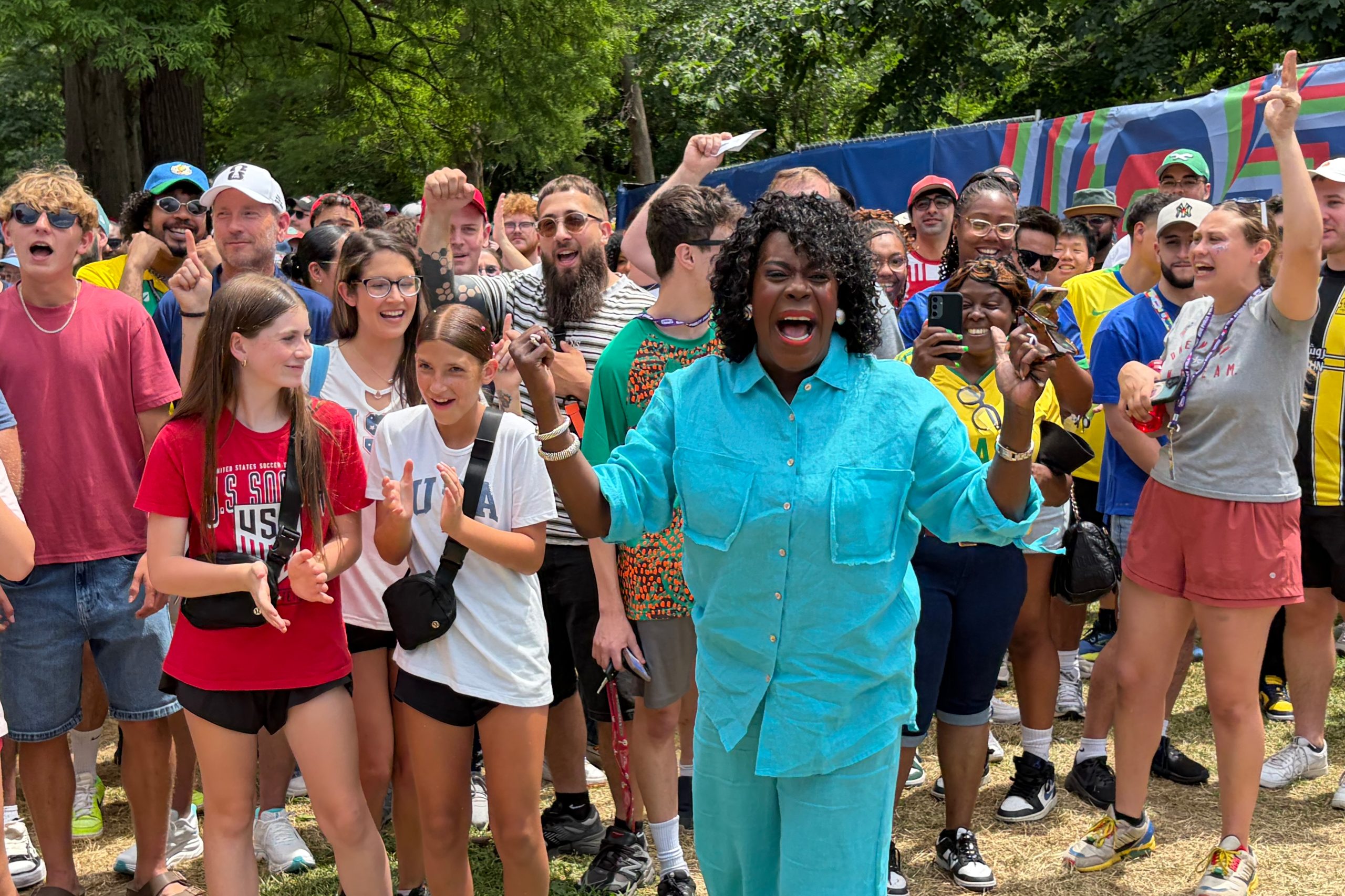
Mayor Cherelle L. Parker helped open the gates of the fan festival before the USMNT’s clash with Australia.
Parker walked into the crowd waiting at the festival’s main gate and posed for photos with fans waiting in line, including one with a group of traveling Scottish supporters.
Parker said she was appreciative that fans are showing up to the city and the festival “authentically, as themselves.”
“We are a global culture, and we are one people,” Parker said. “What makes America and the world so amazing, is that all of us, no matter the fabric, no matter the patchwork in our quilt, we make up a global humanity, and an American community that’s representative of everyone. I’m excited about it all.”
Philadelphia Mayor Cherelle L. Parker at the opening of the FIFA Fan Festival.Owen Hewitt / Staff
After greeting fans waiting to get into the festival on Sedgley Drive, Parker greeted a few vendors inside the festival. She stopped at the Bank of America tent to make a bracelet — she chose a black band with all the Philly-specific charms and a World Cup trophy charm — then stopped into the FIFA store on the festival grounds.
With the help of a few store associates, Parker picked out some kits and World Cup merchandise, including both Brazil jerseys, a sea foam France away jersey, a yellow Curaçao jersey, two World Cup logo shirts, and a stripes U.S. jersey.
Parker said she’s enjoyed seeing soccer fans out and about in the city.
“We were on the parkway, and Brazil was turning it out and up,” Parker said. “Everywhere we’ve been, they’re like, ‘Philadelphia is beautiful, the experience is great.’ You can be a visitor one time, but they’ll feel Philadelphia.
“You have to feel the energy here. We are not like any other city in the nation. There is something special about Philadelphia, and being able to share that Philly-ness with the world is something really exciting.”
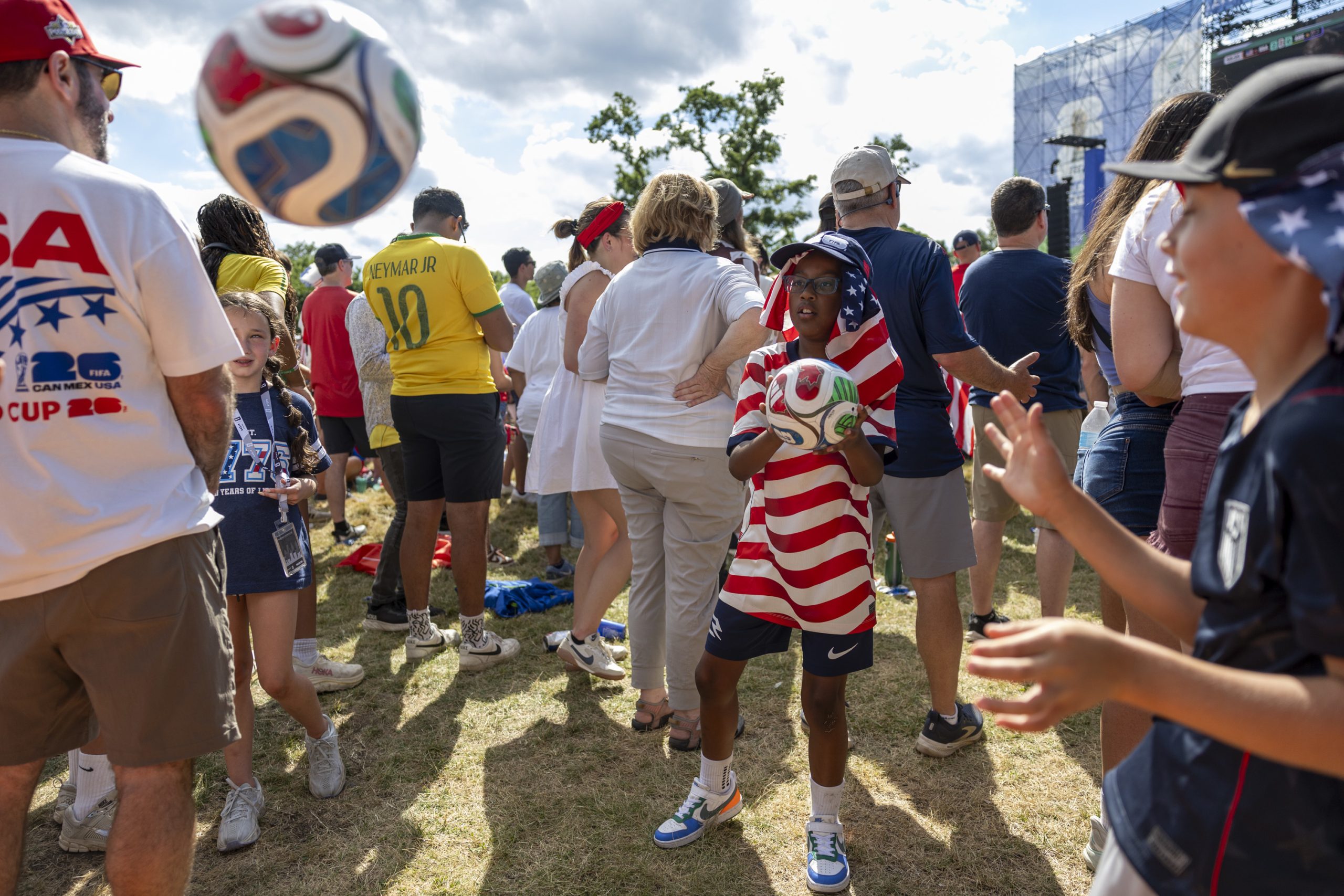
Moses Bango, 8, (center), playing with his friends Rudy Townsend, 8, (right), and Quinn Medaglia, 9, (left), at the FIFA Fan Festival at Lemon Hill Park on Friday.Tyger Williams / Staff Photographer
Early arrivals
A line to enter the festival had already formed an hour before it opened to spectators at 2 p.m.
Friday was the first time a U.S. match coincided with a match being played in Philadelphia, making the fan festival a watch party for American fans and a prematch hangout for Brazilian and Haitian fans.
The festival is free to the public with registration, but only 15,000 people can be on the festival grounds at once.
The festival did not reach full capacity during the U.S. match, but it got close. Festival organizers said attendance peaked at 14,000.
According to the festival, more than 100,000 people entered its grounds in its first three days of operation.
Gus Sanchez, who stood near the front of the line on Friday afternoon, said he and his family arrived around noon after biking over from Northeast Philly.
Sanchez said he wanted to watch the U.S. men’s team take on Australia with a crowd, leading him to come over to the festival.
“It’s something I can’t explain,” Sanchez, 53, said. “Seeing people from different countries getting together, having fun, enjoying the game.”
Most of the fans waiting to enter the festival were wearing U.S. garb, but fans of Haiti, Brazil, and even Scotland, which kicked off with Morocco at 6 p.m., were represented.
Alex Nelson said he traveled from Prestwick, Scotland, about 30 miles south of Glasgow, to the U.S. to experience the environment of the World Cup.
He arrived in Philadelphia from Boston, where the Scots played Haiti last Saturday, to take in Scotland-Morocco at the fan festival on Friday.
Nelson, sporting a tartan kilt, said he’s loved his time in Philly so far.
“Very clean city,” Nelson said. “Everybody has been so helpful. Everybody’s mixed in — the Brazilians, the Moroccans, USA, all mixed. That’s what it’s all about.”
Alex Nelson poses with his wife before entering the FIFA Fan Festival on Friday afternoon.Owen Hewitt
Match moments
The lively crowd had plenty to celebrate, as the U.S. went up, 1-0, after Cameron Burgess knocked in an Australian own goal in the 11th minute.
The crowd erupted as the States took the lead, with chants of “U-S-A” following a frenetic celebration.
The crowd at the Fan Festival goes wild as the U.S. goes up, 1-0, on an Australian own goal.
American fans celebrated again as Alex Freeman doubled the States’ lead with a goal in the 43rd minute.
Their celebration was placed on a temporary hold, as the goal was called offside on the field and disallowed, but after a Video Assistant Referee check confirmed Freeman’s goal counted, the crowd got another opportunity to cheer.
Double celebration for Alex Freeman’s goal to put the U.S. up 2-0 before the half — once before the VAR, and once after
Fans looked on nervously as Australia angled to get back into the match in its final 20 minutes, and they shouted when the game got chippy in its closing moments.
The U.S. is through to the knockouts, and the crowd at the Fan Festival is loving it:
SEATTLE — It turned out that the U.S. men’s soccer team didn’t need Christian Pulisic to beat Australia, and make history in doing so.
With the star playmaker unable to shake off a calf injury, the Americans used two first-half tallies and a raucous atmosphere in Seattle to earn a 2-0 win, before a packed-to-the-roof crowd of 66,925.
The win clinched qualification for the knockout rounds, and marked the first time since 1930 that the U.S. men’s program has won two games in a World Cup group stage.
U.S. manager Mauricio Pochettino started Ricardo Pepi in the open lineup spot, leading to a tactical change. The Americans rolled out a 3-5-2 formation, with Pepi and Folarin Balogun paired up top.
It didn’t take long for that to pay off. In the 11th minute, Antonee Robinson sprung Balogun down the left flank. He ran almost to the end line, then laid a pass into an onrushing crowd that included Pepi, Sergiño Dest, and three Australian defenders. The ball hit one of them, Cameron Burgess, and pinged into the net.
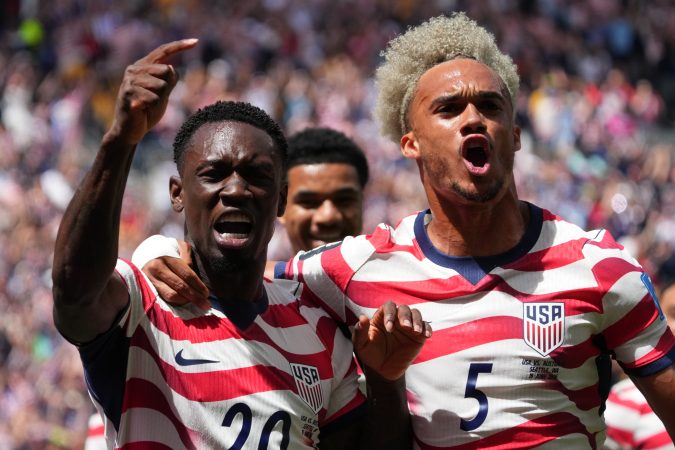
The statisticians at TruMedia noted this marked the first time in World Cup history that one team benefited from own goals in consecutive games, following the opening tally of the U.S.’ win over Paraguay.
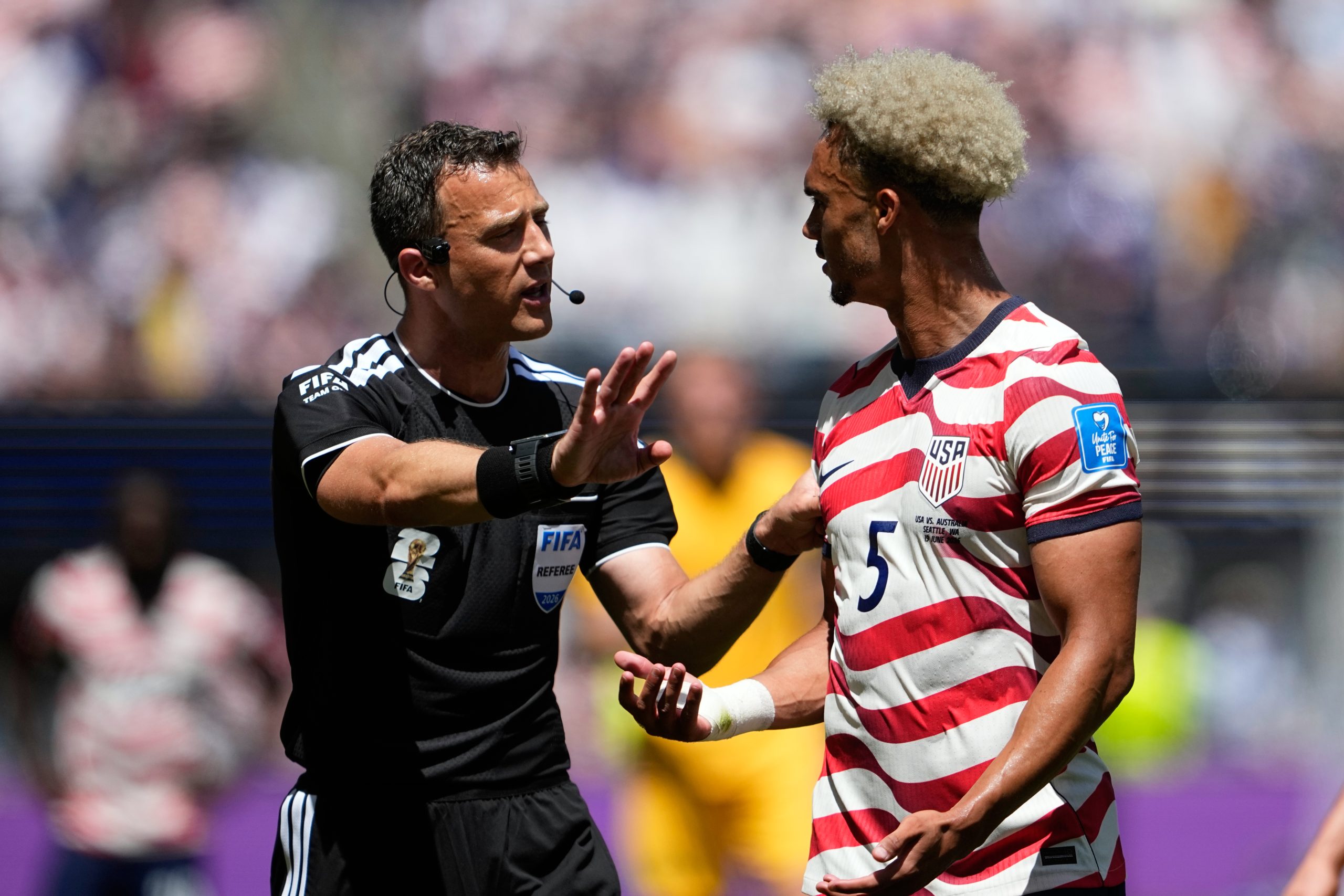
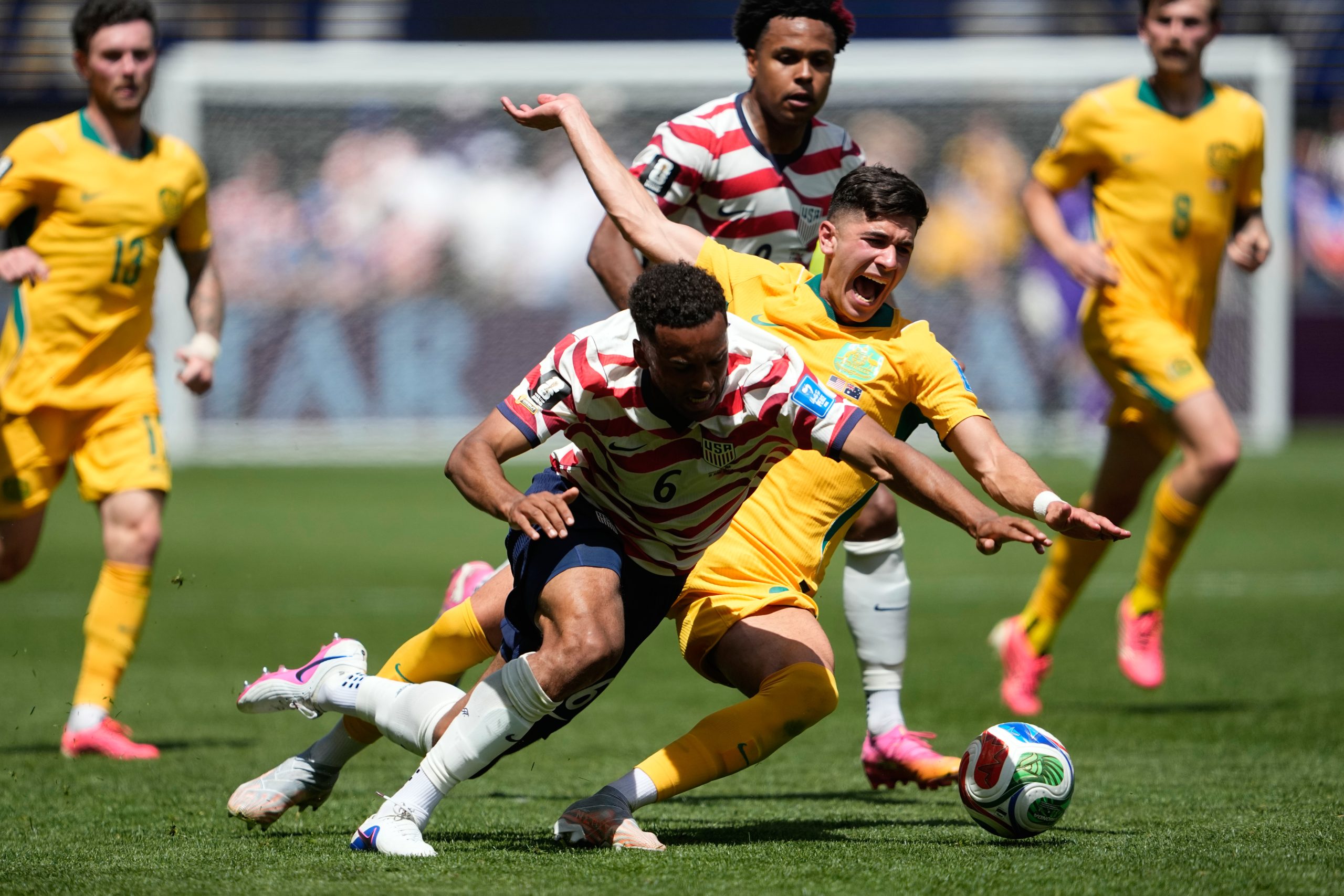
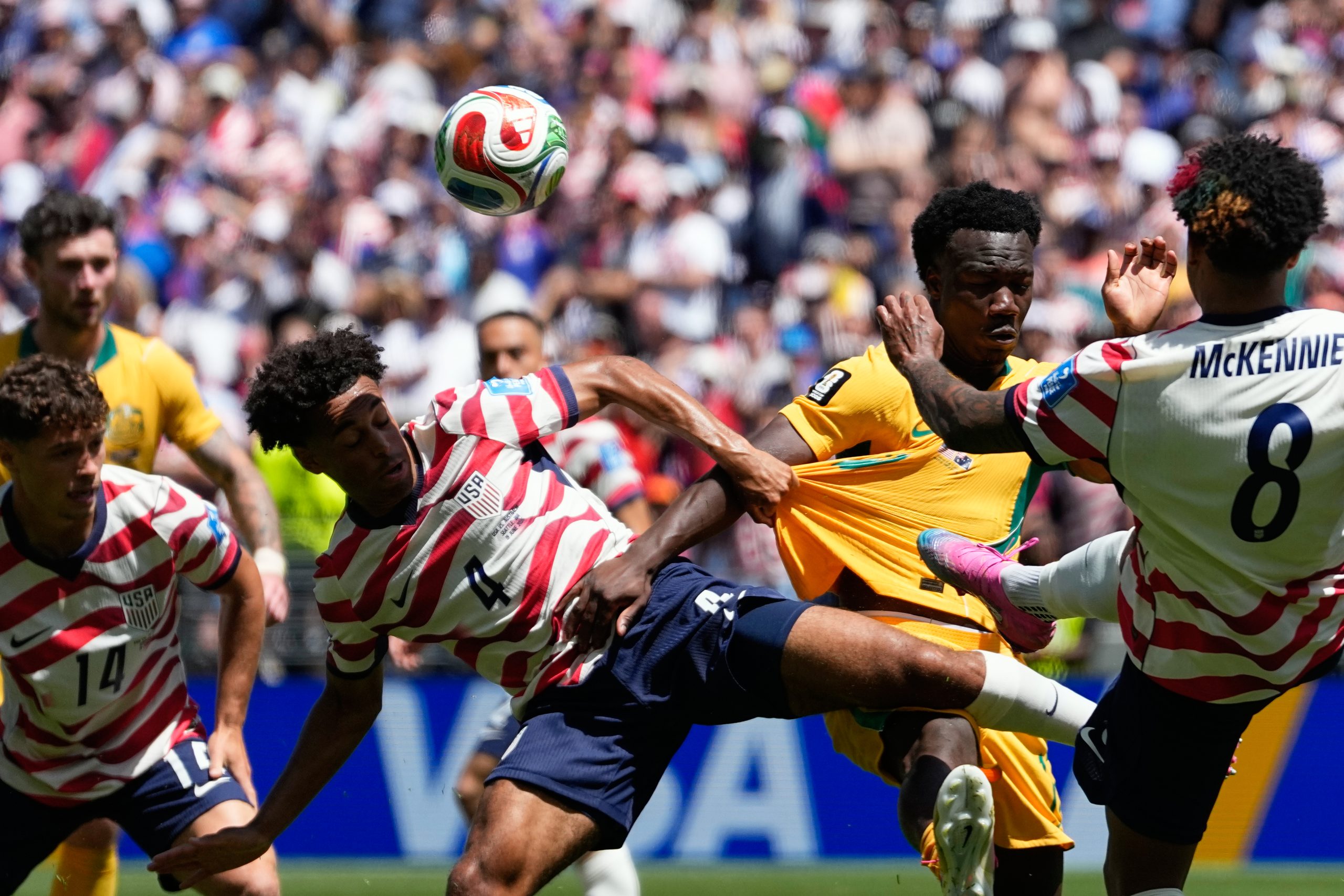
During the rest of the first half, the action was as physical as expected. Each team committed eight fouls in the period, and German referee Felix Zwayer left more potential ones uncalled. There were two yellow cards, for Jordan Bos’ tackle on Tyler Adams in the 16th minute, and Alessandro Circati’s hard hit on Malik Tillman in the 32nd.
The mood came to a boil in the 38th when Alex Freeman collided head-to-head with Paul Okon-Engstler, and both players stayed down for a while. Fortunately, neither had to leave the game.
The Americans got their second in the 43rd, and in controversial fashion. After Dest and Tillman combined to draw a foul on the right wing, Robinson served the free kick wide to Dest at the top of the 18-yard box. He ripped a shot that hit the crowd, flew up in the air, and Freeman jumped to head it past Matt Beach.
The controversy was that the flag was up for offside, and it sure looked at first like there was good reason. Balogun and Weston McKennie were indeed off when Dest shot. But Freeman wasn’t, and since Balogun didn’t touch the ball, the video review officials called it a good goal.
Australia manager Tony Popovic admitted how deep a hole his team was in by making three substitutions at halftime, including taking out Burgess. Another, replacing striker Mohamed Touré with Nestory Irankunda, raised the question of why Irankunda surprisingly hadn’t started.
Popovic had another complaint in the 63rd when Adams, who was risking a suspension for yellow card accumulation, knocked Connor Metcalfe over in the box off the ball and it went uncalled.
This was the start of the Socceroos gaining momentum, and Wayne’s Matt Freese was forced into his first proper save of the day in the 65th. A few seconds later, Chris Richards shoved Irankunda outside the box as Freese was charging off his line toward them, Zwayer didn’t blow his whistle, and Popovic was angry again.
Pochettino finally made his first substitution in the 74th, sending in Sebastian Berhalter for Pepi and taking the U.S. back to a one-striker setup.
Tyler Adams (left) and Weston McKennie (right) battling with Australia’s Nestory Irankunda during the second half.Lindsey Wasson
The crowd might have preferred hometown hero Cristian Roldan, and a lot of people wanted to see Adams taken off before picking up that feared second booking.
Instead, there were two other defensive substitutions in the 80th: Joe Scally for Dest and Media’s Auston Trusty for Robinson.
Tempers flared again in the 88th when Australia’s 6-foot-6 centerback Harry Souttar and Balogun got each other in mutual headlocks. There was a brief coming together of the teams, and both players were booked. Australia’s Jacob Italiano was also booked amid the scuffling.
As six minutes of stoppage time began, the crowd gave another hearty “USA!” chant. Then they had a brief laugh in the 93rd when Zwayer cramped up on the field, and needed some medical assistance. Players from both teams came over to lend a hand.
Pochettino then made two last substitutions, withdrawing Balogun for Haji Wright and McKennie for Gio Reyna.
SEATTLE — There was no surprise news about Christian Pulisic from U.S. men’s soccer team manager Mauricio Pochettino in his news conference before Friday’s game against Australia (3 p.m., Fox29, Telemundo 62). Pochettino did not rule the star playmaker in or out, and that was not surprising.
“As you know, he was training in an individual way the whole week,” Pochettino said. “But like always, I think tonight, the day before the game, we have a meeting with our medical area, and we will assess the whole group, the players, and tomorrow we will communicate all the things that we can agree tonight.”
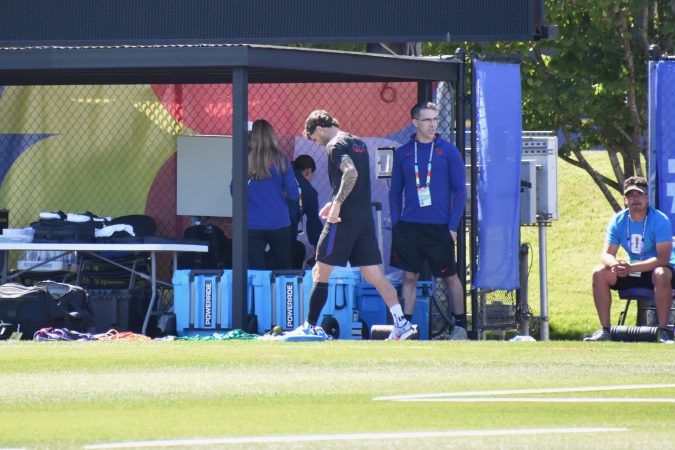
Pulisic was seen briefly at the start of Thursday’s practice, then headed off to work on his own. When he arrived, he wasn’t wearing the sleeve over his injured left calf that he sported on Wednesday. But after a few minutes, he sat down on a bench by the sideline and put it on.
“He is evolving, he is much better from [last] Friday,” Pochettino said. “I think at the moment we’ll see. … He’s doing a massive effort trying to be ready.”
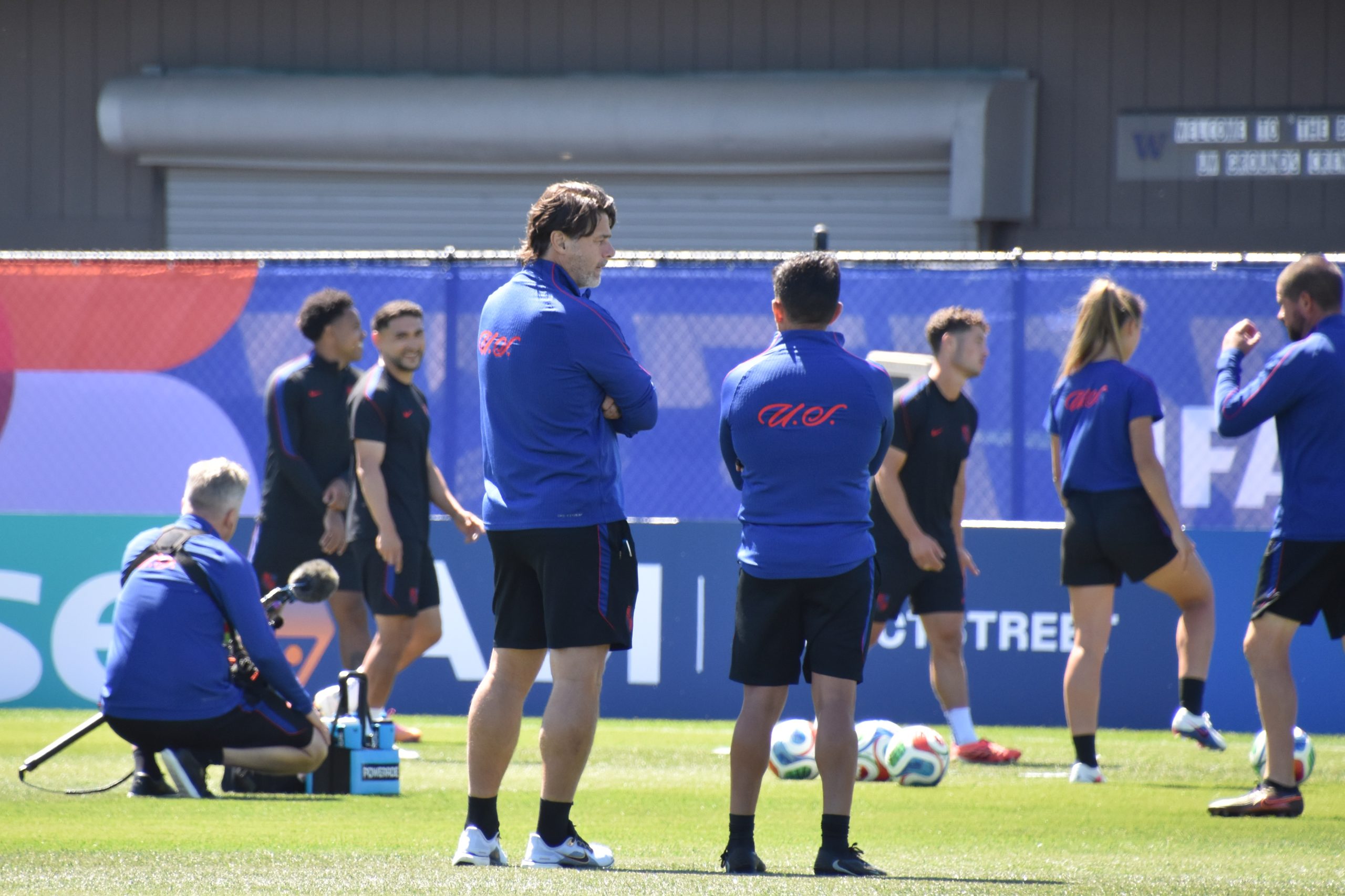
Mauricio Pochettino (left) and his top assistant Jesús Pérez at Thursday’s practice.Jonathan Tannenwald
The manager also praised Pulisic for being “strong and with a great mentality” as the Hershey native works to be ready for kickoff.
Asked who might play if Pulisic can’t go, Pochettino didn’t answer. This was no surprise either.
“I will tell tomorrow if that is the situation,” he said. “At the moment, we are evaluating all the possibilities just in case, and then we will decide when we have the confirmation in one or another direction tonight.”
What is no secret is that when these teams met in a friendly in suburban Denver in October, it was far from friendly on the field. Australia played a physical game, with a focus on Pulisic that forced him off the field injured in the 31st minute.
When Christian Pulisic (center) first appeared Thursday, he wasn’t wearing the sleeve over his injured calf that he wore Wednesday. He put it on later.Jonathan Tannenwald
All of the U.S. players are ready for round two, and so is the manager.
“I think we need to play on the edge of the line, not crossing the lines of the rules,” Pochettino said. “I think we are going to try, all, to be very close to this thin line. That allows us to take some advantage [with] the rules.”
Later in the day, Australia manager Tony Popovic was asked if he expects this game to be similar to the last. He didn’t answer directly.
“Since then we feel we’ve improved,” he said. “We’re a better team now than what we were in October and I’m sure the U.S. is as well.”
Popovic also was asked if he expects Pulisic to play.
“I’m sure he’ll play if he’s fit — he’s one of their best players, an outstanding footballer,” Popovic said. “We expect Christian to definitely play if he’s available, and if he’s not, we’ve looked at some of the players that have played when he hasn’t been there.”
Pochettino grew up in Argentina, played 20 times for his country (including at the 2002 World Cup), and like many Argentines is fiercely proud of his roots. So of course he was thrilled to see the Albiceleste start its World Cup campaign by routing Algeria, 3-0, with a hat trick from Lionel Messi — whom Pochettino coached at Paris Saint-Germain in the 2021-22 season.
“I am Argentino, and I really enjoyed the performance,” Pochettino said, quickly adding “but I’m going to give my life for the USA.”
He didn’t have to worry about offending anyone this time.
“I think it’s difficult to describe Messi,” Pochettino said. “Six World Cups, all that he achieved in his career in different clubs [in] collective and individual ways — woof. Is he the best? For sure, yes.”
(Not that he was ever going to answer with Brazil’s Pelé, Argentina’s foil for decades; or Portugal’s Cristiano Ronaldo, Messi’s modern foil.)
“Argentina is an amazing team,” Pochettino said of the reigning champions, noting his friendship with their manager Lionel Scaloni and some of his staff. “Lionel is, for me, the best coach today in this World Cup. … The fans — amazing.”
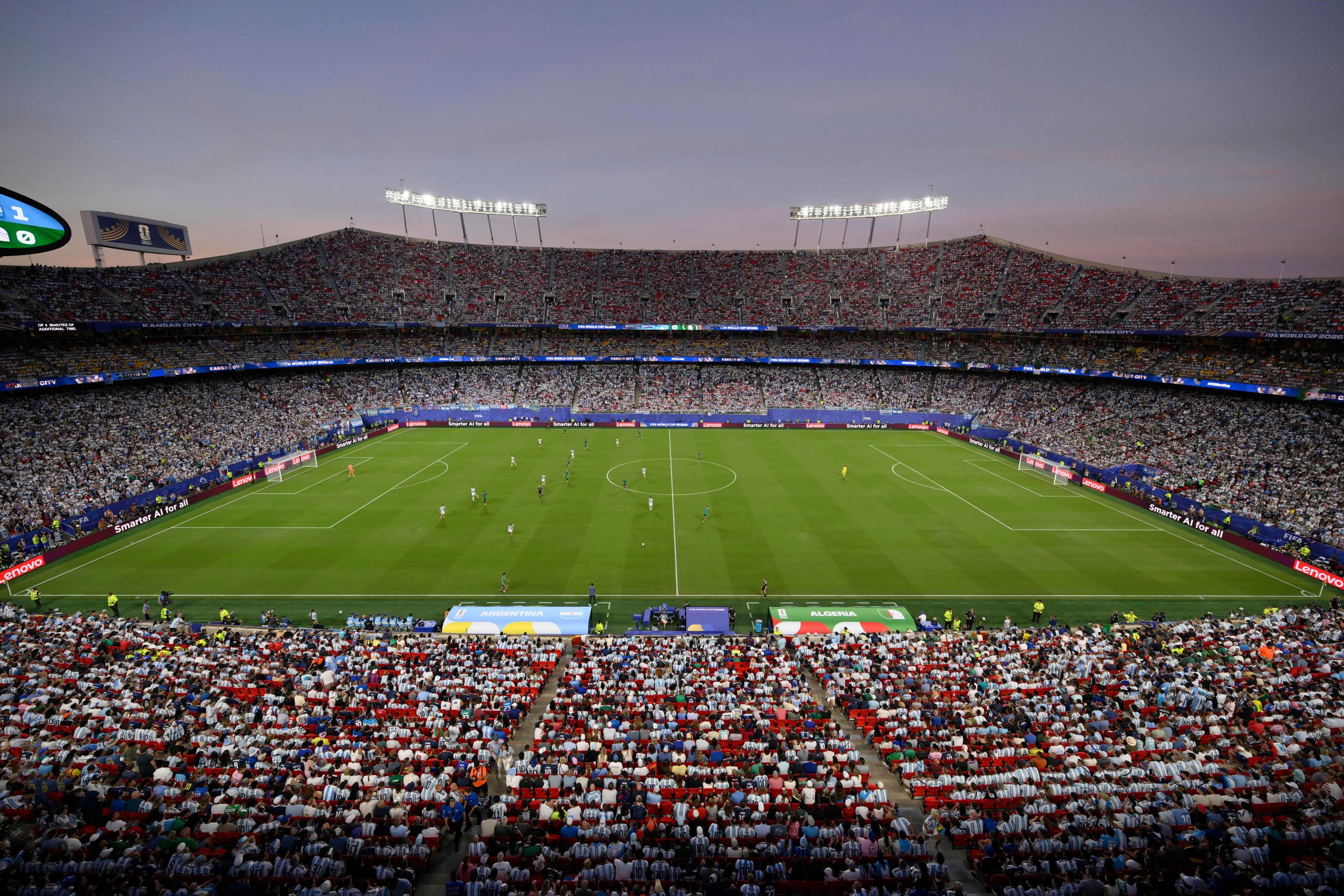
The packed crowd of Argentina fans in Kansas City on Tuesday.Reed Hoffmann
He paused there to make a gesture showing the importance of Argentina’s legendary fan base, that has filled stadiums to the brim for decades. Kansas City’s Arrowhead Stadium was the latest to see the show, as a full house roared into the night.
“And then the cherry [on top]? Messi,” Pochettino concluded.
This isn’t Pochettino’s first trip to Seattle. In 2014, his first game with England’s Tottenham Hotspur was a friendly against the Sounders at the same stadium he’ll work Friday.
“I saw the ambience and the atmosphere and the people, and I hear that they are very passionate people here,” he said. “I’m looking forward [to] tomorrow, to share all together a great night, I hope with a good result and good performance.”
The vibrant scene in Seattle as Fox’s studio show goes on air:
At one point during Thursday’s practice, Pochettino walked to the end of the field, then up a hill behind the net, took out his phone, and recorded a little video. What was that about?
He joked in the news conference that it was “to see how everything looks without me,” mocking Argentines’ reputations for big egos. He also joked that he was watching for spies, though that line fell a little flat in a sport where spying actually happens.
As it turned out, he was just taking a video for himself, with a view in front of him of Lake Washington and the facilities on a classically big-time American college campus. Though the U.S. team was only there for a short time, Pochettino appreciated the setting.
“It was amazing, beautiful facilities,” he said. “We know that they were working for months, only for us to spend maybe an hour and a half, two hours. … Thank you to the people that made it possible to have, in perfect condition, the field and all the facilities.”
SEATTLE — Like any sport, soccer is a game of players, tactics, skills, and decisions. But when it comes to emotions, no sport is like the world’s most famous one.
Not for nothing did soccer resist the long march of analytics far longer than increasingly-global basketball, baseball, ice hockey, gridiron football, and others. (Americans might not know cricket, for example, but that bat-and-ball game has its own volume of statistics.)
So, yes, we can talk about player matchups in Friday’s U.S.-Australia showdown for first place in Group D (3 p.m., Fox29, Telemundo 62). We can talk about the Socceroos’ impressive striker Nestory Irankunda and 6-foot-6 centerback Harry Souttar. And we can certainly talk about whether Christian Pulisic will shake off his calf strain in time.
But it’s impossible to avoid this moment’s romantic side. The Emerald City is rich with a half-century of soccer history, from the NASL’s Sounders to the MLS version, always drawing big and passionate crowds. In recent years, the NWSL’s Reign have joined them, with their own robust fan base watching stars of the women’s game.
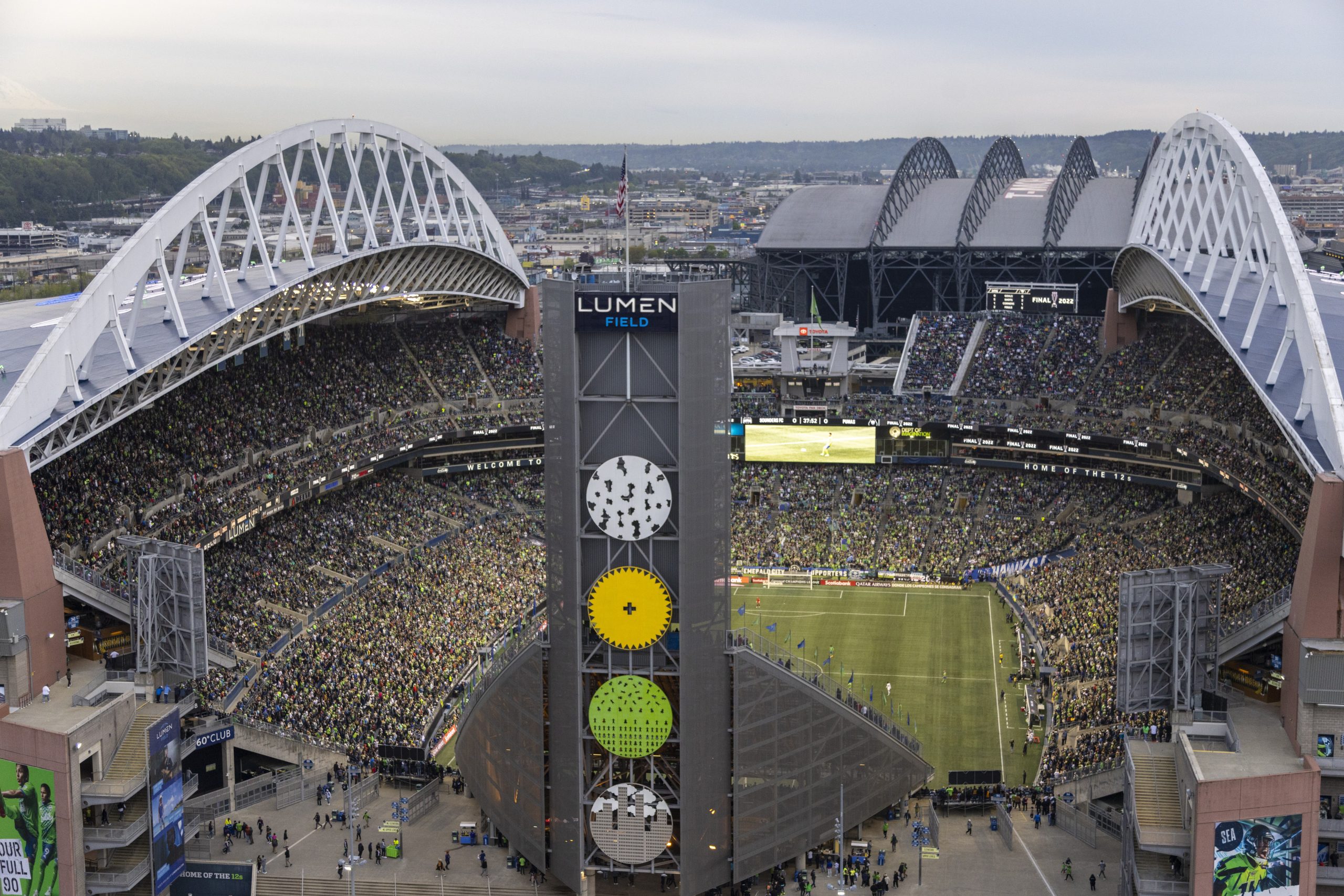
Seattle fans show up in big numbers for soccer games at Lumen Field, the home of MLS’s Sounders and the NWSL’s Reign.Seattle Sounders
Now, at last, that hole is filled, and with style. Since the day in early 2024 when FIFA announced the U.S. would play a group game here, Seattle has been counting down to this moment, and so have fans across the country.
A game in this city, with its stage towering over the south side of downtown, is a joy any time. But a World Cup game here is on American soccer’s bucket list. So it’s natural that U.S. and Sounders midfielder Cristian Roldan, in his 12th season with the only club of his career, has led the welcome committee for the squad.
Cristian Roldan (center) at work on his old college field during Thursday’s practice.Jonathan Tannenwald
“I’ve told them that the city is ready, that the city is energized,” he said before Thursday’s practice at the University of Washington, his alma mater — with its own famed sports theaters in football’s Husky Stadium and basketball’s Palestra-like Hec Edmundson Pavilion.
“We haven’t had a game here in a long time, and we’ve been desperate to host a World Cup game, a U.S. men’s national team game,” Roldan added. “So they’re going to feel the crowd, feel the energy, and it’s about feeding off it.”
He felt it even more as he set foot on his old college field, with glittering Lake Washington a stone’s throw away and Mount Rainier towering beyond. On the same day that Penn product Duke Lacroix returned to his alma mater in Philadelphia ahead of Haiti’s clash with Brazil on Friday, a similar scene unfolded thousands of miles west.
“I’m thankful to have this full circle moment,” Roldan said. “I don’t think people realize how special it is for me to be here and enjoying this experience with the men’s national team.”
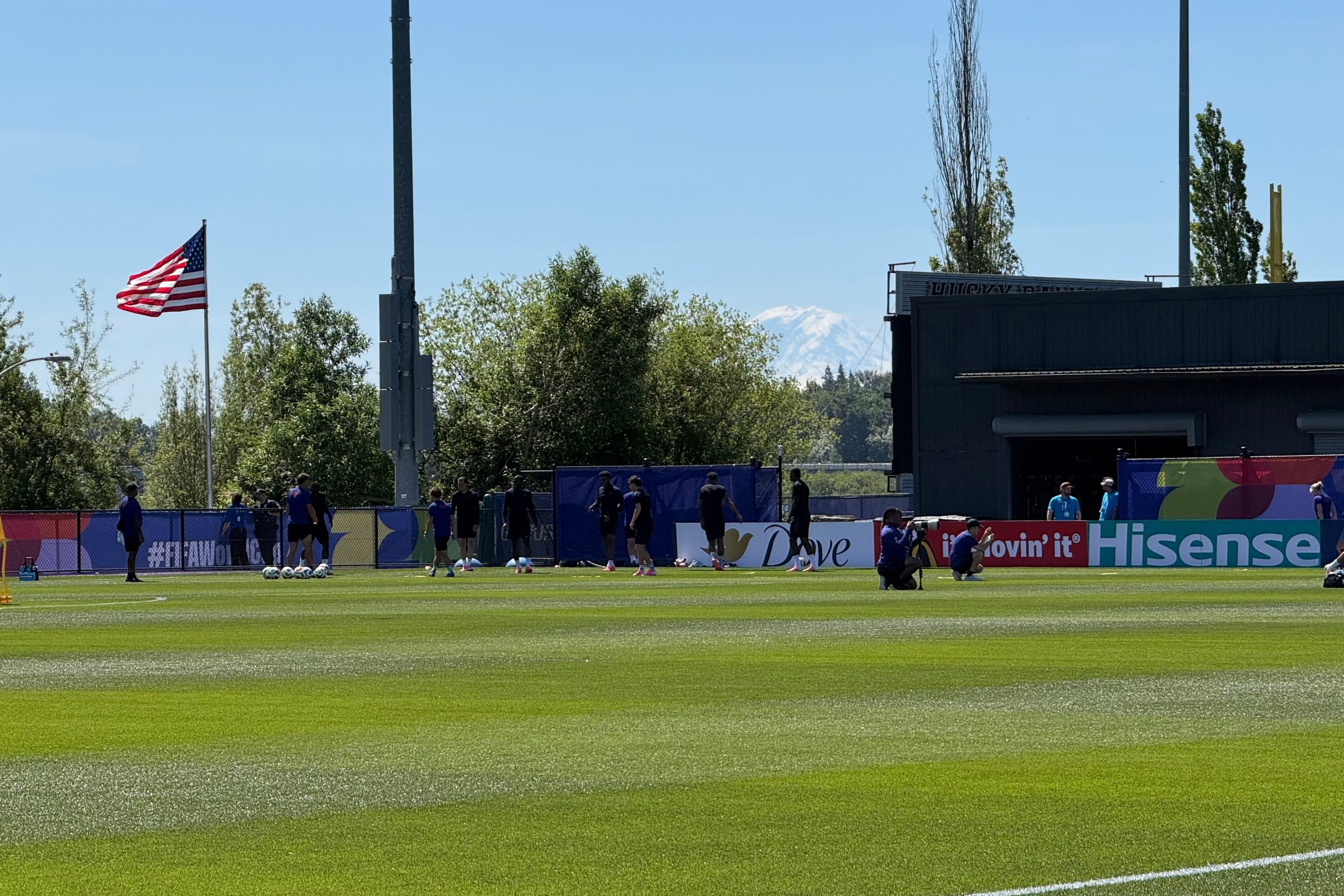
Mount Rainier looming in the background over the scene at the U.S. team’s practice.Jonathan Tannenwald
Come lunchtime, a walk through downtown showed what awaits. Fans in U.S. jerseys were all over, from Pike Place Market (Seattle’s version of Reading Terminal) to the glistening waterfront.
Fox’s studio show set up shop on one of the piers, with the ferries crossing Puget Sound as one backdrop and a boisterous crowd as another.
The players are excited to experience it, especially those who haven’t before. Because the stadium usually has artificial turf, the U.S. men haven’t been here since the 2016 Copa América Centenario, when grass was installed like it has been this summer. (The World Cup’s grass also helped bring the women’s team here in April, ending a nine-year drought.)
“I’ve obviously spoken to ‘Roldy’ and other people who’ve said how much of a soccer culture Seattle has, and I’m really looking forward to experiencing that firsthand,” defender Antonee Robinson said. “The first game that was played in that stadium looked amazing. So I’m looking forward to being a part of it, too.”
Roldan isn’t expected to start, and he knows it. But if he gets on the field as a substitute, the roar that rises will no doubt be as great as a U.S. goal.
“I’m getting goosebumps just thinking about it,” he said. “This is a place that I call home, and I’ve called home for a while. … I’ve given my heart and soul to this club. To be able to see the field would be a dream come true, and I think it would be special not only for me, but I think for the city of Seattle as well.”
With the United States exhibiting one of its best opening performances in the history of the men’s World Cup, expectations are high for the team’s second Group D match against Australia on Friday (3 p.m., Fox29).
Reports indicate that the U.S. men’s soccer team, which thumped Paraguay, 4-1, in its opener last Saturday, expects a physical affair against the Australians, who surprised many in their 2-0 upset of Group D favorites Turkey in its opener in Vancouver.
This game is a rematch of an uber-physical game last October that broke out into a few skirmishes and in which the Aussies attempted to bully the U.S.
Now, the pair are running it back. A win is another step closer to the U.S. winning the group or at least assuring a place in the knockout rounds. However, the Australians know that they could leapfrog the U.S. with a win and put themselves in the driver’s seat to win the group with a game remaining against Paraguay.
U.S. midfielder Sebastian Berhalter said earlier this week that head coach Mauricio Pochettino has the group in a “We’re American, we don’t take s—” mentality, which served the team pretty well against Paraguay.
How will it look against the Aussies?
Our group covering the World Cup and embedded with the U.S. camp in Irvine, Calif., weighed in and offered predictions.
I said this in my report from the U.S. camp on Tuesday, and I meant it: As great as the opening win over Paraguay was, it was just one game. I expect Australia to be a very different opponent, tighter defensively and more physical. Though the Socceroos’ win over Turkey was an upset, it was no fluke. It took just one game for Nestory Irankunda to justify the hype as a breakout star this summer.
It also was a physical contest when these teams met last October in a friendly in suburban Denver, one the U.S. came from behind to win 2-1.
No doubt both teams will be even more up for it this time, with first place in Group D at stake. So what will make the difference?
Christian Pulisic has been dealing with an injury but is expected to be available for the game against Australia. Jonathan Tannenwald
I’ll be romantic for a moment and say the atmosphere in Seattle is worth at least one goal for the U.S. If you’re new to soccer or only watch European games, you’re in for something you might not have seen from the sport in this country.
For over half a century, Seattle has been one of the best soccer cities in this country. It will be electric for this game, which has been a bucket-list item for fans ever since it was first announced in February 2024 that the U.S. would play its second group game there.
World Cups are about players and tactics, but they’re also about emotions. This will be a moment for that.
The beauty of this one is that, like Paraguay, the core group of this U.S. men’s national team was on the field when they beat the Australians in that October friendly. Haji Wright scored twice. Chris Richards was there. So was Weston McKennie. Even Christian Pulisic, before he suffered a minor hamstring injury and left midway through the first half.
The point is, having that match so close to the World Cup feels serendipitous. Australia is big, strong, and has goal scorers, but I’d give the edge to the U.S. for more creativity and skill, specifically up top.
They’ll need to keep an eye on Connor Metcalfe, the Socceroos’ crafty center midfielder who plays for St. Pauli FC in Germany’s Bundesliga. Metcalfe’s vision was a catalyst behind many of Australia’s chances and he scored his nation’s crucial second goal against Turkey.
Come out flat, and the Aussies will make it a game. Come out as the U.S. did in the opener, creating one opportunity after another in the final third, and I don’t see a world in which the U.S. isn’t celebrating a win in front of a sold-out Seattle crowd.
I was talking to someone last Thursday when I told them I thought the U.S. was still a World Cup away from making noise. And then I watched them play like that on Friday night. I was in awe as the U.S. dominated Paraguay, playing like no American team I’d ever seen. It was beautiful. To me, it was the best performance in the history of American soccer. It felt like a hot take, but then people who have seen more than me all seemed to agree.
What we watched in the opener wasn’t a mirage. It was a byproduct of a U.S. system that is investing in youth development, a legitimate domestic league, and a team full of players who play for top-flight clubs led by a wizard-like manager. You’ll hear a lot about 2002 before Friday but remember that the 2002 team started just five players in the upset of Portugal who didn’t play in MLS. On Friday, the U.S. lineup included just two MLS players. The talent is just so much deeper, and it showed against Paraguay. This was different.
Friday felt like the start of a magical summer. The ride will continue against Australia, who won’t be able to beat the U.S. playing the way it did against Turkey. The Socceroos upset Turkey despite being outshot, 30-9. They parked the bus, and it worked. It won’t against the U.S., which are far more creative up front than Turkey. The U.S. will not be shut out if it takes 30 shots on Friday afternoon.
Christian Pulisic looked like a man on a mission in his 45 minutes, and he seems on track to play Friday, Tyler Adams was excellent in the midfield, Malik Tillman made some fantastic passes, and the flight attendant who refused to let Folarin Balogun’s pregnant mother leave New York years ago might be responsible for a summer to remember. The U.S. no longer feels like they’re a “World Cup away.” Enjoy the ride.
The U.S. outperformed my optimistic prediction for its opener with a 4-1 thrashing of Paraguay on Friday. It was a dream start for the American side, but as Jonathan Tannenwald wrote on Tuesday, the win only matters if the U.S. can follow it up with two more quality performances in group play.
Can the U.S. contend with a fierce Australian side that surprised the rest of Group D with a 2-0 win over Turkey? It should be able to, though that task will get more complicated if Pulisic, nursing his hamstring, isn’t fully healthy.
The USMNT will need to be vigilant when defending counter attacks, as Australia was brilliant on breaks in its opening match.
Pulisic or not, one of the States’ plethora of talented attackers will break through the fierce Australian low block that stymied Turkey, and the defense will hold up in transition to put the Americans atop Group D.
The U.S. is bound for a bit of a letdown after their high-flying victory against Paraguay. One question I have is the health of Pulisic, who was pulled at halftime after being kicked in the calf. As Tannenwald reported, Pulisic is expected to be healthy for their matchup with Australia but trained mostly on his own Wednesday.
There’s also history to contend with. In 2002, the U.S. pulled off a major upset by defeating Portugal, but followed it up with a tie against South Korea in a hard-fought game they were lucky not to lose.
Thankfully, the atmosphere in Seattle will be terrific, and that will count for something. The U.S. will remain in first place in Group D following the game, but it won’t be because of a victory.