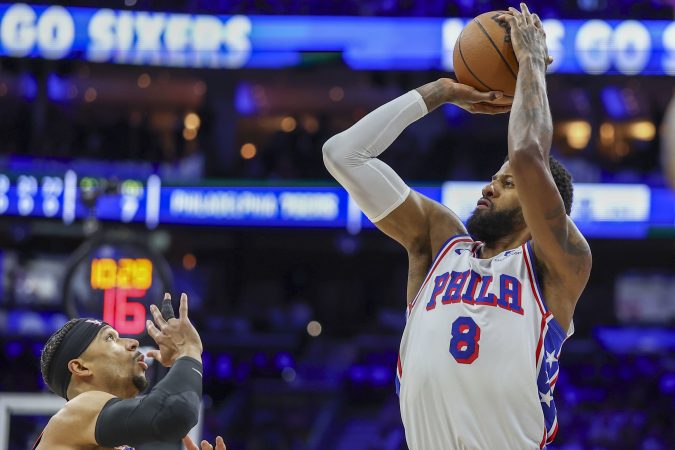
During a post-practice media session two days before Game 1 of the 76ers’ first-round playoff series against the Boston Celtics, Paul George was asked extensively about defending the wing tandem of Jayson Tatum and Jaylen Brown.
“Those two guys have won,” George said. “They’re mature. They’re experienced. … If we’ve got a shot to beat them, we’ve got to make it as tough as possible.”
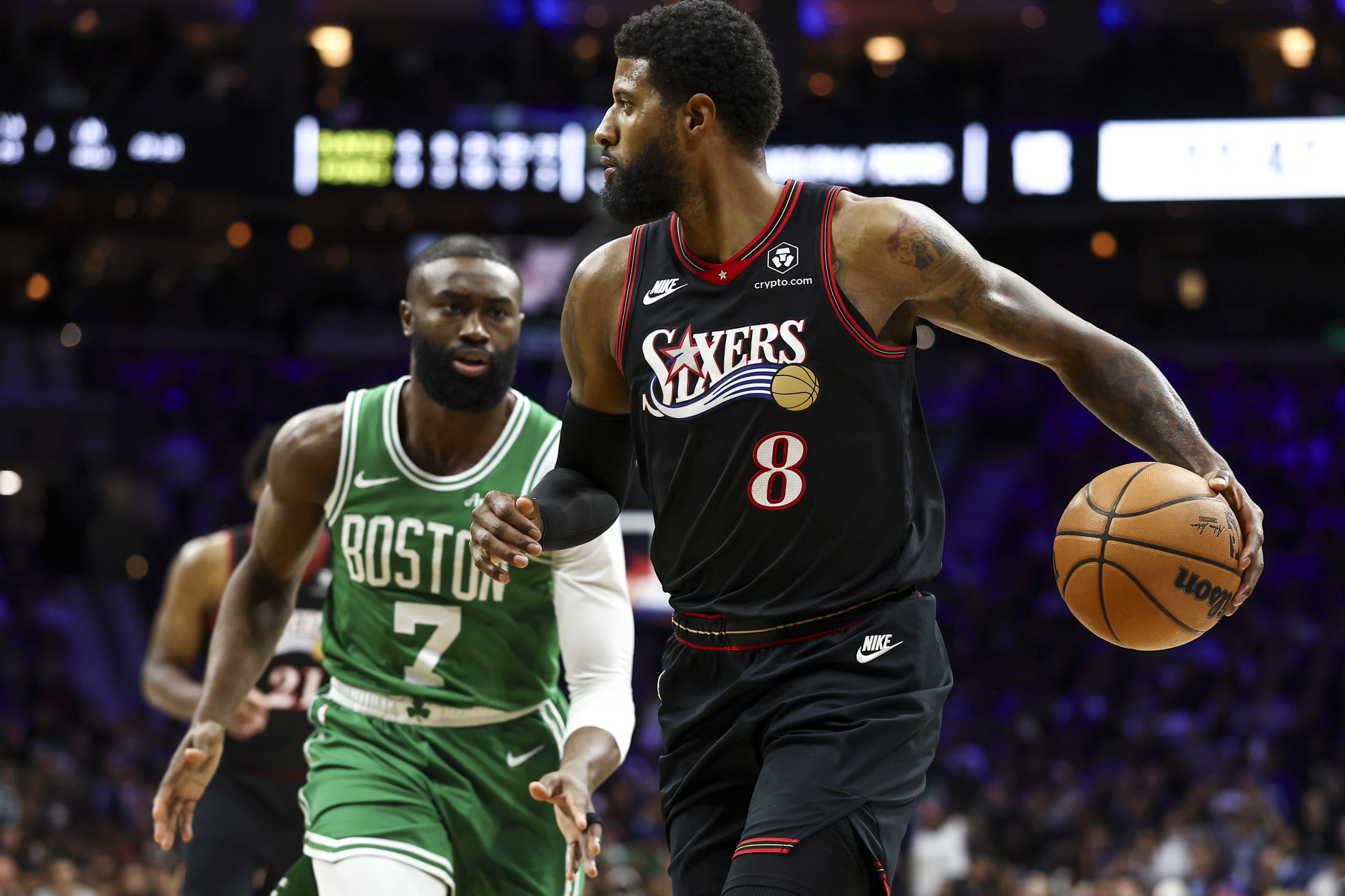
The veteran wing was instrumental on both ends of the floor in that stunning Sixers upset. Brown said as much on a Thursday night Twitch livestream, calling George’s performance “vintage” during that series. And more division-rival matchups between George and Brown are on the horizon — but in opposite jerseys.
George’s two-year stopover in Philly is over, after the Sixers on Wednesday agreed to trade him and four draft picks to Boston in a blockbuster exchange for the All-NBA wing Brown. George, once a perennial All-Star but now past his prime, will be remembered as the flashy free-agent signing in 2024 whose tenure here was regularly interrupted by injuries and suspension.
Much hoopla surrounded George’s arrival, including stories of the Sixers’ brass dodging a storm on their flight to Los Angeles to woo him into agreeing to a four-year max contract after 2 a.m. Eastern time the first night of free agency. The Sixers deliberately cleared cap space — including asking ascending star point guard Tyrese Maxey to wait a year to sign his own max deal — in order to offer such a contract once Tobias Harris’ deal came off the books.
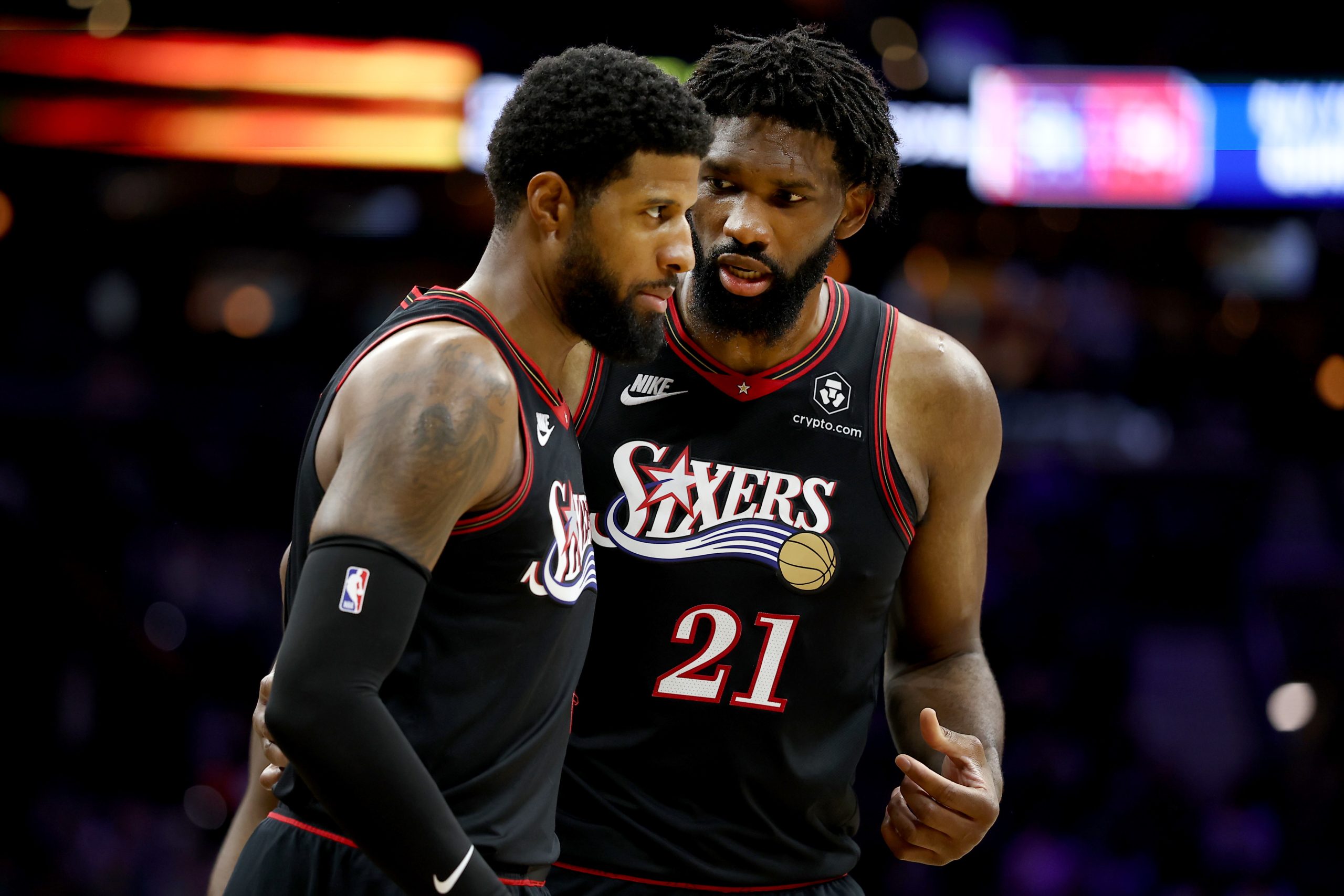
George revealed he had formed a “secret friendship” with fellow introvert Joel Embiid at league events such as All-Star weekend, adding context to Embiid’s nationally televised side-eye to George while on set together at the NBA Finals. Coach Nick Nurse expressed excitement in the clean “1-3-5” fit with Maxey at guard, George on the wing, and 2023 NBA Most Valuable Player Embiid at center.
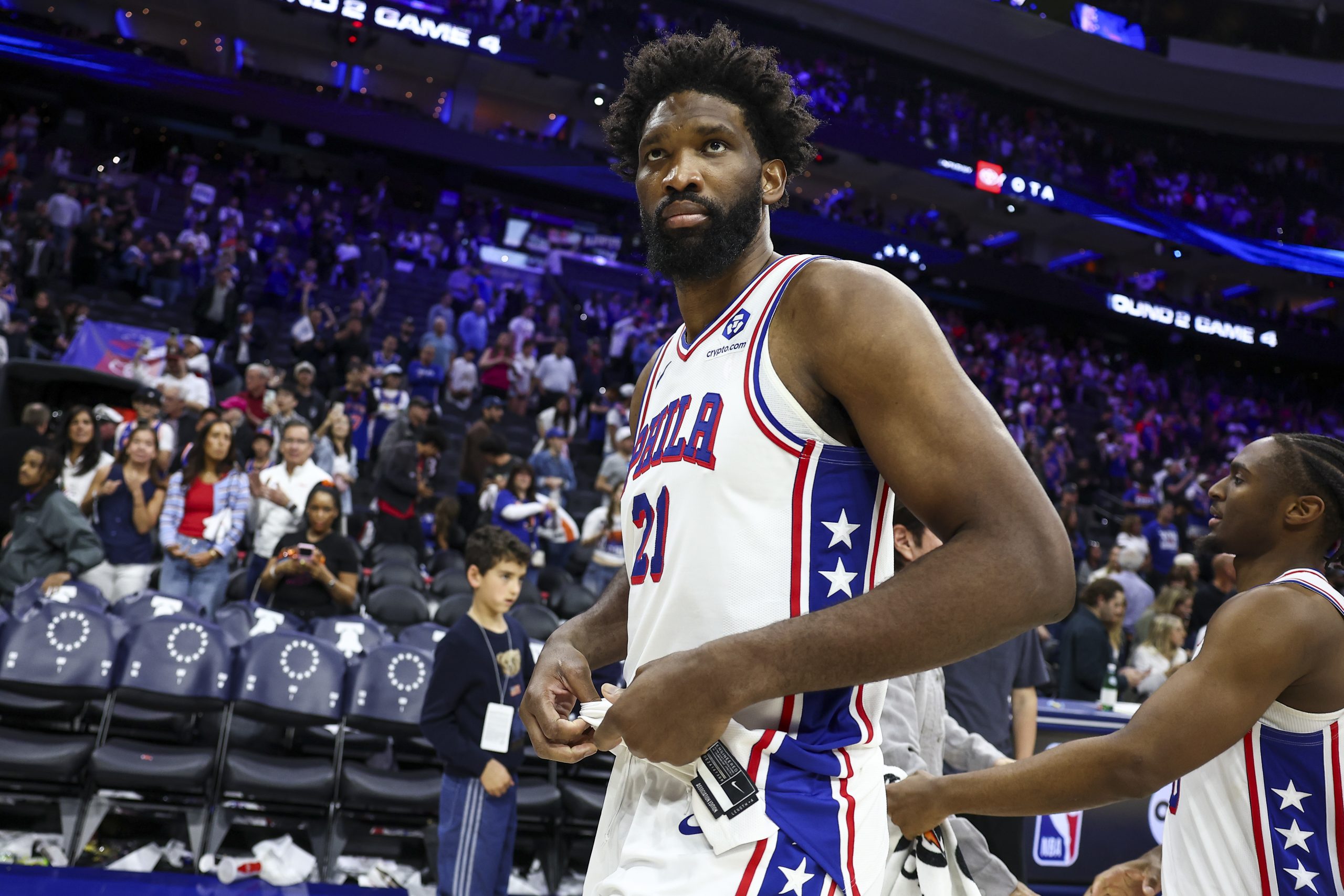
Paul George (left) and Joel Embiid rarely shared the court together over the last two seasons.Monica Herndon / Staff Photographer
Yet it was foreshadowing when George, who turned 36 in May, hyperextended his knee in a preseason game at the Atlanta Hawks in 2024. He went on to play 78 total games across two seasons with the Sixers, and only 36 with both Embiid and Maxey that yielded an 18-18 record.
At various points during that frustrating first season in Philly, George received painkiller injections in his pinkie finger, adductor, and knee to try and play. He visibly did not have the same burst to get past defenders which had previously helped make him one of the smoothest and versatile scorers of this generation. He sustained another knee injury during an offseason workout last July, prompting arthroscopic surgery and another delayed start to his 2025-26 season.
Then in January, George was abruptly suspended by the NBA for 25 games for violating the league’s anti-drug policy.
Interestingly, those weeks away may have helped George’s body heal and propelled him to a strong finish. He averaged 21 points, 5.7 rebounds, 3.3 assists, and 2.2 steals in the Sixers’ final 10 regular-season games, and shot a blistering 41.5% on 8.2 three-point attempts per game.
In that first-round series against the Celtics, George drew praise from Nurse and teammates for his stout play while the three-star Embiid-Maxey-George vision suddenly came to life. George added that he was finally “able to do things [on the court] that I was once able to do, again.” But during the New York Knicks’ second-round sweep of the Sixers, George started multiple games strong before his production fell off in the second half.
George, though, expressed optimism during his end-of-season news conference that he could have a “real summer of improving” his game instead of rehabbing an injury. The Sixers made a significant front-office change in replacing Daryl Morey with new president of basketball operations Mike Gansey, but it appeared they would be forced to run it back with their core because of the hefty salary committed across multiple seasons.
Jaylen Brown (left) and Paul George will remain division rivals next season, just in different uniforms.Monica Herndon / Staff Photographer
Perhaps Wednesday’s shocking trade is evidence that no contract is immovable.
News surfaced publicly that the Celtics had offered Brown to the Milwaukee Bucks as part of a trade package for two-time MVP Giannis Antetokounmpo before last week’s NBA draft. From the outside, it appears that, in the aftermath, the relationship between team and player became irreparable. And though the Sixers swapped one gigantic contract for another in the deal, Brown is more durable, in his prime, and coming off a season when he finished sixth in MVP voting.
George also is an example of the modern NBA’s more transient stars. This will be his fifth team — also including the Indiana Pacers, Oklahoma City Thunder, and Los Angeles Clippers — in a fantastic 17-year career. Before this stunning blockbuster, George had already been traded for future two-time MVP Shai Gilgeous-Alexander along with former All-Stars Victor Oladipo and Domantas Sabonis.
There has been a barrage of star-player moves already this offseason, including the Toronto Raptors reacquiring Kawhi Leonard, LaMelo Ball going from the Charlotte Hornets to the Minnesota Timberwolves, and Ja Morant moving from the Memphis Grizzlies to the Portland Trail Blazers. All of those have occurred via trade. That can be attributed to the new collective bargaining agreement and “apron penalties,” along with an overarching player philosophy to get lucrative contracts when offered as extensions by their current team and, if necessary, force their way to a new playing destination later.
When asked during his end-of-season news conference about how he felt about his time in Philly — a sports market known for harsh outside criticism for players who are perceived to not be living up to their contracts — George said, “My experience with the fans has been amazing, it’s definitely love here.” He posted a thank-you note to the Sixers and fans on his Instagram Thursday night.
Now, George’s choppy two-year stint in Philly is over.
Weeks before Giannis Antetokounmpo, LaMelo Ball, and Ja Morant were traded, Bob Myers understood the allure of a blockbuster move.
“Those are obviously things that look to appear to be the most meaningful,” said Myers, the president of Harris Blitzer Sports & Entertainment and former lead executive during the Golden State Warriors dynasty. “But it’s just one good decision at a time as far as change.”
That is the reality facing new 76ers president of basketball operations Mike Gansey, whom Myers led the search to hire, and the remaining front office as NBA free agency begins at 6 p.m. Tuesday. All-NBA third-team guard Tyrese Maxey ($41 million), along with former perennial All-Stars Joel Embiid ($59.5 million) and Paul George ($54.1 million), remain on max contracts accounting for nearly $155 million of the projected $165 million salary cap. And the latter two players are considered difficult to trade because of their age and recent injury history.
So the Sixers must again hope for better health with that top-heavy roster during the 2026-27 season, which could turn that flash from the playoff upset of the Boston Celtics into more consistency. Yet that postseason run, which ended in being swept by the eventual NBA champion New York Knicks, also exposed that the Sixers must bolster their depth, requiring shrewd around-the-edges moves with limited financial flexibility.
The Sixers already have begun to build their roster by drafting Alabama guard Labaron Philon Jr., in a potential first-round steal, and picked up the team options for Dominick Barlow ($3.4 million) and Dalen Terry ($2.6 million, nonguaranteed until Jan. 10) on Monday. They will aim to address positional needs at wing and in the frontcourt, as well as with shooting and rebounding.
“You can make a great [draft] pick, [or] you can sign a minimum player that really moves things further,” Myers said. “ … You can have minimum players that really do a great job for your team. You can have a $4 million [player]. It doesn’t have to be the big-spending guys. You get 5%, 10% 15% better, it makes a big difference.”
How could the Sixers attack the coming days? Here is a primer on where they sit entering free agency.
Sixers free agents
Kelly Oubre Jr.
Oubre rebuilt his NBA career in three seasons with the Sixers. He was a starting forward who impacted both ends of the floor, while averaging 14.1 points, 5 rebounds, and 1.4 steals in 50 games in 2025-26. The 6-foot-8 wing used his athleticism in a more controlled way on offense, shot a career-best 36% from three-point range last season, and had the willingness to take on challenging perimeter defensive assignments.
Oubre’s salary was $8.3 million in 2025-26, the player option on a two-year deal signed in 2024. Though Oubre said “I love it here” in Philly during his end-of-season news conference last month, his length and positional archetype are typically valued leaguewide. Oubre also said he hopes he “did myself a good service” by putting a concerted effort into a more efficient playing style.
“I learned so much,” Oubre said of his time with the Sixers. “The game of basketball has reinvented itself to me through different lenses and different eyes throughout my tenure here, and I’m forever appreciative for the opportunity to play for this city.
“Obviously I don’t like how [the season] ended. I always say I like to finish what I start, and this is a bit sour for me. But at the end of the day, it’s already written.”
Yet the 30-year-old also has previous experience with the harsh realities of free agency. He reminded during his end-of-season news conference that, after averaging 20.3 points per game with the Charlotte Hornets in 2022-23, he “still found myself barely getting any contracts” until the Sixers signed him to a veteran’s minimum deal in September.
It will be interesting to see what this version of Oubre commands on the open market.
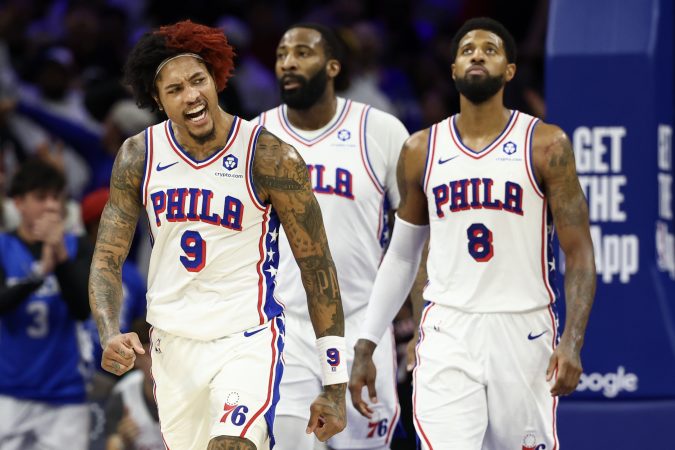
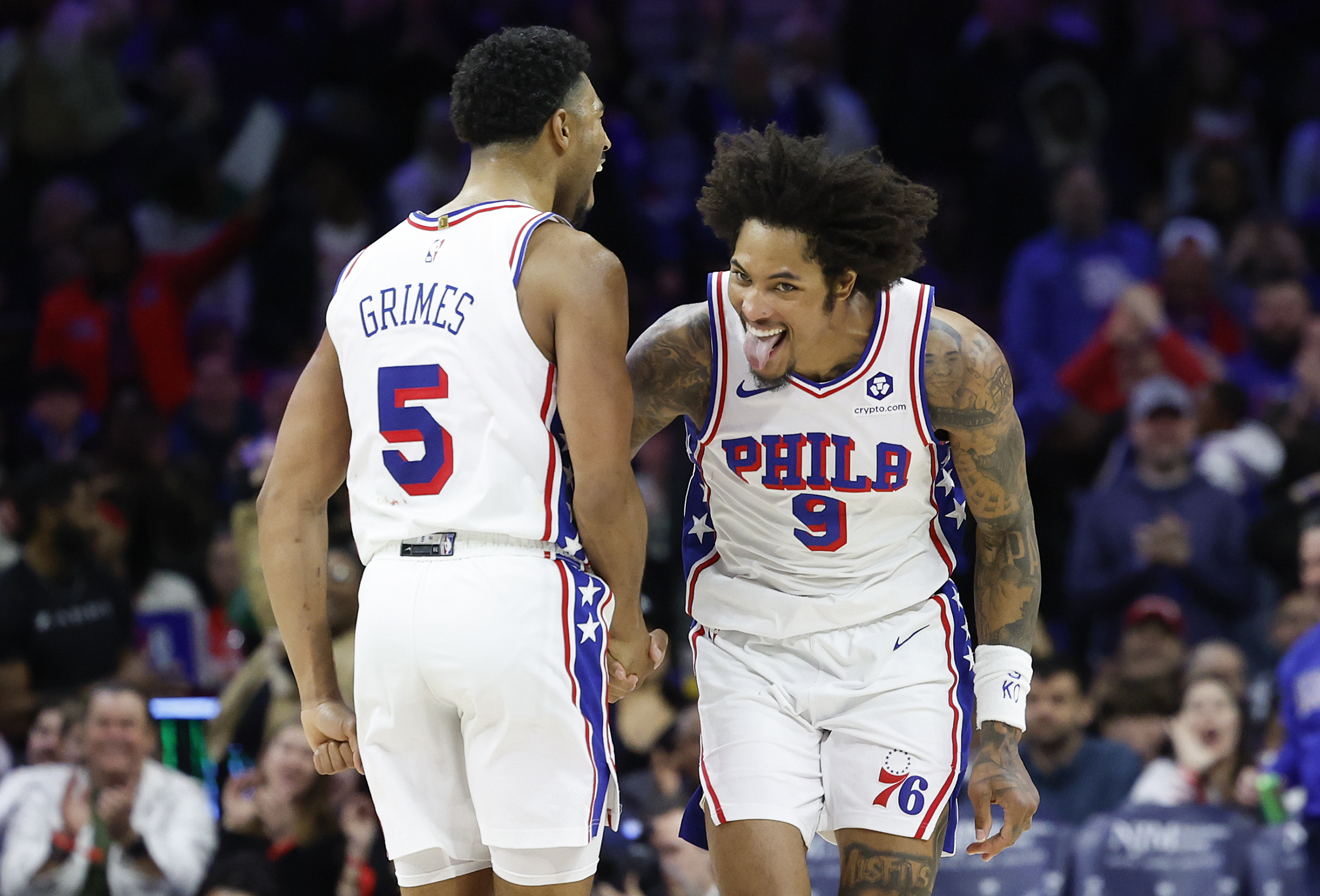
Sixers guard Kelly Oubre Jr., and teammate guard Quentin Grimes celebrate in a game against the Brooklyn Nets. Yong Kim / Staff Photographer
Quentin Grimes
Grimes was primarily the Sixers’ sixth man during a 2025-26 season he described multiple times as “solid.”
The 26-year-old was part of a terrific three-guard lineup, and reignited his aggressive scoring ability when Maxey missed three weeks in March with a finger injury. But Grimes shot a career-low 33.4% from three-point range, while also averaging 13.4 points, 3.6 rebounds, and 3.3 assists in 29.4 minutes in 75 games. And other than an excellent Game 5 performance on both ends in Boston, he was not good enough during the playoffs for a Sixers second unit that desperately needed scoring production.
When asked shortly after last month’s season-ending Game 4 loss to the Knicks about how he viewed his free agency and ideal basketball setup, Grimes was not exactly forthcoming.
“I haven’t even really thought about that, honestly,” he said. “… Talking to my agents and everything, we’ll kind of figure out what’s the best situation moving forward.”
After joining the Sixers at the 2025 trade deadline, Grimes became a go-to scorer for an injured team that had shifted to “tank” mode to increase odds of landing a high draft pick. He averaged 21.9 points, 5.2 rebounds, 4.5 assists, and 1.5 steals in 28 games with the Sixers in 2024-25, including a 46-point outburst at his hometown Houston Rockets.
Grimes then entered restricted free agency, which turned into a messy, monthslong saga. He eventually signed his one-year, $8.7 million qualifying offer to become an unrestricted free agent this summer. Grimes parted ways with agent David Bauman and is now represented by Creative Arts Agency.
Does any of that impact Grimes’ decision-making as he enters the open market? And does Philon’s arrival diminish the Sixers’ need (or desire) to retain Grimes?
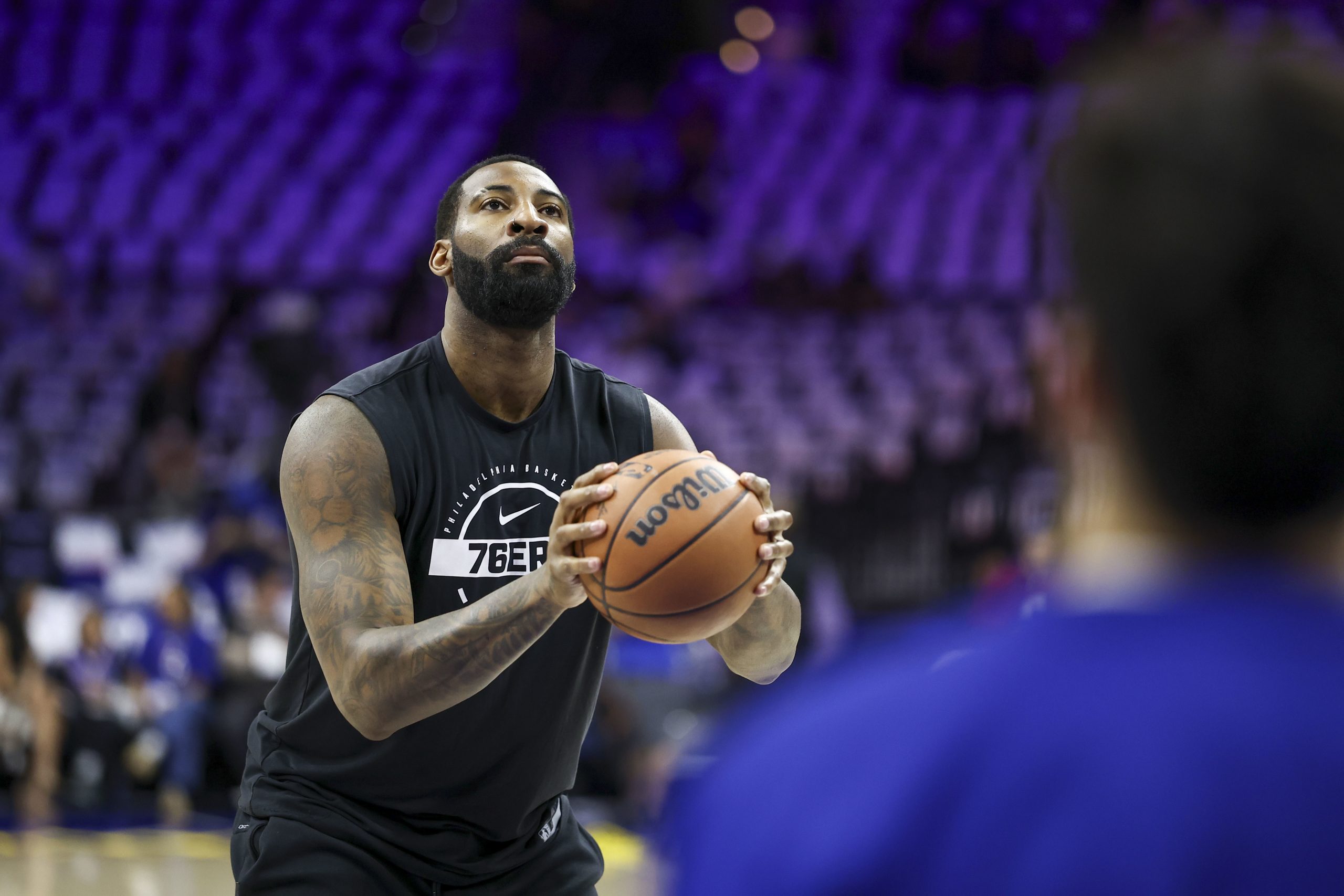
Andre Drummond is looking for more consistency next season.Monica Herndon / Staff Photographer
Andre Drummond
The veteran center professionally handled a fluctuating role in 2025-26.
For the bulk of the season, Drummond was the starting center in the games Embiid did not play — and was out of the rotation when Embiid was available. During the playoffs, though, Drummond recaptured the role as Embiid’s backup while postseason first-timer Adem Bona struggled. Drummond averaged 6.4 points, 8.4 rebounds, and 1.3 assists in 63 regular-season games.
The 32-year-old Drummond is still a stout rebounder and big-bodied presence. His corner three-point shooting has elevated from fun novelty to legitimate offensive weapon. But he is not the most mobile, making him a liability on defense.
It is possible Drummond, whose salary was $5 million this season, desires a playing destination where his role is more defined and consistent.
Watford, a versatile forward who recorded a triple-double last season, averaged 6.5 points, 3.3 rebounds, and 2.5 assists in 53 games. Injuries, though, impacted his ability to stick in the Sixers’ rotation. Watford has been a close friend of Maxey since they were teenagers, and was a lively presence inside the Sixers’ locker room.
The Sixers declining that option does not eliminate Watford’s ability to return on a new deal.
Kyle Lowry
It is presumed that Lowry, who did not conduct an end-of-season media session, will retire. At the end of the 2024-25 season, the Philly native said he wanted to play one more season to reach 20 for his career, though he was more coy when asked about that plan in recent months.
Lowry, who played in 14 games last season, was almost exclusively a trusted and enthusiastic veteran on the bench and locker room, particularly for Maxey. His knowledge and respect are invaluable, but the Sixers also could have benefited from having another player on the roster who could contribute on the floor more than the 40-year-old version of Lowry.
(Note: Adem Bona’s $2.3 million salary for 2026-27 becomes guaranteed July 7.)
President of basketball operations Mike Gansey and Harris-Blitzer president Bob Myers (right) will lead the Sixers’ free-agent decisions. Tom Gralish / Staff Photographer
Types of contracts available
This is tricky to determine right now, because it could be dependent on if Oubre and/or Grimes returns.
If both players depart, the Sixers are likely to have the non-taxpayer midlevel exception (approximately $15 million) and the biannual exception ($5.5 million). If they re-sign one or both players, they likely will only have the $6.1 taxpayer midlevel exception.
For what it’s worth, earlier this month Myers specifically referenced the non-taxpayer midlevel exception as a free-agency tool, suggesting the Sixers are using that as a starting point and will weigh the players they could sign on that deal vs. the return of Oubre or Grimes. And if the Sixers cross into the “apron” penalties, it will limit their ability to make in-season trades because of new collective bargaining agreement rules.
The Sixers will also have veteran minimum contracts to fill out their 15-man roster.
Potential free-agent targets
Frontcourt help
John Collins
Collins could slide into a starting forward spot if Oubre leaves. The sensational athlete has become an improved shooter since getting off the perpetual trade block with the Atlanta Hawks, connecting on 40.6% of his three-point attempts last season with the Los Angeles Clippers.
Rui Hachimura
The 6-foot-8, 230-pound Hachimura boasts a more traditional power forward frame and versatile skill on both ends of the floor. He shot 44.3% on 3.9 long-range attempts per game last season with the Los Angeles Lakers, while averaging 11.5 points and 3.3 rebounds. The Lakers reportedly committed to signing Austin Reaves to a max contract, and must make a free-agency decision on all-time great LeBron James.
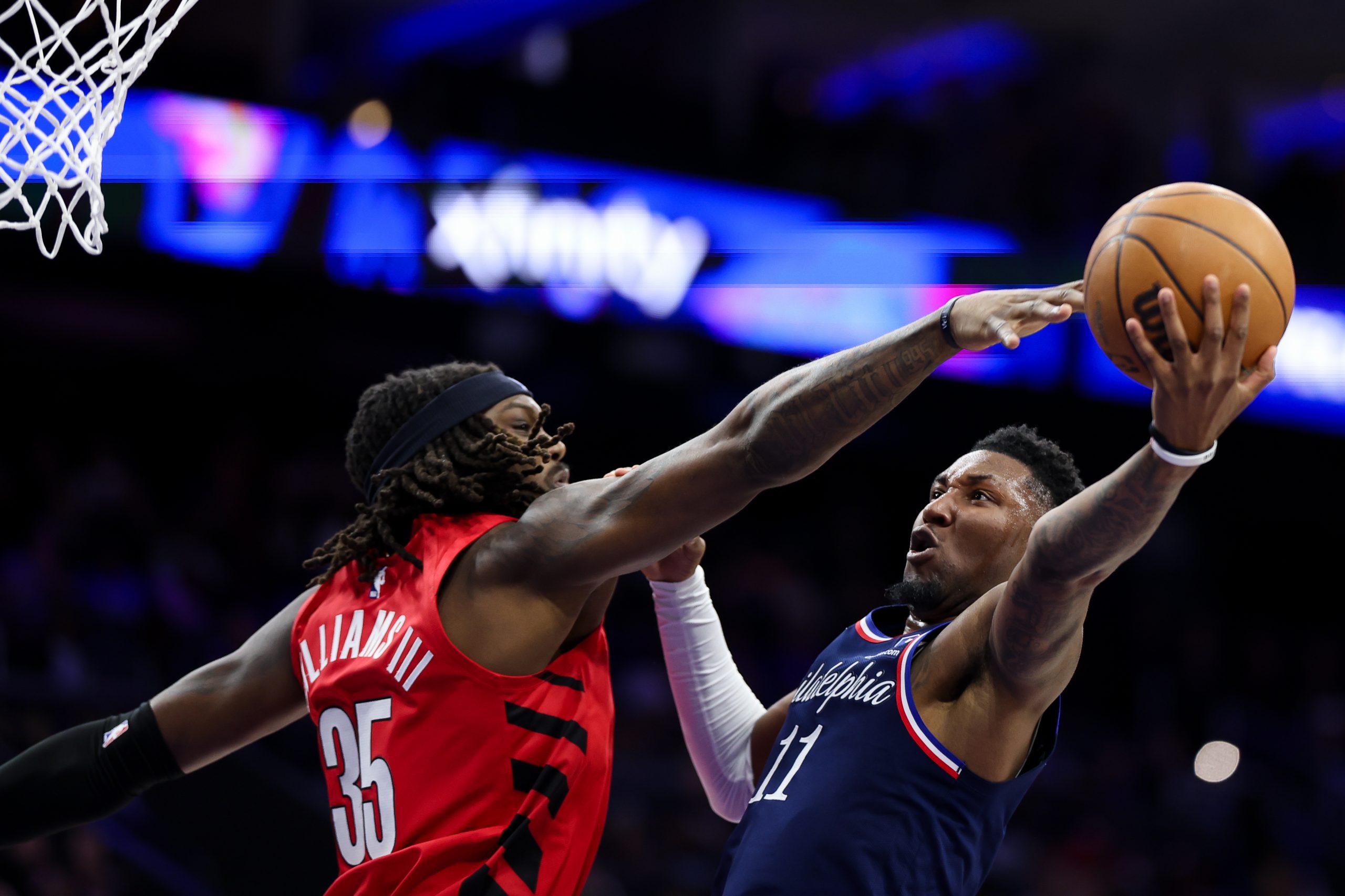
Portland Trail Blazers center Robert Williams III (left) defends Sixers forward Justin Edwards during a game earlier this year.Isaiah Vazquez / For The Inquirer
Robert Williams III
Another supreme athlete who can rebound (7 per game last season) and finish lobs. But the 28-year-old now has a lengthy injury history with the Celtics and Portland Trail Blazers, which might be a risky investment for a center to play behind Embiid. (Reportedly agreed to deal to return to Portland on Monday)
Marvin Bagley III
Bagley’s career has fallen far below original expectations as a former No. 2 overall draft pick. Yet he is coming off a productive season for the Washington Wizards and Dallas Mavericks, averaging 10.5 points per game. His career average of 6.5 rebounds — including 2.3 on the offensive end — in 22 minutes is also a sound number.
His brother, Marcus, played 10 games for the Sixers and also played for the G League’s Delaware Blue Coats during the 2024-25 season.
A floor-spacing big man with defensive versatility, Landale was an impactful trade-deadline pickup for the streaking Hawks until an ankle sprain prematurely ended his season. He averaged 5.7 rebounds in 22.1 minutes with the Memphis Grizzlies and Hawks last season. (Reportedly agreed to deal to return to Atlanta on Monday)
Mitchell Robinson
The competition could be steep for the newly crowned NBA champion — including from the Knicks. Robinson is a fantastic rim protector and rebounder, especially on the offensive end (4.2 per game last season). The knocks on him are his injury history and poor shooting, prompting the Hack-A-Mitch strategy for opposing teams.
Other options: Sandro Mamukelashvili, Nikola Vučević, Mo Wagner, Jaxson Hayes, Kelly Olynyk, Nick Richards
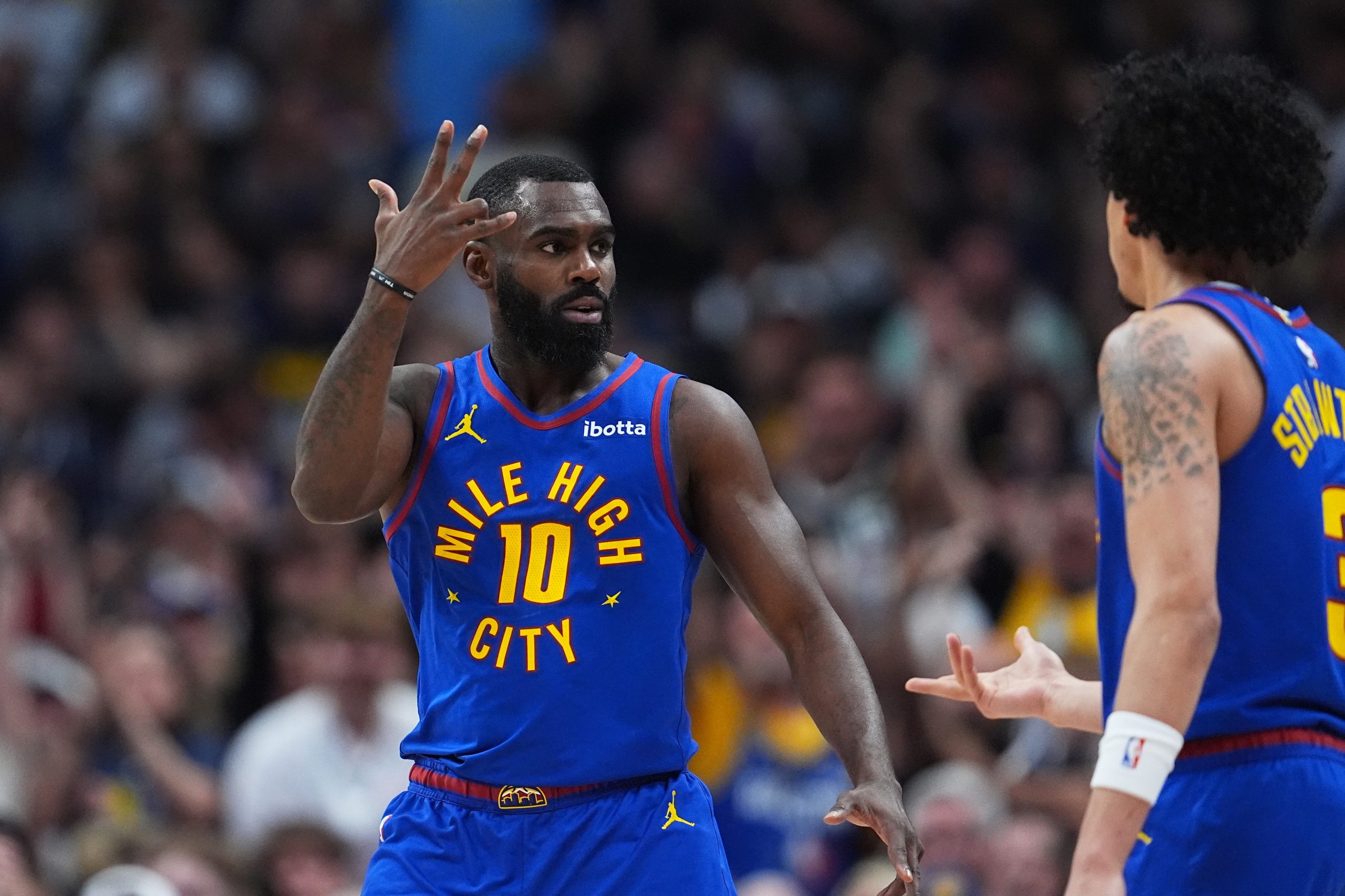
Denver Nuggets guard Tim Hardaway Jr. is an option for the Sixers.David Zalubowski
Shooting
Tim Hardaway Jr.
Hardaway has been a top veteran role player on win-now teams in three consecutive seasons with the Mavericks, Detroit Pistons, and Denver Nuggets. He finished third in voting for the NBA’s Sixth Man of the Year, after shooting 40.7% on 6.9 three-point attempts per game and averaging 13.5 points for the Nuggets last season.
Luke Kennard
Kennard has been a deadly three-point shooter for years, connecting on 44.2% of his career attempts. He also has a more well-rounded offensive game than he gets credit for, and was a useful trade deadline pickup by the Lakers last season.
The Delaware native would give the Sixers another wiry guard. He underwent a bit of a career renaissance as a key bench player for the Minnesota Timberwolves, shooting 38.8% on 4.2 deep attempts last season.
Gary Trent Jr.
Trent is another knock-down shooter from beyond the arc (career 38.7% on 6.1 attempts per game) who can also create off the dribble. Nick Nurse previously coached Trent with the Toronto Raptors, though they may not have had the best rapport after Nurse publicly critiqued his defensive performance and Trent acknowledged a lack of regular communication during their time together.
Other options: Kenrich Williams, Keon Ellis, Javonte Green, Bogdan Bogdanović
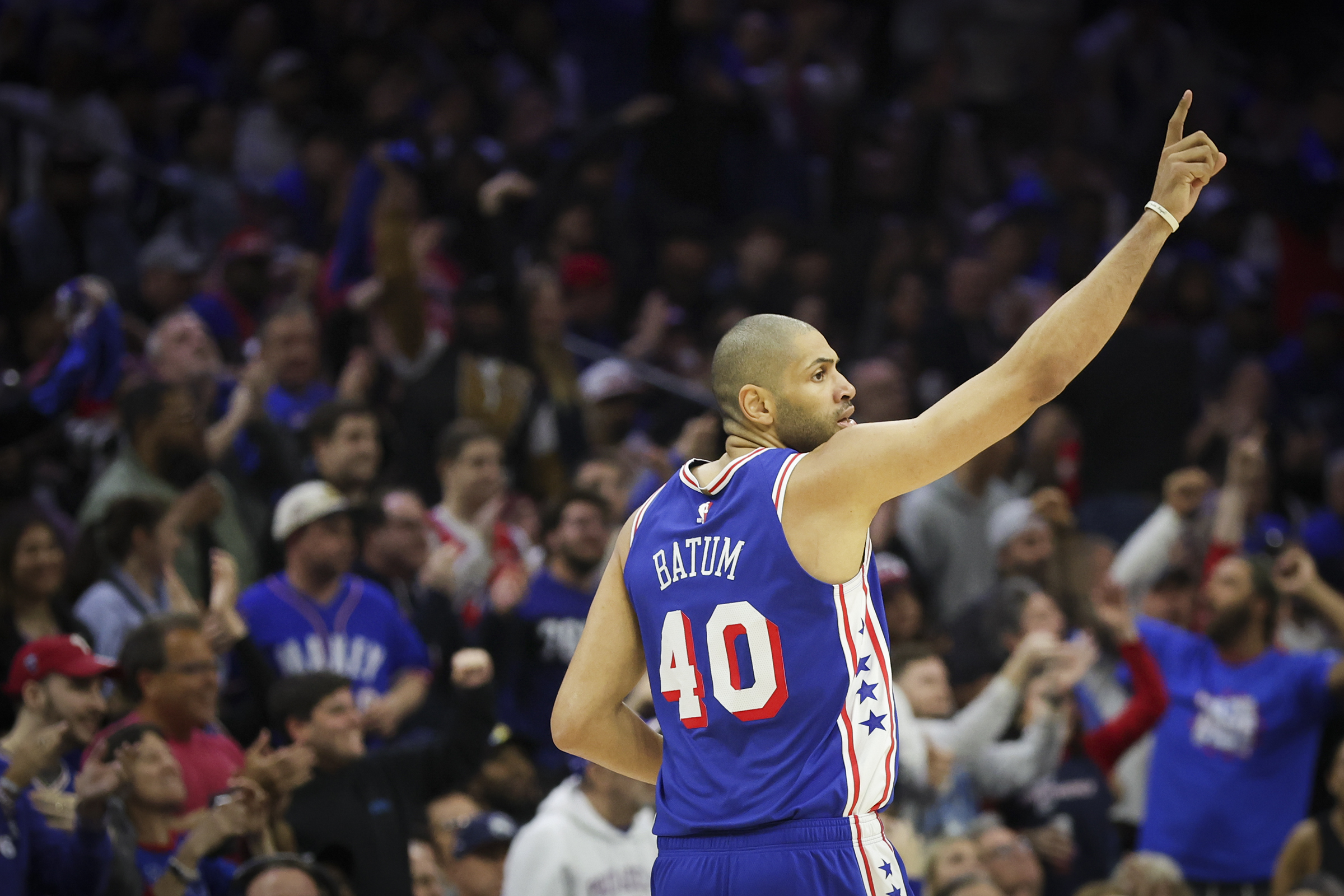
Could Nico Batum make a return to Philly?Heather Khalifa / Staff Photographer
Wade was one of Gansey’s success stories with the Cavaliers, evolving from undrafted player to rotation forward. His 6-9, 230-pound frame allows for defensive versatility, and he is a career 36.7% three-point shooter. Unsurprisingly, multiple reports surfaced over the weekend that the Sixers are among the teams interested in Wade.
Guerschon Yabusele
A rare feel-good story during the Sixers’ disastrous 2024-25 season, Yabusele parlayed his NBA comeback into a pay raise with the Knicks. To say things did not work out in New York is an understatement, and he was traded at the deadline to the Chicago Bulls. Could he successfully slide back into a complementary role with the Sixers? Or will his performance two seasons ago go down as a career anomaly on a bad team?
Achiuwa also played under Nurse in Toronto, and offers the defensive mobility to switch and block shots as a center or power forward. Though he averaged a career-best 10.1 points per game on a bad Sacramento Kings team last season, his offensive game is more limited.
Nico Batum
The Clippers on Monday declined Batum’s $5.9 million player option, making him an unrestricted free agent. Nurse (and Embiid) had an affinity for Batum’s veteran savvy during his time with the Sixers during the 2023-24 season, when he swung the play-in game against the Miami Heat with his three-point shooting and even became the team’s designated inbounds passer. But he is 37 years old, and feels deep family connections to Los Angeles and the West Coast.
Other options: Matisse Thybulle, Kevon Looney, Gary Payton II
At the broadest, most general philosophical level, Mike Gansey aced his first test as Sixers president on Tuesday night. He looked at his draft board, saw a player he’d graded as the best talent by a significant margin, and then he selected that player. The process was sound.
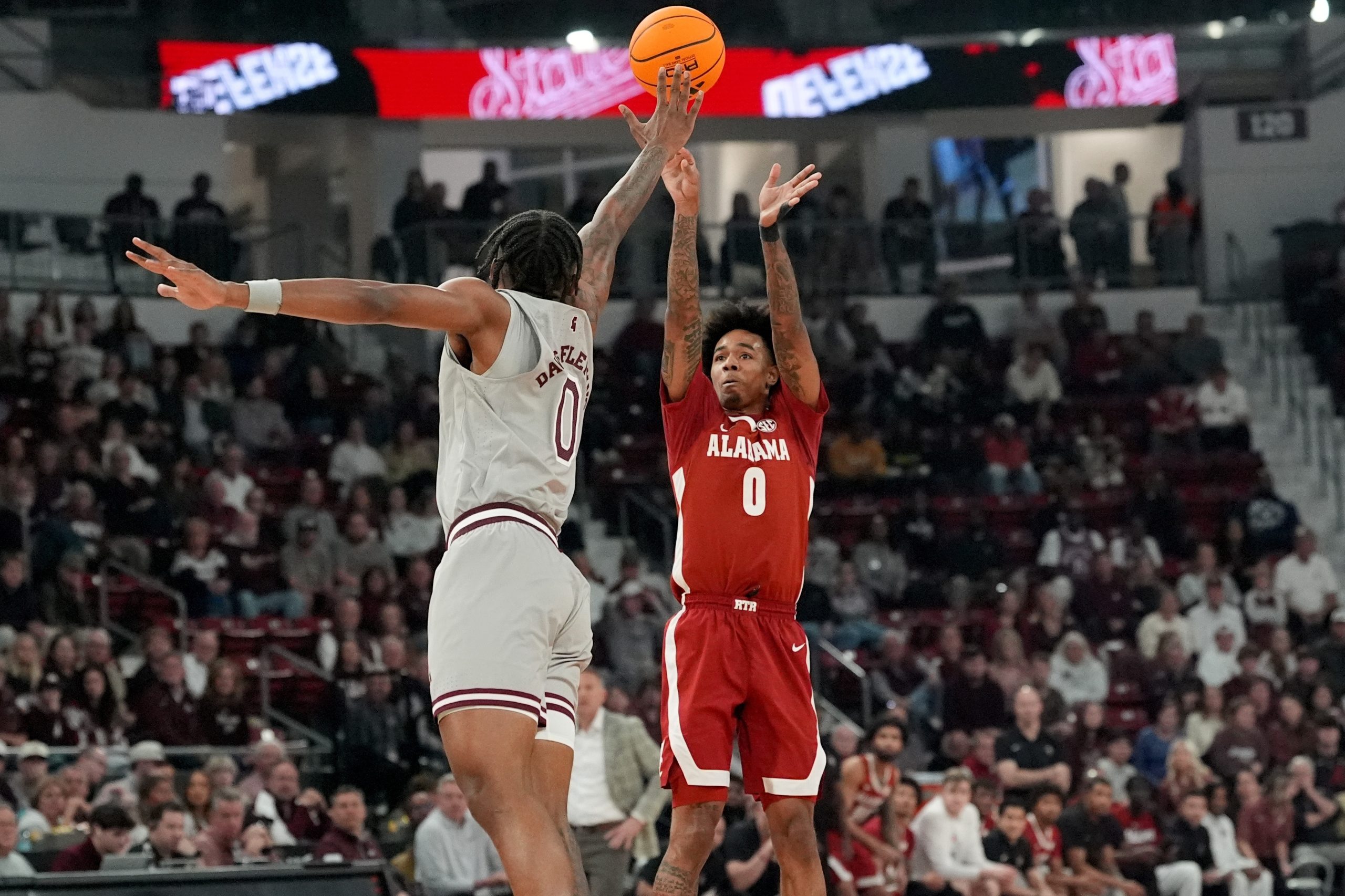
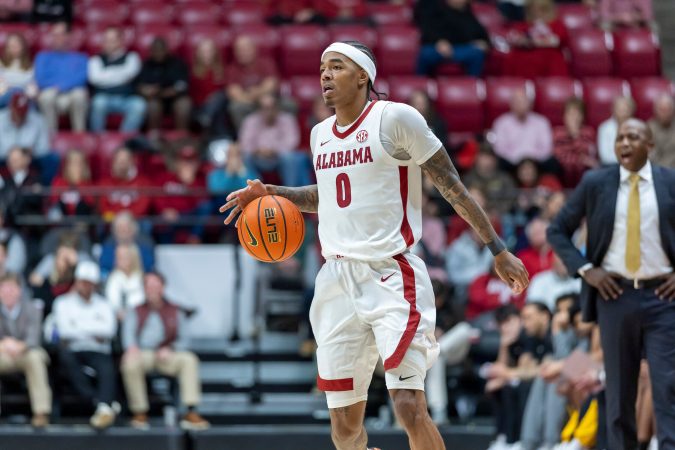
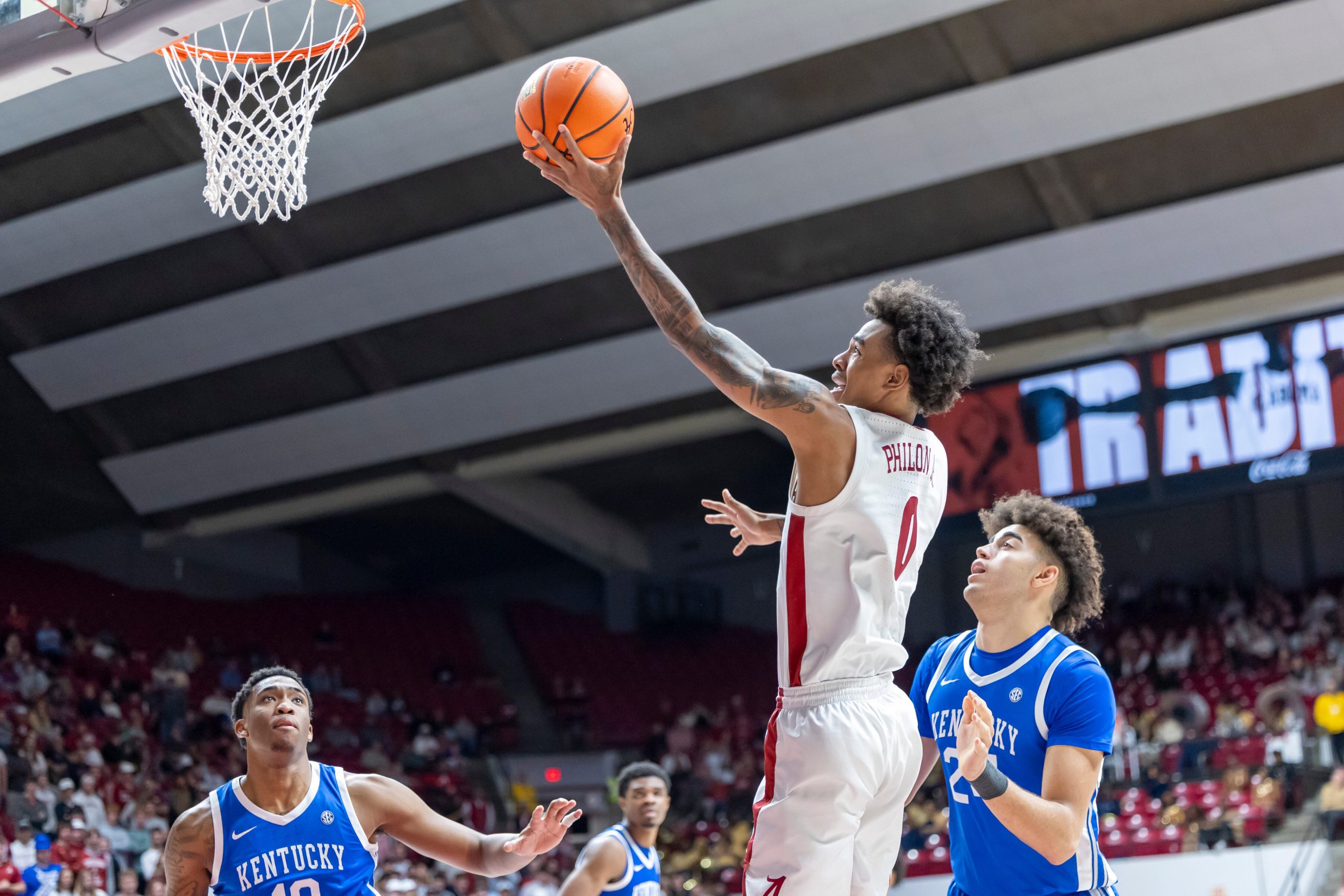
As insignificant as it may seem, plenty of front offices mess it up. They prioritize things like roster construction or positional fit and they allow motivated reasoning to cloud the reality that all of the perfect players are long gone by the 22nd pick in the NBA draft. You must defy the odds just to select a player who ends up deserving a spot in a playoff rotation, let alone one who can make a decisive impact at a position of need. In Labaron Philon Jr., a sophomore guard from Alabama, the Sixers saw a talent so obvious that they didn’t feel like there was a choice to make.
“He’s someone that fell into our lap, so to speak,” Gansey said.
Of course, the real test is whether they are right. Not just about Philon, a dynamic ballhandler and shooter who averaged 22 points per game last season and who some mock drafts had going in the top 15. Gansey and his front office must also be correct in their evaluations of the players they could have drafted instead of Philon. Zuby Ejiofor, Chris Cenac Jr., Joshua Jefferson, to name a few. Each of those three possesses the size that Philon lacks and that a roster like the Sixers’ will eventually need on the wing alongside Tyrese Maxey and VJ Edgecombe. Each went off the board in the six picks after Philon. Two of them went to Eastern Conference playoff hopefuls (Ejiofor to the Hawks at No. 23, Cenac to the Celtics at No. 27). History will be written by the teams that got it right.
All you need to know about how the Sixers feel about Philon can be derived by the fact that they saw fit to draft him despite the overlap in skill sets with Maxey and Edgecombe and also the player they traded away for the pick they used to draft the Alabama guard. When Daryl Morey dealt Jared McCain to the Thunder with ownership’s approval, the thought was that the 2024 first-round pick’s long-term utility would be capped by his inability to play alongside two other smallish guards. He and Philon are hardly carbon copies of each other. Philon is a little longer in terms of standing reach and wingspan, and he is a quicker, more dynamic playmaker with the ball in his hands. But they both exist in the same general bucket, with the same limitations with regard to Maxey and Edgecombe.
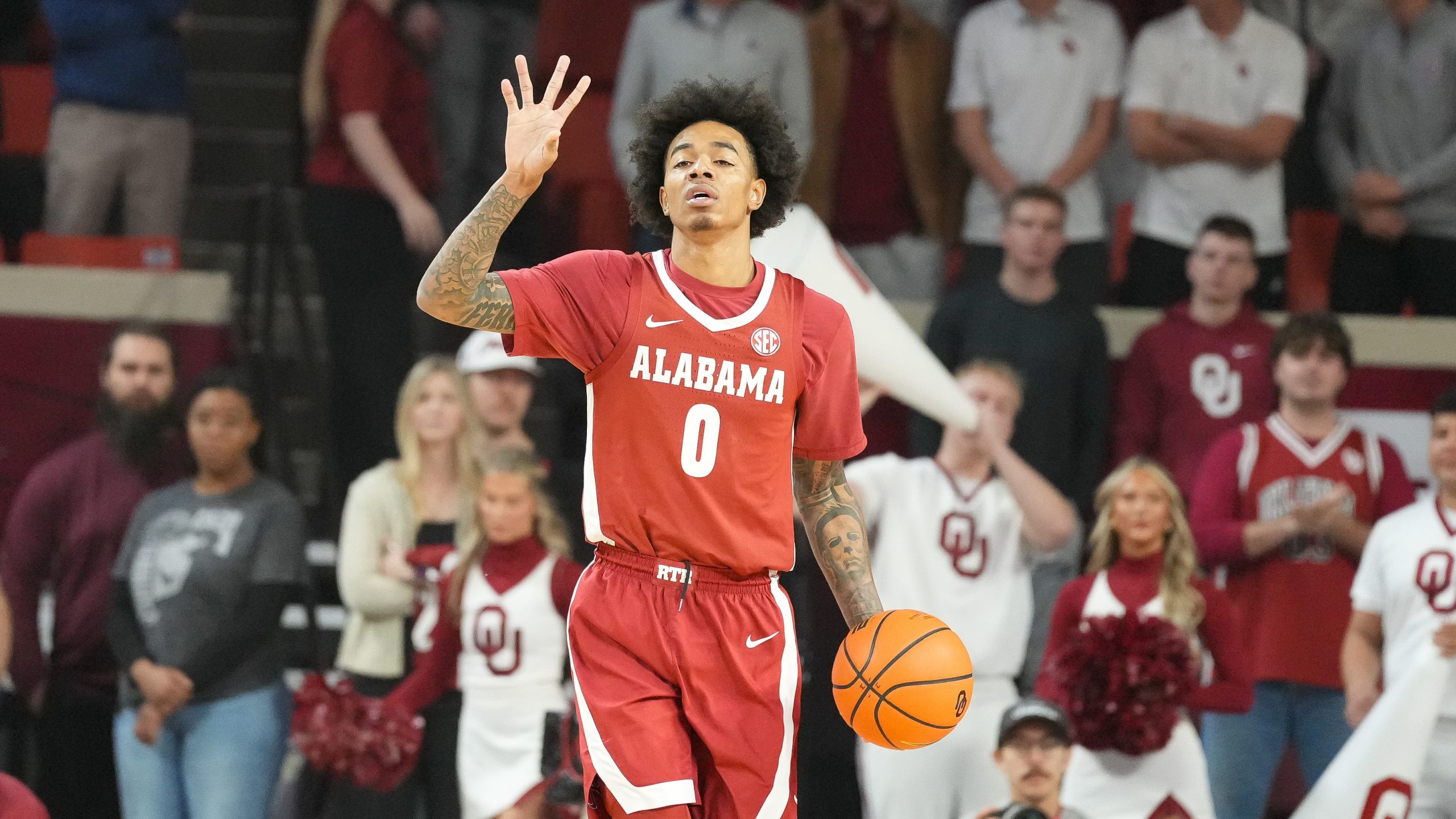
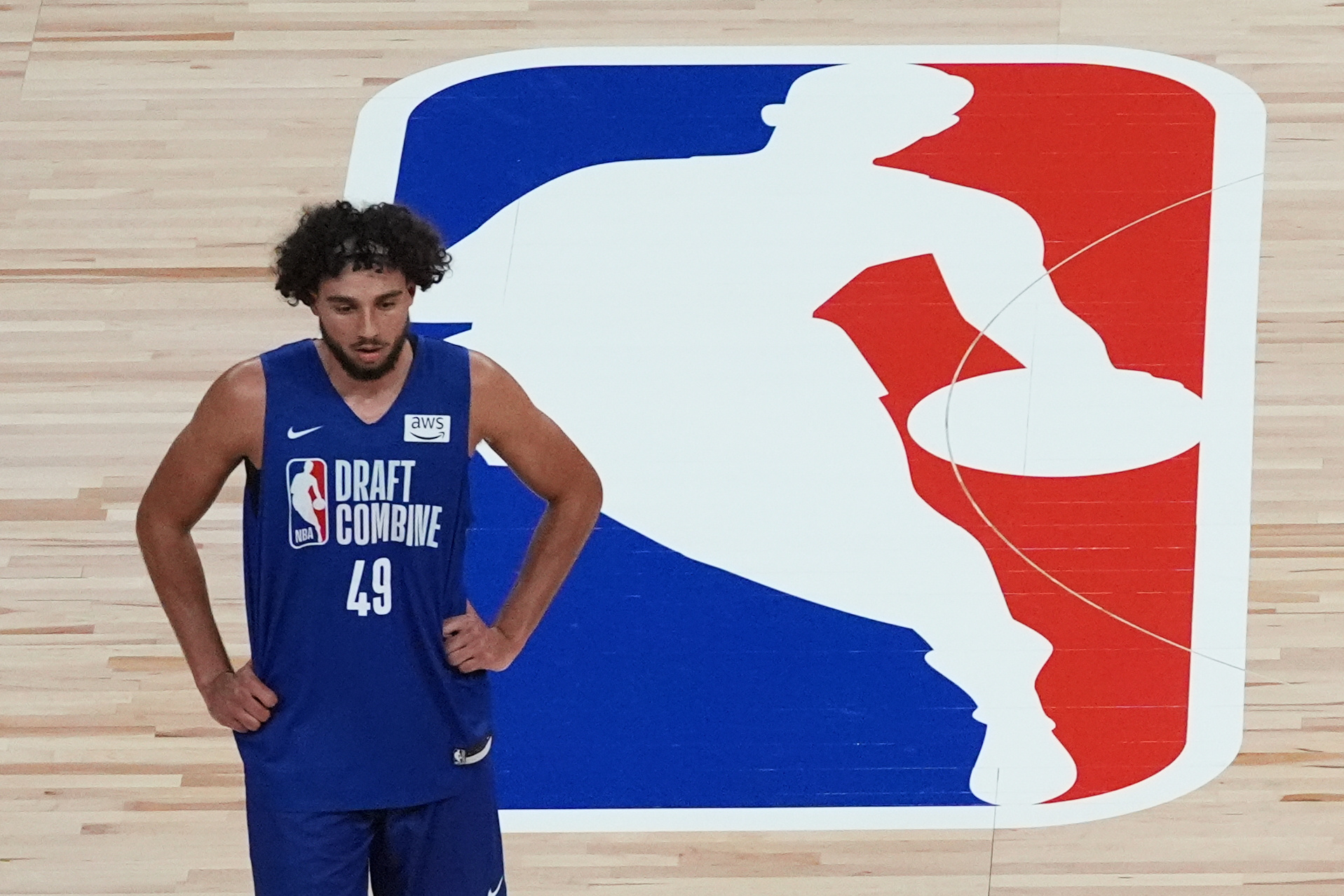
Sixers first-rounder Labaron Philon Jr. averaged 22 points in his final season at Alabama.Kyle Phillips
Speaking to reporters after the conclusion of Tuesday’s first round, Gansey and Sixers coach Nick Nurse both spent a lot of time talking about how similar Philon is to Maxey and Edgecombe.
“He’s another fast, kind of exciting guy that kind of plays a lot like Tyrese and VJ,” Nurse said. “It’s another guy with the speed, athleticism, quickness, deep range, some creativity with the ball. He’s a pretty good pick-and-roll player already, probably more advanced than a lot of guys coming out. I think he sees all the pieces of the pick-and-roll.”
Nurse and Gansey both hemmed and hawed when asked whether they envisioned using all three of their young guards on the court at the same time.
“I don’t see a lot of minutes, but maybe in certain situations we can,” Gansey said, while also deferring to Nurse.
“I think it’s a little early to answer that,” he said.
Both downplayed the significance of the question. Games are more than long enough to accommodate three guards playing starter minutes at staggered intervals. Maxey and Edgecombe both finished among the league leaders in playing time last season, perhaps counterproductively so. In a world where each averages 32 minutes per game, that would leave another 32 where one or the other is on the bench.
“My mindset is he’s talented,” Nurse said of Philon. “Let’s figure out how we’re going to get him on the floor.”
Nick Nurse and Mike Gansey saw a lot of similarities between new Sixer Labaron Philon Jr. (right) and VJ Edgecombe and Tyrese Maxey.Rogelio V. Solis
The Sixers will have a good problem on their hands if Philon ends up good enough to warrant more minutes than are available. It will mean the minutes he does play are valuable. The Knicks won an NBA championship with Jalen Brunson, Miles McBride, and Jose Alvarado. The Spurs had Dylan Harper playing starter minutes off the bench behind De’Aaron Fox and Stephon Castle. The Thunder had a slew of guards contribute, including the smallish McCain and Cason Wallace.
“You look at our roster, we need help at every position, one through five,” Gansey said. “Obviously, we have the big four, and I think he fits. He’s another guard so now we can kind of focus in other areas on the roster.”
However Philon turns out, the pick does offer us a little more evidence on what to expect out of Gansey and this Sixers roster. They didn’t use the No. 22 pick to select a player who might someday help alleviate the roster’s clearest current need (size on the wing). They didn’t trade it for a veteran who might’ve made them better in the short term. They didn’t use it to entice a team to take on Paul George’s contract. They did what a team in their position should be doing. They had an opportunity to draft a player they think will someday belong in a championship-caliber rotation, and they availed themselves of that opportunity. That is how it is going to need to be done: piece by piece.
NEW YORK — The 76ers entered the NBA draft fresh off a playoff series that exposed their roster shortcomings.
That decisive second-round sweep by the New York Knicks showed that the franchise needed to double down on what it received from cornerstones Tyrese Maxey, VJ Edgecombe, and Joel Embiid. They needed more speed, more scoring, more shooting, more rebounding, more everything.
The Sixers’ first attempt at improving came with the selection of Alabama guard Labaron Philon Jr. at No. 22 overall on Tuesday, christening the Mike Gansey era as president of basketball operations.
Let’s take a closer look at Philon’s career at Alabama, how he fits with the Sixers, and other areas of the Sixers’ roster that can still be addressed.
What Philon brings to Philly
Philon arrived at Alabama as a homegrown talent who proved to be a big-time scorer, earning Alabama’s Mr. Basketball high school honors.
Before leaving town for Link Academy in Missouri for his senior season, Philon played three seasons at Baker High School in Mobile, Ala., and averaged 35 points, 6.2 rebounds and 3.9 assists as a junior. That scoring ability didn’t immediately translate to college in his freshman season at Alabama, when he averaged 10.6 points, 3.3. rebounds, and 3.8 assists in 37 games.
Alabama’s Labaron Philon (right) averaged 10.6 points, 3.3. rebounds and 3.8 assists in 37 games as a freshman.Vasha Hunt
Philon realized that he didn’t put together a strong enough campaign to enter the NBA. He went through the process and returned to school for another year, where his tape was more undeniable. As a sophomore, Philon averaged 22 points, 3.5 rebounds, and 5 assists. That was good enough to get buzz as a lottery pick before dropping to the Sixers at No. 22.
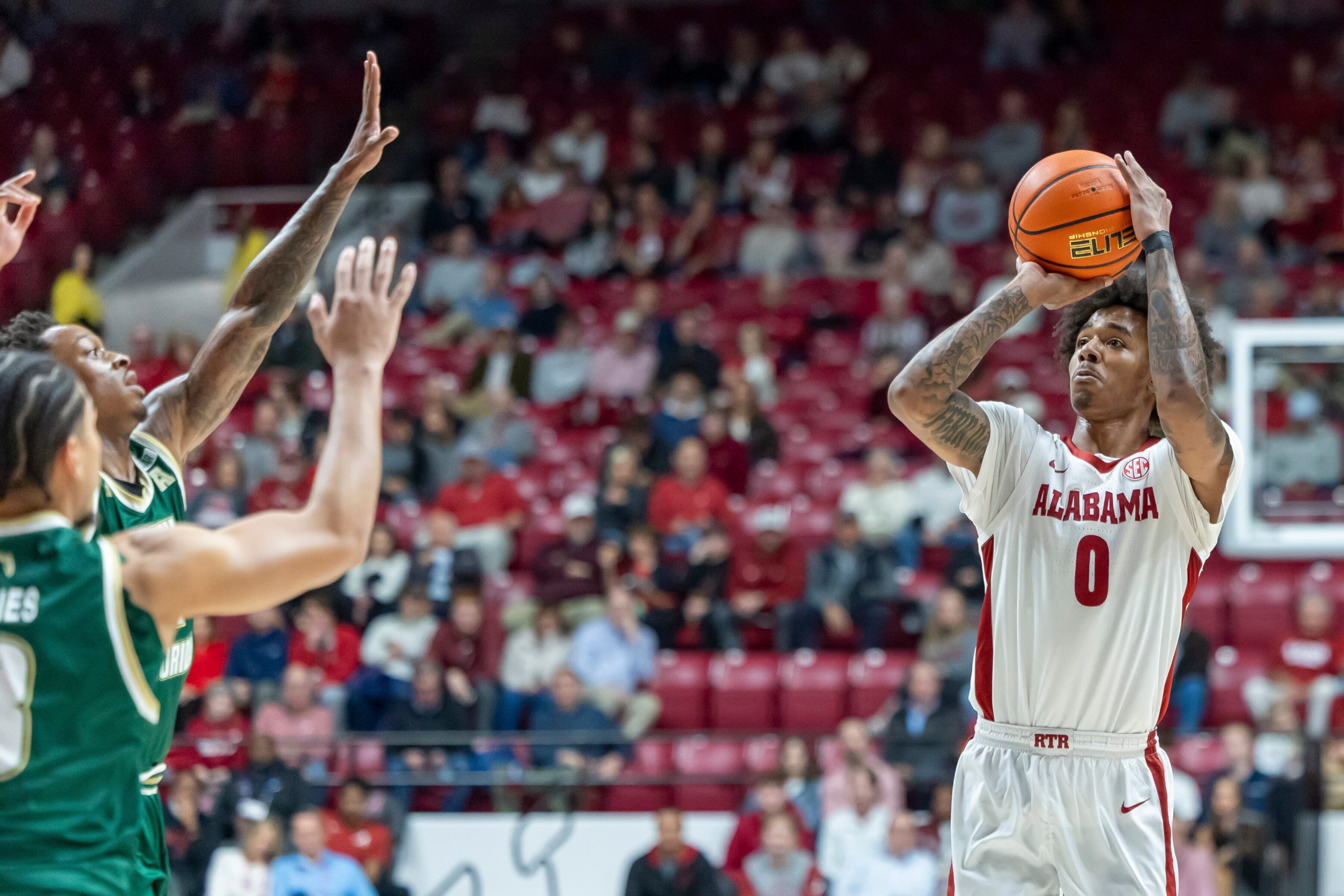
Philon’s skill set features a crafty handle, ability to finish at the rim, and shooting range from deep. He can function in the screen-and-roll and is creative in open space. He made 57.4% of his two-pointers and 39.9% of his three-pointers last season, and those numbers are made more impressive by the fact that Philon was often the center of attention for Alabama and created a large share of his own shots.
Most important, Philon’s numbers weren’t empty calories. His production contributed to winning in both seasons for the Crimson Tide, as he helped direct a team that made the Elite Eight as a freshman and the Sweet 16 this past season. Each time his team met a No. 1 seed, losing to Cooper Flagg’s Duke team in 2024-25 and eventual champion Michigan in 2025-26.
How Philon fits in Philly
The Sixers have too many holes to fill in one draft. They entered Tuesday with voids in the backcourt and frontcourt. The franchise hit on Maxey and Edgecombe in recent drafts, but those stellar guards were near the top of the league in minutes played. Paul George and Embiid played inspired basketball at times when available, but they were not healthy nearly enough. George played only 37 games because of injury and suspension and Embiid called his 38 games played a “successful season” after he managed 19 games the season before.
There were several players on the board who could have helped the Sixers when the 22nd pick rolled arrived. And several of them were names that slipped down the board as Arizona’s Koa Peat, Houston’s Chris Cenac Jr., and Philon were available. The Sixers appeared to take the best player available, as president of basketball operations Mike Gansey intimated that they would.
During the draft process, Iowa sharpshooter Bennet Stirtz, who was picked 16th and joined former Sixer Jared McCain with the Oklahoma City Thunder, made a poignant statement. He said every team can use more shooters and ballhandlers. That’s what Philon will bring to Philly, another player who can create and score when Maxey goes to the bench.
He’s adept at getting downhill and making buckets in the midrange and over bigger bodies, which will be needed on a Sixers team that received most of its scoring from four players. That he is a strong three-point shooter will be a bigger boon for the Sixers after trading McCain at the deadline in February and struggling to make shots from deep in the postseason.
Alabama guard Labaron Philon (right) shot 39.9% from three as a sophomore.Vasha Hunt
The Sixers also trotted Edgecombe out as a secondary ballhandler often in his rookie season. But that typically amounted to him creating offense for himself or initiating and getting out of the way. There wasn’t much in between as he continues to improve his ballhandling. Philon can take some of that pressure off Edgecombe and do more to find Embiid and George, who have grown more dependent on their teammates to get them the ball at this time of their careers.
What the Sixers still need to address
Rebounding was a major issue for the Sixers last season. As was on-ball defense and communication. As were turnovers. Those things won’t all be addressed in the draft or free agency. The Sixers can add reinforcements at forward to lower the usage of a smaller lineup around Embiid. They can also retain Kelly Oubre Jr. or Quentin Grimes to keep depth and talent on the wings.
But because of their contract obligations, there are some things that can only be fixed from within. Maxey, George, and Embiid are all on max contracts, limiting who the Sixers can add to the roster. That means those players will have to do more. It’s hard to ask Maxey to be better than he was during the regular season, when he carried the franchise to the playoffs and earned All-Star and third-team All-NBA honors. That leaves George and Embiid, whose availability will remain the biggest factor in this team’s success.
The 76ers’ offseason is about to ramp up, with the NBA draft next week and free agency beginning at 6 p.m. on June 30.
These are the first opportunities for new president of basketball operations Mike Gansey to make roster decisions — within the constraints of having three players (Tyrese Maxey, Joel Embiid, Paul George) still on max contracts.
That means there is a lot to ponder and discuss. And you brought questions.
Let’s get to them.
Santa Clara’s Allen Graves could be one of the players the Sixers consider picking at No. 22 in next week’s draft.Nam Y. Huh
Q: From @davesoup on Bluesky: “Draft question. Biggest need? Best available? Chances they pick someone as good as [Jared] McCain?”
A: This is a great place to start. Based on Gansey’s vague comments at his introductory news conference, the Sixers will aim for a combination of both with the 22nd overall pick. It’s cliche, but also makes sense in that range. I’m perhaps most intrigued by the options at center and power forward — think Houston’s Chris Cenac Jr. or Santa Clara’s Allen Graves — though a wing could make sense if the Sixers’ front office believes they are in danger of losing Kelly Oubre Jr. and/or Quentin Grimes in free agency. So could a guard — yes, again — if they can provide a three-point shooting boost.
The Sixers absolutely could find somebody as good as McCain, given Maxey went even lower at 21 in the bizarre COVID-impacted 2020 draft. But as recent drafts illustrate, picking here is always a crapshoot. Who the Sixers select next week, however, will likely help determine free agency priorities.
Q: From @marc_almond on X: “Any chance the Sixers trade up their pick, since the draft is very open at their current spot?”
A: There’s always a chance, especially if the front office falls in love with a specific prospect during this week’s workouts. But right now it feels more likely that a good option could slip to 22, rather than the Sixers aggressively trying to move up. Gansey’s general draft approach also still comes with some uncertainty. He ran the draft with the Cleveland Cavaliers, but was not in the higher-ranking position that he holds with a new organization.
The Sixers and Joel Embiid are optimistic about his long-term health.Monica Herndon / Staff Photographer
Q: From @cornerblight on Bluesky: “Do you think they are keeping Embiid?”
A: Never say never, given Luka Dončić was abruptly traded on a January Saturday night in the middle of his prime. But, putting it bluntly, Embiid’s contract is regarded as extremely difficult to trade given his age and injury history. If you were a fan of another team, would you be interested in trading for Embiid?
For now, the Sixers have to accept Embiid’s optimism that he and the medical/training staff have figured out how to manage his knee. He has no surgeries scheduled and plans to play more next season. That, of course, does not prevent the freak injuries like the oblique strain that kept him out for a month, or the ankle sprain and hip soreness that sidelined him for Game 2 of the playoff series against the New York Knicks, or the other random ailments like orbital fractures and Bell’s Palsy that have hampered postseason runs. One guarantee: He no longer has an appendix, and therefore will not need another emergency appendectomy.
The Sixers flashed what they could be with Embiid and George during that playoff comeback in the first round against the Boston Celtics. Gansey said he must operate (at least for now) as if he is building a roster with the core four of those three max players, plus VJ Edgecombe. And they all must cross their fingers for health, and that health leads to continuity.
Q: From @johnmlatimer on Bluesky: “I think the Spurs should have done the Two Tower thing more with Wemby [Victor Wembanyama] and [Luke] Kornet. And I think that would be a good option for Sixers to maximize and protect Embiid. Thoughts? Is [Adem] Bona that guy? If not him, who?
A: Solid observation. The Sixers have already dabbled in this, even going back to a preseason scrimmage in Delaware. And Bona has vocalized his eagerness to play in those lineups, as an additional way to get on the floor long-term.
The Sixers could use Bona’s athleticism, particularly as a defender, given Embiid clearly is not as mobile and vertical as the once-dominant player used to be. Bona’s limited offensive repertoire, in turn, is balanced by Embiid’s excellent skills for his size in the mid-post and perimeter. And that all helps fill the void at power forward.
Embiid did not play enough during the regular season to really experiment with this lineup for significant stretches. I’d imagine it is something Nick Nurse and the coaching staff are examining this summer.
Tyrese Maxey is a franchise cornerstone for a Sixers team trying to contend for a championship with three max contract players.Monica Herndon / Staff Photographer
Q: From @realstuartl on X: “With Rich Paul as his agent, would Maxey really play the next few years in a rebuilding situation, if they did somehow get rid of Embiid and George?”
A: First, Maxey has never publicly expressed anything resembling disgruntlement or wanting out if the Sixers make the type of pivot you are suggesting.
I think it greatly helps the Sixers that Maxey legitimately believes in Edgecombe and has immediately established an on- and off-court connection and mentorship with him. I also think Maxey understands his unique situation: that he was drafted to an immediately competitive team with an MVP contender, instead of trudging through a rebuild like so many star-caliber young players do early in their careers. That now has made Maxey a tweener, of sorts, on this roster between Embiid/George and Edgecombe — and bridging that during a transitional period always felt like a possibility. Heck, Maxey has already been part of several iterations of this team, from Embiid-Ben Simmons, to Embiid-James Harden, to the most recent version.
Maxey, though, is also fiercely competitive. He also has already done right by the organization in waiting a year to sign his max contract, so that the Sixers could have a smaller cap hold on him and also sign George. In the current NBA landscape, partnerships between players and teams run their course more times than not (see Giannis Antetokounmpo). But right now, Maxey is a franchise cornerstone.
Q: From @jesuszoidberg on Bluesky: “In today’s NBA playoffs, is it possible to win a title if your best player is a post 30 year old big man, even not taking into the account the injuries?”
A: Just throwing this out there: A month ago, one could have asked if it was possible to win a title if that team’s best player was a small, ball-dominant guard who was a second-round draft pick and did not even make the All-NBA first-team this season.
(This is Jalen Brunson, of course.)
A team almost certainly needs a certified dude to win a championship. But getting the right players around that dude — whatever archetype they fill in regards to physical stature, skills, or intangibles — is the biggest key to building the correct team. And I do think that, under the new Collective Bargaining Agreement’s constraints, the star collecting method might be phasing out in place of compiling depth at the right spots. That is something Bob Myers mentioned during his news conference before the executive search that landed on Gansey.
The 76ers need to establish an identity, Bob Myers said Monday.
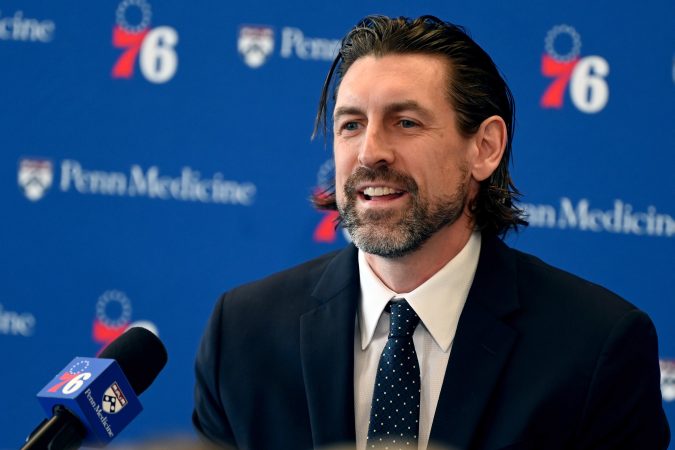
That’s the central task ahead of new president of basketball operations Mike Gansey, who will look to bring the Sixers past the second-round hump and build them into a true championship contender.
When asked if the franchise was committed to Joel Embiid in the long-term, Gansey said that he considers Embiid, Tyrese Maxey, VJ Edgecombe, and Paul George the four tentpoles of the roster in the short-term.
“We have those four and we’ve got to maximize those four,” Gansey said. “Obviously [Edgecombe] and [Maxey] are younger, but [George] and [Embiid] can still play at a high level. We were 24-14 when Joel played, and obviously in the playoffs, coming back from Boston. We’ve got to rely on those four, and obviously keep them on the floor, and then just build around them.”
The Sixers were not elite offensively or defensively last season — they ranked in the middle of the league in both offensive (17th) and defensive (16th) rating — and the new leadership group wants to change that.
But getting their stars on the floor at the same time is easier said than done. Myers cosigned that to establish a team identity, the Sixers need to have their top four guys, namely Embiid and George, who both missed significant chunks of the last two seasons, all on the floor together.
“In order to see what we are, we’ve got to be on the floor, right?” said Myers, president of sports for Harris Blitzer Sports & Entertainment and the head of the search that led to the Sixers hiring Gansey. “You have to have a consistent product on the floor, and maybe that’s not good enough, or maybe it is, but we’ve got to figure out what are we, what can we stand on as a team.”
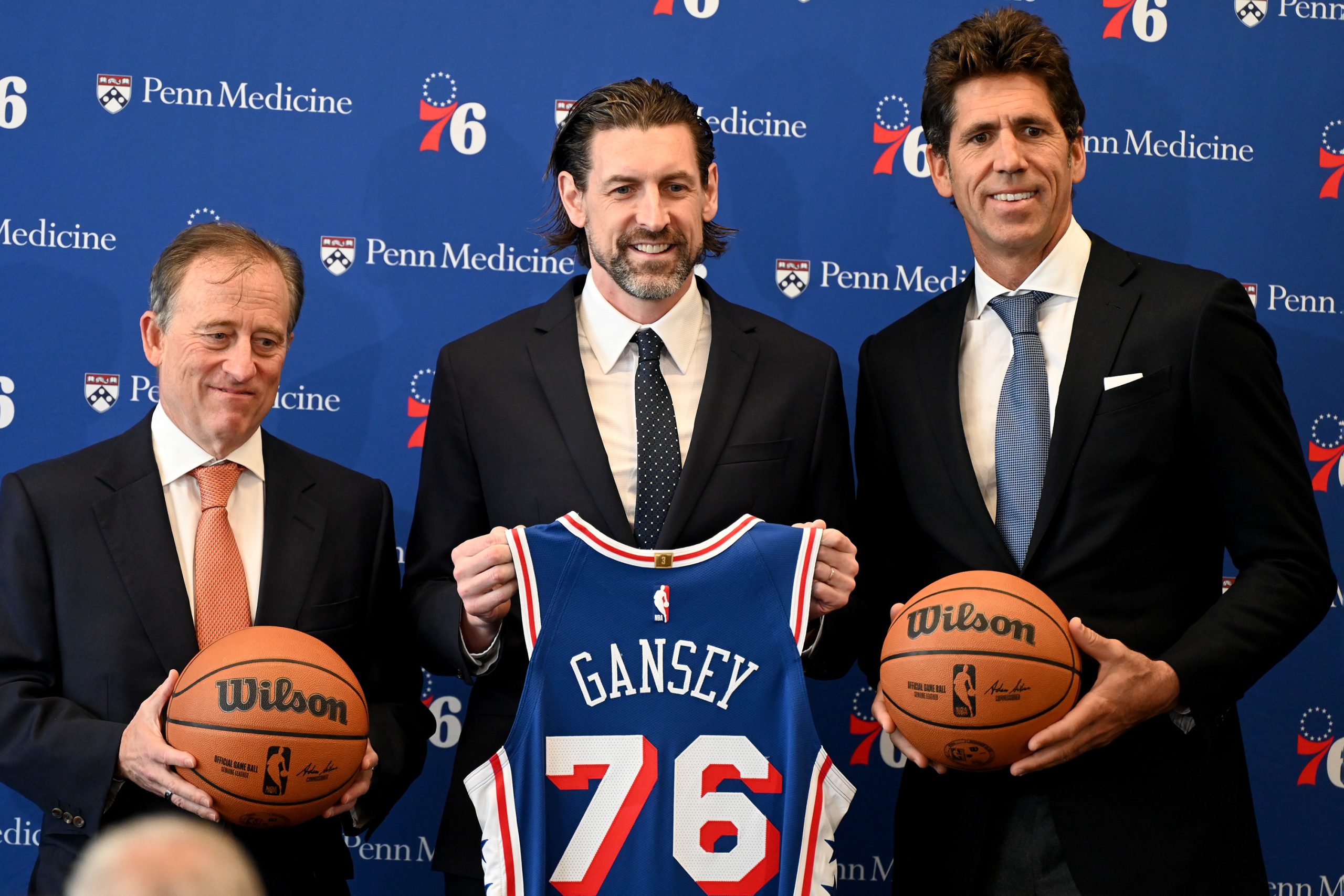
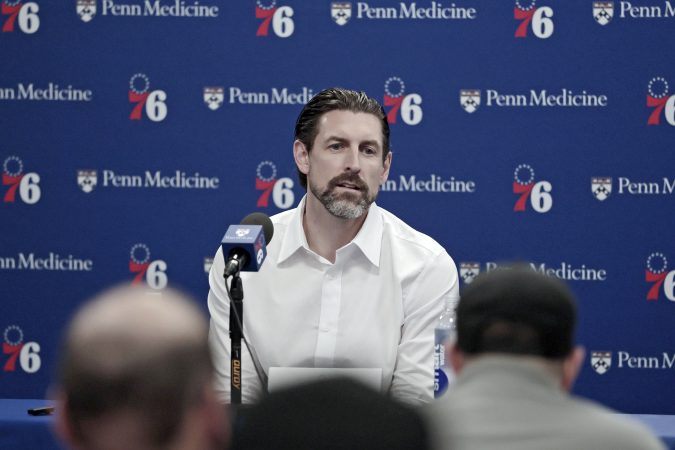
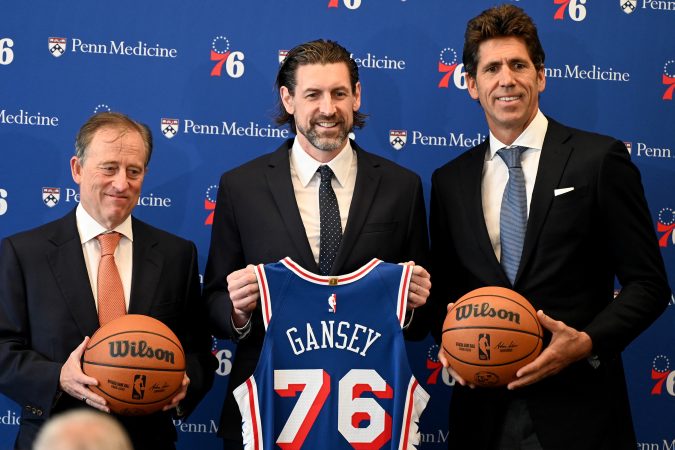
Mike Gansey (center) was introduced to the Philadelphia media Monday by managing partner Josh Harris (left) and president of sports for Harris Blitzer Sports & Entertainment Bob Myers (right).Tom Gralish / Staff Photographer
Myers referenced Embiid’s comments that the season was “successful” because he felt like he’d worked past the knee issues that hampered him for several years. Embiid has no scheduled surgeries this summer and the Sixers hope he can use the offseason to build instead of recover.
But Embiid has missed more games than he’s played in his NBA career, partially due to just exceptionally bad injury luck, like last season’s appendectomy, or an orbital fracture or a bout with Bell’s palsy. Embiid has never played 70 games in a season, and hasn’t played more than half the games in a year since his MVP campaign in 2022-23.
“He’s too important, and we are a top heavy team, right?” Myers said. “That’s just what it is. Look at the contracts. We need those guys to play, and you need depth underneath it. The league has changed, so we need both, but to experience what this team is, we need a healthy roster in training camp.”
The other aspect of building a team identity is through the internal culture of the organization. Gansey said explicitly that the Sixers roster is not championship caliber as it stands, but “we’re going to do everything we can to bring in players that fit” in order to build that roster.
“I want guys that want to be in Philly, first and foremost,” Gansey said of his roster construction philosophy. “… I want fountains, not drains. I want guys with high character, guys with high work ethics, and guys that want to be in Philadelphia.”
Gansey also said it was “a sticking point” for him to keep Jameer Nelson on and promote him to executive vice president of basketball operations. As a Chester native and former St. Joe’s star, Nelson knows the culture of basketball in the city in a way no one else in the organization does.
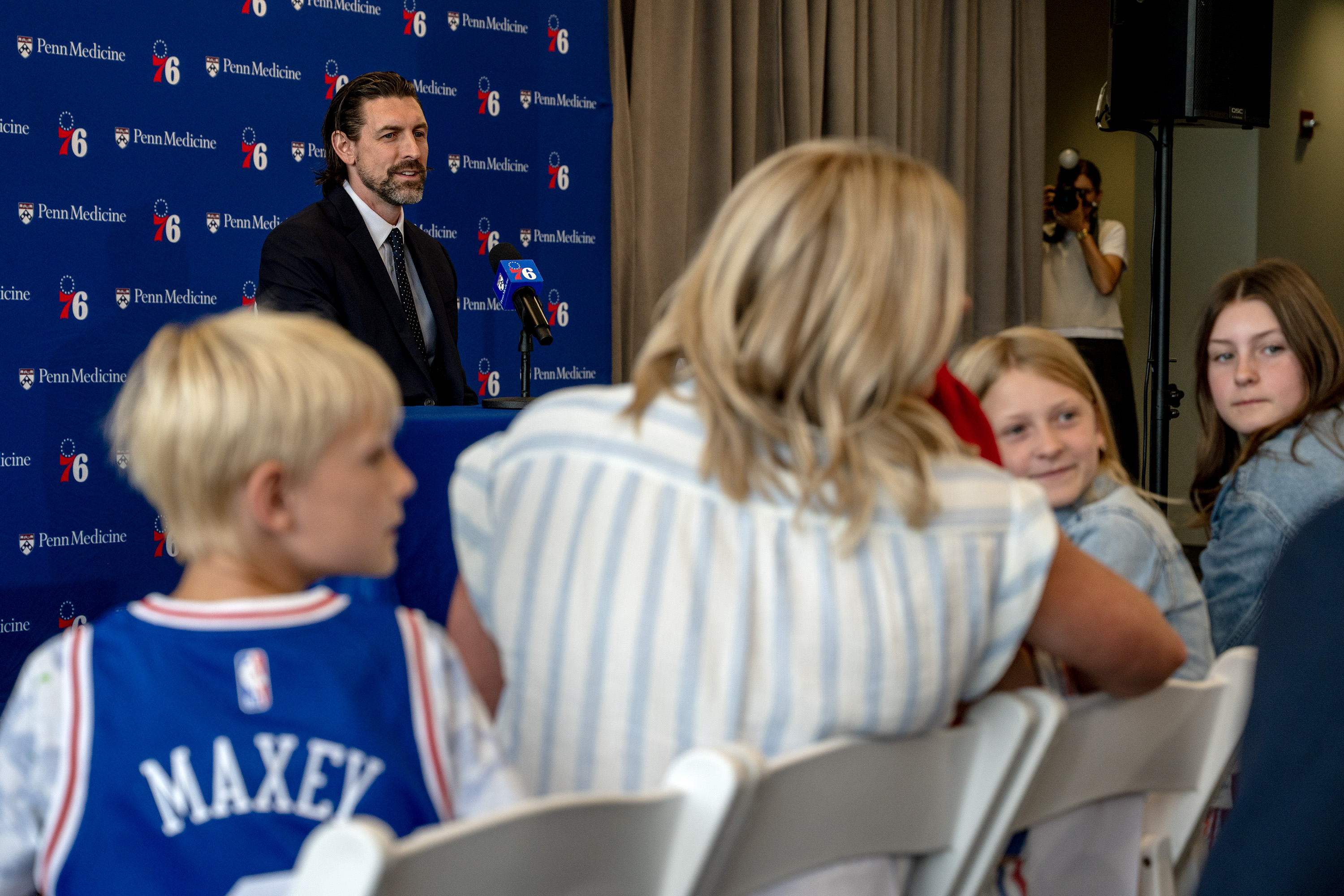
Mike Gansey speaks to the Philadelphia media Monday as his wife Amy and their four children sit in the front row.Tom Gralish / Staff Photographer
With the draft at the end of the month, Gansey’s first big task will be to add another piece that can hopefully make an impact for the Sixers next year. Gansey did not delve too deeply into his draft philosophy, but said that at No. 22 he would consider both best fit and best player available.
But it’s not just about getting the pick right. It’s also about what the Sixers do from there. The team has come under scrutiny recently for its struggles in keeping and developing players. This year’s NBA conference finals featured several ex-Sixers, including former draft picks Jared McCain, Landry Shamet, Isaiah Joe, and even Mikal Bridges, though he never suited up for Philly.