Villanova visited Holy Cross on Saturday in Worcester, Mass., knowing it was a must-win matchup.
And despite a comeback that forced overtime, the Wildcats fell, 30-27, to the Crusaders, which moved Holy Cross into second place in the Patriot League and ended Villanova’s hopes of winning a conference title. At 6-5 overall, 5-3 in league games, the Wildcats are two games behind league-leading Lehigh (9-2, 7-1) with one game left.
The Wildcats were unable to find the end zone after getting the ball first in extra time and settled for a 38-yard field goal on fourth-and-18. Holy Cross running back Jake Croce then punched it in for the winning touchdown on third-and-goal from the 1.
Villanova struggled with consistency on offense, especially on the ground. The Wildcats rushed for 48 yards, their lowest total this season.
Pat McQuaide threw for just 71 yards in the first half before unleashing 342 passing yards in the second and overtime. The sixth-year quarterback completed 33 of 58 attempts. He threw two touchdowns and three interceptions, tying his season high in picks from the opener against William & Mary.
While the offense was finding its footing late in the game, the Wildcats went 2-for-15 on third down, only converting their first early in the fourth quarter.
It was also a tale of two halves for Villanova’s defense. The unit allowed 196 yards and three touchdowns in the first. After halftime, the defense flipped a switch and held the Crusaders’ offense to 72 yards before allowing the game-winning score in overtime.
Playoff picture
Saturday’s loss put the Wildcats’ playoff hopes in jeopardy, as Holy Cross dropped Villanova to third place.
Holy Cross now holds the tiebreaker over Villanova, but Lehigh sits in first place. The 8-2 Mountain Hawks defeated the 6-5 Crusaders in the season opener but also lost to Villanova.
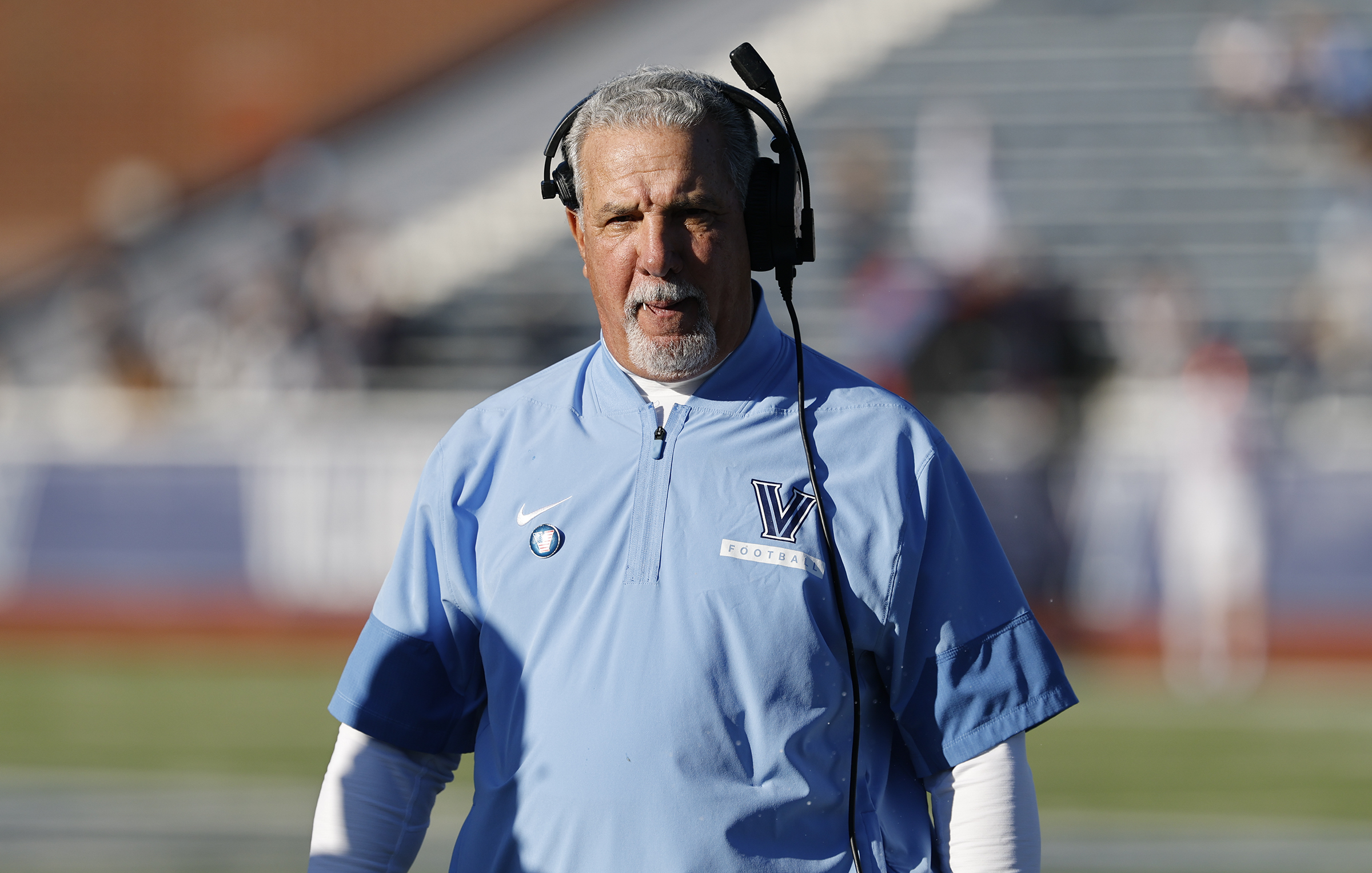
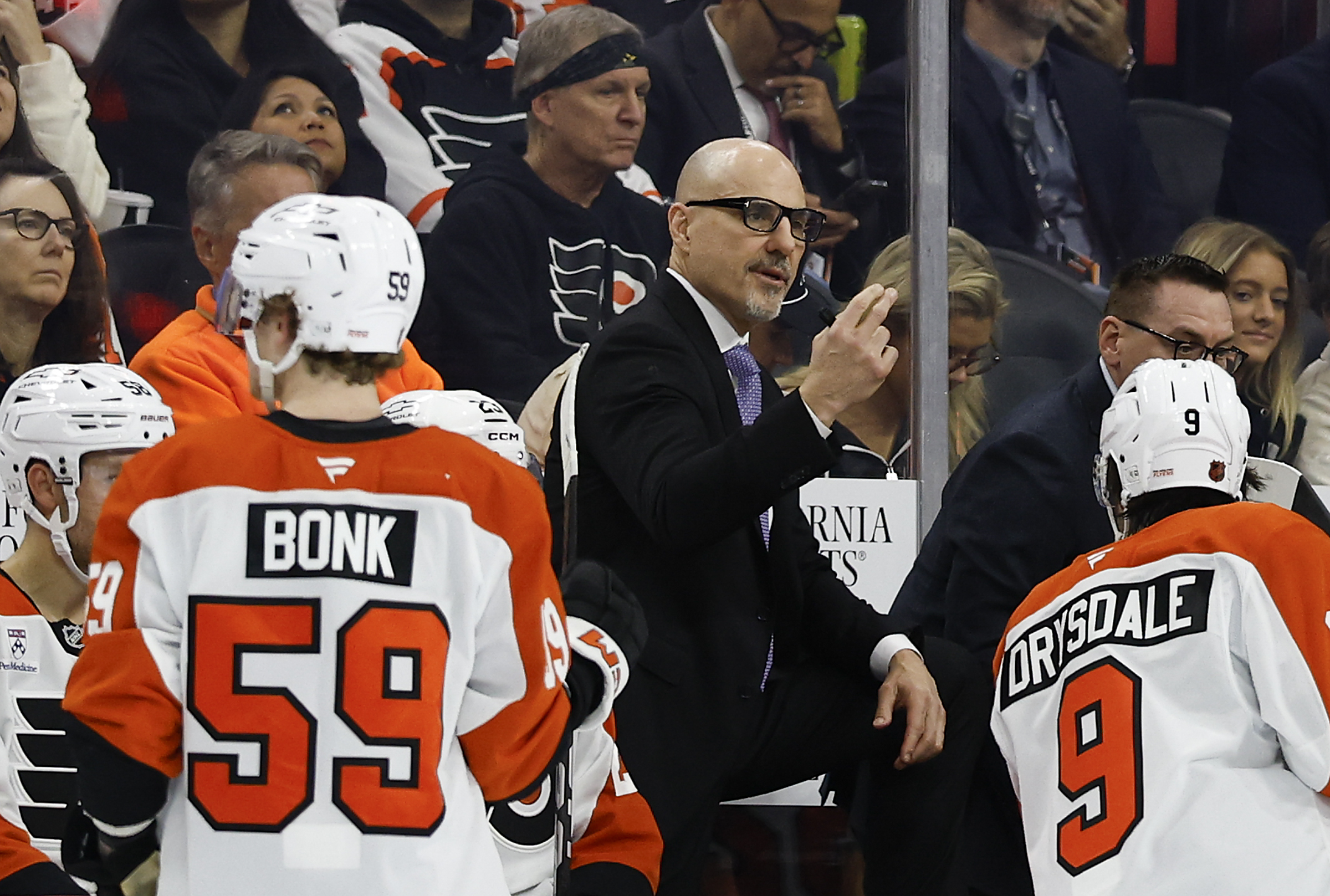
Villanova head coach Mark Ferrante against Richmond on Nov. 7.Yong Kim / Staff Photographer
Regardless, Saturday’s loss has made it impossible for Villanova to win the automatic qualifier for winning the Patriot League.
The Wildcats still have a chance to earn an at-large bid to the FCS playoffs, but next Saturday’s clash with Georgetown is an absolute must-win.
Turnovers doom Wildcats
Villanova hasn’t lost a turnover battle since its September loss to Colgate. The early-season problem showed up against the Crusaders.
Isaiah Ragland fumbled with under a minute left in the second quarter, contributing to the Wildcats trailing by 14 points entering the half.
In the second half, McQuaide threw three interceptions. His second was costly, as it went right into the hands of Crusader cornerback Anthony Redfern, who returned it back 65 yards to set up a Holy Cross field goal, their last score in regulation.
Villanova will head home for their regular-season finale against Georgetown (3-6, 3-4 Patriot League) next Saturday (1 p.m., ESPN+). The Hoyas are coming off consecutive losses to Holy Cross and Fordham.
It has been 76 years since these two programs played, with the Wildcats winning 20-14 over the Hoyas on Oct. 28, 1950. Villanova is 7-3 all-time against Georgetown.
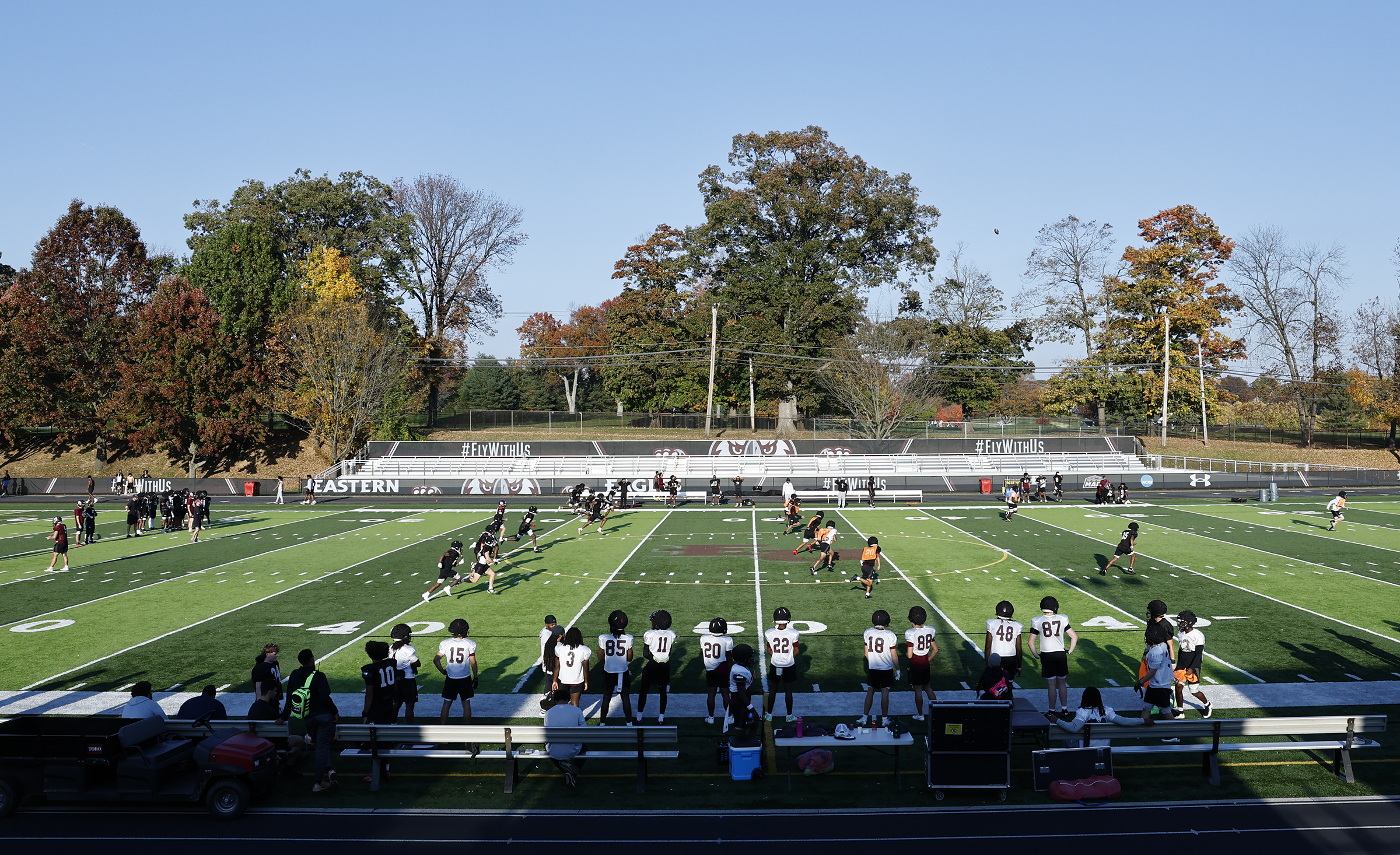
Eastern University’s football team is heading back to the Division III playoffs after beating Fairleigh Dickinson University-Florham, 52-0, on Saturday.
The 8-2 Eagles, who are in their fourth season of competitive play under coach Billy Crocker, earned a share of the Middle Atlantic Conference with the win. Delaware Valley beat Widener, 35-7, Saturday to be named co-champions of the MAC since Delaware Valley and Eastern finished with the same conference record.
Because Eastern owned a head-to-head 21-7 win against Delaware Valley on Sept. 26, the Eagles have earned the league’s automatic bid to the NCAA playoffs.
Quarterback Brett Nabb starred in Eastern’s win with five total touchdowns (three passing, two rushing) and accounted for 271 total yards. Eastern’s defense forced three turnovers and shut out an opponent for the fourth time this season.
The Eagles will learn who they face in the playoffs when the Division III brackets are revealed on Sunday at 5 p.m. Last season, Eastern won its second-round game over Franklin and Marshall before falling in the quarterfinal to Susquehanna University.
A year ago, Troy Brock had convinced himself his lifelong dream of working in law enforcement would remain just a dream.
He said he still thinks back to those days in disbelief as he puts on his Chester County Sheriff’s Office uniform.
“It’s very emotional because I thank God for this every single day that I get up,” Brock said. “I know a lot of people say, ‘Oh, it’s just a sheriff’s position.’
“It’s not, and they have no idea the journey that I’ve been through to get here.”
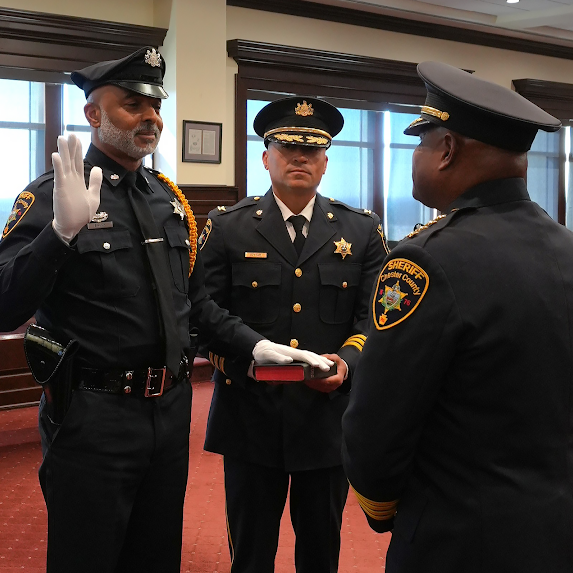
In June, Brock, 57, was one of the oldest deputies to be sworn in by the Chester County Sheriff’s Office. Brock,aKing of Prussia resident, said his journey to joining the office was far from direct.
The son of a Wilmington police officer, Brock said he always sought to follow his father’s example.
But nearly 20 years ago, a major injury sidelined him days before he was set to enter the Delaware State Police Academy. In the intervening years, he worked as a security officer at the University of Delaware, St. Joseph’s University, and Children’s Hospital of Philadelphia before landing a role with the Chester County Department of Emergency Services.
His induction into the department came at a time when the office was reevaluating how it recruits people to serve the county and protect its courthouse, according to Chief Deputy Sheriff Jason Suydam.
“We want people that live in the community to be part of this law enforcement organization and reflect the variety of people that live and work here,” Suydam said in a recent interview.
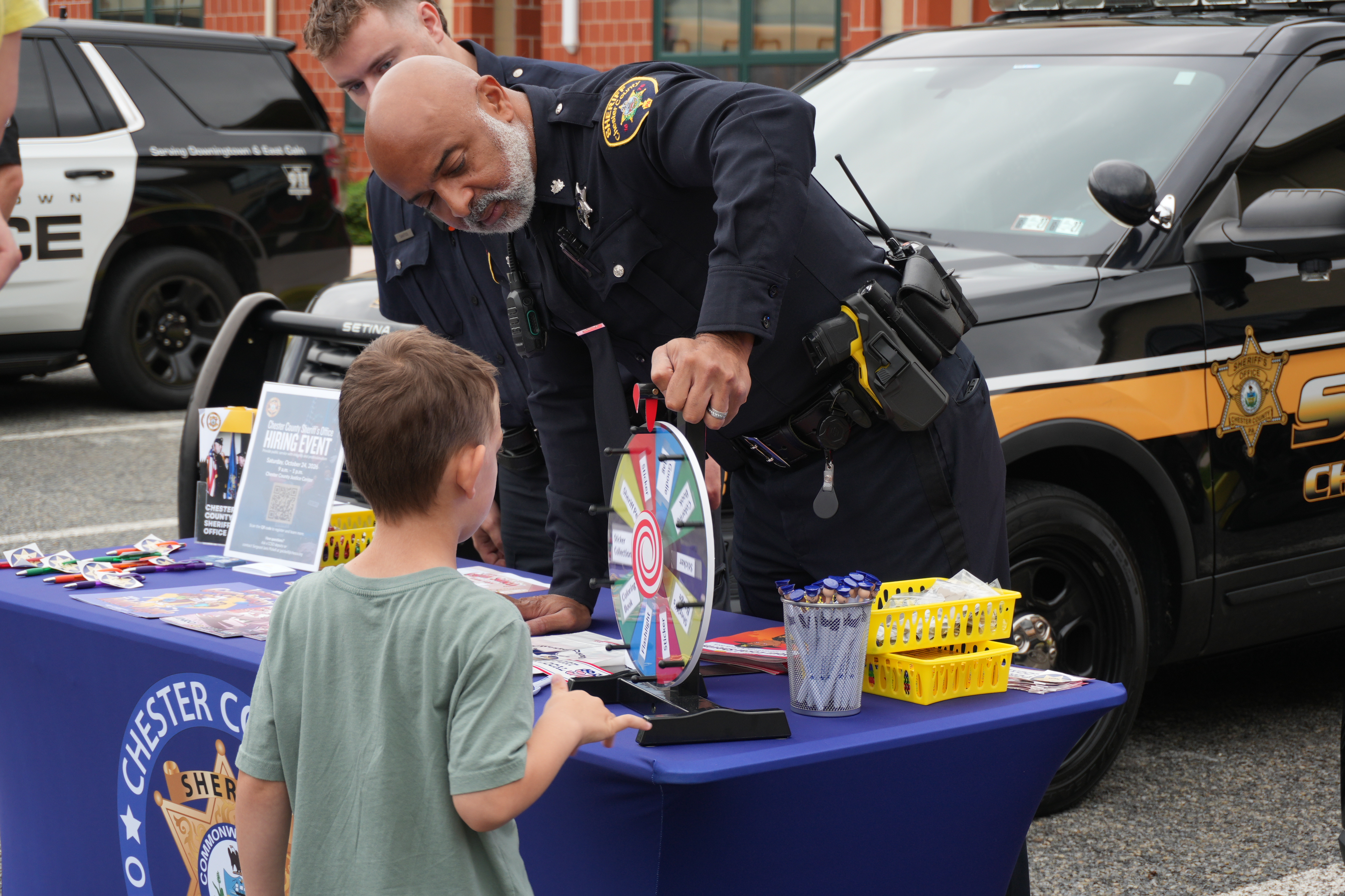
Deputy Troy Brock works at a community event in Downingtown this summer. Brock said he was initially unsure if he would join the Chester County Sheriff’s Office, believing he was past his prime.Courtesy Chester County Sheriff's Office
Suydam first met Brock at the emergency services department, while he wasworking as the department’s deputy director of law enforcement. And when Suydam moved over to the sheriff’s office, he extended Brock an opportunity to join his team. Brocksaid it allseemed too good to be true.
“I had to chuckle a little bit because I felt like I’ve already buried that skeleton, and I wasn’t going to pursue it, because it was pretty heartbreaking,” Brock said. “But he saw something in me, and I knew I couldn’t let him down.”
Brock spent months on an intense workout schedule that got him into recruit shape, and he joined the police academy in January.
Suydam said he knew all along that Brock would succeed.
“Throughout the time that I’ve known him, I just thought he is the type of person that we need in this profession,” he said. “I remember when we sat down, him saying, ‘I’m too old.’
“But I don’t subscribe to being too old or too young to do something if your mindset is you want to accomplish it.”
Brock said in the last five months he has become something of a mentor to his fellow new recruits, most young enough to be his children.
“The most important aspect that I teach to them is it’s not about chasing a dollar or a position; it’s about having integrity,” he said. “That’s the backbone of law enforcement — being honest and having integrity.”
COLUMBUS, Ohio ― The Flyers finish a five-game road trip in Columbus on Saturday night.
The last time these two teams met, the Flyers battled back from a 3-0 hole before losing in overtime on a two-on-none goal by Blue Jackets forward Kent Johnson.
It’s been a trend this season. The Flyers have gone past regulation six times in their first 21 games and have lost each one, with five ending in the extra session and one in a shootout. Last season, they played 28 games past regulation, winning 16.
What are the issues? “All the above,” coach Rick Tocchet said of the team’s overtimes on Friday.
The Flyers spent a long stretch of practice Friday at Nationwide Arena working on three-on-three action after watching video. Whether it translates to the game itself is anyone’s guess because each game, scenario, and opponent is different.
But Tocchet follows three tenets: You can’t lose pucks in certain areas; you can’t throw pucks away; and you have to have better line changes. Of the five overtime goals allowed, four came either directly off an odd-man rush or soon after. The Edmonton Oilers took advantage of a bad change on Wednesday for Evan Bouchard’s winning goal.
“We basically gave the team stats. I think we’ve had five chances. The other team’s had 12,” Tocchet said. “… For us, it’s not a one-man show. We need three guys participating. It seems like we’re not getting that three-man attack or three-man defending. And quite frankly, to be honest, we throw the puck away.
“You’ve got to have a lot of — it’s not courage, but just the hockey IQ of holding onto a puck. You can’t throw pucks away because that’s probably the number one culprit for us. And we’re trying to find guys. I’ll be honest, all jobs are open.”
Fifteen players have seen the ice in overtime, with Travis Sanheim leading at 9 minutes, 25 seconds, Oliver Bonk is last with 23 seconds, and Trevor Zegras leads the forwards at 6:16, and Matvei Michkov is third (4:41).
Rookie Porter Martone, who scored an overtime power-play goal against the Boston Bruins in a pivotal game as the Flyers surged to the postseason last season, has not seen the ice in extra time but is someone Tocchet said could look to moving forward.
Flyers right wing Porter Martone has not seen the ice in overtime this season.Yong Kim / Staff Photographer
So what constitutes a successful player in overtime?
Part of the deployment is based on timing, like needing a center to win the opening draw, as it typically lays the foundation for the rest of overtime, or someone who, because of the fast-paced action, will skate a hard 30 /seconds/ and then change.
“Guys obviously good with the puck who can defend the puck,” Tocchet said. “It’s really, if you look, I think 60% of the overtime goals are from actually defending the puck into a transition. It’s a big number. So you’re looking for people that just can’t go out there and try to just think about scoring all the time because you have to defend. After that, yes, do your thing.”
Watching the three-on-three practice, it looked like the Flyers were focusing on maintaining a triangle formation.
One of the most basic offensive-zone strategies in hockey is utilizing a triangle, where it is not only about spreading out and puck support but also having a player higher in the zone to defend if things quickly head the other way. The bench boss thought his group has been playing flat — or all three across — which is what happened on the Johnson overtime winner at Xfinity Mobile Arena.
“A lot of times in three-on-three, right, teams will fold into kind of a tight triangle, and it’s hard to spread them out,” said forward Travis Konecny. “So, picking your spots on when to try something and when to attack, and then also not giving up the puck.”
The bare minimum message on Friday, whether using the triangle or not, was about support, with or without the puck, and awareness.
“I think at times when we’re in our structure defending, we’re defending pretty good and creating turnovers. It’s the plays [where] we’re trying to force and make, and giving up possession of the puck when we have it,” Sanheim said.
“And in three-on-three, it’s a possession game. You need to wait for your chances and wait for the other team to make a mistake on coverage. Just being more patient, understanding that we don’t need to force it, and let the game kind of come to us.”
Breakaways
Joseph Woll (2-6-2, .902 save percentage) started in goal for the Flyers in the first game of the back-to-back on Saturday. Woll is 2-1-1 in four games against the Blue Jackets with a 2.44 goals-against average and .924 save percentage. Dan Vladař (3-4-4 overall, .879 SV%) is, therefore, expected to be in net against the Oilers on Sunday at home (7:30 p.m., NBCSP). Vladař made 21 saves on 24 shots in the overtime loss on Wednesday. … Columbus head coach Rick Bowness missed his second straight game due to an undisclosed health issue. Don Granato served as the bench boss in his place.
As Pennsylvanians grapple with a major measles outbreak, the Wall Street Journal reported that the Pan-American Health Organization will no longer consider the highly contagious disease “eliminated” in the United States, an extraordinary loss of a public health achievement that the country had maintained for more than 25 years.
The latest designation by PAHO, a division of the World Health Organization focused on the Americas, is largely symbolic, but it means that measles is once again spreading widely in communities across the United States. A spokesperson for the international health agency said it would hold a briefing on the determination Tuesday. The Journal cited “people familiar with the matter” when breaking the news Friday night.
“It is a sad day. I think it is a tremendous step back for public health in this country,” said Paul Offit, a nationally renowned vaccination expert and codirector of the Vaccine Education Center at Children’s Hospital of Philadelphia.
PAHO considers measles eliminated when a country has “no continuous spread of the virus” for at least a year, the Journal reported, adding that PAHO evaluates recent measles outbreaks and reports from the Centers for Disease Control and Prevention to determine how cases in the United States are linked, and whether any outbreaks lasted longer than a year.
Massive measles, mumps, and rubella (MMR) vaccination campaigns in the United States led to the elimination of the disease in 2000. Many doctors practicing today had never seen a measles case before. The last major outbreak in Pennsylvania occurred in 1991.
In 2025, amid a measles outbreak in Texas, the country recorded its first measles death in a decade. This year, the CDC has recorded 5,412 measles cases, the most since 1991.
Pennsylvania has reported the worst measles outbreak in the country this year, with 1,542 cases confirmed as of Friday. About one in five patients has been hospitalized. The state has confirmed seven measles-associated deaths and is investigating an eighth, while New York and Wisconsin have reported three deaths between them.
Offit said that, given the death rate — typically, about 1 to 3 of every 1,000 children who contract measles will die — measles cases in the United States are almost certainly undercounted.
The loss of measles elimination status should be a wake-up call for scientists and public health workers, said Brian Castrucci, an epidemiologist and president and CEO of de Beaumont Foundation, a community health philanthropy outside Washington.
“We’re in an ongoing, day-to-day war with measles, and for the first time in 26 years, measles is winning,” he said.
In a statement, Pennsylvania Secretary of Health Debra Bogen said declining vaccination rates have made more Pennsylvanians vulnerable to the “entirely preventable” disease.
“The only way we can successfully stop future outbreaks, protect our most vulnerable residents, and regain our elimination status as a country is for more people to choose to get vaccinated and rebuild our community immunity,” she said.
Representatives from the U.S. Department of Health and Human Services did not immediately respond to requests for comment.
Vaccine skepticism rises along with spikes in measles cases
Measles is one of the most contagious viruses on earth, lingering in the air for up to two hours after an infected person leaves an area. Up to 90% of unvaccinated people who come into contact with the virus will contract it.
Experts say that 95% of a given population must be vaccinated to prevent the virus from spreading widely; a two-dose regimen of the MMR vaccine is 97% effective against the disease.
ButMMR vaccination rates have been declining for years, both around the country and in the Philadelphia region, amid a burgeoning anti-vaccination movement and the spread of misinformation about the safety of vaccines.
Vaccination rates in Pennsylvania communities and elsewhere have steadily slipped below the 95% level. In Lancaster County, the epicenter of the state’s spiraling measles outbreak, just 87.6% of kindergarteners had been fully vaccinated against measles for the 2025-26 school year.
Now, proponents of the anti-vaccination movement are at the highest echelons of the federal government. Health and Human Services Secretary Robert F. Kennedy Jr., an appointee of President Donald Trump, is a longtime anti-vaccination activist.
Earlier this year, Kennedy said that the MMR vaccine is effective. But he spent years spreading skepticism about vaccine safety — including as recently as September, when he spoke at a conference for Children’s Health Defense,the anti-vaccination group he once chaired.
Castrucci said that anti-vaccination sentiment has long been building in the United States, and that public health workers must communicate more effectively with vaccine skeptics to rebuild trust and encourage vaccination.
“This is our own failure of recognizing this growing problem before it became a crisis. The anti-vax movement is a slow-moving cancer in the American psyche,” Castrucci said. “To think this began and ends with RFK, or begins and ends with Trump, or the midterms, is a horribly naive thought.”
Local health departments need more funding to encourage vaccination and conduct contact tracing, he said. Healthcare providers must help parents navigate questions about vaccination with empathy. And public health officials should emphasize that measles outbreaks take a toll on an entire population, disrupting school operations, hospital work, and other aspects of public life, he said.
Bogen said that efforts to vaccinate more Pennsylvanians are working, with more than 7,100 MMR vaccines distributed by DOH staff at pop-up clinics since April. Across the state, health providers dispensed more than 61,000 doses of the vaccine in October. In a typical month, providers normally give out just 25,000 doses.
“Those numbers are undoubtedly the result of earned public trust and are contributing to the progress we are making to protect our communities,” she said. “We are leading with science, listening to medical experts and giving Pennsylvanians the facts they need to make informed decisions about their health and the health of their families.”
“The epidemiology has shifted,” he said. Before widespread vaccination was available in the 1960s, most Americans contracted measles as children.
“Now you have people in their 20s, 30, and 40s, who didn’t grow up with the virus, who may not have been vaccinated,” Offit said.
Adults make up two-thirds of the measles cases in Pennsylvania, and, like children under 5, people over 20 are more likely to develop serious complications from the virus. Unvaccinated pregnant women are also at high risk, and doctors in Pennsylvania have reported cases of congenital measles — a rare condition in which a woman passes the virus to her child before birth.
“Most doctors have not dealt with congenital measles or measles in adults,” Offit said.
Kennedy must do more to promote vaccination, especially among adults, Offit said, and it is crucial that state and local health leaders vaccinate as many people as possible as cases continue to rise.
“We have an anti-public health HHS secretary,” he said. “We have to do it ourselves, and do everything we can at the state and local level.”
Staff writer Sarah Gantz contributed to this article.
Inside the Alan Horwitz “Sixth Man” Center, Tyrese Maxey hosted the fifth annual Tyrese Maxey Foundation Turkey Giveaway on Saturday. On two of the six main courts, turkeys, sides, fresh produce, and sweets lined the tables. And as Maxey posed for photos with fans, “Tyrese” chants could be heard from the next court over.
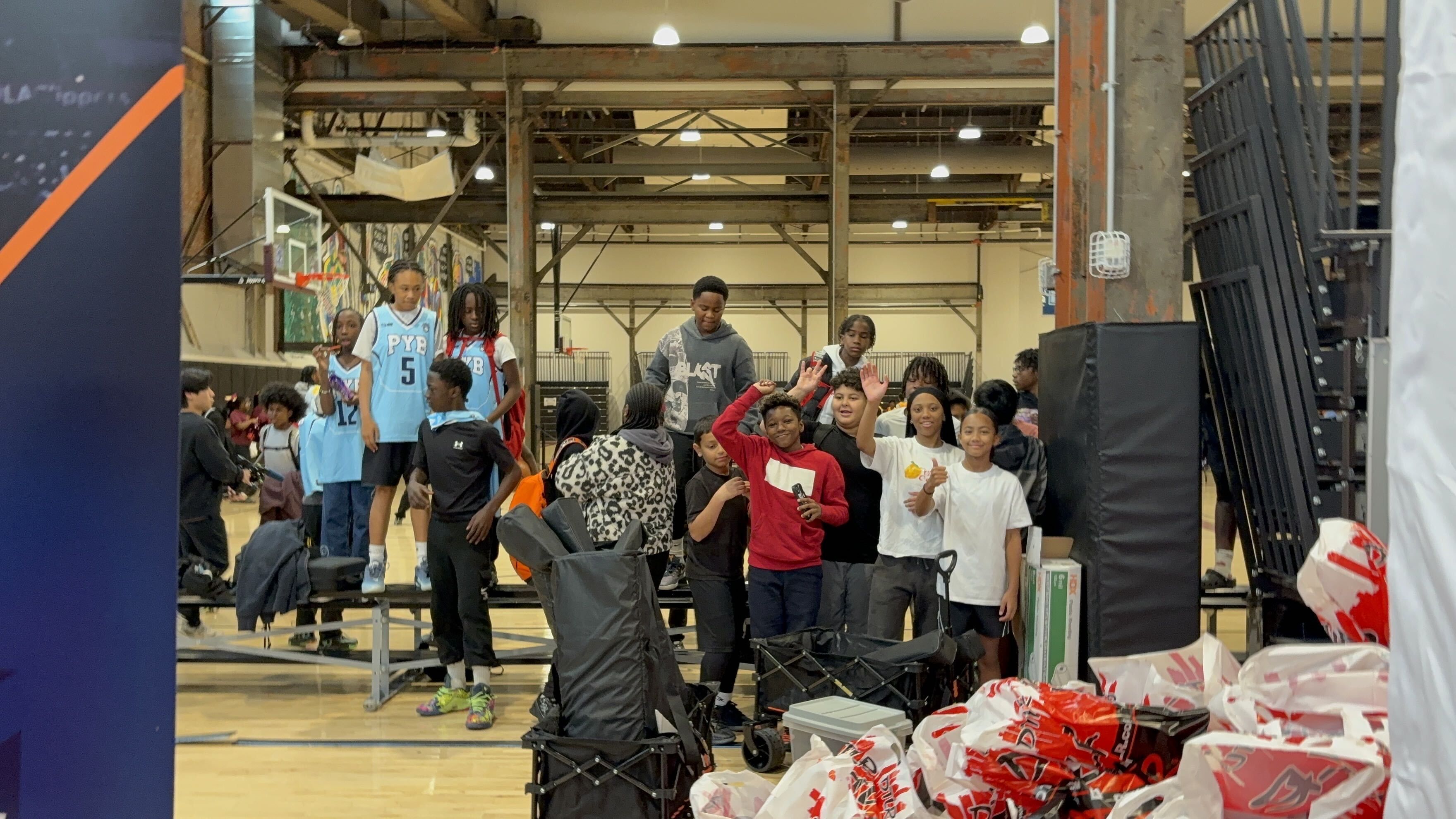
Beyond the turkey drive barrier, the Thomas Holme elementary school basketball team was preparing to compete in a tournament on the other side of the sports facility. Ten-year-old shooting guard Adonis Whice was one of those leading the chants to get Maxey’s attention.
“Tyrese, that’s my dad right there,” Whice said. “I may be glazing right now but Tyrese tough. He’s my favorite.”
Eventually, Maxey made his way over to pose for photos with Whice and other members of the team.
Members of the Thomas Holme Elementary School basketball team met Tyrese Maxey on Saturday.Ariel Simpson
“It was really cool,” said 11-year-old shooting guard Shiloh Penn. “Because Tyrese Maxey is famous and he’s really good on the 76ers. He has good ways to get to the basket and good playmaking abilities.”
The All-Star continues to grow as a leader, and is making his presence off the court just as impactful as it is on the court.
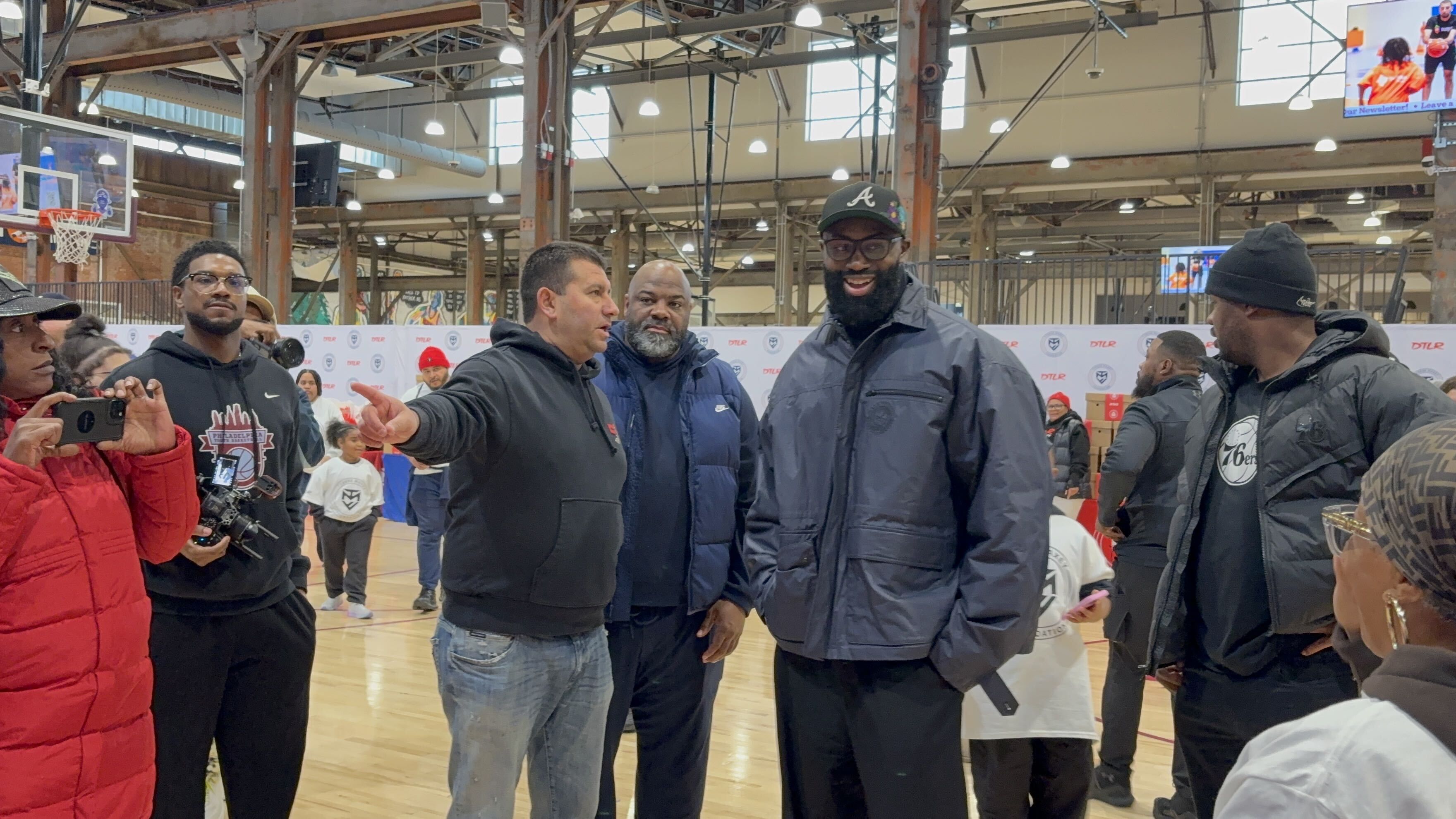
In his fifth year hosting his holiday turkey giveaway, Maxey partnered with Jaylen Brown’s foundation 7uice to play an even bigger role in the community — giving away 5,000 Thanksgiving meals to Philadelphia families in need.
“Man, it means everything,” Maxey said. “Jaylen’s been here for I don’t know what, three months maybe, on the team. I don’t know how long it’s been. But for him to come to an event like this and really support me and my foundation, and just the city of Philadelphia, I just say this, Philadelphia fans, that’s somebody we can get behind, for sure. You know, someone that comes out and takes time out of their day to do this, I’m very much thankful for him.”
Tyrese Maxey partnered with Jaylen Brown for the fifth annual Tyrese Maxey Foundation holiday turkey giveaway, providing 5,000 Thanksgiving meals to families in need.Ariel Simpson
Since its start in 2022, the event continues to grow. In its first year, the foundation gave away 400 meals. The following year, it increased to 1,000; in 2024, the foundation gave out 2,000 meals. And last year, they gave out 3,000.
Seventy-year-old South Philly native Dori Bico is grateful for players like Maxey and Brown who want to give back to the community.
“Tyrese Maxey is a gem because he puts things together, he gives back,” Bico said. “And I’m so honored that he put this together. And I want to thank him, personally. He’s made a difference, definitely. I have food now. Thank you so much, Tyrese.”
Ahead of practice, both Brown and Maxey met with volunteers, fans, and first responders.
Tyrese Maxey partnered with Jaylen Brown for the 5th annual holiday turkey giveaway, providing 5,000 Thanksgiving meals to Philadelphia families in need pic.twitter.com/WHCbfFRR2u
One of those volunteers was 9-year-old Philly native Dylan Smith, who was also celebrating his birthday.
“I like giving stuff out to people to help them with food,” Smith said. “It’s fun giving out food to help others.”
And helping others has been a goal of Maxey’s since before he was drafted to the Sixers with the 21st overall pick in the 2020 NBA draft.
Video: Tyrese Maxey loves giving back. It comes from his family.
“It was a priority for me before I got drafted,” Maxey said. “It was one of the last conversations I had with my grandma before she passed away, just how she wanted me to be able to give back to the community that I play in and where I’m from back in Dallas. So, I’ve been able to do that. I hope she’s shining down on me, laughing, and smiling, and is proud of me.”
Travelers at Philadelphia International Airport continued to face uncertainty Saturday after an extraordinary nationwide ground stop upended flights and left people stranded overnight.
Air travel should be back to normal by the end of Sunday, federal officials said at a news conference. Airlines will still have delays and cancellations, according to Bryan Bedford, administrator of the Federal Aviation Administration, but the “worst is behind us,” he said.
Officials said a section of the nation’s aging air traffic control system was being upgraded whenit became overloaded. A contractor was replacing copper telecommunications wire withnew fiber wire when a problemcaused communication and radar gaps,leading the FAA to suspend flights.
The four-hour stoppage — the longest in 25 years — disrupted hundreds of flights at Philadelphia International Airport on Friday evening, and the fallout lingered Saturday morning, as mounting delays and cancellations forced some flyers to abandon their itineraries. As of midafternoon, more than 150 flights had been canceled and more than 130 others into or out of the airport had been delayed, according to data from the flight-tracking website FlightAware.
Lea and Todd Hoiland’s travel plans had been in limbo since Thursday. Waiting for the bar to open at the Philadelphia Airport Marriott Hotel on Saturday morning, the couple explained how their dream vacation — a 10-day cruise to Rome — refused to end.
On Thursday, they were diverted from Philadelphia to Washington Dulles International Airport due to golf ball-size hail. Then, on Friday afternoon, while waiting to board their flight from Philadelphia to South Carolina, all flights were grounded. The pair tried to book a rental car to make the 8.5-hour drive home, Todd Hoiland said, but no cars were available.
“We started scrambling,” Lea Hoiland said. “People were everywhere. I’ve never seen anything like it.”
By Saturday, with her checked luggage somewhere between Italy and Myrtle Beach, S.C., she resorted to the fashions of an airport gift shop: a Liberty Bell sweatshirt, Philly-themed socks.
Since the couple are small-business owners, the extended trip has cost them money and added complications, Todd Hoiland said. But it could be worse, and he was grateful they were almost home.
“It’s going to feel great,” he said.
Meanwhile, other travelers were frustrated they couldn’t get away.
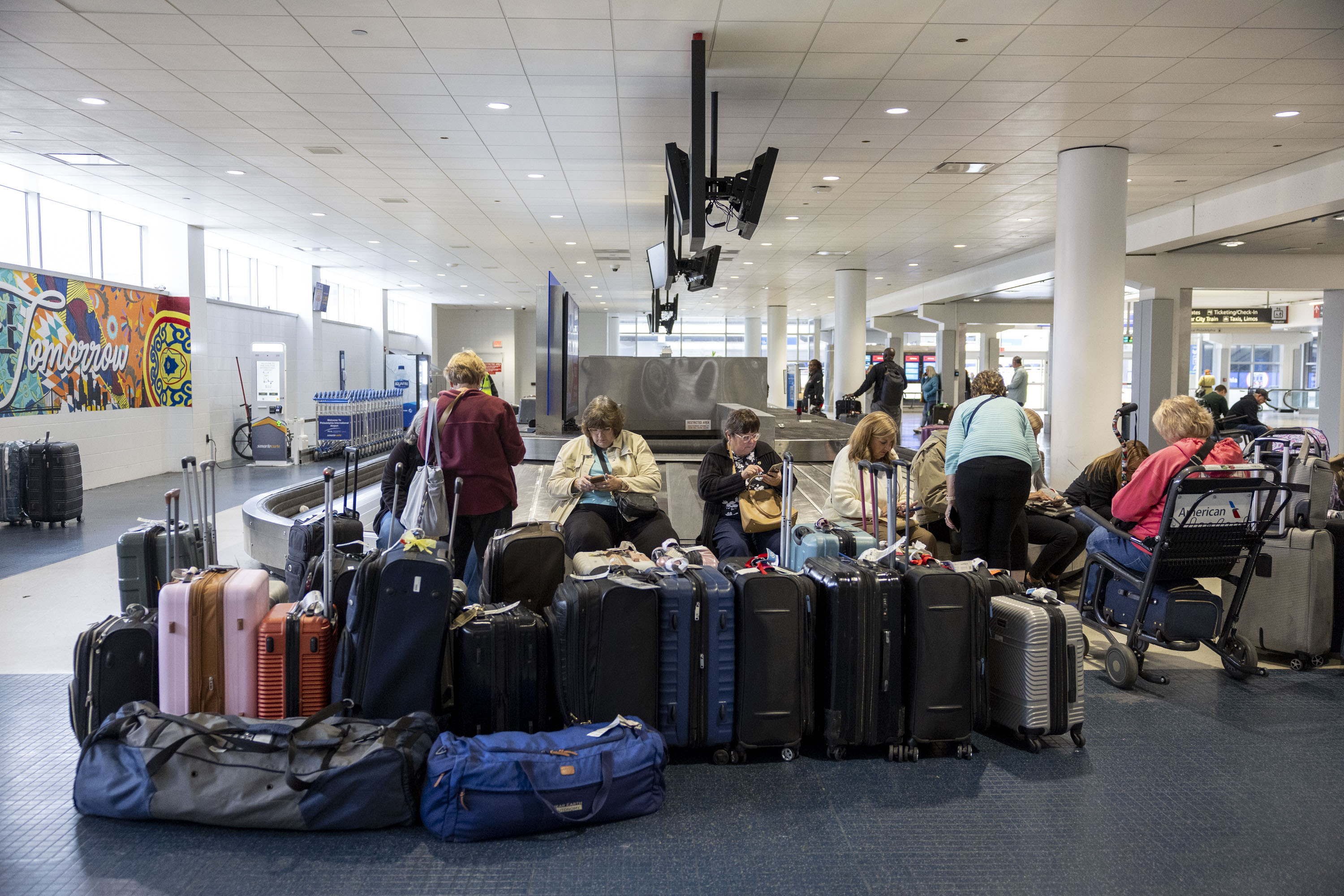
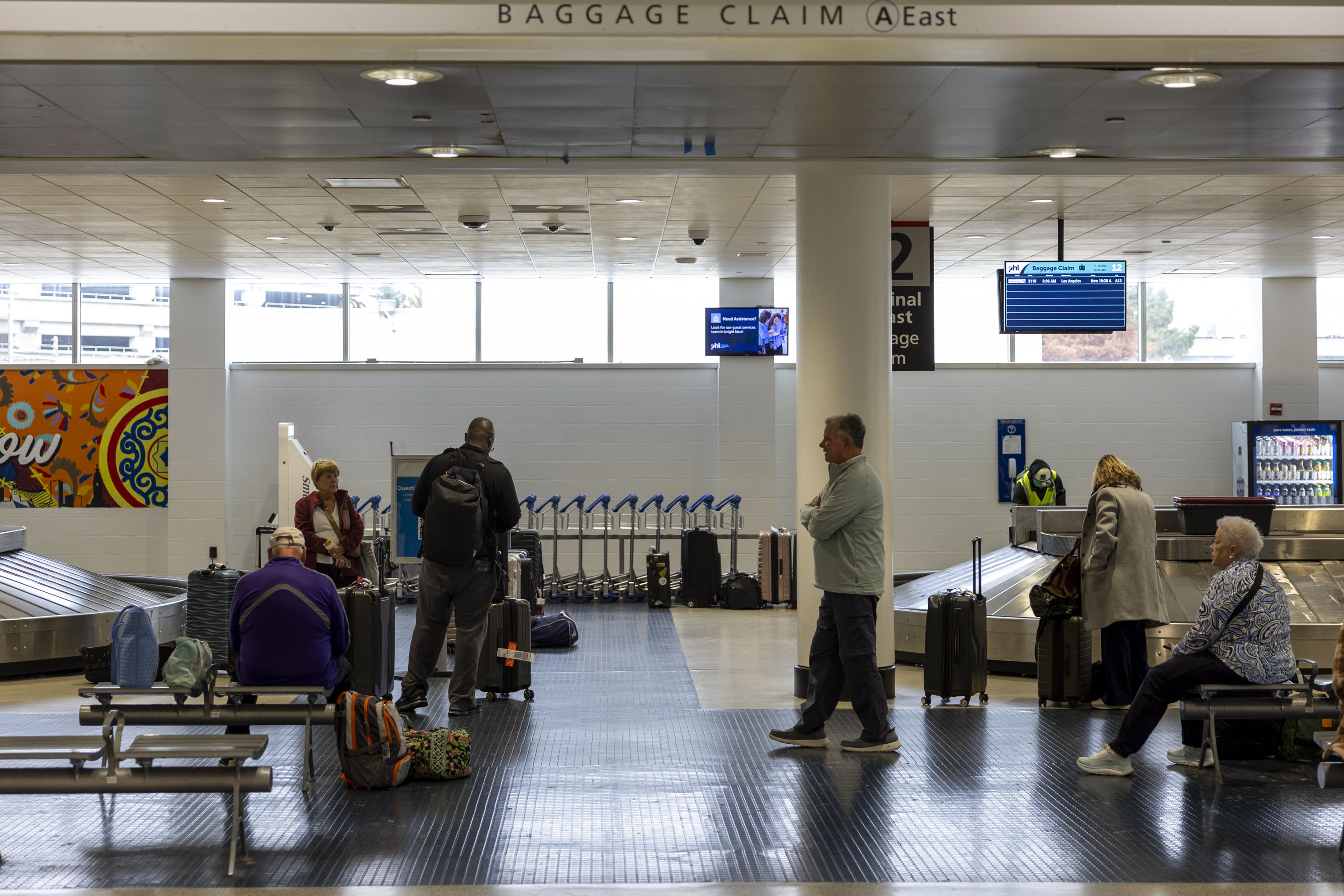
Dozens bound for a beach oasis found themselves at baggage claim, dragging untouched vacation clothes back into 40-degree temperatures.
People waiting on their baggage after yesterdays nationwide ground stop for flights at Terminal A at the Philadelphia International Airport on Saturday, Nov. 14, 2026, in Philadelphia, Pa.Tyger Williams / Staff Photographer
“I’d rather be in clear blue water than Philadelphia,” said Chris Hudson of Smyrna, Del., who was part of a 27-person group headed to the Turks and Caicos Islands for an annual family vacation. Their flight was canceled just before boarding.
Hudson and his group were trying to secure a flight for Monday, shaving two days off their planned getaway. Airlines are obligated to offer free rebooking on another flight for travelers who want to continue their journey, or a refund if their flight was canceled and they decide not to take the trip.
Lisa Prisco of Bethany Beach, Del., and her husband were hoping to rebook their 50th wedding anniversary excursion for January.
“We’re retired,” Prisco said. “It’s an inconvenience, that’s all.
“But I feel for the families and working people.”
Hudson heaped the blame on “dirty” politicians from both parties: “They can’t fix anything,” he said. “They just blame each other.”
Secretary of Transportation Sean Duffy said authorities were investigating whether contractor “incompetence” or a faulty router caused the system overload. But officials stressed that the ground stop was not the result of a system outage or a nefarious cyberattack or related to the use of artificial intelligence.
Modernization of the air traffic control system began last year after Congress approved $12.5 billion in funding, and the FAA has already replaced thousands of old copper wires with fiber optic lines and upgraded hundreds of radio systems as part of the overhaul.
But Trump administration officials have renewed their calls for another multibillion-dollar investment into the technology, which they say is needed to prevent similar failures.
Flyer Ron Sigismonti Jr. of North Carolina was hopeful the issues were a one-off, but he prepared himself for a long travel day.
“Anything could happen,” he said.
This article contains information from the Associated Press.
Justice for Malayshia should not mean simply tightening enforcement of foster system regulations and more family separation. It is an invitation to admit the foster system is not safe for our children and imagine something new: meaningful resources to keep families together.
We know these numbers do not capture the full extent of the problem — youth survivors of the foster system routinely tell of the harms they suffered — many of which go unreported. These rates are also far greater than the rate at which children are torn from their families for allegations of physical (13%) or sexual (4%) abuse.
Every day, the city’s Department of Human Services (DHS) and family court deem parents unfit because of failures to provide for their children, unjustly holding parents individually accountable for living in poverty with no accountability for systemic failures. Black parents living in poverty fight against, but are often defeated by, the overwhelming narrative of unfitness. When children cannot safely live at home, the law requires family placements to be considered by DHS.
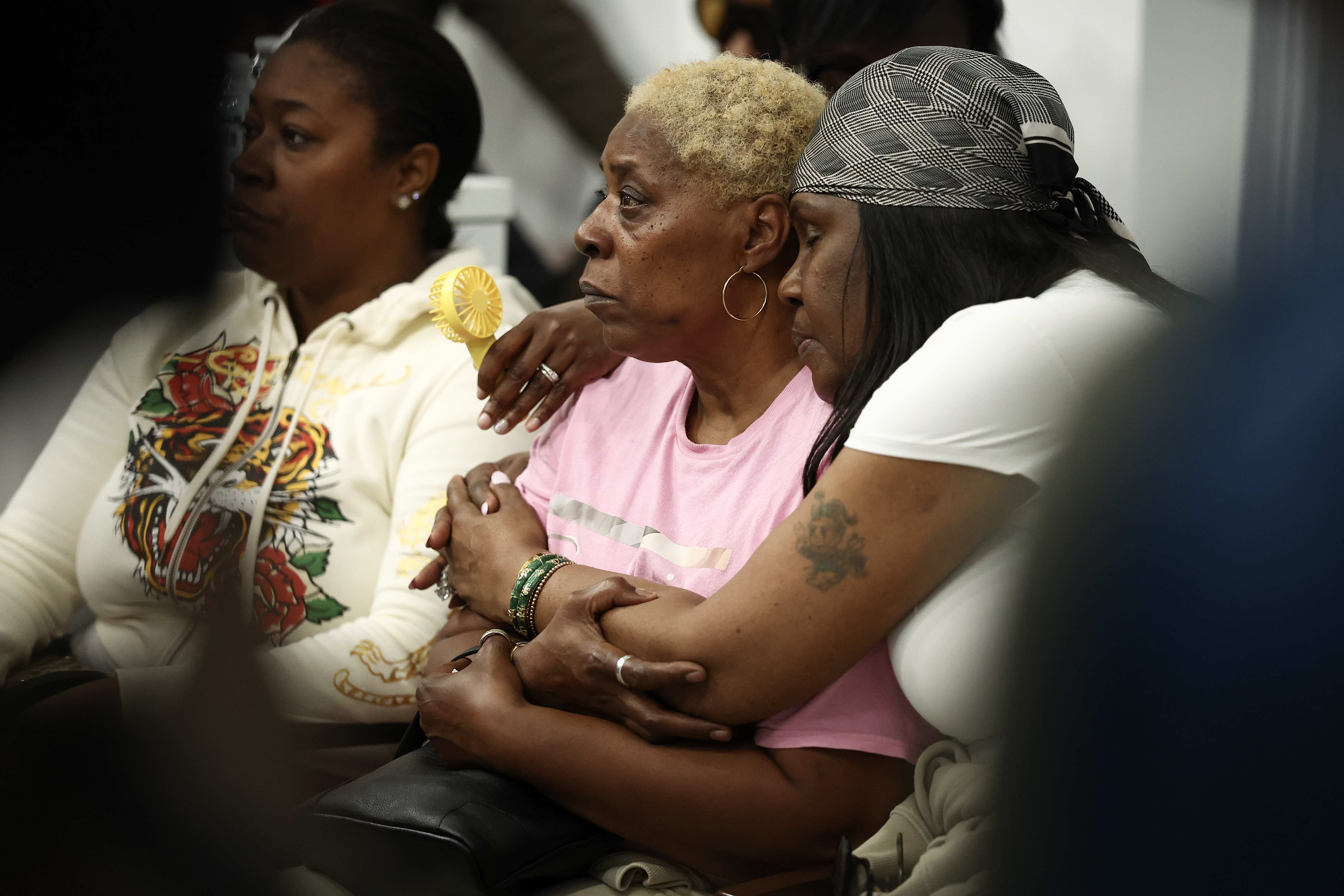
Family of Malayshia Allford, 10, at a news conference at Philadelphia District Attorney Larry Krasner’s office Nov. 5 after the child’s remains were recovered inside the trunk of a car in South Jersey.Monica Herndon / Staff Photographer
But relatives and family members are frequently disqualified by DHS as a placement option for any number of reasons: a home is deemed not big enough, income levels are said to be too low, someone in the home has a criminal record, and many other factors.
However, the solution is not just more kinship care, because while arguably better for children, it is still family separation and children still experience harm. No amount of increased funding, policy change, different leadership, or increased oversight changes the harm our families are experiencing. The solution is ending our reliance on the foster system to keep children “safe” and to redirect these resources outside of the child welfare system so that families can stay safely together.
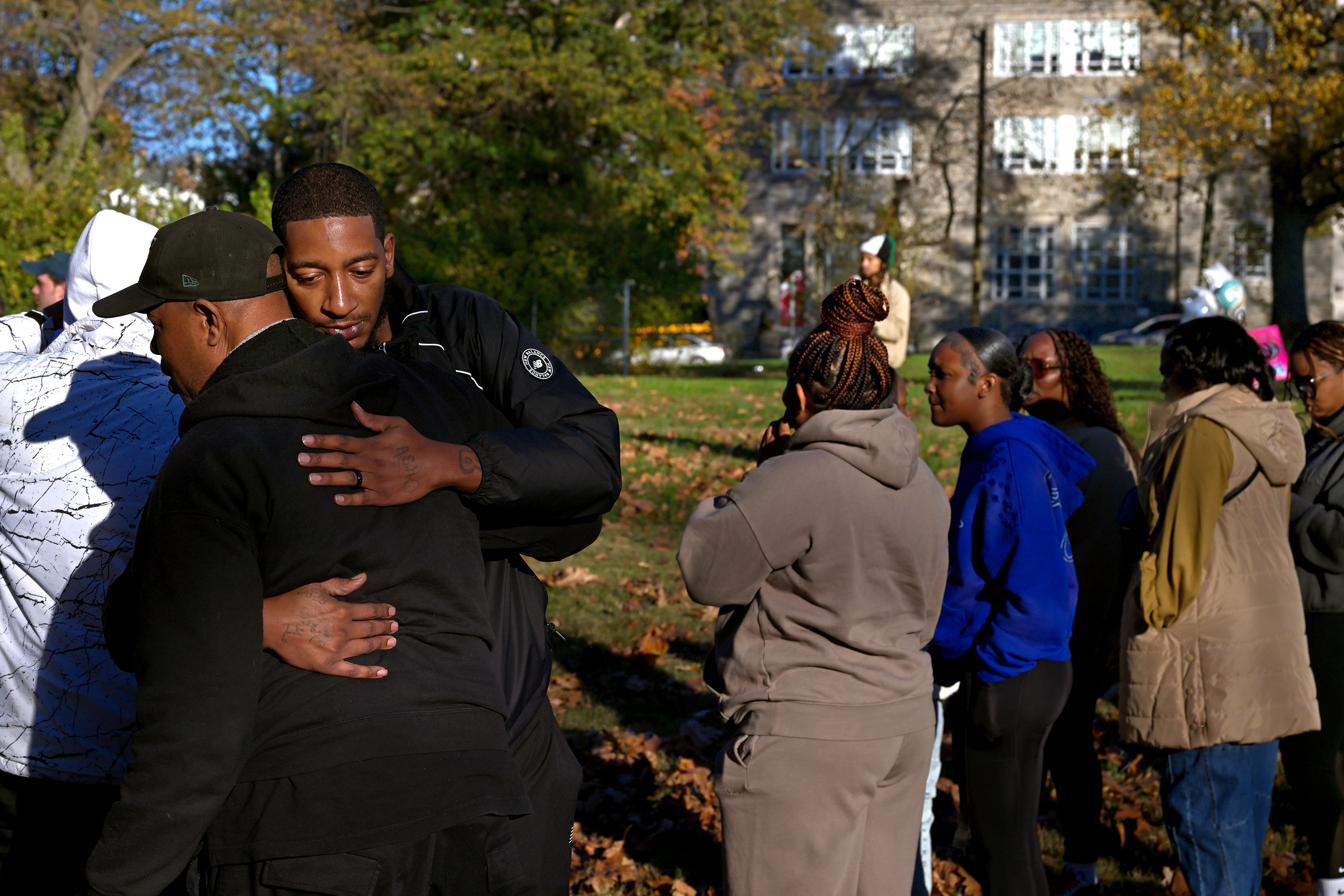
Nafis Horne, the uncle of Malayshia Allford, is with family and friends as they gathered Nov. 8 in Morris Park in Overbrook to remember the young girl.Tom Gralish / Staff Photographer
While child welfare agencies say family separations are meant to offer protection, our children are being killed, abused, and silenced, dragged from foster home to foster home with virtually no safeguards.
In the past five years alone, Hope Jones, Sul’yah Williams, and Sy’Vir Hill were each killed by caregivers whom DHS deemed safe. Despite well-publicized closures, residential facilities continue to have rampant abuse, sex trafficking, and regulatory issues.
It is time to break our reliance on harmful systems and imagine something different.
One of the most unusual offerings in the cornucopia of events occasioned by our country’s 250th birthday is “A Nation of Artists,” an extraordinary exhibition that takes a fresh look at the history of American art. Spread over two museums, the show implicates nearly 1,000 artworks gathered from three collections that span four centuries.
The whole is indeed greater than the sum of its parts.
“A Nation of Artists” occupies 19 galleries at the Philadelphia Museum of Art (PMA) and nearly all available space at the Pennsylvania Academy of the Fine Arts’ Historic Landmark Building (PAFA). Intermixed with the museums’ permanent collections are about 100 masterworks from the Middleton Family Collection of American Art, on public view for the first time.
“The beauty of ‘A Nation of Artists,’” says PMA curator Kathleen Foster, “is that the two grandpas collaborated with the Middleton Collection to enhance their ability to tell the story of American art history.” To Foster, “There is no single story of American art — it’s a patchwork of different ideas, an amalgam.”
Skylights in the newly renovated Furness and Hewitt building at the Pennsylvania Academy of the Fine Arts Wednesday, May 6, 2026,“A Nation of Artists”Tom Gralish / Staff Photographer
The dualinstallations, like nonidentical twins, were simultaneously conceived yet endowed with distinct mien and appearance. To identify art that best exemplified history’s blended narratives, each curatorial team scrutinized the galleries and storage vaults of their respective collections. Burrowed within the origin story of each institution are clues to why and how the halves differ.
PAFA opened in 1805 as a museum and school with a curriculum modeled on traditional European academies. Not long after, it began to collect “the art of our time.” PAFA’s enduring identity as the nation’s first art museum and school reflects the founders’ intention to “promote the cultivation of the Fine Arts in the United States of America.” It helps explain why, in their portion of “A Nation of Artists” galleries, work by recent graduates hangs near legendary elders who studied at the school a century or two earlier.
The PMA, 75 years PAFA’s junior, was likewise established to teach and to present art. Then called the Pennsylvania Museum and School of Industrial Art, it started in Memorial Hall, the art gallery of the 1876 Centennial Exhibition in Fairmount Park.
The institution uniquely made space for “applied arts” such as furniture, jewelry, and clothing, a clear sign of the modernity of their interests. Their purview widened in the 1890s when they began to buy and collect contemporary painting and sculpture.
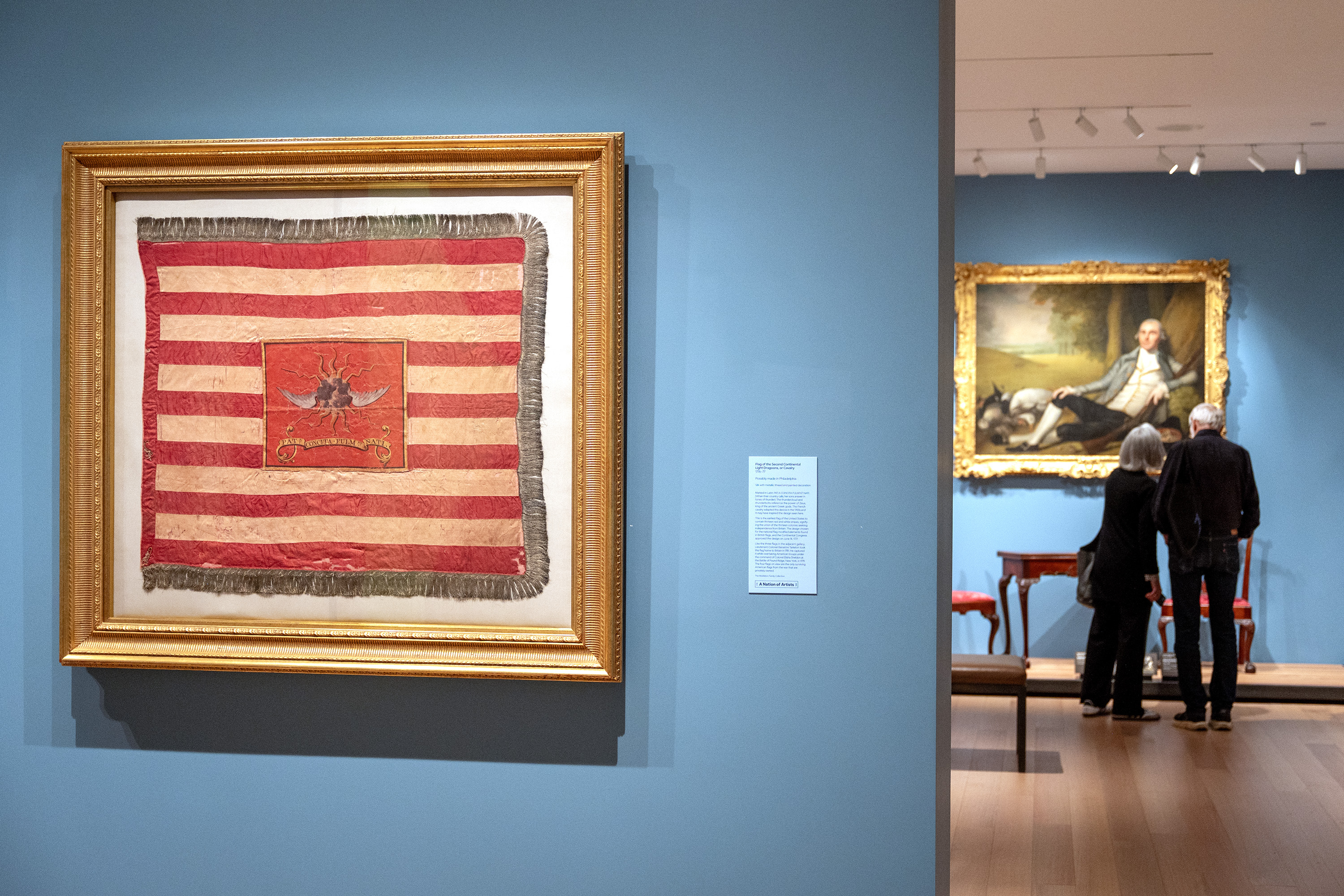
“The Flag of the Second Continental Light Dragoons,” possibly made in Philadelphia, is displayed at the Art Museum. It is the earliest flag of the United States to contain 13 red and white stripes.Tom Gralish / Staff Photographer
Gems at PMA
From the vantage of the PMA’s Grand Stair Hall on the second floor, a supersized trailhead marks the route to “A Nation of Artists.” The way forward leads through a corridor with a small selection of American watercolors and drawings made in response to the terrain of the New World. The section’s title, “New Eyes,” is a fitting note to self for what’s ahead.
The PMA galleries designated for “A Nation of Artists” bracket the years from the 1680s to the 1950s. The newly renovated galleries on the second floor tackle the 19th and 20th centuries, while art from the first 200 years is on the first floor, in the museum’s splendidly reinstalled galleries of early American art, which opened in 2021. Seventeen works from the Middleton Collection are there, in companionable proximity to charismatic old-timers.
The earliest United States flag to contain 13 red and white stripes, The Flag of the Second Continental Light Dragoons, (1776-77) is a Middleton loan, as is Charles Willson Peale’s monumentalGeorge Washington at Princeton (1779), painted a decade before the subject became president.
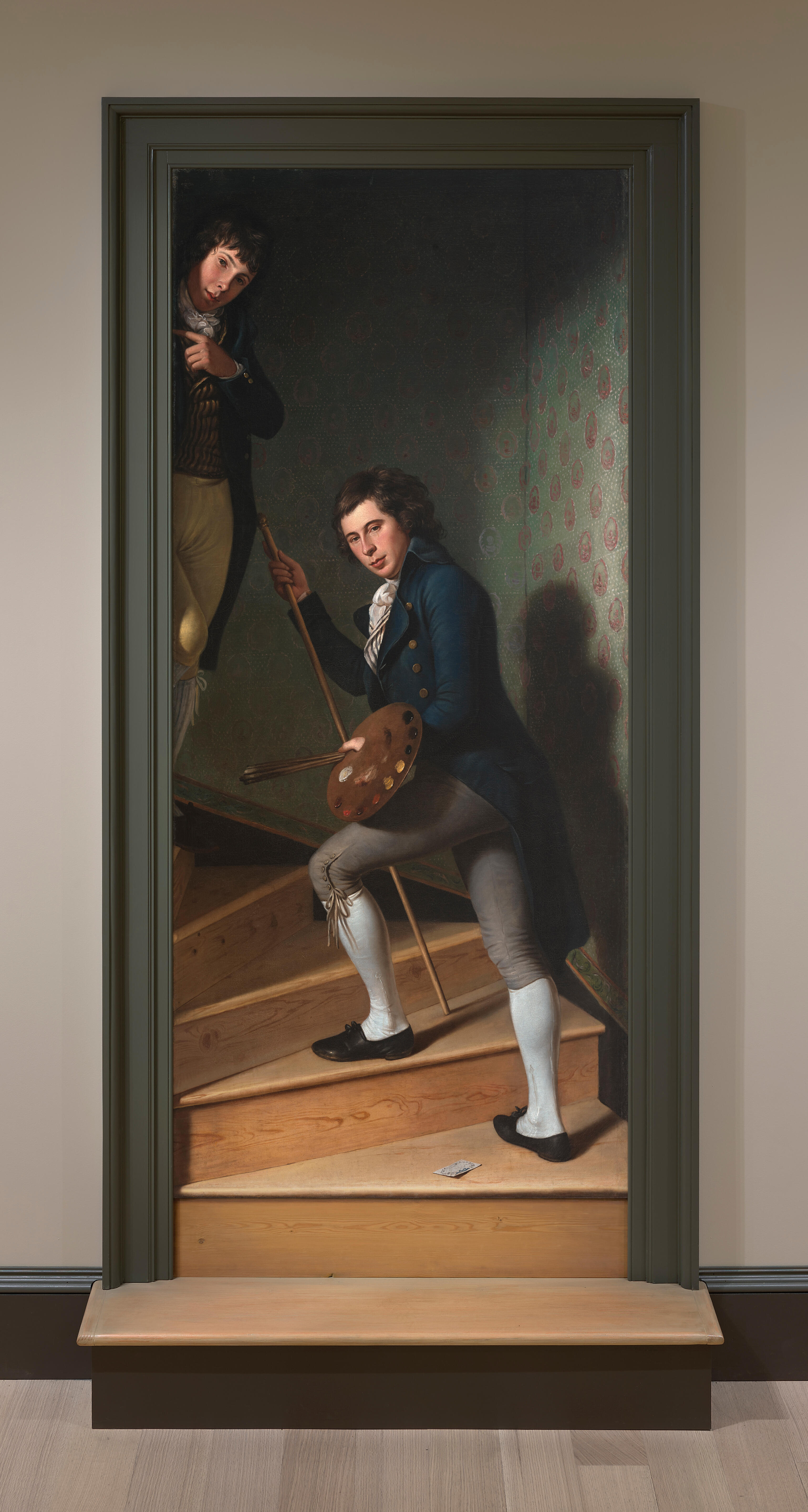
“Staircase Group” by Charles Willson Peale. Jason Wierzbicki
A few steps away is PMA’s Staircase Group (1795), Peale’s startlingly illusionistic portrait of his sons paused in mid-ascent. It was so realistic that, reportedly, a distracted Washington once nodded at it in passing. The entire first-floor area constitutes an “unadvertised special” of the upstairs galleries. Explore it the day of your visit or save it for another day — it’s that worthwhile.
Works in the newly renovated Furness and Hewitt building at the Pennsylvania Academy of the Fine Arts.Tom Gralish / Staff Photographer
Head over to PAFA
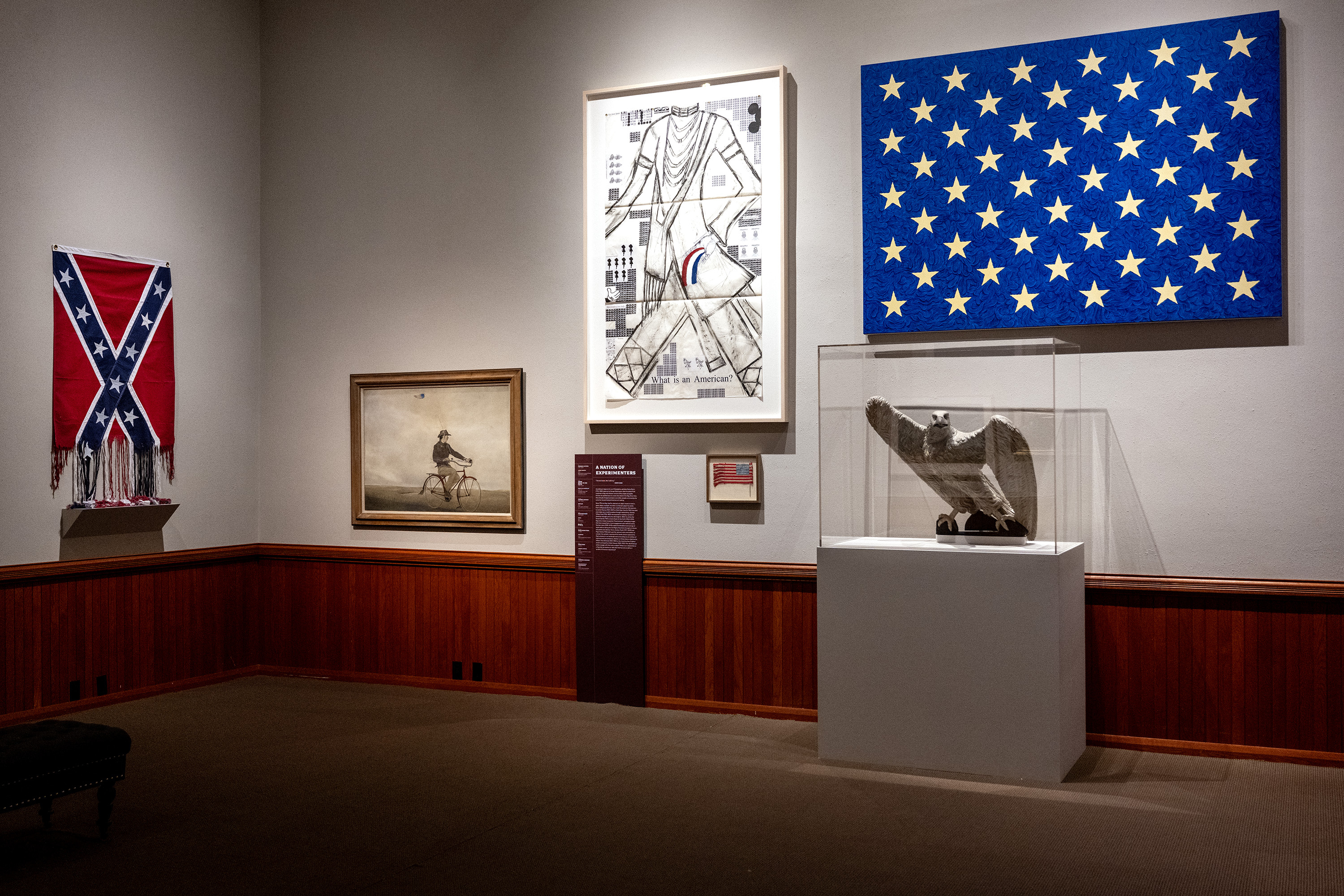
At PAFA, “A Nation of Artists” begins a few steps from the front desk, in a section entitled “A Nation of Experimenters.” Relinquish expectations that art history here unfolds in chronological sequence, as it does at PMA. Throughout PAFA, intergenerational clusters of provocatively unalike art shelter under thematic umbrellas.
Every work in this introductory gallery references the American flag or issues of national identity. Standouts include Sonya Clark’s ongoing performance work, Unraveling (2015 to present), made with a Confederate battle flag that she partially deconstructed, thread by thread. In Andrew Wyeth’s Young America (1950), a rider isn’t looking where he’s going as he pedals across a desolate landscape. Both Norman Lewis’ painting Redneck Birth(1961) and William Rush’s emblematic sculpture Eagle (ca. 1810) voice the unspoken query of Jaune Quick-to-See Smith’s large lithograph (2001-03) What is an American?
Norman Lewis’ “Redneck Birth.” Courtesy of the Pennsylvania Academy of Fine Arts
Midway upstairs, there’s an independent, outwardly unrelated display of Fred Wilson’s MASTER PLAN(2004-2009), a suite of delicate photogravures commissioned by PAFA’s Brodsky Center. An intriguing, conceptual inquiry into the subtle ways museum floor plans affect visitors, it prompted me to draft another “note to self.”
Detail of “Declaration of Independence” by Vanessa German.Tom Gralish / Staff Photographer
A diverse nation
“A Nation of Artists” offers rich, tangible proof of the creative complexity of American art. The curators’ strategic arrangements stimulate many educational takeaways. Equally potent provocateurs are the juxtapositions and connections we notice on our own. Here are some of mine.
African Americans are integral to the narrative weave of the show.“Prosperity, Abundance, Inequity,” the overarching theme of a PMA gallery of mid-19th century art, includes one less obvious thread.
Amid the eye-catching trappings of wealth is a utilitarian stoneware vessel by Dave, an enslaved potter. Although literacy was illegal for enslaved people in South Carolina, Dave inscribed the jar with his name, a rhymed verse combining a biblical reference with the jar’s use, and the date, 1859.
That same year in West Virginia, an ardent abolitionist received a death sentence for raiding the federal armory at Harpers Ferry.
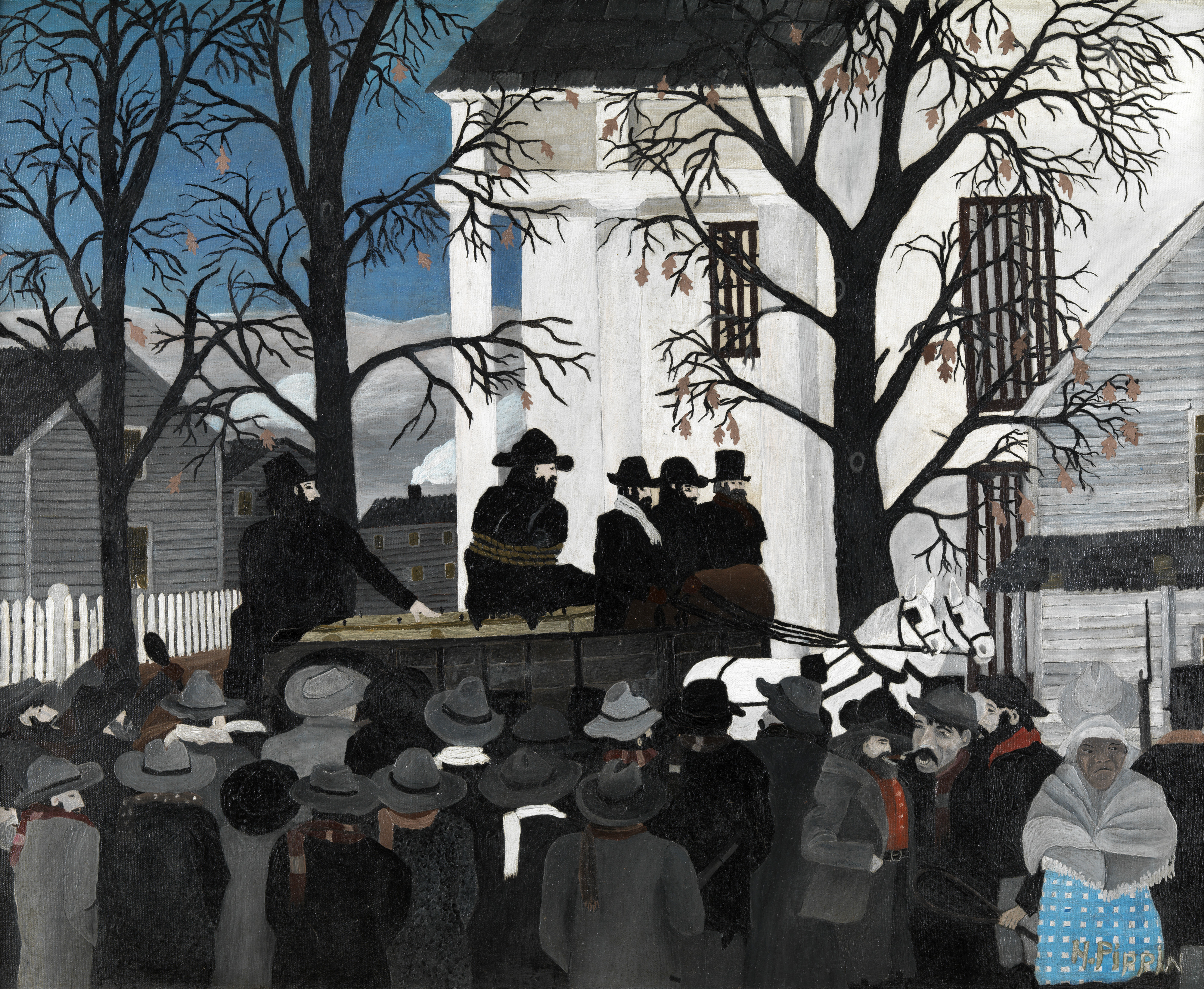
In PAFA’sJohn Brown Going to His Hanging (1942), Horace Pippin visualized a crowd of male onlookers facing the gallows-bound wagon in which Brown sits on his own coffin. The one Black woman may be his grandmother, who, while not an eyewitness, was the likely source of his information. Unforgettably, she’s the only person turned to meet our gaze.
“John Brown Going to His Hanging” by Horace Pippin.Barbara KatusFlorine Stettheimer’s “Picnic at Bedford Hills.” Courtesy of the Pennsylvania Academy of Fine Arts
The city of Philadelphia links two works painted 200 years apart at PAFA. John L. Krimmel’s Fourth of July in Centre Square (1811) is a delightfully detailed survey of a broad range of the population. It wasn’t people but the record of their actions that snared my attention a few galleries away. In Alex Lukas’ lengthy horizontal painting Untitled (2012), the stigmata of old tires, vandalized walls, and posters ornament an unidentified Philly riverbank.
Although I was acquainted with the modernist Florine Stettheimer’s whimsical paintings, it was a treat to find two of them. In PAFA’s Picnic at Bedford Hills (1918), the artist taps her memory of the languorous luncheon she enjoyed with a small group of friends, Marcel Duchamp among them. In PMA’s Spring Sale at Bendel’s (1923), a melee of bargain-crazed ladies behaves in amusingly unladylike ways.
Florine Stettheimer, “Spring Sale at Bendel’s.” Courtesy of the Philadelphia Museum of Art
Benjamin West’s familiarity with the customs and attire of Indigenous Americans is evident in his iconic, grandly scaled Penn’s Treaty with the Indians (1771—72) at PAFA. To paint it, he tapped firsthand knowledge, having grown up near Indigenous communities in what is Swarthmore today.
In West’s painting, authentically garbed players enact an imaginary account of the founding of Pennsylvania a hundred years earlier, an ostensibly beneficent goods-for-land exchange between Penn and representatives of the Lenape. West’s prominent placement of a bare-breasted Native mother nursing her cradleboard-bound infant is less a compositional device than it is a nod to Eurocentric interest in exotic details.
Benjamin West’s “Penn’s Treaty with the Indians.”Courtesy of the Pennsylvania Academy of Fine ArtsSanford Gifford, “A Coming Storm.”Courtesy of the Philadelphia Museum of Art
Several works at PAFA catapult us forward by hundreds of years. Skywalker/Skyscraper (Allegory) (2012), a knockout, mural-size rainbow made with reclaimed wool blankets, is by Marie Watt, a member of the Seneca Nation of Indians. She chose blankets as her material because, like all everyday objects, they can carry “extraordinary histories of use.”
Dyani White Hawk, an artist of Sičáŋǧu Lakota ancestry, painted PAFA’s stunning She Gives (Quiet Strength VII) (2020). This monumental, abstract composition of marks in layered patternsalludes to the rhythms of traditional beadwork and porcupine quillwork.
Two hundred years after West, the Indigenous man in Andy Warhol’s screen print Cowboys and Indians (1986) at PAFA, was a person Warhol had never seen. As had other Pop artists, Warhol had only represented a representation. In this case, it was the U.S. coin known as the Indian Head Nickel.
Andy Warhol’s “Cowboys and Indians (Indian Head Nickle).” Courtesy of the Pennsylvania Academy of Fine Arts
At PMA, I connected paintings with works from their hitherto unexhibited collection of native artifacts.Dogfish Pile Driver(before 1893), is a masterfully carved toolby the Northwest Coast craftsman identified as a “Nuxalk Artist Once Known.” An invited advisory committee of Indigenous curators, scholars, and culture bearers selected the work on view. Many object labels include their commentary.
It takes a minute to spot the Native Americans in Sanford Gifford’s A Coming Storm (1863), a showstopper of a painting. A demon cloud commandeers attention as it approaches the banks of Lake George in Upstate New York. Then we notice a small, marginalized group of Native people on the shoreline, a literal and metaphorical indication that the area was within the homelands of the Iroquois Confederacy.
Works in the newly renovated Furness and Hewitt building at the Pennsylvania Academy of the Fine Arts Wednesday, May 6, 2026. “A Nation of Artists”Tom Gralish / Staff Photographer
Visitors find more than one important work by Pippin in each venue, as is true of other celebrated artists such as Thomas Eakins, Violet Oakley, Winslow Homer, Henry Tanner, and Cecilia Beaux.“A Nation of Artists” runs into 2027, encouraging multiple visits to both museums.
Of course, Hippocrates didn’t have the show in mind when he noted “ars longa, vita brevis.” Although his insight that “art is long and life is short” refers to the time required for proficiency, it’s another useful “note to self” when attempting to predict just how much time it might take to reap all the exhibition has to offer.
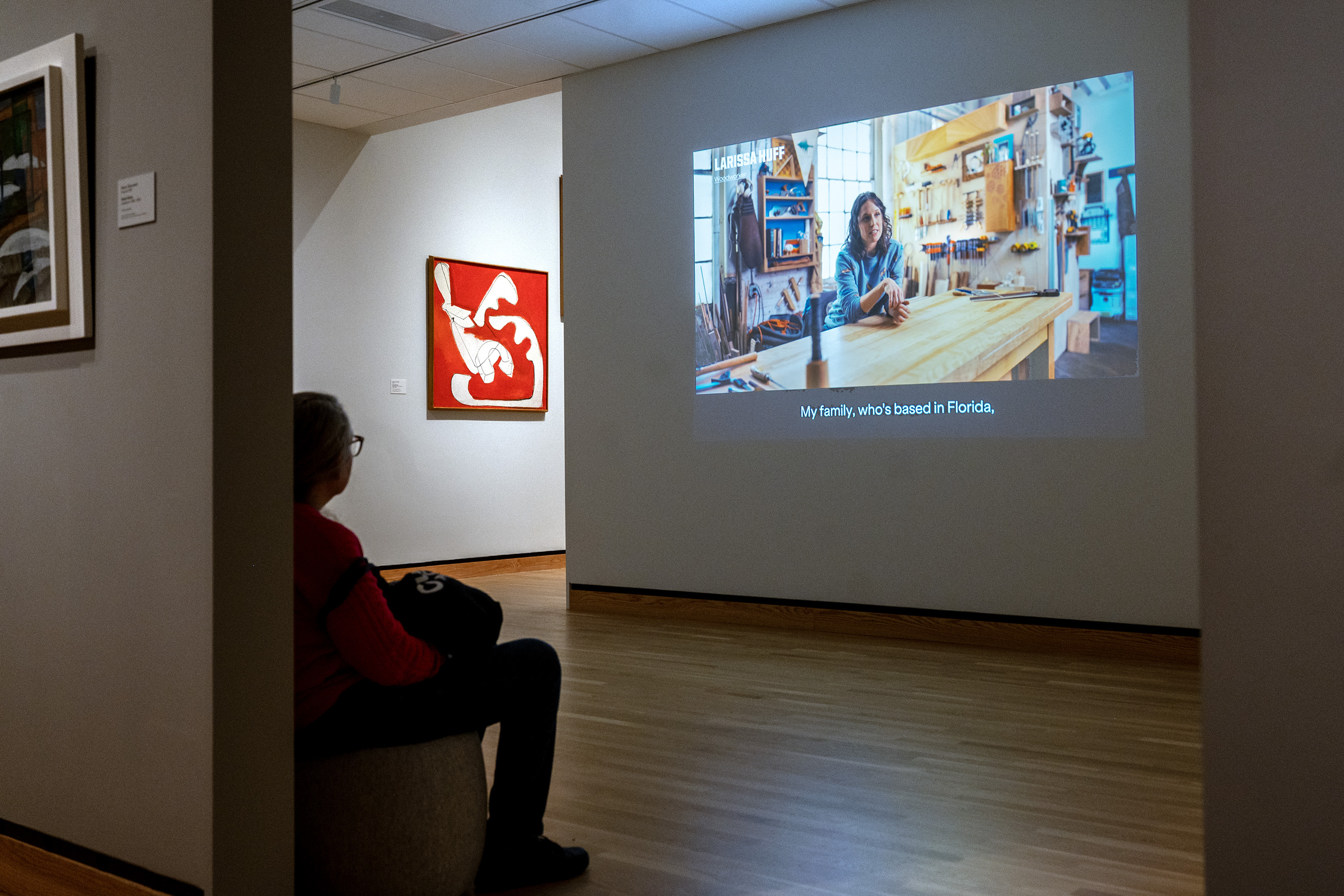
Philadelphia-based woodworker and artist Larissa Huff is featured in a video in the “A Nation of Artists” show at the Philadelphia Museum of Art Monday, May 4, 2026, in the newly renovated American galleries which were closed for several years.Tom Gralish / Staff Photographer
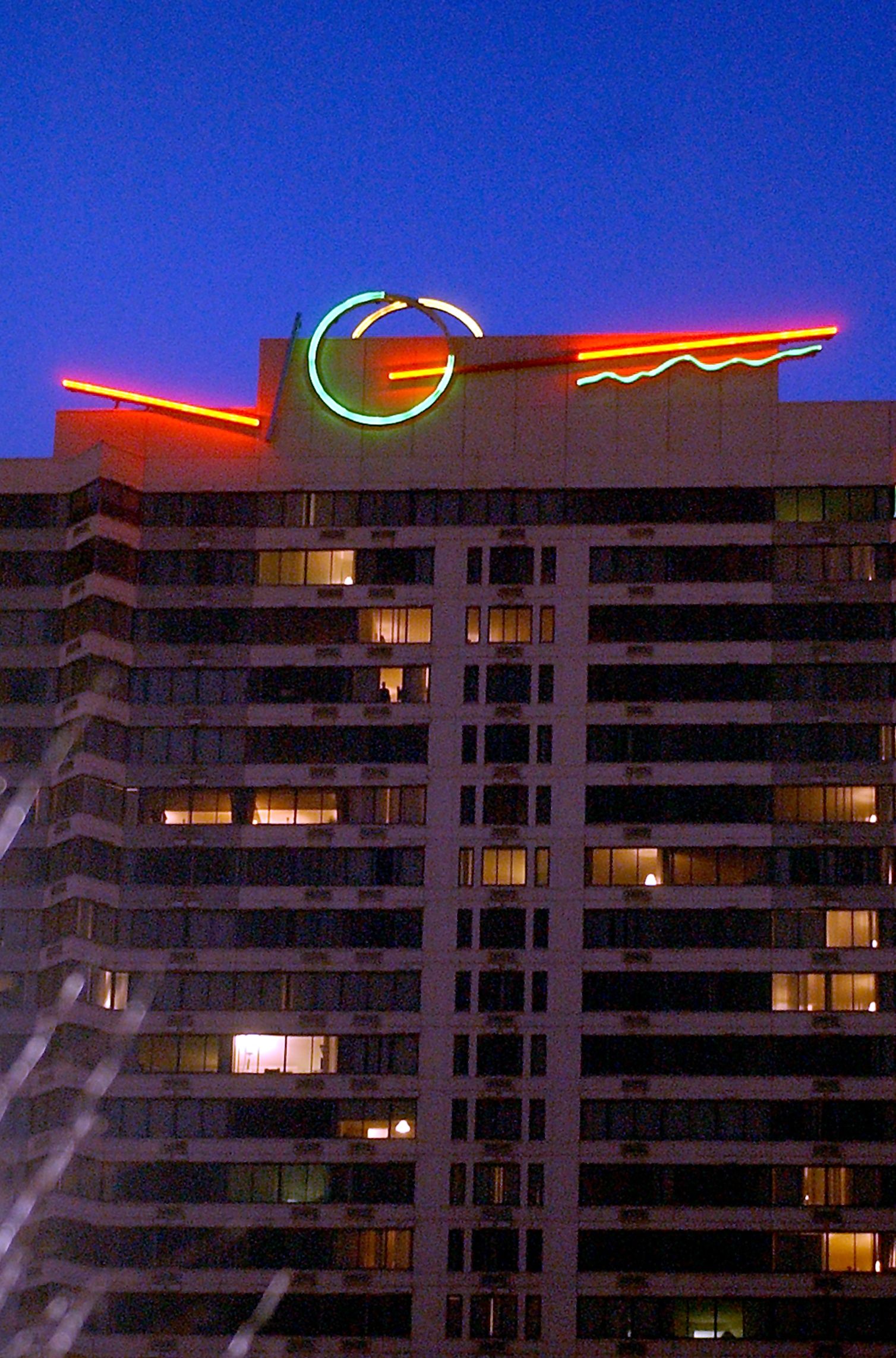
The colorful circles, squiggle, and lines of Stephen Antonakos’ sculpture hovering in the sky just north of Center City are still discernible. But the piece’s essence, its wow factor, is in its medium — neon — and that feature has long been gone.
Once a seemingly impromptu scribble in the dark sky, Neons for Buttonwood had its off switch flipped more than a decade ago.
Now, though, the sculpture’s fans are working to bring it back. A committee of residents of CityView Condominiums, on whose south tower the piece is perched, is seeking the money required for its restoration and relighting. About $100,000 has been raised toward a goal of $750,000, says Lynda Orfanelli, cochair with Sonja Eveslage of the Relight the Sky Committee.
“I feel like it’s starting to happen,” said Orfanelli during a recent rooftop visit to see the sculpture, “but what we really need is that one big donor who has confidence in us, and that’ll give [other potential donors] a feeling like, ‘Yes, let’s get on this train.’”
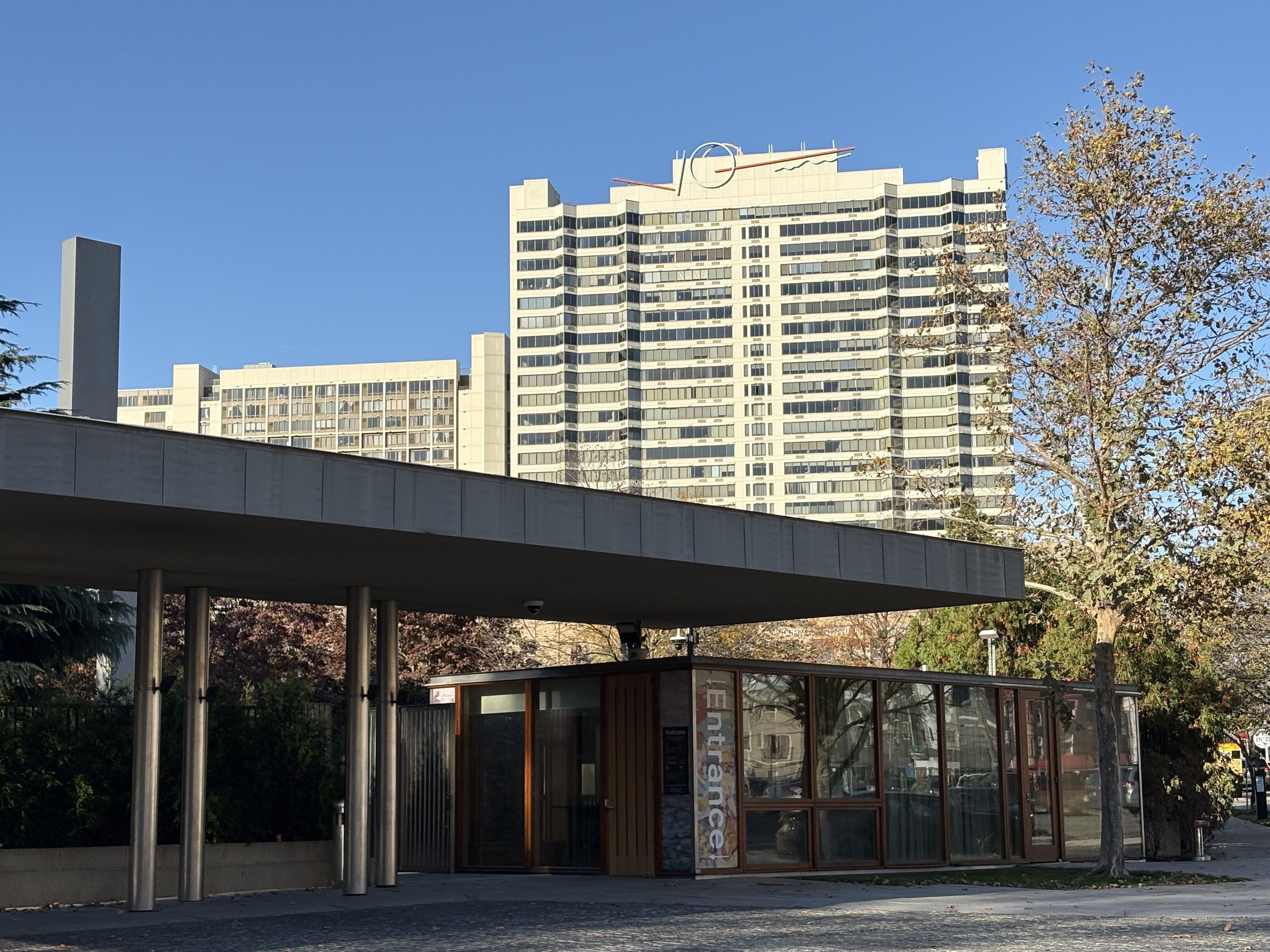
“Neons for Buttonwood” by Stephen Antonakos is seen atop the south tower of CityView Condominiums, with the Barnes Foundation in the foreground, on Nov. 10. The neon sculpture hasn’t been illuminated since 2015, but a group is raising money for its restoration.Peter Dobrin
Neons for Buttonwood sits atop a privately owned building, yet it is among Philadelphia’s most visible and recognizable pieces of public art. It may be little-remembered now, but in 1990, when the sculpture was first lit on what was then Korman Suites at Buttonwood Square, the city’s nighttime skyline was considerably less dazzling.
There was no coordinated effort to bathe building ensembles emerald when something was on the line for the Eagles or render them in cobalt or pink on other occasions.
“The reason we turned it off initially was because the pope was coming to town [in 2015], and we had been spending a lot of money doing repairs,” said Orfanelli, “and it was only partially lit. So we decided to turn it off rather than embarrass the building.”
The sculpture remained off until last year, when it was discovered that while the smaller checkmark facing east could still illuminate, no other part would. The neon tubing was removed because parts of it were breaking off.
The back of “Neons for Buttonwood” by Stephen Antonakos can be partially seen on the roof of the south tower of CityView Condominiums, Nov. 10, 2026.Peter Dobrin
Planning a comeback for the 111-foot-long work required clearing a few hurdles.
The city’s Percent for Art program, which originally shepherded the sculpture, was contacted for approval since the restoration calls for using LED technology instead of the original neon.
The Greek American artist Antonakos — who died in 2013 and whose works are in the collections of major museums — was noted as a pioneering exponent of neon, and so Orfanelli and Eveslage paid a visit to his widow, Naomi Antonakos, in New York, for her blessing.
“Her reaction initially was, ‘My husband was a neon artist,’ and we said, ‘If he was alive today he’d probably be using LED,’” said Orfanelli. “And then she spoke to art consultants that she still deals with, and she got back to us and said, ‘OK.’”
The new LED won’t change colors as other building lighting elements in the city do, and will remain true to the original colors chosen by the artist.
As fundraising proceeds, leaders have a chance to piggyback onto another project. The repainting phase could happen while the building is putting up scaffolding for unrelated maintenance work expected next year — if the next $50,000-$100,000 can be found by then. Installation of the LED elements would happen when the rest of the money is raised.
It’s not lost on the committee that when Neons for Buttonwood is restored and relit, there will be one major group of Philadelphians who won’t be able to look out of their windows at night to see it: the building’s residents themselves.
“That was exactly our point in calling it ‘Relight the Sky,’” said Orfanelli, “because it’s for everybody else.”
For more information and to donate to the project: relightthesky.org.