
Tag: topic-link-auto

  • Reed E. Pyeritz, pioneering medical geneticist and Penn professor emeritus, has died at 78

    Reed E. Pyeritz, pioneering medical geneticist and Penn professor emeritus, has died at 78

    Reed E. Pyeritz, 78, of Radnor, pioneering medical geneticist, cofounder of the Marfan Foundation and the American College of Medical Genetics and Genomics, professor emeritus of medicine and genetics at the University of Pennsylvania, author, mentor, veteran, and nationally ranked masters triathlete, died Monday, Aug. 10, of interstitial lung disease at Bryn Mawr Hospital.

    Dr. Pyeritz was a trailblazing expert on the diagnosis and treatment of Marfan syndrome and other inherited cardiovascular disorders. His 44 years of research and clinical work, from 1978 to 2022, advanced the understanding and management of the diseases, and extended the life expectancy of Marfan patients by 30 years.

    “So many of us in the community owe Reed so much,” Bert Medina, board chair of the Marfan Foundation, said in a tribute. “His legacy lives on in all of us, thanks to his dedication.”

    In an online tribute, a relative of former patients said: “Without this amazing doctor, I wouldn’t have my sister or dad. He changed the world for Marfan patients and their families.”

    Dr. Pyeritz joined the faculty at Penn in 2001 and spent more than 20 years treating patients, teaching students, doing landmark studies on the value and social implications of genetic testing, and championing patient-centered care. He was codirector of Penn’s research center on hereditary hemorrhagic telangiectasia, onetime chair of the faculty senate, and a fellow at the College of Physicians of Philadelphia and other medical associations.

    His “vision and scholarship fundamentally transformed the care of patients,” Nimesh D. Desai, director of the Penn Aorta Center, said on X.

    Before Penn, Dr. Pyeritz spent nine years in Pittsburgh with what is now the Allegheny Health Network and 17 years at the Johns Hopkins University School of Medicine in Baltimore. In 1991, his team at Hopkins discovered that mutations in the FBN1 gene cause Marfan syndrome and followed up with new regimens to treat it.

    He cofounded the Marfan Foundation in 1981 and the American College of Medical Genetics and Genomics in 1991. “It became clear that folks with Marfan syndrome could benefit by an organization that allowed them to communicate [and] to stimulate other physicians to become involved,” he said in a 2018 video interview.
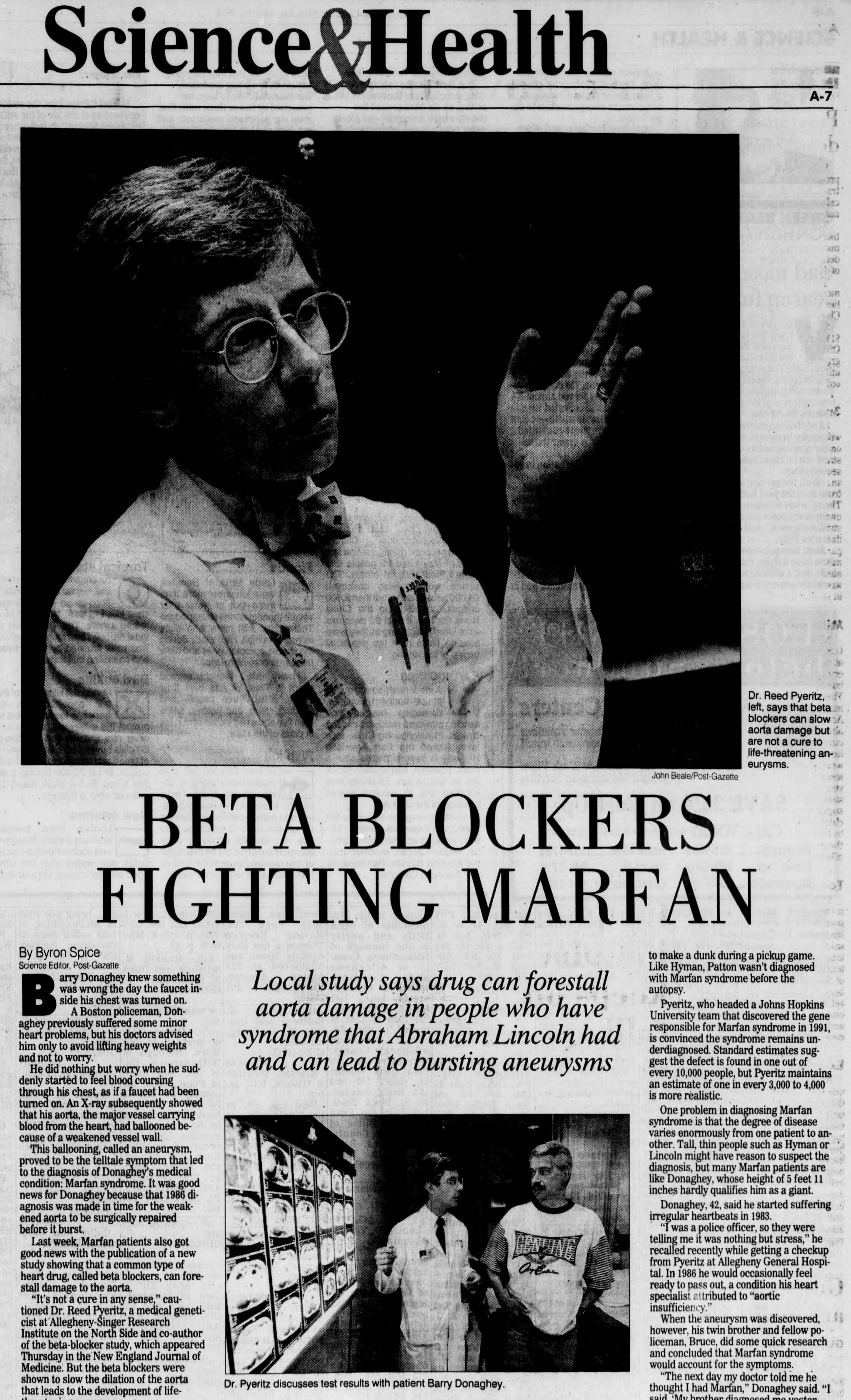
    This story and photos about Dr. Pyeritz appeared in the Pittsburgh Post-Gazette in 1994.Newspapers.com

    Colleagues, friends, and former patients called him “a phenomenal physician,” “a guiding light,” and “an extraordinarily reassuring presence” in online tributes. In 2018, he said: “The most gratifying thing is the fact that folks [with Marfan syndrome] are living their normal life expectancy.”

    Dianna Milewicz, chair of the John Ritter Foundation advisory board, noted his “excellence in clinical care, teaching, and research” on Facebook. Michael L. Weamer, president and CEO of the Marfan Foundation, called him “a true hero” and said his “impact on our community is immeasurable.”

    Dr. Pyeritz edited medical reference books and wrote The Marfan Syndrome and Uncertain Precision: Managing Health Care with Personalized Technologies. More than 700 of his research studies, reviews, and book chapters were published.

    He served 13 years in the Army Reserve Medical Corps and earned lifetime achievement awards from the Marfan Foundation, the American College of Medical Genetics and Genomics, and other groups.

    Dr. Pyeritz and his wife, Jane Tumpson, married in 1972.Courtesy of the family

    On weekends, he did marathons and triathlons, and was part of a world record 100-man, 100-mile relay. His family said in a tribute: “He measured a successful life less by titles or awards than by what one gives, what one learns, whom one loves, and what one leaves behind in others.”

    Reed Edwin Pyeritz was born Nov. 2, 1947, in Pittsburgh. He was fascinated by science and space as a boy, and he built rockets in his backyard and performed scientific experiments in his bedroom.

    He earned a bachelor’s degree in chemistry at the University of Delaware in 1968, a master’s degree and doctorate in biological chemistry at Harvard University in 1972, and his medical degree at Harvard in 1975.

    He met Jane Tumpson in first grade, and they graduated together from Mount Lebanon High School near Pittsburgh in 1965. They reconnected on the tennis court a few years later, married in 1972, and had daughters Allyson and Abigail.


    Dr. Pyeritz, left in the top photo and right in the bottom photo, enjoyed time with his family.Courtesy of the family

    Dr. Pyeritz and his wife honeymooned on Mount Kilimanjaro in Africa and traveled the world together for years. In April, the whole family went to Spain.

    He liked to wear bow ties, build stone walls, watch the news, and spend time outside with his dogs. He followed the Pittsburgh pro sports teams closely and enjoyed Manhattans and chocolate milkshakes.

    “I will miss it all,” he told colleagues at Cure HHT when he retired a few years ago. “But I am certainly looking forward to spending time with my two granddaughters, Tallulah and Penelope.”

    His daughters said: “Ever an adventurer, he instilled in us the importance of making the most of every day, watching the sunrise or sunset, and cherishing the time you have.”

    His wife said: “He loved without exception and reservation.”

    In addition to his wife, daughters, and granddaughters, Dr. Pyeritz is survived by son-in-law Keith Hopkins and other relatives. A brother died earlier.

    A celebration of his life is to be held later.

    Donations in his name may be made to the Marfan Foundation, 22 Manhasset Ave., Port Washington, N.Y. 11050.
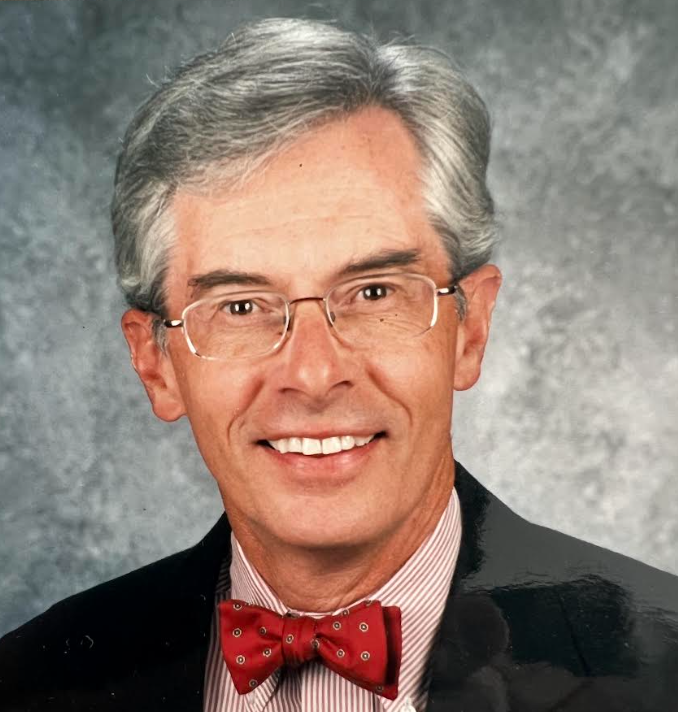
    Dr. Pyeritz “loved without exception and reservation,” his wife said.Courtesy of the family
  • City leaders gear up for the revival of the Philadelphia Cycling Classic this weekend

    City leaders gear up for the revival of the Philadelphia Cycling Classic this weekend

    City and business leaders on Friday were gearing up for the Philadelphia Cycling Classic’s comeback after a decade-long hiatus.

    The return of one of the most prestigious races in the United States has been years in the making, drawing some 200 riders — including Olympians, national champions, and emerging talents — from more than two dozen countries, to the City of Brotherly Love. It’s likely that come Sunday morning, spectators will line the 14.4-mile loop course from the Benjamin Franklin Parkway to Manayunk to witness the whooshing peloton and usher in what could become a renewed era of American professional road cycling.

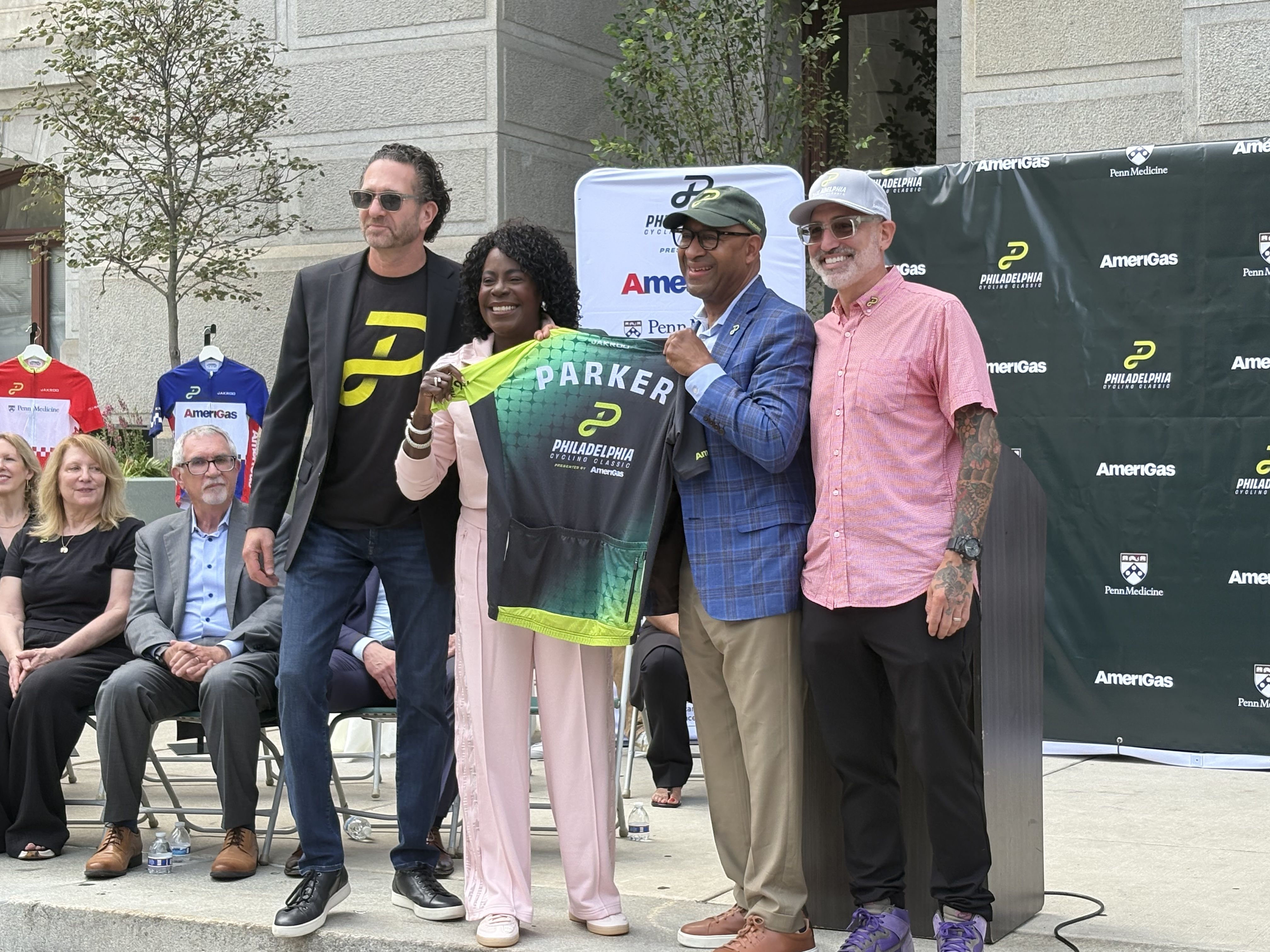
    “When the story about cycling in Philadelphia and bringing this race back is told for future generations to come, I want you to know for the record that it’s a Philadelphia story” — one of grit, perseverance, passion, and community, Philadelphia Mayor Cherelle L. Parker said at a news conference outside City Hall where she was bestowed a commemorative No. 1 race jersey.

    During its run from 1985 to 2016, Philadelphia’s criterium reigned, known for its theaterlike scene and famed “Manayunk Wall“ with its 17% gradient. But in 2017, officials announced the race had run its course, citing increasing costs and decreasing sponsors, much to the chagrin of the city’s cycling community.

    The Philadelphia Cycling Classic trophies — designed by a local metal artist — are displayed alongside the official race jerseys during a news conference Friday, Aug. 28, outside Philadelphia City Hall.Maggie Prosser

    “Bringing an iconic event back to one of the most iconic cities in the world,” — according to Michael Sharp, president of AmeriGas, the race’s presenting sponsor — is due to the enthusiasm of Old City salon owner Carlos Rogers, entrepreneur Eric Robbins, and former Philadelphia Mayor Michael A. Nutter.

    For Nutter, the classic is “the people’s race.”

    Officials stressed the equitability of the race, which is offering equal prize purses, $75,000, to the crowded men’s and women’s fields — a rarity in the sport, according to race director Robin Morton.

    Also, the race is free to watch from the sidelines and is one of the few professional sports where the athletes brush right up against fans and front doors. During the first iteration of what Philadelphians just call “the Bike Race,” that accessibility welcomed an all-day party.

    “The whole neighborhood turns up, it’s a giant block party,” competitor and Manayunk native Robin Carpenter said of his hometown. “You can kind of wander in and out of any house almost and be welcomed with open arms and a cup of beer.”

    Rider Kim Stoveld, a full-time nurse at Thomas Jefferson University Hospital, hopes Philly fans, naturally, get “a little rambunctious.”

    The classic nearly wraps up Philly’s generational summer, from being the epicenter of the United States’ 250th birthday celebrations, to the World Cup, and the MLB All-Star Game.

    “Philadelphia proves, time and time again, that we know how to do great things and we know how to do big things,” Parker said. “Now you’ll get a chance to see what Philadelphia does with this iconic international bike race.

    “And we’re so excited to be doing it again.”

  • A new line of tailgate-themed canned cocktails will benefit the Eagles Autism Foundation

    A new line of tailgate-themed canned cocktails will benefit the Eagles Autism Foundation

    If you’re looking for some on-theme drinks to bring to an Eagles tailgate this season, Bird Gang Spirits has you covered.

    In partnership with BOTLD, which works with distilleries nationwide, Bird Gang Spirits released a “tailgate pack” of canned cocktails. The eight-pack’s flavors are Tailgate Tea, Orange Crush, and Green Machine Margarita — which have an ABV of 7% — and Jawn Island Iced Tea, which boasts an ABV of 12%. The latest addition to the seltzer aisle isn’t just for a good time, however, said BOTLD president Andrew Auwerda.

    “We thought it would be kind of a fun, new twist to do good by doing some can cocktails, with the proceeds benefiting Eagles Autism Foundation.” he said. “ It’s supposed to be kitschy, fun, and perfect for the tailgate and in time for the Eagles’ season. It’s been great working with the Eagles Autism Foundation. They’re just a real pro organization and great cause.”

    Bird Gang Spirits released a line of canned cocktails. Part of the proceeds from the cocktails will benefit the Eagles Autism Foundation.BOTLD

    Since the Eagles Autism Foundation was created in 2019, the team has raised millions for research, accessibility resources, and community programs. A portion of the tailgate pack’s sales will go to the foundation, and Bird Gang Spirits itself is a collaboration with the Eagles.

    The team’s partnership with BOTLD began in 2023 alongside the return of the beloved kelly green uniforms. Since then, Bird Gang has released a line of liquors, from Bird Gang Spicy Tequila to “Bird Gang World Championship 2024 Irish Whiskey.”

    The tailgate pack is $24 and available online at BOTLD’s website; in person at grocers like Acme, Giant, and Weis; or brick-and-mortar BOTLD locations in King of Prussia and Rittenhouse. Bird Gang Spirits is taking advantage of the booming seltzer market that has emerged in the past few years, joining brands like Surfside that have become nationwide hits as well as Philly stadium favorites.

    “I mean, they’ve only been in the stores maybe a week, and it’s still rolling out to more stores, but we’re already seeing some reorders,” Auwerda said. “We’re really grateful for a great start from the retail partners.”

    As for his favorite flavor?

    “I think the margarita right now, for the time of the year. It’s the end of summer, but it’s still marg season.” he said. “The Jawn Island Iced Tea has a bit more alcohol, so I will save that for a game day.”

  • New Jersey permanently allows the sale and delivery of to-go alcoholic beverages

    New Jersey permanently allows the sale and delivery of to-go alcoholic beverages

    In New Jersey, “to-go” alcoholic beverages are officially here to stay.

    Gov. Mikie Sherrill on Friday signed legislation making permanent the COVID-era provisions that allowed bars, restaurants, and other permitted businesses to sell and deliver alcoholic beverages for off-premises consumption. Intended to be temporary, those allowances were previously set to expire Sept. 1.

    Moving forward, the legislation allows certain establishments to sell and deliver mixed cocktails in closed, sealed containers, and alcoholic beverages in their original containers, to be consumed away from their locations. Craft distillery licensees will also be able to sell and deliver their products under certain conditions.

    “New Jersey’s small businesses shouldn’t have to navigate outdated rules just to serve their customers and grow,” Sherrill said in a statement. “Cocktails to-go worked, customers liked it, and small businesses told us it was another way to bring in revenue. Today, we’re making it permanent.”

    The bipartisan legislation making those to-go alcohol changes permanent passed both New Jersey houses in late June.

    In addition to restaurants and bars, under the law, other permitted businesses with retail consumption licenses, such as hotels, may also sell alcoholic beverages for delivery and off-site consumption. Deliveries can be made by the licensed business itself, or a permitted third-part delivery company.

    New Jersey distilleries, meanwhile, can sell mixed drinks for on-site consumption when the beverages are made using alcohol manufactured on premises. Those businesses can also sell mixed drinks using their own distilled alcohol for off-site consumption, though the beverages must be sold in containers with a tamper-evident seal. And distilleries can also sell their own products accompanied by nonalcoholic beverages and food items that enable customers to make their own mixed drinks.

    “During the pandemic, this commonsense policy helped restaurants survive one of the toughest periods in their industry’s history,” said state Sen. Declan O’Scanlon, a Republican from Monmouth County. “I’m proud that the flexibility we gave these businesses will now be permanently available to them with the signing of this law.”

  • An officer failed to help a man lying in the road minutes before he was killed by a hit-and-run driver, Philly police say

    An officer failed to help a man lying in the road minutes before he was killed by a hit-and-run driver, Philly police say

    Philadelphia police are investigating a fatal hit-and-run that took place early Thursday morning in the Olney section of the city, minutes after an officer left the 48-year-old victim lying on the ground in a bike lane.

    Police are treating the case as two separate matters — a search for the hit-and-run driver led by crash investigators, and an internal disciplinary probe into the officer’s conduct leading up to the crash.

    First Deputy Commissioner John Stanford, at a news conference on Friday, criticized the officer for failing to help the man and leaving him in a vulnerable state on the roadway.

    “[It’s] very troubling to see that there is an officer that responds to this location and fails to render any type of aid to the individual prior to that individual being struck by the vehicle, being run over by that vehicle, driven over by that vehicle and that’s troubling for us,” he said.

    The officer’s name has not been released. He is assigned to the 35th District and has two years on the force, Stanford said. The department placed the officer on administrative leave while the incident is investigated, Stanford said.

    Police have also not released the victim’s identity as they are trying to contact relatives.

    At about 1:40 a.m., a man with an “unsteady gait” was seen walking down the 5500 block of Rising Sun Avenue, Stanford said.

    Video shows the officer pull his police vehicle next to the man and engage with him. During that encounter, the man falls to the ground, lying in the bike lane and partially in the traffic lane, Stanford said.

    The officer pulls his patrol car in front of the man, Stanford said, and gets out to speak with him. Then the officer leaves.

    Minutes later, a car stops before reaching the man, Stanford said. But a second vehicle drives into the bike lane to go around the first car, running over the man and driving away. The victim was pronounced dead hours later at approximately 6:15 a.m.

    Police are searching for a 2023 to 2026 green Kia Sportage X Line series with black-and-chrome rims.

    Stanford said passersby pulled the 48-year-old man out of traffic and called police.

    The officer who had first engaged with the victim and then left him in the road mere minutes before was the first officer to respond to the scene, Stanford said.

    Stanford said the officer did not make a police report, waiting for medics to arrive. Stanford said the officer did not render aid during this time.

    Stanford said the officer did not check whether the victim was impaired or having a medical condition, calling the officer’s behavior “very troubling, very disturbing, and to be quite blunt about it, extremely disappointing.”

    “It goes against everything we stand for,” he said.

  • Cherry Hill district’s pre-K students are absent from school almost as much as seniors

    Cherry Hill district’s pre-K students are absent from school almost as much as seniors

    Getting all prekindergarten students to consistently attend school has proven to be a challenge as the Cherry Hill district rapidly expands its program for early learners.

    Absenteeism rates among the district’s pre-K students is second only to Cherry Hill high school seniors, the grade with the highest chronic absenteeism rate, according to state data. The district’s experience is similar to other districts rolling out pre-K programs with state funding, which reaches $1.4 billion in the latest budget.

    “Unfortunately, I have to say that preschool had one of the highest rates of chronic absenteeism,” Farrah Mahan, assistant superintendent for pre-K to grade 12 and curriculum, told school board members at this week’s meeting. She explained some tactics being used to combat high absenteeism.

    The chronic absenteeism rate, a widely used measure in education, shows the percentage of students absent 10% or more days in the school year.

    In Cherry Hill public schools in 2024-25, the latest year available, the rate for Cherry Hill pre-K students was 23.5% compared with a statewide average of 29.9%, according to the New Jersey Education Department School Performance Reports.

    Overall, the district’s rate was 14%, slightly less than the state average of 14.4%. However, 25.8% of all high school seniors were chronically absent — more than the statewide average of 21%.

    The district’s preschool social workers and other staff members have been working with parents to get the youngest children to attend school, Mahan said.

    “They’ve really been acting almost as like a social service agency, which is really sometimes what our families need, making sure that they are connected to the appropriate resources that are available in the community to ensure that their child is able to get to school on a daily basis,” she told board members.

    Sometimes it is as simple as greeting students at the bus or as they’re exiting the family car in the morning or providing extra attention during the school day, she said.

    “But we’ve also had some tough conversations like, this really matters,” Mahan said. “When you were in a private preschool location, maybe it was OK to take a vacation that second week, because it was more convenient and a little bit cheaper for families. But really expect your preschooler, if they’re enrolled in the program, to be in school.”

    She said the focus has resulted in reducing the chronic absenteeism rates among the preschoolers.

    Mahan joked that when schools open on Wednesday she looks forward to welcoming the Class of 2041.

    Pre-K enrollment has increased sharply in Cherry Hill and some other districts as former Gov. Phil Murphy and Gov. Mikie Sherrill have supported free and expanded access to early childhood education.

    Cherry Hill and other districts have had to rely heavily on private providers to help take on the growing enrollment as parents shift from privately paid to publicly funded preschool. The district has two district preschool locations and uses nine private providers.

    With its expansion to 11 sites last year, the district was able to clear the initial wait list, Mahan said. All 559 students who applied for a pre-K seat were accepted, so the district opened up the list to additional families. A total of 93 applied and the district could offer spots for 34.

    In the new school year, nearly 900 preschoolers have been offered spots. The total will include 740 general education seats, 55 preschool inclusion seats, and 96 disabled student seats, Mahan said.

    The district’s program has grown from 17 classrooms after preschool expansion was announced in 2023 to 53 classrooms in the 2026-27 school year.

    Mahan said the goal is to eventually expand to a projected 1,700 seats — more than a 90% increase over this coming year’s group. She said 110 classrooms will be needed to accommodate the enrollment.

    The district’s private providers for the new school year are Adventure Kids, Cadence Academy, Discovery Corner, Goddard School, KinderCare, Lightbridge Academy. Primrose School, Chesterbrook Academy of Voorhees, Mosaic Early Learning of Oakland. The two in-district locations are at Kilmer Elementary School and the Malberg Early Childhood Center.

    “Children who participate in early childhood education programs generally enter kindergarten with stronger foundational skills,” Mahan told the board. “The research in early childhood education states that early learning environments foster essential language skills, early literacy, and basic math concepts,” she said.

    Supervision of curriculum and teaching at all 11 locations is important to the preschool program, she explained.

    “It is imperative that we have consistency across all of our locations. So when we speak about our preschool private provider locations and our in-district locations, we talk about consistency across all of our guidelines, our curriculum,” Mahan said.

    70and73.com is a hyperlocal news site focused on South Jersey, including the communities of Cherry Hill, Evesham, Mount Laurel, Voorhees, Medford, Medford Lakes, and Moorestown.

  • New assistant Penn wrestling coach Lucas Byrd and his fiancée are TikTok stars, playing off their ‘different dynamic’

    New assistant Penn wrestling coach Lucas Byrd and his fiancée are TikTok stars, playing off their ‘different dynamic’

    Lucas Byrd — a four-time All-American wrestler and a 2025 NCAA champion at Illinois — has been recognized “a handful” of times on the street. But it’s not for his dominance on the mat.

    Byrd, who was recently hired as an assistant wrestling coach at Penn, has more than 570,000 followers on TikTok with his fiancée, Ellie Holzman. They met at Illinois with Byrd wrestling and Holzman starring for the Illini volleyball team. Shortly after, they began posting short videos about their relationship to social media — which quickly gained traction because of the couple’s difference in height. Byrd is 5-foot-5 and Holzman is 6-2.

    “I think a lot of people find it interesting because it is such a different dynamic,” Byrd said. “Your typical relationships aren’t a girl that’s really tall and a guy that’s really short.”

    Byrd and Holzman readily make reference to their height difference on TikTok. In one video, Holzman humorously pins Byrd to a wall, pretending to yell at him. The video’s caption reads, “If you see a 6’2 brunette yelling at me…. Don’t worry. That’s my girlfriend. I ticked her off on purpose. I’m exactly where I want to be.” In another, Byrd hops on Holzman’s shoulders to grab containers from a hard-to-reach shelf.

    “We both believe we make a positive impact on relationship dynamics,” Byrd said. “Guys don’t like to be shorter [in a relationship], and women typically don’t like to be taller. It’s a good thing that we can show people that it doesn’t matter. Height, for some people, it could be a deciding factor, but there’s no point to limit yourself for the love of your life.”

    The couple’s content is lighthearted. Many of their videos feature the two dancing together, lip syncing to viral songs, or trying new foods — including a recent review of the brunch menu at Fishtown’s Middle Child Clubhouse. In the videos, Byrd is constantly cracking jokes and making funny expressions — a side of his personality he does not show on the mat.

    “When I take my glasses off and I have my shoes on, I’m in the wrestling world,” Byrd said. “I’m the guy that won a national title, and that’s who I am. But the minute I’m off, and I’m with Ellie and my family and friends, I’m just a big goof ball.”

    Lucas Byrd (right) won an NCAA championship last season at Illinois.Matt Rourke

    ‘Easier than breathing’

    After graduating from Illinois this spring, Byrd looked to move to Philadelphia to live with Holzman, who recently finished up a nursing program at Drexel.

    Byrd knew he wanted to stay in wrestling and gravitated toward coaching. During the 2023-24 season, when he was sidelined with a wrist injury, Byrd coached a kids wrestling club. He enjoyed the process enough to pursue coaching at the next level.

    When the Penn wrestling staff interviewed Byrd, they asked what makes him stand out compared to other candidates.

    “Wrestling is sometimes easier than breathing,” he responded.

    Byrd joins a Penn wrestling staff led by second-year head coach Matt Valenti. Like Byrd, Valenti is a former NCAA champion at 133 pounds, winning the title twice for the Quakers in 2006 and 2007. Valenti took the over the program from longtime coach Roger Reina, who served as the “head coach emeritus” to oversee the transition. Last season, the Quakers finished 7-4 overall and placed third in the Ivy League.

    “A lot of people feel like Big Ten programs do so many things differently,” Byrd said. “They feel like they eat nails, chew them up and spit them out. But in reality, they train hard. But it’s what we’re doing here [at Penn]”

    One major difference between the Big Ten and the Ivy League is the lack of opportunities for Ivy athletes to cash in on their name, image, and likeness (NIL). The conference, in an effort to preserve a sense of amateurism, boasts a blanket ban on NIL collectives. Byrd sees this as a plus.

    After graduating from Illinois in the spring, Lucas Byrd knew he wanted to stay in wrestling and gravitated toward coaching.Jose F. Moreno / Staff Photographer

    “I think it’s awesome that there is no NIL in a way because these guys truly want to wrestle,” Byrd said. “It’s different when you’re getting paid $300,000 to go wrestle … These guys, on top of being in Wharton, they want to come to practice.”

    “I can tell you the classes I took,” he added with a laugh. “I took a yoga class and these guys aren’t taking yoga.”

    Outside of coaching and growing his social media presence, Byrd is looking to pursue a mixed martial arts career — a transition many collegiate wrestlers make after graduating. He has sparred with UFC fighters, and is looking to learn more from his peers who have switched over to the sport.

    “It’s the same mechanics [in wrestling and MMA],” Byrd said. “Just different ways to get there. In MMA, there’s more danger because if you don’t disguise what you’re doing, you’re probably getting kneed or punched in the face.”

  • Shooting death of man by police in Montgomery County ruled a homicide

    Shooting death of man by police in Montgomery County ruled a homicide

    The Montgomery County Coroner’s Office said Thursday that the death of a 22-year-old man shot by a police officer was a homicide caused by two gunshot wounds to the chest.

    The determination confirms that Glenwood Pysher IV was killed by another person, but not whether the fatal use of force was legally justified.

    Around 12:30 a.m. on Aug. 23, the Upper Pottsgrove Police Department received a 911 call reporting an active burglary at a residence, the coroner’s office said. Officers responded to the scene and Pysher was fatally shot. The officer who fired has not been identified.

    “Consistent with Pennsylvania law and Coroner’s Office policy, the classification of homicide is a medical determination for death certification purposes and does not indicate criminal intent or assign legal responsibility,” the coroner’s office said.

    The case remains under investigation by the Montgomery County Detective Bureau.

    The Montgomery County District Attorney’s Office said that police arrived to find Pysher “in the rear of the the residence. An encounter ensued and police fired at Pysher, fatally striking him.”

    Pysher’s mother, Erin, told the Inquirer that her son had been out celebrating a friend’s 21st birthday and was heading to another friend’s place to spend the night when accidentally ended up at a stranger’s home.

    Pysher was about to begin his senior year at St. Elizabeth University in North Jersey, his mother said.

    “This was all a huge mistake, and they killed him,” she said.

    <iframe src="https://www.facebook.com/plugins/post.php?href=https%3A%2F%2Fwww.facebook.com%2Fmontcocoroner%2Fposts%2Fpfbid0qSGr8ZBJmmXMTUnNnrJyLTRm66Frp8vG2QNYqeDmfDLA22JgCGUjTVv2ie8GNSisl&show_text=true&width=500" width="500" height="608" style="border:none;overflow:hidden" scrolling="no" frameborder="0" allowfullscreen="true" allow="autoplay; clipboard-write; encrypted-media; picture-in-picture; web-share"></iframe>
  • ICE cannot survive past the Trump administration

    ICE cannot survive past the Trump administration

    Another day, another video on social media featuring U.S. Immigration and Customs Enforcement agents behaving badly.

    Sometimes they act like bullies, intimidating goons trampling the Constitution. Other times they show they’ve learned nothing from their deadly encounters in Minnesota and Texas, using excessive force and putting people in harm’s way.

    And every time, my blood boils at the rampant thuggery on display.

    I abhor facile slogans, but as more and more incidents pile up, this one’s an easy call: Abolish ICE.

    Smash it up. Close it down. Dismantle it. It shouldn’t be too hard, since it’s already been broken by President Donald Trump and his GOP allies in Congress, who have flooded the agency with billions of dollars and a mission directive that rewards lawlessness and recklessness.

    Under Stephen Miller, the architect of the administration’s anti-immigrant policies, the goal is mass arrests and deportations, no matter the cost. A June 2025 post by the president on Truth Social made it explicit: “ICE Officers are herewith ordered, by notice of this TRUTH, to do all in their power to achieve the very important goal of delivering the single largest Mass Deportation Program in History.”

    This has led to the foreseeable consequences that are playing out on America’s streets and inside immigration detention centers. The stories of abuse are so common, their number so overwhelming, that I don’t see how the agency survives.

    This should not be interpreted as a call for nonexistent borders or unfettered immigration. Having spent much of my life in and around southwest Texas, I count myself among those who have a particular appreciation for the importance of humane, rational, and consistent immigration policies — but, by almost any measure, we’re getting none of the above from ICE as it’s currently formulated.

    And it’s not just me or the usual left-leaning advocates who are questioning the national framework on immigration. Nearly three-quarters of Americans believe immigration is a good thing for our country, and most people prefer widening paths to citizenship rather than increasing enforcement efforts.

    The prospect of doing away with ICE does not garner nearly as much support from undecided midterm voters, with just 21% of them saying in a recent poll that they favored eliminating the agency.

    As I’ve written about how the administration is demonizing immigrants, I’ve heard from conservative readers who say the media is doing the same to ICE, casting it as the worst of the worst and inevitably forcing a critical look at its future.

    To answer the question of what the agency might look like in the years to come — or if it should even continue to exist at all — I reached out to a few people who may know ICE better than nearly anyone else: those who’ve worked inside it.

    Federal agents make a traffic stop on a U.S. citizen in Minneapolis in January.Adam Gray

    Changing tactics

    I put the question of ICE’s future and how its agents are regarded to Jason Houser, who spent his government career at the U.S. Department of Homeland Security and is a former ICE chief of staff. The Afghanistan combat veteran told me it starts and ends with leadership.

    “The tactical and operational guidance and directives from the administration are putting ICE officers in a place to be demonized,” he said. “There’s a lot of authority and power in law enforcement, and the way that power is being used by this administration for the first 18 months has been disjointed, punitive, shortsighted, and targeted at the most vulnerable communities.”

    While the behavior of some agents is inexcusable, and they should be held accountable, the agency is ultimately an instrument wielded by those in power.

    For example, some of the same agents who are being maligned today were redeployed to Del Rio, Texas, in 2021 to help humanely and safely process almost 16,000 mostly Haitian immigrants who were living in substandard conditions in a makeshift border camp, Houser noted.

    How ICE is operating today cannot be separated from the administration’s demands.

    Some of the worst examples of abuse by ICE agents have come during vehicle stops, including the July killing of Lorenzo Salgado Araujo in Houston. Agents have been captured on video in high-speed pursuits, cutting off cars, and smashing windows.

    Before Trump returned to office, the agency rarely engaged in these kinds of tactics, let alone used them to target noncriminal immigrants, said Joe Sifuentez, who worked for ICE until he retired in 2020.

    “If it’s a bad guy in that vehicle, we have a judicial warrant, we stop them. Then we can break that window and drag that person out of the vehicle,” he said. “But that’s not what’s happening now.”

    While the president campaigned on mass deportations, many voters believed the government would focus on immigrants with serious criminal records. Increasingly, that is not the case, with most people being detained only charged with violating civil immigration laws.

    And in trying to fill a reported White House quota of 2,000 arrests a day, federal agents are engaged in random sweeps and racial profiling that put people at risk.

    “I’m concerned that one of my loved ones could get pulled over tomorrow,” Sifuentez said. “God only knows what can happen.”

    Detainees stand at windows at the Delaney Hall immigration detention center in Newark, N.J., in May, as demonstrators gather outside.TODD HEISLER

    Bad math

    The Republican-controlled Congress has given the administration more than $150 billion for immigration enforcement. The question is what taxpayers are getting in return. It isn’t increasing public safety, the former officials I spoke with said.

    Houser pointed to a recent report by the DHS Office of Inspector General that found that as ICE shifted priorities toward immigration enforcement, its efforts to combat fentanyl trafficking declined. From fiscal years 2024 to 2025, the report said, fentanyl investigations decreased by 24%, investigative hours spent countering fentanyl decreased by approximately 30%, and fentanyl seizures decreased by almost 40%.

    It’s not just drug trafficking investigations that are falling by the wayside over Trump’s misplaced priorities. ICE agents descending on a Home Depot or a Walmart to fulfill their arrest quotas fail to target the kinds of criminals the agency should be focused on.

    “Real sex predators, convicted rapists, murderers, aren’t just hanging out at a Starbucks on a Tuesday, right? They’re not at the corner, walking their kids to school,” Houser said.

    Mass arrests also put people in detention who do not have a final order of removal. These are immigrants who are going through the system and would generally be allowed to walk free until they had exhausted their legal options. Instead, the administration is deciding to hold them without bond for what can be an indeterminate amount of time.

    Sifuentez, who oversaw ICE’s national fugitive operations program and detention facilities, told me that even under regular circumstances, detention is extremely challenging. As the government works to not only increase the number of such facilities in the country, but also how many people these places hold, the situation is bound to get worse.

    “When I was in Atlanta, I oversaw a facility with 2,000 detainees. That in itself was very difficult to oversee and keep your staffing levels intact,” he said. “What do you think it’s going to be like when you ramp it up to 10,000?”

    Already, there have been more than 50 deaths in detention since the start of Trump’s second term, with the detention fatality rate hitting a two-decade high.

    “You’re going to see more suicides. You’re going to see more people die of health conditions. You’re going to see more both mental and physical stress that leads to horrific outcomes,” Houser added. “It’s just math.”

    Lorenzo Salgado Araujo, a 52-year-old Mexican immigrant, was fatally shot by ICE agents in Houston in July. A makeshift memorial took shape at the site where he was killed.ANTRANIK TAVITIAN

    Abolish ICE

    If ICE is being used to indiscriminately terrorize communities, and ignore constitutional protections while disregarding its public safety charge, what is the point of its continued existence? Even if you see it as a tool, if it can be abused so readily and so thoroughly by an out-of-control executive, wouldn’t the cause of sensible and coherent immigration policy be better served by replacing it?

    Neither of the former officials I spoke with would endorse the call to abolish ICE, and perhaps their experiential knowledge of the agency’s complexity would keep them from ever embracing what can feel more like a facile bit of political sloganeering than anything else. After all, activists have long called to eliminate the agency, rightly underscoring the need for accountability over the lives that have been destroyed by detention and deportation — but they hardly ever offer realistic or politically viable alternatives.

    Indeed, as long as we are a nation of laws, there will be the need for enforcement. In humanitarian terms, whatever agency takes ICE’s place will be judged harshly under those same standards, but exist it must.

    Still, Sifuentez, until recently a lifelong registered Republican, said that at the very least ICE should be renamed and its functions divided among other agencies.

    “Everybody in America should be very concerned about what’s going on,” he said. “This isn’t about politics. This is about what’s right and what’s wrong, and what’s going on is wrong.”

    For his part, Houser stressed that we need migrants in this country, and we need public safety. Immigration enforcement is difficult, nuanced work and should be entrusted to those who have the highest level of training and expertise.

    “No matter what the structure and organization of the bureaucracy is, there’s going to be immigration enforcement, and it needs to be handled with professionalism,” he said. “Remembering that 95% of individuals who are coming to this country want the American way of life, and that’s something to be embraced.”

  • DHS staff lacks ‘high confidence’ in Trump’s claims of noncitizen voters in Pa., Al Schmidt claims in letter to Mullin

    Pennsylvania’s top election official contended in a letter to a cabinet secretary this week that the Trump administration’s own staff does not have “high confidence” in its claims of thousands of noncitizens on the state’s voter rolls.

    In a letter to DHS Secretary Markwayne Mullin, Secretary of State Al Schmidt said the Department of Homeland Security has still not fulfilled a promise to provide a written copy of its methodology “with a list of specific data sources” for its calculation that there are more than 14,500 noncitizens on the state’s voter rolls — a claim Schmidt and other Pennsylvania officials dispute.

    “We await this information,” Schmidt said in the letter, citing a virtual Aug. 13 meeting with DHS staff.

    Schmidt, a Republican appointed by Democratic Gov. Josh Shapiro, told Mullin that during that meeting “DHS representatives explained that they did not have high confidence that the 14,576 individuals… were, in fact, non-citizens who had improperly registered to vote in Pennsylvania.”

    The correspondence, shared with The Philadelphia Inquirer, comes amid increased scrutiny of election workers ahead of the consequential midterm elections just over two months away and as President Donald Trump has been pushing for an overhaul of the way Americans vote.

    In an email response Thursday after the initial publication of this story, a spokesperson for DHS confirmed the meeting with Schmidt and said the agency “will continue working with Pennsylvania to address additional questions and correct their misunderstanding of the information provided during the meeting.”

    Pennsylvania was one of four Democratic-led states — along with California, Nevada and New Jersey — that DHS claimed had a collective total of 250,000 noncitizens on their voter rolls in a July document posted at the same time Trump delivered a prime-time address on election security that waded into conspiracy theories.

    The White House and DHS have provided little explanation for how they have arrived at these numbers, and election experts have said the large numbers may likely be pulling from other government data sources and include hits to names from systems that were never meant to identify noncitizen voters.

    Schmidt said in the letter that he looks forward to understanding “how you attempted to match registered voters in Pennsylvania with information in DHS’s data sources and how you determined which matches were associated with greater or lesser degrees of confidence.”

    Mullin said in a news conference the day after Trump’s address that leaders in any states who resist working with the department to screen for noncitizen voters would be “held accountable by fines, by penalties, and even depending on how far it goes, prison time.”

    Schmidt, who previously investigated noncitizen voting when he served as Philadelphia’s Republican city commissioner, has repeatedly rebuked the department’s requests, which would require handing over unredacted voter rolls, which Schmidt has warned could put individual privacy at risk. He has also said it is extremely rare for noncitizens to vote and is already prohibited by state law.

    In New Jersey, a few days after Mullin’s announcement, Democratic Gov. Mikie Sherrill disclosed that, due to a computer glitch, roughly 6,600 noncitizens were inadvertently registered to vote over a yearlong span ahead of the 2024 election.

    Mullin claimed on X, following Sherrill’s announcement, that more than 35,000 noncitizens could be registered in New Jersey.

    Sherrill’s office has since provided updates to its estimates, sharing Aug. 19 that approximately 5,100 individuals, who were only registered from the error, were removed from voter system and about another 1,450 will undergo additional review. Roughly 340 individuals, her office said, who were registered because of the error cast a ballot at least once.

    Sherrill won the 2025 governor’s race, and New Jersey went for Vice President Kamala Harris in 2024. Neither contest’s outcome would have been changed by those 340 votes.

    But New Jersey’s disclosure has helped put additional pressure on the other three states targeted by DHS as November approaches. Shapiro, who is seeking a second term as governor this November, and Schmidt have continued to reject Trump’s push for a greater federal role in elections.

    In closing his letter, Schmidt said he wants DHS’ additional information to conduct further review and appealed to the high stakes of the potential premature removal of eligible voters.

    “The right to vote is sacred, and the cancellation of any voter registration record must be based on reliable data sources and done in accordance with Pennsylvania and federal law,” he wrote.