Tag: topic-link-auto

  • We need to find the words for Trump’s madness before things blow up

    We need to find the words for Trump’s madness before things blow up

    Newspaper readers on Earth 2 woke up this week to a shocking headline in the Bizarro New York Times: “President’s Mental Health Crisis Spirals Downward Again in Stunning and Senseless Speech to UN.”

    The article began: “BIZARRO NEW YORK — In a rambling and at times incoherent 40-minute speech to the United Nations General Assembly that shocked delegates from around the alternative planet, President Donald Trump made up his own new name for artificial intelligence, lied about his regime’s murderous attacks on boats in the Caribbean, and threatened a nuclear Armageddon in Iran.

    “The speech from a hoarse and occasionally confused Bizarro American president sparked a rushed press conference on Capitol Hill from rattled Democrats calling for Mr. Trump’s immediate removal under the 25th Amendment, an outcome also urged by three major U.S. newspapers in front-page editorials.”

    Meanwhile, here in the polluted reality-based atmosphere of Earth 1, Trump’s mashugana speech to the U.N. was more or less “sanewashed” by the media and by Congress — just like everything else from 21st-century Caligula, like his 2 a.m. AI-fueled posting sprees on social media, his growing obsession with renaming lakes and whatnot, or the more serious unconstitutional power grabs.

    The actual not-bizarro New York Times did mention the Iran annihilation threat in its headline, but explained that Trump had laid out his “Winner-Takes-All Vision” of geopolitics, which also presumably would have been the paper of record’s 1938 sanewashing of a certain German dictator’s foreign policy.

    It’s not the first time a vision of journalistic objectivity that was forged in a very different mid-20th-century America has failed the public. I say that as someone who began an evolution from “straight” news reporter to opinion journalist when conventional reporting failed to call out the obvious lies when the U.S. invaded Iraq in 2003.

    But what was a big problem a generation ago now looms as a once-in-a-lifetime catastrophe: A demagogue who hijacked American democracy, just as the nation’s founders feared would happen, is devolving into a mad king before our eyes.

    Less than halfway through Trump’s second term, a buck-naked monarch is parading down Fifth Avenue atop a horse he just appointed to his cabinet, holding nothing but a .38-caliber pistol he occasionally fires into a stunned paradegoer, just to prove he can still get away with it. Somewhere in New York or Washington, D.C., a headline writer is hailing a president’s “One-of-a-Kind Approach to Diplomacy.”

    The United States is in a world of trouble right now — losing a totally pointless war in which insane prices at the gas station are collateral damage, committing crimes against humanity from the waters off South America to the meatpacking plants of Dodge City, Kan. — but there is no more pressing crisis than the mental state of a president who believes the only limits on his power are “my own morality, my own mind.”

    The salary of both the elite Beltway media and our corporate-sponsored members of Congress depends very much on not understanding the seriousness or nature of this crisis, and so both occupations cower at the thought of making the hard moral choices required by even a child’s understanding of our mad emperor’s new clothes.

    There are some eyes-wide-open scribes out there like indie journalist Dan Froomkin, formerly of the Washington Post, who’s long been crusading against the news media’s sanewashing of Trump and wrote in a recent piece that “his idiocy is intertwined with his derangement. And yes, it’s compounded by the lack of anyone inside his bubble willing to correct him. But it’s not so much correction that he lacks. It’s a functional brain.”

    Froomkin backed up those words that you won’t see on your TV screen or in leading newspapers with a slew of examples: Trump’s imposition of economically crippling tariffs despite not understanding what a “trade deficit” is, his shifting day-to-day comments on whether or not the Strait of Hormuz is open for oil tankers, or his frequent bragging about passing a cognitive test used to detect dementia.

    A mockup of President Donald Trump’s proposed triumphal arch stands at the Great American State Fair on the National Mall in June.Jen Golbeck

    I try not to write a “hot take” column every time the president utters something completely irrational, because that would be at least five or six times a week and there’d be no time to write about all the other bad things happening in our country right now.

    I did find myself baffled by the coverage of what I thought was maybe the most bat-guano crazy thing to come out of Trump’s unhinged Truth Social feed: his “announcement” that his 250-foot “triumphal arch” in the nation’s capital will now become a sniper’s nest stockpiling live ammo and lethal drones.

    What read like a plea for a 302 involuntary commitment police call for 1600 Pennsylvania Avenue was instead treated by too many journalists as a serious news story, followed up by thumb-sucking pieces about Trump’s new penchant for invoking “national security” to silence critics of his many vanity projects. Fellow journalists: We need fewer “think pieces” and more “this man cannot think” articles.

    The U.S. Supreme Court, with its three Trump-appointed justices, has made it clear that the president will never be punished in a courtroom for his multiple high crimes and misdemeanors. But if another trial did somehow take place, I believe Trump could have grounds for an insanity defense, because he certainly appears to lack an ability to understand how politically toxic his shtick has become.

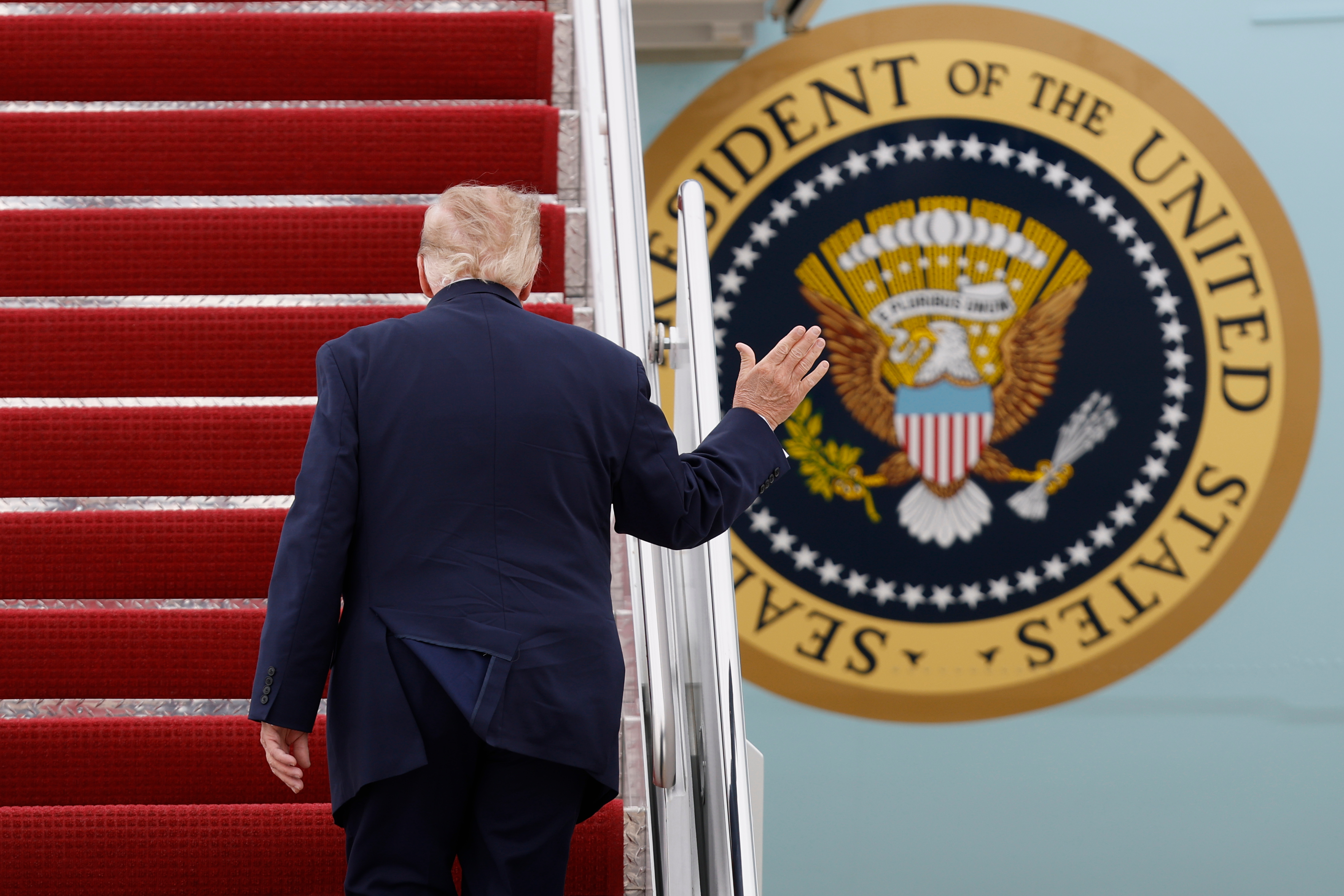
    This week, with some polls showing Trump’s approval rating plunging to Richard Nixon pre-resignation levels, the president commandeered Air Force One to fly to yet another college football stadium’s luxury box, with his blonde Rasputin, Natalie Harp, right by his side. This came after a week dominated by a gaudy three-day summit with Chinese dictator Xi Jinping, where tuxedoed guests gorged on sesame-crusted sea bass while nothing was done about the planet’s many pressing problems.

    President Donald Trump toasts with Peng Liyuan, the wife of China’s President Xi Jinping, during a state dinner in the East Room of the White House Thursday.Alex Brandon

    It was Trump’s close aide and social media guru Dan Scavino who put an exclamation point on the “let them eat cake” mindset by posting an AI video of him getting pushed through the aftermath of the Xi dinner on a cart spraying a bottle of Champagne, with two attractive women at his side. But can you truly “own the libs” with a 29% approval rating? Or do they just not care, and if so, why not?

    In a broken country that now runs on the “mind” and the “morality” of its weakened strongman leader, there are three explanations the media needs to discuss, but for the most part won’t:

    1. The oldest man ever elected president in American history is gradually succumbing to dementia, much like his own landlord father whose employees created a desk full of fake work for him in his final years, and his yes-sir Oval Office aides refuse to confront the problem.
    2. Trump has always been like this — an out-of-control, unrepentant narcissist — and he is determined to spend his last three years of power achieving only the things that matter to him, which are building giant monuments to himself as well as the infrastructure to make sure no one from his family goes to prison. In such a world, his approval rating, or your vote in November, matters not.
    3. The scariest of the three: Trump is crazy … like a fox. In other words, all the insane pronouncements about his power to change the names of things like AI or Lake Ontario are really just numbing the public to the idea that he can do anything he wants, including somehow nullifying the upcoming election with the Democrats looking likely to win both houses.

    That would certainly explain a rash of blatantly illegal recent actions such as spending taxpayers’ dollars on what are clearly political pro-Trump TV ads, not spending nearly $1 billion authorized by Congress, or his nakedly unconstitutional banning of journalists from the White House press pool because he didn’t like their stories.

    If no one is blocking Trump from these fairly serious violations, who will try to stop him when he sends troops or immigration agents to polling places, seizes huge numbers of ballots, or conspires with Republicans on Capitol Hill to not seat Democratic election winners? And then ignores judicial orders to cease and desist?

    This is exactly why the time to sound the alarm is now, and not Nov. 10 or Jan. 3, when undoing irrational and unlawful moves by the White House will be much, much harder. Look, TV punditry and newspaper analyses that stop pretending the president is a well man, or newspaper editorials calling for his resignation, or leaders in Congress backing impeachment won’t end the crisis … today.

    But calling attention now to Trump’s gross unfitness to hold office will set the stage for the battles to come — moving the Overton window on what can be done to restore democracy and helping any sensible Republicans understand there’s still a way to save both themselves and the country before it’s too late.

    The right words matter, a lot. We need to start urgently looking for them.

  • A man was fatally stabbed Sunday morning in Fairhill

    A man was fatally stabbed Sunday morning in Fairhill

    A man was fatally stabbed early Sunday morning in the Fairhill section of North Philadelphia, police said.

    Philadelphia police were called about 2:45 a.m. to a reported stabbing in the 200 block of West Lehigh Avenue. When officers arrived, they found a man with a stab wound to his chest.

    The man, who authorities did not identify, was taken to Temple University Hospital, where he died, police said.

    No further details were immediately available, and the investigation is ongoing.

    Through Saturday, Philadelphia police had reported 129 homicides this year. That compares with 164 through the same date last year and 404 through the same date in 2021.

    Anyone with information can contact the Philadelphia Police Department by calling the police tip line at 215-686-TIPS (8477). Tipsters can remain anonymous.

  • A final day at the Academy of Natural Sciences brought tears, nostalgia, and disbelief

    A final day at the Academy of Natural Sciences brought tears, nostalgia, and disbelief

    Rene Garner cried even before the doors swung open Sunday to admit visitors to the last-ever day of operation for the Academy of Natural Sciences of Drexel University.

    “I feel so sad,” said Garner, a retired educator who brought classes to the museum for years and credits her son’s love of science to summers spent learning at the academy’s summer camp. “This was such a great big part of our lives.”

    Garner, a West Philadelphia resident, came with her son, Addison Garner, and her granddaughter, Sage Young, 7, to see the academy one last time.

    Garner was far from alone.

    About 8,000 fans streamed through the museum on Saturday, with some flying in from across the country to squeeze in one last visit, a museum leader said.

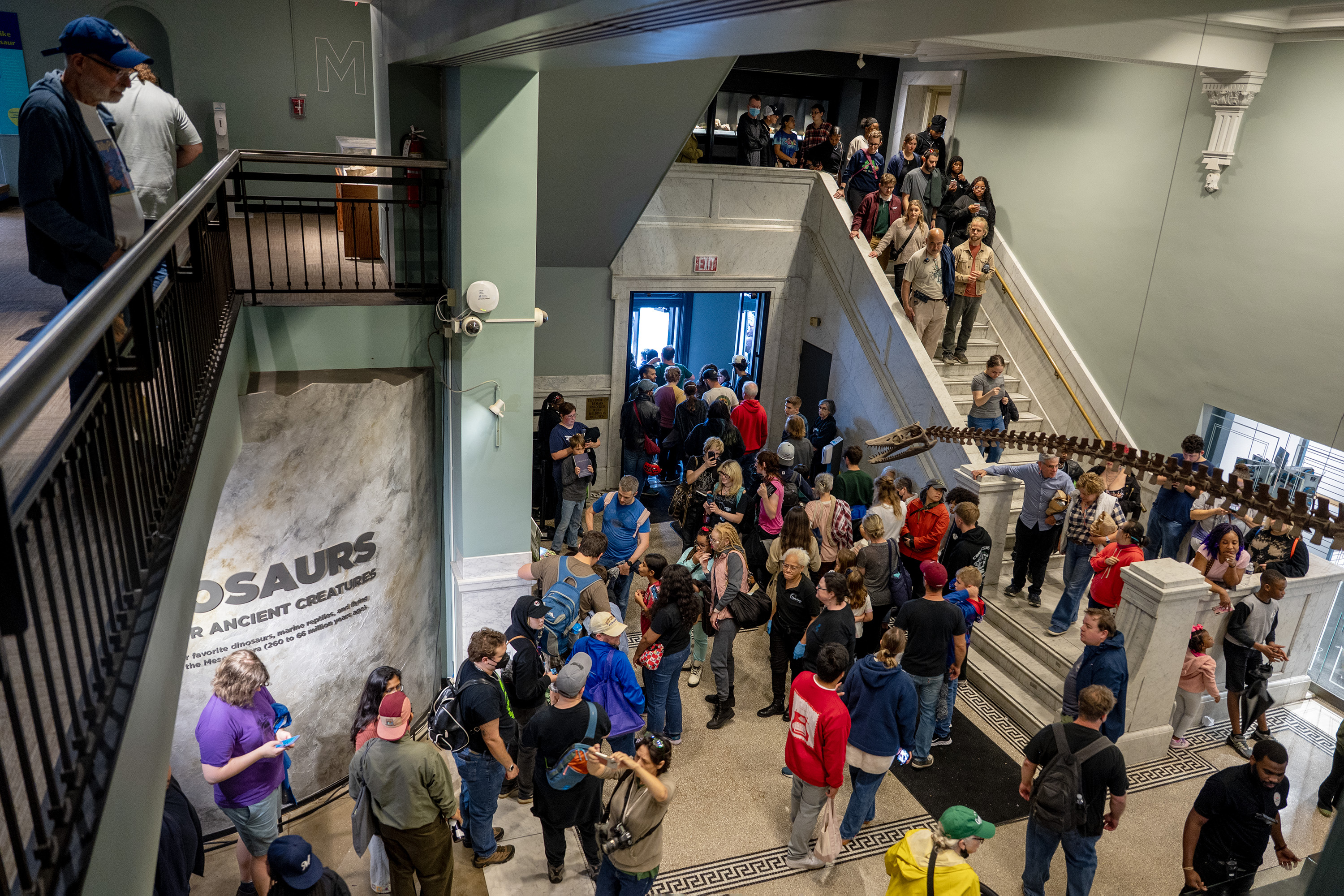
    On Sunday, a steady stream of visitors inside the museum took photos, touched the hard but smooth skin of a pangolin — a scaly anteater — being circulated by museum educators, and guided toddlers in dinosaur costumes through exhibits.

    “I can’t believe this,” one woman cried, peering over a second-floor balcony at a packed room full of visitors examining dinosaur bones.

    Drexel and the academy announced this month the museum was closing amid declining attendance and economic pressures. The academy has been open to the public since 1828, and is considered the birthplace of American paleontology.

    The William Penn Foundation offered Drexel a lifeline to keep the academy open for a year, saying it would pay operating costs while the museum studies the feasibility of its long-term survival.

    Drexel has not specifically said it declined the offer, but a spokesperson said that the university doesn’t have a viable proposal for a “permanent, sustainable path forward for the academy’s museum.”

    Sean White holds Camon, 2, while his wife, Michelle White, records them on the video screen “interacting” with a T. Rex inside the Academy of Natural Sciences of Drexel University on Sunday, Sept. 27, the last day that the museum was scheduled to be open. They were in another room room with a “green screen” that the computer combined into a single scene. Daughter Whenonah, 3, was also with the family from Abington. They had never been to the museum before and Michelle said, “We heard it was closing, so we just had to come before it’s too late.”Tom Gralish / Staff Photographer

    The foundation’s offer was on the minds of many on Sunday. Canvassers from a group attempting to save the academy chatted up visitors as they walked into the museum. They relayed their message from a billboard truck parked outside.

    “200 years of natural history can’t end on our watch,” the billboard said.

    Erin Kelly agreed.

    “My 11-year-old grew up coming here,” said Kelly, who lives in Kensington and brought her son, Phoenix Johnson, to the museum for one more lesson Sunday. “I’ve taught him about our city, and country, and cultural treasures just by coming here.”

    Visitors crowd past the exhibits inside the Academy of Natural Sciences of Drexel University on Sunday, Sept. 27, 2026, the last day that the museum was scheduled to be open.Tom Gralish / Staff Photographer

    In some ways, it felt like an ordinary Sunday at the museum — kids digging for fossils in the sand, parents pushing strollers, people fake-climbing into dinosaur mouths for photos.

    But there were definite signs of the end: the crowds, the activists handing out flyers, the picked-over gift shop, where signs told patrons that there was no stock left. A smiling, teal, stuffed dino purse seemed incongruous, a burst of cheer amid so much regret.

    Artist Thomas LaPine traveled to Philadelphia to witness the museum’s last moments. He set up his easel, unpacked his paper and pencils and oil pastels, and sketched.

    There was something magical in seeing people from all walks of life absorb the exhibits, LaPine said — watching children gain a sense of magic, a perspective on where the world has been, to perhaps think of where it’s going.

    Artist Thomas LaPine sketches a T. Rex inside the main dinosaur hall in the Academy of Natural Sciences of Drexel University on Sunday, Sept. 27, the last day that the museum was scheduled to be open.Tom Gralish / Staff Photographer

    “It’s a pretty big tragedy to me, a big deal; that’s why I’m here,” LaPine said. “I’m paying my respects.”

    LaPine said he planned to turn his sketches into a painting.

    “Hopefully, it’s a little time capsule of a time when people decided to cut off this resource,” he said.

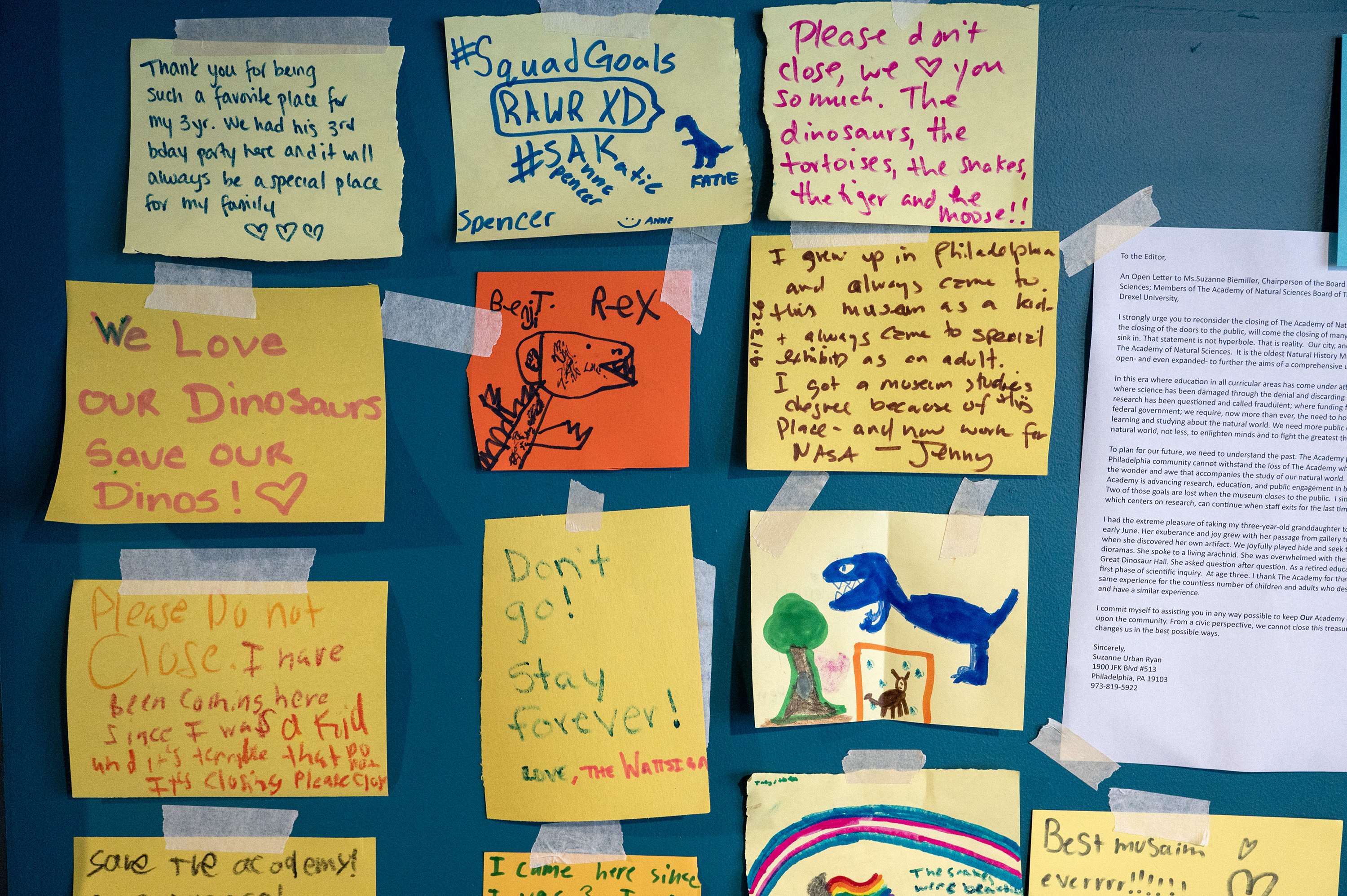
    In Outside In, a hands-on exhibit designed for young children that featured animals to meet and exhibits to climb on, the walls were papered with notes on colorful paper — messages about what the museum meant to families, pleas to save it.

    Visitors leave notes inside the Academy of Natural Sciences of Drexel University on Sunday, Sept. 27, 2026, the last day that the museum was scheduled to be open.Tom Gralish / Staff Photographer

    “Stay Open!” a child wrote on a pale yellow page, with a frowny face. “Love Henry.”

    “This has been a place of solace, fun and learning for me since childhood,” someone else wrote. “I was here before COVID, I was there after, and I’m here now. I hope this isn’t the last time.”

    A place of ‘incalculable value’

    Multiple politicians have urged Drexel to accept the William Penn Foundation’s offer.

    State Sen. Nikil Saval (D., Philadelphia) said in a statement that “the museum is of incalculable value to both our region and to international scientific and cultural fields,” and said the academy must remain on Benjamin Franklin Parkway.

    Visitors take selfies at a North American diorama inside the Academy of Natural Sciences of Drexel University on Sunday, Sept. 27, 2026, the last day that the museum was scheduled to be open.Tom Gralish / Staff Photographer

    City Councilmembers Nina Ahmad and Jeffery Young Jr. said in a statement that the foundation’s offer comes at a crucial time and allows officials the time “to take a breath and better understand how we got here and what we can do to keep the Academy open for hundreds of more years to come. All parties must be willing to explore every option to save this precious institution.”

    Mourning a friend

    The museum spent its final hours with those who loved it most: thousands of visitors, who basked in its wonders, staring starry-eyed at collections of dinosaur bones, taxidermy, and petrified bugs.

    Members of the museum staff pose for a photo in the lobby of the the Academy of Natural Sciences of Drexel University just after it closed at 5 p.m. Sunday, Sept. 27, 2026.Tom Gralish / Staff Photographer

    At the minutes ticked toward 5 p.m. — closing time — hundreds processed out of the old Victorian building one last time and protesters chanted in the rain, holding aloft plastic candles for a planned vigil at Philadelphia City Hall.

    Suzanne Ryan, a retired teacher and grandmother who has volunteered at the academy since June, held a sign reading, “The Academy is a treasure and must be saved.”

    Emotion caught in her voice as she implored each departing guest to sign a petition to save the endangered museum (which by Sunday had well over 100,000 signatures.)

    She’s been livid about the closing. She became a docent because of her granddaughter’s love for the dinosaurs. And as an educator, she said: “You close museums, you close minds.”

    Visitors inside the Academy of Natural Sciences of Drexel University watch protesters from Save The Academy hold a vigil outside the museum just before it closes at 5 p.m. Sunday, Sept. 27, 2026.Tom Gralish / Staff Photographer

    In the steady rain Sunday evening, many protesters shouted angrily about Drexel University’s seeming coolness. They hoped and urged for a miraculous resurrection.

    “We’re trying to protect this place from Drexel University,” shouted museum member Corey Miller, of South Philadelphia. “They’re trying to shut down a 200-year-old institution with 30 days’ notice. It’s a public embarrassment.”

    “Don’t let Drexel off,” others chanted. “Tell Drexel to get out of the way.”

    Longtime visitors Christina Stone and her daughter, Tais Millan, a student at the University of Pennsylvania, spoke through tears.

    “Philly loves this museum and they can save it,” said Millan. “I don’t know why Drexel isn’t trying to save it.”

    Some parents said they belatedly brought their children to the museum on the final day just so they could share their childhood experiences.

    Glenn McElroy (right) carries dinosaur balloons as he marches behind his wife Beth and daughter Parker, 15, to City Hall after attending a vigil for the Academy of Natural Sciences of Drexel University after it closed at 5 p.m. Sunday, Sept. 27, 2026. The Parkers are from Huntingdon Valley, Montgomery County.Tom Gralish / Staff Photographer

    Others, like Mary Fetter, said the day was an especially sad one for her daughters, Maeve, 10, and Margaret, 9, who are devoted visitors.

    “We’ve been going here four years,” said Maeve, holding her mother’s hand outside the shuttered museum. The museum is important to the identity of the city — and her family, Mary Fetter said as protesters began to march toward City Hall in the rain.

    The little girl is taking it hard, her mother said. She and her sister loved visiting the dinosaurs, the dioramas, and the live animals in the children’s rooms.

    Now it all may be gone. For good.

    “It’s really special to us,” said the little girl. “It’s hard to say goodbye.”

    Staff writers Peter Dobrin, Susan Snyder, and Mike Newall contributed to this article.

  • Phillies move up start time of Sunday’s game vs. Rays due to rain

    Phillies move up start time of Sunday’s game vs. Rays due to rain

    The Phillies are moving up their start time for Sunday’s game against the Tampa Bay Rays from 3:05 p.m. to 2:30 p.m. due to inclement weather, the team announced.

    The nor’easter howling through the East Coast has left the Philadelphia region with heavy rainfall, which is expected to continue throughout Sunday afternoon and evening.

    The Phillies said the earlier start time should provide the best opportunity to play Sunday’s regular-season finale without interruption.

    And the stakes couldn’t be higher.

    After the Phillies fell 12-1 to the Rays on Saturday, it marked their fourth consecutive loss and one more opportunity to decide their playoff fate.

    If the Phillies win Sunday, they will clinch the third and final NL wild-card spot. If they lose and the Diamondbacks win, Arizona will get in.

    The Diamondbacks play the Padres at 3:10 p.m. ET in San Diego

  • A Philly woman won a NASA contest to design a food system for astronauts on Mars

    A Philly woman won a NASA contest to design a food system for astronauts on Mars

    A 25-year-old Philadelphia woman won the $300,000 first prize in a NASA competition to design food systems to improve how astronauts eat in space, and eventually how they will eat on Mars, the space agency announced Thursday.

    Chinyere “Chichi” Ukeje, a native of Bowie, Md., now living with her husband in Northeast Philadelphia, submitted a proposal called Adaptive Nourishment Infrastructure, or ANI, which is named after the Nigerian Earth goddess of harvest and fertility.

    Ukeje said in a phone interview Friday night that her family has roots in Nigeria and with the Igbo people, a major ethnic group in that country.

    With the Deep Space Food Challenge: Mars to Table competition, NASA asked participants to “explore innovative solutions for integrated space food systems that would provide safe, nutritious meals to astronauts living and working in space,” the agency said.

    NASA launched Mars to Table in January 2026 as a follow-up to the Deep Space Food Challenge, which NASA ran from 2014 to 2021 in collaboration with the Canadian Space Agency.

    The updated competition included entries from teams in 28 U.S. states and from a total of 33 countries. The total prize pool was $650,000 for five winning teams.

    Jennifer Edmunson, program manager for Centennial Challenges at NASA’s Marshall Space Flight Center in Huntsville, Ala., said in a statement: “The future of human space exploration will rely on innovative food systems, and it is amazing how much ingenuity this challenge has helped us identify from participants near and far.”

    The challenge was created to find ways to feed astronauts without having to send prepackaged foods, which would not be possible because of the sheer bulk for the many months a Mars mission would take.

    The core of the challenge was to create a working system for a 15-person astronaut crew for 500 Martian sols, which is the equivalent of around 513 Earth days.

    “The problem of feeding astronauts on Mars is more than just growing crops,” said Ukeje, who is studying for a master’s degree in computer science at Johns Hopkins University.

    After spending most of her childhood in Maryland, Ukeje went to Nigeria during high school. She then returned to the U.S. to earn her bachelor’s degree in computer science at the University of Maryland, Baltimore County, before moving to Philadelphia.

    NASA described Ukeje’s “ANI” as “a modular food ecosystem combining controlled-environment agriculture, fermentation and fungi cultivation, and closed-loop nutrient recycling through bioreactors with limited Earth-provisioned foods to produce 50% of the food away from Earth.”

    Ukeje’s complex winning entry included having astronauts heating food with portable electric lunch boxes. The astronauts would take cubes of nutritious food and prepare them into recognizable meals, and then they could have “taco night” or “Italian pasta night.”

    “You want them to feel at home when they are millions of miles from home,” she said.

    She was surprised she won first place, but not surprised that she did well.

    “I completely poured myself into this project,” she said.

    There are no restrictions on what she can spend her prize money on, but Ukeje said she expects some of it will go into further food technology research.

    Correction: A previous version of this article incorrectly spelled Chinyere Ukeje’s first name in a sub-headline and photo caption.

  • The Jersey Shore surveys the damage as the region emerges from a furious nor’easter

    The Jersey Shore surveys the damage as the region emerges from a furious nor’easter

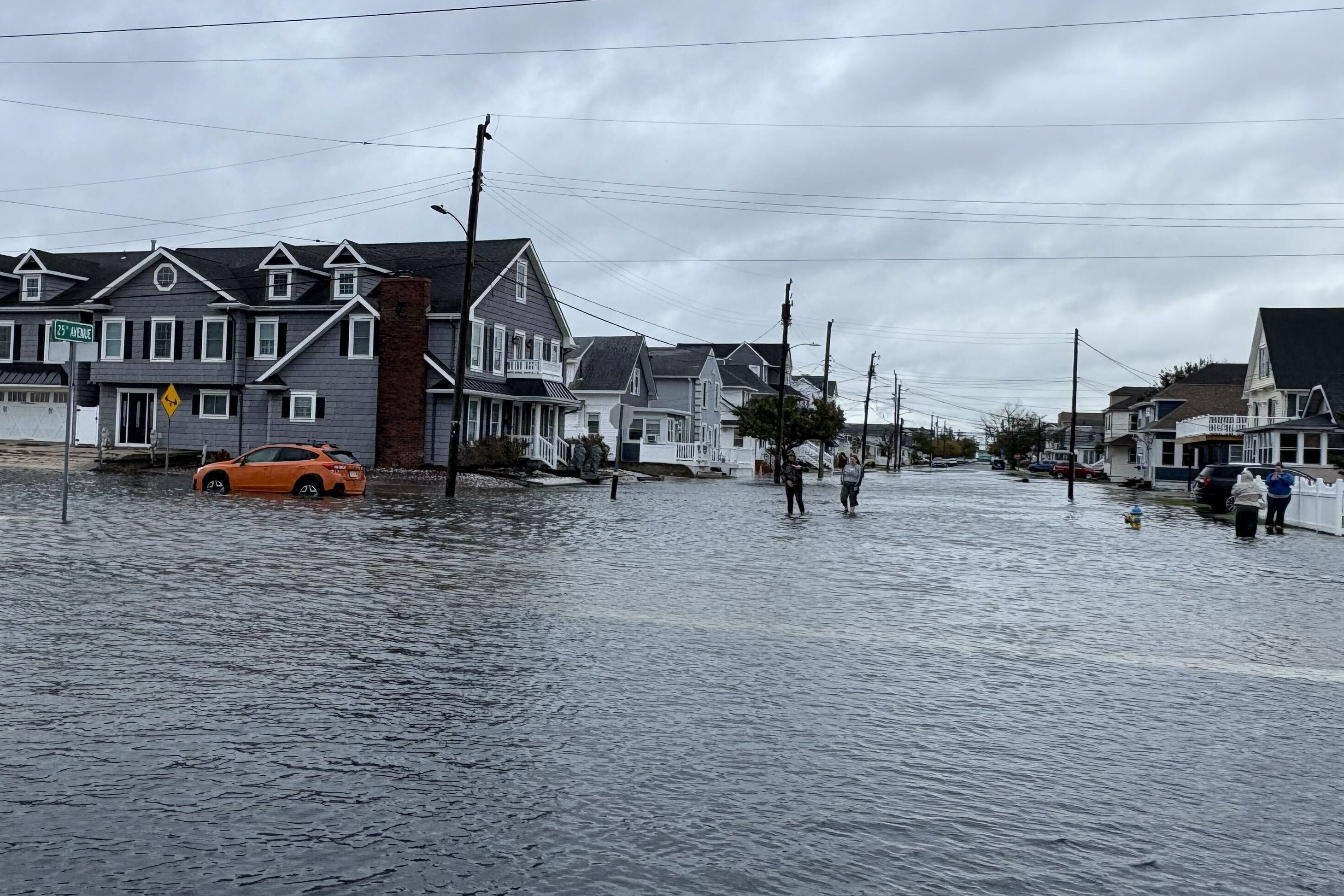
    A weekend of devastating and unusual nor’easter storms prompted evacuations, waterlogged cars and businesses, and eroded idyllic beaches along the Jersey Shore.

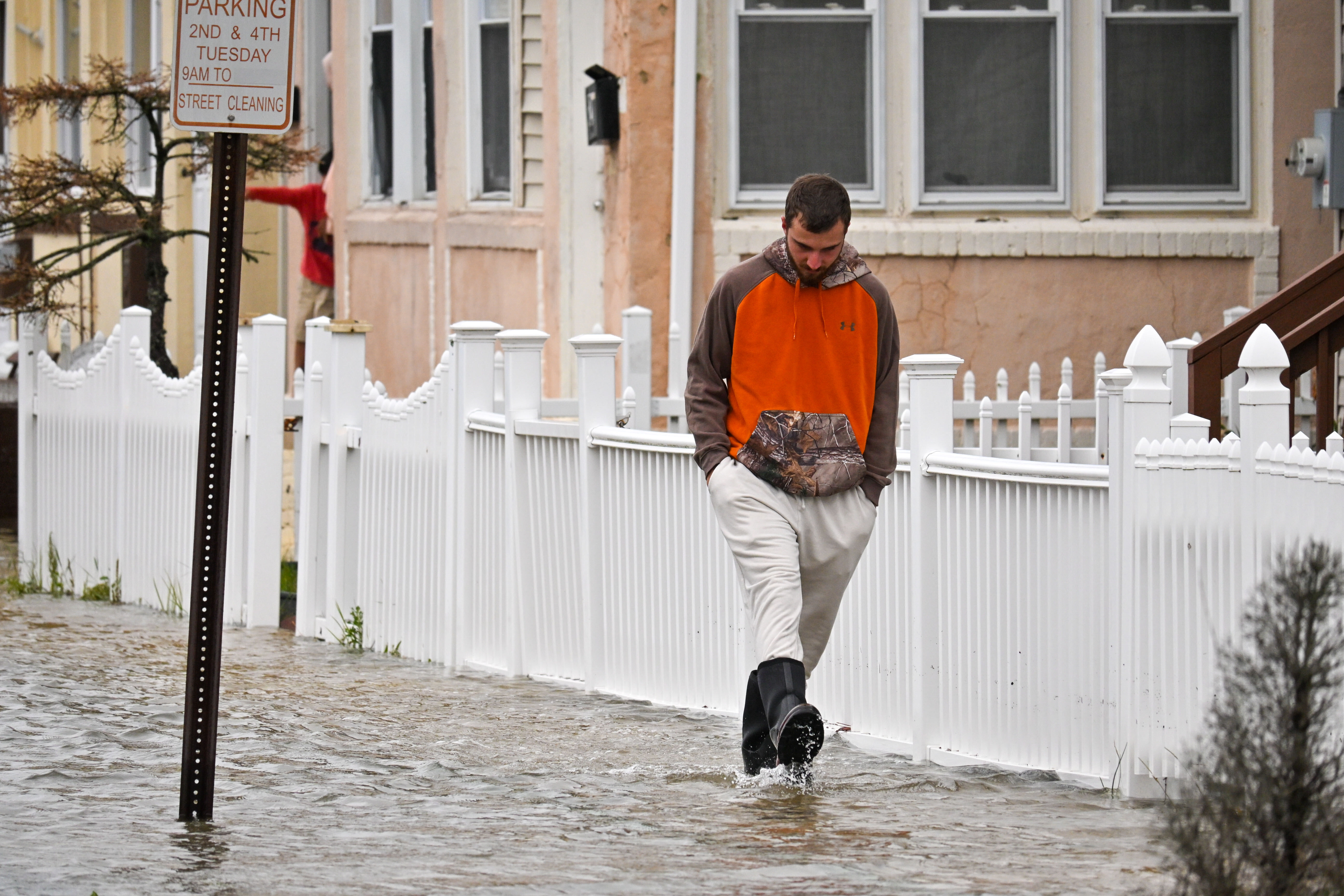
    In coastal towns, roaring floodwaters swallowed major thoroughfares and white-picket fences, as massive, salty waves pushed far past the Shore’s beaches and into residential areas. People waded through ankle- to waist-deep waters, and dozens had to be rescued from cars trapped on impassable roadways, New Jersey Gov. Mikie Sherrill said Sunday at a news conference.

    “Our Shore communities have been hit hard,” Sherrill said, warning “we’re not out of the woods just yet.” On Sunday, persistent showers lingered, and the threat of high winds and surges continued for the already weather-tested region.

    For some, the fury of the early-season nor’easter evoked memories of Superstorm Sandy in 2012 or 2016’s Winter Storm Jonas. No deaths have been reported in New Jersey, and the full scope of the damage likely won’t come into focus until the howling storm quiets.

    The forecast

    Sherrill, who declared a state of emergency Friday, said officials were concerned about possible flooding after high tide Monday morning.

    Sunday morning’s high tide had been expected to work its way into the back bays and lagoon communities, likely leading to moderate flooding with the possibility of isolated pockets of more severe flooding, said National Weather Service meteorologist Ray Kruzdlo. Water levels may take a few days to recede, he said.

    “I don’t think we’re going to see what we saw two high-tide cycles ago, but it’s still going to be impactful,” Kruzdlo said.

    The wind — which reached 74 mph in Surf City, according to Sherrill — was also starting to subside.

    “The low pressure responsible for this whole nor’easter, it’s kind of wobbling around a little bit,” Kruzdlo said. “It’ll get out of here within 24 hours.”

    More than 22,000 power outages were reported across New Jersey about 2:45 p.m. Sunday, according to the PowerOutage.us tracker. Meanwhile, NJ Transit officials were monitoring conditions, and most routes were operating on normal weekend schedules or with some delays because of downed trees. Portions of the River Line and Hudson-Bergen Light Rail were suspended Sunday.

    Across the Philly region, the heavy rain overnight and Sunday morning was headed out of town toward Wilmington, Kruzdlo said. There was a chance of showers overnight Sunday and early Monday.

    Despite the rain, the Philadelphia area experienced only some disruption Sunday: SEPTA ran with some delays, and Peco reported nearly 110 outages, affecting about 1,900 customers, Sunday afternoon. The Phillies game was moved up, and the annual Puerto Rican Day Parade was moved inside.

    Surveying the damage

    According to Sherrill, the early-season nor’easter caused severe dune loss in Atlantic City and Brigantine — with the Brigantine mayor calling it the worst tidal flooding since Sandy, the Press of Atlantic City reported.

    The storm reminded Sea Isle City Mayor Leonard Desiderio of Jonas — a historic winter storm with hurricane-force gusts that incited record tides at the Shore. Ocean City officials said Saturday morning’s tide (7.63 feet) reached nearly as high as the tide during Jonas (7.66 feet).

    “But this was pretty bad,” Desiderio said. “Until we can really evaluate everything, we don’t know the damage it has caused.”

    Gaetano Petinga walks through flood waters brought by a nor-easter Saturday, Sept. 26, 2026, in Atlantic City.Brett Sholtis / Staff

    In Margate City, areas that tend to flood during storms indeed flooded, and tidewaters entered some buildings, fire department Capt. Chris Hornig said.

    “After today, they’re going to be doing some cleanup, so hopefully this is the last big one this morning,” Hornig said.

    Hornig cautioned drivers to stay out of flooded areas: “People shouldn’t drive through floodwater. It’s salt water. It’s not good for their cars, even if they make it through.”

    Wildwood Mayor Ernie Troiano Jr. said flooding, there, contributed to multiple fires, including one caused by lithium batteries on an e-bike. Troiano said the Saturday morning tide surprised him with “the swiftness of it entering the streets.”

    “When it came up over the bulkheads, it just released and it just went flying,” Troiano said.

    As the tidewaters spread across the Shore, so did the videos and photos online.

    One widely shared video showed a waterlogged dining room at The Lobster House in Cape May. Then Internet jokesters enhanced the video, adding three lobsters serenely swimming out to sea. On Sunday, people drove up to the iconic seafood restaurant and market — closed due to flooding — to see for themselves.

    “We’ve had people in Florida and Virginia ask us about it,” Cape May resident Gary Bartlett said of the videos.

    Keith Laudeman, the third-generation owner of The Lobster House, explained that for three days, the water level outside the restaurant inched up — the result of relentless northeast winds holding seawater in the inlet.

    Saturday morning’s high tide was the “icing on the cake” that sent floodwaters pouring into front door.

    Laudeman dealt with flooding after Sandy and Storm Jonas. He said his team will have to wash everything with freshwater, scrub it down with antimicrobial soap, and replace carpeting.

    He hopes to have the restaurant open within three days, and plans for the fish market and coffee shop to be open Monday.

    As for the lobsters escaping to sea, Laudeman said anything is possible.

    “That’s a little far-fetched,” he said. “But if it adds to the story, then go ahead.”

    This is a developing story that will be updated.

  • Think U.S. government debt doesn’t affect you? Think again | Expert Opinion

    Think U.S. government debt doesn’t affect you? Think again | Expert Opinion

    The U.S. government’s debt recently hit $40 trillion. Beyond the shock value of a number so large, what does that actually mean for your economic life? Were you getting along fine when the debt was $39 trillion?

    It matters because persistent deficits and rising borrowing costs are fueling the affordability pressures households feel every day.

    Think of the debt as water in the tub and the annual deficit as the flow from the faucet. Of that $40 trillion, $32 trillion is held by investors here and abroad who buy our bonds; the $8 trillion difference is held in government trust funds. That public debt is about equal to 100% of U.S. gross domestic product, a near threefold increase over the past two decades.

    The war with Iran adds to the fiscal pressures, but the deeper problem is that we have, for years, been running recession-level deficits in good times and bad. It’s one thing to borrow historically large amounts in the face of an existential threat. After all, the U.S. hit its highest debt on record, 106% of GDP, following World War II. But heavy, routine borrowing is an entirely different scenario — a bad one.

    This fiscal posture most directly affects everyday Americans through higher interest rates.

    Long-term rates reflect many forces including inflation expectations, priorities of the Federal Reserve, global demand for safe assets, and investor confidence. But massive federal borrowing is an increasingly large part of the story.

    The 10-year Treasury yield has crossed 5% for the first time since 2023, up a full percentage point since the war with Iran began in late February. Mortgage rates followed, climbing from just under 6% to above 7%.

    That increase is costly. On a $400,000 mortgage, the difference between a 6% and a 7% rate is $265 per month — more than $3,000 per year, about what a typical household spends annually on gasoline. That helps explain why home sales have slowed to rates unseen since the housing crash, leaving many young families stuck as renters. The same arithmetic strains car loans, credit cards, and the loans small businesses need to expand and hire.

    Higher rates also increase the government’s own borrowing costs, putting more pressure on the federal budget. When debt is high, even modest rate increases drastically inflate the nation’s interest bill.

    Net interest on debt will reach approximately $1 trillion this fiscal year, surpassing military spending and roughly matching Medicare’s cost. That equates to over $7,000 per household, making interest the fastest-growing line item in the budget. The nonpartisan Congressional Budget Office projects this interest bill will double again to over $2 trillion annually within a decade, even assuming rates fall from current levels.

    There’s a circular logic to these budget dynamics. Consider the large budget package enacted last year.

    In an unfavorable trade-off for low-income families, last year’s tax cuts were partially offset by nearly $1 trillion in reductions to Medicaid and historic cuts to food assistance. Similar pressures are hitting the discretionary side of the budget, which funds everything from infrastructure to medical research to childcare. Ultimately, deficit-financed tax cuts and escalating interest costs can provide the political justification for cutting the programs that help families hardest hit by the affordability crisis.

    The pressure is also mounting on the tax side of the ledger.

    Tariffs generated nearly $200 billion in revenues last fiscal year, more than doubling the previous year’s total and costing about $1,500 per household. But that money is not paid by foreigners; it is collected from American importers and largely passed on to U.S. businesses and consumers.

    In effect, tariffs are a sales tax that falls hardest on families with the least room in their budgets. They may raise revenue for the Treasury, but they do so by making everyday life less affordable.

    The war with Iran is adding to the affordability squeeze by pushing energy prices higher. The U.S. average price of gasoline is back to nearly $4.50 a gallon this week, up about $1.50, or 50%, since the war began, and diesel has surged to a record price above $6 a gallon. Cars run on gasoline, but the economy runs on diesel. Trucks, trains, farm equipment, and delivery fleets depend on it, so higher diesel costs eventually show up in the prices of groceries and other essential goods.

    What can be done to help Americans deal with these pressures?

    Foremost, resolving the war with Iran and lowering tariffs. And it doesn’t take advanced math to see that repeated high-end tax cuts enacted without offsetting revenues only add to our debt.

    Also vital is a credible plan to stabilize the debt relative to the economy, targeting a deficit closer to 3% of GDP rather than the current more than 6%.

    Achieving this strictly via spending cuts would inflict further harm on vulnerable Americans, while tariffs are no substitute for a durable tax code. True fiscal health requires restraint and adjustments across both revenue and spending, and it takes a Congress and White House willing to say so.

    Global bond investors are losing patience. Interest rates are on the rise, and the U.S. Treasury’s efforts to stem the rise have done little to slow it. Investors don’t expect a balanced budget tomorrow, but they do expect a budget plan they can trust.

    If we provide one, long-term interest rates should moderate, the government’s interest bill should stop crowding out the rest of the budget, and the pressure to cut the programs families count on should ease. If we fail, investors will impose a plan on their own terms.

    The debt, the tariffs, the war, and the 7% mortgage are all of our own making. We can choose differently.

    Jared Bernstein is a senior fellow at American Progress. He was chair of the U.S. Council of Economic Advisers under former President Joe Biden.

  • For Cavan Sullivan, ‘the dream is reality’ in a successful USMNT debut

    For Cavan Sullivan, ‘the dream is reality’ in a successful USMNT debut

    ORLANDO — There were hints in the last few days that Mauricio Pochettino might choose to make Cavan Sullivan’s national team debut be a start against Peru, and they proved correct.

    When the word went out Saturday afternoon, there was plenty of excitement in the stadium and on social media. But when Sullivan was subbed out after just over an hour, he hadn’t made a highlight-reel play.

    Instead, he gave a performance that, had it been done by a veteran, would have been called perfectly solid.

    This should be seen as great news.

    Cavan Sullivan (left) celebrating with Justin Ellis (center) and the rest of the team after Ellis opened the scoring in just the fourth minute.Phelan M. Ebenhack

    Sure, there weren’t any of the flashy moments that Sullivan has delivered for the Union in recent weeks. In fact, on a few occasions in the first half, he chose to make quieter plays when he could have gone big.

    But for a 16-year-old to make those choices in his first senior national team game, with the nerves that surely were there on top of all the pressure he already faces?

    That made Sullivan worthy of the praise Pochettino lavished on him afterward.

    “I am so happy with his performance,” he said. “I feel really proud. Sixteen years old, and performing, and fighting, and playing with personality, with character.”

    Leading up to the game, Pochettino seemed intent on not singling out Sullivan or any of the other new young players on this U.S. roster until they had played a game. Now they had, with 11 of the 12 newcomers getting on the field, so Pochettino could let it out.

    “Of course, he’s a kid that absorbs a lot of pressure from the environment,” he said. “But I think now he’s with people, like he’s with people in his club, [so] that we are going to do everything to protect, and to help, and to support him to keep him evolving. And there’s no doubt that he’s very smart. He’s so great, and he only needs time — like Mathis Albert, like Zavier Gozo.”

    From there, Pochettino reeled off the names of almost every other newcomer on the squad, drawing laughter from the room. But he knows Sullivan is different because he’s younger than the rest; in fact now the second-youngest starter in team history.

    That’s why the manager spoke of “feeling a sense of responsibility, trying to guide him with discipline and professionalism, showing him the way, because at 16 he’s still a kid who needs to mature. There are many things — just like us, too, with 50 years — to keep learning, because it’s a constant learning process.”

    It’s 54 in Pochettino’s case, to be precise. But he could apply the night’s biggest point to players of every age, from his era to Sullivan’s now.

    “The language of football is, good players connect quick,” he said. “They don’t need too much time together.”

    Sullivan showed his fluency right out of the gate.

    ‘It’s pretty surreal’

    After the game, there were a few admissions that he is, in fact, new at this.

    One was that he couldn’t figure out how to get his parents down the stands after the final whistle so he could greet them.

    “I know now for next time that I can find a way to bring them down here,” Sullivan quipped.

    Another was his admission that yes, he was as nervous before kickoff as anyone would expect.

    “Of course there was nerves,” he said. “I was super excited. A little bit of both. Pregame was definitely nerve-wracking.”

    Cavan Sullivan (right) talking with Mauricio Pochettino at the start of training camp.Taylor Banner

    Beyond that, the national media got to see that Auston Trusty was right when he recently told The Inquirer about Sullivan’s humility. Spend time with Sullivan in person and you see the human beyond the Instagram highlights.

    “It’s crazy that I represented my country at the highest level with the men’s national team,” he said. “I’m really happy just to have done this. … The dream is a reality. It’s pretty surreal.”

    He saw the chemistry, too.

    “I just think, yeah, when you’re surrounded by players with such high quality, it makes it so much easier,” Sullivan said. “Like I said, I’m still learning. Chemistry’s a real thing, so, yeah, we’re taking it day-by-day, game-by-game.”

    He kept his goals for the rest of this camp simple: “Learn more and more from the coaches, and from the other guys, and hopefully get my first goal.”

    The games will get harder, especially facing regional rivals Mexico and Canada. But those goals seem achievable, perhaps even the last of them.

    ‘It shows maturity’

    Other players saw it too, starting with the one who lined up behind him on the right flank.

    “Knowing that he’s only 16, it shows maturity,” said right back Alex Freeman, who this year vaulted from Orlando City to Spain’s Villarreal to World Cup stardom before turning 22 in August. “Showing that he knows when to choose his moments, when to be flashy, when to take his chances and when to keep the ball. … He picked his moments to go one-v-one, he also cut in [at] moments to be able to combine.”

    He called Sullivan “a complete winger,” and said “as a first impression, it was amazing to see.”

    Gio Reyna also now counts as a veteran at age 23, having been to two World Cups. He started in the central attacking spot, with Sullivan out wide.

    “My message to him today was pretty simple: just play, play with your instinct, be yourself, do what he’s been doing the last eight to 12 weeks in MLS that brought him here,” Reyna said. “Obviously, he’s got a load of talent. Looking forward to continuing to see him develop — he’s only 16, which is crazy. But yeah, he’s been great.”

    Reyna admitted to being “surprised” to see in person that Sullivan is “a really, really hard worker … I didn’t think he was not going to work hard, but the work he’s shown has been great.”

    Cavan Sullivan (center) listening to a coach during a practice a few days ago.Jonathan Tannenwald

    It was not lost on anyone standing there that in normal-life terms, Reyna is still not far removed from the 2022 World Cup scandal that centered specifically on his work ethic. But maybe that made the words count a little more.

    Not for nothing, Pochettino continued his praise of the veterans for how they’ve welcomed the newcomers into the program. He knew he’d get a lot of questions about players like Sullivan, goal-scorers Julian Hall and Justin Ellis, and others. But he insisted that the spotlight be shared.

    “The headline is, the senior players deserve massive credit in the way that they treat, in the way that they guide, in the way that they support, in the way that they welcome, in the way that they create an environment very comfortable for them to feel like home,” Pochettino said. “I think it’s a massive value for us to have the senior players helping in this way.”

    This was just one night, and the 2030 World Cup is a long way away. For a first impression, though, this sure was a memorable one.

  • Oxford police officers, uncertain of their futures, resign as borough plans to close department and join regional force

    Oxford police officers, uncertain of their futures, resign as borough plans to close department and join regional force

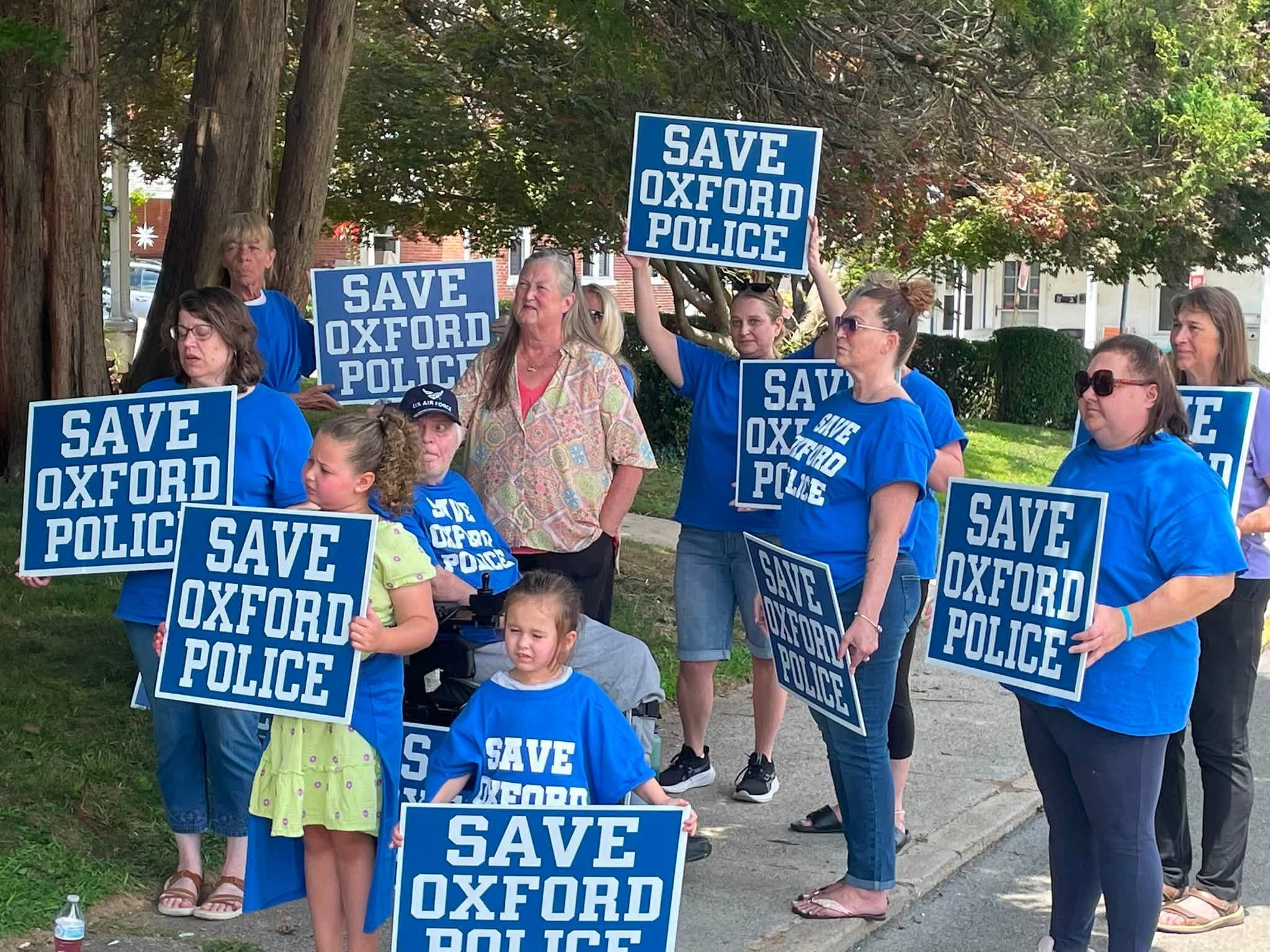
    Three officers will resign from the Oxford Police Department ahead of the borough joining a regional department, with many officers saying the path to employment has felt uncertain and not guaranteed.

    The resignations — which the borough council approved Monday — come after Oxford’s officials approved, in a 5-2 split, to close the doors of their police department, citing ballooning expenses that outpaced the municipality’s revenue.

    Under the vote, the borough will become part of the Southern Chester County Regional Police Department, which serves New Garden, West Grove, and Avondale, on Jan. 1, 2027.

    To accommodate the growing geography, the regional department has pledged to hire 12 additional officers, with Oxford officials saying previously that their goal was for every officer to move over to the new force, if they wanted to. Oxford currently employs 11 full-time officers, including the chief, and several part-time officers.

    Applications for the regional department were sent out to Oxford officers earlier this month, with a deadline to submit by Friday. The applications were also posted publicly.

    But officers said that the road hasn’t been easy or transparent. In a meeting with The Inquirer at their station, the officers said that while it has been publicly stated that they are essentially guaranteed a job at the regional department, everything they have seen is “an opportunity to apply for a job.” Most officers spoke on the condition of anonymity out of fear of retaliation.

    Officers who are leaving said the uncertainty and the borough’s decision to close their department ultimately led them to seek new employment.

    Mayor Philip Harris said the borough was in active contract negotiations and declined to comment broadly on the situation.

    For the officers resigning, he acknowledged the community may “consider that to be in discord with the merger/joinder.” He argued that it “highlights and amplifies what we’ve been saying all along.”

    “It’s an incredibly difficult thing to recruit and retain officers,” he said. “They were recruited by other departments. They were offered better deals. That highlights some of the problems that brought us to this forefront.”

    Officers who have not resigned have begun meeting with the regional department leadership, they said. But with the clock ticking and no formal contract in front of them, the officers are worried about what employment could look like after Jan. 1.

    They are not sure what jobs they will get. With a cumulative experience of more than 280 years, they each have more than one year of service and have acquired rankings from corporal to sergeant. Those positions do not exist at Southern Regional, they say, making it unclear if they will lose rank in the transition.

    Because they have not seen a contract, they don’t know whether they should take a severance package. There are differences in pensions between the two departments that officers think will complicate the transition, too.

    “We have three that have secured jobs at other surrounding departments, and I haven’t seen one damn contract from Southern Regional,” one officer said. “What is my position going over there? How much am I making? What time am I carrying with me? My sick time, my vacation time, my seniority?”

    A yearslong process

    The move to regionalization has, essentially, been three years in the making, with borough officials long saying the police force costs more than it can afford. The borough has had several financial studies done in recent years examining the viability of the police department, and considering alternatives.

    Under the agreement with Southern Chester County Regional, Oxford borough would have two officers on patrol 24-7, like the current structure. Their shifts would begin and end at a local substation, ensuring no gap in coverage, as Oxford is roughly 16 miles away from the other municipalities under the regional department’s coverage. The 12 additional officers, hired as part of this expansion, would join a force of 21 full-time officers.

    There has been a growing trend of municipalities moving toward regionalization for high-price items in their annual budgets, like police, fire, and EMS. Public safety is at least 50% of the pie in most communities, experts have said.

    Regionalization, however, has not been perfect. Across the state, municipalities have joined and then withdrawn from regional services due to increasing costs under the agreement, according to a Keystone Municipal Solutions analysis, which studied police structuring in Oxford.

    Oxford officers said that there had been talks to merge with Southern Chester County Regional several years ago, but those discussions seemingly fell apart. Instead, officers recall, the department tried to make itself a possible regional hub — a force that could serve the municipalities that neighbor Oxford and currently use free coverage from the Pennsylvania State Police. Those talks also struggled to catch on.

    Officers still heard rumblings about joining the Southern Chester County Regional, but formally found out about the renewed effort when the Oxford Police Association received a letter from the borough council saying the start of union contract negotiations would be put on hold as the council explored a merger.

    Meanwhile, officers said, they are frustrated that the borough has not sought to slash costs in other areas, or will not wait for eligible members of the force to retire, where the pendulum on costs could swing back.

    “They have a champagne police department on a beer budget,” an officer said.

    Paul Frie, one of the officers who has accepted a position elsewhere, said that the borough’s decision to close its department caused him to look for other employment.

    “I can’t trust them to have my back,” he said. “I couldn’t work for them when they so haphazardly threw my job to someone else, because it’s not a guarantee.”

    Another officer, who has also resigned, said the uncertainty — and not knowing whether regionalization would stick — ultimately made the decision for him. It was hard: The officer grew up knowing many on the Oxford force, and said it was always a dream to work for the department.

    “I’m glad I got to fill it, partially,” said the officer, who spoke on the condition of anonymity. “It definitely sucks knowing this place isn’t going to be around.”

    This suburban content is produced with support from the Leslie Miller and Richard Worley Foundation and The Lenfest Institute for Journalism. Editorial content is created independently of the project donors. Gifts to support The Inquirer’s high-impact journalism can be made at inquirer.com/donate. A list of Lenfest Institute donors can be found at lenfestinstitute.org/supporters.

  • New doula directory will help Delaware County families find support

    New doula directory will help Delaware County families find support

    Family and friends cooked, cleaned, and took care of Alejandra McBride after she gave birth to her first child in Ecuador, so that the young mother could focus all her energy on her newborn.

    She felt much more alone when she gave birth to her second child 14 years later, in Delaware County.

    “I have friends who would come for a few minutes to see the baby – and then go,” said McBride, who lives in Springfield. “It was hard to recover.”

    Now she is training to be a doula through a new initiative in Delaware County to provide other women with support during and after pregnancy.

    McBride is among 30 doulas trained through the Delco Doula Collaborative, designed to build the maternity care workforce and expand patient resources in Philadelphia suburbs where prenatal care options have dwindled since last year’s closure of Crozer Health, which operated the county’s largest birth center.

    Earlier this month, an online directory launched where families can access doula services — which are covered by Medicaid and some private health insurance plans. Delaware County spearheaded the initiative with Family Village, an initiative of the Foundation for Delaware County that brings together support services for families and parents-to-be.

    “Every family deserves to feel supported, informed, and empowered throughout pregnancy, childbirth, and the postpartum period,” Lora Werner, director of the Delaware County Health Department, said in a statement. “By expanding access to this trusted support, we are advancing health equity and helping to build a healthier future for parents, babies and families across Delaware County.”

    Doulas are not medical professionals, but rather provide emotional support around pregnancy, and can serve as an advocate for patients.

    Research has found that parents who work with a doula experience lower rates of cesarean section births, reduced anxiety, and higher rates of breastfeeding, in part because they are more empowered to advocate for their wishes and feel heard by their medical providers.

    Doula training in Delaware County

    With part of a $600,000 grant from the U.S. Department of Labor’s Employment and Training Administration, the Delco Doula Collaborative provided free training and licensing assistance to 30 county residents.

    Participants work alongside certified doulas to learn about patient advocacy, childbirth education, and how to interact with patients.

    Family Village also helped participants apply for certification through CAPPA, a leading international doula certification organization, and a Pennsylvania license.

    Participants worked with a Medicaid billing consultant to help them establish their own Medicaid contract or join the organization’s contract. In Pennsylvania, doula services are covered by Medicaid. The government-funded health program covers about one-third of births statewide. Some private health plans also pay for doulas.

    The organization hopes to provide scholarships to support more certification training in the future.

    In the meantime, doulas who are already certified can join the collaborative for networking and additional training opportunities, and to be part of the online directory.

    Individuals interested in self-funding their initial doula training should visit the national CAPPA Website, or other doula organizations in Philadelphia or surrounding areas.

    For expectant parents, a doula can be a valuable resource, said Erica Loizos, the doula program coordinator for Family Village. They can talk to first-time parents about the stages of labor, postpartum care, and breastfeeding.

    Doulas play the critical role of advocating for the person who is giving birth at a time when medical attention often shifts to the baby.

    During labor and maternal medical appointments, some patients may struggle to speak up for what they want, or may not know what questions to ask. Doulas can coach them on how to advocate for themselves, or be the advocate, voicing their client’s wishes when they are unable to. Doulas often attend the birth to help advocate for the birthing person.

    “The most important thing is getting to know their family,” Loizos said of the service doulas provide.

    Zainab Waites, who works as a daycare teacher in Chester, embraced that mission. She has worked with eight families since beginning her training last year, many of whom were “really alone,” she said.

    “I always see myself as coming in to be a family member,” Waites said. “Whatever it is, even if you just want to complain about something, I’m here.”

    Learning from personal experience

    McBride said she was surprised how different pregnancy is treated in the United States, compared to where she grew up in Ecuador. Parents are faced with many more decisions and choices, which can be especially hard to navigate if they come from a different culture or do not speak English as their first language.

    “With my third birth, I was pretty much saying yes to whatever the doctor said,” McBride recalled. She didn’t know doulas existed, or that it was possible to push back against a doctor’s initial recommendation.

    McBride had a C-section because she didn’t know she could ask to wait a little longer to see if she would go into labor naturally.

    “Every woman is different,” she said. “My job is to advocate for these families and make sure they are delivering in a safe and warm place.”