The Flyers know their power play needs to be better this season.
During Saturday’s scrimmage, the team tested out the power play for the first time in camp, and it went about as well as last season.
The first unit, playing for the orange team, included Jamie Drysdale at the point, with Trevor Zegras, Owen Tippett, Denver Barkey, and Matvei Michkov.
It was hard to tell exactly where each player was positioned because they struggled to enter the zone and get set. No one on the unit is a strong faceoff man, which contributed to their difficulties getting into formation to generate chances.
Flyers right-winger Matvei Michkov shoots the puck during training camp ahead of the NHL season. Jose F. Moreno / Staff Photographer
Zegras and Michkov generally prefer playing on the right, which means the unit will be pretty fluid with motion against some opponents.
“They’re going to have the puck most of the time, right?” coach Rick Tocchet said. “Can they manipulate the structure that’s in front of them? That’s going to be video; it’s going to [be] spend[ing] some time with them, and they have to have that sixth sense themselves. We can’t tell them everything. It’s not a robotic game, and they’re going to have to figure it out.”
The second unit featured David Jiříček, Travis Konecny, Porter Martone, Tyson Foerster, and Noah Cates. It’s a vote of confidence in Jiříček, who played most of the scrimmage on a pair with Nick Seeler, and seems to be the clear frontrunner for the final open spot on the Flyers’ defense.
Tocchet praised Jiříček’s patience and passing on the man advantage, but joked that he’s afraid to use his booming shot to avoid hurting his teammates, which makes it challenging to practice.
“In a game, you don’t care, you tee it up, but that’s the hardest thing, and then guys don’t shoot it [in practice],” Tocchet said. “Can anybody make a puck that is an actual puck that, if you get hit, it doesn’t hurt you? It’s 2026. If somebody can do that, they’d make a lot of money.”
That second unit looked a bit stronger, and Martone got a solid look on goal in their two-minute opportunity.
Tocchet didn’t want to evaluate the units heavily after the scrimmage. Each group had just about two minutes to practice together. Plus, even with a shortened training camp, more opportunities remain to run the power play.
Flyers coach Rick Tocchet (center) is ready to assess what he’s seen too heavily from these early days in training camp. Jose F. Moreno / Staff Photographer
Last season, the Flyers converted just 15.7% of their opportunities, which ranked last in the league. There’s some reason for confidence that their trajectory is headed upward, since the underlying numbers looked slightly better. The Flyers’ five-on-four expected goals percentage was 92.26%, according to Natural Stat Trick, ninth in the league.
“There’s all the stuff with numbers and expected goals vs. actually what happened,” Drysdale said. “You look at those, and we’re in a pretty good freaking spot. It’s just a matter of capitalizing, getting into the right spots, but at the end of the day, those numbers don’t matter. The only ones that matter are the ones that go in the net.”
The 7th annual Seeds Philly Celebration became a solemn and spirited tribute to Indigenous arts and culture: powwow dancing and flag songs, tepee raisings and fry bread, corn husk dolls and Powowpopart.
But this year’s two-day celebration, Saturday and Sunday at Cherry Street Pier, carried added significance. Founded as a small arts gathering in Fairhill, Seeds Philly has grown to include representatives and traditional dancers from 40 tribal nations and more art booths and performers than ever. And, marking the 250th anniversary of the signing of the Declaration of Independence, the two-day event includes a special artist installation confronting hateful language enshrined in the founding document.
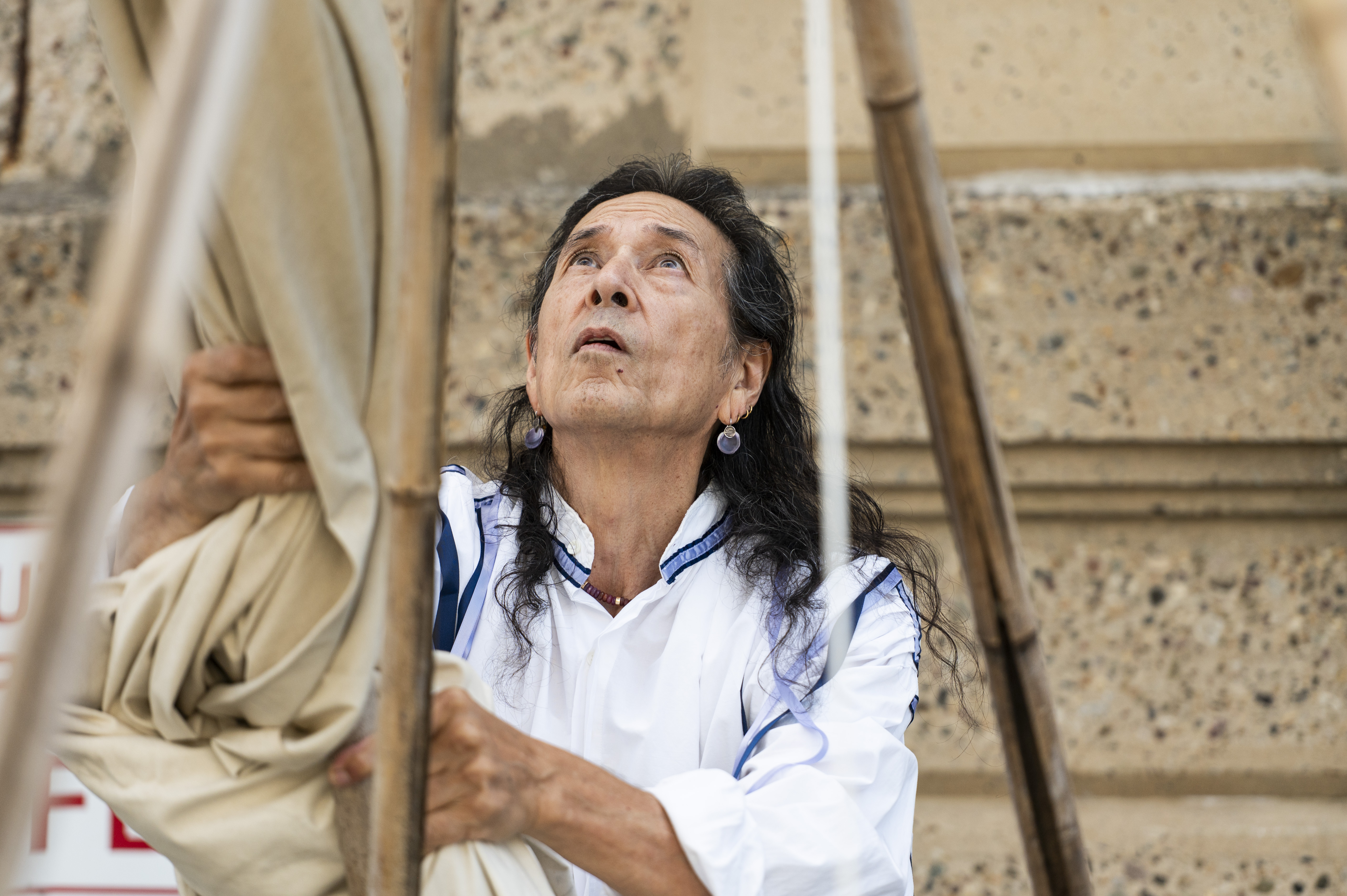
Tchin (left), artist-partner for education and cultural programs at We Are the Seeds, and a volunteer raise a Northern Plains tepee at the Seeds Philly Celebration at Cherry Street Pier on Saturday, Sept. 19, 2026.
This also may be the last Seeds Philly Celebration for the foreseeable future, organizers say. Despite all the gains — and special city funding this year — money has run out.
“I would love to see a world where the city and other private foundations would recognize that this event is absolutely critical for this city,” said Tailinh Agoyo, cofounder and executive director of We Are the Seeds, the Philly-based, Native-led organization that runs the festival. “It brings attention to the fact that this is Lenape land we are on, and celebrates not only the histories of our people, but the diversity of the Native people who live in the city now.”
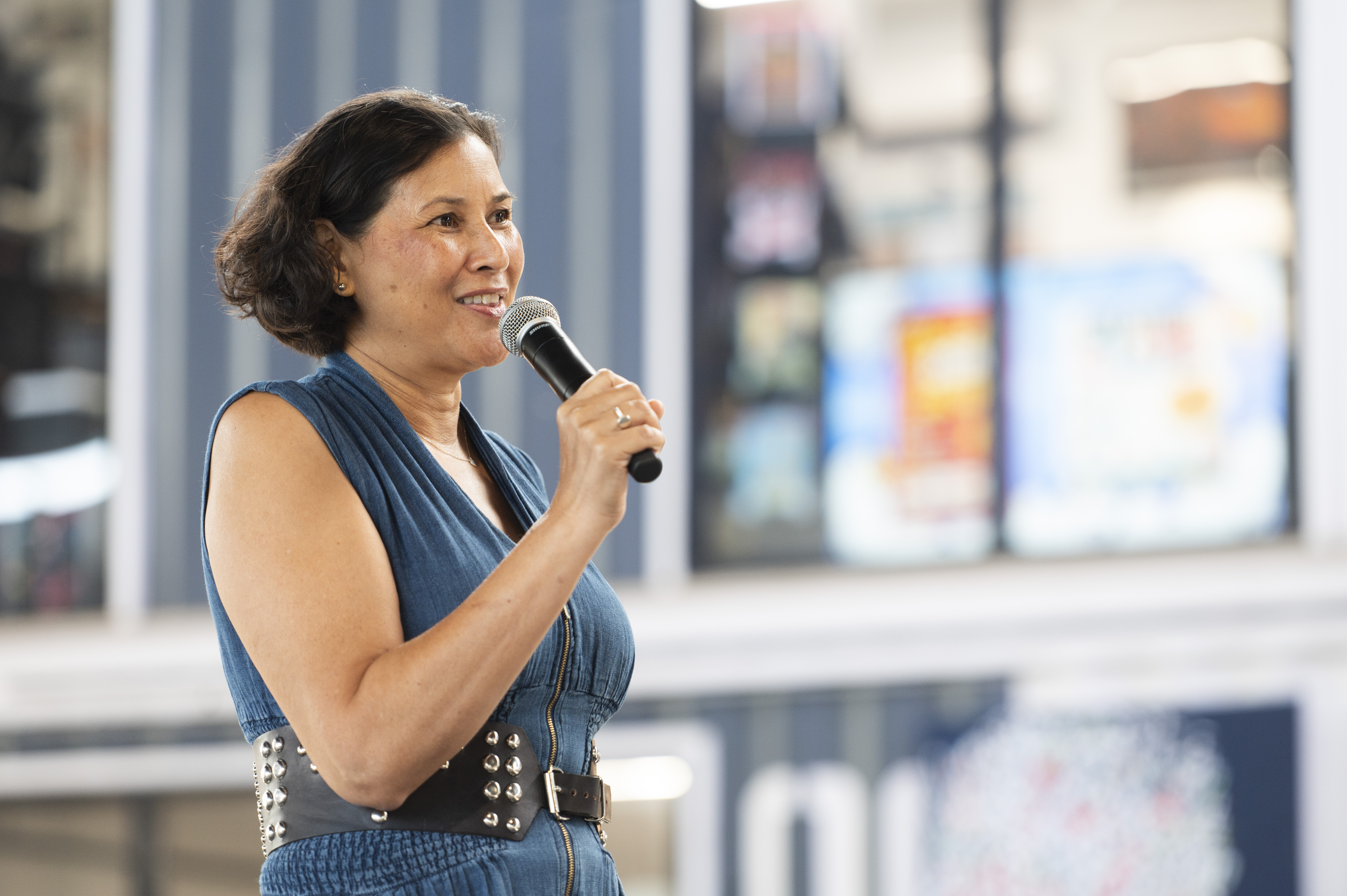
Tailinh Agoyo, co-founder and executive director of We Are the Seeds, speaks to the crowd during the Seeds Philly Celebration at Cherry Street Pier on Saturday, Sept. 19, 2026.
How Seeds Philly was born
Agoyo, who moved to Philadelphia from Sante Fe, N.M., helped form We Are the Seeds in 2016 to celebrate the heritage and culture of Indigenous people in the country’s founding city. At the time, some Philly-area Native American cultural organizations were fading after generations, she remembered.
“I felt like, where do we go?” said Agoyo, a descendant of the Narragansett tribe who is raising four sons. “Where do we have our conversations? Where do we see our community?”
The nonprofit has grown to include Indigenous Listening Gardens in West and North Philly and Kensington; an Indigenous-led theater project examining the myths surrounding Philadelphia’s founding in 1682; and a popular podcast, From Here, With a View, featuring Indigenous artists, culture bearers, and activists.
“We create these types of programs and events for Native people to come together and connect and gather and dance and celebrate,” Agoyo said. “And we invite the greater Philadelphia region to be a part of it.”
But with a key private grant expiring — and the growing festival eating up much of the nonprofit’s expenses — Agoyo said the group needs time and does not know when exactly the event might return. It is bittersweet, Agoyo said, that the festival, which was expecting more than 4,000 attendees — tickets are pay what you can, with a $20 suggested donation — may disappear just as it comes into its own.
Bricks with the words “Merciless Indian Savages” are laid on the ground to be put together to make a Mohawk Rocket Kiln at the Seeds Philly Celebration hosted by an Indigenous nonprofit, We Are the Seeds, at Cherry Street Pier on Saturday, Sept. 19, 2026.
This year, the city provided funding for the festival through its 250th programming, Agoyo said. And the group plans on applying for more grants and hopes to build partnerships with leading Philadelphia philanthropic organizations.
“The reality is the world is in a really tough place and we need to make sure that we stay healthy as an organization,” shesaid. “So we need to be strong and say, ‘Let’s just rest for our health and our family’s health and our community’s health, and then we figure it out.’”
Perhaps, next year, the festival could return as a smaller event, she said.
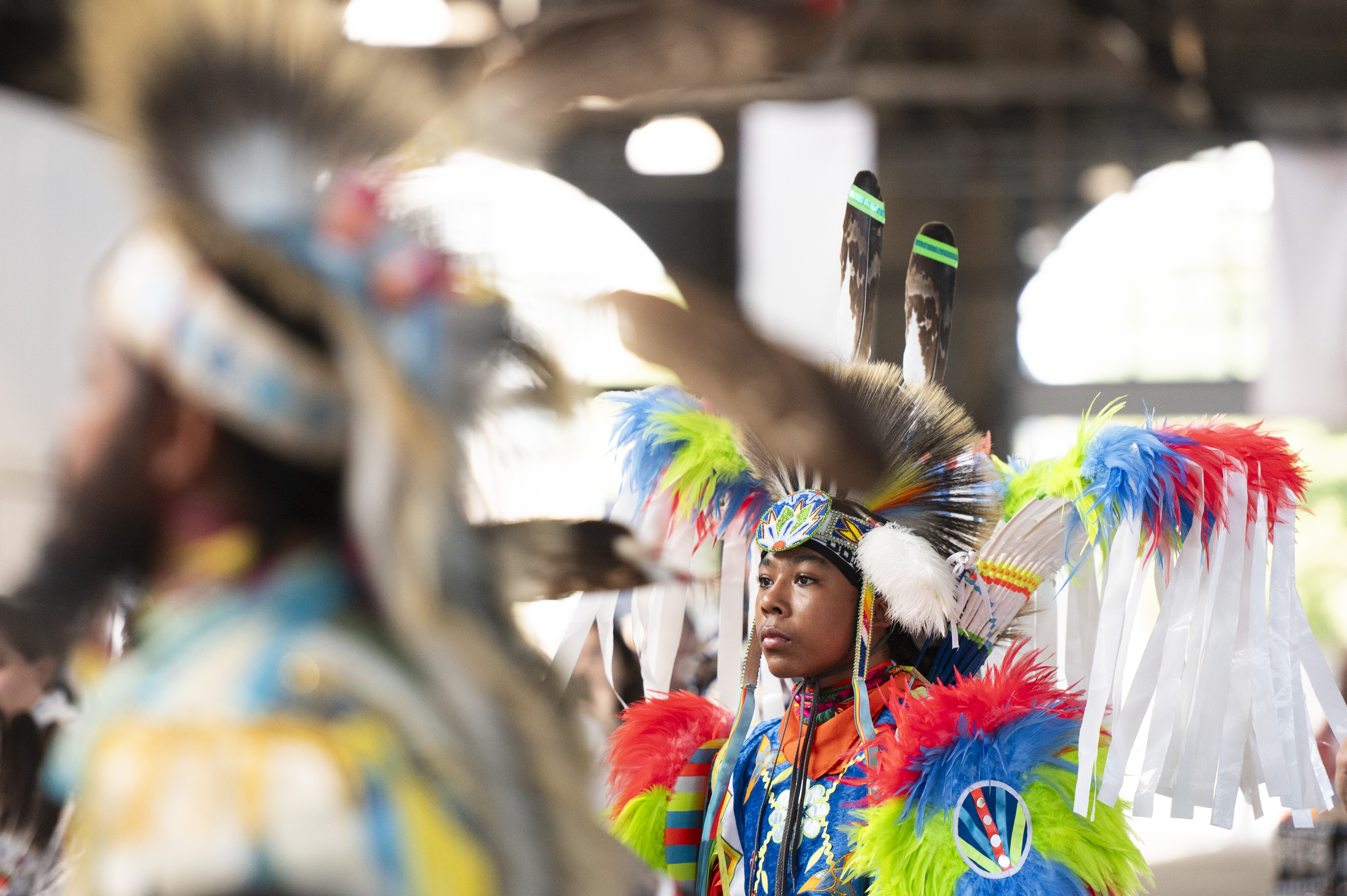
But the hard realities confronting the popular but endangered festival did not dampen Saturday’s celebration. At noon, after an honorary tepee raising, dozens of dancers processed into the powwow. Men and women from tribes up and down the East Coast danced traditional and fancy steps. Jingle dancers donning regalia adorned with dozens of clanking tin snuff lids danced steady rhythmic steps meant to promote healing. Musicians pounded beats on powwow drums made of maple wood and rawhide. Crowds flowed along the pier.
Garbed in a women’s jingle dress, Vaughnda Hilton, executive director of the Philly-based Native Nations Dance Group, said the Seeds Philly Celebration has become a premier Indigenous event.
“It shows we’re still here,” she said. “We’re keeping the culture alive, keeping the dances and songs alive. It’s who we are.”
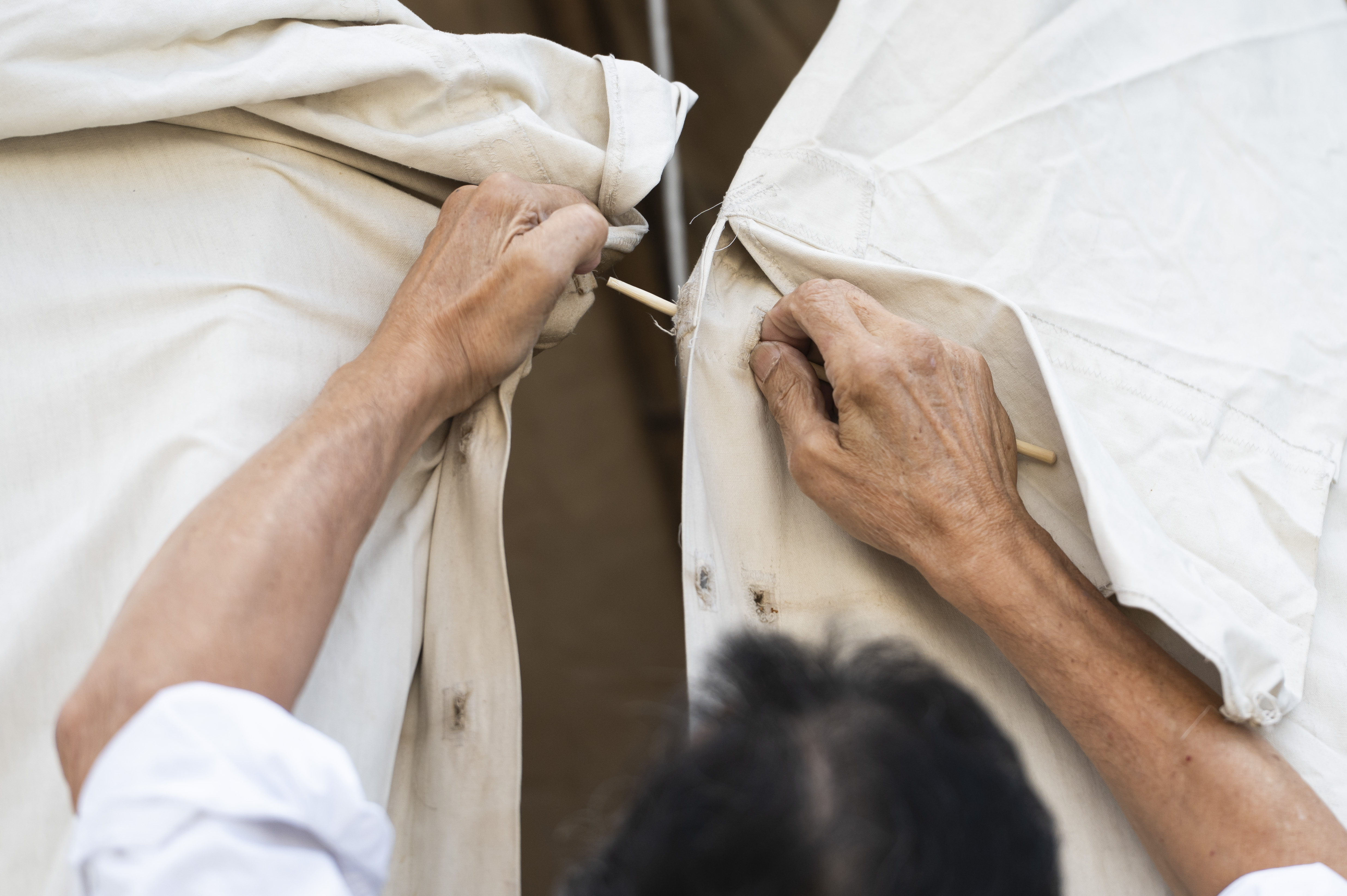
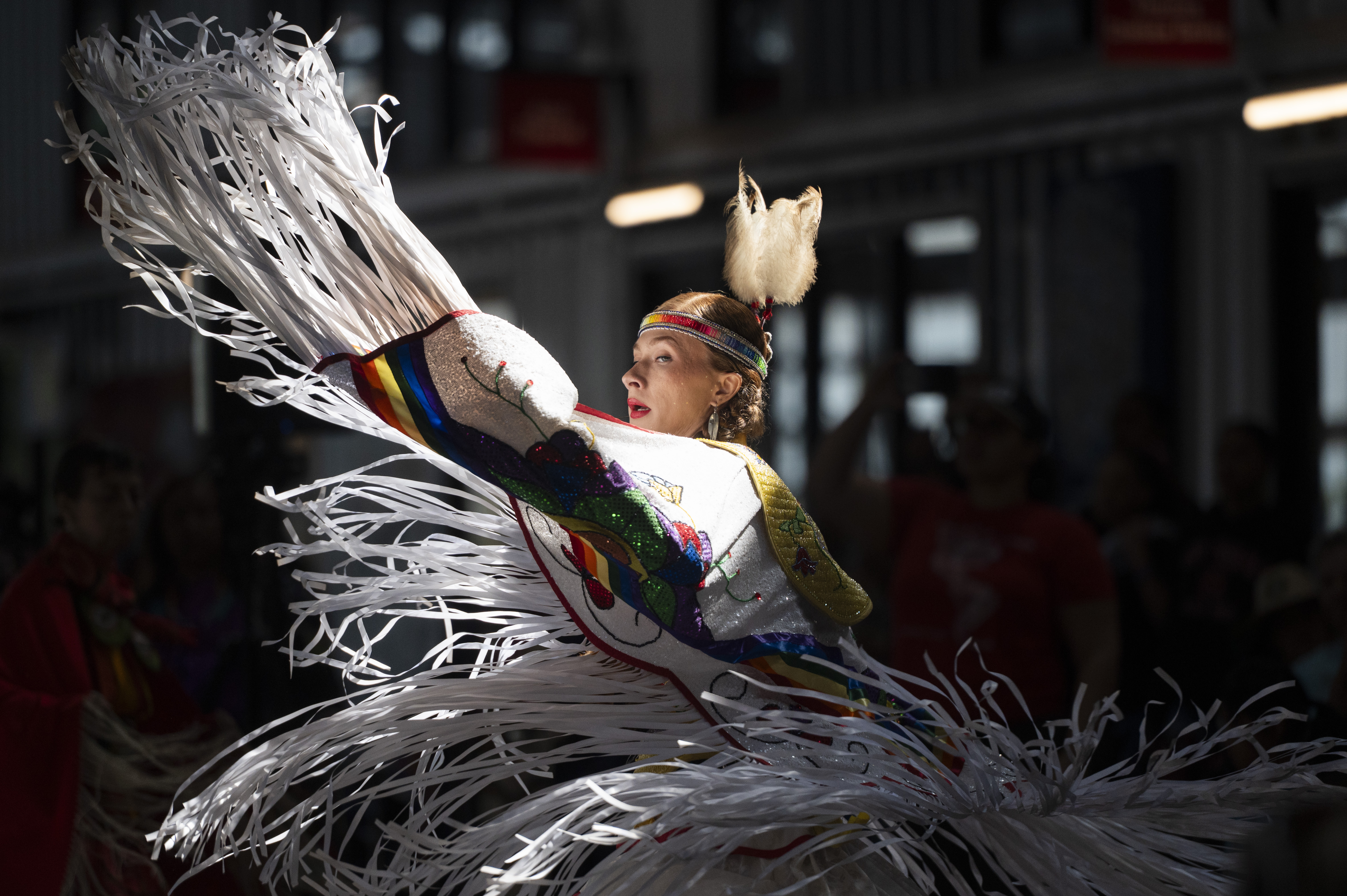
Sosakete of Akwesasne Mohawk Nation builds a Mohawk Rocket Kiln made of bricks with the words “Merciless Indian Savages” at the Philly Seeds Festival hosted by Indigenous nonprofit, We Are the Seeds, at Cherry Street Pier on Saturday, Sept. 19, 2026.Tchin, Artist-Partner for Education and Cultural Programs at We Are the Seeds, puts in a lacing pin to hold together a northern plains tipi at the Philly Seeds Festival at Cherry Street Pier on Saturday, Sept. 19, 2026.Tchin, Artist-Partner for Education and Cultural Programs at We Are the Seeds, raises a northern plains tipi at the Philly Seeds Festival at Cherry Street Pier on Saturday, Sept. 19, 2026.Tchin (right), Artist-Partner for Education and Cultural Programs at We Are the Seeds, puts the finishing touches on a northern plains tipi at the Philly Seeds Festival at Cherry Street Pier on Saturday, Sept. 19, 2026.Dancers line up for the Powwow at the Philly Seeds Festival hosted by Indigenous nonprofit, We Are the Seeds, at Cherry Street Pier on Saturday, Sept. 19, 2026.A dancer performs during the Powwow at the Philly Seeds Festival hosted by Indigenous nonprofit, We Are the Seeds, at Cherry Street Pier on Saturday, Sept. 19, 2026.A dancer wears a decorative headdress at the Philly Seeds Festival hosted by Indigenous nonprofit, We Are the Seeds, at Cherry Street Pier on Saturday, Sept. 19, 2026.Various artists and vendors are set up at the Philly Seeds Festival hosted by Indigenous nonprofit, We Are the Seeds, at Cherry Street Pier on Saturday, Sept. 19, 2026.Sherenté Harris, Head Two Spirit Dancer from the Narragansett Tribe, performs during the Powwow at the Philly Seeds Festival hosted by Indigenous nonprofit, We Are the Seeds, at Cherry Street Pier on Saturday, Sept. 19, 2026.Dancers perform during the Powwow at the Philly Seeds Festival hosted by Indigenous nonprofit, We Are the Seeds, at Cherry Street Pier on Saturday, Sept. 19, 2026.Dawn Spears, artist and Narragansett, teaches a group how to make cornhusk dolls at the Philly Seeds Festival hosted by Indigenous nonprofit, We Are the Seeds, at Cherry Street Pier on Saturday, Sept. 19, 2026.Fancy Shawl Dancers Chitanitehe Ridgeway (left) and Cory Ridgeway (right) put accessories in their hair before the start of the powwow at the The Philly Seeds Festival hosted by Indigenous nonprofit, We Are the Seeds, at Cherry Street Pier on Saturday, Sept. 19, 2026.
Farther down the pier, Roger Sosakete Perkins, a Mohawk multimedia artist and culture keeper from the Bear Clan of Akwesasne near the Canadian banks of the St. Lawrence River, prepared a special fire-working kiln he had built for the festival. Considered a founder of “Powowpopart” — a blending of Native-inspired abstract design and vintage pop culture imagery — Perkins gathered clay from a roadbed near his studio to make Mohawk bricks for the kiln. Each is enshrined with “merciless Indian savages” — a phrase that appears in the Declaration of Independence. On Sunday, Perkins will burn a piece of his own art and a replica of the declaration in the kiln. In Mohawk culture, the burning of something is symbolic of “rebirth” and “replenishing” – like the intentional land fires set to “burn out old growth and bring in new life,” he said.
The installation is meant to represent a conversation, he said, building his kiln, brick by brick, as the pier filled.
“A conversation that has needed to happen for 250 years,” he said. “A real conversation.”
Ask Pastor Daniel Cho why Korean culture has become so popular in the United States, and he just smiles, shaking his head in wonderment.
“I’m not sure, but we’re pleasantly shocked,” said Cho, 59, a Montgomery County Presbyterian minister, who is leaving soon for missionary work in Vietnam. “Turn on the TV and see Korean dramas, K-pop music, and Korean food being everywhere.
Pastor Daniel ChoAlfred Lubrano
“It’s wonderful how we’ve gotten to share our culture. When someone loves what you love, it’s exciting.”
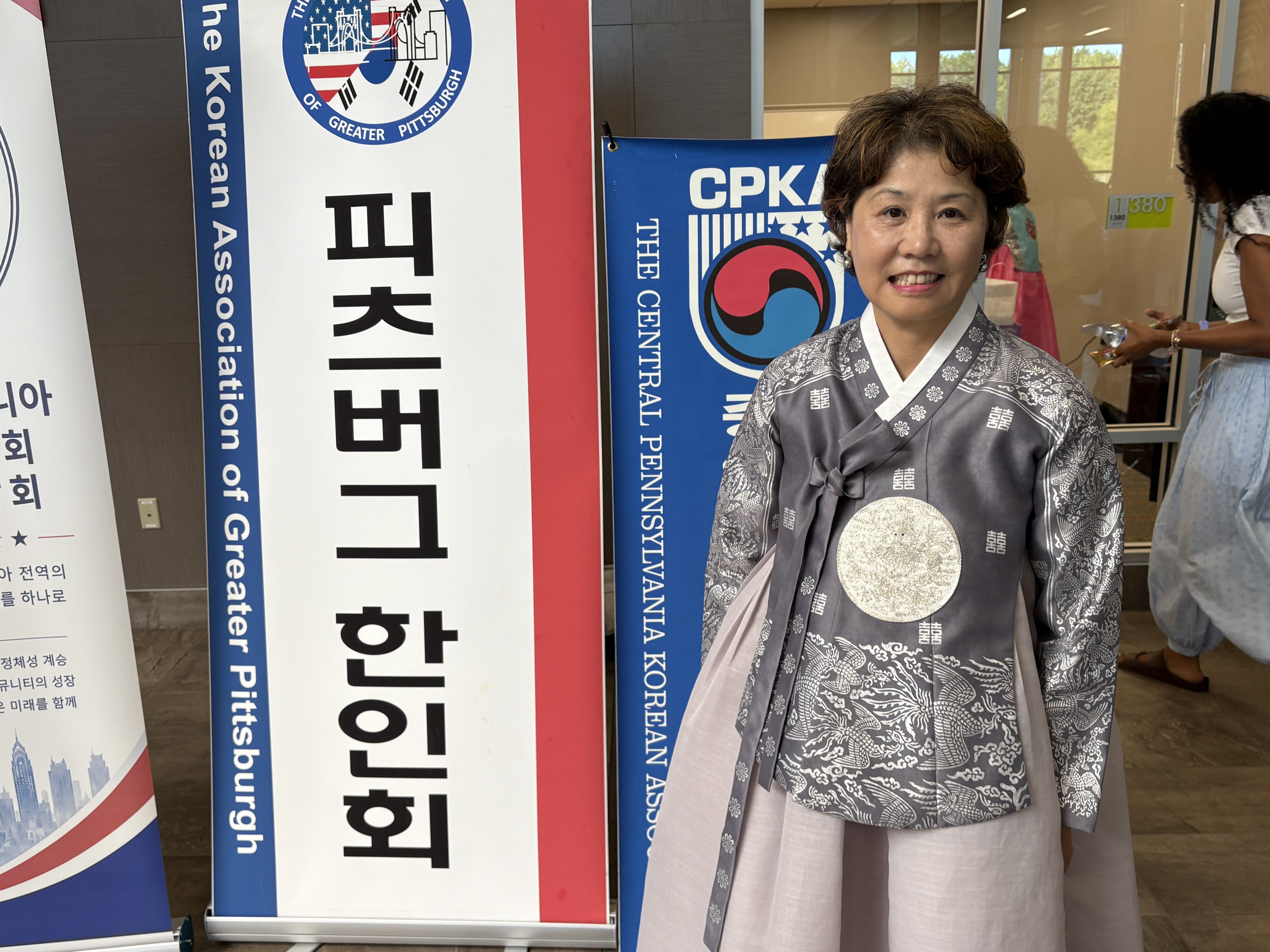
That excitement was palpable Saturday at Montgomery County Community College in Blue Bell, where about 1,500 people gathered for “Happy Chuseok Fest 2026,” a Korean Thanksgiving celebration.
Part of a 2,000-year-old tradition, Chuseok is the time Koreans pause to reflect on family, gratitude, ancestors, harvest, and respect for nature.
“I love it because I get to spend time with my family,” said Kelsey Chung, 14, a ninth grader from Newtown Square. “It’s important to remember the traditions.”
Sponsored by the Korean Culture Community Foundation and Montgomery County, the Chuseok festival is highly significant for the roughly 30,000 to 40,000 Korean Americans living in Pennsylvania, said Sharon Hartz, president of the foundation.
“We know Christian and Jewish holidays,” she said. “But Koreans didn’t really have a holiday that was theirs. Chuseok is becoming more widely known.”
At the festival, vendors were selling kimchi (fermented cabbage), kimbap (rice, vegetables, and meat in seaweed), bulgogi (marinated beef), and, of course, fried chicken, the most popular Korean food abroad, according to the Korea Herald.
Beyond chicken, Korea is widely known for a “deep-rooted culture that people around the world have grabbed onto,” said sociologist Sam Richards of Pennsylvania State University, a Korean scholar who spoke at Saturday’s event.
“South Korea was poor 60 years ago, but it’s an economic superpower now,” said Richards, described by the Korea Times as a “megastar” whose YouTube videos are popular in Korea because of his love for and understanding of the culture.
“The Korean government rebuilt the country by putting money into exporting culture — music, television, movies.”
Americans, he said, are quite familiar with the K-pop superstars BTS, the most popular band in the world. Then, among other works, there is Squid Game, the dystopian thriller TV series, as well as the black-comedy film Parasite, Richards said.
“The government succeeded, as people were attracted to what South Korea has exported.”
A key to the appeal of Korean entertainment is that humility, a national trait, stands out among actors and musical artists, Richards said. Also, he noted, “you won’t see Korean artists putting themselves forward.”
“Pop stars say ‘we,’ not ‘I,’” Richards said.
Korea’s new role in the American zeitgeist is remarkable, said Nani Shin, executive director of the Philadelphia Asian American Film Foundation, whose organization was tabling at the Chuseok event.
“No one in the 1970s knew where Korea was,” Shin, who was born in South Korea, said. “Now, the culture isn’t only known, but celebrated. It’s wild.”
It is important to remember, however, that Koreans look to keep their traditions alive for themselves and their children.
“That’s why I’m here,” said Will Press, 43, who stood outside the event Saturday. He married a Korean woman, he said, which means “she, and I, want our children to know that Korea is part of their heritage.”
The Nittany Lions came out of the Beaver Stadium gates firing on Saturday and beat Buffalo, 55-13, behind the best performance from Penn State’s running backs this season and another 100-yard performance from sophomore wide receiver Koby Howard.
Penn State (3-0) forced the Bulls (1-2) to fumble four times and recovered two, while it has yet to commit a turnover this season.
“[We’re] not where we need to be, but I think a team that has certainly grown in different entities each week and is still a team that, in my opinion, has got so much ability and growth to go,” Penn State coach Matt Campbell said. “We grew in some areas that were really critical focal points. This is college football, and I think our ability to grow from Week 3 to Week 4 will be really important.”
Run game gets going
Offensive coordinator Taylor Mouser expressed his frustration with the run game this week, calling out “mediocrity” and taking the blame for the running backs’ struggles through three weeks.
Mouser surely was much happier with Saturday’s performance. Penn State had 304 rushing yards, led by redshirt sophomore Quinton Martin Jr., who had 100 yards on 10 carries.
Martin, who didn’t record a snap against Temple last week, recorded the Nittany Lions’ longest rush of the year with a 61-yard run on just his second carry of the day at the end of the first quarter.
“It was great to see Quinton really had a great moment,” Campbell said. “I think if you ask Q, Q would tell you [he had] maybe one of his best weeks of practice.”
Junior James Peoples and senior Carson Hansen scored their first touchdowns of the year on 16- and 12-yard rushes, respectively, and Peoples added a second TD in the third quarter. Both averaged 7.4 yards per carry.
Hansen again was the announced starting running back, but the carries were split as evenly as could be before Penn State began playing its backups. By the end, Peoples had eight carries (58 yards) and Hansen had five (37 yards) to Martin’s 10.
Redshirt junior Cam Wallace got in on the fun as well with a 59-yard touchdown run in the fourth quarter.
“All four guys really did some great things with the ball in their hands at some critical moments,” Campbell said. “So I think that part I thought there was growth, but I also thought there was growth because there was some really good blocking on the perimeter.”
While the run game shined, the production from the passing game matched it. Quarterback Rocco Becht finished 11 for 19 for 212 yards and two touchdowns. Howard had three catches for 115 yards and a touchdown.
Campbell said Tuesday that his team was “getting healthier,” but it was without two of its most valuable offensive starters for most of the win over Buffalo.
Center Brock Riker left the game in the first quarter and didn’t return. He was seen shaking an ankle out on the sideline.
“We really didn’t know exactly where we would be with Brock going into the game,” Campbell said. “We wanted to at least put him out there. It still didn’t feel like he was at 100%. That just didn’t feel like it was the right situation to leave him in the game.”
Redshirt freshman Vaea Ikakoula filled in for Riker the rest of the game. Ikakoula transferred from Iowa State this offseason, where he played in four games (two starts) last year.
Ikakoula had some slip-ups while filling in, including missing a rusher on a third-and-15 that forced Becht to throw the ball away late in the first half.
Tight end Andrew Rappleyea appeared to hurt a shoulder midgame. The redshirt junior went to the locker room and returned in street clothes.
Rappleyea had three catches for 24 yards and a touchdown before he left. Campbell said Rappleyea could have returned to the game, and the staff held him out as a precaution.
Up next
Penn State opens Big Ten play next Saturday at home against Wisconsin (5 p.m., Peacock). The two last faced in 2024 at Camp Randall Stadium in Madison, Wis., where the Nittany Lions won, 28-13.
The Philadelphia Eagles (1-0) are on the road this week to take on the Tennessee Titans (0-1), and a Hall of Fame quarterback is joining them in Nashville.
Drew Brees, the Super Bowl XLIV MVP who spent 20 seasons in the NFL, will be in the booth to call the game on Fox alongside play-by-play partner Adam Amin. Kristina Pink will report from the sidelines of Nissan Stadium.
Similar to his playing career, Brees has been forced to overcome adversity as a broadcaster. He was hired by NBC in 2020 and appeared to be on track to replace Cris Collinsworth on Sunday Night Football, but a widely criticized performance in his first NFL broadcast — a 2021 wild-card game — led to his departure from the network.
“When Drew shows up in the booth, who wouldn’t want to listen to him?” Fox Sports’ president and executive producer Brad Zager told Sports Business Journal before the start of the season. “You saw with Tom [Brady] that he had 18 weeks of reps with an ‘A’ crew his first year, and you saw that improvement. Drew never really had that on the NFL level. He does that playoff game, and everybody has their opinions.”
Drew Brees spent 20 season in the NFL, winning a Super Bowl with the Saints. YONG KIM / Staff Photographer
Fox turned to Brees last season to replace former Eagles quarterback Mark Sanchez, who was fired following a late-night fight in October where he allegedly attacked and stabbed a delivery driver. Brees has now called nine game in the network’s No. 3 booth alongside Amin, who has been impressed by the Hall of Famer’s deep understanding of the game and the gravitas he brings to the booth.
It was certainly on display last week when the pair called the Chicago Bears’ 59-37 drubbing of the Carolina Panthers. Bears quarterback Caleb Williams credited advice Brees offered during a production meeting before the game with helping him focus on sticking with his reads and not overlooking open targets in search of a big play.
“We want to encourage him to use his voice and take [viewers] another layer deeper,” Amin said. “And I think he’s starting to improve as a presenter. He still has to learn some of the timing and rhythm, but a lot of that just comes with doing the job. And the rest of it, the presentation, is going to come with timing and confidence.”
Adam Amin and Drew Brees are paired together in Fox’s No. 3 NFL booth.Fox Sports
In a way, Brees is fortunate to have been paired with Amin, who is in his seventh season with Fox and has a track record of working with recently retired players. That includes Sanchez on the football side and Adam Wainwright and A.J. Pierzynski on MLB games. Despite working with former All-Stars and MVPs, Amin has found most of his on-air partners to be coachable, and Brees has been no exception.
“Most people don’t get a lot of coaching or guidance when they first step into the booth,” Amin said. “I have a process. I know what the feel of the broadcast looks and feels like and what the timing and rhythm of it is. And I go, ‘Man, here’s the timing and rhythm that I work off of. Let’s start there.’”
“It’s funny to listen to him use television terminology,” Amin added. “Like, ‘Hey, let’s talk about this graphic’ or ‘Hey, what does the viz do?’ It’s like learning a new playbook for him.”
“Simmons did not get a whole lot done against Landon Dickerson the last time they met in 2022,” Amin said. “Obviously, Dickerson is hurt, so who gets the assignment on Simmons?”
“The All-Pro lines up at multiple spots inside, but it’s likely Titans coach Robert Saleh will concentrate his efforts vs. Kendall,” McLane wrote.
How to watch and stream Eagles vs. Titans
Eagles-Titans will air on Fox Sunday at 1 p.m. Troy Taormina, Imagn Images
Sunday’s Week 2 game between the Eagles and Titans is scheduled to start at 1 p.m. Philadelphia time on Fox.
The game will stream on Fox One, the network’s subscription streaming service. It’s also available on any so-called skinny bundle that carries Fox, including fuboTV, YouTube TV, Hulu + Live TV, Sling TV, and DirecTV Stream. Most offer a free trial.
If you live in Philadelphia or any other TV market where the game is airing, you can also stream the game on NFL+, the league’s subscription streaming service, which runs $6.99 a month.
If you’re looking to stream the game for free and you live in or around Philadelphia, your best option is to use a digital antenna, since the game will air on broadcast television on Fox 29.
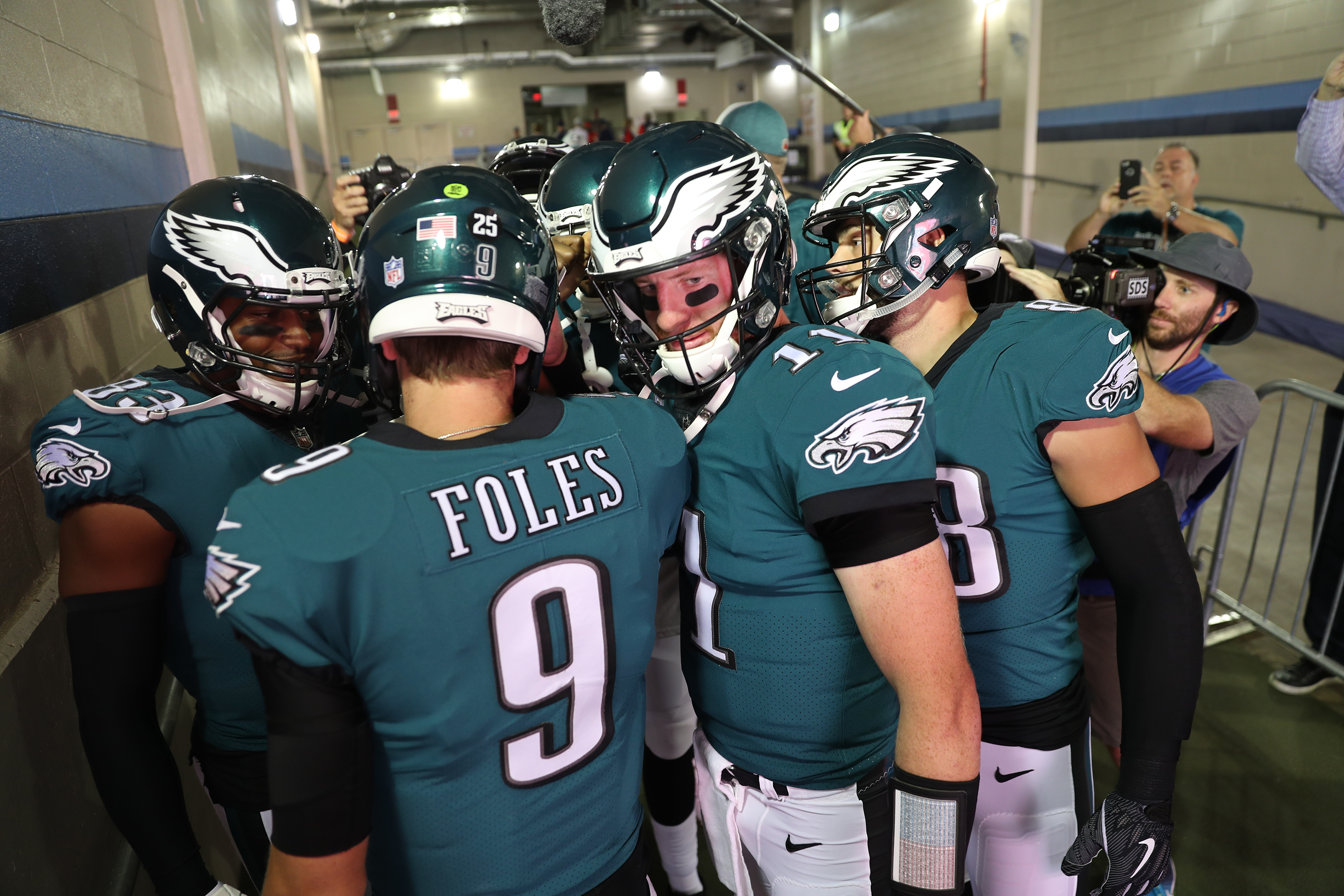
The last time the Eagles played in Nashville Carson Wentz was still QB and Nick Foles was his backup. Michael Bryant / Staff Photographer
Sunday’s matchup is just the fourth time the Eagles have traveled to Nashville to face the Titans since the franchise moved to Nissan Stadium in 1999.
Overall, the Eagles are 8-5 against the Titans, but they haven’t had much success down in the Music City, losing all three games they’ve played there. The most recent was an overtime loss to the Titans in 2018, when Carson Wentz was quarterback and Nelson Agholor — who recently joined NFL Media as an analyst — was still dropping passes.
The last time the two teams played was in Week 12 of the 2022 season, with the Birds dominating the Titans in a 35-10 win in something of a revenge game for former Eagles wide receiver A.J. Brown.
As Philadelphia rounds the corner into spooky season, fans of all things gothic, literary, or historical may be disappointed to learn that the Edgar Allan Poe National Historic Site remains closed.
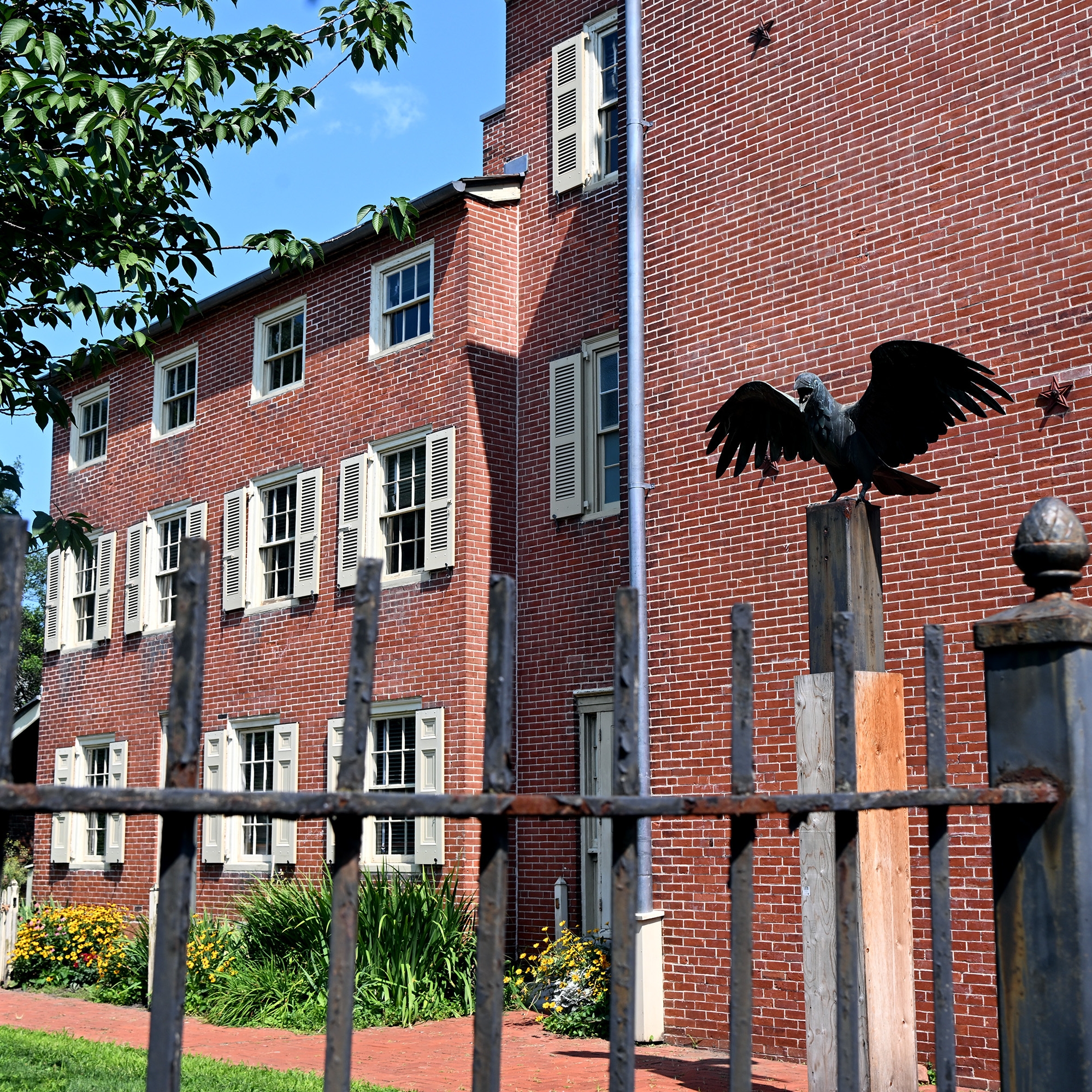
The three-story brick building at 532 N. Seventh St. shuttered in summer 2024 for fire safety upgrades costing over $931,000. It was initially slated to reopen that fall, but renovations grewinto a broader improvement project, according to the National Park Service.
More recently, Philadelphia’s tourism agency had said the site was expected to open this fall, and an Oct. 31 event celebrating Poe as the father of the modern detective novel is planned at the site.But the National Park Service says there is still no official reopening date for the public.
“I can tell you that we can offer no date for when the house will reopen,” said park service spokesperson John Warren.
Calls to a supervisor at Independence National Historical Park, which manages the Poe house, went unanswered Thursday and Friday.
Warren said park service officials did not provide more details to him on the timeline, adding that there were “multiple, complex infrastructure projects going on at the site all at once.”
“If you have ever owned an old home, you know that repair projects often lead to discovering more issues, so it’s wisest not to speculate on an end date,” Warren said.
What’s holding things up?
At the site Friday, volunteers tended to flowers and plants while National Park Service workers wrapped up another day renovating the building’s first floor.
National Park Service plasterer and painter Joe Palumbo said the house’s issues should have been addressed a decade earlier. He said when he started working there,the property “smelled awful” from likely water damage.
Palumbo said construction crews redid the restrooms, replastered and painted the first floor, and rehabbed the woodworking.
He estimated it would take another week to complete first-floor renovations. From there, outside contractors are set to replace the carpets and blinds.
Palumbo said a plan to renovate the building’s exterior is “on hold,” and he is not sure why.
What’s the significance of the site?
Built in the 1800s, the home is the only remaining residence where Poe lived during his six years in Philadelphia from 1838 to 1844.
Retired National Park Service worker Helen McKenna spent 25 years at the site, educating people about Poe and his ties to Philadelphia. During her time working there, the house had exhibits, poetry recitations, a short biographical film, and a reading room styled after one of Poe’s published articles.
Back then, the house still had the original plaster, which was moldering and falling away from its lath. Of course, she said, the walls would have been gleaming white when Poe lived there in 1843 and 1844.
The neighborhood was not even part of the city at that time, she said, and Poe would have traveled on horse-drawn omnibuses. These kinds of details help people imagine Poe, she said, not just as a literary figure, but as a person.
To her, the house captures thecontrast between Poe’s literary stature — with his influence stretching across detective fiction, science fiction, poetry, and short stories — and the alcoholic, struggling writer who lived there with his mother-in-law and his wife, who had tuberculosis.
“There’s that sense of place. This grand, admired author was living in really humble circumstances on the outskirts of the city,” she said. “He didn’t own the place, he was paying rent, and he wasn’t always able to pay the rent.”
What did Poe do while in Philly?
Many cities have memorials to Poe, McKenna said. That is because he traveled. He was born in Boston, grew up in Richmond and in England, lived twice in New York, had a stint in Delaware, and died in Baltimore.
Poe’s time in Philly, however, marked acreative high-water mark, McKenna said.
He moved to Philly after failing to find success with a novel in New York City and turned his attention to short stories. While in Philly, he published “The Murders in the Rue Morgue,” “The Black Cat,” and “The Tell-Tale Heart,” McKenna said. He also became known as a charismatic speaker and an acerbic critic.
At his best, McKenna said, Poe was “a genius of compression,” creating haunting, memorable stories at a time when interest in American writers was growing.
“I won’t say that Poe is the best writer that America ever produced, but he’s certainly had a ton of impact, globally,” McKenna said.
After decades as a popular hang-out for generations of Oaklyn kids, the aging hockey rink and adjacent basketball court at Oaklyn-Lions Park have both closed because of safety concerns.
Oaklyn Borough officials announced the closures at the Sept. 8 council meeting following an annual safety inspection that recommended the areas be closed because of concerns about the surface, boards, and fencing. The courts closed the following day and it’s unclear how long the repairs could take and how much they’ll cost.
Currently cordoned off by temporary fencing and caution tape, the wooden boards around the rink have come apart in various spots as weeds have sprouted through cracks on the surface.
The outdoor hockey rink at Oaklyn-Lions Park could be seen cordoned off on Sept. 17 after being closed due to safety concerns.Lacey Latch
Right behind one of the hockeynets, two holes in the boards and gaps in the upper protective fencing — all large enough for street hockey balls and pucks to soar through — directly face a neighboring playground.
On the basketball court, only one backboard remains standing — albeit crookedly.
But in spite of the current state of things, the area was still being used up until the sudden closure last week, said lifelong Oaklyn resident Alex Lewis, 36.
Like many other Oaklyn kids, Lewis grew up playing soccer at the hockey rink that for years was informally used for both sports.
“We had this really vibrant soccer-loving community,” Lewis said.
“It was so much the thing to do for our group that if we had a three-day weekend for school, we’d be down there all three nights playing soccer until we basically couldn’t walk anymore,” he said. “It was incredible.”
Eventually, the long-standing shared use of the space was paused in 2006 when an ordinance was passed banning all non-hockey equipment within the rink, Lewis said.
The ordinance has remainedin place since then and precipitated a noticeable drop in the rink’s usage, Lewis said.
“There was still a vibrant hockey-playing community, as there should be, which is awesome,” Lewis said. “But the overall use of the court declined and the quality of the court and the upkeep of the court itself declined over that same amount of time.”
That steady decline has been clear to Lewis and others who spent years playing at the park.
Large holes in the boards and gaps in the protective fencing can be see at the outdoor hockey rink at Oaklyn-Lions Park on Sept. 17.Lacey Latch
Another lifelong Oaklyn resident Billy Gamba, 29, was one of the many hockey players who spent countless hours at the rink learning the fundamentals of the sport.
Almost every night growing up, Gamba and his friends would descend on the rink, he said, honing their skills and eventually passing them on to the players coming up behind them through impromptu clinics.
“We would just meet down there and we pick teams and just play for all hours of the day and throughout the night,” Gamba said.
The rink wasn’t only a draw for Oaklyners either, he said, attracting players fromother communities, including Audubon, Collingswood, and Haddon Township.
In spite of its heavy use over the years, Gamba said he doesn’t remember any major repairs taking place at the rink in his lifetime, save for a quick patch-job when he was about 10 years old.
“I used to play down there like four or five nights a week and it just got worse and worse over time,” he said.
“Over the years I stopped playing because I don’t want to get hurt down here,” Gamba said. “I’ve seen guys get seriously hurt down there, whether their stick gets caught in the boards and they jab themselves in the stomach or their wheels or skates catch that deep crack and they fall.”
Just like Lewis, Gamba, and countless other residents, Oaklyn Mayor Greg Brandley has memories as a kid on the courts.
“Growing up in Oaklyn, I played on those courts my whole life as a little kid so it’s very sad to see this happen right now,” Brandley said of the closures.
“It’s something for the kids that we have to get reopened again,” he said.
But repairs won’t be as simple as just pouring a new layer of concrete, Brandley said.
Only one backboard remains standing on the basketball court at Oaklyn-Lions Park, pictured here on Sept. 17.Lacey Latch
Because the rink has a special surface, he said, the borough will have to consult with engineers on the necessary work and the estimated cost. After that, the discussion will then shift to how to find money for the project in the budget, he said.
As a result, it’s still much too early to put a realistic timeline or price tag on the project, he said.
With that said, Lewis has already gotten a jump on the process.
Last fall, Lewis and the semipro soccer club he founded, Oaklyn United FC, organized a tournament at the courts to help fundraise for the needed repairs.
While the money raised was “just a drop in the bucket” toward the tens of thousands of dollars that will likely be needed for the repairs, Lewis said, it was about trying to give back to “this public resource that in many ways was kind of the birthplace of OUFC.”
And while he’s disappointed that the courts deteriorated to the point of closing, he’s eager tohelpfix it up and make it even better.
With soccer gaining popularity in the U.S., Lewis noted that it could be the perfect time to formalize the shared-use of the court for both hockey and soccer, which is as simple as painting a few extra lines, he said.
“We’re talking about restoring a public asset that if it doesn’t get restored, it’s just kind of sitting there in this blighted state in what is otherwise kind of the center of the universe for our town,” Lewis said.
“It’s a great art, is rowing. It’s the finest art there is. It’s a symphony of motion. … When you near perfection, you’re touching the Divine.”
— George Y. Pocock, renowned rowing coach and boatbuilder
“If you want to be a Schuylkill Dragon, don’t be a schmuck.”
— Judy Gernon, 81
Boathouse Row, on the Schuylkill, is the epitome of old-money elegance — a Ralph Lauren catalog come to life.
Home to more than a dozen of the city’s storied rowing clubs, it’s atimeless civicfixture. Opulent brick houses with palatial decks. American flags fluttering from poles. Young rowers with sinewy physiques andwell-earned tans, milling about the docks.
There’s a reason it is considered one of the city’s most iconic settings, the subject of postcards and poetry.
Boathouse Row, a picturesque scene located along the east bank of the Schuylkill.TOM GRALISH / Staff Photographer
About two miles upriver, meanwhile — far from this extravagant scene — sits another boathouse, of far less renown.
To get to it, you have to trek through knee-high grass, past the porta-potties and discarded car tires, and the mosquitoes as big as Buicks. Go past the chain-link fence choked by weeds and the dead trees the city hasn’t yet gotten around to clearing, and soon enough, you’ll reach it.
The humble headquarters of the Schuylkill Dragons.
It is 4 feet by 6 feet. It is packed with faded life jackets, water jugs, a smattering of rusted, secondhand tools. The only thing WASPy about it are the actual wasps — which, at the moment, have infested a corner of the small structure.
It is damp and dirty, thick with dust and cobwebs.
To the ladies of the Schuylkill Dragons — the city’s oldest all-woman dragon-boating team and its unlikeliest sports dynasty — there might be no better place on earth.
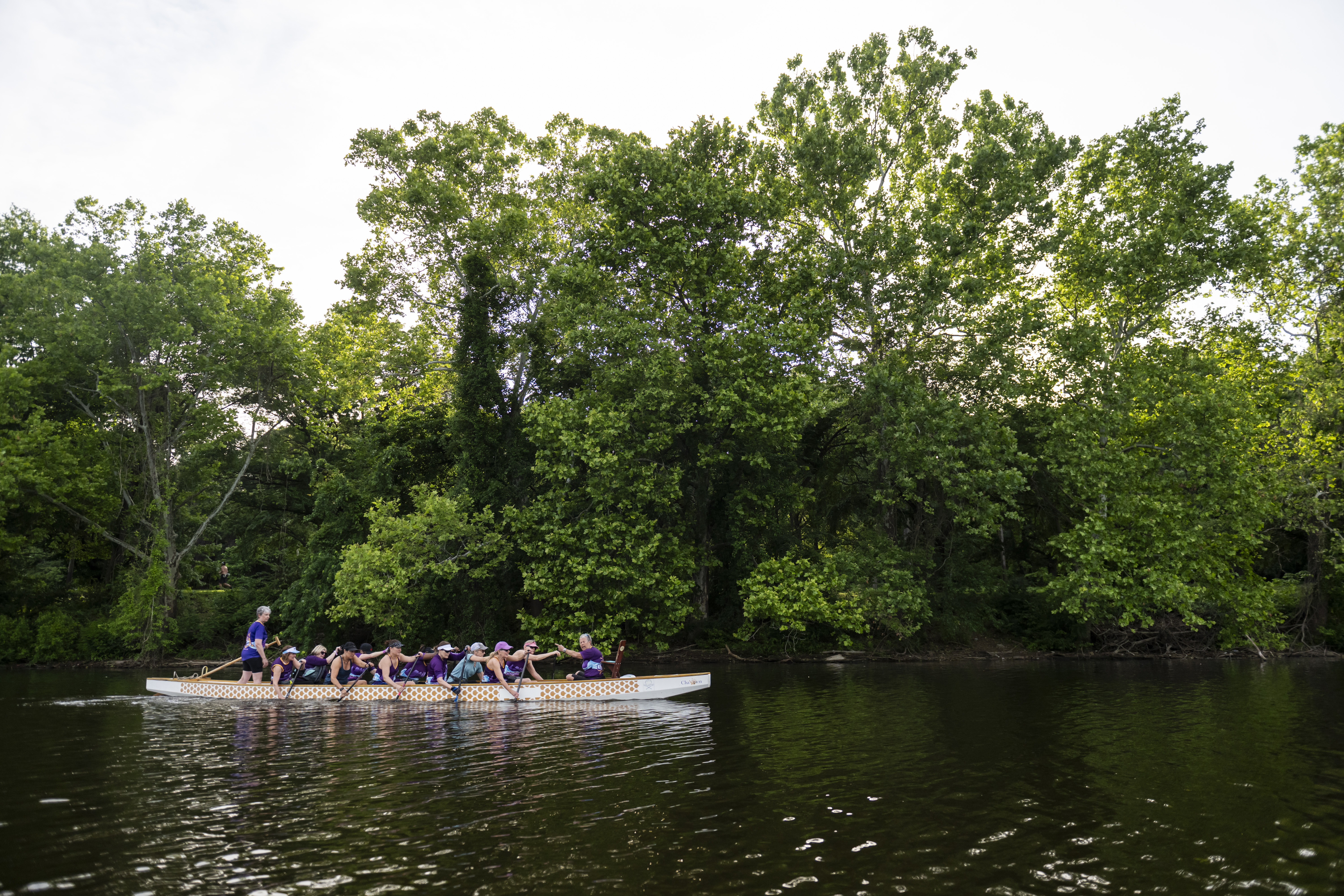
The Schuylkill Dragons on June 2, 2026.Allie Ippolito / For The Inquirer
A ‘dump truck’ on the water
My introduction to the Schuylkill Dragons came on a Saturday morning this summer, at a team practice along the Schuylkill.
As I followed the team down a dirt path toward the water, a tiny white-haired woman in her 80s sidled up to me.
“It’s a good thing you didn’t come last Thursday,” she said, “‘cause it was raining like a b—.”
The “boathouse” of the Schuylkill Dragons stands on the west bank of the Schuylkill, near the team’s dock. Members of the team built the structure in 2015.Dugan Arnett
For 25 years, the Dragons have been rumbling their way up and down the Schuylkill.
And for 25 years, they have been the river’s most immovableforce — a sweatin’, swearin’, swaggerin’ group of bandits that no one has quite figured out how to tame.
“Underestimate them at your own peril,”says Bob Mina, a longtime member of the Philadelphia Dragon Boat Association.
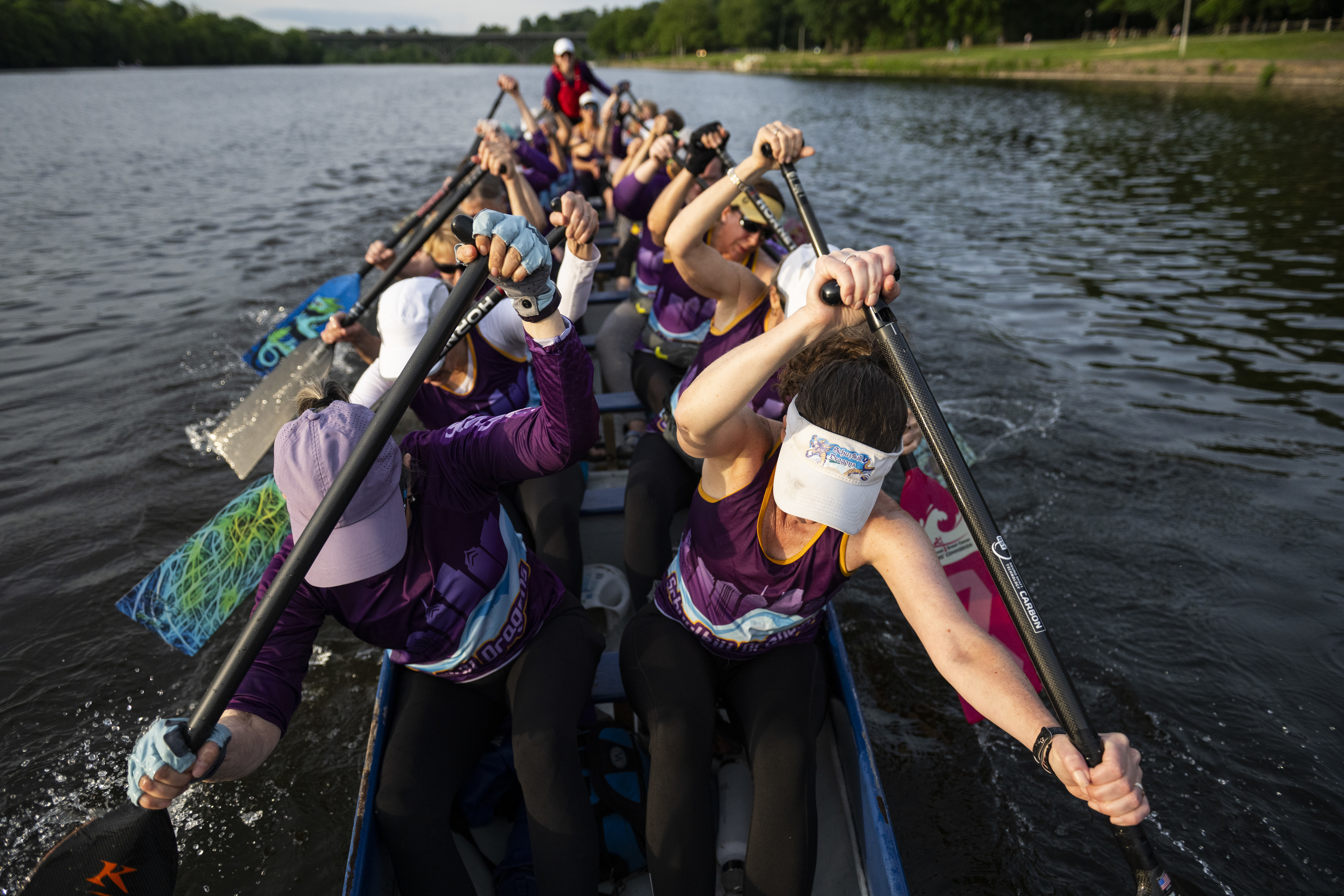
Many are in their 60s, 70s, and 80s, and — having endured some of life’s cruelest challenges: cancer, divorce, the loss of spouses — do not find it particularly daunting to propel a two-ton boat upriver until their backs and shoulders scream.
There is Cindy Roberts, a65-year-old retired preservationist known for growling loudly throughout races. And Sue Ferry, 64, who goes by the nickname “Machete” — due to the fact that she once brandished one at practice and used it to hack a path through the weeds to the team’s boat ramp.
Judy Gernon, drummer with the Schuylkill Dragons, yells out calls during a practice ahead of an forthcoming race.Allie Ippolito / For The Inquirer
There is “Crazy Judy” Gernon, a tattooed 81-year-old former Army brat who stands 5-foot-1 (“and a half”) and has never met a sentence she felt couldn’t be enhanced with an expletive (or six). A while back, the team had to convince her to stop flashing people on the river.
Nothing has been able to slay the Dragons. Not injury (they’ve been known to schedule their hip-replacement surgeries around dragon-boating season). Not the city’s rowers (with whom they regularly clash), or the younger, fitter teams they routinely find themselves lined up against (the Dragons have won medals across the globe and are widely considered the gold standard for women’s dragon-boating in the city).
Even their own coaches have occasionally found themselves at the mercy of the Schuylkill’s Bad News Bears.
Years ago, the team was led by a man who worked as an attorney for a prominent pharmaceutical company, a guy with a reputation for navigating the corporate world with iron-fisted efficiency.
“What cracked us up is he had no qualms going into some office and firing everybody there,” says Crazy Judy.
“But to work with a women’s dragon-boating team? He couldn’t say s— if he had a mouthful.”
The Schuylkill Dragons on Tuesday, June 2, 2026.Allie Ippolito / For The Inquirer
‘Renegades’ of the river
Since hosting its first regatta in 1835, the Schuylkill has been a national hub for U.S. rowing. It has produced Olympic rowing medalists and national collegiate champions, been the training ground for clubs with names like Vespa and Crescent.
It was into this hallowed setting, meanwhile, that the Schuylkill Dragons arrived, in 2001, with all the subtlety of a right cross.
Though not the first dragon-boating team on the river — at least one men’s team started in the mid-1980s — the Dragons quickly established themselves as the most colorful.
“We were like renegades,” says Patti Miller, 72, one of the Dragons’ founding members. “We were a novelty: Who are these Schuylkill Dragons?”
If rowing is jazz — smooth, elegant — then dragon-boating is a half-dozen teenagers in a garage, thrashing on electric guitars and banging on drum kits.
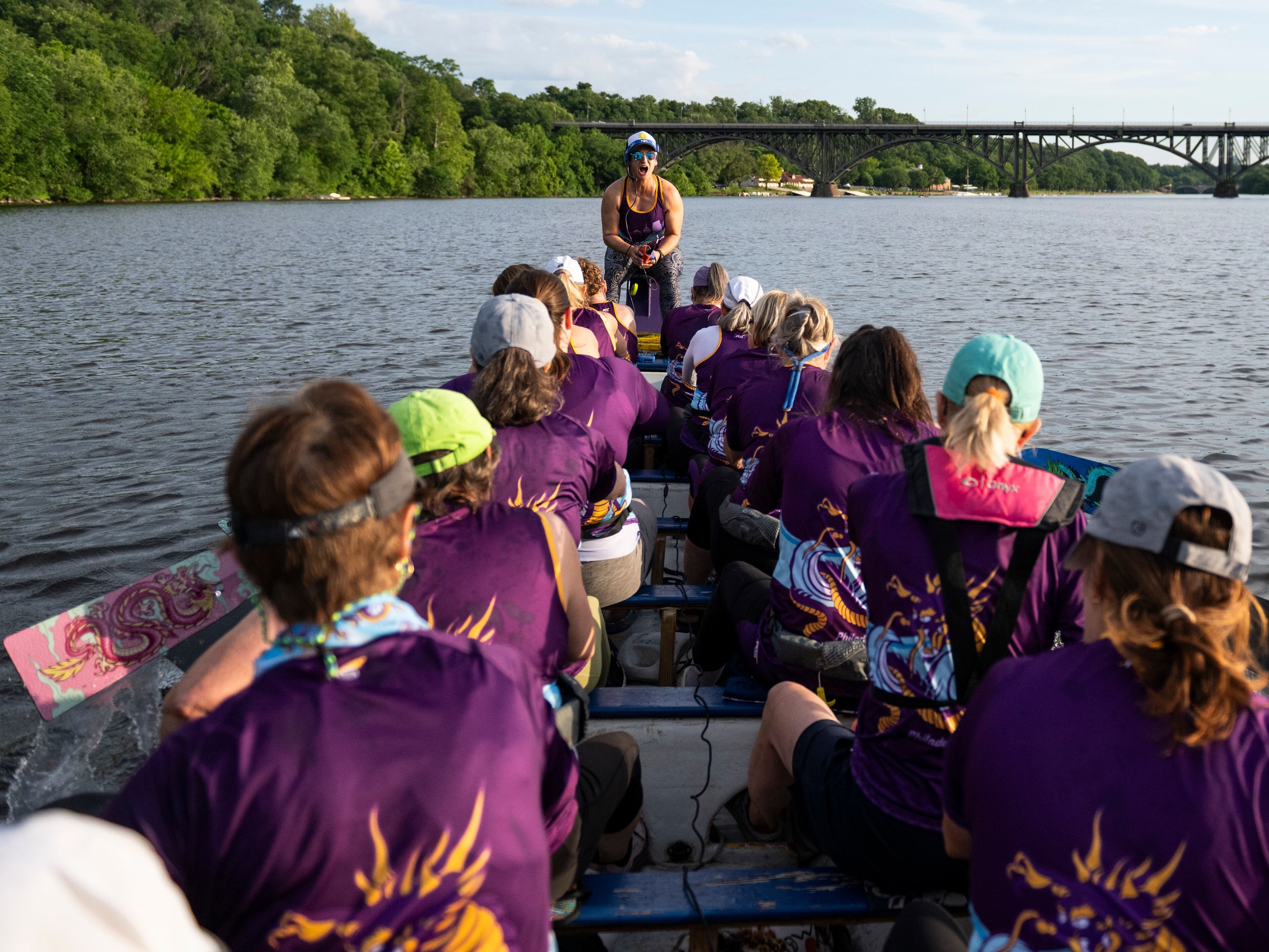
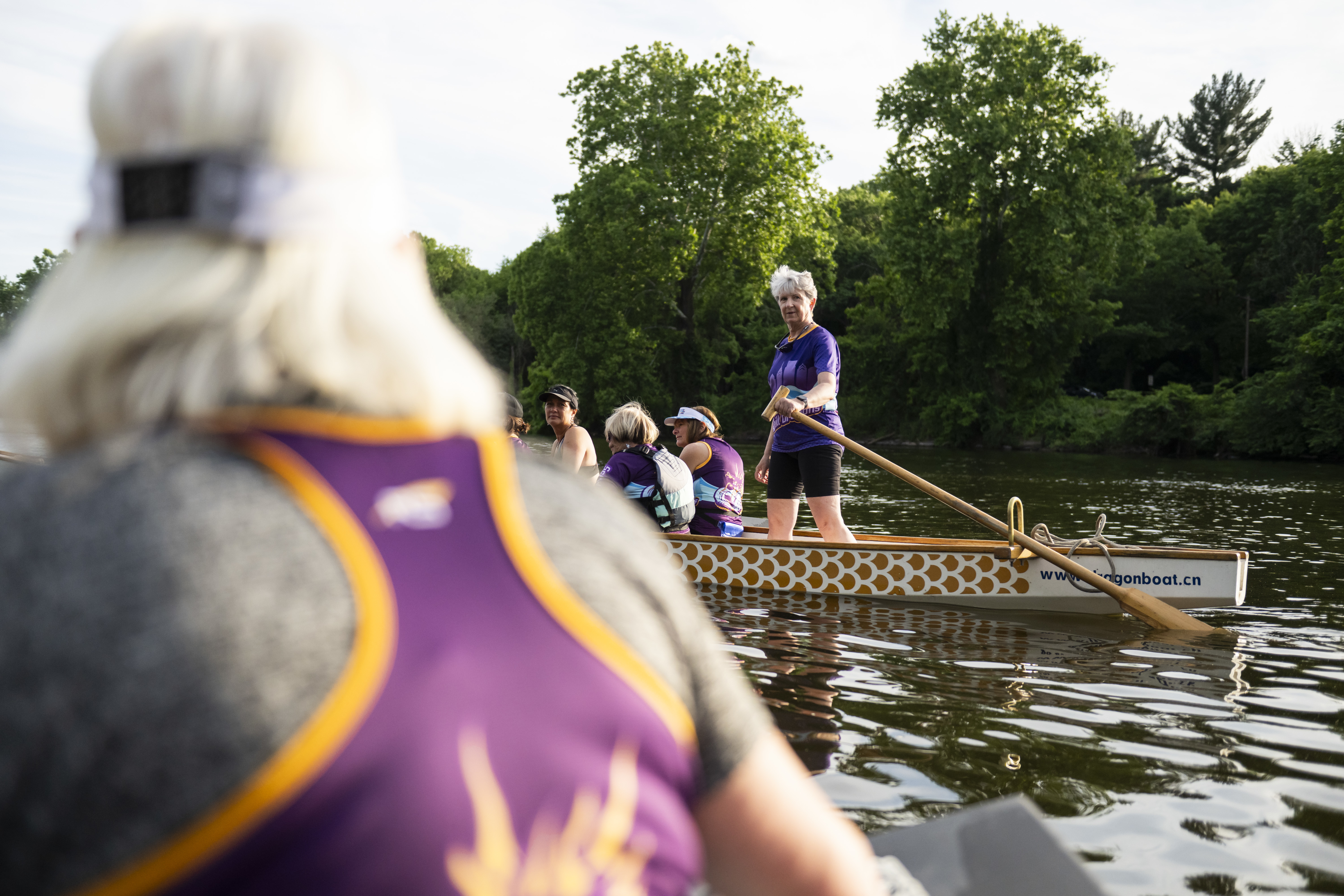
Their stroke is urgent and aggressive. Their boats — usually adorned with large dragon heads and tails — are massive, measuring some 40 feet in length. Unlike rowing, which typically includes no more than eight people to a boat, dragon boats hold 22: 20 paddlers, a drummer (who sits up front, banging a drum to set the paddling pace and barking instructions through a microphone) and a steersperson (stationed in the back and responsible for keeping the boat on course).
Amy Virus, a 52-year-old member of the Dragons, explains it this way:
The Schuylkill is like a smooth-running highway, the rowers and kayakers minding their own business.
“And then a dump truck gets on,” she says, “and gets in [everybody’s] way.”
Video: The Schuylkill Dragons are Philly’s oldest all-woman dragon-boating team
The early years weren’t always easy. To find members, the Dragons handed out flyers and published classified ads in the newspaper: Women wanted to paddle on the Schuylkill.
For years, the team was stationed on the Kelly Drive side of the Schuylkill, their boats tied to a tree on the river’s bank. Before each practice, the women — many postretirement age — had to rappel down a rock wall to board the boat.
Introducing dragon-boating to the Schuylkill, meanwhile, was a little like releasing a pack of honey badgers into a wedding reception.
Years ago, a group of male dragon-boaters — who’d apparently done a little too much prerace imbibing — managed to tip their boat during a race, sending themselves spilling into the river. When a police boat arrived to pull them out of the water, they managed to sink that boat, too.
Lora Dunnigan, one of the coaches of the Schuylkill Dragons, on Tuesday, June 2, 2026.Allie Ippolito / For The Inquirer
It was “basically like West Side Story on the water,” says Mina, of the PDBA, of the rower-dragon-boater tension. “Only without the jaunty musical numbers.”
When the Dragons first started on the river, the mostly male rowers would report the team to the Schuylkill Navy — the river’s rule-enforcement body — for rules violations. Or scream at the women to get out of their way.
Today, the two groups seem to have reached an uneasy detente, though plenty of Dragons believe the rowers would be happy if they packed up their hulking boats and disappeared forever. Says Meg Fasy, 62, “They’re looking at us like we’re a bunch of old broads, I’m sure.”
Which is not to say, of course, that the Dragons do not give as good as they get.
Not long ago, when the team encountered a group of younger male rowers on the river during practice, one Dragon couldn’t help herself.
“I’ve got shoes older than you!” she bellowed.
The Schuylkill Dragons on Tuesday, June 2, 2026.Allie Ippolito / For The Inquirer
‘I was better than they were’
Because many came of age before Title IX, the Dragons are, for some, the first team they’ve ever been a part of.
Growing up in Massachusetts, Susan Wilson — the Dragons’ oldest member at 83 — spent childhood evenings playing street baseball with the boys in her neighborhood — long, glorious hours chasing fly balls under a fading New England sun.
But at a certain point, the boys all joined organized teams, and Wilson was relegated to the bleachers — a development particularly unjust, she explains, considering “I was better than they were.”
When she eventually discovered dragon-boating several decades later, in her late 50s, it was a revelation.
“The first night I went out on the water, there were whitecaps [and] hail,” says Wilson. “And I went, ‘Oh, yes, this is for me.’”
One after another, members credit the Dragons with bringing them out of their shells, with instilling in them a newfound confidence.
As a young mother, Karen Anderson, 72, says, she was so competition-averse that during her kids’ youth sporting events, “I’d hope for a tie, so everyone left happy.”
Now?
“I never know what’s going to come flying out of my mouth,” she says. “It’s made me really like a crazy woman when I’m racing.”
Consider Marina Della Putta Johnston. On land, she is a mild-mannered, 62-year-old former Italian Studies lecturer at Penn. On water, she’s “The Marinator” — a nickname earned following a race in Sarasota, Fla., in which the boat she was steering inadvertently clipped that of a rival team, dumping its occupants into the lake.
“They flipped,” Johnston says, “and we kept going.”
Beneath all their bluster, the Dragons care deeply for one another.
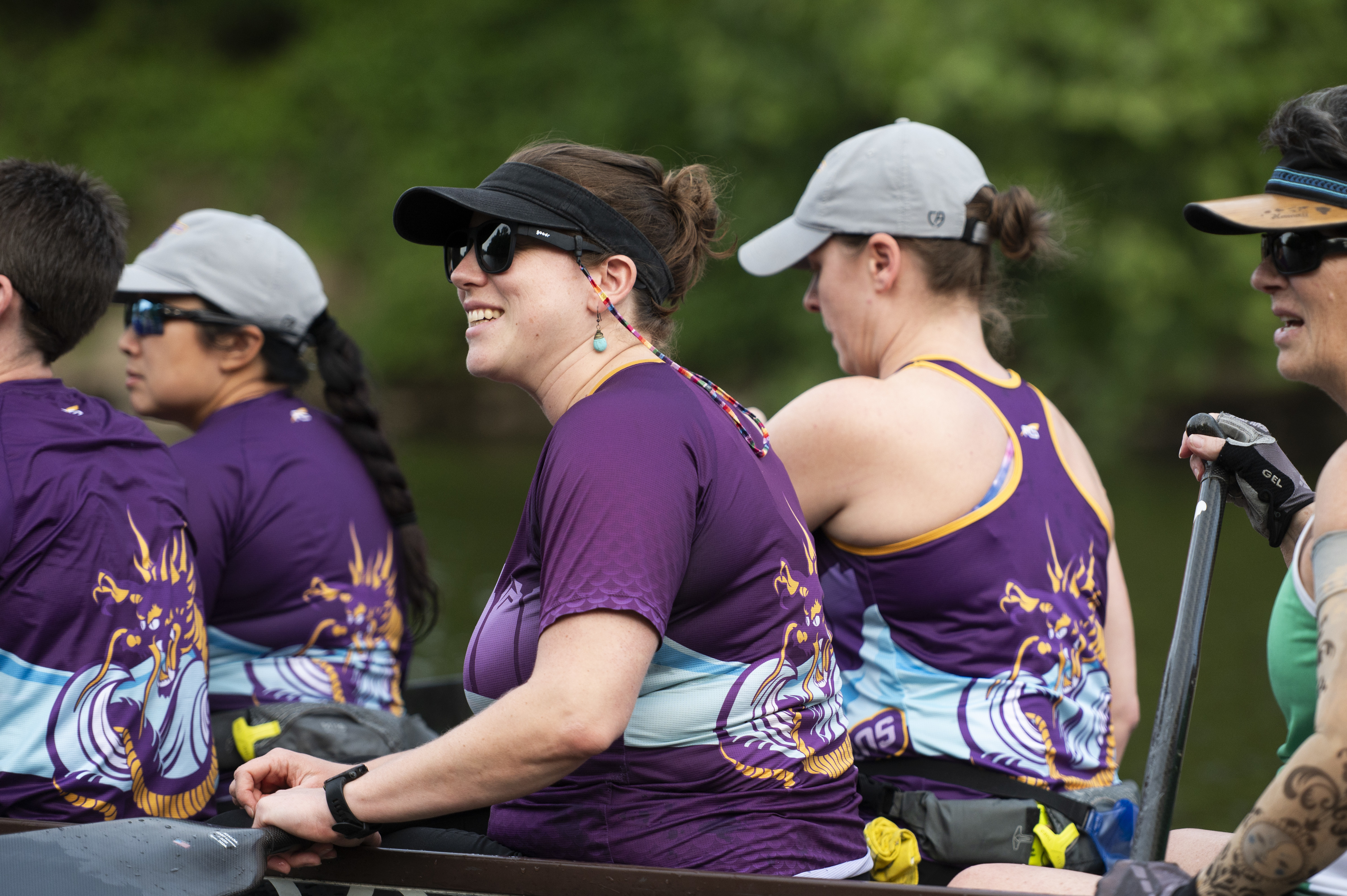
Stacy Kent Wyckoff, a member of the Schuylkill Dragons, an all-woman dragon-boating team, sits with teammates before the start of practice on the Schuylkill on Tuesday, June 2, 2026.Allie Ippolito / For The Inquirer
They arrange meal trains when a teammate is sick or injured. They check in on one another. When her husband’s health was declining in 2022, says Stacy Kent Wyckoff, 66, it was the Dragons who helped her through her grief.
“It was just a very healing thing to jump into,” she says.
This is another Dragons specialty — moments of quiet tenderness amid all the grunting and growling and middle-finger salutes.
Two years ago, at a team camp in Florida, a few Dragons were driving from their hotel to dinner. In the passenger seat, 79-year-old Phoebe Wood — who is typically about as sentimental as a court order — suddenly grew nostalgic.
“I just want to say,” she announced, “that I love everyone in this car.”
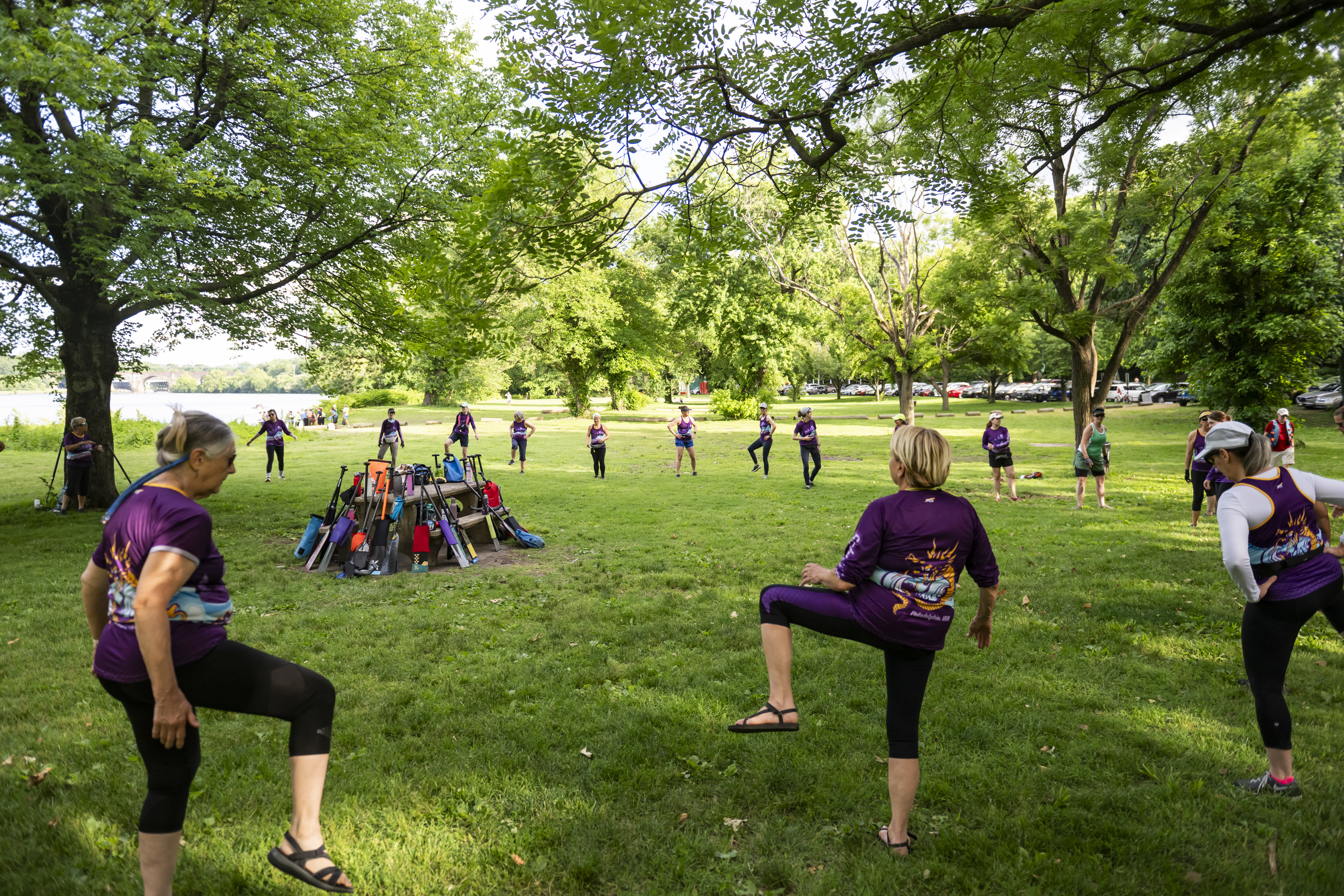
The Schuylkill Dragons warming up before a practice on June 2, 2026.Allie Ippolito / For The Inquirer
‘Solemn and deadly’
At competitions, some teams arrive at the starting line light and loose — laughing, dancing. The Dragons prefer a different approach: “Looking solemn and deadly,” says Wood.
Talking is almost always prohibited in the boat, even at practice — the better to stay focused.
Today, the team has a standing offer: $20 to anyone who pukes during a race.
The Dragons train four days a week in the summer — Tuesday and Thursday evenings, plus Wednesday and Saturday mornings. In the winter, many team members travel more than an hour each weekend to Pottstown, where they train indoors in a simulation paddling pool. Each spring, a group of Dragons attends a grueling preseason dragon-boating camp in Florida, enduring hours-long days on the water.
The Schuylkill Dragons on June 2, 2026.Allie Ippolito / For The Inquirer
They have competed across the world — Hungary, Canada, Italy. Members have paddled for Team USA at the dragon-boating world championships, considered the sport’s Olympics.
“If you want to race seriously,” says Mina, “that’s the club you want to go to.”
Indeed, it is not for the faint of heart.
The Dragons have paddled with torn rotator cuffs, artificial hips, wonky knees. You could field a marching band with all the Dragons who are currently in physical therapy for one ailment or another. One local paddler with emphysema used to lug her oxygen tank with her onto the boat.
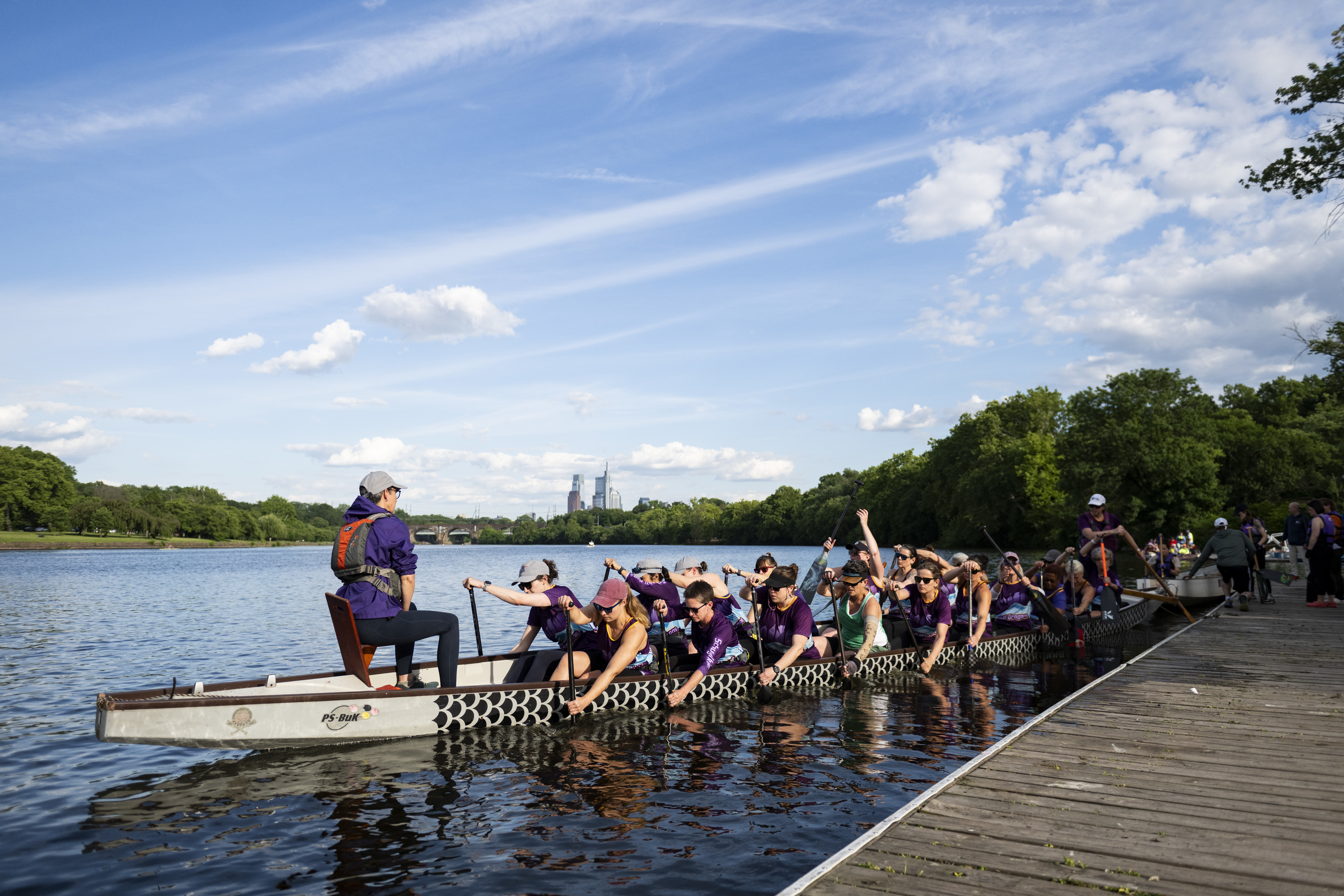
The Schuylkill Dragons launch off the dock at the start of a practice on Tuesday, June 2, 2026.Allie Ippolito / For The Inquirer
Today, Philadelphia is home to more than a dozen competitive dragon-boating teams, many of which share a pair of docks on the Schuylkill’s western bank, off Martin Luther King Jr. Drive.
And while this growth has been viewed very much as a positive, it has occasionally resulted in what the husband of one team member refers to as “Dragon Drama.”
For the Dragons, much of that drama has involved another of the city’s longstanding women’s dragon-boating teams, a rivalry that — like many great conflicts — is rumored to trace its origins to failed romance.
Years ago, according to one version of rivalry lore, the then-coaches of the two teams became romantically involved — which was fine, up until the relationship came to an unceremonious end.
“Then it became, ‘Kill the Dragons!’” says one longtime member of the rival team.
For a long time, the two teams wouldn’t acknowledge each other. Or, conversely, would acknowledge each other too much — lobbing insults from their respective boats before races.
The iciness has since thawed — to a degree.
“We might like them off the boat,” says Anderson. “But on the water … we want to beat their asses.”
The Schuylkill Dragons on June 2, 2026.Allie Ippolito / For The Inquirer
‘You ever heard of dragon-boating?’
The team built its own boathouse, over a single weekend in 2015. They own three dragon boats — long, massive vessels of wood and fiberglass — which they store, patch, and repair themselves. Whereas the clubs of Boathouse Row havestocked bars and gleaming workout facilities — the University of Pennsylvania’s College Boat Club recently underwent a $13.5-million renovation — the Dragons have 70-year-old Julie Regnier, nicknamed “MacGyver” for her proficiency with a two-by-four and a can of epoxy.
Says Linda Breitstein, a 72-year-old Dragon: “These are not women who are used to saying, ‘I’ll call the man to take care of everything.’”
Keeping the team competitive, meanwhile, has required a constant commitment to recruiting, a duty the Dragons have embraced with the intensity of a Southeastern Conference football coach on the hot seat.
They’ve plucked new team members from the gym, from the community garden, from dinner parties. They are not above cornering a fit-looking stranger in the cereal aisle of their local grocery store and extolling the virtues of dragon-boating.
Emma Thomas, center, has served as the Schuylkill Dragons’ tireless team president since 2025. The job includes everything from organizing team events to facilitating the team’s annual training camp in Florida to – on occasion – weed whacking. Thomas joined the team in 2021.Allie Ippolito / For The Inquirer
Once, Anderson found herself at a Bucks County hospital. Her daughter had just gotten out of surgery, and was being wheeled into the post-operation room, but Anderson couldn’t take her eyes off the attending nurse.
“She was tall and she was fit and she had some muscles,” says Anderson, now one of the team’s three coaches. “And I said, ‘I’m going for it.’”
“Excuse me,” she said, as her daughter lay unconscious a few feet away. “Have you ever heard of dragon-boating?”
The nurse joined the team soon after, bringing a neighbor with her.
Though the Dragons are open to women of all ages — their youngest member is 23 — the team has long trended older. As of last year, the average age of the team sat somewhere in the neighborhood of 60.
Lately, there’s been a conscious push to bring in younger paddlers — “our succession plan,” says one former member of the team’s board of directors.The team has instituted an annual rookie camp to scout new members;of the six paddlers who received invitations to join the team this summer, five were under the age of 40.
Short of that, the Dragons have developed a backup plan for ensuring the team’s longevity.
When Crazy Judy told coach Stacey Scanlan recently that they’d have to find a replacement for her eventually, Scanlan shrugged.
“Just don’t die,” she replied.
A steerer on the Schuylkill Dragons, an all-woman dragon-boating team, practices with the team on the Schuylkill.Allie Ippolito / For The Inquirer
The race
On a Saturday afternoon in July, the Dragons gathered in an asphalt parking lot near Baltimore’s Inner Harbor, one of a dozenteams across the Northeast competing in the Charm City’s Dragon Boat Challenge.
It was not going well.
Earlier in the day, the team had finished third in a race they’d hoped to win; afterward, they’d stalked silently to their team tent, pulling out knitting needles or hardcover books and keeping largely to themselves.
Now, as they boarded their boat for the regatta’s final event — the 2,000-meter, the sport’s longest and arguably most grueling race — they vowed to salvage their day.
The Schuylkill Dragons’ final competition of the season takes place Saturday, Sept. 19, at the Mercer County Dragon Boat Festival. The Dragons are among nearly 70 teams competing in the event. Allie Ippolito / For The Inquirer
Ten minutes later, they’d done it, cruising to an easy victory in the eight-team race.
Their smiles returned. They bumped fists. They slapped the side of their boat.
“What a show!” someone yelled from the crowd.
At the awards ceremony a few minutes later, the event’s teams gathered near the water. One by one, they stepped forward to collect their medals. But when it was the Dragons’ turn, the team was nowhere to be found.
“Schuylkill Dragons…” an MC called over a microphone.
“Schuylkill Dragons, are you still here?” he said, finally. “Do you want your medals?”
Far across the parking lot, however, the Dragons were lost in their own little world, giggling and dancing to “Funkytown” and looking to all the world like there was nowhere they’d rather be.
NEW YORK — Zack Wheeler threw “about three strikes in the bullpen,” by his best recollection. But that wasn’t why he slowed his walk across the outfield before a May 12 start in Boston.
“Man,” he exhaled to catcher/confidant J.T. Realmuto, “this is cool.”
Wheeler doesn’t usually do sentimental. Not publicly, at least. He’s 36, with gray wisps in his beard befitting a father of four small children. He’s still the Phillies’ ace, too, and baseball’s highest-paid pitcher (non-Shohei Ohtani division) at $42 million per year.
Wheeler would rather not waste time, then, on things that don’t matter or aren’t within his control. No-nonsense to his core (save for the occasional cameo on his wife’s TikToks), you have a better chance of getting the password to his email than getting him to go deep on overcoming venous thoracic outlet syndrome, the scary-sounding, career-threatening condition that befell him 13 months ago.
So, why the pause for reflection four months ago on the grass in Fenway Park? It sure seemed like a break from his typical tunnel vision to appreciate something that was nearly taken away.
“Part of that’s me probably winding down my career,” Wheeler said the other day after running sprints in the outfield here. “I’ve only got one more year on this contract. I don’t know if I’m going to play after that. But just going into those stadiums that maybe I won’t go back to — Anaheim, Detroit, Boston — we’re not going to play those teams there next year. So, kind of just soaking that in and enjoying it a little bit more this year than most years.”
Phillies ace Zack Wheeler has one season left on a three-year, $126 million contract.Monica Herndon / Staff Photographer
Wait, let’s pause. When Wheeler signed an extension in March 2024, he initially wanted only a two-year deal. The Phillies talked him into three, for a total of $126 million. And at a news conference in Clearwater, Fla., he hinted it might be his last contract.
“I don’t want to play until I’m ‘old, old,’” he said then.
OK, sure. But did anyone really believe him? Wheeler was at the peak of his powers, healthier and better in the first half of his 30s with the Phillies than in his late 20s with the Mets. Besides, 40 is the new 30 in pro sports.
And here’s Wheeler now, pitching as well as ever — 2.99 ERA and 177 strikeouts in 150⅓ innings — even after a procedure last Sept. 23 in which surgeons removed his top rib to relieve a compressed vein.
Surely, he won’t walk away after only one more season. Will he?
“Honestly, I mean, it’s just still up in the air,” Wheeler said. “I think a lot of things have to kind of play out for me just to be able to see.”
Presumably, that includes the outcome of another Red October.
The Phillies are closing in on a fifth consecutive playoff appearance, and their chances of making a deep run hinge on the starters, notably Wheeler, Cristopher Sánchez, and Jesús Luzardo, if he’s able to overcome an inflamed left shoulder. Aaron Nola, Wheeler’s close friend and longtime running mate atop the rotation, can help, too, if he continues his second-half revival.
But there’s also baseball’s looming labor fight over a salary cap. With the collective bargaining agreement set to expire Dec. 1, the owners almost certainly will lock out the players.
What if an agreement isn’t reached in time for a 162-game season in 2027? How would that affect Wheeler’s plans?
“I don’t know,” he said, smiling. “I think it’s just going to be [a decision] at that point in time, whether it’s this or that, honestly.”
Fair enough. Say this, though: A year ago, even some Phillies officials wondered if Wheeler’s retirement, whenever it happens, might not be entirely on his own terms. Wheeler insists he never had a doubt.
Zack Wheeler (right) and Aaron Nola have been mainstays in the Phillies’ starting rotation since 2020.David Maialetti / Staff Photographer
‘To be expected’
As Wheeler comes up on one year since his surgery, it was fitting that he pitched this week in Washington, where his injury odyssey began.
Wheeler allowed two runs in five innings on Aug. 15, 2025, in Nationals Park and felt fine after coming out of the game. But when he developed a bubble in his armpit that looked like a lymph node, head athletic trainer Paul Buchheit recommended that they get it checked by the Nationals’ team physicians.
It turned out to be a blood clot.
Wheeler returned to Philadelphia for a venogram, a test to detect blood flow. The conclusion: The clot was caused by a vein that got compressed between the rib cage and collarbone.
One month after the clot was removed, Wheeler had a second procedure to relieve the vein. Then came the hard part: weeks of physical therapy and rehab, including a strict diet, not easy for an unabashed fast-food and junk-food lover.
It took time for Wheeler to put back the weight. He left spring training at about 195 pounds, roughly 10 pounds less than normal.
And yet, after all that, Wheeler shut out the Nationals on four hits in seven innings Wednesday night in Washington. Among 52 pitchers with a minimum of 150 innings entering the weekend, Wheeler was 14th in ERA and tied for 10th in walks/hits per inning (1.06).
“He’s made it look very easy,” pitching coach Caleb Cotham said of Wheeler’s comeback. “And it’s not.”
If someone had told Wheeler, as he left the hospital last September, that he’d be pitching at this level a year later, what would he have said?
“To be expected,” Wheeler said. “When you have surgery, or anything along those lines, you just have to stay positive and keep a strong mindset, you know? You believe that you’re going to come back and be the same guy, if not better, because you’ve had more time to strengthen and fine-tune everything.
Zack Wheeler says he “expected” to be pitching this well a year after surgery.
“For me, it was just, come back, hit the ground running, and just be the same guy as I was, if not better.”
It did take time for Wheeler to regain the pre-surgery zip on his fastball. Even now, it isn’t completely back. He averaged 96.5 mph in July 2025, according to Statcast; he’s averaging 95.5 mph so far this month.
But Wheeler leans on his secondary pitches more now. His splitter, in particular, is “as good as it’s ever been,” Cotham said. Wheeler has thrown it 15.7% of the time, according to Statcast, and held opponents to a .182 average and .303 slugging.
If anything, Wheeler said the most unexpected part of the season was the depth of a six-start struggle after the All-Star break in which he posted an 8.51 ERA, bottoming out with an eight-run, five-walk, four-homer dud in Seattle on Aug. 24.
The root of the problem was a glitch in his mechanics. Wheeler dropped his glove, causing him to over-rotate and follow through too far to the third-base side. He fixed the issue and has allowed three runs in his last 26 innings.
“I feel like, since I’ve been [with the Phillies], I haven’t had more than two, maybe three starts in a row where it’s kind of gone bad,” Wheeler said. “I think I probably thought I was going to get out of it a little quicker than I did. And I didn’t. So, maybe I should have checked in a little bit earlier.”
It probably cost him a chance for his elusive Cy Young Award, although Brewers sensation Jacob Misiorowski probably wrapped that up months ago. But there’s little doubt Wheeler will be the Comeback Player of the Year.
Zack Wheeler and J.T. Realmuto have played together with the Phillies since 2020.Yong Kim / Staff Photographer
‘This is where you want to be’
Eleven days after the removal of his rib, Wheeler was introduced with his teammates before Game 1 of the divisional round against the Dodgers.
It was a helpless feeling.
“Yeah, it was tough,” he said. “Maybe if it was like June or May, I would have been like, ‘All right.’ But being that close to the finish line and the playoffs where, that’s your goal every year is to make the playoffs and see what happens. It was tough.
“But what are you going to do? I’m that type of person where, stuff’s going to happen in your life. Everyday stuff, normal person stuff, baseball-wise stuff, and sometimes you just can’t help. Injuries happen. Car wrecks happen. Stuff happens in life. You just have to learn how to deal with it and figure stuff out.”
It helped that Wheeler overcame injuries early in his career.
Drafted in the first round (sixth overall) by the Giants in 2009, traded to the Mets in a one-for-one deal for Carlos Beltrán, and hailed as a top prospect, he missed 2½ seasons after Tommy John elbow surgery and multiple setbacks during the recovery.
By comparison, coming back from thoracic outlet syndrome was straightforward.
“That was my first injury where I was missing time at any level, even high school, so I was honestly just nervous that I wouldn’t get back,” Wheeler said. “I was unsure, just hoping for the best. But this far into my career, at the level that I’ve been pitching at, I expect to be there and want to be there.”
A year later, it’s like Wheeler was never gone.
“This time of the season, it’s cool, it’s special,” Wheeler said. “This is where you want to be, and these games really, really matter. It’s fun competing in these types of games, these atmospheres, and getting that close to the finish line. You’ve got to really bear down, and I think everybody knows that.”
The Eagles hit the road for the first time this season to take on the Tennessee Titans, a team they haven’t played since the 2022 season, on Sunday (1 p.m., Fox).
The Eagles began their season with a 24-22 victory against the Commanders, while the Titans enter Sunday’s game looking to bounce back after a 23-10 loss to the New York Jets in their season opener.
Starting left guard Landon Dickerson was placed on injured reserve after aggravating a knee injury vs. Washington. The Eagles will have a new starter on the offensive line against the Titans defense.
The Eagles defense generated 47.4% pressure on Washington, according to Bleeding Green Nation, which should be difficult for Cam Ward and his offense to handle.
So what are the experts thinking about the Birds’ first road game? Let’s take a look at who the local and national media are picking.
Inquirer predictions
The Inquirer beat reporters believe there is nothing to worry about for the Eagles against the Titans.
Novozinsky says even a flawed Eagles team should be able to get it done. Here’s more from Novozinsky:
“The Titans are likely the worst team the Eagles are going to face this year. The Jets — the Jets — limited them to 10 points and just 195 total yards. Titans quarterback Cam Ward had a QBR of 34.4 in the game, which was the seventh-worst in football.
Tennessee has a tough defensive front, led by Jeffery Simmons — who took a shot at Jalen Hurts on Wednesday — which could cause some problems for the inexperienced interior, but that’s really the only thing Nick Sirianni should worry about in this one.”
Olivia Reiner noted that the Eagles still have room to improve offensively, but she’s still predicting a 31-17 Birds win. More of her thoughts:
“The run game left something to be desired, especially when it came to getting the outside zone game going. With Dickerson on injured reserve, can the blocking unit bounce back in Week 2?
“There should be opportunities for the Eagles to run the ball. Last week, the Jets rushed for 152 yards and two touchdowns on 39 carries. Breece Hall eclipsed 100 rushing yards. He forced a missed tackle on 36.4% of his runs against the Titans, which was his highest rate in a game since Week 7 of last season (45.5% against the Panthers), per Next Gen Stats.
Can Saquon Barkley have the same effect? If so, the Eagles could go 2-0 to start the season.”
National media predictions
The national media unanimously favored the Eagles heading into Sunday’s road trip:
NFL.com: All five NFL.com editors selected the Eagles. Jeremy Bergman says “no quarterbacks have been better on the road in September than Hurts and Patrick Mahomes (.800 on their careers)” and “the worst offense in the league” against Vic Fangio’s defense will be a hard test for the Titans.
ESPN.com: ESPN experts also unanimously are backing the Birds.
The Athletic: Vic Tafur, NFL reporter for The Athletic, predicts the Eagles will pull off a win against the Titans, as the team has won a league-best 70% traveling under Nick Sirianni.
CBS Sports: The seven-person panel at CBS all picked the Eagles to start the season 2-0.
USA Today: In their first road trip of the season, USA Today analysts believe the better team will be the Birds.
Sports Illustrated: All eight analysts at Sports Illustrated picked the Eagles.
Bleacher Report: Another clean sweep for the Eagles. Analyst Gary Davenport said “to be fair, while the Eagles won in Week 1, they didn’t look especially good doing it — on either side of the ball. But while Philly was grinding out a win, the Titans were getting dusted. At home. By the New York Jets. Saquon goes nuts. Cam Ward flees for his life for four quarters. Fly Eagles Fly and whatnot.”
Pro Football Talk: Mike Florio picked the Eagles for this weekend’s matchup. “The Eagles may not be as good as they’ve been. The Titans seem to be as bad as they’ve been, possibly worse,” he said.
Sporting News: Bill Bender chose the Birds to win by 17.
Local media predictions
Philly Voice: Staff writers at Philly Voice are backing the Eagles.
Bleeding Green Nation: The entire Bleeding Green Nation writers group is picking the Eagles.
Delaware Online: Eagles beat writer at Delawareonline.com Martin Frank noted three things the Titans have working in their favor: the 95-degree temperatures expected in Nashville, the Eagles being 0-3 at Nissan Stadium, and Landon Dickerson’s injury. “None of that is enough to beat the Eagles,” he said. “But it might not be a pretty Eagles’ win, either.”
The Tennessean: Even the Titans hometown paper is going with the Eagles. Tennessee Titans reporter Nick Suss said the Titans’ defensive unit is better than what it showed against the Jets, but the Eagles won’t have to work too hard to win.