Tag: topic-link-auto

  • Fishtown’s latest pizzeria celebrates Black culture with pies topped with oxtail and collard greens, jerk chicken, and shrimp and grits

    Fishtown’s latest pizzeria celebrates Black culture with pies topped with oxtail and collard greens, jerk chicken, and shrimp and grits

    With pizzas sliding in and out of the Blodgett ovens from noon till night, In Crust We Trust looks like another entrant in Fishtown’s booming pizza scene at first glance.

    But the menu signals a different ambition.

    You can eat quite well at the nearby Pizzeria Beddia, Liguria, Marina’s, Shackamaxon, D’Oliva, Scusi, Rustica, Urban Village, and Bar1010. But no other pizzeria in Fishtown offers pies topped with oxtail and collard greens, Cajun shrimp with broccoli and grits, or jerk chicken with pineapple and mango glaze.
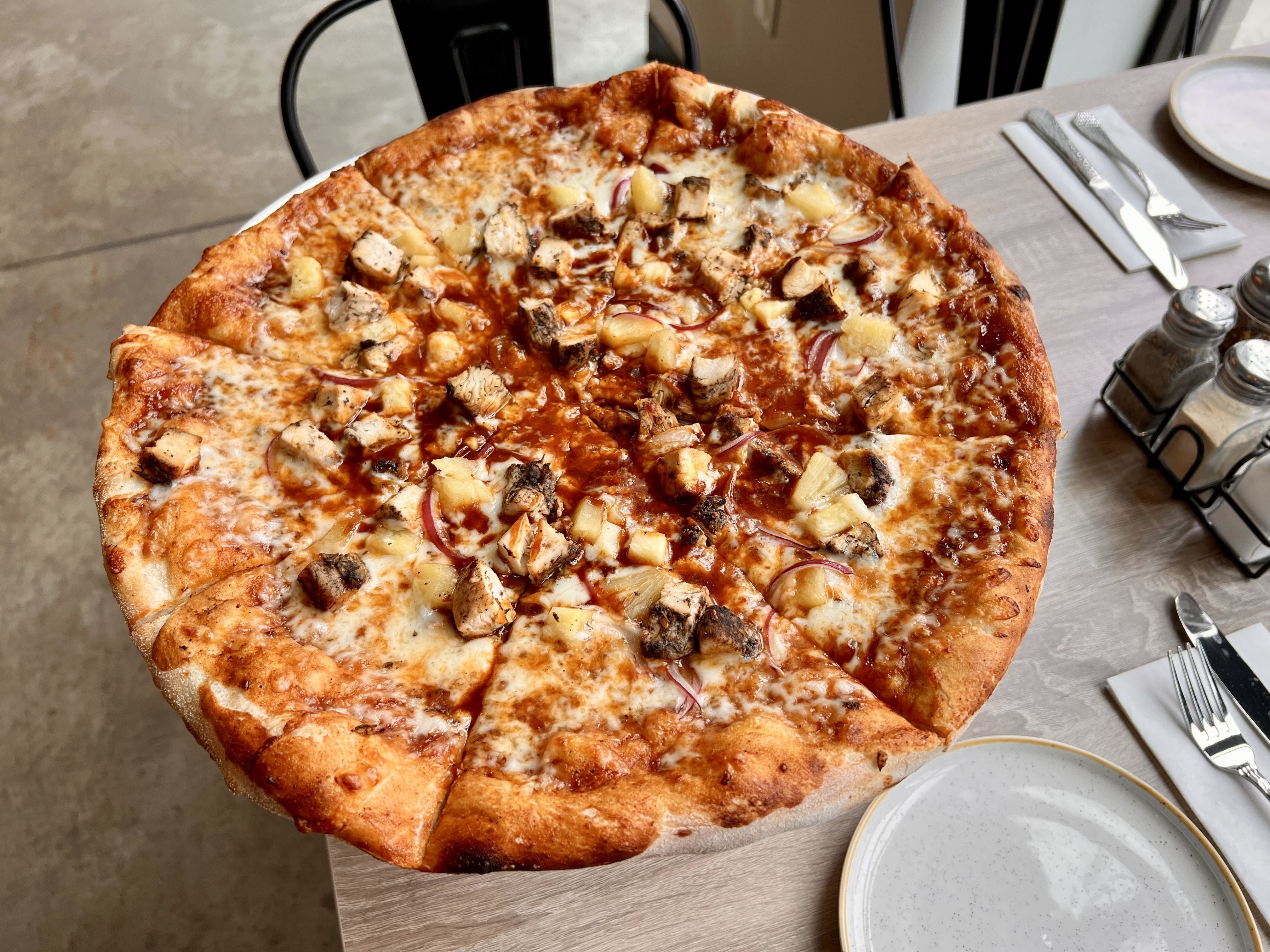
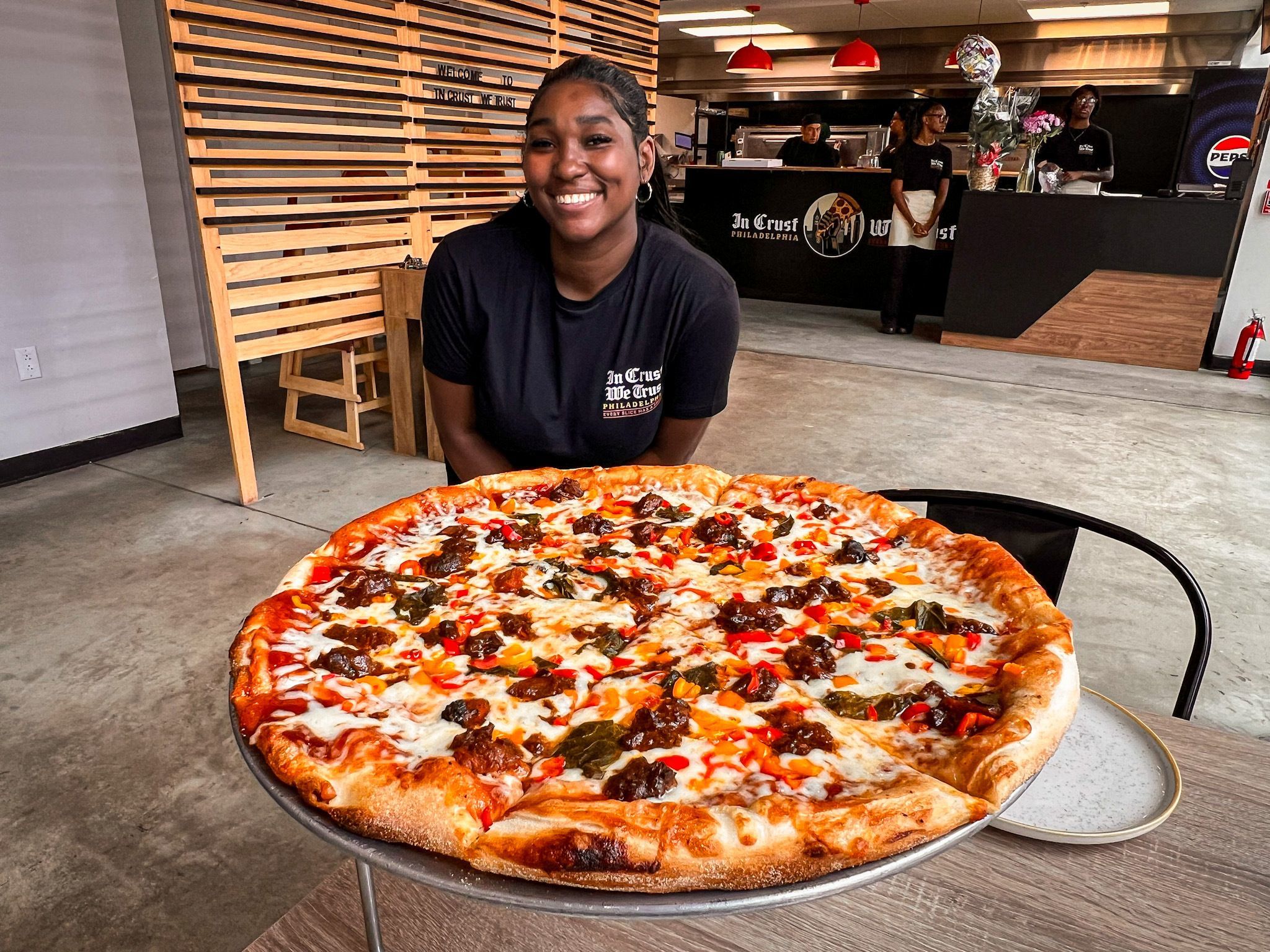
    The Bottom (jerk chicken, mozzarella, pineapple, and mango glaze) at In Crust We Trust.Michael Klein / Staff

    In Crust We Trust, which opened Aug. 1 in the former Vince’s Pizzeria at Frankford Avenue and Richmond Street, across from the Fillmore, is the first solo restaurant from Anyae Wilson-Worley, 25.

    Though she grew up around restaurants and learned the business from her mother, restaurateur Felicia Wilson, Wilson-Worley is emphatic that In Crust We Trust is distinctly her own.

    Pizzaiolo Jose Maria worked with Wilson-Worley on intentional menu combinations for the New York-style pies. She said she wanted to bring Black culture into the recipes while creating a dining room that reflects it. “When people walk in, I want them to feel like a story is being told — taking them back to a Harlem Renaissance type of thing,” she said.
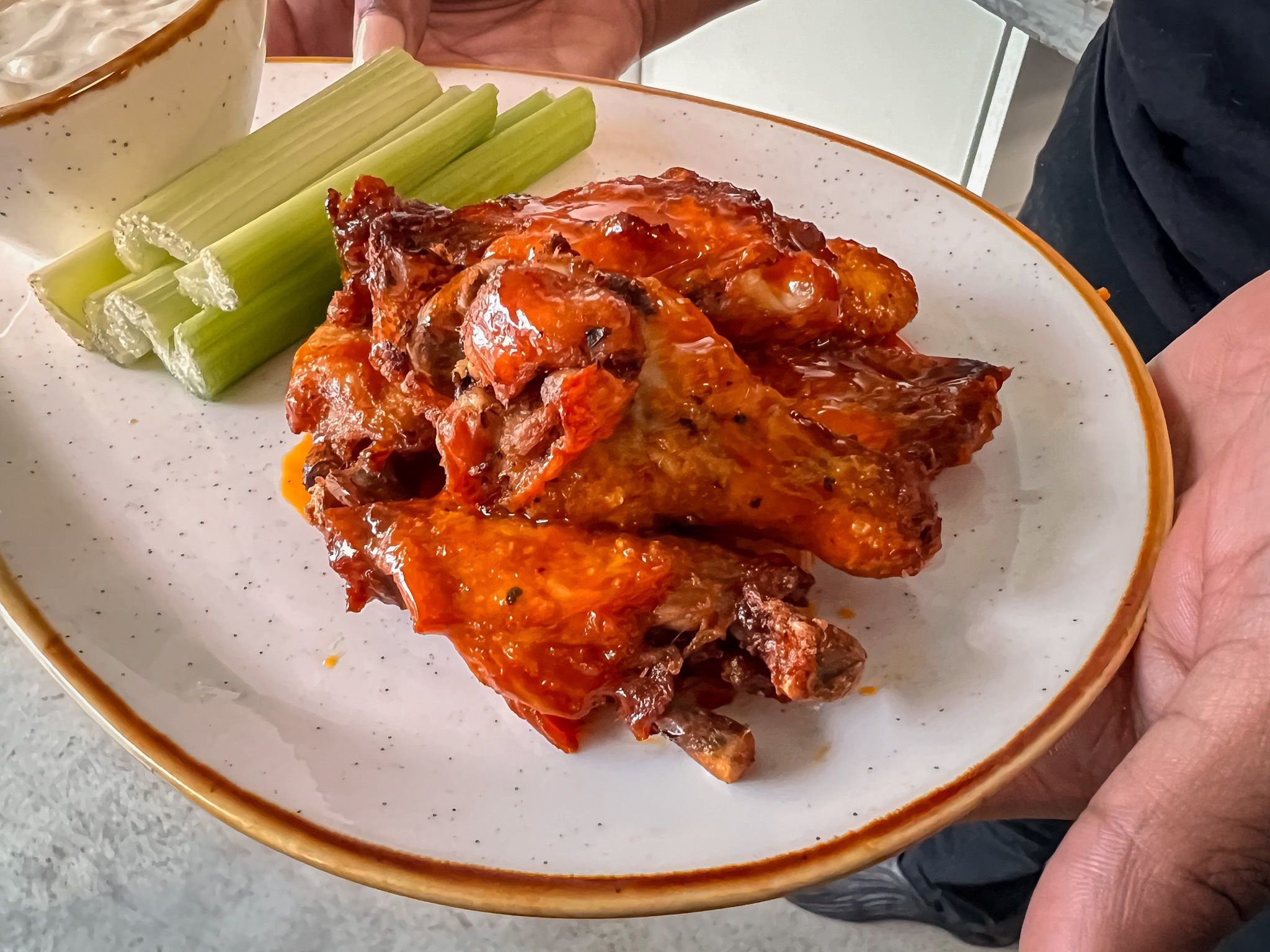
    Corner store wings, topped with cayenne pepper and peri peri, at In Crust We Trust on Aug. 2.Michael Klein / Staff

    The roughly 80-seat restaurant offers table service as well as a takeout counter and delivery. Beyond pizza, the menu includes wings, two salads, cheesy collard greens, and desserts (including a chocolate chip-oatmeal raisin-sugar cookie baked in a cast-iron skillet and topped with vanilla gelato) — all made with halal ingredients.

    Wilson-Worley is the oldest of Felicia Wilson’s three children. Her mother owns Amina, Avana, Fia, First Daughter Oyster & Co., and BlackHen. “She’s been much more than a role model,” Wilson-Worley said. “I definitely wouldn’t be in this position without my mother.”

    Still, restaurants were not part of Wilson-Worley’s original plan.

    She attended the University of Miami, where she majored in health sciences on the pre-med track. She said she was lucky enough to come out of school with no debt. “I took that as an opportunity to seize what was around me,” she said. “At the time [four years ago], my mom was in the height of opening all of her restaurants.”
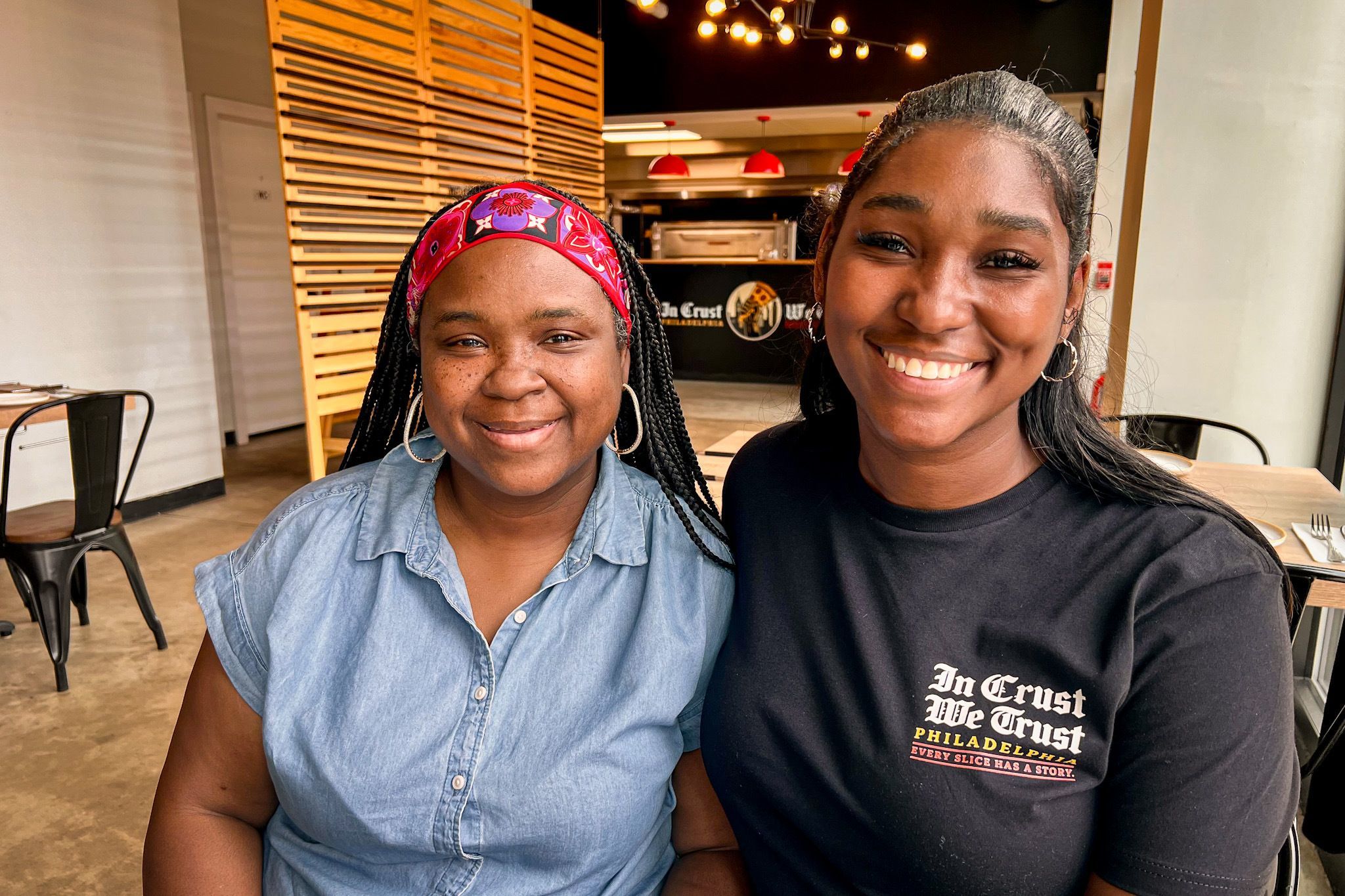
    Anyae Wilson-Worley (right) with her mother, Felicia Wilson, at In Crust We Trust on Aug. 2.Michael Klein / Staff

    While finishing school, she regularly flew back to Philadelphia to help with the expanding restaurant group. Eventually, she decided to stay to help her mother run the business.

    “Anyone who knows me can tell you that ever since my mom opened the restaurant, I always said, ‘This is not what I want to do. I don’t want to be here,’” Wilson-Worley said. “But now this has become my life.”

    Her mother provided the example and the education, but Wilson-Worley said the concept, menu, and identity of In Crust We Trust reflect her own perspective.

    Wilson-Worley describes Philadelphia as a city whose Black culture is foundational but not always fully recognized. Through the restaurant, she hopes to celebrate that culture while encouraging others to pursue their own ambitions.
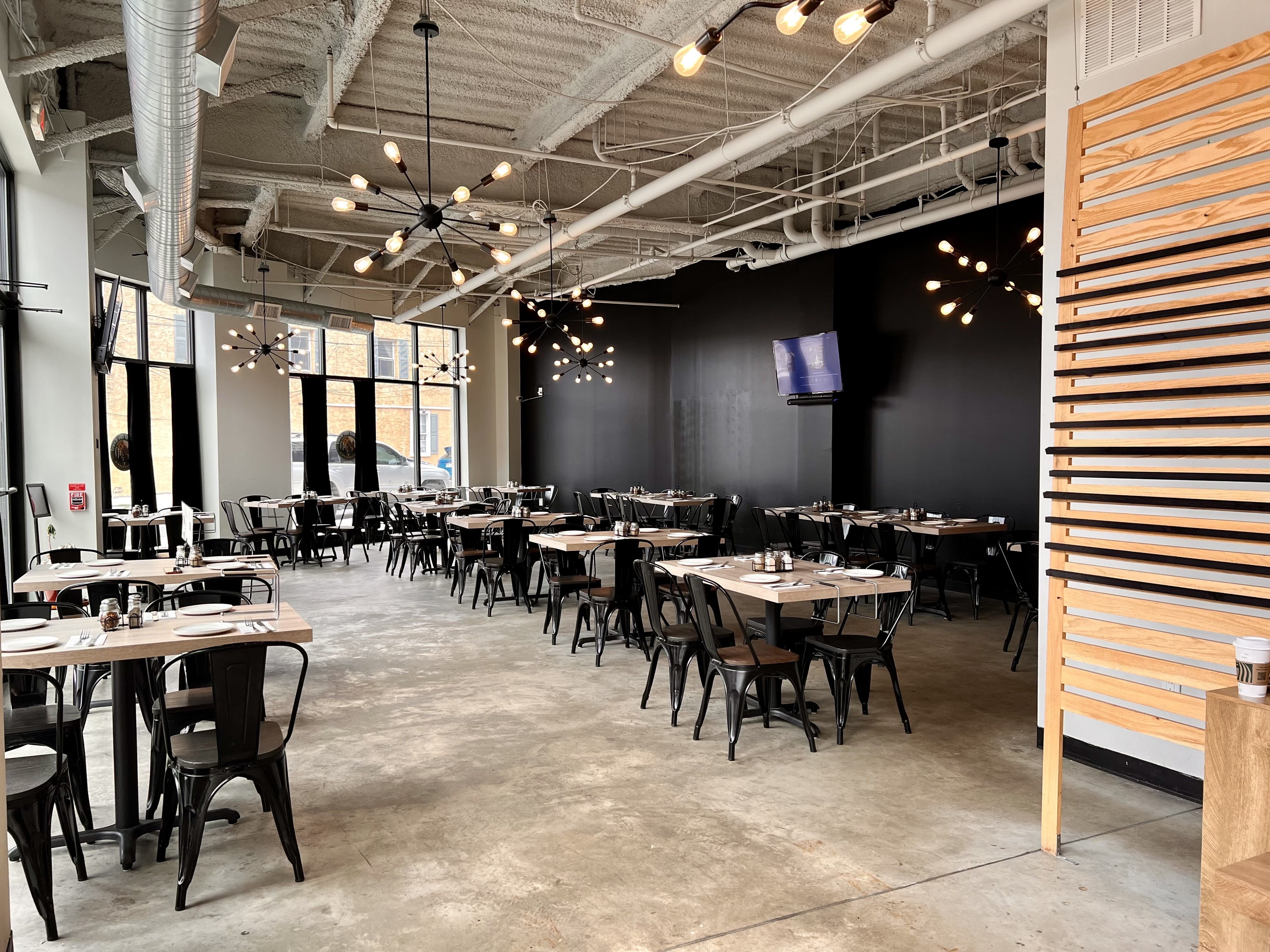
    Dining room at In Crust We Trust.Michael Klein / Staff

    “I hope to create a pathway for other Black people like myself to get involved,” she said. “Not only through food, but through anything.”

    The menu draws from years spent observing professional kitchens.

    “I’ve learned a lot from being around the chefs,” she said. “Watching them, listening to them, and working alongside them has expanded my culinary knowledge. I took everything I learned from them and applied it to create a menu that I’m really proud of.”

    Wilson-Worley also sees common ground with Down North Pizza, the Black-owned North Philadelphia pizzeria known for hiring formerly incarcerated employees. Both restaurants emphasize community engagement, though she said she does not view them as competitors.

    “I’m all about Black empowerment and working with other people like myself in this industry to contribute to the greater good of hospitality,” she said.

    Ultimately, she said, her goal is more immediate than making a statement with every slice.

    “I want people to feel loved and appreciated,” Wilson-Worley said. “When someone dines here, I want them to walk away thinking, ‘I’ve never had pizza like this before.’”

    In Crust We Trust, 965 Frankford Ave. Hours: 11 a.m. to midnight Monday to Thursday, 11 a.m. to 3 a.m. Friday and Saturday, and noon to 11 p.m. Sunday.
  • Philly just shifted its rules for how kids with disabilities can get into special admissions schools. A lawsuit threat prompted the change.

    Philly just shifted its rules for how kids with disabilities can get into special admissions schools. A lawsuit threat prompted the change.

    The Philadelphia School District is changing a policy that effectively barred some qualified students with disabilities from gaining admission into certain magnet schools.

    But it did so only after a Philadelphia family — whose child with disabilities was not admitted to a school for which they met academic criteria — notified the district that it intended to sue over the old policy under the Americans with Disabilities Act.

    The school system’s policy has traditionally worked this way: Students are eligible to apply for admission to up to five of the 37 district schools for which they meet academic, behavioral, and attendance criteria.

    Because of a long-ago agreement resulting from another legal challenge, students with disabilities who meet two of the three criteria for a certain school could request an individualized review, known in the system as the LeGare process, to determine if they could succeed at that school if provided with reasonable accommodations.

    If a review panel judged the child eligible, the child entered the lottery for that school, but was required to waive their rights to enter lotteries for any schools where they met all three criteria.

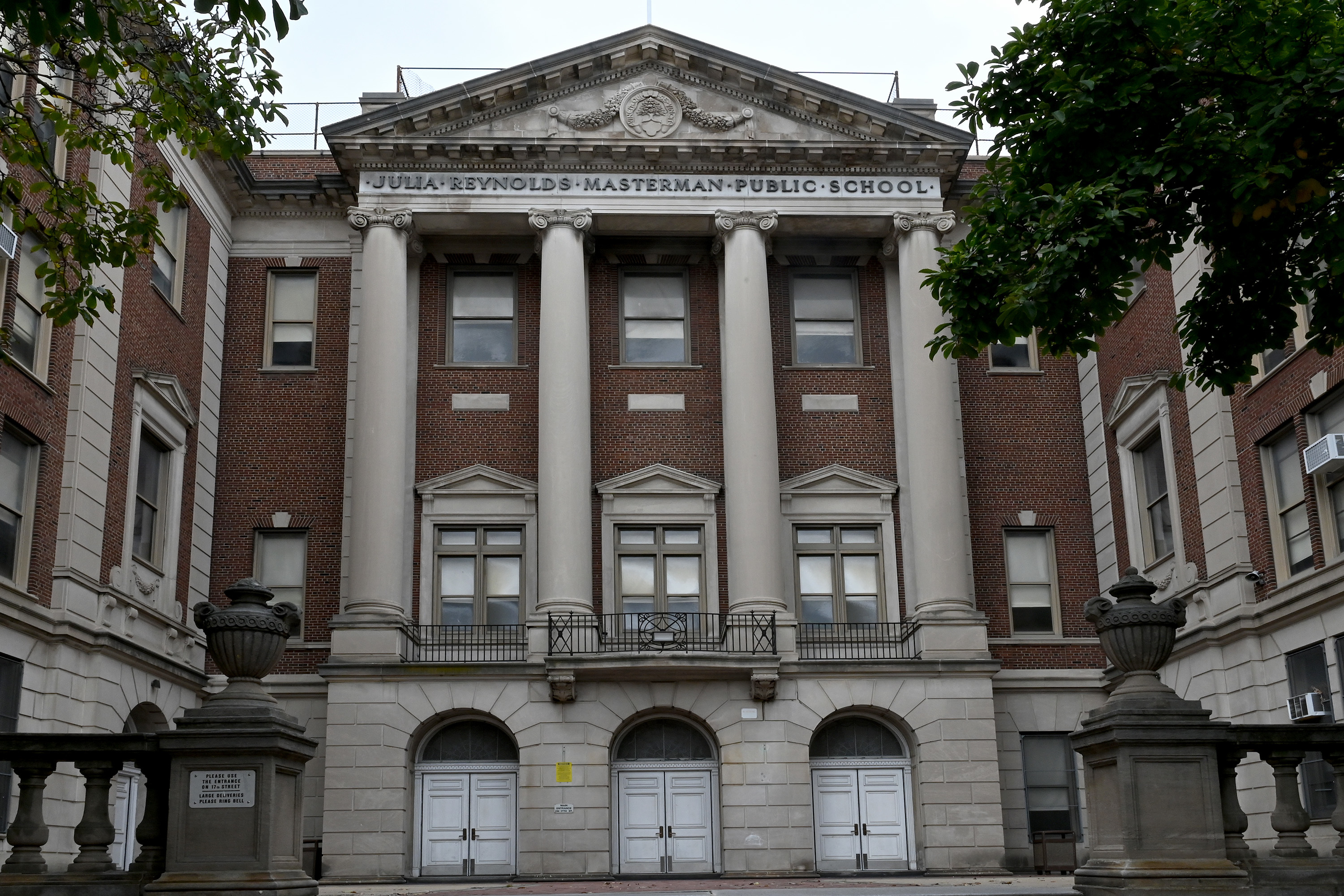
    That is: If a student meets entry requirements for the Philadelphia High School for Girls but only two out of three requirements for Masterman, they could opt for an individualized review for their Masterman application — but only if they gave up the right to be considered for Girls’ High.

    If their Masterman application failed, Girls’ High was off the table.

    Dan Urevick-Ackesberg, an attorney with the Public Interest Law Center, which represented the family that threatened to sue the district this year, in a statement, called it the “double bind,” and said the district for years punished children with disabilities for asking for accommodations they were legally guaranteed.

    Exact numbers are not known, but it’s expected the change will affect hundreds of Philadelphia students annually. The application process for the 2027-28 school year is expected to open sometime this fall, though the district has not yet announced a date.

    Far-reaching impact

    The parent who threatened the lawsuit said when they heard about the policy, they thought they must be an oversight.

    “But the district doubled down” when they inquired about it, the parent said in a statement. The Inquirer is not naming the parent, child, or school to keep the child’s identity private. “It felt punitive.”

    With no other option, the child moved through the admissions process for the school to which they met two out of three academic criteria, but was denied admission in the review process.

    Because they had to forego applications to other criteria-based schools for which they did meet requirements, the student was out of luck.

    “The painful either-or of the policy effectively ruined my child’s eighth-grade year and has far-reaching impacts on their academic confidence, self-esteem, and social experience,” the parent said.

    When the Law Center notified the district of its intent to sue, the district asked to enter settlement negotiations, and agreed to change the policy.

    Going forward, students who are English learners or those with disabilities — either those with individualized education plans or 504 plans — will be able to apply for magnet schools for which they meet criteria and those for which they meet two out of three criteria.

    There will be no penalty for asking for an individualized review. Students will not need to waive their applications to schools for which they meet criteria.

    “I am beyond relieved that this awful policy has been ended,” said the parent whose lawsuit threat prompted the change. “The district should want to have engaged and talented students with disabilities in our top schools, not push them out.”

    Urevick-Acklesberg said the policy change means that “one small barrier is down” to students receiving the free, appropriate public education that’s their right under federal law.

    The district can still change its school selection process

    The new individualized review policy is an appeal process, not a first-line application, and does not guarantee students’ admission into any school.

    The agreement “does not prevent the district from modifying its school selection process, including individualized reviews, or eligibility criteria, nor does it require the district to maintain its current processes for any set period of time,” it reads. “However, to the extent the district’s school selection process continues to allow students to apply to more than one school, the district will provide a mechanism for the subject students to apply to a school where they meet the then applicable criteria, and to additionally seek review of their eligibility where they do not.”

    The district also announced other changes to the process earlier last week, including:

    • Changing the zip codes for preferential admission to Masterman, Central, Carver High School for Engineering and Science, and the Academy at Palumbo: 19132, 19133, 19135, 19138, 19140, or 19141. New to the list are 19138 — Germantown — and 19141 — sections of North Philadelphia including Logan and East Oak Lane. No longer on the preference list are 19121 — parts of North Philadelphia including Brewerytown and Sharswood — and 19136, Holmesburg and Torresdale. The zip codes chosen for preference are the most underserved at the four magnet schools.
    • Limiting the grades that count toward a student’s GPA for admission to magnets. Now, just English, math, and science grades are counted. Social studies grades also used to count.
    • Granting preference for kindergarten admission to students who attend prekindergarten at the school to which they’re applying.
    • Granting preference for career and technical education program admissions to students who participate in a district CTE summer program.
  • Gov. Josh Shapiro should fast-track admissions decisions for students unenrolled by Howard

    Gov. Josh Shapiro should fast-track admissions decisions for students unenrolled by Howard

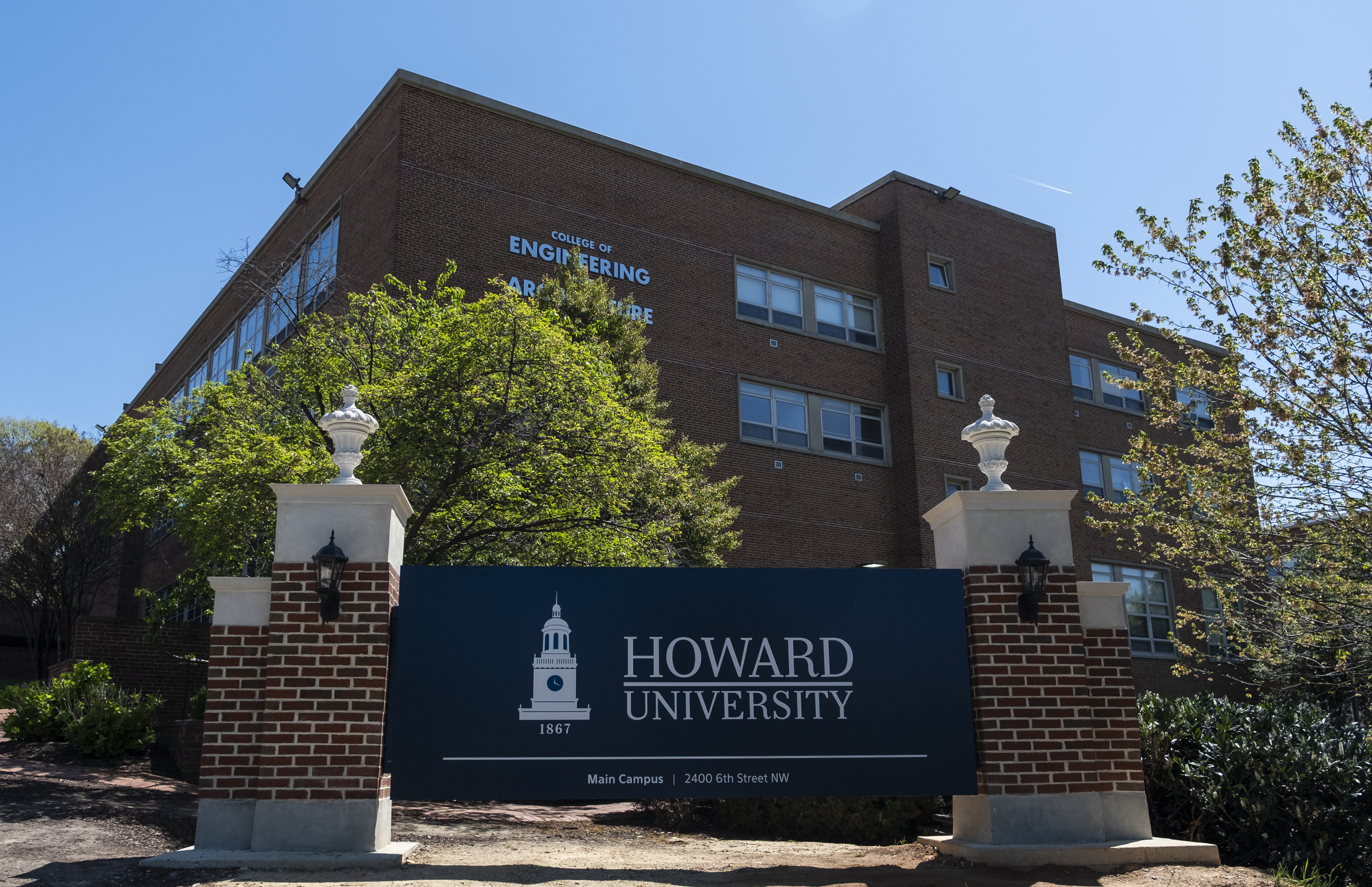
    Maryland Gov. Wes Moore has offered expedited admissions decisions to state-run colleges for incoming freshmen who were abruptly unenrolled by Howard University, as has New York Gov. Kathy Hochul. Pennsylvania Gov. Josh Shapiro should follow suit.

    This could be a win-win situation for both the students and the Keystone State.

    Everyone who knows me recognizes how much I love Howard, which is my alma mater. To call the four years I spent on the campus in Washington, D.C., life-changing would be an understatement. It was the former leader of HU’s journalism department, Lawrence Kaggwa, who set me on my career path, informing me that I was going to work in the newspaper industry.

    But I can’t defend Howard’s unceremonious unenrolling of 502 incoming freshmen just weeks before classes start Aug. 17 because they missed a payment deadline last month.

    The first-time college students — some in tears — responded by posting videos on social media about their plight. They were hard to watch. Some went viral and even made the national news.

    School officials defended what happened, saying payment notices had been going out since March about deadlines and enrollment requirements. Some students said they didn’t get them, or else received a notification on the same day their bill was due.

    Nikiyah Clark told ABC News, “I was so scared because Howard University is my dream school, like, my grandma went there.” She hopped on a bus from Fairport Harbor, Ohio, to D.C. to advocate for herself in person. It paid off, because she has been reinstated into Howard’s first-year class.

    But now Clark faces perhaps an even bigger hurdle: paying for tuition. Tuition plus room and board is $66,000, according to Howard’s website.

    HU’s interim president, Wayne A.I. Frederick, called for an internal investigation into what went wrong, but it’s going to take a lot more than that to heal the damage to the school’s reputation.

    “If another school in the city said that things had to be paid at a certain point, I think people would do that,” he told the Washington Post. “Nobody would make a fuss about the fact that somebody was suggesting a bill be paid on time.”

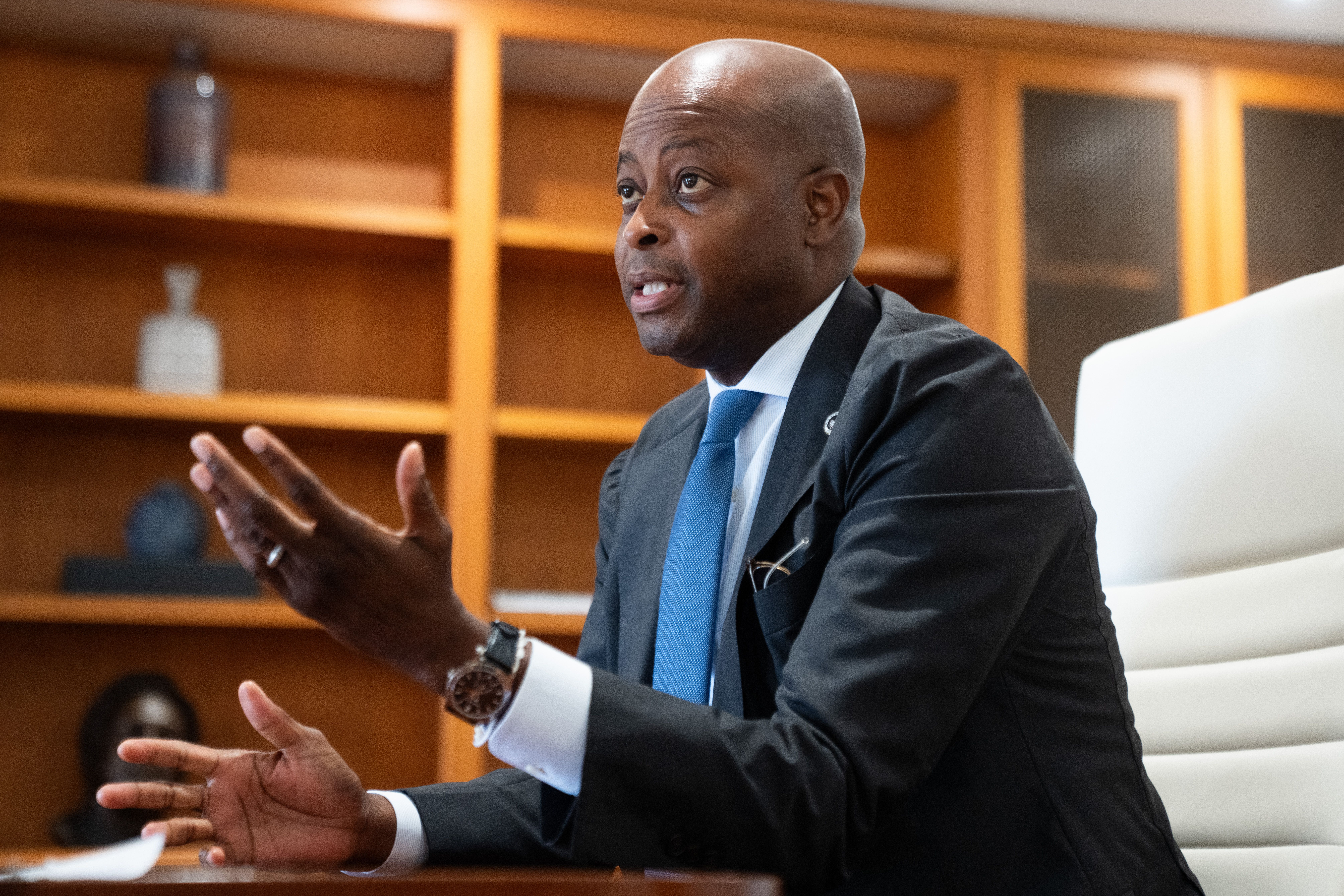
    Howard University interim president Wayne A. I. Frederick sits for an interview July 29.Allison Robbert

    And the fact is, HU needs the money. Trump administration officials ended a series of annual payments meant to support the construction of the university’s new hospital. That move resulted in a cut to the historically Black college or university’s (HBCU) annual federal appropriation for the current fiscal year of about $64 million, or more than 20%. The Chronicle of Higher Education reported on Thursday that HU has offered buyouts to 600 employees.

    Still, that’s no excuse for how the first-time college students were treated. We expect more of institutions like Howard, which was founded in 1867 to educate newly emancipated Black Americans.

    “HBCUs are known for being nurturing and family environments,” said Marybeth Gasman, who runs the Rutgers Center for Minority Serving Institutions. “That’s why this comes off as being kind of shocking to parents and students and some alumni, and some people in the HBCU community and beyond.”

    As I pointed out earlier, expediting admissions here could be a real win-win both for the students unenrolled from Howard and Pennsylvania’s state colleges and universities. Incoming freshmen could further their educations, and state institutions — which have struggled with diversifying their student bodies and declining enrollments — can take a step toward changing those narratives.

    No matter what President Donald Trump would have you believe, diversity matters.

    “In higher education, we do a better job as teachers and as researchers when we work in a diverse environment,” David Oppenheimer, a leading scholar on issues of discrimination and equality, told InsideHigherEd.com earlier this year.

    Oppenheimer, who is the author of The Diversity Principle, added: “Students learn more. In a science lab, scientists make more significant discoveries when the scientists working in the lab are diverse. It’s a real thing. It’s not just a psychological argument.”

    Following all of the public outcry, Howard has readmitted more than 200 of the freshmen who had been dropped, but it’s unclear what all of the other students will do.

    Shapiro should recognize that there’s a real opportunity here — and that Pennsylvania should take advantage of it.

  • How children, good lyrics, and love brought me around to country (ish) music

    How children, good lyrics, and love brought me around to country (ish) music

    My son and I sat on the tailgate of his truck on a recent summer afternoon, sipping beers and looking out at the crowd filling up the fields at the site of the original Woodstock.

    He was shirtless in jeans and cowboy boots and a camo Eagles hat. Other trucks filled the spaces around us, but Subarus and Toyota Priuses rolled in, too. I saw an Arthur Russell bumper sticker on one truck and smiled, a man in a Primus shirt by another, not to mention hundreds of people, of all ages, I’d guess were major Phish fans.

    “I don’t know,” I told my son. “This doesn’t look like a country music crowd.”

    “Billy’s not country,” he replied.

    About an hour later, Nashville musician Billy Strings was deep into a brain-melting jam, fingerpicking his Martin acoustic guitar for about 15,000 people at the Bethel Woods Center for the Arts in New York. Mandolin, banjo, upright bass, and fiddle filled in around him, and I flashed back to a similar, much smaller jam I saw atop a Tennessee mountain years ago.

    “I don’t know anything about music,” I said to myself as Billy blistered on.

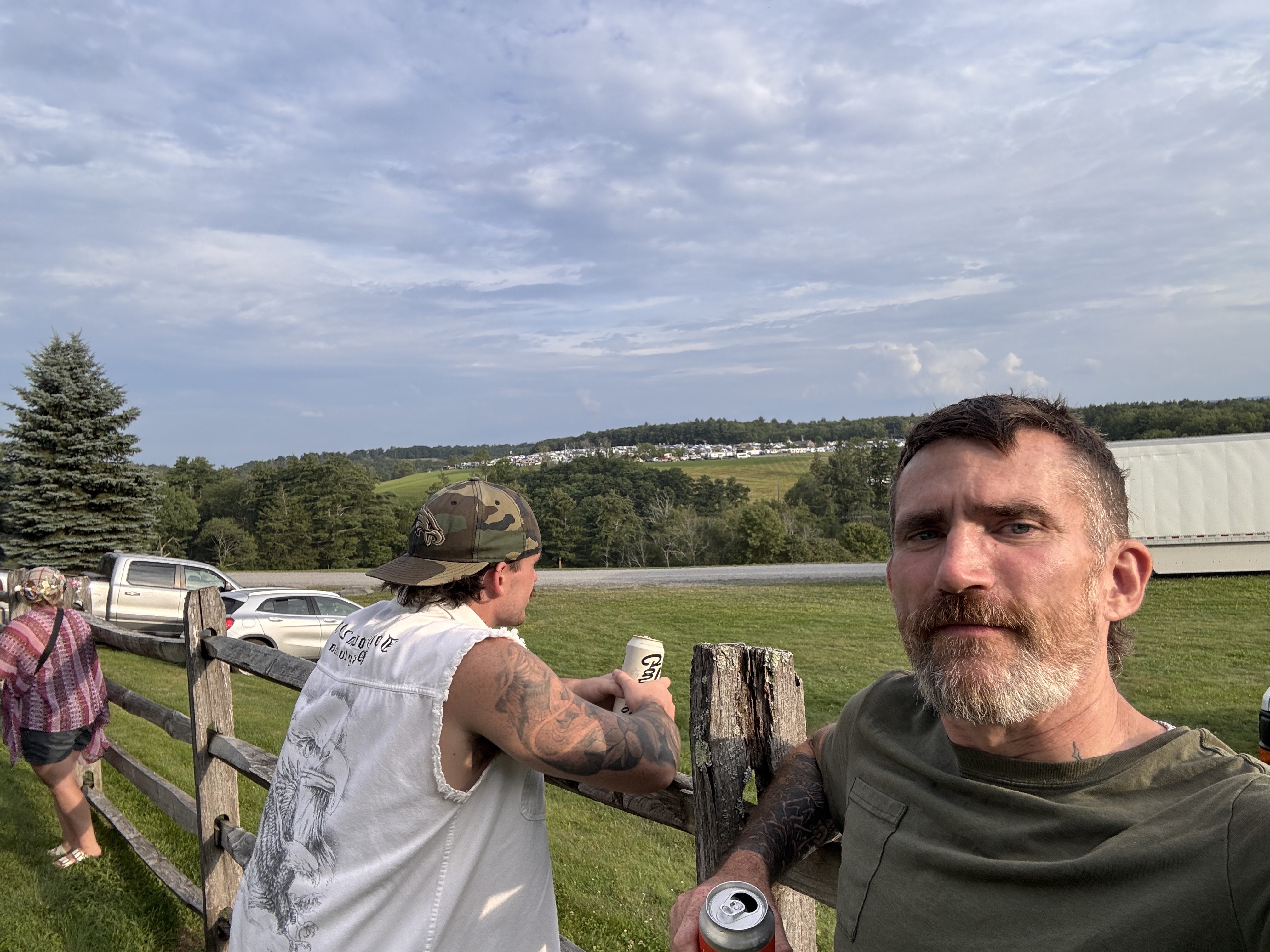
    Ronan (left) and Jason Nark tailgating at the Billy Strings show in Bethel, N.Y.Jason Nark

    People told me as much, way back in 2013, when I wrote a story for the Daily News about the rise of country music in the Philadelphia area and how it baffled me.

    I was — forgive me — snarky.

    “There’s plenty of songs about booze or guns or bonfires or getting muddy with carefree girls. Often, it’s a combination of all those things in one song, and America eats it up,” I wrote.

    Rereading the piece now, in 2026, it’s not as bad as I remembered. I interviewed experts, fans, and radio personalities, and let them have their say.

    “It’s mainstream. It’s rock ‘n’ roll now; it’s not that old twangy country people think of. It’s music people can understand and relate to,” one fan told me back then, during WXTU’s 29th anniversary concert in Camden.

    Still, a few people came for me online.

    Former conservative talk show host Chris Stigall brought me on his Philadelphia-based show, and I knew I was in trouble. I can’t find a recording, but I recall him calling me an “elitist” or “smug,” and he may have laughed when I told him my favorite band was Black Sabbath.

    I took that same son, a middle-schooler back then, to see Sabbath in Philly that very year. Friends were hitting up Toby Keith and Kenny Chesney shows at the time, though, asking me to tag along. I was still very much listening to metal and indie rock, bands like Built to Spill, who I’ve seen live about two dozen times. I held fast.

    “What’s next?” I wondered. “Jimmy Buffett?”

    Ronan and Jason Nark at an Iron Maiden show in Camden in 2012.Jason Nark

    But then a few things happened that changed me, life events that cut me down a bit: my best friend died, I got divorced, and some of my snark just faded away. I was also sent out into rural Pennsylvania after the 2016 election to get a better understanding of the state for The Inquirer. I wrote about deer urine farmers, demolition derbies, transgender women, immigrant families, terrible internet service, the Amish, and even an elderly yodeler.

    I spent a lot of time driving, my radio scanning from country to Christian, and interviewed Pennsylvanians in barns, old coal towns, campgrounds, and general stores. Many of these people had different concerns, backgrounds, musical tastes, and voting records than most Philadelphians. The more time I spent with them, the harder it was to label anyone, anywhere.

    I also met my second wife, who was from Chattanooga, Tenn., around that time too, and she introduced me to a South I didn’t know. During one early visit to her hometown, she took me to the Mountain Opry, a little community hall atop Signal Mountain where they served popcorn and soda. The tiny show, with artists as talented as Billy Strings, felt like a treasure she gifted me, and I remain grateful for that.

    We went to an Austin honky-tonk together too, where I may have hooted and hollered when the Beaumonts played their raunchy songs. Later, in 2019, we danced to Chris Stapleton in a former church in downtown Chattanooga at our wedding. I still have “Rocky Top” in my running playlist.

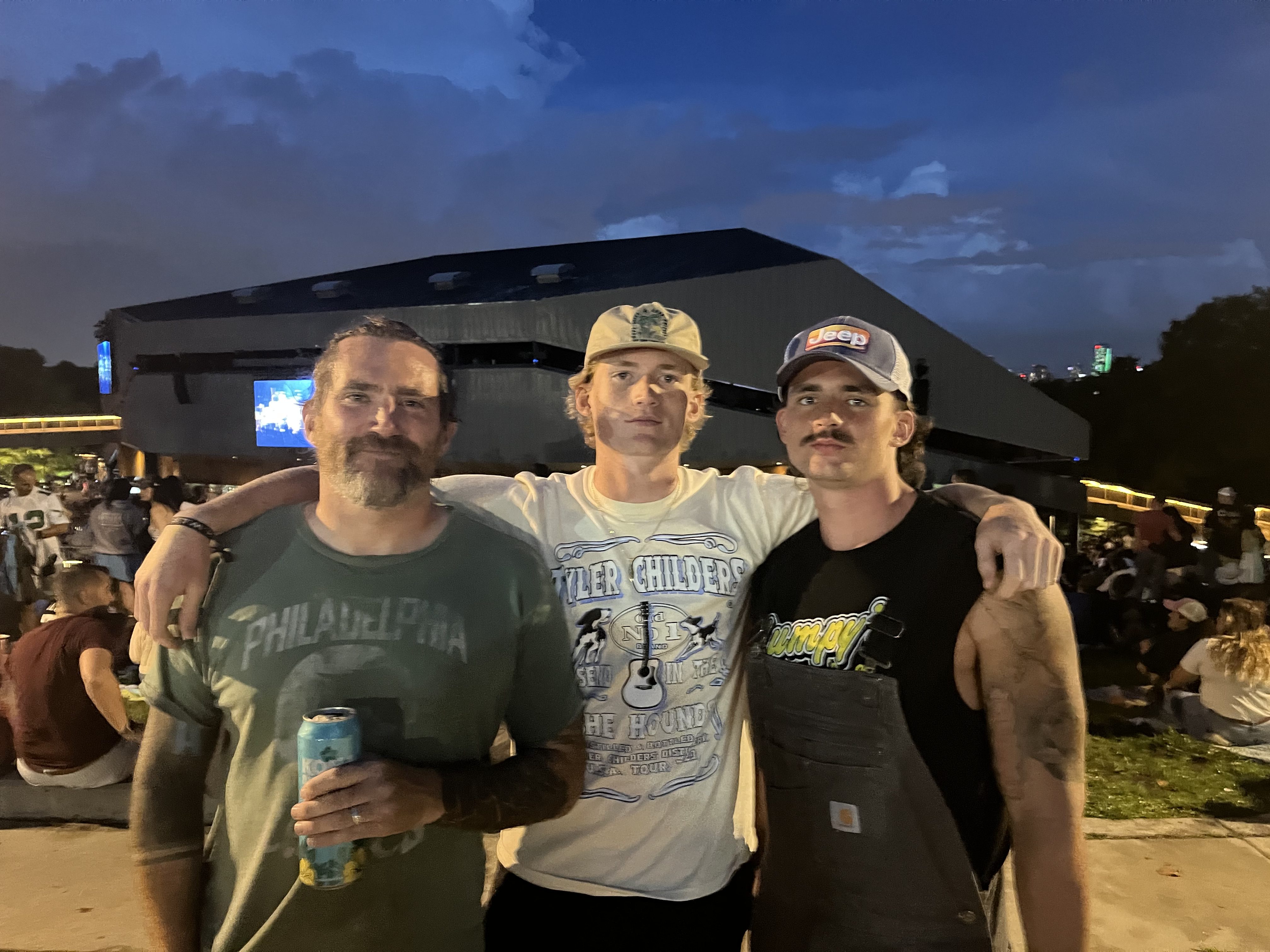
    The author with his sons, Zenon and Ronan, at the Tyler Childers show in Philadelphia in 2023.Jason Nark

    During all this time, I thought about that 2013 story I wrote, with growing regret.

    My children finally tipped the scales when they got to high school and became adults, and some of the lyrics coming out of their speakers began to catch me off guard, artists like Lost Dog Street Band and Zach Bryan. I went looking for more and found Sierra Ferrell, Sturgill Simpson, Lydia Loveless, and Margo Cilker.

    Was it country? Americana? Folk? Bluegrass? Who cares, I’m a fan of whatever it is, and now, as I hover close to 50, I couldn’t care less about who listens to what.

    When I went to see Tyler Childers at the Highmark Mann Center for the Performing Arts, I was surprised to see how young the crowd was and remembered, fondly, getting busted for underage drinking there at a Metallica, Danzig, and Suicidal Tendencies show decades earlier.

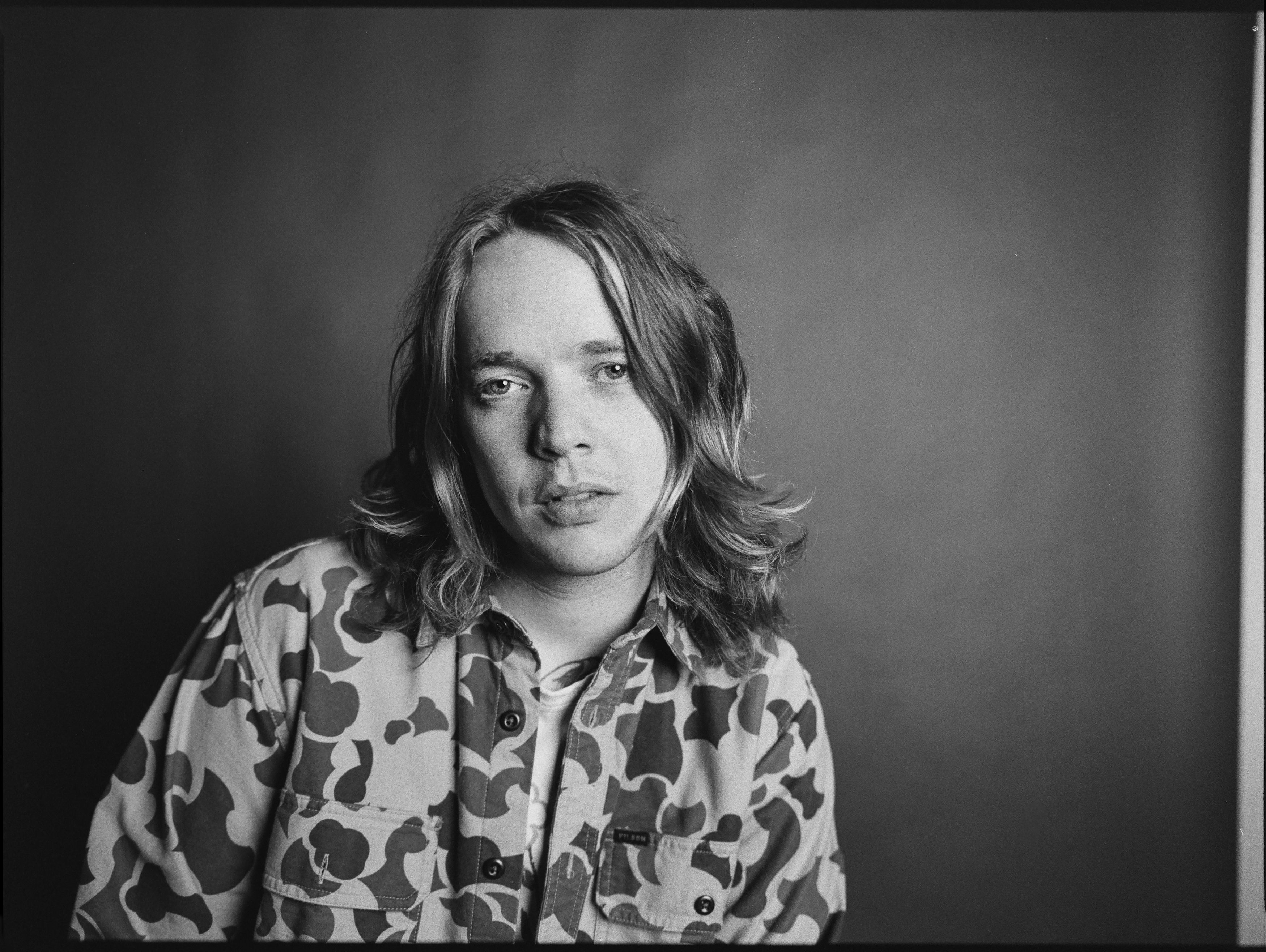
    Billy Strings Alysse Gafkjen

    Fast-forward a few years, and my son and I were camping along the Delaware River, fishing and eating kielbasa, ahead of the Billy Strings show. I hadn’t heard of Strings before I visited the Martin factory in Northeastern Pennsylvania last year, but my son is a devotee, and I’d dragged him to metal shows as a kid, and even a jazz show in Philly last year.

    “It sounds like everyone in the band is playing a different song,” he said about the jazz.

    From quick listens, I assumed Billy Strings was playing country music, but my son was right. It’s something different, something I don’t need to label. I’ve seen Strings described as psychedelic or “jamgrass,” and they both sound fine to me. The crowd — he sold out two nights at Bethel — was losing its mind, twirling around for hours on the grass like at the original Woodstock on the grounds, back in 1969.

    We drove back to the campground with smiles stuck to our faces.

    Later, when I got home, I learned Strings grew up in Michigan, in a household full of bluegrass and heavy metal. One of his favorite bands, it turns out, was Black Sabbath, just like me: further proof that we can like what we like, without labels.

  • The U.S. Amateur Championship comes to Merion Golf Club. Here’s your guide to the week.

    The U.S. Amateur Championship comes to Merion Golf Club. Here’s your guide to the week.

    The best amateur golfers in the country are coming to the Philadelphia area this week for the 126th U.S. Amateur Championship from Monday to Sunday.

    The tournament will be held at the historic Merion Golf Club in Ardmore for the first time since 2005. Philadelphia Country Club in Gladwyne will serve as the co-host for the first two days of stroke play.

    Here’s what to know before the competition begins.

    What is the U.S. Amateur?

    The U.S. Amateur is the oldest tournament held by the United States Golf Association, starting in 1895. It is one of the most prestigious events in amateur golf and has produced a long list of golf’s best, including Tiger Woods, Jack Nicklaus, Arnold Palmer, and Bobby Jones, who won the amateur at Merion in 1930 and won the Grand Slam.

    The tournament is open to amateur golfers with a Handicap Index of 0.4 or better. There are 312 players competing for the Havemeyer Trophy this year, with the field determined through a two-stage qualifying process with 5,111 entries.

    Who’s in the field?

    Forty-seven of the top 50 in the Men’s World Amateur Golf Ranking are in the field this week. No. 1 Preston Stout, the current Division I NCAA individual champion with Oklahoma State, No. 3 Tyler Watts, and No. 4 Miles Russell, who finished runner-up at the U.S. Junior Amateur at Saucon Valley Country Club, will play together at 1:30 p.m. on Monday at Merion and 7:33 a.m. on Tuesday at Philadelphia Country Club.

    Mason Howell, the reigning U.S. Amateur champion, will look to defend his title. Howell was 18 years old when he won at The Olympic Club in San Francisco. He defeated University of Tennessee’s Jackson Herrington in the 36-hole final to become the third-youngest champion in tournament history.

    Forty-five states and 36 countries are represented in the field. There are 12 past USGA champions and 13 runners-up.

    Mike McCoy, 63, is the only player in the field to have competed in the 2005 U.S. Amateur at Merion.

    How many locals are in the field?

    Ten players from Pennsylvania will compete in the championship, with many from the Philly area. Drue Nicholas, 23, of Egg Harbor Township is the only Merion member competing in the field this week.

    Nicholas, who graduated from Drexel, recently won his second straight Philadelphia Open, becoming the second player in history to sweep the Philadelphia Open and the Philadelphia Amateur in the same year.

    Nicholas Gross, 19, of Downingtown; Hunter Stetson, 20, of Newtown Square; Charlie Barrickman, 18, of West Chester; Michael Lugiano, 20, of Jackson Township; Patrick Isztwan, 23, of Huntingdon Valley, and Joshua Ryan, 22, of Norristown are all competing.

    How does the tournament work?

    The U.S. Amateur is decided through both stroke and match play.

    The first two days, Monday and Tuesday, are stroke play. Every player will play 18 holes each day, with one round at Merion’s East Course and one at Philadelphia Country Club.

    After 36 holes, only the 64 lowest scores will advance to match play.

    The Round of 64 begins Wednesday, the Round of 32 and 16 on Thursday, followed by the quarterfinals Friday, the semifinals Saturday, and the championship match Sunday.

    The final match is 36 holes and the eventual champion will have to win six consecutive match-play rounds to claim the title.

    How can I watch?

    The event will air live on Peacock and NBC. Here’s the television schedule:

    Wednesday

    • Round of 64: Peacock/NBCSN, 3 p.m.-6 p.m.

    Thursday

    • Round of 16: Peacock/NBCSN, 3 p.m.-6 p.m.

    Friday

    • Quarterfinals: Peacock/NBCSN, 3 p.m.-6 p.m.

    Saturday

    • Semifinals: Peacock, 3 p.m.-4 p.m.
    • Semifinals: NBC, 4 p.m.-6 p.m.

    Sunday

    • Championship Match (Afternoon 18), Peacock, 3 p.m.-4 p.m.
    • Championship Match (Afternoon 18): NBC, 4 p.m.-6 p.m.

    Tickets to attend the tournament are available on the USGA’s website.

    What does the champion receive?

    The championship comes with significant benefits.

    Along with a gold medal and the Havemeyer Trophy, the winner will receive exemptions into the next 10 U.S. Amateurs, the 2027 U.S. Open at Pebble Beach and the 2027 Open Championship at St. Andrews in Scotland, as long as one remains an amateur. The winner is also likely to receive an invitation to the 2027 Masters.

    No. 9 on the East Course at Merion Golf Club in Ardmore.(Copyright USGA/John Mummert)

    What’s the history behind Merion?

    Merion’s East Course opened in 1912 and was designed by Hugh Wilson. It has hosted some of the most important tournaments in golf history, including 20 USGA championships.

    Ben Hogan won the 1950 U.S. Open at Merion and Justin Rose won in 2013.

    The U.S. Amateur has been played at Merion five previous times. In 2005, Italy’s Edoardo Molinari defeated Dillon Dougherty in the championship match.

    Merion will host the U.S. Open in 2030 and the U.S. Women’s Open in 2034.

  • Helmet cams and VR sets: Eagles quarterbacks use different tools as they learn a new offense

    Helmet cams and VR sets: Eagles quarterbacks use different tools as they learn a new offense

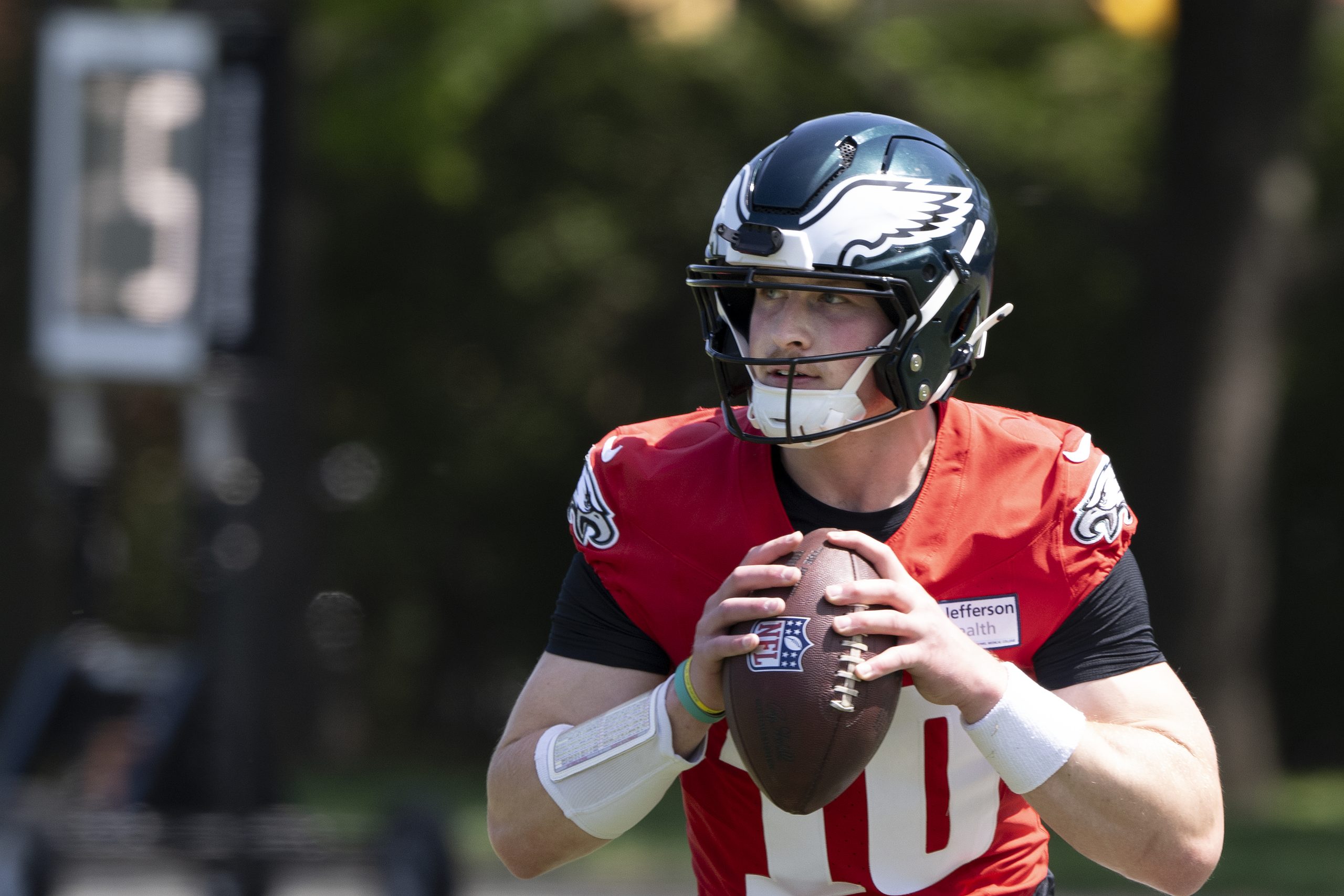
    The Eagles have four quarterbacks in training camp, and when you’re the fourth man on the totem pole like rookie fifth-round pick Cole Payton, getting on the field for extensive work during 11-on-11 team drills can occasionally be difficult.

    The team is committed to Payton’s development, but they’re also learning a new offense under first-year coordinator Sean Mannion. Jalen Hurts and the first-team offense need as many reps as possible, as do potential backup quarterbacks Andy Dalton and Tanner McKee.

    So Payton, a dual-threat quarterback out of North Dakota State, often is on the field late, after practice ends, working with quarterbacks coach Parks Frazier and sometimes Mannion on his footwork and technique. Payton called those post-practice sessions “huge,” but the on-field portion of camp is only part of the on-the-job training Payton is going through as he navigates his first NFL training camp.

    Cole Payton is going through his first NFL training camp with the Eagles.Jose F. Moreno / Staff Photographer

    The Eagles were off Sunday, but Payton said he has spent some off days strapping a virtual reality headset on to get “mental visualization reps.” The tool, Payton said, was introduced to him by Frazier, who last year was the pass game coordinator and this year moved to quarterbacks coach. The Eagles, Payton said, had the sets last year, too.

    Payton can turn on the VR, select any stadium, go through his play calls, break the huddle, and simulate a real play.

    “It’s not live footage, it’s animated, but it’s a really good tool to visualize and see things,” Payton said Saturday.

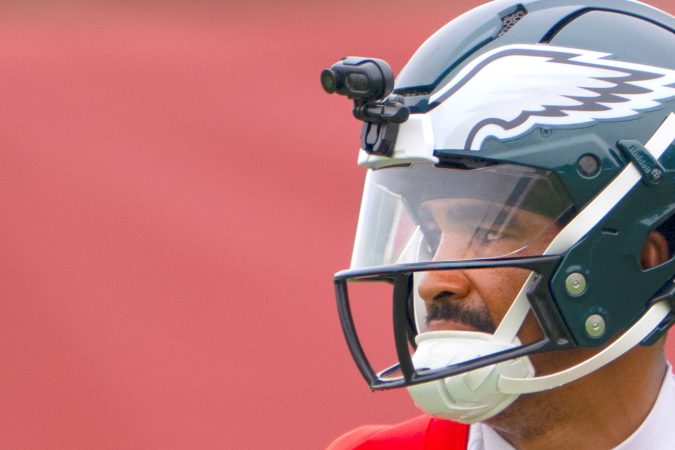
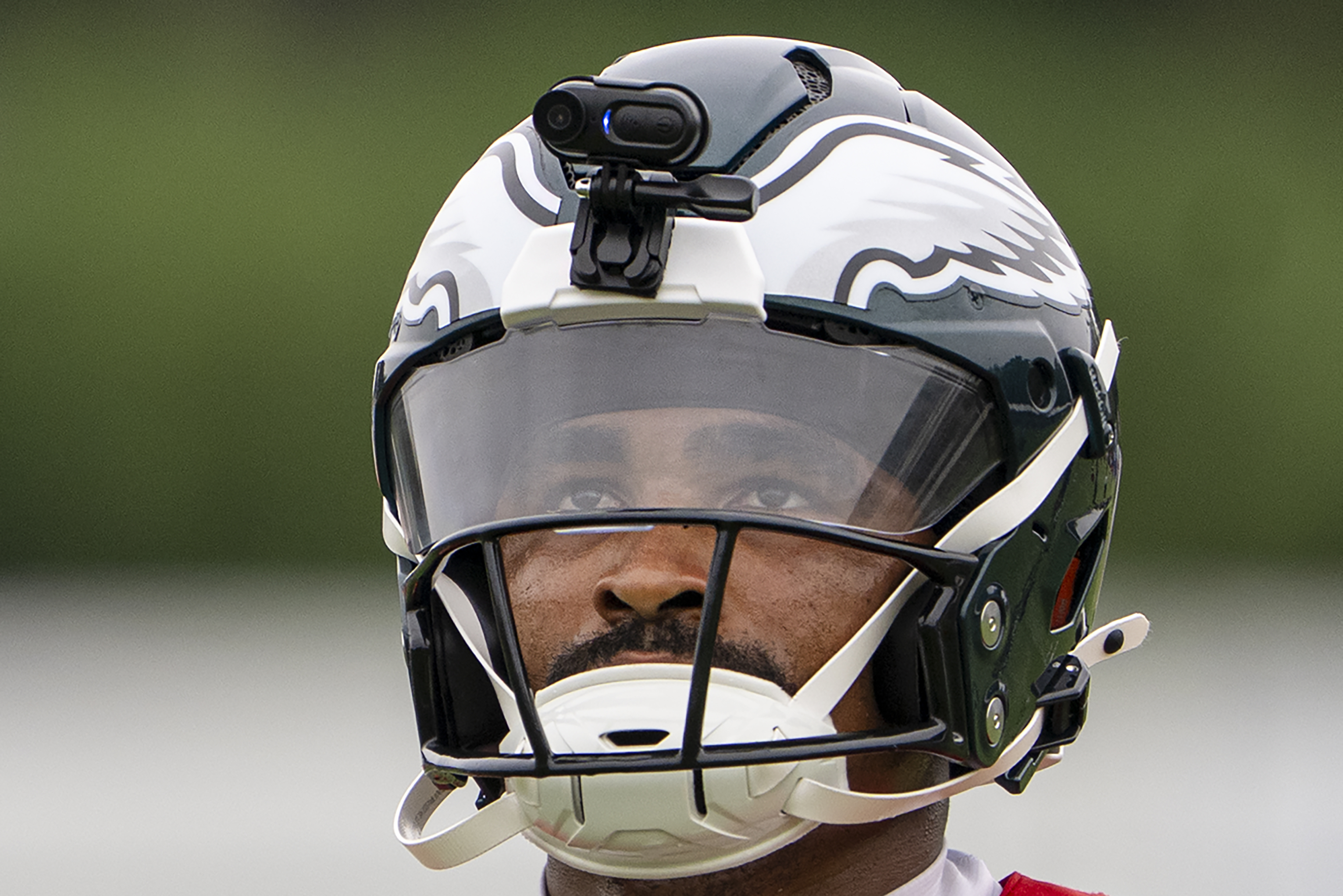
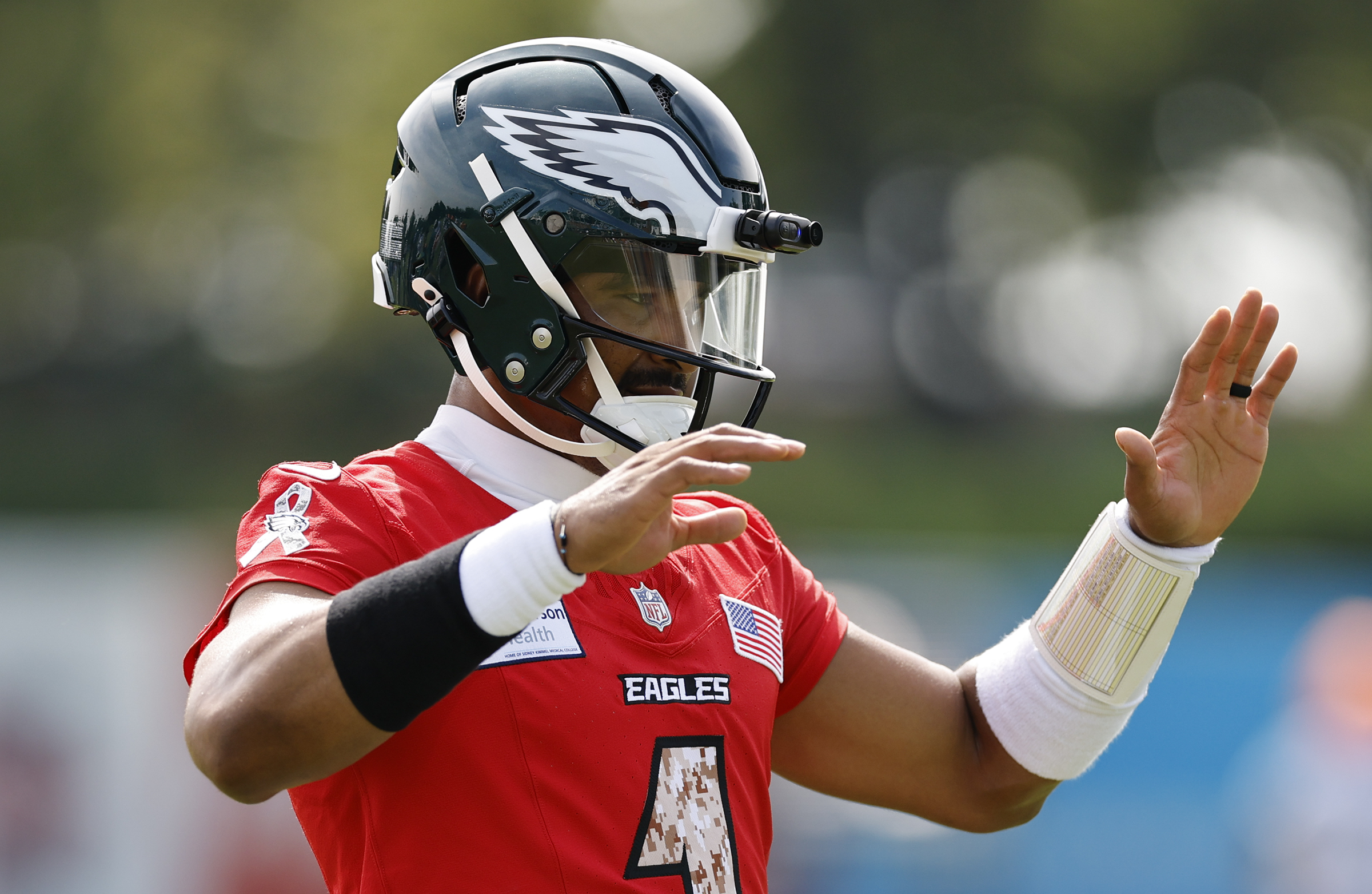
    The VR sets are only part of the visualization tools the Eagles are using as they install Mannion’s new scheme. All through the offseason, Eagles quarterbacks have had an extra piece of hardware affixed to their helmets, giving a first-person view of what each player is seeing on the field. That extra footage is yet another angle for the quarterbacks and the coaching staff to analyze in the meeting rooms.

    Hurts said on Wednesday that the cameras provide “insight and accountability in the huddle” and said “there’s an aspect of that that is very valuable.”

    Jalen Hurts participates in training camp practice with a video camera mounted on his helmet.Jose F. Moreno / Staff Photographer

    Accountability because the camera is recording sound, too. Wide camera angles of the field often used for film review can’t get inside the huddle to hear the way a quarterback calls a play or what he’s seeing when he makes a check at the line of scrimmage, but the helmet cams can.

    “It’s been really cool,” Payton said, “not only for myself but just to hear what Jalen is saying in the huddle, what Andy is saying in the huddle, and Tanner, and the reminders they’re giving to the guys and just how crisp and clean the operation needs to be. We’re working and we’re building.”

    The Eagles aren’t the first team to use either technology, despite the tools being new to the building. HBO’s Hard Knocks provided a look at Tua Tagovailoa utilizing the helmet camera technology two seasons ago. Russell Wilson wore one at times when he played in Seattle, as did Kenny Pickett in Pittsburgh. There are other examples, too. The Arena Football League introduced helmet cameras in 2014, and while that usage was mostly for entertainment purposes for the viewing audience, other NFL teams and college programs have been using the cameras for teaching purposes for years.

    “I think it was more for the coaches to see where your eyes are at,” Nathan Peterman, who used the technology in college and the NFL, told ESPN in 2023. “And also, some of it, was to get a feel for what goes on in the huddle, for the coaches to see the communication of how things are going. That’s what I know [then-Raiders coach Jon] Gruden was looking at, to see the communication in the huddle and checks at the line.”

    Like helmet cameras, the use of virtual reality among quarterbacks has been going on. Tom Brady, for example, used VR when he played for Tampa Bay. Penn State quarterbacks use them. And the latest season of the Netflix docuseries Quarterback gave some insight into Jayden Daniels’ use of the technology, which the Washington Commanders quarterback was open about during his standout rookie season in 2024.

    Daniels first started using VR in college at LSU, and he would routinely turn the speed up to force himself to process plays even faster.

    “It moves faster within the VR than actual human beings,” Daniels told reporters in 2024. “Once you get out there, everything slows down. I know this is coming. I’ve seen this before, [and] it moved more than 20 times faster in VR.”

    His former offensive coordinator Kliff Kingsbury embraced the technology, having used versions of virtual reality while coaching at Texas Tech dating back to 2016. According to The Athletic, Kingsbury changed his daily schedule with the Commanders to spend up to an hour narrating play calls into a recorder so Daniels could hear Kingsbury’s voice in the VR headset.

    “[Pilots] don’t go get trained in real planes,” Kingsbury told The Athletic. “They do their flight simulators. … [Jayden] has that thing on all the time. He can see our reads and routes and hears my voice in it. It’s as real as you can [get to] getting game reps, and your mind doesn’t know the difference. Your mind thinks you’re doing it.”

    Jalen Hurts is one of a number of recent NFL quarterbacks who has utilized helmet video technology as part of the learning process. Yong Kim / Staff Photographer

    This offseason, the Commanders, like the Eagles, added the helmet cameras to their toolbox as they implemented a new offense under first-year coordinator David Blough.

    In Philadelphia, the helmets are another layer of learning. Hurts hasn’t often taken snaps from under center, but this offense will ask him to utilize play action from under center, which means his back will briefly turn to the line of scrimmage before he gets into position to read the field. The cameras, then, could help Hurts train his eyes to be looking in the optimal spot after the handoff fake.

    For Payton, the point-of-view angles could help the rookie continue to work through the struggles of his first training camp. On Saturday, a throw to the sideline that may have been a throwaway attempt resulted in Payton’s fifth interception of camp. Perhaps the camera later would show what Payton saw when he released the ball.

    As long as the camera hadn’t been knocked off focus.

    “Sometimes the angle is funny,” said Payton, who is wearing a helmet camera for the first time. “You’re seeing the clouds or you’re seeing our feet. When the angle is right, I think it’s beneficial.

    “It’s a cool tool to have.”

  • 🏈 Capturing the action | Sports Daily Newsletter

    🏈 Capturing the action | Sports Daily Newsletter

    Helmet cams and virtual reality sets have transitioned from experimental to becoming more of a standard tool for NFL coaches. It certainly adds another layer of learning.

    For the Eagles, with four quarterbacks trying to learn a new offense, those methods have become a valuable resource in camp.

    The VR sets are used as visualization tools as the Eagles install Sean Mannion’s new scheme. It allows players to select any stadium, go through his play calls, break the huddle, and simulate a real play.

    The extra piece of hardware on the QB’s helmets gives a first-person view of what each player is seeing on the field. Jalen Hurts says the cameras provide “insight and accountability in the huddle.”

    We’ll see how effective those tools have been during the Eagles’ preseason opener Saturday in Baltimore. In the meantime, let’s check the stock market. After a week and a half of Eagles training camp, Olivia Reiner weighs the early risers and fallers.

    And Lane Johnson announced that he is considering retiring following the 2026 season. The 36-year-old, who is entering his 14th NFL season, has been a mainstay of the Eagles offense for over a decade. His eventual successor will have hefty shoes to fill.

    — Isabella DiAmore, @phillysport, sports.daily@inquirer.com.

    If someone forwarded you this email, sign up for free here.

    ❓How can the Phillies address their bullpen issues? Email us back for a chance to be featured in the newsletter.

    More prominent role

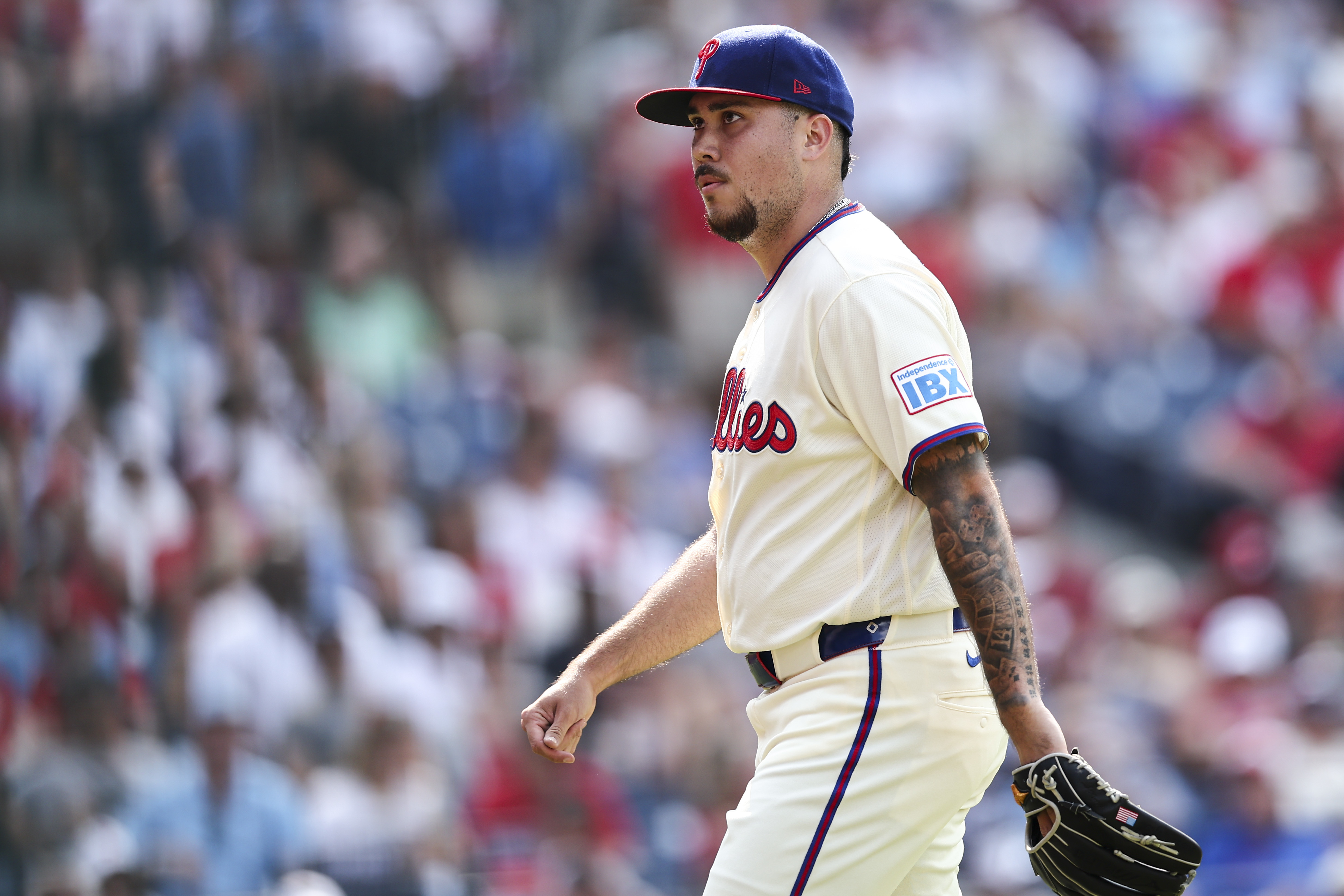
    Jonathan Bowlan has a 2.81 ERA in 44 appearances this season.Yong Kim / Staff Photographer

    Jonathan Bowlan was a lower-profile addition to the Phillies bullpen in December from the Royals for lefty Matt Strahm. After setup man Brad Keller needed Tommy John elbow surgery that figures to sideline him well into next season, Bowlan stepped into his role.

    And he’s been effective. He’s throwing his changeup about twice as often as last year, which makes his fastball appear harder. Bowlan’s fastball averaged 95.5 mph in 2025. This year, it’s up to a 97.2. Maybe the setup reliever job could be his to keep.

    On Sunday, the Phillies managed to sneak out a 7-6 win over the Blue Jays, thanks to Derek Hill’s walkoff hit.

    But it took 12 innings to get there. If you believe the odds, the Phillies remain in the driver’s seat for one of the six NL playoff spots up for grabs. If you believe your eyes, it won’t matter if they get to October, writes columnist David Murphy.

    What we’re…

    🔍 Analyzing: After the Eagles’ eighth practice, Jeff McLane filled us in on what he saw on Saturday, including Jihaad Campbell making several plays.

    🤔 Wondering: Jhoan Duran’s walkout, the Phillies pitch clock, and the scoreboard are all sponsored. Why are these local companies investing in the ads?

    🏌️ Preparing: The U.S. Amateur Championship is coming to Merion Golf Club in Ardmore this week. Here’s everything you need to know.

    🏈 Learning: How Penn State will look this season under first-year coach Matt Campbell, who is making every player earn their Week 1 spot.

    His commute

    Wilt Chamberlain “would do 90 to 100 [mph] all the way up the turnpike” on his commutes from New York City to Philadelphia to play for the Warriors and Sixers.Steve Madden

    There’s a chance that LeBron James could live in New York while playing in Philly. More than 60 years ago, Wilt Chamberlain did it first, as he opted for luxury cars along with a heavy foot in his commute for games and practices.

    Chamberlain lived in an apartment overlooking Central Park while playing in Philadelphia. He maintained a residence in his native Philly but spent most nights in New York and owned a popular club in Harlem. “He would do 90 to 100 [mph] all the way up the turnpike,” said Wilt’s close friend Tom Hoover.

    And Tyrese Maxey hosted his third annual Friends & Family weekend. Here are some of the highlight moments from his events.

    Olympic hopeful

    Maurice Scott, 32, hopes to inspire other inner-city kids who have a dream to compete in a sport lacking representation.Maurice Scott

    Maurice Scott has built a name for himself in rowing. The Northwest Philadelphia native has notched multiple Head of the Charles wins, made history as the first Black governor of the Potomac Boat Club, and is a Philadelphia city champion and a four-time national champion in the sport.

    Now Scott, 32, is making a push to compete in the 2028 Olympics in Los Angeles. And as he embarks on this journey, he’s inspiring other inner-city kids.

    Lasting impact

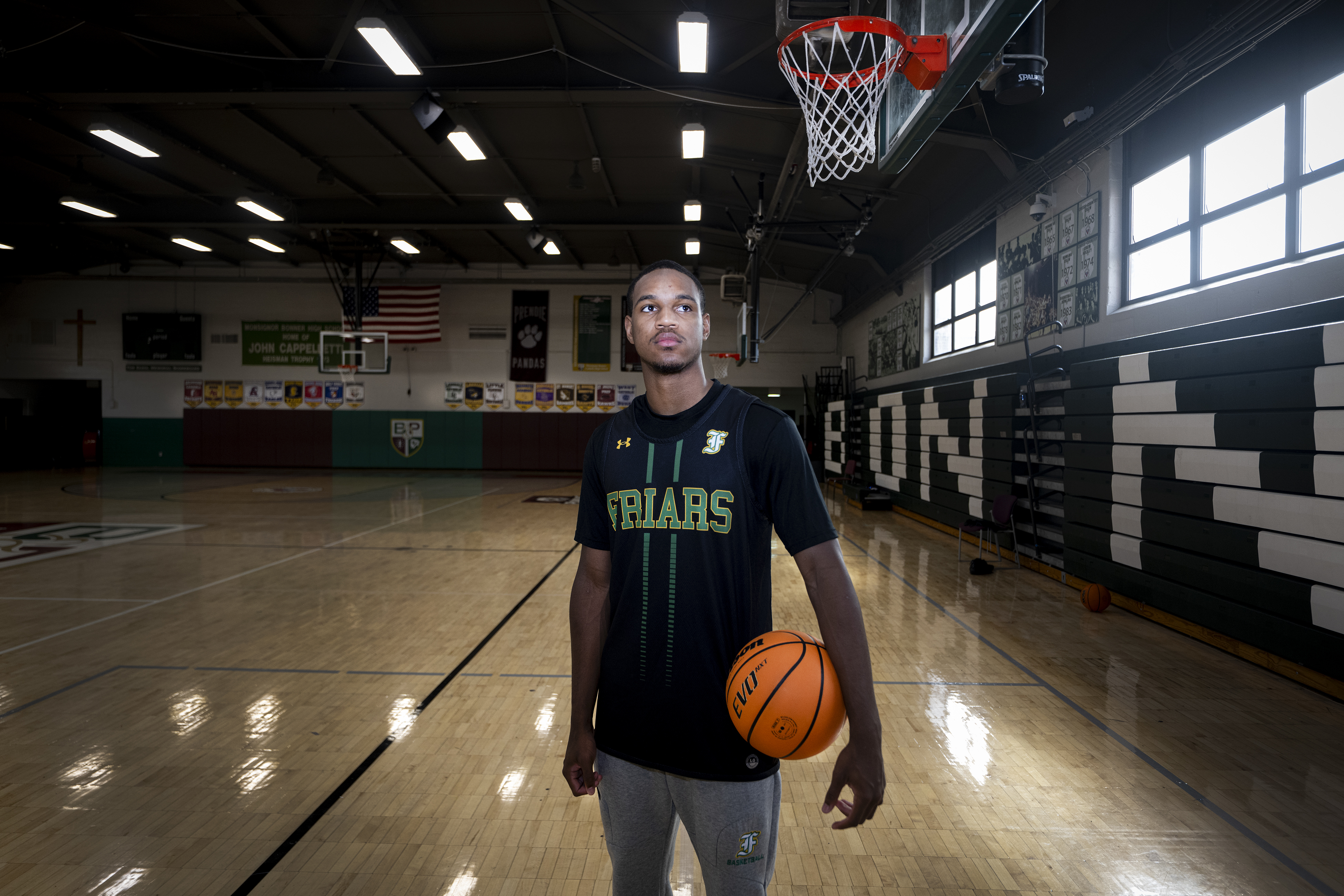
    Bonner-Prendie’s Korey Francis has become one of the state’s most competitive and complete basketball players in the class of 2027.Jose F. Moreno / Staff Photographer

    Korey Francis is one of the state’s top recruits in the class of 2027, and he’s helped transform the Bonner-Prendergast boys’ basketball program. He was named Catholic League MVP last season, after leading Bonner-Prendie to a PCL semifinal appearance and its first PIAA 5A state championship in program history.

    He has more than 19 college scholarship offers, but Francis is more focused on guiding the school to its first Catholic League title since 1988.

    Mike Sielski’s take

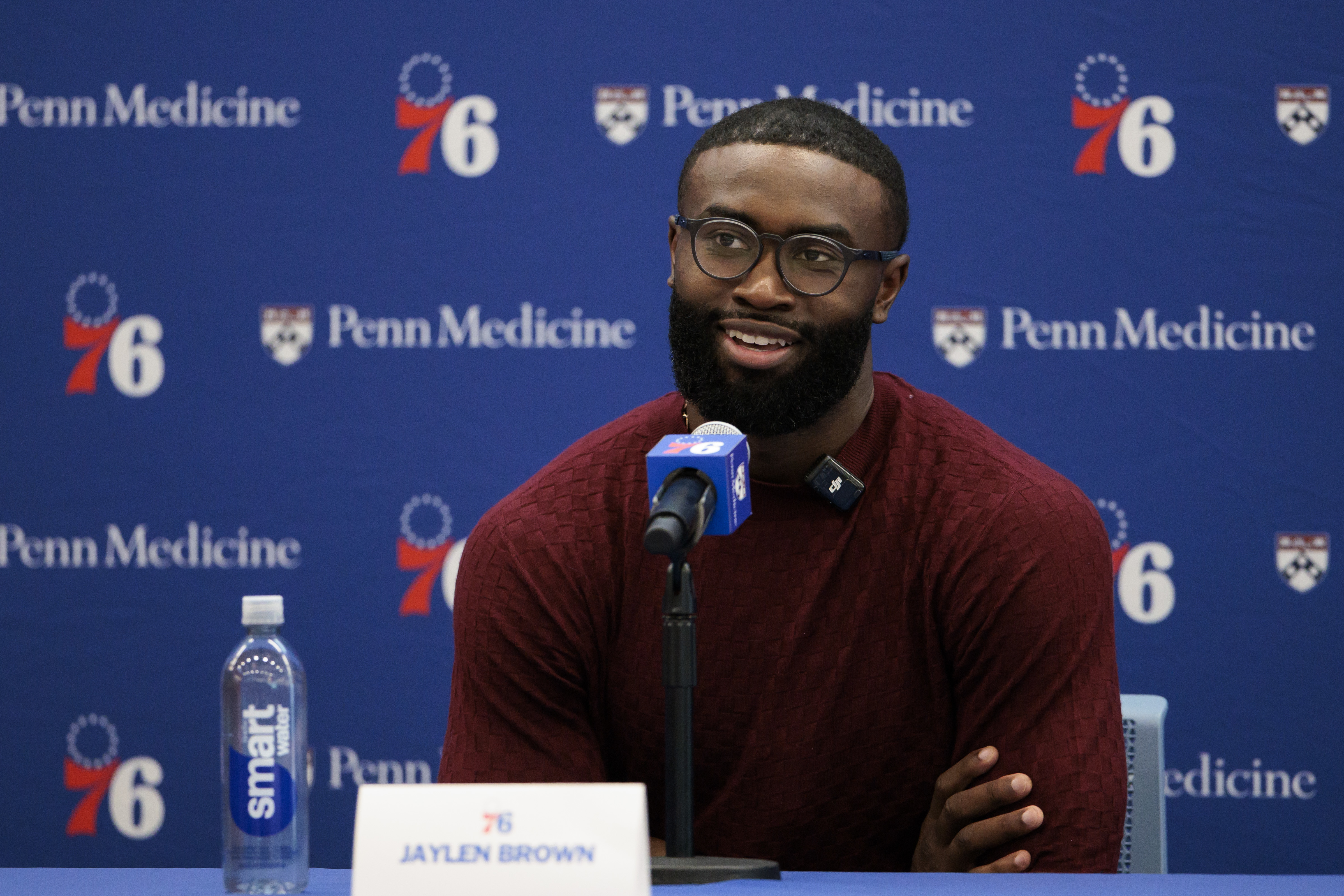
    New Sixers forward Jaylen Brown speaks during his introductory press conference at the Francis Myers Recreation Center on Thursday.Monica Herndon / Staff Photographer

    The trade for Jaylen Brown and LeBron James’s decision to sign here has given the Sixers more than just two outstanding players. They now have two players who have shown they can handle and thrive in big-time moments. That experience goes a long way in tempering premature expectations, writes columnist Mike Sielski.

    We compiled today’s newsletter using reporting from Matt Breen, Mike Sielski, Jeff Neiburg, Olivia Reiner, Jeff McLane, Scott Lauber, Ryan Novozinsky, Erin McCarthy, Lauren Jones, Ariel Simpson, and Lexie Linderman.

    By submitting your written, visual, and/or audio contributions, you agree to The Inquirer’s Terms of Use, including the grant of rights in Section 10.

    As always, thanks for getting your week started with me. I’ll catch back up with you in Tuesday’s newsletter. — Bella

  • Don Mattingly needs to figure out his bullpen. Are there any answers?

    Don Mattingly needs to figure out his bullpen. Are there any answers?

    It is officially audition season in the Phillies’ bullpen.

    Are there any candidates?

    It is a daunting question. It is also the question that will end up defining Don Mattingly’s stint as interim manager.

    The Phillies somehow managed to sneak out a 7-6 win over the Blue Jays on Sunday, but it took them 12 innings, and they made a whole lot of not-so-good memories along the way.

    At the top of that list was Orion Kerkering’s latest implosion. This one occurred in the eighth inning, almost immediately after Jesús Luzardo put a bow on one of the finer starting pitching performances you’ll see. The Phillies lefty looked like he did last postseason: seven innings, five baserunners, 12 strikeouts, two runs. Most importantly, he held a 5-2 lead. It would have taken a drastic turn of events to dampen the buzz at Citizens Bank Park. The Phillies bullpen rose to the challenge.

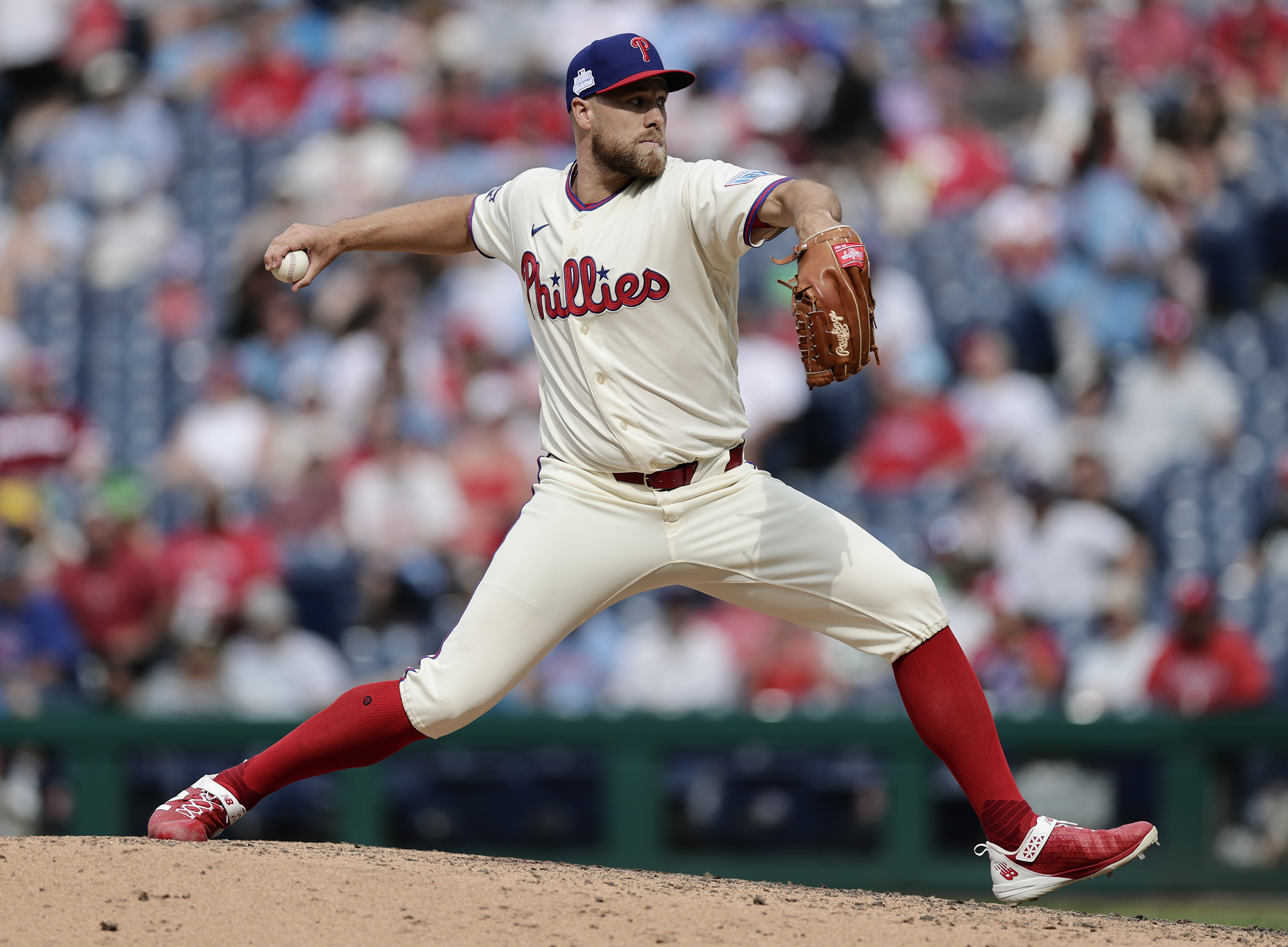
    Sunday was Orion Kerkering’s fourth outing allowing two-plus runs in his last 20 appearancesMonica Herndon / Staff Photographer

    Two batters into the eighth, Kerkering was one out away from delivering a three-run lead to Jhoan Duran in the ninth. Four batters later, the game was tied. There was some bad luck involved, with Ernie Clement’s RBI double the only extra-base hit. Still.

    This was Kerkering’s fourth outing allowing two-plus runs in his last 20 appearances. Opposing batters are now reaching base at a .360 clip against him in high-leverage situations. Only five relievers have averaged as many pitches per plate appearance (4.17) in as many or more innings (45⅓) as Kerkering. The same is true of José Alvarado, who is averaging 4.18 pitches per PA in 43⅔ innings.

    In fact, everything you can say of Kerkering is true of Alvarado. On Saturday, the lefty blew a save situation that sunk the Phillies against Toronto. He has allowed multiple runs in seven of his last 28 outings. The peripheral numbers have begun to catch up to his 5.77 ERA. In his last 13 games, he has 13 strikeouts against 10 walks/HBPs.

    Mattingly needs to figure this thing out. If you believe the odds, the Phillies remain in the driver’s seat for one of the six NL playoff spots up for grabs. If you believe your eyes, it won’t matter if they get to October.

    Even if righthander Jonathan Bowlan continues to perform in his new high-leverage role, that still leaves Mattingly one dependable arm short of avoiding offseason ulcer surgery.

    Tim Mayza isn’t an option. Before Sunday’s scoreless inning, the journeyman lefty had faced just 48 batters in high-leverage situations over the last three seasons. Nearly half had reached base, including 11 of 27 in 2026.

    Caleb Kilian might not be an option after suffering an oblique injury at some point in the top of the 11th.

    “It didn’t look good,” Mattingly said afterward.

    The Phillies’ one hope might be newly acquired lefty Brooks Raley, who pitched a scoreless 11th on Sunday. Raley last pitched in the postseason in 2022 while with the Rays. He retired three of the five batters he faced and did not allow a run in extra innings of a tie game.

    Good luck finding any relevance there. Same goes for his earlier postseason action with Houston. Four of the seven earned runs he allowed came in a couple of outings where the Astros were down six. Otherwise, he has allowed one earned run in 8⅔ innings since the start of the 2020 ALCS. That’s not much of a sample upon which to render judgment.

    But that’s more than we can say for Kerkering. His sample size is robust enough to leave little doubt that Mattingly can’t continue to factor him into his high-leverage decision-making.

    The Phillies have plenty of other headaches. Bryce Harper and Kyle Schwarber combined to reach base seven times on Sunday. They combined to score two runs, both of them driven in by Schwarber himself. It’s a good thing that Schwarber snapped the second-longest homerless streak of his career, and that he did it exactly how you’d expect.

    But Sunday was another answer to the question that so many had asked over the previous 17 games. What’s wrong with Schwarber? Well, what’s wrong is that the Phillies can rarely afford for him to not hit home runs. The problem wasn’t that he hadn’t hit a home run in over two weeks. The problem was that it was so conspicuous.

    Kyle Schwarber hit two homers against the Blue Jays on Sunday.Monica Herndon / Staff Photographer

    Same goes for Harper. After striking out in the first inning, the Phillies’ new right fielder drew a walk in four of his last five plate appearances. Three of them came with less than two out. He reached second base once, on a double steal on a Luis Arraez strikeout. J.T. Realmuto struck out to end the inning. In the 11th, Harper drew a one-out walk to load the bases, then watched right fielder Nathan Lukes gun down pinch-runner Garrett Stubbs at the plate on an Arraez fly-out to end the inning. The lack of punch in the middle of the order is nothing new.

    Compounding matters are the defensive concerns in the wake of the Phillies’ attempt to accommodate their deficiencies in the middle of the order. Bryson Stott has been excellent at third base, and maybe that will ultimately make up for Harper in right field and Alec Bohm at first base. But Bohm was charged with another error on Sunday.

    Plenty of teams have won playoff series, even championships, with bullpens that looked as leaky as Mattingly’s does right now. One needn’t look any further than the 2023 Diamondbacks, who slopped it together well enough to overtake the Phillies in seven games in the NLCS. Baseball is a sport where the odds are overwhelmingly in the favor of even an average-to-below pitcher. It isn’t unreasonable to hope that those odds string themselves together in the right order in the postseason. But it is a much tougher ask when a pitcher is backed by a defense that gives away outs and a lineup that has all of the balance of a fat man on a seesaw.

    Mattingly’s challenge right now is to find out who his pros are, assuming he has any. Raley and Bowlan in the seventh and eighth isn’t how the Phillies would have hoped to be drawing it up at this stage of the game. The odds are hardly healthy that it will end up looking much better than what they’ve seen thus far. But they at least must look.

  • Eagles stock watch: Who ranks among the risers and fallers at 2026 training camp?

    Eagles stock watch: Who ranks among the risers and fallers at 2026 training camp?

    After a week and a half of Eagles training camp, it’s time to check the stock market.

    Plenty of players have flashed, including the usual notables Jalen Hurts and Saquon Barkley. But who else is turning heads? And who has more work to do to carve out a role on the team by the end of camp and the preseason?

    Here are our early risers and fallers:

    Stock up 📈

    OLB Jalyx Hunt

    With Jonathan Greenard sidelined due to a pectoral strain, Hunt has stepped up and taken advantage of his increased opportunities. He has had his pass-rush wins — either in team drills or one-on-ones — against starting tackles Lane Johnson and Jordan Mailata. Defensive coordinator Vic Fangio said at the beginning of training camp that Hunt is “very capable” of having a big year in his third season with the team, and it’s become increasingly clear why.

    DT Jalen Carter

    The Eagles have high expectations for Carter, as evidenced by their decision to sign him to a four-year, $152 million contract extension at the start of camp. He’s setting the groundwork to meet those expectations, notably after recovering from shoulder procedures last season and sitting out during the offseason program. Carter continues to flaunt his game-wrecking ability, most recently when he beat Cam Jurgens on a rep during Saturday’s mock scrimmage and forced Hurts to scramble. Fangio said Wednesday that Carter is in good shape, which is allowing him to do “the little things better.”

    RB Tank Bigsby

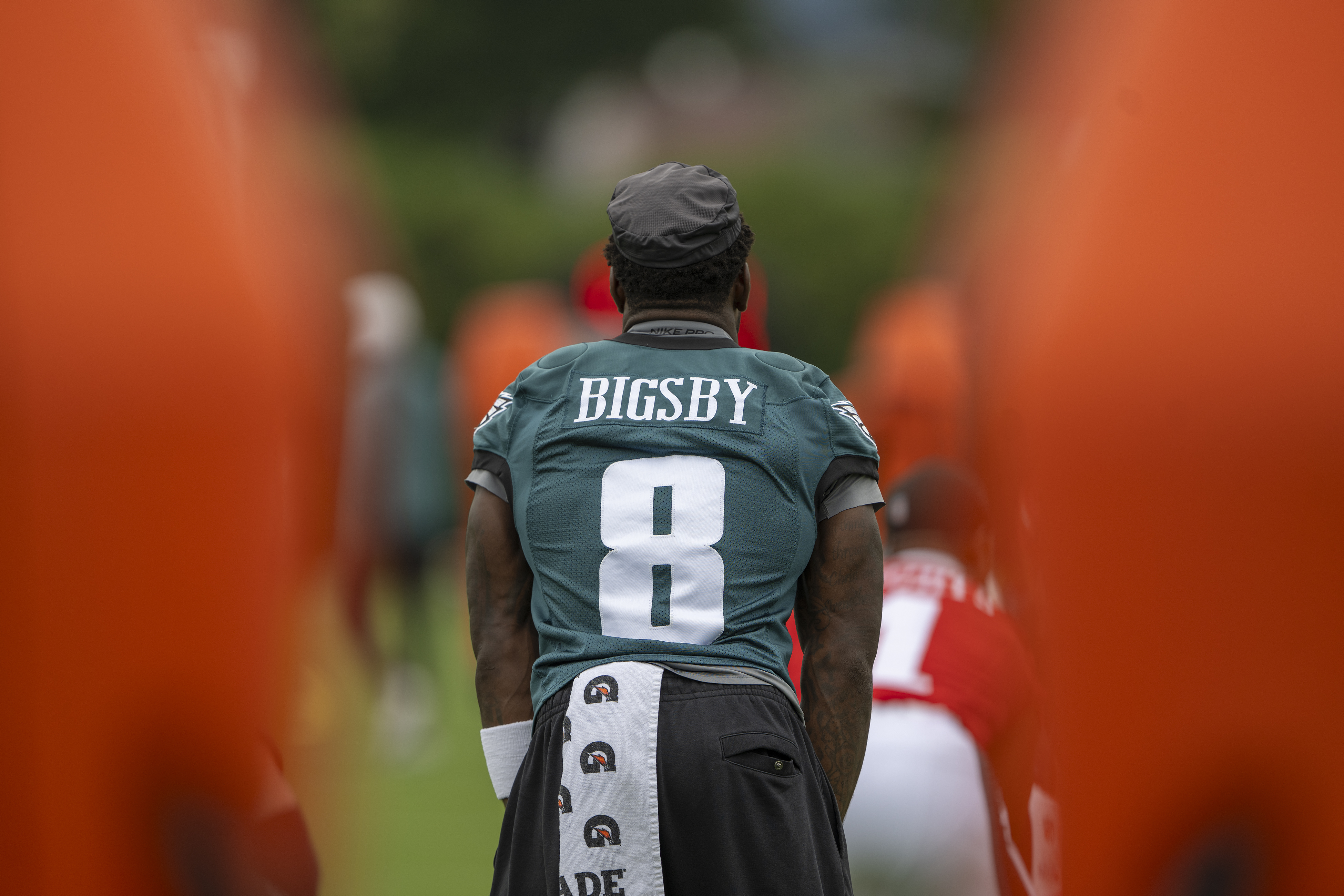
    Barkley is the Eagles’ feature back, but Bigsby is making his case for more touches in his second season with the team. Most of his reps were with the second-string offense on Saturday, but he has had opportunities to spell Barkley with the starters in the first week and a half of camp. His energetic play style stands out. Bigsby has had his ups and downs in pass protection, and Saturday was a microcosm of that, as he kept a blitzing Ambry Thomas away from Andy Dalton on one play and got beat by Jihaad Campbell on the next.

    C/G Drew Kendall

    Kendall, the 2025 fifth-rounder out of Boston College, is Jurgens’ likely backup at center, but he has also been cross-training at guard in camp. He has taken reps with the starters, filling in for Landon Dickerson at left guard on Wednesday when the veteran took a rest day. Kendall spelled Dickerson occasionally on Saturday, then took some reps at center when Jurgens exited the field early and headed indoors with a trainer. Kendall hasn’t looked out of place. Defensive tackle Jordan Davis said on Friday that Kendall has displayed a “tremendous” amount of growth since his rookie season.

    WRs Dontayvion Wicks, Elijah Moore, and Darius Cooper

    DeVonta Smith and Makai Lemon have missed time with hamstring injuries, leading to opportunities for other receivers. Wicks, Moore, and Cooper in particular have had their standout moments. Wicks has popped from the start as he makes his case for WR2, highlighted by his leaping grab over a pair of defensive backs on a deep ball from Hurts on the second day of camp.

    Moore and Cooper are more unlikely risers. Moore had a relatively quiet start to camp, but his chemistry with Hurts is steadily growing. He was wide open in the end zone for a successful catch on a two-point conversion during a red zone period on Saturday. Still, Moore has his work cut out for him to make the initial 53 in a crowded room.

    Cooper, the 2025 undrafted free agent out of Tarleton State, has been a reliable option for Hurts. He has made several impressive plays, including a diving catch on a pass over the middle of the field from Hurts in 7-on-7s at the outset of camp. The 28-year-old quarterback noted that Cooper is a “strong-hands guy” in an interview with the NFL Network on Wednesday.

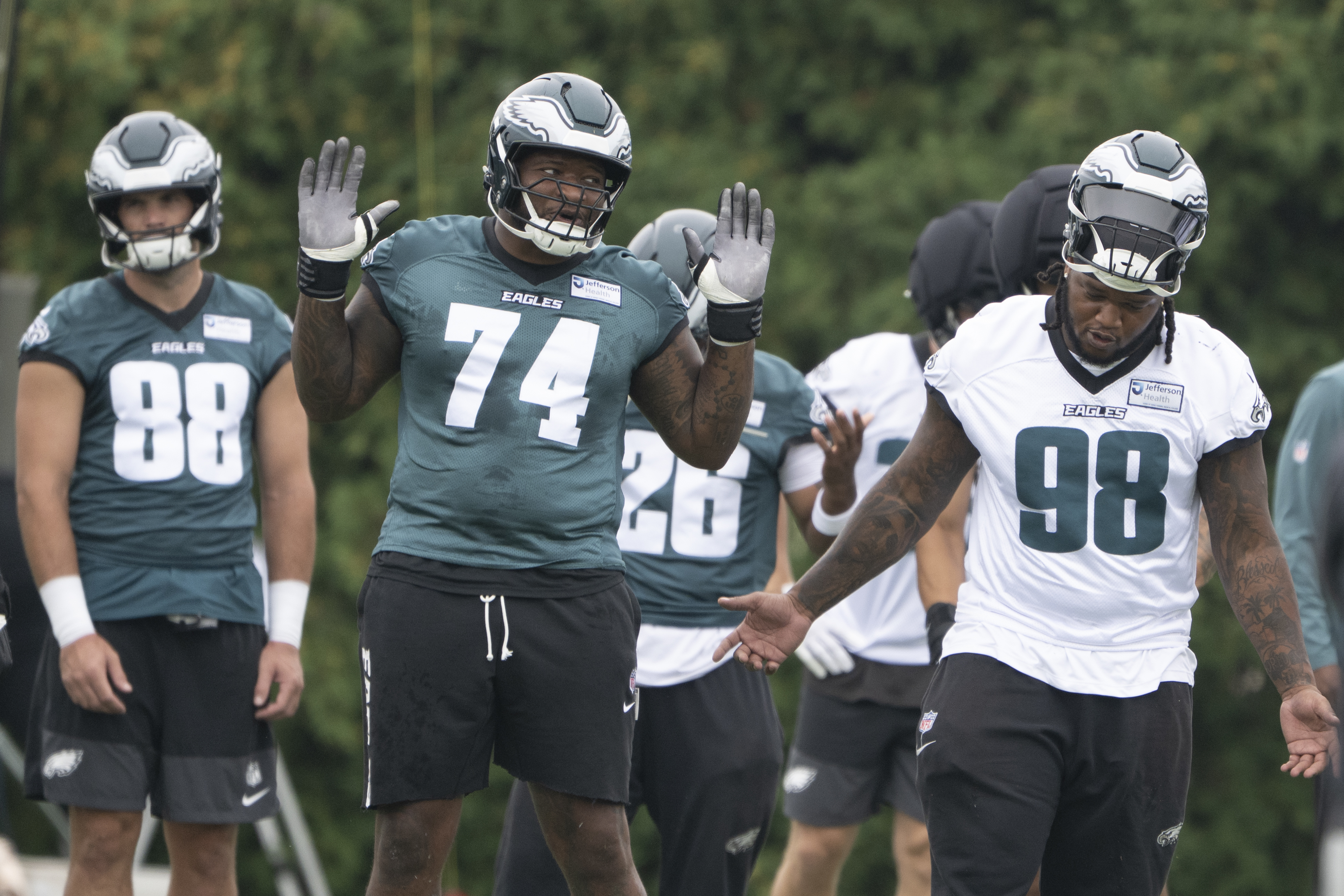
    Fred Johnson (74) will have to withstand some tough competition for the swing tackle role. Jose F. Moreno / Staff Photographer

    Stock down 📉

    This section comes with the caveat that the Eagles are in the early stages of training camp. Just because a player’s stock might be trending downward at this moment doesn’t mean it’s time to sound the alarm.

    OT Fred Johnson

    Johnson has been the Eagles’ top backup swing tackle for the last few seasons. This year, he has a competitor. Markel Bell, the third-rounder out of Miami, has asserted himself as the first tackle off the bench, primarily to fill in for Lane Johnson at right tackle. On Saturday, the elder Johnson was still ramping up after he missed four practices for personal reasons, so Bell occasionally filled in for him during the scrimmage. It shouldn’t come as a surprise that the Eagles want their third-round pick taking those snaps with the starters, especially in light of the 36-year-old Johnson announcing Saturday that this is “probably” his final season.

    WR Makai Lemon

    Perhaps the best characterization of Lemon’s stock is neither up nor down. The first-round receiver out of USC has missed the last four practices with a hamstring injury. While that may put him behind compared to his peers, offensive coordinator Sean Mannion acknowledged on Saturday that Lemon has been “super engaged” in the meeting room and in walkthroughs as he follows along with the script.

    Lemon isn’t the first highly touted Eagles rookie to sustain an injury during training camp. Cooper DeJean missed most of the summer in 2024 with a hamstring injury and made his preseason debut in the third and final game. Smith missed time during training camp his rookie year with an MCL sprain, returning for the second preseason game.

    DT Ty Robinson

    Robinson, the 2025 fourth-rounder out of Nebraska, had a slow start to camp, taking reps early on with the developmental group. He has fared better lately, including on Saturday when he won a rep in one-on-ones against Kendall. Preseason will offer more opportunities for Robinson to prove why he deserves a roster spot with Carter, Davis, Moro Ojomo all locks ahead of him.

  • From Northwest Philly to Olympic hopeful, Maurice Scott used rowing as an outlet: ‘The water gave me strength’

    From Northwest Philly to Olympic hopeful, Maurice Scott used rowing as an outlet: ‘The water gave me strength’

    Two years after a Learn to Row program at Boathouse Row, Maurice Scott was reintroduced to the sport when his father took him to his first race. As a spectator, Scott carefully observed each competitor as they walked toward the water.

    And as they competed, it wasn’t the technique or the speed of the athletes that stood out to him most. Instead, Scott, who was 14 at the time, was focused on the fact that nobody looked like him and nobody shared his background as a Black kid from Northwest Philadelphia. When he voiced his concerns to his father, Maurice Scott Sr., he responded, “You know, that doesn’t mean that you can’t do it.”

    Those words have lived with the younger Scott for the past 18 years.

    Since then, he’s become a Philadelphia city champion and a four-time national champion, has notched multiple Head of the Charles wins, made history as the first Black governor of the Potomac Boat Club, and was honored in the “Philadelphia Rowing: Breaking Barriers” display at the Independence Seaport Museum.

    Now Scott, 32, is making a push to compete in the 2028 Olympics in Los Angeles. And as he embarks on his journey to chase his Olympic dream, he’s inspiring other inner-city kids who have a desire to compete in a sport lacking representation.

    “It was just silencing the noise on both ends,” Scott said. “And continuing to believe in what I knew and believing that I belong there. That this is where I needed to be. And so just really staying focused on that and keeping the main thing the main thing; Jalen Hurts always said that. That’s legit. And knowing that later down the road, my story will be a story for others to see and to follow and know that it’s no longer a joke. We’re actually legit in the sport, too.”

    Maurice Scott’s father, Maurice Scott Sr., reintroduced him to the sport at a young age.Maurice Scott

    ‘I was the black sheep’

    Scott acknowledged the challenges when you don’t see yourself represented.

    “It’s just like, ‘Why is that? Is it because the sport wasn’t made for me?’” Scott said. “And when I did step into the realm, people were looking at me sideways because I’m an anomaly. People [didn’t] see athletes of color within the sport of rowing back then. It wasn’t a thing.”

    Even his peers questioned why he wasn’t playing basketball or football.

    “It became a joke, honestly,” Scott said. “Like, people would laugh at me actually doing this sport. When people like a sport that isn’t a part of the ‘culture,’ people kind of look at them like, ‘Yeah, whatever.’ I can guarantee you folks laughed at Venus and Serena. I can guarantee you folks laughed at Tiger Woods.

    “I was like the black sheep. I didn’t fit the mold. So for me personally, being around the water and doing something around the water gave me strength and provided me something that I could be proud of because I knew that I could be good at it.”

    ‘A safe haven’

    At just 7 years old, Scott witnessed his first drive-by shooting. He’s been robbed, had people close to him killed by gun violence, and stepped over bullet casings as he walked through neighborhoods.

    He felt safe in only two places: in church and on the water.

    Maurice Scott was one of the first students to join Philadelphia City Rowing, the nonprofit designed to create access to the sport for inner-city youth.Maurice Scott

    ”Being in church, it was like a safe haven, a safe place that I can be myself, and I’ve also created a community there,” Scott said. “I was surrounded by a lot of wrongdoing, but it allowed me to really have that confidence to make sure that I did the right thing as I carried myself through my younger childhood years.

    “And rowing was one of those outlets where I can really just get away from all of that. I was scared to go off to school or walk to the bus. I mean, it was that bad. Finding that outlet is important because it just takes your mental state out of the negativity and the picture that’s being painted of the city that you constantly see on a daily basis.”

    As Scott struggled to find his place among his community, he always felt a connection to the water.

    “The water has always been part of me,” Scott said. “Anytime I’m around it, I just feel strength and happiness. So that’s what kind of drew me to the sport itself.”

    Scott grew up sailing, swimming, kayaking, and rafting. So in fifth grade when he heard about the Learn to Row program at Bachelors Barge Club on Boathouse Row, he thought he would give it a shot. But after the two-week program ended, he didn’t know where to go next with the sport.

    “[My father] knew that I just loved the water and he knew how much fun I had when I initially did it,” Scott said. “But it was pretty closed off back then. Boathouse Row in general was very pretentious; there weren’t really wide-open doors. But I think he may have felt something was coming later down the line, and he just wanted to make sure that I didn’t forget it.”

    ‘Building that one heartbeat’

    Philadelphia City Rowing was founded during Scott’s junior year of high school. The nonprofit was designed to provide access to the sport for inner-city youth. He was one of the organization’s first athletes, and it inspired his commitment to diversity in rowing.

    “We try to eliminate a lot of the barriers and obstacles that a lot of kids may face in trying a new sport,” said George Rowley, the director of programs and community inclusion at PCR. “I think it’s important to really highlight [alumni] pathways to provide some inspiration for the kids that are just starting out.”

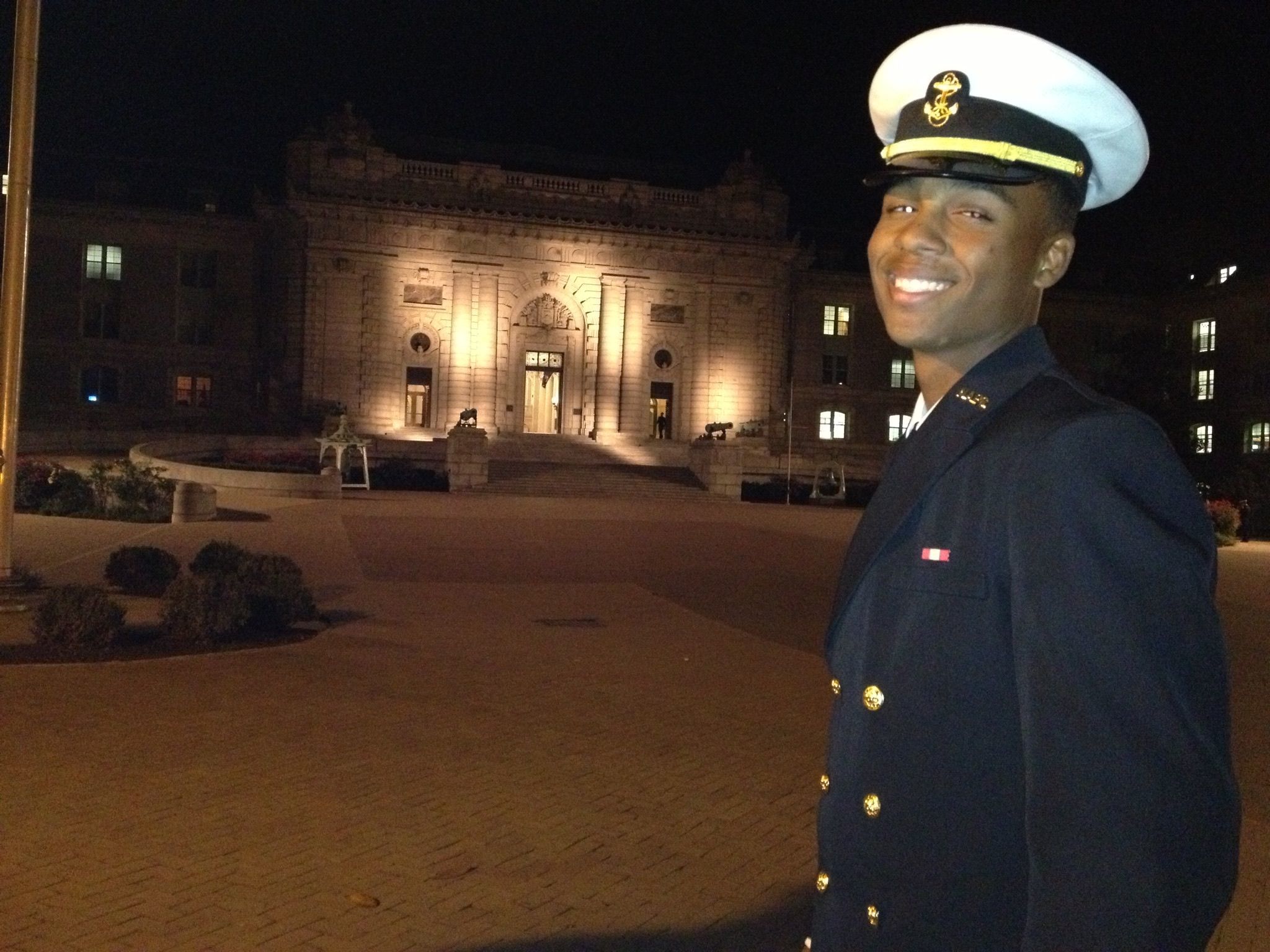
    Maurice Scott joined the Naval Academy before accepting a scholarship to Arcadia.Maurice Scott

    PCR quickly became part of Scott’s family.

    “It was all about rowing together and having that unit and having that rhythm and building that one heartbeat within the boat,” Scott said. “And that was something that I really loved and enjoyed because there was no other sport that is really like that, at least that I’ve done. And trauma bonding. Rowing is a painful sport. Rowing started off as a form of torture, and we’re doing it for fun.

    ”We didn’t look like any other boat on the water. We literally had kids from all over the city. And it was really cool because I got to meet people that weren’t just from my neighborhood, but were from all over and all walks of life.”

    After his first year with PCR, Scott was recruited to the Naval Academy. But a few weeks before graduating from the Naval Academy Preparatory School, he was told he had a sleep disorder. They said he could graduate but wouldn’t be able to move on. So he decided to accept a scholarship from Arcadia and graduated from there in 2017.

    While there, he studied abroad in Australia (2015-16) and competed with the University of South Wales.

    Olympic aspirations

    As people left the nightclubs at 4 a.m. in Australia, Scott would be heading to the gym. That discipline, which sustained him throughout college, is powering his dream of competing at the LA Olympics in 2028.

    Scott moved to Long Beach, Calif., in March 2024 to train at Belmont Shore for beach sprints, a fast, head-to-head race that combines sand runs with a 250-meter slalom boat course. The race will make its Olympic debut in 2028.

    Maurice Scott, 32, is acting as inspiration to other inner-city kids who have a dream to compete in a sport lacking representation.Maurice Scott

    “There’s no better way than training on the actual course and really understanding what goes into beach sprints,” Scott said. “One day, I’ll be doing a total of 16 to 30,000 meters depending on what’s going on. One day I could be doing an 8×500, which is full sprints, just back-to-back sprints.”

    Growing the sport

    Through his talent and telling his story on social media, Scott received a number of sponsorships and partnerships. Now, he’s trying to help other athletes do the same through his name, image, and likeness agency, Rowfluencers.

    And he is bringing even more eyes to the sport with his four-part docuseries, FORGED: The Kid from Philly, on NBC Sports Philadelphia.

    “Representation is so important,” Scott said. “So, I’m hoping they see this and are like, ‘Hey, it doesn’t have to be wrong. But this challenges me to really find what I like to do and not care about what other people think about because I’m going to do this and be a trailblazer for it and bring in others with me to allow them to not only just live, but thrive within whatever space that may be.’”