Tag: topic-link-auto

  • Trump told Ukraine it had no cards. Then Kyiv took the war to Russia

    Trump told Ukraine it had no cards. Then Kyiv took the war to Russia

    The meeting in the Oval Office between U.S. President Donald Trump and Ukrainian President Volodymyr Zelenskyy was a diplomatic car crash.

    “Your country is in big trouble. You’re not winning,” Trump said, dressing down Zelenskyy in front of the world’s media. “You don’t have the cards.”

    The blowup in February 2025, three years into the war, was more than just a heated public exchange: The Ukrainian delegation was asked to leave the White House, and Washington briefly suspended intelligence sharing with Kyiv. In the ensuing months, as Russia made slow but steady gains on the battlefield, Trump warmly welcomed Russian President Vladimir Putin in Alaska and seemed ready to push Ukraine into an unfavorable peace deal, including forcing it to give up territory.

    But even as Zelenskyy sat next to Trump, his forces were preparing an operation that would reveal Ukraine’s ability and ambition to take the war to Russia: Months later, drones smuggled into the country attacked Russian bombers, destroying or damaging planes worth hundreds of millions of dollars.

    Since then, Kyiv has ramped up a campaign of longer-range strikes inside Russia and in areas Moscow has seized, increased production of weapons, targeted Russian air defenses, and hit oil infrastructure and the warehouses of a major retailer in a bid to ensure ordinary Russians feel the impact of the conflict.

    In an embarrassment to Putin, Ukrainian drone strikes sent thick plumes of smoke billowing over St. Petersburg shortly before the opening of an international economic forum in June. Concern over Ukraine’s attacks led Russian authorities to scale down the May 9 military parade commemorating the defeat of Nazi Germany. Strikes on oil refineries have caused a summer fuel crisis.

    By the time Trump and Zelenskyy met at a NATO summit in July, the American president said the Ukrainian leader had “been very effective” in the war. “We’ve actually developed a good relationship,” Trump added.

    But as Ukraine’s strikes have intensified, so have Russia’s — and Kyiv faces major challenges in defending against them because of shortages of American Patriot air defense missiles.

    In the first six months of the year, 1,396 civilians were killed in Ukraine, according to the U.N. Meanwhile, the world body said Russian authorities reported 250 civilians killed in the same period. On Monday, a strike that Ukraine said hit an oil refinery in Russia killed 13 people, according to local officials.

    And while Ukraine’s effort appears to have shifted the narrative about the war in Washington, it’s still not clear if it will be able to push Putin toward the negotiating table.

    Ukraine’s strikes are aimed at undermining the idea that Russia can afford to “just let this roll,” said Jack Watling, a senior research fellow at the London-based RUSI think tank.

    The question of whether it will succeed depends on how much pain Ukraine can exact. “Logically, above a certain threshold, it does work but whether they can reach that threshold is an interesting question” — and one that depends at least partly on factors outside Kyiv’s control, like continued European financial support, he noted.

    Ukraine brings the war to Russia

    While most of Ukraine’s strikes have a range of less than 200 kilometers (125 miles), its longer-range attacks have increased dramatically this year. It launched three times as many of those strikes in July as it did in January, according to data from ACLED, an independent conflict monitor. Repeatedly hitting deep into Russia has forced its military to stretch air defenses over a larger area.

    Many of its strikes have focused on four key categories of targets, according to an Associated Press analysis of hundreds of Ukrainian attacks this year — compiled from statements by Russian officials and state media and the Ukrainian military.

    As the Iran war pushed up energy prices, leading the U.S. to ease sanctions on Russian oil, Kyiv ramped up strikes on oil infrastructure to deny the Kremlin revenue from fuel exports and force shortages on ordinary Russians. It is also striking defense manufacturing to damage Russia’s long-term ability to produce weapons, targeting air defenses to clear a path for its own arms, and hitting retail warehouses to bring the effects to ordinary Russians.

    — As part of the campaign against oil infrastructure, Kyiv said it hit Russia’s largest oil refinery, more than 2,500 kilometers (1,550 miles) from Ukraine.

    — Kyiv has also targeted defense manufacturing centers. It hit a factory making navigation systems multiple times, including with its own Flamingo missile.

    — In July and August, Ukraine struck Wildberries warehouses. Kyiv said the company helps supply the Russian military. Moscow denies that.

    — Many of Ukraine’s strikes on Russian air defenses and radar are around Russian-held Crimea and are often carried out with drones.

    Maj. Robert “Magyar” Brovdi, the commander leading Ukraine’s drone war, told the AP its strikes in Crimea are also aimed at rendering the peninsula unusable as a staging ground for Russian forces.

    Starlink gives Ukraine an advantage — for now

    It’s not always clear if Ukraine’s attacks are effective — and some may have resulted in minimal or no damage. In May and June, Ukraine said it hit several satellite, reconnaissance or signals intelligence facilities in Russia, but satellite images analyzed by AP did not show major damage.

    Still, Ukraine has one advantage that can help it strip back Russian air defenses and make its drone strikes more precise.

    It has access to Elon Musk’s satellite communications service Starlink — which means its operators can control drones in real time in Russian-held Ukrainian territory. Russia has been blocked from using Starlink.

    But Russia is also building its own version of Starlink, and is installing jamming systems that hamper Starlink connectivity, Brovdi said.

    Ukraine is investing heavily in weapons production

    Even before the Oval Office meeting, Ukraine scrambled to invest in new weapons — but that moment was “a real wake-up call,” said a European military official who spoke on condition of anonymity to discuss the front-line situation in detail. It became clear that U.S. support could be stopped “from one day to the next.”

    Ukraine doubled down on production, churning out a growing array of weapons in larger numbers and shortening traditional research and production cycles from decades to years or even months.

    Even so, Ukraine is still not able to produce as many missiles as it needs. It also took Ukraine time to make systems that could target facilities precisely enough that Kyiv felt comfortable using them to strike deep into Russia, Watling said.

    And while Ukraine has begun to resolve navigational issues with its missiles, such as the Flamingo, those weapons are still not as accurate — or as stealthy — as their Western analogues. That often means hundreds of drones must be fired to overwhelm Russian air defenses to allow a missile to get through.

    It’s an expensive and time-consuming way to wage war since only 5% to 9% of what Ukraine fires gets past Russian air defenses, according to Watling.

    But, although Russia’s weapons are more powerful, Zelenskyy suggested at the NATO summit that Putin is “losing the initiative” in the war as Ukraine has moved the fight from the stalled battlefield to the sky.

    Sitting next to Trump at the summit, the Ukrainian leader even cracked a joke, demurring when Trump asked him if he would accept Moscow as a venue for peace talks, as Putin has suggested.

    “There are a lot of Ukrainian drones in the air,” Zelenskyy said. ”It would be dangerous.”
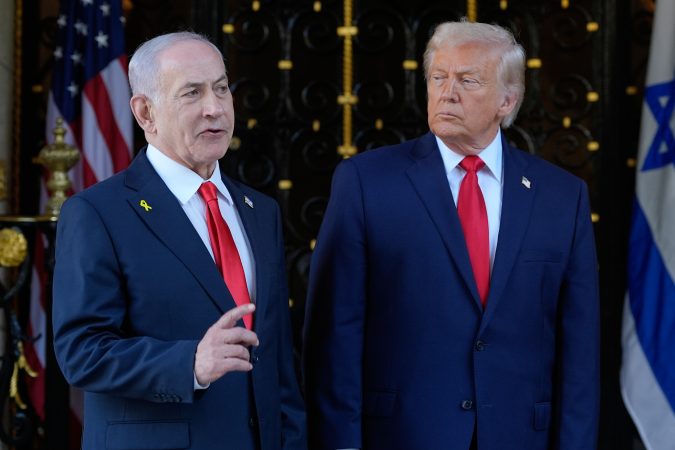
  • In rejecting Trump’s Gaza plan, Netanyahu reprises a balancing act he has mastered

    In rejecting Trump’s Gaza plan, Netanyahu reprises a balancing act he has mastered

    It’s possibly the most important job of any Israeli prime minister: maintain good relations with the United States while pushing back on demands seen as undermining Israel’s security.

    No one has managed the balancing act longer than Prime Minister Benjamin Netanyahu, Israel’s longest-serving leader. But with the Iran war at a stalemate, and U.S. President Donald Trump looking to advance peace efforts elsewhere, Netanyahu’s task is getting harder less than three months away from Israeli elections.

    On Sunday, Netanyahu rejected Trump’s latest plan to advance the stalled ceasefire in Gaza, saying Israel will not withdraw from any of the roughly 60% of the territory it controls until Hamas has been completely disarmed — something the militant group controlling the other 40% has long resisted.

    Netanyahu risks angering Trump, who he has repeatedly said is the greatest friend Israel has ever had in the White House. But even a hint of compromise with Hamas could be fatal for Netanyahu’s reelection in a country deeply traumatized by the Oct. 7, 2023, attack that happened on his watch.

    Trump, meanwhile, is under pressure to deliver on his promise of being a global peacemaker as talks with Iran stall and gas prices stay elevated ahead of U.S. congressional elections in November.

    Netanyahu: No progress on Gaza ceasefire until Hamas disarms

    The Gaza plan announced by Trump last month grew out of his October ceasefire deal, which ended major Israeli military operations there and brought about the release of all remaining hostages but has otherwise largely stalled.

    Under the latest agreement, Hamas would gradually give up its weapons while Israeli forces halt their attacks and begin withdrawing from Gaza. Hamas accepted the deal, even as the group linked the surrender of its heaviest weapons to the creation of a Palestinian state, something Israel’s current government and most of its political class adamantly reject.

    Netanyahu rejected the plan, saying Israel would not retreat from any of its positions in Gaza until Hamas has been completely disarmed. That would leave other elements of the ceasefire, including the deployment of international forces and any reconstruction of the devastated territory, on hold.

    At the same time, the Israeli military seems to have eased off on its strikes on Gaza that have killed over 1,250 people since the ceasefire came into effect, according to Gaza’s Health Ministry.

    Israeli media reported that the authority for carrying out strikes has been limited to the army’s chief of staff, apparently in a quiet gesture toward Trump’s ceasefire efforts. The Israeli military did not respond to a request for comment.

    “We are focused on actions, not rhetoric or politics,” an official with the Board of Peace, the Trump-led entity overseeing the ceasefire, told the Associated Press. “There have been some results on the ground in the last few days,” the official added, including “restraint from strikes” and new Israeli military procedures.

    “There is constructive cooperation behind the scenes and our conversations continue,” the official said, speaking on condition of anonymity because they were not authorized to talk about the ongoing discussions.

    Oct. 7 looms over a tough campaign for reelection

    In his election campaign, Netanyahu has boasted of Israel’s military achievements in the wars that followed the Oct. 7 attack. Israeli forces have seized territory in Gaza, Lebanon and Syria, and launched two major air wars against Iran and its disputed nuclear program.

    But the “total victory” Netanyahu promised in Gaza has yet to materialize. Many Israelis blame him for the security failures that led to the initial attack, as well as previous attempts to contain Hamas that at times included allowing Qatar to deliver suitcases filled with cash to Gaza.

    Netanyahu’s far-right allies, who will likely be crucial to his Likud party’s ability to form a government after the elections, have welcomed his rejection of the Trump plan.

    Trump “wants to see real steps taken toward rehabilitating Gaza, while Netanyahu’s two right-wing partners and the Likud’s faltering election campaign is keeping him from yielding even a millimeter,” wrote Jonathan Lis, the diplomatic correspondent for Israel’s Haaretz newspaper.

    Ghaith al-Omari, a former Palestinian negotiator who is now a senior fellow at the Washington Institute for Near East Policy, said that even if the White House ignores Netanyahu’s rejection of the plan, Trump is still stuck unless he can persuade the Israeli leader to change course.

    Hamas is meanwhile winning the “blame game” by appearing to be the more reasonable of the two sides, he said.

    Trump’s standing in Israel has fallen

    Trump was wildly popular in Israel during his first term, when he lent unprecedented support to Israel’s claims to territory seized in war, including by moving the U.S. Embassy to Jerusalem.

    The trend continued in his second term, as he backed Israel’s actions in Gaza and joined it in bombing Iran. The alliance was particularly beneficial to Netanyahu, whose political future remained uncertain. The prime minister relied on Trump to improve his image at home.

    But the allies’ interests diverged last spring, as Israel pressed for further strikes on Iran and against Hezbollah in Lebanon, while Trump looked to wind down the regional conflict in order to reopen the Strait of Hormuz to ease pressure on the world economy.

    Since then, Trump has said that he would “likely” endorse Netanyahu ahead of the Israeli election but has not yet given his full backing. And while a formal endorsement from a U.S. president still carries weight in Israel, the rift between the two leaders suggests it could also complicate Netanyahu’s campaign.

    “A few months ago, a significant majority of Israelis assumed that when President Trump is making decisions, he’s taking Israeli security interests into account. This is no longer the case,” said Yohanan Plesner, head of the Israel Democracy Institute, a think tank in Jerusalem.

    The closeness between Netanyahu and Trump “used to be an asset,” he said, but not anymore.

    Netanyahu has defied past U.S. presidents

    Netanyahu has a long history of defying U.S. presidents, particularly Democratic ones. During his first term, in the late 1990s, he resisted efforts by President Bill Clinton to resolve the conflict with the Palestinians. He clashed publicly with President Barack Obama over the 2015 nuclear deal with Iran.

    But that approach carries greater risks now, as Israel’s military campaigns have left it increasingly isolated diplomatically and upended its historic support among Democratic voters in the U.S., leaving Trump as one of Israel’s few strong allies.

    Netanyahu’s dependence on Trump is “tremendous,” Plesner said, and voters will punish him if he is seen as mismanaging the key relationship.

    “If Trump will insist on carrying on, I think Netanyahu will have no choice but to tag along rather than take on the president, since he’s left Israel with very few diplomatic cards to maneuver.”

  • Former Syrian President Assad sentenced to death in absentia

    Former Syrian President Assad sentenced to death in absentia

    DAMASCUS, Syria — A Syrian court sentenced ousted Syrian President Bashar Assad along with his younger brother to death in absentia on Tuesday for crimes against humanity and war crimes during Syria’s 14-year conflict that left about half a million people dead.

    The sentences at the Fourth Criminal Court in Damascus are the first against Assad or members of his inner circle since the Assad family’s five decades in power came to an end 20 months ago.

    “Bashar Assad used state agencies to commit war crimes and crimes against humanity,” said judge Fakhareddine al-Aryan during a court session that was aired live on state TV.

    Also sentenced to death in the same case was Assad’s maternal cousin Atef Najib, who was convicted of overseeing a crackdown in the southern province of Daraa that led to the uprising and later the civil war.

    Amid tight security, Najib stood inside a cage wearing a prisoner’s uniform as the judge read the sentence. A crowd of people gathered outside the courthouse in central Damascus to hear the verdict.

    Assad and his brother Maher fled to Russia after the government’s fall in December 2024 and received political asylum. Syria’s new rulers have asked Russia to hand the Assads over.

    Najib, who was sanctioned by the U.S. Department of the Treasury in April 2011, was later detained and is one of the highest-ranking officials to be put on trial.

    Najib is a former Syrian army brigadier general who was head of the Political Security Branch in southern Syria’s Daraa province under Assad in 2011.

    During his tenure, more than a dozen teenagers who scrawled anti-government graffiti on a school wall in Daraa were arrested and tortured. The case became a catalyst for mass protests against the repressive policies of Assad’s security forces.

    The protests were met by a brutal government crackdown and spiraled into a 14-year civil war that ended with Assad’s ouster in a lightning rebel offensive.

    Maher Assad was a former commander of the Syrian military’s 4th Armored Division — which Syrian opposition activists have accused of killings, torture, extortion and drug trafficking, in addition to running its own detention centers.

  • GOP lawmakers release Fauci texts discussing COVID vaccine and pregnancy

    GOP lawmakers release Fauci texts discussing COVID vaccine and pregnancy

    Two Republican senators on Monday released the first in a trove of text messages from Anthony S. Fauci’s former government cell phone, including a discussion with health officials about whether the COVID vaccine posed a risk for pregnant women.

    The messages were released by Sens. Ron Johnson (R., Wis.) and Rand Paul (R., Ky.), who lead panels investigating Fauci, the longtime infectious-disease scientist who left government at the end of 2022 after becoming a highly visible official helping lead the pandemic response.

    The texts appear to show an exchange between Fauci and top health officials in January 2021 related to the safety of the COVID-19 vaccine for pregnant women.

    In one message, according to screenshots the senators released, Fauci wrote: “Since many people have significant cytokines storm and fever after the 2nd dose. this theoretically could be associated with miscarriage in the 1st trimester.”

    “Definitely a good point, esp after dose two,” then-Centers for Disease Control and Prevention Director Rochelle Walensky responded.

    In a news release, the senators pointed to several subsequent public statements from Fauci and other administration officials in which they said the benefits of pregnant women getting vaccinated appeared to outweigh the risks.

    In February 2021, for instance, Fauci said the Food and Drug Administration has “found, thus far — and we’ve got to be careful — but thus far, no red flags about that, about pregnant women.”

    Some of the statements cited by Johnson and Paul occurred after the CDC officially recommended pregnant women get the vaccine in August 2021, citing an agency analysis that found no increase in miscarriage in pregnant women.

    In a statement, Johnson said the release of the texts “could have an immediate impact on public health.” He added that “you don’t wait a day, months, or years, to inform the public of potential dangers.”

    The CDC states that with more than a million pregnant women vaccinated globally, studies have not shown increased risk for complications like miscarriage, preterm delivery, and more. Health officials have said such past exchanges reflect the evolving nature of the science and debate at the time.

    Fauci declined to comment on the released messages. Walensky and Vivek H. Murthy, at the time a member of President Joe Biden’s COVID advisory board who was also included in the texts, did not immediately respond to a request for comment.

    Pregnant women are historically excluded from clinical trials, including those for the coronavirus vaccine. But it became clear that contracting the virus during pregnancy could be associated with increased risk of preterm birth and other adverse outcomes, and so health officials concluded that the benefits of vaccination appeared to outweigh the risks, according to a former public health official who spoke on the condition of anonymity to speak candidly.

    The senators said the texts are among more than 34,000 recovered from a copy of Fauci’s former iPhone. It also contains 522 voicemails, they said. The phone was obtained from the Department of Health and Human Services, now led by fellow Fauci critics, including Health Secretary Robert F. Kennedy Jr.

    “Now that we have the documents and Fauci’s government-issued phone, my investigation has only just begun,” Johnson, the chairperson of the Senate’s permanent subcommittee on investigations, wrote Monday on social media.

    As part of Paul’s investigation of Fauci, HHS also turned over years of Fauci’s personal diary entries that were collected from government servers.

    Last week, a Senate committee that Paul chairs voted along party lines to hold Fauci in contempt of Congress after he declined to answer its questions and accused Paul of trying to wrongly entrap him. The Justice Department, which is not obligated to prosecute Fauci, said it received Paul’s letter referring the matter but did not confirm whether it planned to pursue any criminal charges.

    In April 2021, a New England Journal of Medicine article written by CDC officials stated that preliminary findings “did not show obvious safety signals” among pregnant women who received the vaccines — meaning there wasn’t an unusual number of adverse events — but added that more follow-up was needed.

    “Our societies [American College of Obstetricians and Gynecologists and Society for Maternal-Fetal Medicine] were strongly recommending and advocating for pregnant women to have access to COVID vaccines in the earliest stages of the pandemic because those of us who were dealing withCOVID in pregnancy were seeing exceptionally high rates of complications,” said Neil S. Silverman, a member of the Society for Maternal-Fetal Medicine’s Infectious Disease and Emerging Threats Committee and maternal-fetal medicine faculty at the David Geffen School of Medicine at UCLA.

    Fauci has faced numerous legal threats from Republicans, including Paul and Johnson, who accuse him of covering up his agency’s funding of risky coronavirus research in Wuhan, China, before the virus was first detected there. Fauci has dismissed those claims as “preposterous.”

    Kennedy, his allies, and some Republicans in Congress have expressed concerns about vaccine safety.

    Kennedy, the founder of a prominent anti-vaccine group, has been an outspoken critic of mRNA-based shots, and once called the coronavirus shots “the deadliest vaccine ever made.” Medical experts say COVID-19 vaccines are effective at protecting people from getting seriously ill, being hospitalized, and dying.

    Last year, Kennedy sought to no longer recommend the coronavirus vaccine for healthy pregnant women. The American College of Obstetricians and Gynecologists said it was “concerned” and “extremely disappointed” by the move, and the medical society has continued to recommend the shot for pregnant women.

    On Monday, President Donald Trump signed an executive order that called for cutting the number of recommended childhood vaccines, spacing out those shots and making other changes that would upend decades of federal guidance on vaccines for children.

    Speaking in the Oval Office, the president reiterated his long-held claim that childhood vaccines have led to a rise in U.S. autism cases, an idea that outside researchers have largely debunked.

  • How the Haverford antisemitism settlement harms free speech

    I believe in Israel.

    I oppose its current leadership and its policies in Gaza and the West Bank. But I support its right to exist as a Jewish state. And I reject the idea that Zionism is inherently racist or malevolent.

    That’s why it’s important for me to hear from people who see Israel differently than I do. I need them to question, provoke, and challenge me. That’s how I learn.

    And that’s also why I’m worried about the settlement Haverford College announced last week, pledging to protect Jewish students from antisemitic speech. In a statement, Haverford president Wendy Raymond declared that the college would not tolerate “discrimination, harassment, and bias” against “students who identify as Jewish” or “those who support Zionism.”

    So does that mean you won’t be able to say “Zionism is racism” or “Israel is an apartheid state”? The lawyer representing Jewish students who sued the school — and who said she was “very pleased” with the settlement — seemed to think so.

    “It’s a new form of antisemitism, saying, ‘Oh, no, I don’t hate Jews, I just hate Zionists,’” she said. “For a Jew to hear that was incredibly painful.”

    I’m sure that it was. I’m Jewish, and anti-Zionist rhetoric is hard for me to hear, as well.

    But that’s why I should hear it. Zionism is probably the most contested question on our campuses right now. Unless everyone can address it, freely and openly, we’ll never get a good purchase on it.

    Wendy Raymond, president of Haverford College, pledged that the college would not tolerate “discrimination, harassment, and bias” against “those who support Zionism.”Jose Luis Magana

    Ditto for Columbia, where I went to college 40 years ago. Back then, you could argue about anything. But now Zionism, too, is effectively off the table.

    That’s because the university adopted the International Holocaust Remembrance Alliance’s definition of antisemitism. According to the IHRA, “claiming the existence of a State of Israel is a racist endeavor” and “drawing comparisons of contemporary Israel policy to that of the Nazis” are antisemitic.

    But a competing standard, the Jerusalem Declaration on Antisemitism, argues that “criticizing or opposing Zionism as a form of nationalism” or offering “evidence-based criticism of Israel as a state” are not, on their face, antisemitic. Haverfordʼs settlement seems to lean entirely on the first definition and ignores the second, which has not been adopted by the college or most other institutions, but was endorsed by Bucknell University’s faculty last year.

    Under the IHRA definition, would a student or professor who said Israel was committing genocide in Gaza — like the Nazis did in Europe — face punishment at Columbia? I don’t think Israel’s action in Gaza constitutes genocide, but I know other historians do. And again, I need to hear from them.

    In their 2024 lawsuit against Haverford, Jewish students complained that a professor called supporters of Israel “racist genocidaires.” I can understand why they felt “pain and harm” about these kinds of comments, as Raymond acknowledged at the time.

    But you can censor anything — literally, anything — on those grounds. During the 2016 presidential campaign, students at Emory University said they were harmed by campus chalk messages backing Donald Trump. “Supporting him, repeating his catchphrases [is] an implicit attack on the Muslim, Latinx, Black, and other communities at Emory and across the country,” protesters declared. “This is not political expression; it is hate speech.”

    And in 2021, Harvard biology professor Carole Hooven caused an outcry when she told Fox News that gender could take any number of forms, but sex is binary: male or female. After a colleague denounced Hooven’s “transphobic and hateful” comments on Twitter (now X), she became a campus pariah. Her mental health plummeted, and she resigned.

    Like Zionism, the biology of sex is a hugely contested and complicated matter. And we won’t be able to learn more about it if we inhibit discussion of it.

    How many people celebrating the new restrictions on anti-Zionist speech at Haverford would be OK with prohibiting claims that sex is binary? Likewise, would any of the critics who pushed out Hooven rest easily if critics of Israel were silenced, too?

    We all want to have our own say, of course. But when we feel pained or harmed by someone else’s political expression, we call it hate speech. And we try to blot it out.

    To be clear, nobody should be subject to threats of physical violence. Whatever you think of Zionists on campus, you can’t say you’re going to assault or murder them. That’s against the law, and our colleges should be vigilant in enforcing it.

    But at Haverford, it would now appear, you can’t say anything negative about Zionism. Period. If you don’t think Israel should exist, you’re an antisemite. And you need to keep your big mouth shut.

    I know some people on campus have been “deeply hurt” by anti-Israel rhetoric, as Raymond said in her statement last week. But once that becomes the barometer for what the rest of us can say, we won’t be able to speak — or listen — across our differences. Isn’t that why we gather at universities in the first place: to learn from each other?

    Either you believe in free expression for everyone, or you don’t believe in it at all. Period.

    Jonathan Zimmerman teaches history and education at the University of Pennsylvania. He is the author of “Schooling Citizens: How Education Can Save Democracy,” which will be published next spring by the American Philosophical Society Press.

  • Trump refuses to back down as Supreme Court blocks major policies

    Trump refuses to back down as Supreme Court blocks major policies

    Over the past few weeks, President Donald Trump has made it clear that he will not take Supreme Court decisions as the final word on some of his most cherished priorities.

    The president has introduced new tariffs, renewed efforts to fire Federal Reserve governor Lisa Cook, and issued new executive orders to limit birthright citizenship. While experts said the moves do not signal outright defiance of the high court, they nonetheless push the limits of the rulings that Trump lost earlier this summer.

    “Without question, President Trump is challenging the bounds of the court’s opinions,” particularly regarding Cook’s firing and birthright citizenship, said Richard Lazarus, a law professor at Harvard University.

    The high court’s opinion affirming that nearly everyone born in the United States is a citizen does not allow Trump to create exceptions like some set out in his recent executive orders, Lazarus said. Those orders say children are ineligible for birthright citizenship if born to “alien enemies,” foreign terrorists, foreign lobbyists, or people who fraudulently request tourist visas in order to give birth in the U.S.

    In signing the orders, Trump referred to the Supreme Court decision on birthright citizenship, saying, “We’re ending it a different way.”

    The Trump administration has always followed court orders, said White House spokesperson Lauren Bis. “All actions taken by the president since the recent Supreme Court rulings are consistent with the holdings and analysis set forth by the court,” she said.

    As for Cook, the justices ruled that she deserved notice and a chance to respond before being fired, and Trump’s latest move seeks to provide that. The White House sent a letter to Cook last week renewing the threat to fire her, giving her 21 days to respond, and directing her to submit any response to the White House by Aug. 26.

    “The Supreme Court’s ruling on the Cook case required notice and an opportunity for a hearing in considering whether the president should take certain adverse employment actions,” Bis added. “The president’s notice sent to Fed. Governor Cook offers exactly that within the precise structure enunciated by the Court.”

    Still, Trump’s underlying rationale for dismissing Cook — that she engaged in mortgage fraud — remains unproved, and she has not been charged. While the renewed push to fire her does not “repudiate” the Supreme Court’s opinion, Lazarus said, it “certainly confronts it by challenging its limits.”

    Trump is not the first president to look for ways around adverse Supreme Court rulings. Most recently, when President Joe Biden’s plan to forgive student loan debt was struck down by the Supreme Court, Biden within hours announced a separate plan to forgive the debt.

    Two decades earlier, President George W. Bush wrestled with the court over procedures for detainees seeking freedom from the military prison at Guantánamo Bay, Cuba.

    But such instances appear to be historical exceptions rather than the rule, said David Super, a professor at Georgetown Law.

    “Most presidents treated Supreme Court rulings as dispositive of the issues involved rather than as technical documents to be evaded,” Super said.

    That includes an earlier version of Trump. During his first term, the president was more willing to accept losses at the Supreme Court and move on, Super said. He cited rulings against Trump’s efforts to end the Deferred Action for Childhood Arrivals (DACA) program and to add a question on citizenship status to the 2020 Census.

    “The second-term President Trump appears to have much less regard for the other branches of the federal government than the first-term one did,” Super said.

    Similarly, the Trump administration last month imposed new tariffs on U.S. imports from 60 economies under an authority different from the one the Supreme Court rejected in February. The new duties, imposed under Section 301 of the Trade Act of 1974, purport to penalize countries that fail to curb imports produced by forced labor.

    That does not directly go against the Supreme Court’s decision. But critics call the forced-labor rationale a pretext for reimposing the sweeping tariffs struck down by the court, and small businesses have sued to block them for that reason.

    Some experts say Trump, far from challenging the Supreme Court, is working within the bounds of the justices’ rulings.

    “The court ruled against Trump in these three big cases, and all of them sort of left openings to do something else — and in all three cases he did something else,” said Josh Blackman, a law professor at South Texas College of Law at Houston.

    “Trump is more aggressive because he views rulings as political,” Blackman added. “He’s willing to push back, especially with conservative judges, three of whom he appointed.”

    Still, Trump has added to the sense that he is challenging the court by using heated rhetoric against it.

    After the court overturned his tariff regime in February, the president called the conservative justices who ruled against him “fools and lapdogs.” Last week, when Trump introduced his new birthright measure, he called the court’s decision “a bad decision, very unfair decision,” saying the “country suffers because of it.”

    President Barack Obama criticized the court in his 2010 State of the Union address, though he did so in a more genteel manner. “With all due deference to the separation of powers,” Obama said in criticizing the Citizens United decision (which lifted limits on independent political expenditures by corporations and unions), the court has “reversed a century of law that I believe will open the floodgates for special interests.”

    The Trump administration has also had a tense relationship with the federal judiciary more broadly.

    A Washington Post analysis last year found that Trump and his appointees were accused of flouting the courts in more than a third of the 160-plus lawsuits against the administration in which a judge had issued a substantive ruling. The administration has also sparred with the judiciary over Trump’s picks to lead federal prosecutor’s offices.

    But Mike Fragoso, a former chief counsel to Sen. Mitch McConnell (R., Ky.), said Trump’s responses to the Supreme Court’s most recent decisions do not appear out of the norm.

    Instead, particularly with regard to the new birthright order, Trump appears to be adopting the longtime conservative view that a Supreme Court decision binds the president only to the specific case at issue, not necessarily to its broader reasoning, he said.

    Fragoso, now an attorney at Torridon Law, pointed to President Abraham Lincoln’s rejection of the Supreme Court’s logic in its infamous 1857 decision Dred Scott v. Sandford, which held that African Americans were not citizens.

    “On birthright, it’s a question testing the limits of what the Supreme Court said” while not being inconsistent with the opinion, Fragoso said, adding that Trump’s actions could be described as “Lincolnian.”

  • Willow Grove’s new cafe and bakery has Yemeni coffee drinks, honeycomb bread, hot manakish — and a drive-through

    Willow Grove’s new cafe and bakery has Yemeni coffee drinks, honeycomb bread, hot manakish — and a drive-through

    What started as a halal coffee-and-pastry counter tucked inside a Narberth restaurant has grown into a full-fledged cafe in Willow Grove, with a bakery operation fueled by a mosaic-tiled oven turning out za’atar-topped flatbreads and pizza. And for good measure, the new Mazaj will have a drive-through.

    Mazaj, a Yemeni- and Saudi-inspired cafe, opened earlier this month in the former Grandma’s Grotto Pizza on Route 611 near Blair Mill Road.

    Owners Mohammed Tashkandi, Mohammed Aqlan, Yousef Muneer, and Omar Alkahily also operate Malooga, the Yemeni restaurants in Narberth and Old City. Mazaj began in March as the coffee bar and bakery inside the Narberth location, where the partners developed its drinks and pastries while spending more than two years searching for a place where the concept could stand on its own.

    They deliberately looked beyond the city limits, Tashkandi said. They wanted parking, easy access, and enough room to create the sort of coffeehouse where customers could settle in — without making a quick coffee run difficult.

    Manakish are baked to order in a Forno Picone oven near the front of the cafe at Mazaj. The flatbreads can be spread with za’atar and olive oil or topped with cheese or meat.Jessica Griffin / Staff Photographer

    The Willow Grove location, at 2700 Easton Rd., just north of the Pennsylvania Turnpike interchange, is designed to do both. There are sofas and upholstered chairs for lingering, tables lining the windows, and — unlike Narberth — a drive-through for customers who have no intention of lingering at all. The drive-through is expected to open at the end of the month with premade pizzas and manakish that can be reheated in two minutes.

    “Two things can be true at the same time,” Tashkandi said. “Our homemade food, locally roasted coffee, and crafted drinks are intentionally chosen to elevate your day, whether you want to spend time in our spaces or grab something to go as you move through your day.”

    A crowd has already formed at the new Mazaj in Willow Grove, Aug. 4, 2026.Jessica Griffin / Staff Photographer

    That dual identity is wrapped into the name. Mazaj — also spelled mizaj or mizaaj — is an Arabic word for “mood,” “temperament,” or “state of mind” that is also used in Urdu and Persian. The partners were compelled to choose it because of the idea that what people eat and drink can change how they feel.

    The menu crosses borders. Tashkandi is from Saudi Arabia, while his partners are from Yemen, but they don’t describe Mazaj strictly as a Yemeni coffee shop, an increasingly popular cafe format. They see it as a broader Middle Eastern cafe.

    Honeycomb, Yemeni pull-apart bread, before it is baked at Mazaj, in Willow Grove, Aug. 4, 2026.Jessica Griffin / Staff Photographer

    There are Saudi coffees and mutabbaq, the flaky stuffed pastry pockets popular in Yemen and Saudi Arabia, alongside Levantine manakish, honeycomb bread, date cake, and other pastries. The contemporary coffee-shop side of the menu brings espresso drinks, ceremonial-grade matcha, and flavored lattes.

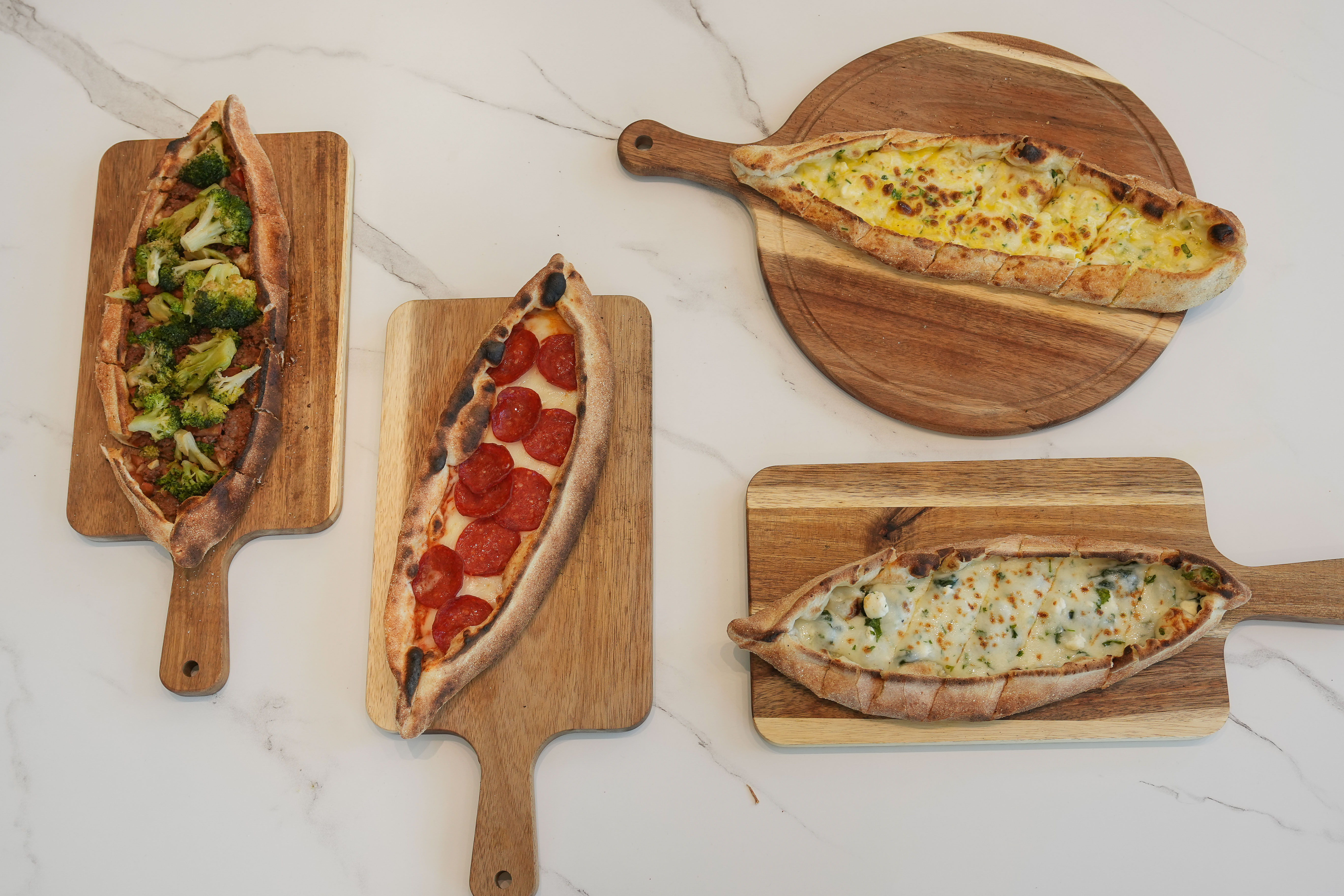
    Mazaj’s manakish are baked to order in a Forno Picone oven, a striking, mosaic-covered centerpiece near the front of the cafe. The flatbreads can be spread with za’atar and olive oil or topped with cheese or meat.

    And now there’s pizza.

    Pizza topped with beef pepperoni coming out of the oven at Mazaj, in Willow Grove, Aug. 4, 2026.Jessica Griffin / Staff Photographer

    It is the major menu addition in Willow Grove, baked in the same oven as the manakish. A separate commercial deck oven handles the cafe’s pastries.

    The expansion has turned Willow Grove into the baking hub for the partners’ other restaurants. The owners are shifting production from Malooga to the new cafe, which will supply baked goods to both Narberth and Old City. The company has also begun laying the groundwork for a wholesale operation to sell pastries to other coffee shops and supermarkets, and the partners say they are meeting with potential franchisees.

    Head baker Samar Alasbahi leads a baking staff with backgrounds in Yemen and Syria. The pastries are made in-house, and Tashkandi said leftovers aren’t put back into the case the next morning. Unsold baked goods instead go to employees, neighbors, and others in the community.

    Customers can linger in the comfy upholstered furniture at Mazaj.Jessica Griffin / Staff Photographer

    The partners have thoroughly remade the former pizzeria. Olive green and cream set the palette, with patterned tile, geometric motifs, Moroccan-style pendant lights, and a long pastry-and-coffee counter. Faux marble tables and caramel-colored chairs dot the narrow, window-lined dining room, while deep-green upholstered chairs and a sofa make up a small lounge. Behind glass near the front sits the new, dark-tiled brick oven.

    For all the Yemeni and Saudi influences behind Mazaj, Tashkandi said the idea is deliberately broader: a cafe where Middle Eastern food traditions overlap rather than stay within national boundaries. “We want the menu to reflect that diversity,” he said.

    Mazaj, 2700 Easton Rd., Willow Grove, 267-900-3167, mazajpa.com. Hours: 8 a.m. to 9 p.m. Monday through Friday, 8 a.m. to 4 p.m. Saturday and Sunday.

  • A Philly entrepreneur allegedly scammed NFL athletes, everyday investors out of more than $5 million

    A Philly entrepreneur allegedly scammed NFL athletes, everyday investors out of more than $5 million

    Hours before Mohamed Coulibaly was found dead in his Gloucester County home, one of his alleged victims said, the 23-year-old entrepreneur had been desperately seeking a $75,000 loan.

    A recent Barron’s investigation alleged Coulibaly defrauded three former NFL players out of $1 million in an e-commerce scheme involving fake Shopify stores. Now others who invested in the venture or lent Coulibaly money were blowing up his phone. They wanted to know if Jalen Carter and several former members of the Eagles, including Nakobe Dean and Terrell Edmunds, were even real clients, a claim Coulibaly made on promotional materials.

    Above all, these people wanted their money back.

    The morning of his death, July 31, Coulibaly solicited money from a New York man, who agreed to speak with The Inquirer on the condition of anonymity to protect his family’s privacy. He is one of at least 10 people, including the three former NFL players, alleging Coulibaly scammed them out of more than $5 million through phony investments over the last year.

    Coulibaly, who lived in Mullica Hill, a section of Harrison Township, promised to send a Lamborghini, two gold Rolexes, and a signed Lionel Messi cleat as collateral for what was to be a weeklong loan.

    Coulibaly still owed the man $1 million for a bridge loan due in March. Yet he insisted the additional loan somehow would make it possible to return the initial money owed. His alleged victim said he figured he could only gain from the arrangement — if the collateral proved to be real.

    But a driver — not in a Lamborghini — arrived at his doorstep with two fake watches, an unauthenticated signed cleat, along with an insurance card and a bill of sale for the promised luxe car, according to the man.

    The man called off the loan.

    “[Coulibaly] then started to cry hysterical on the phone,” the victim said. “He said, ‘I’ve lost it all, please help me here, please help me here.’”

    Coulibaly was found dead later that day.

    Mohamed Coulibaly attends Milan Fashion Week on Jan. 19 in Milan, Italy.Dave Benett/Getty Images

    The Gloucester County Prosecutor’s Office is leading the investigation into Coulibaly’s death and declined to comment. No charges have been filed in connection to the alleged scams Coulibaly is accused of spearheading.

    Coulibaly’s death has only added a layer of uncertainty for his allegedly defrauded clients, who now believe they were unwitting participants in a Ponzi scheme. New so-called investments went toward paying off other clients. But the chain could not be sustained.

    “In terms of his death, it sounds rather brash or harsh, but the only reason I’m upset for his passing is that he’s not able to go to jail and suffer,” the bridge loan investor said.

    The Inquirer spoke with four victims, all but one of whom asked to remain anonymous citing lingering shame, privacy concerns, and, in one case, safety considerations. They provided alleged contracts Coulibaly gave them, text messages, screenshots of their purported Shopify store sales, and a whistleblower report sent to federal and Pennsylvania financial regulators.

    In hindsight, the business always seemed too good to be true. The young entrepreneur convinced them they could rake in millions each month selling vacuums, printers, desktop humidifiers, and silicone trays on Shopify, an e-commerce platform similar to Amazon.

    At first, investors said they had no reason to question Vent Motion LLC, also known as Motion Venture. Shopify alerted the victims to a steady stream of sales through their phone apps.

    But at least two Shopify stores victims bought into were fake, full of transactions a Barron’s analysis suggests are also a sham. Shopify did not respond to requests for comment.

    The alleged victims say Coulibaly lured them in by highlighting purported investor relationships with wealthy and connected people. His pitch deck listed several former members of the Eagles and the NBA as clients. Representatives for the current and former Eagles declined to comment or could not be reached.

    “A selling point [Coulibaly] gave me was, ‘Hey, we only have about 90 to 100 people in this,’ insinuating you can make it behind the velvet rope because everybody involved is celebrities or athletes, and this is just a venture they do,” said another of the defrauded investors, requesting anonymity because family and friends do not know about the scam.

    Yet as more victims have found one another in the wake of Coulibaly’s death, it has become clearer the scheme was not limited to targeting NFL players.

    It involved everyday investors from Arizona, Pennsylvania, and New York who now want to know if any of it was real.

    A ‘magnetic’ man with the digital footprint of a business phenom

    Coulibaly knew how to sell the image of a successful entrepreneur.

    He was a guest on numerous podcasts and featured in publications such as Disrupt Magazine, Business Insider Africa, and the Source in recent years; some of the pieces have no author byline, making it unclear if they were paid content.

    His story always hit the same beats: Coulibaly was a professional soccer player. He made $4 million reselling rare sneakers before he turned 21. His success was largely attributed to “building connections” with athletes and influencers. Grinding was the key to success.

    But much of that was embellished.

    A database for American high school sports coverage noted Coulibaly played soccer for Roxborough High School.

    Coulibaly said he began his professional career with the New York Red Bulls soccer team, but a spokesperson said Coulibaly never had a contract.

    A friend from Coulibaly’s days at Temple University said the sneaker venture Heatkickcity was also a scam that swindled students out of thousands. He asked not to be named out of safety concerns, saying Coulibaly often touted relationships with gang-affiliated people.

    While Coulibaly told publications he was born in Mali, West Africa, and immigrated to the United States at a young age, while in college, he often intimated that he was a trust fund child and that his parents worked for the French government, the Temple friend said.

    He added that may have helped induce so many of their peers to pay a $1,200 membership for monthly access to rare sneakers that ultimately never came.

    “He’d be like, ‘It’s stuck in shipping,’ or ‘my assistant forgot to order them,’ or ‘my assistant’s slacking,’ and then he would just keep on extending it, extending it,” said the friend. “If you questioned him in any way, shape, or form about the product that you paid for, then he would switch to angry mode.”

    The friend eventually got his money back after pressuring him for weeks but said Coulibaly continued his self-proclaimed pursuit of becoming a billionaire.

    “He scammed his best friends,” the friend said. “Nobody was off-limits.”

    Coulibaly’s next venture was fashion line Motion Apparelz. It was profiled in Forbes last year, where the author describes Coulibaly’s energy as “magnetic.” In the piece, Coulibaly name-drops artist friends, including rapper YG, who was later listed as an investor in Motion Venture promotional materials.

    Rapper YG performs at the Coachella Music & Arts Festival in 2019.Amy Harris

    YG’s agent could not be reached for comment.

    Outside of the glowing profiles, a now-defunct Instagram account also detailed a lavish lifestyle full of run-ins with celebrities, boat jaunts on luxury yachts with city skylines in the background, and snapshots of Coulibaly in or in front of private planes. Often, Coulibaly could be seen wearing gold watches, what appear to be Van Cleef & Arpels bracelets, and diamond-studded chains.

    Coulibaly’s digital footprint set the stage for an even bigger business pitch.

    A business promising exorbitant returns

    When it came to Vent Motion LLC, Coulibaly told clients he operated “factories in China and India with a combined team of 125 full-time employees,” according to a pitch deck he showed investors that was obtained by The Inquirer.

    This allowed stores to operate without keeping any inventory and reducing overhead — a model known as drop-shipping.

    The savings from eliminating the middlemen, he said, could then be reinvested into artificial intelligence-driven ads and “influencer amplification” to drum up more customers. Coulibaly’s company would set up and manage the Shopify stores on behalf of investors, pushing out additional advertising or swapping out products if sales slowed.

    Clients would be charged a 20% to 25% service fee for that work, and even so, Coulibaly dangled extraordinary returns for those who joined the venture.

    One Shopify store that began with a $550,000 investment in January 2024 had allegedly generated $2 million in revenue in April and a whopping $23 million in July of that year. By August, this particular store had generated a total of $84 million in revenue, according to the company’s unsubstantiated pitch deck.

    Further sweetening the deal was an initial investment “protection” guarantee if their store did not generate profit within six months.

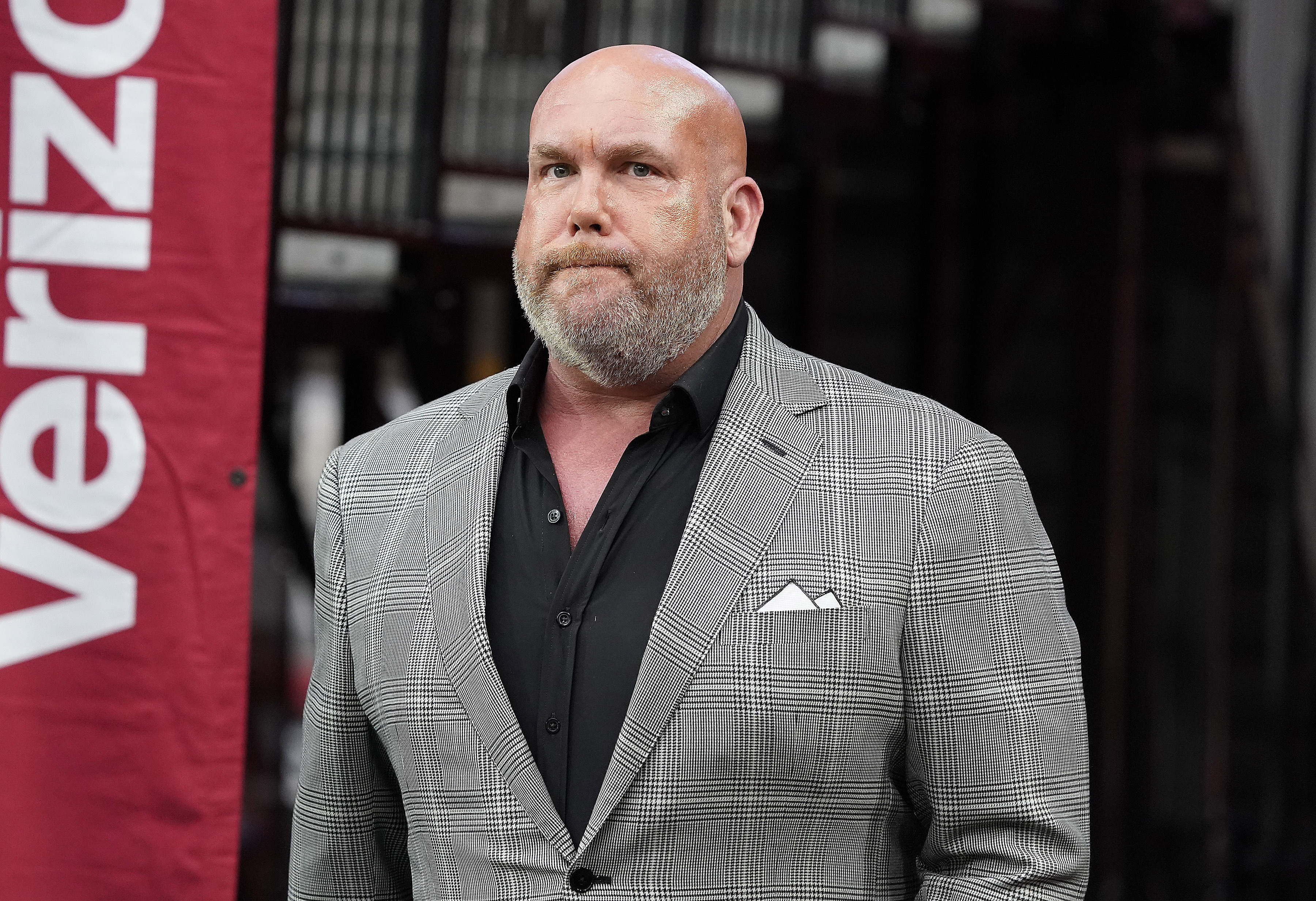
    Former Arizona Cardinals General Manager Steve Keim says he was just as much of victim of Mohammed Coulibaly’s alleged scam.Darryl Webb

    It’s what got Steve Keim, former general manager of the Arizona Cardinals, into the business.

    Keim said he met Coulibaly through mutual Eagles acquaintances and by August 2025 he had bought his first Shopify store, which was recording sales at a pace that had him on track to triple his investment over six months. Keim bought into six more stores the following month, he said. His son and ex-wife would also buy into the business for at least a $1 million investment between all three.

    Keim said he was soon offered the role of chief operating officer/chief growth officer, which he now sees as a way for Coulibaly to “legitimize his business.”

    “I introduced him to people to sell stores to and that sort of thing,” said Keim, who describes fulfilling a figurehead role with no decision-making power. “He called me the COO but he also made promises to give me health insurance and to have some kind of bonus structure.”

    The health insurance, bonuses, and exorbitant returns never materialized. Keim said he never had access to bank records and was never made aware of how many people gave money to Motion Venture. But by the start of the year, Keim claims, a flood of disgruntled investors were asking him for help getting their money back. Around this time, Keim said, he asked Coulibaly to stop using his name in promotional materials and told him he no longer wanted to be COO.

    Keim contended he was as much of a victim as anyone else, holding onto hope that he could recover his money until Coulibaly’s death.

    “This went downhill fast,” he said. “Not only did I get my name drug through the mud, I lost a lot of money since I was an investor.”

    A Dubai deal

    As more investors were demanding access to their Shopify funds in the fall, Coulibaly was telling them that the Dubai firm Middle East Venture Partners was interested in buying the operation for $215 million.

    All they had to do was reach 175 online stores and meet other benchmarks by Aug. 1.

    To back his claim Coulibaly produced a letter of intent dated Aug. 14, 2024.

    Troubling for investors: The letter was dated more than a month before the company was registered in Pennsylvania.

    The discrepancy was the biggest red flag for Barry Minkow, a convicted fraudster who now investigates scams on behalf of fraud victims. He started poking around the company at the start of the year for an investor who had put up $150,000.

    “So here you are looking at a private equity company saying they’re going to buy up this company that doesn’t even exist for $200 million?” Minkow said in disbelief.

    Middle East Venture Partners did not respond to an email to asking if a relationship existed with Coulibaly’s Vent Motion LLC.

    With the permission of three of the alleged victims, Minkow submitted a 23-page whistleblower report to the U.S. Securities and Exchange Commission, FBI, and Pennsylvania Department of Banking and Securities. The report laid out victim accounts and flagged glaring issues with Motion Venture’s business model.

    Minkow warned regulators in February that intervention was essential to “halt ongoing solicitations, trace misallocated funds,” and stressed the importance of doing so “before the scheme inflicts further, irreparable harm.”

    Minkow would prove to be right. Motion Venture was still actively recruiting new investors that month.

    Picking up the pieces

    Coulibaly’s college friend thinks he might have been one of the first victims of the Shopify sometime about three years ago. It involved less paperwork back then, more of a handshake deal. The friend put in $5,000 in a store with an investment protection promise in place, he said. Unlike that time in college, however, the friend only got half his money back.

    The friendship with Coulibaly cooled after that.

    “People just keep on saying he scammed NFL players,” said Coulibaly’s college friend. “No, anybody with money could be scammed, no matter how small.”

    Coulibaly would insist money issues were the Dubai firm’s fault until his death, according to his alleged victims who shared screenshots and voice memos of conversations.

    He ricocheted from distraught, lamenting the financial ruin that awaited him if he did not acquire more investors, to defiant, celebrating the Philadelphia 76ers’ LeBron James trade on X as he dodged investors.

    When Keim and another investor flew into Philadelphia to meet with Coulibaly in late July, they spent a day and a half trying to figure out how much money was left, to no avail.

    It was around that time that Coulibaly was soliciting the New York man for the $75,000 loan.

    Coulibaly’s last post on X was a reshare a day before his death. “Trying to be everyone’s friend is a foolish behavior,” it read.

    Whether any investor money remains is unclear. A now-defunct GoFundMe page put together by a man claiming to be Coulibaly’s brother raised more than $12,000 for the body’s “international transportation arrangements.”

    Investors are also trying to figure out what legal recourse they might have, if any.

    Coulibaly’s death has shattered any last remaining hope some victims had that a Dubai firm was to blame for cash-flow issues, and they are now seeking legal help.

    It also left them feeling cheated one last time.

    Staff writer Ryan W. Briggs contributed to this article.

  • This corner store has the best chicken sandwich in Philly, but we don’t quite know what it’s called

    This corner store has the best chicken sandwich in Philly, but we don’t quite know what it’s called

    When Point Breeze resident Bonnary Lek, 46, first moved to the neighborhood in 2023, a neighbor told her that at the corner of 17th and Wharton Streets, “there’s an Asian couple who makes the best chicken sandwich in Philadelphia.” This particular sandwich has found fame in Point Breeze and far beyond, primarily through word-of-mouth.

    Some people refer to the store, which has no visible signage, as Mrs. Lee’s. Even Lek and her fiancé, Manong sous chef Juan De Ocampo, cannot agree on what to call the store. De Ocampo swears it’s “Jimmy’s.” Credit card receipts read “Kim Woa Store,” a name which is strikingly similar to another South Philly fried chicken sandwich institution, Kim Woo Store, which is at the corner of 19th and Moore Streets.

    Whatever the name of the store is, it’s an ordinary corner store with uneven linoleum floors laid with mismatched tiles, soda bottles lining the shelves along with single rolls of toilet paper and canned soup. Extremely neat, if a bit shabby.

    Longtime regulars drive in from New Jersey, Delaware, and as far south as North Carolina — mostly former Point Breeze residents who need their chicken sandwich fix. TikTok has brought customers as far away as Canada.

    The store is owned by Lynda Cong, 50, and Jimmy Cong, 53. They met in Philly in the early 2000s, after Lynda came to the area to study public health at Stockton University. Both the Congs are southern Chinese, but came from Saigon, now Ho Chi Minh City. They speak to their children (the two younger ones help out in the store, and two older ones are grown) in Cantonese.

    A customer, before he moved away seven years ago, presented the Congs with a custom sign that reads: “The Best Chicken Sandwich in Philly.” It hangs in the spotless, stainless steel kitchen, facing the interior of the store.

    Above the kitchen window: a handwritten menu with prices scratched out.

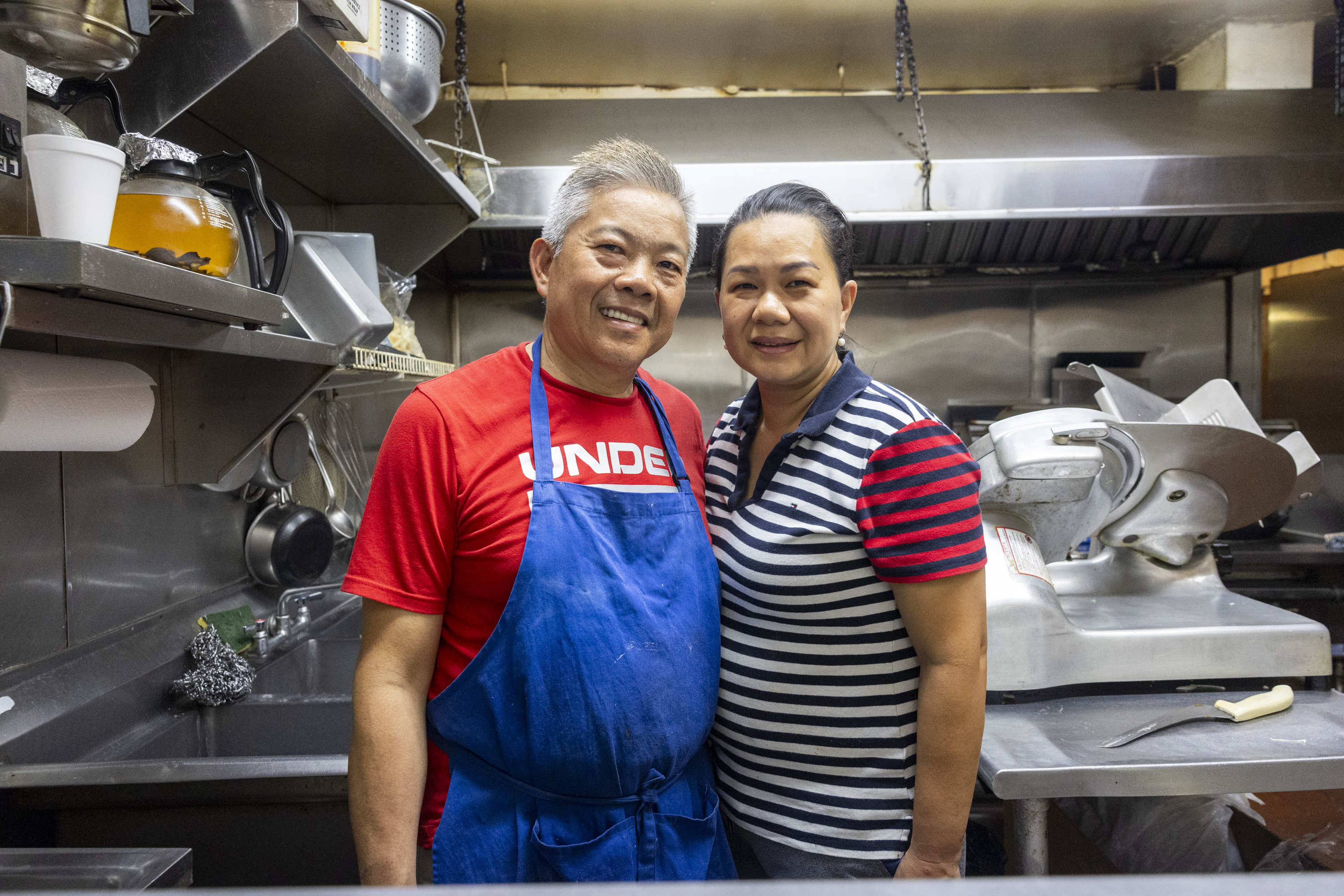
    Lynda Cong and her husband, Jimmy Cong, pose for a portrait at their corner store in Philadelphia on Aug. 5, 2026.Tyger Williams / Staff Photographer

    The Congs took the store over from Jimmy’s sister “between 10 and 15 years ago,” according to Lynda, when the sister retired. Jimmy’s sister was known as “Mrs. Lee” and she first opened the store in 1986. “Kim Woa” is an older Romanization of the Cantonese phrase “gam waa,” which translates literally to “golden splendor” and means “prosperity.”

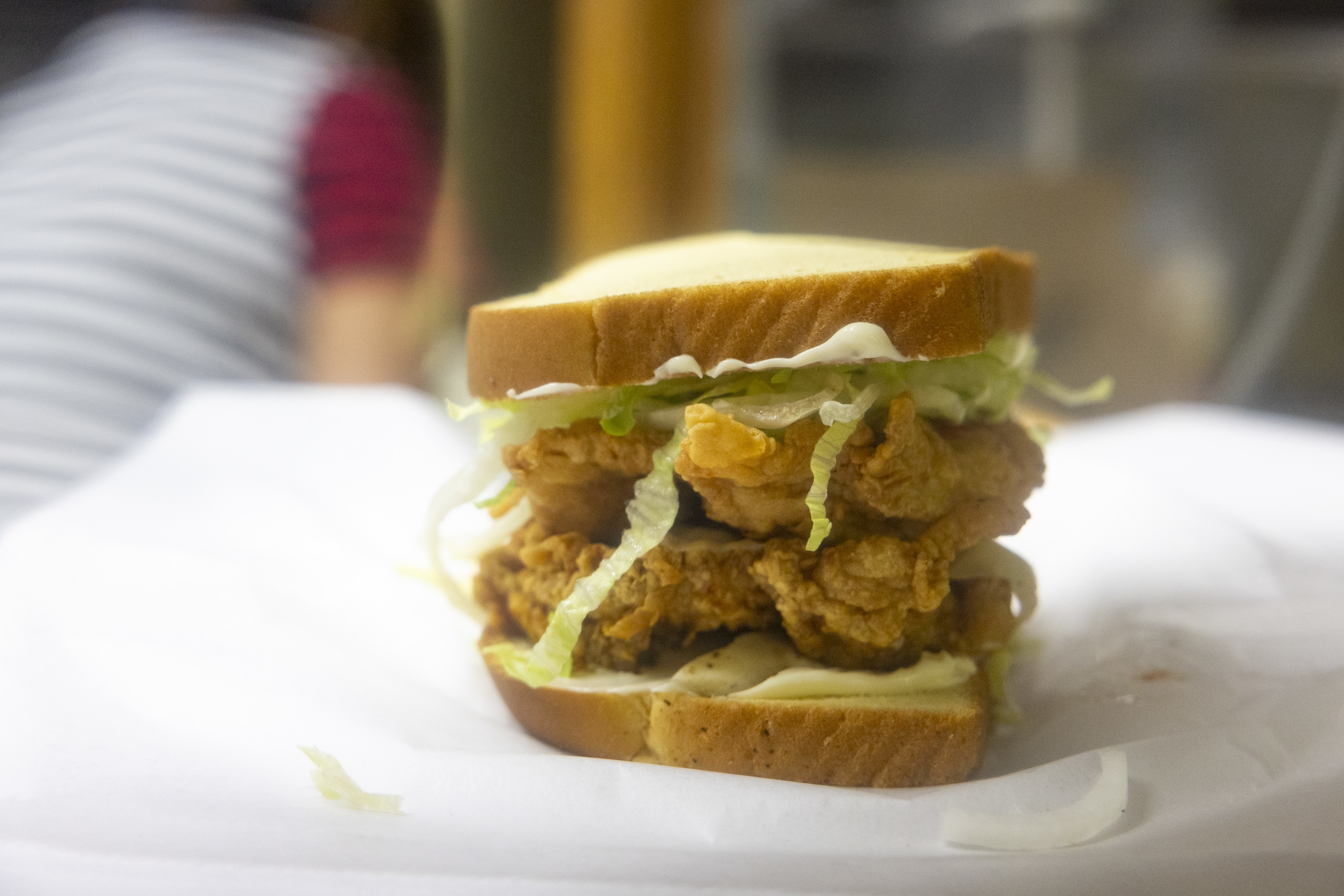
    “Golden” is apt, as it accurately describes the fried breading on the sandwich, which costs $9 and consists of two chicken breast cutlets, thickly breaded with a super crunchy exterior. Ordering it “with everything” means that it comes with pickles, mayo, onion, tomato, and lettuce, laid on two slices of potato bread.

    Earlier this year, a few TikTok influencers also discovered the sandwich, though it has still hardly reached the point of virality. The chicken sandwich whisper network, however, did prompt me to get one.

    After one bite, I promptly texted my editor, “I hit the chicken sandwich jackpot.”

    @reusparx

    Is this The Best Chicken Sandwich in Philly ? I let My Followers Pick My Spot & Meal for The day & This Was The First Suggestion ! So I’m at Kim Woo Store in Philly on 19th St I Got The Chicken Sandwich 🔥 . . . . . . . . . #food #fyp #philly #foodie #WhereToEat

    ♬ original sound – Reusparx

    The wings are improbably juicy, with the same crispy breading and are perhaps even more delectable than the famous chicken sandwich. “It’s just salt, pepper, flour, water, and garlic powder,” said Lynda, who has met this sudden interest in the sandwich with amusement. The Congs now sell about 50 of the sandwiches every day; they say the interest has only somewhat affected daily sales.

    The sandwich and the wings (three for $5 or six for $9.60), along with a massive array of salads, cheesesteaks, hoagies, wraps, and fried rice, emerge from a highly polished and well-scrubbed stainless steel kitchen. (You can order things that aren’t even on the menu. You can order whatever you’d like in a wrap.)

    Over the years, the Congs have watched the neighborhood around them evolve. They’ve added most of the menu items to meet new demands and new tastes. But the chicken sandwich has stayed the same.

    Kim Woa Store, 1300 S 17th St, 215-463-5426, Hours: Monday to Saturday, 9 a.m. to 6:30 p.m.

  • Pennsylvania’s data center boom needs a pause | Editorial

    Pennsylvania’s data center boom needs a pause | Editorial

    What does it say about Pennsylvania’s political leadership when U.S. Rep. Ro Khanna, a progressive Democrat from California, seems more in tune with where voters stand on data centers than many top elected leaders in the Keystone State?

    Khanna, a native of Bucks County, said Pennsylvania should do more to safeguard communities from the proliferation of data centers across the nation. He’s proposed a Data Center Bill of Rights to protect residents from the environmental and financial harms caused by the energy-sucking centers needed to fuel the artificial intelligence boom.

    If Congress approved Khanna’s measure — which is unlikely as long as Republicans control both chambers in Washington — it would pause the current runaway development of data centers.

    Pennsylvania is among the fastest-growing states for data centers. More than 50 of them have been proposed, planned, or are under construction in the state. So far, six are being built and 10 have received at least one state-level permit approval, according to Shapiro’s office.

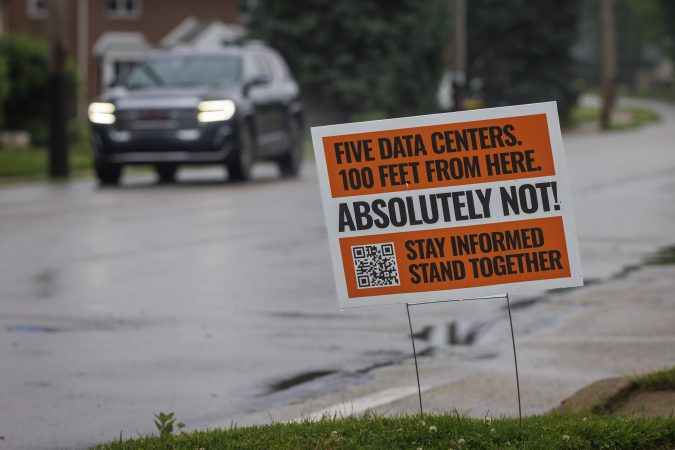
    Opposition to data centers may be the only issue that unites voters from all sides of the otherwise divided political landscape. In Pennsylvania, a whopping 74% of voters are against building an AI data center in their community, according to a recent Quinnipiac University poll.

    Residents fiercely oppose a two million-square-foot data center proposed outside Conshohocken. Tempers flared at a public meeting in King of Prussia where the same developer, Brian O’Neill, wants to build five other data centers totaling 4.6 million square feet.

    Several have already been built in the Philadelphia region, while two are under construction: one for Amazon in Bucks County, and another for Microsoft in Cumberland County in New Jersey.

    Across the country, residents have complained about sharp increases in electric bills — including a 20% increase in Pennsylvania since 2024 — caused, in part, by the growing power demands of data centers.

    Others said their once-quiet communities have been ruined by the constant noise coming from the facilities, including one in Vineland, N.J.

    Gov. Josh Shapiro announces a $20 billion investment by Amazon in Pennsylvania data centers in Salem and Falls Townships in 2025.Commonwealth Media Services

    Still others said data centers caused their water wells to run dry, while many fear increased water bills from the need to cool large data centers that use an estimated five million gallons of water each day, equal to the usage of a town of up to 50,000 residents.

    Sen. Dave McCormick (R., Pa.) has championed the development of data centers along with President Donald Trump. (Conflict of interest alert: McCormick’s wife is an executive at Meta, one of the leading developers of AI data centers.)

    Gov. Josh Shapiro (D., Pa.) initially trumpeted efforts to bring data centers to the state. Just over a year ago, Shapiro said his administration was “all in” on AI, but his position has shifted somewhat in the face of the growing public backlash.

    In May, Shapiro, who is up for reelection in November, unveiled standards designed to place guardrails on the energy usage of data centers and give local communities more input.

    In recent months, Shapiro has met with some residents about data centers and acknowledged concerns about the impact on utility bills and the environment.

    However, the governor still supports $2 billion in tax breaks for data centers if they meet his proposed standards, even after the state House voted 197-5 to repeal the sweetheart deal.

    Shapiro’s opponent in November, Treasurer Stacy Garrity, initially supported data centers, but now favors a pause. The shifting positions of both gubernatorial candidates underscore how data centers are roiling politics and animating voters.

    Supporters argue the data centers will bring investment and construction jobs to the state, and position the country to compete in the global AI race.

    But at what cost to consumers left to shoulder the rising electric and water bills, not to mention the environmental harm?

    Lawmakers have been slow to consider that part of the equation, as no one can say if the hyped benefits outweigh the real costs.

    Elected officials are supposed to represent the interests of the people, and not the deep pockets of big businesses. Until lawmakers find ways to protect residents from the true impact of AI data centers, a pause makes the most sense.