The Union’s 15-game unbeaten streak in regular-season play is one of the most impressive feats by any team in MLS this season. But it’s no secret that a lot of the games have been against teams that were equally bad when the run started, and worse lately.
That started to change when the Union went to Chicago, but that 3-1 win was helped significantly by Jack Elliott’s ejection at the end of the first half. Then came Saturday’s 2-2 tie with Charlotte, which was a fair measure of good teams one point apart in the standings.
Milan Iloski (right) on the ball for the Union in last Saturday’s tie with Charlotte.Elizabeth Robertson / Staff Photographer
Now comes another big test. New England comes to Subaru Park on Saturday third in the East, on the heels of a win over fourth-place Chicago that put a four-point gap between those clubs. The Revolution (16-10-4, 52 points), Miami, and first-place Nashville — which almost has the Supporters’ Shield clinched — are the class of the conference.
If the Union beat the Revolution, they will clinch a playoff spot. They can also do so with a draw against New England but would need one of the following scenarios to occur:
Red Bull New York DRAW vs. Inter Miami CF
Columbus Crew DRAW vs. Toronto FC, or
Red Bull New York LOSS vs. Inter Miami
The gap from third to the Union in sixth (13-10-7, 46 points) is just six points with four games to go. That isn’t so big, though the Union will follow Saturday’s game with a visit to Nashville.
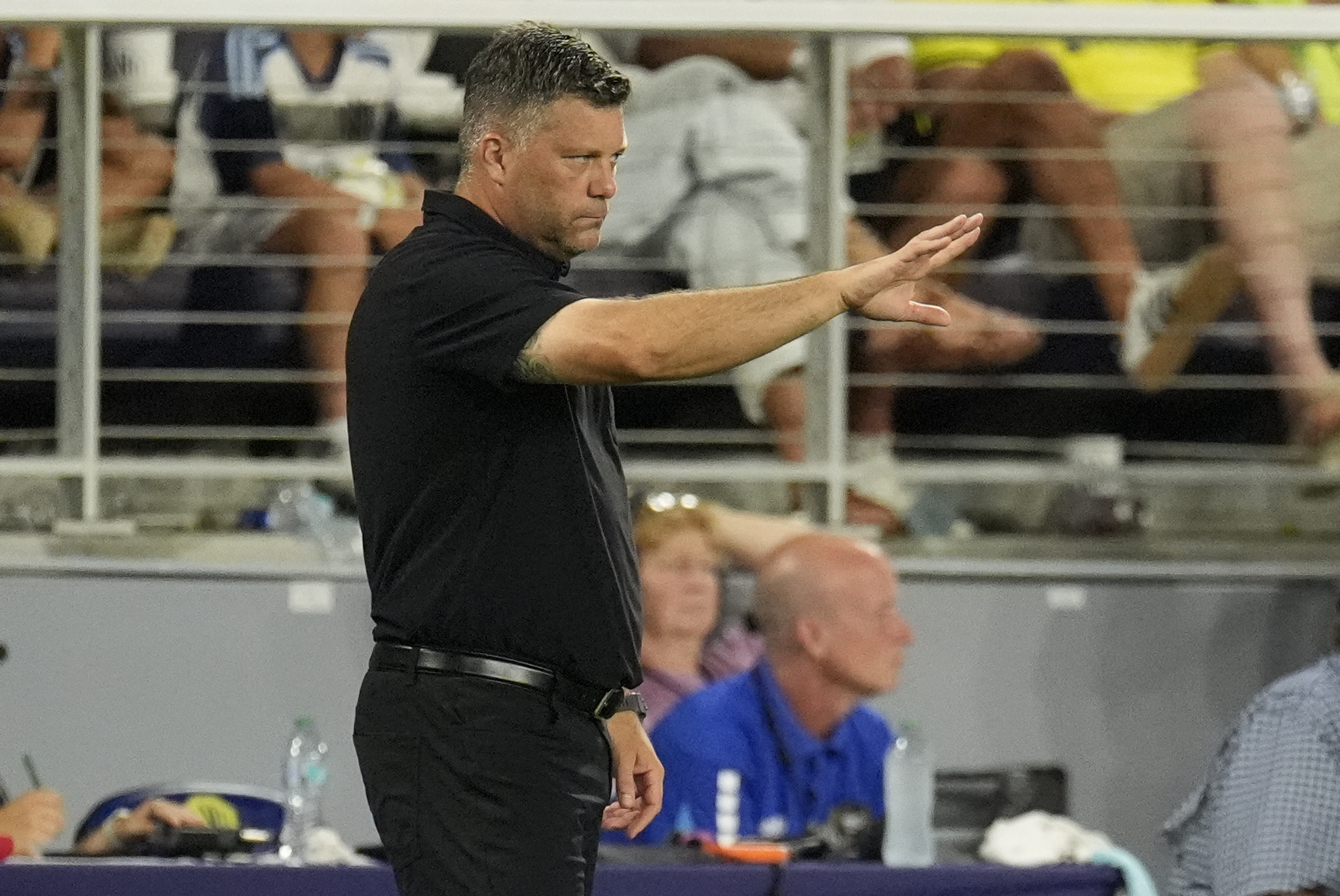
Nashville head coach and Philly-area native B.J. Callaghan can clinch a Supporters’ Shield title with a win this weekend. George Walker IV
The men from Music City should seal their trophy Saturday afternoon at last-place CF Montréal. If they do, Wednesday will be the celebration. If they somehow don’t, Wednesday could be the night they clinch it with a result against the Union, last year’s winners.
Richter knows this is the stretch that lots of outsiders have circled as the one that will prove the Union’s true level.
“It’s a pretty cool position for us to be in, where we get on our great run over the last couple of months and now we get the tests of, ‘Is this the company that we belong in?’” he said. “For us to be successful, to continue to show that these are the teams that we are competing with, the teams that we can compete with, we have to be at our best going into the game on Saturday.”
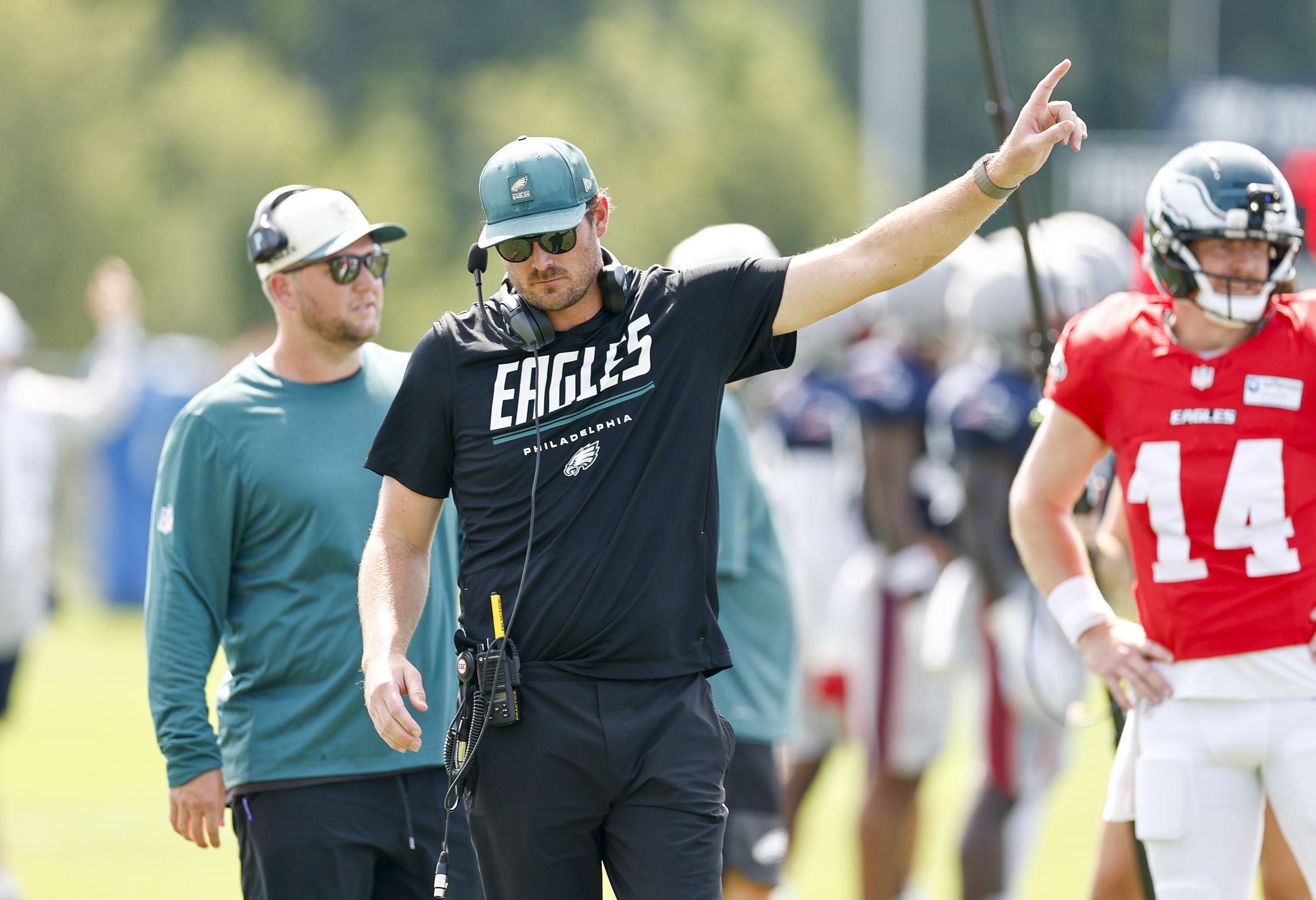
Even with all the injuries and ineffectiveness through six games, Sean Mannion is still a believer in the Eagles offense, saying the problems are “totally fixable.” The Inquirer’s Jeff McLane and Marcus Hayes have some thoughts on the state of Mannion’s group, as well as a defensive unit that’s also been underwhelming this season.
Jeff McLane:When it comes to the game plan, the play- calling, what do you think will [need to] happen for Nick Sirianni to kick-start this offense?
Marcus Hayes: The reality is that this was never a great offense, no matter who ran it. It was a great offensive line. And I’ve been preaching that for what, 12 years now, 13 years. Jeff Stoutland and Lane Johnson came in together and essentially went out together. And we’re seeing the worst offensive line play in that interval right now.
Nobody likes to talk about the offensive line. Rather talk about the coach and the quarterback, but the coach and the quarterback only go as far as the offensive line goes. Now, that’s sort of part A. Part B, and the listeners and viewers probably aren’t gonna want to hear this, is there is not a lot you can do in the middle of a season to fix something that is this broken, and was never that good to begin with.
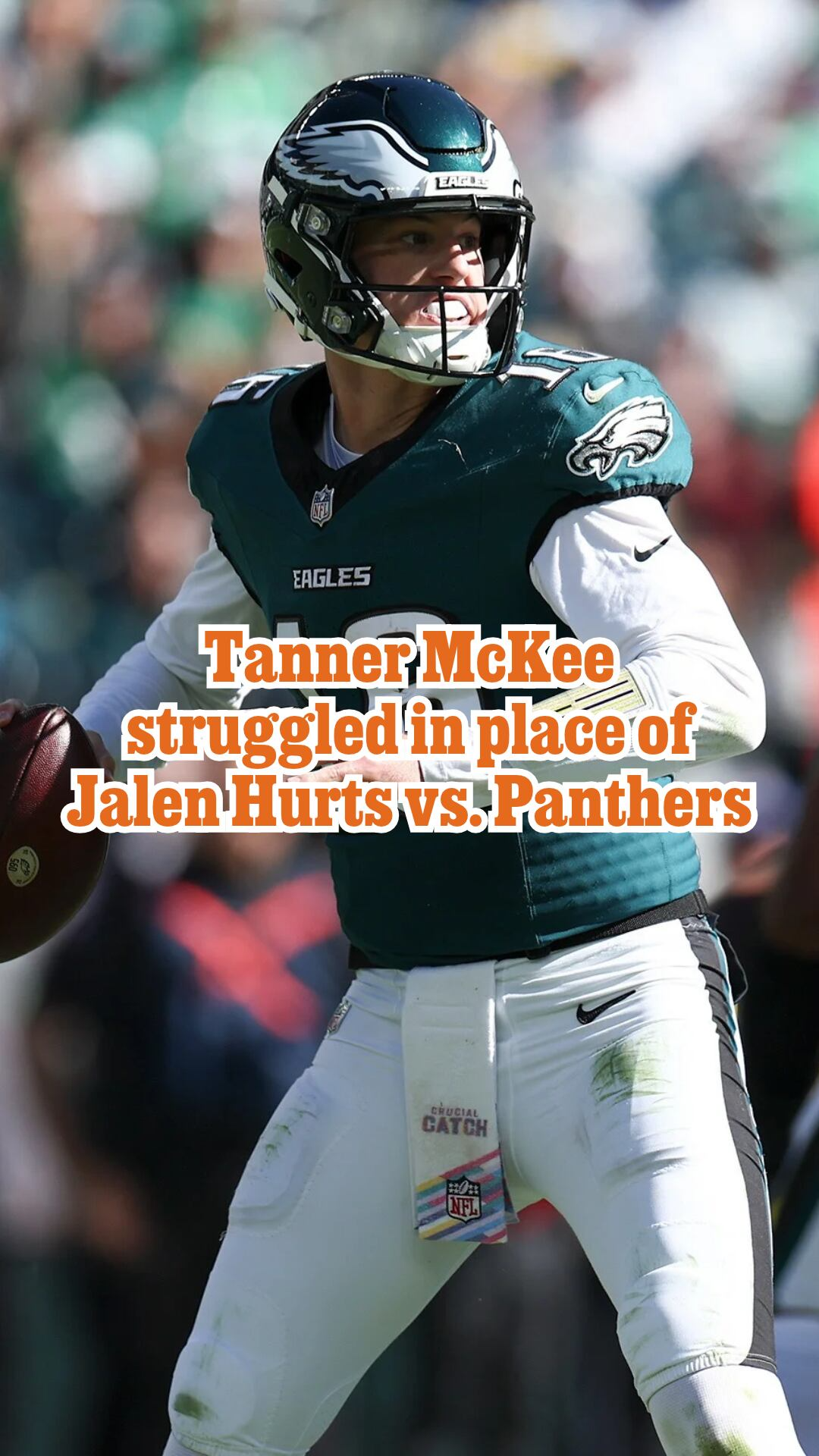
Video: Gameday Central: Tanner McKee struggled in place of Jalen Hurts vs. Panthers
We saw Saquon Barkley running three and four yards without being contacted routinely in 2024. And I want to say in 2022, the offensive line was probably the best it ever has been. It’s probably the best offensive line in the history of the Philadelphia Eagles. So that’s the issue. And benching Sean Mannion, diminishing Sean Mannion, elevating Nick Sirianni, none of that in my opinion will matter much, especially when you’ve got a third-string left guard and a third-string center playing for you, and starting for you.
The conversation before the season, Jeff, was OK, it’s gonna take four to six games before this offense jells. And that was best-case scenario. That was without Lane Johnson retiring. That was without Landon Dickerson getting hurt, precipitating the move of Cam Jurgens to left guard, precipitating Cam Jurgens’ trade.
We know the offense isn’t working and they have tons of issues surrounding it that aren’t coincidental. I don’t know that you can judge this offense when you’re saying, well if Drew Kendall was there, it would be way better.
McLane: Yeah. I think things are more schematic, because these problems existed before all the injuries. It was there from the get-go. I know you’re saying in terms of it being early in the season. …
Hayes: Landon Dickerson was injured in the first game and he was the worst player on both teams. They won that game [against the Commanders] and he almost cost them the game. The injuries and Lane Johnson didn’t play after [Week 3] … my point being we don’t know. We just don’t know.
McLane: I’m not saying we know. I’m just telling you what I think, that the problems are schematic and Nick’s inability to fix them are like the number one problems offensively. There’s just little things they can do, that may be more realistic of what happens here in terms of the scheme.
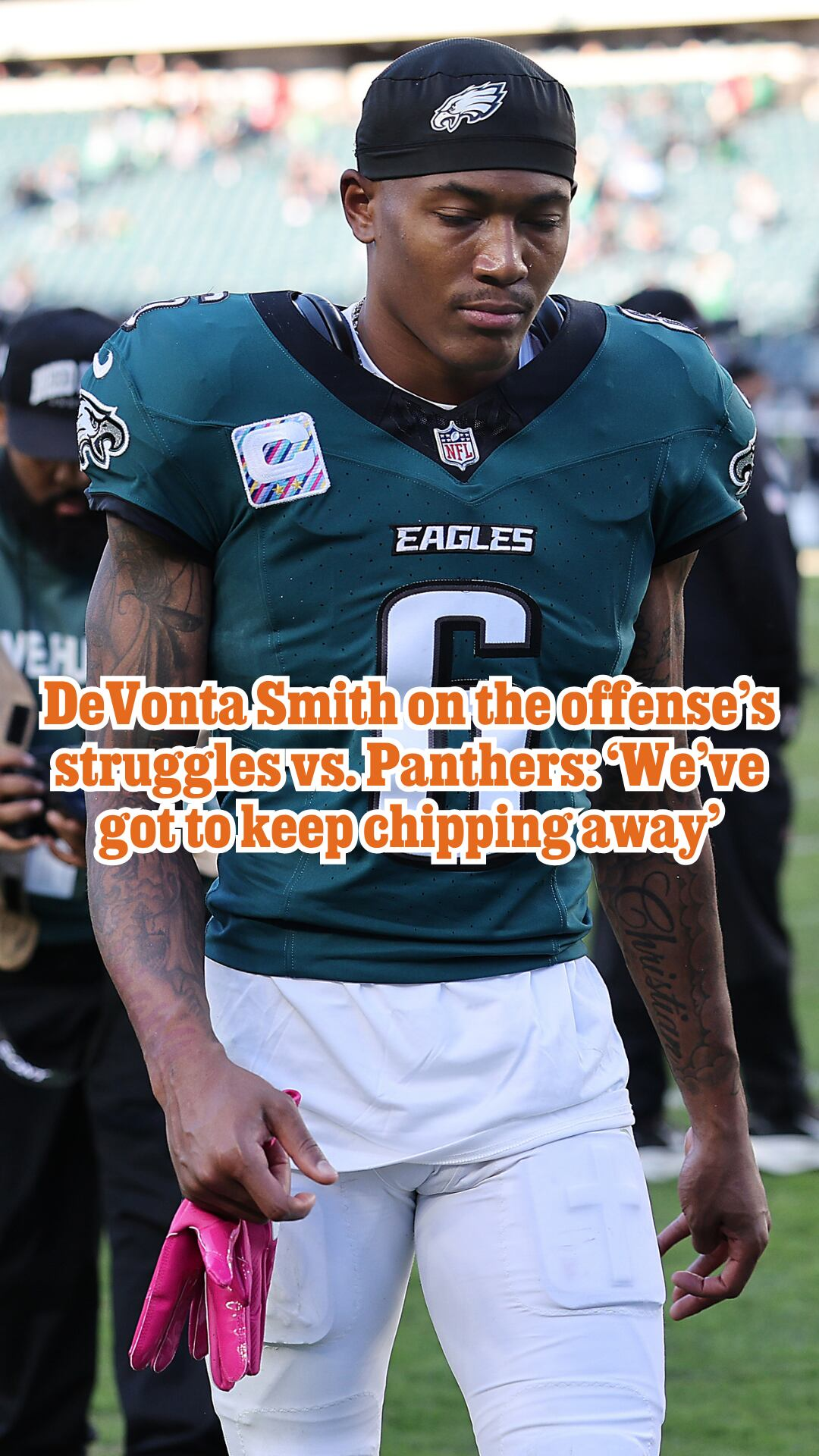
Video: DeVonta Smith on the offense’s struggles vs. Panthers: ‘We’ve got to keep chipping away’
Stop doing stuff from under center, because defenses know you’re either gonna run the ball there or you’re gonna run a play-action and they’re just gonna blitz you every time. We saw this in this [Panthers] game. Tanner McKee under center, drops, run fake, they blitz, zero completions, two sacks, guys unblocked. To me, that is like the number one tell that Mannion and offensive line coach Chris Kuper are kind of in over their heads, because this is very simple football.
Yes, I understand that there’s some new guys up front, but you can’t have four guys blocking two guys. You can’t have three guys blocking one guy. It’s like that. That is some very simple stuff. And then we’re now six weeks into this, and the same thing is happening over and over again.
So what I think they can do is change it more to go back [to shotgun] more, because if you look at the [expected points added] numbers under center versus shotgun, way better under shotgun. This is what Nick’s offense has been essentially with Jalen Hurts at quarterback. And I think to some extent it plays to Tanner McKee’s strengths, in terms of being stronger pre-snap than post-snap, you want your quarterback in the shotgun so that he can see the defense and execute it and you could run the inside-zone stuff. You can do more RPOs, you can get more up-tempo on the ball.
It simplifies things for the players and essentially for the play-caller. And I think that may be more what Nick can do to kind of change things here midseason. We’ll see if there’s more to it. We may never even know. You know, as I found out in 2023, for weeks they had the third-down [defensive play-calling] taken away from [then-coordinator] Sean Desai, which basically foretold his inevitable fate.
There are serious flaws in this offense. And a lot of it has to do with the fact that Sean Mannion is new, a first-time guy, and maybe you understood that going in. You can go back to the very origin of hiring a first-time guy and why they’re in this predicament in the first place, and how that happened.
I’d be interested to hear what your take is about Nick’s role in all this and why they’re now in year six and can’t figure out the offensive coordinator conundrum. I think at some point to save himself, he may have to take control over play-calling or just take authorship over it.
Pennsylvania lawmakers this week passed a bill banning cell phones in schools, joining states across the country amid mounting backlash to technology in classrooms and social media addiction.
Gov. Josh Shapiro, who previously called for a so-called bell-to-bell ban, is expected to sign the measure into law soon.
“It’s time to get back to the basics in school and let our kids be kids,” the Democratic governor said in a post on X on Wednesday, after the House and Senate had passed the bill.
The bill will require schools to bar kids from using cell phones throughout the school day, starting next fall. Here is what to know about the new rule and how schools are reacting:
A ban on ‘mobile devices’
Under the bill, both public and private K-12 schools will be required to prohibit students from using personal mobile devices from the start of the school day to the end.
That applies to cell phones, but also to other internet-connected devices, like smartwatches, according to the bill.
Before the 2027-28 school year begins, Pennsylvania schools will have to adopt policies describing how they intend to prohibit students from using their phones.
“For too long, access to a phone-free school day depended on which school a student attended,” Alex Bird Becker, a Wallingford-Swarthmore parent and coleader of PA Unplugged, a statewide advocacy group, said in a statement. “Once this law takes effect, every student in the Commonwealth will have freedom from addictive algorithms, from the first bell to the last.”
Exceptions for medical and special needs
The bill allows a number of exceptions for “limited use” of a phone:
Students who need phones due to a medical condition.
Students with individualized education plans or 504 plans that require phones as an accommodation.
Students who are English learners who use phones for translation.
Teachers can also permit students to use phones “for instructional purposes,” if a school-issued device is inadequate or unavailable and the principal approves the use, according to the bill. Principals can also apply to their chief school administrators for exceptions.
The law was supported by the Pennsylvania State Education Association, the state’s largest teachers union. President Aaron Chapin said the law “takes an essential step toward reducing distractions for students during class time and keeping lessons and teaching on track.”
How schools are responding
While most school districts already have policies related to cell phones in place, the bill will require many districts to restrict phones more than they already do. Many area high schools allow students to use their phones between classes and at lunch, which will be barred by the bill.
At the 1,600-student Garnet Valley High School in Delaware County,“we don’t have the manpower” to have staff at three different entrances used by students, telling them to put their cell phones away, Superintendent Marc Bertrando said.
Instead, he expected responsibility would fall to first-period teachers — and teachers throughout the day, given a lack of adequate supervision to enforce a ban in hallways between classes.
While “you try to minimize conflict points with students,” Bertrando said, he anticipated more conflict as a result of the ban, “especially if we’re going to get down to the level of ‘Let me see that watch.’” He also predicted pushback from parents used to being able to reach their children directly during the school day. (The bill says schools must provide parents with a phone number or email address to be used for receiving messages during school.)
Bertrando noted that Garnet Valley had worked to produce a policy supported by teachers, parents, and students that restricted, but did not entirely bar, cell phone use by middle and high school students during the school day.
“To take that away from us is incredibly frustrating,” Bertrando said.
The Pennsylvania School Boards Association believes “elected school boards should retain the flexibility to determine the approach that best serves their students and communities,” spokesperson Mackenzie Christ said.
A number of districts have been preparing for new restrictions. Lower Merionin Montgomery County,which has faced parental pressure to adopt a bell-to-bell ban, has said it would enact one in 2027-28, regardless of whether the state required it.
The Philadelphia School District currently allows individual schools to set their own cell phone rules, though the system-wide policy says that district students “should not use cell phones or wearable devices in classrooms unless permitted by a school staff member, or permitted by this policy expressly. Each school shall create their own protocols that designate areas within the school and times of day where student use of cell phones” is permitted during school hours.
That looks different in different buildings. Some schools require students to secure cell phones in lockers outside the building; others require students to place phones in sealed pouches. In some cases, students have access to phones in hallways and the cafeteria, but surrender phones when entering individual classrooms.
Wanda Odom, a spokesperson for the Philadelphia school board, said the board “recognizes the impact excessive cell phone use can have on student learning and well-being.”
“While current district policy allows schools to establish their own cell phone restrictions, the district will work with principals, educators, students, and families to inform the development of a districtwide policy for consideration and adoption by the board of education ahead of the 2027-28 school year, consistent with the new state legislation,” Odom said in an email Thursday.
Staff writers Kristen A. Graham and Gillian McGoldrick contributed to this article.
The Union announced Thursday morning that they agreed to a new contract with prized centerback Neil Pierre, guaranteed through the summer of 2031 with a team option for the 2031-32 season.
It’s not that the Union felt the need to sign Pierre, who turned 19 on Monday, because he’s itching to leave. He isn’t, even though everyone knows his time will come soon enough — and when it does, should he stay on his current trajectory, there should be a large number in the headline.
Conversely, the Union aren’t in any haste to cash in. They’d like to keep him at least through the “sprint season” in the first half of 2027 that will start Major League Soccer’s transition to a fall-to-spring calendar. Along with improving the odds of winning, it will let Pierre play with Mark McKenzie, who will join the team in January. That should look good on the field, and the club’s marketing department likely won’t mind either.
In fact, the eye-catching thing was the length of the new deal. Pierre was already signed through 2029, with a team option into 2030, and no one expects him to be in town that long. So why agree to something even longer?
The 6-foot-7 Neil Pierre has scored four goals for the Union this season from central defense.Elizabeth Robertson / Staff Photographer
The answer is that it doesn’t change any timeline. He should still be here into next summer, then bidders can line up and we’ll see what happens.
What does change is that the runway is now a little longer. And Pierre gets a raise, a source with knowledge of the matter said, which the club was happy to provide. His guaranteed salary this year is $129,798, according to the MLS Players Association, which these days in MLS is at the lower end of the scale.
“Neil is one of the brightest young center backs in our league, and he has consistently made the most of the opportunities he’s earned throughout his development within our club,” Union sporting director Jon Scheer said in a statement. “He has taken significant steps forward this season, and his progression is another example of the pathway we’ve established from our Academy through Union II to the first team. We’re excited to extend his future with the club and look forward to supporting his continued development and growth.”
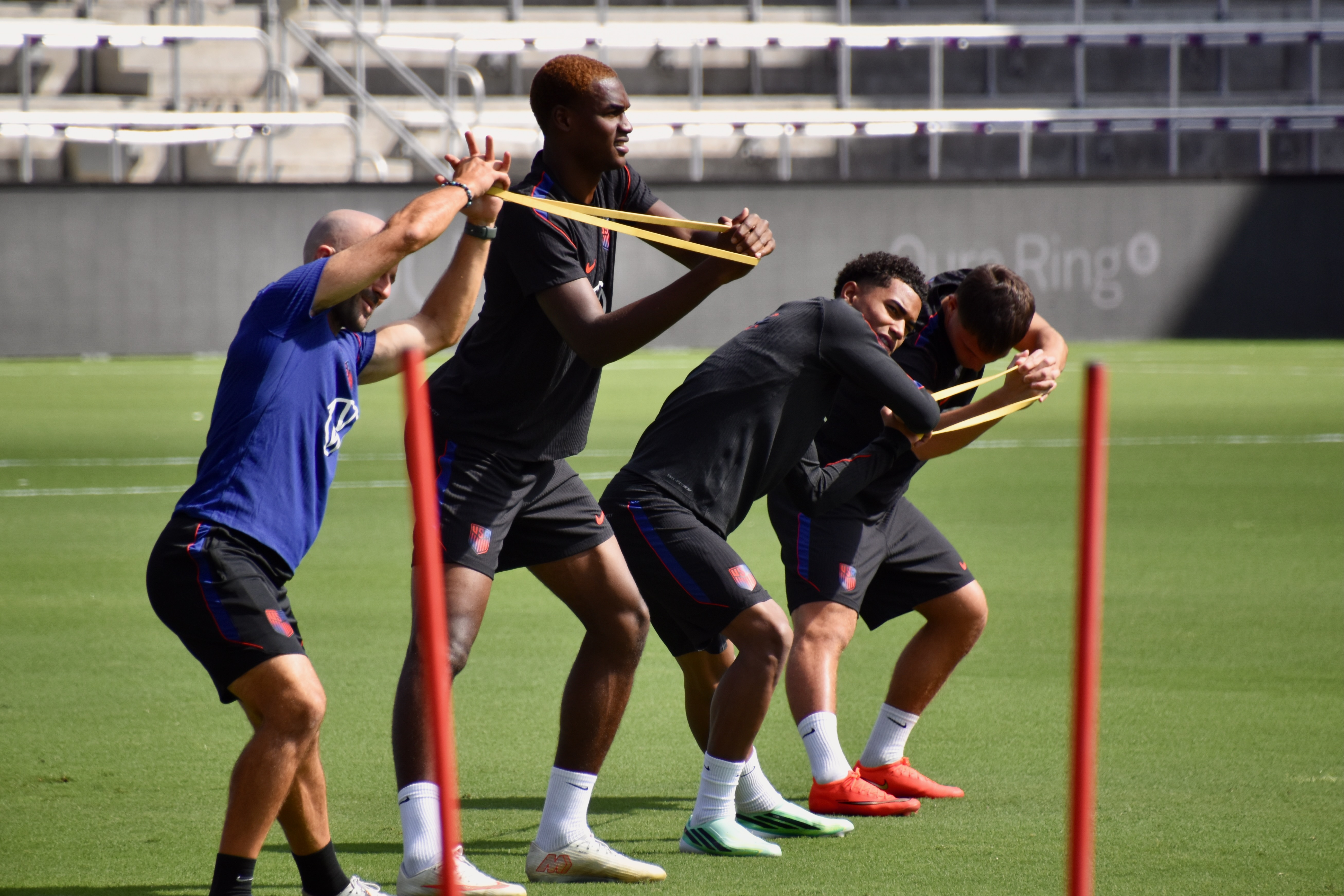
Neil Pierre (second from left) earned even more national acclaim when he earned his first games with the senior U.S. national team a few weeks ago.Jonathan Tannenwald
Interim manager Ryan Richter held his weekly news conference a few hours after the deal was announced, and spoke of his satisfaction.
“He deserves some of the guarantees that come with the new contract,” he said. “I think his play and his performance, he’s been rewarded for that and he deserves that. And then there’s good faith on both sides that when that time eventually does come [for a sale], we’ll make sure the club and Neil and his group are all on the same page.”
Homer City, Pa. — a tiny borough of just 1,746 people about 50 miles east of Pittsburgh in Western Pennsylvania, named for the Greek bard and home to a museum that fits inside an old railroad caboose — is not a place you’d expect would get much attention from the president of the United States … or his avaricious family.
But this remote outpost in Indiana County has been on Donald Trump’s radar since his 2024 campaign, when he bemoaned the looming implosion of the towering 100-foot smokestacks that has once made a massive coal-fired power plant the region’s most prominent landmark. In July 2025, the now-47th president returned to Pennsylvania with news.
Trump said a global fund called Knighthead Capital would spend some $15 billion in Homer City to build a massive new power plant — now to be fueled by natural gas from fracking — and a data center at the abandoned coal plant. “They’re going to spend billions of dollars on rebuilding it,” he said. “It’s going to be the largest plant of its kind in the world, I believe. It’s going to be great.”
Just over three months later, a Bombardier Challenger private jet touched down at Indiana County’s Jimmy Stewart Airport, and out popped a modern-day Mr. Potter: Jared Kushner. Trump’s son-in-law, in a North Face vest and baseball cap, posed for a photo with the airport manager amid unconfirmed rumors he was checking out the Homer City project.
This July, a veteran financial journalist named Miles Weiss unearthed a regulatory document showing that a Cayman Islands-based subsidiary of Kushner’s Affinity Partners, his $6 billion investment vehicle funded almost solely by oil dictatorships like Saudi Arabia and the United Arab Emirates, has made a major investment in the Pennsylvania power plant.
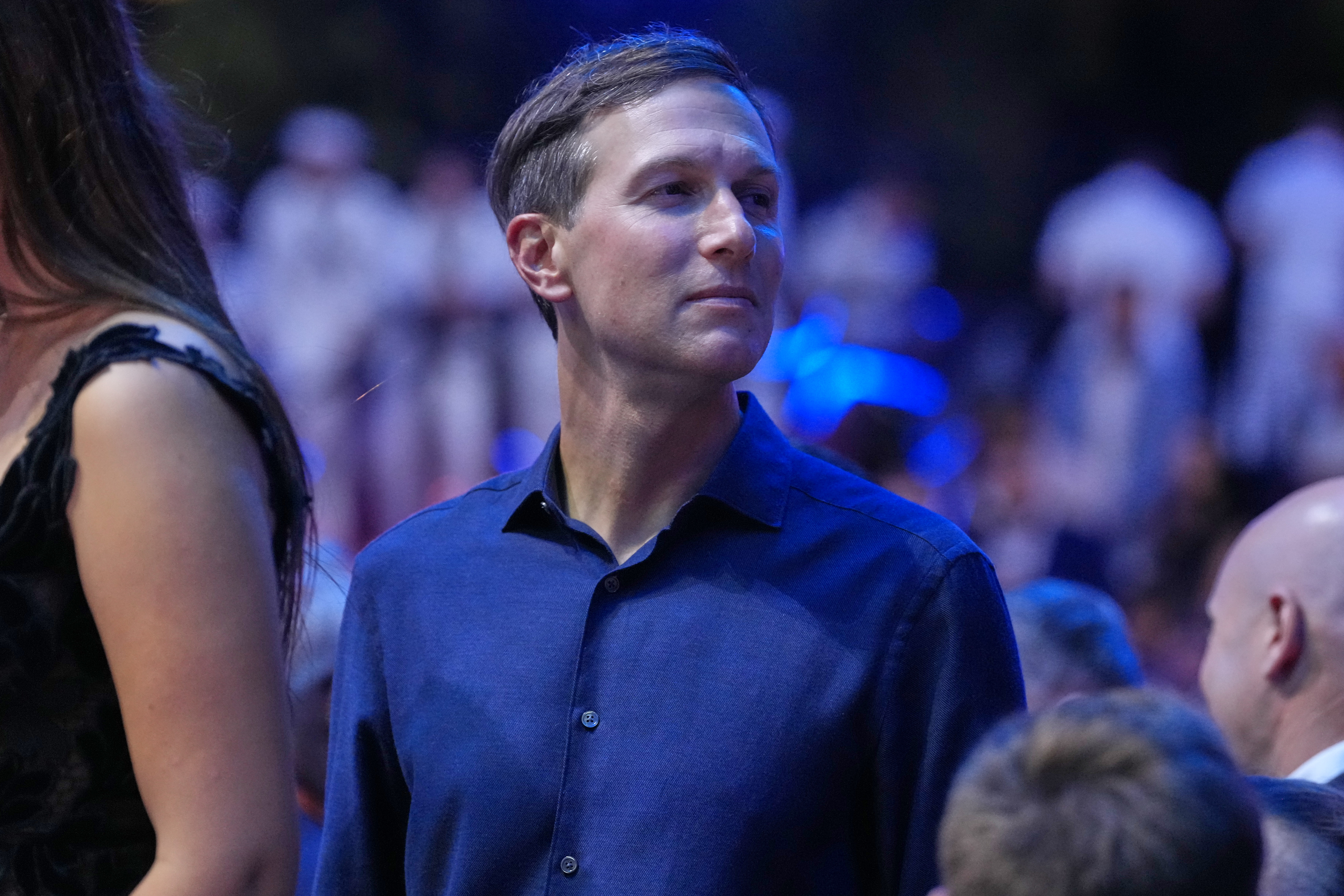
Jared Kushner waits to walk into the ring after the lightweight championship bout at UFC Freedom 250 on the South Lawn of the White House on June 15 in Washington. Alex Brandon
The confluence of 21st century power and wealth on little Homer City — not just the involvement of the Trump family and Middle East oil money, but the news that a whopping 36 data centers on the site will power artificial intelligence, or AI, for Amazon Web Services — would overwhelm even the Everyman heroes portrayed by local native Stewart. But that’s not even the biggest question here.
No, that would be this: How — after a summer when global warming fueled record heat waves, wildfires and killer floods, and as the United Nations said just this week that civilization is blowing its last chance to avert climate disaster — did this rising greenhouse-gas monstrosity in Western Pennsylvania get this far along?
The massive bank of gas turbines at Homer City aims to produce up to 4.7 gigawatts of power, or considerably more than double the capacity of the coal plant, which in its heyday was the largest source of electricity in Pennsylvania. The size of the project overrides the fact that natural gas is a cleaner source of energy than coal. The gas turbines are projected to spew more particulate matter, volatile organic compounds (VOCs), and carbon dioxide into the air than the coal plant did.
An alarming new report on data centers and their natural gas power plants by the environmental group Earthjustice notes that the opening of the Homer City facility would increase carbon emissions from all Pennsylvania power plants by a whopping 15%, right at the moment that climate change is becoming a five-alarm fire.
The potential damage is stunning: The formula developed by the U.S. Environmental Protection Agency for the global social costs of carbon pollution would peg the annual damage from Homer City at $2.5 billion. A separate EPA formula projects that ozone and particulate pollution would kill at least 13 to 22 people prematurely every year.
“The AI data center boom is truly the greatest threat to a stable climate that we face today,” Alex Bomstein, executive director of the Clean Air Council in Pennsylvania, told me.
The pollution projections are alarming both to the national community of climate groups — who see Homer City as the vanguard of a trend that would see nine of the 10 largest power plants in the United States as new gas-fired facilities driving AI data centers — and to locals who lived through the environmental degradation of the coal plant for decades.
“Homer City is an environmental justice area, which means these communities are more vulnerable to climate and health risks, and are supposed to get special attention from the state,” Leigh Hendrix, a local activist with Concerned Residents of Western PA (CROW) told me this week.
Instead, the special attention for the Homer City project from government officials has been often silent acquiescence from their local representatives, a speeded-up “concierge” permitting process from Gov. Josh Shapiro’s administration, and an endorsement from the president as a close relative saw dollar signs.
Some local support for this project in an economically struggling corner of Western Pennsylvania is understandable. The massive private development would mean a surge in tax dollars for a Homer-Center School District which, like many rural districts, struggles with resources and enrollment. The coal plant was a major employer, and while job creation by data centers is often underwhelming, the sheer size of this project would eventually means hundreds of new hires, on top of the construction work.
Still, Jack Hanna — a retired, politically active, attorney who’s lived most of his life in Indiana County — said he’s deeply troubled by the secrecy from county and other local officials who professed to know little about the massive project even as it gained momentum behind gilded locked doors.
“Very, very little information is released by the company and by public officials,” Hanna said. “The company — they have their motivations and I understand that. But public officials, in my opinion, have a duty to have transparency and public disclosure …”
For the developers, there have been many advantages to building at the coal-plant site — existing connections to the power grid and local water supplies, as well as emissions credits for ending coal burning, and some established permits for the site, which was bought by Knighthead in 2017 as a bankrupt “distressed property,” that have greatly eased permitting.
The Earthjustice report noted the Homer City gas plant received an air permit from the Pennsylvania Department of Environmental Protection (DEP) in just seven months, far less than typical. A Right-to-Know request by environmental opponents found a communication from a DEP staffer that the goal was “to provide a concierge level of service” for a project that Shapiro had endorsed as a source of economic development for Indiana County.
In August, Shapiro publicly reversed course on data centers and said the state would now be imposing strict guardrails, but Homer City plant opponents say they’ve seen no change in state policy. Local residents continue to fight a wastewater permit for the plant — arguing it would dump 110-degree water into creeks that were coming back to life after a coal era when they often turned orange with waste — while a coalition of groups including the Clean Air Council is aggressively appealing the air permit.
Little opposition is expected from Trump’s totally neutered EPA, with the president continuing to serve as a cheerleader for both fossil fuels — including the fracking of natural gas in Pennsylvania that would need to increase in order to power Homer City — and data centers, even as their popularity with voters plummets. Earlier this month, Trump praised data centers in Ohio as “so much money to be made …”
Now it appears his own son-in-law will be making some of that cash. Weiss, the financial journalist with a site called Deadline Disclosures, uncovered a June regulatory filing by an affiliate of Kushner’s fund called Affinity HC Cayman Blocker L.L.C. The Cayman vehicle disclosed that it held an equity stake in Homer City Holdings L.L.C., parent company to the power plant. Weiss wrote that the filing did not disclose the size of the Affinity/Kushner investment but he speculated it was sizable, noting that the firm had disclosed borrowing money against its stake.
The source of Affinity Partners’ assets is almost entirely from the sovereign wealth funds of Middle Eastern oil producers such as the Saudis, UAE, and Qatar — all nations that Kushner routinely deals with in his wildly conflicting role as a “peace” negotiator in the region for his father-in-law. The world’s most powerful people taking such interest in a small Pennsylvania borough only makes sense as part of their drive to maintain the dominance of fossil fuels, climate crisis be damned.
I know you’ll be shocked to learn that Affinity Partners has not yet responded to my request for comment.
The locals who are fighting against an environmental nightmare understand what they are up against, because Pennsylvania has been here before, again and again. From the first oil rigs in the mid-19th century backed by John D. Rockefeller that scarred the landscape, to the bloody workers’ battles with coal mine owners, the story of the Keystone State has been the brutality of an extraction economy.
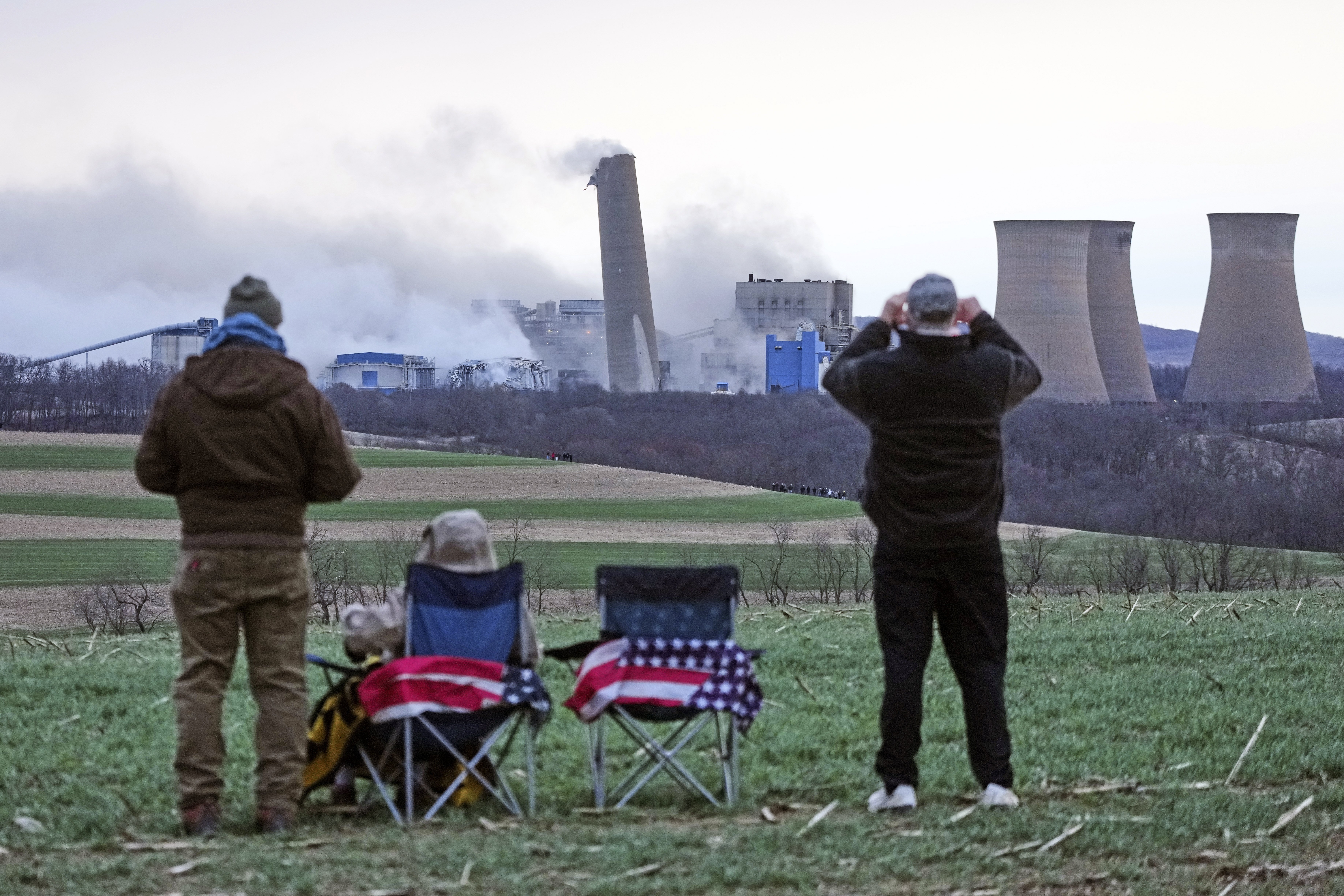
And every time we try to get out — like the implosion of those coal plant smokestacks in March 2025 — they pull us back in with their newest discovery of black gold under our lush hillsides.
“That’s a really critical thing about this place — this history of boom and bust and extraction,” Hendrix told me. But while the prospect that AI data centers will create billion-dollar fortunes for a handful of politically wired folks — money that even Rockefeller could not have dreamed of — is now sparking significant backlash, the vampire squids of a fossil-fuel kleptocracy will keep drilling for new gushers.
Federal prosecutors are opening a separate criminal case against Eric Lewis, the man charged with killing a Philadelphia police officer and seriously wounding another this month.
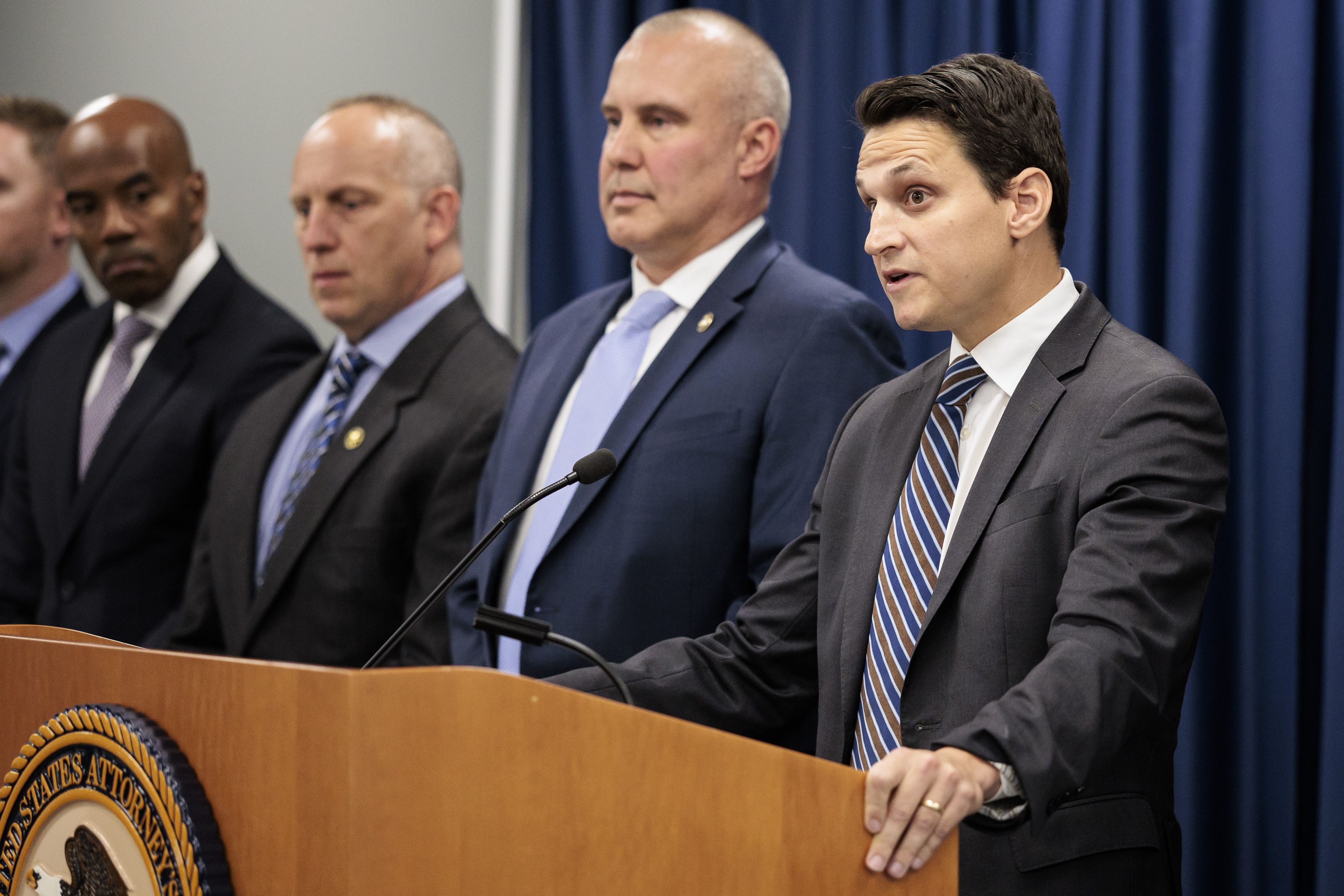
U.S. Attorney David Metcalf, speaking Thursday at a news conference alongside Philadelphia Police Commissioner Kevin J. Bethel and other law enforcement leaders, said federal prosecutors have charged Lewis, 35, with a host of firearms crimes.
Lewis, who was previously convicted of assault and a gun crime at the state level, meets the federal definition of a felon, Metcalf said in explaining why federal prosecutors were involved.
The additional charges, he said, would complement a separate murder case that remains active with prosecutors in the Philadelphia District Attorney’s Office.
“The Department of Justice has a distinct and compelling and powerful federal interest in prosecuting felons who use firearms to rob, shoot, and kill police officers,” said Metcalf, whose office covers the Eastern District of Pennsylvania.
The Justice Department’s involvement marks the latest development in a crime that stunned the city’s law enforcement community and exacerbated tensions between police and District Attorney Larry Krasner. Three days after the shooting, Krasner accused officers of procedural errors and misbehavior that was “arguably criminal” that led to Lewis’ acquittal in a prior murder case.
Bethel, addressing those remarks for the first time Thursday, called the district attorney’s comments “unacceptable.”
Krasner said in a statement Thursday evening that his remarks had been “intended to correct false information.”
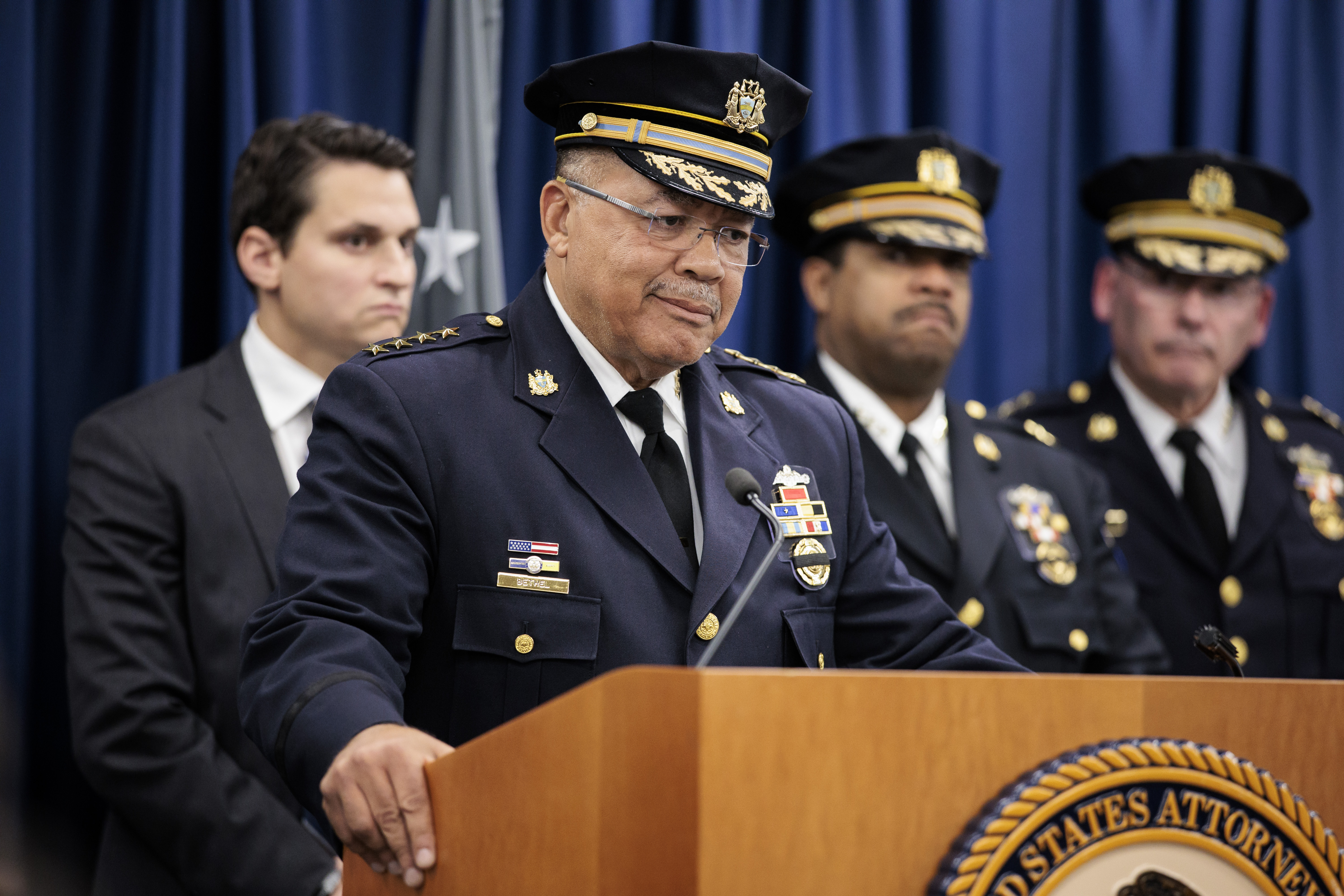
Commissioner of the Philadelphia Police Department Kevin Bethel speaks during a news conference at the United States Attorney’s Office for the Eastern District of Pennsylvania on Thursday, Oct. 22, 2026, in Philadelphia. David Metcalf, U.S. attorney for the Eastern District of Pennsylvania, announced federal firearms charges for Eric Lewis.Monica Herndon / Staff Photographer
Lewis remains in custody without bail in the fatal shooting of Officer Shane Seiber and the wounding of his partner, Officer Hector Rodriguez III, on a West Philadelphia porch in the early morning of Oct. 10.
He committed a series of gun crimes during those moments, Metcalf said in announcing the federal charges.
Lewis is charged with using a firearm in relation to a crime, illegally possessing a firearm, possessing a stolen firearm and ammunition, theft of a firearm, and interference with interstate commerceby robbery, he said. The maximum penalty for those crimes is life in prison, the same maximum that the state charges carry.
Immediately after opening fire, federal prosecutors said, Lewis robbed Rodriguez of his Glock model17 service weapon and then used an illegal 9mm semiautomatic “ghost gun” to continue firing. Lewis also wielded a sawed-off 12-gauge shotgun during the encounter, Metcalf said.
Federal prosecutors began communicating with Philadelphia police about the prospect of opening their own case against Lewis shortly after Seiber’s death, according to Metcalf, who attended the officer’s Center City funeral on Tuesday.
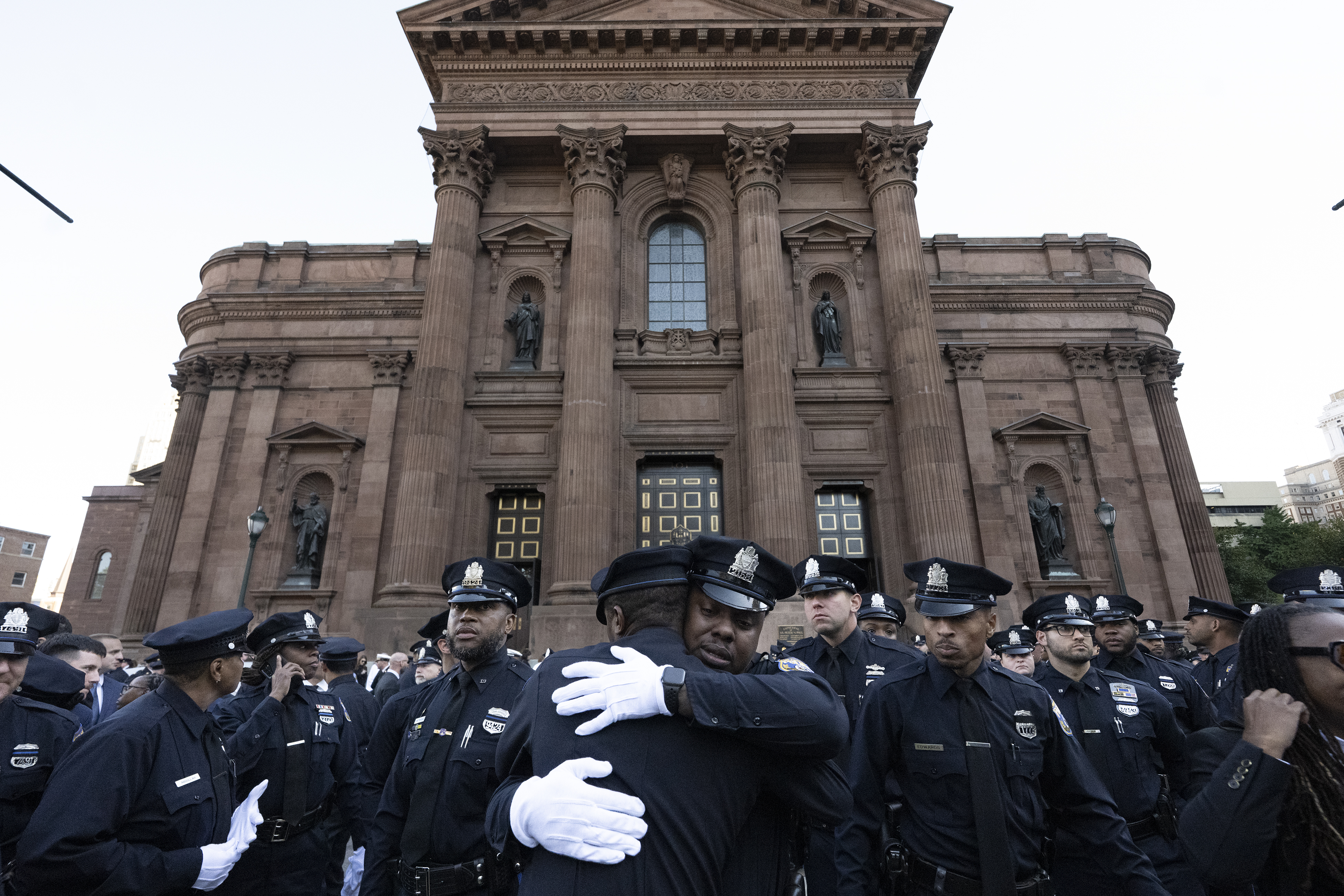
Police officers embrace at the end of the funeral procession for fallen Officer Shane Seiber outside the Cathedral Basilica of Saints Peter and Paul in Philadelphia on Tuesday, Oct. 20, 2026.Jose F. Moreno / Staff Photographer
Metcalf said that the federal case was “completely separate and distinct” from Krasner’s ongoing murder prosecution and that his office had notified the district attorney’s office before bringing the charges.
Krasner said Thursday he welcomed the federal charges.
This would not be the first time federal authorities have opened cases simultaneously with state-level prosecutors in such cases, Metcalf said, adding that his prosecutors would remain in “close contact” with Krasner’s office as the cases progress.
“The objective here is not to duplicate a state criminal proceeding,” Metcalf said. “The idea is to complement it.”
Staff writer Ellie Rushing contributed to this article.
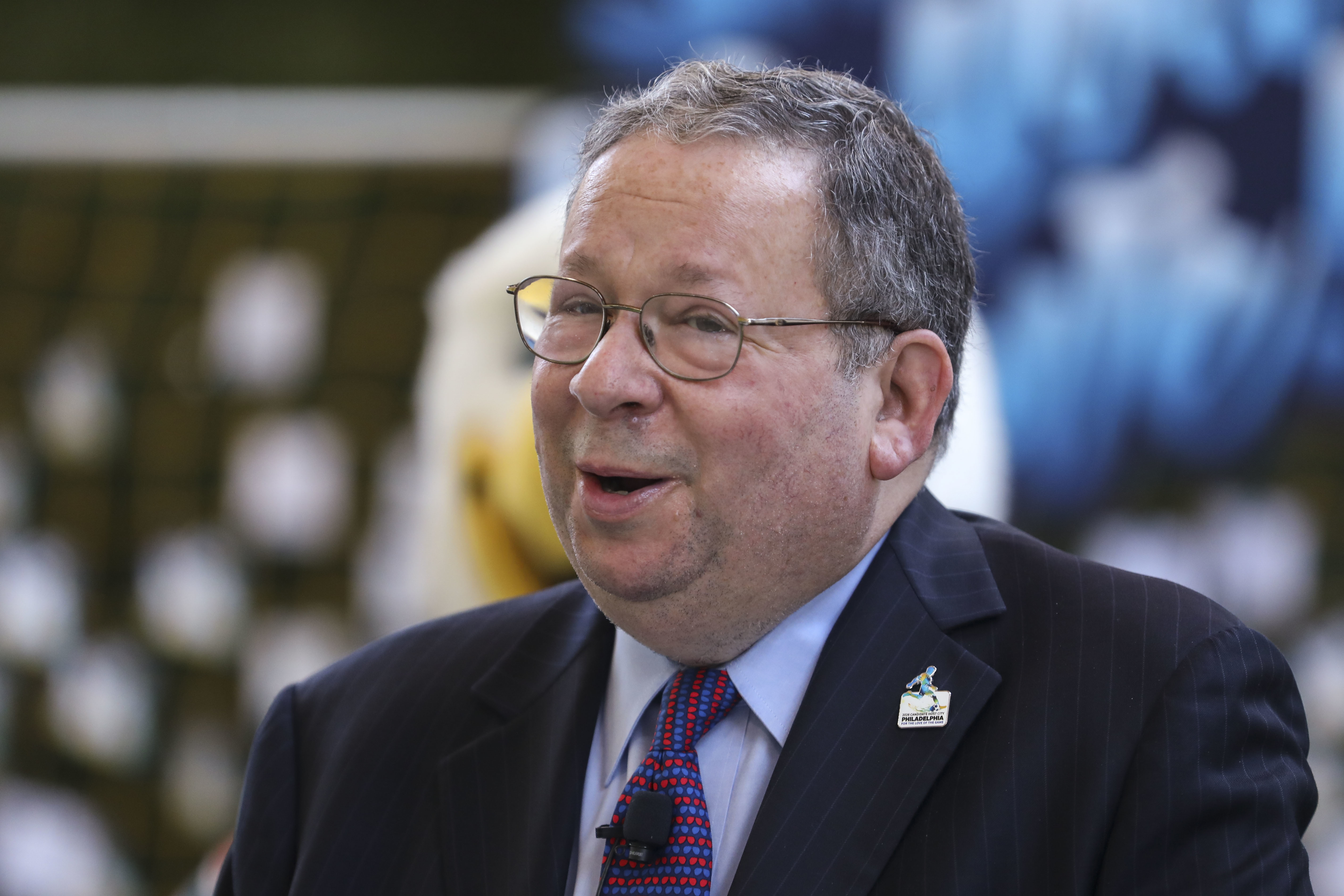
In January, David L. Cohen was elected to the board of the Philadelphia Orchestra and Ensemble Arts, and in the spring was invited to join its executive committee.
Now he has become a major donor, and sees his role at POEA as entree to a larger one advocating for Philadelphia’s arts and culture sector.
Cohen — former Comcast executive, chief of staff during the Rendell mayoral administration, and most recently U.S. ambassador to Canada — and his wife, Rhonda R. Cohen, are giving $10.5 million to POEA that will be used for a variety of activities that align with their interests.
The gift establishes one fund to support the orchestra as a cultural ambassador nationally and internationally through tours and other activities, and another fund to underwrite performances of works by overlooked, underrepresented, and emerging composers, as well as to celebrate the contributions of Jewish artists.
The gift will be recognized by naming the organization’s top administrative post the “Ambassador David L. Cohen and Rhonda R. Cohen President and CEO,” POEA announced Thursday.
It is the single largest donation the Cohens have made to a Philadelphia organization, David L. Cohen, 71, said.
Philadelphia Orchestra violinist Davyd Booth, left, chats with orchestra now-chief Ryan Fleur at the Beijing Capital International Airport, Nov. 7, 2023, when musicians from orchestra visited China.Ng Han Guan
Cohen said this week that the gift’s use came out of discussions with the organization’s leaders, including Philadelphia Orchestra music and artistic director Yannick Nézet-Séguin.
“We had multiple conversations and meetings about what our interests were, and we talked about education, we talked about cultural diplomacy. We also talked about our interest in supporting diverse audiences, which is something Yannick and I spoke about when I was in Canada. It is in my opinion one of the less talked-about but most important attributes that Yannick brings to the table,” Cohen said.
Philadelphia Orchestra music and artistic director Yannick Nezet-Seguin on stage with the orchestra in Marian Anderson Hall, April 10, 2025.Allie Ippolito
“I’m still a believer in diversity and inclusion,” Cohen said, “even if it’s become politically unpopular in certain segments and less politically popular in other segments. I still think diversity is what provides vibrancy, energy, uniqueness, and excitement to the United States and to the city of Philadelphia and the region.”
“It’s very much to support Yannick’s vision,” POEA president and CEO Ryan Fleur said of the Cohen gift. “When we go to China next month, part of the support will be this cultural diplomacy fund. When we go to Europe next year, part of this will fund that.”
A portion of the $10.5 million will be spent and another portion will go toward endowment, Fleur said.
David L. and Rhonda R. CohenAshley Fraser/Courtesy David L. and Rhonda R. Cohen
The Cohens’ commitment was finalized in August, straddling the end of POEA’s ambitious fundraising campaign — $344 million in seven years — and the start of the next one.
“Most of the gift is meant to be a lead gift in the next campaign, to set an example,” said Cohen, who said he will personally make fundraising calls on behalf of POEA in the future.
Cohen’s very Philadelphia focus
Cohen’s involvement in POEA is part of re-devoting himself to Philadelphia causes since returning from his years as ambassador during the Biden administration.
“I took six months before I said yes to anything. I probably had over 100 meetings in that period of time and tried to refine my thinking,” he said.
One of the people he talked to about what he should do was Gov. Josh Shapiro.
Later, Cohen recalled, Shapiro called him and said: “Remember you talked to me about your willingness to be involved in important civic projects? How about the academy?”
That’s the Academy of Natural Sciences, where Cohen has assumed the role of mediator in talks between the boards of Drexel University and the academy over the future of their relationship — and the future of the academy itself.
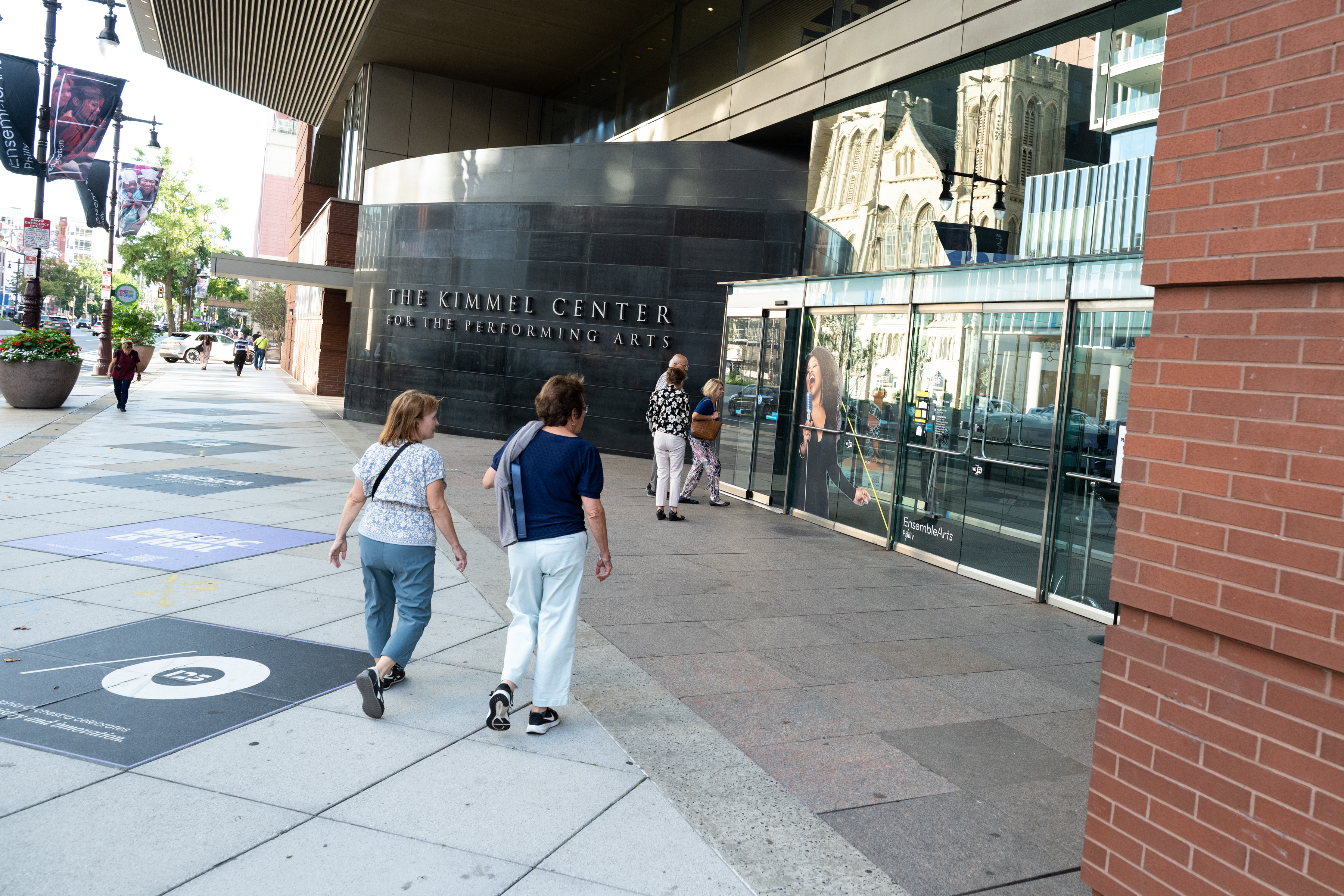
In September, attendees walk into the Kimmel Center for a discussion featuring Gov. Josh Shapiro and Utah Gov. Spencer Cox on free expression, civil dialogue and the First Amendment.Erin Blewett / For The Inquirer
Cohen said that after his return, he “very quickly circled around arts and culture as the space where I thought I could make a real difference, a place where obviously Philadelphia has prominence and wonderful organizations, but where I still felt were a little under-appreciated.”
Cohen had previously served on various nonprofit boards, including the chairmanships of the Philadelphia Theatre Company and the University of Pennsylvania.
The arts sector “might not have all the support that it merits — based on its contributions and its potential impact — from the government, from the corporate community, from the civic community, from a financial perspective, from an audience perspective,” Cohen said. “And I thought that it’s a place where my skills and my experience and my reputation could help to advance the power and the impact of any organization I became involved in.”
David L. Cohen MONICA HERNDON / Staff Photographer
Philadelphia arts and culture has a global reputation, but what about locals?
Cohen had some history with POEA, having served on the board of the Kimmel Center when it was still called the Regional Performing Arts Center.
Cohen also was inspired by something he picked up while he was in Canada.
“Being the U.S. ambassador to Canada, housed in Ottawa for almost four years, gave me exposure to the ambassadors from 150 other countries who were also resident in Ottawa, and the conversations I had with those ambassadors were eye-opening for me.”
Diplomats talked not just about America “as a global leader in advancing democratic ideals and democratic principles on a global basis,” but also about their impressions of Philadelphia.
“The number-one topic that I got interest expressed in on a global basis was arts and culture, and in particular, the orchestra and the Art Museum. I didn’t fully appreciate just how respected it was around the world, and I don’t know that Philadelphians fully appreciate that, either.”
Is Cohen the answer to a certain latent civic pride for the arts and culture scene and a city hungry for leadership?
“I thought it was a sector where my skills and my experience and my reputation could help to advance the power and the impact of any organization I became involved in,” he said, “and, ultimately, the sector as a whole.”
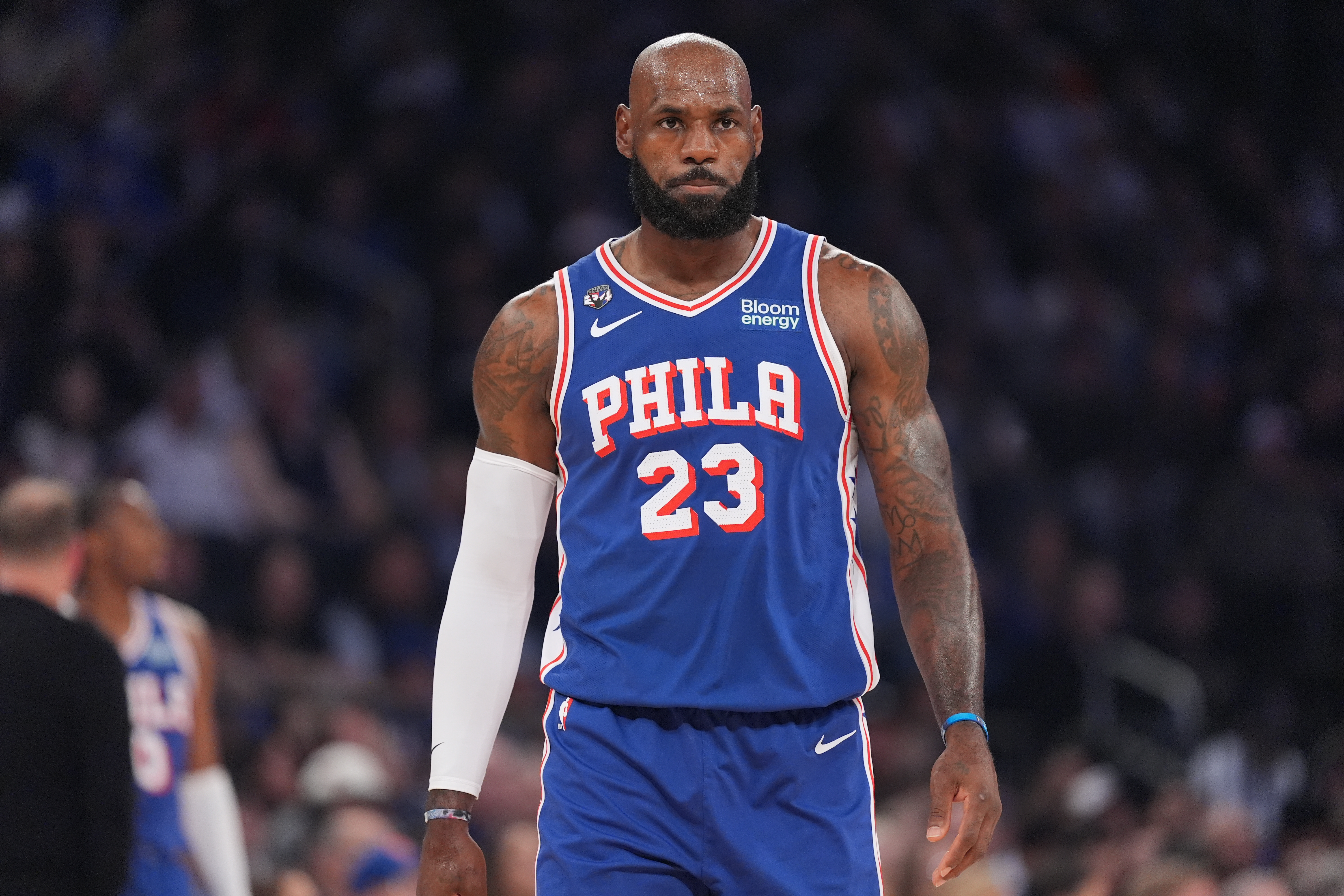
President Donald Trump posted a video on his Truth Social platform on Thursday criticizing Sixers forward LeBron James for pregame stretching during the national anthem before Tuesday’s Sixers-Knicks season opener at Madison Square Garden.
“While listening to our national anthem, LeBron James disrespects our Country!” Trump wrote. “I said right from the beginning that he’s no good, a TOTAL DISGRACE. LeBron James should apologize to all of those Great American Warriors and Heroes who died for the American Flag, and all that our Country stands for!”
In the video, James can be seen extending his arms and rotating his shoulders in a swinging motion that some online thought was a golf swing. It was not the first time James was captured seemingly practicing his golf swing during the anthem, including last Christmas in a post that was shared by ESPN.
However, in the video posted by Trump, James’ swinging stretch aligns with a left-handed golf swing. James is right-handed and would be positioned the opposite way if practicing a golf swing.
James drew Trump’s attention earlier this year. On the day James signed with the Sixers, Trump said of him, “maybe he’s a racist,” when asked whether he preferred James or Michael Jordan. Trump has also been critical of other athletes’ behavior during the national anthem, most notably former NFL quarterback Colin Kaepernick in 2016.
The Sixers face off Thursday night against the Cleveland Cavaliers, the team James began his career with in 2003, at Xfinity Mobile Arena in the Sixers’ home opener. This follows the Sixers’ 106-100 victory Tuesday over the NBA champion New York Knicks.
UConn’s Sarah Strong and Southern Cal’s JuJu Watkins, who have won the Associated Press Player of the Year award the last two years, headline the preseason AP All-America women’s college basketball team released Thursday.
They were joined by Vanderbilt guard Mikayla Blakes, Texas forward Madison Booker, and Notre Dame guard Hannah Hidalgo. Hidalgo, a senior from Merchantville, starred in high school at Paul VI in Haddonfield.
Hidalgo has been a fixture on the All-America team and is coming off another fantastic season. The Notre Dame senior guard averaged 25.3 points — third-best in the country — and 5.6 steals last season. She also led the Fighting Irish to a 25-11 record and the Elite Eight, where they lost to UConn.
“I don’t focus on the numbers ever,” Hidalgo said. “All the numbers I put up last year was never about me saying, ‘OK, I’m going to get this amount of points and this amount of steals.’ I go out every single game and play every game like it’s my last, and the numbers just come with how I play.”
Strong earned 30 votes from the 31-member national media panel that chooses the AP Top 25 each week. Hidalgo and Booker each received 28 votes. Blakes had 27 and Watkins 26. It’s the third consecutive year that Hidalgo and Booker were honored as preseason picks.
Strong, the reigning AP Player of the Year, averaged 18.4 points, 7.7 rebounds, and shot 58.2% from the field as a sophomore forward to help the Huskies reach the Final Four a year after they won their 12th national championship.
“She was national player of the year, you know, and it’s pretty hard to get that much better,” said UConn coach Geno Auriemma, who grew up in Norristown. “But it’s not that hard to get better at some things that she wants to get better at. And I think what we’ll see is a much more aggressive Sarah, much more intentional, much more understanding.”
Watkins is coming back after missing last year while recovering from an ACL tear in her right knee that she suffered in the 2025 NCAA Tournament. The talented guard earned AP Player of the Year honors that season as a sophomore. Watkins is healthy and ready to go.
“We are obviously excited for JuJu to be back on the court,” USC coach Lindsay Gottlieb said. “She has worked so hard both on and off the court, and the joy and talent she brings to college basketball is a great thing not only for our team, but for anyone who is a fan of the game.”
Blakes led the nation in scoring with 27 points per game and was even better in Southeastern Conference play (30.5). She knows the more confidence she helps her teammates build keeps her from being the focal point.
“My role is going to change,” Blakes said. “We have a lot of good scorers this year and really a lot of good players. So I feel like doing whatever the team needs me to do and continue to read defenses really well.”
Booker averaged 18.9 points, 6.7 rebounds, and 3.7 assists to help the Longhorns reach the Final Four for a second straight season.
“In my mind, Madison Booker is the best player in the country,” Texas coach Vic Schaefer said. ”Every night when we take the floor, I feel pretty good about that.”
Strong, Blakes, and Booker were first-team All-Americans last spring while Hidalgo was on the second team. The AP began releasing a preseason All-America team before the 1994-95 season.
After Sunday’s setback against the Carolina Panthers, the Eagles have now lost four straight, the franchise’s first four-game skid since 2020.
Now, a chance to bounce back comes on national television when they host the NFC East rival Dallas Cowboys on Monday (8:20 p.m., ESPN).
These are the updated game odds along with some interesting prop bets from two of the biggest sportsbooks:
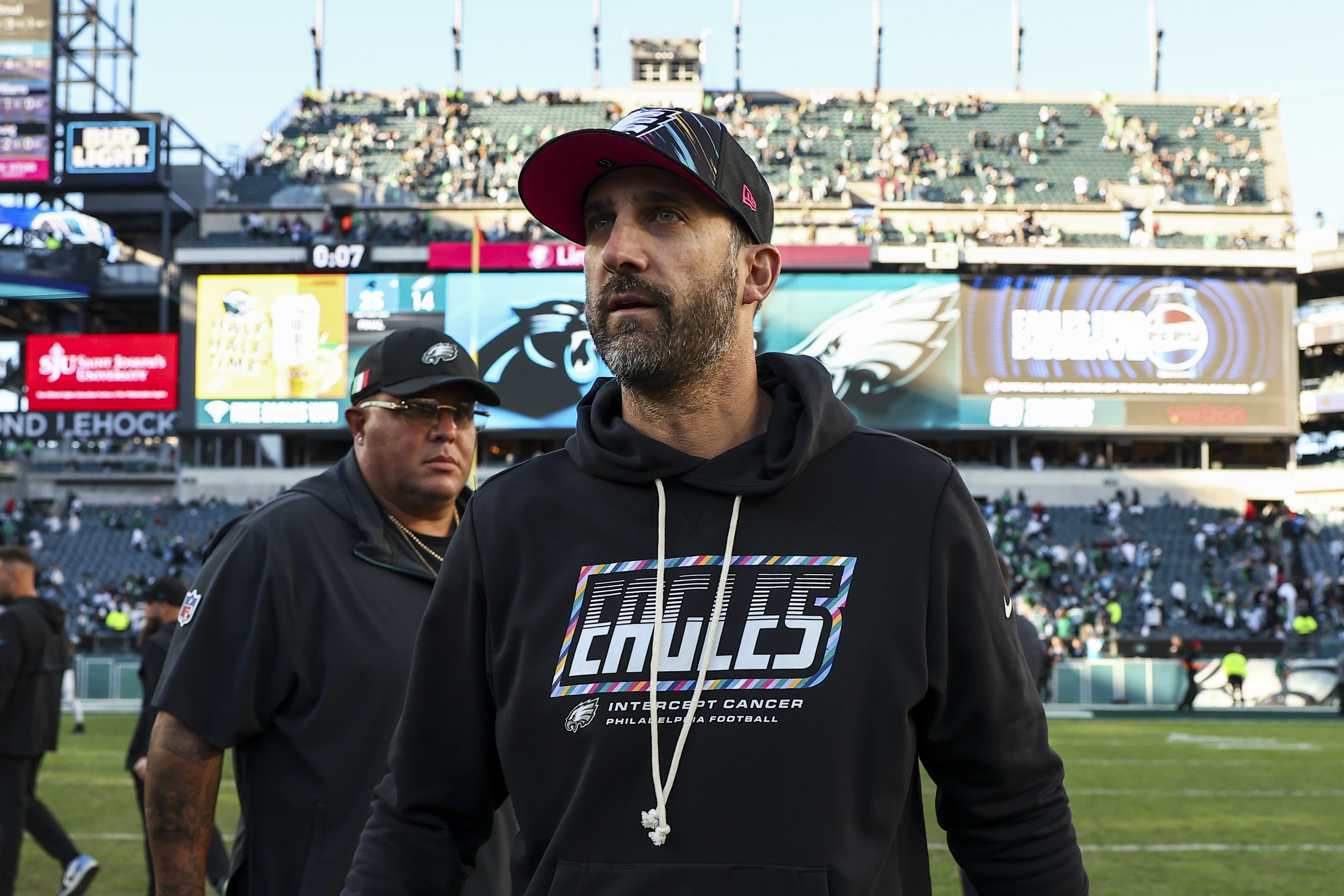
Head coach Nick Sirianni and the Eagles are 4.5-point underdogs at home against the Dallas Cowboys on Monday night. Monica Herndon / Staff Photographer
Eagles vs. Cowboys odds
The Cowboys enter Lincoln Financial Field with consecutive losses to the Green Bay Packers and the Tampa Bay Buccaneers.
The last time these teams met was last November when the Eagles lost 24-21 at AT&T Stadium in a game that saw the Cowboys rally from a 21-0 first-half deficit.
As the Eagles head into Week 7 with several injuries, FanDuel and DraftKings have them listed as 4.5-point underdogs.
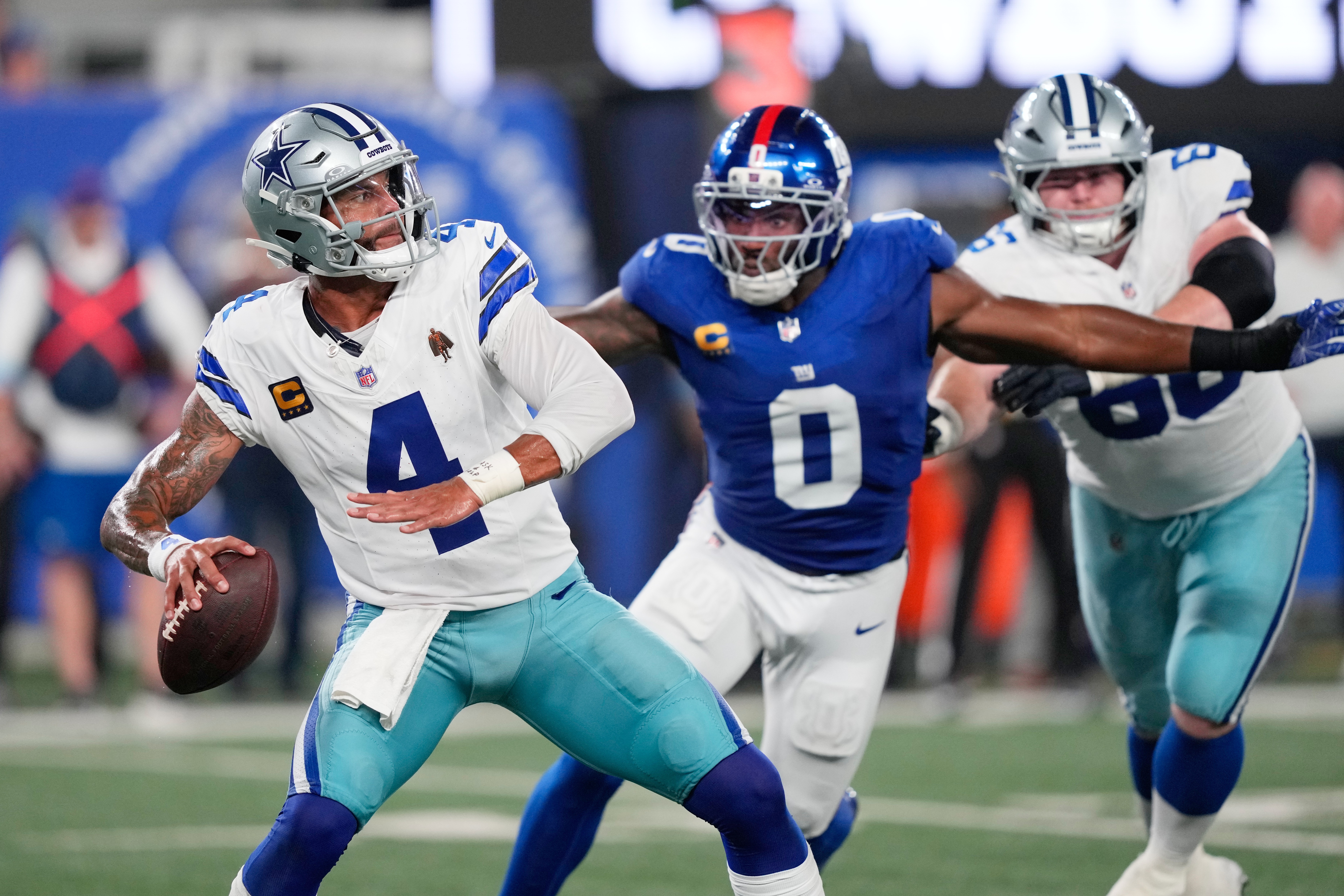
Dallas Cowboys quarterback Dak Prescott (left) will enter Monday coming off his fifth straight game in which he’s thrown for 250 yards or more. Yuki Iwamura
Passing yards
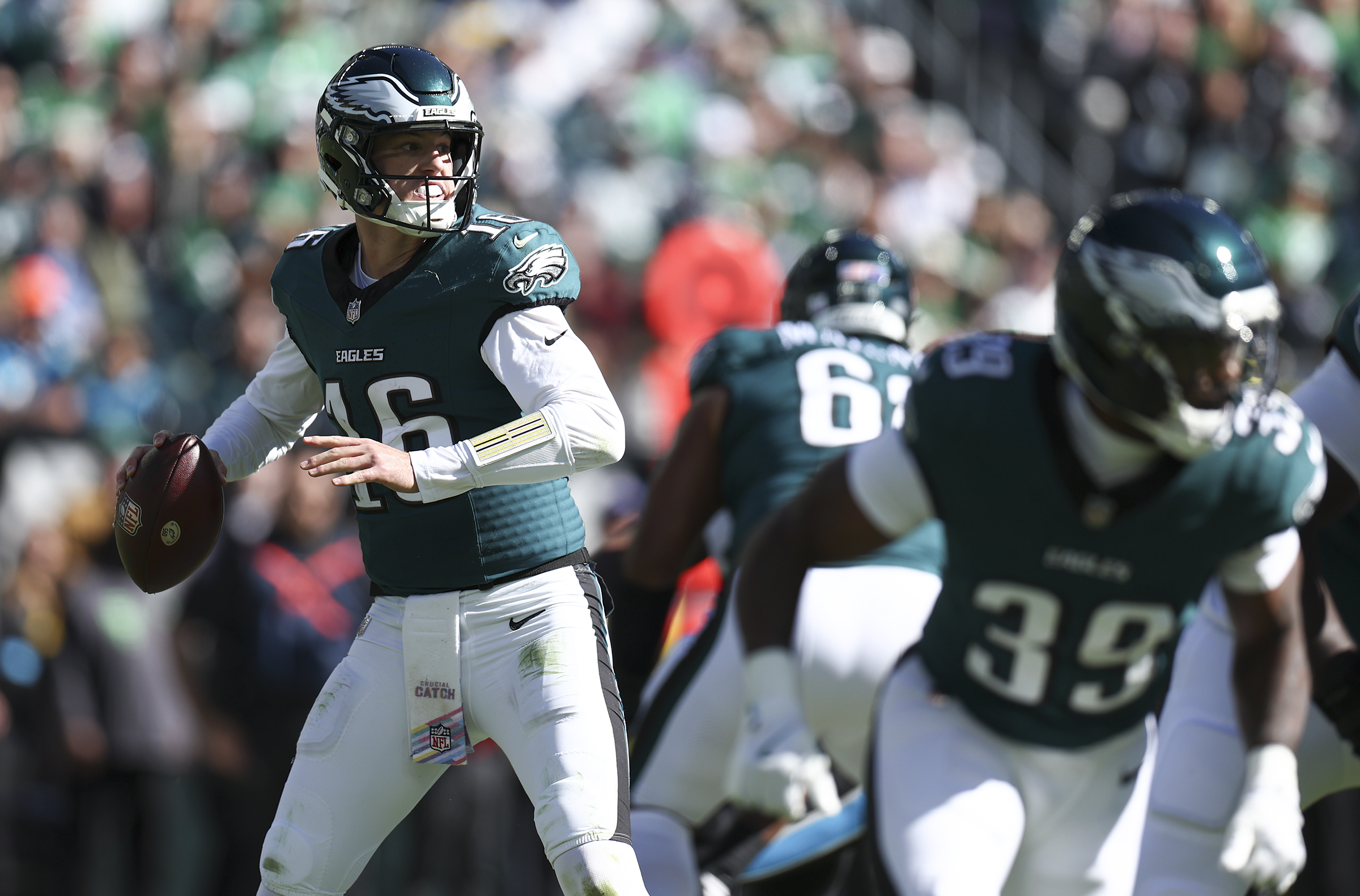
With Jalen Hurts likely missing the remainder of the season due to blood clots in his lungs, Tanner McKee will get his second consecutive start.
Last week, the quarterback completed 26 of 45 passes, throwing for 215 yards. Cowboys quarterback Dak Prescott completed 34 of 54 passes for 258 yards, the fifth straight game that he’s thrown for over 250 yards.
McKee threw for one passing touchdown in last week’s loss. And for the fourth straight game, Prescott also threw for just one touchdown. In Weeks 1 and 2, the Cowboys quarterback threw six touchdown passes, including four against the Washington Commanders and two against the New York Giants.
Cowboys running back Javonte Williams has rushed for over 40 yards in each of the last four games. FanDuel and DraftKings have his over/under set at 66.5 yards. McKee’s over/under is set at 7.5 yards.
DeVonta Smith led the team with seven receptions for 75 receiving yards last week. Eagles tight end Dallas Goedert followed with six for 61. George Pickens and CeeDee Lamb led the Cowboys with 73 and 70 receiving yards, respectively.