The water was flowing peacefully, a solid 7 feet below flood stage, when Matt Collins checked the reading from the government flood gauge, housed in a wooden shed behind the building that is home to the Brandywine Museum of Art.
The ivy on a brick wall had turned an autumnal shade of oxblood, and on a spectacular October afternoon in the heart of Wyeth country, it was hard to believe that Chadds Ford and towns from Honey Brook, Chester County, to Wilmington have been at war for decades with the storied stream from which the museum takes its name.
And the battle of the Brandywine in a watershed that is home to 265,000 people, and expected to add 150,000 more by century’s end, has been escalating and shows no signs of ending. An Inquirer analysis determined the Brandywine has been the most flood-prone stream in the region.
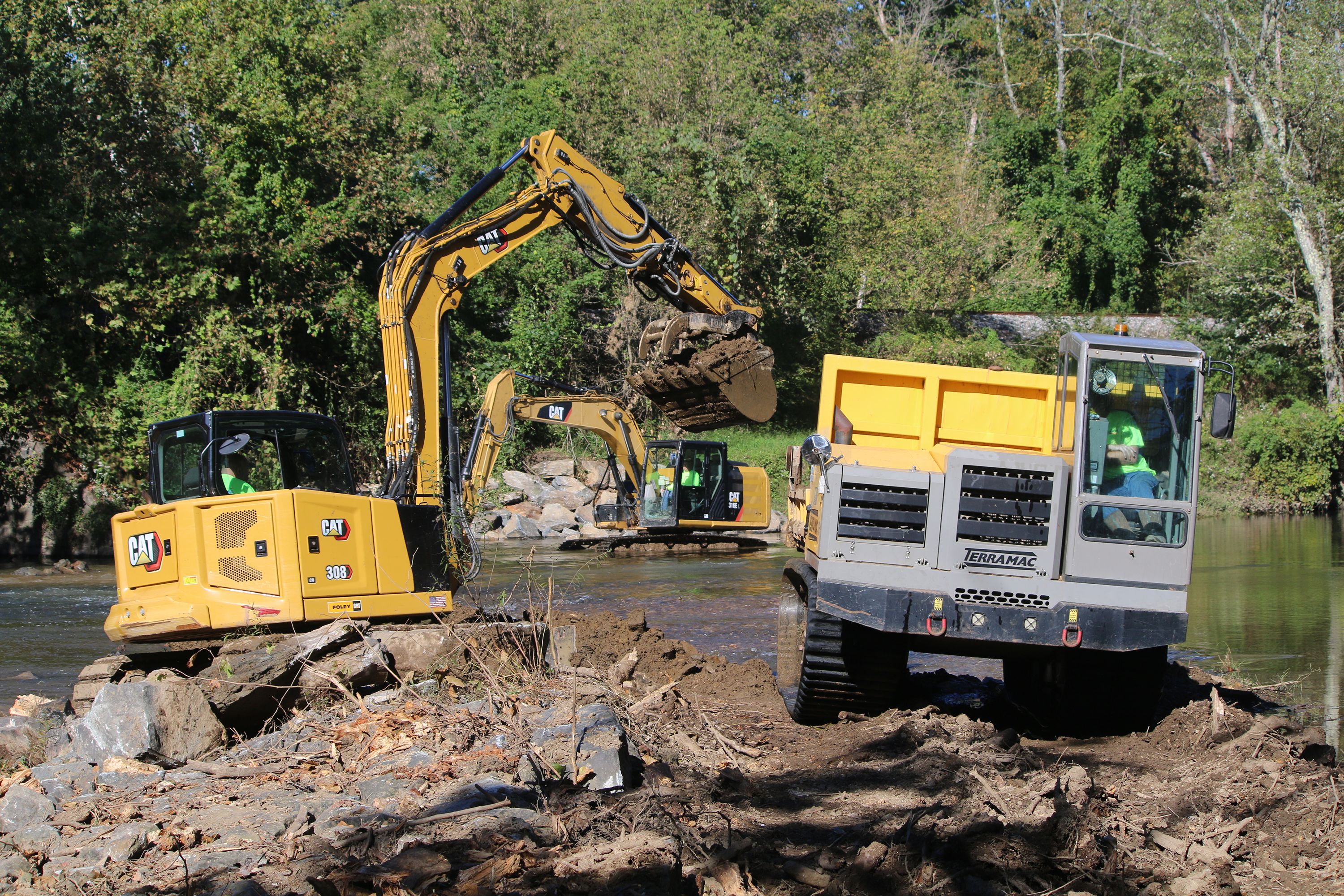
Earlier this month, an obstructive dam just upstream from the museum was dismantled, one of the recommendations in a comprehensive report coauthored by the Brandywine Conservancy — which operates the museum —on taming the flooding throughout the watershed.
Equpiment removes the obsolete Hoffman’s Mill dam on the Brandywine Creek in Chadds Ford earlier this month.Brandywine Convservancy
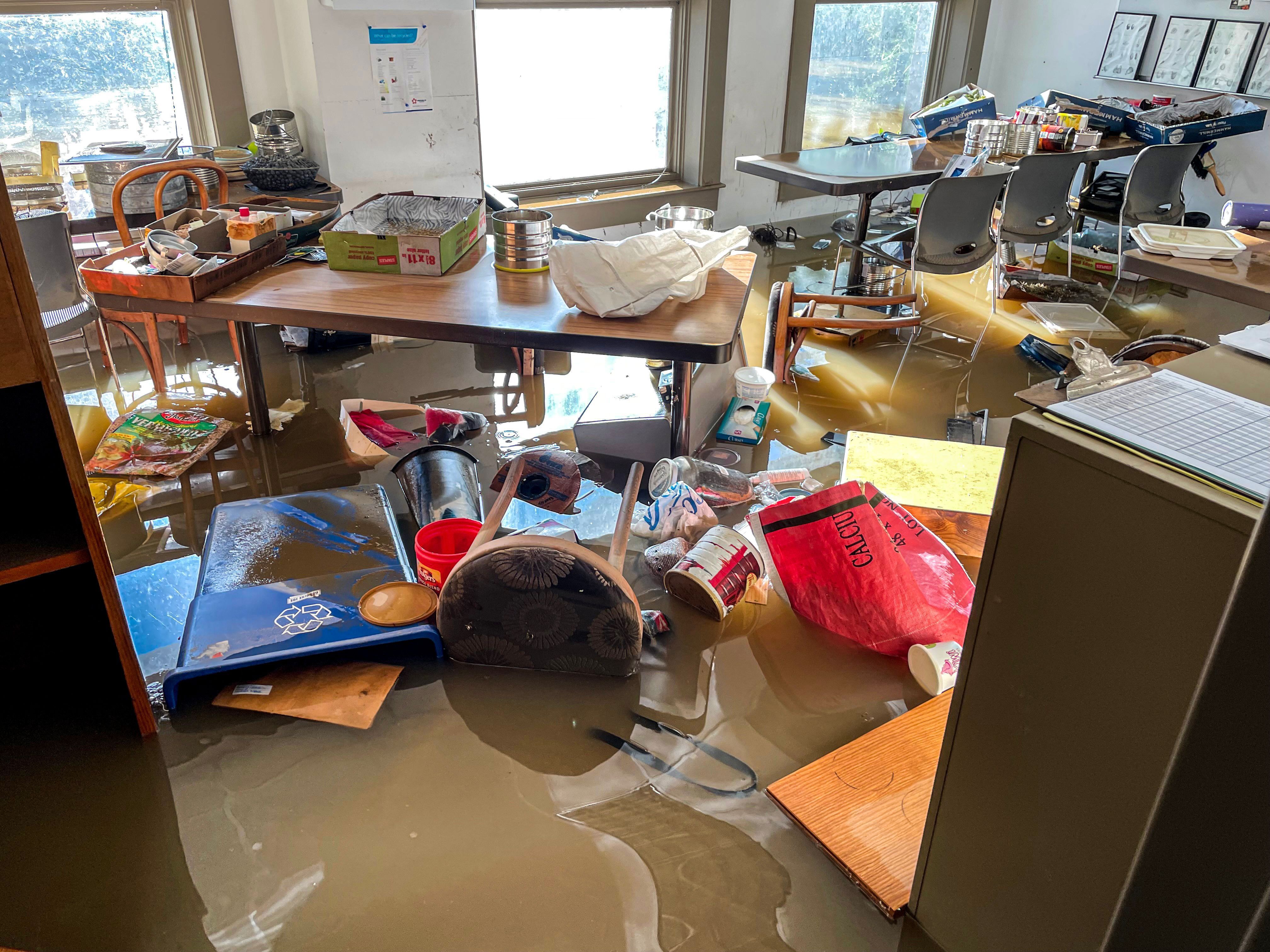
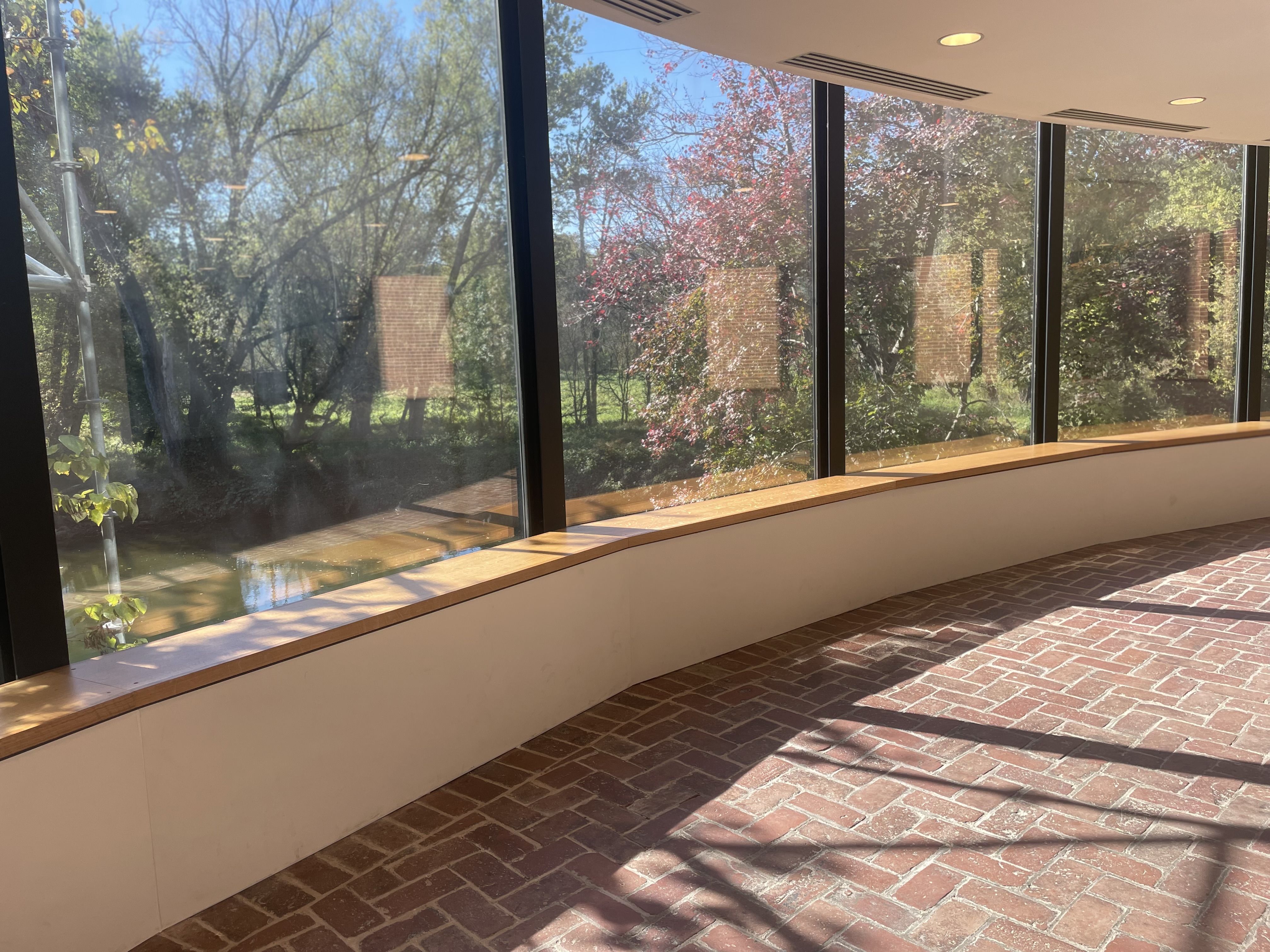
The watershed is still recovering from the ravages of Ida in 2021, its legacy powerfully evident at the museum, where Collins is the acting director of facilities. An arc of wooden benches along the erstwhile floor-to-ceiling windows near the main entrance now also serves as a flood barrier.
A bench-like row suitable for sitting at the Brandywine Museum, in front of the erstwhile flood-to-ceiling windows, also is serving as a flood barrier. Staff / Anthony R. Wood
What was once classroom and lecture space on the ground floor is now bunkered among pipes and sump pumps and other flood-fighting hardware.
“This is all new,” Collins said. “We had to reroute everything.”
The low ceilings, spartan interior, windowless walls, and labyrinth of metal evoke a submarine.
And the hope is that it would be submarine-watertight if another Ida came along, said Nicole Kindbeiter, communications director for the conservancy.
The museum flood-proofing, which Kindbeiter said required closing off about 12,000 square feet of what was publicly usable space in the lower levels, has taken five years and $30 million. A hefty portion came from federal and state disaster assistance.
At long last, conservancy officials are confident that the work is near completion and that the building can withstand an assault similar to that of Ida, during which the river stage rose to 21 feet — 4 feet higher than the previous record crest.
But the grand plan to tame the Brandywine Creek is just beginning, and it is unclear how much it is going to cost, where the money will come from, and when it might be completed.
The Brandywine battle plan
The study, compiled by the conservancy, the Chester County Water Resources Authority, and the University of Delaware Water Resources Center and released last year, looked at 300 sites in the watershed, which covers more than 20% of Chester County.
Starting at an elevation of about 1,000 feet in the western end of the county, the East and West Branches of the creek form a jagged U shape before joining the main stem not far from Longwood Gardens, ultimately flowing into the Christina River near Wilmington.
Through the years, it has caused floods of trouble. The watershed hosts nearly 150 “repetitive loss properties,” those that have suffered repeated flood losses, which have been a drain on the perennially cash-strapped National Flood Insurance Program.
Thousands of properties reside in 100-year floodplains, areas in which a 100-year flood has a 1% chance of occurrence.
Among its recommendations, the 2025 report called for the removal of four dams, two of which, including the one near the museum, are gone, and 10 bridge replacements.
It targeted an area across the creek from the museum on land owned by the Brandywine Conservancy for “floodplain restoration,” more or less returning a property to a predevelopment state. The conservancy is seeking funding, said its director, Grant DeCosta.
But a whole lot of land has headed in the other direction, the report noted. In the heart of the watershed along the Route 30 corridor, impervious cover — the hard surfaces that incite runoff — increased from 9% to as much as 15% between 2001 and 2021.
The fact that so much land in the county was off-limits to development likely kept Ida’s flooding from being worse. A lot of the undeveloped acreage is either owned or held in conservation easements by the conservancy and other entities.
That said, Ida was more than bad enough.
Ida’s legacy and the area’s flood history
By the time the museum opened in 1971 at the site of a closed flour mill, the building it occupied had endured more than 65 floods dating to 1912, according to National Weather Service records.
By just a few years, the museum’s opening predated the era of federal flood mapping, which in all likelihood would have deemed the site unbuildable.
Three months after it opened, a tremendous rainstorm blamed for 12 deaths and wiping out a 20-home development in nearby Chester city triggered the museum’s first major flood. Around the time of its first anniversary, the deadly remnants of Hurricane Agnes resulted in another major flood at the Brandywine.
Agnes’ crest was topped in September 1999 by Floyd’s rains, but Ida was a once-in-800-years event that outdid Floyd’s crest by 4 feet.
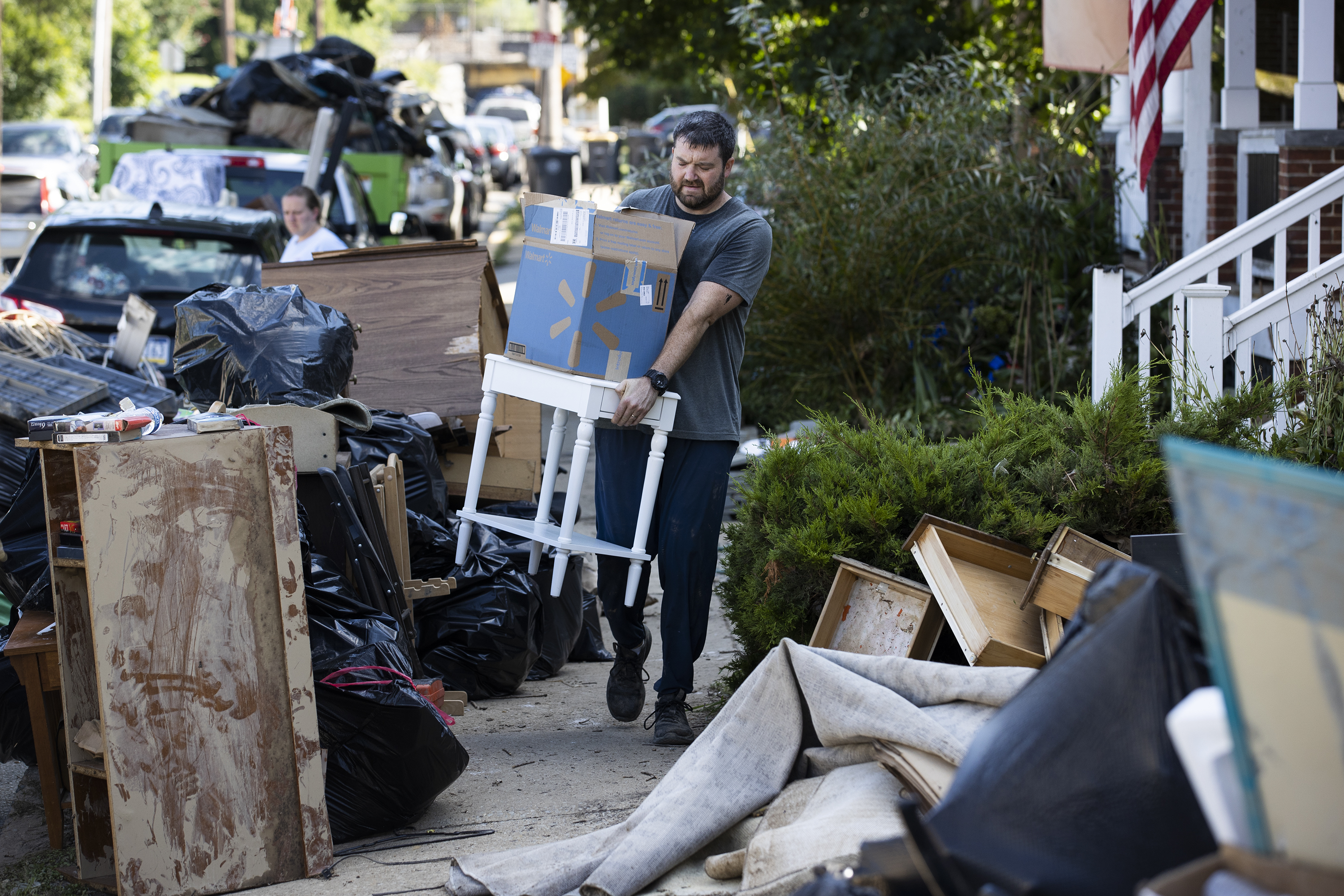
Ida was blamed for one death in Downingtown. The Chester County emergency center dealt with more than 4,000 calls and more than 300 storm-related rescues within 10 hours. Property damage throughout the watershed was immense.
And at some point, officials say, they expect more troubles.
Steve O’Connor carries some on the things he was able to salvage from his home on Brandywine Avenue in Downingtown in the wake of Ida in September 2021CHARLES FOX / Staff Photographer
The future of the Brandywine
Precipitation amounts have been creeping up in the region with the warming of the planet, and the Brandywine study assumed increased rains.
But as the region learned repeatedly this summer, it would be all but impossible to predict where the heaviest rains will target their ferocity at any given time.
The proposed Brandywine projects have no timetable, DeCosta said, “given the scale of the flooding challenges we have.”
“It’s a roll of the dice,” said Gerald Kauffman, director of the University of Delaware Water Resources Center, an author of the study. A major factor in the timing is going to be money, Kauffman said, with federal funding drying up.
As for the museum, the conservancy is adding a 40,000-square-foot building, to be ready in three years, as part of a $100 million expansion.
Correction: This story has been updated to reflect that the museum’s flood-proofing plans required it to close off about 12,000 square feet of public space in the lower level.
Nike has been active around Philly recently, from commissioning a new mural at Garage Fishtown to a commercial highlighting its “Chosen 2One5″ campaign.
Now, it’s adding Philly-inspired sneakers to the mix.
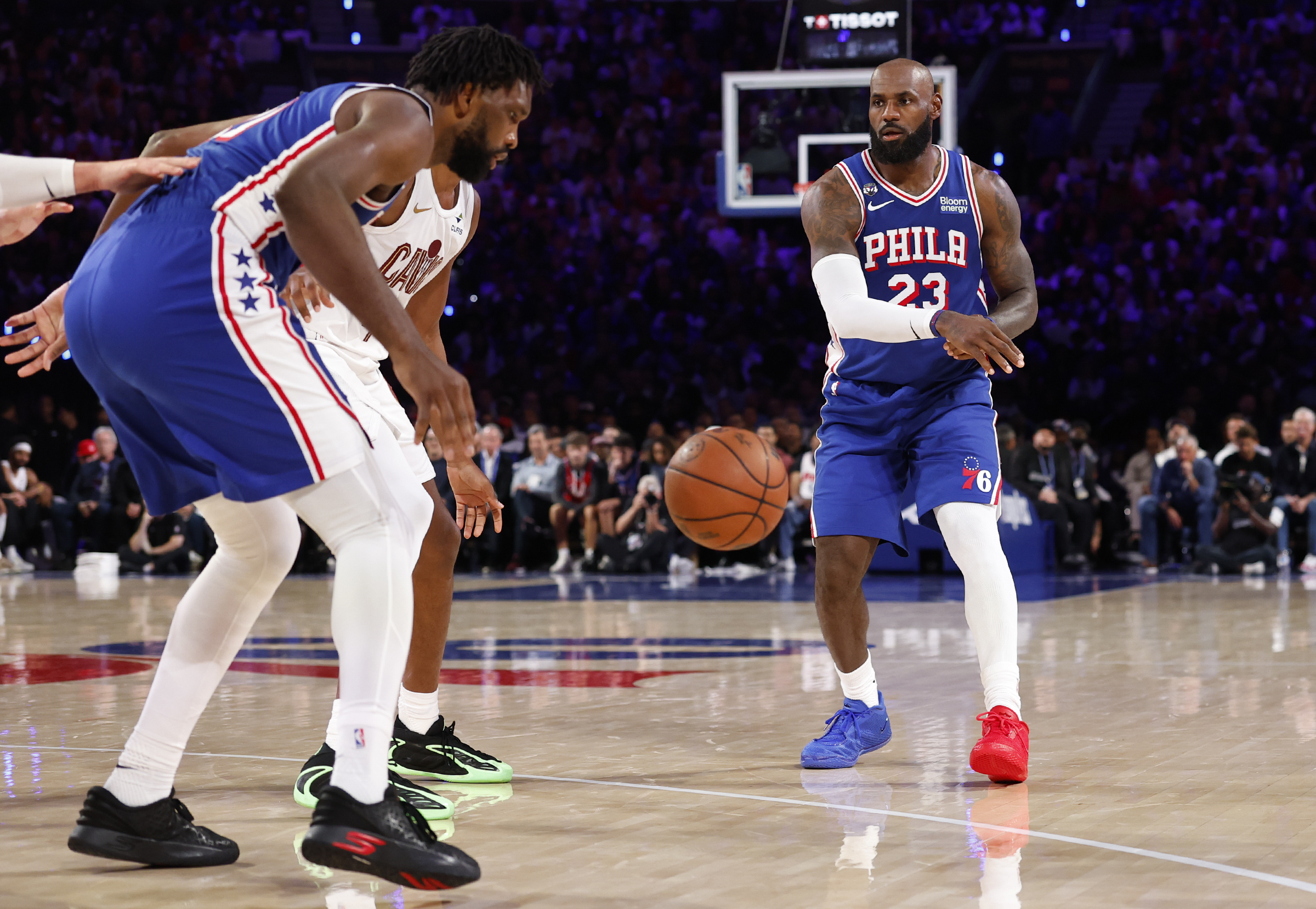
Nike is celebrating LeBron James’ arrival to the city with Air Force 1 ’01 shoes, in a colorway matching the 76ers’ colors. The low-top shoe has a white leather base color, white shoelaces, blue on the toe box and side panels, and a red Nike swoosh.
There are several details paying homage to the city. The right shoe has “PHL,” lettering outlined in blue, while the left shoe has “215,″ the area code for the city. On the back heel, “Phila” is displayed, just like the Sixers’ primary home and away jerseys.
A presale for the shoe, which is $140, was held Thursday through the Nike SNKRS app and local retailer Lapstone & Hammer. The shoes are expected to ship by February.
James debuts LeBron 24 ‘Philly’shoes
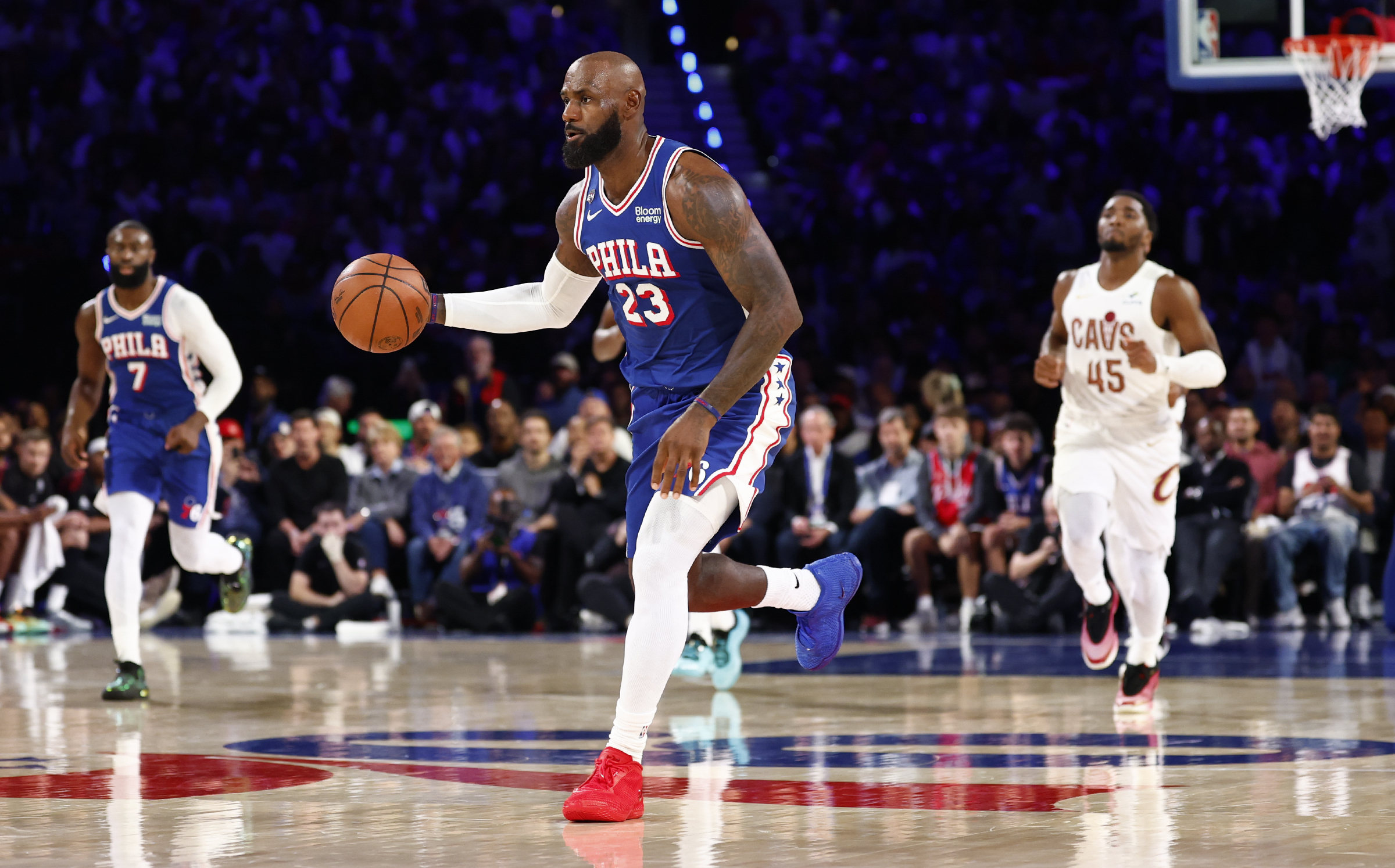
Speaking of James, he has wearing some special, limited-edition shoes in his Sixers debut on Thursday night. Earlier this year, he announced the release of his 24th signature shoe with Nike in his 24th NBA season.
He debuted the Nike LeBron 24 “Philly”shoes,and only 76 pairs were released as a nod to his new team. Each shoe had a monochromatic theme, with the Sixers’ blue on his right foot and their red on his left. The LeBron 24s have a “KingKnit” material, which looks like a mesh fishing net, along with the outline of a crown on the shoe’s outsole. The shoe dropped earlier this week at Nike’s pop-up at the Fashion District.
LeBron James recently debuted his 24th signature shoe.Yong Kim / Staff Photographer
The shoe release is the latest event by a Sixers star. Jaylen Brown partnered with A Bathing Ape through his streetwear brand, 7UICE, for a limited-time shoe collaboration unveiled last weekend at Lapstone & Hammer.
The shoe, called 7UICE x BAPE STA, released online on Oct. 18, a day after the Lapstone & Hammer drop, and has a black leather upper silhouetting the entire shoe, with the Bathing Ape white star and 7UICE written in green accents near the heel, similar to the colors of his former team, the Boston Celtics. Brown also has his “NOT from HERE” signature shoe through his brand, 741 Performance, releasing in November.
When Karen Weaver began her executive doctorate in higher education management at Penn in 2007, she noticed many of her classmates didn’t know much about college athletics.
“We would have fascinating conversations about college athletics and they had a lot of questions,” she said. “And I thought to myself, ‘Where else would they learn this?’”
Weaver, a Lock Haven Athletics Hall of Fame field hockey player with a coaching background, realized the program didn’t have a class about athletics. So she began teaching as an adjunct assistant professor and academic director of Penn’s new athletics enterprise certificate program in 2012.
As college athletics continues to evolve with name, image and likeness, the transfer portal, and legislation like the Protect College Sports Act, Weaver believes university presidents need a better understanding of the landscape.
“As a student-athlete, you do feel very siloed sometimes away from the rest of the campus,” she said. “That separation doesn’t enhance the president’s understanding. So they really don’t get to be exposed to it until they sit in the chair on Day 1.”
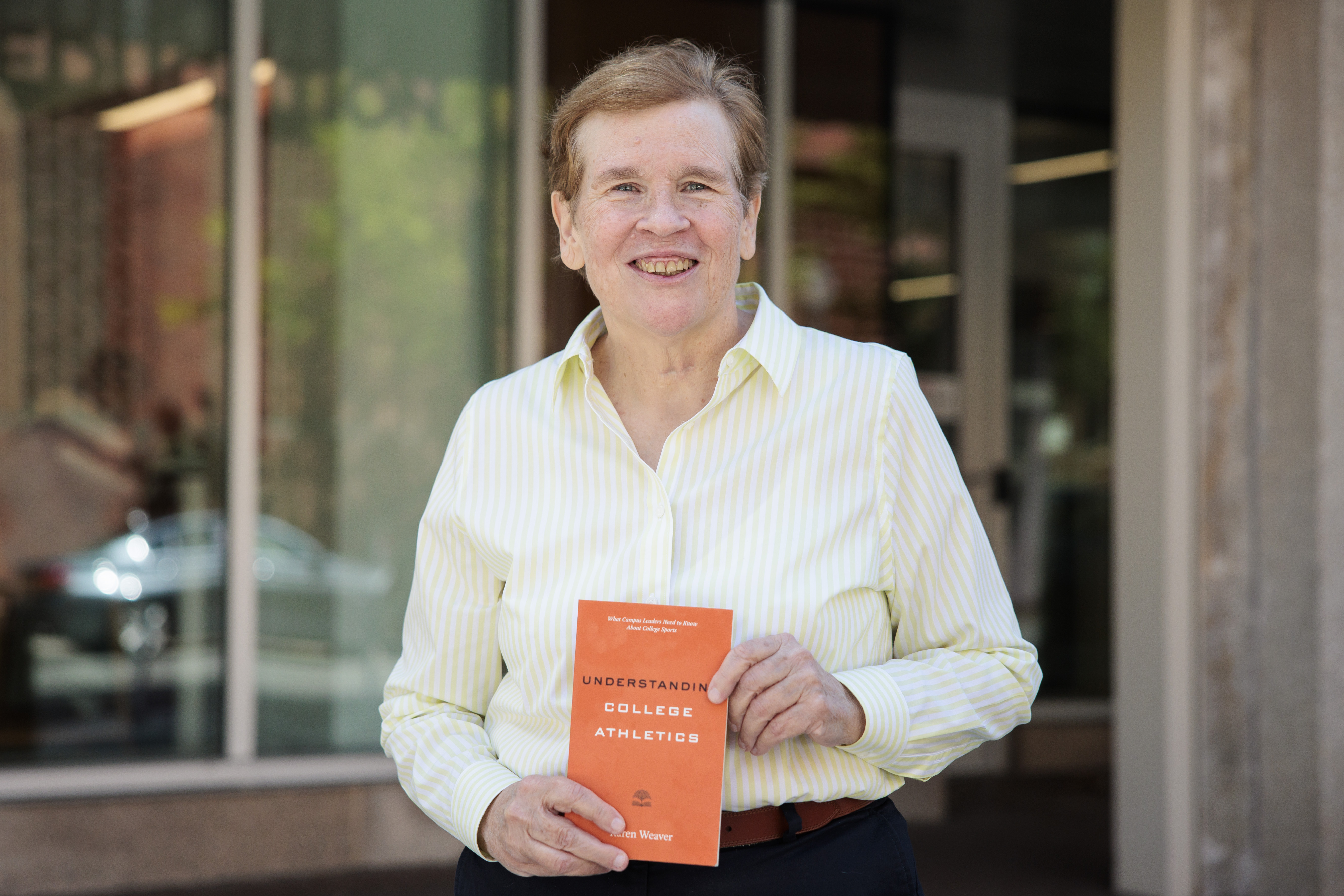
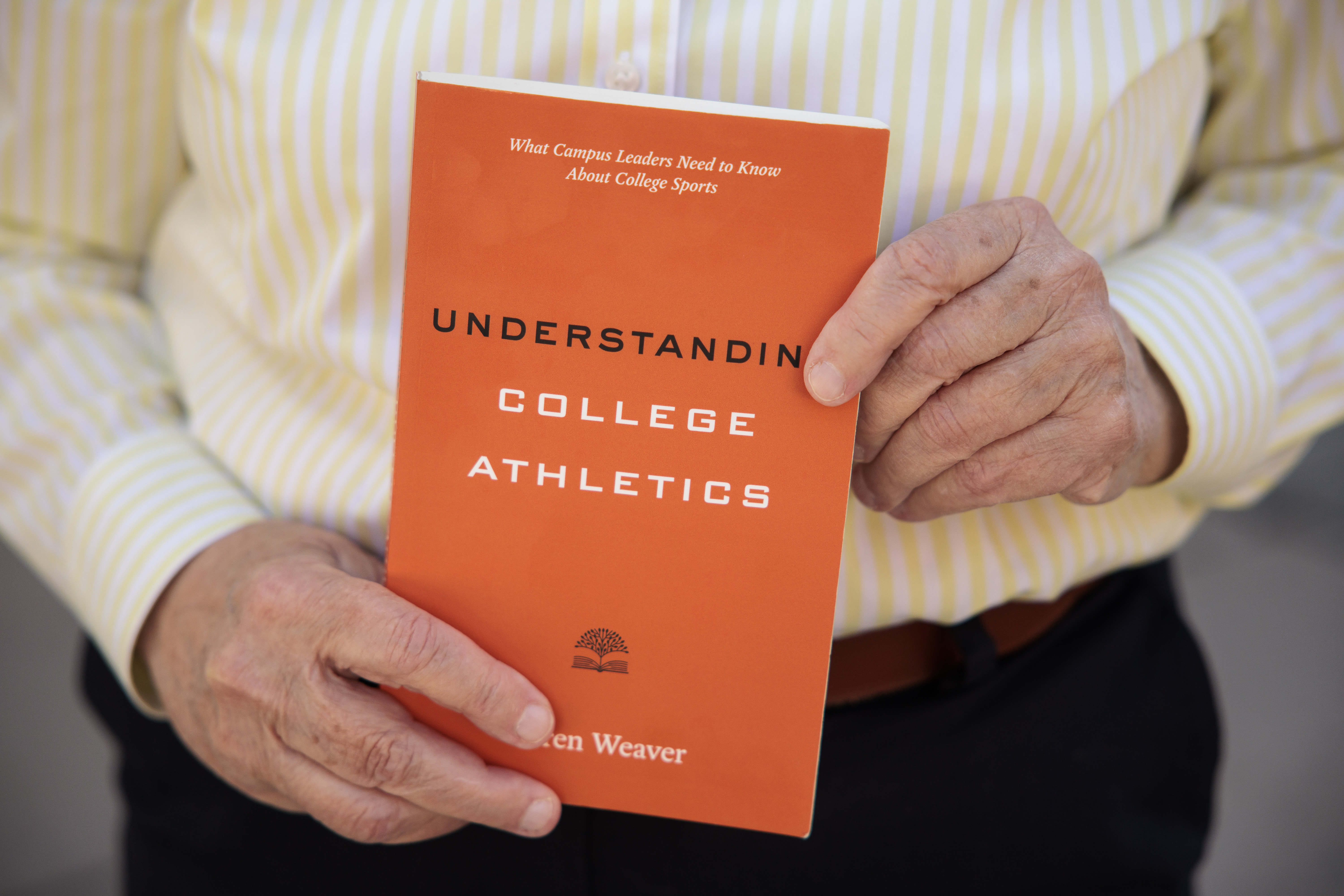
Weaver’s book, Understanding College Athletics: What Campus Leaders Need to Know About College Sports, draws on four years of work to help university presidents navigate the changing landscape of college athletics and make decisions that best reflect the needs of their universities.
The Inquirer sat down with her to discuss her book, which published in August.
Q: Who is the book written for, and what are the main questions you aim to answer?
A: It’s meant for presidents and boards of trustees, and really anybody else who wants to ascend to a senior leadership role. Generally the president has a cabinet of maybe 13-14 people who serve different parts of the institution. And I’m hopeful that this will encourage those folks to have discussions when athletics come up. Villanova is D1 but it is FCS D1. That creates an entirely different set of conversations than what’s happening right now at Florida State, who just fired their AD. So how do we have the right discussion for our level and where we are? That’s the first question.
The second question is, how do we align athletics with our mission today? Not as it was 20 years ago because things have changed. And same thing with a lot of colleges. They know that their role has changed. The interests of parents and students have changed. So, there’s this whole reinvention thing going on and athletics should be a part of that.
And No. 3, what if we can’t afford it? Then what are we doing? And so that’s another part of the book, too.
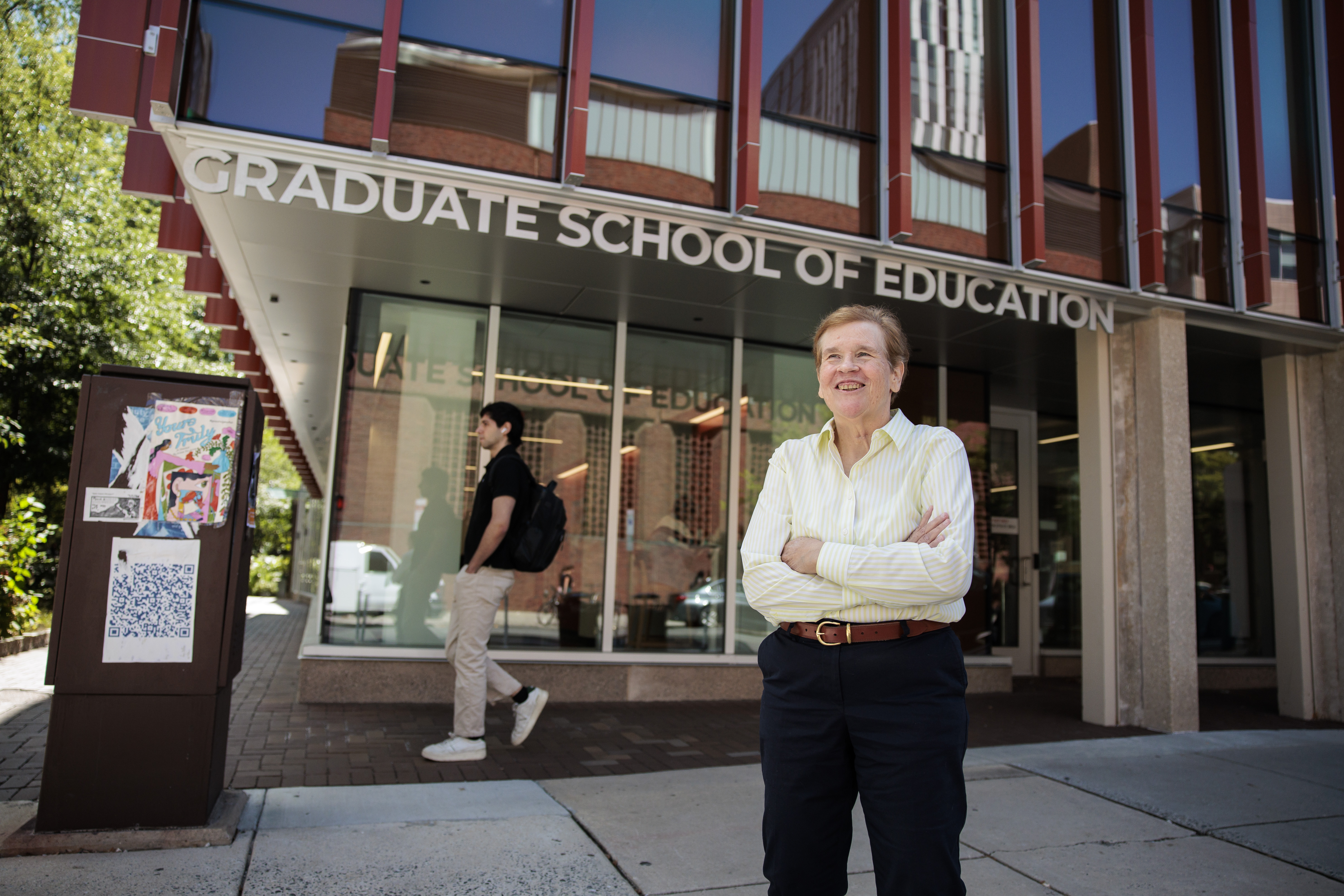
Karen Weaver has been an adjunct assistant professor at Penn since 2012.Monica Herndon / Staff Photographer
Q: You discuss how important it is for universities to develop an athletic model that fits their institution. With schools like Spelman College eliminating varsity sports and Saint Francis University moving from Division I to Division III, will more universities begin to rethink the role athletics play on their campuses as college sports continue to change?
A: I hope so. We’re doing a lot of complaining now about D1 schools. Mostly the group of six like James Madison just moved up to the FBS and some of the others in the Sun Belt Conference. They’re trying to figure out how we can make sure that we get in. But then the next question is once you’re in, how did you get to pay for it? And we haven’t solved that problem yet. So, what are some other alternatives?
I admire St. Francis’ president immensely. They had more discussions for two and a half years about this because their enrollment and their branding was directly tied to D1. So, to give that up and go from D1 to D3 is huge. This is the university’s first full year in Division III. I talked to him [Malachi Van Tassell] last weekend and he said “weekends are quieter here,” which I thought was interesting.
Q: According to a 2018 Forbes article, Villanova saw a 21% increase in applicants after Villanova basketball won the 2016 national championship. How much does athletic success vs. the school’s identity contribute to student enrollment?
A: There’s a certain audience that Villanova is very attractive to. Obviously there’s a religious component and there’s a size component. They’re good at what they’re good at. I honestly can’t tell you what other teams do really well other than track and field perhaps, but basketball does make a difference. Now if they don’t play at the level that they did in the Jay Wright era, then I don’t know what happens.
You look at the other [private Catholic] schools, Loyola, Boston College, all of them have unique challenges because of demographic shifts. Villanova has managed to catch lightning in a bottle at this moment where people who are outside of Pennsylvania and maybe in Ohio, New York, and New Jersey start to think about, “Where could I go that’s got a real mission that I can identify with?” That’s who they are. That’s the thing that more colleges have to understand is, who are we? How do we differentiate ourselves? That’s what Villanova has done.
Q: What is changing the most from student-athletes that people may not think about?
A: The biggest change is the fact that athletes are thinking about the immediacy of what they can get vs. the long-term benefit. All of us chose schools in the past for that long-term benefit. I don’t know that we’re thinking about that right now as athletes. We’re thinking about where we can get the best deal next semester. And we don’t have enough research yet on the athletes who transferred more than twice and what that has done to their academic progress.
Here’s a question I hear nobody asking: If [a student-athlete gets] injured, who’s responsible for their lifetime medical care? Because the NCAA has assigned that to an institution so they could say, we’re providing lifetime medical care. But our school says he got injured at the past school. So, who makes those decisions? I really don’t think we’re thinking enough about medical care and the transfer of medical information from school to school.
Q: In your book, you refer to “Cinderella trap” on how we haven’t seen an underdog team make a run in the NCAA Tournament. Why do you think those Cinderella stories have become less common?
A: We’ve had two years now of no Cinderellas making it beyond the second round, which is sort of the definition of Cinderella. I think Cinderellas are going to be few and far between, and what they’re trying to do with March Madness, at least on the men’s side, is expand it to 74 teams. And you can see why because they want to attract those Cinderellas to get those stories. But again, are they going to go past the second round? Even if they create more rounds. Once you get to that round of 16, that’s when the numbers, the viewers go up. The stories are more interesting. The amount of gambling that goes on in these kinds of situations is frightening. So all this is about trying to extend the media contracts, extend the discussions, the stories, and hopefully catch a moment of glory. That’s what really made March Madness special.
Karen Weaver’s book, “Understanding College Athletics: What Campus Leaders Need to Know About College Sports,” published in August. Monica Herndon / Staff Photographer
Q: You discuss the growth of sports gambling among college students. What concerns you most about the rise of betting on college campuses?
A: It’s scary. You watch a sporting event and every other commercial is gambling. Every ticker line is on there … you can’t avoid it. I really wanted to try to hit at least that in the book because presidents have got to have a better understanding of what’s going on not with their athletes, but with their students.
There is betting going on Division III games. There’s betting going on on women’s games. They’re not as high profile. But still, if somebody gambles what to them is a lot of money, and there’s some people who believe that student loans are being used to promote this gambling, which is really scary, and they lose and they know that kid or a friend knows that kid and they’re going to get mad at that kid who doesn’t hit 20 points. Those kinds of things are scary. We know that has happened because three years ago at Dayton in the first round of March Madness on the men’s side at the press conference where that particular team lost. The players and the coaches were nearly in tears because of the abuse that they took from the fans sitting right behind them on the bench. The coach was like, “Please, these are 19- and 20-year-olds, please stop yelling at them because they’re not hitting the shot you thought they should hit or the first free throw or second free throw.”
Anthony Grant delivered an emotional speech in his postgame press conference. Dayton players were the target of hate online from losing gamblers after the game Friday vs. VCU. pic.twitter.com/l0XgKE8Vsa
Q: What do you hope will be the biggest takeaway from your book?
A: The No. 1 thing is that I want as many schools as possible in this new era to go back to what their mission is. And just to have that basic conversation of who are we today? Not who we were 20 years ago when we decided to move into this division or that division. And who are we in our peer group today? Every school has an institution that they compare themselves to. And does that still work for us? I think that’s the most important question in the book.
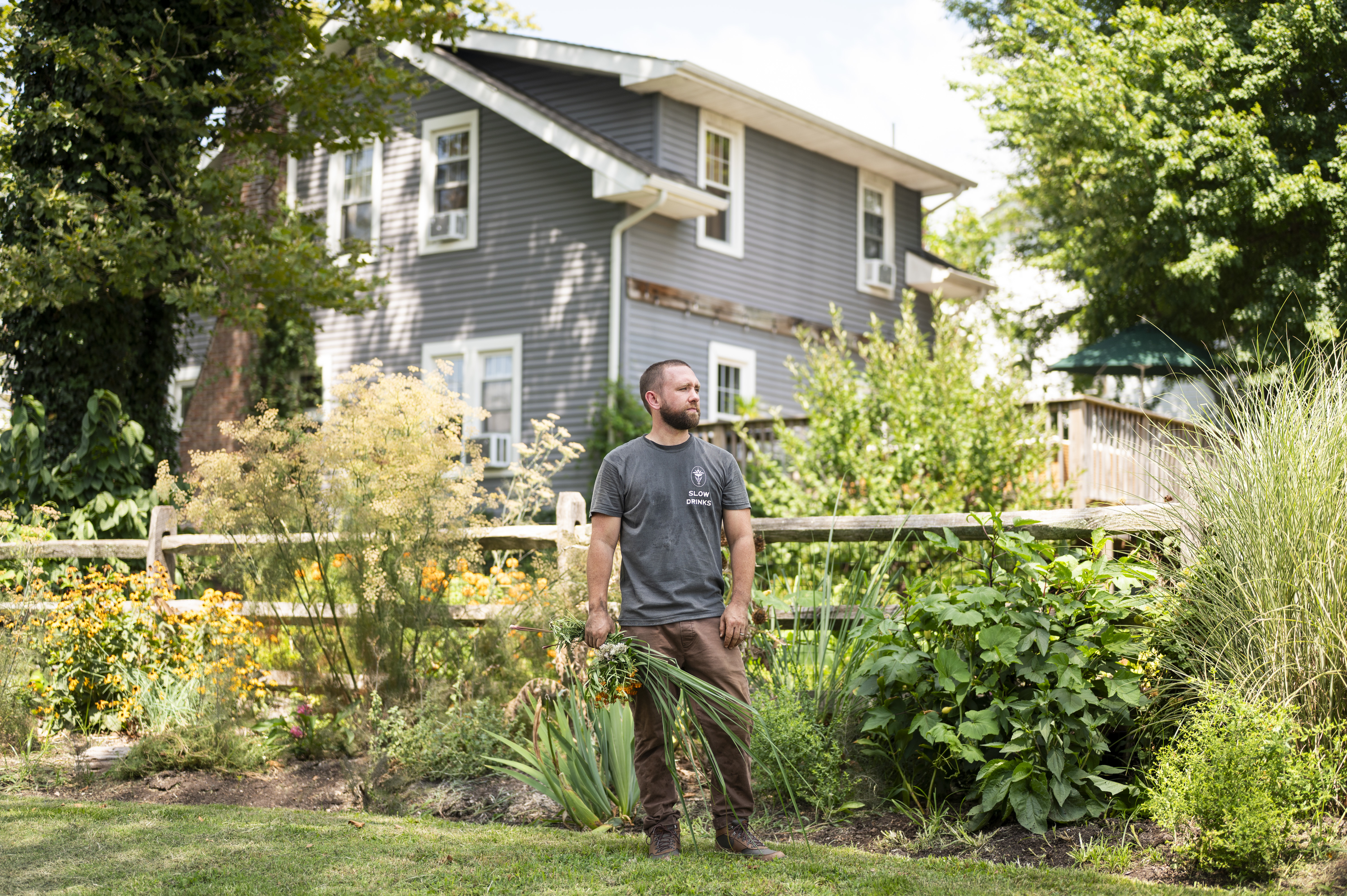
There’s an unassuming backyard in South Jersey that powers some of the area’s most interesting cocktails. The third-of-an-acre Pennsauken plot looks like that of any suburban home, with a weathered swing set and plenty of lawn, but it generates over 100 species of fruit, vegetables, herbs, and flowers each year, a mix of the familiar — lavender, dill, celery, tomatoes, peppers, etc. — and the far more intriguing: dandelion chicory, huacatay, prickly pear cactus, pawpaws, yuzu, jujubes, wormwood, and Jenny Lind melon.
Ingredients from this garden have been showcased in drinks at some of Philly’s best cocktail bars, as well as bars in Chicago; Cleveland; Berlin; Mexico City; Turin, Italy; and Bacolod, Philippines. That’s because the garden’s keeper, James Beard Award-winning beverage writer and bartender Danny Childs, knows how to transform the bounty into a liquid treasure trove.
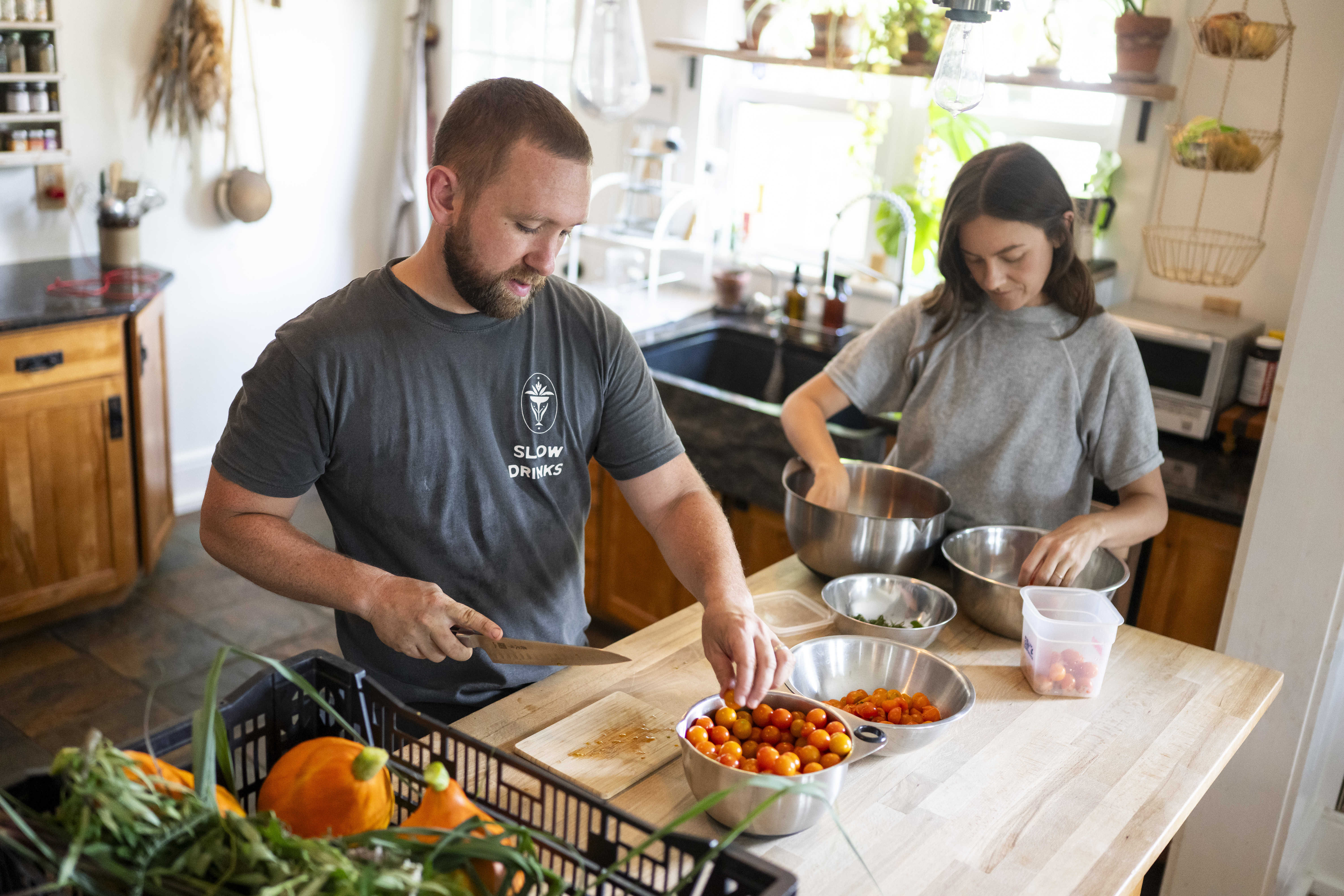
Danny Childs and his wife Katie sift through tomatoes picked from their garden at their home in Pennsauken, N.J., while making lacto-fermented tomato water.Allie Ippolito / For The Inquirer
This backyard and the wilds of South Jersey inspired Childs to develop a range of farm- and field-to-bar beverages, alcoholic and non, collected and detailed in his 2023 book, Slow Drinks.
The principles and practices in the book combine to form a drink-making theory that’s familiar to anyone who’s dined in a farm-to-table restaurant. The best illustration may be homemade amaro, which can capture a time and a place in a bottle by way of its botanicals. Slow Drinks has a recipe for every season — in spring, it’s a strawberry-tinged rabarbaro with roasted dandelion root; in fall, it’s a wormwood-heavy génépy spiked with apples, cranberries, and figs.
The theory behind Slow Drinks, which Childs views as larger than the book itself, emphasizes seasonality, local sourcing, preservation, and storytelling, and it can be applied anywhere.
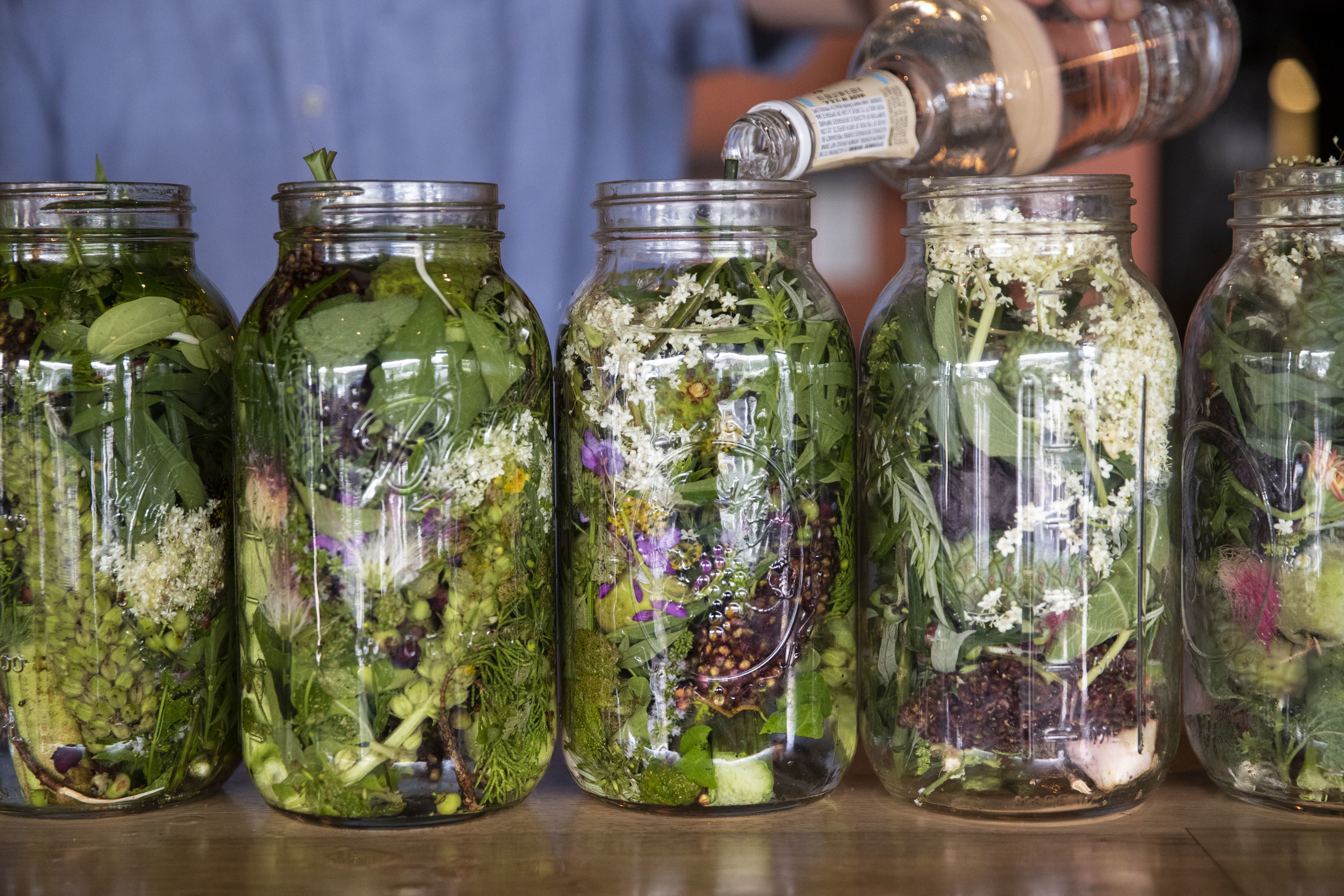
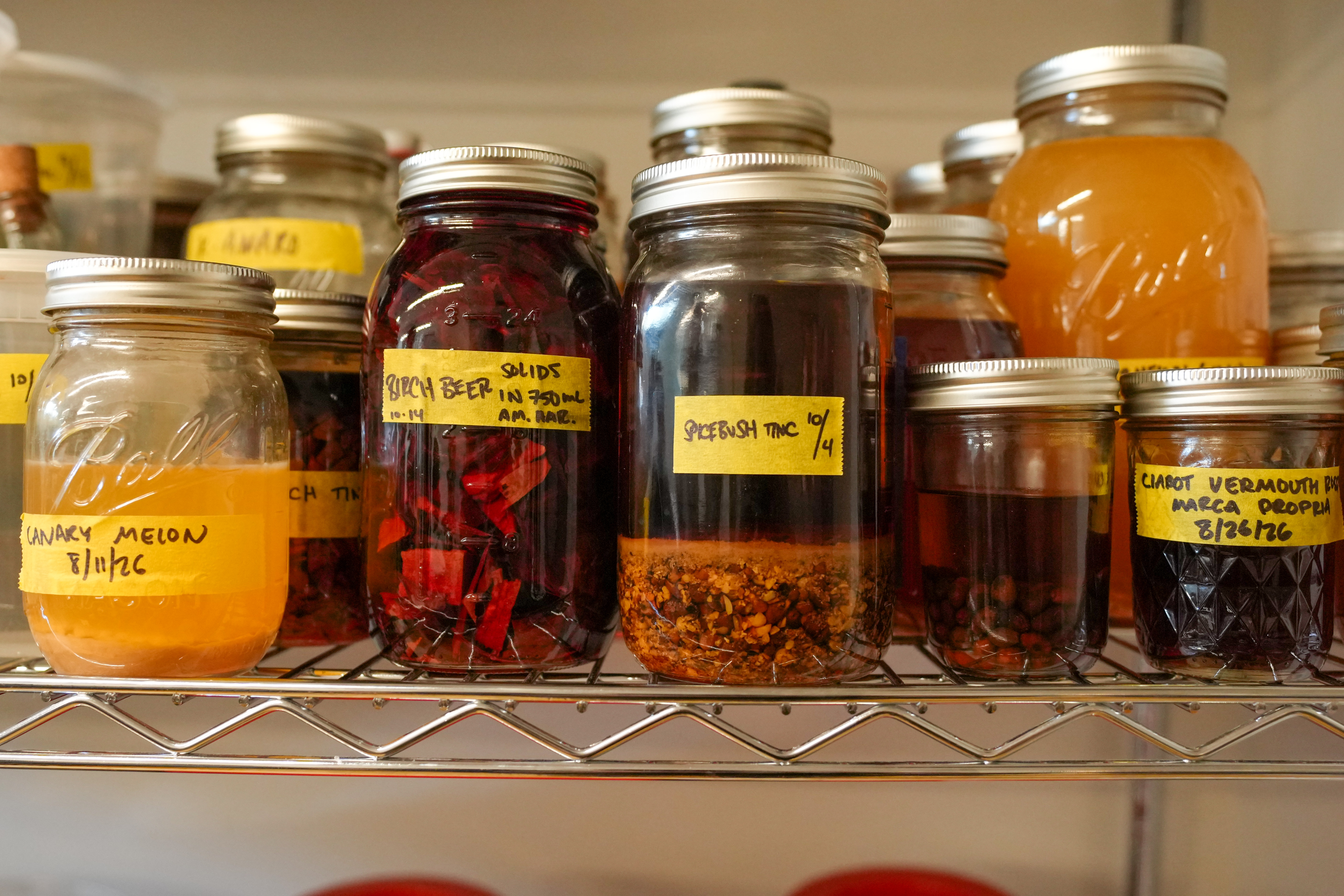
Childs’ South Jersey-inspired amari are infused with botanicals from backyards, forests, and parking lot shrubberies. MONICA HERNDON / Staff Photographer
The farm- and field-to-bar approach has caught the attention of prestigious bar programs here and abroad: Slow Drinks has sold 14,000 copies in English and some 4,000 copies in Italian. It was recently translated to Mandarin.
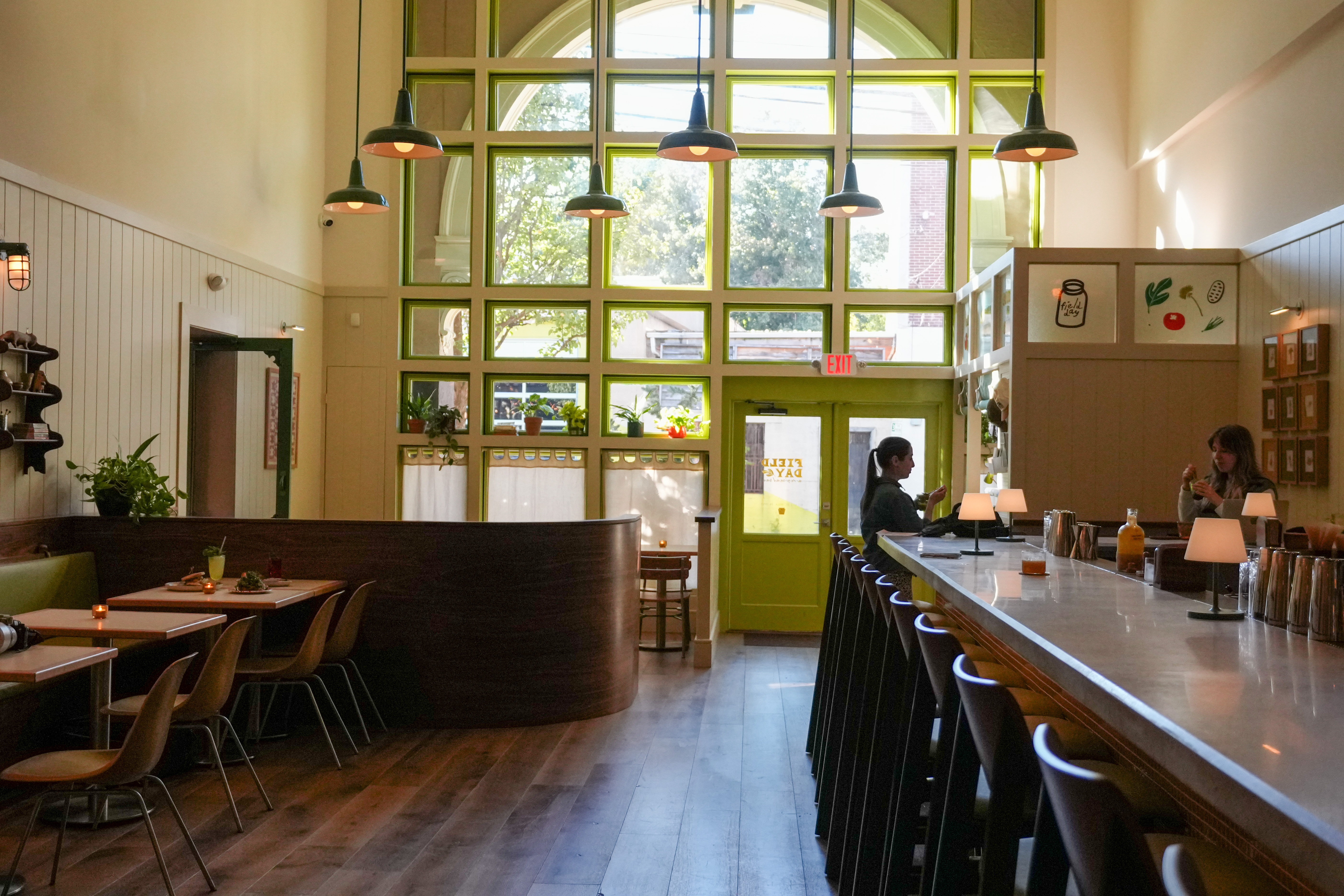
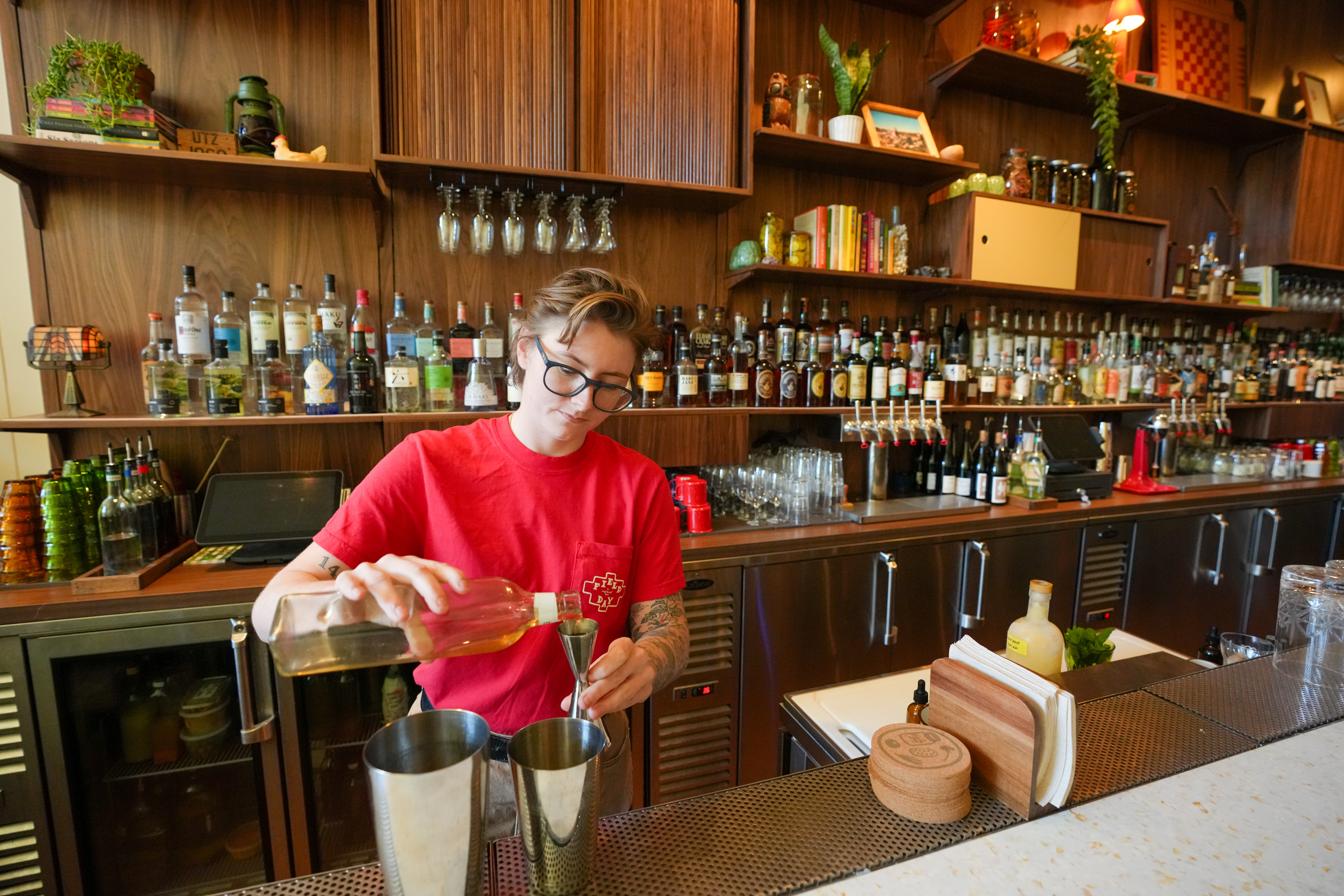
Though Childs has consulted on several beverage programs in Philly, this year marks the opening of his first bar, Field Day, in Northern Liberties, which he owns with his wife, Katie. Flagged as a “regional cocktail bar,” Field Day will filter its menu through a Slow Drinks lens, showcasing the breadth of ingredients and culinary traditions that swirl around our pocket of the Mid-Atlantic, from the Jersey Shore to Pennsylvania Dutch country. Think sherry and cherry wishniak highballs, boozy gelati, and a daiquiri-colada hybrid flavored with pawpaws and strawberries, along with regional foods like tomato pie, Lebanon bologna, and steamed clams.
Field Day, in Philadelphia’s Northern Liberties neighborhood, opened Oct. 21.Jessica Griffin / Staff Photographer
The bar’s debut marks the culmination of years of work. But Childs’ ultimate goal is much bigger. He wants Slow Drinks to take root at bars everywhere. He’s made some headway, but just as it takes time to turn black walnuts into booze, sowing the seeds of a cocktail revolution is no fast or easy feat.
Pitching a movement
It was steamy outside but freezing inside the Ritz-Carlton New Orleans, where Childs was presenting at 2025’s Tales of the Cocktail, the national drinks-industry conference that is nerdy and bacchanalian in almost equal measure.
The annual convention brings together a wide range of beverage professionals — bartenders, bar owners, distillers, marketers — who converge on seminars that would likely bore a layperson to tears. Slideshows on backbar configuration, viscosity, extraction, and “sensory analysis of spirits” were standing-room only, even as cocktail samples were being passed outside conference-room doors. The most-anticipated presentations saw people queue up outside the meeting rooms up to 45 minutes beforehand.
Childs had organized a panel with himself, bartending legend Jim Meehan (best known for cofounding the East Village cocktail bar Please Don’t Tell, or PDT), and Matchbook Distilling’s Leslie Merinoff Kwasnieski. It was slated for a Thursday morning, the penultimate day of the five-day-long conference and when many bartenders fly back home to work lucrative weekend shifts. That may have accounted for the relatively modest crowd in the double-wide meeting room that had been jam-packed for a boisterous lecture on dilution two days before.
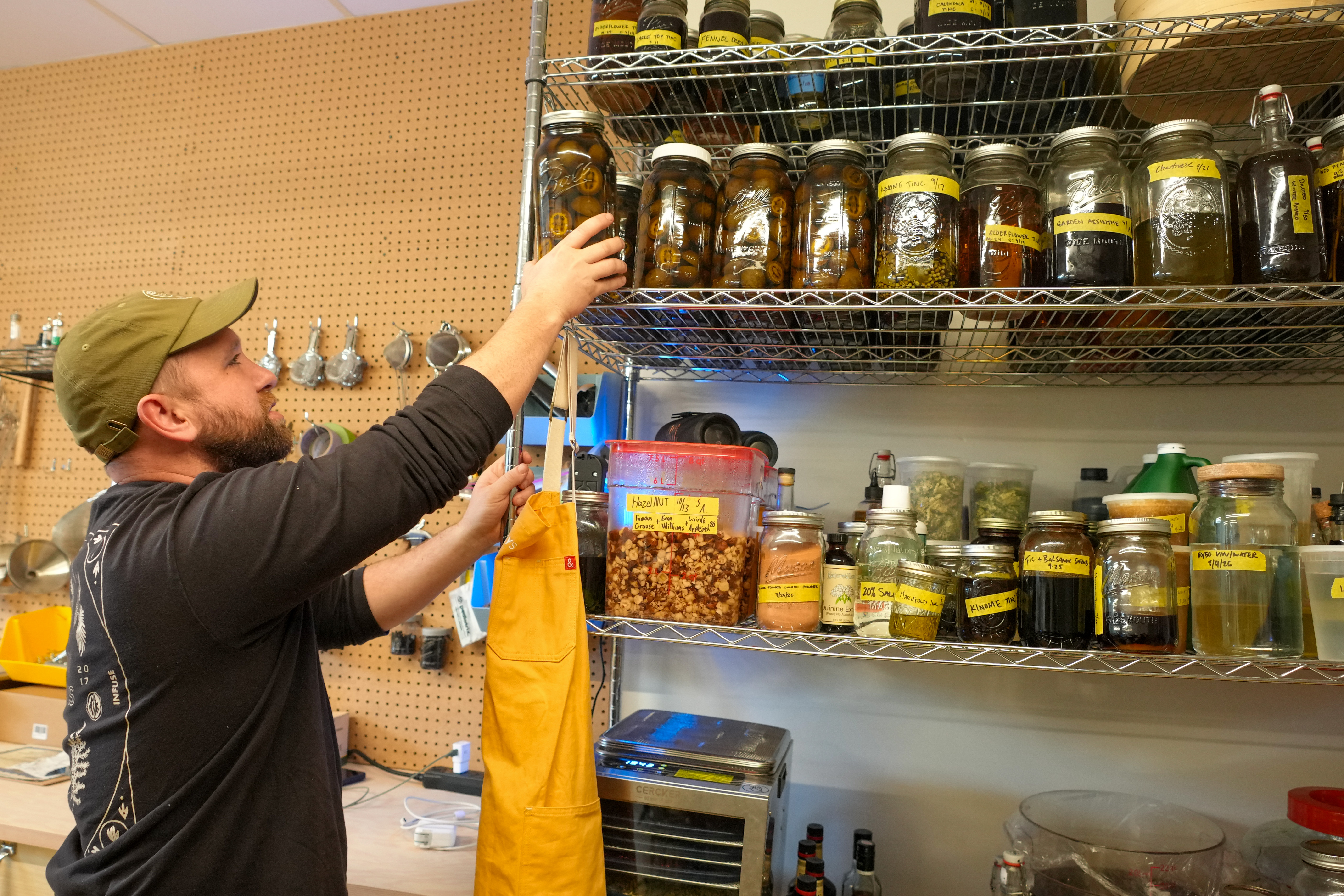
Local botanicals and produce macerate above Field Day, in the Slow Drinks’ second-floor HQ.Jessica Griffin / Staff Photographer
Another factor that may have contributed to crowd size? Compared to some more granular items on the Tales of the Cocktail agenda, the panel — entitled “the Slow Beverage Movement” — promised to be a little lofty.
Over an hour, fielding questions from then-executive director of Slow Food USA Bilal Sarwari, the panelists made the case for cocktails concocted the locally inflected way. The discussion at times veered into very dry territory: Childs waxed on ethnobotany, Meehan meditated on our world’s disappearing biodiversity, and Merinoff Kwasnieski, at one point, gushed about fungal networks’ impact on soil quality.
The talk was well-received by the audience (a small contingent of which were Slow Food Negroni Week scholarship recipients, whose rides to the conference had been subsidized by fundraising efforts that Childs had a hand in), and a couple queries ate up the 10 minutes left for questions. Reliably upbeat, Childs said he couldn’t have been happier with how it went.
Having sat in on several other seminars with higher-energy audiences, I myself wasn’t so sure how well the pitch had landed. A bartender with a gardening habit might be an easy sell. But could Slow Drinks’ time- and labor-intensive cocktail theory gain a foothold in the mainstream? How many bartenders are willing to ferment their own ginger beer, forage ingredients for housemade amari, or harvest actual roots for root beer?
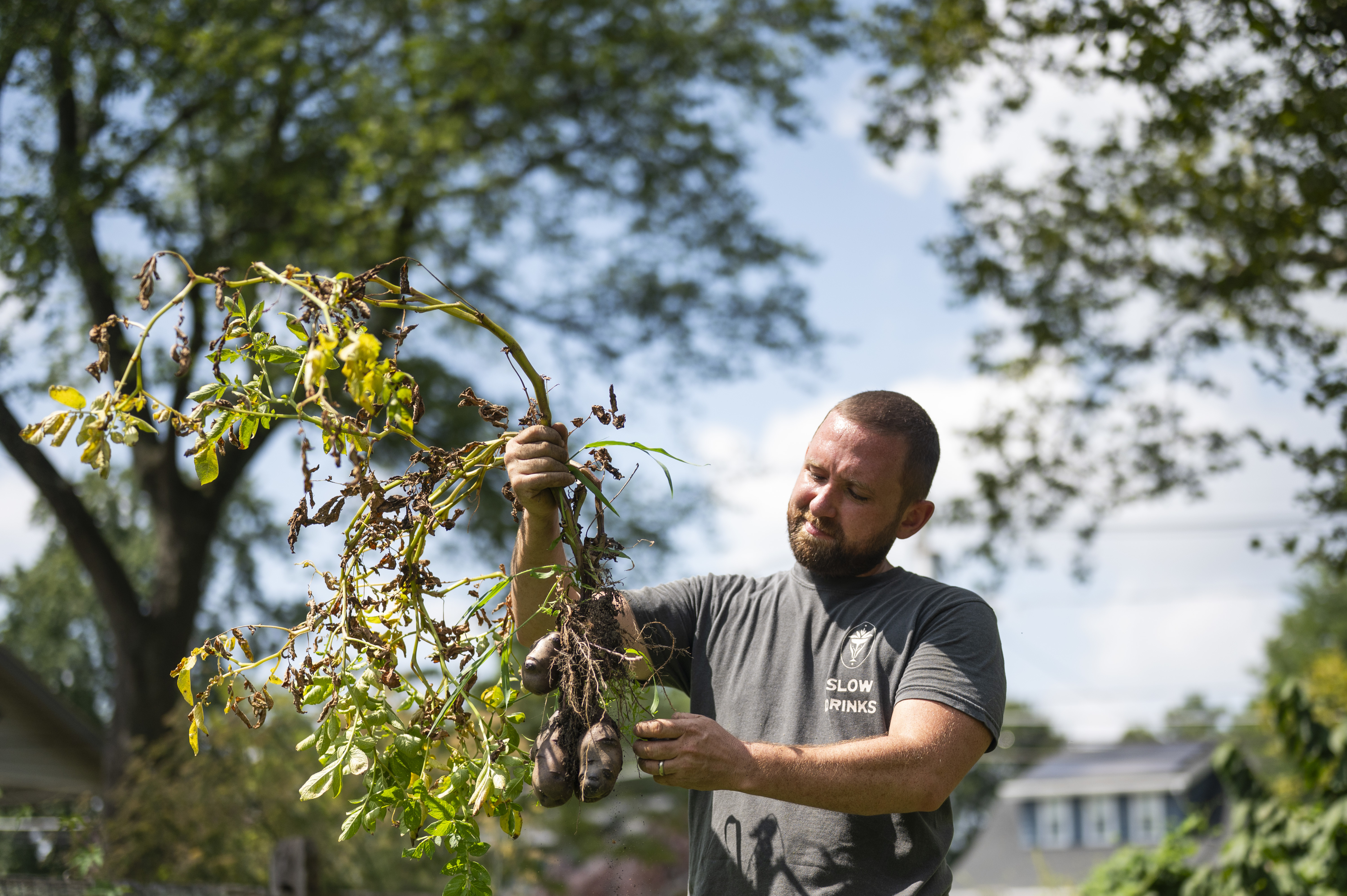
Purple potatoes are among the hundreds of plants Childs grows in his backyard. Allie Ippolito / For The Inquirer
Deeply unpopular, very important
I asked Meehan later about the challenges facing this prospective movement. In 2024, Meehan released a book, The Bartender’s Pantry, written, as he framed it in our interview last year, “in the wake of the reindustrialization of the craft cocktail.” He considers it in league with Slow Drinks — acall to think harder about cocktail ingredients and their sourcing in a time when “our world and our climate is under great duress.”
Like Childs, Meehan feels strongly about this cause, but he’s skeptical about industry uptake. “Are people doing this? Absolutely not. And will they do this? I don’t know. I doubt it,” he said.
But Meehan had reason for optimism, too. “As I think back to the early days of the craft cocktail movement that I participated in [in the aughts] … it is very hard to describe to today’s young bartenders how deeply unpopular what we were doing was — how unpopular, unprofitable, and how vain and silly most people viewed us.”
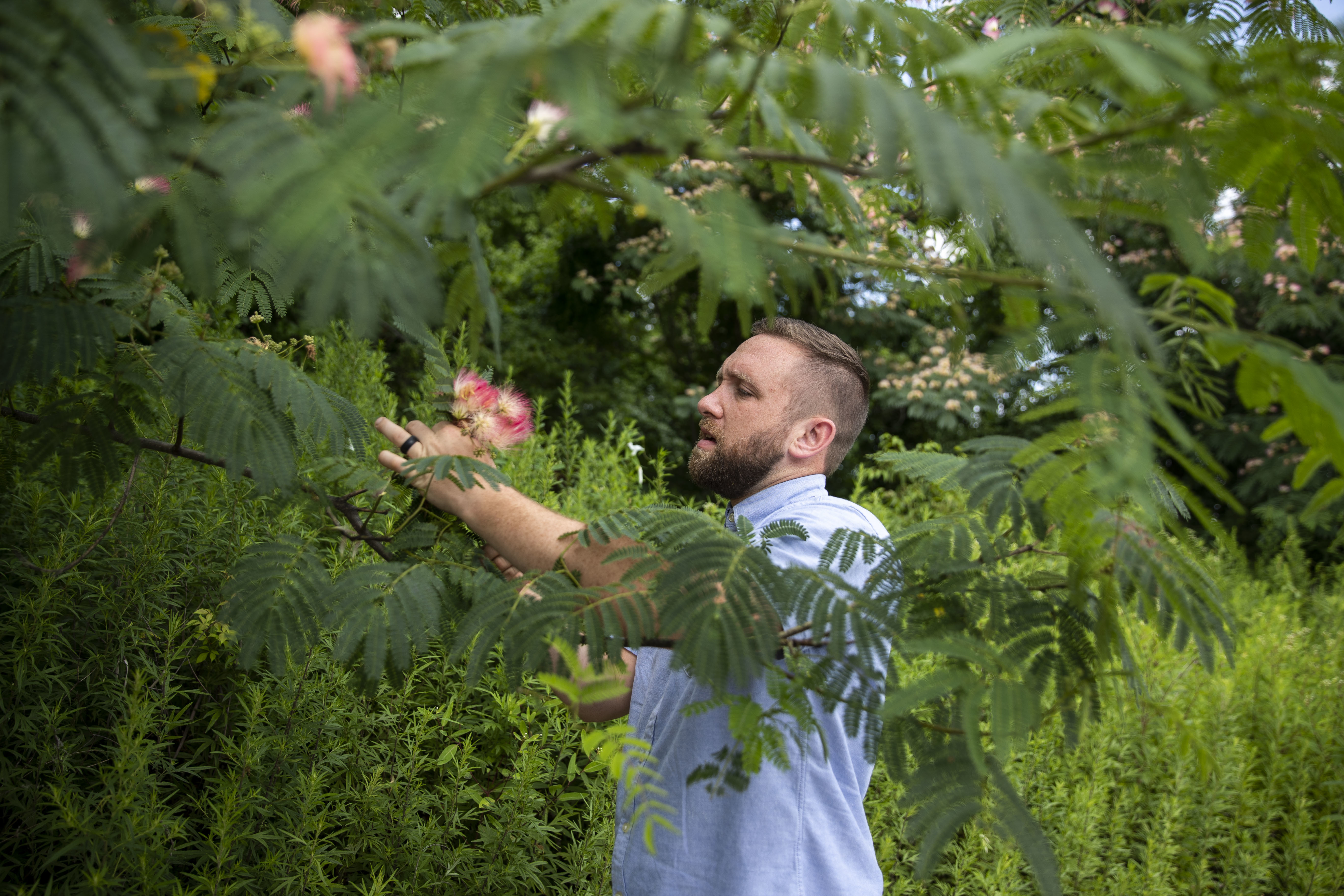
Danny Childs foraging for blooms from a mimosa tree in 2021, when he was still bar manager at the Farm and Fisherman Tavern.MONICA HERNDON / Staff Photographer
He remembered working 12-hour shifts at Pegu Club, the storied New York cocktail bar that opened in SoHo in 2005, and earning just $80, a fraction of what he would make at Gramercy Tavern. He would repeatedly deny requests to sub vodka in for other spirits on the cocktail menu. “It was tough,” Meehan said.
Time and “a never-ending parade of great press” eventually moved the needle, he said, as a curious clientele of mostly young professional women came in, dragging their vodka-drinking boyfriends with them. He was surprised to see customers casually embracing whiskey and gin drinks within just a couple of years. By the 2010s, craft cocktail bars were opening in cities all over the country.
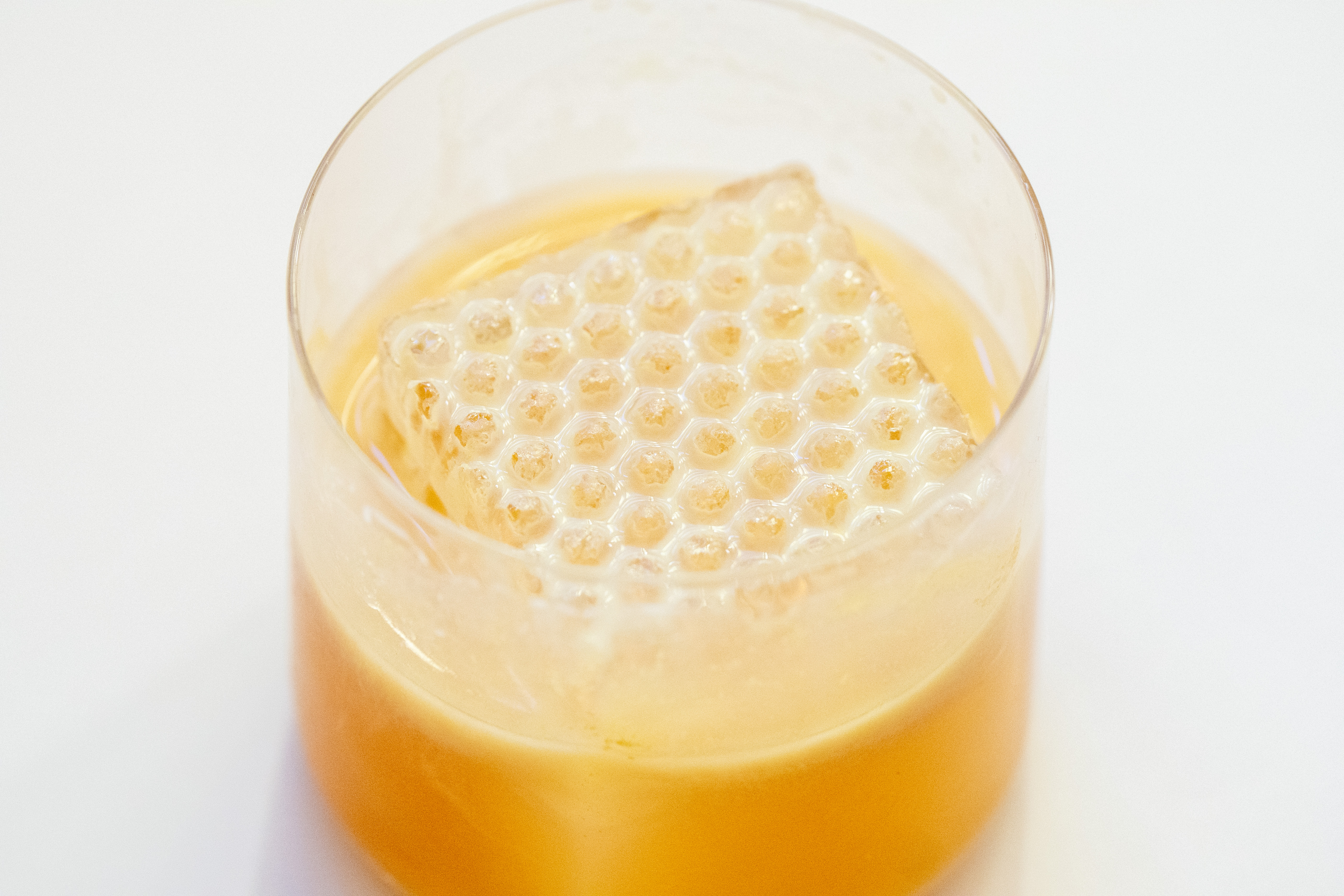
Liquid Gold, an Old Fashioned riff that uses beeswax, propolis, and raw honey, at Field Day.Jessica Griffin / Staff Photographer
To some extent, Meehan — no longer bartending — finds himself on the outs again, having taken up a new mantle in advocating for a more thoughtful, sustainability-minded approach to beverages. He considers himself in the same camp as Childs in that sense, but he thinks Childs has an edge he and his cocktail-pioneer comrades didn’t: “We were weirdos, and Danny is, frankly … very normal and very reasonable and very articulate, and I think mostly he’s very positive,” Meehan said. “For these reasons, I think this guy has a very good chance of being successful.”
“I think that there’s something revolutionary about what Danny’s putting out there,” Meehan said. “I’m sure people think that we look like some bartender form of Alice Waters, but I think that it is very important work.”
Changing perceptions
Childs is well aware that the very idea of locally inflected cocktails can come across as pretentious and twee — they’re the kind of thing you might have seen skewered on Portlandia.
But it’s also hard to imagine a better ambassador for what seems like a very fancy thing: Childs first developed Slow Drinks as a concept while working as bar manager at Farm & Fisherman, a family-friendly tavern in a Cherry Hill strip mall. Over a decade, he hooked suburbanites on sophisticated cocktails that were also approachable and highly drinkable, only going on a spiel about sourcing when prompted.
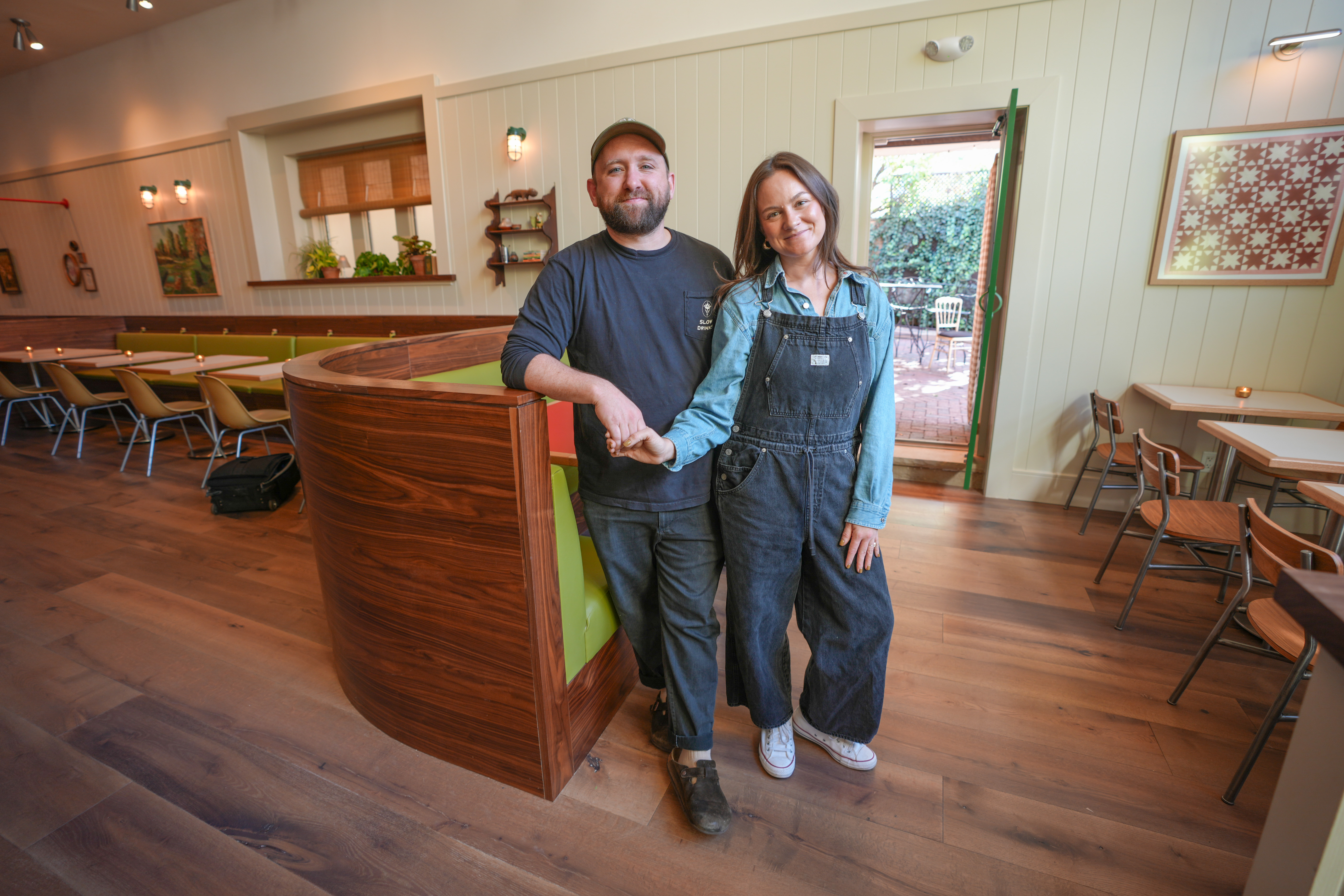
Danny and Katie Childs at their regional cocktail bar Field Day. “He looks like a he looks like a Division Three running back,” bartender and beverage writer Jim Meehan said of Danny Childs. “He’s very approachable.”Jessica Griffin / Staff Photographer
Childs’ upbringing no doubt plays a part in his innate ability to soft-sell. Before he moved to Marlton at age 11, he grew up in Delco: first in his grandparents’ house and then a Clifton Heights apartment complex. His dad bartended at the Clifton Inn (now Murray’s Bar & Grille) for years. “I grew up in that bar in a lot of ways,” Childs said. He remembers learning to play pool and shuffleboard there, and having his first underage drink one Christmas Eve.
His blue-collar roots are balanced by a deeply nerdy side. Childs’ fascination with plants, fostered by his naturalist-oriented uncle and grandfather, kicked into high gear when he studied anthropology and ethnobotany at the University of Delaware. He spent four years traveling through South America to study the use of medicinal plants among Indigenous people. (If not for a bartending gig in Chile, Childs might be an M.D./Ph.D. teaching and practicing ethnomedicine today.)
He swerved out of academia postcollege, when a would-be gap year sent him down an agricultural rabbit hole: first on a Marlton Christmas tree farm — where he and Katie homesteaded in a military tent equipped with a wood-burning stove for nine months — and then over stints at Urban Roots Farm in Newtown Square and at Plowshare Farms in Bucks County.
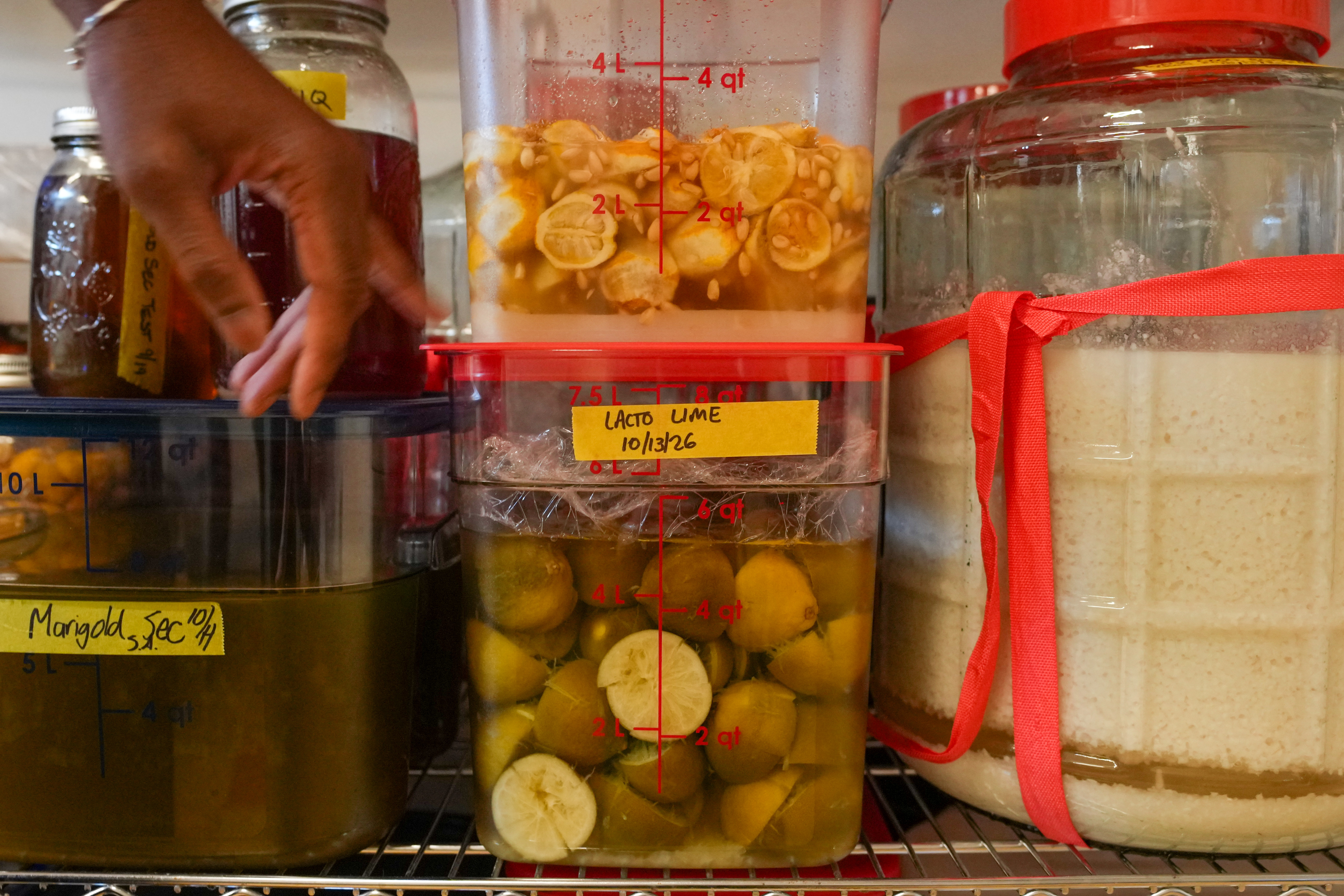
Lacto-fermented limes sit below a bin of trifoliate oranges steeping to eventually make cheong (fermented syrup) in the Slow Drinks HQ and Field Day R&D lab in Northern Liberties. Jessica Griffin / Staff Photographer
Those various walks of life all braided together when Childs took a job at Farm & Fisherman in 2013. It was there that he started dreaming up “cocktails through an anthropological lens” — a phrase, as he writes in Slow Drinks, that he scrawled on a bar napkin, then spent years teasing out. He started applying age-old practices of fermentation and infusion to the local ingredients surrounding him, then mixing them up behind the bar.
Childs codified these methods in Slow Drinks, which is intended as a springboard for other bartenders and home enthusiasts, offering building-block master recipes for shrubs, liqueurs, aromatized wines, and more preserved, distilled, and infused liquids. Cocktail recipes (pickled ramp martini, stone-fruit amaretto sour, clarified persimmon punch, etc.) round out the book, showing region-specific applications season by season.
The Slow Drinks book by Danny ChildsMonica Herndon / Staff Photographer
Just as he knows the larger theory runs the risk of feeling esoteric to guests, he recognizes the work required may intimidate industry pros. “Bartenders are taught how to make syrups and mix cocktails with ingredients that are on their backbar. It’s changing a little bit, but the bars pushing that envelope are still like the top 1%,” he said. “I know it might seem difficult or out of reach.”
Childs’ ultimate counterargument is a humble one: He’s not actually doing anything new here. “People have been doing this for hundreds and in a lot of cases thousands of years.”
Local gaze, global ambition
Childs has been dedicated full-time to Slow Drinks as a business and a concept since 2023, when he left his role at Farm & Fisherman. The departure gave him time to promote the book but also more flexibility and autonomy over where the larger idea might go.
“It was kind of like jumping out of the plane without a parachute and hoping for the best,” Childs said of the decision to leave.
Childs handles nocino in the Slow Drinks HQ above Field Day.Jessica Griffin / Staff Photographer
In the years since, he’s consulted on several bar projects in the Philly area (most notably Almanac and La Jefa, both James Beard Award nominees). With Katie as copilot, he’s grown the Slow Drinks brand via pop-ups and collaborations, some of which have left lasting impressions. (If you find yourself at Mexico City’s Baldió, ask to try the chinampas Chartreuse and agave amazake.) He’s also established a close relationship with the international organization Slow Food that’s taken him to various cities and countries to present on the budding movement, often with an entourage of scholarship-backed bartenders who are practicing this style of drink making already.
Childs also spent much of the last two years laying the groundwork for Field Day, whose staff claims a number of Philly’s most promising restaurant-industry talent, including chef Melissa McGrath and fermentation whiz Jamaar Julal.
Even as he becomes a bar owner, Childsis going full tilt on Slow Drinks. The business’ headquarters live above the bar, in an office/lab that shares space with Cescaphe Ballroom’s wedding complex. This summer he and Katie hired Canyon Shayer, a Philly Distilling and Heaven Hill alum, to be the S corporation’s COO and “director of culture,” working with clients on developing and implementing Slow Drinks-style beverage programs.
Erin Dassler makes cocktails at Field Day. Childs hope the bar serves as a model of a full-fledged Slow Drinks program. Jessica Griffin / Staff Photographer
In a way, Field Day is a test case, “a blueprint for, this is what [Slow Drinks] looks like in practice day in and day out,” Childs said. “I think we’ve just really scratched the surface of getting people fully bought into it, and that it is something that can leave the industry better than we found it.”
If Childs gets his way, bartenders all over will see potential ingredients every time they step foot outside — even if it’s just into their own backyards.
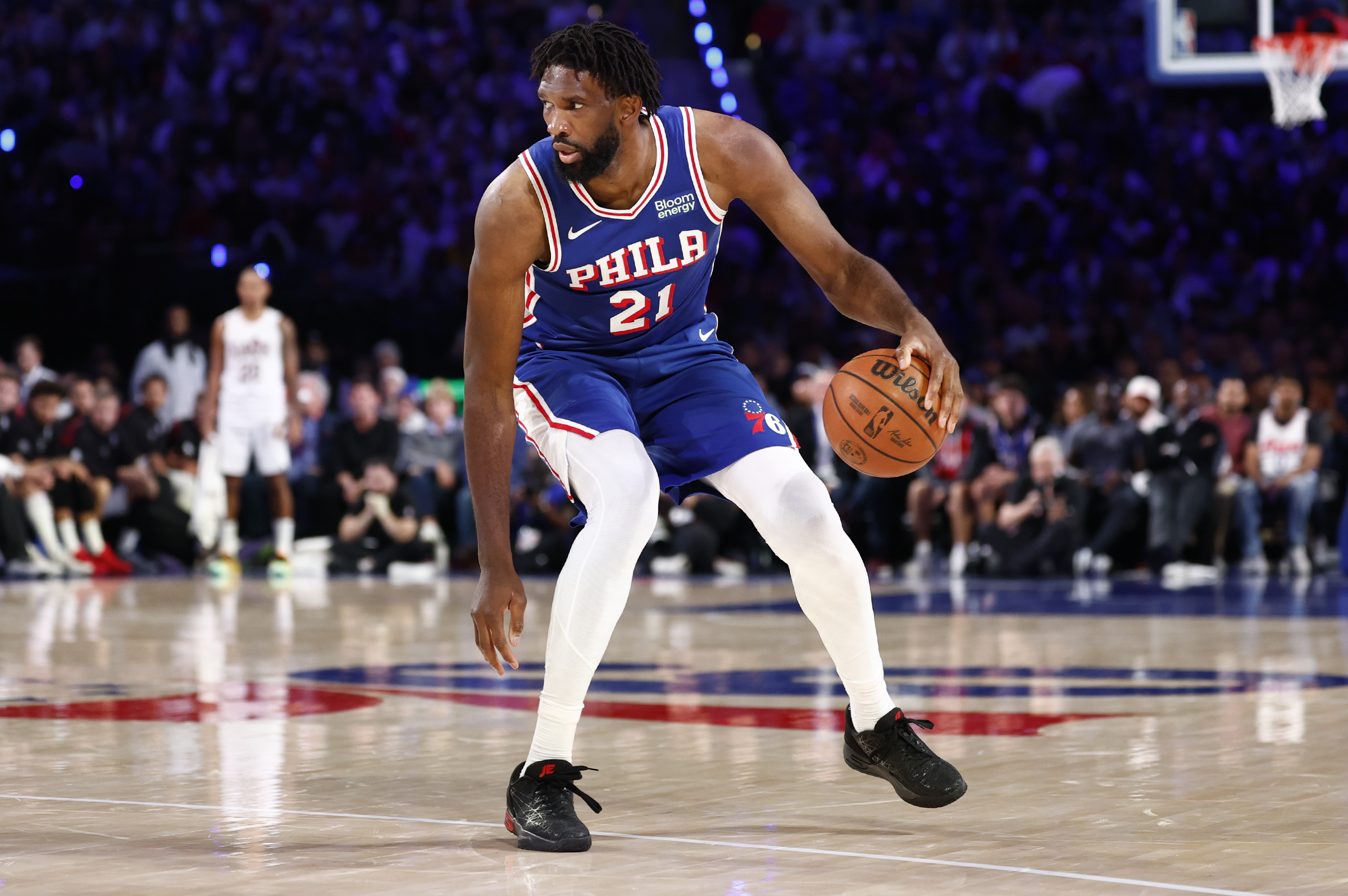
To 76ers coach Nick Nurse, there has been one strong indication through two games that Joel Embiid may truly be returning to the fully formed, healthy version of himself.
“The biggest thing I said to the staff I think that I’m most happy with is that there’s some rebounds or loose balls and he’s coming away with a lot of that stuff,” Nurse said after Thursday’s 114-106 win over the Cleveland Cavaliers. “It’s down there and you’re wondering who’s going to get it, and all of a sudden Joe’s ripping it out there and going up the side with it, and there we go.”
Embiid might still be trying to find his rhythm offensively (he’s shooting just 39% from the floor, and Charles Barkley referred to him on ESPN as the team’s “fourth option”).
But the early returns on how Embiid has played defensively and in those hustle aspects of the game have been promising. A lot of this Sixers season hinges on Embiid’s health; in order for this team to reach a championship ceiling, it needs him to make it to June feeling and playing the way he is in October — especially on defense.
After the win over the Knicks on Tuesday, Embiid said he wanted to be back on the All-Defensive Team this season, a list he has not made since the 2020-21 season.
“Felt good, moving great. Felt like I was all over the place, so I need to do that every game,” Embiid said.
When he spoke after the win over the Cavaliers, Embiid said there was one aspect of the game he is still trying to regain a feel for — rebounding. Through two games, he has averaged nine boards.
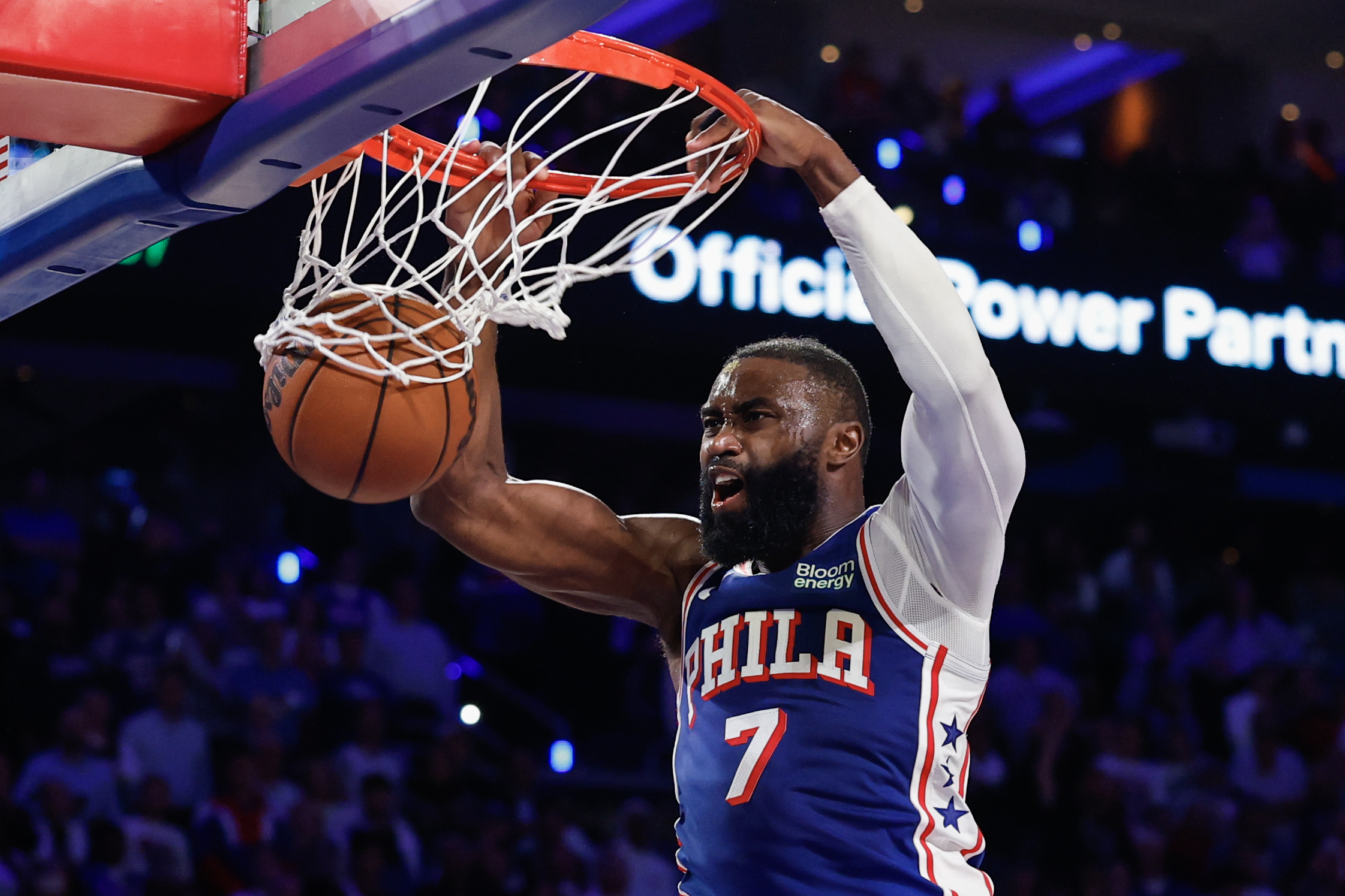
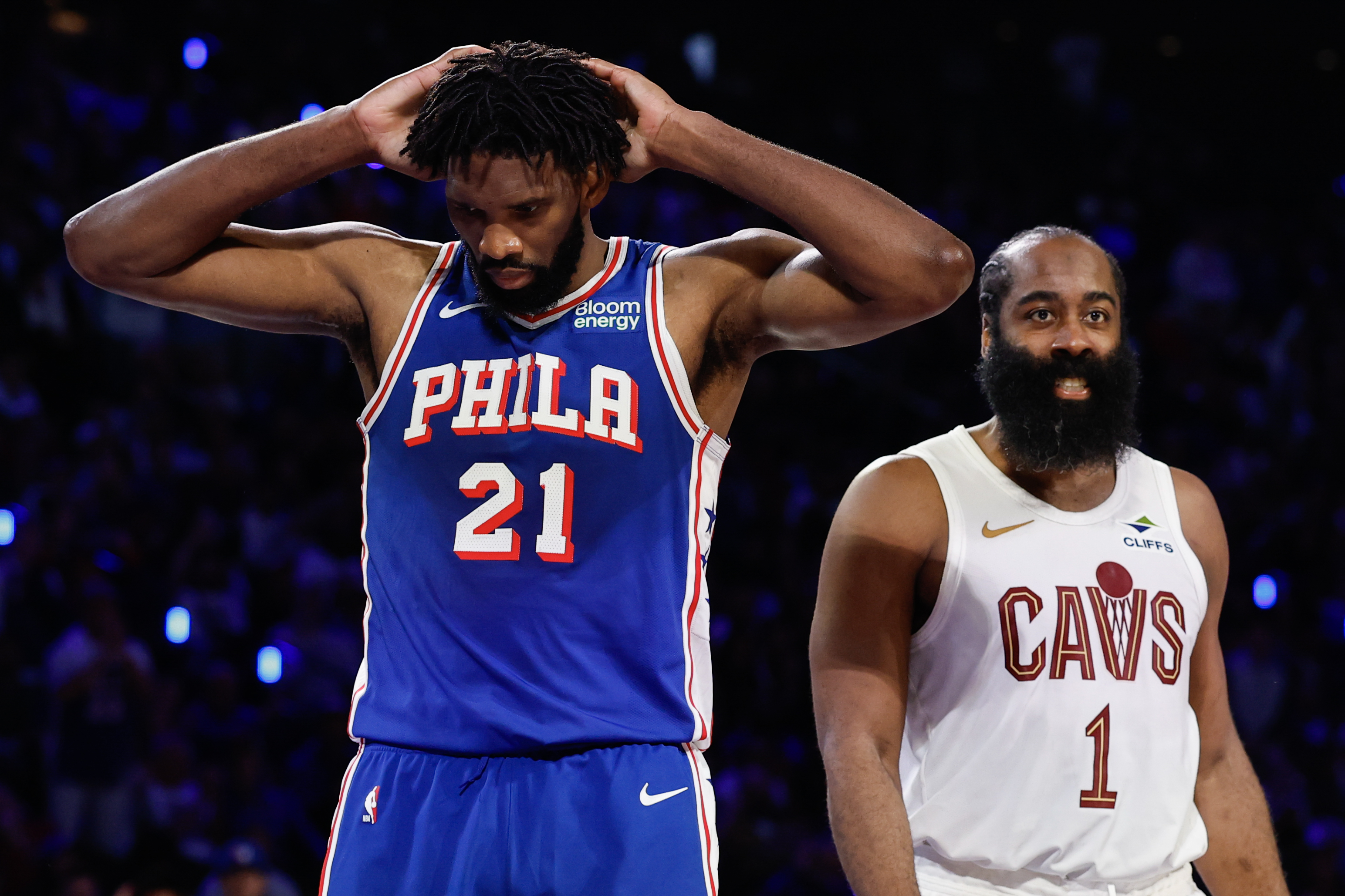
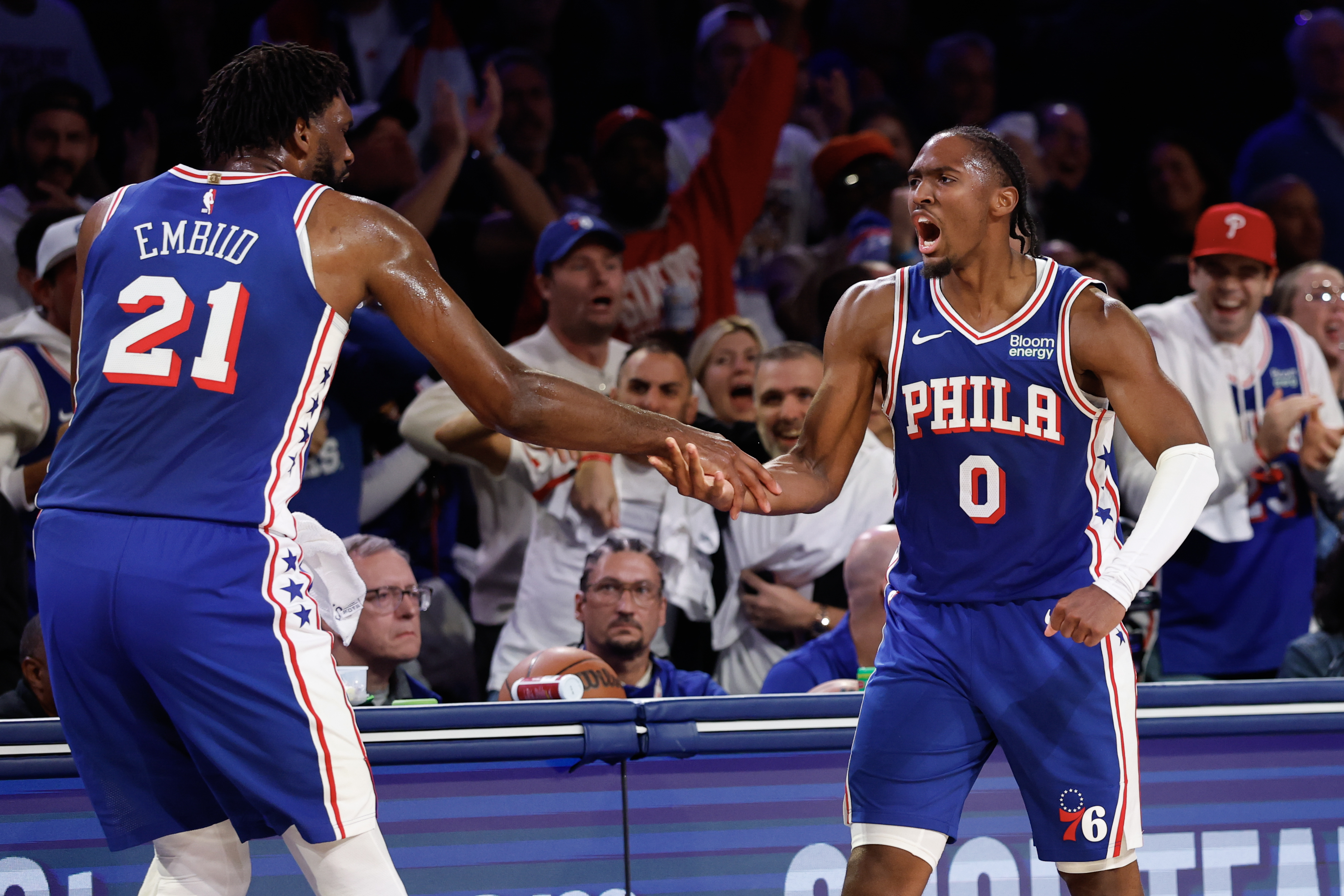
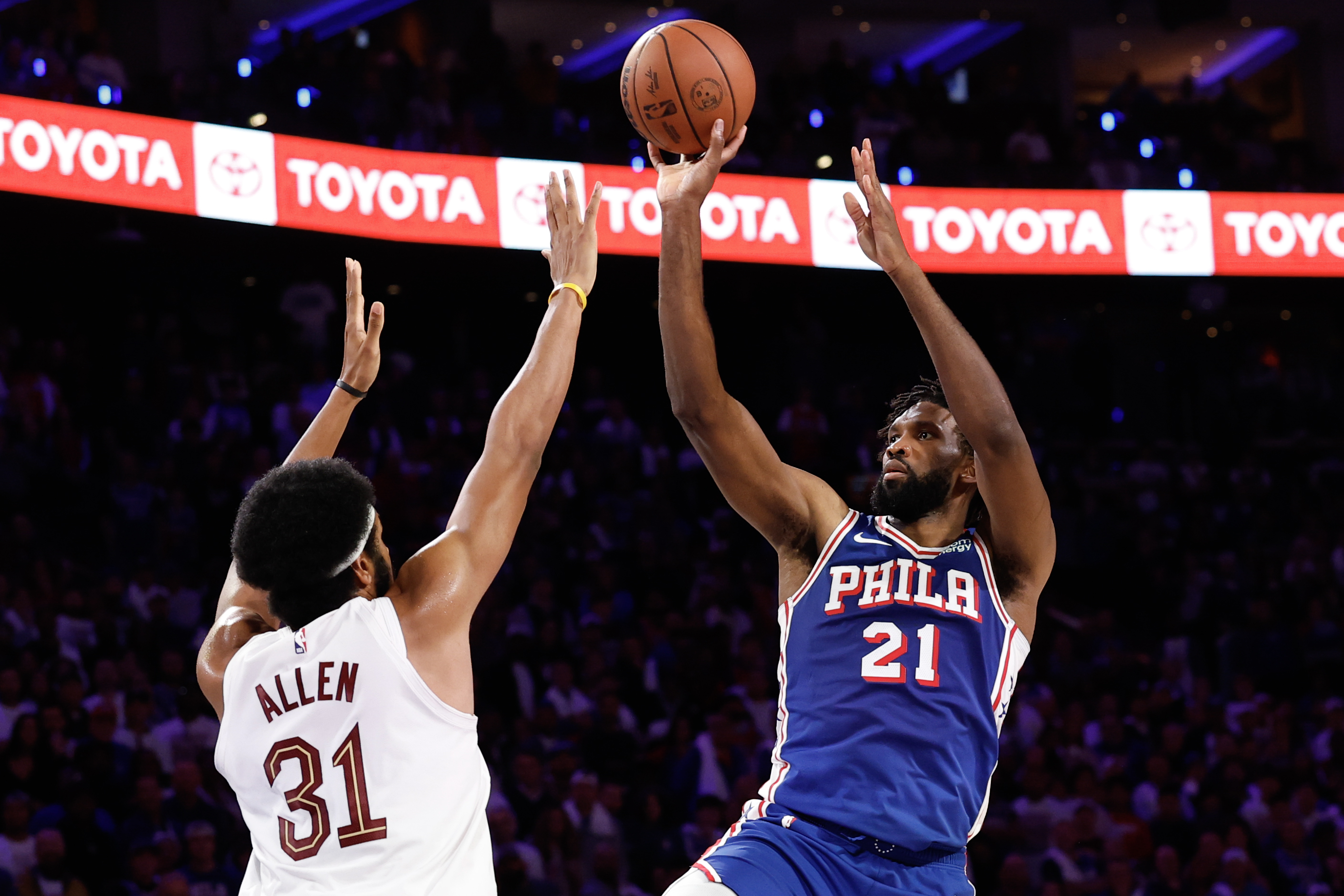
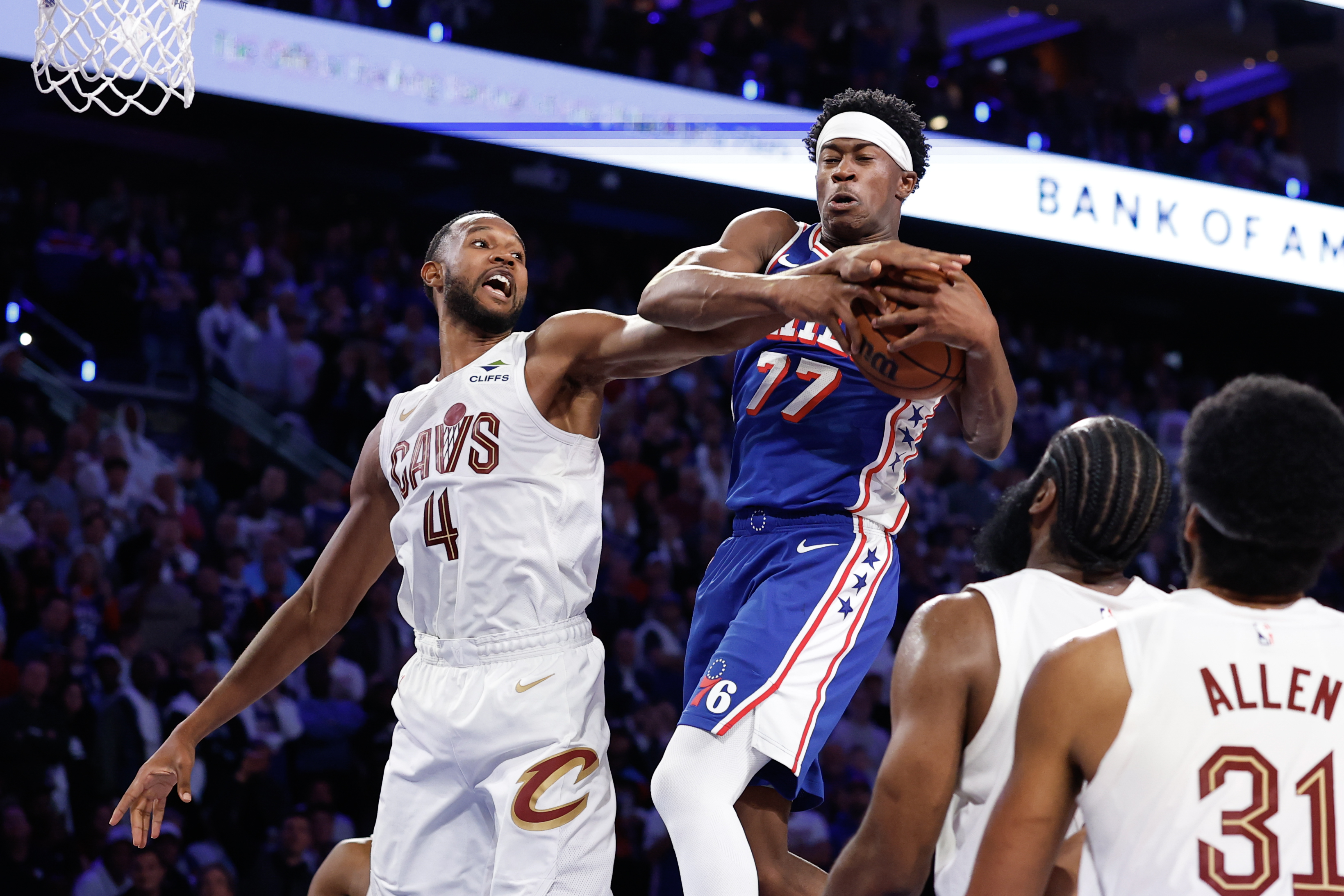
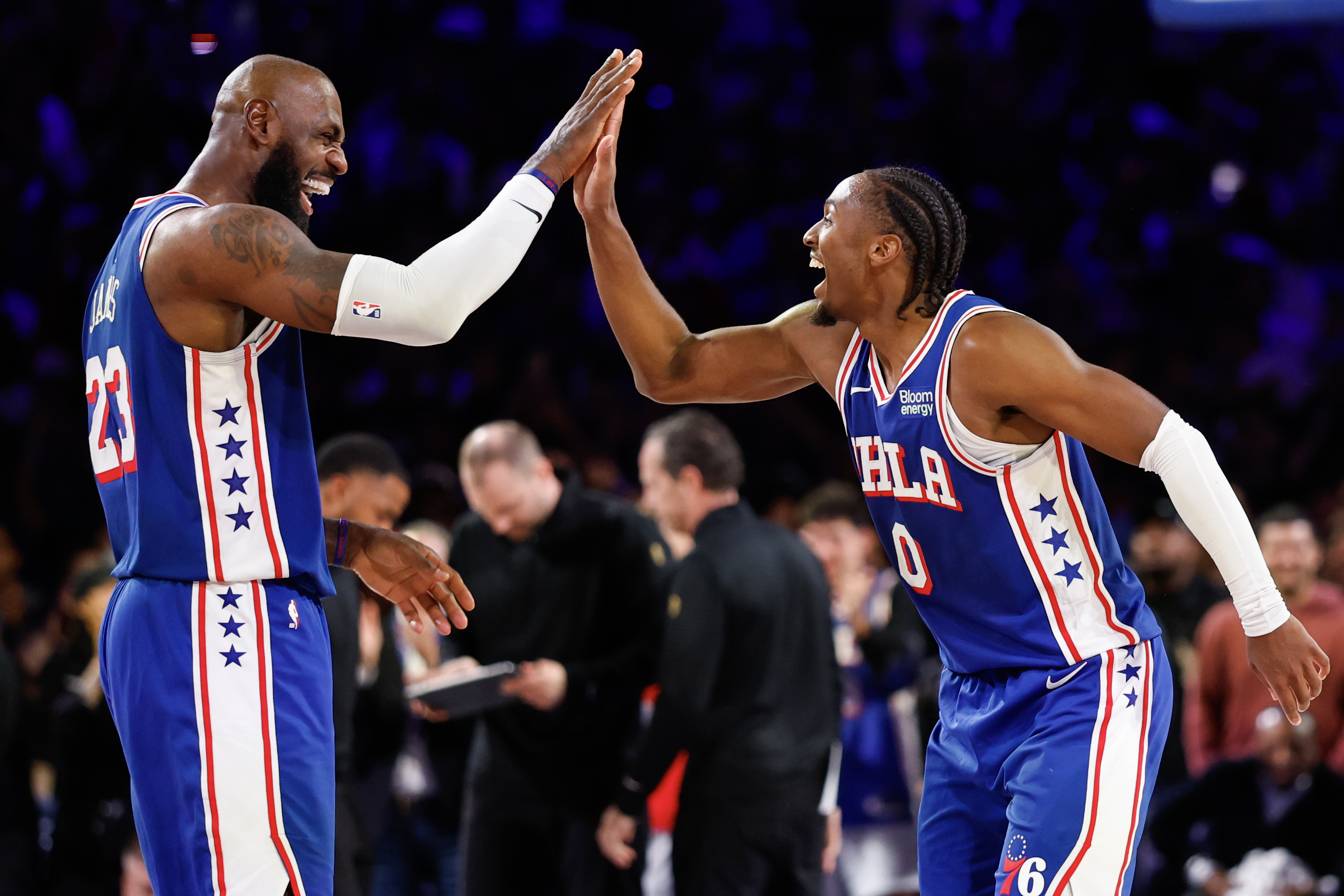
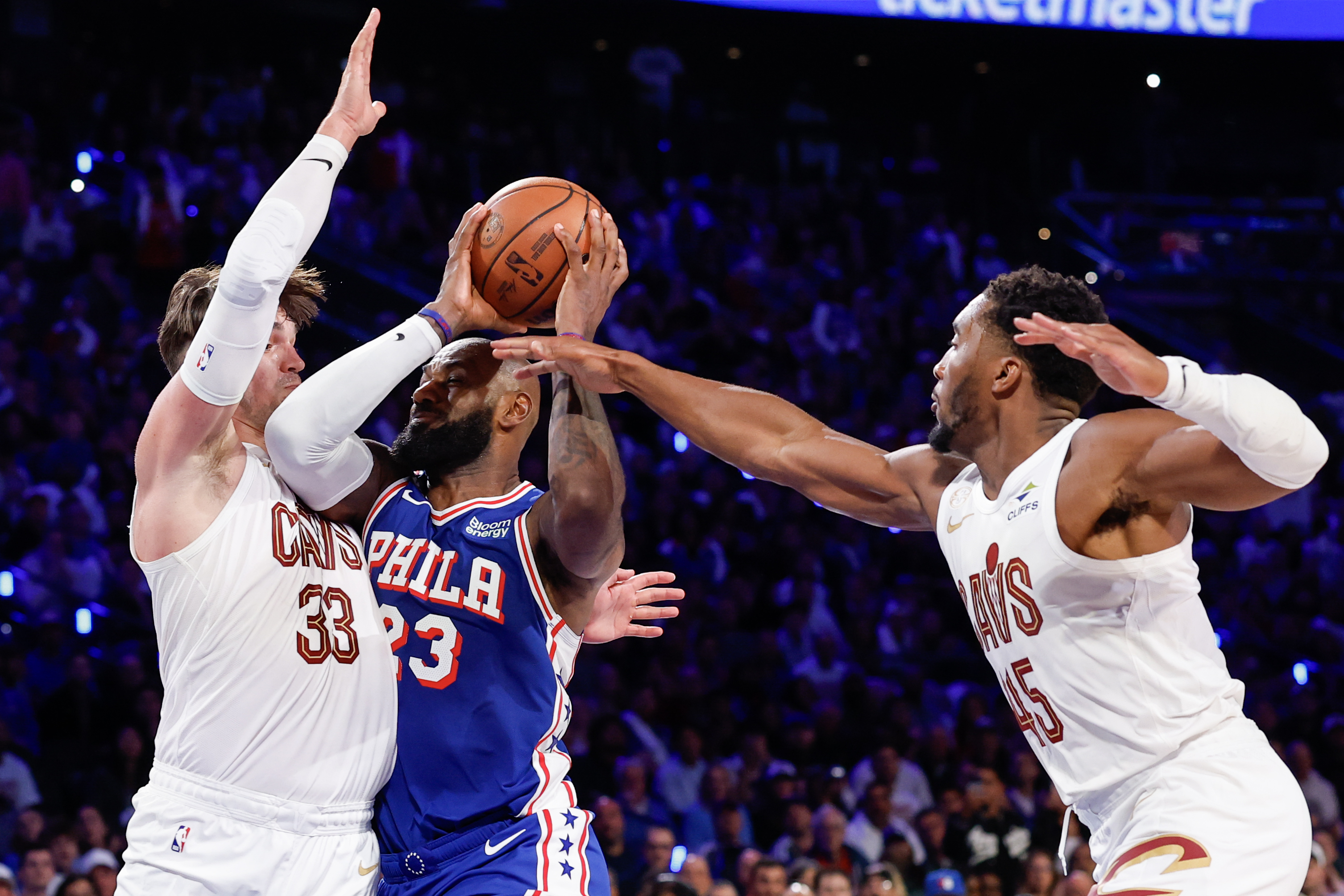
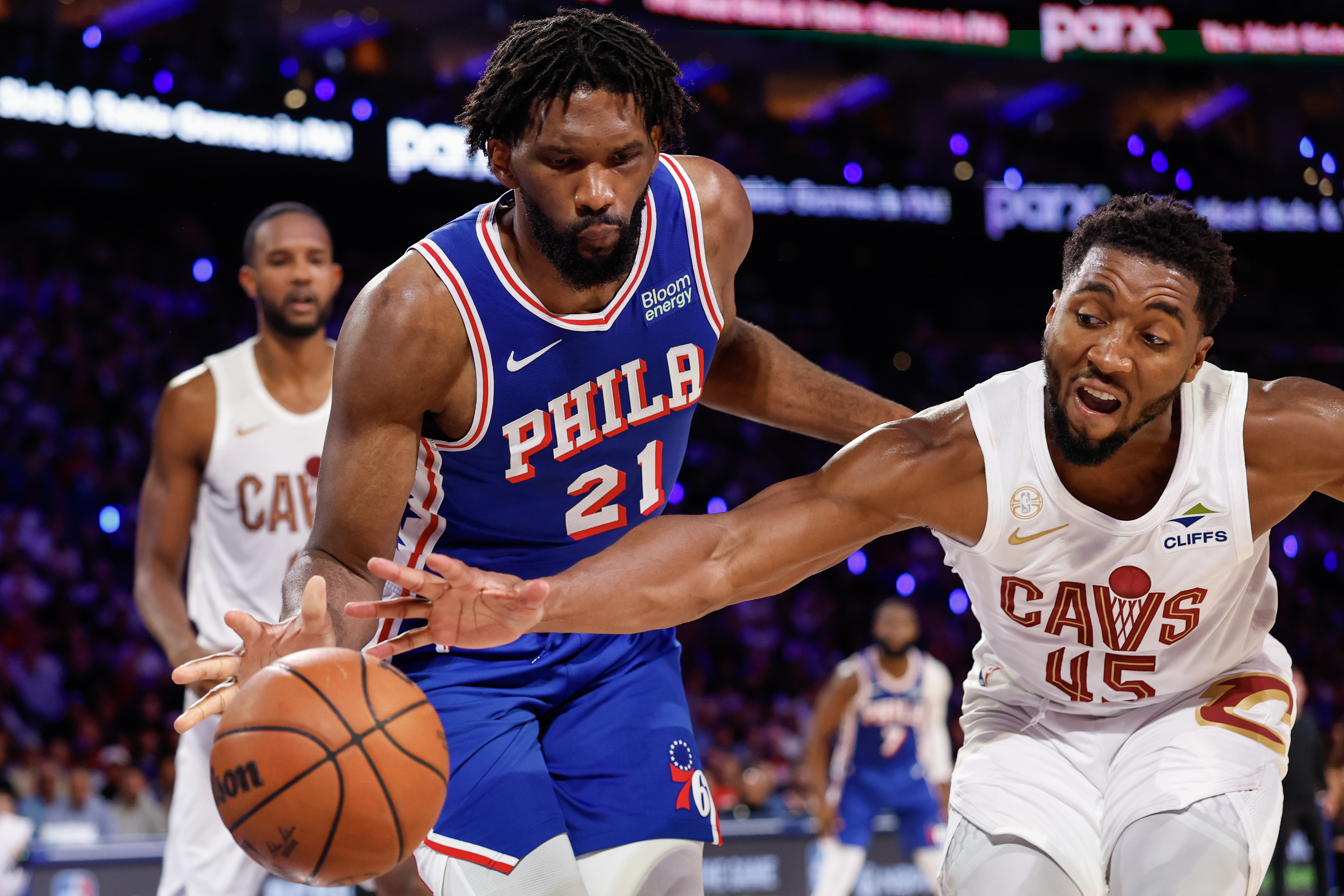
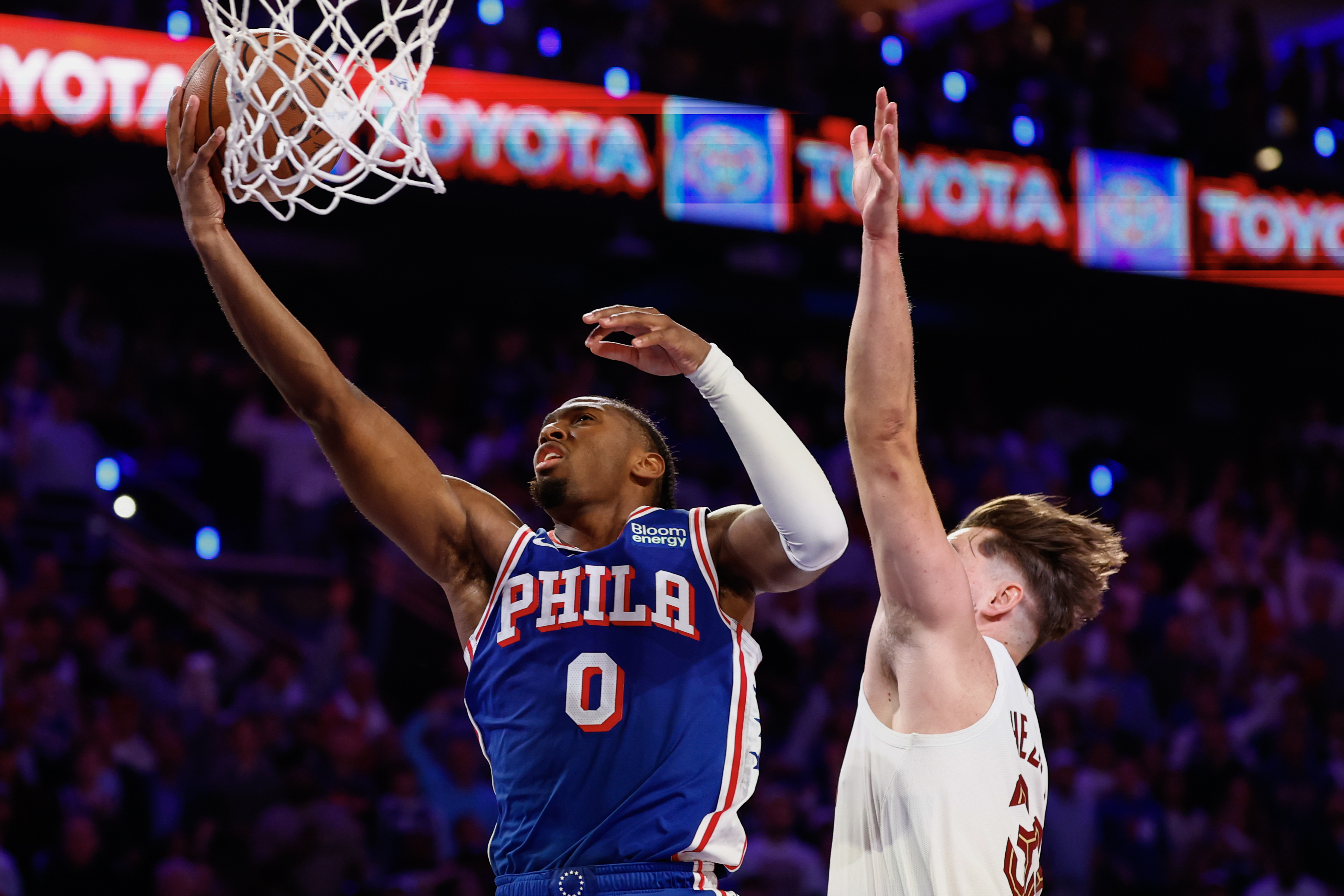
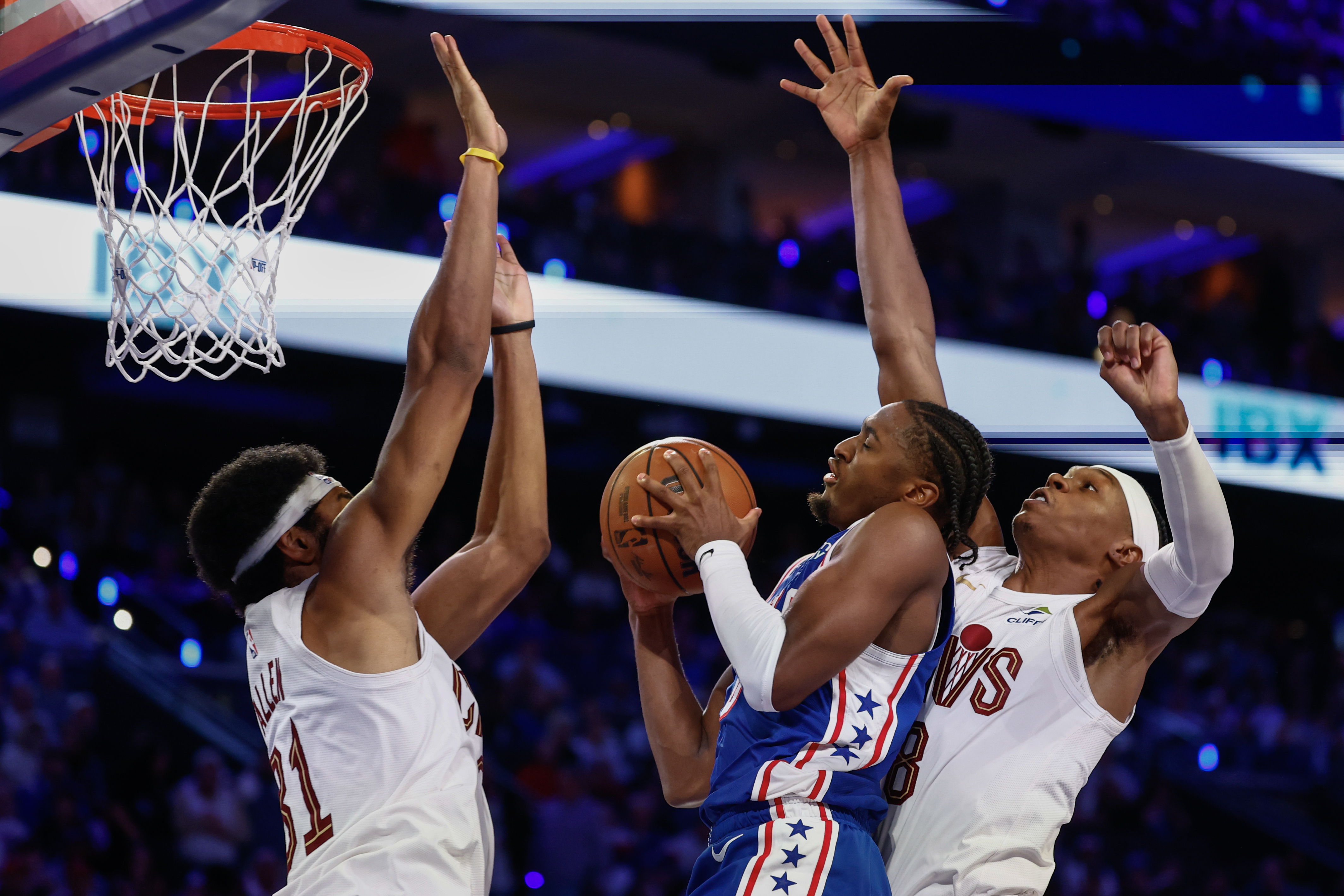
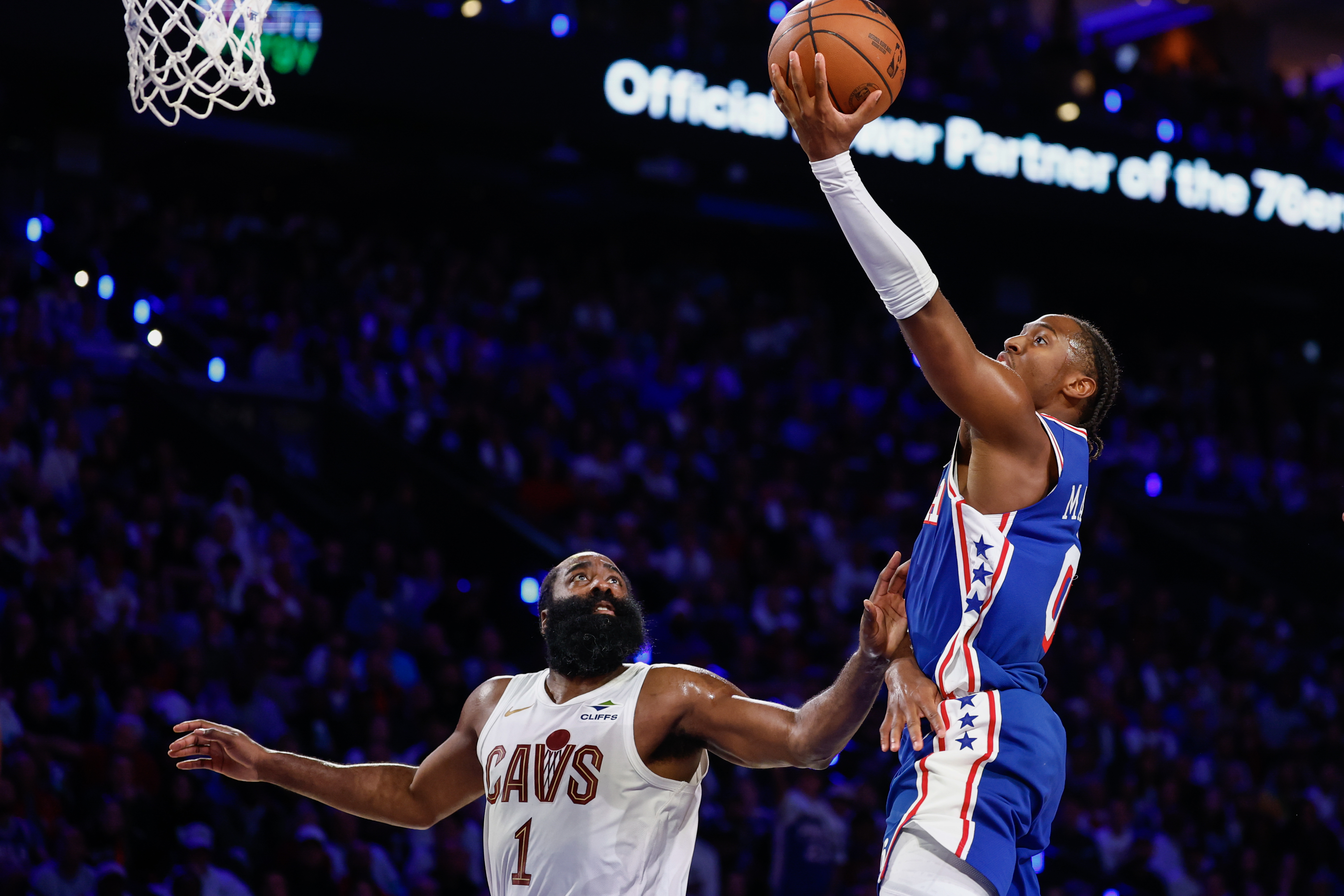
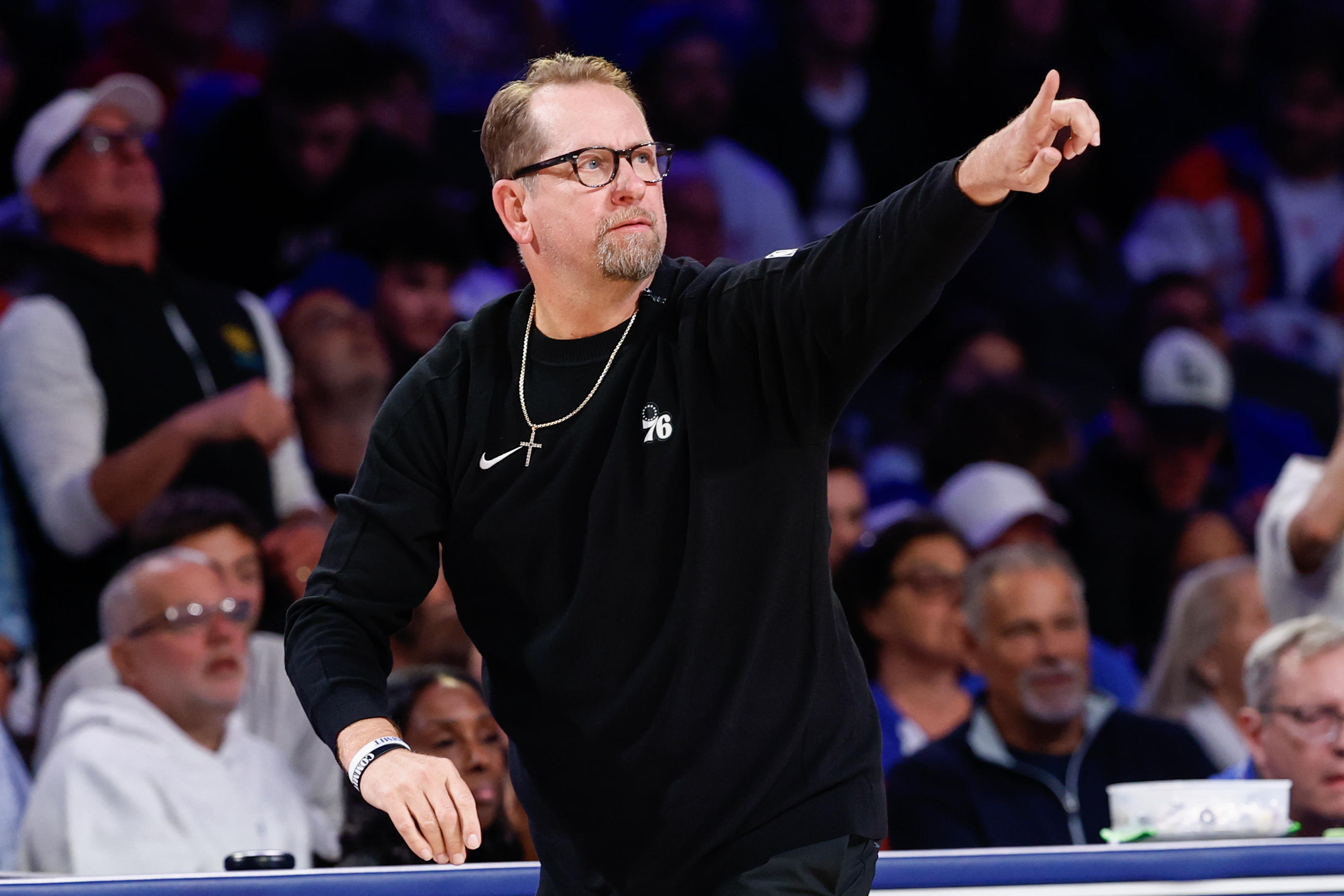
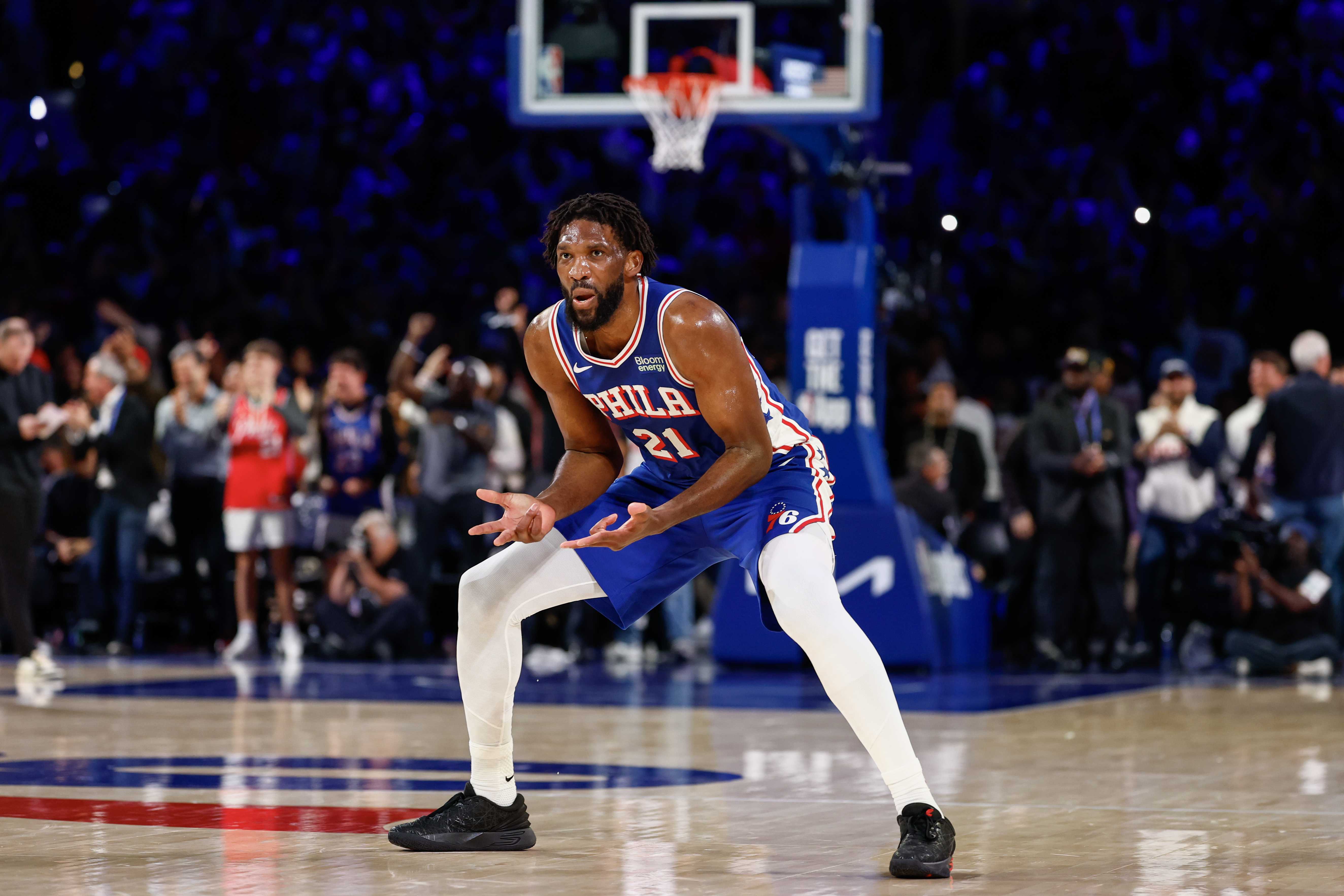
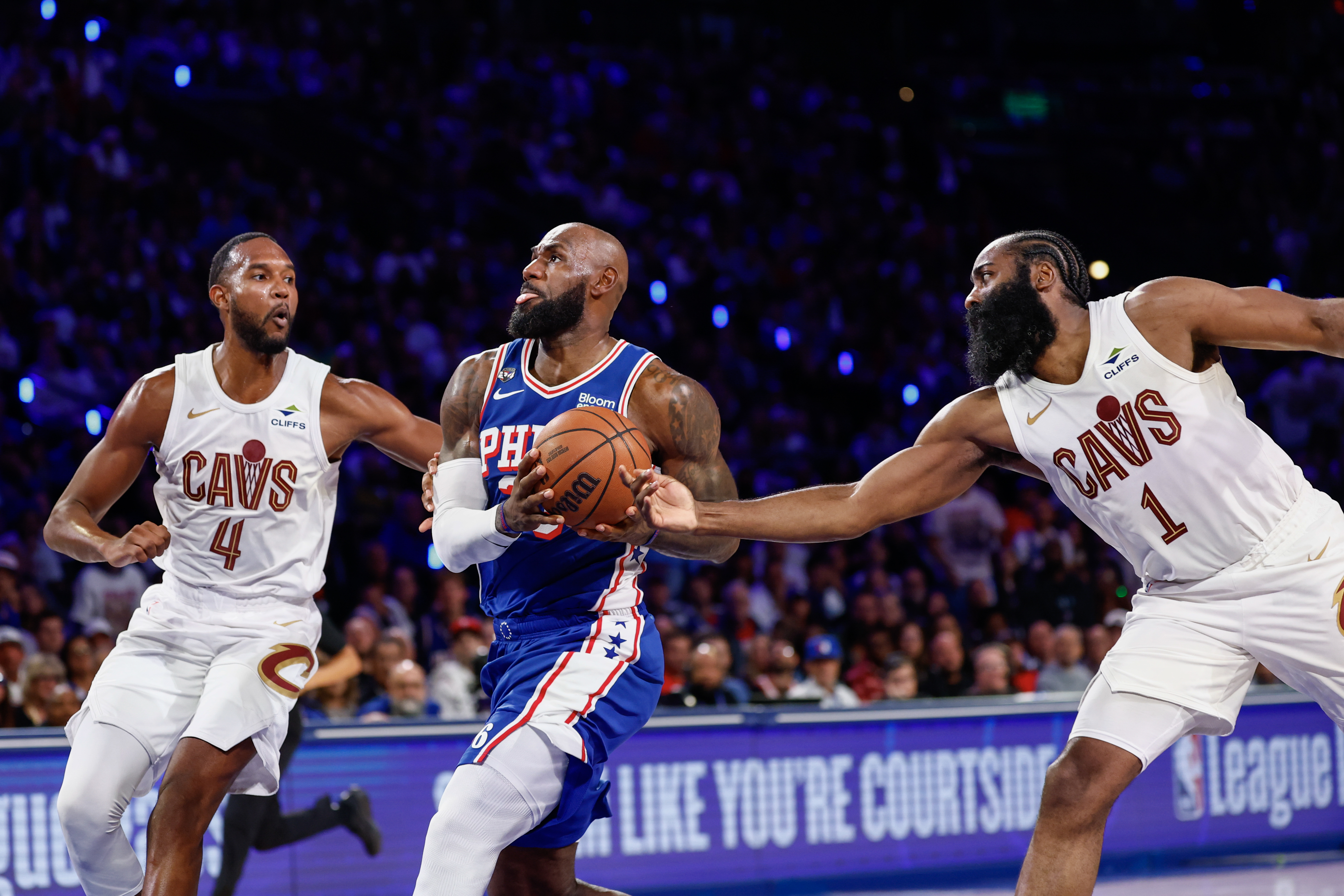
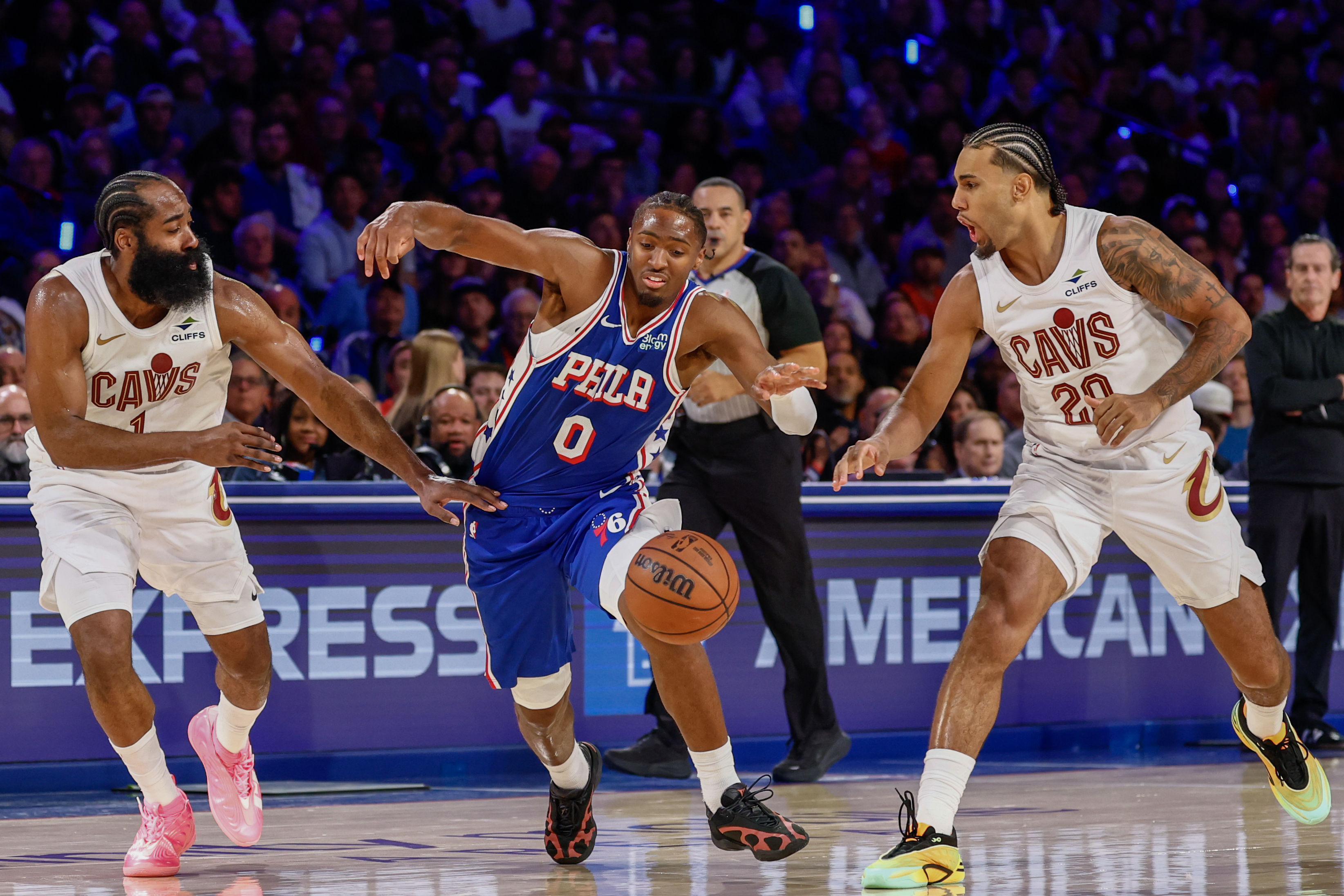
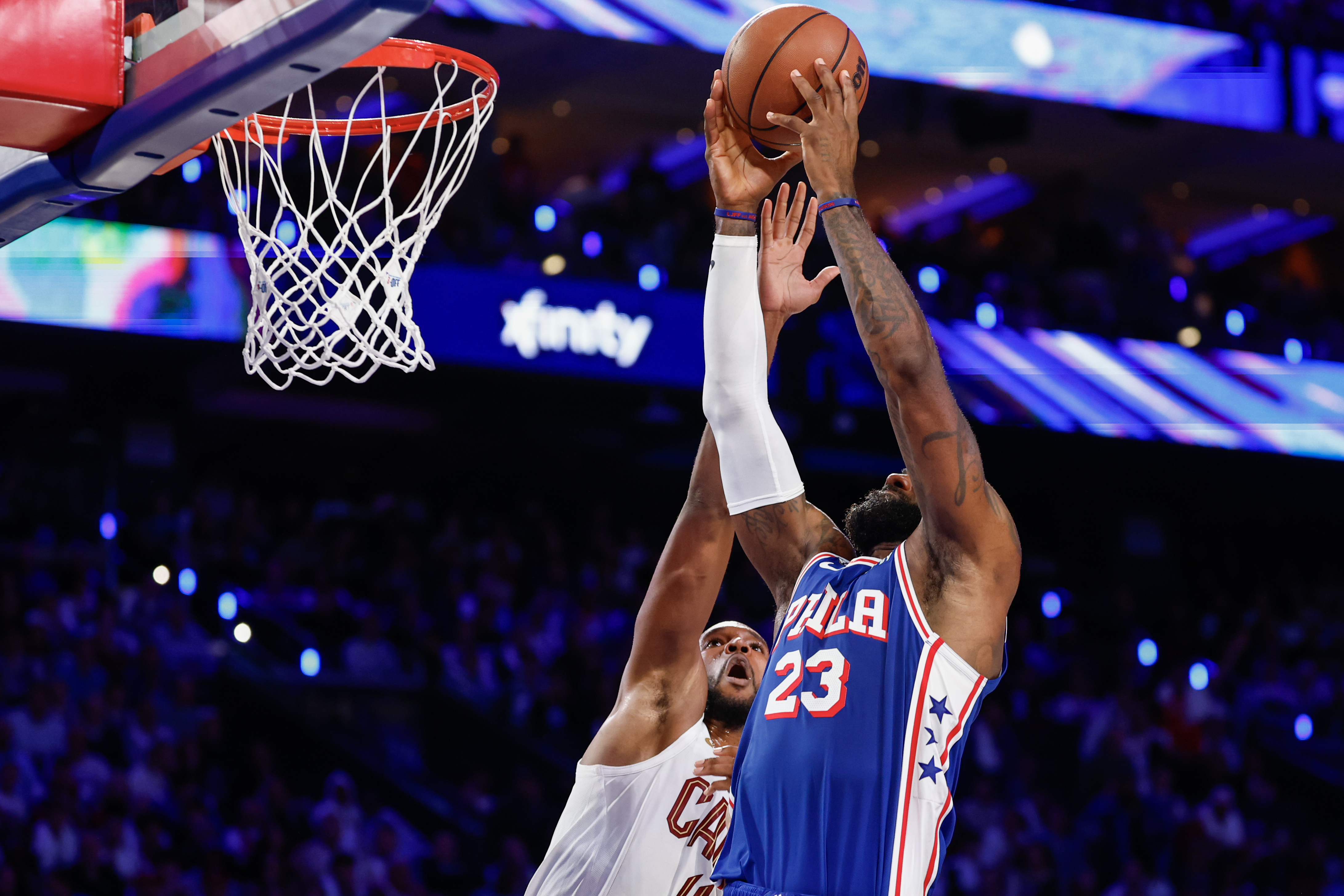
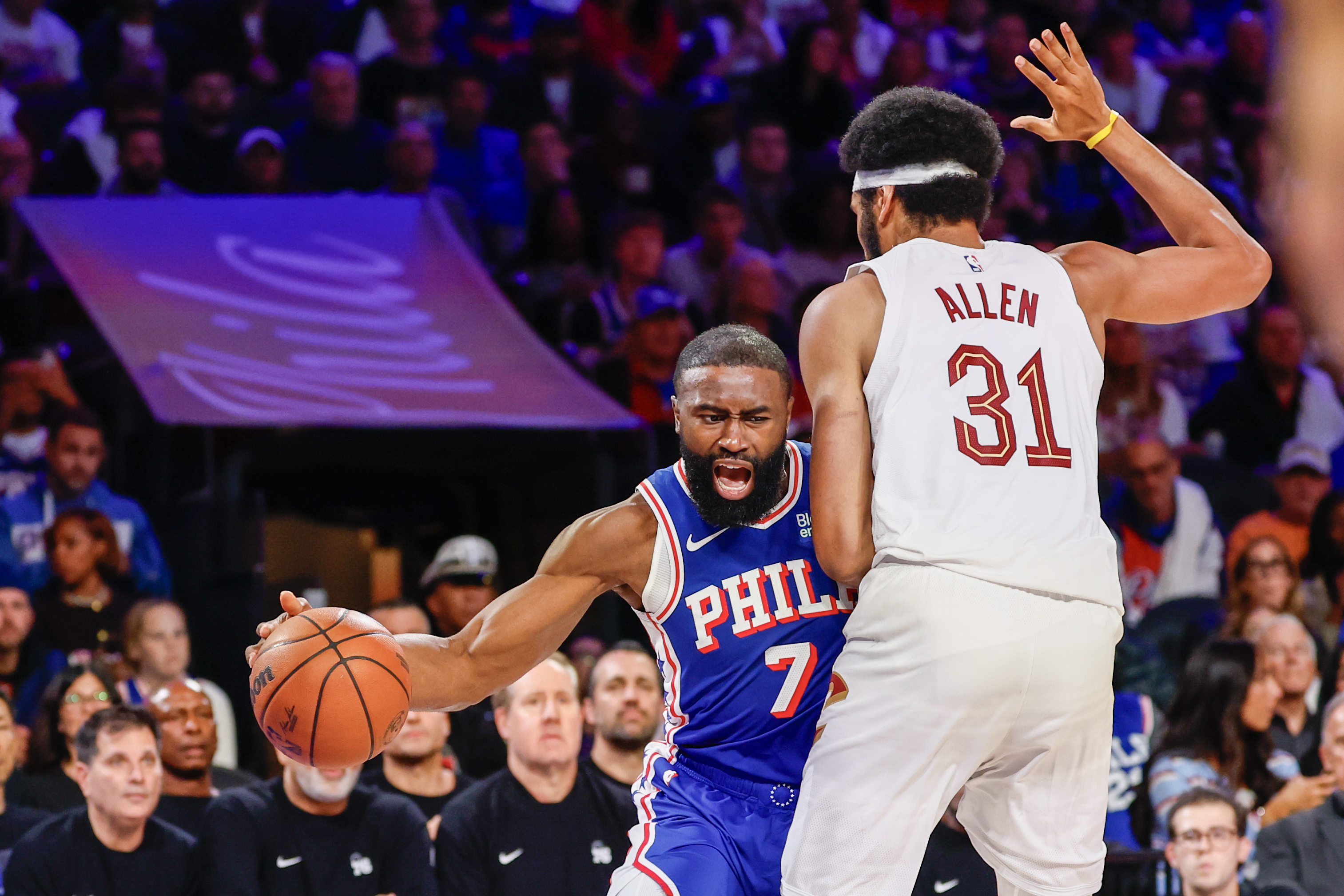
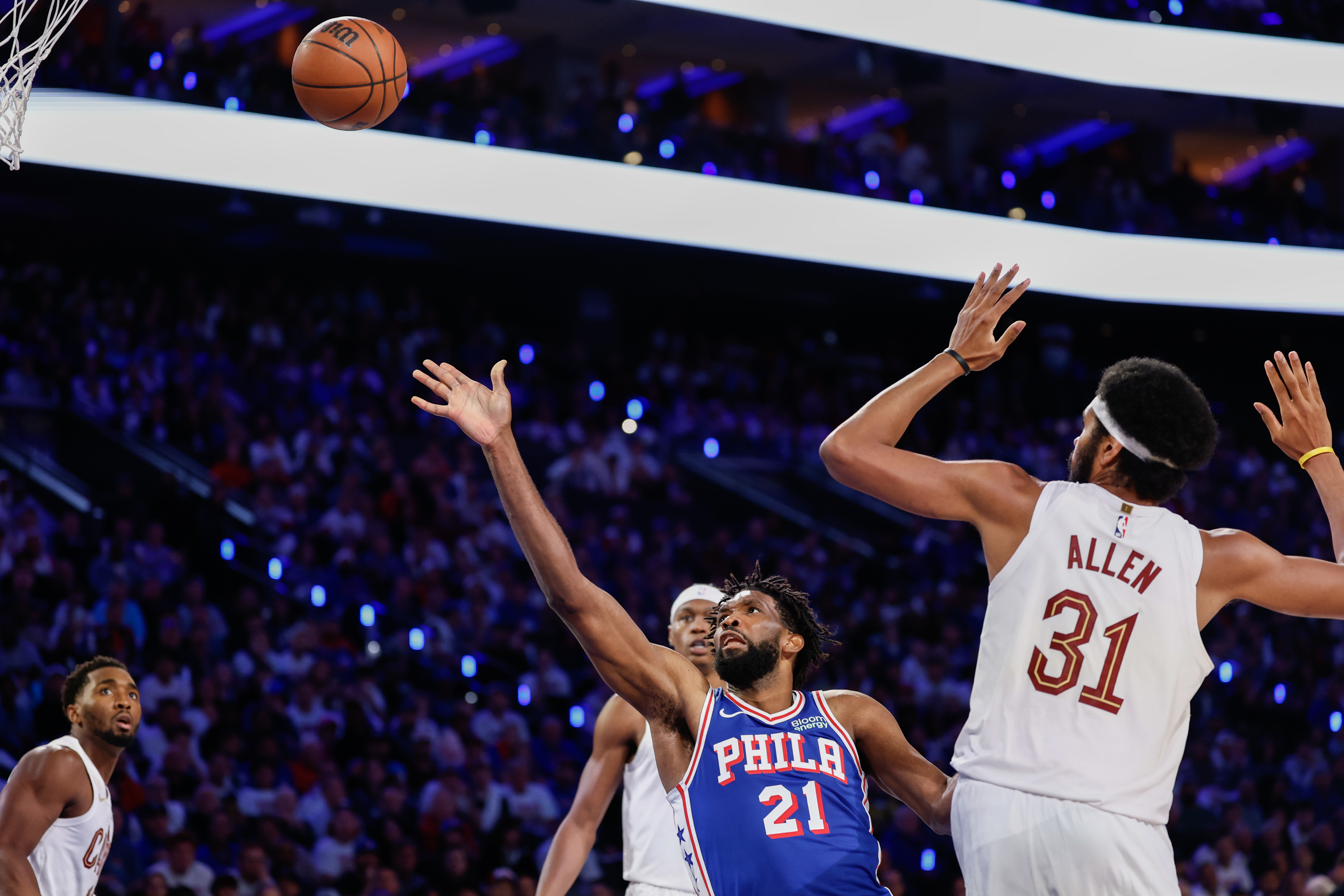
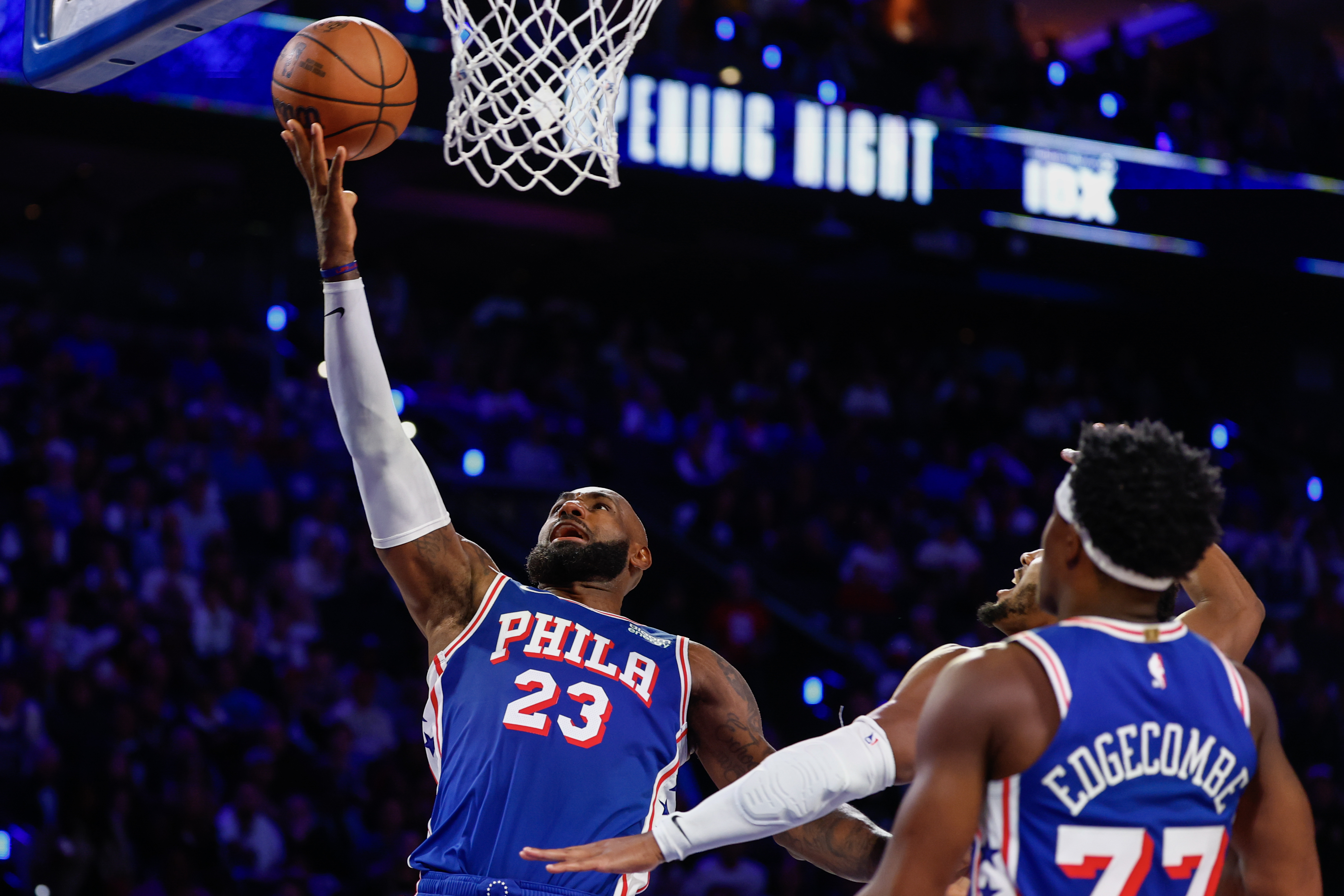
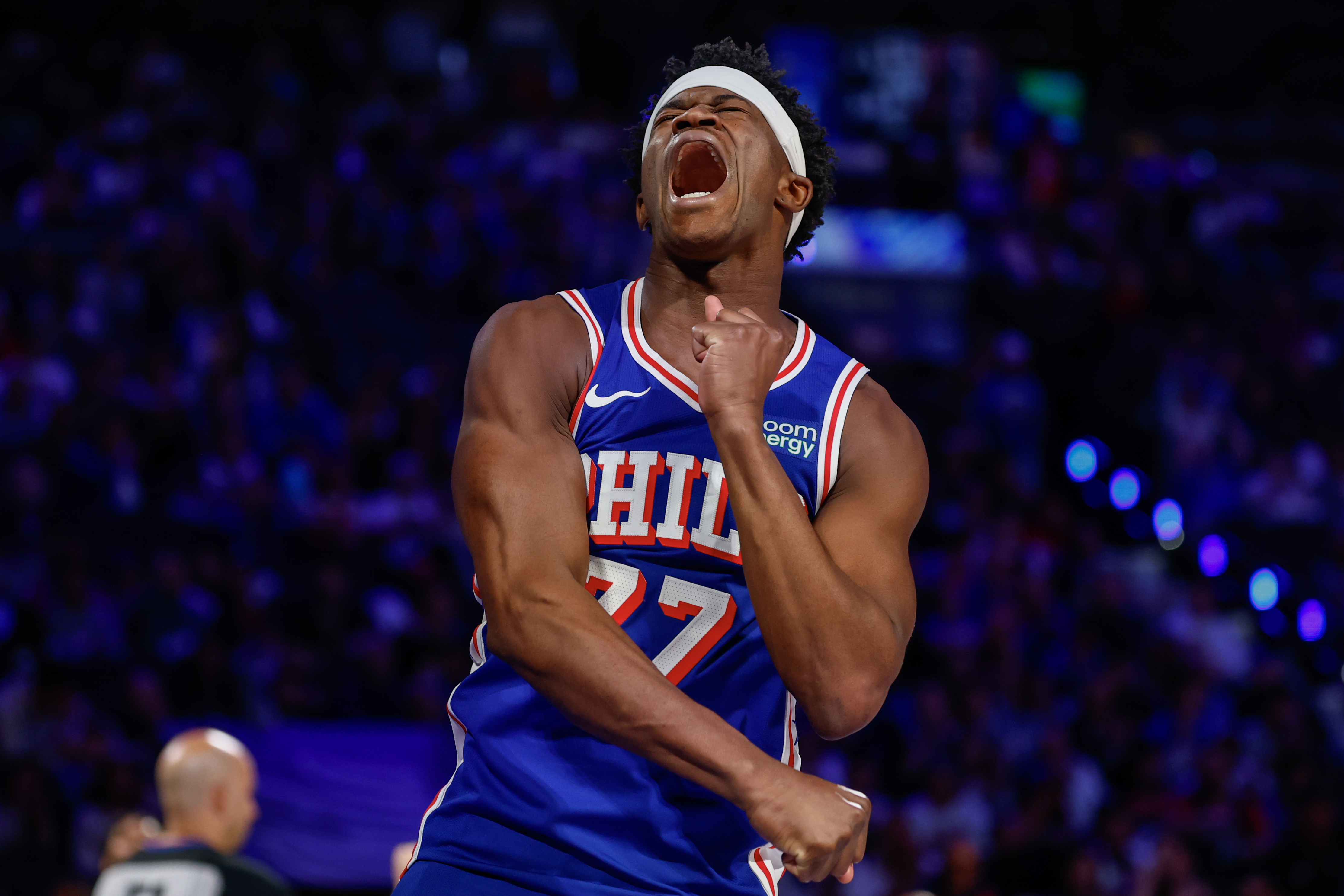
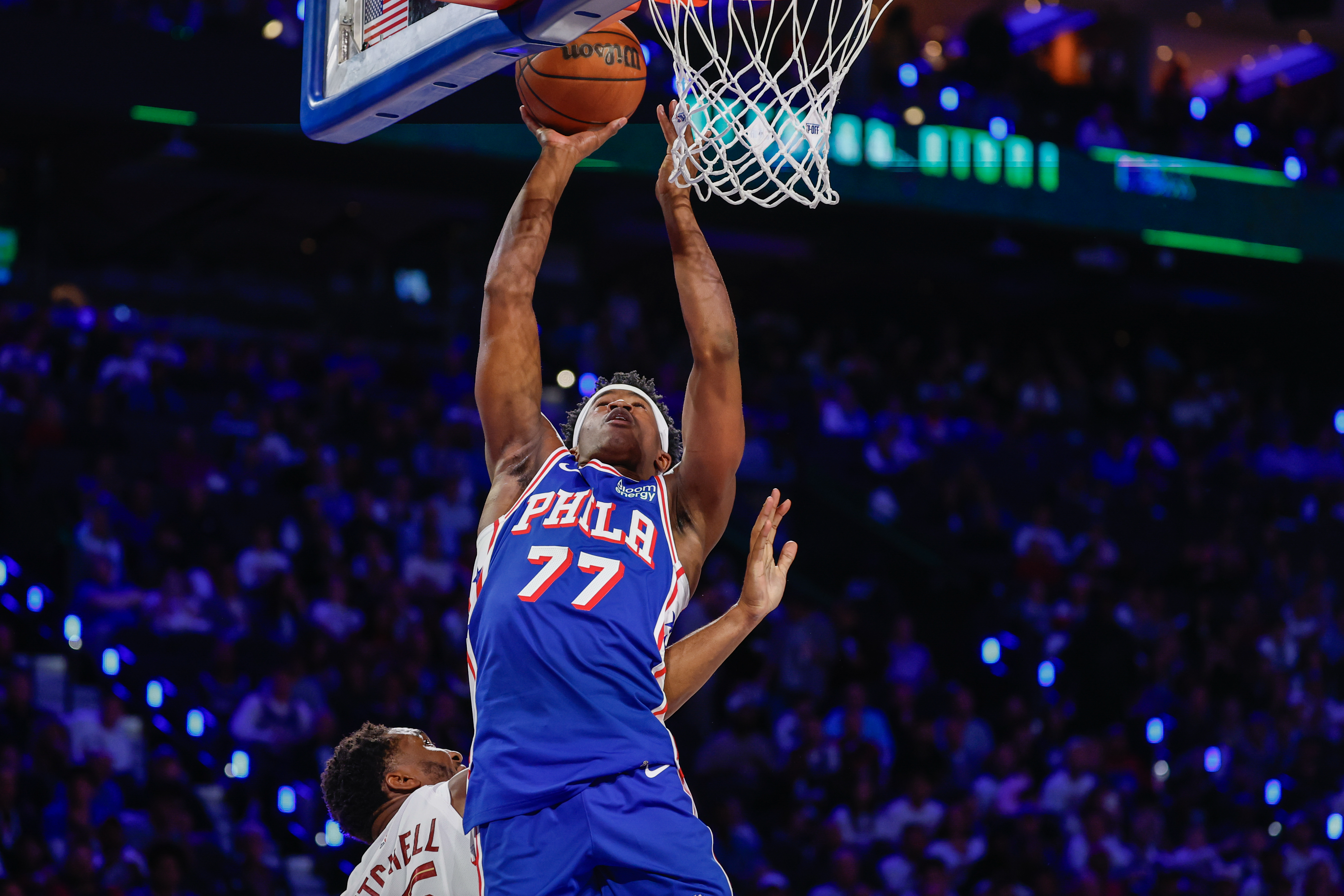
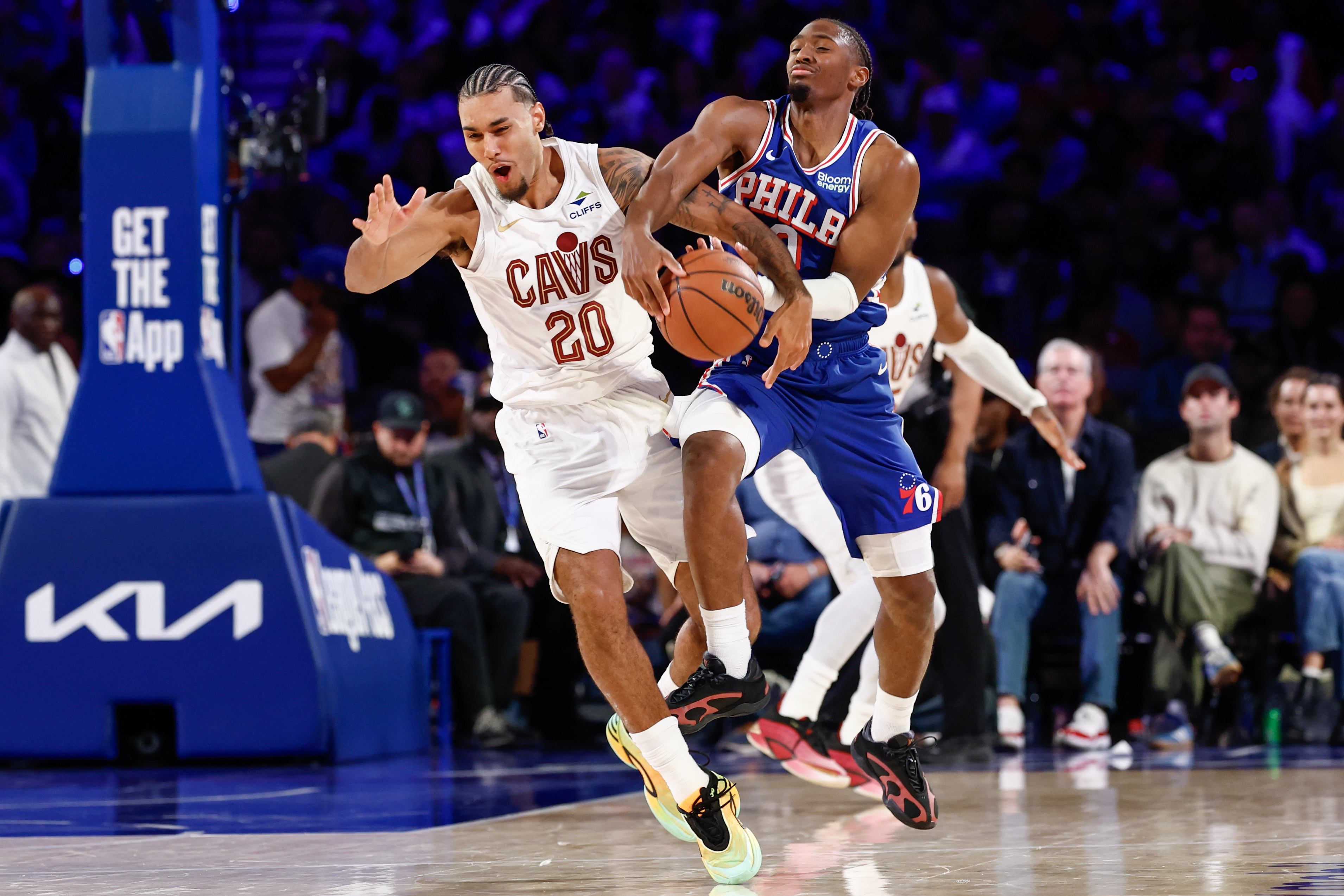
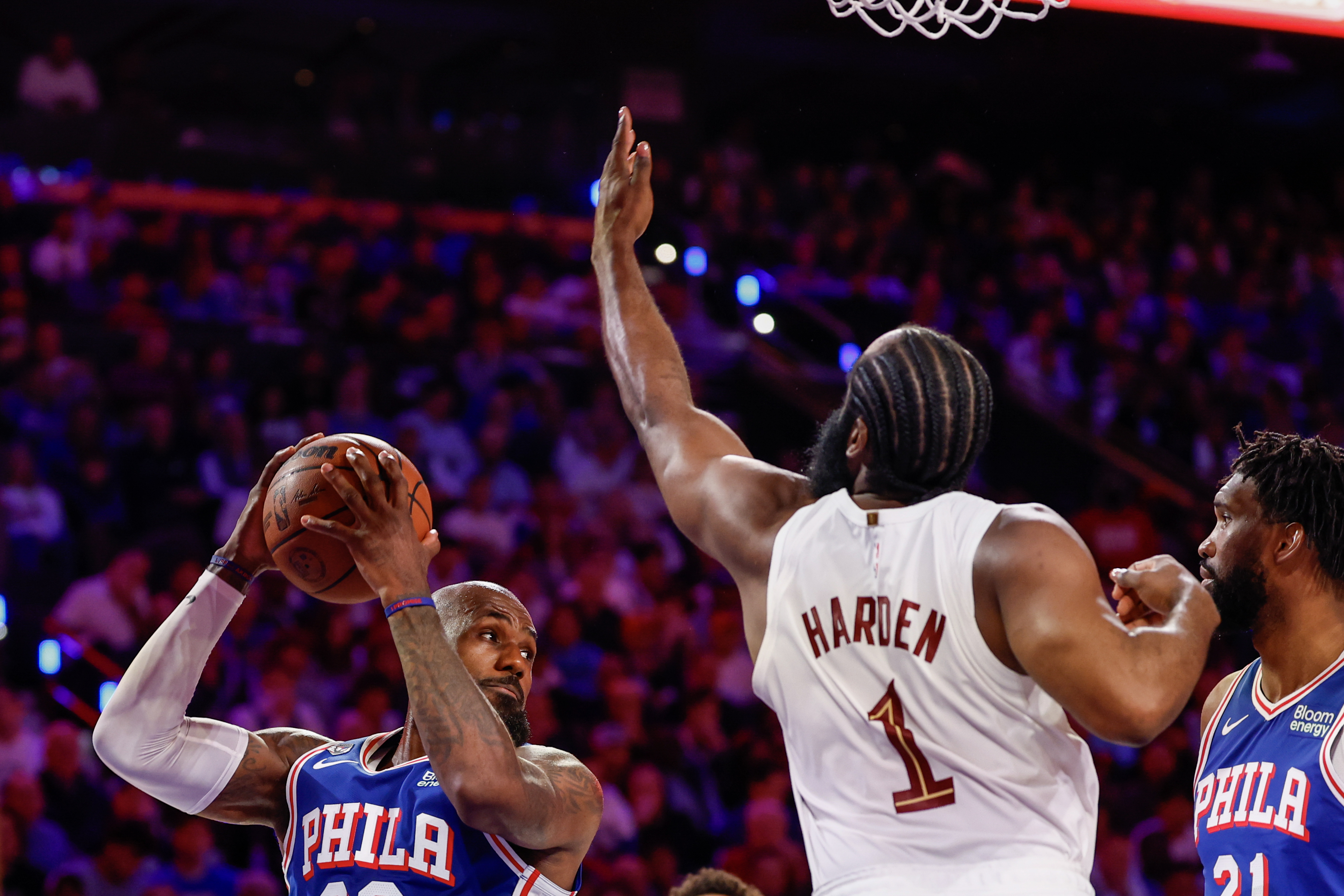
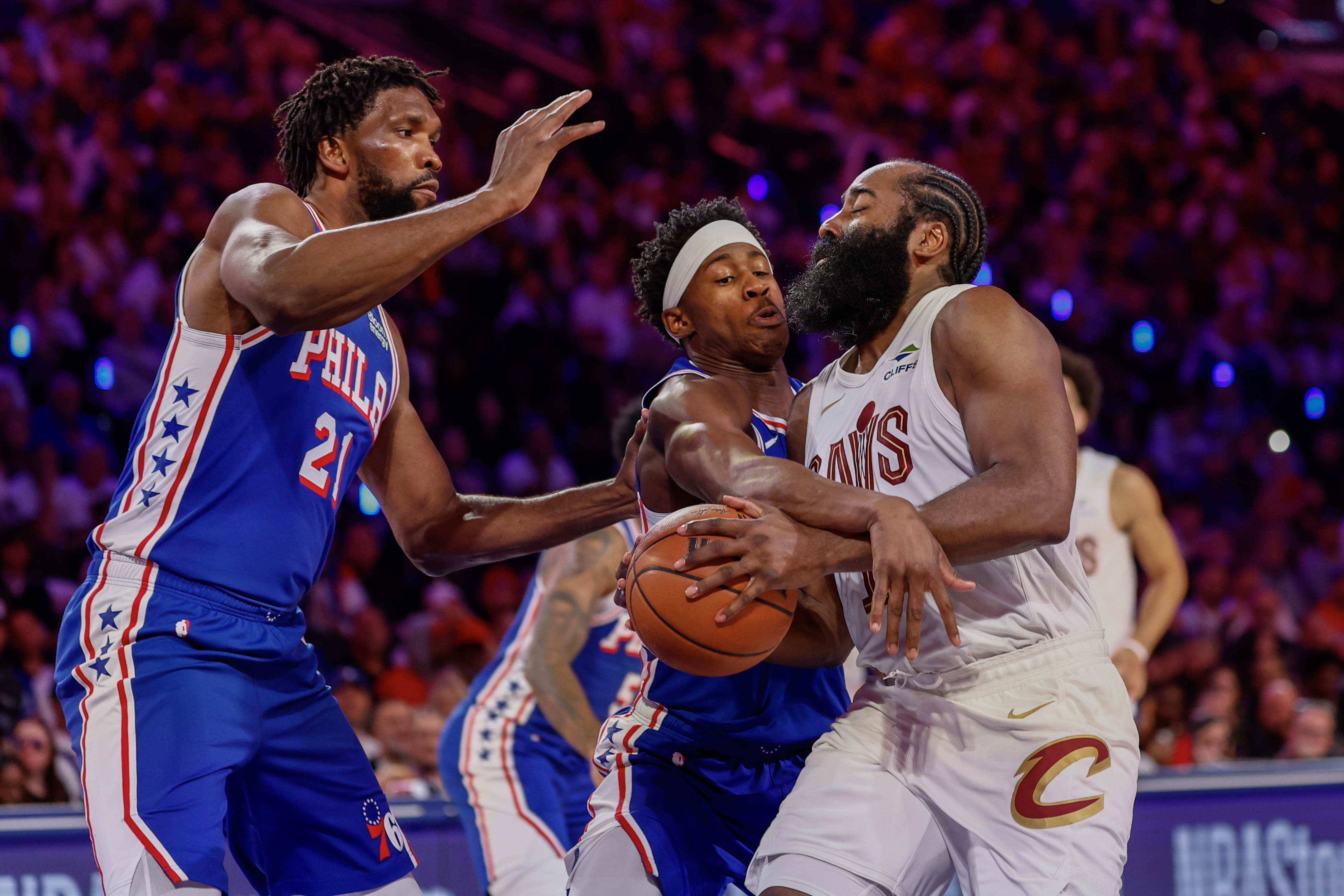
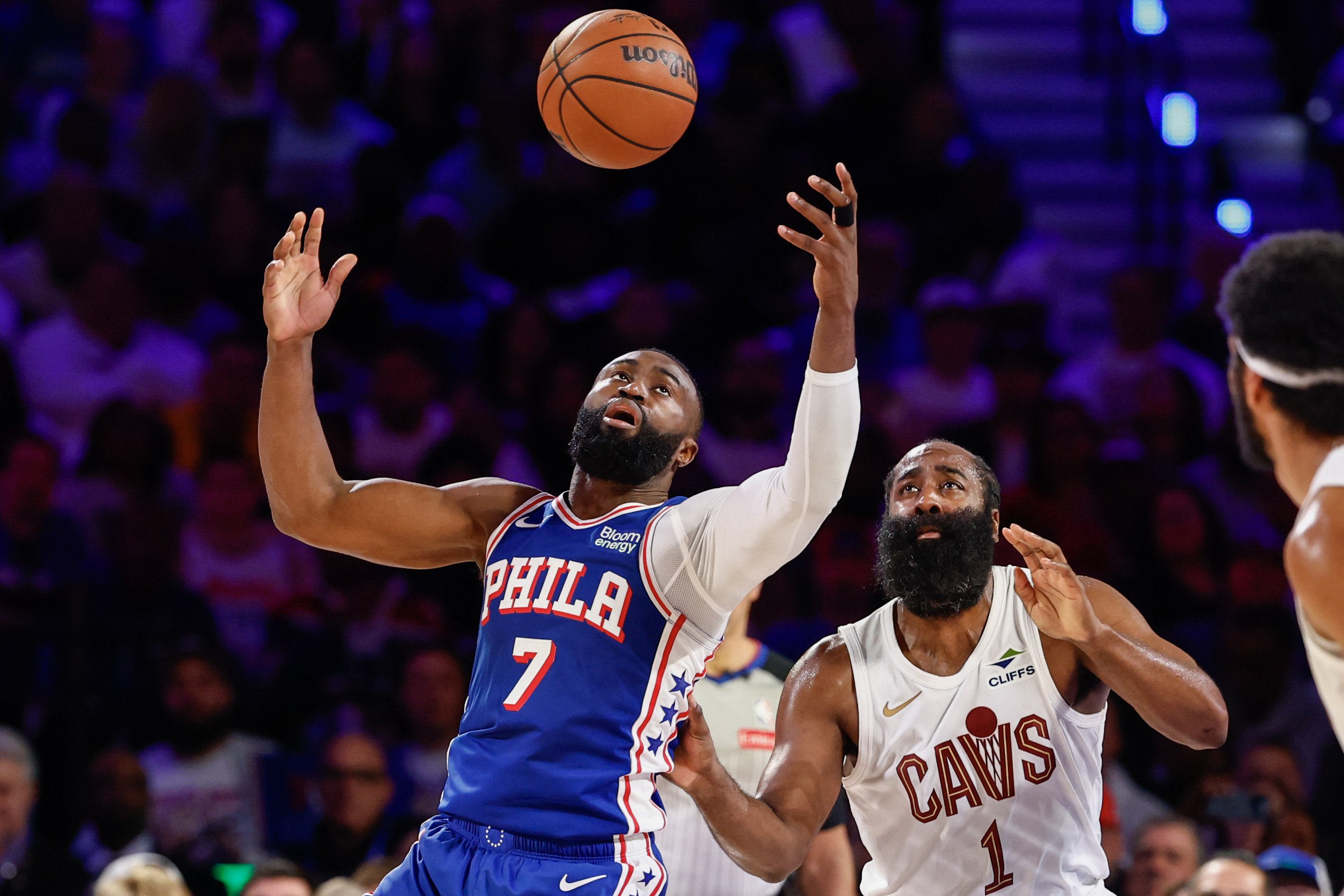
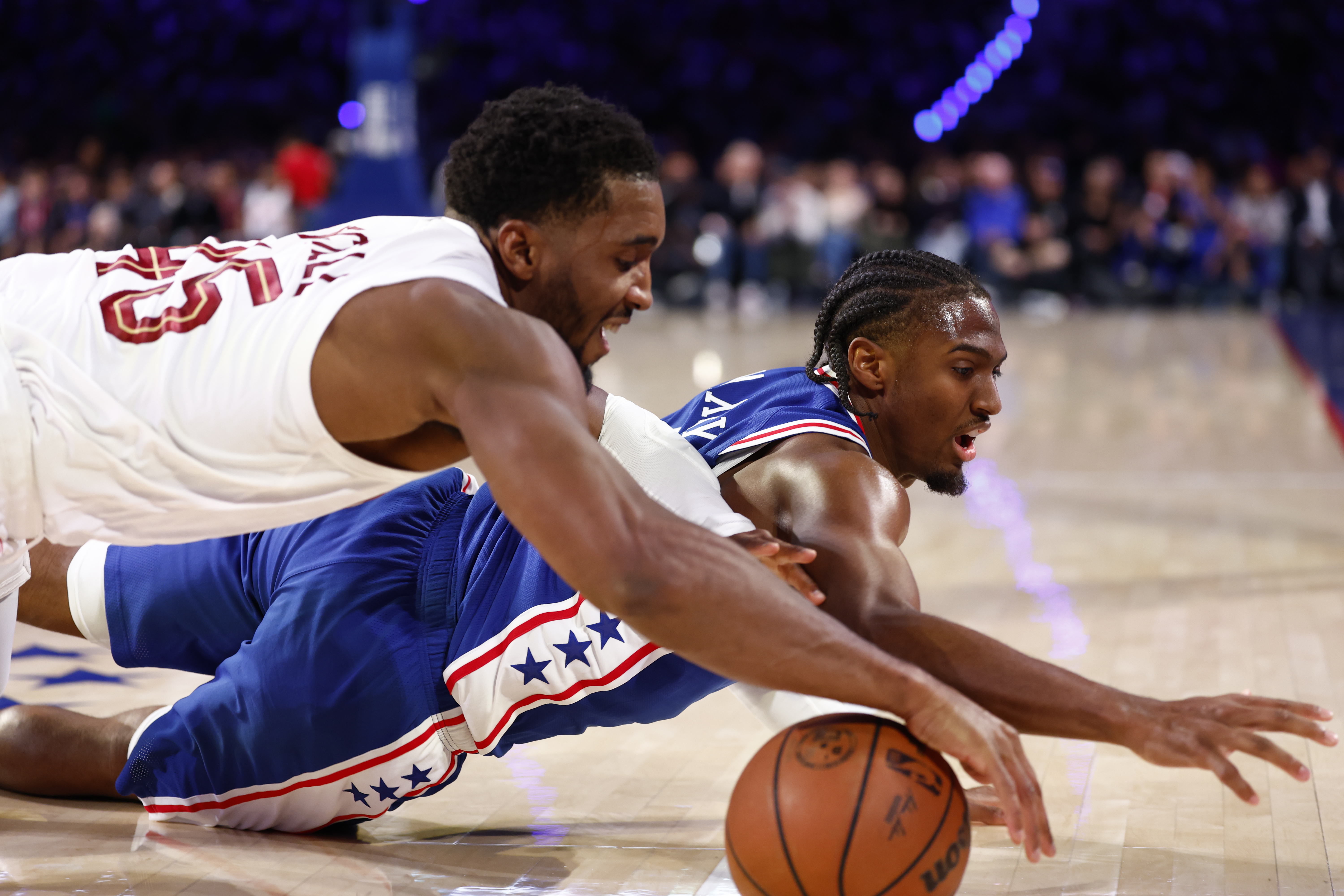
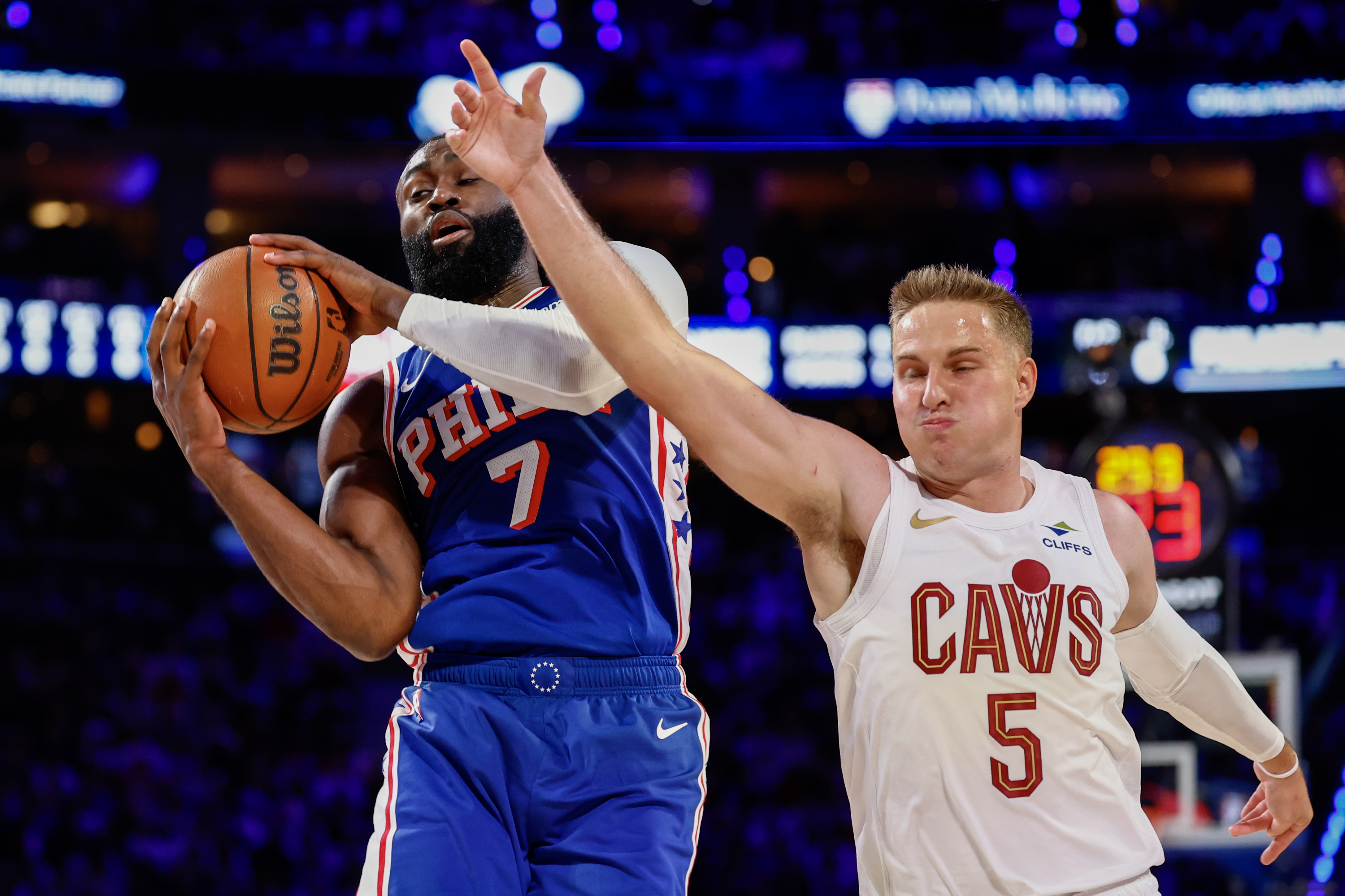
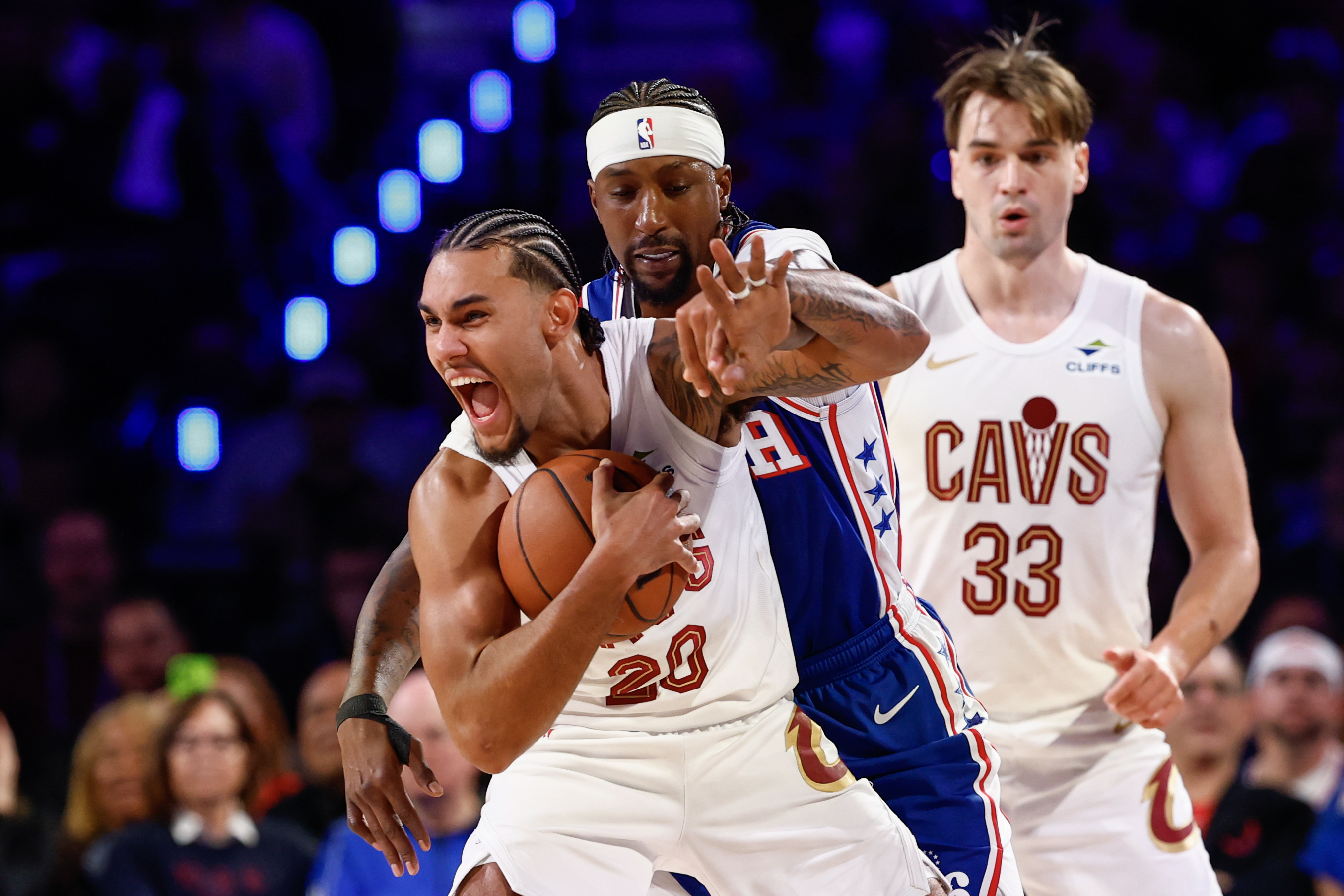
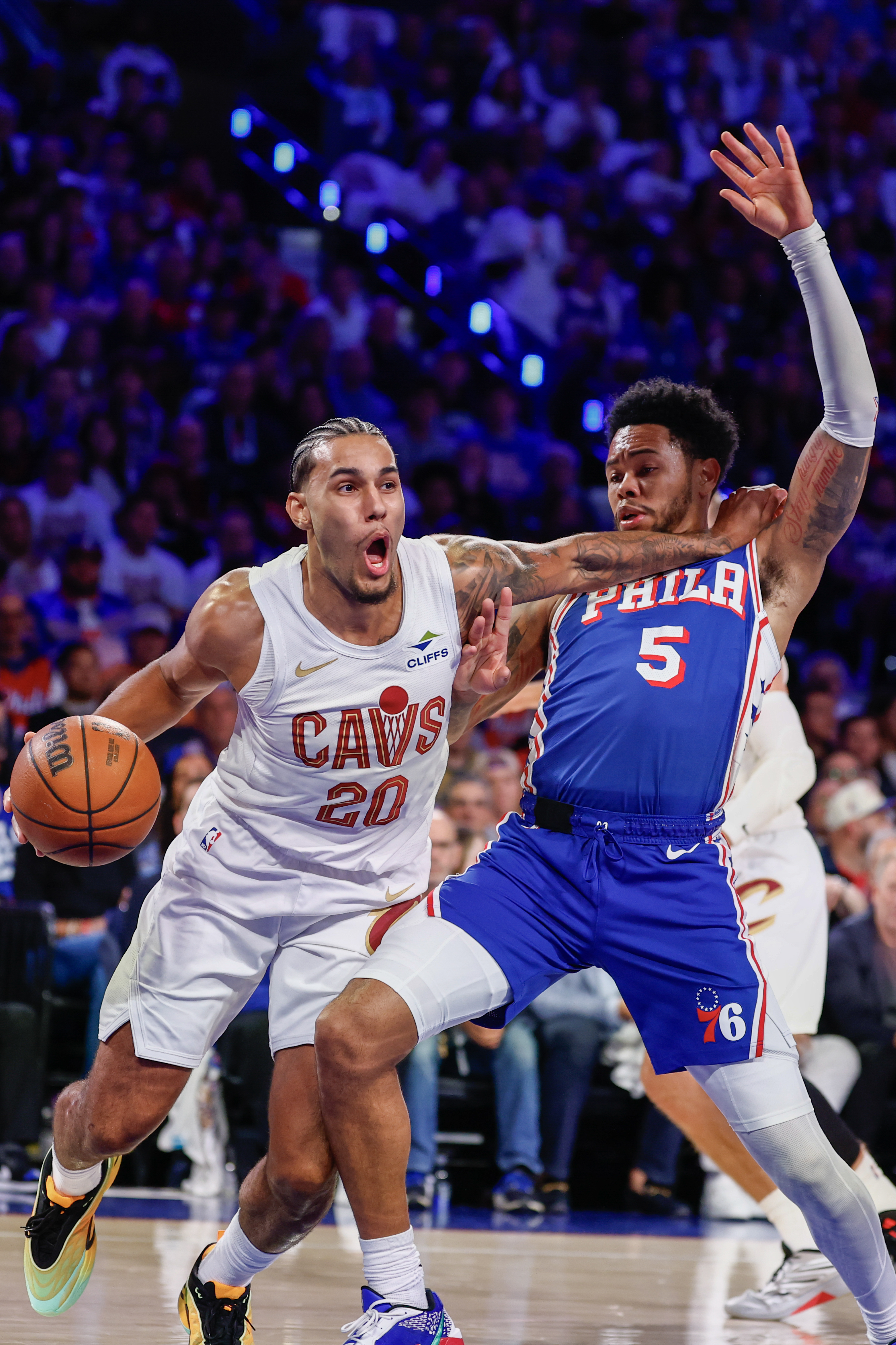
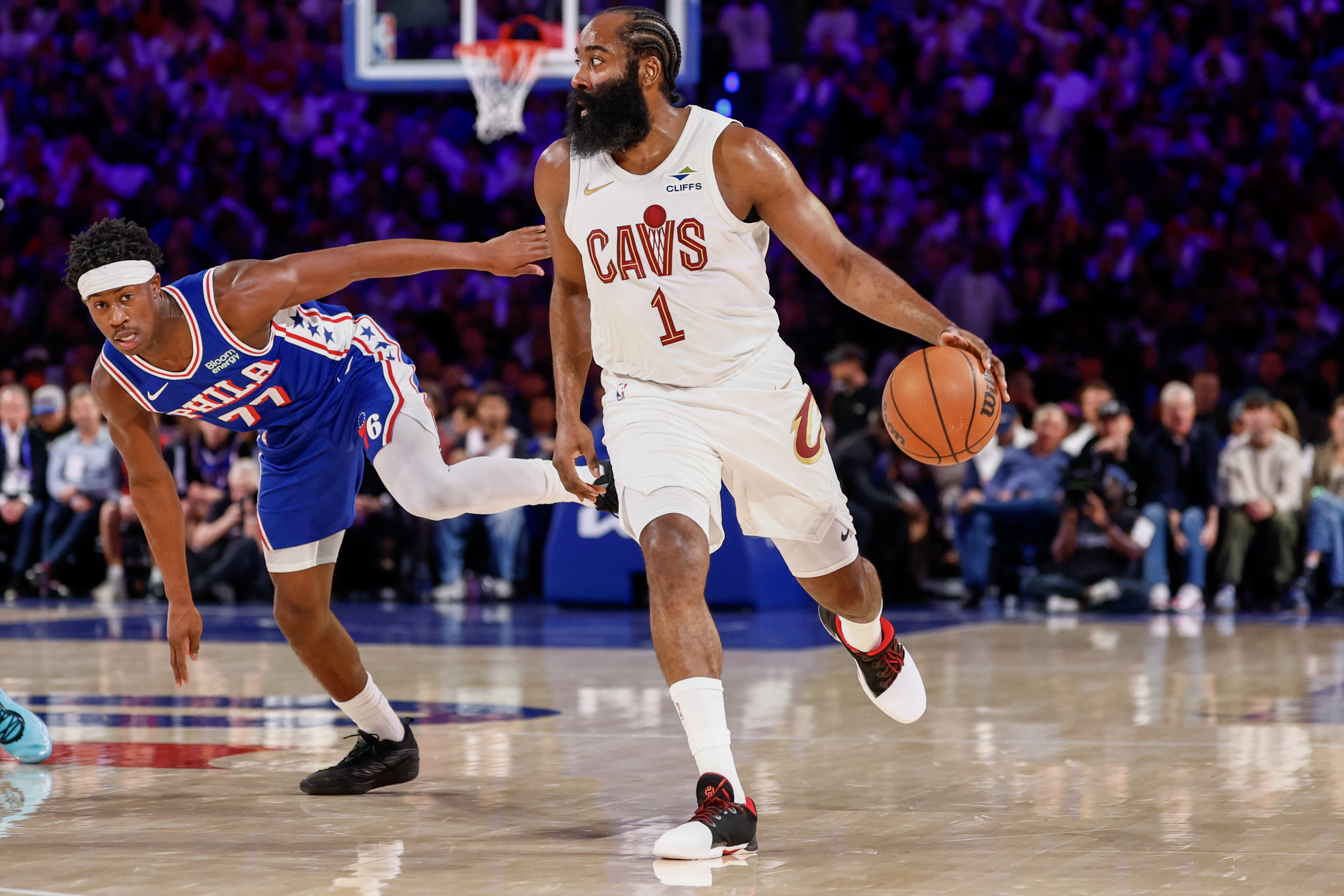
Sixers guard Jaylen Brown dunks the basketball late during the fourth quarter against the Cavaliers Thursday, Oct. 22, 2026, in Philadelphia.Yong Kim / Staff PhotographerSixers center Joel Embiid reacts after getting fouled after scoring during the fourth quarter as Cavaliers guard James Harden passes by (right) Thursday, Oct. 22, 2026, in Philadelphia.Yong Kim / Staff PhotographerSixers guard Tyrese Maxey celebrates with Sixers center Joel Embiid after the Cavaliers made an offensive foul during the fourth quarter Thursday, Oct. 22, 2026, in Philadelphia.Yong Kim / Staff PhotographerSixers center Joel Embiid scores 2-points over Cavaliers center Jarrett Allen during the fourth quarter Thursday, Oct. 22, 2026, in Philadelphia.Yong Kim / Staff PhotographerSixers guard Vj Edgecombe grabs a rebound past Cavaliers center Evan Mobley late during the fourth quarter Thursday, Oct. 22, 2026, in Philadelphia.Yong Kim / Staff PhotographerSixers forward LeBron James (left) and Sixers guard Tyrese Maxey celebrate after a late score during the fourth quarter against the Cavaliers Thursday, Oct. 22, 2026, in Philadelphia.Yong Kim / Staff PhotographerSixers forward LeBron James gets fouled by Cavaliers forward Mario Hezonja (left) and Cavaliers guard Donovan Mitchell during the fourth quarter Thursday, Oct. 22, 2026, in Philadelphia.Yong Kim / Staff PhotographerSixers center Joel Embiid goes after the ball against Cavaliers guard Donovan Mitchell during the fourth quarter Thursday, Oct. 22, 2026, in Philadelphia.Yong Kim / Staff PhotographerSixers guard Tyrese Maxey lays up the basketball against Cavaliers forward Mario Hezonja during the third quarter Thursday, Oct. 22, 2026, in Philadelphia.Yong Kim / Staff PhotographerSixers guard Tyrese Maxey fails to get to the basket against Cavaliers center Jarrett Allen (left) and Cavaliers guard Peyton Watson during the third quarter Thursday, Oct. 22, 2026, in Philadelphia.Yong Kim / Staff PhotographerSixers guard Tyrese Maxey lays up the ball past Cavaliers guard James Harden during the third quarter Thursday, Oct. 22, 2026, in Philadelphia.Yong Kim / Staff PhotographerSixers head coach Nick Nurse during the third quarter of the home opener against the Cavaliers Thursday, Oct. 22, 2026, in Philadelphia.Yong Kim / Staff PhotographerSixers center Joel Embiid reacts after Sixers guard Tyrese Maxey makes a basket during the third quarter Thursday, Oct. 22, 2026, in Philadelphia.Yong Kim / Staff PhotographerSixers forward LeBron James drives to the basket against Cavaliers center Evan Mobley (left) and Cavaliers guard James Harden during the third quarter Thursday, Oct. 22, 2026, in Philadelphia.Yong Kim / Staff PhotographerSixers guard Tyrese Maxey goes after the ball against Cavaliers guard James Harden (left) and Cavaliers guard Jaylon Tyson during the third quarter Thursday, Oct. 22, 2026, in Philadelphia.Yong Kim / Staff PhotographerSixers forward LeBron James lays up the basketball against Cavaliers center Evan Mobley during the third quarter Thursday, Oct. 22, 2026, in Philadelphia.Yong Kim / Staff PhotographerSixers guard Jaylen Brown loses the ball against Cavaliers center Jarrett Allen during the third quarter Thursday, Oct. 22, 2026, in Philadelphia.Yong Kim / Staff PhotographerSixers center Joel Embiid is fouled laying up the basket against Cavaliers center Jarrett Allen during the third quarter Thursday, Oct. 22, 2026, in Philadelphia.Yong Kim / Staff PhotographerSixers forward LeBron James is fouled while making a layup during the third quarter Thursday, Oct. 22, 2026, in Philadelphia.Yong Kim / Staff PhotographerSixers guard Vj Edgecombe reacts after making a basket and getting fouled early during the third quarter Thursday, Oct. 22, 2026, in Philadelphia.Yong Kim / Staff PhotographerSixers guard Vj Edgecombe makes the layup past during the third quarter Thursday, Oct. 22, 2026, in Philadelphia.Yong Kim / Staff PhotographerCavaliers guard Jaylon Tyson fouls Sixers guard Tyrese Maxey during the second quarter Thursday, Oct. 22, 2026, in Philadelphia.Yong Kim / Staff PhotographerSixers forward LeBron James looks for an opening against Cavaliers guard James Harden during the second quarter Thursday, Oct. 22, 2026, in Philadelphia.Yong Kim / Staff PhotographerSixers guard Vj Edgecombe goes after the ball against Cavaliers guard James Harden with Sixers center Joel Embiid (left) during the second quarter Thursday, Oct. 22, 2026, in Philadelphia.Yong Kim / Staff PhotographerSixers guard Jaylen Brown grabs the ball against Cavaliers guard James Harden during the second quarter Thursday, Oct. 22, 2026, in Philadelphia.Yong Kim / Staff PhotographerSixers guard Tyrese Maxey gives the ball to Cavaliers guard Donovan Mitchell during the second quarter Thursday, Oct. 22, 2026, in Philadelphia.Yong Kim / Staff PhotographerSixers guard Jaylen Brown grabs a rebound past Cavaliers guard Sam Merrill during the first quarter Thursday, Oct. 22, 2026, in Philadelphia.Yong Kim / Staff PhotographerCavaliers guard Jaylon Tyson steals the ball from Sixers guard Kentavious Caldwell-Pope during the first quarter Thursday, Oct. 22, 2026, in Philadelphia.Yong Kim / Staff PhotographerCavaliers guard Jaylon Tyson shoves Sixers guard Anfernee Simons for an offensive foul during the first quarter Thursday, Oct. 22, 2026, in Philadelphia.Yong Kim / Staff PhotographerCavaliers guard James Harden against Sixers guard Vj Edgecombe during the first quarter Thursday, Oct. 22, 2026, in Philadelphia.Yong Kim / Staff PhotographerSixers guard Jaylen Brown (right) and Sixers forward LeBron James before the start of the home opener against the Cavaliers Thursday, Oct. 22, 2026, in Philadelphia.Yong Kim / Staff Photographer
“I just forgot the feel of rebounding and positioning,” Embiid said. “So, that’s something that I’m working on — it goes back to everything really basketball-related for me. I missed so much time that it’s taken me a while to kind of put myself out there and be like, ‘OK, this is what you’re doing. This is what you’re used to doing. Get comfortable and get back to it.’”
Embiid will get back to it when the Sixers play twice Saturday and Sunday against the Bucks and Pistons, respectively. Well, he’ll get back to it in one of those games. Embiid said he was going to play in one of the games and rest the other as he and the team manage his workload throughout the season. He wasn’t sure as of Friday night which game he would play.
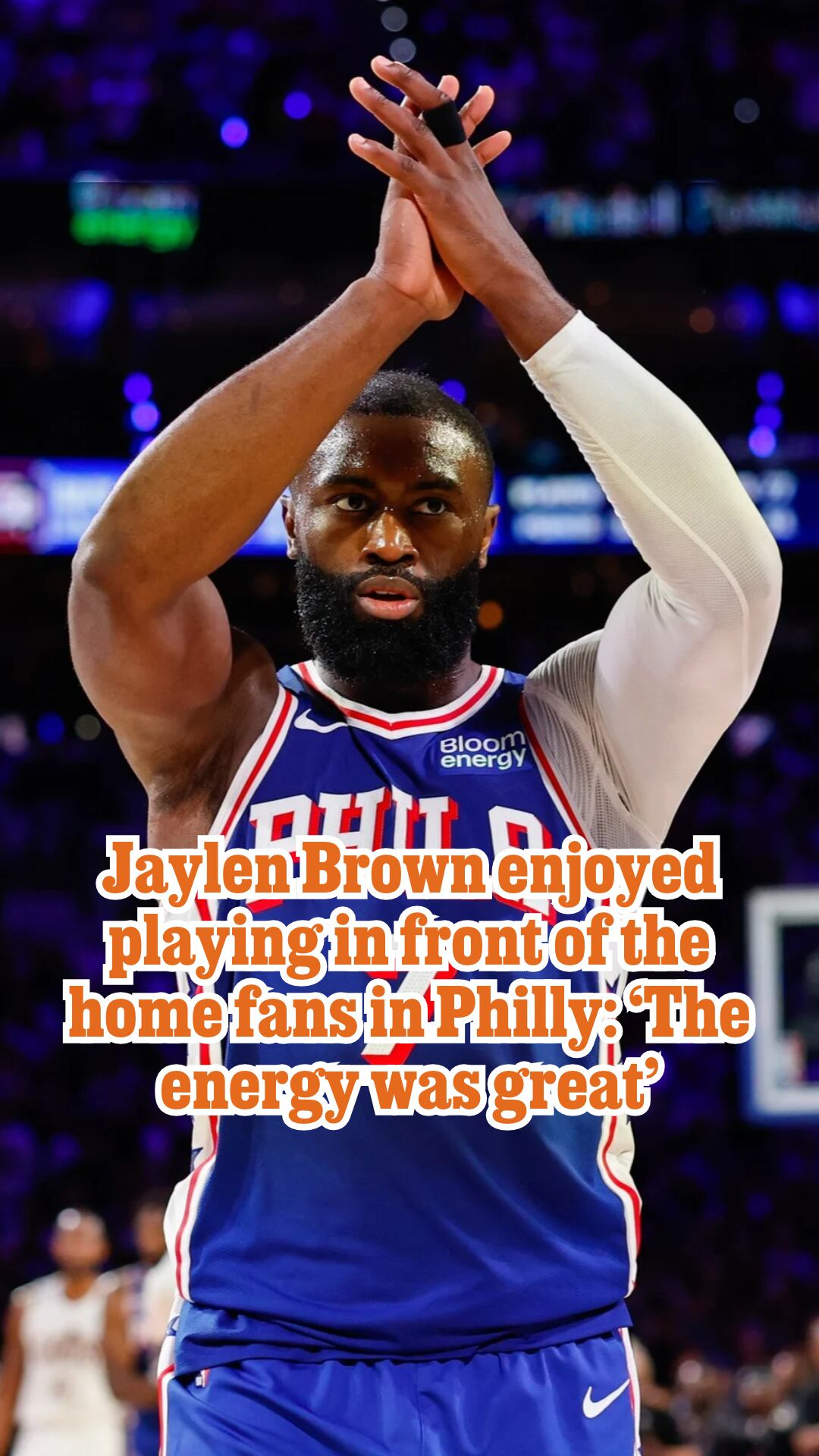
Video: Jaylen Brown enjoyed playing in front of the home fans in Philly: ‘The energy was great’
“I’m playing one of them. I don’t know. They won’t tell me,” Embiid said. “But yeah, I feel good. So, whatever they tell me, I’ll do it. And then if I don’t agree with it, I might fight it, but I might not win. So, I kind of give them the freedom to do whatever they want.”
That game Embiid sits will be another early test for the Sixers. Advanced statistics are always filled with noise until games accumulate and there are larger sample sizes, but through two games, the on/off numbers for the Sixers with and without Embiid have been stark. When he has been on the floor, the Sixers have a net rating of 18.1 — the best net rating of any individual player. When he sits, that plummets to minus-30.4. There’s a 39.7 points per 100 possessions difference in the team’s defensive rating with Embiid on and off the floor.
That matches what Embiid and his teammates have said about his energy and effort so far on the defensive end. In this new season, Embiid has seemed happy on and off the floor. He called Thursday’s comeback win a top five or top three moment in his career, right alongside his first home game and the night he received his Most Valuable Player award.
“It was different,” Embiid said. “I said last game, after the game, it just feels different. We just got to stay healthy and keep working with each other.”
The Philadelphia Union are one win away from qualifying for the MLS Cup playoffs. No, seriously. Their remarkable second-half run will bear fruit if they can defeat a really good New England team at home on Saturday night (7:30 p.m., Apple TV).
For those not following the team as closely as we are here, the Union have doled out a 15-game unbeaten streak since a return to play in late July. It’s now October. And if it weren’t for a 2-2 draw with Charlotte FC in their last match, we’d be talking about a nine-game win streak against MLS competition.
They’ve done all this behind a four-man defensive front with an average age of 23, a star midfielder who only recently celebrated his 17th birthday, a striker who’s been scoring at an insane rate since a return to his rightful position as … striker, and all guided by an interim coach who has as many games coaching the first team as the number of games the club has been unbeaten.
Since taking the reins of the club in May, Ryan Richter has done one thing: put players in the best position to succeed. That means playing them in their actual positions, allowing the ones who need to roam the freedom to roam, making sure the ones who need to be in support are in the right place — and giving the ones who haven’t produced as originally anticipated the opportunity to watch and learn — from the sidelines.
His methods aren’t flashy; in fact, over this run of form they’ve become somewhat predictable. Roughly the same substitutions are made each game, bringing on like-for-like swaps in terms of work rate in the second half (see Quinn Sullivan for Indiana Vassilev, in particular), and when it comes to looking to the future, perhaps that’s the one thing Richter doesn’t do, repeatedly reminding those who ask that his method is a game-over-game approach.
“These are players now playing with a tremendous amount of confidence,” Richter noted following the team’s win against Orlando City on Sept. 26, a game where it was devoid of five starters due to international duty for their respective countries. With the players who remained, the Union rattled off a 4-2 win inside Subaru Park behind a hat trick from Milan Iloski.
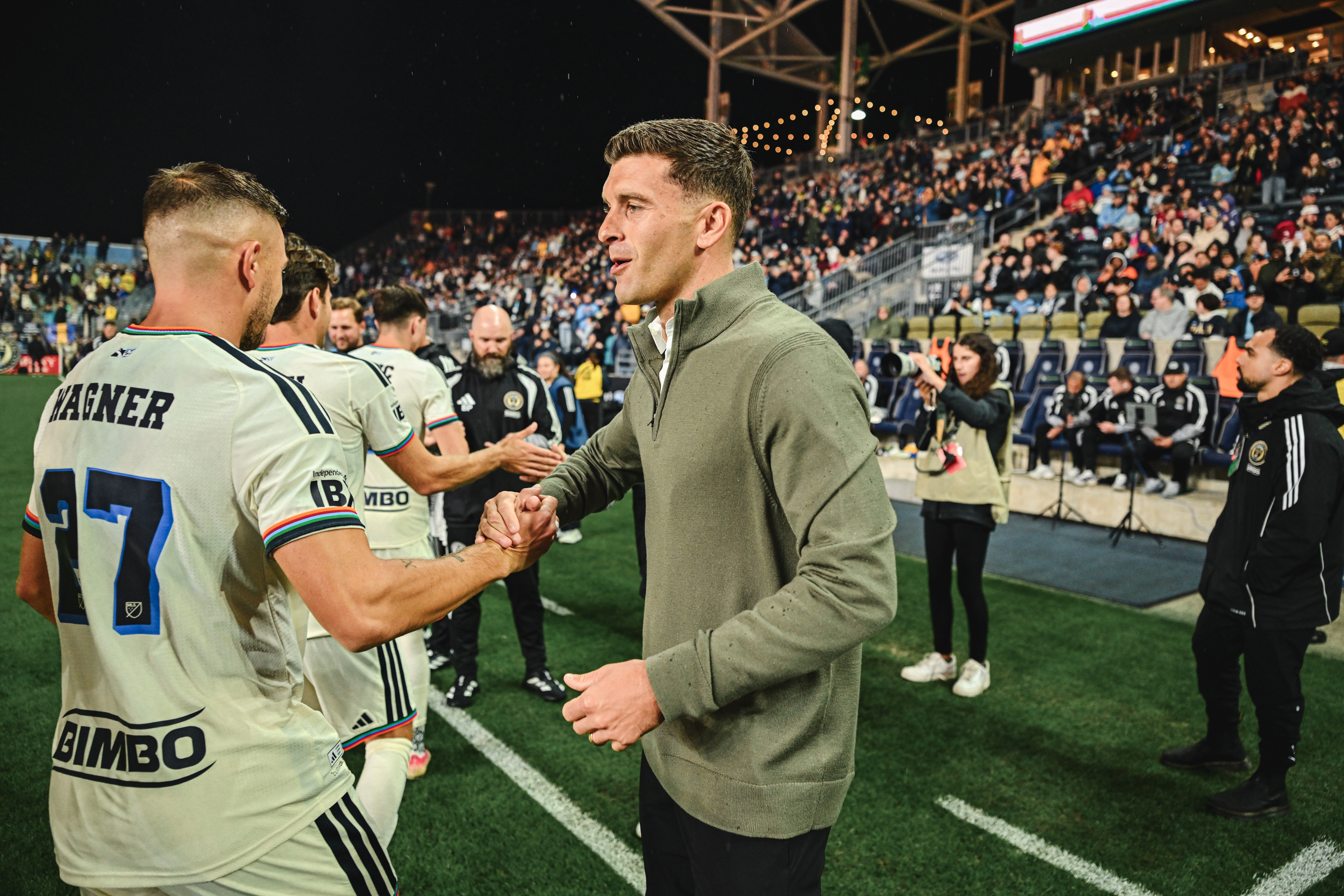
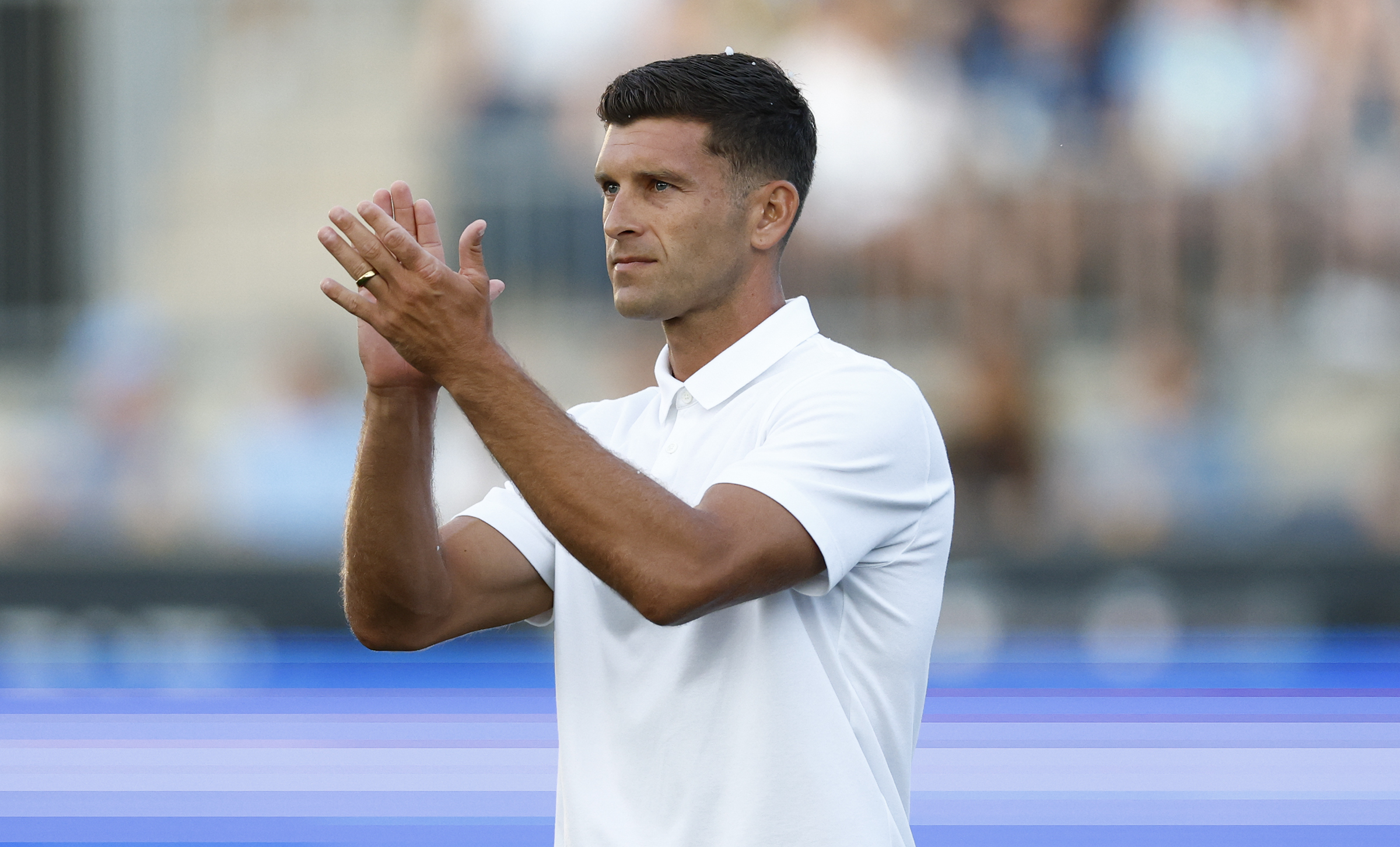
Union head coach Ryan Richter has turned the team into consistent winners from July straight through to October. Yong Kim / Staff Photographer
Added Richter: “You see the energy they’re playing with. And if you can give this to a team, if a team feels like that, you [as a coaching staff have] to keep that rolling because it’s so powerful. You know, it’s so powerful.”
While some might find this premature, there is chatter that Richter, as an interim coach, could be in line to receive MLS’ Sigi Schmid Coach of the Year award. He’d be the first interim head coach to win the award in Major League Soccer and just the second in the five major professional American sports leagues to win such an honor.
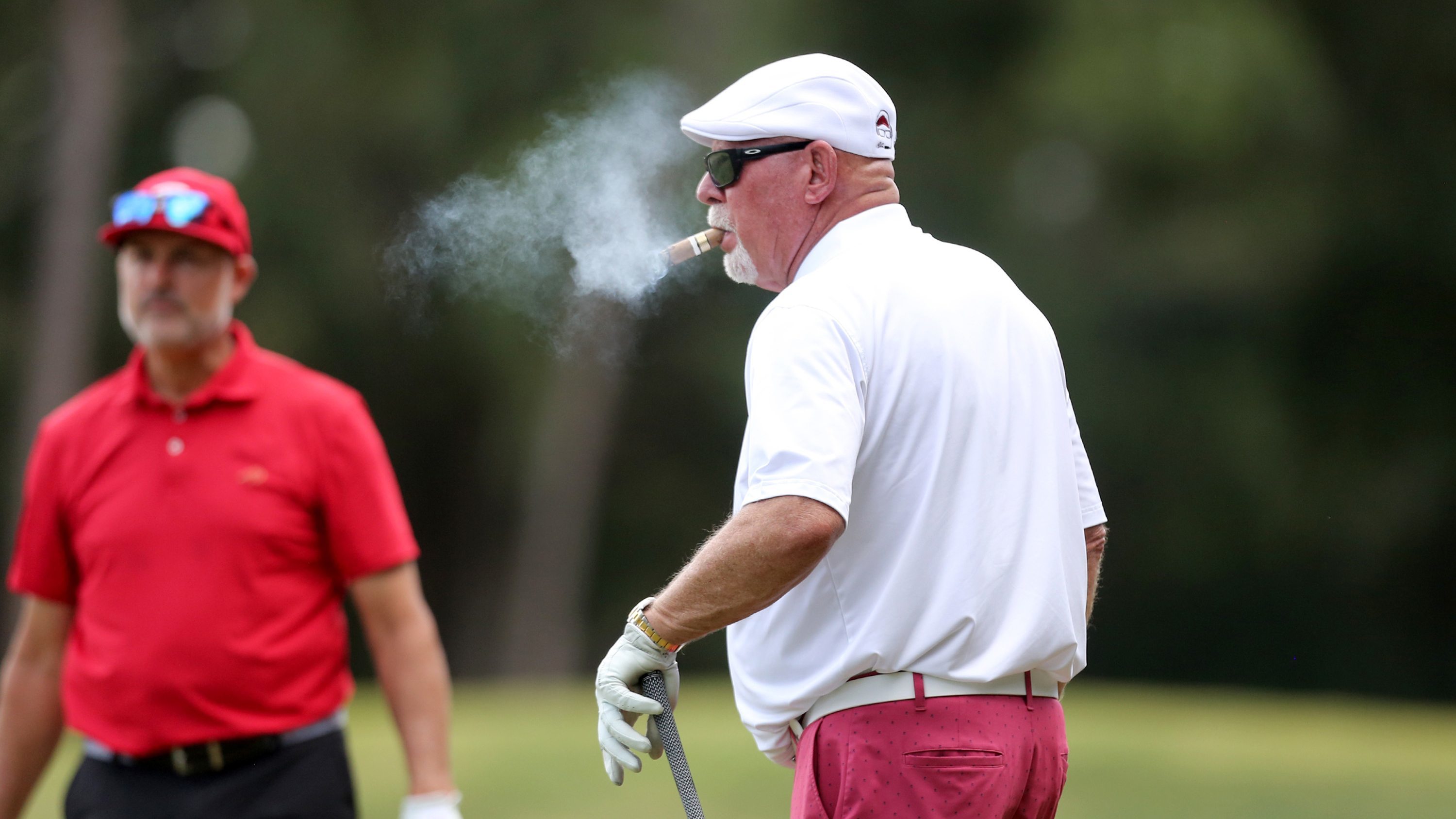
Coincidentally, the last winner of such an award was a Pennsylvania native, like Richter, who hails from Southampton. In 2012, as the interim coach of the Indianapolis Colts, York, Pa., native Bruce Arians won the NFL’s Coach of the Year award after guiding the Colts to a 9-3 record (11-5 overall) while head coach Chuck Pagano was receiving treatment for leukemia.
York, Pa. native Bruce Arians is a two-time NFL Coach of the Year, winning his first as interim coach of the Indianapolis Colts in 2012. Douglas R. Clifford / MCT
Richter could set the stage to do the same in Major League Soccer, but there are hurdles. For starters, only one team in the history of MLS has had a coach win the league’s Coach of the Year award in back-to-back seasons. That would be the case here, considering last season, former Union coach Bradley Carnell earned the distinction after guiding the Union to the 2025 Supporters’ Shield title, given to the club with the best overall record in the league.
The last time a team won consecutive awards was the 2006 and 2007 seasons when the now-defunct Chivas USA franchise had coaches earn the honor. American coaching legend Bob Bradley took the crown first, followed by former U.S. national team standout Preki Radosavljević, who won after taking over for Bradley the following year.
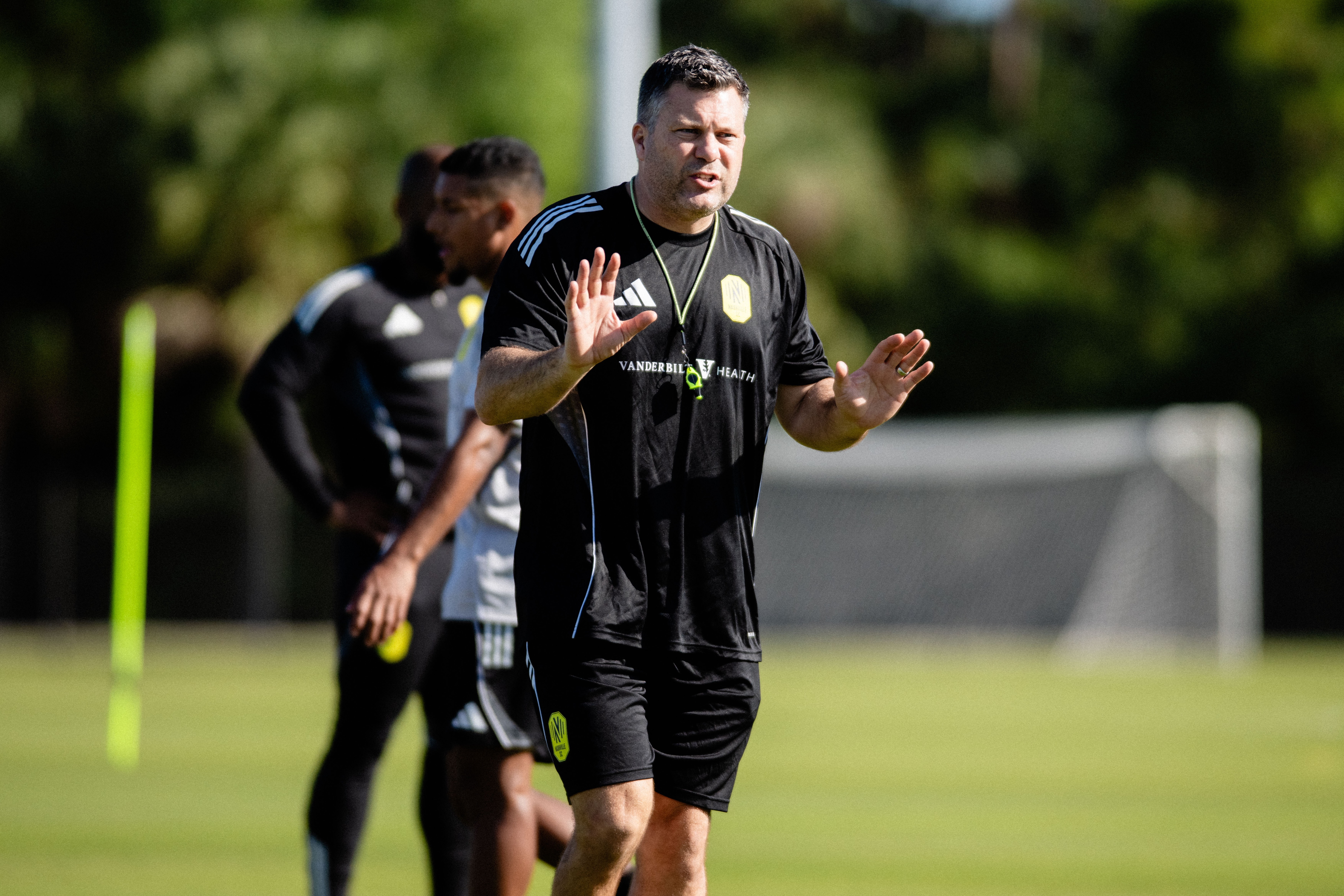
Ventnor City, N.J. native B.J. Callaghan has led MLS’ Nashville SC to the league’s best record and No. 1 seed in the upcoming MLS playoffs.Chris Daniels
Also, there are other coaches in MLS this season who are doing some pretty remarkable things. One of the front-runners just so happens to be another area native and former Union assistant. What Ventnor City, N.J. native B.J. Callaghan has done with Nashville SC, already locking up a playoff spot and ensuring they’ll be the No. 1 seed in the Eastern Conference playoffs with four games still to play — before MLS’ Decision Day — is impressive.
There’s also St. Louis City SC coach Yoann Damet, who, before a 3-2 loss last week against Minnesota United, rattled off an 18-game unbeaten run which included 13 wins. Earlier this month, his team won the famed U.S. Open Cup, the oldest domestic soccer tournament in America.
So Richter has some competition. The difference between the others and what he has to work with is a payroll that is a lot lighter, players who are a lot younger, some even getting their first look at first-team competition, and a run that’s still going strong as they head into a massive game at home that, with a win (or a draw with some help), would serve as early redemption.
A reminder that this was a team that entered the seven-week break for the FIFA World Cup with just one win, wallowing in MLS’ Eastern Conference basement.
“When the players step on the field, they expect to win; they expect to score,” Richter said. “That kind of confidence, it’s contagious. It can take you a long way. And we have to bottle that up and keep it as long as we possibly can.”
It’s already a remarkable story.
The fun part is that it’s one that isn’t close to being done yet.
Another dog owner lets his dog overwhelm mine at the park, then laughs it off as “just playing.” My dog really does not like the intense physical play and yelps for help. But we keep running into each other. How do I set a boundary without making it totally uncomfortable every time I see this person? There is no other close dog park.
Abigail Covington, Life & Culture Reporter
I actually don’t take my dog to the park because she is, objectively, a very bad dog. She’s anxious, aggressive, and can’t play for squat. Whenever she tries to play, her flight-or-fight instincts kick in and she ends up scaring all the other dogs and their owners away. Super fun for everyone!
It sounds like you are dealing with a similar kind of dog, but, unfortunately, an obtuse owner. You are well within your rights to ask this person to keep their dog away from yours. The number one rule of dog ownership is don’t let your dog be a jerk.
Jason Nark, Life & Culture Reporter
I agree. My least favorite type of pet owner is someone who rationalizes/reinterprets clearly bad behavior, so I empathize. I’ve had dogs who behaved poorly, so I kept them out of dog parks. It seems unlikely you’d run into this specific dog every time you go there, but if that’s the case, maybe try going there at completely different times: early morning, nighttime, etc.
Abigail Covington
That would be a very effective and nonconfrontational way of dealing with it. If you don’t want it to be uncomfortable when you see them, just don’t see them. Problem solved.
Or you could choose to put this dog owner in their place, for everybody (and everydog’s!) sake. Simply say, “It looks like our dogs have different ideas of what “playing” means. Maybe we should keep them separate?” It’s for their dog’s good, too, and you can say that. God forbid their dog hurt yours. That could get them in and the owner in serious trouble!
Jason Nark
Yes, this person likely knows their dog is misbehaving, but if they’re not dealing with it, you should say something for your dog’s sake. I have a pit bull who is super friendly and lovable and melts hearts wherever she goes. As a pit bull owner, though, I take even extra precautions around other dogs because, god forbid, she ever reacts to an out-of-control dog, she could do real damage.
Abigail Covington
Exactly. And she could get in trouble too! I believe Pennsylvania has a single-incident rule, so all anyone’s dog has to do is hurt another dog or person, one time, for any reason, to face consequences.
Maybe this dog owner doesn’t know that. I think if you frame the conversation around protecting their dog too, they’d welcome what you had to say and the distance between your two pups.
On the first chilly October morning in West Chester, the sound of skateboard wheels on asphalt was audible down the street as skaters from 5 to 55 warmed up for the biannual Philly AM skating competition.
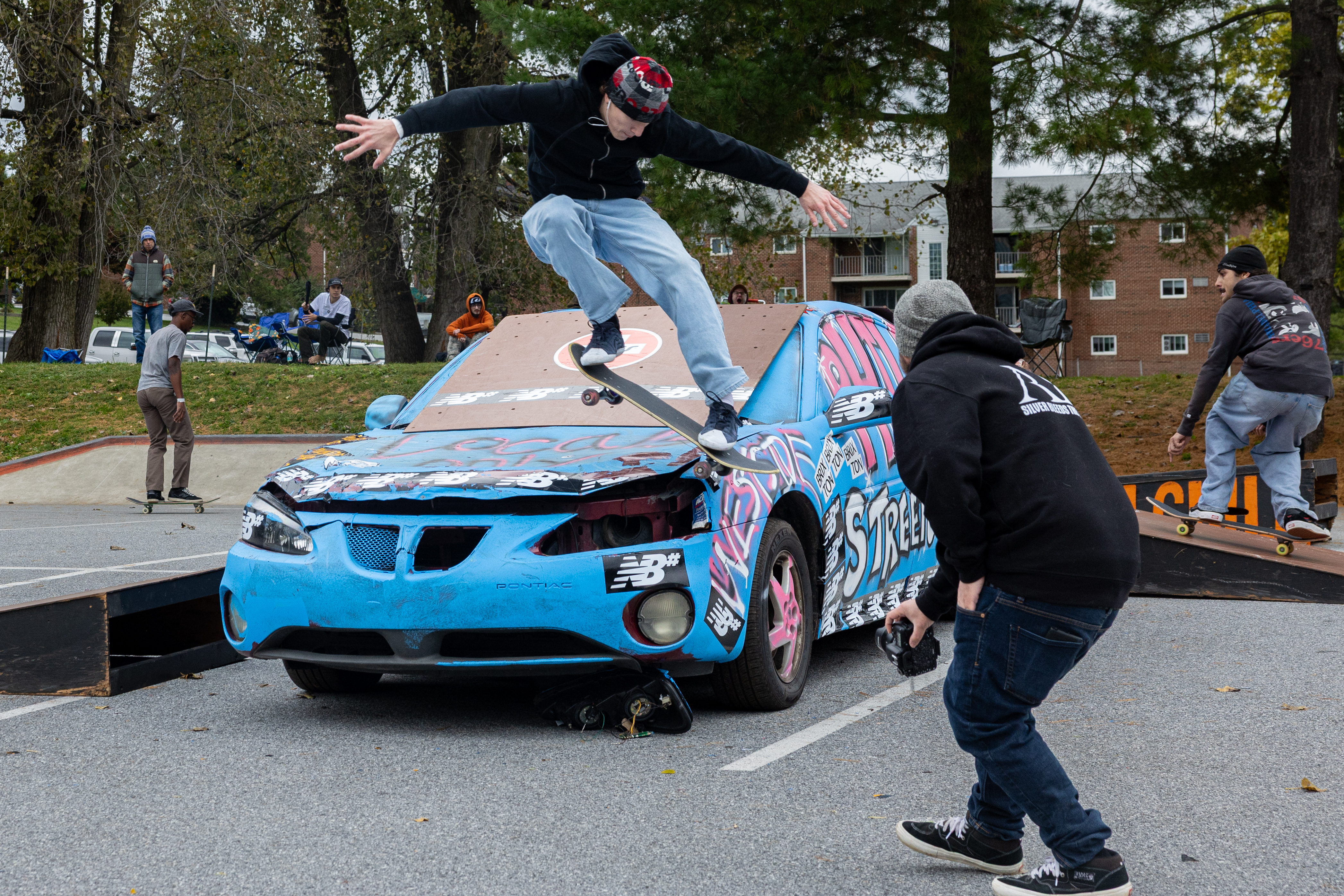
Young amateurs and sponsored skaters alike flocked to the Westside Community Center parking lot, where ramps, rails, and even a spray-painted old Pontiac were set up for the ’80s-style street skating competition, which is now in its 26th year.
For Jon Crans, the longtime organizer of the event, the goal has always been about serving the skating community rather than the competition.
“Trust me, I love how competitive some of these guys get,” Crans said. “But I’m more looking at it from a positive impact, more of an influential impact in all skill levels, all age groups within skateboarding, because a lot of kids never get the chance to compete.”
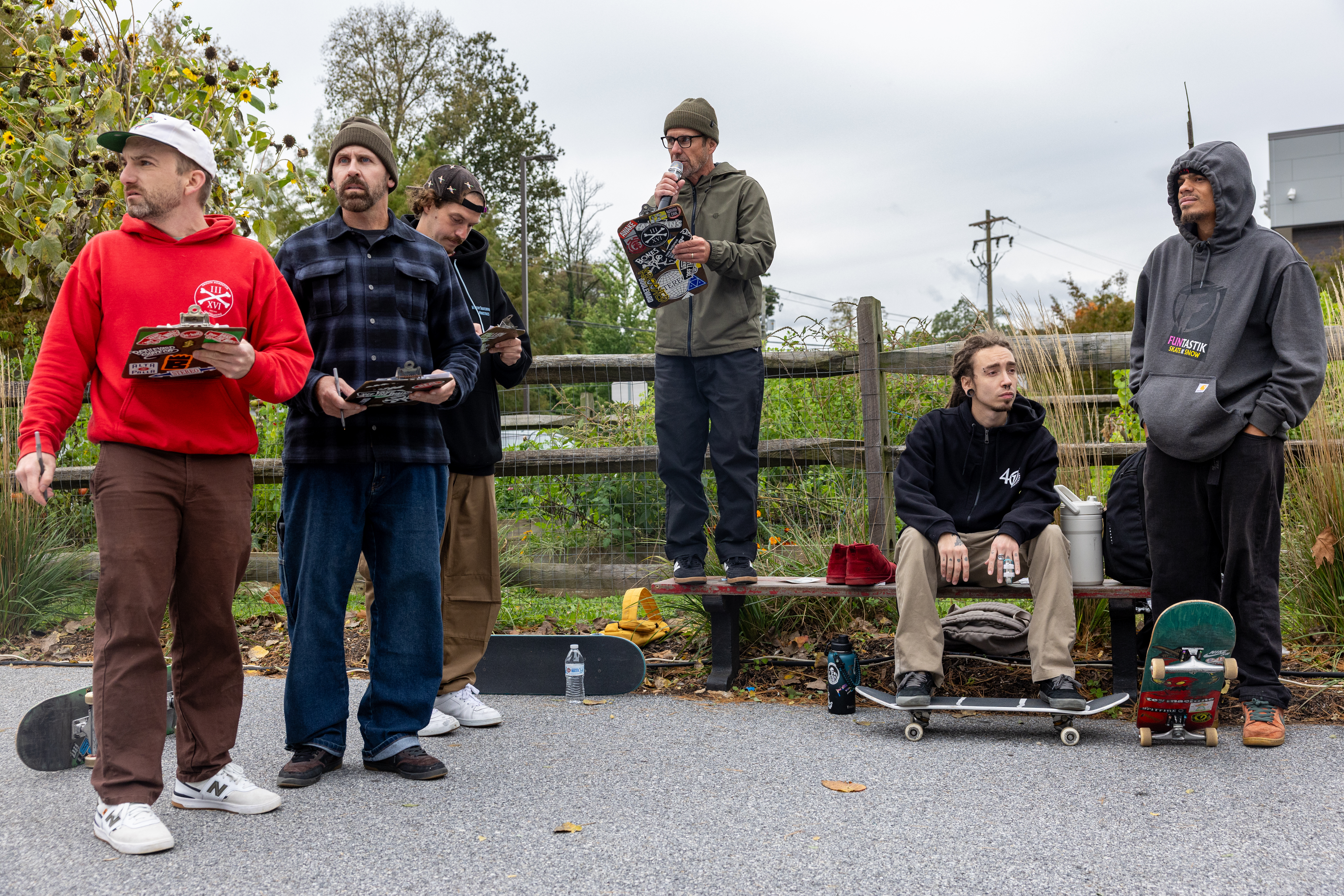
Jon Crans (center), 53, of Coatesville, is the longtime organizer of the Philly AM skateboarding competition. Aidan T. Gallo / Staff Photographer
The competition is structured with six divisions: “grom” (under 13), intermediate, advanced, women’s, over 30, and sponsored. The all-day event drew skaters from down the street and as far away as Wisconsin, along with friends and family, who were on hand with blankets and cups of hot coffee.
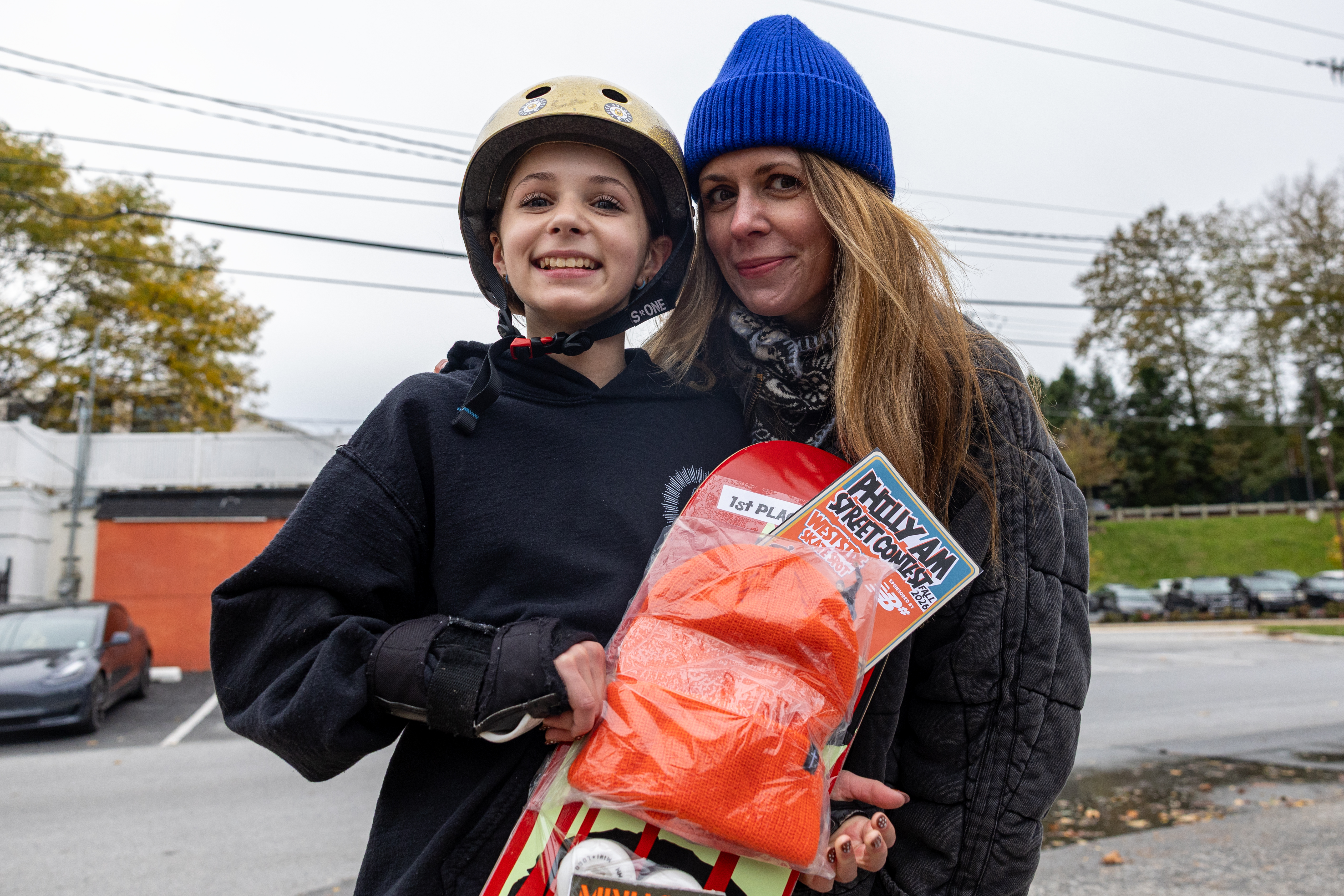
Bowie Neylon was one of two girls who competed Saturday. The 12-year-old won first place in the grom and women’s divisions.
“I feel really good about how I did,” she said as she clutched her skateboard with polka-dot-painted nails. “I’m excited to get to tell people at school that I got to skate a car, even though I fell.
“I guess they don’t need to know that part,” she said with a laugh.
Neylon’s mom, Kiersten Rogenmuser, says she knew her daughter was taking an interest in the sport when she was only 5 and using her scooter without the handlebars.
“I mean, all you want as a parent is for your kids to be having fun, and she loves it,” Rogenmuser said. “And I’d much rather be here than on a soccer field.”
Bowie Neylon, 12, won two divisions at the Philly AM, with her mom, Kiersten Rogenmuser, on hand to watch.Aidan T. Gallo / Staff Photographer
Bowie is among the local kids taking skate lessons from Ronnie Gordon, who on Saturday was a judge, a volunteer, and, at 53, even a competitor in the over-30 division.
“I have older skaters and sponsored guys come up to me all the time and say, ‘Hey, you taught me how to ollie or do this trick or that,’” Gordon said. “Honestly, I never remember it, but I love teaching because you always remember that first skill you get as a kid, and all I want is to see skating survive. Stuff like the Philly AM is really what does that.”
The competitors ranged from those who have been part of the Philadelphia skating world for decades to up-and-coming skaters working to break into the growing pro world.
“That’s what’s so cool about the skateboard community,” Crans said. “It brings diversity together. Whether you’re 5 or 60, when you meet together as a skateboarder, the walls come down. The camaraderie is there, no matter what color skin you are or who you are.”
Over the past 25 years, the competition has propelled some locals into pro competitions and sponsorships. One of them, Ethan Todt, won the sponsored competition and headed home with a $500 prize and New Balance shoes.
“Someone like Ethan has been with us probably the last 10 years,” Crans said. “I remember when he was a little kid, and his mom would bring him, and he was this little skinny kid, just trying to make it up through the intermediate division. And then he got really good at what he was doing, got sponsored, and now he’s competing on a high level, but he still comes back and is a part of this community here.”
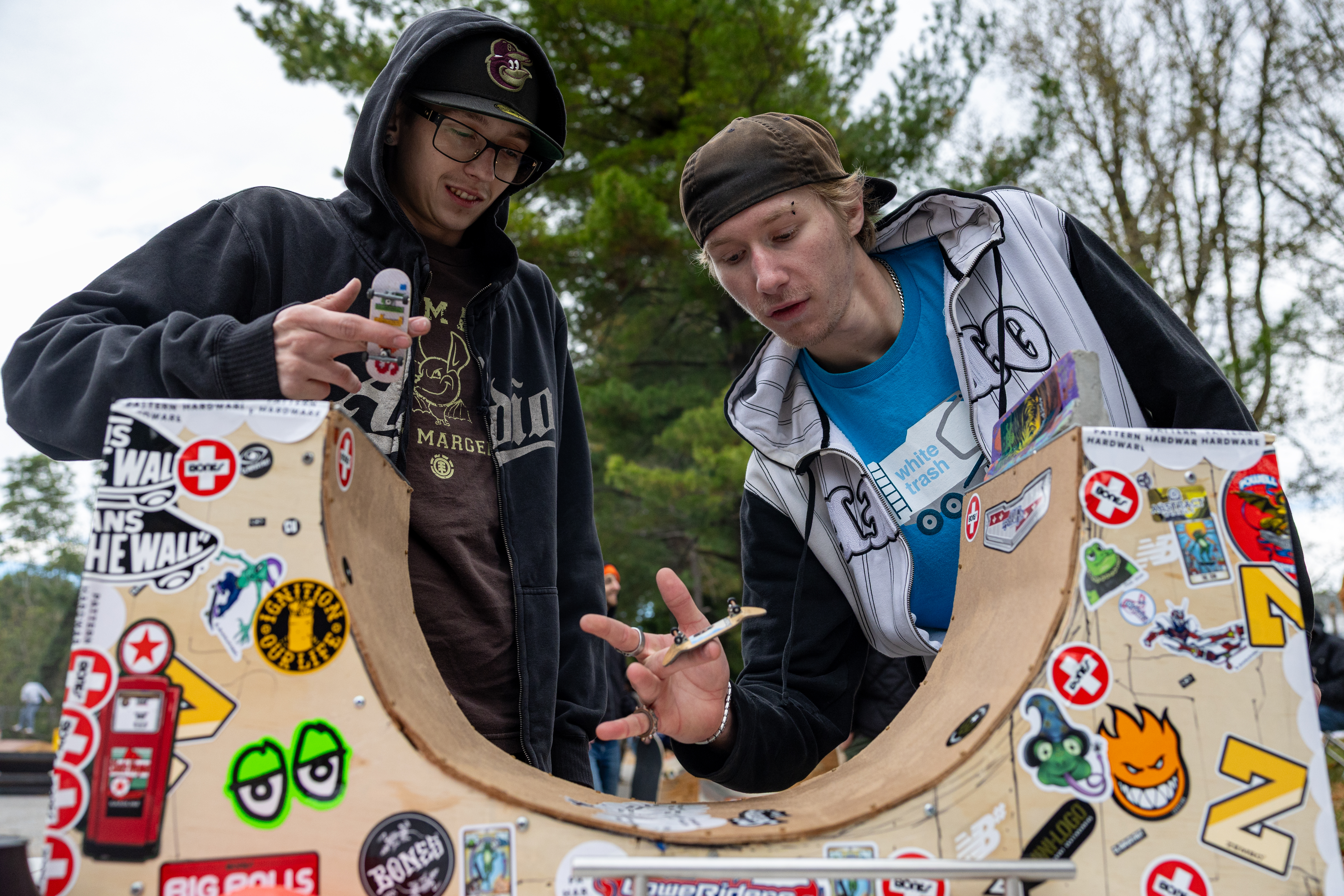
The parking lot that hosted the competition featured artists, too, from custom Tech Decks to stickers, T-shirts, and a handful of photographers there to capture the action..
“It’s exhilarating because you have to get up really close, but it makes for great pictures, and the people are so fun and welcoming. Everyone knows everyone,” said Lydia Willig, a Philly-based photographer and an amateur skater herself.
York residents Seth Livingston (left), 21, and Brandon Bolton, 20, play with mini skateboards during the Philly AM skate competition. Livingston has not skated seriously since pulling his rotator cuff but wanted to “support the homies.”Aidan T. Gallo / Staff Photographer
Crans emphasized that the tight-knit community is what “keeps the fire lit,” a saying and ethos that permeates the culture around the shared responsibility of maintaining the spirit of skating.
“It’s important to me that we’re uplifting the local skate shops here,” Crans said. “Places like Rad World, Kinetic, Nocturnal, and Homebase Skateshop all do their part in keeping skating alive around Philly.”
Philadelphia has a long history as a skateboarding hotbed. In the 1980s and ’90s, Love Park and Center City served as a home base for many skaters. Crans recalled taking the train into the city and skating all day.
Crans and other volunteers behind the Philly AM hope that their work keeps skaters safe and out of trouble while maintaining their subculture.
“Skating has always had a bad rap, but when you give these kids a platform and a place to skate, you see how much they need that community,” Crans said. “A lot of these kids, sadly, come from broken homes. They’re hungry for relationships and to be part of something.”
Little did Walt Whitman know that when he wrote the line, “I contain multitudes,” in his poem “Song of Myself” in 1855, he would help explain the dichotomy that exists within a 26-year-old Eagles quarterback over 170 years later.
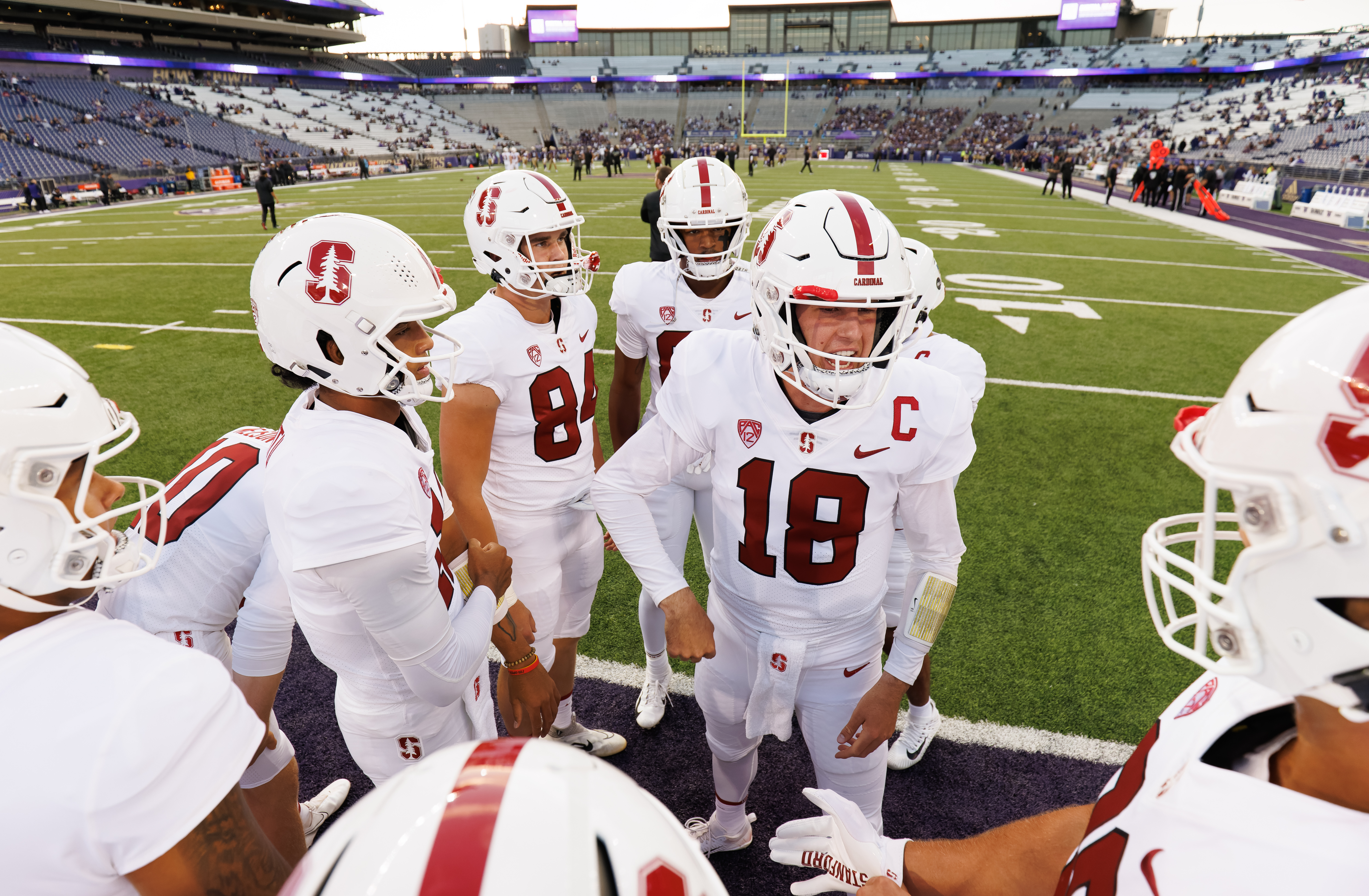
Tavita Pritchard said he quickly learned of the “multitudes” within Tanner McKee as his offensive coordinator and quarterbacks coach at Stanford, when McKee arrived as a freshman in 2020. Off the field, Pritchard described McKee as “one of the most positive people” who was so personable and gregarious that he could strike up a conversation with anybody.
But when he stepped on the field, the 6-foot-6, 231-pound quarterback flipped the switch on his demeanor.
“He’s a freaking killer on the field, man,” said Pritchard, who is now Stanford’s head coach. “He is as competitive a person as I’ve been around. He is somebody who absolutely wants to dominate the opponent.”
Tanner McKee impressed coaches at Stanford with his poise and unflappability. John Lozano/ISI Photos
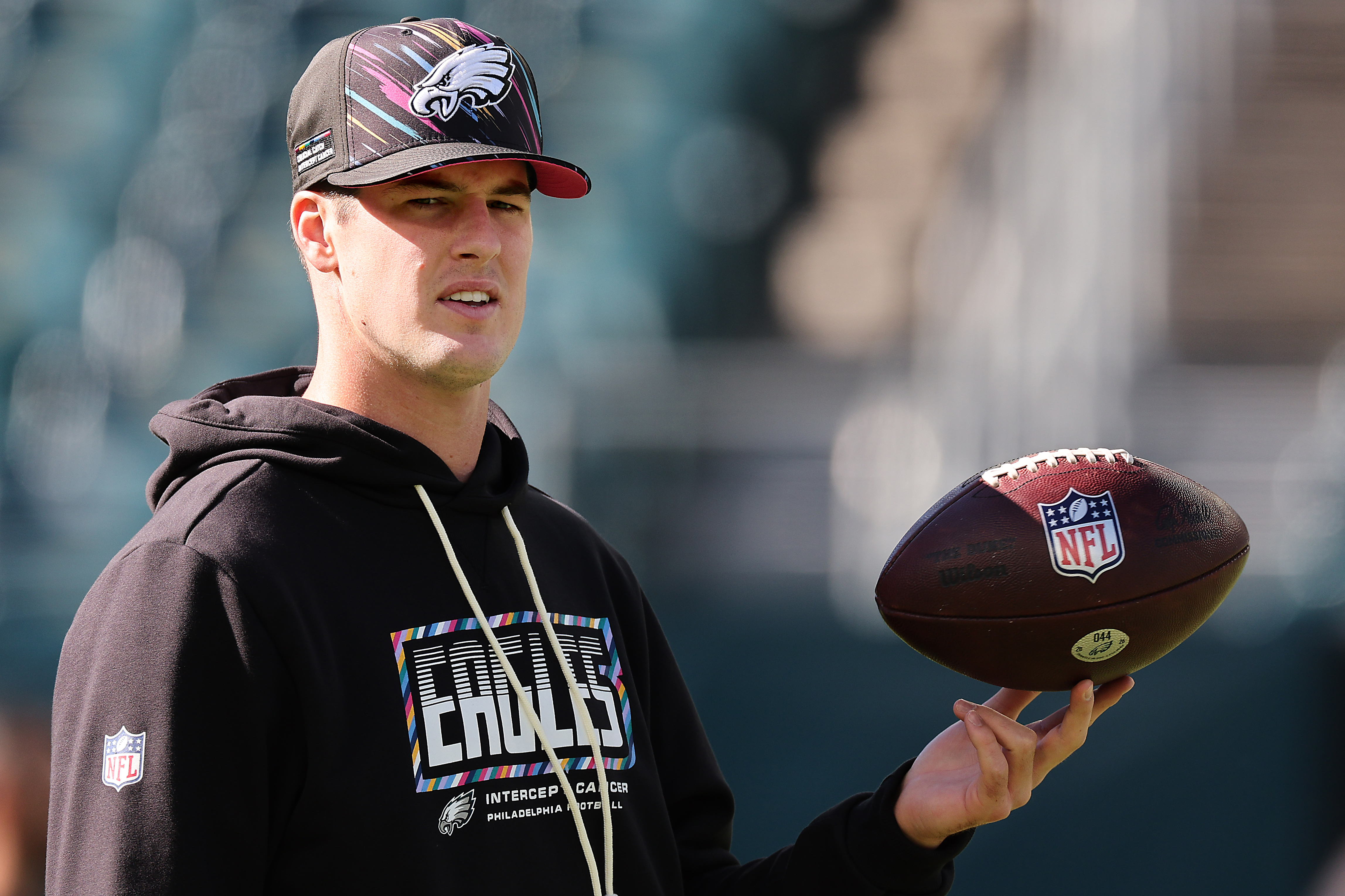
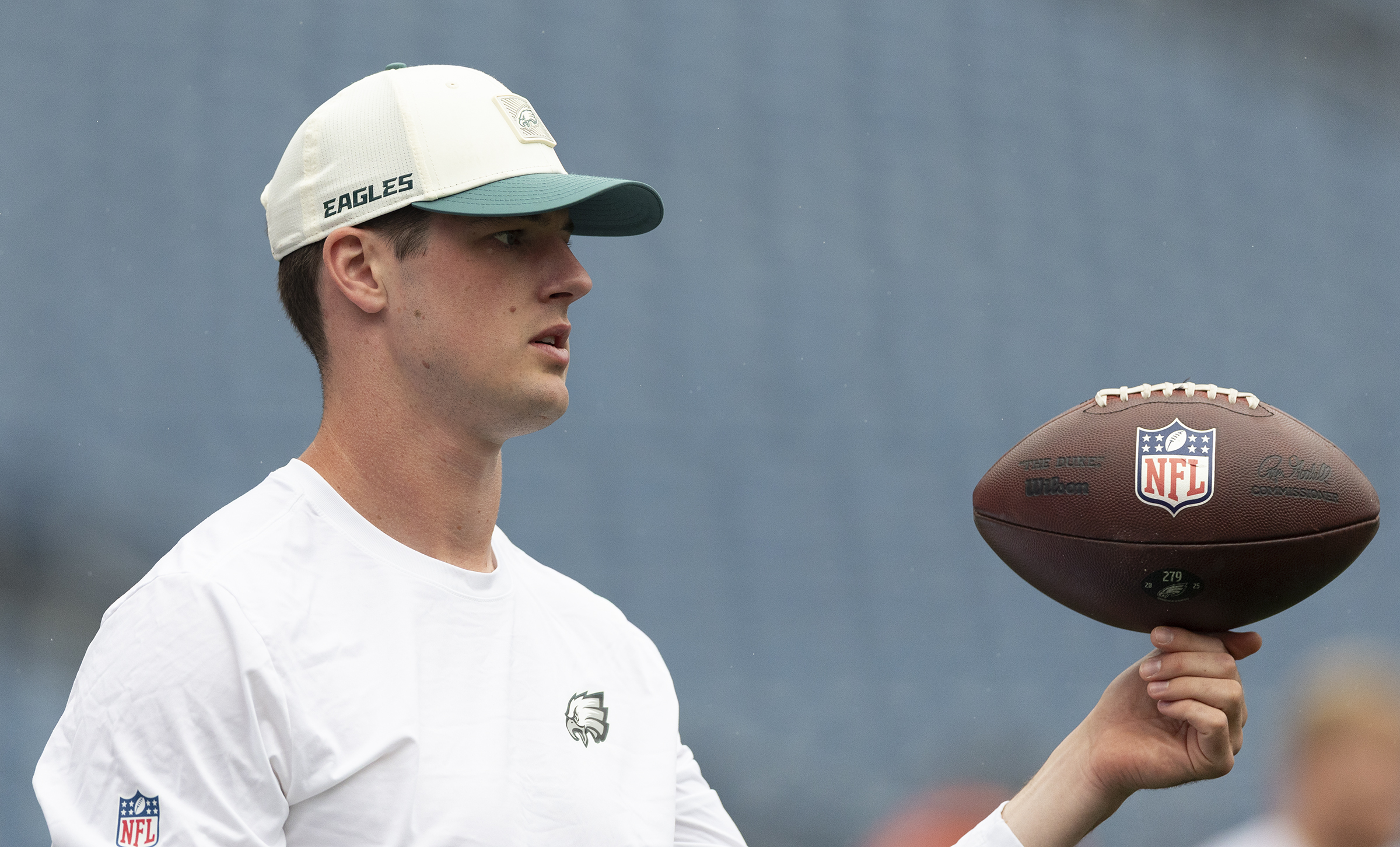
Those disparate qualities within McKee, the Eagles’ 2023 sixth-rounder, haven’t changed. If anything, they’ve become even more evident as he has stepped into the starting role on a full-time basis in the absence of Jalen Hurts, who could miss the rest of the season after he was diagnosed with blood clots in his lungs.
Despite being McKee’s teammate for the last four seasons, Jordan Mailata is just now getting extended exposure to his on-field personality. Mailata, the Eagles’ starting left tackle since 2020, hasn’t taken nearly as many snaps with McKee under center over the years as he has with Hurts. Over the last week and a half, Mailata is beginning to understand what the second-unit offensive linemen have been telling him about McKee and his presence in the huddle.
“There’s a switch,” Mailata said. “He’s [a] very positive, friendly guy, but then when he’s out there, the urgency goes up tenfold, and he’s a different guy out there. The urgency, you see it, the fire, the command of, like, ‘Everybody, refocus.’ To me, he snaps me back out of it. If he can see visually that I’m not in it, he’ll bring me back in.”
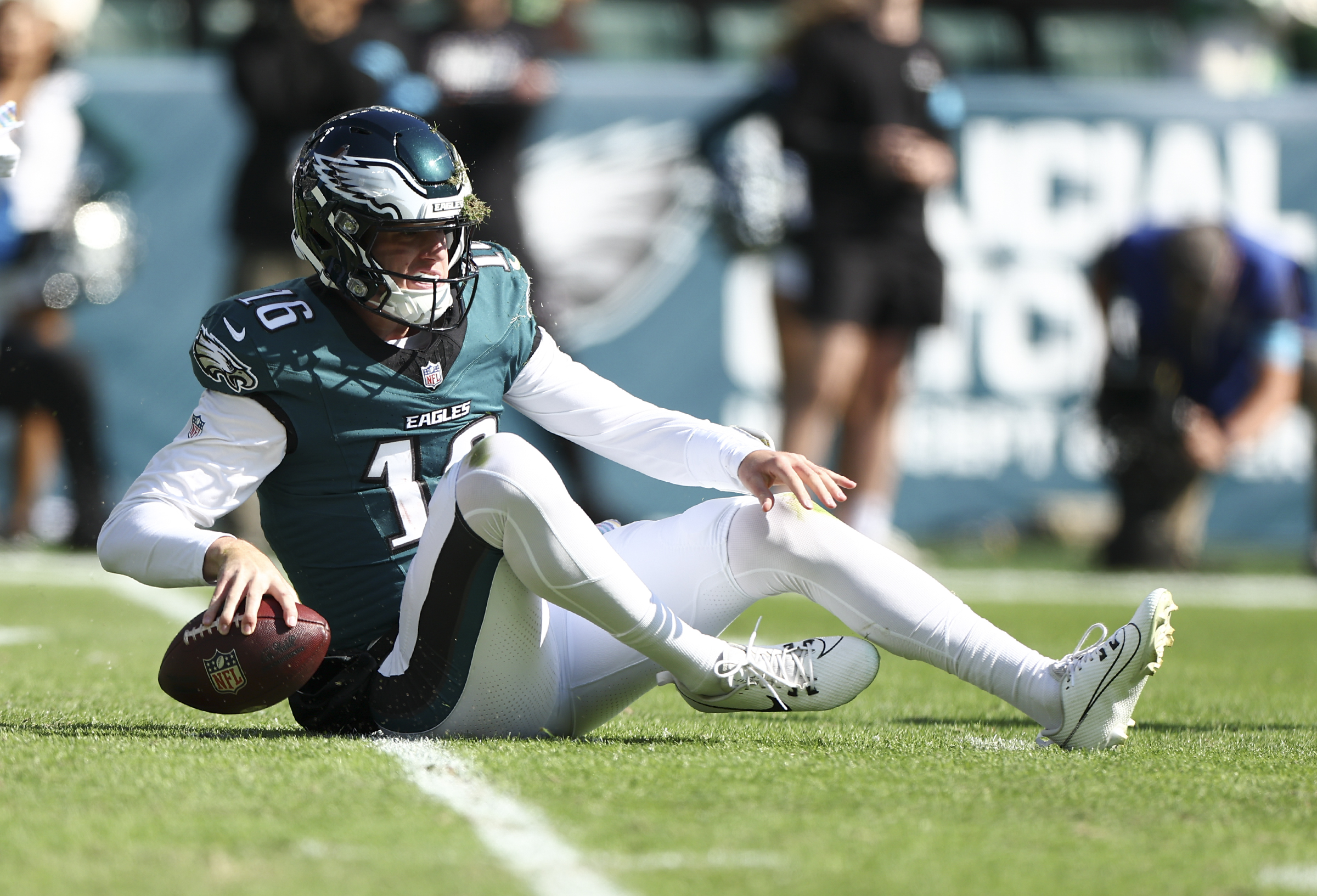
McKee must now bring everyone back in. As the starter moving forward, McKee will be tasked with helping an inefficient Eagles offense that ranks 30th in the NFL in expected points added per play (minus-.21, according to Next Gen Stats) rebound in a wide-open NFC East. He will look to snap the Eagles’ four-game losing skid, too, beginning with their Monday Night Football matchup against the Dallas Cowboys (8:15 p.m., 6abc and ESPN).
He was inconsistent in the first non-Week 18 start of his career last week against the Carolina Panthers, going 26-for-45 (57.8% completion) for 215 yards and a touchdown. But unlike last week, when McKee learned that he would start just three days before the game, offensive coordinator Sean Mannion now has the benefit of a full week of game-planning around McKee.
McKee has shown that he is capable of flipping the switch within. Can he help flip the switch on the Eagles’ season?
“The last couple months, probably month, [is] weighing on everyone,” Mailata said. “But having Tanner under center and just his infectious energy has helped a lot.”
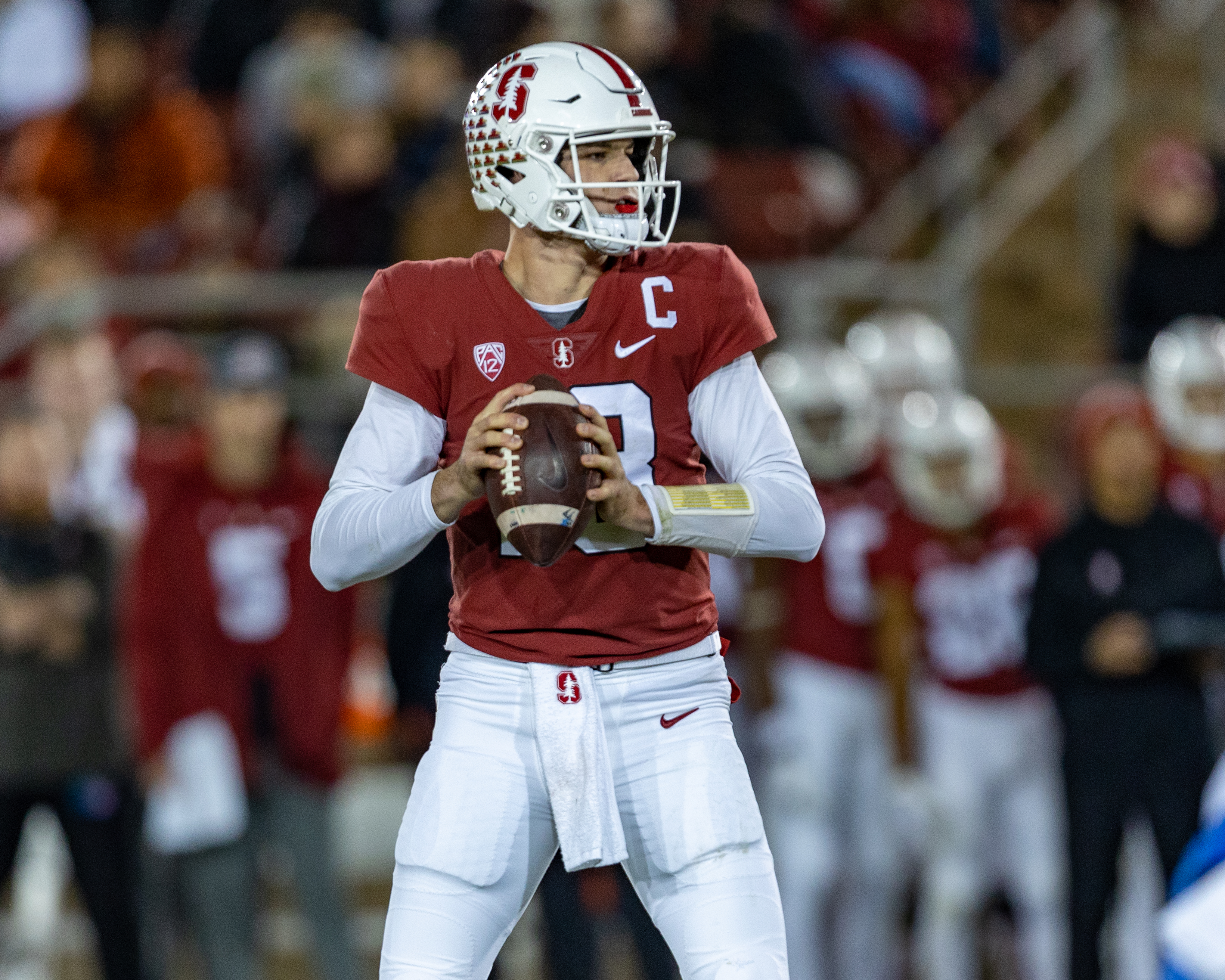
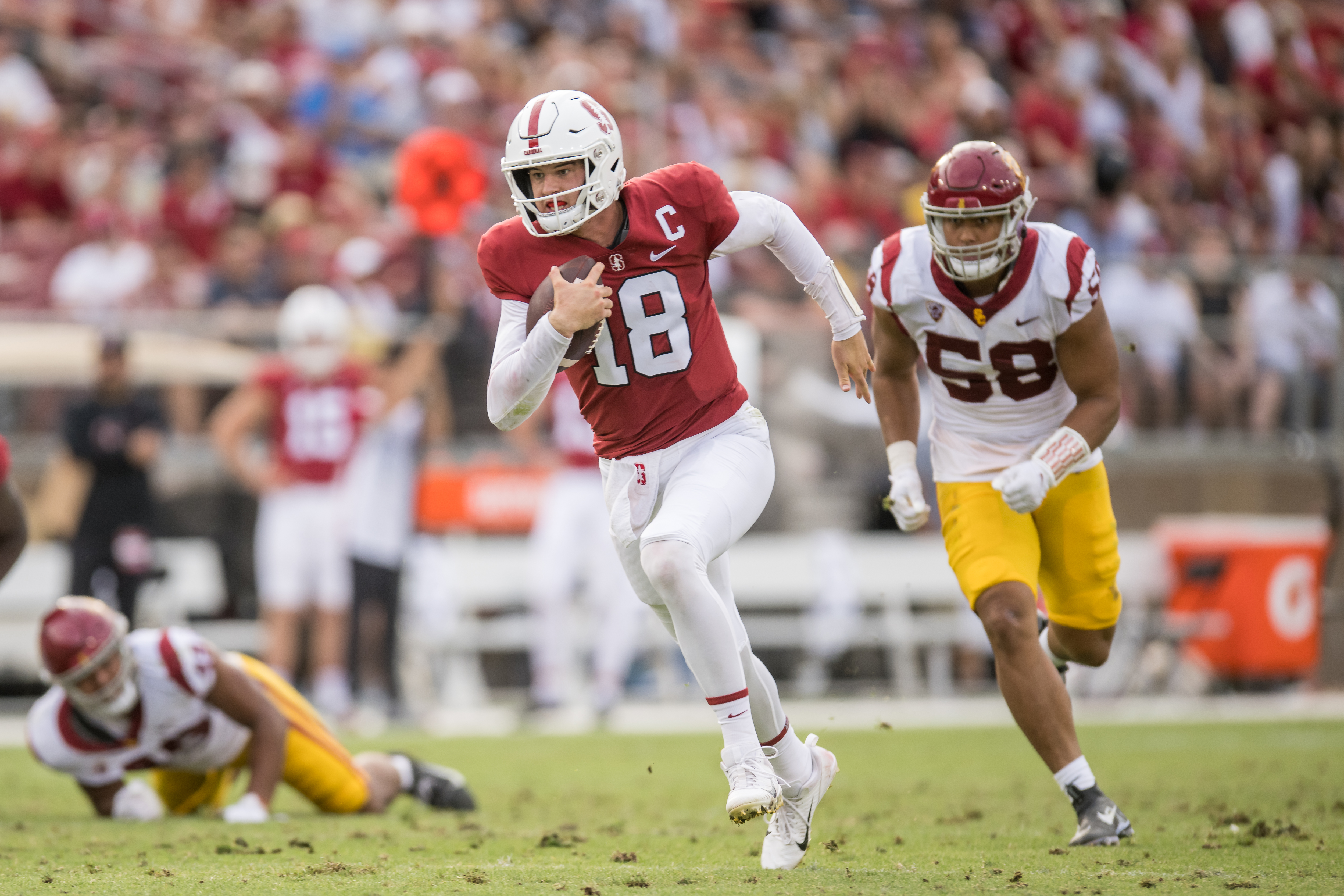
Tanner McKee (18) was pressed into service during the COVID-affected year of 2020 and rose to become Stanford’s captain two seasons later.Bob Drebin/ISI Photos
‘Unflappable’ in the face of adversity
For better or worse, McKee is well-acquainted with taking over at quarterback in less-than-ideal situations.
In 2020, his freshman year at Stanford amid the COVID-19 pandemic, McKee saw his first game action in the season opener on the road against No. 12 Oregon. He found out that he would get playing time just hours before kickoff.
Davis Mills, the starter at the time and now a Houston Texans backup, had an inconclusive COVID-19 test. Despite testing negative multiple times after an initial false positive, former Stanford head coach David Shaw found out that he still couldn’t play Mills. The process delayed the Cardinal’s eventual decision to pivot to a quarterback tandem of junior Jack West and McKee, a freshman who had recently returned from serving a 21-month LDS mission in Brazil.
“He was not moved, in the best sense of that,” Pritchard said. “He was like, ‘OK, great, here we go. Can we go walk through these plays?’”
And so they did, in a parking lot adjacent to Autzen Stadium. They tried to hide behind a trailer that carried Stanford’s equipment so that nobody could see them rehearsing their plays. While Stanford lost, 35-14, McKee flashed in his debut, especially when he flaunted his arm on a 46-yard deep post to current Arizona Cardinals wide receiver Simi Fehoko late in the third quarter.
In theory, Shaw could’ve just gone with West, who was more experienced and knew the offense better. But he had been excited to finally see McKee play.
“I’d waited since his senior year of high school,” said Shaw, who is now the passing game specialist for the Detroit Lions. “Waited from going on a mission for those two years, and we had that opportunity to play him, and knew that it wasn’t going to take away from his eligibility. We said, ‘Hey, gosh, I got to see this kid go out there and play.’ And [he] threw one of the most beautiful balls of the game. And I’m like, ‘Yeah, that’s what we have to look forward to once this kid is really ready to take over.’”
Shaw also continued to see the maturity that McKee possessed before he began his career at Stanford, and even before he went on his mission in Brazil. He overcame melanoma when he was 16 years old. It didn’t take long for Shaw to understand early in their relationship, when Stanford was recruiting McKee out of Centennial High School in Corona, Calif., that he was a fighter.
“This is a young man that’s been through a lot, and has remained a high-caliber person, and at the same time, a tough, tough, tough competitor,” Shaw said.
In 2021, McKee won the starting job and showed that he was “unflappable” in the face of big moments, Pritchard said. In the first start of his career at the helm of unranked Stanford against No. 14 USC, he went 16-for-23 for 234 yards and two passing touchdowns, plus one rushing touchdown. He became the 13th FBS quarterback since 2012 to beat a ranked opponent on the road in their first career start.
Tanner McKee pulled off a rare collegiate feat by beating a ranked USC team on the road in his first start. Stanford Athletics / ISI Photos
He followed that up two weeks later with a stellar performance in a rematch with No. 3 Oregon. After taking a shot to the ribs on the final drive, McKee missed one play and returned to action. He threw the game-tying touchdown as the clock expired in regulation, then tossed another in overtime to win, 31-24. Shaw never doubted that McKee would return after taking the hit that sidelined him.
“When you know what he’s been through, that was very, very minor,” Shaw said. “The moment he was going to get cleared, he was going to go out there with no hesitation and go out and grip it and rip it.”
With the highs came the lows. Stanford won just six games with McKee as the starter over the course of two seasons. Shaw lamented the Cardinal’s inability to play better football around McKee, although he still knew he would have a chance to play at the NFL level.
Regardless, McKee was an “eternal optimist,” Pritchard said, in the face of adversity. Positivity can turn into negativity if it’s funny, according to Shaw, but that wasn’t the case with McKee.
“Positivity has to have gravity,” Shaw said. “So I say that in such a way that people that have been through difficult things and have found a way to be positive, they can exude that positivity with gravity, with earnestness, and be able to step in the huddle and say, ‘Hey, that wasn’t good enough. We’ve got to be better. Come on, guys,’ and lifting people up and bringing people along comes very natural to him.
“And there’s a genuine feeling that the guys get from him that this is someone that they can follow, this is someone that they can trust, this is someone that’s in the battle with them.”
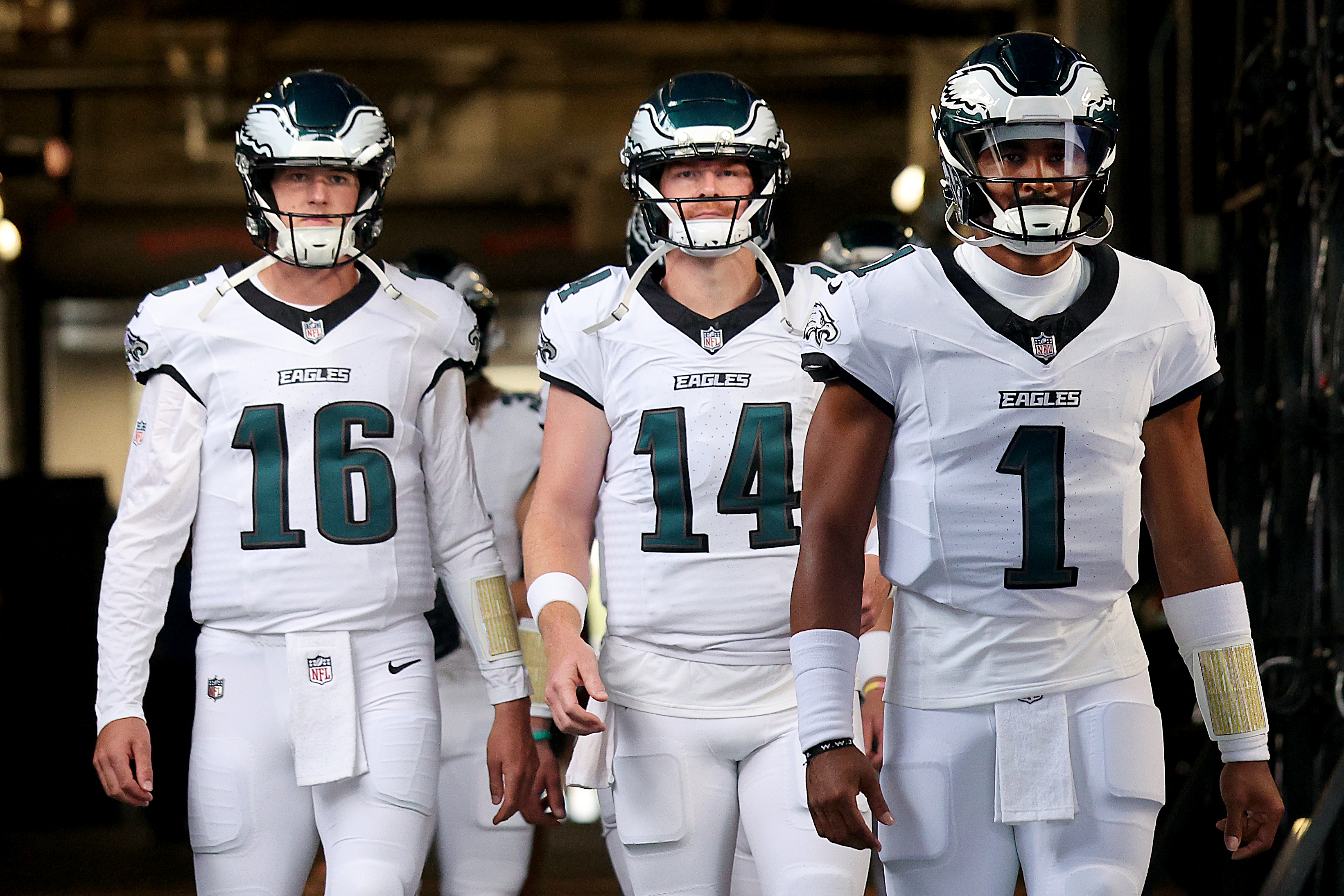
Tanner McKee (left) had to battle Andy Dalton (center) for No. 2 quarterback duties in a competition that continued once the season started. David Maialetti / Staff Photographer
‘I want the guys to trust me’
Roughly seven weeks ago, McKee learned that Andy Dalton would serve as the backup to Hurts going into the season opener against the Washington Commanders.
McKee recalled a conversation that he had with Parks Frazier, the Eagles quarterbacks coach, that day. Frazier told him that nothing would really change from a day-to-day perspective for McKee as the third-string quarterback. The backup competition would continue, and McKee would go through his typical process of preparation every week.
“That’s kind of the way that I approached it, taking it day-by-day, being able to take a step back and let me just focus on today,” McKee said. “Let me focus on this first meeting. Let me focus on this next walkthrough, then this next practice. I feel like that helped my mindset a ton, and still preparing and being ready if something was going to happen, if I was going to get an opportunity.”
He continued to prepare as if he was one injury away from game action. In reality, he was an interception andan injury away, as he took over QB2 duties in the game following Dalton’s pick in the Week 3 loss to the Chicago Bears, then was promoted to the starting job when Hurts was indefinitely sidelined due to the blood clots discovered in his lungs.
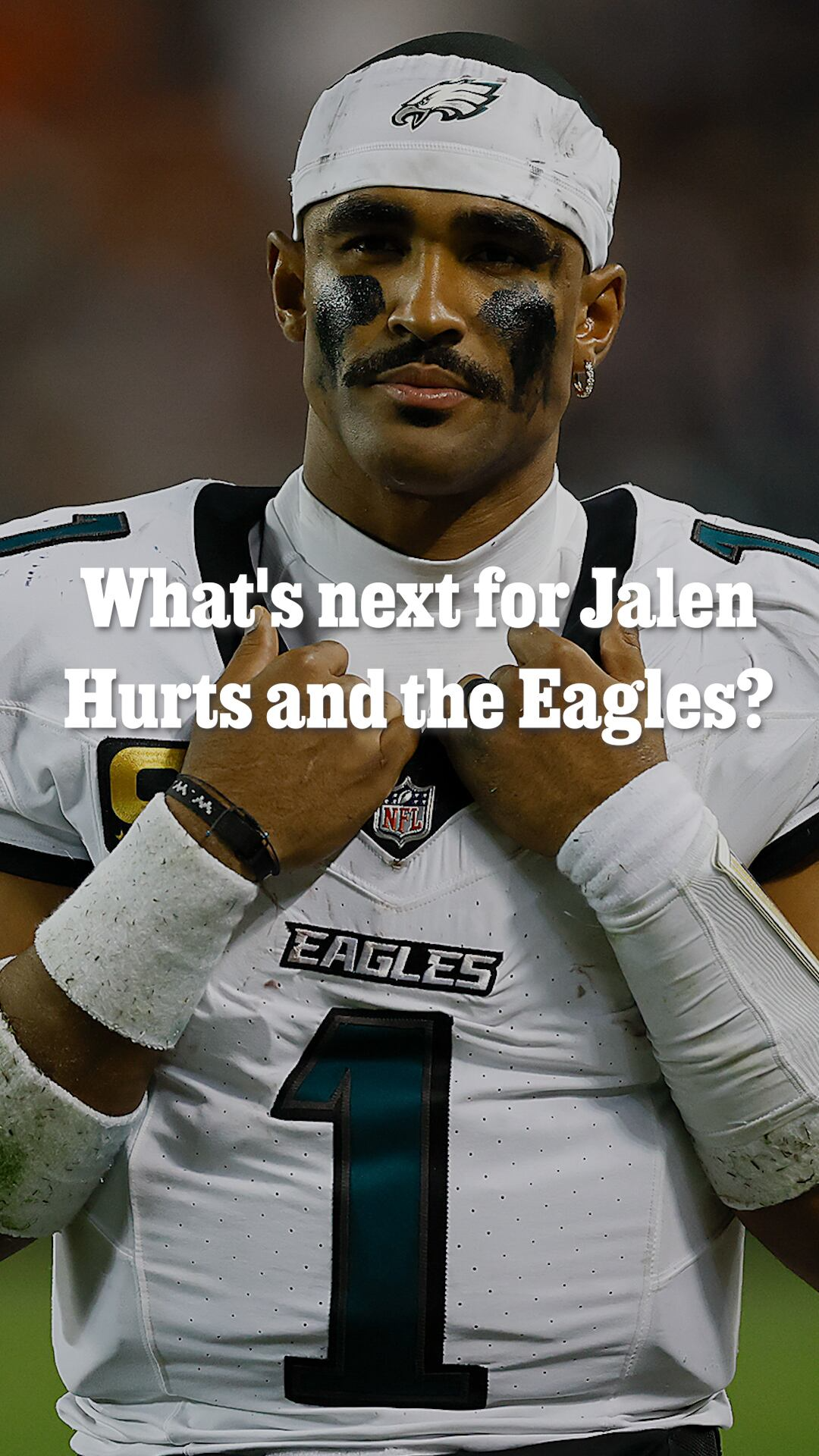
Video: What’s next for Jalen Hurts and the Eagles?
Even when he was the backup, McKee was expected to be the leader in the huddle with the scout team and ensure that everyone was on the same page. Now that he’s the starter, he said he’s “taken an extra step forward” in those duties.
“I want the guys to trust me,” McKee said. “I want the guys to know that when I go in there, they have full confidence that the offense is going to run smoothly.”
McKee is building that trust through his preparation, his leadership, and his trademark sense of positivity. Right tackle Markel Bell said it’s clear that McKee knows his stuff, and his authority in the huddle helps everyone get on the same page. Mailata also noted that one of the benefits of having a full week to practice with McKee is getting used to his cadence, which helps the offensive linemen avoid committing false starts.
Tanner McKee has worked hard to build trust with his teammates on the practice field. Yong Kim / Staff Photographer
Rookie quarterback Cole Payton isn’t in the huddle with McKee, of course, but when he watches tape back from practice, the difference between his laid-back demeanor off the field and his assertive one in the huddle is stark. Britain Covey said that McKee is a little bit more vocal than Hurts is in the huddle, which is by design. The 29-year-old receiver said he thinks McKee is trying to “over-communicate” his confidence to his receivers, so he doesn’t leave any of them guessing about how he is feeling at any given moment, especially because some of them don’t have much experience playing with him.
“He threw a bad pass today in practice, and immediately he’s coming in the huddle, taking ownership, saying, ‘My bad,’ and hyping guys up,” Covey said. “And that kind of confidence is contagious. We just need to be better for him than we were this last week.”
McKee has another opportunity against the Cowboys to prove he can run the offense, albeit potentially without DeVonta Smith and Dontayvion Wicks, who have been sidelined this week with hamstring and ankle injuries, respectively. Saquon Barkley, who has been out for the last two weeks with a hamstring injury, is eyeing a return against the Cowboys, providing some hope that the team can get the run game going and, in turn, spark the play-action pass game.
They failed to achieve that objective in Barkley’s absence against the Panthers. Still, Mannion emphasized his belief in McKee’s ability to execute his West Coast-style system. Mannion said McKee has been getting “better and better” within the offense, and now, he has the full week of reps as the starter to get comfortable within it.
“I think he’s really sharp mentally, he’s accurate, [and] he gets the ball out of his hands quickly,” Mannion said. “I think he does all the things that you ask of a quarterback in terms of his pre-snap operation, and being able to use his cadence [and] being able to handle things at the line of scrimmage if you need adjustments. I think he’s strong in a lot of those areas, and I think it opens up some things for us offensively.”
Tanner McKee had his ups and downs against the Panthers in his first start of the season last week. Monica Herndon / Staff Photographer
Shaw watched last week’s game against the Panthers and saw many of those same attributes within his former quarterback that Mannion covets. After all, they were the same qualities that stuck out to Shaw when McKee was in high school — his stature in the pocket, his quick release, and his accuracy.
The personnel around McKee may change yet again this week, but Shaw knows how stabilizing his presence can be in challenging moments.
“As a former coach and fan of Tanner, you’re like, ‘Oh man, I wish they were a little bit healthier around him,’” Shaw said. “But at the same time, you watch some of those plays, and you see him moving the pocket and get the ball out of his hands. You see him point the protection and run the offense.
“And I watch that, I watch him operate the offense with a lot of pride.”
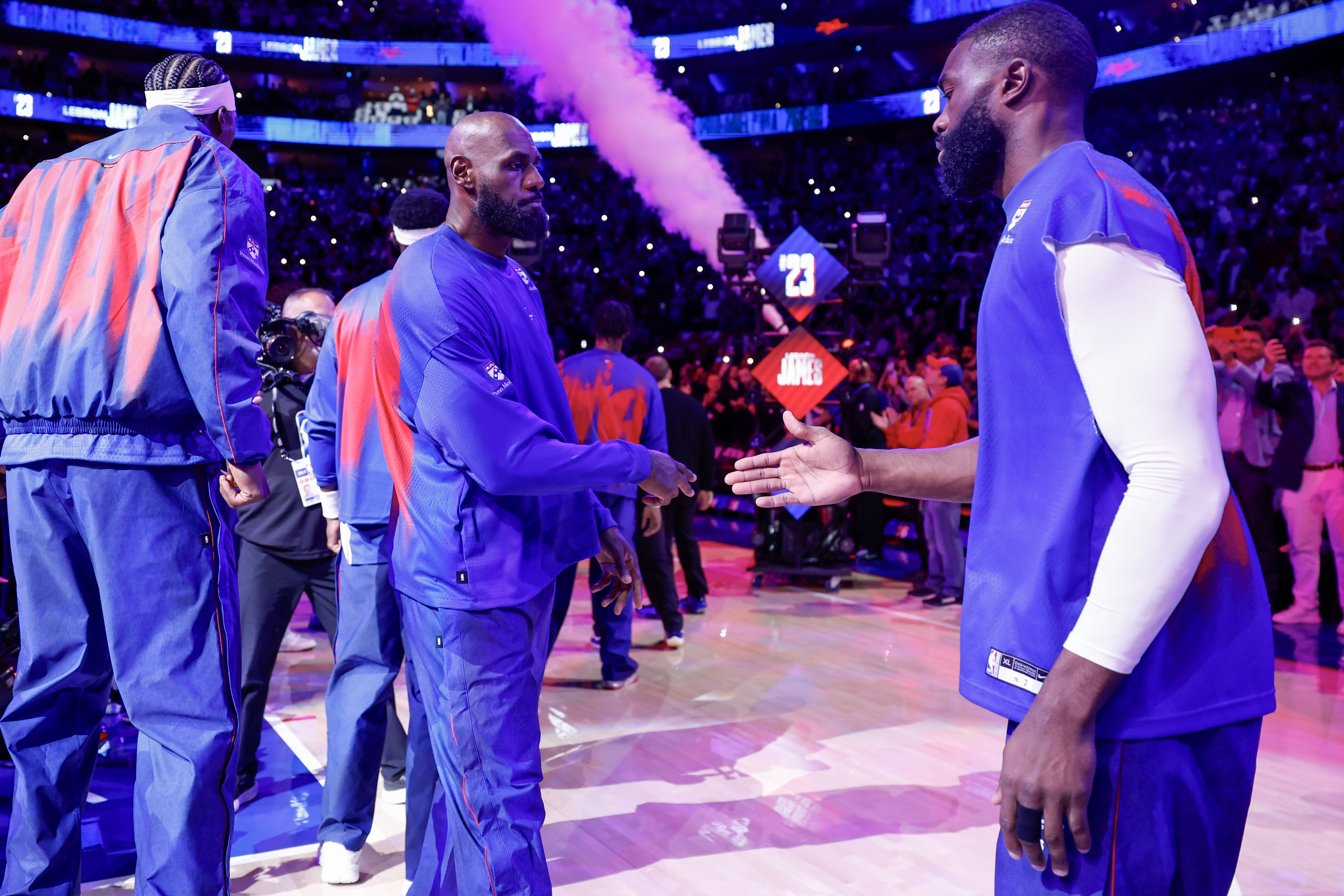
The Sixers are 2-0, LeBron James is wearing a Philadelphia jersey, and he and Tyrese Maxey are already doing cute little postgame handshakes.
Are we allowed to be happy about sports again?
With the Eagles’ season unraveling amid mounting injuries and Jalen Hurts potentially out for the year, another disappointing Phillies postseason, and the Flyers’ historically awful start, Philadelphia sports fans could really use something to celebrate.
And Thursday night, the Sixers delivered. In LeBron’s first regular-season home game, they somehow turned a 29-point deficit against Cleveland into a 114-106 victory. The crowd went from cheering LeBron’s signature chalk toss to booing the team to absolutely losing its mind as the Sixers stormed back.
Maxey scored 32, Jaylen Brown took over down the stretch, and LeBron looked right at home.
But the handshake with Maxey might be the best part. We’re watching these guys develop routines like they’ve been teammates forever. And after years of wondering whether the Sixers could ever get it together, it’s pretty fun to see a team that already seems to enjoy playing together.
Sure, falling behind by 29 points isn’t exactly a championship strategy. But after everything Philadelphia sports fans have endured lately, we’ll gladly take a little drama with our victories.
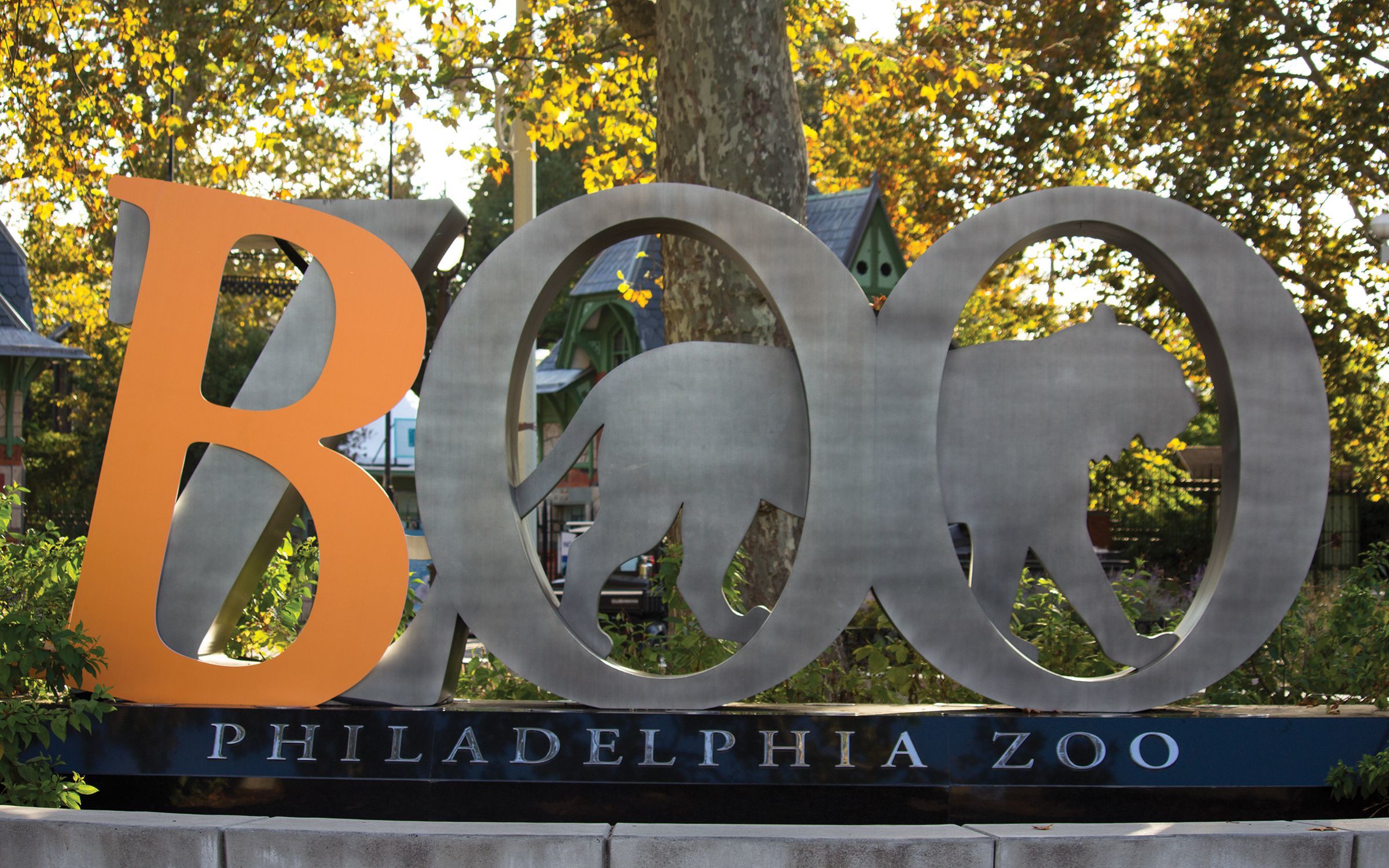
Boo at the Zoo returns to the Philly Zoo for three weekend of spooktacular fun.Philadelphia Zoo
FanDuel takes the kids to the zoo: F
Apparently, losing money gambling now comes with a family outing.
Because nothing says wholesome family fun quite like a sportsbook thanking you for all the money you’ve wagered.
Don’t forget, FanDuel’s VIP programs have already drawn scrutiny over concerns about gambling addiction. Maybe bringing children into the rewards system wasn’t the smartest next move.
Even the zoo had to clarify that this wasn’t a partnership or endorsement.
The Philadelphia Zoo is a place to take your kids to see lions and giraffes. It shouldn’t be a loyalty perk for your gambling habit.
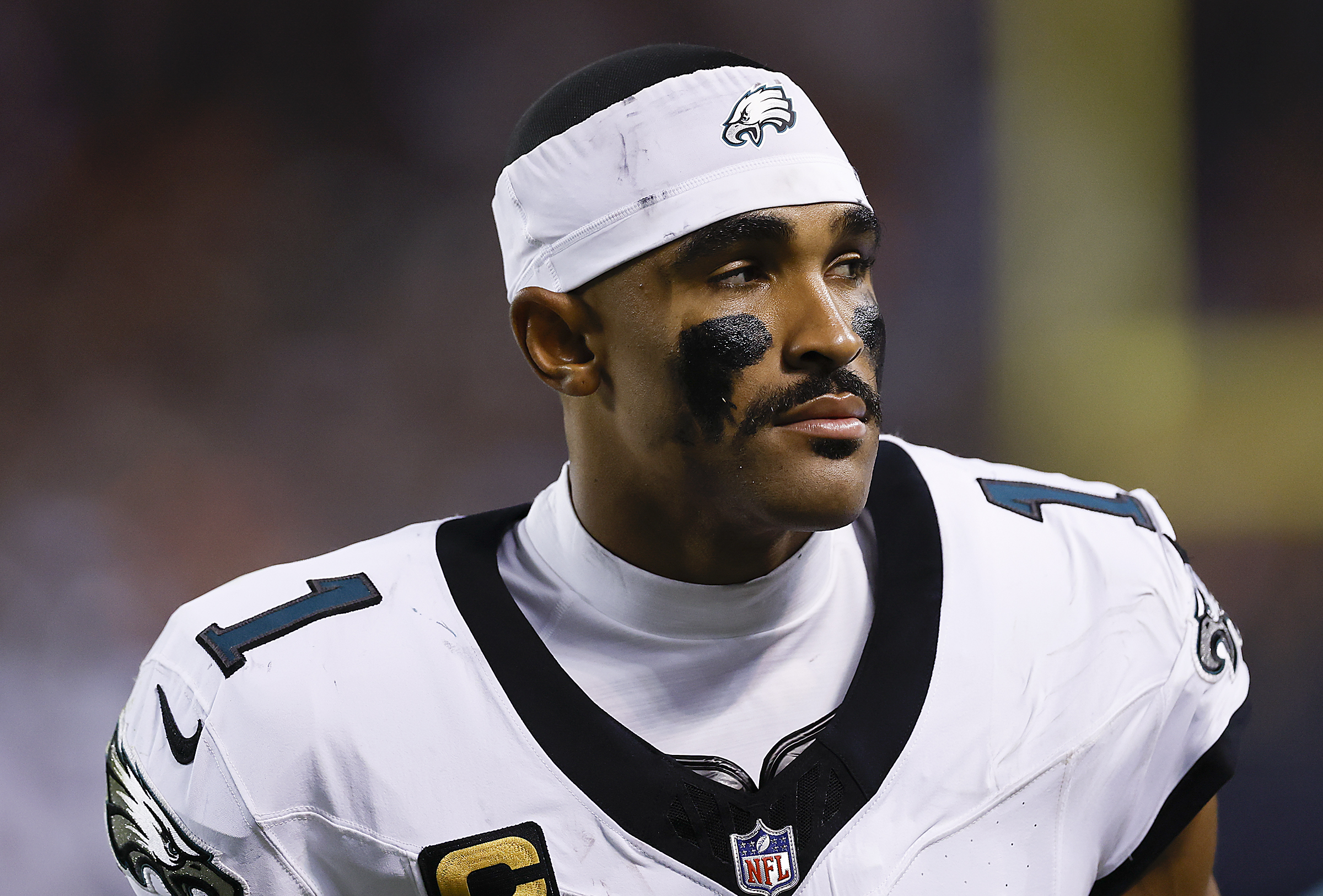
Eagles quarterback Jalen Hurts during a game against the Chicago Bears at Soldier Field in Chicago, ILL., on Monday, Sept. 28, 2026.Yong Kim / Staff Photographer
A much bigger concern than football: F
Four straight losses suddenly feel like the least of the Eagles’ problems.
Jalen Hurts is out indefinitely after doctors discovered multiple blood clots in his lungs. He could miss the rest of the season, but thankfully, his prognosis is good, and doctors expect him to make a full recovery.
That’s the news worth celebrating … the rest is harder to make sense of.
Hurts played in London after a clot was discovered in his calf, then flew home and practiced before further testing revealed the more serious condition. The NFL says medical protocols were followed. The players union wants an investigation. And the Eagles have offered little public explanation of the decisions involved.
For once, the most important thing about the Eagles has absolutely nothing to do with winning.
Her list of eight terrible Philly driving habits includes the usual suspects: double-parking, ignoring turn signals, treating red lights as suggestions, and driving on Kelly Drive like you’re auditioning for Fast & Furious.
But the real standout? An Uber driver watching videos of Vladimir Putin on a second phone while driving on the highway.
And let’s discuss the people who double-park directly next to an empty parking space. That’s not a parking problem. That’s a personality problem.
The worst part is how normal all of this has become. We barely react when someone makes an illegal U-turn across Broad Street, but seeing a driver actually use a turn signal feels like witnessing a random act of kindness.
Give Cody back: F
There are plenty of things to complain about in Philadelphia. But stealing someone’s dog? That’s a special kind of awful.
Surveillance video captured two people taking Cody, a shih tzu, from outside a North Philadelphia corner store Sunday, reported NBC10. Cody belongs to Jamal, a man with cerebral palsy who has limited mobility and relies on his dog for companionship.
His mother, Diane Newman, says Jamal keeps asking her the same heartbreaking question every time she comes home: “Did you bring my dog back yet?”
How do you hear that and not feel absolutely sick?
Whoever took Cody has the opportunity to do one decent thing here. Return him. No excuses, no questions. Somebody knows where Cody is. Let’s get him home to Jamal.
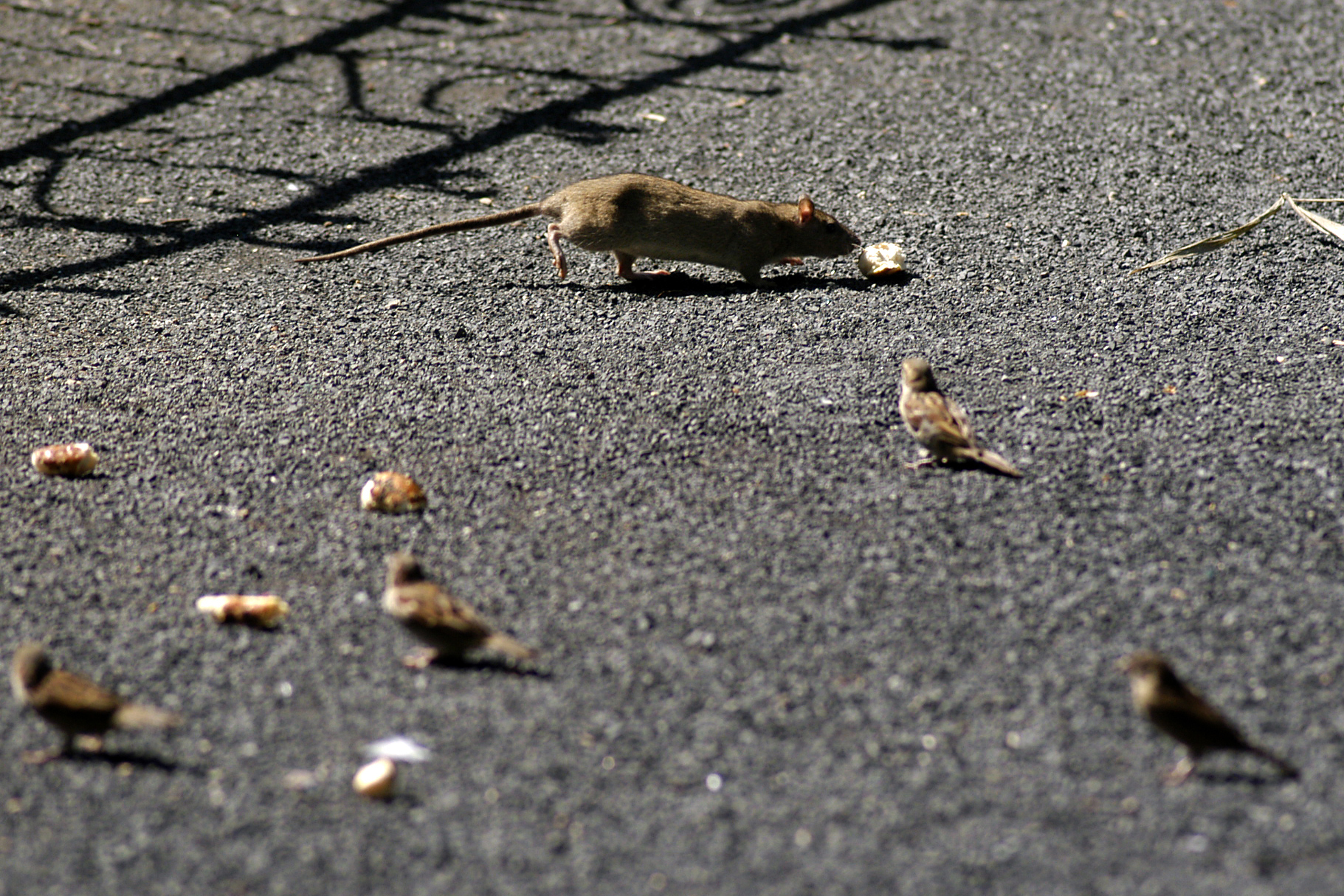
A rat in Franklin Square.Tom Gralish / Staff Photographer
Yes, we’re discussing the reproductive rights of the rats living under our rowhouses.
PETA sent Mayor Cherelle L. Parker a letter suggesting contraception instead of poison, along with a promise to send her a “Rats Have Rights” mug. Because obviously, that’s what was missing from the city’s rodent-control strategy, merchandise.
And here’s the truly bizarre part: It might actually work.
Other cities have tested rat contraceptives with promising results, including Boston, where one pilot program reported a 60% drop in rat activity. Philly’s health department isn’t convinced yet, and more research is needed.
But we have to admit, the idea of a rat chewing through your car’s wiring in Oxford Circle and the city’s response being to offer it family planning services is pretty funny.
We can’t get people to stop double-parking, but maybe we can convince the rats to stop reproducing.