Tag: topic-link-auto

  • Flyers rally from 3-0 down but come up short in overtime vs. Blue Jackets

    Flyers rally from 3-0 down but come up short in overtime vs. Blue Jackets

    The Flyers’ first 20 minutes were the worst. The final 40 minutes were much better. Overtime ended with disappointment.

    Despite a ferocious comeback, the Flyers lost, 4-3, in overtime to the Columbus Blue Jackets on a two-on-none goal by Kent Johnson. Columbus was the only team below the Flyers in the Eastern Conference standings entering Tuesday, and the Flyers have now lost two straight and 11 of their first 14 games (3-7-4).

    “Every game you have is a learning lesson. But I can’t keep coming here, on the mic, saying, ‘Learning lesson, learning lesson,’” coach Rick Tocchet said. “It’s a broken record. I’m just disappointed.

    “… Some of the guys are — I don’t know what they’re doing [in overtime]. We had a meeting about it. We sent them video on it. It’s all puck possession. It’s being smart, and we give them two two-on-[nones]. That’s unacceptable.”

    Flyers goalie Dan Vladař skates off the ice after the Blue Jackets celebrate their overtime game-winner on Tuesday at Xfinity Mobile Arena.Elizabeth Robertson / Staff Photographer

    Less than a minute before the game-winning goal, Cole Sillinger and Zach Werenski had a two-on-none after Matvei Michkov was stripped in the offensive zone. Dan Vladař stopped Werenski after the two Blue Jackets played hot potato and fans chanted “Vladdy.” But after all three Flyers — Michkov, Cam York, and Denver Barkey — went low in the offensive zone, Johnson and Adam Fantilli broke out again all alone and did not miss.

    Trailing 3-0 after one period, in which they had just two shots on goal, the Flyers came out for the second and third periods with more fire, will, and determination. They fired 29 shots on former Flyers goalie Cam Talbot in the final two regulation frames, holding Columbus to six, and tied the game with 11 seconds left in the third.

    Noah Cates said Tocchet “got honest” during the first intermission. Trevor Zegras said the message after the first period “wasn’t good. Kind of got whipped a little bit.”

    Jamie Drysdale (center) celebrates his game-tying goal late in the third period on Tuesday.Elizabeth Robertson / Staff Photographer

    Things started to shift early in the second period when Christian Dvorak had a chance in front after a Noel Acciari shot but couldn’t lift the puck enough. Defenseman Hunter McDonald, playing in his fourth consecutive game, had a shot blocked, chased down the puck, and leveled Jacob Christiansen to keep the Flyers in control. He finished with four hits and three shot attempts.

    It seemed to get the Flyers and their faithful energized, and five minutes later, Cates scored his first goal of the season. Off the rush, Porter Martone put a shot on goal that squeaked through Talbot, and Cates, crashing the net, knocked the puck in.

    The Flyers kept pressing and coming up big. Between a prime opportunity by Michkov at the right post and chances by York, who was activated from injured reserve Tuesday morning after missing eight games with an upper-body injury, and Dvorak, Vladař made a fantastic flying pad save on Valeri Nichushkin.

    In the third period, the Flyers had better pressure, puck protection, and control. After the final TV timeout, they cut it to 3-2 on a goal by Zegras. Travis Sanheim put a shot on goal that was tipped by Dvorak on the way to the net before Zegras tried to score with his back to the goal. It didn’t work, but he stayed with the puck, and banked it in off Talbot for his fourth of the year.

    Then, with time ticking down and Vladař on the bench, Jamie Drysdale scored his first goal of the season to tie the game. The blueliner carried the puck in and dished it over to Zegras as he headed for the net. Zegras fed it down to Tyson Foerster in the right circle, and he found Drysdale in front for the goal with 11 seconds left.

    With two points, Zegras extended his point streak to five games (three goals, six assists).

    “We were flat, no energy. I think it took a kick in the butt to get us going,” York said. “Second and third, thought we pretty much dominated the game. Just felt like we were on our toes and dictating the pace of play, and just can’t come out like that.

    “I think it’s just common sense. We knew that we weren’t good in the first, and that was pretty unacceptable. … I think as a group, we’re all pros, we all know when we’re not playing good, or things aren’t going our way, whatever. Just felt like we were like, ‘OK, let’s do this.’”

    The comeback wouldn’t have been needed if the Flyers came to play. The two shots on goal in the opening 20 minutes were a low for the season, despite the Flyers having a power play.

    And the Blue Jackets took advantage, scoring more times than the Flyers had shots. In a 2-minute, 46-second span, the lifeless hometown team found itself in a big hole.

    Fantilli, who got the assist on the game-winner, opened the scoring 10:58 into the frame with his fourth of the season. With Sanheim and Zegras trapped deep in the offensive zone, rookie defenseman Oliver Bonk was the lone Flyer back as Fantilli and Johnson broke out.

    Cates charged hard off the bench after Dvorak went for an ill-timed change, but Cates and Bonk went to Johnson. And Fantilli played it perfectly, dropping the puck to his winger as the center split between the two Flyers, drawing in Bonk for a split second as he passed by into open ice.

    It gave the two Blue Jackets time and space to create a gap, with Johnson feathering one to Fantilli as he got behind the defense. The top-line center popped the shot through Vladař’s arm — it looked like he got enough to stop it, but the puck hit the handle of Vladař’s stick, the left post, and went in.

    The teams were skating four-on-four after Michkov and Conor Garland received coincidental roughing minors and spent time jawing at each other in the penalty boxes.

    Less than two minutes later, Johnson doubled the lead with his fifth of the season.

    Off a defensive-zone faceoff won by Dvorak, it appeared that the Flyers were in control as they started a breakout. But Zegras couldn’t handle the Sanheim pass up the boards, and Columbus sent the puck deep.

    Bonk knocked it down and tried to get away from Nichushkin, but he lost control when he tried to change direction. The Columbus winger picked up the puck and sent it up to the point, where the reigning Norris Trophy winner, Werenski, fire a slap shot off Johnson, who was atop the crease.

    Fifty seconds later, Denton Mateychuk made it a three-goal lead. York couldn’t handle the bouncing puck near the top of the Flyers’ zone. As a result, the Blue Jackets got to work.

    Columbus controlled the boards and pressured the Orange and Black if they had even a sniff of the puck. Eventually, Mateychuk got the puck atop the circles, and he fired a wrister through a triple screen of Michkov in the slot and Drysdale and Charlie Coyle battling in front.

    “You’re looking for consistency, and you’re looking for a group of players to play a certain way,” Tocchet said. “You’re going to have some bad things happen to you, but you need to stop bad things. And I think that just starts with a consistent mindset. I mean, it’s all mindset for me. Mental toughness and mindset, and we have to just keep working on that part of the game in that dressing room.”

    Breakaways

    Defenseman Simon Benoit was a healthy scratch for the second straight game and defenseman David Jiříček for the third straight. … Original Flyer André Lacroix has died at 81. Lacroix played four seasons with the Flyers, notching 72 goals and 170 points in 245 games. He registered 198 points (79 goals, 119 assists) in 325 NHL games, including stints with the Chicago Black Hawks and Hartford Whalers, and is the all-time leader in points in World Hockey Association history with 798 in 551 games.

    Up next

    The Flyers get right back at it Wednesday. They head to Washington for the first of four meetings against the Washington Capitals in Alex Ovechkin’s final NHL season (7:30 p.m., TNT, TruTV, HBO Max, NBCSP+).


  • Phillies’ Zack Wheeler wins MLBPA NL Comeback Player of the Year

    Phillies’ Zack Wheeler wins MLBPA NL Comeback Player of the Year

    Zack Wheeler won’t know for another two weeks if he’s Comeback Player of the Year in the National League.

    But his peers have already spoken.

    Wheeler was named NL Comeback Player in the annual Players Choice Awards, announced Wednesday by the MLB Players Association. The Phillies’ ace edged fellow pitchers Sandy Alcantara of the Marlins and Martín Pérez of the Braves.

    In 28 starts, Wheeler went 14-5 with a 3.00 ERA and 193 strikeouts in 162 innings. By any measure, it was a resounding return to dominance from thoracic outlet syndrome, a condition that has derailed the careers of several pitchers.

    Wheeler’s 2025 season ended in mid-August with the discovery of a blood clot near his right shoulder. The clot developed when a vein got compressed between his collarbone and rib cage.

    After having the blood clot removed, Wheeler underwent a second procedure to remove a rib and relieve the vein. His recovery involved physical therapy and a strict diet, not easy for an unabashed fast-food and junk-food lover. Wheeler left spring training at about 195 pounds, roughly 10 pounds less than normal.

    It took time for Wheeler’s fastball to regain its usual zip. But concerns about diminished velocity during a minor-league assignment proved unfounded. The first pitch of his first start, April 25 in Atlanta, was 95 mph.

    Wheeler didn’t miss a start the rest of the season. The 36-year-old righty had a 2.13 ERA through 15 starts but wasn’t selected for the All-Star team because he started the Phillies’ last game before the break.

    Phillies pitcher Zack Wheeler returned earlier than expected from thoracic outlet syndrome.Yong Kim / Staff Photographer

    After a six-start stumble in August, Wheeler finished strong with a 4-0 record and 1.67 ERA in his last six starts, including the season finale when he held Tampa Bay to one run in six innings to help clinch the final NL wild card.

    If someone had told Wheeler that he’d be as effective as ever a year after surgery, what would he have said?

    “To be expected,” he said in September. “When you have surgery, or anything along those lines, you just have to stay positive and keep a strong mindset, you know? You believe that you’re going to come back and be the same guy, if not better, because you’ve had more time to strengthen and fine-tune everything.

    “For me, it was just come back, hit the ground running, and just be the same guy as I was, if not better.”

    Wheeler, the highest-paid pitcher in baseball, has one season left on his three-year, $126 million extension. When he signed that deal, he indicated 2027 might be his final season.

    But would he really walk away if he’s still pitching as well as ever?

    “Honestly, I mean, it’s just still up in the air,” he said. “I think a lot of things have to kind of play out for me just to be able to see.”

    Wheeler is a candidate for MLB’s Comeback of the Year, which will be announced Nov. 11 at the league’s annual awards show in Las Vegas. The winner is voted on by the 30 MLB.com club beat reporters.

  • This designer’s home in Sharswood is a collector’s playground

    This designer’s home in Sharswood is a collector’s playground

    Jeremy Olsen’s home is teeming with stuff: defunct signage and flea-market artwork, nonfunctioning clocks and paint pan as sculpture, found items like the pagoda-top silhouette that sits on his fence, and a strangers’ family photo on his bedroom wall.

    The riot of colors, textures, eras, and styles somehow works in harmony inside his Sharswood home.

    While the objects are from the past, Olsen, 52, said how they’re arranged represents who he is in the present.

    A view of the first floor, from the living area.Joe Lamberti / For The Inquirer

    Olsen, the owner of former Queen Village vintage store RareCo and current contractor under the same name, admitted that about 250 pieces were removed from the house before The Inquirer came — such is the level of his tinkering.

    “A new thing goes in and something comes out everyday,” he said. “It’s an obsession, almost an illness, in that it has to reflect a version of myself that feels the most recent.”

    When Olsen purchased the Sharswood rowhouse for $190,000 in 2017, he fell in love with its original details and planned to fix it up as an investment property. But soon after work began he changed course to a full gut renovation for safety reasons. He decided then, after 15 years of living in a constellation of Philadelphia neighborhoods, it would be his home.

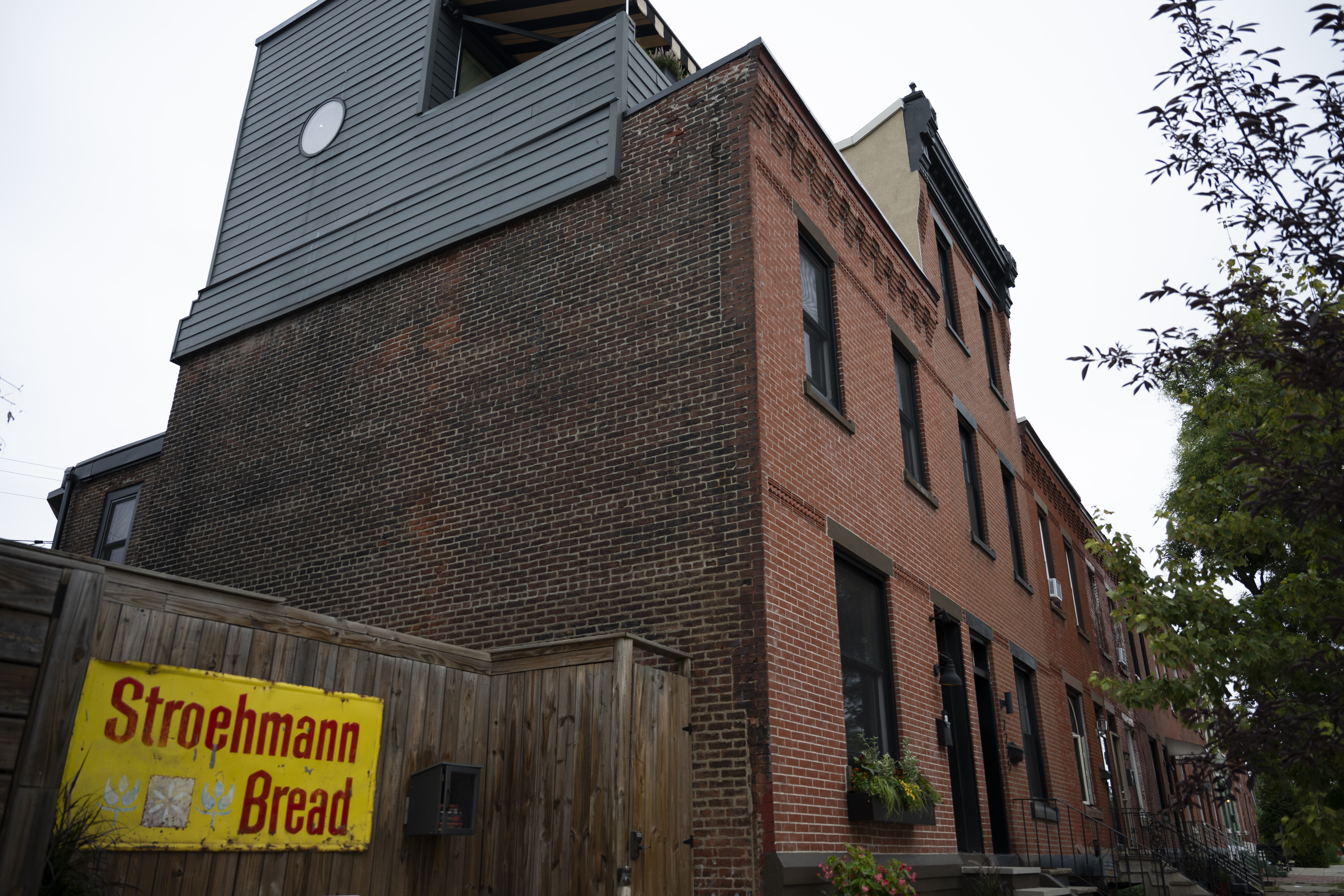
    The outside of Olsen’s home. The renovations included adding a third floor.Joe Lamberti / For The Inquirer
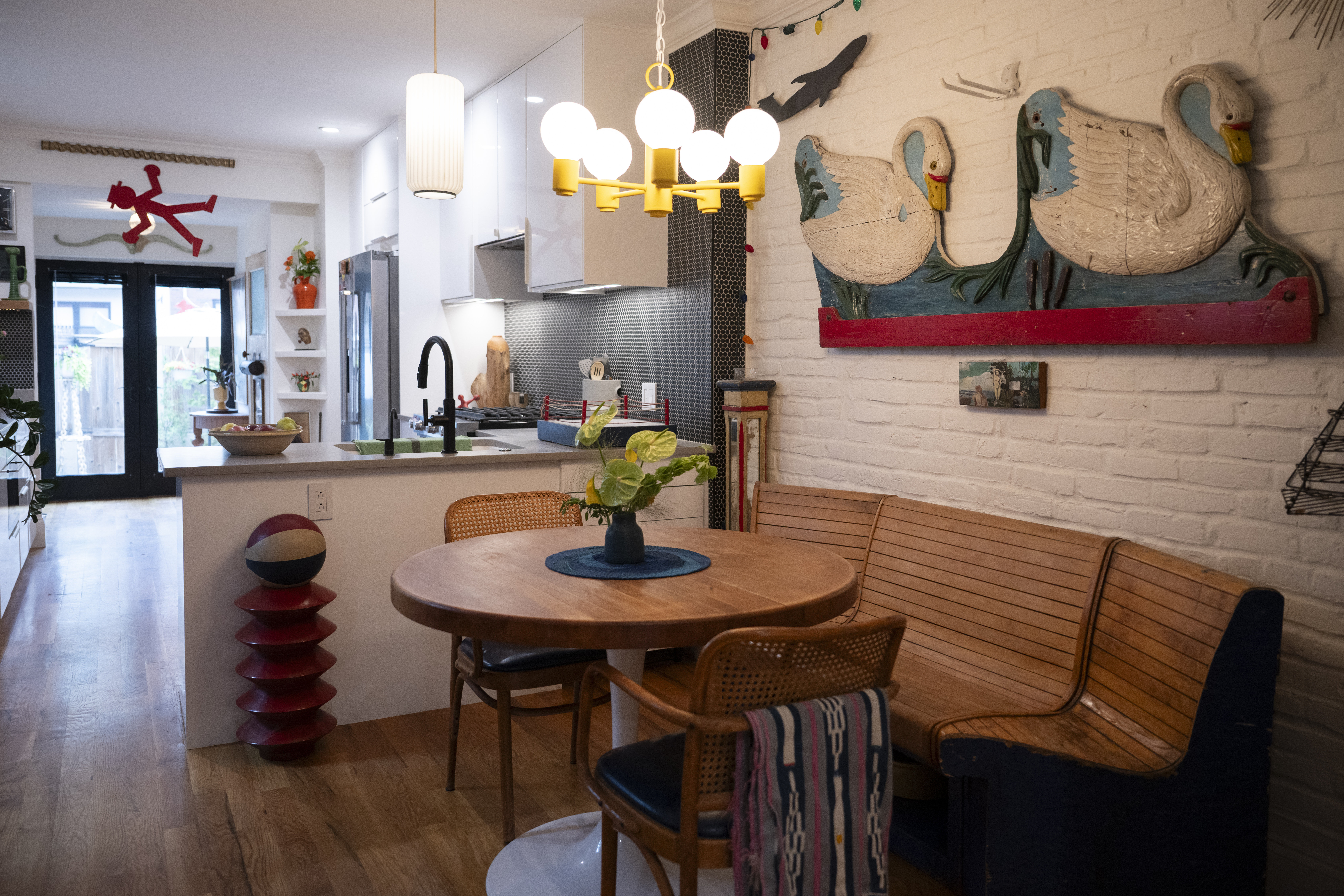
    A dining area and kitchen.Joe Lamberti / For The Inquirer
    Olsen’s dog, Grace, relaxes on the hardwood floor.Joe Lamberti / For The Inquirer
    The eclectic decor continues into the brick-paved backyard.Joe Lamberti / For The Inquirer

    It was the start of a four-year renovation that “almost did me in,” Olsen said, as he rotated through two general contractors before taking on the role himself. Although he swore off returning to his early career work in contracting, he found some joy in the renovation process once he took more control.

    Toward the end of the renovation the RareCo store’s landlord listed the building for sale, leading Olsen to shutter the store. It freed him up to return to contracting. That business, RareCo Painting & Decorating, uses many of the tradespeople he worked with to make over his house.

    Olsen’s finished home, for an all-in investment of about $275,000, he estimates, including the price of the house, is full of practicalities alongside romantic touches. It all keeps Olsen on his toes, literally.

    “Sometimes I like to have things that are precarious,” he said. Case in point: a wooden man that hangs above the entrance to his powder room. When he opens the door every few days, it hits the man and the man falls on his head, “but I won’t change it.”

    Jeremy Olsen adjusts a painting on the wall. He said this piece may be his favorite in the house.Joe Lamberti / For The Inquirer
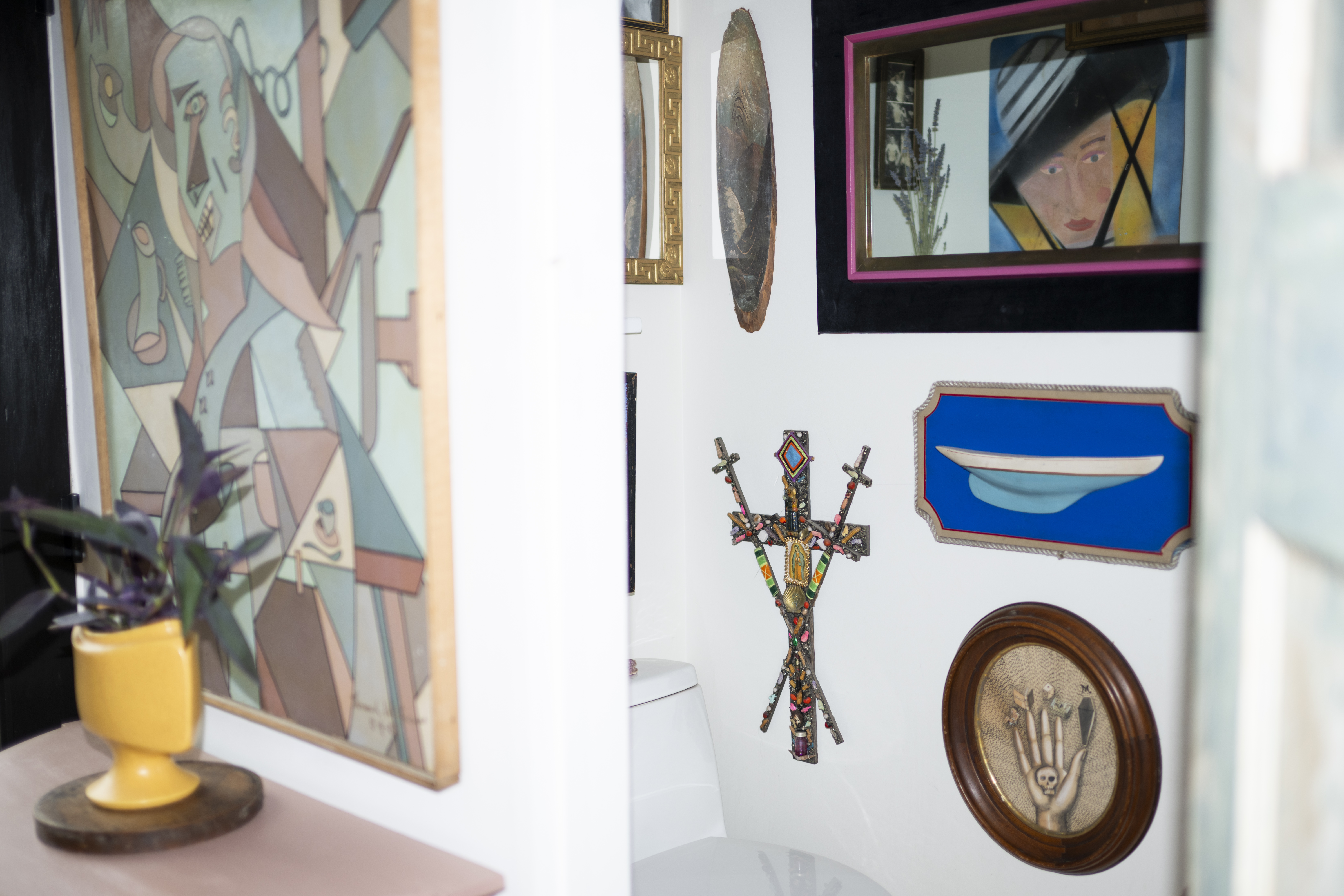
    No wall space in the home is wasted, even in this first-floor bathroom.Joe Lamberti / For The Inquirer

    “There’s a fine line between it being a laboratory and livable,” Olsen quipped.

    His other favorites throughout the house include an oversized sign of a woman’s face that anchors the upstairs living room, which came out of the warehouse that now houses Kalaya. There’s the vibrant painting of a sharpshooter with all the finesse of a grade-school artist. And he notes an abstract painting above the couch he won at auction, against a fellow collector he respects but with whom he often competes.

    Olsen said he often makes mistakes when moving things around. Sometimes items become “too blendy,” in that the individual pieces no longer stand out to him. It’s the gift of an aesthete, he says, a characteristic he developed coming from a family of fine artists, including his brother and dad whose work hangs in the house.

    A view from one of the bedrooms, where an arched door is hugged by wall art on both sides.Joe Lamberti / For The Inquirer
    Another bedroom, with bold art above the bed and brightly colored accents.Joe Lamberti / For The Inquirer

    His collecting is also an inherited trait, as his grandparents amassed folk art and his parents accumulated Victorian antiques. Olsen started his collecting habit with signs, but now specializes in what he calls primitive items — collector-speak for pieces that are often handmade and time-worn. He has a knack for placing found items, or pieces from the street, in the fold as if they’re fine art.

    When not plucking things off the street, Olsen sources pieces from markets, like Massachusetts’ legendary Brimfield Flea, as well as auctions. And he reaches into his Rolodex of industry connections.

    Decor on the third floor of Olsen’s house, which he added as part of the full-home renovation.Joe Lamberti / For The Inquirer

    How does he decide what makes the cut? Olsen is excited by items that he calls “wrong-headed” or things that he barely likes. If he can figure out how to work them into the house in an appealing way, “there’s something magical to that.” Brands and value don’t interest him.

    One of the largest undertakings of the renovation was adding an airy third floor with a sitting room, and an exterior door to a deck with a spiral staircase to the roof.

    A spiral staircase leading to a roof deck.Joe Lamberti / For The Inquirer
    The roof deck, with a ping pong table and a view of the neighborhood.Joe Lamberti / For The Inquirer

    “This is an interesting place because I do come up here, and it’s arresting, but it’s also contemplative,” Olsen said. After weaving through his Wunderkammer of a home, the deck and its view onto the sparse and pristine campus of Girard College is a visual reprieve.

    He added, “It’s almost like being across from an ocean.”

    Is your house a Haven? Nominate your home by email (and send some digital photographs) at properties@inquirer.com.

  • The seven races that will decide control of the Senate

    The seven races that will decide control of the Senate

    Less than a week before the midterm elections, Democrats are heavily favored to retake the House, but the fight for the Senate is much tighter.

    Democrats and Republicans expect Senate control to be determined by a handful of states where polls show close races, making it difficult to tell which party will prevail next week.

    Democrats need to pick up four seats to retake the Senate. The party has a clear lead in just one Republican-held state, North Carolina, where former governor Roy Cooper, a Democrat, is favored to defeat Republican Michael Whatley in the race for an open Senate seat.

    The nonpartisan Cook Political Report rates Senate races in seven other states as toss-ups that could go either way, which will have enormous implications for President Donald Trump’s last two years in office.

    If Democrats win all seven races, along with the ones in which they are favored, they would secure their largest Senate majority since the Obama administration. If Republicans win all seven races, they would maintain their current 53-47 majority in the Senate, picking up a Democratic-held seat in Michigan to offset a loss in North Carolina.

    The battle is being fought largely on Republican terrain. Trump won six of the seven states in 2024, five of them by double-digit margins.

    Republicans are outspending Democrats in most of the races, with especially significant advantages in Texas and Ohio. But Democrats hold narrow leads in all seven toss-up races, according to Washington Post averages of recent high-quality polls in each state — though most of them are within the margin of error.

    The toss-up races do not include New Hampshire, an open seat that Republicans are targeting but where Democratic Rep. Chris Pappas has led in polls, or Georgia, where Democratic Sen. Jon Ossoff is favored to defeat Republican Rep. Mike Collins.

    Here are more details on the seven toss-up races.

    Alaska

    Last time it elected a Democratic senator: 2008.

    Presidential margin in 2024: Trump won by 13 percentage points.

    Spending advantage: Republicans are set to spend $9.5 million more than Democrats between Labor Day and Election Day, according to AdImpact.

    Polling average: Democrats lead by five points.

    Senate Minority Leader Chuck Schumer (D, New York) persuaded former Democratic congresswoman Mary Peltola to run, describing her recruitment in January as “the last piece of the puzzle” to put Democrats in a position to retake the Senate. Peltola is challenging Republican Sen. Dan Sullivan, who is seeking a third term in a state hit hard by rising diesel prices from the war with Iran and other cost-of-living challenges.

    The race was scrambled in May by the entry of Daniel J. Sullivan Jr., a retired teacher from Petersburg, Alaska, who will appear on the ballot under the state’s unique top-four electoral system. Republicans have accused the second Sullivan of trying to confuse voters and help Peltola in the tight race, which he has denied.

    The Justice Department filed a lawsuit last week seeking to blocking certification of the results if the senator loses, which Democrats promised to fight.

    Iowa

    Last time it elected a Democratic senator: 2008.

    Presidential margin in 2024: Trump won by 13 percentage points.

    Spending advantage: Democrats are set to spend $12.9 million more than Republicans between Labor Day and Election Day, according to AdImpact.

    Polling average: Democrats lead by two points.

    Republican Rep. Ashley Hinson is facing Democratic state Rep. Josh Turek in the race for an open Senate seat in Iowa, which President Barack Obama carried twice but which has turned redder in the Trump era.

    Both candidates are running on bipartisanship. Hinson pledged in a debate to push back on Trump when she thinks he is wrong, and Turek has run ads touting how often he voted with Republicans in the state legislature. But the race is hardly Iowa nice: Turek has attacked Hinson for her family’s growing net worth since she was elected to Congress, while Hinson has criticized Turek for missing votes in the legislature.

    Kansas

    Last time it elected a Democratic senator: 1932.

    Presidential margin in 2024: Trump won by 16 percentage points.

    Spending advantage: Democrats are set to spend $18.3 million more than Republicans between Labor Day and Election Day, according to AdImpact.

    Polling average: Democrats lead by one point.

    Neither party viewed the race in Kansas — where no Democrat has won a Senate seat in nearly a century — as competitive earlier this year. But polls show Adam Hamilton, a Democrat running as a moderate, in a close race against Republican Sen. Roger Marshall.

    Republicans have accused Hamilton, a Methodist pastor who leads the state’s largest church, of pretending to be a moderate, citing his past comments in support of Black Lives Matter and for a path to citizenship for undocumented immigrants. However, Hamilton’s campaign has raised far more money than Marshall’s this year, helping to make Kansas one of two toss-up states in which Democrats are outspending Republicans in the home stretch before Election Day.

    Maine

    Last time it elected a Democratic senator: 1988. (Sen. Angus King, an independent who caucuses with Democrats, won Senate races there in 2012, 2018, and 2024.)

    Presidential margin in 2024: Kamala Harris won by seven percentage points.

    Spending advantage: Republicans are set to spend $11.8 million more than Democrats between Labor Day and Election Day, according to AdImpact.

    Polling average: Democrats lead by two points.

    Democrats worked as hard as they could to oust Republican Sen. Susan Collins when she was up for reelection in 2020 — only for Collins to win by nine points, even as Joe Biden carried the state. Now Collins is seeking a sixth term, and Democrats are trying again to defeat the only Republican senator who represents a state that Harris carried in 2024.

    Schumer recruited Democratic Gov. Janet Mills to challenge Collins, but she suspended her campaign ahead of the primary after running out of money. Graham Platner, a Marine Corps veteran and oysterman with strong grassroots appeal, won the nomination but dropped out in July after he was accused of sexual assault, which he denied.

    Democrats united around a new nominee, Troy Jackson, a progressive former state Senate president who polls show is in a close race with Collins. But it is hard for either party to truly trust polling in the state after polls underestimated Collins in 2020.

    Michigan

    Last time it elected a Republican senator: 1994.

    Presidential margin in 2024: Trump won by one percentage point.

    Spending advantage: Republicans are set to spend $23.5 million more than Democrats between Labor Day and Election Day, according to AdImpact.

    Polling average: Democrats lead by four points

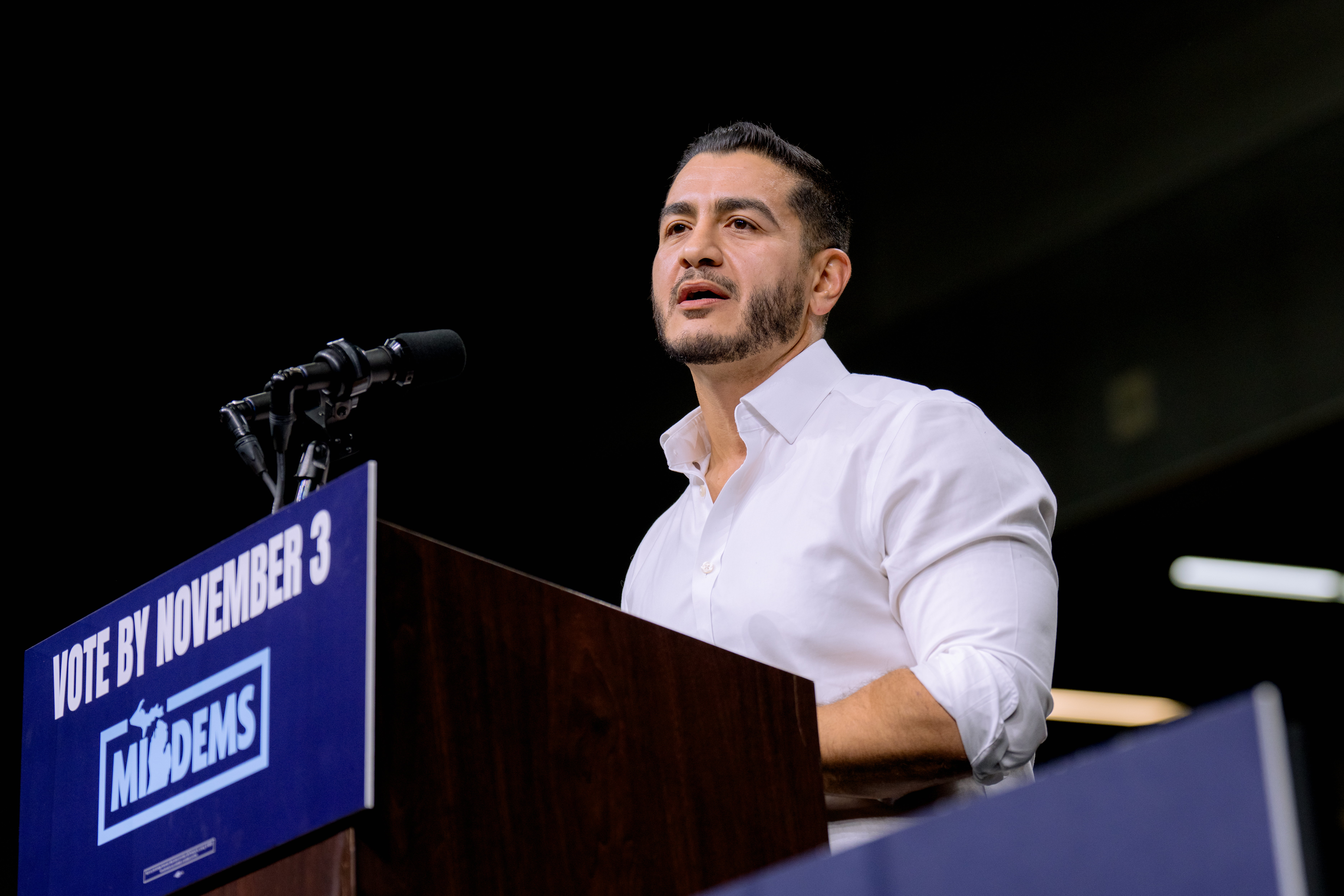
    Michigan is Republicans’ best pickup opportunity this year. Abdul El-Sayed, a former Wayne County public health official who won a fractious Democratic primary in August, is facing former Republican congressman Mike Rogers. Some Democrats have refused to support El-Sayed, though, over his strong criticism of Israel and his controversial comments in the wake of an attack on a Michigan synagogue.

    In polling, El-Sayed has underperformed Jocelyn Benson, the Democratic nominee for governor, but he could still prevail in a state that has not elected a Republican senator in decades. Democrats feel slightly more confident about winning Michigan than the other toss-up races, based on polling and early-voting trends, according to two Democratic strategists, who spoke on the condition of anonymity to speak candidly.

    Ohio

    Last time it elected a Democratic senator: 2018.

    Presidential margin in 2024: Trump won by 11 percentage points.

    Spending advantage: Republicans are set to spend $71 million more than Democrats between Labor Day and Election Day, according to AdImpact.

    Polling average: Democrats lead by four points.

    Former Democratic senator Sherrod Brown spent 18 years in the Senate before losing reelection in 2024 with Trump at the top of the ballot. Brown is running again this year, challenging Republican Sen. Jon Husted, whom Ohio Gov. Mike DeWine appointed last year to fill Vice President JD Vance’s Senate seat.

    The race has become blisteringly expensive. More than $360 million in ads are set to run between Labor Day and Election Day, according to AdImpact — more than any other Senate race in the country. Brown has spent millions of dollars on ads attacking Husted over his support for data centers, which the National Republican Senatorial Committee warned in August could cost Husted the race. Husted, meanwhile, has criticized Brown for spending 50 years in elected office. (Brown won a seat in the state House in 1974.)

    Texas

    Last time it elected a Democratic senator: 1988.

    Presidential margin in 2024: Trump won by 14 percentage points.

    Spending advantage: Republicans are set to spend $159.1 million more than Democrats between Labor Day and Election Day, according to AdImpact.

    Polling average: Democrats lead by three points.

    No Senate race has proved more frustrating to Republicans than Texas, where Trump endorsed Ken Paxton, the state attorney general, over Sen. John Cornyn in the Republican primary runoff despite warnings that it could cost his party the seat. Now Paxton is locked in an expensive race with state Rep. James Talarico, who could become the first Democrat to win a Senate race in Texas in decades.

    Republicans have an enormous spending advantage in the state after Elon Musk gave $158 million in September to a Republican super PAC, the Senate Leadership Fund, which transferred the same amount to a group aiding Paxton. But the money did not arrive until Talarico’s campaign had spent months airing ads, while Paxton’s campaign was not on the air.

    Talarico has criticized Paxton for his indictment on securities fraud charges and for being impeached in 2023 by the Texas House of Representatives, among other scandals. (A judge dismissed the fraud case against Paxton after he completed a pretrial diversion program without admitting guilt; Paxton was acquitted by the state Senate after his impeachment.)

    Paxton has lambasted Talarico for calling on Americans in the past to eat less meat and emit fewer greenhouse gases to fight climate change.

    “Oil. Beef. A way of life,” one recent Paxton ad says. “But radical James Talarico wants to set it ablaze.”

  • Is taxing the rich the answer to Washington’s budget problems?

    Is taxing the rich the answer to Washington’s budget problems?

    In Michigan, Democratic Senate candidate Abdul El-Sayed said he would tax billionaires to “build schools and roads, provide healthcare, provide childcare.”

    In Texas, Democratic Senate hopeful James Talarico said making “the wealthiest Americans and giant corporations pay their fair share” would cover a middle-class tax cut.

    And in Maine, Democratic Senate candidate Troy Jackson said he will “tax those billionaires” if he gets elected, while promising Medicare-for-all.

    Across the country this election season, taxing the richest Americans is the solution many Democrats are offering for a host of middle-class problems, from overly expensive housing to overly expensive college tuition. But while taxing the wealthy could raise substantial sums, it couldn’t even stabilize Washington’s historically large budget deficit, much less finance major new spending, according to two reports released this month.

    “Even if we seized every dollar of billionaire wealth — their stock portfolios, their mansions, their cars, everything down to their kids’ toys, and sold it for full market value” — the proceeds could fund the federal government for about a year, said Jessica Riedl, author of one of the reports. “And then it’s gone.”

    Riedl, a Brookings Institution fellow and former chief economist to former senator Rob Portman (R., Ohio), said she’s not opposed to taxing the rich. “But it doesn’t get us out of the tough decisions that have to be made.”

    A similar finding came this month from the Budget Lab at Yale University, a research group founded by former Biden administration economists. The Budget Lab’s report posed a thought experiment similar to Riedl’s: What if the federal government took every dollar people earn above about $710,000 a year — the cutoff for the top 1%? Some of the most ambitious proposals would still be out of reach, the report concluded.

    The appeal of taxing the rich is easy to see. While economists disagree on how fast and how much the rich have gotten richer, no one disputes that income is concentrated at the top, the Budget Lab notes. The highest-earning 1% of Americans will take in nearly a quarter of all income next year, the report said.

    But though rich people’s incomes are substantial, the report said, they are “still finite.”

    If the government could pocket all those dollars above the top 1% threshold next year — in other words, tax them at 100%, a “clearly unrealistic scenario,” the report said — the U.S. Treasury would collect about $2 trillion.

    That was about the size of the federal budget deficit — the gap between what the government spent and what it took in — in the fiscal year that ended in September. Washington borrowed that amount to cover the difference, adding to the already huge national debt.

    Because a dollar now is worth more than a dollar in the future, economists like to talk about such sums as a percentage of the overall annual economy, or gross domestic product. In those terms, the federal government spent about 23% of GDP ($7.4 trillion) last fiscal year and raised about 17% ($5.4 trillion) in revenue, leaving a deficit of about 6% ($2 trillion).

    That last figure, the big hole in the budget, is projected to grow because of the increasing cost of Social Security and Medicare as the baby-boom generation retires. Those two programs alone cost more than 8% of GDP last year ($2.7 trillion), while defense spending cost about 3% ($916 billion). Interest on the national debt cost more than 3% ($1.1 trillion).

    Over the next three decades, as programs for the aging cover more people with relatively fewer working people to pay for them, the nonpartisan Congressional Budget Office has projected that the deficit will grow to about 9% of GDP. Riedl expects it to get much bigger.

    So how much of the problem could taxing the rich solve? At most a couple of percent of GDP per year, Riedl said — probably not enough to avoid an eventual fiscal crisis.

    The Budget Lab report found that closing certain tax loopholes could help. The biggest one allows the wealthy to avoid taxes on investments that grow in value if they don’t sell them before they die. Changing that rule, the report said, would nearly double the expected proceeds of a higher tax rate on capital gains, or profits from selling investments — one of several ways Democrats have proposed to tax the rich.

    But that still wouldn’t be enough to get the deficit under control.

    “You need 4 to 5 [percent of GDP] in order to stabilize the debt long-term,” Riedl said. “So you’re still going to have to either significantly raise middle-class taxes and/or significantly rein in spending.”

    So far, however, stabilizing the debt has not emerged as a chief campaign-trail priority.

    Instead, consider the proposal to impose a 5% annual tax on billionaires’ wealth, which proponents said would raise about 1.2% of GDP per year. El-Sayed has backed such a tax, as have Sen. Bernie Sanders (Ind., Vt.) and Rep. Ro Khanna (D., Calif.).

    Their plans for the proceeds: Building or preserving more than 7 million affordable homes. Capping families’ childcare costs. Establishing minimum salaries for schoolteachers. Expanding Medicaid home healthcare. Adding dental, vision, and hearing coverage to Medicare. Reversing the cuts to Medicaid and the Affordable Care Act in last year’s tax law. And providing “a $3,000 direct payment to every man, woman and child living in a household making $150,000 or less.”

    Or, take the “Ultra-Millionaire Tax” proposed by Sen. Elizabeth Warren (D., Mass.). It would target the wealthiest 260,000 households, or the top 0.15%, with an annual 2% tax on every dollar of net worth above $50 million and 3% on every dollar above $1 billion.

    Warren said the tax would raise 1.7% of GDP a year, enough to pay for universal childcare, new housing, a bigger child tax credit, paid family leave, free community college, and Medicare eligibility starting at age 55 “with money left to spare.”

    The revenue estimates behind Sanders’s and Warren’s wealth taxes come from Emmanuel Saez and Gabriel Zucman, economists at the University of California at Berkeley. In their 2019 book, The Triumph of Injustice, they estimated that the top 1% could pay roughly 3.5% of GDP a year in additional taxes — well above Riedl’s estimate — if the government first cracked down on “tax dodges.”

    But other economists put the figures far lower.

    El-Sayed, Talarico, Jackson, Sanders, Khanna, and Warren did not respond to requests for comment.

    Sen. Ron Wyden (D., Ore.), who is in line to chair the tax-writing Senate Finance Committee if Democrats gain control of the Senate, has not signed on to either Sanders’s or Warren’s wealth tax proposals. Instead, Wyden has pushed a narrower tax on the yearly rise in value of billionaires’ stock and other investments, even if they don’t sell them. The nonpartisan Joint Committee on Taxation estimated in 2021 that it would raise $557 billion over 10 years, or about two-tenths of a percent of GDP a year.

    At a Finance Committee hearing this summer, Wyden suggested that making billionaires “pay their fair share” would allow policymakers to shore up the finances of Social Security “without a single dime of cuts to a current or future retiree,” with “no raising the retirement age, no cost-of-living haircuts and no means-testing benefits.” But all that is projected to cost significantly more — about 1.5% of GDP per year.

    Asked about the gap, Wyden spokesman Taylor Harvey said in an email that the senator “believes that saving Social Security starts by ensuring the wealthy pay their fair share, through the Billionaires Income Tax as well as other measures like scrapping Social Security’s payroll tax cap.”

    Eliminating the cap, which exempts wages above $184,500 from the Social Security payroll tax, would raise about 0.9% of GDP a year, Riedl estimated, leaving part of the shortfall uncovered even with Wyden’s proposed billionaire tax. Harvey pointed to a list of other Wyden proposals to raise taxes on the wealthy and corporations, but did not say whether they would close the rest of the gap to fully finance Social Security benefits.

    Of course, even if Democrats take the House and Senate on Tuesday, they will be stuck with a president likely to veto their ideas for taxing the rich. And even if Democrats also win back the White House in 2028, history suggests that raising taxes may not be easy.

    The biggest tax increase in more than four decades came under President Bill Clinton in 1993. It raised less than 1% of GDP a year — and contributed to Democrats’ loss of Congress in 1994.

    Under President Joe Biden, Democrats also had “trifecta” control of the White House, House and Senate for two years, and they managed to raise net taxes by less than $6 billion per year, Riedl has calculated, or about two-hundredths of a percent of GDP.

    “They’re not even able amongst themselves to pass big tax hikes on the rich,” Riedl said. “There’s not just the mathematical, economic barrier, there’s a political barrier.”

    Democrats, she said, represent not just the super-rich of Wall Street, Silicon Valley and Hollywood but also upper-income professionals making $300,000 to $500,000 a year, who have become a core of the party’s voters and donors.

    “They have some hesitancy about taxing them to death, too,” Riedl said.

    In fact, during the 2012 “fiscal cliff” negotiations with Republicans, Democrats agreed to raise the top income tax rate for couples earning more than $450,000 and individuals earning more than $400,000 — though President Barack Obama had for years called for raising taxes on households earning more than $250,000. Biden and Kamala Harris later campaigned on not raising taxes on anyone earning less than $400,000.

    “And now,” Riedl said, “I’m already hearing no taxes under a million.”

  • Iran war cost rises to $47.1 billion, Pentagon told lawmakers

    Iran war cost rises to $47.1 billion, Pentagon told lawmakers

    WASHINGTON — The cost of the war in Iran rose to $47.1 billion through Oct. 16, with bombs, missiles, and other munitions accounting for more than 60% of the expenses, the Pentagon told Congress last week. Even with President Donald Trump holding back on restarting major combat operations, at least for now, the Pentagon still incurred about $3.5 billion in additional costs in the roughly six weeks since the Pentagon shared estimates with lawmakers last month.

    The numbers were the latest glimpse of an unclassified breakdown of costs incurred by each of the armed services, as well as for specific categories, like damaged or destroyed weaponry.

    In the most recent cost estimates, the Air Force, for instance, has spent $7.6 billion to pay for operating dozens of fighter and bomber squadrons. The Navy has incurred $1.5 billion to deploy more than two dozen warships, including several aircraft carriers. And it has cost the Army $2.1 billion to sustain its forces in the region. Overall, more than 50,000 troops are assigned to the war mission, according to U.S. Central Command.

    Congressional officials shared the cost estimates with The New York Times after they were provided to national security committees on Capitol Hill.

    Since the war started Feb. 28, the military has burned through $29 billion in munitions, depleting global stockpiles of some critical weapons, like Patriot air-defense interceptors, and siphoning supplies from U.S. military commands in Asia and Europe.

    The Pentagon has spent $6.1 billion to replace dozens of damaged or destroyed combat aircraft and other weaponry and equipment. It has spent $645 million to move and support several thousand Special Operations commandos in the region.

    The information also revealed spending in other critical accounts. The military spent $24.5 million on “in-house medical support” for U.S. service members, according to one congressional official who spoke on the condition of anonymity to discuss the information provided to lawmakers. The Pentagon says that 18 service members have been killed in the war, and that more than 860 have been injured.

    U.S. Transportation Command spent $92.2 million to move supplies and equipment, and U.S. Cyber Command spent $14 million on “cyber support operations,” the official said.

    The Pentagon did not immediately respond to a request for comment.

    The department’s figures are almost certainly on the low side, congressional officials said Tuesday, noting that the Pentagon had acknowledged that its estimate did not include $1.5 billion for fuel and other costs that the Trump administration had asked for in a supplemental request to pay for the war.

    The costs to repair or replace U.S. military facilities that were damaged or destroyed by Iranian attacks, such as the Navy’s base in Manama, Bahrain, also were not included in the information sent to Congress. The Pentagon has indicated it may close or not rebuild them. If the military or host countries rebuild, congressional officials say the bill could be tens of billions of dollars.

    The unclassified Pentagon cost estimates provided to Congress offer an unusual window into the financial accounting of the war, which Defense Secretary Pete Hegseth and his top aides have largely kept under wraps.

    Hegseth and the Trump administration are requesting as much as $70 billion in emergency military spending to cover the costs of the Iran war and pay for new weapons and personnel.

  • Two Council members opt out of Parker’s plan to add apartments in commercial areas

    Two Council members opt out of Parker’s plan to add apartments in commercial areas

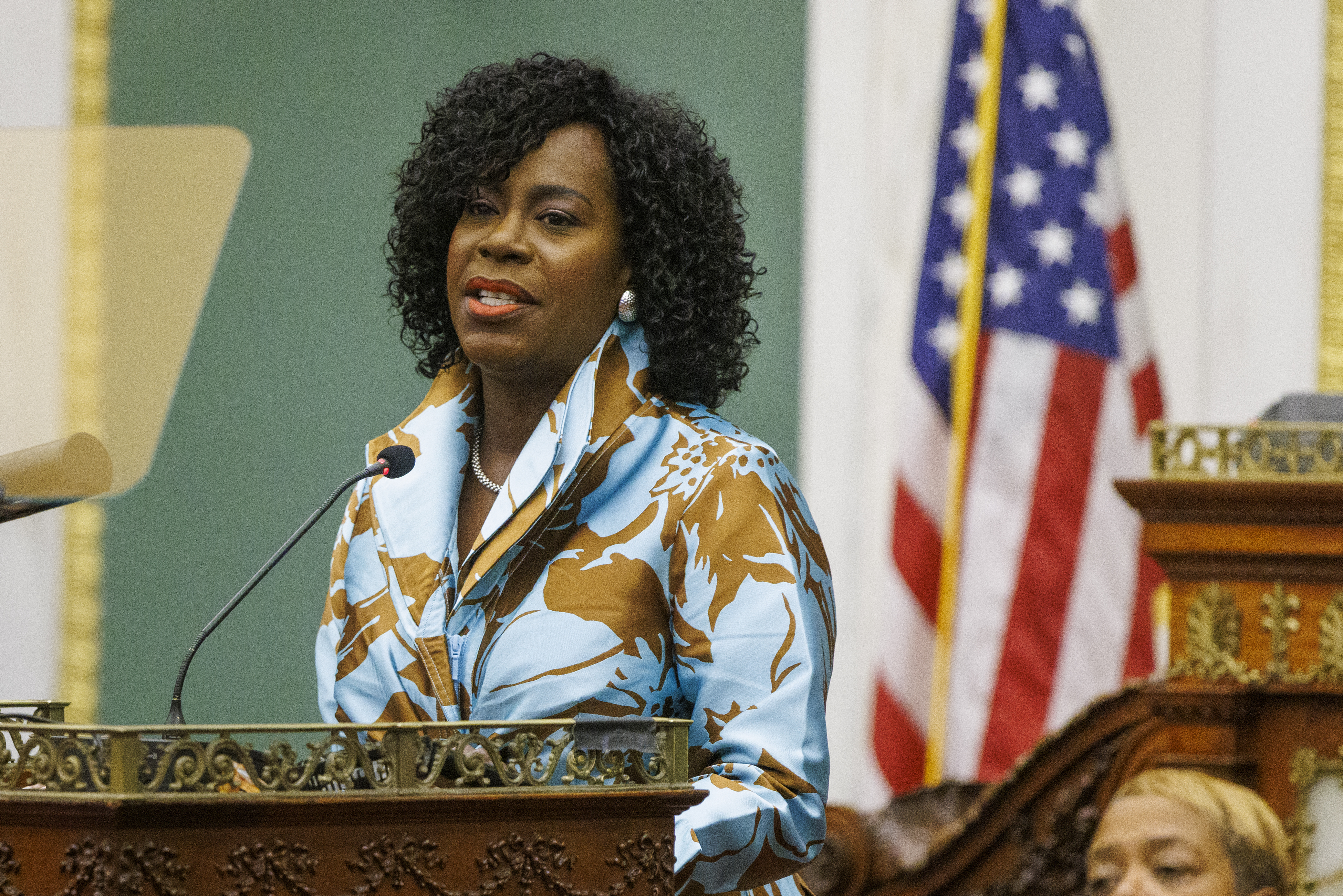
    Mayor Cherelle L. Parker’s latest effort to boost housing production in Philadelphia advanced at a City Council hearing Tuesday, part of her larger push to add 30,000 homes to the city over her tenure.

    The bill allows properties with zoning that mostly applies to corner stores — known as CMX-1 — to allow additional apartments, depending on a building’s size.

    The idea is to allow multiple apartments in larger buildings — where often only one is allowed now — and housing on the ground floor as well, especially in areas where commercial vacancy is high.

    “We have a lot of vacant first-floor commercial that just can’t be occupied,” Paula Brumbelow Burns, director of legislation at the Philadelphia City Planning Commission, said at City’s Council’s Rules Committee hearing Tuesday.

    “This … can create more housing opportunities and use that space so we don’t have that vacancy at street level,” said Brumbelow Burns.

    But two City Council members plan to opt their districts out of this part of the mayor’s housing plan.

    Councilmembers Brian O’Neill, who represents Far Northeast Philadelphia, and Cindy Bass, who represents much of Northwest Philadelphia, said they didn’t see Parker’s bill as a good fit for their districts.

    “It’s really about community control,” Bass said after the hearing. “We’re hesitant to preemptively provide developers with this large development opportunity without having community input.”

    Although the mayor’s bill considered Tuesday was transmitted to Council in March and officially introduced in May, it was not signed into law like Parker’s other zoning changes before the summer recess.

    It has been delayed by concerns from Bass and O’Neill, who needed time to draw up plans to exempt their districts.

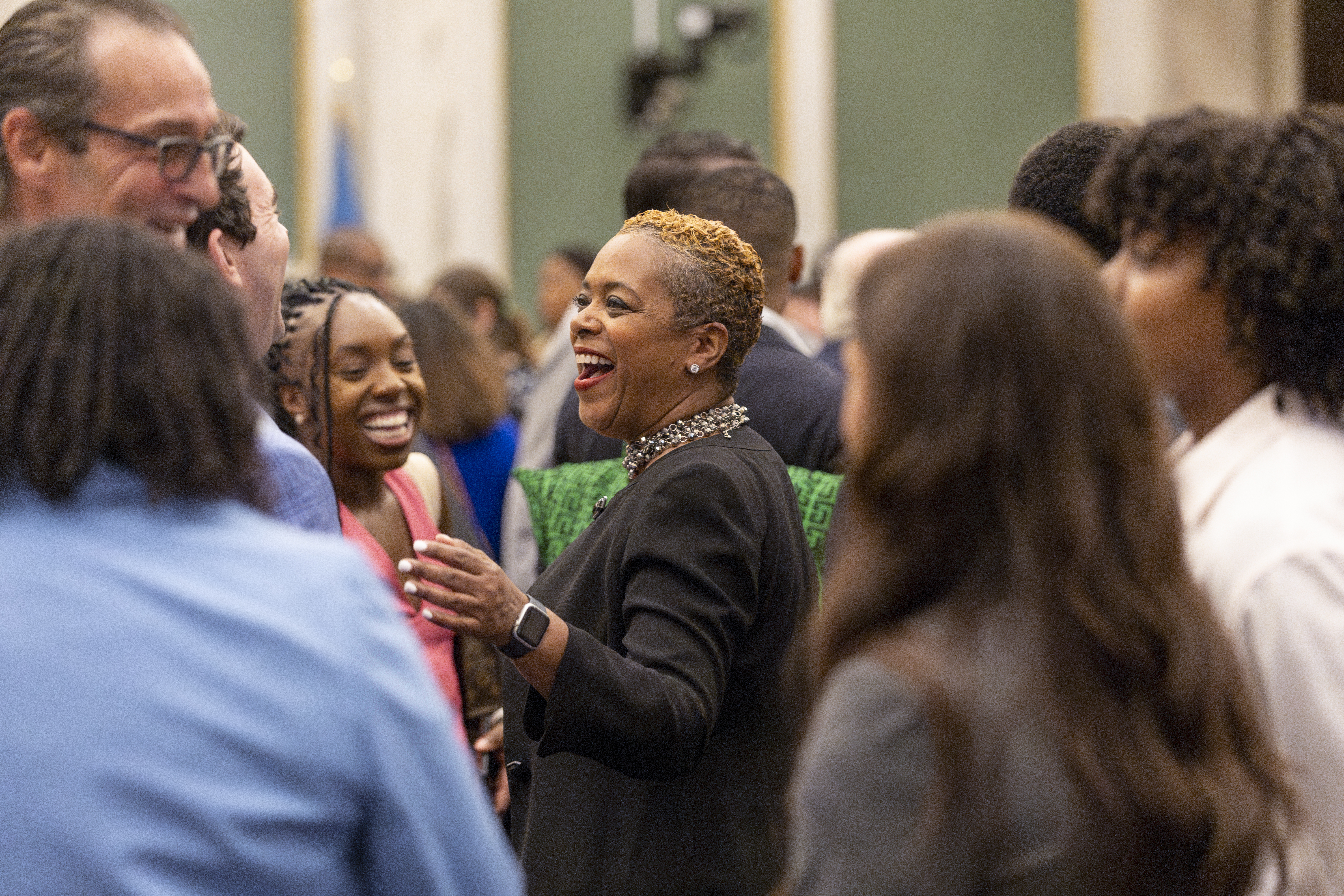
    Philadelphia City Councilmember Cindy Bass on the chamber floor inside City Hall in June.Aidan T. Gallo / Staff Photographer

    The opposition to a change like this in the city’s land use laws exemplifies why the politics of housing can be difficult to navigate and slow to generate results.

    Parker’s zoning proposals are likely to create fewer units than hoped for and on a timeline long enough to do little to add to the mayor’s promised 30,000 new units during her term. Many other municipalities face similar challenges.

    How many units will be created by this change?

    Parker’s team initially said the changes to the CMX-1 category would create the capacity to add 7,000 to 12,000 units across the city.

    However, an analysis from the pro-development think tank Build Philly Now put the estimate at 17,018 across the city — with 5,863 units allowed in O’Neill’s district alone.

    That’s because of an earlier effort by O’Neill to limit housing construction in his district. In 2022, he changed much of the neighborhood commercial zoning in his district to CMX-1, reducing the number of units that could be added along commercial corridors in the Far Northeast.

    That also means that much larger properties have CMX-1 zoning in his district than in any other part of the city, and far more housing would be allowed on these mixed-use commercial properties under Parker’s bill discussed Tuesday.

    “Councilmember O’Neill has a [CMX-1] property that is 16 acres, and it would allow a remarkable number of units” under the administration’s bill, said Brumbelow Burns.

    Philadelphia Mayor Cherelle L. Parker takes podium for opening remarks and budget presentation to City Council on March 12.Alejandro A. Alvarez / Staff Photographer

    The long-standing tradition of councilmanic prerogative — in which district members are allowed wide latitude over zoning in their territory — means that the mayor has little power to fight O’Neill’s and Bass’ exemptions.

    The City Planning Commission endorsed both exemptions, as part of larger changes to zoning overlays in the two Council districts.

    Brumbelow Burns said the exempted districts generally have larger properties with CMX-1 zoning, which would allow a lot more housing than in other parts of the city under the mayor’s change.

    “As we move farther out into other districts, the lots sometimes get bigger,” Brumbelow Burns said. “So we’ve been working with Councilmember Bass and Councilmember O’Neill [because they] have the larger properties that could have a negative impact.”

    The exemptions raised questions from other Council members.

    “There are other districts that have similar makeup, and I’m thinking immediately of my community in Wynnefield as an example,” said Katherine Gilmore Richardson, an at-large Council member. “This continues to be a challenge for us as well.”

    Councilmember Jamie Gauthier, who represents much of West Philadelphia, tried to steer the debate back to the administration’s original intent, which is to add one or two more apartments to former commercial buildings that would otherwise be vacant.

    “This just allows us to make use of the property in a way that reflects how our blocks and our communities actually function,” she said.

    Parker’s bill and the legislation exempting O’Neill’s and Bass’ districts were passed by the Rules Committee on Tuesday. The bills could be voted on by the full Council and sent to the mayor as soon as Nov. 12.

  • Israel’s election: When will we know the next prime minister?

    Israel’s election: When will we know the next prime minister?

    Israelis headed to the polls Tuesday in the highest turnout in more than a quarter-century for what many say was one of the most consequential elections in the country’s 78-year history.

    Prime Minister Benjamin Netanyahu of Israel, the country’s longest-serving leader, his party, Likud, and his far-right governing coalition were locked in a tight contest with opposition parties in the country’s first election since the Hamas-led assault on Oct. 7, 2023, that ignited Israel’s devastating war in the Gaza Strip.

    In Israel’s parliamentary democracy, every party creates a ranked list of its candidates, and voters choose a party or slate. The leader of the party or list with the most votes could become the country’s next prime minister — though it is not automatic — if that candidate can form a government, but the process is complicated and involves extensive negotiations.

    Here’s what to know.

    What happened on Election Day?

    Election Day is a public holiday in Israel, with schools, government offices and many public services closed. In most of the country, polls opened at 7 a.m. local time and closed at 10 p.m. Turnout nationally was 77.7% when the polls closed, according to the country’s Central Elections Committee, the largest figure since 1999.

    Early exit polls published by Israel’s mainstream television networks immediately after the voting ended suggested that Netanyahu’s Likud party had won more seats than the leading opposition party, Yashar. That party is headed by Gadi Eisenkot, a former military chief of staff who lost a son in the war in Gaza.

    But overall, the major opposition coalition appeared to be running close to the right-wing bloc. Other parties that opposed the Netanyahu government, the most far-right of any in Israeli’s history, appeared to fare well.

    Israel’s Arab citizens make up about 20% of the population, and they turned out in large numbers Tuesday with the stated desire to oust the far right. Mansour Abbas, the leader of the Raam party, told a television interviewer Tuesday night that the turnout showed that “frustration and despair” in Israel’s Arab society had “turned to hope.”

    Exit polls suggest the Arab parties may end up with more seats in the Knesset than ever before, making them a potentially important force in any governing coalition regardless of which political leader is ultimately asked to form it by the country’s president, Isaac Herzog.

    The opposition bloc led by Eisenkot has been reluctant to embrace Arab parties but may be unable to form a government without their support.

    Yair Golan, the leader of the Democrats party, which is part of the lead opposition bloc with Yashar, declared victory for their efforts Tuesday night, saying that exit polls show the Israeli public has “fired Netanyahu and Likud.” He urged opposition leaders to swiftly form a “change government” and expressed a willingness to rely on support from outside the alliance to secure a parliamentary majority, an apparent reference to the Arab parties.

    How are votes counted?

    Israel’s electoral system uses nationwide proportional representation. Elections to the 120-seat Knesset are held at least every four years, though they can happen more often. In 2022, Israeli elections were held for the fifth time in three years after the Knesset dissolved itself.

    Each Israeli voter casts a single ballot for a list of candidates affiliated with one or more parties or slates. Invalid votes are removed from the count, and then each list receives the number of Knesset seats proportionate to its share of the national vote, so long as it received at least 3.25% of valid votes. About 10 parties are expected to clear that electoral threshold.

    Votes for lists that did not pass the threshold are subtracted from the total eligible votes and do not count in subsequent stages.

    The number of total valid votes given to the qualifying lists is divided by the number of seats in the Knesset, yielding the number of votes required to win a seat. The 120 seats are then allocated according to each list’s share of the vote.

    There are often seats remaining after this calculation; if so, there is another stage of allocations determined by a formula that aims to ensure that the final seat allocations are as proportional as possible.

    In addition, parties can make agreements in advance to share what are referred to as “surpluses” in this part of the process. And only when all of these calculations have been made is the final seat allocation clear.

    The calculations and seat allocations are based on official results, which are expected by Nov. 4.

    How is a government formed?

    No single party has ever won a majority of votes, which means that parties must form factions and that party leaders must forge a governing coalition, aiming to build a majority in the Knesset of at least 61 lawmakers.

    Within seven days of the announcement of the official election results, Israel’s president, who otherwise plays a mostly symbolic role, meets with elected representatives from the parliamentary factions. He can take recommendations and is not obligated to select a potential prime minister from the party that won the most votes, though that is often the case. He may instead determine that another leader is more likely to be able to form a governing coalition that can win a vote of confidence in the Knesset.

    The president will then ask his choice to try to form a government. That candidate has 28 days to negotiate with other factions and forge alliances to cobble together a government. That person can request a 14-day extension to the deadline.

    If that effort fails, the president can select another candidate, who also has 28 days to try to form a government but has no option of an extension. If the second attempt fails, a majority of Knesset members can ask the president to have a third candidate try. That person would be granted 14 days to form a government, and if that fails, new elections are announced.

    If a candidate succeeds at forging a governing coalition and creates a policy agenda, and if the proposal wins a plurality of votes in the Knesset, the government is formally invested, and that candidate becomes the prime minister.

    Technically, the law allows for a minority government if the relative majority supporting it is larger than the minority opposing, but governments established after elections have almost always enjoyed the confidence of a majority of the 120 Knesset members.

    Historically, it has taken about 20 to 100 days to form a government, and no government has been sworn in less than 50 days after an election, according to the Israel Democracy Institute, a nonpartisan think tank in Israel.

    Who will likely lead Israel?

    The initial exit polls do not always give an accurate sense of the final results, so it may be some time before the picture becomes clear. For example, exit polls do not reflect the votes of hundreds of thousands of Israelis who cast ballots at special polling stations, including on military bases, in hospitals, prisons and embassies.

    What does seem apparent from the exit polls, however, is that both of the significant coalitions — the far-right bloc led by Netanyahu and the center-right bloc led by Eisenkot — will not have a majority that ensures they can easily form a government without significant compromises and negotiations with smaller players.

    This article originally appeared in The New York Times.

  • The Museum of the Philadelphian just popped up on Facebook Marketplace for $65,000. Interested?

    The Museum of the Philadelphian just popped up on Facebook Marketplace for $65,000. Interested?

    Looking to own your own museum?

    Has Brian Adoff got a deal for you.

    In a Facebook Marketplace post last week, Adoff — the founder and creator of the popular pop-up “micro” Museum of the Philadelphian — extolled the virtues of potential museum ownership.

    “Museum, lightly used,” read the listing, which offered the museum’s contents for the “quite frankly bargain price” of $65,000. “Would also make a great Christmas or … Anniversary gift for that special someone in your life.”

    Reached Tuesday, Adoff insisted that the listing is no joke.

    “Dead serious,” he said.

    The 300-square foot Museum of the Philadelphian — which is located in Fishtown and pays homage to such Philadelphia lore as greased poles and murdered robots — will conclude its six-week pop-up run on Nov. 1, at which point its eclectic collection will be placed into storage.

    Unless, that is, Adoff can find a new home for it.

    Ideally, that would include some sort of public display, said Adoff, who is currently exploring a variety of options.

    Hitchbot fills the front window at the Museum of the Philadelphian on Tuesday, Sept. 22, 2026.Monica Herndon / Staff Photographer

    He says he can envision the collection in the lobby of a local building — a hotel or the Comcast Center, perhaps — or a permanent or long-term venue, if funding were to materialize.

    “I’m looking for partners, sponsors, funders that might want to see this somewhere,” he said. “In a perfect world, it continues — if possible — to bring people joy.”

    Angela Val, president and CEO of Visit Philly, is among those who’d like to see the museum continue its run.

    “Knowing how popular it has become, we’d love to see it become a permanent museum,” Val said. “I think one of the best things about this place is the fact that people who visit here want to see and experience the people — and this museum gave them a way to do it.”

    Indeed, from the moment it was announced earlier this year, Adoff’s museum (tag line: “No one likes us, we don’t care”) has been a local darling, the subject of news reports and social media musings.

    Alexander Tominsky, the rotisserie chicken guy, checks out his name on the Register of Philadelphians at the Museum of the Philadelphian earlier this year.Monica Herndon / Staff Photographer

    Among the museum’s eccentric collection: the rearview mirror of the car tipped by Phillies fans after the team’s 2008 World Series title; a “register” of notable Philadelphians (think Alexander “Chicken Man” Tominsky, who once consumed 40 rotisserie chickens in 40 days); and a papier-mâché bust of Jason Kelce depicting his 2018 Eagles Super Bowl speech.

    Already, Adoff says, he’s received one offer for his collection.

    “We didn’t get into (financial details),” he said, but “it was a legitimate offer.”

    “Lovely guy,” Adoff added of the potential buyer. “It just shows people are interested in having this around.”

    Whatever becomes of the museum’s contents, it’s been “delightful” to see the way the venue has resonated with visitors, Adoff said.

    There was the local grandmother who brought her teenage grandsons from North Carolina, giving them an education on Philadelphians’ penchant for celebratory pole-climbing.

    There were the several people who cold-called Adoff to offer their own pieces of Philadelphia ephemera — and the ones who, on occasion, introduced Adoff to new pieces of city lore.

    One woman, upon seeing a display honoring the infamous courtroom located beneath the old Veterans Stadium, asked why there was no mention of “the holding area for children, where they gave them lollipops” while they waited for their fathers to be processed.

    “Is this firsthand knowledge?” Adoff asked.

    It was.

    Brian Adoff talks about the Museum of the Philadelphian earlier this year in Philadelphia. Monica Herndon / Staff Photographer

    The final days to visit the museum in its current form — which is free, though advance reservations are recommended — are Friday from 5-8 p.m., and Saturday and Sunday from noon-5 p.m.

    After that?

    Anyone’s guess.

  • East Passyunk Avenue’s Brazilian bakery is moving

    East Passyunk Avenue’s Brazilian bakery is moving

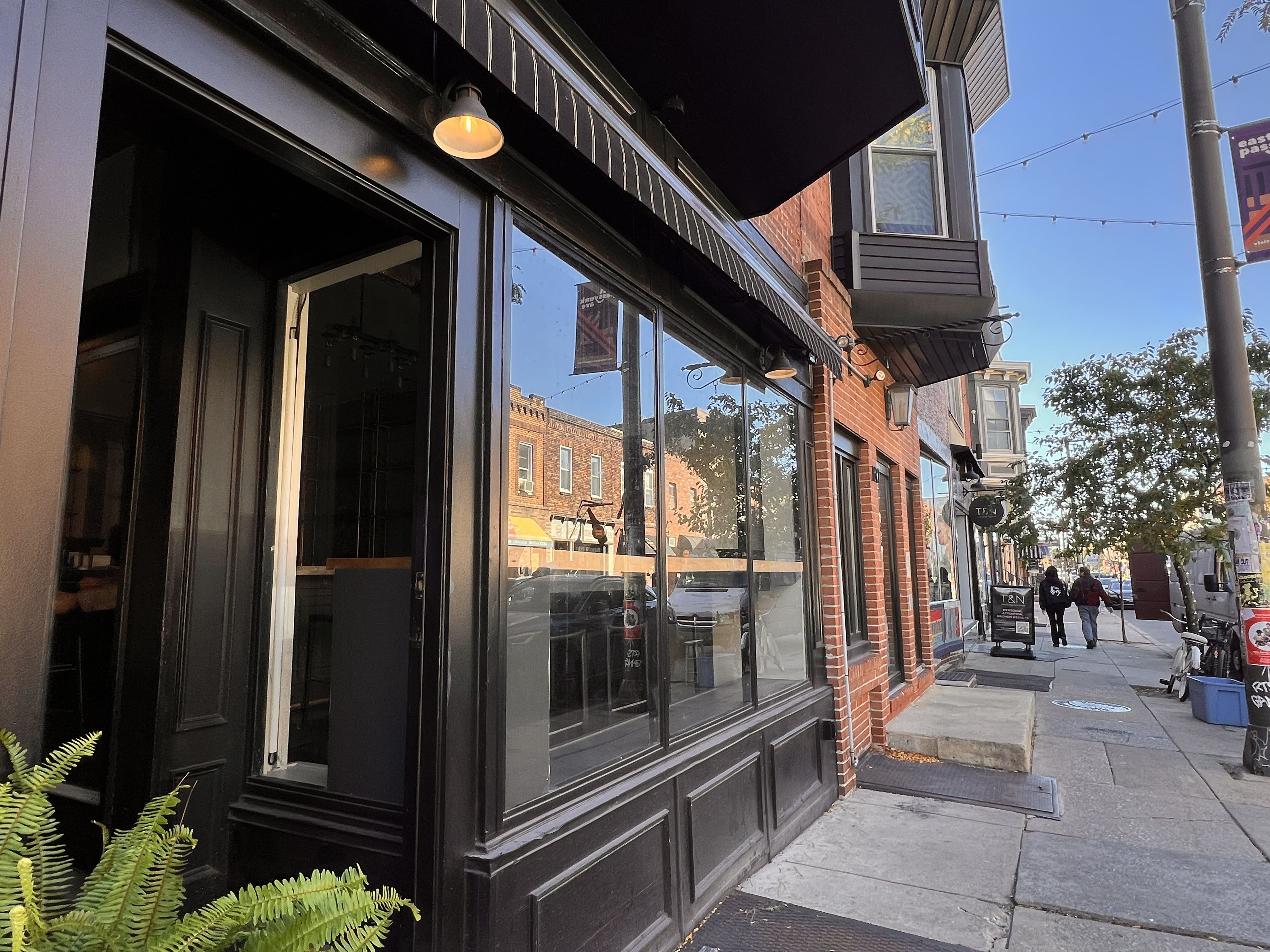
    Mardhory Santos-Cepeda is moving Kouklet Brazilian Bakehouse up East Passyunk Avenue into the former ITV, the bar attached to chef Nicholas Elmi’s now-closed Laurel restaurant.

    The move, from 1647 to 1615 E. Passyunk Ave., will allow Santos-Cepeda to expand Kouklet into an all-day cafe with breakfast, lunch, and seating for about 15 customers. She hopes to open by February.

    Santos-Cepeda said she began looking for a new location after her lease expired in August and her landlord declined to renew it. While leasing month to month, she considered other neighborhoods but was reluctant to leave East Passyunk, where she has built a following since opening Kouklet in late 2021.

    Kouklet owner Mardhory Santos-Cepeda behind the bar at the former In the Valley at 1615 E. Passyunk Ave.Michael Klein / Staff

    “It took five years for us to build this beautiful community we have here,” she said.

    Two weeks ago, she noticed that the former Laurel and ITV spaces, previously marketed together, were being offered separately. She contacted owners and worked out a deal for the bar side. The former Laurel side at 1617 E. Passyunk Ave. is available for lease.

    The new space, about 1,200 square feet, is half again as large as Kouklet’s current 800-square-foot storefront. It also has a basement walk-in refrigerator, additional kitchen space, and room for tables.

    Santos-Cepeda plans to retain the pastry counter, featuring Kouklet’s Brazilian specialties, including sonhos (filled doughnuts), bolo de rolo (thinly layered rolled cakes), cookies, and savory pastries.

    A savory pastry at Kouklet: Roca de presunto e queijo is a sourdough brioche topped with ham, cheese, and hot honey sauce.Michael Klein / Staff

    The expanded menu will include egg dishes, tapioca flatbreads, rice bowls, other breakfast and lunch offerings, and a coffee and beverage program.

    She also envisions an open kitchen, giving customers a view of the baking operation. The window counter will provide about six seats, with additional tables elsewhere.

    And the bakery’s signature bright yellow color scheme will follow it up the block, inside and out.

    Santos-Cepeda, who grew up in Brasília, began Kouklet — a name she made up in high school — as a home-based business before establishing the East Passyunk storefront. Last year, she expanded to 1429 Wolf St., opening a second takeout bakery alongside a production kitchen. She left that location over the summer; it is now Backyard Cravings, the new pizza and cheesesteak shop.

    Santos-Cepeda intends to keep the current East Passyunk location operating until the replacement is ready, then transfer the equipment.

    The additional space excites her. “When you get into a Brazilian bakery, you are overwhelmed by all the options,” she said. “This will be no different.”

    The former In the Valley at 1615 E. Passyunk Ave.Michael Klein / Staff