Tag: no-latest

  • Letters to the Editor | Aug. 28, 2026

    Letters to the Editor | Aug. 28, 2026

    Bright future

    A recent article described how a former dump site in Voorhees is now going to become a site for a community solar project on land unsuitable for other buildings. When complete, it will power about 4,000 households who cannot otherwise access solar power. It will join the current roster of 209 community solar projects now running in New Jersey, with more than 51,000 households subscribed, with a current capacity of 291 megawatts. There are now 392 more projects in development or under construction. The law in New Jersey for community solar requires that at least 51% goes to low- and moderate-income households. There has been a bill in Pennsylvania’s General Assembly, HB 504, which has passed the House, but the Republican majority in the Senate refuses to bring it to a vote. Pennsylvania is so much larger geographically than New Jersey. Imagine if we had community solar in Pennsylvania; how many homes could be served here?

    Peter Handler, Philadelphia

    Don’t blame AI

    A Russian drone guided by artificial intelligence has killed three civilians at a gas station in Ukraine, but the blame for their deaths still belongs to the humans who launched the drone. The endless wars in the Mideast and the pointless war in Ukraine are current chapters in a book as old as humanity itself. AI may make mistakes in wars, but humans start them in the first place.

    Allen N. Smith, Philadelphia

    Join the conversation: Send letters to letters@inquirer.com. Limit length to 150 words and include home address and day and evening phone number. Letters run in The Inquirer six days a week on the editorial pages and online.

  • Dear Abby | Metronome man bounces between two wives

    DEAR ABBY: Twenty-six years ago, I began what was supposed to be an affair with my current girlfriend, “Lacey.” I was married at the time, and when my then-wife caught me, I was told we needed only to figure out who got what out of the marriage. Believing there was no salvaging the marriage, I took what was available and stayed with Lacey.

    My ex-wife moved on, and we divorced. Lacey got pregnant. After the birth of our daughter, and having become “Dad” to Lacey’s other two children, I stayed. The biological father of Lacey’s young children was deceased, so I raised them as my own, the same as my biological child.

    Now, after years of regret about screwing up my marriage, I mustered the courage to contact my ex-wife via social media. We connected via a messenger app for a few days. After those conversations went extremely well, we eventually exchanged numbers.

    There were lots of truths told, some good, some bad, but all in complete honesty. The conversations have been emotional and uplifting. I feel happy thinking about her and hope someday to see her again in person.

    I have been unhappy with Lacey since the beginning, always regretting the screwup I made in losing my first wife. Now, speaking to her again, I feel motivated to leave Lacey. There seems to be an honest connection with my ex, and we both hint at rekindling the relationship. How do I broach this subject civilly with Lacey without ruining my relationships with all of my kids?

    — SORRY IN PENNSYLVANIA

    DEAR SORRY: Do not expect a civil conversation. Expect instead that Lacey will be angry, threatened and furious. It may cushion the blow to mention that you haven’t been happy for years, and that you will see that she is provided for financially in some way. (Discuss this with a lawyer beforehand.)

    Explain to your grown children that you have not been happy for many years, but because you love them, you stayed with their mom until they were all adults so their lives would not be disrupted. If you do this gently and reasonably, they may listen.

    A word to the wise: There is no guarantee that returning to your ex-wife will bring you the happiness you are expecting. Premarital counseling and a long courtship are essential to ensure you aren’t jumping from the fire back into the frying pan.

    ** ** **

    DEAR ABBY: My boyfriend, “Ted,” is divorced from a woman who now has Alzheimer’s. Ted has been the only one to step up to help her through this difficult time. It takes a lot of his time and effort and weighs heavily on his mind.

    I admire Ted for his loyalty to someone he once shared a life with, but now she wants him to go on a cruise with her and a couple of his relatives. Ted says she doesn’t get to travel much now, and he sees nothing wrong with this because she’s paying his way. I am not invited. I feel this goes above and beyond his involvement with her health management. When is enough enough?

    — SECOND FIDDLE

    DEAR SECOND FIDDLE: Ted’s kindness is admirable, but his willingness to set you aside and vacation with his ex-wife crosses a line. Tell him either you accompany him on the cruise, or he shouldn’t bother coming back from it.

  • Horoscopes: Friday, Aug. 28, 2026

    Horoscopes: Friday, Aug. 28, 2026

    ARIES (March 21-April 19). What if you lost self-blame? After all, you couldn’t possibly see what actually happened from every angle, living in your own body and mind as you do. And blame simply doesn’t help. Let it go.

    TAURUS (April 20-May 20). What if you lost your self-consciousness for a moment, or an hour, and simply became more yourself instead of the version you want them to see? It’s a risk. Maybe it will feel more scary than you think is worth that risk. But the more you do this, the easier it gets.

    GEMINI (May 21-June 21). What if you lost the habit of supplying every answer? A few extra minutes can reveal a better question. People admire certainty, though life often rewards the person who waits long enough to see the fuller picture.

    CANCER (June 22-July 22). What if you lost the thing that is making your work take so long? Is it perfectionism? Is it a commute? Is it an unorganized environment that keeps you searching for the tools and resources you need to finish fast?

    LEO (July 23-Aug. 22). What if you lost your intensity of feeling for that certain person who tends to occupy your thoughts? Perhaps it’s easier said than done, but simply holding the intent will eventually loosen up your energy to focus on what will bring greater balance and peace.

    VIRGO (Aug. 23-Sept. 22). What if you lost preconceived notions of what people expect from you? You’re a generous giver. Someone wants to love you, not for what you do, but just for the person you are when you’re not doing anything at all.

    LIBRA (Sept. 23-Oct. 23). What if you lost your attachment to the first draft? A painter steps away from the canvas to return again tomorrow. A carpenter measures twice. A writer goes in with a red pen. More passes can equal more depth, clarity and precision.

    SCORPIO (Oct. 24-Nov. 21). What if you lost the idea that important things should feel dramatic? Most turning points look ordinary while they’re happening. The most profound statements are often understatements, or even just specific pauses. What matters most is told in a whisper.

    SAGITTARIUS (Nov. 22-Dec. 21). What if you lost your version of the time frame and let things tell you how long they need? In baking you know by the smell. In gardening you know by the sprouts. In love you know by how people orient to you.

    CAPRICORN (Dec. 22-Jan. 19). What if you lost your “yes”? Not every opportunity needs or deserves your participation. Time is a valuable currency. Every commitment spends some of it. You can trust your gut to tell you when a quick “no” will uncomplicate your life in the best ways.

    AQUARIUS (Jan. 20-Feb. 18). What if you lost the instructions and just did it your way? By putting things together before you see how others did it, you discover the material version of your unique instincts, the true reflection of your point of view and your most innocent and natural tendencies.

    PISCES (Feb. 19-March 20). What if you lost your need for the last word? Winning a conversation and winning a relationship are two different things. Some power moves actually lessen your power. Ego needs may feed the moment, but cooperation can feed the future of a relationship.

    TODAY’S BIRTHDAY (Aug. 28). Welcome to your Year of Noble Works. There’s honor in the hours you put in to progress the mission. There’s magic that happens when sweat meets an excellent plan. Time off is made sweeter with the knowledge that your leisure is well-earned. More highlights: Powerful forces help you finish strong. Extremely useful prizes and avid fans. Capricorn and Aries adore you. Your lucky numbers are: 6, 33, 10, 18 and 13.

  • ICE awards $16.7M contract to buy 6,000 pairs of gloves that deliver electric shocks

    ICE awards $16.7M contract to buy 6,000 pairs of gloves that deliver electric shocks

    U.S. Immigration and Customs Enforcement has awarded a $16.7 million contract to purchase 6,000 pairs of gloves that can deliver painful electric shocks, saying officers would use them to control detainees and protesters who resist.

    ICE moved forward with the purchase despite opposition from civil rights advocates and Democratic members of Congress, who said ICE officers cannot be trusted to use them appropriately.

    A notice published in a federal database Thursday said ICE entered into a no-bid contract to purchase the gloves from Compliant Technologies LLC, a Kentucky-based firm that manufactures them. The deal includes acquiring 6,000 of the devices along with support equipment and services over the next six months.

    Civil rights advocates have said ICE officers already face criticism for their use of force with little oversight or accountability while enforcing President Donald Trump’s immigration crackdown.

    ICE published the notice hours after a group of U.S. senators, led by Democrat Catherine Cortez Masto of Nevada, urged the agency to cancel its plan to buy the gloves. In a letter to ICE’s acting director Thursday, Cortez Masto and 15 of her colleagues in the Democratic caucus questioned ICE’s need for the devices.

    “The blatant and tragic misuse of force in Los Angeles, Chicago, Minneapolis, Houston, Maine, and other locations around the country raises significant skepticism about the agency’s professional capability to safely deploy a new tool that could be used to harm Americans without cause,” the letter said.

    The senators were the latest to express opposition to the plan, which became public this month when ICE published a notice outlining its intent to purchase thousands of “conductive distraction and de-escalation devices” for officers and investigators.

    The devices are normal patrol gloves until an officer presses a button to activate the electrical mode. They must be applied directly to someone’s skin to produce a shock that causes pain, which is promoted as a way to gain compliance from people who are resisting. They have been used by some local jails and police departments in recent years.

    ICE’s notice said officers would use them in “high-tension environments,” including while making arrests, transporting combative detainees and responding to civil disturbances outside detention facilities.

    “It will be used when a subject is actively or passively resisting and an officer needs to gain control quickly to prevent injuries to both parties,” the document said.

    It said that the shocks would help “maintain control over inmates and prevent aggression or escape attempts,” allow officers to handcuff people hiding their hands, and assist in crowd control. The goal would be to avoid using “more severe force,” including firearms. The notice said the gloves would be used with “approved policy, training, and accountability standards,” but it did not elaborate.

    Cortez Masto and the other senators said in their letter that the device “presents substantial risks if deployed during civil arrests — even more so if it is deployed without clear limits, appropriate training, and comprehensive oversight.” They said ICE must make public details about how officers will be trained and how use of the gloves will be documented and reviewed internally to avoid misuse.

    ICE’s parent agency, the Department of Homeland Security, reacted defiantly Thursday to critics of the purchase.

    “Sanctuary politicians attempting to ban our federal law enforcement from any safety equipment is despicable and a deliberate attempt to undermine and endanger our officers,” the agency said in a statement.

  • In Nepal, a catastrophe so sudden there was no time to react

    In Nepal, a catastrophe so sudden there was no time to react

    KATHMANDU, Nepal — It was already too late when the call came.

    Rajan Khatri, 41, a police officer, was working at his station in a mountain village in northern Nepal when a friend rang Wednesday morning to warn that a flash flood was thundering downriver in his direction. As soon as he hung up, giant waves slammed into the station.

    “I cannot explain how big the waves were,” Khatri said from a hospital bed in Nepal’s capital, Kathmandu, on Thursday. “They engulfed several meters-high buildings in a fraction of seconds. It wasn’t just water. It was a combination of boulders, sand and thick sludge.”

    The onslaught flung Khatri out of the building, and he lost consciousness and suffered chest injuries. Two of his colleagues survived, but four were missing on Thursday.

    They were among the more than 1,400 people missing in the devastating deluge of rock, ice, trees, mud and water that blasted through river valleys on the border between Nepal and Tibet, washing away bridges, smashing homes, schools, and hydropower plants, and swallowing people who tried to run away.

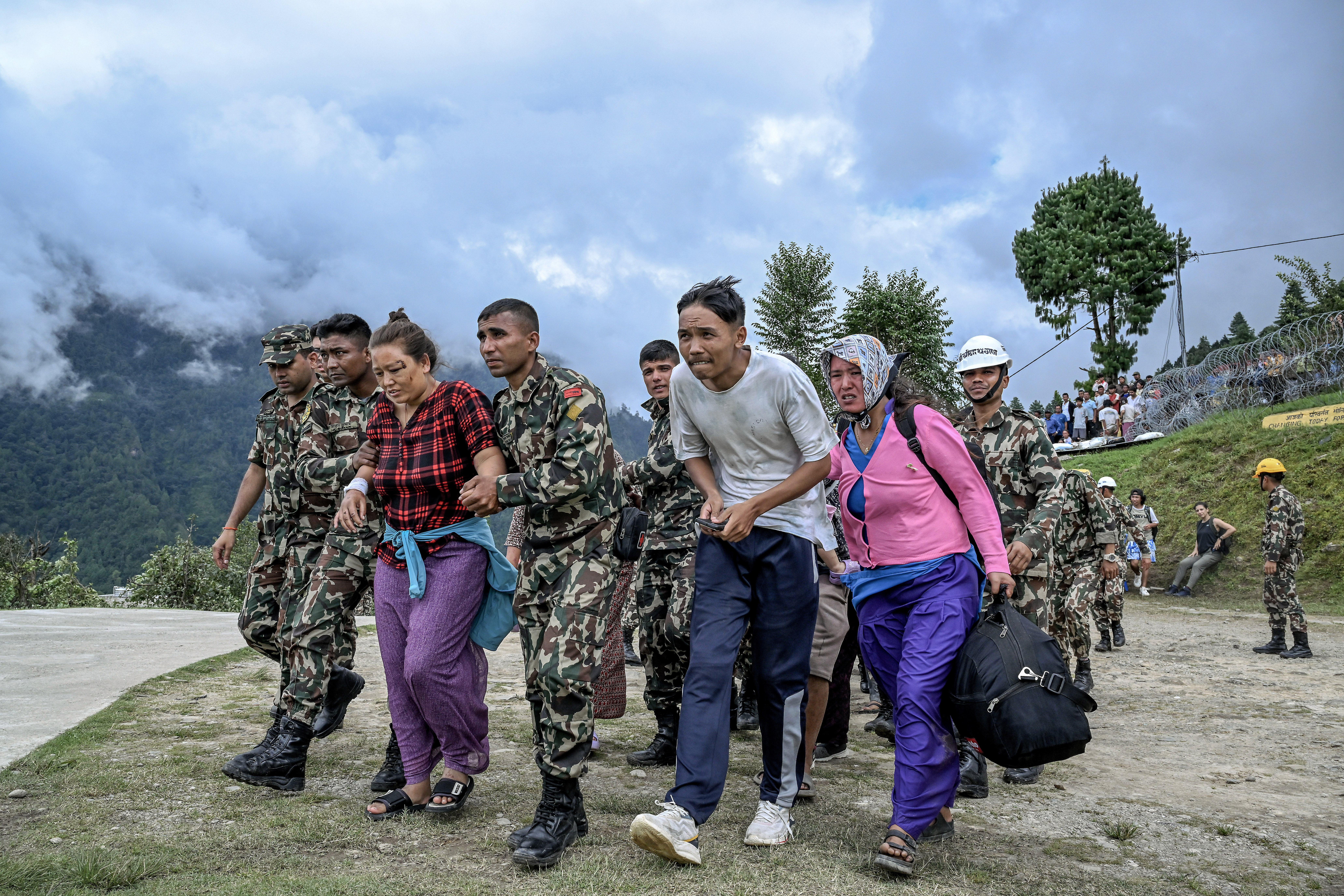
    On Thursday, emergency workers climbed across steep Himalayan valleys and used helicopters to ferry shocked survivors to safety as they carried out a sprawling search for anyone who had managed to escape the flood.

    Nepali officials said at least 389 people had been killed, while the authorities in China, where far less information was being released, reported three deaths in the Tibet region of China.

    The death toll was expected to rise.

    In Nepal, more than 900 people, including about 500 foreign visitors, were unaccounted for, the country’s disaster management agency said. The missing foreigners included at least 288 from India, as well as travelers from the United States, Australia, Britain, Canada, and Malaysia.

    In Tibet, at least 558 people were missing in Gyirong County, including 260 foreigners, Chinese state media reported. China’s Foreign Ministry said 100 Chinese citizens were missing in Nepal.

    The U.S. State Department said in a statement that about 90 U.S. citizens “may be impacted by the floods” and three had been rescued in Nepal. It said it was not aware of any Americans who had died.

    Survivors described having almost no time to react before giant waves came roaring down the Bhotekoshi and Trishuli rivers.

    Smriti Ojha, 17, said she had been getting ready for school Wednesday morning when she felt the ground shaking. She ran out of her house, believing an earthquake had struck. Then she saw the flood. She said her immediate family had survived, but four of her relatives were missing.

    “It was terror,” Ojha said from a hospital bed in Kathmandu. “I cannot believe everything was swept away before my eyes.”

    Officials and aid organizations were still assessing the scale of the destruction in the remote region, renowned for its high-altitude lakes and steep peaks.

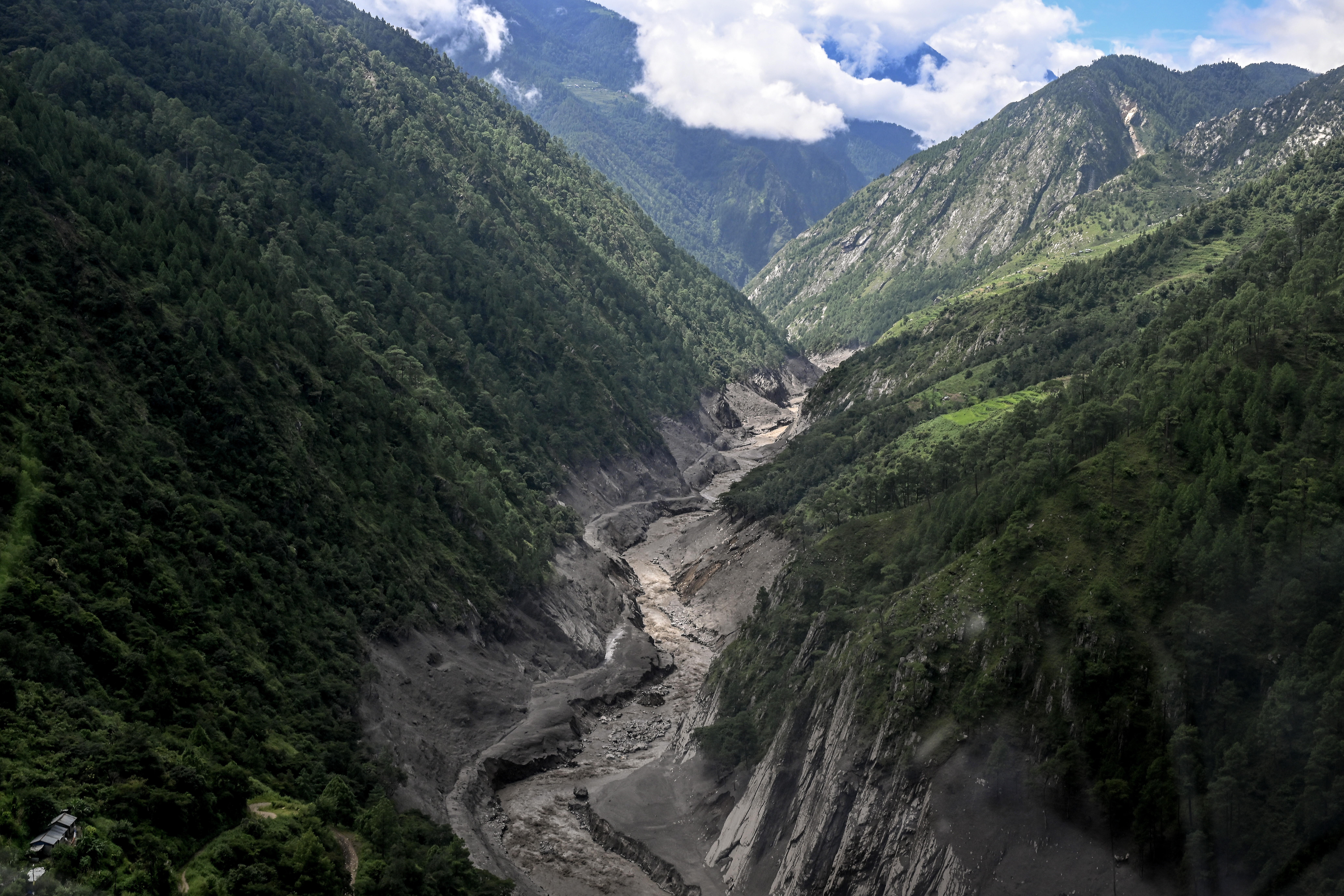
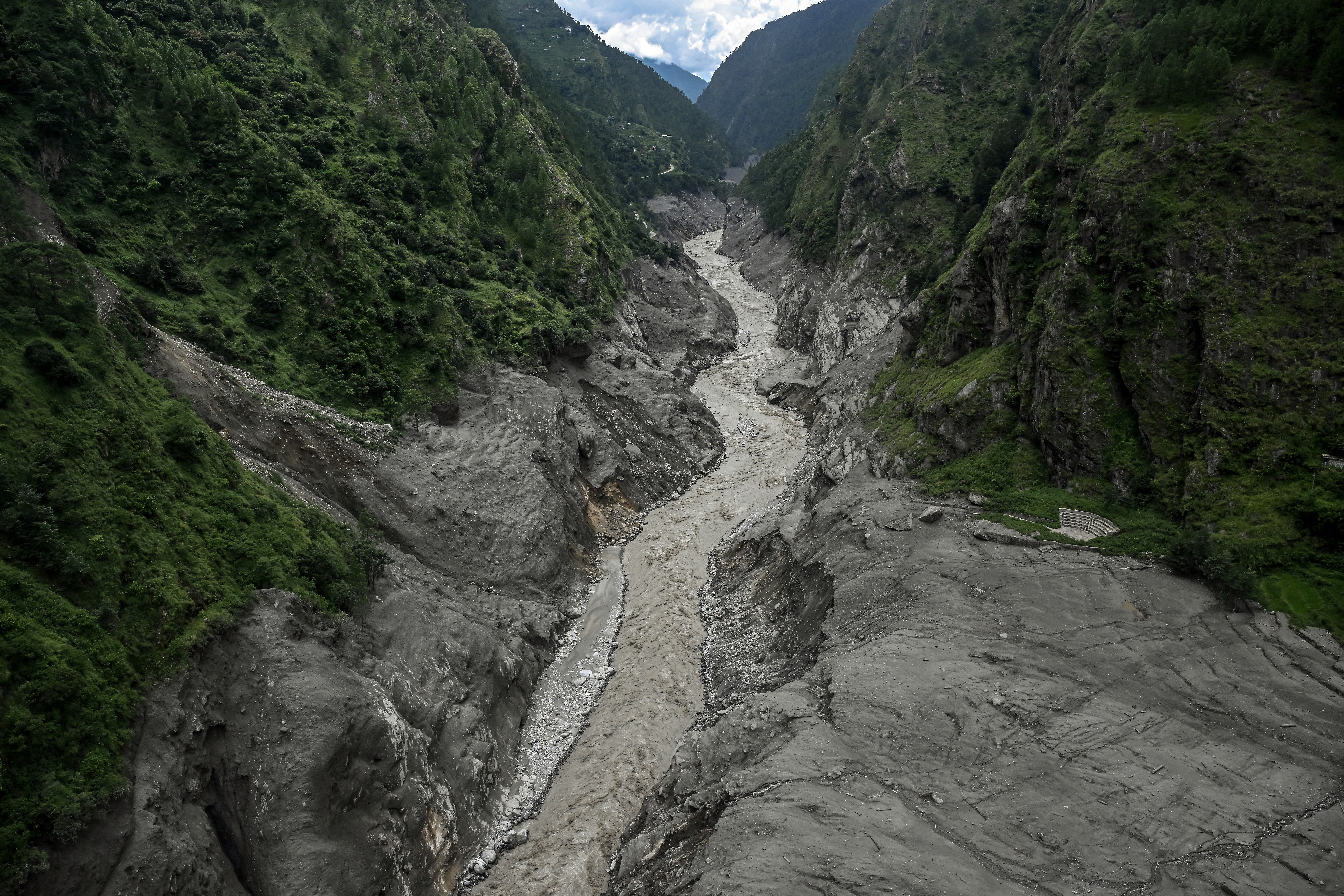
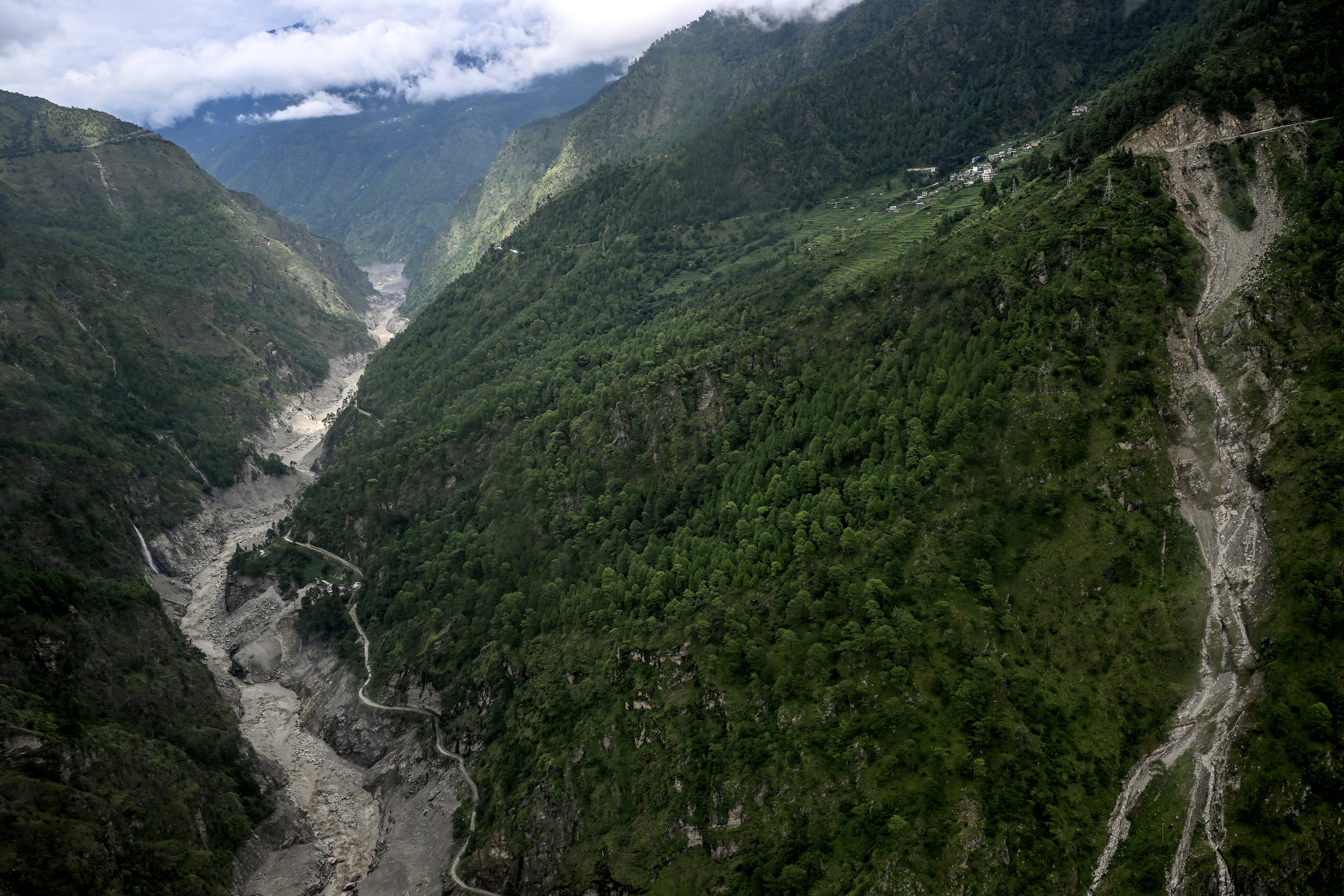
    New York Times journalists traveling with the Nepali military Thursday surveyed the devastating aftermath. One highway, near the Bhotekoshi River, had mostly disappeared. Scars on hillsides showed that in some places, the river had risen more than 650 feet during the flood.

    Rescue efforts were being hampered by communication lines that had been cut and the destruction of dozens of bridges and about 25 miles of roads, Nepal’s government said.

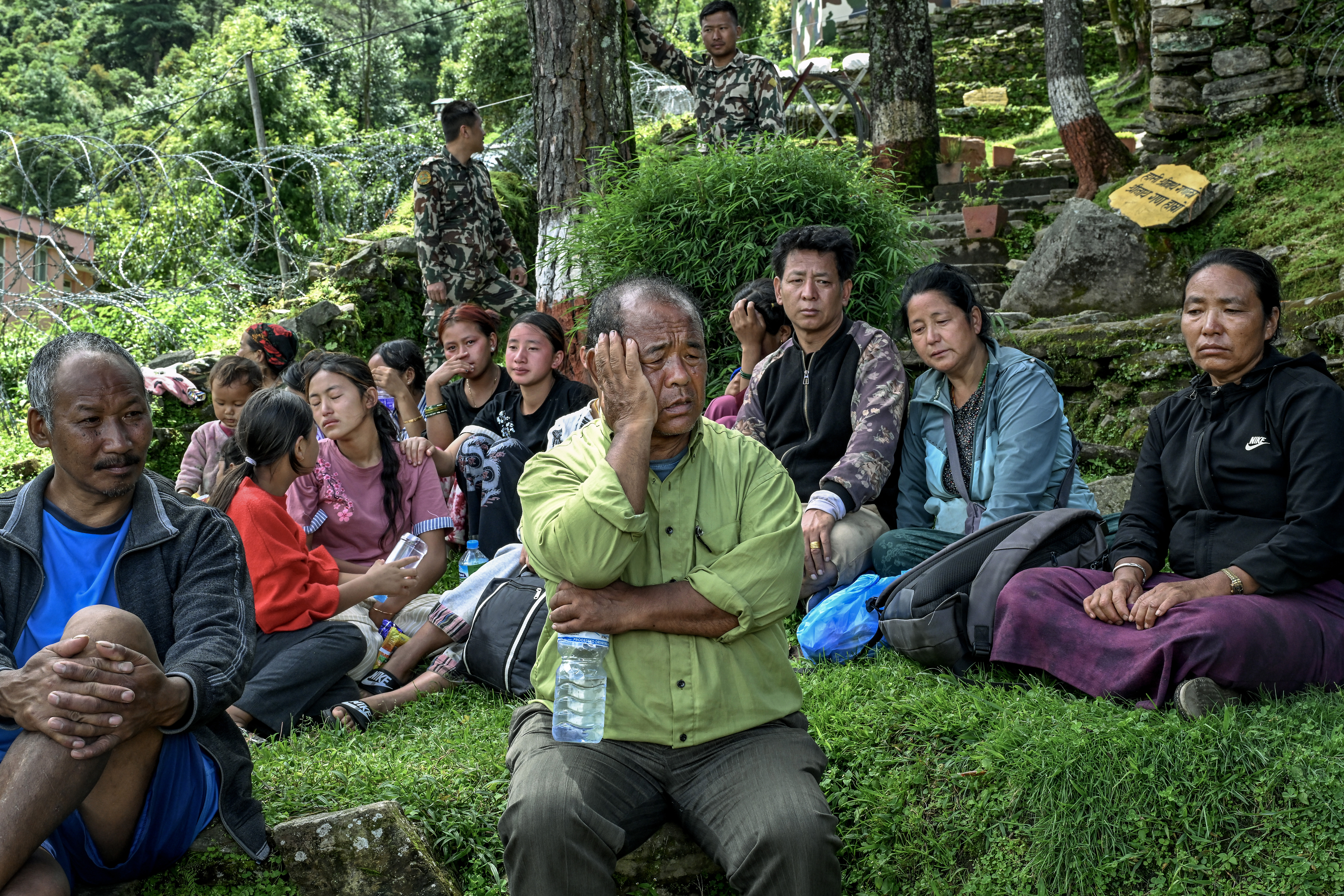
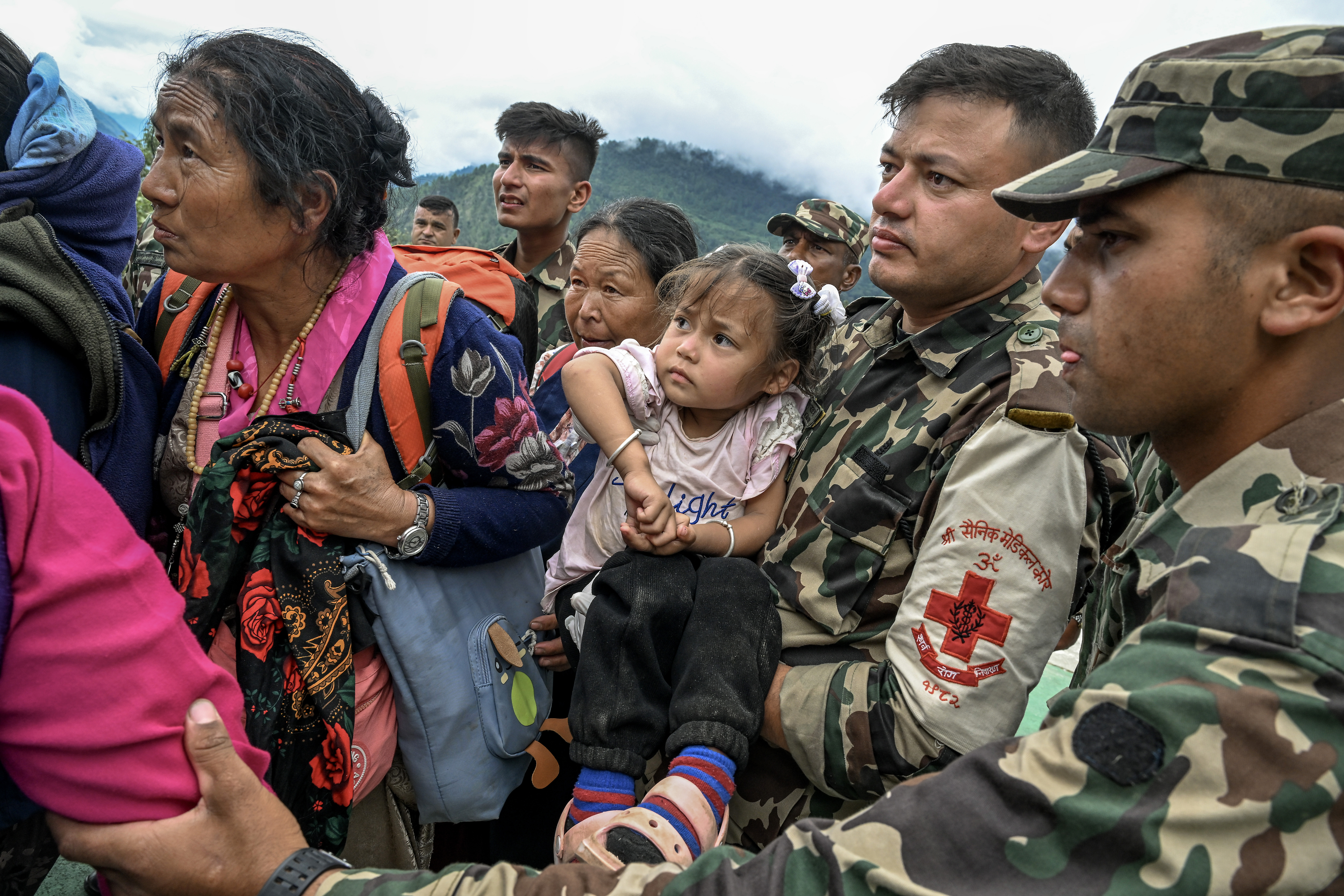
    The Nepali army’s search-and-rescue base was packed with hundreds of army personnel and survivors, some of whom wept after arriving by helicopter. The area had no electricity or phone networks after the flood, and soldiers and other rescuers were using military radios to communicate.

    Nepal’s foreign minister, Shisir Khanal, called it “one of the largest natural disasters we have experienced in recent memory.”

    President Donald Trump, speaking in the Oval Office, said he had offered U.S. aid to Nepal. “We are sending aid, and we’ve spoken to the leadership, and we let them know anything they want will happen,” he said.

    Scientists piecing together satellite imagery and seismological data said that a high-altitude landslide coinciding with a glacial collapse most likely caused the flash flood. The collapse happened on the north face of Langtang Lirung, a Nepalese mountain near the border with Tibet, at an elevation of around 17,000 feet, scientists said.

    After a huge chunk of the mountainside broke off, it sent millions of tons of rock and ice crashing into the river valleys below, said Kristen Cook, a geomorphologist at the Université Grenoble Alpes in France.

    “It was a much larger collapse than we were initially able to see in the satellite imagery,” she said.

    The shaking caused by the falling rock and ice was so powerful that the U.S. Geological Survey registered it at a magnitude of 5.2, as if it were a moderately powerful earthquake. Warming temperatures caused by climate change may have destabilized the glacier and rock face, scientists said, adding that it was too early to determine a precise cause.

    “Earthquakes, landslides, slope failures all could happen even without climate change,” said Austin Lord, an anthropologist and senior fellow at the Stimson Center in Washington who has studied natural disasters in Nepal. “It’s just that climate change is this additional factor that increases the likelihood, scale, frequency and intensity of these events.”

    Nepal has a flood warning system, but it relies on a conventional network of river and lake gauges that was not equipped to alert people to the sudden collapse of part of a mountain, according to scientists and disaster response researchers.

    The river gauges are designed instead to detect slower-rising water levels that typically precede a monsoon-driven flood or glacial lake outburst, which occurs when a pool of glacial meltwater bursts its banks.

    “We didn’t have the right information at the right time, so we couldn’t save more people,” said Basanta Raj Adhikari, director of Tribhuvan University’s Centre for Disaster Studies in Nepal. “The Nepalese government is very good on monsoon floods and perennial floods, but we were not prepared for this fast-moving flash flood,” he added.

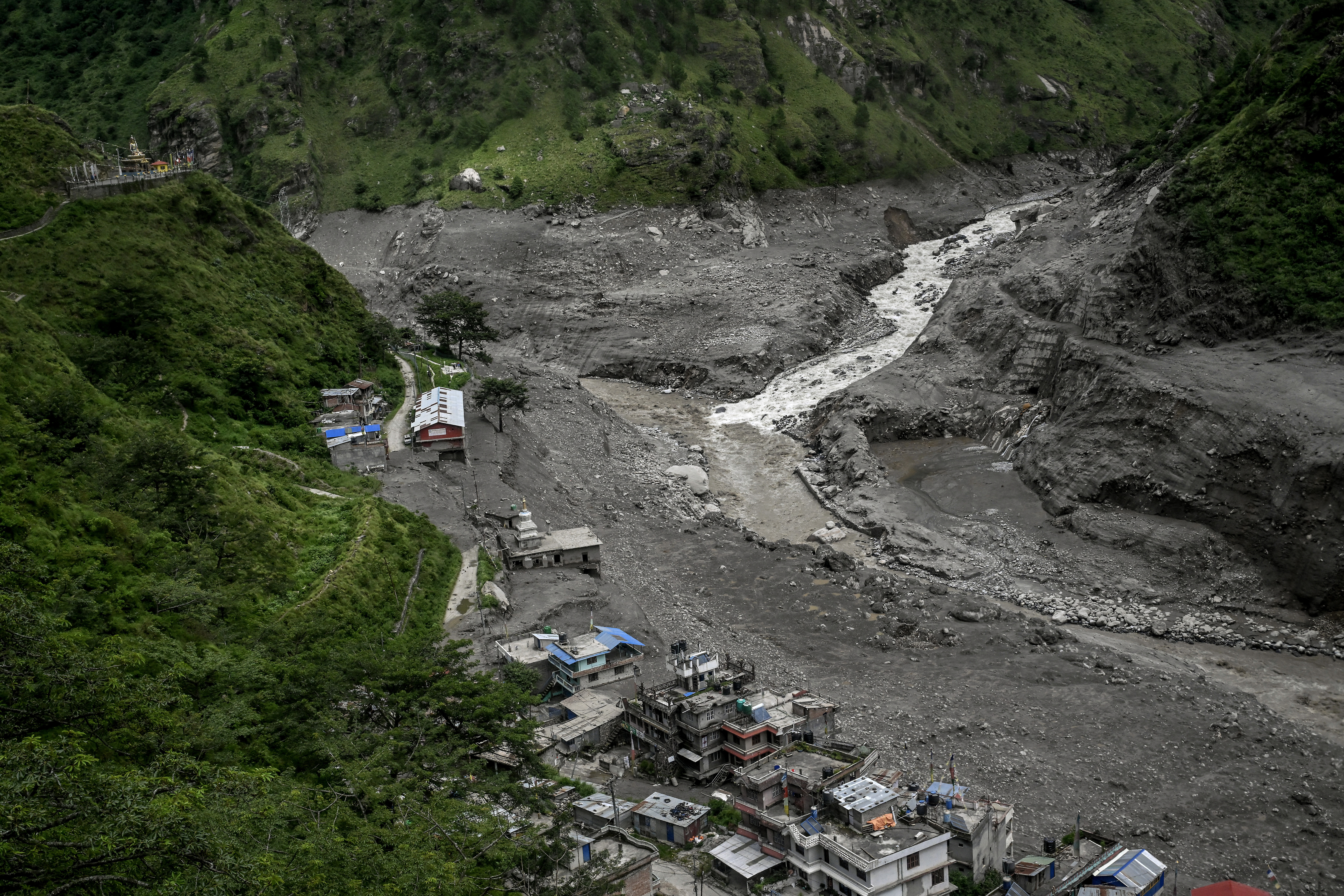
    The banks of the debris-choked Bhotekoshi River show signs of the giant torrent of water, mud and ice that swept through the remote river valley in the Rasuwa district near Nepal’s border with Tibet, on Thursday, Aug. 27, 2026. Emergency workers and helicopters scoured steep Himalayan valleys on Thursday in a desperate search for survivors after a torrent of water, mud and ice killed hundreds — and perhaps many more — as it swept through a river valley that runs through Tibet and Nepal. More than 1,400 people are still missing. (Atul Loke/The New York Times)ATUL LOKE
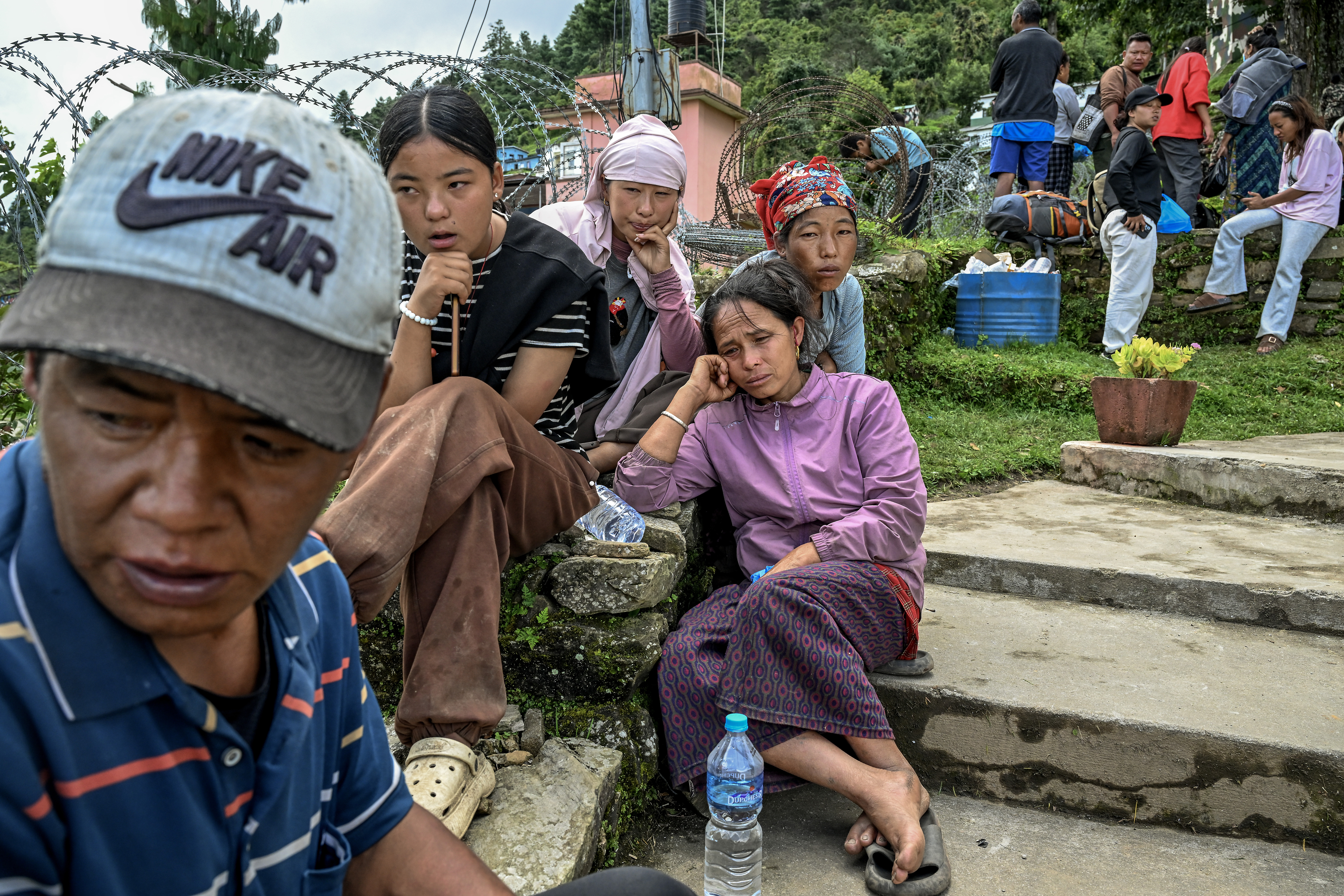
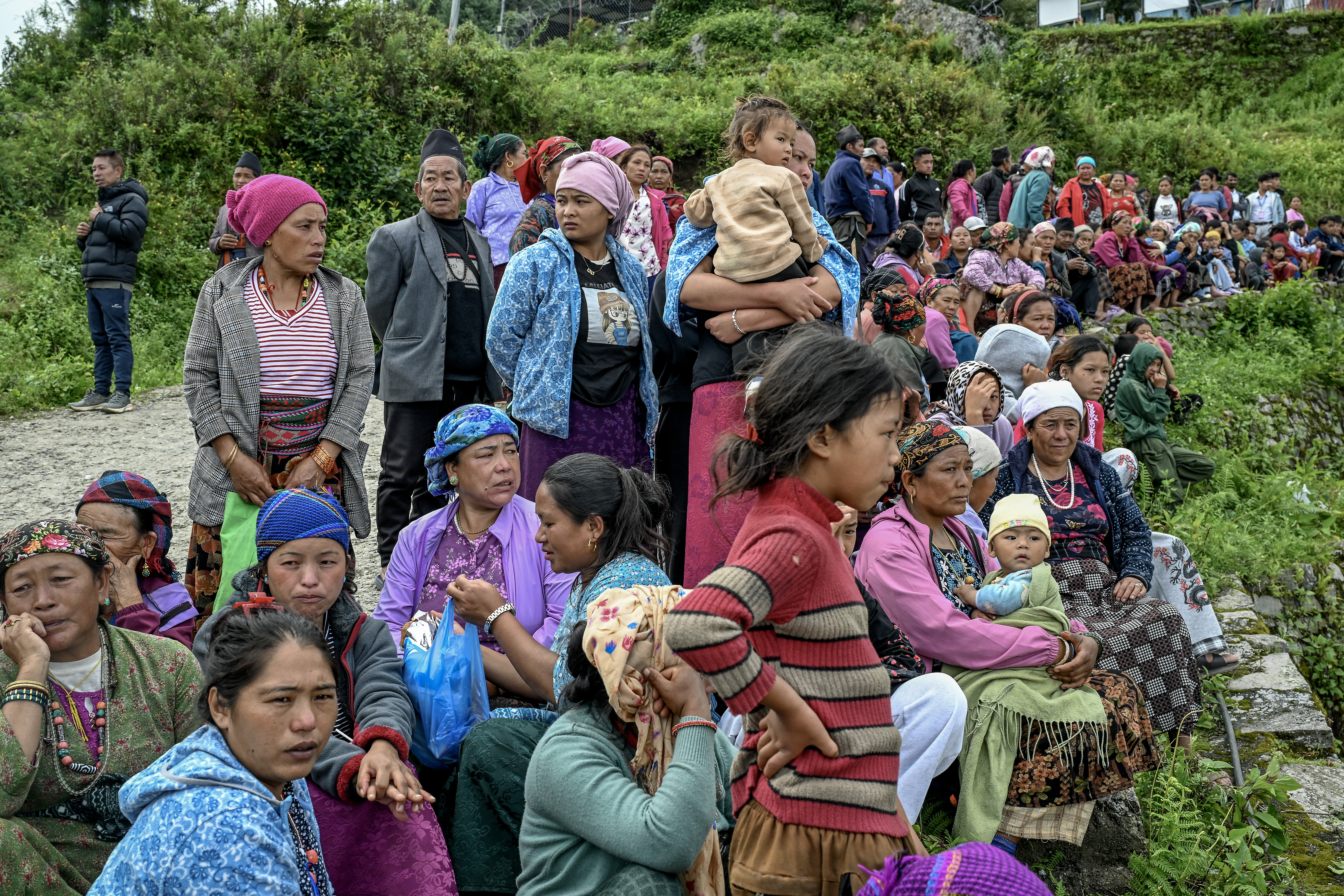
    People wait to board rescue helicopters in the disaster-stricken Rasuwa district near Nepal’s border with Tibet, on Thursday, Aug. 27, 2026. Emergency workers and helicopters scoured steep Himalayan valleys on Thursday in a desperate search for survivors after a torrent of water, mud and ice killed hundreds — and perhaps many more — as it swept through a river valley that runs through Tibet and Nepal. More than 1,400 people are still missing. (Atul Loke/The New York Times)ATUL LOKE
    People wait to board rescue helicopters in the disaster-stricken Rasuwa district near Nepal’s border with Tibet, on Thursday, Aug. 27, 2026. Emergency workers and helicopters scoured steep Himalayan valleys on Thursday in a desperate search for survivors after a torrent of water, mud and ice killed hundreds — and perhaps many more — as it swept through a river valley that runs through Tibet and Nepal. More than 1,400 people are still missing. (Atul Loke/The New York Times)ATUL LOKE
    The banks of the debris-choked Bhotekoshi River show signs of the giant torrent of water, mud and ice that swept through the remote river valley in the Rasuwa district near Nepal’s border with Tibet, on Thursday, Aug. 27, 2026. Emergency workers and helicopters scoured steep Himalayan valleys on Thursday in a desperate search for survivors after a torrent of water, mud and ice killed hundreds — and perhaps many more — as it swept through a river valley that runs through Tibet and Nepal. More than 1,400 people are still missing. (Atul Loke/The New York Times)ATUL LOKE
    People wait to board rescue helicopters in the disaster-stricken Rasuwa district near Nepal’s border with Tibet, on Thursday, Aug. 27, 2026. Emergency workers and helicopters scoured steep Himalayan valleys on Thursday in a desperate search for survivors after a torrent of water, mud and ice killed hundreds — and perhaps many more — as it swept through a river valley that runs through Tibet and Nepal. More than 1,400 people are still missing. (Atul Loke/The New York Times)ATUL LOKE
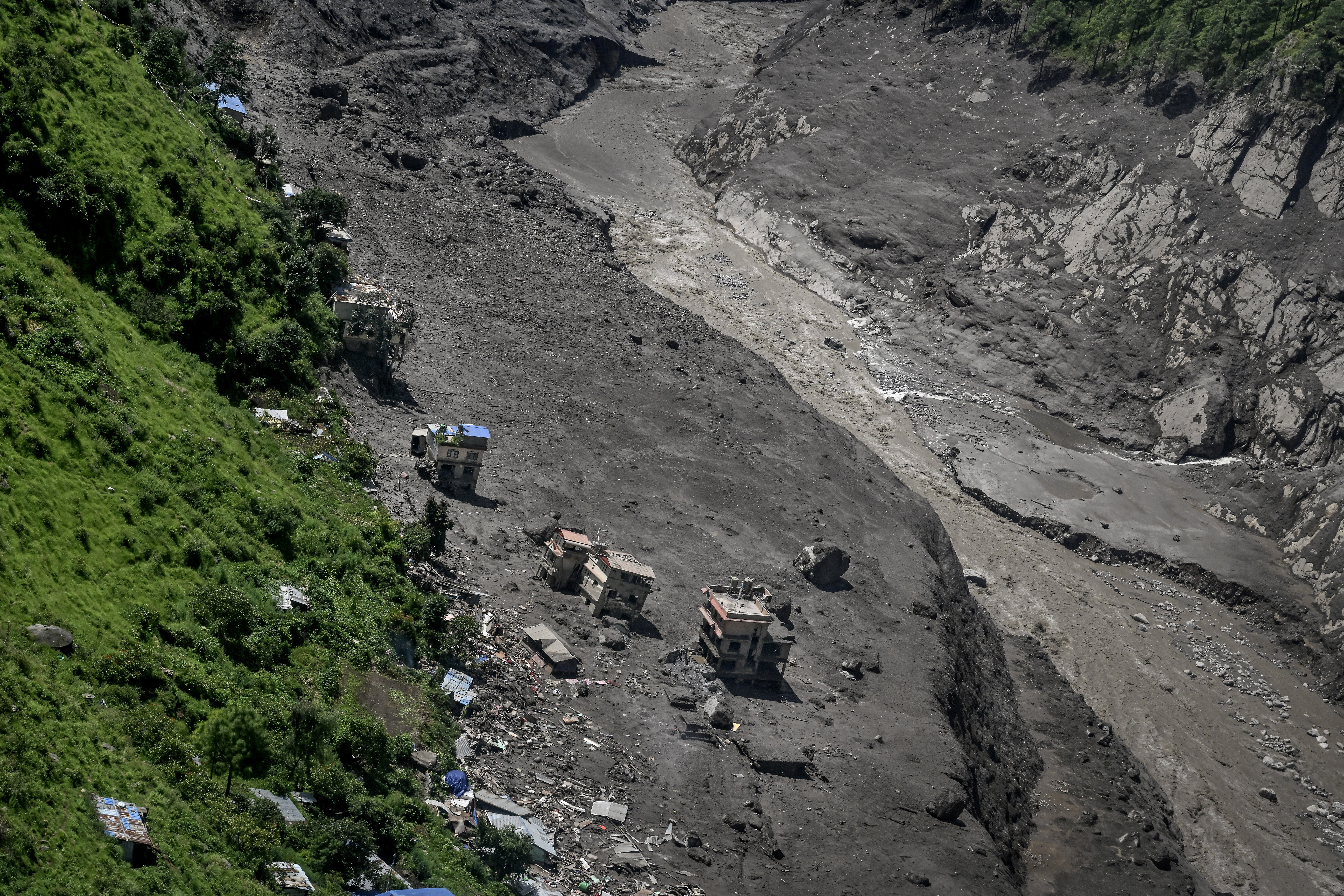
    Structures damaged by the giant torrent of water, mud and ice that swept through a remote river valley in the Rasuwa district near Nepal’s border with Tibet are seen on Thursday, Aug. 27, 2026. Emergency workers and helicopters scoured steep Himalayan valleys on Thursday in a desperate search for survivors after a torrent of water, mud and ice killed hundreds — and perhaps many more — as it swept through a river valley that runs through Tibet and Nepal. More than 1,400 people are still missing. (Atul Loke/The New York Times)ATUL LOKE
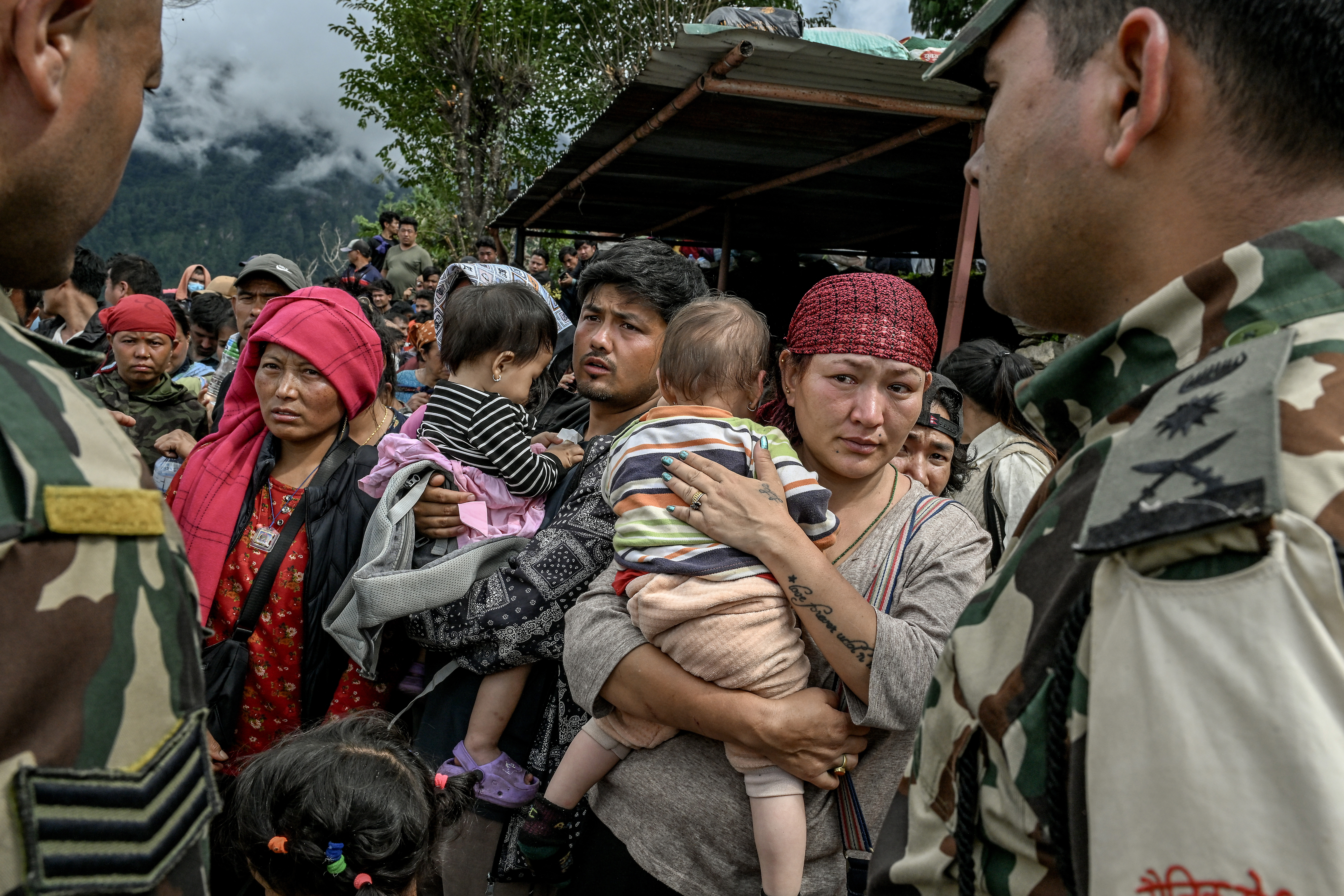
    People wait in line to board rescue helicopters in the disaster-stricken Rasuwa district near Nepal’s border with Tibet, on Thursday, Aug. 27, 2026. Emergency workers and helicopters scoured steep Himalayan valleys on Thursday in a desperate search for survivors after a torrent of water, mud and ice killed hundreds — and perhaps many more — as it swept through a river valley that runs through Tibet and Nepal. More than 1,400 people are still missing. (Atul Loke/The New York Times)ATUL LOKE
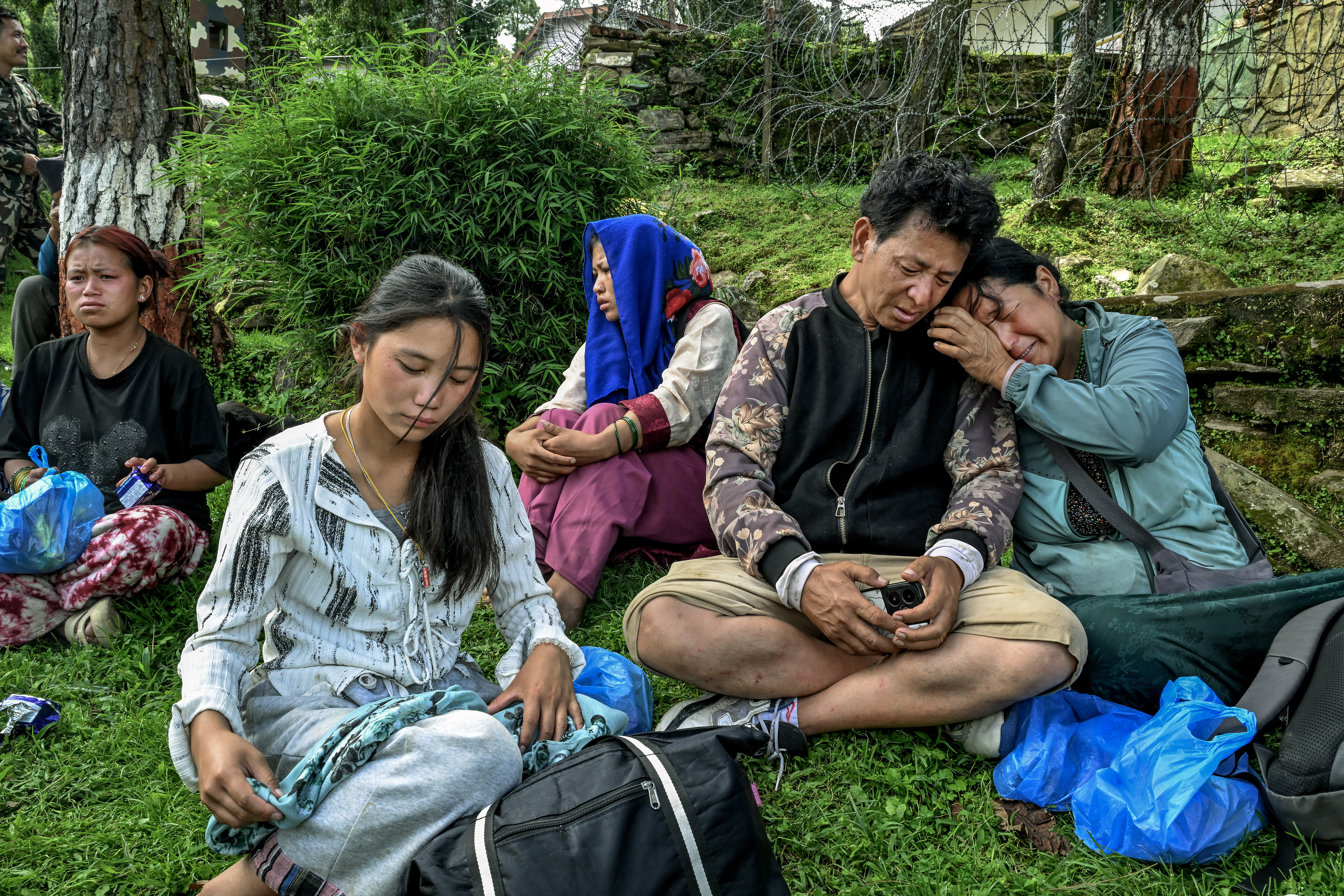
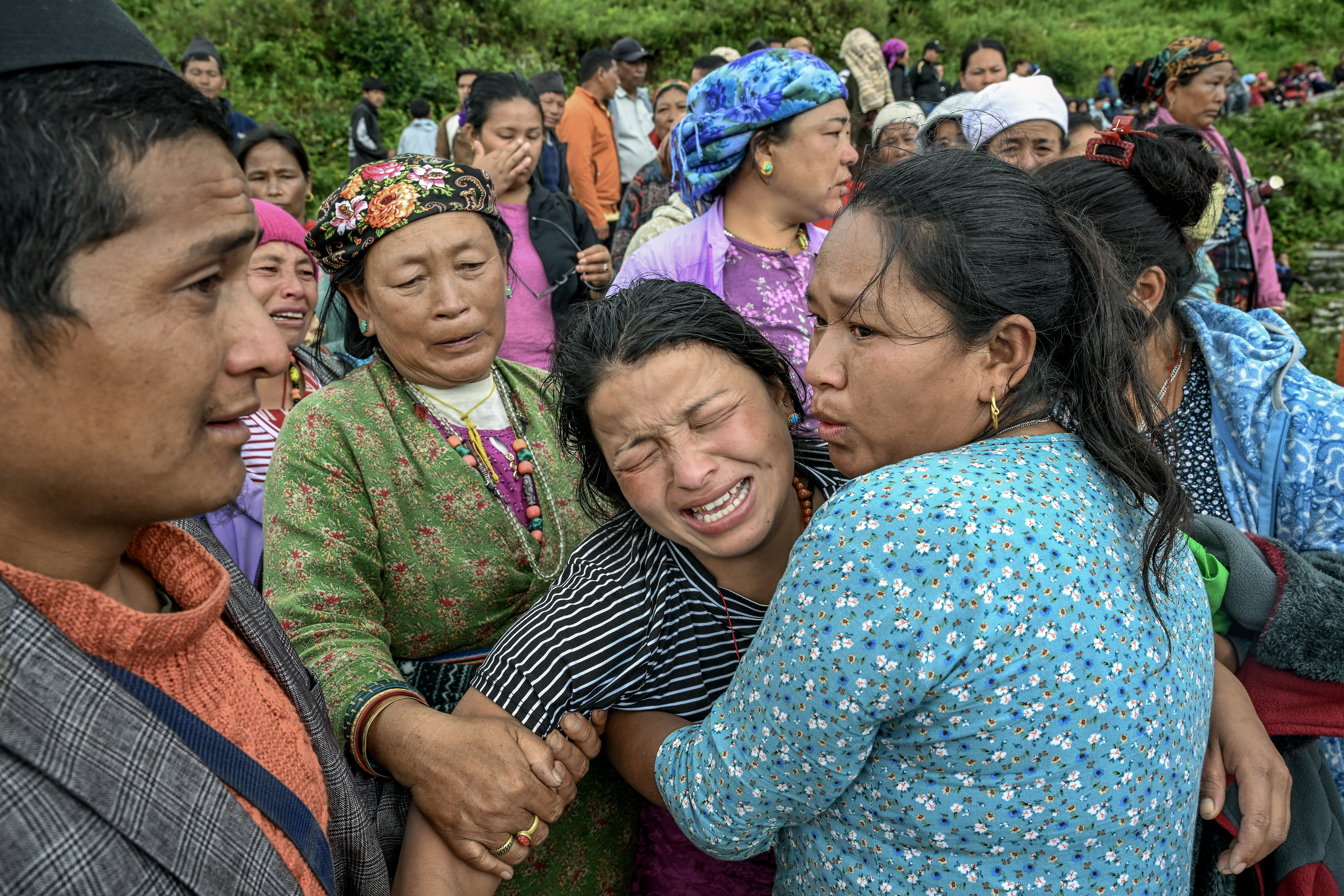
    A woman is overcome as she waits for his turn to board a rescue helicopter in the disaster-stricken Rasuwa district near Nepal’s border with Tibet, on Thursday, Aug. 27, 2026. Emergency workers and helicopters scoured steep Himalayan valleys on Thursday in a desperate search for survivors after a torrent of water, mud and ice killed hundreds — and perhaps many more — as it swept through a river valley that runs through Tibet and Nepal. More than 1,400 people are still missing. (Atul Loke/The New York Times)ATUL LOKE
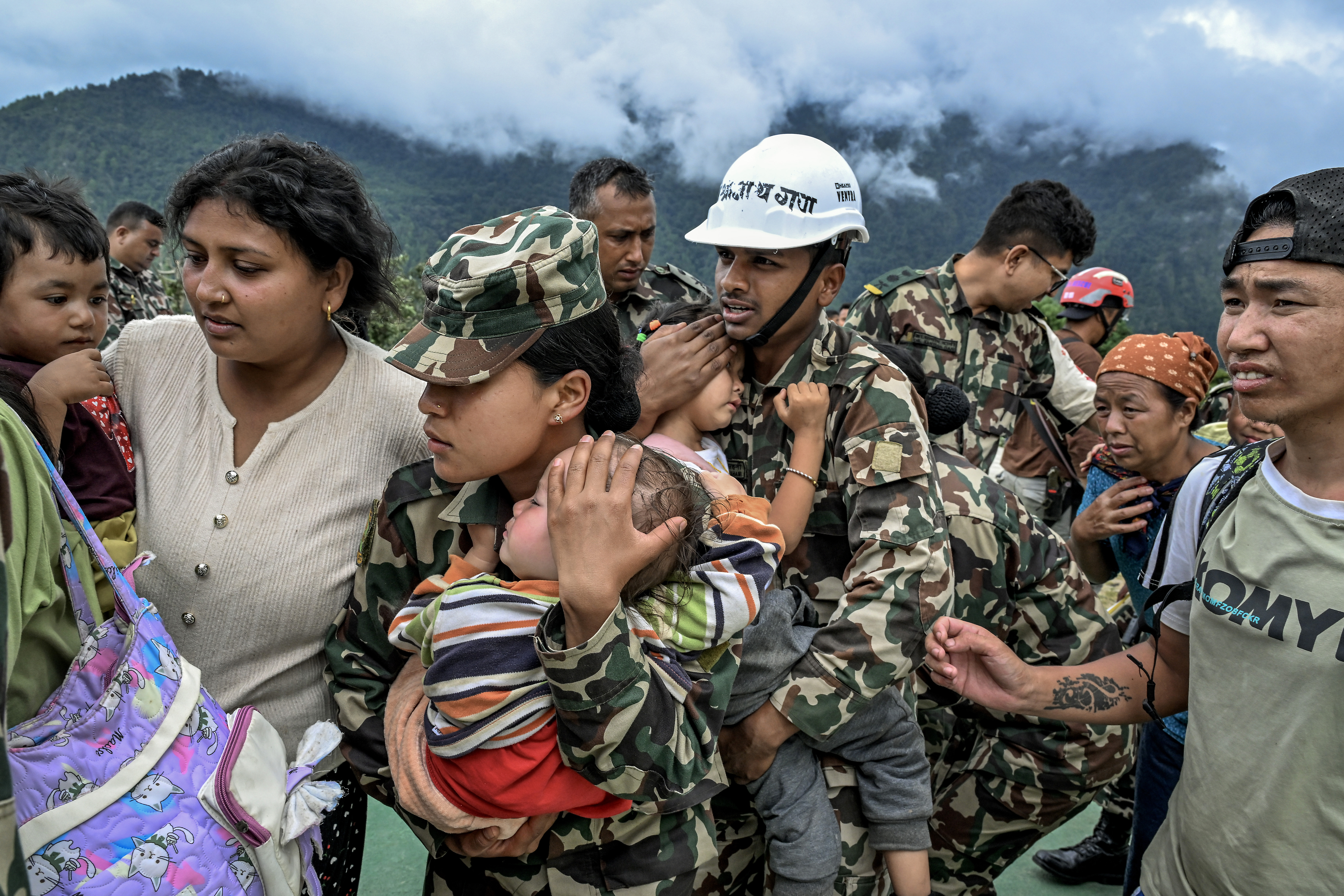
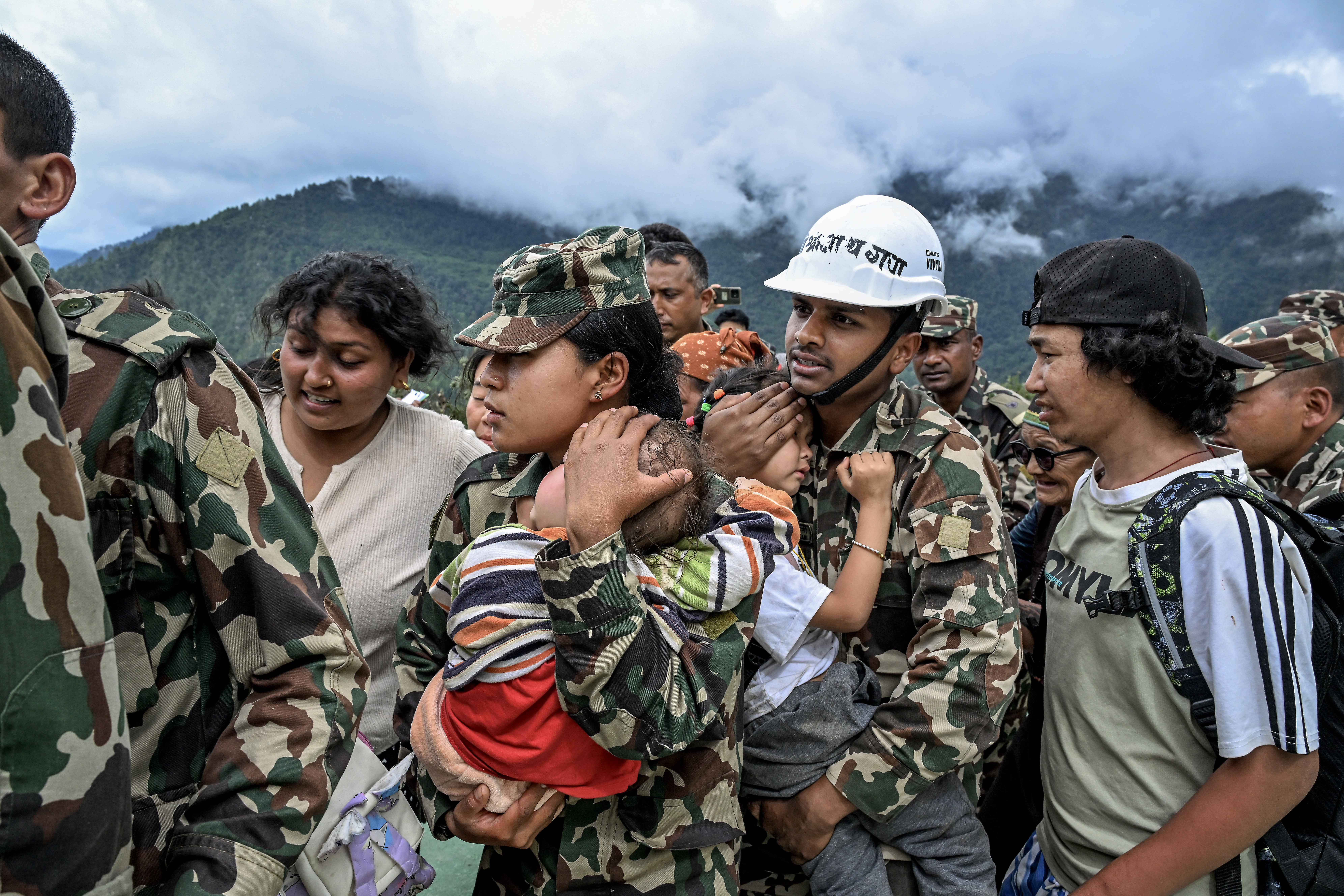
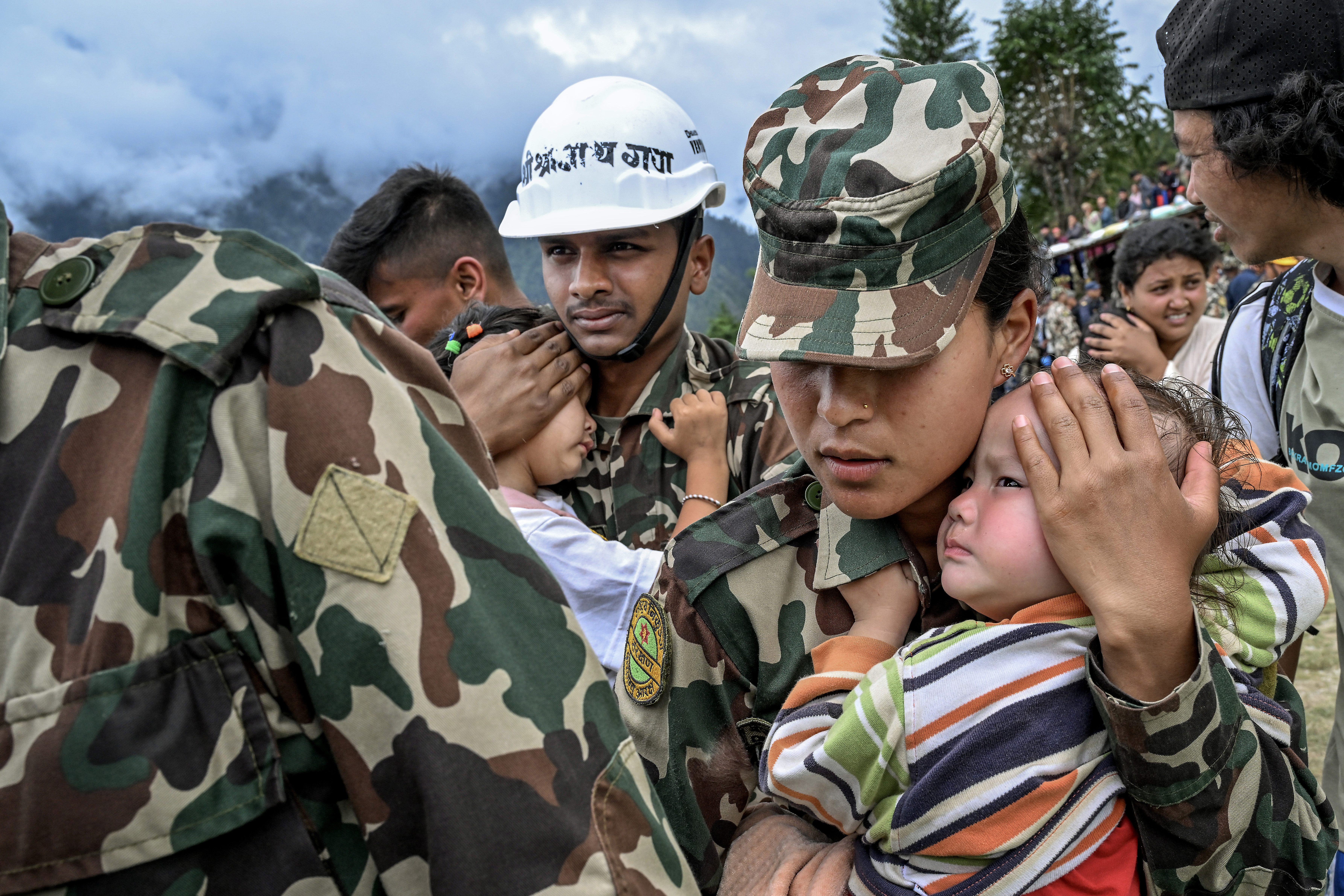
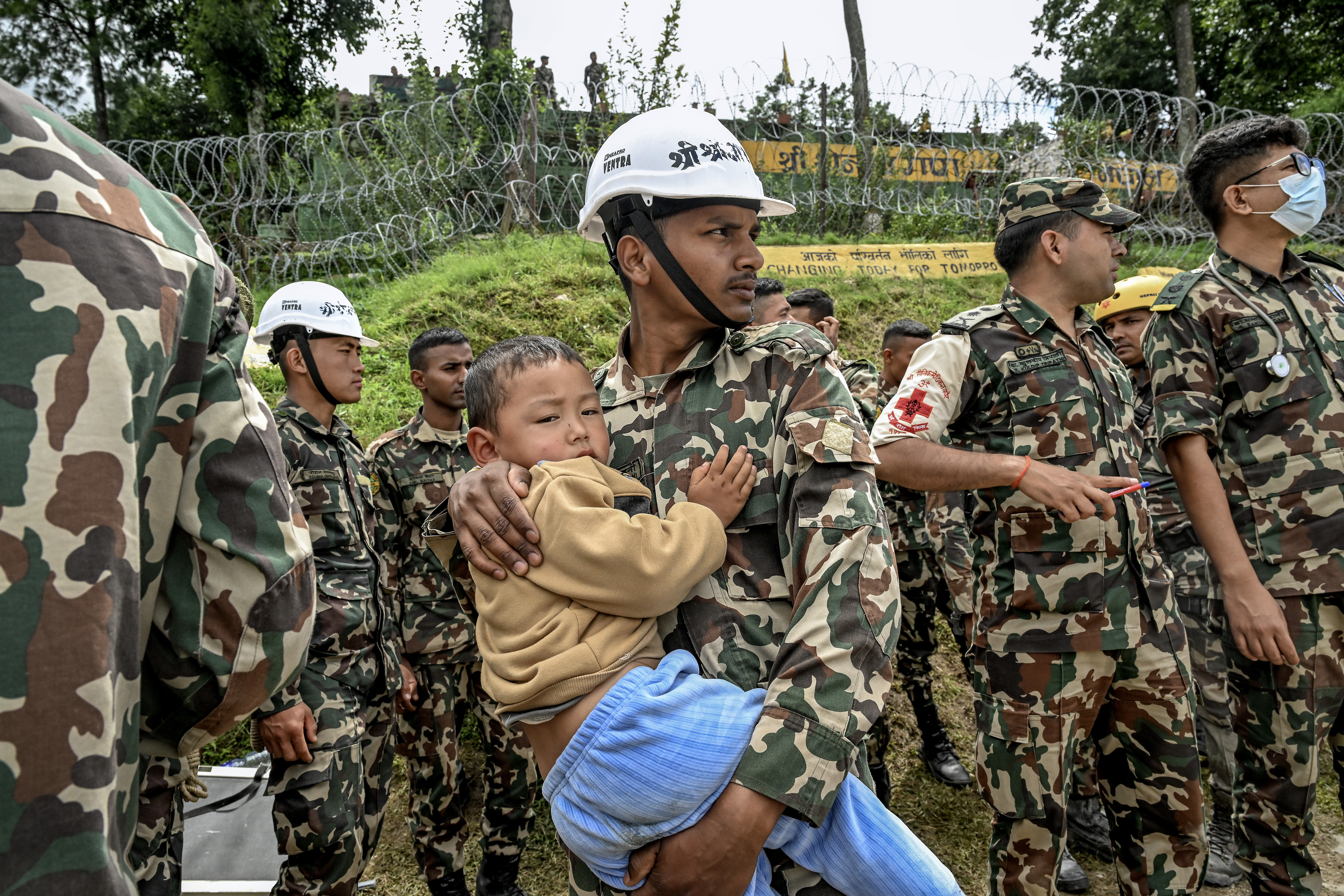
    Children are carried to a rescue helicopter by military personnel in the disaster-stricken Rasuwa district near Nepal’s border with Tibet, on Thursday, Aug. 27, 2026. Emergency workers and helicopters scoured steep Himalayan valleys on Thursday in a desperate search for survivors after a torrent of water, mud and ice killed hundreds — and perhaps many more — as it swept through a river valley that runs through Tibet and Nepal. More than 1,400 people are still missing. (Atul Loke/The New York Times)ATUL LOKE
    People wait in line to board rescue helicopters in the disaster-stricken Rasuwa district near Nepal’s border with Tibet, on Thursday, Aug. 27, 2026. Emergency workers and helicopters scoured steep Himalayan valleys on Thursday in a desperate search for survivors after a torrent of water, mud and ice killed hundreds — and perhaps many more — as it swept through a river valley that runs through Tibet and Nepal. More than 1,400 people are still missing. (Atul Loke/The New York Times)ATUL LOKE
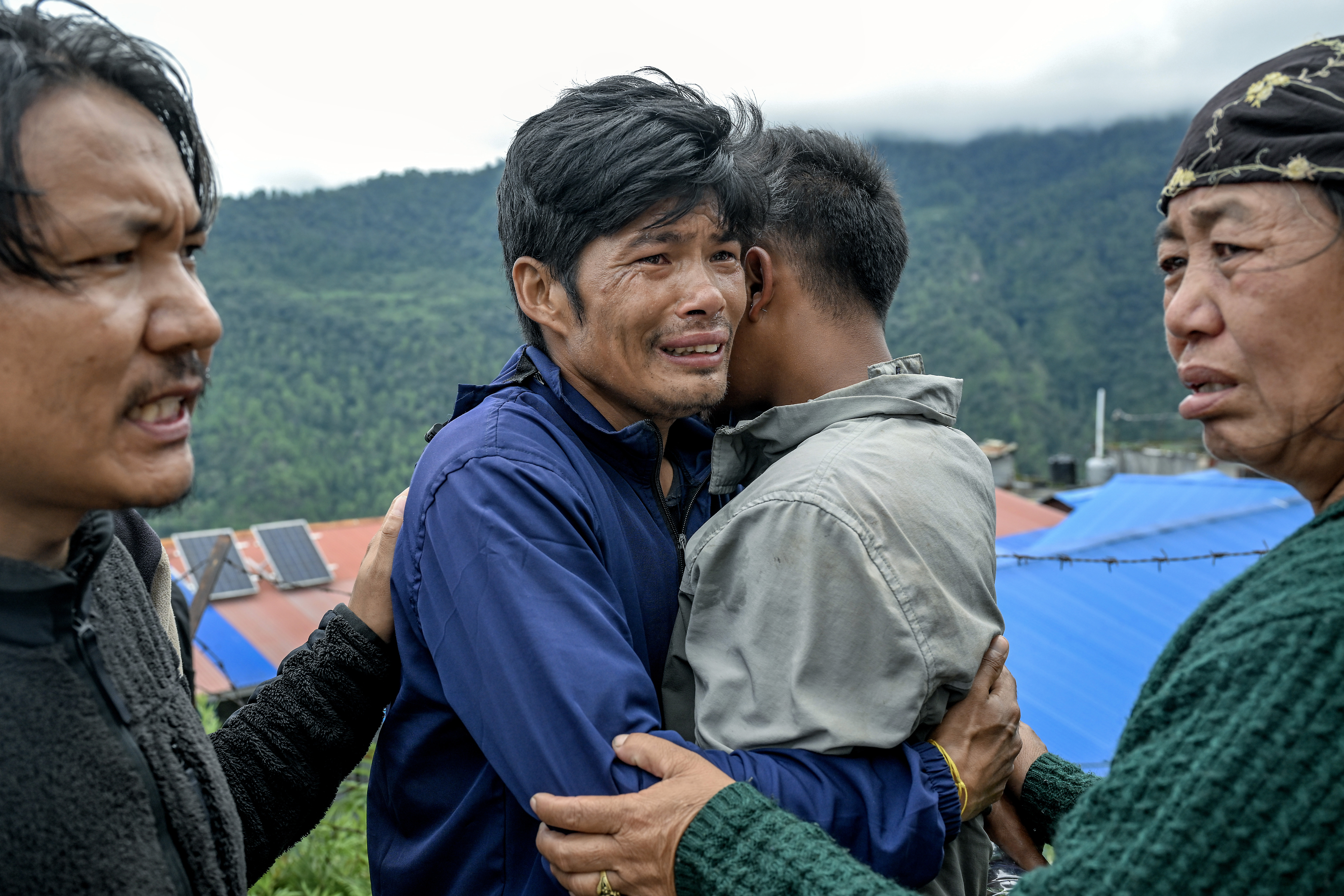
    A man is overcome as he waits for his turn to board a rescue helicopter in the disaster-stricken Rasuwa district near Nepal’s border with Tibet, on Thursday, Aug. 27, 2026. Emergency workers and helicopters scoured steep Himalayan valleys on Thursday in a desperate search for survivors after a torrent of water, mud and ice killed hundreds — and perhaps many more — as it swept through a river valley that runs through Tibet and Nepal. More than 1,400 people are still missing. (Atul Loke/The New York Times)ATUL LOKE
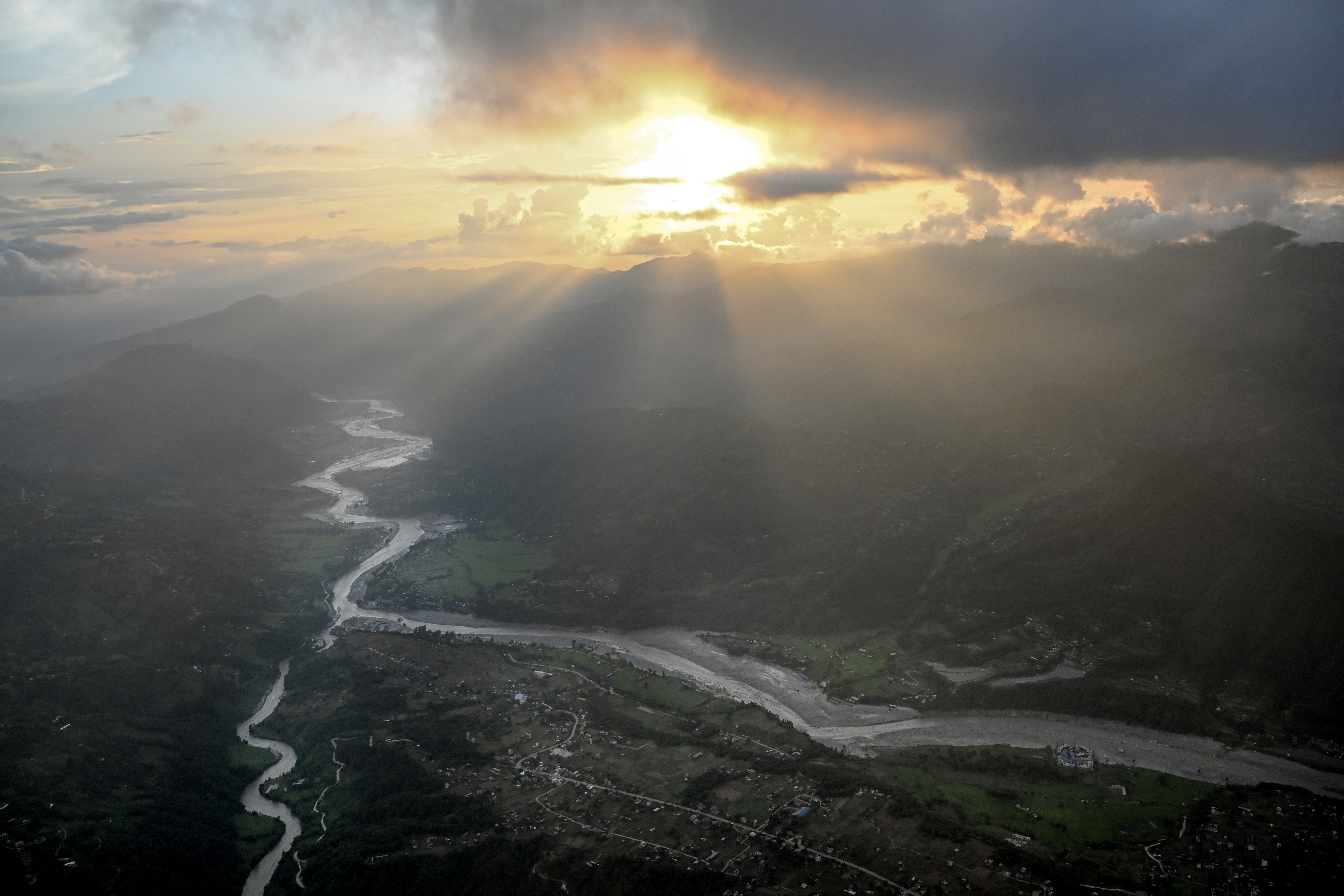
    The banks of the debris-choked Bhotekoshi River show signs of the giant torrent of water, mud and ice that swept through the remote river valley in the Rasuwa district near Nepal’s border with Tibet, on Thursday, Aug. 27, 2026. Emergency workers and helicopters scoured steep Himalayan valleys on Thursday in a desperate search for survivors after a torrent of water, mud and ice killed hundreds — and perhaps many more — as it swept through a river valley that runs through Tibet and Nepal. More than 1,400 people are still missing. (Atul Loke/The New York Times)ATUL LOKE
    The banks of the debris-choked Bhotekoshi River show signs of the giant torrent of water, mud and ice that swept through the remote river valley in the Rasuwa district near Nepal’s border with Tibet, on Thursday, Aug. 27, 2026. Emergency workers and helicopters scoured steep Himalayan valleys on Thursday in a desperate search for survivors after a torrent of water, mud and ice killed hundreds — and perhaps many more — as it swept through a river valley that runs through Tibet and Nepal. More than 1,400 people are still missing. (Atul Loke/The New York Times)ATUL LOKE
    A child is carried to a rescue helicopter in the disaster-stricken Rasuwa district near Nepal’s border with Tibet, on Thursday, Aug. 27, 2026. Emergency workers and helicopters scoured steep Himalayan valleys on Thursday in a desperate search for survivors after a torrent of water, mud and ice killed hundreds — and perhaps many more — as it swept through a river valley that runs through Tibet and Nepal. More than 1,400 people are still missing. (Atul Loke/The New York Times)ATUL LOKE
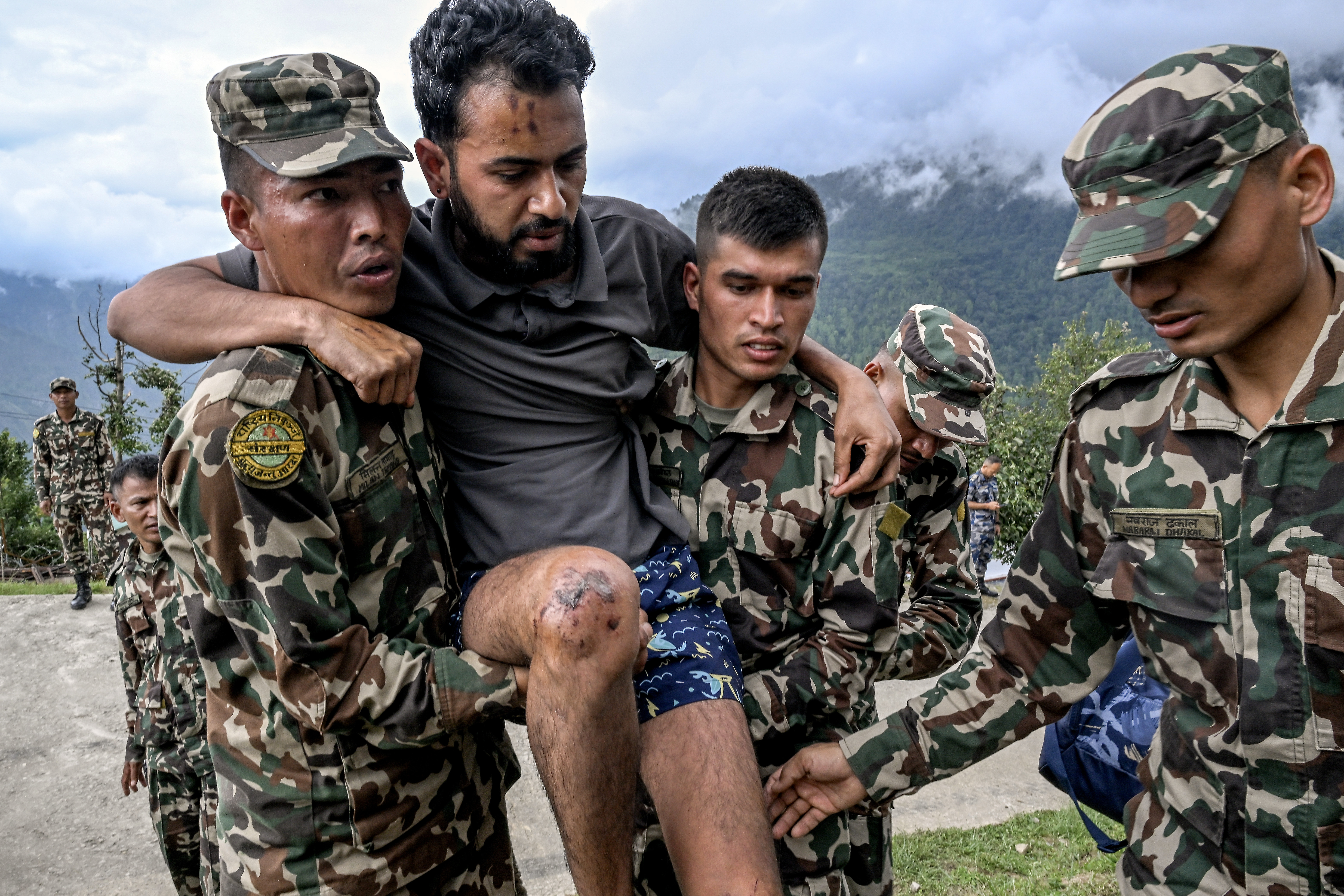
    Flooding survivors are assisted by military personnel as they walk to board a rescue helicopter in the disaster-stricken Rasuwa district near Nepal’s border with Tibet, on Thursday, Aug. 27, 2026. Emergency workers and helicopters scoured steep Himalayan valleys on Thursday in a desperate search for survivors after a torrent of water, mud and ice killed hundreds — and perhaps many more — as it swept through a river valley that runs through Tibet and Nepal. More than 1,400 people are still missing. (Atul Loke/The New York Times)ATUL LOKE
    Children are carried to a rescue helicopter by military personnel in the disaster-stricken Rasuwa district near Nepal’s border with Tibet, on Thursday, Aug. 27, 2026. Emergency workers and helicopters scoured steep Himalayan valleys on Thursday in a desperate search for survivors after a torrent of water, mud and ice killed hundreds — and perhaps many more — as it swept through a river valley that runs through Tibet and Nepal. More than 1,400 people are still missing. (Atul Loke/The New York Times)ATUL LOKE
    An injured man is carried to a rescue helicopter by military personnel in the disaster-stricken Rasuwa district near Nepal’s border with Tibet, on Thursday, Aug. 27, 2026. Emergency workers and helicopters scoured steep Himalayan valleys on Thursday in a desperate search for survivors after a torrent of water, mud and ice killed hundreds — and perhaps many more — as it swept through a river valley that runs through Tibet and Nepal. More than 1,400 people are still missing. (Atul Loke/The New York Times)ATUL LOKE
    The banks of the Trishuli River show signs of the giant torrent of water, mud and ice that swept through the remote river valley in the Rasuwa district near Nepal’s border with Tibet, on Thursday, Aug. 27, 2026. Emergency workers and helicopters scoured steep Himalayan valleys on Thursday in a desperate search for survivors after a torrent of water, mud and ice killed hundreds — and perhaps many more — as it swept through a river valley that runs through Tibet and Nepal. More than 1,400 people are still missing. (Atul Loke/The New York Times)ATUL LOKE
    A young flooding survivor is carried to a rescue helicopter by military personnel in the disaster-stricken Rasuwa district near Nepal’s border with Tibet, on Thursday, Aug. 27, 2026. Emergency workers and helicopters scoured steep Himalayan valleys on Thursday in a desperate search for survivors after a torrent of water, mud and ice killed hundreds — and perhaps many more — as it swept through a river valley that runs through Tibet and Nepal. More than 1,400 people are still missing. (Atul Loke/The New York Times)ATUL LOKE
  • Shackled Tate brothers in court asking to be released from jail during extradition fight

    Shackled Tate brothers in court asking to be released from jail during extradition fight

    MIAMI — Social media influencer Tristan Tate took the witness stand in federal court on Thursday and said he and his brother Andrew can’t adequately defend themselves from criminal sex charges if they have to remain in a Miami jail while fighting extradition to the United Kingdom.

    Lawyers for the Tates are asking a judge to allow them to be freed from custody at least until an extradition hearing can be held on their U.K. rape and trafficking charges. They have remained in a federal detention center in Miami since they were arrested July 18.

    Prosecutors say Tates bragged about wealth and multiple passports

    Prosecutors said they appear to have money and have bragged about multiple passports. Their attorneys argued that their high profile and active social media presence make it nearly impossible for them to flee, and they have shown they won’t run through cooperating in a separate sex crime case in Romania.

    The Tates have become among the world’s most polarizing internet personalities by promoting wealth, male dominance, and misogyny through their social media empire.

    Andrew Tate, 39, has said women who are sexually assaulted should bear some responsibility for the attacks and shared graphic descriptions of how he might attack women. Tristan Tate, 38, has worked with his brother on multiple businesses, including the production of online webcam pornography.

    No date for an extradition hearing has been set. The U.K. has until mid-September to provide evidence to the State Department.

    Tristan Tate says he needs to be out of jail to prove his innocence

    On his way into court Thursday, defense attorney Joseph McBride told reporters he hasn’t heard of a case where U.S. Magistrate Lauren Louis has allowed someone out on bail while awaiting an extradition hearing.

    But while the odds aren’t in their favor, McBride felt like the truth was. He called them innocent, good men who have never run from the law.

    In court, Tristan Tate was called to the stand Thursday and said he can’t prove he is innocent if he is kept in jail.

    “I need to clear my name. I need to take part in these proceedings, I can’t do that from the secure housing unit,” he said.

    Tristan Tate also complained of conditions at the Miami jail. He said there are ants and the only toilet in his cell is where anyone walking by can see him. He said he has lost 14 pounds eating mostly junk food in the nearly six weeks he has been in custody.

    The brothers were wearing tan prison clothes and shackled for Thursday’s hearing.

    Defense lawyers say the brothers have complied in Romania case

    Their lawyers said the U.K.’s request was out of line because their criminal case in Romania is going first. Romanian officials have let them remain free until the proceedings conclude and they have not tried to flee and are complying with all court restrictions.

    The judge reminded defense attorneys she has to follow U.S. laws.

    Attorneys for the Tates said they largely exaggerated their claims of wealth to boost their social media personas, their claims of multiple passports were satirical and a “$50 million superyacht” featured in one of the brothers’ videos does not actually belong to them. The expensive luxury cars, including a $2.1 million Aston Martin, that were featured in other videos were rented, the defense says.

    The brothers have long claimed that their violent and misogynistic statements have been taken out of context or were intended as jokes.

    “That is not the real Andrew Tate, the person Andrew Tate,” said his lawyer Howard Srebnick, who in court Thursday compared Tate on social media to Sacha Baron Cohen’s confrontational Ali G character.

    The former professional kickboxers, who have dual U.S. and U.K. citizenship, have millions of social media followers and are vocal supporters of President Donald Trump. The White House has said the brothers shouldn’t expect any help from the president.

  • Yayoi Kusama, who splashed polka dots across the art world, dies at 97 in Tokyo

    Yayoi Kusama, who splashed polka dots across the art world, dies at 97 in Tokyo

    TOKYO — Japanese artist Yayoi Kusama, who splashed her signature polka dots on paintings, sculptures and museum installations around the world, has died, her studio said Thursday. She was 97.

    Kusama died Aug. 14 at a hospital in Tokyo, Yayoi Kusama Studio said, without specifying the cause of death.

    “She continued to paint until her final days, never setting aside her brush, and continued exploration of forever love and eternal soul,” the studio’s statement said. “We will carry forward Kusama’s wishes and, through art, continue to bring hope and strength for the future to people around the world.”

    Kusama, one of Japan’s most respected contemporary artists, was widely exhibited around the world, including the Museum of Modern Art, the Whitney Museum of American Art in New York and the Museum Ludwig in Germany.

    Repetitive motifs were her trademark, in various shapes, resembling netting, swirls or worms, but most often dots, dancing proudly on her canvases, or as sparkling balls or dots of light in her installations, in all their vibrant psychedelic glory.

    “Polka dots are fabulous,” Kusama said in a 2012 interview with The Associated Press, appearing in her signature orange bob wig and polka dot attire.

    “I want to create a thousand paintings, maybe two thousand paintings, as many as I can draw,” she said in her childlike but matter-of-fact tone. “I will keep painting until I die.”

    Pursuing her vision of art over a lifetime

    Kusama insisted she drew the way she saw the world: covered with spots, part of the hallucinations she said she had from childhood. She was in and out of psychiatric institution for decades, although her sickness did not hold her back as she was one of the first Japanese women to go to New York to pursue her art, in 1957.

    Although soft-spoken and shy in her mannerisms, Kusama was always unabashedly bold in the assertion of her dotty vision, not only in sticking to the style for decades but also in making it accessible to the masses.

    In her later years, as the times caught up with her art, she enjoyed fame. She signed on with fashion brands like Louis Vuitton as well as other licensed products like teacups, T-shirts and key chains with her illustrations, including replicas of her likeness that were used in show windows and other marketing.

    In 2008, Christie’s auctioned her work for $5.8 million. In 2016, she won the most prestigious award Japan gives its artists, the Order of Culture.

    Upon receiving the award, she told reporters she was more determined than ever to pursue her art, stressing that the sincerity and devotion she had demonstrated in her personal life were crucial parts of her artistic legacy.

    “I feel there is little left in my life, but I am now still fighting to the death for my art,” she said. “I am giving all I have so that many people will continue to be interested in my art, even after I am dead.”

    Categories were not enough to represent her art

    Kusama was called pop, avant-garde, feminist, just to name some of the categories thrown at her, most of which Kusama brushed off as not quite representative of her art.

    She was born in a middle-class family but felt misunderstood, as her parents wanted her to simply get married. They wanted to buy her kimono, not paints and brushes. She knew she had to get away. She chose America.

    When she arrived in New York, the fad was “action painting,” characterized by dribbles, swooshes and smears, not dots. She suffered years of poverty and obscurity. But she kept painting dots.

    She put circles of paper on people’s bodies, and once a horse, in “happening” anti-war performances in the late 1960s, which got some people arrested for obscenity but helped get media attention for her art. While in New York, she befriended artists like Andy Warhol, Georgia O’Keeffe and Joseph Cornell, who praised her innovative style.

    Over the years, Kusama made quirky but stunningly celebratory works like “Macaroni Girl,” a female figure plastered with macaroni, which expresses the fear of food; “The Visionary Flowers,” giant sculptures of twisting tulips, and “Mirrored Corridor,” a room with mirrors that delivers an illusion of a field of phallic protrusions speckled with dots.

    Kusama, who has also made films and published several novels, said she wasn’t sure where she got her ideas. She just picked up her brush and started drawing. The process was so mysterious sometimes she surprised herself, she told AP.

    “I think, ‘Oh, I drew that? I was thinking that,’” she said.

    But she appeared happy to have her art be the focus of media attention and praise, reading one of her poems to a reporter or tackling her artworks with gusto for photos.

    But she was also a charmingly disarming mix of vulnerability and defiance, at one moment declaring herself “an artistic revolutionary,” and then the next, mumbling: “I am so afraid, all the time, of everything.”

    Fans around the world share messages of loss

    The news of her death was met with an outpouring of sadness from around the world, including museums that had exhibited her works.

    Fans and artists alike praised her courageous persistence in vowing to continue creating art that, she said, will be recognized thousands of years after her death.

    Messages recognizing her death were sent from people throughout Japan including Tokyo Gov. Yuriko Koike and Yoshitomo Nara, a younger Japanese artist who has exhibited widely abroad.

    “RIP Kusama-sensei,” Nara wrote on his X account, respectfully calling her a teacher in Japanese.

  • U.S. Patriot missile stocks in Europe are ‘beyond critical’ due to Iran war, officials say

    U.S. Patriot missile stocks in Europe are ‘beyond critical’ due to Iran war, officials say

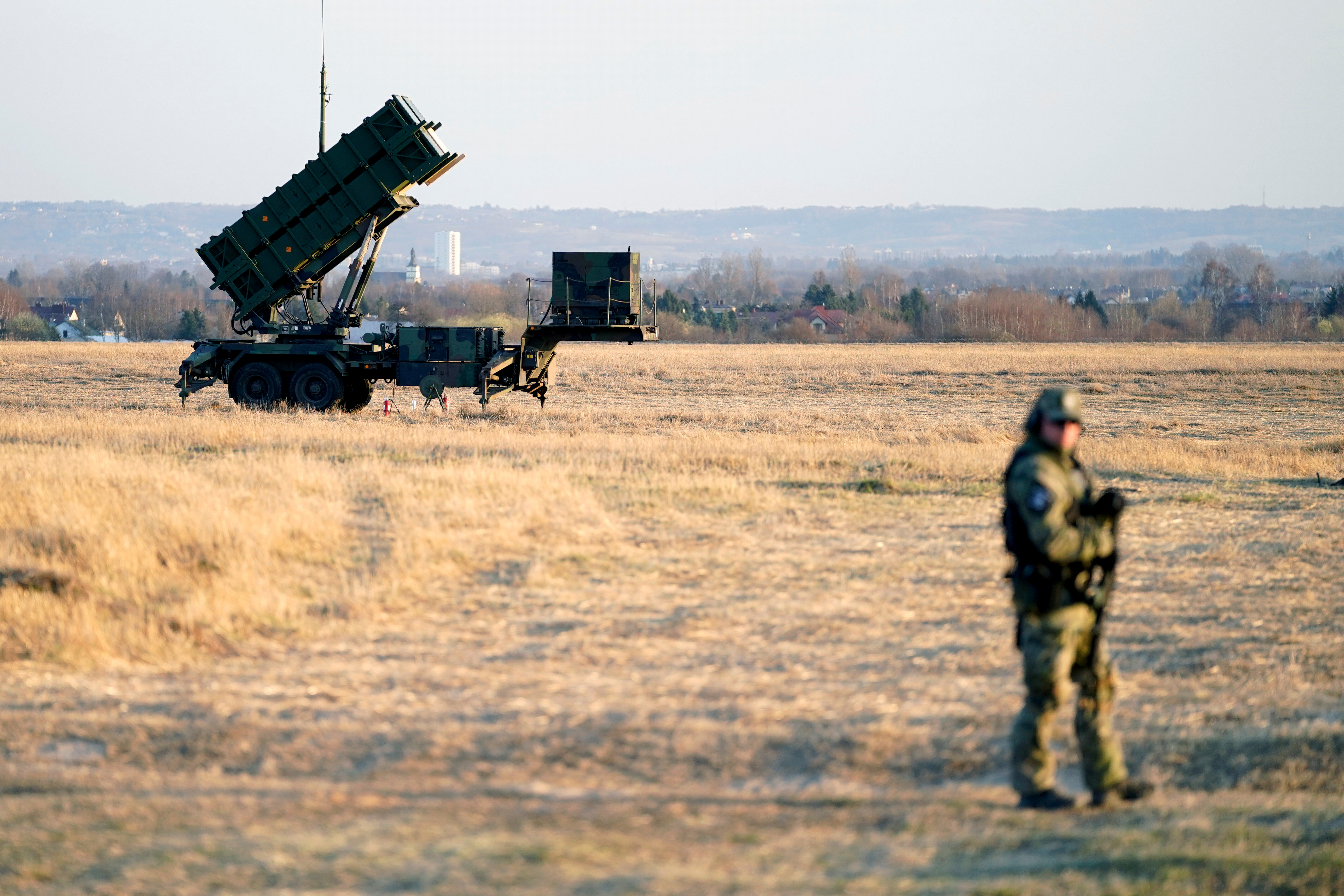
    WASHINGTON — The U.S. military is experiencing a “beyond critical” shortage of advanced missile interceptors in Europe largely driven by President Donald Trump’s war with Iran, a U.S. defense official in Europe and a NATO official told The Associated Press, raising concerns about vulnerabilities in NATO countries to a potential Russian attack.

    The U.S. defense official said the most concerning shortfall involves Patriot missile interceptors, which can shoot down Russia’s high-speed ballistic missiles. The NATO official confirmed the low inventories of Patriots among American and NATO forces in Europe. Both spoke on condition of anonymity to discuss sensitive military matters.

    In the event of a Russian ballistic missile assault on, for example, a military headquarters or power plant, NATO could be in a similar position to Patriot-starved Ukraine and be forced “to take punch after punch in the mouth,” the U.S. defense official said.

    In Europe, the American military “definitely” does not have enough Patriots to stop any possible sustained ballistic missile attack and would have “very limited” capability to defend against a single ballistic missile strike or a stray Russian missile that goes off course, the U.S. official said.

    It illustrates the cascading fallout from Trump’s decision to launch a war against Iran, a conflict that reaches the six-month mark on Friday. U.S. missile stocks in Europe have been moved to the Middle East, where U.S. and Gulf allies have fired off significant numbers of interceptors, including Patriots, to thwart Iran’s drones and missiles. Some of those attacks have killed and wounded American troops.

    Though a Russian ballistic missile attack against NATO countries is not imminently expected, CIA Director John Ratcliffe went to Moscow this week to warn Russia not to attack, The Wall Street Journal reported.

    Asked by reporters Thursday whether Ratcliffe delivered that message to Russian President Vladimir Putin, Trump offered a roundabout response.

    “I don’t want to comment on that, but they’re not going to attack,” Trump said.

    European and NATO officials say Russia could be in a position to attack countries in the alliance by 2030. Patriot stockpiles are projected to rebound by then. In the meantime, Russia’s war in Ukraine could hinder its ability to carry out any missile attack on Europe as it would be a challenge for Moscow to fight an air war on two fronts.

    U.S. Patriot transfers to Ukraine played a role in the drawdown, but the Iran war wasn’t expected

    U.S. Army Col. Martin O’Donnell, a senior NATO military spokesperson, said it is “simply not the case” that the number of Patriot missiles in Europe is beyond critical.

    NATO, he said, is able to “block punches” and has enough air defense munitions available to defend itself as well as to donate to Ukraine.

    Chief Pentagon spokesman Sean Parnell said in a statement Thursday that claims of U.S. munition shortages “are false.”

    “We have everything required to strike at the time and place of the President’s choosing,” Parnell said. “Across multiple combatant commands, we have already executed successful operations while maintaining a deep, ready arsenal to defend our people and our interests.”

    Officials in Ukraine, however, are begging for more Patriots to defend against Russian missile attacks, while previous U.S. transfers to Ukraine have drawn down some of the American supply of the interceptors.

    Kyiv says only U.S.-made Patriots can stop Russia’s advanced ballistic missiles, which increasingly are getting through Ukrainian defenses, including as part of a barrage overnight into Thursday.

    The U.S. supplied hundreds of Patriot missiles to Ukraine over the course of the 4 ½-year-long conflict, but the Iran war was the tipping point for shrinking inventories, said Ed Arnold, senior associate fellow at the Royal United Services Institute, a military think tank in London.

    The supply to Ukraine was planned for and reasonably measured, he said, whereas stocks in the Middle East have been unexpectedly and quickly drained, exposing supply chain constraints.

    The U.S. military in Europe also is grappling with critical shortages of the Army Tactical Missile System, or ATACMS, a medium-range ballistic missile designed to strike behind enemy lines, the two officials said. But the overall munitions picture in Europe is less dire than on air defenses alone because some European militaries have their own offensive missiles, such as the Taurus and Storm Shadow, which are both long-range air-launched bunker-busting missiles.

    Europe has few alternatives while stocks are low

    The dearth of Patriot interceptors in Europe would leave few alternatives for shooting down Russia’s more advanced ballistic missiles, which can be combined with swarms of inexpensive drones to overwhelm defenses, experts say.

    Ukraine and some allies already use systems that can destroy slower-moving drones without expensive missiles. But ballistic missiles are a challenge because they dive steeply toward targets at more than five times the speed of sound, leaving little time to stop them.

    The Patriot system tracks the missile, predicts its path and launches within minutes, all while carrying out complex calculations to ensure the interceptor finds its target. One Patriot battery can only cover a limited area: for example, a small military base but not a whole city.

    One alternative could be France and Italy’s SAMP/T NG air defense system. France has promised to speed up the delivery of the system — the upgraded version of the current SAMP/T — to Ukraine, which the manufacturer says is better able to counter ballistics.

    The new iteration, however, has not yet been battle tested and the current version of the SAMP/T has a smaller range than the Patriot.

    While U.S. and European militaries have warships that can serve as mobile air defense, they may be too far from a target to protect it and could risk getting sunk.

    Patriot stocks have plunged during the Iran war

    Ukraine has received Patriots from American and European stockpiles since Russia’s 2022 invasion, with the U.S. providing about 600 of the interceptors during the Biden administration, said Mark Cancian, a retired Marine colonel who is now senior adviser at the Center for Strategic and International Studies, a Washington think tank.

    But the greatest expenditure has been during the Iran conflict, which has used up 65% of U.S. Patriots, amounting to roughly 1,500 of the nation’s 2,330 interceptors, CSIS says. About 600 missiles, including those destined for Europe, should be made this year, with a production goal of 2,000 Patriot missiles a year set for 2030, Cancian said.

    NATO says Europe’s first Patriot missile production facility is expected to open in Germany in September, with deliveries possibly beginning early next year. The first deliveries should go to countries that have already placed orders, including Germany, the Netherlands, Romania and Spain, the U.S. defense official said.

    But for now, that means some countries, such as Germany, have bought expensive Patriot systems but are in the “ridiculous” position of not having any ammunition to fire from them, said Arnold of the London think tank.

    Germany’s defense ministry said it does not comment on stockpiles.

    Russia also has limitations

    Moscow likely cannot carry out a sustained air assault on a NATO target while it launches almost nightly attacks on Ukraine, Arnold said.

    Ukraine’s recent strikes into Russia also have exposed weaknesses in Russia’s air defenses, which could prompt Putin to think twice about provoking a retaliatory attack.

    “The uncomfortable truth is possibly the best air defense that we have is Russian constraints,” Arnold said.

  • Russia bombards 9 Ukrainian cities overnight, calling the strikes ‘massive’

    Russia bombards 9 Ukrainian cities overnight, calling the strikes ‘massive’

    KYIV, Ukraine — Russia bombarded cities across Ukraine with missiles and drones in an overnight onslaught that ran into the daylight hours of Thursday, when explosions echoed around Kyiv through the morning.

    Ukraine is desperately short of U.S.-made Patriot air defense missiles that can counter Russia’s ballistic missiles, and Moscow’s fast-flying jet-powered drones have brought another challenge since the Russian military’s full-scale invasion began 4½ years ago.

    Ukrainian officials say Russia builds up missile stocks and launches major attacks every few days, hoping to exhaust Ukrainian defenses through the sheer weight of numbers. In response, Ukraine has hit high-profile targets on Russian soil as the countries inflict mutual destruction.

    Russia says attack targeted war-related facilities

    The Russian Defense Ministry said its forces carried out a “massive” strike on targets in nine Ukrainian cities that began after nightfall on Wednesday. It described the targets as military-related, including industrial facilities, oil refineries, logistics hubs and port infrastructure.

    Civilian areas, including apartment buildings, suffered damage. The barrage killed a 78-year-old woman in the southern Zaporizhzhia region and another person in the northern Kharkiv region, with at least 14 people reported wounded elsewhere, Ukrainian officials said.

    “Russia continues to invest in missiles and in expanding its war, and that means more countermeasures are needed,” Ukrainian President Volodymyr Zelenskyy said on social media, noting promises earlier this week by European countries to provide more air defense assistance.

    “It is important that these (measures) are also supplemented by additional ballistic missile defense packages” through European purchases of weapons from the United States, he said.

    Though the Russian Defense Ministry insisted only war-related targets were attacked, Russia appears determined to hurt Ukrainian businesses and dent the country’s economy through attacks on private enterprise after Ukraine’s long-range drone strikes caused financial difficulties for Moscow.

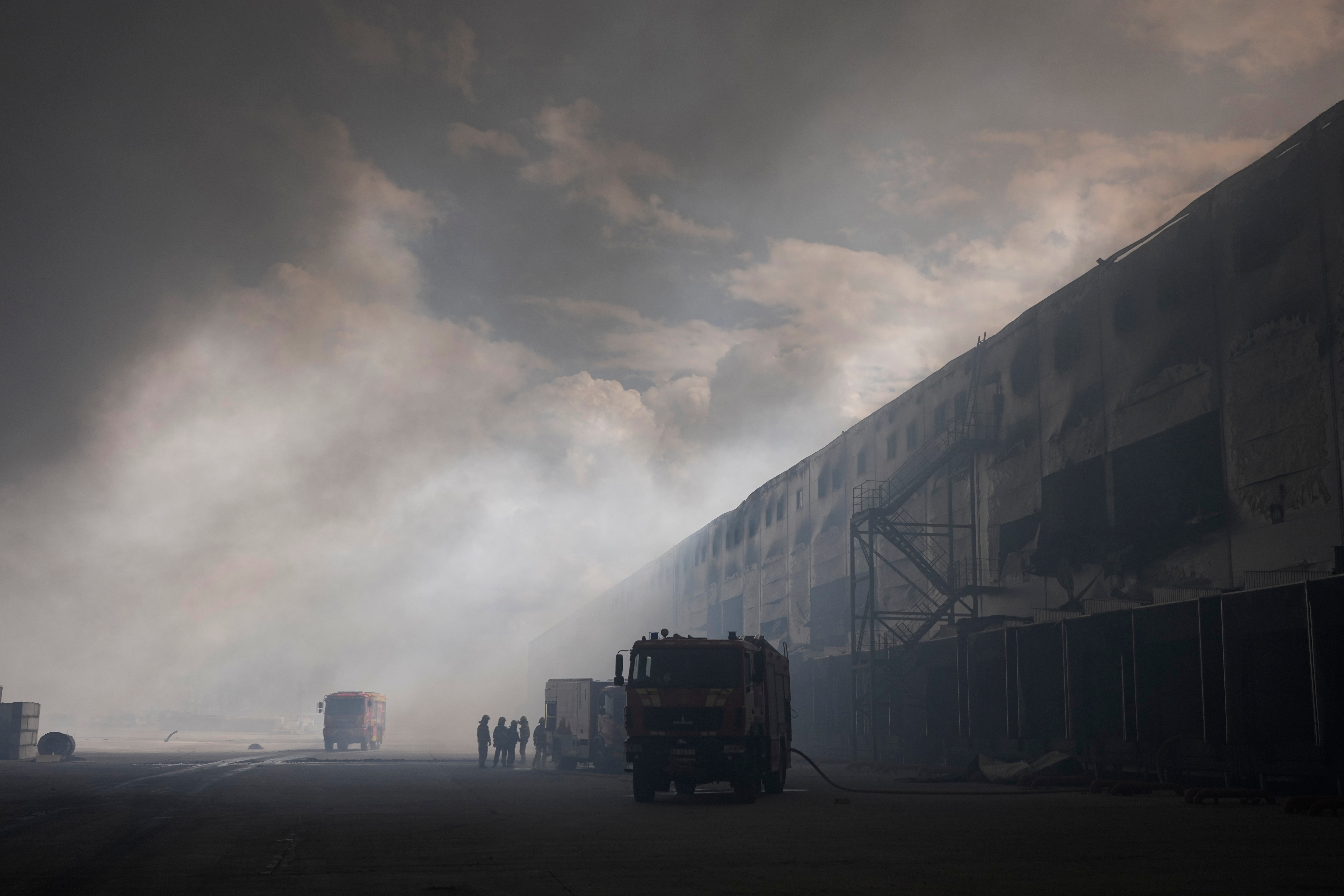
    Russian drones hit three major distribution centers, destroying depots belonging to a toy store chain and a confectionery company, and damaging another run by an electronics retailer, the companies said.

    In addition, Moscow continued its efforts to wreck the Ukrainian power grid before the freezing winter months.

    Four powerful glide bombs destroyed generating equipment at the southern Kherson region’s combined heat and power plant, forcing it to shut down, its operator Naftogaz said.

    Zelenskyy expected on official visit to neighboring Moldova

    Zelenskyy was due to visit neighboring Moldova on Thursday to mark its national day commemorating its 1991 declaration of independence from the Soviet Union. Ukraine announced its independence the same year.

    Russia’s neighbors in Eastern Europe are concerned its invasion of Ukraine could trigger a wider conflict, and drones flying into its airspace have fueled jitters.

    Moldova’s Ministry of Defense said Thursday that five drones breached its airspace overnight, but it didn’t specify who fired them.

    Ukraine’s air force said defenses shot down or suppressed seven Russian ballistic missiles, though it didn’t say how they achieved that.

    Four districts of Kyiv were hit during the night, damaging residential buildings, a school and a medical facility, though no casualties were reported, city police said.

    Russian forces struck industrial facilities as well as energy infrastructure in Ukraine’s central Poltava region, said Vitalii Diakivnych, head of the Poltava regional military administration.

    The southern Odesa region also came under a major Russian attack lasting more than seven hours, according to Oleh Kiper, head of the Odesa regional military administration.

    The barrage damaged a 16-story residential building and two educational facilities as well as a grain elevator, he said. Odesa is a key port for Ukraine’s vital exports of grain and other agricultural products.

    Some trains were delayed by more than 17 hours following the attack, according to Ukrainian state rail company Ukrzaliznysia.

    Ukraine takes aim at another Russian online retailer

    Ukraine has also fired hundreds of long-range drones almost nightly at targets in Russia.

    Ukraine’s General Staff said that plane-launched missiles hit Russia’s main and backup command posts near the eastern city of Donetsk, where Ukrainian defenders are under pressure from a Russian push.

    The Russian Defense Ministry said Thursday that its air defenses shot down 267 Ukrainian drones over 14 Russian regions, the illegally annexed Crimean Peninsula, the Sea of Azov and the Black Sea.

    After razing huge warehouses in recent months belonging to Wildberries, Russia’s biggest online retailer, Ukrainian drones are now taking aim at Ozon, the country’s second-largest e-commerce company.

    Ozon initially said that its logistics facilities in the cities of Orenburg and Ufa were attacked, but neither of the premises caught fire. A later alteration to the company statement said that only the Ufa site was attacked, while the Orenburg facility was evacuated because of an alert, but resumed normal operations.

  • Iran scrambles to sustain trade as U.S. threatens to sanction countries that refuse to break ties

    Iran scrambles to sustain trade as U.S. threatens to sanction countries that refuse to break ties

    BEIRUT — Iran’s economy, already strained by high inflation, years of Western sanctions, and a war that has sharply reduced oil revenue, is poised for more instability as the Trump administration tries to coerce other countries into ending all financial dealings with the Islamic Republic.

    A decision by the United Arab Emirates to suspend trade relations with Iran last week kick-started the White House’s latest attempt to isolate Tehran into submission. Iran entered the war with its foreign commerce concentrated among a relatively small group of countries, leaving it with fewer places to turn now.

    The success of the U.S. strategy will largely hinge on China, the main buyer of Iranian oil and its top trading partner. Russia, a fellow target of sweeping U.S.-led sanctions, has a military conflict and economic crisis of its own and probably can’t offer longtime ally Iran much hard financial support.

    Regional partners like Turkey, Pakistan, and Iraq maintain important relationships with both Iran and the U.S., giving them reason to avoid exposure to the secondary sanctions that Treasury Secretary Scott Bessent said awaited nations that did not cut economic ties with Iran.

    “Those who stand with the United States will reap the rewards of our partnership,” Bessent said Monday while outlining the plan he called “Operation Economic Outcast.” “Those who tether themselves to the Iranian regime should expect to share in the isolation.”

    The Emirates will be hard for Iran to replace as a conduit for foreign goods and payments

    Despite Western sanctions, Iran in 2024 exchanged $125 billion worth of goods globally, according to Trade Data Monitor, a private firm. Iran is not a member of the World Trade Organization.

    The bulk of its declared international trade, though, was with a handful of partners. The UAE, China, and Turkey supplied nearly three-quarters of Iran’s merchandise imports. Four countries — China, Iraq, the UAE, and Turkey — accounted for more than two-thirds of its non-oil exports.

    On the supply side, the UAE held outsized importance. It was Iran’s biggest source of imported items and a gateway to financial channels that helped Iranian businesses make and receive international payments. Both roles kept Iran connected to the global economy.

    As a re-export hub, the UAE processed shipments from foreign suppliers reluctant to deal directly with Iranian customers.

    “From Iran’s perspective, the UAE can be replaced, but the Iranians are openly saying it’s not going to happen overnight,” said Alex Vatanka, a senior fellow at the Middle East Institute in Washington.

    China has deep economic ties to Iran but depends less on the relationship

    Beijing has economic interests in the Persian Gulf beyond Iran, and so far has avoided getting drawn into the conflict the U.S. and Israel initiated. China buys the overwhelming majority of Iran’s crude through opaque trading networks that bypass sanctions.

    Its manufacturing clout and stranglehold on critical mineral supplies nonetheless give Beijing more room than Iran’s other partners to resist U.S. pressure, said David Lubin, a senior research fellow at Chatham House. Aggressive action against major Chinese banks and businesses could revive trade tensions as Chinese leader Xi Jinping prepares to meet with President Donald Trump in Washington next month.

    “I don’t see China playing ball by any means,” Lubin said.

    China is both Iran’s largest reported export market and a supplier of essential parts and products, according to WTO and U.N. data.

    During the Obama administration, Beijing did agree to reduce energy imports from Iran, said Atlantic Council fellow Daniel Fried, a former U.S. ambassador to Poland.

    “We will want the Chinese to go a lot farther than they have gone in the past,” Fried said. “But it’s a lot harder now.”

    China has experience helping an ally survive sanctions: it has long been North Korea’s economic lifeline and main diplomatic backer. Experts say China has avoided fully enforcing U.N. sanctions on North Korea and sent clandestine aid to help its impoverished neighbor stay afloat.

    Expanding bilateral trade would create problems for Iran’s neighbors

    Iranian Parliament Speaker Mohammad Bagher Qalibaf, who has been his country’s lead negotiator over the past six months, was in Iraq the day of the UAE’s trade suspension. A purpose of his visit, he said, was “speeding up efforts to expand joint cooperation among all countries in the region, without foreign interference.”

    The U.S. dollar’s preeminence in international trade and finance, however, means none of Iran’s trading partners would antagonize Washington lightly, Vatanka said. “We’re still at a point where if the U.S. wants to hurt you, it will matter,” he said.
    Underscoring potential consequences, Turkey settled a yearslong U.S. dispute in July over the role of a state-owned bank in helping Iran evade sanctions through an oil-for-gold scheme. Trump also moved to lift sanctions on its fellow NATO member stemming from Turkey’s purchase of a sophisticated Russian missile system.

    “I really don’t think Turkey would like to become the next country helping Iran to evade sanctions right now,” said Riccardo Gasco, an analyst at the IstanPol think tank in Istanbul.

    Iran is a vital import source for Iraq and retains influence there through allied political factions and armed groups. Baghdad has sought closer economic and security ties with Washington. Since it invaded Iraq in 2003, the U.S. has significant control over the nation’s foreign currency reserves because they are housed in the Federal Reserve Bank in New York.

    Oman, a frequent intermediary between Washington and Tehran, has found its balancing act suddenly precarious. Trump threatened Oman last week over its ongoing negotiations with Iran on the future management of the Strait of Hormuz.

    One easy route for goods slipping past sanctions on Iran would be ports like Gwadar near the Persian Gulf in Pakistan, said Peter Harrell, a visiting scholar at Georgetown University.

    “Ship an intermodal container of drone parts to one of the ports in western Pakistan and unload it onto a truck and have it driven across the border into Iran,” he said.

    While Pakistan, a key ally and economic partner of China in the region, wants to increase trade with Iran, it faces competing pressures. It is serving as a key mediator between Tehran and Washington and has deep security ties with Saudi Arabia, Iran’s longtime regional rival.

    Caspian Sea trade route alternatives unlikely to grow quickly

    With the Strait of Hormuz mostly blocked and Russia’s war with Ukraine endangering ships on the Black Sea, Iran has sought to develop a “road of life” on the Caspian Sea, said Nikita Smagin, an independent analyst and a former Russian state news agency correspondent in Tehran.

    Russia reportedly sent drones to Iran this year, repaying Tehran’s favor after Moscow’s full-scale invasion of Ukraine. It also rerouted exports to Iran via Caspian Sea ports like Astrakhan. Agricultural products make up 80% of Russia and Iran’s reported trade.

    “Both economies are exporting natural resources and have little to offer each other,” Smagin said.

    The other countries that border the Caspian — Azerbaijan, Turkmenistan and Kazakhstan — probably won’t rush to join in, said Umud Shokri, a fellow at George Mason University.

    Yet Russia and Iran are already in an “axis of the sanctioned,” said Mark Galeotti, executive director of the Mayak Intelligence firm. For decades the pair have collaborated to thwart trade restrictions, and increasing bilateral trade in both “strategic goods” and contraband like military technology, microchips and Gucci handbags could be a next step.

    “Pomegranates and tomatoes only go so far,” he said.