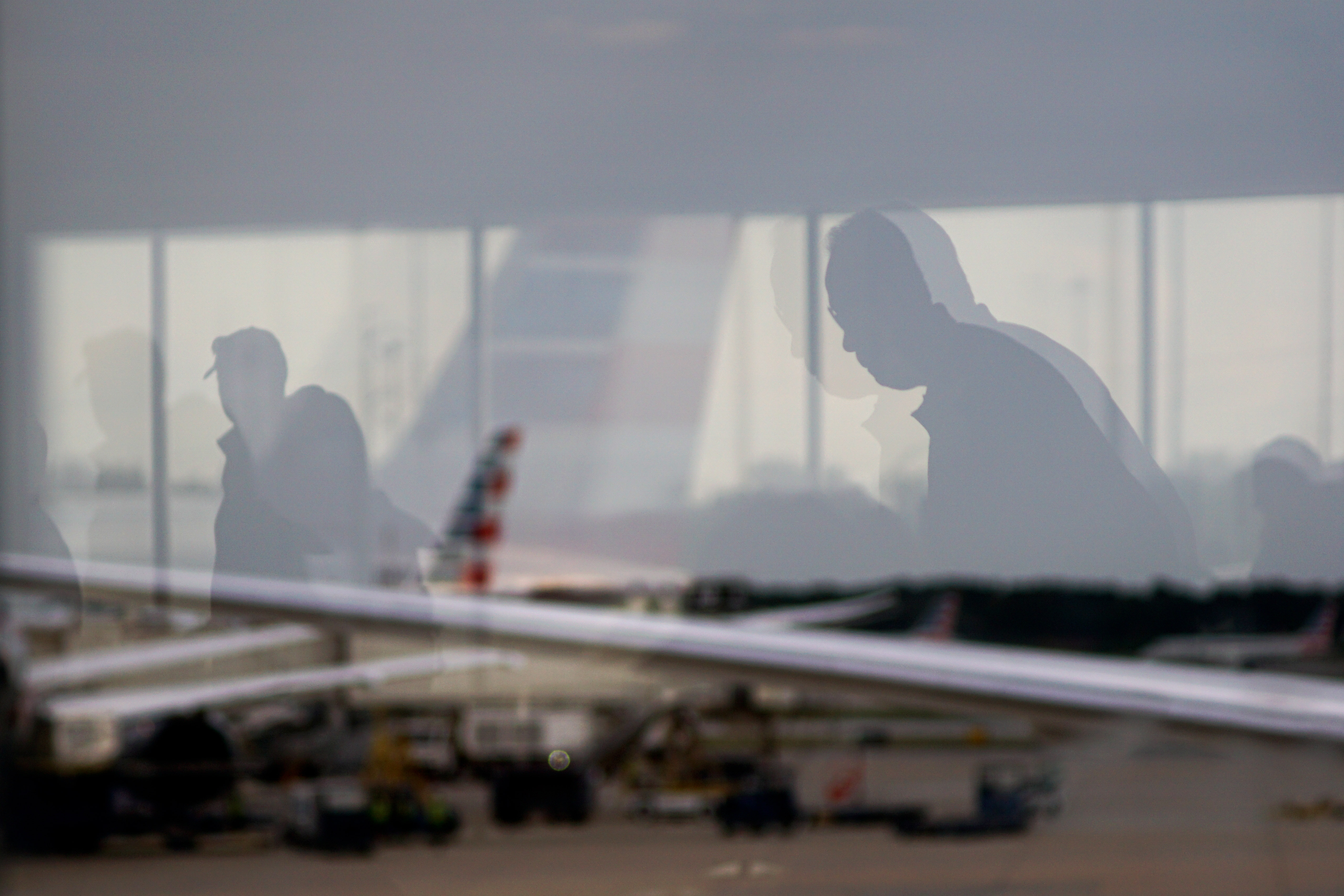
The airport exposure occurred in Terminals B and F, and in areas connecting to Terminals C, D, and E, on Sunday, Sept. 13, from 7:25 p.m. to Monday, Sept. 14, at 12:05 a.m.
A person with measles was traveling through Philadelphia and stayed in the airport, according to the health department. Officials are encouraging anyone who may have been exposed to check their vaccination status and monitor symptoms.
“Anyone who is not immune, is unsure of their vaccination status, is an infant, is pregnant and not immune, or is immunocompromised should contact a healthcare provider as soon as possible,” the department said in the release on Saturday, adding that some people may still be eligible for treatment that can prevent the disease or reduce its severity.
Officials are urging anyone experiencing symptoms to call ahead before visiting a healthcare facility and notify the provider about the exposure.
“This week’s measles exposures are a reminder of how important it is for all of us to be up to date on our vaccinations,” city Health Commissioner Palak Raval-Nelson said in the statement. “Every Philadelphian who is fully vaccinated has little to fear from the situation at CHOP and the airport. Even more importantly, every one of those people is doing their part to help protect our most vulnerable from measles.”
Raval-Nelson is encouraged residents to visit the city’s website, phila.gov/measles, to learn more about measles and the MMR vaccine.
Pennsylvania’s measles outbreak, the largest in the nation this year, has sickened more than 760 people. The state has confirmed four measles-associated deaths, the most seen in the nation in more than three decades.
The state’s outbreak is centered in Lancaster County, right outside of the Philadelphia region, and measles is actively spreading in suburban Chester County. The widening outbreak has affected more than half of Pennsylvania’s 67 counties.
Two doses of the measles, mumps, and rubella vaccine have proven 97% effective at preventing the disease, the Centers for Disease Control and Prevention says.
Nine in 10 unvaccinated people exposed to measles will acquire the disease.
Typical measles symptoms include a high fever, a cough, runny nose, red, watery eyes, and a rash. Measles can cause severe complications, especially in young children, including pneumonia and brain swelling. While deaths are rare, about three in 1,000 children who contract measles will die.
Measles, long considered eradicated in the United States, is resurging amid declining vaccination rates. Scientists say that about 95% of a community should be vaccinated to prevent spread.
In the Philadelphia region, at least 40% of kindergartens were vulnerable to an outbreak as of last school year, up from 33% the prior year, according to an Inquirer analysis of school immunization data widely used to assess community protection levels.
Leah Santos still wears a mask during her daily Regional Rail commute into Philly.
The 35-year-old nurse from Springfield, Delaware County, never stopped implementing COVID-19-era precautions. And she’s just as careful with her 1-year-old son.
So when Santos learned in May about the growing measles outbreak in nearby Lancaster County, she started asking a new question of friends and family who regularly make excursions around the region for shopping and dining: Have you been to Lancaster lately?
“I have a child to protect at all costs. So I’m making sure I’m not in contact with anyone who’s been traveling out to Lancaster,” Santos said.
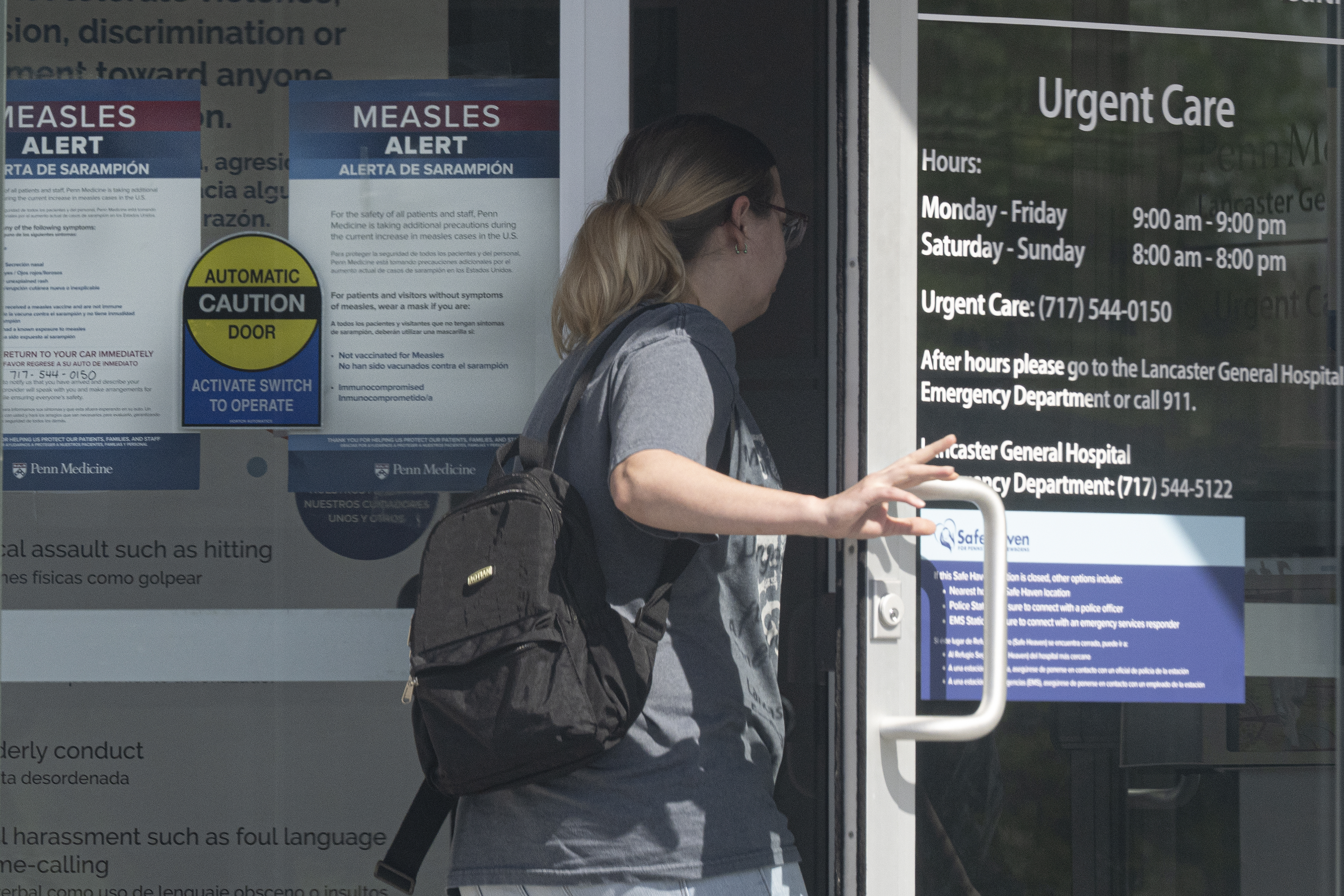
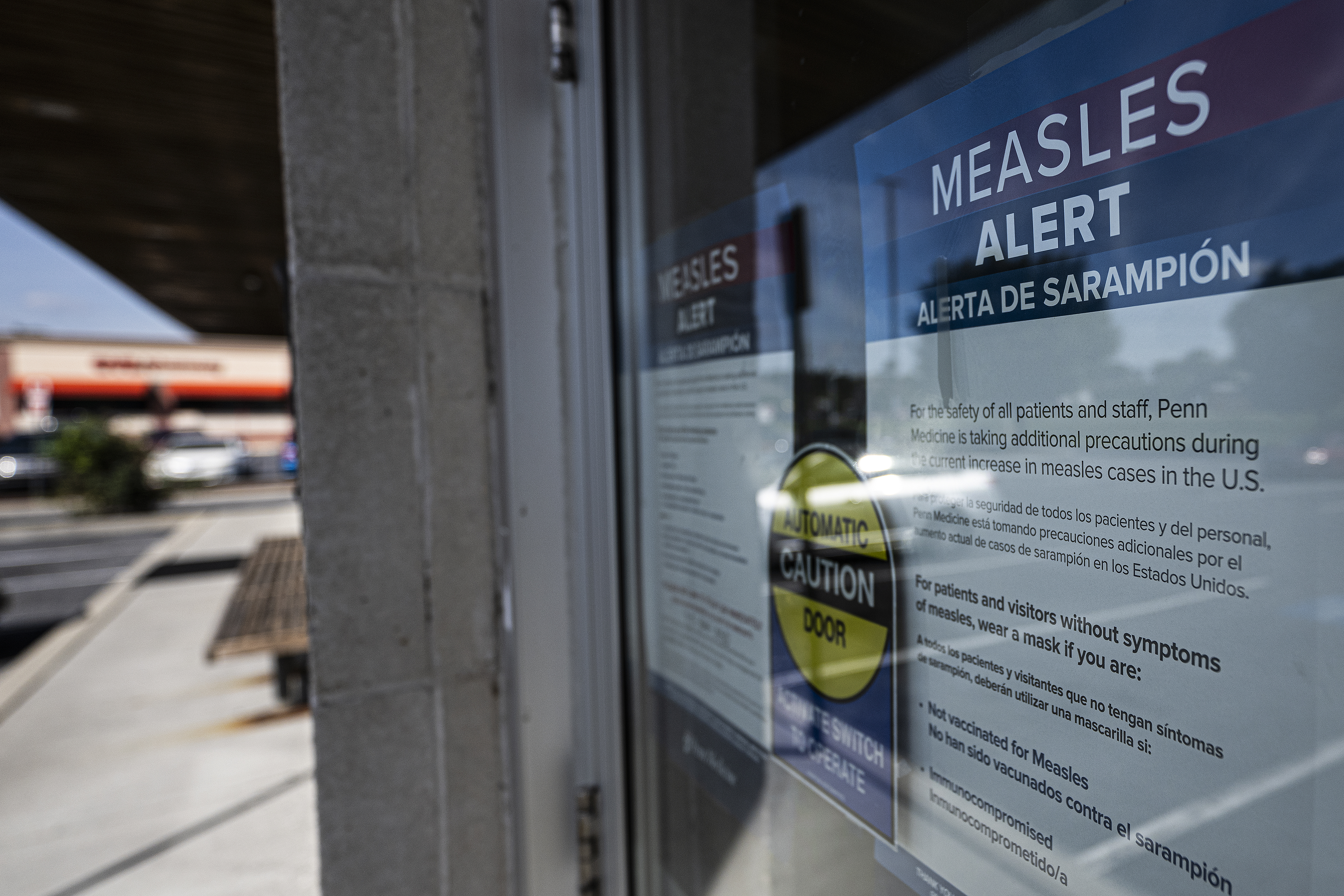
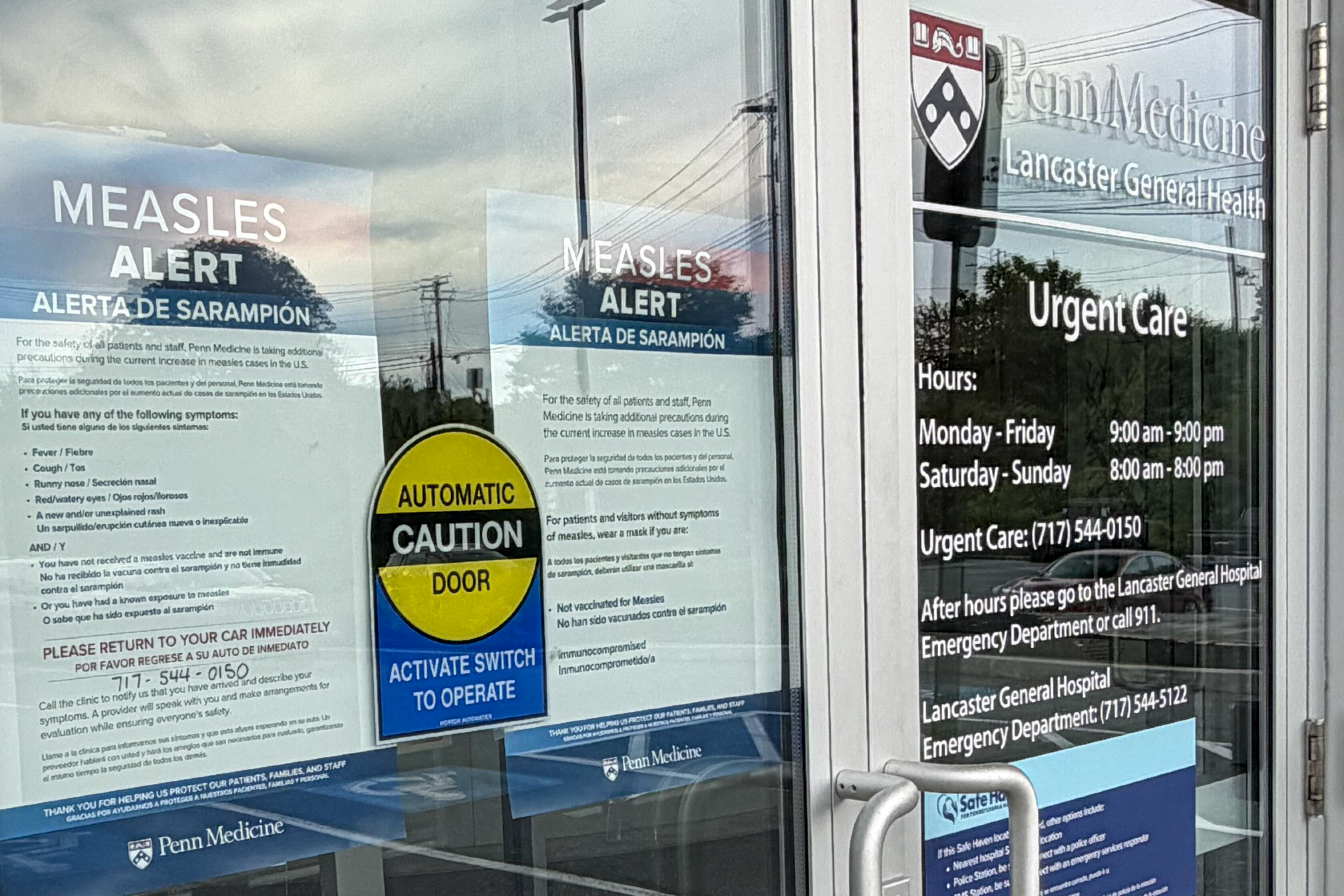
Measles alert signs in English and Spanish are posted on the front doors of an urgent care facility this month in Lancaster County amid a measles outbreak that has affected local Amish and Mennonite communities.Jose F. Moreno / Staff Photographer
A spreading measles outbreak in Pennsylvania has sickened 767 people already this year, and hospitalized 45 children under age 18. State officials have announced fourdeaths related to the outbreak: two infants in Lancaster County, a 40-year-old in Jefferson County, and an 18-year-old in Mifflin County.
Chester County remains the only Philadelphia-area county with confirmed cases — more than 65 this year, the third-highest in the state.
But in a densely populated region where crossing county lines for work and socializing is the norm, someworried parents are vaccinating babies early, delaying daycare, and weighing the risks of attending crowded festivals with their kids or visiting family in affected areas.
Measles can be more dangerous for some
Young children are especially at risk from the vaccine-preventable disease, which in severe cases can cause pneumonia, blindness, and brain swelling that can lead to brain damage.
None of the Pennsylvania residents who died were vaccinated against a virus so contagious that it will infect nine in 10 unvaccinated people who are exposed.
Measles deaths are rare,and the four deaths confirmed as “measles-associated” by Pennsylvania health officials, sparked a political standoff between Democratic Gov. Josh Shapiro and President Donald Trump’s Health Secretary, Robert F. Kennedy Jr., a longtime anti-vaccine activist.
Experts say that life shouldn’t change much for families whose children are vaccinated and otherwise healthy. But it’s important to take the disease seriously at a time when declining vaccination rates have left communities across the state increasingly vulnerable, including in the Philadelphia region.
Even as countywide immunization levels in the area remain relatively high, hundreds of kindergartens across Philadelphia and four surrounding suburban counties dropped below the “herd immunity” threshold — a vaccination rate of 95% or higher — for the 2025-26 school year, an Inquirer analysis of state data found.
This is the level at which a given population must be fully vaccinated against measles to prevent the spread of disease. In the Philadelphia region last school year, about 40% of kindergartens failed to meet that threshold, up from about a third the year before.
What are the pediatric guidelines to protect against measles?
Pediatricians typically recommend a child’s first vaccine for measles, mumps, and rubella at 1 year old, unless the child is likely to travel overseas, and then a second between 4 and 6 years old.
But Pennsylvania health officials are now encouraging a “dose zero” for children as young as 6 months old in counties affected by the state’s worst outbreak in three decades. Children can then get a second dose at 1 year old and another at 4 to 6 years old. The state is also recommending that children older than 1 who haven’t started their MMR vaccine series get two doses of the vaccine at least 28 days apart.
Santos said her son recently had his first vaccination, and her son’s pediatrician recommended he get his next shot at just 15 months old.
“We have gotten so far from knowing what vaccinations have done for us that we have no idea how terrifying this disease is,” Santos said.
‘One of those things you never think would affect you’
Caitlin Buttery of Kennett Square, in Chester County, recalls her trip, earlier this summer, to Lancaster when she was nine months pregnant, only to regret it after learning about the measles outbreak.
Now, with a healthy 6-week old baby, as well as an 18-month old, she’s avoiding the Lancaster area and also monitoring cases in her own county, where measles is circulating.
She worries about taking her children to public spaces like the YMCA or Kennett Square’s annual Mushroom Festival, which earlier this month drew thousands to the rural town.
“Measles is definitely one of those things you never think would affect you,” she said. “Now, I need to be a lot more cognizant of the chance that it could.”
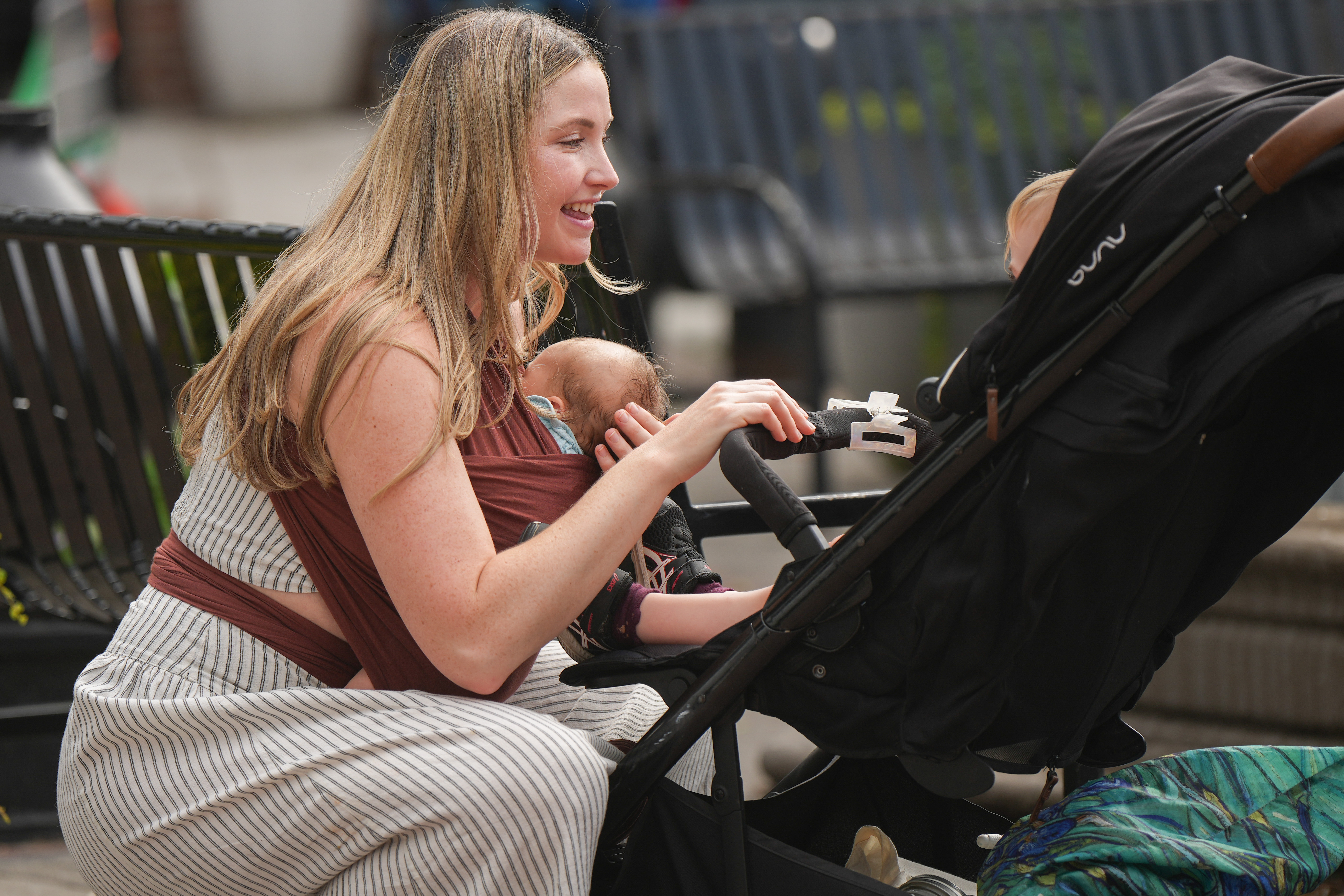
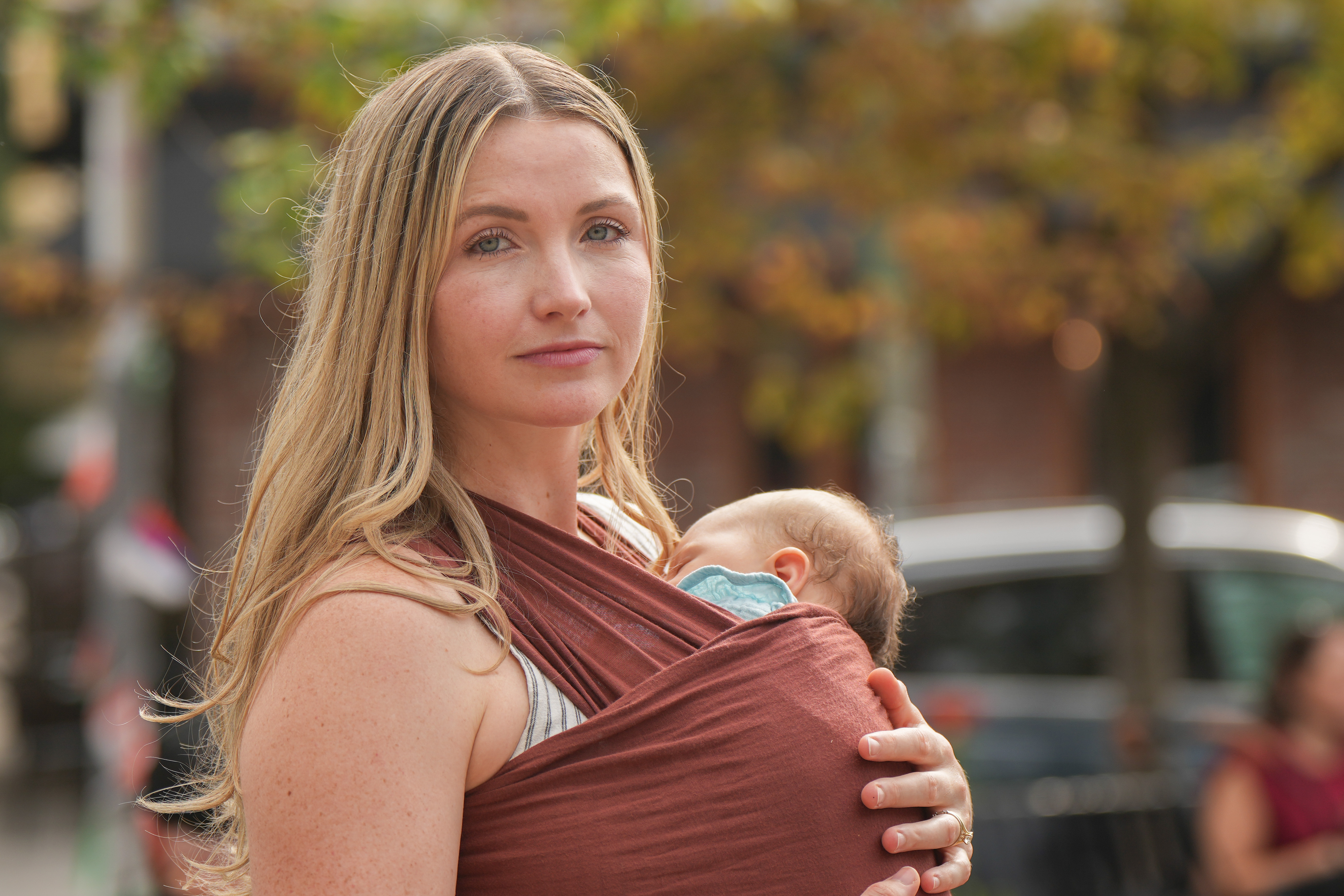
Caitlin Buttery in East Passyunk with her daughter this month. The Chester County mother is avoiding the Lancaster area, the epicenter of the state’s outbreak, and also monitoring cases in her own county, where measles is circulating.Jessica Griffin / Staff Photographer
The 33-year-old said she plans to get her youngest the measles, mumps, and rubella vaccine at 6 months old.
Public health experts have warned that there are likely far more measles cases circulating in Pennsylvania than have been recorded by the state. And the disease doesn’t confine itself to county or state borders. Across the United States, more than 3,100 people this year have tested positive for the disease, the CDC said last Thursday.
(function(){function e(){window.addEventListener(`message`,function(e){if(e.data[`datawrapper-height`]!==void 0){var t=document.querySelectorAll(`iframe`);for(var n in e.data[`datawrapper-height`])for(var r=0,i;i=t[r];r++)if(i.contentWindow===e.source){var a=e.data[`datawrapper-height`][n]+`px`;i.style.height=a}}})}e()})();
Amina Lowery lives in Upper Darby. No cases have been reported in Delaware County, but health officials there did identify measles in a wastewater sample earlier this summer, meaning someone with the disease used a bathroom connected to the county’s public water supply.
Lowery opted to get her 6-month-old daughter vaccinated early. She alsoquit her job in the insurance industry to keep her daughter out of daycare, “since we can’t control what other parents decide.” She said the plan now is to enroll her child when she’s closer to 2 years old.
She feels safer having her child vaccinated ahead of a family trip later this year to Florida, which is also dealing with a measles outbreak.
“We have the research and documentation to show that vaccines work and are for the greater good. It feels like we are in the midst of societal decline,” Lowery said.
Like Lowery, Shelby Steele of Springfield opted to keep her daughter out of daycare. Her daughter is now nearly 2 years old, but Steele, a consultant who works from home, isn’t any closer to enrolling her.
“We obviously worry about the socialization aspect of things, but measles is no joke. We’d rather find more creative ways to socialize her safely for now,” Steele said.
Steele and her partner want to have another child if possible. But she said the measles outbreak “and just the current state of things overall” makes them think twice about the risks a child could face.
Steele said she’d like to send her daughter to school, but the outbreak even has her considering homeschooling. “We are having to reconsider a lot of things, schooling being one of them,” she said.
Physicians advise parents on navigating the outbreak
Pediatrician Katie Lockwood says parents coming to her Children’s Hospital of Philadelphia practice in Montgomery County say they’re changing childcare and vacation plans to avoid measles exposures.
Montgomery County has reported three measles cases this year.
“If you’re fully vaccinated and healthy, I don’t think there’s a change in how you need to operate right now,” Lockwood said.
“But if you have someone in your family who is particularly vulnerable, if they’re immunocompromised, pregnant, or unvaccinated because they’re too young, then you may want to change your behaviors.”
She advises parents to talk to school officials and daycare providers about their vaccination policies, keep sick kids home to avoid spreading illness, and make sure children are up to date on all recommended vaccines.
“It’s awful that now parents are having to make a decision between work and childcare for something that we can prevent safely with vaccination,” she said. “Not everyone has the ability to quit their job or stay home, and they may not have an alternative childcare resource.”
Like many practicing physicians today, most schools and daycares have never had to deal with a measles case. Lockwood recently had several childcare providers refer children with rashes to her practice, worried about measles.
None of the children had the disease, but “I would rather a school or a daycare overreact,” she said, explaining that keeping a child out of school to evaluate a rash that proves harmless prevents “potentially exposing a bunch of kids to measles.”
(function(){function e(){window.addEventListener(`message`,function(e){if(e.data[`datawrapper-height`]!==void 0){var t=document.querySelectorAll(`iframe`);for(var n in e.data[`datawrapper-height`])for(var r=0,i;i=t[r];r++)if(i.contentWindow===e.source){var a=e.data[`datawrapper-height`][n]+`px`;i.style.height=a}}})}e()})();
In Bucks County, pediatrician Toni Richards-Rowley often counsels parents frustrated about having to navigate the outbreak.
She also serves as president of the Pennsylvania chapter of the American Academy of Pediatrics, which has been working to educate doctors about measles and how to recognize it.
In her own practice, Richards-Rowley is also offering “dose zero” shots for children whose parents work or plan travel to affected counties.
“If a parent asks for it, even though there’s not community spread in Bucks yet, we’re not going to turn a family away,” she said.
“Measles doesn’t respect borders. Just because we don’t have an index case doesn’t mean it’s not going to happen. You do have to be fairly vigilant wherever you go.”
Correction: This story has been updated to delete an incorrect reference to Upper Darby’s geography in the region.
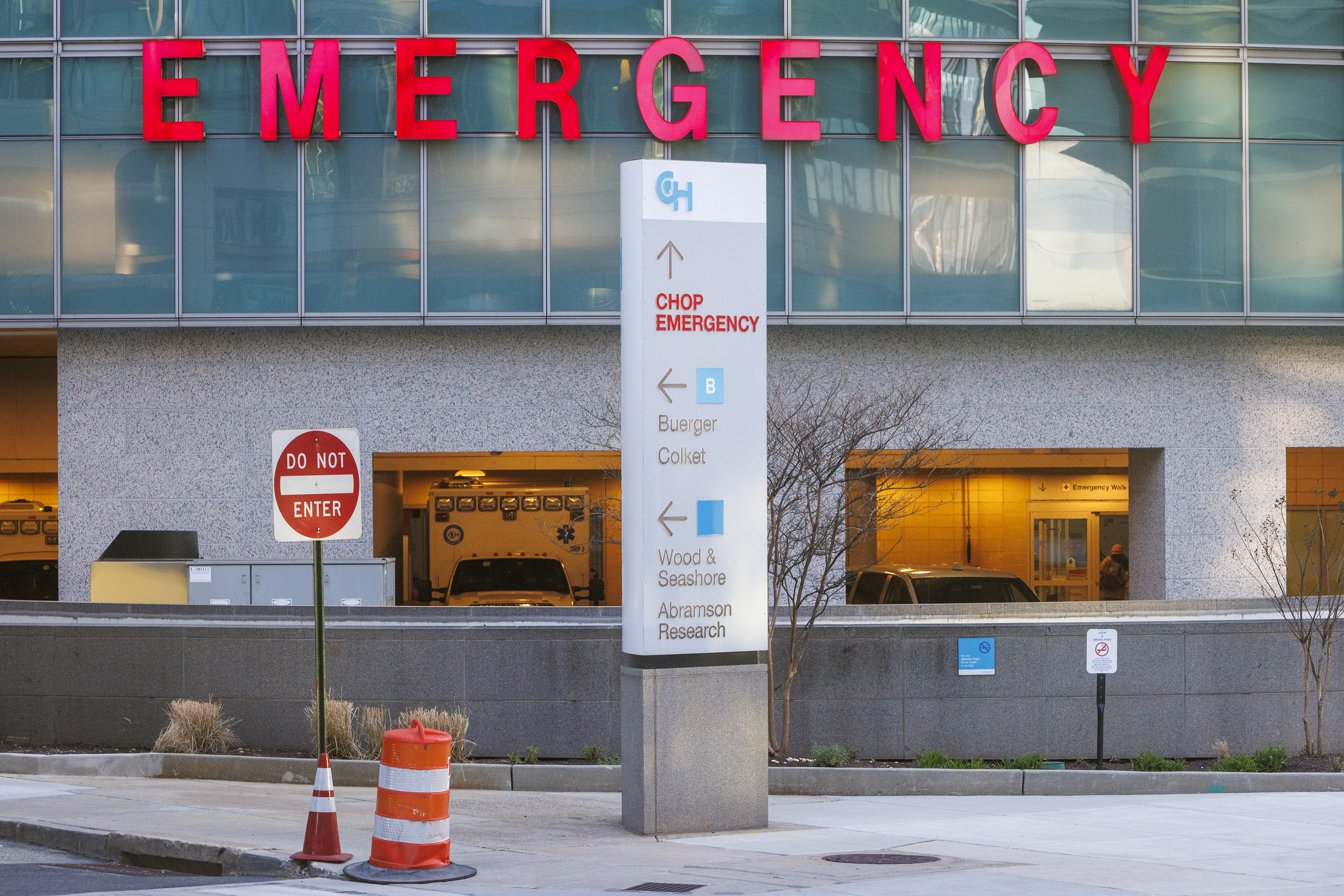
The visitor arrived at a neonatal intensive care unit at the Children’s Hospital of Philadelphia in University City last Friday morning.
Then they visited a family lounge. An atrium. A cafeteria.
At each stop, the person, now known to be infected with measles, potentially exposed others to the highly contagious disease that is particularly risky for young children, city health officials announced this week.
Hospitals have spent years preparing for such incidents, no longer a theoretical concern as Pennsylvania now deals with the nation’s largest measles outbreak this year, which has already sickened more than 760, experts in infectious disease prevention say.
And across the state in Allegheny County, the University of Pittsburgh Medical Center Children’s Hospital has reported several possible measles exposures this summer.
Health officials did not specify how many babies and others were potentially exposed at CHOP in announcing the exposure late Thursday. Philadelphia health officials have issued only general details on the infected person’s visit, along with guidelines for anyone potentially exposed to the virus over the course of several hours on Sept. 11 at the hospital at 3401 Civic Center Blvd.
The hospital is working with NICU families to ensure its patients are protected, Julia Sammons, vice president and associate chief medical officer of CHOP’s Office of Preparedness, Prevention and Response, wrote in an email.
The hospital took “immediate action” after being notified of the exposure to identify babies who might have been exposed and offer preventive treatments to protect them from the virus, Sammons said. Exposed patients have also been placed in isolation and doctors are monitoring them for symptoms.
The hospital is also working with staff and patients outside the NICU to ensure they understand the situation, Sammons said, and partnering with the state and city health departments “on contact tracing, timely testing, and safe quarantining practices for all the areas served by the CHOP enterprise.”
Infectious disease experts say hospitals around the country have been monitoring an explosion of measles cases in the last several years.
Pennsylvania as of Friday had seen 767 cases of measles in 2026, with 93 reported in the last week. One in five people with reported cases has been hospitalized.
“Measles has been up and coming. It’s definitely on the radar of hospitals,” said Ericka Kalp, who directs Drexel University’s infection prevention and control academic programs. “Your risk has increased when you have multiple measles cases within your vicinity.”
Every year, hospitals work on an infection control risk assessment, monitoring rising diseases around the country and internationally, and developing plans on how to treat sickened patients.
That could include triaging patients with respiratory illnesses and isolating those with suspected cases in special rooms, said Kalp, who was not involved in the response at CHOP.
Screening visitors to a hospital is tricky, she said.
“We can ask visitors and the public not to visit if you’re sick, and visitors need to take it upon themselves to not go to the facility if they’ve been around a particular exposure,” she said.
But some may not know they are ill: A person can be contagious for four days before measles’ telltale rash appears.
Sammons said that CHOP screens visitors daily for signs or symptoms of illness at the hospital’s welcome desks, and signs remind visitors that no one with symptoms should be admitted to the NICU. She did not say whether the NICU visitor who exposed others on Friday was symptomatic.
“We have been in constant communication with families in our NICU to discuss guidance to keep them safe,” she said. “As the measles outbreak continues to evolve, we continue to review and update our screening processes to reduce the risk of exposure to our patients and families.”
The virus can linger in the air for up to two hours and infect nine in 10 unvaccinated people exposed to it.
Pregnant women, babies under six months, and some immunocompromised people are among the groups who cannot be vaccinated. Their protection depends on nearly everyone else in a community being vaccinated to prevent the disease from spreading.
But more parents have opted against vaccinating children for religious or philosophical reasons in recent years, The Inquirer has found, leaving hundreds of area schools and communities vulnerable to the spread of the virus.
“When you see fewer people are becoming vaccinated and they have less immunity, it opens up a portal of spread,” Kalp said. “We’ve always trained for this type of thing.”
Sammons said CHOP has stepped up public health education for families and is offering early MMR vaccines for eligible children amid the outbreak, as state health officials have recommended. The hospital is also improving its measles screening capabilities and “developing contingency plans for more widespread community transmission in our area,” she said.
“The best way to control measles outbreaks remains vaccination with the measles, mumps, and rubella vaccine, which is safe and highly effective in preventing measles,” she said, noting the hospital’s long-running Vaccine Education Center, aimed at debunking misinformation about the safety of vaccines.
(function(){function e(){window.addEventListener(`message`,function(e){if(e.data[`datawrapper-height`]!==void 0){var t=document.querySelectorAll(`iframe`);for(var n in e.data[`datawrapper-height`])for(var r=0,i;i=t[r];r++)if(i.contentWindow===e.source){var a=e.data[`datawrapper-height`][n]+`px`;i.style.height=a}}})}e()})();
Treating those exposed
CHOP is offering post-exposure treatments “in the form of antibodies” to infants who may have been exposed to the virus, Sammons said.
Doctors can administer immunoglobulin, a treatment made from the plasma of adult donors, that helps boost a baby’s antibodies to infectious diseases like measles, said Sarah Long, a Drexel pediatrics professor and a physician specializing in infectious disease at the Bristol-Myers Squibb Children’s Hospital in New Brunswick, N.J.
In an outbreak, she said, hospitals can consider limiting visitors to prevent exposures, especially for a virus like measles, which is particularly dangerous for young children and kills about 1 to 3 for every 1,000 infected.
But responding to measles cases or exposures can require hospitals to expend extensive resources.
“It’s an enormous number of meetings, manpower, education about IDing cases early, and sequestering as soon as a patient comes in with a fever,” she said. “It’s an enormous amount of money, gowning, gloving, and masks.”
Now she’s worried again about vulnerable children. Nearly one-third of Pennsylvania’s cases this year have been reported in children under the age of 18, and two of the measles-associated deaths involved infants.
“It makes me just angry, angry, angry. There are so many catastrophes in children’s healthcare that are not preventable,” she said. “To have catastrophes that are preventable is just unconscionable.”
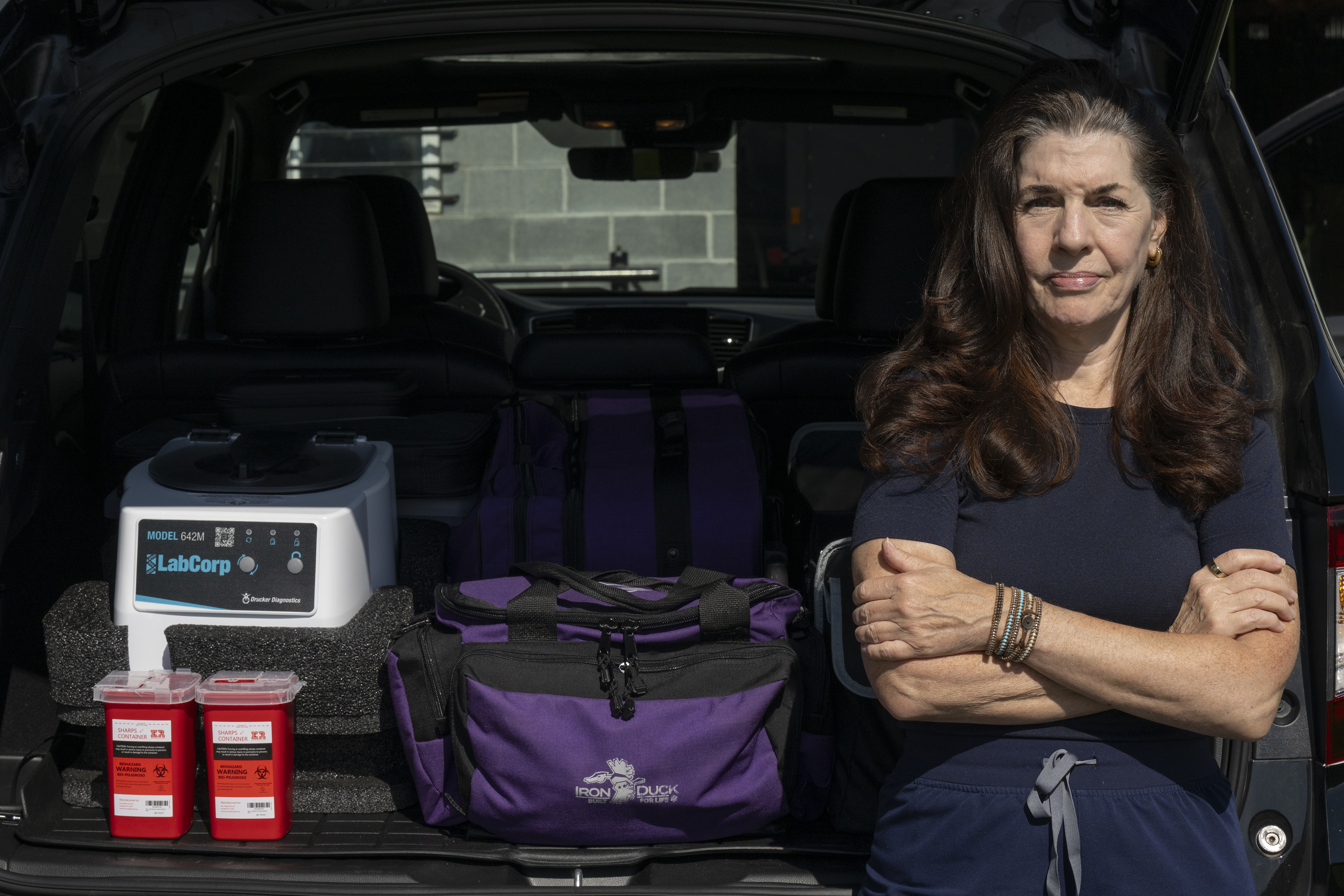
LANCASTER — Amish families peer into Roberta Devers’ Honda Passport as she drives between prenatal checkups along the rolling hills of Lancaster County. They ask her increasingly frequent questions about the vaccine: Do you have some measles in your car?
Devers, 63, works asa traditional midwife in communities at the epicenter of Pennsylvania’s largest measles outbreak in more than 30 years. She belongs toa class of midwives who follow age-old practices and are unregulated by the state, unlikethestate-licensed midwives one may find in a hospital. She received the full childhood vaccination schedule but, as an adult, chose not to vaccinate her son and is part of the rising number of people in Pennsylvania refusing to get vaccinatedagainst preventable diseases due to unfounded concerns about their safety and necessity.
And she thinks she should be able to offer the vaccine to her patients, as a trusted caretaker among Amish residents.
“Babies are dying,” said Devers, who is not Amish but has been a traditional midwife for 38 years. Shesays she fearsthat Pennsylvania’s Amish community, one of the oldest and largest in the country, cannot wait to reach herd immunity. “You’re going to lose too many babies,” she said.
Devers occupies a unique vantage point from the front lines of the nation’s largest measles outbreak this year. State health officials said the deaths of two local Amish infants were measles-related, sparking a clash between Democratic Gov. Josh Shapiro and President Donald Trump’s Health and Human Services secretary, Robert F. Kennedy Jr.,over how to report the outbreak’s death toll. An 18-year-old from Mifflin County and a 40-year-old woman from Jefferson County alsodied from measles-related illnesses in recent days, according to the counties’ coroners.
As of Wednesday, the state had reported 731 cases in 38 counties. Lancaster has recorded the highest number of known cases in Pennsylvania, as the highly contagious disease has spread among the area’s significant number of unvaccinated people, including many from communities beyondthe county’s Amish population.
Measles alert signs in English and Spanish are posted on the front doors of an urgent care facility Tuesday, Sept. 8, 2026, in Lancaster County, Pa., amid a measles outbreak that has affected local Amish and Mennonite communities.Jose F. Moreno / Staff Photographer
Traditional midwives like Devers — also known as lay midwives or direct-entry midwives — broadly oppose being regulated by the modern medical system and often do not receive the medical and scientific training or college-level educationrequired of certified nurse midwives and midwives. Because of this, top medical associations like the American College of Obstetrics and Gynecology oppose traditional midwives from being able to practice at all. State lawalso prohibits traditional midwives from practicing medicine, such as administering vaccines or sutures.
Until this summer when it was quietly repealed in state budget documents, an unenforced 1929 law allowed traditional midwives to practice in Pennsylvania. A group of midwives have sued the state to formally recognize them, but thatwould still not permit them to practice medicine, including administering vaccines.
Yet, traditional midwives are the main care providers who oversee home births in certain Amish communities, or for people who want their help with a personal and private birth experience. Their influence is particularly prominent in Pennsylvania, which has one of the nation’s highest rates of home births. Devers’ practice, Mount Laurel Midwifery, delivers about seven babies per month across south-central and Southeastern Pennsylvania, with a number of student midwives studying underher.
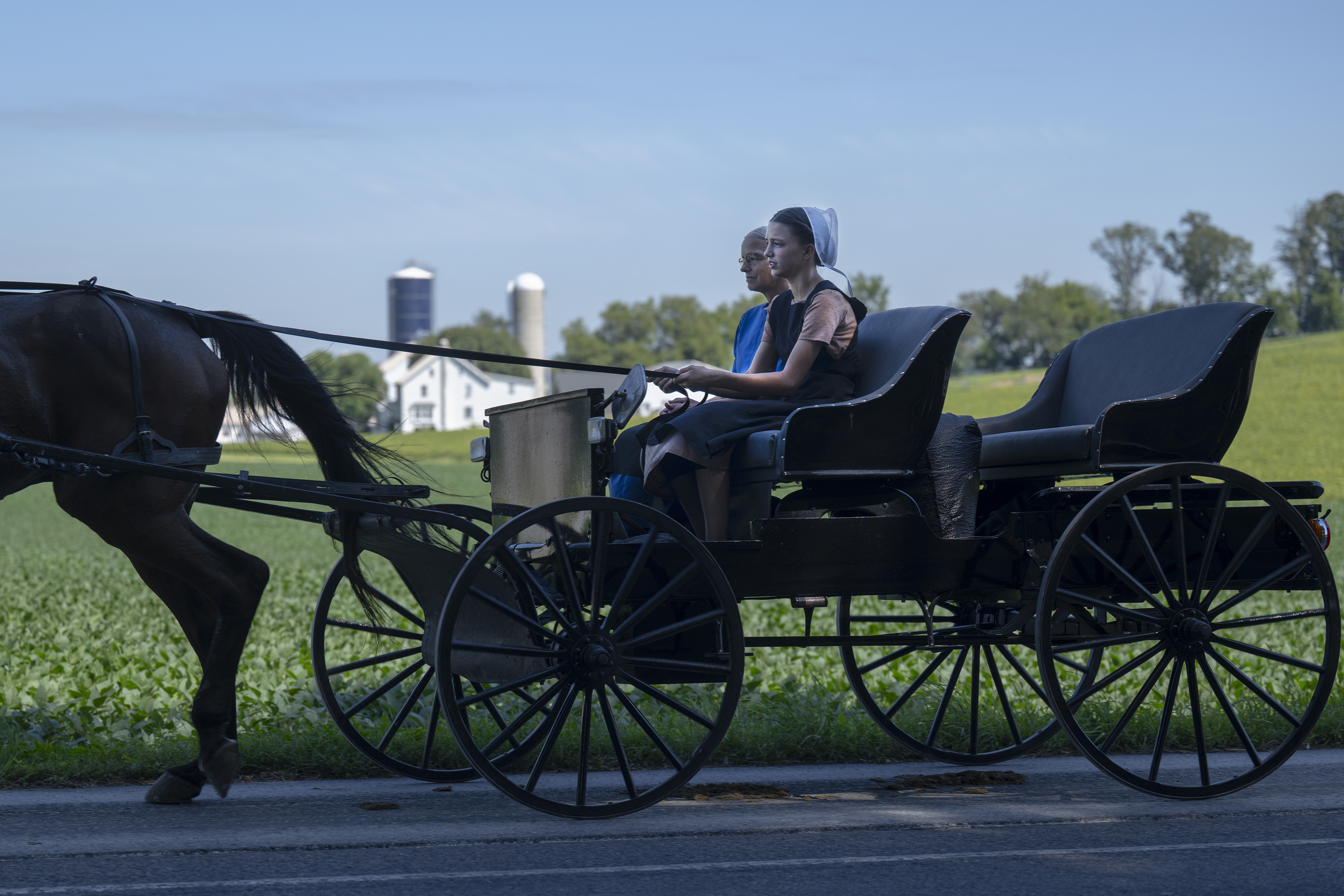
An Amish woman drives a horse-drawn buggy along a road Monday, Sept. 7, 2026, in Lancaster County, Pa., amid a measles outbreak that has affected the local Amish and Mennonite communities.Jose F. Moreno / Staff Photographer
In Lancaster, Devers’ clients are not talking about the political debate. Rather, their conversations center on the spread of measles — did she hear about the recent baby deaths, what should they do if they were exposed, does she have a vaccine with her?
Two doses of the measles, mumps, and rubella vaccine have proven 97% effective at preventing the disease, the Centers for Disease Control and Preventionsays. Nine in 10 unvaccinated people exposed to measles will acquire the disease.
Pregnant people are not eligible to receive the vaccine.
In her daily prenatal checkups, she is seeing moms who have the infection’s signature bumpy, red rash and fever, and families who have watched the sickness move through one family member to the next.
About three in 1,000 children who contract measles will die, according to the CDC. Measles can cause severe complications, especially in young children, including pneumonia and brain swelling. And measles during pregnancy can lead to pregnancy loss, premature delivery, and low birth weight, according to the CDC.
Devers said sherecently saw a case in which a mother lost her baby at 17 weeks. The Amish woman was recovering froman active measles infection at the time of the miscarriage, in addition to at least one other underlying medical condition, Devers said.
Amish families traditionally have funerals for stillborn babies or miscarried fetuses, sharing obituaries in the local newspaper. Devers attended the funeral for one such death, involving the 17-week-old fetus,last month.
Midwife Roberta Devers is photographed Tuesday, Sept. 8, 2026, near the home of one of her Amish patients in Lancaster, Pa. Devers, who primarily serves Amish mothers, discusses the measles outbreak and why she believes unlicensed midwives should be allowed to administer MMR booster shots.Jose F. Moreno / Staff Photographer
During previouspublic health emergencies, state and federal governments have usedlimited emergency approvals to expand who is allowed to administer vaccines, though the authority was not extended to unregulated groups like traditional midwives.
Now, Devers wants state or federal health officialsto extend approval to allow traditional midwives to administer the measles, mumps, and rubella vaccine.
But the Pennsylvania Department of Health saysit does not have the authority to allow traditional midwives to administer vaccines, because they are not certified healthcare providers. Currently, state law allows licensed healthcare providers like doctors and certified nurse midwives to administer vaccines, and any expansion of the list would require an amendment to state law, spokesperson Stephanie Nojiri said in a statement.
HHS and the CDC did not respond to requests for comment. Devers said sherecently accepted an invitation fromthe CDC to participate in a paid interview to discuss how midwives serving Plain communities are approaching the measles outbreak. She sees the outreach as asignal ofthe agency’s interest in working with midwives.
The Amish and vaccines
Vaccination rates among Pennsylvania children have been falling for years. The spread of misinformation about vaccine safety reached the highest echelons of the U.S. governmentafter Trump picked Kennedy, a longtime anti-vaccine activist, to lead the nation’s health agencies.
Amish communities do not have a religious objection to vaccinations, said Steven Nolt, a top Amish scholar at the Young Center for Anabaptist and Pietist Studies at Elizabethtown College.
He said low vaccination rates in the groups, who dress in plain clothes and widely object to using technology in favor of a more traditional way of life, aredue to their partial abstention from modern medicine, as well as a lack of nearby access given their rural lifestyles.
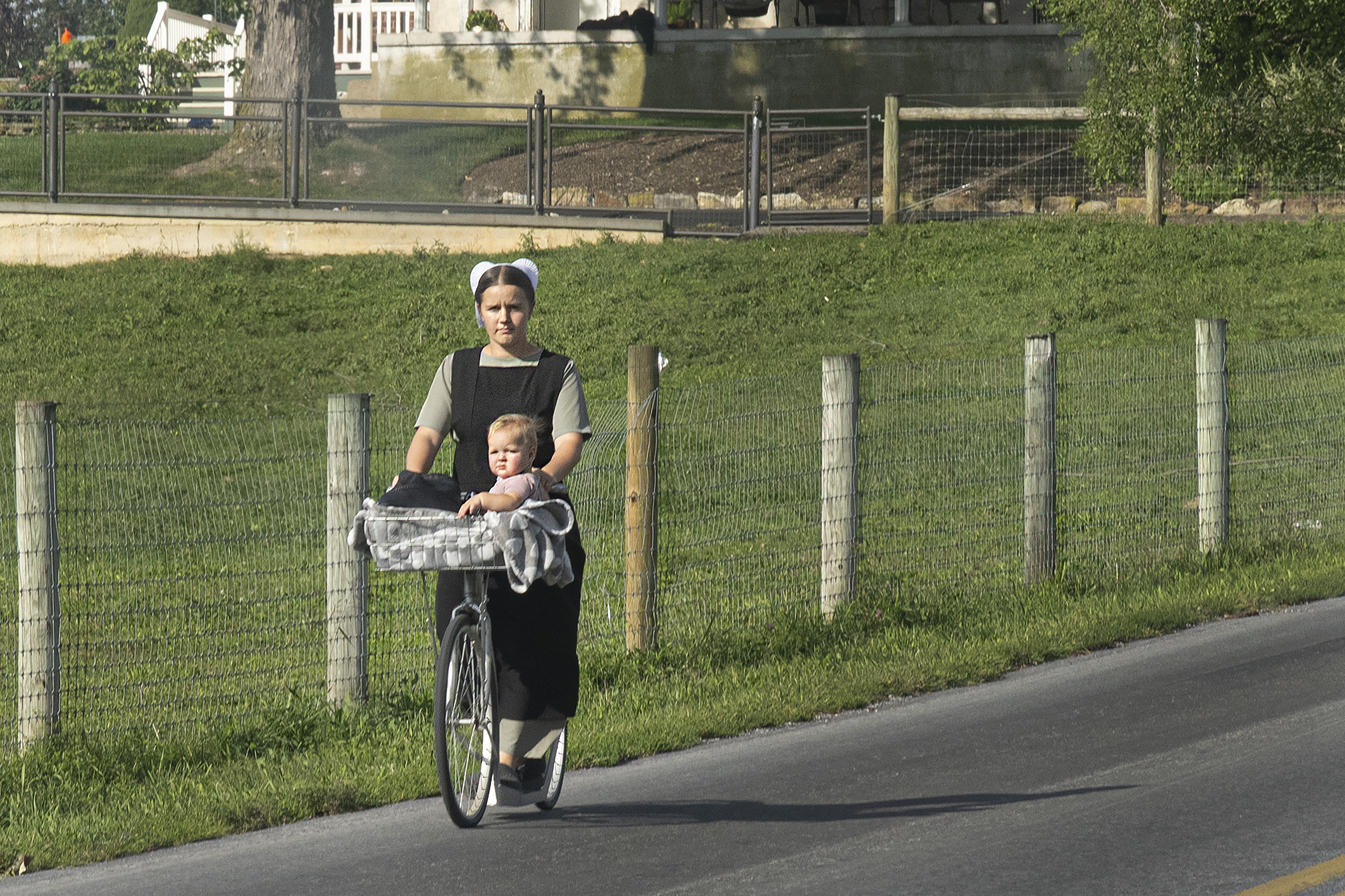
An Amish woman rides a kick scooter with a baby secured in a front basket attached to the scooter Tuesday, Sept. 8, 2026, along a road in Lancaster County, Pa., amid a measles outbreak that has affected local Amish and Mennonite communities.Jose F. Moreno / Staff Photographer
In Lancaster County, 30% of Amish families had their children vaccinated and believed vaccinations were safe and effective, according to a 2022 surveyof 433 Amish and Old Order Mennonite residents, published by Elizabethtown College and conducted by Franklin and Marshall College.
The numbers are much higher among Old Order Mennonites — a different religious group thatsimilarly dresses in plain clothes — with94% vaccinating their children and 72% believing they are safe and effective.
When a 1991 rubella outbreak spread through Amish communities, families welcomed the booster shots, Nolt said. So didAmish groups during a polio outbreak in the 1970s.
“When there would be an outbreak, that was a bit of a wake-up call,” he added. “Then people would come out for immunizations.”
Another “wake-up call” has now arrived for Lancaster’s Amish residents, Devers said.
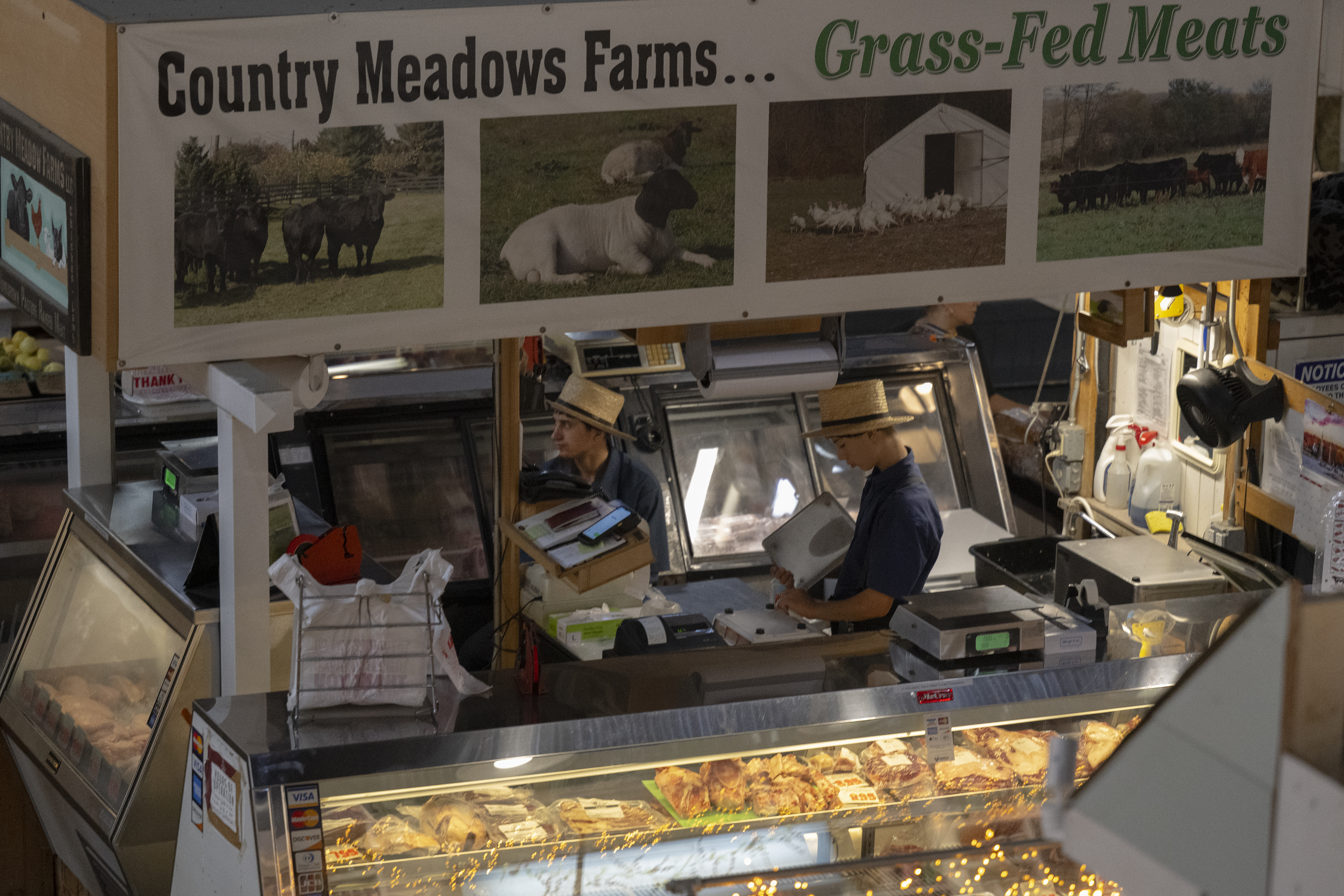
Amish vendors work at their stands inside the popular Central Market in Lancaster, Pa., Tuesday, Sept. 8, 2026, amid a measles outbreak that has affected local Amish and Mennonite communities.Jose F. Moreno / Staff Photographer
Amish groups broadly approach their health through a “medical pluralism” lens — a term coined by Martha King, a medical anthropologist at the University of North Carolina at Chapel Hill. This means Amish communities view medical doctors, chiropractors, midwives, and homeopathic remedies as all being “on the same playing field,” rather than being supplementary to a primary care physician, as is common among most Americans, Nolt said. Sometimes Amish people will choose treatments thatcontradict each other or lack any scientific backing.
“They kind of all function in a way that doesn’t necessarily make sense the way many ‘normal’ Americans think about healthcare,” Nolt added.
Prior to his appointment as HHS secretary, Kennedy helped lead anti-vaccination efforts across the country. During a 2021 speech in Lancaster County, he mocked measles as a serious threat.
It is unclear what effect the efforts have had on Amish populations, Nolt said. During the COVID-19 pandemic, some anti-vaccine groups ran advertisements in Amish newspapers, discouraging the Amish from getting any immunizations, he added.
Devers said she largely supports Kennedy, but believes Shapiro was right to raise alarm about the need to vaccinate against measles. She said she has been disappointed in Kennedy for downplaying the dangers of the outbreak.
“My God, use your head,” Devers said. “He can’t mean this in the midst of an epidemic like this.”
Pennsylvania’s healthdepartment, in partnership with local health systems, says it has been working with Amish communities. And Shapiro has emphasized that the outbreak stretches much further than just among any one community, now that confirmed cases have spread to more than half of Pennsylvania’s 67 counties.
Since the start of the measles outbreak in Pennsylvania in April, state health officials have hosted 124 pop-up vaccination clinics across the state in locations like churches, fire halls, and private homes to give more than 4,100 doses of the MMR vaccine, Nojiri said. More pop-up clinics are planned in the near future.
But traditional midwives should be part of the solution, too, Devers argued.
“Different times call for a change in thinking,” she said.
This story has been updated to remove identifying information.
Pennsylvania health officials on Tuesday confirmed two more deaths associated with measles, involving a resident of Jefferson County and a resident of Mifflin County.
The state has now reported four measles-related deaths amid a growing outbreak that has sickened nearly 700 people this year. The deaths mark the state’s first in three decades related to the highly contagious disease, and the most reported in the U.S. in a year since 1992.
Both residents tested positive for measles and were unvaccinated, state officials said.
An 18-year-old in Mifflin County died due to measles complications, the county coroner said in a news release Tuesday. The cause of death was acute disseminated encephalomyelitis, “a rare and severe neurological complication of measles.”
The condition occurs after a measles infection triggers a harmful autoimmune response, said Paul Offit, a physician and vaccine expert who heads Children’s Hospital of Philadelphia’s Vaccine Education Center.
“It’s rare. It occurs in maybe one in 1,000 cases. But it’s real, and it can be fatal,” he said.
The death of a 40-year-old woman was reported over the weekend by Jefferson County’s coroner. She also had severe respiratory conditions and died of respiratory failure after showing signs of measles.
She had been exposed to a person with a lab-confirmed case of measles, and the coroner onMonday evening confirmed in a news release that postmortem testing showed the woman had an active measles infection when she died.
Health Secretary Debra Bogen, offering condolences to the victims’ families, noted the state’s efforts to “stem this outbreak and prevent more deaths” include ensuring people have access to and accurate information about the measles, mumps, and rubella (MMR) vaccine.
Measles deaths are rare, with typical symptoms including a high fever, a cough, runny nose, red, watery eyes, and a rash.
Yet the disease can cause severe complications, including pneumonia and brain swelling, especially in young children. About one to three children for every 1,000 infected will die from complications, according to the Centers for Disease Control and Prevention.
With 693 cases in 38 counties confirmed so far in Pennsylvania this year, experts fear the mounting death toll indicates that significant numbers of cases are going unreported.
“I think we are severely underestimating this epidemic,” Offit said.
Mifflin County, where the 18-year-old patient died, had reported 79 measles cases as of Monday — the second-highest total in the state, behind Lancaster County, where 296 people have been sickened and two deaths were previously reported.
Jefferson County, where the 40-year-old woman died, has seen 28 cases of measles so far this year.
Pennsylvania defines a “measles-associated death” as one that occurs within 30 days of symptom onset in a person with clinical evidence of infection and a positive laboratory test, and who did not die of another unrelated cause, like a car crash.
(function(){function e(){window.addEventListener(`message`,function(e){if(e.data[`datawrapper-height`]!==void 0){var t=document.querySelectorAll(`iframe`);for(var n in e.data[`datawrapper-height`])for(var r=0,i;i=t[r];r++)if(i.contentWindow===e.source){var a=e.data[`datawrapper-height`][n]+`px`;i.style.height=a}}})}e()})();
Shapiro again criticizes RFK Jr.
Since last month, state and federal officials have sparred over whether two other deaths reported in Pennsylvania were tied to the state’s measles outbreak.
U.S. Department of Health and Human Services press secretary Emily G. Hilliard said that state officials had notified the CDC of the two additional deaths reported Tuesday.
“CDC remains in contact with state health officials as they continue to assess these deaths,” she said in a statement.
With the news of the additional deaths, Democratic Gov. Josh Shapiro on Tuesday continued his criticism of President Donald Trump’s HHS secretary, Robert F. Kennedy Jr., accusing him of spreading misinformation about vaccine safety through his longtime anti-vaccine activism.
“This serious situation continues to be made worse by RFK Jr. playing games with public health and safety,” Shapiro said in a X post Tuesday.
In its latest update Friday, the CDC still had not listed the first two deaths on its website highlighting data on ongoing measles outbreaks around the country.
Shapiro also noted a news report that Kennedy directed the CDC’s decision not to include the deaths. “It is also deeply concerning to learn that the Secretary personally intervened in an otherwise administrative process to direct the CDC to not report these Pennsylvania deaths, presumably because it doesn’t fit his phony narrative,” he wrote.
Kennedy has accused the Shapiro administration of “fabricating” the first two deaths, although he later said one had been caused by measles.
Federal health officials also note that unlike several other states with measles outbreaks, Pennsylvania has not required an “Epi-Aid” team from the agency, “which would deploy epidemiologists to provide on-the-ground measles outbreak support.”
In a post on X, Kennedy said that Shapiro had “chosen to politicize this outbreak instead of implementing a unified public heath response.”
“He continues to point the finger at me and the federal government and to malign the Amish while refusing the federal assistance that might help end the outbreak,” he wrote. (The two Lancaster County deaths occurred in Amish children.)
State health officials have said they meet regularly with the CDC and will continue to evaluate if they need additional support from the agency.
Kennedy also said he had not directed the CDC to “suppress Pennsylvania deaths.”
“CDC is applying a consistent national standard rather than allowing politicians to decide which deaths appear in federal mortality statistics. CDC will report measles-caused deaths when the National Center for Health Statistics reports measles as the underlying cause based on death record information submitted by the states,” he wrote.
He added that MMR vaccination is “the most effective way to prevent measles infection.”
Pennsylvania officials have declined to publicly release additional information on the deaths, citing state privacy laws.
Details on the circumstances involved with the deaths have come from local coroner’s offices, which at times has heightened the scrutiny on the state’s reporting.
Lancaster County’s coroner said he had investigated one death caused by measles, in an infant with a deadly genetic disorder that made her vulnerable to respiratory infections.
He investigated another death in an infant who contracted measles before birth and died shortly after. The coroner, a physician and an elected Republican, has said that infant’s death was caused by a lacerated spleen, not measles. Yet prominent physicians have noted measles can weaken a person’s spleen, putting it at risk of rupture. State officials have maintained that the death was associated with measles.
Both children were too young to be vaccinated against the virus that is transmitted through the air, when an infected person coughs or sneezes, and can linger in the air for up to two hours.
Jefferson County’s coroner, also an elected Republican, said from his first news release Sunday that complications associated with measles were behind the death of the 40-year-old woman in his county. He said her death was due to “suspected measles” and other underlying conditions, because she had symptoms of the disease, including a rash and fever, and had been exposed before her death.
He shared on Monday that he was updating the woman’s death certificate to read “probable measles” after receiving paperwork confirming the woman had been in contact with an infected person with a positive lab test for measles. Later that night, he confirmed in a news release that the woman’s postmortem measles test was positive.
Two doses of the MMR vaccine are 97% effective at preventing the disease, the CDC says.
The more people who are vaccinated, the less likely it is for measles to spread. Scientists say that about 95% of a community should be vaccinated to prevent spread.
But vaccination rates in Pennsylvania have dropped in recent years, including in areas now seeing measles-related deaths.
In Mifflin County, for example, MMR vaccination rates for kindergartners dropped from 92.3% during the 2024 school year to 89% in the 2025 school year.
Lancaster County’s kindergarten MMR rates were already low and dropped by about 1 percentage point to 87.5% in 2025.
About 93% of Jefferson County kindergartners were vaccinated in 2025, a slight decrease from the year before.
Staff writer Stephen Sterling contributed to this article.
Pennsylvania officials reported two deaths associated with measles last week, amid a growing outbreak that has already sickened more than 500 people in the state this year.
Gov. Josh Shapiro, a Democrat, has clashed over the state’s characterization of the deaths with President Donald Trump’s head of the Department of Health and Human Services, Robert F. Kennedy Jr., as the outbreak has rapidly become one of the nation’s largest this year.
Shapiro has said Kennedy, a longtime anti-vaccine activist, is spreading misinformation about the safety of vaccines long recommended to prevent measles. Kennedy has disputed what Shapiro and state health officials have disclosed about the deaths, going so far as to accuse the administration of “fabricating” them.
Here’s what’s known about the deaths, the state’s first involving the highly infectious disease in more than 30 years, and the ongoing measles outbreak in Pennsylvania.
What do we know about the measles-associated deaths in Pennsylvania?
State officials announced two measles-associated deaths in unvaccinated Lancaster County residents last Tuesday, but initially provided no further information about the patients’ ages, medical conditions, or what had been investigated.
The state later explained that it defines a measles-associated death as deaths of people where evidence of measles is present, even when the disease may not be assessed by the coroner as the immediate cause of death.
Lancaster County coroner Stephen Diamantoni said the same day that his office was investigating one death involving a newborn who had measles anddied shortly after birth. Later, the state confirmed that this was one of the measles-associated deaths they had announced.
According to Diamantoni, an elected Republican who is also a physician, postmortem testing of the child’s lung tissue showed the infant had a measles infection acquired before birth. But he said he does not believe measles contributed tothe child’s death. He said the child died of a lacerated spleen, citing trauma to the torso. He said he was not sure how the lacerated spleen or trauma occurred.
Subsequently, Diamantoni said a forensic pathologist had included “measles” on the newborn’s death certificate under a section that lists “significant conditions contributing to death but not resulting in the underlying cause.” He said the condition was listed on the death certificate becausethe baby tested positive for measlesand the pathologist said he would put any “significant finding” in that section.
The state’s decision to call the deaths measles-associated came after the state health department’s “epidemiology team thoroughly investigated and verified both individuals tested positive for measles,” Pennsylvania Health Secretary Debra Bogen said in a statement.
Experts like physician Paul Offit, head of the Vaccine Education Center at the Children’s Hospital of Philadelphia, have pointed out that measles can cause the spleen to become fragile, and that the trauma of birth can cause it to rupture. Offit says the coroner needs to explain more about his conclusions, if he does not believe measles contributed to the death.
The state has not released any information about the second measles-associated death, citing privacy laws.
Diamantoni told The Inquirer that his office is reviewing another instance where measles was listed on a person’s death certificate. “It’s a death of a child who had measles,” he said. On Wednesday, he said the child was an infant.
He declined tosay how “measles” was characterized on that child’s death certificate. A healthcare provider signed the death certificate, he said, and his office was not involved at the time. The child did not die at a hospital, he said.
It is not clear if the case was the second measles-affiliated death announced by state officials.
Pennsylvania officials have cited state laws protecting privacy in saying that they can’t disclose more about the deaths without compromising patient confidentiality and the community’s trust.
Several prominent public health experts have criticized the Shapiro administration for not revealing more information, like the ages or causes of death of the victims, saying not doing so created a void for conspiracy theorists to spread misinformation.
What is the CDC saying?
The Centers for Disease Control and Prevention omitted the two measles-associated deaths in Pennsylvania from its last measles outbreak update on Monday.
The agency said that the deaths were not included because ”available information does not establish whether measles caused or contributed to the deaths or whether the individuals died from other causes while infected with measles,” in an update posted to the CDC’s website Sunday.
Kennedy also said Shapiro’s administration is not cooperating with the CDC in giving information on the deaths.
Pennsylvania “thoroughly reviews” all reported measles cases to ensure they meet CDC definitions and has provided “all required epidemiological data” on the measles-associated deaths to the CDC, state health department spokesperson Neil Ruhland said in a statement on Monday.
How far has measles spread in Pennsylvania? Where is it now?
Measles cases have been reported in 36 counties in Pennsylvania, with 530 cases confirmed this year as of Wednesday. The outbreak is centered in Lancaster County, which has reported 242 cases.
Chester County has reported the second-highest case count, with 52 cases so far this year. Health officials there believe many infections are going unreported, and say measles is generally circulating in the western area of the county.
Montgomery County reported three cases in a separate outbreak this winter.
Allegheny County, Pennsylvania’s second most-populous county after Philadelphia, has reported measles exposures at a children’s hospital in Pittsburgh, but no cases in residents.
Philadelphia has not identified any cases, although several people who tested positive for measles have traveled through the city this year. The last outbreak reported in the city sickened nine people, with six requiring hospitalization, in 2024.
How is measles transmitted? How contagious is it? Can you get measles if you’re vaccinated?
Measles is transmitted through the air, when an infected person coughs or sneezes, according to the CDC. It can linger in the air for up to two hours.
Two doses of the measles, mumps, and rubella vaccine has proven 97% effective at preventing the disease, the CDC says. The more people who are vaccinated, the less likely it is for measles to spread. Scientists say that about 95% of a community should be vaccinated to prevent spread. Nine in 10 unvaccinated people exposed to measles will acquire the disease.
No one who has gotten measles in Pennsylvania this year was fully vaccinated.
Sometimes this occurs if someone’s immune system “did not respond as well” to the vaccine, the CDC says. Other times, vaccinated people can get the virus if they’re exposed for a long period to the disease — like living in a house where multiple unvaccinated people have measles. Vaccinated people tend to have a milder illness if infected, and they’re less likely to spread measles to others.
In 2025, Bucks County reported a case of measles in a vaccinated resident who had recently traveled to Texas, then the site of a major measles outbreak. The person’s symptoms were mild.
What are measles symptoms?
Typical measles symptoms appear one to two weeks after exposure, but sometimes they can take up to 21 days to manifest. They include a high fever, a cough, runny nose, red, watery eyes, and a rash.
How deadly is measles?
About three in 1,000 children who contract measles will die. Measles can cause severe complications, especially in young children, including pneumonia and brain swelling. Physicians on the front lines of the Pennsylvania outbreak have reported treating patients with these symptoms, as well as organ damage from the disease.
Editor’s note: This story has been updated with additional detail from the Lancaster County coroner’s office.
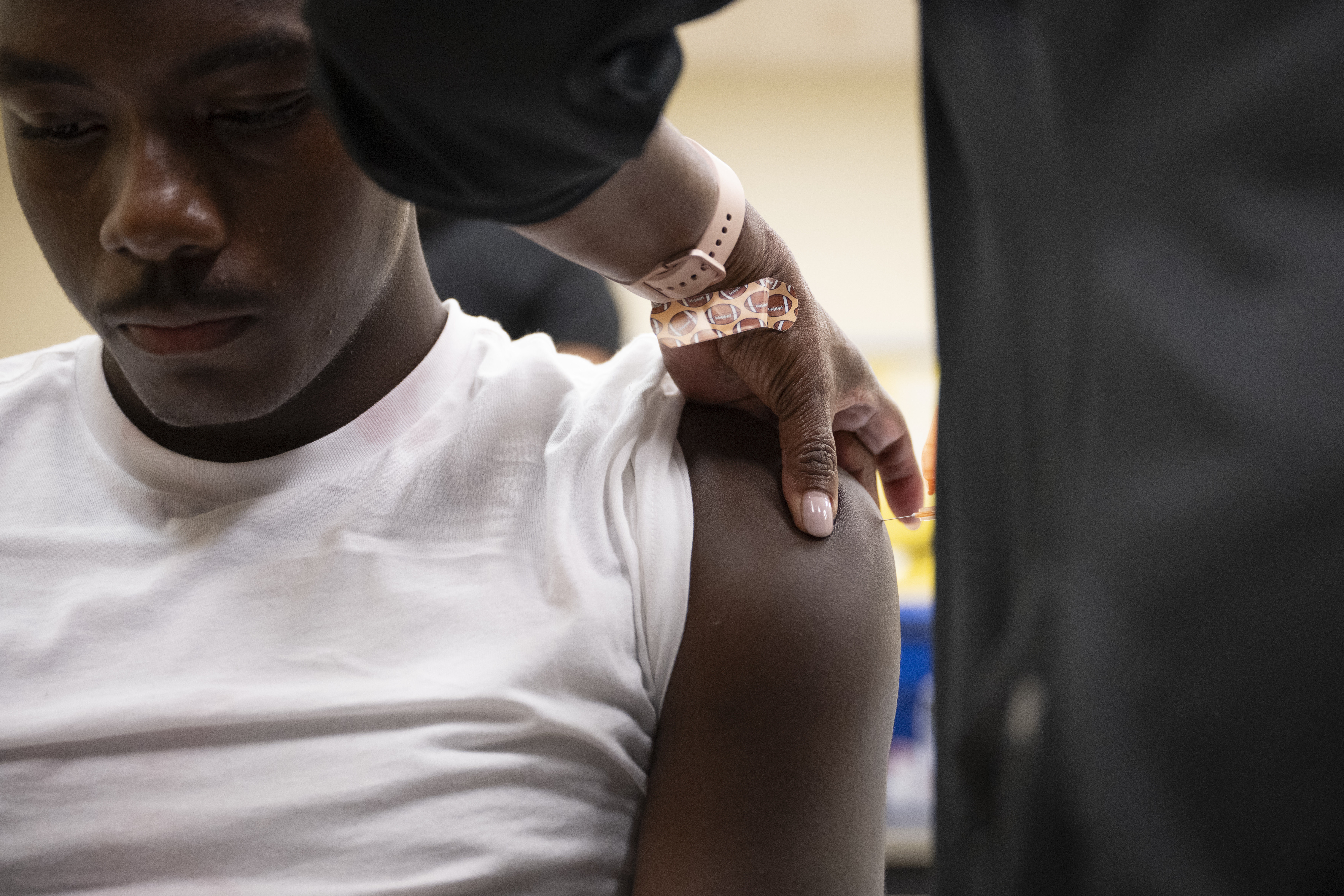
Families with kids in tow lined up Thursday at Benjamin Franklin High School for a one-stop shop: physicals, mental health services, vision screenings, and, perhaps most important, vaccines.
The Philadelphia School District is making a full-court press to get its vaccination rates up, amid a statewide measles outbreak and news that some city schools saw double-digit declines in kindergarten immunization rates in the 2025-26 school year — leaving communities vulnerable to further measles spread.
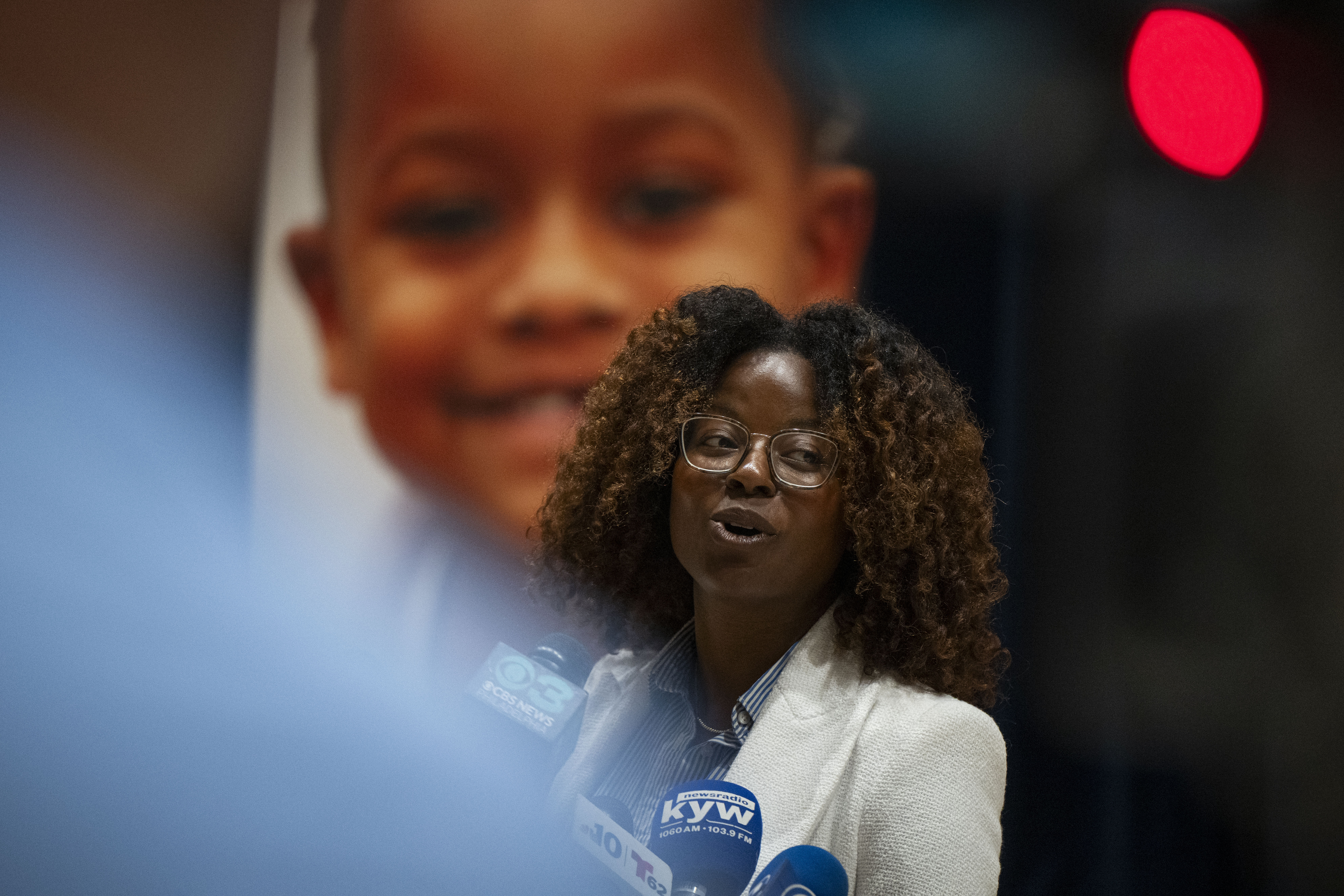
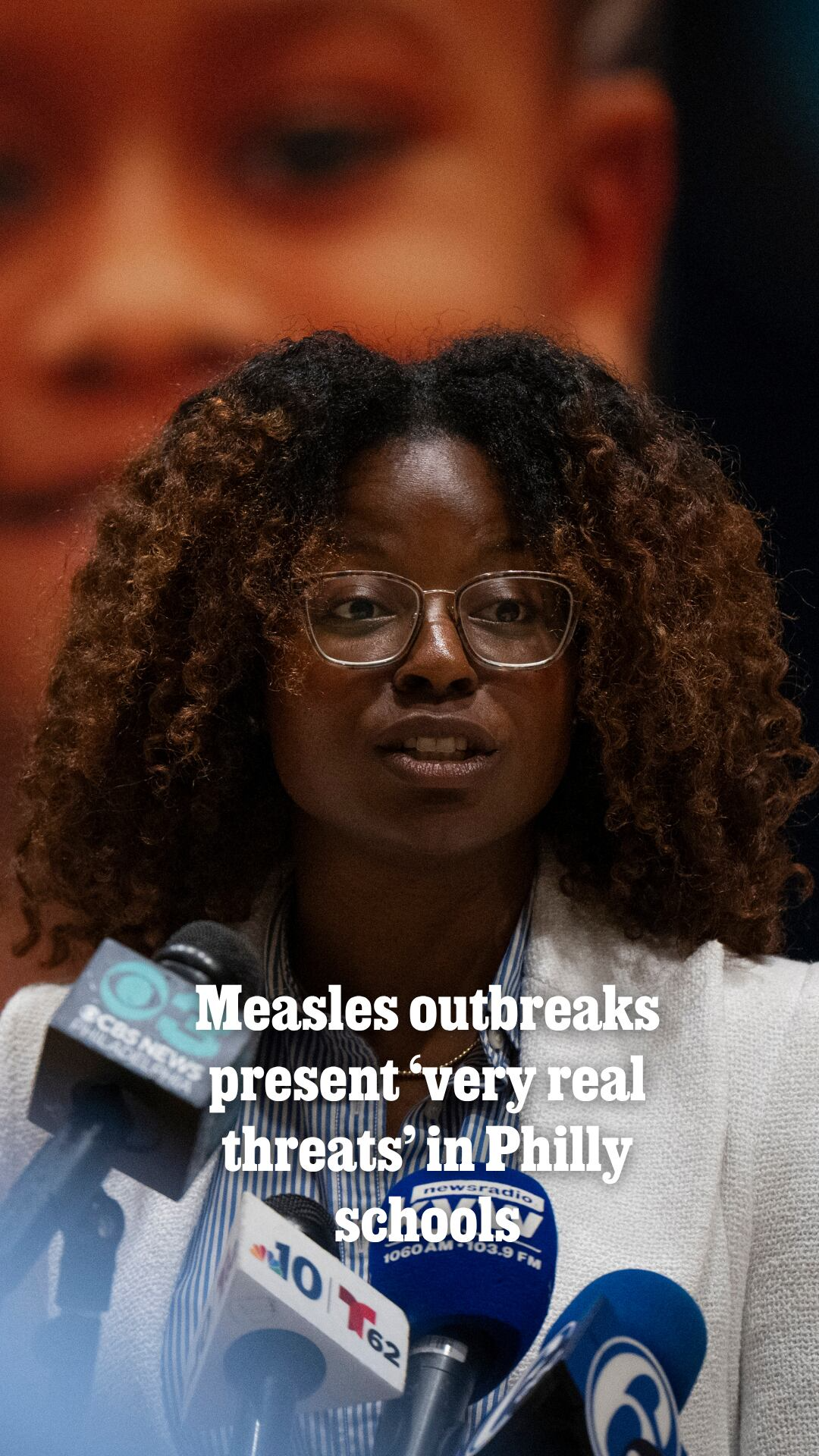
Kids must be healthy to learn, said Kendra McDow, a pediatrician and the district’s medical director, and vaccines against diseases like measles, whooping cough, and chickenpox are crucial protection.
“In 2026, these diseases are very real threats to the health of children and communities,” McDow said. “We are seeing in real time the tragic consequences of children and adolescents not getting vaccinated.”
Medical Officer Kendra McDow speaks during press conference encouraging vaccinations for Philadelphia kids on Thursday at Benjamin Franklin High School in Philadelphia.Joe Lamberti / For The Inquirer
To achieve community protection, which scientists call herd immunity, 95% of a school population must be vaccinated. And though Philadelphia’s vaccination rates remain relatively strong compared with other pockets of the state, about 40% of kindergarten classrooms across Philadelphia and its surrounding suburbs became vulnerable to a measles outbreak last school year, up from a third of classrooms the year prior, according to an Inquirer analysis of state data.
To boost city immunization rates, the district is focusing on access — from a back-to-school bus tour this summer that came with a side of childhood vaccines to the Benjamin Franklin eventover two weeks, which runs through Friday.
Parents can register their children at the district’s Constance E. Clayton Education Center, at 440 N. Broad St., then walk up the block to Ben Franklin, at 550 N. Broad, to get their children vaccines and other preventive healthcare, including connection to mental health services and appointments to get eyeglasses.
Measles is now in 28 Pennsylvania counties, with more than 400 cases reported this year — nearly half in the last month. No cases have been reported in Philadelphia, but the highly contagious disease is circulating in suburban Chester County.
Pennsylvania had the most newly reported measles cases in the nation last week, said Ala Stanford, founder of the Black Doctors Consortium, and 73 state residents have been hospitalized.
Pennsylvania now has the highest number of cases reported in the state since 1991.
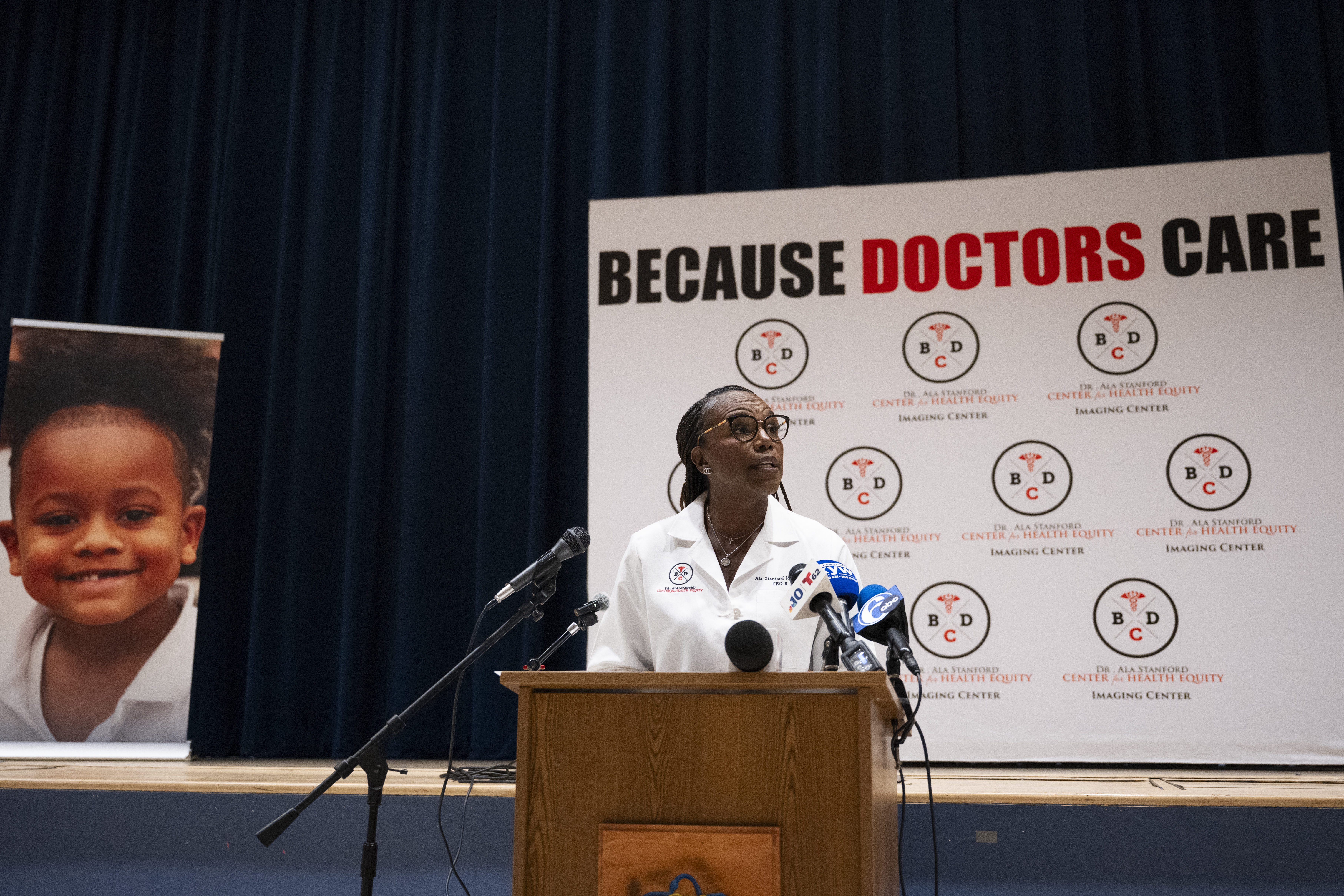
“This is not a mystery. It’s arithmetic,” Stanford said. “It takes 95% of us vaccinated to stop measles from moving through a community. Pennsylvania is at about 93%, and not one county in this region is at 95%.”
What parents need to remember, Stanford said, is that since children traditionally have not received their first measles vaccine until age 1, “every infant in the city, in the stroller, in the car seat, at the family reunion has no protection of their own. We are their protection. That is the entire system.”
In response to the current outbreak, state officials have started recommending that parents in affected areas vaccinate children as early as 6 months with a “zero dose” to provide extra protection against a disease so contagious that it will infect nine in 10 unvaccinated people who are exposed.
The benefits of community protection go beyond babies and children, Stanford said: “It’s the teacher. The lunchroom lady, the man who sweeps the floor, the security officer at the door — you do not know who they go home to at night. You do not know who is on chemotherapy, who has had a transplant, who is caring for a newborn.”
Video: Philly schools recommend vaccinations for students
‘Why so many?’
School officials plan to set up individual vaccine clinics at schools that have problematic compliance rates.
Emlen Elementary in Mount Airy, for instance, had a 100% vaccination compliance rate among incoming kindergarteners two years ago. Last year, it dropped to 80%. (Many Emlen families citedphilosophical or religious exemptions to vaccination.)
Ericka Hayes, senior medical director of infection prevention at Children’s Hospital of Philadelphia, said rampant misinformation about vaccine safety certainly contributed to lower vaccination rates.
“Parents should not let that sway them from giving their children one of the most tested and effective childhood interventions in history,” Hayes said.
Disruptions from the pandemic are another factor in lagging vaccine rates, Stanford said.
Dr. Ala Stanford of the Black Doctors consortium speaks during press conference encouraging vaccinations for Philadelphia kids on Thursday at Benjamin Franklin High School in Philadelphia.Joe Lamberti / For The Inquirer
At a recent clinic at Strawberry Mansion High, Stanford said, children from 30 schools across the city showed up for shots.
“We had 14- year-olds getting four shots, and we said, ‘Why so many?’” Stanford said. Families told care providers that they had fallen off on vaccine schedules, but were relieved to have a chance to catch up their children.
As word spreads about vaccine access, about ease and availability across the city, “more people show up,” Stanford said.
Kids can be excluded for vaccine noncompliance
Children can be excluded from school under Pennsylvania law if they are unvaccinated and their families have not formally filed for an exemption on religious or philosophical grounds.
According to state data, thePhiladelphia School District excluded 34 12th graders, five seventh graders, and three kindergartners last school year for vaccine noncompliance.
Far more students were labeled “noncompliant and attending” — 1,392 12th graders, 1,853 seventh graders, and 669 kindergartners. That means those students’ families have made a plan for them to get vaccinated, but have not yet followed up on it.
Students without vaccine exemptions can be admitted to kindergarten on a provisional basis as long as they have a plan to catch up on their vaccines. (State law allows exceptions for students living in foster care or without permanent housing.) They are listed as “non-complaint but attending” when families fail to adhere to that plan.
School officials have said they work with families in that category to help them catch up on shots, but unvaccinated kids may be asked to stay home if a communicable disease is identified at their school.
School nurses are key to the effort, officials said, on the front lines of ensuring students are vaccine-compliant. Every school in the district currently has a full-time school nurse, McDow said.
One of the district’s 277 school nurse positions is unfilled, but an agency nurse is covering that vacancy, and “we are working to have the position filled as soon as possible,” McDow said.
The act of getting vaccinated or vaccinating your children, said James Garrow, deputy commissioner of the city health department, is powerful.
“Your vaccination can help save lives,” Garrow said.
(function(){function e(){window.addEventListener(`message`,function(e){if(e.data[`datawrapper-height`]!==void 0){var t=document.querySelectorAll(`iframe`);for(var n in e.data[`datawrapper-height`])for(var r=0,i;i=t[r];r++)if(i.contentWindow===e.source){var a=e.data[`datawrapper-height`][n]+`px`;i.style.height=a}}})}e()})();
This isn’t just a bad year for measles. It looks to be the start of a bad era. Confirmed measles cases just hit a 35-year high, and it’s only July. Together with last year, the number of cases has exceeded the combined total over the previous 25 years. The vast majority of cases stem from domestic outbreaks fueled by low rates of vaccination—and rates are declining.
For the first time in a quarter century, the U.S. no longer meets a main criterion for having eliminated measles as a public health threat. That status hinges on sporadic outbreaks fizzling out within a year. Utah’s outbreak has lasted for longer, since June 2025.
Nearly 400 people have been hospitalized with measles in the U.S. this year and last, three people have died, and at least three suffered brain swelling with lingering symptoms.
This month, the Centers for Disease Control and Prevention is set to finalize a comprehensive study of the nation’s measles situation, examining data from January 2025 through June 2026.
“I don’t think we could say with a straight face that there hasn’t been transmission over the past 12 months,” said a CDC scientist with knowledge of the agency’s measles report. (KFF Health News agreed not to name the researcher, who is concerned about retaliation.) The researcher said a national committee of measles specialists will review the CDC’s internal report, which then goes to the Pan American Health Organization, a group that evaluates the measles elimination status of countries throughout North, South, and Central America, and the Caribbean.
PAHO will make its decisions at an annual meeting this fall, but scientists say the writing is on the wall. “The assessment for elimination isn’t until November, but that is a scheduling issue, basically,” said Anne Schuchat, who led the CDC’s immunization and respiratory disease group from 2006 to 2015.
“It’s just so sad, because some people will get brutally ill,” she said of measles’ return. “This is a wake-up call.”
Pediatricians in Utah have been on the front lines as measles and other vaccine-preventable ailments have returned to the U.S. In interviews with KFF Health News, six doctors shared insights on this new era of vaccine hesitancy — and what could be done to turn the situation around.
The conversations have been edited for clarity.
On unvaccinated children hospitalized with measles complications
Emilie Morris, a hospital pediatrician in Salt Lake County and Utah County: When children come in, they’re often bent over. We call it tripoding, which is particular to upper respiratory infections and airway swelling. They have a rash — viruses cause rashes all the time — but in this context, the kid is hunched over, mouth open, drooling, crying, maybe not even producing tears, because they’re so dehydrated. Really labored breathing, kind of tugging in their belly, tugging between their ribs. Their eyes look kind of glazed over. It’s like they’re seeing through you.
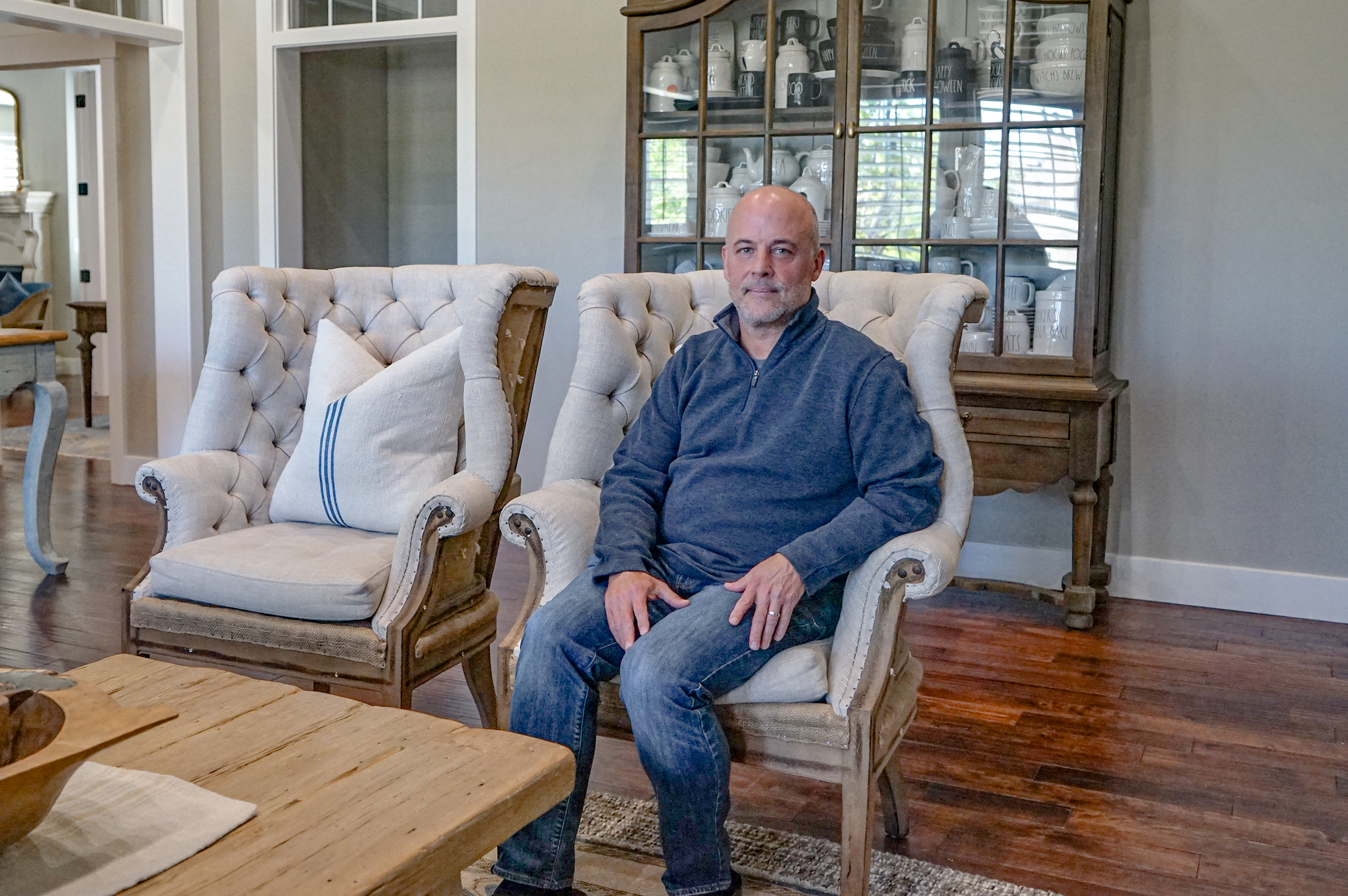
Nathan Money, a hospital pediatrician in Salt Lake County and Utah County in Utah, says it’s “heartbreaking” to see children with measles struggling to breathe. (Amy Maxmen/KFF Health News) Amy Maxmen/KFF Health News
Nathan Money, a hospital pediatrician in Salt Lake County and Utah County: If the child has a fever or trouble breathing, and they’re unvaccinated, I have to be way more aggressive from a medical standpoint, because they are at higher risk of having life-threatening illnesses. I have to do more blood work, or lumbar punctures to rule out meningitis. I have to do things which are painful, and it’s traumatic for the families.
I tell them, “Because your child doesn’t have vaccines, I have to be more worried about conditions like sepsis or meningitis, so therefore I need to do more workup.” The last thing I want to do is miss something. These are parents who love their children. They always tell me, “Do what you need to do to make sure my child is safe.”
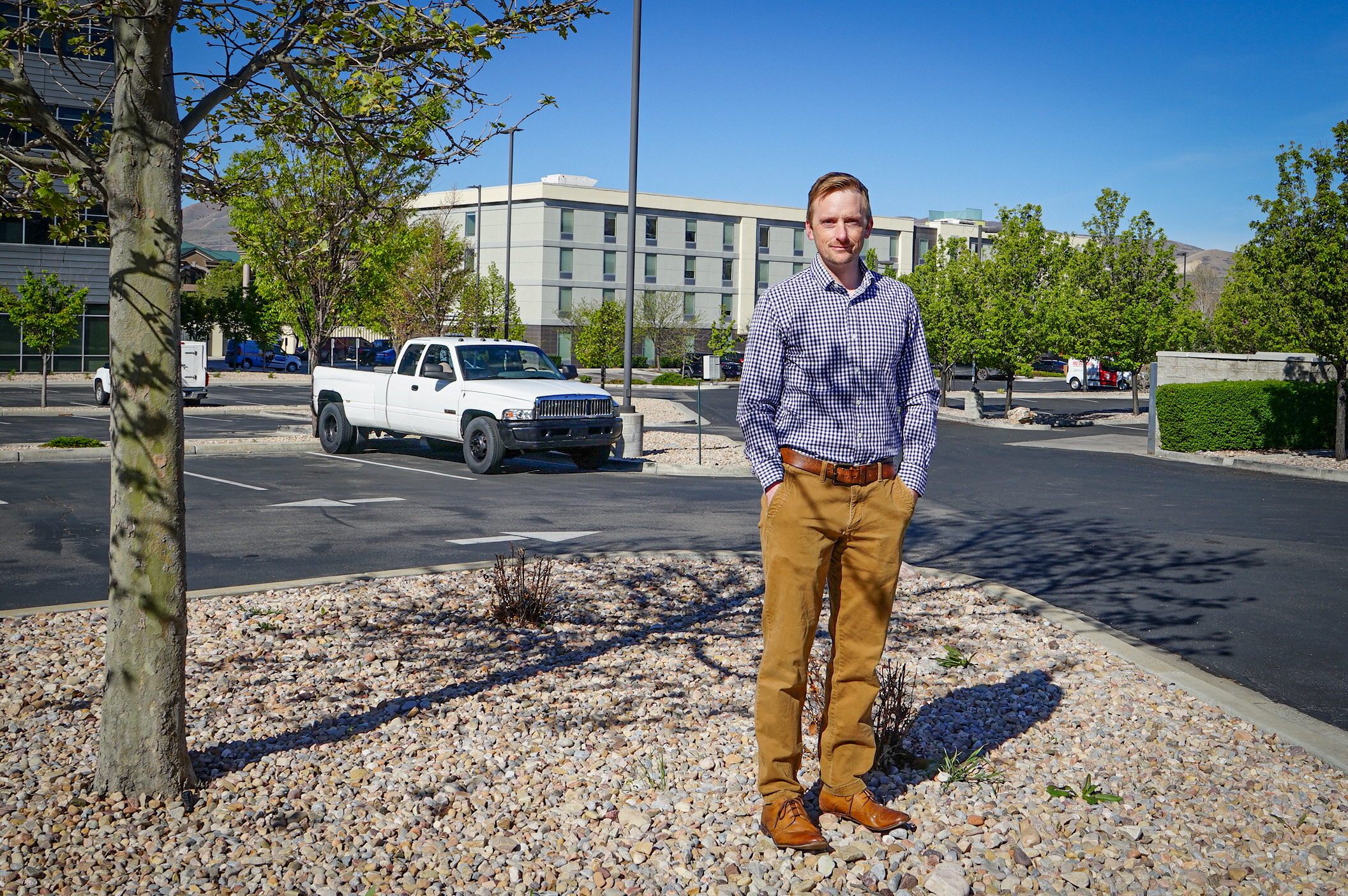
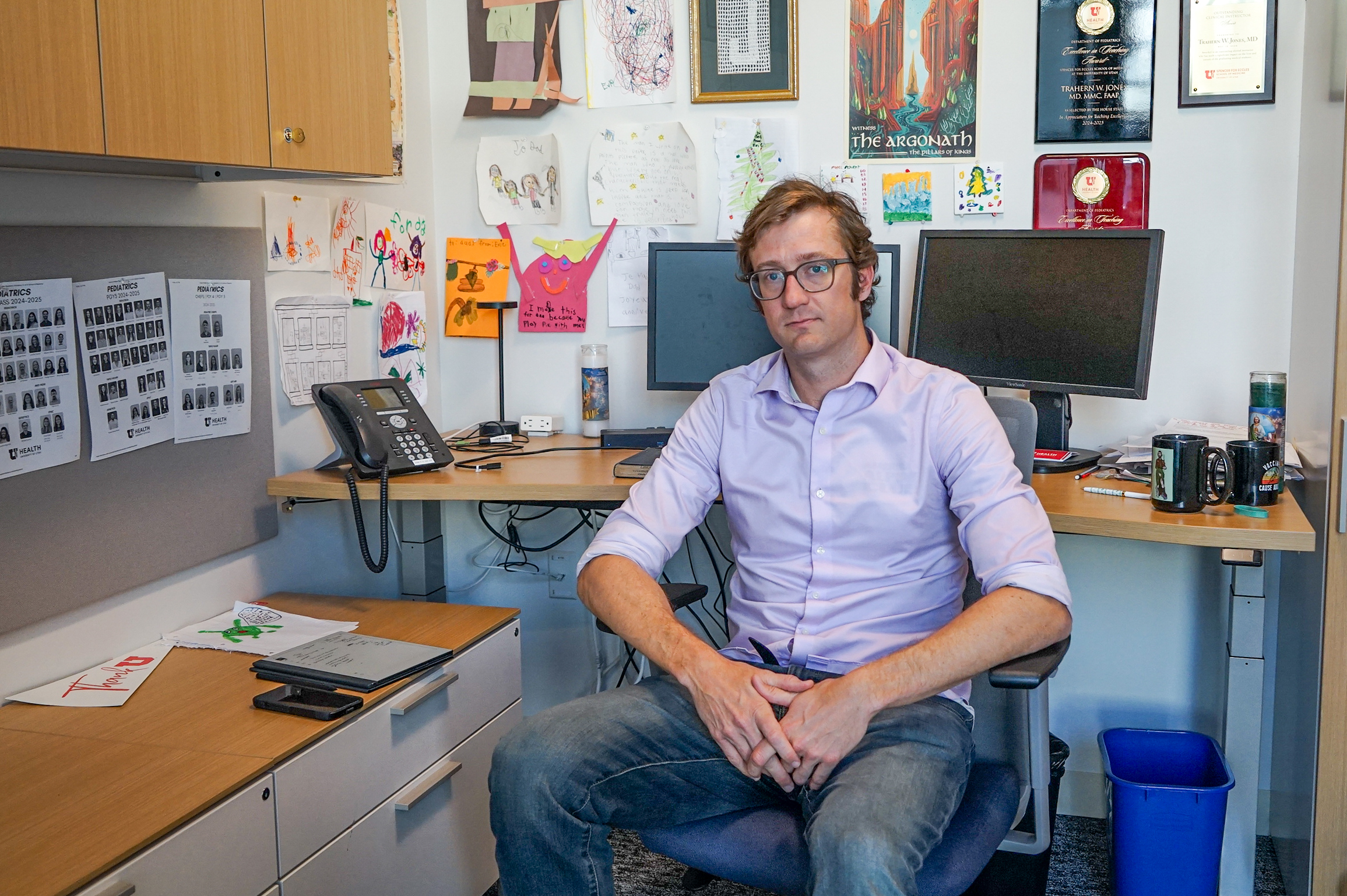
Trahern W. Jones, a pediatric infectious disease specialist based in Salt Lake County, Utah, says parents are often surprised by how severe measles can be. (Amy Maxmen/KFF
Health News)Amy Maxmen/KFF Health News
On treating unvaccinated children hospitalized for measles
Trahern W. Jones, a pediatric infectious disease specialist based in Salt Lake City: So I’m coming into a room and just hearing the most awful barking cough, just a cough and a high-pitch stridor as the child is trying to breathe. And he’s just coughing so hard it just makes you feel short of breath. He looks like he’s been beaten down for days, but he can’t rest, because the cough keeps him awake.
The parents tell me they’re not anti-vaccine, but in the past, somebody they know had a reaction to a vaccine — or something they thought was a reaction to a vaccine — and so they paused vaccines when the child was a baby. They were planning to catch up later.
In another case, the parent was stunned by how awful it was. I asked them what they knew about measles before their child was sick, and they said the only person who’d ever taught them anything about measles was their grandmother who had taken care of her kids with measles ages ago. That’s something I’ve heard from other parents. It’s such an awful illness. Even the best possible course is going to be one of the worst diseases most children ever go through.
There are multiple facets to it. Physically, the child has been beat down for multiple days by this virus. The parents don’t get to sleep, because they’re nursing their child. Then there’s the emotional component because the parent is regretting not getting the vaccine, not realizing how bad this was, and then feeling deeply ashamed, trying to reconcile with family members who are really upset at them for not getting their child vaccinated.
Morris: One child was from a family that was uninsured because they didn’t feel that they would need to use the medical system. They were faced with the high burden of cost of our healthcare system. The cost was playing into the parents’ decision on whether or not their child should receive necessary medical care. I said something like: “Please don’t go home. Your child needs oxygen. She has pneumonia. We will figure out a way to pay for this, because we acknowledge what we do is expensive.”
On top of that, the parent had several other children in the home who weren’t vaccinated. It was past the period where we could intervene with vaccines to try to prevent infection, so then our recommendation was to quarantine their children at home for 21 days: “Don’t interact with anybody else in your community. Don’t go to the grocery store, even with a mask. Please take this seriously.”
It takes time for parents to understand the level of concern I have, even when their child is physically ill in the hospital requiring ongoing care. It’s pretty indicative of the breakdown of trust between physicians and families. I say, “This is the gravity or severity of your child’s situation and how serious we need to be about protecting other people.”
It’s frustrating. How can I make people understand I have a very genuine concern for their child? And I know they share that concern, but maybe it’s not the same degree of concern, because they don’t understand the illness and how severe it can become.
Money: It’s heartbreaking to see these children struggling to survive when measles could have been easily prevented by a safe mechanism that is readily available and well studied. These are well-meaning parents who love their children, who have gotten bad information from federal leadership or from online sources. The saddest part to me is when I am caring for a child and the parent says, “I didn’t know that this could get so bad.”
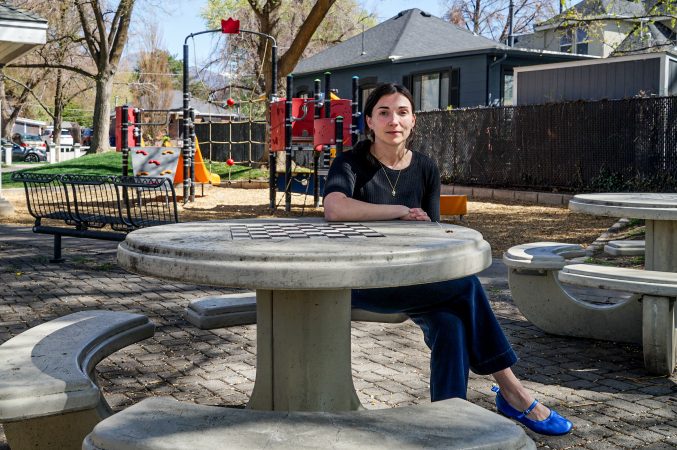
Tim Duffy, a pediatrician in Salt Lake County, Utah, says many parents are concerned about incorrect claims about vaccines seen on social media. (Amy Maxmen/KFF Health
News)Amy Maxmen/KFF Health News
On conversations with parents who don’t vaccinate their children
Tim Duffy, a pediatrician in Salt Lake County: A lot of families aren’t aggressively anti-vax, but they’re hesitant. Younger parents who grew up in the digital age have done their research — “research” in quotation marks — for months. And they keep getting confirmation of their concerns on social media. They think they’re doing what’s best for their child.
I’ve told families: “You could do nothing I say as a pediatrician. You could sleep your child on their stomach. You could not put them in a car seat or, when they’re older, not use seat belts. You could do nothing I say, and for your individual child, they will probably be OK. But from my standpoint, where I’m taking care of thousands of kids, within a system that takes care of hundreds of thousands of kids, we will have bad outcomes. These children will show up at our facilities, and it’s so sad.”
Pediatrician in southern Utah whom KFF Health News agreed not to name, because of concerns about harassment after being targeted by anti-vaccine activists in the past: A lot of parents are concerned about autism. I’ve told them that I’d be very concerned if there was any evidence that what we’re doing is causing autism. But if vaccines were causing autism, we should see more cases of autism in vaccinated kids compared to unvaccinated kids, and we’re just not seeing that.
I’ve also had families who say they want to be natural, or that they’re concerned about what is in the shots. A frequently asked question is: “Did you vaccinate your children?” I say that knowing what I know, I’m confident giving this to my kids. They’re all vaccinated.
On the influence of politics on vaccine hesitancy
Jones: Vaccines have become a political football. That wasn’t true 20 years ago. But now it’s used to drive a wedge between groups of people, which is unfortunate. Vaccines are one of the main reasons why we don’t have to worry about losing our kids.
Southern Utah pediatrician: People don’t know who to believe. If politics comes up, I tell parents that my messaging on vaccines is not politically motivated. When parents ask about changes to the vaccine schedule, I’m transparent. [In January, the Department of Health and Human Services controversially recommended reducing the number of vaccines given to children. A few months later, a federal judge blocked those changes.]
I’ve said there was a process for the approval of immunizations through ACIP [the Advisory Committee on Immunization Practices], which is made up of scientists, public health experts, and doctors, and all those people were let go, and a new panel was selected. A couple of individuals changed the recommendation outside of the time-tested, evidence-based process for evaluating vaccines. That raises concerns for me as a doctor. I tell parents that the American Academy of Pediatrics, the American Academy of Family Physicians, and several other professional organizations have issued statements saying that these changes are not based on evidence.
Ellie Brownstein, a pediatrician in Salt Lake County and president-elect of the Utah chapter of the American Academy of Pediatrics: I avoid talking about politics, but what’s being said has added another layer to our work. One family asked me about changes to vaccine recommendations, so instead of just telling them what immunizations are due, I talk with them about why physicians and researchers have followed a different schedule for years, about the reasoning and the science behind it. I explain that I trust these experts over someone without a lot of experience.
Money: People are not vaccinated, because they’ve lost trust in the medical community. They’re placing trust elsewhere. Rebuilding trust is a complicated process, but it comes from consistent messaging at every level, from the pediatrician to local health departments to community leaders, city leadership, district leadership, religious leadership, educational leadership.
We need consistent messaging from state leadership, which has been pretty absent. I want to see commercials on TV about the safety of the MMR [measles, mumps, and rubella] vaccine and the dangers of the measles, sponsored by my state leadership. I’d like to see this on billboards and in schools, in public buildings and grocery stores. I want to go to a sports event and see messages about the measles and the MMR vaccine. Right now, people have to go out of their way to find information from reputable sources.
We also need policy changes to support vaccination. This train is going in the wrong direction, and it can feel like a helpless situation, because we’re just not seeing the public messaging and leadership that’s needed to turn this around.
Advice on talking with parents who don’t vaccinate their children
Jones: Approach them with as much compassion as you possibly can. Ask open-ended questions to learn about their experiences that led them to have these concerns. I think it’s really important to not come down on them, citing facts and figures and pointing to guidelines on why they need to get their kids vaccinated. But try to direct their attention to the fact that you’re a real person with your own real experiences and knowledge. I point out to families that I have my own kids, and I would never recommend something for your kids that I wouldn’t do for mine.
Southern Utah pediatrician: I’ve learned that if you come down hard, you’re going to lose people who need care. My number one goal now is to build bridges and maintain a relationship with families, because that’s what’s going to allow me to convince some of them.
I approach people differently depending on where they are. Parents who are very skeptical or anti-vax will say no when I tell them their child is due for immunizations. I’ll say: “Fine. You guys get to choose. You’re the parents. But I’m curious to know what your reasoning is.” Sometimes they’re just like, “It’s something I’ve decided.” They don’t want to have a conversation.
It’s a good day if I can have a conversation with someone who doesn’t want to vaccinate, even if I don’t convince them. I try to help them think through things rather than shoving anything down their throat. When they’re done talking, I’ll ask, “Can I share my perspectives on this?” Some will say yes enthusiastically, and others will say yes because they’re being polite.
A lot of parents aren’t sure what to do, and those are the people I focus most of my time on. I focus our conversation on their specific concerns, and I’m open about specific side effects that different immunizations can have. For example, I’ll tell them that some children get a fever after a vaccine, which is OK. The fever is not harmful, but it can make babies feel crummy as their body is building up antibodies against viruses and bacteria.
Brownstein: I don’t like the idea of excluding unvaccinated kids from my practice. I know some do that. But what that does is it ends any future discussion. I can’t keep talking with parents about vaccines if I kick them out of my practice, and if these parents find like-minded doctors, this situation will get worse.
On being on the front lines of measles’ comeback in the U.S.
Money: I wish that people could see what I see. Everyone else sees what people post on Instagram. Or they think, “Someone I know had measles when they were a kid and they were fine.” But as a hospital-based pediatrician, I see what happens when things go poorly. I see what happens when children with measles aren’t able to breathe on their own, and they’re in a hospital bed with a cannula in their nose, struggling to breathe, an IV in their arm because they can’t drink on their own. And the child is terrified, and the parents are scared that their child might die.
It’s heartbreaking as a pediatrician and as a father to know that the entire situation could have been easily prevented.
Duffy: Even though parents say vaccination is their choice, I still feel personally responsible if something bad happens that’s preventable, because I feel like I didn’t say the right thing, I didn’t ask the right questions. Maybe I let it drop because of the look on a parent’s face.
Morris: Every pediatrician I know cares so deeply about what they do. Sometimes people forget that we are human beings practicing this discipline, and we bring all our concerns for our community into this space. I’m trying to navigate a lot of complex human emotions, like how it feels to hold grief with a family when something bad happens that was preventable — which is the worst situation, because you think, “Could I have done something differently?”
Jones: I think we’ll see more diseases start coming back that we thought we had gotten rid of. I think it’s going to take dramatic changes to actually prevent those outcomes. I’m not necessarily seeing those changes being done by those in power.
I think of that quote from The Lord of the Rings. It’s something like, you don’t get to choose the time that you’re born into, but you get to choose what you’re going to do about it. And if there’s any comfort that I have, it’s in knowing that there are right decisions to make and that I’m going to make them, and I’m going to help others make them, too.
KFF Health News is a national newsroom that produces in-depth journalism about health issues and is one of the core operating programs at KFF — the independent source for health policy research, polling, and journalism.